EP2851453A1 - Metal plate for electrode and electrode - Google Patents
Metal plate for electrode and electrode Download PDFInfo
- Publication number
- EP2851453A1 EP2851453A1 EP14002711.1A EP14002711A EP2851453A1 EP 2851453 A1 EP2851453 A1 EP 2851453A1 EP 14002711 A EP14002711 A EP 14002711A EP 2851453 A1 EP2851453 A1 EP 2851453A1
- Authority
- EP
- European Patent Office
- Prior art keywords
- electrode
- metal plate
- conductance
- fine irregular
- irregular surface
- Prior art date
- Legal status (The legal status is an assumption and is not a legal conclusion. Google has not performed a legal analysis and makes no representation as to the accuracy of the status listed.)
- Withdrawn
Links
Images



Classifications
-
- C—CHEMISTRY; METALLURGY
- C25—ELECTROLYTIC OR ELECTROPHORETIC PROCESSES; APPARATUS THEREFOR
- C25B—ELECTROLYTIC OR ELECTROPHORETIC PROCESSES FOR THE PRODUCTION OF COMPOUNDS OR NON-METALS; APPARATUS THEREFOR
- C25B11/00—Electrodes; Manufacture thereof not otherwise provided for
- C25B11/02—Electrodes; Manufacture thereof not otherwise provided for characterised by shape or form
-
- C—CHEMISTRY; METALLURGY
- C25—ELECTROLYTIC OR ELECTROPHORETIC PROCESSES; APPARATUS THEREFOR
- C25C—PROCESSES FOR THE ELECTROLYTIC PRODUCTION, RECOVERY OR REFINING OF METALS; APPARATUS THEREFOR
- C25C7/00—Constructional parts, or assemblies thereof, of cells; Servicing or operating of cells
- C25C7/02—Electrodes; Connections thereof
-
- C—CHEMISTRY; METALLURGY
- C25—ELECTROLYTIC OR ELECTROPHORETIC PROCESSES; APPARATUS THEREFOR
- C25D—PROCESSES FOR THE ELECTROLYTIC OR ELECTROPHORETIC PRODUCTION OF COATINGS; ELECTROFORMING; APPARATUS THEREFOR
- C25D5/00—Electroplating characterised by the process; Pretreatment or after-treatment of workpieces
- C25D5/60—Electroplating characterised by the structure or texture of the layers
- C25D5/605—Surface topography of the layers, e.g. rough, dendritic or nodular layers
Definitions
- the present invention relates to a metal plate for an electrode and an electrode used in electrolysis.
- platinized titanium plates are generally used as an electrode material from a viewpoint of its low overvoltage, low elution property, the cost, and so forth.
- a structure has been proposed (Japanese Patent No. 3467954 ). In this structure, an irregularity portion having a height of 0.5 mm or more is formed on a discharging surface of an electrode for electrolysis.
- the present invention has been proposed in view of the above-described situation, and an object of the present invention is to provide a metal plate for an electrode and an electrode used in electrolysis of high electrolysis efficiency.
- a metal plate for an electrode according to the present invention is a metal plate for an electrode used in electrolysis performed in an aqueous solution or an organic solvent.
- the metal plate for an electrode includes a fine irregular surface.
- a ratio Ra/Pc of the fine irregular surface which is a ratio of an arithmetic mean roughness Ra in ⁇ m to a peak count Pc in counts/mm, is equal to or more than 0.8.
- the irregularities of the electrode surface inhibit the flow of electrolyte solution near the electrode, thereby obstructing transportation of ions involved in a reaction.
- the flow of the electrolyte solution is changed near this electrode. This varies the degree with which the transportation of the ions is obstructed, and accordingly, the conductance varies.
- the ratio Ra/Pc correlates with the amount of the ions, the transportation of which is obstructed by the inhibition of the flow of the electrolyte solution near the electrode, that is, the conductance.
- the metal plate for an electrode includes the fine irregular surface, of which the ratio Ra/Pc is equal to or more than 0.8, a high conductance is obtained, and accordingly, electrolysis efficiency in electrolysis using the metal plate for an electrode is improved.
- a maximum height roughness Rz of the fine irregular surface is preferably equal to or less than 50 ⁇ m.
- the maximum height roughness Rz of the fine irregular surface exceeds the above-described upper limit, it is difficult to form irregularities, the intervals of which between adjacent peaks or valleys are further reduced, in the fine irregular surface.
- the maximum height roughness Rz of the fine irregular surface is equal to or less than the above-described upper limit, the electrolysis efficiency in the electrolysis using the metal plate for an electrode is further improved.
- the arithmetic mean roughness Ra of the fine irregular surface is preferably from 3.6 to 10 ⁇ m.
- the arithmetic mean roughness Ra of the fine irregular surface is less than the above-described lower limit, it is difficult to increase the ratio Ra/Pc.
- the arithmetic mean roughness Ra of the fine irregular surface exceeds the above-described upper limit, the peak count Pc of the fine irregular surface tends to increase. Thus, it is difficult to increase the ratio Ra/Pc.
- the arithmetic mean roughness Ra of the fine irregular surface is within the above-described range, a high conductance can be reliably obtained, and accordingly, the electrolysis efficiency in the electrolysis using the metal plate for an electrode is further improved.
- the peak count Pc of the fine irregular surface is preferably from 0.5 to 5 counts/mm.
- the peak count Pc of the fine irregular surface exceeds the above-described upper limit, it is difficult to increase the ratio Ra/Pc.
- the peak count Pc of the fine irregular surface is less than the above-described lower limit, the arithmetic mean roughness Ra of the fine irregular surface tends to decrease. Thus, it is difficult to increase the ratio Ra/Pc.
- the peak count Pc of the fine irregular surface is within the above-described range, a high conductance can be reliably obtained, and accordingly, the electrolysis efficiency in the electrolysis using the metal plate for an electrode is further improved.
- the fine irregular surface of the metal plate for an electrode preferably has irregularities that form a periodical geometric pattern.
- the fine irregular surface has the irregularities that form periodical geometric pattern, compared to the case of random irregularities, the obtained conductance can be increased, and accordingly, the electrolysis efficiency in the electrolysis using the metal plate for an electrode is reliably improved.
- the irregularities of the metal plate for an electrode are preferably formed by rolling.
- the metal plate for an electrode by which a high conductance can be obtained, can be easily fabricated, and the cost of an electrode for electrolysis can be reduced.
- the metal plate for an electrode preferably contains titanium as the principal component. Since titanium has a good chemical resistance and is unlikely to be corroded, by containing the titanium as the principal component of the metal plate for an electrode, a stable electrolysis process is performed even when an electrolyte solution having a high reactivity permeates the plating of an electrode, which is formed of titanium and plated with a precious metal, through pinholes.
- the electrode is preferably formed of the above-described metal plate for an electrode.
- the electrode formed of the above-described metal plate for an electrode allows the electrolysis efficiency in the electrolysis to be improved compared to that achieved by the related-art electrode.
- the above-described arithmetic mean roughness Ra and the maximum height roughness Rz are measured with the cut-off value ⁇ c of 0.8 mm in conformity with Japanese Industrial Standards (JIS) B 0601:2001.
- the above-described peak count Pc is measured with the cut-off value of 0.8 mm, the cut-off ratio of 300, and the peak count level 2H of 1 ⁇ m in conformity with the International Organization for Standardization (ISO) standard 4288-1998.
- the electrode formed of the metal plate for an electrode according to the present invention has a high conductance.
- electrolysis efficiency is improved by using the metal plate for an electrode according to the present invention.
- a metal plate for an electrode according to an embodiment used in electrolysis is used in electrolysis performed in an aqueous solution or an organic solvent and has a fine irregular surface.
- the ratio Ra/Pc of the arithmetic mean roughness Ra (in ⁇ m) to the peak count Pc (in counts/mm) of this irregular surface is equal to or more than 0.8.
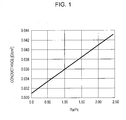
- the inventors have found that the conductance obtained by an electrode formed of a metal plate for an electrode varies depending on the shape of a surface of the metal plate for an electrode contributing to electrolysis and that the ratio Ra/Pc of the arithmetic mean roughness Ra (in ⁇ m) to the peak count Pc (counts/mm) of the electrode surface correlates to the conductance as illustrated in Fig. 1 .
- Fig. 1 illustrates a multiple regression line obtained as follows: surface profiles of a plurality of metal plates for an electrode, the surface of which have different irregularities, were measured; the metal plates for an electrode were platinized and used as the electrodes; the I-V characteristics during electrolysis were measured and the conductance was obtained; and the measured results were subjected to a multiple regression analysis.
- the arithmetic mean roughnesses Ra and the peak counts Pc were measured under the following conditions: the cut-off value ⁇ c is 800 ⁇ m, the cut-off ratio is 300, the measurement length is 4 mm, the measurement speed is 0.6 mm/second, and the peak count level 2H is 1 ⁇ m.
- the plurality of titanium plates were platinized so as to make electrodes, which was subjected to electrolysis where the platinized electrodes were used as counter electrodes.
- the peak count refers to a total count counted as follows: an upper peak count level, which is 1 ⁇ m separated from the center line of the roughness curve of the titanium plate surface at a peak count level (2H), is set, and when there are two intersections of the upper peak count level and the roughness curve, it is counted as a peak.
- the conductance is about 0.030 G/cm 2 when a mirror-finished platinum plate is used as the electrode.
- the conductance is equal to or more than 0.035 G/cm 2 in accordance with the multiple regression line illustrated in Fig. 1 . From this, it can be understood that a conductance higher than that of a smooth electrode (mirror-finished platinum plate electrode) can be obtained. That is, by forming the irregularities in the surface, of which the above-described ratio Ra/Pc is equal to or more than 0.8, a metal plate for an electrode, by which a high conductance can be obtained, can be made.
- the surface area is larger than the apparent electrode area.
- the conductance obtained by such a platinized electrode plate may be less than the conductance obtained by a smooth electrode (mirror-finished platinum electrode), the surface area of which is substantially equal to its apparent surface area, depending on the shape of the irregularities. From this finding, the inventors have found that the increase in the surface area due to the irregularities of the electrode surface does not necessarily contribute to an increase in the conductance.
- the inventors thought that a platinized electrode having irregularities on its surface and by which a larger conductance than that obtained by a smooth electrode (mirror-finished platinum electrode) has a substantially optimum structure of irregularities and is highly efficient.
- the inventors have subsequently found the parameter for irregularities relating to the conductance as described above with reference to the conductance obtained by the smooth electrode.
- electrode reaction occurs in electrolysis as follows: that is, ions move in an electrolyte solution, are activated near a surface of an electrode, and exchange charges on the electrode.
- Figs. 2A and 2B are conceptual views of the electrode reaction.
- Fig. 2A illustrates a state of a potential E near an electrode interface.
- Fig. 2B is an enlarged conceptual view of part of an electric double layer 3 near an electrode 1 in Fig. 2A .
- dipoles 5 are formed of the ions attracted by the potential of the electrode 1 near the electrode 1, the potential E of the electrode linearly changes in a Helmholtz layer 6 immediately adjacent to the electrode 1. Alignment of the dipoles 5 are gradually disturbed on a side further from the electrode 1 than the Helmholtz layer 6. Thus, the potential E gently reduces in a Gouy-Chapman layer 7. On a side further from the electrode 1 than the Gouy-Chapman layer 7, charges of ions having positive charges and charges of ions having negative charges cancel out one another, thereby maintaining an electrically neutral state. In general, in a size larger than a length represented by a Debye length, positive and negative charges cancel out one another. Thus, the state is generally neutral and there is no effect of the potential of the electrode 1.
- the electric double layer 3 is generally several to 50 times thicker than an atom or a molecule. Ions contributing to the reaction are not affected by the electrical attractive force until they reach the electric double layer 3.
- a diffusion layer 4 of 10 -3 cm or less is provided on a side further from the electrode 1 than the electric double layer 3.
- the diffusion of ions in the diffusion layer 4 is controlled mainly by random motions and follows the Stokes-Einstein Relationship.
- a diffusion coefficient representing the diffusion is a function of the viscosity of the electrolyte, the temperature of the solution, and the diameter of the ions. Considering that electrolysis is typically performed at a constant temperature, the diffusion coefficient is the function of the viscosity of the electrolyte.
- the ions contributing to the electrode reaction move from a convection and diffusion region 2 located further away from the electrode 1 than the diffusion layer 4.
- the ions are affected by voluntary stirring due to, for example, the convection of the electrolyte solution and forced bubbles.
- the ion concentration of the diffusion layer 4 is changed by the electrode reaction, and accordingly, a concentration gradient of the ions is formed, thereby facilitating the diffusion.
- speeds of reactions including the diffusion of the ions toward the electrode need to be increased in every reacting path.
- the lower limit of the ratio Ra/Pc of the arithmetic mean roughness Ra (in ⁇ m) to the peak count Pc (counts/mm) is more preferably 1.2.
- the upper limit of the above-described ratio Ra/Pc is preferably 4.
- the ratio Ra/Pc is equal to or more than the above-described lower limit, a high conductance of 0.37 G/cm 2 or more can be obtained by a titanium plate, and the conductance can be increased after the titanium plate has been platinized.
- the ratio Ra/Pc exceeds the upper limit, it is difficult to form a fine irregular surface having a shape, by which such a high conductance can be obtained. This may lead to an increase in the production cost.
- the upper limit of the maximum height roughness Rz of the above-described fine irregular surface is preferably 50 ⁇ m, and more preferably 40 ⁇ m.
- the maximum height roughness Rz of the fine irregular surface exceeds the upper limit, it is difficult to form irregularities in which intervals between adjacent peaks or valleys are further reduced. As a result, the conductance obtained by the metal plate for an electrode cannot be further improved.
- the lower limit of the arithmetic mean roughness Ra of the fine irregular surface is preferably 3.6 ⁇ m, and more preferably 4 ⁇ m.
- the upper limit of the arithmetic mean roughness Ra of the fine irregular surface is preferably 10 ⁇ m, and more preferably 7 ⁇ m.
- the arithmetic mean roughness Ra of the fine irregular surface is less than the lower limit, it is difficult to increase the ratio Ra/Pc, and accordingly, the conductance obtained by the metal plate for an electrode cannot be improved.
- the arithmetic mean roughness Ra of the fine irregular surface exceeds the upper limit, the peak count Pc of the fine irregular surface tends to increase. Thus, it is difficult to increase the ratio Ra/Pc, and accordingly, the conductance obtained by the metal plate for an electrode cannot be improved.
- the lower limit of the peak count Pc of the fine irregular surface is preferably 0.5 counts/mm, and more preferably 1.5 counts/mm.
- the upper limit of the peak count Pc of the fine irregular surface is preferably 5 counts/mm, and more preferably 4.5 counts/mm.
- the peak count Pc of the fine irregular surface exceeds the upper limit, it is difficult to increase the ratio Ra/Pc, and accordingly, the conductance obtained by the metal plate for an electrode cannot be improved.
- the peak count Pc of the fine irregular surface is less than the lower limit, the arithmetic mean roughness Ra of the fine irregular surface tends to decrease. Thus, it is difficult to increase the ratio Ra/Pc, and accordingly, the conductance obtained by the metal plate for an electrode cannot be improved.
- irregularities of the fine irregular surface irregularities that form a periodical geometric pattern are desirable compared to random irregularities.
- the solution regularly flows near the electrode surface, and accordingly, obstruction of transportation of ions near the electrode surface is reduced.
- the ions are activated near the electrode surface, thereby reliably improving the conductance.
- the material of the electrode may be a material other than titanium.
- the material of the electrode may be tantalum, niobium, zirconium, hafnium, vanadium, molybdenum, tungsten, or an alloy of any of these materials.
- the electrode material may be plated with a precious metal other than platinum.
- the electrode material may be gold-plated or rhodium-plated.
- the irregularities of the surfaces and the conductances of the sample electrodes according to the first to third examples and the first comparative example were measured.
- the conductances were measured by performing an electrolysis experiment.
- the irregularities of the surfaces of these samples were measured with a surface roughness tester (SURFCOM 130A by TOKYO SEIMITSU CO., LTD.).
- the arithmetic mean roughnesses Ra (in ⁇ m) and the peak counts Pc (in counts/mm) of the surfaces of the sample electrodes were measured under the following conditions: the cut-off value ⁇ c is 800 ⁇ m, the cut-off ratio is 300, the measurement length is 4 mm, the measurement speed is 0.6 mm/second, and the peak count level 2H is 1 ⁇ m.
- each sample electrode was masked by polyimide tape with a 10 mm x 10 mm region of the surface of the sample electrode exposed from the mask.
- a ⁇ 0.5 mm stainless steel wire formed of a stainless steel specified as Steel Use Stainless (SUS) 304 in the Japanese Industrial Standards was firmly wound around each of the sample electrodes, and secured by crimping. Junctions with copper wires were sealed by epoxy resin (by Stycast 2057 and Catalyst 11 by Henkel Japan Ltd.).
- a 3-liter beaker was filled with an electrolyte solution containing 3.5 percent by mass of NaCl conforming to Japanese pharmacopoeia.
- the sample electrodes opposed counter electrodes (platinized) in the electrolyte solution such that a 10-mm gap was set between each of the sample electrodes and a corresponding one of the counter electrodes.
- 105.0 g of NaCl was put into the 3-liter beaker, and after that, pure water was poured into the beaker to the measurement mark to dissolve the NaCl in the pure water.
- a stirrer and a diaphragm pump were used to spray the electrolyte solution onto the electrode surface and stir the electrolyte solution.
- a power unit was programmed so as to perform a sweep from 0 to 5 V in about 13 seconds. At this time, the electrode voltage and the current were measured with a data logger. The current was measured from the voltage of a shunt resistor connected to circuitry. The conductance of the electrolyte solution was measured before and after the measurement so as to confirm that the electrolyte solution was not significantly changed by the electrolysis.
- Table 1 shows results of the measurement of the surface profiles and results of the measurement in the electrolysis experiment of the sample electrodes according to the first to third examples and the first comparative example. Table 1 also shows the ratios Ra/Pc of the examples and the comparative example. Table 1 Sample name Ra ( ⁇ m) Pc (counts/mm) Ra/Pc Conductance (G/cm 2 ) First example 4.0 1.75 2.29 0.043 Second example 5.4 3.75 1.44 0.040 Third example 3.7 4.50 0.82 0.038 First comparative example 3.5 6.00 0.58 0.031
- a high conductance can be obtained by each of the sample electrodes according to the first to third examples.
- the conductance obtained by the electrode of the first example, which has periodical irregularities, is higher than the conductances obtained by the electrodes of the second and the third examples, which have random irregularities.
- the inventors fabricated a plurality of titanium plates, the surfaces of which have different irregularities, on the basis of the above-described electrolysis model.
- Sample electrodes were made by platinizing these titanium plates and subjected to electrolysis in an NaCl solution.
- the conductances of the electrodes were obtained from the electrolytic characteristics measured in this electrolysis, and the dependency of the conductance on the structure of the irregularities was studied.
- the surface areas and the conductances of the metal plates for an electrode, the surfaces of which have different irregularities were measured. Electrodes were made by platinizing titanium plates in a pinhole free manner, and a plurality of metal plates for an electrode, the surfaces of which have different irregularities, are fabricated. The surface areas and the conductance of these metal plates for an electrode were measured.
- the above-described irregularities formed on the electrode surfaces were the following four types: periodical irregularities having the maximum height roughnesses Rz of the irregularities of 15 ⁇ m and 30 ⁇ m; and random irregularities formed of high and low steps made by machining with reduction rollers, the surfaces of which were made by electrical discharge machining.
- the periodical irregularities formed here may be referred to as embossed structures hereafter.
- the I-V characteristics were measured while changing the applied voltage from 0 to 5 V in about 13 seconds with a programmable power unit, thereby obtaining the conductances.
- the surface areas of the metal plates for an electrode were measured by a confocal laser scanning microscope (OLS31-SU by Olympus Corporation). Thus, the relationships between the surface areas and the conductances were evaluated.
- the surface area of the metal plate for an electrode is increased.
- the reason for this is as follows: that is, by increasing the surface area of the metal plate for an electrode, it is thought that many charges for reactions can be imparted.
- the conductances are reduced in some cases despite the increase in the surface areas.
- the reason for this is that the irregularities for increasing the surface area are assumed to inhibit diffusion of active species near the surface of the electrode.
- the surface area of the electrode is not only the parameter that determines conductance.
- a non-platinized pure titanium plate and a platinized titanium plate were used as electrodes and the I-V characteristics of these electrodes were measured. The relationships among the characteristics of the titanium plate electrode and the platinized electrode were studied.
- the pure titanium plate and the platinized titanium plate used as sample electrodes were made to have a size of 1 cm x 1 cm, and a 2 cm x 2 cm platinized titanium plate was used as a counter electrode.
- a slight electrolytic current flows from about 1.1 V, and then, the current significantly increases from about 2.1 V
- an electrolytic current flows from about 1.7 V, and then, the current steeply rises from about 3.5 V.
- the reason for this is that, in the case of the titanium plate electrode, such a degree of a potential that cuts the bonding between hydrogen and titanium (over voltage) needs to be applied in order to start electrolysis.
- a current change amount with respect to the voltage change in the titanium plate electrode after the electrolysis has started substantially coincides with a current change amount with respect to the voltage change in the platinized electrode.
- a change in the conductance of the titanium plate electrode after the electrolysis has started correlates to a change in the conductance of the platinized electrode.
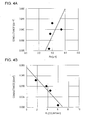
- Fig. 4A illustrates the relationships among the arithmetic mean roughnesses Ra and the conductances in the fine irregular surfaces of the sample electrodes according to the first to third examples and the first comparative example
- Fig. 4B illustrates the relationships among the peak counts Pc and the conductances.
- a multiple regression line obtained by a multiple regression analysis is shown.
- Fig. 5 illustrates the relationship between the cut-off value ⁇ c and a coefficient of determination R 2 obtained by a multiple regression analysis.
- square plots represent the relationship between the conductance and the arithmetic mean roughness Ra
- circular plots represent the relationship between the conductance and the peak count Pc.
- the arithmetic mean roughness Ra and the peak count Pc of the fine irregular surface of the titanium that has not yet undergone platinization and blasting correlate with the conductance of the platinized electrode.
- the metal plate for an electrode and the electrode formed of this metal plate for an electrode can be preferably used in an apparatus such as an electrolysis apparatus used to perform electrolysis in an aqueous solution or an organic solvent.
Landscapes
- Chemical & Material Sciences (AREA)
- Engineering & Computer Science (AREA)
- Chemical Kinetics & Catalysis (AREA)
- Electrochemistry (AREA)
- Materials Engineering (AREA)
- Metallurgy (AREA)
- Organic Chemistry (AREA)
- Electrodes For Compound Or Non-Metal Manufacture (AREA)
Abstract
Description
- This application claims the benefit of priority based on Japanese Patent Application No.
2013-193463 filed on September 18, 2013 - The present invention relates to a metal plate for an electrode and an electrode used in electrolysis.
- In the field of electrolysis, platinized titanium plates are generally used as an electrode material from a viewpoint of its low overvoltage, low elution property, the cost, and so forth. In order to extend the electrode life of such platinized titanium plates, a structure has been proposed (Japanese Patent No.
3467954 - In the field of electrolysis, high energy efficiency, that is, high electrolysis efficiency is demanded. With the above-described related art, in which the 0.5-mm or more irregularity portion is formed on the electrode surface, the surface area can be increased, and accordingly, contribution to improvement of the electrolysis efficiency is expected.
- As the surface area of the above-described related-art electrode for electrolysis is increased, electrolysis efficiency achieved with this electrode for electrolysis is slightly improved. However, the surface area does not correlate with the conductance (electrolysis efficiency). Thus, presently, the conductance does not linearly increase as the surface area increases.
- The present invention has been proposed in view of the above-described situation, and an object of the present invention is to provide a metal plate for an electrode and an electrode used in electrolysis of high electrolysis efficiency.
- In order to address the above-described problem, a metal plate for an electrode according to the present invention is a metal plate for an electrode used in electrolysis performed in an aqueous solution or an organic solvent. The metal plate for an electrode includes a fine irregular surface. A ratio Ra/Pc of the fine irregular surface, which is a ratio of an arithmetic mean roughness Ra in µm to a peak count Pc in counts/mm, is equal to or more than 0.8.
- The inventors studied the relationship between the surface profile and the conductance of an electrode because they have found that the conductance obtained by an electrode varies depending on the shape of a surface of the electrode that contributes to electrolysis. As a result, the inventors have found that the ratio Ra/Pc of the arithmetic mean roughness Ra (in µm) to the peak count Pc (in counts/mm) of the surface of the titanium plate correlates to the conductance, and specifically, by setting the ratio Ra/Pc to equal to or more than 0.8, a high conductance can be obtained. Although the reason for the correlation of the above-described ratio Ra/Pc to the conductance is uncertain, it is assumed as follows.
- The irregularities of the electrode surface inhibit the flow of electrolyte solution near the electrode, thereby obstructing transportation of ions involved in a reaction. Depending on the shape the irregularities of the electrode surface, the flow of the electrolyte solution is changed near this electrode. This varies the degree with which the transportation of the ions is obstructed, and accordingly, the conductance varies. Out of the parameters relating to the surface profile, it is thought that the ratio Ra/Pc correlates with the amount of the ions, the transportation of which is obstructed by the inhibition of the flow of the electrolyte solution near the electrode, that is, the conductance.
- Thus, when the metal plate for an electrode includes the fine irregular surface, of which the ratio Ra/Pc is equal to or more than 0.8, a high conductance is obtained, and accordingly, electrolysis efficiency in electrolysis using the metal plate for an electrode is improved.
- A maximum height roughness Rz of the fine irregular surface is preferably equal to or less than 50 µm. When the maximum height roughness Rz of the fine irregular surface exceeds the above-described upper limit, it is difficult to form irregularities, the intervals of which between adjacent peaks or valleys are further reduced, in the fine irregular surface. When the maximum height roughness Rz of the fine irregular surface is equal to or less than the above-described upper limit, the electrolysis efficiency in the electrolysis using the metal plate for an electrode is further improved.
- The arithmetic mean roughness Ra of the fine irregular surface is preferably from 3.6 to 10 µm. When the arithmetic mean roughness Ra of the fine irregular surface is less than the above-described lower limit, it is difficult to increase the ratio Ra/Pc. When the arithmetic mean roughness Ra of the fine irregular surface exceeds the above-described upper limit, the peak count Pc of the fine irregular surface tends to increase. Thus, it is difficult to increase the ratio Ra/Pc. When the arithmetic mean roughness Ra of the fine irregular surface is within the above-described range, a high conductance can be reliably obtained, and accordingly, the electrolysis efficiency in the electrolysis using the metal plate for an electrode is further improved.
- The peak count Pc of the fine irregular surface is preferably from 0.5 to 5 counts/mm. When the peak count Pc of the fine irregular surface exceeds the above-described upper limit, it is difficult to increase the ratio Ra/Pc. When the peak count Pc of the fine irregular surface is less than the above-described lower limit, the arithmetic mean roughness Ra of the fine irregular surface tends to decrease. Thus, it is difficult to increase the ratio Ra/Pc. When the peak count Pc of the fine irregular surface is within the above-described range, a high conductance can be reliably obtained, and accordingly, the electrolysis efficiency in the electrolysis using the metal plate for an electrode is further improved.
- The fine irregular surface of the metal plate for an electrode preferably has irregularities that form a periodical geometric pattern. When the fine irregular surface has the irregularities that form periodical geometric pattern, compared to the case of random irregularities, the obtained conductance can be increased, and accordingly, the electrolysis efficiency in the electrolysis using the metal plate for an electrode is reliably improved.
- The irregularities of the metal plate for an electrode are preferably formed by rolling. In this case, the metal plate for an electrode, by which a high conductance can be obtained, can be easily fabricated, and the cost of an electrode for electrolysis can be reduced.
- The metal plate for an electrode preferably contains titanium as the principal component. Since titanium has a good chemical resistance and is unlikely to be corroded, by containing the titanium as the principal component of the metal plate for an electrode, a stable electrolysis process is performed even when an electrolyte solution having a high reactivity permeates the plating of an electrode, which is formed of titanium and plated with a precious metal, through pinholes.
- The electrode is preferably formed of the above-described metal plate for an electrode. The electrode formed of the above-described metal plate for an electrode allows the electrolysis efficiency in the electrolysis to be improved compared to that achieved by the related-art electrode.
- The above-described arithmetic mean roughness Ra and the maximum height roughness Rz are measured with the cut-off value λc of 0.8 mm in conformity with Japanese Industrial Standards (JIS) B 0601:2001. The above-described peak count Pc is measured with the cut-off value of 0.8 mm, the cut-off ratio of 300, and the peak count level 2H of 1µm in conformity with the International Organization for Standardization (ISO) standard 4288-1998.
- As described above, the electrode formed of the metal plate for an electrode according to the present invention has a high conductance. Thus, electrolysis efficiency is improved by using the metal plate for an electrode according to the present invention.
-
-
Fig. 1 is a graph illustrating the relationship between a value of Ra/Pc of a titanium plate for an electrode and the conductance of an electrode formed by platinizing this titanium plate; -
Figs. 2A and 2B are conceptual views illustrating an electrode reaction; -
Fig. 3 is a graph illustrating the I-V characteristics in the titanium plate electrode and the platinized electrode; -
Fig. 4A is a graph illustrating the relationships among the arithmetic mean roughnesses Ra (at the cut-off value λc of 800 µm) of the titanium plates for an electrode and the conductances of the electrodes formed by platinizing these titanium plates, andFig. 4B is a graph illustrating the relationships among the peak counts Pc (at the cut-off value λc of 800 µm) and the conductances; and -
Fig. 5 is a graph illustrating the relationship between the cut-off value λc and a coefficient of determination R2 between the conductance and the arithmetic mean roughness Ra and between the conductance and the peak count Pc. - Embodiments of a metal plate for an electrode according to the present invention will be described below.
- A metal plate for an electrode according to an embodiment used in electrolysis is used in electrolysis performed in an aqueous solution or an organic solvent and has a fine irregular surface. The ratio Ra/Pc of the arithmetic mean roughness Ra (in µm) to the peak count Pc (in counts/mm) of this irregular surface is equal to or more than 0.8.
- The inventors have found that the conductance obtained by an electrode formed of a metal plate for an electrode varies depending on the shape of a surface of the metal plate for an electrode contributing to electrolysis and that the ratio Ra/Pc of the arithmetic mean roughness Ra (in µm) to the peak count Pc (counts/mm) of the electrode surface correlates to the conductance as illustrated in
Fig. 1 . -
Fig. 1 illustrates a multiple regression line obtained as follows: surface profiles of a plurality of metal plates for an electrode, the surface of which have different irregularities, were measured; the metal plates for an electrode were platinized and used as the electrodes; the I-V characteristics during electrolysis were measured and the conductance was obtained; and the measured results were subjected to a multiple regression analysis. - Specifically, in the above-described measurement, the arithmetic mean roughnesses Ra (in µm) and the peak counts Pc (in counts/mm) of a plurality of titanium plates (non-platinized titanium plates), the surfaces of which have different irregularities, were initially measured. The arithmetic mean roughnesses Ra and the peak counts Pc were measured under the following conditions: the cut-off value λc is 800 µm, the cut-off ratio is 300, the measurement length is 4 mm, the measurement speed is 0.6 mm/second, and the peak count level 2H is 1 µm. The plurality of titanium plates were platinized so as to make electrodes, which was subjected to electrolysis where the platinized electrodes were used as counter electrodes. At this time, applied voltage and current were measured, and the conductance was obtained from the I-V characteristics. In accordance with the measurement results, a multiple regression analysis, in which the ratio Ra/Pc is the predictor variable and the conductance is the criterion variable, was performed, and the multiple regression line illustrated in
Fig. 1 was obtained. - The peak count refers to a total count counted as follows: an upper peak count level, which is 1 µm separated from the center line of the roughness curve of the titanium plate surface at a peak count level (2H), is set, and when there are two intersections of the upper peak count level and the roughness curve, it is counted as a peak.
- Here, the conductance is about 0.030 G/cm2 when a mirror-finished platinum plate is used as the electrode. Thus, when the above described ratio Ra/Pc is equal to or more than 0.8, the conductance is equal to or more than 0.035 G/cm2 in accordance with the multiple regression line illustrated in
Fig. 1 . From this, it can be understood that a conductance higher than that of a smooth electrode (mirror-finished platinum plate electrode) can be obtained. That is, by forming the irregularities in the surface, of which the above-described ratio Ra/Pc is equal to or more than 0.8, a metal plate for an electrode, by which a high conductance can be obtained, can be made. - Since the electrode plate formed by platinizing the titanium plate has irregularities on its surface, the surface area is larger than the apparent electrode area. However, the inventors have found that the conductance obtained by such a platinized electrode plate may be less than the conductance obtained by a smooth electrode (mirror-finished platinum electrode), the surface area of which is substantially equal to its apparent surface area, depending on the shape of the irregularities. From this finding, the inventors have found that the increase in the surface area due to the irregularities of the electrode surface does not necessarily contribute to an increase in the conductance.
- Accordingly, the inventors thought that a platinized electrode having irregularities on its surface and by which a larger conductance than that obtained by a smooth electrode (mirror-finished platinum electrode) has a substantially optimum structure of irregularities and is highly efficient. The inventors have subsequently found the parameter for irregularities relating to the conductance as described above with reference to the conductance obtained by the smooth electrode.
- Why it is assumed that the conductance obtained by the metal plate for an electrode correlates with the above described ratio Ra/Pc will be described hereafter.
- In general, electrode reaction occurs in electrolysis as follows: that is, ions move in an electrolyte solution, are activated near a surface of an electrode, and exchange charges on the electrode.
-
Figs. 2A and 2B are conceptual views of the electrode reaction.Fig. 2A illustrates a state of a potential E near an electrode interface.Fig. 2B is an enlarged conceptual view of part of an electricdouble layer 3 near anelectrode 1 inFig. 2A . - Since
dipoles 5 are formed of the ions attracted by the potential of theelectrode 1 near theelectrode 1, the potential E of the electrode linearly changes in aHelmholtz layer 6 immediately adjacent to theelectrode 1. Alignment of thedipoles 5 are gradually disturbed on a side further from theelectrode 1 than theHelmholtz layer 6. Thus, the potential E gently reduces in a Gouy-Chapman layer 7. On a side further from theelectrode 1 than the Gouy-Chapman layer 7, charges of ions having positive charges and charges of ions having negative charges cancel out one another, thereby maintaining an electrically neutral state. In general, in a size larger than a length represented by a Debye length, positive and negative charges cancel out one another. Thus, the state is generally neutral and there is no effect of the potential of theelectrode 1. - The electric
double layer 3 is generally several to 50 times thicker than an atom or a molecule. Ions contributing to the reaction are not affected by the electrical attractive force until they reach the electricdouble layer 3. Adiffusion layer 4 of 10-3 cm or less is provided on a side further from theelectrode 1 than the electricdouble layer 3. The diffusion of ions in thediffusion layer 4 is controlled mainly by random motions and follows the Stokes-Einstein Relationship. Thus, a diffusion coefficient representing the diffusion is a function of the viscosity of the electrolyte, the temperature of the solution, and the diameter of the ions. Considering that electrolysis is typically performed at a constant temperature, the diffusion coefficient is the function of the viscosity of the electrolyte. - As illustrated in
Fig. 2A , the ions contributing to the electrode reaction (elementary reaction A) move from a convection anddiffusion region 2 located further away from theelectrode 1 than thediffusion layer 4. Thus, in addition to the diffusion of the ions in the solution, the ions are affected by voluntary stirring due to, for example, the convection of the electrolyte solution and forced bubbles. When there is no stirring, the ion concentration of thediffusion layer 4 is changed by the electrode reaction, and accordingly, a concentration gradient of the ions is formed, thereby facilitating the diffusion. As described above, in order to facilitate the electrode reaction, speeds of reactions including the diffusion of the ions toward the electrode need to be increased in every reacting path. - However, when the electrode surface has the irregularities, the flow of the electrolyte solution near the electrode is inhibited, and transportation of the ions involved in the reaction is obstructed. That is, it is thought that, when the peak count Pc of the electrode surface is large, ion transportation is obstructed because of the increased projections and recesses. Despite this, when the arithmetic mean roughness Ra is large, that is, the projections and recesses are formed to some degree, the area of the electrode increases due to the effect of the projections and recesses. This facilitates exchange of charges on the electrode. For this reason, it is assumed that, with Ra/Pc set to equal to or more than a constant value, a high conductance can be obtained.
- The lower limit of the ratio Ra/Pc of the arithmetic mean roughness Ra (in µm) to the peak count Pc (counts/mm) is more preferably 1.2. Also, the upper limit of the above-described ratio Ra/Pc is preferably 4. When the ratio Ra/Pc is equal to or more than the above-described lower limit, a high conductance of 0.37 G/cm2 or more can be obtained by a titanium plate, and the conductance can be increased after the titanium plate has been platinized. When the ratio Ra/Pc exceeds the upper limit, it is difficult to form a fine irregular surface having a shape, by which such a high conductance can be obtained. This may lead to an increase in the production cost.
- The upper limit of the maximum height roughness Rz of the above-described fine irregular surface is preferably 50 µm, and more preferably 40 µm. When the maximum height roughness Rz of the fine irregular surface exceeds the upper limit, it is difficult to form irregularities in which intervals between adjacent peaks or valleys are further reduced. As a result, the conductance obtained by the metal plate for an electrode cannot be further improved.
- The lower limit of the arithmetic mean roughness Ra of the fine irregular surface is preferably 3.6 µm, and more preferably 4 µm. The upper limit of the arithmetic mean roughness Ra of the fine irregular surface is preferably 10 µm, and more preferably 7 µm. When the arithmetic mean roughness Ra of the fine irregular surface is less than the lower limit, it is difficult to increase the ratio Ra/Pc, and accordingly, the conductance obtained by the metal plate for an electrode cannot be improved. When the arithmetic mean roughness Ra of the fine irregular surface exceeds the upper limit, the peak count Pc of the fine irregular surface tends to increase. Thus, it is difficult to increase the ratio Ra/Pc, and accordingly, the conductance obtained by the metal plate for an electrode cannot be improved.
- The lower limit of the peak count Pc of the fine irregular surface is preferably 0.5 counts/mm, and more preferably 1.5 counts/mm. The upper limit of the peak count Pc of the fine irregular surface is preferably 5 counts/mm, and more preferably 4.5 counts/mm. When the peak count Pc of the fine irregular surface exceeds the upper limit, it is difficult to increase the ratio Ra/Pc, and accordingly, the conductance obtained by the metal plate for an electrode cannot be improved. When the peak count Pc of the fine irregular surface is less than the lower limit, the arithmetic mean roughness Ra of the fine irregular surface tends to decrease. Thus, it is difficult to increase the ratio Ra/Pc, and accordingly, the conductance obtained by the metal plate for an electrode cannot be improved.
- Furthermore, as the irregularities of the fine irregular surface, irregularities that form a periodical geometric pattern are desirable compared to random irregularities. With the irregularities that form a periodical geometric pattern, the solution regularly flows near the electrode surface, and accordingly, obstruction of transportation of ions near the electrode surface is reduced. As a result, the ions are activated near the electrode surface, thereby reliably improving the conductance.
- Although the metal plate for an electrode uses a platinized titanium plate in the above-described embodiment, the material of the electrode may be a material other than titanium. For example, the material of the electrode may be tantalum, niobium, zirconium, hafnium, vanadium, molybdenum, tungsten, or an alloy of any of these materials. The electrode material may be plated with a precious metal other than platinum. For example, the electrode material may be gold-plated or rhodium-plated.
- Hereafter, the present invention will be more specifically described with examples.
- As a sample electrode of a first example, a titanium plate having periodically structured irregularities, in which the maximum height roughness Rz of the irregularities is 15 µm, was platinized.
- As sample electrodes of a second and third examples and a first comparative example, random irregularities were formed in the surfaces of titanium plates. The random irregularities were formed of steps made by a rolling process with reduction rollers, which have irregular surfaces. The resultant titanium plates were platinized. The sizes of the steps of the irregularities of the surfaces of the titanium plates were different from one another among the second and third examples and the first comparative example.
- The irregularities of the surfaces and the conductances of the sample electrodes according to the first to third examples and the first comparative example were measured. The conductances were measured by performing an electrolysis experiment.
- The irregularities of the surfaces of these samples were measured with a surface roughness tester (SURFCOM 130A by TOKYO SEIMITSU CO., LTD.). The arithmetic mean roughnesses Ra (in µm) and the peak counts Pc (in counts/mm) of the surfaces of the sample electrodes were measured under the following conditions: the cut-off value λc is 800 µm, the cut-off ratio is 300, the measurement length is 4 mm, the measurement speed is 0.6 mm/second, and the peak count level 2H is 1 µm.
- In the electrolysis experiment, each sample electrode was masked by polyimide tape with a 10 mm x 10 mm region of the surface of the sample electrode exposed from the mask. As wiring from the sample electrodes, a φ0.5 mm stainless steel wire formed of a stainless steel specified as Steel Use Stainless (SUS) 304 in the Japanese Industrial Standards was firmly wound around each of the sample electrodes, and secured by crimping. Junctions with copper wires were sealed by epoxy resin (by Stycast 2057 and Catalyst 11 by Henkel Japan Ltd.). A 3-liter beaker was filled with an electrolyte solution containing 3.5 percent by mass of NaCl conforming to Japanese pharmacopoeia. The sample electrodes opposed counter electrodes (platinized) in the electrolyte solution such that a 10-mm gap was set between each of the sample electrodes and a corresponding one of the counter electrodes. In order to prepare the electrolyte solution, 105.0 g of NaCl was put into the 3-liter beaker, and after that, pure water was poured into the beaker to the measurement mark to dissolve the NaCl in the pure water. A stirrer and a diaphragm pump were used to spray the electrolyte solution onto the electrode surface and stir the electrolyte solution.
- In order to measure the I-V characteristics, a power unit was programmed so as to perform a sweep from 0 to 5 V in about 13 seconds. At this time, the electrode voltage and the current were measured with a data logger. The current was measured from the voltage of a shunt resistor connected to circuitry. The conductance of the electrolyte solution was measured before and after the measurement so as to confirm that the electrolyte solution was not significantly changed by the electrolysis.
- Table 1 shows results of the measurement of the surface profiles and results of the measurement in the electrolysis experiment of the sample electrodes according to the first to third examples and the first comparative example. Table 1 also shows the ratios Ra/Pc of the examples and the comparative example.
Table 1 Sample name Ra (µm) Pc (counts/mm) Ra/Pc Conductance (G/cm2) First example 4.0 1.75 2.29 0.043 Second example 5.4 3.75 1.44 0.040 Third example 3.7 4.50 0.82 0.038 First comparative example 3.5 6.00 0.58 0.031 - A high conductance can be obtained by each of the sample electrodes according to the first to third examples. The conductance obtained by the electrode of the first example, which has periodical irregularities, is higher than the conductances obtained by the electrodes of the second and the third examples, which have random irregularities.
- When the measurement results of the examples and the comparative example shown in Table 1 are compared with the graph illustrated in
Fig. 1 , it is understood that the measurement results of each of the examples and the comparative example are plotted near the multiple regression line inFig. 1 . - The inventors performed the following tests before the relationship illustrated in
Fig. 1 had been obtained. - The inventors fabricated a plurality of titanium plates, the surfaces of which have different irregularities, on the basis of the above-described electrolysis model. Sample electrodes were made by platinizing these titanium plates and subjected to electrolysis in an NaCl solution. The conductances of the electrodes were obtained from the electrolytic characteristics measured in this electrolysis, and the dependency of the conductance on the structure of the irregularities was studied.
- Specifically, the surface areas and the conductances of the metal plates for an electrode, the surfaces of which have different irregularities, were measured. Electrodes were made by platinizing titanium plates in a pinhole free manner, and a plurality of metal plates for an electrode, the surfaces of which have different irregularities, are fabricated. The surface areas and the conductance of these metal plates for an electrode were measured. The above-described irregularities formed on the electrode surfaces were the following four types: periodical irregularities having the maximum height roughnesses Rz of the irregularities of 15 µm and 30 µm; and random irregularities formed of high and low steps made by machining with reduction rollers, the surfaces of which were made by electrical discharge machining. The periodical irregularities formed here may be referred to as embossed structures hereafter.
- For each of the metal plates for an electrode, the I-V characteristics were measured while changing the applied voltage from 0 to 5 V in about 13 seconds with a programmable power unit, thereby obtaining the conductances. The surface areas of the metal plates for an electrode were measured by a confocal laser scanning microscope (OLS31-SU by Olympus Corporation). Thus, the relationships between the surface areas and the conductances were evaluated.
- In the field of electrolysis, in order to improve electrolysis efficiency, the surface area of the metal plate for an electrode is increased. The reason for this is as follows: that is, by increasing the surface area of the metal plate for an electrode, it is thought that many charges for reactions can be imparted. However, as a result of the measurement of the surface areas and the conductances of the metal plates for an electrode having the above-described four types of fine irregular surfaces, the conductances are reduced in some cases despite the increase in the surface areas. The reason for this is that the irregularities for increasing the surface area are assumed to inhibit diffusion of active species near the surface of the electrode. Thus, it is recognized that the surface area of the electrode is not only the parameter that determines conductance.
- In order to analyze in detail the effects of inhibiting the diffusion of ions produced by irregularities of the electrode surface, flow needs to be analyzed by using a computer simulation on the basis of the surface profile so as to optimize the irregularities. However, in order to do this, the calculation cost is necessary. Thus, based on the above-described prediction, the inventors have simply found the tendency of the flow along the surface with the arithmetic mean roughness Ra and the peak count Pc as parameters that can be measured by the surface roughness tester.
- Initially, a non-platinized pure titanium plate and a platinized titanium plate were used as electrodes and the I-V characteristics of these electrodes were measured. The relationships among the characteristics of the titanium plate electrode and the platinized electrode were studied.
- The pure titanium plate and the platinized titanium plate used as sample electrodes were made to have a size of 1 cm x 1 cm, and a 2 cm x 2 cm platinized titanium plate was used as a counter electrode.
- With the 1 cm x 1 cm non-platinized planar pure titanium plate and the 1 cm x 1 cm platinized titanium plate as the sample electrodes and the 2 cm x 2 cm platinized titanium plate as a counter electrode, a voltage was applied between the electrodes in a 3.5 percent by mass NaCl solution, and the current was measured. In the case where the platinized electrode was used as the sample electrode, the sample electrode was used as the anode and the counter electrode was used as the cathode. However, using the pure titanium plate as the anode facilitates anodization, and accordingly, reduces the conductance. Thus, in the case where the titanium plate electrode was used as the sample electrode, the sample electrode was used as the cathode and the counter electrode was used as the anode.
- With each of the sample electrodes, measurement of the I-V characteristics, in which the applied voltage was changed from 0 to 5 V in 13 seconds, was performed three times. Out of the three measurement runs, the I-V characteristics measured in the third measurement run, in which the electrolysis was stabilized, are illustrated in
Fig. 3 . Referring toFig. 3 , circular plots represent the I-V characteristics of the titanium plate electrode, and square plots represent the I-V characteristics of the platinized electrode. - As illustrated in
Fig. 3 , in the platinized electrode, a slight electrolytic current flows from about 1.1 V, and then, the current significantly increases from about 2.1 V In the titanium plate electrode, an electrolytic current flows from about 1.7 V, and then, the current steeply rises from about 3.5 V. The reason for this is that, in the case of the titanium plate electrode, such a degree of a potential that cuts the bonding between hydrogen and titanium (over voltage) needs to be applied in order to start electrolysis. - It can be seen from
Fig. 3 that a current change amount with respect to the voltage change in the titanium plate electrode after the electrolysis has started substantially coincides with a current change amount with respect to the voltage change in the platinized electrode. Thus, it can be said that a change in the conductance of the titanium plate electrode after the electrolysis has started correlates to a change in the conductance of the platinized electrode. - Next,
Fig. 4A illustrates the relationships among the arithmetic mean roughnesses Ra and the conductances in the fine irregular surfaces of the sample electrodes according to the first to third examples and the first comparative example, andFig. 4B illustrates the relationships among the peak counts Pc and the conductances. In each of these graphs, a multiple regression line obtained by a multiple regression analysis is shown. - Next, the cut-off value λc was changed, and the arithmetic mean roughnesses Ra and the peak counts Pc of the electrodes according to the first to third examples and the first comparative example were measured so as to examine changes in the degree of correlations between the conductances and the arithmetic mean roughnesses Ra and between the conductances and the peak counts Pc depending on the cut-off value λc.
Fig. 5 illustrates the relationship between the cut-off value λc and a coefficient of determination R2 obtained by a multiple regression analysis. InFig. 5 , square plots represent the relationship between the conductance and the arithmetic mean roughness Ra, and circular plots represent the relationship between the conductance and the peak count Pc. - It can been seen from the results illustrated in
Fig. 5 that, as the cut-off value λc is reduced, the coefficient of determination R2 differs more from 1, which is the ideal value of the coefficient of determination R2. This means that the conductance no longer correlates with the arithmetic mean roughness Ra and the peak count Pc. Also, it can be seen that the arithmetic mean roughness Ra and the peak count Pc measured with the cut-off value λc from about 250 to 800 µm correlate with a physical phenomenon that controls the conductance. - Thus, it is understood that the arithmetic mean roughness Ra and the peak count Pc of the fine irregular surface of the titanium that has not yet undergone platinization and blasting correlate with the conductance of the platinized electrode.
- Although the present invention has been described, the present invention is not limited to the aforementioned embodiment and examples, and implementation of the present invention with a variety of changes or modifications is possible without departing from the scope conforming to the gist of the present invention. These changes and modifications are included in the technical scope of the present invention.
- As has been described, a higher conductance can be obtained by the metal plate for an electrode and the electrode formed of this metal plate for an electrode. Accordingly, the metal plate for an electrode and the electrode formed of the metal plate for an electrode can be preferably used in an apparatus such as an electrolysis apparatus used to perform electrolysis in an aqueous solution or an organic solvent.
Claims (10)
- A metal plate for an electrode used in electrolysis performed in an aqueous solution or an organic solvent, the metal plate comprising:a fine irregular surface,wherein a ratio Ra/Pc of the fine irregular surface, which is a ratio of an arithmetic mean roughness Ra in µm to a peak count Pc in counts/mm, is equal to or more than 0.8.
- The metal plate for an electrode according to Claim 1,
wherein a maximum height roughness Rz of the fine irregular surface is equal to or less than 50 µm. - The metal plate for an electrode according to Claim 1 or 2,
wherein the arithmetic mean roughness Ra of the fine irregular surface is from 3.6 to 10 µm. - The metal plate for an electrode according to Claim 2,
wherein the arithmetic mean roughness Ra of the fine irregular surface is from 3.6 to 10 µm. - The metal plate for an electrode according to Claim 1,
wherein the peak count Pc of the fine irregular surface is from 0.5 to 5 counts/mm. - The metal plate for an electrode according to Claim 1,
wherein the fine irregular surface has irregularities that form a periodical geometric pattern. - The metal plate for an electrode according to Claim 2,
wherein the fine irregular surface has irregularities that form a periodical geometric pattern. - The metal plate for an electrode according to Claim 3,
wherein the fine irregular surface has irregularities that form a periodical geometric pattern. - The metal plate for an electrode according to Claim 4,
wherein the fine irregular surface has irregularities that form a periodical geometric pattern. - An electrode,
wherein the electrode is formed of the metal plate for an electrode according to any one of Claims 1 to 9.
Applications Claiming Priority (1)
| Application Number | Priority Date | Filing Date | Title |
|---|---|---|---|
| JP2013193463A JP6234754B2 (en) | 2013-09-18 | 2013-09-18 | Electrode metal plate and electrode |
Publications (1)
| Publication Number | Publication Date |
|---|---|
| EP2851453A1 true EP2851453A1 (en) | 2015-03-25 |
Family
ID=51355403
Family Applications (1)
| Application Number | Title | Priority Date | Filing Date |
|---|---|---|---|
| EP14002711.1A Withdrawn EP2851453A1 (en) | 2013-09-18 | 2014-08-01 | Metal plate for electrode and electrode |
Country Status (3)
| Country | Link |
|---|---|
| EP (1) | EP2851453A1 (en) |
| JP (1) | JP6234754B2 (en) |
| CN (1) | CN104451764A (en) |
Cited By (1)
| Publication number | Priority date | Publication date | Assignee | Title |
|---|---|---|---|---|
| WO2016208863A1 (en) | 2015-06-24 | 2016-12-29 | 엘에스엠트론 주식회사 | Electrolytic copper foil, current collector including same electrolytic copper foil, electrode including same current collector, secondary battery including same electrode, and method for manufacturing same |
Families Citing this family (1)
| Publication number | Priority date | Publication date | Assignee | Title |
|---|---|---|---|---|
| KR102472146B1 (en) * | 2018-03-28 | 2022-11-28 | 주식회사 엘지화학 | Manufacturing method of electrode for electrolysis and electrode for electrolysis manufactured by using the same |
Citations (8)
| Publication number | Priority date | Publication date | Assignee | Title |
|---|---|---|---|---|
| EP0407349A2 (en) * | 1989-06-30 | 1991-01-09 | Eltech Systems Corporation | Electrode for use in electrolytic processes and process for manufacturing it |
| EP0576402A1 (en) * | 1992-06-25 | 1993-12-29 | Eltech Systems Corporation | Electrodes of improved service life |
| JPH08109490A (en) * | 1994-08-16 | 1996-04-30 | Daiso Co Ltd | Production of anode for generating oxygen |
| WO1997017478A1 (en) * | 1995-11-08 | 1997-05-15 | Fissler Gmbh | Process for producing a non-stick coating and objects provided with such a coating |
| JPH11350162A (en) * | 1998-06-04 | 1999-12-21 | Kobe Steel Ltd | Metal plate excellent in adhesion to cement |
| JP3467954B2 (en) | 1996-02-29 | 2003-11-17 | Jfeスチール株式会社 | Continuous electroplating method for metal strip |
| JP2005029834A (en) * | 2003-07-11 | 2005-02-03 | Sumitomo Titanium Corp | Titanium substrate for insoluble anode and manufacturing method therefor |
| US20100084266A1 (en) * | 2007-04-18 | 2010-04-08 | Industrie De Nora S.P.A. | Electrodes with Mechanically Roughened Surface for Electrochemical Applications |
Family Cites Families (5)
| Publication number | Priority date | Publication date | Assignee | Title |
|---|---|---|---|---|
| US5324407A (en) * | 1989-06-30 | 1994-06-28 | Eltech Systems Corporation | Substrate of improved plasma sprayed surface morphology and its use as an electrode in an electrolytic cell |
| TW197475B (en) * | 1990-12-26 | 1993-01-01 | Eltech Systems Corp | |
| IT1317969B1 (en) * | 2000-06-09 | 2003-07-21 | Nora Elettrodi De | ELECTRODE CHARACTERIZED BY A HIGH ADHESION OF A SURFACE CATALYTIC LAYER. |
| ITMI20070980A1 (en) * | 2007-05-15 | 2008-11-16 | Industrie De Nora Spa | ELECTRODE FOR ELECTROLYTIC MEMBRANE CELLS |
| ITMI20101098A1 (en) * | 2010-06-17 | 2011-12-18 | Industrie De Nora Spa | ELECTRODE FOR ELECTROCLORATION |
-
2013
- 2013-09-18 JP JP2013193463A patent/JP6234754B2/en active Active
-
2014
- 2014-08-01 EP EP14002711.1A patent/EP2851453A1/en not_active Withdrawn
- 2014-09-17 CN CN201410474928.3A patent/CN104451764A/en active Pending
Patent Citations (8)
| Publication number | Priority date | Publication date | Assignee | Title |
|---|---|---|---|---|
| EP0407349A2 (en) * | 1989-06-30 | 1991-01-09 | Eltech Systems Corporation | Electrode for use in electrolytic processes and process for manufacturing it |
| EP0576402A1 (en) * | 1992-06-25 | 1993-12-29 | Eltech Systems Corporation | Electrodes of improved service life |
| JPH08109490A (en) * | 1994-08-16 | 1996-04-30 | Daiso Co Ltd | Production of anode for generating oxygen |
| WO1997017478A1 (en) * | 1995-11-08 | 1997-05-15 | Fissler Gmbh | Process for producing a non-stick coating and objects provided with such a coating |
| JP3467954B2 (en) | 1996-02-29 | 2003-11-17 | Jfeスチール株式会社 | Continuous electroplating method for metal strip |
| JPH11350162A (en) * | 1998-06-04 | 1999-12-21 | Kobe Steel Ltd | Metal plate excellent in adhesion to cement |
| JP2005029834A (en) * | 2003-07-11 | 2005-02-03 | Sumitomo Titanium Corp | Titanium substrate for insoluble anode and manufacturing method therefor |
| US20100084266A1 (en) * | 2007-04-18 | 2010-04-08 | Industrie De Nora S.P.A. | Electrodes with Mechanically Roughened Surface for Electrochemical Applications |
Cited By (1)
| Publication number | Priority date | Publication date | Assignee | Title |
|---|---|---|---|---|
| WO2016208863A1 (en) | 2015-06-24 | 2016-12-29 | 엘에스엠트론 주식회사 | Electrolytic copper foil, current collector including same electrolytic copper foil, electrode including same current collector, secondary battery including same electrode, and method for manufacturing same |
Also Published As
| Publication number | Publication date |
|---|---|
| CN104451764A (en) | 2015-03-25 |
| JP2015059240A (en) | 2015-03-30 |
| JP6234754B2 (en) | 2017-11-22 |
Similar Documents
| Publication | Publication Date | Title |
|---|---|---|
| CN116230412A (en) | Electrode foil, method for producing same, wound capacitor, and method for producing same | |
| Lupo et al. | Modeling of dendrite formation as a consequence of diffusion-limited electrodeposition | |
| Kui et al. | Electrochemical migration behavior and mechanism of PCB-ImAg and PCB-HASL under adsorbed thin liquid films | |
| TWI257961B (en) | Device and method for monitoring an electrolytic process | |
| Profeti et al. | Preparation of Ir0. 3Sn (0.7-x) Ti x O2 electrodes by the polymeric precursor method: characterization and lifetime study | |
| JP6234754B2 (en) | Electrode metal plate and electrode | |
| JP2012241226A (en) | Insulation-coated aluminum conductor, insulation coating, and method of producing insulation coating | |
| KR102515885B1 (en) | Method for determining feed point arrangement in electroplating device and electroplating device for plating a rectangular substrate | |
| TWI625748B (en) | Capacitor | |
| Gorodetskii et al. | Titanium anodes with active coatings based on iridium oxides: the corrosion resistance and electrochemical behavior of anodes coated by mixed iridium, ruthenium, and titanium oxides | |
| You et al. | Effects of the solution flow rate on the growth of aluminum etch tunnels | |
| JP2009242876A (en) | Evaluation device for throwing power of plating liquid and evaluation method | |
| EP4317054A1 (en) | Electrode, method for preparing electrode, anode for water electrolysis, electrolytic cell, and method for producing hydrogen | |
| TWI872250B (en) | Structure and method of manufacturing the structure | |
| KR101893902B1 (en) | Electrolyteless electrode for electrochemical reaction that does not require an electrolyte | |
| US10982348B2 (en) | Plating apparatus | |
| EP3105369B1 (en) | Method of forming metal coating | |
| KR20100050970A (en) | Electro plating equipment and method of electro plating using the same | |
| KR102680532B1 (en) | Reel-to-reel ultra-fine wire electrolytic thick film plating device and plating method | |
| JP5413179B2 (en) | Solid electrolytic capacitor and manufacturing method thereof | |
| CN1860566A (en) | Production method of a capacitor | |
| WO2014094810A1 (en) | Method for monitoring the filling properties of a copper electrolyte | |
| JP2018072283A (en) | Probe needle, and manufacturing method for insulation-coated probe needle | |
| GB2559111A (en) | Electrode and electrochemical cell comprising the same | |
| WO2010131290A1 (en) | Manufacturing method for an aluminum electrode plate for electrolytic capacitor and manufacturing apparatus therefor |
Legal Events
| Date | Code | Title | Description |
|---|---|---|---|
| PUAI | Public reference made under article 153(3) epc to a published international application that has entered the european phase |
Free format text: ORIGINAL CODE: 0009012 |
|
| 17P | Request for examination filed |
Effective date: 20140801 |
|
| AK | Designated contracting states |
Kind code of ref document: A1 Designated state(s): AL AT BE BG CH CY CZ DE DK EE ES FI FR GB GR HR HU IE IS IT LI LT LU LV MC MK MT NL NO PL PT RO RS SE SI SK SM TR |
|
| AX | Request for extension of the european patent |
Extension state: BA ME |
|
| R17P | Request for examination filed (corrected) |
Effective date: 20150910 |
|
| RBV | Designated contracting states (corrected) |
Designated state(s): AL AT BE BG CH CY CZ DE DK EE ES FI FR GB GR HR HU IE IS IT LI LT LU LV MC MK MT NL NO PL PT RO RS SE SI SK SM TR |
|
| 17Q | First examination report despatched |
Effective date: 20160321 |
|
| STAA | Information on the status of an ep patent application or granted ep patent |
Free format text: STATUS: THE APPLICATION IS DEEMED TO BE WITHDRAWN |
|
| 18D | Application deemed to be withdrawn |
Effective date: 20160601 |