EP2851415A1 - Novel quinazoline derivatives and their use in perfume compositions - Google Patents
Novel quinazoline derivatives and their use in perfume compositions Download PDFInfo
- Publication number
- EP2851415A1 EP2851415A1 EP14196163.1A EP14196163A EP2851415A1 EP 2851415 A1 EP2851415 A1 EP 2851415A1 EP 14196163 A EP14196163 A EP 14196163A EP 2851415 A1 EP2851415 A1 EP 2851415A1
- Authority
- EP
- European Patent Office
- Prior art keywords
- hexahydro
- pentamethyl
- pyrimidine
- ppm
- quinazoline
- Prior art date
- Legal status (The legal status is an assumption and is not a legal conclusion. Google has not performed a legal analysis and makes no representation as to the accuracy of the status listed.)
- Granted
Links
- MRMUGJJKLJDDNT-UHFFFAOYSA-N CC(C(C)(C)C1CC2)C(C)(C)C1c1c2[s]c(C)n1 Chemical compound CC(C(C)(C)C1CC2)C(C)(C)C1c1c2[s]c(C)n1 MRMUGJJKLJDDNT-UHFFFAOYSA-N 0.000 description 2
- 0 CC(C)(*)CC(C)(C)c1ccncn1 Chemical compound CC(C)(*)CC(C)(C)c1ccncn1 0.000 description 2
- UCVUCLVKWUELGF-UHFFFAOYSA-N CC(C(C)(C)C1CCC2=O)C(C)(C)C1C2=O Chemical compound CC(C(C)(C)C1CCC2=O)C(C)(C)C1C2=O UCVUCLVKWUELGF-UHFFFAOYSA-N 0.000 description 1
- JGODVRPDCMINCC-UHFFFAOYSA-N CC(C(CCCC1)C1(C)C1)c2c1cncn2 Chemical compound CC(C(CCCC1)C1(C)C1)c2c1cncn2 JGODVRPDCMINCC-UHFFFAOYSA-N 0.000 description 1
- YZILXDJWJHJLAM-UHFFFAOYSA-N CC(C)(CCC1)C(CC2)C1(C)CC2=O Chemical compound CC(C)(CCC1)C(CC2)C1(C)CC2=O YZILXDJWJHJLAM-UHFFFAOYSA-N 0.000 description 1
- RJAVXURLYFGNAB-UHFFFAOYSA-N CC(OC/N=C/N)=O Chemical compound CC(OC/N=C/N)=O RJAVXURLYFGNAB-UHFFFAOYSA-N 0.000 description 1
- LMGHZMXXELGTLG-UHFFFAOYSA-N CC(OCC=[N]=CN(C)C)=O Chemical compound CC(OCC=[N]=CN(C)C)=O LMGHZMXXELGTLG-UHFFFAOYSA-N 0.000 description 1
- MIZGSAALSYARKU-UHFFFAOYSA-N CC1C(C)(C)C(C(CCC2)=O)=C2C1(C)C Chemical compound CC1C(C)(C)C(C(CCC2)=O)=C2C1(C)C MIZGSAALSYARKU-UHFFFAOYSA-N 0.000 description 1
Classifications
-
- C—CHEMISTRY; METALLURGY
- C11—ANIMAL OR VEGETABLE OILS, FATS, FATTY SUBSTANCES OR WAXES; FATTY ACIDS THEREFROM; DETERGENTS; CANDLES
- C11B—PRODUCING, e.g. BY PRESSING RAW MATERIALS OR BY EXTRACTION FROM WASTE MATERIALS, REFINING OR PRESERVING FATS, FATTY SUBSTANCES, e.g. LANOLIN, FATTY OILS OR WAXES; ESSENTIAL OILS; PERFUMES
- C11B9/00—Essential oils; Perfumes
- C11B9/0069—Heterocyclic compounds
- C11B9/0092—Heterocyclic compounds containing only N as heteroatom
-
- A—HUMAN NECESSITIES
- A61—MEDICAL OR VETERINARY SCIENCE; HYGIENE
- A61K—PREPARATIONS FOR MEDICAL, DENTAL OR TOILETRY PURPOSES
- A61K8/00—Cosmetics or similar toiletry preparations
- A61K8/18—Cosmetics or similar toiletry preparations characterised by the composition
- A61K8/30—Cosmetics or similar toiletry preparations characterised by the composition containing organic compounds
- A61K8/49—Cosmetics or similar toiletry preparations characterised by the composition containing organic compounds containing heterocyclic compounds
-
- A—HUMAN NECESSITIES
- A61—MEDICAL OR VETERINARY SCIENCE; HYGIENE
- A61K—PREPARATIONS FOR MEDICAL, DENTAL OR TOILETRY PURPOSES
- A61K8/00—Cosmetics or similar toiletry preparations
- A61K8/18—Cosmetics or similar toiletry preparations characterised by the composition
- A61K8/30—Cosmetics or similar toiletry preparations characterised by the composition containing organic compounds
- A61K8/49—Cosmetics or similar toiletry preparations characterised by the composition containing organic compounds containing heterocyclic compounds
- A61K8/494—Cosmetics or similar toiletry preparations characterised by the composition containing organic compounds containing heterocyclic compounds with more than one nitrogen as the only hetero atom
- A61K8/4953—Cosmetics or similar toiletry preparations characterised by the composition containing organic compounds containing heterocyclic compounds with more than one nitrogen as the only hetero atom containing pyrimidine ring derivatives, e.g. minoxidil
-
- A—HUMAN NECESSITIES
- A61—MEDICAL OR VETERINARY SCIENCE; HYGIENE
- A61Q—SPECIFIC USE OF COSMETICS OR SIMILAR TOILETRY PREPARATIONS
- A61Q13/00—Formulations or additives for perfume preparations
-
- C—CHEMISTRY; METALLURGY
- C07—ORGANIC CHEMISTRY
- C07D—HETEROCYCLIC COMPOUNDS
- C07D239/00—Heterocyclic compounds containing 1,3-diazine or hydrogenated 1,3-diazine rings
- C07D239/70—Heterocyclic compounds containing 1,3-diazine or hydrogenated 1,3-diazine rings condensed with carbocyclic rings or ring systems
- C07D239/72—Quinazolines; Hydrogenated quinazolines
- C07D239/74—Quinazolines; Hydrogenated quinazolines with only hydrogen atoms, hydrocarbon or substituted hydrocarbon radicals, attached to ring carbon atoms of the hetero ring
-
- C—CHEMISTRY; METALLURGY
- C07—ORGANIC CHEMISTRY
- C07D—HETEROCYCLIC COMPOUNDS
- C07D241/00—Heterocyclic compounds containing 1,4-diazine or hydrogenated 1,4-diazine rings
- C07D241/36—Heterocyclic compounds containing 1,4-diazine or hydrogenated 1,4-diazine rings condensed with carbocyclic rings or ring systems
-
- C—CHEMISTRY; METALLURGY
- C07—ORGANIC CHEMISTRY
- C07D—HETEROCYCLIC COMPOUNDS
- C07D241/00—Heterocyclic compounds containing 1,4-diazine or hydrogenated 1,4-diazine rings
- C07D241/36—Heterocyclic compounds containing 1,4-diazine or hydrogenated 1,4-diazine rings condensed with carbocyclic rings or ring systems
- C07D241/38—Heterocyclic compounds containing 1,4-diazine or hydrogenated 1,4-diazine rings condensed with carbocyclic rings or ring systems with only hydrogen or carbon atoms directly attached to the ring nitrogen atoms
-
- C—CHEMISTRY; METALLURGY
- C07—ORGANIC CHEMISTRY
- C07D—HETEROCYCLIC COMPOUNDS
- C07D265/00—Heterocyclic compounds containing six-membered rings having one nitrogen atom and one oxygen atom as the only ring hetero atoms
- C07D265/04—1,3-Oxazines; Hydrogenated 1,3-oxazines
-
- C—CHEMISTRY; METALLURGY
- C07—ORGANIC CHEMISTRY
- C07D—HETEROCYCLIC COMPOUNDS
- C07D265/00—Heterocyclic compounds containing six-membered rings having one nitrogen atom and one oxygen atom as the only ring hetero atoms
- C07D265/28—1,4-Oxazines; Hydrogenated 1,4-oxazines
-
- C—CHEMISTRY; METALLURGY
- C07—ORGANIC CHEMISTRY
- C07D—HETEROCYCLIC COMPOUNDS
- C07D279/00—Heterocyclic compounds containing six-membered rings having one nitrogen atom and one sulfur atom as the only ring hetero atoms
- C07D279/02—1,2-Thiazines; Hydrogenated 1,2-thiazines
-
- C—CHEMISTRY; METALLURGY
- C07—ORGANIC CHEMISTRY
- C07D—HETEROCYCLIC COMPOUNDS
- C07D279/00—Heterocyclic compounds containing six-membered rings having one nitrogen atom and one sulfur atom as the only ring hetero atoms
- C07D279/04—1,3-Thiazines; Hydrogenated 1,3-thiazines
-
- C—CHEMISTRY; METALLURGY
- C11—ANIMAL OR VEGETABLE OILS, FATS, FATTY SUBSTANCES OR WAXES; FATTY ACIDS THEREFROM; DETERGENTS; CANDLES
- C11B—PRODUCING, e.g. BY PRESSING RAW MATERIALS OR BY EXTRACTION FROM WASTE MATERIALS, REFINING OR PRESERVING FATS, FATTY SUBSTANCES, e.g. LANOLIN, FATTY OILS OR WAXES; ESSENTIAL OILS; PERFUMES
- C11B9/00—Essential oils; Perfumes
- C11B9/0069—Heterocyclic compounds
- C11B9/0096—Heterocyclic compounds containing at least two different heteroatoms, at least one being nitrogen
-
- C—CHEMISTRY; METALLURGY
- C11—ANIMAL OR VEGETABLE OILS, FATS, FATTY SUBSTANCES OR WAXES; FATTY ACIDS THEREFROM; DETERGENTS; CANDLES
- C11D—DETERGENT COMPOSITIONS; USE OF SINGLE SUBSTANCES AS DETERGENTS; SOAP OR SOAP-MAKING; RESIN SOAPS; RECOVERY OF GLYCEROL
- C11D3/00—Other compounding ingredients of detergent compositions covered in group C11D1/00
- C11D3/50—Perfumes
Definitions
- the present invention relates to new chemical entities and the incorporation and use of the new chemical entities as fragrance materials.
- the present invention provides novel compounds and their unexpected advantageous use in enhancing, improving or modifying the fragrance of perfumes, colognes, toilet water, fabric care products, personal products and the like.
- the present invention relates to novel pyrimidine derivatives represented by Formula I set forth below: wherein m and n are integers that when m is 0, n is 1; when m is 1, n is 0 or 1; or when m is 2, n is 0; wherein (CH) m and (CH) n are each independently optionally substituted with a substituent selected from the group consisting of methyl and ethyl; wherein X is selected from the group consisting of N, O, and S; and wherein R 1 and R 2 each independently represent H or a hydrocarbon group, or R 1 and R 2 together represent a fused ring or a ring system, with the proviso that when R 1 is H, R 2 is not H.
- Formula I set forth below: wherein m and n are integers that when m is 0, n is 1; when m is 1, n is 0 or 1; or when m is 2, n is 0; wherein (CH) m and (CH) n are each
- Another embodiment of the present invention relates to a subgenus of pyrimidine derivatives represented by Formula II set forth below: wherein a pyrimidine ring 1 is attached to a proximal ring 2, and wherein the proximal ring 2 is attached to a distal ring 3; wherein o is an integer of 0 or 1; wherein R 3 represents a substituent in any position of the distal ring 3 and is selected from the group consisting of H, methyl, and ethyl; wherein R 4 represents a substituent in any position of the proximal ring 2 and is H or methyl; and wherein the broken line represents a single or double bond, with the proviso that when R 3 is H, R 4 is not H.
- Formula II set forth below: wherein a pyrimidine ring 1 is attached to a proximal ring 2, and wherein the proximal ring 2 is attached to a distal ring 3; wherein o is an integer of 0 or 1; where
- R 5 and R 6 each independently represent H or a C 1 -C 6 straight or branched, saturated or unsaturated hydrocarbon group; and wherein the broken line represents a single or double bond, with the proviso that R 5 and R 6 together contain 3-10 carbon atoms.
- R 7 and R 8 each independently represent H or a C 1 -C 8 straight or branched, saturated or unsaturated hydrocarbon group, with the proviso that R 7 and R 8 together contain 4-8 carbon atoms.
- Another embodiment of the present invention relates to a subgenus of pyrimidine derivatives represented by Formula V set forth below: wherein p is an integer selected from the group consisting of 0, 1, and 2; and wherein R 9 represents a 5 to 6 membered saturated or unsaturated hydrocarbon ring substituted with a substituent selected from the group consisting of methyl and ethyl.
- Formula V set forth below: wherein p is an integer selected from the group consisting of 0, 1, and 2; and wherein R 9 represents a 5 to 6 membered saturated or unsaturated hydrocarbon ring substituted with a substituent selected from the group consisting of methyl and ethyl.
- Another embodiment of the present invention relates to a subgenus of pyrimidine derivatives represented by Formula VI set forth below: wherein R 10 represents
- Another embodiment of the present invention relates to a subgenus of pyrimidine derivatives represented by Formula VII set forth below: wherein a pyrimidine ring 4 is attached to a proximal ring 5, and wherein the proximal ring 5 is attached to a distal ring 6; wherein R 9 represents a substituent in any position of the proximal ring 5 and is selected from the group consisting of H, methyl, and ethyl; wherein R 10 represents a substituent in any position of the distal ring 6 and is selected from the group consisting of H, methyl, and ethyl; and wherein the broken line represents a single or double bond, with the proviso that R 9 and R 10 together contain at least two carbon atoms.
- Formula VII set forth below: wherein a pyrimidine ring 4 is attached to a proximal ring 5, and wherein the proximal ring 5 is attached to a distal ring 6; wherein R 9 represents a substituent in
- Another embodiment of the present invention relates to a subgenus of pyrimidine derivatives represented by Formula VIII set forth below: wherein R 11 and R 12 taken together represent
- Another embodiment of the present invention relates to a subgenus of pyrimidine derivatives represented by Formula IX set forth below: wherein a ring 7 is attached to a proximal ring 8, and wherein the proximal ring 8 is attached to a distal ring 9; wherein q and r are each independently integers of 0 or 1 that when q is 0, r is 1; or when q is 1, r is 0 or 1; wherein s represents an integer of 0 or 1; wherein Y represents O or S; wherein R 13 represents a substituent in any position of the distal ring 9 and is selected from the group consisting of H, methyl, and ethyl; wherein R 14 represents a substituent in any position of the proximal ring 8 and is H or methyl; and wherein the broken line represents a single or double bond, with the proviso that when R 13 is H, R 14 is not H.
- Formula IX set forth below: wherein a ring 7 is attached to
- Another embodiment of the present invention relates to a subgenus of pyrimidine derivatives represented by Formula X set forth below: wherein a pyrazine ring 10 is attached to a proximal ring 11, and wherein the proximal ring 11 is attached to a distal ring 12; wherein t represents an integer of 0 or 1; wherein R 15 represents a substituent in any position of the distal ring 12 and is selected from the group consisting of H, methyl, and ethyl; wherein R 16 represents a substituent in any position of the proximal ring 11 and is H or methyl; and wherein the broken line represents a single or double bond, with the proviso that when R 15 is H, R 16 is not H.
- Formula X set forth below: wherein a pyrazine ring 10 is attached to a proximal ring 11, and wherein the proximal ring 11 is attached to a distal ring 12; wherein t represents an integer of 0
- Another embodiment of the present invention relates to a fragrance composition comprising the novel compounds provided above.
- Another embodiment of the present invention relates to a fragrance product comprising the compounds provided above.
- Another embodiment of the present invention relates to a method of improving, enhancing or modifying a fragrance formulation through the addition of an olfactory acceptable amount of the novel compounds provided above.
- novel pyrimidine derivatives represented by Formula I of the present invention are illustrated, for example, by following examples.
- the compounds of the present invention contain chiral centers, thereby providing a number of isomers of the claimed compounds.
- the compounds of Structure 1 and Structure 2 described in the above contain chiral centers indicated with asterisks (*) in the following:
- Structure 1 and Structure 2 may be further represented, respectively, by the following structures:
- the compounds described herein include isomeric mixtures of such compounds, as well as those isomers that may be separated using techniques known to those having skill in the art. Suitable techniques include chromatography such as high performance liquid chromatography, referred to as HPLC, and particularly silica gel chromatography and gas chromatography trapping known as GC trapping. Yet, commercial products are mostly offered as isomeric mixtures.
- the use of the compounds of the present invention is widely applicable in current perfumery products, including the preparation of perfumes and colognes, the perfuming of personal care products such as soaps, shower gels, and hair care products, fabric care products, air fresheners, and cosmetic preparations.
- the present invention can also be used to perfume cleaning agents, such as, but not limited to detergents, dishwashing materials, scrubbing compositions, window cleaners and the like.
- the compounds of the present invention can be used alone or in combination with other perfuming compositions, solvents, adjuvants and the like.
- the nature and variety of the other ingredients that can also be employed are known to those with skill in the art.
- Many types of fragrances can be employed in the present invention, the only limitation being the compatibility with the other components being employed. Suitable fragrances include but are not limited to fruits such as almond, apple, cherry, grape, pear, pineapple, orange, strawberry, raspberry; musk, flower scents such as lavender-like, rose-like, iris-like, carnation-like.
- Other pleasant scents include herbal and woodland scents derived from pine, spruce and other forest smells.
- Fragrances may also be derived from various oils, such as essential oils, or from plant materials such as peppermint, spearmint and the like.
- fragrances provided in this treatise are acacia, cassie, chypre, cyclamen, fern, gardenia, hawthorn, heliotrope, honeysuckle, hyacinth, jasmine, lilac, lily, magnolia, mimosa, narcissus, freshly-cut hay, orange blossom, orchid, reseda, sweet pea, trefle, tuberose, vanilla, violet, wallflower, and the like.
- complementary fragrance compound as used herein is defined as a fragrance compound selected from the group consisting of 2-[(4-methylphenyl)methylene]-heptanal (Acalea), iso-amyl oxyacetic acid allylester (Allyl Amyl Glycolate), (3,3-dimethylcyclohexyl)ethyl ethyl propane-1,3-dioate (Applelide), (E/Z)-1-ethoxy-1-decene (Arctical), 2-ethyl-4-(2,2,3-trimethyl-3-cyclo-penten-1-yl)-2-buten-1-ol (Bacdanol), 2-methyl-3-[(1,7,7-trimethylbicyclo[2.2.1]hept-2-yl)oxy] exo-1-propanol (Bornafix), 1,2,3,5,6,7-hexahydro-1
- hydrocarbon group means a chemical group that contains only hydrogen and carbon atoms.
- the hydrocarbon group of the present invention can be a straight, branched and/or cyclic, saturated or unsaturated group.
- fragrance formulation means the same and refer to a consumer composition that is a mixture of compounds including, for example, alcohols, aldehydes, ketones, esters, ethers, lactones, nitriles, natural oils, synthetic oils, and mercaptans, which are admixed so that the combined odors of the individual components produce a pleasant or desired fragrance.
- the fragrance formulation of the present invention is a consumer composition comprising a compound of the present invention.
- the fragrance formulation of the present invention comprises a compound of the present invention and further a complementary fragrance compound as defined above.
- fragrance product means a consumer product that adds a fragrance or masks a malodor. Fragrance products may include, for example, perfumes, colognes, personal care products such as soaps, shower gels, and hair care products, fabric products, air fresheners, cosmetic preparations, and perfume cleaning agents such as detergents, dishwashing materials, scrubbing compositions, and window cleaners.
- the fragrance product of the present invention is a consumer product that contains a compound of the present invention.
- the fragrance product of the present invention contains a compound of the present invention and further a complementary fragrance compound as defined above.
- the term “improving” in the phrase “improving, enhancing or modifying a fragrance formulation” is understood to mean raising the fragrance formulation to a more desirable character.
- the term “enhancing” is understood to mean making the fragrance formulation greater in effectiveness or providing the fragrance formulation with an improved character.
- the term “modifying” is understood to mean providing the fragrance formulation with a change in character.
- olfactory acceptable amount is understood to mean the amount of a compound in a fragrance formulation, wherein the compound will contribute its individual olfactory characteristics.
- the olfactory effect of the fragrance formulation will be the sum of effect of each of the fragrance ingredients.
- the compound of the present invention can be used to improve or enhance the aroma characteristics of the fragrance formulation, or by modifying the olfactory reaction contributed by other ingredients in the formulation.
- the olfactory acceptable amount may vary depending on many factors including other ingredients, their relative amounts and the olfactory effect that is desired.
- the amount of the compounds of the present invention employed in a fragrance formulation varies from about 0.005 to about 70 weight percent, preferably from 0.005 to about 50 weight percent, more preferably from about 0.5 to about 25 weight percent, and even more preferably from about 1 to about 10 weight percent.
- Those with skill in the art will be able to employ the desired amount to provide desired fragrance effect and intensity.
- other materials can also be used in conjunction with the fragrance formulation.
- Well known materials such as surfactants, emulsifiers, polymers to encapsulate the fragrance can also be employed without departing from the scope of the present invention.
- these ingredients When used in a fragrance formulation these ingredients provide additional notes to make a fragrance formulation more desirable and noticeable, and add the perception of value.
- the odor qualities found in these materials assist in beautifying and enhancing the finished accord as well as improving the performance of the other materials in the fragrance.
- reaction mixture was washed twice with brine (1 L) and purified by vacuum distillation to afford 1,1,2,3,3-pentamethyl-2,3,4,5-tetrahydro-1H-7,9-diaza-cyclopenta[a]naphthalene (260 g) having a boiling point of 140°C at a pressure of 1.6 mmHg. Further recrystallization from ethanol afforded a solid with a melting point of 80.0°C.
- Structure 1 was described as having musky, ambery, and powdery notes.
- reaction mixture was washed twice with brine (1 L) and purified by vacuum distillation to afford a 40:60 cis/trans mixture of 1,1,2,3,3-pentamethyl-2,3,3a,4,5,9b-hexahydro-1H-7,9-diaza-cyclopenta[a]naphthalene (200 g) having a boiling point of 153°C at a pressure of 2.0 mmHg.
- the cis/trans structures were confirmed by NMR analysis by GC trapping.
- Structure 2 was described as having ambery, musky, and woody notes.
- the reaction mixture was heated to 180°C for 4 hours and subsequently cooled to 25°C.
- the autoclave was vented and purged with nitrogen.
- the catalyst was removed by filtration through celite.
- a crude mass containing the major product cis-1,1,2,3,3-pentamethyl-2,3,3a,4,5,9b-hexahydro-1H-7,9-diaza-cyclopenta[a]naphthalene (90%) was obtained.
- the crude mass was evaluated by gas chromatography olfactometry. Cis-1,1,2,3,3-pentamethyl-2,3,3a,4,5,9b-hexahydro-1H-7,9-diaza-cyclopenta[a]naphthalene was described as having a musky character.
- 1,1,3,3-Tetramethyl-2,3,3a,4,5,9b-hexahydro-1H-7,9-diaza-cyclopenta[a]naphthalene (Structure 4): 1,1,3,3-Tetramethyl-octahydro-inden-4-one is first prepared by hydrogenating 1,1,3,3-tetramethyl-1,2,3,5,6,7-hexahydro-inden-4-one (prepared as described in U.S. Patent Number 3,927,083 ) with Pd/C in alcohol in a Parr Hydrogenator at 25-60°C and under 500 psi of hydrogen gas.
- 1,1,2,3,3,5-Hexamethyl-2,3,3a,4,5,9b-hexahydro-1H-7,9-diaza-cyclopenta[a]naphthalene (Structure 6): 1,1,2,3,3,6-Hexamethyl-octahydro-inden-4-one is first prepared by hydrogenating 1,1,2,3,3,6-hexamethyl-1,2,3,5,6,7-hexahydro-inden-4-one (prepared as described in U.S. Patent Number 3,927,083 ) with Pd/C in alcohol in a Parr Hydrogenator at 25-60°C and under 500 psi of hydrogen gas.
- the reaction mixture is heated to 130°C and stirred for 24 hours.
- the crude mass is washed once with aqueous sulfuric acid (10%, 100 mL) followed by twice with brine (30 mL). Butanol is recovered by roto-evaporation.
- the crude product is further purified with liquid chromatography (Biotage ® system) and then crystalized.
- Butanol is recovered by roto-evaporation.
- the crude product is further purified with liquid chromatography (Biotage ® system) and then crystalized.
- Product 4-[2-(2,5,6,6-tetramethyl-cyclohex-1-enyl)-ethyl]-pyrimidine ( ⁇ 10 g) is obtained.
- 1,4a-Dimethyl-octahydro-naphthalen-2-one is first prepared by hydrogenating 1,4a-dimethyl-4,4a,5,6,7,8-hexahydro-3H-naphthalen-2-one (prepared as described by Sjoebers in Acta Chemica Scand., 1990, 44(10), pages: 1036-1041 ) with Pd/C in alcohol in a Parr Hydrogenator at 25-60°C and under 500 psi of hydrogen gas.
- Toluene was distilled off using a Rotovap to provide crude product 5,5a,6,7,8,8a-hexahydro-6,6,7,8,8-pentamethyl-4H-indeno[5,4-D]isoxazole (186 g), which was then recrystallized to afford a pure product with a melting point of 82.35°C.
- a 100 mL reaction flask is charged with 1,1,2,3,3-pentamethyl-2,3,6,7-tetrahydro-1H-indene-4,5-dione (10 g, 0.04 mol) and formamide (NH 2 CHO) (50 mL).
- the reaction mixture is heated to 200°C and stirred for 24 hours.
- the crude mass is diluted with toluene (50 mL) and then washed once with aqueous sodium carbonate (10%, 100 mL) followed by twice with brine (30 mL). Toluene is recovered by roto-evaporation.
- the crude product is further purified with liquid chromatography (Biotage ® system) and then crystalized.
- 1,1,2,3,3-Pentamethyl-hexahydro-indene-4,5-dione is subsequently prepared with 1,1,2,3,3-pentamethyl-octahydro-inden-4-one (prepared as described by Barton in Tetrahedron Letters, 1984, 25(6), pages: 603-606 ).
- a 100 mL reaction flask is charged with 1,1,2,3,3-pentamethyl-hexahydro-indene-4,5-dione (10 g, 0.04 mol) and formamide (50 mL). The reaction mixture is heated to 200°C and stirred for 24 hours.
- the crude mass is diluted with toluene (50 mL) and then washed once with aqueous sodium carbonate (10%, 100 mL) followed by twice with brine (30 mL). Toluene is recovered by roto-evaporation. The crude product is further purified with liquid chromatography (Biotage ® system) and then crystalized.
- 1,1,2,3,3-Pentamethyl-octahydro-inden-4-one is first prepared by the hydrogenation of 1,1,2,3,3-pentamethyl-1,2,3,5,6,7-hexahydro-inden-4-one (Cashmeran ® ) (commercially available at IFF).
- 1,1,2,3,3-Pentamethyl-hexahydro-indene-4,5-dione is subsequently prepared with 1,1,2,3,3-pentamethyl-octahydro-inden-4-one (prepared as described by Barton in Tetrahedron Letters, 1984, 25(6), pages: 603-606 ).
- a 100 mL reaction flask is charged with 1,1,2,3,3-pentamethyl-hexahydro-indene-4,5-dione (10 g, 0.04 mol), thioacetamide (3.5 g, 0.04 mol), and diglyme (50 mL). The reaction mixture is heated to 130°C and stirred for 24 hours.
- 1,1,2,3,3-Pentamethyl-2,3,6,7-tetrahydro-1H-indene-4,5-dione is first prepared with 1,1,2,3,3-pentamethyl-1,2,3,5,6,7-hexahydro-inden-4-one (Cashmeran ® ) (commercially available at IFF) via oxidation with (2,2,6,6-tetramethylpiperidin-1-yl)oxidanyl (TEMPO) (prepared as described by Barton in Tetrahedron Letters, 1984, 25(6), pages: 603-606 ).
- a 100 mL reaction flask is charged with 1,1,2,3,3-pentamethyl-2,3,6,7-tetrahydro-1H-indene-4,5-dione (10 g, 0.04 mol), ethylene diamine (NH 2 CH 2 CH 2 NH 2 ) (2.5 g, 0.04 mol), and diglyme (50 mL).
- the reaction mixture is heated to 130°C and stirred for 24 hours.
- the reaction mixture is then cooled to 25°C and further oxidized with 2,3-dichloro-5,6-dicyano-1,4-benzoquinone (10 g, 0.045 mol) for another 8 hours.
- 1,1,2,3,3-Pentamethyl-octahydro-inden-4-one is first prepared by the hydrogenation of 1,1,2,3,3-pentamethyl-1,2,3,5,6,7-hexahydro-inden-4-one (Cashmeran ® ) (commercially available at IFF).
- 1,1,2,3,3-Pentamethyl-hexahydro-indene-4,5-dione is subsequently prepared with 1,1,2,3,3-pentamethyl-octahydro-inden-4-one (prepared as described by Barton in Tetrahedron Letters, 1984, 25(6), pages: 603-606 ).
- a 100 mL reaction flask is charged with 1,1,2,3,3-pentamethyl-hexahydro-indene-4,5-dione (10 g, 0.04 mol), ethylene diamine (NH 2 CH 2 CH 2 NH 2 ) (2.5 g, 0.04 mol), and diglyme (50 mL). The reaction mixture is heated to 130°C and stirred for 24 hours.
- reaction mixture is then cooled to 25°C and further oxidized with 2,3-dichloro-5,6-dicyano-1,4-benzoquinone (10 g, 0.045 mol) for another 8 hours.
- the crude mass is washed once with aqueous sodium carbonate (10%, 100 mL) followed by twice with brine (30 mL).
- Diglyme is recovered by roto-evaporation.
- the crude product is further purified with liquid chromatography (Biotage ® system) and then crystalized. Product 7,7,8,9,9-pentamethyl-5,6a,7,8,9,9a-hexahydro-6H-cyclopenta[f]quinoxaline ( ⁇ 10 g) is obtained.
- Parts (g) Parts (g) Triplal BHT 20 20 Aldehyde C11 Ulenic 13 13 Aldehyde C12 MNA 10 10 Iso Gamma SuperTM 170 170 Hydroxy Citronellal Pure 10 10 BacdanolTM BHT 10 10 Benz Acetone 25 25 Benz Salicylate 50 50 Citronellol 950 15 15 Cyclacet 20 20 Cyclaprop 20 20 Damascone delta 2 2 Dihydro myrcenol 60 60 Eugenol Natural 10 10 Galaxolide 50TM 140 140 Hexyl cinnamic ald 35 35 Hexyl Salicylate 35 35 Iso bornyl acetate 40 40 Iao butyl quinoline 1 1 Methyl ionone gamma 15 15 PeomosaTM 25 25 Rosetone 60 60 Styralyl acetate 1 1 Teipineol alpha 3 3 Gamma undecalactone 6 6 Veramoss 1 1 Verdox 40 40 Yara Yara 1 1 Structure 29 30
Landscapes
- Chemical & Material Sciences (AREA)
- Organic Chemistry (AREA)
- Life Sciences & Earth Sciences (AREA)
- Health & Medical Sciences (AREA)
- Animal Behavior & Ethology (AREA)
- General Health & Medical Sciences (AREA)
- Public Health (AREA)
- Veterinary Medicine (AREA)
- Engineering & Computer Science (AREA)
- Chemical Kinetics & Catalysis (AREA)
- Oil, Petroleum & Natural Gas (AREA)
- Wood Science & Technology (AREA)
- Epidemiology (AREA)
- Birds (AREA)
- Nitrogen Condensed Heterocyclic Rings (AREA)
- Fats And Perfumes (AREA)
- Pharmaceuticals Containing Other Organic And Inorganic Compounds (AREA)
Abstract
Description
- This application is a continuation-in-part of
U.S. Serial No. 13/430,908, filed March 27, 2012 U.S. Serial No. 13/027,314, filed February 15, 2011 - The present invention relates to new chemical entities and the incorporation and use of the new chemical entities as fragrance materials.
- There is an ongoing need in the fragrance industry to provide new chemicals to give perfumers and other persons the ability to create new fragrances for perfumes, colognes and personal care products. Those with skill in the art appreciate how differences in the chemical structure of the molecule can result in significant differences in the odor, notes and characteristics of a molecule. These variations and the ongoing need to discover and use the new chemicals in the development of new fragrances allow the perfumers to apply the new compounds in creating new fragrances.
- The present invention provides novel compounds and their unexpected advantageous use in enhancing, improving or modifying the fragrance of perfumes, colognes, toilet water, fabric care products, personal products and the like.
- More specifically, the present invention relates to novel pyrimidine derivatives represented by Formula I set forth below:

wherein (CH)m and (CH)n are each independently optionally substituted with a substituent selected from the group consisting of methyl and ethyl;
wherein X is selected from the group consisting of N, O, and S; and
wherein R1 and R2 each independently represent H or a hydrocarbon group, or R1 and R2 together represent a fused ring or a ring system,
with the proviso that when R1 is H, R2 is not H. - Another embodiment of the present invention relates to a subgenus of pyrimidine derivatives represented by Formula II set forth below:

wherein o is an integer of 0 or 1;
wherein R3 represents a substituent in any position of the distal ring 3 and is selected from the group consisting of H, methyl, and ethyl;
wherein R4 represents a substituent in any position of the proximal ring 2 and is H or methyl; and
wherein the broken line represents a single or double bond,
with the proviso that when R3 is H, R4 is not H. - Another embodiment of the present invention relates to a subgenus of pyrimidine derivatives represented by Formula III set forth below:

wherein the broken line represents a single or double bond,
with the proviso that R5 and R6 together contain 3-10 carbon atoms. - Another embodiment of the present invention relates to a subgenus of pyrimidine derivatives represented by Formula IV set forth below:

with the proviso that R7 and R8 together contain 4-8 carbon atoms. - Another embodiment of the present invention relates to a subgenus of pyrimidine derivatives represented by Formula V set forth below:

wherein R9 represents a 5 to 6 membered saturated or unsaturated hydrocarbon ring substituted with a substituent selected from the group consisting of methyl and ethyl. - Another embodiment of the present invention relates to a subgenus of pyrimidine derivatives represented by Formula VI set forth below:


- Another embodiment of the present invention relates to a subgenus of pyrimidine derivatives represented by Formula VII set forth below:

wherein R9 represents a substituent in any position of the proximal ring 5 and is selected from the group consisting of H, methyl, and ethyl;
wherein R10 represents a substituent in any position of the distal ring 6 and is selected from the group consisting of H, methyl, and ethyl; and
wherein the broken line represents a single or double bond,
with the proviso that R9 and R10 together contain at least two carbon atoms. - Another embodiment of the present invention relates to a subgenus of pyrimidine derivatives represented by Formula VIII set forth below:
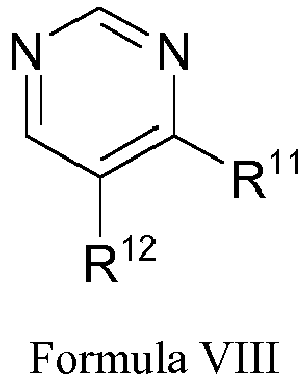

- Another embodiment of the present invention relates to a subgenus of pyrimidine derivatives represented by Formula IX set forth below:

wherein q and r are each independently integers of 0 or 1 that when q is 0, r is 1; or when q is 1, r is 0 or 1;
wherein s represents an integer of 0 or 1;
wherein Y represents O or S;
wherein R13 represents a substituent in any position of the distal ring 9 and is selected from the group consisting of H, methyl, and ethyl;
wherein R14 represents a substituent in any position of the proximal ring 8 and is H or methyl; and
wherein the broken line represents a single or double bond,
with the proviso that when R13 is H, R14 is not H. - Another embodiment of the present invention relates to a subgenus of pyrimidine derivatives represented by Formula X set forth below:

wherein t represents an integer of 0 or 1;
wherein R15 represents a substituent in any position of the distal ring 12 and is selected from the group consisting of H, methyl, and ethyl;
wherein R16 represents a substituent in any position of the proximal ring 11 and is H or methyl; and
wherein the broken line represents a single or double bond,
with the proviso that when R15 is H, R16 is not H. - Another embodiment of the present invention relates to a fragrance composition comprising the novel compounds provided above.
- Another embodiment of the present invention relates to a fragrance product comprising the compounds provided above.
- Another embodiment of the present invention relates to a method of improving, enhancing or modifying a fragrance formulation through the addition of an olfactory acceptable amount of the novel compounds provided above.
- These and other embodiments of the present invention will be apparent by reading the following specification.
- The novel pyrimidine derivatives represented by Formula I of the present invention are illustrated, for example, by following examples.
- 1,1,2,3,3-Pentamethyl-2,3,4,5-tetrahydro-1H-7,9-diaza-cyclopenta[a]naphthalene:

- 1,1,2,3,3-Pentamethyl-2,3,3a,4,5,9b-hexahydro-1H-7,9-diaza-cyclopenta[a]naphthalene:

- 1,1,3,3-Tetramethyl-2,3,4,5-tetrahydro-1H-7,9-diaza-cyclopenta[a]naphthalene:

- 1,1,3,3-Tetramethyl-2,3,3a,4,5,9b-hexahydro-1H-7,9-diaza-cyclopenta[a]naphthalene:
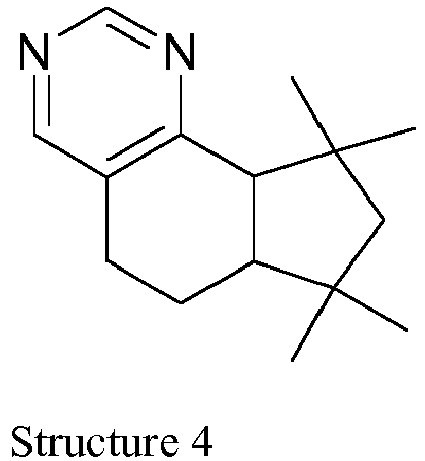
- 1,1,2,3,3,5-Hexamethyl-2,3,4,5-tetrahydro-1H-7,9-diaza-cyclopenta[a]naphthalene:
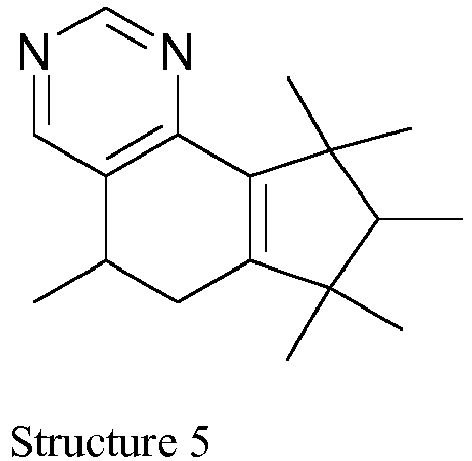
- 1,1,2,3,3,5-Hexamethyl-2,3,3a,4,5,9b-hexahydro-1H-7,9-diaza-cyclopenta[a]naphthalene:

- 7,7,10,10-Tetramethyl-5,6,7,8,9,10-hexahydro-benzo[h]quinazoline:

- 7,7,10,10-Tetramethyl-5,6,6a,7,8,9,10,10a-octahydro-benzo[h]quinazoline:

- 5,7,7,8,10,10-Hexamethyl-5,6,7,8,9,10-hexahydro-benzo[h]quinazoline:

- 5,7,7,8,10,10-Hexamethyl-5,6,6a,7,8,9,10,10a-octahydro-benzo[h]quinazoline:

- 7,7,10a-Trimethyl-5,6,6a,7,8,9,10,10a-octahydro-benzo[h]quinazoline:

- 8 -Isopropyl-5,6,7,8 -tetrahydro-quinazoline:

- 8 -tert-Butyl-5,6,7,8 -tetrahydro-quinazoline:

- 5-(1,5-Dimethyl-hex-4-enyl)-pyrimidine:

- 4-tert-Butyl-pyrimidine:

- 4-(2,2-Dimethyl-propyl)-pyrimidine:

- 4,5-Diisopropyl-pyrimidine:

- 4,5 -Di-tert-butyl-pyrimidine:

- 5-tert-Butyl-4-(2,2-dimethyl-propyl)-pyrimidine:
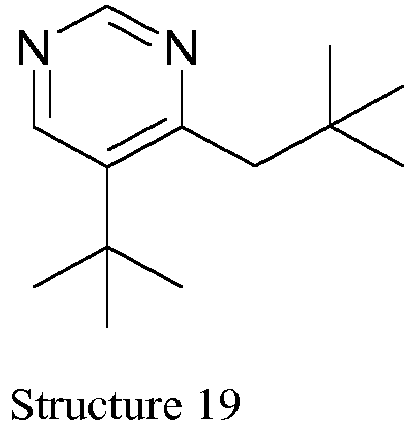
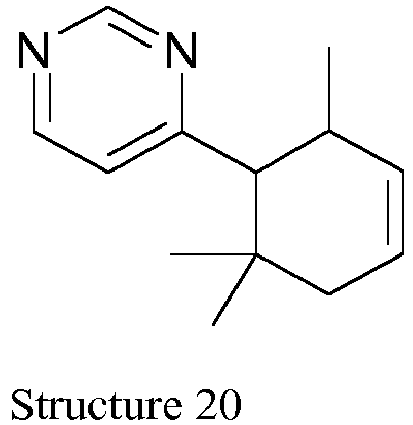
- 4-(2,6,6-Trimethyl-cyclohex-3-enyl)-pyrimidine

- 4-[2-(2,6,6-Trimethyl-cyclohex-1-enyl)-ethyl]-pyrimidine:

- 4-[2-(2,5,6,6-Tetramethyl-cyclohex-1-enyl)-ethyl]-pyrimidine:

- 4-(1,1,2,3,3-Pentamethyl-indan-5-yl)-pyrimidine:

- 4-(6-tert-Butyl-1,1-dimethyl-indan-4-yl)-pyrimidine:

- 6,6,9a-Trimethyl-5,5a,6,7,8,9,9a,10-octahydro-benzo[g]quinazoline:

- 5a,10-Dimethyl-5,5a,6,7,8,9-hexahydro-benzo[g]quinazoline:

- 5a,10-Dimethyl-5,5a,6,7,8,9,9a,10-octahydro-benzo[g]quinazoline:

- 6,6,10,10-Tetramethyl-5,7,8,9,10,10a-hexahydro-6H-6a,9-methanobenzo[H]quinazoline:

- 5,7,7,10-Tetramethyl-6,7,7a,8,9,10-hexahydro-5H-6,10a-methanoazuleno[5,4-d]pyrimidine:

- 5,6,7,8-Tetrahydro-6,6,7,8,8-pentamethyl-4H-indeno[5,4-D]isoxazole:

- 5,5a,6,7,8,8a-hexahydro-6,6,7,8,8-pentamethyl-4H-indeno[5,4-D]isoxazole:

- 6,6,7,8,8-Pentamethyl-5,6,7,8-tetrahydro-4H-1-oxa-3-aza-as-indacene:

- 6,6,7,8,8-Pentamethyl-5,6,7,8-tetrahydro-4H-indeno[4,5-d]oxazole:

- 6,6,7,8,8-Pentamethyl-5,5a,6,7,8,8a-hexahydro-4H-1-oxa-3-aza-as-indace:
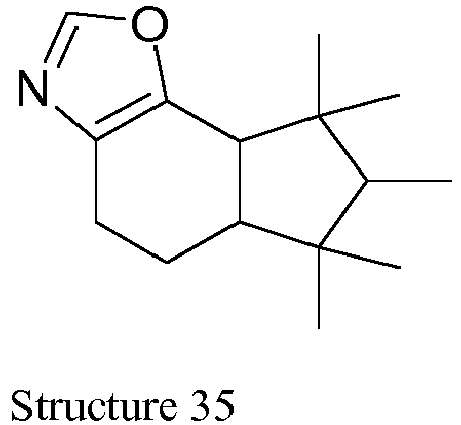
- 6,6,7,8,8-Pentamethyl-5,5a,6,7,8,8a-hexahydro-4H-indeno[4,5-d]oxazole:

- 2,6,6,7,8,8-Hexamethyl-5,6,7,8-tetrahydro-4H-3-thia-1-aza-as-indacene:

- 2,6,6,7,8,8-Hexamethyl-5,5a,6,7,8,8a-hexahydro-4H-3-thia-1-aza-as-indacene:

- 7,7,8,9,9-Pentamethyl-5,7,8,9-tetrahydro-6H-cyclopenta[f]quinoxaline:

- 7,7,8,9,9-Pentamethyl-5,6a,7,8,9,9a-hexahydro-6H-cyclopenta[f]quinoxaline:

- Those with skill in the art will recognize that the compounds of the present invention contain chiral centers, thereby providing a number of isomers of the claimed compounds. For example, the compounds of Structure 1 and Structure 2 described in the above contain chiral centers indicated with asterisks (*) in the following:

- Thus, the isomeric forms of Structure 1 and Structure 2 may be further represented, respectively, by the following structures:


- Structure 1a represents 2S-1,1,2,3,3-pentamethyl-2,3,4,5-tetrahydro-1H-7,9-diaza-cyclopenta[a]naphthalene;
- Structure 1b represents 2R-1,1,2,3,3-pentamethyl-2,3,4,5-tetrahydro-1H-7,9-diaza-cyclopenta[a]naphthalene;
- Structure 2a represents diastereomeric mixture cis-1,1,2,3,3-pentamethyl-2,3,3a,4,5,9b-hexahydro-1H-7,9-diaza-cyclopenta[a]naphthalene; and
- Structure 2b represents diastereomeric mixture trans-1,1,2,3,3-pentamethyl-2,3,3a,4,5,9b-hexahydro-1H-7,9-diaza-cyclopenta[a]naphthalene.
- It is intended herein that the compounds described herein include isomeric mixtures of such compounds, as well as those isomers that may be separated using techniques known to those having skill in the art. Suitable techniques include chromatography such as high performance liquid chromatography, referred to as HPLC, and particularly silica gel chromatography and gas chromatography trapping known as GC trapping. Yet, commercial products are mostly offered as isomeric mixtures.
- The preparation of the compounds of the present invention is detailed in the Examples. Materials were purchased from Aldrich Chemical Company unless noted otherwise.
- The use of the compounds of the present invention is widely applicable in current perfumery products, including the preparation of perfumes and colognes, the perfuming of personal care products such as soaps, shower gels, and hair care products, fabric care products, air fresheners, and cosmetic preparations. The present invention can also be used to perfume cleaning agents, such as, but not limited to detergents, dishwashing materials, scrubbing compositions, window cleaners and the like.
- In these preparations, the compounds of the present invention can be used alone or in combination with other perfuming compositions, solvents, adjuvants and the like. The nature and variety of the other ingredients that can also be employed are known to those with skill in the art. Many types of fragrances can be employed in the present invention, the only limitation being the compatibility with the other components being employed. Suitable fragrances include but are not limited to fruits such as almond, apple, cherry, grape, pear, pineapple, orange, strawberry, raspberry; musk, flower scents such as lavender-like, rose-like, iris-like, carnation-like. Other pleasant scents include herbal and woodland scents derived from pine, spruce and other forest smells. Fragrances may also be derived from various oils, such as essential oils, or from plant materials such as peppermint, spearmint and the like.
- A list of suitable fragrances is provided in
US Pat. No. 4,534,891 , the contents of which are incorporated by reference as if set forth in its entirety. Another source of suitable fragrances is found in Perfumes, Cosmetics and Soaps, Second Edition, edited by W. A. Poucher, 1959. Among the fragrances provided in this treatise are acacia, cassie, chypre, cyclamen, fern, gardenia, hawthorn, heliotrope, honeysuckle, hyacinth, jasmine, lilac, lily, magnolia, mimosa, narcissus, freshly-cut hay, orange blossom, orchid, reseda, sweet pea, trefle, tuberose, vanilla, violet, wallflower, and the like. - The compounds of the present invention can be used in combination with a complementary fragrance compound. The term "complementary fragrance compound" as used herein is defined as a fragrance compound selected from the group consisting of 2-[(4-methylphenyl)methylene]-heptanal (Acalea), iso-amyl oxyacetic acid allylester (Allyl Amyl Glycolate), (3,3-dimethylcyclohexyl)ethyl ethyl propane-1,3-dioate (Applelide), (E/Z)-1-ethoxy-1-decene (Arctical), 2-ethyl-4-(2,2,3-trimethyl-3-cyclo-penten-1-yl)-2-buten-1-ol (Bacdanol), 2-methyl-3-[(1,7,7-trimethylbicyclo[2.2.1]hept-2-yl)oxy] exo-1-propanol (Bornafix), 1,2,3,5,6,7-hexahydro-1,1,2,3,3-pentamethyl-4H-inden-4-one (Cashmeran), trimethylcyclopentenylmethyloxabicyclooctane (Cassiffix), 1,1-dimethoxy-3,7-dimethyl-2,6-octadiene (Citral DMA), 3,7-dimethyl-6-octen-1-ol (Citronellol), 3A,4,5,6,7,7A-hexahydro-4,7-methano-1H-inden-5/6-yl acetate (Cyclacet), 3A,4,5,6,7,7A-hexahydro-4,7-methano-1H-inden-5/6-yl propinoate (Cyclaprop), 3A,4,5,6,7,7A-hexahydro-4,7-methano-1G-inden-5/6-yl butyrate (Cyclobutanate), 1-(2,6,6-trimethyl-3-cyclohexen-1-yl)-2-buten-1-one (Delta Damascone), 3-(4-ethylphenyl)-2,2-dimethyl propanenitrile (Fleuranil), 3-(O/P-ethylphenyl) 2,2-dimethyl propionaldehyde (Floralozone), tetrahydro-4-methyl-2-(2-methylpropyl)-2H-pyran-4-ol (Floriffol), 1,3,4,6,7,8-hexahydro-4,6,6,7,8,8-hexamethylcyclopenta-gamma-2-benzopyran (Galaxolide), 1-(5,5-dimethyl-1-cyclohexen-1-yl)pent-4-en-1-one (Galbascone), E/Z-3,7-dimethyl-2,6-octadien-1-yl acetate (Geranyl Acetate), α-methyl-1,3-benzodioxole-5-propanal (Helional), 1-(2,6,6-trimethyl-2-cyclohexen-1-yl)-1,6-heptadien-3-one (Hexalon), (Z)-3-hexenyl-2-hydroxybenzoate (Hexenyl Salicylate, CIS-3), 4-(2,6,6-trimethyl-2-cyclohexen-1-yl)-3-buten-2-one (Ionone α), 1-(1,2,3,4,5,6,7,8-octahydro-2,3,8,8-tetramethyl-2-naphthalenyl)-ethan-1-one (Iso E Super), methyl 3-oxo-2-pentylcyclopentaneacetate (Kharismal), 2,2,4-trimethyl-4-phenyl-butanenitrile (Khusinil), 3,4,5,6,6-pentamethylhept-3-en-2-one (Koavone), 3/4-(4-hydroxy-4-methyl-pentyl) cyclohexene-1-carboxaldehyde (Lyral), 3-methyl-4-(2,6,6-trimethyl-2-cyclohexen-1-yl)-3-buten-2-one (Methyl Ionone γ), 1-(2,6,6-trimethyl-2-cyclohexen-1-yl) pent-1-en-3-one (Methyl Ionone α Extra, Methyl Ionone N), 3-methyl-4-phenylbutan-2-ol (Muguesia), cyclopentadec-4-en-1-one (Musk Z4), 3,3,4,5,5-pentamethyl-11,13-dioxatricyclo[7.4.0.0<2,6>]tridec-2(6)-ene (Nebulone), 3,7-dimethyl-2,6-octadien-1-yl acetate (Neryl Acetate), 3,7-dimethyl-1,3,6-octatriene (Ocimene), ortho-tolylethanol (Peomosa), 3-methyl-5-phenylpentanol (Phenoxanol), 1-methyl-4-(4-methyl-3-pentenyl) cyclohex-3-ene-1-carboxaldehyde (Precyclemone B), 4-methyl-8-methylene-2-adamantanol (Prismantol), 2-ethyl-4-(2,2,3-trimethyl-3-cyclopenten-1-yl)-2-buten-1-ol (Sanjinol), 2-methyl-4-(2,2,3-trimethyl-3-cyclopenten-1-yl)-2-buten-1-ol (Santaliff), Terpineol, 2,4-dimethyl-3-cyclohexene-1-carboxaldehyde (Triplal), decahydro-2,6,6,7,8,8-hexamethyl-2H-indeno[4,5-B]furan (Trisamber), 2-tert-butylcyclohexyl acetate (Verdox), 4-tert-butylcyclohexyL acetate (Vertenex), acetyl cedrene (Vertofix), 3,6/4,6-dimethylcyclohex-3-ene-1-carboxaldehyde (Vertoliff), and (3Z)-1-[(2-methyl-2-propenyl)oxy]-3-hexene (Vivaldie).
- The term "hydrocarbon group" means a chemical group that contains only hydrogen and carbon atoms. The hydrocarbon group of the present invention can be a straight, branched and/or cyclic, saturated or unsaturated group.
- The terms "fragrance formulation", "fragrance composition", and "perfume composition" mean the same and refer to a consumer composition that is a mixture of compounds including, for example, alcohols, aldehydes, ketones, esters, ethers, lactones, nitriles, natural oils, synthetic oils, and mercaptans, which are admixed so that the combined odors of the individual components produce a pleasant or desired fragrance. The fragrance formulation of the present invention is a consumer composition comprising a compound of the present invention. The fragrance formulation of the present invention comprises a compound of the present invention and further a complementary fragrance compound as defined above.
- The term "fragrance product" means a consumer product that adds a fragrance or masks a malodor. Fragrance products may include, for example, perfumes, colognes, personal care products such as soaps, shower gels, and hair care products, fabric products, air fresheners, cosmetic preparations, and perfume cleaning agents such as detergents, dishwashing materials, scrubbing compositions, and window cleaners. The fragrance product of the present invention is a consumer product that contains a compound of the present invention. The fragrance product of the present invention contains a compound of the present invention and further a complementary fragrance compound as defined above.
- The term "improving" in the phrase "improving, enhancing or modifying a fragrance formulation" is understood to mean raising the fragrance formulation to a more desirable character. The term "enhancing" is understood to mean making the fragrance formulation greater in effectiveness or providing the fragrance formulation with an improved character. The term "modifying" is understood to mean providing the fragrance formulation with a change in character.
- The term "olfactory acceptable amount" is understood to mean the amount of a compound in a fragrance formulation, wherein the compound will contribute its individual olfactory characteristics. However, the olfactory effect of the fragrance formulation will be the sum of effect of each of the fragrance ingredients. Thus, the compound of the present invention can be used to improve or enhance the aroma characteristics of the fragrance formulation, or by modifying the olfactory reaction contributed by other ingredients in the formulation. The olfactory acceptable amount may vary depending on many factors including other ingredients, their relative amounts and the olfactory effect that is desired.
- The amount of the compounds of the present invention employed in a fragrance formulation varies from about 0.005 to about 70 weight percent, preferably from 0.005 to about 50 weight percent, more preferably from about 0.5 to about 25 weight percent, and even more preferably from about 1 to about 10 weight percent. Those with skill in the art will be able to employ the desired amount to provide desired fragrance effect and intensity. In addition to the compounds of the present invention, other materials can also be used in conjunction with the fragrance formulation. Well known materials such as surfactants, emulsifiers, polymers to encapsulate the fragrance can also be employed without departing from the scope of the present invention.
- When used in a fragrance formulation these ingredients provide additional notes to make a fragrance formulation more desirable and noticeable, and add the perception of value. The odor qualities found in these materials assist in beautifying and enhancing the finished accord as well as improving the performance of the other materials in the fragrance.
- The following are provided as specific embodiments of the present invention. Other modifications of this invention will be readily apparent to those skilled in the art. Such modifications are understood to be within the scope of this invention. As used herein all percentages are weight percent unless otherwise noted, ppm is understood to stand for parts per million, L is understood to be liter, mL is understood to be milliliter, Kg is understood to be kilogram, g is understood to be gram, mol is understood to be mole, psi is understood to be pound-force per square inch, and mmHg be millimeters (mm) of mercury (Hg). IFF as used in the examples is understood to mean International Flavors & Fragrances Inc., New York, NY, USA.
-

- Preparation of 1,1,2,3,3-Pentamethyl-2,3,4,5-tetrahydro-1H-7,9-diaza-cyclopenta[a]naphthalene (Structure 1): A 5 L reaction vessel was charged with Cashmeran™ (412 g, 2.0 mol, commercially available at IFF), formamidine acetate (HN2CH=NH/HOOCCH3) (1.03 Kg, 10.0 mol), and butanol (1.2 L). The reaction mixture was heated to 118°C for 4 hours and then cooled to 25°C. The reaction mixture was washed twice with brine (1 L) and purified by vacuum distillation to afford 1,1,2,3,3-pentamethyl-2,3,4,5-tetrahydro-1H-7,9-diaza-cyclopenta[a]naphthalene (260 g) having a boiling point of 140°C at a pressure of 1.6 mmHg. Further recrystallization from ethanol afforded a solid with a melting point of 80.0°C.
- 1H NMR (CDCl3, 500 MHz): 8.90 ppm (s, 1H), 8.31 ppm (s, 1H), 2.77-2.82 ppm (m, 2H), 2.35-2.41 ppm (m, 1H), 2.25-2.32 ppm (m, 1H), 1.74 ppm (q, 1H, J=7.37 Hz), 1.38 ppm (s, 3H), 1.23 ppm (s, 3H), 1.11 ppm (s, 3H), 0.95 ppm (d, 3H, J=7.40 Hz), 0.93 ppm (s, 3H).
- Structure 1 was described as having musky, ambery, and powdery notes.
-

- Preparation of 1,1,2,3,3-Pentamethyl-2,3,3a,4,5,9b-hexahydro-1H-7,9-diaza-cyclopenta[a]naphthalene (Structure 2): Dihydrocashmeran was obtained via the hydrogenation of Cashmeran™. A 3 L reaction vessel was charged with dihydrocashmeran (255 g, 1.2 mol), formamidine acetate (642 g, 6.2 mol), and butanol (1.2 L). The reaction mixture was heated to 118°C for 4 hours and then cooled to 25°C. The reaction mixture was washed twice with brine (1 L) and purified by vacuum distillation to afford a 40:60 cis/trans mixture of 1,1,2,3,3-pentamethyl-2,3,3a,4,5,9b-hexahydro-1H-7,9-diaza-cyclopenta[a]naphthalene (200 g) having a boiling point of 153°C at a pressure of 2.0 mmHg. The cis/trans structures were confirmed by NMR analysis by GC trapping.
- Cis-1,1,2,3,3-pentamethyl-2,3,3a,4,5,9b-hexahydro-1H-7,9-diaza-cyclopenta[a]naphthalene:
- 1H NMR (CDCl3, 500 MHz): 8.96 ppm (s, 1H), 8.39 ppm (s, 1H), 3.00 ppm (d, J=9.7 Hz, 1H), 2.52-2.79 ppm (m, 2H), 1.25-2.15 ppm (m, 4H), 1.42 ppm (s, 3H), 1.10 ppm (s, 3H), 0.92 ppm (s, 3H), 0.84 ppm (d, J=7.3 Hz, 3H), 0.54 ppm (s, 3H).
- Trans-1,1,2,3,3-pentamethyl-2,3,3a,4,5,9b-hexahydro-1H-7,9-diaza-cyclopenta[a]naphthalene: 1H NMR (CDCl3, 500 MHz): 8.92 ppm (s, 1H), 8.37 ppm (s, 1H), 2.75-2.93 ppm (m, 2H), 2.65 ppm (d, J=12.6 Hz, 1H), 1.20-2.10 ppm (m, 4H), 1.32 ppm (s, 3H), 0.99 ppm (s, 3H), 0.95 ppm (s, 3H), 0.84 ppm (d, J=7.5 Hz, 3H), 0.71 ppm (s, 3H).
- Structure 2 was described as having ambery, musky, and woody notes.
-

- Preparation of Cis-1,1,2,3,3-pentamethyl-2,3,3a,4,5,9b-hexahydro-1H-7,9-diaza-cyclopenta[a]naphthalene (Structure 2a): A 500 mL zipper autoclave was charged with 1,1,2,3,3-pentamethyl-2,3,4,5-tetrahydro-1H-7,9-diaza-cyclopenta[a]naphthalene (100 g, prepared as above in EXAMPLE I), IPA (100 mL), and palladium on carbon (Pd/C) (1 g). The autoclave was sealed, purged with nitrogen, and then pressurized with hydrogen. The reaction mixture was heated to 180°C for 4 hours and subsequently cooled to 25°C. The autoclave was vented and purged with nitrogen. The catalyst was removed by filtration through celite. A crude mass containing the major product cis-1,1,2,3,3-pentamethyl-2,3,3a,4,5,9b-hexahydro-1H-7,9-diaza-cyclopenta[a]naphthalene (90%) was obtained. The crude mass was evaluated by gas chromatography olfactometry. Cis-1,1,2,3,3-pentamethyl-2,3,3a,4,5,9b-hexahydro-1H-7,9-diaza-cyclopenta[a]naphthalene was described as having a musky character. In addition, the minor product in the crude mass, trans-1,1,2,3,3-pentamethyl-2,3,3a,4,5,9b-hexahydro-1H-7,9-diaza-cyclopenta[a]naphthalene (Structure 2b) (10%), was also evaluated and described as having an ambery character.
-

- Preparation of 1,1,3,3-Tetramethyl-2,3,4,5-tetrahydro-1H-7,9-diaza-cyclopenta[a]naphthalene (Structure 3): A 100 mL reaction flask is charged with 1,1,3,3-tetramethyl-1,2,3,5,6,7-hexahydro-inden-4-one (prepared as described in
U.S. Patent Number 3,927,083 ) (10 g, 0.05 mol), formamidine acetate (27 g, 0.26 mol), and butanol (C4H9OH) (50 mL). The reaction mixture is heated to 130°C and stirred for 24 hours. The crude mass is washed once with aqueous sulfuric acid (H2SO4) (10%, 100 mL) followed by twice with brine (30 mL). Butanol is recovered by roto-evaporation. The crude product is further purified with liquid chromatography (Biotage® system) and then crystalized. Product 1,1,3,3-tetramethyl-2,3,4,5-tetrahydro-1H-7,9-diaza-cyclopenta[a]naphthalene (~5 g) is obtained. -

- Preparation of 1,1,3,3-Tetramethyl-2,3,3a,4,5,9b-hexahydro-1H-7,9-diaza-cyclopenta[a]naphthalene (Structure 4): 1,1,3,3-Tetramethyl-octahydro-inden-4-one is first prepared by hydrogenating 1,1,3,3-tetramethyl-1,2,3,5,6,7-hexahydro-inden-4-one (prepared as described in
U.S. Patent Number 3,927,083 ) with Pd/C in alcohol in a Parr Hydrogenator at 25-60°C and under 500 psi of hydrogen gas. A 100 mL reaction flask is the charged with 1,1,3,3-tetramethyl-octahydro-inden-4-one (10 g, 0.05 mol), formamidine acetate (27 g, 0.26 mol), and butanol (50 mL). The reaction mixture is heated to 130°C and stirred for 24 hours. The crude mass is washed once with aqueous sulfuric acid (10%, 100 mL) followed by twice with brine (30 mL). Butanol is recovered by roto-evaporation. The crude product is further purified with liquid chromatography (Biotage® system) and then crystalized. Product 1,1,3,3-tetramethyl-2,3,3a,4,5,9b-hexahydro-1H-7,9-diaza-cyclopenta[a]naphthalene (∼5 g) is obtained. -

- Preparation of 1,1,2,3,3,5-Hexamethyl-2,3,4,5-tetrahydro-1H-7,9-diaza-cyclopenta[a]naphthalene (Structure 5): A 100 mL reaction flask is charged with 1,1,2,3,3,6-hexamethyl-1,2,3,5,6,7-hexahydro-inden-4-one (prepared as described in
U.S. Patent Number 3,927,083 ) (10 g, 0.045 mol), formamidine acetate (23 g, 0.22 mol), and butanol (50 mL). The reaction mixture is heated to 130°C and stirred for 24 hours. The crude mass is washed once with aqueous sulfuric acid (10%, 100 mL) followed by twice with brine (30 mL). Butanol is recovered by roto-evaporation. The crude product is further purified with liquid chromatography (Biotage® system) and then crystalized. Product 1,1,2,3,3,5-hexamethyl-2,3,4,5-tetrahydro-1H-7,9-diaza-cyclopenta[a]naphthalene (∼5 g) is obtained. -

- Preparation of 1,1,2,3,3,5-Hexamethyl-2,3,3a,4,5,9b-hexahydro-1H-7,9-diaza-cyclopenta[a]naphthalene (Structure 6): 1,1,2,3,3,6-Hexamethyl-octahydro-inden-4-one is first prepared by hydrogenating 1,1,2,3,3,6-hexamethyl-1,2,3,5,6,7-hexahydro-inden-4-one (prepared as described in
U.S. Patent Number 3,927,083 ) with Pd/C in alcohol in a Parr Hydrogenator at 25-60°C and under 500 psi of hydrogen gas. A 100 mL reaction flask is the charged with 1,1,2,3,3,6-hexamethyl-octahydro-inden-4-one (10 g, 0.045 mol), formamidine acetate (23 g, 0.22 mol), and butanol (50 mL). The reaction mixture is heated to 130°C and stirred for 24 hours. The crude mass is washed once with aqueous sulfuric acid (10%, 100 mL) followed by twice with brine (30 mL). Butanol is recovered by roto-evaporation. The crude product is further purified with liquid chromatography (Biotage® system) and then crystalized. Product 11,1,2,3,3,5-hexamethyl-2,3,3a,4,5,9b-hexahydro-1H-7,9-diaza-cyclopenta[a]naphthalene (∼5 g) is obtained. -

- Preparation of 7,7,10,10-Tetramethyl-5,6,7,8,9,10-hexahydro-benzo[h]quinazoline (Structure 7): A 100 mL reaction flask is charged with 5,5,8,8-tetramethyl-3,4,5,6,7,8-hexahydro-2H-naphthalen-1-one (prepared as described in
U.S. Patent Numbers 3,927,083 and2,912,462 ) (10 g, 0.048 mol), formamidine acetate (25 g, 0.24 mol), and butanol (50 mL). The reaction mixture is heated to 130°C and stirred for 24 hours. The crude mass is washed once with aqueous sulfuric acid (10%, 100 mL) followed by twice with brine (30 mL). Butanol is recovered by roto-evaporation. The crude product is further purified with liquid chromatography (Biotage® system) and then crystalized. Product 7,7,10,10-tetramethyl-5,6,7,8,9,10-hexahydro-benzo[h]quinazoline (∼5 g) is obtained. -
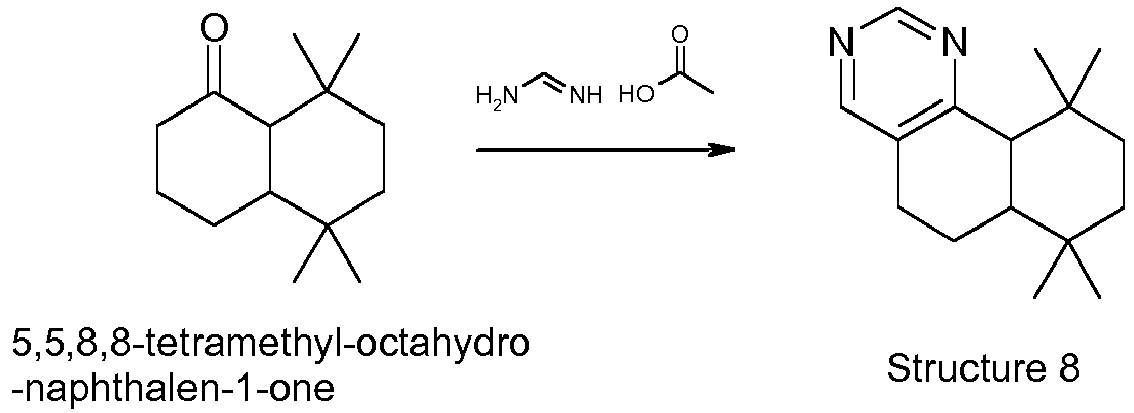
- Preparation of 7,7,10,10-Tetramethyl-5,6,6a,7,8,9,10,10a-octahydro-benzo[h]quinazoline (Structure 8): 5,5,8,8-Tetramethyl-octahydro-naphthalen-1-one is first prepared by hydrogenating 5,5,8,8-tetramethyl-3,4,5,6,7,8-hexahydro-2H-naphthalen-1-one (prepared as described in
U.S. Patent Numbers 3,927,083 and2,912,462 ) with Pd/C in alcohol in a Parr Hydrogenator at 25-60°C and under 500 psi of hydrogen gas. A 100 mL reaction flask is the charged with 5,5,8,8-tetramethyl-octahydro-naphthalen-1-one (10 g, 0.048 mol), formamidine acetate (25 g, 0.24 mol), and butanol (50 mL). The reaction mixture is heated to 130°C and stirred for 24 hours. The crude mass is washed once with aqueous sulfuric acid (10%, 100 mL) followed by twice with brine (30 mL). Butanol is recovered by roto-evaporation. The crude product is further purified with liquid chromatography (Biotage® system) and then crystalized. Product 7,7,10,10-tetramethyl-5,6,6a,7,8,9,10,10a-octahydro-benzo[h]quinazoline (∼5 g) is obtained. -

- Preparation of 5,7,7,8,10,10-Hexamethyl-5,6,7,8,9,10-hexahydro-benzo[h]quinazoline (Structure 9): A 100 mL reaction flask is charged with 3,5,5,6,8,8-hexamethyl-3,4,5,6,7,8 -hexahydro-2H-naphthalen-1-one (prepared as described in
U.S. Patent Number 3,927,083 ) (10 g, 0.042 mol), formamidine acetate (21 g, 0.2 mol), and butanol (50 mL). The reaction mixture is heated to 130°C and stirred for 24 hours. The crude mass is washed once with aqueous sulfuric acid (10%, 100 mL) followed by twice with brine (30 mL). Butanol is recovered by roto-evaporation. The crude product is further purified with liquid chromatography (Biotage® system) and then crystalized. Product 5,7,7,8,10,10-hexamethyl-5,6,7,8,9,10-hexahydro-benzo[h]quinazoline (∼5 g) is obtained. -

- Preparation of 5,7,7,8,10,10-Hexamethyl-5,6,6a,7,8,9,10,10a-octahydro-benzo[h]quinazoline (Structure 10): 3,5,5,6,8,8-Hexamethyl-octahydro-naphthalen-1-one is first prepared by hydrogenating 3,5,5,6,8,8-hexamethyl-3,4,5,6,7,8-hexahydro-2H-naphthalen-1-one (prepared as described in
U.S. Patent Number 3,927,083 ) with Pd/C in alcohol in a Parr Hydrogenator at 25-60°C and under 500 psi of hydrogen gas. A 100 mL reaction flask is the charged with 3,5,5,6,8,8-hexamethyl-octahydro-naphthalen-1-one (10 g, 0.042 mol), formamidine acetate (21 g, 0.2 mol), and butanol (50 mL). The reaction mixture is heated to 130°C and stirred for 24 hours. The crude mass is washed once with aqueous sulfuric acid (10%, 100 mL) followed by twice with brine (30 mL). Butanol is recovered by roto-evaporation. The crude product is further purified with liquid chromatography (Biotage® system) and then crystalized. Product 5,7,7,8,10,10-hexamethyl-5,6,6a,7,8,9,10,10a-octahydro-benzo[h]quinazoline (∼5 g) is obtained. -

- Preparation of 7,7,10a-Trimethyl-5,6,6a,7,8,9,10,10a-octahydro-benzo[h]quinazoline (Structure 11) and 6,6,9a-Trimethyl-5,5a,6,7,8,9,9a,10-octahydro-benzo[g]quinazoline (Structure 26): A 100 mL reaction flask is charged with 5,5,8a-trimethyl-octahydro-naphthalen-2-one (prepared as described by Strike in Journal of the American Chemical Society, 1964, 86(10), pages: 2044-2050) (10 g, 0.05 mol), formamidine acetate (27 g, 0.26 mol), and butanol (50 mL). The reaction mixture is heated to 130°C and stirred for 24 hours. The crude mass is washed once with aqueous sulfuric acid (10%, 100 mL) followed by twice with brine (30 mL). Butanol is recovered by roto-evaporation. The crude product is further purified with liquid chromatography (Biotage® system) and then crystalized. A mixture of products 5,7,7,8,10,10-hexamethyl-5,6,7,8,9,10-hexahydro-benzo[h]quinazoline and 6,6,9a-Trimethyl-5,5a,6,7,8,9,9a,10-octahydro-benzo[g]quinazoline (∼5 g) is obtained, which may be separated using techniques known to those having skill in the art. Suitable techniques include chromatography such as high performance liquid chromatography, referred to as HPLC, and particularly silica gel chromatography and gas chromatography trapping known as GC trapping.
-

- Preparation of 8-Isopropyl-5,6,7,8-tetrahydro-quinazoline (Structure 12): A 100 mL reaction flask is charged with 2-isopropyl-cyclohexanone (10 g, 0.07 mol), formamidine acetate (40 g, 0.4 mol), and butanol (50 mL). The reaction mixture is heated to 130°C and stirred for 24 hours. The crude mass is washed once with aqueous sulfuric acid (10%, 100 mL) followed by twice with brine (30 mL). Butanol is recovered by roto-evaporation. The crude product is further purified with liquid chromatography (Biotage® system) and then crystalized. Product 8-isopropyl-5,6,7,8-tetrahydro-quinazoline (∼5 g) is obtained.
-

- Preparation of 8-tert-Butyl-5,6,7,8-tetrahydro-quinazoline (Structure 13): A 100 mL reaction flask is charged with 2-tert-butyl-cyclohexanone (10 g, 0.07 mol), formamidine acetate (40 g, 0.4 mol), and butanol (50 mL). The reaction mixture is heated to 130°C and stirred for 24 hours. The crude mass is washed once with aqueous sulfuric acid (10%, 100 mL) followed by twice with brine (30 mL). Butanol is recovered by roto-evaporation. The crude product is further purified with liquid chromatography (Biotage® system) and then crystalized. Product 8-tert-butyl-5,6,7,8-tetrahydro-quinazoline (∼5 g) is obtained.
-

- Preparation of 5-(1,5-Dimethyl-hex-4-enyl)-pyrimidine (Structure 14): A 100 mL reaction flask is charged with 3,7-dimethyl-oct-6-enal (Citronellal®) (Commercially available at IFF) (10 g, 0.06 mol), formamidine acetate (31 g, 0.3 mol), and butanol (50 mL). The reaction mixture is heated to 130°C and stirred for 24 hours. The crude mass is washed once with aqueous sulfuric acid (10%, 100 mL) followed by twice with brine (30 mL). Butanol is recovered by roto-evaporation. The crude product is further purified with liquid chromatography (Biotage® system) and then crystalized. Product 5-(1,5-dimethyl-hex-4-enyl)-pyrimidine (∼5 g) is obtained.
-

- Preparation of 4-tert-Butyl-pyrimidine (Structure 16): A 100 mL reaction flask is charged with 3,3-dimethyl-butan-2-one (10 g, 0.1 mol), formamidine acetate (57 g, 0.5 mol), and butanol (50 mL). The reaction mixture is heated to 130°C and stirred for 24 hours. The crude mass is washed once with aqueous sulfuric acid (10%, 100 mL) followed by twice with brine (30 mL). Butanol is recovered by roto-evaporation. The crude product is further purified with liquid chromatography (Biotage® system) and then crystalized. Product 4-tert-butyl-pyrimidine (∼5 g) is obtained.
-

- Preparation of 4-(2,2-Dimethyl-propyl)-pyrimidine (Structure 16): A 100 mL reaction flask is charged with 4,4-dimethyl-pentan-2-one (10 g, 0.1 mol), formamidine acetate (57 g, 0.5 mol), and butanol (50 mL). The reaction mixture is heated to 130°C and stirred for 24 hours. The crude mass is washed once with aqueous sulfuric acid (10%, 100 mL) followed by twice with brine (30 mL). Butanol is recovered by roto-evaporation. The crude product is further purified with liquid chromatography (Biotage® system) and then crystalized. Product 4-(2,2-dimethyl-propyl)-pyrimidine (∼5 g) is obtained.
-

- Preparation of 4,5-Diisopropyl-pyrimidine (Structure 17): A 100 mL reaction flask is charged with 2,5-dimethyl-hexan-3-one (10 g, 0.08 mol), formamidine acetate (40 g, 0.4 mol), and butanol (50 mL). The reaction mixture is heated to 130°C and stirred for 24 hours. The crude mass is washed once with aqueous sulfuric acid (10%, 100 mL) followed by twice with brine (30 mL). Butanol is recovered by roto-evaporation. The crude product is further purified with liquid chromatography (Biotage® system) and then crystalized. Product 4,5-diisopropyl-pyrimidine (∼5 g) is obtained.
-

- Preparation of 4,5-Di-tert-butyl-pyrimidine (Structure 18): A 100 mL reaction flask is charged with 2,2,5,5-tetramethyl-hexan-3-one (10 g, 0.06 mol), formamidine acetate (33 g, 0.3 mol), and butanol (50 mL). The reaction mixture is heated to 130°C and stirred for 24 hours. The crude mass is washed once with aqueous sulfuric acid (10%, 100 mL) followed by twice with brine (30 mL). Butanol is recovered by roto-evaporation. The crude product is further purified with liquid chromatography (Biotage® system) and then crystalized. Product 4,5-di-tert-butyl-pyrimidine (∼5 g) is obtained.
-

- Preparation of 5-tert-Butyl-4-(2,2-dimethyl-propyl)-pyrimidine (Structure 19): A 100 mL reaction flask is charged with 2,2,6,6-tetramethyl-heptan-4-one (10 g, 0.06 mol), formamidine acetate (33 g, 0.3 mol), and butanol (50 mL). The reaction mixture is heated to 130°C and stirred for 24 hours. The crude mass is washed once with aqueous sulfuric acid (10%, 100 mL) followed by twice with brine (30 mL). Butanol is recovered by roto-evaporation. The crude product is further purified with liquid chromatography (Biotage® system) and then crystalized. Product 5-tert-butyl-4-(2,2-dimethyl-propyl)-pyrimidine (∼5 g) is obtained.
-

- Preparation of 4-(2,6,6-Trimethyl-cyclohex-3-enyl)-pyrimidine (Structure 20): A 100 mL reaction flask is charged with 1-(2,6,6-trimethyl-cyclohex-3-enyl)-ethanone (10 g, 0.06 mol, commercially available at IFF), formamidine acetate (31 g, 0.3 mol), and butanol (50 mL). The reaction mixture is heated to 130°C and stirred for 24 hours. The crude mass is washed once with aqueous sulfuric acid (10%, 100 mL) followed by twice with brine (30 mL). Butanol is recovered by roto-evaporation. The crude product is further purified with liquid chromatography (Biotage® system) and then crystalized. Product 4-(2,6,6-trimethyl-cyclohex-3-enyl)-pyrimidine (∼10 g) is obtained.
-
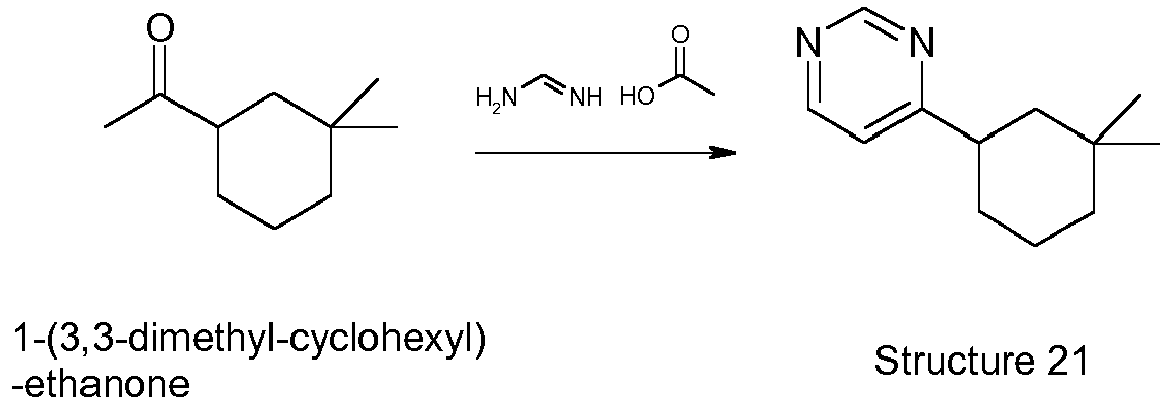
- Preparation of 4-(3,3-Dimethyl-cyclohexyl)-pyrimidine (Structure 21): A 100 mL reaction flask is charged with 1-(3,3-dimethyl-cyclohexyl)-ethanone (Herbac®) (10 g, 0.06 mol, commercially available at IFF), formamidine acetate (31 g, 0.3 mol), and butanol (50 mL). The reaction mixture is heated to 130°C and stirred for 24 hours. The crude mass is washed once with aqueous sulfuric acid (10%, 100 mL) followed by twice with brine (30 mL). Butanol is recovered by roto-evaporation. The crude product is further purified with liquid chromatography (Biotage® system) and then crystalized. Product 4-(3,3-dimethyl-cyclohexyl)-pyrimidine (∼10 g) is obtained.
-

- Preparation of 4-[2-(2,6,6-Trimethyl-cyclohex-1-enyl)-ethyl]-pyrimidine (Structure 22): A 100 mL reaction flask is charged with 4-(2,6,6-trimethyl-cyclohex-1-enyl)-butan-2-one (10 g, 0.05 mol, commercially available at IFF), formamidine acetate (26 g, 0.3 mol), and butanol (50 mL). The reaction mixture is heated to 130°C and stirred for 24 hours. The crude mass is washed once with aqueous sulfuric acid (10%, 100 mL) followed by twice with brine (30 mL). Butanol is recovered by roto-evaporation. The crude product is further purified with liquid chromatography (Biotage® system) and then crystalized. Product 4-[2-(2,6,6-trimethyl-cyclohex-1-enyl)-ethyl]-pyrimidine (∼10 g) is obtained.
-

-

- Preparation of 4-(1,1,2,3,3-Pentamethyl-indan-5-yl)-pyrimidine (Structure 24): A 5 L reaction vessel was charged with 1-(1,1,2,3,3-pentamethyl-indan-5-yl)-ethanone (460 g, 2.0 mol) (commercially available at IFF), formamidine acetate (675 g, 6.4 mol), and butanol (1.0 L). The reaction mixture was heated to 120°C for 10 hours and then cooled to 25°C. The reaction mixture was washed twice with brine (1 L) and purified by vacuum distillation to afford 4-(1,1,2,3,3-pentamethyl-indan-5-yl)-pyrimidine (200 g) having a boiling point of 153°C at a pressure of 2.0 mmHg.
- 1H NMR (CDCl3, 500 MHz): 9.25 ppm (d, 1H, J = 1.28 Hz), 8.71 ppm (d, 1H, J = 5.40 Hz), 7.88-7.93 ppm (m, 2H), 7.69 (d, 1H, J = 5.40 Hz, of d, J = 1.40 Hz), 7.28 ppm (d, 1H, J = 7.90 Hz, of d, J = 0.40 Hz), 1.92 ppm (q, 1H, J = 7.36 Hz), 1.35 ppm (s, 3H), 1.31 ppm (s, 3H), 1.13 ppm (s, 3H), 1.11 ppm (s, 3H), 1.02 ppm (d, 3H, J = 7.36 Hz).
- 4-(1,1,2,3,3-Pentamethyl-indan-5-yl)-pyrimidine was described as having weak floral note.
-

- Preparation of 4-(6-tert-Butyl-1,1-dimethyl-indan-4-yl)-pyrimidine (Structure 25): A 5 L reaction vessel was charged with 1-(6-tert-butyl-1,1-dimethyl-indan-4-yl)-ethanone (300 g, 1.2 mol) (commercially available at IFF), formamidine acetate (639 g, 6.1 mol), and butanol (1.0 L). The reaction mixture was heated to 125°C for 10 hours and then cooled to 25°C. The reaction mixture was washed twice with brine (1 L) and purified by vacuum distillation to afford 4-(6-tert-butyl-1,1-dimethyl-indan-4-yl)-pyrimidine (200 g) having a boiling point of 180°C at a pressure of 0.5 mmHg.
- 1H NMR (CDCl3, 500 MHz): 9.28 ppm (d, 1H, J = 1.28 Hz), 8.74 ppm (d, 1H, J = 5.32 Hz), 7.65 ppm (d, 1H, J = 1.84 Hz), 7.57 ppm (d, 1H, J = 5.32 Hz, of d, J = 1.44 Hz), 7.31 ppm (d, 1H, J = 1.80 Hz), 3.11 ppm (t, 2H, J = 7.14 Hz), 1.95 ppm (t, 2H, J = 7.14 Hz), 1.38 ppm (s, 9H), 1.31 ppm (s, 6H).
- 4-(6-tert-Butyl-1,1-dimethyl-indan-4-yl)-pyrimidine was described as having weak fatty note.
-

- Preparation of 5a,10-Dimethyl-5,5a,6,7,8,9-hexahydro-benzo[g]quinazoline (Structure 27): A 100 mL reaction flask is charged with 1,4a-dimethyl-4,4a,5,6,7,8-hexahydro-3H-naphthalen-2-one (prepared as described by Sjoebers in Acta Chemica Scand., 1990, 44(10), pages: 1036-1041) (10 g, 0.05 mol), formamidine acetate (27 g, 0.26 mol), and butanol (50 mL). The reaction mixture is heated to 130°C and stirred for 24 hours. The crude mass is washed once with aqueous sulfuric acid (10%, 100 mL) followed by twice with brine (30 mL). Butanol is recovered by roto-evaporation. The crude product is further purified with liquid chromatography (Biotage® system) and then crystalized. Product 5a,10-dimethyl-5,5a,6,7,8,9-hexahydro-benzo[g]quinazoline (∼5 g) is obtained.
-
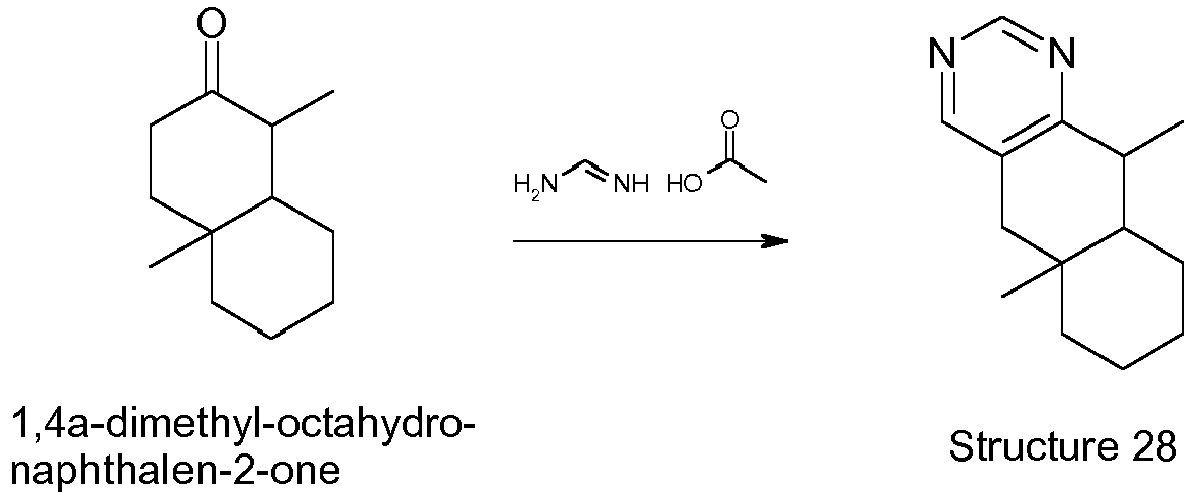
- Preparation of 5a,10-Dimethyl-5,5a,6,7,8,9,9a,10-octahydro-benzo[g]quinazoline (Structure 28): 1,4a-Dimethyl-octahydro-naphthalen-2-one is first prepared by hydrogenating 1,4a-dimethyl-4,4a,5,6,7,8-hexahydro-3H-naphthalen-2-one (prepared as described by Sjoebers in Acta Chemica Scand., 1990, 44(10), pages: 1036-1041) with Pd/C in alcohol in a Parr Hydrogenator at 25-60°C and under 500 psi of hydrogen gas. A 100 mL reaction flask is charged with 1,4a-dimethyl-octahydro-naphthalen-2-one (10 g, 0.05 mol), formamidine acetate (27 g, 0.26 mol), and butanol (50 mL). The reaction mixture is heated to 130°C and stirred for 24 hours. The crude mass is washed once with aqueous sulfuric acid (10%, 100 mL) followed by twice with brine (30 mL). Butanol is recovered by roto-evaporation. The crude product is further purified with liquid chromatography (Biotage® system) and then crystalized. Product 5a,10-dimethyl-5,5a,6,7,8,9,9a,10-octahydro-benzo[g]quinazoline (∼5 g) is obtained.
-

- Preparation of 6,6,10,10-Tetramethyl-5,7,8,9,10,10a-hexahydro-6H-6a,9-methanobenzo[H]quinazotine (Structure IV): A 5 L reaction vessel was charged with 1,1,5,5-tetramethyl-hexahydro-2,4a-methano-naphthalen-8-one (440 g, 2.0 mol) (commercially available at IFF), formamidine acetate (1040 g, 10.0 mol) and butanol (2 L). The reaction mixture was heated to 120°C for 10 hours and then cooled to 25°C. The reaction mixture was washed twice with brine (1 L) and purified by vacuum distillation to afford crude product 6,6,10,10-tetramethyl-5,7,8,9,10,10a-hexahydro-6H-6a,9-methanobenzo[H]quinazoline (430 g) having a boiling point of 159°C at a pressure of 1.0 mmHg. Further recrystallization from ethanol afforded 6,6,10,10-tetramethyl-5,7,8,9,10,10a-hexahydro-6H-6a,9-methanobenzo[H]quinazoline (95% purity) (125 g) with a melting point of 44-45°C.
- 1H NMR (CDCl3, 500 MHz): 8.97 ppm (d, 1H, J = 0.60 Hz), 8.34 ppm (s, 1H), 2.81 ppm (d, 1H, J = 16.14 Hz), 2.45 ppm (s, 1H), 2.30 ppm (d, 1H, J = 16.11 Hz), 1.90-1.97 ppm (m, 1H), 1.76-1.77 ppm (m, 1H), 1.71 ppm (d, 1H, J = 3.95 Hz, of t, J = 12.22 Hz), 1.61-1.66 ppm (d, 1H, J = 9.45 Hz, of m), 1.51-1.58 ppm (m, 1H), 1.39 ppm (s, 3H), 1.28 ppm (d, 1H, J = 9.95 Hz, of t, J = 1.68 Hz), 1.16-1.23 ppm (m, 1H), 1.09 ppm (s, 3H), 0.74 ppm (s, 3H), 0.67 ppm (s, 3H).
- 6,6,10,10-Tetramethyl- 5,7,8,9,10,10a-hexahydro-6H-6a,9-methanobenzo[H]quinazoline was described as having musky, woody, and ambery notes.
-

- Preparation of 5,7,7,10-Tetramethyl-6,7,7a,8,9,10-hexahydro-5H-6,10a-methanoazuleno[5,4- d ]pyrimidine (Structure 30): A 100 mL reaction flask is charged with 3,6,8,8-tetramethyl-hexahydro-3a,7-methano-azulen-5-one (prepared as described in
U.S. Patent No. 3,887,622 ) (10 g, 0.045 mol), formamidine acetate (21 g, 0.2 mol), and butanol (50 mL). The reaction mixture is heated to 130°C and stirred for 24 hours. The crude mass is washed once with aqueous sulfuric acid (10%, 100 mL) followed by twice with brine (30 mL). Butanol is recovered by roto-evaporation. The crude product is further purified with liquid chromatography (Biotage® system) and then crystalized. Product 5,7,7,10-tetramethyl-6,7,7a,8,9,10-hexahydro-5H-6,10a-methanoazuleno[5,4-d]pyrimidine (∼5 g) is obtained. -

- Preparation of 5,6,7,8-Tetrahydro-6,6,7,8,8-pentamethyl-4H-indeno[5,4-D]isoxazole (Structure 31): A 2 L reaction flask was charged with sodium hydride (NaH) (40 g) in dimethoxyethane (DME) (CH3OCH2CH2OCH3) (1.39 Kg) and a mixture of Cashmeran™ (520 g) and ethyl formate (185 g) at room temperature. The mixture was stirred for 8 hours to provide 1,1,2,3,3-pentamethyl-4-oxo-2,3,4,5,6,7-hexahydro-1H-indene-5-carbaldehyde. Dimethylformamide (DMF) (300 mL) and hydroxylamine hydrochloride (NH2OH·HCl) (174 g) were then added and the temperature was heated to and maintained at 130°C for 8 hours. Water was then added and the organic layer was extracted by toluene and washed once with water. Toluene was distilled off using a Rotovap to provide crude product 5,6,7,8-tetrahydro-6,6,7,8,8-pentamethyl-4H-indeno[5,4-D]isoxazole (260 g), which was then recrystallized to afford a pure product with a melting point of 80.96°C.
- 1H NMR (CDCl3, 500 MHz): 8.01 ppm (s, 1H), 2.68-2.73 ppm (m, 2H), 2.28-2.43 ppm (m, 2H), 1.75 ppm (q, 1H, J = 7.40 Hz), 1.31 ppm (s, 3H), 1.09 ppm (s, 3H), 1.07 ppm (s, 3H), 0.93 ppm (s, 3H), 0.93 ppm (d, 3H, J = 7.40 Hz).
- 5,6,7,8-Tetrahydro-6,6,7,8,8-pentamethyl-4H-indeno[5,4-D]isoxazole was described as having cashmeran, slightly musky, geranium, and hint of ambery notes.
-

- Preparation of 5,5a,6,7,8,8a-Hexahydro-6,6,7,8,8-pentamethyl-4H-indeno[5,4-D]isoxazole (Structure 32): A 2 L reaction flask was charged with sodium hydride (24 g) in DME (867 g) and a mixture of dihydrocashmeran (208 g, prepared as above in EXAMPLE II) and ethyl formate (111 g) at room temperature. The mixture was stirred for 8 hours to provide 1,1,2,3,3-pentamethyl-4-oxo-octahydro-indene-5-carbaldehyde. Tetrahydrofuran (THF) (20 mL), ethanol (CH3CH2OH) (200 mL), hydroxylamine hydrochloride (70 g), and acetic acid (CH3COOH) (200 mL) were then added and the temperature was heated to and maintained at 75°C for 8 hours. Water was then added and the organic layer was extracted by toluene and washed once with water. Toluene was distilled off using a Rotovap to provide crude product 5,5a,6,7,8,8a-hexahydro-6,6,7,8,8-pentamethyl-4H-indeno[5,4-D]isoxazole (186 g), which was then recrystallized to afford a pure product with a melting point of 82.35°C.
- 1H NMR (CDCl3, 400 MHz): 8.03 ppm (s, 1H), 2.57-2.64 ppm (m, 2H), 2.40-2.50 ppm (m, 1H), 1.88-1.94 ppm (m, 1H), 1.61 ppm (d, 1H, J = 2.24 Hz, oft, J = 12.42 Hz), 1.43 ppm (q, 1H, J = 7.53 Hz), 1.30-1.39 ppm (m, 1H), 1.19 ppm (s, 3H), 1.00 ppm (s, 3H), 0.94 ppm (s, 3H), 0.84 ppm (d, 3H, J = 7.52 Hz), 0.70 ppm (s, 3H).
- 5,5a,6,7,8,8a-Hexahydro-6,6,7,8,8-pentamethyl-4H-indeno[5,4-D]isoxazole was described as having woody, earthy, green, patchouli, cashmeran, moldy, cucumber, aldehydic, moss and ambery notes.
-

- Preparation of 6,6,7,8,8-Pentamethyl-5,6,7,8-tetrahydro-4H-1-oxa-3-aza-as-indacene (Structure 33) and 6,6,7,8,8-Pentamethyl-5,6,7,8-tetrahydro-4H-indeno[4,5-d]oxazole (Structure 34): 1,1,2,3,3-Pentamethyl-2,3,6,7-tetrahydro-1H-indene-4,5-dione is first prepared with 1,1,2,3,3-pentamethyl-1,2,3,5,6,7-hexahydro-inden-4-one (Cashmeran®) (commercially available at IFF) via oxidation with (2,2,6,6-tetramethylpiperidin-1-yl)oxidanyl (TEMPO) (prepared as described by Barton in Tetrahedron Letters, 1984, 25(6), pages: 603-606). A 100 mL reaction flask is charged with 1,1,2,3,3-pentamethyl-2,3,6,7-tetrahydro-1H-indene-4,5-dione (10 g, 0.04 mol) and formamide (NH2CHO) (50 mL). The reaction mixture is heated to 200°C and stirred for 24 hours. The crude mass is diluted with toluene (50 mL) and then washed once with aqueous sodium carbonate (10%, 100 mL) followed by twice with brine (30 mL). Toluene is recovered by roto-evaporation. The crude product is further purified with liquid chromatography (Biotage® system) and then crystalized. Product of a mixture of 6,6,7,8,8-pentamethyl-5,6,7,8-tetrahydro-4H-1-oxa-3-aza-as-indacene and 6,6,7,8,8-pentamethyl-5,6,7,8-tetrahydro-4H-indeno[4,5-d]oxazole (∼10 g) is obtained.
-

- Preparation of 6,6,7,8,8-Pentamethyl-5,5a,6,7,8,8a-hexahydro-4H-1-oxa-3-aza-as-indacene (Structure 35) and 6,6,7,8,8-Pentamethyl-5,5a,6,7,8,8a-hexahydro-4H-indeno[4,5-d]oxazole (Structure 36): 1,1,2,3,3-Pentamethyl-octahydro-inden-4-one is first prepared by the hydrogenation of 1,1,2,3,3-pentamethyl-1,2,3,5,6,7-hexahydro-inden-4-one (Cashmeran®) (commercially available at IFF). 1,1,2,3,3-Pentamethyl-hexahydro-indene-4,5-dione is subsequently prepared with 1,1,2,3,3-pentamethyl-octahydro-inden-4-one (prepared as described by Barton in Tetrahedron Letters, 1984, 25(6), pages: 603-606). A 100 mL reaction flask is charged with 1,1,2,3,3-pentamethyl-hexahydro-indene-4,5-dione (10 g, 0.04 mol) and formamide (50 mL). The reaction mixture is heated to 200°C and stirred for 24 hours. The crude mass is diluted with toluene (50 mL) and then washed once with aqueous sodium carbonate (10%, 100 mL) followed by twice with brine (30 mL). Toluene is recovered by roto-evaporation. The crude product is further purified with liquid chromatography (Biotage® system) and then crystalized. Product of a mixture of 6,6,7,8,8-pentamethyl-5,5a,6,7,8,8a-hexahydro-4H-1-oxa-3-aza-as-indacene and 6,6,7,8,8-pentamethyl-5,5a,6,7,8,8a-hexahydro-4H-indeno[4,5-d]oxazole (∼10 g) is obtained.
-

- Preparation of 2,6,6,7,8,8-Hexamethyl-5,6,7,8-tetrahydro-4H-3-thia-1-aza-as-indacene (Structure 37): 1,1,2,3,3-Pentamethyl-2,3,6,7-tetrahydro-1H-indene-4,5-dione is first prepared with 1,1,2,3,3-pentamethyl-1,2,3,5,6,7-hexahydro-inden-4-one (Cashmeran®) (commercially available at IFF) via oxidation with (2,2,6,6-tetramethylpiperidin-1-yl)oxidanyl (TEMPO) (prepared as described by Barton in Tetrahedron Letters, 1984, 25(6), pages: 603-606). A 100 mL reaction flask is charged with 1,1,2,3,3-pentamethyl-2,3,6,7-tetrahydro-1H-indene-4,5-dione (10 g, 0.04 mol), thioacetamide (CH3CSNH2) (3.5 g, 0.04 mol), and diglyme (50 mL). The reaction mixture is heated to 130°C and stirred for 24 hours. The crude mass is washed once with aqueous sodium carbonate (10%, 100 mL) followed by twice with brine (30 mL). Diglyme is recovered by roto-evaporation. The crude product is further purified with liquid chromatography (Biotage® system) and then crystalized. Product 2,6,6,7,8,8-hexamethyl-5,6,7,8-tetrahydro-4H-3-thia-1-aza-as-indacene (∼10 g) is obtained.
-

- Preparation of 2,6,6,7,8,8-Hexamethyl-5,5a,6,7,8,8a-hexahydro4H-3-thia-1-aza-as-indacene (Structure 38): 1,1,2,3,3-Pentamethyl-octahydro-inden-4-one is first prepared by the hydrogenation of 1,1,2,3,3-pentamethyl-1,2,3,5,6,7-hexahydro-inden-4-one (Cashmeran®) (commercially available at IFF). 1,1,2,3,3-Pentamethyl-hexahydro-indene-4,5-dione is subsequently prepared with 1,1,2,3,3-pentamethyl-octahydro-inden-4-one (prepared as described by Barton in Tetrahedron Letters, 1984, 25(6), pages: 603-606). A 100 mL reaction flask is charged with 1,1,2,3,3-pentamethyl-hexahydro-indene-4,5-dione (10 g, 0.04 mol), thioacetamide (3.5 g, 0.04 mol), and diglyme (50 mL). The reaction mixture is heated to 130°C and stirred for 24 hours. The crude mass is washed once with aqueous sodium carbonate (10%, 100 mL) followed by twice with brine (30 mL). Diglyme is recovered by roto-evaporation. The crude product is further purified with liquid chromatography (Biotage® system) and then crystalized. Product 2,6,6,7,8,8-hexamethyl-5,5a,6,7,8,8a-hexahydro-4H-3-thia-1-aza-as-indacene (∼10 g) is obtained.
-

- Preparation of 7,7,8,9,9-Pentamethyl-5,7,8,9-tetrahydro-6H-cyclopenta[f]quinoxatine (Structure 39): 1,1,2,3,3-Pentamethyl-2,3,6,7-tetrahydro-1H-indene-4,5-dione is first prepared with 1,1,2,3,3-pentamethyl-1,2,3,5,6,7-hexahydro-inden-4-one (Cashmeran®) (commercially available at IFF) via oxidation with (2,2,6,6-tetramethylpiperidin-1-yl)oxidanyl (TEMPO) (prepared as described by Barton in Tetrahedron Letters, 1984, 25(6), pages: 603-606). A 100 mL reaction flask is charged with 1,1,2,3,3-pentamethyl-2,3,6,7-tetrahydro-1H-indene-4,5-dione (10 g, 0.04 mol), ethylene diamine (NH2CH2CH2NH2) (2.5 g, 0.04 mol), and diglyme (50 mL). The reaction mixture is heated to 130°C and stirred for 24 hours. The reaction mixture is then cooled to 25°C and further oxidized with 2,3-dichloro-5,6-dicyano-1,4-benzoquinone (10 g, 0.045 mol) for another 8 hours. The crude mass is washed once with aqueous sodium carbonate (10%, 100 mL) followed by twice with brine (30 mL). Diglyme is recovered by roto-evaporation. The crude product is further purified with liquid chromatography (Biotage® system) and then crystalized. Product 7,7,8,9,9-pentamethyl-5,7,8,9-tetrahydro-6H-cyclopenta[f]quinoxaline (∼10 g) is obtained.
-

- Preparation of 7,7,8,9,9-Pentamethyl-5,6a,7,8,9,9a-hexahydro-6H-cyclopenta[f]quinoxaline (Structure 40): 1,1,2,3,3-Pentamethyl-octahydro-inden-4-one is first prepared by the hydrogenation of 1,1,2,3,3-pentamethyl-1,2,3,5,6,7-hexahydro-inden-4-one (Cashmeran®) (commercially available at IFF). 1,1,2,3,3-Pentamethyl-hexahydro-indene-4,5-dione is subsequently prepared with 1,1,2,3,3-pentamethyl-octahydro-inden-4-one (prepared as described by Barton in Tetrahedron Letters, 1984, 25(6), pages: 603-606). A 100 mL reaction flask is charged with 1,1,2,3,3-pentamethyl-hexahydro-indene-4,5-dione (10 g, 0.04 mol), ethylene diamine (NH2CH2CH2NH2) (2.5 g, 0.04 mol), and diglyme (50 mL). The reaction mixture is heated to 130°C and stirred for 24 hours. The reaction mixture is then cooled to 25°C and further oxidized with 2,3-dichloro-5,6-dicyano-1,4-benzoquinone (10 g, 0.045 mol) for another 8 hours. The crude mass is washed once with aqueous sodium carbonate (10%, 100 mL) followed by twice with brine (30 mL). Diglyme is recovered by roto-evaporation. The crude product is further purified with liquid chromatography (Biotage® system) and then crystalized. Product 7,7,8,9,9-pentamethyl-5,6a,7,8,9,9a-hexahydro-6H-cyclopenta[f]quinoxaline (∼10 g) is obtained.
- The fragrance formulas exemplified as follows demonstrated that the addition of 1,1,2,3,3-Pentamethyl-2,3,3a,4,5,9b-hexahydro-1H-7,9-diaza-cyclopenta[a]naphthalene (Structure 2) containing a 40:60 cis/trans isomeric mixture provided a musky character to the fragrance formula.
Ingredient Parts (g) Parts (g) Kharismal™ 175 175 Ethylene Brassylate 50 50 Dipropylene Glycol 34 34 Iso Gamma Super™ 30 30 Hydroxy Citronellal Pure 15 15 Indasan 10 10 Amberiff 20% IPM 10 10 L-Citronellol 8 8 Beta Ionone Extra 5 5 Linalyl Acetate 5 5 Ambrettolide 3 3 Geraniol 980 3 3 Healingwood™ 1 1 Amber Xtreme™ 1% DPG 1 1 Structure 2 10 --- DPG --- 10 Total 360 360 - The above fragrance formulas had floral and woody characters. The addition of 1,1,2,3,3-pentamethyl-2,3,3a,4,5,9b-hexahydro-1H-7,9-diaza-cyclopenta[a]naphthalene (Structure 2) intensified the floral and woody notes and provided a musky undertone.
- Fragrance formulation containing 1,1,2,3,3-pentamethyl-2,3,3a,4,5,9b-hexahydro-1H-7,9-diaza-cyclopenta[a]naphthalene (Structure 2):
Ingredient Parts (g) Santaliff™ 24 Phenoxanol™ 32 Coumarin 28 Cyclamal Extra 1 Eth Vanillin 7 Geraniol 980 Pure 1 Hedione™ 60 Amy Cinnamic Aldehyde 60 Heliotropine 17 Hexyl Cinnamic Ald 16 Beta Ionone Extra 6 Iso E Super™ 70 Lyral™ 16 lillial™ 160 Lilianth 20 Methyl Ionone Gamma A 73 Veramoss 2 Peru Balsam Oil India 3 Prenyl Acetate 1 Methyl Cedlyl Ketone 40 Methyl Phenyl Acetate 1 Aubepine 4 Benzoin 10 Cedrol Tex 3 Citronellol Extra 3 Geraniol Coeur 4 Methyl Cinnamate 3 Styrax Alva Ess 2 Vanillin ex Lignin 12 Cananga Java Native 5 Structure 2 20 Total 704 - 1,1,2,3,3-Pentamethyl-2,3,3a,4,5,9b-hexahydro-1H-7,9-diaza-cyclopenta[a]naphthalene (Structure 2) imparted diffusive floral and soft powdery characters to a fragrance formula.
- The fragrance formulas exemplified as follows demonstrated that the addition of 6,6,10,10 -tetramethyl- 5,7,8,9,10,10a-hexahydro-6H-6a, 9-methanobenzo[H]quinazoline (Structure 29) provided floral odor character with woody and musky undertones.
Ingredient Parts (g) Parts (g) Triplal BHT 20 20 Aldehyde C11 Ulenic 13 13 Aldehyde C12 MNA 10 10 Iso Gamma Super™ 170 170 Hydroxy Citronellal Pure 10 10 Bacdanol™ BHT 10 10 Benz Acetone 25 25 Benz Salicylate 50 50 Citronellol 950 15 15 Cyclacet 20 20 Cyclaprop 20 20 Damascone delta 2 2 Dihydro myrcenol 60 60 Eugenol Natural 10 10 Galaxolide 50™ 140 140 Hexyl cinnamic ald 35 35 Hexyl Salicylate 35 35 Iso bornyl acetate 40 40 Iao butyl quinoline 1 1 Methyl ionone gamma 15 15 Peomosa™ 25 25 Rosetone 60 60 Styralyl acetate 1 1 Teipineol alpha 3 3 Gamma undecalactone 6 6 Veramoss 1 1 Verdox 40 40 Yara Yara 1 1 Structure 29 30 --- DPG --- 30 Total 868 868 - The fragrance formula exemplified as follows demonstrated that 6,6,10,10-Tetramethyl-5,7,8,9,10,10a-hexahydro-6H-6a, 9-methanobenzo[H]quinazoline (Structure 29) imparted diffusive floral, soft powdery, and sweet characters.
Ingredient Parts (g) Santaliff™ 24 Phenoxanol™ 32 Coumarin 28 Cyclamal Extra 1 Eth Vanillin 7 Geraniol 980 Pure 1 s Hedione™ 60 Amy Cinnamic Aldehyde 60 Heliotropine 17 Hexyl Cinnamic Ald 16 Beta Ionone Extra 6 Iso E Super™ 70 Lyral™ 16 lillial™ 160 Lilianth 20 Methyl Ionone Gamma A 73 Veramoss 2 Peru Balsam Oil India 3 Prenyl Acetate 1 Methyl Cedlyl Ketone 40 Methyl Phenyl Acetate 1 Aubepine 4 Benzoin 10 Cedrol Tex 3 Citronellol Extra 3 Geraniol Coeur 4 Methyl Cinnamate 3 Styrax Alva Ess 2 Vanillin ex Lignin 12 Cananga Java Native 5 Structure 29 20 Total 704 - Aspects or embodiments of the invention may also be provided by the following numbered paragraphs.
- 1. A compound of formula:

or when m is 2, n is 0;
wherein (CH)m and (CH)n are each independently optionally substituted with a substituent selected from the group consisting of methyl and ethyl;
wherein X is selected from the group consisting of N, O, and S; and wherein R1 and R2 each independently represent H or a hydrocarbon group, or R1 and R2 together represent a fused ring or a ring system,
with the proviso that when R1 is H, R2 is not H. - 2. The compound of paragraph 1, wherein the compound is

wherein o is an integer of 0 or 1;
wherein R3 represents a substituent in any position of the distal ring 3 and is selected from the group consisting of H, methyl, and ethyl;
wherein R4 represents a substituent in any position of the proximal ring 2 and is H or methyl; and
wherein the broken line represents a single or double bond, with the proviso that when R3 is H, R4 is not H; or
wherein the compound is
wherein the broken line represents a single or double bond,
with the proviso that R5 and R6 together contain 3-10 carbon atoms; or
wherein the compound is
with the proviso that R7 and R8 together contain 4-8 carbon atoms; or
wherein the compound is
wherein the compound is

wherein the compound is
wherein R9 represents a substituent in any position of the proximal ring 5 and is selected from the group consisting of H, methyl, and ethyl;
wherein R10 represents a substituent in any position of the distal ring 6 and is selected from the group consisting of H, methyl, and ethyl; and
wherein the broken line represents a single or double bond,
with the proviso that R9 and R10 together contain at least two carbon atoms; or
wherein the compound is


wherein the compound is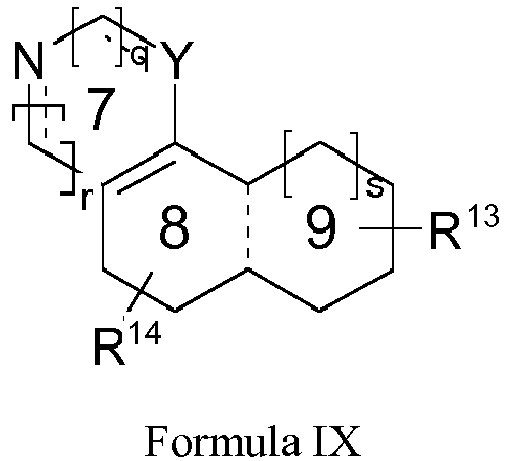
wherein q and r are each independently integers of 0 or 1 that when q is 0, r is 1; or when q is 1, r is 0 or 1;
wherein s represents an integer of 0 or 1;
wherein Y represents O or S;
wherein R13 represents a substituent in any position of the distal ring 9 and is selected from the group consisting of H, methyl, and ethyl;
wherein R14 represents a substituent in any position of the proximal ring 8 and is H or methyl; and
wherein the broken line represents a single or double bond,
with the proviso that when R13 is H, R14 is not H; or
wherein the compound is
wherein t represents an integer of 0 or 1;
wherein R15 represents a substituent in any position of the distal ring 12 and is selected from the group consisting of H, methyl, and ethyl;
wherein R16 represents a substituent in any position of the proximal ring 11 and is H or methyl; and
wherein the broken line represents a single or double bond,
with the proviso that when R15 is H, R16 is not H. - 3. The compound of paragraph 1, wherein the compound is selected from the group consisting of
1,1,2,3,3-Pentamethyl-2,3,4,5-tetrahydro-1H-7,9-diaza-cyclopenta[a]naphthalene;
1,1,2,3,3-Pentamethyl-2,3,3a,4,5,9b-hexahydro-1H-7,9-diaza-cyclopenta[a]naphthalene;
1,1,3,3-Tetramethyl-2,3,4,5-tetrahydro-1H-7,9-diaza-cyclopenta[a]naphthalene;
1,1,3,3-Tetramethyl-2,3,3a,4,5,9b-hexahydro-1H-7,9-diaza-cyclopenta[a]naphthalene;
1,1,2,3,3,5-Hexamethyl-2,3,4,5-tetrahydro-1H-7,9-diaza-cyclopenta[a]naphthalene;
1,1,2,3,3,5-Hexamethyl-2,3,3a,4,5,9b-hexahydro-1H-7,9-diaza-cyclopenta[a]naphthalene;
7,7,10,10-Tetramethyl-5,6,7,8,9,10-hexahydro-benzo[h]quinazoline;
7,7,10,10-Tetramethyl-5,6,6a,7,8,9,10,10a-octahydro-benzo[h]quinazoline;
5,7,7,8,10,10-Hexamethyl-5,6,7,8,9,10-hexahydro-benzo[h]quinazoline;
5,7,7,8,10,10-Hexamethyl-5,6,6a,7,8,9,10,10a-octahydro-benzo[h]quinazoline;
7,7,10a-Trimethyl-5,6,6a,7,8,9,10,10a-octahydro-benzo[h]quinazoline
8 -Isopropyl-5,6,7,8 -tetrahydro-quinazoline;
8 -tert-Butyl-5,6,7,8 -tetrahydro-quinazoline;
5-(1,5-Dimethyl-hex-4-enyl)-pyrimidine;
4-tert-Butyl-pyrimidine;
4-(2,2-Dimethyl-propyl)-pyrimidine;
4,5 -Diisopropyl-pyrimidine;
4,5 -Di-tert-butyl-pyrimidine;
5-tert-Butyl-4-(2,2-dimethyl-propyl)-pyrimidine;
4-(2,6,6-Trimethyl-cyclohex-3-enyl)-pyrimidine;
4-(3,3-Dimethyl-cyclohexyl)-pyrimidine;
4-[2-(2,6,6-Trimethyl-cyclohex-1-enyl)-ethyl]-pyrimidine;
4-[2-(2,5,6,6-Tetramethyl-cyclohex-1-enyl)-ethyl]-pyrimidine;
4-(1,1,2,3,3-Pentamethyl-indan-5-yl)-pyrimidine;
4-(6-tert-Butyl-1,1-dimethyl-indan-4-yl)-pyrimidine;
6,6,9a-Trimethyl-5,5a,6,7,8,9,9a,10-octahydro-benzo[g]quinazoline;
5a,10-Dimethyl-5,5a,6,7,8,9-hexahydro-benzo[g]quinazoline;
5a,10-Dimethyl-5,5a,6,7,8,9,9a,10-octahydro-benzo[g]quinazoline;
6,6,10,10-Tetramethyl-5,7,8,9,10,10a-hexahydro-6H-6a,9-methanobenzo[H]quinazoline;
5,7,7,10-Tetramethyl-6,7,7a,8,9,10-hexahydro-5H-6,10a-methanoazuleno[5,4-d]pyrimidine;
5,6,7,8-Tetrahydro-6,6,7,8,8-pentamethyl-4H-indeno[5,4-D]isoxazole;
5,5a,6,7,8,8a-Hexahydro-6,6,7,8,8-pentamethyl-4H-indeno[5,4-D]isoxazole;
6,6,7,8,8-Pentamethyl-5,6,7,8-tetrahydro-4H-1-oxa-3-aza-as-indacene;
6,6,7,8,8-Pentamethyl-5,6,7,8-tetrahydro-4H-indeno[4,5-d]oxazole;
6,6,7,8,8-Pentamethyl-5,5a,6,7,8,8a-hexahydro-4H-1-oxa-3-aza-as-indace;
6,6,7,8,8-Pentamethyl-5,5a,6,7,8,8a-hexahydro-4H-indeno[4,5-d]oxazole;
2,6,6,7,8,8-Hexamethyl-5,6,7,8-tetrahydro-4H-3-thia-1-aza-as-indacene;
2,6,6,7,8,8-Hexamethyl-5,5a,6,7,8,8a-hexahydro-4H-3-thia-1-aza-as-indacene;
7,7,8,9,9-Pentamethyl-5,7,8,9-tetrahydro-6H-cyclopenta[f]quinoxaline;
7,7,8,9,9-Pentamethyl-5,6a,7,8,9,9a-hexahydro-6H-cyclopenta[f]quinoxaline; and a mixture thereof. - 4. A fragrance formulation containing an olfactory acceptable amount of a compound of formula:

or when m is 2, n is 0;
wherein (CH)m and (CH)n are each independently optionally substituted with a substituent selected from the group consisting of methyl and ethyl;
wherein X is selected from the group consisting of N, O, and S; and
wherein R1 and R2 each independently represent H or a hydrocarbon group, or R1 and R2 together represent a fused ring or a ring system,
with the proviso that when R1 is H, R2 is not H. - 5. The fragrance formulation of paragraph 4, wherein the compound is

wherein o is an integer of 0 or 1;
wherein R3 represents a substituent in any position of the distal ring 3 and is selected from the group consisting of H, methyl, and ethyl;
wherein R4 represents a substituent in any position of the proximal ring 2 and is H or methyl; and
wherein the broken line represents a single or double bond, with the proviso that when R3 is H, R4 is not H; or
wherein the compound is
wherein the broken line represents a single or double bond,
with the proviso that R5 and R6 together contain 3-10 carbon atoms; or
wherein the compound is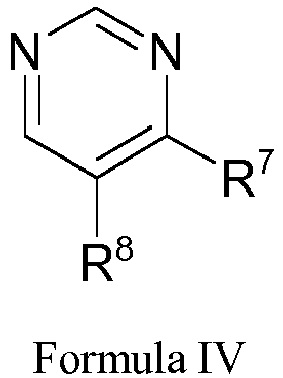
with the proviso that R7 and R8 together contain 4-8 carbon atoms; or
wherein the compound is
wherein R9 represents a 5 to 6 membered saturated or unsaturated hydrocarbon ring substituted with a substituent selected from the group consisting of methyl and ethyl; or
wherein the compound is

wherein the compound is
wherein R9 represents a substituent in any position of the proximal ring 5 and is selected from the group consisting of H, methyl, and ethyl;
wherein R10 represents a substituent in any position of the distal ring 6 and is selected from the group consisting of H, methyl, and ethyl; and
wherein the broken line represents a single or double bond,
with the proviso that R9 and R10 together contain at least two carbon atoms; or
wherein the compound is
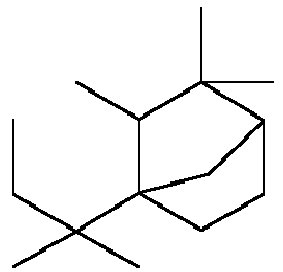

wherein the compound is
8 is attached to a distal ring 9;
wherein q and r are each independently integers of 0 or 1 that when q is 0, r is 1; or when q is 1, r is 0 or 1;
wherein s represents an integer of 0 or 1;
wherein Y represents O or S;
wherein R13 represents a substituent in any position of the distal ring 9 and is selected from the group consisting of H, methyl, and ethyl;
wherein R14 represents a substituent in any position of the proximal ring 8 and is H or methyl; and
wherein the broken line represents a single or double bond,
with the proviso that when R13 is H, R14 is not H; or
wherein the compound is
wherein t represents an integer of 0 or 1;
wherein R15 represents a substituent in any position of the distal ring 12 and is selected from the group consisting of H, methyl, and ethyl;
wherein R16 represents a substituent in any position of the proximal ring 11 and is H or methyl; and
wherein the broken line represents a single or double bond,
with the proviso that when R15 is H, R16 is not H. - 6. The fragrance formulation of paragraph 4, wherein the compound is selected from the group consisting of
1,1,2,3,3-Pentamethyl-2,3,4,5-tetrahydro-1H-7,9-diaza-cyclopenta[a]naphthalene;
1,1,2,3,3-Pentamethyl-2,3,3a,4,5,9b-hexahydro-1H-7,9-diaza-cyclopenta[a]naphthalene;
1,1,3,3-Tetramethyl-2,3,4,5-tetrahydro-1H-7,9-diaza-cyclopenta[a]naphthalene;
1,1,3,3-Tetramethyl-2,3,3a,4,5,9b-hexahydro-1H-7,9-diaza-cyclopenta[a]naphthalene;
1,1,2,3,3,5-Hexamethyl-2,3,4,5-tetrahydro-1H-7,9-diaza-cyclopenta[a]naphthalene;
1,1,2,3,3,5-Hexamethyl-2,3,3a,4,5,9b-hexahydro-1H-7,9-diaza-cyclopenta[a]naphthalene;
7,7,10,10-Tetramethyl-5,6,7,8,9,10-hexahydro-benzo[h]quinazoline;
7,7,10,10-Tetramethyl-5,6,6a,7,8,9,10,10a-octahydro-benzo[h]quinazoline;
5,7,7,8,10,10-Hexamethyl-5,6,7,8,9,10-hexahydro-benzo[h]quinazoline;
5,7,7,8,10,10-Hexamethyl-5,6,6a,7,8,9,10,10a-octahydro-benzo[h]quinazoline;
7,7,10a-Trimethyl-5,6,6a,7,8,9,10,10a-octahydro-benzo[h]quinazoline;
8 -Isopropyl-5,6,7,8 -tetrahydro-quinazoline;
8 -tert-Butyl-5,6,7,8 -tetrahydro-quinazoline;
5-(1,5-Dimethyl-hex-4-enyl)-pyrimidine;
4-tert-Butyl-pyrimidine;
4-(2,2-Dimethyl-propyl)-pyrimidine;
4,5 -Diisopropyl-pyrimidine;
4,5 -Di-tert-butyl-pyrimidine;
5-tert-Butyl-4-(2,2-dimethyl-propyl)-pyrimidine;
4-(2,6,6-Trimethyl-cyclohex-3-enyl)-pyrimidine;
4-(3,3-Dimethyl-cyclohexyl)-pyrimidine;
4-[2-(2,6,6-Trimethyl-cyclohex-1-enyl)-ethyl]-pyrimidine;
4-[2-(2,5,6,6-Tetramethyl-cyclohex-1-enyl)-ethyl]-pyrimidine;
4-(1,1,2,3,3-Pentamethyl-indan-5-yl)-pyrimidine;
4-(6-tert-Butyl-1,1-dimethyl-indan-4-yl)-pyrimidine;
6,6,9a-Trimethyl-5,5a,6,7,8,9,9a,10-octahydro-benzo[g]quinazoline;
5a,10-Dimethyl-5,5a,6,7,8,9-hexahydro-benzo[g]quinazoline;
5a,10-Dimethyl-5,5a,6,7,8,9,9a,10-octahydro-benzo[g]quinazoline;
6,6,10,10-Tetramethyl-5,7,8,9,10,10a-hexahydro-6H-6a,9-methanobenzo[H]quinazoline;
5,7,7,10-Tetramethyl-6,7,7a,8,9,1 0-hexahydro-5H-6,10a-methanoazuleno[5,4-d]pyrimidine;
5,6,7,8-Tetrahydro-6,6,7,8,8-pentamethyl-4H-indeno[5,4-D]isoxazole;
5,5a,6,7,8,8a-Hexahydro-6,6,7,8,8-pentamethyl-4H-indeno[5,4-D]isoxazole;
6,6,7,8,8-Pentamethyl-5,6,7,8-tetrahydro-4H-1-oxa-3-aza-as-indacene;
6,6,7,8,8-Pentamethyl-5,6,7,8-tetrahydro-4H-indeno[4,5-d]oxazole;
6,6,7,8,8-Pentamethyl-5,5a,6,7,8,8a-hexahydro-4H-1-oxa-3-aza-as-indace;
6,6,7,8,8-Pentamethyl-5,5a,6,7,8,8a-hexahydro-4H-indeno[4,5-d]oxazole;
2,6,6,7,8,8-Hexamethyl-5,6,7,8-tetrahydro-4H-3-thia-1-aza-as-indacene;
2,6,6,7,8,8-Hexamethyl-5,5a,6,7,8,8a-hexahydro-4H-3-thia-1-aza-as-indacene;
7,7,8,9,9-Pentamethyl-5,7,8,9-tetrahydro-6H-cyclopenta[f]quinoxaline;
7,7,8,9,9-Pentamethyl-5,6a,7,8,9,9a-hexahydro-6H-cyclopenta[f]quinoxaline; and a mixture thereof. - 7. The fragrance formulation of any of paragraphs 4, 5 or 6, wherein the fragrance formulation is incorporated into a product selected from the group consisting of a perfume, a cologne, toilet water, a cosmetic product, a personal care product, a fabric care product, a cleaning product, and an air freshener.
- 8. The fragrance formulation of paragraph 7, wherein the cleaning product is selected from the group consisting of a detergent, a dishwashing composition, a scrubbing compound, and a window cleaner.
- 9. The fragrance formulation of any of paragraphs 4, 5, 6, 7 or 8, wherein the olfactory acceptable amount is from about 0.005 to about 50 weight percent of the fragrance formulation; or
from about 0.5 to about 25 weight percent of the fragrance formulation; or
from about 1 to about 10 weight percent of the fragrance formulation. - 10. A method of improving, enhancing or modifying a fragrance formulation through the addition of an olfactory acceptable amount of a compound of formula:

wherein (CH)m and (CH)n are each independently optionally substituted with a substituent selected from the group consisting of methyl and ethyl;
wherein X is selected from the group consisting of N, O, and S; and
wherein R1 and R2 each independently represent H or a hydrocarbon group, or R1 and R2 together represent a fused ring or a ring system,
with the proviso that when R1 is H, R2 is not H. - 11. The method of paragraph 10, wherein the compound is

wherein o is an integer of 0 or 1;
wherein R3 represents a substituent in any position of the distal ring 3 and is selected from the group consisting of H, methyl, and ethyl;
wherein R4 represents a substituent in any position of the proximal ring 2 and is H or methyl; and
wherein the broken line represents a single or double bond,
with the proviso that when R3 is H, R4 is not H; or
wherein the compound is
wherein the broken line represents a single or double bond,
with the proviso that R5 and R6 together contain 3-10 carbon atoms; or
wherein the compound is
with the proviso that R7 and R8 together contain 4-8 carbon atoms; or
wherein the compound is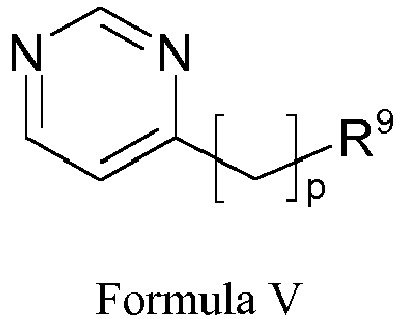
wherein R9 represents a 5 to 6 membered saturated or unsaturated hydrocarbon ring substituted with a substituent selected from the group consisting of methyl and ethyl; or
wherein the compound is
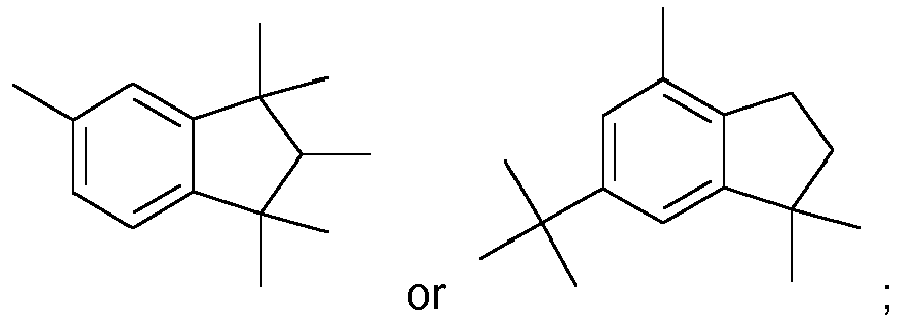
wherein the compound is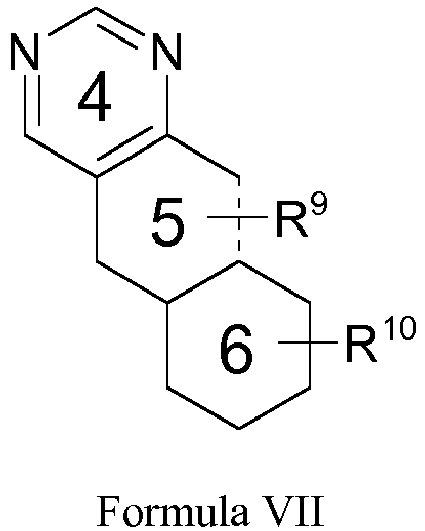
wherein R9 represents a substituent in any position of the proximal ring 5 and is selected from the group consisting of H, methyl, and ethyl;
wherein R10 represents a substituent in any position of the distal ring 6 and is selected from the group consisting of H, methyl, and ethyl; and
wherein the broken line represents a single or double bond,
with the proviso that R9 and R10 together contain at least two carbon atoms; or
wherein the compound is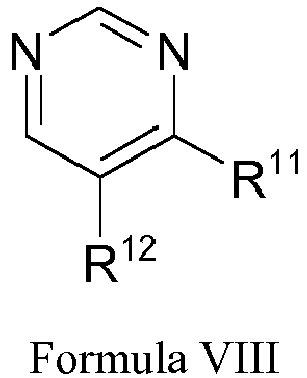
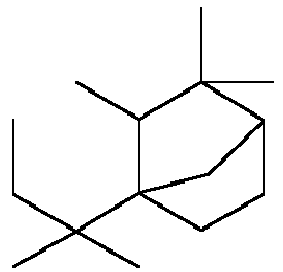

wherein the compound is
wherein q and r are each independently integers of 0 or 1 that when q is 0, r is 1; or when q is 1, r is 0 or 1;
wherein s represents an integer of 0 or 1;
wherein Y represents O or S;
wherein R13 represents a substituent in any position of the distal ring 9 and is selected from the group consisting of H, methyl, and ethyl;
wherein R14 represents a substituent in any position of the proximal ring 8 and is H or methyl; and
wherein the broken line represents a single or double bond,
with the proviso that when R13 is H, R14 is not H; or
wherein the compound is
wherein t represents an integer of 0 or 1;
wherein R15 represents a substituent in any position of the distal ring 12 and is selected from the group consisting of H, methyl, and ethyl;
wherein R16 represents a substituent in any position of the proximal ring 11 and is H or methyl; and
wherein the broken line represents a single or double bond,
with the proviso that when R15 is H, R16 is not H. - 12. The method of paragraph 10, wherein the compound is selected from the group consisting of
1,1,2,3,3-Pentamethyl-2,3,4,5-tetrahydro-1H-7,9-diaza-cyclopenta[a]naphthalene;
1,1,2,3,3-Pentamethyl-2,3,3a,4,5,9b-hexahydro-1H-7,9-diaza-cyclopenta[a]naphthalene;
1,1,3,3-Tetramethyl-2,3,4,5-tetrahydro-1H-7,9-diaza-cyclopenta[a]naphthalene;
1,1,3,3-Tetramethyl-2,3,3a,4,5,9b-hexahydro-1H-7,9-diaza-cyclopenta[a]naphthalene;
1,1,2,3,3,5-Hexamethyl-2,3,4,5-tetrahydro-1H-7,9-diaza-cyclopenta[a]naphthalene;
1,1,2,3,3,5-Hexamethyl-2,3,3a,4,5,9b-hexahydro-1H-7,9-diaza-cyclopenta[a]naphthalene;
7,7,10,10-Tetramethyl-5,6,7,8,9,10-hexahydro-benzo[h]quinazoline;
7,7,10,10-Tetramethyl-5,6,6a,7,8,9,10,10a-octahydro-benzo[h]quinazoline;
5,7,7,8,10,10-Hexamethyl-5,6,7,8,9,10-hexahydro-benzo[h]quinazoline;
5,7,7,8,10,10-Hexamethyl-5,6,6a,7,8,9,10,10a-octahydro-benzo[h]quinazoline;
7,7,10a-Trimethyl-5,6,6a,7,8,9,10,10a-octahydro-benzo[h]quinazoline
8 -Isopropyl-5,6,7,8 -tetrahydro-quinazoline;
8 -tert-Butyl-5,6,7,8 -tetrahydro-quinazoline;
5-(1,5-Dimethyl-hex-4-enyl)-pyrimidine;
4-tert-Butyl-pyrimidine;
4-(2,2-Dimethyl-propyl)-pyrimidine;
4,5 -Diisopropyl-pyrimidine;
4,5 -Di-tert-butyl-pyrimidine;
5-tert-Butyl-4-(2,2-dimethyl-propyl)-pyrimidine;
4-(2,6,6-Trimethyl-cyclohex-3-enyl)-pyrimidine;
4-(3,3-Dimethyl-cyclohexyl)-pyrimidine;
4-[2-(2,6,6-Trimethyl-cyclohex-1-enyl)-ethyl]-pyrimidine;
4-[2-(2,5,6,6-Tetramethyl-cyclohex-1-enyl)-ethyl]-pyrimidine;
4-(1,1,2,3,3-Pentamethyl-indan-5-yl)-pyrimidine;
4-(6-tert-Butyl-1,1-dimethyl-indan-4-yl)-pyrimidine;
6,6,9a-Trimethyl-5,5a,6,7,8,9,9a,10-octahydro-benzo[g]quinazoline;
5a,10-Dimethyl-5,5a,6,7,8,9-hexahydro-benzo[g]quinazoline;
5a,10-Dimethyl-5,5a,6,7,8,9,9a,10-octahydro-benzo[g]quinazoline;
6,6,10,10-Tetramethyl-5,7,8,9,10,10a-hexahydro-6H-6a,9-methanobenzo[H]quinazoline;
5,7,7,10-Tetramethyl-6,7,7a,8,9,10-hexahydro-5H-6,10a-methanoazuleno[5,4-d]pyrimidine;
5,6,7,8-Tetrahydro-6,6,7,8,8-pentamethyl-4H-indeno[5,4-D]isoxazole;
5,5a,6,7,8,8a-Hexahydro-6,6,7,8,8-pentamethyl-4H-indeno[5,4-D]isoxazole:
6,6,7,8,8-Pentamethyl-5,6,7,8-tetrahydro-4H-1-oxa-3-aza-as-indacene;
6,6,7,8,8-Pentamethyl-5,6,7,8-tetrahydro-4H-indeno[4,5-d]oxazole;
6,6,7,8,8-Pentamethyl-5,5a,6,7,8,8a-hexahydro-4H-1-oxa-3-aza-as-indace;
6,6,7,8,8-Pentamethyl-5,5a,6,7,8,8a-hexahydro-4H-indeno[4,5-d]oxazole;
2,6,6,7,8,8-Hexamethyl-5,6,7,8-tetrahydro-4H-3-thia-1-aza-as-indacene;
2,6,6,7,8,8-Hexamethyl-5,5a,6,7,8,8a-hexahydro-4H-3-thia-1-aza-as-indacene;
7,7,8,9,9-Pentamethyl-5,7,8,9-tetrahydro-6H-cyclopenta[f]quinoxaline;
7,7,8,9,9-Pentamethyl-5,6a,7,8,9,9a-hexahydro-6H-cyclopenta[f]quinoxaline; and
a mixture thereof. - 13. The method of any of paragraphs 10, 11 or 12, wherein the olfactory acceptable amount is from about 0.005 to about 50 weight percent of the fragrance formulation; or
from about 0.5 to about 25 weight percent of the fragrance formulation; or
from about 1 to about 10 weight percent of the fragrance formulation.
Claims (7)
- A compound of formula 6,6,10,10-Tetramethyl-5,7,8,9,10,10a-hexahydro-6H-6a,9-methanobenzo[H]quinazoline:

- A fragrance formulation containing an olfactory acceptable amount of 6,6,10,10-Tetramethyl-5,7,8,9,10,10a-hexahydro-6H-6a,9-methanobenzo[H]quinazoline:

- The fragrance formulation of claim 2, wherein the fragrance formulation is incorporated into a product selected from the group consisting of a perfume, a cologne, toilet water, a cosmetic product, a personal care product, a fabric care product, a cleaning product, and an air freshener.
- The fragrance formulation of claim 3, wherein the cleaning product is selected from the group consisting of a detergent, a dishwashing composition, a scrubbing compound, and a window cleaner.
- The fragrance formulation of any of claims 2 to 4, wherein the olfactory acceptable amount is from about 0.005 to about 50 weight percent of the fragrance formulation; or
from about 0.5 to about 25 weight percent of the fragrance formulation; or
from about 1 to about 10 weight percent of the fragrance formulation. - A method of improving, enhancing or modifying a fragrance formulation through the addition of an olfactory acceptable amount of 6,6,10,10-Tetramethyl-5,7,8,9,10,10a-hexahydro-6H-6a,9-methanobenzo[H]quinazoline:

- The method of claim 6, wherein the olfactory acceptable amount is from about 0.005 to about 50 weight percent of the fragrance formulation; or
from about 0.5 to about 25 weight percent of the fragrance formulation; or
from about 1 to about 10 weight percent of the fragrance formulation.
Applications Claiming Priority (2)
| Application Number | Priority Date | Filing Date | Title |
|---|---|---|---|
| US13/430,908 US8557827B2 (en) | 2011-02-15 | 2012-03-27 | Pyrimidine derivatives and their use in perfume compositions |
| EP12175170.5A EP2644688B1 (en) | 2012-03-27 | 2012-07-05 | Novel pyrimidine derivatives and their use in perfume compositions |
Related Parent Applications (2)
| Application Number | Title | Priority Date | Filing Date |
|---|---|---|---|
| EP12175170.5A Division EP2644688B1 (en) | 2012-03-27 | 2012-07-05 | Novel pyrimidine derivatives and their use in perfume compositions |
| EP12175170.5A Division-Into EP2644688B1 (en) | 2012-03-27 | 2012-07-05 | Novel pyrimidine derivatives and their use in perfume compositions |
Publications (2)
| Publication Number | Publication Date |
|---|---|
| EP2851415A1 true EP2851415A1 (en) | 2015-03-25 |
| EP2851415B1 EP2851415B1 (en) | 2016-04-27 |
Family
ID=46458338
Family Applications (2)
| Application Number | Title | Priority Date | Filing Date |
|---|---|---|---|
| EP14196163.1A Active EP2851415B1 (en) | 2012-03-27 | 2012-07-05 | Novel quinazoline derivatives and their use in perfume compositions |
| EP12175170.5A Active EP2644688B1 (en) | 2012-03-27 | 2012-07-05 | Novel pyrimidine derivatives and their use in perfume compositions |
Family Applications After (1)
| Application Number | Title | Priority Date | Filing Date |
|---|---|---|---|
| EP12175170.5A Active EP2644688B1 (en) | 2012-03-27 | 2012-07-05 | Novel pyrimidine derivatives and their use in perfume compositions |
Country Status (3)
| Country | Link |
|---|---|
| EP (2) | EP2851415B1 (en) |
| CN (1) | CN103360324B (en) |
| ES (2) | ES2573810T3 (en) |
Families Citing this family (3)
| Publication number | Priority date | Publication date | Assignee | Title |
|---|---|---|---|---|
| CN105316108A (en) * | 2014-06-12 | 2016-02-10 | 天津市双马香精香料新技术有限公司 | Laundry detergent essence added with tricyclodecenyl n-butyrate |
| CN105669565B (en) * | 2016-03-21 | 2017-07-11 | 南京林业大学 | Isolonglifolane yl pyrimidines class compound and preparation method and application |
| CN116804222A (en) * | 2018-05-02 | 2023-09-26 | 北京康普森生物技术有限公司 | Method for identifying sheep and non-sheep based on SNP molecular markers |
Citations (5)
| Publication number | Priority date | Publication date | Assignee | Title |
|---|---|---|---|---|
| US2912462A (en) | 1957-10-22 | 1959-11-10 | Trubeck Lab | Substituted bicyclic decanols and decanones |
| GB1354733A (en) * | 1970-08-21 | 1974-06-05 | Int Flavors & Fragrances Inc | Process for altering flavour or aroma |
| US3887622A (en) | 1972-07-20 | 1975-06-03 | Naarden International Nv | Process for the preparation of sesquiterpene ketones |
| US3927083A (en) | 1972-06-15 | 1975-12-16 | Int Flavors & Fragrances Inc | Bicyclic compounds and processes for making and using same |
| US4534891A (en) | 1982-11-12 | 1985-08-13 | International Flavors & Fragrances Inc. | Branched C13 -alk-1-en-5-ones and use thereof in perfumery |
Family Cites Families (9)
| Publication number | Priority date | Publication date | Assignee | Title |
|---|---|---|---|---|
| BE755607A (en) * | 1969-09-02 | 1971-03-02 | Int Flavors & Fragrances Inc | NEW NITROGENOUS HETEROCYCLIC COMPOUNDS, THEIR PREPARATION, AROMAS, FLAVORS AND PERFUMES CONTAINING AND PREPARATION OF THE LATEST |
| NL7514197A (en) * | 1970-04-14 | 1976-03-31 | Int Flavors & Fragrances Inc | Pyrazine derivs as flavour additives for foodstuffs |
| US3748145A (en) * | 1970-04-14 | 1973-07-24 | Int Flavors & Fragrances Inc | Bicyclic pyrazine compositions for flavoring processes |
| CH579912A5 (en) * | 1973-03-22 | 1976-09-30 | Roure Bertrand Dupont Sa | |
| CH577318A5 (en) * | 1973-09-28 | 1976-07-15 | Roure Bertrand Dupont Sa | |
| CH679666A5 (en) * | 1989-12-05 | 1992-03-31 | Firmenich & Cie | Novel pyrazole ring contg. cpds. - used as perfuming ingredient in cosmetics |
| AUPR227200A0 (en) * | 2000-12-22 | 2001-01-25 | Elson, Paul | Fragrance compositions replicating new cloth trimmed and leather car scents |
| WO2008013622A2 (en) * | 2006-07-27 | 2008-01-31 | E. I. Du Pont De Nemours And Company | Fungicidal azocyclic amides |
| KR101500918B1 (en) * | 2009-03-06 | 2015-03-12 | 가부시키가이샤 시세이도 | Fragrance compositions |
-
2012
- 2012-07-05 EP EP14196163.1A patent/EP2851415B1/en active Active
- 2012-07-05 ES ES14196163.1T patent/ES2573810T3/en active Active
- 2012-07-05 ES ES12175170.5T patent/ES2651501T3/en active Active
- 2012-07-05 EP EP12175170.5A patent/EP2644688B1/en active Active
- 2012-07-26 CN CN201210262399.1A patent/CN103360324B/en active Active
Patent Citations (5)
| Publication number | Priority date | Publication date | Assignee | Title |
|---|---|---|---|---|
| US2912462A (en) | 1957-10-22 | 1959-11-10 | Trubeck Lab | Substituted bicyclic decanols and decanones |
| GB1354733A (en) * | 1970-08-21 | 1974-06-05 | Int Flavors & Fragrances Inc | Process for altering flavour or aroma |
| US3927083A (en) | 1972-06-15 | 1975-12-16 | Int Flavors & Fragrances Inc | Bicyclic compounds and processes for making and using same |
| US3887622A (en) | 1972-07-20 | 1975-06-03 | Naarden International Nv | Process for the preparation of sesquiterpene ketones |
| US4534891A (en) | 1982-11-12 | 1985-08-13 | International Flavors & Fragrances Inc. | Branched C13 -alk-1-en-5-ones and use thereof in perfumery |
Non-Patent Citations (4)
| Title |
|---|
| "Perfumes, Cosmetics and Soaps", 1959 |
| BARTON, TETRAHEDRON LETTERS, vol. 25, no. 6, 1984, pages 603 - 606 |
| SJOEBERS, ACTA CHEMICA SCAND., vol. 44, no. 10, 1990, pages 1036 - 1041 |
| STRIKE, JOURNAL OF THE AMERICAN CHEMICAL SOCIETY, vol. 86, no. 10, 1964, pages 2044 - 2050 |
Also Published As
| Publication number | Publication date |
|---|---|
| ES2651501T3 (en) | 2018-01-26 |
| CN103360324A (en) | 2013-10-23 |
| EP2644688A2 (en) | 2013-10-02 |
| CN103360324B (en) | 2016-12-21 |
| ES2573810T3 (en) | 2016-06-10 |
| EP2851415B1 (en) | 2016-04-27 |
| EP2644688B1 (en) | 2017-11-08 |
| EP2644688A3 (en) | 2013-10-30 |
Similar Documents
| Publication | Publication Date | Title |
|---|---|---|
| US8557876B2 (en) | Pyrimidine derivatives and their use in perfume compositions | |
| US9834738B2 (en) | Octahydro-1H-4,7-methano-indene-5-aldehydes and their use in perfume compositions | |
| US9643913B2 (en) | Organoleptic compounds | |
| EP2644688B1 (en) | Novel pyrimidine derivatives and their use in perfume compositions | |
| US8461100B1 (en) | Decenal mixtures and their use in perfume compositions | |
| US8557827B2 (en) | Pyrimidine derivatives and their use in perfume compositions | |
| US9029535B2 (en) | Pyrimidine derivatives and their use in perfume compositions | |
| US9416335B2 (en) | Quinazoline compounds and their use in perfume compositions | |
| US9701653B2 (en) | Diethyl-methyl-hexahydro-isobenzofurans and their use in perfume compositions | |
| EP2698363B1 (en) | 3(OR2),4,5-Trimethyl-Octahydro-4,7-Methano-Inden-5-Ol and its use in Perfume Compositions | |
| US8114823B2 (en) | Isomers of bicyclo[2.2.1]hept-5-ene-2-carboxylic acid, ethyl ester and their use in perfume compositions | |
| US8466325B2 (en) | Organoleptic compounds | |
| EP2772527B1 (en) | Novel decenal mixtures and their use in perfume compositions | |
| EP1947078B1 (en) | Novel macrocyclic musk | |
| EP2801572B1 (en) | Novel 3,3-diethyl-alkyl-2-oxa-spiro[4.5]dec-7-enes and their use in perfume compositions | |
| US20170275262A1 (en) | Cyclopropane derivatives in flavor and fragrance compositions |
Legal Events
| Date | Code | Title | Description |
|---|---|---|---|
| PUAI | Public reference made under article 153(3) epc to a published international application that has entered the european phase |
Free format text: ORIGINAL CODE: 0009012 |
|
| 17P | Request for examination filed |
Effective date: 20141203 |
|
| AC | Divisional application: reference to earlier application |
Ref document number: 2644688 Country of ref document: EP Kind code of ref document: P |
|
| AK | Designated contracting states |
Kind code of ref document: A1 Designated state(s): AL AT BE BG CH CY CZ DE DK EE ES FI FR GB GR HR HU IE IS IT LI LT LU LV MC MK MT NL NO PL PT RO RS SE SI SK SM TR |
|
| AX | Request for extension of the european patent |
Extension state: BA ME |
|
| R17P | Request for examination filed (corrected) |
Effective date: 20150925 |
|
| RBV | Designated contracting states (corrected) |
Designated state(s): AL AT BE BG CH CY CZ DE DK EE ES FI FR GB GR HR HU IE IS IT LI LT LU LV MC MK MT NL NO PL PT RO RS SE SI SK SM TR |
|
| GRAP | Despatch of communication of intention to grant a patent |
Free format text: ORIGINAL CODE: EPIDOSNIGR1 |
|
| INTG | Intention to grant announced |
Effective date: 20151201 |
|
| GRAS | Grant fee paid |
Free format text: ORIGINAL CODE: EPIDOSNIGR3 |
|
| GRAA | (expected) grant |
Free format text: ORIGINAL CODE: 0009210 |
|
| AC | Divisional application: reference to earlier application |
Ref document number: 2644688 Country of ref document: EP Kind code of ref document: P |
|
| AK | Designated contracting states |
Kind code of ref document: B1 Designated state(s): AL AT BE BG CH CY CZ DE DK EE ES FI FR GB GR HR HU IE IS IT LI LT LU LV MC MK MT NL NO PL PT RO RS SE SI SK SM TR |
|
| REG | Reference to a national code |
Ref country code: GB Ref legal event code: FG4D |
|
| REG | Reference to a national code |
Ref country code: CH Ref legal event code: EP |
|
| REG | Reference to a national code |
Ref country code: AT Ref legal event code: REF Ref document number: 794835 Country of ref document: AT Kind code of ref document: T Effective date: 20160515 |
|
| REG | Reference to a national code |
Ref country code: IE Ref legal event code: FG4D |
|
| REG | Reference to a national code |
Ref country code: NL Ref legal event code: FP |
|
| REG | Reference to a national code |
Ref country code: ES Ref legal event code: FG2A Ref document number: 2573810 Country of ref document: ES Kind code of ref document: T3 Effective date: 20160610 |
|
| REG | Reference to a national code |
Ref country code: DE Ref legal event code: R096 Ref document number: 602012017970 Country of ref document: DE |
|
| REG | Reference to a national code |
Ref country code: CH Ref legal event code: NV Representative=s name: BOVARD AG, CH |
|
| REG | Reference to a national code |
Ref country code: FR Ref legal event code: PLFP Year of fee payment: 5 |
|
| REG | Reference to a national code |
Ref country code: LT Ref legal event code: MG4D |
|
| REG | Reference to a national code |
Ref country code: AT Ref legal event code: MK05 Ref document number: 794835 Country of ref document: AT Kind code of ref document: T Effective date: 20160427 |
|
| PG25 | Lapsed in a contracting state [announced via postgrant information from national office to epo] |
Ref country code: LT Free format text: LAPSE BECAUSE OF FAILURE TO SUBMIT A TRANSLATION OF THE DESCRIPTION OR TO PAY THE FEE WITHIN THE PRESCRIBED TIME-LIMIT Effective date: 20160427 Ref country code: FI Free format text: LAPSE BECAUSE OF FAILURE TO SUBMIT A TRANSLATION OF THE DESCRIPTION OR TO PAY THE FEE WITHIN THE PRESCRIBED TIME-LIMIT Effective date: 20160427 Ref country code: PL Free format text: LAPSE BECAUSE OF FAILURE TO SUBMIT A TRANSLATION OF THE DESCRIPTION OR TO PAY THE FEE WITHIN THE PRESCRIBED TIME-LIMIT Effective date: 20160427 Ref country code: NO Free format text: LAPSE BECAUSE OF FAILURE TO SUBMIT A TRANSLATION OF THE DESCRIPTION OR TO PAY THE FEE WITHIN THE PRESCRIBED TIME-LIMIT Effective date: 20160727 |
|
| PG25 | Lapsed in a contracting state [announced via postgrant information from national office to epo] |
Ref country code: SE Free format text: LAPSE BECAUSE OF FAILURE TO SUBMIT A TRANSLATION OF THE DESCRIPTION OR TO PAY THE FEE WITHIN THE PRESCRIBED TIME-LIMIT Effective date: 20160427 Ref country code: HR Free format text: LAPSE BECAUSE OF FAILURE TO SUBMIT A TRANSLATION OF THE DESCRIPTION OR TO PAY THE FEE WITHIN THE PRESCRIBED TIME-LIMIT Effective date: 20160427 Ref country code: LV Free format text: LAPSE BECAUSE OF FAILURE TO SUBMIT A TRANSLATION OF THE DESCRIPTION OR TO PAY THE FEE WITHIN THE PRESCRIBED TIME-LIMIT Effective date: 20160427 Ref country code: RS Free format text: LAPSE BECAUSE OF FAILURE TO SUBMIT A TRANSLATION OF THE DESCRIPTION OR TO PAY THE FEE WITHIN THE PRESCRIBED TIME-LIMIT Effective date: 20160427 Ref country code: GR Free format text: LAPSE BECAUSE OF FAILURE TO SUBMIT A TRANSLATION OF THE DESCRIPTION OR TO PAY THE FEE WITHIN THE PRESCRIBED TIME-LIMIT Effective date: 20160728 Ref country code: PT Free format text: LAPSE BECAUSE OF FAILURE TO SUBMIT A TRANSLATION OF THE DESCRIPTION OR TO PAY THE FEE WITHIN THE PRESCRIBED TIME-LIMIT Effective date: 20160829 Ref country code: AT Free format text: LAPSE BECAUSE OF FAILURE TO SUBMIT A TRANSLATION OF THE DESCRIPTION OR TO PAY THE FEE WITHIN THE PRESCRIBED TIME-LIMIT Effective date: 20160427 |
|
| PG25 | Lapsed in a contracting state [announced via postgrant information from national office to epo] |
Ref country code: BE Free format text: LAPSE BECAUSE OF FAILURE TO SUBMIT A TRANSLATION OF THE DESCRIPTION OR TO PAY THE FEE WITHIN THE PRESCRIBED TIME-LIMIT Effective date: 20160427 Ref country code: IT Free format text: LAPSE BECAUSE OF FAILURE TO SUBMIT A TRANSLATION OF THE DESCRIPTION OR TO PAY THE FEE WITHIN THE PRESCRIBED TIME-LIMIT Effective date: 20160427 |
|
| REG | Reference to a national code |
Ref country code: DE Ref legal event code: R097 Ref document number: 602012017970 Country of ref document: DE |
|
| PG25 | Lapsed in a contracting state [announced via postgrant information from national office to epo] |
Ref country code: EE Free format text: LAPSE BECAUSE OF FAILURE TO SUBMIT A TRANSLATION OF THE DESCRIPTION OR TO PAY THE FEE WITHIN THE PRESCRIBED TIME-LIMIT Effective date: 20160427 Ref country code: SK Free format text: LAPSE BECAUSE OF FAILURE TO SUBMIT A TRANSLATION OF THE DESCRIPTION OR TO PAY THE FEE WITHIN THE PRESCRIBED TIME-LIMIT Effective date: 20160427 Ref country code: RO Free format text: LAPSE BECAUSE OF FAILURE TO SUBMIT A TRANSLATION OF THE DESCRIPTION OR TO PAY THE FEE WITHIN THE PRESCRIBED TIME-LIMIT Effective date: 20160427 Ref country code: DK Free format text: LAPSE BECAUSE OF FAILURE TO SUBMIT A TRANSLATION OF THE DESCRIPTION OR TO PAY THE FEE WITHIN THE PRESCRIBED TIME-LIMIT Effective date: 20160427 Ref country code: CZ Free format text: LAPSE BECAUSE OF FAILURE TO SUBMIT A TRANSLATION OF THE DESCRIPTION OR TO PAY THE FEE WITHIN THE PRESCRIBED TIME-LIMIT Effective date: 20160427 |
|
| PG25 | Lapsed in a contracting state [announced via postgrant information from national office to epo] |
Ref country code: SM Free format text: LAPSE BECAUSE OF FAILURE TO SUBMIT A TRANSLATION OF THE DESCRIPTION OR TO PAY THE FEE WITHIN THE PRESCRIBED TIME-LIMIT Effective date: 20160427 |
|
| PLBE | No opposition filed within time limit |
Free format text: ORIGINAL CODE: 0009261 |
|
| STAA | Information on the status of an ep patent application or granted ep patent |
Free format text: STATUS: NO OPPOSITION FILED WITHIN TIME LIMIT |
|
| PG25 | Lapsed in a contracting state [announced via postgrant information from national office to epo] |
Ref country code: MC Free format text: LAPSE BECAUSE OF FAILURE TO SUBMIT A TRANSLATION OF THE DESCRIPTION OR TO PAY THE FEE WITHIN THE PRESCRIBED TIME-LIMIT Effective date: 20160427 |
|
| 26N | No opposition filed |
Effective date: 20170130 |
|
| REG | Reference to a national code |
Ref country code: IE Ref legal event code: MM4A |
|
| PG25 | Lapsed in a contracting state [announced via postgrant information from national office to epo] |
Ref country code: SI Free format text: LAPSE BECAUSE OF FAILURE TO SUBMIT A TRANSLATION OF THE DESCRIPTION OR TO PAY THE FEE WITHIN THE PRESCRIBED TIME-LIMIT Effective date: 20160427 |
|
| REG | Reference to a national code |
Ref country code: FR Ref legal event code: PLFP Year of fee payment: 6 |
|
| PG25 | Lapsed in a contracting state [announced via postgrant information from national office to epo] |
Ref country code: IE Free format text: LAPSE BECAUSE OF NON-PAYMENT OF DUE FEES Effective date: 20160705 |
|
| PG25 | Lapsed in a contracting state [announced via postgrant information from national office to epo] |
Ref country code: LU Free format text: LAPSE BECAUSE OF NON-PAYMENT OF DUE FEES Effective date: 20160705 |
|
| PG25 | Lapsed in a contracting state [announced via postgrant information from national office to epo] |
Ref country code: HU Free format text: LAPSE BECAUSE OF FAILURE TO SUBMIT A TRANSLATION OF THE DESCRIPTION OR TO PAY THE FEE WITHIN THE PRESCRIBED TIME-LIMIT; INVALID AB INITIO Effective date: 20120705 |
|
| PG25 | Lapsed in a contracting state [announced via postgrant information from national office to epo] |
Ref country code: MK Free format text: LAPSE BECAUSE OF FAILURE TO SUBMIT A TRANSLATION OF THE DESCRIPTION OR TO PAY THE FEE WITHIN THE PRESCRIBED TIME-LIMIT Effective date: 20160427 Ref country code: MT Free format text: LAPSE BECAUSE OF NON-PAYMENT OF DUE FEES Effective date: 20160731 Ref country code: CY Free format text: LAPSE BECAUSE OF FAILURE TO SUBMIT A TRANSLATION OF THE DESCRIPTION OR TO PAY THE FEE WITHIN THE PRESCRIBED TIME-LIMIT Effective date: 20160427 Ref country code: IS Free format text: LAPSE BECAUSE OF FAILURE TO SUBMIT A TRANSLATION OF THE DESCRIPTION OR TO PAY THE FEE WITHIN THE PRESCRIBED TIME-LIMIT Effective date: 20160427 |
|
| REG | Reference to a national code |
Ref country code: FR Ref legal event code: PLFP Year of fee payment: 7 |
|
| PG25 | Lapsed in a contracting state [announced via postgrant information from national office to epo] |
Ref country code: BG Free format text: LAPSE BECAUSE OF FAILURE TO SUBMIT A TRANSLATION OF THE DESCRIPTION OR TO PAY THE FEE WITHIN THE PRESCRIBED TIME-LIMIT Effective date: 20160427 |
|
| PG25 | Lapsed in a contracting state [announced via postgrant information from national office to epo] |
Ref country code: AL Free format text: LAPSE BECAUSE OF FAILURE TO SUBMIT A TRANSLATION OF THE DESCRIPTION OR TO PAY THE FEE WITHIN THE PRESCRIBED TIME-LIMIT Effective date: 20160427 Ref country code: TR Free format text: LAPSE BECAUSE OF FAILURE TO SUBMIT A TRANSLATION OF THE DESCRIPTION OR TO PAY THE FEE WITHIN THE PRESCRIBED TIME-LIMIT Effective date: 20160427 |
|
| P01 | Opt-out of the competence of the unified patent court (upc) registered |
Effective date: 20230530 |
|
| PGFP | Annual fee paid to national office [announced via postgrant information from national office to epo] |
Ref country code: GB Payment date: 20250529 Year of fee payment: 14 |
|
| PGFP | Annual fee paid to national office [announced via postgrant information from national office to epo] |
Ref country code: NL Payment date: 20250613 Year of fee payment: 14 |
|
| PGFP | Annual fee paid to national office [announced via postgrant information from national office to epo] |
Ref country code: FR Payment date: 20250610 Year of fee payment: 14 |
|
| PGFP | Annual fee paid to national office [announced via postgrant information from national office to epo] |
Ref country code: ES Payment date: 20250805 Year of fee payment: 14 |
|
| PGFP | Annual fee paid to national office [announced via postgrant information from national office to epo] |
Ref country code: DE Payment date: 20250604 Year of fee payment: 14 |
|
| PGFP | Annual fee paid to national office [announced via postgrant information from national office to epo] |
Ref country code: CH Payment date: 20250801 Year of fee payment: 14 |