EP2849478A1 - A base station and a method of a base station estimating traffic load on a neighbouring base station - Google Patents
A base station and a method of a base station estimating traffic load on a neighbouring base station Download PDFInfo
- Publication number
- EP2849478A1 EP2849478A1 EP13290219.8A EP13290219A EP2849478A1 EP 2849478 A1 EP2849478 A1 EP 2849478A1 EP 13290219 A EP13290219 A EP 13290219A EP 2849478 A1 EP2849478 A1 EP 2849478A1
- Authority
- EP
- European Patent Office
- Prior art keywords
- base station
- neighbouring
- neighbouring base
- transmit power
- small cell
- Prior art date
- Legal status (The legal status is an assumption and is not a legal conclusion. Google has not performed a legal analysis and makes no representation as to the accuracy of the status listed.)
- Withdrawn
Links
- 238000000034 method Methods 0.000 title claims description 8
- 238000005259 measurement Methods 0.000 claims description 30
- 230000005540 biological transmission Effects 0.000 claims description 5
- 230000001419 dependent effect Effects 0.000 claims description 4
- 101000608745 Phytolacca americana Lectin-B Proteins 0.000 description 6
- 238000004364 calculation method Methods 0.000 description 6
- 101000972349 Phytolacca americana Lectin-A Proteins 0.000 description 3
- 238000010586 diagram Methods 0.000 description 3
- 238000007726 management method Methods 0.000 description 3
- 238000012935 Averaging Methods 0.000 description 2
- 230000001413 cellular effect Effects 0.000 description 2
- 238000013500 data storage Methods 0.000 description 2
- 230000006870 function Effects 0.000 description 2
- 238000012545 processing Methods 0.000 description 2
- BIIBYWQGRFWQKM-JVVROLKMSA-N (2S)-N-[4-(cyclopropylamino)-3,4-dioxo-1-[(3S)-2-oxopyrrolidin-3-yl]butan-2-yl]-2-[[(E)-3-(2,4-dichlorophenyl)prop-2-enoyl]amino]-4,4-dimethylpentanamide Chemical class CC(C)(C)C[C@@H](C(NC(C[C@H](CCN1)C1=O)C(C(NC1CC1)=O)=O)=O)NC(/C=C/C(C=CC(Cl)=C1)=C1Cl)=O BIIBYWQGRFWQKM-JVVROLKMSA-N 0.000 description 1
- 230000004913 activation Effects 0.000 description 1
- 230000003044 adaptive effect Effects 0.000 description 1
- 239000000969 carrier Substances 0.000 description 1
- 230000009849 deactivation Effects 0.000 description 1
- 238000013507 mapping Methods 0.000 description 1
- 230000015654 memory Effects 0.000 description 1
- 230000011664 signaling Effects 0.000 description 1
- 238000012546 transfer Methods 0.000 description 1
Images


Classifications
-
- H—ELECTRICITY
- H04—ELECTRIC COMMUNICATION TECHNIQUE
- H04W—WIRELESS COMMUNICATION NETWORKS
- H04W24/00—Supervisory, monitoring or testing arrangements
- H04W24/02—Arrangements for optimising operational condition
-
- H—ELECTRICITY
- H04—ELECTRIC COMMUNICATION TECHNIQUE
- H04W—WIRELESS COMMUNICATION NETWORKS
- H04W52/00—Power management, e.g. Transmission Power Control [TPC] or power classes
- H04W52/04—Transmission power control [TPC]
- H04W52/30—Transmission power control [TPC] using constraints in the total amount of available transmission power
- H04W52/32—TPC of broadcast or control channels
- H04W52/325—Power control of control or pilot channels
-
- H—ELECTRICITY
- H04—ELECTRIC COMMUNICATION TECHNIQUE
- H04W—WIRELESS COMMUNICATION NETWORKS
- H04W52/00—Power management, e.g. Transmission Power Control [TPC] or power classes
- H04W52/04—Transmission power control [TPC]
- H04W52/30—Transmission power control [TPC] using constraints in the total amount of available transmission power
- H04W52/36—Transmission power control [TPC] using constraints in the total amount of available transmission power with a discrete range or set of values, e.g. step size, ramping or offsets
- H04W52/367—Power values between minimum and maximum limits, e.g. dynamic range
-
- H—ELECTRICITY
- H04—ELECTRIC COMMUNICATION TECHNIQUE
- H04W—WIRELESS COMMUNICATION NETWORKS
- H04W52/00—Power management, e.g. Transmission Power Control [TPC] or power classes
- H04W52/04—Transmission power control [TPC]
- H04W52/38—TPC being performed in particular situations
- H04W52/40—TPC being performed in particular situations during macro-diversity or soft handoff
-
- H—ELECTRICITY
- H04—ELECTRIC COMMUNICATION TECHNIQUE
- H04B—TRANSMISSION
- H04B17/00—Monitoring; Testing
- H04B17/30—Monitoring; Testing of propagation channels
- H04B17/309—Measuring or estimating channel quality parameters
- H04B17/318—Received signal strength
- H04B17/327—Received signal code power [RSCP]
-
- H—ELECTRICITY
- H04—ELECTRIC COMMUNICATION TECHNIQUE
- H04W—WIRELESS COMMUNICATION NETWORKS
- H04W52/00—Power management, e.g. Transmission Power Control [TPC] or power classes
- H04W52/04—Transmission power control [TPC]
- H04W52/30—Transmission power control [TPC] using constraints in the total amount of available transmission power
- H04W52/34—TPC management, i.e. sharing limited amount of power among users or channels or data types, e.g. cell loading
- H04W52/343—TPC management, i.e. sharing limited amount of power among users or channels or data types, e.g. cell loading taking into account loading or congestion level
-
- H—ELECTRICITY
- H04—ELECTRIC COMMUNICATION TECHNIQUE
- H04W—WIRELESS COMMUNICATION NETWORKS
- H04W84/00—Network topologies
- H04W84/02—Hierarchically pre-organised networks, e.g. paging networks, cellular networks, WLAN [Wireless Local Area Network] or WLL [Wireless Local Loop]
- H04W84/04—Large scale networks; Deep hierarchical networks
- H04W84/042—Public Land Mobile systems, e.g. cellular systems
- H04W84/045—Public Land Mobile systems, e.g. cellular systems using private Base Stations, e.g. femto Base Stations, home Node B
Definitions
- the present invention relates to telecommunications, in particular to wireless telecommunications.
- Wireless telecommunications systems are well-known. Many such systems are cellular, in that radio coverage is provided by a bundle of radio coverage areas known as cells. A base station that provides radio coverage is located in each cell. Traditional base stations provide coverage in relatively large geographic areas and the corresponding cells are often referred to as macrocells.
- Cells that are smaller than macrocells are sometimes referred to as small cells, microcells, picocells, or femtocells, but we use the term small cells generically for cells that are smaller than macrocells.
- Heterogeneous Networks are cellular wireless telecommunications systems made up of both macrocell base stations and small cell base stations. Some features of small cell base stations, such as radio coverage optimisation and activation/deactivation of a power-saving sleep mode, rely on exchange of load information with the underlying macrocell. For example, by using a backhaul connection, for example over the Internet, a small cell base station of Universal Mobile Telecommunications System (UMTS) type may request load information from the underlying macrocell using the Cell Load Information IE defined in Third Generation Partnership Project (3GPP) Technical Specification 25.413. IE denotes Information Element.
- 3GPP Third Generation Partnership Project
- Small cell base stations are often referred to as small cells.
- An example of the present invention is a base station configured to:
- the base station is also configured to transit between an active mode and a sleeping mode dependent upon whether or not said estimated traffic load exceeds a predetermined level.
- the base station is a small cell base station and the neighbouring base station is a macrocell base station.
- a small cell base station estimates the loading of an underlying macrocell in an autonomous manner not requiring transfer of data over a backhaul connection from a macrocell base station.
- Preferred embodiments may be considered as a type of Radio Resource Management (RRM), in a small cell base station, that uses radio measurements.
- RRM Radio Resource Management
- Preferred embodiments are autonomous as they do not rely on a physical interface, in other words backhaul connectivity, to retrieve a neighbour base station's load information.
- a base station estimates autonomously the loading on a neighbouring base station in a heterogeneous network (HetNet), for example in which small cell base stations from multiple different manufacturers are provided.
- HetNet heterogeneous network
- the present invention alos relates to corresponding methods of a base station estimating traffic load on a neighbouring base station by:
- the inventors realised that it was inefficient and not feasible from a practical perspective for a macrocell base station to support individual connections with a large number of small cell base stations within its coverage area. Problems such as high processing load at the macrocell base station, high control signalling traffic in the network, small cell bandwidth issues.
- the inventors also realised that physical interfaces between macrocell base stations and small cell base stations are not completely reliable in the known system.
- RSCP received signal code power
- RSSI The total received wide band power, including the noise generated in the receiver.
- RSSI is identical to CPICH RSCP divided by CPICH Ec/No (in linear units).
- P tx , CPICH i - CPICH transmit power of base station i .
- P tx , TRAFFIC i - Traffic channels transmit power of base station i .
- HetNet A heterogeneous Network (HetNet) involves a network of underlying macrocells provided by macrocell base stations over which many small cell base stations are overlaid.
- a HetNet 2 includes a small cell base station 4 (Small Cell A), within the coverage area 10 of a macrocell base station 8 (Macrocell B).
- the small cell 4 provides a small cell coverage area 6.
- Small cell base stations are often referred to as small cells.
- An example type of small cell base station is a femtocell base station.
- the small cell base station 4 is in sleep mode in that its normal pilot transmissions do not occur. This is as a result of there being low user traffic in the vicinity of the small cell base station.
- the small cell base station 4 includes a so-called "sniffer" 12 which is a receiver operative to perform downlink measurements on the control channel transmissions from the macrocell base station 8.
- the small cell base station in sleep mode has a dedicated carrier frequency band to be used by the small cell base station but makes measurements in the downlink carrier frequency band of the macrocell base station.
- the small cell base station in sleep mode makes measurements in a shared frequency band to be used by the small cell base station but shared with the macrocell base station.
- the quantities measured using the sniffer 12 are CPICH RSCP and CPICH Ec/No, where CPICH is Common Pilot Channel, RSCP is Received Signal Code Power, and Ec/No is signal to interference ratio.
- P tx , CPICH i - CPICH transmit power of base station i.
- the sniffer 12 determines the CPICH transmit power of the macrocell base station 8 from the known System Information Broadcast SIB5 broadcasted by the macrocell base station 8 on the Primary-Common Control Physical Channel (P-CCPCH).
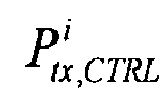
- This CPICH transmit power is denoted P B tx,CPICH, . P tx , CTRL i - Total transmit power on all control channels of base station i, including that of the CPICH.
- transmit powers of the other control channels are determined in two different ways depending on the specific control channel:
- the small cell base station 4 may query the Operations and Management database (not shown, OAM) for information regarding the P B tx,CTRL .
- OAM Operations and Management database
- the P B tx,CTRL may be configured in the small cell at the time of deployment.
- the maximum transmit power P B tx,MAX of the underlying macrocell base station 8 is configured in the small cell base station 4 (Small Cell A) at the time of deployment.
- the small cell may query the OAM database to find out the P tx,MAX of the macrocell B.
- Small Cell base station estimates macrocell load
- the small cell base station 4 includes a processor (not shown) which then makes the following calculations to estimate the traffic channels transmit power of the macrocell base station ( P B t x,TRAFFIC
- B denotes the macrocell base station 8.
- Base station i in the Nomenclature section is here taken as the macrocell base station, so denoted B.
- the pathloss from receiver to macrocell base station is the CPICH transmit power of the macrocell base station minus the CPICH received signal code power (RSCP) received from the macrocell base station (in dB).
- RSCP CPICH received signal code power
- the total received wide band power (RSSI), including noise generated in the receiver is the CPICH received signal code power (RSCP) received from the macrocell base station minus the CPICH Ec/No received from the macrocell base station (in dBm).
- RSCP CPICH received signal code power
- the traffic channels transmit power of the macrocell base station is calculated as a function of: the total received wide band power (RSSI); the total transmit power on all control channels, including CPICH, of the macrocell base station; and the path loss from the receiver to the macrocell base station.
- RSSI total received wide band power
- CPICH control channels
- the load L B on the macrocell base station is then calculated as a function of the traffic channels transmit power, the total transmit power on all control channels and the maximum transmit power.
- This method of estimating macrocell load may be considered a Radio resource Management (RRM) algorithm running in a small cell base station that uses radio measurements.
- RRM Radio resource Management
- the load L B on the macrocell base station is then compared to a predetermined threshold.
- the small cell base station is shifted out of sleep mode and into active mode.
- the small cell base station 4 uses its sniffer 12 to perform the downlink measurements on the macrocell's carrier frequency band.
- measurements can be made, in whole or in part, by user terminals in the small cell, in addition to or instead of by the sniffer.
- measurements can be made by user terminals in the small cell instead of by a sniffer.
- a small cell base station 4' is in active mode connected to user terminals, and measurements are made in a shared frequency band used by the small cell base station but shared with the macrocell base station 8'.
- the sniffer cannot be used to perform measurements of the macrocell base station's downlink using the same frequency band. Instead the small cell base station relies on measurements taken by user terminals in order to estimate macrocell base station load.
- the small cell base station is fully operational with pilot transmissions switched on. Measurements by user terminals are used to estimate the load on the macrocell base station.
- the measurements reported by the user terminals may include measurements of other macrocells in addition to that of the macrocell base station with the strongest signal (the dominant macrocell base station).
- the small cell base station selects (step c) those measurements for which the macrocell base station is dominant. This is done by ascertaining that the RSCP B from the macrocell base station 8' (Macrocell B) is greater than that of a next best macrocell base station by a predetermined margin, in this example10 dB.
- the small cell chooses the user terminal measurements of the dominant macrocell in order to estimate its load.
- RSSI' represents the received power at the user terminal caused by the transmissions from macrocell base station 8' (Macrocell B).
- RSSI' is calculated by subtracting control and traffic channel powers of the small cell base station (Small Cell A) from total RSSI.
- received power from the control channels of the macrocell base station (Macrocell B) is subtracted from RSSI' to estimate the traffic channels transmit power P B tx,TRAFFIC at Macrocell B.
- small cell base station may estimate the loading of a particular macrocell base station over a number of samples to obtain its average cell loading.
- the reported measurements may be from a single user terminal over a period of time, or multiple user terminals distributed within the coverage area of small cell. Only measurements from user terminals that report the particular macrocell base station as the dominant base station are considered in the calculations.
- Macrocell base stations are identified using their Primary Scrambling Codes (PSCs). Furthermore, various forgetting factors may be used in the averaging calculation to anticipate changes in cell loading.
- PSCs Primary Scrambling Codes
- the traffic channel power of a macrocell base station calculated based on a user terminal's report in one instance can also be used in another load calculation in which RSSI' contains traffic channel received powers from multiple macrocell base stations.
- the small cell uses heuristics to estimate the sum load of all macrocell neighbours rather than separately for each base station. This sum load estimation may provide useful information as to the current load on the system. In particular, if the sum load is close to the sum capacity of all neighboring base stations, the small cell deduces that all neighboring macrocell base stations are fully loaded.
- load estimation of a neighbouring base station can be done by a first base station where the first base is a macrocell, small cell, femtocell, picocell, metrocell base station or other type of base station and the neighbouring base station is a macrocell, small cell, femtocell, picocell, metrocell base station or other type of base station.
- the estimation of the neighbouring base stations load can help in a number of ways. For example, from knowing the loading on the adjacent cell, handover parameters and/or idle mode parameters are adjusted to either cause shedding user connections to more lightly loaded base stations, or alternatively keeping them on the serving base station.
- handover parameters and/or idle mode parameters are adjusted to either cause shedding user connections to more lightly loaded base stations, or alternatively keeping them on the serving base station.
- a small cell base station in sleep mode uses it sniffer receiver (or measurements from user terminals) to estimate the loading on a macrocell base station providing an underlying macrocell and then wake up when the loading on the macrocell base station exceeds a given threshold.
- program storage devices e.g., digital data storage media, which are machine or computer readable and encode machine-executable or computer-executable programs of instructions, wherein said instructions perform some or all of the steps of said above-described methods.
- the program storage devices may be, e.g., digital memories, magnetic storage media such as a magnetic disks and magnetic tapes, hard drives, or optically readable digital data storage media.
- Some embodiments involve computers programmed to perform said steps of the above-described methods.
Landscapes
- Engineering & Computer Science (AREA)
- Computer Networks & Wireless Communication (AREA)
- Signal Processing (AREA)
- Mobile Radio Communication Systems (AREA)
Abstract
Description
- The present invention relates to telecommunications, in particular to wireless telecommunications.
- Wireless telecommunications systems are well-known. Many such systems are cellular, in that radio coverage is provided by a bundle of radio coverage areas known as cells. A base station that provides radio coverage is located in each cell. Traditional base stations provide coverage in relatively large geographic areas and the corresponding cells are often referred to as macrocells.
- It is possible to establish smaller sized cells within a macrocell. Cells that are smaller than macrocells are sometimes referred to as small cells, microcells, picocells, or femtocells, but we use the term small cells generically for cells that are smaller than macrocells.
- Heterogeneous Networks are cellular wireless telecommunications systems made up of both macrocell base stations and small cell base stations. Some features of small cell base stations, such as radio coverage optimisation and activation/deactivation of a power-saving sleep mode, rely on exchange of load information with the underlying macrocell. For example, by using a backhaul connection, for example over the Internet, a small cell base station of Universal Mobile Telecommunications System (UMTS) type may request load information from the underlying macrocell using the Cell Load Information IE defined in Third Generation Partnership Project (3GPP) Technical Specification 25.413. IE denotes Information Element.
- Small cell base stations are often referred to as small cells.
- The reader is referred to the appended independent claims. Some preferred features are laid out in the dependent claims.
- An example of the present invention is a base station configured to:
- obtain information about the control channels of a neighbouring base station in which the information comprises transmit power on the pilot channel of the neighbouring base station and transmit powers of the other control channels of the neighbouring base station; and estimate traffic load on the neighbouring base station using said information.
- Preferably the base station is also configured to transit between an active mode and a sleeping mode dependent upon whether or not said estimated traffic load exceeds a predetermined level.
- Preferably the base station is a small cell base station and the neighbouring base station is a macrocell base station.
- In some preferred embodiments a small cell base station estimates the loading of an underlying macrocell in an autonomous manner not requiring transfer of data over a backhaul connection from a macrocell base station.
- Preferred embodiments may be considered as a type of Radio Resource Management (RRM), in a small cell base station, that uses radio measurements.
- Preferred embodiments are autonomous as they do not rely on a physical interface, in other words backhaul connectivity, to retrieve a neighbour base station's load information.
- In some preferred embodiments, a base station estimates autonomously the loading on a neighbouring base station in a heterogeneous network (HetNet), for example in which small cell base stations from multiple different manufacturers are provided.
- The present invention alos relates to corresponding methods of a base station estimating traffic load on a neighbouring base station by:
- obtaining information about the control channels of the neighbouring base station in which the information comprises transmit power on the pilot channel of the neighbouring base station and transmit powers of the other control channels of the neighbouring base station; and estimating traffic load on the neighbouring base station using said information.
- An embodiment of the present invention will now be described by way of example and with reference to the drawings, in which:
-
Figure 1 is a diagram illustrating a small cell base station in sleep mode embedded within the macrocell's coverage area, -
Figure 2 is a diagram illustrating a small cell base station in a fully active mode using a dedicated carrier frequency band ('dedicated carrier') and using measurements to estimate macrocell load, -
Figure 3 is a diagram illustrating a small cell base station in a fully active mode using a shared carrier frequency band ('shared carrier') shared with the macrocell base station and using user terminal measurements to estimate macrocell load, and -
Figure 4 is a flow-chart illustrating the process of estimation of macrocell load used in the small cell base station shown inFigure 3 . - When considering a known system, the inventors realised that although it is desirable for an underlying macrocell to be connected to the small cells within its coverage, this is not always possible. In other words, it is not always possible for a macrocell base station providing a coverage area within which small cell base stations are situated to be connected to those small cell base stations. This is due to the large number of small cells that may be present within the macrocell and processing constraints at the macrocell.
- The inventors realised that it was inefficient and not feasible from a practical perspective for a macrocell base station to support individual connections with a large number of small cell base stations within its coverage area. Problems such as high processing load at the macrocell base station, high control signalling traffic in the network, small cell bandwidth issues.
- The inventors also realised that physical interfaces between macrocell base stations and small cell base stations are not completely reliable in the known system.
- Example embodiments will now be described after some Nomenclature is briefly defined.
- PLi - Path loss from the receiver to base station i.
- RSCPi - CPICH received signal code power (RSCP) received from base station i.
- (Ec /No ) i - CPICH Ec/No received from base station i.
- RSSI - The total received wide band power, including the noise generated in the receiver. RSSI is identical to CPICH RSCP divided by CPICH Ec/No (in linear units).



- Li - Load of base station i, it equates to

- A heterogeneous Network (HetNet) involves a network of underlying macrocells provided by macrocell base stations over which many small cell base stations are overlaid.
- As shown in
Figure 1 , a HetNet 2 includes a small cell base station 4 (Small Cell A), within thecoverage area 10 of a macrocell base station 8 (Macrocell B). Thesmall cell 4 provides a smallcell coverage area 6. Small cell base stations are often referred to as small cells. An example type of small cell base station is a femtocell base station. - In this example, the small
cell base station 4 is in sleep mode in that its normal pilot transmissions do not occur. This is as a result of there being low user traffic in the vicinity of the small cell base station. - The small
cell base station 4 includes a so-called "sniffer" 12 which is a receiver operative to perform downlink measurements on the control channel transmissions from themacrocell base station 8. In this example, the small cell base station in sleep mode has a dedicated carrier frequency band to be used by the small cell base station but makes measurements in the downlink carrier frequency band of the macrocell base station. In an alternative example, the small cell base station in sleep mode makes measurements in a shared frequency band to be used by the small cell base station but shared with the macrocell base station. - The quantities measured using the
sniffer 12 are CPICH RSCP and CPICH Ec/No, where CPICH is Common Pilot Channel, RSCP is Received Signal Code Power, and Ec/No is signal to interference ratio.
- The
sniffer 12 determines the CPICH transmit power of themacrocell base station 8 from the known System Information Broadcast SIB5 broadcasted by themacrocell base station 8 on the Primary-Common Control Physical Channel (P-CCPCH). This CPICH transmit power is denoted PB tx,CPICH,.
- In order to calculate the total transmit power, denoted PB tx,CTRL , on all control channels of the macrocell base station, transmit powers of the other control channels are determined in two different ways depending on the specific control channel:
- 1) from system broadcast information, such as SIB5 of 3GPP TS25.331 for channels such as AICH and PICH, or
- 2) by measuring the received power over a period of time and then applying the CPICH path loss to calculate the transmit power, for examplefor S-CCPCH.
- The result is then added to the PB tx,CPICH, to give the

- Alternatively, instead of calculating PB tx,CTRL from measurements as explained above, the small
cell base station 4 may query the Operations and Management database (not shown, OAM) for information regarding the PB tx,CTRL. - Alternatively, the PB tx,CTRL may be configured in the small cell at the time of deployment.

- It is assumed that the maximum transmit power PB tx,MAX of the underlying macrocell base station 8 (Macrocell B) is configured in the small cell base station 4 (Small Cell A) at the time of deployment. As an alternative, the small cell may query the OAM database to find out the Ptx,MAX of the macrocell B.
- The small
cell base station 4 includes a processor (not shown) which then makes the following calculations to estimate the traffic channels transmit power of the macrocell base station (PB tx,TRAFFIC|), and subsequently the macrocell load LB :


- B denotes the
macrocell base station 8. Base station i in the Nomenclature section is here taken as the macrocell base station, so denoted B. - It can be considered that:
- The pathloss from receiver to macrocell base station is the CPICH transmit power of the macrocell base station minus the CPICH received signal code power (RSCP) received from the macrocell base station (in dB).
- The total received wide band power (RSSI), including noise generated in the receiver is the CPICH received signal code power (RSCP) received from the macrocell base station minus the CPICH Ec/No received from the macrocell base station (in dBm).
- The traffic channels transmit power of the macrocell base station is calculated as a function of: the total received wide band power (RSSI); the total transmit power on all control channels, including CPICH, of the macrocell base station; and the path loss from the receiver to the macrocell base station.
- The load LB on the macrocell base station is then calculated as a function of the traffic channels transmit power, the total transmit power on all control channels and the maximum transmit power.
- This method of estimating macrocell load may be considered a Radio resource Management (RRM) algorithm running in a small cell base station that uses radio measurements.
- The load LB on the macrocell base station is then compared to a predetermined threshold.
- If the load LB is greater than the threshold, and the small cell base station is in a sleep mode, the small cell base station is shifted out of sleep mode and into active mode.
- As shown in
Figure 2 , if the small cell is in active mode, in other words is fully operational, and uses a dedicated carrier frequency band, the smallcell base station 4 uses itssniffer 12 to perform the downlink measurements on the macrocell's carrier frequency band. - In some otherwise similar embodiments, measurements can be made, in whole or in part, by user terminals in the small cell, in addition to or instead of by the sniffer.
- In some otherwise similar embodiments, measurements can be made by user terminals in the small cell instead of by a sniffer.
- As shown in
Figure 3 , in an alternative example, a small cell base station 4' is in active mode connected to user terminals, and measurements are made in a shared frequency band used by the small cell base station but shared with the macrocell base station 8'. As the small cell base station is active in the carrier frequency band, the sniffer cannot be used to perform measurements of the macrocell base station's downlink using the same frequency band. Instead the small cell base station relies on measurements taken by user terminals in order to estimate macrocell base station load. - It will be understood that:
- (a) Through the OAM database (not shown), the small cell base station 4' (Small Cell A) knows the absolute CPICH transmit power and total control channels transmit power of the macrocell base station - PB tx,CPICH and PB tx,CTRL respectively.
- (b) The control channel transmit powers are statically set at the macrocell base station (or in an alternative embodiment where the control channel transmit powers are adaptive, the OAM database is updated with their latest values). It is assumed that the control channel transmit power varies slowly, if at all.
- (c) The small cell base station 4' (Small Cell A) knows the Primary Scrambling Codes (PSCs) of all the surrounding cells and the OAM database provides a mapping of the PSC to the transmit power of CPICH and other control channels. The PSCs are known by the small cell base station as the PSCs are needed to create neighbor lists.
- (d) The small cell base station knows PA tx,CPICH and PA tx,CTRL from its own internal database. The small cell base station estimates PA tx,TRAFFIC by averaging its
layer 1 code power reports across all calls as required by the latest current version of Third Generation Partnership Project (3GPP) Technical Specification 25.133 as of the effective filing date of this patent application. - It will be understood that in the
Figure 4 example, the small cell base station is fully operational with pilot transmissions switched on. Measurements by user terminals are used to estimate the load on the macrocell base station. - As shown in
Figure 4 : - The small cell base station 4' desires (step a) to estimate the load on the macrocell base station. The user terminals connected to the small cell base station report back (step b) to the small cell base station measurements taken including in respect of the serving small cell base station, namely RSCPA and (Ec/No)A, and in respect of the macrocell base station, namely RSCPB and (Ec/No)B.
- The measurements reported by the user terminals may include measurements of other macrocells in addition to that of the macrocell base station with the strongest signal (the dominant macrocell base station). The small cell base station selects (step c) those measurements for which the macrocell base station is dominant. This is done by ascertaining that the RSCPB from the macrocell base station 8' (Macrocell B) is greater than that of a next best macrocell base station by a predetermined margin, in this example10 dB. In other words, in the case of multiple user terminals reporting measurements of multiple neighboring macrocell base stations, the small cell chooses the user terminal measurements of the dominant macrocell in order to estimate its load.
- The small cell base station then performs (step d) calculations to estimate the macrocell base station load as follows:





- In the above calculations, RSSI' represents the received power at the user terminal caused by the transmissions from macrocell base station 8' (Macrocell B). RSSI' is calculated by subtracting control and traffic channel powers of the small cell base station (Small Cell A) from total RSSI. In the next step, received power from the control channels of the macrocell base station (Macrocell B) is subtracted from RSSI' to estimate the traffic channels transmit power PB tx,TRAFFIC at Macrocell B.
- It may be noted that small cell base station (Small Cell A) may estimate the loading of a particular macrocell base station over a number of samples to obtain its average cell loading. The reported measurements may be from a single user terminal over a period of time, or multiple user terminals distributed within the coverage area of small cell. Only measurements from user terminals that report the particular macrocell base station as the dominant base station are considered in the calculations. Macrocell base stations are identified using their Primary Scrambling Codes (PSCs). Furthermore, various forgetting factors may be used in the averaging calculation to anticipate changes in cell loading.
- It will also be noted that, in some embodiments, the traffic channel power of a macrocell base station calculated based on a user terminal's report in one instance can also be used in another load calculation in which RSSI' contains traffic channel received powers from multiple macrocell base stations.
- In the case of a single user terminal that reports measurements of multiple equally-strong neighbours, it is not possible to estimate the load of each of the neighbours from those measurements. This is because the single value of RSSI' would then contain the unknown traffic channel components of more than one macrocell base stations. In this case, the small cell uses heuristics to estimate the sum load of all macrocell neighbours rather than separately for each base station. This sum load estimation may provide useful information as to the current load on the system. In particular, if the sum load is close to the sum capacity of all neighboring base stations, the small cell deduces that all neighboring macrocell base stations are fully loaded.
- The present invention may be embodied in other specific forms without departing from its essential characteristics.
- For example, load estimation of a neighbouring base station can be done by a first base station where the first base is a macrocell, small cell, femtocell, picocell, metrocell base station or other type of base station and the neighbouring base station is a macrocell, small cell, femtocell, picocell, metrocell base station or other type of base station.
- For example, the estimation of the neighbouring base stations load can help in a number of ways. For example, from knowing the loading on the adjacent cell, handover parameters and/or idle mode parameters are adjusted to either cause shedding user connections to more lightly loaded base stations, or alternatively keeping them on the serving base station. In another example, as described previously a small cell base station in sleep mode uses it sniffer receiver (or measurements from user terminals) to estimate the loading on a macrocell base station providing an underlying macrocell and then wake up when the loading on the macrocell base station exceeds a given threshold.
- The described embodiments are to be considered in all respects only as illustrative and not restrictive. The scope of the invention is, therefore, indicated by the appended claims rather than by the foregoing description. All changes that come within the meaning and range of equivalency of the claims are to be embraced within their scope.
- A person skilled in the art would readily recognize that steps of various above-described methods can be performed by programmed computers. Some embodiments relate to program storage devices, e.g., digital data storage media, which are machine or computer readable and encode machine-executable or computer-executable programs of instructions, wherein said instructions perform some or all of the steps of said above-described methods. The program storage devices may be, e.g., digital memories, magnetic storage media such as a magnetic disks and magnetic tapes, hard drives, or optically readable digital data storage media. Some embodiments involve computers programmed to perform said steps of the above-described methods.
Claims (15)
- A base station configured to:obtain information about the control channels of a neighbouring base station in which the information comprises transmit power on the pilot channel of the neighbouring base station and transmit powers of the other control channels of the neighbouring base station; andestimate traffic load on the neighbouring base station using said information.
- A base station according to claim 1, further configured to transit between an active mode and a sleeping mode dependent upon whether or not said estimated traffic load exceeds a predetermined level.
- A base station according to claim 1 or claim 2, which is a small cell base station, the neighbouring base station being a macrocell base station.
- A base station according to any preceding claim, in which the information comprises received power measured on the pilot channel and signal to interference ratio on the pilot channel.
- A base station according to claim 4, in which the received power is Received Signal Code Power, RSCP, of the Common Pilot Channel, CPICH, and the signal to interference ratio is the signal to interference ratio, Ec/No, of the Common Pilot Channel, CPICH.
- A base station according to any preceding claim, in which the information further comprises total transmit power of the control channels of the neighbouring base station comprising the transmit power on the pilot channel of the neighbouring base station and the transmit powers of the other control channels of the neighbouring base station.
- A base station according to claim 6, in which the information further comprises maximum transmit power of the neighbouring base station.
- A base station according to any preceding claim, in which the traffic load on the neighbouring base station is estimated using an estimate of traffic channels transmit power of the neighbouring base station, said estimate of traffic channels transmit power being determined from:received Signal Code Power, RSCP, of the Common Pilot Channel, CPICH of the neighboring base station;signal to interference ratio, Ec/No, of the Common Pilot Channel, CPICH of the neighbouring base station;the total transmit power of the control channels of the neighbouring base station; andattenuation between the base station and the neighbouring base station.
- A base station according to claim 8, in which said attenuation is estimated as the CPICH transmit power of the neighbouring base station minus the CPICH received signal code power, RSCP, received from the neighbouring base station.
- A base station according to any preceding claim, in which at least some of the transmit powers are estimated based on power measurements made by user terminals.
- A base station according to claim 10, in which the base station ignores reported measurements in respect of other neighbouring base stations than the neighbouring base station providing the strongest measured signals; the measurements including detected Primary Scrambling Codes, PSC, for identification of the neighbouring base stations.
- A base station according to claim 10 or claim 11, in which upon a user terminal determining equally strong signals from a group of neighbouring base stations, the base station estimates the sum traffic load of the group.
- A base station according to any preceding claim comprising a receiver configured to detect the pilot transmissions on the pilot channel of the neighbouring base station for determining the transmit power, in which the base station has a different carrier frequency band to the neighbouring base station.
- A base station according to any of claims 1 to 12, in which the base station uses the same carrier frequency band as the neighbouring base station and the transmit powers of the neighbouring base station are estimated based on power measurements made by user terminals.
- A method of a base station estimating traffic load on a neighbouring base station by:obtaining information about the control channels of the neighbouring base station in which the information comprises transmit power on the pilot channel of the neighbouring base station and transmit powers of the other control channels of the neighbouring base station; andestimating traffic load on the neighbouring base station using said information.
Priority Applications (1)
| Application Number | Priority Date | Filing Date | Title |
|---|---|---|---|
| EP13290219.8A EP2849478A1 (en) | 2013-09-13 | 2013-09-13 | A base station and a method of a base station estimating traffic load on a neighbouring base station |
Applications Claiming Priority (1)
| Application Number | Priority Date | Filing Date | Title |
|---|---|---|---|
| EP13290219.8A EP2849478A1 (en) | 2013-09-13 | 2013-09-13 | A base station and a method of a base station estimating traffic load on a neighbouring base station |
Publications (1)
| Publication Number | Publication Date |
|---|---|
| EP2849478A1 true EP2849478A1 (en) | 2015-03-18 |
Family
ID=49303918
Family Applications (1)
| Application Number | Title | Priority Date | Filing Date |
|---|---|---|---|
| EP13290219.8A Withdrawn EP2849478A1 (en) | 2013-09-13 | 2013-09-13 | A base station and a method of a base station estimating traffic load on a neighbouring base station |
Country Status (1)
| Country | Link |
|---|---|
| EP (1) | EP2849478A1 (en) |
Cited By (3)
| Publication number | Priority date | Publication date | Assignee | Title |
|---|---|---|---|---|
| WO2016192420A1 (en) * | 2015-06-04 | 2016-12-08 | 中兴通讯股份有限公司 | Method and device for determining base station load |
| CN112954707A (en) * | 2019-12-11 | 2021-06-11 | 中国电信股份有限公司 | Energy saving method and device for base station, base station and computer readable storage medium |
| EP4164282A4 (en) * | 2020-06-30 | 2023-12-06 | Huawei Technologies Co., Ltd. | Communication prediction-based energy saving method and apparatus |
Citations (3)
| Publication number | Priority date | Publication date | Assignee | Title |
|---|---|---|---|---|
| WO2008093100A2 (en) * | 2007-02-02 | 2008-08-07 | Ubiquisys Limited | A method and base station to control access point transmit power |
| GB2492410A (en) * | 2011-07-01 | 2013-01-02 | Ubiquisys Ltd | Controlling a basestation downlink power |
| WO2013044957A1 (en) * | 2011-09-28 | 2013-04-04 | Fujitsu Limited | Activation of supplementary transmission unit |
-
2013
- 2013-09-13 EP EP13290219.8A patent/EP2849478A1/en not_active Withdrawn
Patent Citations (3)
| Publication number | Priority date | Publication date | Assignee | Title |
|---|---|---|---|---|
| WO2008093100A2 (en) * | 2007-02-02 | 2008-08-07 | Ubiquisys Limited | A method and base station to control access point transmit power |
| GB2492410A (en) * | 2011-07-01 | 2013-01-02 | Ubiquisys Ltd | Controlling a basestation downlink power |
| WO2013044957A1 (en) * | 2011-09-28 | 2013-04-04 | Fujitsu Limited | Activation of supplementary transmission unit |
Cited By (7)
| Publication number | Priority date | Publication date | Assignee | Title |
|---|---|---|---|---|
| WO2016192420A1 (en) * | 2015-06-04 | 2016-12-08 | 中兴通讯股份有限公司 | Method and device for determining base station load |
| CN106255144A (en) * | 2015-06-04 | 2016-12-21 | 中兴通讯股份有限公司 | Load of base station determines method and device |
| CN106255144B (en) * | 2015-06-04 | 2020-12-22 | 中兴通讯股份有限公司 | Base station load determination method and device |
| CN112954707A (en) * | 2019-12-11 | 2021-06-11 | 中国电信股份有限公司 | Energy saving method and device for base station, base station and computer readable storage medium |
| CN112954707B (en) * | 2019-12-11 | 2022-09-16 | 中国电信股份有限公司 | Energy saving method and device for base station, base station and computer readable storage medium |
| EP4164282A4 (en) * | 2020-06-30 | 2023-12-06 | Huawei Technologies Co., Ltd. | Communication prediction-based energy saving method and apparatus |
| US12550055B2 (en) * | 2020-06-30 | 2026-02-10 | Huawei Technologies Co., Ltd. | Communication prediction-based energy saving method and apparatus |
Similar Documents
| Publication | Publication Date | Title |
|---|---|---|
| US9826486B2 (en) | Power setting | |
| US10667221B2 (en) | Communication control device, communication control method, radio communication system, and terminal device | |
| RU2534035C2 (en) | Method of setting downlink transmission power | |
| EP2800412B1 (en) | Method and system for measurement and handover reliability enhancement in a wireless communication system | |
| CN100375575C (en) | Measurement control method for switching between mobile communication cells | |
| EP3496463B1 (en) | Handover in heterogeneous communication networks | |
| EP2446672B1 (en) | Power saving in a radio base station by determining number of active and idle users camping on cell | |
| US9706490B2 (en) | Method for energy saving in a cellular communication system | |
| US20120244869A1 (en) | Network scaling for network energy savings | |
| CN102835160B (en) | For promoting that the network node of reorientation controls | |
| EP2556689B1 (en) | Releasing a radio resource (e.g. primary component carrier) based on capacities of base stations | |
| GB2482734A (en) | Biased RSRP cell selection for use with overlapping cell operating ranges. | |
| CA2337141C (en) | Adaptive power margin for hard handoffs in code division multiple access based systems | |
| EP2849478A1 (en) | A base station and a method of a base station estimating traffic load on a neighbouring base station | |
| US7693521B1 (en) | Method and system for mobile station handoff | |
| CN102098703B (en) | Method and device for determining terminal measurement frequency in cell handover | |
| EP2485516B1 (en) | Radio coverage in mobile telecommunications systems | |
| CN103634858B (en) | A kind of switching method of user equipment, base station, user equipment and switching system | |
| KR101616759B1 (en) | Method and apparatus for selecting frequency allocation in wireless communication system | |
| EP2731378B1 (en) | Neighbouring cell list creation in a heterogenous network | |
| CN102300188B (en) | The method and system of a kind of homogeneous-frequency adjacent-domain information management | |
| KR101496010B1 (en) | Method for managing traffic load in cellular mobile network | |
| EP3160192B1 (en) | A telecommunication controller, and method of controlling multiple small cell base stations | |
| Tomić et al. | Soft handover and downlink capacity in UMTS network | |
| Kanwal et al. | Joint resource blocks switching off and bandwidth expansion for energy saving in LTE networks |
Legal Events
| Date | Code | Title | Description |
|---|---|---|---|
| PUAI | Public reference made under article 153(3) epc to a published international application that has entered the european phase |
Free format text: ORIGINAL CODE: 0009012 |
|
| 17P | Request for examination filed |
Effective date: 20130913 |
|
| AK | Designated contracting states |
Kind code of ref document: A1 Designated state(s): AL AT BE BG CH CY CZ DE DK EE ES FI FR GB GR HR HU IE IS IT LI LT LU LV MC MK MT NL NO PL PT RO RS SE SI SK SM TR |
|
| AX | Request for extension of the european patent |
Extension state: BA ME |
|
| R17P | Request for examination filed (corrected) |
Effective date: 20150918 |
|
| RBV | Designated contracting states (corrected) |
Designated state(s): AL AT BE BG CH CY CZ DE DK EE ES FI FR GB GR HR HU IE IS IT LI LT LU LV MC MK MT NL NO PL PT RO RS SE SI SK SM TR |
|
| RAP1 | Party data changed (applicant data changed or rights of an application transferred) |
Owner name: ALCATEL LUCENT |
|
| 17Q | First examination report despatched |
Effective date: 20180509 |
|
| RIC1 | Information provided on ipc code assigned before grant |
Ipc: H04W 52/32 20090101ALI20181018BHEP Ipc: H04W 84/04 20090101ALN20181018BHEP Ipc: H04W 52/36 20090101ALI20181018BHEP Ipc: H04W 52/40 20090101ALI20181018BHEP Ipc: H04W 52/02 20090101ALI20181018BHEP Ipc: H04W 24/02 20090101AFI20181018BHEP Ipc: H04W 52/34 20090101ALN20181018BHEP |
|
| GRAP | Despatch of communication of intention to grant a patent |
Free format text: ORIGINAL CODE: EPIDOSNIGR1 |
|
| INTG | Intention to grant announced |
Effective date: 20181127 |
|
| RIC1 | Information provided on ipc code assigned before grant |
Ipc: H04W 52/32 20090101ALI20181119BHEP Ipc: H04W 52/40 20090101ALI20181119BHEP Ipc: H04W 52/34 20090101ALN20181119BHEP Ipc: H04W 52/36 20090101ALI20181119BHEP Ipc: H04W 24/02 20090101AFI20181119BHEP Ipc: H04W 52/02 20090101ALI20181119BHEP Ipc: H04W 84/04 20090101ALN20181119BHEP |
|
| STAA | Information on the status of an ep patent application or granted ep patent |
Free format text: STATUS: THE APPLICATION IS DEEMED TO BE WITHDRAWN |
|
| 18D | Application deemed to be withdrawn |
Effective date: 20190409 |