EP2849308A1 - Motor drive device - Google Patents
Motor drive device Download PDFInfo
- Publication number
- EP2849308A1 EP2849308A1 EP13787366.7A EP13787366A EP2849308A1 EP 2849308 A1 EP2849308 A1 EP 2849308A1 EP 13787366 A EP13787366 A EP 13787366A EP 2849308 A1 EP2849308 A1 EP 2849308A1
- Authority
- EP
- European Patent Office
- Prior art keywords
- alternating current
- conversion circuit
- power conversion
- battery
- circuit
- Prior art date
- Legal status (The legal status is an assumption and is not a legal conclusion. Google has not performed a legal analysis and makes no representation as to the accuracy of the status listed.)
- Granted
Links
Images





Classifications
-
- B—PERFORMING OPERATIONS; TRANSPORTING
- B60—VEHICLES IN GENERAL
- B60L—PROPULSION OF ELECTRICALLY-PROPELLED VEHICLES; SUPPLYING ELECTRIC POWER FOR AUXILIARY EQUIPMENT OF ELECTRICALLY-PROPELLED VEHICLES; ELECTRODYNAMIC BRAKE SYSTEMS FOR VEHICLES IN GENERAL; MAGNETIC SUSPENSION OR LEVITATION FOR VEHICLES; MONITORING OPERATING VARIABLES OF ELECTRICALLY-PROPELLED VEHICLES; ELECTRIC SAFETY DEVICES FOR ELECTRICALLY-PROPELLED VEHICLES
- B60L15/00—Methods, circuits, or devices for controlling the traction-motor speed of electrically-propelled vehicles
- B60L15/007—Physical arrangements or structures of drive train converters specially adapted for the propulsion motors of electric vehicles
-
- B—PERFORMING OPERATIONS; TRANSPORTING
- B60—VEHICLES IN GENERAL
- B60L—PROPULSION OF ELECTRICALLY-PROPELLED VEHICLES; SUPPLYING ELECTRIC POWER FOR AUXILIARY EQUIPMENT OF ELECTRICALLY-PROPELLED VEHICLES; ELECTRODYNAMIC BRAKE SYSTEMS FOR VEHICLES IN GENERAL; MAGNETIC SUSPENSION OR LEVITATION FOR VEHICLES; MONITORING OPERATING VARIABLES OF ELECTRICALLY-PROPELLED VEHICLES; ELECTRIC SAFETY DEVICES FOR ELECTRICALLY-PROPELLED VEHICLES
- B60L50/00—Electric propulsion with power supplied within the vehicle
- B60L50/50—Electric propulsion with power supplied within the vehicle using propulsion power supplied by batteries or fuel cells
- B60L50/51—Electric propulsion with power supplied within the vehicle using propulsion power supplied by batteries or fuel cells characterised by AC-motors
-
- B—PERFORMING OPERATIONS; TRANSPORTING
- B60—VEHICLES IN GENERAL
- B60L—PROPULSION OF ELECTRICALLY-PROPELLED VEHICLES; SUPPLYING ELECTRIC POWER FOR AUXILIARY EQUIPMENT OF ELECTRICALLY-PROPELLED VEHICLES; ELECTRODYNAMIC BRAKE SYSTEMS FOR VEHICLES IN GENERAL; MAGNETIC SUSPENSION OR LEVITATION FOR VEHICLES; MONITORING OPERATING VARIABLES OF ELECTRICALLY-PROPELLED VEHICLES; ELECTRIC SAFETY DEVICES FOR ELECTRICALLY-PROPELLED VEHICLES
- B60L53/00—Methods of charging batteries, specially adapted for electric vehicles; Charging stations or on-board charging equipment therefor; Exchange of energy storage elements in electric vehicles
- B60L53/10—Methods of charging batteries, specially adapted for electric vehicles; Charging stations or on-board charging equipment therefor; Exchange of energy storage elements in electric vehicles characterised by the energy transfer between the charging station and the vehicle
- B60L53/14—Conductive energy transfer
-
- B—PERFORMING OPERATIONS; TRANSPORTING
- B60—VEHICLES IN GENERAL
- B60L—PROPULSION OF ELECTRICALLY-PROPELLED VEHICLES; SUPPLYING ELECTRIC POWER FOR AUXILIARY EQUIPMENT OF ELECTRICALLY-PROPELLED VEHICLES; ELECTRODYNAMIC BRAKE SYSTEMS FOR VEHICLES IN GENERAL; MAGNETIC SUSPENSION OR LEVITATION FOR VEHICLES; MONITORING OPERATING VARIABLES OF ELECTRICALLY-PROPELLED VEHICLES; ELECTRIC SAFETY DEVICES FOR ELECTRICALLY-PROPELLED VEHICLES
- B60L53/00—Methods of charging batteries, specially adapted for electric vehicles; Charging stations or on-board charging equipment therefor; Exchange of energy storage elements in electric vehicles
- B60L53/20—Methods of charging batteries, specially adapted for electric vehicles; Charging stations or on-board charging equipment therefor; Exchange of energy storage elements in electric vehicles characterised by converters located in the vehicle
- B60L53/24—Using the vehicle's propulsion converter for charging
-
- B—PERFORMING OPERATIONS; TRANSPORTING
- B60—VEHICLES IN GENERAL
- B60L—PROPULSION OF ELECTRICALLY-PROPELLED VEHICLES; SUPPLYING ELECTRIC POWER FOR AUXILIARY EQUIPMENT OF ELECTRICALLY-PROPELLED VEHICLES; ELECTRODYNAMIC BRAKE SYSTEMS FOR VEHICLES IN GENERAL; MAGNETIC SUSPENSION OR LEVITATION FOR VEHICLES; MONITORING OPERATING VARIABLES OF ELECTRICALLY-PROPELLED VEHICLES; ELECTRIC SAFETY DEVICES FOR ELECTRICALLY-PROPELLED VEHICLES
- B60L7/00—Electrodynamic brake systems for vehicles in general
- B60L7/10—Dynamic electric regenerative braking
- B60L7/14—Dynamic electric regenerative braking for vehicles propelled by AC motors
-
- H—ELECTRICITY
- H02—GENERATION; CONVERSION OR DISTRIBUTION OF ELECTRIC POWER
- H02P—CONTROL OR REGULATION OF ELECTRIC MOTORS, ELECTRIC GENERATORS OR DYNAMO-ELECTRIC CONVERTERS; CONTROLLING TRANSFORMERS, REACTORS OR CHOKE COILS
- H02P5/00—Arrangements specially adapted for regulating or controlling the speed or torque of two or more electric motors
- H02P5/74—Arrangements specially adapted for regulating or controlling the speed or torque of two or more electric motors controlling two or more AC dynamo-electric motors
-
- B—PERFORMING OPERATIONS; TRANSPORTING
- B60—VEHICLES IN GENERAL
- B60L—PROPULSION OF ELECTRICALLY-PROPELLED VEHICLES; SUPPLYING ELECTRIC POWER FOR AUXILIARY EQUIPMENT OF ELECTRICALLY-PROPELLED VEHICLES; ELECTRODYNAMIC BRAKE SYSTEMS FOR VEHICLES IN GENERAL; MAGNETIC SUSPENSION OR LEVITATION FOR VEHICLES; MONITORING OPERATING VARIABLES OF ELECTRICALLY-PROPELLED VEHICLES; ELECTRIC SAFETY DEVICES FOR ELECTRICALLY-PROPELLED VEHICLES
- B60L2210/00—Converter types
- B60L2210/10—DC to DC converters
-
- B—PERFORMING OPERATIONS; TRANSPORTING
- B60—VEHICLES IN GENERAL
- B60L—PROPULSION OF ELECTRICALLY-PROPELLED VEHICLES; SUPPLYING ELECTRIC POWER FOR AUXILIARY EQUIPMENT OF ELECTRICALLY-PROPELLED VEHICLES; ELECTRODYNAMIC BRAKE SYSTEMS FOR VEHICLES IN GENERAL; MAGNETIC SUSPENSION OR LEVITATION FOR VEHICLES; MONITORING OPERATING VARIABLES OF ELECTRICALLY-PROPELLED VEHICLES; ELECTRIC SAFETY DEVICES FOR ELECTRICALLY-PROPELLED VEHICLES
- B60L2210/00—Converter types
- B60L2210/30—AC to DC converters
-
- B—PERFORMING OPERATIONS; TRANSPORTING
- B60—VEHICLES IN GENERAL
- B60L—PROPULSION OF ELECTRICALLY-PROPELLED VEHICLES; SUPPLYING ELECTRIC POWER FOR AUXILIARY EQUIPMENT OF ELECTRICALLY-PROPELLED VEHICLES; ELECTRODYNAMIC BRAKE SYSTEMS FOR VEHICLES IN GENERAL; MAGNETIC SUSPENSION OR LEVITATION FOR VEHICLES; MONITORING OPERATING VARIABLES OF ELECTRICALLY-PROPELLED VEHICLES; ELECTRIC SAFETY DEVICES FOR ELECTRICALLY-PROPELLED VEHICLES
- B60L2210/00—Converter types
- B60L2210/40—DC to AC converters
-
- B—PERFORMING OPERATIONS; TRANSPORTING
- B60—VEHICLES IN GENERAL
- B60L—PROPULSION OF ELECTRICALLY-PROPELLED VEHICLES; SUPPLYING ELECTRIC POWER FOR AUXILIARY EQUIPMENT OF ELECTRICALLY-PROPELLED VEHICLES; ELECTRODYNAMIC BRAKE SYSTEMS FOR VEHICLES IN GENERAL; MAGNETIC SUSPENSION OR LEVITATION FOR VEHICLES; MONITORING OPERATING VARIABLES OF ELECTRICALLY-PROPELLED VEHICLES; ELECTRIC SAFETY DEVICES FOR ELECTRICALLY-PROPELLED VEHICLES
- B60L2220/00—Electrical machine types; Structures or applications thereof
- B60L2220/50—Structural details of electrical machines
- B60L2220/54—Windings for different functions
-
- B—PERFORMING OPERATIONS; TRANSPORTING
- B60—VEHICLES IN GENERAL
- B60L—PROPULSION OF ELECTRICALLY-PROPELLED VEHICLES; SUPPLYING ELECTRIC POWER FOR AUXILIARY EQUIPMENT OF ELECTRICALLY-PROPELLED VEHICLES; ELECTRODYNAMIC BRAKE SYSTEMS FOR VEHICLES IN GENERAL; MAGNETIC SUSPENSION OR LEVITATION FOR VEHICLES; MONITORING OPERATING VARIABLES OF ELECTRICALLY-PROPELLED VEHICLES; ELECTRIC SAFETY DEVICES FOR ELECTRICALLY-PROPELLED VEHICLES
- B60L2220/00—Electrical machine types; Structures or applications thereof
- B60L2220/50—Structural details of electrical machines
- B60L2220/56—Structural details of electrical machines with switched windings
-
- B—PERFORMING OPERATIONS; TRANSPORTING
- B60—VEHICLES IN GENERAL
- B60Y—INDEXING SCHEME RELATING TO ASPECTS CROSS-CUTTING VEHICLE TECHNOLOGY
- B60Y2200/00—Type of vehicle
- B60Y2200/90—Vehicles comprising electric prime movers
- B60Y2200/91—Electric vehicles
-
- B—PERFORMING OPERATIONS; TRANSPORTING
- B60—VEHICLES IN GENERAL
- B60Y—INDEXING SCHEME RELATING TO ASPECTS CROSS-CUTTING VEHICLE TECHNOLOGY
- B60Y2200/00—Type of vehicle
- B60Y2200/90—Vehicles comprising electric prime movers
- B60Y2200/92—Hybrid vehicles
-
- Y—GENERAL TAGGING OF NEW TECHNOLOGICAL DEVELOPMENTS; GENERAL TAGGING OF CROSS-SECTIONAL TECHNOLOGIES SPANNING OVER SEVERAL SECTIONS OF THE IPC; TECHNICAL SUBJECTS COVERED BY FORMER USPC CROSS-REFERENCE ART COLLECTIONS [XRACs] AND DIGESTS
- Y02—TECHNOLOGIES OR APPLICATIONS FOR MITIGATION OR ADAPTATION AGAINST CLIMATE CHANGE
- Y02T—CLIMATE CHANGE MITIGATION TECHNOLOGIES RELATED TO TRANSPORTATION
- Y02T10/00—Road transport of goods or passengers
- Y02T10/60—Other road transportation technologies with climate change mitigation effect
- Y02T10/64—Electric machine technologies in electromobility
-
- Y—GENERAL TAGGING OF NEW TECHNOLOGICAL DEVELOPMENTS; GENERAL TAGGING OF CROSS-SECTIONAL TECHNOLOGIES SPANNING OVER SEVERAL SECTIONS OF THE IPC; TECHNICAL SUBJECTS COVERED BY FORMER USPC CROSS-REFERENCE ART COLLECTIONS [XRACs] AND DIGESTS
- Y02—TECHNOLOGIES OR APPLICATIONS FOR MITIGATION OR ADAPTATION AGAINST CLIMATE CHANGE
- Y02T—CLIMATE CHANGE MITIGATION TECHNOLOGIES RELATED TO TRANSPORTATION
- Y02T10/00—Road transport of goods or passengers
- Y02T10/60—Other road transportation technologies with climate change mitigation effect
- Y02T10/70—Energy storage systems for electromobility, e.g. batteries
-
- Y—GENERAL TAGGING OF NEW TECHNOLOGICAL DEVELOPMENTS; GENERAL TAGGING OF CROSS-SECTIONAL TECHNOLOGIES SPANNING OVER SEVERAL SECTIONS OF THE IPC; TECHNICAL SUBJECTS COVERED BY FORMER USPC CROSS-REFERENCE ART COLLECTIONS [XRACs] AND DIGESTS
- Y02—TECHNOLOGIES OR APPLICATIONS FOR MITIGATION OR ADAPTATION AGAINST CLIMATE CHANGE
- Y02T—CLIMATE CHANGE MITIGATION TECHNOLOGIES RELATED TO TRANSPORTATION
- Y02T10/00—Road transport of goods or passengers
- Y02T10/60—Other road transportation technologies with climate change mitigation effect
- Y02T10/7072—Electromobility specific charging systems or methods for batteries, ultracapacitors, supercapacitors or double-layer capacitors
-
- Y—GENERAL TAGGING OF NEW TECHNOLOGICAL DEVELOPMENTS; GENERAL TAGGING OF CROSS-SECTIONAL TECHNOLOGIES SPANNING OVER SEVERAL SECTIONS OF THE IPC; TECHNICAL SUBJECTS COVERED BY FORMER USPC CROSS-REFERENCE ART COLLECTIONS [XRACs] AND DIGESTS
- Y02—TECHNOLOGIES OR APPLICATIONS FOR MITIGATION OR ADAPTATION AGAINST CLIMATE CHANGE
- Y02T—CLIMATE CHANGE MITIGATION TECHNOLOGIES RELATED TO TRANSPORTATION
- Y02T10/00—Road transport of goods or passengers
- Y02T10/60—Other road transportation technologies with climate change mitigation effect
- Y02T10/72—Electric energy management in electromobility
-
- Y—GENERAL TAGGING OF NEW TECHNOLOGICAL DEVELOPMENTS; GENERAL TAGGING OF CROSS-SECTIONAL TECHNOLOGIES SPANNING OVER SEVERAL SECTIONS OF THE IPC; TECHNICAL SUBJECTS COVERED BY FORMER USPC CROSS-REFERENCE ART COLLECTIONS [XRACs] AND DIGESTS
- Y02—TECHNOLOGIES OR APPLICATIONS FOR MITIGATION OR ADAPTATION AGAINST CLIMATE CHANGE
- Y02T—CLIMATE CHANGE MITIGATION TECHNOLOGIES RELATED TO TRANSPORTATION
- Y02T90/00—Enabling technologies or technologies with a potential or indirect contribution to GHG emissions mitigation
- Y02T90/10—Technologies relating to charging of electric vehicles
- Y02T90/12—Electric charging stations
-
- Y—GENERAL TAGGING OF NEW TECHNOLOGICAL DEVELOPMENTS; GENERAL TAGGING OF CROSS-SECTIONAL TECHNOLOGIES SPANNING OVER SEVERAL SECTIONS OF THE IPC; TECHNICAL SUBJECTS COVERED BY FORMER USPC CROSS-REFERENCE ART COLLECTIONS [XRACs] AND DIGESTS
- Y02—TECHNOLOGIES OR APPLICATIONS FOR MITIGATION OR ADAPTATION AGAINST CLIMATE CHANGE
- Y02T—CLIMATE CHANGE MITIGATION TECHNOLOGIES RELATED TO TRANSPORTATION
- Y02T90/00—Enabling technologies or technologies with a potential or indirect contribution to GHG emissions mitigation
- Y02T90/10—Technologies relating to charging of electric vehicles
- Y02T90/14—Plug-in electric vehicles
Definitions
- the present invention relates to a motor drive device mounted in, for example, a hybrid vehicle (hereafter referred to as an HEV) or electric vehicle (hereafter referred to as an EV), and in particular, relates to a motor drive device having a function of driving a motor driving battery.
- a hybrid vehicle hereafter referred to as an HEV
- EV electric vehicle
- an HEV or EV is such that a large capacity battery is mounted, and the HEV or EV runs by a motor being driven using the power of the battery, a vehicle-mounted charger that charges the battery and a power train for driving the motor using the power of the battery are included.
- Fig. 11 shows a configuration example of a heretofore known vehicle-mounted charger and power train used in an HEV or EV.
- a vehicle-mounted charger 4 includes a power factor control circuit (hereafter referred to as a PFC circuit) 41, a DC/AC converter 42, a transformer 43, a rectifier circuit 44, and a reactor 45, wherein an isolated AC/DC converter is configured of the DC/AC converter 42, transformer 43, rectifier circuit 44, and reactor 45.
- a power train 5 is configured of a 3-phase inverter 51.
- 1 is an alternating current power supply
- 2 is a battery
- 3 is a 3-phase alternating current motor.
- the external alternating current power supply 1 is connected to the vehicle-mounted charger 4 when charging the battery 2. While the power factor of the input current is controlled by the PFC circuit 41 in this condition, the battery 2 is charged by the charging current, power, and voltage of the battery 2 being controlled by the circuit from the DC/AC converter 42 onward. Meanwhile, when the vehicle is running, direct current power of the battery 2 is converted into alternating current power by the inverter circuit 51, thus driving the alternating current motor 3.
- Fig. 11 The heretofore known technology of Fig. 11 is such that the power conversion circuit configuring the vehicle-mounted charger 4 and the power conversion circuit configuring the power train 5 are provided separately, because of which the circuits have a large number of parts, causing an increase in size and increase in cost of the overall device.
- Fig. 12 is a circuit diagram of heretofore known technology described in PTL 1.
- components having the same functions as components shown in Fig. 11 are given the same reference signs.
- 6 is a capacitor connected in parallel with the battery 2
- 7 is a transformer to a primary side of which an alternating current input is applied
- 8 is a filter connected to a secondary side of the transformer 7
- 9 is a cutoff connector provided on the input side of the alternating current motor 3.
- the circuit of Fig. 12 is such that, with the cutoff connector 9 in a disconnected condition, an alternating current input is applied to the inverter 51 via the transformer 7 and filter 8, and the battery 2 is charged by an AC/DC conversion operation of the inverter 51. Also, when driving the alternating current motor 3, direct current power of the battery 2 is converted into alternating current power by the inverter 51 with the cutoff connector 9 in a connected condition, and the alternating current power is supplied to the alternating current motor 3.
- This heretofore known technology is such that, by the motor driving inverter 51 also being utilized as a charger of the battery 2, the circuit configuration is simplified, and a reduction in size and reduction in cost of the overall device are achieved.
- PTL 1 Japanese Patent No. 3,477,850 (Paragraphs [0007] to [0010], Fig. 2 , and the like)
- Fig. 11 The heretofore known technology of Fig. 11 is such that, although a reduction in size and reduction in cost of the overall device are difficult, as previously described, it is possible, by the transformer 43 being driven at a high frequency of several tens of kilohertz by the DC/AC converter 42, to reduce the size of the transformer 43.
- the heretofore known technology shown in Fig. 12 is such that, by the inverter 51 being used both when driving the alternating current motor 3 and when charging the battery 2, a reduction in size of the overall device, and the like, is possible.
- the transformer 7 is used in the alternating current input portion in order to isolate the alternating current input and battery 2.
- the power supply frequency is in the region of several tens of kilohertz, because of which the transformer 7 has low frequency specifications, and a reduction in size is difficult.
- an object of the invention is to provide a motor drive device such that it is possible to reduce the size and reduce the cost of the overall device by an isolating transformer being driven at a high frequency while a motor driving power conversion circuit and a battery charging power conversion circuit are shared.
- the invention is a motor drive device that converts direct current voltage of a battery into alternating current voltage using a power conversion circuit, wherein the power conversion circuit is configured by a plurality of legs having a semiconductor switch element in each of upper and lower arms being connected in parallel.
- alternating current voltage output from the power conversion circuit in a condition wherein the power conversion circuit is connected to an alternating current power supply is converted into direct current voltage via a transformer and an alternating current/direct current conversion circuit, and the battery is charged by the direct current voltage.
- direct current voltage of the battery is converted into alternating current voltage by the power conversion circuit in a condition wherein the alternating current power supply is cut off from the power conversion circuit, and supplied to the alternating current motor, thus driving the alternating current motor.
- the power conversion device used in the invention is configured by, for example, four legs having a semiconductor switch element in upper and lower arms thereof being connected in parallel. Further, by three legs of the four legs being caused to operate as an inverter, the 3-phase alternating current motor is driven with the battery as a power supply. Also, when charging the battery, charging power is obtained by a high frequency alternating current voltage being generated by, for example, two legs being caused to carry out an alternating current/direct current conversion operation and the remaining two legs being caused to carry out a direct Current/alternating current conversion operation, and the high frequency alternating current voltage being converted into direct current voltage by the transformer and alternating current/direct current conversion circuit.
- the invention also includes systems such as the alternating current motor being configured of a motor/generator, or direct current voltage of the battery being converted into alternating current voltage after being boosted, thus driving the alternating current motor.
- one leg of a power conversion circuit for obtaining voltage to be applied to an alternating current motor with a battery as a power supply can also be used as a leg of a power conversion circuit for obtaining high frequency alternating current voltage of a predetermined frequency from an alternating current power supply. That is, the invention is such that when driving the alternating current motor, direct current voltage of the battery is converted into alternating current voltage by the power conversion circuit and supplied to the alternating current motor, and when charging the battery, high frequency alternating current voltage generated while the power factor is improved by the power conversion circuit is AC/DC converted via the transformer and supplied to the battery.
- Fig. 1 is a circuit diagram showing a first embodiment of the invention.
- components the same as components in Fig. 11 and Fig. 12 are given the same reference signs, and the following description will center on portions differing from Fig. 11 and Fig. 12 .
- a third switch circuit 20c formed of switches S C1 and S C2 , and a capacitor 23b are connected in parallel with a battery 2.
- Positive and negative direct current terminals of a full bridge circuit 10 acting as a power conversion circuit are connected to either end of the capacitor 23b, the full bridge circuit 10 being configured by four legs - LegA, LegB, LegC, and LegD - including in upper and lower arms thereof a semiconductor switch element 101, such as an IGBT, all being connected in parallel.
- Alternating current terminals (upper and lower arm connection points of each leg) of the three legs LegA, LegB, and LegC are connected to a 3-phase alternating current motor 3 via a first switch circuit 20a formed of switches S A1 , S A2 , and S A3 . Also, the alternating current terminals of the legs LegB and LegC are connected to a single phase alternating current power supply 1 via a second switch circuit 20b formed of switches S B1 and S B2 , a reactor 22a, and a capacitor 23a.
- alternating current terminals (upper and lower arm connection points of each leg) of the legs LegD and LegA are connected to a primary coil of a transformer 21, and a secondary coil of the transformer 21 is connected to both ends of the battery 2 via an AC/DC conversion circuit 11, formed of a diode bridge, and a reactor 22b.
- the second switch circuit 20b When charging the battery 2, the second switch circuit 20b is turned on, thus connecting the external alternating current power supply 1 with the alternating current input/output terminals of the legs LegB and LegC. At this time, the first switch circuit 20a is turned off, thus cutting the alternating current motor 3 off from the full bridge circuit 10. Also, the third switch circuit 20c is turned off, creating a condition wherein energy is supplied from the full bridge circuit 10 to the battery 2 via the transformer 21, AC/DC conversion circuit 11, and reactor 22b.
- alternating current voltage of the alternating current power supply 1 is converted into direct current voltage while power factor control is carried out by the legs LegB and LegC.
- the direct current voltage is applied to both ends of the parallel circuit of the legs LegA and LegD.
- the direct current voltage is converted into a pulsed high frequency alternating current voltage of a desired frequency in the legs LegA and LegD by the switch elements 101 being caused to carry out turn-on/turn-off operations, and applied to the primary side of the transformer 21. Further, the battery 2 is charged by the high frequency alternating current voltage output to the secondary side in accordance with the turn ratio of the transformer 21 being converted into direct current voltage by the AC/DC converter 11, and applied via the reactor 22b to the battery 2.
- the legs LegA, LegB, and LegC of the full bridge circuit 10 By the switch elements 101 of the legs LegA, LegB, and LegC of the full bridge circuit 10 being caused to carry out turn-on/turn-off operations in this condition, the legs LegA, LegB, and LegC are caused to operate as a 3-phase inverter. By so doing, the direct current voltage of the battery 2 is converted into 3-phase alternating current voltage of a desired frequency and applied to the motor 3, thus driving the alternating current motor 3.
- leg LegD When driving the alternating current motor 3, it is necessary that the leg LegD is caused to be turned on and off in the same pattern as the leg LegA so that no voltage is applied to the primary side of the transformer 21 due to the switching of the leg LegA.
- the legs LegB and LegC by AC/DC conversion being carried out while the power factor is improved by the legs LegB and LegC, and furthermore, by the legs LegA and LegD being caused to carry out a DC/AC conversion operation, it is possible to obtain high frequency alternating current voltage when charging the battery 2. Because of this, it is possible to reduce the size of the transformer 21 in comparison with that of heretofore known technology in Fig. 12 .
- leg LegA acts as both one portion of the legs of a DC/AC conversion circuit that supplies alternating current voltage to the primary side of the transformer 21 and one portion of the legs of an inverter that drives the alternating current motor 3, because of which it is possible to reduce the number of parts, thus simplifying the configuration, reducing the size and cost of the device.
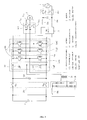
- FIG. 2 is a circuit diagram showing a second embodiment of the invention.
- components the same as components in Fig. 1 are given the same reference signs, and the following description will center on portions differing from Fig. 1 .
- the second switch circuit 20b is connected between the two ends of the alternating current power supply 1 and the two ends of the capacitor 23a, and a PFC circuit 12 is connected between a series circuit of the capacitor 23a and reactor 22a and alternating current terminals of a full bridge circuit 10A acting as a power conversion circuit.
- the full bridge circuit 10A is configured of the three legs LegA, LegB, and LegC including in the upper and lower arms thereof IGBTs as the semiconductor switch elements 101, and a leg LegE including in upper and lower arms thereof a MOSFET as a semiconductor switch element 102.
- the reason for the switch elements 102 of the leg LegE being MOSFETs here will be explained hereafter.
- a fourth switch circuit 20d connected between alternating current terminals of the legs LegA, LegB, and LegC and the alternating current motor 3 includes, as well as a switch S D1 connecting the alternating current terminal of the leg LegA to the alternating current motor 3, a switch S D2 , which selectively carries out an operation short-circuiting the alternating current terminals of the legs LegA and LegB and an operation connecting the alternating current terminal of the leg LegB to the alternating current motor 3, and a switch S D3 , which selectively carries out an operation short-circuiting the alternating current terminals of the legs LegB and LegC and an operation connecting the alternating current terminal of the leg LegC to the alternating current motor 3.
- the condition of the switches S D1 , S D2 , and S D3 of the switch circuit 20d is a condition such that the full bridge circuit 10A and alternating current motor 3 are disconnected, and the alternating current terminals of the legs LegA, LegB, and LegC of the full bridge circuit 10A are short-circuited.
- the switch circuit 20b is turned on, thus enabling energy of the alternating current power supply 1 to be supplied to the PFC circuit 12, and the switch circuit 20c is turned off, creating a condition wherein energy is supplied from the full bridge circuit 10 to the battery 2 via the transformer 21 and AC/DC conversion circuit 11.
- alternating current voltage of the alternating current power supply 1 is converted into direct current voltage
- the direct current voltage is converted into a pulsed high frequency alternating current voltage of a desired frequency by the legs LegA to LegE, and applied to the primary side of the transformer 21.
- the battery 2 is charged by the high frequency alternating current voltage output to the secondary side in accordance with the turn ratio of the transformer 21 being converted into direct current voltage by the AC/DC converter 11, and applied via the reactor 22b to the battery 2.
- the condition of the switches S D1 , S D2 , and S D3 of the switch circuit 20d is a condition such that the alternating current terminals of the legs LegA, LegB, and LegC are released from short-circuiting, and connected to the alternating current motor 3.
- the switch circuit 20b is turned off and the switch circuit 20c turned on, creating a condition wherein energy is supplied from the battery 2 to the alternating current motor 3 via the legs LegA, LegB, and LegC of the full bridge circuit 10A.
- the legs LegA, LegB, and LegC are caused to operate as a 3-phase inverter.
- the direct current voltage of the battery 2 is converted into 3-phase alternating current voltage of a desired frequency and applied to the alternating current motor 3, thus driving the alternating current motor 3.
- leg LegE is caused to be turned on and off in the same pattern as the leg LegA, so that no voltage is applied to the primary side of the transformer 21 due to the switching of the leg LegA.
- the second embodiment is also such that, in the same way as the first embodiment, it is possible to reduce the size of the transformer 21.
- leg LegA acts as both one portion of the legs of a DC/AC conversion circuit that supplies alternating current voltage to the primary side of the transformer 21 and one portion of the legs of an inverter that drives the alternating current motor 3, because of which it is possible to simplify the circuit configuration, and reduce the size and cost of the device.
- Fig. 3 is a schematic equivalent circuit diagram of the full bridge circuit 10A when the battery 2 is charged by the external alternating current power supply 1 in the second embodiment.
- the switch circuit 20d When charging the battery 2, the switch circuit 20d is in a condition such that the full bridge circuit 10A and alternating current motor 3 are disconnected, and the alternating current terminals of the legs LegA, LegB, and LegC are short-circuited. That is, as shown in Fig. 3 , the full bridge circuit 10A, configured of a compound leg wherein the legs LegA, LegB, and LegC are connected in parallel and the leg LegE, is connected to the primary side of the transformer 21.
- Fig. 4 shows the relationship between an applied voltage V TR1 and switching functions S LegA , S LegB , S LegC , and S LegE of LegA, LegB, LegC, and LegD when voltage is applied to the primary side of the transformer 21 using the full bridge circuit 10A.
- the legs LegA, LegB, and LegC are caused to operate alternately so that the operating frequency of the legs LegA, LegB, and LegC, the alternating current terminals of which are short-circuited, is one-third of the frequency of the voltage V TR1 , as is clear from Fig. 4 .
- each switch element of the legs LegA, LegB, LegC, and LegE is switched so that the output voltage frequency of the relevant alternating current terminal coincides with the output voltage frequency of the alternating current terminal of the other leg LegE, which is connected to the other end of the primary side of the transformer 21.
- This kind of switching operation can be realized by, for example, the control circuit shown in Fig. 5 .
- a duty command value Duty* for causing the full bridge circuit 10A to operate and two kinds of carrier wave (Carrier1 and Carrier2) are compared by comparators 30a and 30b, and two switching pulse signals are generated, one of which forms a drive pulse (Pulse E) of the leg LegE, while the other is input into output direction selection means 31.
- the frequencies of the carrier waves (Carrier1 and Carrier2) are equivalent to the voltage V TR1 , while the phases thereof differ from each other by 180°.
- the output direction selection means 31 having the same function as, for example, a demultiplexer, allots one of A, B, and C as the output direction of the input signal (the output signal of the comparator 30b) in accordance with an output direction select signal (Select Signal).
- the outputs A, B, and C of the output direction selection means 31 form drive pulses (Pulse A, Pulse B, and Pulse C) of the legs LegA, LegB, and LegC respectively, and the output direction select signal (Select Signal) is provided so that the drive pulses (Pulse A, Pulse B, and Pulse C) realize the conditions of the switching functions S LeGA , S LegB , S LegC , and S LegE shown in Fig. 4 .
- the switch elements 102 of the leg LegE being MOSFETs, it is possible for the voltage applied to the primary side of the transformer 21 to be a high frequency voltage of a frequency equivalent to the operating frequency of the MOSFETs, even though the switch elements 101 of the legs LegA, LegB, and LegC are IGBTs, and thus possible to achieve a reduction in size of the transformer 21.
- Fig. 6 is a circuit diagram showing a third embodiment of the invention.
- This embodiment relates to a system having a plurality of, for example two, motor/generators.
- a motor/generator is rotating machinery including both alternating current motor and alternating current generator functions.
- a first motor/generator 4a is connected in place of the alternating current motor 3 of Fig. 2 .
- alternating current terminals of a full bridge circuit 10B acting as a power conversion circuit are connected to a second motor/generator 4b via the first switch circuit 20a.
- the full bridge circuit 10B is configured of the legs LegA, LegB, and LegC, in the same way as the full bridge circuit 10A, and direct current terminals of the full bridge circuit 10B are connected to either end of the capacitor 23b.
- the reactor 22a and capacitor 23a are connected to either end of the alternating current power supply 1, and the two ends of the series circuit of the reactor 22a and capacitor 23a are connected one each to one end (the end on the full bridge circuit 10B side) of switches S A2 and S A3 via the second switch circuit 20b.
- the PFC circuit 12 in Fig. 2 is eliminated.
- the configuration may be such that a plurality of circuits wherein the full bridge circuit 10B, switch circuit 20a, and motor/generator 4b are combined are further connected in parallel with the full bridge circuit 10A, driving three or more motor/generators overall.
- the condition of the fourth switch circuit 20d is a condition such that the full bridge circuit 10A and first motor/generator 4a are disconnected, and the alternating current terminals of the legs LegA, LegB, and LegC are short-circuited.
- the first switch circuit 20a is turned off, thus disconnecting the full bridge circuit 10B and second motor/generator 4b, and the second switch circuit 20b is turned on, thus creating a condition wherein energy can be supplied from the alternating current power supply 1 to the full bridge circuit 10B.
- the third switch circuit 20c being turned off, a condition wherein energy is supplied from the full bridge circuit 10A via the transformer 21, AC/DC conversion circuit 11, and reactor 22b to the battery 2 is created.
- alternating current voltage of the alternating current power supply 1 is converted into direct current voltage
- the direct current voltage is converted into a pulsed high frequency alternating current voltage of a desired frequency by the legs LegA to LegE of the full bridge circuit 10A, and applied to the primary side of the transformer 21.
- the battery 2 is charged by the high frequency alternating current voltage output to the secondary side of the transformer 21 in accordance with the turn ratio being converted into direct current voltage by the AC/DC conversion circuit 11.
- the switch circuit 20d when running by driving the motor/generators 4a and 4b using direct current power stored in the battery 2, the short-circuited condition of the alternating current terminals of the legs LegA, LegB, and LegC of the full bridge circuit 10A is released by the switch circuit 20d, and the alternating current terminals are thus connected to the motor/generator 4a. Also, the switch circuit 20a is turned on and the switch circuit 20b turned off, and the switch circuit 20c is turned on.
- the full bridge circuits 10A and 10B are caused to operate as 3-phase inverters, and the direct current voltage of the battery 2 is converted into a desired 3-phase alternating current voltage, thus driving the alternating current motors (motor/generators 4a and 4b). Also, it is also possible to charge the battery 2 by causing the full bridge circuits 10A and 10B to carry out a 3-phase rectifying operation, whereby 3-phase alternating current voltage generated by the alternating current generators (motor/generators 4a and 4b) is converted into direct current voltage, and supplied to the battery 2.
- leg LegE is caused to be turned on and off in the same pattern as the leg LegA so that no voltage is applied to the primary side of the transformer 21 due to the switching of the leg LegA.
- Fig. 7 is a circuit diagram showing a fourth embodiment of the invention.
- the fourth embodiment being a partial improvement of the first embodiment shown in Fig. 1 , the following description will center on portions differing from Fig. 1 .
- the full bridge circuit 10B acting as a first power conversion circuit is such that the leg LegD is eliminated from the full bridge circuit 10 of Fig. 1 .
- 13 is a DC/DC conversion circuit acting as a boosting second power conversion circuit formed of a leg wherein two semiconductor switch elements 101 are connected in series.
- the DC/DC conversion circuit 13 is connected in parallel with the legs LegA, LegB, and LegC of the full bridge circuit 10B and the capacitor 23b.
- an upper and lower arm connection point of the DC/DC conversion circuit 13 is connected via a reactor 22c to one end of the switch S C1 of the third switch circuit 20c, and is connected to one end of the primary coil of the transformer 21. Further, the other end of the primary coil of the transformer 21 is connected to an upper and lower arm connection point of the leg LegA.
- a fifth switch circuit 20e formed of switches S E1 and S E2 is connected via the reactor 22b to the secondary side of the transformer 21, and the switch circuit 20e is connected to both ends of the battery 2.
- the second switch circuit 20b When the battery 2 is charged by the external alternating current power supply 1, the second switch circuit 20b is turned on, and the first switch circuit 20a and third switch circuit 20c are turned off, as in the first embodiment. In addition to this, in the fourth embodiment, the fifth switch circuit 20e is turned on.
- alternating current voltage of the alternating current power supply 1 is converted into direct current voltage while power factor control is carried out by switching operations of the legs LegB and LegC of the full bridge circuit 10B.
- the direct current voltage is converted into a pulsed high frequency alternating current voltage of a desired frequency by switching operations of the leg LegA and the leg of the DC/DC conversion circuit 13, and applied to the primary side of the transformer 21. Because of this, the battery 2 is charged by the high frequency alternating current voltage output to the secondary side of the transformer 21 in accordance with the turn ratio being converted into direct current voltage by the AC/DC conversion circuit 11, and supplied via the reactor 22b and switch circuit 20e to the battery 2.
- the switch circuit 20a when running by driving the alternating current motor 3 using direct current power stored in the battery 2, the switch circuit 20a is turned on and the switch circuit 20b turned off, and the switch circuit 20c is turned on, as in the first embodiment. Furthermore, in the fourth embodiment, the switch circuit 20e is turned off.
- the DC/DC conversion circuit 13 By the DC/DC conversion circuit 13 being caused to carry out a chopper operation in this condition, the voltage of the battery 2 is boosted and applied to the direct current input terminals of the full bridge circuit 10B, and the direct current voltage is converted into 3-phase alternating current voltage of a desired frequency by the legs LegA, LegB, and LegC of the full bridge circuit 10B being caused to operate as a 3-phase inverter, thus driving the alternating current motor 3 via the switch 20a.
- AC/DC conversion is carried out by the legs LegB and LegC when charging the battery 2, and it is possible to obtain high frequency alternating current voltage from switching operations of the leg LegA and the leg of the DC/DC conversion circuit 13. Therefore, it is possible to reduce the size of the transformer 21.
- leg LegA acts as both one portion of the legs of a DC/AC conversion circuit that supplies alternating current voltage to the primary side of the transformer 21 and one portion of the legs of an inverter that drives the alternating current motor 3, because of which it is possible to simplify the circuit configuration, reduce the size of the device, and reduce cost.
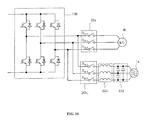
- the first to fourth embodiments are cases wherein the single phase alternating current power supply 1 is used, but the fifth embodiment is a case wherein a 3-phase alternating current power supply 1a is used.
- Fig. 8 is an example wherein the 3-phase alternating current power supply 1a is used in place of the single phase alternating current power supply 1 in the first embodiment of Fig. 1 .
- 20b 1 is a second switch circuit formed of switches S B1 to S B3
- 22d is a reactor
- 23d is a capacitor.
- Fig. 9 is an example wherein the 3-phase alternating current power supply 1a is used in place of the single phase alternating current power supply 1 in the second embodiment of Fig. 2 .
- the alternating current input side of the PFC circuit 12 is of a configuration such that everything is compatible with the 3-phase alternating current power supply 1a.
- Fig. 10 is an example wherein the 3-phase alternating current power supply 1a is used in place of the single phase alternating current power supply 1 in the third embodiment of Fig. 6 .
- the full bridge circuit 10B has 3-phase input specifications, and it is possible to adapt to the 3-phase alternating current power supply 1a by causing the full bridge circuit 10B to operate as a PFC circuit when charging the battery 2.
- the invention can be utilized as various kinds of motor drive device having a function of charging a motor driving battery, such as when mounted in an HEV or EV.
Landscapes
- Engineering & Computer Science (AREA)
- Power Engineering (AREA)
- Mechanical Engineering (AREA)
- Transportation (AREA)
- Sustainable Energy (AREA)
- Life Sciences & Earth Sciences (AREA)
- Sustainable Development (AREA)
- Inverter Devices (AREA)
- Electric Propulsion And Braking For Vehicles (AREA)
- Charge And Discharge Circuits For Batteries Or The Like (AREA)
- Rectifiers (AREA)
- Control Of Ac Motors In General (AREA)
- Dc-Dc Converters (AREA)
Abstract
Description
- The present invention relates to a motor drive device mounted in, for example, a hybrid vehicle (hereafter referred to as an HEV) or electric vehicle (hereafter referred to as an EV), and in particular, relates to a motor drive device having a function of driving a motor driving battery.
- Against a background of an international situation aiming for a low carbon society, the automobile industry, in order to respond to emission regulations that become stricter by the year, is proceeding with a shift from heretofore known vehicles that run by driving an internal combustion engine using a fuel such as gasoline to HEVs or EVs that can run by driving a motor using electrical energy.
- As an HEV or EV is such that a large capacity battery is mounted, and the HEV or EV runs by a motor being driven using the power of the battery, a vehicle-mounted charger that charges the battery and a power train for driving the motor using the power of the battery are included.
-
Fig. 11 shows a configuration example of a heretofore known vehicle-mounted charger and power train used in an HEV or EV. - In
Fig. 11 , a vehicle-mountedcharger 4 includes a power factor control circuit (hereafter referred to as a PFC circuit) 41, a DC/AC converter 42, atransformer 43, arectifier circuit 44, and areactor 45, wherein an isolated AC/DC converter is configured of the DC/AC converter 42,transformer 43,rectifier circuit 44, andreactor 45. Also, apower train 5 is configured of a 3-phase inverter 51. - 1 is an alternating current power supply, 2 is a battery, and 3 is a 3-phase alternating current motor.
- To give a simple description of an operation of
Fig. 11 , the external alternatingcurrent power supply 1 is connected to the vehicle-mountedcharger 4 when charging thebattery 2. While the power factor of the input current is controlled by thePFC circuit 41 in this condition, thebattery 2 is charged by the charging current, power, and voltage of thebattery 2 being controlled by the circuit from the DC/AC converter 42 onward. Meanwhile, when the vehicle is running, direct current power of thebattery 2 is converted into alternating current power by theinverter circuit 51, thus driving the alternatingcurrent motor 3. - The heretofore known technology of
Fig. 11 is such that the power conversion circuit configuring the vehicle-mountedcharger 4 and the power conversion circuit configuring thepower train 5 are provided separately, because of which the circuits have a large number of parts, causing an increase in size and increase in cost of the overall device. - Because of this, heretofore known technology that achieves a reduction in size and a reduction in cost by a power conversion circuit being shared is disclosed in, for example,
PTL 1. -
Fig. 12 is a circuit diagram of heretofore known technology described inPTL 1. InFig. 12 , components having the same functions as components shown inFig. 11 are given the same reference signs. InFig. 12 ,6 is a capacitor connected in parallel with thebattery transformer current motor 3. - The circuit of
Fig. 12 is such that, with thecutoff connector 9 in a disconnected condition, an alternating current input is applied to theinverter 51 via thetransformer 7 andfilter 8, and thebattery 2 is charged by an AC/DC conversion operation of theinverter 51. Also, when driving the alternatingcurrent motor 3, direct current power of thebattery 2 is converted into alternating current power by theinverter 51 with thecutoff connector 9 in a connected condition, and the alternating current power is supplied to the alternatingcurrent motor 3. - This heretofore known technology is such that, by the
motor driving inverter 51 also being utilized as a charger of thebattery 2, the circuit configuration is simplified, and a reduction in size and reduction in cost of the overall device are achieved. - PTL 1: Japanese Patent No.
3,477,850 Fig. 2 , and the like) - The heretofore known technology of
Fig. 11 is such that, although a reduction in size and reduction in cost of the overall device are difficult, as previously described, it is possible, by thetransformer 43 being driven at a high frequency of several tens of kilohertz by the DC/AC converter 42, to reduce the size of thetransformer 43. - As opposed to this, the heretofore known technology shown in
Fig. 12 is such that, by theinverter 51 being used both when driving the alternatingcurrent motor 3 and when charging thebattery 2, a reduction in size of the overall device, and the like, is possible. - However, in the circuit configuration of
Fig. 12 , thetransformer 7 is used in the alternating current input portion in order to isolate the alternating current input andbattery 2. When using a commercial power supply as the alternating current input in this case, the power supply frequency is in the region of several tens of kilohertz, because of which thetransformer 7 has low frequency specifications, and a reduction in size is difficult. - Therefore, an object of the invention is to provide a motor drive device such that it is possible to reduce the size and reduce the cost of the overall device by an isolating transformer being driven at a high frequency while a motor driving power conversion circuit and a battery charging power conversion circuit are shared.
- In order to resolve the heretofore described problems, the invention is a motor drive device that converts direct current voltage of a battery into alternating current voltage using a power conversion circuit, wherein the power conversion circuit is configured by a plurality of legs having a semiconductor switch element in each of upper and lower arms being connected in parallel.
- Further, alternating current voltage output from the power conversion circuit in a condition wherein the power conversion circuit is connected to an alternating current power supply is converted into direct current voltage via a transformer and an alternating current/direct current conversion circuit, and the battery is charged by the direct current voltage. Also, direct current voltage of the battery is converted into alternating current voltage by the power conversion circuit in a condition wherein the alternating current power supply is cut off from the power conversion circuit, and supplied to the alternating current motor, thus driving the alternating current motor.
- The power conversion device used in the invention is configured by, for example, four legs having a semiconductor switch element in upper and lower arms thereof being connected in parallel. Further, by three legs of the four legs being caused to operate as an inverter, the 3-phase alternating current motor is driven with the battery as a power supply. Also, when charging the battery, charging power is obtained by a high frequency alternating current voltage being generated by, for example, two legs being caused to carry out an alternating current/direct current conversion operation and the remaining two legs being caused to carry out a direct Current/alternating current conversion operation, and the high frequency alternating current voltage being converted into direct current voltage by the transformer and alternating current/direct current conversion circuit.
- Furthermore, the invention also includes systems such as the alternating current motor being configured of a motor/generator, or direct current voltage of the battery being converted into alternating current voltage after being boosted, thus driving the alternating current motor.
- According to the invention, one leg of a power conversion circuit for obtaining voltage to be applied to an alternating current motor with a battery as a power supply can also be used as a leg of a power conversion circuit for obtaining high frequency alternating current voltage of a predetermined frequency from an alternating current power supply. That is, the invention is such that when driving the alternating current motor, direct current voltage of the battery is converted into alternating current voltage by the power conversion circuit and supplied to the alternating current motor, and when charging the battery, high frequency alternating current voltage generated while the power factor is improved by the power conversion circuit is AC/DC converted via the transformer and supplied to the battery.
- Because of the heretofore described operations, it is possible to reduce the size of the isolating transformer and effectively utilize the legs of the power conversion circuit, and thus possible to realize a simplification of the circuit configuration, and a reduction in size and reduction in cost of the overall device.
-
- [
Fig. 1] Fig. 1 is a circuit diagram showing a first embodiment of the invention. - [
Fig. 2] Fig. 2 is a circuit diagram showing a second embodiment of the invention. - [
Fig. 3] Fig. 3 is a schematic equivalent circuit diagram of a full bridge circuit when charging a battery according to the second embodiment of the invention. - [
Fig. 4] Fig. 4 shows transformer primary side voltage and switching functions of each leg when charging the battery according to the second embodiment of the invention. - [
Fig. 5] Fig. 5 is a configuration diagram of a control circuit when charging the battery according to the second embodiment of the invention. - [
Fig. 6] Fig. 6 is a circuit diagram showing a third embodiment of the invention. - [
Fig. 7] Fig. 7 is a circuit diagram showing a fourth embodiment of the invention. - [
Fig. 8] Fig. 8 is a circuit diagram of a main portion to which a fifth embodiment of the invention is applied. - [
Fig. 9] Fig. 9 is a circuit diagram of a main portion to which the fifth embodiment of the invention is applied. - [
Fig. 10] Fig. 10 is a circuit diagram of a main portion to which the fifth embodiment of the invention is applied. - [
Fig. 11] Fig. 11 is a circuit diagram of heretofore known technology formed of a vehicle-mounted charger and power train. - [
Fig. 12] Fig. 12 is a circuit diagram of heretofore known technology described inPTL 1. - Hereafter, based on the drawings, a description will be given of embodiments of the invention.
-
Fig. 1 is a circuit diagram showing a first embodiment of the invention. InFig. 1 , components the same as components inFig. 11 andFig. 12 are given the same reference signs, and the following description will center on portions differing fromFig. 11 andFig. 12 . - A
third switch circuit 20c, formed of switches SC1 and SC2, and acapacitor 23b are connected in parallel with abattery 2. Positive and negative direct current terminals of afull bridge circuit 10 acting as a power conversion circuit are connected to either end of thecapacitor 23b, thefull bridge circuit 10 being configured by four legs - LegA, LegB, LegC, and LegD - including in upper and lower arms thereof asemiconductor switch element 101, such as an IGBT, all being connected in parallel. - Alternating current terminals (upper and lower arm connection points of each leg) of the three legs LegA, LegB, and LegC are connected to a 3-phase alternating
current motor 3 via afirst switch circuit 20a formed of switches SA1, SA2, and SA3. Also, the alternating current terminals of the legs LegB and LegC are connected to a single phase alternatingcurrent power supply 1 via asecond switch circuit 20b formed of switches SB1 and SB2, areactor 22a, and acapacitor 23a. Furthermore, alternating current terminals (upper and lower arm connection points of each leg) of the legs LegD and LegA are connected to a primary coil of atransformer 21, and a secondary coil of thetransformer 21 is connected to both ends of thebattery 2 via an AC/DC conversion circuit 11, formed of a diode bridge, and areactor 22b. - Next, a description will be given of an operation of this embodiment.
- When charging the
battery 2, thesecond switch circuit 20b is turned on, thus connecting the external alternatingcurrent power supply 1 with the alternating current input/output terminals of the legs LegB and LegC. At this time, thefirst switch circuit 20a is turned off, thus cutting the alternatingcurrent motor 3 off from thefull bridge circuit 10. Also, thethird switch circuit 20c is turned off, creating a condition wherein energy is supplied from thefull bridge circuit 10 to thebattery 2 via thetransformer 21, AC/DC conversion circuit 11, andreactor 22b. - By the
switch elements 101 of the legs LegB and LegC of thefull bridge circuit 10 being caused to carry out turn-on/turn-off operations in this condition, alternating current voltage of the alternatingcurrent power supply 1 is converted into direct current voltage while power factor control is carried out by the legs LegB and LegC. The direct current voltage is applied to both ends of the parallel circuit of the legs LegA and LegD. - The direct current voltage is converted into a pulsed high frequency alternating current voltage of a desired frequency in the legs LegA and LegD by the
switch elements 101 being caused to carry out turn-on/turn-off operations, and applied to the primary side of thetransformer 21. Further, thebattery 2 is charged by the high frequency alternating current voltage output to the secondary side in accordance with the turn ratio of thetransformer 21 being converted into direct current voltage by the AC/DC converter 11, and applied via thereactor 22b to thebattery 2. - Meanwhile, when running by driving the alternating
current motor 3 using direct current power stored in thebattery 2, theswitch circuit 20a is turned on and theswitch circuit 20b is turned off, and theswitch circuit 20c is turned on. By so doing, direct current voltage of thebattery 2 is applied to the positive and negative direct current terminals of thefull bridge circuit 10. - By the
switch elements 101 of the legs LegA, LegB, and LegC of thefull bridge circuit 10 being caused to carry out turn-on/turn-off operations in this condition, the legs LegA, LegB, and LegC are caused to operate as a 3-phase inverter. By so doing, the direct current voltage of thebattery 2 is converted into 3-phase alternating current voltage of a desired frequency and applied to themotor 3, thus driving the alternatingcurrent motor 3. - When driving the alternating
current motor 3, it is necessary that the leg LegD is caused to be turned on and off in the same pattern as the leg LegA so that no voltage is applied to the primary side of thetransformer 21 due to the switching of the leg LegA. - According to the first embodiment, by AC/DC conversion being carried out while the power factor is improved by the legs LegB and LegC, and furthermore, by the legs LegA and LegD being caused to carry out a DC/AC conversion operation, it is possible to obtain high frequency alternating current voltage when charging the
battery 2. Because of this, it is possible to reduce the size of thetransformer 21 in comparison with that of heretofore known technology inFig. 12 . - Also, the leg LegA acts as both one portion of the legs of a DC/AC conversion circuit that supplies alternating current voltage to the primary side of the
transformer 21 and one portion of the legs of an inverter that drives the alternatingcurrent motor 3, because of which it is possible to reduce the number of parts, thus simplifying the configuration, reducing the size and cost of the device. - Next,
Fig. 2 is a circuit diagram showing a second embodiment of the invention. InFig. 2 , components the same as components inFig. 1 are given the same reference signs, and the following description will center on portions differing fromFig. 1 . - In this embodiment, the
second switch circuit 20b is connected between the two ends of the alternatingcurrent power supply 1 and the two ends of thecapacitor 23a, and aPFC circuit 12 is connected between a series circuit of thecapacitor 23a andreactor 22a and alternating current terminals of afull bridge circuit 10A acting as a power conversion circuit. - The
full bridge circuit 10A is configured of the three legs LegA, LegB, and LegC including in the upper and lower arms thereof IGBTs as thesemiconductor switch elements 101, and a leg LegE including in upper and lower arms thereof a MOSFET as asemiconductor switch element 102. The reason for theswitch elements 102 of the leg LegE being MOSFETs here will be explained hereafter. - A
fourth switch circuit 20d connected between alternating current terminals of the legs LegA, LegB, and LegC and the alternatingcurrent motor 3 includes, as well as a switch SD1 connecting the alternating current terminal of the leg LegA to the alternatingcurrent motor 3, a switch SD2, which selectively carries out an operation short-circuiting the alternating current terminals of the legs LegA and LegB and an operation connecting the alternating current terminal of the leg LegB to the alternatingcurrent motor 3, and a switch SD3, which selectively carries out an operation short-circuiting the alternating current terminals of the legs LegB and LegC and an operation connecting the alternating current terminal of the leg LegC to the alternatingcurrent motor 3. - Next, a description will be given of an operation of this embodiment.
- It is assumed that when charging the
battery 2, the condition of the switches SD1, SD2, and SD3 of theswitch circuit 20d is a condition such that thefull bridge circuit 10A and alternatingcurrent motor 3 are disconnected, and the alternating current terminals of the legs LegA, LegB, and LegC of thefull bridge circuit 10A are short-circuited. Also, theswitch circuit 20b is turned on, thus enabling energy of the alternatingcurrent power supply 1 to be supplied to thePFC circuit 12, and theswitch circuit 20c is turned off, creating a condition wherein energy is supplied from thefull bridge circuit 10 to thebattery 2 via thetransformer 21 and AC/DC conversion circuit 11. - While the power factor is controlled by the
PFC circuit 12 in this condition, alternating current voltage of the alternatingcurrent power supply 1 is converted into direct current voltage, and the direct current voltage is converted into a pulsed high frequency alternating current voltage of a desired frequency by the legs LegA to LegE, and applied to the primary side of thetransformer 21. Further, thebattery 2 is charged by the high frequency alternating current voltage output to the secondary side in accordance with the turn ratio of thetransformer 21 being converted into direct current voltage by the AC/DC converter 11, and applied via thereactor 22b to thebattery 2. - Meanwhile, when running by driving the alternating
current motor 3 using direct current power stored in thebattery 2, the condition of the switches SD1, SD2, and SD3 of theswitch circuit 20d is a condition such that the alternating current terminals of the legs LegA, LegB, and LegC are released from short-circuiting, and connected to the alternatingcurrent motor 3. Also, theswitch circuit 20b is turned off and theswitch circuit 20c turned on, creating a condition wherein energy is supplied from thebattery 2 to the alternatingcurrent motor 3 via the legs LegA, LegB, and LegC of thefull bridge circuit 10A. - By the
switch elements 101 of the legs LegA, LegB, and LegC being caused to carry out turn-on/turn-off operations in this condition, the legs LegA, LegB, and LegC are caused to operate as a 3-phase inverter. By so doing, the direct current voltage of thebattery 2 is converted into 3-phase alternating current voltage of a desired frequency and applied to the alternatingcurrent motor 3, thus driving the alternatingcurrent motor 3. - In the same way as in the first embodiment, it is necessary when driving the alternating
current motor 3 that the leg LegE is caused to be turned on and off in the same pattern as the leg LegA, so that no voltage is applied to the primary side of thetransformer 21 due to the switching of the leg LegA. - The second embodiment is also such that, in the same way as the first embodiment, it is possible to reduce the size of the
transformer 21. - Also, the leg LegA acts as both one portion of the legs of a DC/AC conversion circuit that supplies alternating current voltage to the primary side of the
transformer 21 and one portion of the legs of an inverter that drives the alternatingcurrent motor 3, because of which it is possible to simplify the circuit configuration, and reduce the size and cost of the device. -
Fig. 3 is a schematic equivalent circuit diagram of thefull bridge circuit 10A when thebattery 2 is charged by the external alternatingcurrent power supply 1 in the second embodiment. - When charging the
battery 2, theswitch circuit 20d is in a condition such that thefull bridge circuit 10A and alternatingcurrent motor 3 are disconnected, and the alternating current terminals of the legs LegA, LegB, and LegC are short-circuited. That is, as shown inFig. 3 , thefull bridge circuit 10A, configured of a compound leg wherein the legs LegA, LegB, and LegC are connected in parallel and the leg LegE, is connected to the primary side of thetransformer 21. -
Fig. 4 shows the relationship between an applied voltage VTR1 and switching functions SLegA, SLegB, SLegC, and SLegE of LegA, LegB, LegC, and LegD when voltage is applied to the primary side of thetransformer 21 using thefull bridge circuit 10A. Herein, it is shown that, when an upper arm side switch element of each leg is taken to be Qup and a lower arm side switch element QLow, the switch element Qup of the relevant leg is in an on-state and the switch element QLOW in an off-state when the switching function = 1, the switch elements Qup and QLow of the relevant leg are both in an off-state when the switching function = 0, and the switch element Qup of the relevant leg is in an off-state and the switch element QLow in an on-state when the switching function = -1. - In this embodiment, as a switching operation for applying the desired voltage VTR1 to the
transformer 21, the legs LegA, LegB, and LegC are caused to operate alternately so that the operating frequency of the legs LegA, LegB, and LegC, the alternating current terminals of which are short-circuited, is one-third of the frequency of the voltage VTR1, as is clear fromFig. 4 . - In other words, when the alternating current terminals of the legs LegA, LegB, and LegC of the
full bridge circuit 10A are short-circuited and thus connected to one end of the primary side of thetransformer 21 by thefourth switch circuit 20d, each switch element of the legs LegA, LegB, LegC, and LegE is switched so that the output voltage frequency of the relevant alternating current terminal coincides with the output voltage frequency of the alternating current terminal of the other leg LegE, which is connected to the other end of the primary side of thetransformer 21. This kind of switching operation can be realized by, for example, the control circuit shown inFig. 5 . - That is, in
Fig. 5 , a duty command value Duty* for causing thefull bridge circuit 10A to operate and two kinds of carrier wave (Carrier1 and Carrier2) are compared bycomparators - The output direction selection means 31, having the same function as, for example, a demultiplexer, allots one of A, B, and C as the output direction of the input signal (the output signal of the
comparator 30b) in accordance with an output direction select signal (Select Signal). The outputs A, B, and C of the output direction selection means 31 form drive pulses (Pulse A, Pulse B, and Pulse C) of the legs LegA, LegB, and LegC respectively, and the output direction select signal (Select Signal) is provided so that the drive pulses (Pulse A, Pulse B, and Pulse C) realize the conditions of the switching functions SLeGA, SLegB, SLegC, and SLegE shown inFig. 4 . - Herein, by the
switch elements 102 of the leg LegE being MOSFETs, it is possible for the voltage applied to the primary side of thetransformer 21 to be a high frequency voltage of a frequency equivalent to the operating frequency of the MOSFETs, even though theswitch elements 101 of the legs LegA, LegB, and LegC are IGBTs, and thus possible to achieve a reduction in size of thetransformer 21. - Next,
Fig. 6 is a circuit diagram showing a third embodiment of the invention. This embodiment relates to a system having a plurality of, for example two, motor/generators. Herein, a motor/generator is rotating machinery including both alternating current motor and alternating current generator functions. - In the third embodiment shown in
Fig. 6 , firstly, a first motor/generator 4a is connected in place of the alternatingcurrent motor 3 ofFig. 2 . Also, alternating current terminals of afull bridge circuit 10B acting as a power conversion circuit are connected to a second motor/generator 4b via thefirst switch circuit 20a. Thefull bridge circuit 10B is configured of the legs LegA, LegB, and LegC, in the same way as thefull bridge circuit 10A, and direct current terminals of thefull bridge circuit 10B are connected to either end of thecapacitor 23b. - Furthermore, the
reactor 22a andcapacitor 23a are connected to either end of the alternatingcurrent power supply 1, and the two ends of the series circuit of thereactor 22a andcapacitor 23a are connected one each to one end (the end on thefull bridge circuit 10B side) of switches SA2 and SA3 via thesecond switch circuit 20b. In the third embodiment, thePFC circuit 12 inFig. 2 is eliminated. - Although not shown in the drawing, the configuration may be such that a plurality of circuits wherein the
full bridge circuit 10B,switch circuit 20a, and motor/generator 4b are combined are further connected in parallel with thefull bridge circuit 10A, driving three or more motor/generators overall. - Hereafter, a description will be given of an operation of the embodiment.
- When the
battery 2 is charged by the alternatingcurrent power supply 1, the condition of thefourth switch circuit 20d is a condition such that thefull bridge circuit 10A and first motor/generator 4a are disconnected, and the alternating current terminals of the legs LegA, LegB, and LegC are short-circuited. Also, thefirst switch circuit 20a is turned off, thus disconnecting thefull bridge circuit 10B and second motor/generator 4b, and thesecond switch circuit 20b is turned on, thus creating a condition wherein energy can be supplied from the alternatingcurrent power supply 1 to thefull bridge circuit 10B. Furthermore, by thethird switch circuit 20c being turned off, a condition wherein energy is supplied from thefull bridge circuit 10A via thetransformer 21, AC/DC conversion circuit 11, andreactor 22b to thebattery 2 is created. - While the power factor is controlled by the
full bridge circuit 10B in this condition, alternating current voltage of the alternatingcurrent power supply 1 is converted into direct current voltage, and the direct current voltage is converted into a pulsed high frequency alternating current voltage of a desired frequency by the legs LegA to LegE of thefull bridge circuit 10A, and applied to the primary side of thetransformer 21. Further, thebattery 2 is charged by the high frequency alternating current voltage output to the secondary side of thetransformer 21 in accordance with the turn ratio being converted into direct current voltage by the AC/DC conversion circuit 11. - At this time, it is sufficient that the switching functions of the legs LegA, LegB, LegC, and LegE of the
full bridge circuit 10A are provided as illustrated inFig. 4 . - Meanwhile, when running by driving the motor/
generators battery 2, the short-circuited condition of the alternating current terminals of the legs LegA, LegB, and LegC of thefull bridge circuit 10A is released by theswitch circuit 20d, and the alternating current terminals are thus connected to the motor/generator 4a. Also, theswitch circuit 20a is turned on and theswitch circuit 20b turned off, and theswitch circuit 20c is turned on. - By so doing, a condition wherein energy is supplied from the
battery 2 to the motor/generators full bridge circuits generators battery 2, is created. - In this condition, the
full bridge circuits battery 2 is converted into a desired 3-phase alternating current voltage, thus driving the alternating current motors (motor/generators battery 2 by causing thefull bridge circuits generators battery 2. - As previously described, when driving the motor/
generator 4a as an alternating current motor, it is necessary that the leg LegE is caused to be turned on and off in the same pattern as the leg LegA so that no voltage is applied to the primary side of thetransformer 21 due to the switching of the leg LegA. - Next,
Fig. 7 is a circuit diagram showing a fourth embodiment of the invention. - The fourth embodiment being a partial improvement of the first embodiment shown in
Fig. 1 , the following description will center on portions differing fromFig. 1 . - In
Fig. 7 , thefull bridge circuit 10B acting as a first power conversion circuit is such that the leg LegD is eliminated from thefull bridge circuit 10 ofFig. 1 . Also, 13 is a DC/DC conversion circuit acting as a boosting second power conversion circuit formed of a leg wherein twosemiconductor switch elements 101 are connected in series. The DC/DC conversion circuit 13 is connected in parallel with the legs LegA, LegB, and LegC of thefull bridge circuit 10B and thecapacitor 23b. - Furthermore, an upper and lower arm connection point of the DC/
DC conversion circuit 13 is connected via areactor 22c to one end of the switch SC1 of thethird switch circuit 20c, and is connected to one end of the primary coil of thetransformer 21. Further, the other end of the primary coil of thetransformer 21 is connected to an upper and lower arm connection point of the leg LegA. - A
fifth switch circuit 20e formed of switches SE1 and SE2 is connected via thereactor 22b to the secondary side of thetransformer 21, and theswitch circuit 20e is connected to both ends of thebattery 2. - Hereafter, a description will be given of an operation of the fourth embodiment.
- When the
battery 2 is charged by the external alternatingcurrent power supply 1, thesecond switch circuit 20b is turned on, and thefirst switch circuit 20a andthird switch circuit 20c are turned off, as in the first embodiment. In addition to this, in the fourth embodiment, thefifth switch circuit 20e is turned on. - In this condition, alternating current voltage of the alternating
current power supply 1 is converted into direct current voltage while power factor control is carried out by switching operations of the legs LegB and LegC of thefull bridge circuit 10B. The direct current voltage is converted into a pulsed high frequency alternating current voltage of a desired frequency by switching operations of the leg LegA and the leg of the DC/DC conversion circuit 13, and applied to the primary side of thetransformer 21. Because of this, thebattery 2 is charged by the high frequency alternating current voltage output to the secondary side of thetransformer 21 in accordance with the turn ratio being converted into direct current voltage by the AC/DC conversion circuit 11, and supplied via thereactor 22b andswitch circuit 20e to thebattery 2. - Meanwhile, when running by driving the alternating
current motor 3 using direct current power stored in thebattery 2, theswitch circuit 20a is turned on and theswitch circuit 20b turned off, and theswitch circuit 20c is turned on, as in the first embodiment. Furthermore, in the fourth embodiment, theswitch circuit 20e is turned off. - By the DC/
DC conversion circuit 13 being caused to carry out a chopper operation in this condition, the voltage of thebattery 2 is boosted and applied to the direct current input terminals of thefull bridge circuit 10B, and the direct current voltage is converted into 3-phase alternating current voltage of a desired frequency by the legs LegA, LegB, and LegC of thefull bridge circuit 10B being caused to operate as a 3-phase inverter, thus driving the alternatingcurrent motor 3 via theswitch 20a. - In the fourth embodiment too, AC/DC conversion is carried out by the legs LegB and LegC when charging the
battery 2, and it is possible to obtain high frequency alternating current voltage from switching operations of the leg LegA and the leg of the DC/DC conversion circuit 13. Therefore, it is possible to reduce the size of thetransformer 21. - Also, the leg LegA acts as both one portion of the legs of a DC/AC conversion circuit that supplies alternating current voltage to the primary side of the
transformer 21 and one portion of the legs of an inverter that drives the alternatingcurrent motor 3, because of which it is possible to simplify the circuit configuration, reduce the size of the device, and reduce cost. - Next, a description will be given of a fifth embodiment of the invention.
- The first to fourth embodiments are cases wherein the single phase alternating
current power supply 1 is used, but the fifth embodiment is a case wherein a 3-phase alternating current power supply 1a is used. - Firstly,
Fig. 8 is an example wherein the 3-phase alternating current power supply 1a is used in place of the single phase alternatingcurrent power supply 1 in the first embodiment ofFig. 1 . In this case, it is possible to adapt to the 3-phase alternating current power supply 1a by adding a leg LegF to thefull bridge circuit 10 ofFig. 1 , thus configuring a full bridge circuit 10C. InFig. 8 , 20b1 is a second switch circuit formed of switches SB1 to SB3, 22d is a reactor, and 23d is a capacitor. - Next,
Fig. 9 is an example wherein the 3-phase alternating current power supply 1a is used in place of the single phase alternatingcurrent power supply 1 in the second embodiment ofFig. 2 . In this case, the alternating current input side of thePFC circuit 12 is of a configuration such that everything is compatible with the 3-phase alternating current power supply 1a. -
Fig. 10 is an example wherein the 3-phase alternating current power supply 1a is used in place of the single phase alternatingcurrent power supply 1 in the third embodiment ofFig. 6 . In this case, thefull bridge circuit 10B has 3-phase input specifications, and it is possible to adapt to the 3-phase alternating current power supply 1a by causing thefull bridge circuit 10B to operate as a PFC circuit when charging thebattery 2. - As operations when charging the
battery 2, and operations when driving the alternatingcurrent motor 3 or motor/generator 4b, using the circuits ofFig. 8 to Fig. 10 can be easily inferred from the first to third embodiments, a description thereof will be omitted. - Also, in each of the embodiments, a description has been given of a case of driving a 3-phase alternating current motor, but when driving a single phase alternating current motor, the invention can be applied by changing the
switch circuits - The invention can be utilized as various kinds of motor drive device having a function of charging a motor driving battery, such as when mounted in an HEV or EV.
-
- 1, 1a: Alternating current power supply
- 2: Battery
- 3: Alternating current motor
- 4a, 4b: Motor/generator
- 10, 10A, 10B, 10C: Full bridge circuit
- 11: AC/DC conversion circuit
- 12: PFC circuit
- 13: DC/DC conversion circuit
- 20a, 20b, 20b1, 20c, 20d, 20e: Switch circuit
- 21: Transformer
- 22a, 22b, 22c, 22d: Reactor
- 23a, 23b, 23c, 23d: Capacitor
- 30a, 30b: Comparator
- 31: Output direction selection means
- 101, 102: Semiconductor switch element
- LegA, LegB, LegC, LegD, LegE, LegF: Leg
- SA1 to SA3, SB1 to SB3, SC1, SC2, SD1 to SD3, SE1, SE2: Switch
Claims (10)
- A motor drive device that converts direct current voltage of a battery into alternating current voltage using a power conversion circuit, thus driving an alternating current motor,
the motor drive device being characterized in that
a power conversion circuit is configured by a plurality of legs having a semiconductor switch element in each of upper and lower arms being connected in parallel,
high frequency alternating current voltage output from the power conversion circuit in a condition wherein the power conversion circuit is connected to an alternating current power supply is converted into direct current voltage via a transformer and an alternating current/direct current conversion circuit, and the battery charged by the direct current voltage, and
direct current voltage of the battery is converted into alternating current voltage by the power conversion circuit in a condition wherein the alternating current power supply is cut off from the power conversion circuit, and supplied to the alternating current motor. - A motor drive device that converts direct current voltage of a battery into alternating current voltage using a power conversion circuit, thus driving an alternating current motor,
the motor drive device being characterized by including:a power conversion circuit configured by a plurality of legs having a semiconductor switch element in each of upper and lower arms being connected in parallel;a first switch circuit connected between alternating current terminals of the plurality of legs configuring the power conversion circuit and the alternating current motor;a second switch circuit connected between alternating current terminals of the plurality of legs configuring the power conversion circuit and an alternating current power supply;a third switch circuit connected between the battery and direct current terminals of the power conversion circuit;a transformer whose primary side is connected between alternating current terminals of two of the legs configuring the power conversion circuit; andan alternating current/direct current conversion circuit, connected to a secondary side of the transformer, between a pair of output terminals of which the battery is connected, wherein,in a condition wherein the first and third switch circuits are turned off and the second switch circuit turned on, the battery is charged by alternating current voltage of the alternating current power supply being supplied to the power conversion circuit, high frequency alternating current voltage being generated, and the high frequency alternating current voltage being converted via the transformer and alternating current/direct current conversion circuit into direct current voltage and supplied to the battery, andin a condition wherein the first and third switch circuits are turned on and the second switch circuit turned off, direct current voltage of the battery is converted into alternating current voltage by the power conversion circuit and supplied to the alternating current motor. - A motor drive device that converts direct current voltage of a battery into alternating current voltage using a power conversion circuit, thus driving an alternating current motor,
the motor drive device being characterized by including:a power conversion circuit configured by a plurality of legs having a semiconductor switch element in each of upper and lower arms being connected in parallel;a fourth switch circuit, connected between alternating current terminals of the plurality of legs configuring the power conversion circuit and the alternating current motor, that can short-circuit alternating current terminals of the plurality of legs or connect the alternating current terminals to the alternating current motor;a second switch circuit connected via a power factor control circuit between direct current terminals and alternating current terminals of the power conversion circuit;a third switch circuit connected between the battery and direct current terminals of the power conversion circuit;a transformer whose primary side is connected between the relevant alternating current terminals of those of the plurality of legs whose alternating current terminals are short-circuited by the fourth switch circuit and an alternating current terminal of another leg; andan alternating current/direct current conversion circuit, connected to a secondary side of the transformer, between a pair of output terminals of which the battery is connected, wherein,in a condition wherein the second switch circuit is turned on and the third switch circuit turned off, and alternating current terminals of the plurality of legs are short-circuited by the fourth switch circuit, the battery is charged by alternating current voltage of the alternating current power supply being converted into high frequency alternating current voltage by the power conversion circuit via the power factor control circuit, and the high frequency alternating current voltage being converted via the transformer and alternating current/direct current conversion circuit into direct current voltage and supplied to the battery, andin a condition wherein the second switch circuit is turned off and the third switch circuit turned on, and alternating current terminals of the plurality of legs are connected to the alternating current motor by the fourth switch circuit, direct current voltage of the battery is converted into alternating current voltage by the power conversion circuit and supplied to the alternating current motor. - A motor drive device that converts direct current voltage of a battery into alternating current voltage using a power conversion circuit, thus driving a plurality of alternating current motors, wherein the alternating current motors are configured of motor/generators that can also operate as alternating current generators,
the motor drive device being characterized by including:a plurality of power conversion circuits configured by a plurality of legs having a semiconductor switch element in each of upper and lower arms being connected in parallel;a fourth switch circuit, provided between alternating current terminals of the plurality of legs configuring one power conversion circuit of the plurality of power conversion circuits and one motor/generator, that can short-circuit alternating current terminals of the plurality of legs or connect the alternating current terminals to one motor/generator;a second switch circuit connected between alternating current terminals of the plurality of legs configuring another power conversion circuit of the plurality of power conversion circuits and an alternating current power supply;a first switch circuit connected between alternating current terminals of the plurality of legs configuring the other power conversion circuit and another motor/generator;a third switch circuit connected between the battery and direct current terminals of the one power conversion circuit;a transformer whose primary side is connected between the relevant alternating current terminals of those of the plurality of legs whose alternating current terminals are short-circuited by the fourth switch circuit and an alternating current terminal of another leg; andan alternating current/direct current conversion circuit, connected to a secondary side of the transformer, between a pair of output terminals of which the battery is connected, wherein,in a condition wherein the first and third switch circuits are turned off and the second switch circuit turned on, and alternating current terminals of the plurality of legs are short-circuited by the fourth switch circuit, the battery is charged by alternating current voltage of the alternating current power supply being converted into direct current voltage by the other power conversion circuit, subsequently converted into high frequency alternating current voltage by the one power conversion circuit, and the high frequency alternating current voltage being converted via the transformer and alternating current/direct current conversion circuit into direct current voltage and supplied to the battery, andin a condition wherein the second switch circuit is turned off and the first and third switch circuits turned on, and alternating current terminals of the plurality of legs are connected to the one motor/generator by the fourth switch circuit, direct current voltage of the battery is converted into alternating current voltage by the one power conversion circuit and the other power conversion circuit, and supplied to each motor/generator. - A motor drive device that converts direct current voltage of a battery into alternating current voltage using a power conversion circuit, thus driving an alternating current motor,
the motor drive device being characterized by including:a first power conversion circuit configured by a plurality of legs having a semiconductor switch element in each of upper and lower arms being connected in parallel;a boosting second power conversion circuit configured of a single leg having a semiconductor switch element in each of upper and lower arms, connected in parallel with the first power conversion circuit;a first switch circuit connected between alternating current terminals of the plurality of legs configuring the first power conversion circuit and the alternating current motor;a second switch circuit connected between alternating current terminals of the plurality of legs configuring the first power conversion circuit and an alternating current power supply;a third switch circuit connected between the battery and the second power conversion circuit;a transformer whose primary side is connected between an upper and lower arm connection point of one leg of the first power conversion circuit and an upper and lower arm connection point of the second power conversion circuit;an alternating current/direct current conversion circuit connected to a secondary side of the transformer; anda fifth switch circuit connected between the output side of the alternating current/direct current conversion circuit and the battery, wherein,in a condition wherein the first and third switch circuits are turned off and the second and fifth switch circuits turned on, the battery is charged by alternating current voltage of the alternating current power supply being supplied to the first power conversion circuit, high frequency alternating current voltage being generated by direct current/alternating current conversion operations by one leg of the first power conversion circuit and the second power conversion circuit, and the high frequency alternating current voltage being converted via the transformer and alternating current/direct current conversion circuit into direct current voltage and supplied to the battery, andin a condition wherein the first and third switch circuits are turned on and the second and fifth switch circuits turned off, direct current voltage of the battery is boosted by the second power conversion circuit, subsequently converted into alternating current voltage by the first power conversion circuit, and supplied to the alternating current motor. - The motor drive device according to any one of claims 2 to 4, characterized in that
one portion of the legs configuring the power conversion circuit is used for both a direct current/alternating current conversion operation when charging the battery and a direct current/alternating current conversion operation when driving the alternating current motor. - The motor drive device according to claim 5, characterized in that
one portion of the legs configuring the first power conversion circuit is used for both a direct current/alternating current conversion operation when charging the battery and a direct current/alternating current conversion operation when driving the alternating current motor. - The motor drive device according to claim 3, characterized in that
when alternating current terminals of the plurality of legs of the power conversion circuit are short-circuited and connected to one end of the primary side of the transformer by the fourth switch circuit, the semiconductor switch elements of each leg of the power conversion circuit are switched so that the output voltage frequency of the alternating current terminals coincides with the output voltage frequency of an alternating current terminal of another leg connected to the other end of the primary side of the transformer. - The motor drive device according to claim 4, characterized in that
when alternating current terminals of the plurality of legs of the first power conversion circuit are short-circuited and connected to one end of the primary side of the transformer by the fourth switch circuit, the semiconductor switch elements of each leg of the first power conversion circuit are switched so that the output voltage frequency of the alternating current terminals coincides with the output voltage frequency of an alternating current terminal of another leg connected to the other end of the primary side of the transformer. - The motor drive device according to any one of claims 1 to 5, characterized in that
the alternating current power supply is a single phase power supply or 3-phase power supply.
Applications Claiming Priority (2)
| Application Number | Priority Date | Filing Date | Title |
|---|---|---|---|
| JP2012109168 | 2012-05-11 | ||
| PCT/JP2013/060017 WO2013168491A1 (en) | 2012-05-11 | 2013-04-02 | Motor drive device |
Publications (3)
| Publication Number | Publication Date |
|---|---|
| EP2849308A1 true EP2849308A1 (en) | 2015-03-18 |
| EP2849308A4 EP2849308A4 (en) | 2016-07-06 |
| EP2849308B1 EP2849308B1 (en) | 2020-10-28 |
Family
ID=49550544
Family Applications (1)
| Application Number | Title | Priority Date | Filing Date |
|---|---|---|---|
| EP13787366.7A Not-in-force EP2849308B1 (en) | 2012-05-11 | 2013-04-02 | Motor drive device |
Country Status (6)
| Country | Link |
|---|---|
| US (1) | US9950632B2 (en) |
| EP (1) | EP2849308B1 (en) |
| JP (1) | JP5874990B2 (en) |
| KR (1) | KR102040632B1 (en) |
| CN (1) | CN104170204B (en) |
| WO (1) | WO2013168491A1 (en) |
Cited By (5)
| Publication number | Priority date | Publication date | Assignee | Title |
|---|---|---|---|---|
| CN105291842A (en) * | 2015-11-27 | 2016-02-03 | 华南理工大学 | Distributed high-frequency alternating-current electrical system for electric car |
| WO2016041711A1 (en) * | 2014-09-18 | 2016-03-24 | Continental Automotive Gmbh | Electrical system for a vehicle which can be electrically driven |
| WO2019215128A1 (en) * | 2018-05-09 | 2019-11-14 | Robert Bosch Gmbh | Inverter, electric powertrain, vehicle, and method for operating an inverter |
| CN114290927A (en) * | 2021-03-31 | 2022-04-08 | 华为数字能源技术有限公司 | Energy conversion device, power system and vehicle |
| EP4611197A1 (en) * | 2024-02-26 | 2025-09-03 | Volvo Car Corporation | Multifunctional open-winding drive system for an electric vehicle |
Families Citing this family (32)
| Publication number | Priority date | Publication date | Assignee | Title |
|---|---|---|---|---|
| JP6070263B2 (en) * | 2013-02-26 | 2017-02-01 | 住友電気工業株式会社 | DC-AC converter and control circuit |
| JP6189814B2 (en) * | 2014-10-24 | 2017-08-30 | 株式会社Soken | Power converter |
| CN104393816B (en) * | 2014-11-27 | 2017-02-22 | 杭州电子科技大学 | Control circuit for real-time supply of motor braking energy to alternating-current inertia load |
| CN105790398A (en) * | 2014-12-25 | 2016-07-20 | 中山大洋电机股份有限公司 | A half-vehicle fast charging method and charging device for an electric bus |
| US9899864B2 (en) | 2015-04-10 | 2018-02-20 | Enovate Medical, Llc | Bidirectional power converter |
| DE102016209898A1 (en) * | 2016-06-06 | 2017-12-07 | Continental Automotive Gmbh | Vehicle electrical system with inverter, energy storage, electric machine and DC transmission connection |
| DE102016209872A1 (en) * | 2016-06-06 | 2017-12-07 | Continental Automotive Gmbh | Vehicle electrical system with inverter, energy storage, electric machine and AC transmission connection |
| DE102016212543A1 (en) * | 2016-07-11 | 2018-01-11 | Continental Automotive Gmbh | Vehicle electrical systems, charging system, charging station and method for the transmission of electrical energy |
| DE102016216324A1 (en) * | 2016-08-30 | 2018-03-01 | Robert Bosch Gmbh | Drive system, in particular for a vehicle, and method for heating a drive system |
| FR3056357B1 (en) * | 2016-09-22 | 2018-10-12 | IFP Energies Nouvelles | CONVERTING DEVICE, CONTROL METHOD AND VEHICLE THEREFOR |
| CN108306409A (en) * | 2016-09-29 | 2018-07-20 | 维谛技术有限公司 | A kind of power module, method of supplying power to and system |
| PH12022550504A1 (en) * | 2016-10-05 | 2023-02-06 | Voltu Motor Inc | Electric vehicle |
| JP6763313B2 (en) * | 2017-02-01 | 2020-09-30 | Tdk株式会社 | Storage battery fuse judgment circuit |
| CN107738589A (en) * | 2017-10-16 | 2018-02-27 | 安徽工程大学 | A kind of electric automobile drives discharge and recharge integrated apparatus |
| WO2019244193A1 (en) * | 2018-06-18 | 2019-12-26 | 三菱電機株式会社 | Motor drive device and air conditioner |
| KR102528230B1 (en) * | 2018-07-18 | 2023-05-03 | 현대자동차주식회사 | Battery charger for electric vehicle |
| CN111010038B (en) * | 2018-10-05 | 2024-10-18 | 株式会社电装 | Power conversion equipment |
| JP7102053B2 (en) * | 2018-12-05 | 2022-07-19 | 日立建機株式会社 | Regenerative braking system and electrically driven work vehicle using it |
| EP3916989A4 (en) * | 2019-01-24 | 2022-09-07 | Hitachi Industrial Equipment Systems Co., Ltd. | POWER CONVERTER SYSTEM |
| KR102603058B1 (en) | 2019-04-22 | 2023-11-16 | 현대자동차주식회사 | System and method for controlling charging power of ec0-friendly vehicle |
| CN111434514B (en) | 2019-06-30 | 2021-07-09 | 比亚迪股份有限公司 | Energy conversion devices, power systems and vehicles |
| KR20210005754A (en) * | 2019-07-03 | 2021-01-15 | 현대자동차주식회사 | Four wheel drive vehicle |
| KR102275137B1 (en) * | 2019-08-06 | 2021-07-08 | 현대오트론 주식회사 | Vehicle motor control system and method using on board charger |
| FI129245B (en) * | 2019-09-19 | 2021-10-15 | Lappeenrannan Lahden Teknillinen Yliopisto Lut | System and procedure for an electrochemical process |
| JP7382567B2 (en) * | 2019-11-05 | 2023-11-17 | パナソニックIpマネジメント株式会社 | Power supplies and vehicles |
| CN110949157B (en) * | 2019-12-27 | 2021-06-29 | 成都图翎数控科技有限公司 | Charging device, system and method for traction locomotive |
| KR20250020712A (en) * | 2020-03-06 | 2025-02-11 | 저장 한밍보 뉴 에너지 컴퍼니., 리미티드. | System and method for charging electric vehicles |
| CN114362269B (en) * | 2020-10-13 | 2024-08-02 | 比亚迪股份有限公司 | Charging device, method of controlling charging of charging device, and vehicle |
| CN116325410A (en) | 2020-12-11 | 2023-06-23 | 康明斯公司 | Method and apparatus for an isolated DC/DC converter |
| CN113879154B (en) * | 2021-09-27 | 2023-05-23 | 重庆长安新能源汽车科技有限公司 | Electric automobile charging electric drive system matched with multiple voltage platforms |
| JP2023073887A (en) | 2021-11-16 | 2023-05-26 | 本田技研工業株式会社 | Motor drive device |
| KR102812944B1 (en) * | 2021-12-31 | 2025-05-27 | 서울과학기술대학교 산학협력단 | AC-DC Converter |
Family Cites Families (42)
| Publication number | Priority date | Publication date | Assignee | Title |
|---|---|---|---|---|
| JPH0630505A (en) * | 1992-01-31 | 1994-02-04 | Fuji Electric Co Ltd | Electric system for electric automobile |
| JPH0865904A (en) * | 1994-06-06 | 1996-03-08 | Nippondenso Co Ltd | Charger for electric vehicle |
| JPH0888908A (en) * | 1994-09-14 | 1996-04-02 | Hitachi Ltd | Charger for electric railcar |
| JP3477850B2 (en) | 1994-10-26 | 2003-12-10 | 株式会社明電舎 | Electric vehicle charger |
| JPH08205584A (en) * | 1995-01-24 | 1996-08-09 | Okuma Mach Works Ltd | Controller for motor |
| JPH0965577A (en) * | 1995-08-25 | 1997-03-07 | Kansai Electric Power Co Inc:The | Electric vehicle battery charger |
| US6262896B1 (en) * | 2000-06-19 | 2001-07-17 | General Motors Corporation | Auxiliary power conversion for an electric vehicle using high frequency injection into a PWM inverter |
| JP3625789B2 (en) * | 2001-08-10 | 2005-03-02 | 本田技研工業株式会社 | Vehicle power supply |
| US7598623B2 (en) * | 2006-12-29 | 2009-10-06 | Cummins Power Generation Ip, Inc. | Distinguishing between different transient conditions for an electric power generation system |
| US7573145B2 (en) * | 2006-11-16 | 2009-08-11 | Cummins Power Generation Ip, Inc. | Electric power generation system controlled to reduce perception of operational changes |
| US7880331B2 (en) * | 2006-12-29 | 2011-02-01 | Cummins Power Generation Ip, Inc. | Management of an electric power generation and storage system |
| US9118206B2 (en) * | 2006-11-16 | 2015-08-25 | Cummins Power Generation Ip, Inc. | Management of an electric power generation and storage system |
| US20080157600A1 (en) * | 2006-12-29 | 2008-07-03 | Cummins Power Generation Ip, Inc. | Operator interface for an electric power generation system |
| ATE463878T1 (en) * | 2007-02-08 | 2010-04-15 | Sma Solar Technology Ag | DEVICE FOR FEEDING ELECTRICAL ENERGY FROM AN ENERGY SOURCE |
| JP4680238B2 (en) * | 2007-06-11 | 2011-05-11 | トヨタ自動車株式会社 | Electric system charging apparatus and charging method |
| JP4341712B2 (en) * | 2007-09-10 | 2009-10-07 | トヨタ自動車株式会社 | Charge control device and charge control method for power storage mechanism |
| CN201231690Y (en) * | 2008-06-03 | 2009-05-06 | 金凯祥国际开发有限公司 | Self-charging locomotive with reserve electric energy conversion device |
| JP4466772B2 (en) * | 2008-09-03 | 2010-05-26 | トヨタ自動車株式会社 | Vehicle control device |
| CA2738120C (en) * | 2008-09-25 | 2014-09-16 | Toyota Jidosha Kabushiki Kaisha | Power feeding system and electrical powered vehicle |
| RU2480348C2 (en) * | 2008-12-22 | 2013-04-27 | Тойота Дзидося Кабусики Кайся | Hybrid transport facility |
| CN102318162B (en) * | 2009-02-03 | 2013-08-28 | 丰田自动车株式会社 | Charging system for vehicle |
| US8792261B2 (en) * | 2009-03-30 | 2014-07-29 | Hitachi, Ltd. | Power conversion device |
| WO2010131348A1 (en) * | 2009-05-14 | 2010-11-18 | トヨタ自動車株式会社 | Vehicle charging unit |
| JP4883247B2 (en) * | 2009-05-28 | 2012-02-22 | トヨタ自動車株式会社 | Charging system, vehicle and charging system control method |
| WO2010137144A1 (en) * | 2009-05-28 | 2010-12-02 | トヨタ自動車株式会社 | Charging system |
| JP5359637B2 (en) * | 2009-07-17 | 2013-12-04 | 富士電機株式会社 | Power converter |
| US8279642B2 (en) * | 2009-07-31 | 2012-10-02 | Solarbridge Technologies, Inc. | Apparatus for converting direct current to alternating current using an active filter to reduce double-frequency ripple power of bus waveform |
| WO2011030444A1 (en) * | 2009-09-11 | 2011-03-17 | トヨタ自動車株式会社 | Hybrid car and method of displaying parameters of hybrid car |
| JP2011188601A (en) * | 2010-03-08 | 2011-09-22 | Tabuchi Electric Co Ltd | Charging system of secondary battery mounted to moving body, and electric vehicle |
| KR20110105034A (en) * | 2010-03-18 | 2011-09-26 | 전자부품연구원 | Electric car |
| EP2596979A4 (en) * | 2010-07-22 | 2017-03-29 | Toyota Jidosha Kabushiki Kaisha | Electrically driven vehicle and method of controlling charging thereof |
| WO2012014324A1 (en) | 2010-07-30 | 2012-02-02 | 三菱電機株式会社 | Electric vehicle propulsion control device, and railway vehicle system |
| US9061596B2 (en) * | 2010-08-30 | 2015-06-23 | Toyota Jidosha Kabushiki Kaisha | Charging device and charging method for power storage device |
| WO2012056516A1 (en) * | 2010-10-26 | 2012-05-03 | トヨタ自動車株式会社 | Power supply device, vehicle provided with same, and power supply method |
| DE102010060380B3 (en) * | 2010-11-05 | 2012-02-02 | Lti Drives Gmbh | Emergency-operated pitch motor drive circuit |
| JP2012135141A (en) * | 2010-12-22 | 2012-07-12 | Toyota Central R&D Labs Inc | Motor drive system |
| US9266441B2 (en) * | 2011-01-19 | 2016-02-23 | Technova Inc. | Contactless power transfer system |
| JP5377573B2 (en) * | 2011-05-31 | 2013-12-25 | 日産自動車株式会社 | Power converter |
| US9263968B2 (en) * | 2011-06-22 | 2016-02-16 | Eetrex, Inc. | Bidirectional inverter-charger |
| WO2013027291A1 (en) * | 2011-08-25 | 2013-02-28 | トヨタ自動車株式会社 | Vehicle, charging system, and method for controlling vehicle |
| HK1203108A1 (en) * | 2012-02-09 | 2015-10-16 | 株式会社泰库诺瓦 | Bidirectional contactless power supply system |
| US8933661B2 (en) * | 2012-04-30 | 2015-01-13 | Tesla Motors, Inc. | Integrated inductive and conductive electrical charging system |
-
2013
- 2013-04-02 WO PCT/JP2013/060017 patent/WO2013168491A1/en not_active Ceased
- 2013-04-02 EP EP13787366.7A patent/EP2849308B1/en not_active Not-in-force
- 2013-04-02 CN CN201380012933.6A patent/CN104170204B/en not_active Expired - Fee Related
- 2013-04-02 JP JP2014514406A patent/JP5874990B2/en not_active Expired - Fee Related
- 2013-04-02 KR KR1020147024175A patent/KR102040632B1/en not_active Expired - Fee Related
-
2014
- 2014-09-03 US US14/476,120 patent/US9950632B2/en active Active
Cited By (9)
| Publication number | Priority date | Publication date | Assignee | Title |
|---|---|---|---|---|
| WO2016041711A1 (en) * | 2014-09-18 | 2016-03-24 | Continental Automotive Gmbh | Electrical system for a vehicle which can be electrically driven |
| US10611248B2 (en) | 2014-09-18 | 2020-04-07 | Continental Automotive Gmbh | Electrical system for a vehicle which can be electrically driven |
| CN105291842A (en) * | 2015-11-27 | 2016-02-03 | 华南理工大学 | Distributed high-frequency alternating-current electrical system for electric car |
| US11214148B2 (en) | 2015-11-27 | 2022-01-04 | South China University Of Technology | Distributed high-frequency AC electrical system for the electric vehicle |
| WO2019215128A1 (en) * | 2018-05-09 | 2019-11-14 | Robert Bosch Gmbh | Inverter, electric powertrain, vehicle, and method for operating an inverter |
| CN114290927A (en) * | 2021-03-31 | 2022-04-08 | 华为数字能源技术有限公司 | Energy conversion device, power system and vehicle |
| US11820244B2 (en) | 2021-03-31 | 2023-11-21 | Huawei Digital Power Technologies Co., Ltd. | Energy conversion apparatus, power system, and vehicle |
| CN114290927B (en) * | 2021-03-31 | 2024-04-12 | 华为数字能源技术有限公司 | Energy conversion device, power system and vehicle |
| EP4611197A1 (en) * | 2024-02-26 | 2025-09-03 | Volvo Car Corporation | Multifunctional open-winding drive system for an electric vehicle |
Also Published As
| Publication number | Publication date |
|---|---|
| EP2849308A4 (en) | 2016-07-06 |
| JP5874990B2 (en) | 2016-03-02 |
| JPWO2013168491A1 (en) | 2016-01-07 |
| KR102040632B1 (en) | 2019-11-05 |
| EP2849308B1 (en) | 2020-10-28 |
| CN104170204B (en) | 2019-02-05 |
| CN104170204A (en) | 2014-11-26 |
| KR20150007278A (en) | 2015-01-20 |
| WO2013168491A1 (en) | 2013-11-14 |
| US9950632B2 (en) | 2018-04-24 |
| US20140368131A1 (en) | 2014-12-18 |
Similar Documents
| Publication | Publication Date | Title |
|---|---|---|
| EP2849308B1 (en) | Motor drive device | |
| US8681457B2 (en) | Power source system for electric powered vehicle and control method therefor | |
| US10283990B2 (en) | Universal current charger | |
| KR101171908B1 (en) | System of dc link pre-recharge for plug-in hybrid vehicle | |
| US8384236B2 (en) | Vehicle mounted converter | |
| RU2480348C2 (en) | Hybrid transport facility | |
| RU2525836C2 (en) | Electric system to start aircraft engines | |
| CN112224057B (en) | Vehicle and energy conversion device and power system thereof | |
| JP2011211889A (en) | Battery charging circuit | |
| US20180198401A1 (en) | Variable voltage converter modulation obtaining lower minimum boost ratio | |
| US20240343141A1 (en) | Electrical drive system for a vehicle and method for operating a corresponding electrical drive system | |
| US11383610B2 (en) | Charging-switching arrangement for a vehicle and method for a charging-switching arrangement | |
| US11097620B2 (en) | Circuit system for railroad vehicle | |
| EP4488104A1 (en) | In-vehicle charging device | |
| CN112224051B (en) | Vehicle and energy conversion device and power system thereof | |
| KR20160060970A (en) | Apparatus for charging battery of vehicle | |
| CN118871316B (en) | Method for operating an electric drive system for a vehicle | |
| KR102008751B1 (en) | Vehicle power control device | |
| KR102008752B1 (en) | Vehicle power control device | |
| JP6953634B2 (en) | Vehicle charger with DC / DC converter | |
| EP2602926A1 (en) | An electronic power converter | |
| JP7559617B2 (en) | Power Supplies | |
| KR102008747B1 (en) | Vehicle power control device | |
| CN209562433U (en) | A kind of integration electric vehicle electrical power converting system | |
| KR102008748B1 (en) | Vehicle power control device |
Legal Events
| Date | Code | Title | Description |
|---|---|---|---|
| PUAI | Public reference made under article 153(3) epc to a published international application that has entered the european phase |
Free format text: ORIGINAL CODE: 0009012 |
|
| 17P | Request for examination filed |
Effective date: 20140819 |
|
| AK | Designated contracting states |
Kind code of ref document: A1 Designated state(s): AL AT BE BG CH CY CZ DE DK EE ES FI FR GB GR HR HU IE IS IT LI LT LU LV MC MK MT NL NO PL PT RO RS SE SI SK SM TR |
|
| AX | Request for extension of the european patent |
Extension state: BA ME |
|
| DAX | Request for extension of the european patent (deleted) | ||
| RA4 | Supplementary search report drawn up and despatched (corrected) |
Effective date: 20160603 |
|
| RIC1 | Information provided on ipc code assigned before grant |
Ipc: B60L 11/18 20060101AFI20160527BHEP Ipc: B60L 7/14 20060101ALI20160527BHEP Ipc: B60L 9/18 20060101ALI20160527BHEP Ipc: H02J 7/00 20060101ALI20160527BHEP Ipc: B60L 15/00 20060101ALI20160527BHEP |
|
| STAA | Information on the status of an ep patent application or granted ep patent |
Free format text: STATUS: EXAMINATION IS IN PROGRESS |
|
| 17Q | First examination report despatched |
Effective date: 20190702 |
|
| REG | Reference to a national code |
Ref country code: DE Ref legal event code: R079 Ref document number: 602013073631 Country of ref document: DE Free format text: PREVIOUS MAIN CLASS: H02J0007000000 Ipc: B60L0053240000 |
|
| GRAP | Despatch of communication of intention to grant a patent |
Free format text: ORIGINAL CODE: EPIDOSNIGR1 |
|
| STAA | Information on the status of an ep patent application or granted ep patent |
Free format text: STATUS: GRANT OF PATENT IS INTENDED |
|
| RIC1 | Information provided on ipc code assigned before grant |
Ipc: B60L 53/24 20190101AFI20200429BHEP |
|
| INTG | Intention to grant announced |
Effective date: 20200520 |
|
| GRAS | Grant fee paid |
Free format text: ORIGINAL CODE: EPIDOSNIGR3 |
|
| GRAA | (expected) grant |
Free format text: ORIGINAL CODE: 0009210 |
|
| STAA | Information on the status of an ep patent application or granted ep patent |
Free format text: STATUS: THE PATENT HAS BEEN GRANTED |
|
| AK | Designated contracting states |
Kind code of ref document: B1 Designated state(s): AL AT BE BG CH CY CZ DE DK EE ES FI FR GB GR HR HU IE IS IT LI LT LU LV MC MK MT NL NO PL PT RO RS SE SI SK SM TR |
|
| REG | Reference to a national code |
Ref country code: GB Ref legal event code: FG4D |
|
| REG | Reference to a national code |
Ref country code: CH Ref legal event code: EP |
|
| REG | Reference to a national code |
Ref country code: DE Ref legal event code: R096 Ref document number: 602013073631 Country of ref document: DE |
|
| REG | Reference to a national code |
Ref country code: AT Ref legal event code: REF Ref document number: 1327882 Country of ref document: AT Kind code of ref document: T Effective date: 20201115 |
|
| REG | Reference to a national code |
Ref country code: IE Ref legal event code: FG4D |
|
| REG | Reference to a national code |
Ref country code: AT Ref legal event code: MK05 Ref document number: 1327882 Country of ref document: AT Kind code of ref document: T Effective date: 20201028 |
|
| REG | Reference to a national code |
Ref country code: NL Ref legal event code: MP Effective date: 20201028 |
|
| PG25 | Lapsed in a contracting state [announced via postgrant information from national office to epo] |
Ref country code: NO Free format text: LAPSE BECAUSE OF FAILURE TO SUBMIT A TRANSLATION OF THE DESCRIPTION OR TO PAY THE FEE WITHIN THE PRESCRIBED TIME-LIMIT Effective date: 20210128 Ref country code: PT Free format text: LAPSE BECAUSE OF FAILURE TO SUBMIT A TRANSLATION OF THE DESCRIPTION OR TO PAY THE FEE WITHIN THE PRESCRIBED TIME-LIMIT Effective date: 20210301 Ref country code: NL Free format text: LAPSE BECAUSE OF FAILURE TO SUBMIT A TRANSLATION OF THE DESCRIPTION OR TO PAY THE FEE WITHIN THE PRESCRIBED TIME-LIMIT Effective date: 20201028 Ref country code: FI Free format text: LAPSE BECAUSE OF FAILURE TO SUBMIT A TRANSLATION OF THE DESCRIPTION OR TO PAY THE FEE WITHIN THE PRESCRIBED TIME-LIMIT Effective date: 20201028 Ref country code: RS Free format text: LAPSE BECAUSE OF FAILURE TO SUBMIT A TRANSLATION OF THE DESCRIPTION OR TO PAY THE FEE WITHIN THE PRESCRIBED TIME-LIMIT Effective date: 20201028 Ref country code: GR Free format text: LAPSE BECAUSE OF FAILURE TO SUBMIT A TRANSLATION OF THE DESCRIPTION OR TO PAY THE FEE WITHIN THE PRESCRIBED TIME-LIMIT Effective date: 20210129 |
|
| REG | Reference to a national code |
Ref country code: LT Ref legal event code: MG4D |
|
| PG25 | Lapsed in a contracting state [announced via postgrant information from national office to epo] |
Ref country code: SE Free format text: LAPSE BECAUSE OF FAILURE TO SUBMIT A TRANSLATION OF THE DESCRIPTION OR TO PAY THE FEE WITHIN THE PRESCRIBED TIME-LIMIT Effective date: 20201028 Ref country code: LV Free format text: LAPSE BECAUSE OF FAILURE TO SUBMIT A TRANSLATION OF THE DESCRIPTION OR TO PAY THE FEE WITHIN THE PRESCRIBED TIME-LIMIT Effective date: 20201028 Ref country code: PL Free format text: LAPSE BECAUSE OF FAILURE TO SUBMIT A TRANSLATION OF THE DESCRIPTION OR TO PAY THE FEE WITHIN THE PRESCRIBED TIME-LIMIT Effective date: 20201028 Ref country code: IS Free format text: LAPSE BECAUSE OF FAILURE TO SUBMIT A TRANSLATION OF THE DESCRIPTION OR TO PAY THE FEE WITHIN THE PRESCRIBED TIME-LIMIT Effective date: 20210228 Ref country code: ES Free format text: LAPSE BECAUSE OF FAILURE TO SUBMIT A TRANSLATION OF THE DESCRIPTION OR TO PAY THE FEE WITHIN THE PRESCRIBED TIME-LIMIT Effective date: 20201028 Ref country code: AT Free format text: LAPSE BECAUSE OF FAILURE TO SUBMIT A TRANSLATION OF THE DESCRIPTION OR TO PAY THE FEE WITHIN THE PRESCRIBED TIME-LIMIT Effective date: 20201028 Ref country code: BG Free format text: LAPSE BECAUSE OF FAILURE TO SUBMIT A TRANSLATION OF THE DESCRIPTION OR TO PAY THE FEE WITHIN THE PRESCRIBED TIME-LIMIT Effective date: 20210128 |
|
| PG25 | Lapsed in a contracting state [announced via postgrant information from national office to epo] |
Ref country code: HR Free format text: LAPSE BECAUSE OF FAILURE TO SUBMIT A TRANSLATION OF THE DESCRIPTION OR TO PAY THE FEE WITHIN THE PRESCRIBED TIME-LIMIT Effective date: 20201028 |
|
| REG | Reference to a national code |
Ref country code: DE Ref legal event code: R097 Ref document number: 602013073631 Country of ref document: DE |
|
| PG25 | Lapsed in a contracting state [announced via postgrant information from national office to epo] |
Ref country code: LT Free format text: LAPSE BECAUSE OF FAILURE TO SUBMIT A TRANSLATION OF THE DESCRIPTION OR TO PAY THE FEE WITHIN THE PRESCRIBED TIME-LIMIT Effective date: 20201028 Ref country code: SK Free format text: LAPSE BECAUSE OF FAILURE TO SUBMIT A TRANSLATION OF THE DESCRIPTION OR TO PAY THE FEE WITHIN THE PRESCRIBED TIME-LIMIT Effective date: 20201028 Ref country code: RO Free format text: LAPSE BECAUSE OF FAILURE TO SUBMIT A TRANSLATION OF THE DESCRIPTION OR TO PAY THE FEE WITHIN THE PRESCRIBED TIME-LIMIT Effective date: 20201028 Ref country code: EE Free format text: LAPSE BECAUSE OF FAILURE TO SUBMIT A TRANSLATION OF THE DESCRIPTION OR TO PAY THE FEE WITHIN THE PRESCRIBED TIME-LIMIT Effective date: 20201028 Ref country code: CZ Free format text: LAPSE BECAUSE OF FAILURE TO SUBMIT A TRANSLATION OF THE DESCRIPTION OR TO PAY THE FEE WITHIN THE PRESCRIBED TIME-LIMIT Effective date: 20201028 Ref country code: SM Free format text: LAPSE BECAUSE OF FAILURE TO SUBMIT A TRANSLATION OF THE DESCRIPTION OR TO PAY THE FEE WITHIN THE PRESCRIBED TIME-LIMIT Effective date: 20201028 |
|
| PG25 | Lapsed in a contracting state [announced via postgrant information from national office to epo] |
Ref country code: DK Free format text: LAPSE BECAUSE OF FAILURE TO SUBMIT A TRANSLATION OF THE DESCRIPTION OR TO PAY THE FEE WITHIN THE PRESCRIBED TIME-LIMIT Effective date: 20201028 |
|
| PLBE | No opposition filed within time limit |
Free format text: ORIGINAL CODE: 0009261 |
|
| STAA | Information on the status of an ep patent application or granted ep patent |
Free format text: STATUS: NO OPPOSITION FILED WITHIN TIME LIMIT |
|
| 26N | No opposition filed |
Effective date: 20210729 |
|
| PG25 | Lapsed in a contracting state [announced via postgrant information from national office to epo] |
Ref country code: AL Free format text: LAPSE BECAUSE OF FAILURE TO SUBMIT A TRANSLATION OF THE DESCRIPTION OR TO PAY THE FEE WITHIN THE PRESCRIBED TIME-LIMIT Effective date: 20201028 Ref country code: IT Free format text: LAPSE BECAUSE OF FAILURE TO SUBMIT A TRANSLATION OF THE DESCRIPTION OR TO PAY THE FEE WITHIN THE PRESCRIBED TIME-LIMIT Effective date: 20201028 |
|
| PG25 | Lapsed in a contracting state [announced via postgrant information from national office to epo] |
Ref country code: SI Free format text: LAPSE BECAUSE OF FAILURE TO SUBMIT A TRANSLATION OF THE DESCRIPTION OR TO PAY THE FEE WITHIN THE PRESCRIBED TIME-LIMIT Effective date: 20201028 Ref country code: MC Free format text: LAPSE BECAUSE OF FAILURE TO SUBMIT A TRANSLATION OF THE DESCRIPTION OR TO PAY THE FEE WITHIN THE PRESCRIBED TIME-LIMIT Effective date: 20201028 |
|
| GBPC | Gb: european patent ceased through non-payment of renewal fee |
Effective date: 20210402 |
|
| PG25 | Lapsed in a contracting state [announced via postgrant information from national office to epo] |
Ref country code: LU Free format text: LAPSE BECAUSE OF NON-PAYMENT OF DUE FEES Effective date: 20210402 |
|
| REG | Reference to a national code |
Ref country code: BE Ref legal event code: MM Effective date: 20210430 |
|
| PG25 | Lapsed in a contracting state [announced via postgrant information from national office to epo] |
Ref country code: GB Free format text: LAPSE BECAUSE OF NON-PAYMENT OF DUE FEES Effective date: 20210402 Ref country code: FR Free format text: LAPSE BECAUSE OF NON-PAYMENT OF DUE FEES Effective date: 20210430 Ref country code: LI Free format text: LAPSE BECAUSE OF NON-PAYMENT OF DUE FEES Effective date: 20210430 Ref country code: CH Free format text: LAPSE BECAUSE OF NON-PAYMENT OF DUE FEES Effective date: 20210430 |
|
| PG25 | Lapsed in a contracting state [announced via postgrant information from national office to epo] |
Ref country code: IE Free format text: LAPSE BECAUSE OF NON-PAYMENT OF DUE FEES Effective date: 20210402 |
|
| PG25 | Lapsed in a contracting state [announced via postgrant information from national office to epo] |
Ref country code: IS Free format text: LAPSE BECAUSE OF FAILURE TO SUBMIT A TRANSLATION OF THE DESCRIPTION OR TO PAY THE FEE WITHIN THE PRESCRIBED TIME-LIMIT Effective date: 20210228 |
|
| PG25 | Lapsed in a contracting state [announced via postgrant information from national office to epo] |
Ref country code: BE Free format text: LAPSE BECAUSE OF NON-PAYMENT OF DUE FEES Effective date: 20210430 |
|
| PGFP | Annual fee paid to national office [announced via postgrant information from national office to epo] |
Ref country code: DE Payment date: 20220302 Year of fee payment: 10 |
|
| PG25 | Lapsed in a contracting state [announced via postgrant information from national office to epo] |
Ref country code: HU Free format text: LAPSE BECAUSE OF FAILURE TO SUBMIT A TRANSLATION OF THE DESCRIPTION OR TO PAY THE FEE WITHIN THE PRESCRIBED TIME-LIMIT; INVALID AB INITIO Effective date: 20130402 |
|
| PG25 | Lapsed in a contracting state [announced via postgrant information from national office to epo] |
Ref country code: CY Free format text: LAPSE BECAUSE OF FAILURE TO SUBMIT A TRANSLATION OF THE DESCRIPTION OR TO PAY THE FEE WITHIN THE PRESCRIBED TIME-LIMIT Effective date: 20201028 |
|
| REG | Reference to a national code |
Ref country code: DE Ref legal event code: R119 Ref document number: 602013073631 Country of ref document: DE |
|
| PG25 | Lapsed in a contracting state [announced via postgrant information from national office to epo] |
Ref country code: DE Free format text: LAPSE BECAUSE OF NON-PAYMENT OF DUE FEES Effective date: 20231103 |
|
| PG25 | Lapsed in a contracting state [announced via postgrant information from national office to epo] |
Ref country code: MK Free format text: LAPSE BECAUSE OF FAILURE TO SUBMIT A TRANSLATION OF THE DESCRIPTION OR TO PAY THE FEE WITHIN THE PRESCRIBED TIME-LIMIT Effective date: 20201028 |
|
| PG25 | Lapsed in a contracting state [announced via postgrant information from national office to epo] |
Ref country code: TR Free format text: LAPSE BECAUSE OF FAILURE TO SUBMIT A TRANSLATION OF THE DESCRIPTION OR TO PAY THE FEE WITHIN THE PRESCRIBED TIME-LIMIT Effective date: 20201028 |
|
| PG25 | Lapsed in a contracting state [announced via postgrant information from national office to epo] |
Ref country code: MT Free format text: LAPSE BECAUSE OF FAILURE TO SUBMIT A TRANSLATION OF THE DESCRIPTION OR TO PAY THE FEE WITHIN THE PRESCRIBED TIME-LIMIT Effective date: 20201028 |