EP2846508A1 - Procédé permettant d'effectuer des communications sans fil sécurisées - Google Patents
Procédé permettant d'effectuer des communications sans fil sécurisées Download PDFInfo
- Publication number
- EP2846508A1 EP2846508A1 EP13306214.1A EP13306214A EP2846508A1 EP 2846508 A1 EP2846508 A1 EP 2846508A1 EP 13306214 A EP13306214 A EP 13306214A EP 2846508 A1 EP2846508 A1 EP 2846508A1
- Authority
- EP
- European Patent Office
- Prior art keywords
- wireless communication
- touch screen
- communication device
- communication interface
- screen
- Prior art date
- Legal status (The legal status is an assumption and is not a legal conclusion. Google has not performed a legal analysis and makes no representation as to the accuracy of the status listed.)
- Withdrawn
Links
Images
Classifications
-
- H—ELECTRICITY
- H04—ELECTRIC COMMUNICATION TECHNIQUE
- H04L—TRANSMISSION OF DIGITAL INFORMATION, e.g. TELEGRAPHIC COMMUNICATION
- H04L63/00—Network architectures or network communication protocols for network security
- H04L63/18—Network architectures or network communication protocols for network security using different networks or channels, e.g. using out of band channels
-
- G—PHYSICS
- G06—COMPUTING OR CALCULATING; COUNTING
- G06F—ELECTRIC DIGITAL DATA PROCESSING
- G06F21/00—Security arrangements for protecting computers, components thereof, programs or data against unauthorised activity
- G06F21/30—Authentication, i.e. establishing the identity or authorisation of security principals
- G06F21/31—User authentication
- G06F21/34—User authentication involving the use of external additional devices, e.g. dongles or smart cards
- G06F21/35—User authentication involving the use of external additional devices, e.g. dongles or smart cards communicating wirelessly
-
- G—PHYSICS
- G06—COMPUTING OR CALCULATING; COUNTING
- G06F—ELECTRIC DIGITAL DATA PROCESSING
- G06F21/00—Security arrangements for protecting computers, components thereof, programs or data against unauthorised activity
- G06F21/30—Authentication, i.e. establishing the identity or authorisation of security principals
- G06F21/31—User authentication
- G06F21/42—User authentication using separate channels for security data
- G06F21/43—User authentication using separate channels for security data wireless channels
-
- G—PHYSICS
- G06—COMPUTING OR CALCULATING; COUNTING
- G06F—ELECTRIC DIGITAL DATA PROCESSING
- G06F21/00—Security arrangements for protecting computers, components thereof, programs or data against unauthorised activity
- G06F21/30—Authentication, i.e. establishing the identity or authorisation of security principals
- G06F21/44—Program or device authentication
- G06F21/445—Program or device authentication by mutual authentication, e.g. between devices or programs
-
- G—PHYSICS
- G06—COMPUTING OR CALCULATING; COUNTING
- G06F—ELECTRIC DIGITAL DATA PROCESSING
- G06F21/00—Security arrangements for protecting computers, components thereof, programs or data against unauthorised activity
- G06F21/70—Protecting specific internal or peripheral components, in which the protection of a component leads to protection of the entire computer
- G06F21/82—Protecting input, output or interconnection devices
- G06F21/83—Protecting input, output or interconnection devices input devices, e.g. keyboards, mice or controllers thereof
-
- G—PHYSICS
- G06—COMPUTING OR CALCULATING; COUNTING
- G06F—ELECTRIC DIGITAL DATA PROCESSING
- G06F21/00—Security arrangements for protecting computers, components thereof, programs or data against unauthorised activity
- G06F21/70—Protecting specific internal or peripheral components, in which the protection of a component leads to protection of the entire computer
- G06F21/82—Protecting input, output or interconnection devices
- G06F21/84—Protecting input, output or interconnection devices output devices, e.g. displays or monitors
-
- G—PHYSICS
- G06—COMPUTING OR CALCULATING; COUNTING
- G06F—ELECTRIC DIGITAL DATA PROCESSING
- G06F3/00—Input arrangements for transferring data to be processed into a form capable of being handled by the computer; Output arrangements for transferring data from processing unit to output unit, e.g. interface arrangements
- G06F3/01—Input arrangements or combined input and output arrangements for interaction between user and computer
- G06F3/03—Arrangements for converting the position or the displacement of a member into a coded form
- G06F3/041—Digitisers, e.g. for touch screens or touch pads, characterised by the transducing means
-
- H—ELECTRICITY
- H04—ELECTRIC COMMUNICATION TECHNIQUE
- H04L—TRANSMISSION OF DIGITAL INFORMATION, e.g. TELEGRAPHIC COMMUNICATION
- H04L9/00—Cryptographic mechanisms or cryptographic arrangements for secret or secure communications; Network security protocols
- H04L9/32—Cryptographic mechanisms or cryptographic arrangements for secret or secure communications; Network security protocols including means for verifying the identity or authority of a user of the system or for message authentication, e.g. authorization, entity authentication, data integrity or data verification, non-repudiation, key authentication or verification of credentials
- H04L9/3215—Cryptographic mechanisms or cryptographic arrangements for secret or secure communications; Network security protocols including means for verifying the identity or authority of a user of the system or for message authentication, e.g. authorization, entity authentication, data integrity or data verification, non-repudiation, key authentication or verification of credentials using a plurality of channels
-
- H—ELECTRICITY
- H04—ELECTRIC COMMUNICATION TECHNIQUE
- H04W—WIRELESS COMMUNICATION NETWORKS
- H04W12/00—Security arrangements; Authentication; Protecting privacy or anonymity
- H04W12/06—Authentication
- H04W12/069—Authentication using certificates or pre-shared keys
-
- H—ELECTRICITY
- H04—ELECTRIC COMMUNICATION TECHNIQUE
- H04W—WIRELESS COMMUNICATION NETWORKS
- H04W4/00—Services specially adapted for wireless communication networks; Facilities therefor
- H04W4/80—Services using short range communication, e.g. near-field communication [NFC], radio-frequency identification [RFID] or low energy communication
-
- G—PHYSICS
- G06—COMPUTING OR CALCULATING; COUNTING
- G06F—ELECTRIC DIGITAL DATA PROCESSING
- G06F2203/00—Indexing scheme relating to G06F3/00 - G06F3/048
- G06F2203/038—Indexing scheme relating to G06F3/038
- G06F2203/0384—Wireless input, i.e. hardware and software details of wireless interface arrangements for pointing devices
-
- H—ELECTRICITY
- H04—ELECTRIC COMMUNICATION TECHNIQUE
- H04L—TRANSMISSION OF DIGITAL INFORMATION, e.g. TELEGRAPHIC COMMUNICATION
- H04L63/00—Network architectures or network communication protocols for network security
- H04L63/04—Network architectures or network communication protocols for network security for providing a confidential data exchange among entities communicating through data packet networks
- H04L63/0428—Network architectures or network communication protocols for network security for providing a confidential data exchange among entities communicating through data packet networks wherein the data content is protected, e.g. by encrypting or encapsulating the payload
- H04L63/0492—Network architectures or network communication protocols for network security for providing a confidential data exchange among entities communicating through data packet networks wherein the data content is protected, e.g. by encrypting or encapsulating the payload by using a location-limited connection, e.g. near-field communication or limited proximity of entities
Definitions
- the present invention relates to a method for performing secure wireless communications between two devices, one of them having a touch screen.
- the European patent application filed on July 12, 2013 under the n ° 13305992.3 (hereinafter the document D1) describes a method for establishing a secure wireless communication between a first communication device having a touch screen and a second communication device such as the communication device described in the patent application WO2013/098341 (hereinafter the document D2).
- the method described in the document D2 is used to bootstrap a wireless communication by exchanging the required pieces of information directly through the touch screen of the second communication device.
- This method provides then a secure way to establish a wireless communication between a first communication device having a touch screen and a second communication device and consequently, the method can be used to perform secure transactions by wireless communication.
- the second communication device can be a token comprising authentication means enabling to electronically certify the identity of the person performing the transaction.
- the second communication device enables to encrypt/decrypt/certify/sign messages or documents.
- connection between the secure embedded device and the Tablet/Handset is wireless in general and Bluetooth Low-energy in particular, it can still be maintained to distance up to 150m (open field).
- a well known solution to this issue is to use a proximity or distance measurement to automatically cut the connection at 10 meters.
- the technical problem to solve is then to provide a method to perform secure wireless communication between a first device having a touch screen and a second device having an interface to communicate with the first device through its touch screen.
- the invention suggests to secure, monitor and control the wireless communication thanks to the communication channel established through the touch screen of the first device.
- the invention suggests then to use the communication channel through the touch screen to ensure that the two communication devices are in physical contact and to only allow the wireless communication if the two communication devices are in physical contact.
- one aspect of the invention relates to a method of securing a wireless communication between:
- the verification step enables to check is the second device is still in physical contact with the touch screen of the first device while the wireless communication channel is open in order to secure the wireless communication channel.
- the verification step can be performed, i.e. if data can be exchanged through the touch screen, it means that the screen communication interface is in contact with the touch screen of the first device.
- the method according to the first aspect of the invention can also comprise one or several of the following features, taken individually or according to all possible technical combinations.
- the method further comprises a control step wherein the wireless communication channel is controlled in function of the verification step.
- the communication through the touch screen is used as a side channel to secure, monitor and control the wireless communication channel between the first and the second communication channel since the data exchanged through the touch screen are used to control the wireless communication channel.
- control step comprises:
- the method enables to cut the wireless communication channel if the first and second communication devices are not any more in contact to prevent against fraudulent usage of the wireless communication channel or to keep the wireless communication channel open while the two devices are still in physical contact.
- the verification step comprises a reception step wherein the first communication device receives at least one security data from the second communication device through the touch screen.
- the first communication device receives from the second communication device, through the touch screen, security data indicating that the second communication device, and more particularly its screen communication interface is in contact with the touch screen.
- the method used to send data through the screen communication interface in contact with the touch screen from the second communication device to the first communication device is preferably the method described in the document WO2013/098341 .
- the security data may comprise data enabling to secure the wireless link and/or data enabling to dynamically renew the security properties used by the wireless link.
- control step comprises a step of configuring the wireless communication channel with the security data.
- the control step enables then to control the wireless link with the data received through the touch screen.
- the control step is preferably a step of controlling the first wireless communication interface according to the security data received by the first communication device through the touch screen.
- the verification step can also comprise a step of sending data from the first communication device toward the second communication device through the touch screen.
- the method used to receive data through the screen communication interface in contact with the touch screen from the first communication device to the second communication device is preferably the method described in the document WO2013/098341 .
- control step may also be a step of controlling the second wireless communication interface according to the security data received by the second communication device through the touch screen.
- a second aspect of the invention concerns a first communication device comprising at least:
- the first communication device preferably further comprises control means configured to control the first wireless communication interface in function of the security data exchanged through the touch screen.
- control means are configured to :
- the first communication device may be a mobile phone, a tablet, a handset.
- the wireless communication channel is preferably a Bluetooth low energy link, but it may also be another wireless link like Bluetooth, zigbee...
- a third aspect of the invention concerns a second communication device, comprising:
- the second communication device is preferably a token, a card, a mobile phone, a tablet, a handset...
- the second communication device preferably comprises identification means enabling to identify electronically a user.
- identification means may be session keys, passwords, chip, signature, encryption or decryption keys...
- the second communication device may also comprise second control means configured to control the second wireless communication interface in function of the security data exchanged through the touch screen.
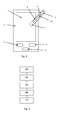
- Figure 1 represents a first communication device 1 and a second communication device 6 according to one embodiment of the invention.
- the first communication device 1 may be a tablet, a mobile phone or a handset.
- the first communication device 1 comprises:
- the second communication device 6 is a device comprising identification means enabling to electronically identify a user via certificates, keys, keywords...
- the second communication device 6 can be a token, an identification card, another mobile phone, another tablet, another handset...
- the second communication device 6 comprises:
- the second communication device 6, and more particularly its screen communication interface 7, is first put in contact with the touch screen 2 of the first communication device 1 (step 101).
- the method comprises then a step 102 of establishing a wireless communication channel between the first wireless communication interface 3 and the second wireless communication interface 8.
- the wireless communication channel is preferably a Bluetooth low energy link.
- the pieces of information needed to bootstrap the wireless communication channel are preferably exchanged through the touch screen 2 of the first communication device.
- the method used to establish the wireless communication channel is preferably the one described in the document D1.
- the second communication device 6 enables to identify electronically a user.
- the second communication device 6 comprises identifying means 10 enabling to identify the user.
- These identification means can be images, certificates, session keys, passwords, encryption or decryption keys stored in a memory.
- the second communication device 6 enables to sign documents, to decrypt or encrypt documents or messages.
- the wireless communication channel is open, the second communication device 6 may be requested via the wireless communication channel to identify the user a task such as encryption, decryption, authenticating, or signature of documents or messages.
- the method according to one embodiment of the invention comprises a verification step 103 which aims at verifying that the second communication device 6 is still in contact with the first communication device 1.
- the first communication device 1 exchanges security data with the second communication device 6 via the touch screen.
- the step of exchanging data through the touch screen may be:
- the method used for the exchange of information through the touch screen is preferably the method described in the document WO2013/098341 .
- the exchange can be performed. Otherwise, if the screen communication interface 7 is not anymore in contact with the touch screen 2, the exchange is impossible.
- the method comprises then a step of control 104 of the wireless communication channel according to the result of the verification step 103. More precisely, if the exchange of security data has been performed during the verification step 103, it means that the screen communication interface 7 is in physical contact with the touch screen, and consequently, during the control step, the wireless communication channel is maintained open. On the contrary, if the exchange of security data has not been performed, it means that the screen communication interface 7 is not anymore in physical contact with the touch screen 2 and consequently, the control step 104 is a step of cutting the wireless communication channel between the two communication devices 1, 6 in order to avoid any fraudulent usage of the wireless communication channel.
- the exchange of data once the wireless communication channel is open enables not only to ensure that the two communication devices 1, 7 are still in physical contact, but also to exchange security information to secure the wireless communication channel in order to dynamically renew the security properties used by the wireless communication channel.
- the security data exchanged during the verification step can be session keys or encryption keys, enabling to renew the session keys or encryption keys used in the wireless communication channel.
- the security data exchanged during the verification step may be used to configure the wireless communication channel in order to keep it secure.
- the control means 5 of the first communication device may use the security data received from the second communication device 6 to configure the first wireless communication interface 3.
- the second communication device 6 may also comprise second control means enabling to configure the second wireless communication interface according to the security data received by the second communication device.
- the verification step 103 may be performed periodically in order to check periodically in the two communication devices are still in contact, and/or the verification step 103 may be performed at request.
- a request for verification step may be performed before each exchange of sensible data via the wireless communication channel or before each encryption, decryption, signature, authentication of documents or messages via the wireless link.
- the communication through the touch screen is then used as a side channel enabling to control the wireless communication channel.
Landscapes
- Engineering & Computer Science (AREA)
- Computer Security & Cryptography (AREA)
- Theoretical Computer Science (AREA)
- General Engineering & Computer Science (AREA)
- Computer Networks & Wireless Communication (AREA)
- Computer Hardware Design (AREA)
- Signal Processing (AREA)
- Physics & Mathematics (AREA)
- General Physics & Mathematics (AREA)
- Software Systems (AREA)
- Computing Systems (AREA)
- Human Computer Interaction (AREA)
- Mobile Radio Communication Systems (AREA)
- Telephone Function (AREA)
Priority Applications (2)
| Application Number | Priority Date | Filing Date | Title |
|---|---|---|---|
| EP13306214.1A EP2846508A1 (fr) | 2013-09-05 | 2013-09-05 | Procédé permettant d'effectuer des communications sans fil sécurisées |
| PCT/EP2014/066849 WO2015032567A1 (fr) | 2013-09-05 | 2014-08-05 | Procédé pour effectuer des communications sans fil sécurisées |
Applications Claiming Priority (1)
| Application Number | Priority Date | Filing Date | Title |
|---|---|---|---|
| EP13306214.1A EP2846508A1 (fr) | 2013-09-05 | 2013-09-05 | Procédé permettant d'effectuer des communications sans fil sécurisées |
Publications (1)
| Publication Number | Publication Date |
|---|---|
| EP2846508A1 true EP2846508A1 (fr) | 2015-03-11 |
Family
ID=49223703
Family Applications (1)
| Application Number | Title | Priority Date | Filing Date |
|---|---|---|---|
| EP13306214.1A Withdrawn EP2846508A1 (fr) | 2013-09-05 | 2013-09-05 | Procédé permettant d'effectuer des communications sans fil sécurisées |
Country Status (2)
| Country | Link |
|---|---|
| EP (1) | EP2846508A1 (fr) |
| WO (1) | WO2015032567A1 (fr) |
Cited By (2)
| Publication number | Priority date | Publication date | Assignee | Title |
|---|---|---|---|---|
| US10325571B2 (en) * | 2011-05-24 | 2019-06-18 | Osman Colakoglu | Data communication method via touch surface |
| FR3077659A1 (fr) * | 2018-02-06 | 2019-08-09 | Bystamp | Dispositif d'authentification securise |
Citations (3)
| Publication number | Priority date | Publication date | Assignee | Title |
|---|---|---|---|---|
| US20090167486A1 (en) * | 2007-12-29 | 2009-07-02 | Shah Rahul C | Secure association between devices |
| US20110304583A1 (en) * | 2010-06-10 | 2011-12-15 | Empire Technology Development Llc | Communication Between Touch-Panel Devices |
| WO2013098341A1 (fr) | 2011-12-30 | 2013-07-04 | Gemalto S.A. | Dispositif de communication pour un dispositif comprenant un écran tactile, et système de communication |
-
2013
- 2013-09-05 EP EP13306214.1A patent/EP2846508A1/fr not_active Withdrawn
-
2014
- 2014-08-05 WO PCT/EP2014/066849 patent/WO2015032567A1/fr not_active Ceased
Patent Citations (3)
| Publication number | Priority date | Publication date | Assignee | Title |
|---|---|---|---|---|
| US20090167486A1 (en) * | 2007-12-29 | 2009-07-02 | Shah Rahul C | Secure association between devices |
| US20110304583A1 (en) * | 2010-06-10 | 2011-12-15 | Empire Technology Development Llc | Communication Between Touch-Panel Devices |
| WO2013098341A1 (fr) | 2011-12-30 | 2013-07-04 | Gemalto S.A. | Dispositif de communication pour un dispositif comprenant un écran tactile, et système de communication |
Cited By (5)
| Publication number | Priority date | Publication date | Assignee | Title |
|---|---|---|---|---|
| US10325571B2 (en) * | 2011-05-24 | 2019-06-18 | Osman Colakoglu | Data communication method via touch surface |
| FR3077659A1 (fr) * | 2018-02-06 | 2019-08-09 | Bystamp | Dispositif d'authentification securise |
| WO2019154749A1 (fr) * | 2018-02-06 | 2019-08-15 | Bystamp | Dispositif d'authentification securise utilisant des signaux lumineux et radio |
| JP2021513301A (ja) * | 2018-02-06 | 2021-05-20 | バイスタンプ | セキュア認証デバイス |
| US11899773B2 (en) | 2018-02-06 | 2024-02-13 | Bystamp | Secure authentication device using light and radio signals |
Also Published As
| Publication number | Publication date |
|---|---|
| WO2015032567A1 (fr) | 2015-03-12 |
| WO2015032567A9 (fr) | 2015-05-28 |
Similar Documents
| Publication | Publication Date | Title |
|---|---|---|
| JP6092415B2 (ja) | Nfcに基いた指紋認証システム及び指紋認証方法 | |
| CN108551455A (zh) | 智能卡的配置方法及装置 | |
| US20240129139A1 (en) | User authentication using two independent security elements | |
| EP2824603A2 (fr) | Système et procédé pour l'authentification de clés publiques | |
| KR20150011305A (ko) | 인스턴트 메신저를 이용한 생체인증 전자서명 등록 방법 | |
| WO2015061354A1 (fr) | Facilitation de transactions sécurisées en utilisant une interface sans contact | |
| KR101498120B1 (ko) | 클라우드 공인인증 시스템 및 그 방법 | |
| WO2015032567A1 (fr) | Procédé pour effectuer des communications sans fil sécurisées | |
| KR101628615B1 (ko) | 보안운영체제를 이용한 안심서명 제공 방법 | |
| JP2006527431A (ja) | 信用証明通信装置 | |
| GB2556625A (en) | Secure enrolment of biometric data | |
| KR101628614B1 (ko) | 보안운영체제를 이용한 전자서명 처리 방법 | |
| Gruntz et al. | MOONACS: a mobile on-/offline NFC-based physical access control system | |
| KR101777043B1 (ko) | 비동기식 근거리 무선 통신 기반 전자서명 구현 방법 | |
| KR101777044B1 (ko) | 비동기식 근거리 무선 통신 기반 오티피 카드 | |
| KR20160124336A (ko) | 보안운영체제를 이용한 전자서명 제공 방법 | |
| KR102149313B1 (ko) | 유심기반 전자서명 처리 방법 | |
| KR102076313B1 (ko) | 무선단말의 유심기반 전자서명 처리 방법 | |
| KR101505735B1 (ko) | 시간 검증을 이용한 엔에프씨카드 인증 방법 | |
| KR101972492B1 (ko) | 에스디메모리 기반 다중 오티피 운영 방법 | |
| EP4407490A1 (fr) | Intégration sécurisée d'attributs personnels sur une entité externe | |
| KR102078319B1 (ko) | 통신사의 유심기반 전자서명 처리 방법 | |
| KR101777042B1 (ko) | 비동기식 근거리 무선 통신 기반 전자서명 카드 | |
| KR20150034852A (ko) | 종단간 인증과 거래 연동을 이용한 서버형 인증코드 제공 방법 | |
| KR101846646B1 (ko) | 비동기식 근거리 무선 통신 기반 보안 통신 방법 |
Legal Events
| Date | Code | Title | Description |
|---|---|---|---|
| 17P | Request for examination filed |
Effective date: 20130905 |
|
| AK | Designated contracting states |
Kind code of ref document: A1 Designated state(s): AL AT BE BG CH CY CZ DE DK EE ES FI FR GB GR HR HU IE IS IT LI LT LU LV MC MK MT NL NO PL PT RO RS SE SI SK SM TR |
|
| AX | Request for extension of the european patent |
Extension state: BA ME |
|
| PUAI | Public reference made under article 153(3) epc to a published international application that has entered the european phase |
Free format text: ORIGINAL CODE: 0009012 |
|
| STAA | Information on the status of an ep patent application or granted ep patent |
Free format text: STATUS: THE APPLICATION IS DEEMED TO BE WITHDRAWN |
|
| 18D | Application deemed to be withdrawn |
Effective date: 20150912 |