EP2844086B1 - Methods for mixing products using acoustic mixing - Google Patents
Methods for mixing products using acoustic mixing Download PDFInfo
- Publication number
- EP2844086B1 EP2844086B1 EP13731164.3A EP13731164A EP2844086B1 EP 2844086 B1 EP2844086 B1 EP 2844086B1 EP 13731164 A EP13731164 A EP 13731164A EP 2844086 B1 EP2844086 B1 EP 2844086B1
- Authority
- EP
- European Patent Office
- Prior art keywords
- product
- mixing
- vessel
- food product
- acoustic
- Prior art date
- Legal status (The legal status is an assumption and is not a legal conclusion. Google has not performed a legal analysis and makes no representation as to the accuracy of the status listed.)
- Not-in-force
Links
- 238000002156 mixing Methods 0.000 title claims description 81
- 238000000034 method Methods 0.000 title claims description 79
- 235000013305 food Nutrition 0.000 claims description 65
- 238000010438 heat treatment Methods 0.000 claims description 30
- 238000001816 cooling Methods 0.000 claims description 23
- 238000012545 processing Methods 0.000 claims description 21
- 230000001133 acceleration Effects 0.000 claims description 9
- 230000008859 change Effects 0.000 claims description 9
- 239000002826 coolant Substances 0.000 claims description 2
- 239000012530 fluid Substances 0.000 claims description 2
- 238000007789 sealing Methods 0.000 claims description 2
- 238000012546 transfer Methods 0.000 claims description 2
- 239000000047 product Substances 0.000 description 81
- 230000001954 sterilising effect Effects 0.000 description 26
- 230000008569 process Effects 0.000 description 24
- 238000004659 sterilization and disinfection Methods 0.000 description 24
- 238000013019 agitation Methods 0.000 description 11
- 238000004519 manufacturing process Methods 0.000 description 11
- 230000008901 benefit Effects 0.000 description 9
- 238000005516 engineering process Methods 0.000 description 9
- 241000287828 Gallus gallus Species 0.000 description 8
- XLYOFNOQVPJJNP-UHFFFAOYSA-N water Substances O XLYOFNOQVPJJNP-UHFFFAOYSA-N 0.000 description 8
- 239000000203 mixture Substances 0.000 description 7
- 239000002245 particle Substances 0.000 description 6
- 241000209094 Oryza Species 0.000 description 4
- 235000007164 Oryza sativa Nutrition 0.000 description 4
- 235000015278 beef Nutrition 0.000 description 4
- 238000002474 experimental method Methods 0.000 description 4
- 239000007788 liquid Substances 0.000 description 4
- 235000012149 noodles Nutrition 0.000 description 4
- 235000015927 pasta Nutrition 0.000 description 4
- 235000009566 rice Nutrition 0.000 description 4
- 230000007246 mechanism Effects 0.000 description 3
- 238000012986 modification Methods 0.000 description 3
- 230000004048 modification Effects 0.000 description 3
- 229920006395 saturated elastomer Polymers 0.000 description 3
- 239000007787 solid Substances 0.000 description 3
- 230000003068 static effect Effects 0.000 description 3
- 238000009529 body temperature measurement Methods 0.000 description 2
- 230000000694 effects Effects 0.000 description 2
- 238000009472 formulation Methods 0.000 description 2
- 238000007654 immersion Methods 0.000 description 2
- 230000006872 improvement Effects 0.000 description 2
- 235000015097 nutrients Nutrition 0.000 description 2
- 229920001184 polypeptide Polymers 0.000 description 2
- 102000004196 processed proteins & peptides Human genes 0.000 description 2
- 108090000765 processed proteins & peptides Proteins 0.000 description 2
- 239000007921 spray Substances 0.000 description 2
- 238000009833 condensation Methods 0.000 description 1
- 230000005494 condensation Effects 0.000 description 1
- 230000003247 decreasing effect Effects 0.000 description 1
- 230000001627 detrimental effect Effects 0.000 description 1
- 230000003467 diminishing effect Effects 0.000 description 1
- 239000012467 final product Substances 0.000 description 1
- 230000010354 integration Effects 0.000 description 1
- 230000001788 irregular Effects 0.000 description 1
- 230000014759 maintenance of location Effects 0.000 description 1
- 239000002417 nutraceutical Substances 0.000 description 1
- 235000021436 nutraceutical agent Nutrition 0.000 description 1
- 230000010355 oscillation Effects 0.000 description 1
- 238000004806 packaging method and process Methods 0.000 description 1
- 238000009928 pasteurization Methods 0.000 description 1
- 239000000825 pharmaceutical preparation Substances 0.000 description 1
- 229940127557 pharmaceutical product Drugs 0.000 description 1
- 230000002035 prolonged effect Effects 0.000 description 1
- 230000009467 reduction Effects 0.000 description 1
- 235000021067 refined food Nutrition 0.000 description 1
- 238000009738 saturating Methods 0.000 description 1
- 238000007669 thermal treatment Methods 0.000 description 1
Images



Classifications
-
- B—PERFORMING OPERATIONS; TRANSPORTING
- B01—PHYSICAL OR CHEMICAL PROCESSES OR APPARATUS IN GENERAL
- B01F—MIXING, e.g. DISSOLVING, EMULSIFYING OR DISPERSING
- B01F31/00—Mixers with shaking, oscillating, or vibrating mechanisms
- B01F31/50—Mixers with shaking, oscillating, or vibrating mechanisms with a receptacle submitted to a combination of movements, i.e. at least one vibratory or oscillatory movement
-
- A—HUMAN NECESSITIES
- A23—FOODS OR FOODSTUFFS; TREATMENT THEREOF, NOT COVERED BY OTHER CLASSES
- A23B—PRESERVATION OF FOODS, FOODSTUFFS OR NON-ALCOHOLIC BEVERAGES; CHEMICAL RIPENING OF FRUIT OR VEGETABLES
- A23B2/00—Preservation of foods or foodstuffs, in general
- A23B2/05—Preservation of foods or foodstuffs, in general by heating using irradiation or electric treatment
-
- A—HUMAN NECESSITIES
- A23—FOODS OR FOODSTUFFS; TREATMENT THEREOF, NOT COVERED BY OTHER CLASSES
- A23B—PRESERVATION OF FOODS, FOODSTUFFS OR NON-ALCOHOLIC BEVERAGES; CHEMICAL RIPENING OF FRUIT OR VEGETABLES
- A23B2/00—Preservation of foods or foodstuffs, in general
- A23B2/20—Preservation of foods or foodstuffs, in general by heating materials in packages which are progressively transported, continuously or stepwise, through the apparatus
- A23B2/203—Preservation of foods or foodstuffs, in general by heating materials in packages which are progressively transported, continuously or stepwise, through the apparatus with packages moving on the spot while being transported
-
- A—HUMAN NECESSITIES
- A23—FOODS OR FOODSTUFFS; TREATMENT THEREOF, NOT COVERED BY OTHER CLASSES
- A23B—PRESERVATION OF FOODS, FOODSTUFFS OR NON-ALCOHOLIC BEVERAGES; CHEMICAL RIPENING OF FRUIT OR VEGETABLES
- A23B4/00—Preservation of meat, sausages, fish or fish products
- A23B4/005—Preserving by heating
- A23B4/0053—Preserving by heating with gas or liquids, with or without shaping, e.g. in form of powder, granules or flakes
- A23B4/0056—Preserving by heating with gas or liquids, with or without shaping, e.g. in form of powder, granules or flakes with packages, or with shaping in the form of blocks or portions
-
- A—HUMAN NECESSITIES
- A23—FOODS OR FOODSTUFFS; TREATMENT THEREOF, NOT COVERED BY OTHER CLASSES
- A23B—PRESERVATION OF FOODS, FOODSTUFFS OR NON-ALCOHOLIC BEVERAGES; CHEMICAL RIPENING OF FRUIT OR VEGETABLES
- A23B4/00—Preservation of meat, sausages, fish or fish products
- A23B4/005—Preserving by heating
- A23B4/01—Preserving by heating by irradiation or electric treatment with or without shaping, e.g. in form of powder, granules or flakes
- A23B4/012—Preserving by heating by irradiation or electric treatment with or without shaping, e.g. in form of powder, granules or flakes with packages, or with shaping in the form of blocks or portions
-
- A—HUMAN NECESSITIES
- A23—FOODS OR FOODSTUFFS; TREATMENT THEREOF, NOT COVERED BY OTHER CLASSES
- A23B—PRESERVATION OF FOODS, FOODSTUFFS OR NON-ALCOHOLIC BEVERAGES; CHEMICAL RIPENING OF FRUIT OR VEGETABLES
- A23B7/00—Preservation of fruit or vegetables; Chemical ripening of fruit or vegetables
- A23B7/005—Preserving by heating
- A23B7/0053—Preserving by heating by direct or indirect contact with heating gases or liquids
- A23B7/0056—Preserving by heating by direct or indirect contact with heating gases or liquids with packages
-
- A—HUMAN NECESSITIES
- A23—FOODS OR FOODSTUFFS; TREATMENT THEREOF, NOT COVERED BY OTHER CLASSES
- A23B—PRESERVATION OF FOODS, FOODSTUFFS OR NON-ALCOHOLIC BEVERAGES; CHEMICAL RIPENING OF FRUIT OR VEGETABLES
- A23B7/00—Preservation of fruit or vegetables; Chemical ripening of fruit or vegetables
- A23B7/005—Preserving by heating
- A23B7/01—Preserving by heating by irradiation or electric treatment
- A23B7/012—Preserving by heating by irradiation or electric treatment with packages
-
- A—HUMAN NECESSITIES
- A23—FOODS OR FOODSTUFFS; TREATMENT THEREOF, NOT COVERED BY OTHER CLASSES
- A23L—FOODS, FOODSTUFFS OR NON-ALCOHOLIC BEVERAGES, NOT OTHERWISE PROVIDED FOR; PREPARATION OR TREATMENT THEREOF
- A23L5/00—Preparation or treatment of foods or foodstuffs, in general; Food or foodstuffs obtained thereby; Materials therefor
- A23L5/30—Physical treatment, e.g. electrical or magnetic means, wave energy or irradiation
- A23L5/32—Physical treatment, e.g. electrical or magnetic means, wave energy or irradiation using phonon wave energy, e.g. sound or ultrasonic waves
-
- B—PERFORMING OPERATIONS; TRANSPORTING
- B01—PHYSICAL OR CHEMICAL PROCESSES OR APPARATUS IN GENERAL
- B01F—MIXING, e.g. DISSOLVING, EMULSIFYING OR DISPERSING
- B01F31/00—Mixers with shaking, oscillating, or vibrating mechanisms
- B01F31/60—Mixers with shaking, oscillating, or vibrating mechanisms with a vibrating receptacle
-
- B—PERFORMING OPERATIONS; TRANSPORTING
- B01—PHYSICAL OR CHEMICAL PROCESSES OR APPARATUS IN GENERAL
- B01F—MIXING, e.g. DISSOLVING, EMULSIFYING OR DISPERSING
- B01F31/00—Mixers with shaking, oscillating, or vibrating mechanisms
- B01F31/80—Mixing by means of high-frequency vibrations above one kHz, e.g. ultrasonic vibrations
- B01F31/86—Mixing by means of high-frequency vibrations above one kHz, e.g. ultrasonic vibrations with vibration of the receptacle or part of it
-
- B—PERFORMING OPERATIONS; TRANSPORTING
- B65—CONVEYING; PACKING; STORING; HANDLING THIN OR FILAMENTARY MATERIAL
- B65B—MACHINES, APPARATUS OR DEVICES FOR, OR METHODS OF, PACKAGING ARTICLES OR MATERIALS; UNPACKING
- B65B55/00—Preserving, protecting or purifying packages or package contents in association with packaging
- B65B55/02—Sterilising, e.g. of complete packages
-
- B—PERFORMING OPERATIONS; TRANSPORTING
- B65—CONVEYING; PACKING; STORING; HANDLING THIN OR FILAMENTARY MATERIAL
- B65B—MACHINES, APPARATUS OR DEVICES FOR, OR METHODS OF, PACKAGING ARTICLES OR MATERIALS; UNPACKING
- B65B55/00—Preserving, protecting or purifying packages or package contents in association with packaging
- B65B55/02—Sterilising, e.g. of complete packages
- B65B55/12—Sterilising contents prior to, or during, packaging
- B65B55/14—Sterilising contents prior to, or during, packaging by heat
-
- A—HUMAN NECESSITIES
- A23—FOODS OR FOODSTUFFS; TREATMENT THEREOF, NOT COVERED BY OTHER CLASSES
- A23P—SHAPING OR WORKING OF FOODSTUFFS, NOT FULLY COVERED BY A SINGLE OTHER SUBCLASS
- A23P10/00—Shaping or working of foodstuffs characterised by the products
Definitions
- the present disclosure relates generally to mixing of compositions. More specifically, the present disclosure relates to methods for mixing compositions using acoustic mixing to achieve an even temperature profile in a reduced amount of time.
- compositions that rapidly provides an even temperature distribution throughout during product manufacturing processes (e.g., heating, cooling, etc.).
- the acoustic mixing can provide accelerations in the food product up to about 150 g, or up to about 125 g, or up to about 100 g, or up to about 75 g, or the like.
- the acoustic mixing can provide a rate of change in force direction in the food product of 5 Hz to 1000Hz. In an embodiment, the acoustic mixing can provide a rate of change in force direction in the food product of at least 20 Hz, or at least 30 Hz, or at least 40 Hz, or at least 50 Hz, or at least 60 Hz, or at least 70 Hz, or at least 80 Hz, or the like.
- the food product comprises particulates and/or has a high viscosity.
- the thermal processing is selected from the group consisting of heating, cooling, or combinations thereof.
- a method for manufacturing a shelf-stable food product includes acoustically mixing the food product with an acoustic mixing device during thermal processing of the food product.
- a method for providing a uniform temperature of a food product during heating or cooling of the food product includes acoustically mixing the food product with an acoustic mixing device during thermal processing of the food product.
- a method for decreasing an amount of time required to provide a uniform temperature of a food product during heating or cooling of the food product includes acoustically mixing the food product with an acoustic mixing device during thermal processing of the food product.
- a method for reducing an amount of time to thermally sterilize a food product includes acoustically mixing the food product with an acoustic mixing device during thermal processing of the food product.
- a method for reducing an amount of stagnant product on an interior wall of a product vessel includes acoustically mixing the food product with an acoustic mixing device during thermal processing of the food product.
- the acoustic mixing can provide accelerations in the food product up to about 150 g, or up to about 125 g, or up to about 100 g, or up to about 75 g, or the like.
- the acoustic mixing can provide a rate of change in force direction in the food product of 5 Hz to 1000Hz. In an embodiment, the acoustic mixing can provide a rate of change in force direction in the food product of at least 20 Hz, or at least 30 Hz, or at least 40 Hz, or at least 50 Hz, or at least 60 Hz, or at least 70 Hz, or at least 80 Hz, or the like.
- the food product comprises particulates and/or has a high viscosity.
- the thermal processing is selected from the group consisting of heating, cooling, or combinations thereof.
- a method for manufacturing a shelf-stable food product includes providing a thermal processing vessel having a product vessel so constructed and arranged to be sealingly housed by an outer vessel, filling at least a portion of the product vessel with a food product, and simultaneously thermally processing and acoustically mixing the food product in the thermal processing vessel.
- the method further includes filling at least a portion of the outer vessel with a heating or cooling medium.
- the method further includes sealing the product vessel within the outer vessel such that there is no fluid transfer between the product vessel and the outer vessel.
- the acoustic mixing is performed with an acoustic mixing device.
- the acoustic mixing can provide accelerations in the food product up to about 150 g, or up to about 125 g, or up to about 100 g, or up to about 75 g, or the like.
- the acoustic mixing can provide a rate of change in force direction in the food product of 5 Hz to 1000Hz. In an embodiment, the acoustic mixing can provide a rate of change in force direction in the food product of at least 20 Hz, or at least 30 Hz, or at least 40 Hz, or at least 50 Hz, or at least 60 Hz, or at least 70 Hz, or at least 80 Hz, or the like.
- the food product comprises particulates and/or has a high viscosity.
- the thermal processing is selected from the group consisting of heating, cooling, or combinations thereof.
- An advantage of the present disclosure is to provide improved methods for mixing food products.
- Another advantage of the present disclosure is to provide food product mixing methods using acoustic mixing.
- Yet another advantage of the present disclosure is to provide improved methods for rapidly achieving a uniform temperature of a product.
- Still yet another advantage of the present disclosure is to provide methods for sterilizing a food product that improve and/or maintain the overall product quality.
- Another advantage of the present disclosure is to provide methods for cooling a food product that improve and/or maintain the overall product quality.
- product vessel is understood to include a sterilization vessel, a thermal processing vessel and the like.
- the foods In order to produce high-quality, safe, shelf-stable foods, the foods must be sterilized prior to, or after packaging (e.g., ultra-high temperature/aseptic processes, in-container sterilization, etc.).
- the product should be sterilized properly to make sure that it is safe for consumption, but, at the same time, it should not be over-cooked or over-processed. Indeed, over-sterilization can degrade the organoleptic appeal of the final product.
- Retorts are steam-based processes and there are generally four steam-based processes that are used in sterilizing food, nutraceutical, and pharmaceutical products.
- Steam can be the direct heating media (e.g., saturated steam) or the indirect heating media (e.g., steam-heated water used in a water immersion process).
- the different types of retort processes include the following: (i) saturated steam (direct steam heating); (ii) water immersion, both rotary and static (indirect steam heating); (iii) water spray, both rotary and static (indirect steam heating); and (iv) steam-air, both rotary and static (direct steam heating).
- Saturated steam processes are the oldest methods of in-container sterilization. Since air is considered an insulating medium, saturating the retort vessel with steam is a requirement of the process. During the process, all air is evacuated from the retort by flooding the vessel with steam and allowing the air to escape through vent valves. Since air is not permitted to enter the vessel at any time during any sterilization step, there can be no overpressure during the sterilization phases of this process.
- acoustic mixing uses low-frequency, high intensity sound energy to provide intimate mixing of different states of matter including, for example, gas/liquid, liquid/liquid, liquid/solid, or solid/solid systems.
- acoustic mixing uses uniformly distributed, consistent acoustic energy instead of traditional, mechanical mixing devices.
- the devices used to provide the acoustic mixing technology may be any devices capable of acoustic mixing and may include, for example, the devices disclosed in U.S. Patent Nos. 7,188,993 and 7,866,878 to Resodyn Corp.
- the skilled artisan will appreciate, however, that the devices described in U.S. Patent Nos. 7,188,993 and 7,866,878 are merely examples of acoustic mixing devices and that any other acoustic mixing device may be used in the present methods.
- the present methods include the use of acoustic mixing to mix products during sterilization processes (e.g., retorting processes).
- acoustic mixing technology to thermal processing of sealed (e.g, in-container) foodstuff is used to render the sealed foodstuff shelf-stable.
- Such acoustic mixing during sterilization processes has surprisingly been found by Applicant to reduce the overall thermal sterilization time of foodstuff and to improve the overall product quality (e.g., nutrient retention, organoleptic properties) of the product that will be exposed to the sterilization process.
- the present methods need not be limited to use in sterilization processes (e.g., aseptic or retort thermal processing), but could also be used in any application where an even temperature distribution of a composition is required.
- the methods of the present disclosure could be used in any heating or cooling process including, but not limited to, microwave heating, ohmic heating, conductive heating, conductive cooling, convective heating, convective cooling, radiant heating, radiant cooling, retort, aseptic heating, aseptic cooling, sterilization processes, or combinations thereof.
- the present methods are not limited to in-container sterilization, and may be used for any of the above-mentioned heating/cooling processes.
- the first and biggest drawback in the existing solutions to achieve an even temperature profile of a product includes significant reduction in effectiveness of the existing agitation methods with increased product consistency.
- a constant or variable force has to be applied to the container in changing directions so that the headspace in the product constantly changes its relative location in the container and hence product mixing occurs.
- Existing technologies utilize methods where the force exerted on the product has a very low acceleration value. As the acceleration value gets higher and changes direction faster, the product mixing becomes more efficient.
- the highest acceleration exerted on a product container in the most efficient non-invasive agitation method commercially available is in the order of 2-3 g (i.e., gravitational acceleration).
- gravitational accelerations up to about 75 g, or up to about 100 g, or up to about 125 g, or up to about 150 g can be achieved.
- This flexibility in achieving and controlling high mixing intensities eliminates the limitations experienced with other mixing technologies. With such effective mixing, and since uniform container temperature can be achieved almost instantaneously, the overall thermal process time reduces significantly (e.g., on the order of 90+%). As a result, the organoleptic properties of the processed food can be improved while the loss of nutrients that occurs during thermal processing can be minimized.
- acoustic mixing Another advantage afforded by use of acoustic mixing is that, with use of the thermal process technologies currently available, product burn-on can occur at the inner walls of the product container. This may occur when the product at the interior walls of the container becomes stagnant and heated and burns to the interior wall of the container.
- the uniform mixing in the container achieved through the use of acoustic mixing removes the stagnant layer of product at the inner container walls thereby eliminating the possibility of burn-on at the inner container walls.
- acoustic mixing coupled with thermal processing has the advantage of mixing uniformly by making use of extremely short (e.g., on the order of 50 micrometers) mixing lengths as opposed to the bulk mixing achieved with existing technologies.
- Bulk mixing has been found to have detrimental effects on particle integrity for products that include food particles. In many cases, the particles are either sheared to the point where the particle size gets much smaller than the original size introduced prior to sterilization, or the particles are broken up into small and irregular pieces.
- FIG. 1 illustrates a schematic manufacturing line 10 that may be used for heating and/or cooling of a food product in accordance with the methods disclosed herein.
- the “inlet” may include a steam supply and the “outlet” may include a steam exhaust.
- the “inlet” may include a cold water supply and the “outlet” may include a warm water exhaust.
- manufacturing line 10 is used to mix a food product while heat sterilizing the product.
- manufacturing line 10 includes a steam supply at the "inlet" to an outer vessel 12 that traverses the interior of vessel 12 before being outlet at an opposing end of vessel 12. Any condensation that forms within vessel 12 may be expelled by a water drain valve 14 and routed to a drain 16.
- vessel 12 may be any suitable size and shape so long as vessel 12 is capable of providing a heating/cooling function in combination with acoustic mixing.
- vessel 12 may also be a substantially cylindrical vessel that is taller and thinner than vessel 12 as illustrated in FIG. 1 .
- Outer vessel 12 houses an inner vessel 18 that contains a plurality of food containers 20.
- Food containers 20 sit on top of a payload plate 22 that is part of an acoustic mixing mechanism 24.
- acoustic mixing mechanism 24 is used to provide rapid agitation (e.g., vibration) of the products contained in food containers 20 to quickly achieve a uniform temperature of same.
- acoustic mixing mechanism 24 allows the products to be heated to a sufficiently high temperature for prolonged amounts of time to achieve sterilization throughout the product, but prevents the product from "burning" to an interior wall of container 20. Constant acoustic mixing of the products provides for a more uniform temperature distribution throughout the product that is achieved at a much faster rate than known agitation methods.
- manufacturing line 10 may be used for cooling of a food product contained in containers 20.
- manufacturing line 10 may include the use of spray balls 26 that provide cold water to containers 20.
- the experiments were performed using a heating/cooling vessel having a formed vessel (e.g., a product vessel) with a machined jacket (e.g., outer vessel) around the formed vessel for containing the heating or cooling media.
- the heating/cooling vessel was substantially cylindrical in shape, and included an o-ring to seal between the outer vessel and the product vessel.
- the product vessel had a capacity of about eight ounces.
- Two sheathed thermocouples were connected to the heating vessel, one measuring a temperature of the product near the wall of the product vessel, and one measuring a temperature of the product near the center of the product vessel.
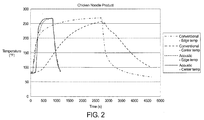
- the wall i.e., edge
- thermocouple comes up to temperature much faster when acoustic mixing is not applied. Further, when acoustic mixing is not applied, it took over 2000 seconds to bring both conventional temperature measurements above 250°F. On the other hand, when acoustic mixing is applied, both temperature measurements rise in temperature almost at the same time. The same effect can be clearly seen during the cooling phase of the chicken noodle product.
- both the center and wall temperatures for a barbeque chicken and rice product can be heated and cooled uniformly. Therefore, any issues concerning cold spots in the container are alleviated by the use of acoustic mixing of the barbeque chicken and rice product during sterilization.
- both the center and wall temperatures for a pasta and beef product can be heated and cooled uniformly. Therefore, any issues concerning cold spots in the container are alleviated by the use of acoustic mixing of the pasta and beef product during sterilization.
Landscapes
- Engineering & Computer Science (AREA)
- Life Sciences & Earth Sciences (AREA)
- Chemical & Material Sciences (AREA)
- Polymers & Plastics (AREA)
- Food Science & Technology (AREA)
- Wood Science & Technology (AREA)
- Zoology (AREA)
- Chemical Kinetics & Catalysis (AREA)
- Mechanical Engineering (AREA)
- General Chemical & Material Sciences (AREA)
- Nutrition Science (AREA)
- Health & Medical Sciences (AREA)
- Food Preservation Except Freezing, Refrigeration, And Drying (AREA)
- Seasonings (AREA)
- General Preparation And Processing Of Foods (AREA)
- Preparation Of Fruits And Vegetables (AREA)
- Noodles (AREA)
- Seeds, Soups, And Other Foods (AREA)
Description
- The present disclosure relates generally to mixing of compositions. More specifically, the present disclosure relates to methods for mixing compositions using acoustic mixing to achieve an even temperature profile in a reduced amount of time.
- For certain manufacturing processes, for example, and depending on the consistency of the product, it may take an undesirably long amount of time to achieve an even temperature distribution throughout the product. In certain cases, existing technology uses external agitation to reduce such a time delay. With agitation, the product being processed (e.g., heated, cooled, etc.) is mixed and a uniform temperature may be achieved in a relatively shorter period of time when compared to products that remain still throughout the process.
- Different methods for agitating containers during sterilization are known in the art. However, the effectiveness of these known methods has been limited, especially with respect to the consistency of the product and possible effects on particles contained within the product. Indeed, the greatest limiting factor with known agitation methods is the consistency of the product when the product has a high viscosity value. With such high viscosity products, experiments have shown little or no improvement on the time delay to achieve a uniform temperature throughout.
- Accordingly, it is desirable to provide a method for mixing compositions that rapidly provides an even temperature distribution throughout during product manufacturing processes (e.g., heating, cooling, etc.).
- Methods for making the food product using acoustic mixing are provided as recited in claim 1.
- In an embodiment, the acoustic mixing can provide accelerations in the food product up to about 150 g, or up to about 125 g, or up to about 100 g, or up to about 75 g, or the like.
- The acoustic mixing can provide a rate of change in force direction in the food product of 5 Hz to 1000Hz. In an embodiment, the acoustic mixing can provide a rate of change in force direction in the food product of at least 20 Hz, or at least 30 Hz, or at least 40 Hz, or at least 50 Hz, or at least 60 Hz, or at least 70 Hz, or at least 80 Hz, or the like.
- In an embodiment, the food product comprises particulates and/or has a high viscosity.
- In an embodiment, the thermal processing is selected from the group consisting of heating, cooling, or combinations thereof.
- In another embodiment, a method for manufacturing a shelf-stable food product is provided. The method includes acoustically mixing the food product with an acoustic mixing device during thermal processing of the food product.
- In yet another embodiment, a method for providing a uniform temperature of a food product during heating or cooling of the food product is provided. The method includes acoustically mixing the food product with an acoustic mixing device during thermal processing of the food product.
- In still yet another embodiment, a method for decreasing an amount of time required to provide a uniform temperature of a food product during heating or cooling of the food product is provided. The method includes acoustically mixing the food product with an acoustic mixing device during thermal processing of the food product.
- In another embodiment, a method for reducing an amount of time to thermally sterilize a food product is provided. The method includes acoustically mixing the food product with an acoustic mixing device during thermal processing of the food product.
- In yet another embodiment, a method for reducing an amount of stagnant product on an interior wall of a product vessel is provided. The method includes acoustically mixing the food product with an acoustic mixing device during thermal processing of the food product.
- In an embodiment, the acoustic mixing can provide accelerations in the food product up to about 150 g, or up to about 125 g, or up to about 100 g, or up to about 75 g, or the like.
- The acoustic mixing can provide a rate of change in force direction in the food product of 5 Hz to 1000Hz. In an embodiment, the acoustic mixing can provide a rate of change in force direction in the food product of at least 20 Hz, or at least 30 Hz, or at least 40 Hz, or at least 50 Hz, or at least 60 Hz, or at least 70 Hz, or at least 80 Hz, or the like.
- In an embodiment, the food product comprises particulates and/or has a high viscosity.
- In an embodiment, the thermal processing is selected from the group consisting of heating, cooling, or combinations thereof.
- In yet another embodiment, a method for manufacturing a shelf-stable food product is provided. The method includes providing a thermal processing vessel having a product vessel so constructed and arranged to be sealingly housed by an outer vessel, filling at least a portion of the product vessel with a food product, and simultaneously thermally processing and acoustically mixing the food product in the thermal processing vessel.
- In an embodiment, the method further includes filling at least a portion of the outer vessel with a heating or cooling medium.
- In an embodiment, the method further includes sealing the product vessel within the outer vessel such that there is no fluid transfer between the product vessel and the outer vessel.
- In an embodiment, the acoustic mixing is performed with an acoustic mixing device.
- In an embodiment, the acoustic mixing can provide accelerations in the food product up to about 150 g, or up to about 125 g, or up to about 100 g, or up to about 75 g, or the like.
- The acoustic mixing can provide a rate of change in force direction in the food product of 5 Hz to 1000Hz. In an embodiment, the acoustic mixing can provide a rate of change in force direction in the food product of at least 20 Hz, or at least 30 Hz, or at least 40 Hz, or at least 50 Hz, or at least 60 Hz, or at least 70 Hz, or at least 80 Hz, or the like.
- In an embodiment, the food product comprises particulates and/or has a high viscosity.
- In an embodiment, the thermal processing is selected from the group consisting of heating, cooling, or combinations thereof.
- An advantage of the present disclosure is to provide improved methods for mixing food products.
- Another advantage of the present disclosure is to provide food product mixing methods using acoustic mixing.
- Yet another advantage of the present disclosure is to provide improved methods for rapidly achieving a uniform temperature of a product.
- Still yet another advantage of the present disclosure is to provide methods for sterilizing a food product that improve and/or maintain the overall product quality.
- Another advantage of the present disclosure is to provide methods for cooling a food product that improve and/or maintain the overall product quality.
- Additional features and advantages are described herein, and will be apparent from the following Detailed Description and the figures.
-
-
FIG. 1 illustrates a schematic representation of an acoustic mixing integrated heating/cooling assembly in accordance with an embodiment of the present disclosure. -
FIG. 2 illustrates the product temperature near the wall and in the center of a chicken noodle product in a product vessel in accordance with an embodiment of the present disclosure. -
FIG. 3 illustrates the product temperature near the wall and in the center of a barbeque chicken and rice product in a product vessel in accordance with an embodiment of the present disclosure. -
FIG. 4 illustrates the product temperature near the wall and in the center of a pasta and beef product in a product vessel in accordance with an embodiment of the present disclosure. - As used herein, the singular forms "a," "an" and "the" include plural referents unless the context clearly dictates otherwise. Thus, for example, reference to "a polypeptide" includes a mixture of two or more polypeptides and the like.
- As used herein, "about" is understood to refer to numbers in a range of numerals. Moreover, all numerical ranges herein should be understood to include all integer, whole or fractions, within the range.
- As used herein, "product vessel" is understood to include a sterilization vessel, a thermal processing vessel and the like.
- In order to produce high-quality, safe, shelf-stable foods, the foods must be sterilized prior to, or after packaging (e.g., ultra-high temperature/aseptic processes, in-container sterilization, etc.). The product should be sterilized properly to make sure that it is safe for consumption, but, at the same time, it should not be over-cooked or over-processed. Indeed, over-sterilization can degrade the organoleptic appeal of the final product.
- One manner in which to produce shelf-stable foods is the retort process. Retorts are steam-based processes and there are generally four steam-based processes that are used in sterilizing food, nutraceutical, and pharmaceutical products. Steam can be the direct heating media (e.g., saturated steam) or the indirect heating media (e.g., steam-heated water used in a water immersion process). The different types of retort processes include the following: (i) saturated steam (direct steam heating); (ii) water immersion, both rotary and static (indirect steam heating); (iii) water spray, both rotary and static (indirect steam heating); and (iv) steam-air, both rotary and static (direct steam heating).
- Saturated steam processes are the oldest methods of in-container sterilization. Since air is considered an insulating medium, saturating the retort vessel with steam is a requirement of the process. During the process, all air is evacuated from the retort by flooding the vessel with steam and allowing the air to escape through vent valves. Since air is not permitted to enter the vessel at any time during any sterilization step, there can be no overpressure during the sterilization phases of this process.
- For retorted food products, and depending on the consistency of the product, there is usually a time delay to get every point in the volume of the product to the same temperature. In certain cases, the existing technology utilizes external agitation to reduce this time delay. With agitation, the product in the container is mixed and a uniform temperature is achieved in a relatively shorter period of time when compared to containers that stand still throughout the sterilization process. For agitation of the food container during sterilization different methods been utilized, but the effectiveness of these methods has been limited. The consistency of the product is the biggest factor in limiting the effectiveness and, for some products with high viscosity values, experiments have shown little or no improvement on the time delay to achieve uniform internal product temperature.
- In contrast to the existing, non-invasive agitation technology for sterilization techniques, Applicant has developed methods for thermal processes (e.g., sterilization, pasteurization, etc.) that can be used in several industries including, for example, food, pet food, pharmaceutical, neutraceutical, etc. Accordingly, the methods of the present disclosure solve problems of the prior art by making use of acoustic mixing in food thermal sterilization applications. Acoustic mixing uses low-frequency, high intensity sound energy to provide intimate mixing of different states of matter including, for example, gas/liquid, liquid/liquid, liquid/solid, or solid/solid systems. In other words, acoustic mixing uses uniformly distributed, consistent acoustic energy instead of traditional, mechanical mixing devices. The devices used to provide the acoustic mixing technology may be any devices capable of acoustic mixing and may include, for example, the devices disclosed in
U.S. Patent Nos. 7,188,993 and7,866,878 to Resodyn Corp. The skilled artisan will appreciate, however, that the devices described inU.S. Patent Nos. 7,188,993 and7,866,878 are merely examples of acoustic mixing devices and that any other acoustic mixing device may be used in the present methods. -
US 2009/110791 ,US 2004/005242 ,RU 2 158 097 C1 RU 2 216 202 C2 RU 2 347 369 C2 - The present methods include the use of acoustic mixing to mix products during sterilization processes (e.g., retorting processes). In this regard, integration of acoustic mixing technology to thermal processing of sealed (e.g, in-container) foodstuff is used to render the sealed foodstuff shelf-stable. Such acoustic mixing during sterilization processes has surprisingly been found by Applicant to reduce the overall thermal sterilization time of foodstuff and to improve the overall product quality (e.g., nutrient retention, organoleptic properties) of the product that will be exposed to the sterilization process.
- It will be appreciated that the present methods need not be limited to use in sterilization processes (e.g., aseptic or retort thermal processing), but could also be used in any application where an even temperature distribution of a composition is required. For example, the methods of the present disclosure could be used in any heating or cooling process including, but not limited to, microwave heating, ohmic heating, conductive heating, conductive cooling, convective heating, convective cooling, radiant heating, radiant cooling, retort, aseptic heating, aseptic cooling, sterilization processes, or combinations thereof. It will also be appreciated that the present methods are not limited to in-container sterilization, and may be used for any of the above-mentioned heating/cooling processes.
- As described above, the first and biggest drawback in the existing solutions to achieve an even temperature profile of a product includes significant reduction in effectiveness of the existing agitation methods with increased product consistency. In other words, to induce product mixing in a container, a constant or variable force has to be applied to the container in changing directions so that the headspace in the product constantly changes its relative location in the container and hence product mixing occurs. Existing technologies utilize methods where the force exerted on the product has a very low acceleration value. As the acceleration value gets higher and changes direction faster, the product mixing becomes more efficient. As an example, the highest acceleration exerted on a product container in the most efficient non-invasive agitation method commercially available is in the order of 2-3 g (i.e., gravitational acceleration).
- In contrast, with the use of acoustic mixing, as in the present disclosure, gravitational accelerations up to about 75 g, or up to about 100 g, or up to about 125 g, or up to about 150 g can be achieved. Further, a rate of change in force direction 5 Hz to 1000Hz, or at least 20 Hz, or at least 30 Hz, or at least 40 Hz, or at least 50 Hz, or at least 60 Hz, or at least 70 Hz, or at least 80 Hz, can be accomplished. This flexibility in achieving and controlling high mixing intensities eliminates the limitations experienced with other mixing technologies. With such effective mixing, and since uniform container temperature can be achieved almost instantaneously, the overall thermal process time reduces significantly (e.g., on the order of 90+%). As a result, the organoleptic properties of the processed food can be improved while the loss of nutrients that occurs during thermal processing can be minimized.
- Another advantage afforded by use of acoustic mixing is that, with use of the thermal process technologies currently available, product burn-on can occur at the inner walls of the product container. This may occur when the product at the interior walls of the container becomes stagnant and heated and burns to the interior wall of the container. The uniform mixing in the container achieved through the use of acoustic mixing removes the stagnant layer of product at the inner container walls thereby eliminating the possibility of burn-on at the inner container walls.
- Further, acoustic mixing coupled with thermal processing has the advantage of mixing uniformly by making use of extremely short (e.g., on the order of 50 micrometers) mixing lengths as opposed to the bulk mixing achieved with existing technologies. Bulk mixing has been found to have detrimental effects on particle integrity for products that include food particles. In many cases, the particles are either sheared to the point where the particle size gets much smaller than the original size introduced prior to sterilization, or the particles are broken up into small and irregular pieces.
-
FIG. 1 illustrates aschematic manufacturing line 10 that may be used for heating and/or cooling of a food product in accordance with the methods disclosed herein. In an embodiment wherein the manufacturing line is used to heat sterilize a product, the "inlet" may include a steam supply and the "outlet" may include a steam exhaust. In another embodiment, wherein the manufacturing line is used to cool a product, the "inlet" may include a cold water supply and the "outlet" may include a warm water exhaust. - As illustrated in
FIG. 1 , and in an embodiment, manufacturingline 10 is used to mix a food product while heat sterilizing the product. Accordingly, manufacturingline 10 includes a steam supply at the "inlet" to anouter vessel 12 that traverses the interior ofvessel 12 before being outlet at an opposing end ofvessel 12. Any condensation that forms withinvessel 12 may be expelled by awater drain valve 14 and routed to adrain 16. Although illustrated as a low and wideouter vessel 12, the skilled artisan will appreciate thatvessel 12 may be any suitable size and shape so long asvessel 12 is capable of providing a heating/cooling function in combination with acoustic mixing. For example,vessel 12 may also be a substantially cylindrical vessel that is taller and thinner thanvessel 12 as illustrated inFIG. 1 . -
Outer vessel 12 houses aninner vessel 18 that contains a plurality offood containers 20.Food containers 20 sit on top of apayload plate 22 that is part of anacoustic mixing mechanism 24. As discussed above,acoustic mixing mechanism 24 is used to provide rapid agitation (e.g., vibration) of the products contained infood containers 20 to quickly achieve a uniform temperature of same. Additionally, for products that contain particulates and/or have higher viscosities,acoustic mixing mechanism 24 allows the products to be heated to a sufficiently high temperature for prolonged amounts of time to achieve sterilization throughout the product, but prevents the product from "burning" to an interior wall ofcontainer 20. Constant acoustic mixing of the products provides for a more uniform temperature distribution throughout the product that is achieved at a much faster rate than known agitation methods. - In an alternative embodiment, manufacturing
line 10 may be used for cooling of a food product contained incontainers 20. When used for cooling purposes, manufacturingline 10 may include the use ofspray balls 26 that provide cold water tocontainers 20. - By way of example and not limitation, the following examples are illustrative of various embodiments of the present disclosure. The formulations and processes below are provided for exemplification only, and they can be modified by the skilled artisan to the necessary extent, depending on the special features that are desired.
- Applicants performed experiments using different product formulations to determine the mixing efficiency of methods incorporating acoustic mixing during heat sterilization. The experiments were performed using a heating/cooling vessel having a formed vessel (e.g., a product vessel) with a machined jacket (e.g., outer vessel) around the formed vessel for containing the heating or cooling media. The heating/cooling vessel was substantially cylindrical in shape, and included an o-ring to seal between the outer vessel and the product vessel. The product vessel had a capacity of about eight ounces. Two sheathed thermocouples were connected to the heating vessel, one measuring a temperature of the product near the wall of the product vessel, and one measuring a temperature of the product near the center of the product vessel.
- As shown in
FIG. 2 , as the chicken noodle product is heated from the jacket side, the wall (i.e., edge) thermocouple comes up to temperature much faster when acoustic mixing is not applied. Further, when acoustic mixing is not applied, it took over 2000 seconds to bring both conventional temperature measurements above 250°F. On the other hand, when acoustic mixing is applied, both temperature measurements rise in temperature almost at the same time. The same effect can be clearly seen during the cooling phase of the chicken noodle product. - As shown in
FIG. 3 , both the center and wall temperatures for a barbeque chicken and rice product (e.g., the whole volume of the product) can be heated and cooled uniformly. Therefore, any issues concerning cold spots in the container are alleviated by the use of acoustic mixing of the barbeque chicken and rice product during sterilization. - As shown in
FIG. 4 , both the center and wall temperatures for a pasta and beef product (e.g., the whole volume of the product) can be heated and cooled uniformly. Therefore, any issues concerning cold spots in the container are alleviated by the use of acoustic mixing of the pasta and beef product during sterilization. - It should be understood that various changes and modifications to the presently preferred embodiments described herein will be apparent to those skilled in the art. Such changes and modifications can be made without departing from the scope of the present subject matter and without diminishing its intended advantages. It is therefore intended that such changes and modifications be covered by the appended claims.
Claims (10)
- A method for mixing a food product, the method comprising: providing a food product;
acoustically mixing the food product with an acoustic mixing device while
thermally processing the food product, wherein the acoustic mixing provides a rate of change in force direction in the food product of 5 Hz - 1000 Hz. - The method according to Claim 1, wherein the acoustic mixing provides a rate of change in force direction in the food product of at least 20 Hz.
- The method according to Claim 1, wherein the food product comprises particulates.
- The method according to Claim 1, wherein the food product is substantially homogenous.
- The method according to Claim 1, wherein the food product comprises a high viscosity.
- The method according to Claim 1, wherein the thermal processing is selected from the group consisting of heating, cooling, and combinations thereof.
- The method according to Claim 1, wherein the mixing the food product with the acoustic mixing device comprises: providing a thermal processing vessel comprising a product vessel so constructed and arranged to be sealingly housed by an outer vessel;
filling at least a portion of the product vessel with the food product; and
simultaneously thermally processing and acoustically mixing the food product in the thermal processing vessel. - The method according to Claim 7, further comprising filling at least a portion of the outer vessel with a heating or cooling medium.
- The method according to Claim 7, further comprising sealing the product vessel within the outer vessel such that there is no fluid transfer between the product vessel and the outer vessel.
- The method according to Claim 1, wherein the acoustic mixing provides accelerations in the food product of up to 150g.
Applications Claiming Priority (2)
| Application Number | Priority Date | Filing Date | Title |
|---|---|---|---|
| US201261641542P | 2012-05-02 | 2012-05-02 | |
| PCT/IB2013/053416 WO2013164766A1 (en) | 2012-05-02 | 2013-04-30 | Methods for mixing products using acoustic mixing |
Publications (2)
| Publication Number | Publication Date |
|---|---|
| EP2844086A1 EP2844086A1 (en) | 2015-03-11 |
| EP2844086B1 true EP2844086B1 (en) | 2016-04-27 |
Family
ID=48692616
Family Applications (1)
| Application Number | Title | Priority Date | Filing Date |
|---|---|---|---|
| EP13731164.3A Not-in-force EP2844086B1 (en) | 2012-05-02 | 2013-04-30 | Methods for mixing products using acoustic mixing |
Country Status (19)
| Country | Link |
|---|---|
| US (1) | US10046287B2 (en) |
| EP (1) | EP2844086B1 (en) |
| JP (1) | JP6074027B2 (en) |
| CN (1) | CN104270965A (en) |
| AR (1) | AR100658A1 (en) |
| AU (2) | AU2013255434A1 (en) |
| CA (1) | CA2872158C (en) |
| ES (1) | ES2578354T3 (en) |
| IN (1) | IN2014DN09112A (en) |
| MX (1) | MX341972B (en) |
| MY (1) | MY166860A (en) |
| PH (1) | PH12014502306A1 (en) |
| PL (1) | PL2844086T3 (en) |
| PT (1) | PT2844086T (en) |
| RU (1) | RU2014148435A (en) |
| SG (1) | SG11201406614PA (en) |
| TW (1) | TWI566705B (en) |
| WO (1) | WO2013164766A1 (en) |
| ZA (1) | ZA201408812B (en) |
Families Citing this family (1)
| Publication number | Priority date | Publication date | Assignee | Title |
|---|---|---|---|---|
| US20170057800A1 (en) * | 2015-08-26 | 2017-03-02 | Stokely-Van Camp, Inc. | Method and apparatus for assisted heat transfer for containers |
Family Cites Families (26)
| Publication number | Priority date | Publication date | Assignee | Title |
|---|---|---|---|---|
| US1491031A (en) * | 1921-09-15 | 1924-04-22 | Chapman Frank Dalton | Apparatus for agitating foodstuffs and the like |
| US1709175A (en) * | 1927-05-14 | 1929-04-16 | Huygen Frederic Constant | Process and means for sterilizing liquid substances |
| US3427004A (en) * | 1967-07-24 | 1969-02-11 | United Co The | Can shaking device |
| US3767829A (en) * | 1971-05-04 | 1973-10-23 | Shasta Beverages | Method for warming carbonated beverages in sealed containers |
| US4170421A (en) * | 1978-09-05 | 1979-10-09 | American Hospital Supply Corporation | Reciprocal sterilizing agitator system (RSAS) |
| US4504498A (en) * | 1982-04-22 | 1985-03-12 | The United States Of America As Represented By The Secretary Of Commerce | Acoustic thawing of frozen food |
| JP2604257B2 (en) * | 1990-02-23 | 1997-04-30 | ハウス食品株式会社 | Manufacturing method of retort food |
| DE69410838T2 (en) * | 1993-01-29 | 1998-11-12 | Able Corp | Autoclave |
| JP3342535B2 (en) * | 1993-05-22 | 2002-11-11 | 本多電子株式会社 | High pressure processing unit with ultrasonic vibrator |
| GB9420650D0 (en) * | 1994-10-13 | 1994-11-30 | Metal Box Plc | Thermal processing method and apparatus for use with packaging containers |
| US6073540A (en) * | 1998-11-10 | 2000-06-13 | Fmc Corporation | Apparatus for heating or cooling product containers |
| RU2158097C1 (en) * | 1999-08-24 | 2000-10-27 | Закрытое акционерное общество "Катализаторная компания" | Food-stuff production method |
| AU2002210808A1 (en) * | 2000-10-27 | 2002-05-06 | Apit Corp. Sa | Method and device for sterilising a liquid |
| WO2003000395A1 (en) * | 2001-06-25 | 2003-01-03 | Japan Techno Co., Ltd. | Vibratingly stirring apparatus, and device and method for processing using the stirring apparatus |
| RU2216202C2 (en) * | 2001-07-26 | 2003-11-20 | Закрытое акционерное общество "Холдинговая катализаторная компания" | Jam production method |
| US7188993B1 (en) * | 2003-01-27 | 2007-03-13 | Harold W Howe | Apparatus and method for resonant-vibratory mixing |
| GB2411335B (en) | 2004-02-26 | 2007-06-20 | Zinetec Ltd | Heat-treatment apparatus and process |
| US8197873B2 (en) * | 2006-07-07 | 2012-06-12 | James McCall | Acoustically-treated food and method for flavor enhancement |
| US8262987B2 (en) * | 2006-07-11 | 2012-09-11 | Toyo Seikan Kaisha, Ltd. | Sterilizing method and sterilizing apparatus for retorted products |
| JP4941642B2 (en) * | 2006-07-11 | 2012-05-30 | 東洋製罐株式会社 | Method and apparatus for sterilizing retort products |
| RU2347369C2 (en) * | 2006-08-22 | 2009-02-27 | ГНУ "Сибирский научно-исследовательский и проектно-технологический институт переработки сельскохозяйственной продукции" (СибНИПТИП) | Method of obtaining of paste-like lupine concentrate |
| JP2009055856A (en) * | 2007-08-31 | 2009-03-19 | Morinaga & Co Ltd | Method for producing gel food |
| US20090110791A1 (en) * | 2007-10-31 | 2009-04-30 | Burley David R | Produce processor |
| US8394335B2 (en) * | 2009-03-06 | 2013-03-12 | Allpax Products Llc | Drive train for agitation of products in batch retorts and related retort system |
| WO2011035104A1 (en) * | 2009-09-17 | 2011-03-24 | Sanuwave, Inc. | Methods and devices for cleaning and sterilization with shock waves |
| US8277754B2 (en) | 2009-10-13 | 2012-10-02 | Steriflow | System for pressure treatment of articles |
-
2013
- 2013-04-30 PT PT137311643T patent/PT2844086T/en unknown
- 2013-04-30 JP JP2015509544A patent/JP6074027B2/en not_active Expired - Fee Related
- 2013-04-30 WO PCT/IB2013/053416 patent/WO2013164766A1/en not_active Ceased
- 2013-04-30 US US13/873,571 patent/US10046287B2/en active Active
- 2013-04-30 MX MX2014012868A patent/MX341972B/en active IP Right Grant
- 2013-04-30 AU AU2013255434A patent/AU2013255434A1/en not_active Abandoned
- 2013-04-30 ES ES13731164.3T patent/ES2578354T3/en active Active
- 2013-04-30 PL PL13731164.3T patent/PL2844086T3/en unknown
- 2013-04-30 CN CN201380023023.8A patent/CN104270965A/en active Pending
- 2013-04-30 AR ARP130101477A patent/AR100658A1/en unknown
- 2013-04-30 RU RU2014148435A patent/RU2014148435A/en not_active Application Discontinuation
- 2013-04-30 CA CA2872158A patent/CA2872158C/en active Active
- 2013-04-30 MY MYPI2014703033A patent/MY166860A/en unknown
- 2013-04-30 EP EP13731164.3A patent/EP2844086B1/en not_active Not-in-force
- 2013-04-30 SG SG11201406614PA patent/SG11201406614PA/en unknown
- 2013-05-02 TW TW102115755A patent/TWI566705B/en not_active IP Right Cessation
-
2014
- 2014-10-14 PH PH12014502306A patent/PH12014502306A1/en unknown
- 2014-10-30 IN IN9112DEN2014 patent/IN2014DN09112A/en unknown
- 2014-12-01 ZA ZA2014/08812A patent/ZA201408812B/en unknown
-
2016
- 2016-01-11 AU AU2016200141A patent/AU2016200141B2/en not_active Ceased
Also Published As
| Publication number | Publication date |
|---|---|
| PL2844086T3 (en) | 2016-12-30 |
| JP6074027B2 (en) | 2017-02-01 |
| PH12014502306B1 (en) | 2014-12-22 |
| SG11201406614PA (en) | 2014-11-27 |
| EP2844086A1 (en) | 2015-03-11 |
| CA2872158C (en) | 2019-03-12 |
| AU2016200141B2 (en) | 2016-08-04 |
| MX341972B (en) | 2016-09-08 |
| AU2013255434A1 (en) | 2014-11-06 |
| JP2015515858A (en) | 2015-06-04 |
| AR100658A1 (en) | 2016-10-26 |
| CN104270965A (en) | 2015-01-07 |
| PT2844086T (en) | 2016-07-14 |
| WO2013164766A1 (en) | 2013-11-07 |
| ZA201408812B (en) | 2017-04-26 |
| AU2016200141A1 (en) | 2016-02-04 |
| PH12014502306A1 (en) | 2014-12-22 |
| TWI566705B (en) | 2017-01-21 |
| US10046287B2 (en) | 2018-08-14 |
| US20130295246A1 (en) | 2013-11-07 |
| ES2578354T3 (en) | 2016-07-26 |
| CA2872158A1 (en) | 2013-11-07 |
| MY166860A (en) | 2018-07-24 |
| RU2014148435A (en) | 2016-06-27 |
| TW201350027A (en) | 2013-12-16 |
| MX2014012868A (en) | 2015-01-19 |
| IN2014DN09112A (en) | 2015-05-22 |
Similar Documents
| Publication | Publication Date | Title |
|---|---|---|
| Ahmed et al. | Microwave pasteurization and sterilization of foods | |
| JP6840665B2 (en) | Microwave retort system, method of heating food using microwave retort system, and food prepared for microwave retort | |
| EP2363048B1 (en) | Steam oven for "sous-vide" cooking and method for using such oven | |
| Alamprese et al. | Effects of ohmic heating on technological properties of whole egg | |
| Hamoud-Agha et al. | Drop (DIC) Technology in food | |
| AU2016200141B2 (en) | Methods for mixing products using acoustic mixing | |
| Barmanray et al. | Heat transfer and pasteurization techniques in food and dairy processing | |
| JP4129007B2 (en) | Packaged cold noodle frozen food for cooking in a microwave oven and method for cooking the same | |
| US20170367381A1 (en) | In-bag process for cooking or partially cooking water-absorbing and other food products in a continuous oven | |
| Saravacos et al. | Heat transfer equipment | |
| CN101213874B (en) | Method for heating products evenly | |
| EP0300978A1 (en) | A method for producing industrially sauces packaged in sealed containers, ready for consumption | |
| Richardson et al. | Heat processing equipment | |
| Bindu et al. | Heat penetration characteristics of smoked tuna in oil and brine in retort pouches at different rotational speeds | |
| Neto | Heat Transfer Rates to Liquid Foods During Flame‐Sterilization | |
| JPS6163271A (en) | Preparation of retort food | |
| JP2008278817A (en) | Aseptic manufacturing method of cooked food | |
| GB2528045A (en) | Thermal treatment of food products | |
| Dhobale et al. | Microwave Heat treatment for Milk Processing | |
| JP2004053134A (en) | Heat exchange system for fluid | |
| JPS62501468A (en) | Improved closed food processing equipment and liquid regulating equipment used therein | |
| JP2003180313A (en) | Forced heat sterilization method and forced heat sterilization device | |
| JPH0429338B2 (en) | ||
| BRPI0705603A2 (en) | production process on zero-percent microwaveable popcorn for its pop |
Legal Events
| Date | Code | Title | Description |
|---|---|---|---|
| PUAI | Public reference made under article 153(3) epc to a published international application that has entered the european phase |
Free format text: ORIGINAL CODE: 0009012 |
|
| 17P | Request for examination filed |
Effective date: 20141016 |
|
| AK | Designated contracting states |
Kind code of ref document: A1 Designated state(s): AL AT BE BG CH CY CZ DE DK EE ES FI FR GB GR HR HU IE IS IT LI LT LU LV MC MK MT NL NO PL PT RO RS SE SI SK SM TR |
|
| AX | Request for extension of the european patent |
Extension state: BA ME |
|
| DAX | Request for extension of the european patent (deleted) | ||
| 17Q | First examination report despatched |
Effective date: 20150925 |
|
| GRAP | Despatch of communication of intention to grant a patent |
Free format text: ORIGINAL CODE: EPIDOSNIGR1 |
|
| INTG | Intention to grant announced |
Effective date: 20151217 |
|
| GRAS | Grant fee paid |
Free format text: ORIGINAL CODE: EPIDOSNIGR3 |
|
| GRAA | (expected) grant |
Free format text: ORIGINAL CODE: 0009210 |
|
| AK | Designated contracting states |
Kind code of ref document: B1 Designated state(s): AL AT BE BG CH CY CZ DE DK EE ES FI FR GB GR HR HU IE IS IT LI LT LU LV MC MK MT NL NO PL PT RO RS SE SI SK SM TR |
|
| REG | Reference to a national code |
Ref country code: GB Ref legal event code: FG4D |
|
| REG | Reference to a national code |
Ref country code: CH Ref legal event code: EP |
|
| REG | Reference to a national code |
Ref country code: AT Ref legal event code: REF Ref document number: 793726 Country of ref document: AT Kind code of ref document: T Effective date: 20160515 |
|
| REG | Reference to a national code |
Ref country code: IE Ref legal event code: FG4D |
|
| REG | Reference to a national code |
Ref country code: DE Ref legal event code: R096 Ref document number: 602013007099 Country of ref document: DE |
|
| REG | Reference to a national code |
Ref country code: NL Ref legal event code: FP |
|
| REG | Reference to a national code |
Ref country code: PT Ref legal event code: SC4A Ref document number: 2844086 Country of ref document: PT Date of ref document: 20160714 Kind code of ref document: T Free format text: AVAILABILITY OF NATIONAL TRANSLATION Effective date: 20160707 |
|
| REG | Reference to a national code |
Ref country code: ES Ref legal event code: FG2A Ref document number: 2578354 Country of ref document: ES Kind code of ref document: T3 Effective date: 20160726 |
|
| REG | Reference to a national code |
Ref country code: SE Ref legal event code: TRGR |
|
| REG | Reference to a national code |
Ref country code: LT Ref legal event code: MG4D |
|
| PG25 | Lapsed in a contracting state [announced via postgrant information from national office to epo] |
Ref country code: NO Free format text: LAPSE BECAUSE OF FAILURE TO SUBMIT A TRANSLATION OF THE DESCRIPTION OR TO PAY THE FEE WITHIN THE PRESCRIBED TIME-LIMIT Effective date: 20160727 Ref country code: FI Free format text: LAPSE BECAUSE OF FAILURE TO SUBMIT A TRANSLATION OF THE DESCRIPTION OR TO PAY THE FEE WITHIN THE PRESCRIBED TIME-LIMIT Effective date: 20160427 Ref country code: LT Free format text: LAPSE BECAUSE OF FAILURE TO SUBMIT A TRANSLATION OF THE DESCRIPTION OR TO PAY THE FEE WITHIN THE PRESCRIBED TIME-LIMIT Effective date: 20160427 |
|
| REG | Reference to a national code |
Ref country code: FR Ref legal event code: PLFP Year of fee payment: 4 |
|
| PG25 | Lapsed in a contracting state [announced via postgrant information from national office to epo] |
Ref country code: LV Free format text: LAPSE BECAUSE OF FAILURE TO SUBMIT A TRANSLATION OF THE DESCRIPTION OR TO PAY THE FEE WITHIN THE PRESCRIBED TIME-LIMIT Effective date: 20160427 Ref country code: RS Free format text: LAPSE BECAUSE OF FAILURE TO SUBMIT A TRANSLATION OF THE DESCRIPTION OR TO PAY THE FEE WITHIN THE PRESCRIBED TIME-LIMIT Effective date: 20160427 Ref country code: HR Free format text: LAPSE BECAUSE OF FAILURE TO SUBMIT A TRANSLATION OF THE DESCRIPTION OR TO PAY THE FEE WITHIN THE PRESCRIBED TIME-LIMIT Effective date: 20160427 |
|
| REG | Reference to a national code |
Ref country code: IE Ref legal event code: MM4A |
|
| REG | Reference to a national code |
Ref country code: DE Ref legal event code: R097 Ref document number: 602013007099 Country of ref document: DE |
|
| PG25 | Lapsed in a contracting state [announced via postgrant information from national office to epo] |
Ref country code: SK Free format text: LAPSE BECAUSE OF FAILURE TO SUBMIT A TRANSLATION OF THE DESCRIPTION OR TO PAY THE FEE WITHIN THE PRESCRIBED TIME-LIMIT Effective date: 20160427 Ref country code: RO Free format text: LAPSE BECAUSE OF FAILURE TO SUBMIT A TRANSLATION OF THE DESCRIPTION OR TO PAY THE FEE WITHIN THE PRESCRIBED TIME-LIMIT Effective date: 20160427 Ref country code: DK Free format text: LAPSE BECAUSE OF FAILURE TO SUBMIT A TRANSLATION OF THE DESCRIPTION OR TO PAY THE FEE WITHIN THE PRESCRIBED TIME-LIMIT Effective date: 20160427 Ref country code: EE Free format text: LAPSE BECAUSE OF FAILURE TO SUBMIT A TRANSLATION OF THE DESCRIPTION OR TO PAY THE FEE WITHIN THE PRESCRIBED TIME-LIMIT Effective date: 20160427 Ref country code: CZ Free format text: LAPSE BECAUSE OF FAILURE TO SUBMIT A TRANSLATION OF THE DESCRIPTION OR TO PAY THE FEE WITHIN THE PRESCRIBED TIME-LIMIT Effective date: 20160427 Ref country code: MC Free format text: LAPSE BECAUSE OF FAILURE TO SUBMIT A TRANSLATION OF THE DESCRIPTION OR TO PAY THE FEE WITHIN THE PRESCRIBED TIME-LIMIT Effective date: 20160427 |
|
| REG | Reference to a national code |
Ref country code: GR Ref legal event code: EP Ref document number: 20160401706 Country of ref document: GR Effective date: 20161020 |
|
| PG25 | Lapsed in a contracting state [announced via postgrant information from national office to epo] |
Ref country code: SM Free format text: LAPSE BECAUSE OF FAILURE TO SUBMIT A TRANSLATION OF THE DESCRIPTION OR TO PAY THE FEE WITHIN THE PRESCRIBED TIME-LIMIT Effective date: 20160427 |
|
| PLBE | No opposition filed within time limit |
Free format text: ORIGINAL CODE: 0009261 |
|
| STAA | Information on the status of an ep patent application or granted ep patent |
Free format text: STATUS: NO OPPOSITION FILED WITHIN TIME LIMIT |
|
| REG | Reference to a national code |
Ref country code: FR Ref legal event code: PLFP Year of fee payment: 5 |
|
| 26N | No opposition filed |
Effective date: 20170130 |
|
| PG25 | Lapsed in a contracting state [announced via postgrant information from national office to epo] |
Ref country code: IE Free format text: LAPSE BECAUSE OF NON-PAYMENT OF DUE FEES Effective date: 20160430 Ref country code: SI Free format text: LAPSE BECAUSE OF FAILURE TO SUBMIT A TRANSLATION OF THE DESCRIPTION OR TO PAY THE FEE WITHIN THE PRESCRIBED TIME-LIMIT Effective date: 20160427 |
|
| PGFP | Annual fee paid to national office [announced via postgrant information from national office to epo] |
Ref country code: BE Payment date: 20170313 Year of fee payment: 5 |
|
| REG | Reference to a national code |
Ref country code: FR Ref legal event code: PLFP Year of fee payment: 6 |
|
| PGFP | Annual fee paid to national office [announced via postgrant information from national office to epo] |
Ref country code: GB Payment date: 20180329 Year of fee payment: 6 |
|
| PG25 | Lapsed in a contracting state [announced via postgrant information from national office to epo] |
Ref country code: HU Free format text: LAPSE BECAUSE OF FAILURE TO SUBMIT A TRANSLATION OF THE DESCRIPTION OR TO PAY THE FEE WITHIN THE PRESCRIBED TIME-LIMIT; INVALID AB INITIO Effective date: 20130430 |
|
| PGFP | Annual fee paid to national office [announced via postgrant information from national office to epo] |
Ref country code: GR Payment date: 20180312 Year of fee payment: 6 |
|
| PG25 | Lapsed in a contracting state [announced via postgrant information from national office to epo] |
Ref country code: MT Free format text: LAPSE BECAUSE OF NON-PAYMENT OF DUE FEES Effective date: 20160430 Ref country code: IS Free format text: LAPSE BECAUSE OF FAILURE TO SUBMIT A TRANSLATION OF THE DESCRIPTION OR TO PAY THE FEE WITHIN THE PRESCRIBED TIME-LIMIT Effective date: 20160427 Ref country code: LU Free format text: LAPSE BECAUSE OF NON-PAYMENT OF DUE FEES Effective date: 20160430 Ref country code: CY Free format text: LAPSE BECAUSE OF FAILURE TO SUBMIT A TRANSLATION OF THE DESCRIPTION OR TO PAY THE FEE WITHIN THE PRESCRIBED TIME-LIMIT Effective date: 20160427 Ref country code: MK Free format text: LAPSE BECAUSE OF FAILURE TO SUBMIT A TRANSLATION OF THE DESCRIPTION OR TO PAY THE FEE WITHIN THE PRESCRIBED TIME-LIMIT Effective date: 20160427 |
|
| PGFP | Annual fee paid to national office [announced via postgrant information from national office to epo] |
Ref country code: NL Payment date: 20180412 Year of fee payment: 6 |
|
| PG25 | Lapsed in a contracting state [announced via postgrant information from national office to epo] |
Ref country code: BG Free format text: LAPSE BECAUSE OF FAILURE TO SUBMIT A TRANSLATION OF THE DESCRIPTION OR TO PAY THE FEE WITHIN THE PRESCRIBED TIME-LIMIT Effective date: 20160427 |
|
| PGFP | Annual fee paid to national office [announced via postgrant information from national office to epo] |
Ref country code: PT Payment date: 20180426 Year of fee payment: 6 |
|
| PGFP | Annual fee paid to national office [announced via postgrant information from national office to epo] |
Ref country code: AT Payment date: 20180326 Year of fee payment: 6 Ref country code: TR Payment date: 20180430 Year of fee payment: 6 |
|
| PG25 | Lapsed in a contracting state [announced via postgrant information from national office to epo] |
Ref country code: AL Free format text: LAPSE BECAUSE OF FAILURE TO SUBMIT A TRANSLATION OF THE DESCRIPTION OR TO PAY THE FEE WITHIN THE PRESCRIBED TIME-LIMIT Effective date: 20160427 |
|
| REG | Reference to a national code |
Ref country code: BE Ref legal event code: FP Effective date: 20160720 Ref country code: BE Ref legal event code: MM Effective date: 20180430 |
|
| PG25 | Lapsed in a contracting state [announced via postgrant information from national office to epo] |
Ref country code: BE Free format text: LAPSE BECAUSE OF NON-PAYMENT OF DUE FEES Effective date: 20180430 |
|
| PG25 | Lapsed in a contracting state [announced via postgrant information from national office to epo] |
Ref country code: IT Free format text: LAPSE BECAUSE OF NON-PAYMENT OF DUE FEES Effective date: 20180430 |
|
| REG | Reference to a national code |
Ref country code: CH Ref legal event code: PFUS Owner name: SOCIETE DES PRODUITS NESTLE S.A., CH Free format text: FORMER OWNER: NESTEC S.A., CH Ref country code: AT Ref legal event code: UEP Ref document number: 793726 Country of ref document: AT Kind code of ref document: T Effective date: 20160427 |
|
| REG | Reference to a national code |
Ref country code: ES Ref legal event code: PC2A Owner name: SOCIETE DES PRODUITS NESTLE S.A. Effective date: 20191015 |
|
| REG | Reference to a national code |
Ref country code: NL Ref legal event code: MM Effective date: 20190501 |
|
| REG | Reference to a national code |
Ref country code: AT Ref legal event code: MM01 Ref document number: 793726 Country of ref document: AT Kind code of ref document: T Effective date: 20190430 |
|
| GBPC | Gb: european patent ceased through non-payment of renewal fee |
Effective date: 20190430 |
|
| PG25 | Lapsed in a contracting state [announced via postgrant information from national office to epo] |
Ref country code: AT Free format text: LAPSE BECAUSE OF NON-PAYMENT OF DUE FEES Effective date: 20190430 Ref country code: NL Free format text: LAPSE BECAUSE OF NON-PAYMENT OF DUE FEES Effective date: 20190501 Ref country code: PT Free format text: LAPSE BECAUSE OF NON-PAYMENT OF DUE FEES Effective date: 20191031 Ref country code: GB Free format text: LAPSE BECAUSE OF NON-PAYMENT OF DUE FEES Effective date: 20190430 |
|
| REG | Reference to a national code |
Ref country code: DE Ref legal event code: R082 Ref document number: 602013007099 Country of ref document: DE Representative=s name: MITSCHERLICH, PATENT- UND RECHTSANWAELTE PARTM, DE Ref country code: DE Ref legal event code: R081 Ref document number: 602013007099 Country of ref document: DE Owner name: SOCIETE DES PRODUITS NESTLE S.A., CH Free format text: FORMER OWNER: NESTEC S.A., VEVEY, CH |
|
| PG25 | Lapsed in a contracting state [announced via postgrant information from national office to epo] |
Ref country code: GR Free format text: LAPSE BECAUSE OF NON-PAYMENT OF DUE FEES Effective date: 20191105 |
|
| PGFP | Annual fee paid to national office [announced via postgrant information from national office to epo] |
Ref country code: CH Payment date: 20220314 Year of fee payment: 10 |
|
| PGFP | Annual fee paid to national office [announced via postgrant information from national office to epo] |
Ref country code: SE Payment date: 20220310 Year of fee payment: 10 Ref country code: FR Payment date: 20220308 Year of fee payment: 10 |
|
| PG25 | Lapsed in a contracting state [announced via postgrant information from national office to epo] |
Ref country code: TR Free format text: LAPSE BECAUSE OF NON-PAYMENT OF DUE FEES Effective date: 20190430 |
|
| PGFP | Annual fee paid to national office [announced via postgrant information from national office to epo] |
Ref country code: ES Payment date: 20220505 Year of fee payment: 10 Ref country code: DE Payment date: 20220309 Year of fee payment: 10 |
|
| PGFP | Annual fee paid to national office [announced via postgrant information from national office to epo] |
Ref country code: PL Payment date: 20220314 Year of fee payment: 10 |
|
| REG | Reference to a national code |
Ref country code: DE Ref legal event code: R119 Ref document number: 602013007099 Country of ref document: DE |
|
| REG | Reference to a national code |
Ref country code: CH Ref legal event code: PL |
|
| REG | Reference to a national code |
Ref country code: SE Ref legal event code: EUG |
|
| PG25 | Lapsed in a contracting state [announced via postgrant information from national office to epo] |
Ref country code: SE Free format text: LAPSE BECAUSE OF NON-PAYMENT OF DUE FEES Effective date: 20230501 Ref country code: LI Free format text: LAPSE BECAUSE OF NON-PAYMENT OF DUE FEES Effective date: 20230430 Ref country code: FR Free format text: LAPSE BECAUSE OF NON-PAYMENT OF DUE FEES Effective date: 20230430 Ref country code: DE Free format text: LAPSE BECAUSE OF NON-PAYMENT OF DUE FEES Effective date: 20231103 Ref country code: CH Free format text: LAPSE BECAUSE OF NON-PAYMENT OF DUE FEES Effective date: 20230430 |
|
| REG | Reference to a national code |
Ref country code: ES Ref legal event code: FD2A Effective date: 20240627 |
|
| PG25 | Lapsed in a contracting state [announced via postgrant information from national office to epo] |
Ref country code: ES Free format text: LAPSE BECAUSE OF NON-PAYMENT OF DUE FEES Effective date: 20230501 |
|
| PG25 | Lapsed in a contracting state [announced via postgrant information from national office to epo] |
Ref country code: ES Free format text: LAPSE BECAUSE OF NON-PAYMENT OF DUE FEES Effective date: 20230501 |
|
| PG25 | Lapsed in a contracting state [announced via postgrant information from national office to epo] |
Ref country code: PL Free format text: LAPSE BECAUSE OF NON-PAYMENT OF DUE FEES Effective date: 20230430 |
|
| PG25 | Lapsed in a contracting state [announced via postgrant information from national office to epo] |
Ref country code: PL Free format text: LAPSE BECAUSE OF NON-PAYMENT OF DUE FEES Effective date: 20230430 |