EP2843442A2 - Positionierungssatelliten - Google Patents
Positionierungssatelliten Download PDFInfo
- Publication number
- EP2843442A2 EP2843442A2 EP20140191355 EP14191355A EP2843442A2 EP 2843442 A2 EP2843442 A2 EP 2843442A2 EP 20140191355 EP20140191355 EP 20140191355 EP 14191355 A EP14191355 A EP 14191355A EP 2843442 A2 EP2843442 A2 EP 2843442A2
- Authority
- EP
- European Patent Office
- Prior art keywords
- init
- equation
- satellite
- algebraic
- motion
- Prior art date
- Legal status (The legal status is an assumption and is not a legal conclusion. Google has not performed a legal analysis and makes no representation as to the accuracy of the status listed.)
- Granted
Links
- 238000000034 method Methods 0.000 claims abstract description 42
- 238000012884 algebraic function Methods 0.000 claims abstract description 12
- 230000033001 locomotion Effects 0.000 claims description 58
- 230000006870 function Effects 0.000 claims description 19
- 238000004590 computer program Methods 0.000 claims description 15
- 239000013598 vector Substances 0.000 description 47
- 230000005405 multipole Effects 0.000 description 36
- 230000014509 gene expression Effects 0.000 description 35
- 238000004364 calculation method Methods 0.000 description 16
- 238000009826 distribution Methods 0.000 description 10
- 230000005624 perturbation theories Effects 0.000 description 8
- 230000005484 gravity Effects 0.000 description 6
- 230000001419 dependent effect Effects 0.000 description 5
- 238000013507 mapping Methods 0.000 description 5
- 230000007774 longterm Effects 0.000 description 4
- 230000008569 process Effects 0.000 description 4
- 238000003860 storage Methods 0.000 description 4
- 230000000694 effects Effects 0.000 description 3
- 230000007246 mechanism Effects 0.000 description 3
- 239000002245 particle Substances 0.000 description 3
- 230000003094 perturbing effect Effects 0.000 description 3
- 230000008901 benefit Effects 0.000 description 2
- 230000005540 biological transmission Effects 0.000 description 2
- 230000007423 decrease Effects 0.000 description 2
- 230000010354 integration Effects 0.000 description 2
- 238000007781 pre-processing Methods 0.000 description 2
- 238000006467 substitution reaction Methods 0.000 description 2
- 230000036962 time dependent Effects 0.000 description 2
- 230000009466 transformation Effects 0.000 description 2
- 238000002940 Newton-Raphson method Methods 0.000 description 1
- 238000004458 analytical method Methods 0.000 description 1
- 238000013459 approach Methods 0.000 description 1
- 238000003491 array Methods 0.000 description 1
- 238000004422 calculation algorithm Methods 0.000 description 1
- 230000001413 cellular effect Effects 0.000 description 1
- 230000008859 change Effects 0.000 description 1
- 238000004891 communication Methods 0.000 description 1
- 238000010276 construction Methods 0.000 description 1
- 238000011161 development Methods 0.000 description 1
- 238000006073 displacement reaction Methods 0.000 description 1
- 230000005672 electromagnetic field Effects 0.000 description 1
- 238000009472 formulation Methods 0.000 description 1
- 238000004519 manufacturing process Methods 0.000 description 1
- 239000000203 mixture Substances 0.000 description 1
- 238000012986 modification Methods 0.000 description 1
- 230000004048 modification Effects 0.000 description 1
- 238000012545 processing Methods 0.000 description 1
- 230000035945 sensitivity Effects 0.000 description 1
- 238000010561 standard procedure Methods 0.000 description 1
- 230000003068 static effect Effects 0.000 description 1
- 238000012546 transfer Methods 0.000 description 1
Images
Classifications
-
- G—PHYSICS
- G01—MEASURING; TESTING
- G01S—RADIO DIRECTION-FINDING; RADIO NAVIGATION; DETERMINING DISTANCE OR VELOCITY BY USE OF RADIO WAVES; LOCATING OR PRESENCE-DETECTING BY USE OF THE REFLECTION OR RERADIATION OF RADIO WAVES; ANALOGOUS ARRANGEMENTS USING OTHER WAVES
- G01S19/00—Satellite radio beacon positioning systems; Determining position, velocity or attitude using signals transmitted by such systems
- G01S19/01—Satellite radio beacon positioning systems transmitting time-stamped messages, e.g. GPS [Global Positioning System], GLONASS [Global Orbiting Navigation Satellite System] or GALILEO
- G01S19/13—Receivers
- G01S19/24—Acquisition or tracking or demodulation of signals transmitted by the system
- G01S19/27—Acquisition or tracking or demodulation of signals transmitted by the system creating, predicting or correcting ephemeris or almanac data within the receiver
Definitions
- Embodiments of the present invention relate to positioning satellites.
- they relate to positioning satellites using solutions derived by geometric algebraic methods to equations of motion.
- the differential equation of motion for a satellite orbiting the earth is solved numerically to determine the future positions of the satellites. This means that the determined future positions are only accurate with a limited time window typically a few hours.
- Some embodiments of the invention by using geometric algebraic solutions enable long term accurate positioning without the need for current ephemeris data.
- the inherent accuracy of the geometric algebraic solutions (compared to numeric solutions) enables the positioning of an apparatus without having to download current ephemeris data.
- pre-calculated algebraic look-up tables may be used to provide fast positioning.
- the (real world) position of an apparatus is a technical feature of the apparatus.
- the positioning or locating of an apparatus provides technical effect.
- the perturbation order determines the accuracy of the positioning calculation into the future. For longer term accuracy, more orders are required. As the perturbation calculation starts at the lowest order and the solution to that order is used to determine the solution to the next highest order, the perturbation calculation may be stopped at the required order of accuracy.
- a look up table may indicate the order required for a particular duration into the future. Thus the perturbation order may be a dynamic variable of the calculation.
- the number of terms in the expansion also affects the fundamental accuracy of the calculations. Accuracy may be improved by including more terms. Thus the number of terms may be a dynamic variable of the calculation.
- real world positioning has many applications. It may, for example, be used in navigation apparatus, in emergency apparatus, in apparatus that provide location dependent services, etc.
- Embodiments of the invention may result in a satellite positioning system transmitting less (or no) ephemeris data. This may result in fewer satellite tracking stations. This may enable the use of longer pseudo codes in satellite transmissions which would result in greater sensitivity of receivers. This could free up bandwidth in the satellite transmissions which could be used for other purposes.
- Embodiments of the invention enables fast positioning by occasional-use positioning apparatus, that have pre-stored or 'old' ephemeris data.
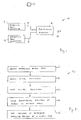
- Fig 1 schematically illustrates a satellite positioning system 10.
- the system 10 is capable of positioning one or more satellites 2.
- a satellite is an object that orbits a much greater mass such that the centre of the orbit can be approximated to the centre of the greater mass.
- Satellites may be earth satellites that orbit the earth.
- Earth satellites may be functional man-made satellites that orbit the Earth such as satellites in a Global Navigation Satellite System (GNSS).
- GNSS Global Navigation Satellite System
- the satellite 2 is a space satellite high above the Earth.
- the system 10 comprises: an empirical data generator 12; an ephemeris data generator 13; and a positioning apparatus 14. One or more of the components is located on the Earth.
- Ephemeris data generator 13 provides ephemeris (orbit) data 15 to the positioning apparatus 14.
- Ephemeris data 15 is information about the position and velocity at a particular time of one or more satellites. The same or different particular times may be used for different satellites.
- the empirical data generator 12 provides empirical based data 16 to the positioning apparatus 14.
- the empirically based data 16 accounts for the distribution of the mass of the Earth.
- the positioning apparatus 14 uses the ephemeris data 15 and the empirically based data to determine the position 17 of the satellite 2.
- the positioning apparatus 14 may output the satellite position 17.
- the positioning apparatus 14 is part of a mobile terminal. In other implementations the positioning apparatus 14 is not part of a mobile terminal but communicates the satellite position 17 to a mobile terminal.
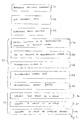
- One example of how the positioning apparatus 14 can determine the satellite position 17 is illustrated in the method 20 of Fig 2 .
- the empirically based data 16 is obtained.
- the empirically based data takes account of the gravitational potential produced by the Earth's distributed mass.
- initial conditions for the satellite are determined from the ephemeris data 15.
- the initial conditions include ⁇ int the vector velocity of the satellite at time t 0 and r int the vector position of the satellite at time t int .
- the initial conditions are mapped using defined mappings from one variable space [r, t] to another variable space [U, s]. This produces initial conditions in [U, s] space.
- the differential equation of motion of the satellite expressed using geometric algebra in terms of U and s comprises a constant based on the empirically based data 16 and this differential equation is solved using perturbation theory and the mapped initial conditions.
- an algebraic solution to the differential equation of motion of the satellite is used to determine the position of the satellite at a chosen time.
- the time scale for updating the empirical based constant can be very long. It may have a period T1, where T1>N1, in different implementations N1 can have any one of the values greater than 1 day and less than 365 days.
- the time scale for updating the empirical based constant can be very long. It may have a period T2, where T2>M1, in different implementations M1 can have any one of the values greater than 4 hours and less than 365 days. M1 may, for example, be 4 days or 2 weeks.
- Equations will identify vectors using bold notation. Vectors are identified by context within the description or may be identified using an underscore or bold font.
- Kepler's equation assumes a point source for the mass. Let us assume that the component f i with the greatest influence on f deals with the effect of mass distribution, where f i which is the gravitational field created by the uneven distribution of the earth's mass. Then to the first order f can be approximated to f i .
- u ⁇ ⁇ be a unit vector in the direction of the axis of rotation.
- v ⁇ ⁇ and w ⁇ ⁇ represent unit vectors orthogonal to u ⁇ ⁇ and orthogonal to each other.
- the dashed unit vectors rotate with the body assumed to rotate with an angular velocity of ⁇ er about the axis parallel to û and passing through the center of gravity.
- J[n][p, q, r] [ û', v ⁇ ' ⁇ '] is a multipole constant (henceforth referred to as J) that can be empirically determined. It is a set of n constants for a given set of parameters [p, q, r] and a given co-ordinate system [ û', v ⁇ ', ⁇ '].
- J may be conveyed as a set of constant values, one for each n, or may be conveyed as a single constant value (the integral) with the set of constant values being determined later using M, R and n.
- Equation 9 Use the gravitational potential expressed in Equation 9 to express the perturbation field f
- the method 30 described with reference to Fig 3 determines an unknown satellite position at a particular time. It illustrates some of the blocks of Fig 2 in more detail.
- the object of block 31 is to determine the multipole constants J up to a certain order (see equations 9 and 13 and Annex pg 29/30) that takes account of the gravitational potential produced by a distributed mass.
- the method of Fig 2 can be adapted to determine the multipole constants J up to a certain order, which when used in the method of Fig 2 determines a known satellite position at a particular time.
- the multi-pole constants J to the respective order is empirically determined as it is based on accurate ephemeris data which may be in the past.
- ephemeris data defining the initial conditions of a satellite are mapped or transformed.
- the initial conditions are mapped using defined mappings from one variable space [r, t] to another variable space [U, s]. This produces initial conditions in [U, s] space.
- the initial conditions include:
- a force constant ⁇ that is used to define the gravitational force in [U, s] space is determined.
- Equation 13 is used calculate ⁇ n U ⁇ u ⁇ ⁇ v ⁇ ⁇ w ⁇ ⁇ r ⁇ Init ⁇ r ⁇ ⁇ Init
- the force constant ⁇ is dependent upon the co-ordinate system û , v ⁇ ⁇ , w ⁇ ⁇ and on the initial conditions ⁇ int , r int . It should therefore be updated whenever new ephemeris data is to be used.
- the force constant may be distributed with or at the same time as the ephemeris data 14. For each, the force constant ⁇ need only be calculated once to yield a function in terms of U given the co-ordinate system and initial conditions.
- Equation 13 the force constant ⁇ is dependent upon J and that ⁇ is also empirically based.
- the empirically based data 13 produced by the empirical data generator 12 may be either the multipole constant J or the force constant ⁇ .
- the block includes sub-blocks 34 to 38.
- the differential equation of motion of the satellite expressed using geometric algebra in terms of U and s comprises the force constant ⁇ (see Equation 14).
- This differential equation may, for example, be solved using perturbation theory and the mapped initial conditions as explained in more detail below.
- the differential equations for the different orders of perturbation are solved to a target order of perturbation. In this example, they will be solved to the second order but in other examples a different target order for solution may be chosen.
- the first order differential equation is solved to determine Uo
- the process is continued until the target order is reached and completed.
- the target order determines accuracy.
- Equation 23 The general solution U i is found by solving equations 17 to 21 using the stability condition of Equation 23 as a constraint. (see Annex pgs 60 to 83)
- Equation 27 algebraically express ⁇ 0 D 2 ⁇ U s ⁇ U ⁇ s ⁇ ⁇ ds using the algebraic expression for U[s]U[s]' from Equation 26 in Equation 27 to determine the coefficients of Equation 27.
- Block 25 an algebraic solution to the differential equation of motion of the satellite is used to determine the position of the satellite at a chosen time.
- Block 25 comprises the sub-blocks 40 to 42.
- Equation 27 is an algebraic function that relates a time variable t to a first mapped variable s. The coefficients of this equation have been determined at block 38. At block 40, this algebraic equation is used to convert a time variable value t 1- t init to a first value s 1 of the first mapped variable.
- Equation 25 is an algebraic function that relates the first mapped variable s to the second mapped variable U.
- the coefficients of this equation have been determined at block 36.
- this algebraic equation is used to convert the first value s 1 of the first mapped variable s to a second value U(s 1 ) of a second mapped variable U.
- the satellite is positioned at block 42 by converting the second value U(s 1 ) of the second mapped variable to a position value r t1 that positions the satellite.
- the position value can then be stored in a memory for future use in applications.
- the boundary conditions (Equations 19, 20, 21) may be expressed in a look-up table in terms of the variables a, b, ⁇ o , and the initial conditions ⁇ int , r int .
- the initial conditions are defined by received ephemeris data
- the three boundary conditions are expressed in terms of variables a, b, ⁇ o in a look-up table.
- the three equations in three unknowns can be solved using standard processes (Annex pg 83) to provide a, b, ⁇ o ,
- pre-processing it is therefore possible to perform a large amount of pre-processing to obtain geometric algebraic look-up tables, which can be simply used to calculate the position. It will be appreciated that the exact extent and nature of the pre-processing may vary from implementation to implementation.
- the blocks 31, 32, 33, 24, 25 may be carried out in different locations in different apparatus.
- block 31 may, for example, be advantageous to have block 31 performed where there is access to accurate satellite positioning information. This may also be where the ephemeris data 15 is generated.
- the block 32 (mapping ephemeris data) may, for example, occur before or after distribution of ephemeris data 15.
- the block 33 may, for example, occur before distribution of the ephemeris data 15 and, for example be distributed with the ephemeris data 15.
- the block 33 may, for example, occur after receiving distributed ephemeris data 15.
- the block 24 may, for example, occur before distribution of the ephemeris data 15 and/or force constant and the coefficients may be distributed with the ephemeris data and/or force constant.
- the block 24 may, for example, occur after receiving distributed ephemeris data and after receiving or generating the force constant.
- the block 25 may, for example, occur before distribution of the ephemeris data and, for example, be distributed with the ephemeris data.
- the block 33 may, for example, occur after receiving or determining the coefficients of the algebraic expressions.
- a mobile terminal may perform blocks 31, 32, 33, 24 and 25. In another implementation a mobile terminal may perform only blocks 32, 33, 24 and 25. In another implementation a mobile terminal may perform only blocks 33, 24 and 25. In another implementation a mobile terminal may perform only blocks 24 and 25. In another implementation a mobile terminal may perform only block 25.
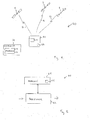
- Fig 4 schematically illustrates a Global Navigation Satellite System (GNSS) 50.
- GNSS Global Navigation Satellite System
- the system 50 comprises: a plurality of GNSS communication satellites 2 for transmitting positioning signals 51 and one or more mobile receiver terminals 52.
- a mobile receiver terminal 52 receives the positioning signals from at least some of the satellites and at least partially processes the positioning signals to determine the distance of each satellite from the mobile receiver terminal 52.
- the mobile receiver terminal 52 determines the position 53 of the mobile receiver terminal 52 by using the determined distance values for each satellite and obtained accurate positions for each satellite.
- the mobile receiver terminal 52 use the satellites positions and their distances to determine the position 53 of the mobile receiver terminal 52.
- the position 53 may be stored in a memory of the mobile receiver terminal 52.
- This system 50 may advantageously use or include the satellite positioning system 10 to provide long-term accurate satellite positions.
- the GNSS system 50 includes a system controller 54 that comprises the empirical data generator 12 and the ephemeris data generator 13.
- the empirical data generator 12 and the ephemeris data generator 13 may be housed separately using the system controller 52 or elsewhere.
- the empirical data generator 12 determines and distributes the multipole constant J and the force constant ⁇ .
- the empirical data generator 12 performs blocks 31, 32 and 33 of Fig 3 .
- the empirical data generator 12 determines and distributes only the multipole constant J and the force constant ⁇ is determined elsewhere. It may, for example, be determined in the positioning apparatus 14.
- the positioning apparatus 14 is integrated within the mobile terminal 52.
- the positioning apparatus performs blocks 24 and 25 to determine and store satellite positions 17.
- the satellite positions are used to determine and store the position 53 of the mobile receiver terminal.
- the positioning apparatus 14 may be located outside the terminal and may provide the satellite positions 17 to the mobile receiver terminal 52.
- the mobile receiver terminal 52 need not be a dedicated GNSS terminal.
- the terminal may, for example, have functionality for other uses. It may, for example, also operate as a personal digital assistant and/or a cellular phone and/or a personal music player and/or a personal video player and/or a personal computer etc.
- the position apparatus 14 can determine the position 17 of a satellite without needing to acquire current ephemeris data. This allows positioning services to be available immediately when the terminal 52 is started.
- the terminal 52 has two modes of operation. It has a first positioning mode that requires the regular receipt of ephemeris data because it expires after a few hours. It has a second positioning mode, based on the method 30 of Fig 3 , which performs block 25 to determine a satellite position 17. It may be possible for the terminal 52 to start-up in the second mode to provide instantaneous positioning and then switch to the first mode when updated ephemeris data is received. It may be possible for the terminal 52 to switch from the second mode to the first mode when it is determined that the first mode is inaccurate or potentially inaccurate.
- the determination of possible inaccuracy may occur, for example, by having a validity period for ephemeris data, after which that data expires and is no longer accurate. The determination of possible inaccuracy may occur, for example, by regularly performing the first mode and the second mode in parallel and determining when the resulting positions determined using the two modes are significantly different.
- the first mode and the second mode are performed in parallel and differences in results are used to correct for clock drift.
- Fig 5 schematically illustrates a controller 60 suitable for performing one or more of the blocks illustrated in the Figs 2 and/or 3.
- a controller of this type may be used as the empirical data generator 12 and/or the ephemeris data generator 13 and/or the positioning apparatus 14.
- the controller 60 may be implemented using instructions that enable hardware functionality, for example, by using executable computer program instructions in a general-purpose or special-purpose processor that may be stored on a computer readable storage medium (disk, memory etc) to be executed by a processor.
- a general-purpose or special-purpose processor may be stored on a computer readable storage medium (disk, memory etc) to be executed by a processor.
- the processor 62 is configured to read from and write to the memory 64.
- the processor 62 may also comprise an output interface via which data and/or commands are output by the processor 62 and an input interface via which data and/or commands are input to the processor 62.
- the memory 64 stores a computer program 66 comprising computer program instructions that control the operation of a host apparatus when loaded into the processor 62.
- the computer program instructions 66 provide the logic and routines that enables the apparatus to perform the methods illustrated in Figs 2 & 3 .
- the processor 62 by reading the memory 64 is able to load and execute the computer program 66.
- the computer program may arrive at the apparatus via any suitable delivery mechanism.
- the delivery mechanism may be, for example, a computer-readable storage medium, a computer program product, a memory device, a record medium such as a CD-ROM or DVD, an article of manufacture that tangibly embodies the computer program.
- the delivery mechanism may be a signal configured to reliably transfer the computer program 53.
- the apparatus may propagate or transmit the computer program as a computer data signal.
- memory 52 is illustrated as a single component it may be implemented as one or more separate components some or all of which may be integrated/removable and/or may provide permanent/semi-permanent/ dynamic/caclied storage.
- references to 'computer-readable storage medium', 'computer program product', 'tangibly embodied computer program' etc. or a 'controller', 'computer', 'processor' etc. should be understood to encompass not only computers having different architectures such as single /multi- processor architectures and sequential (Von Neumann)/parallel architectures but also specialized circuits such as field-programmable gate arrays (FPGA), application specific circuits (ASIC), signal processing devices and other devices.
- References to computer program, instructions, code etc. should be understood to encompass software for a programmable processor or firmware such as, for example, the programmable content of a hardware device whether instructions for a processor, or configuration settings for a fixed-function device, gate array or programmable logic device etc.
- determining the position of a satellite has many uses. It may be used to position GNSS satellites. It may be used to position and track other satellites such as space debris, which may be used to produce collision warnings. It may be used to position a satellite even after the ephemeris data has 'expired' and new ephemeris data is not available. It may be used for low power measuring of movement of a positioning apparatus 14. this may be useful when measuring landslip, structural failure, tectonic plate movement etc.
- Figs 2 and 3 may represent steps in a method and/or sections of code in the computer program.
- the illustration of a particular order to the blocks does not necessarily imply that there is a required or preferred order for the blocks and the order and arrangement of the block may be varied. Furthermore, it may be possible for some steps to be omitted.
- Module refers to a unit or apparatus that excludes certain parts/components that would be added by an end manufacturer or a user.
- the Kepler problem has been studied for a long time.
- This equation is used to calculate the orbit of a satellite orbiting round the earth in the presence of perturbing forces f.
- the solution to the equation can be obtained numerically and as the equation is non-linear the accuracy of the solution decreases the further away the point is from the initial condition.
- the transformed equation is the equation of motion of a one-dimentional harmonic oscillator.
- This equation does not have any singularities, and is also linear and is thus a good basis for performing long term analytic orbit calculations.
- Levi-Civita regularised a 2 dimensional Kepler problem, to an equivalent two dimensional harmonic oscillator. Attempts to regularise a three dimentional Kepler problem failed until 1964, when Kustaanheimo and Stiefel showed how to transform the three dimentional Kepler problem to a harmonic oscillitor in 4 dimentional space.
- the harmonic oscillator of any dimension has good analytical properties, so that make using perturbation theory, one can solve the equation of motion when there are perturbating forces present.
- Hestenes (Ref 1) showed how to solve the Kepler problem using geometric algebra, while Jan Vibrik (Ref 6) showed how to use quaternions to regularise the Kepler problem.
- Bartsch(Ref 7) gives references to Euler, Levi-Civita and Kustaanheimo and Stiefel attempts. Bartsch's paper shows how to use geometric algebra to derive a Lagrangian and Hamiltonion of the Kustaanheimo-Stiefel dynamics in arbitary static electromagnetic fields. These ideas have applications in atomic physics.
- a formula for the earth's potential V, that is represented by a spherical harmonic multipole expansion can be found in Ref 3 and refered to as the earth model.
- Quaternions are a subalgebra of geometric algebra and it would be useful to describe the regularising method using geometric algebra.
- the solution to Kepler's equation in geometric algebra is developed in Ref 1, but only for axially symmetric bodies.
- the advantage of evaluating the RHS in geometric algebra is that the level of perturbation approximation needed can be decided depending on the length of time that has elapsed between the last known position of the satellite and the time for which the position is required.
- the perturbation level can be precalculated beforehand, and the different solutions stored.
- r and r' may not commute. r r' may not be equal to r' r.
- P n are usually known as Legendre polynomials.We need to prove that all the terms are accounted for. For any i and k, the term - 1 2 ⁇ C i * iC k * - 2 ⁇ r . r ⁇ i - k r ⁇ 2 ⁇ k ) r 2 ⁇ i
- the Legendre polynomials are generated by the following code.
- the first five Legendre polynomials are generated by the following code
- the origin be the center of gravity of the body.
- the dashed unit vectors rotate with the body assumed to rotate with an angular velocity of ⁇ er about the axis parallel to û and passing through the center of gravity.
- G ⁇ 1 r ⁇ P 2 r ⁇ r ⁇ ⁇ dm ⁇ ⁇ r ⁇ G ⁇ 1 r ( 1 2 ⁇ r 4 ⁇ 3 ⁇ r . u ⁇ 2 ⁇ u ⁇ ⁇ 2 + 3 ⁇ r 2 ⁇ w ⁇ ⁇ 2 - 3 ⁇ r . u ⁇ 2 ⁇ w ⁇ ⁇ 2 - r 2 ⁇ u ⁇ ⁇ 2 - 2 ⁇ r 2 ⁇ w ⁇ ⁇ 2 dm ⁇ ⁇ r ⁇
- G ⁇ 1 r ⁇ P 2 r ⁇ r ⁇ ⁇ dm ⁇ ⁇ r ⁇ G ⁇ 1 r ( 1 2 ⁇ r 4 ⁇ 3 ⁇ r . u ⁇ 2 ⁇ u ⁇ ⁇ 2 + r 2 ⁇ w ⁇ ⁇ 2 - 3 ⁇ r . u ⁇ 2 ⁇ w ⁇ ⁇ 2 - r 2 ⁇ u ⁇ ⁇ 2 ⁇ dm ⁇ ⁇ r ⁇
- J 2 Given axial symmetry, we can express J 2 as above, where J 2 has the usual definitions.
- the quaternion implementation of the solution to Kepler's equation for predicting orbits is transformed into finding the root by numerical means of an equation, as opposed to numerically solving a non linear differential equation.
- the quaternion implementation has therefore superior numerical accuracy.
- Quaternions are a subalgebra of geometric algebra and it would be useful to describe the regularising method using geometric algebra.
- the solution to Kepler's equation in geometric algebra is developed in Ref 1, but only for axially symmetric bodies.
- J[n][p, q, r] [ û ', v ⁇ ', ⁇ '] are functions of the unit vectors û' , v ⁇ ' , ⁇ ' , and for a particular coordinate system for each p,q, and r , the value of J[n] [p, q, r] [ û ', v ⁇ ', ⁇ '] can be determined empirically for the earth, given the trajectories of orbiting satellites.
- J[1] [0, 0, 1] [u, v, ⁇ ],J[1] [0, 1, 0] [û, v ⁇ , ⁇ ] and J [1] [1, 0, 0] [û, v ⁇ , ⁇ ] are zero.
- the angular momentum for unit mass is defined as L ⁇ r ⁇ r •
- ⁇ n [U, û , v ⁇ , ⁇ , r ⁇ Init , ⁇ Init ] also depends on the constants multipole constants, J [n] [p, q, r] [ û , v ⁇ , ⁇ ].
- J[n] [p, q, r] [ û , v ⁇ , ⁇ ] is a constant.
- ⁇ n [U, û , v ⁇ , ⁇ , r ⁇ Init , ⁇ Init need only be calculated once, to yield a function in terms of U, given the initial position r Init , and initial velocity ⁇ Init , and the unit vectors û, v ⁇ , ⁇ , as ⁇ n [U, û , v ⁇ , ⁇ , r ⁇ Init , ⁇ Init ] then just depends on U, the rest of the inputs being constant.
- the above equation is an example of a weakly non-linear equation to which one may apply perturbation techniques e.g Lindstedt-Poincare (Ref 4) to generate analytic solutions correct to a given order.
- Vrbik (Ref 8) has produced perturbed solutions to orbits using quaternion.
- ⁇ Sin , and ⁇ cos are the number of terms to use for the desired accuracy and j is complex square root of -1.
- the number of terms to use depends on the orbit of the satellite. When the encentricity of the orbit is small, then only a few terms need be used. For satellite orbits which are nearly circular, then only as few as 4 terms may be sufficient. Also, if it is possible to select the initial position, then select the position that is approximately the square root of the product of the nearest and furtherst distances.
- ⁇ n U ⁇ u ⁇ ⁇ v ⁇ ⁇ w ⁇ ⁇ r ⁇ Init ⁇ r ⁇ ⁇ Init can be expressed as a sum of therms that are products of terms that can be expresses as exponentials.
- the right hand side of the second equation can be expressed as a sum of exponentials
- ⁇ [k] is a non-linear equation, for k>1, and entirely in terms of the initial conditions once we have solved for a,b, and ⁇ 0 .
- One of the methods of solving it would be to get an estimate of s 1 , using, ⁇ [0], the zero order perturbation equation, then using the solution of ⁇ [0] as initial input for Newton-Raphson method for solving ⁇ [1], and so on until one arrives at the solution for the appropriate equation to be solved.
- t 0 we know the position of the position of the satellite and its velocity.
- the first limit can be expressed as two limits, because interchanging the order of the limits yields the same limit point.
- ⁇ k 1 n ⁇ k ( r n ⁇ Limit ⁇ k ⁇ 0 1 ⁇ k ⁇ 1 + 2 ⁇ k r . ⁇ k + ⁇ k 2 ⁇ ⁇ k 2 r 2 n 2 - 1 )
- r n ⁇ r 1 r n ⁇ r ⁇ . u m
- ⁇ r r . u m r m m ⁇ r . u m - 1 r m ⁇ u - m ⁇ r . u m r m + 2 r
Landscapes
- Engineering & Computer Science (AREA)
- Radar, Positioning & Navigation (AREA)
- Remote Sensing (AREA)
- Power Engineering (AREA)
- Computer Networks & Wireless Communication (AREA)
- Physics & Mathematics (AREA)
- General Physics & Mathematics (AREA)
- Position Fixing By Use Of Radio Waves (AREA)
Priority Applications (1)
| Application Number | Priority Date | Filing Date | Title |
|---|---|---|---|
| EP14191355.8A EP2843442B1 (de) | 2009-12-22 | 2009-12-22 | Positionierungssatelliten |
Applications Claiming Priority (3)
| Application Number | Priority Date | Filing Date | Title |
|---|---|---|---|
| PCT/EP2009/067782 WO2011076260A1 (en) | 2009-12-22 | 2009-12-22 | Positioning satellites |
| EP14191355.8A EP2843442B1 (de) | 2009-12-22 | 2009-12-22 | Positionierungssatelliten |
| EP09796387.0A EP2517047B1 (de) | 2009-12-22 | 2009-12-22 | Positionierung von satelliten |
Related Parent Applications (2)
| Application Number | Title | Priority Date | Filing Date |
|---|---|---|---|
| EP09796387.0A Division EP2517047B1 (de) | 2009-12-22 | 2009-12-22 | Positionierung von satelliten |
| PCT/EP2009/067782 Previously-Filed-Application WO2011076260A1 (en) | 2009-12-22 | 2009-12-22 | Positioning satellites |
Publications (3)
| Publication Number | Publication Date |
|---|---|
| EP2843442A2 true EP2843442A2 (de) | 2015-03-04 |
| EP2843442A3 EP2843442A3 (de) | 2015-05-13 |
| EP2843442B1 EP2843442B1 (de) | 2019-07-31 |
Family
ID=42470584
Family Applications (3)
| Application Number | Title | Priority Date | Filing Date |
|---|---|---|---|
| EP09796387.0A Not-in-force EP2517047B1 (de) | 2009-12-22 | 2009-12-22 | Positionierung von satelliten |
| EP14191355.8A Not-in-force EP2843442B1 (de) | 2009-12-22 | 2009-12-22 | Positionierungssatelliten |
| EP14191319.4A Not-in-force EP2878973B1 (de) | 2009-12-22 | 2009-12-22 | Positionierungssatelliten |
Family Applications Before (1)
| Application Number | Title | Priority Date | Filing Date |
|---|---|---|---|
| EP09796387.0A Not-in-force EP2517047B1 (de) | 2009-12-22 | 2009-12-22 | Positionierung von satelliten |
Family Applications After (1)
| Application Number | Title | Priority Date | Filing Date |
|---|---|---|---|
| EP14191319.4A Not-in-force EP2878973B1 (de) | 2009-12-22 | 2009-12-22 | Positionierungssatelliten |
Country Status (3)
| Country | Link |
|---|---|
| US (1) | US8843251B2 (de) |
| EP (3) | EP2517047B1 (de) |
| WO (1) | WO2011076260A1 (de) |
Families Citing this family (4)
| Publication number | Priority date | Publication date | Assignee | Title |
|---|---|---|---|---|
| GB2483713B (en) * | 2010-09-20 | 2016-04-06 | St Microelectronics Res & Dev | Signal verification |
| US10761739B2 (en) * | 2018-08-23 | 2020-09-01 | Micron Technology, Inc. | Multi-level wear leveling for non-volatile memory |
| US11537307B2 (en) | 2018-08-23 | 2022-12-27 | Micron Technology, Inc. | Hybrid wear leveling for in-place data replacement media |
| CN109823571B (zh) * | 2019-01-23 | 2020-07-03 | 清华大学 | 一种遥感微纳卫星的多阶段姿态控制方法 |
Family Cites Families (5)
| Publication number | Priority date | Publication date | Assignee | Title |
|---|---|---|---|---|
| US6138061A (en) * | 1997-04-18 | 2000-10-24 | Hughes Electronics Corporation | Onboard orbit propagation using quaternions |
| US6337657B1 (en) * | 1999-03-12 | 2002-01-08 | Topcon Positioning Systems, Inc. | Methods and apparatuses for reducing errors in the measurement of the coordinates and time offset in satellite positioning system receivers |
| EP1852711B1 (de) * | 2006-04-24 | 2013-03-13 | Qualcomm Incorporated | Ephemeriserweiterungsverfahren für GNSS-Anwendungen |
| US7564406B2 (en) * | 2006-11-10 | 2009-07-21 | Sirf Technology, Inc. | Method and apparatus in standalone positioning without broadcast ephemeris |
| US8099186B2 (en) * | 2006-12-22 | 2012-01-17 | The Boeing Company | Satellite navigation using long-term navigation information and autonomous orbit control |
-
2009
- 2009-12-22 EP EP09796387.0A patent/EP2517047B1/de not_active Not-in-force
- 2009-12-22 EP EP14191355.8A patent/EP2843442B1/de not_active Not-in-force
- 2009-12-22 EP EP14191319.4A patent/EP2878973B1/de not_active Not-in-force
- 2009-12-22 US US13/517,027 patent/US8843251B2/en not_active Expired - Fee Related
- 2009-12-22 WO PCT/EP2009/067782 patent/WO2011076260A1/en not_active Ceased
Non-Patent Citations (8)
| Title |
|---|
| BARTSCH T.: "The Kustaanheimo-Stiefel transformation in geometric algebra", ARXIV:-PHYSICS/0301017VL[PHYSICS.CLASS-PH, 10 January 2003 (2003-01-10) |
| DRAZIN P. G.: "Nonlinear Systems", CAMBRIDGE TEXTS IN APPLIED MATHEMATICS |
| HESTENES DAVID: "New Foundations for Classical Mechanics (Second Edition", KLUWER ACADEMIC PUBLISHERS |
| HESTENES DAVID; SOBCZYK GARRET: "Clifford Algebra to Geometric Calculus", KLUWER ACADEMIC PUBLISHERS |
| HOFMANN-WELLENHOF B.; LICHTENEGGER H.; COLLINS J.: "GPS Theory and Practice", SPRINGER |
| VRBIK JAN: "Kepler problem with time-dependent and resonant perturbations", JOURNAL OF METHEMATICAL PHYSICS, vol. 48, 2007, pages 052701 |
| VRBIK, JAN: "Perturbed Kepler problem in quatemionic form", J. PHYS. A, vol. 28, 1995, pages 193 - 198 |
| WALDVOGEL JORG: "Research Report No. 2009-09", May 2008, ETH, article "Quaternions for Regularizing Celestial Mechanics- the Right Way" |
Also Published As
| Publication number | Publication date |
|---|---|
| EP2517047A1 (de) | 2012-10-31 |
| US20120253563A1 (en) | 2012-10-04 |
| US8843251B2 (en) | 2014-09-23 |
| EP2878973A1 (de) | 2015-06-03 |
| WO2011076260A1 (en) | 2011-06-30 |
| EP2843442A3 (de) | 2015-05-13 |
| EP2843442B1 (de) | 2019-07-31 |
| EP2878973B1 (de) | 2019-01-30 |
| EP2517047B1 (de) | 2014-11-26 |
Similar Documents
| Publication | Publication Date | Title |
|---|---|---|
| Taylor et al. | Putting the Precision in Precision Cosmology: How accurate should your data covariance matrix be? | |
| Müller et al. | High performance clocks and gravity field determination | |
| Armellin et al. | Asteroid close encounters characterization using differential algebra: the case of Apophis | |
| Vines et al. | First-post-Newtonian quadrupole tidal interactions in binary systems | |
| Millea et al. | Bayesian delensing of CMB temperature and polarization | |
| Pettinari et al. | The intrinsic bispectrum of the Cosmic Microwave Background | |
| Vecchiato et al. | Testing general relativity by micro-arcsecond global astrometry | |
| Giri et al. | Exploring KSZ velocity reconstruction with N-body simulations and the halo model | |
| Giblin Jr et al. | General relativistic corrections to the weak lensing convergence power spectrum | |
| EP2517047B1 (de) | Positionierung von satelliten | |
| Liu et al. | Initial orbit determination of periodic orbits in the earth–moon system with ground-based optical observations | |
| Chen et al. | Autonomous navigation using X-ray pulsars and multirate processing | |
| US20150285919A1 (en) | Positioning satellites | |
| Page et al. | Bayesian time delay interferometry for orbiting LISA: Accounting for the time dependence of spacecraft separations | |
| Tommei et al. | Light-time computations for the BepiColombo radio science experiment | |
| Dimitrov | Elliptic integrals for calculation of the propagation time of a signal, emitted and received by satellites on one orbit | |
| Weisman et al. | Solution of Liouville's Equation for Uncertainty Characterization of the Main Problem in Satellite Theory | |
| Folcik et al. | Reconciling covariances with reliable orbital uncertainty | |
| Folkner | Relativistic aspects of the JPL planetary ephemeris | |
| Woodburn et al. | Effect of coordinate selection on orbit determination | |
| Pardal et al. | An investigation on cubature Kalman filter performance for orbit determination application | |
| Peron | Testing general relativistic predictions with the LAGEOS satellites | |
| Craft et al. | Performance Determination of a Multi-Mode Thruster Using GPS and Star Tracker Data | |
| Yu | Characterization of X-ray pulsar navigation for tracking closed Earth orbits | |
| Jamali | ORBIT PROPAGATION AND DETERMINATION ALGORITHMS FOR SATELLITE GROUND STATIONS |
Legal Events
| Date | Code | Title | Description |
|---|---|---|---|
| 17P | Request for examination filed |
Effective date: 20141031 |
|
| AC | Divisional application: reference to earlier application |
Ref document number: 2517047 Country of ref document: EP Kind code of ref document: P |
|
| AK | Designated contracting states |
Kind code of ref document: A2 Designated state(s): AT BE BG CH CY CZ DE DK EE ES FI FR GB GR HR HU IE IS IT LI LT LU LV MC MK MT NL NO PL PT RO SE SI SK SM TR |
|
| PUAI | Public reference made under article 153(3) epc to a published international application that has entered the european phase |
Free format text: ORIGINAL CODE: 0009012 |
|
| PUAL | Search report despatched |
Free format text: ORIGINAL CODE: 0009013 |
|
| AK | Designated contracting states |
Kind code of ref document: A3 Designated state(s): AT BE BG CH CY CZ DE DK EE ES FI FR GB GR HR HU IE IS IT LI LT LU LV MC MK MT NL NO PL PT RO SE SI SK SM TR |
|
| RIC1 | Information provided on ipc code assigned before grant |
Ipc: G01S 19/27 20100101AFI20150409BHEP |
|
| R17P | Request for examination filed (corrected) |
Effective date: 20151111 |
|
| RBV | Designated contracting states (corrected) |
Designated state(s): AT BE BG CH CY CZ DE DK EE ES FI FR GB GR HR HU IE IS IT LI LT LU LV MC MK MT NL NO PL PT RO SE SI SK SM TR |
|
| RAP1 | Party data changed (applicant data changed or rights of an application transferred) |
Owner name: NOKIA TECHNOLOGIES OY |
|
| 17Q | First examination report despatched |
Effective date: 20160504 |
|
| GRAP | Despatch of communication of intention to grant a patent |
Free format text: ORIGINAL CODE: EPIDOSNIGR1 |
|
| STAA | Information on the status of an ep patent application or granted ep patent |
Free format text: STATUS: GRANT OF PATENT IS INTENDED |
|
| INTG | Intention to grant announced |
Effective date: 20180307 |
|
| GRAJ | Information related to disapproval of communication of intention to grant by the applicant or resumption of examination proceedings by the epo deleted |
Free format text: ORIGINAL CODE: EPIDOSDIGR1 |
|
| STAA | Information on the status of an ep patent application or granted ep patent |
Free format text: STATUS: EXAMINATION IS IN PROGRESS |
|
| INTC | Intention to grant announced (deleted) | ||
| GRAS | Grant fee paid |
Free format text: ORIGINAL CODE: EPIDOSNIGR3 |
|
| STAA | Information on the status of an ep patent application or granted ep patent |
Free format text: STATUS: GRANT OF PATENT IS INTENDED |
|
| GRAP | Despatch of communication of intention to grant a patent |
Free format text: ORIGINAL CODE: EPIDOSNIGR1 |
|
| INTG | Intention to grant announced |
Effective date: 20190225 |
|
| GRAA | (expected) grant |
Free format text: ORIGINAL CODE: 0009210 |
|
| STAA | Information on the status of an ep patent application or granted ep patent |
Free format text: STATUS: THE PATENT HAS BEEN GRANTED |
|
| AC | Divisional application: reference to earlier application |
Ref document number: 2517047 Country of ref document: EP Kind code of ref document: P |
|
| AK | Designated contracting states |
Kind code of ref document: B1 Designated state(s): AT BE BG CH CY CZ DE DK EE ES FI FR GB GR HR HU IE IS IT LI LT LU LV MC MK MT NL NO PL PT RO SE SI SK SM TR |
|
| REG | Reference to a national code |
Ref country code: GB Ref legal event code: FG4D Ref country code: CH Ref legal event code: EP |
|
| REG | Reference to a national code |
Ref country code: AT Ref legal event code: REF Ref document number: 1161510 Country of ref document: AT Kind code of ref document: T Effective date: 20190815 |
|
| REG | Reference to a national code |
Ref country code: IE Ref legal event code: FG4D |
|
| REG | Reference to a national code |
Ref country code: DE Ref legal event code: R096 Ref document number: 602009059331 Country of ref document: DE |
|
| RAP2 | Party data changed (patent owner data changed or rights of a patent transferred) |
Owner name: NOKIA TECHNOLOGIES OY |
|
| REG | Reference to a national code |
Ref country code: NL Ref legal event code: FP |
|
| REG | Reference to a national code |
Ref country code: LT Ref legal event code: MG4D |
|
| REG | Reference to a national code |
Ref country code: AT Ref legal event code: MK05 Ref document number: 1161510 Country of ref document: AT Kind code of ref document: T Effective date: 20190731 |
|
| PG25 | Lapsed in a contracting state [announced via postgrant information from national office to epo] |
Ref country code: HR Free format text: LAPSE BECAUSE OF FAILURE TO SUBMIT A TRANSLATION OF THE DESCRIPTION OR TO PAY THE FEE WITHIN THE PRESCRIBED TIME-LIMIT Effective date: 20190731 Ref country code: LT Free format text: LAPSE BECAUSE OF FAILURE TO SUBMIT A TRANSLATION OF THE DESCRIPTION OR TO PAY THE FEE WITHIN THE PRESCRIBED TIME-LIMIT Effective date: 20190731 Ref country code: FI Free format text: LAPSE BECAUSE OF FAILURE TO SUBMIT A TRANSLATION OF THE DESCRIPTION OR TO PAY THE FEE WITHIN THE PRESCRIBED TIME-LIMIT Effective date: 20190731 Ref country code: AT Free format text: LAPSE BECAUSE OF FAILURE TO SUBMIT A TRANSLATION OF THE DESCRIPTION OR TO PAY THE FEE WITHIN THE PRESCRIBED TIME-LIMIT Effective date: 20190731 Ref country code: PT Free format text: LAPSE BECAUSE OF FAILURE TO SUBMIT A TRANSLATION OF THE DESCRIPTION OR TO PAY THE FEE WITHIN THE PRESCRIBED TIME-LIMIT Effective date: 20191202 Ref country code: BG Free format text: LAPSE BECAUSE OF FAILURE TO SUBMIT A TRANSLATION OF THE DESCRIPTION OR TO PAY THE FEE WITHIN THE PRESCRIBED TIME-LIMIT Effective date: 20191031 Ref country code: SE Free format text: LAPSE BECAUSE OF FAILURE TO SUBMIT A TRANSLATION OF THE DESCRIPTION OR TO PAY THE FEE WITHIN THE PRESCRIBED TIME-LIMIT Effective date: 20190731 Ref country code: NO Free format text: LAPSE BECAUSE OF FAILURE TO SUBMIT A TRANSLATION OF THE DESCRIPTION OR TO PAY THE FEE WITHIN THE PRESCRIBED TIME-LIMIT Effective date: 20191031 |
|
| PGFP | Annual fee paid to national office [announced via postgrant information from national office to epo] |
Ref country code: DE Payment date: 20191210 Year of fee payment: 11 Ref country code: NL Payment date: 20191212 Year of fee payment: 11 |
|
| PG25 | Lapsed in a contracting state [announced via postgrant information from national office to epo] |
Ref country code: ES Free format text: LAPSE BECAUSE OF FAILURE TO SUBMIT A TRANSLATION OF THE DESCRIPTION OR TO PAY THE FEE WITHIN THE PRESCRIBED TIME-LIMIT Effective date: 20190731 Ref country code: IS Free format text: LAPSE BECAUSE OF FAILURE TO SUBMIT A TRANSLATION OF THE DESCRIPTION OR TO PAY THE FEE WITHIN THE PRESCRIBED TIME-LIMIT Effective date: 20191130 Ref country code: GR Free format text: LAPSE BECAUSE OF FAILURE TO SUBMIT A TRANSLATION OF THE DESCRIPTION OR TO PAY THE FEE WITHIN THE PRESCRIBED TIME-LIMIT Effective date: 20191101 Ref country code: LV Free format text: LAPSE BECAUSE OF FAILURE TO SUBMIT A TRANSLATION OF THE DESCRIPTION OR TO PAY THE FEE WITHIN THE PRESCRIBED TIME-LIMIT Effective date: 20190731 |
|
| PG25 | Lapsed in a contracting state [announced via postgrant information from national office to epo] |
Ref country code: TR Free format text: LAPSE BECAUSE OF FAILURE TO SUBMIT A TRANSLATION OF THE DESCRIPTION OR TO PAY THE FEE WITHIN THE PRESCRIBED TIME-LIMIT Effective date: 20190731 |
|
| PG25 | Lapsed in a contracting state [announced via postgrant information from national office to epo] |
Ref country code: RO Free format text: LAPSE BECAUSE OF FAILURE TO SUBMIT A TRANSLATION OF THE DESCRIPTION OR TO PAY THE FEE WITHIN THE PRESCRIBED TIME-LIMIT Effective date: 20190731 Ref country code: IT Free format text: LAPSE BECAUSE OF FAILURE TO SUBMIT A TRANSLATION OF THE DESCRIPTION OR TO PAY THE FEE WITHIN THE PRESCRIBED TIME-LIMIT Effective date: 20190731 Ref country code: EE Free format text: LAPSE BECAUSE OF FAILURE TO SUBMIT A TRANSLATION OF THE DESCRIPTION OR TO PAY THE FEE WITHIN THE PRESCRIBED TIME-LIMIT Effective date: 20190731 Ref country code: PL Free format text: LAPSE BECAUSE OF FAILURE TO SUBMIT A TRANSLATION OF THE DESCRIPTION OR TO PAY THE FEE WITHIN THE PRESCRIBED TIME-LIMIT Effective date: 20190731 Ref country code: DK Free format text: LAPSE BECAUSE OF FAILURE TO SUBMIT A TRANSLATION OF THE DESCRIPTION OR TO PAY THE FEE WITHIN THE PRESCRIBED TIME-LIMIT Effective date: 20190731 |
|
| PGFP | Annual fee paid to national office [announced via postgrant information from national office to epo] |
Ref country code: GB Payment date: 20191219 Year of fee payment: 11 |
|
| PG25 | Lapsed in a contracting state [announced via postgrant information from national office to epo] |
Ref country code: SM Free format text: LAPSE BECAUSE OF FAILURE TO SUBMIT A TRANSLATION OF THE DESCRIPTION OR TO PAY THE FEE WITHIN THE PRESCRIBED TIME-LIMIT Effective date: 20190731 Ref country code: SK Free format text: LAPSE BECAUSE OF FAILURE TO SUBMIT A TRANSLATION OF THE DESCRIPTION OR TO PAY THE FEE WITHIN THE PRESCRIBED TIME-LIMIT Effective date: 20190731 Ref country code: CZ Free format text: LAPSE BECAUSE OF FAILURE TO SUBMIT A TRANSLATION OF THE DESCRIPTION OR TO PAY THE FEE WITHIN THE PRESCRIBED TIME-LIMIT Effective date: 20190731 Ref country code: IS Free format text: LAPSE BECAUSE OF FAILURE TO SUBMIT A TRANSLATION OF THE DESCRIPTION OR TO PAY THE FEE WITHIN THE PRESCRIBED TIME-LIMIT Effective date: 20200224 |
|
| REG | Reference to a national code |
Ref country code: DE Ref legal event code: R097 Ref document number: 602009059331 Country of ref document: DE |
|
| PLBE | No opposition filed within time limit |
Free format text: ORIGINAL CODE: 0009261 |
|
| STAA | Information on the status of an ep patent application or granted ep patent |
Free format text: STATUS: NO OPPOSITION FILED WITHIN TIME LIMIT |
|
| PG2D | Information on lapse in contracting state deleted |
Ref country code: IS |
|
| PG25 | Lapsed in a contracting state [announced via postgrant information from national office to epo] |
Ref country code: IS Free format text: LAPSE BECAUSE OF FAILURE TO SUBMIT A TRANSLATION OF THE DESCRIPTION OR TO PAY THE FEE WITHIN THE PRESCRIBED TIME-LIMIT Effective date: 20191030 |
|
| REG | Reference to a national code |
Ref country code: CH Ref legal event code: PL |
|
| 26N | No opposition filed |
Effective date: 20200603 |
|
| REG | Reference to a national code |
Ref country code: BE Ref legal event code: MM Effective date: 20191231 |
|
| PG25 | Lapsed in a contracting state [announced via postgrant information from national office to epo] |
Ref country code: MC Free format text: LAPSE BECAUSE OF FAILURE TO SUBMIT A TRANSLATION OF THE DESCRIPTION OR TO PAY THE FEE WITHIN THE PRESCRIBED TIME-LIMIT Effective date: 20190731 Ref country code: SI Free format text: LAPSE BECAUSE OF FAILURE TO SUBMIT A TRANSLATION OF THE DESCRIPTION OR TO PAY THE FEE WITHIN THE PRESCRIBED TIME-LIMIT Effective date: 20190731 |
|
| PG25 | Lapsed in a contracting state [announced via postgrant information from national office to epo] |
Ref country code: LU Free format text: LAPSE BECAUSE OF NON-PAYMENT OF DUE FEES Effective date: 20191222 Ref country code: IE Free format text: LAPSE BECAUSE OF NON-PAYMENT OF DUE FEES Effective date: 20191222 Ref country code: FR Free format text: LAPSE BECAUSE OF NON-PAYMENT OF DUE FEES Effective date: 20191231 |
|
| PG25 | Lapsed in a contracting state [announced via postgrant information from national office to epo] |
Ref country code: BE Free format text: LAPSE BECAUSE OF NON-PAYMENT OF DUE FEES Effective date: 20191231 Ref country code: CH Free format text: LAPSE BECAUSE OF NON-PAYMENT OF DUE FEES Effective date: 20191231 Ref country code: LI Free format text: LAPSE BECAUSE OF NON-PAYMENT OF DUE FEES Effective date: 20191231 |
|
| PG25 | Lapsed in a contracting state [announced via postgrant information from national office to epo] |
Ref country code: CY Free format text: LAPSE BECAUSE OF FAILURE TO SUBMIT A TRANSLATION OF THE DESCRIPTION OR TO PAY THE FEE WITHIN THE PRESCRIBED TIME-LIMIT Effective date: 20190731 |
|
| REG | Reference to a national code |
Ref country code: DE Ref legal event code: R119 Ref document number: 602009059331 Country of ref document: DE |
|
| PG25 | Lapsed in a contracting state [announced via postgrant information from national office to epo] |
Ref country code: MT Free format text: LAPSE BECAUSE OF FAILURE TO SUBMIT A TRANSLATION OF THE DESCRIPTION OR TO PAY THE FEE WITHIN THE PRESCRIBED TIME-LIMIT Effective date: 20190731 Ref country code: HU Free format text: LAPSE BECAUSE OF FAILURE TO SUBMIT A TRANSLATION OF THE DESCRIPTION OR TO PAY THE FEE WITHIN THE PRESCRIBED TIME-LIMIT; INVALID AB INITIO Effective date: 20091222 |
|
| REG | Reference to a national code |
Ref country code: NL Ref legal event code: MM Effective date: 20210101 |
|
| GBPC | Gb: european patent ceased through non-payment of renewal fee |
Effective date: 20201222 |
|
| PG25 | Lapsed in a contracting state [announced via postgrant information from national office to epo] |
Ref country code: NL Free format text: LAPSE BECAUSE OF NON-PAYMENT OF DUE FEES Effective date: 20210101 |
|
| PG25 | Lapsed in a contracting state [announced via postgrant information from national office to epo] |
Ref country code: GB Free format text: LAPSE BECAUSE OF NON-PAYMENT OF DUE FEES Effective date: 20201222 Ref country code: DE Free format text: LAPSE BECAUSE OF NON-PAYMENT OF DUE FEES Effective date: 20210701 |
|
| PG25 | Lapsed in a contracting state [announced via postgrant information from national office to epo] |
Ref country code: MK Free format text: LAPSE BECAUSE OF FAILURE TO SUBMIT A TRANSLATION OF THE DESCRIPTION OR TO PAY THE FEE WITHIN THE PRESCRIBED TIME-LIMIT Effective date: 20190731 |