EP2843049B1 - Neuronal differentiation promoter - Google Patents
Neuronal differentiation promoter Download PDFInfo
- Publication number
- EP2843049B1 EP2843049B1 EP13781077.6A EP13781077A EP2843049B1 EP 2843049 B1 EP2843049 B1 EP 2843049B1 EP 13781077 A EP13781077 A EP 13781077A EP 2843049 B1 EP2843049 B1 EP 2843049B1
- Authority
- EP
- European Patent Office
- Prior art keywords
- mir
- neural stem
- stem cells
- cells
- nucleic acid
- Prior art date
- Legal status (The legal status is an assumption and is not a legal conclusion. Google has not performed a legal analysis and makes no representation as to the accuracy of the status listed.)
- Not-in-force
Links
- 230000004031 neuronal differentiation Effects 0.000 title claims description 27
- 210000001178 neural stem cell Anatomy 0.000 claims description 121
- 108091091751 miR-17 stem-loop Proteins 0.000 claims description 48
- 108091069239 miR-17-2 stem-loop Proteins 0.000 claims description 48
- 239000012826 P38 inhibitor Substances 0.000 claims description 46
- 230000001272 neurogenic effect Effects 0.000 claims description 34
- 238000000034 method Methods 0.000 claims description 27
- 239000003795 chemical substances by application Substances 0.000 claims description 23
- 230000001737 promoting effect Effects 0.000 claims description 18
- 206010008118 cerebral infarction Diseases 0.000 claims description 13
- 208000037265 diseases, disorders, signs and symptoms Diseases 0.000 claims description 13
- 108091045790 miR-106b stem-loop Proteins 0.000 claims description 13
- 238000000338 in vitro Methods 0.000 claims description 11
- 208000024827 Alzheimer disease Diseases 0.000 claims description 10
- 108091064157 miR-106a stem-loop Proteins 0.000 claims description 10
- 208000030886 Traumatic Brain injury Diseases 0.000 claims description 9
- 230000009529 traumatic brain injury Effects 0.000 claims description 9
- 201000006474 Brain Ischemia Diseases 0.000 claims description 8
- 206010008120 Cerebral ischaemia Diseases 0.000 claims description 7
- 208000026106 cerebrovascular disease Diseases 0.000 claims description 6
- 239000003937 drug carrier Substances 0.000 claims description 5
- 208000023105 Huntington disease Diseases 0.000 claims description 4
- 208000035475 disorder Diseases 0.000 claims description 4
- 102100023482 Mitogen-activated protein kinase 14 Human genes 0.000 description 106
- 108010068338 p38 Mitogen-Activated Protein Kinases Proteins 0.000 description 105
- 210000004027 cell Anatomy 0.000 description 73
- 150000007523 nucleic acids Chemical class 0.000 description 69
- 102000039446 nucleic acids Human genes 0.000 description 67
- 108020004707 nucleic acids Proteins 0.000 description 67
- 125000003729 nucleotide group Chemical group 0.000 description 66
- 239000002773 nucleotide Substances 0.000 description 64
- 239000002679 microRNA Substances 0.000 description 53
- 108020004999 messenger RNA Proteins 0.000 description 51
- 108091070501 miRNA Proteins 0.000 description 40
- 210000002569 neuron Anatomy 0.000 description 37
- 108091032973 (ribonucleotides)n+m Proteins 0.000 description 36
- 108090000623 proteins and genes Proteins 0.000 description 36
- 230000014509 gene expression Effects 0.000 description 34
- 230000004069 differentiation Effects 0.000 description 32
- 108020004414 DNA Proteins 0.000 description 27
- 230000002018 overexpression Effects 0.000 description 24
- 108020004459 Small interfering RNA Proteins 0.000 description 22
- 230000000295 complement effect Effects 0.000 description 20
- 210000001130 astrocyte Anatomy 0.000 description 19
- 238000012353 t test Methods 0.000 description 19
- 108700011259 MicroRNAs Proteins 0.000 description 17
- 241000282414 Homo sapiens Species 0.000 description 16
- 241000713666 Lentivirus Species 0.000 description 16
- 241000699666 Mus <mouse, genus> Species 0.000 description 15
- 238000013519 translation Methods 0.000 description 15
- 108091027967 Small hairpin RNA Proteins 0.000 description 13
- 230000002401 inhibitory effect Effects 0.000 description 13
- 239000004055 small Interfering RNA Substances 0.000 description 13
- 101710193519 Glial fibrillary acidic protein Proteins 0.000 description 12
- 108010043121 Green Fluorescent Proteins Proteins 0.000 description 12
- 102000004144 Green Fluorescent Proteins Human genes 0.000 description 12
- 230000000692 anti-sense effect Effects 0.000 description 12
- -1 aryl ureas Chemical class 0.000 description 12
- 239000005090 green fluorescent protein Substances 0.000 description 12
- 238000001727 in vivo Methods 0.000 description 12
- 230000001537 neural effect Effects 0.000 description 12
- 102100039289 Glial fibrillary acidic protein Human genes 0.000 description 11
- 230000027455 binding Effects 0.000 description 11
- 230000000694 effects Effects 0.000 description 11
- 230000002518 glial effect Effects 0.000 description 11
- 230000004022 gliogenesis Effects 0.000 description 11
- 238000013518 transcription Methods 0.000 description 11
- 230000035897 transcription Effects 0.000 description 11
- 230000007704 transition Effects 0.000 description 10
- 101150057182 GFAP gene Proteins 0.000 description 9
- 102100032352 Leukemia inhibitory factor Human genes 0.000 description 9
- 108091027974 Mature messenger RNA Proteins 0.000 description 9
- 108091028043 Nucleic acid sequence Proteins 0.000 description 9
- 201000010099 disease Diseases 0.000 description 9
- 239000003814 drug Substances 0.000 description 9
- 239000013604 expression vector Substances 0.000 description 9
- 210000005046 glial fibrillary acidic protein Anatomy 0.000 description 9
- 230000036961 partial effect Effects 0.000 description 9
- 230000004962 physiological condition Effects 0.000 description 9
- 210000000130 stem cell Anatomy 0.000 description 9
- 102100024506 Bone morphogenetic protein 2 Human genes 0.000 description 8
- 101000762366 Homo sapiens Bone morphogenetic protein 2 Proteins 0.000 description 8
- 150000001413 amino acids Chemical group 0.000 description 8
- 238000002474 experimental method Methods 0.000 description 8
- 102000040430 polynucleotide Human genes 0.000 description 8
- 108091033319 polynucleotide Proteins 0.000 description 8
- 239000002157 polynucleotide Substances 0.000 description 8
- 230000008685 targeting Effects 0.000 description 8
- 241000124008 Mammalia Species 0.000 description 7
- 241001465754 Metazoa Species 0.000 description 7
- 238000000692 Student's t-test Methods 0.000 description 7
- 230000015572 biosynthetic process Effects 0.000 description 7
- 210000003169 central nervous system Anatomy 0.000 description 7
- 230000006870 function Effects 0.000 description 7
- 230000006698 induction Effects 0.000 description 7
- 230000001939 inductive effect Effects 0.000 description 7
- 239000003550 marker Substances 0.000 description 7
- 101001120822 Homo sapiens Putative microRNA 17 host gene protein Proteins 0.000 description 6
- 102100026055 Putative microRNA 17 host gene protein Human genes 0.000 description 6
- 210000003710 cerebral cortex Anatomy 0.000 description 6
- KRKNYBCHXYNGOX-UHFFFAOYSA-N citric acid Chemical compound OC(=O)CC(O)(C(O)=O)CC(O)=O KRKNYBCHXYNGOX-UHFFFAOYSA-N 0.000 description 6
- 210000001671 embryonic stem cell Anatomy 0.000 description 6
- 239000002609 medium Substances 0.000 description 6
- 108091007428 primary miRNA Proteins 0.000 description 6
- 210000004291 uterus Anatomy 0.000 description 6
- 102000004127 Cytokines Human genes 0.000 description 5
- 108090000695 Cytokines Proteins 0.000 description 5
- 229940122696 MAP kinase inhibitor Drugs 0.000 description 5
- 241000699660 Mus musculus Species 0.000 description 5
- 238000012228 RNA interference-mediated gene silencing Methods 0.000 description 5
- 108010017324 STAT3 Transcription Factor Proteins 0.000 description 5
- 102100024040 Signal transducer and activator of transcription 3 Human genes 0.000 description 5
- 238000004458 analytical method Methods 0.000 description 5
- 239000003153 chemical reaction reagent Substances 0.000 description 5
- 230000007423 decrease Effects 0.000 description 5
- 230000009368 gene silencing by RNA Effects 0.000 description 5
- 238000007069 methylation reaction Methods 0.000 description 5
- 239000002829 mitogen activated protein kinase inhibitor Substances 0.000 description 5
- 230000035772 mutation Effects 0.000 description 5
- 102000045246 noggin Human genes 0.000 description 5
- 108700007229 noggin Proteins 0.000 description 5
- 102000004169 proteins and genes Human genes 0.000 description 5
- 239000000725 suspension Substances 0.000 description 5
- SZXUTTGMFUSMCE-UHFFFAOYSA-N 2-(1h-imidazol-2-yl)pyridine Chemical class C1=CNC(C=2N=CC=CC=2)=N1 SZXUTTGMFUSMCE-UHFFFAOYSA-N 0.000 description 4
- 108020005345 3' Untranslated Regions Proteins 0.000 description 4
- 101150063425 Acsbg1 gene Proteins 0.000 description 4
- 102100024392 Insulin gene enhancer protein ISL-1 Human genes 0.000 description 4
- RJKFOVLPORLFTN-LEKSSAKUSA-N Progesterone Chemical compound C1CC2=CC(=O)CC[C@]2(C)[C@@H]2[C@@H]1[C@@H]1CC[C@H](C(=O)C)[C@@]1(C)CC2 RJKFOVLPORLFTN-LEKSSAKUSA-N 0.000 description 4
- 229920002472 Starch Polymers 0.000 description 4
- 238000012258 culturing Methods 0.000 description 4
- 239000012636 effector Substances 0.000 description 4
- 210000002257 embryonic structure Anatomy 0.000 description 4
- 230000001973 epigenetic effect Effects 0.000 description 4
- 210000004263 induced pluripotent stem cell Anatomy 0.000 description 4
- 208000015181 infectious disease Diseases 0.000 description 4
- 230000005764 inhibitory process Effects 0.000 description 4
- NOESYZHRGYRDHS-UHFFFAOYSA-N insulin Chemical compound N1C(=O)C(NC(=O)C(CCC(N)=O)NC(=O)C(CCC(O)=O)NC(=O)C(C(C)C)NC(=O)C(NC(=O)CN)C(C)CC)CSSCC(C(NC(CO)C(=O)NC(CC(C)C)C(=O)NC(CC=2C=CC(O)=CC=2)C(=O)NC(CCC(N)=O)C(=O)NC(CC(C)C)C(=O)NC(CCC(O)=O)C(=O)NC(CC(N)=O)C(=O)NC(CC=2C=CC(O)=CC=2)C(=O)NC(CSSCC(NC(=O)C(C(C)C)NC(=O)C(CC(C)C)NC(=O)C(CC=2C=CC(O)=CC=2)NC(=O)C(CC(C)C)NC(=O)C(C)NC(=O)C(CCC(O)=O)NC(=O)C(C(C)C)NC(=O)C(CC(C)C)NC(=O)C(CC=2NC=NC=2)NC(=O)C(CO)NC(=O)CNC2=O)C(=O)NCC(=O)NC(CCC(O)=O)C(=O)NC(CCCNC(N)=N)C(=O)NCC(=O)NC(CC=3C=CC=CC=3)C(=O)NC(CC=3C=CC=CC=3)C(=O)NC(CC=3C=CC(O)=CC=3)C(=O)NC(C(C)O)C(=O)N3C(CCC3)C(=O)NC(CCCCN)C(=O)NC(C)C(O)=O)C(=O)NC(CC(N)=O)C(O)=O)=O)NC(=O)C(C(C)CC)NC(=O)C(CO)NC(=O)C(C(C)O)NC(=O)C1CSSCC2NC(=O)C(CC(C)C)NC(=O)C(NC(=O)C(CCC(N)=O)NC(=O)C(CC(N)=O)NC(=O)C(NC(=O)C(N)CC=1C=CC=CC=1)C(C)C)CC1=CN=CN1 NOESYZHRGYRDHS-UHFFFAOYSA-N 0.000 description 4
- 239000007788 liquid Substances 0.000 description 4
- 230000011987 methylation Effects 0.000 description 4
- 210000004498 neuroglial cell Anatomy 0.000 description 4
- 210000001778 pluripotent stem cell Anatomy 0.000 description 4
- 229920001184 polypeptide Polymers 0.000 description 4
- 239000002243 precursor Substances 0.000 description 4
- 102000004196 processed proteins & peptides Human genes 0.000 description 4
- 108090000765 processed proteins & peptides Proteins 0.000 description 4
- KIDHWZJUCRJVML-UHFFFAOYSA-N putrescine Chemical compound NCCCCN KIDHWZJUCRJVML-UHFFFAOYSA-N 0.000 description 4
- 230000001105 regulatory effect Effects 0.000 description 4
- 238000011160 research Methods 0.000 description 4
- 108091069025 single-strand RNA Proteins 0.000 description 4
- 239000008107 starch Substances 0.000 description 4
- 238000003786 synthesis reaction Methods 0.000 description 4
- 150000003672 ureas Chemical class 0.000 description 4
- QTBSBXVTEAMEQO-UHFFFAOYSA-N Acetic acid Chemical compound CC(O)=O QTBSBXVTEAMEQO-UHFFFAOYSA-N 0.000 description 3
- 230000007067 DNA methylation Effects 0.000 description 3
- WQZGKKKJIJFFOK-GASJEMHNSA-N Glucose Natural products OC[C@H]1OC(O)[C@H](O)[C@@H](O)[C@@H]1O WQZGKKKJIJFFOK-GASJEMHNSA-N 0.000 description 3
- 102000003693 Hedgehog Proteins Human genes 0.000 description 3
- 108090000031 Hedgehog Proteins Proteins 0.000 description 3
- 101000919320 Homo sapiens Adapter molecule crk Proteins 0.000 description 3
- 101001053263 Homo sapiens Insulin gene enhancer protein ISL-1 Proteins 0.000 description 3
- 101001092197 Homo sapiens RNA binding protein fox-1 homolog 3 Proteins 0.000 description 3
- 101000919317 Mus musculus Adapter molecule crk Proteins 0.000 description 3
- 102100035530 RNA binding protein fox-1 homolog 3 Human genes 0.000 description 3
- 239000004480 active ingredient Substances 0.000 description 3
- 238000000137 annealing Methods 0.000 description 3
- 238000003556 assay Methods 0.000 description 3
- WQZGKKKJIJFFOK-VFUOTHLCSA-N beta-D-glucose Chemical compound OC[C@H]1O[C@@H](O)[C@H](O)[C@@H](O)[C@@H]1O WQZGKKKJIJFFOK-VFUOTHLCSA-N 0.000 description 3
- 230000033228 biological regulation Effects 0.000 description 3
- 210000004556 brain Anatomy 0.000 description 3
- 238000004422 calculation algorithm Methods 0.000 description 3
- 235000013877 carbamide Nutrition 0.000 description 3
- 230000015556 catabolic process Effects 0.000 description 3
- 210000004289 cerebral ventricle Anatomy 0.000 description 3
- 230000008859 change Effects 0.000 description 3
- 238000003776 cleavage reaction Methods 0.000 description 3
- 239000002299 complementary DNA Substances 0.000 description 3
- 150000001875 compounds Chemical class 0.000 description 3
- 238000006731 degradation reaction Methods 0.000 description 3
- 238000011161 development Methods 0.000 description 3
- 230000018109 developmental process Effects 0.000 description 3
- 229940079593 drug Drugs 0.000 description 3
- 239000008103 glucose Substances 0.000 description 3
- 239000008187 granular material Substances 0.000 description 3
- 125000001072 heteroaryl group Chemical group 0.000 description 3
- 238000009396 hybridization Methods 0.000 description 3
- 239000007924 injection Substances 0.000 description 3
- 238000002347 injection Methods 0.000 description 3
- 230000003834 intracellular effect Effects 0.000 description 3
- 229940043355 kinase inhibitor Drugs 0.000 description 3
- 230000007246 mechanism Effects 0.000 description 3
- 238000000520 microinjection Methods 0.000 description 3
- 239000003226 mitogen Substances 0.000 description 3
- 230000009456 molecular mechanism Effects 0.000 description 3
- 210000005036 nerve Anatomy 0.000 description 3
- 239000002245 particle Substances 0.000 description 3
- 239000003757 phosphotransferase inhibitor Substances 0.000 description 3
- 238000002360 preparation method Methods 0.000 description 3
- 125000002294 quinazolinyl group Chemical class N1=C(N=CC2=CC=CC=C12)* 0.000 description 3
- 230000004044 response Effects 0.000 description 3
- 230000004043 responsiveness Effects 0.000 description 3
- 230000007017 scission Effects 0.000 description 3
- 239000012679 serum free medium Substances 0.000 description 3
- 235000019698 starch Nutrition 0.000 description 3
- 230000002194 synthesizing effect Effects 0.000 description 3
- YBJHBAHKTGYVGT-ZKWXMUAHSA-N (+)-Biotin Chemical compound N1C(=O)N[C@@H]2[C@H](CCCCC(=O)O)SC[C@@H]21 YBJHBAHKTGYVGT-ZKWXMUAHSA-N 0.000 description 2
- SFGFYNXPJMOUHK-PKAFTLKUSA-N (2r)-2-[[(2r)-2-amino-5-(diaminomethylideneamino)pentanoyl]amino]-n-[(2r)-1-[[(2r)-1-[[(2r)-1-[[(2r)-1-[[(2r)-1-[[(2r)-1-[[2-[[(2r)-1-amino-3-(4-hydroxyphenyl)-1-oxopropan-2-yl]amino]-2-oxoethyl]amino]-1-oxohexan-2-yl]amino]-1-oxohexan-2-yl]amino]-1-oxohe Chemical compound NC(N)=NCCC[C@@H](N)C(=O)N[C@H](CCCC)C(=O)N[C@H](CCCC)C(=O)N[C@H](CCCC)C(=O)N[C@H](CCCN=C(N)N)C(=O)N[C@H](CCCC)C(=O)N[C@H](CCCC)C(=O)N[C@H](CCCC)C(=O)NCC(=O)N[C@@H](C(N)=O)CC1=CC=C(O)C=C1 SFGFYNXPJMOUHK-PKAFTLKUSA-N 0.000 description 2
- VTYYLEPIZMXCLO-UHFFFAOYSA-L Calcium carbonate Chemical compound [Ca+2].[O-]C([O-])=O VTYYLEPIZMXCLO-UHFFFAOYSA-L 0.000 description 2
- 241000282472 Canis lupus familiaris Species 0.000 description 2
- 108091029430 CpG site Proteins 0.000 description 2
- 241000702421 Dependoparvovirus Species 0.000 description 2
- 239000006144 Dulbecco’s modified Eagle's medium Substances 0.000 description 2
- 102000003974 Fibroblast growth factor 2 Human genes 0.000 description 2
- 108090000379 Fibroblast growth factor 2 Proteins 0.000 description 2
- DHMQDGOQFOQNFH-UHFFFAOYSA-N Glycine Chemical compound NCC(O)=O DHMQDGOQFOQNFH-UHFFFAOYSA-N 0.000 description 2
- 229920000209 Hexadimethrine bromide Polymers 0.000 description 2
- 238000010867 Hoechst staining Methods 0.000 description 2
- 241000282412 Homo Species 0.000 description 2
- 102000004877 Insulin Human genes 0.000 description 2
- 108090001061 Insulin Proteins 0.000 description 2
- 108010050904 Interferons Proteins 0.000 description 2
- 102000014150 Interferons Human genes 0.000 description 2
- ZDXPYRJPNDTMRX-VKHMYHEASA-N L-glutamine Chemical compound OC(=O)[C@@H](N)CCC(N)=O ZDXPYRJPNDTMRX-VKHMYHEASA-N 0.000 description 2
- 108700012928 MAPK14 Proteins 0.000 description 2
- 101150003941 Mapk14 gene Proteins 0.000 description 2
- 241000699670 Mus sp. Species 0.000 description 2
- 206010028980 Neoplasm Diseases 0.000 description 2
- 101710163270 Nuclease Proteins 0.000 description 2
- 239000002202 Polyethylene glycol Substances 0.000 description 2
- 229920002873 Polyethylenimine Polymers 0.000 description 2
- 241000288906 Primates Species 0.000 description 2
- 239000005700 Putrescine Substances 0.000 description 2
- 241000283984 Rodentia Species 0.000 description 2
- UIIMBOGNXHQVGW-UHFFFAOYSA-M Sodium bicarbonate Chemical compound [Na+].OC([O-])=O UIIMBOGNXHQVGW-UHFFFAOYSA-M 0.000 description 2
- 229930006000 Sucrose Natural products 0.000 description 2
- CZMRCDWAGMRECN-UGDNZRGBSA-N Sucrose Chemical compound O[C@H]1[C@H](O)[C@@H](CO)O[C@@]1(CO)O[C@@H]1[C@H](O)[C@@H](O)[C@H](O)[C@@H](CO)O1 CZMRCDWAGMRECN-UGDNZRGBSA-N 0.000 description 2
- 108091036066 Three prime untranslated region Proteins 0.000 description 2
- 102000004338 Transferrin Human genes 0.000 description 2
- 108090000901 Transferrin Proteins 0.000 description 2
- 108091023045 Untranslated Region Proteins 0.000 description 2
- ISAKRJDGNUQOIC-UHFFFAOYSA-N Uracil Chemical compound O=C1C=CNC(=O)N1 ISAKRJDGNUQOIC-UHFFFAOYSA-N 0.000 description 2
- 208000027418 Wounds and injury Diseases 0.000 description 2
- 230000009471 action Effects 0.000 description 2
- SHGAZHPCJJPHSC-YCNIQYBTSA-N all-trans-retinoic acid Chemical compound OC(=O)\C=C(/C)\C=C\C=C(/C)\C=C\C1=C(C)CCCC1(C)C SHGAZHPCJJPHSC-YCNIQYBTSA-N 0.000 description 2
- 238000001369 bisulfite sequencing Methods 0.000 description 2
- 239000001506 calcium phosphate Substances 0.000 description 2
- 229910000389 calcium phosphate Inorganic materials 0.000 description 2
- 235000011010 calcium phosphates Nutrition 0.000 description 2
- 201000011510 cancer Diseases 0.000 description 2
- 239000002775 capsule Substances 0.000 description 2
- 230000024245 cell differentiation Effects 0.000 description 2
- 239000001913 cellulose Substances 0.000 description 2
- 229920002678 cellulose Polymers 0.000 description 2
- VIEXQFHKRAHTQS-UHFFFAOYSA-N chloroselanyl selenohypochlorite Chemical compound Cl[Se][Se]Cl VIEXQFHKRAHTQS-UHFFFAOYSA-N 0.000 description 2
- 238000007451 chromatin immunoprecipitation sequencing Methods 0.000 description 2
- 210000000349 chromosome Anatomy 0.000 description 2
- 230000006378 damage Effects 0.000 description 2
- 230000035622 drinking Effects 0.000 description 2
- 239000000839 emulsion Substances 0.000 description 2
- 238000005516 engineering process Methods 0.000 description 2
- 230000001605 fetal effect Effects 0.000 description 2
- 108091008053 gene clusters Proteins 0.000 description 2
- ZDXPYRJPNDTMRX-UHFFFAOYSA-N glutamine Natural products OC(=O)C(N)CCC(N)=O ZDXPYRJPNDTMRX-UHFFFAOYSA-N 0.000 description 2
- 230000012010 growth Effects 0.000 description 2
- RAXXELZNTBOGNW-UHFFFAOYSA-N imidazole Natural products C1=CNC=N1 RAXXELZNTBOGNW-UHFFFAOYSA-N 0.000 description 2
- 238000012744 immunostaining Methods 0.000 description 2
- 230000000977 initiatory effect Effects 0.000 description 2
- 208000014674 injury Diseases 0.000 description 2
- 229940125396 insulin Drugs 0.000 description 2
- 230000003993 interaction Effects 0.000 description 2
- 229940079322 interferon Drugs 0.000 description 2
- HQKMJHAJHXVSDF-UHFFFAOYSA-L magnesium stearate Chemical compound [Mg+2].CCCCCCCCCCCCCCCCCC([O-])=O.CCCCCCCCCCCCCCCCCC([O-])=O HQKMJHAJHXVSDF-UHFFFAOYSA-L 0.000 description 2
- 238000004519 manufacturing process Methods 0.000 description 2
- 230000001404 mediated effect Effects 0.000 description 2
- 229920000609 methyl cellulose Polymers 0.000 description 2
- 239000001923 methylcellulose Substances 0.000 description 2
- LXCFILQKKLGQFO-UHFFFAOYSA-N methylparaben Chemical compound COC(=O)C1=CC=C(O)C=C1 LXCFILQKKLGQFO-UHFFFAOYSA-N 0.000 description 2
- 108091049679 miR-20a stem-loop Proteins 0.000 description 2
- 238000010208 microarray analysis Methods 0.000 description 2
- 230000004766 neurogenesis Effects 0.000 description 2
- 239000008194 pharmaceutical composition Substances 0.000 description 2
- 239000006187 pill Substances 0.000 description 2
- 229920001223 polyethylene glycol Polymers 0.000 description 2
- 239000000843 powder Substances 0.000 description 2
- 238000012545 processing Methods 0.000 description 2
- 239000000047 product Substances 0.000 description 2
- 239000000186 progesterone Substances 0.000 description 2
- 229960003387 progesterone Drugs 0.000 description 2
- QELSKZZBTMNZEB-UHFFFAOYSA-N propylparaben Chemical compound CCCOC(=O)C1=CC=C(O)C=C1 QELSKZZBTMNZEB-UHFFFAOYSA-N 0.000 description 2
- 210000004129 prosencephalon Anatomy 0.000 description 2
- 150000003217 pyrazoles Chemical class 0.000 description 2
- 125000004076 pyridyl group Chemical group 0.000 description 2
- 238000011084 recovery Methods 0.000 description 2
- 229930002330 retinoic acid Natural products 0.000 description 2
- 230000011664 signaling Effects 0.000 description 2
- 238000007619 statistical method Methods 0.000 description 2
- 230000000638 stimulation Effects 0.000 description 2
- 239000000758 substrate Substances 0.000 description 2
- 239000005720 sucrose Substances 0.000 description 2
- 239000000829 suppository Substances 0.000 description 2
- 230000001629 suppression Effects 0.000 description 2
- 239000000454 talc Substances 0.000 description 2
- 229910052623 talc Inorganic materials 0.000 description 2
- 230000002123 temporal effect Effects 0.000 description 2
- RWQNBRDOKXIBIV-UHFFFAOYSA-N thymine Chemical compound CC1=CNC(=O)NC1=O RWQNBRDOKXIBIV-UHFFFAOYSA-N 0.000 description 2
- 210000001519 tissue Anatomy 0.000 description 2
- 238000012546 transfer Methods 0.000 description 2
- 239000012581 transferrin Substances 0.000 description 2
- 229960001727 tretinoin Drugs 0.000 description 2
- QORWJWZARLRLPR-UHFFFAOYSA-H tricalcium bis(phosphate) Chemical compound [Ca+2].[Ca+2].[Ca+2].[O-]P([O-])([O-])=O.[O-]P([O-])([O-])=O QORWJWZARLRLPR-UHFFFAOYSA-H 0.000 description 2
- 241000701161 unidentified adenovirus Species 0.000 description 2
- 241001430294 unidentified retrovirus Species 0.000 description 2
- 239000013598 vector Substances 0.000 description 2
- 230000003612 virological effect Effects 0.000 description 2
- 238000001262 western blot Methods 0.000 description 2
- NOOLISFMXDJSKH-UTLUCORTSA-N (+)-Neomenthol Chemical compound CC(C)[C@@H]1CC[C@@H](C)C[C@@H]1O NOOLISFMXDJSKH-UTLUCORTSA-N 0.000 description 1
- OPCHFPHZPIURNA-MFERNQICSA-N (2s)-2,5-bis(3-aminopropylamino)-n-[2-(dioctadecylamino)acetyl]pentanamide Chemical compound CCCCCCCCCCCCCCCCCCN(CC(=O)NC(=O)[C@H](CCCNCCCN)NCCCN)CCCCCCCCCCCCCCCCCC OPCHFPHZPIURNA-MFERNQICSA-N 0.000 description 1
- 102000040650 (ribonucleotides)n+m Human genes 0.000 description 1
- KSXTUUUQYQYKCR-LQDDAWAPSA-M 2,3-bis[[(z)-octadec-9-enoyl]oxy]propyl-trimethylazanium;chloride Chemical compound [Cl-].CCCCCCCC\C=C/CCCCCCCC(=O)OCC(C[N+](C)(C)C)OC(=O)CCCCCCC\C=C/CCCCCCCC KSXTUUUQYQYKCR-LQDDAWAPSA-M 0.000 description 1
- RQVKVJIRFKVPBF-VWLOTQADSA-N 2-[[(2s)-2-amino-3-phenylpropyl]amino]-3-methyl-5-naphthalen-2-yl-6-pyridin-4-ylpyrimidin-4-one Chemical compound C([C@H](N)CNC=1N(C(C(C=2C=C3C=CC=CC3=CC=2)=C(C=2C=CN=CC=2)N=1)=O)C)C1=CC=CC=C1 RQVKVJIRFKVPBF-VWLOTQADSA-N 0.000 description 1
- NOIXNOMHHWGUTG-UHFFFAOYSA-N 2-[[4-[4-pyridin-4-yl-1-(2,2,2-trifluoroethyl)pyrazol-3-yl]phenoxy]methyl]quinoline Chemical class C=1C=C(OCC=2N=C3C=CC=CC3=CC=2)C=CC=1C1=NN(CC(F)(F)F)C=C1C1=CC=NC=C1 NOIXNOMHHWGUTG-UHFFFAOYSA-N 0.000 description 1
- NMUTXDVDNPBAKU-UHFFFAOYSA-N 4-(4-phenyl-1h-imidazol-5-yl)pyridine Chemical compound N1C=NC(C=2C=CN=CC=2)=C1C1=CC=CC=C1 NMUTXDVDNPBAKU-UHFFFAOYSA-N 0.000 description 1
- QSUSKMBNZQHHPA-UHFFFAOYSA-N 4-[4-(4-fluorophenyl)-1-(3-phenylpropyl)-5-pyridin-4-ylimidazol-2-yl]but-3-yn-1-ol Chemical compound C=1C=CC=CC=1CCCN1C(C#CCCO)=NC(C=2C=CC(F)=CC=2)=C1C1=CC=NC=C1 QSUSKMBNZQHHPA-UHFFFAOYSA-N 0.000 description 1
- QBACMJFLMUCPNA-UHFFFAOYSA-N 4-[5-(4-fluorophenyl)-3-piperidin-4-ylimidazol-4-yl]pyridine Chemical compound C1=CC(F)=CC=C1C1=C(C=2C=CN=CC=2)N(C2CCNCC2)C=N1 QBACMJFLMUCPNA-UHFFFAOYSA-N 0.000 description 1
- FWMNVWWHGCHHJJ-SKKKGAJSSA-N 4-amino-1-[(2r)-6-amino-2-[[(2r)-2-[[(2r)-2-[[(2r)-2-amino-3-phenylpropanoyl]amino]-3-phenylpropanoyl]amino]-4-methylpentanoyl]amino]hexanoyl]piperidine-4-carboxylic acid Chemical group C([C@H](C(=O)N[C@H](CC(C)C)C(=O)N[C@H](CCCCN)C(=O)N1CCC(N)(CC1)C(O)=O)NC(=O)[C@H](N)CC=1C=CC=CC=1)C1=CC=CC=C1 FWMNVWWHGCHHJJ-SKKKGAJSSA-N 0.000 description 1
- 244000215068 Acacia senegal Species 0.000 description 1
- 108010085238 Actins Proteins 0.000 description 1
- 229910002012 Aerosil® Inorganic materials 0.000 description 1
- 208000007848 Alcoholism Diseases 0.000 description 1
- GUBGYTABKSRVRQ-XLOQQCSPSA-N Alpha-Lactose Chemical compound O[C@@H]1[C@@H](O)[C@@H](O)[C@@H](CO)O[C@H]1O[C@@H]1[C@@H](CO)O[C@H](O)[C@H](O)[C@H]1O GUBGYTABKSRVRQ-XLOQQCSPSA-N 0.000 description 1
- 208000037259 Amyloid Plaque Diseases 0.000 description 1
- NOWKCMXCCJGMRR-UHFFFAOYSA-N Aziridine Chemical compound C1CN1 NOWKCMXCCJGMRR-UHFFFAOYSA-N 0.000 description 1
- 241000283690 Bos taurus Species 0.000 description 1
- 102000039444 Bubblegum family Human genes 0.000 description 1
- 108091068610 Bubblegum family Proteins 0.000 description 1
- 101000909256 Caldicellulosiruptor bescii (strain ATCC BAA-1888 / DSM 6725 / Z-1320) DNA polymerase I Proteins 0.000 description 1
- 241000283707 Capra Species 0.000 description 1
- 229920002134 Carboxymethyl cellulose Polymers 0.000 description 1
- 241000700198 Cavia Species 0.000 description 1
- 241000282693 Cercopithecidae Species 0.000 description 1
- 102100023033 Cyclic AMP-dependent transcription factor ATF-2 Human genes 0.000 description 1
- 241000701022 Cytomegalovirus Species 0.000 description 1
- FBPFZTCFMRRESA-KVTDHHQDSA-N D-Mannitol Chemical compound OC[C@@H](O)[C@@H](O)[C@H](O)[C@H](O)CO FBPFZTCFMRRESA-KVTDHHQDSA-N 0.000 description 1
- NOOLISFMXDJSKH-UHFFFAOYSA-N DL-menthol Natural products CC(C)C1CCC(C)CC1O NOOLISFMXDJSKH-UHFFFAOYSA-N 0.000 description 1
- 102000053602 DNA Human genes 0.000 description 1
- 101710177611 DNA polymerase II large subunit Proteins 0.000 description 1
- 101710184669 DNA polymerase II small subunit Proteins 0.000 description 1
- 230000004568 DNA-binding Effects 0.000 description 1
- 102100023275 Dual specificity mitogen-activated protein kinase kinase 3 Human genes 0.000 description 1
- 102100023401 Dual specificity mitogen-activated protein kinase kinase 6 Human genes 0.000 description 1
- 241000196324 Embryophyta Species 0.000 description 1
- 241000792859 Enema Species 0.000 description 1
- 241000283073 Equus caballus Species 0.000 description 1
- 241000282326 Felis catus Species 0.000 description 1
- 108010067306 Fibronectins Proteins 0.000 description 1
- 102000016359 Fibronectins Human genes 0.000 description 1
- 108010010803 Gelatin Proteins 0.000 description 1
- 108700007698 Genetic Terminator Regions Proteins 0.000 description 1
- 102000053171 Glial Fibrillary Acidic Human genes 0.000 description 1
- 239000004471 Glycine Substances 0.000 description 1
- 229920000084 Gum arabic Polymers 0.000 description 1
- HTTJABKRGRZYRN-UHFFFAOYSA-N Heparin Chemical compound OC1C(NC(=O)C)C(O)OC(COS(O)(=O)=O)C1OC1C(OS(O)(=O)=O)C(O)C(OC2C(C(OS(O)(=O)=O)C(OC3C(C(O)C(O)C(O3)C(O)=O)OS(O)(=O)=O)C(CO)O2)NS(O)(=O)=O)C(C(O)=O)O1 HTTJABKRGRZYRN-UHFFFAOYSA-N 0.000 description 1
- 241000238631 Hexapoda Species 0.000 description 1
- 101000974934 Homo sapiens Cyclic AMP-dependent transcription factor ATF-2 Proteins 0.000 description 1
- 101001115394 Homo sapiens Dual specificity mitogen-activated protein kinase kinase 3 Proteins 0.000 description 1
- 101000624426 Homo sapiens Dual specificity mitogen-activated protein kinase kinase 6 Proteins 0.000 description 1
- 101000997829 Homo sapiens Glial cell line-derived neurotrophic factor Proteins 0.000 description 1
- 101000624631 Homo sapiens M-phase inducer phosphatase 2 Proteins 0.000 description 1
- 101000574648 Homo sapiens Retinoid-inducible serine carboxypeptidase Proteins 0.000 description 1
- 229920002153 Hydroxypropyl cellulose Polymers 0.000 description 1
- 230000004163 JAK-STAT signaling pathway Effects 0.000 description 1
- GUBGYTABKSRVRQ-QKKXKWKRSA-N Lactose Natural products OC[C@H]1O[C@@H](O[C@H]2[C@H](O)[C@@H](O)C(O)O[C@@H]2CO)[C@H](O)[C@@H](O)[C@H]1O GUBGYTABKSRVRQ-QKKXKWKRSA-N 0.000 description 1
- 102000003960 Ligases Human genes 0.000 description 1
- 108090000364 Ligases Proteins 0.000 description 1
- 239000012098 Lipofectamine RNAiMAX Substances 0.000 description 1
- 102100023325 M-phase inducer phosphatase 2 Human genes 0.000 description 1
- 102000043136 MAP kinase family Human genes 0.000 description 1
- 108091054455 MAP kinase family Proteins 0.000 description 1
- 108010018650 MEF2 Transcription Factors Proteins 0.000 description 1
- 241000282567 Macaca fascicularis Species 0.000 description 1
- 241000282560 Macaca mulatta Species 0.000 description 1
- 108091030146 MiRBase Proteins 0.000 description 1
- 101100295773 Mus musculus Onecut2 gene Proteins 0.000 description 1
- 102100039229 Myocyte-specific enhancer factor 2C Human genes 0.000 description 1
- 241000244206 Nematoda Species 0.000 description 1
- 241000772415 Neovison vison Species 0.000 description 1
- 101150015020 Nr2f2 gene Proteins 0.000 description 1
- 108091034117 Oligonucleotide Proteins 0.000 description 1
- 241000283973 Oryctolagus cuniculus Species 0.000 description 1
- 241000282579 Pan Species 0.000 description 1
- 208000018737 Parkinson disease Diseases 0.000 description 1
- 241000282405 Pongo abelii Species 0.000 description 1
- 102000001253 Protein Kinase Human genes 0.000 description 1
- 101000902592 Pyrococcus furiosus (strain ATCC 43587 / DSM 3638 / JCM 8422 / Vc1) DNA polymerase Proteins 0.000 description 1
- 241000700159 Rattus Species 0.000 description 1
- 102100025483 Retinoid-inducible serine carboxypeptidase Human genes 0.000 description 1
- CDMGBJANTYXAIV-UHFFFAOYSA-N SB 203580 Chemical compound C1=CC(S(=O)C)=CC=C1C1=NC(C=2C=CC(F)=CC=2)=C(C=2C=CN=CC=2)N1 CDMGBJANTYXAIV-UHFFFAOYSA-N 0.000 description 1
- ZQUSFAUAYSEREK-WKILWMFISA-N SB-239063 Chemical compound COC1=NC=CC(C=2N(C=NC=2C=2C=CC(F)=CC=2)[C@@H]2CC[C@@H](O)CC2)=N1 ZQUSFAUAYSEREK-WKILWMFISA-N 0.000 description 1
- 208000034189 Sclerosis Diseases 0.000 description 1
- 108091081021 Sense strand Proteins 0.000 description 1
- MTCFGRXMJLQNBG-UHFFFAOYSA-N Serine Natural products OCC(N)C(O)=O MTCFGRXMJLQNBG-UHFFFAOYSA-N 0.000 description 1
- VYPSYNLAJGMNEJ-UHFFFAOYSA-N Silicium dioxide Chemical compound O=[Si]=O VYPSYNLAJGMNEJ-UHFFFAOYSA-N 0.000 description 1
- DWAQJAXMDSEUJJ-UHFFFAOYSA-M Sodium bisulfite Chemical compound [Na+].OS([O-])=O DWAQJAXMDSEUJJ-UHFFFAOYSA-M 0.000 description 1
- FAPWRFPIFSIZLT-UHFFFAOYSA-M Sodium chloride Chemical compound [Na+].[Cl-] FAPWRFPIFSIZLT-UHFFFAOYSA-M 0.000 description 1
- DBMJMQXJHONAFJ-UHFFFAOYSA-M Sodium laurylsulphate Chemical compound [Na+].CCCCCCCCCCCCOS([O-])(=O)=O DBMJMQXJHONAFJ-UHFFFAOYSA-M 0.000 description 1
- 241000282898 Sus scrofa Species 0.000 description 1
- 239000004098 Tetracycline Substances 0.000 description 1
- 244000299461 Theobroma cacao Species 0.000 description 1
- 235000005764 Theobroma cacao ssp. cacao Nutrition 0.000 description 1
- 235000005767 Theobroma cacao ssp. sphaerocarpum Nutrition 0.000 description 1
- 108700019146 Transgenes Proteins 0.000 description 1
- 241000251539 Vertebrata <Metazoa> Species 0.000 description 1
- 241000700605 Viruses Species 0.000 description 1
- HMNZFMSWFCAGGW-XPWSMXQVSA-N [3-[hydroxy(2-hydroxyethoxy)phosphoryl]oxy-2-[(e)-octadec-9-enoyl]oxypropyl] (e)-octadec-9-enoate Chemical compound CCCCCCCC\C=C\CCCCCCCC(=O)OCC(COP(O)(=O)OCCO)OC(=O)CCCCCCC\C=C\CCCCCCCC HMNZFMSWFCAGGW-XPWSMXQVSA-N 0.000 description 1
- 230000002159 abnormal effect Effects 0.000 description 1
- 239000000205 acacia gum Substances 0.000 description 1
- 235000010489 acacia gum Nutrition 0.000 description 1
- 125000002777 acetyl group Chemical group [H]C([H])([H])C(*)=O 0.000 description 1
- 230000003213 activating effect Effects 0.000 description 1
- 239000002580 adenosine A3 receptor antagonist Substances 0.000 description 1
- 239000000853 adhesive Substances 0.000 description 1
- 230000001070 adhesive effect Effects 0.000 description 1
- 230000032683 aging Effects 0.000 description 1
- 201000007930 alcohol dependence Diseases 0.000 description 1
- 208000029650 alcohol withdrawal Diseases 0.000 description 1
- 125000003282 alkyl amino group Chemical group 0.000 description 1
- CEGOLXSVJUTHNZ-UHFFFAOYSA-K aluminium tristearate Chemical compound [Al+3].CCCCCCCCCCCCCCCCCC([O-])=O.CCCCCCCCCCCCCCCCCC([O-])=O.CCCCCCCCCCCCCCCCCC([O-])=O CEGOLXSVJUTHNZ-UHFFFAOYSA-K 0.000 description 1
- 229940063655 aluminum stearate Drugs 0.000 description 1
- 125000003277 amino group Chemical group 0.000 description 1
- 229960000723 ampicillin Drugs 0.000 description 1
- AVKUERGKIZMTKX-NJBDSQKTSA-N ampicillin Chemical compound C1([C@@H](N)C(=O)N[C@H]2[C@H]3SC([C@@H](N3C2=O)C(O)=O)(C)C)=CC=CC=C1 AVKUERGKIZMTKX-NJBDSQKTSA-N 0.000 description 1
- 210000004102 animal cell Anatomy 0.000 description 1
- 238000010171 animal model Methods 0.000 description 1
- 238000002869 basic local alignment search tool Methods 0.000 description 1
- 230000008901 benefit Effects 0.000 description 1
- 230000002457 bidirectional effect Effects 0.000 description 1
- 239000011230 binding agent Substances 0.000 description 1
- 229960002685 biotin Drugs 0.000 description 1
- 235000020958 biotin Nutrition 0.000 description 1
- 239000011616 biotin Substances 0.000 description 1
- 230000037396 body weight Effects 0.000 description 1
- 239000007853 buffer solution Substances 0.000 description 1
- 235000014121 butter Nutrition 0.000 description 1
- 235000001046 cacaotero Nutrition 0.000 description 1
- 229910000019 calcium carbonate Inorganic materials 0.000 description 1
- FNAQSUUGMSOBHW-UHFFFAOYSA-H calcium citrate Chemical compound [Ca+2].[Ca+2].[Ca+2].[O-]C(=O)CC(O)(CC([O-])=O)C([O-])=O.[O-]C(=O)CC(O)(CC([O-])=O)C([O-])=O FNAQSUUGMSOBHW-UHFFFAOYSA-H 0.000 description 1
- 239000001354 calcium citrate Substances 0.000 description 1
- 239000001768 carboxy methyl cellulose Substances 0.000 description 1
- 235000010948 carboxy methyl cellulose Nutrition 0.000 description 1
- 239000008112 carboxymethyl-cellulose Substances 0.000 description 1
- 230000000453 cell autonomous effect Effects 0.000 description 1
- 238000004113 cell culture Methods 0.000 description 1
- 230000005754 cellular signaling Effects 0.000 description 1
- 230000021617 central nervous system development Effects 0.000 description 1
- HYXPWOSDWIYCSH-QRIJWHNFSA-N chembl308003 Chemical compound CS(O)(=O)=O.N1C([C@H]2OC[C@](CO2)(C)C(=O)N2CCOCC2)=NC(C=2C=CC(F)=CC=2)=C1C1=CC=NC=C1 HYXPWOSDWIYCSH-QRIJWHNFSA-N 0.000 description 1
- 238000006243 chemical reaction Methods 0.000 description 1
- 239000013611 chromosomal DNA Substances 0.000 description 1
- 229960004106 citric acid Drugs 0.000 description 1
- 238000004590 computer program Methods 0.000 description 1
- 239000006071 cream Substances 0.000 description 1
- 239000012228 culture supernatant Substances 0.000 description 1
- 210000004748 cultured cell Anatomy 0.000 description 1
- 210000000805 cytoplasm Anatomy 0.000 description 1
- 230000003247 decreasing effect Effects 0.000 description 1
- 238000001514 detection method Methods 0.000 description 1
- UMGXUWVIJIQANV-UHFFFAOYSA-M didecyl(dimethyl)azanium;bromide Chemical compound [Br-].CCCCCCCCCC[N+](C)(C)CCCCCCCCCC UMGXUWVIJIQANV-UHFFFAOYSA-M 0.000 description 1
- 239000003085 diluting agent Substances 0.000 description 1
- LOKCTEFSRHRXRJ-UHFFFAOYSA-I dipotassium trisodium dihydrogen phosphate hydrogen phosphate dichloride Chemical compound P(=O)(O)(O)[O-].[K+].P(=O)(O)([O-])[O-].[Na+].[Na+].[Cl-].[K+].[Cl-].[Na+] LOKCTEFSRHRXRJ-UHFFFAOYSA-I 0.000 description 1
- 239000007884 disintegrant Substances 0.000 description 1
- 239000002270 dispersing agent Substances 0.000 description 1
- MVCOAUNKQVWQHZ-UHFFFAOYSA-N doramapimod Chemical compound C1=CC(C)=CC=C1N1C(NC(=O)NC=2C3=CC=CC=C3C(OCCN3CCOCC3)=CC=2)=CC(C(C)(C)C)=N1 MVCOAUNKQVWQHZ-UHFFFAOYSA-N 0.000 description 1
- 238000007877 drug screening Methods 0.000 description 1
- 235000013601 eggs Nutrition 0.000 description 1
- 210000002242 embryoid body Anatomy 0.000 description 1
- 239000007920 enema Substances 0.000 description 1
- 229940095399 enema Drugs 0.000 description 1
- 230000008472 epithelial growth Effects 0.000 description 1
- 238000011156 evaluation Methods 0.000 description 1
- 230000001747 exhibiting effect Effects 0.000 description 1
- 239000000284 extract Substances 0.000 description 1
- 239000003889 eye drop Substances 0.000 description 1
- 239000003885 eye ointment Substances 0.000 description 1
- 238000001914 filtration Methods 0.000 description 1
- 238000001943 fluorescence-activated cell sorting Methods 0.000 description 1
- 108091006047 fluorescent proteins Proteins 0.000 description 1
- 239000012634 fragment Substances 0.000 description 1
- 239000008273 gelatin Substances 0.000 description 1
- 229920000159 gelatin Polymers 0.000 description 1
- 235000019322 gelatine Nutrition 0.000 description 1
- 235000011852 gelatine desserts Nutrition 0.000 description 1
- LPLVUJXQOOQHMX-QWBHMCJMSA-N glycyrrhizinic acid Chemical class O([C@@H]1[C@@H](O)[C@H](O)[C@H](O[C@@H]1O[C@@H]1C([C@H]2[C@]([C@@H]3[C@@]([C@@]4(CC[C@@]5(C)CC[C@@](C)(C[C@H]5C4=CC3=O)C(O)=O)C)(C)CC2)(C)CC1)(C)C)C(O)=O)[C@@H]1O[C@H](C(O)=O)[C@@H](O)[C@H](O)[C@H]1O LPLVUJXQOOQHMX-QWBHMCJMSA-N 0.000 description 1
- 210000004884 grey matter Anatomy 0.000 description 1
- 239000003102 growth factor Substances 0.000 description 1
- 229960002897 heparin Drugs 0.000 description 1
- 229920000669 heparin Polymers 0.000 description 1
- 125000005842 heteroatom Chemical group 0.000 description 1
- 210000001320 hippocampus Anatomy 0.000 description 1
- 125000002887 hydroxy group Chemical group [H]O* 0.000 description 1
- 239000001341 hydroxy propyl starch Substances 0.000 description 1
- 239000001863 hydroxypropyl cellulose Substances 0.000 description 1
- 235000010977 hydroxypropyl cellulose Nutrition 0.000 description 1
- 235000013828 hydroxypropyl starch Nutrition 0.000 description 1
- 150000002460 imidazoles Chemical class 0.000 description 1
- 238000003364 immunohistochemistry Methods 0.000 description 1
- 238000007901 in situ hybridization Methods 0.000 description 1
- 238000001802 infusion Methods 0.000 description 1
- 239000003112 inhibitor Substances 0.000 description 1
- 108010090448 insulin gene enhancer binding protein Isl-1 Proteins 0.000 description 1
- 230000010354 integration Effects 0.000 description 1
- 235000015110 jellies Nutrition 0.000 description 1
- 239000008274 jelly Substances 0.000 description 1
- 229930027917 kanamycin Natural products 0.000 description 1
- 229960000318 kanamycin Drugs 0.000 description 1
- SBUJHOSQTJFQJX-NOAMYHISSA-N kanamycin Chemical compound O[C@@H]1[C@@H](O)[C@H](O)[C@@H](CN)O[C@@H]1O[C@H]1[C@H](O)[C@@H](O[C@@H]2[C@@H]([C@@H](N)[C@H](O)[C@@H](CO)O2)O)[C@H](N)C[C@@H]1N SBUJHOSQTJFQJX-NOAMYHISSA-N 0.000 description 1
- 229930182823 kanamycin A Natural products 0.000 description 1
- 210000003292 kidney cell Anatomy 0.000 description 1
- 239000008101 lactose Substances 0.000 description 1
- 229940040145 liniment Drugs 0.000 description 1
- 239000000865 liniment Substances 0.000 description 1
- 239000006210 lotion Substances 0.000 description 1
- 239000000314 lubricant Substances 0.000 description 1
- 235000019359 magnesium stearate Nutrition 0.000 description 1
- 238000012423 maintenance Methods 0.000 description 1
- 241001515942 marmosets Species 0.000 description 1
- 239000000463 material Substances 0.000 description 1
- 206010027175 memory impairment Diseases 0.000 description 1
- 229940041616 menthol Drugs 0.000 description 1
- 239000002207 metabolite Substances 0.000 description 1
- 235000010270 methyl p-hydroxybenzoate Nutrition 0.000 description 1
- 239000004292 methyl p-hydroxybenzoate Substances 0.000 description 1
- 229960002216 methylparaben Drugs 0.000 description 1
- 238000002493 microarray Methods 0.000 description 1
- 230000003278 mimic effect Effects 0.000 description 1
- 239000000203 mixture Substances 0.000 description 1
- 230000004048 modification Effects 0.000 description 1
- 238000012986 modification Methods 0.000 description 1
- 210000004877 mucosa Anatomy 0.000 description 1
- PWDYHMBTPGXCSN-VCBMUGGBSA-N n,n'-bis[3,5-bis[(e)-n-(diaminomethylideneamino)-c-methylcarbonimidoyl]phenyl]decanediamide Chemical compound NC(N)=N/N=C(\C)C1=CC(C(=N/N=C(N)N)/C)=CC(NC(=O)CCCCCCCCC(=O)NC=2C=C(C=C(C=2)C(\C)=N\N=C(N)N)C(\C)=N\N=C(N)N)=C1 PWDYHMBTPGXCSN-VCBMUGGBSA-N 0.000 description 1
- 239000007923 nasal drop Substances 0.000 description 1
- 239000007922 nasal spray Substances 0.000 description 1
- 210000003061 neural cell Anatomy 0.000 description 1
- 230000003988 neural development Effects 0.000 description 1
- 210000005155 neural progenitor cell Anatomy 0.000 description 1
- 108091027963 non-coding RNA Proteins 0.000 description 1
- 102000042567 non-coding RNA Human genes 0.000 description 1
- 210000004940 nucleus Anatomy 0.000 description 1
- 239000002674 ointment Substances 0.000 description 1
- 210000004248 oligodendroglia Anatomy 0.000 description 1
- 231100000590 oncogenic Toxicity 0.000 description 1
- 230000002246 oncogenic effect Effects 0.000 description 1
- 229940069265 ophthalmic ointment Drugs 0.000 description 1
- 235000015205 orange juice Nutrition 0.000 description 1
- 210000000056 organ Anatomy 0.000 description 1
- 230000003204 osmotic effect Effects 0.000 description 1
- 239000006072 paste Substances 0.000 description 1
- 230000037361 pathway Effects 0.000 description 1
- 230000002688 persistence Effects 0.000 description 1
- 239000003208 petroleum Substances 0.000 description 1
- 239000000546 pharmaceutical excipient Substances 0.000 description 1
- 239000002953 phosphate buffered saline Substances 0.000 description 1
- 150000003013 phosphoric acid derivatives Chemical class 0.000 description 1
- 230000026731 phosphorylation Effects 0.000 description 1
- 238000006366 phosphorylation reaction Methods 0.000 description 1
- 239000013600 plasmid vector Substances 0.000 description 1
- 239000011505 plaster Substances 0.000 description 1
- 239000001267 polyvinylpyrrolidone Substances 0.000 description 1
- 229920000036 polyvinylpyrrolidone Polymers 0.000 description 1
- 235000013855 polyvinylpyrrolidone Nutrition 0.000 description 1
- 239000003755 preservative agent Substances 0.000 description 1
- 230000008569 process Effects 0.000 description 1
- 235000010232 propyl p-hydroxybenzoate Nutrition 0.000 description 1
- 239000004405 propyl p-hydroxybenzoate Substances 0.000 description 1
- 229960003415 propylparaben Drugs 0.000 description 1
- 108060006633 protein kinase Proteins 0.000 description 1
- 230000009467 reduction Effects 0.000 description 1
- 230000010076 replication Effects 0.000 description 1
- 108010056030 retronectin Proteins 0.000 description 1
- 239000000523 sample Substances 0.000 description 1
- 238000012216 screening Methods 0.000 description 1
- 150000003384 small molecules Chemical class 0.000 description 1
- WXMKPNITSTVMEF-UHFFFAOYSA-M sodium benzoate Chemical compound [Na+].[O-]C(=O)C1=CC=CC=C1 WXMKPNITSTVMEF-UHFFFAOYSA-M 0.000 description 1
- 235000010234 sodium benzoate Nutrition 0.000 description 1
- 239000004299 sodium benzoate Substances 0.000 description 1
- 229960003885 sodium benzoate Drugs 0.000 description 1
- 235000017557 sodium bicarbonate Nutrition 0.000 description 1
- 229910000030 sodium bicarbonate Inorganic materials 0.000 description 1
- 229940001607 sodium bisulfite Drugs 0.000 description 1
- 239000011780 sodium chloride Substances 0.000 description 1
- 239000001509 sodium citrate Substances 0.000 description 1
- NLJMYIDDQXHKNR-UHFFFAOYSA-K sodium citrate Chemical compound O.O.[Na+].[Na+].[Na+].[O-]C(=O)CC(O)(CC([O-])=O)C([O-])=O NLJMYIDDQXHKNR-UHFFFAOYSA-K 0.000 description 1
- 235000010267 sodium hydrogen sulphite Nutrition 0.000 description 1
- 235000019333 sodium laurylsulphate Nutrition 0.000 description 1
- 241000894007 species Species 0.000 description 1
- 239000007921 spray Substances 0.000 description 1
- 239000003381 stabilizer Substances 0.000 description 1
- 230000035882 stress Effects 0.000 description 1
- 239000000126 substance Substances 0.000 description 1
- 150000003457 sulfones Chemical class 0.000 description 1
- 150000003462 sulfoxides Chemical class 0.000 description 1
- 239000004094 surface-active agent Substances 0.000 description 1
- 238000004114 suspension culture Methods 0.000 description 1
- 230000002459 sustained effect Effects 0.000 description 1
- 239000006188 syrup Substances 0.000 description 1
- 235000020357 syrup Nutrition 0.000 description 1
- 239000003826 tablet Substances 0.000 description 1
- ZMELOYOKMZBMRB-DLBZAZTESA-N talmapimod Chemical compound C([C@@H](C)N(C[C@@H]1C)C(=O)C=2C(=CC=3N(C)C=C(C=3C=2)C(=O)C(=O)N(C)C)Cl)N1CC1=CC=C(F)C=C1 ZMELOYOKMZBMRB-DLBZAZTESA-N 0.000 description 1
- 229960002180 tetracycline Drugs 0.000 description 1
- 229930101283 tetracycline Natural products 0.000 description 1
- 235000019364 tetracycline Nutrition 0.000 description 1
- 150000003522 tetracyclines Chemical class 0.000 description 1
- 230000001225 therapeutic effect Effects 0.000 description 1
- 238000002560 therapeutic procedure Methods 0.000 description 1
- 229940113082 thymine Drugs 0.000 description 1
- 230000005030 transcription termination Effects 0.000 description 1
- 238000001890 transfection Methods 0.000 description 1
- 230000009466 transformation Effects 0.000 description 1
- 230000001052 transient effect Effects 0.000 description 1
- 230000010474 transient expression Effects 0.000 description 1
- 238000003146 transient transfection Methods 0.000 description 1
- 238000002054 transplantation Methods 0.000 description 1
- 235000013337 tricalcium citrate Nutrition 0.000 description 1
- 238000005199 ultracentrifugation Methods 0.000 description 1
- 238000002604 ultrasonography Methods 0.000 description 1
- 238000009281 ultraviolet germicidal irradiation Methods 0.000 description 1
- 230000003827 upregulation Effects 0.000 description 1
- 229940035893 uracil Drugs 0.000 description 1
- 230000029812 viral genome replication Effects 0.000 description 1
- 230000009385 viral infection Effects 0.000 description 1
- 239000013603 viral vector Substances 0.000 description 1
- XLYOFNOQVPJJNP-UHFFFAOYSA-N water Substances O XLYOFNOQVPJJNP-UHFFFAOYSA-N 0.000 description 1
- 239000001993 wax Substances 0.000 description 1
- 230000003936 working memory Effects 0.000 description 1
Images







Classifications
-
- C—CHEMISTRY; METALLURGY
- C12—BIOCHEMISTRY; BEER; SPIRITS; WINE; VINEGAR; MICROBIOLOGY; ENZYMOLOGY; MUTATION OR GENETIC ENGINEERING
- C12N—MICROORGANISMS OR ENZYMES; COMPOSITIONS THEREOF; PROPAGATING, PRESERVING, OR MAINTAINING MICROORGANISMS; MUTATION OR GENETIC ENGINEERING; CULTURE MEDIA
- C12N5/00—Undifferentiated human, animal or plant cells, e.g. cell lines; Tissues; Cultivation or maintenance thereof; Culture media therefor
- C12N5/06—Animal cells or tissues; Human cells or tissues
- C12N5/0602—Vertebrate cells
- C12N5/0618—Cells of the nervous system
- C12N5/0623—Stem cells
-
- A—HUMAN NECESSITIES
- A61—MEDICAL OR VETERINARY SCIENCE; HYGIENE
- A61K—PREPARATIONS FOR MEDICAL, DENTAL OR TOILETRY PURPOSES
- A61K31/00—Medicinal preparations containing organic active ingredients
- A61K31/33—Heterocyclic compounds
- A61K31/395—Heterocyclic compounds having nitrogen as a ring hetero atom, e.g. guanethidine or rifamycins
- A61K31/435—Heterocyclic compounds having nitrogen as a ring hetero atom, e.g. guanethidine or rifamycins having six-membered rings with one nitrogen as the only ring hetero atom
- A61K31/44—Non condensed pyridines; Hydrogenated derivatives thereof
- A61K31/4427—Non condensed pyridines; Hydrogenated derivatives thereof containing further heterocyclic ring systems
- A61K31/4439—Non condensed pyridines; Hydrogenated derivatives thereof containing further heterocyclic ring systems containing a five-membered ring with nitrogen as a ring hetero atom, e.g. omeprazole
-
- A—HUMAN NECESSITIES
- A61—MEDICAL OR VETERINARY SCIENCE; HYGIENE
- A61K—PREPARATIONS FOR MEDICAL, DENTAL OR TOILETRY PURPOSES
- A61K31/00—Medicinal preparations containing organic active ingredients
- A61K31/70—Carbohydrates; Sugars; Derivatives thereof
- A61K31/7088—Compounds having three or more nucleosides or nucleotides
-
- A—HUMAN NECESSITIES
- A61—MEDICAL OR VETERINARY SCIENCE; HYGIENE
- A61K—PREPARATIONS FOR MEDICAL, DENTAL OR TOILETRY PURPOSES
- A61K31/00—Medicinal preparations containing organic active ingredients
- A61K31/70—Carbohydrates; Sugars; Derivatives thereof
- A61K31/7088—Compounds having three or more nucleosides or nucleotides
- A61K31/7105—Natural ribonucleic acids, i.e. containing only riboses attached to adenine, guanine, cytosine or uracil and having 3'-5' phosphodiester links
-
- A—HUMAN NECESSITIES
- A61—MEDICAL OR VETERINARY SCIENCE; HYGIENE
- A61K—PREPARATIONS FOR MEDICAL, DENTAL OR TOILETRY PURPOSES
- A61K31/00—Medicinal preparations containing organic active ingredients
- A61K31/70—Carbohydrates; Sugars; Derivatives thereof
- A61K31/7088—Compounds having three or more nucleosides or nucleotides
- A61K31/713—Double-stranded nucleic acids or oligonucleotides
-
- A—HUMAN NECESSITIES
- A61—MEDICAL OR VETERINARY SCIENCE; HYGIENE
- A61K—PREPARATIONS FOR MEDICAL, DENTAL OR TOILETRY PURPOSES
- A61K35/00—Medicinal preparations containing materials or reaction products thereof with undetermined constitution
- A61K35/12—Materials from mammals; Compositions comprising non-specified tissues or cells; Compositions comprising non-embryonic stem cells; Genetically modified cells
- A61K35/30—Nerves; Brain; Eyes; Corneal cells; Cerebrospinal fluid; Neuronal stem cells; Neuronal precursor cells; Glial cells; Oligodendrocytes; Schwann cells; Astroglia; Astrocytes; Choroid plexus; Spinal cord tissue
-
- A—HUMAN NECESSITIES
- A61—MEDICAL OR VETERINARY SCIENCE; HYGIENE
- A61P—SPECIFIC THERAPEUTIC ACTIVITY OF CHEMICAL COMPOUNDS OR MEDICINAL PREPARATIONS
- A61P25/00—Drugs for disorders of the nervous system
-
- A—HUMAN NECESSITIES
- A61—MEDICAL OR VETERINARY SCIENCE; HYGIENE
- A61P—SPECIFIC THERAPEUTIC ACTIVITY OF CHEMICAL COMPOUNDS OR MEDICINAL PREPARATIONS
- A61P25/00—Drugs for disorders of the nervous system
- A61P25/14—Drugs for disorders of the nervous system for treating abnormal movements, e.g. chorea, dyskinesia
-
- A—HUMAN NECESSITIES
- A61—MEDICAL OR VETERINARY SCIENCE; HYGIENE
- A61P—SPECIFIC THERAPEUTIC ACTIVITY OF CHEMICAL COMPOUNDS OR MEDICINAL PREPARATIONS
- A61P25/00—Drugs for disorders of the nervous system
- A61P25/28—Drugs for disorders of the nervous system for treating neurodegenerative disorders of the central nervous system, e.g. nootropic agents, cognition enhancers, drugs for treating Alzheimer's disease or other forms of dementia
-
- A—HUMAN NECESSITIES
- A61—MEDICAL OR VETERINARY SCIENCE; HYGIENE
- A61P—SPECIFIC THERAPEUTIC ACTIVITY OF CHEMICAL COMPOUNDS OR MEDICINAL PREPARATIONS
- A61P43/00—Drugs for specific purposes, not provided for in groups A61P1/00-A61P41/00
-
- C—CHEMISTRY; METALLURGY
- C12—BIOCHEMISTRY; BEER; SPIRITS; WINE; VINEGAR; MICROBIOLOGY; ENZYMOLOGY; MUTATION OR GENETIC ENGINEERING
- C12N—MICROORGANISMS OR ENZYMES; COMPOSITIONS THEREOF; PROPAGATING, PRESERVING, OR MAINTAINING MICROORGANISMS; MUTATION OR GENETIC ENGINEERING; CULTURE MEDIA
- C12N15/00—Mutation or genetic engineering; DNA or RNA concerning genetic engineering, vectors, e.g. plasmids, or their isolation, preparation or purification; Use of hosts therefor
- C12N15/09—Recombinant DNA-technology
- C12N15/11—DNA or RNA fragments; Modified forms thereof; Non-coding nucleic acids having a biological activity
- C12N15/113—Non-coding nucleic acids modulating the expression of genes, e.g. antisense oligonucleotides; Antisense DNA or RNA; Triplex- forming oligonucleotides; Catalytic nucleic acids, e.g. ribozymes; Nucleic acids used in co-suppression or gene silencing
- C12N15/1137—Non-coding nucleic acids modulating the expression of genes, e.g. antisense oligonucleotides; Antisense DNA or RNA; Triplex- forming oligonucleotides; Catalytic nucleic acids, e.g. ribozymes; Nucleic acids used in co-suppression or gene silencing against enzymes
-
- C—CHEMISTRY; METALLURGY
- C12—BIOCHEMISTRY; BEER; SPIRITS; WINE; VINEGAR; MICROBIOLOGY; ENZYMOLOGY; MUTATION OR GENETIC ENGINEERING
- C12N—MICROORGANISMS OR ENZYMES; COMPOSITIONS THEREOF; PROPAGATING, PRESERVING, OR MAINTAINING MICROORGANISMS; MUTATION OR GENETIC ENGINEERING; CULTURE MEDIA
- C12N5/00—Undifferentiated human, animal or plant cells, e.g. cell lines; Tissues; Cultivation or maintenance thereof; Culture media therefor
- C12N5/06—Animal cells or tissues; Human cells or tissues
- C12N5/0602—Vertebrate cells
- C12N5/0618—Cells of the nervous system
- C12N5/0619—Neurons
-
- C—CHEMISTRY; METALLURGY
- C12—BIOCHEMISTRY; BEER; SPIRITS; WINE; VINEGAR; MICROBIOLOGY; ENZYMOLOGY; MUTATION OR GENETIC ENGINEERING
- C12Y—ENZYMES
- C12Y207/00—Transferases transferring phosphorus-containing groups (2.7)
- C12Y207/11—Protein-serine/threonine kinases (2.7.11)
- C12Y207/11024—Mitogen-activated protein kinase (2.7.11.24), i.e. MAPK or MAPK2 or c-Jun N-terminal kinase
-
- C—CHEMISTRY; METALLURGY
- C12—BIOCHEMISTRY; BEER; SPIRITS; WINE; VINEGAR; MICROBIOLOGY; ENZYMOLOGY; MUTATION OR GENETIC ENGINEERING
- C12N—MICROORGANISMS OR ENZYMES; COMPOSITIONS THEREOF; PROPAGATING, PRESERVING, OR MAINTAINING MICROORGANISMS; MUTATION OR GENETIC ENGINEERING; CULTURE MEDIA
- C12N2310/00—Structure or type of the nucleic acid
- C12N2310/10—Type of nucleic acid
- C12N2310/14—Type of nucleic acid interfering nucleic acids [NA]
-
- C—CHEMISTRY; METALLURGY
- C12—BIOCHEMISTRY; BEER; SPIRITS; WINE; VINEGAR; MICROBIOLOGY; ENZYMOLOGY; MUTATION OR GENETIC ENGINEERING
- C12N—MICROORGANISMS OR ENZYMES; COMPOSITIONS THEREOF; PROPAGATING, PRESERVING, OR MAINTAINING MICROORGANISMS; MUTATION OR GENETIC ENGINEERING; CULTURE MEDIA
- C12N2310/00—Structure or type of the nucleic acid
- C12N2310/10—Type of nucleic acid
- C12N2310/14—Type of nucleic acid interfering nucleic acids [NA]
- C12N2310/141—MicroRNAs, miRNAs
-
- C—CHEMISTRY; METALLURGY
- C12—BIOCHEMISTRY; BEER; SPIRITS; WINE; VINEGAR; MICROBIOLOGY; ENZYMOLOGY; MUTATION OR GENETIC ENGINEERING
- C12N—MICROORGANISMS OR ENZYMES; COMPOSITIONS THEREOF; PROPAGATING, PRESERVING, OR MAINTAINING MICROORGANISMS; MUTATION OR GENETIC ENGINEERING; CULTURE MEDIA
- C12N2310/00—Structure or type of the nucleic acid
- C12N2310/50—Physical structure
- C12N2310/53—Physical structure partially self-complementary or closed
- C12N2310/531—Stem-loop; Hairpin
-
- C—CHEMISTRY; METALLURGY
- C12—BIOCHEMISTRY; BEER; SPIRITS; WINE; VINEGAR; MICROBIOLOGY; ENZYMOLOGY; MUTATION OR GENETIC ENGINEERING
- C12N—MICROORGANISMS OR ENZYMES; COMPOSITIONS THEREOF; PROPAGATING, PRESERVING, OR MAINTAINING MICROORGANISMS; MUTATION OR GENETIC ENGINEERING; CULTURE MEDIA
- C12N2501/00—Active agents used in cell culture processes, e.g. differentation
- C12N2501/65—MicroRNA
-
- C—CHEMISTRY; METALLURGY
- C12—BIOCHEMISTRY; BEER; SPIRITS; WINE; VINEGAR; MICROBIOLOGY; ENZYMOLOGY; MUTATION OR GENETIC ENGINEERING
- C12N—MICROORGANISMS OR ENZYMES; COMPOSITIONS THEREOF; PROPAGATING, PRESERVING, OR MAINTAINING MICROORGANISMS; MUTATION OR GENETIC ENGINEERING; CULTURE MEDIA
- C12N2501/00—Active agents used in cell culture processes, e.g. differentation
- C12N2501/70—Enzymes
- C12N2501/72—Transferases [EC 2.]
- C12N2501/727—Kinases (EC 2.7.)
-
- C—CHEMISTRY; METALLURGY
- C12—BIOCHEMISTRY; BEER; SPIRITS; WINE; VINEGAR; MICROBIOLOGY; ENZYMOLOGY; MUTATION OR GENETIC ENGINEERING
- C12N—MICROORGANISMS OR ENZYMES; COMPOSITIONS THEREOF; PROPAGATING, PRESERVING, OR MAINTAINING MICROORGANISMS; MUTATION OR GENETIC ENGINEERING; CULTURE MEDIA
- C12N2501/00—Active agents used in cell culture processes, e.g. differentation
- C12N2501/999—Small molecules not provided for elsewhere
-
- C—CHEMISTRY; METALLURGY
- C12—BIOCHEMISTRY; BEER; SPIRITS; WINE; VINEGAR; MICROBIOLOGY; ENZYMOLOGY; MUTATION OR GENETIC ENGINEERING
- C12N—MICROORGANISMS OR ENZYMES; COMPOSITIONS THEREOF; PROPAGATING, PRESERVING, OR MAINTAINING MICROORGANISMS; MUTATION OR GENETIC ENGINEERING; CULTURE MEDIA
- C12N2506/00—Differentiation of animal cells from one lineage to another; Differentiation of pluripotent cells
- C12N2506/08—Differentiation of animal cells from one lineage to another; Differentiation of pluripotent cells from cells of the nervous system
Definitions
- the present invention relates to an agent for use in a method of promoting neuronal differentiation of neural stem cells.
- NSC Central nervous system
- iPSC induced pluripotent stem cell
- NSCs Multipotent neural stem cells
- NSCs the specific and efficient induction of homogeneous target cell populations from NSCs remains difficult due to the complex mechanisms regulating NSC development and differentiation. Therefore, further identification of the means by which specific cell types are generated from NSCs is urgently required to facilitate their therapeutic application.
- the present inventors have been using a recently-developed embryonic stem cell (ESC)-derived neurosphere culture system to investigate the molecular mechanisms governing NSC differentiation (non-patent document 1, patent document 1).
- ESC embryonic stem cell
- NSCs possess the multipotency to differentiate into neurons and glial cells
- neurogenesis largely precedes gliogenesis during CNS development in vertebrates.
- This neurogenesis-to-gliogenesis switch requires the temporal identity transition of NSCs (non-patent document 2).
- the neurosphere culture system developed by the present inventors can recapitulate neural development in vivo, including this temporal regulation.
- Coup-tfI and II act as critical molecular switches for the differentiation potential transition of NSCs (non-patent document 1, patent document 1).
- Patent Document 2 relates to the treatment of traumatic brain injury and Alzheimer's disease using p38 inhibitors.
- Patent Document 3 relates to the treatment of traumatic brain injury, cerebral ischemia, Huntingdon's disease and Alzheimer's disease using p38 inhibitors.
- Patent Document 4 relates to the treatment of nerve system diseases such as cerebral infarction, traumatic brain injury, cerebral ischemia, Huntingdon's disease and Alzheimer's disease using p38 siRNA.
- Patent Document 5 relates to the treatment of nerve system diseases such as, traumatic brain injury, brain ischemia, Huntingdon's disease and Alzheimer's disease using p38 inhibitors.
- Patent Document 6 relates to the treatment of CNS injury such as cerebral infarction, traumatic brain injury, cerebral ischemia, Huntingdon's disease and Alzheimer's disease using p38 inhibitors.
- Patent Document 7 relates to a method of reducing amyloid plaque burden using p38 inhibitors.
- Patent Document 8 relates to the treatment of working memory impairment due to aging, Alzheimer's disease, amyotrophic sclerosis (ALS), Parkinson's disease, alcoholism, alcohol withdrawal, or Huntingdon's disease using p38 inhibitors.
- ALS amyotrophic sclerosis
- Parkinson's disease relates to the treatment of working memory impairment due to aging, Alzheimer's disease, amyotrophic sclerosis (ALS), Parkinson's disease, alcoholism, alcohol withdrawal, or Huntingdon's disease using p38 inhibitors.
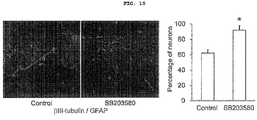
- Non-patent documents 3-5 relate to the use of p38 inhibitors in in vitro methods for promoting neuronal cell differentiation in neuronal stem cells and/or converting gliogenic neuronal stem cells to neurogenic stem cells.
- An object of the present study is to elucidate the molecular mechanism involved in the competence change of NSCs and provide a technique for improving the differentiation efficiency of neural stem cells into neurons.
- micro RNA-17 (miR-17)/106-p38 pathway is an effector of transition of neural stem cells from a neurogenic type to a gliogenic type.
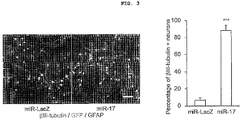
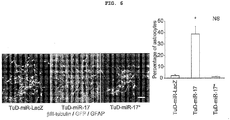
- Overexpression of miR-17 inhibited acquisition of gliogenic competence, and restored the neuropotency of neural stem cells without accompanying changes in the epigenetic status of glial marker gene promoter, in NSCs in which developmental stage has progressed up to the period when NSCs are generally differentiated into gliogenic NSCs.
- the direct target of miR-17/106 is p38. Restoration of neuropotency by p38 inhibition was achieved in mouse and human NSCs. They have conducted further studies based on these findings and completed the present invention.
- the present invention relates to the following.
- differentiation of a neural stem cell into a neuron can be promoted by a new mechanism of p38 suppression. This results from the restoration of neurogenic competence in gliogenic neural stem cells, and neuronal differentiation can be induced exclusively.
- the present invention provides a p38 inhibitor selected from miR-17, miR-106a and miR-106b for use in a method of treating or preventing a disorder selected from cerebral infarction, traumatic brain injury, cerebral ischemia, Huntington's disease and Alzheimer's disease, as well as an agent comprising this p38 inhibitor and a pharmaceutically acceptable carrier for the same use.
- a p38 inhibitor means a substance that suppresses expression or function of p38.
- Mapk14 mitogen-activated protein kinase 14
- Mapk14 mitogen-activated protein kinase 14
- p38 generally means one derived from a mammal.
- the mammal include rodents such as mouse, rat, and guinea pigs, experiment animals such as rabbits, domestic animals such as swine, bovine, goat, horse, and mink, pets such as dogs and cats, primates such as human, monkey, Macaca fascicularis, Macaca mulatta, marmoset, orangutans and chimpanzees.
- p38 is preferably derived from primates (e.g. humans) or rodents (e.g. mice).
- factors such as polypeptide, polynucleotide "derived from organism X” means that the polypeptide or polynucleotide has an amino acid sequence or polynucleotide sequence the same as or substantially the same as that of the polypeptide or polynucleotide naturally expressed in the organism X. Being “substantially the same” means that the interested amino acid sequence or nucleic acid sequence has 70% or more (preferably 80% or more, more preferably 90% or more, further preferably 95% or more, most preferably 99% or more) identity with the amino acid sequence or nucleic acid sequence of a factor naturally expressed in organism X, and maintains the activity of the protein.
- the amino acid sequence and nucleotide sequence of p38 The amino acid sequence and nucleotide sequence of p38
- amino acid sequence and nucleotide sequence of p38 are known.
- the representative amino acid sequences of human p38 and mousep 38 and the polynucleotide sequences (cDNA or mRNA sequence) encoding same are as described below.
- accession numbers of GENBANK provided by NCBI are shown.
- nucleotide sequences are described as DNA sequences unless otherwise specified; however, when the polynucleotide is an RNA, thymine (T) should read as uracil (U) as appropriate.
- Examples of the function of p38 include phosphorylation of serine or treonine in a substrate protein such as ATF2, MEF2C, MAX, CDC25B, and p53.
- Examples of the p38 inhibitor include a nucleic acid which hybridizes, under physiological conditions, to a DNA or mRNA encoding p38, thereby inhibiting the transcription and/or translation thereof, an expression vector of the nucleic acid, or a low-molecular-weight compound.
- nucleic acid which hybridizes, under physiological conditions, to a DNA or mRNA encoding p38, thereby inhibiting the transcription and/or translation thereof is micro RNA(miRNA) targeting p38, with siRNA a precursor to micro RNA, an antisense nucleic acid also being disclosed herein.
- siRNA targeting p38 examples include
- nucleotide sequence of mRNA encoding p38 examples include the nucleotide sequence shown by SEQ ID NO: 1 (human p38), and the nucleotide sequence shown by SEQ ID NO: 3 (mouse p38) .
- RNA interference a phenomenon in which transferring siRNA of a short double-stranded RNA and the like into a cell results in the degradation of mRNAs that are complementary to the RNA, has long been known to occur in nematodes, insects, plants and the like; recently, this phenomenon was confirmed as occurring also in animal cells [ Nature, 411(6836): 494-498 (2001 )], and this is attracting attention as a ribozyme-substitute technique.
- a representative siRNA is a double-stranded oligo-RNA consisting of an RNA having a sequence complementary to the nucleotide sequence of the mRNA of the target gene or a partial sequence thereof (hereinafter, target nucleotide sequence) and a complementary strand for the RNA.
- target nucleotide sequence a sequence complementary to the nucleotide sequence of the mRNA of the target gene or a partial sequence thereof (hereinafter, target nucleotide sequence) and a complementary strand for the RNA.
- the length of the portion complementary to the target nucleotide sequence, contained in the siRNA is normally about 18 bases or more, preferably 19 bases or more, more preferably about 21 bases or more, and is not particularly limited as long as the expression of the target gene can be specifically suppressed.
- the siRNA is longer than 23 bases, the siRNA undergoes degradation in cells to produce an siRNA of about 20 bases long; therefore, theoretically, the upper limit of the portion complementary to the target nucleotide sequence is the full length of the nucleotide sequence of an mRNA (mature mRNA or primary transcript) of the target gene.
- the length of the complementary portion is, for example, about 50 bases or less, preferably about 25 bases or less, most preferably about 23 bases or less.
- the length of the complementary portion is, for example, normally, about 18-50 bases, preferably about 19 to about 25 bases, more preferably about 21 to about 23 bases.
- each RNA chain constituting siRNA is also disclosed herein generally about 18 bases or more, preferably 19 bases or more, more preferably about 21 bases or more, and is not particularly limited as long as the expression of the target gene can be specifically suppressed.
- the length of each RNA chain does not have an upper limit.
- the length of the siRNA is, for example, about 50 bases or less, preferably about 25 bases or less, most preferably about 23 bases or less.
- the length of each siRNA is, for example, about 18 to 50 bases, preferably about 19 to about 25 bases, more preferably about 21 to about 23 bases.
- the length of the shRNA is expressed as the length of the double-stranded moiety when the shRNA provides a double-stranded structure.
- the target nucleotide sequence and the sequence complementary thereto contained in the siRNA also disclosed herein be completely complementary to each other.
- the mutation can be fall in the range of identity of at least 90% or more, preferably 95% or more
- the cleavage activity by RNA interference is not completely lost, but a partial activity can remain.
- a base mutation in the center of the siRNA has a major influence to the extent that can extremely reduce the mRNA cleavage activity by RNA interference.
- the siRNA also disclosed herein may have an additional base that does not form a base pair at the 5'- and/or 3'-end.
- the length of the additional base is not particularly limited as long as siRNA can specifically suppress the expression of the target gene, and is normally 5 bases or less, for example, 2 to 4 bases.
- the additional base may be a DNA or an RNA, use of a DNA makes it possible to improve the stability of the siRNA. Examples of the sequences of such additional bases include, but are not limited to, the sequences ug-3', uu-3', tg-3', tt-3', ggg-3', guuu-3', gttt-3', tttt-3', and uuuuu-3'.
- the length of the loop portion of the hairpin loop of the shRNA also disclosed herein is not particularly limited, as long as the expression of the target gene can be specifically suppressed, and the length is normally about 5 to 25 bases.
- the nucleotide sequence of the loop portion is not particularly limited as long as a loop can be formed, and shRNA can specifically suppress the expression of the target gene.
- miRNA targeting p38 examples include miRNA containing, as a seed sequence, a nucleotide sequence complementary to a partial sequence (7 bases length) of the nucleotide sequence of mRNA encoding p38 (mature mRNA or primary transcript), and inhibiting transcription and/or translation of p38 can be mentioned.
- miRNA representatively means what is called mature miRNA.
- the mature miRNA is an endogenous non-coding RNA having 20 - 25 bases, which is encoded on the genome. It is known that miRNA is transcribed as a primary transcript having a length of about several hundred - several thousand bases (Primary miRNA, hereinafter to be referred to as "Pri-miRNA”) from the miRNA gene on the genomic DNA, then processed to be a pre-miRNA (precursor miRNA) having a hairpin structure of about 60 - 70 bases, after which moves from the nucleus into the cytoplasm, further processed to be a double stranded mature miRNA of about 20 - 25 bases, a single strand of the double stranded mature miRNA forms a complex with a protein called RISC, and acts on the mRNA of the target gene to inhibit translation of the target gene.
- RISC protein
- miRNA is used as a concept encompassing not only endogenous miRNA but also a synthetic nucleic acid consisting of the same nucleotide sequence as the endogenous miRNA.
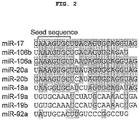
- the seed sequence means the nucleotide sequence of the 5'-terminal 2nd - 8th residues of the mature miRNA, and the seed sequence is known to determine the mRNA to be the target of miRNA.
- miRNA targeting p38 can be obtained by searching, based on the nucleotide sequence of mRNA encoding p38 (for example, nucleotide sequence shown by SEQ ID NO: 1 or 3), for a miRNA having a seed sequence completely complementary to a partial sequence of the mRNA sequence (preferably, partial sequence of nucleotide sequence of 3'UTR of said mRNA), introducing the searched miRNA into the cell of p38 expressing cells, and selecting miRNA that suppressed expression of p38.
- the search of miRNA based on such target sequence can be performed based on target prediction programs such as TargetScan, PicTar, and miRanda.
- the miRNA targeting p38 is miR-17, miR-106a, and miR-106b.
- miR-17, miR-106a and miR-106b also include isomers of these miRNAs.
- the representative nucleotide sequences of miR-17, miR-106a and miR-106b are shown by SEQ ID NOs: 5, 6 and 7, respectively.
- nucleic acid containing a nucleotide sequence having 85% or more, preferably 90% or more, more preferably 95% or more, identity with the nucleotide sequence shown by SEQ ID NO: 5, 6 or 7, and hybridizing, under physiological conditions, to an mRNA encoding p38, thereby inhibiting the transcription and/or translation thereof, is also encompassed in miRNA targeting p38.
- the “identity” means a ratio (%) of identical nucleotide residues to all overlapping nucleotide residues in the optimal alignment where two nucleotide sequences are aligned using a mathematical algorithm known in the technical field (preferably, the algorithm considers introduction of gaps on one or both of the sequences for the best alignment).
- NCBI BLAST-2 National Center for Biotechnology Information Basic Local Alignment Search Tool
- the nucleotide sequence having 85% or more identity with the nucleotide sequence shown by SEQ ID NO: 5, 6 or 7 is a nucleotide sequence which is the nucleotide sequence shown by SEQ ID NO: 5, 6 or 7 wherein 1 to 3 nucleotides are deleted, substituted, inserted or added, for example, (1) a nucleotide sequence which is the nucleotide sequence shown by SEQ ID NO: 5, 6 or 7 wherein 1 - 3 (preferably 1 or 2) nucleotides are deleted, (2) a nucleotide sequence which is the nucleotide sequence shown by SEQ ID NO: 5, 6 or 7 wherein 1 - 3 (preferably 1 or 2) nucleotides are added, (3) a nucleotide sequence which is the nucleotide sequence shown by SEQ ID NO: 5, 6 or 7 wherein 1 - 3 (preferably 1 or 2) nucleotides are inserted, (4) a nucleotide sequence which is the nucleotide sequence shown by SEQ ID
- a seed sequence common to miR-17, miR-106a and miR-106b is preferably maintained.
- the precursor of miRNA means a nucleic acid that can produce mature miRNA in a cell as a result of intracellular processing or cleavage of double stranded nucleic acid.
- pri-miRNA and pre-miRNA can be mentioned.
- the pri-miRNA is a primary transcript (single strand RNA) of miRNA gene, and generally has a length of about several hundred - several thousand bases.
- pre-miRNA is a single strand RNA having a hairpin structure, which results from intracellular processing of pri-miRNA, and generally has a length of 90 - 110 base.
- pri-miRNA or pre-miRNA of miRNA for example, the nucleotide sequence thereof is disclosed in miRBase database: http://micro RNA.sanger.ac.uk/ produced by Sanger Institute and the like.
- the miRNA used in the present invention encompasses a nucleic acid at least partly containing RNA, which suppresses transcription and/or translation of p38 by RNA interference.
- Such nucleic acid is RNA, chimera nucleic acid of RNA and DNA (hereinafter to be referred to as chimera nucleic acid) or hybrid nucleic acid.
- chimera nucleic acid refers to single strand or double strand nucleic acid containing RNA and DNA in a single nucleic acid
- hybrid nucleic acid refers to double strand nucleic acid wherein one of the chains is RNA or chimera nucleic acid and the other chain is DNA or chimera nucleic acid.
- the miRNA used in the present invention are single strand or double strand.
- the embodiments of double strand include double strand RNA, double strand chimera nucleic acid, RNA/DNA hybrid, RNA/chimera nucleic acid hybrid, chimera nucleic acid/chimera nucleic acid hybrid and chimera nucleic acid/DNA hybrid.
- the nucleic acid of the present invention is preferably single strand RNA, single strand chimera nucleic acid, double strand RNA, double strand chimera nucleic acid, RNA/DNA hybrid, RNA/chimera nucleic acid hybrid, chimera nucleic acid/chimera nucleic acid hybrid or chimera nucleic acid/DNA hybrid, more preferably single strand RNA, single strand chimera nucleic acid, double strand RNA, double strand chimera nucleic acid, RNA/DNA hybrid, chimera nucleic acid/chimera nucleic acid hybrid, RNA/chimera nucleic acid hybrid or an artificial nucleic acid constituted to include a molecule equivalent to natural nucleic acid.
- the "antisense nucleic acid” refers to a nucleic acid comprising a nucleotide sequence capable of specifically-hybridizing with a target mRNA (mature mRNA or primary transcript) under physiological conditions for the cells that express the target mRNA, and capable of inhibiting the translation of the polypeptide encoded by the target mRNA in the hybridized state.
- the antisense nucleic acid may be a DNA or an RNA, and may be a DNA/RNA chimera, preferable DNA.
- antisense nucleic acid capable of specifically suppressing the expression of p38 examples include
- the length of the portion that hybridizes with the target mRNA in the antisense nucleic acid is not particularly limited as long as the expression of p38 is specifically suppressed. Generally, the length is about 12 bases or more, and as long as the full-length sequence of the mRNA (mature mRNA or primary transcript) for the longest. In view of hybridization specificity, the length is, for example, preferably about 15 bases or more, more preferably about 18 bases or more. In view of the ease of synthesis, antigenicity problems and the like, the length of the portion that hybridizes with the target mRNA is normally about 200 bases or less, preferably about 50 bases or less, more preferably about 30 bases or less. Hence, the length of the portion that hybridizes with the target mRNA is, for example, about 12 to about 200 bases, preferably about 15 to about 50 bases, more preferably about 18 to about 30 bases.
- the target nucleotide sequence for the antisense nucleic acid is not particularly limited, as long as the expression of p38 can be specifically suppressed.
- the sequence may be the full-length sequence of an mRNA (mature mRNA or primary transcript) of p38 or a partial sequence thereof (e.g., about 12 bases or more, preferably about 15 bases or more, more preferably about 18 bases or more), or an intron portion of the primary transcript.
- the nucleotide sequence of the portion that hybridizes with the target mRNA in the antisense nucleic acid varies depending on the base composition of the target sequence, and has an identity of normally about 90% or more (preferably 95% or more, most preferably 100%) to the complementary sequence for the target sequence, so as to be capable of hybridizing with the p38 mRNA under physiological conditions.
- the size of the antisense nucleic acid is normally about 12 bases or more, preferably about 15 bases or more, more preferably about 18 bases or more. In view of the ease of synthesis, and antigenicity problems, the size is normally about 200 bases or less, preferably about 50 bases or less, more preferably about 30 bases or less.
- the antisense nucleic acid may be one not only capable of hybridizing with the p38 mRNA or primary transcript thereof to inhibit the translation, but also capable of binding to the p38 gene, which is a double-stranded DNA, to form a triple strand (triplex) and inhibit the transcription into p38.
- the miRNA and an antisense nucleic acid used in the present invention may be modified to be a modified form resistant to the aforementioned nuclease.
- modified sugar chain moiety e.g., 2'-O-methylation
- modified base moiety e.
- siRNA and antisense nucleic acid targeting p38 can be prepared by determining the target sequence based on the mRNA sequence (e.g., the nucleotide sequence shown by SEQ ID NO:1 or 3) or chromosomal DNA sequence of p38, and synthesizing a nucleotide sequence complementary thereto using a commercially available automated DNA/RNA synthesizer (Applied Biosystems, Beckman and the like).
- An siRNA can be prepared by separately synthesizing a sense strand and antisense strand using an automated DNA/RNA synthesizer, denaturing the strands in an appropriate annealing buffer solution at about 90 to about 95°C for about 1 minute, and then annealing at about 30 to about 70°C for about 1 to about 8 hours.
- a longer double-stranded polynucleotide can be prepared by synthesizing complementary oligonucleotide strands in a way such that they overlap with each other, annealing the strands, and then performing ligation with a ligase.
- the micro RNA targeting p38 can be obtained by searching, based on the mRNA sequence of p38 (for example, nucleotide sequence shown by SEQ ID NO: 1 or 3), for micro RNAs having a seed sequence complementary to a partial sequence of the mRNA sequence, preparing the searched micro RNAs by an automated DNA/RNA synthesizer (Applied Biosystems, Beckman and the like), introducing same into p38-expressing cells, and selecting a micro RNA actually suppressing the expression of p38.
- mRNA sequence of p38 for example, nucleotide sequence shown by SEQ ID NO: 1 or 3
- the agent for promoting neuronal differentiation of the present invention can also contain, as an active ingredient, an expression vector capable of expressing (encoding) a nucleic acid which hybridizes, under physiological conditions, to a DNA or mRNA encoding p38, thereby inhibiting the transcription and/or translation thereof.
- an expression vector capable of expressing (encoding) a nucleic acid which hybridizes, under physiological conditions, to a DNA or mRNA encoding p38, thereby inhibiting the transcription and/translation thereof, or a nucleic acid (preferably DNA) encoding same is operably linked to a promoter capable of exhibiting promoter activity in the cells (e.g., neural stem cell) of an mammal (preferably human or mouse) of application subject.
- the promoter used is not particularly limited as long as it is functional in cells of the mammal of application subject.
- pol I promoter, pol II promoter, pol III promoter and the like can be used.
- viral promoters such as the SV40-derived initial promoter and cytomegalovirus LTR, mammalian constitutive protein gene promoters such as the ⁇ -actin gene promoter, and RNA promoters such as the tRNA promoter, and the like are used.
- a pol III promoter be used as the promoter.
- the U6 promoter, H1 promoter, tRNA promoter and the like can be mentioned.
- the above-mentioned expression vector preferably comprises a transcription termination signal, i.e., a terminator region, downstream of the above-described polynucleotide or nucleic acid that encodes the same.
- a selection marker gene for selection of transformant cells a gene that confers resistance to a drug such as tetracycline, ampicillin, or kanamycin, a gene that compensates for an auxotrophic mutation and the like
- fluorescent protein genes GFP, RFP, YFP etc.
- suitable vectors for administration to mammals such as humans include plasmid vector; viral vectors such as retrovirus, adenovirus, adeno-associated virus and lentivirus.
- Adenovirus in particular, has advantages such as very high gene transfer efficiency and transferability to non-dividing cells as well.
- the gene expression is transient and normally persists only for about 4 weeks.
- low molecular p38 inhibitor examples include, but not particularly limited to, pyridinylimidazoles, substituted pyrazoles, substituted pyridyls, quinazoline derivatives, aryl ureas, heteroaryl analogues, substituted imidazole compounds and substituted triazole compounds.
- the compounds proposed for p38 inhibition include pyridinylimidazoles. See Young P.R. et al. (1997) J. Biol. Chem. 272, pages 12116-12121 ; and Bender, P.E. (1985) J. Med. Chem. 28, pages 1169-1177 .
- Examples of the pyridinylimidazoles capable of inhibiting p38 include 6-(4'-fluorophenyl)-5-(4'-pyridyl)-2,3-dihydroimidazo(2,1-b)-thiazole and a metabolite thereof (sulfoxide, sulfone), analogue thereof, fragment thereof and mimic thereof.
- Particular 1,5-diaryl substituted pyrazole compounds are also proposed as a p38 inhibitor.
- Such substituted pyrazole compounds are disclosed in US-B-6,509,361 .
- Further pyrazole derivatives inhibiting p38 are disclosed in US-B-6,335,336 .
- Examples of other p38 inhibitors include substituted pyridyls such as those disclosed in US-B-2003/0139462 .
- p38 inhibitor are those disclosed in US-B-6,610,688 .
- a quinazoline derivative can also function as a p38 inhibitor.
- Examples of the quinazoline derivative as the p38 inhibitor are disclosed in US-B-6,541,477 , 6,184,226 , 6,509,363 and 6,635,644 .
- Aryl ureas and heteroaryl analogues can also function as p38 inhibitors.
- Examples of the aryl ureas and heteroaryl analogues as the p38 inhibitors are disclosed in US-B-6,344,476 .
- WO 99/32110 describes hetero ring-ureas as the p38 inhibitor.
- WO 99/32463 describes urea compounds inhibiting p38 kinase.
- WO 98/52558 describes urea compounds for p38 kinase inhibition.
- WO 99/00357 describes a method for using urea compounds as a p38 kinase inhibitor.
- WO 99/58502 describes urea compounds as a p38 kinase inhibitor.
- a substituted imidazole compound and a substituted triazole compound can also function as p38 inhibitors. Such compounds are respectively disclosed in US-B-6,560,871 and 6,599,910 .
- Examples of further p38 inhibitor include RWJ-67657 (RW Johnson Pharmaceutical Research Institute); RDP-58 (Sangstat Medical); RDP-58; Scios-469 (Scios); MKK3/MKK6 inhibitor (Signal Research Division); SB-210313 analogue, SB-220025, SB-238039, HEP-689, SB-203580, SB-239063, SB-239065, SB-242235 (SmithKline Beecham Pharmaceuticals); VX-702 and VX-745 (Vertex Pharmaceuticals); AMG-548 (Amgen); Astex p38 kinase inhibitor (Bayer); BIRB-796 (Boehringer Ingelheim Pharmaceuticals); Celltech p38 MAP kinase inhibitor (CeltechGroup plc.); FR-167653 (Fujisawa Pharmaceutical); 681323 and SB-281832 (GlaxoSmithKline plc); MAP kinase inhibitor of LEO Pharmaceuticals (LEO Pharma A/S); Merck&Co.
- p38 MAP kinase inhibitor (Merck research Laboratories); SC-040 and SC-XX906 (Monsanto); Novartis adenosine A3 antagonists (Novartis AG); p38 MAP kinase inhibitor (NovartisPharma AG); CP-64131 (Pfizer); CNI-1493 (Picower Institute for Medical Research); RPR-200765A (Phone-Poulenc Rorer); and Roche p38 MAP kinase inhibitor and Ro-320-1195 (Roche Bioscience).
- a low molecular p38 inhibitor is SB203580.
- the agent for promoting neuronal differentiation of the present invention can contain, in addition to a p38 inhibitor, any carrier, for example, a pharmaceutically acceptable carrier.
- the pharmaceutically acceptable carrier examples include excipients such as sucrose, starch, mannit, sorbit, lactose, glucose, cellulose, talc, calcium phosphate, calcium carbonate; binders such as cellulose, methylcellulose, hydroxypropylcellulose, polypropylpyrrolidone, gelatin, gum arabic, polyethylene glycol, sucrose, starch; disintegrants such as starch, carboxymethylcellulose, hydroxypropylstarch, sodium-glycol-starch, sodium hydrogen carbonate, calcium phosphate, calcium citrate; lubricants such as magnesium stearate, Aerosil, talc, sodium lauryl sulfate; aromatics such as citric acid, menthol, glycyrrhizin ⁇ ammonium salt, glycine, orange powder; preservatives such as sodium benzoate, sodium bisulfite, methylparaben, propylparaben; stabilizers such as citric acid, sodium citrate, acetic acid
- the agent for promoting neuronal differentiation of the present invention can further contain a reagent for nucleic acid introduction, to promote introduction of the nucleic acid into cells.
- a cationic lipid such as lipofectin, lipofectamine, lipofectamine RNAiMAX, Invivofectamine, DOGS (Transfectam), DOPE, DOTAP, DDAB, DHDEAB, HDEAB, polybrene, poly(ethyleneimine) (PEI) can be used.
- retrovirus is used as an expression vector, RetroNectin, fibronectin, polybrene can be used as a reagent for introduction.
- Examples of the dosage unit form of the agent of the present invention include liquid, tablet, pill, drinking liquid, powder, suspension, emulsion, granules, extract, fine granules, syrup, infusion, decoction, eye drop, troche, poultice, liniment, lotion, ophthalmic ointment, plaster, capsule, suppository, enema, injection (liquid, suspension and the like), adhesive preparation, ointment, jelly, paste, inhalant, cream, spray, nasal drop, and aerosol.
- the content of the p38 inhibitor in the pharmaceutical composition is not particularly limited and is appropriately determined in a wide range. For example, it is 0.01 to 100 wt% of the whole pharmaceutical composition.
- the agent of the present invention can be used for promoting neuronal differentiation of neural stem cells.
- the neural stem cell refers to a cell having an ability to differentiate into any type of cell constituting the central nervous system (neural multipotency), including neuron, astrocyte and oligodendrocyte, and having self replication potency.
- Neural stem cells generated from pluripotent stem cells such as fertilized eggs, embryonic stem cells, induced pluripotent stem cells and the like temporally changes their responsiveness to extrinsic differentiation-inducing stimulation while maintaining the multipotency.
- the neurogenic competence to differentiate into neurons in response to neurogenic signals is dominant, and the gliogenic competence to differentiate into astrocytes in response to gliogenic signals is recessive.
- the neurogenic competence disappears, the gliogenic competence are acquired, and the cells transit into late neural stem cells wherein neurogenic competence is recessive and gliogenic competence is dominant.
- the present invention has been made based on the findings that p38 is involved in the transition of neural stem cells where neurogenic competence is dominant than gliogenic competence (neurogenic neural stem cell) into neural stem cells where gliogenic competence is dominant than neurogenic competence (gliogenic neural stem cell), specifically that p38 is involved in the acquisition of gliogenic competence of the neural stem cells, and expression of p38 is suppressed by micro RNA such as miR-17 in the early neural stem cells.
- promotion of neuronal differentiation of neural stem cells means to increase neurogenic competence and decrease gliogenic competence of neural stem cells, or as a result of which enhance differentiation of neural stem cell into neuron.
- the neural stem cells used in the present invention are gliogenic.
- a p38 inhibitor is applied to the gliogenic neural stem cells, neurogenic competence increases and gliogenic competence is suppressed.
- conversion of gliogenic neural stem cells to neurogenic neural stem cells occurs.
- the neural stem cells used in the present invention are neurogenic.
- both a decrease in the neurogenic competence and acquisition of gliogenic competence are suppressed, and the neurogenic stage is maintained. In the present invention, both of these embodiments are encompassed in the promotion of neuronal differentiation of neural stem cells.
- Whether the neural stem cells are neurogenic or gliogenic can be evaluated by culturing the evaluation target neural stem cells in the presence of glial differentiation inducing factors, LIF and BMP2, according to the method described in Nat. Neurosci. 11, 1014-1023 (2008 ), and examining which of the neurons and astrocytes are generated in a greater number. When the number of the astrocytes is higher than that of the neurons as a result of the culture, the neural stem cells are judged to be gliogenic; otherwise, the neural stem cells can be judged to be neurogenic.
- glial differentiation inducing factors LIF and BMP2
- the neural stem cells may be present in vivo or in vitro. Therefore, the agent for promoting neuronal differentiation of the present invention can be used as an in vivo medicament or a reagent for experiment in vitro.
- a p38 inhibitor (or the agent for promoting neuronal differentiation of the present invention) is administered to an individual mammal such that it is delivered to the neural stem cells in the neural tissues in the body, whereby neuronal differentiation of neural stem cells can be promoted in vivo.
- the disease to be treated is a disorder selected from cerebral infarction, traumatic brain injury, cerebral ischemia, Huntington's disease, and Alzheimer's disease. like.
- the agent for promoting neuronal differentiation of the present invention is administered according to a method suitable for each form.
- the agent in the case of an external preparation, the agent is sprayed, adhered or applied directly onto the required site such as skin or mucosa; in the case of tablet, pill, drinking liquid, suspension, emulsion, granule or capsule, the agent is administered orally; in the case of injection, the agent is administered intravenously, intracerebrally, intramuscularly, intradermally, subcutaneously, intraarticularly or intraperitoneally; and in the case of suppository, the agent is administered intrarectally.
- the dose of the agent of the present invention varies depending on the activity and choice of the active ingredient, administration manner (e.g., oral, parenteral), recipient animal species, the recipient's drug receptivity, body weight, age, and the like, and cannot be generalized, the dose is normally about 0.001 mg to about 2.0 g, based on the amount of active ingredient, per day for an adult.
- the neuronal differentiation of the neural stem cells can be promoted by cultivating the neural stem cells in the presence of a p38 inhibitor (or the agent for promoting neuronal differentiation of the present invention).
- the present invention also provides an in vitro method of promoting neuronal differentiation of neural stem cells.
- the neural stem cells in a culture state may be obtained by isolating neural stem cells in the living body and culturing same, they may also be prepared by differentiating pluripotent stem cells such as embryonic stem cells (ES cell), induced pluripotent stem cells (iPS cell) and the like into the neural stem cells.
- pluripotent stem cells such as embryonic stem cells (ES cell), induced pluripotent stem cells (iPS cell) and the like into the neural stem cells.
- ES cell embryonic stem cells
- iPS cell induced pluripotent stem cells
- embryoid body EB
- EB embryoid body
- ES cells or iPS cells in the presence of, for example, retinoic acid or Noggin protein.
- retinoic acid it may be added to a medium at a low concentration level (10 -9 M - 10 -6 M).
- Noggin protein a culture supernatant obtain by introducing Xenopus Noggin into mammalian cultured cells, and allowing for transient expression of the Noggin protein may be directly (1 - 50%(v/v)) used, or a recombinant Noggin protein (final concentration about 1 ⁇ g/ml) may also be used.
- the thus-obtained EB is dissociated and subjected to suspension culture in a serum-free medium added with FGF-2 (generally 10 - 100 ng/ml), whereby neural stem cells can be obtained in the form of neurosphere.
- a serum-free medium is not particularly limited as long as it is a serum-free medium generally used for culturing neural stem cells or neurons, examples thereof include a DMEM medium added with, besides the above-mentioned components, glucose, glutamine, insulin, transferrin, progesterone, putrescine, selenium chloride, and heparin.
- the medium to be used for neurosphere formation may be added with a sonic hedgehog protein (generally, 1 - 20 nM).
- the culture is preferably performed under 5% CO 2 conditions at 35 - 40°C for about 7 - 9 days.
- a neurosphere directly derived from EB is referred to as a primary neurosphere, and a neurosphere reformed by separating and dispersing the primary neurosphere and cultivating same under the same conditions is referred to as a secondary neurosphere.
- a neurosphere passaged even only once under culture conditions is referred to as a secondary neurosphere.
- neural stem cells contained in the primary neurosphere are neurogenic.
- Neural stem cells contained in the secondary neurosphere generally have lower neurogenic competence and higher gliogenic competence as compared to the neural stem cells contained in the primary neurosphere.
- neural stem cells contained in the secondary neurosphere are gliogenic.
- the neuronal differentiation conditions are not particularly limited, for example, culture in a medium free of mitogen such as FGF-2 can be mentioned.
- conventional media applicable for culturing neural stem cells and neurons can be used as long as mitogen is not contained.
- examples thereof include DMEM:F12 medium containing glucose, glutamine, insulin, transferrin, progesterone, putrescine, and selenium chloride.
- Sonic hedgehog protein may be present or absent.
- Examples of other neuronal differentiation conditions include those described in Nat Biotechnol. 21, 183-186 (2003 ) and those of ordinary skill in the art can easily construct various neuronal differentiation conditions.
- a differentiation culture into neuron is preferably performed under 5% CO 2 conditions at 35 - 40°C for 5 - 7 days.
- the p38 inhibitor acts on neurogenic neural stem cells contained therein, and both a decrease in the neurogenic competence and acquisition of the gliogenic competence are suppressed and the neurogenic stage of the neural stem cells is maintained. As a result, differentiation of neural stem cells into neurons is promoted.
- the p38 inhibitor acts on neural stem cells having the gliogenic competence (preferably gliogenic neural stem cells) contained therein to increase the neurogenic competence and suppress the gliogenic competence. As a result, restoration of differentiation potency is occurred into a neurogenic neural stem cell and differentiation of neural stem cells into neurons is promoted.
- Mouse ESC (EB3) culture, EB formation, neurosphere formation and differentiation of neurosphere were performed as previously described ( Nat. Neurosci. 11, 1014-1023 (2008 )).
- Human NSCs were grown as previously described ( J. Neurosci. Res. 69, 869-879 (2002 ); J. Neurosci. Res. 87, 307-317 (2009 )) without epithelial growth factor (EGF), and allowed to differentiate on a substrate-coated coverslips in the absence of mitogen for 14 days, a procedure similar to that used for mouse neurosphere.
- EGF epithelial growth factor
- Lentivirus particles were produced by the transient transfection of 293T human embryonic kidney cells with a lentiviral expression construct for the gene of interest, along with two lentivirus constructs required for viral replication (pCMV-VSV-G-RSV-Rev and pCAG-HIVgp). The transfection was performed using GeneJuice (Novagen) according to the manufacturer's instructions. The virus particles were collected by ultracentrifugation and then resuspended in phosphate-buffered saline. High-titer viral suspensions were used to obtain an efficient infection of NSCs with a multiplicity of infection of about 5.
- Immunocytechemistry and immunohistochemistry were performed as previously described ( Nat. Neurosci. 11, 1014-1023 (2008 )) using antibodies against ⁇ III-tubulin, NeuN (neural marker), glial fibrillary acidic protein (GFAP, astrocyte marker), and haemagglutinin (HA).
- Quantitative proteomics analyses using an iTRAQ method were performed for miR-LacZ-, and miR-17s-overexpressing p0 and p2 neurospheres, using AB SCIEX TripleTOF 5600 System (AB SCIEX) according to the manufacturer's instructions.
- the present inventors began this experiment by identifying candidate genes at the downstream of Coup-tfs.
- the direct DNA-binding sites of Coup-tfs were investigated using chromatin immunoprecipitation sequencing (ChIP-seq), and global gene and microRNA expression profiles were compared between control and Coup-tfs knockdown mouse neurospheres by microarray analysis ( Nat. Neurosci. 11, 1014-1023 (2008 )).
- candidate genes were acquired and lentiviral libraries were constructed for their overexpression and knockdown.
- the present inventors used the neurosphere culture system to functionally screen the candidate genes as previously described ( Nat. Neurosci. 11, 1014-1023 (2008 )).
- the miR-17-92 microRNA gene cluster was identified as a downstream effector of Coup-tfs.
- the miR-17-92 cluster was first identified as a cluster of oncogenic microRNAs, namely OncomiR-1, and was associated with the development of various organs ( Nature 435, 828-833 (2005 ); Cell 133, 217-222 (2008 ); Cell 132, 875-886 (2008 )). According to microarray analysis, the expression of this gene cluster was 3.58-fold higher in twice-passaged (p2) Coup-tfs knockdown neurospheres than in control neurospheres. Normally, the majority of cells in p2 neurospheres differentiate into astrocytes, with less than 20% becoming neurons. However, overexpression of the miR-17-92 cluster caused them to differentiate almost exclusively into neurons, with the elaboration of long ⁇ III-tubulin-positive processes ( Fig. 1 ).
- the miR-17-92 cluster encodes six distinct microRNAs (miR-17, 18a, 19a, 20a, 19b and 92a, with their star (*) strands). To determine which of the six microRNAs was responsible for the neuronal phenotype, the present inventors individually overexpressed each of them in NSCs. This was done by infecting NSCs with lentiviruses expressing microRNAs and green fluorescent protein (GFP). Of the six microRNAs, only miR-17 replicated the phenotype induced by the intact miR-17-92 cluster ( Fig. 1 ).
- nucleotide sequences of miR-17 and miR-20a are highly homologous and share the same 7-mer seed sequence (nucleotides 2-8, Fig. 2 ) that is required for binding to target mRNAs. Therefore, the target mRNAs of these two microRNAs are also speculated to have highly overlapping sequences ( Cancer Res. 68, 8191-8194 (2008 )). However, the overexpression of miR-20a did not yield a neuronal promoting action ( Fig. 1 ).
- MiR-17 has two additional paralogs with high homology and identical seed sequences, miR-106b and miR-106a, which are encoded by the miR-106b-25 and miR-106a-363 clusters, respectively ( Cancer Res. 68, 8191-8194 (2008 )). These paralogs were individually overexpressed in NSCs to examine whether either or both affected the neurogenesis-to-gliogenesis switch. Overexpression of both microRNAs led to a neuronal phenotype, although the effect of miR-106b was stronger than that of miR-106a ( Fig. 1 ). Thus, miR-17, miR-106a and miR-106b were collectively termed "miR-17s" in Examples of the description.
- LIF and BMP2 are well-known extrinsic glial differentiation inducing factors that promote gliogenesis only in late-developmental NSCs by activating the JAK-STAT pathway and BMP signaling, respectively ( Proc. Natl. Acad. Sci. U. S. A. 95, 3178-3181 (1998 ); Science 284, 479-482 (1999 ); Proc. Natl. Acad. Sci. U. S. A. 98, 5868-5873 (2001 )).
- LIF does not act as a gliogenic factor in early-developmental NSCs because the STAT3-binding site in the promoter of glial marker genes is epigenetically suppressed (epigenetically silenced) by DNA methylation ( Dev. Cell 1, 749-758 (2001 )).
- BMP signaling for its part, promotes neuronal rather than glial differentiation in early-developmental NSCs ( Proc. Natl. Acad. Sci. U. S. A. 98, 5868-5873 (2001 ); J. Neurosci. 18, 8853-8862 (1998 )).
- miR-17-overexpressing NSCs were exposed to LIF and BMP2 during differentiation.
- MiR-17-overexpressing neurospheres were strongly resistant to these cytokines and differentiated exclusively into neurons, even at the p2 stage ( Fig. 3 ).
- the present inventors next investigated the temporally-regulated DNA methylation status of the STAT3-binding site and its surrounding CpG sites in the Gfap promoter.
- Gfap is the most general gene marker for astrocytes.
- no significant changes in the extent of CpG methylation at the p2 neurosphere stage were observed following the overexpression of miR-17 ( Fig. 4 ).
- Coup-tfs are transiently upregulated in developing NSCs during mid-gestation. After this time, NSCs lose their plasticity and produce only late-born subtype neurons and glial cells. Because knockdown of Coup-tfs in ESC-derived neurospheres results in the maintenance of the early epigenetic status of the Gfap promoter ( Nat. Neurosci.
- the present inventors initially expected that the expression of the molecular entities (e.g., miR-17s) responsible for the changes in NSC competence would converge with changes in the epigenetic status of neuronal or glial differentiation-associated genes.
- miR-17s function at another stage in Coup-tfs-regulated competency transition.
- the change in the epigenetic status of cell-type specific genes may therefore be only one necessary prerequisite for the control of cytogenesis.
- RNA decoys namely "tough decoy (TuD)" RNA, which strongly and stably suppresses specific target microRNAs ( Nucleic Acids Res 37, e43 (2009 )).
- Lentivirus vectors were constructed that expressed miR-17-specific TuD, miR-17*-specific TuD (TuD-miR-17 and TuD-miR-17*, respectively), or control TuD-miR-LacZ.
- the present inventors investigated their expression patterns in the developing CNS. According to the microarray data, expression levels of miR-17 and miR-106b were 0.18- and 0.28-fold lower in p2 neurospheres than in p0 neurospheres. As expected from these data, the in vivo expression patterns of miR-17 and miR-106b were similar at embryonic Day 11.5 (E11.5) and postnatal Day 0 (P0), although a stronger signal was observed for the former at E11.5. The levels of both microRNAs declined as development progressed ( Fig. 7 ).
- a microRNA regulates the degradation and/or translation of multiple target mRNAs ( Biogerontology 11, 501-506 (2010 )).
- the present inventors tried to identify the target mRNAs of miR-17s.
- the present inventors first carried out a proteomics analysis using the iTRAQ (isobaric tags for relative and absolute quantitation) method to identify proteins downregulated by the overexpression of miR-17 in p2 neurospheres (17).
- iTRAQ isobaric tags for relative and absolute quantitation
- neurospheres at the p2 stage showed higher neuropotency than controls following exposure to a specific p38 inhibitor (SB203580) ( Fig. 9 ), as did p2 neurospheres following knockdown of p38 using a p38-specific shRNA ( Fig. 10 ).
- SB203580 specific p38 inhibitor
- Fig. 10 p38 protein expression increased during the passage of neurospheres (3.16-fold higher at p2 than at p0). In the Western blotting, the expression is 2.78-fold higher at p2 than at p0 ( Fig. 18 ).
- a reporter assay using the miR-17s-binding site in the 3'untranslated region (UTR) of p38 mRNA revealed a direct interaction between p38 mRNA and miR-17 ( Fig. 17 ).
- the overexpression of miR-17s-resistant p38 mRNA which lacks the entire 3'UTR, not only reversed the neuronal phenotype induced by miR-17 overexpression to a glial phenotype ( Fig. 11 ) but also induced precocious gliogenesis from p0 neurospheres ( Fig. 12 ).
- the present inventors asked whether the overexpression of miR-17s could restore neuropotency in stage-progressed NSCs. To address this, the present inventors overexpressed miR-17 in neurospheres via lentiviral infection at the onset of the p3 stage, when neurospheres normally differentiate exclusively into glial cells. Previous work of the present inventors showed that knockdown of Coup-tfs resulted in the recovery of neuropotency only in limited populations of p3 NSCs, which had apparently not yet lost their plasticity ( Nat. Neurosci. 11, 1014-1023 (2008 )).
- NSPCs neural stem/progenitor cells
- p38 knockdown experiments using a lentivirus expressing p38-specific shRNA revealed a decrease in the numbers of VZ and SVZ cells expressing acyl-CoA synthase bubblegum family 1 (Acsbg1) at E17.5 ( Fig. 20 ).
- Acsbg1 is a gray matter astrocyte marker that is useful for the detection of GFAP-positive mature astrocytes and GFAP-negative immature astrocytes in the cerebral cortex ( J Neurosci 28, 264-278 (2008 )).
- the miR-17/106-p38 axis is a major regulator of the neurogenic-to-gliogenic transition in developing neural stem/progenitor cells, and that manipulation of this axis permits bidirectional control of the multipotency of neural stem/progenitor cells.
- differentiation of neural stem cells into neurons can be promoted by new mechanism of p38 suppression. This is based on the restoration of the neurogenic competence in gliogenic neural stem cells, and neuronal differentiation can be exclusively induced.
Landscapes
- Health & Medical Sciences (AREA)
- Life Sciences & Earth Sciences (AREA)
- Engineering & Computer Science (AREA)
- Chemical & Material Sciences (AREA)
- Biomedical Technology (AREA)
- General Health & Medical Sciences (AREA)
- Organic Chemistry (AREA)
- Bioinformatics & Cheminformatics (AREA)
- Genetics & Genomics (AREA)
- Zoology (AREA)
- Medicinal Chemistry (AREA)
- Animal Behavior & Ethology (AREA)
- Pharmacology & Pharmacy (AREA)
- Public Health (AREA)
- Veterinary Medicine (AREA)
- Wood Science & Technology (AREA)
- Biotechnology (AREA)
- Molecular Biology (AREA)
- Biochemistry (AREA)
- Neurology (AREA)
- Epidemiology (AREA)
- General Engineering & Computer Science (AREA)
- Neurosurgery (AREA)
- Cell Biology (AREA)
- Developmental Biology & Embryology (AREA)
- Microbiology (AREA)
- Virology (AREA)
- Nuclear Medicine, Radiotherapy & Molecular Imaging (AREA)
- General Chemical & Material Sciences (AREA)
- Chemical Kinetics & Catalysis (AREA)
- Plant Pathology (AREA)
- Biophysics (AREA)
- Physics & Mathematics (AREA)
- Immunology (AREA)
- Ophthalmology & Optometry (AREA)
- Psychiatry (AREA)
- Hospice & Palliative Care (AREA)
- Psychology (AREA)
- Pharmaceuticals Containing Other Organic And Inorganic Compounds (AREA)
- Medicines That Contain Protein Lipid Enzymes And Other Medicines (AREA)
Description
- The present invention relates to an agent for use in a method of promoting neuronal differentiation of neural stem cells.
- Central nervous system (CNS) injury and disease have gained new prominence in modern medicine. Recent progress in stem cell biology, typified by induced pluripotent stem cell (iPSC) technology, has drawn attention to stem cells as innovative resources for transplantation therapy and individualized drug screening. Multipotent neural stem cells (NSCs), which give rise to all types of neural cells within the CNS, are now readily obtained from iPSCs. However, the specific and efficient induction of homogeneous target cell populations from NSCs remains difficult due to the complex mechanisms regulating NSC development and differentiation. Therefore, further identification of the means by which specific cell types are generated from NSCs is urgently required to facilitate their therapeutic application.
- The present inventors have been using a recently-developed embryonic stem cell (ESC)-derived neurosphere culture system to investigate the molecular mechanisms governing NSC differentiation (non-patent document 1, patent document 1). Although NSCs possess the multipotency to differentiate into neurons and glial cells, neurogenesis largely precedes gliogenesis during CNS development in vertebrates. This neurogenesis-to-gliogenesis switch requires the temporal identity transition of NSCs (non-patent document 2). Importantly, the neurosphere culture system developed by the present inventors can recapitulate neural development in vivo, including this temporal regulation. Using this system, the present inventors previously discovered that Coup-tfI and II (Coup-tfs; also known as Nr2f1 and Nr2f2) act as critical molecular switches for the differentiation potential transition of NSCs (non-patent document 1, patent document 1).
-
Patent Document 2 relates to the treatment of traumatic brain injury and Alzheimer's disease using p38 inhibitors. - Patent Document 3 relates to the treatment of traumatic brain injury, cerebral ischemia, Huntingdon's disease and Alzheimer's disease using p38 inhibitors.
-
Patent Document 4 relates to the treatment of nerve system diseases such as cerebral infarction, traumatic brain injury, cerebral ischemia, Huntingdon's disease and Alzheimer's disease using p38 siRNA. - Patent Document 5 relates to the treatment of nerve system diseases such as, traumatic brain injury, brain ischemia, Huntingdon's disease and Alzheimer's disease using p38 inhibitors.
- Patent Document 6 relates to the treatment of CNS injury such as cerebral infarction, traumatic brain injury, cerebral ischemia, Huntingdon's disease and Alzheimer's disease using p38 inhibitors.
- Patent Document 7 relates to a method of reducing amyloid plaque burden using p38 inhibitors.
-
Patent Document 8 relates to the treatment of working memory impairment due to aging, Alzheimer's disease, amyotrophic sclerosis (ALS), Parkinson's disease, alcoholism, alcohol withdrawal, or Huntingdon's disease using p38 inhibitors. - Non-patent documents 3-5 relate to the use of p38 inhibitors in in vitro methods for promoting neuronal cell differentiation in neuronal stem cells and/or converting gliogenic neuronal stem cells to neurogenic stem cells.
-
- patent document 1:
WO2010/018652 - patent document 2:
WO05/039393 - patent document 3:
WO01/01986 - patent document 4:
WO2010/018652 - patent document 5:
WO00/17175 - patent document 6:
WO00/12497 - patent document 7:
WO2012/154814 - patent document 8:
US2012/245188 -
- non-patent document 1: Nat. Neurosci. 11, 1014-1023 (2008)
- non-patent document 2: Nat. Neurosci. 9, 743-751 (2006)
- non-patent document 3: J. Cell. Biochem. 2001, 83(4), 585
- non-patent document 4: J. Clin. Rehab Tissue Eng. Res. 2007, 11(37), 7329
- non-patent document 5: Neurosci. Res. 2003, 47(2), 209
- An object of the present study is to elucidate the molecular mechanism involved in the competence change of NSCs and provide a technique for improving the differentiation efficiency of neural stem cells into neurons.
- The present inventors have conducted intensive studies in an attempt to solve the aforementioned problems and identified that micro RNA-17 (miR-17)/106-p38 pathway is an effector of transition of neural stem cells from a neurogenic type to a gliogenic type. Overexpression of miR-17 inhibited acquisition of gliogenic competence, and restored the neuropotency of neural stem cells without accompanying changes in the epigenetic status of glial marker gene promoter, in NSCs in which developmental stage has progressed up to the period when NSCs are generally differentiated into gliogenic NSCs. They have further identified that the direct target of miR-17/106 is p38. Restoration of neuropotency by p38 inhibition was achieved in mouse and human NSCs. They have conducted further studies based on these findings and completed the present invention.
- Accordingly, the present invention relates to the following.
- [1] A p38 inhibitor selected from miR-17, miR-106a and miR-106b for use in a method of treating or preventing a disorder selected from cerebral infarction, traumatic brain injury, cerebral ischemia, Huntington's disease and Alzheimer's disease.
- [2] An agent comprising the p38 inhibitor according to 1 and a pharmaceutically acceptable carrier for use according to 1.
- [3] An in vitro method of promoting neuronal differentiation of neural stem cells, comprising cultivating neural stem cells in the presence of the p38 inhibitor as defined in 1.
- [4] The method according to 3, wherein the neural stem cells are gliogenic.
- [5] The method according to 3, wherein the neural stem cells are neurogenic.
- [6] An in vitro method of converting a gliogenic neural stem cell to a neurogenic neural stem cell, comprising cultivating gliogenic neural stem cells in the presence of the p38 inhibitor as defined in 1.
- According to the present invention, differentiation of a neural stem cell into a neuron can be promoted by a new mechanism of p38 suppression. This results from the restoration of neurogenic competence in gliogenic neural stem cells, and neuronal differentiation can be induced exclusively.
-
-
Fig. 1 shows representative immunocytochemical images of differentiated p2 neurospheres derived from NSCs infected with lentiviruses expressing microRNAs and GFP at the primary (p0) neurosphere stage. MiR-LacZ microRNA was used as a control. Neurospheres were immunostained with antibodies against βIII-tubulin, GFAP and GFP. Scale bar, 50 µm. The graph shows the percentage of βIII-tubulin-positive (βIII-tubulin +) neurons among virus-infected cells differentiated from p2 neurospheres (t test, n (≥ 100 cells) = 3, *P < 0.05 and ***P < 0.001). Bars and error bars represent the mean+s.e.m for each condition. -
Fig. 2 shows the sequence comparison of microRNAs encoded by the miR-17-92, miR-106b-25 and miR-106a-363 clusters. The nucleotides identical to the corresponding nucleotides in miR-17 are shaded. -
Fig. 3 shows immunocytochemical images of miR-17 overexpressing p2 neurospheres. MiR-17-overexpressing p2 neurospheres did not undergo gliogenesis in response to LIF (10 ng/ml) and BMP2 (100 ng/ml). The graph shows the percentage of βIII-tubulin-positive (βIII-tubulin +) neurons among virus-infected cells differentiated from p2 neurospheres (t test, n (≥ 100 cells) = 3, ***P < 0.001). Scale bar, 50 µm. Bars and error bars represent the mean+s.e.m for each condition. -
Fig. 4 shows the analysis results of the CpG methylation status of the Gfap promoter by bisulfite sequencing. The methylation frequency of 10 CpG sequences on the Gfap promoter, including the CpG site in the STAT3-binding sequence as indicated by the arrows, was examined. The graphs show the percentages of methylated CpG cytosines in the whole Gfap promoter (left graph) and the STAT3-binding region (right graph) (t test, n (≥ 10 clones) = 3, NS (not significant), P> 0.05). Bars and error bars represent the mean+s.e.m for each condition. -
Fig. 5 shows immunocytochemical images of the cells differentiated from Coup-tfs-knockdown, miR-17-suppressed p0 neurospheres. Overexpression of TuD-miR-17 (GFP-positive cells) cancelled the neuronal differentiation-promoting action in Coup-tfs knockdown p2 neurospheres and restored differentiation into astrocytes as assessed by reduction in βIIItubulin-positive nerve cells and increased GFP immunostaining. The graph shows the percentage of neurons (t test, n (≥ 100 cells) = 3, **, *P < 0.05). Scale bar, 50 µm. Bars and error bars represent the mean+s.e.m for each condition. -
Fig. 6 shows immunocytochemical images of the cells differentiated from TuD-miR-17 overexpressing p0 neurospheres in the presence of glial differentiation inducing factors. Overexpression of TuD-miR-17 caused precocious gliogenesis from p0 neurospheres in the presence of LIF and BMP2. The graph shows the percentage of astrocytes (t test, n (≥ 100 cells) = 3, *P < 0.05). Scale bar, 50 µm. Bars and error bars represent the mean+s.e.m for each condition. -
Fig. 7 shows the expression of miR-17 and miR-106b at E11.5 and P0 which was determined by in situ hybridization with specific locked nucleic acid (LNA) probes. Scale bar, 300 µm. -
Fig. 8 shows immunocytochemical images of cerebral cortex sections of a mouse injected into the cerebral ventricle with lentiviruses for the overexpression of miR-LacZ or miR-17. The lentiviruses for the overexpression of miR-LacZ or miR-17 were injected in utero into the cerebral ventricle of mouse embryos at E10.5, and the fates of the infected cells were examined in the cerebral cortex at P30 (t test, n (≥ 250 cells, ≥ three independent sections) = three independent embryos, **P < 0.01 and ***P < 0.001). Neuronal nuclei were stained with an antibody against NeuN. Arrowheads indicate non-neuronal cells, which include GFAP-positive astrocytes. Most GFAP-negative non-neuronal cells ('Others') appeared to be immature astrocytes. Higher magnification images of the cells indicated with arrows are shown as inserts. Scale bar, 50 µm. -
Fig. 9 shows immunocytochemical images of the cells differentiated from SB203580-treated p2 neurospheres. Treatment with the p38 inhibitor SB203580 during their growth increased the percentage of neurons differentiated from p2 neurospheres (t test, n (≥ 150 cells) = 3, *P < 0.05). Scale bar, 50 µm. Bars and error bars represent the mean+s.e.m for each condition. -
Fig. 10 shows immunocytochemical images of the cells differentiated from p2 neurospheres introduced with p38 specific shRNA. The p38-specific shRNA introduced by lentiviral infection increased the neuropotency of p2 neurospheres (t test, n (≥ 100 cells) = 3, *P < 0.05). Scale bar, 50 µm. Bars and error bars represent the mean+s.e.m for each condition. -
Fig. 11 shows immunocytochemical images of the cells differentiated from p2 neurospheres overexpressing miR-17 and miR-17s-resistant p38 mRNA. Simultaneous overexpression of miR-17 and miR-17s-resistant p38 mRNA (yielding 3x HA-tagged N terminal p38 as the protein product) eliminated the effect of overexpressed miR-17 to promote neuronal differentiation in p2 neurospheres. Hence, most of the progenitor cells that exogenously express p38 were fated to become astrocytes once again (t test, n (≥ 150 cells) = 3, *P < 0.05). Arrows indicate GFP, HA-tagged p38 and GFAP triple-positive astrocytes. Arrowheads indicate GFP and βIII-tubulin double-positive neurons. Scale bar, 50 µm. Bars and error bars represent the mean+s.e.m for each condition. -
Fig. 12 shows immunocytochemical images of the cells differentiated from p38 overexpressing p0 neurospheres in the presence of a glial differentiation inducing factors. Overexpression of HA-tagged p38 caused precocious gliogenesis from p0 neurospheres in the presence of LIF and BMP2 (t test, n (≥ 100 cells) = 3, *P < 0.05). Scale bar, 50 µm. Bars and error bars represent the mean+s.e.m for each condition. Bars and error bars represent the mean+s.e.m for each condition. -
Fig. 13 shows immunocytochemical images of the cells differentiated from miR-17-overexpressing p3 neurospheres. Overexpression of miR-17 restored neuropotency of mouse p3 neurospheres (t test, n (≥ 100 cells) = 3, ***P < 0.001). Scale bar, 50 µm. -
Fig. 14 shows the analysis results of the CpG methylation status of the Gfap promoter by bisulfite sequencing. The graphs show the percentages of methylated CpG cytosines in the whole Gfap promoter (left graph) and the STAT3-binding region (right graph) (t-test, n (≥ 10 clones) = 3, NS, P > 0.05). -
Fig. 15 shows immunocytochemical images of the cells differentiated from human neurospheres treated with SB203580. Treatment of human neurospheres with the p38 inhibitor, SB203580, increased the percentage of neurons differentiated from the neurospheres (t-test, n (≥ 150 cells) = 3, *P < 0.05). Scale bar, 50 µm. -
Fig. 16 shows immunocytochemical images of the cells differentiated from human neurosphere overexpressing p38, in the presence of a glial differentiation inducing factors. Overexpression of HA-tagged p38 in human neurospheres increased the percentage of astrocytes differentiated from the neurospheres in the presence of LIF and BMP2 (t test, n (≥ 100 cells) = 3, *P < 0.05). Scale bar, 50 µm. Bars and error bars represent the mean+s.e.m for each condition. -
Fig. 17 is a graph showing that miR-17 binds to a binding site in the 3' untranslated region (UTR) of mouse p38 mRNA. To confirm direct interaction between miR-17 and its binding site in 3'UTR of p38 mRNA, a reporter assay was performed. The miR-17 binding site in 3'UTR of p38 mRNA (to be referred to as "Mp38 sensor"; 2970-2992 of NM_011951) was cloned into a mammal expression vector of the DsRed-Express2 reporter system. After transformation of HEK293 cells, lentiviruses expressing miR-LacZ or miR-17 were introduced into a stable transformant. One week later, the intracellular expression level of DsRed-Express2 was analyzed by FACS. Forced expression of miR-17 caused a decrease in DsRed-Express2 linked to the Mp38 sensor, as compared to miR-LacZ. (t-test, n (≥ 3000 cells) = 3, **P < 0.01). Bars and error bars represent the mean+s.e.m for each condition. -
Fig. 18 shows the comparison results of p38 expression by Western blotting. The expression levels of p38 in p0, p1 and p2 neurospheres were examined by an anti-p38 antibody (Cell Signaling Technology 9212). miR-17 suppressed p38 expression at p2 stage (t-test, n = 3, NS (not significant) p > 0.05, *p < 0.05 and ** p < 0.01; p1 *p = 0.0281, p2 **p = 0.0063, p2 miR-LacZ *p = 0.0243, p2 miR-17 p = 0.9704, *p =0.0393). -
Fig. 19 shows the results indicating that p38 controls acquisition of gliogenic competence in the developing mouse forebrain. Overexpression of p38 resulted in the production of cell clusters having abnormal early expression of GFAP protein in VZ and SVZ (t-test, n (≥ 100 cells) = 5 independent embryos, *p<0.05; *p=0.0284) (left Figure). Higher magnification images of the cells indicated with arrows are shown in the right Figure. In the left and right Figures, the photographs of the uppermost panel indicate GFP or HA, the photographs in the second panel from the top indicate GFAP, and the photographs in the third panel from the top show merged image of GFAP, and GFP or HA. The lowermost panel of the left Figure shows Hoechst staining. Scale bar: 50 µm. In the lower right graph, bars and error bars represent the mean+s.e.m. -
Fig. 20 shows the results indicating that p38 controls acquisition of gliogenic competence in the developing mouse forebrain. The photograph of the upper panel of the Figure shows merged image of Acsbg1 and GFP, and the photograph of the lower panel shows Hoechst staining. The percentage of Acsbg1-expressing astrocytes decreased in VZ and SVZ due to shRNA-mediated knockdown of p38 (t-test, n (≥ 100 cells) = 5 independent embryos, *p<0.05;*p=0.0158). Scale bar: 50 µm. Bars and error bars represent the mean+s.e.m in the graph. - The present invention provides a p38 inhibitor selected from miR-17, miR-106a and miR-106b for use in a method of treating or preventing a disorder selected from cerebral infarction, traumatic brain injury, cerebral ischemia, Huntington's disease and Alzheimer's disease, as well as an agent comprising this p38 inhibitor and a pharmaceutically acceptable carrier for the same use.
- A p38 inhibitor means a substance that suppresses expression or function of p38.
- p38, also called Mapk14 (mitogen-activated protein kinase 14), is a member of the MAP kinase family, and is a known protein kinase activated by stimulation by cytokine, UV irradiation, heat or osmotic pressure stress
- In the present specification, p38 generally means one derived from a mammal. Examples of the mammal include rodents such as mouse, rat, and guinea pigs, experiment animals such as rabbits, domestic animals such as swine, bovine, goat, horse, and mink, pets such as dogs and cats, primates such as human, monkey, Macaca fascicularis, Macaca mulatta, marmoset, orangutans and chimpanzees. p38 is preferably derived from primates (e.g. humans) or rodents (e.g. mice).
- In the present specification, factors such as polypeptide, polynucleotide "derived from organism X" means that the polypeptide or polynucleotide has an amino acid sequence or polynucleotide sequence the same as or substantially the same as that of the polypeptide or polynucleotide naturally expressed in the organism X. Being "substantially the same" means that the interested amino acid sequence or nucleic acid sequence has 70% or more (preferably 80% or more, more preferably 90% or more, further preferably 95% or more, most preferably 99% or more) identity with the amino acid sequence or nucleic acid sequence of a factor naturally expressed in organism X, and maintains the activity of the protein.
The amino acid sequence and nucleotide sequence of p38 - The amino acid sequence and nucleotide sequence of p38 are known. The representative amino acid sequences of human p38 and mousep 38 and the polynucleotide sequences (cDNA or mRNA sequence) encoding same are as described below. In the parentheses, the accession numbers of GENBANK provided by NCBI are shown.
- [human p38]
amino acid sequence: accession number NP_001306 (version NP_001306.1) (SEQ ID NO: 2)
nucleotide sequence (cDNA sequence): accession number NM_001315 (version NM_001315.2) (SEQ ID NO: 1) - [mouse p38]
amino acid sequence: accession number NP_001161980 (version NP_001161980.1) (SEQ ID NO: 4)
nucleotide sequence (cDNA sequence): accession number NM_001168508 (version NM_001168508.1) (SEQ ID NO: 3) - In the present specification, nucleotide sequences are described as DNA sequences unless otherwise specified; however, when the polynucleotide is an RNA, thymine (T) should read as uracil (U) as appropriate.
- Examples of the function of p38 include phosphorylation of serine or treonine in a substrate protein such as ATF2, MEF2C, MAX, CDC25B, and p53.
- Examples of the p38 inhibitor include a nucleic acid which hybridizes, under physiological conditions, to a DNA or mRNA encoding p38, thereby inhibiting the transcription and/or translation thereof, an expression vector of the nucleic acid, or a low-molecular-weight compound.
- Examples of the nucleic acid which hybridizes, under physiological conditions, to a DNA or mRNA encoding p38, thereby inhibiting the transcription and/or translation thereof is micro RNA(miRNA) targeting p38, with siRNA a precursor to micro RNA, an antisense nucleic acid also being disclosed herein.
- Examples of the siRNA targeting p38 also disclosed herein include
- (A) an RNA comprising a nucleotide sequence complementary to the nucleotide sequence of an mRNA (mature mRNA or primary transcript) that encodes p38 or a partial sequence thereof having a length of 18 bases or more; and
- (B) an RNA which comprises a nucleotide sequence having a length of 18 bases or more and capable of specifically hybridizing to an mRNA (mature mRNA or primary transcript) that encodes p38 in a cell of the target animal (preferably human or mouse), and suppresses transcription and/or translation of p38 by the hybridization.
- In the present specification, "specific hybridization" means that a nucleic acid more strongly hybridizes to the target nucleotide than other nucleotides.
- Examples of the nucleotide sequence of mRNA encoding p38 include the nucleotide sequence shown by SEQ ID NO: 1 (human p38), and the nucleotide sequence shown by SEQ ID NO: 3 (mouse p38) .
- What is called RNA interference (RNAi), a phenomenon in which transferring siRNA of a short double-stranded RNA and the like into a cell results in the degradation of mRNAs that are complementary to the RNA, has long been known to occur in nematodes, insects, plants and the like; recently, this phenomenon was confirmed as occurring also in animal cells [Nature, 411(6836): 494-498 (2001)], and this is attracting attention as a ribozyme-substitute technique.
- A representative siRNA is a double-stranded oligo-RNA consisting of an RNA having a sequence complementary to the nucleotide sequence of the mRNA of the target gene or a partial sequence thereof (hereinafter, target nucleotide sequence) and a complementary strand for the RNA. A single-stranded RNA wherein a sequence complementary to the target nucleotide sequence (first sequence) and a complementary sequence for the same (second sequence) are linked via a hairpin loop portion, and wherein the first sequence forms a double-stranded structure with the second sequence by assuming a hairpin loop structure (small hairpin RNA: shRNA), also represents a preferred embodiment of siRNA.
- The length of the portion complementary to the target nucleotide sequence, contained in the siRNA, is normally about 18 bases or more, preferably 19 bases or more, more preferably about 21 bases or more, and is not particularly limited as long as the expression of the target gene can be specifically suppressed. When the siRNA is longer than 23 bases, the siRNA undergoes degradation in cells to produce an siRNA of about 20 bases long; therefore, theoretically, the upper limit of the portion complementary to the target nucleotide sequence is the full length of the nucleotide sequence of an mRNA (mature mRNA or primary transcript) of the target gene. However, in view of the avoidance of interferon induction, the ease of synthesis, antigenicity problems and the like, the length of the complementary portion is, for example, about 50 bases or less, preferably about 25 bases or less, most preferably about 23 bases or less. Hence, the length of the complementary portion is, for example, normally, about 18-50 bases, preferably about 19 to about 25 bases, more preferably about 21 to about 23 bases.
- In addition, the length of each RNA chain constituting siRNA is also disclosed herein generally about 18 bases or more, preferably 19 bases or more, more preferably about 21 bases or more, and is not particularly limited as long as the expression of the target gene can be specifically suppressed. Theoretically, the length of each RNA chain does not have an upper limit. However, in view of the avoidance of interferon induction, the ease of synthesis, antigenicity problems and the like, the length of the siRNA is, for example, about 50 bases or less, preferably about 25 bases or less, most preferably about 23 bases or less. Hence, the length of each siRNA is, for example, about 18 to 50 bases, preferably about 19 to about 25 bases, more preferably about 21 to about 23 bases. The length of the shRNA is expressed as the length of the double-stranded moiety when the shRNA provides a double-stranded structure.
- It is preferable that the target nucleotide sequence and the sequence complementary thereto contained in the siRNA also disclosed herein be completely complementary to each other. However, in the presence of a base mutation at a position apart from the center of the siRNA (the mutation can be fall in the range of identity of at least 90% or more, preferably 95% or more), the cleavage activity by RNA interference is not completely lost, but a partial activity can remain. On the other hand, a base mutation in the center of the siRNA has a major influence to the extent that can extremely reduce the mRNA cleavage activity by RNA interference.
- The siRNA also disclosed herein may have an additional base that does not form a base pair at the 5'- and/or 3'-end. The length of the additional base is not particularly limited as long as siRNA can specifically suppress the expression of the target gene, and is normally 5 bases or less, for example, 2 to 4 bases. Although the additional base may be a DNA or an RNA, use of a DNA makes it possible to improve the stability of the siRNA. Examples of the sequences of such additional bases include, but are not limited to, the sequences ug-3', uu-3', tg-3', tt-3', ggg-3', guuu-3', gttt-3', ttttt-3', and uuuuu-3'.
- The length of the loop portion of the hairpin loop of the shRNA also disclosed herein is not particularly limited, as long as the expression of the target gene can be specifically suppressed, and the length is normally about 5 to 25 bases. The nucleotide sequence of the loop portion is not particularly limited as long as a loop can be formed, and shRNA can specifically suppress the expression of the target gene.
- Examples of the miRNA targeting p38 include miRNA containing, as a seed sequence, a nucleotide sequence complementary to a partial sequence (7 bases length) of the nucleotide sequence of mRNA encoding p38 (mature mRNA or primary transcript), and inhibiting transcription and/or translation of p38 can be mentioned.
- miRNA representatively means what is called mature miRNA. The mature miRNA is an endogenous non-coding RNA having 20 - 25 bases, which is encoded on the genome. It is known that miRNA is transcribed as a primary transcript having a length of about several hundred - several thousand bases (Primary miRNA, hereinafter to be referred to as "Pri-miRNA") from the miRNA gene on the genomic DNA, then processed to be a pre-miRNA (precursor miRNA) having a hairpin structure of about 60 - 70 bases, after which moves from the nucleus into the cytoplasm, further processed to be a double stranded mature miRNA of about 20 - 25 bases, a single strand of the double stranded mature miRNA forms a complex with a protein called RISC, and acts on the mRNA of the target gene to inhibit translation of the target gene.
- In the present specification, the term "miRNA" is used as a concept encompassing not only endogenous miRNA but also a synthetic nucleic acid consisting of the same nucleotide sequence as the endogenous miRNA.
- The seed sequence means the nucleotide sequence of the 5'-terminal 2nd - 8th residues of the mature miRNA, and the seed sequence is known to determine the mRNA to be the target of miRNA.
- miRNA targeting p38 can be obtained by searching, based on the nucleotide sequence of mRNA encoding p38 (for example, nucleotide sequence shown by SEQ ID NO: 1 or 3), for a miRNA having a seed sequence completely complementary to a partial sequence of the mRNA sequence (preferably, partial sequence of nucleotide sequence of 3'UTR of said mRNA), introducing the searched miRNA into the cell of p38 expressing cells, and selecting miRNA that suppressed expression of p38. The search of miRNA based on such target sequence can be performed based on target prediction programs such as TargetScan, PicTar, and miRanda.
- Specifically, the miRNA targeting p38 is miR-17, miR-106a, and miR-106b. miR-17, miR-106a and miR-106b also include isomers of these miRNAs. The representative nucleotide sequences of miR-17, miR-106a and miR-106b are shown by SEQ ID NOs: 5, 6 and 7, respectively.
- Also, a nucleic acid containing a nucleotide sequence having 85% or more, preferably 90% or more, more preferably 95% or more, identity with the nucleotide sequence shown by SEQ ID NO: 5, 6 or 7, and hybridizing, under physiological conditions, to an mRNA encoding p38, thereby inhibiting the transcription and/or translation thereof, is also encompassed in miRNA targeting p38.
- The "identity" means a ratio (%) of identical nucleotide residues to all overlapping nucleotide residues in the optimal alignment where two nucleotide sequences are aligned using a mathematical algorithm known in the technical field (preferably, the algorithm considers introduction of gaps on one or both of the sequences for the best alignment).
- In the present specification, nucleotide sequence identity can be calculated by, for example, aligning the two nucleotide sequences using the homology calculation algorithm NCBI BLAST-2 (National Center for Biotechnology Information Basic Local Alignment Search Tool) under the following conditions (gap open=5 penalties; gap extension=2 penalties; x_ dropoff=50; expectation value=10; filtering=ON).
- The nucleotide sequence having 85% or more identity with the nucleotide sequence shown by SEQ ID NO: 5, 6 or 7 is a nucleotide sequence which is the nucleotide sequence shown by SEQ ID NO: 5, 6 or 7 wherein 1 to 3 nucleotides are deleted, substituted, inserted or added, for example, (1) a nucleotide sequence which is the nucleotide sequence shown by SEQ ID NO: 5, 6 or 7 wherein 1 - 3 (preferably 1 or 2) nucleotides are deleted, (2) a nucleotide sequence which is the nucleotide sequence shown by SEQ ID NO: 5, 6 or 7 wherein 1 - 3 (preferably 1 or 2) nucleotides are added, (3) a nucleotide sequence which is the nucleotide sequence shown by SEQ ID NO: 5, 6 or 7 wherein 1 - 3 (preferably 1 or 2) nucleotides are inserted, (4) a nucleotide sequence which is the nucleotide sequence shown by SEQ ID NO: 5, 6 or 7 wherein 1 - 3 (preferably 1 or 2) nucleotides are substituted by other nucleotides, or (5) a nucleotide sequence wherein the mutations of the above-mentioned (1) - (4) are combined (in this case, total of mutated nucleotides is 1 - 3, preferably 1 or 2).
- In the nucleotide sequence having 85% or more identity with the nucleotide sequence shown by SEQ ID NO: 5, 6 or 7, a seed sequence common to miR-17, miR-106a and miR-106b is preferably maintained.
- The precursor of miRNA means a nucleic acid that can produce mature miRNA in a cell as a result of intracellular processing or cleavage of double stranded nucleic acid. As the precursor, pri-miRNA, and pre-miRNA can be mentioned. The pri-miRNA is a primary transcript (single strand RNA) of miRNA gene, and generally has a length of about several hundred - several thousand bases. pre-miRNA is a single strand RNA having a hairpin structure, which results from intracellular processing of pri-miRNA, and generally has a length of 90 - 110 base. As pri-miRNA or pre-miRNA of miRNA, for example, the nucleotide sequence thereof is disclosed in miRBase database: http://micro RNA.sanger.ac.uk/ produced by Sanger Institute and the like.
- The miRNA used in the present invention encompasses a nucleic acid at least partly containing RNA, which suppresses transcription and/or translation of p38 by RNA interference. Such nucleic acid is RNA, chimera nucleic acid of RNA and DNA (hereinafter to be referred to as chimera nucleic acid) or hybrid nucleic acid. As used herein, chimera nucleic acid refers to single strand or double strand nucleic acid containing RNA and DNA in a single nucleic acid, hybrid nucleic acid refers to double strand nucleic acid wherein one of the chains is RNA or chimera nucleic acid and the other chain is DNA or chimera nucleic acid.
- The miRNA used in the present invention are single strand or double strand. The embodiments of double strand include double strand RNA, double strand chimera nucleic acid, RNA/DNA hybrid, RNA/chimera nucleic acid hybrid, chimera nucleic acid/chimera nucleic acid hybrid and chimera nucleic acid/DNA hybrid. The nucleic acid of the present invention is preferably single strand RNA, single strand chimera nucleic acid, double strand RNA, double strand chimera nucleic acid, RNA/DNA hybrid, RNA/chimera nucleic acid hybrid, chimera nucleic acid/chimera nucleic acid hybrid or chimera nucleic acid/DNA hybrid, more preferably single strand RNA, single strand chimera nucleic acid, double strand RNA, double strand chimera nucleic acid, RNA/DNA hybrid, chimera nucleic acid/chimera nucleic acid hybrid, RNA/chimera nucleic acid hybrid or an artificial nucleic acid constituted to include a molecule equivalent to natural nucleic acid.
- The "antisense nucleic acid" refers to a nucleic acid comprising a nucleotide sequence capable of specifically-hybridizing with a target mRNA (mature mRNA or primary transcript) under physiological conditions for the cells that express the target mRNA, and capable of inhibiting the translation of the polypeptide encoded by the target mRNA in the hybridized state. The antisense nucleic acid may be a DNA or an RNA, and may be a DNA/RNA chimera, preferable DNA.
- Examples of the antisense nucleic acid capable of specifically suppressing the expression of p38 include
- (A) a nucleic acid comprising a nucleotide sequence complementary to the nucleotide sequence of an mRNA (mature mRNA or primary transcript product) that encodes p38 or a partial sequence thereof having a length of 12 bases or more; and
- (B) a nucleic acid comprising a nucleotide sequence having a length of 12 bases or more which is capable of specifically hybridizing to an mRNA (mature mRNA or primary transcript) encoding p38, in the cell of an animal (preferably human) to be the subject of treatment, and capable of inhibiting, in the hybridized state, and translation into p38 polypeptide.
- The length of the portion that hybridizes with the target mRNA in the antisense nucleic acid is not particularly limited as long as the expression of p38 is specifically suppressed. Generally, the length is about 12 bases or more, and as long as the full-length sequence of the mRNA (mature mRNA or primary transcript) for the longest. In view of hybridization specificity, the length is, for example, preferably about 15 bases or more, more preferably about 18 bases or more. In view of the ease of synthesis, antigenicity problems and the like, the length of the portion that hybridizes with the target mRNA is normally about 200 bases or less, preferably about 50 bases or less, more preferably about 30 bases or less. Hence, the length of the portion that hybridizes with the target mRNA is, for example, about 12 to about 200 bases, preferably about 15 to about 50 bases, more preferably about 18 to about 30 bases.
- The target nucleotide sequence for the antisense nucleic acid is not particularly limited, as long as the expression of p38 can be specifically suppressed. The sequence may be the full-length sequence of an mRNA (mature mRNA or primary transcript) of p38 or a partial sequence thereof (e.g., about 12 bases or more, preferably about 15 bases or more, more preferably about 18 bases or more), or an intron portion of the primary transcript.
- The nucleotide sequence of the portion that hybridizes with the target mRNA in the antisense nucleic acid varies depending on the base composition of the target sequence, and has an identity of normally about 90% or more (preferably 95% or more, most preferably 100%) to the complementary sequence for the target sequence, so as to be capable of hybridizing with the p38 mRNA under physiological conditions.
- The size of the antisense nucleic acid is normally about 12 bases or more, preferably about 15 bases or more, more preferably about 18 bases or more. In view of the ease of synthesis, and antigenicity problems, the size is normally about 200 bases or less, preferably about 50 bases or less, more preferably about 30 bases or less.
- Furthermore, the antisense nucleic acid may be one not only capable of hybridizing with the p38 mRNA or primary transcript thereof to inhibit the translation, but also capable of binding to the p38 gene, which is a double-stranded DNA, to form a triple strand (triplex) and inhibit the transcription into p38.
- In natural nucleic acids, the phosphodiester bond is easily cleaved by a nuclease present in the cells. Therefore, the miRNA and an antisense nucleic acid used in the present invention may be modified to be a modified form resistant to the aforementioned nuclease. Examples of the modification to give a modified form include modified sugar chain moiety (e.g., 2'-O-methylation), modified base moiety, and modified phosphate or hydroxyl moieties (e.g., biotin, amino group, lower alkylamine group, acetyl group etc.).
- siRNA and antisense nucleic acid targeting p38 can be prepared by determining the target sequence based on the mRNA sequence (e.g., the nucleotide sequence shown by SEQ ID NO:1 or 3) or chromosomal DNA sequence of p38, and synthesizing a nucleotide sequence complementary thereto using a commercially available automated DNA/RNA synthesizer (Applied Biosystems, Beckman and the like). An siRNA can be prepared by separately synthesizing a sense strand and antisense strand using an automated DNA/RNA synthesizer, denaturing the strands in an appropriate annealing buffer solution at about 90 to about 95°C for about 1 minute, and then annealing at about 30 to about 70°C for about 1 to about 8 hours. A longer double-stranded polynucleotide can be prepared by synthesizing complementary oligonucleotide strands in a way such that they overlap with each other, annealing the strands, and then performing ligation with a ligase.
- The micro RNA targeting p38 can be obtained by searching, based on the mRNA sequence of p38 (for example, nucleotide sequence shown by SEQ ID NO: 1 or 3), for micro RNAs having a seed sequence complementary to a partial sequence of the mRNA sequence, preparing the searched micro RNAs by an automated DNA/RNA synthesizer (Applied Biosystems, Beckman and the like), introducing same into p38-expressing cells, and selecting a micro RNA actually suppressing the expression of p38.
- The agent for promoting neuronal differentiation of the present invention can also contain, as an active ingredient, an expression vector capable of expressing (encoding) a nucleic acid which hybridizes, under physiological conditions, to a DNA or mRNA encoding p38, thereby inhibiting the transcription and/or translation thereof. In the expression vector, the nucleic acid which hybridizes, under physiological conditions, to a DNA or mRNA encoding p38, thereby inhibiting the transcription and/translation thereof, or a nucleic acid (preferably DNA) encoding same is operably linked to a promoter capable of exhibiting promoter activity in the cells (e.g., neural stem cell) of an mammal (preferably human or mouse) of application subject.
- The promoter used is not particularly limited as long as it is functional in cells of the mammal of application subject. As the promoter, pol I promoter, pol II promoter, pol III promoter and the like can be used. Specifically, viral promoters such as the SV40-derived initial promoter and cytomegalovirus LTR, mammalian constitutive protein gene promoters such as the β-actin gene promoter, and RNA promoters such as the tRNA promoter, and the like are used.
- When the expression of an siRNA or a micro RNA is intended, it is general that a pol III promoter be used as the promoter. As examples of the pol III promoter, the U6 promoter, H1 promoter, tRNA promoter and the like can be mentioned.
- The above-mentioned expression vector preferably comprises a transcription termination signal, i.e., a terminator region, downstream of the above-described polynucleotide or nucleic acid that encodes the same. Furthermore, a selection marker gene for selection of transformant cells (a gene that confers resistance to a drug such as tetracycline, ampicillin, or kanamycin, a gene that compensates for an auxotrophic mutation and the like), and fluorescent protein genes (GFP, RFP, YFP etc.) can further be contained.
- Although there is no limitation on the choice of expression vector used in the present invention, suitable vectors for administration to mammals such as humans include plasmid vector; viral vectors such as retrovirus, adenovirus, adeno-associated virus and lentivirus. Adenovirus, in particular, has advantages such as very high gene transfer efficiency and transferability to non-dividing cells as well. However, since the integration of transgenes into host chromosomes is extremely rare, the gene expression is transient and normally persists only for about 4 weeks. Considering the persistence of effect, it is also preferable to use adeno-associated virus and lentivirus, which offer a relatively high efficiency of gene transfer, which can be transferred into non-dividing cells as well, and which can be integrated into chromosomes.
- Examples of the low molecular p38 inhibitor include, but not particularly limited to, pyridinylimidazoles, substituted pyrazoles, substituted pyridyls, quinazoline derivatives, aryl ureas, heteroaryl analogues, substituted imidazole compounds and substituted triazole compounds.
- Many compounds have heretofore been proposed for p38 inhibition. The compounds proposed for p38 inhibition include pyridinylimidazoles. See Young P.R. et al. (1997) J. Biol. Chem. 272, pages 12116-12121; and Bender, P.E. (1985) J. Med. Chem. 28, pages 1169-1177. Examples of the pyridinylimidazoles capable of inhibiting p38 include 6-(4'-fluorophenyl)-5-(4'-pyridyl)-2,3-dihydroimidazo(2,1-b)-thiazole and a metabolite thereof (sulfoxide, sulfone), analogue thereof, fragment thereof and mimic thereof. Furthermore, it is proposed that 4-(pyridin-4-yl)-5-phenylimidazole, the smallest structure of the pyridinylimidazoles, could be sufficient to inhibit p38. See Gallagher, TF et al. (1997) Bio-org. Med. Chem. 5, pages 49-64.
- Particular 1,5-diaryl substituted pyrazole compounds are also proposed as a p38 inhibitor. Such substituted pyrazole compounds are disclosed in
US-B-6,509,361 . Further pyrazole derivatives inhibiting p38 are disclosed inUS-B-6,335,336 . - Examples of other p38 inhibitors include substituted pyridyls such as those disclosed in
US-B-2003/0139462 . - Further p38 inhibitor are those disclosed in
US-B-6,610,688 . - A quinazoline derivative can also function as a p38 inhibitor. Examples of the quinazoline derivative as the p38 inhibitor are disclosed in
US-B-6,541,477 ,6,184,226 ,6,509,363 and6,635,644 . - Aryl ureas and heteroaryl analogues can also function as p38 inhibitors. Examples of the aryl ureas and heteroaryl analogues as the p38 inhibitors are disclosed in
US-B-6,344,476 .WO 99/32110 WO 99/32463 WO 98/52558 WO 99/00357 WO 99/58502 - A substituted imidazole compound and a substituted triazole compound can also function as p38 inhibitors. Such compounds are respectively disclosed in
US-B-6,560,871 and6,599,910 . - Examples of further p38 inhibitor include RWJ-67657 (RW Johnson Pharmaceutical Research Institute); RDP-58 (Sangstat Medical); RDP-58; Scios-469 (Scios); MKK3/MKK6 inhibitor (Signal Research Division); SB-210313 analogue, SB-220025, SB-238039, HEP-689, SB-203580, SB-239063, SB-239065, SB-242235 (SmithKline Beecham Pharmaceuticals); VX-702 and VX-745 (Vertex Pharmaceuticals); AMG-548 (Amgen); Astex p38 kinase inhibitor (Bayer); BIRB-796 (Boehringer Ingelheim Pharmaceuticals); Celltech p38 MAP kinase inhibitor (CeltechGroup plc.); FR-167653 (Fujisawa Pharmaceutical); 681323 and SB-281832 (GlaxoSmithKline plc); MAP kinase inhibitor of LEO Pharmaceuticals (LEO Pharma A/S); Merck&Co. p38 MAP kinase inhibitor (Merck research Laboratories); SC-040 and SC-XX906 (Monsanto); Novartis adenosine A3 antagonists (Novartis AG); p38 MAP kinase inhibitor (NovartisPharma AG); CP-64131 (Pfizer); CNI-1493 (Picower Institute for Medical Research); RPR-200765A (Phone-Poulenc Rorer); and Roche p38 MAP kinase inhibitor and Ro-320-1195 (Roche Bioscience).
- In one embodiment, a low molecular p38 inhibitor is SB203580.
- The agent for promoting neuronal differentiation of the present invention can contain, in addition to a p38 inhibitor, any carrier, for example, a pharmaceutically acceptable carrier.
- Examples of the pharmaceutically acceptable carrier include excipients such as sucrose, starch, mannit, sorbit, lactose, glucose, cellulose, talc, calcium phosphate, calcium carbonate; binders such as cellulose, methylcellulose, hydroxypropylcellulose, polypropylpyrrolidone, gelatin, gum arabic, polyethylene glycol, sucrose, starch; disintegrants such as starch, carboxymethylcellulose, hydroxypropylstarch, sodium-glycol-starch, sodium hydrogen carbonate, calcium phosphate, calcium citrate; lubricants such as magnesium stearate, Aerosil, talc, sodium lauryl sulfate; aromatics such as citric acid, menthol, glycyrrhizin·ammonium salt, glycine, orange powder; preservatives such as sodium benzoate, sodium bisulfite, methylparaben, propylparaben; stabilizers such as citric acid, sodium citrate, acetic acid; suspensions such as methylcellulose, polyvinylpyrrolidone, aluminum stearate; dispersing agents such as surfactant; diluents such as water, saline, orange juice; base waxes such as cacao butter, polyethylene glycol, and white petroleum oil.
- When a nucleic acid which hybridizes, under physiological conditions, to a DNA or mRNA encoding p38, thereby inhibiting the transcription and/or translation thereof, or an expression vector thereof is used as a p38 inhibitor, the agent for promoting neuronal differentiation of the present invention can further contain a reagent for nucleic acid introduction, to promote introduction of the nucleic acid into cells. As the reagent for nucleic acid introduction, a cationic lipid such as lipofectin, lipofectamine, lipofectamine RNAiMAX, Invivofectamine, DOGS (Transfectam), DOPE, DOTAP, DDAB, DHDEAB, HDEAB, polybrene, poly(ethyleneimine) (PEI) can be used. When retrovirus is used as an expression vector, RetroNectin, fibronectin, polybrene can be used as a reagent for introduction.
- Examples of the dosage unit form of the agent of the present invention include liquid, tablet, pill, drinking liquid, powder, suspension, emulsion, granules, extract, fine granules, syrup, infusion, decoction, eye drop, troche, poultice, liniment, lotion, ophthalmic ointment, plaster, capsule, suppository, enema, injection (liquid, suspension and the like), adhesive preparation, ointment, jelly, paste, inhalant, cream, spray, nasal drop, and aerosol.
- The content of the p38 inhibitor in the pharmaceutical composition is not particularly limited and is appropriately determined in a wide range. For example, it is 0.01 to 100 wt% of the whole pharmaceutical composition.
- The agent of the present invention can be used for promoting neuronal differentiation of neural stem cells. In the present specification, the neural stem cell refers to a cell having an ability to differentiate into any type of cell constituting the central nervous system (neural multipotency), including neuron, astrocyte and oligodendrocyte, and having self replication potency. Neural stem cells generated from pluripotent stem cells such as fertilized eggs, embryonic stem cells, induced pluripotent stem cells and the like temporally changes their responsiveness to extrinsic differentiation-inducing stimulation while maintaining the multipotency. To be specific, in early neural stem cells, the neurogenic competence to differentiate into neurons in response to neurogenic signals is dominant, and the gliogenic competence to differentiate into astrocytes in response to gliogenic signals is recessive. However, along with the progress of differentiation stages, the neurogenic competence disappears, the gliogenic competence are acquired, and the cells transit into late neural stem cells wherein neurogenic competence is recessive and gliogenic competence is dominant. The present invention has been made based on the findings that p38 is involved in the transition of neural stem cells where neurogenic competence is dominant than gliogenic competence (neurogenic neural stem cell) into neural stem cells where gliogenic competence is dominant than neurogenic competence (gliogenic neural stem cell), specifically that p38 is involved in the acquisition of gliogenic competence of the neural stem cells, and expression of p38 is suppressed by micro RNA such as miR-17 in the early neural stem cells.
- In the present specification, promotion of neuronal differentiation of neural stem cells means to increase neurogenic competence and decrease gliogenic competence of neural stem cells, or as a result of which enhance differentiation of neural stem cell into neuron. In one embodiment, the neural stem cells used in the present invention are gliogenic. When a p38 inhibitor is applied to the gliogenic neural stem cells, neurogenic competence increases and gliogenic competence is suppressed. As a result, conversion of gliogenic neural stem cells to neurogenic neural stem cells occurs. In one embodiment, the neural stem cells used in the present invention are neurogenic. When a p38 inhibitor is applied to the neurogenic neural stem cells, both a decrease in the neurogenic competence and acquisition of gliogenic competence are suppressed, and the neurogenic stage is maintained. In the present invention, both of these embodiments are encompassed in the promotion of neuronal differentiation of neural stem cells.
- Whether the neural stem cells are neurogenic or gliogenic can be evaluated by culturing the evaluation target neural stem cells in the presence of glial differentiation inducing factors, LIF and BMP2, according to the method described in Nat. Neurosci. 11, 1014-1023 (2008), and examining which of the neurons and astrocytes are generated in a greater number. When the number of the astrocytes is higher than that of the neurons as a result of the culture, the neural stem cells are judged to be gliogenic; otherwise, the neural stem cells can be judged to be neurogenic.
- In the present invention, the neural stem cells may be present in vivo or in vitro. Therefore, the agent for promoting neuronal differentiation of the present invention can be used as an in vivo medicament or a reagent for experiment in vitro.
- Since the neural stem cells are present in vivo in the cerebral cortex in the embryonic stage/fetal stage, and hippocampus and lateral cerebral ventricle of adult, in human or non-human mammal (e.g., mouse), a p38 inhibitor (or the agent for promoting neuronal differentiation of the present invention) is administered to an individual mammal such that it is delivered to the neural stem cells in the neural tissues in the body, whereby neuronal differentiation of neural stem cells can be promoted in vivo.
- The disease to be treated is a disorder selected from cerebral infarction, traumatic brain injury, cerebral ischemia, Huntington's disease, and Alzheimer's disease. like.
- When in use, the agent for promoting neuronal differentiation of the present invention is administered according to a method suitable for each form. For example, in the case of an external preparation, the agent is sprayed, adhered or applied directly onto the required site such as skin or mucosa; in the case of tablet, pill, drinking liquid, suspension, emulsion, granule or capsule, the agent is administered orally; in the case of injection, the agent is administered intravenously, intracerebrally, intramuscularly, intradermally, subcutaneously, intraarticularly or intraperitoneally; and in the case of suppository, the agent is administered intrarectally.
- While the dose of the agent of the present invention varies depending on the activity and choice of the active ingredient, administration manner (e.g., oral, parenteral), recipient animal species, the recipient's drug receptivity, body weight, age, and the like, and cannot be generalized, the dose is normally about 0.001 mg to about 2.0 g, based on the amount of active ingredient, per day for an adult.
- Moreover, when the agent for promoting neuronal differentiation of the present invention is used in vitro, the neuronal differentiation of the neural stem cells can be promoted by cultivating the neural stem cells in the presence of a p38 inhibitor (or the agent for promoting neuronal differentiation of the present invention). The present invention also provides an in vitro method of promoting neuronal differentiation of neural stem cells.
- While the neural stem cells in a culture state may be obtained by isolating neural stem cells in the living body and culturing same, they may also be prepared by differentiating pluripotent stem cells such as embryonic stem cells (ES cell), induced pluripotent stem cells (iPS cell) and the like into the neural stem cells. A method of inducing differentiation of ES cells into neural stem cells is disclosed in detail in
JP-A-2002-291469 - To enhance differentiation potency of pluripotent stem cells into the nerve system in the differentiation induction into neural stem cells, it is preferable to form embryoid (embryoid body; EB) in advance and differentiate the EB into neural stem cells under particular culture conditions. EB can be formed by cultivating ES cells or iPS cells in the presence of, for example, retinoic acid or Noggin protein. In the case of retinoic acid, it may be added to a medium at a low concentration level (10-9 M - 10-6 M). In the case of Noggin protein, a culture supernatant obtain by introducing Xenopus Noggin into mammalian cultured cells, and allowing for transient expression of the Noggin protein may be directly (1 - 50%(v/v)) used, or a recombinant Noggin protein (final concentration about 1 µg/ml) may also be used.
- The thus-obtained EB is dissociated and subjected to suspension culture in a serum-free medium added with FGF-2 (generally 10 - 100 ng/ml), whereby neural stem cells can be obtained in the form of neurosphere. While the serum-free medium is not particularly limited as long as it is a serum-free medium generally used for culturing neural stem cells or neurons, examples thereof include a DMEM medium added with, besides the above-mentioned components, glucose, glutamine, insulin, transferrin, progesterone, putrescine, selenium chloride, and heparin. The medium to be used for neurosphere formation may be added with a sonic hedgehog protein (generally, 1 - 20 nM). Since addition of a sonic hedgehog protein improves differentiation induction efficiency of neural stem cells into neural progenitor cells and growth efficiency thereof, the differentiation efficiency into neurons by differentiation culture thereafter is enhanced. The culture is preferably performed under 5% CO2 conditions at 35 - 40°C for about 7 - 9 days.
- In this case, a neurosphere directly derived from EB is referred to as a primary neurosphere, and a neurosphere reformed by separating and dispersing the primary neurosphere and cultivating same under the same conditions is referred to as a secondary neurosphere. In the following, a neurosphere passaged even only once under culture conditions is referred to as a secondary neurosphere. Generally, neural stem cells contained in the primary neurosphere are neurogenic. Neural stem cells contained in the secondary neurosphere generally have lower neurogenic competence and higher gliogenic competence as compared to the neural stem cells contained in the primary neurosphere. In one embodiment, neural stem cells contained in the secondary neurosphere are gliogenic.
- When the thus-obtained neurosphere containing neural stem cells is cultivated under nerve cell differentiation conditions, differentiation of the neural stem cells into neurons is induced. The neuronal differentiation is promoted by the addition of a p38 inhibitor (or the agent for promoting neuronal differentiation of the present invention) in the neurosphere stage. When a nucleic acid which hybridizes, under physiological conditions, to a DNA or mRNA encoding p38, thereby inhibiting the transcription and/or translation thereof, or an expression vector thereof is used as a p38 inhibitor, a reagent for nucleic acid introduction may also be used to promote introduction of the nucleic acid into cells. While the neuronal differentiation conditions are not particularly limited, for example, culture in a medium free of mitogen such as FGF-2 can be mentioned. As the medium, conventional media applicable for culturing neural stem cells and neurons can be used as long as mitogen is not contained. Examples thereof include DMEM:F12 medium containing glucose, glutamine, insulin, transferrin, progesterone, putrescine, and selenium chloride. Sonic hedgehog protein may be present or absent. Examples of other neuronal differentiation conditions include those described in Nat Biotechnol. 21, 183-186 (2003) and those of ordinary skill in the art can easily construct various neuronal differentiation conditions. A differentiation culture into neuron is preferably performed under 5% CO2 conditions at 35 - 40°C for 5 - 7 days. When a primary neurosphere is used as a neurosphere, the p38 inhibitor acts on neurogenic neural stem cells contained therein, and both a decrease in the neurogenic competence and acquisition of the gliogenic competence are suppressed and the neurogenic stage of the neural stem cells is maintained. As a result, differentiation of neural stem cells into neurons is promoted. When a secondary neurosphere is used as a neurosphere, the p38 inhibitor acts on neural stem cells having the gliogenic competence (preferably gliogenic neural stem cells) contained therein to increase the neurogenic competence and suppress the gliogenic competence. As a result, restoration of differentiation potency is occurred into a neurogenic neural stem cell and differentiation of neural stem cells into neurons is promoted.
- The present invention is explained in more detail in the following by referring to the Examples shown below.
- Mouse ESC (EB3) culture, EB formation, neurosphere formation and differentiation of neurosphere were performed as previously described (Nat. Neurosci. 11, 1014-1023 (2008)). Human NSCs were grown as previously described (J. Neurosci. Res. 69, 869-879 (2002); J. Neurosci. Res. 87, 307-317 (2009)) without epithelial growth factor (EGF), and allowed to differentiate on a substrate-coated coverslips in the absence of mitogen for 14 days, a procedure similar to that used for mouse neurosphere.
- Lentivirus particles were produced by the transient transfection of 293T human embryonic kidney cells with a lentiviral expression construct for the gene of interest, along with two lentivirus constructs required for viral replication (pCMV-VSV-G-RSV-Rev and pCAG-HIVgp). The transfection was performed using GeneJuice (Novagen) according to the manufacturer's instructions. The virus particles were collected by ultracentrifugation and then resuspended in phosphate-buffered saline. High-titer viral suspensions were used to obtain an efficient infection of NSCs with a multiplicity of infection of about 5.
- Experiments were performed using ICR mice. All aspects of animal care and treatment were carried according to the guidelines of the Experimental Animal Committee of Keio University School of Medicine. In utero microinjection of lentivirus particles into the brain of E10.5 ICR mouse was guided by an in vivo ultrasound real-time scanner (Vevo660; VisualSonics).
- Immunocytechemistry and immunohistochemistry were performed as previously described (Nat. Neurosci. 11, 1014-1023 (2008)) using antibodies against βIII-tubulin, NeuN (neural marker), glial fibrillary acidic protein (GFAP, astrocyte marker), and haemagglutinin (HA).
- Quantitative proteomics analyses using an iTRAQ method were performed for miR-LacZ-, and miR-17s-overexpressing p0 and p2 neurospheres, using AB SCIEX TripleTOF 5600 System (AB SCIEX) according to the manufacturer's instructions.
- At least three independent experiments were performed for each statistical analysis. The statistical significance was determined by two-tailed t-test. Throughout the study, P<0.05 was considered to be significantly different.
- The present inventors began this experiment by identifying candidate genes at the downstream of Coup-tfs. The direct DNA-binding sites of Coup-tfs were investigated using chromatin immunoprecipitation sequencing (ChIP-seq), and global gene and microRNA expression profiles were compared between control and Coup-tfs knockdown mouse neurospheres by microarray analysis (Nat. Neurosci. 11, 1014-1023 (2008)). Based on the obtained data, candidate genes were acquired and lentiviral libraries were constructed for their overexpression and knockdown. Next, the present inventors used the neurosphere culture system to functionally screen the candidate genes as previously described (Nat. Neurosci. 11, 1014-1023 (2008)). Finally, the miR-17-92 microRNA gene cluster was identified as a downstream effector of Coup-tfs.
- The miR-17-92 cluster was first identified as a cluster of oncogenic microRNAs, namely OncomiR-1, and was associated with the development of various organs (Nature 435, 828-833 (2005); Cell 133, 217-222 (2008); Cell 132, 875-886 (2008)). According to microarray analysis, the expression of this gene cluster was 3.58-fold higher in twice-passaged (p2) Coup-tfs knockdown neurospheres than in control neurospheres. Normally, the majority of cells in p2 neurospheres differentiate into astrocytes, with less than 20% becoming neurons. However, overexpression of the miR-17-92 cluster caused them to differentiate almost exclusively into neurons, with the elaboration of long βIII-tubulin-positive processes (
Fig. 1 ). - The miR-17-92 cluster encodes six distinct microRNAs (miR-17, 18a, 19a, 20a, 19b and 92a, with their star (*) strands). To determine which of the six microRNAs was responsible for the neuronal phenotype, the present inventors individually overexpressed each of them in NSCs. This was done by infecting NSCs with lentiviruses expressing microRNAs and green fluorescent protein (GFP). Of the six microRNAs, only miR-17 replicated the phenotype induced by the intact miR-17-92 cluster (
Fig. 1 ). The nucleotide sequences of miR-17 and miR-20a are highly homologous and share the same 7-mer seed sequence (nucleotides 2-8,Fig. 2 ) that is required for binding to target mRNAs. Therefore, the target mRNAs of these two microRNAs are also speculated to have highly overlapping sequences (Cancer Res. 68, 8191-8194 (2008)). However, the overexpression of miR-20a did not yield a neuronal promoting action (Fig. 1 ). - MiR-17 has two additional paralogs with high homology and identical seed sequences, miR-106b and miR-106a, which are encoded by the miR-106b-25 and miR-106a-363 clusters, respectively (Cancer Res. 68, 8191-8194 (2008)). These paralogs were individually overexpressed in NSCs to examine whether either or both affected the neurogenesis-to-gliogenesis switch. Overexpression of both microRNAs led to a neuronal phenotype, although the effect of miR-106b was stronger than that of miR-106a (
Fig. 1 ). Thus, miR-17, miR-106a and miR-106b were collectively termed "miR-17s" in Examples of the description. - As demonstrated previously, knockdown of Coup-tfs causes sustained generation of Islet-1 (Isl-1)-expressing neurons, a subpopulation of early-born neurons found even at the p2 neurosphere stage (Nat. Neurosci. 11, 1014-1023 (2008)). Notably, overexpression of miR-17s did not result in the cytogenesis of Isl-1-positive neurons, even though miR-17s were identified as downstream effectors of Coup-tfs. Instead, Onecut2 was identified as a positive regulator of Isl-1-positive cell production during candidate gene screening. These results suggested that both neurogenesis-to-gliogenesis transition in NSCs and neuron subtype specification are independently regulated downstream of Coup-tfs.
- The transition from early-developmental neurogenic NSCs to late-developmental gliogenic NSCs can be recognized by changes in the responsiveness of NSCs to gliogenic cytokines (Nat. Neurosci. 11, 1014-1023 (2008)). LIF and BMP2 are well-known extrinsic glial differentiation inducing factors that promote gliogenesis only in late-developmental NSCs by activating the JAK-STAT pathway and BMP signaling, respectively (Proc. Natl. Acad. Sci. U. S. A. 95, 3178-3181 (1998); Science 284, 479-482 (1999); Proc. Natl. Acad. Sci. U. S. A. 98, 5868-5873 (2001)). LIF does not act as a gliogenic factor in early-developmental NSCs because the STAT3-binding site in the promoter of glial marker genes is epigenetically suppressed (epigenetically silenced) by DNA methylation (Dev. Cell 1, 749-758 (2001)). BMP signaling, for its part, promotes neuronal rather than glial differentiation in early-developmental NSCs (Proc. Natl. Acad. Sci. U. S. A. 98, 5868-5873 (2001); J. Neurosci. 18, 8853-8862 (1998)). Therefore, to examine whether miR-17 alters the responsiveness of NSCs to glial differentiation induction cytokines, miR-17-overexpressing NSCs were exposed to LIF and BMP2 during differentiation. MiR-17-overexpressing neurospheres were strongly resistant to these cytokines and differentiated exclusively into neurons, even at the p2 stage (
Fig. 3 ). - The present inventors next investigated the temporally-regulated DNA methylation status of the STAT3-binding site and its surrounding CpG sites in the Gfap promoter. Gfap is the most general gene marker for astrocytes. However, no significant changes in the extent of CpG methylation at the p2 neurosphere stage were observed following the overexpression of miR-17 (
Fig. 4 ). Coup-tfs are transiently upregulated in developing NSCs during mid-gestation. After this time, NSCs lose their plasticity and produce only late-born subtype neurons and glial cells. Because knockdown of Coup-tfs in ESC-derived neurospheres results in the maintenance of the early epigenetic status of the Gfap promoter (Nat. Neurosci. 11, 1014-1023 (2008)), the present inventors initially expected that the expression of the molecular entities (e.g., miR-17s) responsible for the changes in NSC competence would converge with changes in the epigenetic status of neuronal or glial differentiation-associated genes. However, the current results suggest that miR-17s function at another stage in Coup-tfs-regulated competency transition. The change in the epigenetic status of cell-type specific genes may therefore be only one necessary prerequisite for the control of cytogenesis. - To ensure that miR-17s are downstream effectors of Coup-tfs, the present inventors next performed experiments using RNA decoys, namely "tough decoy (TuD)" RNA, which strongly and stably suppresses specific target microRNAs (Nucleic Acids Res 37, e43 (2009)). Lentivirus vectors were constructed that expressed miR-17-specific TuD, miR-17*-specific TuD (TuD-miR-17 and TuD-miR-17*, respectively), or control TuD-miR-LacZ.
- This series of experiments employed neurospheres in which Coup-tfs was silenced using Coup-tfs-specific short hairpin RNA (shRNA) from the p0 stage (Nat. Neurosci. 11, 1014-1023 (2008)). The neurogenesis-to-gliogenesis switch is inhibited in these suppressed (silenced) neurospheres, as it is in miR-17-overexpressing neurospheres. As expected, TuD-miR-17 expression largely cancelled out the neuronal differentiation promoting action induced by Coup-tfs knockdown at the p2 stage (
Fig. 5 ), whereas the TuD-miR-17* and Tud-mi-17-LacZ controls had no significant effect. Moreover, while p0 neurospheres barely differentiate into glia, even in the presence of gliogenic cytokines, the forced expression of TuD-miR-17 (but not TuD-miR-17*) resulted in the induction of precocious gliogenesis, but only in the presence of LIF and BMP2 (Fig. 6 ). These results clearly demonstrate that miR-17s are responsible for the neurogenic competence of NSCs, at least in part due to their actions downstream of Coup-tfs. - As a first step toward exploring the functional roles of miR-17s in vivo, the present inventors investigated their expression patterns in the developing CNS. According to the microarray data, expression levels of miR-17 and miR-106b were 0.18- and 0.28-fold lower in p2 neurospheres than in p0 neurospheres. As expected from these data, the in vivo expression patterns of miR-17 and miR-106b were similar at embryonic Day 11.5 (E11.5) and postnatal Day 0 (P0), although a stronger signal was observed for the former at E11.5. The levels of both microRNAs declined as development progressed (
Fig. 7 ). Next, the in vivo roles of miR-17s were analyzed by examining the effects of miR-17 overexpression in the developing mouse brain via in utero lentiviral microinjection. Consistent with the in vitro results, most of the cells (97.6%) infected with the miR-17-overexpressing lentivirus at E10.5 were fated to become neurons in the cerebral cortex by P30, whereas only 62.2% of the cells infected with the control miR-LacZ-expressing lentivirus became neurons (Fig. 8 ). Thus, overexpression of miR-17 also inhibited gliogenesis in vivo in a cell-autonomous fashion. - Normally, a microRNA regulates the degradation and/or translation of multiple target mRNAs (Biogerontology 11, 501-506 (2010)). To further identify the molecular mechanisms underlying changes in the competence of NSCs, the present inventors tried to identify the target mRNAs of miR-17s. To this end, the present inventors first carried out a proteomics analysis using the iTRAQ (isobaric tags for relative and absolute quantitation) method to identify proteins downregulated by the overexpression of miR-17 in p2 neurospheres (17). Candidate genes were then scanned using our original "in-house" computer program "HIMAJA", which searches for sequences in mRNAs that are complementary to the seed sequences of particular microRNAs. An initial list of 40 genes was obtained. Finally, mRNA encoding p38 (also known as mitogen-activated protein kinase 14, or Mapk14) was identified as a direct target for miR-17s during the regulation of competence transition of NSCs as follows.
- First, neurospheres at the p2 stage showed higher neuropotency than controls following exposure to a specific p38 inhibitor (SB203580) (
Fig. 9 ), as did p2 neurospheres following knockdown of p38 using a p38-specific shRNA (Fig. 10 ). On the other hand, p38 protein expression increased during the passage of neurospheres (3.16-fold higher at p2 than at p0). In the Western blotting, the expression is 2.78-fold higher at p2 than at p0 (Fig. 18 ). Next, a reporter assay using the miR-17s-binding site in the 3'untranslated region (UTR) of p38 mRNA revealed a direct interaction between p38 mRNA and miR-17 (Fig. 17 ). Finally, the overexpression of miR-17s-resistant p38 mRNA, which lacks the entire 3'UTR, not only reversed the neuronal phenotype induced by miR-17 overexpression to a glial phenotype (Fig. 11 ) but also induced precocious gliogenesis from p0 neurospheres (Fig. 12 ). These results indicate that p38 is a direct target for miR-17s and is largely involved in the initiation of gliogenesis. - Finally, the present inventors asked whether the overexpression of miR-17s could restore neuropotency in stage-progressed NSCs. To address this, the present inventors overexpressed miR-17 in neurospheres via lentiviral infection at the onset of the p3 stage, when neurospheres normally differentiate exclusively into glial cells. Previous work of the present inventors showed that knockdown of Coup-tfs resulted in the recovery of neuropotency only in limited populations of p3 NSCs, which had apparently not yet lost their plasticity (Nat. Neurosci. 11, 1014-1023 (2008)). Surprisingly, however, overexpression of miR-17 led to a marked recovery of neuropotency in p3 neurospheres within 1 week, whereas the vast majority of cells within control p3 neurospheres differentiated into astrocytes (
Fig. 13 ). In addition, the DNA methylation status of the Gfap promoter did not change significantly (Fig. 14 ), as observed previously during continuous upregulation of miR-17 in neurospheres from the p0 stage (Fig. 4 ). - The specific p38 inhibitor, SB203580, and overexpression of p38 restored neuropotency (
Fig. 15 ) and promoted gliogenesis (Fig. 16 ), respectively, in human fetal brain-derived neurospheres (J. Neurosci. Res. 69, 869-879 (2002); J. Neurosci. Res. 87, 307-317 (2009)). These results suggest that the molecular machinery directing the neuronal-to-glial competence transition of NSCs is evolutionarily conserved, but that its microRNA-mediated regulation differs among species. - To determine the in vivo roles of p38, gain- and loss-of-function studies were performed by in utero lentiviral microinjection. Consistent with the in vitro results, when p38 was overexpressed, precocious GFAP protein expression was observed in the cerebral cortex at E17.5. In utero injections of p38-overexpressing lentivirus resulted in the generation of cell clusters with low-level GFAP protein expression in the subventricular zone (SVZ). In contrast, control cells overexpressing eGFP did not form cell clusters or express GFAP (
Fig. 19 ). p38 knockdown experiments using a lentivirus expressing p38-specific shRNA revealed a decrease in the numbers of VZ and SVZ cells expressing acyl-CoA synthase bubblegum family 1 (Acsbg1) at E17.5 (Fig. 20 ). Acsbg1 is a gray matter astrocyte marker that is useful for the detection of GFAP-positive mature astrocytes and GFAP-negative immature astrocytes in the cerebral cortex (J Neurosci 28, 264-278 (2008)). These observations suggest that p38 is critically involved in the initiation of gliogenesis. Taken together, the above-mentioned results teach that the miR-17/106-p38 axis is a major regulator of the neurogenic-to-gliogenic transition in developing neural stem/progenitor cells, and that manipulation of this axis permits bidirectional control of the multipotency of neural stem/progenitor cells. - According to the present invention, differentiation of neural stem cells into neurons can be promoted by new mechanism of p38 suppression. This is based on the restoration of the neurogenic competence in gliogenic neural stem cells, and neuronal differentiation can be exclusively induced.
- This application is based on a patent application No.
2012-103875 -
- <110> KEIO UNIVERSITY
RIKEN - <120> Agent for promoting neurogenesis
- <130> 092005
- <150>
JP2012-103875
<151> 2012-04-27 - <160> 7
- <170> PatentIn version 3.4
- <210> 1
<211> 4353
<212> DNA
<213> Homo sapiens - <220>
<221> CDS
<222> (482)..(1564) - <400> 1


- <210> 2
<211> 360
<212> PRT
<213> Homo sapiens - <400> 2


- <210> 3
<211> 3560
<212> DNA
<213> Mus musculus - <220>
<221> CDS
<222> (399)..(1481) - <400> 3


- <210> 4
<211> 360
<212> PRT
<213> Mus musculus - <400> 4


- <210> 5
<211> 23
<212> RNA
<213> Mus musculus - <400> 5
caaagugcuu acagugcagg uag 23 - <210> 6
<211> 23
<212> RNA
<213> Mus musculus - <400> 6
caaagugcua acagugcagg uag 23 - <210> 7
<211> 21
<212> RNA
<213> Mus musculus - <400> 7
uaaagugcug acagugcaga u 21
Claims (6)
- A p38 inhibitor selected from miR-17, miR-106a and miR-106b for use in a method of treating or preventing a disorder selected from cerebral infarction, traumatic brain injury, cerebral ischemia, Huntington's disease and Alzheimer's disease.
- An agent comprising the p38 inhibitor according to claim 1 and a pharmaceutically acceptable carrier for use according to claim 1.
- An in vitro method of promoting neuronal differentiation of neural stem cells, comprising cultivating neural stem cells in the presence of the p38 inhibitor as defined in claim 1.
- The method according to claim 3, wherein the neural stem cells are gliogenic.
- The method according to claim 3, wherein the neural stem cells are neurogenic.
- An in vitro method of converting a gliogenic neural stem cell to a neurogenic neural stem cell, comprising cultivating gliogenic neural stem cells in the presence of the p38 inhibitor as defined in claim 1.
Applications Claiming Priority (2)
| Application Number | Priority Date | Filing Date | Title |
|---|---|---|---|
| JP2012103875 | 2012-04-27 | ||
| PCT/JP2013/062490 WO2013162027A1 (en) | 2012-04-27 | 2013-04-26 | Neuronal differentiation promoter |
Publications (3)
| Publication Number | Publication Date |
|---|---|
| EP2843049A1 EP2843049A1 (en) | 2015-03-04 |
| EP2843049A4 EP2843049A4 (en) | 2015-04-22 |
| EP2843049B1 true EP2843049B1 (en) | 2018-04-11 |
Family
ID=49483322
Family Applications (1)
| Application Number | Title | Priority Date | Filing Date |
|---|---|---|---|
| EP13781077.6A Not-in-force EP2843049B1 (en) | 2012-04-27 | 2013-04-26 | Neuronal differentiation promoter |
Country Status (4)
| Country | Link |
|---|---|
| US (1) | US20150104870A1 (en) |
| EP (1) | EP2843049B1 (en) |
| JP (1) | JP6194517B2 (en) |
| WO (1) | WO2013162027A1 (en) |
Families Citing this family (1)
| Publication number | Priority date | Publication date | Assignee | Title |
|---|---|---|---|---|
| US11041006B2 (en) | 2015-12-28 | 2021-06-22 | Riken | Compositions for use in recovering or ameliorating deterioration of physiological functions due to aging |
Family Cites Families (25)
| Publication number | Priority date | Publication date | Assignee | Title |
|---|---|---|---|---|
| US6087496A (en) | 1998-05-22 | 2000-07-11 | G. D. Searle & Co. | Substituted pyrazoles suitable as p38 kinase inhibitors |
| US6344476B1 (en) | 1997-05-23 | 2002-02-05 | Bayer Corporation | Inhibition of p38 kinase activity by aryl ureas |
| AU7585498A (en) | 1997-05-23 | 1998-12-11 | Bayer Corporation | Inhibition of p38 kinase activity by aryl ureas |
| US6093742A (en) | 1997-06-27 | 2000-07-25 | Vertex Pharmaceuticals, Inc. | Inhibitors of p38 |
| CA2306870A1 (en) | 1997-10-20 | 1999-04-29 | David Michael Goldstein | Bicyclic kinase inhibitors |
| WO1999032110A1 (en) | 1997-12-22 | 1999-07-01 | Bayer Corporation | INHIBITION OF p38 KINASE ACTIVITY USING ARYL AND HETEROARYL SUBSTITUTED HETEROCYCLIC UREAS |
| WO1999032463A1 (en) | 1997-12-22 | 1999-07-01 | Bayer Corporation | INHIBITION OF p38 KINASE USING SYMMETRICAL AND UNSYMMETRICAL DIPHENYL UREAS |
| MY132496A (en) | 1998-05-11 | 2007-10-31 | Vertex Pharma | Inhibitors of p38 |
| EP1112070B1 (en) | 1998-08-20 | 2004-05-12 | Smithkline Beecham Corporation | Novel substituted triazole compounds |
| US6184226B1 (en) | 1998-08-28 | 2001-02-06 | Scios Inc. | Quinazoline derivatives as inhibitors of P-38 α |
| AR023659A1 (en) | 1998-09-18 | 2002-09-04 | Vertex Pharma | AN INHIBITOR COMPOUND OF P38, A PHARMACEUTICAL COMPOSITION THAT INCLUDES IT AND THE USE OF SUCH COMPOSITION IN THE TREATMENT AND PREVENTION OF PATHOLOGICAL STATES |
| JP2002526482A (en) | 1998-09-18 | 2002-08-20 | バーテックス ファーマシューティカルズ インコーポレイテッド | inhibitors of p38 |
| US6509361B1 (en) | 1999-05-12 | 2003-01-21 | Pharmacia Corporation | 1,5-Diaryl substituted pyrazoles as p38 kinase inhibitors |
| JP2003503456A (en) * | 1999-07-02 | 2003-01-28 | スチュアート エイ. リプトン | How to reduce nerve injury or apoptosis |
| US6541477B2 (en) | 1999-08-27 | 2003-04-01 | Scios, Inc. | Inhibitors of p38-a kinase |
| CA2395520A1 (en) | 1999-12-21 | 2001-06-28 | Sugen, Inc. | 4-substituted 7-aza-indolin-2-ones and their use as protein kinase inhibitors |
| US6560871B1 (en) | 2000-03-21 | 2003-05-13 | Hewlett-Packard Development Company, L.P. | Semiconductor substrate having increased facture strength and method of forming the same |
| JP3660601B2 (en) | 2001-03-30 | 2005-06-15 | 独立行政法人科学技術振興機構 | Method for producing neural stem cells, motor neurons and GABAergic neurons from embryonic stem cells |
| US20050095246A1 (en) * | 2003-10-24 | 2005-05-05 | Medtronic, Inc. | Techniques to treat neurological disorders by attenuating the production of pro-inflammatory mediators |
| AU2006292021B2 (en) * | 2005-09-12 | 2012-05-31 | Es Cell International Pte Ltd. | Cardiomyocyte production |
| WO2008070082A2 (en) * | 2006-12-04 | 2008-06-12 | The Johns Hopkins University | Stem-progenitor cell specific micro-ribonucleic acids and uses thereof |
| WO2010018652A1 (en) * | 2008-08-13 | 2010-02-18 | Keio University | Agent for promoting neuronal differentiation and method therefor |
| US9407694B2 (en) * | 2008-10-30 | 2016-08-02 | Dell Products, Lp | System and method of polling with an information handling system |
| US20120245188A1 (en) * | 2010-11-15 | 2012-09-27 | Translational Genomics Research Institute | Methods of treating memory loss and enhancing memory performance |
| CN103842362B (en) * | 2011-05-09 | 2017-05-24 | 爱普制药有限责任公司 | Compositions and methods for treating Alzheimer's disease |
-
2013
- 2013-04-26 WO PCT/JP2013/062490 patent/WO2013162027A1/en not_active Ceased
- 2013-04-26 EP EP13781077.6A patent/EP2843049B1/en not_active Not-in-force
- 2013-04-26 US US14/397,376 patent/US20150104870A1/en not_active Abandoned
- 2013-04-26 JP JP2014512727A patent/JP6194517B2/en not_active Expired - Fee Related
Non-Patent Citations (1)
| Title |
|---|
| None * |
Also Published As
| Publication number | Publication date |
|---|---|
| US20150104870A1 (en) | 2015-04-16 |
| JP6194517B2 (en) | 2017-09-13 |
| EP2843049A4 (en) | 2015-04-22 |
| WO2013162027A1 (en) | 2013-10-31 |
| JPWO2013162027A1 (en) | 2015-12-24 |
| EP2843049A1 (en) | 2015-03-04 |
Similar Documents
| Publication | Publication Date | Title |
|---|---|---|
| DK2217704T3 (en) | Method to promote angionesis, vascularization or vascular repair or to inhibit tumor angionesis | |
| US20090082297A1 (en) | Compositions and Methods for Regulating Gene Expression | |
| JP6049623B2 (en) | Treatment of IDUA-related diseases by inhibition of natural antisense transcripts to α-L-iduronidase (IDUA) | |
| CN102933711B (en) | Treatment of sirtuin (SIRT)-associated diseases by inhibiting natural antisense transcripts of sirtuin (SIRT) | |
| TW201143780A (en) | Treatment of Colony-stimulating factor 3 (CSF3) related diseases by inhibition of natural antisense transcript to CSF3 | |
| CN102482670A (en) | Treatment of CHIP-associated diseases by inhibiting the natural antisense transcript of 'C-terminus of HSP70-interacting protein' (CHIP) | |
| KR20130132795A (en) | Short rna molecules | |
| TW201143782A (en) | Treatment of LIM homeobox 2 (LHX2) related diseases by inhibition of natural antisense transcript to LHX2 | |
| US20160040126A1 (en) | Regulation of differentiation into dopaminergic neurons by metalloprotease | |
| JP2009518022A (en) | Anti-myosin VasiRNA and skin decolorization | |
| US20230287427A1 (en) | Inhibition of lncExACT1 to Treat Heart Disease | |
| Liu et al. | Targeting β-secretase with RNAi in neural stem cells for Alzheimer's disease therapy | |
| EP2843049A1 (en) | Neuronal differentiation promoter | |
| KR20210066758A (en) | Nucleic acids inducing rna interference including 8-oxoguanine, micro rna including 8-oxoguanine, and use thereof | |
| JP5850702B2 (en) | Differentiation regulator of mesenchymal cells, medicament using the same, and screening method for substances having differentiation regulating action on mesenchymal cells | |
| EP2755663A1 (en) | Microrna inhibitors | |
| KR101890874B1 (en) | A composition for repression of muscle-aging and regeneration of old muscle | |
| CN112662671B (en) | Antisense oligonucleotide of targeted SMN2 promoter region methylation site nt-290 | |
| US20210261966A1 (en) | TREATMENT OF CARDIOMYOPATHY THROUGH MODULATION OF HYPOXIA-INDUCED eRNA ACTIVITY | |
| JPWO2005010185A1 (en) | RNA that suppresses the expression of the KLF5 gene | |
| JP7032775B2 (en) | How to streamline the expression of artificially synthesized mRNA | |
| US20260139273A1 (en) | Synergistic Nucleic Acid Based Therapeutics and Methods of Use for Treating Genetic Disorders | |
| KR101447227B1 (en) | A pharmaceutical composition for inhibiting metastasis comprising siRNA of BC200 RNA | |
| CN112779252B (en) | Antisense oligonucleotides targeting the key methylation region of the SMN2 promoter region MeCP2 binding | |
| JP2010030956A (en) | Promoter and inhibitor of osteoblast cell differentiation, osteogenesis promoter, osteoporosis drug, anti-obesity agent, and screening method |
Legal Events
| Date | Code | Title | Description |
|---|---|---|---|
| PUAI | Public reference made under article 153(3) epc to a published international application that has entered the european phase |
Free format text: ORIGINAL CODE: 0009012 |
|
| 17P | Request for examination filed |
Effective date: 20141121 |
|
| AK | Designated contracting states |
Kind code of ref document: A1 Designated state(s): AL AT BE BG CH CY CZ DE DK EE ES FI FR GB GR HR HU IE IS IT LI LT LU LV MC MK MT NL NO PL PT RO RS SE SI SK SM TR |
|
| AX | Request for extension of the european patent |
Extension state: BA ME |
|
| RA4 | Supplementary search report drawn up and despatched (corrected) |
Effective date: 20150323 |
|
| RIC1 | Information provided on ipc code assigned before grant |
Ipc: A61K 45/00 20060101ALI20150317BHEP Ipc: A61K 31/4439 20060101ALI20150317BHEP Ipc: C12N 5/0797 20100101ALI20150317BHEP Ipc: A61P 25/00 20060101ALI20150317BHEP Ipc: A61K 35/76 20150101ALI20150317BHEP Ipc: A61P 25/14 20060101ALI20150317BHEP Ipc: A61P 25/28 20060101ALI20150317BHEP Ipc: C12N 15/113 20100101ALI20150317BHEP Ipc: A61P 43/00 20060101ALI20150317BHEP Ipc: A61K 31/7088 20060101ALI20150317BHEP Ipc: C12N 15/09 20060101AFI20150317BHEP Ipc: A61K 31/7105 20060101ALI20150317BHEP Ipc: A61K 48/00 20060101ALI20150317BHEP Ipc: C12N 5/10 20060101ALI20150317BHEP |
|
| DAX | Request for extension of the european patent (deleted) | ||
| 17Q | First examination report despatched |
Effective date: 20161213 |
|
| REG | Reference to a national code |
Ref country code: DE Ref legal event code: R079 Ref document number: 602013035798 Country of ref document: DE Free format text: PREVIOUS MAIN CLASS: C12N0015090000 Ipc: A61K0031443900 |
|
| GRAP | Despatch of communication of intention to grant a patent |
Free format text: ORIGINAL CODE: EPIDOSNIGR1 |
|
| RIC1 | Information provided on ipc code assigned before grant |
Ipc: C12N 5/0797 20100101ALI20171009BHEP Ipc: C12N 15/09 20060101ALI20171009BHEP Ipc: C12N 5/0793 20100101ALI20171009BHEP Ipc: A61P 25/14 20060101ALI20171009BHEP Ipc: A61K 35/76 20150101ALI20171009BHEP Ipc: A61K 48/00 20060101ALI20171009BHEP Ipc: A61K 31/7088 20060101ALI20171009BHEP Ipc: A61P 25/00 20060101ALI20171009BHEP Ipc: A61K 35/30 20150101ALI20171009BHEP Ipc: A61K 31/7105 20060101ALI20171009BHEP Ipc: C12N 15/113 20100101ALI20171009BHEP Ipc: A61K 31/4439 20060101AFI20171009BHEP Ipc: A61P 25/28 20060101ALI20171009BHEP Ipc: A61P 43/00 20060101ALI20171009BHEP Ipc: A61K 31/713 20060101ALI20171009BHEP Ipc: C12N 5/10 20060101ALI20171009BHEP Ipc: A61K 45/00 20060101ALI20171009BHEP |
|
| INTG | Intention to grant announced |
Effective date: 20171024 |
|
| GRAS | Grant fee paid |
Free format text: ORIGINAL CODE: EPIDOSNIGR3 |
|
| GRAA | (expected) grant |
Free format text: ORIGINAL CODE: 0009210 |
|
| AK | Designated contracting states |
Kind code of ref document: B1 Designated state(s): AL AT BE BG CH CY CZ DE DK EE ES FI FR GB GR HR HU IE IS IT LI LT LU LV MC MK MT NL NO PL PT RO RS SE SI SK SM TR |
|
| REG | Reference to a national code |
Ref country code: GB Ref legal event code: FG4D |
|
| REG | Reference to a national code |
Ref country code: CH Ref legal event code: EP |
|
| REG | Reference to a national code |
Ref country code: AT Ref legal event code: REF Ref document number: 987268 Country of ref document: AT Kind code of ref document: T Effective date: 20180415 |
|
| REG | Reference to a national code |
Ref country code: FR Ref legal event code: PLFP Year of fee payment: 6 |
|
| REG | Reference to a national code |
Ref country code: IE Ref legal event code: FG4D |
|
| REG | Reference to a national code |
Ref country code: DE Ref legal event code: R096 Ref document number: 602013035798 Country of ref document: DE |
|
| REG | Reference to a national code |
Ref country code: NL Ref legal event code: MP Effective date: 20180411 |
|
| REG | Reference to a national code |
Ref country code: LT Ref legal event code: MG4D |
|
| PG25 | Lapsed in a contracting state [announced via postgrant information from national office to epo] |
Ref country code: NL Free format text: LAPSE BECAUSE OF FAILURE TO SUBMIT A TRANSLATION OF THE DESCRIPTION OR TO PAY THE FEE WITHIN THE PRESCRIBED TIME-LIMIT Effective date: 20180411 |
|
| PG25 | Lapsed in a contracting state [announced via postgrant information from national office to epo] |
Ref country code: NO Free format text: LAPSE BECAUSE OF FAILURE TO SUBMIT A TRANSLATION OF THE DESCRIPTION OR TO PAY THE FEE WITHIN THE PRESCRIBED TIME-LIMIT Effective date: 20180711 Ref country code: ES Free format text: LAPSE BECAUSE OF FAILURE TO SUBMIT A TRANSLATION OF THE DESCRIPTION OR TO PAY THE FEE WITHIN THE PRESCRIBED TIME-LIMIT Effective date: 20180411 Ref country code: LT Free format text: LAPSE BECAUSE OF FAILURE TO SUBMIT A TRANSLATION OF THE DESCRIPTION OR TO PAY THE FEE WITHIN THE PRESCRIBED TIME-LIMIT Effective date: 20180411 Ref country code: PL Free format text: LAPSE BECAUSE OF FAILURE TO SUBMIT A TRANSLATION OF THE DESCRIPTION OR TO PAY THE FEE WITHIN THE PRESCRIBED TIME-LIMIT Effective date: 20180411 Ref country code: SE Free format text: LAPSE BECAUSE OF FAILURE TO SUBMIT A TRANSLATION OF THE DESCRIPTION OR TO PAY THE FEE WITHIN THE PRESCRIBED TIME-LIMIT Effective date: 20180411 Ref country code: AL Free format text: LAPSE BECAUSE OF FAILURE TO SUBMIT A TRANSLATION OF THE DESCRIPTION OR TO PAY THE FEE WITHIN THE PRESCRIBED TIME-LIMIT Effective date: 20180411 Ref country code: FI Free format text: LAPSE BECAUSE OF FAILURE TO SUBMIT A TRANSLATION OF THE DESCRIPTION OR TO PAY THE FEE WITHIN THE PRESCRIBED TIME-LIMIT Effective date: 20180411 Ref country code: BG Free format text: LAPSE BECAUSE OF FAILURE TO SUBMIT A TRANSLATION OF THE DESCRIPTION OR TO PAY THE FEE WITHIN THE PRESCRIBED TIME-LIMIT Effective date: 20180711 |
|
| PG25 | Lapsed in a contracting state [announced via postgrant information from national office to epo] |
Ref country code: RS Free format text: LAPSE BECAUSE OF FAILURE TO SUBMIT A TRANSLATION OF THE DESCRIPTION OR TO PAY THE FEE WITHIN THE PRESCRIBED TIME-LIMIT Effective date: 20180411 Ref country code: HR Free format text: LAPSE BECAUSE OF FAILURE TO SUBMIT A TRANSLATION OF THE DESCRIPTION OR TO PAY THE FEE WITHIN THE PRESCRIBED TIME-LIMIT Effective date: 20180411 Ref country code: LV Free format text: LAPSE BECAUSE OF FAILURE TO SUBMIT A TRANSLATION OF THE DESCRIPTION OR TO PAY THE FEE WITHIN THE PRESCRIBED TIME-LIMIT Effective date: 20180411 Ref country code: GR Free format text: LAPSE BECAUSE OF FAILURE TO SUBMIT A TRANSLATION OF THE DESCRIPTION OR TO PAY THE FEE WITHIN THE PRESCRIBED TIME-LIMIT Effective date: 20180712 |
|
| REG | Reference to a national code |
Ref country code: CH Ref legal event code: PL |
|
| REG | Reference to a national code |
Ref country code: AT Ref legal event code: MK05 Ref document number: 987268 Country of ref document: AT Kind code of ref document: T Effective date: 20180411 |
|
| REG | Reference to a national code |
Ref country code: BE Ref legal event code: MM Effective date: 20180430 |
|
| PG25 | Lapsed in a contracting state [announced via postgrant information from national office to epo] |
Ref country code: PT Free format text: LAPSE BECAUSE OF FAILURE TO SUBMIT A TRANSLATION OF THE DESCRIPTION OR TO PAY THE FEE WITHIN THE PRESCRIBED TIME-LIMIT Effective date: 20180813 |
|
| REG | Reference to a national code |
Ref country code: DE Ref legal event code: R097 Ref document number: 602013035798 Country of ref document: DE |
|
| REG | Reference to a national code |
Ref country code: IE Ref legal event code: MM4A |
|
| PG25 | Lapsed in a contracting state [announced via postgrant information from national office to epo] |
Ref country code: EE Free format text: LAPSE BECAUSE OF FAILURE TO SUBMIT A TRANSLATION OF THE DESCRIPTION OR TO PAY THE FEE WITHIN THE PRESCRIBED TIME-LIMIT Effective date: 20180411 Ref country code: DK Free format text: LAPSE BECAUSE OF FAILURE TO SUBMIT A TRANSLATION OF THE DESCRIPTION OR TO PAY THE FEE WITHIN THE PRESCRIBED TIME-LIMIT Effective date: 20180411 Ref country code: SK Free format text: LAPSE BECAUSE OF FAILURE TO SUBMIT A TRANSLATION OF THE DESCRIPTION OR TO PAY THE FEE WITHIN THE PRESCRIBED TIME-LIMIT Effective date: 20180411 Ref country code: MC Free format text: LAPSE BECAUSE OF FAILURE TO SUBMIT A TRANSLATION OF THE DESCRIPTION OR TO PAY THE FEE WITHIN THE PRESCRIBED TIME-LIMIT Effective date: 20180411 Ref country code: AT Free format text: LAPSE BECAUSE OF FAILURE TO SUBMIT A TRANSLATION OF THE DESCRIPTION OR TO PAY THE FEE WITHIN THE PRESCRIBED TIME-LIMIT Effective date: 20180411 Ref country code: CZ Free format text: LAPSE BECAUSE OF FAILURE TO SUBMIT A TRANSLATION OF THE DESCRIPTION OR TO PAY THE FEE WITHIN THE PRESCRIBED TIME-LIMIT Effective date: 20180411 Ref country code: LU Free format text: LAPSE BECAUSE OF NON-PAYMENT OF DUE FEES Effective date: 20180426 Ref country code: RO Free format text: LAPSE BECAUSE OF FAILURE TO SUBMIT A TRANSLATION OF THE DESCRIPTION OR TO PAY THE FEE WITHIN THE PRESCRIBED TIME-LIMIT Effective date: 20180411 |
|
| PLBE | No opposition filed within time limit |
Free format text: ORIGINAL CODE: 0009261 |
|
| STAA | Information on the status of an ep patent application or granted ep patent |
Free format text: STATUS: NO OPPOSITION FILED WITHIN TIME LIMIT |
|
| PG25 | Lapsed in a contracting state [announced via postgrant information from national office to epo] |
Ref country code: CH Free format text: LAPSE BECAUSE OF NON-PAYMENT OF DUE FEES Effective date: 20180430 Ref country code: SM Free format text: LAPSE BECAUSE OF FAILURE TO SUBMIT A TRANSLATION OF THE DESCRIPTION OR TO PAY THE FEE WITHIN THE PRESCRIBED TIME-LIMIT Effective date: 20180411 Ref country code: LI Free format text: LAPSE BECAUSE OF NON-PAYMENT OF DUE FEES Effective date: 20180430 Ref country code: IT Free format text: LAPSE BECAUSE OF FAILURE TO SUBMIT A TRANSLATION OF THE DESCRIPTION OR TO PAY THE FEE WITHIN THE PRESCRIBED TIME-LIMIT Effective date: 20180411 Ref country code: BE Free format text: LAPSE BECAUSE OF NON-PAYMENT OF DUE FEES Effective date: 20180430 |
|
| 26N | No opposition filed |
Effective date: 20190114 |
|
| PG25 | Lapsed in a contracting state [announced via postgrant information from national office to epo] |
Ref country code: IE Free format text: LAPSE BECAUSE OF NON-PAYMENT OF DUE FEES Effective date: 20180426 |
|
| PG25 | Lapsed in a contracting state [announced via postgrant information from national office to epo] |
Ref country code: SI Free format text: LAPSE BECAUSE OF FAILURE TO SUBMIT A TRANSLATION OF THE DESCRIPTION OR TO PAY THE FEE WITHIN THE PRESCRIBED TIME-LIMIT Effective date: 20180411 |
|
| PGFP | Annual fee paid to national office [announced via postgrant information from national office to epo] |
Ref country code: DE Payment date: 20190430 Year of fee payment: 7 |
|
| PGFP | Annual fee paid to national office [announced via postgrant information from national office to epo] |
Ref country code: FR Payment date: 20190426 Year of fee payment: 7 |
|
| PGFP | Annual fee paid to national office [announced via postgrant information from national office to epo] |
Ref country code: GB Payment date: 20190424 Year of fee payment: 7 |
|
| PG25 | Lapsed in a contracting state [announced via postgrant information from national office to epo] |
Ref country code: MT Free format text: LAPSE BECAUSE OF NON-PAYMENT OF DUE FEES Effective date: 20180426 |
|
| PG25 | Lapsed in a contracting state [announced via postgrant information from national office to epo] |
Ref country code: TR Free format text: LAPSE BECAUSE OF FAILURE TO SUBMIT A TRANSLATION OF THE DESCRIPTION OR TO PAY THE FEE WITHIN THE PRESCRIBED TIME-LIMIT Effective date: 20180411 |
|
| PG25 | Lapsed in a contracting state [announced via postgrant information from national office to epo] |
Ref country code: HU Free format text: LAPSE BECAUSE OF FAILURE TO SUBMIT A TRANSLATION OF THE DESCRIPTION OR TO PAY THE FEE WITHIN THE PRESCRIBED TIME-LIMIT; INVALID AB INITIO Effective date: 20130426 |
|
| PG25 | Lapsed in a contracting state [announced via postgrant information from national office to epo] |
Ref country code: CY Free format text: LAPSE BECAUSE OF FAILURE TO SUBMIT A TRANSLATION OF THE DESCRIPTION OR TO PAY THE FEE WITHIN THE PRESCRIBED TIME-LIMIT Effective date: 20180411 Ref country code: MK Free format text: LAPSE BECAUSE OF NON-PAYMENT OF DUE FEES Effective date: 20180411 |
|
| PG25 | Lapsed in a contracting state [announced via postgrant information from national office to epo] |
Ref country code: IS Free format text: LAPSE BECAUSE OF FAILURE TO SUBMIT A TRANSLATION OF THE DESCRIPTION OR TO PAY THE FEE WITHIN THE PRESCRIBED TIME-LIMIT Effective date: 20180811 |
|
| REG | Reference to a national code |
Ref country code: DE Ref legal event code: R119 Ref document number: 602013035798 Country of ref document: DE |
|
| PG25 | Lapsed in a contracting state [announced via postgrant information from national office to epo] |
Ref country code: DE Free format text: LAPSE BECAUSE OF NON-PAYMENT OF DUE FEES Effective date: 20201103 Ref country code: FR Free format text: LAPSE BECAUSE OF NON-PAYMENT OF DUE FEES Effective date: 20200430 |
|
| GBPC | Gb: european patent ceased through non-payment of renewal fee |
Effective date: 20200426 |
|
| PG25 | Lapsed in a contracting state [announced via postgrant information from national office to epo] |
Ref country code: GB Free format text: LAPSE BECAUSE OF NON-PAYMENT OF DUE FEES Effective date: 20200426 |