EP2842871A1 - Aircraft seat and method for monitoring usage of a power outlet at an aircraft seat - Google Patents
Aircraft seat and method for monitoring usage of a power outlet at an aircraft seat Download PDFInfo
- Publication number
- EP2842871A1 EP2842871A1 EP20130182094 EP13182094A EP2842871A1 EP 2842871 A1 EP2842871 A1 EP 2842871A1 EP 20130182094 EP20130182094 EP 20130182094 EP 13182094 A EP13182094 A EP 13182094A EP 2842871 A1 EP2842871 A1 EP 2842871A1
- Authority
- EP
- European Patent Office
- Prior art keywords
- aircraft
- outlet
- power
- aircraft seat
- usage
- Prior art date
- Legal status (The legal status is an assumption and is not a legal conclusion. Google has not performed a legal analysis and makes no representation as to the accuracy of the status listed.)
- Withdrawn
Links
Images
Classifications
-
- B—PERFORMING OPERATIONS; TRANSPORTING
- B64—AIRCRAFT; AVIATION; COSMONAUTICS
- B64D—EQUIPMENT FOR FITTING IN OR TO AIRCRAFT; FLIGHT SUITS; PARACHUTES; ARRANGEMENT OR MOUNTING OF POWER PLANTS OR PROPULSION TRANSMISSIONS IN AIRCRAFT
- B64D11/00—Passenger or crew accommodation; Flight-deck installations not otherwise provided for
- B64D11/06—Arrangements of seats, or adaptations or details specially adapted for aircraft seats
- B64D11/0624—Arrangements of electrical connectors, e.g. for earphone, internet or electric supply
-
- B—PERFORMING OPERATIONS; TRANSPORTING
- B64—AIRCRAFT; AVIATION; COSMONAUTICS
- B64D—EQUIPMENT FOR FITTING IN OR TO AIRCRAFT; FLIGHT SUITS; PARACHUTES; ARRANGEMENT OR MOUNTING OF POWER PLANTS OR PROPULSION TRANSMISSIONS IN AIRCRAFT
- B64D11/00—Passenger or crew accommodation; Flight-deck installations not otherwise provided for
- B64D11/0015—Arrangements for entertainment or communications, e.g. radio, television
- B64D11/00155—Individual entertainment or communication system remote controls therefor, located in or connected to seat components, e.g. to seat back or arm rest
-
- H—ELECTRICITY
- H02—GENERATION; CONVERSION OR DISTRIBUTION OF ELECTRIC POWER
- H02J—ELECTRIC POWER NETWORKS; CIRCUIT ARRANGEMENTS OR SYSTEMS FOR SUPPLYING OR DISTRIBUTING ELECTRIC POWER; SYSTEMS FOR STORING ELECTRIC ENERGY
- H02J13/00—Circuit arrangements for providing remote monitoring or remote control of equipment in a power distribution network
- H02J13/13—Circuit arrangements for providing remote monitoring or remote control of equipment in a power distribution network characterised by the transmission of data to equipment in the power network
- H02J13/1331—Circuit arrangements for providing remote monitoring or remote control of equipment in a power distribution network characterised by the transmission of data to equipment in the power network using wireless data transmission
- H02J13/1333—Circuit arrangements for providing remote monitoring or remote control of equipment in a power distribution network characterised by the transmission of data to equipment in the power network using wireless data transmission by means of mobile telephony
-
- H—ELECTRICITY
- H02—GENERATION; CONVERSION OR DISTRIBUTION OF ELECTRIC POWER
- H02J—ELECTRIC POWER NETWORKS; CIRCUIT ARRANGEMENTS OR SYSTEMS FOR SUPPLYING OR DISTRIBUTING ELECTRIC POWER; SYSTEMS FOR STORING ELECTRIC ENERGY
- H02J13/00—Circuit arrangements for providing remote monitoring or remote control of equipment in a power distribution network
- H02J13/13—Circuit arrangements for providing remote monitoring or remote control of equipment in a power distribution network characterised by the transmission of data to equipment in the power network
- H02J13/1331—Circuit arrangements for providing remote monitoring or remote control of equipment in a power distribution network characterised by the transmission of data to equipment in the power network using wireless data transmission
- H02J13/1335—Circuit arrangements for providing remote monitoring or remote control of equipment in a power distribution network characterised by the transmission of data to equipment in the power network using wireless data transmission involving a local wireless network, e.g. Wi-Fi®, ZigBee® or Bluetooth®
-
- H—ELECTRICITY
- H02—GENERATION; CONVERSION OR DISTRIBUTION OF ELECTRIC POWER
- H02J—ELECTRIC POWER NETWORKS; CIRCUIT ARRANGEMENTS OR SYSTEMS FOR SUPPLYING OR DISTRIBUTING ELECTRIC POWER; SYSTEMS FOR STORING ELECTRIC ENERGY
- H02J2105/00—Networks for supplying or distributing electric power characterised by their spatial reach or by the load
- H02J2105/30—Networks for supplying or distributing electric power characterised by their spatial reach or by the load the load networks being external to vehicles, i.e. exchanging power with vehicles
- H02J2105/32—Networks for supplying or distributing electric power characterised by their spatial reach or by the load the load networks being external to vehicles, i.e. exchanging power with vehicles for aircrafts
Definitions
- the present invention pertains to an aircraft seat with power outlet usage monitoring, an aircraft seat management system for monitoring usage of power outlets at aircraft seats, and a method for monitoring usage of a power outlet at an aircraft seat.
- the document EP 0 881 145 B1 discloses a power supply device for providing a supply voltage for electric devices in an airplane cabin with an outlet plug having a detector that detects the presence of a plug inserted in the socket. Via a signal line and a supply line for supplying a voltage supply unit is connected to the power outlet, which is located away from the wall outlet. The supply unit switches the supply voltage on the power cord when the connector detector indicates the presence of a connector on the signal cable to the power supply unit.
- an aircraft seat comprises a power outlet, a power monitoring unit coupled to the power outlet and configured to monitor whether the power outlet is in use and to emit an outlet usage signal based on the monitoring result, and a wireless communication device coupled to the power monitoring unit and configured to receive the outlet usage signal and to wirelessly send the outlet usage signal to an aircraft cabin management device.
- an aircraft seat management system comprises a plurality of aircraft seats according to the first aspect, a wireless radio receiver configured to receive the wirelessly sent outlet usage signals from the plurality of aircraft seats, and an aircraft cabin management device coupled to the wireless radio receiver and configured to receive the outlet usage signals from the plurality of aircraft seats.
- a method for monitoring power usage at a power outlet of an aircraft seat comprises detecting, at a power outlet of an aircraft seat, whether the power outlet is in use, generating an outlet usage signal on the basis of the detection result, and sending, via a wireless communication signal, the outlet usage signal from the aircraft seat to an aircraft cabin management device.
- One main idea of the present invention is to locally collect power outlet usage information once or periodically at an aircraft seat and to relay the collected information wirelessly to a central management device of the aircraft.
- An advantage of such power outlet monitoring is the avoidance of local indicators at the aircraft seats, such as LEDs. By centrally collecting all power outlet usage information from the individual aircraft seats it will be easier for the cabin crew to access the information without having to actually pass by all the aircraft seats in order to check the indicators.
- an advantage is that the wireless data link from the aircraft seats to the central aircraft cabin management device allows direct transport of the information signals to the cabin management system without blocking other wired data channels from the aircraft seats to aircraft systems.
- the power monitoring unit may comprise a current sensor configured to detect a current flowing through the power outlet.
- the aircraft seat management device may comprise a graphical display configured to display a graphical representation of the plurality of outlet usage signals. This enables a condensation of the received outlet usage signals on an overall cabin level, for example in regular and periodic updates.
- the graphical representation may include a graphical illustration of the plurality of aircraft seats. That way, the cabin crew may easily gather very quickly which of the power outlets at which aircraft seat are still in use.
- an aircraft may comprise an aircraft cabin management system according to the second aspect.
- the method may further comprise displaying, by the aircraft cabin management device, a graphical representation of the outlet usage signal at a graphical display.
- the method may further comprise displaying, by the aircraft cabin management device, a graphical illustration of the aircraft seat along with the graphical representation of the outlet usage signal at the graphical display.
- Aircraft seat within the meaning of the invention may comprise any facility for temporary sojourn by a passenger of an aircraft.
- aircraft seats within the meaning of the invention may comprise settees, chairs, armchairs, first class lounges or similar seating devices.
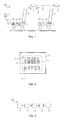
- Fig. 1 shows a schematic illustration of a passenger cabin 100 within an aircraft.
- the passenger cabin 100 may comprise a plurality of aircraft seats 2, of which two are shown exemplarily in Fig. 1 . However, as may be apparent to the skilled person, any other number of aircraft seats 2 may be provided in the passenger cabin 100 as well.
- the aircraft seat 2 comprises a power outlet 10 which may be coupled with a power supply (not shown) supplying electrical power to an electric device plugged in the power outlet 10.
- the power supply may for example comprise an AC/AC converter. It may be possible to connect the power supplies of neighbouring seats via a seat-to-seat power supply line.
- a first one of the aircraft seats 2 may then be coupled to an on-board power supply unit (not shown) of the passenger cabin 100 or the aircraft.
- the power outlet 10 may be used for a passenger to supply an electric device with electric power, for example a personal electronic device 1 such as a smartphone, a mobile phone, a laptop or any similar device. To that end, the passenger may plug a power cord 1a of the personal electronic device 1 into the power outlet 10, thereby causing electric current to flow from the power supply through the power outlet 10 to the personal electronic device 1.
- a power monitoring unit 11 is coupled to the power outlet 10.
- the power monitoring unit 11 may for example comprise a current sensor which may be configured to detect a current flowing through the power outlet 10.
- the power monitoring unit 11 may include a mechanical plug detection sensor which is configured to detect whether a plug is inserted into the power outlet 10 or not.
- the power monitoring unit 11 is configured to emit an outlet usage signal based on the monitoring result, i.e. the outlet usage signal indicates whether the power outlet 10 is in use or not. For example, if a current is detected flowing through the power outlet 10 or if a plug is detected to be inserted into the power outlet 10, it can be assumed that the power outlet 10 is in use.
- the power monitoring unit 11 is coupled to a wireless communication device 12 which is configured to receive the outlet usage signal and to wirelessly send the outlet usage signal to an aircraft cabin management device 5.
- the aircraft seat management device 5 may be coupled to a wireless radio receiver 3 via a network line 4 or similar communication line and may be configured to receive the outlet usage signals sent via radio communication signals 9 from the plurality of aircraft seats 2.
- the wireless radio receiver 3 and the aircraft cabin management device 5 may both be part of an aircraft seat management system, which also includes a plurality of aircraft seats 2.
- the wireless communication device 12 may be configured for an easy adaption of existing outlet usage indication systems, for example outlet usage indication light module installed at the aircraft seat 2. The wireless communication device 12 may then be exchanged with such an outlet usage indication system without any modification of the mechanical seat interface and the electrical/data interface. The wireless communication device 12 may fit to the mechanical provision originally made for the outlet usage indication light module. This enables the wireless communication device 12 to be installed in an exposed position of the aircraft 2 in order to improve the quality of wireless outlet usage signal transmission to the wireless radio receiver 3. Alternatively, a hidden installation within the interior of the aircraft seat 2, for example due to aesthetic reasons, may also be possible.
- the aircraft cabin management device 5 may comprise a graphical display 6 configured to display a graphical representation 8 of the plurality of outlet usage signals.
- the graphical representation 8 may for example comprise coloured or highlighted dots or symbols indicating different states of usage of the power outlets 10.
- it may also include a graphical illustration 7 of the plurality of aircraft seats 2 which may be spatially aligned with the graphical representation 8 of the plurality of outlet usage signals. That way, cabin crew members may easily check the status of the power outlets 10 of the aircraft seats 2.
- the aircraft seat management system as explained in conjunction with Figs. 1 and 2 may be used in an aircraft, for example in an aircraft with a passenger cabin 100.
- Fig. 3 schematically illustrates a method 20 for monitoring power usage at a power outlet of an aircraft seat, for example at a power outlet 10 as shown for an aircraft seat 2 in Fig. 1 .
- the method may comprise as a first step 21 detecting, at a power outlet 10 of an aircraft seat 2, whether the power outlet 10 is in use.
- an outlet usage signal may be generated on the basis of the detection result.
- the outlet usage signal may be wirelessly sent via a wireless communication signal 9, from the aircraft seat 2 to an aircraft cabin management device 5.
- the wireless communication signal 9 may for example comprise a WLAN signal, a Bluetooth(R) signal, a radio signal, an infrared communication signal, or any other suitable means of wireless communication.
- the aircraft seat management device 5 may display a graphical representation 8 of the outlet usage signal at a graphical display 6, along with a graphical illustration 7 of the aircraft seat 2 in an optional fifth step 25.
Landscapes
- Engineering & Computer Science (AREA)
- Power Engineering (AREA)
- Aviation & Aerospace Engineering (AREA)
- Remote Monitoring And Control Of Power-Distribution Networks (AREA)
Abstract
Description
- The present invention pertains to an aircraft seat with power outlet usage monitoring, an aircraft seat management system for monitoring usage of power outlets at aircraft seats, and a method for monitoring usage of a power outlet at an aircraft seat.
- On board of aircraft, an indication of passengers using power outlets installed at their aircraft seats to the cabin crew is required. Usually, certain security regulations require such an indication to be readily available to the aircraft staff.
- The document
EP 0 881 145 B1 discloses a power supply device for providing a supply voltage for electric devices in an airplane cabin with an outlet plug having a detector that detects the presence of a plug inserted in the socket. Via a signal line and a supply line for supplying a voltage supply unit is connected to the power outlet, which is located away from the wall outlet. The supply unit switches the supply voltage on the power cord when the connector detector indicates the presence of a connector on the signal cable to the power supply unit. - However, there is a need for improved relay of the indication whether a power outlet at an aircraft seat is in use or not.
- It is therefore one object of the present invention to provide for an improved solution to indicate to the cabin crew of an aircraft whether a power outlet at an aircraft seat is in use or not, and to enable the cabin crew to receive condensed information on the outlet usage of aircraft seats of an aircraft.
- This problem is solved by an aircraft seat having the technical features of claim 1, an aircraft seat management system having the technical features of claim 3, and a method for monitoring power usage at a power outlet of an aircraft seat, the method having the features of
claim 7. - According to a first aspect of the present invention, an aircraft seat comprises a power outlet, a power monitoring unit coupled to the power outlet and configured to monitor whether the power outlet is in use and to emit an outlet usage signal based on the monitoring result, and a wireless communication device coupled to the power monitoring unit and configured to receive the outlet usage signal and to wirelessly send the outlet usage signal to an aircraft cabin management device.
- According to a second aspect of the present invention, an aircraft seat management system comprises a plurality of aircraft seats according to the first aspect, a wireless radio receiver configured to receive the wirelessly sent outlet usage signals from the plurality of aircraft seats, and an aircraft cabin management device coupled to the wireless radio receiver and configured to receive the outlet usage signals from the plurality of aircraft seats. According to a third aspect of the present invention, a method for monitoring power usage at a power outlet of an aircraft seat comprises detecting, at a power outlet of an aircraft seat, whether the power outlet is in use, generating an outlet usage signal on the basis of the detection result, and sending, via a wireless communication signal, the outlet usage signal from the aircraft seat to an aircraft cabin management device.
- One main idea of the present invention is to locally collect power outlet usage information once or periodically at an aircraft seat and to relay the collected information wirelessly to a central management device of the aircraft.
- An advantage of such power outlet monitoring is the avoidance of local indicators at the aircraft seats, such as LEDs. By centrally collecting all power outlet usage information from the individual aircraft seats it will be easier for the cabin crew to access the information without having to actually pass by all the aircraft seats in order to check the indicators.
- Furthermore, an advantage is that the wireless data link from the aircraft seats to the central aircraft cabin management device allows direct transport of the information signals to the cabin management system without blocking other wired data channels from the aircraft seats to aircraft systems.
- The dependent claims provide additional technical features of advantageous embodiments and further improvements of the invention.
- According to an embodiment of the aircraft seat, the power monitoring unit may comprise a current sensor configured to detect a current flowing through the power outlet.
- According to an embodiment of the aircraft seat management system, the aircraft seat management device may comprise a graphical display configured to display a graphical representation of the plurality of outlet usage signals. This enables a condensation of the received outlet usage signals on an overall cabin level, for example in regular and periodic updates.
- According to a further embodiment of the aircraft seat management system, the graphical representation may include a graphical illustration of the plurality of aircraft seats. That way, the cabin crew may easily gather very quickly which of the power outlets at which aircraft seat are still in use.
- According to a further embodiment, an aircraft may comprise an aircraft cabin management system according to the second aspect.
- According to an embodiment of the method, the method may further comprise displaying, by the aircraft cabin management device, a graphical representation of the outlet usage signal at a graphical display.
- According to a further embodiment of the method, the method may further comprise displaying, by the aircraft cabin management device, a graphical illustration of the aircraft seat along with the graphical representation of the outlet usage signal at the graphical display.
- The invention will be explained in greater detail with reference to exemplary embodiments depicted in the drawings as appended.
- The accompanying drawings are included to provide a further understanding of the present invention and are incorporated in and constitute a part of this specification. The drawings illustrate the embodiments of the present invention and together with the description serve to explain the principles of the invention. Other embodiments of the present invention and many of the intended advantages of the present invention will be readily appreciated as they become better understood by reference to the following detailed description. The elements of the drawings are not necessarily to scale relative to each other. Like reference numerals designate corresponding similar parts.
- Fig. 1
- shows a schematic illustration of a passenger cabin having aircraft seats according to an embodiment of the invention.
- Fig. 2
- shows a schematic illustration of an aircraft seat management system according to another embodiment of the invention.
- Fig. 3
- shows a schematic illustration of a method for monitoring power usage at a power outlet of an aircraft seat according to yet another embodiment of the invention.
- Although specific embodiments have been illustrated and described herein, it will be appreciated by those of ordinary skill in the art that a variety of alternate and/or equivalent implementations may be substituted for the specific embodiments shown and described without departing from the scope of the present invention. Generally, this application is intended to cover any adaptations or variations of the specific embodiments discussed herein.
- Aircraft seat within the meaning of the invention may comprise any facility for temporary sojourn by a passenger of an aircraft. For example, aircraft seats within the meaning of the invention may comprise settees, chairs, armchairs, first class lounges or similar seating devices.
-
Fig. 1 shows a schematic illustration of apassenger cabin 100 within an aircraft. Thepassenger cabin 100 may comprise a plurality ofaircraft seats 2, of which two are shown exemplarily inFig. 1 . However, as may be apparent to the skilled person, any other number ofaircraft seats 2 may be provided in thepassenger cabin 100 as well. - The
aircraft seat 2 comprises apower outlet 10 which may be coupled with a power supply (not shown) supplying electrical power to an electric device plugged in thepower outlet 10. The power supply may for example comprise an AC/AC converter. It may be possible to connect the power supplies of neighbouring seats via a seat-to-seat power supply line. A first one of theaircraft seats 2 may then be coupled to an on-board power supply unit (not shown) of thepassenger cabin 100 or the aircraft. Thepower outlet 10 may be used for a passenger to supply an electric device with electric power, for example a personal electronic device 1 such as a smartphone, a mobile phone, a laptop or any similar device. To that end, the passenger may plug a power cord 1a of the personal electronic device 1 into thepower outlet 10, thereby causing electric current to flow from the power supply through thepower outlet 10 to the personal electronic device 1. - In order to detect whether the
power outlet 10 is in use, apower monitoring unit 11 is coupled to thepower outlet 10. Thepower monitoring unit 11 may for example comprise a current sensor which may be configured to detect a current flowing through thepower outlet 10. Alternatively or additionally, thepower monitoring unit 11 may include a mechanical plug detection sensor which is configured to detect whether a plug is inserted into thepower outlet 10 or not. Thepower monitoring unit 11 is configured to emit an outlet usage signal based on the monitoring result, i.e. the outlet usage signal indicates whether thepower outlet 10 is in use or not. For example, if a current is detected flowing through thepower outlet 10 or if a plug is detected to be inserted into thepower outlet 10, it can be assumed that thepower outlet 10 is in use. - The
power monitoring unit 11 is coupled to awireless communication device 12 which is configured to receive the outlet usage signal and to wirelessly send the outlet usage signal to an aircraftcabin management device 5. The aircraftseat management device 5 may be coupled to a wireless radio receiver 3 via anetwork line 4 or similar communication line and may be configured to receive the outlet usage signals sent via radio communication signals 9 from the plurality ofaircraft seats 2. The wireless radio receiver 3 and the aircraftcabin management device 5 may both be part of an aircraft seat management system, which also includes a plurality ofaircraft seats 2. - The
wireless communication device 12 may be configured for an easy adaption of existing outlet usage indication systems, for example outlet usage indication light module installed at theaircraft seat 2. Thewireless communication device 12 may then be exchanged with such an outlet usage indication system without any modification of the mechanical seat interface and the electrical/data interface. Thewireless communication device 12 may fit to the mechanical provision originally made for the outlet usage indication light module. This enables thewireless communication device 12 to be installed in an exposed position of theaircraft 2 in order to improve the quality of wireless outlet usage signal transmission to the wireless radio receiver 3. Alternatively, a hidden installation within the interior of theaircraft seat 2, for example due to aesthetic reasons, may also be possible. - As shown in
Fig. 2 in greater detail, the aircraftcabin management device 5 may comprise agraphical display 6 configured to display agraphical representation 8 of the plurality of outlet usage signals. Thegraphical representation 8 may for example comprise coloured or highlighted dots or symbols indicating different states of usage of thepower outlets 10. In order to clarify the representation, it may also include agraphical illustration 7 of the plurality ofaircraft seats 2 which may be spatially aligned with thegraphical representation 8 of the plurality of outlet usage signals. That way, cabin crew members may easily check the status of thepower outlets 10 of the aircraft seats 2. - The aircraft seat management system as explained in conjunction with
Figs. 1 and 2 may be used in an aircraft, for example in an aircraft with apassenger cabin 100. -
Fig. 3 schematically illustrates amethod 20 for monitoring power usage at a power outlet of an aircraft seat, for example at apower outlet 10 as shown for anaircraft seat 2 inFig. 1 . The method may comprise as afirst step 21 detecting, at apower outlet 10 of anaircraft seat 2, whether thepower outlet 10 is in use. In asecond step 22, an outlet usage signal may be generated on the basis of the detection result. Finally, in athird step 23, the outlet usage signal may be wirelessly sent via a wireless communication signal 9, from theaircraft seat 2 to an aircraftcabin management device 5. The wireless communication signal 9 may for example comprise a WLAN signal, a Bluetooth(R) signal, a radio signal, an infrared communication signal, or any other suitable means of wireless communication. - Optionally, in a
fourth step 24 the aircraftseat management device 5 may display agraphical representation 8 of the outlet usage signal at agraphical display 6, along with agraphical illustration 7 of theaircraft seat 2 in an optionalfifth step 25. - In the foregoing detailed description, various features are grouped together in one or more examples or examples with the purpose of streamlining the disclosure. It is to be understood that the above description is intended to be illustrative, and not restrictive. It is intended to cover all alternatives, modifications and equivalents. Many other examples will be apparent to one skilled in the art upon reviewing the above specification.
- The embodiments were chosen and described in order to best explain the principles of the invention and its practical applications, to thereby enable others skilled in the art to best utilize the invention and various embodiments with various modifications as are suited to the particular use contemplated. In the appended claims and throughout the specification, the terms "including" and "in which" are used as the plain-English equivalents of the respective terms "comprising" and "wherein," respectively.
-
- 1
- Personal electronic device
- 1a
- Power cord
- 2
- Aircraft seat
- 3
- Wireless radio receiver
- 4
- Network line
- 5
- Aircraft cabin management device
- 6
- Graphical display
- 7
- Graphical illustration
- 8
- Graphical representation
- 9
- Wireless communication signal
- 10
- Power outlet
- 11
- Power outlet monitoring unit
- 12
- Wireless communication device
- 20
- Method
- 21
- Method step
- 22
- Method step
- 23
- Method step
- 24
- Method step
- 25
- Method step
- 100
- Passenger cabin
Claims (9)
- An aircraft seat (2), comprising:a power outlet (10);a power monitoring unit (11) coupled to the power outlet (10) and configured to monitor whether the power outlet (10) is in use and to emit an outlet usage signal based on the monitoring result; anda wireless communication device (12) coupled to the power monitoring unit (11) and configured to receive the outlet usage signal and to wirelessly send the outlet usage signal to an aircraft cabin management device (5).
- The aircraft seat (2) of claim 1, wherein the power monitoring unit (11) comprises a current sensor configured to detect a current flowing through the power outlet (10).
- An aircraft seat management system, comprising:a plurality of aircraft seats (2) according to one of the claims 1 and 2;a wireless radio receiver (3) configured to receive the wirelessly sent outlet usage signals from the plurality of aircraft seats (2); andan aircraft cabin management device (5) coupled to the wireless radio receiver (3) and configured to receive the outlet usage signals from the plurality of aircraft seats (2).
- The aircraft seat management system of claim 3, the aircraft cabin management device (5) comprising a graphical display (6) configured to display a graphical representation (8) of the plurality of outlet usage signals.
- The aircraft seat management system of claim 4, wherein the graphical representation (8) includes a graphical illustration (7) of the plurality of aircraft seats (2).
- An aircraft, comprising an aircraft cabin management system according to one of the claims 3 to 5.
- A method (20) for monitoring power usage at a power outlet (10) of an aircraft seat (2), the method (20) comprising:detecting (21), at a power outlet (10) of an aircraft seat (2), whether the power outlet (10) is in use;generating (22) an outlet usage signal on the basis of the detection result; andsending (23), via a wireless communication signal (9),the outlet usage signal from the aircraft seat (2) to an aircraft seat management device (5).
- The method (20) of claim 7, further comprising:displaying (24), by the aircraft cabin management device (5), a graphical representation (8) of the outlet usage signal at a graphical display (6).
- The method (20) of claim 8, further comprising:displaying (25), by the aircraft cabin management device (5), a graphical illustration (7) of the aircraft seat (2) along with the graphical representation (8) of the outlet usage signal at the graphical display (6).
Priority Applications (1)
| Application Number | Priority Date | Filing Date | Title |
|---|---|---|---|
| EP20130182094 EP2842871A1 (en) | 2013-08-28 | 2013-08-28 | Aircraft seat and method for monitoring usage of a power outlet at an aircraft seat |
Applications Claiming Priority (1)
| Application Number | Priority Date | Filing Date | Title |
|---|---|---|---|
| EP20130182094 EP2842871A1 (en) | 2013-08-28 | 2013-08-28 | Aircraft seat and method for monitoring usage of a power outlet at an aircraft seat |
Publications (1)
| Publication Number | Publication Date |
|---|---|
| EP2842871A1 true EP2842871A1 (en) | 2015-03-04 |
Family
ID=49035476
Family Applications (1)
| Application Number | Title | Priority Date | Filing Date |
|---|---|---|---|
| EP20130182094 Withdrawn EP2842871A1 (en) | 2013-08-28 | 2013-08-28 | Aircraft seat and method for monitoring usage of a power outlet at an aircraft seat |
Country Status (1)
| Country | Link |
|---|---|
| EP (1) | EP2842871A1 (en) |
Cited By (3)
| Publication number | Priority date | Publication date | Assignee | Title |
|---|---|---|---|---|
| GB2532318A (en) * | 2014-09-12 | 2016-05-18 | Zodiac Actuation System | Wireless equipment for airplane seat |
| DE102018216363A1 (en) * | 2018-09-25 | 2020-03-26 | Airbus Operations Gmbh | SOCKET INSERT AND SOCKET FOR AN AIRPLANE SEAT |
| DE102018133175A1 (en) * | 2018-12-20 | 2020-06-25 | Airbus Operations Gmbh | Aircraft monitoring system for controlling the safe charging of portable electrical devices |
Citations (5)
| Publication number | Priority date | Publication date | Assignee | Title |
|---|---|---|---|---|
| EP0881145B1 (en) | 1997-05-31 | 2003-11-26 | Lufthansa Technik AG | Electrical power supply device |
| US6929218B1 (en) * | 2004-03-29 | 2005-08-16 | The Boeing Company | Modularized integrated aircraft seat structure |
| US20110079682A1 (en) * | 2009-10-05 | 2011-04-07 | Shawn Raybell | Systems and methods for securing and protecting aircraft line replaceable units with status indicator under a passenger seat |
| US20120091824A1 (en) * | 2010-10-19 | 2012-04-19 | Leviton Manufacturing Co., Inc. | Electric Vehicle Supply Equipment with Line Fitting Disconnect Sensing |
| US20130167817A1 (en) * | 2010-09-01 | 2013-07-04 | Airbus Operations Gmbh | System For Contactless Power Transfer |
-
2013
- 2013-08-28 EP EP20130182094 patent/EP2842871A1/en not_active Withdrawn
Patent Citations (5)
| Publication number | Priority date | Publication date | Assignee | Title |
|---|---|---|---|---|
| EP0881145B1 (en) | 1997-05-31 | 2003-11-26 | Lufthansa Technik AG | Electrical power supply device |
| US6929218B1 (en) * | 2004-03-29 | 2005-08-16 | The Boeing Company | Modularized integrated aircraft seat structure |
| US20110079682A1 (en) * | 2009-10-05 | 2011-04-07 | Shawn Raybell | Systems and methods for securing and protecting aircraft line replaceable units with status indicator under a passenger seat |
| US20130167817A1 (en) * | 2010-09-01 | 2013-07-04 | Airbus Operations Gmbh | System For Contactless Power Transfer |
| US20120091824A1 (en) * | 2010-10-19 | 2012-04-19 | Leviton Manufacturing Co., Inc. | Electric Vehicle Supply Equipment with Line Fitting Disconnect Sensing |
Cited By (4)
| Publication number | Priority date | Publication date | Assignee | Title |
|---|---|---|---|---|
| GB2532318A (en) * | 2014-09-12 | 2016-05-18 | Zodiac Actuation System | Wireless equipment for airplane seat |
| DE102018216363A1 (en) * | 2018-09-25 | 2020-03-26 | Airbus Operations Gmbh | SOCKET INSERT AND SOCKET FOR AN AIRPLANE SEAT |
| DE102018133175A1 (en) * | 2018-12-20 | 2020-06-25 | Airbus Operations Gmbh | Aircraft monitoring system for controlling the safe charging of portable electrical devices |
| US11136127B2 (en) | 2018-12-20 | 2021-10-05 | Airbus Operations Gmbh | Supervision system for an aircraft for monitoring the safe charging of portable electrical devices |
Similar Documents
| Publication | Publication Date | Title |
|---|---|---|
| US10658837B2 (en) | Safety power disconnection for power distribution over power conductors to power consuming devices | |
| US20180050230A1 (en) | Electrical wall outlet fire detection system | |
| EP2817890B1 (en) | Dual communication-interface facility monitoring and management system and method | |
| KR101287627B1 (en) | detecting system for disconnection of distribution line | |
| EP2842871A1 (en) | Aircraft seat and method for monitoring usage of a power outlet at an aircraft seat | |
| CN110654548B (en) | Aircraft seat arrangement and aircraft with an aircraft seat arrangement | |
| ES2707999T3 (en) | Wireless configuration and diagnostics of aviation field lighting fixtures | |
| EP3792140A1 (en) | Reconfigurable overhead unit, system and method | |
| CN106314813A (en) | System for electrically connecting cabin equipment of an aircraft to a control system and to at least one electrical power supply source of the aircraft | |
| KR101409354B1 (en) | Synthetic Network Management System for a Pole Transformer and Operation Method of the Same | |
| US11136127B2 (en) | Supervision system for an aircraft for monitoring the safe charging of portable electrical devices | |
| JP6285696B2 (en) | Repeater | |
| CN203689650U (en) | Daily electricity consumption model collection device and daily electricity consumption model acquisition system | |
| JP6058275B2 (en) | Plant remote monitoring operation system | |
| US11027848B2 (en) | Power pack for the seat-related supply of power to an electrical unit, in particular in an airplane, and method for wireless reading out of status information of a power pack | |
| CN105118296A (en) | Method and device for acquiring number of passengers | |
| CN206164167U (en) | Fill electric pile with idle state instruction function | |
| EP3133568B1 (en) | Automatic fire alarm system and base device for automatic fire alarm system | |
| KR20090039134A (en) | Power line monitoring system using WSS-based sensor tag and its method | |
| KR101093515B1 (en) | Switchboard Environmental Monitoring | |
| JP2016163323A (en) | Radio relay unit and radio communication system | |
| EP3057242B1 (en) | Systems and methods for communication data of a power transmission line | |
| KR102862957B1 (en) | Apparatus for Testing of Fault Line utilizing Wired Coumunication Characteristics | |
| EP3153378B1 (en) | Notification control device, train traffic control system, and display control method | |
| KR101903489B1 (en) | Apparatus for confirming wiring status in train system |
Legal Events
| Date | Code | Title | Description |
|---|---|---|---|
| 17P | Request for examination filed |
Effective date: 20130828 |
|
| AK | Designated contracting states |
Kind code of ref document: A1 Designated state(s): AL AT BE BG CH CY CZ DE DK EE ES FI FR GB GR HR HU IE IS IT LI LT LU LV MC MK MT NL NO PL PT RO RS SE SI SK SM TR |
|
| AX | Request for extension of the european patent |
Extension state: BA ME |
|
| PUAI | Public reference made under article 153(3) epc to a published international application that has entered the european phase |
Free format text: ORIGINAL CODE: 0009012 |
|
| R17P | Request for examination filed (corrected) |
Effective date: 20150903 |
|
| RBV | Designated contracting states (corrected) |
Designated state(s): AL AT BE BG CH CY CZ DE DK EE ES FI FR GB GR HR HU IE IS IT LI LT LU LV MC MK MT NL NO PL PT RO RS SE SI SK SM TR |
|
| STAA | Information on the status of an ep patent application or granted ep patent |
Free format text: STATUS: REQUEST FOR EXAMINATION WAS MADE |
|
| STAA | Information on the status of an ep patent application or granted ep patent |
Free format text: STATUS: THE APPLICATION IS DEEMED TO BE WITHDRAWN |
|
| 18D | Application deemed to be withdrawn |
Effective date: 20180301 |