EP2842182B1 - Battery separator - Google Patents
Battery separator Download PDFInfo
- Publication number
- EP2842182B1 EP2842182B1 EP13706957.1A EP13706957A EP2842182B1 EP 2842182 B1 EP2842182 B1 EP 2842182B1 EP 13706957 A EP13706957 A EP 13706957A EP 2842182 B1 EP2842182 B1 EP 2842182B1
- Authority
- EP
- European Patent Office
- Prior art keywords
- fibres
- lyocell
- value
- fibre
- battery separator
- Prior art date
- Legal status (The legal status is an assumption and is not a legal conclusion. Google has not performed a legal analysis and makes no representation as to the accuracy of the status listed.)
- Active
Links
Images

Classifications
-
- D—TEXTILES; PAPER
- D01—NATURAL OR MAN-MADE THREADS OR FIBRES; SPINNING
- D01F—CHEMICAL FEATURES IN THE MANUFACTURE OF ARTIFICIAL FILAMENTS, THREADS, FIBRES, BRISTLES OR RIBBONS; APPARATUS SPECIALLY ADAPTED FOR THE MANUFACTURE OF CARBON FILAMENTS
- D01F2/00—Monocomponent artificial filaments or the like of cellulose or cellulose derivatives; Manufacture thereof
-
- H—ELECTRICITY
- H01—ELECTRIC ELEMENTS
- H01M—PROCESSES OR MEANS, e.g. BATTERIES, FOR THE DIRECT CONVERSION OF CHEMICAL ENERGY INTO ELECTRICAL ENERGY
- H01M50/00—Constructional details or processes of manufacture of the non-active parts of electrochemical cells other than fuel cells, e.g. hybrid cells
- H01M50/40—Separators; Membranes; Diaphragms; Spacing elements inside cells
- H01M50/409—Separators, membranes or diaphragms characterised by the material
- H01M50/44—Fibrous material
-
- C—CHEMISTRY; METALLURGY
- C08—ORGANIC MACROMOLECULAR COMPOUNDS; THEIR PREPARATION OR CHEMICAL WORKING-UP; COMPOSITIONS BASED THEREON
- C08L—COMPOSITIONS OF MACROMOLECULAR COMPOUNDS
- C08L1/00—Compositions of cellulose, modified cellulose or cellulose derivatives
- C08L1/02—Cellulose; Modified cellulose
-
- C—CHEMISTRY; METALLURGY
- C08—ORGANIC MACROMOLECULAR COMPOUNDS; THEIR PREPARATION OR CHEMICAL WORKING-UP; COMPOSITIONS BASED THEREON
- C08L—COMPOSITIONS OF MACROMOLECULAR COMPOUNDS
- C08L5/00—Compositions of polysaccharides or of their derivatives not provided for in groups C08L1/00 or C08L3/00
- C08L5/14—Hemicellulose; Derivatives thereof
-
- D—TEXTILES; PAPER
- D21—PAPER-MAKING; PRODUCTION OF CELLULOSE
- D21H—PULP COMPOSITIONS; PREPARATION THEREOF NOT COVERED BY SUBCLASSES D21C OR D21D; IMPREGNATING OR COATING OF PAPER; TREATMENT OF FINISHED PAPER NOT COVERED BY CLASS B31 OR SUBCLASS D21G; PAPER NOT OTHERWISE PROVIDED FOR
- D21H11/00—Pulp or paper, comprising cellulose or lignocellulose fibres of natural origin only
- D21H11/16—Pulp or paper, comprising cellulose or lignocellulose fibres of natural origin only modified by a particular after-treatment
-
- D—TEXTILES; PAPER
- D21—PAPER-MAKING; PRODUCTION OF CELLULOSE
- D21H—PULP COMPOSITIONS; PREPARATION THEREOF NOT COVERED BY SUBCLASSES D21C OR D21D; IMPREGNATING OR COATING OF PAPER; TREATMENT OF FINISHED PAPER NOT COVERED BY CLASS B31 OR SUBCLASS D21G; PAPER NOT OTHERWISE PROVIDED FOR
- D21H13/00—Pulp or paper, comprising synthetic cellulose or non-cellulose fibres or web-forming material
- D21H13/02—Synthetic cellulose fibres
- D21H13/08—Synthetic cellulose fibres from regenerated cellulose
-
- H—ELECTRICITY
- H01—ELECTRIC ELEMENTS
- H01M—PROCESSES OR MEANS, e.g. BATTERIES, FOR THE DIRECT CONVERSION OF CHEMICAL ENERGY INTO ELECTRICAL ENERGY
- H01M50/00—Constructional details or processes of manufacture of the non-active parts of electrochemical cells other than fuel cells, e.g. hybrid cells
- H01M50/40—Separators; Membranes; Diaphragms; Spacing elements inside cells
- H01M50/409—Separators, membranes or diaphragms characterised by the material
- H01M50/411—Organic material
- H01M50/429—Natural polymers
- H01M50/4295—Natural cotton, cellulose or wood
-
- H—ELECTRICITY
- H01—ELECTRIC ELEMENTS
- H01M—PROCESSES OR MEANS, e.g. BATTERIES, FOR THE DIRECT CONVERSION OF CHEMICAL ENERGY INTO ELECTRICAL ENERGY
- H01M10/00—Secondary cells; Manufacture thereof
- H01M10/24—Alkaline accumulators
-
- Y—GENERAL TAGGING OF NEW TECHNOLOGICAL DEVELOPMENTS; GENERAL TAGGING OF CROSS-SECTIONAL TECHNOLOGIES SPANNING OVER SEVERAL SECTIONS OF THE IPC; TECHNICAL SUBJECTS COVERED BY FORMER USPC CROSS-REFERENCE ART COLLECTIONS [XRACs] AND DIGESTS
- Y02—TECHNOLOGIES OR APPLICATIONS FOR MITIGATION OR ADAPTATION AGAINST CLIMATE CHANGE
- Y02E—REDUCTION OF GREENHOUSE GAS [GHG] EMISSIONS, RELATED TO ENERGY GENERATION, TRANSMISSION OR DISTRIBUTION
- Y02E60/00—Enabling technologies; Technologies with a potential or indirect contribution to GHG emissions mitigation
- Y02E60/10—Energy storage using batteries
Definitions
- the present invention relates to the field of batteries, including alkaline (primary and secondary) and lithium batteries, which include separators comprising a porous layer including polymeric fibres.
- Such separators serve to prevent an electrical connection between the anode and the cathode of the battery, or a short circuit.
- Cellulosic fibres are widely employed in battery separators due to their ability to absorb and retain the electrolytes. However, some of these cellulosic fibres (like rayon or mercerized pulp) have poor fibrillation ability and, therefore, do not allow obtaining battery separators with the desired properties in terms of density, porosity and dimensional stability.
- Lyocell fibres of the lyocell genus are well known for their fibrillation ability and are employed in battery separators. Lyocell fibres are spun from a solution of cellulose in a tertiary amine-oxide.
- the separators made with such fibres have a suitable porosity, the ions mobility inside the battery is very good and the efficiency of the battery is high.
- the fibrils interlace very well during paper making and form a dense structure with low shrinkage and high dimensional stability. Moreover the average size of the pores is small, and this represents a barrier for dendrites.
- lyocell fibres in battery separators has been disclosed in EP 0 572 921 A1 , US 2007/0014080 A1 , US 2010/0310921 and US 2009/0017385 A1 .
- WO 97/37392 discloses a battery separator made from a cellulose film formed from a solution of cellulose in an amine oxide. Further state of the art is provided by US 5,700,700 and DE 198 55 644 .
- the battery separator is required to have good chemical stability in the presence of strong electrolytes (such as 30-40% KOH). Further details about the requirements of battery separators in various types of batteries are disclosed in e.g. WO 2007/041312 .
- the present invention provides a battery separator, comprising cellulosic fibres of the lyocell genus, wherein the R10-value, the R18-value and the hemicellulose content of the lyocell fibres is as follows:
- the present invention provides the use of a cellulosic fibre of the lyocell genus, said fibre exhibiting
- the present invention furthermore, provides a cellulosic fibre of the lyocell genus, said fibre exhibiting
- the present invention provides a battery, preferably an alkaline battery, comprising the battery separator according to the present invention.
- lyocell fibres with a certain set of properties i.e. R10-value, R18-value and hemicellulose content, exhibit a much better resistance to electrolytes of especially alkaline batteries than standard lyocell fibres hitherto proposed for battery separators.
- the R10-value of a cellulosic substrate is the amount of undissolved residue when exposing the substrate to 10% NaOH.
- R18 reflects the amount of undissolved residue when exposing the substrate to 18% NaOH. Both values can be measured according to DIN 54355.
- the content of hemicellulose is understood to be the sum of xylane and mannane.
- the method for determining the content of hemicellulose is set out further below.
- separators containing the above-specified lyocell fibres have lower Reduction by Area in 40% KOH compared to separators containing other cellulosic fibres.
- Lyocell fibres with the above-specified properties have also a high degree of fibrillation when they are refined with the conventional beating systems.
- the Canadian Standard Freeness (CSF) of the refined fibres is below 700ml, or preferably below 500 ml.
- the alkali resistance of battery separators was further enhanced when employing lyocell fibres wherein the R10-value, the R18-value and the hemicellulose content of the lyocell fibres is as follows:
- Such lyocell fibres showed excellent alkali resistance, thus they were particularly suitable to make separators with extremely low Reduction by Weight in KOH. Nevertheless Lyocell fibres having extremely high R18- and R10-values and extremely low hemicellulose content are more difficult to beat. Thus, it is more difficult to obtain fine fibrils that are suitable for making separators with low shrinkage in KOH and suitable porosity.
- the battery separator according to the present invention may comprise a mixture of lyocell fibres exhibiting the R10-values, R18-values and hemicellulose content as set out above.
- the lyocell fibres are mercerised.
- Mercerising cellulosic fibres is well-known in the textile industry for modifying yarns and fabric properties and achieve special performances.
- mercerising means the treatment of the fibre, yarn or fabric with an alkaline solution, especially NaOH-solution.
- alkaline solution especially NaOH-solution.
- the effects of mercerisation on the fibre structure of, inter alia, lyocell fibres have, inter alia, been discussed in Stana-Kleinschek et al., Correlation of regenerated cellulose fibres morphology and surface free energy components, Lenzinger Berichte 82 (2003), 83-95 and Colom, X., Carrillo, F., Crystallinity changes in lyocell and viscose-type fibres by caustic treatment, Europ. Polymer J. 38 (2002), 2225-2230 .
- Mercerisation of fabrics containing lyocell fibre is disclosed in WO 95/024524 A1 .
- mercerised pulp which is a cellulosic fibre, but not a man-made cellulosic fibre that has been spun from a cellulose-containing solution, like lyocell fibre
- mercerisation treatment performed on the pulp negatively influences the fibrillation ability of the pulp.
- the R10-value and the R18-value of the mercerised lyocell fibres employed according to this preferred embodiment of the invention is preferably as follows:
- the amount of the lyocell fibres fulfilling the above requirements in the separator may range from 1% to 100%, preferably 15% or more, 25% or more, 40% or more, or 50% or more.
- the separator may comprise other constituents known to the skilled artisan, such as PVA fibres and PVA binders, pulp, viscose fibres or also lyocell fibres that do not fulfil the requirements regarding R10-value, R18-value and hemicellulose content.
- the separator may be of any known design, such as a monolayer or multi-layer design.
- at least one layer should be a nonwoven layer.
- the layers may be glued or thermally bonded together.
- Each layer may be coated with particles (like inorganic particles), may be grafted, treated with surfactants or corona treated. This kind of treatment may be symmetrical or asymmetrical, as described in US2012/028103A1 .
- the separator may include functional substances that have an "ions-trapping" function. They can selectively block molecules that reduce the battery performance ( US2011/0117413A1 ).
- battery separators comprising the lyocell fibres fulfilling the requirements according to the present invention exhibit advantageous properties, such as
- the lyocell fibres to be employed according to the present invention may exhibit a titre in the range of 0.2-10 dtex, preferably 0.2-2 dtex.
- the length of the fibres may be in the range of 1-20 mm, preferably 2-10 mm.
- the diameter of the fibrils after refining the fibres may be between 50 nm and 10.000 nm.
- a lyocell fibre fulfilling the requirements according to the present invention and exhibiting a length of from 2 to 10 mm has not been proposed before.
- Lyocell fibres fulfilling the requirements according to the present invention can be made from cellulosic starting materials, especially pulps or pulp mixtures, having corresponding properties in terms of R10-value, R18-value and hemicellulose content.
- Pulps fulfilling the above requirements are commercially available and/or can be produced by the skilled artisan according to the respective needs of the production, see for example US 2009/0312536 A1 or WO 2005/118950 .
- the cellulosic starting material may also include cotton linters.
- lyocell fibres exhibiting the R10-values, R18-values according to the present invention can also be obtained by mercerising lyocell fibre.
- mercerisation is carried out with a NaOH-solution.
- concentration of NaOH in the solution may preferably be from 5 wt.% to 20 wt.%.
- the duration of the treatment may preferably be from 120 to 480 seconds.
- Mercerisation may be carried out within the fibre production line just before the cutting step, where the fibres are still in the form of continuous filaments called “tow”.
- mercerisation may be carried out in the fibre production line after cutting, when the fibres are already in the form of "staple” or “short cut” fibre.
- mercerisation can also be carried out off-line.
- the mercerisation can be applied to any type of lyocell fibres, independently from the pulp types or other conditions used for the production of the fibres. If as the starting material for mercerisation lyocell fibres are employed the R10- and R18-values of which are already high, notably where the R10- and R18-values already meet the requirements of the present invention (because they have been made from a pulp as specified above), excellent results can be obtained.
- sample solution is cooled, filtered (0.45 ⁇ m), diluted 50-fold and neutralized with sodium hydroxide
- Air permeability was measures according to JIS 1096-6,27.
- the differential pressure of the air flow passing through the material was 1.27 cm (0.5 inches) of water.
- Lyocell fibres were manufactured according to methods known as such to the skilled artisan from different pulps.
- the properties of the pulps employed, their respective amount in the fibre produced therefrom, and the properties of the resulting fibres are listed in the following table: Table 1: Fibre Examples (Percent of respective Pulp type in Fibre) Pulp type ref. A G H B F C D Q Pulp type 1 Xylan, % 2.6 100 Mannan, % 0.7 Tot. Hemicellulose, % 3.3 R10, % 82.2 R18, % 92.7 Pulp type 2 Xylan, % 7.3 100 50 20 Mannan, % 5.3 Tot.
- fibre examples C, D and Q fulfil the requirements according to the present invention.
- Fibres A, G, H, B and F constitute comparative examples.
- Lyocell fibres were refined with a Valley Beater according to ISO 5264-1.
- Pulp fibres were refined with a PFI U3000 mill according to ISO 5264-2.
- Paper samples were prepared with a RAPID-KOTHEN sheet former, according to EN ISO 5269/2.
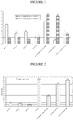
- Figures 1 and 2 demonstrate the Alkali Resistance ( Figure 1 ) and Air Permeability ( Figure 2 ) properties of some of the above examples plus some additional comparative examples containing no lyocell fibre.
- the battery separator contained 50% cellulosic component (lyocell fibres according to the present invention, lyocell fibres not according to the present invention or other cellulosic materials such as eucalyptus pulp, rayon, cotton linter pulp and mercerized wood pulp) and 35% PVA fibres as well as 15% PVA binder.
- Lyocell fibres produced from the same starting materials and spun under the same conditions as for examples B and C above were mercerised in aqueous NaOH-solutions in the tow form. The fibres were then cut to a length of 3 mm.
- the mercerisation process employed the following parameters: Concentration of NaOH (%): 5 - 10 - 15 - 20 Residential time (s): 120 - 240 - 480 Bath temperature (°C): 25
- the alkali resistances of the mercerised fibres in terms of R10-value and R18-value were determined.
- Example B A Schopper-Riegler-test was performed on the unmercerised fibre of Example B and the mercerised fibre according to Example B-4-3 above in a Valley Beater.
- Papers were manufactured, as described above, from the mercerised fibres described above, optionally in a mixture with other constituents.
Landscapes
- Chemical & Material Sciences (AREA)
- Chemical Kinetics & Catalysis (AREA)
- General Chemical & Material Sciences (AREA)
- Medicinal Chemistry (AREA)
- Polymers & Plastics (AREA)
- Organic Chemistry (AREA)
- Health & Medical Sciences (AREA)
- Engineering & Computer Science (AREA)
- Electrochemistry (AREA)
- Textile Engineering (AREA)
- Life Sciences & Earth Sciences (AREA)
- Wood Science & Technology (AREA)
- Cell Separators (AREA)
Description
- The present invention relates to the field of batteries, including alkaline (primary and secondary) and lithium batteries, which include separators comprising a porous layer including polymeric fibres.
- Such separators serve to prevent an electrical connection between the anode and the cathode of the battery, or a short circuit.
- Cellulosic fibres are widely employed in battery separators due to their ability to absorb and retain the electrolytes. However, some of these cellulosic fibres (like rayon or mercerized pulp) have poor fibrillation ability and, therefore, do not allow obtaining battery separators with the desired properties in terms of density, porosity and dimensional stability.
- Cellulosic fibres of the lyocell genus are well known for their fibrillation ability and are employed in battery separators. Lyocell fibres are spun from a solution of cellulose in a tertiary amine-oxide.
- Thanks to the fine and long fibrils, the separators made with such fibres have a suitable porosity, the ions mobility inside the battery is very good and the efficiency of the battery is high. The fibrils interlace very well during paper making and form a dense structure with low shrinkage and high dimensional stability. Moreover the average size of the pores is small, and this represents a barrier for dendrites.
- The use of lyocell fibres in battery separators has been disclosed in
EP 0 572 921 A1US 2007/0014080 A1 ,US 2010/0310921 andUS 2009/0017385 A1 .WO 97/37392 US 5,700,700 andDE 198 55 644 . - Especially in the case of alkaline batteries, the battery separator is required to have good chemical stability in the presence of strong electrolytes (such as 30-40% KOH). Further details about the requirements of battery separators in various types of batteries are disclosed in e.g.
WO 2007/041312 . - It is still desired to make battery separators with cellulosic fibres having an enhanced resistance towards alkali solutions.
- Accordingly, in one aspect the present invention provides a battery separator, comprising cellulosic fibres of the lyocell genus, wherein the R10-value, the R18-value and the hemicellulose content of the lyocell fibres is as follows:
- R10 > 83%, preferably > 84%
- R18 > 93%, preferably > 94%
- Hemicellulose content < 3%.
- In a further aspect, the present invention provides the use of a cellulosic fibre of the lyocell genus, said fibre exhibiting
- a value for R10 > 83%, preferably > 84%
- a value for R18 > 93%, preferably > 94%
- a hemicellulose content < 3%,
- The present invention, furthermore, provides a cellulosic fibre of the lyocell genus, said fibre exhibiting
- a value for R10 > 83%, preferably > 84%
- a value for R18 > 93%, preferably > 94%
- a hemicellulose content < 3% and
- a length of from 2 to 10 mm.
- Finally, the present invention provides a battery, preferably an alkaline battery, comprising the battery separator according to the present invention.
-
-
Figures 1 and 2 demonstrate the Alkali Resistance (Figure 1 ) and Air Permeability (Figure 2 ) properties of battery separators according to the present invention and comparative examples. -
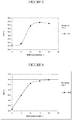
Figures 3 to 6 demonstrate the effect of the mercerisation of lyocell fibres on alkali resistance in terms of R10-value (Figures 3 and5 ) and R18-value (Figures 4 and6 ). -
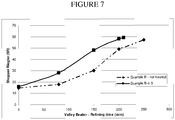
Figure 7 shows the results of a Schopper-Riegler test on non-mercerised and mercerised lyocell fibre. - It has surprisingly been found that lyocell fibres with a certain set of properties, i.e. R10-value, R18-value and hemicellulose content, exhibit a much better resistance to electrolytes of especially alkaline batteries than standard lyocell fibres hitherto proposed for battery separators.
- As known to the skilled artisan, the R10-value of a cellulosic substrate is the amount of undissolved residue when exposing the substrate to 10% NaOH. R18 reflects the amount of undissolved residue when exposing the substrate to 18% NaOH. Both values can be measured according to DIN 54355.
- All values given within this application for R10, R18 and hemicellulose content are wt.%.
- The content of hemicellulose is understood to be the sum of xylane and mannane. The method for determining the content of hemicellulose is set out further below.
- When producing battery separators comprising lyocell fibres meeting the above specifications, it was found that the Reduction by Weight of the separator in 40% KOH was significantly reduced.
- Furthermore, separators containing the above-specified lyocell fibres have lower Reduction by Area in 40% KOH compared to separators containing other cellulosic fibres.
- Lyocell fibres with the above-specified properties have also a high degree of fibrillation when they are refined with the conventional beating systems. For example, the Canadian Standard Freeness (CSF) of the refined fibres is below 700ml, or preferably below 500 ml.
- The alkali resistance of battery separators was further enhanced when employing lyocell fibres wherein the R10-value, the R18-value and the hemicellulose content of the lyocell fibres is as follows:
- R10 > 89%
- R18 > 97%
- Hemicellulose content < 2%.
- Such lyocell fibres showed excellent alkali resistance, thus they were particularly suitable to make separators with extremely low Reduction by Weight in KOH. Nevertheless Lyocell fibres having extremely high R18- and R10-values and extremely low hemicellulose content are more difficult to beat. Thus, it is more difficult to obtain fine fibrils that are suitable for making separators with low shrinkage in KOH and suitable porosity.
- The battery separator according to the present invention may comprise a mixture of lyocell fibres exhibiting the R10-values, R18-values and hemicellulose content as set out above.
- In an especially preferred embodiment of the present invention, the lyocell fibres are mercerised.
- Mercerising cellulosic fibres is well-known in the textile industry for modifying yarns and fabric properties and achieve special performances. In short, mercerising means the treatment of the fibre, yarn or fabric with an alkaline solution, especially NaOH-solution. The effects of mercerisation on the fibre structure of, inter alia, lyocell fibres have, inter alia, been discussed in Stana-Kleinschek et al., Correlation of regenerated cellulose fibres morphology and surface free energy components, Lenzinger Berichte 82 (2003), 83-95 and Colom, X., Carrillo, F., Crystallinity changes in lyocell and viscose-type fibres by caustic treatment, Europ. Polymer J. 38 (2002), 2225-2230. Mercerisation of fabrics containing lyocell fibre is disclosed in
WO 95/024524 A1 - It has been found that mercerised pulp (which is a cellulosic fibre, but not a man-made cellulosic fibre that has been spun from a cellulose-containing solution, like lyocell fibre) exhibits high alkali resistance when used in a battery separator, but exhibits a poor fibrillation ability (cf.
US 7,781,104 B2 ). Apparently, the mercerisation treatment performed on the pulp negatively influences the fibrillation ability of the pulp. - In contrast therto, it has been found that mercerised lyocell fibres not only exhibit high alkali resistance when used in a battery separator, but also high fibrillation ability.
- The R10-value and the R18-value of the mercerised lyocell fibres employed according to this preferred embodiment of the invention is preferably as follows:
- R10 > 87%, preferably > 93%
- R18 > 95%, preferably > 98%.
- It has been found that in spite of these very high R10- and R18-values, the lyocell fibres not only exhibit excellent alkali resistance, but still show good fibrillation ability during the refining process.
- The amount of the lyocell fibres fulfilling the above requirements in the separator may range from 1% to 100%, preferably 15% or more, 25% or more, 40% or more, or 50% or more.
- The separator may comprise other constituents known to the skilled artisan, such as PVA fibres and PVA binders, pulp, viscose fibres or also lyocell fibres that do not fulfil the requirements regarding R10-value, R18-value and hemicellulose content.
- The separator may be of any known design, such as a monolayer or multi-layer design. In multi-layer structures at least one layer should be a nonwoven layer.
In such embodiments, there may be one or more additional layer(s) which can be selected from the group consisting of nonwovens or microporous layers (films), for example cellophane, PVA, polyamide, polyester or polyolefins. - In some embodiments the layers may be glued or thermally bonded together. Each layer may be coated with particles (like inorganic particles), may be grafted, treated with surfactants or corona treated. This kind of treatment may be symmetrical or asymmetrical, as described in
US2012/028103A1 . - Moreover the separator may include functional substances that have an "ions-trapping" function. They can selectively block molecules that reduce the battery performance (
US2011/0117413A1 ). - It was found that battery separators comprising the lyocell fibres fulfilling the requirements according to the present invention exhibit advantageous properties, such as
- A Reduction by Weight in KOH of < 6.0%, preferably 5.5% or less, more preferably 5% or less, most preferably 4% or less
- A Reduction by Area in KOH of < 4.5%, preferably 3.5% or less, most preferably 2% or less and/or
- A Frazier Air Permeability of < 50 cm3/cm2/s, preferably 20 cm3/cm2/s, most preferred from 3.5 cm3/cm2/s to 15 cm3/cm2/s.
- In the case of mercerised lyocell fibres, even more preferable properties in terms of Reduction by Weight in KOH and Reduction by Area in KOH can be obtained, such as
- A Reduction by Weight in KOH of < 3.5%, preferably 2.5% or less
- A Reduction by Area in KOH of < 3.0%, preferably 1.0% or less.
- The lyocell fibres to be employed according to the present invention may exhibit a titre in the range of 0.2-10 dtex, preferably 0.2-2 dtex. The length of the fibres may be in the range of 1-20 mm, preferably 2-10 mm. The diameter of the fibrils after refining the fibres may be between 50 nm and 10.000 nm.
- A lyocell fibre fulfilling the requirements according to the present invention and exhibiting a length of from 2 to 10 mm has not been proposed before.
- Lyocell fibres fulfilling the requirements according to the present invention can be made from cellulosic starting materials, especially pulps or pulp mixtures, having corresponding properties in terms of R10-value, R18-value and hemicellulose content.
- Thus, for making the lyocell fibres to be employed according to the present invention
- All components of the cellulosic starting material should exhibit
- R18>94%,
- R10>85% and
- Hemicellulose < 3%
- At least 50% in weight of the cellulosic starting material should exhibit
- R18>96%,
- R10>90% and
- Hemicellulose < 3%.
- In order to produce lyocell fibres with a very high R10- and R18-value, at least 50% in weight of the cellulosic starting material should exhibit
- R18>98%,
- R10>97% and
- Hemicellulose<1 %
- Pulps fulfilling the above requirements are commercially available and/or can be produced by the skilled artisan according to the respective needs of the production, see for example
US 2009/0312536 A1 orWO 2005/118950 . - The cellulosic starting material may also include cotton linters.
- Alternatively, lyocell fibres exhibiting the R10-values, R18-values according to the present invention can also be obtained by mercerising lyocell fibre.
- Typically, mercerisation is carried out with a NaOH-solution. The concentration of NaOH in the solution may preferably be from 5 wt.% to 20 wt.%. The duration of the treatment (residential time of the fibres in the treatment bath) may preferably be from 120 to 480 seconds.
- Mercerisation may be carried out within the fibre production line just before the cutting step, where the fibres are still in the form of continuous filaments called "tow". Alternatively, mercerisation may be carried out in the fibre production line after cutting, when the fibres are already in the form of "staple" or "short cut" fibre. Of course, mercerisation can also be carried out off-line.
- The mercerisation can be applied to any type of lyocell fibres, independently from the pulp types or other conditions used for the production of the fibres. If as the starting material for mercerisation lyocell fibres are employed the R10- and R18-values of which are already high, notably where the R10- and R18-values already meet the requirements of the present invention (because they have been made from a pulp as specified above), excellent results can be obtained.
- Principle: Two step sulphuric acid hydrolysis followed by quantification of the obtained monosaccharides by anion exchange chromatography.
- About 50 mg of the sample is placed in a culture-C-tube (Wheaton) equipped with a small magnetic stirrer. Then 0.5 ml of 72.3% sulphuric acid is added under vigorous stirring and the reaction tube is closed. The mixture is kept at room temperature for 3 hours with frequent stirring to properly dissolve the sample.
- For the second hydrolysis step 8.5 ml water is added and the reaction vessel is placed into a heating block and heated to 110°C for 90 min.
- The sample solution is cooled, filtered (0.45 µm), diluted 50-fold and neutralized with sodium hydroxide
-
- Column:
Dionex CarboPac PA10 4*50 + 4*250 mm - Eluent A: MilliQ water
- Eluent B: 0,35 M sodium hydroxide
- Flow Rate: 1 ml/min
- Temperature: ambient
- Injection volume: 20 µl
- Post column reagent: 0,35 M sodium hydroxide (0,8 ml/min)
- Detection: pulsed amperometric detection (Dionex ED40)
- Run time: 51 min
-
Time [min] Eluent A [%] Eluent B [%] Comment 0.0 100 0 separation 33.5 100 0 34.0 0 100 regeneration 36.0 0 100 36,5 100 0 conditioning 51 100 0 end - However, chromatography can also be carried out with other anion exchange columns with equivalent results.
- The evaluation and quantification of the results of the chromatography is well-known to the skilled artisan.
- Measured according to EDANA standard WSP130.1
- Measured according to ASTM D1777
- Calculated: Density (g/cm3) = (Basis Weight [g/m2] / 10000) / (Thickness [µm] / 10000)
-
- cut a square sheet 120mm x 120 mm (A1). Cut carefully the specimen where the paper is uniform.
- immerse it in 40% KOH solution at 70°C.
- keep in the bath for 8 hours
- measure the area of the wet sample (A2)
-
- cut one or more pieces of separator with a weight of approximately 5g
- dry the sample at 80°C for 1 hour
- weigh the dried sample (W1)
- immerse it in 40% KOH solution at 70°C.
- keep in the bath for 8 hours
- wash the sample with water
- dry the sample at 80°C for 1 hour
- weigh the dried sample (W2)
- Air permeability was measures according to JIS 1096-6,27.
- The differential pressure of the air flow passing through the material was 1.27 cm (0.5 inches) of water.
- It was calculated dividing the paper basis weight (g/m2) by the polymer density (g/cm3) and by the paper thickness (µm), multiplying by 100 and finally subtracting the result by 100.

- Lyocell fibres were manufactured according to methods known as such to the skilled artisan from different pulps. The properties of the pulps employed, their respective amount in the fibre produced therefrom, and the properties of the resulting fibres are listed in the following table:
Table 1: Fibre Examples (Percent of respective Pulp type in Fibre) Pulp type ref. A G H B F C D Q Pulp type 1 Xylan, % 2.6 100 Mannan, % 0.7 Tot. Hemicellulose, % 3.3 R10, % 82.2 R18, % 92.7 Pulp type 2Xylan, % 7.3 100 50 20 Mannan, % 5.3 Tot. Hemicellulose, % 12.6 R10, % 83.3 R18, % 89.4 Pulp type 3Xylan, % 2.5 50 80 100 50 Mannan, % 0.4 Tot. Hemicellulose, % 2.9 R10, % 85.9 R18, % 94.9 Pulp type 4Xylan, % 2.4 50 100 Mannan, % 0 Tot. Hemicellulose, % 2.4 R10, % 92.6 R18, % 97.2 Pulp type 5Xylan, % 1.6 50 Mannan, % 0.2 Tot. Hemicellulose, % 1.8 R10, % 93.6 R18, % 97.4 Pulp type 6Xylan, % 0.5 50 Mannan, % 0 Tot. Hemicellulose, % 0.5 R10, % 98.6 R18, % 99.5 Fibre properties: A G H B F C D Q dtex 1.7 1.7 1.3 1.7 1.3 1.7 1.7 1.3 length, mm 4 5 5 4 5 4 5 5 Xylan, % 2 7.3 4.3 3 1.6 2.1 2.6 1.1 Mannan, % 0.2 4.9 2.3 1.6 0.2 0.2 0.1 0.1 Tot. Hemicellulose, % 2.2 12.2 6.6 4.6 1.8 2.3 2.7 1.2 R10, % 80.1 75.2 78 82.4 79.9 85.7 88.1 89.7 R18, % 93.3 83.4 88.8 92.3 93.8 95.2 96.4 97.5 - Accordingly, fibre examples C, D and Q fulfil the requirements according to the present invention. Fibres A, G, H, B and F constitute comparative examples.
- Lyocell fibres were refined with a Valley Beater according to ISO 5264-1.
- Pulp fibres were refined with a PFI U3000 mill according to ISO 5264-2.
- Paper samples were prepared with a RAPID-KOTHEN sheet former, according to EN ISO 5269/2.
- Various papers were manufactured from the fibres as summarized above, optionally in a mixture with other constituents.
- The composition of the paper samples as well as the properties determined therein are summarized in the following tables:


-
Figures 1 and 2 demonstrate the Alkali Resistance (Figure 1 ) and Air Permeability (Figure 2 ) properties of some of the above examples plus some additional comparative examples containing no lyocell fibre. - In each case, the battery separator contained 50% cellulosic component (lyocell fibres according to the present invention, lyocell fibres not according to the present invention or other cellulosic materials such as eucalyptus pulp, rayon, cotton linter pulp and mercerized wood pulp) and 35% PVA fibres as well as 15% PVA binder.
- Lyocell fibres produced from the same starting materials and spun under the same conditions as for examples B and C above were mercerised in aqueous NaOH-solutions in the tow form. The fibres were then cut to a length of 3 mm. The mercerisation process employed the following parameters:
Concentration of NaOH (%): 5 - 10 - 15 - 20 Residential time (s): 120 - 240 - 480 Bath temperature (°C): 25 - The alkali resistances of the mercerised fibres in terms of R10-value and R18-value were determined.
- The respective test regimes and results in terms of R10-value and R18-value are summarized in the following table:
Table 4 - Test Regimes for mercerisation and results Mercerisation conditions Alkali Resistance example Starting fibers NaOH concentration (%) Residential time (s) Bath Temperature, °C R10% R18% C-1-0 Example C 0 0 25 85.7 95.2 C-1-1 Example C 5 120 25 87.0 97.0 C-1-2 Example C 10 120 25 91.3 98.4 C-1-3 Example C 15 120 25 94.5 98.9 C-1-4 Example C 20 120 25 94.5 98.7 C-2-4 Example C 5 240 25 87.0 96.9 C-3-1 Example C 10 240 25 93.5 98.6 C-2-6 Example C 15 240 25 96.5 99.3 C-3-2 Example C 20 240 25 96.8 98.5 C-3-3 Example C 5 480 25 87.0 96.9 C-3-4 Example C 10 480 25 95.3 98.6 C-3-5 Example C 15 480 25 96.7 98.7 C-3-6 Example C 20 480 25 96.9 98.6 B-4-0 Example B 0 0 25 82.4 92.3 B-4-1 Example B 5 240 25 83.3 95.0 B-4-2 Example B 10 240 25 93.4 97.2 B-4-3 Example B 15 240 25 95.4 97.7 B-4-4 Example B 20 240 25 94.8 97.9 - The results are shown graphically in
Figure 3 (R10-value) andFigure 4 (R18-value) concerning the fibre of Example C, andFigure 5 (R10-value) andFigure 6 (R18-value concerning the fibre of Example B. - One can see that the R10-values and R18-values of lyocell fibres that already fulfil the requirements of the present invention (Example C) are further enhanced by a mercerisation treatment, and those of lyocell fibres that do not fulfil the requirements of the present invention (Example B) can be increased such as to fulfil the requirements by a mercerisation treatment.
- A Schopper-Riegler-test was performed on the unmercerised fibre of Example B and the mercerised fibre according to Example B-4-3 above in a Valley Beater.
- The results of the tests are shown in
Figure 7 . One can clearly see that the mercerised fibre develops higher Schopper-Riegler-values within a shorter refining time. This means that the mercerised lyocell fibre has a high degree of fibrillation. - Papers were manufactured, as described above, from the mercerised fibres described above, optionally in a mixture with other constituents.
- The composition of the paper samples as well as the properties determined therein are summarized in the following tables:


- Comparing Comparison Example 29 with Inventive Examples 27 and 28 and Comparison Example 30 with Inventive Examples 22 to 26, respectively, there is a (further) remarkable reduction in the Weight Reduction rate in KOH obtained by employing mercerised lyocell fibre instead of non-mercerised lyocell fibre.


Claims (9)
- A battery separator, comprising cellulosic fibres of the lyocell genus, wherein the R10-value, the R18-value, which are determined according to DIN 54355, and the hemicellulose content of the lyocell fibres is as follows:R10 > 83 wt.-% preferably > 84 wt.-%R18 > 93 wt.-%, preferably > 94 wt.-%Hemicellulose content < 3 wt.-%.
- Battery separator according to claim 1, wherein the R10-value, the R18-value and the hemicellulose content of the lyocell fibres is as follows:R10 > 89 wt.-%R18 > 97 wt.-%Hemicellulose content < 2 wt.-%.
- Battery separator according to claim 1 or 2, characterized in that the separator comprises a mixture of lyocell fibres exhibiting the R10-values, R18-values and hemicellulose content as defined in claim 1 or 2.
- Battery separator according to any of the preceding claims, characterized in that the amount of said lyocell fibres in the separator is from 1% to 100%, preferably 15% or more, 25% or more, 40% or more, or 50% or more.
- Battery separator according to any of the preceding claims, characterized in that it exhibits a Reduction by Weight in KOH, as described in the description, of < 6.0%, preferably 5.5% or less, more preferably 5% or less, most preferably 4% or less.
- Battery separator according to any of the preceding claims, characterized in that it exhibits a Reduction by Area in KOH, as described in the description, of < 4.5%, preferably 3.5% or less, most preferably 2% or less.
- Battery separator according to any of the preceding claims, characterized in that it exhibits a Frazier Air Permeability, which is determined according to JIS 1096-6,27, of < 50 cm3/cm2/s, preferably 20 cm3/cm2/s, most preferred from 3.5 cm3/cm2/s to 15 cm3/cm2/s.
- The use of a cellulosic fibre of the lyocell genus, said fibre exhibiting the following values for R10 and R18, which are determined according to DIN 54355, and hemicellulose content:- a value for R10 > 83 wt.-%, preferably > 84wt.-%- a value for R18 > 93 wt.-%, preferably > 94wt.-%- a hemicellulose content < 3 wt.-%, in a battery separator.
- A battery, preferably an alkaline battery, comprising the battery separator according to any of claims 1-7.
Priority Applications (1)
| Application Number | Priority Date | Filing Date | Title |
|---|---|---|---|
| EP13706957.1A EP2842182B1 (en) | 2012-04-26 | 2013-02-22 | Battery separator |
Applications Claiming Priority (3)
| Application Number | Priority Date | Filing Date | Title |
|---|---|---|---|
| EP12165714 | 2012-04-26 | ||
| PCT/EP2013/053579 WO2013159948A1 (en) | 2012-04-26 | 2013-02-22 | Battery separator |
| EP13706957.1A EP2842182B1 (en) | 2012-04-26 | 2013-02-22 | Battery separator |
Publications (2)
| Publication Number | Publication Date |
|---|---|
| EP2842182A1 EP2842182A1 (en) | 2015-03-04 |
| EP2842182B1 true EP2842182B1 (en) | 2018-11-07 |
Family
ID=47757583
Family Applications (1)
| Application Number | Title | Priority Date | Filing Date |
|---|---|---|---|
| EP13706957.1A Active EP2842182B1 (en) | 2012-04-26 | 2013-02-22 | Battery separator |
Country Status (5)
| Country | Link |
|---|---|
| US (2) | US20150093650A1 (en) |
| EP (1) | EP2842182B1 (en) |
| JP (2) | JP2015518248A (en) |
| ES (1) | ES2705557T3 (en) |
| WO (1) | WO2013159948A1 (en) |
Families Citing this family (6)
| Publication number | Priority date | Publication date | Assignee | Title |
|---|---|---|---|---|
| US9666848B2 (en) * | 2011-05-20 | 2017-05-30 | Dreamweaver International, Inc. | Single-layer lithium ion battery separator |
| JP2017069409A (en) * | 2015-09-30 | 2017-04-06 | ニッポン高度紙工業株式会社 | Electrochemical element separator and electrochemical element |
| JP6667148B2 (en) * | 2016-10-03 | 2020-03-18 | パナソニックIpマネジメント株式会社 | Alkaline batteries |
| EP3688829A1 (en) * | 2017-09-26 | 2020-08-05 | SWM Intl | Alkaline battery separators having controlled pore size |
| JP7162837B2 (en) | 2018-12-06 | 2022-10-31 | 東京エレクトロン株式会社 | Plasma processing apparatus and plasma processing method |
| CN116157572B (en) | 2020-07-29 | 2025-08-22 | 兰精股份公司 | Use of lyocell fibres |
Family Cites Families (19)
| Publication number | Priority date | Publication date | Assignee | Title |
|---|---|---|---|---|
| JPS62154559A (en) * | 1985-12-27 | 1987-07-09 | Kuraray Co Ltd | Separator paper for alkaline dry battery |
| AU662822B2 (en) | 1992-06-01 | 1995-09-14 | Kuraray Co., Ltd. | Separator for alkaline batteries |
| JP3290734B2 (en) * | 1993-02-04 | 2002-06-10 | ニッポン高度紙工業株式会社 | Separator paper for alkaline batteries |
| GB9404510D0 (en) | 1994-03-09 | 1994-04-20 | Courtaulds Fibres Holdings Ltd | Fibre treatment |
| JPH08269872A (en) * | 1995-04-03 | 1996-10-15 | Kanebo Ltd | Method for producing fiber structure having morphological stability |
| KR0150105B1 (en) | 1995-06-20 | 1998-12-01 | 김주용 | Method of fabricating transistor of semiconductor device |
| GB9606914D0 (en) | 1996-04-02 | 1996-06-05 | Courtaulds Fibres Holdings Ltd | Battery separators |
| JPH1064504A (en) * | 1996-05-14 | 1998-03-06 | Kuraray Co Ltd | Battery separator |
| AU9778398A (en) * | 1997-10-01 | 1999-04-23 | Weyerhaeuser Company | Cellulose treatment and the resulting product |
| US5942354A (en) | 1997-12-02 | 1999-08-24 | Viskase Corporation | Reduced curl battery separator and method |
| AT413548B (en) | 2004-06-02 | 2006-03-15 | Chemiefaser Lenzing Ag | METHOD FOR PRODUCING A CHEMICAL FIBER AND ITS USE |
| JP4787473B2 (en) * | 2004-06-18 | 2011-10-05 | ニッポン高度紙工業株式会社 | Separator paper for alkaline battery and alkaline battery |
| JP5032748B2 (en) | 2005-02-25 | 2012-09-26 | 株式会社クラレ | Alkaline battery separator and alkaline primary battery |
| US7386868B2 (en) | 2005-07-14 | 2008-06-10 | Quantum Corporation | External desktop dock for a cartridge-based data storage unit |
| US7112389B1 (en) | 2005-09-30 | 2006-09-26 | E. I. Du Pont De Nemours And Company | Batteries including improved fine fiber separators |
| AT503610B1 (en) | 2006-05-10 | 2012-03-15 | Chemiefaser Lenzing Ag | METHOD FOR PRODUCING A PULP |
| KR101332876B1 (en) | 2006-12-20 | 2013-11-25 | 가부시키가이샤 구라레 | Separator for alkaline battery, method for producing the same, and battery |
| DE102009017542A1 (en) | 2009-04-17 | 2010-10-28 | Carl Freudenberg Kg | Unsymmetrical separator |
| US20110117413A1 (en) | 2009-11-19 | 2011-05-19 | Yichun Wang | Alkaline Battery Separators with Ion-Trapping Molecules |
-
2013
- 2013-02-22 EP EP13706957.1A patent/EP2842182B1/en active Active
- 2013-02-22 JP JP2015507418A patent/JP2015518248A/en active Pending
- 2013-02-22 WO PCT/EP2013/053579 patent/WO2013159948A1/en not_active Ceased
- 2013-02-22 ES ES13706957T patent/ES2705557T3/en active Active
- 2013-02-22 US US14/396,485 patent/US20150093650A1/en not_active Abandoned
-
2017
- 2017-02-28 JP JP2017035744A patent/JP2017143065A/en active Pending
-
2018
- 2018-10-16 US US16/161,885 patent/US20190115578A1/en not_active Abandoned
Non-Patent Citations (1)
| Title |
|---|
| None * |
Also Published As
| Publication number | Publication date |
|---|---|
| ES2705557T3 (en) | 2019-03-25 |
| WO2013159948A1 (en) | 2013-10-31 |
| US20150093650A1 (en) | 2015-04-02 |
| US20190115578A1 (en) | 2019-04-18 |
| JP2017143065A (en) | 2017-08-17 |
| EP2842182A1 (en) | 2015-03-04 |
| JP2015518248A (en) | 2015-06-25 |
Similar Documents
| Publication | Publication Date | Title |
|---|---|---|
| US20190115578A1 (en) | Battery separator | |
| US7781104B2 (en) | Separator paper for alkaline battery and the alkaline battery | |
| US6905798B2 (en) | Separator for electrochemical device and method for producing the same | |
| JP6872493B2 (en) | Alkaline battery separator and alkaline battery | |
| CN104081558B (en) | Separator for alkaline battery and alkaline battery | |
| EP2940703B1 (en) | Separator for electric double layer capacitors, and electric double layer capacitor | |
| EP3412713A1 (en) | Resin composite and method for manufacturing resin composite | |
| CN112768839A (en) | Battery separator comprising inorganic particles | |
| EP2959523B1 (en) | Battery separator | |
| US12456781B2 (en) | Separator for alkaline batteries, and alkaline battery | |
| CN113725556B (en) | Nonwoven fabric and battery separator | |
| EP2645452A1 (en) | Microporous membrane and manufacturing method therefor | |
| CN108028340A (en) | Alkaline battery separator | |
| JP3310935B2 (en) | Separator paper for alkaline batteries | |
| WO2025233653A1 (en) | Nonwoven battery separator, batteries including the non-woven battery separator, and processes of manufacture | |
| JP2017224611A (en) | Battery separator | |
| JP6540924B1 (en) | Fibrous cellulose-containing composition and paint | |
| JP2002279957A (en) | Separator paper for alkaline batteries | |
| HK1201992B (en) | Separator for alkaline battery and alkaline battery |
Legal Events
| Date | Code | Title | Description |
|---|---|---|---|
| PUAI | Public reference made under article 153(3) epc to a published international application that has entered the european phase |
Free format text: ORIGINAL CODE: 0009012 |
|
| 17P | Request for examination filed |
Effective date: 20140819 |
|
| AK | Designated contracting states |
Kind code of ref document: A1 Designated state(s): AL AT BE BG CH CY CZ DE DK EE ES FI FR GB GR HR HU IE IS IT LI LT LU LV MC MK MT NL NO PL PT RO RS SE SI SK SM TR |
|
| AX | Request for extension of the european patent |
Extension state: BA ME |
|
| DAX | Request for extension of the european patent (deleted) | ||
| STAA | Information on the status of an ep patent application or granted ep patent |
Free format text: STATUS: EXAMINATION IS IN PROGRESS |
|
| 17Q | First examination report despatched |
Effective date: 20170830 |
|
| GRAP | Despatch of communication of intention to grant a patent |
Free format text: ORIGINAL CODE: EPIDOSNIGR1 |
|
| STAA | Information on the status of an ep patent application or granted ep patent |
Free format text: STATUS: GRANT OF PATENT IS INTENDED |
|
| RIC1 | Information provided on ipc code assigned before grant |
Ipc: D01F 2/00 20060101ALI20180514BHEP Ipc: H01M 10/24 20060101ALI20180514BHEP Ipc: C08L 1/02 20060101ALI20180514BHEP Ipc: H01M 2/16 20060101AFI20180514BHEP Ipc: D21H 13/08 20060101ALI20180514BHEP Ipc: C08L 5/14 20060101ALI20180514BHEP Ipc: D21H 11/16 20060101ALI20180514BHEP Ipc: D21H 11/00 20060101ALI20180514BHEP Ipc: C08L 1/00 20060101ALI20180514BHEP |
|
| INTG | Intention to grant announced |
Effective date: 20180612 |
|
| GRAS | Grant fee paid |
Free format text: ORIGINAL CODE: EPIDOSNIGR3 |
|
| GRAA | (expected) grant |
Free format text: ORIGINAL CODE: 0009210 |
|
| STAA | Information on the status of an ep patent application or granted ep patent |
Free format text: STATUS: THE PATENT HAS BEEN GRANTED |
|
| AK | Designated contracting states |
Kind code of ref document: B1 Designated state(s): AL AT BE BG CH CY CZ DE DK EE ES FI FR GB GR HR HU IE IS IT LI LT LU LV MC MK MT NL NO PL PT RO RS SE SI SK SM TR |
|
| REG | Reference to a national code |
Ref country code: GB Ref legal event code: FG4D |
|
| REG | Reference to a national code |
Ref country code: CH Ref legal event code: EP Ref country code: AT Ref legal event code: REF Ref document number: 1063144 Country of ref document: AT Kind code of ref document: T Effective date: 20181115 |
|
| REG | Reference to a national code |
Ref country code: IE Ref legal event code: FG4D |
|
| REG | Reference to a national code |
Ref country code: DE Ref legal event code: R096 Ref document number: 602013046262 Country of ref document: DE |
|
| REG | Reference to a national code |
Ref country code: SE Ref legal event code: TRGR |
|
| REG | Reference to a national code |
Ref country code: NL Ref legal event code: FP |
|
| REG | Reference to a national code |
Ref country code: ES Ref legal event code: FG2A Ref document number: 2705557 Country of ref document: ES Kind code of ref document: T3 Effective date: 20190325 Ref country code: LT Ref legal event code: MG4D |
|
| PG25 | Lapsed in a contracting state [announced via postgrant information from national office to epo] |
Ref country code: LT Free format text: LAPSE BECAUSE OF FAILURE TO SUBMIT A TRANSLATION OF THE DESCRIPTION OR TO PAY THE FEE WITHIN THE PRESCRIBED TIME-LIMIT Effective date: 20181107 Ref country code: NO Free format text: LAPSE BECAUSE OF FAILURE TO SUBMIT A TRANSLATION OF THE DESCRIPTION OR TO PAY THE FEE WITHIN THE PRESCRIBED TIME-LIMIT Effective date: 20190207 Ref country code: IS Free format text: LAPSE BECAUSE OF FAILURE TO SUBMIT A TRANSLATION OF THE DESCRIPTION OR TO PAY THE FEE WITHIN THE PRESCRIBED TIME-LIMIT Effective date: 20190307 Ref country code: BG Free format text: LAPSE BECAUSE OF FAILURE TO SUBMIT A TRANSLATION OF THE DESCRIPTION OR TO PAY THE FEE WITHIN THE PRESCRIBED TIME-LIMIT Effective date: 20190207 Ref country code: HR Free format text: LAPSE BECAUSE OF FAILURE TO SUBMIT A TRANSLATION OF THE DESCRIPTION OR TO PAY THE FEE WITHIN THE PRESCRIBED TIME-LIMIT Effective date: 20181107 Ref country code: LV Free format text: LAPSE BECAUSE OF FAILURE TO SUBMIT A TRANSLATION OF THE DESCRIPTION OR TO PAY THE FEE WITHIN THE PRESCRIBED TIME-LIMIT Effective date: 20181107 |
|
| PG25 | Lapsed in a contracting state [announced via postgrant information from national office to epo] |
Ref country code: RS Free format text: LAPSE BECAUSE OF FAILURE TO SUBMIT A TRANSLATION OF THE DESCRIPTION OR TO PAY THE FEE WITHIN THE PRESCRIBED TIME-LIMIT Effective date: 20181107 Ref country code: GR Free format text: LAPSE BECAUSE OF FAILURE TO SUBMIT A TRANSLATION OF THE DESCRIPTION OR TO PAY THE FEE WITHIN THE PRESCRIBED TIME-LIMIT Effective date: 20190208 Ref country code: AL Free format text: LAPSE BECAUSE OF FAILURE TO SUBMIT A TRANSLATION OF THE DESCRIPTION OR TO PAY THE FEE WITHIN THE PRESCRIBED TIME-LIMIT Effective date: 20181107 Ref country code: PT Free format text: LAPSE BECAUSE OF FAILURE TO SUBMIT A TRANSLATION OF THE DESCRIPTION OR TO PAY THE FEE WITHIN THE PRESCRIBED TIME-LIMIT Effective date: 20190307 |
|
| PG25 | Lapsed in a contracting state [announced via postgrant information from national office to epo] |
Ref country code: DK Free format text: LAPSE BECAUSE OF FAILURE TO SUBMIT A TRANSLATION OF THE DESCRIPTION OR TO PAY THE FEE WITHIN THE PRESCRIBED TIME-LIMIT Effective date: 20181107 Ref country code: PL Free format text: LAPSE BECAUSE OF FAILURE TO SUBMIT A TRANSLATION OF THE DESCRIPTION OR TO PAY THE FEE WITHIN THE PRESCRIBED TIME-LIMIT Effective date: 20181107 Ref country code: CZ Free format text: LAPSE BECAUSE OF FAILURE TO SUBMIT A TRANSLATION OF THE DESCRIPTION OR TO PAY THE FEE WITHIN THE PRESCRIBED TIME-LIMIT Effective date: 20181107 |
|
| REG | Reference to a national code |
Ref country code: DE Ref legal event code: R097 Ref document number: 602013046262 Country of ref document: DE |
|
| PG25 | Lapsed in a contracting state [announced via postgrant information from national office to epo] |
Ref country code: RO Free format text: LAPSE BECAUSE OF FAILURE TO SUBMIT A TRANSLATION OF THE DESCRIPTION OR TO PAY THE FEE WITHIN THE PRESCRIBED TIME-LIMIT Effective date: 20181107 Ref country code: SK Free format text: LAPSE BECAUSE OF FAILURE TO SUBMIT A TRANSLATION OF THE DESCRIPTION OR TO PAY THE FEE WITHIN THE PRESCRIBED TIME-LIMIT Effective date: 20181107 Ref country code: EE Free format text: LAPSE BECAUSE OF FAILURE TO SUBMIT A TRANSLATION OF THE DESCRIPTION OR TO PAY THE FEE WITHIN THE PRESCRIBED TIME-LIMIT Effective date: 20181107 Ref country code: SM Free format text: LAPSE BECAUSE OF FAILURE TO SUBMIT A TRANSLATION OF THE DESCRIPTION OR TO PAY THE FEE WITHIN THE PRESCRIBED TIME-LIMIT Effective date: 20181107 |
|
| PLBE | No opposition filed within time limit |
Free format text: ORIGINAL CODE: 0009261 |
|
| STAA | Information on the status of an ep patent application or granted ep patent |
Free format text: STATUS: NO OPPOSITION FILED WITHIN TIME LIMIT |
|
| REG | Reference to a national code |
Ref country code: CH Ref legal event code: PL |
|
| 26N | No opposition filed |
Effective date: 20190808 |
|
| PG25 | Lapsed in a contracting state [announced via postgrant information from national office to epo] |
Ref country code: SI Free format text: LAPSE BECAUSE OF FAILURE TO SUBMIT A TRANSLATION OF THE DESCRIPTION OR TO PAY THE FEE WITHIN THE PRESCRIBED TIME-LIMIT Effective date: 20181107 Ref country code: LU Free format text: LAPSE BECAUSE OF NON-PAYMENT OF DUE FEES Effective date: 20190222 Ref country code: MC Free format text: LAPSE BECAUSE OF FAILURE TO SUBMIT A TRANSLATION OF THE DESCRIPTION OR TO PAY THE FEE WITHIN THE PRESCRIBED TIME-LIMIT Effective date: 20181107 |
|
| REG | Reference to a national code |
Ref country code: IE Ref legal event code: MM4A |
|
| PG25 | Lapsed in a contracting state [announced via postgrant information from national office to epo] |
Ref country code: CH Free format text: LAPSE BECAUSE OF NON-PAYMENT OF DUE FEES Effective date: 20190228 Ref country code: LI Free format text: LAPSE BECAUSE OF NON-PAYMENT OF DUE FEES Effective date: 20190228 |
|
| PG25 | Lapsed in a contracting state [announced via postgrant information from national office to epo] |
Ref country code: IE Free format text: LAPSE BECAUSE OF NON-PAYMENT OF DUE FEES Effective date: 20190222 |
|
| PG25 | Lapsed in a contracting state [announced via postgrant information from national office to epo] |
Ref country code: TR Free format text: LAPSE BECAUSE OF FAILURE TO SUBMIT A TRANSLATION OF THE DESCRIPTION OR TO PAY THE FEE WITHIN THE PRESCRIBED TIME-LIMIT Effective date: 20181107 |
|
| PG25 | Lapsed in a contracting state [announced via postgrant information from national office to epo] |
Ref country code: MT Free format text: LAPSE BECAUSE OF NON-PAYMENT OF DUE FEES Effective date: 20190222 |
|
| REG | Reference to a national code |
Ref country code: DE Ref legal event code: R079 Ref document number: 602013046262 Country of ref document: DE Free format text: PREVIOUS MAIN CLASS: H01M0002160000 Ipc: H01M0050409000 |
|
| REG | Reference to a national code |
Ref country code: AT Ref legal event code: UEP Ref document number: 1063144 Country of ref document: AT Kind code of ref document: T Effective date: 20181107 |
|
| PG25 | Lapsed in a contracting state [announced via postgrant information from national office to epo] |
Ref country code: CY Free format text: LAPSE BECAUSE OF FAILURE TO SUBMIT A TRANSLATION OF THE DESCRIPTION OR TO PAY THE FEE WITHIN THE PRESCRIBED TIME-LIMIT Effective date: 20181107 |
|
| PG25 | Lapsed in a contracting state [announced via postgrant information from national office to epo] |
Ref country code: HU Free format text: LAPSE BECAUSE OF FAILURE TO SUBMIT A TRANSLATION OF THE DESCRIPTION OR TO PAY THE FEE WITHIN THE PRESCRIBED TIME-LIMIT; INVALID AB INITIO Effective date: 20130222 |
|
| PG25 | Lapsed in a contracting state [announced via postgrant information from national office to epo] |
Ref country code: MK Free format text: LAPSE BECAUSE OF FAILURE TO SUBMIT A TRANSLATION OF THE DESCRIPTION OR TO PAY THE FEE WITHIN THE PRESCRIBED TIME-LIMIT Effective date: 20181107 |
|
| P01 | Opt-out of the competence of the unified patent court (upc) registered |
Effective date: 20230717 |
|
| PGFP | Annual fee paid to national office [announced via postgrant information from national office to epo] |
Ref country code: ES Payment date: 20250331 Year of fee payment: 13 |
|
| PGFP | Annual fee paid to national office [announced via postgrant information from national office to epo] |
Ref country code: NL Payment date: 20260218 Year of fee payment: 14 |
|
| PGFP | Annual fee paid to national office [announced via postgrant information from national office to epo] |
Ref country code: SE Payment date: 20260218 Year of fee payment: 14 |
|
| PGFP | Annual fee paid to national office [announced via postgrant information from national office to epo] |
Ref country code: GB Payment date: 20260219 Year of fee payment: 14 |
|
| PGFP | Annual fee paid to national office [announced via postgrant information from national office to epo] |
Ref country code: DE Payment date: 20260218 Year of fee payment: 14 |
|
| PGFP | Annual fee paid to national office [announced via postgrant information from national office to epo] |
Ref country code: AT Payment date: 20260219 Year of fee payment: 14 |
|
| PGFP | Annual fee paid to national office [announced via postgrant information from national office to epo] |
Ref country code: BE Payment date: 20260218 Year of fee payment: 14 Ref country code: FI Payment date: 20260226 Year of fee payment: 14 Ref country code: IT Payment date: 20260224 Year of fee payment: 14 |
|
| PGFP | Annual fee paid to national office [announced via postgrant information from national office to epo] |
Ref country code: FR Payment date: 20260218 Year of fee payment: 14 |