EP2840634A1 - Anode active material, lithium secondary battery including same, and manufacturing method for anode active material - Google Patents
Anode active material, lithium secondary battery including same, and manufacturing method for anode active material Download PDFInfo
- Publication number
- EP2840634A1 EP2840634A1 EP13858136.8A EP13858136A EP2840634A1 EP 2840634 A1 EP2840634 A1 EP 2840634A1 EP 13858136 A EP13858136 A EP 13858136A EP 2840634 A1 EP2840634 A1 EP 2840634A1
- Authority
- EP
- European Patent Office
- Prior art keywords
- active material
- anode active
- quasi
- lithium
- core
- Prior art date
- Legal status (The legal status is an assumption and is not a legal conclusion. Google has not performed a legal analysis and makes no representation as to the accuracy of the status listed.)
- Granted
Links
Images

Classifications
-
- H—ELECTRICITY
- H01—ELECTRIC ELEMENTS
- H01M—PROCESSES OR MEANS, e.g. BATTERIES, FOR THE DIRECT CONVERSION OF CHEMICAL ENERGY INTO ELECTRICAL ENERGY
- H01M4/00—Electrodes
- H01M4/02—Electrodes composed of, or comprising, active material
- H01M4/13—Electrodes for accumulators with non-aqueous electrolyte, e.g. for lithium-accumulators; Processes of manufacture thereof
- H01M4/134—Electrodes based on metals, Si or alloys
-
- H—ELECTRICITY
- H01—ELECTRIC ELEMENTS
- H01M—PROCESSES OR MEANS, e.g. BATTERIES, FOR THE DIRECT CONVERSION OF CHEMICAL ENERGY INTO ELECTRICAL ENERGY
- H01M4/00—Electrodes
- H01M4/02—Electrodes composed of, or comprising, active material
- H01M4/04—Processes of manufacture in general
- H01M4/0471—Processes of manufacture in general involving thermal treatment, e.g. firing, sintering, backing particulate active material, thermal decomposition, pyrolysis
-
- H—ELECTRICITY
- H01—ELECTRIC ELEMENTS
- H01M—PROCESSES OR MEANS, e.g. BATTERIES, FOR THE DIRECT CONVERSION OF CHEMICAL ENERGY INTO ELECTRICAL ENERGY
- H01M4/00—Electrodes
- H01M4/02—Electrodes composed of, or comprising, active material
- H01M4/13—Electrodes for accumulators with non-aqueous electrolyte, e.g. for lithium-accumulators; Processes of manufacture thereof
-
- H—ELECTRICITY
- H01—ELECTRIC ELEMENTS
- H01M—PROCESSES OR MEANS, e.g. BATTERIES, FOR THE DIRECT CONVERSION OF CHEMICAL ENERGY INTO ELECTRICAL ENERGY
- H01M4/00—Electrodes
- H01M4/02—Electrodes composed of, or comprising, active material
- H01M4/13—Electrodes for accumulators with non-aqueous electrolyte, e.g. for lithium-accumulators; Processes of manufacture thereof
- H01M4/131—Electrodes based on mixed oxides or hydroxides, or on mixtures of oxides or hydroxides, e.g. LiCoOx
-
- H—ELECTRICITY
- H01—ELECTRIC ELEMENTS
- H01M—PROCESSES OR MEANS, e.g. BATTERIES, FOR THE DIRECT CONVERSION OF CHEMICAL ENERGY INTO ELECTRICAL ENERGY
- H01M4/00—Electrodes
- H01M4/02—Electrodes composed of, or comprising, active material
- H01M4/13—Electrodes for accumulators with non-aqueous electrolyte, e.g. for lithium-accumulators; Processes of manufacture thereof
- H01M4/133—Electrodes based on carbonaceous material, e.g. graphite-intercalation compounds or CFx
-
- H—ELECTRICITY
- H01—ELECTRIC ELEMENTS
- H01M—PROCESSES OR MEANS, e.g. BATTERIES, FOR THE DIRECT CONVERSION OF CHEMICAL ENERGY INTO ELECTRICAL ENERGY
- H01M4/00—Electrodes
- H01M4/02—Electrodes composed of, or comprising, active material
- H01M4/13—Electrodes for accumulators with non-aqueous electrolyte, e.g. for lithium-accumulators; Processes of manufacture thereof
- H01M4/139—Processes of manufacture
- H01M4/1391—Processes of manufacture of electrodes based on mixed oxides or hydroxides, or on mixtures of oxides or hydroxides, e.g. LiCoOx
-
- H—ELECTRICITY
- H01—ELECTRIC ELEMENTS
- H01M—PROCESSES OR MEANS, e.g. BATTERIES, FOR THE DIRECT CONVERSION OF CHEMICAL ENERGY INTO ELECTRICAL ENERGY
- H01M4/00—Electrodes
- H01M4/02—Electrodes composed of, or comprising, active material
- H01M4/13—Electrodes for accumulators with non-aqueous electrolyte, e.g. for lithium-accumulators; Processes of manufacture thereof
- H01M4/139—Processes of manufacture
- H01M4/1393—Processes of manufacture of electrodes based on carbonaceous material, e.g. graphite-intercalation compounds or CFx
-
- H—ELECTRICITY
- H01—ELECTRIC ELEMENTS
- H01M—PROCESSES OR MEANS, e.g. BATTERIES, FOR THE DIRECT CONVERSION OF CHEMICAL ENERGY INTO ELECTRICAL ENERGY
- H01M4/00—Electrodes
- H01M4/02—Electrodes composed of, or comprising, active material
- H01M4/13—Electrodes for accumulators with non-aqueous electrolyte, e.g. for lithium-accumulators; Processes of manufacture thereof
- H01M4/139—Processes of manufacture
- H01M4/1395—Processes of manufacture of electrodes based on metals, Si or alloys
-
- H—ELECTRICITY
- H01—ELECTRIC ELEMENTS
- H01M—PROCESSES OR MEANS, e.g. BATTERIES, FOR THE DIRECT CONVERSION OF CHEMICAL ENERGY INTO ELECTRICAL ENERGY
- H01M4/00—Electrodes
- H01M4/02—Electrodes composed of, or comprising, active material
- H01M4/36—Selection of substances as active materials, active masses, active liquids
- H01M4/362—Composites
- H01M4/366—Composites as layered products
-
- H—ELECTRICITY
- H01—ELECTRIC ELEMENTS
- H01M—PROCESSES OR MEANS, e.g. BATTERIES, FOR THE DIRECT CONVERSION OF CHEMICAL ENERGY INTO ELECTRICAL ENERGY
- H01M4/00—Electrodes
- H01M4/02—Electrodes composed of, or comprising, active material
- H01M4/36—Selection of substances as active materials, active masses, active liquids
- H01M4/38—Selection of substances as active materials, active masses, active liquids of elements or alloys
-
- H—ELECTRICITY
- H01—ELECTRIC ELEMENTS
- H01M—PROCESSES OR MEANS, e.g. BATTERIES, FOR THE DIRECT CONVERSION OF CHEMICAL ENERGY INTO ELECTRICAL ENERGY
- H01M4/00—Electrodes
- H01M4/02—Electrodes composed of, or comprising, active material
- H01M4/36—Selection of substances as active materials, active masses, active liquids
- H01M4/38—Selection of substances as active materials, active masses, active liquids of elements or alloys
- H01M4/386—Silicon or alloys based on silicon
-
- H—ELECTRICITY
- H01—ELECTRIC ELEMENTS
- H01M—PROCESSES OR MEANS, e.g. BATTERIES, FOR THE DIRECT CONVERSION OF CHEMICAL ENERGY INTO ELECTRICAL ENERGY
- H01M4/00—Electrodes
- H01M4/02—Electrodes composed of, or comprising, active material
- H01M4/36—Selection of substances as active materials, active masses, active liquids
- H01M4/38—Selection of substances as active materials, active masses, active liquids of elements or alloys
- H01M4/387—Tin or alloys based on tin
-
- H—ELECTRICITY
- H01—ELECTRIC ELEMENTS
- H01M—PROCESSES OR MEANS, e.g. BATTERIES, FOR THE DIRECT CONVERSION OF CHEMICAL ENERGY INTO ELECTRICAL ENERGY
- H01M4/00—Electrodes
- H01M4/02—Electrodes composed of, or comprising, active material
- H01M4/36—Selection of substances as active materials, active masses, active liquids
- H01M4/38—Selection of substances as active materials, active masses, active liquids of elements or alloys
- H01M4/40—Alloys based on alkali metals
- H01M4/405—Alloys based on lithium
-
- H—ELECTRICITY
- H01—ELECTRIC ELEMENTS
- H01M—PROCESSES OR MEANS, e.g. BATTERIES, FOR THE DIRECT CONVERSION OF CHEMICAL ENERGY INTO ELECTRICAL ENERGY
- H01M4/00—Electrodes
- H01M4/02—Electrodes composed of, or comprising, active material
- H01M4/36—Selection of substances as active materials, active masses, active liquids
- H01M4/48—Selection of substances as active materials, active masses, active liquids of inorganic oxides or hydroxides
-
- H—ELECTRICITY
- H01—ELECTRIC ELEMENTS
- H01M—PROCESSES OR MEANS, e.g. BATTERIES, FOR THE DIRECT CONVERSION OF CHEMICAL ENERGY INTO ELECTRICAL ENERGY
- H01M4/00—Electrodes
- H01M4/02—Electrodes composed of, or comprising, active material
- H01M4/36—Selection of substances as active materials, active masses, active liquids
- H01M4/48—Selection of substances as active materials, active masses, active liquids of inorganic oxides or hydroxides
- H01M4/485—Selection of substances as active materials, active masses, active liquids of inorganic oxides or hydroxides of mixed oxides or hydroxides for inserting or intercalating light metals, e.g. LiTi2O4 or LiTi2OxFy
-
- H—ELECTRICITY
- H01—ELECTRIC ELEMENTS
- H01M—PROCESSES OR MEANS, e.g. BATTERIES, FOR THE DIRECT CONVERSION OF CHEMICAL ENERGY INTO ELECTRICAL ENERGY
- H01M4/00—Electrodes
- H01M4/02—Electrodes composed of, or comprising, active material
- H01M4/36—Selection of substances as active materials, active masses, active liquids
- H01M4/58—Selection of substances as active materials, active masses, active liquids of inorganic compounds other than oxides or hydroxides, e.g. sulfides, selenides, tellurides, halogenides or LiCoFy; of polyanionic structures, e.g. phosphates, silicates or borates
- H01M4/583—Carbonaceous material, e.g. graphite-intercalation compounds or CFx
-
- H—ELECTRICITY
- H01—ELECTRIC ELEMENTS
- H01M—PROCESSES OR MEANS, e.g. BATTERIES, FOR THE DIRECT CONVERSION OF CHEMICAL ENERGY INTO ELECTRICAL ENERGY
- H01M4/00—Electrodes
- H01M4/02—Electrodes composed of, or comprising, active material
- H01M4/36—Selection of substances as active materials, active masses, active liquids
- H01M4/58—Selection of substances as active materials, active masses, active liquids of inorganic compounds other than oxides or hydroxides, e.g. sulfides, selenides, tellurides, halogenides or LiCoFy; of polyanionic structures, e.g. phosphates, silicates or borates
- H01M4/583—Carbonaceous material, e.g. graphite-intercalation compounds or CFx
- H01M4/587—Carbonaceous material, e.g. graphite-intercalation compounds or CFx for inserting or intercalating light metals
-
- H—ELECTRICITY
- H01—ELECTRIC ELEMENTS
- H01M—PROCESSES OR MEANS, e.g. BATTERIES, FOR THE DIRECT CONVERSION OF CHEMICAL ENERGY INTO ELECTRICAL ENERGY
- H01M4/00—Electrodes
- H01M4/02—Electrodes composed of, or comprising, active material
- H01M4/62—Selection of inactive substances as ingredients for active masses, e.g. binders, fillers
- H01M4/624—Electric conductive fillers
- H01M4/625—Carbon or graphite
-
- H—ELECTRICITY
- H01—ELECTRIC ELEMENTS
- H01M—PROCESSES OR MEANS, e.g. BATTERIES, FOR THE DIRECT CONVERSION OF CHEMICAL ENERGY INTO ELECTRICAL ENERGY
- H01M10/00—Secondary cells; Manufacture thereof
- H01M10/05—Accumulators with non-aqueous electrolyte
- H01M10/052—Li-accumulators
-
- H—ELECTRICITY
- H01—ELECTRIC ELEMENTS
- H01M—PROCESSES OR MEANS, e.g. BATTERIES, FOR THE DIRECT CONVERSION OF CHEMICAL ENERGY INTO ELECTRICAL ENERGY
- H01M10/00—Secondary cells; Manufacture thereof
- H01M10/05—Accumulators with non-aqueous electrolyte
- H01M10/052—Li-accumulators
- H01M10/0525—Rocking-chair batteries, i.e. batteries with lithium insertion or intercalation in both electrodes; Lithium-ion batteries
-
- Y—GENERAL TAGGING OF NEW TECHNOLOGICAL DEVELOPMENTS; GENERAL TAGGING OF CROSS-SECTIONAL TECHNOLOGIES SPANNING OVER SEVERAL SECTIONS OF THE IPC; TECHNICAL SUBJECTS COVERED BY FORMER USPC CROSS-REFERENCE ART COLLECTIONS [XRACs] AND DIGESTS
- Y02—TECHNOLOGIES OR APPLICATIONS FOR MITIGATION OR ADAPTATION AGAINST CLIMATE CHANGE
- Y02E—REDUCTION OF GREENHOUSE GAS [GHG] EMISSIONS, RELATED TO ENERGY GENERATION, TRANSMISSION OR DISTRIBUTION
- Y02E60/00—Enabling technologies; Technologies with a potential or indirect contribution to GHG emissions mitigation
- Y02E60/10—Energy storage using batteries
-
- Y—GENERAL TAGGING OF NEW TECHNOLOGICAL DEVELOPMENTS; GENERAL TAGGING OF CROSS-SECTIONAL TECHNOLOGIES SPANNING OVER SEVERAL SECTIONS OF THE IPC; TECHNICAL SUBJECTS COVERED BY FORMER USPC CROSS-REFERENCE ART COLLECTIONS [XRACs] AND DIGESTS
- Y02—TECHNOLOGIES OR APPLICATIONS FOR MITIGATION OR ADAPTATION AGAINST CLIMATE CHANGE
- Y02P—CLIMATE CHANGE MITIGATION TECHNOLOGIES IN THE PRODUCTION OR PROCESSING OF GOODS
- Y02P70/00—Climate change mitigation technologies in the production process for final industrial or consumer products
- Y02P70/50—Manufacturing or production processes characterised by the final manufactured product
Definitions
- the present disclosure relates to an anode active material, and more particularly, to an anode active material comprising a composite of a core-shell structure, a lithium secondary battery comprising the same, and a method of manufacturing the anode active material.
- lithium secondary batteries developed in the early 1990's have received a great deal of attention due to their advantages of higher operating voltages and much higher energy densities than conventional batteries using aqueous electrolyte solutions, such as Ni-MH batteries, Ni-Cd batteries, H 2 SO 4 -Pb batteries, and the like.
- a lithium ion secondary battery involves a safety issue such as a fire or explosion due to the use of an organic electrolyte solution, and has a disadvantage of being complicated to manufacture.
- a lithium polymer secondary battery designed to overcome these weak points of a lithium ion secondary battery is stated to be one of the next-generation batteries of the future, but still has a relatively low capacity, in particular, an insufficient discharging capacity at low temperature, when compared to a lithium ion secondary battery, and accordingly, there is an urgent demand for improvement.
- a lithium source for pre-alloying (quasi)metal oxide with lithium may be largely classified into a lithium metal, a lithium salt free of oxygen, and a lithium salt containing oxygen.
- a lithium salt free of oxygen is mostly ionically bonded, and thus its reaction with (quasi)metal oxide is extremely limited.
- the use of a lithium salt containing oxygen hinders the adjustment of an oxygen content of (quasi)metal oxide since oxygen in a lithium salt reacts with (quasi)metal oxide in the process of a reaction between (quasi)metal oxide and a lithium salt containing oxygen.
- due to a by-product derived from a reaction between an un-reacted lithium source residue and (quasi)metal oxide there is still a gelation issue of an anode active material slurry in a battery fabrication process.
- the present disclosure is designed to provide a method of manufacturing an anode active material with excellent cycle characteristics and volume expansion control capability without forming a by-product by a reaction between a lithium source and (quasi)metal oxide, the anode active material, and a lithium secondary battery comprising the same.
- anode active material comprising forming a composite of a core-shell structure (MO x -Li y )-C, where M represents a (quasi)metal, x is greater than 0 and less than 1.5, and y is greater than 0 and less than 4, by coating a shell including a carbon material on a surface of a core including oxide of a (quasi)metal, forming a mixture by mixing the composite with lithium metal powder, and thermally treating the mixture so as to yield alloyed (quasi)metal oxide-Li in the core.
- M represents a (quasi)metal
- x is greater than 0 and less than 1.5
- y is greater than 0 and less than 4
- an anode active material including a composite of a core-shell structure having a formula (MO x -Li y )-C where M represents a (quasi)metal, x is greater than 0 and less than 1.5, and y is greater than 0 and less than 4, in which a core includes (MO x -Li y ) and a shell includes a carbon material coated on a surface of the core.
- an anode for a lithium secondary battery comprising a current collector, and an anode active material layer formed on at least one surface of the current collector and including the above-described anode active material.
- a lithium secondary battery comprising an anode using the above-described anode active material, a cathode, and a separator interposed between the cathode and the anode.
- an anode active material with high capacity, excellent cycle characteristics and volume expansion control capacity, and high initial efficiency is provided.
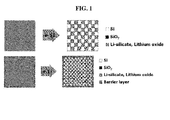
- FIG. 1 is a schematic concept diagram illustrating formation of a structure of an anode active material according to an exemplary embodiment of the present disclosure.
- an anode active material including a composite of a core-shell structure, in which a core contains (MO x -Li y ) and a shell contains a carbon material coated on the surface of the core, represented by the formula (MO x -Li y )-C where M represents a (quasi)metal, x is greater than 0 and less than 1.5, and y is greater than 0 and less than 4.
- the core includes a (quasi)metal.
- the (quasi)metal may be selected from the group consisting of Si, Sn, Al, Sb, Bi, As, Ge, Pb, Zn, Cd, In, Ti, Ga, and alloys thereof, but is not limited thereto.
- the (quasi)metal is present within the core in a form of oxide.
- the oxide of the (quasi)metal may include, as a non-limiting example, any one compound selected from the group consisting of SiO, SnO and SnO, or mixtures thereof.
- the core may further include a (quasi)metal, for example, the above-described (quasi)metal, if necessary.
- a diameter of the core may be in a range of about 0.05 to about 30 ⁇ m or in a range of about 0.5 to about 15 ⁇ m.
- the shell includes a carbon material.
- the shell exists in a form of a coating layer on the surface of the core to form the composite of the core-shell structure.
- the shell may act as a lithium-reaction barrier layer to suppress a fast reaction between lithium and (quasi)metal oxide.
- the carbon material crystalline carbon, amorphous carbon or a mixture thereof may be used, and the content of the carbon material in the shell may be in a range of about 0.05 to about 30 wt% or in a range of about 1 to about 20 wt% based on the weight of the anode active material.
- the anode active material has a high capacity, and when used in a battery, is excellent in cycle characteristics and volume expansion control capability, and its initial efficiency is found to be very high as well.
- the shell of the composite as the lithium-reaction barrier layer should comprise a carbon material.
- a metal crystal grows fast and a resulting large (quasi)metal particle is embedded in a structure such as a (quasi)metal oxide matrix
- the matrix is incompetent in effectively suppressing the volume expansion of a (quasi) metal of a large particle size. That is, even in the same (quasi) metal oxide matrix, the size of the crystal present therein makes a big difference in an extent of cracking from crystal expansion and an extent of control of the matrix.
- the shell is not a carbon material
- a reaction between (quasi) metal oxide and lithium metal powder, for example, lithium of lithium metal powder is not controlled and a metal crystal in the (quasi) metal oxide grows fast.
- This metal crystal growth causes stress as the volume expands due to a weak ionic bond between a metal and lithium, which is likely to be vulnerable to cracks. This crack occurs irregularly, hence noncontact with an electrolyte or electrical disconnection may occur at some parts within the material, leading to a battery fault.
- a crystal grain size in the (quasi) metal included in the core is preferably from 2 nm to a maximum of 200 nm. More preferably, the crystal grain size is less than or equal to 100 nm, or less than or equal to 50 nm.
- the crystal grain size in the (quasi) metal may be controlled by adjusting a heating temperature condition in a thermal treatment step after shell formation in a method of manufacturing an anode active material according to the present disclosure to be described later.
- anode active material of the present disclosure manufactured as described in the foregoing may be used to manufacture an anode by a manufacturing method generally used in the art.
- a cathode according to the present disclosure may be manufactured by a general method in the art, similar to the anode.
- an electrode may be manufactured by mixing an electrode active material of the present disclosure with a binder, a solvent, if necessary, a conductive material and a dispersant and agitating the mixture to prepare a slurry, applying the slurry to a current collector, and compressing the result.
- the binder may be any one selected from the group consisting of polyvinylidene fluoride-co-hexafluoro propylene (PVDF-co-HFP), polyvinylidene fluoride-co-trichloro ethylene, polyvinylidene fluoride-co-chlorotrifluoro ethylene, polymethyl methacrylate, polyacrylonitrile, polyvinylpymolidone, polyvinylacetate, polyethylene-co-vinyl acetate, polyethylene oxide, cellulose acetate, cellulose acetate butyrate, cellulose acetate propionate, cyanoethylpullulan, cyanoethylpolyvinylalcohol, cyanoethyl cellulose, cyanoethyl sucrose, pullulan, carboxyl methyl cellulose (CMC), acrylonitrile-styrene-butadiene copolymer, polyimide, polyvinylidenefluoride,
- a lithium secondary battery generally used in the art may be manufactured using the electrode, in which a separator interposed between the cathode and the anode and an electrolyte solution are included.
- a lithium salt included as an electrolyte may use, without limitation, those generally used in an electrolyte solution for a lithium secondary battery, and for example, an anion of the lithium salt may be any one selected from the group consisting of F - , Cl - , Br - , I - , NO 3 - , N(CN) 2 - , BF 4 - , ClO 4 - , PF6 - , (CF 3 ) 2 PF 4 - , (CF 3 ) 3 PF 3 - , (CF 3 ) 4 PF 2 - , (CF 3 ) 5 PF - , (CF 3 ) 6 P - , CF 3 SO 3 - , CF 3 CF 2 SO 3 - , (CF 3 SO 2 ) 2 N - , (FSO 2 ) 2 N - , CF 3 CF 2 (CF 3 ) 2 CO - , (CF 3 SO 2
- an organic solvent included in the electrolyte solution may include, without limitation, those generally used in an electrolyte solution for a lithium secondary battery, as a representative example, any one selected from the group consisting of propylene carbonate (PC), ethylene carbonate (EC), diethyl carbonate (DEC), dimethyl carbonate (DMC), ethylmethylcarbonate (EMC), methylpropyl carbonate, dipropyl carbonate, dimethylsulfoxide, acetonitrile, dimethoxyethane, diethoxyethane, vinylene carbonate, sulfolane, gamma butyrolactone, propylene sulfate, tetrahydrofuran, fluoro-ethylene carbonate (FEC), and propionate ester, for example, methyl-propionate, ethyl-propionate, propyl-propionate and butyl-propionate, or mixtures thereof.
- PC propylene carbonate
- EC ethylene carbonate
- cyclic carbonate such as ethylene carbonate and propylene carbonate corresponds to an organic solvent having a high viscosity, and is preferred to use because it dissociates a lithium salt in an electrolyte well due to its high dielectric constant, and in this instance, such cyclic carbonate is more preferred to use because it contributes to form an electrolyte solution having high electrical conductivity when mixed with linear carbonate having a low viscosity and a low dielectric constant such as dimethyl carbonate and diethyl carbonate at a proper ratio.
- the electrolyte solution stored according to the present disclosure may further include an additive, such as an overcharge inhibitor, used in a general electrolyte solution.
- an additive such as an overcharge inhibitor
- the separator may use a general porous polymer film used as a separator in the art, for example, a porous polymer film made from a polyolefin-based polymer such as an ethylene homopolymer, a propylene homopolymer, an ethylene/butene copolymer, an ethylene/hexene copolymer, and an ethylene/methacrylate copolymer, arranged singularly or in a stack, or a general porous non-woven fabric, for example, a non-woven fabric made from a glass fiber having a high melting point, a polyethyleneterephthalate fiber, and the like, however the present disclosure is not limited thereto.
- a general porous polymer film used as a separator in the art, for example, a porous polymer film made from a polyolefin-based polymer such as an ethylene homopolymer, a propylene homopolymer, an ethylene/butene copolymer, an ethylene/hexen
- the separator may additionally include a porous coating layer on the surface thereof.
- the porous coating layer includes inorganic particles and a binder.
- the binder is disposed in all or a part of the inorganic particles to couple and bond the inorganic particles to one another.
- the inorganic particles may use an inorganic particle having a dielectric constant greater than or equal to 5 and an inorganic particle having a lithium ion delivery capability (in a case of a lithium secondary battery), singularly or in combination.
- the inorganic particle having a dielectric constant greater than or equal to 5 may be any one selected from the group consisting of BaTiO 3 , P b (Zr x Ti 1-x )O 3 (PZT, 0 ⁇ x ⁇ 1), Pb 1-x La x Zr 1-y Ti y O 3 (PLZT, 0 ⁇ x ⁇ 1, 0 ⁇ y ⁇ 1), (1-x)Pb(Mg 1/3 Nb 2/3 )O 3-x PbTiO 3 (PMN-PT, 0 ⁇ x ⁇ 1), hafnia (HfO 2 ), SrTiO 3 , SnO 2 , CeO 2 , MgO, NiO, CaO, ZnO, ZrO 2 , SiO 2 , Y 2 O 3
- the inorganic particle having a lithium ion delivery capability may be, as a non-limiting example, any one selected from the group consisting of lithium phosphate (Li 3 PO 4 ), lithium titanium phosphate (Li x Ti y (PO 4 ) 3 , 0 ⁇ x ⁇ 2, 0 ⁇ y ⁇ 3), lithium aluminum titanium phosphate (Li x Al y Ti z (PO 4 ) 3 , 0 ⁇ x ⁇ 2, 0 ⁇ y ⁇ 1, 0 ⁇ z ⁇ 3), (LiAlTiP) x O y -based glass (0 ⁇ x ⁇ 4, 0 ⁇ y ⁇ 13), lithium lanthanum titanate (Li x La y TiO 3 , 0 ⁇ x ⁇ 2, 0 ⁇ y ⁇ 3), lithium germanium thiophosphate (Li x Ge y P z S w , 0 ⁇ x ⁇ 4, 0 ⁇ y ⁇ 1, 0 ⁇ z ⁇ 1, 0 ⁇ w ⁇ 5), lithium nitride (Li x N y , 0
- the average particle diameter of the inorganic particles may be in a range of about 0.001 ⁇ m to about 10 ⁇ m.
- the average particle diameter of the inorganic particles satisfying the range prevents dispersibility of the inorganic particles from reducing and enables adjustment of the porous coating layer to a proper thickness.
- the binder content may be in a range of about 0.1 to about 20 parts by weight, preferably, in a range of about 1 to about 5 parts by weight, based on the total 100 parts by weight of the binder and the inorganic particles.
- the binder may be any one selected from the group consisting of polyvinylidene fluoride-co-hexafluoro propylene (PVDF-co-HFP), polyvinylidene fluoride-co-trichloro ethylene, polyvinylidene fluoride-co-chlorotrifluoro ethylene, polymethyl methacrylate, polyacrylonitrile, polyvinylpymolidone, polyvinylacetate, polyethylene-co-vinyl acetate, polyethylene oxide, cellulose acetate, cellulose acetate butyrate, cellulose acetate propionate, cyanoethylpullulan, cyanoethylpolyvinylalcohol, cyanoethyl
- a battery casing used in the present disclosure may employ those generally used in the art, and is not limited to a specific outer shape based on a use of a battery, and the battery casing may have, for example, a circular shape using a can, a prismatic shape, a pouch shape, a coin shape, and the like.
- a method of manufacturing the anode active material according to an exemplary embodiment of the present disclosure introduces lithium to (quasi)metal oxide of a core in a composite of a core-shell structure, and involves mixing the composite with lithium metal powder and thermally treating the mixture to form the composite of the core-shell structure having a formula (MO x -Li y )-C for alloyed (quasi)metal oxide-Li in the core where M represents a (quasi)metal, x is greater than 0 and less than 1.5, and y is greater than 0 and less than 4.
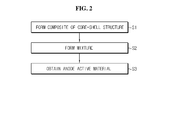
- FIG. 2 is a flowchart illustrating a method of manufacturing an anode active material according to an exemplary embodiment of the present disclosure. A detailed description is provided below with reference to FIG. 2 .
- a method of manufacturing an anode active material according to an aspect of the present disclosure includes (S1) forming a composite of a core-shell structure, (S2) forming a mixture, and (S3) thermally treating the mixture. Through (S3), an alloyed (quasi)metal oxide-Li composite is formed in the core. In S1, the composite of the core-shell structure is manufactured by forming a shell on a surface of a core.
- the core and the shell is the same as described previously in the description of the anode active material.
- crystalline carbon may be coated on the core by mixing the core and the crystalline carbon in a solid or liquid phase, followed by coating.
- coating When mixed in a solid phase, coating may be performed mainly by a mechanical mixing method, and the mechanical mixing method may include, for example, a kneading method, a mechanical mixing method that changes a wing structure of a mixer to apply shear stress during mixing, a mechanochemical method that induces a fusion over an interface between materials by mechanically applying a shear force to the materials, and the like.
- a mechanical mixing method may include, for example, a kneading method, a mechanical mixing method that changes a wing structure of a mixer to apply shear stress during mixing, a mechanochemical method that induces a fusion over an interface between materials by mechanically applying a shear force to the materials, and the like.
- a mechanical mixing method may be used similar to mixing in a solid phase, or spray drying, spray pyrolysis, or freeze drying may be carried out.
- a solvent that may be added in a case of mixing in a liquid phase water, an organic solvent, or a mixture thereof may be used, and as the organic solvent, ethanol, isopropyl alcohol, toluene, benzene, hexane, and tetrahydrofuran may be used.
- a method that coats with an amorphous carbon precursor and carbonizes the carbon precursor through thermal treatment may be used.
- the coating method both dry and wet mixing may be used.
- a chemical vapor deposition (CVD) method using gas containing carbon such as methane, ethane, propane, ethylene, and acetylene, may be used.
- the amorphous carbon precursor may include resins such as phenol resin, naphthalene resin, polyvinylalcohol resin, urethane resin, polyimide resin, furan resin, cellulose resin, epoxy resin and polystyrene resin, coal-derived pitches, petroleum-derived pitches, tar or intermediate crude oil with a low molecular weight, and the like.
- resins such as phenol resin, naphthalene resin, polyvinylalcohol resin, urethane resin, polyimide resin, furan resin, cellulose resin, epoxy resin and polystyrene resin, coal-derived pitches, petroleum-derived pitches, tar or intermediate crude oil with a low molecular weight, and the like.
- the composite formed in S1 is mixed with lithium metal powder.
- the composite formed in S1 is mixed with lithium metal powder by a chemical mixing method, a mechanical mixing method, a dry mixing method, and the like.
- an anode active material may be obtained by preparing a dispersion solution using a solvent and/or a dispersant, mixing the composite in the dispersion solution, and thermally treating the mixture.
- the solvent or dispersant is not limited to a specific type, and is preferred if it enables uniform dissolution and mixing and may be subsequently removed.
- the solvent or dispersant may be xylene such as p-xylene, heptane, hexane such as n-hexane, toluene, acetone, tetrahydrofuran, methylenechloride, chloroform, dimethylformamide, N-methyl-2-pyrrolidone, cyclohexane, dichloromethane, dimethylsulfoxide, acetonitrile, pyridine, amines, or mixed solutions thereof.
- a dispersion device When forming the dispersion solution by dispersing the lithium metal powder in the solvent or dispersant and forming the mixture by mixing the dispersion solution with the (quasi)metal oxide, a dispersion device known in the art may be generally used to disperse the (quasi)metal oxide.
- the dispersion device is not particularly limited if it corresponds to a device that enables dispersion of a material to be dispersed in a solvent or dispersant, and may include, for example, an ultrasonic dispersion device, a magnetic stirring device, a spray dryer device, and the like.
- the formed dispersion solution is dried at room temperature of about 25 to about 28°C or at temperature of about 50 to about 200°C to remove the solvent or dispersant, yielding a mixture of the composite and the lithium metal powder.
- a method of removing the solvent or dispersant methods known in the art may be used.
- the lithium metal powder and the composite may be uniformly mixed using a mechanical mixing method.
- the mechanical mixing method is a method that pulverizes and mixes materials intended to mix by applying a mechanical force to form a uniform mixture.
- mechanical mixing employs a mechanical mixing device using a chemically inactive bead or the like, for example, a high energy ball mill, a planetary mill, a stirred ball mill, a vibrating mill, and the like, and a process parameter may be changed, for example, a rotation rate, a ball-powder weight ratio, a ball size, a mixing time, mixing temperature and atmosphere, and the like.
- a process parameter may be changed, for example, a rotation rate, a ball-powder weight ratio, a ball size, a mixing time, mixing temperature and atmosphere, and the like.
- alcohol such as ethanol and higher fatty acid such as stearic acid
- the processing control agent may be added in an amount of about 2.0 parts by weight or less, preferably, 0.5 parts by weight or less, based on 100 parts by weight of the mixture. When the processing control agent is added, a mixing time may be shortened.
- mechanical alloying when there is a condition change, for example, a mixing time, a mixing temperature, and a rotation rate, to increase a rotation rate at high temperature for a long time, mechanical alloying may be performed at the same time of pulverizing and mixing the lithium metal powder and the composite.
- the present disclosure may obtain an electrode active material in a type of an alloy of uniform composition. In this case, subsequent thermal treatment in an inert atmosphere may be omitted.
- the lithium metal powder and the composite may be mixed in a simple manner using dry mixing, and in this case, a mixing device may use, without limitation, any type of mixing device if it is a general one known in the art. For example, a shaker, a stirrer, and the like, may be used.
- a general thermal treatment step follows.
- the composite formed in S1 and the lithium metal powder are mixed at a mixing ratio in a range of about 70:30 to about 98:2. Because lithium is a very light metal, mixing with the composite at a mixing ratio exceeding the range is unfavorable. For this reason, the mixing ratio is set to the above value.
- the mixture formed in S2 is thermally treated to achieve (quasi)metal oxide-Li alloying in the core.
- the (quasi)metal oxide-Li alloying in the core by the thermal treatment forms a composite of a core-shell structure represented by the formula (MO x -Liy)-C where M represents a (quasi)metal, x is greater than 0 and less than 1.5, and y is greater than 0 and less than 4.
- the shell of the composite formed in S1 should comprise a carbon material. The reason is the same as described previously in the description of the anode active material.
- the mixture of the composite formed in S2 and the lithium metal powder needs thermal treatment to form a (quasi)metal oxide-Li alloy.
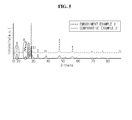
- FIG. 5 illustrates an x-ray diffraction (XRD) graph of Embodiment example 1 and Comparative example 1 of the present disclosure.
- XRD x-ray diffraction
- Embodiment example 1 and Comparative example 2 an alloy of Li-(quasi)metal oxide such as Li 2 SiO 3 and Li 2 Si 2 O 5 appears commonly in Embodiment example 1 and Comparative example 2 although it differs in peak intensity. This is because the peaks of the alloy result from a reaction of lithium and (quasi)metal oxide by thermal treatment.
- the thermal treatment temperature range if it is between a melting point of lithium metal powder and a boiling point of the lithium metal powder. If the temperature is less than the melting point of lithium metal powder, a reaction between lithium metal powder and (quasi)metal oxide may not occur, and when the temperature is higher than the boiling point of lithium metal powder, lithium metal powder may evaporate into gas before lithium sufficiently reacts with (quasi)metal oxide. Accordingly, the thermal treatment temperature range is preferably is in a range of about 500 to about 2000°C or in a range of about 700 to about 1200°C.
- the heating temperature is preferably adjusted to a range of hindering the excessive crystal grain growth in the (quasi)metal in the anode active material, preferably, to obtain a crystal grain size less than or equal to a maximum of 200 nm.
- the thermal treatment in an inert gas atmosphere in which nitrogen gas, argon gas, helium gas, krypton gas, or xenon gas is present, to block the contact with oxygen. If the mixture comes into contact with oxygen during thermal treatment of the mixture, the lithium source reacts with metal oxide along with oxygen to form lithium oxide or lithium metal oxide, and as a result, an initial efficiency increase effect of the battery may decline.
- an oxygen content of (quasi)metal oxide is MO x (0 ⁇ x ⁇ 1.5), and when x exceeds 1.5, a relative amount of (quasi)metal oxide (M) corresponding to an electrochemical reaction site is low, which may induce a reduction in a total energy density and cause a problem that initial efficiency reduces.
- the (quasi)metal oxide core of the present disclosure has the coating layer of the carbon material, that is, the shell, on the surface thereof, and the shell of the carbon material allows lithium to pass through but hinders oxygen from passing through, thereby preventing oxygen from reacting with (quasi)metal oxide of the core, so that it is easy to adjust the oxygen content of (quasi)metal oxide.
- the surface of the composite in S3 may be washed and dried. This is because unreacted lithium metal powder or a by-product produced by a side reaction between lithium metal powder and (quasi)metal oxide may remain on the surface of the composite.
- the manufactured composite was mixed with lithium metal powder at a weight ratio of 92:8 to form a mixture.
- the mixture was thermally treated at 700°C for 5 hours under an Ar atmosphere to manufacture an anode active material in which lithium alloying is implemented in the core.
- anode active material that is, formula (MO x -Li y )-C, it could be seen from its measurement result that 0 ⁇ x ⁇ 1.5 and 0 ⁇ y ⁇ 4.
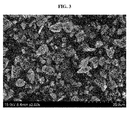
- FIG. 3 is a scanning electron microscope (SEM) photographic image of an anode active material according to Embodiment example 1 of the present disclosure.
- An anode active material was manufactured by the same method as Embodiment example 1 except that a thermal treatment temperature was adjusted to 600°C.
- An anode active material was manufactured by the same method as Embodiment example 1 except that a thermal treatment temperature was adjusted to 1000°C.
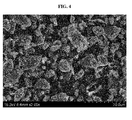
- FIG. 4 is a SEM image of an anode active material according to Comparative example 1 of the present disclosure.
- 10g of the SiO containing lithium was put into a rotary tube furnace, and temperature was increased to 1000°C at a rate of 5°C/min after flowing argon gas at a rate of 0.5 L/min.
- Thermal treatment was performed for 2 hours while rotating the rotary tube furnace at a rate of 10 rpm/min and flowing argon gas at a rate of 1.8 L/min and acetylene gas at a rate of 0.3 L/min, to manufacture an anode active material of a core-shell structure in which a conductive carbon material as a shell is coated on the surface of SiO as a core.
- the carbon content of the shell was 5.1 parts by weight based on 100 parts by weight of the core.
- Each anode active material manufactured in Embodiment example 1, Comparative example 1 and Comparative example 2 was mixed with graphite at a weight ratio of 15:85, and this mixture was mixed with carbon black as a conductive material and SBR/CMC at a weight ratio of 94:2:2:2.
- the result was put in distilled water as a solvent and mixed to prepare a homogeneous electrode slurry.
- the electrode slurry was coated on one surface of a copper current collector at a thickness of 65 ⁇ m, followed by drying, rolling, and punching to a necessary size, to manufacture an anode.
- a lithium metal was used, and an electrode assembly was manufactured with a polyolefin separator interposed between the manufactured anode and cathode.
- a non-aqueous electrolyte solution was prepared by mixing ethylene carbonate (EC) and diethyl carbonate (DEC) at a volume ratio of 30:70, adding 5% of fluoro-ethylene carbonate (FEC) as an additive, and adding 1M LiPF 6 , and then injected into the manufactured electrode assembly to fabricate a coin cell.
- EC ethylene carbonate
- DEC diethyl carbonate
- FEC fluoro-ethylene carbonate
- the electrode thickness corresponds to a thickness of only an active material except a thickness of a current collector.
- the secondary batteries using the anode active materials of Embodiment examples 1 through 3 improved in initial efficiency by about 7.1%, compared to the secondary battery using the anode active material of Comparative example 1, and when compared to the secondary battery using the anode active material of Comparative example 1, relative degradation in life characteristics and thickness expansion ratio after charging and discharging was not observed. Because lithium alloying suppressed the crystal grain growth of Si in the SiO structure to the maximum, initial efficiency greatly increased and a side reaction did not take place, for example, degradation of thickness expansion extent and life characteristics that are an advantage of SiO.
- a portion indicated by 'Si' corresponds to a main peak of Si, and it was found that when reacted with lithium (lithium metal powder) without a carbon shell, a plurality of large (quasi)metal (Si) particles were formed in a lithium-(quasi)metal oxide alloy structure (Li-SiO), in light of a result that a peak of Si has a sharp and strong intensity as in Comparative example 2.
Landscapes
- Chemical & Material Sciences (AREA)
- Chemical Kinetics & Catalysis (AREA)
- Electrochemistry (AREA)
- General Chemical & Material Sciences (AREA)
- Engineering & Computer Science (AREA)
- Materials Engineering (AREA)
- Inorganic Chemistry (AREA)
- Manufacturing & Machinery (AREA)
- Composite Materials (AREA)
- Battery Electrode And Active Subsutance (AREA)
- Silicon Compounds (AREA)
Abstract
Description
- The present application claims priority to Korean Patent Application No.
10-2012-0138382 10-2013-0147908 - The present disclosure relates to an anode active material, and more particularly, to an anode active material comprising a composite of a core-shell structure, a lithium secondary battery comprising the same, and a method of manufacturing the anode active material.
- Recently, there has been growing interest in energy storage technologies. As the application fields of energy storage technologies have been extended to mobile phones, camcorders, lap-top computers and even electric cars, efforts have increasingly been made towards the research and development of electrochemical devices. In this aspect, electrochemical devices have attracted the most attention. The development of rechargeable secondary batteries has been the focus of particular interest. In recent years, extensive research and development has been conducted to design new electrodes and batteries for the purpose of improving capacity density and specific energy of the batteries.
- Among currently available secondary batteries, lithium secondary batteries developed in the early 1990's have received a great deal of attention due to their advantages of higher operating voltages and much higher energy densities than conventional batteries using aqueous electrolyte solutions, such as Ni-MH batteries, Ni-Cd batteries, H2SO4-Pb batteries, and the like. However, among them, a lithium ion secondary battery involves a safety issue such as a fire or explosion due to the use of an organic electrolyte solution, and has a disadvantage of being complicated to manufacture. A lithium polymer secondary battery designed to overcome these weak points of a lithium ion secondary battery is stated to be one of the next-generation batteries of the future, but still has a relatively low capacity, in particular, an insufficient discharging capacity at low temperature, when compared to a lithium ion secondary battery, and accordingly, there is an urgent demand for improvement.
- For this, there is a growing need for a high capacity anode material, and a (quasi)metal material having a high theoretical capacity, for example, Si- and Sn-based materials, is being applied as an anode active material, however these anode active materials deteriorate in cycle characteristics as charging and discharging repeats, and their extreme volume expansion has a negative influence on the performance and safety of a battery. Accordingly, studies have been conducted to improve the cycle characteristics and mitigate the volume expansion by using (quasi)metal oxide, for example, silicon oxide (SiOx) and the like, however (quasi)metal oxide has a shortcoming of significantly low initial efficiency because (quasi)metal oxide produces an irreversible phase due to an initial reaction of oxygen and lithium upon lithium insertion.
- To compensate this defect, if (quasi)metal oxide is prealloyed with lithium so that (quasi)metal oxide contains lithium, an irreversible phase such as lithium oxide or lithium metal oxide is produced in a reduced amount during initial charging/discharging of a battery, resulting in increased initial efficiency of an anode active material.
- A lithium source for pre-alloying (quasi)metal oxide with lithium may be largely classified into a lithium metal, a lithium salt free of oxygen, and a lithium salt containing oxygen.
- Among them, a lithium salt free of oxygen is mostly ionically bonded, and thus its reaction with (quasi)metal oxide is extremely limited. Also, the use of a lithium salt containing oxygen hinders the adjustment of an oxygen content of (quasi)metal oxide since oxygen in a lithium salt reacts with (quasi)metal oxide in the process of a reaction between (quasi)metal oxide and a lithium salt containing oxygen. Also, due to a by-product derived from a reaction between an un-reacted lithium source residue and (quasi)metal oxide, there is still a gelation issue of an anode active material slurry in a battery fabrication process.
- Meanwhile, in case a lithium metal is used as a lithium source, there are disadvantages such as high reactivity with water and high fire hazards, and formation of lithium carbonate caused by reaction with carbon dioxide.
- The present disclosure is designed to provide a method of manufacturing an anode active material with excellent cycle characteristics and volume expansion control capability without forming a by-product by a reaction between a lithium source and (quasi)metal oxide, the anode active material, and a lithium secondary battery comprising the same.
- According to an aspect of the present disclosure, there is provided a method of manufacturing an anode active material comprising forming a composite of a core-shell structure (MOx-Liy)-C, where M represents a (quasi)metal, x is greater than 0 and less than 1.5, and y is greater than 0 and less than 4, by coating a shell including a carbon material on a surface of a core including oxide of a (quasi)metal, forming a mixture by mixing the composite with lithium metal powder, and thermally treating the mixture so as to yield alloyed (quasi)metal oxide-Li in the core.
- According to another aspect of the present disclosure, there is provided an anode active material including a composite of a core-shell structure having a formula (MOx-Liy)-C where M represents a (quasi)metal, x is greater than 0 and less than 1.5, and y is greater than 0 and less than 4, in which a core includes (MOx-Liy) and a shell includes a carbon material coated on a surface of the core.
- According to another aspect of the present disclosure, there is provided an anode for a lithium secondary battery comprising a current collector, and an anode active material layer formed on at least one surface of the current collector and including the above-described anode active material.
- According to another aspect of the present disclosure, there is provided a lithium secondary battery comprising an anode using the above-described anode active material, a cathode, and a separator interposed between the cathode and the anode.
- According to an aspect of the present disclosure, an anode active material with high capacity, excellent cycle characteristics and volume expansion control capacity, and high initial efficiency is provided.
- The accompanying drawing illustrates a preferred embodiment of the present disclosure and together with the foregoing disclosure, serves to provide further understanding of the technical spirit of the present disclosure, and thus, the present disclosure is not construed as being limited to the drawing.
-
FIG. 1 is a schematic concept diagram illustrating formation of a structure of an anode active material according to an exemplary embodiment of the present disclosure. -
FIG. 2 is a flowchart illustrating a method of manufacturing an anode active material according to an exemplary embodiment of the present disclosure. -
FIG. 3 is a scanning electron microscope (SEM) photographic image of an anode active material according to Embodiment example 1 of the present disclosure. -
FIG. 4 is a SEM image of an anode active material according to Comparative example 1 of the present disclosure. -
FIG. 5 illustrates an x-ray diffraction (XRD) analysis result of Embodiment example 1 and Comparative example 2. -
FIG. 6 illustrates an initial charging/discharging result using coin-cells manufactured using anode active materials according to Embodiment example 1 and Comparative example 1 of the present disclosure. - Hereinafter, the present disclosure will be described in detail. Prior to the description, it should be understood that the terms used in the specification and the appended claims should not be construed as limited to general and dictionary meanings, but interpreted based on the meanings and concepts corresponding to technical aspects of the present disclosure on the basis of the principle that the inventor is allowed to define terms appropriately for the best explanation. Therefore, the description proposed herein is just a preferable example for the purpose of illustrations only, not intended to limit the scope of the disclosure, so it should be understood that other equivalents and modifications could be made thereto without departing from the spirit and scope of the disclosure.
-
FIG. 1 is a schematic concept diagram illustrating formation of a structure of an anode active material according to an exemplary embodiment of the present disclosure. - According to another aspect of the present disclosure, there is provided an anode active material including a composite of a core-shell structure, in which a core contains (MOx-Liy) and a shell contains a carbon material coated on the surface of the core, represented by the formula (MOx-Liy)-C where M represents a (quasi)metal, x is greater than 0 and less than 1.5, and y is greater than 0 and less than 4.
- The core includes a (quasi)metal. The (quasi)metal may be selected from the group consisting of Si, Sn, Al, Sb, Bi, As, Ge, Pb, Zn, Cd, In, Ti, Ga, and alloys thereof, but is not limited thereto. The (quasi)metal is present within the core in a form of oxide. Preferably, the oxide of the (quasi)metal may include, as a non-limiting example, any one compound selected from the group consisting of SiO, SnO and SnO, or mixtures thereof. Also, to adjust an oxygen content of (quasi)metal oxide in a final product, the core may further include a (quasi)metal, for example, the above-described (quasi)metal, if necessary.
- A diameter of the core may be in a range of about 0.05 to about 30 µm or in a range of about 0.5 to about 15 µm.
- The shell includes a carbon material. The shell exists in a form of a coating layer on the surface of the core to form the composite of the core-shell structure. The shell may act as a lithium-reaction barrier layer to suppress a fast reaction between lithium and (quasi)metal oxide.
- As the carbon material, crystalline carbon, amorphous carbon or a mixture thereof may be used, and the content of the carbon material in the shell may be in a range of about 0.05 to about 30 wt% or in a range of about 1 to about 20 wt% based on the weight of the anode active material.
- The anode active material has a high capacity, and when used in a battery, is excellent in cycle characteristics and volume expansion control capability, and its initial efficiency is found to be very high as well.
- The shell of the composite as the lithium-reaction barrier layer should comprise a carbon material. Generally, when a metal crystal grows fast and a resulting large (quasi)metal particle is embedded in a structure such as a (quasi)metal oxide matrix, the matrix is incompetent in effectively suppressing the volume expansion of a (quasi) metal of a large particle size. That is, even in the same (quasi) metal oxide matrix, the size of the crystal present therein makes a big difference in an extent of cracking from crystal expansion and an extent of control of the matrix.
- In case the shell is not a carbon material, a reaction between (quasi) metal oxide and lithium metal powder, for example, lithium of lithium metal powder is not controlled and a metal crystal in the (quasi) metal oxide grows fast. This metal crystal growth causes stress as the volume expands due to a weak ionic bond between a metal and lithium, which is likely to be vulnerable to cracks. This crack occurs irregularly, hence noncontact with an electrolyte or electrical disconnection may occur at some parts within the material, leading to a battery fault.
- In this respect, a crystal grain size in the (quasi) metal included in the core is preferably from 2 nm to a maximum of 200 nm. More preferably, the crystal grain size is less than or equal to 100 nm, or less than or equal to 50 nm.
- The crystal grain size in the (quasi) metal may be controlled by adjusting a heating temperature condition in a thermal treatment step after shell formation in a method of manufacturing an anode active material according to the present disclosure to be described later.
- The anode active material of the present disclosure manufactured as described in the foregoing may be used to manufacture an anode by a manufacturing method generally used in the art. Also, a cathode according to the present disclosure may be manufactured by a general method in the art, similar to the anode. For example, an electrode may be manufactured by mixing an electrode active material of the present disclosure with a binder, a solvent, if necessary, a conductive material and a dispersant and agitating the mixture to prepare a slurry, applying the slurry to a current collector, and compressing the result.
- The binder may be any one selected from the group consisting of polyvinylidene fluoride-co-hexafluoro propylene (PVDF-co-HFP), polyvinylidene fluoride-co-trichloro ethylene, polyvinylidene fluoride-co-chlorotrifluoro ethylene, polymethyl methacrylate, polyacrylonitrile, polyvinylpymolidone, polyvinylacetate, polyethylene-co-vinyl acetate, polyethylene oxide, cellulose acetate, cellulose acetate butyrate, cellulose acetate propionate, cyanoethylpullulan, cyanoethylpolyvinylalcohol, cyanoethyl cellulose, cyanoethyl sucrose, pullulan, carboxyl methyl cellulose (CMC), acrylonitrile-styrene-butadiene copolymer, polyimide, polyvinylidenefluoride, polyacrylonitrile and styrene butadiene rubber (SBR), or mixtures thereof.
- As the cathode active material, lithium-containing transition metal oxide may be preferably used, for example, any one selected from the group consisting of LixCoO2 (0.5<x<1.3), LixNiO2 (0.5<x<1.3), LixMnO2 (0.5<x<1.3), LixMn2O4 (0.5<x<1.3), Lix(NiaCobMnc)O2 (0.5<x<1.3, 0<a<1, 0<b<1, 0<c<1, a+b+c=1), LixNi1-yCoyO2 (0.5<x<1.3, 0<y<1), LixCo1-yMnyO2(0.5<x<1.3, 0≤y<1), LixNi1-yMnyO2 (0.5<x<1.3, 0≤y<1), Lix (NiaCobMnc)O4 (0.5<x<1.3, 0<a<2, 0<b<2, 0<c<2, a+b+c=2), LixMn2-zNizO4 (0.5<x<1.3, 0<z<2), Lix Mn2-zCozO4 (0.5<x<1.3, 0<z<2), Lix CoPO4 (0.5<x<1.3) and Lix FePO4 (0.5<x<1.3), or mixtures thereof, and the lithium-containing transition metal oxide may be coated with a metal such as aluminum (Al) or metal oxide. Also, besides the lithium-containing transition metal oxide, sulfide, selenide, and halide may be used.
- When an electrode is manufactured, a lithium secondary battery generally used in the art may be manufactured using the electrode, in which a separator interposed between the cathode and the anode and an electrolyte solution are included.
- In the electrolyte solution used in the present disclosure, a lithium salt included as an electrolyte may use, without limitation, those generally used in an electrolyte solution for a lithium secondary battery, and for example, an anion of the lithium salt may be any one selected from the group consisting of F-, Cl-, Br-, I-, NO3 -, N(CN)2 -, BF4 -, ClO4 -, PF6-, (CF3)2PF4 -, (CF3)3PF3 -, (CF3)4PF2 -, (CF3)5PF-, (CF3)6P-, CF3SO3 -, CF3CF2SO3 -, (CF3SO2)2N-, (FSO2)2N-, CF3CF2(CF3)2CO-, (CF3SO2)2CH-, (SF5)3C-, (CF3SO2)3C-, CF3(CF2)7SO3 -, CF3CO2 -, CH3CO2 -, SCN-, and (CF3CF2SO2)2N-.
- In the electrolyte solution used in the present disclosure, an organic solvent included in the electrolyte solution may include, without limitation, those generally used in an electrolyte solution for a lithium secondary battery, as a representative example, any one selected from the group consisting of propylene carbonate (PC), ethylene carbonate (EC), diethyl carbonate (DEC), dimethyl carbonate (DMC), ethylmethylcarbonate (EMC), methylpropyl carbonate, dipropyl carbonate, dimethylsulfoxide, acetonitrile, dimethoxyethane, diethoxyethane, vinylene carbonate, sulfolane, gamma butyrolactone, propylene sulfate, tetrahydrofuran, fluoro-ethylene carbonate (FEC), and propionate ester, for example, methyl-propionate, ethyl-propionate, propyl-propionate and butyl-propionate, or mixtures thereof. Particularly, among the carbonate-based organic solvents, cyclic carbonate such as ethylene carbonate and propylene carbonate corresponds to an organic solvent having a high viscosity, and is preferred to use because it dissociates a lithium salt in an electrolyte well due to its high dielectric constant, and in this instance, such cyclic carbonate is more preferred to use because it contributes to form an electrolyte solution having high electrical conductivity when mixed with linear carbonate having a low viscosity and a low dielectric constant such as dimethyl carbonate and diethyl carbonate at a proper ratio.
- Optionally, the electrolyte solution stored according to the present disclosure may further include an additive, such as an overcharge inhibitor, used in a general electrolyte solution.
- Also, the separator may use a general porous polymer film used as a separator in the art, for example, a porous polymer film made from a polyolefin-based polymer such as an ethylene homopolymer, a propylene homopolymer, an ethylene/butene copolymer, an ethylene/hexene copolymer, and an ethylene/methacrylate copolymer, arranged singularly or in a stack, or a general porous non-woven fabric, for example, a non-woven fabric made from a glass fiber having a high melting point, a polyethyleneterephthalate fiber, and the like, however the present disclosure is not limited thereto.
- Optionally, the separator may additionally include a porous coating layer on the surface thereof. The porous coating layer includes inorganic particles and a binder. The binder is disposed in all or a part of the inorganic particles to couple and bond the inorganic particles to one another.
- The inorganic particles may use an inorganic particle having a dielectric constant greater than or equal to 5 and an inorganic particle having a lithium ion delivery capability (in a case of a lithium secondary battery), singularly or in combination. The inorganic particle having a dielectric constant greater than or equal to 5 may be any one selected from the group consisting of BaTiO3, Pb(ZrxTi1-x)O3 (PZT, 0<x<1), Pb1-xLaxZr1-yTiyO3 (PLZT, 0<x<1, 0<y<1), (1-x)Pb(Mg1/3Nb2/3)O3-xPbTiO3(PMN-PT, 0<x<1), hafnia (HfO2), SrTiO3, SnO2, CeO2, MgO, NiO, CaO, ZnO, ZrO2, SiO2, Y2O3, Al2O3, SiC and TiO2, or mixtures thereof. The inorganic particle having a lithium ion delivery capability may be, as a non-limiting example, any one selected from the group consisting of lithium phosphate (Li3PO4), lithium titanium phosphate (LixTiy(PO4)3, 0<x<2, 0<y<3), lithium aluminum titanium phosphate (LixAlyTiz(PO4)3, 0<x<2, 0<y<1, 0<z<3), (LiAlTiP)xOy-based glass (0<x<4, 0<y<13), lithium lanthanum titanate (LixLayTiO3, 0<x<2, 0<y<3), lithium germanium thiophosphate (LixGeyPzSw, 0<x<4, 0<y<1, 0<z<1, 0<w<5), lithium nitride (LixNy, 0<x<4, 0<y<2), SiS2 (LixSiySz, 0<x<3, 0<y<2, 0<z<4)-based glass and P2S5 (LixPySz, 0<x<3, 0<y<3, 0<z<7)-based glass, or mixtures thereof. There is not special limitation in an average particle diameter of the inorganic particles, but with the aim to form a porous coating layer having a uniform thickness and ensure a proper porosity, the average particle diameter may be in a range of about 0.001 µm to about 10 µm. The average particle diameter of the inorganic particles satisfying the range prevents dispersibility of the inorganic particles from reducing and enables adjustment of the porous coating layer to a proper thickness.
- The binder content may be in a range of about 0.1 to about 20 parts by weight, preferably, in a range of about 1 to about 5 parts by weight, based on the total 100 parts by weight of the binder and the inorganic particles. As non-limiting example, the binder may be any one selected from the group consisting of polyvinylidene fluoride-co-hexafluoro propylene (PVDF-co-HFP), polyvinylidene fluoride-co-trichloro ethylene, polyvinylidene fluoride-co-chlorotrifluoro ethylene, polymethyl methacrylate, polyacrylonitrile, polyvinylpymolidone, polyvinylacetate, polyethylene-co-vinyl acetate, polyethylene oxide, cellulose acetate, cellulose acetate butyrate, cellulose acetate propionate, cyanoethylpullulan, cyanoethylpolyvinylalcohol, cyanoethyl cellulose, cyanoethyl sucrose, pullulan, carboxyl methyl cellulose (CMC), acrylonitrile-styrene-butadiene copolymer, polyimide, polyvinylidenefluoride, polyacrylonitrile and styrene butadiene rubber (SBR), or mixtures thereof.
- A battery casing used in the present disclosure may employ those generally used in the art, and is not limited to a specific outer shape based on a use of a battery, and the battery casing may have, for example, a circular shape using a can, a prismatic shape, a pouch shape, a coin shape, and the like.
- A method of manufacturing the anode active material according to an exemplary embodiment of the present disclosure introduces lithium to (quasi)metal oxide of a core in a composite of a core-shell structure, and involves mixing the composite with lithium metal powder and thermally treating the mixture to form the composite of the core-shell structure having a formula (MOx-Liy)-C for alloyed (quasi)metal oxide-Li in the core where M represents a (quasi)metal, x is greater than 0 and less than 1.5, and y is greater than 0 and less than 4.
-
FIG. 2 is a flowchart illustrating a method of manufacturing an anode active material according to an exemplary embodiment of the present disclosure. A detailed description is provided below with reference toFIG. 2 . - A method of manufacturing an anode active material according to an aspect of the present disclosure includes (S1) forming a composite of a core-shell structure, (S2) forming a mixture, and (S3) thermally treating the mixture. Through (S3), an alloyed (quasi)metal oxide-Li composite is formed in the core. In S1, the composite of the core-shell structure is manufactured by forming a shell on a surface of a core.
- The core and the shell is the same as described previously in the description of the anode active material.
- In the carbon material, for example, crystalline carbon may be coated on the core by mixing the core and the crystalline carbon in a solid or liquid phase, followed by coating.
- When mixed in a solid phase, coating may be performed mainly by a mechanical mixing method, and the mechanical mixing method may include, for example, a kneading method, a mechanical mixing method that changes a wing structure of a mixer to apply shear stress during mixing, a mechanochemical method that induces a fusion over an interface between materials by mechanically applying a shear force to the materials, and the like.
- When mixed in a liquid phase, a mechanical mixing method may be used similar to mixing in a solid phase, or spray drying, spray pyrolysis, or freeze drying may be carried out. As a solvent that may be added in a case of mixing in a liquid phase, water, an organic solvent, or a mixture thereof may be used, and as the organic solvent, ethanol, isopropyl alcohol, toluene, benzene, hexane, and tetrahydrofuran may be used.
- When coating with amorphous carbon is carried out, a method that coats with an amorphous carbon precursor and carbonizes the carbon precursor through thermal treatment may be used. As the coating method, both dry and wet mixing may be used. Also, a chemical vapor deposition (CVD) method using gas containing carbon such as methane, ethane, propane, ethylene, and acetylene, may be used. The amorphous carbon precursor may include resins such as phenol resin, naphthalene resin, polyvinylalcohol resin, urethane resin, polyimide resin, furan resin, cellulose resin, epoxy resin and polystyrene resin, coal-derived pitches, petroleum-derived pitches, tar or intermediate crude oil with a low molecular weight, and the like.
- In S2, the composite formed in S1 is mixed with lithium metal powder.
- The composite formed in S1 is mixed with lithium metal powder by a chemical mixing method, a mechanical mixing method, a dry mixing method, and the like.
- In a case of a chemical mixing method, an anode active material may be obtained by preparing a dispersion solution using a solvent and/or a dispersant, mixing the composite in the dispersion solution, and thermally treating the mixture.
- The solvent or dispersant is not limited to a specific type, and is preferred if it enables uniform dissolution and mixing and may be subsequently removed. As a non-limiting example, the solvent or dispersant may be xylene such as p-xylene, heptane, hexane such as n-hexane, toluene, acetone, tetrahydrofuran, methylenechloride, chloroform, dimethylformamide, N-methyl-2-pyrrolidone, cyclohexane, dichloromethane, dimethylsulfoxide, acetonitrile, pyridine, amines, or mixed solutions thereof.
- When forming the dispersion solution by dispersing the lithium metal powder in the solvent or dispersant and forming the mixture by mixing the dispersion solution with the (quasi)metal oxide, a dispersion device known in the art may be generally used to disperse the (quasi)metal oxide. The dispersion device is not particularly limited if it corresponds to a device that enables dispersion of a material to be dispersed in a solvent or dispersant, and may include, for example, an ultrasonic dispersion device, a magnetic stirring device, a spray dryer device, and the like.
- Subsequently, the formed dispersion solution is dried at room temperature of about 25 to about 28°C or at temperature of about 50 to about 200°C to remove the solvent or dispersant, yielding a mixture of the composite and the lithium metal powder. However, as a method of removing the solvent or dispersant, methods known in the art may be used. Also, the lithium metal powder and the composite may be uniformly mixed using a mechanical mixing method. Here, the mechanical mixing method is a method that pulverizes and mixes materials intended to mix by applying a mechanical force to form a uniform mixture.
- Generally, mechanical mixing employs a mechanical mixing device using a chemically inactive bead or the like, for example, a high energy ball mill, a planetary mill, a stirred ball mill, a vibrating mill, and the like, and a process parameter may be changed, for example, a rotation rate, a ball-powder weight ratio, a ball size, a mixing time, mixing temperature and atmosphere, and the like. In this instance, to obtain an excellent mixing effect, alcohol such as ethanol and higher fatty acid such as stearic acid may be added as a processing control agent. The processing control agent may be added in an amount of about 2.0 parts by weight or less, preferably, 0.5 parts by weight or less, based on 100 parts by weight of the mixture. When the processing control agent is added, a mixing time may be shortened.
- Also, in the mechanical mixing method, when there is a condition change, for example, a mixing time, a mixing temperature, and a rotation rate, to increase a rotation rate at high temperature for a long time, mechanical alloying may be performed at the same time of pulverizing and mixing the lithium metal powder and the composite. Through the mechanical mixing and mechanical alloying processes, the present disclosure may obtain an electrode active material in a type of an alloy of uniform composition. In this case, subsequent thermal treatment in an inert atmosphere may be omitted.
- Also, the lithium metal powder and the composite may be mixed in a simple manner using dry mixing, and in this case, a mixing device may use, without limitation, any type of mixing device if it is a general one known in the art. For example, a shaker, a stirrer, and the like, may be used. After the mixing step is completed, a general thermal treatment step follows.
- The composite formed in S1 and the lithium metal powder are mixed at a mixing ratio in a range of about 70:30 to about 98:2. Because lithium is a very light metal, mixing with the composite at a mixing ratio exceeding the range is unfavorable. For this reason, the mixing ratio is set to the above value.
- When the weight ratio of the lithium metal powder is less than 2, a lithium content in a final product is too low and initial efficiency is not sufficiently high. In contrast, when the weight ratio of the lithium metal powder exceeds 30, excess inactive phases such as lithium oxide or lithium silicate are produced in a final product, resulting in a reduction in discharge capacity per unit weight and causing an alloying reaction of a (quasi)metal part with lithium. This lithium oxide or lithium silicate is a relatively stable phase, but when a lithium-(quasi)metal compound, for example, a Li-Si compound is set aside, it becomes unstable. For example, when about 10 wt% of the lithium metal powder is mixed with the composite, initial efficiency may reach nearly 90%.
- In S3, the mixture formed in S2 is thermally treated to achieve (quasi)metal oxide-Li alloying in the core. The (quasi)metal oxide-Li alloying in the core by the thermal treatment forms a composite of a core-shell structure represented by the formula (MOx-Liy)-C where M represents a (quasi)metal, x is greater than 0 and less than 1.5, and y is greater than 0 and less than 4.
- To allow the lithium metal powder to achieve Li alloying with (quasi)metal oxide in the core, the shell of the composite formed in S1 should comprise a carbon material. The reason is the same as described previously in the description of the anode active material.
- The mixture of the composite formed in S2 and the lithium metal powder needs thermal treatment to form a (quasi)metal oxide-Li alloy.
- When the mixture is thermally treated in an inert atmosphere within a reactor, (quasi)metal oxide and lithium react with one another to form a new bond, and in this instance, lithium may exist in a type of lithium oxide or lithium-(quasi)metal oxide.
FIG. 5 illustrates an x-ray diffraction (XRD) graph of Embodiment example 1 and Comparative example 1 of the present disclosure. Referring toFIG. 5 , peaks of Li2Si2O5 (Section A) and Li2SiO3 (Section B) are observed at portions indicated by circles. It is found that an alloy of Li-(quasi)metal oxide such as Li2SiO3 and Li2Si2O5 appears commonly in Embodiment example 1 and Comparative example 2 although it differs in peak intensity. This is because the peaks of the alloy result from a reaction of lithium and (quasi)metal oxide by thermal treatment. - In this instance, there is no special limitation in the thermal treatment temperature range if it is between a melting point of lithium metal powder and a boiling point of the lithium metal powder. If the temperature is less than the melting point of lithium metal powder, a reaction between lithium metal powder and (quasi)metal oxide may not occur, and when the temperature is higher than the boiling point of lithium metal powder, lithium metal powder may evaporate into gas before lithium sufficiently reacts with (quasi)metal oxide. Accordingly, the thermal treatment temperature range is preferably is in a range of about 500 to about 2000°C or in a range of about 700 to about 1200°C.
- Also, when the thermal treatment temperature is excessively high, excessive crystal grain growth in the (quasi)metal in the anode active material results, causing a weak ionic bond between a metal and lithium. Thereby, stress occurs as the volume expands, which is likely to be vulnerable to cracks. Accordingly, the heating temperature is preferably adjusted to a range of hindering the excessive crystal grain growth in the (quasi)metal in the anode active material, preferably, to obtain a crystal grain size less than or equal to a maximum of 200 nm.
- For example, when mixing with (quasi)metal oxide such as SiO and thermally treating the mixture, temperature less than or equal to about 1100°C is preferred. At temperature higher than 1100°C, SiO is strongly liable to grow while being separated into SiO2 and SiO so that SiO may reduce its advantage of volume control. Also, as seen in the following example, Si crystal grains tend to increase in size with the increasing thermal treatment temperature. Accordingly, when thermally treating at temperature in a range of a melting point of lithium metal powder to a boiling point of the lithium metal powder, it is preferred to take a type of (quasi)metal oxide into consideration. Also, it is preferred to perform the thermal treatment in an inert gas atmosphere in which nitrogen gas, argon gas, helium gas, krypton gas, or xenon gas is present, to block the contact with oxygen. If the mixture comes into contact with oxygen during thermal treatment of the mixture, the lithium source reacts with metal oxide along with oxygen to form lithium oxide or lithium metal oxide, and as a result, an initial efficiency increase effect of the battery may decline.
- In the (quasi)metal oxide-Li alloy, an oxygen content of (quasi)metal oxide is MOx (0 < x < 1.5), and when x exceeds 1.5, a relative amount of (quasi)metal oxide (M) corresponding to an electrochemical reaction site is low, which may induce a reduction in a total energy density and cause a problem that initial efficiency reduces.
- The (quasi)metal oxide core of the present disclosure has the coating layer of the carbon material, that is, the shell, on the surface thereof, and the shell of the carbon material allows lithium to pass through but hinders oxygen from passing through, thereby preventing oxygen from reacting with (quasi)metal oxide of the core, so that it is easy to adjust the oxygen content of (quasi)metal oxide.
- Also, in case of need, the surface of the composite in S3 may be washed and dried. This is because unreacted lithium metal powder or a by-product produced by a side reaction between lithium metal powder and (quasi)metal oxide may remain on the surface of the composite.
- Hereinafter, a detailed description is provided through an embodiment example and a comparative example to describe embodiments and effects of the present disclosure more specifically. However, it should be understood that embodiments of the present disclosure may be modified in various forms and the scope of the invention is not limited to the following embodiment. The embodiments of the present disclosure are provided to describe the present disclosure to those skilled in the art more completely.
- 10g of SiO having an average particle diameter of 5 µm as (quasi)metal oxide was put into a rotary tube furnace, and temperature was increased to 1000°C at a rate of 5°C/min after flowing argon gas at a rate of 0.5 L/min. Thermal treatment was performed for 2 hours while rotating the rotary tube furnace at a rate of 10 rpm/min and flowing argon gas at a rate of 1.8 L/min and acetylene gas at a rate of 0.3 L/min, to manufacture a composite of a core-shell structure in which a conductive carbon material as a shell is coated on the surface of SiO as a core. Here, the carbon content of the shell was 5.3 parts by weight based on 100 parts by weight of the core. Also, it was observed from TEM analysis that the shell was 40 nm thick.
- The manufactured composite was mixed with lithium metal powder at a weight ratio of 92:8 to form a mixture.
- The mixture was thermally treated at 700°C for 5 hours under an Ar atmosphere to manufacture an anode active material in which lithium alloying is implemented in the core. In the composition of the anode active material, that is, formula (MOx-Liy)-C, it could be seen from its measurement result that 0 < x < 1.5 and 0 < y < 4.
-
FIG. 3 is a scanning electron microscope (SEM) photographic image of an anode active material according to Embodiment example 1 of the present disclosure. - An anode active material was manufactured by the same method as Embodiment example 1 except that a thermal treatment temperature was adjusted to 600°C.
- An anode active material was manufactured by the same method as Embodiment example 1 except that a thermal treatment temperature was adjusted to 1000°C.
- A SiO/C anode active material was manufactured by coating (quasi)metal oxide powder (SiO, D60 = 5 µm) with a carbon material by the same method as Embodiment example 1 except that lithium alloying of a core was performed by thermal treatment of a mixture of a composite and lithium metal powder.
-
FIG. 4 is a SEM image of an anode active material according to Comparative example 1 of the present disclosure. - Referring to
FIGS. 3 and4 , the SEM images presented in the drawings were taken from Li-SiO/C and SiO/C used in Embodiment example 1 and Comparative example 1, and it was found that there was scarcely a big outward change. - (quasi)metal oxide powder (SiO, D60 = 5 µm) was mixed with lithium metal powder at a weight ratio of 92:8, and the mixture was thermally treated at 700°C for 5 hours under an Ar atmosphere to manufacture a composite with alloyed lithium. As a result of measuring the composition of the composite, it was found that the composition of the composite had values corresponding to 0.5 < x < 5 and 1 < y < 5.
- 10g of the SiO containing lithium was put into a rotary tube furnace, and temperature was increased to 1000°C at a rate of 5°C/min after flowing argon gas at a rate of 0.5 L/min. Thermal treatment was performed for 2 hours while rotating the rotary tube furnace at a rate of 10 rpm/min and flowing argon gas at a rate of 1.8 L/min and acetylene gas at a rate of 0.3 L/min, to manufacture an anode active material of a core-shell structure in which a conductive carbon material as a shell is coated on the surface of SiO as a core. Here, the carbon content of the shell was 5.1 parts by weight based on 100 parts by weight of the core.
- Each anode active material manufactured in Embodiment example 1, Comparative example 1 and Comparative example 2 was mixed with graphite at a weight ratio of 15:85, and this mixture was mixed with carbon black as a conductive material and SBR/CMC at a weight ratio of 94:2:2:2. The result was put in distilled water as a solvent and mixed to prepare a homogeneous electrode slurry. The electrode slurry was coated on one surface of a copper current collector at a thickness of 65 µm, followed by drying, rolling, and punching to a necessary size, to manufacture an anode.
- As a cathode, a lithium metal was used, and an electrode assembly was manufactured with a polyolefin separator interposed between the manufactured anode and cathode.
- A non-aqueous electrolyte solution was prepared by mixing ethylene carbonate (EC) and diethyl carbonate (DEC) at a volume ratio of 30:70, adding 5% of fluoro-ethylene carbonate (FEC) as an additive, and adding 1M LiPF6, and then injected into the manufactured electrode assembly to fabricate a coin cell.
- For each coin cell of manufacturing example 1 manufactured using the anode active materials in Embodiment example 1, Comparative example 1 and Comparative example 2, first charging and discharging characteristics and life characteristics were measured under the following condition, and their results were shown in Table 1 below.
-
- Charging of cell: Charging was carried out to 5mV at a constant current, and continued until the current reached 0.005C at 5mV.
- Discharging of cell: Discharging was carried out to 1.0V at a constant current.
- The coin cell ended with 50 cycle charging (lithiation) was dismantled and a lithium salt or the like was removed using DMC, and after drying, thickness was measured, and a thickness expansion ratio was calculated from the following equation.
- In the above equation,
the electrode thickness corresponds to a thickness of only an active material except a thickness of a current collector.Table 1 Thermal treatment temperature (°C) Si crystal grain (nm) Discharge capacity (mAh/g) Charge capacity (mAh/g) Initial efficiency (%) Normalized capacity (%) 49th cycle Thickness expansion ratio (%) Embodiment example 1 700 45 527 579 91.0 92 41 Embodiment example 2 600 5 526 577 91.2 93 40 Embodiment example 3 1000 150 524 576 90.9 89 48 Comparative example 1 - 5 542 646 83.9 91 45 Comparative example 2 700 300 521 581 89.6 60 73 - As seen in the above Table 1, the secondary batteries using the anode active materials of Embodiment examples 1 through 3 improved in initial efficiency by about 7.1%, compared to the secondary battery using the anode active material of Comparative example 1, and when compared to the secondary battery using the anode active material of Comparative example 1, relative degradation in life characteristics and thickness expansion ratio after charging and discharging was not observed. Because lithium alloying suppressed the crystal grain growth of Si in the SiO structure to the maximum, initial efficiency greatly increased and a side reaction did not take place, for example, degradation of thickness expansion extent and life characteristics that are an advantage of SiO.
- Referring to
FIG. 6 that is normalized with respect to charge capacity, it was found that in a case of SiO/C such as Comparative example 1, initial efficiency had a value of about 75%, but when a reaction was induced by introducing about 8% of lithium, initial efficiency increased to about 88%. It can be seen that this result matches, in terms of calculation, the initial charging and discharging result of Embodiment example 1 and Comparative example 1. - Meanwhile, in a case of Comparative example 2 that enabled a reaction to occur between lithium and SiO not pre-coated with a carbon material and conducted a battery test using an anode active material in which the reactant is coated with a carbon material, as in the XRD result of
FIG. 5 , a result was that Si crystal grains in SiO grew very large due to a quick reaction of lithium and SiO, and it was found that there occurred a rapid degradation in life characteristics and thickness expansion ratio characteristics thereby. - Referring to
FIG. 5 , a portion indicated by 'Si' corresponds to a main peak of Si, and it was found that when reacted with lithium (lithium metal powder) without a carbon shell, a plurality of large (quasi)metal (Si) particles were formed in a lithium-(quasi)metal oxide alloy structure (Li-SiO), in light of a result that a peak of Si has a sharp and strong intensity as in Comparative example 2.

Claims (18)
- An anode active material of a core-shell structure, comprising a core including alloyed (quasi)metal oxide-Li (MOx-Liy) and a shell including a carbon material coated on a surface of the core, represented by a formula (MOx-Liy)-C where M represents a (quasi)metal, x is greater than 0 and less than 1.5, and y is greater than 0 and less than 4.
- The anode active material according to claim 1, wherein the (quasi)metal is selected from the group consisting of Si, Sn, Al, Sb, Bi, As, Ge, Pb, Zn, Cd, In, Ti, Ga, and alloys thereof.
- The anode active material according to claim 1, wherein the (quasi)metal is any one compound selected from the group consisting of SiO, SnO and SnO2, or mixtures thereof.
- The anode active material according to claim 1, wherein a diameter of the core is in a range of 0.05 to 30 µm.
- The anode active material according to claim 1, wherein the carbon material is crystalline carbon, amorphous carbon, or mixture thereof.
- The anode active material according to claim 1, wherein the carbon material of the shell is in a range of 0.05 to 30 wt% based on the weight of the anode active material.
- The anode active material according to claim 1, wherein a maximum crystal grain size in the (quasi)metal included in the anode active material is up to 200 nm.
- An anode for a lithium secondary battery, comprising:a current collector; andan anode active material layer formed on at least one surface of the current collector and including an anode active material according to any one of claims 1 through 7.
- A lithium secondary battery comprising:a cathode;an anode according to claim 8; anda separator interposed between the cathode and the anode.
- A method of manufacturing an anode active material, comprising:(S1) forming a composite of a core-shell structure by coating a shell including a carbon material on a surface of a core including oxide of a (quasi)metal;(S2) forming a mixture by mixing the composite with lithium metal powder; and(S3) thermally treating the mixture,wherein the core comprises an anode active material represented by a formula (MOx-Liy)-C for alloyed (quasi)metal oxide-Li where M represents a (quasi)metal, x is greater than 0 and less than 1.5, and y is greater than 0 and less than 4.
- The method according to claim 10, wherein the (quasi)metal is selected from the group consisting of Si, Sn, Al, Sb, Bi, As, Ge, Pb, Zn, Cd, In, Ti, Ga, and alloys thereof.
- The method according to claim 10, wherein the (quasi)metal is a compound of any one selected from the group consisting of SiO, SnO and SinO2, or mixtures thereof.
- The method according to claim 10, wherein a diameter of the core is in a range of 0.05 to 30 µm.
- The method according to claim 10, wherein the carbon material is crystalline carbon, amorphous carbon, or mixture thereof.
- The method according to claim 10, wherein the carbon material of the shell is in a range of 0.05 to 30 wt% based on the weight of the anode active material.
- The method according to claim 10, wherein in the step of forming the mixture, a weight ratio of the composite and the lithium metal powder is in a range of 30:70 to 95:5.
- The method according to claim 10, wherein the thermal treatment step (S3) is performed under a temperature condition in a range of 500 to 2000°C.
- An anode active material manufactured by a method of manufacturing an anode active material according to any one of claims 10 through 17.
Priority Applications (1)
| Application Number | Priority Date | Filing Date | Title |
|---|---|---|---|
| PL13858136T PL2840634T3 (en) | 2012-11-30 | 2013-11-29 | Anode active material, lithium secondary battery comprising the same, and method of manufacturing anode active material |
Applications Claiming Priority (2)
| Application Number | Priority Date | Filing Date | Title |
|---|---|---|---|
| KR20120138382 | 2012-11-30 | ||
| PCT/KR2013/011033 WO2014084679A1 (en) | 2012-11-30 | 2013-11-29 | Anode active material, lithium secondary battery including same, and manufacturing method for anode active material |
Publications (3)
| Publication Number | Publication Date |
|---|---|
| EP2840634A1 true EP2840634A1 (en) | 2015-02-25 |
| EP2840634A4 EP2840634A4 (en) | 2016-03-16 |
| EP2840634B1 EP2840634B1 (en) | 2020-06-24 |
Family
ID=51125301
Family Applications (1)
| Application Number | Title | Priority Date | Filing Date |
|---|---|---|---|
| EP13858136.8A Active EP2840634B1 (en) | 2012-11-30 | 2013-11-29 | Anode active material, lithium secondary battery comprising the same, and method of manufacturing anode active material |
Country Status (7)
| Country | Link |
|---|---|
| US (1) | US9419276B2 (en) |
| EP (1) | EP2840634B1 (en) |
| JP (2) | JP6388594B2 (en) |
| KR (1) | KR101591698B1 (en) |
| CN (1) | CN104380507B (en) |
| PL (1) | PL2840634T3 (en) |
| WO (1) | WO2014084679A1 (en) |
Cited By (2)
| Publication number | Priority date | Publication date | Assignee | Title |
|---|---|---|---|---|
| RU2634561C1 (en) * | 2016-12-15 | 2017-10-31 | федеральное государственное автономное образовательное учреждение высшего образования "Санкт-Петербургский политехнический университет Петра Великого" (ФГАОУ ВО "СПбПУ") | Method for producing nanocomposition powder anode materials for lithium-ion accumulators |
| RU2687959C1 (en) * | 2017-07-06 | 2019-05-17 | Тойота Дзидося Кабусики Кайся | Completely solid-state secondary lithium-ion battery (versions) |
Families Citing this family (53)
| Publication number | Priority date | Publication date | Assignee | Title |
|---|---|---|---|---|
| KR101818813B1 (en) | 2014-09-18 | 2018-01-15 | 주식회사 엘지화학 | Silicon-carbonnanotube complex, method of preparing the same, anode active material for lithium secondary battery including the same and lithium secondary battery including the same |
| KR101720429B1 (en) | 2014-09-18 | 2017-03-27 | 주식회사 엘지화학 | Silicon-carbonnanotube complex, method of preparing the same, anode active material for lithium secondary battery including the same and lithium secondary battery including the same |
| KR20160033639A (en) | 2014-09-18 | 2016-03-28 | 주식회사 엘지화학 | Silicon-carbonnanotube complex, method of preparing the same, anode active material for lithium secondary battery including the same and lithium secondary battery including the same |
| KR101886592B1 (en) * | 2014-12-15 | 2018-08-07 | 오사카 티타늄 테크놀로지스 캄파니 리미티드 | Powder for negative electrode of lithium ion secondary cell, and method for producing such powder |
| JP6111453B2 (en) * | 2015-02-26 | 2017-04-12 | 株式会社アイ.エス.テイ | Polyimide coating active material particles, slurry for electrode material, negative electrode, battery, and method for producing polyimide coating active material particles |
| JP6970617B2 (en) * | 2015-03-02 | 2021-11-24 | イーオーセル リミテッド | Silicon: A silicon-silicon oxide-lithium composite material with nanosilicon particles embedded in a lithium silicate composite material, its use in the manufacturing process, and its use in the battery secondary cell negative electrode manufacturing process, and lithium. Ion battery cell |
| KR101723545B1 (en) * | 2015-10-02 | 2017-04-05 | 포항공과대학교 산학협력단 | Core-shell nanoparticles for anode active material and method for preparing the same |
| US9770688B2 (en) * | 2015-10-22 | 2017-09-26 | King Fahd University Of Petroleum And Minerals | Si—Y nanocomposite membrane and methods of making and use thereof |
| KR101902071B1 (en) | 2015-10-26 | 2018-11-02 | 주식회사 엘지화학 | Negative electrode active particle and method for manufacturing the same |
| CN105406050B (en) | 2015-12-31 | 2018-11-02 | 深圳市贝特瑞新能源材料股份有限公司 | A kind of comprehensive silicon negative material, preparation method and purposes |
| DE102016202459A1 (en) * | 2016-02-17 | 2017-08-17 | Wacker Chemie Ag | Core-shell composite particles |
| CN108701826B (en) * | 2016-03-29 | 2021-04-16 | 株式会社大阪钛技术 | Lithium-containing silicon oxide powder |
| KR102164252B1 (en) | 2017-05-04 | 2020-10-12 | 주식회사 엘지화학 | Negative electrode active material, negative electrode comprising the negative electrode active material, lithium secondarty battery comprising the negative electrode and method for preparing the negative electrode active material |
| PL3696893T3 (en) | 2017-11-24 | 2025-03-31 | Lg Energy Solution, Ltd. | Anode active material for lithium secondary battery, and preparation method therefor |
| KR102065256B1 (en) * | 2018-06-27 | 2020-01-10 | 박현기 | Silicone based negative active material, preparing method of the same and lithium ion secondary battery including the same |
| CN109081369B (en) * | 2018-07-16 | 2020-11-17 | 杭州电子科技大学 | SnO prepared by sol-vapor self-combustion method2Method for producing amorphous carbon nanocomposite pellets |
| CN112840476A (en) | 2018-10-12 | 2021-05-25 | 雅宝公司 | Particles containing silicon and lithium |
| CN119481001A (en) * | 2019-05-20 | 2025-02-18 | 纳诺格拉夫公司 | Turbostratic graphene material and method for manufacturing the same |
| CA3157142A1 (en) * | 2019-11-06 | 2021-07-08 | Cary Hayner | Thermally disproportionated anode active material including turbostratic carbon coating |
| JP7787100B2 (en) * | 2020-05-18 | 2025-12-16 | ナノグラフ コーポレイション | Graphene-containing metallized silicon oxide composites |
| KR102286227B1 (en) | 2020-05-21 | 2021-08-06 | 에스케이이노베이션 주식회사 | Lithium doped silicon oxide negative active material, method of preparing the same, negative electrode including the same and lithium secondary battery including the same |
| KR102286235B1 (en) | 2020-07-29 | 2021-08-06 | 에스케이이노베이션 주식회사 | Lithium doped silicon oxide negative active material, method of preparing the same, negative electrode including the same and lithium secondary battery including the same |
| KR102286231B1 (en) | 2020-07-29 | 2021-08-06 | 에스케이이노베이션 주식회사 | Lithium doped silicon oxide negative active material, method of preparing the same, negative electrode including the same and lithium secondary battery including the same |
| KR20220052541A (en) | 2020-10-21 | 2022-04-28 | 에스케이온 주식회사 | Composition for anode of lithium secondary battery and lithium secondary battery manufactured using the same |
| CN112670453B (en) * | 2020-12-23 | 2022-11-15 | 陕西煤业化工技术研究院有限责任公司 | A silicon-based laminated negative electrode material and its preparation method and application |
| US11688854B2 (en) | 2021-03-11 | 2023-06-27 | Sk On Co., Ltd. | Anode active material for lithium secondary battery, method of forming the same and lithium secondary battery including the same |
| KR102417880B1 (en) | 2021-03-11 | 2022-07-06 | 에스케이온 주식회사 | Anode actibe material for lithium secondary battery and lithium secondary battery including the same |
| EP4057391A3 (en) | 2021-03-11 | 2022-09-28 | SK On Co., Ltd. | Anode active material for lithium secondary battery, method of forming the same and lithium secondary battery including the same |
| KR102417881B1 (en) | 2021-03-11 | 2022-07-06 | 에스케이온 주식회사 | Anode actibe material for lithium secondary battery and lithium secondary battery including the same |
| KR102413184B1 (en) | 2021-10-08 | 2022-06-24 | 에스케이온 주식회사 | Anode actibe material for lithium secondary battery and lithium secondary battery including the same |
| JP7834782B2 (en) * | 2021-11-25 | 2026-03-24 | エルジー エナジー ソリューション リミテッド | Negative electrode active material, method for manufacturing negative electrode active material, negative electrode slurry, negative electrode, and secondary battery |
| KR102632547B1 (en) | 2021-12-30 | 2024-01-31 | 에스케이온 주식회사 | Anode for lithium secondary battery and lithium secondary battery including the same |
| WO2023146377A1 (en) | 2022-01-28 | 2023-08-03 | 주식회사 엘지에너지솔루션 | Secondary battery |
| KR20230118210A (en) | 2022-02-03 | 2023-08-11 | 에스케이온 주식회사 | Anode actibe material for lithium secondary battery and lithium secondary battery including the same |
| KR20230131648A (en) | 2022-03-07 | 2023-09-14 | 에스케이온 주식회사 | Anode actibe material for lithium secondary battery and lithium secondary battery including the same |
| KR20230172978A (en) | 2022-06-16 | 2023-12-26 | 에스케이온 주식회사 | Anode active material for lithium secondary battery, method of manufacturing the same and lithium secondary battery including the same |
| KR20230174597A (en) | 2022-06-21 | 2023-12-28 | 에스케이온 주식회사 | Anode active material for lithium secondary battery and lithium secondary battery including the same |
| KR102491619B1 (en) | 2022-07-25 | 2023-01-20 | 에스케이온 주식회사 | Anode for lithium secondary battery and lithium secondary battery including the same |
| KR20240031578A (en) | 2022-09-01 | 2024-03-08 | 에스케이온 주식회사 | Anode active material for lithium secondary battery and lithium secondary battery including the same |
| KR20240043257A (en) | 2022-09-27 | 2024-04-03 | 에스케이온 주식회사 | Anode for lithium secondary battery and lithium secondary battery including the same |
| KR20240044744A (en) | 2022-09-29 | 2024-04-05 | 에스케이온 주식회사 | Anode active material for lithium secondary battery, method of manufacturing the same and lithium secondary battery including the same |
| KR20240071872A (en) | 2022-11-16 | 2024-05-23 | 에스케이온 주식회사 | Composition for anode of lithium secondary battery and lithium secondary battery manufactured by using the same |
| KR20240076554A (en) | 2022-11-22 | 2024-05-30 | 에스케이온 주식회사 | Anode active material for lithium secondary battery and lithium secondary battery including the same |
| KR102915230B1 (en) | 2022-12-07 | 2026-01-19 | 에스케이온 주식회사 | Anode for lithium secondary battery and lithium secondary battery including the same |
| KR20240095874A (en) | 2022-12-19 | 2024-06-26 | 에스케이온 주식회사 | Anode for lithium secondary battery, method of manufacturing the same and lithium secondary battery including the same |
| KR102621871B1 (en) | 2022-12-19 | 2024-01-04 | 에스케이이노베이션 주식회사 | Anode for lithium secondary battery, method of manufacturing the same and lithium secondary battery including the same |
| CN118263407A (en) * | 2022-12-28 | 2024-06-28 | 贝特瑞新材料集团股份有限公司 | Silicon-based negative electrode material, preparation method and application thereof |
| KR20240109114A (en) | 2023-01-03 | 2024-07-10 | 에스케이온 주식회사 | Anode active material for lithium secondary battery and lithium secondary battery including the same |
| KR20240130331A (en) | 2023-02-22 | 2024-08-29 | 에스케이온 주식회사 | Anode active material for lithium secondary battery and lithium secondary battery including the same |
| KR20240134543A (en) | 2023-03-02 | 2024-09-10 | 에스케이온 주식회사 | Anode for lithium secondary battery and lithium secondary battery including the same |
| KR20240153758A (en) | 2023-04-17 | 2024-10-24 | 에스케이온 주식회사 | Anode for lithium secondary battery and lithium secondary battery including the same |
| KR20240161362A (en) | 2023-05-04 | 2024-11-12 | 에스케이온 주식회사 | Anode active material for lithium secondary battery and lithium secondary battery including the same |
| KR20250109937A (en) | 2024-01-11 | 2025-07-18 | 에스케이온 주식회사 | Anode for secondary battery and lithium secondary battery comprising the same |
Family Cites Families (17)
| Publication number | Priority date | Publication date | Assignee | Title |
|---|---|---|---|---|
| JP2997741B2 (en) * | 1992-07-29 | 2000-01-11 | セイコーインスツルメンツ株式会社 | Non-aqueous electrolyte secondary battery and method of manufacturing the same |
| DE19819752A1 (en) * | 1998-05-04 | 1999-11-11 | Basf Ag | Compositions suitable for electrochemical cells |
| KR100726065B1 (en) * | 2004-12-22 | 2007-06-08 | 에스케이 주식회사 | High power lithium battery packs with high power lithium cells and high power lithium cells |
| JP4985949B2 (en) * | 2006-03-27 | 2012-07-25 | 信越化学工業株式会社 | Method for producing silicon-silicon oxide-lithium composite, and negative electrode material for non-aqueous electrolyte secondary battery |
| US7776473B2 (en) * | 2006-03-27 | 2010-08-17 | Shin-Etsu Chemical Co., Ltd. | Silicon-silicon oxide-lithium composite, making method, and non-aqueous electrolyte secondary cell negative electrode material |
| KR20070109634A (en) * | 2006-05-12 | 2007-11-15 | 주식회사 엘지화학 | High Capacity Electrode Active Material |
| KR101023919B1 (en) * | 2008-06-09 | 2011-03-22 | 삼성에스디아이 주식회사 | Lithium secondary battery |
| JP5503858B2 (en) * | 2008-09-22 | 2014-05-28 | 株式会社東芝 | Negative electrode active material for non-aqueous electrolyte battery and non-aqueous electrolyte battery |
| US8546019B2 (en) | 2008-11-20 | 2013-10-01 | Lg Chem, Ltd. | Electrode active material for secondary battery and method for preparing the same |
| JP5659696B2 (en) * | 2009-12-24 | 2015-01-28 | ソニー株式会社 | Lithium ion secondary battery, negative electrode for lithium ion secondary battery, electric tool, electric vehicle and power storage system |
| JP5411781B2 (en) * | 2010-04-05 | 2014-02-12 | 信越化学工業株式会社 | Anode material for non-aqueous electrolyte secondary battery, method for producing anode material for non-aqueous electrolyte secondary battery, and lithium ion secondary battery |
| JP5411780B2 (en) * | 2010-04-05 | 2014-02-12 | 信越化学工業株式会社 | Anode material for non-aqueous electrolyte secondary battery, method for producing anode material for non-aqueous electrolyte secondary battery, and lithium ion secondary battery |
| KR102106151B1 (en) * | 2010-08-03 | 2020-04-29 | 맥셀 홀딩스 가부시키가이샤 | Negative electrode for non-aqueous secondary battery, and non-aqueous secondary battery |
| KR101288973B1 (en) | 2011-05-04 | 2013-07-24 | 삼성전자주식회사 | Electrode active material, preparation method thereof, and electrode and lithium battery containing the same |
| US9601228B2 (en) * | 2011-05-16 | 2017-03-21 | Envia Systems, Inc. | Silicon oxide based high capacity anode materials for lithium ion batteries |
| KR101437074B1 (en) * | 2011-10-24 | 2014-09-02 | 주식회사 엘지화학 | Manufacturing Method of Negative Active Material, Negative Active Material thereof And Lithium Secondary Battery Comprising The Same |
| JP5947198B2 (en) * | 2012-11-21 | 2016-07-06 | 信越化学工業株式会社 | Negative electrode material for power storage device and method for manufacturing electrode for power storage device |
-
2013
- 2013-11-29 KR KR1020130147908A patent/KR101591698B1/en active Active
- 2013-11-29 PL PL13858136T patent/PL2840634T3/en unknown
- 2013-11-29 EP EP13858136.8A patent/EP2840634B1/en active Active
- 2013-11-29 CN CN201380032006.0A patent/CN104380507B/en active Active
- 2013-11-29 JP JP2015545372A patent/JP6388594B2/en active Active
- 2013-11-29 WO PCT/KR2013/011033 patent/WO2014084679A1/en not_active Ceased
-
2014
- 2014-07-15 US US14/331,385 patent/US9419276B2/en active Active
-
2017
- 2017-05-24 JP JP2017102815A patent/JP6683652B2/en active Active
Cited By (2)
| Publication number | Priority date | Publication date | Assignee | Title |
|---|---|---|---|---|
| RU2634561C1 (en) * | 2016-12-15 | 2017-10-31 | федеральное государственное автономное образовательное учреждение высшего образования "Санкт-Петербургский политехнический университет Петра Великого" (ФГАОУ ВО "СПбПУ") | Method for producing nanocomposition powder anode materials for lithium-ion accumulators |
| RU2687959C1 (en) * | 2017-07-06 | 2019-05-17 | Тойота Дзидося Кабусики Кайся | Completely solid-state secondary lithium-ion battery (versions) |
Also Published As
| Publication number | Publication date |
|---|---|
| EP2840634A4 (en) | 2016-03-16 |
| US9419276B2 (en) | 2016-08-16 |
| CN104380507B (en) | 2017-12-01 |
| JP2015536556A (en) | 2015-12-21 |
| WO2014084679A1 (en) | 2014-06-05 |
| JP6683652B2 (en) | 2020-04-22 |
| CN104380507A (en) | 2015-02-25 |
| JP6388594B2 (en) | 2018-09-12 |
| PL2840634T3 (en) | 2020-11-16 |
| KR101591698B1 (en) | 2016-02-04 |
| EP2840634B1 (en) | 2020-06-24 |
| KR20140070482A (en) | 2014-06-10 |
| US20140322606A1 (en) | 2014-10-30 |
| JP2017216233A (en) | 2017-12-07 |
Similar Documents
| Publication | Publication Date | Title |
|---|---|---|
| EP2840634B1 (en) | Anode active material, lithium secondary battery comprising the same, and method of manufacturing anode active material | |
| JP5977831B2 (en) | Method for manufacturing negative electrode active material, negative electrode active material, and lithium secondary battery including the same | |
| KR101749187B1 (en) | Negative active material and negative electrode and lithium battery containing the material, and method for manufacturing the material | |
| EP2854206A1 (en) | High-capacity anode active material for lithium secondary battery, manufacturing method therefor, and lithium secondary battery comprising same | |
| KR101766535B1 (en) | Negative electrode active material for lithium secondary battery, method for preparing the same, and lithium secondary battery comprising the same | |
| KR20170063373A (en) | Positive electrode active material for secondary battery, and positive electrode for secondary battery and secondary battery comprising the same | |
| CN1794494A (en) | Negative electrode active material for nonaqueous electrolyte secondary battery and nonaqueous electrolyte secondary battery | |
| KR101763478B1 (en) | Negative electrode active material for lithium secondary battery, method for preparing the same, and lithium secondary battery comprising the same | |
| US20140363741A1 (en) | Electrode active material for lithium secondary battery and preparation thereof | |
| KR102945581B1 (en) | Method for preparing lithium oxide and lithium oxide manufactured through the method | |
| KR101676405B1 (en) | Anode active material, lithium secondary battery comprising the material, and method of preparing the material | |
| KR20220092169A (en) | Method for preparing positive active material for lithium secondary battery using waste positive acive material | |
| KR20190044451A (en) | Method for preparing positive electrode active material for secondary battery and secondary battery using the same | |
| KR20250133245A (en) | Positive active material and method for preparing the same | |
| KR20220144747A (en) | Negative active material and lithium secondary battery using the same | |
| US10297820B2 (en) | Anode active material with a core-shell structure, lithium secondary battery comprising same, and method for preparing anode active material with a core-shell structure | |
| KR20140070162A (en) | Anode active material for lithium secondary battery with high capacity, a manufacturing method of the same and Lithium secondary battery comprising the same | |
| JP2002241117A (en) | Graphite based carbon material, manufacturing method therefor, negative electrode material for lithium secondary battery, and lithium secondary battery | |
| KR20240100228A (en) | Positive electrode active material for lithium secondary battery, method of preparing the same, and the lithium secondary battery | |
| KR20160123078A (en) | Anode active material, lithium secondary battery comprising the material, and method of preparing the material | |
| KR20260044034A (en) | Negative electrode active material, method of manufacturing the same and lithium secondary battery comprising the same | |
| KR20260064065A (en) | Cathode active material for lithium secondary battery, methode of preparing the same and lithium secondary battery | |
| CN120226166A (en) | Lithium secondary battery comprising amorphous positive electrode active material |
Legal Events
| Date | Code | Title | Description |
|---|---|---|---|
| PUAI | Public reference made under article 153(3) epc to a published international application that has entered the european phase |
Free format text: ORIGINAL CODE: 0009012 |
|
| 17P | Request for examination filed |
Effective date: 20141119 |
|
| AK | Designated contracting states |
Kind code of ref document: A1 Designated state(s): AL AT BE BG CH CY CZ DE DK EE ES FI FR GB GR HR HU IE IS IT LI LT LU LV MC MK MT NL NO PL PT RO RS SE SI SK SM TR |
|
| AX | Request for extension of the european patent |
Extension state: BA ME |
|
| DAX | Request for extension of the european patent (deleted) | ||
| RA4 | Supplementary search report drawn up and despatched (corrected) |
Effective date: 20160215 |
|
| RIC1 | Information provided on ipc code assigned before grant |
Ipc: H01M 4/1395 20100101ALI20160209BHEP Ipc: H01M 4/587 20100101ALI20160209BHEP Ipc: H01M 10/0525 20100101ALN20160209BHEP Ipc: H01M 4/134 20100101ALI20160209BHEP Ipc: H01M 10/052 20100101ALI20160209BHEP Ipc: H01M 4/1391 20100101ALI20160209BHEP Ipc: H01M 4/133 20100101ALI20160209BHEP Ipc: H01M 4/62 20060101ALI20160209BHEP Ipc: H01M 4/04 20060101AFI20160209BHEP Ipc: H01M 4/131 20100101ALI20160209BHEP Ipc: H01M 4/38 20060101ALI20160209BHEP Ipc: H01M 4/485 20100101ALI20160209BHEP Ipc: H01M 4/1393 20100101ALI20160209BHEP |
|
| STAA | Information on the status of an ep patent application or granted ep patent |
Free format text: STATUS: EXAMINATION IS IN PROGRESS |
|
| 17Q | First examination report despatched |
Effective date: 20180212 |
|
| RIC1 | Information provided on ipc code assigned before grant |
Ipc: H01M 4/1393 20100101ALI20191127BHEP Ipc: H01M 4/62 20060101ALI20191127BHEP Ipc: H01M 4/1391 20100101ALI20191127BHEP Ipc: H01M 10/0525 20100101ALN20191127BHEP Ipc: H01M 4/131 20100101ALI20191127BHEP Ipc: H01M 4/48 20100101ALI20191127BHEP Ipc: H01M 4/134 20100101ALI20191127BHEP Ipc: H01M 4/38 20060101ALI20191127BHEP Ipc: H01M 4/40 20060101ALI20191127BHEP Ipc: H01M 4/485 20100101ALI20191127BHEP Ipc: H01M 4/1395 20100101ALI20191127BHEP Ipc: H01M 4/587 20100101ALI20191127BHEP Ipc: H01M 4/133 20100101ALI20191127BHEP Ipc: H01M 4/36 20060101ALI20191127BHEP Ipc: H01M 4/04 20060101AFI20191127BHEP Ipc: H01M 10/052 20100101ALI20191127BHEP |
|
| RIC1 | Information provided on ipc code assigned before grant |
Ipc: H01M 4/587 20100101ALI20191211BHEP Ipc: H01M 4/133 20100101ALI20191211BHEP Ipc: H01M 4/40 20060101ALI20191211BHEP Ipc: H01M 4/04 20060101AFI20191211BHEP Ipc: H01M 10/052 20100101ALI20191211BHEP Ipc: H01M 4/48 20100101ALI20191211BHEP Ipc: H01M 4/1391 20100101ALI20191211BHEP Ipc: H01M 4/1395 20100101ALI20191211BHEP Ipc: H01M 4/134 20100101ALI20191211BHEP Ipc: H01M 4/36 20060101ALI20191211BHEP Ipc: H01M 4/38 20060101ALI20191211BHEP Ipc: H01M 4/1393 20100101ALI20191211BHEP Ipc: H01M 4/62 20060101ALI20191211BHEP Ipc: H01M 4/131 20100101ALI20191211BHEP Ipc: H01M 4/485 20100101ALI20191211BHEP Ipc: H01M 10/0525 20100101ALN20191211BHEP |
|
| REG | Reference to a national code |
Ref country code: DE Ref legal event code: R079 Ref document number: 602013070219 Country of ref document: DE Free format text: PREVIOUS MAIN CLASS: H01M0004587000 Ipc: H01M0004040000 |
|
| RIC1 | Information provided on ipc code assigned before grant |
Ipc: H01M 4/48 20100101ALI20200207BHEP Ipc: H01M 4/131 20100101ALI20200207BHEP Ipc: H01M 4/587 20100101ALI20200207BHEP Ipc: H01M 4/133 20100101ALI20200207BHEP Ipc: H01M 4/485 20100101ALI20200207BHEP Ipc: H01M 10/0525 20100101ALN20200207BHEP Ipc: H01M 4/04 20060101AFI20200207BHEP Ipc: H01M 10/052 20100101ALI20200207BHEP Ipc: H01M 4/36 20060101ALI20200207BHEP Ipc: H01M 4/1395 20100101ALI20200207BHEP Ipc: H01M 4/134 20100101ALI20200207BHEP Ipc: H01M 4/62 20060101ALI20200207BHEP Ipc: H01M 4/1393 20100101ALI20200207BHEP Ipc: H01M 4/1391 20100101ALI20200207BHEP Ipc: H01M 4/40 20060101ALI20200207BHEP Ipc: H01M 4/38 20060101ALI20200207BHEP |
|
| GRAP | Despatch of communication of intention to grant a patent |
Free format text: ORIGINAL CODE: EPIDOSNIGR1 |
|
| STAA | Information on the status of an ep patent application or granted ep patent |
Free format text: STATUS: GRANT OF PATENT IS INTENDED |
|
| INTG | Intention to grant announced |
Effective date: 20200320 |
|
| GRAS | Grant fee paid |
Free format text: ORIGINAL CODE: EPIDOSNIGR3 |
|
| GRAA | (expected) grant |
Free format text: ORIGINAL CODE: 0009210 |
|
| STAA | Information on the status of an ep patent application or granted ep patent |
Free format text: STATUS: THE PATENT HAS BEEN GRANTED |
|
| RAP1 | Party data changed (applicant data changed or rights of an application transferred) |
Owner name: LG CHEM, LTD. |
|
| AK | Designated contracting states |
Kind code of ref document: B1 Designated state(s): AL AT BE BG CH CY CZ DE DK EE ES FI FR GB GR HR HU IE IS IT LI LT LU LV MC MK MT NL NO PL PT RO RS SE SI SK SM TR |
|
| REG | Reference to a national code |
Ref country code: GB Ref legal event code: FG4D |
|
| REG | Reference to a national code |
Ref country code: CH Ref legal event code: EP |
|
| REG | Reference to a national code |
Ref country code: AT Ref legal event code: REF Ref document number: 1284791 Country of ref document: AT Kind code of ref document: T Effective date: 20200715 |
|
| REG | Reference to a national code |
Ref country code: DE Ref legal event code: R096 Ref document number: 602013070219 Country of ref document: DE |
|
| REG | Reference to a national code |
Ref country code: IE Ref legal event code: FG4D |
|
| PG25 | Lapsed in a contracting state [announced via postgrant information from national office to epo] |
Ref country code: LT Free format text: LAPSE BECAUSE OF FAILURE TO SUBMIT A TRANSLATION OF THE DESCRIPTION OR TO PAY THE FEE WITHIN THE PRESCRIBED TIME-LIMIT Effective date: 20200624 Ref country code: FI Free format text: LAPSE BECAUSE OF FAILURE TO SUBMIT A TRANSLATION OF THE DESCRIPTION OR TO PAY THE FEE WITHIN THE PRESCRIBED TIME-LIMIT Effective date: 20200624 Ref country code: SE Free format text: LAPSE BECAUSE OF FAILURE TO SUBMIT A TRANSLATION OF THE DESCRIPTION OR TO PAY THE FEE WITHIN THE PRESCRIBED TIME-LIMIT Effective date: 20200624 Ref country code: GR Free format text: LAPSE BECAUSE OF FAILURE TO SUBMIT A TRANSLATION OF THE DESCRIPTION OR TO PAY THE FEE WITHIN THE PRESCRIBED TIME-LIMIT Effective date: 20200925 Ref country code: NO Free format text: LAPSE BECAUSE OF FAILURE TO SUBMIT A TRANSLATION OF THE DESCRIPTION OR TO PAY THE FEE WITHIN THE PRESCRIBED TIME-LIMIT Effective date: 20200924 |
|
| REG | Reference to a national code |
Ref country code: LT Ref legal event code: MG4D |
|
| PG25 | Lapsed in a contracting state [announced via postgrant information from national office to epo] |
Ref country code: BG Free format text: LAPSE BECAUSE OF FAILURE TO SUBMIT A TRANSLATION OF THE DESCRIPTION OR TO PAY THE FEE WITHIN THE PRESCRIBED TIME-LIMIT Effective date: 20200924 Ref country code: HR Free format text: LAPSE BECAUSE OF FAILURE TO SUBMIT A TRANSLATION OF THE DESCRIPTION OR TO PAY THE FEE WITHIN THE PRESCRIBED TIME-LIMIT Effective date: 20200624 Ref country code: RS Free format text: LAPSE BECAUSE OF FAILURE TO SUBMIT A TRANSLATION OF THE DESCRIPTION OR TO PAY THE FEE WITHIN THE PRESCRIBED TIME-LIMIT Effective date: 20200624 Ref country code: LV Free format text: LAPSE BECAUSE OF FAILURE TO SUBMIT A TRANSLATION OF THE DESCRIPTION OR TO PAY THE FEE WITHIN THE PRESCRIBED TIME-LIMIT Effective date: 20200624 |
|
| REG | Reference to a national code |
Ref country code: NL Ref legal event code: MP Effective date: 20200624 |
|
| REG | Reference to a national code |
Ref country code: AT Ref legal event code: MK05 Ref document number: 1284791 Country of ref document: AT Kind code of ref document: T Effective date: 20200624 |
|
| PG25 | Lapsed in a contracting state [announced via postgrant information from national office to epo] |
Ref country code: AL Free format text: LAPSE BECAUSE OF FAILURE TO SUBMIT A TRANSLATION OF THE DESCRIPTION OR TO PAY THE FEE WITHIN THE PRESCRIBED TIME-LIMIT Effective date: 20200624 Ref country code: NL Free format text: LAPSE BECAUSE OF FAILURE TO SUBMIT A TRANSLATION OF THE DESCRIPTION OR TO PAY THE FEE WITHIN THE PRESCRIBED TIME-LIMIT Effective date: 20200624 |
|
| PG25 | Lapsed in a contracting state [announced via postgrant information from national office to epo] |
Ref country code: EE Free format text: LAPSE BECAUSE OF FAILURE TO SUBMIT A TRANSLATION OF THE DESCRIPTION OR TO PAY THE FEE WITHIN THE PRESCRIBED TIME-LIMIT Effective date: 20200624 Ref country code: SM Free format text: LAPSE BECAUSE OF FAILURE TO SUBMIT A TRANSLATION OF THE DESCRIPTION OR TO PAY THE FEE WITHIN THE PRESCRIBED TIME-LIMIT Effective date: 20200624 Ref country code: RO Free format text: LAPSE BECAUSE OF FAILURE TO SUBMIT A TRANSLATION OF THE DESCRIPTION OR TO PAY THE FEE WITHIN THE PRESCRIBED TIME-LIMIT Effective date: 20200624 Ref country code: AT Free format text: LAPSE BECAUSE OF FAILURE TO SUBMIT A TRANSLATION OF THE DESCRIPTION OR TO PAY THE FEE WITHIN THE PRESCRIBED TIME-LIMIT Effective date: 20200624 Ref country code: CZ Free format text: LAPSE BECAUSE OF FAILURE TO SUBMIT A TRANSLATION OF THE DESCRIPTION OR TO PAY THE FEE WITHIN THE PRESCRIBED TIME-LIMIT Effective date: 20200624 Ref country code: IT Free format text: LAPSE BECAUSE OF FAILURE TO SUBMIT A TRANSLATION OF THE DESCRIPTION OR TO PAY THE FEE WITHIN THE PRESCRIBED TIME-LIMIT Effective date: 20200624 Ref country code: PT Free format text: LAPSE BECAUSE OF FAILURE TO SUBMIT A TRANSLATION OF THE DESCRIPTION OR TO PAY THE FEE WITHIN THE PRESCRIBED TIME-LIMIT Effective date: 20201026 Ref country code: ES Free format text: LAPSE BECAUSE OF FAILURE TO SUBMIT A TRANSLATION OF THE DESCRIPTION OR TO PAY THE FEE WITHIN THE PRESCRIBED TIME-LIMIT Effective date: 20200624 |
|
| PG25 | Lapsed in a contracting state [announced via postgrant information from national office to epo] |
Ref country code: SK Free format text: LAPSE BECAUSE OF FAILURE TO SUBMIT A TRANSLATION OF THE DESCRIPTION OR TO PAY THE FEE WITHIN THE PRESCRIBED TIME-LIMIT Effective date: 20200624 Ref country code: IS Free format text: LAPSE BECAUSE OF FAILURE TO SUBMIT A TRANSLATION OF THE DESCRIPTION OR TO PAY THE FEE WITHIN THE PRESCRIBED TIME-LIMIT Effective date: 20201024 |
|
| REG | Reference to a national code |
Ref country code: DE Ref legal event code: R097 Ref document number: 602013070219 Country of ref document: DE |
|
| PG25 | Lapsed in a contracting state [announced via postgrant information from national office to epo] |
Ref country code: DK Free format text: LAPSE BECAUSE OF FAILURE TO SUBMIT A TRANSLATION OF THE DESCRIPTION OR TO PAY THE FEE WITHIN THE PRESCRIBED TIME-LIMIT Effective date: 20200624 |
|
| PLBE | No opposition filed within time limit |
Free format text: ORIGINAL CODE: 0009261 |
|
| STAA | Information on the status of an ep patent application or granted ep patent |
Free format text: STATUS: NO OPPOSITION FILED WITHIN TIME LIMIT |
|
| 26N | No opposition filed |
Effective date: 20210325 |
|
| PG25 | Lapsed in a contracting state [announced via postgrant information from national office to epo] |
Ref country code: MC Free format text: LAPSE BECAUSE OF FAILURE TO SUBMIT A TRANSLATION OF THE DESCRIPTION OR TO PAY THE FEE WITHIN THE PRESCRIBED TIME-LIMIT Effective date: 20200624 |
|
| REG | Reference to a national code |
Ref country code: CH Ref legal event code: PL |
|
| PG25 | Lapsed in a contracting state [announced via postgrant information from national office to epo] |
Ref country code: LU Free format text: LAPSE BECAUSE OF NON-PAYMENT OF DUE FEES Effective date: 20201129 |
|
| REG | Reference to a national code |
Ref country code: BE Ref legal event code: MM Effective date: 20201130 |
|
| PG25 | Lapsed in a contracting state [announced via postgrant information from national office to epo] |
Ref country code: LI Free format text: LAPSE BECAUSE OF NON-PAYMENT OF DUE FEES Effective date: 20201130 Ref country code: SI Free format text: LAPSE BECAUSE OF FAILURE TO SUBMIT A TRANSLATION OF THE DESCRIPTION OR TO PAY THE FEE WITHIN THE PRESCRIBED TIME-LIMIT Effective date: 20200624 Ref country code: CH Free format text: LAPSE BECAUSE OF NON-PAYMENT OF DUE FEES Effective date: 20201130 |
|
| REG | Reference to a national code |
Ref country code: IE Ref legal event code: MM4A |
|
| PG25 | Lapsed in a contracting state [announced via postgrant information from national office to epo] |
Ref country code: IE Free format text: LAPSE BECAUSE OF NON-PAYMENT OF DUE FEES Effective date: 20201129 |
|
| PG25 | Lapsed in a contracting state [announced via postgrant information from national office to epo] |
Ref country code: TR Free format text: LAPSE BECAUSE OF FAILURE TO SUBMIT A TRANSLATION OF THE DESCRIPTION OR TO PAY THE FEE WITHIN THE PRESCRIBED TIME-LIMIT Effective date: 20200624 Ref country code: MT Free format text: LAPSE BECAUSE OF FAILURE TO SUBMIT A TRANSLATION OF THE DESCRIPTION OR TO PAY THE FEE WITHIN THE PRESCRIBED TIME-LIMIT Effective date: 20200624 Ref country code: CY Free format text: LAPSE BECAUSE OF FAILURE TO SUBMIT A TRANSLATION OF THE DESCRIPTION OR TO PAY THE FEE WITHIN THE PRESCRIBED TIME-LIMIT Effective date: 20200624 |
|
| PG25 | Lapsed in a contracting state [announced via postgrant information from national office to epo] |
Ref country code: MK Free format text: LAPSE BECAUSE OF FAILURE TO SUBMIT A TRANSLATION OF THE DESCRIPTION OR TO PAY THE FEE WITHIN THE PRESCRIBED TIME-LIMIT Effective date: 20200624 |
|
| PG25 | Lapsed in a contracting state [announced via postgrant information from national office to epo] |
Ref country code: BE Free format text: LAPSE BECAUSE OF NON-PAYMENT OF DUE FEES Effective date: 20201130 |
|
| REG | Reference to a national code |
Ref country code: DE Ref legal event code: R081 Ref document number: 602013070219 Country of ref document: DE Owner name: LG ENERGY SOLUTION, LTD., KR Free format text: FORMER OWNER: LG CHEM, LTD., SEOUL, KR |
|
| P01 | Opt-out of the competence of the unified patent court (upc) registered |
Effective date: 20230323 |
|
| REG | Reference to a national code |
Ref country code: GB Ref legal event code: 732E Free format text: REGISTERED BETWEEN 20230824 AND 20230831 |
|
| PGFP | Annual fee paid to national office [announced via postgrant information from national office to epo] |
Ref country code: DE Payment date: 20251020 Year of fee payment: 13 |
|
| PGFP | Annual fee paid to national office [announced via postgrant information from national office to epo] |
Ref country code: GB Payment date: 20251023 Year of fee payment: 13 |
|
| PGFP | Annual fee paid to national office [announced via postgrant information from national office to epo] |
Ref country code: FR Payment date: 20251021 Year of fee payment: 13 |
|
| PGFP | Annual fee paid to national office [announced via postgrant information from national office to epo] |
Ref country code: PL Payment date: 20251020 Year of fee payment: 13 |