EP2840504A1 - Enhanced pre-fetch in a memory management system - Google Patents
Enhanced pre-fetch in a memory management system Download PDFInfo
- Publication number
- EP2840504A1 EP2840504A1 EP13181535.9A EP13181535A EP2840504A1 EP 2840504 A1 EP2840504 A1 EP 2840504A1 EP 13181535 A EP13181535 A EP 13181535A EP 2840504 A1 EP2840504 A1 EP 2840504A1
- Authority
- EP
- European Patent Office
- Prior art keywords
- address translation
- translation information
- information
- amount
- page table
- Prior art date
- Legal status (The legal status is an assumption and is not a legal conclusion. Google has not performed a legal analysis and makes no representation as to the accuracy of the status listed.)
- Ceased
Links
Images


Classifications
-
- G—PHYSICS
- G06—COMPUTING OR CALCULATING; COUNTING
- G06F—ELECTRIC DIGITAL DATA PROCESSING
- G06F12/00—Accessing, addressing or allocating within memory systems or architectures
- G06F12/02—Addressing or allocation; Relocation
- G06F12/08—Addressing or allocation; Relocation in hierarchically structured memory systems, e.g. virtual memory systems
- G06F12/0802—Addressing of a memory level in which the access to the desired data or data block requires associative addressing means, e.g. caches
- G06F12/0862—Addressing of a memory level in which the access to the desired data or data block requires associative addressing means, e.g. caches with prefetch
-
- G—PHYSICS
- G06—COMPUTING OR CALCULATING; COUNTING
- G06F—ELECTRIC DIGITAL DATA PROCESSING
- G06F12/00—Accessing, addressing or allocating within memory systems or architectures
- G06F12/02—Addressing or allocation; Relocation
- G06F12/08—Addressing or allocation; Relocation in hierarchically structured memory systems, e.g. virtual memory systems
- G06F12/10—Address translation
- G06F12/1027—Address translation using associative or pseudo-associative address translation means, e.g. translation look-aside buffer [TLB]
-
- G—PHYSICS
- G06—COMPUTING OR CALCULATING; COUNTING
- G06F—ELECTRIC DIGITAL DATA PROCESSING
- G06F12/00—Accessing, addressing or allocating within memory systems or architectures
- G06F12/02—Addressing or allocation; Relocation
- G06F12/08—Addressing or allocation; Relocation in hierarchically structured memory systems, e.g. virtual memory systems
- G06F12/10—Address translation
- G06F12/1027—Address translation using associative or pseudo-associative address translation means, e.g. translation look-aside buffer [TLB]
- G06F12/1045—Address translation using associative or pseudo-associative address translation means, e.g. translation look-aside buffer [TLB] associated with a data cache
- G06F12/1063—Address translation using associative or pseudo-associative address translation means, e.g. translation look-aside buffer [TLB] associated with a data cache the data cache being concurrently virtually addressed
-
- G—PHYSICS
- G06—COMPUTING OR CALCULATING; COUNTING
- G06F—ELECTRIC DIGITAL DATA PROCESSING
- G06F2212/00—Indexing scheme relating to accessing, addressing or allocation within memory systems or architectures
- G06F2212/30—Providing cache or TLB in specific location of a processing system
- G06F2212/304—In main memory subsystem
-
- G—PHYSICS
- G06—COMPUTING OR CALCULATING; COUNTING
- G06F—ELECTRIC DIGITAL DATA PROCESSING
- G06F2212/00—Indexing scheme relating to accessing, addressing or allocation within memory systems or architectures
- G06F2212/50—Control mechanisms for virtual memory, cache or TLB
- G06F2212/507—Control mechanisms for virtual memory, cache or TLB using speculative control
-
- G—PHYSICS
- G06—COMPUTING OR CALCULATING; COUNTING
- G06F—ELECTRIC DIGITAL DATA PROCESSING
- G06F2212/00—Indexing scheme relating to accessing, addressing or allocation within memory systems or architectures
- G06F2212/60—Details of cache memory
- G06F2212/602—Details relating to cache prefetching
-
- G—PHYSICS
- G06—COMPUTING OR CALCULATING; COUNTING
- G06F—ELECTRIC DIGITAL DATA PROCESSING
- G06F2212/00—Indexing scheme relating to accessing, addressing or allocation within memory systems or architectures
- G06F2212/68—Details of translation look-aside buffer [TLB]
- G06F2212/684—TLB miss handling
Definitions
- the field of the present disclosure is that of controlling a memory management system where virtual addresses are translated into physical addresses.
- a memory management unit is an arrangement in a virtual memory system that provides address translation services, memory fragmentation and memory protection capabilities to a group of devices sharing the MMU in the system.
- Information that enables the MMU to map virtual addresses to physical addresses is stored in a so-called page table.
- the page table is stored in physical memory that is part of the main memory of the system in which the MMU is operating.
- One part of the MMU is a cache of recently used mappings from the page table. This cache is called a translation look aside buffer, TLB.
- PTW page table walk
- TLB pre-fetching is the mechanism of address prediction aimed to refill the MMU TLB with the appropriate translated addresses before they are requested by an initiator.
- an initiator is any device that is connected directly to the MMU data request interface and that is capable of issuing transactions (i.e. a data request) through the MMU.
- TLB buffering capabilities and TLB pre-fetching mechanisms are usually a bottleneck for the overall performance of the system due to TLB misses and the latency required when fetching page table entries from the main memory system.
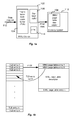
- an MMU 102 contains a TLB 104 with a depth n, and a pre-fetch buffer 106 with depth m, the depth being the number of page table entries each buffer can hold.
- the MMU 102 has data request interface 112 where data requests are received.
- the MMU 102 comprises control circuitry 114 that is configured to control the MMU 102 as described herein and illustrated in figure 1a only as a functional block for the sake of clarity.
- the page table entries are virtual-to-physical address translation information located inside the MMU page table descriptor 108 in the main memory system 110.
- a data request has attributes, as the skilled person will realize, in terms of parameters that are associated with the address and data of the request in a given bus protocol (e.g., for the advanced extensible interface, AXI, bus protocol, the transactions attributes include: address, burst size, burst length, type and cacheability). Moreover, as the skilled person will realize, realization of the look-up is by means of the control circuitry 114. If the corresponding entry is found, the address is translated and the data transaction is issued to the main physical memory.
- a PTW is performed to fetch the corresponding entry from the page table descriptor.
- a pre-fetch request is also issued to fetch the next page table entry in the page table descriptor, i.e. the page table entry that is subsequent to the entry corresponding to the address causing the miss in the TLB.
- Figure 1b illustrates the content of a TLB and MMU page table descriptor (e.g. corresponding to TLB 104 and page table descriptor 108 in figure 1 a) and how a PTW request re-fills the TLB.
- the "next" page table entry is the virtual to physical translation of the current virtual address that caused the miss plus an address stride.
- the address stride corresponds to the description of a memory page that has a given size.
- the size of a page in the page table descriptor is software driven and varies from one implementation to another.
- an MMU needs to perform three page table walk accesses to level 1, level 2 and then level 3 descriptors (assuming that the memory is mapped in 4KB pages).
- TLB buffering capabilities and TLB pre-fetching mechanisms are usually a bottleneck for the system overall performance due to TLB miss and latency required to fetch page table entries from the main memory system: this latter issue is usually shared between a big number of hardware devices.
- MMU pre-fetch logic usually contains buffering capabilities only for the last translation level (i.e. level 3).
- a single MMU is usually shared between several initiators, an initiator being any device connected directly to the MMU data request interface and capable of issuing transactions through the MMU.
- the TLB, pre-fetch buffers and other MMU device resources are used by several sources and the miss rate in the TLB is higher. This is due to the fact that these initiators are independent and access several distinct buffers in the main memory simultaneously.
- the access pattern within the same buffer is not necessarily contiguous in the virtual address space, which makes reuse of TLB entries very low and pre-fetching the next page table descriptor almost useless.
- TLB replacement policy can also be a limitation depending on the traffic access pattern.
- a replacement policy is the implementation of an algorithm responsible for replacing the TLB entries when the TLB is full. The algorithm is responsible for choosing the TLB entry that has to be evicted to replace it with a newly requested one.
- TLB replacement policy is round-robin.
- Round-Robin is a scheduling algorithm where the eviction order of the TLB entries is cyclic and no specific priority is applied to any of the TLB entries. The eviction of the TLB is then based on the location of the entries and could lead to the eviction of entries that are currently in use, especially if TLB depth is limited (largely less than the number of buffers accessed simultaneously).
- a memory management system that comprises a memory management unit, MMU, configured to receive data requests associated with virtual addresses from data request initiators and configured to translate the virtual addresses into physical addresses in a main memory system.
- MMU memory management unit
- the configuration of the memory management system is such that it is capable of:
- the memory management system of the first aspect further comprises:
- the MMU can comprise an address prediction module that is configured to determine an identity, ID, of a data request initiator, calculate, based on the ID, an address stride prediction value, and provide the address stride prediction value to the ETC.
- the ETC is further configured to receive the address stride prediction value, and based on the address stride prediction value, perform said extension of the information that specifies an amount of further address translation information.
- a method in a memory management system comprising a memory management unit, MMU, configured to receive data requests associated with virtual addresses from data request initiators and configured to translate the virtual addresses into physical addresses in a main memory system. This translation is performed by:
- the method of the second aspect further comprises:
- the method comprises determining, in an address prediction module comprised in the MMU, an identity, ID, of a data request initiator, calculating, in the address prediction module, based on the ID, an address stride prediction value, providing, from the address prediction module, the address stride prediction value to the ETC, receiving, in the ETC, the address stride prediction value, and based on the address stride prediction value, performing, in the ETC, said extension of the information that specifies an amount of further address translation information.
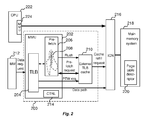
- the system 200 comprises a MMU 202 and interacts with an architecture that comprises number of entities including a processor 222 having an internal MMU 224, a multimedia subsystem 212, an interconnect network 216 and a main memory system 218.
- the MMU comprises a TLB 204, a pre-fetch cache circuitry 206 that includes prediction functionality 208 (i.e. a prediction algorithm), and control circuitry 214.
- the system can, e.g., be integrated into a system-on-chip, SoC, basic architecture.
- Data requests that include virtual addresses are received by the MMU 202 from, e.g., the multimedia subsystem 212.
- the data requests are processed by the MMU 202 as summarized above and PTW requests are issued in cases where the desired address translation information is not available in the TLB.
- the pre-fetching process operates by way of pre-fetch requests and flushing as illustrated in figure 2 .
- MMU device PTW requests can be easily distinguished at MMU device boundaries (either because issued through a dedicated port or tagged differently than translated transactions at MMU data master interface).
- the present disclosure illustrates two enhancements that mask TLB misses and reduce page table walk latency:
- a first enhancement is the addition of an external (i.e. external to the MMU) hardware component that is named external TLB cache, ETC, 210.
- ETC external TLB cache
- the ETC 210 is connected to the MMU device PTW master port through which the PTW requests are issued. If the PTW transactions don't have a dedicated interface, the ETC can be connected to a MMU data master port (however, such a variant is not illustrated in figure 2 ).
- the other enhancement involves an extension of the pre-fetch prediction algorithm 208 to add virtual address stride prediction that depends on the transaction initiator ID (i.e. source of the request or transaction).
- the ETC 210 is connected such that the pre-fetch and flush procedure operates via the ETC such that cache refill requests are issued by the ETC 210 to the page table descriptor 220 in the main memory system 218 via the interconnect network 216.
- the ETC is a read-only cache that, for example, has a 128 bytes line size. If a page table entry is 8-bytes long, a cache line is able to hold up to 16 page table entries.
- the role of the ETC is to intercept PTW bursts (i.e. requests or transactions) issued by the MMU 202 and extend the burst length to the line size of the ETC.
- the PTW burst length can be either 8 or 16 bytes.
- each intercepted PTW transaction is turned to a 128 byte transaction, which allows fetching 16 times more entries than the initial PTW 8 byte burst. All the other PTW transaction attributes are kept the same (i.e. only the size is modified).
- the ETC 310 can be the ETC 210 in figure 2 .
- the addition of an ETC having a line size that is bigger than the PTW burst size introduces an enhancement of the MMU device pre-fetching capabilities natively. Instead of pre-fetching the single next entry, 16 entries are fetched from the page table descriptor at once. Only the requested amount of data is returned to the MMU device PTW request. The 128 byte burst is stored in the ETC.
- the PTW request When a miss occurs in the TLB the next time, and the requested address belongs to one of the 16 pre-fetched entries located in the ETC, the PTW request will hit in the ETC and the transaction will not pay the latency of fetching the page table descriptor from the main memory system.
- the ETC replacement policy is least recently used, LRU. This means that the eviction of ETC lines is based on the frequency of using the page table entries. The least used entry will be evicted. This guarantees that no eviction will happen on a cached line where a hit happened recently and hence in use by the MMU.
- the MMU device pre-fetch functionality is extended to have a dedicated port handling only pre-fetch requests and connected to ETC 210.
- the miss is detected inside the MMU device pre-fetch module 206.
- the intercepted miss address and transaction identity, ID i.e. the identity of the initiator or requesting entity such as a multimedia subsystem, a processor etc.
- ID i.e. the identity of the initiator or requesting entity such as a multimedia subsystem, a processor etc.
- the address prediction mechanism is based on a user-defined software, SW, interface in the form of a register, or a set of registers, that defines how address stride is calculated by the prediction algorithm.
- the registers for example located in the pre-fetch module 206, are configured to be programmed by SW before the MMU device starts processing data transactions. Such a register is illustrated in figure 4 .
- the pre-fetch user-defined interface can be used to enable pre-fetch for a specific type of data traffic or for some initiators only (e.g. a specific processor or specific multimedia subsystem etc. having a specific ID) It is up to the SW to determine which traffic has performance requirements that need pre-fetch enabling.
- a PTW is performed by the MMU device.
- An added functionality of the present disclosure is that an additional pre-fetch request is computed and transferred to ETC.
- the address stride prediction is based on initiator ID.
- the ID of the transaction that caused the miss is compared to the ID range pre-programmed in the user-defined pre-fetch register user_reg[ID1_END:ID1_BASE]. If the ID matches, the pre-fetch address is equal to @current_address + user_reg[4:1].
- the bitfield user_reg[4:1] being pre-programmed with the address stride the SW wants to apply to the transactions belonging to the ID range.
- the ID range can be an entity/transaction source identifier. It is possible to implement as much user-defined registers as necessary to cover all types of entities/initiators connected to the same MMU device or to cut ID ranges as precisely as necessary to differentiate entity traffic threads (when possible).
- address stride is a multiple of ETC line size.
- pre-fetch is either linear or n-linear.
- the new pre-fetch request corresponds to the next ETC line, i.e. next 128 bytes of the page table descriptor, for a given TLB miss.
- n is the number of page table entries to jump inside the page table descriptor before pre-fetching the next 128 bytes. If the ETC line size is "L”, "n" is a multiple of "L".
- control circuitry 214 can interact with the functionality of the TLB 204, the pre-fetch cache circuitry 206 and the ETC 210, 310 in order to perform the steps of the method.
- the method commences with an interception step 502 performed in the ETC210, where said PTW requests are intercepted.
- a modification step 504 performed in the ETC, content of said intercepted PTW requests is modified such that the information that specifies an amount of further address translation information is extended from a first amount to a second amount, the second amount being greater than the first amount.
- a storage step 506 performed in the ETC, the second amount of further address translation information is stored.
- a provision step 512 is performed that entails providing, from the ETC, said address translation information to the MMU, thereby avoiding the sending a PTW request to the page table descriptor and avoiding reception of further address translation information from the page table descriptor.
- the method can also include steps performed in collaboration between the address prediction module 206 and the ETC 210, 310.
- a determination step 552 performed in the address prediction module 206 an identity, ID, of a data request initiator is determined.
- An address stride prediction value is then calculated in the address prediction module 206 in a calculation step 554.
- the address stride prediction value is then provided from the address prediction module 206 to the ETC 210, 310 in a provision step 556.
- the address stride prediction value is received in the ETC 210, 310 in a reception step 558 and, based on the received address stride prediction value, the ETC performs, in an extension step 560, said extension of the information that specifies an amount of further address translation information.
Landscapes
- Engineering & Computer Science (AREA)
- Theoretical Computer Science (AREA)
- Physics & Mathematics (AREA)
- General Engineering & Computer Science (AREA)
- General Physics & Mathematics (AREA)
- Memory System Of A Hierarchy Structure (AREA)
Abstract
Description
- The field of the present disclosure is that of controlling a memory management system where virtual addresses are translated into physical addresses.
- A memory management unit, MMU, is an arrangement in a virtual memory system that provides address translation services, memory fragmentation and memory protection capabilities to a group of devices sharing the MMU in the system. Information that enables the MMU to map virtual addresses to physical addresses is stored in a so-called page table. Typically, the page table is stored in physical memory that is part of the main memory of the system in which the MMU is operating. One part of the MMU is a cache of recently used mappings from the page table. This cache is called a translation look aside buffer, TLB.
- One procedure that the MMU performs is page table walk, PTW, which is a mechanism of controlling (often denoted "walking") the memory device to read page table descriptors containing address translation information for a given MMU Device.
- Another procedure that is performed by the MMU is TLB pre-fetching. TLB pre-fetching is the mechanism of address prediction aimed to refill the MMU TLB with the appropriate translated addresses before they are requested by an initiator. Here, an initiator is any device that is connected directly to the MMU data request interface and that is capable of issuing transactions (i.e. a data request) through the MMU.
- In the existing MMU devices, TLB buffering capabilities and TLB pre-fetching mechanisms are usually a bottleneck for the overall performance of the system due to TLB misses and the latency required when fetching page table entries from the main memory system.
- In other words, there is a need for enhancing TLB pre-fetch capabilities to mask page table walk latency caused by TLB misses, as will be illustrated in the following.
- With reference to
figure 1a , anMMU 102 contains aTLB 104 with a depth n, and apre-fetch buffer 106 with depth m, the depth being the number of page table entries each buffer can hold. The MMU 102 hasdata request interface 112 where data requests are received. As the skilled person realizes, the MMU 102 comprisescontrol circuitry 114 that is configured to control theMMU 102 as described herein and illustrated infigure 1a only as a functional block for the sake of clarity. The page table entries are virtual-to-physical address translation information located inside the MMUpage table descriptor 108 in themain memory system 110. - When a transaction, i.e. a data request, occurs on the MMU
data request interface 112, theTLB 104 is looked up to identify the TLB entry that corresponds to the incoming data request. A data request has attributes, as the skilled person will realize, in terms of parameters that are associated with the address and data of the request in a given bus protocol (e.g., for the advanced extensible interface, AXI, bus protocol, the transactions attributes include: address, burst size, burst length, type and cacheability). Moreover, as the skilled person will realize, realization of the look-up is by means of thecontrol circuitry 114. If the corresponding entry is found, the address is translated and the data transaction is issued to the main physical memory. - If the entry is not found, i.e. a TLB miss occurs, a PTW is performed to fetch the corresponding entry from the page table descriptor. In parallel, a pre-fetch request is also issued to fetch the next page table entry in the page table descriptor, i.e. the page table entry that is subsequent to the entry corresponding to the address causing the miss in the TLB.
-
Figure 1b illustrates the content of a TLB and MMU page table descriptor (e.g. corresponding toTLB 104 andpage table descriptor 108 infigure 1 a) and how a PTW request re-fills the TLB. The "next" page table entry is the virtual to physical translation of the current virtual address that caused the miss plus an address stride. The address stride corresponds to the description of a memory page that has a given size. The size of a page in the page table descriptor is software driven and varies from one implementation to another. - In the implementations that exist today, 32-bit address space page table descriptors are described on three levels:
-
Level 1 contains the fragmentation of the memory space in 1 GB regions. -
Level 2 contains the fragmentation of a 1 GB region into 2MB regions. The descriptor contains maximum 512 entries. -
Level 3 contains the memory mapping of each 2 MB region into 4KB pages. - To perform an address translation, an MMU needs to perform three page table walk accesses to
level 1,level 2 and thenlevel 3 descriptors (assuming that the memory is mapped in 4KB pages). - In existing MMU devices, TLB buffering capabilities and TLB pre-fetching mechanisms are usually a bottleneck for the system overall performance due to TLB miss and latency required to fetch page table entries from the main memory system: this latter issue is usually shared between a big number of hardware devices. Furthermore, MMU pre-fetch logic usually contains buffering capabilities only for the last translation level (i.e. level 3).
- In addition to that, a single MMU is usually shared between several initiators, an initiator being any device connected directly to the MMU data request interface and capable of issuing transactions through the MMU. In such cases, the TLB, pre-fetch buffers and other MMU device resources are used by several sources and the miss rate in the TLB is higher. This is due to the fact that these initiators are independent and access several distinct buffers in the main memory simultaneously. Besides, the access pattern within the same buffer is not necessarily contiguous in the virtual address space, which makes reuse of TLB entries very low and pre-fetching the next page table descriptor almost useless.
- Moreover, TLB replacement policy can also be a limitation depending on the traffic access pattern. A replacement policy is the implementation of an algorithm responsible for replacing the TLB entries when the TLB is full. The algorithm is responsible for choosing the TLB entry that has to be evicted to replace it with a newly requested one.
- In most of the cases, TLB replacement policy is round-robin. Round-Robin is a scheduling algorithm where the eviction order of the TLB entries is cyclic and no specific priority is applied to any of the TLB entries. The eviction of the TLB is then based on the location of the entries and could lead to the eviction of entries that are currently in use, especially if TLB depth is limited (largely less than the number of buffers accessed simultaneously).
- In view of this situation with respect to prior art memory management systems, there is a need for enhancing TLB pre-fetch capabilities to mask page table walk latency caused by a TLB miss.
- In order to mitigate at least some of the drawbacks as discussed above, there is provided in a first aspect a memory management system that comprises a memory management unit, MMU, configured to receive data requests associated with virtual addresses from data request initiators and configured to translate the virtual addresses into physical addresses in a main memory system. The configuration of the memory management system is such that it is capable of:
- obtaining address translation information from an address translation look-aside buffer, TLB in the MMU,
- sending page table walk, PTW, requests to a page table descriptor in said main memory system and receiving address translation information from said page table descriptor, said PTW requests including information that specifies an amount of further address translation information, said further address translation information being associated with data requests that are subsequent to a current data request,
- receiving said further address translation information from said page table descriptor and storing said further address translation information for use in connection with data requests that are subsequent to a current data request.
- The memory management system of the first aspect further comprises:
- a cache unit, ETC, configured to:
- intercept said PTW requests,
- modify content of said intercepted PTW requests such that the information that specifies an amount of further address translation information is extended from a first amount to a second amount, the second amount being greater than the first amount,
- store the second amount of further address translation information, and
- if an intercepted PTW request is associated with address translation information already stored in the ETC, provide said address translation information to the MMU, thereby avoiding the sending a PTW request to the page table descriptor and avoiding reception of further address translation information from the page table descriptor.
- In some embodiments, the MMU can comprise an address prediction module that is configured to determine an identity, ID, of a data request initiator, calculate, based on the ID, an address stride prediction value, and provide the address stride prediction value to the ETC. In these embodiments, the ETC is further configured to receive the address stride prediction value, and based on the address stride prediction value, perform said extension of the information that specifies an amount of further address translation information.
- In order to mitigate at least some of the drawbacks as discussed above, there is provided in a second aspect a method in a memory management system. The system comprises a memory management unit, MMU, configured to receive data requests associated with virtual addresses from data request initiators and configured to translate the virtual addresses into physical addresses in a main memory system. This translation is performed by:
- obtaining address translation information from an address translation look-aside buffer, TLB, in the MMU,
- sending page table walk, PTW, requests to a page table descriptor in said main memory system and receiving address translation information from said page table descriptor, said PTW requests including information that specifies an amount of further address translation information, said further address translation information being associated with data requests that are subsequent to a current data request, and
- receiving said further address translation information from said page table descriptor and storing said further address translation information for use in connection with data requests that are subsequent to a current data request.
- The method of the second aspect further comprises:
- intercepting, in a cache unit, ETC, said PTW requests,
- modifying, in the ETC, content of said intercepted PTW requests such that the information that specifies an amount of further address translation information is extended from a first amount to a second amount, the second amount being greater than the first amount,
- storing, in the ETC, the second amount of further address translation information, and
- if an intercepted PTW request is associated with address translation information already stored in the ETC, providing, from the ETC, said address translation information to the MMU, thereby avoiding the sending a PTW request to the page table descriptor and avoiding reception of further address translation information from the page table descriptor.
- In some embodiments, the method comprises determining, in an address prediction module comprised in the MMU, an identity, ID, of a data request initiator, calculating, in the address prediction module, based on the ID, an address stride prediction value, providing, from the address prediction module, the address stride prediction value to the ETC, receiving, in the ETC, the address stride prediction value, and based on the address stride prediction value, performing, in the ETC, said extension of the information that specifies an amount of further address translation information.
- To summarize some effects and advantages it can be seen that, by the addition of a dedicated external TLB cache the buffering capacity of the TLB is enlarged with a reduced latency as a result. For example, when using a 128 byte cache line, implicit pre-fetch of 15 entries is enabled in addition to an 8 byte entry requested effectively by the MMU.
-
-
Figure 1a schematically illustrates a block diagram of a memory management system, -
figure 1b schematically illustrates content of a TLB and a page table descriptor, -
figure 2 schematically illustrates a block diagram of a memory management system, -
figure 3 schematically illustrates a block diagram of an ETC, -
figure 4 schematically illustrates a register for use in controlling a memory management system, and -
figures 5a and 5b are flow charts of methods of controlling a memory management system. - Now with reference to
figure 2 , amemory management system 200 will be described in some more detail. Thesystem 200 comprises aMMU 202 and interacts with an architecture that comprises number of entities including aprocessor 222 having aninternal MMU 224, amultimedia subsystem 212, aninterconnect network 216 and amain memory system 218. The MMU comprises aTLB 204, apre-fetch cache circuitry 206 that includes prediction functionality 208 (i.e. a prediction algorithm), andcontrol circuitry 214. The system can, e.g., be integrated into a system-on-chip, SoC, basic architecture. - Data requests that include virtual addresses are received by the
MMU 202 from, e.g., themultimedia subsystem 212. The data requests are processed by theMMU 202 as summarized above and PTW requests are issued in cases where the desired address translation information is not available in the TLB. The pre-fetching process, as summarized above, operates by way of pre-fetch requests and flushing as illustrated infigure 2 . - In this disclosure, it is assumed that MMU device PTW requests can be easily distinguished at MMU device boundaries (either because issued through a dedicated port or tagged differently than translated transactions at MMU data master interface).
- In contrast to prior art memory management systems, the present disclosure illustrates two enhancements that mask TLB misses and reduce page table walk latency:
- A first enhancement is the addition of an external (i.e. external to the MMU) hardware component that is named external TLB cache, ETC, 210. In the example of
figure 2 , theETC 210 is connected to the MMU device PTW master port through which the PTW requests are issued. If the PTW transactions don't have a dedicated interface, the ETC can be connected to a MMU data master port (however, such a variant is not illustrated infigure 2 ). - The other enhancement involves an extension of the
pre-fetch prediction algorithm 208 to add virtual address stride prediction that depends on the transaction initiator ID (i.e. source of the request or transaction). - As illustrated in
figure 2 theETC 210 is connected such that the pre-fetch and flush procedure operates via the ETC such that cache refill requests are issued by theETC 210 to thepage table descriptor 220 in themain memory system 218 via theinterconnect network 216. - The ETC is a read-only cache that, for example, has a 128 bytes line size. If a page table entry is 8-bytes long, a cache line is able to hold up to 16 page table entries.
- The role of the ETC is to intercept PTW bursts (i.e. requests or transactions) issued by the
MMU 202 and extend the burst length to the line size of the ETC. For example, the PTW burst length can be either 8 or 16 bytes. In case the ETC line is 128Bytes, each intercepted PTW transaction is turned to a 128 byte transaction, which allows fetching 16 times more entries than theinitial PTW 8 byte burst. All the other PTW transaction attributes are kept the same (i.e. only the size is modified). - This is illustrated in further detail by an
ETC 310 infigure 3 . TheETC 310 can be theETC 210 infigure 2 . The addition of an ETC having a line size that is bigger than the PTW burst size introduces an enhancement of the MMU device pre-fetching capabilities natively. Instead of pre-fetching the single next entry, 16 entries are fetched from the page table descriptor at once. Only the requested amount of data is returned to the MMU device PTW request. The 128 byte burst is stored in the ETC. When a miss occurs in the TLB the next time, and the requested address belongs to one of the 16 pre-fetched entries located in the ETC, the PTW request will hit in the ETC and the transaction will not pay the latency of fetching the page table descriptor from the main memory system. - The ETC replacement policy is least recently used, LRU. This means that the eviction of ETC lines is based on the frequency of using the page table entries. The least used entry will be evicted. This guarantees that no eviction will happen on a cached line where a hit happened recently and hence in use by the MMU.
- It is to be noted that the
ETC - As
figure 2 illustrates, the MMU device pre-fetch functionality is extended to have a dedicated port handling only pre-fetch requests and connected toETC 210. For each MMU internal TLB miss, the miss is detected inside the MMUdevice pre-fetch module 206. The intercepted miss address and transaction identity, ID (i.e. the identity of the initiator or requesting entity such as a multimedia subsystem, a processor etc.), are processed inside pre-fetch module to calculate the address to pre-fetch. The address prediction mechanism is based on a user-defined software, SW, interface in the form of a register, or a set of registers, that defines how address stride is calculated by the prediction algorithm. The registers, for example located in thepre-fetch module 206, are configured to be programmed by SW before the MMU device starts processing data transactions. Such a register is illustrated infigure 4 . - The pre-fetch user-defined interface can be used to enable pre-fetch for a specific type of data traffic or for some initiators only (e.g. a specific processor or specific multimedia subsystem etc. having a specific ID) It is up to the SW to determine which traffic has performance requirements that need pre-fetch enabling.
- For example, now also with reference to
figure 4 , when a miss in the TLB occurs, a PTW is performed by the MMU device. An added functionality of the present disclosure is that an additional pre-fetch request is computed and transferred to ETC. The address stride prediction is based on initiator ID. The ID of the transaction that caused the miss is compared to the ID range pre-programmed in the user-defined pre-fetch register user_reg[ID1_END:ID1_BASE]. If the ID matches, the pre-fetch address is equal to @current_address + user_reg[4:1]. The bitfield user_reg[4:1] being pre-programmed with the address stride the SW wants to apply to the transactions belonging to the ID range. - For example, the ID range can be an entity/transaction source identifier. It is possible to implement as much user-defined registers as necessary to cover all types of entities/initiators connected to the same MMU device or to cut ID ranges as precisely as necessary to differentiate entity traffic threads (when possible).
- As mentioned above, address stride is a multiple of ETC line size. This means that pre-fetch is either linear or n-linear. In case it is linear, the new pre-fetch request corresponds to the next ETC line, i.e. next 128 bytes of the page table descriptor, for a given TLB miss. In case it is n-linear, "n" is the number of page table entries to jump inside the page table descriptor before pre-fetching the next 128 bytes. If the ETC line size is "L", "n" is a multiple of "L".
- A method that realizes the above is illustrated in the flow chart in
figures 5a and 5b . The method can be realized in the memory management system as illustrated above infigures 2-4 . For example,control circuitry 214 can interact with the functionality of theTLB 204, thepre-fetch cache circuitry 206 and theETC - The method commences with an
interception step 502 performed in the ETC210, where said PTW requests are intercepted. - In a
modification step 504, performed in the ETC, content of said intercepted PTW requests is modified such that the information that specifies an amount of further address translation information is extended from a first amount to a second amount, the second amount being greater than the first amount. - In a
storage step 506, performed in the ETC, the second amount of further address translation information is stored. - If an intercepted PTW request is associated with address translation information already stored in the ETC, a
provision step 512 is performed that entails providing, from the ETC, said address translation information to the MMU, thereby avoiding the sending a PTW request to the page table descriptor and avoiding reception of further address translation information from the page table descriptor. - With reference to
figure 5b , the method can also include steps performed in collaboration between theaddress prediction module 206 and theETC determination step 552 performed in theaddress prediction module 206 an identity, ID, of a data request initiator is determined. An address stride prediction value is then calculated in theaddress prediction module 206 in acalculation step 554. The address stride prediction value is then provided from theaddress prediction module 206 to theETC provision step 556. - The address stride prediction value is received in the
ETC reception step 558 and, based on the received address stride prediction value, the ETC performs, in anextension step 560, said extension of the information that specifies an amount of further address translation information. - The arrangements and methods described herein have advantages that can be summarized as follows:
- The memory management unit TLB buffering capacity is enlarged by the addition of a dedicated external TLB Cache.
- Using a 128 byte cache line enables the implicit pre-fetch of 15 entries in addition to the 8-byte entry requested effectively by the MMU.
- The extended pre-fetch logic is based on user-defined SW interface.
- The user-defined SW interface allows the identification of transactions causing the TLB miss based on the initiator ID.
- The user-defined SW interface allows defining a dedicated pre-fetch depth per initiator or per transaction ID.
- The pre-fetch dedicated logic has its own master port connected to ETC.
- The pre-fetch dedicated logic benefits from implicit 128 byte inner ETC pre-fetching.
Claims (7)
- A memory management system (200) comprising:- a memory management unit, MMU (202), configured to receive data requests associated with virtual addresses from data request initiators and configured to translate the virtual addresses into physical addresses in a main memory system (216) by:the memory management system being characterized in that it comprises:- obtaining address translation information from an address translation look-aside buffer, TLB (204) in the MMU,- sending page table walk, PTW, requests to a page table descriptor (218) in said main memory system and receiving address translation information from said page table descriptor, said PTW requests including information that specifies an amount of further address translation information, said further address translation information being associated with data requests that are subsequent to a current data request,- receiving said further address translation information from said page table descriptor and storing said further address translation information for use in connection with data requests that are subsequent to a current data request,- a cache unit, ETC (210), configured to:- intercept said PTW requests,- modify content of said intercepted PTW requests such that the information that specifies an amount of further address translation information is extended from a first amount to a second amount, the second amount being greater than the first amount,- store the second amount of further address translation information, and- if an intercepted PTW request is associated with address translation information already stored in the ETC, provide said address translation information to the MMU, thereby avoiding the sending a PTW request to the page table descriptor and avoiding reception of further address translation information from the page table descriptor.
- The system of claim 1, where the MMU comprises an address prediction module (206) configured to:- determine an identity, ID, of a data request initiator,- calculate, based on the ID, an address stride prediction value,- provide the address stride prediction value to the ETC, and
where the ETC is further configured to:- receive the address stride prediction value, and- based on the address stride prediction value, perform said extension of the information that specifies an amount of further address translation information. - The system of claim 2, where the address prediction module comprises a register (400) that is configured to be programmed by a user to contain at least one data request initiator ID and information associated with said at least one data request initiator ID, said information configured for enabling and disabling the ETC to operate based on the ID.
- The system of claim 2, where the address prediction module comprises a register (400) that is configured to be programmed by a user to contain at least one data request initiator ID and information associated with said at least one data request initiator ID, said information configured for use in said calculation of an address stride prediction value.
- A method in a memory management system (200) comprising:- a memory management unit, MMU (202), configured to receive data requests associated with virtual addresses from data request initiators and configured to translate the virtual addresses into physical addresses in a main memory system (216) by:the method being characterized in that it comprises:- obtaining address translation information from an address translation look-aside buffer, TLB (204) in the MMU,- sending page table walk, PTW, requests to a page table descriptor (218) in said main memory system and receiving address translation information from said page table descriptor, said PTW requests including information that specifies an amount of further address translation information, said further address translation information being associated with data requests that are subsequent to a current data request,- receiving said further address translation information from said page table descriptor and storing said further address translation information for use in connection with data requests that are subsequent to a current data request,- intercepting (502), in a cache unit, ETC (210), said PTW requests,- modifying (504), in the ETC, content of said intercepted PTW requests such that the information that specifies an amount of further address translation information is extended from a first amount to a second amount, the second amount being greater than the first amount,- storing (506), in the ETC, the second amount of further address translation information, and- if an intercepted PTW request is associated with address translation information already stored in the ETC, providing (512), from the ETC, said address translation information to the MMU, thereby avoiding the sending a PTW request to the page table descriptor and avoiding reception of further address translation information from the page table descriptor.
- The method of claim 5, comprising:- determining (552) an identity, ID, of a data request initiator,- calculating (554), based on the ID, an address stride prediction value,- providing (556), from the address prediction module, the address stride prediction value to the ETC,- receiving (558), in the ETC, the address stride prediction value, and- based on the address stride prediction value, performing (560), in the ETC, said extension of the information that specifies an amount of further address translation information.
- The method of claim 6, comprising enabling the ETC to operate based on the ID.
Priority Applications (2)
| Application Number | Priority Date | Filing Date | Title |
|---|---|---|---|
| EP13181535.9A EP2840504A1 (en) | 2013-08-23 | 2013-08-23 | Enhanced pre-fetch in a memory management system |
| US14/464,750 US9436610B2 (en) | 2013-08-23 | 2014-08-21 | Enhanced pre-fetch in a memory management system |
Applications Claiming Priority (1)
| Application Number | Priority Date | Filing Date | Title |
|---|---|---|---|
| EP13181535.9A EP2840504A1 (en) | 2013-08-23 | 2013-08-23 | Enhanced pre-fetch in a memory management system |
Publications (1)
| Publication Number | Publication Date |
|---|---|
| EP2840504A1 true EP2840504A1 (en) | 2015-02-25 |
Family
ID=49035394
Family Applications (1)
| Application Number | Title | Priority Date | Filing Date |
|---|---|---|---|
| EP13181535.9A Ceased EP2840504A1 (en) | 2013-08-23 | 2013-08-23 | Enhanced pre-fetch in a memory management system |
Country Status (2)
| Country | Link |
|---|---|
| US (1) | US9436610B2 (en) |
| EP (1) | EP2840504A1 (en) |
Cited By (2)
| Publication number | Priority date | Publication date | Assignee | Title |
|---|---|---|---|---|
| CN112753024A (en) * | 2018-09-25 | 2021-05-04 | Ati科技无限责任公司 | External memory based translation look-aside buffer |
| GB2528842B (en) * | 2014-07-29 | 2021-06-02 | Advanced Risc Mach Ltd | A data processing apparatus, and a method of handling address translation within a data processing apparatus |
Families Citing this family (4)
| Publication number | Priority date | Publication date | Assignee | Title |
|---|---|---|---|---|
| US9645934B2 (en) * | 2013-09-13 | 2017-05-09 | Samsung Electronics Co., Ltd. | System-on-chip and address translation method thereof using a translation lookaside buffer and a prefetch buffer |
| US9910780B2 (en) * | 2015-10-28 | 2018-03-06 | International Business Machines Corporation | Pre-loading page table cache lines of a virtual machine |
| GB2593736B (en) * | 2020-03-31 | 2022-11-16 | Advanced Risc Mach Ltd | Verifying address translation integrity |
| KR102989817B1 (en) | 2020-12-03 | 2026-07-10 | 삼성전자주식회사 | System-on-chip performing address translation and method of thereof |
Citations (1)
| Publication number | Priority date | Publication date | Assignee | Title |
|---|---|---|---|---|
| US20130103923A1 (en) * | 2011-10-20 | 2013-04-25 | Jesse Pan | Memory management unit speculative hardware table walk scheme |
Family Cites Families (2)
| Publication number | Priority date | Publication date | Assignee | Title |
|---|---|---|---|---|
| US7171539B2 (en) * | 2002-11-18 | 2007-01-30 | Arm Limited | Apparatus and method for controlling access to a memory |
| WO2004046738A2 (en) * | 2002-11-18 | 2004-06-03 | Arm Limited | Virtual to physical memory address mapping within a system having a secure domain and a non-secure domain |
-
2013
- 2013-08-23 EP EP13181535.9A patent/EP2840504A1/en not_active Ceased
-
2014
- 2014-08-21 US US14/464,750 patent/US9436610B2/en active Active
Patent Citations (1)
| Publication number | Priority date | Publication date | Assignee | Title |
|---|---|---|---|---|
| US20130103923A1 (en) * | 2011-10-20 | 2013-04-25 | Jesse Pan | Memory management unit speculative hardware table walk scheme |
Cited By (3)
| Publication number | Priority date | Publication date | Assignee | Title |
|---|---|---|---|---|
| GB2528842B (en) * | 2014-07-29 | 2021-06-02 | Advanced Risc Mach Ltd | A data processing apparatus, and a method of handling address translation within a data processing apparatus |
| CN112753024A (en) * | 2018-09-25 | 2021-05-04 | Ati科技无限责任公司 | External memory based translation look-aside buffer |
| CN112753024B (en) * | 2018-09-25 | 2023-11-03 | Ati科技无限责任公司 | External memory-based conversion lookaside buffer |
Also Published As
| Publication number | Publication date |
|---|---|
| US9436610B2 (en) | 2016-09-06 |
| US20150058578A1 (en) | 2015-02-26 |
Similar Documents
| Publication | Publication Date | Title |
|---|---|---|
| KR101667772B1 (en) | Translation look-aside buffer with prefetching | |
| US12066953B2 (en) | Handling address translation requests | |
| CN101203837B (en) | Method and device for segment processing in virtual memory system | |
| CN107111455B (en) | Electronic processor architecture and method of caching data | |
| KR102069273B1 (en) | System on chip and operating method thereof | |
| KR102290464B1 (en) | System-on-chip and address translation method thereof | |
| US9436610B2 (en) | Enhanced pre-fetch in a memory management system | |
| EP3367248B1 (en) | Streaming translation lookaside buffer | |
| US11803482B2 (en) | Process dedicated in-memory translation lookaside buffers (TLBs) (mTLBs) for augmenting memory management unit (MMU) TLB for translating virtual addresses (VAs) to physical addresses (PAs) in a processor-based system | |
| US8335908B2 (en) | Data processing apparatus for storing address translations | |
| US20160323407A1 (en) | Data processing apparatus, controller, cache and method | |
| CN111198827B (en) | Page table prefetching method and device | |
| US20250165402A1 (en) | Memory-Access Policies in Peripheral Device based on Memory Usage Characteristics | |
| US20150121012A1 (en) | Method and apparatus for providing dedicated entries in a content addressable memory to facilitate real-time clients | |
| CN120407453A (en) | Page table acquisition method, memory management unit, processor and computer equipment |
Legal Events
| Date | Code | Title | Description |
|---|---|---|---|
| PUAI | Public reference made under article 153(3) epc to a published international application that has entered the european phase |
Free format text: ORIGINAL CODE: 0009012 |
|
| 17P | Request for examination filed |
Effective date: 20130823 |
|
| AK | Designated contracting states |
Kind code of ref document: A1 Designated state(s): AL AT BE BG CH CY CZ DE DK EE ES FI FR GB GR HR HU IE IS IT LI LT LU LV MC MK MT NL NO PL PT RO RS SE SI SK SM TR |
|
| AX | Request for extension of the european patent |
Extension state: BA ME |
|
| R17P | Request for examination filed (corrected) |
Effective date: 20150813 |
|
| RBV | Designated contracting states (corrected) |
Designated state(s): AL AT BE BG CH CY CZ DE DK EE ES FI FR GB GR HR HU IE IS IT LI LT LU LV MC MK MT NL NO PL PT RO RS SE SI SK SM TR |
|
| 17Q | First examination report despatched |
Effective date: 20180314 |
|
| STAA | Information on the status of an ep patent application or granted ep patent |
Free format text: STATUS: THE APPLICATION HAS BEEN REFUSED |
|
| 18R | Application refused |
Effective date: 20200330 |