EP2840080A1 - Nitrogen-containing heterocyclic compound or salt thereof - Google Patents
Nitrogen-containing heterocyclic compound or salt thereof Download PDFInfo
- Publication number
- EP2840080A1 EP2840080A1 EP20130778349 EP13778349A EP2840080A1 EP 2840080 A1 EP2840080 A1 EP 2840080A1 EP 20130778349 EP20130778349 EP 20130778349 EP 13778349 A EP13778349 A EP 13778349A EP 2840080 A1 EP2840080 A1 EP 2840080A1
- Authority
- EP
- European Patent Office
- Prior art keywords
- group
- substituted
- amino
- dimethylamino
- methyl
- Prior art date
- Legal status (The legal status is an assumption and is not a legal conclusion. Google has not performed a legal analysis and makes no representation as to the accuracy of the status listed.)
- Granted
Links
- 0 *c1n[n](*)c2nc(N)ccc12 Chemical compound *c1n[n](*)c2nc(N)ccc12 0.000 description 19
- YBAZINRZQSAIAY-UHFFFAOYSA-N Nc(cc1)ccc1C#N Chemical compound Nc(cc1)ccc1C#N YBAZINRZQSAIAY-UHFFFAOYSA-N 0.000 description 3
- QZVQQUVWFIZUBQ-UHFFFAOYSA-N Nc1cccc(F)c1 Chemical compound Nc1cccc(F)c1 QZVQQUVWFIZUBQ-UHFFFAOYSA-N 0.000 description 3
- BGPVAGINRNAFSY-UHFFFAOYSA-N CC(C)(C)OC(NC1(CN)CCOCC1)=O Chemical compound CC(C)(C)OC(NC1(CN)CCOCC1)=O BGPVAGINRNAFSY-UHFFFAOYSA-N 0.000 description 2
- WFZFQJNCPZTWFJ-UHFFFAOYSA-N CC(C)(C)OC(NCCN(C(OC(C)(C)C)=O)c1cccc([N+]([O-])=O)c1)=O Chemical compound CC(C)(C)OC(NCCN(C(OC(C)(C)C)=O)c1cccc([N+]([O-])=O)c1)=O WFZFQJNCPZTWFJ-UHFFFAOYSA-N 0.000 description 2
- OEUWQYOWKWNKRW-UHFFFAOYSA-N CCCNc1c(CO)cnc(Nc2cc(F)ccc2)n1 Chemical compound CCCNc1c(CO)cnc(Nc2cc(F)ccc2)n1 OEUWQYOWKWNKRW-UHFFFAOYSA-N 0.000 description 2
- YIMNQWSIQLKYOZ-UHFFFAOYSA-N C#CCCN(C(c1ccccc11)=O)C1=O Chemical compound C#CCCN(C(c1ccccc11)=O)C1=O YIMNQWSIQLKYOZ-UHFFFAOYSA-N 0.000 description 1
- DUUNRPRPIYSJPE-UHFFFAOYSA-N C#Cc1ccccc1CN(C(c1c2cccc1)=O)C2=O Chemical compound C#Cc1ccccc1CN(C(c1c2cccc1)=O)C2=O DUUNRPRPIYSJPE-UHFFFAOYSA-N 0.000 description 1
- RBZDBSJEDQMZKH-UHFFFAOYSA-O CC(C(NCCCC#Cc1c(NCC=COC)nc(Nc2ccc(C=N)c([NH2+]C)c2)nc1)=O)N(C)C(OC(C)(C)C)=O Chemical compound CC(C(NCCCC#Cc1c(NCC=COC)nc(Nc2ccc(C=N)c([NH2+]C)c2)nc1)=O)N(C)C(OC(C)(C)C)=O RBZDBSJEDQMZKH-UHFFFAOYSA-O 0.000 description 1
- MKWCWMCPBLDFIZ-UHFFFAOYSA-O CC(C(NCCCC#Cc1c([NH2+]N=CC=N)nc(Nc(cc2)ccc2C#N)nc1)=O)N(C)C(C=CCN(C)C)=O Chemical compound CC(C(NCCCC#Cc1c([NH2+]N=CC=N)nc(Nc(cc2)ccc2C#N)nc1)=O)N(C)C(C=CCN(C)C)=O MKWCWMCPBLDFIZ-UHFFFAOYSA-O 0.000 description 1
- ZYWOFYDBYXCDKB-ZETCQYMHSA-N CC(C)(C)OC(N(C)[C@H](C(O)=O)C#C)=O Chemical compound CC(C)(C)OC(N(C)[C@H](C(O)=O)C#C)=O ZYWOFYDBYXCDKB-ZETCQYMHSA-N 0.000 description 1
- UKDBDJRZCUPJGL-NDEPHWFRSA-N CC(C)(C)OC(N(CC(C1)(F)F)[C@@]1(C([N](C)(C)CCCC#Cc1c(NC)nc(Nc(cc2)ccc2F)nc1)=O)N)=O Chemical compound CC(C)(C)OC(N(CC(C1)(F)F)[C@@]1(C([N](C)(C)CCCC#Cc1c(NC)nc(Nc(cc2)ccc2F)nc1)=O)N)=O UKDBDJRZCUPJGL-NDEPHWFRSA-N 0.000 description 1
- OZPSSRHETLBGTM-UHFFFAOYSA-N CC(C)(C)OC(N(CCC1)C1C(NCCCC#Cc1c(NCCCOC)nc(Nc2ccnc(OC)c2)nc1)=O)=O Chemical compound CC(C)(C)OC(N(CCC1)C1C(NCCCC#Cc1c(NCCCOC)nc(Nc2ccnc(OC)c2)nc1)=O)=O OZPSSRHETLBGTM-UHFFFAOYSA-N 0.000 description 1
- ALENZIYBEXJJPD-SGOSIXLISA-N CC(C)(C)OC(N(CCC1)C1C(N[C@H](C1)C[C@H]1C#Cc1c(NC2CC2)nc(Nc(cc2)ccc2C#N)nc1)=O)=O Chemical compound CC(C)(C)OC(N(CCC1)C1C(N[C@H](C1)C[C@H]1C#Cc1c(NC2CC2)nc(Nc(cc2)ccc2C#N)nc1)=O)=O ALENZIYBEXJJPD-SGOSIXLISA-N 0.000 description 1
- FKKSHUUCKLJKHM-DEOSSOPVSA-N CC(C)(C)OC(N(CCC1)[C@@H]1C(NCCCC#Cc1c(NC2CC2)nc(Nc(cc2C=N)ccc2N)nc1)=O)=O Chemical compound CC(C)(C)OC(N(CCC1)[C@@H]1C(NCCCC#Cc1c(NC2CC2)nc(Nc(cc2C=N)ccc2N)nc1)=O)=O FKKSHUUCKLJKHM-DEOSSOPVSA-N 0.000 description 1
- IXCQPGGHHXLBCC-VWLOTQADSA-O CC(C)(C)OC(N(CCC1)[C@@H]1C(NCCCC#Cc1c(NCCCOC)nc(Nc(cc2C=[NH2+])ccc2N)nc1)=O)=O Chemical compound CC(C)(C)OC(N(CCC1)[C@@H]1C(NCCCC#Cc1c(NCCCOC)nc(Nc(cc2C=[NH2+])ccc2N)nc1)=O)=O IXCQPGGHHXLBCC-VWLOTQADSA-O 0.000 description 1
- LZMYADSVEWYWQE-UHFFFAOYSA-N CC(C)(C)OC(NC(CCOC)(CCOC)C#N)=O Chemical compound CC(C)(C)OC(NC(CCOC)(CCOC)C#N)=O LZMYADSVEWYWQE-UHFFFAOYSA-N 0.000 description 1
- KCPGRRQIMQKRAQ-UHFFFAOYSA-N CC(C)(C)OC(NC(CCOC)(CCOC)CN)=O Chemical compound CC(C)(C)OC(NC(CCOC)(CCOC)CN)=O KCPGRRQIMQKRAQ-UHFFFAOYSA-N 0.000 description 1
- SKIMZZPDOVVMIG-UHFFFAOYSA-N CC(C)(C)OC(NC(CCOC)(CCOC)CNC(OCC1c2ccccc2-c2c1cccc2)=O)=O Chemical compound CC(C)(C)OC(NC(CCOC)(CCOC)CNC(OCC1c2ccccc2-c2c1cccc2)=O)=O SKIMZZPDOVVMIG-UHFFFAOYSA-N 0.000 description 1
- GFMHNORFBIULNJ-UHFFFAOYSA-N CC(C)(C)OC(NC1(CCOCC1)C#N)=O Chemical compound CC(C)(C)OC(NC1(CCOCC1)C#N)=O GFMHNORFBIULNJ-UHFFFAOYSA-N 0.000 description 1
- QWXUMWGSBHIOKB-UHFFFAOYSA-N CC(C)(C)OC(NC1(CNC(OCc2ccccc2)=O)CCOCC1)=O Chemical compound CC(C)(C)OC(NC1(CNC(OCc2ccccc2)=O)CCOCC1)=O QWXUMWGSBHIOKB-UHFFFAOYSA-N 0.000 description 1
- GARAUAIDCKJFFO-UHFFFAOYSA-N CC(C)(C)OC(NCCC(Nc1cccc(N)c1)=O)=O Chemical compound CC(C)(C)OC(NCCC(Nc1cccc(N)c1)=O)=O GARAUAIDCKJFFO-UHFFFAOYSA-N 0.000 description 1
- WCFJUSRQHZPVKY-UHFFFAOYSA-N CC(C)(C)OC(NCCC(O)=O)=O Chemical compound CC(C)(C)OC(NCCC(O)=O)=O WCFJUSRQHZPVKY-UHFFFAOYSA-N 0.000 description 1
- RTEUYBORJPZXJK-UHFFFAOYSA-N CC(C)(C)OC(NCCCC#Cc(cnc(Nc(cc1)ccc1C#N)n1)c1Cl)=O Chemical compound CC(C)(C)OC(NCCCC#Cc(cnc(Nc(cc1)ccc1C#N)n1)c1Cl)=O RTEUYBORJPZXJK-UHFFFAOYSA-N 0.000 description 1
- YRISEVVENQXNQU-UHFFFAOYSA-N CC(C)(C)OC(NCCCC#Cc1c(-[n]2nccc2)nc(Nc(cc2)ccc2C#N)nc1)=O Chemical compound CC(C)(C)OC(NCCCC#Cc1c(-[n]2nccc2)nc(Nc(cc2)ccc2C#N)nc1)=O YRISEVVENQXNQU-UHFFFAOYSA-N 0.000 description 1
- QXNIRRBXAVHUCH-UHFFFAOYSA-N CC(C)(C)OC(NCCN(C(OC(C)(C)C)=O)c1cccc(N)c1)=O Chemical compound CC(C)(C)OC(NCCN(C(OC(C)(C)C)=O)c1cccc(N)c1)=O QXNIRRBXAVHUCH-UHFFFAOYSA-N 0.000 description 1
- NBROOFIXGXXYIH-UHFFFAOYSA-N CC(C)(C)OC(NCc1nc(ccc(I)c2)c2[nH]1)=O Chemical compound CC(C)(C)OC(NCc1nc(ccc(I)c2)c2[nH]1)=O NBROOFIXGXXYIH-UHFFFAOYSA-N 0.000 description 1
- LNBSHIZPNHVFMX-LPHOPBHVSA-N CC(C)(C)OC(N[C@@H](CCC1)C[C@@H]1C#Cc1c(NC2CC2)nc(Nc2ccnc(F)c2)nc1)=O Chemical compound CC(C)(C)OC(N[C@@H](CCC1)C[C@@H]1C#Cc1c(NC2CC2)nc(Nc2ccnc(F)c2)nc1)=O LNBSHIZPNHVFMX-LPHOPBHVSA-N 0.000 description 1
- RUPVGCDWROPYMS-UHFFFAOYSA-N CC(C)(CCN)C#Cc1c(NC2CC2)nc(Nc2ccnc(F)c2)nc1 Chemical compound CC(C)(CCN)C#Cc1c(NC2CC2)nc(Nc2ccnc(F)c2)nc1 RUPVGCDWROPYMS-UHFFFAOYSA-N 0.000 description 1
- WDJLJIHZXYSWLK-LFWWJXCOSA-N CC(C)Oc(nc(Nc(cc1)ccc1C#N)nc1)c1C#C[C@H](CCC1)C[C@H]1NC([C@H](C)N(C)C(/C=C/CN(C)C)=O)=O Chemical compound CC(C)Oc(nc(Nc(cc1)ccc1C#N)nc1)c1C#C[C@H](CCC1)C[C@H]1NC([C@H](C)N(C)C(/C=C/CN(C)C)=O)=O WDJLJIHZXYSWLK-LFWWJXCOSA-N 0.000 description 1
- ZAUJGDFXVHCQIP-UHFFFAOYSA-N CC(CC1NC1)=O Chemical compound CC(CC1NC1)=O ZAUJGDFXVHCQIP-UHFFFAOYSA-N 0.000 description 1
- HMMRKCFQEMTGPI-UHFFFAOYSA-N CC(CC=C(NC)N=C1NC2C=CC(C)=CC2)C=C1C#CC(C)(C1)CC1(C1)C1NC(C1(CC1)N(C)C(OC(C)(C)C)=O)=O Chemical compound CC(CC=C(NC)N=C1NC2C=CC(C)=CC2)C=C1C#CC(C)(C1)CC1(C1)C1NC(C1(CC1)N(C)C(OC(C)(C)C)=O)=O HMMRKCFQEMTGPI-UHFFFAOYSA-N 0.000 description 1
- WIVDPHPOPLJROI-UHFFFAOYSA-N CC1(CCC1)C#Cc1c(NC2CC2)nc(Nc(cc2F)ccc2OC)nc1 Chemical compound CC1(CCC1)C#Cc1c(NC2CC2)nc(Nc(cc2F)ccc2OC)nc1 WIVDPHPOPLJROI-UHFFFAOYSA-N 0.000 description 1
- BFBJXLKJFCNJQH-YABOKQTFSA-N CCC(/C(/[C@](C)(CCC1)C[C@@]1(C1)C1NC([C@H](C=C)N(C)C(OC(C)(C)C)=O)=O)=C\N=C(/N)\Nc1cccc(F)c1)OC(C)C Chemical compound CCC(/C(/[C@](C)(CCC1)C[C@@]1(C1)C1NC([C@H](C=C)N(C)C(OC(C)(C)C)=O)=O)=C\N=C(/N)\Nc1cccc(F)c1)OC(C)C BFBJXLKJFCNJQH-YABOKQTFSA-N 0.000 description 1
- KVEMGPGHOWZJFV-UHFFFAOYSA-N CCCN(C(OC(C)(C)C)=O)c1cc(Cl)ncc1I Chemical compound CCCN(C(OC(C)(C)C)=O)c1cc(Cl)ncc1I KVEMGPGHOWZJFV-UHFFFAOYSA-N 0.000 description 1
- IKOTWOHOMQVCQC-DEOSSOPVSA-N CCCN(C1CC1)c1nc(Nc2ccnc(F)c2)ncc1C#CCCCNC([C@H](C=C)N(C)C(OC(C)(C)C)=O)=O Chemical compound CCCN(C1CC1)c1nc(Nc2ccnc(F)c2)ncc1C#CCCCNC([C@H](C=C)N(C)C(OC(C)(C)C)=O)=O IKOTWOHOMQVCQC-DEOSSOPVSA-N 0.000 description 1
- OYLHBPLRWAFZLG-UHFFFAOYSA-N CCCNC1=NC(Nc(cc2)ccc2F)NC=C1C#CC1CC2(CC2)C1 Chemical compound CCCNC1=NC(Nc(cc2)ccc2F)NC=C1C#CC1CC2(CC2)C1 OYLHBPLRWAFZLG-UHFFFAOYSA-N 0.000 description 1
- IQPBEDDGJHFQML-UHFFFAOYSA-N CCCNc(nc(N)nc1)c1C(OCC)=O Chemical compound CCCNc(nc(N)nc1)c1C(OCC)=O IQPBEDDGJHFQML-UHFFFAOYSA-N 0.000 description 1
- ZONPAJICNGJSLJ-UHFFFAOYSA-N CCCNc(nc(NC(C=CC1C)=CC1F)nc1)c1-c1c[n](CCNC(CN(C)C(OC(C)(C)C)=O)=O)nn1 Chemical compound CCCNc(nc(NC(C=CC1C)=CC1F)nc1)c1-c1c[n](CCNC(CN(C)C(OC(C)(C)C)=O)=O)nn1 ZONPAJICNGJSLJ-UHFFFAOYSA-N 0.000 description 1
- QEXBYPLBPIHCIY-SOFGYWHQSA-N CCCNc(nc(NC(Nc1ccncc1)=O)nc1)c1C(NCCCNC(CN(C)C(/C=C/CN(C)C)=O)=O)=O Chemical compound CCCNc(nc(NC(Nc1ccncc1)=O)nc1)c1C(NCCCNC(CN(C)C(/C=C/CN(C)C)=O)=O)=O QEXBYPLBPIHCIY-SOFGYWHQSA-N 0.000 description 1
- UCDAXLZAMMLWFM-SDNYCIMKSA-N CCCNc(nc(NC1CC1)nc1)c1C#CCCCNC([C@H](C#C)N(C)C(/C=C/CN(C)C)=O)=O Chemical compound CCCNc(nc(NC1CC1)nc1)c1C#CCCCNC([C@H](C#C)N(C)C(/C=C/CN(C)C)=O)=O UCDAXLZAMMLWFM-SDNYCIMKSA-N 0.000 description 1
- MAXWDMZMFGIYLX-KRWDZBQOSA-N CCCNc(nc(NCC)nc1)c1C#CCCCNC([C@H](C)N(C)C(OC(C)(C)C)=O)=O Chemical compound CCCNc(nc(NCC)nc1)c1C#CCCCNC([C@H](C)N(C)C(OC(C)(C)C)=O)=O MAXWDMZMFGIYLX-KRWDZBQOSA-N 0.000 description 1
- NOSISMGYWWZFOJ-UHFFFAOYSA-N CCCNc(nc(NCCc1ccncc1)nc1)c1C(NCCCNC(CNC)=O)=O Chemical compound CCCNc(nc(NCCc1ccncc1)nc1)c1C(NCCCNC(CNC)=O)=O NOSISMGYWWZFOJ-UHFFFAOYSA-N 0.000 description 1
- FQHAKJDPMLYAOY-UHFFFAOYSA-N CCCNc(nc(NCCc1ccncc1)nc1)c1C(Nc(cc1NC(CN)=O)ccc1OC)=O Chemical compound CCCNc(nc(NCCc1ccncc1)nc1)c1C(Nc(cc1NC(CN)=O)ccc1OC)=O FQHAKJDPMLYAOY-UHFFFAOYSA-N 0.000 description 1
- LXNUDIVGBGRJBA-UHFFFAOYSA-N CCCNc(nc(NCCc1ccncc1)nc1)c1C(Nc(cc1NC(CNC)=O)ccc1OC)=O Chemical compound CCCNc(nc(NCCc1ccncc1)nc1)c1C(Nc(cc1NC(CNC)=O)ccc1OC)=O LXNUDIVGBGRJBA-UHFFFAOYSA-N 0.000 description 1
- KQZGRBMAJHXGRT-UHFFFAOYSA-N CCCNc(nc(NCCc1ccncc1)nc1)c1C(Nc1cc(NC(C(C)(C)N)=O)ccc1)=O Chemical compound CCCNc(nc(NCCc1ccncc1)nc1)c1C(Nc1cc(NC(C(C)(C)N)=O)ccc1)=O KQZGRBMAJHXGRT-UHFFFAOYSA-N 0.000 description 1
- VAOKMVPSVSHPBT-UHFFFAOYSA-N CCCNc(nc(NCCc1ccncc1)nc1)c1C(Nc1cccc(N)c1)=O Chemical compound CCCNc(nc(NCCc1ccncc1)nc1)c1C(Nc1cccc(N)c1)=O VAOKMVPSVSHPBT-UHFFFAOYSA-N 0.000 description 1
- GOLZIVYIWZPDHG-UHFFFAOYSA-N CCCNc(nc(NCCc1ccncc1)nc1)c1C(Nc1cccc(NC(CNC)=O)c1)=O Chemical compound CCCNc(nc(NCCc1ccncc1)nc1)c1C(Nc1cccc(NC(CNC)=O)c1)=O GOLZIVYIWZPDHG-UHFFFAOYSA-N 0.000 description 1
- SQNUJNIUXRTGLY-OTQLOIIPSA-N CCCNc(nc(Nc(cc1)ccc1-[n]1nccn1)nc1)c1C#CCCCNC([C@H](C#C)N(C)C(/C=C/CN(C)C)=O)=O Chemical compound CCCNc(nc(Nc(cc1)ccc1-[n]1nccn1)nc1)c1C#CCCCNC([C@H](C#C)N(C)C(/C=C/CN(C)C)=O)=O SQNUJNIUXRTGLY-OTQLOIIPSA-N 0.000 description 1
- BBBBEPFVGAYONU-UHFFFAOYSA-N CCCNc(nc(Nc(cc1)ccc1C#N)nc1)c1C#CCCCNC(C(CC(C1)C#[O]C)N1C(OC(C)(C)C)=O)=O Chemical compound CCCNc(nc(Nc(cc1)ccc1C#N)nc1)c1C#CCCCNC(C(CC(C1)C#[O]C)N1C(OC(C)(C)C)=O)=O BBBBEPFVGAYONU-UHFFFAOYSA-N 0.000 description 1
- BWBXODUMFCCRKV-XUMXBMEFSA-N CCCNc(nc(Nc(cc1)ccc1C#N)nc1)c1C#CCCCNC([C@H](C[C@@H](C1)OC)N1C(/C=C/CN(C)C)=O)=O Chemical compound CCCNc(nc(Nc(cc1)ccc1C#N)nc1)c1C#CCCCNC([C@H](C[C@@H](C1)OC)N1C(/C=C/CN(C)C)=O)=O BWBXODUMFCCRKV-XUMXBMEFSA-N 0.000 description 1
- BWBXODUMFCCRKV-NFYVHRGDSA-N CCCNc(nc(Nc(cc1)ccc1C#N)nc1)c1C#CCCCNC([C@H](C[C@H](C1)OC)N1C(/C=C/CN(C)C)=O)=O Chemical compound CCCNc(nc(Nc(cc1)ccc1C#N)nc1)c1C#CCCCNC([C@H](C[C@H](C1)OC)N1C(/C=C/CN(C)C)=O)=O BWBXODUMFCCRKV-NFYVHRGDSA-N 0.000 description 1
- UNFFIQUXBKHUJX-HKBQPEDESA-N CCCNc(nc(Nc(cc1)ccc1C#N)nc1)c1C#CCCCNC([C@](C)(CCCC1)N1C(OC(C)(C)C)=O)=O Chemical compound CCCNc(nc(Nc(cc1)ccc1C#N)nc1)c1C#CCCCNC([C@](C)(CCCC1)N1C(OC(C)(C)C)=O)=O UNFFIQUXBKHUJX-HKBQPEDESA-N 0.000 description 1
- KSNPDDRABHMQDH-UHFFFAOYSA-N CCCNc(nc(Nc(cc1)ccc1C#N)nc1)c1C#CCNC(CCCN)=O Chemical compound CCCNc(nc(Nc(cc1)ccc1C#N)nc1)c1C#CCNC(CCCN)=O KSNPDDRABHMQDH-UHFFFAOYSA-N 0.000 description 1
- AJNGBRKWYVJKST-UHFFFAOYSA-N CCCNc(nc(Nc(cc1)ccc1C(N(C)C)=O)nc1)c1C#CCCCNC(CN(C)C(OC(C)(C)C)=O)=O Chemical compound CCCNc(nc(Nc(cc1)ccc1C(N(C)C)=O)nc1)c1C#CCCCNC(CN(C)C(OC(C)(C)C)=O)=O AJNGBRKWYVJKST-UHFFFAOYSA-N 0.000 description 1
- ZUENWQSATSUAIP-AATRIKPKSA-N CCCNc(nc(Nc(cc1)ccc1C(N)=O)nc1)c1C#CC(C=C1)=CCC1NC(CNC(/C=C/CN(C)C)=O)=O Chemical compound CCCNc(nc(Nc(cc1)ccc1C(N)=O)nc1)c1C#CC(C=C1)=CCC1NC(CNC(/C=C/CN(C)C)=O)=O ZUENWQSATSUAIP-AATRIKPKSA-N 0.000 description 1
- CQAMURHHQNHXNA-UHFFFAOYSA-N CCCNc(nc(Nc(cc1)ccc1C(N)=O)nc1)c1C#CCCCNC(C)(C)CN Chemical compound CCCNc(nc(Nc(cc1)ccc1C(N)=O)nc1)c1C#CCCCNC(C)(C)CN CQAMURHHQNHXNA-UHFFFAOYSA-N 0.000 description 1
- HKZGVROBQIWFJG-UHFFFAOYSA-N CCCNc(nc(Nc(cc1)ccc1C(N)=O)nc1)c1C(NCC(CCC1)CC1Nc(cccc1)c1[N+]([O-])=O)=O Chemical compound CCCNc(nc(Nc(cc1)ccc1C(N)=O)nc1)c1C(NCC(CCC1)CC1Nc(cccc1)c1[N+]([O-])=O)=O HKZGVROBQIWFJG-UHFFFAOYSA-N 0.000 description 1
- NFBMHCBQIYEKTK-VQHVLOKHSA-N CCCNc(nc(Nc(cc1)ccc1C(N)=O)nc1)c1C(NCCCNC(C)(C)CNC(/C=C/CN(C)C)=O)=O Chemical compound CCCNc(nc(Nc(cc1)ccc1C(N)=O)nc1)c1C(NCCCNC(C)(C)CNC(/C=C/CN(C)C)=O)=O NFBMHCBQIYEKTK-VQHVLOKHSA-N 0.000 description 1
- FQEZZUURMYUWFD-UHFFFAOYSA-N CCCNc(nc(Nc(cc1)ccc1C(N)=O)nc1)c1C(Nc1cc(NC2CNCC2)ccc1)=O Chemical compound CCCNc(nc(Nc(cc1)ccc1C(N)=O)nc1)c1C(Nc1cc(NC2CNCC2)ccc1)=O FQEZZUURMYUWFD-UHFFFAOYSA-N 0.000 description 1
- UDNSAZYWFQDQOD-UHFFFAOYSA-N CCCNc(nc(Nc(cc1)ccc1C(N)=O)nc1)c1C(Nc1cccc(NC(CC2)CN2C(OC(C)(C)C)=O)c1)=O Chemical compound CCCNc(nc(Nc(cc1)ccc1C(N)=O)nc1)c1C(Nc1cccc(NC(CC2)CN2C(OC(C)(C)C)=O)c1)=O UDNSAZYWFQDQOD-UHFFFAOYSA-N 0.000 description 1
- RWYIZNIQIYBSSO-RMKNXTFCSA-N CCCNc(nc(Nc(cc1)ccc1C(N)=O)nc1)c1C(Nc1cccc(NC(CNC(/C=C/CN(C)C)=O)C(F)(F)F)c1)=O Chemical compound CCCNc(nc(Nc(cc1)ccc1C(N)=O)nc1)c1C(Nc1cccc(NC(CNC(/C=C/CN(C)C)=O)C(F)(F)F)c1)=O RWYIZNIQIYBSSO-RMKNXTFCSA-N 0.000 description 1
- VTIDHNUQESJMBP-INIZCTEOSA-N CCCNc(nc(Nc(cc1)ccc1C(N)=O)nc1)c1C(Nc1ccccc1CNC([C@H](C)NC)=O)=O Chemical compound CCCNc(nc(Nc(cc1)ccc1C(N)=O)nc1)c1C(Nc1ccccc1CNC([C@H](C)NC)=O)=O VTIDHNUQESJMBP-INIZCTEOSA-N 0.000 description 1
- VBIJOYYPGMSTQG-UHFFFAOYSA-N CCCNc(nc(Nc(cc1)ccc1C(N)=O)nc1)c1C(O)=O Chemical compound CCCNc(nc(Nc(cc1)ccc1C(N)=O)nc1)c1C(O)=O VBIJOYYPGMSTQG-UHFFFAOYSA-N 0.000 description 1
- WJMMYELAICLGBJ-UHFFFAOYSA-N CCCNc(nc(Nc(cc1C)ccc1C#N)nc1)c1I Chemical compound CCCNc(nc(Nc(cc1C)ccc1C#N)nc1)c1I WJMMYELAICLGBJ-UHFFFAOYSA-N 0.000 description 1
- JHMUPPYNUNHQAV-UHFFFAOYSA-N CCCNc(nc(Nc(cc1F)ccc1F)nc1)c1I Chemical compound CCCNc(nc(Nc(cc1F)ccc1F)nc1)c1I JHMUPPYNUNHQAV-UHFFFAOYSA-N 0.000 description 1
- VRBOCYUGQWCROE-UHFFFAOYSA-N CCCNc(nc(Nc(cc1F)ccc1OC)nc1)c1C#CCCCN Chemical compound CCCNc(nc(Nc(cc1F)ccc1OC)nc1)c1C#CCCCN VRBOCYUGQWCROE-UHFFFAOYSA-N 0.000 description 1
- BLGDPLBOTIVACR-UHFFFAOYSA-N CCCNc(nc(Nc(cn1)ccc1OC)nc1)c1C#CCCCN Chemical compound CCCNc(nc(Nc(cn1)ccc1OC)nc1)c1C#CCCCN BLGDPLBOTIVACR-UHFFFAOYSA-N 0.000 description 1
- HUBCOLGYYGVDRL-UHFFFAOYSA-N CCCNc(nc(Nc(cn1)ccc1OC)nc1)c1C#CCCCNC(CN(C)C(OC(C)(C)C)=O)=O Chemical compound CCCNc(nc(Nc(cn1)ccc1OC)nc1)c1C#CCCCNC(CN(C)C(OC(C)(C)C)=O)=O HUBCOLGYYGVDRL-UHFFFAOYSA-N 0.000 description 1
- VGJFJFLSQFUOER-QFIPXVFZSA-N CCCNc(nc(Nc1cc(-[n]2nccc2)ccc1)nc1)c1C#CCCCNC([C@H](C)N(C)C(OC(C)(C)C)=O)=O Chemical compound CCCNc(nc(Nc1cc(-[n]2nccc2)ccc1)nc1)c1C#CCCCNC([C@H](C)N(C)C(OC(C)(C)C)=O)=O VGJFJFLSQFUOER-QFIPXVFZSA-N 0.000 description 1
- ZZKRADKTHBGUPU-UHFFFAOYSA-N CCCNc(nc(Nc1cc(C)n[o]1)nc1)c1C#CCCCNC(C(CCC1)N1C(OC(C)(C)C)=O)=O Chemical compound CCCNc(nc(Nc1cc(C)n[o]1)nc1)c1C#CCCCNC(C(CCC1)N1C(OC(C)(C)C)=O)=O ZZKRADKTHBGUPU-UHFFFAOYSA-N 0.000 description 1
- FFPYKYOOFLHDRK-UHFFFAOYSA-N CCCNc(nc(Nc1cc(C)n[o]1)nc1)c1C#CCCCNC(C1NCCC1)=O Chemical compound CCCNc(nc(Nc1cc(C)n[o]1)nc1)c1C#CCCCNC(C1NCCC1)=O FFPYKYOOFLHDRK-UHFFFAOYSA-N 0.000 description 1
- MQZDTNCPPUQSMU-UHFFFAOYSA-N CCCNc(nc(Nc1cc(C)n[s]1)nc1)c1C#CCCCN Chemical compound CCCNc(nc(Nc1cc(C)n[s]1)nc1)c1C#CCCCN MQZDTNCPPUQSMU-UHFFFAOYSA-N 0.000 description 1
- ROAHYRUWPFHRBJ-QFIPXVFZSA-N CCCNc(nc(Nc1cc(F)ccc1)nc1)c1C#CCCCNC([C@H](CC(C)C)NC)=O Chemical compound CCCNc(nc(Nc1cc(F)ccc1)nc1)c1C#CCCCNC([C@H](CC(C)C)NC)=O ROAHYRUWPFHRBJ-QFIPXVFZSA-N 0.000 description 1
- KEYOKMYSDOYTFX-UHFFFAOYSA-N CCCNc(nc(Nc1cc(F)ccc1)nc1)c1C#Cc1c(CN)cccc1 Chemical compound CCCNc(nc(Nc1cc(F)ccc1)nc1)c1C#Cc1c(CN)cccc1 KEYOKMYSDOYTFX-UHFFFAOYSA-N 0.000 description 1
- RTKZDKBENZDHFE-UHFFFAOYSA-O CCCNc(nc(Nc1cc([NH3+])c(C=N)cc1)nc1)c1C#CCCCNC(C(CCC1)N1C(C=CCN(C)C)=O)=O Chemical compound CCCNc(nc(Nc1cc([NH3+])c(C=N)cc1)nc1)c1C#CCCCNC(C(CCC1)N1C(C=CCN(C)C)=O)=O RTKZDKBENZDHFE-UHFFFAOYSA-O 0.000 description 1
- ZYKRDLNQSDOPPF-NRFANRHFSA-N CCCNc(nc(Nc1cc(c(C)n[nH]2)c2nc1)nc1)c1C#CCCCNC([C@H](C)N(C)C(CCCN(C)C)=O)=O Chemical compound CCCNc(nc(Nc1cc(c(C)n[nH]2)c2nc1)nc1)c1C#CCCCNC([C@H](C)N(C)C(CCCN(C)C)=O)=O ZYKRDLNQSDOPPF-NRFANRHFSA-N 0.000 description 1
- RNHJAAXOTOEOIE-CWSBKQHBSA-N CCCNc(nc(Nc1cc2ccc(C)nc2cc1)nc1)c1C#CCCCNC([C@H](C)N(C)C(/C=C/CN(C)C)=O)=O Chemical compound CCCNc(nc(Nc1cc2ccc(C)nc2cc1)nc1)c1C#CCCCNC([C@H](C)N(C)C(/C=C/CN(C)C)=O)=O RNHJAAXOTOEOIE-CWSBKQHBSA-N 0.000 description 1
- NWISDCUTHAOSSB-QQOLHMHLSA-N CCCNc(nc(Nc1cc2ccncc2cc1)nc1)c1C(NCCCNC([C@H](C=C)N(C)C(/C=C/CN(C)C)=O)=O)=O Chemical compound CCCNc(nc(Nc1cc2ccncc2cc1)nc1)c1C(NCCCNC([C@H](C=C)N(C)C(/C=C/CN(C)C)=O)=O)=O NWISDCUTHAOSSB-QQOLHMHLSA-N 0.000 description 1
- LNPQFIYBJLJSMT-UHFFFAOYSA-O CCCNc(nc(Nc1ccc(C(OC)=N)c([NH2+]C)c1)nc1)c1C#CCCCNC(C(C)N(C)C(OC(C)(C)C)=O)=O Chemical compound CCCNc(nc(Nc1ccc(C(OC)=N)c([NH2+]C)c1)nc1)c1C#CCCCNC(C(C)N(C)C(OC(C)(C)C)=O)=O LNPQFIYBJLJSMT-UHFFFAOYSA-O 0.000 description 1
- SOHCMXOCDJLHQD-NAQGIECBSA-N CCCNc(nc(Nc1ccc(C)nc1)nc1)c1C#CCCCNC([C@H](C)N(C)C(/C=C/CN(C)C)O)=O Chemical compound CCCNc(nc(Nc1ccc(C)nc1)nc1)c1C#CCCCNC([C@H](C)N(C)C(/C=C/CN(C)C)O)=O SOHCMXOCDJLHQD-NAQGIECBSA-N 0.000 description 1
- UVAOUZCERSCNJQ-KHMHUBCMSA-N CCCNc(nc(Nc1ccc2[n](C(OCC)=O)ncc2c1)nc1)c1C#CCCCNC([C@H](C)N(C)C(/C=C/CN(C)C)=O)=O Chemical compound CCCNc(nc(Nc1ccc2[n](C(OCC)=O)ncc2c1)nc1)c1C#CCCCNC([C@H](C)N(C)C(/C=C/CN(C)C)=O)=O UVAOUZCERSCNJQ-KHMHUBCMSA-N 0.000 description 1
- WSHTUBHMFVDXDX-JLHYYAGUSA-N CCCNc(nc(Nc1ccc2c(OC)n[nH]c2c1)nc1)c1C#CCCCNC(C(CCC1)N1C(/C=C/CN(C)C)=O)=O Chemical compound CCCNc(nc(Nc1ccc2c(OC)n[nH]c2c1)nc1)c1C#CCCCNC(C(CCC1)N1C(/C=C/CN(C)C)=O)=O WSHTUBHMFVDXDX-JLHYYAGUSA-N 0.000 description 1
- VEUFQJGFGGFAMH-ACUNGTFPSA-N CCCNc(nc(Nc1ccc2nc[s]c2c1)nc1)c1C#CCCCNC([C@H](C)N(C)C(/C=C/CN(C)C)=O)=O Chemical compound CCCNc(nc(Nc1ccc2nc[s]c2c1)nc1)c1C#CCCCNC([C@H](C)N(C)C(/C=C/CN(C)C)=O)=O VEUFQJGFGGFAMH-ACUNGTFPSA-N 0.000 description 1
- JEBCEIXBGGJFEL-QMUTUGEISA-N CCCNc(nc(Nc1cccc(C#N)c1)nc1)c1C#CCCCNC([C@H](C)N(C)C(/C=C/CN(C)C)=O)=O Chemical compound CCCNc(nc(Nc1cccc(C#N)c1)nc1)c1C#CCCCNC([C@H](C)N(C)C(/C=C/CN(C)C)=O)=O JEBCEIXBGGJFEL-QMUTUGEISA-N 0.000 description 1
- OYOJIRGXCOQTAY-IBGZPJMESA-N CCCNc(nc(Nc1cccc(C#N)c1)nc1)c1C(Nc1cccc(NC([C@H](C)N(C)C(OC(C)(C)C)=O)=O)c1)=O Chemical compound CCCNc(nc(Nc1cccc(C#N)c1)nc1)c1C(Nc1cccc(NC([C@H](C)N(C)C(OC(C)(C)C)=O)=O)c1)=O OYOJIRGXCOQTAY-IBGZPJMESA-N 0.000 description 1
- TZLXAUMVCQCWRJ-GLHYLFFDSA-N CCCNc(nc(Nc1cccc(C(F)(F)F)c1)nc1)c1C#CCCCNC([C@H](C)N(C)C(/C=C/CN(C)C)=O)=O Chemical compound CCCNc(nc(Nc1cccc(C(F)(F)F)c1)nc1)c1C#CCCCNC([C@H](C)N(C)C(/C=C/CN(C)C)=O)=O TZLXAUMVCQCWRJ-GLHYLFFDSA-N 0.000 description 1
- RATCPJPGGWPQHE-UHFFFAOYSA-N CCCNc(nc(Nc1cccc(F)c1)nc1)c1-c([o]c1c2)nc1ccc2[N+]([O-])=O Chemical compound CCCNc(nc(Nc1cccc(F)c1)nc1)c1-c([o]c1c2)nc1ccc2[N+]([O-])=O RATCPJPGGWPQHE-UHFFFAOYSA-N 0.000 description 1
- ZGOCEYIUBVVLFM-UHFFFAOYSA-N CCCNc(nc(Nc1cccc(F)c1)nc1)c1-c1c[n](CCN)nn1 Chemical compound CCCNc(nc(Nc1cccc(F)c1)nc1)c1-c1c[n](CCN)nn1 ZGOCEYIUBVVLFM-UHFFFAOYSA-N 0.000 description 1
- FUCWHEWQAKBNHT-UHFFFAOYSA-N CCCNc(nc(Nc1cccc(F)c1)nc1)c1-c1c[n](CCNC(OC(C)(C)C)=O)nn1 Chemical compound CCCNc(nc(Nc1cccc(F)c1)nc1)c1-c1c[n](CCNC(OC(C)(C)C)=O)nn1 FUCWHEWQAKBNHT-UHFFFAOYSA-N 0.000 description 1
- SSLGXUFMDILDLJ-LUFJGRFYSA-N CCCNc(nc(Nc1cccc(F)c1)nc1)c1-c1c[n](CCNC([C@H](C#C)N(C)C(/C=C/CN(C)C)=O)=O)nn1 Chemical compound CCCNc(nc(Nc1cccc(F)c1)nc1)c1-c1c[n](CCNC([C@H](C#C)N(C)C(/C=C/CN(C)C)=O)=O)nn1 SSLGXUFMDILDLJ-LUFJGRFYSA-N 0.000 description 1
- ZRYIFLWNHNOYPR-UHFFFAOYSA-N CCCNc(nc(Nc1cccc(F)c1)nc1)c1C#CCCC(NC(C)(C)CNC)=O Chemical compound CCCNc(nc(Nc1cccc(F)c1)nc1)c1C#CCCC(NC(C)(C)CNC)=O ZRYIFLWNHNOYPR-UHFFFAOYSA-N 0.000 description 1
- AQXFIRGZLUOQDR-UHFFFAOYSA-N CCCNc(nc(Nc1cccc(F)c1)nc1)c1C#CCCC(NCCNC)=O Chemical compound CCCNc(nc(Nc1cccc(F)c1)nc1)c1C#CCCC(NCCNC)=O AQXFIRGZLUOQDR-UHFFFAOYSA-N 0.000 description 1
- KCIPXBYUAWCZFS-FOWTUZBSSA-N CCCNc(nc(Nc1cccc(F)c1)nc1)c1C#CCCCNC(C(C=C(C)C)N(C)C(/C=C/CN(C)C)=O)=O Chemical compound CCCNc(nc(Nc1cccc(F)c1)nc1)c1C#CCCCNC(C(C=C(C)C)N(C)C(/C=C/CN(C)C)=O)=O KCIPXBYUAWCZFS-FOWTUZBSSA-N 0.000 description 1
- LHJVFYSMXNYZRV-NRFANRHFSA-N CCCNc(nc(Nc1cccc(F)c1)nc1)c1C#CCCCNC([C@H]1NCCCC1)=O Chemical compound CCCNc(nc(Nc1cccc(F)c1)nc1)c1C#CCCCNC([C@H]1NCCCC1)=O LHJVFYSMXNYZRV-NRFANRHFSA-N 0.000 description 1
- HLCVTPQZHASSOX-SFHVURJKSA-N CCCNc(nc(Nc1cccc(F)c1)nc1)c1C#Cc1c(CNC([C@H](C)NC)=O)cccc1 Chemical compound CCCNc(nc(Nc1cccc(F)c1)nc1)c1C#Cc1c(CNC([C@H](C)NC)=O)cccc1 HLCVTPQZHASSOX-SFHVURJKSA-N 0.000 description 1
- CEOCTEUEQRXYBU-FQEVSTJZSA-N CCCNc(nc(Nc1cccc(F)c1)nc1)c1C#Cc1cc(NC([C@H](C)N(C)C(OC(C)(C)C)=O)=O)ccc1 Chemical compound CCCNc(nc(Nc1cccc(F)c1)nc1)c1C#Cc1cc(NC([C@H](C)N(C)C(OC(C)(C)C)=O)=O)ccc1 CEOCTEUEQRXYBU-FQEVSTJZSA-N 0.000 description 1
- FNARBKIIXAXYHP-KRWDZBQOSA-N CCCNc(nc(Nc1cccc(F)c1)nc1)c1C#Cc1cc(NC([C@H](C)NC)=O)ccc1 Chemical compound CCCNc(nc(Nc1cccc(F)c1)nc1)c1C#Cc1cc(NC([C@H](C)NC)=O)ccc1 FNARBKIIXAXYHP-KRWDZBQOSA-N 0.000 description 1
- CVSYYYINEKCTSP-UHFFFAOYSA-O CCCNc(nc(Nc1cccc(F)c1)nc1)c1C(N=N)=C[NH2+]CCNC(CNC)=O Chemical compound CCCNc(nc(Nc1cccc(F)c1)nc1)c1C(N=N)=C[NH2+]CCNC(CNC)=O CVSYYYINEKCTSP-UHFFFAOYSA-O 0.000 description 1
- ZFGQSBZNEFPTJH-UHFFFAOYSA-N CCCNc(nc(Nc1cccc(F)c1)nc1)c1C(Nc(ccc([N+]([O-])=O)c1)c1O)=O Chemical compound CCCNc(nc(Nc1cccc(F)c1)nc1)c1C(Nc(ccc([N+]([O-])=O)c1)c1O)=O ZFGQSBZNEFPTJH-UHFFFAOYSA-N 0.000 description 1
- IOYJZTJCYMYZKE-UHFFFAOYSA-N CCCNc(nc(Nc1cccc(F)c1)nc1)c1C(OCC)=O Chemical compound CCCNc(nc(Nc1cccc(F)c1)nc1)c1C(OCC)=O IOYJZTJCYMYZKE-UHFFFAOYSA-N 0.000 description 1
- RIFJAFAWSSQTDX-UHFFFAOYSA-N CCCNc(nc(Nc1ccnc(OC)c1)nc1)c1C#CCCCN(C(c1ccccc11)=O)C1=O Chemical compound CCCNc(nc(Nc1ccnc(OC)c1)nc1)c1C#CCCCN(C(c1ccccc11)=O)C1=O RIFJAFAWSSQTDX-UHFFFAOYSA-N 0.000 description 1
- GOWXGFFKQNAQLC-UHFFFAOYSA-N CCCNc1c(C=O)cnc(Nc2cccc(F)c2)n1 Chemical compound CCCNc1c(C=O)cnc(Nc2cccc(F)c2)n1 GOWXGFFKQNAQLC-UHFFFAOYSA-N 0.000 description 1
- ZISKOYKYNSIIQZ-CSKARUKUSA-N CCCNc1c(CCCCCNC(CNC(/C=C/CN(C)C)=O)=O)cnc(Nc(cc2)ccc2C(N)=O)n1 Chemical compound CCCNc1c(CCCCCNC(CNC(/C=C/CN(C)C)=O)=O)cnc(Nc(cc2)ccc2C(N)=O)n1 ZISKOYKYNSIIQZ-CSKARUKUSA-N 0.000 description 1
- JFNCGPFPYVYMDF-YPRJSTJPSA-N CCCNc1c(CNC(C)(C2)C=CC=C2NC([C@H](C=C)N(C)C(/C=C/CN(C)C)=O)=O)cnc(Nc2cccc(F)c2)n1 Chemical compound CCCNc1c(CNC(C)(C2)C=CC=C2NC([C@H](C=C)N(C)C(/C=C/CN(C)C)=O)=O)cnc(Nc2cccc(F)c2)n1 JFNCGPFPYVYMDF-YPRJSTJPSA-N 0.000 description 1
- PKORUQJKCJYBJF-UHFFFAOYSA-N CCCNc1cc(Cl)ncc1C(OCC)=O Chemical compound CCCNc1cc(Cl)ncc1C(OCC)=O PKORUQJKCJYBJF-UHFFFAOYSA-N 0.000 description 1
- KJEJNTDEONGLHJ-UHFFFAOYSA-N CCCNc1n[nH]cc1C#CC(C)(C)CCO Chemical compound CCCNc1n[nH]cc1C#CC(C)(C)CCO KJEJNTDEONGLHJ-UHFFFAOYSA-N 0.000 description 1
- PSVGTHBGLIYHJG-UHFFFAOYSA-N CCCNc1n[nH]cc1C#CC1CCCCC1 Chemical compound CCCNc1n[nH]cc1C#CC1CCCCC1 PSVGTHBGLIYHJG-UHFFFAOYSA-N 0.000 description 1
- GXJDIJCMDYFFJQ-ACCUITESSA-N CCCNc1n[nH]cc1C#CCCCNC(C)(C)CN(C)C(/C=C/CN(C)C)=O Chemical compound CCCNc1n[nH]cc1C#CCCCNC(C)(C)CN(C)C(/C=C/CN(C)C)=O GXJDIJCMDYFFJQ-ACCUITESSA-N 0.000 description 1
- JZPIHOUGBUMBIM-JICACKBISA-N CCCNc1n[nH]cc1C#CCCCNC([C@H](C)N(C)C(/C=C/CN(C)C)=O)=O Chemical compound CCCNc1n[nH]cc1C#CCCCNC([C@H](C)N(C)C(/C=C/CN(C)C)=O)=O JZPIHOUGBUMBIM-JICACKBISA-N 0.000 description 1
- BLHYHYRESBZYBA-KRWDZBQOSA-N CCCNc1n[nH]cc1C#Cc1c(CNC([C@H](C)N(C)C(OC(C)(C)C)=O)=O)cccc1 Chemical compound CCCNc1n[nH]cc1C#Cc1c(CNC([C@H](C)N(C)C(OC(C)(C)C)=O)=O)cccc1 BLHYHYRESBZYBA-KRWDZBQOSA-N 0.000 description 1
- ZSVSCWDAVPXKCK-UHFFFAOYSA-N CCCNc1n[nH]cc1C#Cc1ccccc1CN(C(c1c2cccc1)=O)C2=O Chemical compound CCCNc1n[nH]cc1C#Cc1ccccc1CN(C(c1c2cccc1)=O)C2=O ZSVSCWDAVPXKCK-UHFFFAOYSA-N 0.000 description 1
- HRURFNJIYCSWFK-UHFFFAOYSA-O CCCNc1nc(NC(SC(C)=N)=[NH2+])ncc1C#CCCCN Chemical compound CCCNc1nc(NC(SC(C)=N)=[NH2+])ncc1C#CCCCN HRURFNJIYCSWFK-UHFFFAOYSA-O 0.000 description 1
- AFLIOMSIBUNALE-GUXMJAIHSA-N CCCNc1nc(NC2C=CC(C#N)=CC2)ncc1C#CCCCNC(C(C1)(C=N)NC[C@@H]1OC)=O Chemical compound CCCNc1nc(NC2C=CC(C#N)=CC2)ncc1C#CCCCNC(C(C1)(C=N)NC[C@@H]1OC)=O AFLIOMSIBUNALE-GUXMJAIHSA-N 0.000 description 1
- JHGTUNIGTXVUGQ-UHFFFAOYSA-N CCCNc1nc(NCCc2ccncc2)ncc1C(NCc(cccc1)c1NC(CNC(C=C)=O)=O)=O Chemical compound CCCNc1nc(NCCc2ccncc2)ncc1C(NCc(cccc1)c1NC(CNC(C=C)=O)=O)=O JHGTUNIGTXVUGQ-UHFFFAOYSA-N 0.000 description 1
- MKHSZAXAOBDZLF-IBGZPJMESA-N CCCNc1nc(NCCc2ccncc2)ncc1C(Nc1cccc(NC([C@H](C)NC(OC(C)(C)C)=O)=O)c1)=O Chemical compound CCCNc1nc(NCCc2ccncc2)ncc1C(Nc1cccc(NC([C@H](C)NC(OC(C)(C)C)=O)=O)c1)=O MKHSZAXAOBDZLF-IBGZPJMESA-N 0.000 description 1
- KIJRYBQBTGOVDP-UHFFFAOYSA-N CCCNc1nc(Nc(cc2)ccc2C#N)ncc1C(OCC)=O Chemical compound CCCNc1nc(Nc(cc2)ccc2C#N)ncc1C(OCC)=O KIJRYBQBTGOVDP-UHFFFAOYSA-N 0.000 description 1
- PCZCTRNROJRQAG-UHFFFAOYSA-N CCCNc1nc(Nc(cc2)ccc2C(N)=O)ncc1C#CCCCNC(CN)=O Chemical compound CCCNc1nc(Nc(cc2)ccc2C(N)=O)ncc1C#CCCCNC(CN)=O PCZCTRNROJRQAG-UHFFFAOYSA-N 0.000 description 1
- DXXFHHUKAYLCAI-UHFFFAOYSA-N CCCNc1nc(Nc(cc2)ccc2C(N)=O)ncc1C(Nc1cc(N)ccc1)=O Chemical compound CCCNc1nc(Nc(cc2)ccc2C(N)=O)ncc1C(Nc1cc(N)ccc1)=O DXXFHHUKAYLCAI-UHFFFAOYSA-N 0.000 description 1
- IGGDPPPKJKJEBQ-SHNGXWFYSA-O CCCNc1nc(Nc(cc2C(C)=[NH2+])cnc2NC)ncc1C#CCCCNC([C@H](C)N(C)C(/C=C/CN(C)C)=O)=O Chemical compound CCCNc1nc(Nc(cc2C(C)=[NH2+])cnc2NC)ncc1C#CCCCNC([C@H](C)N(C)C(/C=C/CN(C)C)=O)=O IGGDPPPKJKJEBQ-SHNGXWFYSA-O 0.000 description 1
- LFEYKKCWIWLKOM-IBGZPJMESA-N CCCNc1nc(Nc2cc(F)cnc2)ncc1C#CCCCNC[C@H](C)N(C)C(OC(C)(C)C)=O Chemical compound CCCNc1nc(Nc2cc(F)cnc2)ncc1C#CCCCNC[C@H](C)N(C)C(OC(C)(C)C)=O LFEYKKCWIWLKOM-IBGZPJMESA-N 0.000 description 1
- IANZKOIABPHKJU-UHFFFAOYSA-N CCCNc1nc(Nc2cccc(F)c2)ncc1C#CC(C)(C)CC(OCC)=O Chemical compound CCCNc1nc(Nc2cccc(F)c2)ncc1C#CC(C)(C)CC(OCC)=O IANZKOIABPHKJU-UHFFFAOYSA-N 0.000 description 1
- CZAKAKAPFGTJKX-FQEVSTJZSA-N CCCNc1nc(Nc2cccc(F)c2)ncc1C#CCCC(NC[C@H]1NCCC1)=O Chemical compound CCCNc1nc(Nc2cccc(F)c2)ncc1C#CCCC(NC[C@H]1NCCC1)=O CZAKAKAPFGTJKX-FQEVSTJZSA-N 0.000 description 1
- YJSSKEIUARIYPD-PBHICJAKSA-N CCCNc1nc(Nc2cccc(F)c2)ncc1C#C[C@H](CC1)C[C@H]1N Chemical compound CCCNc1nc(Nc2cccc(F)c2)ncc1C#C[C@H](CC1)C[C@H]1N YJSSKEIUARIYPD-PBHICJAKSA-N 0.000 description 1
- LAYOCKZLWKJYEL-UHFFFAOYSA-N CCCNc1nc(Nc2cccc(F)c2)ncc1C#[Si+](C)(C)C Chemical compound CCCNc1nc(Nc2cccc(F)c2)ncc1C#[Si+](C)(C)C LAYOCKZLWKJYEL-UHFFFAOYSA-N 0.000 description 1
- NMWBNQPFGQFQFI-OSJHKOOESA-N CCCNc1nc(Nc2nnc(C)[s]2)ncc1C#CCCCNC([C@H](C=C)N(C)C(/C=C/CN(C)C)=O)=O Chemical compound CCCNc1nc(Nc2nnc(C)[s]2)ncc1C#CCCCNC([C@H](C=C)N(C)C(/C=C/CN(C)C)=O)=O NMWBNQPFGQFQFI-OSJHKOOESA-N 0.000 description 1
- WSIGDDOXFYRWFY-NTKRULOLSA-N CCNC1=NC(Nc(cc2)ccc2C#N)=NCC1C(C)(CCC1)C[C@@]1(C1)[C@@H]1NC([C@H](C)N(C)C(/C=C/CN(C)C)=O)O Chemical compound CCNC1=NC(Nc(cc2)ccc2C#N)=NCC1C(C)(CCC1)C[C@@]1(C1)[C@@H]1NC([C@H](C)N(C)C(/C=C/CN(C)C)=O)O WSIGDDOXFYRWFY-NTKRULOLSA-N 0.000 description 1
- DJYRWUPVSFZBNO-QHCPKHFHSA-N CCNc(nc(Nc1ccc2[nH]ncc2c1)nc1)c1C#CCCCNC([C@H](C#C)N(C)C(OC(C)(C)C)=O)=O Chemical compound CCNc(nc(Nc1ccc2[nH]ncc2c1)nc1)c1C#CCCCNC([C@H](C#C)N(C)C(OC(C)(C)C)=O)=O DJYRWUPVSFZBNO-QHCPKHFHSA-N 0.000 description 1
- DHVNBXGWDMPBNA-UHFFFAOYSA-N CCNc(nc(Nc1cccc(F)c1)nc1)c1I Chemical compound CCNc(nc(Nc1cccc(F)c1)nc1)c1I DHVNBXGWDMPBNA-UHFFFAOYSA-N 0.000 description 1
- FLWFJCIJEQMTKK-TYZQSYOASA-N CCNc1n[nH]cc1C#CCCCNC([C@H](C)N(C)C(/C=C/CN(C)C)=O)=O Chemical compound CCNc1n[nH]cc1C#CCCCNC([C@H](C)N(C)C(/C=C/CN(C)C)=O)=O FLWFJCIJEQMTKK-TYZQSYOASA-N 0.000 description 1
- AAUBVINEXCCXOK-UHFFFAOYSA-N CCOC(c(c(Cl)c1)cnc1Cl)=O Chemical compound CCOC(c(c(Cl)c1)cnc1Cl)=O AAUBVINEXCCXOK-UHFFFAOYSA-N 0.000 description 1
- CDUKIWYPUBBEPQ-LCIVRZSQSA-N CN(C)C/C=C/C(/N(C)[C@@H](C=C)C(NCCCC#Cc1c(Nc(cc2)cnc2OC)nc(Nc(cc2)ccc2F)nc1)=O)=[O]\C Chemical compound CN(C)C/C=C/C(/N(C)[C@@H](C=C)C(NCCCC#Cc1c(Nc(cc2)cnc2OC)nc(Nc(cc2)ccc2F)nc1)=O)=[O]\C CDUKIWYPUBBEPQ-LCIVRZSQSA-N 0.000 description 1
- RHBOEDRQCIAXKB-SNAWJCMRSA-N CN(C)C/C=C/C(N(C)C1(CC1)C(N)=O)=O Chemical compound CN(C)C/C=C/C(N(C)C1(CC1)C(N)=O)=O RHBOEDRQCIAXKB-SNAWJCMRSA-N 0.000 description 1
- ZSVIFBXVJZBDIQ-CSKARUKUSA-N CN(C)C/C=C/C(N(C)CC(NCCCC#Cc1c(Nc(cc2)ccc2OC)nc(Nc(cc2)ccc2F)nc1)=O)=O Chemical compound CN(C)C/C=C/C(N(C)CC(NCCCC#Cc1c(Nc(cc2)ccc2OC)nc(Nc(cc2)ccc2F)nc1)=O)=O ZSVIFBXVJZBDIQ-CSKARUKUSA-N 0.000 description 1
- FJXQPYONPZUFDK-PKNBQFBNSA-N CN(C)C/C=C/C(N(C)CC(NCCCC#Cc1cnc(Nc(cc2)ccc2C#N)nc1N(CCCCF)CCF)=O)=O Chemical compound CN(C)C/C=C/C(N(C)CC(NCCCC#Cc1cnc(Nc(cc2)ccc2C#N)nc1N(CCCCF)CCF)=O)=O FJXQPYONPZUFDK-PKNBQFBNSA-N 0.000 description 1
- BKDGQTVCGVDJDX-ZQRQZVKFSA-N CN[C@H](C(NCCCC#CC1=CN=C(Nc2ccnc(F)c2)N(C)C1NC1CC1)=O)C#C Chemical compound CN[C@H](C(NCCCC#CC1=CN=C(Nc2ccnc(F)c2)N(C)C1NC1CC1)=O)C#C BKDGQTVCGVDJDX-ZQRQZVKFSA-N 0.000 description 1
- JTCMRLAEZANPJU-KRWDZBQOSA-N CNc(nc(Nc(cc1)ccc1F)nc1)c1C#CCCCNC([C@H]1NCC1)=O Chemical compound CNc(nc(Nc(cc1)ccc1F)nc1)c1C#CCCCNC([C@H]1NCC1)=O JTCMRLAEZANPJU-KRWDZBQOSA-N 0.000 description 1
- NTMIWRVDLSBWFX-UHFFFAOYSA-N CNc(nc(Nc1cccc(F)c1)nc1)c1C#CCCCN Chemical compound CNc(nc(Nc1cccc(F)c1)nc1)c1C#CCCCN NTMIWRVDLSBWFX-UHFFFAOYSA-N 0.000 description 1
- DWAXZHDWAOLCHQ-QHCPKHFHSA-N CNc(nc(Nc1cccc(F)c1)nc1)c1C#CCCCNC([C@@]1(N)NCC2(CC2)C1)=O Chemical compound CNc(nc(Nc1cccc(F)c1)nc1)c1C#CCCCNC([C@@]1(N)NCC2(CC2)C1)=O DWAXZHDWAOLCHQ-QHCPKHFHSA-N 0.000 description 1
- NRDJXPFOBAAZNA-WMZOPIPTSA-N CNc(nc(Nc1cccc(F)c1)nc1)c1C#CCCCNC([C@H](C1)NC[C@H]1F)=O Chemical compound CNc(nc(Nc1cccc(F)c1)nc1)c1C#CCCCNC([C@H](C1)NC[C@H]1F)=O NRDJXPFOBAAZNA-WMZOPIPTSA-N 0.000 description 1
- QMAVYQJTEHGCGV-UHFFFAOYSA-N COc(c(F)cc(N)c1)c1[F]CCCNc1n[nH]cc1I Chemical compound COc(c(F)cc(N)c1)c1[F]CCCNc1n[nH]cc1I QMAVYQJTEHGCGV-UHFFFAOYSA-N 0.000 description 1
- JZBCPVDDSQXGEH-UHFFFAOYSA-N COc(cc1)ncc1Nc1nc(Cl)ncc1I Chemical compound COc(cc1)ncc1Nc1nc(Cl)ncc1I JZBCPVDDSQXGEH-UHFFFAOYSA-N 0.000 description 1
- WWVZKWJQDPWNMD-UHFFFAOYSA-N CSC1=NCC(C=O)C(OCc2ccccc2)=N1 Chemical compound CSC1=NCC(C=O)C(OCc2ccccc2)=N1 WWVZKWJQDPWNMD-UHFFFAOYSA-N 0.000 description 1
- VEOZRLYRTYBYGB-UHFFFAOYSA-N CSc1ncc(-c2n[o]c(CCN(C(c3ccccc33)=O)C3=O)c2)c(OCc2ccccc2)n1 Chemical compound CSc1ncc(-c2n[o]c(CCN(C(c3ccccc33)=O)C3=O)c2)c(OCc2ccccc2)n1 VEOZRLYRTYBYGB-UHFFFAOYSA-N 0.000 description 1
- ZDDCOUPXFXHTBQ-UHFFFAOYSA-N CSc1ncc(CO)c(OCc2ccccc2)n1 Chemical compound CSc1ncc(CO)c(OCc2ccccc2)n1 ZDDCOUPXFXHTBQ-UHFFFAOYSA-N 0.000 description 1
- LHMNGXITGBYVAK-GJIOHYHPSA-N C[C@@H](C(N)=O)N(C)C(/C=C/CN(C)C)=O Chemical compound C[C@@H](C(N)=O)N(C)C(/C=C/CN(C)C)=O LHMNGXITGBYVAK-GJIOHYHPSA-N 0.000 description 1
- PNBHNMGRRINFTB-ZLFXAHIRSA-N C[C@@H](C(NC(C1)[C@@]1(CCC1)C[C@@H]1C#Cc(cnc(Nc(cc1)ccc1C#N)n1)c1OC)=O)NC Chemical compound C[C@@H](C(NC(C1)[C@@]1(CCC1)C[C@@H]1C#Cc(cnc(Nc(cc1)ccc1C#N)n1)c1OC)=O)NC PNBHNMGRRINFTB-ZLFXAHIRSA-N 0.000 description 1
- GYXVAQFTJJIBAD-VUYBRFEFSA-N C[C@@H](C(NC(CCC1)C[C@@H]1C#Cc1c(NCc2cc(F)ccc2)nc(NC)nc1)=O)N(C)C(/C=C/CN(C)C)=O Chemical compound C[C@@H](C(NC(CCC1)C[C@@H]1C#Cc1c(NCc2cc(F)ccc2)nc(NC)nc1)=O)N(C)C(/C=C/CN(C)C)=O GYXVAQFTJJIBAD-VUYBRFEFSA-N 0.000 description 1
- WRUCGTKVFIPJDV-BRFMZMRBSA-N C[C@@H](C(NCCCC#Cc1c(N(CC2)CCC2F)nc(Nc(cc2)ccc2C#N)nc1)O)N(C)C(/C=C/CN(C)C)=O Chemical compound C[C@@H](C(NCCCC#Cc1c(N(CC2)CCC2F)nc(Nc(cc2)ccc2C#N)nc1)O)N(C)C(/C=C/CN(C)C)=O WRUCGTKVFIPJDV-BRFMZMRBSA-N 0.000 description 1
- AQJZXIBRUJUHCH-NMXNWIABSA-N C[C@@H](C(NCCCC#Cc1c(N2CCN(C)CC2)nc(Nc(cc2)ccc2F)nc1)=O)N(C)C(/C=C/CN(C)C)=O Chemical compound C[C@@H](C(NCCCC#Cc1c(N2CCN(C)CC2)nc(Nc(cc2)ccc2F)nc1)=O)N(C)C(/C=C/CN(C)C)=O AQJZXIBRUJUHCH-NMXNWIABSA-N 0.000 description 1
- IJZLCORQDKEGJB-GWECRGSCSA-N C[C@@H](C(NCCCC#Cc1c(Nc(cc2)cnc2OC)nc(Nc2cccc(F)c2)nc1)=O)N(C)C(/C=C/CN(C)C)=O Chemical compound C[C@@H](C(NCCCC#Cc1c(Nc(cc2)cnc2OC)nc(Nc2cccc(F)c2)nc1)=O)N(C)C(/C=C/CN(C)C)=O IJZLCORQDKEGJB-GWECRGSCSA-N 0.000 description 1
- TUTVMNULFSJTQA-HNNXBMFYSA-N C[C@@H](C(NCCCC#Cc1c[nH]nc1NCCC[F]c1cc(F)cc(N)c1)=O)NC Chemical compound C[C@@H](C(NCCCC#Cc1c[nH]nc1NCCC[F]c1cc(F)cc(N)c1)=O)NC TUTVMNULFSJTQA-HNNXBMFYSA-N 0.000 description 1
- NJLQDILDVDZWSV-INIZCTEOSA-N C[C@@H](C(NCCCC#Cc1cnc(Nc2ccnc(F)c2)nc1NCCCOC)=O)NC Chemical compound C[C@@H](C(NCCCC#Cc1cnc(Nc2ccnc(F)c2)nc1NCCCOC)=O)NC NJLQDILDVDZWSV-INIZCTEOSA-N 0.000 description 1
- XXBQPGFOZLLWAS-QMMMGPOBSA-N C[C@@H](C(NCc1ccccc1N)=O)N(C)C(O)=O Chemical compound C[C@@H](C(NCc1ccccc1N)=O)N(C)C(O)=O XXBQPGFOZLLWAS-QMMMGPOBSA-N 0.000 description 1
- NOPPKPTWECJZHP-LNLFQRSKSA-N C[C@@H](C(N[C@@H](CCC1)C[C@@H]1C#Cc(c(NCCOC)n1)cnc1Cl)=O)N(C)C(OC(C)(C)C)=O Chemical compound C[C@@H](C(N[C@@H](CCC1)C[C@@H]1C#Cc(c(NCCOC)n1)cnc1Cl)=O)N(C)C(OC(C)(C)C)=O NOPPKPTWECJZHP-LNLFQRSKSA-N 0.000 description 1
- XVQUOKLQLMAUCZ-IPJJNNNSSA-N C[C@@H](C(N[C@@H](CCC1)C[C@@H]1C#Cc1c(NC2CC2)nc(Nc2ccnc(F)c2)nc1)=O)N(C)C(OC(C)(C)C)=O Chemical compound C[C@@H](C(N[C@@H](CCC1)C[C@@H]1C#Cc1c(NC2CC2)nc(Nc2ccnc(F)c2)nc1)=O)N(C)C(OC(C)(C)C)=O XVQUOKLQLMAUCZ-IPJJNNNSSA-N 0.000 description 1
- SVSMPMZTCVNQQB-DTHJWRNUSA-N C[C@@H](C(N[C@@H](CCC1)C[C@@H]1C#Cc1cnc(Nc(cc2)ccc2C#N)nc1OC)=O)N(C)C(/C=C/CN(C)C)=O Chemical compound C[C@@H](C(N[C@@H](CCC1)C[C@@H]1C#Cc1cnc(Nc(cc2)ccc2C#N)nc1OC)=O)N(C)C(/C=C/CN(C)C)=O SVSMPMZTCVNQQB-DTHJWRNUSA-N 0.000 description 1
- UBPRIXGHAKKBQM-GRDNDAEWSA-N C[C@@H](C(N[C@H](C1)C[C@H]1C#Cc(cn1)c(NC2CC2)nc1Cl)=O)N(C)C(OC(C)(C)C)=O Chemical compound C[C@@H](C(N[C@H](C1)C[C@H]1C#Cc(cn1)c(NC2CC2)nc1Cl)=O)N(C)C(OC(C)(C)C)=O UBPRIXGHAKKBQM-GRDNDAEWSA-N 0.000 description 1
- PBUIEUZIDLGBHV-SFYKDHMMSA-N C[C@@H](C(N[C@H](C1)C[C@H]1C#Cc1c(NCCCF)nc(Nc2cccc(F)c2)nc1)=O)N(C)C(OC(C)(C)C)=O Chemical compound C[C@@H](C(N[C@H](C1)C[C@H]1C#Cc1c(NCCCF)nc(Nc2cccc(F)c2)nc1)=O)N(C)C(OC(C)(C)C)=O PBUIEUZIDLGBHV-SFYKDHMMSA-N 0.000 description 1
- HEGKJYDZSSMDEB-SDSRCXDMSA-N C[C@@H](C(N[C@H](C1)[C@@]1(CCC1)C[C@@H]1C#Cc(cnc(Nc(cc1)ccc1C#N)n1)c1OC)=O)N(C)C(OC(C)(C)C)=O Chemical compound C[C@@H](C(N[C@H](C1)[C@@]1(CCC1)C[C@@H]1C#Cc(cnc(Nc(cc1)ccc1C#N)n1)c1OC)=O)N(C)C(OC(C)(C)C)=O HEGKJYDZSSMDEB-SDSRCXDMSA-N 0.000 description 1
- MPLPKMPENNNKGB-KRWDZBQOSA-N C[C@@H](C(Nc1cccc(C#Cc(c(N2CCOCC2)n2)cnc2Cl)c1)=O)N(C)C(OC(C)(C)C)=O Chemical compound C[C@@H](C(Nc1cccc(C#Cc(c(N2CCOCC2)n2)cnc2Cl)c1)=O)N(C)C(OC(C)(C)C)=O MPLPKMPENNNKGB-KRWDZBQOSA-N 0.000 description 1
- FJHRVVOTVJZSPJ-QHCPKHFHSA-N C[C@@H](C(Nc1cccc(C#Cc2c(N3CCOCC3)nc(NCCc3ccncc3)nc2)c1)=O)N(C)C(OC(C)(C)C)=O Chemical compound C[C@@H](C(Nc1cccc(C#Cc2c(N3CCOCC3)nc(NCCc3ccncc3)nc2)c1)=O)N(C)C(OC(C)(C)C)=O FJHRVVOTVJZSPJ-QHCPKHFHSA-N 0.000 description 1
- TUGISNIEKBUMNF-UHFFFAOYSA-O C[NH2+]c1c(C=N)ccc(Nc(nc2)nc(Cl)c2I)c1 Chemical compound C[NH2+]c1c(C=N)ccc(Nc(nc2)nc(Cl)c2I)c1 TUGISNIEKBUMNF-UHFFFAOYSA-O 0.000 description 1
- JVOODLLXPAABOG-UHFFFAOYSA-N Clc(nc1)nc(OCc2ccccc2)c1I Chemical compound Clc(nc1)nc(OCc2ccccc2)c1I JVOODLLXPAABOG-UHFFFAOYSA-N 0.000 description 1
- MOVGANFIMUWROC-UHFFFAOYSA-N Fc1cc(Nc(nc2)nc(OCc3ccccc3)c2I)ccc1 Chemical compound Fc1cc(Nc(nc2)nc(OCc3ccccc3)c2I)ccc1 MOVGANFIMUWROC-UHFFFAOYSA-N 0.000 description 1
- QVYLQXLLRFLYAS-UHFFFAOYSA-N N#Cc(cc1)ccc1Nc(nc1)nc(N2CCCC2)c1C#CCCCN(C(c1ccccc11)=O)C1=O Chemical compound N#Cc(cc1)ccc1Nc(nc1)nc(N2CCCC2)c1C#CCCCN(C(c1ccccc11)=O)C1=O QVYLQXLLRFLYAS-UHFFFAOYSA-N 0.000 description 1
- ZXWOEHAPSKTINP-UHFFFAOYSA-N NC1(CNC(OCc2ccccc2)=O)CCOCC1 Chemical compound NC1(CNC(OCc2ccccc2)=O)CCOCC1 ZXWOEHAPSKTINP-UHFFFAOYSA-N 0.000 description 1
- ZJAMVZDWAUSHNV-UHFFFAOYSA-N NCCCC#Cc1cnc(Nc2cccc(F)c2)nc1OC1CCC1 Chemical compound NCCCC#Cc1cnc(Nc2cccc(F)c2)nc1OC1CCC1 ZJAMVZDWAUSHNV-UHFFFAOYSA-N 0.000 description 1
- JQMSHLIFDQOFRL-UHFFFAOYSA-N NCCNc1cccc([N+]([O-])=O)c1 Chemical compound NCCNc1cccc([N+]([O-])=O)c1 JQMSHLIFDQOFRL-UHFFFAOYSA-N 0.000 description 1
- GVOYKJPMUUJXBS-UHFFFAOYSA-N NCc1ccccc1N Chemical compound NCc1ccccc1N GVOYKJPMUUJXBS-UHFFFAOYSA-N 0.000 description 1
- IETCGXOSYZNQNS-RITPCOANSA-N N[C@@H](CC1)C[C@@H]1C=O Chemical compound N[C@@H](CC1)C[C@@H]1C=O IETCGXOSYZNQNS-RITPCOANSA-N 0.000 description 1
- HVQDOKDLGGYIOY-GDVGLLTNSA-N N[C@@H]1CC(CO)CC1 Chemical compound N[C@@H]1CC(CO)CC1 HVQDOKDLGGYIOY-GDVGLLTNSA-N 0.000 description 1
- DDEBLMKXRILMJG-JGZJWPJOSA-N N[C@H](C1)C[C@H]1C#Cc(cn1)c(NCCCF)nc1Cl Chemical compound N[C@H](C1)C[C@H]1C#Cc(cn1)c(NCCCF)nc1Cl DDEBLMKXRILMJG-JGZJWPJOSA-N 0.000 description 1
- KRZCOLNOCZKSDF-UHFFFAOYSA-N Nc(cc1)ccc1F Chemical compound Nc(cc1)ccc1F KRZCOLNOCZKSDF-UHFFFAOYSA-N 0.000 description 1
- PZTRJSMSGNIRDE-UHFFFAOYSA-N Nc(cc1C=N)ccc1N Chemical compound Nc(cc1C=N)ccc1N PZTRJSMSGNIRDE-UHFFFAOYSA-N 0.000 description 1
- FUOSRKZBOIVBOS-UHFFFAOYSA-N Nc(ccc(I)c1)c1N Chemical compound Nc(ccc(I)c1)c1N FUOSRKZBOIVBOS-UHFFFAOYSA-N 0.000 description 1
- WZCQRUWWHSTZEM-UHFFFAOYSA-N Nc1cc(N)ccc1 Chemical compound Nc1cc(N)ccc1 WZCQRUWWHSTZEM-UHFFFAOYSA-N 0.000 description 1
- NJXPYZHXZZCTNI-UHFFFAOYSA-N Nc1cccc(C#N)c1 Chemical compound Nc1cccc(C#N)c1 NJXPYZHXZZCTNI-UHFFFAOYSA-N 0.000 description 1
- GBSNFAXDLOILLG-UHFFFAOYSA-N O=C(c1ccccc11)N(CCCC#Cc(c(N2CCCC2)n2)cnc2Cl)C1=O Chemical compound O=C(c1ccccc11)N(CCCC#Cc(c(N2CCCC2)n2)cnc2Cl)C1=O GBSNFAXDLOILLG-UHFFFAOYSA-N 0.000 description 1
- AROXNYUGRBFHEL-UHFFFAOYSA-N O=C(c1ccccc11)N(CCCC#Cc(cnc(Nc2cc(F)ccc2)n2)c2OCc2ccccc2)C1=O Chemical compound O=C(c1ccccc11)N(CCCC#Cc(cnc(Nc2cc(F)ccc2)n2)c2OCc2ccccc2)C1=O AROXNYUGRBFHEL-UHFFFAOYSA-N 0.000 description 1
- QBYZCKWEKSYRIK-UHFFFAOYSA-N O=C(c1ccccc11)N(CCCC#Cc2c(NC3CC3)nc(Nc3cccc(F)n3)nc2)C1=O Chemical compound O=C(c1ccccc11)N(CCCC#Cc2c(NC3CC3)nc(Nc3cccc(F)n3)nc2)C1=O QBYZCKWEKSYRIK-UHFFFAOYSA-N 0.000 description 1
- ZSHDZRZKVQNWEK-UHFFFAOYSA-N Oc(nc(Nc1cccc(F)c1)nc1)c1C#CCCCN(C(c1ccccc11)=O)C1=O Chemical compound Oc(nc(Nc1cccc(F)c1)nc1)c1C#CCCCN(C(c1ccccc11)=O)C1=O ZSHDZRZKVQNWEK-UHFFFAOYSA-N 0.000 description 1
- DZTBDTVUWXPLIQ-UHFFFAOYSA-N [O-][N+](c1cc(NC(CN(C(c2ccccc22)=O)C2=O)C(F)(F)F)ccc1)=O Chemical compound [O-][N+](c1cc(NC(CN(C(c2ccccc22)=O)C2=O)C(F)(F)F)ccc1)=O DZTBDTVUWXPLIQ-UHFFFAOYSA-N 0.000 description 1
- CNQBHMHUCUSJHJ-UHFFFAOYSA-N [O-][N+](c1cc(NC(CO)C(F)(F)F)ccc1)=O Chemical compound [O-][N+](c1cc(NC(CO)C(F)(F)F)ccc1)=O CNQBHMHUCUSJHJ-UHFFFAOYSA-N 0.000 description 1
Classifications
-
- C—CHEMISTRY; METALLURGY
- C07—ORGANIC CHEMISTRY
- C07D—HETEROCYCLIC COMPOUNDS
- C07D239/00—Heterocyclic compounds containing 1,3-diazine or hydrogenated 1,3-diazine rings
- C07D239/02—Heterocyclic compounds containing 1,3-diazine or hydrogenated 1,3-diazine rings not condensed with other rings
- C07D239/24—Heterocyclic compounds containing 1,3-diazine or hydrogenated 1,3-diazine rings not condensed with other rings having three or more double bonds between ring members or between ring members and non-ring members
- C07D239/28—Heterocyclic compounds containing 1,3-diazine or hydrogenated 1,3-diazine rings not condensed with other rings having three or more double bonds between ring members or between ring members and non-ring members with hetero atoms or with carbon atoms having three bonds to hetero atoms with at the most one bond to halogen, directly attached to ring carbon atoms
- C07D239/32—One oxygen, sulfur or nitrogen atom
- C07D239/42—One nitrogen atom
-
- C—CHEMISTRY; METALLURGY
- C07—ORGANIC CHEMISTRY
- C07D—HETEROCYCLIC COMPOUNDS
- C07D471/00—Heterocyclic compounds containing nitrogen atoms as the only ring hetero atoms in the condensed system, at least one ring being a six-membered ring with one nitrogen atom, not provided for by groups C07D451/00 - C07D463/00
- C07D471/02—Heterocyclic compounds containing nitrogen atoms as the only ring hetero atoms in the condensed system, at least one ring being a six-membered ring with one nitrogen atom, not provided for by groups C07D451/00 - C07D463/00 in which the condensed system contains two hetero rings
- C07D471/04—Ortho-condensed systems
-
- C—CHEMISTRY; METALLURGY
- C07—ORGANIC CHEMISTRY
- C07D—HETEROCYCLIC COMPOUNDS
- C07D213/00—Heterocyclic compounds containing six-membered rings, not condensed with other rings, with one nitrogen atom as the only ring hetero atom and three or more double bonds between ring members or between ring members and non-ring members
- C07D213/02—Heterocyclic compounds containing six-membered rings, not condensed with other rings, with one nitrogen atom as the only ring hetero atom and three or more double bonds between ring members or between ring members and non-ring members having three double bonds between ring members or between ring members and non-ring members
- C07D213/04—Heterocyclic compounds containing six-membered rings, not condensed with other rings, with one nitrogen atom as the only ring hetero atom and three or more double bonds between ring members or between ring members and non-ring members having three double bonds between ring members or between ring members and non-ring members having no bond between the ring nitrogen atom and a non-ring member or having only hydrogen or carbon atoms directly attached to the ring nitrogen atom
- C07D213/60—Heterocyclic compounds containing six-membered rings, not condensed with other rings, with one nitrogen atom as the only ring hetero atom and three or more double bonds between ring members or between ring members and non-ring members having three double bonds between ring members or between ring members and non-ring members having no bond between the ring nitrogen atom and a non-ring member or having only hydrogen or carbon atoms directly attached to the ring nitrogen atom with hetero atoms or with carbon atoms having three bonds to hetero atoms with at the most one bond to halogen, e.g. ester or nitrile radicals, directly attached to ring carbon atoms
- C07D213/72—Nitrogen atoms
- C07D213/74—Amino or imino radicals substituted by hydrocarbon or substituted hydrocarbon radicals
-
- A—HUMAN NECESSITIES
- A61—MEDICAL OR VETERINARY SCIENCE; HYGIENE
- A61K—PREPARATIONS FOR MEDICAL, DENTAL OR TOILETRY PURPOSES
- A61K31/00—Medicinal preparations containing organic active ingredients
- A61K31/33—Heterocyclic compounds
- A61K31/395—Heterocyclic compounds having nitrogen as a ring hetero atom, e.g. guanethidine or rifamycins
- A61K31/495—Heterocyclic compounds having nitrogen as a ring hetero atom, e.g. guanethidine or rifamycins having six-membered rings with two or more nitrogen atoms as the only ring heteroatoms, e.g. piperazine or tetrazines
- A61K31/505—Pyrimidines; Hydrogenated pyrimidines, e.g. trimethoprim
-
- A—HUMAN NECESSITIES
- A61—MEDICAL OR VETERINARY SCIENCE; HYGIENE
- A61K—PREPARATIONS FOR MEDICAL, DENTAL OR TOILETRY PURPOSES
- A61K31/00—Medicinal preparations containing organic active ingredients
- A61K31/33—Heterocyclic compounds
- A61K31/395—Heterocyclic compounds having nitrogen as a ring hetero atom, e.g. guanethidine or rifamycins
- A61K31/495—Heterocyclic compounds having nitrogen as a ring hetero atom, e.g. guanethidine or rifamycins having six-membered rings with two or more nitrogen atoms as the only ring heteroatoms, e.g. piperazine or tetrazines
- A61K31/505—Pyrimidines; Hydrogenated pyrimidines, e.g. trimethoprim
- A61K31/506—Pyrimidines; Hydrogenated pyrimidines, e.g. trimethoprim not condensed and containing further heterocyclic rings
-
- A—HUMAN NECESSITIES
- A61—MEDICAL OR VETERINARY SCIENCE; HYGIENE
- A61K—PREPARATIONS FOR MEDICAL, DENTAL OR TOILETRY PURPOSES
- A61K31/00—Medicinal preparations containing organic active ingredients
- A61K31/33—Heterocyclic compounds
- A61K31/395—Heterocyclic compounds having nitrogen as a ring hetero atom, e.g. guanethidine or rifamycins
- A61K31/535—Heterocyclic compounds having nitrogen as a ring hetero atom, e.g. guanethidine or rifamycins having six-membered rings with at least one nitrogen and one oxygen as the ring hetero atoms, e.g. 1,2-oxazines
- A61K31/5375—1,4-Oxazines, e.g. morpholine
- A61K31/5377—1,4-Oxazines, e.g. morpholine not condensed and containing further heterocyclic rings, e.g. timolol
-
- A—HUMAN NECESSITIES
- A61—MEDICAL OR VETERINARY SCIENCE; HYGIENE
- A61K—PREPARATIONS FOR MEDICAL, DENTAL OR TOILETRY PURPOSES
- A61K31/00—Medicinal preparations containing organic active ingredients
- A61K31/33—Heterocyclic compounds
- A61K31/395—Heterocyclic compounds having nitrogen as a ring hetero atom, e.g. guanethidine or rifamycins
- A61K31/55—Heterocyclic compounds having nitrogen as a ring hetero atom, e.g. guanethidine or rifamycins having seven-membered rings, e.g. azelastine, pentylenetetrazole
-
- A—HUMAN NECESSITIES
- A61—MEDICAL OR VETERINARY SCIENCE; HYGIENE
- A61K—PREPARATIONS FOR MEDICAL, DENTAL OR TOILETRY PURPOSES
- A61K31/00—Medicinal preparations containing organic active ingredients
- A61K31/33—Heterocyclic compounds
- A61K31/395—Heterocyclic compounds having nitrogen as a ring hetero atom, e.g. guanethidine or rifamycins
- A61K31/55—Heterocyclic compounds having nitrogen as a ring hetero atom, e.g. guanethidine or rifamycins having seven-membered rings, e.g. azelastine, pentylenetetrazole
- A61K31/551—Heterocyclic compounds having nitrogen as a ring hetero atom, e.g. guanethidine or rifamycins having seven-membered rings, e.g. azelastine, pentylenetetrazole having two nitrogen atoms, e.g. dilazep
-
- A—HUMAN NECESSITIES
- A61—MEDICAL OR VETERINARY SCIENCE; HYGIENE
- A61P—SPECIFIC THERAPEUTIC ACTIVITY OF CHEMICAL COMPOUNDS OR MEDICINAL PREPARATIONS
- A61P35/00—Antineoplastic agents
-
- A—HUMAN NECESSITIES
- A61—MEDICAL OR VETERINARY SCIENCE; HYGIENE
- A61P—SPECIFIC THERAPEUTIC ACTIVITY OF CHEMICAL COMPOUNDS OR MEDICINAL PREPARATIONS
- A61P35/00—Antineoplastic agents
- A61P35/02—Antineoplastic agents specific for leukemia
-
- A—HUMAN NECESSITIES
- A61—MEDICAL OR VETERINARY SCIENCE; HYGIENE
- A61P—SPECIFIC THERAPEUTIC ACTIVITY OF CHEMICAL COMPOUNDS OR MEDICINAL PREPARATIONS
- A61P43/00—Drugs for specific purposes, not provided for in groups A61P1/00-A61P41/00
-
- C—CHEMISTRY; METALLURGY
- C07—ORGANIC CHEMISTRY
- C07D—HETEROCYCLIC COMPOUNDS
- C07D239/00—Heterocyclic compounds containing 1,3-diazine or hydrogenated 1,3-diazine rings
- C07D239/02—Heterocyclic compounds containing 1,3-diazine or hydrogenated 1,3-diazine rings not condensed with other rings
- C07D239/24—Heterocyclic compounds containing 1,3-diazine or hydrogenated 1,3-diazine rings not condensed with other rings having three or more double bonds between ring members or between ring members and non-ring members
- C07D239/28—Heterocyclic compounds containing 1,3-diazine or hydrogenated 1,3-diazine rings not condensed with other rings having three or more double bonds between ring members or between ring members and non-ring members with hetero atoms or with carbon atoms having three bonds to hetero atoms with at the most one bond to halogen, directly attached to ring carbon atoms
- C07D239/46—Two or more oxygen, sulphur or nitrogen atoms
-
- C—CHEMISTRY; METALLURGY
- C07—ORGANIC CHEMISTRY
- C07D—HETEROCYCLIC COMPOUNDS
- C07D239/00—Heterocyclic compounds containing 1,3-diazine or hydrogenated 1,3-diazine rings
- C07D239/02—Heterocyclic compounds containing 1,3-diazine or hydrogenated 1,3-diazine rings not condensed with other rings
- C07D239/24—Heterocyclic compounds containing 1,3-diazine or hydrogenated 1,3-diazine rings not condensed with other rings having three or more double bonds between ring members or between ring members and non-ring members
- C07D239/28—Heterocyclic compounds containing 1,3-diazine or hydrogenated 1,3-diazine rings not condensed with other rings having three or more double bonds between ring members or between ring members and non-ring members with hetero atoms or with carbon atoms having three bonds to hetero atoms with at the most one bond to halogen, directly attached to ring carbon atoms
- C07D239/46—Two or more oxygen, sulphur or nitrogen atoms
- C07D239/48—Two nitrogen atoms
-
- C—CHEMISTRY; METALLURGY
- C07—ORGANIC CHEMISTRY
- C07D—HETEROCYCLIC COMPOUNDS
- C07D239/00—Heterocyclic compounds containing 1,3-diazine or hydrogenated 1,3-diazine rings
- C07D239/02—Heterocyclic compounds containing 1,3-diazine or hydrogenated 1,3-diazine rings not condensed with other rings
- C07D239/24—Heterocyclic compounds containing 1,3-diazine or hydrogenated 1,3-diazine rings not condensed with other rings having three or more double bonds between ring members or between ring members and non-ring members
- C07D239/28—Heterocyclic compounds containing 1,3-diazine or hydrogenated 1,3-diazine rings not condensed with other rings having three or more double bonds between ring members or between ring members and non-ring members with hetero atoms or with carbon atoms having three bonds to hetero atoms with at the most one bond to halogen, directly attached to ring carbon atoms
- C07D239/46—Two or more oxygen, sulphur or nitrogen atoms
- C07D239/48—Two nitrogen atoms
- C07D239/49—Two nitrogen atoms with an aralkyl radical, or substituted aralkyl radical, attached in position 5, e.g. trimethoprim
-
- C—CHEMISTRY; METALLURGY
- C07—ORGANIC CHEMISTRY
- C07D—HETEROCYCLIC COMPOUNDS
- C07D401/00—Heterocyclic compounds containing two or more hetero rings, having nitrogen atoms as the only ring hetero atoms, at least one ring being a six-membered ring with only one nitrogen atom
- C07D401/02—Heterocyclic compounds containing two or more hetero rings, having nitrogen atoms as the only ring hetero atoms, at least one ring being a six-membered ring with only one nitrogen atom containing two hetero rings
- C07D401/06—Heterocyclic compounds containing two or more hetero rings, having nitrogen atoms as the only ring hetero atoms, at least one ring being a six-membered ring with only one nitrogen atom containing two hetero rings linked by a carbon chain containing only aliphatic carbon atoms
-
- C—CHEMISTRY; METALLURGY
- C07—ORGANIC CHEMISTRY
- C07D—HETEROCYCLIC COMPOUNDS
- C07D401/00—Heterocyclic compounds containing two or more hetero rings, having nitrogen atoms as the only ring hetero atoms, at least one ring being a six-membered ring with only one nitrogen atom
- C07D401/02—Heterocyclic compounds containing two or more hetero rings, having nitrogen atoms as the only ring hetero atoms, at least one ring being a six-membered ring with only one nitrogen atom containing two hetero rings
- C07D401/12—Heterocyclic compounds containing two or more hetero rings, having nitrogen atoms as the only ring hetero atoms, at least one ring being a six-membered ring with only one nitrogen atom containing two hetero rings linked by a chain containing hetero atoms as chain links
-
- C—CHEMISTRY; METALLURGY
- C07—ORGANIC CHEMISTRY
- C07D—HETEROCYCLIC COMPOUNDS
- C07D401/00—Heterocyclic compounds containing two or more hetero rings, having nitrogen atoms as the only ring hetero atoms, at least one ring being a six-membered ring with only one nitrogen atom
- C07D401/14—Heterocyclic compounds containing two or more hetero rings, having nitrogen atoms as the only ring hetero atoms, at least one ring being a six-membered ring with only one nitrogen atom containing three or more hetero rings
-
- C—CHEMISTRY; METALLURGY
- C07—ORGANIC CHEMISTRY
- C07D—HETEROCYCLIC COMPOUNDS
- C07D403/00—Heterocyclic compounds containing two or more hetero rings, having nitrogen atoms as the only ring hetero atoms, not provided for by group C07D401/00
- C07D403/02—Heterocyclic compounds containing two or more hetero rings, having nitrogen atoms as the only ring hetero atoms, not provided for by group C07D401/00 containing two hetero rings
- C07D403/04—Heterocyclic compounds containing two or more hetero rings, having nitrogen atoms as the only ring hetero atoms, not provided for by group C07D401/00 containing two hetero rings directly linked by a ring-member-to-ring-member bond
-
- C—CHEMISTRY; METALLURGY
- C07—ORGANIC CHEMISTRY
- C07D—HETEROCYCLIC COMPOUNDS
- C07D403/00—Heterocyclic compounds containing two or more hetero rings, having nitrogen atoms as the only ring hetero atoms, not provided for by group C07D401/00
- C07D403/02—Heterocyclic compounds containing two or more hetero rings, having nitrogen atoms as the only ring hetero atoms, not provided for by group C07D401/00 containing two hetero rings
- C07D403/12—Heterocyclic compounds containing two or more hetero rings, having nitrogen atoms as the only ring hetero atoms, not provided for by group C07D401/00 containing two hetero rings linked by a chain containing hetero atoms as chain links
-
- C—CHEMISTRY; METALLURGY
- C07—ORGANIC CHEMISTRY
- C07D—HETEROCYCLIC COMPOUNDS
- C07D403/00—Heterocyclic compounds containing two or more hetero rings, having nitrogen atoms as the only ring hetero atoms, not provided for by group C07D401/00
- C07D403/14—Heterocyclic compounds containing two or more hetero rings, having nitrogen atoms as the only ring hetero atoms, not provided for by group C07D401/00 containing three or more hetero rings
-
- C—CHEMISTRY; METALLURGY
- C07—ORGANIC CHEMISTRY
- C07D—HETEROCYCLIC COMPOUNDS
- C07D405/00—Heterocyclic compounds containing both one or more hetero rings having oxygen atoms as the only ring hetero atoms, and one or more rings having nitrogen as the only ring hetero atom
- C07D405/02—Heterocyclic compounds containing both one or more hetero rings having oxygen atoms as the only ring hetero atoms, and one or more rings having nitrogen as the only ring hetero atom containing two hetero rings
- C07D405/12—Heterocyclic compounds containing both one or more hetero rings having oxygen atoms as the only ring hetero atoms, and one or more rings having nitrogen as the only ring hetero atom containing two hetero rings linked by a chain containing hetero atoms as chain links
-
- C—CHEMISTRY; METALLURGY
- C07—ORGANIC CHEMISTRY
- C07D—HETEROCYCLIC COMPOUNDS
- C07D409/00—Heterocyclic compounds containing two or more hetero rings, at least one ring having sulfur atoms as the only ring hetero atoms
- C07D409/02—Heterocyclic compounds containing two or more hetero rings, at least one ring having sulfur atoms as the only ring hetero atoms containing two hetero rings
- C07D409/12—Heterocyclic compounds containing two or more hetero rings, at least one ring having sulfur atoms as the only ring hetero atoms containing two hetero rings linked by a chain containing hetero atoms as chain links
-
- C—CHEMISTRY; METALLURGY
- C07—ORGANIC CHEMISTRY
- C07D—HETEROCYCLIC COMPOUNDS
- C07D413/00—Heterocyclic compounds containing two or more hetero rings, at least one ring having nitrogen and oxygen atoms as the only ring hetero atoms
- C07D413/02—Heterocyclic compounds containing two or more hetero rings, at least one ring having nitrogen and oxygen atoms as the only ring hetero atoms containing two hetero rings
- C07D413/04—Heterocyclic compounds containing two or more hetero rings, at least one ring having nitrogen and oxygen atoms as the only ring hetero atoms containing two hetero rings directly linked by a ring-member-to-ring-member bond
-
- C—CHEMISTRY; METALLURGY
- C07—ORGANIC CHEMISTRY
- C07D—HETEROCYCLIC COMPOUNDS
- C07D413/00—Heterocyclic compounds containing two or more hetero rings, at least one ring having nitrogen and oxygen atoms as the only ring hetero atoms
- C07D413/02—Heterocyclic compounds containing two or more hetero rings, at least one ring having nitrogen and oxygen atoms as the only ring hetero atoms containing two hetero rings
- C07D413/12—Heterocyclic compounds containing two or more hetero rings, at least one ring having nitrogen and oxygen atoms as the only ring hetero atoms containing two hetero rings linked by a chain containing hetero atoms as chain links
-
- C—CHEMISTRY; METALLURGY
- C07—ORGANIC CHEMISTRY
- C07D—HETEROCYCLIC COMPOUNDS
- C07D413/00—Heterocyclic compounds containing two or more hetero rings, at least one ring having nitrogen and oxygen atoms as the only ring hetero atoms
- C07D413/14—Heterocyclic compounds containing two or more hetero rings, at least one ring having nitrogen and oxygen atoms as the only ring hetero atoms containing three or more hetero rings
-
- C—CHEMISTRY; METALLURGY
- C07—ORGANIC CHEMISTRY
- C07D—HETEROCYCLIC COMPOUNDS
- C07D417/00—Heterocyclic compounds containing two or more hetero rings, at least one ring having nitrogen and sulfur atoms as the only ring hetero atoms, not provided for by group C07D415/00
- C07D417/02—Heterocyclic compounds containing two or more hetero rings, at least one ring having nitrogen and sulfur atoms as the only ring hetero atoms, not provided for by group C07D415/00 containing two hetero rings
- C07D417/12—Heterocyclic compounds containing two or more hetero rings, at least one ring having nitrogen and sulfur atoms as the only ring hetero atoms, not provided for by group C07D415/00 containing two hetero rings linked by a chain containing hetero atoms as chain links
-
- A—HUMAN NECESSITIES
- A61—MEDICAL OR VETERINARY SCIENCE; HYGIENE
- A61K—PREPARATIONS FOR MEDICAL, DENTAL OR TOILETRY PURPOSES
- A61K31/00—Medicinal preparations containing organic active ingredients
- A61K31/33—Heterocyclic compounds
- A61K31/395—Heterocyclic compounds having nitrogen as a ring hetero atom, e.g. guanethidine or rifamycins
- A61K31/435—Heterocyclic compounds having nitrogen as a ring hetero atom, e.g. guanethidine or rifamycins having six-membered rings with one nitrogen as the only ring hetero atom
- A61K31/44—Non condensed pyridines; Hydrogenated derivatives thereof
Definitions
- the present invention relates to a nitrogen-containing heterocyclic compound or a salt thereof that is useful as an Fms-like tyrosine kinase 3 inhibitor.
- Fms-like tyrosine kinase 3 is a protein belonging to the class III of receptor type tyrosine kinases, and it has five immnunoglobulin-like motifs in the N-terminus extracellular domain, and two kinase domains at the C-terminus. Expression of FLT3 is observed on normal CD34-positive human bone marrow precursor cells and dendritic cell progenitors, and it plays an important role for proliferation, differentiation, and so forth of these cells (Non-patent document 1).
- the ligand (FL) of FLT3 is expressed in bone marrow stromal cells and T cells, and is one of the cytokines that affect the cytogenesis of many kinds of hematogenous systems, and stimulate proliferation of stem cells, precursor cells, dendritic cells, and natural killer cells through interactions with other growth factors.
- FLT3 is dimerized upon binding of FL, and activated by autophosphorylation. As a result, phosphorylation of PI3 as well as AKT and ERK in the RAS signal transduction pathway is induced. FLT3 plays an important role for proliferation and differentiation of hematopoietic cells.
- FLT3 In normal bone marrow, expression of FLT3 is limited to early precursor cells, but in blood carcinoma, FLT3 is expressed at a high concentration, or FLT3 causes a mutation and thereby contributes to proliferation and malignant alteration of carcinoma through activation of the aforementioned signal transduction pathway.
- the blood carcinoma include, for example, acute lymphocytic leukemia (ALL), acute myeloid leukemia (AML), acute promyelocytic leukemia (APL), chronic lymphocytic leukemia (CLL), chronic myeloid leukemia (CML), chronic neutrophilic leukemia (CNL), acute undifferentiated leukemia (AUL), anaplastic large cell lymphoma (ALCL), prolymphocytic leukemia (PML), juvenile myelomonocytic leukemia (JMML), adult T cell ALL, myelodysplastic syndrome (MDS), and myeloproliferative disorder (MPD).
- ALL acute lymphocytic leukemia
- AML acute myeloid leukemia
- APL acute promyelocytic leukemia
- CLL chronic lymphocytic leukemia
- CML chronic myeloid leukemia
- CML chronic neutrophilic leukemia
- AUL acute undifferentiated leukemia
- AUL an
- Non-patent document 2 One of the causes of the relapse and resistance thereof is gene mutation of the AML cells, and especially, gene mutation of FLT3 is confirmed most frequently.
- the FLT3 gene mutation includes internal tandem duplication (ITD) mutation observed near the membrane (Non-patent document 3) and activation mutation of the tyrosine kinase moiety (Non-patent document 4), and FLT3 is constantly activated even in the absence of the ligand to accelerate proliferation of cancer cells.
- Non-patent document 5 It is reported that the ITD mutation, in particular, is observed in about 30% of AML patients, and vital prognosis of the patients having this mutation is poor (Non-patent document 5).
- AC220 is a compound that selectively inhibits a type III tyrosine kinase (FLT3, c-KIT, FMS, PDGFR), and it is developed with targeting AML (Patent document 1).
- drugs showing superior sustainability are also being developed by covalently bonding such an inhibitory compound to a biological protein.
- Afatinib (BIBW2992) is reported as an EGFR inhibitor having acrylic group in the molecule (Patent document 2).
- FLT3 inhibitor useful as a therapeutic agent for AML is strongly desired.
- R 1 represents hydrogen atom or a C 1-6 alkyl group which may be substituted
- R 2 represents hydrogen atom, a C 1-6 alkyl group which may be substituted, a C 2-6 alkenyl group which may be substituted or a C 2-6 alkynyl group which may be substituted
- R 3 represents hydrogen atom, a C 1-6 alkyl group which may be substituted, a C 2-6 alkenyl group which may be substituted or a C 2-6 alkynyl group which may be substituted
- R 4 represents hydrogen atom, a C 1-6 alkyl group which may be substituted, a C 2-6 alkenyl group which may be substituted, a C 2-6 alkynyl group which may be substituted, a C 3-8
- the present invention provides the followings.
- the present invention also provides the followings.
- the nitrogen-containing heterocyclic compound or a salt thereof of the present invention has superior antitumor activity, and is useful as an FLT3 inhibitor.
- the halogen atom means fluorine atom, chlorine atom, bromine atom, or iodine atom.
- the C 1-6 alkyl group means a linear or branched C 1-6 alkyl group such as methyl, ethyl, propyl, isopropyl, butyl, sec-butyl, isobutyl, tert-butyl, pentyl, isopentyl, and hexyl groups.
- the C 1-3 alkyl group means methyl, ethyl, propyl, or isopropyl group.
- the C 2-6 alkenyl group means a linear or branched C 2-6 alkenyl group such as vinyl, allyl, propenyl, isopropenyl, butenyl, isobutenyl, 1,3-butadienyl, pentenyl, and hexenyl groups.
- the C 2-6 alkynyl group means a linear or branched C 2-6 alkynyl group such as ethynyl, propynyl, butynyl, pentynyl, and hexynil groups.
- the C 3-8 cycloalkyl group means a C 3-8 cycloalkyl groups such as cyclopropyl, cyclobutyl, cyclopentyl, and cyclohexyl groups.
- the aryl group means phenyl or naphthyl group.
- the ar(C 1-6 alkyl) group means an ar(C 1-6 alkyl) group such as benzyl, diphenylmethyl, trityl, phenethyl, and naphthylmethyl groups.
- the C 1-6 alkoxy group means a linear, cyclic, or branched C 1-6 alkyloxy group such as methoxy, ethoxy, propoxy, isopropoxy, cyclopropoxy, butoxy, isobutoxy, sec-butoxy, tert-butoxy, cyclobutoxy, pentyloxy, and hexyloxy groups.
- the C 1-3 alkoxy group means methoxy, ethoxy, propoxy, or isopropoxy group.
- the (C 1-6 alkoxy)-(C 1-6 alkyl) group means a (C 1-6 alkyloxy)-(C 1-6 alkyl) group such as methoxymethyl and 1-ethoxyethyl groups.
- the ar(C 1-6 alkoxy)-(C 1-6 alkyl) group means an ar(C 1-6 alkyloxy)-(C 1-6 alkyl) group such as benzyloxymethyl and phenethyloxymethyl groups.
- the C 2-6 alkanoyl group means a linear or branched C 2-6 alkanoyl group such as acetyl, propionyl, valeryl, isovaleryl, and pivaloyl groups.
- the aroyl group means benzoyl or naphthoyl group.
- the heterocyclylcarbonyl group means nicotinoyl, thenoyl, pyrrolidinocarbonyl, or furoyl group.
- the ( ⁇ -substituted) aminoacetyl group means an ( ⁇ -substituted) aminoacetyl group derived from an amino acid (examples include glycine, alanine, valine, leucine, isoleucine, serine, threonine, cysteine, methionine, aspartic acid, glutamic acid, asparagine, glutamine, arginine, lysine, histidine, hydroxylysine, phenylalanine, tyrosine, tryptophan, proline, and hydroxyproline), of which N-terminus may be protected.
- amino acid examples include glycine, alanine, valine, leucine, isoleucine, serine, threonine, cysteine, methionine, aspartic acid, glutamic acid, asparagine, glutamine, arginine, lysine, histidine, hydroxylysine, phenylalanine,
- the acyl group means formyl group, succinyl group, glutaryl group, maleoyl group, phthaloyl group, a C 2-6 alkanoyl group, aroyl group, a heterocyclylcarbonyl group, or an ( ⁇ -substituted) aminoacetyl group.
- the acyl(C 1-6 alkyl) group means an acyl(C 1-6 alkyl) group such as acetylmethyl, benzoylmethyl, and 1-benzoylethyl groups.
- the acyloxy(C 1-6 alkyl) group means an acyloxy(C 1-6 alkyl) group such as acetoxymethyl, propionyloxymethyl, pivaloyloxymethyl, benzoyloxymethyl, and 1-(benzoyloxy)ethyl groups.
- the C 1-6 alkoxycarbonyl group means a linear or branched C 1-6 alkyloxycarbonyl group such as methoxycarbonyl, ethoxycarbonyl, isopropoxycarbonyl, tert-butoxycarbonyl, and 1,1-dimethylpropoxycarbonyl groups.
- the ar(C 1-6 alkoxy)carbonyl group means an ar(C 1-6 alkyl)oxycarbonyl group such as benzyloxycarbonyl and phenethyloxycarbonyl groups.
- the aryloxycarbonyl group means phenyloxycarbonyl or naphthyloxycarbonyl group.
- the C 1-6 alkylamino group means a linear or branched C 1-6 alkylamino group such as methylamino, ethylamino, propylamino, isopropylamino, butylamino, sec-butylamino tert-butylamino, pentylamino, and hexylamino groups.
- the C 1-3 alkylamino group means methylamino, ethylamino, propylamino, or isopropylamino group.
- the di(C 1-6 alkyl)amino group means a linear or branched di(C 1-6 alkyl)amino group such as dimethylamino, diethylamino, dipropylamino, diisopropylamino, dibutylamino, di(tert-butyl)amino, dipentylamino, dihexylamino, (ethyl)(methyl)amino,” and (methyl)(propyl)amino groups.
- the di(C 1-3 alkyl)amino group means a linear or branched di(C 1-3 alkyl)amino group such as dimethylamino, diethylamino, dipropylamino, diisopropylamino, (methyl)(ethyl)amino,”and (methyl)(propyl)amino groups.
- the C 1-6 alkylsulfonyl group means a C 1-6 alkylsulfonyl groups such as methylsulfonyl, ethylsulfonyl, and propylsulfonyl groups.
- the arylsulfonyl group means benzenesulphonyl, p-toluenesulfonyl, or naphthalenesulfonyl group.
- the C 1-6 alkylsulfonyloxy group means a C 1-6 alkylsulfonyloxy groups such as methylsulfonyloxy and ethylsulfonyloxy groups.
- the arylsulfonyloxy group means benzenesulfonyloxy or p-toluenesulfonyloxy group.
- the C 1-6 alkylsulfonylamino group means a C 1-6 alkylsulfonylamino groups such as methylsulfonylamino and ethylsulfonylamino groups.
- the cyclic amino group means a cyclic amino group having a ring containing one or more nitrogen atoms as heteroatoms, which may further contain one or more atoms selected from oxygen atom and sulfur atoms, such as azetidinyl, pyrrolidinyl, pyrrolinyl, pyrrolyl, piperidinyl, tetrahydropyridyl, homopiperidinyl, imidazolidinyl, imidazolinyl, imidazolyl, pyrazolidinyl, pyrazolinyl, pyrazolyl, piperazinyl, homopiperazinyl, triazolyl, tetrazolyl, morpholinyl, thiomorpholinyl, tetrahydroquinolinyl, tetrahydroisoquinolinyl, and quinuclidinyl.
- the monocyclic nitrogen-containing heterocyclic group means a monocyclic nitrogen-containing heterocyclic group containing only nitrogen atom as a heteroatom constituting the ring, such as azetidinyl, pyrrolidinyl, pyrrolinyl, pyrrolyl, piperidyl, tetrahydropyridyl, pyridyl, homopiperidinyl, octahydroazocinyl, imidazolidinyl, imidazolinyl, imidazolyl, pyrazolidinyl, pyrazolinyl, pyrazolyl, piperazinyl, pyrazinyl, pyridazinyl, pyrimidinyl, homopiperazinyl, triazolyl, and tetrazolyl groups.
- the monocyclic oxygen-containing heterocyclic group means tetrahydrofuranyl, furanyl, tetrahydropyranyl, or pyranyl group.
- the monocyclic sulfur-containing heterocyclic group means thienyl group.
- the monocyclic nitrogen and oxygen-containing heterocyclic group means a monocyclic nitrogen and oxygen-containing heterocyclic group containing only nitrogen atom and oxygen atom as heteroatoms constituting the ring, such as oxazolyl, isoxazolyl, oxadiazolyl, and morpholinyl groups.
- the monocyclic nitrogen and sulfur-containing heterocyclic group means a monocyclic nitrogen and sulfur-containing heterocyclic group containing only nitrogen atom and sulfur atom as heteroatoms constituting the ring, such as thiazolyl, isothiazolyl, thiadiazolyl, thiomorpholinyl, 1-oxidothiomorpholinyl, and 1,1-dioxidothiomorpholinyl groups.
- the monocyclic heterocyclic group means a monocyclic nitrogen-containing heterocyclic group, a monocyclic oxygen-containing heterocyclic group, a monocyclic sulfur-containing heterocyclic group, a monocyclic nitrogen and oxygen-containing heterocyclic group, or a monocyclic nitrogen and sulfur-containing heterocyclic group.
- the bicyclic nitrogen-containing heterocyclic group means a bicyclic nitrogen-containing heterocyclic group containing only nitrogen atom as a heteroatom constituting the ring, such as indolinyl, indolyl, isoindolinyl, isoindolyl, benzimidazolyl, indazolyl, benzotriazolyl, pyrazolopyridinyl, quinolyl, tetrahydroquinolinyl, quinolyl, tetrahydroisoquinolinyl, isoquinolinyl, quinolidinyl, cinnolinyl, phthalazinyl, quinazolinyl, dihydroquinoxalinyl, quinoxalinyl, naphthylidinyl, purinyl, pteridinyl, and quinuclidinyl groups.
- the bicyclic oxygen-containing heterocyclic group means a bicyclic oxygen-containing heterocyclic group containing only oxygen atom as a heteroatom constituting the ring, such as 2,3-dihydrobenzofuranyl, benzofuranyl, isobenzofuranyl, cromanyl, chromenyl, isocromanyl, 1,3- benzodioxolyl, 1,3-benzodioxanyl, and 1,4-benzodioxanyl groups.
- the bicyclic sulfur-containing heterocyclic group means a bicyclic sulfur-containing heterocyclic group containing only sulfur atom as a heteroatom constituting the ring, such as 2,3-dihydrobenzothienyl and benzothienyl groups.
- the bicyclic nitrogen and oxygen-containing heterocyclic group means a bicyclic nitrogen and oxygen-containing heterocyclic group containing only nitrogen atom and oxygen atom as heteroatoms constituting the ring, such as benzoxazolyl, benzoisoxazolyl, benzoxadiazolyl, benzomorpholinyl, dihydropyranopyridyl, dihydrodioxynopyridyl, and dihydropyridoxadinyl groups.
- the bicyclic nitrogen and sulfur-containing heterocyclic group means a bicyclic nitrogen and sulfur-containing heterocyclic group containing only nitrogen atom and sulfur atom as heteroatoms constituting the ring, such as benzothiazolyl, benzoisothiazolyl, and benzothiadiazolyl groups.
- the bicyclic heterocyclic group means a bicyclic nitrogen-containing heterocyclic group, a bicyclic oxygen-containing heterocyclic group, a bicyclic sulfur-containing heterocyclic group, a bicyclic nitrogen and oxygen-containing heterocyclic group, or a bicyclic nitrogen and sulfur-containing heterocyclic group.
- the heterocyclic group means a monocyclic heterocyclic group or a bicyclic heterocyclic group.
- the C 1-6 alkylene group means a linear or branched C 1-6 alkylene group such as methylene, ethylene, propylene, butylene, and hexylene groups.
- the C 2-6 alkylene group means a linear or branched C 2-6 alkylene group such as ethylene, propylene, butylene, and hexylene groups.
- the C 1-3 alkylene group means methylene, ethylene, or propylene group.
- the C 2-6 alkenylene group means a linear or branched C 2-6 alkenylene group such as vinylene, propenylene, butenylene, and pentenylene groups.
- the C 2-6 alkynylene group means a linear or branched C 2-6 alkynylene group such as ethynylene, propynylene, butynylene, and pentynylene groups.
- the divalent alicyclic hydrocarbon group means a group formed by eliminating two hydrogen atoms from an alicyclic hydrocarbon ring, such as 1,2-cyclobutylene, 1,3-cyclobutylene, 1,2-cyclopentylene, 1,3-cyclopentylene, 1,2-cyclohexylene, 1,4-cyclohexylene, bicyclo(3.2.1)octylene, bicyclo(2.2.0)hexylene, and bicyclo(5.2.0)nonylene groups.
- the divalent 4-, 5- or 6-membered alicyclic hydrocarbon residue means a group formed by eliminating two hydrogen atoms from a 4-, 5- or 6-membered alicyclic hydrocarbon ring, such as 1,2-cyclobutylene, 1,3-cyclobutylene, 1,2-cyclopentylene, 1,3-cyclopentylene, 1,2-cyclohexylene, 1,3-cyclohexylene, 1,4-cyclohexylene, bicyclo(3.2.1)octylene, and bicyclo(2.2.0)hexylene.
- the divalent aromatic hydrocarbon group means a group formed by removing two hydrogen atoms from an aromatic hydrocarbon ring, such as phenylene, indenylene, naphthylene, fluorenylene, phenanthrenylene, anthrylene, and pyrenylene groups.
- the divalent nitrogen-containing heterocyclic group means a group formed by removing two hydrogen atoms from nitrogen-containing heterocyclic ring, such as azetidinediyl, pyrrolidinediyl, pyrrolinediyl, piperidinediyl, tetrahydropyridinediyl, homopiperidinediyl, imidazolidinediyl, imidazolinediyl, pyrazolidinediyl, piperazinediyl, and homopiperazinediyl.
- the divalent heterocyclic group means a group formed by removing two hydrogen atoms from a heterocyclic ring, such as pyrrolinediyl, furandiyl, thiophenediyl, pyrazinediyl, pyridinediyl, and pyrimidinediyl groups.
- the silyl group means trimethylsilyl, triethylsilyl, or tributylsilyl group.
- Examples of the leaving group include a halogen atom, a C 1-6 alkylsulfonyloxy group, and an arylsulfonyloxy group.
- the C 1-6 alkylsulfonyloxy group, and arylsulfonyloxy group may be substituted.
- the amino protecting group may be any group that can be used as a usual protective group of amino group.
- Examples include, for example, the groups mentioned in T.W. Greene et al., Protective Groups in Organic Synthesis, 4th Edition, pp.696-926, 2007, John Wiley & Sons, Inc .
- Specific examples include an ar(C 1-6 alkyl) group, a (C 1-6 alkoxy)(C 1-6 alkyl) group, an acyl group, a C 1-6 alkoxycarbonyl group, an ar(C 1-6 alkoxy)carbonyl group, aryloxycarbonyl group, a C 1-6 alkylsulfonyl group, an arylsulfonyl group, and a silyl group.
- the imino protecting group may be any group that can be used as a usual protective group of imino group. Examples include, for example, the groups mentioned in T.W. Greene et al., Protective Groups in Organic Synthesis, 4th Edition, pp.696-868, 2007, John Wiley & Sons, Inc .
- Specific examples include an ar(C 1-6 alkyl) group, a (C 1-6 alkoxy)(C 1-6 alkyl) group, an acyl group, a C 1-6 alkoxycarbonyl group, an ar(C 1-6 alkoxy)carbonyl group, an aryloxycarbonyl group, a C 1-6 alkylsulfonyl group, an arylsulfonyl group, and a silyl group.
- the hydroxyl protecting group may be any group that can be used as a usual protective group of hydroxyl group. Examples include, for example, the groups mentioned in T.W. Greene et al., Protective Groups in Organic Synthesis, 4th Edition, pp.16-299, 2007, John Wiley & Sons, Inc .
- Specific examples include a C 1-6 alkyl group, a C 2-6 alkenyl group, an ar(C 1-6 alkyl) group, a (C 1-6 alkoxy)(C 1-6 alkyl) group, an ar(C 1-6 alkoxy)(C 1-6 alkyl) group, an acyl group, a C 1-6 alkoxycarbonyl group, an ar(C 1-6 alkoxy)carbonyl group, a C 1-6 alkylsulfonyl group, an arylsulfonyl group, a silyl group, tetrahydrofuranyl group, and tetrahydropyranyl group.
- the carboxyl protecting group may be any group that can be used as a usual protective group of carboxyl group. Examples include, for example, the groups mentioned in T.W. Greene et al., Protective Groups in Organic Synthesis, 4th Edition, pp.533-643, 2007, John Wiley & Sons, Inc .
- Specific examples include a C 1-6 alkyl group, a C 2-6 alkenyl group, an aryl group, an ar(C 1-6 alkyl) group, a (C 1-6 alkoxy)(C 1-6 alkyl) group, an ar(C 1-6 alkoxy)(C 1-6 alkyl) group, an acyl(C 1-6 alkyl) group, an acyloxy(C 1-6 alkyl) group, and a silyl group.
- the halogenated hydrocarbon means methylene chloride, chloroform, or dichloroethane.
- the ether means diethyl ether, diisopropyl ether, dioxane, tetrahydrofuran, anisole, ethylene glycol dimethyl ether, diethylene glycol dimethyl ether, or diethylene glycol diethyl ether.
- the alcohol means methanol, ethanol, propanol, 2-propanol, butanol, or 2-methyl-2-propanol.
- the ketone means acetone, 2-butanone, 4-methyl-2-pentanone, or methyl isobutyl ketone.
- the ester means methyl acetate, ethyl acetate, propyl acetate, or butyl acetate.
- the amide means N,N-dimethylformamide, N,N-dimethylacetamide, or N-methylpyrrolidone.
- the nitrile means acetonitrile or propionitrile.
- the sulfoxide means dimethyl sulfoxide or sulfolane.
- the aromatic hydrocarbon means benzene, toluene, or xylene.
- the inorganic base means sodium hydroxide, potassium hydroxide, tert-butoxysodium, tert-butoxypotassium, sodium hydrogencarbonate, sodium carbonate, potassium carbonate, or cesium carbonate.
- the organic base means triethylamine, N,N-diisopropylethylamine, 1,8-diazabicyclo(5.4.0)undec-7-ene (DBU), 4-dimethylaminopyridine, or N-methylmorpholine.
- the palladium catalyst means metal palladium such as palladium/carbon and palladium black; an inorganic palladium salt such as palladium chloride; an organic palladium salt such as palladium acetate; an organic palladium complex such as tetrakis(triphenylphosphine)palladium(0), bis(triphenylphosphine)palladium(II) dichloride, 1,1'-bis-(diphenylphosphino)ferrocenepalladium(II) dichloride, (E)-di( ⁇ -acetato)bis(o-(di-o-tolylphosphino)benzyl)dipalladium (II), and tris(dibenzylidene acetone)dipalladium(0); or a polymer-immobilized organic palladium complex such as polymer-supported bis(acetato)triphenylphosphinepalladium(II) and polymer-supported di(acetate)dic
- the ligand means a trialkylphosphine such as trimethylphosphine and tri-tert-butylphosphine; a tricycloalkylphosphine such as tricyclohexylphosphine; a triarylphosphine such as triphenylphosphine and tritolylphosphine; a trialkyl phosphite such as trimethyl phosphite, triethyl phosphite and tributyl phosphite; a tricycloalkyl phosphite such as tricyclohexyl phosphite; a triaryl phosphite such as triphenyl phosphite; an imidazolium salt such as 1,3-bis(2,4,6-trimethylphenyl)imidazolium chloride; a diketone such as acetylacetone and octafluoroacetylacetone; an
- Examples of the salt of the compound of Formula [1] include a usually known salt of a basic group such as an amino group, or an acidic group such as hydroxyl group or carboxyl group.
- Examples of the salt of the basic group include salts with a mineral acid such as hydrochloric acid, hydrobromic acid, nitric acid, and sulfuric acid; salts with an organic carboxylic acid such as formic acid, acetic acid, citric acid, oxalic acid, fumaric acid, maleic acid, succinic acid, malic acid, tartaric acid, aspartic acid, trichloroacetic acid, and trifluoroacetic acid; and salts with a sulfonic acid such as methanesulfonic acid, benzenesulfonic acid, p-toluenesulfonic acid, mesitylenesulfonic acid, and naphthalenesulfonic acid.
- a mineral acid such as hydrochloric acid, hydrobromic acid, nitric acid, and sulfuric acid
- salts with an organic carboxylic acid such as formic acid, acetic acid, citric acid, oxalic acid, fumaric acid,
- salts with an alkali metal such as sodium or potassium
- salts with an alkaline earth metal such as calcium or magnesium
- ammonium salts and salts with an nitrogen-containing organic base such as trimethylamine, triethylamine, tributylamine, pyridine, N,N-dimethylaniline, N-methylpiperidine, N-methylmorpholine, diethylamine, dicyclohexylamine, procaine, dibenzylamine, N-benzyl- ⁇ -phenethylamine, 1-ephenamine and N,N'-dibenzylethylenediamine.
- salts include pharmacologically acceptable salts.
- the compound of the present invention is a compound represented by the general formula [1]: (in the formula R 1 , R 2 , R 3 , R 4 , R 5 , R 6 , R 7 , R 8 , R 9 , R 10 , R 11 , R 12 , X 1 , X 2 , X 3 , Z 1 , m and n have the same meanings as those defined above).
- R 1 represents hydrogen atom or a C 1-6 alkyl group which may be substituted, preferably hydrogen atom.
- the C 1-6 alkyl group as R 1 may be substituted with one or more groups selected from a halogen atom, cyano group, amino group which may be protected, and hydroxyl group which may be protected.
- the C 1-6 alkyl group mentioned above is preferably a C 1-3 alkyl group.
- R 2 represents hydrogen atom, a C 1-6 alkyl group which may be substituted, a C 2-6 alkenyl group which may be substituted or a C 2-6 alkynyl group which may be substituted, preferably hydrogen atom or a C 1-6 alkyl group which may be substituted, more preferably a C 1-6 alkyl group which may be substituted.
- the C 1-6 alkyl group which may be substituted mentioned above is preferably a C 1-3 alkyl group which may be substituted, more preferably methyl group or ethyl group which may be substituted, further preferably methyl group which may be substituted.
- the C 1-6 alkyl group, C 2-6 alkenyl group or C 2-6 alkynyl group as R 2 may be substituted with one or more substituents selected from a halogen atom, cyano group, amino group which may be protected, hydroxyl group which may be protected, a C 1-6 alkoxy group which may be substituted with one or more groups selected from the substituent group A, an acyl group which may be substituted with one or more groups selected from the substituent group A, a C 1-6 alkoxycarbonyl group which may be substituted with one or more groups selected from the substituent group A, a C 1-6 alkylamino group which may be substituted with one or more groups selected from the substituent group A, a di(C 1-6 alkyl)amino group which may be substituted with one or more groups selected from the substituent group A, a C 1-6 alkylsulfonyl group which may be substituted with one or more groups selected from the substituent group A
- the substituent group A consists of a halogen atom, cyano group, amino group which may be protected, hydroxyl group which may be protected, a C 1-6 alkyl group which may be substituted with one or more groups selected from the substituent group B, a C 3-8 cycloalkyl group which may be substituted with one or more groups selected from the substituent group B, an aryl group which may be substituted with one or more groups selected from the substituent group B, a C 1-6 alkoxy group which may be substituted with one or more groups selected from the substituent group B, a C 1-6 alkylamino group which may be substituted with one or more groups selected from the substituent group B, a di(C 1-6 alkyl)amino group which may be substituted with one or more groups selected from the substituent group B, a heterocyclic group which may be substituted with one or more groups selected from the substituent group B, and oxo group.
- the substituent group B consists of a halogen atom, cyano group, amino group which may be protected, hydroxyl group which may be protected, a C 1-6 alkyl group which may be substituted with a halogen atom or hydroxyl group, a C 1-6 alkoxy group which may be substituted with a halogen atom or hydroxyl group, an aryl group, a heterocyclic group, and oxo group.
- the substituent of the C 1-6 alkyl group which may be substituted, the C 2-6 alkenyl group which may be substituted or the C 2-6 alkynyl group which may be substituted as R 2 is preferably a halogen atom, hydroxyl group, a C 1-6 alkylamino group which may be substituted with one or more groups selected from the substituent group A-1, a di(C 1-6 alkyl)amino group which may be substituted with one or more groups selected from the substituent group A-1, or a heterocyclic group which may be substituted with one or more groups selected from the substituent group A-1.
- the halogen atom mentioned above is preferably fluorine atom, chlorine atom or bromine atom, more preferably bromine atom.
- the C 1-6 alkylamino group is preferably a C 1-3 alkylamino group, more preferably methylamino group or ethylamino group, further preferably methylamino group.
- the di(C 1-6 alkyl)amino group is preferably a di(C 1-3 alkyl)amino group, more preferably dimethylamino group, diethylamino group or (methyl)(ethyl)amino group, further preferably dimethylamino group.
- the heterocyclic group is preferably azetidinyl group, piperazinyl group or morpholinyl group.
- the substituent group A-1 consists of a halogen atom, hydroxyl group which may be protected, and a C 1-6 alkyl group which may be substituted with hydroxyl group.
- the halogen atom mentioned above is preferably fluorine atom, chlorine atom or bromine atom, more preferably fluorine atom.
- the C 1-6 alkyl group is preferably a C 1-3 alkyl group, more preferably methyl group or ethyl group, further preferably methyl group.
- R 2 is preferably a C 1-6 alkyl group substituted with a substituent selected from the group consisting of a C 1-6 alkylamino group which may be substituted with one or more groups selected from the substituent group A-1 and a di(C 1-6 alkyl)amino group which may be substituted with one or more groups selected from the substituent group A-1, more preferably a C 1-6 alkyl group substituted with a substituent selected from the group consisting of a C 1-6 alkylamino group and a di(C 1-6 alkyl)amino group, further preferably a C 1-6 alkyl group substituted with a di(C 1-6 alkyl)amino group.
- the C 1-6 alkyl group substituted with a di(C 1-6 alkyl)amino group mentioned above is preferably a C 1-3 alkyl group substituted with a di(C 1-3 alkyl)amino group, more preferably methyl group or ethyl group substituted with a di(C 1-3 alkyl)amino group, further preferably a di(C 1-3 alkyl)aminomethyl group.
- the di(C 1-3 alkyl)aminomethyl group is preferably diethylaminomethyl group or dimethylaminomethyl group, more preferably dimethylaminomethyl group.
- R 3 is hydrogen atom, a C 1-6 alkyl group which may be substituted, a C 2-6 alkenyl group which may be substituted or a C 2-6 alkynyl group which may be substituted, and R 2 and R 3 may bind together to form an atomic bond.
- R 3 is preferably hydrogen atom, a C 1-6 alkyl group, a C 2-6 alkenyl group, or a C 2-6 alkynyl group, or R 2 and R 3 preferably bind together to form an atomic bond, and R 3 is more preferably hydrogen atom or a C 1-6 alkyl group, further preferably hydrogen atom.
- the C 1-6 alkyl group, C 2-6 alkenyl group, or C 2-6 alkynyl group as R 3 may be substituted with one or more groups selected from a halogen atom, cyano group, amino group which may be protected and hydroxyl group which may be protected.
- R 4 is hydrogen atom, a C 1-6 alkyl group which may be substituted, a C 2-6 alkenyl group which may be substituted, a C 2-6 alkynyl group which may be substituted, a C 3-8 cycloalkyl group which may be substituted or an imino protecting group, preferably hydrogen atom or a C 1-6 alkyl group, more preferably a C 1-6 alkyl group.
- the C 1-6 alkyl group mentioned above is preferably a C 1-3 alkyl group, more preferably methyl group or ethyl group, further preferably methyl group.
- the C 1-6 alkyl group, C 2-6 alkenyl group, C 2-6 alkynyl group or C 3-8 cycloalkyl group as R 4 may be substituted with one or more groups selected from a halogen atom, cyano group, amino group which may be protected, hydroxyl group which may be protected, an aryl group which may be substituted with one or more groups selected from the substituent group A, and a heterocyclic group which may be substituted with one or more groups selected from the substituent group A.
- n of R 5 are the same or different, and represent hydrogen atom or a C 1-6 alkyl group which may be substituted, preferably hydrogen atom or a C 1-6 alkyl group, more preferably hydrogen atom.
- R 6 are the same or different, and represent hydrogen atom or a C 1-6 alkyl group which may be substituted, or R 5 and R 6 binding to the same carbon atom may bind together to form a C 2-6 alkylene group which may be substituted, an O-(C 1-6 alkylene) group which may be substituted, an N(R 13 )-(C 1-6 alkylene) group which may be substituted (in the formula, R 13 has the same meaning as that defined above), a (C 1-3 alkylene)-O-(C 1-3 alkylene) group which may be substituted or a (C 1-3 alkylene)-N(R 13 )-(C 1-3 alkylene) group which may be substituted (in the formula, R 13 has the same meanings as that defined above), and R 6 preferably represents hydrogen atom or a C 1-6 alkyl group, more preferably hydrogen atom.
- n of R 7 are the same or different, and represent hydrogen atom or a C 1-6 alkyl group which may be substituted, preferably hydrogen atom or a C 1-6 alkyl group, more preferably hydrogen atom.
- n of R 8 are the same or different, and represent hydrogen atom or a C 1-6 alkyl group which may be substituted, or R 7 and R 8 binding to the same carbon atom may bind together to form a C 2-6 alkylene group which may be substituted, an O-(C 1-6 alkylene) group which may be substituted, an N(R 14 )-(C 1-6 alkylene) group which may be substituted (in the formula, R 14 has the same meaning as that defined above), a (C 1-3 alkylene)-O-(C 1-3 alkylene) group which maybe substituted or a (C 1-3 alkylene)-N(R 14 )-(C 1-3 alkylene) group which may be substituted (in the formula, R 14 has the same meanings as that defined above), and R 8 preferably represents hydrogen atom or a C 1-6 alkyl group, more preferably hydrogen atom.
- the C 1-6 alkyl group as R 5 , R 6 , R 7 or R 8 may be substituted with one or more groups selected from a halogen atom, cyano group, amino group which may be protected, hydroxyl group which may be protected, a C 1-6 alkoxy group which may be substituted with one or more groups selected from the substituent group A, an aryl group which may be substituted with one or more groups selected from the substituent group A, and a heterocyclic group which may be substituted with one or more groups selected from the substituent group A.
- the C 2-6 alkylene group, O-(C 1-6 alkylene) group, N(R 13 )-(C 1-6 alkylene) group (in the formula, R 13 has the same meaning as that defined above), (C 1-3 alkylene)-O-(C 1-3 alkylene) group, or (C 1-3 alkylene)-N(R 13 )-(C 1-3 alkylene) group (in the formula, R 13 has the same meanings as that defined above) formed by R 5 and R 6 binding together may be substituted with one or more groups selected from a halogen atom, cyano group, amino group which may be protected, hydroxyl group which may be protected and oxo group.
- the C 1-6 alkyl group as R 13 or R 14 may be substituted with one or more groups selected from a halogen atom, cyano group, amino group which may be protected, and hydroxyl group which may be protected.
- the C 2-6 alkylene group, O-(C 1-6 alkylene) group, N(R 14 )-(C 1-6 alkylene) group (in the formula, R 14 has the same meanings as that defined above), (C 1-3 alkylene)-O-(C 1-3 alkylene) group, or (C 1-3 alkylene)-N(R 14 )-(C 1-3 alkylene) group (in the formula, R 14 has the same meanings as that defined above) formed by R 7 and R 8 binding together may be substituted with one or more groups selected from a halogen atom, cyano group, amino group which may be protected, hydroxyl group which may be protected, and oxo group.
- R 9 is a C 1-6 alkyl group which may be substituted, a C 3-8 cycloalkyl group which may be substituted, an aryl group which may be substituted, a C 1-6 alkoxy group which may be substituted, a heterocyclic group which may be substituted, or N(R 15 )(R 16 ) (in the formula, R 15 and R 16 have the same meanings as those defined above), preferably a C 1-6 alkoxy group which may be substituted, a heterocyclic group which may be substituted, or N(R 15 )(R 16 ) (in the formula, R 15 and R 16 have the same meanings as those defined above), more preferably a C 1-6 alkoxy group which may be substituted or N(R 15 )(R 16 ) (in the formula, R 15 and R 16 have the same meanings as those defined above), further preferably N(R 15 )(R 16 ) (in the formula, R 15 and R 16 have the same meanings as those defined above).
- the C 1-6 alkyl group, C 3-8 cycloalkyl group, aryl group, C 1-6 alkoxy group or heterocyclic group as R 9 may be substituted with one or more groups selected from a halogen atom, cyano group, amino group which may be protected, and hydroxyl group which may be protected.
- the C 1-6 alkyl group, C 2-6 alkenyl group, C 2-6 alkynyl group, or C 3-8 cycloalkyl group as R 15 may be substituted with one or more groups selected from a halogen atom, cyano group, amino group which may be protected, and hydroxyl group which may be protected.
- the C 1-6 alkyl group, C 2-6 alkenyl group, C 2-6 alkynyl group, C 3-8 cycloalkyl group, aryl group, or heterocyclic group as R 16 may be substituted with one or more groups selected from a halogen atom, cyano group, amino group which may be protected, hydroxyl group which may be protected, a C 1-6 alkyl group which may be substituted with one or more groups selected from the substituent group A, a C 3-6 cycloalkyl group which may be substituted with one or more groups selected from the substituent group A, an aryl group which may be substituted with one or more groups selected from the substituent group A, a C 1-6 alkoxy group which may be substituted with one or more groups selected from the substituent group A, an acyl group which may be substituted with one or more groups selected from the substituent group A, a C 1-6 alkoxycarbonyl group which may be substituted with one or more
- the cyclic amino group formed by R 15 and R 16 together with the nitrogen atom to which they bind may be substituted with one or more groups selected from a halogen atom, cyano group, amino group which may be protected, hydroxyl group which may be protected, and oxo group.
- Preferred examples of the C 1-6 alkoxy group which may be substituted mentioned above as R 9 include unsubstituted alkoxy groups, such as methoxy group, ethoxy group, propoxy group, butoxy group, pentoxy group, cyclopropoxy group, cyclobutoxy group, and cyclopentoxy group, more preferably ethoxy group, propoxy group, butoxy group, and cyclopropoxy group.
- Preferred examples of the heterocyclic group which may be substituted as R 9 include azetidinyl group, pyrrolidinyl group, pyrazolyl group, piperazinyl group, triazolyl group, morpholinyl group, and so forth.
- Preferred examples of the substituent of the heterocyclic group include a halogen atom such as fluorine atom and a C 1-3 alkyl group such as methyl group.
- R 15 is preferably hydrogen atom, a C 1-6 alkyl group which may be substituted or a C 3-8 cycloalkyl group which may be substituted, more preferably hydrogen atom, a C 1-6 alkyl group or a C 3-8 cycloalkyl group, further preferably hydrogen atom.
- the C 1-6 alkyl group mentioned above is preferably a C 1-3 alkyl group, and the C 3-8 cycloalkyl group is preferably cyclopropyl group.
- R 16 is preferably a C 1-6 alkyl group which may be substituted, a C 3-8 cycloalkyl group which may be substituted, an aryl group which may be substituted or a heterocyclic group which may be substituted, more preferably a C 1-6 alkyl group which may be substituted, a C 3-8 cycloalkyl group which may be substituted or an aryl group which may be substituted, further preferably a C 1-6 alkyl group which may be substituted or a C 3-8 cycloalkyl group which may be substituted, particularly preferably a C 1-6 alkyl group which may be substituted.
- Preferred examples of the substituent of the C 1-6 alkyl group which may be substituted include a halogen atom such as fluorine atom; cyano group; a C 1-3 alkoxy group such as methoxy group; a di(C 1-3 alkyl)amino group such as dimethylamino; an aryl group such as phenyl group; and a heterocyclic group such as tetrahydropyranyl group, thienyl group and morpholinyl group, and more preferred examples include a halogen atom such as fluorine atom; and a C 1-3 alkoxy group such as methoxy group.
- a C 1-6 alkyl group not having any substituent can also be preferably used.
- the C 1-6 alkyl group mentioned above is preferably a C 1-3 alkyl group, more preferably ethyl group or propyl group, further preferably propyl group.
- C 3-8 cycloalkyl group examples include those not having any substituent.
- cyclopropyl group, cyclobutyl group and cyclopentyl group are preferred, and cyclopropyl group is more preferred.
- Preferred examples of the substituent of the aryl group which may be substituted include a halogen atom such as fluorine atom; cyano group; a C 1-3 alkyl group such as methyl group, ethyl group and propyl group; and a C 1-3 alkoxy group such as methoxy group and ethoxy group.
- an aryl group not having any substituent can also be preferably used.
- the aryl group mentioned above is preferably phenyl group.
- heterocyclic group which may be substituted include a C 1-3 alkoxy group such as methoxy group and ethoxy group.
- a heterocyclic group not having any substituent can also be preferably used.
- the heterocyclic group mentioned above is preferably pyridyl group or quinolyl group.
- R 10 is hydrogen atom, a halogen atom, a C 1-6 alkyl group which may be substituted, a C 3-8 cycloalkyl group which may be substituted, an aryl group which may be substituted, a C 1-6 alkoxy group which may be substituted or a heterocyclic group which may be substituted, preferably hydrogen atom, a C 1-6 alkyl group which may be substituted or an aryl group which may be substituted, more preferably hydrogen atom or a C 1-6 alkyl group, further preferably hydrogen atom.
- the C 1-6 alkyl group, C 3-8 cycloalkyl group, aryl group, C 1-6 alkoxy group or heterocyclic group as R 10 may be substituted with one or more groups selected from a halogen atom, cyano group, amino group which may be protected, and hydroxyl group which may be protected.
- Preferred examples of the substituent of the aryl group which may be substituted include a halogen atom such as fluorine atom and chlorine atom, and the aryl group is preferably phenyl group.
- R 11 is hydrogen atom, a C 1-6 alkyl group which may be substituted, a C 2-6 alkenyl group which may be substituted, a C 2-6 alkynyl group which may be substituted or a C 3-8 cycloalkyl group which may be substituted, preferably hydrogen atom.
- the C 1-6 alkyl group, C 2-6 alkenyl group, C 2-6 alkynyl group or C 3-8 cycloalkyl group as R 11 may be substituted with one or more groups selected from a halogen atom, cyano group, amino group which may be protected, hydroxyl group which may be protected, a C 1-6 alkyl group which may be substituted with one or more groups selected from the substituent group A, an aryl group which may be substituted with one or more groups selected from the substituent group A, a C 1-6 alkoxy group which may be substituted with one or more groups selected from the substituent group A, a C 1-6 alkylamino group which may be substituted with one or more groups selected from the substituent group A, a di(C 1-6 alkyl)amino group which may be substituted with one or more groups selected from the substituent group A, and a heterocyclic group which may be substituted with one or more groups selected from the substituent group
- R 12 is a C 1-6 alkyl group which may be substituted, a C 2-6 alkenyl group which may be substituted, a C 2-6 alkynyl group which may be substituted, a C 3-8 cycloalkyl group which may be substituted, an aryl group which may be substituted, a heterocyclic group which may be substituted or a carbamoyl group which may be substituted, preferably a C 1-6 alkyl group which may be substituted, a C 3-8 cycloalkyl group which may be substituted, an aryl group which may be substituted or a heterocyclic group which may be substituted, more preferably an aryl group which may be substituted or a heterocyclic group which may be substituted, further preferably an aryl group which may be substituted.
- the C 1-6 alkyl group, C 2-6 alkenyl group, C 2-6 alkynyl group, C 3-8 cycloalkyl group, aryl group, heterocyclic group, or carbamoyl group as R 12 may be substituted with one or more groups selected from a halogen atom, cyano group, amino group which may be protected, hydroxyl group which may be protected, a carbamoyl group which may be substituted with one or more groups selected from the substituent group A, a C 1-6 alkyl group which may be substituted with one or more groups selected from the substituent group A, an aryl group which may be substituted with one or more groups selected from the substituent group A, a C 1-6 alkoxy group which may be substituted with one or more groups selected from the substituent group A, an acyl group which may be substituted with one or more groups selected from the substituent group A, a C 1-6 alkoxycarbonyl group which may be substituted with
- the substituent of the C 1-6 alkyl group which may be substituted, C 3-8 cycloalkyl group which may be substituted, aryl group which may be substituted, heterocyclic group which may be substituted, or carbamoyl group which may be substituted as R 12 is preferably a halogen atom, cyano group, amino group which may be protected, hydroxyl group which may be protected, a carbamoyl group which may be substituted with one or more groups selected from the substituent group A-2, a C 1-6 alkyl group which may be substituted with one or more groups selected from the substituent group A-2, a C 1-6 alkoxy group which may be substituted with one or more groups selected from the substituent group A-2, a C 1-6 alkylamino group which may be substituted with one or more groups selected from the substituent group A-2, a di(C 1-6 alkyl)amino group which may be substituted with one or more groups selected from the substituent group A-2, or a heterocyclic
- the substituent group A-2 consists of a halogen atom, a C 1-6 alkyl group, a C 3-8 cycloalkyl group, a C 1-6 alkoxy group, and a heterocyclic group.
- the C 1-6 alkyl group which may be substituted as R 12 is preferably a substituted C 1-6 alkyl group, more preferably a substituted C 1-3 alkyl group, further preferably a substituted methyl group or a substituted ethyl group.
- the substituent of the substituted C 1-6 alkyl group is preferably hydroxyl group; a heterocyclic group such as pyridyl group, pyrrolidinyl group and morpholinyl group; or a di(C 1-6 alkyl)amino group such as dimethylamino group.
- a C 1-6 alkyl group substituted with a heterocyclic group such as pyridyl group, pyrrolidinyl group and morpholinyl group is preferred.
- the aryl group which may be substituted as R 12 is preferably a substituted aryl group, more preferably a substituted phenyl group.
- the substituent of the substituted phenyl group is preferably a halogen atom; cyano group; amino group protected with an acyl group; a carbamoyl group which may be substituted with one or more groups selected from a C 1-6 alkyl group and a C 3-8 cycloalkyl group; a C 1-6 alkyl group which may be substituted with one or more groups selected from a halogen atom and a heterocyclic group; a C 1-6 alkoxy group which may be substituted with a halogen atom; or a heterocyclic group, more preferably a halogen atom; cyano group; a C 1-6 alkyl group which may be substituted with one or more groups selected from a halogen atom and a heterocyclic group; or a C 1-6 alkoxy group which may be substituted with a halogen atom, further preferably cyano group, a C 1-6 alkyl group, or a C 1-6 alkoxy group, particularly
- the halogen atom mentioned above is preferably fluorine atom or chlorine atom, more preferably fluorine atom.
- the C 1-6 alkyl group is preferably a C 1-3 alkyl group, more preferably methyl group or ethyl group, further preferably methyl group.
- Preferred examples of the C 3-8 cycloalkyl group include cyclopropyl group.
- the C 1-6 alkoxy group is preferably methoxy group, ethoxy group or propoxy group, more preferably methoxy group or ethoxy group, further preferably methoxy group.
- heterocyclic group examples include pyrazolyl group and triazolyl group.
- the aryl group is phenyl group
- the phenyl group does not have any substituent at the o-position, but has a substituent at the m- and/or p-position
- Preferred substituents at the m-position or p-position are as described above.
- the heterocyclic group which may be substituted as R 12 is preferably pyridyl group which may be substituted, pyrazolyl group which may be substituted, thienyl group which may be substituted, oxazolyl group which may be substituted, thiazolyl group which may be substituted, isothiazolyl group which may be substituted, indazolyl group which may be substituted, pyrazolopyridinyl group which may be substituted, quinolyl group which may be substituted, isoquinolyl group which may be substituted, cinnolinyl group which may be substituted, phthalazinyl group which may be substituted, quinoxalinyl group which may be substituted, benzofuranyl group which may be substituted, or benzothiazolyl group which may be substituted, more preferably pyridyl group which may be substituted, indazolyl group which may be substituted, or pyrazolopyridinyl group which may be substituted, further
- the substituent of the pyridyl group which may be substituted is preferably a halogen atom, a C 1-6 alkyl group, a C 1-6 alkoxy group, a C 1-6 alkylamino group or a heterocyclic group, more preferably a halogen atom or a C 1-6 alkoxy group.
- the halogen atom mentioned above is preferably fluorine atom or chlorine atom, more preferably fluorine atom.
- the C 1-6 alkyl group is preferably a C 1-3 alkyl group, more preferably methyl group or ethyl group, further preferably methyl group.
- the C 1-6 alkoxy group is preferably methoxy group, ethoxy group or propoxy group, more preferably methoxy group or ethoxy group, further preferably methoxy group.
- the C 1-6 alkylamino group is preferably methylamino group, ethylamino group or propylamino group, more preferably methylamino group or ethylamino group, further preferably methylamino group.
- heterocyclic group examples include morpholinyl group.
- R 12 is pyridyl group which may be substituted, preferably it is a pyridyl group represented by the following formula [I]-(1) or [I]-(2): (in the formulas, R 24 , R 25 , R 26 and R 27 are the same or different, and represent hydrogen atom, a halogen atom, a C 1-6 alkyl group, a C 1-6 alkoxy group, a C 1-6 alkylamino group or a heterocyclic group, and * represents binding position), more preferably a pyridyl group represented by the formula [I]-(2).
- R 24 , R 25 , R 26 and R 27 are the same as those mentioned above as substituent of the pyridyl group which may be substituted. It is more preferred that one of R 24 and R 25 , or one of R 26 and R 27 represents hydrogen atom.
- the substituent of the pyridyl group which may be substituted is preferably a halogen atom; a C 1-6 alkyl group which may be substituted with a C 1-6 alkoxy group; a C 1-6 alkoxy group; or a di(C 1-6 alkyl)amino group, more preferably a C 1-6 alkyl group which may be substituted with a C 1-6 alkoxy group; or a C 1-6 alkoxy group.
- the halogen atom mentioned above is preferably fluorine atom or chlorine atom, more preferably fluorine atom.
- the C 1-6 alkoxy group is preferably methoxy group, ethoxy group or propoxy group, more preferably methoxy group or ethoxy group, further preferably methoxy group.
- the C 1-6 alkyl group is preferably a C 1-3 alkyl group, more preferably methyl group or ethyl group, further preferably methyl group.
- di(C 1-6 alkyl)amino group examples include a di(C 1-3 alkyl)amino group such as dimethylamino group.
- R 12 is indazolyl group which may be substituted, it is preferably an indazolyl group represented by any one of the following formulas [II]-(1) to [II]-(4): (in the formula, R 28 , R 30 , R 32 and R 34 are the same or different, and represent hydrogen atom; or a C 1-6 alkyl group which may be substituted with a C 1-6 alkoxy group, R 29 , R 31 , R 33 and R 35 are the same or different, and represent hydrogen atom; a halogen atom; a C 1-6 alkyl group which may be substituted with a C 1-6 alkoxy group; a C 1-6 alkoxy group; or a di(C 1-6 alkyl)amino group, and * represents binding position), more preferably an indazolyl group represented by the formula [II]-(1) or [II]-(2), further preferably an indazolyl group represented by the formula [II]-(1).
- the C 1-6 alkoxy group mentioned above is preferably methoxy group, ethoxy group or propoxy group, more preferably methoxy group or ethoxy group, further preferably methoxy group.
- the C 1-6 alkyl group is preferably a C 1-3 alkyl group, more preferably methyl group or ethyl group, further preferably methyl group.
- the halogen atom is preferably fluorine atom or chlorine atom, more preferably fluorine atom.
- di(C 1-6 alkyl)amino group examples include a di(C 1-3 alkyl)amino group such as dimethylamino group.
- R 28 , R 30 , R 32 and R 34 preferably represent hydrogen atom; or a C 1-3 alkyl group which may be substituted with a C 1-3 alkoxy group, more preferably hydrogen atom, methyl group, ethyl group or methoxyethyl group, further preferably hydrogen atom or methyl group, particularly preferably hydrogen atom.
- R 29 , R 31 , R 33 and R 35 preferably represent hydrogen atom, a C 1-6 alkyl group or a C 1-6 alkoxy group, more preferably hydrogen atom, methyl group or methoxy group, further preferably hydrogen atom or methyl group, particularly preferably hydrogen atom.
- the substituent of the indazolyl group which may be substituted is preferably a >C 1-6 alkyl group which may be substituted with a C 1-6 alkoxy group; or a C 1-6 alkoxy group.
- the C 1-6 alkoxy group mentioned above is preferably methoxy group, ethoxy group or propoxy group, more preferably methoxy group or ethoxy group, further preferably methoxy group.
- the C 1-6 alkyl group is preferably a C 1-3 alkyl group, more preferably methyl group or ethyl group, further preferably methyl group.
- R 12 is pyrazolopyridinyl group which may be substituted
- R 12 is preferably a pyrazolopyridinyl group represented by any one of the following formulas [III]-(1) to [III]-(4): (in the formula, R 36 , R 38 , R 40 and R 42 are the same or different, and represent hydrogen atom; or a C 1-6 alkyl group which may be substituted with a C 1-6 alkoxy group, R 37 , R 39 , R 41 and R 43 are the same or different, and represent hydrogen atom; a C 1-6 alkyl group which may be substituted with a C 1-6 alkoxy group; or a C 1-6 alkoxy group, and * represents binding position), more preferably a pyrazolopyridinyl group represented by the formula [III]-(1) or [III]-(2), further preferably a pyrazolopyridinyl group represented by the formula [III]-(2).
- the C 1-6 alkoxy group mentioned above is preferably methoxy group, ethoxy group or propoxy group, more preferably methoxy group or ethoxy group, further preferably methoxy group.
- the C 1-6 alkyl group is preferably a C 1-3 alkyl group, more preferably methyl group or ethyl group, further preferably methyl group.
- R 36 , R 38 , R 40 and R 42 are preferably hydrogen atom; or a C 1-3 alkyl group which may be substituted with a C 1-3 alkoxy group, more preferably hydrogen atom, methyl group, ethyl group, methoxyethyl group or methoxy group, further preferably hydrogen atom or methyl group, particularly preferably hydrogen atom.
- R 37 , R 39 , R 41 and R 43 are preferably hydrogen atom, a C 1-6 alkyl group or a C 1-6 alkoxy group, more preferably hydrogen atom, methyl group or methoxy group, further preferably hydrogen atom.
- Preferred examples of the substituent of the pyrazolyl group which may be substituted as R 12 include a C 1-6 alkyl group such as methyl group.
- Preferred examples of the substituent of the thienyl group which may be substituted as R 12 include cyano group and a heterocyclic group such as carbamoyl group.
- Preferred examples of the substituent of the oxazolyl group which may be substituted as R 12 include a C 1-6 alkyl group such as butyl group.
- Preferred examples of the substituent of the thiazolyl group which may be substituted as R 12 include cyano group.
- Preferred examples of the substituent of the isothiazolyl group which may be substituted as R 12 include a C 1-6 alkyl group such as methyl group.
- Preferred examples of the substituent of the benzothiazolyl group which may be substituted as R 12 include a C 1-6 alkyl group such as methyl group.
- Preferred examples of the substituent of the carbamoyl group which may be substituted as R 12 include a heterocyclic group such as pyridyl group.
- X 1 is a group represented by the general formula [2]: [Formula 11] -X 4 -X 5 - [2] (in the formula, X 4 and X 5 have the same meanings as those defined above).
- X 4 is a divalent alicyclic hydrocarbon group which may be substituted, a divalent aromatic hydrocarbon group which may be substituted, a divalent heterocyclic group which may be substituted, a group represented by the general formula [3]: (in the formula, R 17 , R 18 and p have the same meanings as those defined above) or an atomic bond.
- the divalent alicyclic hydrocarbon group, divalent aromatic hydrocarbon group or divalent heterocyclic group as X 4 may be substituted with one or more groups selected from a halogen atom, cyano group, amino group which may be protected, hydroxyl group which may be protected and oxo group.
- X 4 is a divalent alicyclic hydrocarbon group which may be substituted
- preferred examples of the divalent alicyclic hydrocarbon group include cyclohexylene group, and an unsubstituted alicyclic hydrocarbon group is also preferred.
- X 4 is a divalent aromatic hydrocarbon group which may be substituted
- preferred examples of the divalent aromatic hydrocarbon group include phenylene group, and an unsubstituted aromatic hydrocarbon group is also preferred.
- X 4 is a divalent a heterocyclic group
- preferred examples of the divalent heterocyclic group include pyridinediyl group, and an unsubstituted heterocyclic group is also preferred.
- R 17 , R 18 and p have the same meanings as those defined above
- p of R 17 are the same or different, and represent hydrogen atom or a C 1-6 alkyl group which may be substituted, or one R 17 among p of R 17 may bind with R 4 to form a C 1-6 alkylene group which may be substituted, a (C 1-3 alkylene)-O group which may be substituted, a (C 1-3 alkylene)-N(R 19 ) group which may be substituted (in the formula, R 19 has the same meaning as that defined above), a (C 1-3 alkylene)-O-(C 1-3 alkylene) group which may be substituted or a (C 1-3 alkylene)-N(R 19 )-(C 1-3 alkylene) group which may be substituted (in the formula, R 19 has the same meaning as that defined above), p of R 18 are the same or different, and represent hydrogen atom or a C 1-6 alkyl group which may be substituted, or one R
- R 17 are the same or different, and preferably represent hydrogen atom or a C 1-6 alkyl group which may be substituted, or bind with R 4 to represent a C 1-6 alkylene group which may be substituted or a (C 1-3 alkylene)-N(R 19 )-(C 1-3 alkylene) group which may be substituted (in the formula, R 19 has the same meaning as that defined above).
- the C 1-6 alkyl group of the C 1-6 alkyl group which may be substituted mentioned above is preferably methyl group, ethyl group, propyl group or butyl group, more preferably methyl group, ethyl group or propyl group, further preferably methyl group or ethyl group, particularly preferably methyl group.
- the C 1-6 alkyl group as R 17 may be substituted with one or more groups selected from a halogen atom, cyano group, amino group which may be protected and hydroxyl group which may be protected.
- Preferred examples of the substituent of the C 1-6 alkyl group which may be substituted include a halogen atom such as fluorine atom; hydroxyl group; a C 1-3 alkoxy group such as methoxy group; and an aryl group such as phenyl group.
- the C 1-6 alkylene group, (C 1-3 alkylene)-O group, (C 1-3 alkylene)-N(R 19 ) group (in the formula, R 19 has the same meaning as that defined above), (C 1-3 alkylene)-O-(C 1-3 alkylene) group or (C 1-3 alkylene)-N(R 19 )-(C 1-3 alkylene) group (in the formula, R 19 has the same meaning as that defined above) formed by R 4 and R 17 binding together may be substituted with one or more groups selected from a halogen atom, cyano group, amino group which may be protected, hydroxyl group which may be protected and oxo group.
- the C 1-6 alkylene group of the C 1-6 alkylene group which may be substituted formed by R 17 together with R 4 is preferably a C 1-3 alkylene, more preferably ethylene group.
- Preferred examples of the substituent of the C 1-6 alkylene group which may be substituted include a halogen atom such as fluorine atom; hydroxyl group; a C 1-3 alkyl group such as methyl group; and a C 1-3 alkoxy group such as methoxy group.
- the C 1-3 alkylene of the (C 1-3 alkylene)-N(R 19 )-(C 1-3 alkylene) group which may be substituted (in the formula, R 19 has the same meaning as that defined above) formed by R 17 together with R 4 is preferably a C 1-3 alkylene group, more preferably ethylene group or trimethylene group.
- an unsubstituted (C 1-3 alkylene)-N(R 19 )-(C 1-3 alkylene) group is also preferred.
- R 18 are the same or different, and preferably represent hydrogen atom or a C 1-6 alkyl group which may be substituted, or R 17 and R 18 binding to the same carbon atom may bind together to represent a (C 1-3 alkylene)-O-(C 1-3 alkylene) group which may be substituted.
- the C 2-6 alkylene group, O-(C 1-6 alkylene) group, N(R 20 )-(C 1-6 alkylene) group (in the formula, R 20 has the same meaning as that defined above), (C 1-3 alkylene)-O-(C 1-3 alkylene) group or (C 1-3 alkylene)-N(R 20 )-(C 1-3 alkylene) group (in the formula, R 20 has the same meaning as that defined above) formed by R 17 and R 18 binding together may be substituted with one or more groups selected from a halogen atom, cyano group, amino group which may be protected, hydroxyl group which may be protected and oxo group.
- the C 1-6 alkyl group as R 18 may be substituted with one or more groups selected from a halogen atom, cyano group, amino group which may be protected, hydroxyl group which may be protected, a C 1-6 alkoxy group which may be substituted with one or more groups selected from the substituent group A, an aryl group which may be substituted with one or more groups selected from the substituent group A and a heterocyclic group which may be substituted with one or more groups selected from the substituent group A.
- the C 1-6 alkyl group as R 19 or R 20 may be substituted with one or more groups selected from a halogen atom, cyano group, amino group which may be protected and hydroxyl group which may be protected.
- the C 1-6 alkylene group of the C 1-6 alkylene group which may be substituted formed by R 17 together with R 4 mentioned above is preferably a C 1-3 alkylene, more preferably ethylene group.
- Preferred examples of the substituent of the C 1-6 alkylene group which may be substituted include a halogen atom such as fluorine atom; hydroxyl group; a C 1-3 alkyl group such as methyl group; and a C 1-3 alkoxy group such as methoxy group.
- the C 1-3 alkylene group of the (C 1-3 alkylene)-O-(C 1-3 alkylene) group which may be substituted formed by R 17 and R 18 binding to the same carbon atom and binding together is preferably ethylene group.
- an unsubstituted (C 1-3 alkylene)-O-(C 1-3 alkylene) group is also preferred.
- the C 1-6 alkyl group, C 2-6 alkenyl group or C 2-6 alkynyl group as R 21 may be substituted with one or more groups selected from a halogen atom, cyano group, amino group which may be protected and hydroxyl group which may be protected.
- R 21 of N(R 21 ) is preferably hydrogen atom, or R 21 preferably binds with R 4 to form a C 1-6 alkylene group which may be substituted.
- the C 1-6 alkylene group mentioned above is preferably a C 1-3 alkylene group, more preferably ethylene group or trimethylene group.
- the C 1-6 alkylene group formed by R 4 and R 21 binding together may be substituted with one or more groups selected from a halogen atom, cyano group, amino group which may be protected, hydroxyl group which may be protected and oxo group.
- p is an integer of 1 to 6, preferably an integer of 1 to 4, more preferably an integer of 1 to 3, further preferably 1 or 2, particularly preferably 1.
- the C 1-6 alkyl group, C 2-6 alkenyl group or C 2-6 alkynyl group as R 22 may be substituted with one or more groups selected from a halogen atom, cyano group, amino group which may be protected and hydroxyl group which may be protected.
- the C 1-6 alkyl group, C 3-8 cycloalkyl group, aryl group, C 1-6 alkoxy group or heterocyclic group as R 23 may be substituted with one or more groups selected from a halogen atom, cyano group, amino group which may be protected, hydroxyl group which may be protected and oxo group.
- X 2 is a C 1-6 alkylene group which may be substituted, a divalent alicyclic hydrocarbon group which may be substituted, a divalent aromatic hydrocarbon group which may be substituted or a divalent heterocyclic group which may be substituted.
- the C 1-6 alkylene group, divalent alicyclic hydrocarbon group, divalent aromatic hydrocarbon group or divalent heterocyclic group as X 2 may be substituted with one or more groups selected from a halogen atom, cyano group, amino group which may be protected, hydroxyl group which may be protected, a C 1-6 alkyl group which may be substituted with one or more groups selected from the substituent group A, a C 1-6 alkoxy group which may be substituted with one or more groups selected from the substituent group A and oxo group.
- the C 1-6 alkylene group of the C 1-6 alkylene group which may be substituted is preferably methylene group, ethylene group or trimethylene group, more preferably trimethylene group.
- the substituent of the C 1-6 alkylene group of the C 1-6 alkylene group which may be substituted is preferably oxo group or a C 1-6 alkyl group, more preferably a C 1-3 alkyl group, further preferably methyl group or ethyl group, particularly preferably methyl group.
- an unsubstituted C 1-6 alkylene group is preferred.
- the divalent alicyclic hydrocarbon group of the divalent alicyclic hydrocarbon group which may be substituted is preferably cyclobutylene group, cyclopentylene group or cyclohexylene group, more preferably cyclobutylene group or cyclohexylene group, further preferably cyclobutylene group.
- the cyclobutylene group mentioned above is preferably (in the formula, * represents binding position), more preferably (in the formula, * represents binding position).
- the cyclopentylene group is preferably (in the formula, * represents binding position), more preferably (in the formula, * represents binding position), more preferably (in the formula, * represents binding position).
- the cyclohexylene group is preferably (in the formula, * represents binding position), more preferably (in the formula, * represents binding position), still more preferably (in the formula, * represents binding position).
- divalent alicyclic hydrocarbon group which may be substituted
- an unsubstituted divalent alicyclic hydrocarbon group is preferred.
- the aromatic hydrocarbon group of the aromatic hydrocarbon group which may be substituted is preferably phenylene group.
- the phenylene group mentioned above is preferably (in the formula, * represents binding position).
- X 2 is an aromatic hydrocarbon group which may be substituted
- the substituent of the aromatic hydrocarbon group which may be substituted is preferably a halogen atom; a C 1-6 alkyl group which may be substituted with a halogen atom; or a C 1-6 alkoxy group.
- the halogen atom mentioned above is preferably fluorine atom or chlorine atom, more preferably fluorine atom.
- the C 1-6 alkyl group is preferably a C 1-3 alkyl group, more preferably methyl group or ethyl group, further preferably methyl group.
- the C 1-6 alkoxy group is preferably methoxy group, ethoxy group or propoxy group, more preferably methoxy group or ethoxy group, further preferably methoxy group.
- divalent aromatic hydrocarbon group which may be substituted
- an unsubstituted divalent aromatic hydrocarbon group is preferred.
- the heterocyclic group of the divalent heterocyclic group which may be substituted is preferably pyrrolidinediyl group, piperidinediyl group, tetrahydropyridinediyl group, pyridinediyl group, isoxazolediyl group, oxadiazoldiyl group, benzoimidazolediyl group or benzooxazolediyl group, more preferably pyrrolidinediyl group, piperidinediyl group, tetrahydropyridinediyl group, pyridinediyl group, isoxazolediyl group or oxadiazoldiyl group, further preferably piperidinediyl group, tetrahydropyridinediyl group or pyridinediyl group, particularly preferably pyridinediyl group.
- divalent heterocyclic group which may be substituted
- an unsubstituted divalent heterocyclic group is preferred.
- the C 1-6 alkylene group, C 2-6 alkenylene group, C 2-6 alkynylene group, O-(C 1-6 alkylene) group, S(O) q -(C 1-6 alkylene) group or N(R 22 )-(C 1-6 alkylene) group (in the formula, R 22 and q have the same meanings as those defined above) as X 3 may be substituted with one or more groups selected from a halogen atom, cyano group, amino group which may be protected, hydroxyl group which may be protected and oxo group.
- the C 1-6 alkylene group is preferably ethylene group
- the C 2-6 alkenylene group is preferably ethenylene group
- the C 2-6 alkynylene group is preferably ethynylene group
- the C 1-6 alkylene group of the O-(C 1-6 alkylene) group is preferably methylene group
- the C 1-6 alkylene group of the S(O) q -(C 1-6 alkylene) group (in the formula, q has the same meaning as that defined above) is preferably methylene group
- q is preferably an integer of 0,
- the C 1-6 alkylene group of the N(R 22 )-(C 1-6 alkylene) group (in the formula, R 22 has the same meaning as that defined above) is preferably methylene group
- R 22 of N(R 22 )-(C 1-6 alkylene) group is preferably hydrogen atom
- Z 1 is nitrogen atom or C(R 23 ) (in the formula, R 23 has the same meaning as that defined above), preferably nitrogen atom.
- n is an integer of 0 to 6, preferably an integer of 0 to 3, more preferably an integer of 0 to 2, further preferably an integer of 0 or 1, particularly preferably an integer of 0.
- n is an integer of 0 to 6, preferably an integer of 0 to 3, more preferably an integer of 0 to 2, further preferably an integer of 0 or 1, particularly preferably an integer of 0.
- preferred compounds include the following compounds.
- R 2 is hydrogen atom or a C 1-6 alkyl group which may be substituted are preferred, the compounds wherein R 2 is a C 1-6 alkyl group which may be substituted are more preferred, and the compounds wherein R 2 is a C 1-6 alkyl group substituted with a di(C 1-6 alkyl)amino group are further preferred.
- R 3 is hydrogen atom or a C 1-6 alkyl group which may be substituted are preferred, and the compounds wherein R 3 is hydrogen atom are more preferred.
- R 4 is hydrogen atom or a C 1-6 alkyl group which may be substituted are preferred, and the compounds wherein R 4 is a C 1-6 alkyl group are more preferred.
- R 5 , R 6 , R 7 and R 8 are hydrogen atom or a C 1-6 alkyl group, and the compounds wherein R 5 , R 6 , R 7 and R 8 are hydrogen atoms are more preferred.
- R 9 is N(R 15 )(R 16 ) (in the formula, R 15 and R 16 have the same meanings as those defined above) are preferred.
- R 12 is an aryl group which may be substituted or a heterocyclic group which may be substituted are preferred, the compounds wherein R 12 is phenyl group which may be substituted, pyridyl group which may be substituted, oxazolyl group which may be substituted, pyrazolyl group which may be substituted, thiazolyl group which may be substituted, isoquinolyl group which may be substituted or cinnolyl group which may be substituted are preferred.
- X 2 is a C 1-6 alkylene group which may be substituted or a divalent alicyclic hydrocarbon group which may be substituted are preferred, and the compounds wherein X 2 is a C 1-6 alkylene group which may be substituted or a divalent 4-, 5- or 6-membered ring alicyclic hydrocarbon group which may be substituted are more preferred.
- R 2a is hydrogen atom or a C 1-6 alkyl group which may be substituted, preferably a C 1-6 alkyl group which may be substituted.
- the C 1-6 alkyl group which may be substituted mentioned above is preferably a C 1-3 alkyl group which may be substituted, more preferably methyl group or ethyl group which may be substituted, further preferably methyl group which may be substituted.
- the substituent of the C 1-6 alkyl group which may be substituted as R 2a is preferably a halogen atom, hydroxyl group, a C 1-6 alkylamino group which may be substituted with one or more substituents selected from the substituent group A-3, a di(C 1-6 alkyl)amino group which may be substituted with one or more substituents selected from the substituent group A-3 or a heterocyclic group which may be substituted with one or more substituents selected from the substituent group A-3.
- the halogen atom mentioned above is preferably fluorine atom, chlorine atom or bromine atom, more preferably bromine atom.
- the C 1-6 alkylamino group is preferably a C 1-3 alkylamino group, more preferably a C 1-2 alkylamino group, further preferably methylamino group.
- the di(C 1-6 alkyl)amino group is preferably a di(C 1-3 alkyl)amino group, more preferably a di(C 1-2 alkyl)amino group, further preferably dimethylamino group.
- the heterocyclic group is preferably azetidinyl group, piperazinyl group or morpholinyl group.
- the substituent group A-3 consists of a halogen atom, hydroxyl group which may be protected and a C 1-6 alkyl group which may be substituted with hydroxyl group.
- the halogen atom mentioned above is preferably fluorine atom, chlorine atom or bromine atom, more preferably fluorine atom.
- the C 1-6 alkyl group is preferably a C 1-3 alkyl group, more preferably methyl group or ethyl group, further preferably methyl group.
- the substituent of the C 1-6 alkyl group which may be substituted as R 2a is more preferably a C 1-6 alkylamino group which may be substituted with one or more groups selected from the substituent group A-1 or a di(C 1-6 alkyl)amino group which may be substituted with one or more groups selected from the substituent group A-1, still more preferably a C 1-6 alkylamino group or a di(C 1-6 alkyl)amino group, further preferably a di(C 1-6 alkyl)amino group.
- C 1-6 alkyl group substituted with a di(C 1-6 alkyl)amino group mentioned above is preferably a C 1-3 alkyl group substituted with a di(C 1-3 alkyl)amino group, more preferably methyl group or ethyl group substituted with a di(C 1-3 alkyl)amino group, further preferably a di(C 1-3 alkyl)aminomethyl group.
- the di(C 1-3 alkyl)aminomethyl group is preferably diethylaminomethyl group or dimethylaminomethyl group, more preferably dimethylaminomethyl group.
- R 4a is hydrogen atom or a C 1-6 alkyl group which may be substituted, preferably hydrogen atom or a C 1-6 alkyl group, more preferably a C 1-6 alkyl group.
- the C 1-6 alkyl group is preferably a C 1-3 alkyl group, more preferably methyl group or ethyl group, further preferably methyl group.
- R 17a is hydrogen atom or a C 1-6 alkyl group which may be substituted, provided that R 17a may form a divalent nitrogen-containing heterocyclic group which may be substituted together with R 4a , the nitrogen atom to which R 4a binds, and the carbon atom to which R 17a binds, and R 17a is preferably hydrogen atom or a C 1-6 alkyl group, more preferably a C 1-6 alkyl group.
- R 17a is a C 1-6 alkyl group, it is preferably (in the formula, * is the binding position on the nitrogen atom side, and ** is the binding position on the carbon atom side).
- the C 1-6 alkyl group of the C 1-6 alkyl group which may be substituted mentioned above is preferably methyl group, ethyl group, propyl group or butyl group, more preferably methyl group, ethyl group or propyl group, further preferably methyl group or ethyl group, particularly preferably methyl group.
- the substituent of the C 1-6 alkyl group which may be substituted is preferably a halogen atom such as fluorine atom; hydroxyl group; a C 1-6 alkoxy group such as methoxy group; or an aryl group such as phenyl group.
- the divalent nitrogen-containing heterocyclic group of the divalent nitrogen-containing heterocyclic group which may be substituted formed by R 17a , R 4a , the nitrogen atom to which R 4a binds and the carbon atom to which R 17a binds binding together is preferably azetidinediyl group, pyrrolidinediyl group, piperidinediyl group, homopiperidinediyl group, piperazinediyl group or homopiperazinediyl group, more preferably azetidinediyl group or pyrrolidinediyl group.
- the substituent of the divalent nitrogen-containing heterocyclic group which may be substituted is preferably a halogen atom such as fluorine atom; hydroxyl group; a C 1-3 alkyl group such as methyl group; or a C 1-6 alkoxy group such as methoxy group.
- a halogen atom such as fluorine atom
- hydroxyl group preferably a C 1-3 alkyl group such as methyl group
- C 1-6 alkoxy group such as methoxy group.
- an unsubstituted divalent nitrogen-containing heterocyclic group is also preferred.
- the C 1-6 alkyl group mentioned above is preferably a C 1-3 alkyl group, more preferably methyl group or ethyl group, further preferably methyl group.
- the heterocyclic group is preferably tetrahydropyranediyl group.
- an unsubstituted heterocyclic group is also preferred.
- the substituent of the C 1-6 alkyl group which may be substituted is preferably a halogen atom such as fluorine atom; hydroxyl group; or a C 1-6 alkoxy group such as methoxy group.
- R 9a is a C 1-6 alkyl group which may be substituted, a C 1-6 alkoxy group which may be substituted, a heterocyclic group which may be substituted or N(R 15 )(R 16 ) (in the formula, R 15 and R 16 have the same meanings as those defined above), preferably a C 1-6 alkoxy group which may be substituted, a heterocyclic group which may be substituted or N(R 15 )(R 16 ) (in the formula, R 15 and R 16 have the same meanings as those defined above), more preferably a C 1-6 alkoxy group which may be substituted or N(R 15 )(R 16 ), further preferably N(R 15 )(R 16 ) (in the formula, R 15 and R 16 have the same meanings as those defined above).
- C 1-6 alkoxy group which may be substituted mentioned above include those not having any substituent, for example, methoxy group, ethoxy group, propoxy group, butoxy group, pentyloxy group, cyclopropoxy group, cyclobutoxy group, cyclopentyloxy group and so forth, preferably ethoxy group, propoxy group, butoxy group, and cyclopropoxy group.
- heterocyclic group which may be substituted include azetidinyl group, pyrrolidinyl group, pyrazolyl group, piperazinyl group, triazolyl group, morpholinyl group, and so forth.
- substituent of the heterocyclic group include a halogen atom such as fluorine atom and a C 1-3 alkyl group such as methyl group.
- R 15 of N(R 15 )(R 16 ) is preferably hydrogen atom, a C 1-6 alkyl group which may be substituted or a C 3-8 cycloalkyl group which may be substituted, more preferably hydrogen atom, a C 1-6 alkyl group or a C 3-8 cycloalkyl group, further preferably hydrogen atom.
- the C 1-6 alkyl group mentioned above is preferably a C 1-3 alkyl group, and preferred examples of the C 3-8 cycloalkyl group include cyclopropyl.
- R 16 of N(R 15 )(R 16 ) is preferably a C 1-6 alkyl group which may be substituted, a C 3-8 cycloalkyl group which may be substituted, an aryl group which may be substituted or a heterocyclic group which may be substituted, more preferably a C 1-6 alkyl group which may be substituted, a C 3-8 cycloalkyl group which may be substituted or an aryl group which may be substituted, further preferably a C 1-6 alkyl group which may be substituted or a C 3-8 cycloalkyl group which may be substituted, particularly preferably a C 1-6 alkyl group which may be substituted.
- Preferred examples of the substituent of the C 1-6 alkyl group which may be substituted include a halogen atom such as fluorine atom; cyano group; a C 1-3 alkoxy group such as methoxy group; a di(C 1-3 alkyl)amino group such as dimethylamino; an aryl group such as phenyl group; and a heterocyclic group such as tetrahydropyranyl group, thienyl group and morpholinyl group, and it is preferably a halogen atom such as fluorine atom; or a C 1-3 alkoxy group such as methoxy group.
- a C 1-6 alkyl group not having any substituent can also be preferably used.
- the C 1-6 alkyl group mentioned above is preferably a C 1-6 alkyl group, more preferably ethyl group or propyl group, further preferably propyl group.
- C 3-8 cycloalkyl group include those not having any substituent.
- a C 3-5 cycloalkyl group as cyclopropyl group, cyclobutyl group and cyclopentyl group is preferred, and cyclopropyl group is more preferred.
- Preferred examples of the substituent of the heterocyclic group which may be substituted include a C 1-3 alkoxy group such as methoxy group and ethoxy group.
- a heterocyclic group not having any substituent can also be preferably used.
- the heterocyclic group is preferably pyridyl group or quinolyl group.
- R 12a is a C 1-6 alkyl group which may be substituted, an aryl group which may be substituted or a heterocyclic group which may be substituted, preferably an aryl group which may be substituted or a heterocyclic group which may be substituted, more preferably an aryl group which may be substituted.
- the substituent of the C 1-6 alkyl group which may be substituted as R 12a is preferably a halogen atom, cyano group, amino group which may be protected, hydroxyl group which may be protected, a carbamoyl group which may be substituted with one or more groups selected from the substituent group A-4, a C 1-6 alkyl group which may be substituted with one or more groups selected from the substituent group A-4, a C 1-6 alkoxy group which may be substituted with one or more groups selected from the substituent group A-4, a C 1-6 alkylamino group which may be substituted with one or more groups selected from the substituent group A-4, a di(C 1-6 alkyl)amino group which may be substituted with one or more groups selected from the substituent group A-4, or a heterocyclic group which may be substituted with one or more groups selected from the substituent group A-4.
- the substituent group A-4 consists of a halogen atom, a C 1-6 alkyl group, a C 3-8 cycloalkyl group, a C 1-6 alkoxy group and a heterocyclic group.
- the C 1-6 alkyl group which maybe substituted as R 12a is preferably a substituted C 1-6 alkyl group, more preferably a substituted C 1-3 alkyl group, further preferably a substituted methyl group or ethyl group.
- the substituent of the substituted C 1-6 alkyl group is preferably hydroxyl group; a heterocyclic group such as pyridyl group, pyrrolidinyl group and morpholinyl group; or a di(C 1-6 alkyl)amino group such as dimethylamino group.
- a C 1-6 alkyl group substituted with a heterocyclic group such as pyridyl group, pyrrolidinyl group and morpholinyl group is preferred.
- the aryl group which may be substituted as R 12a is preferably a substituted aryl group, more preferably a substituted phenyl group.
- the substituent of the substituted phenyl group is preferably a halogen atom; cyano group; amino group protected with an acyl group; a carbamoyl group which may be substituted with one or more groups selected from a C 1-6 alkyl group and a C 3-8 cycloalkyl group; a C 1-6 alkyl group which may be substituted with one or more groups selected from a halogen atom and a heterocyclic group; a C 1-6 alkoxy group which may be substituted with a halogen atom; or a heterocyclic group, more preferably a halogen atom; cyano group; a C 1-6 alkyl group which may be substituted with one or more groups selected from a halogen atom and a heterocyclic group; or a C 1-6 alkoxy group which may be substituted with a halogen atom, further preferably cyano group, a C 1-6 alkyl group or a C 1-6 alkoxy group, particularly
- the halogen atom mentioned above is preferably fluorine atom or chlorine atom, more preferably fluorine atom.
- the C 1-6 alkyl group is preferably a C 1-3 alkyl group, more preferably methyl group or ethyl group, further preferably methyl group.
- Preferred examples of the C 3-8 cycloalkyl group include cyclopropyl group.
- the C 1-6 alkoxy group is preferably methoxy group, ethoxy group or propoxy group, more preferably methoxy group or ethoxy group, further preferably methoxy group.
- heterocyclic group examples include pyrazolyl group and triazolyl group.
- the aryl group is phenyl group
- the phenyl group does not have any substituent at the o-position, but has a substituent at the m- and/or p-position
- Preferred substituents at the m-position or p-position are as described above.
- the heterocyclic group which may be substituted as R 12a is preferably pyridyl group which may be substituted, pyrazolyl group which may be substituted, thienyl group which may be substituted, oxazolyl group which may be substituted, thiazolyl group which may be substituted, isothiazolyl group which may be substituted, indazolyl group which may be substituted, pyrazolopyridinyl group which may be substituted, quinolyl group which may be substituted, isoquinolyl group which may be substituted, cinnolinyl group which may be substituted, phthalazinyl group which may be substituted, quinoxalinyl group which may be substituted, benzofuranyl group which may be substituted or benzothiazolyl group which may be substituted, more preferably pyridyl group which may be substituted, indazolyl group which may be substituted or pyrazolopyridinyl group which may be substituted, further
- the substituent of the pyridyl group which may be substituted is preferably a halogen atom, a C 1-6 alkyl group, a C 1-6 alkoxy group, C 1-6 alkylamino group or a heterocyclic group, more preferably a halogen atom or a C 1-6 alkoxy group.
- the halogen atom mentioned above is preferably fluorine atom or chlorine atom, more preferably fluorine atom.
- the C 1-6 alkyl group is preferably a C 1-3 alkyl group, more preferably methyl group or ethyl group, further preferably methyl group.
- the C 1-6 alkoxy group is preferably methoxy group, ethoxy group or propoxy group, more preferably methoxy group or ethoxy group, further preferably methoxy group.
- the C 1-6 alkylamino group is preferably methylamino group, ethylamino group or propylamino group, more preferably methylamino group or ethylamino group, further preferably methylamino group.
- heterocyclic group examples include morpholinyl group.
- R 12a is pyridyl group which may be substituted, preferably it is a pyridyl group represented by the following formula [1]-(1) or [I]-(2): (in the formulas, R 24 , R 25 , R 26 and R 27 have the same meanings as those defined above), more preferably a pyridyl group represented by the formula [I]-(2).
- R 24 , R 25 , R 26 and R 27 are the same as those mentioned above as substituent of the pyridyl group which may be substituted. It is more preferred that one of R 24 and R 25 , or one of R 26 and R 27 is hydrogen atom.
- the substituent of the pyridyl group which may be substituted is preferably a halogen atom; a C 1-6 alkyl group which may be substituted with a C 1-6 alkoxy group; a C 1-6 alkoxy group; or a di(C 1-6 alkyl)amino group, more preferably a C 1-6 alkyl group which may be substituted with a C 1-6 alkoxy group; or a C 1-6 alkoxy group.
- the halogen atom mentioned above is preferably fluorine atom or chlorine atom, more preferably fluorine atom.
- the C 1-6 alkoxy group is preferably methoxy group, ethoxy group or propoxy group, more preferably methoxy group or ethoxy group, further preferably methoxy group.
- the C 1-6 alkyl group is preferably a C 1-3 alkyl group, more preferably methyl group or ethyl group, further preferably methyl group.
- di(C 1-6 alkyl)amino group examples include a di(C 1-3 alkyl)amino group such as dimethylamino group.
- R 12a is indazolyl group which may be substituted, it is preferably an indazolyl group represented by any one of the following formulas [II]-(1) to [II]-(4): (in the formula, R 28 , R 29 , R 30 , R 31 , R 32 , R 33 , R 34 , R 35 and * have the same meanings as those defined above), more preferably an indazolyl group represented by the formula [II]-(1) or [II]-(2), further preferably an indazolyl group represented by the formula [II]-(1).
- the C 1-6 alkoxy group mentioned above is preferably methoxy group, ethoxy group or propoxy group, more preferably methoxy group or ethoxy group, further preferably methoxy group.
- the C 1-6 alkyl group is preferably a C 1-3 alkyl group, more preferably methyl group or ethyl group, further preferably methyl group.
- the halogen atom is preferably fluorine atom or chlorine atom, more preferably fluorine atom.
- di(C 1-6 alkyl)amino group examples include a di(C 1-3 alkyl)amino group such as dimethylamino group.
- R 28 , R 30 , R 32 and R 34 preferably represent hydrogen atom; or a C 1-3 alkyl group which may be substituted with a C 1-3 alkoxy group, more preferably hydrogen atom, methyl group, ethyl group or methoxyethyl group, further preferably hydrogen atom or methyl group, particularly preferably hydrogen atom.
- R 29 , R 31 , R 33 and R 35 preferably represent hydrogen atom, a C 1-6 alkyl group or a C 1-6 alkoxy group, more preferably hydrogen atom, methyl group or methoxy group, further preferably hydrogen atom or methyl group, particularly preferably hydrogen atom.
- the substituent of the indazolyl group which may be substituted is preferably a C 1-6 alkyl group which may be substituted with a C 1-6 alkoxy group; or a C 1-6 alkoxy group.
- the C 1-6 alkoxy group is preferably methoxy group, ethoxy group or propoxy group, more preferably methoxy group or ethoxy group, further preferably methoxy group.
- the C 1-6 alkyl group is preferably a C 1-3 alkyl group, more preferably methyl group or ethyl group, further preferably methyl group.
- R 12a is pyrazolopyridinyl group which may be substituted
- R 12a is preferably a pyrazolopyridinyl group represented by any one of the following formulas [III]-(1) to [III]-(4): (in the formula, R 36 , R 37 , R 38 , R 39 , R 40 , R 41 , R 42 , R 43 and * have the same meanings as those defined above), more preferably a pyrazolopyridinyl group represented by the formula [III]-(1) or [III]-(2), further preferably a pyrazolopyridinyl group represented by the formula [III]-(2).
- the C 1-6 alkoxy group mentioned above is preferably methoxy group, ethoxy group or propoxy group, more preferably methoxy group or ethoxy group, further preferably methoxy group.
- the C 1-6 alkyl group is preferably a C 1-3 alkyl group, more preferably methyl group or ethyl group, further preferably methyl group.
- R 36 , R 38 , R 40 and R 42 preferably represent hydrogen atom; or a C 1-3 alkyl group which may be substituted with a C 1-3 alkoxy group, more preferably hydrogen atom, methyl group, ethyl group, methoxyethyl group or methoxy group, further preferably hydrogen atom or methyl group, particularly preferably hydrogen atom.
- R 37 , R 39 , R 41 and R 43 preferably represent hydrogen atom, a C 1-6 alkyl group or a C 1-6 alkoxy group, more preferably hydrogen atom, methyl group or methoxy group, further preferably hydrogen atom.
- Preferred examples of the substituent of the pyrazolyl group which may be substituted as R 12a include a C 1-6 alkyl group such as methyl group.
- Preferred examples of the substituent of the thienyl group which may be substituted as R 12a include cyano group and a heterocyclic group such as carbamoyl group.
- Preferred examples of the substituent of the oxazolyl group which may be substituted as R 12a include a C 1-6 alkyl group such as butyl group.
- Preferred examples of the substituent of the thiazolyl group which may be substituted as R 12a include cyano group.
- Preferred examples of the substituent of the isothiazolyl group which may be substituted as R 12a include a C 1-6 alkyl group such as methyl group.
- Preferred examples of the substituent of the benzothiazolyl group which may be substituted as R 12a include a C 1-6 alkyl group such as methyl group.
- Preferred examples of the substituent of the carbamoyl group which may be substituted as R 12a include a heterocyclic group such as pyridyl group.
- X 2a is a C 1-6 alkylene group which may be substituted, a divalent alicyclic hydrocarbon group which may be substituted or a divalent aromatic hydrocarbon group which may be substituted, preferably a C 1-6 alkylene group which may be substituted or a divalent alicyclic hydrocarbon group which may be substituted, more preferably a C 1-6 alkylene group which may be substituted.
- the C 1-6 alkylene group of the C 1-6 alkylene group which may be substituted is preferably methylene group, ethylene group or trimethylene group, more preferably trimethylene group.
- the substituent of the C 1-6 alkylene group of the C 1-6 alkylene group which may be substituted is preferably a C 1-6 alkyl group, more preferably a C 1-3 alkyl group, further preferably methyl group or ethyl group, particularly preferably methyl group.
- an unsubstituted C 1-6 alkylene group is preferred.
- the divalent alicyclic hydrocarbon group of the divalent alicyclic hydrocarbon group which may be substituted is preferably cyclobutylene group, cyclopentylene group or cyclohexylene group, more preferably cyclobutylene group or cyclohexylene group, further preferably cyclobutylene group.
- the cyclobutylene group mentioned above is preferably (in the formula, * represents binding position), more preferably (in the formula, * represents binding position).
- the cyclopentylene group is preferably (in the formula, * represents binding position), more preferably (in the formula, * represents binding position), more preferably (in the formula, * represents binding position).
- the cyclohexylene group is preferably (in the formula, * represents binding position), more preferably (in the formula, * represents binding position), still more preferably (in the formula, * represents binding position).
- divalent alicyclic hydrocarbon group which may be substituted
- an unsubstituted divalent alicyclic hydrocarbon group is preferred.
- the aromatic hydrocarbon group of the aromatic hydrocarbon group which may be substituted is preferably phenylene group.
- the phenylene group mentioned above is preferably (in the formula, * represents binding position).
- the substituent of the aromatic hydrocarbon group which may be substituted is preferably a halogen atom; a C 1-6 alkyl group which may be substituted with a halogen atom; or a C 1-6 alkoxy group which may be substituted with a halogen atom.
- the halogen atom mentioned above is preferably fluorine atom or chlorine atom, more preferably fluorine atom.
- the C 1-6 alkyl group is preferably a C 1-3 alkyl group, more preferably methyl group or ethyl group, further preferably methyl group.
- the C 1-6 alkoxy group is preferably methoxy group, ethoxy group or propoxy group, more preferably methoxy group or ethoxy group, further preferably methoxy group.
- divalent aromatic hydrocarbon group which may be substituted
- an unsubstituted divalent aromatic hydrocarbon group is preferred.
- the C 2-6 alkynylene group mentioned above is preferably ethynylene group
- Examples of preferred compounds among the compounds of the present invention include the following compounds.
- the compounds of the present invention represented by the general formula [1] have superior FLT3 inhibition activity, and are useful for treatment of a disease or condition relating to FLT3.
- the treatment means prophylactic treatment, therapeutic treatment etc.
- the prophylactic treatment means a treatment for inhibiting onset, reducing risk of onset, retarding onset, etc.
- the therapeutic treatment means a treatment for improving a target disease or condition, or suppressing (maintaining or retarding) aggravation of the disease or condition.
- the disease or condition relating to FLT3 means any diseases and conditions that can be treated by inhibiting FLT3.
- diseases and conditions include, for example, acute lymphocytic leukemia (ALL), acute myeloid leukemia (AML), acute promyelocytic leukemia (APL), chronic lymphocytic leukemia (CLL), chronic myeloid leukemia (CML), chronic neutrophilic leukemia (CNL), acute undifferentiated leukemia (AUL), anaplastic large cell lymphoma (ALCL), prolymphocytic leukemia (PML), juvenile myelomonocytic leukemia (JMML), adult T cell ALL, myelodysplastic syndrome (MDS), and myeloproliferative disorder (MPD), AML and APL are preferred examples, and AML is a more preferred example.
- ALL acute lymphocytic leukemia
- AML acute myeloid leukemia
- APL acute promyelocytic leukemia
- CLL chronic lymph
- the compounds of the present invention represented by the general formula [1] are also useful as seed compounds, lead compounds, or intermediates for searching for a compound useful for prophylactic or therapeutic treatment of FLT3-related diseases.
- the compounds of the present invention are prepared by a combination of per se known methods, and for example, they can be prepared by the preparation methods shown below.
- R a represents an amino protecting group or an imino protecting group
- R 1 , R 2 , R 3 , R 4 , R 5 , R 6 , R 7 , R 8 , R 9 , R 10 , R 11 , R 12 , X 1 , X 2 X 3 , Z 1 , m and n have the same meanings as those defined above.
- the compounds of the general formula [5] can be prepared by carrying out deprotection of a compound of the general formula [4].
- This reaction can be performed by, for example, the method described in T.W. Greene et al., Protective Groups in Organic Synthesis, 4th Edition, pp.696-926, 2007, John Wiley & Sons, Inc .
- the compounds of the general formula [1] can be prepared by reacting a compound of the general formula [5] with a compound of the general formula [6a] in the presence of a condensing agent or an acid halide, and a base.
- This reaction can be performed by, for example, the method described in Chemical Reviews, vol. 97, p.2243, 1997, Chemical Synthesis of Natural Product Peptides: Coupling Methods for the Incorporation of Noncoded Amino Acids into Peptides , or Tetrahedron, vol. 60, p.2447, 2004, Recent development of peptide coupling reagents in organic synthesis .
- the solvent used for this reaction is not particularly limited, so long as a solvent that does not affect the reaction is chosen, and examples include, for example, halogenated hydrocarbons, ethers, esters, amides, nitriles, sulfoxides, and aromatic hydrocarbons, and these solvents may be used as a mixture.
- Preferred examples of the solvent include amides, and N,N-dimethylformamide is more preferred.
- amount of the solvent to be used is not particularly limited, it may be 1-to 500-fold amount (v/w) with respect to the compound of the general formula [5].
- Examples of the base used for this reaction include inorganic bases and organic bases.
- Amount of the base to be used may be 1- to 50-fold molar amount, preferably 1- to 10-fold molar amount, with respect to the compound of the general formula [5].
- condensing agent used for this reaction examples include, for example, carbodiimides such as N,N'-dicyclohexylcarbodiimide and 1-ethyl-3-(3-dimethylaminopropyl)carbodiimide; carbonyl compounds such as carbonyldiimidazole; acid azides such as diphenylphosphoryl azide; acid cyanides such as diethylphosphoryl cyanide; 2-ethoxy-1-ethoxycarbonyl-1,2-dihydroquinoline; O-benzotriazol-1-yl-1,1,3,3-tetramethyluronium hexafluorophosphate; O-(7-azabenzotriazol-1-yl)-1,1,3,3-tetramethyluronium hexafluorophosphate, and so forth.
- carbodiimides such as N,N'-dicyclohexylcarbodiimide and 1-ethyl-3-(3-dimethylamino
- Examples of the acid halide used for this reaction include, for example, carboxylic acid halides such as acetyl chloride and trifluoroacetyl chloride; sulfonic acid halides such as methanesulfonyl chloride and para-toluenesulfonyl chloride; chloroformic acid esters such as ethyl chloroformate and isobutyl chloroformate, and so forth.
- carboxylic acid halides such as acetyl chloride and trifluoroacetyl chloride
- sulfonic acid halides such as methanesulfonyl chloride and para-toluenesulfonyl chloride
- chloroformic acid esters such as ethyl chloroformate and isobutyl chloroformate, and so forth.
- Amount of the compound of the general formula [6a] to be used is not particularly limited, and it maybe 1- to 10-fold amount (v/w) with respect to the compound of the general formula [5].
- This reaction may be performed at -30 to 150°C, preferably 0 to 100°C, for 30 minutes to 48 hours.
- the compounds of the general formula [1] can be prepared by reacting a compound of the general formula [5] with a compound of the general formula [6b] in the presence of a base.
- the compounds of the general formula [6b] can be prepared by reacting a compound of the general formula [6a] with thionyl chloride, oxalyl chloride, or the like.
- the solvent used for this reaction is not particularly limited, so long as a solvent that does not affect the reaction is chosen.
- examples include, for example, halogenated hydrocarbons, ethers, esters, amides, aromatic hydrocarbons, and acetonitrile, and a mixture of these solvents may also be used.
- Preferred examples of the solvent include amides, and N,N-dimethylformamide is preferred.
- amount of the solvent to be used is not particularly limited, it may be 1-to 500-fold amount (v/w) with respect to the compound of the general formula [5].
- Examples of the base used for this reaction include inorganic bases and organic bases.
- Amount of the base to be used may be 1- to 50-fold molar amount, preferably 1- to 5-fold molar amount, with respect to the compound of the general formula [5].
- This reaction maybe performed at -30 to 150°C, preferably 0 to 100°C, for 30 minutes to 48 hours.
- R b represents a carboxy protecting group
- R C represents an amino protecting group
- Y 1 represents a leaving group
- R 4 , R 5 , R 6 , R 7 , R 8 , R 9 , R 10 , R 11 , R 12 , R a , X 2 , X 4 , Z 1 , m, and n have the same meanings as those defined above.
- the compounds of the general formula [9] can be prepared by reacting a compound of the general formula [7] with a compound of the general formula [8] in the presence of a base.
- the solvent used for this reaction is not particularly limited, so long as a solvent that does not affect the reaction is chosen.
- examples include, for example, halogenated hydrocarbons, ethers, esters, amides, nitriles, sulfoxides, and aromatic hydrocarbons, and a mixture of these solvents may also be used.
- Preferred examples of the solvent include ethers, and tetrahydrofuran is more preferred.
- amount of the solvent to be used is not particularly limited, it may be 1-to 500-fold amount (v/w) with respect to the compound of the general formula [7].
- Amount of the compound of the general formula [8] to be used may be 1- to 50-fold molar amount, preferably 1- to 5-fold molar amount, with respect to the compound of the general formula [7].
- Examples of the base used for this reaction include inorganic bases and organic bases.
- Amount of the base to be used may be 1- to 50-fold molar amount, preferably 1- to 5-fold molar amount, with respect to the compound of the general formula [7].
- This reaction may be performed at -30 to 150°C, preferably 0 to 100°C, for 30 minutes to 48 hours.
- the compounds of the general formula [11] can be prepared by oxidizing a compound of the general formula [9] with a peroxy acid, and then reacting the resultant with a compound of the general formula [10] in the presence of a base.
- the solvent used for this reaction is not particularly limited, so long as a solvent that does not affect the reaction is chosen.
- examples include, for example, halogenated hydrocarbons, ethers, esters, amides, nitriles, sulfoxides, and aromatic hydrocarbons, and a mixture of these solvents may also be used.
- Preferred examples of the solvent include amides, and N-methylpyrrolidone is more preferred.
- amount of the solvent to be used is not particularly limited, it may be 1-to 500-fold amount (v/w) with respect to the compound of the general formula [9].
- peroxy acid used for this reaction examples include hydrogen peroxide, peracetic acid, and meta-chloroperbenzoic acid, and meta-chloroperbenzoic acid is more preferred.
- Amount of the peroxy acid to be used may be 1- to 50-fold molar amount, preferably 1- to 5-fold molar amount, with respect to the compound of the general formula [9].
- Amount of the compound of the general formula [10] to be used may be 1- to 50-fold molar amount, preferably 1- to 5-fold molar amount, with respect to the compound of the general formula [9].
- Examples of the base used for this reaction include inorganic bases and organic bases.
- Amount of the base to be used may be 1- to 50-fold molar amount, preferably 1- to 5-fold molar amount, with respect to the compound of the general formula [9].
- This reaction may be performed at -30 to 150°C, preferably 0 to 100°C, for 30 minutes to 48 hours.
- the compounds of the general formula [12] can be prepared by carrying out deprotection of a compound of the general formula [11].
- the compounds of the general formula [14] can be prepared by reacting a compound of the general formula [12] with a compound of the general formula [13a] in the presence of a condensing agent.
- This reaction can be performed in a manner similar to that of the preparation method (1-2).
- the compounds of the general formula [13b] can be prepared from a compound of the general formula [13a] by a method similar to the method described in T.W. Greene et al., Protective Groups in Organic Synthesis, 4th edition, pp.696-926, 2007, John Wiley & Sons, Inc .
- the compounds of the general formula [14] can also be prepared by reacting a compound of the general formula [12] with a compound of the general formula [13b] in the presence of a condensing agent, and then performing deprotection of the resultant compound.
- This reaction can be performed in a manner similar to that of the preparation method (1-2) and the preparation method (1-1).
- the compounds of the general formula [4a] can be prepared by reacting a compound of the general formula [14] with a compound of the general formula [15] in the presence of a condensing agent or an acid halide.
- This reaction can be performed in a manner similar to that of the preparation method (1-2).
- the compounds of the general formula [16] can be prepared by reacting a compound of the general formula [13a] with a compound of the general formula [15] in the presence of a condensing agent or an acid halide.
- This reaction can be performed in a manner similar to that of the preparation method (1-2).
- the compounds of the general formula [4a] can be prepared by reacting a compound of the general formula [16] with a compound of the general formula [12] in the presence of a condensing agent or an acid halide.
- This reaction can be performed in a manner similar to that of the preparation method (1-2).
- L 1 represents a leaving group
- R 9 , R 10 , R 11 , R b , and Z 1 have the same meanings as those defined above.
- the compounds of the general formula [17] can be prepared by oxidizing a compound of the general formula [9] with a peroxy acid, and then reacting the resultant with ammonia.
- This reaction can be performed in a manner similar to that of the preparation method (2-2).
- the compounds of the general formula [11a] can be prepared by reacting a compound of the general formula [17] with a compound of the general formula [18] in the presence of a palladium catalyst, a ligand, and a base.
- the solvent used for this reaction is not particularly limited, so long as a solvent that does not affect the reaction is chosen.
- examples include, for example, halogenated hydrocarbons, ethers, esters, amides, nitriles, sulfoxides, and aromatic hydrocarbons, and a mixture of these solvents may also be used.
- Preferred examples of the solvent include ethers, and 1,4-dioxane is more preferred.
- amount of the solvent to be used is not particularly limited, it may be 1-to 500-fold amount (v/w) with respect to the compound of the general formula [17].
- Amount of the catalyst to be used may be 0.001- to 2-fold molar amount, preferably 0.01- to 0.5-fold molar amount, with respect to the compound of the general formula [17].
- Amount of the ligand to be used may be 0.001- to 2-fold molar amount, preferably 0.01- to 0.5-fold molar amount, with respect to the compound of the general formula [17].
- Examples of the base used for this reaction include inorganic bases and organic bases.
- Amount of the base to be used may be 1- to 50-fold molar amount, preferably 1- to 5-fold molar amount, with respect to the compound of the general formula [17].
- This reaction may be performed at 0 to 150°C, preferably 20 to 120°C, for 30 minutes to 48 hours.
- a microwave reactor may be used.
- Y 2 represents a leaving group
- R 4 , R 5 , R 6 , R 7 , R 8 , R 9 , R 10 , R 11 , R 12 , R a , X 2 , X 4 , Y 1 , Z 1 , m, and n have the same meanings as those defined above.
- the compounds of the general formula [20] can be prepared by reacting a compound of the general formula [19] with a compound of the general formula [8].
- This reaction can be performed in a manner similar to that of the preparation method (2-1).
- the compounds of the general formula [21] can be prepared by reacting a compound of the general formula [20] with a compound of the general formula [10].
- the solvent used for this reaction is not particularly limited, so long as a solvent that does not affect the reaction is chosen.
- examples include, for example, halogenated hydrocarbons, ethers, esters, amides, nitriles, sulfoxides, and aromatic hydrocarbons, and a mixture of these solvents may also be used.
- Preferred examples of the solvent include amides, and N-methylpyrrolidone is more preferred.
- amount of the solvent to be used is not particularly limited, it may be 1-to 500-fold amount (v/w) with respect to the compound of the general formula [20].
- Amount of the compound of the general formula [10] to be used may be 1- to 50-fold molar amount, preferably 1- to 5-fold molar amount, with respect to the compound of the general formula [20].
- a proton acid is preferably used.
- camphorsulfonic acid is preferred.
- Amount of the proton acid to be used may be 1- to 50-fold molar amount, preferably 1- to 10-fold molar amount, with respect to the compound of the general formula [20].
- This reaction may be performed at -30 to 150°C, preferably 0 to 100°C, for 30 minutes to 48 hours.
- the compounds of the general formula [23] can be prepared by reacting a compound of the general formula [21] with a compound of the general formula [22] in the presence of a palladium catalyst, a copper salt, and a base.
- the solvent used for this reaction is not particularly limited, so long as a solvent that does not affect the reaction is chosen.
- examples include, for example, halogenated hydrocarbons, ethers, esters, amides, nitriles, sulfoxides, and aromatic hydrocarbons, and a mixture of these solvents may also be used.
- Preferred examples of the solvent include amides, and N,N-dimethylformamide is more preferred.
- amount of the solvent to be used is not particularly limited, it may be 1-to 500-fold amount (v/w) with respect to the compound of the general formula [21].
- Amount of the compound of the general formula [22] to be used may be 1- to 50-fold molar amount, preferably 1- to 5-fold molar amount, with respect to the compound of the general formula [21].
- Amount of the catalyst used may be 0.0001- to 2-fold molar amount, preferably 0.001- to 0.2-fold molar amount, with respect to the compound of the general formula [21].
- Examples of the copper salt used for this reaction include copper(I) chloride, copper(I) bromide, copper(I) iodide, and copper(II) acetate.
- Amount of the copper salt to be used may be 0.0001- to 2-fold molar amount, preferably 0.001- to 0.2-fold molar amount, with respect to the compound of the general formula [21].
- Examples of the base used for this reaction include organic bases.
- Amount of the base to be used may be 0.1- to 50-fold molar amount, preferably 1-to 10-fold molar amount, with respect to the compound of the general formula [21].
- This reaction may be performed at -30 to 150°C, preferably 0 to 100°C, for 30 minutes to 48 hours.
- the compounds of the general formula [24] can be prepared by carrying out deprotection of a compound of the general formula [23].
- the compounds of the general formula [4b] can be prepared by reacting a compound of the general formula [24] with a compound of the general formula [15] in the presence of a condensing agent or an acid halide.
- This reaction can be performed in a manner similar to that of the preparation method (1-2).
- R 4 , R 5 , R 6 , R 7 , R 8 , R 9 , R 10 , R 11 , R 12 , R a , X 2 , X 4 , Z 1 , m, and n have the same meanings as those defined above.
- the compounds of the general formula [26] can be prepared by reacting a compound of the general formula [25] with a compound of the general formula [15] in the presence of a condensing agent or an acid halide.
- This reaction can be performed in a manner similar to that of the preparation method (1-2).
- the compounds of the general formula [4b] can be prepared by reacting a compound of the general formula [26] with a compound of the general formula [21].
- This reaction can be performed in a manner similar to that of the preparation method (5-3).
- the compounds of the general formula [27] can be prepared by reacting a compound of the general formula [20] with a compound of the general formula [22].
- This reaction can be performed in a manner similar to that of the preparation method (5-3).
- the compounds of the general formula [23] can be prepared by reacting a compound of the general formula [27] with a compound of the general formula [10].
- This reaction can be performed in a manner similar to that of the preparation method (5-2).
- these groups can be protected with usual protective groups beforehand, and after the reactions, the protective groups can be eliminated by a known method.
- the compounds obtained by the aforementioned preparation methods can be derived into other compounds by a per se known reaction such as condensation, addition, oxidation, reduction, rearrangement, substitution, halogenation, dehydration, hydrolysis, or an appropriate combination of these.
- the compounds of the present invention when used as a drug, they may be optionally mixed with pharmaceutical additives usually used for preparation of drugs, such as excipients, carriers, diluents, stabilizers, preservatives, buffering agents, corrigents, suspending agents, emulsifiers, flavoring agents, dissolving aids, colorants, and thickeners, as well as other active ingredients.
- the drugs can be orally or parenterally administered by a conventional method in the form of tablet, capsule, fine particle preparation, syrup, granule, pill, suspension, emulsion, solution, powdery preparation, suppository, eye drop, nose drop, ear drop, patch, ointment, injection, or the like.
- Administration method, dose, and frequency of administration can be appropriately chosen according to age, weight, and symptoms of patients.
- the compounds can usually be orally or parenterally administered (for example, injection, drip infusion, administration to the rectum part, etc.) to an adult at a daily dose of 0.01 to 1000 mg/kg at one time a day, or several times a day as divided portions.
- the FLT3 inhibition test was performed for the compounds of the present invention by the method described below.
- GST glutathione S-transferase
- a reaction mixture in a volume of 9 ⁇ L containing the FLT3 protein and a test compound of a predetermined concentration (1.2 ⁇ g of FLT3, 100 mM HEPES, 10 mM MgCl 2 , 25 mM NaCl, 0.01% BSA, 1 mM DTT, pH 7.5) was left standing at 25°C for 15 minutes.
- a leukemia cell proliferation inhibition test was performed for the compounds of the present invention by using the leukemia cell strains MV4-11 (ATCC Number, CRL-9591) and Molm-13 (DSMZ Number, ACC554).
- the leukemia cell proliferation inhibition test was performed by the method described below.
- the total cell count was quantified on the basis of the total cellular ATP concentration using the ATPlite (PerkinElmer) reagent utilizing firefly luciferase.
- the Molm-13 or MV4-11 cells were added to the RPMI medium containing penicillin and streptomycin (penn/strep) and 10% FBS at a density of 2 x 10 5 cells/ml, and 50 ⁇ L (10,000 cells) of the cell suspension was inoculated to each well of a 96-well plate (Corning).
- a serially diluted solution of a compound or 0.1 % DMSO (solvent control) in a volume of 50 ⁇ L was added to the cells, and then the cells were cultured for 72 hours under the standard cell proliferation conditions (37°C, 5% CO 2 ) to allow proliferation of the cells.
- standard cell proliferation conditions 37°C, 5% CO 2
- equal volume of the ATPlite reaction mixture was added to each well in accordance with the instructions attached to ATPlite, and then luminescence count of the well was measured (relative light unit, RLU).
- the RLU signal observed with the DMSO solvent control after 72 hours of the culture was defined as a signal indicating 0% inhibition, and the GI 50 value for the proliferation inhibition corresponds to a concentration of a compound that provides 50% inhibition based on the proliferation of the total cells contained in the DMSO solvent control. Each data point was obtained from samples in duplicate.
- the GI 50 values were calculated by the non-linear regression fitting (Fit Model (205)) according to a sigmoid dose-reaction equation using the XLfit software.
- the compounds of the present invention had superior FLT3 inhibition activity and leukemia cell strain proliferation inhibition activity.
- SNAP KP-Sil Cartridge produced by Biotage
- SNAP KP-NH Cartridge produced by Biotage
- the mixing ratios of the eluents are indicated in terms of volume ratio.
- an indication of "eluent, 75 to 0% hexane in ethyl acetate” means that an eluent consisting of 75% hexane and 25% ethyl acetate was continuously changed to an eluent consisting of 0% hexane and 100% ethyl acetate at last.
- Initiator Sixty (produced by Biotage) was used.
- H-Cube produced by ThalesNano
- SFC30 produced by Waters
- the NMR spectra were measured by using tetramethylsilane as an internal standard and Bruker AV300 (produced by Bruker), and all the ⁇ values are indicated in terms of ppm.
- MS spectra were measured by using ACQUITY SQD LC/MS System (produced by Waters).
- N-Boc-L-alanine 57 mg
- 1-ethyl-3-(3-dimethylaminopropyl)carbodiimide hydrochloride 115 mg
- 1-hydroxybenzotriazole monohydrate 81 mg
- N,N-dimethylformamide 2 mL
- N,N-diisopropylethylamine (153 ⁇ L) andN-(3-aminophenyl)-4-(propylamino)-2-((2-(pyridin-4-yl)ethyl)amino)pyrimidine-5-carboxamide (A4, 98 mg) were added at room temperature, and the mixture was stirred at the same temperature for 5 hours.
- saturated aqueous sodium hydrogencarbonate and ethyl acetate were added. The organic layer was separated, washed with saturated aqueous sodium chloride, and then dried over anhydrous magnesium sulfate, and the solvent was evaporated under reduced pressure.
- reaction mixture was cooled to room temperature, and then saturated aqueous sodium hydrogencarbonate and ethyl acetate were added to the mixture.
- the organic layer was separated, washed with water, and then dried over anhydrous sodium sulfate, and the solvent was evaporated under reduced pressure.
- N-(3-aminophenyl)-2,2,2-trifluoro-N-methylactamide (302 mg) synthesized according to the method described in US6344465B1 , 4-(propylamino)-2-((2-(pyridin-4-yl)ethyl)amino)pyrimidine-5-carboxylic acid (A3, 627 mg), 1-ethyl-3-(3-dimethylaminopropyl)carbodiimide hydrochloride (545 mg) and 1-hydroxybenzotriazole monohydrate (377 mg), N,N-dimethylformamide (15 mL) and triethylamine (766 ⁇ L) were added at room temperature, the reaction vessel was sealed, and then the mixture was stirred at 100°C for 40 minutes by using a microwave reaction system.
- the reaction mixture was cooled to room temperature, and then saturated aqueous sodium hydrogencarbonate and ethyl acetate were added to the mixture.
- the organic layer was separated, and dried over anhydrous sodium sulfate, and the solvent was evaporated under reduced pressure.
- the obtained residue was purified by silica gel column chromatography (eluent, 97 to 96% ethyl acetate in methanol) to obtain 4-(propylamino)-2-((2-(pyridin-4-yl)ethyl)amino)-N-(3-(2,2,2-trifluoro-N-methylacetamido)phenyl)pyrimidine-5-carboxamide (A7, 186 mg).
- reaction mixture A To a solution of N-Boc-glycine (3.50 g) in N,N-dimethylactamide (20 mL), carbonyldiimidazole (3.34 g) was added at room temperature, and the mixture was stirred at the same temperature for 1 hour (Reaction mixture A).
- N-(3-(2-(acrylylamido)acetamido)phenyl)-4-(propylamino)-2-((2-(pyridin-4-yl)ethyl)amino)pyrimidine-5-carboxamide (2-1) was obtained from tert-butyl (2-oxo-2-((3-(4-(propylamino)-2-((2-(pyridin-4-yl)ethyl)amino)pyrimidine-5-carboxamido)phenyl)amino)ethyl)carbamate (B2).
- reaction mixture was cooled to room temperature, then N,N-diisopropylethylamine (765 ⁇ L) and N-Boc-1,3-propanediamine (330 mg) were added to the mixture, and the mixture was stirred at the same temperature for 2 hours.
- saturated aqueous sodium hydrogencarbonate and ethyl acetate were added to the reaction mixture.
- the organic layer was separated, washed successively with water and saturated aqueous sodium chloride, and then dried over anhydrous magnesium sulfate, and the solvent was evaporated under reduced pressure.
- N-(3-aminopropyl)-4-(propylamino)-2-((2-(pyridin-4-yl)ethyl)amino)pyrimidine-5-carboxamide B4, 57 mg
- N-Boc-glycine 44 mg
- 1-ethyl-3-(3-dimethylaminopropyl)carbodiimide hydrochloride 127 mg
- 1-hydroxybenzotriazole monohydrate 102 mg
- N,N-dimethylformamide (2 mL) and triethylamine (46 ⁇ L) were added at room temperature, and the mixture was stirred at the same temperature for 7 hours.
- N-(3-(2-(acrylylamido)actamido)propyl)-4-(propylamino)-2-((2-(pyridin-4-yl)ethyl)amino)pyrimidine-5-carboxamide (2-2) was obtained from tert-butyl (2-oxo-2-((3-(4-(propylamino)-2-((2-(pyridin-4-yl)ethyl)amino)pyrimidine-5-carboxamido)propyl)amino)ethyl)carbamate (B5).
- N,N-dimethylformamide 15 mL was added at room temperature, and the mixture was stirred at the same temperature for 1 hour.
- a solution of N,N-diisopropylethylamine (2.6 mL) and 1,3-phenylenediamine (1.35 g) in N,N-dimethylformamide (4 mL) was added at room temperature, and the mixture was stirred at 40°C for 3 hours.
- N-(3-nitrophenyl)ethylenediamine (1.0 g) synthesized according to the method described in Journal of Organic Chemistry, 1992, vol. 57, pp.6257-6265 and 4-dimethylaminopyridine (674 mg) in acetonitrile (10 mL)
- triethylamine (3.8 mL) and di-tert-butyl dicarbonate (4.8 g) were added at room temperature, and the mixture was stirred at the same temperature for 13 hours.
- water and ethyl acetate were added. The organic layer was separated, and the aqueous layer was extracted with ethyl acetate.
- tert-butyl (2-((tert-butoxycarbonyl)amino)ethyl)(3-nitrophenyl)carbamate (B12, 500 mg) was added at room temperature, and the mixture was stirred at room temperature for 1 hour and 30 minutes under a hydrogen atmosphere.
- methanol was added, the insoluble matter was removed by filtration through Cerite, and then the solvent was evaporated under reduced pressure.
- the reaction mixture was cooled to room temperature, then the insoluble matter was removed by filtration through Cerite, and then 1.0 mol/L aqueous hydrochloric acid and ethyl acetate were added.
- the organic layer was separated, washed successively with 1.0 mol/L aqueous hydrochloric acid, saturated aqueous sodium hydrogencarbonate and saturated aqueous sodium chloride, and then dried over anhydrous magnesium sulfate, and the solvent was evaporated under reduced pressure.
- N-(3-aminophenyl)-2-((4-carbamoylphenyl)amino)-4-(propylamino)pyrimidine-5-carboxamide C6, 272 mg
- N-Boc-N-methyl-L-alanine 164 mg
- 1-ethyl-3-(3-dimethylaminopropyl)carbodiimide hydrochloride 515 mg
- 1-hydroxybenzotriazole monohydrate 411 mg
- N,N-dimethylformamide 5 mL
- N,N-diisopropylethylamine (228 ⁇ L) were added at room temperature, and the mixture was stirred at the same temperature for 7 hours.
- reaction mixture was cooled to room temperature, and then N,N-diisopropylethylamine (697 ⁇ L) and (S)-tert-butyl (1-((3-aminophenyl)amino)-1-oxopropan-2-yl)(methyl)carbamate (B9, 323 mg) were added to the mixture at room temperature, and the mixture was stirred at the same temperature for 30 minutes, and then further stirred at 50°C for 1 hour and 30 minutes.
- the reaction mixture was cooled to room temperature, and then saturated aqueous sodium hydrogencarbonate and ethyl acetate were added to the mixture.
- N-Boc-N-methyl-L-alanine 200 mg
- 2-aminobenzylamine 240 mg
- 1-ethyl-3-(3-dimethylaminopropyl)carbodiimide hydrochloride 755 mg
- 1-hydroxybenzotriazole monohydrate 603 mg
- N,N-dimethylformamide 4 mL
- N,N-diisopropylethylamine 355 ⁇ L
- tert-butyl 4-((3-nitrophenyl)amino)azepane-1-carboxylate C25, 78 mg
- tetrahydrofuran 2 mL
- methanol 2 mL
- the insoluble matter was removed by filtration through Cerite, and then the solvent was evaporated under reduced pressure to obtain tert-butyl 4-((3-aminophenyl)amino)azepane-1-carboxylate (C26, 64 mg).
- tert-butyl (2-((3-((benzyloxycarbonyl)amino)propyl)amino)cyclohexyl)carbamate (C39, 137 mg) in methanol (5 mL) was added at room temperature, and the mixture was stirred at room temperature for 4 hours under a hydrogen atmosphere. The insoluble matter was removed by filtration through Cerite, and then the solvent was evaporated under reduced pressure to obtain tert-butyl (2-((3-aminopropyl)amino)cyclohexyl)carbamate (C40, 101 mg).
- tert-butyl (2-((3-aminophenyl)amino)-2-oxoethyl)carbamate (B1) and 2-((4-cyanophenyl)amino)-4-(propylamino)pyrimidine-5-carboxylic acid (C5) tert-butyl (2-((3-(2-((4-cyanophenyl)amino)-4-(propylamino)pyrimidine-5-carboxamido)phenyl)amino)-2-oxoethyl)carbamate (D8) was obtained in the same manner as that of Example 12, (1).
Landscapes
- Chemical & Material Sciences (AREA)
- Organic Chemistry (AREA)
- Health & Medical Sciences (AREA)
- Life Sciences & Earth Sciences (AREA)
- Pharmacology & Pharmacy (AREA)
- Animal Behavior & Ethology (AREA)
- General Health & Medical Sciences (AREA)
- Public Health (AREA)
- Veterinary Medicine (AREA)
- Medicinal Chemistry (AREA)
- Epidemiology (AREA)
- General Chemical & Material Sciences (AREA)
- Nuclear Medicine, Radiotherapy & Molecular Imaging (AREA)
- Chemical Kinetics & Catalysis (AREA)
- Oncology (AREA)
- Hematology (AREA)
- Engineering & Computer Science (AREA)
- Bioinformatics & Cheminformatics (AREA)
- Pharmaceuticals Containing Other Organic And Inorganic Compounds (AREA)
- Plural Heterocyclic Compounds (AREA)
- Pyridine Compounds (AREA)
- Nitrogen Condensed Heterocyclic Rings (AREA)
- Heterocyclic Carbon Compounds Containing A Hetero Ring Having Nitrogen And Oxygen As The Only Ring Hetero Atoms (AREA)
- Agricultural Chemicals And Associated Chemicals (AREA)
Abstract
Description
- The present invention relates to a nitrogen-containing heterocyclic compound or a salt thereof that is useful as an Fms-like tyrosine kinase 3 inhibitor.
- The Fms-like tyrosine kinase 3 (FLT3) is a protein belonging to the class III of receptor type tyrosine kinases, and it has five immnunoglobulin-like motifs in the N-terminus extracellular domain, and two kinase domains at the C-terminus. Expression of FLT3 is observed on normal CD34-positive human bone marrow precursor cells and dendritic cell progenitors, and it plays an important role for proliferation, differentiation, and so forth of these cells (Non-patent document 1). Further, the ligand (FL) of FLT3 is expressed in bone marrow stromal cells and T cells, and is one of the cytokines that affect the cytogenesis of many kinds of hematogenous systems, and stimulate proliferation of stem cells, precursor cells, dendritic cells, and natural killer cells through interactions with other growth factors.
- FLT3 is dimerized upon binding of FL, and activated by autophosphorylation. As a result, phosphorylation of PI3 as well as AKT and ERK in the RAS signal transduction pathway is induced. FLT3 plays an important role for proliferation and differentiation of hematopoietic cells.
- In normal bone marrow, expression of FLT3 is limited to early precursor cells, but in blood carcinoma, FLT3 is expressed at a high concentration, or FLT3 causes a mutation and thereby contributes to proliferation and malignant alteration of carcinoma through activation of the aforementioned signal transduction pathway. The blood carcinoma include, for example, acute lymphocytic leukemia (ALL), acute myeloid leukemia (AML), acute promyelocytic leukemia (APL), chronic lymphocytic leukemia (CLL), chronic myeloid leukemia (CML), chronic neutrophilic leukemia (CNL), acute undifferentiated leukemia (AUL), anaplastic large cell lymphoma (ALCL), prolymphocytic leukemia (PML), juvenile myelomonocytic leukemia (JMML), adult T cell ALL, myelodysplastic syndrome (MDS), and myeloproliferative disorder (MPD).
- As for AML among the various kinds of blood carcinoma, several existing therapies are effective to a certain extent, but relapse and resistance are frequently observed, and it is still such an intractable carcinoma as the five-year survival rate for that carcinoma is about 24% (in the United States) (Non-patent document 2). One of the causes of the relapse and resistance thereof is gene mutation of the AML cells, and especially, gene mutation of FLT3 is confirmed most frequently. It is known that the FLT3 gene mutation includes internal tandem duplication (ITD) mutation observed near the membrane (Non-patent document 3) and activation mutation of the tyrosine kinase moiety (Non-patent document 4), and FLT3 is constantly activated even in the absence of the ligand to accelerate proliferation of cancer cells.
- It is reported that the ITD mutation, in particular, is observed in about 30% of AML patients, and vital prognosis of the patients having this mutation is poor (Non-patent document 5).
- It is thought that suppression of both the activation of FLT3 and the activation thereof by gene mutation is important for the treatment of AML and improvement of prognosis, and development of FLT3 inhibitor is conducted.
- For example, AC220 (Ambit) is a compound that selectively inhibits a type III tyrosine kinase (FLT3, c-KIT, FMS, PDGFR), and it is developed with targeting AML (Patent document 1).
- Further, drugs showing superior sustainability are also being developed by covalently bonding such an inhibitory compound to a biological protein. For example, Afatinib (BIBW2992) is reported as an EGFR inhibitor having acrylic group in the molecule (Patent document 2).
-
- Patent document 1:
WO2007/109120A2 - Patent document 2: Japanese Patent Unexamined Publication (Kohyo) No. 2009-515851
-
- Non-patent document 1: Brown P. et al., European Journal of Cancer, vol. 40, pp.707-721, 2004
- Non-patent document 2: American Cancer Society, Cancer Facts and Figures, pp.9-24, 2012
- Non-patent document 3: Yokota S. et al., Leukemia, vol. 11, pp.1605-1609, 1997
- Non-patent document 4: Choudhary C. et al., Blood, vol. 106, pp.265-273, 2005
- Non-patent document 5: Kiyoi H. et al., Oncogene, vol. 21, pp.2555-2563, 2002
- FLT3 inhibitor useful as a therapeutic agent for AML is strongly desired. Means for Achieving the Object
- The inventors of the present invention conducted various researches in order to solve the aforementioned problem, as a result, found that a compound represented by the general formula [1]:

[Formula 2]
-X4-X5- [2]
(in the formula, X4 represents a divalent alicyclic hydrocarbon group which may be substituted, a divalent aromatic hydrocarbon group which may be substituted, a divalent heterocyclic group which may be substituted, a group represented by the general formula [3]
- The present invention provides the followings.
- (1) A compound represented by the general formula [1] defined above or a salt thereof.
- (2) The compound or a salt thereof according to (1), wherein Z1 is nitrogen atom.
- (3) The compound or a salt thereof according to (1) or (2), wherein X3 is a C2-6 alkynylene group which may be substituted or N(R22)-C(=O) (in the formula, R22 represents hydrogen atom, a C1-6 alkyl group which may be substituted, a C2-6 alkenyl group which may be substituted, a C2-6 alkynyl group which may be substituted or an imino protecting group).
- (4) The compound or a salt thereof according to (1) or (2), wherein X3 is ethynylene group.
- (5) The compound or a salt thereof according to any one of (1) to (4), wherein R1 is hydrogen atom, and R2 is a C1-6 alkyl group which may be substituted.
- (6) The compound or a salt thereof according to any one of (1) to (4), wherein R1 is hydrogen atom, and R2 is a C1-6 alkyl group substituted with a di(C1-6 alkyl)amino group.
- (7) The compound or a salt thereof according to any one of (1) to (6), wherein R9 is N(R15)(R16) (in the formula, R15 represents hydrogen atom, a C1-6 alkyl group which may be substituted, a C2-6 alkenyl group which may be substituted, a C2-6 alkynyl group which may be substituted or a C3-8 cycloalkyl group which may be substituted, and R16 represents a C1-6 alkyl group which may be substituted, a C2-6 alkenyl group which may be substituted, a C2-6 alkynyl group which may be substituted, a C3-8 cycloalkyl group which may be substituted, an aryl group which may be substituted or a heterocyclic group which may be substituted, or R15 and R16 may form a cyclic amino group which may be substituted together with the nitrogen atom to which they bind).
- (8) The compound or a salt thereof according to (7), wherein R15 is hydrogen atom, and R16 is a C1-6 alkyl group which may be substituted.
- (9) The compound or a salt thereof according to any one of (1) to (8), wherein R11 is hydrogen atom, and R12 is an aryl group which may be substituted or a heterocyclic group which may be substituted.
- (10) The compound or a salt thereof according to any one of (1) to (8), wherein R11 is hydrogen atom, and R12 is phenyl group which may be substituted, pyridyl group which may be substituted, pyrazolyl group which may be substituted, thienyl group which may be substituted, oxazolyl group which may be substituted, thiazolyl group which may be substituted, isothiazolyl group which may be substituted, indazolyl group which may be substituted, pyrazolopyridinyl group which may be substituted, quinolyl group which may be substituted, isoquinolyl group which may be substituted, cinnolinyl group which may be substituted, phthalazinyl group which may be substituted, quinoxalinyl group which may be substituted, benzofuranyl group which may be substituted or benzothiazolyl group which may be substituted.
- (11) The compound or a salt thereof according to any one of (1) to (10), wherein R4 is hydrogen atom or a C1-6 alkyl group which may be substituted.
- (12) The compound or a salt thereof according to any one of (1) to (10), wherein R4 is hydrogen atom or methyl group.
- (13) The compound or a salt thereof according to any one of (1) to (12), wherein X2 is a C1-6 alkylene group which may be substituted or a divalent alicyclic hydrocarbon group which may be substituted.
- (14) The compound or a salt thereof according to any one of (1) to (13), wherein X1 is a group represented by the general formula [2]:
[Formula 4]
-X4-X5- [2]
(in the formula, X4 represents a group represented by the general formula [3]
- (15) The compound or a salt thereof according to any one of (1) to (14), wherein R3 is hydrogen atom or a C1-6 alkyl group which may be substituted.
- (16) The compound or a salt thereof according to any one of (1) to (15), wherein R5, R6, R7 and R8 are hydrogen atoms.
- (17) The compound or a salt thereof according to any one of (1) to (16), wherein R10 is hydrogen atom.
- (18) A compound represented by the general formula [1]-(1):

R2a represents hydrogen atom or a C1-6 alkyl group which may be substituted,
R4a represents hydrogen atom or a C1-6 alkyl group which may be substituted,
R17a represents hydrogen atom or a C1-6 alkyl group which may be substituted, provided that R17a may form a divalent nitrogen-containing heterocyclic group which may be substituted together with R4a, the nitrogen atom to which R4a binds, and the carbon atom to which R17a binds,
R17b and R18b are the same or different, and represent hydrogen atom or a C1-6 alkyl group which may be substituted, provided that R17b and R18b may form C(=O) together with the carbon atom to which they bind, or R17b and R18b may form a heterocyclic group which may be substituted together with the carbon atom to which they bind,
R9a represents a C1-6 alkyl group which may be substituted, a C1-6 alkoxy group which may be substituted, a heterocyclic group which may be substituted or N(R15)(R16) (in the formula, R15 represents hydrogen atom, a C1-6 alkyl group which may be substituted, a C2-6 alkenyl group which may be substituted, a C2-6 alkynyl group which may be substituted or a C3-8 cycloalkyl group which may be substituted, and R16 represents a C1-6 alkyl group which may be substituted, a C2-6 alkenyl group which may be substituted, a C2-6 alkynyl group which may be substituted, a C3-8 cycloalkyl group which may be substituted, an aryl group which may be substituted or a heterocyclic group which may be substituted, or R15 and R16 may form a cyclic amino group which may be substituted together with the nitrogen atom to which they bind),
R12a represents a C1-6 alkyl group which may be substituted, an aryl group which may be substituted or a heterocyclic group which may be substituted,
X2a represents a C1-6 alkylene group which may be substituted, a divalent alicyclic hydrocarbon group which may be substituted or a divalent aromatic hydrocarbon group which may be substituted, and
X3a represents a C2-6 alkynylene group which may be substituted or N(R22)-C(=O) (in the formula, R22 represents hydrogen atom, a C1-6 alkyl group which may be substituted, a C2-6 alkenyl group which may be substituted, a C2-6 alkynyl group which may be substituted or an imino protecting group) or a salt thereof. - (19) The compound or a salt thereof according to (18), wherein R2a is a C1-6 alkyl group which may be substituted, substituent of the C1-6 alkyl group which may be substituted as R2a is a halogen atom, hydroxyl group, a C1-6 alkylamino group which may be substituted with one or more groups selected from the substituent group A-3, a di(C1-6 alkyl)amino group which may be substituted with one or more groups selected from the substituent group A-3 or a heterocyclic group which may be substituted with one or more groups selected from the substituent group A-3, and the substituent group A-3 consists of a halogen atom, hydroxyl group which may be protected, and a C1-6 alkyl group which may be substituted with hydroxyl group.
- (20) The compound or a salt thereof according to (18) or (19), wherein R4a is hydrogen atom or a C1-6 alkyl group.
- (21) The compound or a salt thereof according to any one of (18) to (20), wherein R17a is hydrogen atom or a C1-6 alkyl group.
- (22) The compound or a salt thereof according to any one of (18) to (21), wherein R17b and R18b are a C1-6 alkyl group, or R17b and R18b form C(=O) together with the carbon atom to which they bind.
- (23) The compound or a salt thereof according to any one of (18) to (22), wherein R9a is N(R15)(R16) (in the formula, R15 represents hydrogen atom, a C1-6 alkyl group which may be substituted, a C2-6 alkenyl group which may be substituted, a C2-6 alkynyl group which may be substituted or a C3-8 cycloalkyl group which may be substituted, and R16 represents a C1-6 alkyl group which may be substituted, a C2-6 alkenyl group which may be substituted, a C2-6 alkynyl group which may be substituted, a C3-8 cycloalkyl group which may be substituted, an aryl group which may be substituted or a heterocyclic group which may be substituted, or R15 and R16 may form a cyclic amino group which may be substituted together with the nitrogen atom to which they bind).
- (24) The compound or a salt thereof according to any one of (18) to (23), wherein R12a is an aryl group which may be substituted.
- (25) The compound or a salt thereof according to any one of (18) to (24), wherein X2a is a C1-6 alkylene group which may be substituted or a divalent alicyclic hydrocarbon group which may be substituted.
- (26) The compound or a salt thereof according to any one of (18) to (25), wherein X3a is a C2-6 alkynylene group which may be substituted.
- (27) A pharmaceutical composition containing the compound or a salt thereof according to any one of (1) to (26).
- (28) The pharmaceutical composition according to (27), which is for treatment of a disease or condition relating to FLT3.
- (29) The pharmaceutical composition according to (27), which is for treatment of acute myeloid leukemia.
- (30) An FLT3 inhibitor containing the compound or salt thereof according to any one of (1) to (26).
- The present invention also provides the followings.
- (a) A compound represented by the general formula [1] defined above or a salt thereof, which is for use as a drug.
- (b) A compound represented by the general formula [1] or a salt thereof, which is for use in treatment of a disease or condition relating to FLT3, preferably for use in treatment of acute lymphocytic leukemia (ALL), acute myeloid leukemia (AML), acute promyelocytic leukemia (APL), chronic lymphocytic leukemia (CLL), chronic myeloid leukemia (CML), chronic neutrophilic leukemia (CNL), acute undifferentiated leukemia (AUL), anaplastic large cell lymphoma (ALCL), prolymphocytic leukemia (PML), juvenile myelomonocytic leukemia (JMML), adult T cell ALL, myelodysplastic syndrome (MDS), or myeloproliferative disorder (MPD), more preferably for use in treatment of AML or APL, further preferably for use in treatment of AML.
- (c) A pharmaceutical composition containing a compound represented by the general formula [1] or a salt thereof together with a pharmaceutically acceptable additive.
- (d) Use of a compound represented by the general formula [1] or a salt thereof for manufacture of a drug for use in treatment of a disease or condition relating to FLT3, preferably for use in treatment of acute lymphocytic leukemia (ALL), acute myeloid leukemia (AML), acute promyelocytic leukemia (APL), chronic lymphocytic leukemia (CLL), chronic myeloid leukemia (CML), chronic neutrophilic leukemia (CNL), acute undifferentiated leukemia (AUL), anaplastic large cell lymphoma (ALCL), prolymphocytic leukemia (PML), juvenile myelomonocytic leukemia (JMML), adult T cell ALL, myelodysplastic syndrome (MDS), or myeloproliferative disorder (MPD), more preferably for use in treatment of AML or APL, further preferably for use in treatment of AML.
- (e) A method for treatment of a disease or condition relating to FLT3, preferably for treatment of acute lymphocytic leukemia (ALL), acute myeloid leukemia (AML), acute promyelocytic leukemia (APL), chronic lymphocytic leukemia (CLL), chronic myeloid leukemia (CML), chronic neutrophilic leukemia (CNL), acute undifferentiated leukemia (AUL), anaplastic large cell lymphoma (ALCL), prolymphocytic leukemia (PML), juvenile myelomonocytic leukemia (JMML), adult T cell ALL, myelodysplastic syndrome (MDS), or myeloproliferative disorder (MPD), more preferably for treatment of AML or APL, further preferably for treatment of AML, which comprises the step of administering a therapeutically effective amount of a compound represented by the general formula [1] or a salt thereof to an object (mammal including human) in need of such treatment.
- The nitrogen-containing heterocyclic compound or a salt thereof of the present invention has superior antitumor activity, and is useful as an FLT3 inhibitor.
- Hereafter, the present invention will be explained in detail.
- The terms used for the present invention have the following meanings unless especially specified.
- The halogen atom means fluorine atom, chlorine atom, bromine atom, or iodine atom.
- The C1-6 alkyl group means a linear or branched C1-6 alkyl group such as methyl, ethyl, propyl, isopropyl, butyl, sec-butyl, isobutyl, tert-butyl, pentyl, isopentyl, and hexyl groups.
- The C1-3 alkyl group means methyl, ethyl, propyl, or isopropyl group.
- The C2-6 alkenyl group means a linear or branched C2-6 alkenyl group such as vinyl, allyl, propenyl, isopropenyl, butenyl, isobutenyl, 1,3-butadienyl, pentenyl, and hexenyl groups.
- The C2-6 alkynyl group means a linear or branched C2-6 alkynyl group such as ethynyl, propynyl, butynyl, pentynyl, and hexynil groups.
- The C3-8 cycloalkyl group means a C3-8 cycloalkyl groups such as cyclopropyl, cyclobutyl, cyclopentyl, and cyclohexyl groups.
- The aryl group means phenyl or naphthyl group.
- The ar(C1-6 alkyl) group means an ar(C1-6 alkyl) group such as benzyl, diphenylmethyl, trityl, phenethyl, and naphthylmethyl groups.
- The C1-6 alkoxy group means a linear, cyclic, or branched C1-6 alkyloxy group such as methoxy, ethoxy, propoxy, isopropoxy, cyclopropoxy, butoxy, isobutoxy, sec-butoxy, tert-butoxy, cyclobutoxy, pentyloxy, and hexyloxy groups.
- The C1-3 alkoxy group means methoxy, ethoxy, propoxy, or isopropoxy group.
- The (C1-6 alkoxy)-(C1-6 alkyl) group means a (C1-6 alkyloxy)-(C1-6 alkyl) group such as methoxymethyl and 1-ethoxyethyl groups.
- The ar(C1-6 alkoxy)-(C1-6 alkyl) group means an ar(C1-6 alkyloxy)-(C1-6 alkyl) group such as benzyloxymethyl and phenethyloxymethyl groups.
- The C2-6 alkanoyl group means a linear or branched C2-6 alkanoyl group such as acetyl, propionyl, valeryl, isovaleryl, and pivaloyl groups.
- The aroyl group means benzoyl or naphthoyl group.
- The heterocyclylcarbonyl group means nicotinoyl, thenoyl, pyrrolidinocarbonyl, or furoyl group.
- The (α-substituted) aminoacetyl group means an (α-substituted) aminoacetyl group derived from an amino acid (examples include glycine, alanine, valine, leucine, isoleucine, serine, threonine, cysteine, methionine, aspartic acid, glutamic acid, asparagine, glutamine, arginine, lysine, histidine, hydroxylysine, phenylalanine, tyrosine, tryptophan, proline, and hydroxyproline), of which N-terminus may be protected.
- The acyl group means formyl group, succinyl group, glutaryl group, maleoyl group, phthaloyl group, a C2-6 alkanoyl group, aroyl group, a heterocyclylcarbonyl group, or an (α-substituted) aminoacetyl group.
- The acyl(C1-6 alkyl) group means an acyl(C1-6 alkyl) group such as acetylmethyl, benzoylmethyl, and 1-benzoylethyl groups.
- The acyloxy(C1-6 alkyl) group means an acyloxy(C1-6 alkyl) group such as acetoxymethyl, propionyloxymethyl, pivaloyloxymethyl, benzoyloxymethyl, and 1-(benzoyloxy)ethyl groups.
- The C1-6 alkoxycarbonyl group means a linear or branched C1-6 alkyloxycarbonyl group such as methoxycarbonyl, ethoxycarbonyl, isopropoxycarbonyl, tert-butoxycarbonyl, and 1,1-dimethylpropoxycarbonyl groups.
- The ar(C1-6 alkoxy)carbonyl group means an ar(C1-6 alkyl)oxycarbonyl group such as benzyloxycarbonyl and phenethyloxycarbonyl groups.
- The aryloxycarbonyl group means phenyloxycarbonyl or naphthyloxycarbonyl group.
- The C1-6 alkylamino group means a linear or branched C1-6 alkylamino group such as methylamino, ethylamino, propylamino, isopropylamino, butylamino, sec-butylamino tert-butylamino, pentylamino, and hexylamino groups.
- The C1-3 alkylamino group means methylamino, ethylamino, propylamino, or isopropylamino group.
- The di(C1-6 alkyl)amino group means a linear or branched di(C1-6 alkyl)amino group such as dimethylamino, diethylamino, dipropylamino, diisopropylamino, dibutylamino, di(tert-butyl)amino, dipentylamino, dihexylamino, (ethyl)(methyl)amino," and (methyl)(propyl)amino groups.
- The di(C1-3 alkyl)amino group means a linear or branched di(C1-3 alkyl)amino group such as dimethylamino, diethylamino, dipropylamino, diisopropylamino, (methyl)(ethyl)amino,"and (methyl)(propyl)amino groups.
- The C1-6 alkylsulfonyl group means a C1-6 alkylsulfonyl groups such as methylsulfonyl, ethylsulfonyl, and propylsulfonyl groups.
- The arylsulfonyl group means benzenesulphonyl, p-toluenesulfonyl, or naphthalenesulfonyl group.
- The C1-6 alkylsulfonyloxy group means a C1-6 alkylsulfonyloxy groups such as methylsulfonyloxy and ethylsulfonyloxy groups.
- The arylsulfonyloxy group means benzenesulfonyloxy or p-toluenesulfonyloxy group.
- The C1-6 alkylsulfonylamino group means a C1-6 alkylsulfonylamino groups such as methylsulfonylamino and ethylsulfonylamino groups.
- The cyclic amino group means a cyclic amino group having a ring containing one or more nitrogen atoms as heteroatoms, which may further contain one or more atoms selected from oxygen atom and sulfur atoms, such as azetidinyl, pyrrolidinyl, pyrrolinyl, pyrrolyl, piperidinyl, tetrahydropyridyl, homopiperidinyl, imidazolidinyl, imidazolinyl, imidazolyl, pyrazolidinyl, pyrazolinyl, pyrazolyl, piperazinyl, homopiperazinyl, triazolyl, tetrazolyl, morpholinyl, thiomorpholinyl, tetrahydroquinolinyl, tetrahydroisoquinolinyl, and quinuclidinyl.
- The monocyclic nitrogen-containing heterocyclic group means a monocyclic nitrogen-containing heterocyclic group containing only nitrogen atom as a heteroatom constituting the ring, such as azetidinyl, pyrrolidinyl, pyrrolinyl, pyrrolyl, piperidyl, tetrahydropyridyl, pyridyl, homopiperidinyl, octahydroazocinyl, imidazolidinyl, imidazolinyl, imidazolyl, pyrazolidinyl, pyrazolinyl, pyrazolyl, piperazinyl, pyrazinyl, pyridazinyl, pyrimidinyl, homopiperazinyl, triazolyl, and tetrazolyl groups.
- The monocyclic oxygen-containing heterocyclic group means tetrahydrofuranyl, furanyl, tetrahydropyranyl, or pyranyl group.
- The monocyclic sulfur-containing heterocyclic group means thienyl group.
- The monocyclic nitrogen and oxygen-containing heterocyclic group means a monocyclic nitrogen and oxygen-containing heterocyclic group containing only nitrogen atom and oxygen atom as heteroatoms constituting the ring, such as oxazolyl, isoxazolyl, oxadiazolyl, and morpholinyl groups.
- The monocyclic nitrogen and sulfur-containing heterocyclic group means a monocyclic nitrogen and sulfur-containing heterocyclic group containing only nitrogen atom and sulfur atom as heteroatoms constituting the ring, such as thiazolyl, isothiazolyl, thiadiazolyl, thiomorpholinyl, 1-oxidothiomorpholinyl, and 1,1-dioxidothiomorpholinyl groups.
- The monocyclic heterocyclic group means a monocyclic nitrogen-containing heterocyclic group, a monocyclic oxygen-containing heterocyclic group, a monocyclic sulfur-containing heterocyclic group, a monocyclic nitrogen and oxygen-containing heterocyclic group, or a monocyclic nitrogen and sulfur-containing heterocyclic group.
- The bicyclic nitrogen-containing heterocyclic group means a bicyclic nitrogen-containing heterocyclic group containing only nitrogen atom as a heteroatom constituting the ring, such as indolinyl, indolyl, isoindolinyl, isoindolyl, benzimidazolyl, indazolyl, benzotriazolyl, pyrazolopyridinyl, quinolyl, tetrahydroquinolinyl, quinolyl, tetrahydroisoquinolinyl, isoquinolinyl, quinolidinyl, cinnolinyl, phthalazinyl, quinazolinyl, dihydroquinoxalinyl, quinoxalinyl, naphthylidinyl, purinyl, pteridinyl, and quinuclidinyl groups.
- The bicyclic oxygen-containing heterocyclic group means a bicyclic oxygen-containing heterocyclic group containing only oxygen atom as a heteroatom constituting the ring, such as 2,3-dihydrobenzofuranyl, benzofuranyl, isobenzofuranyl, cromanyl, chromenyl, isocromanyl, 1,3- benzodioxolyl, 1,3-benzodioxanyl, and 1,4-benzodioxanyl groups.
- The bicyclic sulfur-containing heterocyclic group means a bicyclic sulfur-containing heterocyclic group containing only sulfur atom as a heteroatom constituting the ring, such as 2,3-dihydrobenzothienyl and benzothienyl groups.
- The bicyclic nitrogen and oxygen-containing heterocyclic group means a bicyclic nitrogen and oxygen-containing heterocyclic group containing only nitrogen atom and oxygen atom as heteroatoms constituting the ring, such as benzoxazolyl, benzoisoxazolyl, benzoxadiazolyl, benzomorpholinyl, dihydropyranopyridyl, dihydrodioxynopyridyl, and dihydropyridoxadinyl groups.
- The bicyclic nitrogen and sulfur-containing heterocyclic group means a bicyclic nitrogen and sulfur-containing heterocyclic group containing only nitrogen atom and sulfur atom as heteroatoms constituting the ring, such as benzothiazolyl, benzoisothiazolyl, and benzothiadiazolyl groups.
- The bicyclic heterocyclic group means a bicyclic nitrogen-containing heterocyclic group, a bicyclic oxygen-containing heterocyclic group, a bicyclic sulfur-containing heterocyclic group, a bicyclic nitrogen and oxygen-containing heterocyclic group, or a bicyclic nitrogen and sulfur-containing heterocyclic group.
- The heterocyclic group means a monocyclic heterocyclic group or a bicyclic heterocyclic group.
- The C1-6 alkylene group means a linear or branched C1-6 alkylene group such as methylene, ethylene, propylene, butylene, and hexylene groups.
- The C2-6 alkylene group means a linear or branched C2-6 alkylene group such as ethylene, propylene, butylene, and hexylene groups.
- The C1-3 alkylene group means methylene, ethylene, or propylene group.
- The C2-6 alkenylene group means a linear or branched C2-6 alkenylene group such as vinylene, propenylene, butenylene, and pentenylene groups.
- The C2-6 alkynylene group means a linear or branched C2-6 alkynylene group such as ethynylene, propynylene, butynylene, and pentynylene groups.
- The divalent alicyclic hydrocarbon group means a group formed by eliminating two hydrogen atoms from an alicyclic hydrocarbon ring, such as 1,2-cyclobutylene, 1,3-cyclobutylene, 1,2-cyclopentylene, 1,3-cyclopentylene, 1,2-cyclohexylene, 1,4-cyclohexylene, bicyclo(3.2.1)octylene, bicyclo(2.2.0)hexylene, and bicyclo(5.2.0)nonylene groups.
- The divalent 4-, 5- or 6-membered alicyclic hydrocarbon residue means a group formed by eliminating two hydrogen atoms from a 4-, 5- or 6-membered alicyclic hydrocarbon ring, such as 1,2-cyclobutylene, 1,3-cyclobutylene, 1,2-cyclopentylene, 1,3-cyclopentylene, 1,2-cyclohexylene, 1,3-cyclohexylene, 1,4-cyclohexylene, bicyclo(3.2.1)octylene, and bicyclo(2.2.0)hexylene.
- The divalent aromatic hydrocarbon group means a group formed by removing two hydrogen atoms from an aromatic hydrocarbon ring, such as phenylene, indenylene, naphthylene, fluorenylene, phenanthrenylene, anthrylene, and pyrenylene groups.
- The divalent nitrogen-containing heterocyclic group means a group formed by removing two hydrogen atoms from nitrogen-containing heterocyclic ring, such as azetidinediyl, pyrrolidinediyl, pyrrolinediyl, piperidinediyl, tetrahydropyridinediyl, homopiperidinediyl, imidazolidinediyl, imidazolinediyl, pyrazolidinediyl, piperazinediyl, and homopiperazinediyl.
- The divalent heterocyclic group means a group formed by removing two hydrogen atoms from a heterocyclic ring, such as pyrrolinediyl, furandiyl, thiophenediyl, pyrazinediyl, pyridinediyl, and pyrimidinediyl groups.
- The silyl group means trimethylsilyl, triethylsilyl, or tributylsilyl group.
- Examples of the leaving group include a halogen atom, a C1-6 alkylsulfonyloxy group, and an arylsulfonyloxy group. The C1-6 alkylsulfonyloxy group, and arylsulfonyloxy group may be substituted.
- The amino protecting group may be any group that can be used as a usual protective group of amino group. Examples include, for example, the groups mentioned in T.W. Greene et al., Protective Groups in Organic Synthesis, 4th Edition, pp.696-926, 2007, John Wiley & Sons, Inc. Specific examples include an ar(C1-6 alkyl) group, a (C1-6 alkoxy)(C1-6 alkyl) group, an acyl group, a C1-6 alkoxycarbonyl group, an ar(C1-6 alkoxy)carbonyl group, aryloxycarbonyl group, a C1-6 alkylsulfonyl group, an arylsulfonyl group, and a silyl group.
- The imino protecting group may be any group that can be used as a usual protective group of imino group. Examples include, for example, the groups mentioned in T.W. Greene et al., Protective Groups in Organic Synthesis, 4th Edition, pp.696-868, 2007, John Wiley & Sons, Inc. Specific examples include an ar(C1-6 alkyl) group, a (C1-6 alkoxy)(C1-6 alkyl) group, an acyl group, a C1-6 alkoxycarbonyl group, an ar(C1-6 alkoxy)carbonyl group, an aryloxycarbonyl group, a C1-6 alkylsulfonyl group, an arylsulfonyl group, and a silyl group.
- The hydroxyl protecting group may be any group that can be used as a usual protective group of hydroxyl group. Examples include, for example, the groups mentioned in T.W. Greene et al., Protective Groups in Organic Synthesis, 4th Edition, pp.16-299, 2007, John Wiley & Sons, Inc. Specific examples include a C1-6 alkyl group, a C2-6 alkenyl group, an ar(C1-6 alkyl) group, a (C1-6 alkoxy)(C1-6 alkyl) group, an ar(C1-6 alkoxy)(C1-6 alkyl) group, an acyl group, a C1-6 alkoxycarbonyl group, an ar(C1-6 alkoxy)carbonyl group, a C1-6 alkylsulfonyl group, an arylsulfonyl group, a silyl group, tetrahydrofuranyl group, and tetrahydropyranyl group.
- The carboxyl protecting group may be any group that can be used as a usual protective group of carboxyl group. Examples include, for example, the groups mentioned in T.W. Greene et al., Protective Groups in Organic Synthesis, 4th Edition, pp.533-643, 2007, John Wiley & Sons, Inc. Specific examples include a C1-6 alkyl group, a C2-6 alkenyl group, an aryl group, an ar(C1-6 alkyl) group, a (C1-6 alkoxy)(C1-6 alkyl) group, an ar(C1-6 alkoxy)(C1-6 alkyl) group, an acyl(C1-6 alkyl) group, an acyloxy(C1-6 alkyl) group, and a silyl group.
- The halogenated hydrocarbon means methylene chloride, chloroform, or dichloroethane.
- The ether means diethyl ether, diisopropyl ether, dioxane, tetrahydrofuran, anisole, ethylene glycol dimethyl ether, diethylene glycol dimethyl ether, or diethylene glycol diethyl ether.
- The alcohol means methanol, ethanol, propanol, 2-propanol, butanol, or 2-methyl-2-propanol.
- The ketone means acetone, 2-butanone, 4-methyl-2-pentanone, or methyl isobutyl ketone.
- The ester means methyl acetate, ethyl acetate, propyl acetate, or butyl acetate.
- The amide means N,N-dimethylformamide, N,N-dimethylacetamide, or N-methylpyrrolidone.
- The nitrile means acetonitrile or propionitrile.
- The sulfoxide means dimethyl sulfoxide or sulfolane.
- The aromatic hydrocarbon means benzene, toluene, or xylene.
- The inorganic base means sodium hydroxide, potassium hydroxide, tert-butoxysodium, tert-butoxypotassium, sodium hydrogencarbonate, sodium carbonate, potassium carbonate, or cesium carbonate.
- The organic base means triethylamine, N,N-diisopropylethylamine, 1,8-diazabicyclo(5.4.0)undec-7-ene (DBU), 4-dimethylaminopyridine, or N-methylmorpholine.
- The palladium catalyst means metal palladium such as palladium/carbon and palladium black; an inorganic palladium salt such as palladium chloride; an organic palladium salt such as palladium acetate; an organic palladium complex such as tetrakis(triphenylphosphine)palladium(0), bis(triphenylphosphine)palladium(II) dichloride, 1,1'-bis-(diphenylphosphino)ferrocenepalladium(II) dichloride, (E)-di(µ-acetato)bis(o-(di-o-tolylphosphino)benzyl)dipalladium (II), and tris(dibenzylidene acetone)dipalladium(0); or a polymer-immobilized organic palladium complex such as polymer-supported bis(acetato)triphenylphosphinepalladium(II) and polymer-supported di(acetate)dicyclohexylphenylphosphinepalladium(II).
- The ligand means a trialkylphosphine such as trimethylphosphine and tri-tert-butylphosphine; a tricycloalkylphosphine such as tricyclohexylphosphine; a triarylphosphine such as triphenylphosphine and tritolylphosphine; a trialkyl phosphite such as trimethyl phosphite, triethyl phosphite and tributyl phosphite; a tricycloalkyl phosphite such as tricyclohexyl phosphite; a triaryl phosphite such as triphenyl phosphite; an imidazolium salt such as 1,3-bis(2,4,6-trimethylphenyl)imidazolium chloride; a diketone such as acetylacetone and octafluoroacetylacetone; an amine such as trimethylamine, triethylamine, tripropylamine, and triisopropylamine; 1,1'-bis-(diphenylphosphino)ferrocene, 2,2'-bis(diphenylphosphino)-1,1'-binaphthyl, 2-dicyclohexylphosphino- 2',6'-dimethoxybiphenyl, 2-dicyclohexylphosphino-2',4',6'-triisopropylbiphenyl, 2-(di-tert-butylphosphino)-2',4',6'-triisopropylbiphenyl, 4,5'-bis(diphenylphosphino)-9,9'-dimethylxanthene, or 2-(di-tert-butylphosphino)biphenyl.
- Examples of the salt of the compound of Formula [1] include a usually known salt of a basic group such as an amino group, or an acidic group such as hydroxyl group or carboxyl group.
- Examples of the salt of the basic group include salts with a mineral acid such as hydrochloric acid, hydrobromic acid, nitric acid, and sulfuric acid; salts with an organic carboxylic acid such as formic acid, acetic acid, citric acid, oxalic acid, fumaric acid, maleic acid, succinic acid, malic acid, tartaric acid, aspartic acid, trichloroacetic acid, and trifluoroacetic acid; and salts with a sulfonic acid such as methanesulfonic acid, benzenesulfonic acid, p-toluenesulfonic acid, mesitylenesulfonic acid, and naphthalenesulfonic acid.
- Examples of the salt of an acidic group include salts with an alkali metal such as sodium or potassium; salts with an alkaline earth metal such as calcium or magnesium; ammonium salts; and salts with an nitrogen-containing organic base such as trimethylamine, triethylamine, tributylamine, pyridine, N,N-dimethylaniline, N-methylpiperidine, N-methylmorpholine, diethylamine, dicyclohexylamine, procaine, dibenzylamine, N-benzyl-β-phenethylamine, 1-ephenamine and N,N'-dibenzylethylenediamine.
- Among the aforementioned salts, preferred examples of the salt include pharmacologically acceptable salts.
- The compound of the present invention is a compound represented by the general formula [1]:

- R1 represents hydrogen atom or a C1-6 alkyl group which may be substituted, preferably hydrogen atom.
- Regardless of the types of the other substituents, the C1-6 alkyl group as R1 may be substituted with one or more groups selected from a halogen atom, cyano group, amino group which may be protected, and hydroxyl group which may be protected. The C1-6 alkyl group mentioned above is preferably a C1-3 alkyl group.
- R2 represents hydrogen atom, a C1-6 alkyl group which may be substituted, a C2-6 alkenyl group which may be substituted or a C2-6 alkynyl group which may be substituted, preferably hydrogen atom or a C1-6 alkyl group which may be substituted, more preferably a C1-6 alkyl group which may be substituted. The C1-6 alkyl group which may be substituted mentioned above is preferably a C1-3 alkyl group which may be substituted, more preferably methyl group or ethyl group which may be substituted, further preferably methyl group which may be substituted.
- Regardless of the types of the other substituents, the C1-6 alkyl group, C2-6 alkenyl group or C2-6 alkynyl group as R2 may be substituted with one or more substituents selected from a halogen atom, cyano group, amino group which may be protected, hydroxyl group which may be protected, a C1-6 alkoxy group which may be substituted with one or more groups selected from the substituent group A, an acyl group which may be substituted with one or more groups selected from the substituent group A, a C1-6 alkoxycarbonyl group which may be substituted with one or more groups selected from the substituent group A, a C1-6 alkylamino group which may be substituted with one or more groups selected from the substituent group A, a di(C1-6 alkyl)amino group which may be substituted with one or more groups selected from the substituent group A, a C1-6 alkylsulfonyl group which may be substituted with one or more groups selected from the substituent group A, a C1-6 alkylsulfonylamino group which may be substituted with one or more groups selected from the substituent group A, and a heterocyclic group which may be substituted with one or more groups selected from the substituent group A.
- The substituent group A consists of a halogen atom, cyano group, amino group which may be protected, hydroxyl group which may be protected, a C1-6 alkyl group which may be substituted with one or more groups selected from the substituent group B, a C3-8 cycloalkyl group which may be substituted with one or more groups selected from the substituent group B, an aryl group which may be substituted with one or more groups selected from the substituent group B, a C1-6 alkoxy group which may be substituted with one or more groups selected from the substituent group B, a C1-6 alkylamino group which may be substituted with one or more groups selected from the substituent group B, a di(C1-6 alkyl)amino group which may be substituted with one or more groups selected from the substituent group B, a heterocyclic group which may be substituted with one or more groups selected from the substituent group B, and oxo group.
- The substituent group B consists of a halogen atom, cyano group, amino group which may be protected, hydroxyl group which may be protected, a C1-6 alkyl group which may be substituted with a halogen atom or hydroxyl group, a C1-6 alkoxy group which may be substituted with a halogen atom or hydroxyl group, an aryl group, a heterocyclic group, and oxo group.
- The substituent of the C1-6 alkyl group which may be substituted, the C2-6 alkenyl group which may be substituted or the C2-6 alkynyl group which may be substituted as R2 is preferably a halogen atom, hydroxyl group, a C1-6 alkylamino group which may be substituted with one or more groups selected from the substituent group A-1, a di(C1-6 alkyl)amino group which may be substituted with one or more groups selected from the substituent group A-1, or a heterocyclic group which may be substituted with one or more groups selected from the substituent group A-1.
- The halogen atom mentioned above is preferably fluorine atom, chlorine atom or bromine atom, more preferably bromine atom.
- The C1-6 alkylamino group is preferably a C1-3 alkylamino group, more preferably methylamino group or ethylamino group, further preferably methylamino group.
- The di(C1-6 alkyl)amino group is preferably a di(C1-3 alkyl)amino group, more preferably dimethylamino group, diethylamino group or (methyl)(ethyl)amino group, further preferably dimethylamino group.
- The heterocyclic group is preferably azetidinyl group, piperazinyl group or morpholinyl group.
- The substituent group A-1 consists of a halogen atom, hydroxyl group which may be protected, and a C1-6 alkyl group which may be substituted with hydroxyl group. The halogen atom mentioned above is preferably fluorine atom, chlorine atom or bromine atom, more preferably fluorine atom.
- The C1-6 alkyl group is preferably a C1-3 alkyl group, more preferably methyl group or ethyl group, further preferably methyl group.
- R2 is preferably a C1-6 alkyl group substituted with a substituent selected from the group consisting of a C1-6 alkylamino group which may be substituted with one or more groups selected from the substituent group A-1 and a di(C1-6 alkyl)amino group which may be substituted with one or more groups selected from the substituent group A-1, more preferably a C1-6 alkyl group substituted with a substituent selected from the group consisting of a C1-6 alkylamino group and a di(C1-6 alkyl)amino group, further preferably a C1-6 alkyl group substituted with a di(C1-6 alkyl)amino group.
- The C1-6 alkyl group substituted with a di(C1-6 alkyl)amino group mentioned above is preferably a C1-3 alkyl group substituted with a di(C1-3 alkyl)amino group, more preferably methyl group or ethyl group substituted with a di(C1-3 alkyl)amino group, further preferably a di(C1-3 alkyl)aminomethyl group.
- The di(C1-3 alkyl)aminomethyl group is preferably diethylaminomethyl group or dimethylaminomethyl group, more preferably dimethylaminomethyl group.
- R3 is hydrogen atom, a C1-6 alkyl group which may be substituted, a C2-6 alkenyl group which may be substituted or a C2-6 alkynyl group which may be substituted, and R2 and R3 may bind together to form an atomic bond. R3 is preferably hydrogen atom, a C1-6 alkyl group, a C2-6 alkenyl group, or a C2-6 alkynyl group, or R2 and R3 preferably bind together to form an atomic bond, and R3 is more preferably hydrogen atom or a C1-6 alkyl group, further preferably hydrogen atom.
- Regardless of the types of the other substituents, the C1-6 alkyl group, C2-6 alkenyl group, or C2-6 alkynyl group as R3 may be substituted with one or more groups selected from a halogen atom, cyano group, amino group which may be protected and hydroxyl group which may be protected.
- R4 is hydrogen atom, a C1-6 alkyl group which may be substituted, a C2-6 alkenyl group which may be substituted, a C2-6 alkynyl group which may be substituted, a C3-8 cycloalkyl group which may be substituted or an imino protecting group, preferably hydrogen atom or a C1-6 alkyl group, more preferably a C1-6 alkyl group.
- The C1-6 alkyl group mentioned above is preferably a C1-3 alkyl group, more preferably methyl group or ethyl group, further preferably methyl group.
- Regardless of the types of the other substituents, the C1-6 alkyl group, C2-6 alkenyl group, C2-6 alkynyl group or C3-8 cycloalkyl group as R4 may be substituted with one or more groups selected from a halogen atom, cyano group, amino group which may be protected, hydroxyl group which may be protected, an aryl group which may be substituted with one or more groups selected from the substituent group A, and a heterocyclic group which may be substituted with one or more groups selected from the substituent group A.
- m of R5 are the same or different, and represent hydrogen atom or a C1-6 alkyl group which may be substituted, preferably hydrogen atom or a C1-6 alkyl group, more preferably hydrogen atom.
- m of R6 are the same or different, and represent hydrogen atom or a C1-6 alkyl group which may be substituted, or R5 and R6 binding to the same carbon atom may bind together to form a C2-6 alkylene group which may be substituted, an O-(C1-6 alkylene) group which may be substituted, an N(R13)-(C1-6 alkylene) group which may be substituted (in the formula, R13 has the same meaning as that defined above), a (C1-3 alkylene)-O-(C1-3 alkylene) group which may be substituted or a (C1-3 alkylene)-N(R13)-(C1-3 alkylene) group which may be substituted (in the formula, R13 has the same meanings as that defined above), and R6 preferably represents hydrogen atom or a C1-6 alkyl group, more preferably hydrogen atom.
- n of R7 are the same or different, and represent hydrogen atom or a C1-6 alkyl group which may be substituted, preferably hydrogen atom or a C1-6 alkyl group, more preferably hydrogen atom.
- n of R8 are the same or different, and represent hydrogen atom or a C1-6 alkyl group which may be substituted, or R7 and R8 binding to the same carbon atom may bind together to form a C2-6 alkylene group which may be substituted, an O-(C1-6 alkylene) group which may be substituted, an N(R14)-(C1-6 alkylene) group which may be substituted (in the formula, R14 has the same meaning as that defined above), a (C1-3 alkylene)-O-(C1-3 alkylene) group which maybe substituted or a (C1-3 alkylene)-N(R14)-(C1-3 alkylene) group which may be substituted (in the formula, R14 has the same meanings as that defined above), and R8 preferably represents hydrogen atom or a C1-6 alkyl group, more preferably hydrogen atom.
- Regardless of the types of the other substituents, the C1-6 alkyl group as R5, R6, R7 or R8 may be substituted with one or more groups selected from a halogen atom, cyano group, amino group which may be protected, hydroxyl group which may be protected, a C1-6 alkoxy group which may be substituted with one or more groups selected from the substituent group A, an aryl group which may be substituted with one or more groups selected from the substituent group A, and a heterocyclic group which may be substituted with one or more groups selected from the substituent group A.
- Regardless of the types of the other substituents, the C2-6 alkylene group, O-(C1-6 alkylene) group, N(R13)-(C1-6 alkylene) group (in the formula, R13 has the same meaning as that defined above), (C1-3 alkylene)-O-(C1-3 alkylene) group, or (C1-3 alkylene)-N(R13)-(C1-3 alkylene) group (in the formula, R13 has the same meanings as that defined above) formed by R5 and R6 binding together may be substituted with one or more groups selected from a halogen atom, cyano group, amino group which may be protected, hydroxyl group which may be protected and oxo group.
- Regardless of the types of the other substituents, the C1-6 alkyl group as R13 or R14 may be substituted with one or more groups selected from a halogen atom, cyano group, amino group which may be protected, and hydroxyl group which may be protected.
- Regardless of the types of the other substituents, the C2-6 alkylene group, O-(C1-6 alkylene) group, N(R14)-(C1-6 alkylene) group (in the formula, R14 has the same meanings as that defined above), (C1-3 alkylene)-O-(C1-3 alkylene) group, or (C1-3 alkylene)-N(R14)-(C1-3 alkylene) group (in the formula, R14 has the same meanings as that defined above) formed by R7 and R8 binding together may be substituted with one or more groups selected from a halogen atom, cyano group, amino group which may be protected, hydroxyl group which may be protected, and oxo group.
- R9 is a C1-6 alkyl group which may be substituted, a C3-8 cycloalkyl group which may be substituted, an aryl group which may be substituted, a C1-6 alkoxy group which may be substituted, a heterocyclic group which may be substituted, or N(R15)(R16) (in the formula, R15 and R16 have the same meanings as those defined above), preferably a C1-6 alkoxy group which may be substituted, a heterocyclic group which may be substituted, or N(R15)(R16) (in the formula, R15 and R16 have the same meanings as those defined above), more preferably a C1-6 alkoxy group which may be substituted or N(R15)(R16) (in the formula, R15 and R16 have the same meanings as those defined above), further preferably N(R15)(R16) (in the formula, R15 and R16 have the same meanings as those defined above).
- Regardless of the types of the other substituents, the C1-6 alkyl group, C3-8 cycloalkyl group, aryl group, C1-6 alkoxy group or heterocyclic group as R9 may be substituted with one or more groups selected from a halogen atom, cyano group, amino group which may be protected, and hydroxyl group which may be protected.
- Regardless of the types of the other substituents, the C1-6 alkyl group, C2-6 alkenyl group, C2-6 alkynyl group, or C3-8 cycloalkyl group as R15 may be substituted with one or more groups selected from a halogen atom, cyano group, amino group which may be protected, and hydroxyl group which may be protected.
- Regardless of the types of the other substituents, the C1-6 alkyl group, C2-6 alkenyl group, C2-6 alkynyl group, C3-8 cycloalkyl group, aryl group, or heterocyclic group as R16 may be substituted with one or more groups selected from a halogen atom, cyano group, amino group which may be protected, hydroxyl group which may be protected, a C1-6 alkyl group which may be substituted with one or more groups selected from the substituent group A, a C3-6 cycloalkyl group which may be substituted with one or more groups selected from the substituent group A, an aryl group which may be substituted with one or more groups selected from the substituent group A, a C1-6 alkoxy group which may be substituted with one or more groups selected from the substituent group A, an acyl group which may be substituted with one or more groups selected from the substituent group A, a C1-6 alkoxycarbonyl group which may be substituted with one or more groups selected from the substituent group A, a C1-6 alkylamino group which may be substituted with one or more groups selected from the substituent group A, a di(C1-6 alkyl)amino group which may be substituted with one or more groups selected from the substituent group A, a C1-6 alkylsulfonyl group which may be substituted with one or more groups selected from the substituent group A, a C1-6 alkylsulfonylamino group which may be substituted with one or more groups selected from the substituent group A, and a heterocyclic group which may be substituted with one or more groups selected from the substituent group A.
- Regardless of the types of the other substituents, the cyclic amino group formed by R15 and R16 together with the nitrogen atom to which they bind may be substituted with one or more groups selected from a halogen atom, cyano group, amino group which may be protected, hydroxyl group which may be protected, and oxo group.
- Preferred examples of the C1-6 alkoxy group which may be substituted mentioned above as R9 include unsubstituted alkoxy groups, such as methoxy group, ethoxy group, propoxy group, butoxy group, pentoxy group, cyclopropoxy group, cyclobutoxy group, and cyclopentoxy group, more preferably ethoxy group, propoxy group, butoxy group, and cyclopropoxy group.
- Preferred examples of the heterocyclic group which may be substituted as R9 include azetidinyl group, pyrrolidinyl group, pyrazolyl group, piperazinyl group, triazolyl group, morpholinyl group, and so forth. Preferred examples of the substituent of the heterocyclic group include a halogen atom such as fluorine atom and a C1-3 alkyl group such as methyl group.
- R15 is preferably hydrogen atom, a C1-6 alkyl group which may be substituted or a C3-8 cycloalkyl group which may be substituted, more preferably hydrogen atom, a C1-6 alkyl group or a C3-8 cycloalkyl group, further preferably hydrogen atom.
- The C1-6 alkyl group mentioned above is preferably a C1-3 alkyl group, and the C3-8 cycloalkyl group is preferably cyclopropyl group.
- R16 is preferably a C1-6 alkyl group which may be substituted, a C3-8 cycloalkyl group which may be substituted, an aryl group which may be substituted or a heterocyclic group which may be substituted, more preferably a C1-6 alkyl group which may be substituted, a C3-8 cycloalkyl group which may be substituted or an aryl group which may be substituted, further preferably a C1-6 alkyl group which may be substituted or a C3-8 cycloalkyl group which may be substituted, particularly preferably a C1-6 alkyl group which may be substituted.
- Preferred examples of the substituent of the C1-6 alkyl group which may be substituted include a halogen atom such as fluorine atom; cyano group; a C1-3 alkoxy group such as methoxy group; a di(C1-3 alkyl)amino group such as dimethylamino; an aryl group such as phenyl group; and a heterocyclic group such as tetrahydropyranyl group, thienyl group and morpholinyl group, and more preferred examples include a halogen atom such as fluorine atom; and a C1-3 alkoxy group such as methoxy group. In addition, a C1-6 alkyl group not having any substituent can also be preferably used.
- The C1-6 alkyl group mentioned above is preferably a C1-3 alkyl group, more preferably ethyl group or propyl group, further preferably propyl group.
- Preferred examples of the C3-8 cycloalkyl group include those not having any substituent. For example, cyclopropyl group, cyclobutyl group and cyclopentyl group are preferred, and cyclopropyl group is more preferred.
- Preferred examples of the substituent of the aryl group which may be substituted include a halogen atom such as fluorine atom; cyano group; a C1-3 alkyl group such as methyl group, ethyl group and propyl group; and a C1-3 alkoxy group such as methoxy group and ethoxy group. In addition, an aryl group not having any substituent can also be preferably used. The aryl group mentioned above is preferably phenyl group.
- Preferred examples of the heterocyclic group which may be substituted include a C1-3 alkoxy group such as methoxy group and ethoxy group. In addition, a heterocyclic group not having any substituent can also be preferably used. The heterocyclic group mentioned above is preferably pyridyl group or quinolyl group.
- R10 is hydrogen atom, a halogen atom, a C1-6 alkyl group which may be substituted, a C3-8 cycloalkyl group which may be substituted, an aryl group which may be substituted, a C1-6 alkoxy group which may be substituted or a heterocyclic group which may be substituted, preferably hydrogen atom, a C1-6 alkyl group which may be substituted or an aryl group which may be substituted, more preferably hydrogen atom or a C1-6 alkyl group, further preferably hydrogen atom.
- Regardless of the types of the other substituents, the C1-6 alkyl group, C3-8 cycloalkyl group, aryl group, C1-6 alkoxy group or heterocyclic group as R10 may be substituted with one or more groups selected from a halogen atom, cyano group, amino group which may be protected, and hydroxyl group which may be protected.
- Preferred examples of the substituent of the aryl group which may be substituted include a halogen atom such as fluorine atom and chlorine atom, and the aryl group is preferably phenyl group.
- R11 is hydrogen atom, a C1-6 alkyl group which may be substituted, a C2-6 alkenyl group which may be substituted, a C2-6 alkynyl group which may be substituted or a C3-8 cycloalkyl group which may be substituted, preferably hydrogen atom.
- Regardless of the types of the other substituents, the C1-6 alkyl group, C2-6 alkenyl group, C2-6 alkynyl group or C3-8 cycloalkyl group as R11 may be substituted with one or more groups selected from a halogen atom, cyano group, amino group which may be protected, hydroxyl group which may be protected, a C1-6 alkyl group which may be substituted with one or more groups selected from the substituent group A, an aryl group which may be substituted with one or more groups selected from the substituent group A, a C1-6 alkoxy group which may be substituted with one or more groups selected from the substituent group A, a C1-6 alkylamino group which may be substituted with one or more groups selected from the substituent group A, a di(C1-6 alkyl)amino group which may be substituted with one or more groups selected from the substituent group A, and a heterocyclic group which may be substituted with one or more groups selected from the substituent group A.
- R12 is a C1-6 alkyl group which may be substituted, a C2-6 alkenyl group which may be substituted, a C2-6 alkynyl group which may be substituted, a C3-8 cycloalkyl group which may be substituted, an aryl group which may be substituted, a heterocyclic group which may be substituted or a carbamoyl group which may be substituted, preferably a C1-6 alkyl group which may be substituted, a C3-8 cycloalkyl group which may be substituted, an aryl group which may be substituted or a heterocyclic group which may be substituted, more preferably an aryl group which may be substituted or a heterocyclic group which may be substituted, further preferably an aryl group which may be substituted.
- Regardless of the types of the other substituents, the C1-6 alkyl group, C2-6 alkenyl group, C2-6 alkynyl group, C3-8 cycloalkyl group, aryl group, heterocyclic group, or carbamoyl group as R12 may be substituted with one or more groups selected from a halogen atom, cyano group, amino group which may be protected, hydroxyl group which may be protected, a carbamoyl group which may be substituted with one or more groups selected from the substituent group A, a C1-6 alkyl group which may be substituted with one or more groups selected from the substituent group A, an aryl group which may be substituted with one or more groups selected from the substituent group A, a C1-6 alkoxy group which may be substituted with one or more groups selected from the substituent group A, an acyl group which may be substituted with one or more groups selected from the substituent group A, a C1-6 alkoxycarbonyl group which may be substituted with one or more groups selected from the substituent group A, a C1-6 alkylamino group which may be substituted with one or more groups selected from the substituent group A, a di(C1-6 alkyl)amino group which may be substituted with one or more groups selected from the substituent group A, a C1-6 alkylsulfonyl group which may be substituted with one or more groups selected from the substituent group A, a C1-6 alkylsulfonylamino group which may be substituted with one or more groups selected from the substituent group A, and a heterocyclic group which may be substituted with one or more groups selected from the substituent group A.
- The substituent of the C1-6 alkyl group which may be substituted, C3-8 cycloalkyl group which may be substituted, aryl group which may be substituted, heterocyclic group which may be substituted, or carbamoyl group which may be substituted as R12 is preferably a halogen atom, cyano group, amino group which may be protected, hydroxyl group which may be protected, a carbamoyl group which may be substituted with one or more groups selected from the substituent group A-2, a C1-6 alkyl group which may be substituted with one or more groups selected from the substituent group A-2, a C1-6 alkoxy group which may be substituted with one or more groups selected from the substituent group A-2, a C1-6 alkylamino group which may be substituted with one or more groups selected from the substituent group A-2, a di(C1-6 alkyl)amino group which may be substituted with one or more groups selected from the substituent group A-2, or a heterocyclic group which may be substituted with one or more groups selected from the substituent group A-2.
- The substituent group A-2 consists of a halogen atom, a C1-6 alkyl group, a C3-8 cycloalkyl group, a C1-6 alkoxy group, and a heterocyclic group.
- The C1-6 alkyl group which may be substituted as R12 is preferably a substituted C1-6 alkyl group, more preferably a substituted C1-3 alkyl group, further preferably a substituted methyl group or a substituted ethyl group.
- The substituent of the substituted C1-6 alkyl group is preferably hydroxyl group; a heterocyclic group such as pyridyl group, pyrrolidinyl group and morpholinyl group; or a di(C1-6 alkyl)amino group such as dimethylamino group. In particular, a C1-6 alkyl group substituted with a heterocyclic group such as pyridyl group, pyrrolidinyl group and morpholinyl group is preferred.
- The aryl group which may be substituted as R12 is preferably a substituted aryl group, more preferably a substituted phenyl group.
- The substituent of the substituted phenyl group is preferably a halogen atom; cyano group; amino group protected with an acyl group; a carbamoyl group which may be substituted with one or more groups selected from a C1-6 alkyl group and a C3-8 cycloalkyl group; a C1-6 alkyl group which may be substituted with one or more groups selected from a halogen atom and a heterocyclic group; a C1-6 alkoxy group which may be substituted with a halogen atom; or a heterocyclic group, more preferably a halogen atom; cyano group; a C1-6 alkyl group which may be substituted with one or more groups selected from a halogen atom and a heterocyclic group; or a C1-6 alkoxy group which may be substituted with a halogen atom, further preferably cyano group, a C1-6 alkyl group, or a C1-6 alkoxy group, particularly preferably cyano group.
- The halogen atom mentioned above is preferably fluorine atom or chlorine atom, more preferably fluorine atom.
- The C1-6 alkyl group is preferably a C1-3 alkyl group, more preferably methyl group or ethyl group, further preferably methyl group.
- Preferred examples of the C3-8 cycloalkyl group include cyclopropyl group.
- The C1-6 alkoxy group is preferably methoxy group, ethoxy group or propoxy group, more preferably methoxy group or ethoxy group, further preferably methoxy group.
- Preferred examples of the heterocyclic group include pyrazolyl group and triazolyl group.
- When the aryl group is phenyl group, it is preferred that the phenyl group does not have any substituent at the o-position, but has a substituent at the m- and/or p-position, it is more preferred that the phenyl group does not have any substituent at the o-position, but has a substituent at the m- or p-position, and it is still more preferred that the phenyl group has a substituent only at the p-position.
- Preferred substituents at the m-position or p-position are as described above.
- The heterocyclic group which may be substituted as R12 is preferably pyridyl group which may be substituted, pyrazolyl group which may be substituted, thienyl group which may be substituted, oxazolyl group which may be substituted, thiazolyl group which may be substituted, isothiazolyl group which may be substituted, indazolyl group which may be substituted, pyrazolopyridinyl group which may be substituted, quinolyl group which may be substituted, isoquinolyl group which may be substituted, cinnolinyl group which may be substituted, phthalazinyl group which may be substituted, quinoxalinyl group which may be substituted, benzofuranyl group which may be substituted, or benzothiazolyl group which may be substituted, more preferably pyridyl group which may be substituted, indazolyl group which may be substituted, or pyrazolopyridinyl group which may be substituted, further preferably pyridyl group which may be substituted.
- The substituent of the pyridyl group which may be substituted is preferably a halogen atom, a C1-6 alkyl group, a C1-6 alkoxy group, a C1-6 alkylamino group or a heterocyclic group, more preferably a halogen atom or a C1-6 alkoxy group.
- The halogen atom mentioned above is preferably fluorine atom or chlorine atom, more preferably fluorine atom.
- The C1-6 alkyl group is preferably a C1-3 alkyl group, more preferably methyl group or ethyl group, further preferably methyl group.
- The C1-6 alkoxy group is preferably methoxy group, ethoxy group or propoxy group, more preferably methoxy group or ethoxy group, further preferably methoxy group.
- The C1-6 alkylamino group is preferably methylamino group, ethylamino group or propylamino group, more preferably methylamino group or ethylamino group, further preferably methylamino group.
- Preferred examples of the heterocyclic group include morpholinyl group.
- When R12 is pyridyl group which may be substituted, preferably it is a pyridyl group represented by the following formula [I]-(1) or [I]-(2):

- Preferred examples of R24, R25, R26 and R27 are the same as those mentioned above as substituent of the pyridyl group which may be substituted. It is more preferred that one of R24 and R25, or one of R26 and R27 represents hydrogen atom.
- The substituent of the pyridyl group which may be substituted is preferably a halogen atom; a C1-6 alkyl group which may be substituted with a C1-6 alkoxy group; a C1-6 alkoxy group; or a di(C1-6 alkyl)amino group, more preferably a C1-6 alkyl group which may be substituted with a C1-6 alkoxy group; or a C1-6 alkoxy group.
- The halogen atom mentioned above is preferably fluorine atom or chlorine atom, more preferably fluorine atom.
- The C1-6 alkoxy group is preferably methoxy group, ethoxy group or propoxy group, more preferably methoxy group or ethoxy group, further preferably methoxy group.
- The C1-6 alkyl group is preferably a C1-3 alkyl group, more preferably methyl group or ethyl group, further preferably methyl group.
- Preferred examples of the di(C1-6 alkyl)amino group include a di(C1-3 alkyl)amino group such as dimethylamino group.
- When R12 is indazolyl group which may be substituted, it is preferably an indazolyl group represented by any one of the following formulas [II]-(1) to [II]-(4):

- The C1-6 alkoxy group mentioned above is preferably methoxy group, ethoxy group or propoxy group, more preferably methoxy group or ethoxy group, further preferably methoxy group.
- The C1-6 alkyl group is preferably a C1-3 alkyl group, more preferably methyl group or ethyl group, further preferably methyl group.
- The halogen atom is preferably fluorine atom or chlorine atom, more preferably fluorine atom.
- Preferred examples of the di(C1-6 alkyl)amino group include a di(C1-3 alkyl)amino group such as dimethylamino group.
- R28, R30, R32 and R34 preferably represent hydrogen atom; or a C1-3 alkyl group which may be substituted with a C1-3 alkoxy group, more preferably hydrogen atom, methyl group, ethyl group or methoxyethyl group, further preferably hydrogen atom or methyl group, particularly preferably hydrogen atom.
- R29, R31 , R33 and R35 preferably represent hydrogen atom, a C1-6 alkyl group or a C1-6 alkoxy group, more preferably hydrogen atom, methyl group or methoxy group, further preferably hydrogen atom or methyl group, particularly preferably hydrogen atom.
- The substituent of the indazolyl group which may be substituted is preferably a >C1-6 alkyl group which may be substituted with a C1-6 alkoxy group; or a C1-6 alkoxy group.
- The C1-6 alkoxy group mentioned above is preferably methoxy group, ethoxy group or propoxy group, more preferably methoxy group or ethoxy group, further preferably methoxy group.
- The C1-6 alkyl group is preferably a C1-3 alkyl group, more preferably methyl group or ethyl group, further preferably methyl group.
- When R12 is pyrazolopyridinyl group which may be substituted, R12 is preferably a pyrazolopyridinyl group represented by any one of the following formulas [III]-(1) to [III]-(4):

- The C1-6 alkoxy group mentioned above is preferably methoxy group, ethoxy group or propoxy group, more preferably methoxy group or ethoxy group, further preferably methoxy group.
- The C1-6 alkyl group is preferably a C1-3 alkyl group, more preferably methyl group or ethyl group, further preferably methyl group.
- R36, R38, R40 and R42 are preferably hydrogen atom; or a C1-3 alkyl group which may be substituted with a C1-3 alkoxy group, more preferably hydrogen atom, methyl group, ethyl group, methoxyethyl group or methoxy group, further preferably hydrogen atom or methyl group, particularly preferably hydrogen atom.
- R37, R39, R41 and R43 are preferably hydrogen atom, a C1-6 alkyl group or a C1-6 alkoxy group, more preferably hydrogen atom, methyl group or methoxy group, further preferably hydrogen atom.
- Preferred examples of the substituent of the pyrazolyl group which may be substituted as R12 include a C1-6 alkyl group such as methyl group.
- Preferred examples of the substituent of the thienyl group which may be substituted as R12 include cyano group and a heterocyclic group such as carbamoyl group.
- Preferred examples of the substituent of the oxazolyl group which may be substituted as R12 include a C1-6 alkyl group such as butyl group.
- Preferred examples of the substituent of the thiazolyl group which may be substituted as R12 include cyano group.
- Preferred examples of the substituent of the isothiazolyl group which may be substituted as R12 include a C1-6 alkyl group such as methyl group.
- Preferred examples of the substituent of the benzothiazolyl group which may be substituted as R12 include a C1-6 alkyl group such as methyl group.
- As the isoquinolyl group which may be substituted, cinnolinyl group which may be substituted, phthalazinyl group which may be substituted, quinoxalinyl group which may be substituted and benzofuranyl group which may be substituted as R12, those not having any substituent are also preferred.
- Preferred examples of the substituent of the carbamoyl group which may be substituted as R12 include a heterocyclic group such as pyridyl group.
- X1 is a group represented by the general formula [2]:
[Formula 11]
-X4-X5- [2]
(in the formula, X4 and X5 have the same meanings as those defined above). - X4 is a divalent alicyclic hydrocarbon group which may be substituted, a divalent aromatic hydrocarbon group which may be substituted, a divalent heterocyclic group which may be substituted, a group represented by the general formula [3]:


- Regardless of the types of the other substituents, the divalent alicyclic hydrocarbon group, divalent aromatic hydrocarbon group or divalent heterocyclic group as X4 may be substituted with one or more groups selected from a halogen atom, cyano group, amino group which may be protected, hydroxyl group which may be protected and oxo group.
- When X4 is a divalent alicyclic hydrocarbon group which may be substituted, preferred examples of the divalent alicyclic hydrocarbon group include cyclohexylene group, and an unsubstituted alicyclic hydrocarbon group is also preferred.
- When X4 is a divalent aromatic hydrocarbon group which may be substituted, preferred examples of the divalent aromatic hydrocarbon group include phenylene group, and an unsubstituted aromatic hydrocarbon group is also preferred.
- When X4 is a divalent a heterocyclic group, preferred examples of the divalent heterocyclic group include pyridinediyl group, and an unsubstituted heterocyclic group is also preferred.
- When X4 is a group represented by the general formula [3]:

- p of R17 are the same or different, and preferably represent hydrogen atom or a C1-6 alkyl group which may be substituted, or bind with R4 to represent a C1-6 alkylene group which may be substituted or a (C1-3 alkylene)-N(R19)-(C1-3 alkylene) group which may be substituted (in the formula, R19 has the same meaning as that defined above).
- The C1-6 alkyl group of the C1-6 alkyl group which may be substituted mentioned above is preferably methyl group, ethyl group, propyl group or butyl group, more preferably methyl group, ethyl group or propyl group, further preferably methyl group or ethyl group, particularly preferably methyl group.
- Regardless of the types of the other substituents, the C1-6 alkyl group as R17 may be substituted with one or more groups selected from a halogen atom, cyano group, amino group which may be protected and hydroxyl group which may be protected. Preferred examples of the substituent of the C1-6 alkyl group which may be substituted include a halogen atom such as fluorine atom; hydroxyl group; a C1-3 alkoxy group such as methoxy group; and an aryl group such as phenyl group.
- Regardless of the types of the other substituents, the C1-6 alkylene group, (C1-3 alkylene)-O group, (C1-3 alkylene)-N(R19) group (in the formula, R19 has the same meaning as that defined above), (C1-3 alkylene)-O-(C1-3 alkylene) group or (C1-3 alkylene)-N(R19)-(C1-3 alkylene) group (in the formula, R19 has the same meaning as that defined above) formed by R4 and R17 binding together may be substituted with one or more groups selected from a halogen atom, cyano group, amino group which may be protected, hydroxyl group which may be protected and oxo group.
- The C1-6 alkylene group of the C1-6 alkylene group which may be substituted formed by R17 together with R4 is preferably a C1-3 alkylene, more preferably ethylene group.
- Preferred examples of the substituent of the C1-6 alkylene group which may be substituted include a halogen atom such as fluorine atom; hydroxyl group; a C1-3 alkyl group such as methyl group; and a C1-3 alkoxy group such as methoxy group.
- The C1-3 alkylene of the (C1-3 alkylene)-N(R19)-(C1-3 alkylene) group which may be substituted (in the formula, R19 has the same meaning as that defined above) formed by R17 together with R4 is preferably a C1-3 alkylene group, more preferably ethylene group or trimethylene group. In addition, an unsubstituted (C1-3 alkylene)-N(R19)-(C1-3 alkylene) group (in the formula, R19 has the same meaning as that defined above) is also preferred.
- p of R18 are the same or different, and preferably represent hydrogen atom or a C1-6 alkyl group which may be substituted, or R17 and R18 binding to the same carbon atom may bind together to represent a (C1-3 alkylene)-O-(C1-3 alkylene) group which may be substituted.
- Regardless of the types of the other substituents, the C2-6 alkylene group, O-(C1-6 alkylene) group, N(R20)-(C1-6 alkylene) group (in the formula, R20 has the same meaning as that defined above), (C1-3 alkylene)-O-(C1-3 alkylene) group or (C1-3 alkylene)-N(R20)-(C1-3 alkylene) group (in the formula, R20 has the same meaning as that defined above) formed by R17 and R18 binding together may be substituted with one or more groups selected from a halogen atom, cyano group, amino group which may be protected, hydroxyl group which may be protected and oxo group.
- Regardless of the types of the other substituents, the C1-6 alkyl group as R18 may be substituted with one or more groups selected from a halogen atom, cyano group, amino group which may be protected, hydroxyl group which may be protected, a C1-6 alkoxy group which may be substituted with one or more groups selected from the substituent group A, an aryl group which may be substituted with one or more groups selected from the substituent group A and a heterocyclic group which may be substituted with one or more groups selected from the substituent group A.
- Regardless of the types of the other substituents, the C1-6 alkyl group as R19 or R20 may be substituted with one or more groups selected from a halogen atom, cyano group, amino group which may be protected and hydroxyl group which may be protected.
- The C1-6 alkylene group of the C1-6 alkylene group which may be substituted formed by R17 together with R4 mentioned above is preferably a C1-3 alkylene, more preferably ethylene group.
- Preferred examples of the substituent of the C1-6 alkylene group which may be substituted include a halogen atom such as fluorine atom; hydroxyl group; a C1-3 alkyl group such as methyl group; and a C1-3 alkoxy group such as methoxy group.
- The C1-3 alkylene group of the (C1-3 alkylene)-O-(C1-3 alkylene) group which may be substituted formed by R17 and R18 binding to the same carbon atom and binding together is preferably ethylene group. In addition, an unsubstituted (C1-3 alkylene)-O-(C1-3 alkylene) group is also preferred.
- X5 represents oxygen atom, N(R21) (in the formula, R21 has the same meaning as that defined above), C(=O), C(=O)-N(R21) (in the formula, R21 has the same meaning as that defined above) or an atomic bond.
- Regardless of the types of the other substituents, the C1-6 alkyl group, C2-6 alkenyl group or C2-6 alkynyl group as R21 may be substituted with one or more groups selected from a halogen atom, cyano group, amino group which may be protected and hydroxyl group which may be protected.
- R21 of N(R21) is preferably hydrogen atom, or R21 preferably binds with R4 to form a C1-6 alkylene group which may be substituted.
- The C1-6 alkylene group mentioned above is preferably a C1-3 alkylene group, more preferably ethylene group or trimethylene group.
- R21 of C(=O)-N(R21) is preferably hydrogen atom.
- Regardless of the types of the other substituents, the C1-6 alkylene group formed by R4 and R21 binding together may be substituted with one or more groups selected from a halogen atom, cyano group, amino group which may be protected, hydroxyl group which may be protected and oxo group.
- p is an integer of 1 to 6, preferably an integer of 1 to 4, more preferably an integer of 1 to 3, further preferably 1 or 2, particularly preferably 1.
- Regardless of the types of the other substituents, the C1-6 alkyl group, C2-6 alkenyl group or C2-6 alkynyl group as R22 may be substituted with one or more groups selected from a halogen atom, cyano group, amino group which may be protected and hydroxyl group which may be protected.
- Regardless of the types of the other substituents, the C1-6 alkyl group, C3-8 cycloalkyl group, aryl group, C1-6 alkoxy group or heterocyclic group as R23 may be substituted with one or more groups selected from a halogen atom, cyano group, amino group which may be protected, hydroxyl group which may be protected and oxo group.
- X2 is a C1-6 alkylene group which may be substituted, a divalent alicyclic hydrocarbon group which may be substituted, a divalent aromatic hydrocarbon group which may be substituted or a divalent heterocyclic group which may be substituted.
- Regardless of the types of the other substituents, the C1-6 alkylene group, divalent alicyclic hydrocarbon group, divalent aromatic hydrocarbon group or divalent heterocyclic group as X2 may be substituted with one or more groups selected from a halogen atom, cyano group, amino group which may be protected, hydroxyl group which may be protected, a C1-6 alkyl group which may be substituted with one or more groups selected from the substituent group A, a C1-6 alkoxy group which may be substituted with one or more groups selected from the substituent group A and oxo group.
- When X2 is a C1-6 alkylene group which may be substituted, the C1-6 alkylene group of the C1-6 alkylene group which may be substituted is preferably methylene group, ethylene group or trimethylene group, more preferably trimethylene group.
- The substituent of the C1-6 alkylene group of the C1-6 alkylene group which may be substituted is preferably oxo group or a C1-6 alkyl group, more preferably a C1-3 alkyl group, further preferably methyl group or ethyl group, particularly preferably methyl group. In addition, as the C1-6 alkylene group which may be substituted, an unsubstituted C1-6 alkylene group is preferred.
- When X2 is a divalent alicyclic hydrocarbon group which may be substituted, the divalent alicyclic hydrocarbon group of the divalent alicyclic hydrocarbon group which may be substituted is preferably cyclobutylene group, cyclopentylene group or cyclohexylene group, more preferably cyclobutylene group or cyclohexylene group, further preferably cyclobutylene group.
- The cyclobutylene group mentioned above is preferably


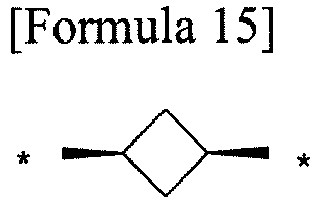
- The cyclopentylene group is preferably


- The cyclohexylene group is preferably


- In addition, as the divalent alicyclic hydrocarbon group which may be substituted, an unsubstituted divalent alicyclic hydrocarbon group is preferred.
- When X2 is an aromatic hydrocarbon group which may be substituted, the aromatic hydrocarbon group of the aromatic hydrocarbon group which may be substituted is preferably phenylene group.
- The phenylene group mentioned above is preferably
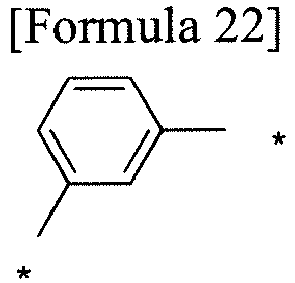
- When X2 is an aromatic hydrocarbon group which may be substituted, the substituent of the aromatic hydrocarbon group which may be substituted is preferably a halogen atom; a C1-6 alkyl group which may be substituted with a halogen atom; or a C1-6 alkoxy group.
- The halogen atom mentioned above is preferably fluorine atom or chlorine atom, more preferably fluorine atom.
- The C1-6 alkyl group is preferably a C1-3 alkyl group, more preferably methyl group or ethyl group, further preferably methyl group.
- The C1-6 alkoxy group is preferably methoxy group, ethoxy group or propoxy group, more preferably methoxy group or ethoxy group, further preferably methoxy group.
- In addition, as the divalent aromatic hydrocarbon group which may be substituted, an unsubstituted divalent aromatic hydrocarbon group is preferred.
- When X2 is a divalent heterocyclic group which may be substituted, the heterocyclic group of the divalent heterocyclic group which may be substituted is preferably pyrrolidinediyl group, piperidinediyl group, tetrahydropyridinediyl group, pyridinediyl group, isoxazolediyl group, oxadiazoldiyl group, benzoimidazolediyl group or benzooxazolediyl group, more preferably pyrrolidinediyl group, piperidinediyl group, tetrahydropyridinediyl group, pyridinediyl group, isoxazolediyl group or oxadiazoldiyl group, further preferably piperidinediyl group, tetrahydropyridinediyl group or pyridinediyl group, particularly preferably pyridinediyl group.
- In addition, as the divalent heterocyclic group which may be substituted, an unsubstituted divalent heterocyclic group is preferred.
- X3 is a C1-6 alkylene group which may be substituted, a C2-6 alkenylene group which may be substituted, a C2-6 alkynylene group which may be substituted, an O-(C1-6 alkylene) group which may be substituted, an S(O)q-(C1-6 alkylene) group which may be substituted (in the formula, q represents 0, 1 or 2), an N(R22)-(C1-6 alkylene) group which may be substituted (in the formula, R22 has the same meaning as that defined above), N(R22)-C(=O) (in the formula, R22 has the same meaning as that defined above) or an atomic bond.
- Regardless of the types of the other substituents, the C1-6 alkylene group, C2-6 alkenylene group, C2-6 alkynylene group, O-(C1-6 alkylene) group, S(O)q-(C1-6 alkylene) group or N(R22)-(C1-6 alkylene) group (in the formula, R22 and q have the same meanings as those defined above) as X3 may be substituted with one or more groups selected from a halogen atom, cyano group, amino group which may be protected, hydroxyl group which may be protected and oxo group.
- The compounds wherein X3 is a C2-6 alkynylene group which may be substituted or N(R22)-C(=O) (in the formula, R22 has the same meaning as that defined above) are preferred, and the compounds wherein X3 is ethynylene group are more preferred.
- X3 is preferably a C1-6 alkylene group, a C2-6 alkenylene group, a C2-6 alkynylene group, an S(O)q-(C1-6 alkylene) group (in the formula, q has the same meaning as that defined above), N(R22)-C(=O) (in the formula, R22 has the same meaning as that defined above) or an atomic bond, more preferably a C2-6 alkynylene group or N(R22)-C(=O) (in the formula, R22 has the same meaning as that defined above), further preferably a C2-6 alkynylene group.
- As for X3, the C1-6 alkylene group is preferably ethylene group, the C2-6 alkenylene group is preferably ethenylene group, the C2-6 alkynylene group is preferably ethynylene group, the C1-6 alkylene group of the O-(C1-6 alkylene) group is preferably methylene group, the C1-6 alkylene group of the S(O)q-(C1-6 alkylene) group (in the formula, q has the same meaning as that defined above) is preferably methylene group, q is preferably an integer of 0, the C1-6 alkylene group of the N(R22)-(C1-6 alkylene) group (in the formula, R22 has the same meaning as that defined above) is preferably methylene group, R22 of N(R22)-(C1-6 alkylene) group (in the formula, R22 has the same meaning as that defined above) is preferably hydrogen atom, and R22 of N(R22)-C(=O) (in the formula, R22 has the same meaning as that defined above) is preferably hydrogen atom.
- Z1 is nitrogen atom or C(R23) (in the formula, R23 has the same meaning as that defined above), preferably nitrogen atom.
- m is an integer of 0 to 6, preferably an integer of 0 to 3, more preferably an integer of 0 to 2, further preferably an integer of 0 or 1, particularly preferably an integer of 0.
- n is an integer of 0 to 6, preferably an integer of 0 to 3, more preferably an integer of 0 to 2, further preferably an integer of 0 or 1, particularly preferably an integer of 0.
- As the compound of the present invention represented by the general formula [1], preferred compounds include the following compounds.
- The compounds wherein R1 is hydrogen atom are preferred.
- The compounds wherein R2 is hydrogen atom or a C1-6 alkyl group which may be substituted are preferred, the compounds wherein R2 is a C1-6 alkyl group which may be substituted are more preferred, and the compounds wherein R2 is a C1-6 alkyl group substituted with a di(C1-6 alkyl)amino group are further preferred.
- The compounds wherein R3 is hydrogen atom or a C1-6 alkyl group which may be substituted are preferred, and the compounds wherein R3 is hydrogen atom are more preferred.
- The compounds wherein R4 is hydrogen atom or a C1-6 alkyl group which may be substituted are preferred, and the compounds wherein R4 is a C1-6 alkyl group are more preferred.
- The compounds wherein R5, R6, R7 and R8 are hydrogen atom or a C1-6 alkyl group are preferred, and the compounds wherein R5, R6, R7 and R8 are hydrogen atoms are more preferred.
- The compounds wherein R9 is N(R15)(R16) (in the formula, R15 and R16 have the same meanings as those defined above) are preferred.
- The compounds wherein R10 is hydrogen atom are preferred.
- The compounds wherein R11 is hydrogen atom are preferred.
- ] The compounds wherein R12 is an aryl group which may be substituted or a heterocyclic group which may be substituted are preferred, the compounds wherein R12 is phenyl group which may be substituted, pyridyl group which may be substituted, oxazolyl group which may be substituted, pyrazolyl group which may be substituted, thiazolyl group which may be substituted, isoquinolyl group which may be substituted or cinnolyl group which may be substituted are preferred.
- The compounds wherein X1 is -X4-X5- (in the formula, X4 and X5 have the same meanings as those defined above) are preferred, and the compounds wherein X1 is -X4-X5-(in the formula, X4 represents a group represented by the general formula [3]:

- The compounds wherein X2 is a C1-6 alkylene group which may be substituted or a divalent alicyclic hydrocarbon group which may be substituted are preferred, and the compounds wherein X2 is a C1-6 alkylene group which may be substituted or a divalent 4-, 5- or 6-membered ring alicyclic hydrocarbon group which may be substituted are more preferred.
- The compounds wherein Z1 is nitrogen atom are preferred.
- As the compounds of the present invention, those represented by the following general formula [1]-(1):

- R2a is hydrogen atom or a C1-6 alkyl group which may be substituted, preferably a C1-6 alkyl group which may be substituted.
- The C1-6 alkyl group which may be substituted mentioned above is preferably a C1-3 alkyl group which may be substituted, more preferably methyl group or ethyl group which may be substituted, further preferably methyl group which may be substituted.
- The substituent of the C1-6 alkyl group which may be substituted as R2a is preferably a halogen atom, hydroxyl group, a C1-6 alkylamino group which may be substituted with one or more substituents selected from the substituent group A-3, a di(C1-6 alkyl)amino group which may be substituted with one or more substituents selected from the substituent group A-3 or a heterocyclic group which may be substituted with one or more substituents selected from the substituent group A-3.
- The halogen atom mentioned above is preferably fluorine atom, chlorine atom or bromine atom, more preferably bromine atom.
- The C1-6 alkylamino group is preferably a C1-3 alkylamino group, more preferably a C1-2 alkylamino group, further preferably methylamino group.
- The di(C1-6 alkyl)amino group is preferably a di(C1-3 alkyl)amino group, more preferably a di(C1-2 alkyl)amino group, further preferably dimethylamino group.
- The heterocyclic group is preferably azetidinyl group, piperazinyl group or morpholinyl group.
- The substituent group A-3 consists of a halogen atom, hydroxyl group which may be protected and a C1-6 alkyl group which may be substituted with hydroxyl group.
- The halogen atom mentioned above is preferably fluorine atom, chlorine atom or bromine atom, more preferably fluorine atom.
- The C1-6 alkyl group is preferably a C1-3 alkyl group, more preferably methyl group or ethyl group, further preferably methyl group.
- The substituent of the C1-6 alkyl group which may be substituted as R2a is more preferably a C1-6 alkylamino group which may be substituted with one or more groups selected from the substituent group A-1 or a di(C1-6 alkyl)amino group which may be substituted with one or more groups selected from the substituent group A-1, still more preferably a C1-6 alkylamino group or a di(C1-6 alkyl)amino group, further preferably a di(C1-6 alkyl)amino group.
- As the C1-6 alkyl group substituted with a di(C1-6 alkyl)amino group mentioned above is preferably a C1-3 alkyl group substituted with a di(C1-3 alkyl)amino group, more preferably methyl group or ethyl group substituted with a di(C1-3 alkyl)amino group, further preferably a di(C1-3 alkyl)aminomethyl group.
- The di(C1-3 alkyl)aminomethyl group is preferably diethylaminomethyl group or dimethylaminomethyl group, more preferably dimethylaminomethyl group.
- R4a is hydrogen atom or a C1-6 alkyl group which may be substituted, preferably hydrogen atom or a C1-6 alkyl group, more preferably a C1-6 alkyl group.
- The C1-6 alkyl group is preferably a C1-3 alkyl group, more preferably methyl group or ethyl group, further preferably methyl group.
- R17a is hydrogen atom or a C1-6 alkyl group which may be substituted, provided that R17a may form a divalent nitrogen-containing heterocyclic group which may be substituted together with R4a, the nitrogen atom to which R4a binds, and the carbon atom to which R17a binds, and R17a is preferably hydrogen atom or a C1-6 alkyl group, more preferably a C1-6 alkyl group.
- In addition, when R17a is a C1-6 alkyl group, it is preferably

- The C1-6 alkyl group of the C1-6 alkyl group which may be substituted mentioned above is preferably methyl group, ethyl group, propyl group or butyl group, more preferably methyl group, ethyl group or propyl group, further preferably methyl group or ethyl group, particularly preferably methyl group.
- The substituent of the C1-6 alkyl group which may be substituted is preferably a halogen atom such as fluorine atom; hydroxyl group; a C1-6 alkoxy group such as methoxy group; or an aryl group such as phenyl group.
- The divalent nitrogen-containing heterocyclic group of the divalent nitrogen-containing heterocyclic group which may be substituted formed by R17a, R4a, the nitrogen atom to which R4a binds and the carbon atom to which R17a binds binding together is preferably azetidinediyl group, pyrrolidinediyl group, piperidinediyl group, homopiperidinediyl group, piperazinediyl group or homopiperazinediyl group, more preferably azetidinediyl group or pyrrolidinediyl group.
- The substituent of the divalent nitrogen-containing heterocyclic group which may be substituted is preferably a halogen atom such as fluorine atom; hydroxyl group; a C1-3 alkyl group such as methyl group; or a C1-6 alkoxy group such as methoxy group. In addition, an unsubstituted divalent nitrogen-containing heterocyclic group is also preferred.
- R17b and R18b are the same or different, and represent hydrogen atom or a C1-6 alkyl group which may be substituted, provided that, R17b and R18b may form C(=O) together with the carbon atom to which they bind, or R17b and R18b may form a divalent heterocyclic group which may be substituted together with the carbon atom to which they bind, preferably R17b and R18b represent a C1-6 alkyl group, or R17b and R18b form C(=O) together with the carbon atom to which they bind, more preferably R17b and R18b form C(=O) together with the carbon atom to which they bind.
- The C1-6 alkyl group mentioned above is preferably a C1-3 alkyl group, more preferably methyl group or ethyl group, further preferably methyl group.
- The heterocyclic group is preferably tetrahydropyranediyl group. In addition, as the heterocyclic group which may be substituted, an unsubstituted heterocyclic group is also preferred.
- The substituent of the C1-6 alkyl group which may be substituted is preferably a halogen atom such as fluorine atom; hydroxyl group; or a C1-6 alkoxy group such as methoxy group.
- R9a is a C1-6 alkyl group which may be substituted, a C1-6 alkoxy group which may be substituted, a heterocyclic group which may be substituted or N(R15)(R16) (in the formula, R15 and R16 have the same meanings as those defined above), preferably a C1-6 alkoxy group which may be substituted, a heterocyclic group which may be substituted or N(R15)(R16) (in the formula, R15 and R16 have the same meanings as those defined above), more preferably a C1-6 alkoxy group which may be substituted or N(R15)(R16), further preferably N(R15)(R16) (in the formula, R15 and R16 have the same meanings as those defined above).
- Preferred examples of the C1-6 alkoxy group which may be substituted mentioned above include those not having any substituent, for example, methoxy group, ethoxy group, propoxy group, butoxy group, pentyloxy group, cyclopropoxy group, cyclobutoxy group, cyclopentyloxy group and so forth, preferably ethoxy group, propoxy group, butoxy group, and cyclopropoxy group.
- Preferred examples of the heterocyclic group which may be substituted include azetidinyl group, pyrrolidinyl group, pyrazolyl group, piperazinyl group, triazolyl group, morpholinyl group, and so forth. Preferred examples of the substituent of the heterocyclic group include a halogen atom such as fluorine atom and a C1-3 alkyl group such as methyl group.
- R15 of N(R15)(R16) (in the formula, R15 and R16 have the same meanings as those defined above) is preferably hydrogen atom, a C1-6 alkyl group which may be substituted or a C3-8 cycloalkyl group which may be substituted, more preferably hydrogen atom, a C1-6 alkyl group or a C3-8 cycloalkyl group, further preferably hydrogen atom.
- The C1-6 alkyl group mentioned above is preferably a C1-3 alkyl group, and preferred examples of the C3-8 cycloalkyl group include cyclopropyl.
- R16 of N(R15)(R16) (in the formula, R15 and R16 have the same meanings as those defined above) is preferably a C1-6 alkyl group which may be substituted, a C3-8 cycloalkyl group which may be substituted, an aryl group which may be substituted or a heterocyclic group which may be substituted, more preferably a C1-6 alkyl group which may be substituted, a C3-8 cycloalkyl group which may be substituted or an aryl group which may be substituted, further preferably a C1-6 alkyl group which may be substituted or a C3-8 cycloalkyl group which may be substituted, particularly preferably a C1-6 alkyl group which may be substituted.
- Preferred examples of the substituent of the C1-6 alkyl group which may be substituted include a halogen atom such as fluorine atom; cyano group; a C1-3 alkoxy group such as methoxy group; a di(C1-3 alkyl)amino group such as dimethylamino; an aryl group such as phenyl group; and a heterocyclic group such as tetrahydropyranyl group, thienyl group and morpholinyl group, and it is preferably a halogen atom such as fluorine atom; or a C1-3 alkoxy group such as methoxy group. In addition, a C1-6 alkyl group not having any substituent can also be preferably used.
- The C1-6 alkyl group mentioned above is preferably a C1-6 alkyl group, more preferably ethyl group or propyl group, further preferably propyl group.
- Preferred examples of the C3-8 cycloalkyl group include those not having any substituent. For example, such a C3-5 cycloalkyl group as cyclopropyl group, cyclobutyl group and cyclopentyl group is preferred, and cyclopropyl group is more preferred.
- Preferred examples of the substituent of the heterocyclic group which may be substituted include a C1-3 alkoxy group such as methoxy group and ethoxy group. In addition, a heterocyclic group not having any substituent can also be preferably used. The heterocyclic group is preferably pyridyl group or quinolyl group.
- R12a is a C1-6 alkyl group which may be substituted, an aryl group which may be substituted or a heterocyclic group which may be substituted, preferably an aryl group which may be substituted or a heterocyclic group which may be substituted, more preferably an aryl group which may be substituted.
- The substituent of the C1-6 alkyl group which may be substituted as R12a is preferably a halogen atom, cyano group, amino group which may be protected, hydroxyl group which may be protected, a carbamoyl group which may be substituted with one or more groups selected from the substituent group A-4, a C1-6 alkyl group which may be substituted with one or more groups selected from the substituent group A-4, a C1-6 alkoxy group which may be substituted with one or more groups selected from the substituent group A-4, a C1-6 alkylamino group which may be substituted with one or more groups selected from the substituent group A-4, a di(C1-6 alkyl)amino group which may be substituted with one or more groups selected from the substituent group A-4, or a heterocyclic group which may be substituted with one or more groups selected from the substituent group A-4.
- The substituent group A-4 consists of a halogen atom, a C1-6 alkyl group, a C3-8 cycloalkyl group, a C1-6 alkoxy group and a heterocyclic group.
- The C1-6 alkyl group which maybe substituted as R12a is preferably a substituted C1-6 alkyl group, more preferably a substituted C1-3 alkyl group, further preferably a substituted methyl group or ethyl group.
- The substituent of the substituted C1-6 alkyl group is preferably hydroxyl group; a heterocyclic group such as pyridyl group, pyrrolidinyl group and morpholinyl group; or a di(C1-6 alkyl)amino group such as dimethylamino group. In particular, a C1-6 alkyl group substituted with a heterocyclic group such as pyridyl group, pyrrolidinyl group and morpholinyl group is preferred.
- The aryl group which may be substituted as R12a is preferably a substituted aryl group, more preferably a substituted phenyl group.
- The substituent of the substituted phenyl group is preferably a halogen atom; cyano group; amino group protected with an acyl group; a carbamoyl group which may be substituted with one or more groups selected from a C1-6 alkyl group and a C3-8 cycloalkyl group; a C1-6 alkyl group which may be substituted with one or more groups selected from a halogen atom and a heterocyclic group; a C1-6 alkoxy group which may be substituted with a halogen atom; or a heterocyclic group, more preferably a halogen atom; cyano group; a C1-6 alkyl group which may be substituted with one or more groups selected from a halogen atom and a heterocyclic group; or a C1-6 alkoxy group which may be substituted with a halogen atom, further preferably cyano group, a C1-6 alkyl group or a C1-6 alkoxy group, particularly preferably cyano group.
- The halogen atom mentioned above is preferably fluorine atom or chlorine atom, more preferably fluorine atom.
- The C1-6 alkyl group is preferably a C1-3 alkyl group, more preferably methyl group or ethyl group, further preferably methyl group.
- Preferred examples of the C3-8 cycloalkyl group include cyclopropyl group.
- The C1-6 alkoxy group is preferably methoxy group, ethoxy group or propoxy group, more preferably methoxy group or ethoxy group, further preferably methoxy group.
- Preferred examples of the heterocyclic group include pyrazolyl group and triazolyl group.
- When the aryl group is phenyl group, it is preferred that the phenyl group does not have any substituent at the o-position, but has a substituent at the m- and/or p-position, it is more preferred that the phenyl group does not have any substituent at the o-position, but has a substituent at the m- or p-position, and it is still more preferred that the phenyl group has a substituent only at the p-position.
- Preferred substituents at the m-position or p-position are as described above.
- The heterocyclic group which may be substituted as R12a is preferably pyridyl group which may be substituted, pyrazolyl group which may be substituted, thienyl group which may be substituted, oxazolyl group which may be substituted, thiazolyl group which may be substituted, isothiazolyl group which may be substituted, indazolyl group which may be substituted, pyrazolopyridinyl group which may be substituted, quinolyl group which may be substituted, isoquinolyl group which may be substituted, cinnolinyl group which may be substituted, phthalazinyl group which may be substituted, quinoxalinyl group which may be substituted, benzofuranyl group which may be substituted or benzothiazolyl group which may be substituted, more preferably pyridyl group which may be substituted, indazolyl group which may be substituted or pyrazolopyridinyl group which may be substituted, further preferably pyridyl group which may be substituted.
- The substituent of the pyridyl group which may be substituted is preferably a halogen atom, a C1-6 alkyl group, a C1-6 alkoxy group, C1-6 alkylamino group or a heterocyclic group, more preferably a halogen atom or a C1-6 alkoxy group.
- The halogen atom mentioned above is preferably fluorine atom or chlorine atom, more preferably fluorine atom.
- The C1-6 alkyl group is preferably a C1-3 alkyl group, more preferably methyl group or ethyl group, further preferably methyl group.
- The C1-6 alkoxy group is preferably methoxy group, ethoxy group or propoxy group, more preferably methoxy group or ethoxy group, further preferably methoxy group.
- The C1-6 alkylamino group is preferably methylamino group, ethylamino group or propylamino group, more preferably methylamino group or ethylamino group, further preferably methylamino group.
- Preferred examples of the heterocyclic group include morpholinyl group.
- When R12a is pyridyl group which may be substituted, preferably it is a pyridyl group represented by the following formula [1]-(1) or [I]-(2):

- Preferred examples of R24, R25, R26 and R27 are the same as those mentioned above as substituent of the pyridyl group which may be substituted. It is more preferred that one of R24 and R25, or one of R26 and R27 is hydrogen atom.
- The substituent of the pyridyl group which may be substituted is preferably a halogen atom; a C1-6 alkyl group which may be substituted with a C1-6 alkoxy group; a C1-6 alkoxy group; or a di(C1-6 alkyl)amino group, more preferably a C1-6 alkyl group which may be substituted with a C1-6 alkoxy group; or a C1-6 alkoxy group.
- The halogen atom mentioned above is preferably fluorine atom or chlorine atom, more preferably fluorine atom.
- The C1-6 alkoxy group is preferably methoxy group, ethoxy group or propoxy group, more preferably methoxy group or ethoxy group, further preferably methoxy group.
- The C1-6 alkyl group is preferably a C1-3 alkyl group, more preferably methyl group or ethyl group, further preferably methyl group.
- Preferred examples of the di(C1-6 alkyl)amino group include a di(C1-3 alkyl)amino group such as dimethylamino group.
- When R12a is indazolyl group which may be substituted, it is preferably an indazolyl group represented by any one of the following formulas [II]-(1) to [II]-(4):

- The C1-6 alkoxy group mentioned above is preferably methoxy group, ethoxy group or propoxy group, more preferably methoxy group or ethoxy group, further preferably methoxy group.
- The C1-6 alkyl group is preferably a C1-3 alkyl group, more preferably methyl group or ethyl group, further preferably methyl group.
- The halogen atom is preferably fluorine atom or chlorine atom, more preferably fluorine atom.
- Preferred examples of the di(C1-6 alkyl)amino group include a di(C1-3 alkyl)amino group such as dimethylamino group.
- R28, R30, R32 and R34 preferably represent hydrogen atom; or a C1-3 alkyl group which may be substituted with a C1-3 alkoxy group, more preferably hydrogen atom, methyl group, ethyl group or methoxyethyl group, further preferably hydrogen atom or methyl group, particularly preferably hydrogen atom.
- R29, R31, R33 and R35 preferably represent hydrogen atom, a C1-6 alkyl group or a C1-6 alkoxy group, more preferably hydrogen atom, methyl group or methoxy group, further preferably hydrogen atom or methyl group, particularly preferably hydrogen atom.
- The substituent of the indazolyl group which may be substituted is preferably a C1-6 alkyl group which may be substituted with a C1-6 alkoxy group; or a C1-6 alkoxy group.
- The C1-6 alkoxy group is preferably methoxy group, ethoxy group or propoxy group, more preferably methoxy group or ethoxy group, further preferably methoxy group.
- The C1-6 alkyl group is preferably a C1-3 alkyl group, more preferably methyl group or ethyl group, further preferably methyl group.
- When R12a is pyrazolopyridinyl group which may be substituted, R12a is preferably a pyrazolopyridinyl group represented by any one of the following formulas [III]-(1) to [III]-(4):


- The C1-6 alkoxy group mentioned above is preferably methoxy group, ethoxy group or propoxy group, more preferably methoxy group or ethoxy group, further preferably methoxy group.
- The C1-6 alkyl group is preferably a C1-3 alkyl group, more preferably methyl group or ethyl group, further preferably methyl group.
- R36, R38, R40 and R42 preferably represent hydrogen atom; or a C1-3 alkyl group which may be substituted with a C1-3 alkoxy group, more preferably hydrogen atom, methyl group, ethyl group, methoxyethyl group or methoxy group, further preferably hydrogen atom or methyl group, particularly preferably hydrogen atom.
- R37, R39, R41 and R43 preferably represent hydrogen atom, a C1-6 alkyl group or a C1-6 alkoxy group, more preferably hydrogen atom, methyl group or methoxy group, further preferably hydrogen atom.
- Preferred examples of the substituent of the pyrazolyl group which may be substituted as R12a include a C1-6 alkyl group such as methyl group.
- Preferred examples of the substituent of the thienyl group which may be substituted as R12a include cyano group and a heterocyclic group such as carbamoyl group.
- Preferred examples of the substituent of the oxazolyl group which may be substituted as R12a include a C1-6 alkyl group such as butyl group.
- Preferred examples of the substituent of the thiazolyl group which may be substituted as R12a include cyano group.
- Preferred examples of the substituent of the isothiazolyl group which may be substituted as R12a include a C1-6 alkyl group such as methyl group.
- Preferred examples of the substituent of the benzothiazolyl group which may be substituted as R12a include a C1-6 alkyl group such as methyl group.
- As the isoquinolyl group which may be substituted, cinnolinyl group which may be substituted, phthalazinyl group which may be substituted, quinoxalinyl group which may be substituted and benzofuranyl group which may be substituted as R12a, those not having any substituent are also preferred.
- Preferred examples of the substituent of the carbamoyl group which may be substituted as R12a include a heterocyclic group such as pyridyl group.
- X2a is a C1-6 alkylene group which may be substituted, a divalent alicyclic hydrocarbon group which may be substituted or a divalent aromatic hydrocarbon group which may be substituted, preferably a C1-6 alkylene group which may be substituted or a divalent alicyclic hydrocarbon group which may be substituted, more preferably a C1-6 alkylene group which may be substituted.
- When X2a is a C1-6 alkylene group which may be substituted, the C1-6 alkylene group of the C1-6 alkylene group which may be substituted is preferably methylene group, ethylene group or trimethylene group, more preferably trimethylene group.
- The substituent of the C1-6 alkylene group of the C1-6 alkylene group which may be substituted is preferably a C1-6 alkyl group, more preferably a C1-3 alkyl group, further preferably methyl group or ethyl group, particularly preferably methyl group. In addition, as the C1-6 alkylene group which may be substituted, an unsubstituted C1-6 alkylene group is preferred.
- When X2a is a divalent alicyclic hydrocarbon group which may be substituted, the divalent alicyclic hydrocarbon group of the divalent alicyclic hydrocarbon group which may be substituted is preferably cyclobutylene group, cyclopentylene group or cyclohexylene group, more preferably cyclobutylene group or cyclohexylene group, further preferably cyclobutylene group.
- The cyclobutylene group mentioned above is preferably
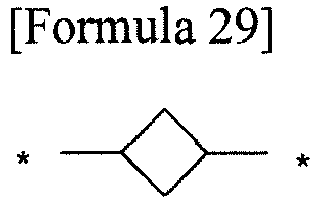

- The cyclopentylene group is preferably


- The cyclohexylene group is preferably


- In addition, as the divalent alicyclic hydrocarbon group which may be substituted, an unsubstituted divalent alicyclic hydrocarbon group is preferred.
- When X2a is an aromatic hydrocarbon group which may be substituted, the aromatic hydrocarbon group of the aromatic hydrocarbon group which may be substituted is preferably phenylene group.
- The phenylene group mentioned above is preferably

- When X2a is an aromatic hydrocarbon group which may be substituted, the substituent of the aromatic hydrocarbon group which may be substituted is preferably a halogen atom; a C1-6 alkyl group which may be substituted with a halogen atom; or a C1-6 alkoxy group which may be substituted with a halogen atom.
- The halogen atom mentioned above is preferably fluorine atom or chlorine atom, more preferably fluorine atom.
- The C1-6 alkyl group is preferably a C1-3 alkyl group, more preferably methyl group or ethyl group, further preferably methyl group.
- The C1-6 alkoxy group is preferably methoxy group, ethoxy group or propoxy group, more preferably methoxy group or ethoxy group, further preferably methoxy group.
- In addition, as the divalent aromatic hydrocarbon group which may be substituted, an unsubstituted divalent aromatic hydrocarbon group is preferred.
- X3a is a C2-6 alkynylene group which may be substituted or N(R22)-C(=O) (in the formula, R22 has the same meaning as that defined above), preferably a C2-6 alkynylene group which may be substituted.
- The C2-6 alkynylene group mentioned above is preferably ethynylene group, R22 of N(R22)-C(=O) (in the formula, R22 has the same meaning as that defined above) is preferably hydrogen atom.
- In addition, as the C2-6 alkynylene group which may be substituted, an unsubstituted C2-6 alkynylene group is preferred.
- Examples of preferred compounds among the compounds of the present invention include the following compounds.
- (S,E)-N-(3-(2-(4-(Dimethylamino)-N-methyl-2-butenamido)propanamido)phenyl)-4-(propylamino)-2-((2-(pyridin-4-yl)ethyl)amino)pyrimidine-5-carboxamide [Compound No. 2-12]
- (S,E)-2-((4-Carbamoylphenyl)amino)-N-(3-(2-(4-(dimethylamino)-N-methyl-2-butenamido)propanamido)phenyl)-4-(propylamino)pyrimidine-5-carboxamide [Compound No. 3-1]
- (E)-2-((4-Carbamoylphenyl)amino)-N-(3-(2-(4-(dimethylamino)-N-methyl-2-butenamido)actamido)cyclohexyl)-4-(propylamino)pyrimidine-5-carboxamide [Compound No. 3-4]
- (S,E)-2-((4-Carbamoylphenyl)amino)-N-(3-(2-(4-(diethylamino)-N-methyl-2-butenamido)propanamido)phenyl)-4-(propylamino)pyrimidine-5-carboxamide [Compound No. 4-8]
- (S,E)-2-((4-Carbamoylphenyl)amino)-N-(3-(2-(4-(dimethylamino)-N-methyl-2-butenamido)propaneamido)propyl)-4-(propylamino)pyrimidine-5-carboxamide [Compound No. 5-1]
- (S,E)-N-(3-(2-(4-(Dimethylamino)-N-methyl-2-butenamido)propanamido)phenyl)-2-(isoquinolin-6-ylamino)-4-(propylamino)pyrimidine-5-carboxamide [Compound No. 6-9]
- (S,E)-2-(Cinnolin-6-ylamino)-N-(3-(2-(4-(dimethylamino)-N-methyl-2-butenamido)propanamido)phenyl)-4-(propylamino)pyrimidine-5-carboxamide [Compound No. 6-11]
- (S,E)-4-(Dimethylamino)-N-(1-((5-(2-((3-fluorophenyl)amino)-4-(propylamino)pyrimidin-5-yl)-4-pentyn-1-yl)amino)-1-oxopropan-2-yl)-N-methyl-2-butenamide [Compound No. 7-1]
- (S,E)-N-(1-((5-(2-((3-Cyanophenyl)amino)-4-(propylamino)pyrimidin-5-yl)-4-pentyn-1-yl)amino)-1-oxopropan-2-yl)-4-(dimethylamino)-N-methyl-2-butenamide [Compound No. 7-3]
- (S,E)-4-((5-(5-(2-(4-(Dimethylamino)-N-methyl-2-butenamido)propaneamido)-1-pentyn-1-yl)-4-(propylamino)pyrimidin-2-yl)amino)benzamide [Compound No. 7-4]
- (S,E)-N-(1-((5-(2-((4-Cyanophenyl)amino)-4-(propylamino)pyrimidin-5-yl)-4-pentyn-1-yl)amino)-1-oxopropan-2-yl)-4-(dimethylamino)-N-methyl-2-butenamide [Compound No. 7-5]
- (E)-4-(Dimethylamino)-N-(2-((5-(2-((4-fluorophenyl)amino)-4-(propylamino)pyrimidin-5-yl)-4-pentyn-1-yl)amino)-2-oxoethyl)-N-methyl-2-butenamide [Compound No. 7-8]
- (E)-N-(2-((5-(2-((4-Cyanophenyl)amino)-4-(propylamino)pyrimidin-5-yl)-4-pentyn-1-yl)amino)-2-oxoethyl)-4-(dimethylamino)-N-methyl-2-butenamide [Compound No. 7-9]
- (S,E)-4-(Dimethylamino)-N-(1-((5-(2-((3-fluorophenyl)amino)-4-(propylamino)pyrimidin-5-yl)-4-pentyn-1-yl)amino)-1-oxobutan-2-yl)-N-methyl-2-butenamide [Compound No. 7-17]
- (S,E)-4-(Dimethylamino)-N-(1-((5-(2-((3-fluoro-4-methoxyphenyl)amino)-4-(propylamino)pyrimidin-5-yl)-4-pentyn-1-yl)amino)-1-oxopropan-2-yl)-N-methyl-2-butenamide [Compound No. 7-20]
- (S,E)-4-(Dimethylamino)-N-(1-((5-(2-((6-fluoropyridin-3-yl)amino)-4-(propylamino)pyrimidin-5-yl)-4-pentyn-1-yl)amino)-1-oxopropan-2-yl)-N-methyl-2-butenamide [Compound No. 7-21]
- (S,E)-4-(Dimethylamino)-N-(1-((5-(2-((6-fluoropyridin-3-yl)amino)-4-((4-methoxyphenyl)amino)pyrimidin-5-yl)-4-pentyn-1-yl)amino)-1-oxopropan-2-yl)-N-methyl-2-butenamide [Compound No. 7-22]
- (E)-4-(Dimethylamino)-N-(2-((5-(2-((3-fluorophenyl)amino)-4-(propylamino)pyrimidin-5-yl)-4-pentyn-1-yl)amino)-2-oxoethyl)-N-methyl-2-butenamide [Compound No. 7-24]
- (S,E)-N-(5-(2-((4-Cyanophenyl)amino)-4-(propylamino)pyrimidin-5-yl)-4-pentyn-1-yl)-1-(4-(dimethylamino)-2-butenoyl)pyrrolidine-2-carboxamide [Compound No. 7-33]
- (S,E)-N-(1-((5-(4-(Cyclopropylamino)-2-((3-fluoro-4-methoxyphenyl)amino)pyrimidin-5-yl)-4-pentyn-1-yl)amino)-1-oxopropan-2-yl)-4-(dimethylamino)-N-methyl-2-butenamide [Compound No. 7-42]
- (S,E)-4-(Dimethylamino)-N-(1-((5-(2-((3-fluoro-4-methoxyphenyl)amino)-4-((3-fluoropropyl)amino)pyrimidin-5-yl)-4-pentyn-1-yl)amino)-1-oxopropan-2-yl)-N-methyl-2-butenamide [Compound No. 7-56]
- (S,E)-N-(1-((5-(2-((4-Cyanophenyl)amino)-4-(propylamino)pyrimidin-5-yl)-4-pentyn-1-yl)amino)-3-hydroxy-1-oxopropan-2-yl)-4-(dimethylamino)-N-methyl-2-butenamide [Compound No. 7-62]
- (2S,4R)-1-((E)-4-(Dimethylamino)-2-butenoyl)-N-(5-(2-((3-fluorophenyl)amino)-4-(propylamino)pyrimidin-5-yl)-4-pentyn-1-yl)-4-hydroxypyrrolidine-2-carboxamide [Compound No. 7-66]
- (2S,4S)-1-((E)-4-(Dimethylamino)-2-butenoyl)-4-fluoro-N-(5-(2-((3-fluorophenyl)amino)-4-(methylamino)pyrimidin-5-yl)-4-pentyn-1-yl)pyrrolidine-2-carboxamide [Compound No. 7-72]
- (2S,4S)-1-((E)-4-(Dimethylamino)-2-butenoyl)-N-(5-(2-((3-fluorophenyl)amino)-4-(methylamino)pyrimidin-5-yl)-4-pentyn-1-yl)-4-methoxypyrrolidine-2-carboxamide [Compound No. 7-73]
- (2S,4S)-1-((E)-4-(Dimethylamino)-2-butenoyl)-4-fluoro-N-(5-(2-((4-fluorophenyl)amino)-4-(methylamino)pyrimidin-5-yl)-4-pentyn-1-yl)pyrrolidine-2-carboxamide [Compound No. 7-80]
- (2S,4R)-1-((E)-4-(Dimethylamino)-2-butenoyl)-4-fluoro-N-(5-(2-((4-fluorophenyl)amino)-4-(methylamino)pyrimidin-5-yl)-4-pentyn-1-yl)pyrrolidine-2-carboxamide [Compound No. 7-81]
- (2S,4S)-1-((E)-4-(Dimethylamino)-2-butenoyl)-N-(5-(2-((4-fluorophenyl)amino)-4-(methylamino)pyrimidin-5-yl)-4-pentyn-1-yl)-4-methoxypyrrolidine-2-carboxamide [Compound No. 7-82]
- (2S,4R)-1-((E)-4-(Dimethylamino)-2-butenoyl)-N-(5-(2-((4-fluorophenyl)amino)-4-(methylamino)pyrimidin-5-yl)-4-pentyn-1-yl)-4-methoxypyrrolidine-2-carboxamide [Compound No. 7-83]
- (S,E)-1-(4-(Dimethylamino)-2-butenoyl)-N-(5-(2-((4-fluorophenyl)amino)-4-(methylamino)pyrimidin-5-yl)-4-pentyn-1-yl)azetidine-2-carboxamide [Compound No. 7-86]
- (2S,4S)-N-(5-(2-((4-Cyanophenyl)amino)-4-(methylamino)pyrimidin-5-yl)-4-pentyn-1-yl)-1-((E)-4-(dimethylamino)-2-butenoyl)-4-fluoropyrrolidine-2-carboxamide [Compound No. 7-87]
- (E)-N-(2-((5-(2-((4-Cyanophenyl)amino)-4-(methylamino)pyrimidin-5-yl)-4-pentyn-1-yl)amino)-2-oxoethyl)-4-(dimethylamino)-N-methyl-2-butenamide [Compound No. 7-88]
- (S,E)-4-(Dimethylamino)-N-(1-((3-((2-((3-fluorophenyl)amino)-4-(propylamino)pyrimidin-5-yl)ethynyl)phenyl)amino)-1-oxopropan-2-yl)-N-methyl-2-butenamide [Compound No. 8-1]
- (S,E)-4-((5-((3-(2-(4-(Dimethylamino)-N-methyl-2-butenamido)propanamido)phenyl)ethynyl)-4-(propylamino)pyrimidin-2-yl)amino)benzamide [Compound No. 8-2]
- (S,E)-N-(1-((5-(2-((4-Cyanophenyl)amino)-4-(pyrrolidin-1-yl)pyrimidin-5-yl)-4-pentyn-1-yl)amino)-1-oxopropan-2-yl)-4-(dimethylamino)-N-methyl-2-butenamide [Compound No. 9-1]
- (S,E)-4-(Dimethylamino)-N-(1-((5-(2-((2-fluoropyridin-4-yl)amino)-4-(pyrrolidin-1-yl)pyrimidin-5-yl)-4-pentyn-1-yl)amino)-1-oxopropan-2-yl)-N-methyl-2-butenamide [Compound No. 9-12]
- (S,E)-4-(Dimethylamino)-N-(1-((5-(2-((2-fluoropyridin-4-yl)amino)-4-(propylamino)pyrimidin-5-yl)-4-pentyn-1-yl) amino)-1-oxopropan-2-yl)-N-methyl-2-butenamide [Compound No. 9-13]
- (S,E)-N-(1-((5-(4-(Cyclopropylamino)-2-((2-fluoropyridin-4-yl)amino)pyrimidin-5-yl)-4-pentyn-1-yl)amino)-1-oxopropan-2-yl)-4-(dimethylamino)-N-methyl-2-butenamide [Compound No. 9-15]
- (S,E)-4-(Dimethylamino)-N-methyl-N-(1-((5-(2-((3-methylisothiazol-5-yl)amino)-4-(propylamino)pyrimidin-5-yl)-4-pentyn-1-yl)amino)-1-oxopropan-2-yl)-2-butenamide [Compound No. 9-30]
- (S,E)-4-(Dimethylamino)-N-(1-((5-(4-((3-methoxypropyl)amino)-2-((2-methoxypyridin-4-yl)amino)pyrimidin-5-yl)-4-pentyn-1-yl)amino)-1-oxopropan-2-yl)-N-methyl-2-butenamide [Compound No. 9-31]
- (S,E)-1-(4-(Dimethylamino)-2-butenoyl)-N-(5-(4-((3-methoxypropyl)amino)-2-((methoxypyridin-4-yl)amino)pyrimidin-5-yl)-4-pentyn-1-yl)pyrrolidine-2-carboxamide [Compound No. 9-32]
- (2S,4S)-1-((E)-4-(Dimethylamino)-2-butenoyl)-4-fluoro-N-(5-(4-((3-methoxypropyl)amino)-2-((methoxypyridin-4-yl)amino)pyrimidin-5-yl)-4-pentyn-1-yl)pyrrolidine-2-carboxamide [Compound No. 9-34]
- (S,E)-1-(4-(Dimethylamino)-2-butenoyl)-N-(5-(2-((2-methoxypyridin-4-yl)amino)-4-(propylamino)pyrimidin-5-yl)-4-pentyn-1-yl)pyrrolidine-2-carboxamide [Compound No. 9-35]
- (2S,4S)-1-((E)-4-(Dimethylamino)-2-butenoyl)-4-fluoro-N-(5-(2-((2-methoxypyridin-4-yl)amino)-4-(propylamino)pyrimidin-5-yl)-4-pentyn-1-yl)pyrrolidine-2-carboxamide [Compound No. 9-37]
- (E)-4-(Dimethylamino)-N-(2-((5-(2-((2-methoxypyridin-4-yl)amino)-4-(propylamino)pyrimidin-5-yl)-4-pentyn-1-yl)amino)-2-oxoethyl)-N-methyl-2-butenamide [Compound No. 9-38]
- (S,E)-4-(Dimethylamino)-N-(1-((5-(2-((3-fluorophenyl)amino)-4-((4-methoxyphenyl)amino)pyrimidin-5-yl)-4-pentyn-1-yl)amino)-1-oxopropan-2-yl)-N-methyl-2-butenamide [Compound No. 10-3]
- (S,E)-4-(Dimethylamino)-N-(1-((5-(2-((3-fluorophenyl)amino)-4-morpholinopyrimidin-5-yl)-4-pentyn-1-yl)amino)-1-oxopropan-2-yl)-N-methyl-2-butenamide [Compound No. 10-5]
- (E)-4-(Dimethylamino)-N-(2-((5-(2-((4-fluorophenyl)amino)-4-((3-fluoropropyl)amino)pyrimidin-5-yl)-4-pentyn-1-yl)amino)-2-oxoethyl)-N-methyl-2-butenamide [Compound No. 10-21]
- (S,E)-N-(1-((5-(2-((4-Cyanophenyl)amino)-4-(cyclopropylamino)pyrimidin-5-yl)-4-pentyn-1-yl)amino)-1-oxopropan-2-yl)-4-(dimethylamino))-N-methyl-2-butenamide [Compound No. 10-25]
- (S,E)-N-(1-((5-(2-((4-Cyanophenyl)amino)-4-((3-fluoropropyl)amino)pyrimidin-5-yl)-4-pentyn-1-yl)amino)-1-oxopropan-2-yl)-4-(dimethylamino))-N-methyl-2-butenamide [Compound No. 10-29]
- (S,E)-4-(Dimethylamino))-N-(1-((5-(4-(ethylamino)-2-((1-methyl-1H-indazol-5-yl)amino)pyrimidin-5-yl)-4-pentyn-1-yl)amino)-1-oxopropan-2-yl)-N-methyl-2-butenamide [Compound No. 10-53]
- (S,E)-N-(1-((5-(4-(Cyclopropylamino)-2-((1-methyl-1H-indazol-5-yl)amino)pyrimidin-5-yl)-4-pentyn-1-yl)amino)-1-oxopropan-2-yl)-4-(dimethylamino))-N-methyl-2-butenamide [Compound No. 10-54]
- (S,E)-4-(Dimethylamino))-N-methyl-N-(1-((5-(2-((1-methyl-1H-indazol-5-yl)amino)-4-(methylamino)pyrimidin-5-yl)-4-pentyn-1-yl)amino)-1-oxopropan-2-yl)-2-butenamide [Compound No. 10-56]
- (S,E)-N-(5-(2-((1H-Indazol-5-yl)amino)-4-(methylamino)pyrimidin-5-yl)-4-pentyn-1-yl)-1-(4-(dimethylamino)-2-butenoyl)pyrrolidine-2-carboxamide [Compound No. 10-66]
- (S,E)-N-(5-(2-((1H-Indazol-5-yl)amino)-4-(ethylamino)pyrimidin-5-yl)-4-pentyn-1-yl)-1-(4-(dimethylamino)-2-butenoyl)pyrrolidine-2-carboxamide [Compound No. 10-67]
- (S,E)-N-(5-(2-((1H-Indazol-5-yl)amino)-4-((3-methoxypropyl)amino)pyrimidin-5-yl)-4-pentyn-1-yl)-1-(4-(dimethylamino)-2-butenoyl)pyrrolidine-2-carboxamide [Compound No. 10-68]
- (E)-4-(Dimethylamino)-N-((S)-1-(((1S,3R)-3-((2-((3-fluorophenyl)amino)-4-(propylamino)pyrimidin-5-yl)ethynyl)cyclohexyl)amino)-1-oxopropan-2-yl)-N-methyl-2-butenamide [Compound No. 13-1]
- (E)-4-(Dimethylamino)-N-((S)-1-(((1S,3R)-3-((2-((3-fluorophenyl)amino)-4-(propylamino)pyrimidin-5-yl)ethynyl)cyclobutyl)amino)-1-oxopropan-2-yl)-N-methyl-2-butenamide [Compound No. 13-8]
- (E)-N-((S)-1-(((1S,3R)-3-((2-((4-Cyanophenyl)amino)-4-(methylamino)pyrimidin-5-yl)ethynyl)cyclobutyl)amino)-1-oxopropan-2-yl)-4-(dimethylamino)-N-methyl-2-butenamide [Compound No. 13-9]
- (E)-4-(Dimethylamino)-N-((S)-1-(((1S,3R)-3-((2-((3-fluorophenyl)amino)-4-(methylamino)pyrimidin-5-yl)ethynyl)cyclobutyl)amino)-1-oxopropan-2-yl)-N-methyl-2-butenamide [Compound No. 13-13]
- (E)-N-((S)-1-(((1S,3R)-3-((2-((4-Cyanophenyl)amino)-4-(methylamino)pyrimidin-5-yl)ethynyl)cyclobutyl)amino)-1-oxopropan-2-yl)-4-(dimethylamino)-N-methyl-2-butenamide [Compound No. 13-14]
- (E)-N-((S)-1-(((1S,3R)-3-((2-((3-Cyanophenyl)amino)-4-(methylamino)pyrimidin-5-yl)ethynyl)cyclobutyl)amino)-1-oxopropan-2-yl)-4-(dimethylamino)-N-methyl-2-butenamide [Compound No. 13-15]
- (E)-4-(Dimethylamino)-N-((S)-1-(((1S,3R)-3-((2-((3-fluoro-4-methoxyphenyl)amino)-4-(methylamino)pyrimidin-5-yl)ethynyl)cyclobutyl)amino)-1-oxopropan-2-yl)-N-methyl-2-butenamide [Compound No. 13-16]
- (E)-4-(Dimethylamino)-N-((S)-1-(((1S,3R)-3-((2-((4-fluorophenyl)amino)-4-(methylamino)pyrimidin-5-yl)ethynyl)cyclobutyl)amino)-1-oxopropan-2-yl)-N-methyl-2-butenamide [Compound No. 13-19]
- (E)-N-((S)-1-(((1S,3R)-3-((2-((3-Cyanophenyl)amino)-4-(cyclopropylamino)pyrimidin-5-yl)ethynyl)cyclobutyl)amino)-1-oxopropan-2-yl)-4-(dimethylamino)-N-methyl-2-butenamide [Compound No. 13-20]
- (E)-4-(Dimethylamino)-N-((S)-1-(((1S*,3R*)-3-((2-((2-fluoropyridin-4-yl)amino)-4-(propylamino)pyrimidin-5-yl)ethynyl)cyclobutyl)amino)-1-oxopropan-2-yl)-N-methyl-2-butenamide [Compound No. 14-4]
- (E)-4-(Dimethylamino)-N-((S)-1-(((1S,3R)-3-((2-((2-methoxypyridin-4-yl)amino)-4-(propylamino)pyrimidin-5-yl)ethynyl)cyclobutyl)amino)-1-oxopropan-2-yl)-N-methyl-2-butenamide [Compound No. 14-6]
- (E)-N-((S)-1-(((1S,3R)-3-((2-((4-Cyanophenyl)amino)-4-(methylamino)pyrimidin-5-yl)ethynyl)cyclohexyl)amino)-1-oxopropan-2-yl)-4-(dimethylamino)-N-methyl-2-butenamide [Compound No. 15-5]
- (E)-N-((S)-1-(((1S*,3R*)-3-((2-((4-Cyanophenyl)amino)-4-(cyclopropylamino)pyrimidin-5-yl)ethynyl)cyclobutyl)amino)-1-oxopropan-2-yl)-4-(dimethylamino)-N-methyl-2-butenamide [Compound No. 15-8]
- (E)-N-((S)-1-(((1S*,3R*)-3-((4-(Cyclopropylamino)-2-((4-fluorophenyl)amino)pyrimidin-5-yl)ethynyl)cyclobutyl)amino)-1-oxopropan-2-yl)-4-(dimethylamino)-N-methyl-2-butenamide [Compound No. 15-9]
- (E)-N-((S)-1-(((1S*,3R*)-3-((4-(Cyclopropylamino)-2-((3-fluoro-4-methoxyphenyl)amino)pyrimidin-5-yl)ethynyl)cyclobutyl)amino)-1-oxopropan-2-yl)-4-(dimethylamino)-N-methyl-2-butenamide [Compound No. 15-10]
- (E)-4-(Dimethylamino)-N-((S)-1-(((1S,3R)-3-((2-((3-fluorophenyl)amino)-4-((3-fluoropropyl)amino)pyrimidin-5-yl)ethynyl)cyclobutyl)amino)-1-oxopropan-2-yl)-N-methyl-2-butenamide [Compound No. 15-13]
- (E)-N-((S)-1-(((1S,3R)-3-((2-((4-Cyanophenyl)amino)-4-((3-fluoropropyl)amino)pyrimidin-5-yl)ethynyl)cyclobutyl)amino)-1-oxopropan-2-yl)-4-(dimethylamino)-N-methyl-2-butenamide [Compound No. 15-14]
- (E)-4-(Dimethylamino)-N-((S)-1-(((1S,3R)-3-((2-((3-fluorophenyl)amino)-4-((3-methoxypropyl)amino)pyrimidin-5-yl)ethynyl)cyclobutyl)amino)-1-oxopropan-2-yl)-N-methyl-2-butenamide [Compound No. 15-15]
- (E)-N-((S)-1-(((1S,3R)-3-((2-((4-Cyanophenyl)amino)-4-((3-methoxypropyl)amino)pyrimidin-5-yl)ethynyl)cyclobutyl)amino)-1-oxopropan-2-yl)-4-(dimethylamino)-N-methyl-2-butenamide [Compound No. 15-16]
- (E)-4-(Dimethylamino)-N-((S)-1-(((1S,3R)-3-((2-((3-fluoro-4-methoxyphenyl)amino)-4-(methylamino)pyrimidin-5-yl)ethynyl)cyclohexyl)amino)-1-oxopropan-2-yl)-N-methyl-2-butenamide [Compound No. 21-32]
- (S,E)-4-(Dimethylamino)-N-methyl-N-(1-((5-(2-((2-methylpyridin-4-yl)amino)-4-(propylamino)pyrimidin-5-yl)-4-pentyn-1-yl)amino)-1-oxopropan-2-yl)-2-butenamide [Compound No. 22-1]
- (S,E)-N-(1-((5-(2-(Benzo[d]thiazol-6-ylamino)-4-(propylamino)pyrimidin-5-yl)-4-pentyn-1-yl)amino)-1-oxopropan-2-yl)-4-(dimethylamino)-N-methyl-2-butenamide [Compound No. 22-6]
- (S,E)-1-(4-(Dimethylamino)-2-butenoyl)-N-(5-(2-((1-methyl-1H-indazol-5-yl)amino)-4-(propylamino)pyrimidin-5-yl)-4-pentyn-1-yl)pyrrolidine-2-carboxamide [Compound No. 22-31]
- (S,E)-1-(4-(Dimethylamino)-2-butenoyl)-N-(5-(2-((1-methyl-1H-pyrazolo[3,4-b]pyridin-5-yl)amino)-4-(propylamino)pyrimidin-5-yl)-4-pentyn-1-yl)pyrrolidine-2-carboxamide [Compound No. 22-43]
- (S,E)-1-(4-(Dimethylamino)-2-butenoyl)-N-(5-(2-((1-(2-methoxyethyl)-1H-pyrazolo[3,4-b]pyridin-5-yl)amino)-4-(propylamino)pyrimidin-5-yl)-4-pentyn-1-yl)pyrrolidine-2-carboxamide [Compound No. 22-44]
- (S,E)-4-(Dimethylamino)-N-methyl-N-(1-((5-(2-((3-methyl-1H-pyrazolo[3,4-b]pyridin-5-yl)amino)-4-(propylamino)pyrimidin-5-yl)-4-pentyn-1-yl)amino)-1-oxopropan-2-yl)-2-butenamide [Compound No. 22-51]
- (S,E)-1-(4-(Dimethylamino)-2-butenoyl)-N-(5-(2-((3-methyl-1H-pyrazolo[3,4-b]pyridin-5-yl)amino)-4-(propylamino)pyrimidin-5-yl)-4-pentyn-1-yl)pyrrolidine-2-carboxamide [Compound No. 22-56]
- (S,E)-1-(4-(Dimethylamino)-2-butenoyl)-N-(5-(2-((3-methoxy-1H-pyrazolo[3,4-b]pyridin-5-yl)amino)-4-(propylamino)pyrimidin-5-yl)-4-pentyn-1-yl)pyrrolidine-2-carboxamide [Compound No. 22-57]
- When there are isomers (for example, optical isomers, geometrical isomers, tautomers etc.) of the compounds of the general formula [1] and salts thereof, they fall within the scope of the present invention, and anhydrides, solvates, hydrates and crystals of various forms thereof also fall within the scope of the present invention.
- The compounds of the present invention represented by the general formula [1] have superior FLT3 inhibition activity, and are useful for treatment of a disease or condition relating to FLT3. The treatment means prophylactic treatment, therapeutic treatment etc.
- The prophylactic treatment means a treatment for inhibiting onset, reducing risk of onset, retarding onset, etc.
- The therapeutic treatment means a treatment for improving a target disease or condition, or suppressing (maintaining or retarding) aggravation of the disease or condition.
- The disease or condition relating to FLT3 means any diseases and conditions that can be treated by inhibiting FLT3. Examples include, for example, acute lymphocytic leukemia (ALL), acute myeloid leukemia (AML), acute promyelocytic leukemia (APL), chronic lymphocytic leukemia (CLL), chronic myeloid leukemia (CML), chronic neutrophilic leukemia (CNL), acute undifferentiated leukemia (AUL), anaplastic large cell lymphoma (ALCL), prolymphocytic leukemia (PML), juvenile myelomonocytic leukemia (JMML), adult T cell ALL, myelodysplastic syndrome (MDS), and myeloproliferative disorder (MPD), AML and APL are preferred examples, and AML is a more preferred example.
- The compounds of the present invention represented by the general formula [1] are also useful as seed compounds, lead compounds, or intermediates for searching for a compound useful for prophylactic or therapeutic treatment of FLT3-related diseases.
- Hereafter, the methods for preparing the compounds of the present invention will be explained.
- The compounds of the present invention are prepared by a combination of per se known methods, and for example, they can be prepared by the preparation methods shown below.
-


- The compounds of the general formula [5] can be prepared by carrying out deprotection of a compound of the general formula [4].
- This reaction can be performed by, for example, the method described in T.W. Greene et al., Protective Groups in Organic Synthesis, 4th Edition, pp.696-926, 2007, John Wiley & Sons, Inc.
- As the compounds of the general formula [6a], for example, crotonic acid, 4-dimethylaminocrotonic acid, and so forth are known.
- The compounds of the general formula [1] can be prepared by reacting a compound of the general formula [5] with a compound of the general formula [6a] in the presence of a condensing agent or an acid halide, and a base.
- This reaction can be performed by, for example, the method described in Chemical Reviews, vol. 97, p.2243, 1997, Chemical Synthesis of Natural Product Peptides: Coupling Methods for the Incorporation of Noncoded Amino Acids into Peptides, or Tetrahedron, vol. 60, p.2447, 2004, Recent development of peptide coupling reagents in organic synthesis.
- The solvent used for this reaction is not particularly limited, so long as a solvent that does not affect the reaction is chosen, and examples include, for example, halogenated hydrocarbons, ethers, esters, amides, nitriles, sulfoxides, and aromatic hydrocarbons, and these solvents may be used as a mixture.
- Preferred examples of the solvent include amides, and N,N-dimethylformamide is more preferred.
- Although amount of the solvent to be used is not particularly limited, it may be 1-to 500-fold amount (v/w) with respect to the compound of the general formula [5].
- Examples of the base used for this reaction include inorganic bases and organic bases.
- Amount of the base to be used may be 1- to 50-fold molar amount, preferably 1- to 10-fold molar amount, with respect to the compound of the general formula [5].
- Examples of the condensing agent used for this reaction include, for example, carbodiimides such as N,N'-dicyclohexylcarbodiimide and 1-ethyl-3-(3-dimethylaminopropyl)carbodiimide; carbonyl compounds such as carbonyldiimidazole; acid azides such as diphenylphosphoryl azide; acid cyanides such as diethylphosphoryl cyanide; 2-ethoxy-1-ethoxycarbonyl-1,2-dihydroquinoline; O-benzotriazol-1-yl-1,1,3,3-tetramethyluronium hexafluorophosphate; O-(7-azabenzotriazol-1-yl)-1,1,3,3-tetramethyluronium hexafluorophosphate, and so forth.
- Examples of the acid halide used for this reaction include, for example, carboxylic acid halides such as acetyl chloride and trifluoroacetyl chloride; sulfonic acid halides such as methanesulfonyl chloride and para-toluenesulfonyl chloride; chloroformic acid esters such as ethyl chloroformate and isobutyl chloroformate, and so forth.
- Amount of the compound of the general formula [6a] to be used is not particularly limited, and it maybe 1- to 10-fold amount (v/w) with respect to the compound of the general formula [5].
- This reaction may be performed at -30 to 150°C, preferably 0 to 100°C, for 30 minutes to 48 hours.
- As the compounds of the general formula [6b], for example, acrylic acid chloride, and so forth are known.
- The compounds of the general formula [1] can be prepared by reacting a compound of the general formula [5] with a compound of the general formula [6b] in the presence of a base.
- The compounds of the general formula [6b] can be prepared by reacting a compound of the general formula [6a] with thionyl chloride, oxalyl chloride, or the like.
- The solvent used for this reaction is not particularly limited, so long as a solvent that does not affect the reaction is chosen. Examples include, for example, halogenated hydrocarbons, ethers, esters, amides, aromatic hydrocarbons, and acetonitrile, and a mixture of these solvents may also be used.
- Preferred examples of the solvent include amides, and N,N-dimethylformamide is preferred.
- Although amount of the solvent to be used is not particularly limited, it may be 1-to 500-fold amount (v/w) with respect to the compound of the general formula [5].
- Examples of the base used for this reaction include inorganic bases and organic bases.
- Amount of the base to be used may be 1- to 50-fold molar amount, preferably 1- to 5-fold molar amount, with respect to the compound of the general formula [5].
- This reaction maybe performed at -30 to 150°C, preferably 0 to 100°C, for 30 minutes to 48 hours.
- Next, the method for preparing the compounds of the general formula [4], which are starting materials for the production of the compounds of the present invention, will be explained.
-


- As the compounds of the general formula [7], for example, ethyl 4-chloro-2-(methylthio)pyrimidine-5-carboxylate and so forth are known.
- As the compounds of the general formula [8], for example, propylamine and so forth are known.
- The compounds of the general formula [9] can be prepared by reacting a compound of the general formula [7] with a compound of the general formula [8] in the presence of a base.
- The solvent used for this reaction is not particularly limited, so long as a solvent that does not affect the reaction is chosen. Examples include, for example, halogenated hydrocarbons, ethers, esters, amides, nitriles, sulfoxides, and aromatic hydrocarbons, and a mixture of these solvents may also be used.
- Preferred examples of the solvent include ethers, and tetrahydrofuran is more preferred.
- Although amount of the solvent to be used is not particularly limited, it may be 1-to 500-fold amount (v/w) with respect to the compound of the general formula [7].
- Amount of the compound of the general formula [8] to be used may be 1- to 50-fold molar amount, preferably 1- to 5-fold molar amount, with respect to the compound of the general formula [7].
- Examples of the base used for this reaction include inorganic bases and organic bases.
- Amount of the base to be used may be 1- to 50-fold molar amount, preferably 1- to 5-fold molar amount, with respect to the compound of the general formula [7].
- This reaction may be performed at -30 to 150°C, preferably 0 to 100°C, for 30 minutes to 48 hours.
- As the compounds of the general formula [10], for example, 4-(2-aminoethyl)pyridine, 4-aminobenzamide, and so forth are known.
- The compounds of the general formula [11] can be prepared by oxidizing a compound of the general formula [9] with a peroxy acid, and then reacting the resultant with a compound of the general formula [10] in the presence of a base.
- The solvent used for this reaction is not particularly limited, so long as a solvent that does not affect the reaction is chosen. Examples include, for example, halogenated hydrocarbons, ethers, esters, amides, nitriles, sulfoxides, and aromatic hydrocarbons, and a mixture of these solvents may also be used.
- Preferred examples of the solvent include amides, and N-methylpyrrolidone is more preferred.
- Although amount of the solvent to be used is not particularly limited, it may be 1-to 500-fold amount (v/w) with respect to the compound of the general formula [9].
- Examples of the peroxy acid used for this reaction include hydrogen peroxide, peracetic acid, and meta-chloroperbenzoic acid, and meta-chloroperbenzoic acid is more preferred.
- Amount of the peroxy acid to be used may be 1- to 50-fold molar amount, preferably 1- to 5-fold molar amount, with respect to the compound of the general formula [9].
- Amount of the compound of the general formula [10] to be used may be 1- to 50-fold molar amount, preferably 1- to 5-fold molar amount, with respect to the compound of the general formula [9].
- Examples of the base used for this reaction include inorganic bases and organic bases.
- Amount of the base to be used may be 1- to 50-fold molar amount, preferably 1- to 5-fold molar amount, with respect to the compound of the general formula [9].
- This reaction may be performed at -30 to 150°C, preferably 0 to 100°C, for 30 minutes to 48 hours.
- The compounds of the general formula [12] can be prepared by carrying out deprotection of a compound of the general formula [11].
- This reaction can be performed by the method described in T.W. Greene et al., Protective Groups in Organic Synthesis, 4th edition, pp.533-643, 2007, John Wiley & Sons, Inc.
- As the compounds of the general formula [13a], for example, 1,3-phenylenediamine, 1,3-cyclohexanediamine, 1,3-diaminopentane, and so forth are known.
- The compounds of the general formula [14] can be prepared by reacting a compound of the general formula [12] with a compound of the general formula [13a] in the presence of a condensing agent.
- This reaction can be performed in a manner similar to that of the preparation method (1-2).
- As the compounds of the general formula [13b], for example, N-Boc-1,3-propanediamine, 1-benzyl-3-aminopyrrolidine, and so forth are known.
- The compounds of the general formula [13b] can be prepared from a compound of the general formula [13a] by a method similar to the method described in T.W. Greene et al., Protective Groups in Organic Synthesis, 4th edition, pp.696-926, 2007, John Wiley & Sons, Inc.
- The compounds of the general formula [14] can also be prepared by reacting a compound of the general formula [12] with a compound of the general formula [13b] in the presence of a condensing agent, and then performing deprotection of the resultant compound.
- This reaction can be performed in a manner similar to that of the preparation method (1-2) and the preparation method (1-1).
- As the compounds of the general formula [15], for example, N-Boc-L-alanine and so forth are known.
- The compounds of the general formula [4a] can be prepared by reacting a compound of the general formula [14] with a compound of the general formula [15] in the presence of a condensing agent or an acid halide.
- This reaction can be performed in a manner similar to that of the preparation method (1-2).
-

- The compounds of the general formula [16] can be prepared by reacting a compound of the general formula [13a] with a compound of the general formula [15] in the presence of a condensing agent or an acid halide.
- This reaction can be performed in a manner similar to that of the preparation method (1-2).
- The compounds of the general formula [4a] can be prepared by reacting a compound of the general formula [16] with a compound of the general formula [12] in the presence of a condensing agent or an acid halide.
- This reaction can be performed in a manner similar to that of the preparation method (1-2).
-
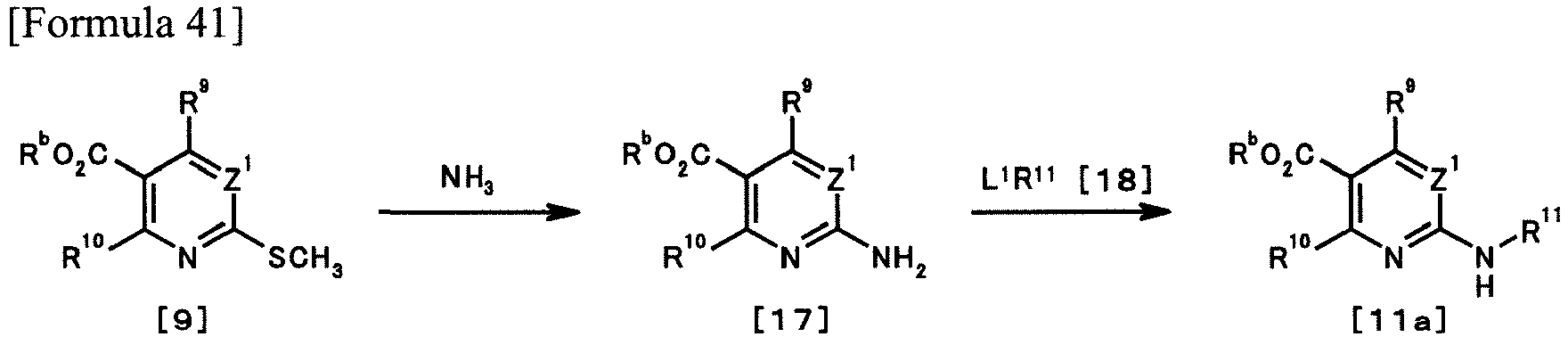
- The compounds of the general formula [17] can be prepared by oxidizing a compound of the general formula [9] with a peroxy acid, and then reacting the resultant with ammonia.
- This reaction can be performed in a manner similar to that of the preparation method (2-2).
- As the compounds of the general formula [18], for example, 4-bromobenzonitrile and so forth are known.
- The compounds of the general formula [11a] can be prepared by reacting a compound of the general formula [17] with a compound of the general formula [18] in the presence of a palladium catalyst, a ligand, and a base.
- The solvent used for this reaction is not particularly limited, so long as a solvent that does not affect the reaction is chosen. Examples include, for example, halogenated hydrocarbons, ethers, esters, amides, nitriles, sulfoxides, and aromatic hydrocarbons, and a mixture of these solvents may also be used.
- Preferred examples of the solvent include ethers, and 1,4-dioxane is more preferred. Although amount of the solvent to be used is not particularly limited, it may be 1-to 500-fold amount (v/w) with respect to the compound of the general formula [17].
- Amount of the catalyst to be used may be 0.001- to 2-fold molar amount, preferably 0.01- to 0.5-fold molar amount, with respect to the compound of the general formula [17].
- Amount of the ligand to be used may be 0.001- to 2-fold molar amount, preferably 0.01- to 0.5-fold molar amount, with respect to the compound of the general formula [17].
- Examples of the base used for this reaction include inorganic bases and organic bases.
- Amount of the base to be used may be 1- to 50-fold molar amount, preferably 1- to 5-fold molar amount, with respect to the compound of the general formula [17].
- This reaction may be performed at 0 to 150°C, preferably 20 to 120°C, for 30 minutes to 48 hours.
- For this reaction, a microwave reactor may be used.
-


- The compounds of the general formula [20] can be prepared by reacting a compound of the general formula [19] with a compound of the general formula [8].
- This reaction can be performed in a manner similar to that of the preparation method (2-1).
- The compounds of the general formula [21] can be prepared by reacting a compound of the general formula [20] with a compound of the general formula [10].
- The solvent used for this reaction is not particularly limited, so long as a solvent that does not affect the reaction is chosen. Examples include, for example, halogenated hydrocarbons, ethers, esters, amides, nitriles, sulfoxides, and aromatic hydrocarbons, and a mixture of these solvents may also be used.
- Preferred examples of the solvent include amides, and N-methylpyrrolidone is more preferred.
- Although amount of the solvent to be used is not particularly limited, it may be 1-to 500-fold amount (v/w) with respect to the compound of the general formula [20].
- Amount of the compound of the general formula [10] to be used may be 1- to 50-fold molar amount, preferably 1- to 5-fold molar amount, with respect to the compound of the general formula [20].
- For this reaction, a proton acid is preferably used.
- As the proton acid, camphorsulfonic acid is preferred.
- Amount of the proton acid to be used may be 1- to 50-fold molar amount, preferably 1- to 10-fold molar amount, with respect to the compound of the general formula [20].
- This reaction may be performed at -30 to 150°C, preferably 0 to 100°C, for 30 minutes to 48 hours.
- The compounds of the general formula [23] can be prepared by reacting a compound of the general formula [21] with a compound of the general formula [22] in the presence of a palladium catalyst, a copper salt, and a base.
- The solvent used for this reaction is not particularly limited, so long as a solvent that does not affect the reaction is chosen. Examples include, for example, halogenated hydrocarbons, ethers, esters, amides, nitriles, sulfoxides, and aromatic hydrocarbons, and a mixture of these solvents may also be used.
- Preferred examples of the solvent include amides, and N,N-dimethylformamide is more preferred.
- Although amount of the solvent to be used is not particularly limited, it may be 1-to 500-fold amount (v/w) with respect to the compound of the general formula [21].
- Amount of the compound of the general formula [22] to be used may be 1- to 50-fold molar amount, preferably 1- to 5-fold molar amount, with respect to the compound of the general formula [21].
- Amount of the catalyst used may be 0.0001- to 2-fold molar amount, preferably 0.001- to 0.2-fold molar amount, with respect to the compound of the general formula [21].
- Examples of the copper salt used for this reaction include copper(I) chloride, copper(I) bromide, copper(I) iodide, and copper(II) acetate.
- Amount of the copper salt to be used may be 0.0001- to 2-fold molar amount, preferably 0.001- to 0.2-fold molar amount, with respect to the compound of the general formula [21].
- Examples of the base used for this reaction include organic bases.
- Amount of the base to be used may be 0.1- to 50-fold molar amount, preferably 1-to 10-fold molar amount, with respect to the compound of the general formula [21].
- This reaction may be performed at -30 to 150°C, preferably 0 to 100°C, for 30 minutes to 48 hours.
- The compounds of the general formula [24] can be prepared by carrying out deprotection of a compound of the general formula [23].
- This reaction can be performed by the method described in T.W. Greene et al., Protective Groups in Organic Synthesis, 4th edition, pp.790-793, 2007, John Wiley & Sons, Inc.
- The compounds of the general formula [4b] can be prepared by reacting a compound of the general formula [24] with a compound of the general formula [15] in the presence of a condensing agent or an acid halide.
- This reaction can be performed in a manner similar to that of the preparation method (1-2).
-

- The compounds of the general formula [26] can be prepared by reacting a compound of the general formula [25] with a compound of the general formula [15] in the presence of a condensing agent or an acid halide.
- This reaction can be performed in a manner similar to that of the preparation method (1-2).
- The compounds of the general formula [4b] can be prepared by reacting a compound of the general formula [26] with a compound of the general formula [21].
- This reaction can be performed in a manner similar to that of the preparation method (5-3).
-

- The compounds of the general formula [27] can be prepared by reacting a compound of the general formula [20] with a compound of the general formula [22].
- This reaction can be performed in a manner similar to that of the preparation method (5-3).
- The compounds of the general formula [23] can be prepared by reacting a compound of the general formula [27] with a compound of the general formula [10].
- This reaction can be performed in a manner similar to that of the preparation method (5-2).
- When there are isomers (for example, optical isomers, geometrical isomers, tautomers, etc.) of the compounds used in the aforementioned preparation methods, these isomers can also be used.
- Further, when there are solvates, hydrates and crystals of various forms thereof, these solvates, hydrates and crystals of various forms can also be used.
- As for the compounds used in the aforementioned preparation methods having, for example, amino group, hydroxyl group, carboxyl group or the like, these groups can be protected with usual protective groups beforehand, and after the reactions, the protective groups can be eliminated by a known method.
- The compounds obtained by the aforementioned preparation methods can be derived into other compounds by a per se known reaction such as condensation, addition, oxidation, reduction, rearrangement, substitution, halogenation, dehydration, hydrolysis, or an appropriate combination of these.
- When the compounds of the present invention are used as a drug, they may be optionally mixed with pharmaceutical additives usually used for preparation of drugs, such as excipients, carriers, diluents, stabilizers, preservatives, buffering agents, corrigents, suspending agents, emulsifiers, flavoring agents, dissolving aids, colorants, and thickeners, as well as other active ingredients. The drugs can be orally or parenterally administered by a conventional method in the form of tablet, capsule, fine particle preparation, syrup, granule, pill, suspension, emulsion, solution, powdery preparation, suppository, eye drop, nose drop, ear drop, patch, ointment, injection, or the like. Administration method, dose, and frequency of administration can be appropriately chosen according to age, weight, and symptoms of patients. The compounds can usually be orally or parenterally administered (for example, injection, drip infusion, administration to the rectum part, etc.) to an adult at a daily dose of 0.01 to 1000 mg/kg at one time a day, or several times a day as divided portions.
- Next, usefulness of typical compounds of the present invention will be explained with reference to the following test examples.
- The FLT3 inhibition test was performed for the compounds of the present invention by the method described below.
- For the FLT3 enzyme inhibition test, glutathione S-transferase (GST)-fused human FLT3 protein (intracellular region, 564 to 993 aa) produced by using a baculovirus expression system (Carna Biosciences) was used.
- A reaction mixture in a volume of 9 µL containing the FLT3 protein and a test compound of a predetermined concentration (1.2 µg of FLT3, 100 mM HEPES, 10 mM MgCl2, 25 mM NaCl, 0.01% BSA, 1 mM DTT, pH 7.5) was left standing at 25°C for 15 minutes. Then, 3 µL (final concentration 0.25 µM) of a substrate peptide, biotin-AAA-AEEEEYFELVAKKK (Toray Industries), and 3 µL (final concentration 50 µM) of ATP (Sigma-Aldrich) were added to the reaction mixture, and the mixture was shaken for 2 minutes, and then further left standing at 25°C for 30 minutes to allow the enzymatic reaction.
- Then, 30 µL of an enzymatic reaction termination solution containing Streptavidin-Xlent (Cisbio) and Mab PT66-K (Cisbio) (5 µg/mL streptavidin, 0.19 µg/mL PT66-K, 30 mM HEPES (pH 7.0), 150 mM KF, 75 mM EDTA, 0.15% BSA, 0.075% Tween 20) was added to the reaction mixture to arrest the enzymatic reaction, and the reaction mixture was left standing at room temperature for 1 hour to allow the antigen-antibody reaction. Then, phosphorylation of the substrate peptide was measured by measuring time decomposition fluorescence at 615 nm and 665 nm using Envision (PerkinElmer).
- A leukemia cell proliferation inhibition test was performed for the compounds of the present invention by using the leukemia cell strains MV4-11 (ATCC Number, CRL-9591) and Molm-13 (DSMZ Number, ACC554).
- The leukemia cell proliferation inhibition test was performed by the method described below.
- For the purpose of measuring proliferation inhibition attained with a compound, the total cell count was quantified on the basis of the total cellular ATP concentration using the ATPlite (PerkinElmer) reagent utilizing firefly luciferase. The Molm-13 or MV4-11 cells were added to the RPMI medium containing penicillin and streptomycin (penn/strep) and 10% FBS at a density of 2 x 10⁵ cells/ml, and 50 µL (10,000 cells) of the cell suspension was inoculated to each well of a 96-well plate (Corning).
- A serially diluted solution of a compound or 0.1 % DMSO (solvent control) in a volume of 50 µL was added to the cells, and then the cells were cultured for 72 hours under the standard cell proliferation conditions (37°C, 5% CO2) to allow proliferation of the cells. In order to measure the proliferation of the total cells, equal volume of the ATPlite reaction mixture was added to each well in accordance with the instructions attached to ATPlite, and then luminescence count of the well was measured (relative light unit, RLU).
- The RLU signal observed with the DMSO solvent control after 72 hours of the culture was defined as a signal indicating 0% inhibition, and the GI50 value for the proliferation inhibition corresponds to a concentration of a compound that provides 50% inhibition based on the proliferation of the total cells contained in the DMSO solvent control. Each data point was obtained from samples in duplicate. The GI50 values were calculated by the non-linear regression fitting (Fit Model (205)) according to a sigmoid dose-reaction equation using the XLfit software.
- The results are shown below.
[Table 1] FLT3 (WT) enzyme inhibition activity MV4-11 cell proliferation inhibition effect MOLM 13 cell proliferation inhibition effect IC50 Evaluation Evaluation Evaluation Lower than 0.01 µM +++ +++ +++ 0.01 to 0.1 µM ++ ++ ++ 0.1 to 1 µM + + + Higher than 1 µM - - - [Table 2] Compound No. FLT3 (WT) enzyme inhibition activity MV4-11 cell proliferation inhibition effect MOLM13 cell proliferation inhibition effect 1-1 +++ ++ ++ 1-2 +++ +++ ++ 1-3 +++ +++ +++ 1-4 +++ +++ ++ 1-5 ++ ++ ++ 1-6 +++ ++ ++ 1-7 +++ ++ +++ 1-8 +++ +++ ++ 1-9 +++ +++ ++ 1-10 +++ +++ +++ 1-11 +++ ++ ++ 1-12 +++ +++ ++ 2-1 +++ ++ ++ 2-2 +++ ++ ++ 2-3 +++ ++ ++ 2-4 +++ +++ ++ 2-5 +++ ++ ++ 2-6 ++ ++ ++ 2-7 +++ ++ + 2-8 +++ ++ ++ 2-9 +++ +++ +++ 2-10 +++ + + 2-11 +++ ++ ++ 2-12 +++ +++ +++ 2-13 +++ ++ ++ 2-14 +++ ++ ++ 2-15 +++ + + 2-16 +++ ++ + 2-17 ++ + + 2-18 ++ - - 2-19 ++ - - 2-20 +++ ++ ++ 2-21 ++ ++ ++ 2-23 +++ ++ +++ 2-24 +++ ++ ++ 2-25 ++ + + 2-26 ++ + + 2-27 ++ + + 2-28 + + + 2-29 ++ + + 3-1 +++ +++ +++ 3-2 +++ ++ ++ 3-3 +++ ++ ++ 3-4 +++ +++ +++ 3-6 +++ + - 3-7 +++ ++ ++ [Table 3] Compound No. FLT3 (WT) enzyme inhibition activity MV4-11 cell proliferation inhibition effect MOLM13 cell proliferation inhibition effect 3-8 +++ ++ ++ 3-9 +++ ++ ++ 3-10 +++ + + 3-11 +++ +++ ++ 3-12 +++ ++ ++ 3-13 +++ ++ ++ 3-15 +++ + + 3-17 +++ + - 3-18 +++ - - 3-19 +++ ++ + 3-20 +++ ++ + 3-21 +++ + + 3-24 +++ ++ + 3-25 +++ ++ + 3-27 +++ ++ ++ 3-28 +++ + + 3-29 +++ ++ ++ 3-30 +++ +++ ++ 3-31 +++ + + 4-1 +++ ++ ++ 4-2 +++ +++ +++ 4-3 +++ +++ +++ 4-4 +++ +++ +++ 4-5 +++ +++ +++ 4-7 +++ +++ +++ 4-8 +++ +++ +++ 4-9 +++ +++ +++ 4-10 +++ +++ +++ 4-13 +++ ++ ++ 4-14 +++ +++ +++ 4-15 +++ ++ + 5-1 +++ +++ +++ 5-2 +++ ++ ++ 5-3 +++ ++ ++ 5-4 +++ + + 5-5 +++ ++ ++ 6-1 +++ +++ ++ 6-2 ++ ++ + 6-3 +++ ++ ++ 6-4 +++ +++ +++ 6-5 +++ ++ ++ 6-6 +++ +++ +++ 6-7 +++ ++ ++ 6-8 +++ +++ +++ 6-9 +++ +++ +++ 6-10A +++ ++ + 6-10B +++ +++ +++ 6-11 +++ +++ +++ [Table 4] Compound No. FLT3 (WT) enzyme inhibition activity MV4-11 cell proliferation inhibition effect MOLM13 cell proliferation inhibition effect 6-12 +++ ++ + 6-13 +++ + + 6-14 +++ +++ ++ 6-15 +++ + + 6-16 ++ + ++ 6-17 ++ + + 6-18 +++ ++ ++ 6-19 ++ ++ ++ 6-21 ++ + + 6-23 ++ + + 7-1 +++ +++ +++ 7-2 +++ +++ +++ 7-3 +++ +++ +++ 7-4 +++ +++ +++ 7-5 +++ +++ +++ 7-6 +++ ++ ++ 7-7 +++ +++ +++ 7-8 +++ +++ +++ 7-9 +++ +++ +++ 7-10 +++ ++ ++ 7-11 +++ ++ ++ 7-12 ++ + + 7-14 +++ +++ ++ 7-15 ++ +++ +++ 7-16 ++ +++ +++ 7-17 +++ +++ +++ 7-18 +++ ++ ++ 7-19 +++ +++ +++ 7-20 +++ +++ +++ 7-21 +++ +++ +++ 7-22 +++ +++ +++ 7-23 +++ +++ ++ 7-24 +++ +++ +++ 7-25 +++ +++ ++ 7-27 +++ ++ +++ 7-28 +++ +++ +++ 7-29 +++ ++ + 7-31 +++ +++ +++ 7-32 +++ +++ +++ 7-3 +++ +++ +++ 7-34 +++ +++ +++ 7-35 +++ +++ +++ 7-36 +++ +++ ++ 7-37 +++ +++ +++ 7-38 +++ ++ ++ 7-39 +++ +++ +++ 7-40 +++ +++ +++ 7-41 +++ +++ +++ [Table 5] Compound No. FLT3 (WT) enzyme inhibition activity MV4-11 cell proliferation inhibition effect MOLM 13 cell proliferation inhibition effect 7-42 +++ +++ +++ 7-43 +++ +++ +++ 7-44 +++ +++ +++ 7-45 +++ +++ +++ 7-46 +++ +++ ++ 7-47 +++ +++ +++ 7-48 +++ +++ +++ 7-49 +++ +++ +++ 7-50 +++ +++ +++ 7-51 +++ +++ +++ 7-52 +++ +++ +++ 7-53 ++ +++ +++ 7-54 ++ +++ +++ 7-55 +++ +++ +++ 7-56 +++ +++ +++ 7-57 +++ +++ +++ 7-58 +++ +++ +++ 7-59 +++ +++ +++ 7-60 +++ +++ +++ 7-61 +++ +++ +++ 7-62 +++ +++ +++ 7-63 +++ +++ +++ 7-64 +++ +++ +++ 7-65 +++ +++ +++ 7-66 +++ +++ +++ 7-67 +++ +++ +++ 7-68 +++ +++ +++ 7-69 +++ +++ +++ 7-70 +++ +++ +++ 7-71 +++ +++ +++ 7-72 +++ +++ +++ 7-73 +++ +++ +++ 7-74 +++ +++ +++ 7-75 +++ +++ +++ 7-76 +++ +++ +++ 7-77 +++ +++ +++ 7-78 +++ +++ ++ 7-79 +++ +++ +++ 7-80 +++ +++ +++ 7-81 +++ +++ +++ 7-82 +++ +++ +++ 7-83 +++ +++ +++ 7-84 +++ +++ +++ 7-85 +++ +++ +++ 7-86 +++ +++ +++ 7-87 +++ +++ +++ 7-88 +++ +++ +++ 7-89 +++ +++ +++ [Table 6] Compound No. FLT3 (WT) enzyme inhibition activity MV4-11 cell proliferation inhibition effect MOLM13 cell proliferation inhibition effect 7-90 +++ + + 7-91 +++ + + 7-92 +++ +++ +++ 7-93 +++ +++ +++ 7-94 ++ ++ ++ 7-95 ++ - - 7-96 ++ + - 8-1 +++ +++ +++ 8-2 +++ +++ +++ 8-3 +++ +++ ++ 8-4 +++ ++ ++ 8-5 +++ ++ ++ 8-6 +++ +++ +++ 8-7 +++ +++ ++ 8-9 +++ ++ ++ 8-10 +++ +++ ++ 8-11 +++ +++ +++ 8-12 +++ ++ ++ 8-13 +++ ++ ++ 8-14 +++ +++ ++ 8-15 ++ + + 8-16 ++ ++ + 8-18 +++ ++ ++ 8-19 +++ ++ ++ 8-20 ++ ++ + 8-21 ++ + + 8-22 +++ ++ ++ 8-23 +++ ++ ++ 9-1 +++ +++ +++ 9-2 +++ ++ ++ 9-3 +++ +++ ++ 9-4 +++ ++ ++ 9-5 +++ ++ ++ 9-6 +++ +++ +++ 9-7 +++ +++ +++ 9-8 ++ +++ +++ 9-9 +++ +++ +++ 9-10 +++ +++ +++ 9-11 +++ +++ +++ 9-12 +++ +++ +++ 9-13 +++ +++ +++ 9-14 +++ +++ +++ 9-15 +++ +++ +++ 9-16 +++ +++ +++ 9-17 +++ +++ +++ 9-18 +++ +++ +++ 9-19 +++ +++ +++ 9-20 +++ +++ +++ [Table 7] Compound No. FLT3 (WT) enzyme inhibition activity MV4-11 cell proliferation inhibition effect MOLM13 cell proliferation inhibition effect 9-21 +++ +++ ++ 9-22 +++ +++ ++ 9-23 ++ ++ + 9-25 +++ +++ +++ 9-26 +++ +++ +++ 9-27 +++ +++ +++ 9-28 +++ +++ +++ 9-29 +++ +++ +++ 9-30 +++ +++ +++ 9-31 +++ +++ +++ 9-32 +++ +++ +++ 9-3 +++ +++ +++ 9-34 +++ +++ +++ 9-35 +++ +++ +++ 9-36 +++ +++ +++ 9-37 +++ +++ +++ 9-38 +++ +++ +++ 9-39 +++ +++ +++ 9-40 ++ ++ ++ 10-1 +++ +++ ++ 10-2 +++ +++ +++ 10-3 +++ +++ +++ 10-4 +++ +++ +++ 10-5 +++ +++ +++ 10-6 +++ +++ +++ 10-7 +++ +++ +++ 10-8 +++ +++ ++ 10-9 +++ ++ ++ 10-10 +++ +++ +++ 10-11 +++ +++ ++ 10-12 +++ +++ ++ 10-13 +++ +++ +++ 10-14 +++ +++ +++ 10-15 +++ +++ +++ 10-16 +++ +++ +++ 10-17 +++ +++ ++ 10-18 +++ +++ +++ 10-19 +++ +++ +++ 10-20 +++ +++ +++ 10-21 +++ +++ +++ 10-22 +++ +++ +++ 10-23 +++ +++ +++ 10-24 +++ +++ +++ 10-25 +++ +++ +++ 10-26 +++ +++ ++ 10-27 +++ +++ +++ 10-28 +++ +++ ++ 10-29 +++ +++ +++ [Table 8] Compound No. FLT3 (WT) enzyme inhibition activity MV4-11 cell proliferation inhibition effect MOLM13 cell proliferation inhibition effect 10-30 +++ +++ ++ 10-31 +++ +++ ++ 10-32 +++ +++ +++ 10-33 +++ +++ +++ 10-34 +++ +++ +++ 10-35 +++ +++ ++ 10-36 +++ +++ +++ 10-37 +++ +++ +++ 10-38 +++ +++ ++ 10-39 +++ +++ +++ 10-40 +++ +++ +++ 10-41 +++ +++ +++ 10-42 +++ +++ +++ 10-43 +++ ++ ++ 10-44 +++ +++ +++ 10-45 +++ +++ +++ 10-46 +++ +++ +++ 10-47 +++ +++ +++ 10-48 +++ +++ +++ 10-49 +++ +++ +++ 10-50 +++ +++ +++ 10-51 +++ +++ +++ 10-52 +++ +++ +++ 10-53 +++ +++ +++ 10-54 +++ +++ +++ 10-55 +++ +++ +++ 10-56 +++ +++ +++ 10-57 +++ +++ +++ 10-58 +++ +++ +++ 10-59 +++ +++ +++ 10-60 +++ +++ +++ 10-61 +++ +++ +++ 10-62 +++ +++ +++ 10-63 +++ +++ +++ 10-64 +++ +++ +++ 10-65 +++ +++ +++ 10-66 +++ +++ +++ 10-67 +++ +++ +++ 10-68 +++ +++ +++ 10-69 +++ +++ +++ 10-70 +++ +++ +++ 10-71 +++ +++ +++ 10-72 +++ +++ +++ 10-73 +++ +++ +++ 10-74 +++ +++ +++ 10-75 +++ +++ +++ 11-1 ++ ++ ++ 11-3 ++ + + [Table 9] Compound No. FLT3 (WT) enzyme inhibition activity MV4-11 cell proliferation inhibition effect MOLM13 cell proliferation inhibition effect 11-8 +++ ++ ++ 11-9 +++ ++ ++ 11-10 +++ +++ ++ 11-11 +++ ++ ++ 12-1 +++ +++ +++ 12-2 +++ +++ ++ 12-3 +++ +++ +++ 12-5 +++ ++ ++ 12-6 ++ ++ + 12-9 +++ ++ ++ 12-10 +++ ++ + 12-11 ++ ++ ++ 12-12 ++ ++ +++ 12-13 +++ +++ +++ 12-14 +++ +++ +++ 13-1 +++ +++ +++ 13-2 +++ ++ ++ 13-3 +++ +++ ++ 13-4 +++ +++ +++ 13-5 +++ +++ +++ 13-6 +++ +++ +++ 13-7 +++ +++ +++ 13-8 +++ +++ +++ 13-9 +++ +++ +++ 13-10 +++ +++ +++ 13-11 +++ +++ +++ 13-12 +++ +++ +++ 13-13 +++ +++ +++ 13-14 +++ +++ +++ 13-15 +++ +++ +++ 13-16 +++ +++ +++ 13-17 +++ +++ +++ 13-18 +++ +++ +++ 13-19 +++ +++ +++ 13-20 +++ +++ +++ 13-21 +++ +++ +++ 13-22 +++ +++ +++ 14-1 +++ +++ +++ 14-2 +++ +++ +++ 14-3 +++ +++ +++ 14-4 +++ +++ +++ 14-5 +++ +++ +++ 14-6 +++ +++ +++ 15-1 +++ +++ +++ 15-2 +++ +++ ++ 15-3 +++ +++ +++ 15-4 +++ +++ +++ 15-5 +++ +++ +++ [Table 10] Compound No. FLT3 (WT) enzyme inhibition activity MV4-11 cell proliferation inhibition effect MOLM13 cell proliferation inhibition effect 15-6 +++ +++ +++ 15-7 +++ +++ +++ 15-8 +++ +++ +++ 15-9 +++ +++ +++ 15-10 +++ +++ +++ 15-11 +++ +++ +++ 15-12 +++ +++ +++ 15-13 +++ +++ +++ 15-14 +++ +++ +++ 15-15 +++ +++ +++ 15-16 +++ +++ +++ 16-1 +++ ++ + 16-2 +++ ++ + 16-3 +++ + + 17-1 +++ +++ +++ 17-2 +++ +++ +++ 17-3 +++ ++ ++ 18-1 +++ ++ ++ 18-2 +++ +++ ++ 19-1 +++ + + 20-1 ++ +++ +++ 20-2 ++ ++ ++ 20-3 ++ +++ +++ 20-4 +++ ++ ++ 21-1 +++ +++ +++ 21-2 +++ +++ +++ 21-3 +++ +++ +++ 21-4 +++ +++ ++ 21-5 + - + 21-6 +++ +++ +++ 21-7 +++ +++ +++ 21-8 ++ ++ ++ 21-9 +++ +++ +++ 21-10 +++ ++ ++ 21-12 +++ +++ +++ 21-13 +++ +++ +++ 21-14 +++ ++ ++ 21-15 +++ +++ ++ 21-16 +++ +++ +++ 21-17 +++ +++ ++ 21-18 ++ ++ ++ 21-19 +++ +++ +++ 21-20 +++ +++ +++ 21-21 +++ +++ +++ 21-22 +++ +++ +++ 21-27 +++ +++ +++ 21-28 +++ +++ +++ 21-29 +++ +++ +++ [Table 11] Compound No. FLT3 (WT) enzyme inhibition activity MV4-11 cell proliferation inhibition effect MOLM13 cell proliferation inhibition effect 21-30 +++ +++ +++ 21-31 +++ +++ +++ 21-32 +++ +++ +++ 21-33 +++ +++ +++ 21-34 +++ +++ +++ 21-35 +++ ++ ++ 21-36 +++ +++ +++ 21-37 +++ +++ +++ 21-38 +++ +++ +++ 21-39 +++ +++ +++ 21-40 +++ +++ +++ 21-41 +++ +++ +++ 21-42 +++ +++ +++ 21-43 +++ +++ +++ 21-44 +++ ++ ++ 21-45 +++ +++ +++ 21-46 +++ +++ +++ 21-47 +++ +++ +++ 21-48 +++ ++ +++ 21-49 ++ +++ +++ 21-50 +++ +++ +++ 21-51 +++ +++ +++ 21-52 +++ +++ +++ 21-53 +++ +++ +++ 21-54 ++ ++ + 21-55 +++ +++ +++ 21-56 ++ + + 22-1 +++ +++ +++ 22-2 +++ +++ +++ 22-3 +++ ++ ++ 22-4 +++ +++ +++ 22-5 ++ + ++ 22-6 +++ +++ +++ 22-7 +++ ++ ++ 22-8 +++ +++ ++ 22-9 +++ ++ ++ 22-10 +++ +++ +++ 22-11 +++ +++ +++ 22-12 +++ +++ +++ 22-13 ++ + ++ 22-14 +++ +++ +++ 22-15 +++ ++ ++ 22-16 ++ ++ ++ 22-17 +++ +++ +++ 22-18 +++ +++ +++ 22-19 +++ +++ +++ 22-20 +++ +++ +++ 22-22 +++ +++ +++ [Table 12] Compound No. FLT3 (WT) enzyme inhibition activity MV4-11 cell proliferation inhibition effect MOLM13 cell proliferation inhibition effect 22-23 +++ +++ +++ 22-24 ++ ++ ++ 22-25 +++ +++ +++ 22-26 +++ ++ ++ 22-27 +++ +++ +++ 22-28 +++ +++ +++ 22-29 +++ +++ +++ 22-30 +++ +++ +++ 22-31 +++ +++ +++ 22-32 +++ +++ +++ 22-33 +++ +++ +++ 22-36 +++ +++ +++ 22-37 +++ +++ +++ 22-38 +++ +++ +++ 22-39 +++ +++ +++ 22-40 +++ +++ +++ 22-41 +++ +++ +++ 22-42 +++ +++ +++ 22-43 +++ +++ +++ 22-44 +++ +++ +++ 22-45 +++ +++ +++ 22-46 +++ +++ +++ 22-47 +++ +++ +++ 22-50 +++ ++ +++ 22-51 +++ +++ +++ 22-55 +++ +++ +++ 22-56 +++ +++ +++ 22-57 +++ +++ +++ 22-58 +++ +++ +++ 22-59 +++ +++ +++ 22-60 +++ +++ +++ 22-61 +++ +++ +++ 22-62 +++ +++ +++ 22-63 +++ +++ +++ 22-64 +++ +++ +++ 22-65 +++ +++ +++ 22-66 +++ +++ +++ 22-67 +++ +++ +++ 22-68 +++ +++ +++ - The compounds of the present invention had superior FLT3 inhibition activity and leukemia cell strain proliferation inhibition activity.
- Hereafter, the present invention will be explained with reference to examples. However, the present invention is not limited by these examples.
- Unless especially indicated, an automatic purification system, ISOLERA (produced by Biotage), was used for the purification by column chromatography.
- Unless especially indicated, SNAP KP-Sil Cartridge (produced by Biotage) was used as the carrier for silica gel column chromatography, and SNAP KP-NH Cartridge (produced by Biotage) was used as the carrier for basic silica gel column chromatography.
- The mixing ratios of the eluents are indicated in terms of volume ratio. For example, an indication of "eluent, 75 to 0% hexane in ethyl acetate" means that an eluent consisting of 75% hexane and 25% ethyl acetate was continuously changed to an eluent consisting of 0% hexane and 100% ethyl acetate at last.
- As the microwave synthesizer, Initiator Sixty (produced by Biotage) was used.
- As the continuous flow hydrogenation reactor, H-Cube (produced by ThalesNano) was used.
- As the supercritical fluid chromatography (SFC) purification system, SFC30 (produced by Waters) was used.
- The NMR spectra were measured by using tetramethylsilane as an internal standard and Bruker AV300 (produced by Bruker), and all the δ values are indicated in terms of ppm.
- The MS spectra were measured by using ACQUITY SQD LC/MS System (produced by Waters).
- The abbreviations used in the examples have the following meanings.
- Boc: tert-butoxycarbonyl
- DMSO-d6: deuterated dimethyl sulfoxide
- TBS: tert-butyldimethylsilyl
-

- To a solution of 4-chloro-2-(methylthio)pyrimidine-5-carboxylic acid ethyl ester (11.6 g) in tetrahydrofuran (100 mL), triethylamine (8.4 mL) and propylamine (5.1 mL) were added under ice cooling, and the mixture was stirred at room temperature for 30 minutes. To the reaction mixture, 1.0 mol/L aqueous hydrochloric acid and ethyl acetate were added. The organic layer was separated, washed successively with saturated aqueous sodium hydrogencarbonate and saturated aqueous sodium chloride, and then dried over anhydrous magnesium sulfate, and the solvent was evaporated under reduced pressure to obtain oily 2-(methylthio)-4-(propylamino)pyrimidine-5-carboxylic acid ethyl ester (A1, 11.7 g).
1H-NMR (CDCl3) δ: 8.61 (1H, s), 8.27 (1H, brs), 4.32 (2H, q, J=7.0Hz), 3.55-3.48 (2H, m), 2.53 (3H, s), 1.73-1.60 (2H, m), 1.37 (3H, t, J=7.3Hz), 0.99 (3H, t, J=7.6Hz) -

- To a solution of 2-(methylthio)-4-(propylamino)pyrimidine-5-carboxylic acid ethyl ester (A1, 9.0 g) in N-methylpyrrolidone (88 mL), meta-chloroperbenzoic acid (70 to 75% wt, 10.8 g) was added portionwise under ice cooling, and the mixture was stirred at room temperature for 45 minutes. To the reaction mixture, meta-chloroperbenzoic acid (70 to 75% wt, 2.5 g) was added at room temperature, and the mixture was stirred at the same temperature for 3 hours. To the reaction mixture, saturated aqueous sodium hydrogencarbonate and ethyl acetate were added. The organic layer was separated, washed with saturated aqueous sodium chloride, and then dried over anhydrous magnesium sulfate, and the solvent was evaporated under reduced pressure. To a solution of the obtained residue in N-methylpyrrolidone (35 mL), N,N-diisopropylethylamine (11.9 mL) and 4-(2-aminoethyl)pyridine (6.3 mL) were added at room temperature, and the mixture was stirred at 100°C for 4 hours. The reaction mixture was cooled to room temperature, and then poured into water (400 mL). The solid matter was taken by filtration, washed with water, and then dried under reduced pressure to obtain 4-(propylamino)-2-((2-(pyridin-4-yl)ethyl)amino)pyrimidine-5-carboxylic acid ethyl ester (A2, 9.2 g) as yellow solid.
-

- A mixture of 4-(propylamino)-2-((2-(pyridin-4-yl)ethyl)amino)pyrimidine-5-carboxylic acid ethyl ester (A2, 9.2 g), ethanol (115 mL), tetrahydrofuran (58 mL) and 2.0 mol/L aqueous sodium hydroxide (115 mL) was stirred at 40°C for 4 hours, and then further stirred at 60°C for 3 hours. The reaction mixture was cooled to room temperature, then 12 mol/L aqueous hydrochloric acid (19.5 mL) was added to the mixture (pH 5 to 6), and the organic solvent was evaporated under reduced pressure. The solid matter was taken by filtration, washed with water, and then dried under reduced pressure to obtain 4-(propylamino)-2-((2-(pyridin-4-yl)ethyl)amino)pyrimidine-5-carboxylic acid (A3, 9.3 g) as white solid.
MS m/z (M-H): 300.3 -

- To a suspension of 4-(propylamino)-2-((2-(pyridin-4-yl)ethyl)amino)pyrimidine-5-carboxylic acid (A3, 1.12 g), 1-ethyl-3-(3-dimethylaminopropyl)carbodiimide hydrochloride (843 mg) and 1-hydroxybenzotriazole monohydrate (595 mg) in N,N-dimethylformamide (20 mL), N,N-diisopropylethylamine (2.0 mL) was added at room temperature, and the mixture was stirred at 40°C for 2 hours (Reaction mixture A).
- To a solution of 1,3-phenylenediamine (1.73 g) in N,N-dimethylformamide (10 mL), Reaction mixture A mentioned above was added at room temperature, and the mixture was stirred at the same temperature for 4 hours. To the reaction mixture, saturated aqueous sodium hydrogencarbonate and ethyl acetate were added. The organic layer was separated, and the aqueous layer was extracted with ethyl acetate. The organic layer and the extract were combined, washed with saturated aqueous sodium chloride, and then dried over anhydrous magnesium sulfate, and the solvent was evaporated under reduced pressure. The obtained residue was purified by basic silica gel column chromatography to obtain N-(3-aminophenyl)-4-(propylamino)-2-((2-(pyridin-4-yl)ethyl)amino)pyrimidine-5-carboxamide (A4, 950 mg) as white solid.
1H-NMR (DMSO-d6) δ: 9.50 (1H, brs), 8.74 (1H, brs), 8.56-8.42 (3H, m), 7.37 (1H, brs), 7.25 (2H, d, J=5.3Hz), 6.98-6.88 (2H, m), 6.72 (1H, d, J=9.2Hz), 6.27 (1H, d, J=9.2Hz), 5.02 (2H, s), 3.58-3.50 (2H, m), 3.44-3.34 (2H, m), 2.88 (2H, t, J=6.9Hz), 1.62-1.50 (2H, m), 0.91 (3H, t, J=7.3Hz) -

- To N-Boc-L-alanine (57 mg), 1-ethyl-3-(3-dimethylaminopropyl)carbodiimide hydrochloride (115 mg) and 1-hydroxybenzotriazole monohydrate (81 mg), N,N-dimethylformamide (2 mL) was added at room temperature, and the mixture was stirred at the same temperature for 2 hours. To the reaction mixture, N,N-diisopropylethylamine (153 µL) andN-(3-aminophenyl)-4-(propylamino)-2-((2-(pyridin-4-yl)ethyl)amino)pyrimidine-5-carboxamide (A4, 98 mg) were added at room temperature, and the mixture was stirred at the same temperature for 5 hours. To the reaction mixture, saturated aqueous sodium hydrogencarbonate and ethyl acetate were added. The organic layer was separated, washed with saturated aqueous sodium chloride, and then dried over anhydrous magnesium sulfate, and the solvent was evaporated under reduced pressure. The obtained residue was purified by basic silica gel column chromatography (eluent, 98 to 90% ethyl acetate in methanol) to obtain oily (S)-tert-butyl (1-oxo-1-((3-(4-(propylamino)-2-((2-(pyridin-4-yl)ethyl)amino)pyrimidine-5-carboxamido)phenyl)amino)propan-2-yl)carbamate (A5, 137 mg).
MS m/z (M+H): 563.4 -

- To a solution of (S)-tert-butyl (1-oxo-1-((3-(4-(propylamino)-2-((2-(pyridin-4-yl)ethyl)amino)pyrimidine-5-carboxamido)phenyl)amino)propan-2-yl)carbamate (A5,137 mg) in chloroform (2 mL), trifluoroacetic acid (2 mL) was added at room temperature, and the mixture was stirred at the same temperature for 3 hours. The solvent was evaporated under reduced pressure, and to the obtained residue, saturated aqueous sodium hydrogencarbonate and ethyl acetate were added. The organic layer was separated, and the aqueous layer was extracted with ethyl acetate. The organic layer and the extract were combined, washed with saturated aqueous sodium chloride, and then dried over anhydrous magnesium sulfate, and the solvent was evaporated under reduced pressure. To the obtained residue, ethyl acetate was added, and the solid matter was taken by filtration, and dried under reduced pressure to obtain (S)-N-(3-(2-aminopropanamido)phenyl)-4-(propylamino)-2-((2-(pyridin-4-yl)ethyl)amino)pyrimidine-5-carboxamide (A6, 75 mg) as white solid.
-

- To a solution of (S)-N-(3-(2-aminopropanamido)phenyl)-4-(propylamino)-2-((2-(pyridin-4-yl)ethyl)amino)pyrimidine-5-carboxamide (A6, 23.1 mg) in N,N-dimethylformamide (1 mL), triethylamine (28 µL) and acryloyl chloride (6 µL) were added under ice cooling, and the mixture was stirred at the same temperature for 2 hours. To the reaction mixture, acryloyl chloride (2 µL) was added under ice cooling, and the mixture was stirred at the same temperature for 30 minutes. To the reaction mixture, saturated aqueous sodium hydrogencarbonate and ethyl acetate were added. The organic layer was separated, washed with saturated aqueous sodium chloride, and then dried over anhydrous magnesium sulfate, and the solvent was evaporated under reduced pressure. The obtained residue was purified by basic silica gel column chromatography to obtain (S)-N-(3-(2-(acrylylamido)propanamido)phenyl)-4-(propylamino)-2-((2-(pyridin-4-yl)ethyl)amino)pyrimidine-5-carboxamide (1-1, 8.9 mg) as white solid.
1H-NMR (CD3OD) δ: 8.44-8.36 (3H, m), 7.91 (1H, s), 7.36-7.24 (5H, m), 6.36 (1H, dd, J=17.2, 9.9Hz), 6.24 (1H, dd, J=17.2, 2.6Hz), 5.69 (1H, dd, J=9.6, 2.3Hz), 4.60-4.52 (1H, m), 3.69 (2H, t, J=6.9Hz), 3.46 (2H, brs), 2.99 (2H, t, J=7.3Hz), 1.72-1.60 (2H, m), 1.46 (3H, d, J=7.3Hz), 0.99 (3H, t, J=7.3Hz) -

- To a solution of (S)-N-(3-(2-aminopropanamido)phenyl)-4-(propylamino)-2-((2-(pyridin-4-yl)ethyl)amino)pyrimidine-5-carboxamide (A6, 21 mg), 4-dimethylaminocrotonic acid hydrochloride (16 mg) and 1-methyl-3-(3-dimethylaminopropyl)carbodiimide hydrochloride (38 mg) in N,N-dimethylformamide (2 mL), triethylamine (40 µL) was added at room temperature, and the mixture was stirred at 50°C for 30 minutes. The reaction mixture was cooled to room temperature, and then saturated aqueous sodium hydrogencarbonate and ethyl acetate were added to the mixture. The organic layer was separated, washed with water, and then dried over anhydrous sodium sulfate, and the solvent was evaporated under reduced pressure. The obtained residue was purified by silica gel column chromatography (eluent, 95% chloroform/5% methanol) to obtain (S,E)-N-(3-(2-(4-(dimethylamino)-2-butenamido)propanamido)phenyl)-4-(propylamino)-2-((2-(pyridin-4-yl)ethyl)amino)pyrimidine-5-carboxamide (1-2, 11 mg).
1H-NMR (CDCl3) δ: 9.15 (1H, brs), 8.66 (1H, brs), 8.50-8.49 (2H, m), 8.35-8.32 (2H, m), 7.69 (1H, brs), 7.42-7.40 (1H, m), 7.22-7.19 (2H, m), 7.13 (2H, d, J=5.3Hz), 6.89-6.84 (2H, m), 6.02 (1H, d, J=15.2Hz), 5.50 (1H, brs), 4.75 (1H, q, J=6.6Hz), 3.72-3.67 (2H, m), 3.42 (2H, s), 3.03 (2H, d, J=5.9Hz), 2.91 (2H, t, J=6.9Hz), 2.22 (6H, s), 1.66-1.61 (2H, m), 1.44 (3H, d, J=6.6Hz), 0.97 (3H, t, J=7.3Hz) -

- To N-(3-aminophenyl)-2,2,2-trifluoro-N-methylactamide (302 mg) synthesized according to the method described in
US6344465B1 , 4-(propylamino)-2-((2-(pyridin-4-yl)ethyl)amino)pyrimidine-5-carboxylic acid (A3, 627 mg), 1-ethyl-3-(3-dimethylaminopropyl)carbodiimide hydrochloride (545 mg) and 1-hydroxybenzotriazole monohydrate (377 mg), N,N-dimethylformamide (15 mL) and triethylamine (766 µL) were added at room temperature, the reaction vessel was sealed, and then the mixture was stirred at 100°C for 40 minutes by using a microwave reaction system. The reaction mixture was cooled to room temperature, and then saturated aqueous sodium hydrogencarbonate and ethyl acetate were added to the mixture. The organic layer was separated, and dried over anhydrous sodium sulfate, and the solvent was evaporated under reduced pressure. The obtained residue was purified by silica gel column chromatography (eluent, 97 to 96% ethyl acetate in methanol) to obtain 4-(propylamino)-2-((2-(pyridin-4-yl)ethyl)amino)-N-(3-(2,2,2-trifluoro-N-methylacetamido)phenyl)pyrimidine-5-carboxamide (A7, 186 mg).
1H-NMR (CDCl3) δ: 8.89 (1H, brs), 8.49 (2H, d, J=5.9Hz), 8.35 (1H, s), 7.82-7.28 (3H, m), 7.16 (2H, d, J=7.6Hz), 7.00 (1H, d, J=7.9Hz), 6.68 (1H, brs), 5.35 (1H, brs), 3.75-3.65 (2H, m), 3.48-3.40 (2H, m), 3.36 (3H, s), 2.94 (2H, t, J=8.9Hz), 1.67-1.62 (2H, m), 1.00 (3H, t, J=7.3Hz) -

- To a solution of 4-(propylamino)-2-((2-(pyridin-4-yl)ethyl)amino)-N-(3-(2,2,2-trifluoro-N-methylacetamido)phenyl)pyrimidine-5-carboxamide (A7, 186 mg) in methanol (4 mL) and water (2 mL), potassium carbonate (92 mg) was added at room temperature, and the mixture was stirred at the same temperature for 13 hours and 30 minutes. To the reaction mixture, water and chloroform were added. The organic layer was separated, washed successively with water and saturated aqueous sodium chloride, and then dried over anhydrous sodium sulfate, and the solvent was evaporated under reduced pressure to obtain N-(3-(methylamino)phenyl)-4-(propylamino)-2-((2-(pyridin-4-yl)ethyl)amino)pyrimidine-5-carboxamide (A8, 141 mg).
MS m/z (M-H): 406.3 - In the same manner as that of Example 1, (4), Intermediates (A9) to (A 12) were obtained.
[Table 13] Compound No. Structure Physicochemical data A9 
MS m/z (M+H): 398.3 A10 
MS m/z (M+H): 386.4 A11 
MS m/z (M+H): 406.3 A12 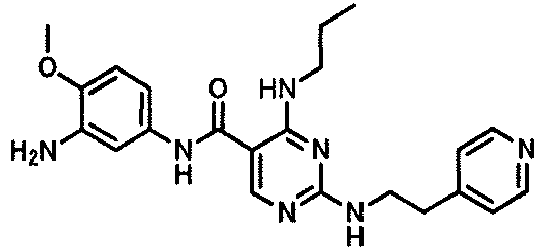
MS m/z (M+H): 422.2 - In the same manner as that of Example 1, (5), Intermediates (A 13) to (A20) were obtained.
[Table 14] Compound No. Structure Physicochemical data A13 
MS m/z (M+H): 563.4 A14 
MS m/z (M+H): 555.4 A15 
- A16 
MS m/z (M+H): 543.4 A17 
MS m/z (M+H): 557.5 A18 
MS m/z (M+H): 563.4 A19 
- A20 
- - In the same manner as that of Example 1, (6), Intermediates (A21) to (A28) were obtained.
[Table 15] Compound No. Structure Physicochemical data A21 
MS m/z (M+H): 463.3 A22 
MS m/z (M+H): 455.4 A23 
- A24 
- A25 
- A26 
- A27 
- A28 
MS m/z (M+H): 493.3 - In the same manner as that of Example 1, (7) or Example 1, (8), Compounds (1-3) to (1-12) were obtained.
[Table 16] Compound No. Structure Physicochemical data 1-3 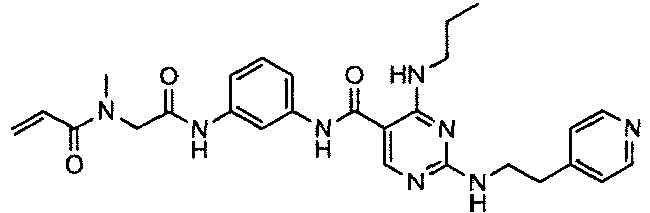
1H-NMR (CDCl3) δ: 8.52-8.46 (2H, m), 8.31 (1H, s), 7.67 (1H, s), 7.44-7.36 (1H, m), 7.25-7.14 (4H, m), 6.63 (1H, dd, J=16.8, 10.2Hz), 6.39 (1H, d, J=16.5Hz), 5.80 (1H, d, J=10.2Hz), 4.17 (2H, s), 3.68 (2H, t, J=7.3Hz), 3.43 (2H, s), 3.25 (3H, s), 2.93 (2H, t, J=7.3Hz), 1.70-1.60 (2H, m), 0.98 (3H, t, J=7.3Hz) 1-4 
MS m/z [M+H): 509.4 1-5 
1H-NMR (CDCl3) δ: 8.62 (1H, brs), 8.53-8.52 (2H, m), 8.23 (1H, brs), 8.04 (1H, brs), 7.65 (1H, s), 7.48-7.33 (2H, m), 7.17 (2H, d, J=3.0Hz), 6.94 (1H, d, J=10.1Hz), 6.68 (1H, s), 6.24-6.14 (2H, m), 5.63 (1H, d, J=9.9Hz), 5.46 (1H, brs), 3.88 (2H, d, J=4.0Hz), 3.72-3.70 (2H, m), 3.51-3.40 (2H, m), 3.32 (3H, s), 2.93 (2H, t, J=6.9Hz), 1.70-1.66 (2H, m), 0.99 (3H, t, J=7.6Hz) 1-6 
1H-NMR (CDCl3) δ: 8.85 (1H, brs), 8.51 (2H, d, J=5.9Hz), 8.29 (1H, s), 7.38 (1H, brs), 7.15 (2H, d, J=5.9Hz), 6.92 (1H, brs), 6.57 (1H, d, J=9.2Hz), 6.32 (1H, dd, J=17.0, 2.0Hz), 6.20 (1H, dd, J=17.0, 10.0Hz), 5.71 (1H, dd, J=10.0, 2.0Hz), 5.36 (1H, brs), 4.05 (2H, dd, J=5.3, 2.6Hz), 3.90-3.71 (2H, m), 3.68 (2H, q, J=6.8Hz), 3.48-3.35 (2H, m), 2.92 (3H, t, J=6.9Hz), 1.95-1.80 (1H, m), 1.70-1.35 (5H, m), 0.98 (3H, t, J=7.6Hz), 0.90 (3H, t, J=7.6Hz) [Table 17] Compound No. Structure Physicochemical data 1-7 
1H-NMR (CDCl3) δ: 8.86 (1H, brs), 8.51 (2H, dd, J=4.6, 1.3Hz), 8.33 (1H, s), 7.47 (1H, brs), 7.16 (2H, d, J=5.9Hz), 6.62 (1H, dd, J=16.8, 10.2Hz), 6.42-6.33 (2H, m), 5.79 (1H, dd, J=10.2, 1.7Hz), 5.23 (1H, s), 4.16 (1H, d, J=14.2Hz), 3.95 (1H, d, J=14.2Hz), 3.86-3.77 (2H, m), 3.68 (2H, q, J=6.8Hz), 3.41 (2H, d, J=5.3Hz), 3.22 (3H, s), 2.94-2.83 (3H, m), 1.90-1.78 (1H, m), 1.71-1.31 (5H, m), 0.98 (3H, t, J=7.4Hz), 0.88 (3H, t, J=7.4Hz) 1-8 
1H-NMR (CD3OD) δ: 8.42 (3H, d, J=5.3Hz), 8.23 (2H, brs), 7.71 (1H, s), 7.34-7.31 (2H, m), 7.20-7.17 (1H, m), 6.78-6.75 (1H, m), 6.44 (1H, d, J=15.2Hz), 4.16 (1H, s), 3.88 (2H, d, J=6.6Hz), 3.70 (2H, t, J=6.6Hz), 3.47-3.40 (2H, m), 3.00 (2H, t, J=6.9Hz), 2.85 (6H, s), 2.23 (3H, s), 1.68-1.63 (2H, m), 0.99 (3H, t, J=7.3Hz) 1-9 
1H-NMR (CDCl3) δ: 8.70 (1H, brs), 8.52-8.51 (2H, m), 8.42-8.39 (2H, m), 8.33 (1H, brs), 8.27 (1H, brs), 7.52-7.49 (1H, m), 7.14-7.13 (2H, m), 6.94-6.84 (3H, m), 6.05 (1H, d, J=15.2Hz), 5.25 (1H, s), 4.15 (2H, brs), 3.86 (3H, s), 3.67 (2H, brs), 3.44 (2H, brs), 3.07 (2H, d, J=5.9Hz), 2.90 (2H, t, J=5.6Hz), 2.26 (6H, s), 1.67-1.62 (2H, m), 0.97 (3H, t, J=7.3Hz) 1-10 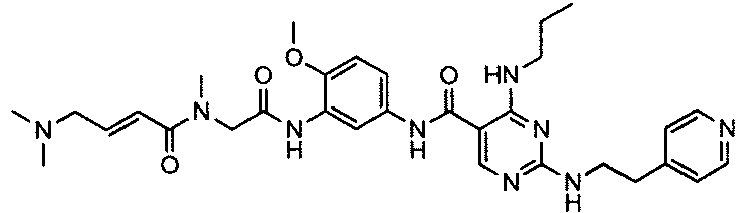
1H-NMR (CDCl3) δ: 8.65 (2H, brs), 8.52 (2H, d, J=4.3Hz), 8.29-8.25 (2H, m), 7.85 (1H, brs), 7.46 (1H, d, J=8.9Hz), 7.16 (2H, d, J=5.9Hz), 7.00-6.93 (1H, m), 6.84 (1H, d, J=8.6Hz), 6.49 (1H, d, J=15.2Hz), 5.32 (1H, brs), 4.21 (2H, s), 3.85 (3H, s), 3.70-3.68 (2H, m), 3.43 (2H, brs), 3.22 (3H, s), 3.17-3.11 (2H, m), 2.92 (2H, t, J=6.9Hz), 2.27 (3H, s), 2.21 (3H, s), 1.66-1.61 (2H, m), 0.97 (3H, t, J=7.3Hz) [Table 18] Compound No. Structure Physicochemical data 1-11 
1H-NMR (CDCl3) δ: 8.86 (1H, brs), 8.51 (2H, dd, J=4.3, 1.7Hz), 8.30 (1H, s), 7.45 (1H, brs), 7.16 (2H, d, J=5.9Hz), 6.94 (1H, brs), 6.84 (1H, dt, J=15.6, 6.1Hz), 6.74 (1H, d, J=9.2Hz), 6.06 (1H, d, J=15.6Hz), 5.50 (1H, brs), 4.04 (2H, t, J=5.0Hz), 3.85-3.64 (4H, m), 3.42 (2H, d, J=5.3Hz), 3.06 (2H, dd, J=5.9, 1.3Hz), 2.92 (3H, t, J=6.9Hz), 2.24 (6H, s), 1.91-1.82 (1H, m), 1.71-1.37 (5H, m), 0.98 (3H, t, J=7.4Hz), 0.89 (3H, t, J=7.4Hz) 1-12 
1H-NMR (CDCl3) δ: 8.87 (1H, brs), 8.51 (2H, dd, J=4.6, 1.3Hz), 8.33 (1H, s), 7.51 (1H, brs), 7.16 (2H, d, J=5.9Hz), 6.93 (1H, dt, J=15.2, 5.9Hz), 6.49-6.40 (2H, m), 5.35 (1H, brs), 4.16 (1H, d, J=14.5Hz), 3.92 (1H, d, J=14.5Hz), 3.84-3.72 (2H, m), 3.68 (2H, q, J=6.8Hz), 3.44 (2H, t, J=10.6Hz), 3.21 (3H, s), 3.10 (2H, d, J=5.9Hz), 2.94-2.79 (3H, m), 2.26 (6H, s), 1.88-1.80 (1H, m), 1.70-1.33 (5H, m), 0.98 (3H, t, J=7.4Hz), 0.88 (3H, t, J=7.4Hz) -

- To a solution of N-Boc-glycine (3.50 g) in N,N-dimethylactamide (20 mL), carbonyldiimidazole (3.34 g) was added at room temperature, and the mixture was stirred at the same temperature for 1 hour (Reaction mixture A).
- To a solution of 1,3-phenylenediamine (3.24 g) in N,N-dimethylactamide (20 mL), Reaction mixture A was added dropwise at room temperature, and the mixture was stirred at the same temperature for 2 hours. To the reaction mixture, saturated aqueous sodium chloride and ethyl acetate were added. The organic layer was separated, washed successively with saturated aqueous sodium hydrogencarbonate and saturated aqueous sodium chloride, and then dried over anhydrous magnesium sulfate, and the solvent was evaporated under reduced pressure. The obtained residue was purified by basic silica gel column chromatography to obtain oily tert-butyl (2-((3-aminophenyl)amino)-2-oxoethyl)carbamate (B1, 3.20 g).
1H-NMR (CDCl3) δ: 7.98 (1H, s), 7.12 (1H, s), 7.08 (1H, t, J=7.9Hz), 6.68 (1H, d, J=7.9Hz), 6.44 (1H, d, J=7.9Hz), 5.22 (1H, s), 3.90 (2H, d, J=5.9Hz), 3.69 (2H, brs), 1.48 (9H, s) -

- To a suspension of 4-(propylamino)-2-((2-(pyridin-4-yl)ethyl)amino)pyrimidine-5-carboxylic acid (A3, 301 mg) in N,N-dimethylformamide (3 mL), 1-ethyl-3-(3-dimethylaminopropyl)carbodiimide hydrochloride (211 mg) and 1-hydroxybenzotriazole monohydrate (162 mg) were added at room temperature, and the mixture was stirred at the same temperature for 2 hours. To the reaction mixture, a solution of N,N-diisopropylethylamine (511 µL) and tert-butyl (2-((3-aminophenyl)amino)-2-oxoethyl)carbamate (B1, 292 mg) in N,N-dimethylformamide (2 mL) was added at room temperature, and the mixture was stirred at the same temperature for 5 hours. To the reaction mixture, saturated aqueous sodium chloride and ethyl acetate were added. The organic layer was separated, washed with saturated aqueous sodium chloride, and then dried over anhydrous magnesium sulfate, and the solvent was evaporated under reduced pressure. The obtained residue was purified by silica gel column chromatography (eluent, 100 to 93% ethyl acetate in methanol) to obtain oily tert-butyl (2-oxo-2-((3-(4-(propylamino)-2-((2-(pyridin-4-yl)ethyl)amino)pyrimidine-5-carboxamido)phenyl)amino)ethyl)carbamate (B2, 437 mg).
MS m/z (M-H): 547.2 -

- In the same manner as that of Example 1, (6) and Example 1, (7), N-(3-(2-(acrylylamido)acetamido)phenyl)-4-(propylamino)-2-((2-(pyridin-4-yl)ethyl)amino)pyrimidine-5-carboxamide (2-1) was obtained from tert-butyl (2-oxo-2-((3-(4-(propylamino)-2-((2-(pyridin-4-yl)ethyl)amino)pyrimidine-5-carboxamido)phenyl)amino)ethyl)carbamate (B2).
1H-NMR (CD3OD) δ: 8.43 (2H, dd, J=4.5, 1.5Hz), 8.38 (1H, s), 7.93 (1H, s), 7.38-7.21 (5H, m), 6.33 (1H, dd, J=17.1, 9.8Hz), 6.28 (1H, dd, J=17.1, 2.1Hz), 5.71 (1H, dd, J=9.6, 2.4Hz), 4.08 (2H, s), 3.78-3.62 (2H, m), 3.57-3.41 (2H, br), 3.01 (2H, t, J=7.2Hz), 1.76-1.53 (2H, m), 0.99 (3H, t, J=7.5Hz) -

- To 4-(propylamino)-2-((2-(pyridin-4-yl)ethyl)amino)pyrimidine-5-carboxylic acid (A3, 452 mg), 1-ethyl-3-(3-dimethylaminopropyl)carbodiimide hydrochloride (575 mg) and 1-hydroxybenzotriazole monohydrate (405 mg), N,N-dimethylformamide (10 mL) was added at room temperature, and the mixture was stirred at 40°C for 2 hours. The reaction mixture was cooled to room temperature, then N,N-diisopropylethylamine (765 µL) and N-Boc-1,3-propanediamine (330 mg) were added to the mixture, and the mixture was stirred at the same temperature for 2 hours. To the reaction mixture, saturated aqueous sodium hydrogencarbonate and ethyl acetate were added. The organic layer was separated, washed successively with water and saturated aqueous sodium chloride, and then dried over anhydrous magnesium sulfate, and the solvent was evaporated under reduced pressure. The obtained residue was purified by basic silica gel column chromatography (eluent, 100 to 95% ethyl acetate in methanol) to obtain tert-butyl (3-(4-(propylamino)-2-((2-(pyridin-4-yl)ethyl)amino)pyrimidine-5-carboxamido)propyl)carbamate (B3, 481 mg) as white solid.
MS m/z (M+H): 458.4 -

- To a solution of tert-butyl (3-(4-(propylamino)-2-((2-(pyridin-4-yl)ethyl)amino)pyrimidine-5-carboxamido)propyl)carbamate (B3, 281 mg) in chloroform (2 mL), trifluoroacetic acid (2 mL) was added at room temperature, and the mixture was stirred at the same temperature for 30 minutes. To the reaction mixture, saturated aqueous sodium hydrogencarbonate and ethyl acetate were added. The organic layer was separated, and the aqueous layer was extracted three times with chloroform. The organic layer and the extracts were combined, washed with saturated aqueous sodium chloride, and then dried over anhydrous sodium sulfate, and the solvent was evaporated under reduced pressure. The obtained residue was purified by basic silica gel column chromatography (eluent, 85 to 70% ethyl acetate in methanol) to obtain N-(3-aminopropyl)-4-(propylamino)-2-((2-(pyridin-4-yl)ethyl)amino)pyrimidine-5-carboxamide (B4,142 mg) as white solid.
1H-NMR (CDCl3) δ: 8.89 (1H, brs), 8.51 (2H, dd, J=6.0,1.5Hz), 8.09 (1H, s), 8.09 (1H, brs), 7.15 (2H, d, J=6.0Hz), 5.37 (1H, brs), 3.67 (2H, q, J=6.6Hz), 3.52-3.41 (4H, m), 2.91 (4H, t, J=6.6Hz), 1.74-1.59 (6H, m), 0.98 (3H, t, J=7.5Hz) -

- To N-(3-aminopropyl)-4-(propylamino)-2-((2-(pyridin-4-yl)ethyl)amino)pyrimidine-5-carboxamide (B4, 57 mg), N-Boc-glycine (44 mg), 1-ethyl-3-(3-dimethylaminopropyl)carbodiimide hydrochloride (127 mg) and 1-hydroxybenzotriazole monohydrate (102 mg), N,N-dimethylformamide (2 mL) and triethylamine (46 µL) were added at room temperature, and the mixture was stirred at the same temperature for 7 hours. To the reaction mixture, saturated aqueous sodium hydrogencarbonate and ethyl acetate were added. The organic layer was separated, and the aqueous layer was extracted with ethyl acetate. The organic layer and the extract were combined, washed successively with water and saturated aqueous sodium chloride, and then dried over anhydrous sodium sulfate, and the solvent was evaporated under reduced pressure. The obtained residue was purified by basic silica gel column chromatography (eluent, 95 to 90% ethyl acetate in methanol) to obtain amorphous tert-butyl (2-oxo-2-((3-(4-(propylamino)-2-((2-(pyridin-4-yl)ethyl)amino)pyrimidine-5-carboxamido)propyl)amino)ethyl)carbamate (B5, 83 mg).
MS m/z (M+H): 515.4 -

- In the same manner as that of Example 1, (6) and Example 1, (7), N-(3-(2-(acrylylamido)actamido)propyl)-4-(propylamino)-2-((2-(pyridin-4-yl)ethyl)amino)pyrimidine-5-carboxamide (2-2) was obtained from tert-butyl (2-oxo-2-((3-(4-(propylamino)-2-((2-(pyridin-4-yl)ethyl)amino)pyrimidine-5-carboxamido)propyl)amino)ethyl)carbamate (B5).
1H-NMR (CDCl3) δ: 8.78 (1H, brs), 8.49 (2H, dd, J=4.3, 1.7Hz), 8.20 (1H, s), 7.30 (1H, brs), 7.20-7.10 (4H, m), 6.30 (1H, dd, J=17.0, 2.0Hz), 6.20 (1H, dd, J=17.0, 10.0Hz), 5.68 (1H, dd, J=10.0, 2.0Hz), 5.61 (1H, brs), 4.01 (2H, d, J=5.9Hz), 3.68 (2H, q, J=6.8Hz), 3.46-3.29 (6H, m), 2.91 (2H, t, J=6.9Hz), 1.75-1.59 (4H, m), 0.98 (3H, t, J=7.6Hz) -


- To a solution of N-Boc-β-alanine (1.00 g) in N,N-dimethylactamide (5 mL), carbonyldiimidazole (888 mg) was added at room temperature, and the mixture was stirred at the same temperature for 1 hour and 20 minutes. To the reaction mixture, a solution of 1,3-phenylenediamine (1.15 g) in N,N-dimethylactamide (5 mL) was added at room temperature, and the mixture was stirred at the same temperature for 18 hours. To the reaction mixture, saturated aqueous sodium hydrogencarbonate and ethyl acetate were added. The organic layer was separated, washed with saturated aqueous sodium chloride, and then dried over anhydrous magnesium sulfate, and the solvent was evaporated under reduced pressure. The obtained residue was purified by silica gel column chromatography to obtain tert-butyl (3-((3-aminophenyl)amino)-3-oxopropyl)carbamate (B6, 978 mg). 1H-NMR (CDCl3) δ: 7.65 (1H, s), 7.14 (1H, s), 7.07 (2H, t, J=7.9Hz), 6.71 (1H, d, J=7.9Hz), 6.43 (1H, d, J=7.9Hz), 5.19 (1H, s), 3.70 (1H, brs), 3.48-3.46 (2H, m), 2.56 (2H, t, J=5.9Hz), 1.43 (9H, s)
-

- By using N-Boc-D-alanine, amorphous (R)-tert-butyl (1-((3-aminophenyl)amino)-1-oxopropan-2-yl)carbamate (B7) was obtained in the same manner as that of Example 5, (1).
1H-NMR (CDCl3) δ: 8.19 (1H, s), 7.14 (1H, s), 7.07 (1H, t, J=7.9Hz), 6.69 (1H, d, J=7.9Hz), 6.43 (1H, d, J=7.9Hz), 4.95 (1H, brs), 4.32-4.20 (1H, m), 3.69 (2H, brs), 1.46 (9H, s), 1.42 (3H, d, J=6.6Hz) -


- To a solution of 2-(tert-butoxycarbonylamino)isobutyric acid (203 mg), 1-ethyl-3-(3-dimethylaminopropyl)carbodiimide hydrochloride (211 mg) and 1-hydroxybenzotriazole monohydrate (149 mg) in N,N-dimethylformamide (3 mL), N,N-diisopropylethylamine (510 µL) was added at room temperature, and the mixture was stirred at the same temperature for 1 hour and 30 minutes. To the reaction mixture, a solution of 1,3-phenylenediamine (260 mg) in N,N-dimethylformamide (2 mL) was added at room temperature, and the mixture was stirred at 80°C for 1 hour and 30 minutes. The reaction mixture was cooled to room temperature, and then saturated aqueous sodium hydrogencarbonate and ethyl acetate were added to the mixture. The organic layer was separated, washed with saturated aqueous sodium chloride, and then dried over anhydrous magnesium sulfate, and the solvent was evaporated under reduced pressure. The obtained residue was purified by silica gel column chromatography to obtain tert-butyl (1-((3-aminophenyl)amino)-2-methyl-1-oxopropan-2-yl)carbamate (B8, 195 mg) as white solid.
MS m/z (M+H): 294.2 -

- To N-Boc-N-methyl-L-alanine (1.02 g), 1-ethyl-3-(3-dimethylaminopropyl)carbodiimide hydrochloride (1.92 g) and 1-hydroxybenzotriazole monohydrate (1.35 g), N,N-dimethylformamide (15 mL) was added at room temperature, and the mixture was stirred at the same temperature for 1 hour. To the reaction mixture, a solution of N,N-diisopropylethylamine (2.6 mL) and 1,3-phenylenediamine (1.35 g) in N,N-dimethylformamide (4 mL) was added at room temperature, and the mixture was stirred at 40°C for 3 hours. The reaction mixture was cooled to room temperature, and then saturated aqueous sodium hydrogencarbonate and ethyl acetate were added to the mixture. The organic layer was separated, washed successively with water and saturated aqueous sodium chloride, and then dried over anhydrous magnesium sulfate, and the solvent was evaporated under reduced pressure. The obtained residue was purified by silica gel column chromatography (eluent, 60 to 25% hexane in ethyl acetate) to obtain amorphous (S)-tert-butyl (1-((3-aminophenyl)amino)-1-oxopropan-2-yl)(methyl)carbamate (B9, 967 mg).
MS m/z (M+H): 294.2 -

- To a solution of 5-chloro-1,3-phenylenediamine (1.22 g), N-Boc-glycine (500 mg) and (1-cyano-2-ethoxy-2-oxoethylideneaminoxy)dimethylamino-morpholino-carbenium hexafluorophosphate (1.83 g) in N,N-dimethylformamide (5 mL), N-methylmorpholine (628 µL) was added at room temperature, and the mixture was stirred at 130°C for 5 hours. The reaction mixture was cooled to room temperature, and then saturated aqueous sodium hydrogencarbonate and ethyl acetate were added to the mixture. The organic layer was separated, and the aqueous layer was extracted with ethyl acetate. The organic layer and the extract were combined, washed successively with water and saturated aqueous sodium chloride, and then dried over anhydrous sodium sulfate, and the solvent was evaporated under reduced pressure. The obtained residue was purified by basic silica gel column chromatography (eluent, 70 to 40% hexane in ethyl acetate) to obtain tert-butyl (2-((3-amino-5-chlorophenyl)amino)-2-oxoethyl)carbamate (B10, 273 mg) as yellow solid.
MS m/z (M+H): 300.1, 303.1 -

- By using 4,6-dimethyl-1,3-phenylenediamine, oily tert-butyl (2-((5-amino-2,4-dimethylphenyl)amino)-2-oxoethyl)carbamate (B11) was obtained in the same manner as that of Example 5, (5).
1H-NMR (CDCl3) δ: 7.83 (1H, brs), 7.37 (1H, s), 6.84 (1H, s), 5.17 (1H, brs), 3.91 (2H, d, J=6.0Hz), 3.54 (2H, brs), 2.13 (3H, s), 2.10 (3H, s), 1.48 (9H, s) -

- To a solution of N-(3-nitrophenyl)ethylenediamine (1.0 g) synthesized according to the method described in Journal of Organic Chemistry, 1992, vol. 57, pp.6257-6265 and 4-dimethylaminopyridine (674 mg) in acetonitrile (10 mL), triethylamine (3.8 mL) and di-tert-butyl dicarbonate (4.8 g) were added at room temperature, and the mixture was stirred at the same temperature for 13 hours. To the reaction mixture, water and ethyl acetate were added. The organic layer was separated, and the aqueous layer was extracted with ethyl acetate. The organic layer and the extract were combined, washed successively with water and saturated aqueous sodium chloride, and then dried over anhydrous sodium sulfate, and the solvent was evaporated under reduced pressure. The obtained residue was purified by silica gel column chromatography (eluent, 90 to 80% hexane in ethyl acetate) to obtain oily tert-butyl (2-((tert-butoxycarbonyl)amino)ethyl)(3-nitrophenyl)carbamate (B12, 1.0 g).
-

- To a suspension of 10% palladium-carbon (500 mg) in methanol (4 mL), tert-butyl (2-((tert-butoxycarbonyl)amino)ethyl)(3-nitrophenyl)carbamate (B12, 500 mg) was added at room temperature, and the mixture was stirred at room temperature for 1 hour and 30 minutes under a hydrogen atmosphere. To the reaction mixture, methanol was added, the insoluble matter was removed by filtration through Cerite, and then the solvent was evaporated under reduced pressure. The obtained residue was purified by basic silica gel column chromatography (eluent, 75 to 70% hexane in ethyl acetate) to obtain tert-butyl (3-aminophenyl)(2-((tert-butoxycarbonyl)amino)ethyl)carbamate (B13, 140 mg). MS m/z (M+H): 352.3
-

- To a solution of 4-iodocrotonic acid tert-butyl ester (310 mg) synthesized according to the method described in Journal of Medicinal Chemistry, 2005, vol. 48, pp.1107-1131 in tetrahydrofuran (3 mL), morpholine (200 µL) was added under ice cooling, and the mixture was stirred at room temperature for 13 hours. To the reaction mixture, saturated aqueous sodium hydrogencarbonate and ethyl acetate were added. The organic layer was separated, washed successively with water and saturated aqueous sodium chloride, and then dried over anhydrous sodium sulfate, and the solvent was evaporated under reduced pressure to obtain (E)-tert-butyl 4-morpholino-2-butenoate (B14, 180 mg).
1H-NMR (CDCl3) δ: 6.85-6.80 (1H, m), 5.91 (1H, d, J=15.9Hz), 3.86-3.62 (4H, m), 3.10 (2H, d, J=3.0Hz), 2.60-2.35 (4H, m), 1.51 (9H, s) -

- To (E)-tert-butyl 4-morpholino-2-butenoate (B 14, 179 mg), 1.0 mol/L aqueous hydrochloric acid (4 mL) was added at room temperature, and the mixture was stirred for 1 hour and 40 minutes under reflux by heating. The reaction mixture was cooled to room temperature, and then toluene was added to the mixture, and the solvent was evaporated under reduced pressure. To the obtained residue, ethyl acetate was added. The solid matter was taken by filtration, washed with chloroform, and then dried under reduced pressure to obtain (E)-4-morpholino-2-butenoic acid (B15) hydrochloride (134 mg).
1H-NMR (DMSO-d6) δ: 6.89-6.84 (1H, m), 6.18 (1H, d, J=15.9Hz), 3.94-3.92 (4H, m), 3.16-2.92 (2H, m), 2.58-2.44 (4H, m) -

- By using N-methylpiperazine, (E)-4-(4-methylpiperazin-1-yl)-2-butenoic acid (B16) hydrochloride was obtained in the same manner as that of Example 5, (9) and Example 5, (10).
1H-NMR (DMSO-d6) δ: 6.91-6.73 (1H, m), 6.20 (1H, d, J=15.2Hz), 4.00-3.00 (10H, m), 2.82 (3H, s) -

- By using 2,6-dimethylpiperazine, (E)-4-(3,5-dimethylpiperazin-1-yl)-2-butenoic acid (B17) hydrochloride was obtained in the same manner as that of Example 5, (9) and Example 5, (10).
-

- By using 1-(2-(tert-butyldimethylsilyloxy)ethyl)piperazine, (E)-4-(4-(2-hydroxyethyl)piperazin-1-yl)-2-butenoic acid (B18) hydrochloride was obtained in the same manner as that of Example 5, (9) and Example 5, (10).
1H-NMR (DMSO-d6) δ: 6.87-6.82 (1H, m), 6.24 (1H, d, J=15.2Hz), 4.51-3.17 (14H, m) - By using 4-(propylamino)-2-((2-(pyridin-4-yl)ethyl)amino)pyrimidine-5-carboxylic acid (A3), Intermediates (B19) to (B25) were obtained in the same manner as that of Example 4, (2).
[Table 19] Compound No. Structure Physicochemical data B19 
MS m/z (M+H): 563.5 B20 
MS m/z (M+H): 577.5 B21 
- B22 
- B23 
- B24 
MS m/z (M+H): 635.5 B25 
MS m/z (M+H): 577.3 - In the same manner as that of Example 1, (6), Intermediates (B28) to (B34) were obtained.
[Table 20] Compound No. Structure Physicochemical data B28 
- B29 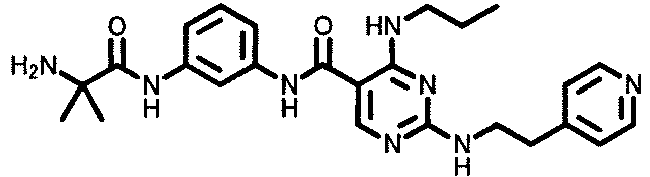
MS m/z (M+H): 477.3 B30 
- B31 
- B32 
- B33 
MS m/z (M+H): 435.4 B34 
MS m/z (M+H): 477.2 -

- By using 4-(propylamino)-2-((2-(pyridin-4-yl)ethyl)amino)pyrimidine-5-carboxylic acid (A3), tert-butyl (2(4-(propylamino)-2-((2-(pyridin-4-yl)ethyl)amino)pyrimidine-5-carboxamido)ethyl)carbamate (B35) was obtained in the same manner as that of Example 4, (4).
MS m/z (M+H): 444.3 -

- By using tert-butyl (2-(4-(propylamino)-2-((2-(pyridin-4-yl)ethyl)amino)pyrimidine-5-carboxamido)ethyl)carbamate (B35), N-(2-aminoethyl)-4-(propylamino)-2-((2-(pyridin-4-yl)ethyl)amino)pyrimidine-5-carboxamide (B40) was obtained in the same manner as that of Example 4, (5).
MS m/z (M+H): 344.3 -

- By using N-(2-aminoethyl)-4-(propylamino)-2-((2-(pyridin-4-yl)ethyl)amino)pyrimidine-5-carboxamide (B40), tert-butyl (2-oxo-2-((2-(4-(propylamino)-2-((2-(pyridin-4-yl)ethyl)amino)pyrimidine-5-carboxamido)ethyl)amino)ethyl)carbamate (B36) and tert-butyl (3-oxo-3-((2-(4-(propylamino)-2-((2-(pyridin-4-yl)ethyl)amino)pyrimidine-5-carboxamido)ethyl)amino)propyl)carbamate (B37) were obtained in the same manner as that of Example 4, (6).
-


- By using 4-(propylamino)-2-((2-(pyridin-4-yl)ethyl)amino)pyrimidine-5-carboxylic acid (A3), tert-butyl (2-(3-(4-(propylamino)-2-((2-(pyridin-4-yl)ethyl)amino)pyrimidine-5-carboxamido)phenoxy)ethyl)carbamate (B38) was obtained in the same manner as that of Example 4, (4).
- In the same manner as that of Example 1, (6), Intermediates (B41) to (B44) were obtained.
[Table 21] Compound No. Structure Physicochemical data B41 
- B42 
MS m/z (M+H): 415.3 B43 
MS m/z (M+H): 436.3 B44 
- - In the same manner as that of Example 1, (7) or Example 1, (8), Compounds (2-3) to (2-29) were obtained.
[Table 22] Compound No. Structure Physicochemical data 2-3 
1H-NMR (CDCl3) δ: 8.73 (1H, brs), 8.49 (2H, d, J=3.0Hz), 8.29 (1H, s), 7.78 (1H, s), 7.42-7.34 (1H, m), 7.28-7.24 (1H, m), 7.20 (2H, d, J=5.9Hz), 6.34 (1H, d, J=16.2Hz), 6.18 (1H, dd, J=16.8, 10.2Hz), 5.72 (1H, d, J=10.2Hz), 4.64 (1H, d, J=7.3Hz), 3.69 (2H, t, J=6.9Hz), 3.48-3.38 (2H, m), 2.96 (2H, t, J=7.3Hz), 1.72-1.60 (2H, m), 1.46 (3H, d, J=7.3Hz), 0.99 (3H, t, J=7.6Hz) 2-4 
1H-NMR (CDCl3) δ: 9.30 (1H, s), 8.65 (1H, brs), 8.49 (2H, d, J=5.8Hz), 8.34-8.22 (2H, m), 7.73 (1H, s), 7.36 (1H, d, J=7.9Hz), 7.26-7.12 (4H, m), 6.53 (1H, s), 6.30 (1H, d, J=17.2Hz), 6.14 (1H, dd, J=17.2, 10.2Hz), 5.66 (1H, dd, J=10.2, 1.7Hz), 5.55 (1H, brs), 3.70-3.60 (2H, m), 3.42 (2H, brs), 2.89 (2H, t, J=7.3Hz), 1.68-1.58 (8H, m), 0.97 (3H, t, J=7.3Hz) 2-5 
1H-NMR (CDCl3+CD3OD) δ: 8.47 (2H, dd, J=4.3, 1.7Hz), 8.30 (1H, s), 7.62 (1H, t, J=2.0Hz), 7.52 (1H, t, J=1.7Hz), 7.39 (1H, d, J=2.0Hz), 7.22 (2H, d, J=5.9Hz), 6.3 (1H, dd, J=17.0, 2.0Hz), 6.24 (1H, dd, J=17.0, 10.0Hz), 5.74 (1H, dd, J=10.0, 2.0Hz), 4.07 (2H, s), 3.69 (2H, t, J=6.9Hz), 3.45 (2H, brs), 2.96 (2H, t, J=7.3Hz), 1.70-1.61 (2H, m), 1.00 (3H, t, J=7.3Hz) 2-6 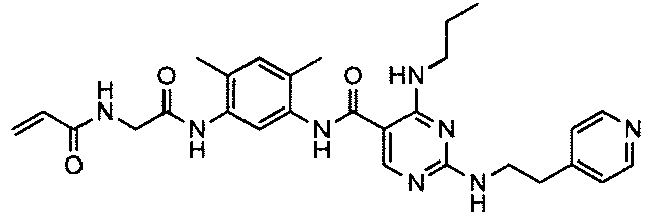
1H-NMR (CDCl3) δ: 8.65 (1H, brs), 8.52 (2H, dd, J=4.3, 1.7Hz), 8.35 (1H, s), 8.32 (1H, brs), 7.93 (1H, brs), 7.83 (1H, brs), 7.15 (2H, d, J=5.9Hz), 7.03 (1H, brs), 7.00 (1H, s), 6.35 (1H, dd, J=17.0, 2.0Hz), 6.18 (1H, dd, J=17.0, 10.0Hz), 5.70 (1H, dd, J=10.0, 2.0Hz), 5.36 (1H, brs), 4.08 (2H, d, J=5.9Hz), 3.69 (2H, q, J=6.8Hz), 3.42 (2H, br), 2.92 (2H, t, J=6.9Hz), 2.16 (3H, s), 2.15 (3H, s), 1.68-1.58 (2H, m), 0.95 (3H, t, J=7.6 Hz) [Table 23] Compound No. Structure Physicochemical data 2-7 
1H-NMR (CD3OD) δ: 8.41-8.39 (3H, m), 7.91 (1H, s), 7.31-7.24 (5H, m), 6.23-6.19 (2H, m), 5.64 (1H, dd, J=7.3, 4.6Hz), 3.68 (2H, t, J=6.9Hz), 3.59 (2H, t, J=6.6Hz), 3.45 (2H, s), 2.99 (2H, t, J=6.9Hz), 2.69-2.60 (2H, m), 1.68-1.63 (2H, m), 0.99 (3H, t, J=7.6Hz) 2-8 
MS m/z [M+H]: 489.3 2-9 
1H-NMR (CD3OD) δ: 8.42-8.39 (3H, m), 7.91-7.90 (1H, m), 7.34-7.22 (5H, m), 6.81 (1H, dt, J=15.9, 6.6Hz), 6.19 (1H, d, J=15.9Hz), 4.10-4.07 (2H, m), 3.68 (2H, t, J=7.3Hz), 3.47-3.43 (2H, m), 3.14 (2H, d, J=6.6Hz), 2.99 (2H, t, J=6.9Hz), 2.28 (6H, s), 1.67-1.62 (2H, m), 0.99 (3H, t, J=7.3Hz) 2-10 
1H-NMR (CD3OD) δ: 8.42-8.39 (3H, m), 7.92-7.89 (1H, m), 7.34-7.08 (5H, m), 6.78-6.73 (1H, m), 6.08 (1H, d, J=15.2Hz), 3.68 (2H, t, J=6.9Hz), 3.59 (2H, t, J=6.6Hz), 3.49-3.46 (2H, m), 3.09 (2H, d, J=6.6Hz), 2.98 (2H, t, J=6.9Hz), 2.62 (2H, t, J=6.9Hz), 2.24 (6H, s), 1.67-1.62 (2H, m), 0.98 (3H, t, J=7.6Hz) 2-11 
1H-NMR (CDCl3) δ: 9.55 (1H, brs), 8.68 (1H, brs), 8.53 (2H, d, J=4.6Hz), 8.25 (1H, brs), 7.80 (1H, brs), 7.70 (1H, brs), 7.31-7.22 (5H, m), 6.90-6.87 (1H, m), 6.00 (1H, d, J=15.2Hz), 5.94 (1H, brs), 5.26 (1H, brs), 3.71-3.69 (2H, m), 3.49-3.44 (2H, m), 3.07 (2H, d, J=5.9Hz), 2.95-2.90 (2H, m), 2.26 (6H, s), 1.67 (6H, s), 1.64-1.63 (2H, m), 0.98 (3H, t, J=7.6Hz) [Table 24] Compound No. Structure Physicochemical data 2-12 
1H-NMR (CDCl3) δ: 8.89 (1H, s), 8.66 (1H, brs), 8.51 (2H, d, J=5.9Hz), 8.22 (1H, brs), 8.08 (1H, brs), 7.79 (1H, s), 7.34 (1H, d, J=7.9Hz), 7.26-7.12 (4H, m), 6.96 (1H, dt, J=15.2, 5.9Hz), 6.43 (1H, d, J=15.2Hz), 5.64 (1H, brs), 5.29 (1H, q, J=7.0Hz), 3.67 (2H, q, J=6.4Hz), 3.43 (2H, brs), 3.09 (2H, d, J=4.6Hz), 3.03 (3H, s), 2.91 (2H, t, J=7.3Hz), 2.26 (6H, s), 1.70-1.58 (2H, m), 1.41 (3H, d, J=7.3Hz), 0.97 (3H, t, J=7.6Hz) 2-13 
1H-NMR (CD3OD) δ: 8.42-8.39 (3H, m), 7.90 (1H, d, J=3.3Hz), 7.34-7.22 (5H, m), 6.80 (1H, dt, J=15.4, 6.4Hz), 6.22 (1H, d, J=15.9Hz), 4.08 (2H, s), 3.70-3.67 (6H, m), 3.43-3.38 (2H, m), 3.17 (2H, d, J=6.6Hz), 2.99 (2H, t, J=6.9Hz), 2.49-2.48 (4H, m), 1.67-1.63 (2H, m), 0.99 (3H, t, J=7.3Hz) 2-14 
1H-NMR (CDCl3) δ: 9.29 (1H, brs), 8.67 (2H, brs), 8.48-8.45 (2H, m), 8.38 (1H, s), 7.66 (1H, s), 7.37-7.18 (5H, m), 6.84-6.82 (1H, m), 6.01 (1H, d, J=15.9Hz), 5.78 (1H, brs), 5.36 (1H, brs), 4.08 (2H, brs), 3.66 (2H, brs), 3.41 (2H, brs), 3.07-3.06 (2H, m), 2.91-2.87 (2H, m), 2.45-2.41 (4H, m), 2.25 (3H, s), 1.99-1.96 (4H, m), 1.63 (2H, brs), 0.96-0.90 (3H, m) 2-15 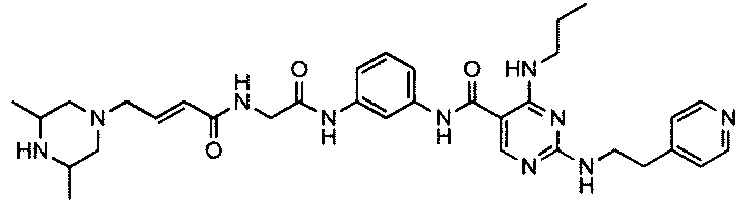
1H-NMR (CD3OD) δ: 8.41-8.40 (3H, m), 7.91-7.90 (1H, m), 7.34-7.22 (5H, m), 6.81 (1H, dt, J=15.6, 6.4Hz), 6.21 (1H, d, J=15.9Hz), 4.08 (2H, s), 3.70-3.61 (2H, m), 3.48-3.41 (2H, m), 3.16 (2H, d, J=6.4Hz), 2.94-2.87 (6H, m), 1.71-1.59 (4H, m), 1.06 (6H, d, J=6.6Hz), 0.99 (3H, t, J=7.3Hz) [Table 25] Compound No. Structure Physicochemical data 2-16 
1H-NMR (CD3OD) δ: 8.42-8.40 (3H, m), 7.91-7.88 (1H, m), 7.32-7.28 (5H, m), 6.83-6.78 (1H, m), 6.21 (1H, d, J=15.2Hz), 4.07-4.06 (2H, m), 3.65-3.60 (4H, m), 3.44 (2H, brs), 3.19-3.17 (2H, m), 3.01-2.97 (2H, m), 2.88-2.54(10H, m), 1.66-1.63 (2H, m), 0.99 (3H, t, J=14.5Hz) 2-17 
1H-NMR (CDCl3) δ: 8.75 (1H, brs), 8.50 (2H, dd, J=4.3, 1.7Hz), 7.99 (1H, brs), 7.15 (3H, d, J=5.9Hz), 6.79 (1H, brs), 6.29 (1H, dd, J=17.0, 2.0Hz), 6.11 (1H, dd, J=17.0, 10.0Hz), 5.81 (1H, brs), 5.64 (1H, dd, J=10.0, 2.0Hz), 3.67 (2H, q, J=6.6Hz), 3.54 (4H, brs), 3.48-3.38 (2H, m), 2.91 (2H, t, J=6.9Hz), 1.70-1.58 (2H, m), 0.98 (3H, t, J=7.3Hz) 2-18 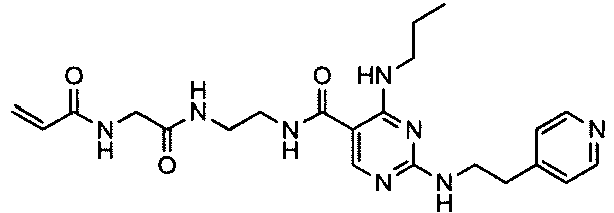
1H-NMR (CDCl3+CD3OD) δ: 8.76 (1H, brs), 8.48 (2H, d, J=5.9Hz), 8.15 (1H, s), 7.51 (1H, brs), 7.31 (1H, brs), 7.22 (1H, brs), 7.13 (2H, d, J=5.9Hz), 6.31-6.11 (2H, m), 5.78 (1H, brs), 5.65 (1H, dd, J=9.9, 2.0Hz), 3.95 (2H, d, J=5.3Hz), 3.66 (2H, q, J=6.9Hz), 3.46-3.39 (4H, m), 2.90 (2H, t, J=6.9Hz), 2.06-2.04 (2H, m), 1.69-1.57 (2H, m), 0.97 (3H, t, J=7.3Hz) 2-19 
1H-NMR (CDCl3+CD3OD) δ: 8.79 (1H, brs), 8.49 (2H, d, J=5.9Hz), 8.16 (1H, s), 7.36 (1H, brs), 7.15 (3H, t, J=5.9Hz), 6.96 (1H, brs), 6.25-6.02 (2H, m), 5.81 (1H, brs), 5.58 (1H, d, J=9.9Hz), 3.68 (2H, d, J=6.9Hz), 3.57 (2H, d, J=5.3Hz), 3.51-3.38 (4H, m), 2.92 (2H, t, J=6.9Hz), 2.46 (2H, d, J=5.3Hz), 2.13 (2H, s), 1.68-1.60 (2H, m), 0.98 (3H, t, J=7.3Hz) 2-20 
1H-NMR (CDCl3) δ: 8.64 (1H, brs), 8.52 (3H, d, J=5.9Hz), 8.20 (1H, brs), 7.76 (1H, brs), 7.29-7.23 (3H, m), 7.16 (1H, d, J=5.9Hz), 6.98 (1H, d, J=7.9Hz), 6.66 (1H, d, J=8.6Hz), 6.29-6.14 (2H, m), 5.67 (1H, d, J=9.9Hz), 5.41 (1H, brs), 4.09 (2H, t, J=5.0Hz), 3.78-3.67 (4H, m), 3.47-3.44 (2H, m), 2.93 (2H, t, J=6.9Hz), 1.71-1.64 (2H, m), 0.99 (3H, t, J=7.6Hz) [Table 26] Compound No. Structure Physicochemical data 2-21 
1H-NMR (CDCl3+CD3OD) δ: 8.79 (1H, brs), 8.51 (2H, d, J=5.9Hz), 8.20 (1H, s), 7.14 (2H, d, J=5.9Hz), 7.13 (1H, brs), 6.37 (1H, brs), 6.34-6.08 (2H, m), 5.67 (1H, d, J=9.9Hz), 5.58 (1H, brs), 3.68 (2H, q, J=6.9Hz), 3.45-3.38 (4H, m), 2.92 (2H, t, J=6.9Hz), 2.04 (2H, t, J=3.0Hz), 1.77-1.59 (4H, m), 0.99 (3H, t, J=7.3Hz) 2-23 
1H-NMR (CDCl3) δ: 8.51 (2H, d, J=5.9Hz), 8.20 (1H, brs), 7.15 (2H, d, J=5.9Hz), 6.63 (1H, dd, J=16.5, 10.6Hz), 6.37 (1H, dd, J=16.8, 1.7Hz), 5.77 (1H, dd, J=10.6, 2.0Hz), 4.06 (2H, s), 3.67 (2H, q, J=6.6Hz), 3.46-3.28 (6H, m), 3.21 (3H, s), 2.92 (2H, t, J=6.9Hz), 1.74-1.60 (4H, m), 0.98 (3H, t, J=7.6Hz) 2-24 
1H-NMR (CDCl3) δ: 8.78 (1H, brs), 8.51 (2H, d, J=5.9Hz), 8.21 (1H, s), 7.15 (2H, d, J=5.9Hz), 7.05 (2H, brs), 6.92-6.81 (1H, m), 6.73 (1H, brs), 6.04 (1H, d, J=15.2Hz), 5.41 (1H, brs), 4.00 (2H, d, J=5.3Hz), 3.72-3.68 (2H, m), 3.50-3.32 (6H, m), 3.06 (2H, d, J=5.9Hz), 2.92 (2H, t, J=7.3Hz), 2.24 (6H, s), 1.90 (2H, brs), 1.73-1.59 (2H, m), 0.98 (3H, t, J=7.3Hz) 2-25 
1H-NMR (CD3OD) δ: 8.93-8.87 (1H, m), 8.42 (2H, dd, J=3.6, 1.2Hz), 8.40 (1H, s), 8.00 (1H, s), 7.91 (1H, s), 7.42-7.13 (7H, m), 6.44 (1H, dd, J=12.6, 7.5Hz), 6.36 (1H, dd, J=12.6, 1.5Hz), 5.77 (1H, dd, J=7.2, 1.5Hz), 3.70 (2H, t, J=5.1Hz), 3.56-3.38 (2H, m), 3.00 (2H, t, J=5.1Hz), 1.74-1.56 (2H, m), 1.00 (3H, t, J=5.7Hz) [Table 27] Compound No. Structure Physicochemical data 2-26 
1H-NMR (DMSO-d6) δ: 10.11 (1H, s), 8.98-8.84 (1H, m), 8.76-8.62 (1H, m), 8.45 (2H, dd, J=4.5, 1.8Hz), 8.42 (1H, s), 7.59 (1H, d, J=8.1Hz), 7.53 (1H, s), 7.34-7.21 (4H, m), 6.98 (1H, d, J=7.8Hz), 6.41 (1H, dd, J=16.8, 9.9Hz), 6.25 (1H, dd, J=17.1, 2.1 Hz), 5.73 (1H, dd, J=9.9, 2.1Hz), 4.37 (2H, d, J=4.8Hz), 3.60-3.41 (2H, m), 3.44-3.26 (2H, m), 2.86 (2H, t, J=7.2Hz), 0.88 (3H, t, J=7.5Hz) 2-27 
MS m/z (M+H): 517.2 2-28 
1H-NMR (CD3OD) δ: 8.47-8.37 (3H, m), 8.23 (1H, s), 8.28-8.10 (1H, m), 7.78 (1H, s), 7.71 (1H, s), 7.35 (2H, d, J=5.9Hz), 6.50-6.34 (2H, m), 5.81 (1H, dd, J=8.4,3.5Hz), 3.70 (2H, t, J=6.9Hz), 3.53-3.41 (2H, m), 3.00 (2H, t, J=7.1Hz), 1.74-1.56 (2H, m), 1.00 (3H, t, J=7.3Hz) 2-29 
1H-NMR (CD3OD) δ: 8.40 (2H, dd, J=4.6, 1.7Hz), 8.21 (1H, s), 7.64 (1H, dd, J=8.3,0.9Hz), 7.39-7.16 (5H, m), 6.33 (1H, dd, J=17.1, 9.6Hz), 6.26 (1H, dd, J=16.8, 2.3Hz), 5.69 (1H, dd, J=9.6, 2.3Hz), 4.64-4.56 (1H, m), 4.38 (2H, s), 4.13 (2H, s), 3.65 (2H, t, J=7.1Hz), 3.48-3.36 (2H, m), 3.34 (3H, s), 2.96 (2H, t, J=7.1Hz), 1.71-1.56 (2H, m), 0.96 (3H, J=7.8Hz) -

- To a solution of 2-(methylthio)-4-(propylamino)pyrimidine-5-carboxylic acid ethyl ester (A1, 7.0 g) in chloroform (100 mL), meta-chloroperbenzoic acid (70 to 75% wt, 13.5 g) was added under ice cooling, and the mixture was stirred at room temperature for 30 minutes. The reaction mixture was cooled on ice, and then saturated aqueous sodium hydrogencarbonate and chloroform were added to the mixture. The organic layer was separated, and the aqueous layer was extracted with chloroform. The organic layer and the extract were combined, washed with saturated aqueous sodium chloride, and then dried over anhydrous sodium sulfate, and the solvent was evaporated under reduced pressure. To a solution of the obtained residue in N-methylpyrrolidone (100 mL), 4-aminobenzamide (5.3 g) and (1S)-(+)-10-camphorsulfonic acid (19.1 g) were added at room temperature, and the mixture was stirred at 110°C for 3 hours. The reaction mixture was cooled to room temperature, and then poured into ice water. The solid matter was taken by filtration, washed with water, and then dried under reduced pressure to obtain ethyl 2-((4-carbamoylphenyl)amino)-4-(propylamino)pyrimidine-5-carboxylate (C1, 8.1 g) as white solid.
MS m/z (M+H): 344.2 -

- To a solution of ethyl 2-((4-carbamoylphenyl)amino)-4-(propylamino)pyrimidine-5-carboxylate (C1, 8.0 g) in tetrahydrofuran (240 mL) and methanol (240 mL), water (40 mL) and 5.0 mol/L aqueous sodium hydroxide (48 mL) were added at room temperature, and the mixture was stirred at 60°C for 3 hours. The reaction mixture was cooled on ice, then 12 mol/L aqueous hydrochloric acid was added to the mixture until pH of the mixture became 2, and the reaction mixture was poured into ice water (2000 mL). The solid matter was taken by filtration, washed with water, and then dried under reduced pressure to obtain 2-((4-carbamoylphenyl)amino)-4-(propylamino)pyrimidine-5-carboxylic acid (C2, 4.0 g) as white solid.
-


- To a solution of 2-(methylthio)-4-(propylamino)pyrimidine-5-carboxylic acid ethyl ester (A1, 11.7 g) in N-methylpyrrolidone (90 mL), meta-chloroperbenzoic acid (70 to 75% wt, 20.8 g) was added under ice cooling, and the mixture was stirred at room temperature for 40 minutes. To the reaction mixture, N,N-diisopropylethylamine (23.9 mL) and 10% aqueous ammonia (60.0 mL) were added at room temperature, and the mixture was stirred at the same temperature for 1 hour. The reaction mixture was poured into water (400 mL). The solid matter was taken by filtration, washed with water, and then dried under reduced pressure to obtain ethyl 2-amino-4-(propylamino)pyrimidine-5-carboxylate (C3, 8.0 g).
MS m/z (M+H): 225.1 -

- To a solution of tris(dibenzylideneacetone)dipalladium(0) (1.14 g) and 4,5'-bis(diphenylphosphino)-9,9'-dimethylxanthene (1.45 g) in 1,4-dioxane (150 mL), ethyl 2-amino-4-(propylamino)pyrimidine-5-carboxylate (C3, 5.61 g), 4-bromobenzonitrile (6.83 g) and cesium carbonate (24.40 g) were added at room temperature, and the mixture was stirred at 100°C for 11 hours and 30 minutes under a nitrogen atmosphere. The reaction mixture was cooled to room temperature, then the insoluble matter was removed by filtration through Cerite, and then 1.0 mol/L aqueous hydrochloric acid and ethyl acetate were added. The organic layer was separated, washed successively with 1.0 mol/L aqueous hydrochloric acid, saturated aqueous sodium hydrogencarbonate and saturated aqueous sodium chloride, and then dried over anhydrous magnesium sulfate, and the solvent was evaporated under reduced pressure. To the obtained residue, ethyl acetate was added, and the solid matter was taken by filtration to obtain ethyl 2-((4-cyanophenyl)amino)-4-(propylamino)pyrimidine-5-carboxylate (C4, 2.68 g).
MS m/z (M+H): 326.1 -

- To a solution of ethyl 2-((4-cyanophenyl)amino)-4-(propylamino)pyrimidine-5-carboxylate (C4, 0.90 g) in ethanol (10 mL) and tetrahydrofuran (5 mL), 2.0 mol/L aqueous sodium hydroxide (2.8 mL) was added at room temperature, and the mixture was stirred at 50°C for 5 hours. The reaction mixture was cooled to room temperature, and then 1.0 mol/L aqueous hydrochloric acid was added to the reaction mixture until the mixture became acidic. The solid matter was taken by filtration, washed with water, and then dried under reduced pressure to obtain 2-((4-cyanophenyl)amino)-4-(propylamino)pyrimidine-5-carboxylic acid (C5, 738 mg).
MS m/z (M+H): 298.2 -

- To a solution of ethyl 2-((4-cyanophenyl)amino)-4-(propylamino)pyrimidine-5-carboxylate (C4, 800 mg) in tetrahydrofuran (25 mL) and methanol (25 mL), water (2 mL) and 4.0 mol/L aqueous sodium hydroxide (8 mL) were added at room temperature, and the mixture was stirred at 55°C for 1 hour and 20 minutes. The reaction mixture was cooled to room temperature, and then 35% aqueous hydrogen peroxide (8 mL) was added to the mixture, and the mixture was stirred at the same temperature for 45 minutes. To the reaction mixture, 3.0 mol/L aqueous hydrochloric acid was added until the reaction mixture was neutralized. The solid matter was taken by filtration, and dried under reduced pressure to obtain 2-((4-carbamoylphenyl)amino)-4-(propylamino)pyrimidine-5-carboxylic acid (C2, 500 mg) as white solid.
MS m/z (M+H): 316.2 -

- To 2-((4-carbamoylphenyl)amino)-4-(propylamino)pyrimidine-5-carboxylic acid (C2, 400 mg), 1-ethyl-3-(3-dimethylaminopropyl)carbodiimide hydrochloride (970 mg) and 1-hydroxybenzotriazole monohydrate (780 mg), N,N-dimethylformamide (5 mL) and N,N-diisopropylethylamine (430 µL) were added at room temperature, and the mixture was stirred at the same temperature for 1 hour. To the reaction mixture, 1,3-phenylenediamine (418 mg) was added at room temperature, and the mixture was stirred at the same temperature for 16 hours. To the reaction mixture, saturated aqueous sodium hydrogencarbonate and ethyl acetate were added. The organic layer was separated, washed successively with water and saturated aqueous sodium chloride, and then dried over anhydrous sodium sulfate, and the solvent was evaporated under reduced pressure. The obtained residue was purified by basic silica gel column chromatography (eluent, 95% ethyl acetate/5% methanol) to obtain N-(3-aminophenyl)-2-((4-carbamoylphenyl)amino)-4-(propylamino)pyrimidine-5-carboxamide (C6, 272 mg) as pale yellow solid.
MS m/z (M+H): 406.2 -

- To N-(3-aminophenyl)-2-((4-carbamoylphenyl)amino)-4-(propylamino)pyrimidine-5-carboxamide (C6, 272 mg), N-Boc-N-methyl-L-alanine (164 mg), 1-ethyl-3-(3-dimethylaminopropyl)carbodiimide hydrochloride (515 mg) and 1-hydroxybenzotriazole monohydrate (411 mg), N,N-dimethylformamide (5 mL) and N,N-diisopropylethylamine (228 µL) were added at room temperature, and the mixture was stirred at the same temperature for 7 hours. To the reaction mixture, water and ethyl acetate were added. The organic layer was separated, and the aqueous layer was extracted with ethyl acetate. The organic layer and the extract were combined, washed successively with water and saturated aqueous sodium chloride, and then dried over anhydrous sodium sulfate, and the solvent was evaporated under reduced pressure. The obtained residue was purified by basic silica gel column chromatography (eluent, 98 to 95% ethyl acetate in methanol) to obtain (S)-tert-butyl (1-((3-(2-((4-carbamoylphenyl)amino)-4-(propylamino)pyrimidine-5-carboxamido)phenyl)amino)-1-oxopropan-2-yl)(methyl)carbamate (C7, 339 mg) as white solid.
MS m/z (M+H): 591.3 -

- To 2-((4-cyanophenyl)amino)-4-(propylamino)pyrimidine-5-carboxylic acid (C5, 297 mg), 1-ethyl-3-(3-dimethylaminopropyl)carbodiimide hydrochloride (383 mg) and 1-hydroxybenzotriazole monohydrate (270 mg), N,N-dimethylformamide (7.5 mL) was added at room temperature, and the mixture was stirred at 50°C for 1 hour and 20 minutes. The reaction mixture was cooled to room temperature, and then N,N-diisopropylethylamine (697 µL) and (S)-tert-butyl (1-((3-aminophenyl)amino)-1-oxopropan-2-yl)(methyl)carbamate (B9, 323 mg) were added to the mixture at room temperature, and the mixture was stirred at the same temperature for 30 minutes, and then further stirred at 50°C for 1 hour and 30 minutes. The reaction mixture was cooled to room temperature, and then saturated aqueous sodium hydrogencarbonate and ethyl acetate were added to the mixture. The organic layer was separated, washed successively with water and saturated aqueous sodium chloride, and then dried over anhydrous sodium sulfate, and the solvent was evaporated under reduced pressure. The obtained residue was purified by silica gel column chromatography (eluent, 40 to 10% hexane in ethyl acetate) to obtain (S)-tert-butyl (1-((3-(2-((4-cyanophenyl)amino)-4-(propylamino)pyrimidine-5-carboxamido)phenyl)amino)-1-oxopropan-2-yl)(methyl)carbamate (C8, 325 mg).
MS m/z (M+H): 573.3 -


- To a solution of (S)-tert-butyl (1-((3-(2-((4-cyanophenyl)amino)-4-(propylamino)pyrimidine-5-carboxamido)phenyl)amino)-1-oxopropan-2-yl)(methyl)carbamate (C8, 173 mg) in ethanol (4 mL) and dimethyl sulfoxide (2 mL), 2.0 mol/L aqueous sodium hydroxide (0.45 mL) and 35% aqueous hydrogen peroxide (87 µL) were added at room temperature, and the mixture was stirred at the same temperature for 1 hour. To the reaction mixture, water (15 mL) was added. The solid matter was taken by filtration, washed successively with water and ethyl acetate, and then dried under reduced pressure to obtain (S)-tert-butyl (1-((3-(2-((4-carbamoylphenyl)amino)-4-(propylamino)pyrimidine-5-carboxamido)phenyl)amino)-1-oxopropan-2-yl)(methyl)carbamate (C7, 102 mg) as white solid.
MS m/z (M+H): 591.3 -

- By using 2-((4-carbamoylphenyl)amino)-4-(propylamino)pyrimidine-5-carboxylic acid (C2) and (S)-tert-butyl (1-((3-aminophenyl)amino)-1-oxopropan-2-yl)(methyl)carbamate (B9), (S)-tert-butyl (1-((3-(2-((4-carbamoylphenyl)amino)-4-(propylamino)pyrimidine-5-carboxamido)phenyl)amino)-1-oxopropan-2-yl)(methyl)carbamate (C7) was obtained as white solid in the same manner as that of Example 7, (9).
MS m/z (M+H): 591.3 -


- By using (S)-tert-butyl (1-((3-(2-((4-carbamoylphenyl)amino)-4-(propylamino)pyrimidine-5-carboxamido)phenyl)amino)-1-oxopropan-2-yl)(methyl)carbamate (C7), (S,E)-2-((4-carbamoylphenyl)amino)-N-(3-(2-(4-(dimethylamino)-N-methyl-2-butenamido)propanamido)phenyl)-4-(propylamino)pyrimidine-5-carboxamide (3-1) was obtained as white solid in the same manner as that of Example 1, (6) and Example 1, (8).
1H-NMR (DMSO-d6) δ: 10.02 (1H, s), 9.95 (1H, s), 9.88 (1H, s), 8.83 (1H, brs), 8.72 (1H, s), 8.08 (1H, s), 7.90 (2H, d, J=8.6Hz), 7.86-7.78 (3H, m), 7.36-7.14 (4H, m), 6.70-6.52 (2H, m), 5.14-5.06 (1H, m), 3.52-3.42 (2H, m), 3.08-3.02 (5H, m), 2.15 (6H, s), 1.72-1.58 (2H, m), 1.36 (3H, d, J=6.6Hz), 0.97 (3H, t, J=7.3Hz) -

- To a solution of N-Boc-N-methyl-L-alanine (200 mg), 2-aminobenzylamine (240 mg), 1-ethyl-3-(3-dimethylaminopropyl)carbodiimide hydrochloride (755 mg) and 1-hydroxybenzotriazole monohydrate (603 mg) in N,N-dimethylformamide (4 mL), N,N-diisopropylethylamine (355 µL) was added at room temperature, and the mixture was stirred at the same temperature for 9 hours. To the reaction mixture, water and ethyl acetate were added. The organic layer was separated, and the aqueous layer was extracted with ethyl acetate. The organic layer and the extract were combined, washed successively with water and saturated aqueous sodium chloride, and then dried over anhydrous sodium sulfate, and the solvent was evaporated under reduced pressure. The obtained residue was purified by silica gel column chromatography (eluent, 75 to 50% hexane in ethyl acetate) to obtain oily (S)-tert-butyl (1-((2-aminobenzyl)amino)-1-oxopropan-2-yl)(methyl)carbamate (C9, 47 mg).
MS m/z (M+H): 308.2 -

- By using 1,2-phenylenediamine, (S)-tert-butyl (1-((2-aminophenyl)amino)-1-oxopropan-2-yl)(methyl)carbamate (C10) was obtained in the same manner as that of Example 8, (1).
MS m/z (M+H): 294.2 -

- To a solution of N-Boc-ethanolamine (477 mg) in tetrahydrofuran (10 mL), sodium hydride (118 mg, 60 wt%) was added under ice cooling, and the mixture was stirred at the same temperature for 1 hour under a nitrogen atmosphere. To the reaction mixture, 2-nitrobenzyl bromide (500 mg) was added under ice cooling, and the mixture was stirred at the same temperature for 1 hour, and then further stirred at room temperature for 4 hours. To the reaction mixture, saturated aqueous sodium hydrogencarbonate and ethyl acetate were added. The organic layer was separated, washed successively with water and saturated aqueous sodium chloride, and then dried over anhydrous sodium sulfate, and the solvent was evaporated under reduced pressure. The obtained residue was purified by silica gel column chromatography (eluent, 80 to 70% hexane in ethyl acetate) to obtain oily tert-butyl (2-((2-nitrobenzyl)oxy)ethyl)carbamate (C11, 154 mg).
-


- To a solution of tert-butyl (2-((2-nitrobenzyl)oxy)ethyl)carbamate (C11, 154 mg) in ethanol (5 mL) and water (1 mL), iron powder (174 mg) and ammonium chloride (167 mg) were added at room temperature, and the mixture was stirred at 80°C for 2 hours. The reaction mixture was cooled to room temperature, and then ethyl acetate was added to the reaction mixture. The insoluble matter was removed by filtration through Cerite, and then the solvent was evaporated under reduced pressure. The obtained residue was purified by basic silica gel column chromatography (eluent, 75% hexane/25% ethyl acetate) to obtain oily tert-butyl (2-((2-aminobenzyl)oxy)ethyl)carbamate (C12, 60 mg).
MS m/z (M+H): 267.2 -

- To a solution of methyl trifluoropyruvate (500 mg) and 3-nitroaniline (442 mg) in methylene chloride (32 mL), titanium tetrachloride (350 µL) was added at room temperature, and the mixture was stirred at the same temperature for 20 minutes. To the reaction mixture, sodium triacetoxyborohydride (1.35 g) was added at room temperature, and the mixture was stirred at the same temperature for 2 hours. To the reaction mixture, water and methylene chloride were added. The organic layer was separated, washed with saturated aqueous sodium chloride, and then dried over anhydrous sodium sulfate, and the solvent was evaporated under reduced pressure. The obtained residue was purified by silica gel column chromatography (eluent, 100 to 20% hexane in ethyl acetate) to obtain methyl 3,3,3-trifluoro-2-((3-nitrophenyl)amino)propanoate (C13, 391 mg).
1H-NMR (CDCl3) δ: 8.13 (1H, dt), 7.81 (1H, t), 7.59 (1H, t), 7.28-7.23 (1H, m), 3.78 (3H, s) -

- To a solution of methyl 3,3,3-trifluoro-2-((3-nitrophenyl)amino)propanoate (C13, 297 mg) in ethanol (10 mL), sodium borohydride (121 mg) was added at room temperature, and the mixture was stirred at the same temperature for 4 hours. To the reaction mixture, water and ethyl acetate were added. The organic layer was separated, washed with saturated aqueous sodium chloride, and then dried over anhydrous sodium sulfate, and the solvent was evaporated under reduced pressure. The obtained residue was purified by silica gel column chromatography (eluent, 100 to 50% hexane in ethyl acetate) to obtain 3,3,3-trifluoro-2-((3-nitrophenyl)amino)propan-1-ol (C14, 197 mg).
1H-NMR (CDCl3) δ: 7.65 (1H, dd), 7.55 (1H, t), 7.35 (1H, t), 7.01 (1H, dd), 4.16-3.90 (3H, m) -

- To a solution of 3,3,3-trifluoro-2-((3-nitrophenyl)amino)propan-1-ol (C14, 171 mg), phthalimide (201 mg) and triphenylphosphine (305 mg) in tetrahydrofuran (7 mL), a 40% solution of diethyl azodicarboxylate in toluene (526 µL) was added under ice cooling, and the mixture was stirred at the same temperature for 40 minutes. To the reaction mixture, water and ethyl acetate were added. The organic layer was separated, washed with saturated aqueous sodium chloride, and then dried over anhydrous sodium sulfate, and the solvent was evaporated under reduced pressure. The obtained residue was purified by silica gel column chromatography (eluent, 100 to 70% hexane in ethyl acetate) to obtain 2-(3,3,3-trifluoro-2-((3-nitrophenyl)amino)propyl)isoindoline-1,3-dione (C15, 209 mg).
1H-NMR (CDCl3) δ: 7.90-7.69 (4H, m), 7.50 (1H, dd), 7.43 (1H, t), 7.22 (1H, t), 6.90 (1H, dd), 4.50-4.35 (1H, m), 4.19-4.00 (2H, m) -


- To a solution of 2-(3,3,3-trifluoro-2-((3-nitrophenyl)amino)propyl)isoindoline-1,3-dione (C 15, 209 mg) in ethanol (3 mL) and tetrahydrofuran (3 mL), hydrazine monohydrate (132 µL) was added at room temperature, and the mixture was stirred at the same temperature for 19 hours. The insoluble matter was removed by filtration, and then the solvent was evaporated under reduced pressure to obtain 3,3,3-trifluoro-N2-(3-nitrophenyl)propane-1,2-diamine (C16, 106 mg).
-
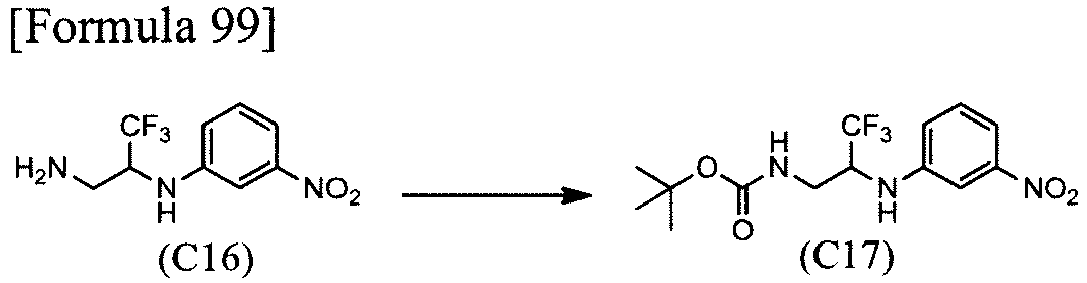
- To a solution of 3,3,3-trifluoro-N2-(3-nitrophenyl)propane-1,2-diamine (C16, 106 mg) in tetrahydrofuran (4 mL), triethylamine (90 µL) and di-tert-butyl dicarbonate (140 mg) were added at room temperature, and the mixture was stirred at the same temperature for 4 hours. To the reaction mixture, water and ethyl acetate were added. The organic layer was separated, washed with saturated aqueous sodium chloride, and then dried over anhydrous sodium sulfate, and the solvent was evaporated under reduced pressure to obtain tert-butyl (3,3,3-trifluoro-2-((3-nitrophenyl)amino)propyl)carbamate (C17, 202 mg).
1H-NMR (CDCl3) δ: 7.63 (1H, dd), 7.50 (1H, t), 7.32 (1H, t), 6.96 (1H, dd), 4.98-4.76 (1H, m), 3.68-3.44 (2H, m), 1.55 (9H, s) -

- To 10% palladium-carbon (50 mg) and ammonium formate (135 mg), a solution of tert-butyl (3,3,3-trifluoro-2-((3-nitrophenyl)amino)propyl)carbamate (C17, 100 mg) in methanol (2 mL) was added at room temperature, and the mixture was stirred at the same temperature for 3 hours. The insoluble matter was removed by filtration through Cerite, and then the solvent was evaporated under reduced pressure. To the obtained residue, ethyl acetate and water were added. The organic layer was separated, washed with saturated aqueous sodium chloride, and then dried over anhydrous sodium sulfate, and the solvent was evaporated under reduced pressure to obtain tert-butyl (2-((3-aminophenyl)amino)-3,3,3-trifluoropropyl)carbamate (C18, 45 mg).
MS m/z (M+H): 320.1 -

- To a solution of N-Boc-glycine (571 mg) in tetrahydrofuran (16 mL), isobutyl chloroformate (428 µL) and N-methylmorpholine (358 µL) were added under ice cooling, and the mixture was stirred at the same temperature for 20 minutes. To the reaction mixture, 4-nitro-1,2-phenylenediamine (500 mg) was added under ice cooling, and the mixture was stirred at room temperature for 3 hours and 30 minutes. To the reaction mixture, acetic acid (16 mL) was added, and the mixture was stirred at 70°C for 3 hours and 30 minutes. The reaction mixture was cooled to room temperature, and then water and ethyl acetate were added to the reaction mixture. The organic layer was separated, washed successively with saturated aqueous sodium hydrogencarbonate and saturated aqueous sodium chloride, and then dried over anhydrous sodium sulfate, and the solvent was evaporated under reduced pressure. The obtained residue was purified by silica gel column chromatography (eluent, 100 to 0% hexane in ethyl acetate) to obtain tert-butyl ((6-nitro-1H-benzo[d]imidazol-2-yl)methyl)carbamate (C19, 782 mg).
MS m/z (M+H): 293.1 -

- To 10% palladium-carbon (50 mg) and ammonium formate (228 mg), a solution of tert-butyl ((6-nitro-1H-benzo[d]imidazol-2-yl)methyl)carbamate (C19, 106 mg) in methanol (4 mL) was added at room temperature, and the mixture was stirred at room temperature for 1 hour and 30 minutes. The insoluble matter was removed by filtration through Cerite, and then the solvent was evaporated under reduced pressure. To the obtained residue, ethyl acetate and water were added. The organic layer was separated, washed with saturated aqueous sodium chloride, and then dried over anhydrous sodium sulfate, and the solvent was evaporated under reduced pressure to obtain tert-butyl ((6-amino-1H-benzo[d]imidazol-2-yl)methyl)carbamate (C20, 100 mg).
MS m/z (M+H): 263.2 -

- To a solution of 1-Boc-3-piperidinone (256 mg) and 3-nitroaniline (190 mg) in methylene chloride (7 mL), sodium triacetoxyborohydride (438 mg) and acetic acid (80 µL) were added at room temperature, and the mixture was stirred at the same temperature for 15 hours. To the reaction mixture, ethyl acetate and saturated aqueous sodium hydrogencarbonate were added. The organic layer was separated, washed with saturated aqueous sodium chloride, and then dried over anhydrous sodium sulfate, and the solvent was evaporated under reduced pressure. The obtained residue was purified by silica gel column chromatography (eluent, 100 to 50% hexane in ethyl acetate) to obtain tert-butyl 3-((3-nitrophenyl)amino)piperidine-1-carboxylate (C21, 229 mg).
MS m/z (M+H): 322.1 -

- To 10% palladium-carbon (100 mg), a solution of tert-butyl 3-((3-nitrophenyl)amino)piperidine-1-carboxylate (C21, 229 mg) in tetrahydrofuran (10 mL) and methanol (4 mL) was added at room temperature, and the mixture was stirred at room temperature for 1 hour under a hydrogen atmosphere. The insoluble matter was removed by filtration through Cerite, and then the solvent was evaporated under reduced pressure to obtain tert-butyl 3-((3-aminophenyl)amino)piperidine-1-carboxylate (C22, 211 mg).
MS m/z (M+H): 292.2 -

- To a solution of 1-(tert-butoxycarbonyl)-3-pyrrolidinone (220 mg) and 3-nitroaniline (164 mg) in methylene chloride (3 mL), sodium triacetoxyborohydride (375 mg) and acetic acid (67 µL) were added at room temperature, and the mixture was stirred at the same temperature for 10 hours. To the reaction mixture, ethyl acetate and saturated aqueous sodium hydrogencarbonate were added. The organic layer was separated, washed with saturated aqueous sodium chloride, and then dried over anhydrous sodium sulfate, and the solvent was evaporated under reduced pressure. The obtained residue was purified by silica gel column chromatography (eluent, 100 to 50% hexane in ethyl acetate) to obtain tert-butyl 3-((3-nitrophenyl)amino)pyrrolidine-1-carboxylate (C23, 210 mg).
-

- To 10% palladium-carbon (100 mg), a solution of tert-butyl 3-((3-nitrophenyl)amino)pyrrolidine-1-carboxylate (C23, 210 mg) in tetrahydrofuran (10 mL) and methanol (10 mL) was added at room temperature, and the mixture was stirred at the same temperature for 1 hour under a hydrogen atmosphere. The insoluble matter was removed by filtration through Cerite, and then the solvent was evaporated under reduced pressure to obtain tert-butyl 3-((3-aminophenyl)amino)pyrrolidine-1-carboxylate (C24, 231 mg).
MS m/z (M+H): 278.2 -

- To a solution of N-Boc-hexahydro-1H-azepin-4-one (141 mg) and 3-nitroaniline (91 mg) in methylene chloride (3 mL), sodium triacetoxyborohydride (210 mg) and acetic acid (38 µL) were added at room temperature, and the mixture was stirred at the same temperature for 10 hours. To the reaction mixture, ethyl acetate and saturated aqueous sodium hydrogencarbonate were added. The organic layer was separated, washed with saturated aqueous sodium chloride, and then dried over anhydrous sodium sulfate, and the solvent was evaporated under reduced pressure. The obtained residue was purified by silica gel column chromatography (eluent, 100 to 30% hexane in ethyl acetate) to obtain tert-butyl 4-((3-nitrophenyl)amino)azepane-1-carboxylate (C25, 157 mg).
MS m/z (M+H): 336.2 -

- To 10% palladium-carbon (30 mg), a solution of tert-butyl 4-((3-nitrophenyl)amino)azepane-1-carboxylate (C25, 78 mg) in tetrahydrofuran (2 mL) and methanol (2 mL) was added at room temperature, and the mixture was stirred at the same temperature for 1 hour under a hydrogen atmosphere. The insoluble matter was removed by filtration through Cerite, and then the solvent was evaporated under reduced pressure to obtain tert-butyl 4-((3-aminophenyl)amino)azepane-1-carboxylate (C26, 64 mg).
-

- To a solution of 1-Boc-hexahydro-1,4-diazepine (150 mg), 3-bromonitrobenzene (125 mg) and cesium carbonate (507 mg) in 1,4-dioxane (3 mL), bis[di-tert-butyl (4-dimethylaminophenyl)phosphine]dichloropalladium(II) (26 mg) was added at room temperature, and the mixture was stirred at 80°C for 2 hours. The reaction mixture was cooled to room temperature, and then water and ethyl acetate were added to the mixture. The organic layer was separated, washed with saturated aqueous sodium chloride, and then dried over anhydrous sodium sulfate, and the solvent was evaporated under reduced pressure. The obtained residue was purified by silica gel column chromatography (eluent, 100 to 70% hexane in ethyl acetate) to obtain tert-butyl 4-(3-nitrophenyl)-1,4-diazepane-1-carboxylate (C27, 15 mg).
MS m/z (M+H): 322.1 -

- To 10% palladium-carbon (10 mg), a solution of tert-butyl 4-(3-nitrophenyl)-1,4-diazepane-1-carboxylate (C27, 15 mg) in tetrahydrofuran (2 mL) and methanol (2 mL) was added at room temperature, and the mixture was stirred at the same temperature for 1 hour under a hydrogen atmosphere. The insoluble matter was removed by filtration through Cerite, and then the solvent was evaporated under reduced pressure to obtain tert-butyl 4-(3-aminophenyl)-1,4-diazepane-1-carboxylate (C28, 12 mg).
MS m/z (M+H): 292.2 -
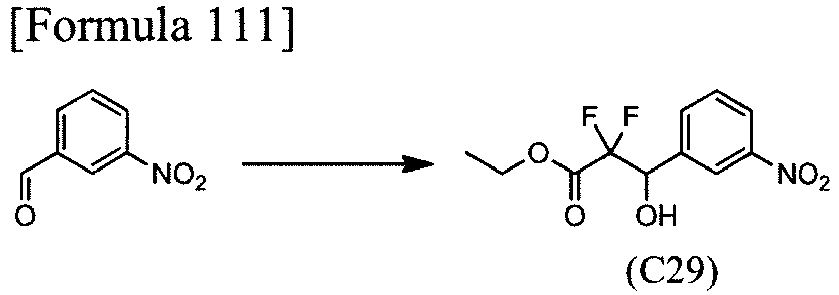
- To a suspension of zinc (962 mg) in tetrahydrofuran (25 mL), trimethylsilyl chloride (1 drop) and ethyl bromodifluoroacetate (2.2 mL) were added at room temperature, and the mixture was stirred for 5 minutes under reflux by heating. To the reaction mixture, 3-nitrobenzaldehyde (695 mg) was added, and the mixture was stirred for 30 minutes under reflux by heating. The reaction mixture was cooled to room temperature, and then ethyl acetate and 1.0 mol/L aqueous hydrochloric acid were added to the mixture. The organic layer was separated, washed successively with 1.0 mol/L aqueous hydrochloric acid and saturated aqueous sodium chloride, and then dried over anhydrous sodium sulfate, and the solvent was evaporated under reduced pressure. The obtained residue was purified by silica gel column chromatography (eluent, 100 to 60% hexane in ethyl acetate) to obtain ethyl 2,2-difluoro-3-hydroxy-3-(3-nitrophenyl)propanoate (C29, 1.02 g).
1H-NMR (CDCl3) δ: 8.37-8.34 (1H, brs), 8.28-8.24 (1H, m), 7.84-7.78 (1H, m), 7.60 (1H, t), 5.38-5.27 (1H, m), 7.36 (2H, q), 1.34 (3H, t) -

- To a solution of ethyl 2,2-difluoro-3-hydroxy-3-(3-nitrophenyl)propanoate (C29, 1.02 g) in methylene chloride (22 mL), bis(2-methoxyethyl)aminosulfur trifluoride (1.6 mL) was added under ice cooling, and the mixture was stirred at room temperature for 16 hours. To the reaction mixture, ethyl acetate and water were added. The organic layer was separated, washed successively with 1.0 mol/L aqueous hydrochloric acid, saturated aqueous sodium hydrogencarbonate and saturated aqueous sodium chloride, and then dried over anhydrous sodium sulfate, and the solvent was evaporated under reduced pressure to obtain ethyl 2,2,3-trifluoro-3-(3-nitrophenyl)propanoate (C30, 1.19 g).
1H-NMR (CDCl3) δ: 8.36 (2H, m), 7.81-7.77 (1H, m), 7.69-7.62 (1H, m), 6.05-5.82 (1H, m), 4.41 (2H, q), 1.38 (3H, t) -

- To a solution of ethyl 2,2,3-trifluoro-3-(3-nitrophenyl)propanoate (C30, 1.19 g) in ethanol (43 mL), sodium borohydride (811 mg) was added under ice cooling, and the mixture was stirred at room temperature for 40 minutes. To the reaction mixture, ethyl acetate and 1.0 mol/L aqueous hydrochloric acid were added. The organic layer was separated, washed successively with saturated aqueous sodium hydrogencarbonate and saturated aqueous sodium chloride, and then dried over anhydrous sodium sulfate, and the solvent was evaporated under reduced pressure. The obtained residue was purified by silica gel column chromatography (eluent, 100 to 40% hexane in ethyl acetate) to obtain 2,2,3-trifluoro-3-(3-nitrophenyl)propan-1-ol (C31, 829 mg).
1H-NMR (CDCl3) δ: 8.36-8.28 (2H, m), 7.82-7.77 (1H, m), 7.64 (1H, t), 5.98-5.74 (1H, m), 4.19-3.84 (2H, m) -

- To a suspension of 2,2,3-trifluoro-3-(3-nitrophenyl)propan-1-ol (C31, 500 mg), anhydrous sodium sulfate (500 mg) and pyridine (256 µL) in methylene chloride (20 mL), trifluoromethanesulfonic anhydride (521 µL) was added under ice cooling, and the mixture was stirred at the same temperature for 1 hour. To the reaction mixture, 10% aqueous citric acid and methylene chloride were added. The organic layer was separated, washed successively with saturated aqueous sodium hydrogencarbonate and saturated aqueous sodium chloride, and then dried over anhydrous sodium sulfate, and the solvent was evaporated under reduced pressure to obtain 2,2,3-trifluoro-3-(3-nitrophenyl)propyl trifluoromethanesulfonate (C32, 709 mg).
-

- To 2,2,3-trifluoro-3-(3-nitrophenyl)propyl trifluoromethanesulfonate (C32, 709 mg) and potassium phthalimide (1.07 g), N-methylpyrrolidone (4 mL) was added at room temperature, and the mixture was stirred at 80°C for 3 hours. The reaction mixture was cooled to room temperature, and then ethyl acetate and saturated aqueous sodium hydrogencarbonate were added to the mixture. The organic layer was separated, washed successively with water and saturated aqueous sodium chloride, and then dried over anhydrous sodium sulfate, and the solvent was evaporated under reduced pressure. The obtained residue was purified by silica gel column chromatography (eluent, 100 to 30% hexane in ethyl acetate) to obtain 2-(2,2,3-trifluoro-3-(3-nitrophenyl)propyl)isoindoline-1,3-dione (C33, 531 mg).
1H-NMR (CDCl3) δ: 8.37-8.27 (2H, m), 7.95-7.75 (5H, m), 7.63 (1H, t), 5.98-5.62 (1H, m), 4.41-4.26 (2H, m) -


- To a solution of 2-(2,2,3-trifluoro-3-(3-nitrophenyl)propyl)isoindoline-1,3-dione (C33, 531 mg) in ethanol (4 mL) and tetrahydrofuran (4 mL), hydrazine monohydrate (349 µL) was added at room temperature, and the mixture was stirred at the same temperature for 18 hours. The insoluble matter was removed by filtration, and then the solvent was evaporated under reduced pressure to obtain 2,2,3-trifluoro-3-(3-nitrophenyl)propan-1-amine (C34, 224 mg).
-

- To a solution of 2,2,3-trifluoro-3-(3-nitrophenyl)propan-1-amine (C34, 224 mg) in tetrahydrofuran (5 mL), triethylamine (200 µL) and di-tert-butyl dicarbonate (313 mg) were added at room temperature, and the mixture was stirred at the same temperature for 7 hours. To the reaction mixture, water and ethyl acetate were added. The organic layer was separated, washed with saturated aqueous sodium chloride, and then dried over anhydrous sodium sulfate, and the solvent was evaporated under reduced pressure. The obtained residue was purified by silica gel column chromatography (eluent, 100 to 50% hexane in ethyl acetate) to obtain tert-butyl (2,2,3-trifluoro-3-(3-nitrophenyl)propyl)carbamate (C35, 182 mg).
1H-NMR (CDCl3) δ: 8.33-8.27 (2H, m), 7.79 (1H, d), 7.63 (1H, t), 5.78-5.54 (1H, m), 3.96-3.58 (2H, m), 1.47 (9H, s) -

- To 10% palladium-carbon (40 mg), a solution of tert-butyl (2,2,3-trifluoro-3-(3-nitrophenyl)propyl)carbamate (C35, 80 mg) in tetrahydrofuran (5 mL) and methanol (5 mL) was added at room temperature, and the mixture was stirred at room temperature for 1 hour under a hydrogen atmosphere. The insoluble matter was removed by filtration through Cerite, and then the solvent was evaporated under reduced pressure to obtain tert-butyl (3-(3-aminophenyl)-2,2,3-trifluoropropyl)carbamate (C36, 88 mg).
MS m/z (M+H): 305.1 -

- To a solution of tert-butyl (2-amino-2-methylpropyl)carbamate 50 mg) and 3-((benzyloxycarbonyl)amino)propionaldehyde (60 mg) in methylene chloride (3 mL), sodium triacetoxyborohydride (83 mg) and acetic acid (15 µL) were added at room temperature, and the mixture was stirred at the same temperature for 15 hours. To the reaction mixture, ethyl acetate and saturated aqueous sodium hydrogencarbonate were added. The organic layer was separated, washed with saturated aqueous sodium chloride, and then dried over anhydrous sodium sulfate, and the solvent was evaporated under reduced pressure. The obtained residue was purified by silica gel column chromatography (eluent, 100 to 0% hexane in ethyl acetate) to obtain tert-butyl (2-((3-((benzyloxycarbonyl)amino)propyl)amino)-2-methylpropyl)carbamate (C37, 93 mg).
MS m/z (M+H): 380.3 -

- To 10% palladium-carbon (50 mg), a solution of tert-butyl (2-((3-((benzyloxycarbonyl)amino)propyl)amino)-2-methylpropyl)carbamate (C37, 93 mg) in methanol (5 mL) was added at room temperature, and the mixture was stirred at room temperature for 2 hours and 30 minutes under a hydrogen atmosphere. The insoluble matter was removed by filtration through Cerite, and then the solvent was evaporated under reduced pressure to obtain tert-butyl (2-((3-aminopropyl)amino)-2-methylpropyl)carbamate (C38, 56 mg).
1H-NMR (CDCl3) δ: 3.06 (2H, d), 2.80 (2H, t), 2.60 (2H, t), 1.68-1.55 (2H, m), 1.06 (6H, s) -

- To a solution of N-(tert-butoxycarbonyl)-1,2-cyclohexanediamine (200 mg) and 3-((benzyloxycarbonyl)amino)propionaldehyde (65 mg) in methylene chloride (4 mL), sodium triacetoxyborohydride (133 mg) and acetic acid (18 µL) were added at room temperature, and the mixture was stirred at the same temperature for 5 hours and 30 minutes. To the reaction mixture, ethyl acetate and saturated aqueous sodium hydrogencarbonate were added. The organic layer was separated, washed with saturated aqueous sodium chloride, and then dried over anhydrous sodium sulfate, and the solvent was evaporated under reduced pressure. The obtained residue was purified by silica gel column chromatography (eluent, 100 to 0% hexane in ethyl acetate) to obtain tert-butyl (2-((3-((benzyloxycarbonyl)amino)propyl)amino)cyclohexyl)carbamate (C39, 137 mg).
MS m/z (M+H): 406.3 -

- To 10% palladium-carbon (50 mg), a solution of tert-butyl (2-((3-((benzyloxycarbonyl)amino)propyl)amino)cyclohexyl)carbamate (C39, 137 mg) in methanol (5 mL) was added at room temperature, and the mixture was stirred at room temperature for 4 hours under a hydrogen atmosphere. The insoluble matter was removed by filtration through Cerite, and then the solvent was evaporated under reduced pressure to obtain tert-butyl (2-((3-aminopropyl)amino)cyclohexyl)carbamate (C40, 101 mg).
-

- To a suspension of 2-fluoronitrobenzene (197 mg) and potassium carbonate (193 mg) in acetonitrile (4 mL), 1,3-cyclohexanediamine (480 mg) was added at room temperature, and the mixture was stirred for 10 hours and 30 minutes under reflux by heating. The reaction mixture was cooled to room temperature, and then ethyl acetate and water were added to the reaction mixture. The organic layer was separated, washed with saturated aqueous sodium chloride, and then dried over anhydrous sodium sulfate, and the solvent was evaporated under reduced pressure. The obtained residue was purified by silica gel column chromatography (eluent, 100 to 80% ethyl acetate in methanol) to obtain N1-(2-nitrophenyl)cyclohexane-1,3-diamine (C41, 162 mg).
MS m/z (M+H): 236.1 -

- To 2-chloro-3-nitropyridine (92 mg), tert-butyl (3-aminopropyl)carbamate (102 mg) and potassium carbonate (161 mg), acetonitrile (1.2 mL) was added at room temperature, and the mixture was stirred at the same temperature for 4 hours. To the reaction mixture, ethyl acetate and water were added. The organic layer was separated, washed with saturated aqueous sodium chloride, and then dried over anhydrous sodium sulfate, and the solvent was evaporated under reduced pressure. The obtained residue was purified by silica gel column chromatography (eluent, 100 to 0% hexane in ethyl acetate) to obtain tert-butyl (3-((3-nitropyridin-2-yl)amino)propyl)carbamate (C42, 186 mg).
MS m/z (M+H): 297.2 -

- To tert-butyl (3-((3-nitropyridin-2-yl)amino)propyl)carbamate (C42, 53 mg), a 4.0 mol/L solution of hydrochloric acid in dioxane (2 mL) and water (100 µL) were added at room temperature, and the mixture was stirred at the same temperature for 1 hour. To the reaction mixture, diisopropyl ether were added, the solvent was removed by decantation, and then the residue was dried under reduced pressure to obtain N1-(3-nitropyridin-2-yl)propane-1,3-diamine (C43) hydrochloride (113 mg).
MS m/z (M+H): 197.1 - In the same manner as that of Example 1, (4) or Example 7, (9), Intermediates (C44) to (C46) were obtained.
[Table 28] Compound No. Structure Physicochemical data C44 
- C45 
- C46 
MS m/z (M+H): 559.3 - By using Intermediates (C45) and (C46), Intermediates (C47) and (C48) were obtained in the same manner as that of Example 7, (10).
[Table 29] Compound No. Structure Physicochemical data C47 
MS m/z (M+H): 563.3 C48 
MS m/z (M+H): 577.3 - By using Intermediates (C44), Intermediates (C49) and (C50) were obtained in the same manner as that of Example 1, (5).
[Table 30] Compound No. Structure Physicochemical data C49 
- C50 
MS m/z (M+H): 583.4 - In the same manner as that of Example 1, (6), Intermediates (C51) to (C55) were obtained.
[Table 31] Compound No. Structure Physicochemical data C51 
MS m/z (M+H): 469.3 C52 
MS m/z (M+H): 483.3 C53 
MS m/z (M+H): 491.3 C54 
- C55 
MS m/z (M+H): 477.3 - In the same manner as that of Example 7, (7), Intermediates (C56) and (C57) were obtained.
[Table 32] Compound No. Structure Physicochemical data C56 
- C57 
- - In the same manner as that of Example 7, (11), Intermediates (C58) to (C76) were obtained.
[Table 33] Compound No. Structure Physicochemical data C58 
- C59 
- C60 
- C61 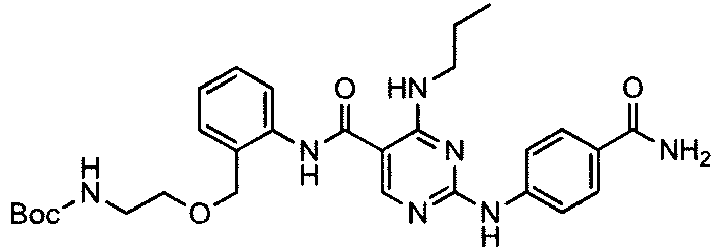
- C62 
- C63 
- C64 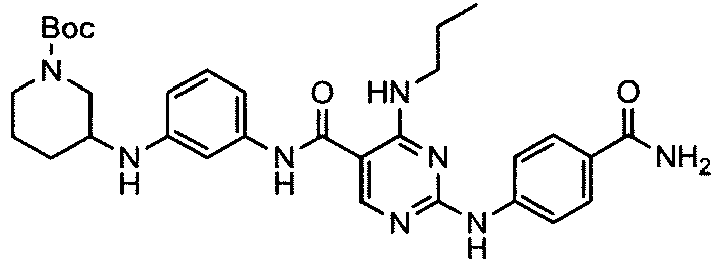
- C65 
- [Table 34] Compound No. Structure Physicochemical data C66 
- C67 
- C68 
- C69 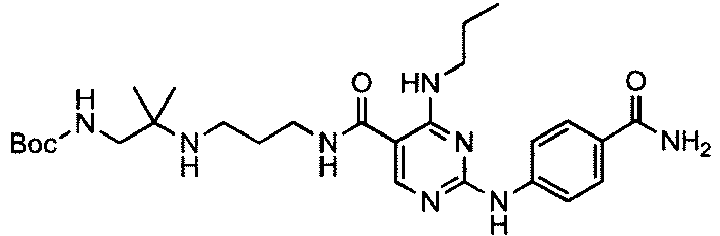
- C70 
- C71 
- C72 
- C73 
- [Table 35] Compound No. Structure Physicochemical data C74 
- C75 
- C76 
- - In the same manner as that of Example 1, (6), Intermediates (C77) to (C92) were obtained.
[Table 36] Compound No. Structure Physicochemical data C77 
MS m/z (M+H): 491.2 C78 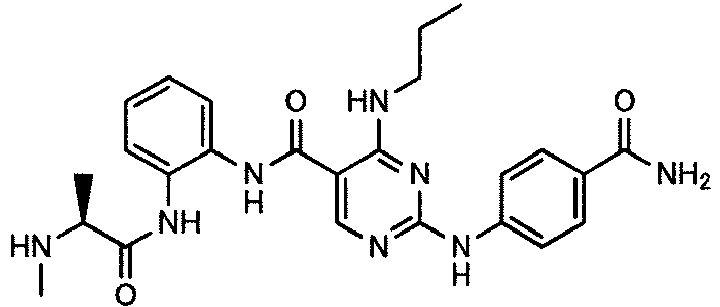
- C79 
- C80 
- C81 
- C82 
- C83 
- C84 
- [Table 37] Compound No. Structure Physicochemical data C85 
- C86 
- C87 
- C88 
- C89 
- C90 
- C91 
MS m/z (M+H): 503.2 C92 
- - By using Intermediates (C72) to (C74), Intermediates (C93) to (C95) were obtained in the same manner as that of Example 8, (10).
[Table 38] Compound No. Structure Physicochemical data C93 
- C94 
- C95 
- - In the same manner as that of Example 7, Compounds (3-2) to (3-31) were obtained.
[Table 39] Compound No. Structure Physicochemical data 3-2 
1H-NMR (DMSO-d6) δ: 9.77 (1H, s), 9.03 (1H, t, J=5.6Hz), 8.52 (1H, s), 8.33-8.29 (1H, m), 8.11 (1H, d, J=7.8Hz), 7.92-7.78 (6H, m), 7.15 (1H, s), 6.32 (1H, dd, J=16.8, 10.2Hz), 6.08 (1H, dd, J=16.8, 2.6Hz), 5.60 (1H, dd, J=10.2, 2.6Hz), 3.75-3.38 (6H, m), 1.98-1.94 (1H, m), 1.76-1.56 (5H, m), 1.35-1.03 (4H, m), 0.96 (3H, t, J=7.3Hz) 3-3 
1H-NMR (CDCl3+CD3OD) δ: 8.26 (1H, s), 7.85-7.78 (4H, m), 6.80 (1H, dt, J=15.2, 6.4Hz), 6.08 (1H, d, J=15.2Hz), 3.93-3.82 (4H, m), 3.49 (2H, d, J=5.3Hz), 3.18-3.11 (2H, m), 2.28 (6H, s), 1.75-1.61 (4H, m), 1.30-1.01 (9H, m) 3-4 
1H-NMR (DMSO-d6) δ: 9.76 (1H, s), 9.04 (1H, t, J=5.3Hz), 8.52 (1H, s), 8.06 (1H, dd, J=25.1, 7.9Hz), 7.88-7.78 (6H, m), 7.15 (1H, s), 6.61-6.31 (2H, m), 3.95 (2H, d, J=15.9Hz), 3.75-3.38 (4H, m), 3.03 (3H, s), 2.96 (2H, d, J=5.3Hz), 2.15 (3H, s), 2.09 (3H, s), 1.96 (1H, d, J=12.6Hz), 1.75-1.56 (5H, m), 1.34-1.15 (4H, m), 0.96 (3H, t, J=7.3Hz) 3-5 
1H-NMR (CDCl3+CD3OD) δ: 8.49 (1H, s), 7.80 (4H, s), 7.72 (1H, d, J=8.6Hz), 7.31-7.25 (2H, m), 7.23-7.18 (1H, m), 6.95 (1H, dt, J=10.6, 4.8Hz), 6.20 (1H, d, J=15.9Hz), 3.49 (2H, t, J=7.3Hz), 3.15 (2H, d, J=4.6Hz), 2.31 (6H, s), 1.70 (2H, dd, J=13.9, 7.3Hz), 1.02 (3H, t, J=7.3Hz) 3-6 
1H-NMR (CDCl3+CD3OD) δ: 8.48 (1H, s), 7.87-7.78 (4H, m), 7.64-7.51 (4H, m), 6.89 (1H, dt, J=15.4, 6.3Hz), 6.20 (1H, d, J=15.4Hz), 3.52 (2H, dd, J=12.9, 6.9Hz), 3.18 (2H, d, J=7.3Hz), 2.33 (6H, s), 1.79-1.67 (2H, m), 1.04 (3H, t, J=7.3Hz) 3-7 
1H-NMR (CD3OD) δ: 8.56 (1H, s), 7.95 (1H, s), 7.90-7.83 (4H, m), 7.31-7.29 (3H, m), 6.32 (1H, dt, J=6.3, 1.7Hz), 6.10 (1H, q, J=6.3Hz), 5.15 (1H, q, J=7.0Hz), 3.53 (2H, t, J=7.3Hz), 3.45 (2H, dd, J=6.3, 1.7Hz), 3.11 (3H, s), 1.78-1.66 (2H, m), 1.46 (3H, d, J=7.3Hz), 1.04 (3H, t, J=7.3Hz) [Table 40] Compound No. Structure Physicochemical data 3-8 
1H-NMR (DMSO-d6) δ: 10.07 (1H, s), 10.03 (1H, s), 9.88 (1H, s), 8.83 (1H, t, J=5.6Hz), 8.72 (1H, s), 8.48 (1H, t, J=5.9Hz), 8.06 (1H, s), 7.90 (2H, d, J=9.2Hz), 7.86-7.78 (3H, m), 7.36-7.14 (4H, m), 6.36 (1H, dd, J=17.2, 9.9Hz), 6.12 (1H, dd, J=17.2, 2.6Hz), 5.64 (1H, dd, J=9.9, 2.0Hz), 3.98 (2H, d, J=5.9Hz), 3.47 (2H, q, J=6.6Hz), 1.72-1.58 (2H, m), 0.98 (3H, t, J=7.3Hz) 3-9 
1H-NMR (DMSO-d6) δ: 10.01 (1H, s), 9.94-9.84 (2H, m), 8.83 (1H, brs), 8.72 (1H, s), 8.07 (1H, s), 7.90 (2H, d, J=8.6Hz), 7.86-7.78 (3H, m), 7.36-7.16 (4H, m), 6.76-6.66 (1H, m), 6.49 (1H, d, J=14.5Hz), 5.16-5.04 (1H, m), 3.47 (2H, q, J=6.6Hz), 3.04 (3H, s), 1.86 (3H, d, J=6.6Hz), 1.72-1.58 (2H, m), 1.35 (3H, d, J=7.3Hz), 0.98 (3H, t, J=7.6Hz) 3-10 
1H-NMR (DMSO-d6) δ: 10.04-9.94 (2H, m), 9.88 (1H, s), 8.83 (1H, brs), 8.72 (1H, s), 8.08 (1H, s), 7.90 (2H, d, J=8.6Hz), 7.86-7.78 (3H, m), 7.36-7.16 (4H, m), 5.21 (1H, s), 5.10-4.90 (2H, m), 3.52-3.42 (2H, m), 3.00 (3H, brs), 1.87 (3H, s), 1.70-1.60 (2H, m), 1.48-1.38 (3H, m), 0.98 (3H, t, J=7.3Hz) 3-11 
MS m/z [M+H]: 557.3 3-12 
MS m/z [M+H]: 588.3 3-13 
MS m/z [M+H]: 602.3 [Table 41] Compound No. Structure Physicochemical data 3-14 
1H-NMR (CDCl3) δ: 9.07 (1H, s), 9.00 (1H, s), 8.85 (1H, t, J=5.3Hz), 8.54 (1H, s), 8.23 (1H, s), 7.76 (4H, s), 7.61 (1H, d, J=7.3Hz), 7.47 (1H, d, J=6.6Hz), 7.23-7.14 (2H, m), 6.90 (1H, dt, J=15.2, 5.9Hz), 6.36 (1H, d, J=15.2Hz), 6.21 (1H, brs), 5.26 (1H, q, J=7.0Hz), 3.45 (2H, q, J=6.4Hz), 3.04-3.02 (5H, m), 2.42 (1H, brs), 2.20 (6H, s), 1.66 (2H, dt, J=14.4, 7.0Hz), 1.44 (3H, d, J=7.3Hz), 0.99 (3H, t, J=7.6Hz) 3-15 
1H-NMR (CDCl3) δ: 10.44 (1H, s), 9.06 (1H, t, J=5.6Hz), 8.92 (1H, s), 8.19 (1H, s), 7.75-7.74 (5H, m), 7.58 (1H, t, J=6.3Hz), 7.35-7.23 (2H, m), 7.11 (1H, t, J=7.3Hz), 6.90 (1H, dt, J=15.2, 5.9Hz), 6.37 (1H, d, J=15.2Hz), 6.16 (1H, brs), 5.15 (1H, q, J=7.0Hz), 4.38-4.18 (2H, m), 3.51 (2H, dd, J=13.2, 6.6Hz), 3.09 (2H, d, J=5.3Hz), 2.89 (3H, s), 2.70 (1H, brs), 2.26 (6H, s), 1.77-1.64 (2H, m), 1.37-1.30 (3H, m), 1.02 (3H, t, J=7.3Hz) 3-16 
1H-NMR (CDCl3+CD3OD) δ: 8.38 (1H, s), 8.11 (1H, d, J=7.9Hz), 7.82 (4H, s), 7.39 (1H, t, J=7.6Hz), 7.23 (1H, d, J=7.3Hz), 7.11 (1H, t, J=7.6Hz), 6.75 (1H, dt, J=15.6, 6.1Hz), 5.95 (1H, d, J=15.6Hz), 4.67 (2H, s), 3.65 (2H, t, J=5.0Hz), 3.56-3.49 (4H, m), 3.01 (2H, t, J=3.3Hz), 2.21 (6H, s), 1.79-1.67 (2H, m), 1.04 (3H, t, J=7.6Hz) 3-17 
1H-NMR (CD3OD) δ: 8.53 (1H, s), 7.86 (4H, brs), 7.41-7.35 (2H, m), 7.11-7.04 (1H, m), 6.51-6.46 (1H, m), 6.03 (1H, dt), 5.44 (1H, d), 4.97-4.76 (3H, m), 3.53 (2H, t), 3.06 (2H, d), 2.21 (6H, s), 1.77-1.66 (2H, m), 1.04 (3H, t) [Table 42] Compound No. Structure Physicochemical data 3-18 
1H-NMR (CD3OD) δ: 8.59 (1H, s), 7.97-7.88 (1H, m), 7.86 (4H, d), 7.53-7.46 (1H, m), 7.39-7.31 (1H, m), 6.84 (1H, dt), 6.18 (1H, dt), 3.53 (2H, t), 3.17-3.08 (2H, m), 3.24 (2H, t), 2.24 (6H, s), 1.82-1.59 (2H, m), 1.04 (3H, t) 3-19 
1H-NMR (CD3COCD3) δ: 8.67 (1H, s), 8.00 (2H, d), 7.92 (2H, d), 7.33-6.89 (3H, m), 6.69-6.57 (1H, m), 6.51-6.40 (2H, m), 4.09-3.99 (3H, m), 3.59 (4H, m), 3.34-3.00 (2H, m), 2.13 (6H, s), 1.87-1.50 (6H, m), 1.03 (3H, t) 3-20 
1H-NMR (CD3COCD3) δ: 8.64 (1H, s), 8.00 (2H, d), 7.92 (2H, d), 7.25-6.90 (3H, m), 6.79-6.67 (1H, m), 6.48-6.31 (2H, m), 4.11-3.39(7H, m), 3.02 (2H, t), 2.18 (6H, s), 2.18-2.12 (2H, m), 1.77-1.67 (2H, m), 1.03 (3H, t) 3-21 
1H-NMR (CD3COCD3) δ: 8.63 (1H, s), 8.00 (2H, d), 7.92 (2H, d), 7.11-7.06 (1H, m), 7.05-7.0 (1H, m), 6.96-6.90 (1H, m), 6.81-6.69 (1H, m), 6.57 (1H, dt), 6.36 (1H, d), 3.82-3.40 (7H, m), 3.04 (2H, d), 2.17 (6H, s), 2.08-2.03 (4H, m), 1.80-1.66 (4H, m), 1.04 (3H, t) 3-22 
1H-NMR (CD3COCD3) δ: 8.56 (1H, s), 8.01 (2H, d), 7.93 (2H, d), 7.24-7.19 (1H, m), 7.15-7.03 (2H, m), 6.60-6.51 (3H, m), 3.87-3.43 (10H, m), 3.06-2.94 (2H, m), 2.17 (6H, s), 1.74 (2H, dt), 1.41 (2H, dd), 1.03 (3H, t) 3-23 
1H-NMR (CD3COCD3) δ: 8.73 (1H, s), 8.01 (2H, d), 7.94 (2H, d), 7.60-7.52 (1H, m), 7.47-7.40 (1H, m), 7.27-7.22 (1H, m), 6.76 (1H, m), 6.18 (1H, m), 5.83 (1H, m), 4.00-3.84 (1H, m), 3.83-3.69 (1H, m), 3.61-3.53 (1H, m), 3.01 (1H, m), 2.17 (6H, s), 1.81-1.67 (2H, m), 1.03 (3H, t) 3-24 
1H-NMR (CD3OD) δ: 8.40 (1H, s), 7.86-7.83 (4H, brs), 6.75 (1H, dt), 6.13 (1H, d), 3.50 (2H, t), 3.39 (2H, t), 3.32-3.28 (2H, t), 3.09 (2H, d), 2.66 (2H, t), 2.23 (6H, s), 1.80-1.61 (4H, m), 1.10 (6H, s), 1.03 (3H, t) [Table 43] Compound No. Structure Physicochemical data 3-25 
1H-NMR (CD3OD) δ: 8.38 (1H, s), 7.86-7.83 (1H, brs), 6.73 (1H, dt), 6.18 (1H, d), 3.50 (2H, t), 3.40-3.31 (4H, m), 3.05 (2H, d), 2.31-2.11 (3H, m), 2.20 (6H, s), 1.80-1.45 (8H, m), 1.04-0.93 (4H, m), 1.03 (3H, t) 3-26 
1H-NMR (CD3OD) δ: 8.45 (1H, s), 8.36 (4H, s), 6.74 (1H, dt), 6.08 (1H, d), 3.50 (2H, t), 3.41-3.28 (3H, m), 3.06 (2H, m), 2.32-2.10 (3H, m), 2.22 (6H, s), 1.80-1.63 (8H, m), 1.05-0.90 (4H, m), 1.03 (3H, t) 3-27 
1H-NMR (CD3COCD3) δ: 8.48 (1H, s), 7.98 (2H, d), 7.91 (2H, d), 7.33 (1H, dd), 7.04 (1H, t), 6.88 (1H, dt), 6.78 (1H, d), 6.63 (1H, t), 6.37 (1H, d), 4.09-3.98 (1H, m), 3.55-3.43 (3H, m), 3.07 (2H, d), 2.05 (6H, s), 1.96-1.50 (8H, m), 1.01 (3H, t) 3-28 
1H-NMR (CD3COCD3) δ: 8.51 (1H, s), 7.98 (2H, d), 7.91 (2H, d), 7.33 (1H, dd), 7.04 (1H, t), 6.88 (1H, dt), 6.78 (1H, d), 6.63 (1H, t), 6.37 (1H, d), 4.37-4.25 (1H, m), 3.90-3.77 (1H, m), 3.54-3.45 (2H, m), 3.07 (2H, d), 2.05 (6H, s), 1.96-1.50 (8H, m), 1.01 (3H, t) 3-29 
1H-NMR (CD3OD) δ: 8.37 (1H, s), 7.93-7.90 (1H, m), 7.85-7.83 (4H, brs), 7.50-7.45 (1H, m), 6.90 (1H, dt), 6.63-6.56 (1H, m), 3.54-3.37 (4H, m), 3.23-3.12 (4H, m), 2.15 (6H, s), 1.98-1.83 (2H, m), 1.75-1.65 (2H, m), 1.03 (3H, t) 3-30 
1H-NMR (DMSO-d6) δ: 10.06-9.98 (2H, m), 9.88 (1H, s), 8.84 (1H, brs), 8.72 (1H, s), 8.09 (1H, s), 7.92-7.78 (5H, m), 7.34-7.14 (4H, m), 6.66-6.54 (1H, m), 6.43 (1H, d, J=15.2Hz), 4.54-4.48 (1H, m), 3.74-3.58 (2H, m), 3.52-3.42 (2H, m), 3.04 (2H, d, J=5.3Hz), 2.16 (6H, s), 2.00-1.86 (4H, m), 1.70-1.60 (2H, m), 0.98 (3H, t, J=7.6Hz) 3-31 
1H-NMR (CD3COCD3) δ: 8.68 (1H, s), 8.01 (2H, d), 7.93 (2H, d), 7.47-7.43 (1H, m), 7.28-7.17 (2H, m), 6.81-6.59 (3H, m), 3.83-3.72 (4H, brs), 3.61-3.52 (2H, m), 3.25-3.16 (4H, brs), 3.05 (2H, d), 2.19 (6H, s), 1.74 (2H, dt), 1.03 (3H, t) -

- To a solution of (S,E)-N-(3-(2-(4-bromo-N-methyl-2-butenamido)propanamido)phenyl)-2-((4-carbamoylphenyl)amino)-4-(propylamino)pyrimidine-5-carboxamide (3-7, 100 mg) in N,N-dimethylformamide (2 mL), piperazine (135 mg) was added at room temperature, and the mixture was stirred at the same temperature for 1 hour and 40 minutes. The solvent was evaporated under reduced pressure, and the obtained residue was purified by basic silica gel column chromatography (eluent, 85% ethyl acetate/15% methanol) to obtain (S,E)-2-((4-carbamoylphenyl)amino)-N-(3-(2-(N-methyl-4-(piperazin-1-yl)-2-butenamido)propanamido)phenyl)-4-(propylamino)pyrimidine-5-carboxamide (4-1, 57 mg) as white solid.
1H-NMR (CDCl3+CD3OD) δ: 8.45 (1H, s), 7.84-7.76 (5H, m), 7.45 (1H, d, J=7.9Hz), 7.32-7.23 (2H, m), 6.95 (1H, dt, J=15.2, 6.3Hz), 6.47 (1H, d, J=15.2Hz), 5.28 (1H, q, J=7.3Hz), 3.50 (2H, t, J=7.3Hz), 3.18 (2H, d, J=6.3Hz), 3.07 (3H, s), 2.90-2.85 (4H, m), 2.48 (4H, brs), 1.78-1.66 (2H, m), 1.43 (3H, d, J=7.3Hz), 1.03 (3H, t, J=7.3Hz) - In the same manner as that of Example 10, Compounds (4-2) to (4-15) were obtained.
[Table 44] Compound No. Structure Physicochemical data 4-2 
1H-NMR (CDCl3+CD3OD) δ: 8.46 (1H, s), 7.90-7.75 (5H, m), 7.42-7.27 (3H, m), 6.96 (1H, d, J=14.5Hz), 6.46 (1H, d, J=14.5Hz), 5.28 (1H, d, J=7.3Hz), 3.50-3.28 (4H, m), 3.08 (3H, s), 2.44 (3H, s), 1.73-1.63 (2H, m), 1.44 (3H, d, J=6.6Hz), 1.03 (3H, t, J=7.3Hz) 4-3 
1H-NMR (CDCl3+CD3OD) δ: 8.45 (1H, s), 7.80-7.75 (5H, m), 7.46 (1H, d, J=6.6Hz), 7.31-7.27 (2H, m), 6.96 (1H, dt, J=15.0, 5.9Hz), 6.46 (1H, d, J=15.0Hz), 5.29 (1H, q, J=6.8Hz), 3.49 (2H, t, J=7.3Hz), 3.21 (2H, d, J=5.9Hz), 3.07 (3H, s), 2.52-2.45 (2H, m), 2.27 (3H, s), 1.71-1.63 (2H, m), 1.43 (3H, d, J=6.8Hz), 1.12-0.90 (6H, m) 4-4 
1H-NMR (CDCl3+CD3OD) δ: 8.46 (1H, s), 7.84-7.75 (5H, m), 7.45 (1H, d, J=7.3Hz), 7.34-7.24 (2H, m), 7.00 (1H, dt, J=15.2, 6.3Hz), 6.47 (1H, d, J=15.2Hz), 5.29 (1H, q, J=6.6Hz), 3.51-3.39 (4H, m), 3.08 (3H, s), 1.77-1.65 (2H, m), 1.43 (3H, d, J=6.6Hz), 1.15 (9H, s), 1.03 (3H, t, J=7.3Hz) 4-5 
1H-NMR (CDCl3+CD3OD) δ: 8.45 (1H, s), 7.84-7.75 (5H, m), 7.45 (1H, d, J=7.3Hz), 7.30-7.24 (2H, m), 6.83 (1H, dt, J=15.9, 5.1Hz), 6.40 (1H, d, J=15.9Hz), 5.27 (1H, q, J=7.3Hz), 4.46-4.38 (1H, m), 3.72-3.66 (2H, m), 3.50 (2H, t, J=7.3Hz), 3.23-3.27 (2H, m), 3.07 (3H, s), 2.99 (2H, t, J=7.3Hz), 1.78-1.66 (2H, m), 1.43 (3H, d, J=6.6Hz), 1.03 (3H, t, J=7.3Hz) 4-6 
MS m/z [M+H]: 659.4 [Table 45] Compound No. Structure Physicochemical data 4-7 
1H-NMR (CD3OD) δ: 8.56 (1H, s), 7.93 (1H, s), 7.89-7.82 (4H, m), 7.30-7.23 (3H, m), 6.87 (1H, dt, J=15.0, 7.0Hz), 6.67 (1H, d, J=15.0Hz), 5.19 (1H, q, J=7.0Hz), 3.52 (2H, t, J=7.3Hz), 3.35-3.30 (2H, m), 3.14 (3H, s), 3.10-3.01 (2H, m), 1.71 (2H, dt, J=14.5, 7.3Hz), 1.47 (3H, d, J=7.0Hz), 1.06-1.01(15H, m) 4-8 
1H-NMR (CDCl3+CD3OD) δ: 8.44 (1H, s), 7.82-7.75 (5H, m), 7.46 (1H, dt, J=4.5, 2.2Hz), 7.31-7.27 (2H, m), 6.99 (1H, dt, J=15.2, 6.3Hz), 6.47 (1H, d, J=15.2Hz), 5.30 (1H, q, J=7.0Hz), 3.47 (2H, t, J=7.3Hz), 3.28 (2H, d, J=6.3Hz), 3.07 (3H, s), 2.56 (4H, q, J=7.3Hz), 1.76-1.64 (2H, m), 1.43 (3H, d, J=7.3Hz), 1.08-0.99 (9H, m) 4-9 
1H-NMR (CDCl3+CD3OD) δ: 8.45 (1H, s), 7.91-7.76 (5H, m), 7.43 (1H, s), 7.34-7.28 (2H, m), 6.94 (1H, d, J=14.5Hz), 6.49 (1H, d, J=14.5Hz), 5.29 (1H, d, J=6.6Hz), 3.65-3.27 (6H, m), 3.07 (3H, s), 2.70-2.43 (2H, m), 2.32 (3H, s), 1.72-1.67 (2H, m), 1.44 (3H, d, J=7.3Hz), 1.02 (3H, t, J=7.3Hz) 4-10 
1H-NMR (CD3OD) δ: 8.55 (1H, s), 7.99 (1H, s), 7.89-7.82 (4H, m), 7.30-7.28 (3H, m), 6.86 (1H, dt, J=15.6, 5.9Hz), 6.63 (1H, d, J=15.6Hz), 5.19 (1H, q, J=7.0Hz), 4.60 (1H, dd, J=9.9, 4.6Hz), 4.44 (1H, dd, J=9.9, 4.6Hz), 3.54-3.46 (4H, m), 3.16 (3H, s), 2.95 (1H, t, J=4.6Hz), 2.86 (1H, t, J=4.6Hz), 1.78-1.65 (2H, m), 1.47 (3H, d, J=7.3Hz), 1.03 (3H, t, J=7.3Hz) 4-11 
1H-NMR (CDCl3+CD3OD) δ: 8.44 (1H, s), 7.82-7.76 (5H, m), 7.44 (1H, d, J=7.3Hz), 7.31-7.22 (2H, m), 7.02 (1H, dt, J=15.2, 5.1Hz), 6.44 (1H, d, J=15.2Hz), 5.29 (1H, q, J=7.3Hz), 3.53-3.43 (4H, m), 3.08 (3H, s), 1.76-1.64 (2H, m), 1.43 (3H, d, J=7.3Hz), 1.02 (3H, t, J=7.3Hz) [Table 46] Compound No. Structure Physicochemical data 4-12 
MS m/z [M+H]: 645.5 4-13 
1H-NMR (CDCl3+CD3OD) δ: 8.47 (1H, s), 7.82-7.79 (5H, m), 7.38-7.33 (3H, m), 6.92 (1H, d, J=15.2Hz), 6.54 (1H, d, J=15.2Hz), 5.28 (1H, d, J=7.3Hz), 3.56-3.48 (4H, m), 3.22 (2H, q, J=9.0Hz), 3.10 (3H, s), 1.78-1.66 (2H, m), 1.45 (3H, d, J=7.3Hz), 1.03 (3H, t, J=7.6Hz) 4-14 
1H-NMR (CDCl3) δ: 8.43 (1H, s), 7.80-7.73 (5H, m), 7.43 (1H, t, J=2.3Hz), 7.27 (2H, d, J=5.3Hz), 6.91 (1H, dd, J=15.2, 7.9Hz), 6.36 (1H, d, J=15.2Hz), 5.30 (1H, q, J=7.3Hz), 3.49-3.43 (2H, m), 3.17-3.02 (4H, m), 2.26 (6H, s), 1.74-1.62 (2H, m), 1.43 (3H, d, J=7.3Hz), 1.21 (3H, d, J=7.3Hz), 1.00 (3H, t, J=7.3Hz) 4-15 
1H-NMR (CDCl3) δ: 8.42 (1H, s), 7.80-7.73 (5H, m), 7.43 (1H, d, J=3.3Hz), 7.28 (2H, t, J=5.9Hz), 6.83 (1H, dd, J=15.2, 9.2Hz), 6.34 (1H, d, J=15.2Hz), 5.30 (1H, q, J=6.8Hz), 3.48-3.40 (2H, m), 3.09 (3H, s), 2.88-2.78 (1H, m), 2.27 (6H, d, J=2.6Hz), 1.72-1.64 (3H, m), 1.55-1.43 (4H, m), 1.00 (3H, t, J=7.6Hz), 0.88 (3H, dt, J=7.4,3.1 Hz) -

- To 2-((4-cyanophenyl)amino)-4-(propylamino)pyrimidine-5-carboxylic acid (C5, 328 mg), N-Boc-1,3-propanediamine (289 µL), 1-ethyl-3-(3-dimethylaminopropyl)carbodiimide hydrochloride (846 mg), and 1-hydroxybenzotriazole monohydrate (676 mg), N,N-dimethylformamide (10 mL) and triethylamine (306 µL) were added at room temperature, and the mixture was stirred at the same temperature for 2 hours. To the reaction mixture, saturated aqueous sodium hydrogencarbonate and ethyl acetate were added. The organic layer was separated, washed successively with water and saturated aqueous sodium chloride, and then dried over anhydrous sodium sulfate, and the solvent was evaporated under reduced pressure. The obtained residue was purified by basic silica gel column chromatography (eluent, 50 to 30% hexane in ethyl acetate) to obtain tert-butyl (3-(2-((4-cyanophenyl)amino)-4-(propylamino)pyrimidine-5-carboxamido)propyl)carbamate (D1, 224 mg) as white solid.
-

- To a solution of tert-butyl (3-(2-((4-cyanophenyl)amino)-4-(propylamino)pyrimidine-5-carboxamido)propyl)carbamate (D1, 220 mg) in ethanol (4 mL) and dimethyl sulfoxide (4 mL), 1.0 mol/L aqueous sodium hydroxide (2.4 mL) and 35% aqueous hydrogen peroxide (750 µL) were added at room temperature, and the mixture was stirred at the same temperature for 30 minutes. To the reaction mixture, water was added. The solid matter was taken by filtration, washed with water, and then dried under reduced pressure to obtain tert-butyl (3-(2-((4-carbamoylphenyl)amino)-4-(propylamino)pyrimidine-5-carboxamido)propyl)carbamate (D2, 195 mg) as white solid.
MS m/z (M+H): 472.3 -

- To a suspension of tert-butyl (3-(2-((4-carbamoylphenyl)amino)-4-(propylamino)pyrimidine-5-carboxamido)propyl)carbamate (D2, 190 mg) in chloroform (8 mL) and methanol (2 mL), trifluoroacetic acid (1 mL) was added at room temperature, and the mixture was stirred at the same temperature for 30 minutes. The solvent was evaporated under reduced pressure to obtain N-(3-aminopropyl)-2-((4-carbamoylphenyl)amino)-4-(propylamino)pyrimidine-5-carboxamide (D3) trifluoroacetate (280 mg).
MS m/z (M+H): 372.3 -

- To N-(3-aminopropyl)-2-((4-carbamoylphenyl)amino)-4-(propylamino)pyrimidine-5-carboxamide (D3) trifluoroacetate (100 mg), N-Boc-N-methyl-L-alanine (47 mg), 1-ethyl-3-(3-dimethylaminopropyl)carbodiimide hydrochloride (128 mg) and 1-hydroxybenzotriazole monohydrate (102 mg), N,N-dimethylformamide (2 mL) and triethylamine (116 µL) were added at room temperature, and the mixture was stirred at the same temperature for 1 hour. To the reaction mixture, water and ethyl acetate were added. The organic layer was separated, washed successively with water and saturated aqueous sodium chloride, and then dried over anhydrous sodium sulfate, and the solvent was evaporated under reduced pressure to obtain (S)-tert-butyl (1-((3-(2-((4-carbamoylphenyl)amino)-4-(propylamino)pyrimidine-5-carboxamido)propyl)amino)-1-oxopropan-2-yl)(methyl)carbamate (D4, 103 mg) as white solid.
MS m/z (M+H): 557.3 -

- By using (S)-tert-butyl (1-((3-(2-((4-carbamoylphenyl)amino)-4-(propylamino)pyrimidine-5-carboxamido)propyl)amino)-1-oxopropan-2-yl)(methyl)carbamate (D4), (S,E)-2-((4-carbamoylphenyl)amino)-N-(3-(2-(4-(dimethylamino)-N-methyl-2-butenamido)propaneamido)propyl)-4-(propylamino)pyrimidine-5-carboxamide (5-1) was obtained as white solid in the same manner as that of Example 1, (6) and Example 1, (8).
1H-NMR (DMSO-d6) δ: 9.76 (1H, s), 9.05 (1H, brs), 8.50 (1H, s), 8.28 (1H, brs), 7.88-7.78 (6H, m), 7.15 (1H, s), 6.66-6.50 (2H, m), 4.99 (1H, d, J=6.6Hz), 3.46-3.39 (2H, m), 3.25-2.75 (10H, m), 2.14 (6H, s), 1.66-1.61 (4H, m), 1.30-1.22 (2H, m), 0.96 (3H, t, J=7.6Hz) - By using Intermediates (D3), Intermediates (D5) and (D6) were obtained in the same manner as that of Example 12, (4).
[Table 47] Compound No. Structure Physicochemical data D5 
MS m/z (M+H): 543.4 D6 
- - By using Intermediates (D4) to (D6), Compounds (5-2) to (5-5) were obtained in the same manner as that of Example 1, (6) to (8).
[Table 48] Compound No. Structure Physicochemical data 5-2 
MS m/z (M+H): 497.4 5-3 
1H-NMR (CDCl3+CD3OD) δ: 8.34 (1H, s), 7.80 (4H, s), 6.63 (1H, dd, J=16.5, 10.6Hz), 6.35 (1H, d, J=16.5Hz), 5.80 (1H, d, J=10.6Hz), 5.15 (1H, q, J=6.8Hz), 3.38-3.29 (6H, m), 3.06 (3H, s), 1.75-1.68 (4H, m), 1.40 (3H, d, J=6.8Hz), 1.03 (3H, t, J=7.3Hz) 5-4 
1H-NMR (CDCl3+CD3OD) δ: 8.37 (1H, s), 7.83 (4H, d, J=2.6Hz), 6.80 (1H, dt, J=15.6, 6.4Hz), 6.09 (1H, d, J=15.6Hz), 4.47 (1H, q, J=7.3Hz), 3.49 (2H, t, J=7.3Hz), 3.36-3.28 (4H, m), 3.19-3.10 (2H, m), 2.25 (6H, s), 1.80-1.63 (4H, m), 1.41 (3H, d, J=7.3Hz), 1.04 (3H, t, J=7.6Hz) 5-5 
1H-NMR (CDCl3+CD3OD) δ: 8.35 (1H, s), 7.86-7.80 (4H, m), 6.90-6.81 (1H, m), 6.55 (1H, d, J=15.2Hz), 4.09 (2H, s), 3.50 (2H, t, J=6.3Hz), 3.36-3.31 (4H, m), 3.22 (3H, s), 3.18-3.08 (2H, m), 2.28 (6H, s), 1.76-1.61 (4H, m), 1.05 (3H, t, J=7.3Hz) -

- To a suspension of (S)-tert-butyl (1-((3-(2-((4-cyanophenyl)amino)-4-(propylamino)pyrimidine-5-carboxamido)phenyl)amino)-1-oxopropan-2-yl)(methyl)carbamate (C8, 325 mg) in 1,4-dioxane (6 mL), a 4.0 mol/L solution of hydrochloric acid in 1,4-dioxane (6 mL) was added at room temperature, and the mixture was stirred at the same temperature for 4 hours. The solvent was evaporated under reduced pressure, ethyl acetate was added to the obtained residue, and the solid matter was taken by filtration to obtain (S)-2-((4-cyanophenyl)amino)-N-(3-(2-(methylamino)propanamido)phenyl)-4-(propylamino)pyrimidine-5-carboxamide (E1) dihydrochloride (302 mg).
MS m/z (M+H): 473.2 -

- To a solution of (S)-2-((4-cyanophenyl)amino)-N-(3-(2-(methylamino)propanamido)phenyl)-4-(propylamino)pyrimidine-5-carboxamide (E1) dihydrochloride (58 mg), 4-dimethylaminocrotonic acid hydrochloride (33 mg) and 1-ethyl-3-(3-dimethylaminopropyl)carbodiimide hydrochloride (38 mg) in N,N-dimethylformamide (1 mL), N,N-diisopropylethylamine (174 µL) was added at room temperature, and the mixture was stirred at the same temperature for 15 hours. To the reaction mixture, saturated aqueous sodium hydrogencarbonate was added. The solid matter was taken by filtration, washed with water, and then dried under reduced pressure. The obtained solid matter was purified by basic silica gel column chromatography (eluent, 98 to 88% ethyl acetate in methanol) to obtain (S,E)-2-((4-cyanophenyl)amino)-N-(3-(2-(4-(dimethylamino)-N-methyl-2-butenamido)propanamido)phenyl)-4-(propylamino)pyrimidine-5-carboxamide (6-1, 41 mg) as white solid.
1H-NMR (CDCl3) δ: 8.84 (1H, s), 8.79 (1H, brs), 8.38 (1H, s), 7.85 (2H, s), 7.79 (2H, d, J=8.6Hz), 7.59 (2H, d, J=8.6Hz), 7.50 (1H, s), 7.36 (1H, d, J=7.9Hz), 7.30-7.24 (1H, m), 7.15 (1H, d, J=7.9Hz), 6.99 (1H, dt, J=15.2, 5.9Hz), 6.44 (1H, d, J=15.2Hz), 5.30 (1H, q, J=6.9Hz), 3.52-3.42 (2H, m), 3.11 (2H, d, J=4.6Hz), 3.03 (3H, s), 2.27 (6H, s), 1.76-1.66 (2H, m), 1.43 (3H, d, J=7.3Hz), 1.02 (3H, t, J=6.9Hz) -

- By using tert-butyl (2-((3-aminophenyl)amino)-2-oxoethyl)carbamate (B1) and 2-((4-cyanophenyl)amino)-4-(propylamino)pyrimidine-5-carboxylic acid (C5), tert-butyl (2-((3-(2-((4-cyanophenyl)amino)-4-(propylamino)pyrimidine-5-carboxamido)phenyl)amino)-2-oxoethyl)carbamate (D8) was obtained in the same manner as that of Example 12, (1).
-

- By using tert-butyl (2-((3-(2-((4-cyanophenyl)amino)-4-(propylamino)pyrimidine-5-carboxamido)phenyl)amino)-2-oxoethyl)carbamate (D8), N-(3-(2-(acrylylamido)acetamido)phenyl)-2-((4-cyanophenyl)amino)-4-(propylamino)pyrimidine-5-carboxamide (6-2) was obtained as white solid in the same manner as that of Example 1, (6) and Example 1, (7).
MS m/z[M+H]: 499.3 - By using Intermediates (C3), Intermediate (E2) was obtained in the same manner as that of Example 7, (4).
- By using Intermediates (A1), Intermediate (E3) was obtained in the same manner as that of Example 7, (1).
[Table 49] Compound No. Structure Physicochemical data E2 
- E3 
MS m/z (M+H): 319.2 - By using Intermediates (E2) and (E3), Intermediates (E27) and (E28) were obtained in the same manner as that of Example 7, (5).
[Table 50] Compound No. Structure Physicochemical data E27 
MS m/z (M+H): 298.1 E28 
MS m/z (M+H): 290.1 - By using Intermediates (E27) and (E28), Intermediates (E29) and (E30) were obtained in the same manner as that of Example 7, (9).
[Table 51] Compound No. Structure Physicochemical data E29 
MS m/z (M+H): 573.3 E30 
MS m/z (M+H): 566.3 -

- By using (S)-tert-butyl (1-((3-(2-((3-cyanophenyl)amino)-4-(propylamino)pyrimidine-5-carboxamido)phenyl)amino)-1-oxopropan-2-yl)(methyl)carbamate (E29), (S,E)-2-((3-cyanophenyl)amino)-N-(3-(2-(4-(dimethylamino)-N-methyl-2-butenamido)propanamido)phenyl)-4-(propylamino)pyrimidine-5-carboxamide (6-3) was obtained as white solid in the same manner as that of Example 14, (1) and Example 14, (2).
1H-NMR (DMSO-d6) δ: 10.03 (1H, s), 10.00 (1H, s), 9.95 (1H, s), 8.86 (1H, brs), 8.73 (1H, s), 8.47 (1H, s), 8.08 (1H, s), 7.95 (1H, d, J=7.9Hz), 7.50 (1H, t, J=7.9Hz), 7.40 (1H, d, J=7.3Hz), 7.36-7.20 (3H, m), 6.68-6.54 (2H, m), 5.14-5.06 (1H, m), 3.46 (2H, q, J=6.6Hz), 3.05 (5H, brs), 2.15 (6H, s), 1.70-1.58 (2H, m), 1.36 (3H, d, J=7.3Hz), 0.97 (3H, t, J=7.3Hz) -


- By using (S)-tert-butyl (1-((3-(2-((3-fluorophenyl)amino)-4-(propylamino)pyrimidine-5-carboxamido)phenyl)amino)-1-oxopropan-2-yl)(methyl)carbamate (E30), (S,E)-N-(3-(2-(4-(dimethylamino)-N-methyl-2-butenamido)propanamido)phenyl)-2-((3-fluorophenyl)amino)-4-(propylamino)pyrimidine-5-carboxamide (6-4) was obtained as white solid in the same manner as that of Example 14, (1) and Example 14, (2).
1H-NMR (CDCl3) δ: 8.86 (1H, s), 8.76 (1H, brs), 8.37 (1H, s), 7.97 (1H, s), 7.84-7.78 (2H, m), 7.47 (1H, s), 7.36 (1H, d, J=7.9Hz), 7.28-7.10 (4H, m), 6.98 (1H, dt, J=15.2, 5.9Hz), 6.75-6.68 (1H, m), 6.43 (1H, d, J=15.2Hz), 5.30 (1H, q, J=7.0Hz), 3.52-3.44 (2H, m), 3.10 (2H, d, J=4.6Hz), 3.03 (3H, s), 2.26 (6H, s), 1.74-1.64 (2H, m), 1.42 (3H, d, J=6.6Hz), 1.01 (3H, t, J=7.6Hz) -

- By using 6-bromoisoquinoline, ethyl 2-((isoquinolin-6-yl)amino)-4-(propylamino)pyrimidine-5-carboxylate (E4) was obtained in the same manner as that of Example 7, (4).
MS m/z (M+H): 352.2 -

- By using ethyl 2-((isoquinolin-6-yl)amino)-4-(propylamino)pyrimidine-5-carboxylate (E4), 2-((isoquinolin-6-yl)amino)-4-(propylamino)pyrimidine-5-carboxylic acid (E31) was obtained in the same manner as that of Example 7, (5).
MS m/z (M+H): 324.2 -

- By using 2-((isoquinolin-6-yl)amino)-4-(propylamino)pyrimidine-5-carboxylic acid (E31), tert-butyl (3-(2-((isoquinolin-6-yl)amino)-4-(propylamino)pyrimidine-5-carboxamido)propyl)carbamate (E32) was obtained in the same manner as that of Example 12,(1).
MS m/z (M+H): 480.3 -

- By using tert-butyl (3-(2-((isoquinolin-6-yl)amino)-4-(propylamino)pyrimidine-5-carboxamido)propyl)carbamate (E32), N-(3-aminopropyl)-2-((isoquinolin-6-yl)amino)-4-(propylamino)pyrimidine-5-carboxamide (E33) was obtained in the same manner as that of Example 12, (3).
- In the same manner as that of Example 12, (4), Intermediates (E34) to (E38) were obtained.
[Table 52] Compound No. Structure Physicochemical data E34 
MS m/z (M+H): 537.3 E35 
- E36 
- E37 
- E38 
MS m/z (M+H): 599.3 - In the same manner as that of Example 1 or Example 14, Compounds (6-5) to (6-9) were obtained.
[Table 53] Compound No. Structure Physicochemical data 6-5 
1H-NMR (DMSO-d6) δ: 10.02 (1H, s), 9.11 (2H, brs), 8.62 (1H, s), 8.56 (1H, s), 8.40-8.30 (3H, m), 8.02-7.92 (2H, m), 7.86 (1H, dd, J=8.9, 1.7Hz), 7.58 (1H, d, J=5.9Hz), 6.32 (1H, dd, J=17.2, 9.9Hz), 6.10 (1H, dd, J=17.2, 2.6Hz), 5.61 (1H, dd, J=10.2, 2.3Hz), 3.76 (2H, d, J=5.9Hz), 3.56-3.46 (2H, m), 3.28-3.20 (2H, m), 3.18-3.08 (2H, m), 1.74-1.60 (4H, m), 0.99 (3H, t, J=7.6Hz) 6-6 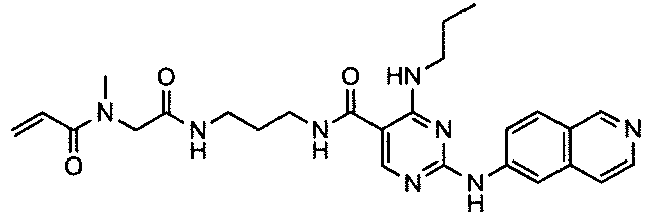
1H-NMR (CDCl3) δ: 9.10 (1H, s), 9.01 (1H, brs), 8.48-8.42 (3H, m), 7.87 (1H, d, J=9.2Hz), 7.70 (1H, brs), 7.62 (1H, dd, J=9.2, 2.0Hz), 7.53 (1H, d, J=5.3Hz), 7.45 (1H, brs), 6.97 (1H, brs), 6.64 (1H, dd, J=16.8, 10.2Hz), 6.40 (1H, dd, J=16.5, 2.0Hz), 5.80 (1H, dd, J=10.2, 1.7Hz), 4.08 (2H, s), 3.58-3.50 (2H, m), 3.44-3.34 (4H, m), 3.22 (3H, s), 1.82-1.70 (4H, m), 1.06 (3H, t, J=7.3Hz) 6-7 
1H-NMR (CDCl3) δ: 9.07 (1H, s), 9.03 (1H, t, J=5.6Hz), 8.51 (1H, s), 8.46 (1H, s), 8.40 (1H, d, J=5.3Hz), 8.14 (1H, brs), 7.84 (1H, d, J=8.6Hz), 7.71 (1H, brs), 7.62 (1H, dd, J=8.6, 2.0Hz), 7.50 (1H, d, J=5.3Hz), 7.22 (1H, t, J=6.3Hz), 6.87 (1H, s), 6.28 (1H, dd, J=17.2, 2.0Hz), 6.17 (1H, dd, J=16.8, 9.6Hz), 5.63 (1H, dd, J=9.9, 2.0Hz), 3.53 (2H, q, J=6.6Hz), 3.46-3.36 (4H, m), 1.80-1.70 (4H, m), 1.61 (6H, s), 1.05 (3H, t, J=7.6Hz) 6-8 
MS m/z (M+H): 576.3 6-9 
1H-NMR (DMSO-d6) δ: 10.13 (1H, s), 10.06 (1H, s), 9.95 (1H, s), 9.12 (1H, s), 8.88 (1H, brs), 8.77 (1H, s), 8.65 (1H, s), 8.39 (1H, d, J=5.9Hz), 8.10 (1H, s), 8.02 (1H, d, J=9.2Hz), 7.89 (1H, d, J=9.2Hz), 7.60 (1H, d, J=5.9Hz), 7.38-7.22 (3H, m), 6.70-6.54 (2H, m), 5.16-5.06 (1H, m), 3.56 (2H, q, J=6.6Hz), 3.05 (3H, s), 2.14 (6H, s), 1.78-1.64 (2H, m), 1.37 (3H, d, J=7.3Hz), 1.00 (3H, t, J=7.6Hz) -

- By using 6-bromophthalazine, ethyl 2-((phthalazin-6-yl)amino)-4-(propylamino)pyrimidine-5-carboxylate (E5) was obtained in the same manner as that of Example 7, (4).
MS m/z (M+H): 353.2 -

- By using ethyl 2-((phthalazin-6-yl)amino)-4-(propylamino)pyrimidine-5-carboxylate (E5), 2-((phthalazin-6-yl)amino)-4-(propylamino)pyrimidine-5-carboxylic acid (E39) was obtained in the same manner as that of Example 7, (5).
MS m/z (M+H): 325.2 -

- By using 2-((phthalazin-6-yl)amino)-4-(propylamino)pyrimidine-5-carboxylic acid (E39), tert-butyl (3-(2-((phthalazin-6-yl)amino)-4-(propylamino)pyrimidine-5-carboxamido)propyl)carbamate (E40) was obtained in the same manner as that of Example 12,(1).
MS m/z (M+H): 481.3 -

- By using tert-butyl (3-(2-((phthalazin-6-yl)amino)-4-(propylamino)pyrimidine-5-carboxamido)propyl)carbamate (E40), N-(3-aminopropyl)-(2-((phthalazin-6-yl)amino)-4-(propylamino)pyrimidine-5-carboxamide (E41) was obtained in the same manner as that of Example 12, (3).
MS m/z (M+H): 381.3 -

- By using N-(3-aminopropyl)-(2-((phthalazin-6-yl)amino)-4-(propylamino)pyrimidine-5-carboxamide (E41), tert-butyl methyl(2-oxo-2-((3-(2-((phthalazin-6-yl)amino)-4-(propylamino)pyrimidine-5-carboxamido)propyl)amino)ethyl)carbamate (E42) was obtained in the same manner as that of Example 12, (4).
MS m/z (M+H): 552.3 -

- By using tert-butyl methyl(2-oxo-2-((3-(2-((phthalazin-6-yl)amino)-4-(propylamino)pyrimidine-5-carboxamido)propyl)amino)ethyl)carbamate (E42), N-(3-(2-(N-methylacrylylamido)actamido)propyl)-2-((phthalazin-6-yl)amino)-4-(propylamino)pyrimidine-5-carboxamide (6-10A) was obtained in the same manner as that of Example 1.
MS m/z [M+H]: 506.3 -

- By using 6-bromocinnoline, ethyl 2-((cinnolin-6-yl)amino)-4-(propylamino)pyrimidine-5-carboxylate (E6) was obtained in the same manner as that of Example 7, (4).
MS m/z (M+H): 353.2 -
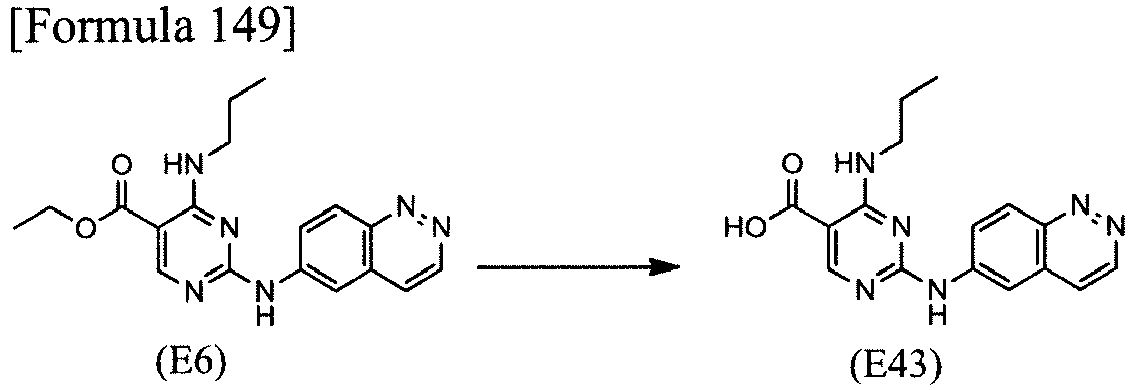
- By using ethyl 2-((cinnolin-6-yl)amino)-4-(propylamino)pyrimidine-5-carboxylate (E6), 2-((cinnolin-6-yl)amino)-4-(propylamino)pyrimidine-5-carboxylic acid (E43) was obtained in the same manner as that of Example 7, (5).
-

- By using 2-((cinnolin-6-yl)amino)-4-(propylamino)pyrimidine-5-carboxylic acid (E43), tert-butyl (3-(2-((cinnolin-6-yl)amino)-4-(propylamino)pyrimidine-5-carboxamido)propyl)carbamate (E44) was obtained in the same manner as that of Example 12,(1).
-

- By using tert-butyl (3-(2-((cinnolin-6-yl)amino)-4-(propylamino)pyrimidine-5-carboxamido)propyl)carbamate (E44), N-(3-aminopropyl)-2-((cinnolin-6-yl)amino)-4-(propylamino)pyrimidine-5-carboxamide (E45) was obtained in the same manner as that of Example 12, (3).
-

- By using N-(3-aminopropyl)-2-((cinnolin-6-yl)amino)-4-(propylamino)pyrimidine-5-carboxamide (E45), (S)-tert-butyl (1-((3-(2-((cinnolin-6-yl)amino)-4-(propylamino)pyrimidine-5-carboxamido)propyl)amino)-1-oxopropan-2-yl)(methyl)carbamate (E46) was obtained in the same manner as that of Example 12, (4).
-
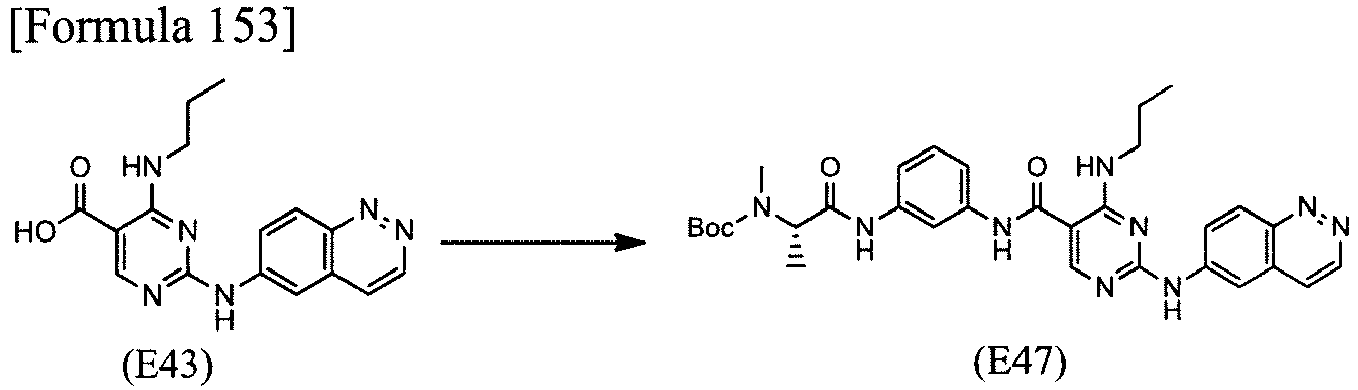
- By using 2-((cinnolin-6-yl)amino)-4-(propylamino)pyrimidine-5-carboxylic acid (E43), (S)-tert-butyl (1-((3-(2-((cinnolin-6-yl)amino)-4-(propylamino)pyrimidine-5-carboxamido)phenyl)amino)-1-oxopropan-2-yl)(methyl)carbamate (E47) was obtained in the same manner as that of Example 7, (9).
- By using Intermediates (E46) and (E47), Compounds (6-10B) and (6-11) were obtained in the same manner as that of Example 1 or Example 14.
[Table 54] Compound No. Structure Physicochemical data 6-10B 
1H-NMR (DMSO-d6) δ: 10.24 (1H, s), 9.16 (1H, s), 8.68 (1H, d), 8.58 (1H, s), 8.40-8.30 (2H, m), 8.08 (1H, dd), 7.93 (1H, d), 3.57-3.38 (4H, m), 3.35-2.98 (5H, m), 2.93 (3H, s), 2.15 (6H, s), 1.75-1.60 (4H, m), 1.23 (3H, d),0.99 (3H, t) 6-11 
1H-NMR (DMSO-d6) δ: 10.35 (1H, s), 10.10 (1H, s), 9.96 (1H, s), 9.18 (1H, d), 8.89 (1H, t), 8.79 (1H, s), 8.71 (1H, d), 8.34 (1H, d), 8.14-8.09 (2H, m), 7.95 (1H, d), 7.37-7.22 (3H, m), 6.66-6.54 (2H, m), 3.57 (2H, q), 3.07-3.02 (5H, brs), 2.16 (6H, s), 2.16-2.11 (1H, m), 1.71 (2H, dt), 1.36 (3H, d), 1.00 (3H, t) -

- To a solution of ethyl 2-amino-4-(propylamino)pyrimidine-5-carboxylate (C3, 5.00 g) and pyridine (2.2 mL) in N,N-dimethylformamide (45 mL), phenyl chloroformate (3.1 mL) was added dropwise under ice cooling, and the mixture was stirred at the same temperature for 40 minutes. To the reaction mixture, pyridine (1.0 mL) and phenyl chloroformate (1.5 mL) were added under ice cooling, and the mixture was stirred at the same temperature for 40 minutes. The reaction mixture was poured into water. The solid matter was taken by filtration, and dried under reduced pressure to obtain ethyl 2-((phenoxycarbonyl)amino)-4-(propylamino)pyrimidine-5-carboxylate (E7, 2.89 g) as white solid.
MS m/z[M+H]: 345.2 -

- To ethyl 2-((phenoxycarbonyl)amino)-4-(propylamino)pyrimidine-5-carboxylate (E7, 2.89 g) and 4-aminopyridine (3.16 g), N,N-dimethylformamide (30 mL) was added at room temperature, and the mixture was stirred at 70°C for 30 minutes. The reaction mixture was cooled to room temperature, and then the reaction mixture was poured into water (300 mL). The solid matter was taken by filtration, and purified by silica gel column chromatography (eluent, ethyl acetate) to obtain ethyl 4-(propylamino)-2-(3-(pyridin-4-yl)ureido)pyrimidine-5-carboxylate (E8, 830 mg) as white solid.
MS m/z [M+H]: 345.2 -
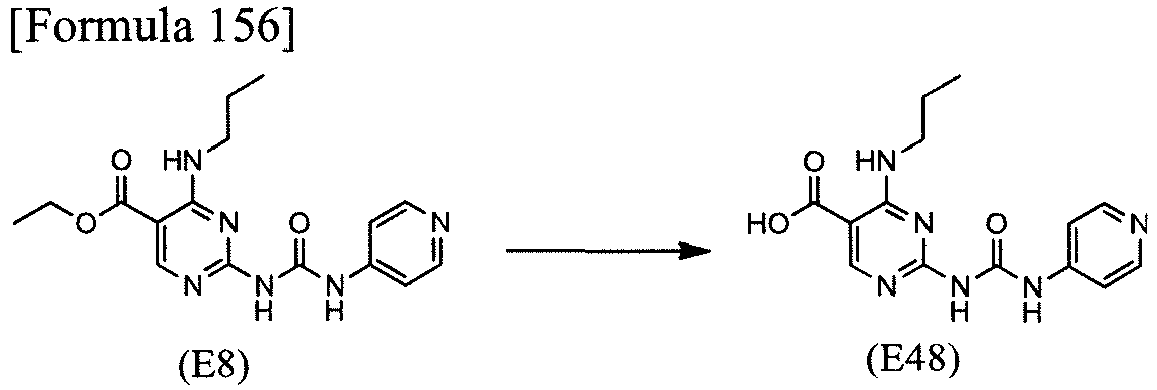
- By using ethyl 4-(propylamino)-2-(3-(pyridin-4-yl)ureido)pyrimidine-5-carboxylate (E8), 4-(propylamino)-2-(3-(pyridin-4-yl)ureido)pyrimidine-5-carboxylic acid (E48) was obtained in the same manner as that of Example 7, (5).
MS m/z (M+H): 317.2 -


- By using 4-(propylamino)-2-(3-(pyridin-4-yl)ureido)pyrimidine-5-carboxylic acid (E48), tert-butyl (3-(4-(propylamino)-2-(3-(pyridin-4-yl)ureido)pyrimidine-5-carboxamido)propyl)carbamate (E49) was obtained in the same manner as that of Example 12, (1).
MS m/z (M+H): 473.3 -

- By using tert-butyl (3-(4-(propylamino)-2-(3-(pyridin-4-yl)ureido)pyrimidine-5-carboxamido)propyl)carbamate (E49), N-(3-aminopropyl)-4-(propylamino)-2-(3-(pyridin-4-yl)ureido)pyrimidine-5-carboxamide (E50) was obtained in the same manner as that of Example 12, (3).
-

- By using N-(3-aminopropyl)-4-(propylamino)-2-(3-(pyridin-4-yl)ureido)pyrimidine-5-carboxamide (E50), tert-butyl methyl (2-oxo-2-((3-(4-(propylamino)-2-(3-(pyridin-4-yl)ureido)pyrimidine-5-carboxamido)propyl)amino)ethyl)carbamate (E51) was obtained in the same manner as that of Example 12, (4).
MS m/z (M+H): 544.3 -

- By using 4-(propylamino)-2-(3-(pyridin-4-yl)ureido)pyrimidine-5-carboxylic acid (E48), (S)-tert-butyl methyl(1-oxo-1-((3-(4-(propylamino)-2-(3-(pyridin-4-yl)ureido)pyrimidine-5-carboxamido)phenyl)amino)propan-2-yl)carbamate (E52) was obtained in the same manner as that of Example 7, (9).
MS m/z (M+H): 592.3 - In the same manner as that of Example 1 or Example 14, Compounds (6-12) to (6-15) were obtained.
[Table 55] Compound No. Structure Physicochemical data 6-12 
1H-NMR (CD3OD) δ: 8.47-8.46 (1H, m), 8.39-8.38 (2H, m), 7.63-7.62 (2H, m), 6.81-6.62 (1H, m), 6.27-6.21 (1H, m), 5.78-5.72 (1H, m), 4.12-3.99 (2H, m), 3.50 (2H, t, J=6.9Hz), 3.37 (2H, t, J=6.9Hz), 3.21 (3H, s), 3.14-3.04 (2H, m), 1.93-1.64 (4H, m), 1.14-0.90 (3H, m) 6-13 
1H-NMR (CDCl3) δ: 11.66 (1H, brs), 9.12 (1H, brs), 8.44-8.42 (3H, m), 7.85-7.71 (1H, m), 7.38 (2H, brs), 7.24-7.11 (1H, m), 6.91-6.89 (1H, m), 6.47 (1H, d, J=15.2Hz), 4.10 (2H, s), 3.41-3.28 (6H, m), 3.22 (3H, s), 3.13-3.08 (2H, m), 2.47 (1H, brs), 2.24 (6H, s), 1.72-1.65 (4H, m), 1.00 (3H, t, J=6.3Hz) 6-14 
MS m/z[M+H]: 603.3 6-15 
1H-NMR (CD3OD) δ: 8.65 (1H, s), 8.38 (2H, d, J=4.6Hz), 7.94 (1H, s), 7.58 (2H, d, J=4.6Hz), 7.38-7.24 (3H, m), 6.82 (1H, dt, J=15.4, 6.4Hz), 6.16 (1H, d, J=15.9Hz), 4.61 (1H, q, J=7.0Hz), 3.51 (2H, t, J=7.3Hz), 3.17-3.13 (2H, m), 2.29 (6H, s), 1.80-1.70 (2H, m), 1.47 (3H, d, J=6.6Hz), 1.06 (3H, t, J=8.0Hz) -

- To a solution of 4-(propylamino)-2-((2-(pyridin-4-yl)ethyl)amino)pyrimidine-5-carboxylic acid (A3, 90 mg) in N,N-dimethylformamide (2 mL), 1-ethyl-3-(3-dimethylaminopropyl)carbodiimide hydrochloride (63 mg) and 1-hydroxybenzotriazole monohydrate (45 mg) were added at room temperature, and the mixture was stirred at the same temperature for 2 hours and 30 minutes. To the reaction mixture, N,N-diisopropylethylamine (153 µL) and 1-benzyl-3-aminopyrrolidine (53 mg) were added at room temperature, and the mixture was stirred at the same temperature for 2 hours. To the reaction mixture, water was added. The solid matter was taken by filtration, washed with water, and then dried under reduced pressure. The obtained solid matter was purified by basic silica gel column chromatography to obtain N-(1-benzylpyrrolidin-3-yl)-4-(propylamino)-2-((2-(pyridin-4-yl)ethyl)amino)pyrimidine-5-carboxamide (E9, 117 mg).
MS m/z (M+H): 460.3 -

- To a suspension of 10% palladium-carbon (12 mg) in methanol (1 mL), a solution of ammonium formate (64 mg) and N-(1-benzylpyrrolidin-3-yl)-4-(propylamino)-2-((2-(pyridin-4-yl)ethyl)amino)pyrimidine-5-carboxamide (E9, 117 mg) in methanol (4 mL) was added at room temperature, and the mixture was stirred for 5 hours and 30 minutes under reflux by heating. The reaction mixture was cooled to room temperature, and then methanol was added to the mixture. The insoluble matter was removed by filtration through Cerite, and then the solvent was evaporated under reduced pressure. The obtained residue was purified by basic silica gel column chromatography to obtain 4-(propylamino)-2-((2-(pyridin-4-yl)ethyl)amino)-N-(pyrrolidin-3-yl)pyrimidine-5-carboxamide (E10, 85 mg).
-
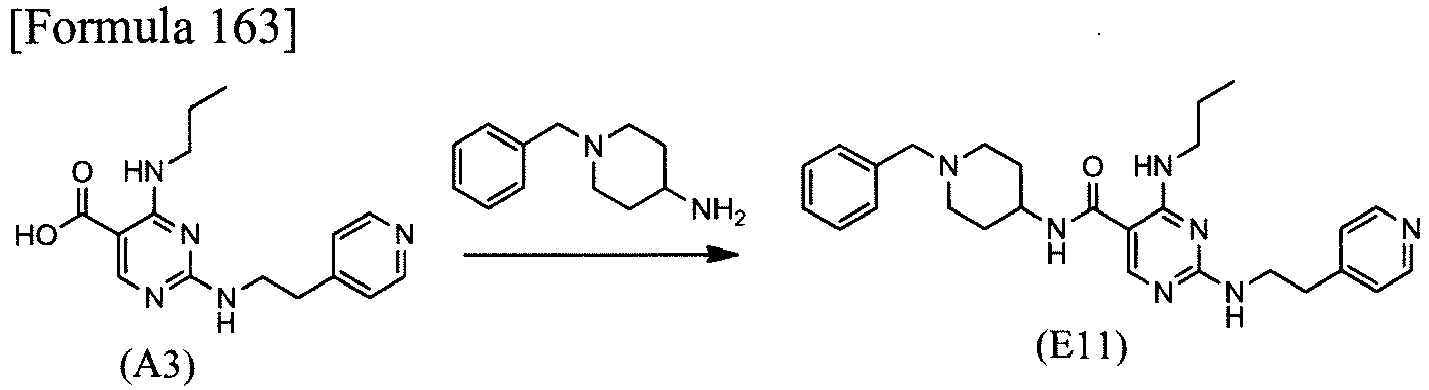
- By using 4-amino-1-benzylpiperazine, N-(1-benzylpiperidin-4-yl)-4-(propylamino)-2-((2-(pyridin-4-yl)ethyl)amino)pyrimidine-5-carboxamide (E11) was obtained in the same manner as that of Example 23, (1).
MS m/z (M+H): 474.4 -

- By using N-(1-benzylpiperidin-4-yl)-4-(propylamino)-2-((2-(pyridin-4-yl)ethyl)amino)pyrimidine-5-carboxamide (E11), N-(piperidin-4-yl)-4-(propylamino)-2-((2-(pyridin-4-yl)ethyl)amino)pyrimidine-5-carboxamide (E12) was obtained in the same manner as that of Example 23, (2).
MS m/z (M+H): 384.3 - By using Intermediates (E10) and (E12), Intermediates (E53) and (E54) were obtained in the same manner as that of Example 12, (4).
[Table 56] Compound No. Structure Physicochemical data E53 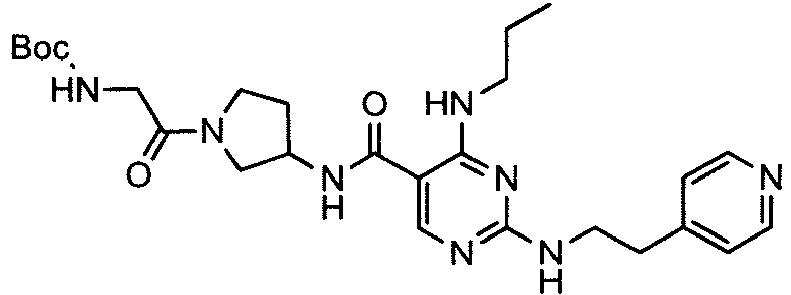
- E54 
- - In the same manner as that of Example 1, Compounds (6-16) to (6-19) were obtained.
[Table 57] Compound No. Structure Physicochemical data 6-16 
1H-NMR (CD3OD) δ: 8.40 (2H, d, J=6.4Hz), 8.24 (1H, s), 7.31 (2H, d, J=6.4Hz), 6.68-6.50 (1H, m), 6.32-6.20 (1H, m), 5.78-5.68 (1H, m), 4.60-4.44 (1H, m), 4.00-3.26 (8H, m), 2.97 (2H, t, J=6.9Hz), 2.36-2.16 (1H, m), 2.12-1.94 (1H, m), 1.64 (2H, q, J=7.3Hz), 0.98 (3H, t, J=7.6Hz) 6-17 
1H-NMR (CDCl3) δ: 8.76 (1H, brs), 8.49 (2H, d, J=5.9Hz), 8.16 (1H, brs), 7.13 (2H, d, J=5.3Hz), 7.12-7.04 (1H, m), 6.95 (1H, brs), 6.29 (1H, d, J=17.2Hz), 6.18 (1H, dd, J=17.2, 9.9Hz), 5.65 (1H, d, J=9.9Hz), 5.62-5.44 (1H, m), 4.68-4.56 (1H, m), 4.16-4.06 (1H, m), 4.00-3.84 (1H, m), 3.80-3.38 (8H, m), 2.90 (2H, t, J=6.9Hz), 2.36-2.08 (2H, m), 1.72-1.58 (2H, m), 0.99 (3H, t, J=7.3Hz) 6-18 
1H-NMR (CDCl3) δ: 8.70 (1H, brs), 8.51 (2H, d, J=5.9Hz), 8.05 (1H, brs), 7.15 (2H, d, J=5.9Hz), 6.59 (1H, dd, J=16.5, 10.6Hz), 6.27 (1H, dd, J=16.5, 2.0Hz), 5.97 (1H, d, J=7.3Hz), 5.69 (1H, dd, J=10.2, 1.7Hz), 5.30 (1H, s), 4.70-4.60 (1H, m), 4.20-4.06 (1H, m), 4.05-3.96 (1H, m), 3.68 (2H, q, J=6.6Hz), 3.42 (2H, brs), 3.28-3.14 (1H, m), 2.91 (2H, t, J=6.9Hz), 2.86-2.76 (1H, m), 2.16-1.98 (2H, m), 1.72-1.58 (2H, m), 1.50-1.36 (2H, m), 0.99 (3H, t, J=7.6Hz) 6-19 
1H-NMR (CDCl3) δ: 8.70 (1H, brs), 8.51 (2H, d, J=5.9Hz), 8.02 (1H, brs), 7.15 (2H, d, J=5.9Hz), 6.79 (1H, brs), 6.31 (1H, dd, J=16.8, 1.7Hz), 6.19 (1H, dd, J=17.2, 9.9Hz), 5.93 (1H, d, J=7.3Hz), 5.68 (1H, dd, J=9.9, 2.0Hz), 5.36 (1H, brs), 4.59 (1H, d, J=13.9Hz), 4.26-4.04 (3H, m), 3.79 (1H, d, J=12.6Hz), 3.68 (2H, q, J=6.6Hz), 3.42 (2H, brs), 3.18 (1H, t, J=11.6Hz), 2.94-2.78 (3H, m), 2.18-2.02 (2H, m), 1.70-1.60 (2H, m), 1.52-1.36 (2H, m), 0.99 (3H, t, J=7.3Hz) -

- To a suspension of lithium aluminum hydride (160 mg) in tetrahydrofuran (14 mL), ethyl 2-((3-fluorophenyl)amino)-4-(propylamino)pyrimidine-5-carboxylate (E3, 450 mg) was added under ice cooling, and the mixture was stirred at the same temperature for 1 hour and 30 minutes. To the reaction mixture, lithium aluminum hydride (80 mg) was added under ice cooling, and the mixture was stirred at the same temperature for 1 hour. To the reaction mixture, ethyl acetate and an aqueous solution of the Rochell salt were added at room temperature, and the mixture was stirred at the same temperature for 2 hours and 30 minutes. The insoluble matter was removed by filtration through Cerite. The organic layer was separated, washed with saturated aqueous sodium chloride, and then dried over anhydrous sodium sulfate, and the solvent was evaporated under reduced pressure. The obtained residue was purified by silica gel column chromatography (eluent, 100 to 90% ethyl acetate in methanol) to obtain (2-((3-fluorophenyl)amino)-4-(propylamino)pyrimidin-5-yl)methanol (E13, 212 mg).
MS m/z (M+H): 277.2 -

- To a solution of (2-((3-fluorophenyl)amino)-4-(propylamino)pyrimidin-5-yl)methanol (E13, 26 mg) in chloroform (2 mL), manganese dioxide (41 mg) was added at room temperature, and the mixture was stirred at 50°C for 4 hours. The reaction mixture was cooled to room temperature, then the insoluble matter was removed by filtration through Cerite, and then the solvent was evaporated under reduced pressure. The obtained residue was purified by silica gel column chromatography (eluent, 70 to 40% hexane in ethyl acetate) to obtain 2-((3-fluorophenyl)amino)-4-(propylamino)pyrimidine-5-carbaldehyde (E14, 26 mg).
MS m/z (M+H): 275.1 -

- To a solution of N-Boc-N-methyl-L-alanine (561 mg) in tetrahydrofuran (14 mL), isobutyl chloroformate (362 µL) and N-methylmorpholine (303 µL) were added under ice cooling, and the mixture was stirred at the same temperature for 30 minutes. To the reaction mixture, 3-benzyloxyaniline (500 mg) was added under ice cooling, and the mixture was stirred at room temperature for 30 minutes. To the reaction mixture, water and ethyl acetate were added. The organic layer was separated, washed with saturated aqueous sodium chloride, and then dried over anhydrous sodium sulfate, and the solvent was evaporated under reduced pressure. The obtained residue was purified by silica gel column chromatography (eluent, 100 to 70% hexane in ethyl acetate) to obtain (S)-tert-butyl (1-((3-(benzyloxy)phenyl)amino)-1-oxopropan-2-yl)(methyl)carbamate (E15, 903 mg).
MS m/z (M+H): 385.2 -

- To 10% palladium-carbon (100 mg), a solution of (S)-tert-butyl (1-((3-(benzyloxy)phenyl)amino)-1-oxopropan-2-yl)(methyl)carbamate (E15, 166 mg) in methanol (4 mL) and tetrahydrofuran (2 mL) was added at room temperature, and the mixture was stirred at the same temperature for 5 hours and 30 minutes under a hydrogen atmosphere. The insoluble matter was removed by filtration through Cerite, and then the solvent was evaporated under reduced pressure to obtain (S)-tert-butyl (1-((3-hydroxyphenyl)amino)-1-oxopropan-2-yl)(methyl)carbamate (E16,136 mg).
MS m/z (M+H): 295.2 -


- To a solution of (S)-tert-butyl (1-((3-hydroxyphenyl)amino)-1-oxopropan-2-yl)(methyl)carbamate (E16, 68 mg), a solution of (2-((3-fluorophenyl)amino)-4-(propylamino)pyrimidin-5-yl)methanol (E13, 50 mg) and triphenylphosphine (52 mg) in tetrahydrofuran (2 mL), a 40% solution of diethyl azodicarboxylate in toluene (86 µL) was added under ice cooling, and the mixture was stirred at the same temperature for 15 minutes, and then stirred at room temperature for 2 hours. To the reaction mixture, water and ethyl acetate were added. The organic layer was separated, washed with saturated aqueous sodium chloride, and then dried over anhydrous sodium sulfate, and the solvent was evaporated under reduced pressure. The obtained residue was purified by silica gel column chromatography (eluent, 70 to 0% hexane in ethyl acetate) to obtain (S)-tert-butyl (1-((3-((2-((3-fluorophenyl)amino)-4-(propylamino)pyrimidin-5-yl)methoxy)phenyl)amino)-1-oxopropan-2-yl)(methyl)carbamate (E17, 54 mg).
MS m/z (M+H): 553.3 -
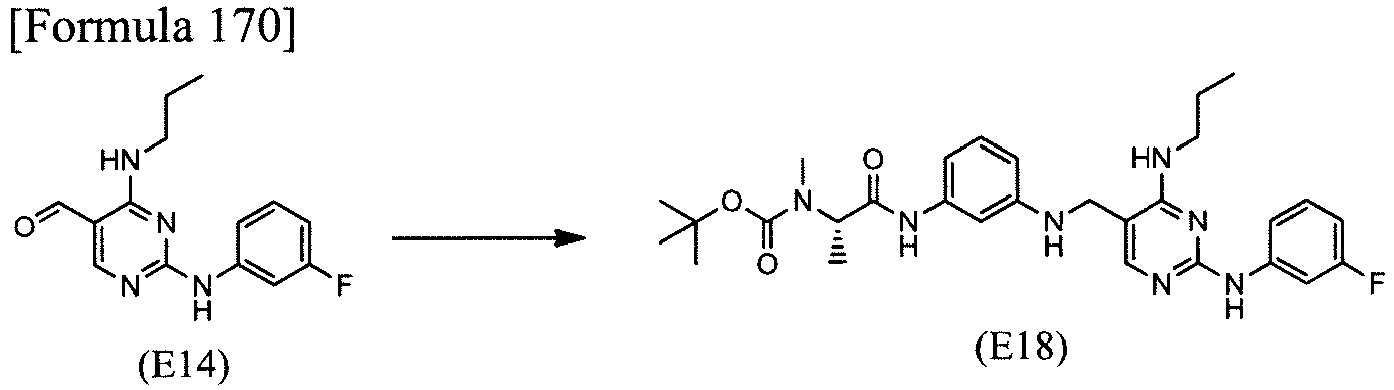
- To a solution of (S)-tert-butyl (1-((3-aminophenyl)amino)-1-oxopropan-2-yl)(methyl)carbamate (B9, 28 mg) and 2-((3-fluorophenyl)amino)-4-(propylamino)pyrimidine-5-carbaldehyde (E14, 24 mg) in methylene chloride (2 mL), sodium triacetoxyborohydride (28 mg) and acetic acid (50 µL) were added at room temperature, and the mixture was stirred at the same temperature for 5 hours. To the reaction mixture, ethyl acetate and saturated aqueous sodium hydrogencarbonate were added. The organic layer was separated, washed with saturated aqueous sodium chloride, and then dried over anhydrous sodium sulfate, and the solvent was evaporated under reduced pressure. The obtained residue was purified by silica gel column chromatography (eluent, 60 to 0% hexane in ethyl acetate) to obtain (S)-tert-butyl (1-((3-(((2-((3-fluorophenyl)amino)-4-(propylamino)pyrimidin-5-yl)methyl)amino)phenyl)amino)-1-oxopropan-2-yl)(methyl)carbamate (E18, 33 mg).
MS m/z (M+H): 552.3 -

- To a solution of (2-((3-fluorophenyl)amino)-4-(propylamino)pyrimidin-5-yl)methanol (E13, 20 mg) and 3-nitrothiophenol (17 mg) in tetrahydrofuran (1 mL), tributylphosphine (36 µL) and 1,1'-(azodicarbonyl)dipiperidine (28 mg) were added under ice cooling, and the mixture was stirred at room temperature for 6 hours and 30 minutes. To the reaction mixture, tributylphosphine (36 µL) and 1,1'-(azodicarbonyl)dipiperidine (28 mg) were added at room temperature, and the mixture was stirred at the same temperature for 8 hours and 30 minutes. The solvent was evaporated under reduced pressure, and then the obtained residue was purified by basic silica gel column chromatography (eluent, 88 to 40% hexane in ethyl acetate) to obtain N2-(3-fluorophenyl)-5-(((3-nitrophenyl)thio)methyl)-N4-propylpyrimidine-2,4-diamine (E19, 19 mg) as yellow solid.
MS m/z (M+H): 414.3 -

- To a solution of N2-(3-fluorophenyl)-5-(((3-nitrophenyl)thio)methyl)-N4-propylpyrimidine-2,4-diamine (E19, 160 mg) in ethanol (4 mL) and ethyl acetate (8 mL), tin(II) chloride (739 mg) was added at room temperature, and the mixture was stirred at 70°C for 1 hour. The reaction mixture was cooled to room temperature, and then water and ethyl acetate were added to the mixture. The organic layer was separated, washed successively with water and saturated aqueous sodium chloride, and then dried over anhydrous magnesium sulfate, and the solvent was evaporated under reduced pressure to obtain 5-(((3-aminophenyl)thio)methyl)-N2-(3-fluorophenyl)-N4-propylpyrimidine-2,4-diamine (E20).
MS m/z (M+H): 384.3 -
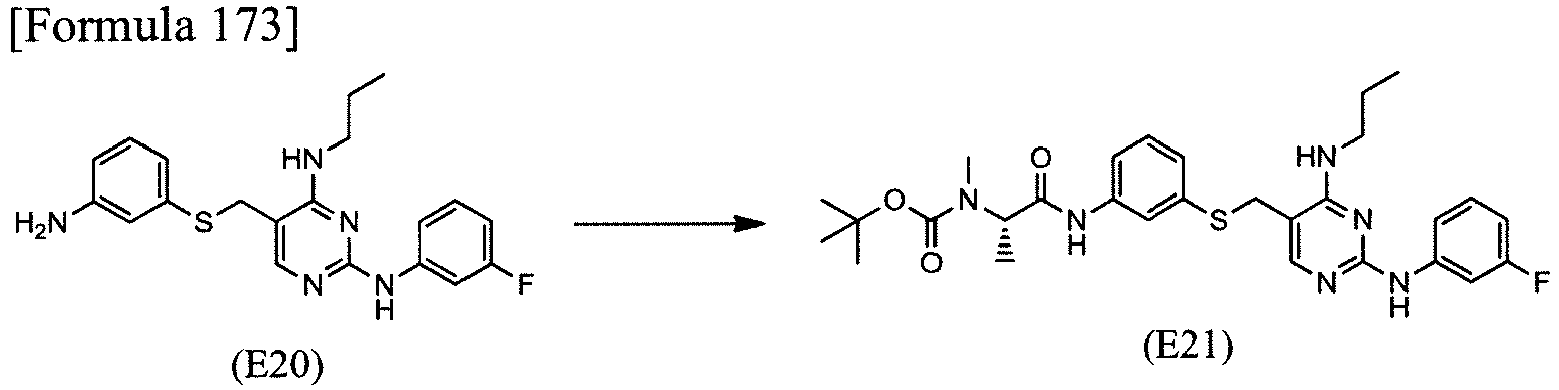
- To 5-(((3-aminophenyl)thio)methyl)-N2-(3-fluorophenyl)-N4-propylpyrimidine-2,4-diamine (E20) obtained above, N-Boc-N-methyl-L-alanine (179 mg), 1-ethyl-3-(3-dimethylaminopropyl)carbodiimide hydrochloride (169 mg) and 1-hydroxybenzotriazole monohydrate (119 mg), N,N-dimethylformamide (2.5 mL) and N,N-diisopropylethylamine (299 µL) were added at room temperature, and the mixture was stirred at 40°C for 11 hours. The reaction mixture was cooled to room temperature, and then saturated aqueous sodium hydrogencarbonate and ethyl acetate were added to the mixture. The organic layer was separated, washed successively with water, saturated aqueous sodium hydrogencarbonate and saturated aqueous sodium chloride, and then dried over anhydrous magnesium sulfate, and the solvent was evaporated under reduced pressure. The obtained residue was purified by silica gel column chromatography (eluent, 88 to 28% hexane in ethyl acetate) to obtain oily (S)-tert-butyl (1-((3-(((2-((3-fluorophenyl)amino)-4-(propylamino)pyrimidin-5-yl)methyl)thio)phenyl)amino)-1-oxopropan-2-yl)(methyl)carbamate (E21, 47 mg).
MS m/z (M+H): 569.4 - In the same manner as that of Example 1 or Example 14, Compounds (6-20) to (6-22) were obtained.
[Table 58] Compound No. Structure Physicochemical data 6-20 
1H-NMR (CDCl3) δ: 7.78 (1H, s), 7.77-7.75 (1H, m), 7.50 (1H, s), 7.25-6.90 (4H, m), 6.71-6.63 (1H, m), 6.46-6.39 (1H, m), 5.48 (1H, dt), 5.28 (1H, d), 4.88 (2H, s), 3.52-3.43 (3H, m), 3.11 (2H, d), 3.01 (3H, s), 2.28 (6H, s), 1.74-1.62 (2H, m), 1.43 (3H, d), 1.00 (3H, t) 6-21 
1H-NMR (CDCl3) δ: 7.85-7.78 (1H, m), 7.83 (1H, s), 7.26-7.07 (3H, m), 7.00-6.94 (1H, m), 6.82-6.76 (1H, m), 6.71-6.63 (1H, m), 6.50-6.43 (1H, m), 5.83-5.73 (1H, m), 5.33-5.24 (1H, m), 4.06 (2H, d), 3.49-3.40 (3H, m), 3.11 (3H, d), 3.01 (3H, s), 2.27 (6H, s), 1.71-1.57 (2H, m), 1.42 (3H, d),0.96 (3H, t) 6-22 
1H-NMR (CDCl3) δ: 8.88 (1H, s), 7.78 (1H, dt, J=11.5, 2.0Hz), 7.71 (1H, s), 7.67 (1H, s), 7.36-6.95 (7H, m), 6.65 (1H, td, J=8.3, 2.0Hz), 6.42 (1H, d, J=15.2Hz), 5.45 (1H, t, J=5.3Hz), 5.28 (1H, q, J=6.6Hz), 3.92 (2H, s), 3.55-3.45 (2H, m), 3.11 (2H, d, J=5.9Hz), 3.01 (3H, s), 2.27 (6H, s), 1.77-1.63 (2H, m), 1.42 (3H, d, J=7.3Hz), 1.02 (3H, t, J=7.3Hz) -


- To a solution of ethyl 2-((3-fluorophenyl)amino)-4-(propylamino)pyrimidine-5-carboxylate (E3, 247 mg) in ethanol (3 mL) and tetrahydrofuran (1.5 mL), 2.0 mol/L aqueous sodium hydroxide (0.78 mL) was added at room temperature, and the mixture was stirred at 50°C for 1 hour. To the reaction mixture, 2.0 mol/L aqueous sodium hydroxide (0.39 mL) was added at 50°C, and the mixture was stirred at the same temperature for 3 hours. The reaction mixture was cooled to room temperature, and then 1.0 mol/L aqueous hydrochloric acid was added to the reaction mixture until the mixture became acidic. The solid matter was taken by filtration, washed with water, and then dried under reduced pressure to obtain 2-((3-fluorophenyl)amino)-4-(propylamino)pyrimidine-5-carboxylic acid (E22, 130 mg).
MS m/z (M+H): 290.1 -

- To 2-((3-fluorophenyl)amino)-4-(propylamino)pyrimidine-5-carboxylic acid (E22, 19 mg), thionyl chloride (2 mL) was added at room temperature, and the mixture was stirred for 2 hours under reflux by heating. The reaction mixture was cooled to room temperature, and then toluene was added to the mixture. The solvent was evaporated under reduced pressure to obtain 2-((3-fluorophenyl)amino)-4-(propylamino)pyrimidine-5-carbonyl chloride (E23) as white solid.
-


- To 2-((3-fluorophenyl)amino)-4-(propylamino)pyrimidine-5-carbonyl chloride (E23) obtained above and 2-amino-5-nitrophenol (15 mg), 1,4-dioxane (1.5 mL) was added at room temperature, the reaction vessel was sealed, and then by using a microwave reaction system, the mixture was stirred at 210°C for 30 minutes. The reaction mixture was cooled to room temperature, and then saturated aqueous sodium hydrogencarbonate and ethyl acetate were added to the reaction mixture. The organic layer was separated, washed successively with saturated aqueous sodium hydrogencarbonate and saturated aqueous sodium chloride, and then dried over anhydrous magnesium sulfate, and the solvent was evaporated under reduced pressure. The obtained residue was purified by silica gel column chromatography (eluent, 88 to 20% hexane in ethyl acetate) to obtain 2-((3-fluorophenyl)amino)-N-(2-hydroxy-4-nitrophenyl)-4-(propylamino)pyrimidine-5-carboxamide (E24, 11 mg) as yellow solid.
MS m/z (M+H): 427.3 -

- To 2-((3-fluorophenyl)amino)-N-(2-hydroxy-4-nitrophenyl)-4-(propylamino)pyrimidine-5-carboxamide (E24, 11 mg) and p-toluenesulfonic acid monohydrate (15 mg), xylene (1.5 mL) was added at room temperature, and the mixture was stirred at 155°C for 4 hours. The reaction mixture was cooled to room temperature, and then purified by silica gel column chromatography (eluent, 100 to 80% ethyl acetate in methanol). To the obtained solid matter, saturated aqueous sodium hydrogencarbonate and ethyl acetate were added. The organic layer was separated, washed successively with saturated aqueous sodium hydrogencarbonate and saturated aqueous sodium chloride, and then dried over anhydrous magnesium sulfate, and the solvent was evaporated under reduced pressure. To the obtained residue, ethyl acetate were added, and the solid matter was taken by filtration to obtain N2-(3-fluorophenyl)-5-(6-nitrobenzo[d]oxazol-2-yl)-N4-propylpyrimidine-2,4-diamine (E25) as yellow solid.
MS m/z (M+H): 409.3 -

- To a solution of N2-(3-fluorophenyl)-5-(6-nitrobenzo[d]oxazol-2-yl)-N4-propylpyrimidine-2,4-diamine (E25) obtained above in ethanol (1.5 mL) and ethyl acetate (1.5 mL), tin(II) chloride (49 mg) was added at room temperature, and the mixture was stirred at 70°C for 50 minutes. The reaction mixture was cooled to room temperature, and then saturated aqueous sodium hydrogencarbonate and ethyl acetate were added to the reaction mixture. The organic layer was separated, washed with saturated aqueous sodium chloride, and then dried over anhydrous magnesium sulfate to obtain 5-(6-aminobenzo[d]oxazol-2-yl)-N2-(3-fluorophenyl)-N4-propylpyrimidine-2,4-diamine (E26).
-
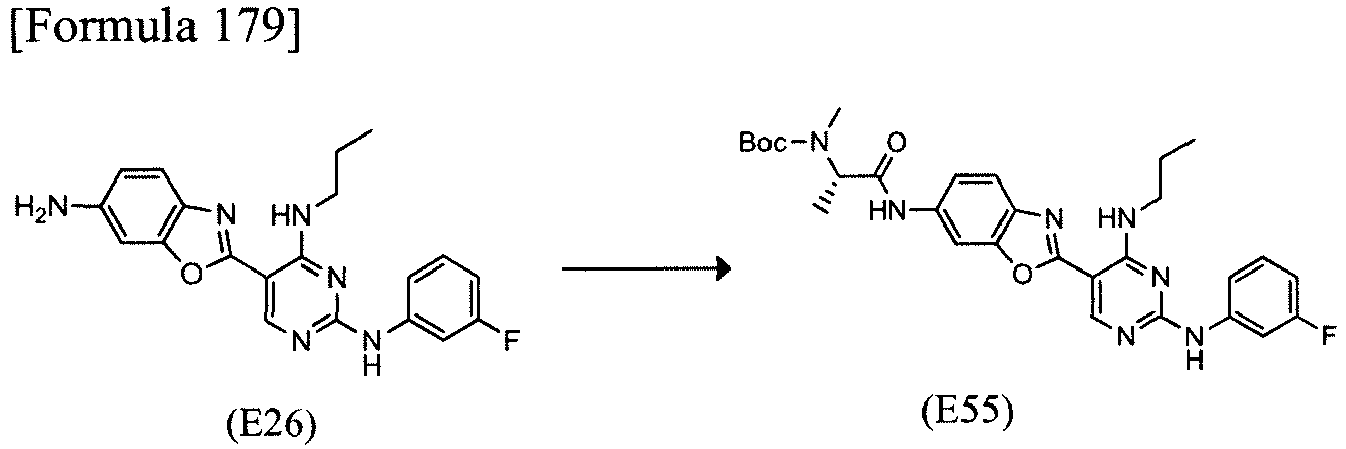
- By using 5-(6-aminobenzo[d]oxazol-2-yl)-N2-(3-fluorophenyl)-N4-propylpyrimidine-2,4-diamine (E26), (S)-tert-butyl (1-((2-(2-((3-fluorophenyl)amino)-4-(propylamino)pyrimidin-5-yl)benzo[d]oxazol-6-yl)amino)-1-oxopropan-2-yl)(methyl)carbamate (E55) was obtained in the same manner as that of Example 1, (5).
-


- By using (S)-tert-butyl (1-((2-(2-((3-fluorophenyl)amino)-4-(propylamino)pyrimidin-5-yl)benzo[d]oxazol-6-yl)amino)-1-oxopropan-2-yl)(methyl)carbamate (E55), (S,E)-4-(dimethylamino)-N-(1-((2-(2-((3-fluorophenyl)amino)-4-(propylamino)pyrimidin-5-yl)benzo[d]oxazol-6-yl)amino)-1-oxopropan-2-yl)-N-methyl-2-butenamide (6-23) was obtained in the same manner as that of Example 1, (6) and Example 1, (8).
1H-NMR (CDCl3) δ: 9.00-8.93 (2H, m), 8.79 (1H, s), 8.11 (1H, d, J=2.0Hz), 7.88 (1H, d, J=10.6Hz), 7.54 (1H, d, J=8.6Hz), 7.27-7.13 (4H, m), 7.02 (1H, dt, J=15.2, 5.9Hz), 6.74 (1H, td, J=7.9, 2.0Hz), 6.45 (1H, d, J=15.2Hz), 5.40-5.26 (1H, m), 3.71-3.61 (2H, m), 3.12 (2H, dd, J=5.9, 1.3Hz), 3.05 (3H, s), 2.28 (6H, s), 1.88-1.75 (2H, m), 1.46 (3H, d, J=6.6Hz), 1.09 (3H, t, J=7.6Hz) -

- To a solution of 2,4-dichloro-5-iodopyrimidine (5.77 g) synthesized according to the method described in
WO2008/155140A1 and N,N-diisopropylethylamine (7.86 mL) in tetrahydrofuran (83 mL), propylamine (3.55 mL) was added under ice cooling, and the mixture was stirred at room temperature for 1 hour. To the reaction mixture, water and ethyl acetate were added. The organic layer was separated, and the aqueous layer was extracted with ethyl acetate. The organic layer and the extract were combined, washed successively with 1.0 mol/L aqueous hydrochloric acid, water, saturated aqueous sodium hydrogencarbonate and saturated aqueous sodium chloride, and then dried over anhydrous magnesium sulfate. The solvent was evaporated under reduced pressure to obtain oily 2-chloro-5-iodo-N-propylpyrimidin-4-amine (F1, 6.44 g).
MS m/z (M+H): 298.3 -

- To a solution of 2-chloro-5-iodo-N-propylpyrimidin-4-amine (F1, 596 mg) and 3-fluoroaniline (1.11 g) in N-methylpyrrolidone (10 mL), (1S)-(+)-10-camphorsulfonic acid (2.32 g) was added at room temperature, and the mixture was stirred at 40 to 50°C for 6 hours. The reaction mixture was cooled to room temperature, and then saturated aqueous sodium hydrogencarbonate was added to the reaction mixture. The solid matter was taken by filtration, washed with water, and then dried under reduced pressure to obtain N2-(3-fluorophenyl)-5-iodo-N4-propylpyrimidine-2,4-diamine (F2, 685 mg) as white solid.
MS m/z (M+H): 373.0 -

- To a solution of N2-(3-fluorophenyl)-5-iodo-N4-propylpyrimidine-2,4-diamine (F2, 2.50 g), bis(triphenylphosphine)palladium(II) dichloride (472 mg) and copper(I) iodide (256 mg) in N,N-dimethylformamide (60 mL), triethylamine (4.7 mL) and N-(4-pentynyl)phthalimide (2.15 g) were added at room temperature, and the mixture was stirred at the same temperature for 2 hours. To the reaction mixture, water and ethyl acetate were added. The organic layer was separated, and the aqueous layer was extracted with ethyl acetate. The organic layer and the extract were combined, washed successively with water, saturated aqueous ammonium chloride and saturated aqueous sodium chloride, and then dried over anhydrous magnesium sulfate, and the solvent was evaporated under reduced pressure. To the obtained residue, hexane and ethyl acetate were added. The solid matter was taken by filtration, and dried under reduced pressure to obtain 2-(5-(2-((3-fluorophenyl)amino)-4-(propylamino)pyrimidin-5-yl)-4-pentyn-1-yl)isoindoline-1,3-dione (F3, 1.44 g) as yellow solid.
MS m/z (M+H): 458.8 -

- To a solution of 2-(5-(2-((3-fluorophenyl)amino)-4-(propylamino)pyrimidin-5-yl)-4-pentyn-1-yl)isoindoline-1,3-dione (F3, 2.51 g) in tetrahydrofuran (20 mL) and ethanol (10 mL), hydrazine monohydrate (5.1 mL) was added at room temperature, and the mixture was stirred for 10 minutes under reflux by heating. To the reaction mixture, ethanol (10 mL) was added, and the mixture was stirred at room temperature for 3 hours and 20 minutes. To the reaction mixture, diisopropyl ether was added, the insoluble matter was removed by filtration, and then water was added to the filtrate. The organic layer was separated, washed successively with saturated aqueous sodium hydrogencarbonate and saturated aqueous sodium chloride, and then dried over anhydrous magnesium sulfate. The solvent was evaporated under reduced pressure to obtain 5-(5-amino-1-pentyn-1-yl)-N2-(3-fluorophenyl)-N4-propylpyrimidine-2,4-diamine (F4, 1.10 g) as white solid.
MS m/z (M+H): 328.2 -

- To a solution of 5-(5-amino-1-pentyn-1-yl)-N2-(3-fluorophenyl)-N4-propylpyrimidine-2,4-diamine (F4, 91 mg), N-Boc-N-methyl-L-alanine (113 mg), 1-ethyl-3-(3-dimethylaminopropyl)carbodiimide hydrochloride (107 mg) and 1-hydroxybenzotriazole monohydrate (75 mg) in N,N-dimethylformamide (2 mL), N,N-diisopropylethylamine (194 µL) was added at room temperature, and the mixture was stirred at the same temperature for 4 hours and 20 minutes. To the reaction mixture, saturated aqueous sodium hydrogencarbonate and ethyl acetate were added. The organic layer was separated, washed with saturated aqueous sodium chloride, and then dried over anhydrous sodium sulfate, and the solvent was evaporated under reduced pressure. The obtained residue was purified by silica gel column chromatography (eluent, 75 to 25% hexane in ethyl acetate) to obtain oily (S)-tert-butyl (1-((5-(2-((3-fluorophenyl)amino)-4-(propylamino)pyrimidin-5-yl)-4-pentyn-1-yl)amino)-1-oxopropan-2-yl)(methyl)carbamate (F5, 103 mg).
MS m/z (M+H): 513.3 -

- To a solution of (S)-tert-butyl (1-((5-(2-((3-fluorophenyl)amino)-4-(propylamino)pyrimidin-5-yl)-4-pentyn-1-yl)amino)-1-oxopropan-2-yl)(methyl)carbamate (F5, 103 mg) in 1,4-dioxane (2 mL), a 4.0 mol/L solution of hydrochloric acid in 1,4-dioxane (2 mL) was added at room temperature, and the mixture was stirred at the same temperature for 2 hours. The solvent was evaporated under reduced pressure. The obtained solid matter was washed with ethyl acetate, and then dried under reduced pressure to obtain (S)-N-(5-(2-((3-fluorophenyl)amino)-4-(propylamino)pyrimidin-5-yl)-4-pentyn-1-yl)-2-(methylamino)propanamide (F6) dihydrochloride (94 mg) as white solid.
MS m/z (M+H): 413.2 -

- To a solution of 4-dimethylaminocrotonic acid hydrochloride (307 mg) in N,N-dimethylformamide (9 mL), N-methylmorpholine (682 µL) was added under ice cooling, and the mixture was stirred at the same temperature for 5 minutes. Then, isobutyl chloroformate (204 µL) was added to the mixture under ice cooling, and the mixture was stirred at the same temperature for 3 minutes. To the reaction mixture, (S)-N-(5-(2-((3-fluorophenyl)amino)-4-(propylamino)pyrimidin-5-yl)-4-pentyn-1-yl)-2-(methylamino)propanamide (F6) dihydrochloride (300 mg) was added under ice cooling, and the mixture was stirred at the same temperature for 1 hour and 30 minutes. To the reaction mixture, saturated aqueous sodium hydrogencarbonate (10 drops) were added, and the solvent was evaporated under reduced pressure. The obtained residue was purified by basic silica gel column chromatography (eluent, 100 to 90% ethyl acetate in methanol) to obtain (S,E)-4-(dimethylamino)-N-(1-((5-(2-((3-fluorophenyl)amino)-4-(propylamino)pyrimidin-5-yl)-4-pentyn-1-yl)amino)-1-oxopropan-2-yl)-N-methyl-2-butenamide (7-1, 208 mg).
1H-NMR (CDCl3) δ: 7.96 (1H, s), 7.82 (1H, dt, J=11.9, 2.3Hz), 7.26-7.16 (1H, m), 7.11-7.06 (1H, m), 7.08-7.04 (1H, m), 6.94 (1H, dt, J=15.2, 5.9Hz), 6.67 (1H, dt, J=7.9, 2.3Hz), 6.59-6.48 (1H, m), 6.42 (1H, d, J=15.2Hz), 6.31-6.22 (1H, m), 5.18 (1H, q, J=7.3Hz), 3.55-3.47 (2H, m), 3.49-3.39 (2H, m), 3.10 (2H, d, J=5.9Hz), 2.99 (3H, s), 2.44 (2H, t, J=6.6Hz), 2.27 (6H, s), 1.81-1.69 (2H, m), 1.71-1.64 (2H, m), 1.36 (3H, d, J=7.3Hz), 1.01 (3H, t, J=7.9Hz) -

- To a solution of cyclobutanol (117 µL) in tetrahydrofuran (2 mL), tert-butoxypotassium (100 mg) was added at room temperature, and the mixture was stirred under reflux by heating. The reaction mixture was cooled to room temperature (Reaction mixture A).
- To a solution of 2,4-dichloro-5-iodopyrimidine (205 mg) in N,N-dimethylformamide (2 mL), Reaction mixture A mentioned above was added under ice cooling, and the mixture was stirred at the same temperature for 2 hours. To the reaction mixture, water and ethyl acetate were added. The organic layer was separated, washed successively with water and saturated aqueous sodium chloride, and then dried over anhydrous sodium sulfate, and the solvent was evaporated under reduced pressure. The obtained residue was purified by silica gel column chromatography to obtain 2-chloro-4-cyclobutoxy-5-iodopyrimidine (F7).
MS m/z (M+H): 311.0 -

- To a solution of 2-ethynylbenzyl alcohol (1.00 g), phthalimide (2.20 g) and triphenylphosphine (3.96 g) in tetrahydrofuran (30 mL), a solution of diisopropyl azodicarboxylate (1.9 mol/L) in toluene (7.9 mL) was added under ice cooling, and the mixture was stirred at room temperature for 5 hours. The solvent was evaporated under reduced pressure, and the obtained residue was purified by silica gel column chromatography (eluent, 96 to 66% hexane in ethyl acetate) to obtain 2-(2-ethynylbenzyl)isoindoline-1,3-dione (F8, 1.44 g) as pale orange solid.
MS m/z (M+H): 262.2 -

- In the same manner as that of Example 35, (3) to (6), (S)-N-(2-((2-((3-fluorophenyl)amino)-4-(propylamino)pyrimidin-5-yl)ethynyl)benzyl)-2-(methylamino)propanamide (F9) dihydrochloride was obtained from 2-(2-ethynylbenzyl)isoindoline-1,3-dione (F8).
MS m/z (M+H): 461.4 -

- A solution of (S)-N-(2-((2-((3-fluorophenyl)amino)-4-(propylamino)pyrimidin-5-yl)ethynyl)benzyl)-2-(methylamino)propanamide (F9) dihydrochloride (50 mg) in methanol (5 mL) was prepared, and hydrogenation was performed at room temperature and a flow rate of 1 mL/minute in a flow type hydrogenation reactor set with a 10% palladium-carbon cartridge. The solvent was evaporated under reduced pressure to obtain (S)-N-(2-(2-(2-((3-fluorophenyl)amino)-4-(propylamino)pyrimidin-5-yl)ethyl)benzyl)-2-(methylamino)propanamide (F10) dihydrochloride (43 mg) as white solid.
MS m/z (M+H): 465.4 -

- To a solution of 3-vinylaniline (19 µL), N2-(3-fluorophenyl)-5-iodo-N4-propylpyrimidine-2,4-diamine (F2, 51 mg) and palladium(II) acetate (3 mg) in acetonitrile (1.5 mL), triethylamine (68 µL) was added at room temperature, and the mixture was stirred at the same temperature for 1 hour, and then stirred at 80°C for 14 hours. The reaction mixture was cooled to room temperature, and then the solvent was evaporated under reduced pressure. The obtained residue was purified by silica gel column chromatography (eluent, 50% hexane in ethyl acetate) to obtain (E)-5-(3-aminostyryl)-N2-(3-fluorophenyl)-N4-propylpyrimidine-2,4-diamine (F11, 14 mg).
MS m/z (M+H): 364.3 -


- To a solution of 3,3-dimethyl-4-pentyn-1-ol (6.3 g) synthesized according to the method described in Chemistry A European Journal, 2005, 11, pp.308-320, triphenylphosphine (29.4 g), and phthalimide (16.5 g) in tetrahydrofuran (200 mL), a 2.2 mol/L solution of diethyl azodicarboxylate in toluene (51 mL) was added dropwise under ice cooling, and the mixture was stirred at the same temperature. To the reaction mixture, water and ethyl acetate were added. The organic layer was separated, washed successively with water and saturated aqueous sodium chloride, and then dried over anhydrous sodium sulfate, and the solvent was evaporated under reduced pressure. To the obtained residue, ethyl acetate were added, the insoluble matter was removed by filtration, and then the solvent was evaporated under reduced pressure. The obtained residue was purified by silica gel column chromatography to obtain 2-(3,3-dimethyl-4-pentyn-1-yl)isoindoline-1,3-dione (F12, 7.1 g) as pale yellow solid.
MS m/z (M+H): 242.1 -

- To a solution of diethyl 2-(2-methyl-3-butyn-2-yl)malonate synthesized according to the method described in Chemistry A European Journal, 2005, 11, pp.308-320 (3.3 g), N2-(3-fluorophenyl)-5-iodo-N4-propylpyrimidine-2,4-diamine (F2, 868 mg), bis(triphenylphosphine)palladium(II) dichloride (161 mg) and copper(I) iodide (88 mg) in N,N-dimethylformamide (15 mL), triethylamine (1.6 mL) was added at room temperature, and the mixture was stirred at the same temperature for 2 hours and 30 minutes. To the reaction mixture, tetrakis(triphenylphosphine)palladium(0) (132 mg) was added at room temperature, and the mixture was stirred at the same temperature for 1 hour and 40 minutes. To the reaction mixture, ethyl acetate and saturated aqueous ammonium chloride were added. The organic layer was separated, washed successively with saturated aqueous ammonium chloride, water and saturated aqueous sodium chloride, and then dried over anhydrous sodium sulfate, and the solvent was evaporated under reduced pressure. The obtained residue was purified by silica gel column chromatography (eluent, 94 to 64% hexane in ethyl acetate) to obtain diethyl 2-(4-(2-((3-fluorophenyl)amino)-4-(propylamino)pyrimidin-5-yl)-2-methyl-3-butyn-2-yl)malonate (F13, 803 mg) as yellow solid.
MS m/z (M+H): 471.4 -

- To diethyl 2-(4-(2-((3-fluorophenyl)amino)-4-(propylamino)pyrimidin-5-yl)-2-methyl-3-butyn-2-yl)malonate (F13, 400 mg) and sodium bromide (437 mg), water (140 µL) and dimethyl sulfoxide (10 mL) were added at room temperature, the reaction vessel was sealed, and then by using a microwave reaction system, the mixture was stirred at 190°C for 30 minutes. The reaction mixture was cooled to room temperature, and then ethyl acetate and water were added to the reaction mixture. The organic layer was separated, washed successively with water and saturated aqueous sodium chloride, and then dried over anhydrous sodium sulfate, and the solvent was evaporated under reduced pressure. The obtained residue was purified by silica gel column chromatography (eluent, 94 to 64% hexane in ethyl acetate) to obtain ethyl 5-(2-((3-fluorophenyl)amino)-4-(propylamino)pyrimidin-5-yl)-3,3-dimethyl-4-pentynoate (F14, 64 mg).
MS m/z (M+H): 399.4 -

- To a solution of ethyl 5-(2-((3-fluorophenyl)amino)-4-(propylamino)pyrimidin-5-yl)-3,3-dimethyl-4-pentynoate (F14, 120 mg) in tetrahydrofuran (4 mL), lithium aluminum hydride (114 mg) was added under ice cooling, and the mixture was stirred at the same temperature for 5 minutes, and then stirred at room temperature for 1 hour. The reaction mixture was cooled on ice, and then saturated aqueous sodium sulfate was added, and the mixture was stirred at room temperature. To the reaction mixture, ethyl acetate was added. The organic layer was separated, washed with saturated aqueous sodium chloride, and then dried over anhydrous magnesium sulfate, and the solvent was evaporated under reduced pressure. The obtained residue was purified by silica gel column chromatography (eluent, 88 to 28% hexane in ethyl acetate) to obtain 5-(2-((3-fluorophenyl)amino)-4-(propylamino)pyrimidin-5-yl)-3,3-dimethyl-4-pentyn-1-ol (F15, 75 mg) as white solid.
MS m/z (M+H): 357.3 -
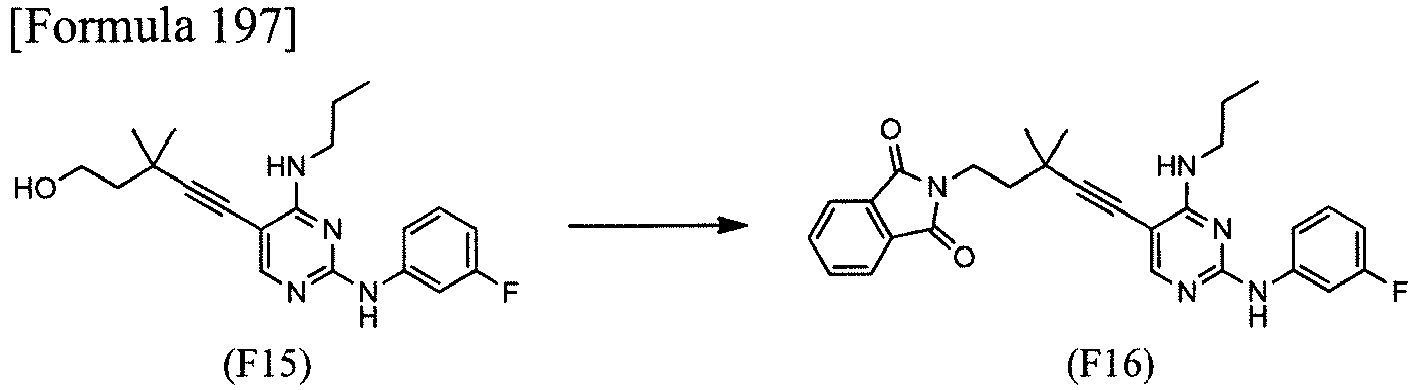
- To a solution of 5-(2-((3-fluorophenyl)amino)-4-(propylamino)pyrimidin-5-yl)-3,3-dimethyl-4-pentyn-1-ol (F15, 75 mg), phthalimide (93 mg) and triphenylphosphine (165 mg) in tetrahydrofuran (3.5 mL), a 1.9 mol/L solution of diisopropyl azodicarboxylate in toluene (332 µL) was added under ice cooling, and the mixture was stirred at room temperature for 1 hour. The solvent was evaporated under reduced pressure, and the obtained residue was purified by silica gel column chromatography (eluent, 92 to 52% hexane in ethyl acetate) to obtain 2-(5-(2-((3-fluorophenyl)amino)-4-(propylamino)pyrimidin-5-yl)-3,3-dimethyl-4-pentyn-1-yl)isoindoline-1,3-dione (F16, 129 mg) as pale yellow solid.
MS m/z (M+H): 486.4 -

- To a solution of 2-chloro-5-iodo-N-propylpyrimidin-4-amine (F1, 46.3 mg) in tetrahydrofuran (0.5 mL), a 9.8 mol/L solution of methylamine in methanol (0.5 mL) was added at room temperature, the reaction vessel was sealed, and then by using a microwave reaction system, the mixture was stirred at 80°C for 30 minutes. The reaction mixture was cooled to room temperature, and then the solvent was evaporated under reduced pressure. The obtained residue was purified by silica gel column chromatography (eluent, 40 to 27% hexane in ethyl acetate) to obtain 5-iodo-N2-methyl-N4-propylpyrimidine-2,4-diamine (F222, 32.4 mg) as white solid.
MS m/z (M+H): 293.1 - By using 2,4-dichloro-5-iodopyrimidine, Intermediates (F17) to (F22) and Intermediates (F176) to (F186) were obtained in the same manner as that of Example 35, (1) or Example 36, (1).
[Table 59] Compound No. Structure Physicochemical data F17 
- F18 
- F19 
MS m/z (M-H): 363.0 F20 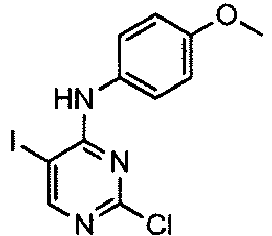
- F21 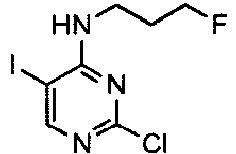
- F22 
- F176 
MS m/z (M-H): 308.0 F177 
MS m/z (M+H): 299.0 F178 
MS m/z (M+H): 285.0 F179 
MS m/z (M+H): 299.0 F180 
MS m/z (M+H): 284.0 [Table 60] Compound No. Structure Physicochemical data F181 
MS m/z (M+H): 298.0 F182 
MS m/z (M+H): 270.0 F183 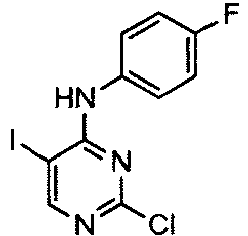
MS m/z (M+H): 350.0 F184 
MS m/z (M+H): 346.0 F185 
MS m/z (M+H): 364.0 F186 
MS m/z (M+H): 314.0 - In the same manner as that of Example 35, (2) or Example 36, (11), Intermediates (F23) to (F39), Intermediates (F187) to (F234), and Intermediates (F327) were obtained.
[Table 61] Compound No. Structure Physicochemical data F23 
- F24 
- F25 
MS m/z (M+H): 380.2 F26 
- F27 
- F28 
MS m/z (M+H): 373.1 F29 
- F30 
- [Table 62] Compound No. Structure Physicochemical data F31 
- F32 
- F33 
- F34 
- F35 
- F36 
- F37 
- F38 
- F39 
- [Table 63] Compound No. Structure Physicochemical data F187 
MS m/z (M+H): 421.3 F188 
MS m/z (M+H): 389.4 F189 
MS m/z (M+H): 394.1 F190 
MS m/z (M-H): 383.2 F191 
MS m/z (M+H): 409.1 F192 
MS m/z (M+H): 409.1 F193 
MS m/z (M+H): 409.1 F194 
MS m/z (M+H): 459.2 F195 
MS m/z (M+H): 409.1 [Table 64] Compound No. Structure Physicochemical data F196 
MS m/z (M+H): 409.1 F197 
MS m/z (M+H): 409.1 F198 
- F199 
MS m/z (M+H): 381.1 F200 
MS m/z (M+H): 403.1 F201 
MS m/z (M+H): 412.1 F202 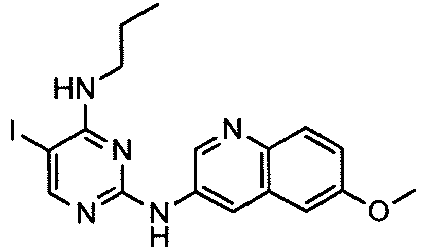
MS m/z (M+H): 436.1 F203 
MS m/z (M+H): 370.1 F204 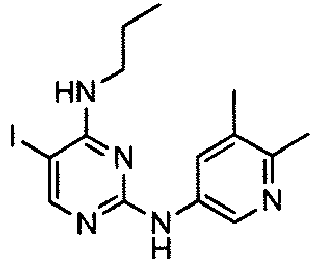
MS m/z (M+H): 384.1 [Table 65] Compound No. Structure Physicochemical data F205 
MS m/z (M+H): 360.2 F206 
MS m/z (M+H): 367.1 F207 
MS m/z (M+H): 374.1 F208 
MS m/z (M+H): 381.1 F209 
MS m/z (M+H): 360.2 F210 
MS m/z (M+H): 467.1 F211 
MS m/z (M+H): 467.2 F212 
MS m/z (M+H): 467.2 F213 
MS m/z (M+H): 467.2 [Table 66] Compound No. Structure Physicochemical data F214 
MS m/z (M+H): 359.1 F215 
MS m/z (M+H): 366.1 F216 
MS m/z (M+H): 371.2 F217 
MS m/z (M+H): 373.1 F218 
- F219 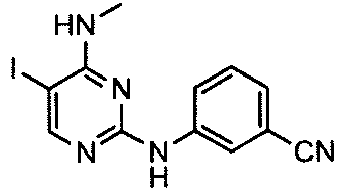
MS m/z (M+H): 352.1 F220 
MS m/z (M+H): 375.1 F221 
MS m/z (M+H): 395.1 F222 
MS m/z (M+H): 293.1 [Table 67] Compound No. Structure Physicochemical data F223 
MS m/z (M+H): 345.1 F224 
- F225 
MS m/z (M+H): 357.1 F226 
MS m/z (M+H): 345.1 F227 
MS m/z (M+H): 385.1 F228 
MS m/z (M+H): 341.1 F229 
MS m/z (M-H): 343.1 F230 
MS m/z (M+H): 359.1 [Table 68] Compound No. Structure Physicochemical data F231 
MS m/z (M+H): 371.1 F232 
MS m/z (M+H): 378.1 F233 
MS m/z (M+H): 399.1 F234 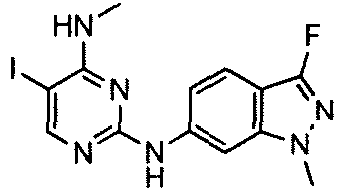
MS m/z (M+H): 399.1 F327 
- - In the same manner as that of Example 35, (3), Intermediates (F40) to (F56) and Intermediates (F235) to (F241) were obtained.
[Table 69] Compound No. Structure Physicochemical data F40 
MS m/z (M+H): 483.2 F41 
- F42 
MS m/z (M+H): 465.3 F43 
- F44 
- F45 
MS m/z (M+H): 458.3 F46 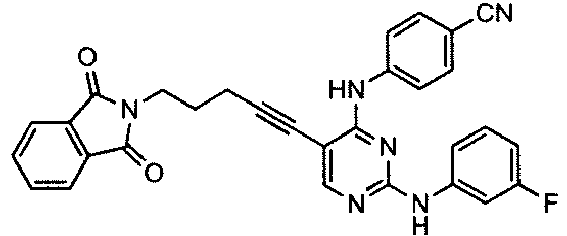
- F47 
MS m/z (M+H): 511.4 [Table 70] Compound No. Structure Physicochemical data F48 
- F49 
- F50 
- F51 
- F52 
- F53 
- F54 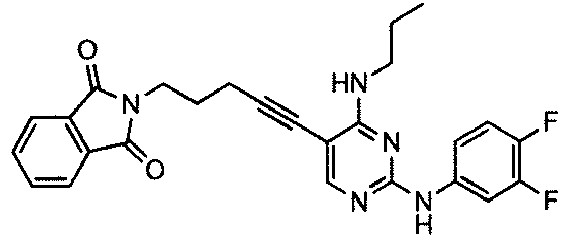
- F55 
- F56 
- F235 
MS m/z (M-H): 504.3 [Table 71] Compound No. Structure Physicochemical data F236 
- F237 
MS m/z (M+H): 437.3 F238 
MS m/z (M+H): 445.3 F239 
MS m/z (M+H): 430.3 F240 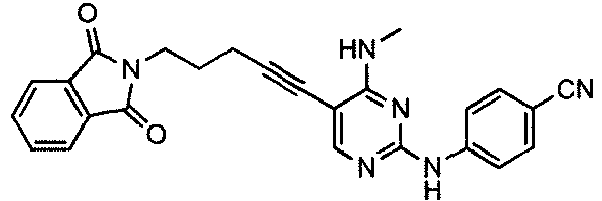
MS m/z (M+H): 437.3 F241 
MS m/z (M+H): 437.4 - In the same manner as that of Example 35, (4), Intermediates (F57) to (F73), Intermediates (F242) to (F248), and Intermediates (F328) were obtained.
[Table 72] Compound No. Structure Physicochemical data F57 
MS m/z (M+H): 353.2 F58 
- F59 
MS m/z (M+H): 335.3 F60 
- F61 
- F62 
- F63 
- F64 
MS m/z (M+H): 381.4 [Table 73] Compound No. Structure Physicochemical data F65 
- F66 
- F67 
- F68 
- F69 
- F70 
- F71 
- F72 
- F73 
- [Table 74] Compound No. Structure Physicochemical data F242 
MS m/z (M+H): 376.3 F243 
MS m/z (M+H): 300.2 F244 
MS m/z (M+H): 307.2 F245 
- F246 
MS m/z (M+H): 300.3 F247 
MS m/z (M+H): 307.3 F248 
MS m/z (M+H): 307.3 F328 
MS m/z (M+H): 309.3 -

- By using 4-((5-(5-amino-1-pentyn-1-yl)-4-(propylamino)pyrimidin-2-yl)amino)benzamide (F57), tert-butyl (2-((5-(2-((4-carbamoylphenyl)amino)-4-(propylamino)pyrimidin-5-yl)-4-pentyn-1-yl)amino)-2-oxoethyl)carbamate (F74) was obtained in the same manner as that of Example 35, (5).
-

- By using tert-butyl (2-((5-(2-((4-carbamoylphenyl)amino)-4-(propylamino)pyrimidin-5-yl)-4-pentyn-1-yl)amino)-2-oxoethyl)carbamate (F74), 4-((5-(5-(2-aminoactamido)-1-pentyn-1-yl)-4-(propylamino)pyrimidin-2-yl)amino)benzamide (F75) dihydrochloride was obtained in the same manner as that of Example 35, (6).
-

- A mixed solution of 4-((5-(5-(2-aminoactamido)-1-pentyn-1-yl)-4-(propylamino)pyrimidin-2-yl)amino)benzamide (F75) dihydrochloride (100 mg) in methanol (60 mL) and acetic acid (4 mL) was prepared, and hydrogenation was performed at room temperature and a flow rate of 1 mL/minute in a flow type hydrogenation reactor set with a 10% palladium-carbon cartridge. The solvent was evaporated under reduced pressure to obtain 4-((5-(5-(2-aminoactamido)pentyl)-4-(propylamino)pyrimidin-2-yl)amino)benzamide (F76) dihydrochloride (90 mg) as white solid.
MS m/z (M+H): 414.3 -

- By using tert-butyl ((1S,3R)-3-((2-((4-cyanophenyl)amino)-4-(cyclopropylamino)pyrimidin-5-yl)ethynyl)cyclohexyl)carbamate (F56), 4-((5-(((1S,3R)-3-aminocyclohexyl)ethynyl)-4-(cyclopropylamino)pyrimidin-2-yl)amino)benzonitrile (F77) dihydrochloride was obtained in the same manner as that of Example 35, (6).
- In the same manner as that of Example 35, (5), Intermediates (F78) to (F126), Intermediates (F249) to (F287), Intermediates (F329) and (F330) were obtained.
[Table 75] Compound No. Structure Physicochemical data F78 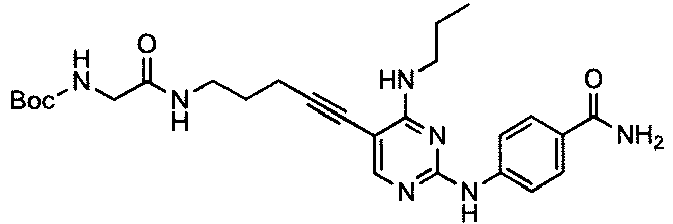
- F79 
- F80 
MS m/z (M+H): 538.3 F81 
MS m/z (M+H): 520.4 F82 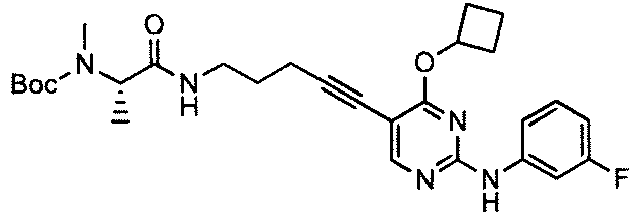
- F83 
- F84 
MS m/z (M+H): 499.4 F85 
MS m/z (M+H): 506.4 F86 
MS m/z (M+H): 541.5 F87 
MS m/z (M+H): 555.5 F88 
- [Table 76] Compound No. Structure Physicochemical data F89 
- F90 
- F91 
MS m/z (M+H): 566.5 F92 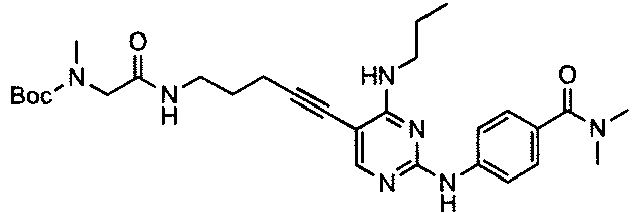
MS m/z (M+H): 552.5 F93 
- F94 
- F95 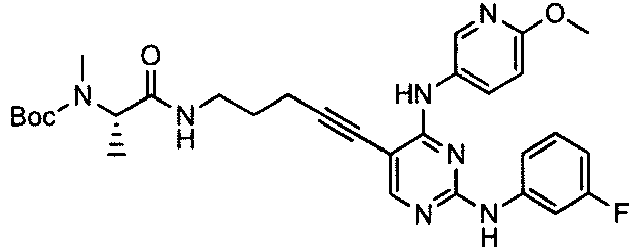
- F96 
- F97 
- F98 
- [Table 77] Compound No. Structure Physicochemical data F99 
- F100 
- F101 
- F102 
- F103 
- F104 
MS m/z (M+H): 520.4 F105 
MS m/z (M+H): 532.4 F106 
- F107 
- F108 
- [Table 78] Compound No. Structure Physicochemical data F109 
- F110 
- F111 
- F112 
- F113 
- F114 
- F115 
- F116 
- F117 
- [Table 79] Compound No. Structure Physicochemical data F118 
- F119 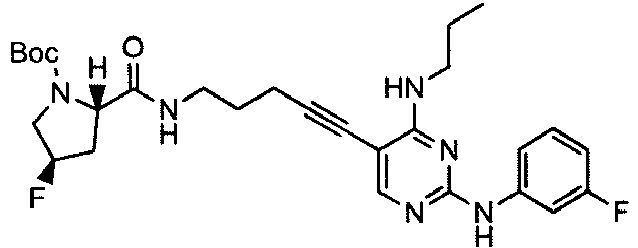
- F120 
- F121 
- F122 
- F123 
- F124 
- F125 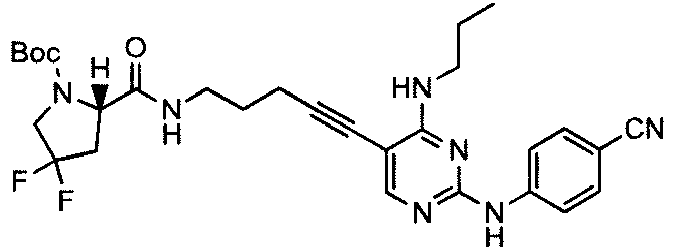
- F126 
- [Table 80] Compound No. Structure Physicochemical data F249 
MS m/z (M+H): 561.2 F250 
- F251 
MS m/z (M+H): 555.4 F252 
MS m/z (M+H): 555.4 F253 
MS m/z (M+H): 562.4 F254 
MS m/z (M+H): 562.4 F255 
- F256 
- F257 
MS m/z (M+H): 534.4 [Table 81] Compound No. Structure Physicochemical data F258 
MS m/z (M+H): 548.4 F259 
MS m/z (M+H): 541.4 F260 
MS m/z (M+H): 541.4 F261 
MS m/z (M+H): 548.4 F262 
MS m/z (M+H): 548.4 F263 
MS m/z (M+H): 548.5 F264 
MS m/z (M+H): 562.4 F265 
MS m/z (M+H): 515.4 F266 
MS m/z (M+H): 527.4 F267 
MS m/z (M+H): 513.4 [Table 82] Compound No. Structure Physicochemical data F268 
MS m/z (M+H): 522.4 F269 
MS m/z (M-H): 502.4 F270 
MS m/z (M+H): 497.4 F271 
MS m/z (M+H): 500.4 F272 
MS m/z (M+H): 512.4 F273 
MS m/z (M+H): 515.4 F274 
MS m/z (M+H): 515.4 F275 
MS m/z (M+H): 527.5 F276 
MS m/z (M+H): 527.5 F277 
MS m/z (M+H): 513.4 [Table 83] Compound No. Structure Physicochemical data F278 
MS m/z (M+H): 513.4 F279 
MS m/z (M+H): 483.4 F280 
MS m/z (M+H): 522.4 F281 
MS m/z (M+H): 478.4 F282 
MS m/z (M+H): 471.4 F283 
MS m/z (M+H): 478.5 F284 
MS m/z (M+H): 492.5 F285 
MS m/z (M+H): 511.4 F286 
MS m/z (M+H): 533.4 F287 
MS m/z (M+H): 525.4 [Table 84] Compound No. Structure Physicochemical data F329 
MS m/z (M+H): 480.5 F330 
MS m/z (M+H): 494.5 - In the same manner as that of Example 35, (6), Intermediates (F127) to (F175), Intermediates (F288) to (F326), Intermediates (F331) and (F332) were obtained.
[Table 85] Compound No. Structure Physicochemical data F127 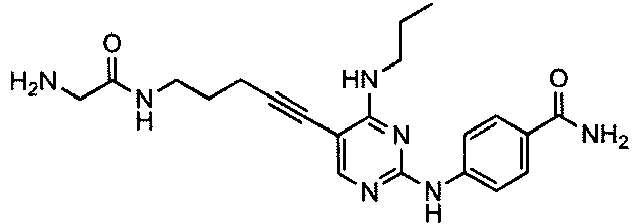
- F128 
- F129 
MS m/z (M+H): 438.3 F130 
MS m/z (M+H): 420.4 F131 
- F132 
- F133 
MS m/z (M+H): 399.3 F134 
MS m/z (M+H): 406.4 F135 
- F136 
- [Table 86] Compound No. Structure Physicochemical data F137 
- F138 
- F139 
- F140 
- F141 
- F142 
- F143 
- F144 
- F145 
- F146 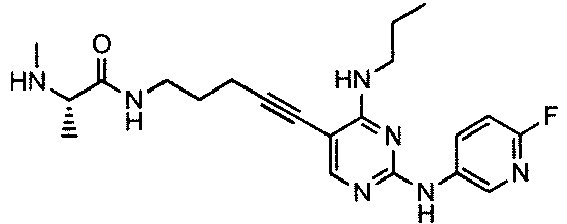
- F147 
- [Table 87] Compound No. Structure Physicochemical data F148 
- F149 
- F150 
- F151 
- F152 
- F153 
- F154 
- F155 
- F156 
- F157 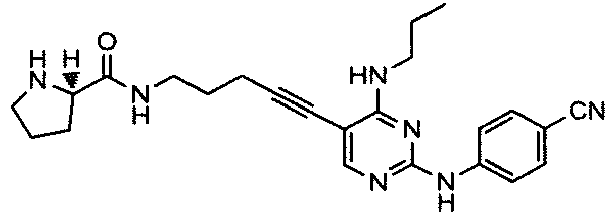
- F158 
- [Table 88] Compound No. Structure Physicochemical data F159 
- F160 
- F161 
- F162 
- F163 
- F164 
- F165 
- F166 
- F167 
- F168 
- [Table 89] Compound No. Structure Physicochemical data F169 
- F170 
- F171 
- F172 
- F173 
- F174 
- F175 
- F288 
MS m/z (M+H): 461.3 F289 
- [Table 90] Compound No. Structure Physicochemical data F290 
MS m/z (M+H): 455.3 F291 
MS m/z (M+H): 455.3 F292 
MS m/z (M+H): 462.3 F293 
MS m/z (M+H): 462.3 F294 
- F295 
- F296 
- F297 
- F298 
MS m/z (M+H): 441.3 [Table 91] Compound No. Structure Physicochemical data F299 
MS m/z (M+H): 441.3 F300 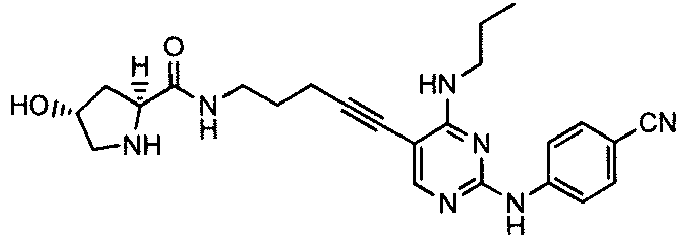
MS m/z (M+H): 448.3 F301 
MS m/z (M+H): 448.3 F302 
- F303 
- F304 
MS m/z (M+H): 415.3 F305 
- F306 
- F307 
MS m/z (M+H): 422.3 F308 
- [Table 92] Compound No. Structure Physicochemical data F309 
- F310 
MS m/z (M+H): 400.4 F311 
MS m/z (M+H): 412.3 F312 
MS m/z (M+H): 415.3 F313 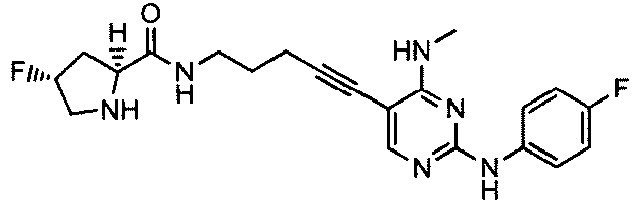
MS m/z (M+H): 415.3 F314 
MS m/z (M+H): 427.4 F315 
MS m/z (M+H): 427.4 F316 
MS m/z (M+H): 413.3 F317 
MS m/z (M+H): 413.3 F318 
MS m/z (M+H): 383.3 [Table 93] Compound No. Structure Physicochemical data F319 
MS m/z (M+H): 422.2 F320 
MS m/z (M+H): 378.3 F321 
MS m/z (M+H): 371.3 F322 
- F323 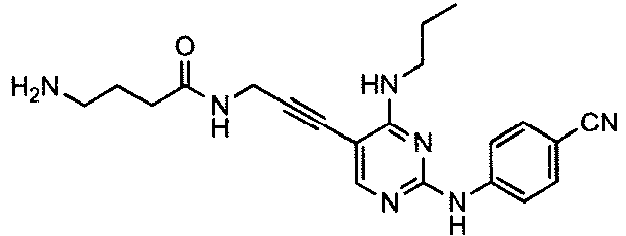
- F324 
MS m/z (M+H): 411.3 F325 
MS m/z (M+H): 433.3 F326 
MS m/z (M+H): 425.3 F331 
- F332 
- - In the same manner as that of Example 35, Compounds (7-2) to (7-96) were obtained.
[Table 94] Compound No. Structure Physicochemical data 7-2 
1H-NMR (CD3OD) δ: 7.88 (1H, s), 7.81 (4H, s), 6.81-6.76 (1H, m), 6.15 (1H, d, J=15.9Hz), 3.91 (2H, s), 3.55-3.46 (2H, m), 3.41 (2H, t, J=6.6Hz), 3.13 (2H, dd, J=6.6, 1.3Hz), 2.52 (2H, t, J=6.6Hz), 2.26 (6H, s), 1.77-1.69 (4H, m), 0.99 (3H, t, J=7.3Hz) 7-3 
1H-NMR (CDCl3) δ: 8.41-8.32 (1H, m), 8.09 (1H, s), 7.96 (1H, s), 7.62 (1H, d, J=9.2Hz), 7.37-7.34 (1H, m), 7.24 (1H, d, J=7.3Hz), 6.94 (1H, dt, J=15.2, 5.9Hz), 6.81 (1H, t, J=5.9Hz), 6.52-6.24 (2H, m), 5.21 (1H, q, J=7.0Hz), 3.54-3.41 (4H, m), 3.11 (2H, d, J=5.3Hz), 3.02 (3H, s), 2.45 (2H, t, J=6.6Hz), 2.27 (6H, s), 1.80-1.73 (4H, m), 1.37 (3H, d, J=7.0Hz), 1.02 (3H, t, J=7.6Hz) 7-4 
MS m/z (M+H): 549.3 7-5 
1H-NMR (CDCl3) δ: 8.05 (1H, s), 7.97 (1H, s), 7.79 (2H, d, J=8.6Hz), 7.56 (2H, d, J=9.2Hz), 6.94 (1H, dt, J=15.2, 5.3Hz), 6.71 (1H, t, J=5.6Hz), 6.44-6.42 (2H, m), 5.20 (1H, q, J=7.3Hz), 3.49-3.45 (4H, m), 3.11 (2H, d, J=5.3Hz), 3.01 (3H, s), 2.45 (2H, t, J=6.6Hz), 2.27 (6H, s), 1.77-1.66 (4H, m), 1.36 (3H, d, J=7.3Hz), 1.00 (3H, t, J=7.3Hz) 7-6 
1H-NMR (CDCl3) δ: 8.21 (1H, s), 7.71 (1H, dt, J=11.7, 2.3Hz), 7.29-7.21 (1H, m), 7.14-7.06 (2H, m), 6.93 (1H, dt, J=15.2, 5.9Hz), 6.73 (1H, dt, J=8.3, 2.3Hz), 6.57-6.47 (1H, m), 6.47-6.3 (1H, m), 5.29-5.15 (2H, m), 3.40 (2H, q, J=6.6Hz), 3.14-3.04 (2H, m), 2.99 (3H, s), 2.56-2.44 (4H, m), 2.32-2.18 (8H, m), 1.94-1.67 (4H, m), 1.35 (3H, d, J=6.6Hz) [Table 95] Compound No. Structure Physicochemical data 7-7 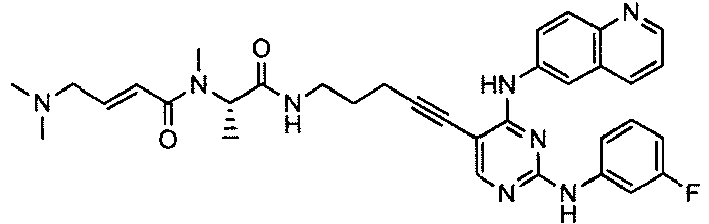
1H-NMR (CDCl3) δ: 8.84 (1H, dd, J=4.3, 1.7Hz), 8.38-8.31 (2H, m), 8.20 (1H, s), 8.10-8.02 (2H, m), 7.97 (1H, dd, J=9.2, 2.0Hz), 7.63-7.54 (1H, m), 7.38 (1H, dd, J=8.3, 4.3Hz), 7.31 (1H, s), 7.21-7.14 (2H, m), 6.93 (1H, dt, J=15.2, 5.9Hz), 6.75-6.59 (2H, m), 6.41 (1H, d, J=15.2Hz), 5.20 (1H, q, J=7.0Hz), 3.59-3.46 (2H, m), 3.10 (2H, d, J=5.9Hz), 2.97 (3H, s), 2.52 (2H, t, J=5.6Hz), 2.26 (6H, s), 1.86-1.74 (2H, m), 1.36 (3H, d, J=7.0Hz) 7-8 
1H-NMR (CDCl3) δ: 7.95 (1H, s), 7.60-7.52 (2H, m), 7.04-6.90 (3H, m), 6.88 (1H, s), 6.57 (1H, brs), 6.46 (1H, d, J=15.2Hz), 6.03 (1H, brs), 4.03 (2H, s), 3.50-3.40 (4H, m), 3.20 (3H, s), 3.10 (2H, d, J=5.9Hz), 2.47 (2H, t, J=6.6Hz), 2.27 (6H, s), 1.82-1.64 (4H, m), 0.98 (3H, t, J=7.3Hz) 7-9 
1H-NMR (CDCl3) δ: 7.98 (1H, s), 7.76 (2H, d, J=9.2Hz), 7.57 (2H, d, J=8.6Hz), 7.20 (1H, s), 6.96 (1H, dt, J=15.2, 5.9Hz), 6.59 (1H, brs), 6.47 (1H, d, J=15.2Hz), 6.27 (1H, brs), 4.04 (2H, s), 3.54-3.40 (4H, m), 3.20 (3H, s), 3.10 (2H, d, J=5.9Hz), 2.48 (2H, t, J=6.9Hz), 2.27 (6H, s), 1.82-1.66 (4H, m), 1.00 (3H, t, J=7.3Hz) 7-10 
1H-NMR (CDCl3) δ: 7.95 (1H, s), 7.83 (1H, d, J=11.9Hz), 7.22-6.88 (4H, m), 6.68 (1H, t, J=8.3Hz), 6.46-6.41 (3H, m), 4.52 (1H, d, J=11.2Hz), 3.54-3.41 (4H, m), 3.10 (2H, d, J=5.9Hz), 3.05 (3H, s), 2.43 (2H, t, J=6.6Hz), 2.37-2.27 (7H, m), 1.76-1.66 (4H, m), 1.00 (6H, t, J=7.3Hz), 0.86 (3H, d, J=6.6Hz) 7-11 
1H-NMR (CDCl3) δ: 7.96 (1H, s), 7.83 (1H, dt, J=12.1, 2.3Hz), 7.25-7.07 (3H, m), 6.94 (1H, dt, J=15.2, 5.9Hz), 6.67 (1H, dt, J=8.3, 2.3 Hz), 6.51 (1H, brs), 6.42 (1H, d, J=15.2Hz), 6.33 (1H, t, J=5.9Hz), 5.11 (1H, t, J=7.6Hz), 3.54-3.42 (4H, m), 3.10 (2H, d, J=5.9Hz), 2.99 (3H, s), 2.45 (2H, d, J=7.6Hz), 2.27 (6H, s), 1.79-1.59 (6H, m), 1.56-1.43 (1H, m), 1.03-0.90 (9H, m) [Table 96] Compound No. Structure Physicochemical data 7-12 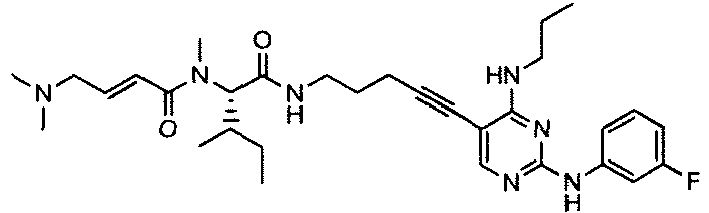
1H-N+MR (CDCl3) δ: 7.95 (1H, s), 7.83 (1H, dt, J=12.1, 2.1 Hz), 7.38 (1H, s), 7.20 (1H, q, J=7.7Hz), 7.11 (1H, d, J=8.3Hz), 6.92 (1H, dt, J=15.2, 5.9Hz), 6.67 (1H, dt, J=8.3, 1.8Hz), 6.53 (1H, t, J=5.9Hz), 6.46-6.37 (2H, m), 4.63 (1H, d, J=11.2Hz), 3.53-3.40 (4H, m), 3.10 (2H, dd, J=5.9, 2.1Hz), 3.05 (3H, s), 2.43 (2H, t, J=6.6Hz), 2.27 (6H, s), 2.21-2.05 (2H, m), 1.78-1.66 (4H, m), 1.43-1.31 (1H, m), 1.02-0.85 (9H, m) 7-13 
1H-NMR (CDCl3) 8: 7.93 (1H, s), 7.83 (1H, dt, J=12.1, 2.1Hz), 7.32-7.09 (8H, m), 6.87 (1H, dt, J=15.2, 5.9Hz), 6.67 (1H, dt, J=8.1, 2.1Hz), 6.53 (1H, t, J=5.9Hz), 6.35-6.30 (2H, m), 5.33 (1H, t, J=7.6Hz), 3.57-3.31 (5H, m), 3.08-2.94 (6H, m), 2.32 (2H, t, J=5.0Hz), 2.25 (6H, s), 1.81-1.63 (4H, m), 1.02 (3H, t, J=7.6Hz) 7-14 
1H-NMR (CDCl3) δ: 8.44 (1H, s), 8.21 (1H, s), 8.00-7.91 (3H, m), 7.60 (2H, d, J=8.6Hz), 7.30-7.17 (2H, m), 7.12-7.06 (1H, m), 6.94 (1H, dt, J=15.2, 5.9Hz), 6.75 (1H, dt, J=8.3, 2.4Hz), 6.67-6.58 (1H, m), 6.43 (1H, d, J=15.2Hz), 5.19 (1H, q, J=7.0Hz), 3.58-3.45 (2H, m), 3.11 (2H, d, J=4.6Hz), 2.98 (3H, s), 2.56-2.46 (2H, m), 2.27 (6H, s), 1.84-1.70 (2H, m), 1.36 (3H, d, J=7.0Hz) 7-15 
1H-NMR (CDCl3) δ: 7.97 (1H, s), 7.67 (2H, d, J=8.6Hz), 7.40 (2H, d, J=8.6Hz), 7.03 (1H, s), 6.94 (1H, dt, J=15.2, 5.9Hz), 6.52 (1H, brs), 6.42 (1H, d, J=15.2Hz), 6.25 (1H, brs), 5.18 (1H, q, J=7.3Hz), 3.54-3.40 (4H, m), 3.10 (2H, d, J=6.6Hz), 3.07 (6H, brs), 2.99 (3H, s), 2.49-2.39 (2H, m), 2.27 (6H,S), 1.77-1.68 (4H, m), 1.36 (3H, d, J=7.3Hz), 1.00 (3H, t, J=7.6Hz) 7-16 
1H-NMR (CDCl3) δ: 7.97 (1H, s), 7.68 (2H, d, J=8.6Hz), 7.40 (2H, d, J=8.6Hz), 7.34 (1H, s), 6.95 (1H, dt, J=15.2, 5.9Hz), 6.69 (1H, brs), 6.46 (1H, d, J=15.2Hz), 6.13 (1H, brs), 4.04 (2H, s), 3.52-3.40 (4H, m), 3.20 (3H, s), 3.10 (2H, d, J=6.6Hz), 3.07 (6H, s), 2.47 (2H, t, J=6.6Hz), 2.26 (6H, s), 1.82-1.66 (4H, m), 0.99 (3H, t, J=7.6Hz) [Table 97] Compound No. Structure Physicochemical data 7-17 
1H-NMR (CDCl3) δ: 7.95 (1H, s), 7.83 (1H, dt, J=12.1, 2.3Hz), 7.26-7.17 (3H, m), 6.94 (1H, dt, J=15.2, 5.9Hz), 6.67 (1H, dt, J=8.1, 2.3Hz), 6.56 (1H, t, J=5.9Hz), 6.44 (1H, d, J=15.2Hz), 6.32 (1H, t, J=5.6Hz), 4.91 (1H, t, J=7.6Hz), 3.54-3.41 (4H, m), 3.11 (2H, dd, J=5.9, 1.3Hz), 3.00 (3H, s), 2.43 (2H, t, J=6.6Hz), 2.27 (6H, s), 2.04-1.65 (6H, m), 1.00 (3H, t, J=7.3Hz), 0.90 (3H, t, J=7.3Hz) 7-18 
1H-NMR (CDCl3) δ: 7.96 (1H, s), 7.83 (1H, dt, J=12.1, 2.2Hz), 7.36 (1H, s), 7.21 (1H, q, J=7.7Hz), 7.10 (1H, d, J=9.2Hz), 6.93 (1H, dt, J=15.2, 5.9Hz), 6.67 (1H, dt, J=8.1, 2.2Hz), 6.58 (1H, t, J=5.9Hz), 6.43 (1H, d, J=15.2Hz), 6.33 (1H, t, J=5.6Hz), 5.01 (1H, t, J=7.6Hz), 3.54-3.40 (4H, m), 3.10 (2H, d, J=5.3Hz), 3.00 (3H, s), 2.43 (2H, t, J=6.6Hz), 2.27 (6H, s), 1.96-1.60 (6H, m), 1.35-1.21 (2H, m), 1.00 (3H, t, J=7.6Hz), 0.94 (3H, t, J=7.6Hz) 7-19 
1H-NMR (CDCl3) δ: 8.39 (1H, d, J=2.6Hz), 8.22 (1H, s), 8.12 (1H, s), 7.91 (1H, dd, J=9.2, 2.6Hz), 7.56 (1H, dt, J=11.7, 2.3Hz), 7.16 (1H, q, J=7.5Hz), 7.06 (1H, s), 7.01 (1H, dd, J=8.6, 2.3Hz), 6.93 (1H, dt, J=15.2, 5.9Hz), 6.78 (1H, d, J=9.2Hz), 6.66 (1H, dt, J=8.3, 2.3Hz), 6.64-6.55 (1H, m), 6.46-6.35 (1H, m), 5.16 (1H, q, J=7.0Hz), 3.96 (3H, s), 3.51 (2H, q, J=6.2Hz), 3.09 (2H, dd, J=5.9, 1.3Hz), 2.95 (3H, s), 2.52-2.42 (2H, m), 2.26 (6H, s), 1.80-1.69 (2H, m), 1.32 (3H, d, J=7.0Hz) 7-20 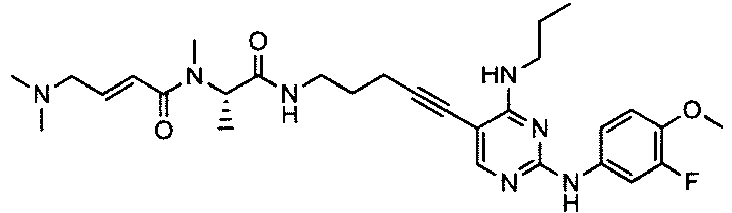
1H-NMR (CDCl3) δ: 7.93 (1H, s), 7.77 (1H, dd, J=13.9, 2.6Hz), 7.08-7.00 (1H, m), 6.98-6.86 (3H, m), 6.59-6.49 (1H, m), 6.42 (1H, d, J=15.2Hz), 6.26-6.16 (1H, m), 5.18 (1H, q, J=7.0Hz), 3.87 (3H, s), 3.51-3.40 (4H, m), 3.10 (2H, d, J=5.9Hz), 2.99 (3H, s), 2.43 (2H, t, J=6.6Hz), 2.27 (6H, s), 1.80-1.62 (4H, m), 1.35 (3H, d, J=7.0Hz), 0.99 (3H, t, J=7.3Hz) [Table 98] Compound No. Structure Physicochemical data 7-21 
1H-NMR (CDCl3) δ: 8.40 (1H, s), 8.25-8.19 (2H, m), 7.95 (1H, s), 7.00-6.85 (2H, m), 6.72 (1H, d, J=5.9Hz), 6.43 (1H, d, J=15.2Hz), 6.32 (1H, t, J=5.6Hz), 5.20 (1H, q, J=7.0Hz), 3.49-3.40 (4H, m), 3.10 (2H, dd, J=5.9, 1.3Hz), 3.01 (3H, s), 2.46-2.39 (2H, m), 2.27 (6H, s), 1.77-1.65 (4H, m), 1.36 (3H, d, J=7.3Hz), 0.98 (3H, t, J=7.5Hz) 7-22 
1H-NMR (CDCl3) δ: 8.39-8.17 (2H, m), 8.17-8.05 (2H, m), 8.09 (2H, s), 7.53-7.41 (2H, m), 6.96-6.73 (4H, m), 6.41 (1H, d, J=15.2Hz), 5.19 (1H, q, J=7.2Hz), 3.82 (3H, s), 3.57-3.41 (2H, m), 3.09 (2H, d, J=5.9Hz), 2.97 (3H, s), 2.60-2.42 (2H, m), 2.25 (6H, s), 1.88-1.68 (2H, m), 1.33 (3H, d, J=7.2Hz) 7-23 
1H-NMR (CDCl3) δ: 8.24 (1H, d, J=2.6Hz), 7.99 (1H, dd, J=8.6, 2.6Hz), 7.93 (1H, s), 6.94 (1H, dt, J=15.2, 5.9Hz), 6.79 (1H, s), 6.72 (1H, d, J=8.6Hz), 6.57-6.48 (1H, m), 6.42 (1H, d, J=15.2Hz), 6.20-6.09 (1H, m), 5.18 (1H, q, J=6.8Hz), 3.92 (3H, s), 3.50-3.37 (4H, m), 3.10 (2H, d, J=5.9Hz), 2.99 (3H, s), 2.43 (2H, t, J=6.9Hz), 2.27 (6H, s), 1.80-1.66 (4H, m), 1.35 (3H, d, J=6.8Hz), 0.97 (3H, t, J=7.6Hz) 7-24 
1H-NMR (CDCl3) δ: 7.96 (1H, s), 7.81 (1H, dt, J=11.9, 2.3Hz), 7.26-7.16 (1H, m), 7.11-7.07 (1H, m), 7.09-7.06 (1H, m), 6.95 (1H, dt, J=15.2, 5.9Hz), 6.67 (1H, dt, J=8.6, 2.6Hz), 6.62-6.55 (1H, m), 6.48 (1H, d, J=15.2Hz), 6.20-6.10 (1H, m), 4.04 (2H, s), 3.55-3.46 (2H, m), 3.48-3.40 (2H, m), 3.20 (3H, s), 3.13 (2H, d, J=5.9Hz), 2.48 (2H, t, J=6.6Hz), 2.29 (6H, s), 1.86-1.75 (2H, m), 1.76-1.64 (2H, m), 1.00 (3H, t, J=7.3Hz) 7-25 
1H-NMR (CDCl3) δ: 8.13 (1H, s), 7.84 (1H, dt, J=11.9, 2.0Hz), 7.51-7.45 (1H, m), 7.28-7.18 (4H, m), 7.14-7.08 (2H, m), 6.93-6.85 (1H, m), 6.70 (1H, td, J=8.6, 2.6Hz), 6.48-6.40 (1H, m), 6.34 (1H, d, J=15.2Hz), 5.21 (1H, q, J=7.3Hz), 4.65 (1H, dd, J=15.2, 7.2Hz), 4.53 (1H, dd, J=15.2, 6.6Hz), 3.60-3.49 (2H, m), 3.06 (2H, d, J=5.9Hz), 2.88 (3H, s), 2.24 (6H, s), 1.83-1.69 (2H, m), 1.33 (3H, d, J=7.3Hz), 1.03 (3H, t, J=7.6Hz) [Table 99] Compound No. Structure Physicochemical data 7-26 
1H-NMR (CDCl3) δ: 7.84 (1H, dt, J=12.5, 2.6Hz), 7.70 (1H, s), 7.25-7.04(7H, m), 6.98-6.91 (1H, m), 6.91 (1H, dt, J=15.2, 5.9Hz), 6.64 (1H, td, J=8.6, 2.6Hz), 6.39 (1H, d, J=15.2Hz), 5.66-5.58 (1H, m), 5.20 (1H, q, J=7.3Hz), 4.43 (2H, d, J=6.6Hz), 3.45-3.34 (2H, m), 3.09 (2H, d, J=5.9Hz), 2.94 (3H, s), 2.86 (2H, t, J=7.3Hz), 2.65-2.55 (2H, m), 2.26 (6H, s), 1.65-1.54 (2H, m), 1.35 (3H, d, J=7.3Hz), 0.97 (3H, t, J=7.3Hz) 7-27 
1H-NMR (CDCl3) δ: 8.83 (1H, s), 8.04 (1H, s), 7.84 (1H, dt, J=11.9, 2.3Hz), 7.74 (1H, s), 7.36 (1H, d, J=7.9Hz), 7.31-7.09 (4H, m), 7.00 (1H, dt, J=15.2, 5.9Hz), 6.80 (2H, s), 6.67 (1H, td, J=7.9, 2.0Hz), 6.45 (1H, d, J=15.2Hz), 5.48-5.25 (2H, m), 5.26-5.15 (1H, m), 3.57-3.47 (2H, m), 3.11 (2H, d, J=5.9Hz), 3.05 (3H, s), 2.27 (6H, s), 1.82-1.69 (2H, m), 1.45 (3H, d, J=7.3Hz), 1.03 (3H, t, J=7.6Hz) 7-28 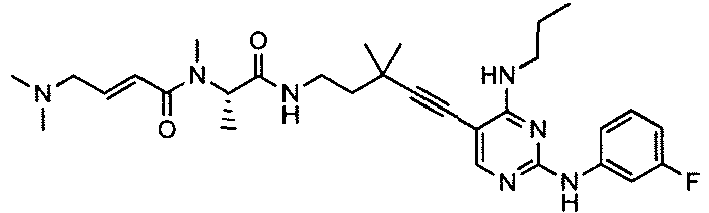
1H-NMR (CDCl3) δ: 7.96 (1H, s), 7.82 (1H, dt, J=11.9, 2.0Hz), 7.27-7.16 (1H, m), 7.10-7.05 (2H, m), 6.93 (1H, dt, J=15.2, 5.9Hz), 6.67 (1H, dt, J=7.9, 2.0Hz), 6.60-6.51 (1H, m), 6.41 (1H, d, J=15.2Hz), 6.11-6.00 (1H, m), 5.17 (1H, q, J=7.3Hz), 3.55-3.47 (2H, m), 3.49-3.35 (2H, m), 3.10 (2H, d, J=5.9Hz), 2.98 (3H, s), 2.27 (6H, s), 1.75-1.62 (2H, m), 1.34 (3H, d, J=7.3Hz), 1.34-1.24 (2H, m), 1.30 (6H, s), 1.00 (3H, t, J=7.6Hz) 7-29 
1H-NMR (CD3OD) δ: 7.80 (4H, s), 7.60 (1H, s), 6.78 (1H, dt, J=15.9, 6.6Hz), 6.14 (1H, d, J=15.9Hz), 3.88 (2H, s), 3.47 (2H, t, J=7.3Hz), 3.20 (2H, t, J=6.9Hz), 3.11 (2H, dd, J=6.6, 1.3Hz), 2.36 (2H, t, J=7.6Hz), 2.26 (6H, s), 1.72-1.67 (2H, m), 1.61-1.51 (4H, m), 1.41-1.35 (2H, m), 1.00 (3H, t, J=7.6Hz) [Table 100] Compound No. Structure Physicochemical data 7-31 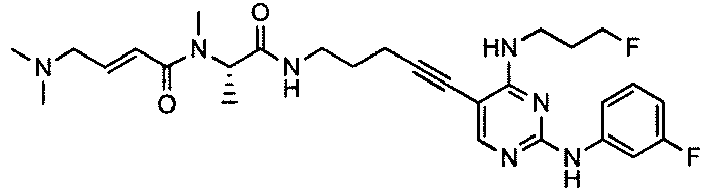
1H-NMR (CDCl3) δ: 7.97 (1H, s), 7.77 (1H, dt, J=12.1, 2.1Hz), 7.21 (1H, dt, J=8.3, 6.6Hz), 7.17 (1H, s), 7.10 (1H, dd, J=8.3, 2.1 Hz), 6.94 (1H, dt, J=15.2, 5.9Hz), 6.68 (1H, dt, J=8.3, 2.1Hz), 6.65-6.60 (1H, m), 6.60-6.52 (1H, m), 6.45-6.40 (1H, m), 5.19 (1H, q, J=7.3Hz), 4.60 (2H, dt, J=47.3, 5.6Hz), 3.71 (2H, q, J=6.6Hz), 3.46 (2H, q, J=6.4Hz), 3.10 (2H, dd, J=5.9, 1.3Hz), 3.00 (3H, s), 2.43 (2H, t, J=6.3Hz), 2.27 (6H, s), 2.21-2.04 (2H, m), 1.80-1.66 (2H, m), 1.36 (3H, d, J=7.3Hz) 7-32 
1H-NMR (CDCl3) δ: 7.98 (1H, s), 7.77 (2H, d, J=9.2Hz), 7.60-7.48 (3H, m), 6.94 (1H, dt, J=15.2, 5.9Hz), 6.60 (1H, brs), 6.48-6.34 (2H, m), 5.19 (1H, q, J=7.0Hz), 3.56-3.40 (4H, m), 3.10 (2H, dd, J=5.9, 1.3Hz), 3.00 (3H, s), 2.50-2.38 (2H, m), 2.27 (6H, s), 1.88-1.64 (4H, m), 1.36 (3H, d, J=7.3Hz), 1.00 (3H, t, J=7.6Hz) 7-33 
1H-NMR (CDCl3) δ: 7.97 (1H, s), 7.77 (2H, d, J=8.6Hz), 7.56 (2H, d, J=8.6Hz), 7.53-7.44 (2H, m), 6.96 (1H, dt, J=15.2, 5.9Hz), 6.45 (1H, t, J=5.6Hz), 6.33 (1H, d, J=15.2Hz), 4.68 (1H, d, J=6.6Hz), 3.74-3.32 (6H, m), 3.10 (2H, d, J=5.9Hz), 2.52-2.43 (2H, m), 2.27 (6H, s), 1.89-1.65 (8H, m), 0.99 (3H, t, J=7.4Hz) 7-34 
1H-NMR (CDCl3) δ: 7.97 (1H, s), 7.78 (2H, d, J=8.6Hz), 7.70 (1H, brs), 7.56 (2H, d, J=8.6Hz), 6.94 (1H, dt, J=15.2, 5.9Hz), 6.60 (1H, brs), 6.48-6.42 (2H, m), 4.92 (1H, t, J=7.9Hz), 3.53-3.42 (4H, m), 3.11 (2H, d, J=5.9Hz), 3.01 (3H, s), 2.44 (2H, t, J=6.6Hz), 2.28 (6H, s), 2.04-1.92 (1H, m), 1.78-1.65 (5H, m), 1.00 (3H, t, J=7.4Hz), 0.91 (3H, t, J=7.4Hz) [Table 101] Compound No. Structure Physicochemical data 7-35 
1H-NMR (CDCl3) δ: 8.00 (1H, s), 7.88 (2H, d, J=9.2Hz), 7.56 (2H, d, J=9.2Hz), 7.45 (1H, s), 6.93 (1H, dt, J=15.2, 5.9Hz), 6.47-6.37 (1H, m), 6.34 (1H, d, J=7.9Hz), 5.61 (1H, s), 5.15 (1H, q, J=7.0Hz), 3.78-3.64 (1H, m), 3.10 (2H, dd, J=5.9, 1.3Hz), 2.98 (3H, s), 2.87-2.77 (1H, m), 2.67-2.52 (1H, m), 2.35-2.21(7H, m), 2.05-1.93 (1H, m), 1.92-1.75 (2H, m), 1.47-0.99(7H, m), 0.98-0.87 (2H, m), 0.72-0.61 (2H, m) 7-36 
1H-NMR (CDCl3) δ: 7.97 (1H, s), 7.77 (2H, d, J=8.8Hz), 7.56 (2H, d, J=8.8Hz), 7.50-7.36 (2H, m), 6.96 (1H, dt, J=15.2, 5.9Hz), 6.45 (1H, t, J=5.9Hz), 6.33 (1H, d, J=15.2Hz), 4.68 (1H, d, J=6.6Hz), 3.73-3.32 (6H, m), 3.11 (2H, d, J=5.6Hz), 2.47 (2H, t, J=6.6Hz), 2.27 (6H, s), 1.90-1.65 (8H, m), 1.00 (3H, t, J=7.3Hz) 7-37 
1H-NMR (CDCl3) δ: 7.98 (1H, s), 7.76 (2H, d, J=8.8Hz), 7.57 (2H, d, J=8.8Hz), 7.19 (1H, s), 6.91 (1H, dt, J=15.2, 5.9Hz), 6.55-6.30 (3H, m), 5.20 (1H, d, J=4.6Hz), 3.99-3.87 (1H, m), 3.57-3.36 (4H, m), 3.14-3.00 (3H, m), 2.46 (2H, t, J=6.6Hz), 2.28 (6H, s), 1.95-1.20 (10H, m), 1.00 (3H, t, J=7.4Hz) 7-38 
1H-NMR (CDCl3) δ: 7.98 (1H, s), 7.76 (2H, d, J=8.8Hz), 7.57 (2H, d, J=8.8Hz), 7.16 (1H, s), 6.91 (1H, dt, J=15.2, 5.9Hz), 6.55-6.30 (3H, m), 5.20 (1H, d, J=5.3Hz), 3.99-3.87 (1H, m), 3.57-3.36 (4H, m), 3.14-3.00 (3H, m), 2.46 (2H, t, J=6.6Hz), 2.28 (6H, s), 1.95-1.20 (10H, m), 1.00 (3H, t, J=7.4Hz) 7-39 
1H-NMR (CDCl3) δ: 7.97 (1H, s), 7.77 (2H, d, J=9.2Hz), 7.56 (2H, d, J=9.2Hz), 7.47 (1H, s), 6.98 (1H, dt, J=15.2, 5.9Hz), 6.85 (1H, brs), 6.43 (1H, d, J=15.2Hz), 6.29 (1H, brs), 4.02 (2H, s), 3.57-3.41 (6H, m), 3.12-3.07 (2H, m), 2.47 (2H, t, J=6.6Hz), 2.27 (6H, s), 1.83-1.65 (4H, m), 1.25 (3H, t, J=7.3Hz), 1.00 (3H, t, J=7.3Hz) [Table 102] Compound No. Structure Physicochemical data 7-40 
1H-NMR (CDCl3) δ: 7.97 (1H, s), 7.77 (2H, d, J=9.2Hz), 7.56 (2H, d, J=9.2Hz), 7.47 (1H, s), 7.09 (1H, brs), 6.98-6.89 (1H, m), 6.49 (1H, d, J=15.2Hz), 6.38 (1H, brs), 4.31-4.20 (1H, m), 3.97 (2H, s), 3.52-3.42 (4H, m), 3.12-3.07 (2H, m), 2.47 (2H, t, J=6.9Hz), 2.28 (6H, s), 1.80-1.65 (4H, m), 1.26 (6H, d, J=6.9Hz), 1.00 (3H, t, J=7.6Hz) 7-41 
1H-NMR (CDCl3) δ: 7.95 (1H, s), 7.92 (1H, ddd, J=12.6, 7.6, 1.7Hz), 7.12-6.96 (3H, m), 6.94 (1H, dt, J=15.2, 5.9Hz), 6.59-6.48 (1H, m), 6.48-6.37 (1H, m), 6.34-6.25 (1H, m), 5.19 (1H, q, J=7.0Hz), 3.52-3.40 (4H, m), 3.10 (2H, dd, J=5.9, 1.3Hz), 2.99 (3H, s), 2.44 (2H, t, J=6.6Hz), 2.27 (6H, s), 1.79-1.65 (4H, m), 1.36 (3H, d, J=7.0Hz), 1.00 (3H, t, J=7.3Hz) 7-42 
1H-NMR (CDCl3) δ: 8.06 (1H, dd, J=14.2, 2.3Hz), 7.95 (1H, s), 7.10-7.01 (2H, m), 6.94 (1H, dt, J=15.2, 5.9Hz), 6.88 (1H, t, J=9.2Hz), 6.60-6.48 (1H, m), 6.42 (1H, d, J=15.2Hz), 6.21 (1H, s), 5.18 (1H, q, J=7.0Hz), 3.87 (3H, s), 3.41 (2H, q, J=6.4Hz), 3.10 (2H, d, J=5.9Hz), 3.00 (3H, s), 2.91-2.80 (1H, m), 2.42 (2H, t, J=6.6Hz), 2.27 (6H, s), 1.78-1.69 (2H, m), 1.37 (3H, d, J=7.0Hz), 0.93-0.86 (2H, m), 0.72 (2H, q, J=5.3Hz) 7-43 
1H-NMR (CDCl3) δ: 7.98 (1H, s), 7.77 (2H, d, J=8.6Hz), 7.57 (2H, d, J=8.6Hz), 7.37-7.18 (6H, m), 7.08-6.99 (1H, m), 6.69 (1H, brs), 6.48 (1H, d, J=15.2Hz), 6.29 (1H, brs), 4.73 (2H, s), 4.01 (2H, s), 3.49-3.36 (4H, m), 3.09-3.01 (2H, m), 2.48 (2H, t, J=6.0Hz), 2.26 (6H, s), 1.84-1.66 (4H, m), 1.00 (3H, t, J=7.6Hz) [Table 103] Compound No. Structure Physicochemical data 7-44 
1H-NMR (CDCl3) δ: 7.98 (1H, s), 7.76 (2H, d, J=8.6Hz), 7.57 (2H, d, J=8.6Hz), 7.26 (1H, brs), 6.89 (1H, dt, J=15.2, 5.3Hz), 6.53 (1H, brs), 6.42 (1H, brs), 6.25 (1H, brs), 6.02 (1H, d, J=15.2Hz), 4.60-4.55 (1H, m), 3.88 (1H, dd, J=8.9,3.6Hz), 3.54-3.46 (5H, m), 3.41 (3H, s), 3.07 (2H, d, J=5.9Hz), 2.50 (2H, t, J=6.6Hz), 2.26 (6H, s), 1.84-1.68 (4H, m), 1.01 (3H, t, J=7.3Hz) 7-45 
1H-NMR (CDCl3) δ: 7.95 (1H, s), 7.82 (1H, d, J=12.1Hz), 7.47-7.41 (1H, m), 7.24-7.16 (1H, m), 7.10-7.07 (1H, m), 7.08-7.05 (1H, m), 6.96 (1H, dt, J=15.2, 5.9Hz), 6.67 (1H, td, J=8.1, 2.4Hz), 6.33 (1H, d, J=15.2Hz), 6.32-6.28 (1H, m), 4.68 (1H, d, J=7.3Hz), 3.70-3.63 (1H, m), 3.59-3.45 (4H, m), 3.46-3.33 (1H, m), 3.10 (2H, d, J=5.9Hz), 2.55-2.48 (1H, m), 2.46 (2H, t, J=6.6Hz), 2.27 (6H, s), 2.22-1.97 (2H, m), 1.88-1.69 (1H, m), 1.82-1.65 (4H, m), 1.00 (3H, t, J=6.6Hz) 7-46 
1H-NMR (CDCl3) δ: 7.96 (1H, s), 7.82 (1H, d, J=11.9Hz), 7.24-7.17 (1H, m), 7.11-7.06 (1H, m), 7.08-7.05 (1H, m), 6.91 (1H, dt, J=15.2, 5.9Hz), 6.67 (1H, td, J=8.3, 2.0Hz), 6.48 (1H, d, J=15.2Hz), 6.38-6.33 (1H, m), 5.20 (1H, d, J=5.3Hz), 3.93 (1H, d, J=13.2Hz), 3.54-3.42 (4H, m), 3.10-3.00 (2H, m), 3.10 (2H, d, J=5.9Hz), 2.46 (2H, t, J=6.6Hz), 2.27 (6H, s), 1.90-1.80 (2H, m), 1.82-1.65 (6H, m), 1.58-1.47 (2H, m), 1.00 (3H, t, J=7.3Hz) 7-47 
1H-NMR (CDCl3) δ: 7.96 (1H, s), 7.85-7.78 (1H, m), 7.27-7.17 (2H, m), 7.10-7.06 (1H, m), 7.06-7.03 (1H, m), 6.95 (1H, dt, J=15.2, 5.9Hz), 6.67 (1H, td, J=8.1, 2.2Hz), 6.27 (1H, d, J=15.2Hz), 6.20-6.14 (1H, m), 5.33 (1H, d, J=53.5Hz), 4.83-4.76 (1H, m), 3.98 (1H, dd, J=20.5, 12.6Hz), 3.70 (1H, ddd, J=32.4, 12.2,3.6Hz), 3.52-3.39 (4H, m), 3.10 (2H, d, J=5.9Hz), 2.90-2.70 (1H, m), 2.48 (2H, t, J=6.9Hz), 2.45-2.25 (1H, m), 2.26 (6H, s), 1.85-1.74 (2H, m), 1.76-1.65 (2H, m), 1.00 (3H, t, J=7.6Hz) [Table 104] Compound No. Structure Physicochemical data 7-48 
1H-NMR (CDCl3) δ: 7.97 (1H, s), 7.76 (2H, d, J=8.6Hz), 7.57 (2H, d, J=8.6Hz), 7.29-7.26 (2H, m), 6.95 (1H, dt, J=15.2, 5.9Hz), 6.30-6.26 (1H, m), 6.28 (1H, d, J=15.2Hz), 5.33 (1H, d, J=52.8Hz), 4.83-4.76 (1H, m), 3.99 (1H, dd, J=20.1, 12.2Hz), 3.70 (1H, ddd, J=32.4, 12.2,3.6Hz), 3.50-3.43 (4H, m), 3.10 (2H, d, J=5.9Hz), 2.89-2.69 (1H, m), 2.48 (2H, t, J=6.6Hz), 2.45-2.28 (1H, m), 2.26 (6H, s), 1.85-1.73 (2H, m), 1.75-1.64 (2H, m), 0.99 (3H, t, J=7.6Hz) 7-49 
MS m/z (M+H): 554.4 7-50 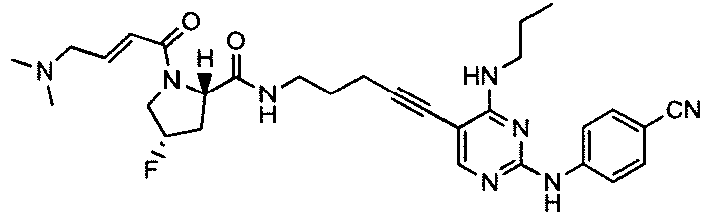
MS m/z (M+H): 561.4 7-51 
1H-NMR (CDCl3) δ: 8.03-8.00 (1H, m), 7.96 (1H, s), 7.82 (1H, d, J=12.1Hz), 7.25-7.16 (1H, m), 7.11-7.05 (1H, m), 7.04-7.00 (1H, m), 6.94 (1H, dt, J=15.2, 5.9Hz), 6.67 (1H, td, J=8.3, 2.2Hz), 6.25-6.17 (1H, m), 6.04 (1H, d, J=15.2Hz), 4.95 (1H, dd, J=9.2, 6.6Hz), 4.17-4.09 (2H, m), 3.58-3.37 (4H, m), 3.10 (2H, d, J=5.9Hz), 2.81-2.70 (1H, m), 2.52-2.40 (1H, m), 2.50 (2H, t, J=6.6Hz), 2.26 (6H, s), 1.85-1.75 (2H, m), 1.78-1.65 (2H, m), 1.01 (3H, t, J=7.3Hz) 7-52 
1H-NMR (CDCl3) δ: 8.06-7.99 (1H, m), 7.98 (1H, s), 7.76 (2H, d, J=8.6Hz), 7.57 (2H, d, J=8.6Hz), 7.25-7.20 (1H, m), 6.94 (1H, dt, J=15.2, 5.9Hz), 6.37-6.30 (1H, m), 6.04 (1H, d, J=15.2Hz), 4.95 (1H, dd, J=9.2, 6.6Hz), 4.20-4.11 (2H, m), 3.62-3.33 (4H, m), 3.10 (2H, d, J=5.9Hz), 2.81-2.70 (1H, m), 2.50 (2H, t, J=6.6Hz), 2.50-2.40 (1H, m), 2.26 (6H, s), 1.85-1.75 (2H, m), 1.76-1.65 (2H, m), 1.00 (3H, t, J=7.3Hz) [Table 105] Compound No. Structure Physicochemical data 7-53 
1H-NMR (CDCl3) δ: 7.96 (1H, s), 7.81 (1H, d, J=13.0Hz), 7.28-7.16 (2H, m), 7.16-7.06 (1H, m), 7.07-6.97 (1H, m), 7.06-7.02 (1H, m), 6.71-6.64 (1H, m), 6.22 (1H, d, J=15.2Hz), 6.21-6.17 (1H, m), 4.88 (1H, dd, J=9.2, 4.6Hz), 4.07-3.80 (2H, m), 3.54-3.40 (4H, m), 3.24-3.05 (1H, m), 3.11 (2H, d, J=5.0Hz), 2.58-2.43 (1H, m), 2.48 (2H, t, J=6.6Hz), 2.26 (6H, s), 1.83-1.73 (2H, m), 1.76-1.65 (2H, m), 1.00 (3H, t, J=7.3Hz) 7-54 
1H-NMR (CDCl3) δ: 7.97 (1H, s), 7.76 (2H, d, J=8.6Hz), 7.57 (2H, d, J=8.6Hz), 7.25-7.21 (1H, m), 7.15-7.09 (1H, m), 7.01 (1H, dt, J=15.2, 5.9Hz), 6.37-6.31 (1H, m), 6.22 (1H, d, J=15.2Hz), 4.88 (1H, dd, J=9.6, 5.0Hz), 4.10-3.80 (2H, m), 3.53-3.43 (4H, m), 3.18-3.05 (1H, m), 3.11 (2H, d, J=5.3Hz), 2.57-2.44 (1H, m), 2.48 (2H, t, J=6.6Hz), 2.27 (6H, s), 1.83-1.73 (2H, m), 1.75-1.65 (2H, m), 1.00 (3H, t, J=7.6Hz) 7-55 
1H-NMR (CDCl3) δ: 7.98 (1H, s), 7.76 (2H, d, J=8.6Hz), 7.57 (2H, d, J=8.6Hz), 7.21 (1H, brs), 6.94 (1H, dt, J=15.2, 5.9Hz), 6.64 (1H, brs), 6.46 (1H, d, J=15.2Hz), 6.35 (1H, brs), 5.22 (1H, t, J=7.3Hz), 3.80 (2H, d, J=7.3Hz), 3.51-3.41 (4H, m), 3.38 (3H, s), 3.11-3.04 (5H, m), 2.46 (2H, t, J=6.6Hz), 2.27 (6H, s), 1.78-1.70 (4H, m), 1.00 (3H, t, J=7.6Hz) 7-56 
1H-NMR (CDCl3) δ: 7.95 (1H, s), 7.71 (1H, dd, J=13.5, 2.3Hz), 7.10-7.03 (1H, m), 6.94 (1H, dt, J=15.2, 5.9Hz), 6.89 (1H, t, J=9.2Hz), 6.86 (1H, brs), 6.61-6.48 (2H, m), 6.42 (1H, dt, J=15.2, 1.3Hz), 5.18 (1H, q, J=6.8Hz), 4.59 (2H, dt, J=47.1, 5.6Hz), 3.87 (3H, s), 3.69 (2H, q, J=6.6Hz), 3.45 (2H, q, J=6.6Hz), 3.11 (2H, dd, J=5.9, 1.3Hz), 2.99 (3H, s), 2.43 (2H, t, J=6.3Hz), 2.27 (6H, s), 2.21-2.02 (2H, m), 1.79-1.69 (2H, m), 1.36 (3H, d, J=6.8Hz) [Table 106] Compound No. Structure Physicochemical data 7-57 
1H-NMR (CDCl3) δ: 7.98 (1H, s), 7.77 (2H, d, J=8.6Hz), 7.56 (2H, d, J=8.6Hz), 7.51 (1H, brs), 6.87 (1H, dt, J=15.3, 6.0Hz), 6.62 (1H, brs), 6.54 (1H, brs), 6.13 (1H, t, J=5.3 Hz), 6.02 (1H, d, J=15.3Hz), 4.01 (2H, d, J= 5.3Hz), 3.57-3.42 (4H, m), 3.06 (2H, d, J=6.0Hz), 2.51 (2H, t, J=6.9Hz), 2.25 (6H, s), 1.87-1.76 (2H, m), 1.76-1.65 (2H, m), 1.00 (3H, t, J=7.6Hz) 7-58 
1H-NMR (CDCl3) δ: 7.96 (1H, s), 7.86-7.78 (1H, m), 7.36-7.29 (1H, m), 7.25-7.16 (1H, m), 7.11-7.05 (1H, m), 7.04-7.01 (1H, m), 6.94 (1H, dt, J=15.2, 5.9Hz), 6.67 (1H, dt, J=8.1, 2.2Hz), 6.28 (1H, d, J=15.2Hz), 6.27-6.22 (1H, m), 4.73 (1H, dd, J=8.6, 4.0Hz), 4.23-4.16 (1H, m), 3.76 (1H, dd, J=10.6, 5.9Hz), 3.58 (1H, dd, J=10.6, 4.6Hz), 3.53-3.41 (2H, m), 3.43-3.30 (2H, m), 3.35 (3H, s), 3.10 (2H, d, J=5.9Hz), 2.73-2.64 (1H, m), 2.47 (2H, t, J=6.9Hz), 2.26 (6H, s), 2.06-1.91 (1H, m), 1.80-1.67 (4H, m), 1.00 (3H, t, J=7.6Hz) 7-59 
MS m/z (M+H): 566.4 7-60 
1H-NMR (CDCl3) δ: 7.97 (1H, s), 7.76 (2H, d, J=9.2Hz), 7.56 (2H, d, J=9.2Hz), 7.36-7.31 (1H, m), 7.26-7.23 (1H, m), 6.94 (1H, dt, J=15.2, 5.9Hz), 6.39-6.33 (1H, m), 6.28 (1H, d, J=15.2Hz), 4.73 (1H, dd, J=8.3, 4.3 Hz), 4.22-4.15 (1H, m), 3.76 (1H, dd, J=10.6, 5.9Hz), 3.58 (1H, dd, J=10.6, 4.6Hz), 3.52-3.41 (4H, m), 3.35 (3H, s), 3.10 (2H, d, J=5.9Hz), 2.72-2.64 (1H, m), 2.47 (2H, t, J=6.9Hz), 2.26 (6H, s), 2.02-1.92 (1H, m), 1.81-1.67 (4H, m), 1.00 (3H, t, J=7.3Hz) [Table 107] Compound No. Structure Physicochemical data 7-61 
MS m/z (M+H): 573.4 7-62 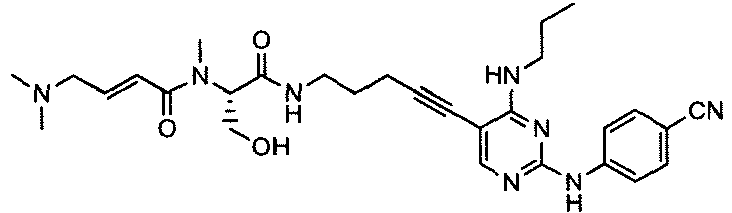
1H-NMR (CDCl3) δ: 7.98 (1H, s), 7.76 (2H, d, J=9.0Hz), 7.57 (2H, d, J=9.0Hz), 7.22 (1H, brs), 6.97 (1H, dt, J=15.0, 6.0Hz), 6.66 (1H, brs), 6.47 (1H, d, J=15.0Hz), 6.23 (1H, brs), 5.05 (1H, t, J=5.0Hz), 4.16-3.95 (2H, m), 3.52-3.45 (4H, m), 3.14-3.10 (5H, m), 2.48 (2H, t, J=6.6Hz), 2.28 (6H, s), 1.83-1.65 (5H, m), 1.00 (3H, t, J=7.8Hz) 7-63 
1H-NMR (CDCl3) δ: 7.99 (1H, s), 7.76 (2H, d, J=9.0Hz), 7.57 (2H, d, J=9.0Hz), 7.17 (1H, brs), 6.97 (1H, dt, J=15.0, 6.0Hz), 6.57 (1H, brs), 6.51 (1H, d, J=15.0Hz), 6.24 (1H, brs), 4.86 (1H, d, J=5.4Hz), 4.47-4.38 (1H, m), 3.52-3.45 (4H, m), 3.23 (3H, s), 3.13-3.08 (2H, m), 2.47 (2H, t, J=7.5Hz), 2.28 (6H, s), 1.82-1.59 (5H, m), 1.21 (3H, d, J=6.0 Hz), 1.00 (3H, t, J=7.2Hz) 7-64 
1H-NMR (CDCl3) δ: 7.98 (1H, s), 7.76 (2H, d, J=9.0Hz), 7.57 (2H, d, J=9.0Hz), 7.18 (1H, brs), 6.97 (1H, dt, J=15.0, 6.0Hz), 6.86 (1H, brs), 6.43 (1H, d, J=15.0Hz), 6.26 (1H, brs), 4.02 (2H, s), 3.52-3.39 (6H, m), 3.11 (2H, d, J=6.0Hz), 2.47 (2H, t, J=6.6Hz), 2.28 (6H, s), 1.81-1.63 (6H, m), 1.00 (3H, t, J=7.2Hz), 0.93 (3H, t, J=7.2Hz) 7-65 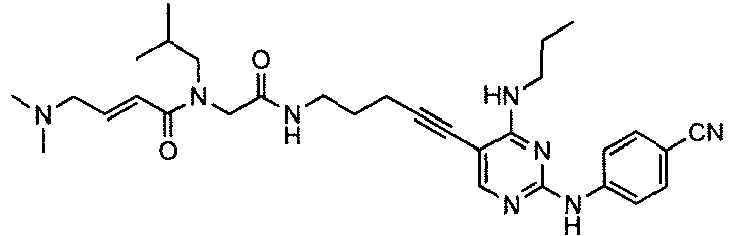
1H-NMR (CDCl3) δ: 7.98 (1H, s), 7.76 (2H, d, J=9.0Hz), 7.56 (2H, d, J=9.0Hz), 7.23 (1H, brs), 6.97 (2H, dt, J=15.0, 6.0Hz), 6.44 (1H, d, J=15.0Hz), 6.27 (1H, brs), 4.03 (2H, s), 3.54-3.40 (4H, m), 3.28 (2H, d, J=7.2Hz), 3.10 (2H, d, J=6.0Hz), 2.47 (2H, t, J=6.6Hz), 2.27 (6H, s), 2.13-1.90 (1H, m), 1.81-1.66 (4H, m), 1.00 (3H, t, J=7.5Hz), 0.93 (6H, d, J=6.6Hz) [Table 108] Compound No. Structure Physicochemical data 7-66 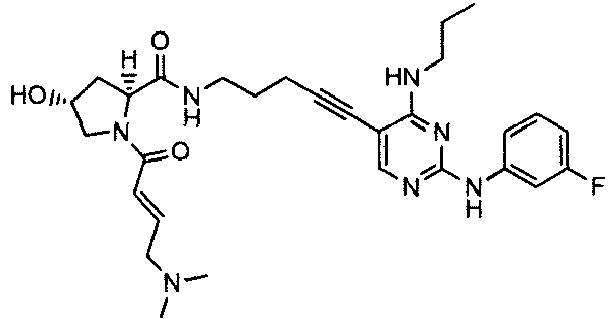
1H-NMR (CDCl3) δ: 7.95 (1H, s), 7.85-7.78 (1H, m), 7.36-7.30 (1H, m), 7.24-7.17 (1H, m), 7.11-7.05 (1H, m), 7.08-7.05 (1H, m), 6.94 (1H, dt, J=15.2, 5.9Hz), 6.67 (1H, td, J=8.3, 2.4Hz), 6.28 (1H, d, J=15.2Hz), 6.24-6.17 (1H, m), 4.76 (1H, dd, J=8.3, 5.0Hz), 4.70-4.64 (1H, m), 3.77 (1H, dd, J=10.6, 5.0Hz), 3.56 (1H, dd, J=10.6, 5.0Hz), 3.55-3.37 (4H, m), 3.10 (2H, d, J=5.9Hz), 2.72-2.63 (1H, m), 2.47 (2H, t, J=6.9Hz), 2.28-2.22 (1H, m), 2.26 (6H, s), 2.03-1.92 (1H, m), 1.82-1.63 (4H, m), 1.00 (3H, t, J=7.6Hz) 7-67 
1H-NMR (CDCl3) δ: 7.96 (1H, s), 7.84-7.78 (1H, m), 7.74-7.69 (1H, m), 7.26-7.16 (1H, m), 7.15-7.11 (1H, m), 7.15-7.09 (1H, m), 6.97 (1H, dt, J=15.2, 5.9Hz), 6.71-6.63 (1H, m), 6.26 (1H, d, J=15.2Hz), 6.04-5.98 (1H, m), 5.62-5.55 (1H, m), 4.79 (1H, d, J=8.6Hz), 4.53-4.46 (1H, m), 3.77-3.67 (2H, m), 3.52-3.42 (4H, m), 3.10 (2H, d, J=5.9Hz), 2.50 (2H, t, J=6.9Hz), 2.45-2.38 (1H, m), 2.26 (6H, s), 2.18-2.09 (1H, m), 1.85-1.76 (2H, m), 1.74-1.65 (2H, m), 1.00 (3H, t, J=7.3Hz) 7-68 
1H-NMR (CDCl3) δ: 7.97 (1H, s), 7.76 (2H, d, J=8.6Hz), 7.57 (2H, d, J=8.6Hz), 7.36-7.28 (1H, m), 7.31-7.23 (1H, m), 6.94 (1H, dt, J=15.2, 5.9Hz), 6.34-6.28 (1H, m), 6.29 (1H, d, J=15.2Hz), 4.76 (1H, dd, J=8.3, 5.0Hz), 4.70-4.64 (1H, m), 3.77 (1H, dd, J=10.9, 5.6Hz), 3.57 (1H, dd, J=10.6, 4.6Hz), 3.51-3.41 (4H, m), 3.10 (2H, d, J=5.9Hz), 2.72-2.63 (1H, m), 2.47 (2H, t, J=6.6Hz), 2.28-2.21 (1H, m), 2.26 (6H, s), 2.04-1.94 (1H, m), 1.80-1.66 (4H, m), 1.00 (3H, t, J=7.6Hz) [Table 109] Compound No. Structure Physicochemical data 7-69 
1H-NMR (CDCl3) δ: 7.97 (1H, s), 7.78 (2H, d, J=8.6Hz), 7.76-7.69 (1H, m), 7.56 (2H, d, J=8.6Hz), 7.41-7.38 (1H, m), 6.96 (1H, dt, J=15.2, 5.9Hz), 6.27 (1H, d, J=15.2Hz), 6.14-6.08 (1H, m), 5.60-5.54 (1H, m), 4.79 (1H, d, J=8.6Hz), 4.53-4.47 (1H, m), 3.79-3.66 (2H, m), 3.51-3.42 (4H, m), 3.10 (2H, d, J=5.9Hz), 2.50 (2H, t, J=6.6Hz), 2.46-2.37 (1H, m), 2.26 (6H, s), 2.20-2.09 (1H, m), 1.86-1.76 (2H, m), 1.75-1.63 (2H, m), 0.99 (3H, t, J=7.3Hz) 7-70 
1H-NMR (CDCl3) δ: 7.98 (1H, s), 7.76 (2H, d, J=9.0Hz), 7.56 (2H, d, J=9.0Hz), 7.26 (1H, brs), 6.97 (1H, dt, J=15.0, 6.0Hz), 6.86 (1H, brs), 6.42 (1H, d, J=15.0Hz), 6.29 (1H, brs), 4.02 (2H, s), 3.52-3.40 (6H, m), 3.11 (2H, d, J=6.0Hz), 2.47 (2H, t, J=7.5Hz), 2.27 (6H, s), 1.81-1.56 (6H, m), 1.39-1.26 (2H, m), 1.00 (3H, t, J=7.5Hz), 0.94 (3H, t, J=7.5Hz) 7-71 
1H-NMR (CDCl3) δ: 7.98 (1H, s), 7.76 (2H, d, J=9.0Hz), 7.56 (2H, d, J=9.0Hz), 7.34 (1H, brs), 6.97 (1H, dt, J=15.0, 6.0Hz), 6.87 (1H, brs), 6.42 (1H, d, J=15.0Hz), 6.29 (1H, brs), 4.02 (2H, s), 3.52-3.41 (6H, m), 3.10 (2H, d, J=6.0Hz), 2.47 (2H, t, J=7.5Hz), 2.27 (6H, s), 1.79-1.58 (6H, m), 1.37-1.23 (4H, m), 1.00 (3H, t, J=7.5Hz), 0.90 (3H, t, J=7.5Hz) 7-72 
MS m/z (M+H): 526.4 7-73 
MS m/z (M+H): 538.4 [Table 110] Compound No. Structure Physicochemical data 7-74 
1H-NMR (CDCl3) δ: 7.95 (1H, s), 7.84-7.78 (1H, m), 7.76-7.70 (1H, m), 7.26-7.16 (1H, m), 7.20-7.15 (1H, m), 7.19-7.13 (1H, m), 6.96 (1H, dt, J=15.2, 5.9Hz), 6.71-6.64 (1H, m), 6.27 (1H, d, J=15.2Hz), 6.12-6.06 (1H, m), 5.67-5.60 (1H, m), 4.80 (1H, d, J=8.6Hz), 4.53-4.47 (1H, m), 3.79-3.67 (2H, m), 3.53-3.45 (2H, m), 3.11 (2H, d, J=5.9Hz), 3.08 (3H, d, J=4.6Hz), 2.49 (2H, t, J=6.6Hz), 2.46-2.38 (1H, m), 2.27 (6H, s), 2.20-2.09 (1H, m), 1.88-1.73 (2H, m) 7-75 
MS m/z (M+H): 533.4 7-76 
1H-NMR (CDCl3) δ: 8.39 (1H, s), 7.99 (1H, s), 7.95 (1H, s), 7.67-7.59 (2H, m), 7.35 (1H, t, J=7.9Hz), 7.23 (1H, d, J=7.9Hz), 6.96 (1H, dt, J=15.2, 5.9Hz), 6.52-6.49 (1H, m), 6.34 (1H, d, J=15.2Hz), 4.69 (1H, d, J=6.6Hz), 3.73-3.66 (1H, m), 3.58-3.42 (3H, m), 3.12-3.08 (5H, m), 2.49-2.31 (3H, m), 2.26 (6H, s), 2.21-1.85 (3H, m), 1.78-1.73 (2H, m) 7-77 
1H-NMR (CDCl3) δ: 7.95 (1H, s), 7.85-7.79 (1H, m), 7.45 (1H, brs), 7.20 (1H, dd, J=7.9, 6.6Hz), 7.11 (1H, d, J=7.9Hz), 7.00-6.92 (2H, m), 6.70-6.65 (1H, dt, J=8.1, 1.8Hz), 6.39-6.30 (2H, m), 4.69 (1H, d, J=6.6Hz), 3.71-3.64 (1H, m), 3.59-3.37 (3H, m), 3.11-3.09 (5H, m), 2.55-2.43 (4H, m), 2.27 (6H, s), 1.88-1.71 (4H, m) 7-78 
1H-NMR (CDCl3) δ: 8.22 (1H, s), 6.95 (1H, dt, J=15.2, 5.9Hz), 6.59-6.49 (2H, m), 6.43 (2H, d, J=15.2Hz), 6.18 (1H, s), 5.20 (1H, q, J=7.2Hz), 3.56-3.32 (4H, m), 3.11 (2H, d, J=5.9Hz), 3.00 (3H, s), 2.43 (2H, t, J=6.6Hz), 2.28 (3H, s), 2.27 (6H, s), 1.86-1.66 (4H, m), 1.36 (3H, d, J=7.2Hz), 1.01 (3H, t, J=7.3Hz) [Table 111] Compound No. Structure Physicochemical data 7-79 
1H-NMR (CDCl3) δ: 8.21 (1H, s), 7.41 (1H, t, J=5.9Hz), 6.97 (1H, dt, J=15.2, 5.9Hz), 6.57 (1H, t, J=5.9Hz), 6.34 (1H, d, J=15.2Hz), 6.18 (1H, s), 4.69 (1H, dd, J=6.6,3.3Hz), 3.75-3.34 (6H, m), 3.11 (2H, d, J=5.9Hz), 2.55-2.50 (1H, m), 2.46 (2H, t, J=6.9Hz), 2.28 (3H, s), 2.27 (6H, s), 2.22-1.96 (2H, m), 1.92-1.61 (6H, m), 1.00 (3H, t, J=7.6Hz) 7-80 
MS m/z (M+H): 526.5 7-81 
1H-NMR (CDCl3) δ: 7.93 (1H, s), 7.63-7.56 (2H, m), 7.44-7.38 (1H, m), 7.24-7.21 (1H, m), 7.03-6.96 (2H, m), 6.94 (1H, dt, J=15.2, 5.9Hz), 6.27 (1H, d, J=15.2Hz), 6.17-6.12 (1H, m), 5.34 (1H, d, J=52.8Hz), 4.84-4.77 (1H, m), 3.98 (1H, dd, J=20.1, 12.2Hz), 3.73 (1H, ddd, J=32.4, 12.2,3.6Hz), 3.51-3.41 (2H, m), 3.10 (2H, d, J=5.9Hz), 3.04 (3H, d, J=4.6Hz), 2.87-2.67 (1H, m), 2.47 (2H, t, J=6.6Hz), 2.42-2.29 (1H, m), 2.26 (6H, s), 1.83-1.72 (2H, m) 7-82 
MS m/z (M+H): 538.5 7-83 
1H-NMR (CDCl3) δ: 7.93 (1H, s), 7.62-7.55 (2H, m), 7.37-7.32 (1H, m), 7.04-6.96 (2H, m), 7.04-6.99 (1H, m), 6.94 (1H, dt, J=15.2, 5.9Hz), 6.28 (1H, d, J=15.2Hz), 6.27-6.20 (1H, m), 4.74 (1H, dd, J=8.3, 5.0Hz), 4.23-4.16 (1H, m), 3.76 (1H, dd, J=10.6, 5.0Hz), 3.58 (1H, dd, J=10.9, 5.0Hz), 3.49-3.40 (2H, m), 3.35 (3H, s), 3.10 (2H, d, J=5.9Hz), 3.06 (3H, d, J=4.6Hz), 2.72-2.64 (1H, m), 2.46 (2H, t, J=6.9Hz), 2.26 (6H, s), 2.02-1.93 (1H, m), 1.82-1.73 (2H, m) [Table 112] Compound No. Structure Physicochemical data 7-84 
1H-NMR (CDCl3) δ: 7.90 (1H, s), 7.80-7.74 (1H, m), 7.65-7.57 (2H, m), 7.52-7.49 (1H, m), 7.04-6.95 (2H, m), 7.01-6.95 (1H, m), 6.96 (1H, dt, J=15.2, 5.9Hz), 6.27 (1H, d, J=15.2Hz), 6.09-6.05 (1H, m), 4.79 (1H, d, J=8.6Hz), 4.52-4.47 (1H, m), 3.79-3.66 (2H, m), 3.54-3.44 (2H, m), 3.11 (2H, d, J=5.9Hz), 3.04 (3H, d, J=5.3Hz), 2.49 (2H, t, J=6.6Hz), 2.41-2.37 (1H, m), 2.26 (6H, s), 2.20-2.10 (1H, m), 1.87-1.74 (2H, m) 7-85 
1H-NMR (CDCl3) δ: 7.92 (1H, s), 7.62-7.55 (2H, m), 7.32-7.24 (1H, m), 7.15-7.11 (1H, m), 7.05-6.95 (2H, m), 6.97-6.89 (1H, m), 6.30 (1H, d, J=15.2Hz), 6.29-6.24 (1H, m), 4.77 (1H, dd, J=7.9, 4.6Hz), 4.71-4.65 (1H, m), 3.77 (1H, dd, J=10.6, 4.6Hz), 3.57 (1H, dd, J=10.9, 4.6Hz), 3.50-3.40 (2H, m), 3.12 (2H, d, J=5.9Hz), 3.06 (3H, d, J=4.6Hz), 2.76-2.66 (1H, m), 2.46 (2H, t, J=6.6Hz), 2.36-2.33 (1H, m), 2.28 (6H, s), 2.04-1.93 (1H, m), 1.80-1.73 (2H, m) 7-86 
1H-NMR (CDCl3) δ: 8.06-7.99 (1H, m), 7.94 (1H, s), 7.62-7.55 (2H, m), 7.13-7.10 (1H, m), 7.00 (2H, dd, J=8.6, 8.6Hz), 6.93 (1H, dt, J=15.2, 5.9Hz), 6.29-6.20 (1H, m), 6.04 (1H, d, J=15.2Hz), 4.95 (1H, dd, J=9.2, 6.6Hz), 4.19-4.11 (2H, m), 3.59-3.39 (2H, m), 3.10 (2H, d, J=5.9Hz), 3.06 (3H, d, J=5.3Hz), 2.81-2.70 (1H, m), 2.49 (2H, t, J=6.6Hz), 2.48-2.40 (1H, m), 2.26 (6H, s), 1.84-1.75 (2H, m) 7-87 
MS m/z (M+H): 533.5 [Table 113] Compound No. Structure Physicochemical data 7-88 
1H-NMR (CDCl3) δ: 7.97 (1H, s), 7.79 (2H, d, J=9.2Hz), 7.73 (1H, s), 7.57 (2H, d, J=8.6Hz), 6.95 (1H, dt, J=15.2, 5.9Hz), 6.73 (1H, t, J=5.9Hz), 6.47 (1H, d, J=15.2Hz), 6.41-6.28 (1H, m), 4.06 (2H, s), 3.55-3.41 (2H, m), 3.22 (3H, s), 3.12-3.07 (5H, m), 2.47 (2H, t, J=6.6Hz), 2.27 (6H, s), 1.80-1.72 (2H, m) 7-89 
1H-NMR (CDCl3) δ: 7.93 (1H, s), 7.63-7.55 (2H, m), 7.30 (1H, brs), 7.02-6.89 (3H, m), 6.73 (1H, brs), 6.46 (1H, d, J=15.2Hz), 6.17-6.14 (1H, m), 4.05 (2H, s), 3.54-3.41 (2H, m), 3.20 (3H, s), 3.10 (2H, d, J=5.9Hz), 3.05 (3H, d, J=4.6Hz), 2.46 (2H, t, J=6.6Hz), 2.26 (6H, s), 1.80-1.71 (2H, m) 7-90 
1H-NMR (CDCl3) δ: 7.95 (1H, s), 7.82 (2H, d, J=9.0Hz), 7.57 (2H, d, J=9.0Hz), 6.74 (1H, dt, J=15.0, 6.0Hz), 6.33 (1H, brs), 5.94 (1H, d, J=15.0Hz), 4.21 (2H, s), 3.55-3.44 (4H, m), 3.35 (3H, brs), 3.05 (2H, d, J=6.0Hz), 2.47 (2H, t, J=6.0Hz), 2.25 (6H, s), 1.78-1.66 (2H, m), 1.02 (3H, t, J=7.5Hz) 7-91 
1H-NMR (CDCl3) δ: 7.95 (1H, s), 7.81 (2H, d, J=9.0Hz), 7.57 (2H, d, J=9.0Hz), 6.73 (1H, dt, J=15.0, 6.0Hz), 6.37 (1H, brs), 5.98 (1H, d, J=15.0Hz), 4.22 (2H, s), 3.46-3.27 (7H, m), 3.08 (2H, d, J=6.0Hz), 2.28-2.22 (8H, m), 1.87-1.83 (2H, m), 1.74-1.67 (2H, m), 1.0 (3H, t, J=7.5Hz) 7-92 
1H-NMR (CDCl3) δ: 7.93 (1H, s), 7.62-7.55 (2H, m), 7.13-7.07 (1H, m), 7.03-6.95 (2H, m), 6.97-6.92 (1H, m), 6.91 (1H, dt, J=15.2, 5.9Hz), 6.31-6.25 (1H, m), 6.31 (1H, d, J=15.2Hz), 4.59-4.53 (1H, m), 3.84 (1H, dd, J=9.9, 7.3Hz), 3.51-3.43 (2H, m), 3.16-3.05 (1H, m), 3.08 (2H, d, J=5.9Hz), 3.05 (3H, d, J=5.3Hz), 2.48 (2H, t, J=6.6Hz), 2.26 (6H, s), 2.24-2.18 (2H, m), 2.20-2.08 (1H, m), 1.81-1.71 (2H, m), 1.11 (3H, d, J=5.9Hz) [Table 114] Compound No. Structure Physicochemical data 7-93 
1H-NMR (CDCl3) δ: 7.94 (1H, s), 7.61-7.54 (2H, m), 7.14-7.09 (1H, m), 7.05-6.97 (2H, m), 7.03-6.98 (1H, m), 6.88-6.85 (1H, m), 6.22-6.17 (1H, m), 6.21 (1H, d, J=15.2Hz), 4.89 (1H, dd, J=9.6, 5.0Hz), 4.09-3.80 (2H, m), 3.52-3.45 (2H, m), 3.23-3.06 (1H, m), 3.10 (2H, d, J=5.9Hz), 3.06 (3H, d, J=4.6Hz), 2.58-2.44 (1H, m), 2.47 (2H, t, J=6.6Hz), 2.27 (6H, s), 1.81-1.73 (2H, m) 7-94 
1H-NMR (CDCl3) δ: 7.95 (1H, s), 7.85-7.79 (1H, m), 7.47-7.41 (1H, m), 7.25-7.17 (1H, m), 7.11-7.05 (1H, m), 7.01-6.96 (1H, m), 6.96 (1H, dt, J=15.2, 5.9Hz), 6.71-6.62 (1H, m), 6.36-6.29 (1H, m), 6.33 (1H, d, J=15.2Hz), 4.68 (1H, d, J=6.6Hz), 3.70-3.63 (1H, m), 3.59-3.45 (4H, m), 3.44-3.35 (1H, m), 3.11 (2H, d, J=5.9Hz), 2.54-2.49 (1H, m), 2.46 (2H, t, J=6.6Hz), 2.27 (6H, s), 2.17-1.95 (2H, m), 1.87-1.81 (1H, m), 1.85-1.66 (4H, m), 1.01 (3H, t, J=7.4Hz) 7-95 
1H-NMR (CDCl3) δ: 7.82 (2H, d, J=9.0Hz), 7.67 (1H, s), 7.57 (2H, d, J=9.0Hz), 6.75 (1H, dt, J=15.0, 6.0Hz), 6.17 (1H, d, J=11.0Hz), 5.95 (1H, d, J=15.0Hz), 5.77 (1H, dt, J=11.0, 6.0Hz), 5.59 (1H, brs), 3.92-3.85 (2H, m), 3.50-3.39 (4H, m), 3.14-3.00 (5H, m), 2.48-2.38 (2H, m), 2.26 (6H, s), 1.75-1.64 (2H, m), 1.00 (3H, t, J=7.5Hz) 7-96 
1H-NMR (CDCl3) δ: 7.82 (2H, d, J=9.0Hz), 7.68 (1H, s), 7.57 (2H, d, J=9.0Hz), 6.72 (1H, dt, J=15.0, 6.0Hz), 6.16 (1H, d, J=11.0Hz), 5.96 (1H, d, J=15.0Hz), 5.79 (1H, dt, J=11.0, 6.0Hz), 5.66 (1H, brs), 3.90-3.88 (2H, m), 3.46-3.39 (2H, m), 3.32-3.28 (2H, m), 3.07 (2H, d, J=6.0Hz), 3.00 (3H, brs), 2.27 (6H, s), 2.22-2.18 (2H, m), 1.84-1.80 (2H, m), 1.72-1.65 (2H, m), 1.00 (3H, t, J=7.5Hz) -

- To N-Boc-N-methyl-L-alanine (2.03 g), 1-ethyl-3-(3-dimethylaminopropyl)carbodiimide hydrochloride (3.81 g) and 1-hydroxybenzotriazole monohydrate (2.70 g), N,N-dimethylformamide (20 mL) was added at room temperature, and the mixture was stirred at the same temperature for 2 hours. To the reaction mixture, N,N-diisopropylethylamine (5.2 mL) and 3-ethynylaniline (1.17 g) were added at room temperature, and the mixture was stirred at the same temperature for 1 hour and 30 minutes. To the reaction mixture, saturated aqueous sodium hydrogencarbonate and ethyl acetate were added. The organic layer was separated, washed successively with saturated aqueous sodium hydrogencarbonate and saturated aqueous sodium chloride, and then dried over anhydrous magnesium sulfate, and the solvent was evaporated under reduced pressure. The obtained residue was purified by silica gel column chromatography (eluent, 80 to 50% hexane in ethyl acetate) to obtain (S)-tert-butyl (1-((3-ethynylphenyl)amino)-1-oxopropan-2-yl)(methyl)carbamate (G1, 626 mg) as white solid.
1H-NMR (DMSO-d6) δ: 10.04-9.86 (1H, m), 7.79 (1H, s), 7.59 (1H, d, J=7.3Hz), 7.32 (1H, t, J=7.9Hz), 7.15 (1H, d, J=7.9Hz), 4.70-4.30 (1H, m), 4.18 (1H, s), 2.85 (3H, s), 1.46-1.26 -

- To N2-(3-fluorophenyl)-5-iodo-N4-propylpyrimidine-2,4-diamine (F2, 186 mg), bis(triphenylphosphine)palladium(II) dichloride (35 mg) and copper(I) iodide (19 mg), N,N-dimethylformamide (5 mL), triethylamine (348 µL), and (S)-tert-butyl (1-((3-ethynylphenyl)amino)-1-oxopropan-2-yl)(methyl)carbamate (G1, 166 mg) were added at room temperature, and the mixture was stirred at the same temperature for 1 hour and 20 minutes. To the reaction mixture, saturated aqueous sodium hydrogencarbonate and ethyl acetate were added. The organic layer was separated, washed with saturated aqueous sodium chloride, and then dried over anhydrous sodium sulfate, and the solvent was evaporated under reduced pressure. The obtained residue was purified by silica gel column chromatography (eluent, 80 to 35% hexane in ethyl acetate) to obtain oily (S)-tert-butyl (1-((3-((2-((3-fluorophenyl)amino)-4-(propylamino)pyrimidin-5-yl)ethynyl)phenyl)amino)-1-oxopropan-2-yl)(methyl)carbamate (G2, 265 mg).
MS m/z (M+H): 547.2 -
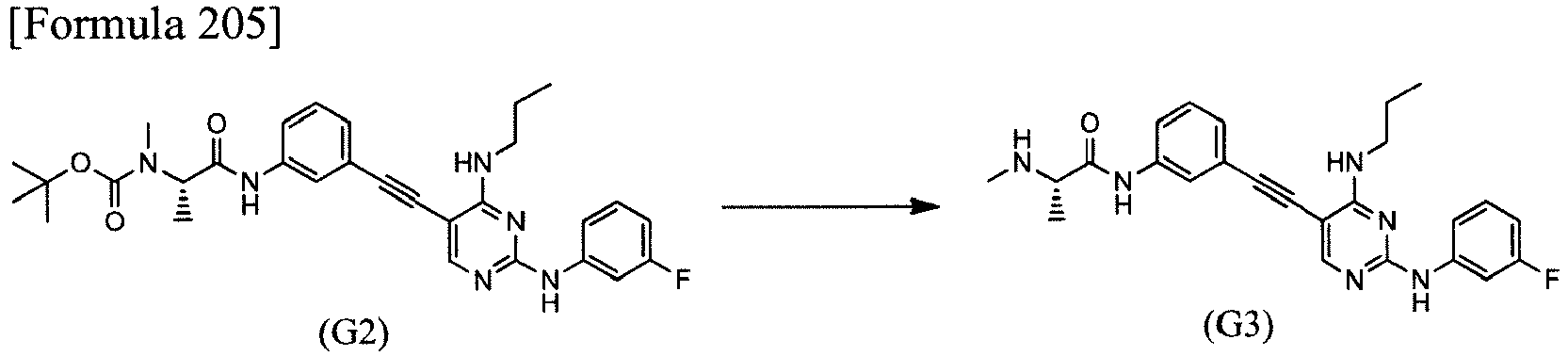
- To a solution of (S)-tert-butyl (1-((3-((2-((3-fluorophenyl)amino)-4-(propylamino)pyrimidin-5-yl)ethynyl)phenyl)amino)-1-oxopropan-2-yl)(methyl)carbamate (G2, 265 mg) in 1,4-dioxane (4 mL), a 4.0 mol/L solution of hydrochloric acid in 1,4-dioxane (4 mL) was added at room temperature, and the mixture was stirred at the same temperature for 2 hours. The solvent was evaporated under reduced pressure. To the obtained residue, saturated aqueous sodium hydrogencarbonate and ethyl acetate were added. The organic layer was separated, and washed successively with saturated aqueous sodium hydrogencarbonate and saturated aqueous sodium chloride, and then the solvent was evaporated under reduced pressure. The obtained solid matter was recrystallized from a mixed solvent of ethyl acetate and methanol to obtain (S)-N-(3-((2-((3-fluorophenyl)amino)-4-(propylamino)pyrimidin-5-yl)ethynyl)phenyl)-2-(methylamino)propanamide (G3, 105 mg).
MS m/z (M+H): 447.2 -

- To (S)-N-(3-((2-((3-fluorophenyl)amino)-4-(propylamino)pyrimidin-5-yl)ethynyl)phenyl)-2-(methylamino)propanamide (G3, 67 mg), 4-dimethylaminocrotonic acid hydrochloride (50 mg) and 1-ethyl-3-(3-dimethylaminopropyl)carbodiimide hydrochloride (58 mg), N,N-dimethylformamide (1.5 mL) and N,N-diisopropylethylamine (105 µL) were added at room temperature, and the mixture was stirred at the same temperature for 13 hours. To the reaction mixture, saturated aqueous sodium hydrogencarbonate and ethyl acetate were added. The organic layer was separated, washed successively with saturated aqueous sodium hydrogencarbonate and saturated aqueous sodium chloride, and then dried over anhydrous sodium sulfate, and the solvent was evaporated under reduced pressure. The obtained residue was purified by basic silica gel column chromatography (eluent, 100 to 94% ethyl acetate in methanol). The obtained solid matter was washed with water, and then dried under reduced pressure to obtain (S,E)-4-(dimethylamino)-N-(1-((3-((2-((3-fluorophenyl)amino)-4-(propylamino)pyrimidin-5-yl)ethynyl)phenyl)amino)-1-oxopropan-2-yl)-N-methyl-2-butenamide (8-1, 50 mg).
1H-NMR (CDCl3) δ: 8.84 (1H, s), 8.12 (1H, s), 7.82 (1H, dt, J=12.1, 2.1Hz), 7.74 (1H, s), 7.46 (1H, d, J=8.6Hz), 7.32-7.18 (4H, m), 7.11 (1H, d, J=9.2Hz), 7.00 (1H, dt, J=15.2, 5.9Hz), 6.70 (1H, td, J=8.3, 2.2Hz), 6.44 (1H, d, J=15.2Hz), 5.62 (1H, brs), 5.30 (1H, q, J=7.0Hz), 3.56-3.48 (2H, m), 3.12 (2H, d, J=5.9Hz), 3.03 (3H, s), 2.28 (6H, s), 1.76-1.72 (2H, m), 1.44 (3H, d, J=7.3Hz), 1.04 (3H, t, J=7.6Hz) - By using 4-pentynoic acid, Intermediates (G52) to (G54) were obtained in the same manner as that of Example 38, (1).
[Table 115] Compound No. Structure Physicochemical data G52 
- G53 
- G54 
- -

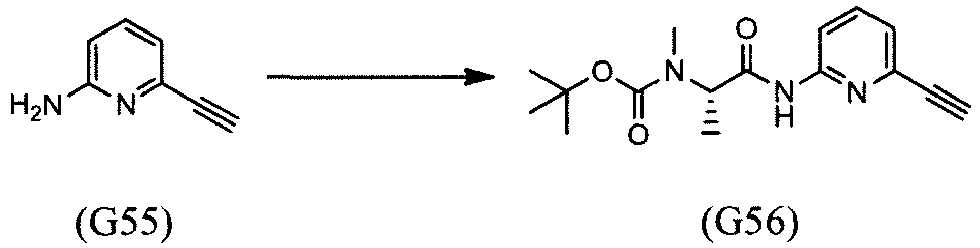
- To 2-amino-6-ethynylpyridine (G55, 203 mg) synthesized according to the method described in
WO2012/052451A1 , N-Boc-N-methyl-L-alanine (524 mg), and O-(7-azabenzotriazol-1-yl)-1,1,3,3-tetramethyluronium hexafluorophosphate (1.31 g), N,N-diisopropylethylamine (1.2 mL) and N,N-dimethylformamide (4.5 mL) were added at room temperature, and the mixture was stirred at 45°C for 12 hours. The reaction mixture was cooled on ice, and then saturated aqueous sodium hydrogencarbonate and ethyl acetate were added to the reaction mixture. The organic layer was separated, washed successively with water and saturated aqueous sodium chloride, and then dried over anhydrous sodium sulfate, and the solvent was evaporated under reduced pressure. The obtained residue was purified by silica gel column chromatography to obtain tert-butyl (1-((6-ethynylpyridin-2-yl)amino)-1-oxopropan-2-yl)(methyl)carbamate (G56, 180 mg) as white solid.
MS m/z (M+H): 304.3 -

- To a solution of N-Boc-glycine (129 mg) in tetrahydrofuran (3.5 mL), isobutyl chloroformate (97 µL) and N-methylmorpholine (81 µL) were added under ice cooling, and the mixture was stirred at the same temperature for 30 minutes. To the reaction mixture, 4-iodobenzene-1,2-diamine (200 mg) synthesized according to the method described in
WO2010/065668A1 was added under ice cooling, and the mixture was stirred at room temperature for 1 hour, and then acetic acid (3.5 mL) was added, and the mixture was stirred at 70°C for 2 hours. The reaction mixture was cooled to room temperature, and then water and ethyl acetate were added to the reaction mixture. The organic layer was separated, washed successively with saturated aqueous sodium hydrogencarbonate and saturated aqueous sodium chloride, and then dried over anhydrous sodium sulfate, and the solvent was evaporated under reduced pressure. The obtained residue was purified by silica gel column chromatography (eluent, 80 to 0% hexane in ethyl acetate) to obtain tert-butyl ((6-iodo-1H-benzo[d]imidazol-2-yl)methyl)carbamate (G4, 216 mg).
MS m/z (M+H): 374.0 -

- To a suspension of tert-butyl ((6-iodo-1H-benzo[d]imidazol-2-yl)methyl)carbamate (G4, 216 mg), bis(triphenylphosphine)palladium(II) dichloride (40 mg) and copper(I) iodide (22 mg) in tetrahydrofuran (2 mL), triethylamine (243 µL) and trimethylsilylacetylene (96 µL) were added at room temperature, and the mixture was stirred at the same temperature for 3 hours. To the reaction mixture, ethyl acetate and saturated aqueous sodium hydrogencarbonate were added. The organic layer was separated, washed with saturated aqueous sodium chloride, and then dried over anhydrous sodium sulfate, and the solvent was evaporated under reduced pressure. The obtained residue was purified by silica gel column chromatography (eluent, 70 to 0% hexane in ethyl acetate) to obtain tert-butyl ((6-((trimethylsilyl)ethynyl)-1H-benzo[d]imidazol-2-yl)methyl)carbamate (G5, 82 mg).
MS m/z (M+H): 344.1 -

- To tert-butyl ((6-((trimethylsilyl)ethynyl)-1H-benzo[d]imidazol-2-yl)methyl)carbamate (G5, 82 mg) and potassium carbonate (99 mg), methanol (1 mL) was added at room temperature, and the mixture was stirred at the same temperature for 1 hour. The solvent was evaporated under reduced pressure, and the obtained residue was purified by silica gel column chromatography (eluent, 80 to 30% hexane in ethyl acetate) to obtain tert-butyl ((6-ethynyl-1H-benzo[d]imidazol-2-yl)methyl)carbamate (G6, 62 mg).
MS m/z (M+H): 272.1 -

- To a solution of 4-pentynal (631 mg) synthesized according to the method described in
US4877779A1 and tert-butyl (2-amino-2-methylpropyl)carbamate (328 mg) in methylene chloride (10 mL), sodium triacetoxyborohydride (921 mg) and acetic acid (99 µL) were added at room temperature, and the mixture was stirred at the same temperature for 2 hours. To the reaction mixture, ethyl acetate and saturated aqueous sodium hydrogencarbonate were added. The organic layer was separated, washed with saturated aqueous sodium chloride, and then dried over anhydrous sodium sulfate, and the solvent was evaporated under reduced pressure. The obtained residue was purified by silica gel column chromatography (eluent, 100 to 80% ethyl acetate in methanol) to obtain tert-butyl (2-methyl-2-((4-pentyn-1-yl)amino)propyl)carbamate (G7, 172 mg).
MS m/z (M+H): 255.5 -

- To a suspension of tert-butyl (2-amino-2-methylpropyl)carbamate (1.98 g) and anhydrous sodium sulfate (3.00 g) in toluene (5 mL), benzaldehyde (1.07 mL) was added at room temperature, and the mixture was stirred for 11 hours under reflux by heating. The reaction mixture was cooled to room temperature, and then the solvent was evaporated under reduced pressure to obtain (E)-tert-butyl (2-(benzylideneamino)-2-methylpropyl)carbamate (G8).
MS m/z (M+H): 277.3 -


- To a solution of (E)-tert-butyl (2-(benzylideneamino)-2-methylpropyl)carbamate (G8) obtained above in N,N-dimethylformamide (20 mL), iodomethane (1.96 mL) and sodium hydride(60% wt, 1.26 g) were added at room temperature, and the mixture was stirred at the same temperature for 30 minutes. To the reaction mixture, iodomethane (1.00 mL) was added at room temperature, and the mixture was stirred at the same temperature for 1 hour. To the reaction mixture, ethyl acetate and water were added. The organic layer was separated, washed with saturated aqueous sodium chloride, and then dried over anhydrous sodium sulfate, and the solvent was evaporated under reduced pressure to obtain (E)-tert-butyl (2-(benzylideneamino)-2-methylpropyl)(methyl)carbamate (G9, 3.17 g).
-

- To a solution of (E)-tert-butyl (2-(benzylideneamino)-2-methylpropyl)(methyl)carbamate (G9, 3.17 g) in tetrahydrofuran (25 mL), 5% aqueous citric acid (25 mL) was added at room temperature, and the mixture was stirred at the same temperature for 3 hours. To the reaction mixture, ethyl acetate and saturated aqueous sodium hydrogencarbonate were added. The organic layer was separated, and the aqueous layer was extracted with methylene chloride. The organic layer and the extract were combined, and dried over anhydrous sodium sulfate, and the solvent was evaporated under reduced pressure. The obtained residue was purified by silica gel column chromatography (eluent, 100 to 0% hexane in ethyl acetate) to obtain tert-butyl (2-amino-2-methylpropyl)(methyl)carbamate (G10, 506 mg).
MS m/z (M+H): 203.2 -


- To a suspension of 4-((5-iodo-4-(propylamino)pyrimidin-2-yl)amino)benzonitrile (F25, 289 mg), bis(triphenylphosphine)palladium(II) dichloride (53 mg) and copper(I) iodide (28 mg) in N,N-dimethylformamide (4 mL), triethylamine (322 µL), 4-pentyn-1-ol (304 mg), and tetrakis(triphenylphosphine)palladium(0) (88 mg) were added at room temperature, and the mixture was stirred at the same temperature for 3 hours. To the reaction mixture, ethyl acetate and water were added, and the insoluble matter was removed by filtration through Cerite. The organic layer was separated, washed successively with water, saturated aqueous ammonium chloride and saturated aqueous sodium chloride, and then dried over anhydrous sodium sulfate, and the solvent was evaporated under reduced pressure. The obtained residue was purified by silica gel column chromatography (eluent, 90 to 0% hexane in ethyl acetate) to obtain 4-((5-(5-hydroxy-1-pentyn-1-yl)-4-(propylamino)pyrimidin-2-yl)amino)benzonitrile (G11, 195 mg).
MS m/z (M+H): 336.3 -

- To a solution of 4-((5-(5-hydroxy-1-pentyn-1-yl)-4-(propylamino)pyrimidin-2-yl)amino)benzonitrile (G11, 124 mg) in methylene chloride (4 mL), 1,1,1-triacetoxy-1,1-dihydro-1,2-benziodoxol-3(1H)-one (313 mg) was added at room temperature, and the mixture was stirred at the same temperature for 3 hours. To the reaction mixture, ethyl acetate and 10% aqueous sodium thiosulfate were added. The organic layer was separated, washed successively with water and saturated aqueous sodium chloride, and then dried over anhydrous sodium sulfate, and the solvent was evaporated under reduced pressure to obtain 4-((5-(5-oxo-1-pentyn-1-yl)-4-(propylamino)pyrimidin-2-yl)amino)benzonitrile (G12, 300 mg).
MS m/z (M+H): 334.3 -

- To a solution of 4-((5-(5-oxo-1-pentyn-1-yl)-4-(propylamino)pyrimidin-2-yl)amino)benzonitrile (G12, 300 mg) and tert-butyl (2-amino-2-methylpropyl)(methyl)carbamate (G10, 112 mg) in methylene chloride (4 mL), sodium triacetoxyborohydride (195 mg) and acetic acid (21 µL) were added at room temperature, and the mixture was stirred at the same temperature for 3 hours. To the reaction mixture, ethyl acetate and saturated aqueous sodium hydrogencarbonate were added. The organic layer was separated, washed with saturated aqueous sodium chloride, and then dried over anhydrous sodium sulfate, and the solvent was evaporated under reduced pressure. The obtained residue was purified by silica gel column chromatography (eluent, 100 to 80% ethyl acetate in methanol) to obtain tert-butyl (2-((5-(2-((4-cyanophenyl)amino)-4-(propylamino)pyrimidin-5-yl)-4-pentyn-1-yl)amino)-2-methylpropyl)(methyl)carbamate (G13, 80 mg).
MS m/z (M+H): 520.5 -

- To a solution of 4-cyanotetrahydro-2H-pyrane-4-carboxylic acid (1.69 g) synthesized according to the method described in Journal of the American Chemical Society, 1942, vol. 64, p. 1672 in tetrahydrofuran (20 mL) and tert-butanol (80 mL), diphenylphosphonyl azide (2.32 mL) and triethylamine (1.51 mL) were added at room temperature, and the mixture was stirred at 80°C for 3 hours. The reaction mixture was cooled to room temperature, and then ethyl acetate and saturated aqueous sodium chloride were added. The organic layer was separated, and dried over anhydrous sodium sulfate, and the solvent was evaporated under reduced pressure. The obtained residue was purified by silica gel column chromatography (eluent, 100 to 0% hexane in ethyl acetate) to obtain tert-butyl (4-cyanotetrahydro-2H-pyran-4-yl)carbamate (G14, 1.38 g).
MS m/z (M+H): 227.2 -

- To a suspension of tert-butyl (4-cyanotetrahydro-2H-pyran-4-yl)carbamate (G14, 210 mg) and cobalt(II) chloride (241 mg) in methanol (9 mL), sodium borohydride (175 mg) was added at room temperature, and the mixture was stirred at the same temperature for 1 hour. To the reaction mixture, cobalt(II) chloride (241 mg) and sodium borohydride (175 mg) were added at room temperature, and the mixture was stirred at the same temperature for 2 hours. To the reaction mixture, ethyl acetate and 1.0 mol/L aqueous sodium hydroxide were added. The organic layer was separated, washed with saturated aqueous sodium chloride, and then dried over anhydrous sodium sulfate, and the solvent was evaporated under reduced pressure to obtain tert-butyl (4-(aminomethyl)tetrahydro-2H-pyran-4-yl)carbamate (G 15, 195 mg).
-

- To a suspension of tert-butyl (4-(aminomethyl)tetrahydro-2H-pyran-4-yl)carbamate (G15, 195 mg) and sodium carbonate (449 mg) in acetone (5 mL) and water (2 mL), benzyloxycarbonyl chloride (241 µL) was added at room temperature, and the mixture was stirred at the same temperature for 2 hours. To the reaction mixture, ethyl acetate and saturated aqueous sodium chloride were added. The organic layer was separated, and dried over anhydrous sodium sulfate, and the solvent was evaporated under reduced pressure. The obtained residue was purified by silica gel column chromatography (eluent, 100 to 0% hexane in ethyl acetate) to obtain tert-butyl (4-(((benzyloxycarbonyl)amino)methyl)tetrahydro-2H-pyran-4-yl)carbamate (G16, 141 mg).
MS m/z (M+H): 365.3 -

- To a solution of tert-butyl (4-(((benzyloxycarbonyl)amino)methyl)tetrahydro-2H-pyran-4-yl)carbamate (G16, 141 mg) in methylene chloride (2 mL), trifluoroacetic acid (2 mL) was added at room temperature, and the mixture was stirred at the same temperature for 1 hour. The solvent was evaporated under reduced pressure, and then ethyl acetate and saturated aqueous sodium hydrogencarbonate were added to the residue. The organic layer was separated, washed with saturated aqueous sodium chloride, and then dried over anhydrous sodium sulfate, and the solvent was evaporated under reduced pressure to obtain benzyl ((4-aminotetrahydro-2H-pyran-4-yl)methyl)carbamate (G17, 106 mg).
MS m/z (M+H): 265.2 -

- To a solution of benzyl ((4-aminotetrahydro-2H-pyran-4-yl)methyl)carbamate (G17, 106 mg) and 4-pentynal (34 mg) in methylene chloride (4 mL), sodium triacetoxyborohydride (205 mg) and acetic acid (22 µL) were added at room temperature, and the mixture was stirred at the same temperature for 2 hours. To the reaction mixture, ethyl acetate and saturated aqueous sodium hydrogencarbonate were added. The organic layer was separated, washed with saturated aqueous sodium chloride, and then dried over anhydrous sodium sulfate, and the solvent was evaporated under reduced pressure. The obtained residue was purified by silica gel column chromatography (eluent, 100 to 0% hexane in ethyl acetate) to obtain benzyl ((4-((4-pentyn-1-yl)amino)tetrahydro-2H-pyran-4-yl)methyl)carbamate (G18, 74 mg).
1H-NMR (CDCl3) δ: 7.38-7.30 (5H, m), 5.10 (2H, s), 3.73-3.64 (4H, m), 3.22 (2H, d), 2.59 (2H, dt), 2.31 (2H, dt), 2.17 (1H, d), 1.69-1.45 (6H, m) -

- To a solution of methyl 2-cyano-4-methoxy-2-(2-methoxyethyl)butanoate (1.13 g) synthesized according to the method described in European Journal of Organic Chemistry, 2005, vol. 20, pp.4313-4321 in tetrahydrofuran (10 mL), 1.0 mol/L aqueous sodium hydroxide (20 mL) was added at room temperature, and the mixture was stirred at the same temperature for 7 hours. To the reaction mixture, hexane and tert-butyl methyl ether were added. The aqueous layer was separated, and ethyl acetate and 1.0 mol/L aqueous hydrochloric acid were added. The organic layer was separated, and dried over anhydrous sodium sulfate, and the solvent was evaporated under reduced pressure to obtain 2-cyano-4-methoxy-2-(2-methoxyethyl)butyric acid (G19, 957 mg).
-

- To a solution of 2-cyano-4-methoxy-2-(2-methoxyethyl)butyric acid (G19, 957 mg) in tetrahydrofuran (8 mL) and tert-butanol (32 mL), diphenylphosphonyl azide (1.63 mL) and triethylamine (1.00 mL) were added at room temperature, and the mixture was stirred at 80°C for 2 hours. The solvent was evaporated under reduced pressure, and to the obtained residue, ethyl acetate and saturated aqueous sodium chloride were added. The organic layer was separated, washed successively with saturated aqueous sodium hydrogencarbonate and saturated aqueous sodium chloride, and then dried over anhydrous sodium sulfate, and the solvent was evaporated under reduced pressure. The obtained residue was purified by silica gel column chromatography (eluent, 100 to 0% hexane in ethyl acetate) to obtain tert-butyl (3-cyano-1,5-dimethoxypentan-3-yl)carbamate (G20, 519 mg).
MS m/z (M+H): 273.3 -


- To a suspension of tert-butyl (3-cyano-1,5-dimethoxypentan-3-yl)carbamate (G20, 192 mg) and cobalt(II) chloride (183 mg) in methanol (7 mL), sodium borohydride (134 mg) was added at room temperature, and the mixture was stirred at the same temperature for 4 hours. To the reaction mixture, ethyl acetate and 1.0 mol/L aqueous sodium hydroxide were added. The organic layer was separated, washed with saturated aqueous sodium chloride, and then dried over anhydrous sodium sulfate, and the solvent was evaporated under reduced pressure to obtain tert-butyl (3-(aminomethyl)-1,5-dimethoxypentan-3-yl)carbamate (G21, 275 mg).
-

- To a suspension of tert-butyl (3-(aminomethyl)-1,5-dimethoxypentan-3-yl)carbamate (G21, 275 mg) and sodium hydrogencarbonate (400 mg) in 1,4-dioxane (4 mL) and water (4 mL), 9-fluorenylmethyl succinimidyl carbonate (261 mg) was added under ice cooling, and the mixture was stirred at the same temperature for 2 hours, and then stirred at room temperature for 1 hour. To the reaction mixture, ethyl acetate and saturated aqueous sodium chloride were added. The organic layer was separated, and dried over anhydrous sodium sulfate, and the solvent was evaporated under reduced pressure. The obtained residue was purified by silica gel column chromatography (eluent, 100 to 30% hexane in ethyl acetate) to obtain (9H-fluoren-9-yl)methyl tert-butyl (4-methoxy-2-(2-methoxyethyl)butane-1,2-diyl)dicarbamate (G22, 269 mg).
1H-NMR (CDCl3) δ: 7.77 (2H, d), 7.60 (2H, d), 7.40 (2H, t), 7.31 (2H, t), 4.41-4.35 (2H, m), 4.24 (1H, t), 3.52-3.42 (4H, m), 3.33-3.29 (4H, m), 2.17 (6H, s), 1.43 (9H, s) -


- To a solution of (9H-fluoren-9-yl)methyl tert-butyl (4-methoxy-2-(2-methoxyethyl)butane-1,2-diyl)dicarbamate (G22, 269 mg) in methylene chloride (2 mL), trifluoroacetic acid (2 mL) was added at room temperature, and the mixture was stirred at the same temperature for 5 hours. The solvent was evaporated under reduced pressure, and then ethyl acetate and saturated aqueous sodium hydrogencarbonate were added to the residue. The organic layer was separated, washed with saturated aqueous sodium chloride, and then dried over anhydrous sodium sulfate, and the solvent was evaporated under reduced pressure to obtain (9H-fluoren-9-yl)methyl (2-amino-4-methoxy-2-(2-methoxyethyl)butyl)carbamate (G23, 186 mg).
MS m/z (M+H): 399.4 -

- To a solution of (9H-fluoren-9-yl)methyl (2-amino-4-methoxy-2-(2-methoxyethyl)butyl)carbamate (G23, 186 mg) and 4-pentynal (42 mg) in methylene chloride (5 mL), sodium triacetoxyborohydride (247 mg) and acetic acid (26 µL) were added at room temperature, and the mixture was stirred at the same temperature for 3 hours. To the reaction mixture, ethyl acetate and saturated aqueous sodium hydrogencarbonate were added. The organic layer was separated, washed with saturated aqueous sodium chloride, and then dried over anhydrous sodium sulfate, and the solvent was evaporated under reduced pressure. The obtained residue was purified by silica gel column chromatography (eluent, 60 to 0% hexane in ethyl acetate) to obtain (9H-fluoren-9-yl)methyl (4-methoxy-2-(2-methoxyethyl)-2-((4-pentyn-1-yl)amino)butyl)carbamate (G24, 102 mg).
MS m/z (M+H): 465.4 -

- A solution of (S)-4-((5-((3-(2-(methylamino)propanamido)phenyl)ethynyl)-4-(propylamino)pyrimidin-2-yl)amino)benzamide (G25, 47 mg) synthesized in the same manner as that of Example 38, (1) to (3) in a mixture of acetic acid (2.5 mL) and methanol (80 mL) was prepared, and hydrogenation was performed at room temperature and a flow rate of 1 mL/minute in a flow type hydrogenation reactor set with a 10% palladium-carbon cartridge. The solvent was evaporated under reduced pressure to obtain (S)-4-((5-(3-(2-(methylamino)propaneamido)phenethyl)-4-(propylamino)pyrimidin-2-yl)amino)benzamide (G26, 38 mg) as white solid.
MS m/z (M+H): 476.2 -

- To a solution of 3-ethynylaniline (100 mg) and N-Boc-2-aminoacetaldehyde (407 mg) in ethyl acetate (5 mL) and methylene chloride (5 mL), acetic acid (2 drops) and sodium triacetoxyborohydride (543 mg) were added at room temperature, and the mixture was stirred at the same temperature for 3 hours and 30 minutes. To the reaction mixture, N-Boc-2-aminoacetaldehyde (200 mg) and sodium triacetoxyborohydride (200 mg) were added at room temperature, and the mixture was stirred at the same temperature. To the reaction mixture, saturated aqueous sodium hydrogencarbonate and ethyl acetate were added. The organic layer was separated, and dried over anhydrous sodium sulfate, and the solvent was evaporated under reduced pressure. The obtained residue was purified by basic silica gel column chromatography (eluent, 75% hexane/25% ethyl acetate) to obtain tert-butyl (2-((3-ethynylphenyl)amino)ethyl)carbamate (G27).
MS m/z (M+H): 261.1 -


- By using 2-chloro-5-iodo-N-propylpyrimidin-4-amine (F1), 5-iodo-N4-propyl-N2-(2-(pyridin-4-yl)ethyl)pyrimidine-2,4-diamine (G28) was obtained in the same manner as that of Example 36, (11).
- In the same manner as that of Example 38, (2), Intermediates (G29) to (G37) and Intermediates (G57) to (G64) were obtained.
[Table 116] Compound No. Structure Physicochemical data G29 
MS m/z (M+H): 572.3 G30 
- G31 
- G32 
MS m/z (M+H): 530.2 G33 
MS m/z (M+H): 558.3 G34 
- G35 
- G36 
- G37 
- G57 
MS m/z (M-H): 523.4 [Table 117] Compound No. Structure Physicochemical data G58 
MS m/z (M+H): 534.4 G59 
MS m/z (M+H): 527.2 G60 
- G61 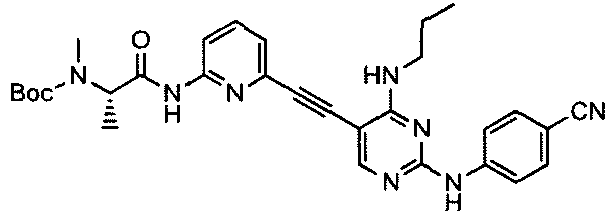
- G62 
MS m/z (M+H): 548.4 G63 
MS m/z (M+H): 499.4 G64 
MS m/z (M+H): 506.4 - In the same manner as that of Example 38, (3), Intermediates (G38) to (G47), Intermediates (G65) to (G72) and Intermediates (G74) were obtained.
[Table 118] Compound No. Structure Physicochemical data G38 
MS m/z (M+H): 472.2 G39 
- G40 
- G41 
- G42 
- G43 
- G44 
- G45 
- G46 
- G47 
- [Table 119] Compound No. Structure Physicochemical data G65 
MS m/z (M+H): 425.3 G66 
MS m/z (M+H): 434.4 G67 
MS m/z (M+H): 427.3 G68 
MS m/z (M+H): 453.3 G69 
MS m/z (M+H): 455.3 G70 
MS m/z (M+H): 448.3 G71 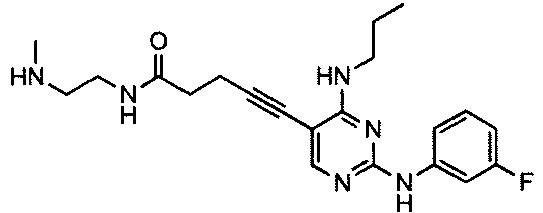
MS m/z (M+H): 399.3 G72 
MS m/z (M+H): 406.3 G74 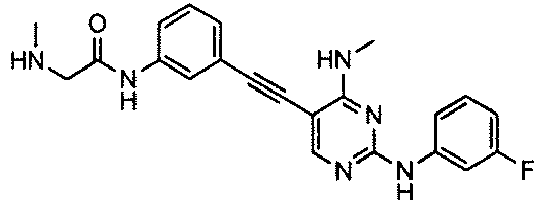
MS m/z (M+H): 405.3 -


- By using N2-(3-fluorophenyl)-5-iodo-N4-propylpyrimidine-2,4-diamine (F2), 5-((5-amino-2-fluorophenyl)ethynyl)-N2-(3-fluorophenyl)-N4-propylpyrimidine-2,4-diamine (G48) was obtained in the same manner as that of Example 38, (2).
-

- By using 5-((5-amino-2-fluorophenyl)ethynyl)-N2-(3-fluorophenyl)-N4-propylpyrimidine-2,4-diamine (G48), (S)-tert-butyl (1-((4-fluoro-3-((2-((3-fluorophenyl)amino)-4-(propylamino)pyrimidin-5-yl)ethynyl)phenyl)amino)-1-oxopropan-2-yl)(methyl)carbamate (G49) was obtained in the same manner as that of Example 1, (5).
-

- By using (S)-tert-butyl (1-((4-fluoro-3-((2-((3-fluorophenyl)amino)-4-(propylamino)pyrimidin-5-yl)ethynyl)phenyl)amino)-1-oxopropan-2-yl)(methyl)carbamate (G49), (S)-N-(4-fluoro-3-((2-((3-fluorophenyl)amino)-4-(propylamino)pyrimidin-5-yl)ethynyl)phenyl)-2-(methylamino)propanamide (G50) was obtained in the same manner as that of Example 38, (3).
-


- By using (S)-N-(4-fluoro-3-((2-((3-fluorophenyl)amino)-4-(propylamino)pyrimidin-5-yl)ethynyl)phenyl)-2-(methylamino)propanamide (G50), (S)-N-(4-fluoro-3-(2-(2-((3-fluorophenyl)amino)-4-(propylamino)pyrimidin-5-yl)ethyl)phenyl)-2-(methylamino)propanamide (G51) was obtained in the same manner as that of Example 36, (4) or Example 38, (22).
- In the same manner as that of Example 1, (7), Example 1, (8) or Example 35, (7), Compounds (8-2) to (8-23) were obtained.
[Table 120] Compound No. Structure Physicochemical data 8-2 
1H-NMR (CD3OD) δ: 8.03 (1H, s), 7.83 (4H, s), 7.79 (1H, brs), 7.51-7.47 (1H, m), 7.34-7.29 (2H, m), 6.84-6.76 (1H, m), 6.64 (1H, d, J=15.2Hz), 5.17 (1H, q, J=7.3Hz), 3.51 (2H, t, J=7.3Hz), 3.21-3.12 (5H, m), 2.28 (6H, s), 1.74-1.69 (2H, m), 1.48 (3H, d, J=7.3Hz), 1.01 (3H, t, J=7.3Hz) 8-3 
1H-NMR (CD3OD) δ: 8.05 (1H, s), 7.84-7.80 (1H, m), 7.84 (4H, s), 7.50-7.48 (1H, m), 7.34-7.31 (2H, m), 6.37-6.27 (2H, m), 5.72 (1H, dd, J=9.9, 5.0Hz), 4.10 (2H, s), 3.52 (2H, t, J=7.6Hz), 1.75-1.71 (2H, m), 1.02 (3H, t, J=7.6Hz) 8-4 
1H-NMR (CD3OD) δ: 8.03 (1H, s), 7.83 (4H, s), 7.60 (2H, dd, J=9.2, 2.6Hz), 7.50-7.47 (2H, m), 6.86-6.76 (1H, m), 6.20 (1H, d, J=15.5Hz), 4.09 (2H, s), 3.52 (2H, t, J=7.3Hz), 3.15 (2H, d, J=6.6Hz), 2.28 (6H, s), 1.75-1.70 (2H, m), 1.02 (3H, t, J=7.3Hz) 8-5 
1H-NMR (CD3OD) δ: 8.03 (1H, s), 7.83 (4H, s), 7.10 (1H, t, J=7.9Hz), 6.84-6.63 (4H, m), 6.08 (1H, d, J=15.2Hz), 3.53-3.46 (4H, m), 3.37-3.22 (2H, m), 3.14-3.09 (2H, m), 2.25 (6H, s), 1.75-1.70 (2H, m), 1.02 (3H, t, J=7.3Hz) 8-6 
1H-NMR (CDCl3+CD3OD) δ: 8.41 (2H, dd, J=4.6, 2.0Hz), 7.86 (1H, s), 7.76 (1H, s), 7.46 (1H, d, J=7.3Hz), 7.33-7.20 (4H, m), 6.87-6.66 (1H, m), 6.59 (1H, d, J=13.2Hz), 5.17 (1H, q, J=7.0Hz), 3.64 (2H, t, J=6.9Hz), 3.44 (2H, t, J=7.3Hz), 3.19-3.12 (5H, m), 2.96 (2H, t, J=7.3Hz), 2.28 (6H, s), 1.72-1.59 (2H, m), 1.47 (3H, d, J=7.3Hz), 0.96 (3H, t, J=7.3Hz) 8-7 
1H-NMR (CDCl3) δ: 8.86 (1H, s), 8.12 (1H, s), 7.81 (1H, dt, J=11.7, 2.1Hz), 7.70 (1H, dd, J=5.9, 2.6Hz), 7.47-7.39 (1H, m), 7.26-6.96 (5H, m), 6.71 (1H, td, J=8.1, 2.4Hz), 6.44 (1H, d, J=15.2Hz), 5.75 (1H, t, J=4.6Hz), 5.26 (1H, q, J=7.0Hz), 3.58-3.47 (2H, m), 3.13 (2H, d, J=6.3Hz), 3.03 (3H, s), 2.29 (6H, s), 1.79-1.68 (2H, m), 1.44 (3H, d, J=7.3Hz), 1.04 (3H, t, J=7.6Hz) [Table 121] Compound No. Structure Physicochemical data 8-8 
1H-NMR (CDCl3) δ: 8.74 (1H, s), 7.80 (1H, dt, J=11.9, 2.0Hz), 7.69 (1H, s), 7.45 (1H, dd, J=6.6, 2.6Hz), 7.32-7.08 (4H, m), 7.05-6.93 (2H, m), 6.65 (1H, td, J=8.6, 2.0Hz), 6.43 (1H, d, J=15.2Hz), 5.26 (1H, q, J=7.3Hz), 4.95-4.85 (1H, m), 3.53-3.44 (2H, m), 3.14-3.08 (2H, m), 3.02 (3H, s), 2.84-2.76 (2H, m), 2.61-2.53 (2H, m), 2.27 (6H, s), 1.75-1.64 (2H, m), 1.42 (3H, d, J=6.6Hz), 1.02 (3H, t, J=7.3Hz) 8-9 
1H-NMR (CD3OD) δ: 8.06 (1H, s), 7.84 (4H, s), 7.54-7.31 (3H, m), 6.90-6.78 (1H, m), 6.23-6.14 (1H, m), 4.70 (2H, s), 3.54 (2H, t), 3.17-3.13 (2H, m), 2.29 (6H, s), 1.74 (2H, dt), 1.03 (3H, t) 8-10 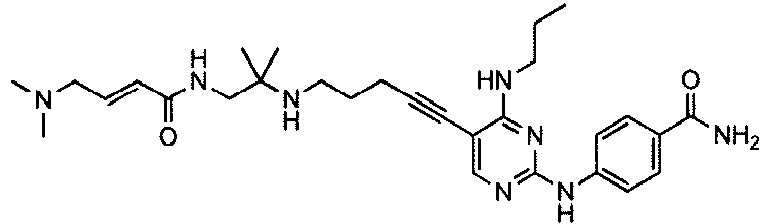
1H-NMR (CD3OD) δ: 7.90 (1H, s), 7.82-7.80 (4H, brs), 6.76 (1H, dt), 6.14 (1H, dt), 3.47 (2H, t), 3.32-3.28 (2H, t), 3.09 (2H, dd), 2.73 (2H, t), 2.57 (2H, t), 2.15 (6H, s), 1.81-1.61 (4H, m), 1.16 (6H, s), 1.00 (3H, t) 8-11 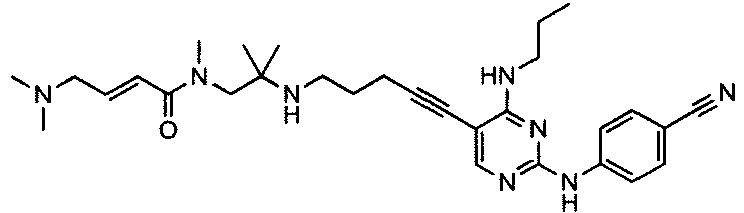
1H-NMR (CD3OD) δ: 7.90 (1H, s), 7.90 (2H, d), 7.58 (2H, d), 6.81-6.69 (1H, m), 6.60 (1H, d), 3.50-3.42 (4H, m), 3.16-3.12 (2H, m), 2.80-2.71, (2H, m), 2.61-2.53 (2H, m), 2.26 (6H, s), 2.24 (3H, s), 1.81-1.61 (4H, m), 1.13 (6H, s), 0.98 (3H, t) 8-12 
1H-NMR (CDCl3) δ: 7.90 (1H, s), 7.80-7.80 (4H, brs), 7.77 (1H, dt), 6.16 (1H, d), 3.85-3.55 (8H, m), 3.36-3.32 (2H, m), 3.12 (2H, d), 2.66-2.58 (2H, t), 2.26 (6H, s), 1.80-1.48 (8H, m), 1.00 (3H, t) 8-13 
1H-NMR (CDCl3) δ: 7.90 (1H, s), 7.80-7.80 (4H, brs), 7.77 (1H, dt), 6.16 (1H, d), 3.62-3.52 (8H, m), 3.34 (6H, s)3.36-3.32 (2H, m), 3.12 (2H, d), 2.66-2.58 (2H, t), 2.26 (6H, s), 1.80-1.48 (8H, m), 1.00 (3H, t) [Table 122] Compound No. Structure Physicochemical data 8-14 
1H-NMR (CD3OD) δ: 7.90 (1H, s), 7.81-7.77 (4H, m), 7.37-7.34 (2H, m), 7.20 (1H, t, J=7.6Hz), 6.93 (1H, d, J=7.3Hz), 6.85-6.75 (1H, m), 6.59 (1H, d, J=15.2Hz), 5.15 (1H, q, J=7.3Hz), 3.45 (2H, t, J=7.3Hz), 3.15 (2H, d, J=6.6Hz), 3.10 (3H, s), 2.86-2.83 (2H, m), 2.68 (2H, t, J=6.9Hz), 2.27 (6H, s), 1.71-1.66 (2H, m), 1.43 (3H, d, J=7.3Hz), 1.01 (3H, t, J=7.3Hz) 8-15 
1H-NMR (CDCl3) δ: 7.93 (1H, s), 7.86-7.74 (2H, m), 7.29-7.14 (2H, m), 7.12-7.05 (1H, m), 6.92 (1H, dt, J=15.2, 5.9Hz), 6.67 (1H, dt, J=8.1, 2.4Hz), 6.33-6.25 (1H, m), 6.24-6.14 (1H, m), 4.43-4.31 (1H, m), 3.66-3.40 (5H, m), 3.30-3.18 (1H, m), 3.09 (2H, d, J=5.9Hz), 2.74 (2H, t, J=6.9Hz), 2.47 (2H, t, J=6.9Hz), 2.26 (6H, s), 2.07-1.88 (4H, m), 1.80-1.64 (2H, m), 1.01 (3H, t, J=7.6Hz) 8-16 
1H-NMR (CDCl3) δ: 8.07 (1H, s), 7.93 (1H, s), 7.76 (2H, d, J=8.6Hz), 7.56 (2H, d, J=9.2Hz), 7.29-7.22 (1H, m), 6.93 (1H, dt, J=15.3, 5.9Hz), 6.53-6.42 (2H, m), 3.46 (2H, dd, J=14.5, 5.9Hz), 3.41 (2H, s), 3.20 (3H, s), 3.11 (2H, dd, J=5.9, 13Hz), 2.69 (2H, t, J=6.9Hz), 2.37 (2H, t, J=6.9Hz), 2.28 (6H, s), 1.81-1.68 (2H, m), 1.46 (6H, s), 1.01 (3H, t, J=7.3Hz) 8-17 
1H-NMR (CDCl3) δ: 8.03 (1H, s), 7.91 (1H, s), 7.82 (1H, dt, J=12.1, 2.0Hz), 7.31-7.23 (1H, m), 7.20 (1H, dt, J=8.3, 6.6Hz), 7.09 (1H, dd, J=8.3, 2.0Hz), 6.93 (1H, dt, J=15.2, 6.0Hz), 6.67 (1H, dt, J=8.3, 2.0Hz), 6.46 (1H, dt, J=15.2, 1.7Hz), 6.35 (1H, t, J=6.3Hz), 3.47 (2H, dd, J=14.9, 6.3Hz), 3.41 (2H, s), 3.19 (3H, s), 3.10 (2H, dd, J=6.0, 1.7Hz), 2.69 (2H, t, J=6.9Hz), 2.36 (2H, t, J=6.9Hz), 2.27 (6H, s), 1.80-1.65 (2H, m), 1.45 (6H, s), 1.01 (3H, t, J=7.3Hz) [Table 123] Compound No. Structure Physicochemical data 8-18 
1H-NMR (CDCl3) δ: 8.87-8.83 (1H, m), 8.21 (1H, s), 8.16 (1H, d, J=7.9Hz), 7.90 (2H, d, J=9.2Hz), 7.69 (1H, t, J=7.9Hz), 7.59 (2H, d, J=9.2Hz), 7.41-7.37 (1H, m), 7.22 (1H, d, J=7.9Hz), 7.04 (1H, dt, J=15.2, 5.9Hz), 6.51-6.41 (1H, m), 6.14-6.11 (1H, m), 5.40 (1H, q, J=7.3Hz), 3.13 (2H, dd, J=5.9, 1.3Hz), 3.04 (3H, s), 2.94-2.83 (1H, m), 2.28 (6H, s), 1.44 (3H, d, J=7.3Hz), 0.99-0.88 (2H, m), 0.78-0.68 (2H, m) 8-19 
1H-NMR (CDCl3) δ: 8.83 (1H, s), 8.19 (1H, s), 8.16 (1H, d, J=8.3Hz), 7.78 (2H, d, J=8.6Hz), 7.69 (1H, t, J=8.3Hz), 7.59 (2H, d, J=8.6Hz), 7.32 (1H, s), 7.22 (1H, d, J=8.3Hz), 7.03 (1H, dt, J=15.2, 5.9Hz), 6.51-6.41 (1H, m), 6.09-5.97 (1H, m), 5.40 (1H, q, J=6.8Hz), 3.59-3.47 (2H, m), 3.12 (2H, d, J=5.9Hz), 3.04 (3H, s), 2.28 (6H, s), 1.83-1.64 (2H, m), 1.44 (3H, d, J=6.8Hz), 1.04 (3H, t, J=7.6Hz) 8-20 
1H-NMR (CDCl3) δ: 8.78 (1H, s), 8.18 (1H, s), 8.15 (1H, d, J=7.9Hz), 7.81 (1H, dt, J=11.7, 2.3Hz), 7.68 (1H, t, J=7.9Hz), 7.29-7.18 (3H, m), 7.11 (1H, dd, J=7.9, 2.3Hz), 7.03 (1H, dt, J=15.3, 5.9Hz), 6.71 (1H, dt, J=8.3, 2.3Hz), 6.51-6.39 (1H, m), 5.98-5.87 (1H, m), 5.48-5.33 (1H, m), 3.61-3.45 (2H, m), 3.12 (2H, dd, J=5.9, 1.3Hz), 3.04 (3H, s), 2.28 (6H, s), 1.83-1.67 (2H, m), 1.44 (3H, d, J=7.3Hz), 1.04 (3H, t, J=7.6Hz) 8-21 
1H-NMR (CDCl3) δ: 7.93 (1H, s), 7.86-7.76 (1H, m), 7.31-7.15 (2H, m), 7.14-7.06 (1H, m), 6.95-6.77 (2H, m), 6.67 (1H, dt, J=8.3, 2.0Hz), 6.40 (1H, d, J=15.2Hz), 6.31-6.22 (1H, m), 3.66-3.56 (2H, m), 3.53-3.42 (4H, m), 3.13-3.03 (5H, m), 2.72 (2H, t, J=6.9Hz), 2.44 (2H, t, J=6.9Hz), 2.26 (6H, s), 1.81-1.66 (2H, m), 1.02 (3H, t, J=7.6Hz) [Table 124] Compound No. Structure Physicochemical data 8-22 
1H-NMR (CDCl3) δ: 7.94 (1H, s), 7.77 (2H, d, J=8.6Hz), 7.61-7.47 (3H, m), 6.97-6.81 (2H, m), 6.48-6.34 (2H, m), 3.66-3.57 (2H, m), 3.53-3.40 (4H, m), 3.14-3.04 (5H, m), 2.72 (2H, t, J=6.9Hz), 2.45 (2H, t, J=6.9Hz), 2.26 (6H, s), 1.81-1.64 (2H, m), 1.01 (3H, t, J=7.6Hz) 8-23 
1H-NMR (CDCl3) δ: 8.94 (1H, s), 8.12 (1H, s), 7.84-7.79 (1H, m), 7.73 (1H, s), 7.45 (1H, d, J=7.9Hz), 7.32-7.13 (5H, m), 7.00 (1H, dt, J=15.3, 5.7Hz), 6.73-6.68 (1H, m), 6.48 (1H, d, J=15.2Hz), 5.59 (1H, brs), 4.17 (2H, s), 3.26 (3H, s), 3.16-3, 12 (5H, m), 2.28 (6H, s) -

- To a solution of 2,4-dichloro-5-iodopyrimidine (5.00 g) synthesized according to the method described in
WO2008/155140A1 in tetrahydrofuran (50 mL), N,N-diisopropylethylamine (3.49 mL) and pyrrolidine (1.65 mL) were added under ice cooling, and the mixture was stirred at the same temperature for 3 hours. To the reaction mixture, 1.0 mol/L aqueous hydrochloric acid was added. The solid matter was taken by filtration, washed with water, and then dried under reduced pressure to obtain 2-chloro-5-iodo-4-(pyrrolidin-1-yl)pyrimidine (H1, 4.49 g).
MS m/z (M+H): 310.1 -

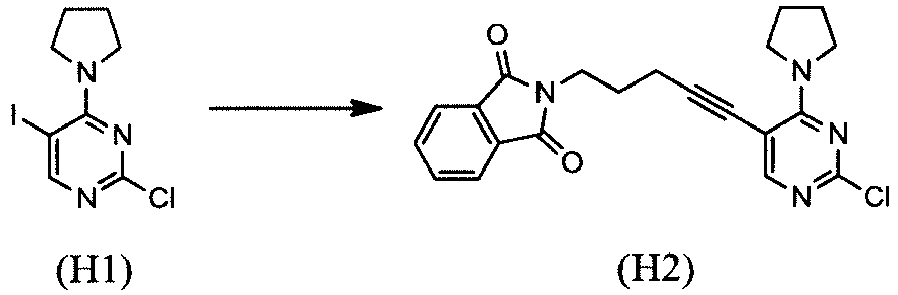
- To a suspension of bis(triphenylphosphine)palladium(II) dichloride (1.02 g) and copper(I) iodide (558 mg) in N,N-dimethylformamide (90 mL), triethylamine (10.2 mL), 2-chloro-5-iodo-4-(pyrrolidin-1-yl)pyrimidine (H1, 4.49 g), and N-(4-pentynyl)phthalimide (4.65 g) were added at room temperature under a nitrogen atmosphere, and the mixture was stirred at the same temperature for 4 hours. To the reaction mixture, water was added. The solid matter was taken by filtration, washed with water, then dried under reduced pressure, and purified by silica gel column chromatography. The obtained solid matter was washed with ethyl acetate, and then dried under reduced pressure to obtain 2-(5-(2-chloro-4-(pyrrolidin-1-yl)pyrimidin-5-yl)-4-pentyn-1-yl)isoindoline-1,3-dione (H2, 3.66 g).
MS m/z (M+H): 395.2 -

- To a solution of tris(dibenzylideneacetone)dipalladium(0) (835 mg) and 4,5'-bis(diphenylphosphino)-9,9'-dimethylxanthene (1.06 g) in 1,4-dioxane (125 mL), 2-(5-(2-chloro-4-(pyrrolidin-1-yl)pyrimidin-5-yl)-4-pentyn-1-yl)isoindoline-1,3-dione (H2, 3.60 g), 4-aminobenzonitrile (2.69 g) and cesium carbonate (8.90 g) were added at room temperature under a nitrogen atmosphere, and the mixture was stirred at 90°C for 7 hours. The reaction mixture was cooled to room temperature, and then ethyl acetate was added to the reaction mixture. The insoluble matter was removed by filtration through Cerite, and then the solvent was evaporated under reduced pressure. To the obtained residue, water was added. The solid matter was taken by filtration, and washed with water to obtain 4-((5-(5-(1,3-dioxoisoindolin-2-yl)-1-pentyn-1-yl)-4-(pyrrolidin-1-yl)pyrimidin-2-yl)amino)benzonitrile (H3).
MS m/z (M+H): 477.3 -

- To a solution of 4-((5-(5-(1,3-dioxoisoindolin-2-yl)-1-pentyn-1-yl)-4-(pyrrolidin-1-yl)pyrimidin-2-yl)amino)benzonitrile (H3) obtained above in tetrahydrofuran (80 mL) and ethanol (80 mL), hydrazine monohydrate (16 mL) was added at room temperature, and the mixture was stirred at 80°C for 3 hours. The reaction mixture was cooled to room temperature, and then ethyl acetate was added to the reaction mixture. The insoluble matter was removed by filtration, and then the solvent was evaporated under reduced pressure. The obtained residue was purified by basic silica gel column chromatography (eluent, 98 to 85% ethyl acetate in methanol) to obtain 4-((5-(5-amino-1-pentyn-1-yl)-4-(pyrrolidin-1-yl)pyrimidin-2-yl)amino)benzonitrile (H4, 2.64 g).
MS m/z (M+H): 347.3 -

- To a solution of 4-((5-(5-amino-1-pentyn-1-yl)-4-(pyrrolidin-1-yl)pyrimidin-2-yl)amino)benzonitrile (H4, 2.64 g), N-Boc-N-methyl-L-alanine (3.10 g), 1-ethyl-3-(3-dimethylaminopropyl)carbodiimide hydrochloride (2.92 g) and 1-hydroxybenzotriazole monohydrate (2.06 g) in N,N-dimethylformamide (40 mL), N,N-diisopropylethylamine (3.98 mL) was added at room temperature, and the mixture was stirred at the same temperature for 3 hours. The solvent was evaporated under reduced pressure, and to the obtained residue, saturated aqueous sodium hydrogencarbonate and ethyl acetate were added. The organic layer was separated, washed successively with saturated aqueous sodium hydrogencarbonate and saturated aqueous sodium chloride, and then dried over anhydrous sodium sulfate, and the solvent was evaporated under reduced pressure. The obtained residue was purified by silica gel column chromatography (eluent, 30 to 5% hexane in ethyl acetate). The obtained solid matter was washed with a mixed solvent of ethyl acetate and hexane, and then dried under reduced pressure to obtain (S)-tert-butyl (1-((5-(2-((4-cyanophenyl)amino)-4-(pyrrolidin-1-yl)pyrimidin-5-yl)-4-pentyn-1-yl)amino)-1-oxopropan-2-yl)(methyl)carbamate (H5, 2.39 g) as white solid.
MS m/z (M+H): 532.5 -

- To a solution of (S)-tert-butyl (1-((5-(2-((4-cyanophenyl)amino)-4-(pyrrolidin-1-yl)pyrimidin-5-yl)-4-pentyn-1-yl)amino)-1-oxopropan-2-yl)(methyl)carbamate (H5, 2.39 g) in 1,4-dioxane (40 mL), a 4.0 mol/L solution of hydrochloric acid in 1,4-dioxane (20 mL) was added at room temperature, and the mixture was stirred at the same temperature for 6 hours. The solvent was evaporated under reduced pressure. The obtained solid matter was washed with ethyl acetate, and then dried under reduced pressure to obtain (S)-N-(5-(2-((4-cyanophenyl)amino)-4-(pyrrolidin-1-yl)pyrimidin-5-yl)-4-pentyn-1-yl)-2-(methylamino)propanamide (H6) dihydrochloride (2.36 g) as white solid.
MS m/z (M-H): 430.4 -

- To a solution of (S)-N-(5-(2-((4-cyanophenyl)amino)-4-(pyrrolidin-1-yl)pyrimidin-5-yl)-4-pentyn-1-yl)-2-(methylamino)propanamide (H6) dihydrochloride (252 mg) and 4-dimethylaminocrotonic acid hydrochloride (331 mg) in N,N-dimethylformamide (8 mL), N-methylmorpholine (660 µL) and isobutyl chloroformate were added under ice cooling, and the mixture was stirred at the same temperature for 1 hour. To the reaction mixture, saturated aqueous sodium hydrogencarbonate (5 drop) was added, and the solvent was evaporated under reduced pressure. The obtained residue was purified by basic silica gel column chromatography (eluent, 100 to 90% ethyl acetate in methanol). The obtained solid matter was washed with a mixed solvent of ethyl acetate and hexane, and then dried under reduced pressure to obtain (S,E)-N-(1-((5-(2-((4-cyanophenyl)amino)-4-(pyrrolidin-1-yl)pyrimidin-5-yl)-4-pentyn-1-yl)amino)-1-oxopropan-2-yl)-4-(dimethylamino)-N-methyl-2-butenamide (9-1, 132 mg) as white solid.
1H-NMR (CDCl3) δ: 8.03 (1H, s), 7.74 (2H, d, J=8.6Hz), 7.56 (2H, d, J=8.6Hz), 7.30 (1H, s), 6.93 (1H, dt, J=15.2, 5.9Hz), 6.57 (1H, brs), 6.42 (1H, d, J=15.2Hz), 5.17 (1H, q, J=7.0Hz), 3.84 (4H, brs), 3.42-3.26 (2H, m), 3.10 (2H, d, J=5.9Hz), 2.99 (3H, s), 2.40 (2H, t, J=6.9Hz), 2.27 (6H, s), 2.00-1.94 (4H, m), 1.78-1.72 (2H, m), 1.35 (3H, d, J=6.6Hz) -

- By using N-methyl-propylamine and methyl 4-aminobenzoate, methyl 4-((5-(5-(1,3-dioxoisoindolin-2-yl)-1-pentyn-1-yl)-4-(methyl(propyl)amino)pyrimidin-2-yl)amino)benzoate (H7) was obtained in the same manner as that of Example 41.
MS m/z (M+H): 512.4 -

- To a solution of methyl 4-((5-(5-(1,3-dioxoisoindolin-2-yl)-1-pentyn-1-yl)-4-(methyl(propyl)amino)pyrimidin-2-yl)amino)benzoate (H7, 634 mg) in tetrahydrofuran (6.2 mL), 2.0 mol/L aqueous sodium hydroxide (3.1 mL) was added at room temperature, and the mixture was stirred at 80°C for 4 hours. The reaction mixture was cooled to room temperature, and then 1.0 mol/L aqueous hydrochloric acid was added to the reaction mixture until the mixture became acidic. The solid matter was taken by filtration, washed with water, and then dried under reduced pressure to obtain 2-((5-(2-((4-carboxyphenyl)amino)-4-(methyl(propyl)amino)pyrimidin-5-yl)-4-pentyn-1-yl)carbamoyl)benzoic acid (H8, 526 mg) as white solid.
MS m/z (M+H):516.4 -

- To a solution of 2-((5-(2-((4-carboxyphenyl)amino)-4-(methyl(propyl)amino)pyrimidin-5-yl)-4-pentyn-1-yl)carbamoyl)benzoic acid (H8, 200 mg) in N,N-dimethylformamide (4 mL), 1-ethyl-3-(3-dimethylaminopropyl)carbodiimide hydrochloride (297 mg) and 1-hydroxybenzotriazole monohydrate (210 mg) were added at room temperature, and the mixture was stirred at the same temperature for 3 hours. To the reaction mixture, N,N-diisopropylethylamine (541 µL) and cyclopropylamine (215 µL) were added at room temperature, and the mixture was stirred at the same temperature for 2 hours. To the reaction mixture, water was added. The solid matter was taken by filtration, and dried under reduced pressure to obtain white solid (218 mg).
- To a solution of the white solid (218 mg) obtained above in ethanol (3 mL) and tetrahydrofuran (3 mL), hydrazine monohydrate (0.5 mL) was added at room temperature, and the mixture was stirred for 1 hour under reflux by heating. The reaction mixture was cooled to room temperature, and then ethyl acetate was added to the reaction mixture. The insoluble matter was removed by filtration, and then water was added. The organic layer was separated, washed successively with water and saturated aqueous sodium chloride, and then dried over anhydrous sodium sulfate, and the solvent was evaporated under reduced pressure. The obtained residue was purified by basic silica gel column chromatography (eluent, 100 to 88% ethyl acetate in methanol) to obtain 4-((5-(5-amino-1-pentyn-1-yl)-4-(methyl(propyl)amino)pyrimidin-2-yl)amino)-N-cyclopropylbenzamide (H9, 112 mg) as white solid.
MS m/z (M+H): 407.4 -

- By using methylamine, 4-((5-(5-amino-1-pentyn-1-yl)-4-(methyl(propyl)amino)pyrimidin-2-yl)amino)-N-methylbenzamide (H10) was obtained in the same manner as that of Example 42, (3).
- By using 2,4-dichloro-5-iodopyrimidine, Intermediates (H11) to (H 14) were obtained in the same manner as that of Example 41, (1).
[Table 125] Compound No. Structure Physicochemical data H11 
- H12 
- H13 
- H14 
- - In the same manner as that of Example 41, (2), Intermediates (H15) to (H23) and Intermediates (H125) were obtained.
[Table 126] Compound No. Structure Physicochemical data H15 
- H16 
MS m/z (M+H): 397.1 H17 
- H18 
- H19 
- H20 
MS m/z (M+H): 413.3 H21 
- H22 
- H23 
- H125 
MS m/z (M+H): 355.2 - In the same manner as that of Example 41, (3), Intermediates (H25) to (H47) and Intermediates (H126) to (H130) were obtained.
[Table 127] Compound No. Structure Physicochemical data H25 
- H26 
- H27 
MS m/z (M+H): 472.2 H28 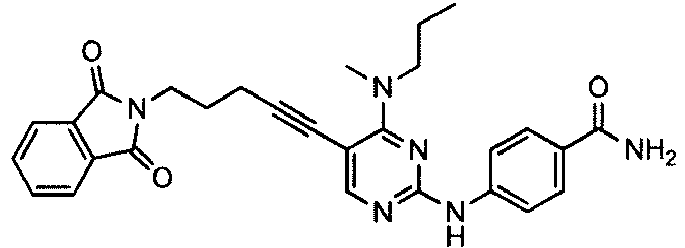
- H29 
- H30 
- H31 
- H32 
- [Table 128] Compound No. Structure Physicochemical data H33 
- H34 
- H35 
- H36 
- H37 
- H38 
- H39 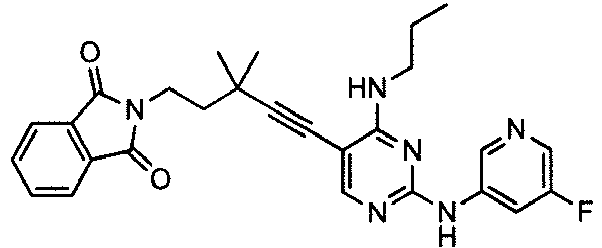
- H40 
- H41 
- [Table 129] Compound No. Structure Physicochemical data H42 
- H43 
- H44 
- H45 
- H46 
- H47 
- H126 
MS m/z (M+H): 461.3 H127 
- [Table 130] Compound No. Structure Physicochemical data H128 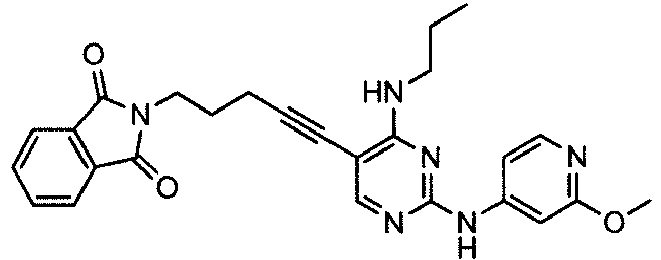
- H129 
MS m/z (M+H): 443.3 H130 
MS m/z (M+H): 462.3 - In the same manner as that of Example 41, (4), Intermediates (H48) to (H70) and Intermediates (H131) to (H 13 5) were obtained.
[Table 131] Compound No. Structure Physicochemical data H48 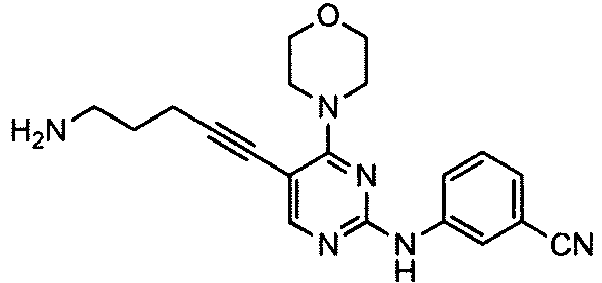
- H49 
- H50 
MS m/z (M+H): 342.2 H51 
MS m/z (M+H): 367.3 H52 
- H53 
- H54 
- H55 
- [Table 132] Compound No. Structure Physicochemical data H56 
- H57 
- H58 
- H59 
- H60 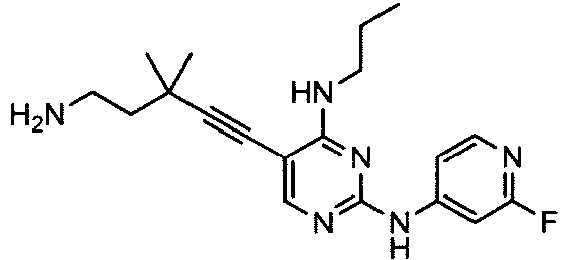
- H61 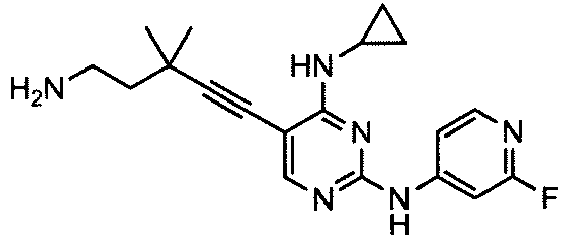
- H62 
- H63 
- H64 
- [Table 133] Compound No. Structure Physicochemical data H65 
- H66 
- H67 
- H68 
- H69 
- H70 
- H131 
- H132 
MS m/z (M+H): 371.3 [Table 134] Compound No. Structure Physicochemical data H133 
- H134 
MS m/z (M+H): 313.3 H135 
MS m/z (M+H): 332.3 - In the same manner as that of Example 41, (5), Intermediates (H71) to (H97) and Intermediates (H 136) to (H 146) were obtained.
[Table 135] Compound No. Structure Physicochemical data H71 
- H72 
- H73 
MS m/z (M+H): 527.3 H74 
MS m/z (M+H): 552.4 H75 
MS m/z (M+H): 550.4 H76 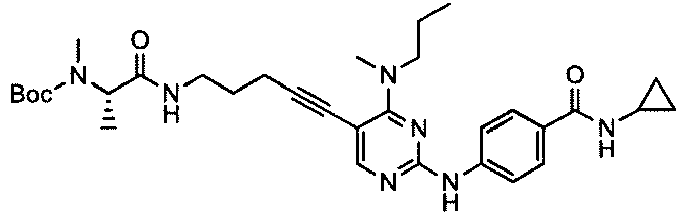
MS m/z (M+H): 592.5 H77 
MS m/z (M+H): 566.5 H78 
- H79 
- H80 
- H81 
- [Table 136] Compound No. Structure Physicochemical data H82 
- H83 
MS m/z (M+H): 512.4 H84 
- H85 
- H86 
- H87 
- H88 
- H89 
- H90 
- H91 
- [Table 137] Compound No. Structure Physicochemical data H92 
- H93 
- H94 
- H95 
- H96 
- H97 
- H136 
- H137 
- H138 
- H139 
- [Table 138] Compound No. Structure Physicochemical data H140 
- H141 
MS m/z (M+H): 538.5 H142 
MS m/z (M+H): 554.4 H143 
MS m/z (M+H): 556.4 H144 
MS m/z (M+H): 512.4 H145 
MS m/z (M+H): 498.4 H146 
MS m/z (M+H): 517.4 - In the same manner as that of Example 41, (6), Intermediates (H98) to (H124) and Intermediates (H147) to (H157) were obtained.
[Table 139] Compound No. Structure Physicochemical data H98 
- H99 
- H100 
MS m/z (M+H): 427.3 H101 
MS m/z (M+H): 452.4 H102 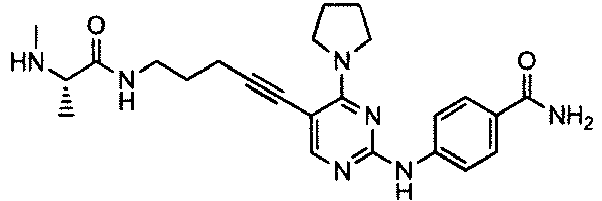
MS m/z (M+H): 450.4 H103 
MS m/z (M+H): 492.5 H104 
- H105 
- [Table 140] Compound No. Structure Physicochemical data H106 
- H107 
- H108 
- H109 
- H110 
- H111 
- H112 
- H113 
- H114 
- H115 
- [Table 141] Compound No. Structure Physicochemical data H116 
- H117 
- H118 
- H119 
- H120 
- H121 
- H122 
- H123 
- H124 
- H147 
- [Table 142] Compound No. Structure Physicochemical data H148 
- H149 
- H150 
- H151 
- H152 
MS m/z (M+H): 438.3 H153 
MS m/z (M+H): 454.4 H154 
- H155 
MS m/z (M+H): 412.4 H156 
- H157 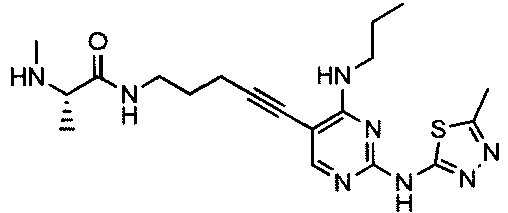
MS m/z (M+H): 417.4 - In the same manner as that of Example 41, Compounds (9-2) to (9-40) were obtained.
[Table 143] Compound No. Structure Physicochemical data 9-2 
1H-NMR (CDCl3) δ: 8.16 (1H, brs), 8.12 (1H, s), 7.63 (1H, s), 7.60 (1H, brs), 7.41-7.35 (1H, m), 7.25 (1H, brs), 7.02-6.89 (1H, m), 6.67 (1H, t, J=5.6Hz), 6.43 (1H, d, J=15.2Hz), 5.17 (1H, q, J=7.3Hz), 3.99-3.93 (4H, m), 3.83-3.76 (4H, m), 3.48-3.23 (2H, m), 3.10 (2H, d, J=5.9Hz), 3.00 (3H, s), 2.44 (2H, t, J=6.9Hz), 2.27 (6H, s), 1.80-1.71 (2H, m), 1.35 (3H, d, J=7.3Hz) 9-3 
1H-NMR (CDCl3) δ: 8.22 (1H, s), 8.14 (1H, s), 8.02 (1H, s), 7.74-7.19 (3H, m), 6.93-6.85 (2H, m), 6.44 (1H, d, J=15.2Hz), 5.20 (1H, q, J=7.3Hz), 3.74 (2H, t, J=7.6Hz), 3.39-3.35 (2H, m), 3.29 (3H, s), 3.12-3.10 (2H, m), 3.02 (3H, s), 2.42 (2H, t, J=6.9Hz), 2.27 (6H, s), 1.77-1.67 (4H, m), 1.36 (3H, d, J=7.3Hz), 0.93 (3H, t, J=7.6Hz) 9-4 
1H-NMR (CDCl3) δ: 8.16 (1H, brs), 8.13 (1H, s), 7.59 (1H, dd, J=7.6, 1.7Hz), 7.40-7.26 (4H, m), 6.64-6.33 (2H, m), 5.79 (1H, dd, J=10.2, 1.7Hz), 5.16 (1H, q, J=7.3Hz), 3.99-3.93 (4H, m), 3.83-3.76 (4H, m), 3.44-3.24 (2H, m), 3.00 (3H, s), 2.44 (2H, t, J=6.9Hz), 1.81-1.72 (2H, m), 1.36 (3H, d, J=7.3Hz) 9-5 
1H-NMR (CDCl3) δ: 8.03 (1H, s), 7.76-7.68 (1H, m), 7.24-7.16 (2H, m), 7.07 (1H, d, J=7.6Hz), 6.98-6.88 (1H, m), 6.67 (1H, dt, J=8.3, 2.0Hz), 6.5 (1H, brs), 6.42 (1H, d, J=15.2Hz), 5.18 (1H, q, J=7.0Hz), 3.78-3.70 (2H, m), 3.42-3.32 (2H, m), 3.30 (3H, s), 3.12-3.06 (2H, m), 2.99 (3H, s), 2.42 (2H, t, J=6.9Hz), 2.26 (6H, s), 1.80-1.64 (4H, m), 1.35 (3H, d, J=7.3Hz), 0.94 (3H, t, J=7.3Hz) 9-6 
MS m/z (M+H): 563.5 9-7 
1H-NMR (CDCl3) δ: 8.02 (1H, s), 7.77 (2H, d, J=8.6Hz), 7.70 (2H, d, J=8.6Hz), 6.93 (1H, dt, J=15.0, 6.1Hz), 6.57 (1H, brs), 6.42 (1H, d, J=15.2Hz), 5.18 (1H, d, J=7.3Hz), 3.84 (4H, s), 3.42-3.28 (2H, m), 3.09 (2H, d, J=5.9Hz), 2.99 (3H, s), 2.40 (2H, t, J=6.9Hz), 2.26 (6H, s), 2.00-1.92 (4H, m), 1.75 (2H, t, J=7.3Hz), 1.35 (3H, d, J=7.3Hz) [Table 144] Compound No. Structure Physicochemical data 9-8 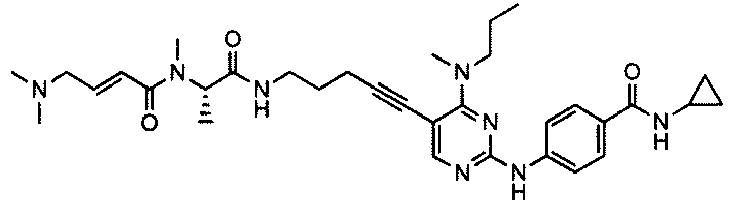
1H-NMR (CDCl3) δ: 8.03 (1H, s), 7.70 (2H, d, J=8.6Hz), 7.64 (2H, d, J=8.6Hz), 7.61 (1H, s), 6.93 (1H, dt, J=15.0, 6.1Hz), 6.64 (1H, brs), 6.42 (1H, d, J=15.2Hz), 6.38-6.32 (1H, m), 5.18 (1H, q, J=7.0Hz), 3.78-3.70 (2H, m), 3.42-3.30 (2H, m), 3.28 (3H, s), 3.09 (2H, d, J=5.3Hz), 2.99 (3H, s), 2.94-2.84 (1H, m), 2.42 (2H, t, J=7.3Hz), 2.26 (6H, s), 1.82-1.64 (4H, m), 1.35 (3H, d, J=6.6Hz), 0.93 (3H, t, J=7.6Hz), 0.88-0.82 (2H, m), 0.64-0.58 (2H, m) 9-9 
1H-NMR (CDCl3) δ: 8.04 (1H, s), 7.71 (2H, d, J=8.9Hz), 7.64 (2H, d, J=8.9Hz), 7.16 (1H, s), 6.93 (1H, dt, J=15.0, 5.9Hz), 6.53 (1H, brs), 6.41 (1H, d, J=15.2Hz), 6.12-6.04 (1H, m), 5.17 (1H, q, J=6.8Hz), 3.79-3.70 (2H, m), 3.42-3.32 (2H, m), 3.29 (3H, s), 3.10 (2H, d, J=5.9Hz), 3.01 (3H, d, J=5.0Hz), 2.98 (3H, s), 2.46-2.38 (2H, m), 2.26 (6H, s), 1.80-1.68 (4H, m), 1.35 (3H, d, J=7.3Hz), 0.94 (3H, t, J=7.3Hz) 9-10 
1H-NMR (CDCl3) δ: 8.50 (1H, s), 8.03 (1H, s), 7.97 (1H, d, J=5.9Hz), 7.55 (1H, d, J=1.3Hz), 7.17 (1H, d, J=5.3Hz), 6.97-6.88 (2H, m), 6.42 (1H, d, J=15Hz), 5.20 (1H, q, J=7.0Hz), 3.75-3.65 (2H, m), 3.39-3.32 (2H, m), 3.30 (3H, s), 3.10 (2H, d, J=5.3Hz), 3.02 (3H, s), 2.42 (2H, t, J=6.9Hz), 2.26 (6H, s), 1.84-1.62 (4H, m), 1.36 (3H, d, J=6.6Hz), 0.94 (3H, t, J=7.6Hz) 9-11 
1H-NMR (CDCl3) δ: 8.15 (1H, s), 8.01 (1H, d, 5.9Hz), 7.83 (1H, s), 7.47 (1H, d, J=1.3Hz), 7.17 (1H, dd, J=4.6, 2.6Hz), 6.94 (1H, dt, J=15.2, 5.9Hz), 6.68 (1H, t, J=5.3Hz), 6.43 (1H, d, J=15.2Hz), 5.17 (1H, q, J=7.0Hz), 4.05-3.96 (4H, m), 3.83-3.79 (4H, m), 3.45-3.23 (2H, m), 3.10 (2H, dd, J=5.9, 1.3Hz), 3.00 (3H, s), 2.44 (2H, t, 7.3Hz), 2.25 (6H, s), 1.83-1.69 (2H, m), 1.36 (3H, d, J=7.3Hz) 9-12 
1H-NMR (CDCl3) δ: 8.26 (1H, s), 8.06-7.94 (2H, m), 7.60 (1H, s), 7.23-7.14 (1H, m), 7.01-6.81 (2H, m), 6.43 (1H, d, 15.2Hz), 5.27-5.13 (1H, m), 4.05-3.62 (4H, m), 3.46-3.26 (2H, m), 3.19-3.07 (2H, m), 3.02 (3H, s), 2.51-2.36 (2H, m), 2.30 (6H, s), 2.00 (4H, brs), 1.86-1.64 (2H, m), 1.36 (3H, d, J=7.3Hz) [Table 145] Compound No. Structure Physicochemical data 9-13 
1H-NMR (CDCl3) δ: 8.99 (1H, s), 7.97 (2H, t, J=3.0Hz), 7.69 (1H, s), 7.18 (1H, d, J=5.3Hz), 6.96-6.89 (2H, m), 6.59 (1H, t, J=5.3Hz), 6.44 (1H, d, J=15.2Hz), 5.23 (1H, q, J=7.2Hz), 3.60-3.38 (4H, m), 3.10 (2H, d, J=5.9Hz), 3.03 (3H, s), 2.53-2.37 (2H, m), 2.26 (6H, s), 1.83-1.61 (4H, m), 1.38 (3H, d, J=7.2Hz), 1.01 (3H, t, J=7.3Hz) 9-14 
1H-NMR (CDCl3) δ: 8.57 (1H, s), 8.12 (1H, s), 7.97 (1H, d, J=5.3Hz), 7.71 (1H, d, J=2.0Hz), 7.14 (1H, d, J=5.9Hz), 6.93 (1H, dt, 15.2, 5.9Hz), 6.80 (1H, t, J=5.6Hz), 6.43 (1H, d, 15.0Hz), 6.40 (1H, s), 5.19 (1H, q, J=7.0Hz), 3.81-3.72 (2H, m), 3.43-3.24 (2H, m), 3.15-3.03 (3H, m), 3.01 (3H, s), 2.69-2.55 (1H, m), 2.41 (2H, t, J=7.3Hz), 2.26 (6H, s), 1.83-1.64 (4H, m), 1.35 (3H, d, J=7.3Hz), 1.00-0.88 (5H, m), 0.76-0.71 (2H, m) 9-15 
1H-NMR (CDCl3) δ: 8.30 (1H, s), 8.02-7.95 (3H, m), 7.17-7.10 (1H, m), 6.94 (1H, dt, J=15.2, 5.9Hz), 6.70 (1H, t, J=5.9Hz), 6.51 (1H, s), 6.44 (1H, dt, J=15.2, 1.7Hz), 5.20 (1H, q, J=6.8Hz), 3.44 (2H, q, J=6.4Hz), 3.11 (2H, dd, J=5.9, 1.3Hz), 3.02 (3H, s), 2.92-2.81 (1H, m), 2.43 (2H, t, J=6.6Hz), 2.27 (6H, s), 1.78-1.69 (2H, m), 1.38 (3H, d, J=6.8Hz), 0.96-0.90 (2H, m), 0.79-0.74 (2H, m) 9-16 
1H-NMR (CDCl3) δ: 8.24 (1H, s), 8.01-7.96 (2H, m), 7.63 (1H, d, J=1.3Hz), 7.18 (1H, d, J=5.9Hz), 6.94 (1H, dt, J=15.2, 5.9Hz), 6.81-6.65 (2H, m), 6.43 (1H, d, J=15.2Hz), 5.20 (1H, q, J=7.3Hz), 3.65 (2H, q, J=6.4Hz), 3.54 (2H, t, J=5.9Hz), 3.43 (2H, q, J=6.4Hz), 3.35 (3H, s), 3.11 (2H, dd, J=5.9, 1.3Hz), 3.02 (3H, s), 2.49-2.40 (2H, m), 2.27 (6H, s), 2.01-1.97 (2H, m), 1.80-1.71 (2H, m), 1.37 (3H, d, J=7.3Hz) [Table 146] Compound No. Structure Physicochemical data 9-17 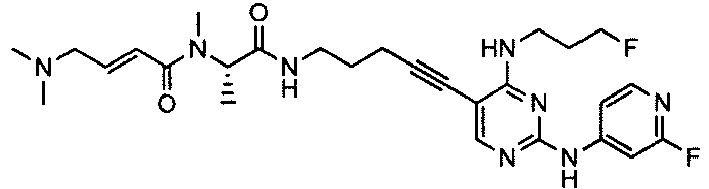
1H-NMR (CDCl3) δ: 8.00 (1H, s), 8.00 (1H, d, J=5.3Hz), 7.60 (1H, d, J=2.0Hz), 7.30 (1H, s), 7.16-7.09 (1H, m), 6.94 (1H, dt, J=15.2, 5.9Hz), 6.89-6.80 (1H, m), 6.61-6.51 (1H, m), 6.48-6.37 (1H, m), 5.19 (1H, q, J=7.0Hz), 4.61 (2H, dt, J=47.3, 5.6Hz), 3.73 (2H, q, J=6.6Hz), 3.53-3.40 (2H, m), 3.11 (2H, dd, J=5.9, 1.3Hz), 3.00 (3H, s), 2.52-2.37 (2H, m), 2.27 (6H, s), 2.22-2.05 (2H, m), 1.78-1.69 (2H, m), 1.36 (3H, d, J=7.0Hz) 9-18 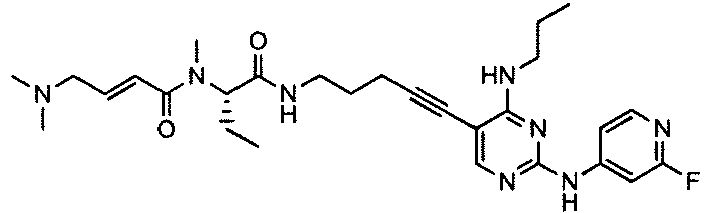
1H-NMR (CDCl3) δ: 8.52 (1H, s), 7.98 (2H, dd, J=5.9, 1.3Hz), 7.68 (1H, d, J=1.3Hz), 7.17 (1H, d, J=5.9Hz), 6.94 (1H, dt, J=15.2, 5.9Hz), 6.83 (1H, t, J=6.3Hz), 6.59 (1H, t, J=5.9Hz), 6.45 (1H, d, J=15.2Hz), 4.94 (1H, t, J=7.9Hz), 3.54-3.42 (4H, m), 3.13-3.08 (2H, m), 3.03 (3H, s), 2.44 (2H, t, J=6.3Hz), 2.27 (6H, s), 2.06-1.95 (1H, m), 1.77-1.67 (5H, m), 1.01 (3H, t, J=7.3Hz), 0.91 (3H, t, J=7.3Hz) 9-19 
1H-NMR (CDCl3) δ: 8.00 (1H, s), 7.99 (1H, d, J=5.9Hz), 7.65 (1H, d, J=2.0Hz), 7.30 (1H, s), 7.12-7.06 (1H, m), 6.94 (1H, dt, J=15.2, 5.9Hz), 6.64-6.53 (1H, m), 6.47-6.36 (1H, m), 6.32-6.22 (1H, m), 5.17 (1H, q, J=7.0Hz), 3.59-3.36 (4H, m), 3.10 (2H, dd, J=5.9, 1.3Hz), 2.98 (3H, s), 2.27 (6H, s), 1.78-1.64 (4H, m), 1.35 (3H, d, J=7.0Hz), 1.30 (3H, s), 1.29 (3H, s), 1.01 (3H, t, J=7.3Hz) 9-20 
1H-NMR (CDCl3) δ: 8.02 (1H, s), 7.99 (1H, d, J=5.3Hz), 7.95 (1H, d, J=2.0Hz), 7.38 (1H, s), 7.12-7.04 (1H, m), 6.94 (1H, dt, J=15.2, 5.9Hz), 6.61-6.51 (1H, m), 6.41 (1H, d, J=15.2Hz), 6.09 (1H, s), 5.16 (1H, q, J=7.0Hz), 3.51-3.37 (2H, m), 3.10 (2H, d, J=5.9Hz), 2.99 (3H, s), 2.87-2.82 (1H, m), 2.27 (6H, s), 1.66 (2H, t, J=9.6Hz), 1.36 (3H, d, J=7.0Hz), 1.30 (3H, s), 1.29 (3H, s), 1.01-0.88 (2H, m), 0.77-0.67 (2H, m) [Table 147] Compound No. Structure Physicochemical data 9-21 
1H-NMR (CDCl3) δ: 8.37 (1H, dt, J=11.7, 2.3Hz), 8.34-8.31 (1H, m), 8.07 (1H, d, J=2.6Hz), 7.98 (1H, s), 7.52 (1H, s), 6.94 (1H, dt, J=15.2, 5.9Hz), 6.64-6.55 (1H, m), 6.46-6.37 (1H, m), 6.24-6.15 (1H, m), 5.17 (1H, q, J=7.0Hz), 3.57-3.35 (4H, m), 3.10 (2H, dd, J=5.9, 1.3Hz), 2.98 (3H, s), 2.27 (6H, s), 1.79-1.61 (4H, m), 1.35 (3H, d, J=7.3Hz), 1.30 (3H, s), 1.29 (3H, s), 1.00 (3H, t, J=7.3Hz) 9-22 
1H-NMR (CDCl3) δ: 8.67 (1H, dt, J=11.9, 2.3Hz), 8.35 (1H, s), 8.07 (1H, d, J=2.3Hz), 8.00 (1H, s), 7.60 (1H, s), 6.94 (1H, dt, J=15.2, 5.9Hz), 6.62-6.51 (1H, m), 6.48-6.38 (2H, m), 5.19 (1H, q, J=7.0Hz), 3.43 (2H, q, J=6.4Hz), 3.11 (2H, dd, J=5.9, 1.3Hz), 3.00 (3H, s), 2.91-2.80 (1H, m), 2.42 (2H, t, J=6.6Hz), 2.27 (6H, s), 1.78-1.69 (2H, m), 1.37 (3H, d, J=7.0Hz), 0.95-0.89 (2H, m), 0.79-0.72 (2H, m) 9-23 
1H-NMR (CDCl3) δ: 8.48 (1H, dd, J=8.3, 2.3Hz), 8.05 (1H, s), 7.76 (1H, s), 7.70 (1H, q, J=8.3Hz), 6.94 (1H, dt, J=15.2, 5.9Hz), 6.57-6.51 (1H, m), 6.49 (1H, dd, J=8.3, 2.3Hz), 6.46-6.37 (1H, m), 6.34 (1H, s), 5.18 (1H, q, J=7.0Hz), 3.43 (2H, q, J=6.4Hz), 3.10 (2H, dd, J=5.9, 1.3Hz), 3.00 (3H, s), 2.93-2.81 (1H, m), 2.42 (2H, t, J=6.6Hz), 2.27 (6H, s), 1.78-1.68 (2H, m), 1.37 (3H, d, J=7.0Hz), 0.90-0.84 (2H, m), 0.77-0.72 (2H, m) 9-24 
1H-NMR (CDCl3) δ: 8.12 (1H, d, J=7.9Hz), 8.02 (1H, s), 7.60 (1H, s), 7.53 (1H, t, J=7.9Hz), 6.94 (1H, dt, J=15.2, 5.9Hz), 6.57-6.48 (1H, m), 6.46-6.3 (1H, m), 6.35 (1H, d, J=7.9Hz), 6.24 (1H, s), 5.18 (1H, q, J=7.3Hz), 3.87 (3H, s), 3.42 (2H, q, J=6.4Hz), 3.10 (2H, dd, J=5.9, 1.3Hz), 3.00 (3H, s), 2.94-2.83 (1H, m), 2.42 (2H, t, J=6.9Hz), 2.27 (6H, s), 1.78-1.69 (2H, m), 1.37 (3H, d, J=7.3Hz), 0.90-0.84 (2H, m), 0.77-0.70 (2H, m) [Table 148] Compound No. Structure Physicochemical data 9-25 
1H-NMR (CDCl3) δ: 8.11 (1H, dd, J=12.6, 2.0Hz), 7.97 (1H, s), 7.62 (1H, s), 7.46 (1H, dd, J=8.6, 7.3Hz), 7.13 (1H, dd, J=8.6, 2.0Hz), 6.94 (1H, dt, J=15.2, 5.9Hz), 6.63-6.49 (2H, m), 6.48-6.38 (1H, m), 5.19 (1H, q, J=7.0Hz), 3.56-3.39 (4H, m), 3.11 (2H, dd, J=5.9, 13Hz), 3.00 (3H, s), 2.44 (2H, t, J=6.3Hz), 2.27 (6H, s), 1.81-1.65 (4H, m), 1.36 (3H, d, J=7.3Hz), 1.01 (3H, t, J=7.0Hz) 9-26 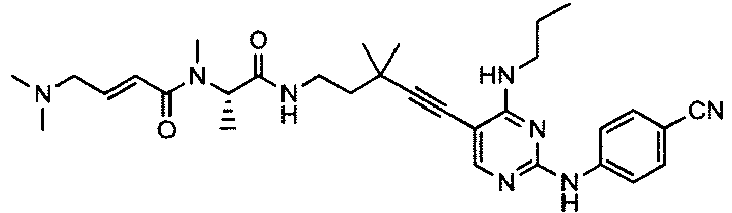
1H-NMR (CDCl3) δ: 7.98 (1H, s), 7.76 (2H, d, J=8.6Hz), 7.57 (2H, d, J=8.6Hz), 7.23 (1H, s), 6.94 (1H, dt, J=15.2, 5.9Hz), 6.62-6.52 (1H, m), 6.41 (1H, d, J=15.2Hz), 6.22-6.10 (1H, m), 5.17 (1H, q, J=7.0Hz), 3.53-3.39 (4H, m), 3.10 (2H, d, J=5.9Hz), 2.98 (3H, s), 2.27 (6H, s), 1.78-1.62 (4H, m), 1.35 (3H, d, J=7.0Hz), 1.30 (3H, s), 1.29 (3H, s), 1.00 (3H, t, J=7.3Hz) 9-27 
1H-NMR (CDCl3) δ: 8.00 (1H, s), 7.88 (2H, d, J=9.2Hz), 7.56 (2H, d, J=9.2Hz), 7.33 (1H, s), 6.93 (1H, dt, J=15.2, 5.9Hz), 6.59-6.50 (1H, m), 6.41 (1H, d, J=15.2Hz), 6.00 (1H, s), 5.16 (1H, q, J=7.0Hz), 3.55-3.32 (2H, m), 3.10 (2H, d, J=5.9Hz), 2.99 (3H, s), 2.90-2.79 (1H, m), 2.27 (6H, s), 1.66 (2H, t, J=7.6Hz), 1.36 (3H, d, J=7.0Hz), 1.30 (3H, s), 1.29 (3H, s), 0.94-0.84 (2H, m), 0.74-0.69 (2H, m) 9-28 
1H-NMR (CDCl3) δ: 7.96 (1H, s), 7.86 (1H, t, J=2.0Hz), 7.28-7.14 (2H, m), 7.05 (1H, s), 6.94 (1H, dt, J=15.2, 5.9Hz), 6.73 (1H, dd, J=7.6, 2.0Hz), 6.57-6.48 (1H, m), 6.53 (1H, t, J=74.3Hz), 6.48-6.37 (1H, m), 6.27-6.18 (1H, m), 5.18 (1H, q, J=7.0Hz), 3.51 (2H, q, J=6.3Hz), 3.43 (2H, q, J=6.4Hz), 3.10 (2H, dd, J=5.9, 13Hz), 2.99 (3H, s), 2.44 (2H, t, J=6.9Hz), 2.27 (6H, s), 1.84-1.65 (4H, m), 1.36 (3H, d, J=7.0Hz), 1.00 (3H, t, J=7.6Hz) [Table 149] Compound No. Structure Physicochemical data 9-29 
1H-NMR (CDCl3) δ: 7.95 (1H, s), 7.57 (1H, dd, J=7.9, 2.0Hz), 7.09-6.86 (4H, m), 6.60-6.49 (1H, m), 6.42 (1H, d, J=15.2Hz), 6.21-6.08 (1H, m), 5.18 (1H, q, J=7.0Hz), 3.90 (3H, s), 3.50 (2H, q, J=6.6Hz), 3.43 (2H, q, J=6.6Hz), 3.10 (2H, d, J=5.9Hz), 2.99 (3H, s), 2.44 (2H, t, J=6.6Hz), 2.27 (6H, s), 1.79-1.62 (4H, m), 1.35 (3H, d, J=7.0Hz), 0.97 (3H, t, J=7.3Hz) 9-30 
1H-NMR (CDCl3) δ: 8.01 (1H, s), 7.01-6.88 (1H, m), 6.84-6.70 (1H, m), 6.69-6.58 (1H, m), 6.57-6.33 (2H, m), 5.27-5.15 (1H, m), 3.97-3.86 (1H, m), 3.80-3.61 (2H, m), 3.59-3.36 (2H, m), 3.11 (2H, d, J=5.9Hz), 3.02 (3H, s), 2.52-2.41 (2H, m), 2.40 (3H, s), 2.27 (6H, s), 1.91-1.66 (4H, m), 1.37 (3H, d, J=7.3Hz), 1.03 (3H, t, J=7.6Hz) 9-31 
1H-NMR (CDCl3) δ: 7.97 (2H, brs), 7.41-7.13 (2H, m), 7.11-6.88 (2H, m), 6.70-6.51 (2H, m), 6.42 (1H, d, J=14.5Hz), 5.19 (1H, brs), 3.93 (3H, s), 3.79-3.61 (2H, m), 3.61-3.51 (2H, m), 3.51-3.39 (2H, m), 3.36 (3H, s), 3.11 (2H, d, J=5.3Hz), 3.00 (3H, s), 2.45 (2H, t, J=6.3Hz), 2.27 (6H, s), 2.14-1.67 (4H, m), 1.36 (3H, d, J=6.6Hz) 9-32 
1H-NMR (CDCl3) δ: 7.99 (2H, brs), 7.23-7.09 (1H, m), 7.09-6.86 (2H, m), 6.48-6.36 (1H, m), 6.36-6.18 (2H, m), 5.54 (1H, brs), 4.90-4.42 (1H, m), 3.92 (3H, s), 3.86-3.43 (8H, m), 3.36 (3H, s), 3.11 (2H, brs), 2.52 (2H, brs), 2.26 (6H, s), 2.22-1.51 (8H, m) 9-33 
1H-NMR (CDCl3) δ: 7.98 (2H, brs), 7.31-7.13 (2H, m), 7.13-6.87 (3H, m), 6.60 (1H, brs), 6.33 (1H, d, J=13.9Hz), 4.68 (1H, brs), 3.93 (3H, s), 3.77-3.45 (10H, m), 3.36 (3H, s), 3.12 (2H, brs), 2.49 (2H, brs), 2.27 (6H, s), 2.10-1.50 (6H, m) [Table 150] Compound No. Structure Physicochemical data 9-34 
1H-NMR (CDCl3) δ: 8.03-7.93 (2H, m), 7.14-6.96 (3H, m), 6.95-6.82 (1H, m), 6.63-6.40 (1H, m), 6.36-6.12 (2H, m), 5.47-5.18 (1H, m), 4.88-4.51 (1H, m), 3.93 (3H, s), 3.81-3.41 (8H, m), 3.36 (3H, s), 3.13-3.05 (2H, m), 2.48 (2H, t, J=5.3Hz), 2.28 (3H, s), 2.23 (3H, s), 2.03-1.90 (2H, m), 1.84-1.70 (2H, m), 1.68-1.56 (2H, m) 9-35 
1H-NMR (CDCl3) δ: 7.98 (2H, d, J=5.3Hz), 7.54-7.41 (1H, m), 7.41-7.24 (1H, m), 7.21-7.06 (1H, m), 7.06-6.86 (2H, m), 6.52-6.09 (2H, m), 4.69 (1H, brs), 3.92 (3H, s), 3.83-3.28 (6H, m), 3.11 (2H, s), 2.49 (2H, brs), 2.27 (6H, s), 2.18-1.51 (8H, m), 1.00 (3H, t, J=5.9Hz) 9-36 
1H-NMR (CDCl3) δ: 8.06-7.93 (2H, m), 7.85 (1H, brs), 7.43-7.27 (2H, m), 7.11-6.88 (2H, m), 6.27 (1H, d, J=15.2Hz), 6.04 (1H, s), 5.68 (1H, s), 4.79 (1H, d, J=8.6Hz), 4.51 (1H, brs), 3.92 (3H, s), 3.84-3.66 (2H, m), 3.59-3.38 (4H, m), 3.12 (2H, brs), 2.50 (2H, t, J=5.6Hz), 2.27 (6H, s), 1.92-1.59 (6H, m), 1.00 (3H, t, J=7.6Hz) 9-37 
1H-NMR (CDCl3) δ: 7.99 (2H, s), 7.42-7.23 (2H, m), 7.19-6.84 (2H, m), 6.50-6.12 (2H, m), 5.48-5.16 (1H, m), 4.92-4.50 (1H, m), 3.93 (3H, s), 3.90-3.36 (5H, m), 3.21-2.89 (4H, m), 2.48 (2H, t, J=5.6Hz), 2.28 (3H, s), 2.23 (3H, s), 1.95-1.51 (6H, m), 1.02 (3H, t, J=6.9Hz) 9-38 
1H-NMR (CDCl3) δ: 8.00-7.96 (2H, m), 7.35-7.25 (2H, m), 7.06-6.89 (2H, m), 6.66 (1H, brs), 6.47 (1H, d, J=15.2Hz), 6.22 (1H, brs), 4.04 (2H, s), 3.92 (3H, s), 3.59-3.40 (4H, m), 3.20 (3H, s), 3.11 (2H, d, J=5.9Hz), 2.48 (2H, t, J=6.6Hz), 2.27 (6H, s), 1.93-1.64 (4H, m), 1.01 (3H, t, J=7.3Hz) [Table 151] Compound No. Structure Physicochemical data 9-39 
1H-NMR (CDCl3) δ: 7.98 (1H, d, J=5.9Hz), 7.96 (1H, s), 7.43 (1H, s), 7.34 (1H, d, J=2.0Hz), 7.02 (1H, dd, J=5.9, 2.0Hz), 6.94 (1H, dt, J=15.2, 5.9Hz), 6.63 (1H, t, J=5.9Hz), 6.45-6.40 (2H, m), 5.19 (1H, q, J=6.8Hz), 3.93 (3H, s), 3.48-3.40 (2H, m), 3.15-3.08 (5H, m), 3.00 (3H, s), 2.43 (2H, t, J=6.3Hz), 2.27 (6H, s), 1.78-1.70 (2H, m), 1.37 (3H, d, J=6.8Hz) 9-40 
1H-NMR (CDCl3) δ: 8.33 (1H, brs), 6.97-6.92 (2H, m), 6.66-6.53 (2H, m), 6.45-6.40 (2H, m), 5.28-5.11 (1H, m), 3.67-3.53 (1H, m), 3.53-3.37 (2H, m), 3.11 (2H, d, J=5.9Hz), 3.00 (3H, s), 2.68 (3H, s), 2.43 (2H, t, J=5.9Hz), 2.27 (6H, s), 1.88-1.53 (4H, m), 1.36 (3H, d, J=7.3Hz), 1.02 (3H, t, J=7.6Hz) -

- To a solution of benzyl alcohol (10.4 mL) in tetrahydrofuran (100 mL), tert-butoxypotassium (6.2 g) was added under a nitrogen atmosphere with ice cooling, and the mixture was stirred for 40 minutes under reflux by heating (Reaction mixture A).
- To a solution of 2,4-dichloro-5-iodopyrimidine (13.7 g) synthesized according to the method described in
WO2008/155140A1 in N,N-dimethylformamide (100 mL), Reaction mixture A mentioned above was added dropwise at a temperature below 10°C, and the mixture was stirred for 2 hours under ice cooling. To the reaction mixture, water (800 mL) was added. The solid matter was taken by filtration, washed with water, and then recrystallized from acetonitrile, and dried under reduced pressure to obtain 4-(benzyloxy)-2-chloro-5-iodopyrimidine (J1, 10.3 g) as white solid.
MS m/z (M+H): 347.0 -

- To a solution of 4-(benzyloxy)-2-chloro-5-iodopyrimidine (J1, 158 mg) in N-methylpyrrolidone (2.5 mL), 3-fluoroaniline (66 µL) and (1S)-(+)-10-camphorsulfonic acid (159 mg) were added at room temperature, and the mixture was stirred at 60°C for 2 hours, and then stirred at 80°C for 7 hours. The reaction mixture was cooled to room temperature, and then saturated aqueous sodium hydrogencarbonate and ethyl acetate were added. The organic layer was separated, washed successively with water and saturated aqueous sodium chloride, and then dried over anhydrous sodium sulfate, and the solvent was evaporated under reduced pressure. The obtained residue was purified by silica gel column chromatography to obtain 4-(benzyloxy)-N-(3-fluorophenyl)-5-iodopyrimidin-2-amine (J2, 60 mg) as white solid.
MS m/z (M+H): 422.0 -

- To a solution of 4-(benzyloxy)-N-(3-fluorophenyl)-5-iodopyrimidin-2-amine (J2, 60 mg) and N-(4-pentynyl)phthalimide (76 mg) in N,N-dimethylformamide (500 µL), triethylamine (98 µL), copper(I) iodide (14 mg) and bis(triphenylphosphine)palladium(II) dichloride (10 mg) were added at room temperature, and the mixture was stirred at the same temperature for 1 hour. To the reaction mixture, ethyl acetate and water were added. The organic layer was separated, washed successively with water and saturated aqueous sodium chloride, and then dried over anhydrous sodium sulfate, and the solvent was evaporated under reduced pressure. The obtained residue was purified by silica gel column chromatography to obtain 2-(5-(4-(benzyloxy)-2-((3-fluorophenyl)amino)pyrimidin-5-yl)-4-pentyn-1-yl)isoindoline-1,3-dione (J3, 69 mg) as pale green solid.
MS m/z (M+H): 507.2 -

- To 2-(5-(4-(benzyloxy)-2-((3-fluorophenyl)amino)pyrimidin-5-yl)-4-pentyn-1-yl)isoindoline-1,3-dione (J3, 69 mg), trifluoroacetic acid (1 mL) was added at room temperature, and the mixture was stirred overnight at the same temperature. The solvent was evaporated under reduced pressure, and then ethyl acetate and water were added to the mixture. The organic layer was separated, washed with saturated aqueous sodium chloride, and then dried over anhydrous sodium sulfate, and the solvent was evaporated under reduced pressure. The obtained solid matter was washed with diisopropyl ether, and then dried under reduced pressure to obtain 2-(5-(2-((3-fluorophenyl)amino)-4-hydroxypyrimidin-5-yl)-4-pentyn-1-yl)isoindoline-1,3-dione (J4, 62 mg) as pale pink solid.
MS m/z (M+H): 417.1 -

- To 2-(5-(2-((3-fluorophenyl)amino)-4-hydroxypyrimidin-5-yl)-4-pentyn-1-yl)isoindoline-1,3-dione (J4, 36 mg), phosphorus oxychloride (1 mL) was added at room temperature, and the mixture was stirred at 80°C for 45 minutes. The reaction mixture was cooled to room temperature, and then poured into ice, and then ethyl acetate was added to the mixture. The organic layer was separated, washed successively with water, saturated aqueous sodium hydrogencarbonate and saturated aqueous sodium chloride, and then dried over anhydrous sodium sulfate, and the solvent was evaporated under reduced pressure. The obtained solid matter was washed with diisopropyl ether, and then dried under reduced pressure to obtain 2-(5-(4-chloro-2-((3-fluorophenyl)amino)pyrimidin-5-yl)-4-pentyn-1-yl)isoindoline-1,3-dione (J5, 21 mg) as pale yellow solid.
MS m/z (M+H): 435.1 -

- To a solution of 2-(5-(4-chloro-2-((3-fluorophenyl)amino)pyrimidin-5-yl)-4-pentyn-1-yl)isoindoline-1,3-dione (J5, 124 mg) in 1,4-dioxane (2 mL), triethylamine (119 µL) and 3-methoxypropylamine (88 µL) were added at room temperature, and the mixture was stirred overnight at 50°C in a sealed tube. The reaction mixture was cooled to room temperature, and then ethyl acetate and water were added to the reaction mixture. The organic layer was separated, washed successively with water and saturated aqueous sodium chloride, and then dried over anhydrous sodium sulfate, and the solvent was evaporated under reduced pressure. The obtained residue was purified by silica gel column chromatography to obtain 2-(5-(2-((3-fluorophenyl)amino)-4-((3-methoxypropyl)amino)pyrimidin-5-yl)-4-pentyn-1-yl)isoindoline-1,3-dione (J6, 90 mg) as pale yellow solid.
MS m/z (M+H): 488.2 -

- To a solution of 2-(5-(2-((3-fluorophenyl)amino)-4-((3-methoxypropyl)amino)pyrimidin-5-yl)-4-pentyn-1-yl)isoindoline-1,3-dione (J6, 90 mg) in tetrahydrofuran (1 mL) and ethanol (0.5 mL), hydrazine monohydrate (100 µL) was added at room temperature, and the mixture was stirred for 1 hour under reflux by heating. The reaction mixture was cooled to room temperature, and then ethyl acetate was added to the reaction mixture. The insoluble matter was removed by filtration, and then 1.0 mol/L aqueous hydrochloric acid was added to the reaction mixture until the mixture became acidic. The aqueous layer was separated, 3.0 mol/L aqueous sodium hydroxide was added until the mixture became basic, and the reaction mixture was extracted with ethyl acetate. The extract was dried over anhydrous sodium sulfate, and the solvent was evaporated under reduced pressure to obtain 5-(5-amino-1-pentyn-1-yl)-N2-(3-fluorophenyl)-N4-(3-methoxypropyl)pyrimidine-2,4-diamine (J7, 55 mg) as pale yellow solid.
MS m/z (M+H): 358.2 -

- To a solution of 5-(5-amino-1-pentyn-1-yl)-N2-(3-fluorophenyl)-N4-(3-methoxypropyl)pyrimidine-2,4-diamine (J7, 55 mg), N-Boc-N-methyl-L-alanine (63 mg), 1-ethyl-3-(3-dimethylaminopropyl)carbodiimide hydrochloride (59 mg) and 1-hydroxybenzotriazole monohydrate (42 mg) in N,N-dimethylformamide (700 µL), N,N-diisopropylethylamine (108 µL) was added at room temperature, and the mixture was stirred at the same temperature for 3 hours. To the reaction mixture, water and ethyl acetate were added. The organic layer was separated, washed successively with water and saturated aqueous sodium chloride, and then dried over anhydrous sodium sulfate, and the solvent was evaporated under reduced pressure. The obtained residue was purified by silica gel column chromatography to obtain (S)-tert-butyl (1-((5-(2-((3-fluorophenyl)amino)-4-((3-methoxypropyl)amino)pyrimidin-5-yl)-4-pentyn-1-yl)amino)-1-oxopropan-2-yl)(methyl)carbamate (J8, 84 mg).
MS m/z (M+H): 543.1 -


- To (S)-tert-butyl (1-((5-(2-((3-fluorophenyl)amino)-4-((3-methoxypropyl)amino)pyrimidin-5-yl)-4-pentyn-1-yl)amino)-1-oxopropan-2-yl)(methyl)carbamate (J8, 81 mg), a 4.0 mol/L solution of hydrochloric acid in 1,4-dioxane (1 mL) was added at room temperature, and the mixture was stirred at the same temperature for 30 minutes. The solvent was evaporated under reduced pressure. The obtained solid matter was washed with diisopropyl ether, and then dried under reduced pressure to obtain (S)-N-(5-(2-((3-fluorophenyl)amino)-4-((3-methoxypropyl)amino)pyrimidin-5-yl)-4-pentyn-1-yl)-2-(methylamino)propanamide (J9) dihydrochloride (55 mg) as pale yellow solid.
MS m/z (M+H): 443.3 -

- To a solution of 4-dimethylaminocrotonic acid hydrochloride (61 mg) in N,N-dimethylformamide (0.5 mL), N-methylmorpholine (135 µL) and isobutyl chloroformate (40 µL) were added under ice cooling, then (S)-N-(5-(2-((3-fluorophenyl)amino)-4-((3-methoxypropyl)amino)pyrimidin-5-yl)-4-pentyn-1-yl)-2-(methylamino)propanamide (J9) dihydrochloride (55 mg) was further added, and the mixture was stirred at the same temperature for 1 hour. To the reaction mixture, saturated aqueous sodium hydrogencarbonate (10 drops) was added, and the solvent was evaporated under reduced pressure. The obtained residue was purified by basic silica gel column chromatography to obtain (S,E)-4-(dimethylamino)-N-(1-((5-(2-((3-fluorophenyl)amino)-4-((3-methoxypropyl)amino)pyrimidin-5-yl)-4-pentyn-1-yl)amino)-1-oxopropan-2-yl)-N-methyl-2-butenamide (10-1, 45 mg).
1H-NMR (CDCl3) δ: 7.96 (1H, s), 7.79 (1H, dt, J=12.1, 2.1Hz), 7.26-7.15 (1H, m), 7.09 (1H, dd, J=8.1, 2.1Hz), 7.05 (1H, s), 6.94 (1H, dt, J=15.2, 5.9Hz), 6.67 (1H, dt, J=8.1, 2.1Hz), 6.60-6.50 (1H, m), 6.50-6.36 (2H, m), 5.18 (1H, q, J=7.3Hz), 3.64 (2H, q, J=6.4Hz), 3.53 (2H, t, J=6.3Hz), 3.42 (2H, q, J=6.4Hz), 3.35 (3H, s), 3.10 (2H, dd, J=5.9, 1.3Hz), 2.99 (3H, s), 2.44 (2H, t, J=6.6Hz), 2.26 (6H, s), 2.01-1.93 (2H, m), 1.80-1.71 (2H, m), 1.36 (3H, d, J=7.3Hz) -

- To a solution of 4-(benzyloxy)-2-chloro-5-iodopyrimidine (J1, 2.02 g) and 4-aminobenzamide (3.97 g) in N-methylpyrrolidone (20 mL), (1S)-(+)-10-camphorsulfonic acid (6.76 g) was added at room temperature, and the mixture was stirred at 60°C for 9 hours. The reaction mixture was cooled on ice, and then poured into saturated aqueous sodium hydrogencarbonate. The solid matter was taken by filtration, washed with a mixed solvent of ethyl acetate and methanol, and then dried under reduced pressure to obtain 4-((4-(benzyloxy)-5-iodopyrimidin-2-yl)amino)benzamide (J10, 3.05 g) as white solid.
MS m/z (M+H): 447.2 -

- To 4-((4-(benzyloxy)-5-iodopyrimidin-2-yl)amino)benzamide (J10, 2.84 g), trifluoroacetic acid (25 mL) was added at room temperature, and the mixture was stirred at 40 to 50°C for 8 hours. The reaction mixture was cooled to room temperature, and then the solvent was evaporated under reduced pressure. The obtained solid matter was washed with a mixed solvent of diisopropyl ether and chloroform, and then dried under reduced pressure to obtain 4-((4-hydroxy-5-iodopyrimidin-2-yl)amino)benzamide (J11, 1.35 g) as pale brown solid.
MS m/z (M+H): 357.1 -

- To 4-((4-hydroxy-5-iodopyrimidin-2-yl)amino)benzamide (J11, 1.35 g), phosphorus oxychloride (14 mL) was added at room temperature, and the mixture was stirred at 90°C for 1 hour and 30 minutes. The reaction mixture was cooled to room temperature, and then poured into ice, and then ethyl acetate was added to the mixture. The organic layer was separated, washed successively with water, saturated aqueous sodium hydrogencarbonate and saturated aqueous sodium chloride, and then dried over anhydrous sodium sulfate, and the solvent was evaporated under reduced pressure. The obtained solid matter was washed with a mixed solvent of diisopropyl ether and chloroform, and then dried under reduced pressure to obtain 4-((4-chloro-5-iodopyrimidin-2-yl)amino)benzonitrile (J12, 764 mg) as pale yellow solid.
MS m/z (M+H): 357.0 -

- To a solution of 4-((4-chloro-5-iodopyrimidin-2-yl)amino)benzonitrile (J 12, 53 mg) and N-(4-pentynyl)phthalimide (47 mg) in N,N-dimethylformamide (1 mL), triethylamine (103 µL), copper(I) iodide (14 mg), and bis(triphenylphosphine)palladium(II) dichloride (10 mg) were added at room temperature, and the mixture was stirred overnight at the same temperature. To the reaction mixture, ethyl acetate and water were added. The organic layer was separated, washed successively with water and saturated aqueous sodium chloride, and then dried over anhydrous sodium sulfate, and the solvent was evaporated under reduced pressure. The obtained solid matter was washed with chloroform, and then dried under reduced pressure to obtain 4-((4-chloro-5-(5-(1,3-dioxoisoindolin-2-yl)-1-pentyn-1-yl)pyrimidin-2-yl)amino)benzonitrile (J13, 44 mg) as white solid.
-

- To a solution of 4-((4-chloro-5-(5-(1,3-dioxoisoindolin-2-yl)-1-pentyn-1-yl)pyrimidin-2-yl)amino)benzonitrile (J13, 41 mg) in 1,4-dioxane (1.5 mL), 4-fluoroaniline (79 µL) and triethylamine (115 µL) were added at room temperature, and the mixture was stirred at 95°C for 2 hours in a sealed tube. The reaction mixture was cooled to room temperature, and then ethyl acetate and water were added to the reaction mixture. The organic layer was separated, washed successively with 1.0 mol/L aqueous hydrochloric acid, saturated aqueous sodium hydrogencarbonate and saturated aqueous sodium chloride, and then dried over anhydrous sodium sulfate, and the solvent was evaporated under reduced pressure. The obtained solid matter was washed with a mixed solvent of chloroform and methanol, and then dried under reduced pressure to obtain 4-((5-(5-(1,3-dioxoisoindolin-2-yl)-1-pentyn-1-yl)-4-((4-fluorophenyl)amino)pyrimidin-2-yl)amino)benzonitrile (J 14, 32 mg) as pale green solid.
MS m/z (M+H): 517.3 -

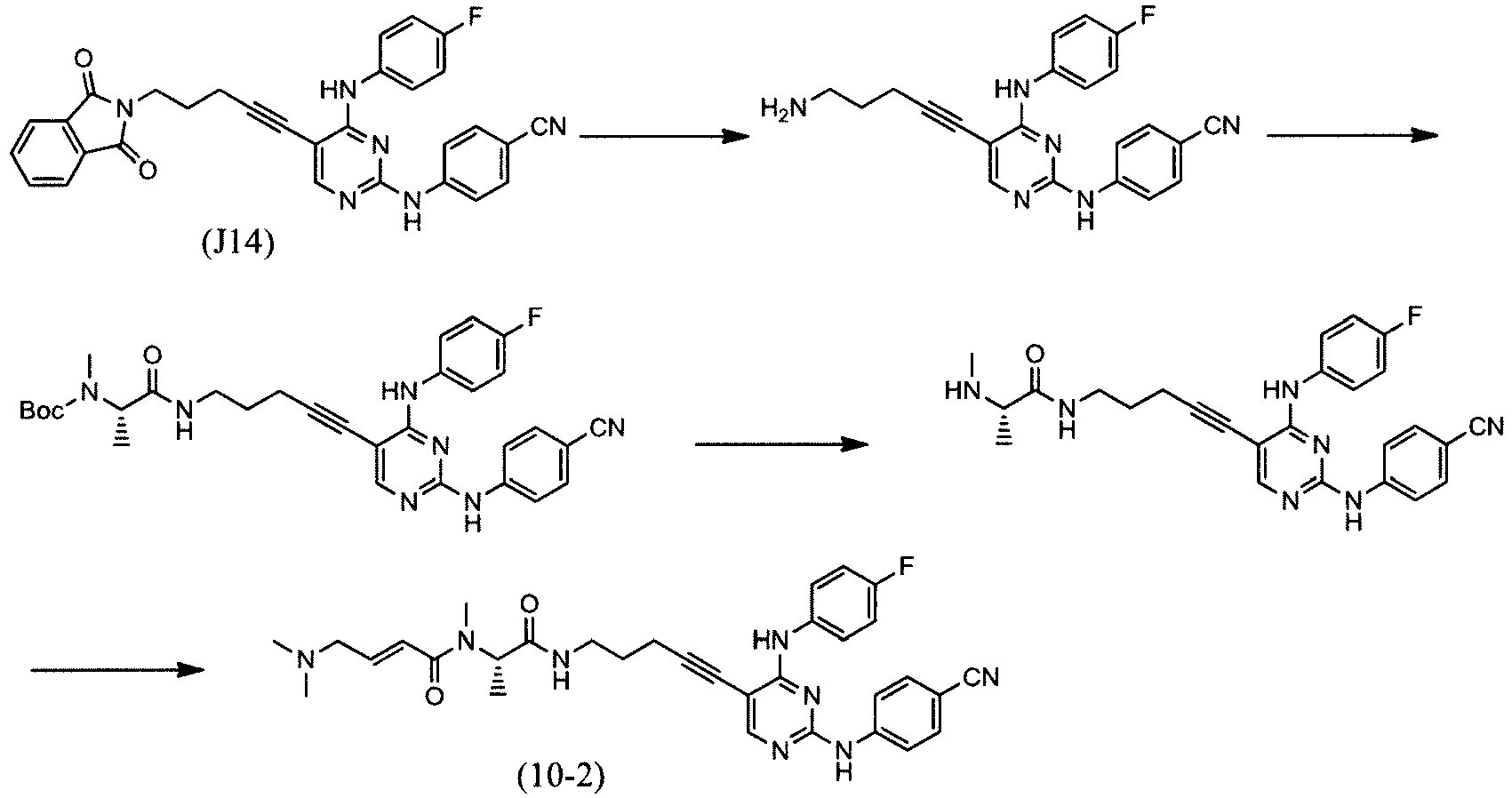
- In the same manner as that of Example 44, (7) to (10), (S,E)-N-(1-((5-(2-((4-cyanophenyl)amino)-4-((4-fluorophenyl)amino)pyrimidin-5-yl)-4-pentyn-1-yl)amino)-1-oxopropan-2-yl)-4-(dimethylamino)-N-methyl-2-butenamide (10-2) was obtained from 4-((5-(5-(1,3-dioxoisoindolin-2-yl)-1-pentyn-1-yl)-4-((4-fluorophenyl)amino)pyrimidin-2-yl)amino)benzonitrile (J14).
1H-NMR (CDCl3) δ: 8.26 (1H, s), 8.15 (1H, s), 7.64 (2H, d, J=8.6Hz), 7.59 (2H, dd, J=8.6, 4.6Hz), 7.49 (2H, d, J=8.6Hz), 7.45 (1H, brs), 7.07 (2H, t, J=8.6Hz), 6.93 (1H, dt, J=15.0, 6.1Hz), 6.67-6.57 (1H, m), 6.41 (1H, dt, J=15.0, 1.3Hz), 5.17 (1H, q, J=7.0Hz), 3.54-3.49 (2H, m), 3.10 (2H, dd, J=5.9, 1.3Hz), 2.95 (3H, s), 2.54-2.43 (2H, m), 2.27 (6H, s), 1.81-1.68 (2H, m), 1.32 (3H, d, J=7.0Hz) -

- To a solution of 4-((4-chloro-5-iodopyrimidin-2-yl)amino)benzonitrile (J12, 25 mg) in tetrahydrofuran (1 mL), N,N-diisopropylethylamine (37 µL) and a 2.0 mol/L solution of methylamine in tetrahydrofuran (105 µL) were added at room temperature, and the mixture was stirred at room temperature for 19 hours. To the reaction mixture, water (5 mL) was added. The solid matter was taken by filtration, washed with water, and then dried under reduced pressure to obtain 4-((5-iodo-4-(methylamino)pyrimidin-2-yl)amino)benzonitrile (F224, 27 mg).
-

- By using 4-((5-iodo-4-(methylamino)pyrimidin-2-yl)amino)benzonitrile (F224) and (S)-tert-butyl methyl(1-oxo-1-(4-pentyn-1-ylamino)propan-2-yl)carbamate (U4), (S)-tert-butyl (1-((5-(2-((4-cyanophenyl)amino)-4-(methylamino)pyrimidin-5-yl)-4-pentyn-1-yl)amino)-1-oxopropan-2-yl)(methyl)carbamate (J17) was obtained in the same manner as that of Example 38, (2).
MS m/z (M+H): 492.4 - By using Intermediates (J12), Intermediates (J18) to (J23) were obtained in the same manner as that of Example 45, (7).
[Table 152] Compound No. Structure Physicochemical data J18 
MS m/z (M+H): 366.1 J19 
MS m/z (M+H): 392.1 J20 
MS m/z (M+H): 406.1 J21 
MS m/z (M+H): 410.1 J22 
MS m/z (M+H): 396.1 J23 
MS m/z (M+H): 410.1 - By using Intermediates (J18) to (J23), Intermediates (J24) to (J29) were obtained in the same manner as that of Example 45, (8).
[Table 153] Compound No. Structure Physicochemical data J24 
MS m/z (M+H): 506.4 J25 
MS m/z (M+H): 532.4 J26 
MS m/z (M+H): 546.4 J27 
MS m/z (M+H): 550.4 J28 
MS m/z (M+H): 536.4 J29 
MS m/z (M+H): 550.4 - By using 4-(benzyloxy)-2-chloro-5-iodopyrimidine (J1), Intermediates (J30) to (J33) were obtained in the same manner as that of Example 45, (1) to (3).
[Table 154] Compound No. Structure Physicochemical data J30 
MS m/z (M+H): 385.9 J31 
MS m/z (M+H): 385.9 J32 
MS m/z (M+H): 444.0 J33 
MS m/z (M+H): 444.0 - By using Intermediates (J30) to (J33), Intermediates (J34) to (J39) were obtained in the same manner as that of Example 45, (8).
[Table 155] Compound No. Structure Physicochemical data J34 
MS m/z (M+H): 526.3 J35 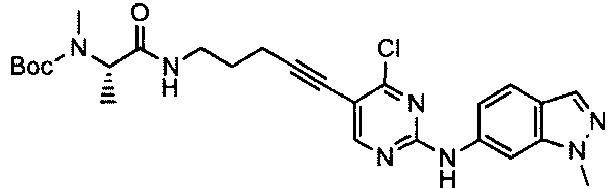
MS m/z (M+H): 526.3 J36 
MS m/z (M+H): 584.4 J37 
MS m/z (M+H): 584.4 J38 
MS m/z (M+H): 596.4 J39 
MS m/z (M+H): 596.4 - By using Intermediates (J34) to (J39), Intermediates (J40) to (J63) were obtained in the same manner as that of Example 45, (7).
[Table 156] Compound No. Structure Physicochemical data J40 
MS m/z (M+H): 521.4 J41 
MS m/z (M+H): 535.5 J42 
MS m/z (M+H): 547.5 J43 
MS m/z (M+H): 579.5 J44 
MS m/z (M+H): 521.5 J45 
MS m/z (M+H): 535.5 J46 
MS m/z (M+H): 547.5 J47 
MS m/z (M+H): 579.5 J48 
MS m/z (M+H): 507.4 J49 
MS m/z (M+H): 521.5 [Table 157] Compound No. Structure Physicochemical data J50 
MS m/z (M+H): 565.5 J51 
MS m/z (M+H): 507.4 J52 
MS m/z (M+H): 521.5 J53 
MS m/z (M+H): 565.5 J54 
MS m/z (M+H): 519.5 J55 
MS m/z (M+H): 533.5 J56 
MS m/z (M+H): 577.5 J57 
MS m/z (M+H): 519.3 J58 
MS m/z (M+H): 533.3 J59 
MS m/z (M+H): 577.3 [Table 158] Compound No. Structure Physicochemical data J60 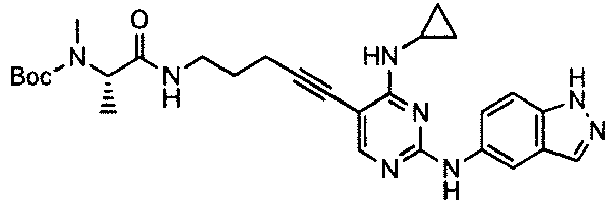
- J61 
- J62 
- J63 
- -

- By using 4-((4-chloro-5-(5-(1,3-dioxoisoindolin-2-yl)-1-pentyn-1-yl)pyrimidin-2-yl)amino)benzonitrile (J13), 4-((5-(5-(1,3-dioxoisoindolin-2-yl)-1-pentyn-1-yl)-4-((3-hydroxypropyl)amino)pyrimidin-2-yl)amino)benzonitrile (J 15) was obtained in the same manner as that of Example 45, (5).
MS m/z (M+H): 481.3 -


- To a suspension of 4-((5-(5-(1,3-dioxoisoindolin-2-yl)-1-pentyn-1-yl)-4-((3-hydroxypropyl)amino)pyrimidin-2-yl)amino)benzonitrile (J15, 51 mg) in methylene chloride (1 mL), bis(2-methoxyethyl)aminosulfur trifluoride (188 µL) was added under ice cooling, and the mixture was stirred at the same temperature for 1 hour. To the reaction mixture, water and ethyl acetate were added. The solid matter was taken by filtration, washed successively with water and ethyl acetate, and then dried under reduced pressure to obtain 4-((4-(azetidin-1-yl)-5-(5-(1,3-dioxoisoindolin-2-yl)-1-pentyn-1-yl)pyrimidin-2-yl)amino)benzonitrile (J16, 48 mg) as pale yellow solid.
MS m/z (M+H): 463.3 - In the same manner as that of Example 44 and Example 45, Compounds (10-3) to (10-75) were obtained.
[Table 159] Compound No. Structure Physicochemical data 10-3 
1H-NMR (CDCl3) δ: 8.11 (1H, s), 7.90 (1H, s), 7.65 (1H, dt, J=11.9, 2.3Hz), 7.54-7.50 (2H, m), 7.21-7.11 (1H, m), 7.08 (1H, s), 7.04-6.87 (4H, m), 6.65 (1H, dt, J=8.3, 2.3Hz), 6.60-6.52 (1H, m), 6.41 (1H, d, J=15.2Hz), 5.17 (1H, q, J=7.3Hz), 3.84 (3H, s), 3.47 (2H, q, J=6.4Hz), 3.09 (2H, d, J=5.3Hz), 2.95 (3H, s), 2.48 (2H, t, J=6.6Hz), 2.26 (6H, s), 1.81-1.73 (2H, m), 1.33 (3H, d, J=7.3Hz) 10-4 
1H-NMR (CDCl3) δ: 7.96 (1H, s), 7.81 (1H, dt, J=11.9, 2.0Hz), 7.26-7.15 (2H, m), 7.12-7.05 (1H, m), 7.00-6.80 (2H, m), 6.73-6.55 (2H, m), 6.42 (1H, d, J=15.2Hz), 5.19 (1H, q, J=7.0Hz), 3.67-3.54 (2H, m), 3.51-3.35 (2H, m), 3.10 (2H, d, J=5.3Hz), 2.99 (3H, s), 2.46-2.39 (4H, m), 2.27 (6H, s), 2.25 (6H, s), 1.91-1.70 (4H, m), 1.36 (3H, d, J=6.6Hz) 10-5 
1H-NMR (CDCl3) δ: 8.11 (1H, s), 7.61 (1H, dt, J=11.7, 2.1Hz), 7.27-7.18 (2H, m), 7.13-7.04 (1H, m), 6.93 (1H, dt, J=15.2, 5.9Hz), 6.70 (1H, dt, J=8.1, 2.1Hz), 6.65-6.54 (1H, m), 6.47-6.35 (1H, m), 5.16 (1H, q, J=7.0Hz), 4.00-3.90 (4H, m), 3.85-3.75 (4H, m), 3.43-3.23 (2H, m), 3.10 (2H, dd, J=5.9, 1.3Hz), 2.99 (3H, s), 2.43 (2H, t, J=7.3Hz), 2.27 (6H, s), 1.80-1.71 (2H, m), 1.35 (3H, d, J=7.0Hz) 10-6 
1H-NMR (CDCl3) δ: 7.97 (1H, s), 7.78 (1H, dt, J=11.9, 2.0Hz), 7.28 (1 H, s), 7.25-7.15 (1 H, m), 7.09 (1H, dd, J=7.6, 2.0Hz), 6.93 (1H, dt, J=15.2, 5.9Hz), 6.73-6.57 (2H, m), 6.49-6.35 (2H, m), 5.18 (1H, q, J=7.0Hz), 3.75-3.68 (4H, m), 3.64 (2H, q, J=5.9Hz), 3.42 (2H, q, J=6.6Hz), 3.13-3.07 (2H, m), 2.99 (3H, s), 2.67 (2H, t, J=6.6Hz), 2.59-2.49 (4H, m), 2.46 (2H, t, J=6.9Hz), 2.26 (6H, s), 1.82-1.73 (2H, m), 1.35 (3H, d, J=7.0Hz) 10-7 
1H-NMR (CDCl3) δ: 7.97 (1H, s), 7.87 (1H, dt, J=11.9, 2.0Hz), 7.24 (1H, s), 7.20 (1H, dt, J=8.3, 6.6Hz), 7.04 (1H, dd, J=8.3, 2.0Hz), 6.94 (1H, dt, J=15.2, 5.9Hz), 6.68 (1H, dt, J=8.3, 2.0Hz), 6.62-6.51 (2H, m), 6.48-6.37 (1H, m), 5.19 (1H, q, J=7.0Hz), 3.99 (2H, dd, J=11.6,3.6Hz), 3.52-3.32 (6H, m), 3.11 (2H, dd, J=5.9, 1.3Hz), 3.00 (3H, s), 2.43 (2H, t, J=6.3Hz), 2.27 (6H, s), 2.13-2.02 (1H, m), 1.80-1.66 (4H, m), 1.49-1.30 (5H, m) [Table 160] Compound No. Structure Physicochemical data 10-8 
1H-NMR (CDCl3) δ: 8.01 (1H, s), 7.65 (1H, dt, J=11.9, 2.3Hz), 7.24 (1H, dt, J=8.6, 6.2Hz), 7.18-7.08 (3H, m), 6.94 (1H, dt, J=15.2, 5.9Hz), 6.70 (1H, dt, J=8.6, 2.3Hz), 6.63-6.56 (1H, m), 6.48-6.37 (1H, m), 5.21 (1H, q, J=7.0Hz), 3.93-3.81 (2H, m), 3.60-3.43 (2H, m), 3.11 (2H, dd, J=5.9, 1.3Hz), 3.01 (3H, s), 2.82 (2H, q, J=6.4Hz), 2.46-2.39 (2H, m), 2.27 (6H, s), 1.80-1.65 (2H, m), 1.38 (3H, d, J=7.0Hz) 10-9 
1H-NMR (CDCl3) δ: 7.98 (1H, s), 7.75-7.66 (1H, m), 7.23-7.16 (4H, m), 7.00-6.86 (3H, m), 6.72-6.65 (1H, m), 6.58-6.48 (2H, m), 6.42 (1H, dt, J=15.0, 1.7Hz), 5.18 (1H, q, J=7.0Hz), 3.90-3.77 (2H, m), 3.49-3.35 (2H, m), 3.23 (2H, t, J=7.3Hz), 3.11-3.07 (2H, m), 2.99 (3H, s), 2.41 (2H, t, J=6.6Hz), 2.27 (6H, s), 1.75-1.67 (2H, m), 1.36 (3H, d, J=7.0Hz) 10-10 
1H-NMR (CDCl3) δ: 8.02 (1H, s), 7.67 (1H, dt, J=11.7, 2.1 Hz), 7.25-7.13 (2H, m), 7.05 (1H, dd, J=7.9, 2.1 Hz), 6.94 (1H, dt, J=15.2, 5.9Hz), 6.66 (1H, dt, J=8.1, 2.1Hz), 6.61-6.52 (1H, m), 6.46-6.37 (1H, m), 5.17 (1H, q, J=7.0Hz), 3.74-3.61 (4H, m), 3.45-3.25 (2H, m), 3.10 (2H, dd, J=5.9, 1.3Hz), 2.99 (3H, s), 2.42 (2H, t, J=7.3Hz), 2.27 (6H, s), 1.83-1.62 (6H, m), 1.35 (3H, d, J=7.3Hz), 0.94 (6H, t, J=7.0Hz) 10-11 
1H-NMR (CDCl3) δ: 8.12 (1H, s), 7.87 (1H, s), 7.64 (1H, dt, J=11.9, 2.3Hz), 7.52 (2H, d, J=8.6Hz), 7.27 (1H, s), 7.22-7.12 (3H, m), 7.06 (1H, dd, J=7.6, 2.3Hz), 6.93 (1H, dt, J=15.2, 5.9Hz), 6.73-6.56 (2H, m), 6.41 (1H, dt, J=15.2, 1.7Hz), 5.18 (1H, q, J=7.3Hz), 3.46 (2H, q, J=6.4Hz), 3.14-3.04 (2H, m), 2.97 (3H, s), 2.48 (2H, t, J=6.6Hz), 2.37 (3H, s), 2.26 (6H, s), 1.82-1.73 (2H, m), 1.34 (3H, d, J=7.3Hz) [Table 161] Compound No. Structure Physicochemical data 10-12 
1H-NMR (CDCl3) δ: 8.12 (1H, s), 7.88 (1H, s), 7.68 (1H, dt, J=11.7, 2.3Hz), 7.55 (2H, d, J=8.6Hz), 7.30-7.11 (4H, m), 7.04 (1H, dd, J=7.9, 2.3Hz), 6.93 (1H, dt, J=15.2, 5.9Hz), 6.66 (1H, dt, J=8.1, 2.3Hz), 6.62-6.52 (1H, m), 6.47-6.35 (1H, m), 5.18 (1H, q, J=7.0Hz), 3.46 (2H, q, J=6.4Hz), 3.10 (2H, dd, J=5.9, 1.3Hz), 2.99-2.88 (4H, m), 2.48 (2H, t, J=6.6Hz), 2.26 (6H, s), 1.82-1.73 (2H, m), 1.34 (3H, d, J=7.0Hz), 1.29 (3H, s), 1.27 (3H, s) 10-13 
1H-NMR (CDCl3) δ: 7.97 (1H, s), 7.77 (2H, d, J=8.6Hz), 7.56 (2H, d, J=8.6Hz), 7.30 (1H, s), 6.94 (1H, dt, J=15.2, 5.9Hz), 6.60-6.51 (1H, m), 6.47-6.31 (2H, m), 5.19 (1H, q, J=7.0Hz), 3.60-3.50 (2H, m), 3.45 (2H, q, J=6.4Hz), 3.11 (2H, dd, J=5.9, 1.3Hz), 3.00 (3H, s), 2.44 (2H, t, J=6.3Hz), 2.27 (6H, s), 1.82-1.56 (5H, m), 1.36 (3H, d, J=7.3Hz), 0.99 (6H, d, J=7.0Hz) 10-14 
1H-NMR (CDCl3) δ: 7.79 (1H, s), 7.58 (1H, s), 7.54-7.48 (2H, m), 7.17-7.11 (2H, m), 6.94 (1H, dt, J=15.2, 5.9Hz), 6.61-6.51 (1H, m), 6.49-6.36 (1H, m), 5.19 (1H, q, J=7.0Hz), 4.12-4.05 (2H, m), 3.63-3.37 (4H, m), 3.11 (2H, dd, J=5.9, 1.3Hz), 2.99 (3H, s), 2.50-2.34 (2H, m), 2.28 (6H, s), 2.21-2.12 (2H, m), 1.82-1.64 (2H, m), 1.36 (3H, d, J=7.0Hz) 10-15 
1H-NMR (CDCl3) δ: 8.05 (1H, s), 7.72 (2H, d, J=9.2Hz), 7.60-7.46 (3H, m), 6.93 (1H, dt, J=15.2, 5.9Hz), 6.66-6.55 (1H, m), 6.42 (1H, d, J=15.2Hz), 5.17 (1H, q, J=7.0Hz), 3.70 (2H, d, J=7.3Hz), 3.47-3.24 (5H, m), 3.10 (2H, d, J=5.9Hz), 2.99 (3H, s), 2.50-2.35 (2H, m), 2.26 (6H, s), 2.20-2.07 (1H, m), 1.84-1.69 (2H, m), 1.35 (3H, d, J=7.3Hz), 0.93 (6H, d, J=7.0Hz) 10-16 
1H-NMR (CDCl3) δ: 8.04 (1H, s), 7.70 (2H, d, J=8.6Hz), 7.55 (2H, d, J=8.6Hz), 7.50 (1H, s), 6.94 (1H, dt, J=15.0, 6.1Hz), 6.66-6.57 (1H, m), 6.48-6.35 (1H, m), 5.17 (1H, q, J=7.0Hz), 3.72-3.61 (4H, m), 3.46-3.22 (2H, m), 3.10 (2H, dd, J=6.1, 1.3Hz), 2.99 (3H, s), 2.42 (2H, t, J=7.3Hz), 2.27 (6H, s), 1.82-1.60 (6H, m), 1.35 (3H, d, J=7.0Hz), 0.94 (6H, t, J=7.6Hz) [Table 162] Compound No. Structure Physicochemical data 10-17 
1H-NMR (CDCl3) δ: 8.09 (1H, s), 7.52-7.42 (2H, m), 7.12-6.88 (4H, m), 6.70-6.59 (1H, m), 6.46 (1H, d, J=15.2Hz), 4.02 (2H, s), 3.97-3.88 (4H, m), 3.83-3.74 (4H, m), 3.35 (2H, dd, J=13.2, 6.6Hz), 3.19 (3H, s), 3.10 (2H, d, J=5.9Hz), 2.45 (2H, t, J=7.3Hz), 2.27 (6H, s), 1.85-1.72 (2H, m) 10-18 
1H-NMR (CDCl3) δ: 7.95 (1H, s), 7.60-7.50 (2H, m), 7.12 (1H, s), 7.04-6.88 (3H, m), 6.69-6.57 (1H, m), 6.47 (1H, d, J=15.2Hz), 6.36-6.23 (1H, m), 4.03 (2H, s), 3.99 (2H, dd, J=11.2,3.3Hz), 3.54-3.28 (6H, m), 3.20 (3H, s), 3.11 (2H, d, J=5.9Hz), 2.47 (2H, t, J=6.6Hz), 2.27 (6H, s), 2.10-1.90 (1H, m), 1.84-1.60 (4H, m), 1.47-1.26 (2H, m) 10-19 
1H-NMR (CDCl3) δ: 8.08 (1H, s), 7.71 (1H, s), 7.56-7.41 (4H, m), 7.11 (1H, s), 6.98-6.87 (5H, m), 6.73-6.59 (1H, m), 6.45 (1H, d, J=15.2Hz), 4.03 (2H, s), 3.84 (3H, s), 3.47 (2H, q, J=6.4Hz), 3.17 (3H, s), 3.10 (2H, d, J=5.9Hz), 2.52 (2H, t, J=6.6Hz), 2.26 (6H, s), 1.84-1.75 (2H, m) 10-20 
1H-NMR (CDCl3) δ: 8.39 (1H, d, J=2.6Hz), 8.10 (1H, s), 8.07 (1H, s), 7.91 (1H, dd, J=9.2, 2.6Hz), 7.49-7.38 (2H, m), 7.03 (1H, s), 6.97-6.89 (3H, m), 6.73 (1H, d, J=9.2Hz), 6.68-6.58 (1H, m), 6.45 (1H, d, J=15.2Hz), 4.03 (2H, s), 3.96 (3H, s), 3.52 (2H, q, J=6.2Hz), 3.17 (3H, s), 3.10 (2H, d, J=5.9Hz), 2.51 (2H, t, J=6.6Hz), 2.26 (6H, s), 1.87-1.67 (2H, m) 10-21 
1H-NMR (CDCl3) δ: 7.95 (1H, s), 7.58-7.52 (2H, m), 7.04-6.90 (4H, m), 6.65-6.54 (1H, m), 6.47 (1H, d, J=15.2Hz), 6.46-6.36 (1H, m), 4.57 (2H, m), 4.03 (2H, s), 3.66 (2H, q, J=6.6Hz), 3.45 (2H, q, J=6.4Hz), 3.20 (3H, s), 3.11 (2H, d, J=5.9Hz), 2.46 (2H, t, J=6.6Hz), 2.27 (6H, s), 2.16-1.98 (2H, m), 1.80-1.67 (2H, m) 10-22 
1H-NMR (CDCl3) δ: 8.00 (1H, s), 7.52-7.46 (2H, m), 7.05-6.86 (4H, m), 6.70-6.59 (1H, m), 6.45 (1H, d, J=15.2Hz), 4.03 (2H, s), 3.69-3.61 (4H, m), 3.36 (2H, q, J=6.8Hz), 3.19 (3H, s), 3.10 (2H, d, J=5.9Hz), 2.43 (2H, t, J=6.9Hz), 2.26 (6H, s), 1.83-1.61 (6H, m), 0.91 (6H, t, J=7.3Hz) [Table 163] Compound No. Structure Physicochemical data 10-23 
1H-NMR (CDCl3) δ: 8.14 (1H, s), 8.03 (1H, s), 7.71-7.63 (2H, m), 7.51-7.47 (4H, m), 7.32 (1H, s), 7.19 (2H, d, J=7.9Hz), 6.93 (1H, dt, J=15.2, 5.9Hz), 6.66-6.54 (1H, m), 6.47-6.35 (1H, m), 5.17 (1H, q, J=7.0Hz), 3.55-3.42 (2H, m), 3.10 (2H, dd, J=5.9, 1.3Hz), 2.96 (3H, s), 2.49 (2H, t, J=6.3Hz), 2.40 (3H, s), 2.26 (6H, s), 1.85-1.71 (2H, m), 1.34 (3H, d, J=7.0Hz) 10-24 
1H-NMR (CDCl3) δ: 7.97 (1H, s), 7.77 (2H, d, J=9.2Hz), 7.56 (2H, d, J=9.2Hz), 7.47 (1H, s), 6.94 (1H, dt, J=15.2, 5.9Hz), 6.63-6.54 (1H, m), 6.51-6.37 (2H, m), 5.18 (1H, q, J=7.0Hz), 3.44 (2H, q, J=6.4Hz), 3.35 (2H, t, J=6.6Hz), 3.10 (2H, dd, J=5.9, 1.3Hz), 3.00 (3H, s), 2.44 (2H, t, J=6.6Hz), 2.27 (6H, s), 2.13-1.97 (1H, m), 1.80-1.67 (2H, m), 1.36 (3H, d, J=7.0Hz), 0.99 (6H, d, J=6.6Hz) 10-25 
1H-NMR (CDCl3) δ: 7.99 (1H, s), 7.89 (2H, d, J=9.2Hz), 7.62 (1H, s), 7.56 (2H, d, J=9.2Hz), 6.94 (1H, dt, J=15.2, 5.9Hz), 6.65-6.54 (1H, m), 6.48-6.36 (2H, m), 5.19 (1H, q, J=7.0Hz), 3.43 (2H, q, J=6.4Hz), 3.11 (2H, dd, J=5.9, 1.3Hz), 3.01 (3H, s), 2.92-2.81 (1H, m), 2.43 (2H, t, J=6.6Hz), 2.27 (6H, s), 1.78-1.69 (2H, m), 1.37 (3H, d, J=7.0Hz), 0.91-0.85 (2H, m), 0.79-0.70 (2H, m) 10-26 
1H-NMR (CDCl3) δ: 7.95 (1H, s), 7.60-7.52 (2H, m), 7.15 (1H, s), 7.04-6.88 (3H, m), 6.59 (1H, brs), 6.46-6.34 (2H, m), 5.19 (1H, q, J=7.0Hz), 3.99 (3H, s), 3.60 (2H, q, J=6.4Hz), 3.51 (2H, t, J=5.9Hz), 3.42 (2H, q, J=6.4Hz), 3.35 (3H, s), 3.12-3.08 (2H, m), 2.99 (3H, s), 2.44 (2H, t, J=6.6Hz), 2.27 (6H, s), 1.98-1.88 (2H, m), 1.80-1.71 (2H, m), 1.35 (3H, d, J=7.3Hz) 10-27 
1H-NMR (CDCl3) δ: 7.94 (1H, s), 7.60-7.53 (2H, m), 7.22 (1H, s), 7.04-6.88 (3H, m), 6.69 (1H, brs), 6.46 (1H, d, J=15.2Hz), 6.34-6.24 (1H, m), 4.04 (2H, s), 3.59 (2H, q, J=6.4Hz), 3.51 (2H, t, J=5.9Hz), 3.42 (2H, q, J=6.4Hz), 3.35 (3H, s), 3.20 (3H, s), 3.12-3.04 (2H, m), 2.47 (2H, t, J=6.6Hz), 2.26 (6H, s), 1.98-1.88 (2H, m), 1.82-1.73 (2H, m) [Table 164] Compound No. Structure Physicochemical data 10-28 
1H-NMR (CDCl3) δ: 8.07 (1H, s), 7.51-7.46 (2H, m), 7.08-6.88 (4H, m), 6.55 (1H, brs), 6.42 (1H, d, J=15.2Hz), 5.17 (1H, q, J=6.8Hz), 3.98-3.90 (4H, m), 3.44-3.24 (2H, m), 3.10 (2H, d, J=5.9Hz), 2.99 (3H, s), 2.52-2.40 (6H, m), 2.33 (3H, s), 2.27 (6H, s), 1.82-1.70 (2H, m), 1.35 (3H, d, J=6.6Hz) 10-29 
1H-NMR (CDCl3) δ: 7.98 (1H, s), 7.77 (2H, d, J=9.2Hz), 7.57 (2H, d, J=9.2Hz), 7.47 (1H, s), 6.94 (1H, dt, J=15.2, 5.9Hz), 6.81-6.70 (1H, m), 6.64-6.52 (1H, m), 6.43 (1H, dt, J=15.2, 1.7Hz), 5.19 (1H, q, J=7.0Hz), 4.59 (2H, dt, J=47.3, 5.6Hz), 3.72 (2H, q, J=6.4Hz), 3.46 (2H, q, J=6.6Hz), 3.11 (2H, dd, J=5.9, 1.7Hz), 3.00 (3H, s), 2.50-2.38 (2H, m), 2.27 (6H, s), 2.22-2.02 (2H, m), 1.78-1.69 (2H, m), 1.36 (3H, d, J=7.0Hz) 10-30 
1H-NMR (CDCl3) δ: 8.37 (1H, s), 8.21 (1H, dt, J=11.2, 4.1Hz), 7.94 (1H, s), 7.34 (1H, brs), 6.98-6.86 (2H, m), 6.53 (2H, brs), 6.42 (1H, dt, J=15.2, 1.7Hz), 5.18 (1H, q, J=7.0Hz), 3.60 (2H, q, J=6.2Hz), 3.54-3.39 (4H, m), 3.35 (3H, s), 3.11 (2H, d, J=4.6Hz), 2.99 (3H, s), 2.53-2.39 (2H, m), 2.27 (6H, s), 1.97-1.89 (2H, m), 1.83-1.71 (2H, m), 1.36 (3H, d, J=7.0Hz) 10-31 
1H-NMR (CDCl3) δ: 8.37 (1H, s), 8.24-8.18 (1H, m), 7.95 (1H, s), 7.38 (1H, s), 6.99-6.86 (2H, m), 6.65 (1H, brs), 6.47 (2H, d, J=15.2Hz), 4.04 (2H, s), 3.62-3.40 (6H, m), 3.35 (3H, s), 3.20 (3H, s), 3.11-3.08 (2H, m), 2.48 (2H, t, J=6.6Hz), 2.27 (6H, s), 1.96-1.88 (2H, m), 1.82-1.74 (2H, m) 10-32 
1H-NMR (CDCl3) δ: 8.29-8.15 (4H, m), 7.58 (1H, dt, J=11.0, 2.1Hz), 7.44 (1H, d, J=7.9Hz), 7.29-7.22 (2H, m), 6.97-6.79 (3H, m), 6.57 (1H, t, J=6.3Hz), 6.43 (1H, d, J=15.2Hz), 4.90 (1H, t, J=7.6Hz), 3.60-3.43 (2H, m), 3.10 (2H, dd, J=6.3, 2.1Hz), 2.99 (3H, s), 2.46 (2H, dt, J=6.4, 2.4Hz), 2.27 (6H, s), 2.06-1.62 (4H, m), 0.90 (3H, t, J=7.6Hz) [Table 165] Compound No. Structure Physicochemical data 10-33 
1H-NMR (CDCl3) δ: 8.26 (1H, s), 8.21 (1H, t, J=7.5Hz), 8.04 (1H, s), 7.18 (2H, brs), 6.99-6.88 (2H, m), 6.58 (1H, brs), 6.43 (1H, d, J=15.2Hz), 5.19 (1H, d, J=7.3Hz), 4.26-4.12 (2H, m), 3.49 (2H, t, J=5.6Hz), 3.11 (2H, d, J=5.9Hz), 2.98 (3H, s), 2.43-2.41 (2H, m), 2.28 (6H, s), 1.72 (2H, brs), 1.35 (3H, d, J=7.3Hz) 10-34 
1H-NMR (CDCl3) δ: 8.34 (1H, s), 8.25-8.19 (1H, m), 7.96 (1H, s), 7.08 (1H, s), 6.99-6.87 (2H, m), 6.66 (1H, brs), 6.54 (1H, brs), 6.43 (1H, d, J=15.2Hz), 5.19 (1H, q, J=7.0Hz), 4.66 (1H, t, J=5.6Hz), 4.50 (1H, t, J=5.6Hz), 3.68 (2H, q, J=6.4Hz), 3.46 (2H, q, J=6.4Hz), 3.11 (2H, d, J=5.9Hz), 2.99 (3H, s), 2.43 (2H, t, J=5.9Hz), 2.27 (6H, s), 2.17-1.99 (2H, m), 1.75-1.68 (2H, m), 1.36 (3H, d, J=7.0Hz) 10-35 
1H-NMR (CDCl3) δ: 8.27 (1H, s), 8.20 (1H, dt, J=8.8,3.5Hz), 8.02 (1H, s), 7.32 (1H, brs), 7.22 (1H, brs), 6.98-6.88 (2H, m), 6.57 (1H, brs), 6.44 (1H, d, J=15.2Hz), 4.90 (1H, t, J=7.6Hz), 4.24-4.16 (2H, m), 3.50 (2H, d, J=6.0Hz), 3.11 (2H, d, J=6.0Hz), 2.99 (3H, s), 2.41 (2H, d, J=5.3Hz), 2.28 (6H, s), 2.02-1.96 (1H, m), 1.73-1.69 (3H, m), 0.90 (3H, t, J=7.3Hz) 10-36 
1H-NMR (CDCl3) δ: 8.26 (1H, s), 8.19 (1H, dt, J=8.8,3.5Hz), 8.03 (1H, s), 7.30 (1H, brs), 7.06 (1H, brs), 6.99-6.88 (2H, m), 6.63 (1H, brs), 6.47 (1H, d, J=15.2Hz), 4.25-4.14 (2H, m), 4.03 (2H, s), 3.50 (2H, q, J=6.4Hz), 3.20 (3H, s), 3.11 (2H, t, J=5.9Hz), 2.46 (2H, t, J=6.3Hz), 2.28 (6H, s), 1.78-1.70 (2H, m) 10-37 
1H-NMR (CDCl3) δ: 8.23 (1H, dt, J=8.8,3.5Hz), 8.13 (1H, s), 8.09 (1H, s), 7.98 (1H, s), 7.49 (2H, d, J=6.6Hz), 7.42 (1H, s), 6.95-6.87 (3H, m), 6.77 (1H, dd, J=8.8,3.5Hz), 6.59 (1H, brs), 6.42 (1H, d, J=15.2Hz), 4.89 (1H, t, J=7.6Hz), 3.84 (3H, s), 3.49 (2H, d, J=5.9Hz), 3.10 (2H, d, J=5.9Hz), 2.95 (3H, s), 2.47 (2H, s), 2.27 (6H, s), 2.00-1.61 (4H, m), 0.88 (3H, t, J=7.3Hz) [Table 166] Compound No. Structure Physicochemical data 10-38 
1H-NMR (CDCl3) δ: 8.04 (1H, s), 7.54-7.46 (2H, m), 7.17 (1H, s), 7.04-6.87 (3H, m), 6.57 (1H, brs), 6.42 (1H, d, J=15.2Hz), 5.18 (1H, q, J=7.0Hz), 3.88-3.82 (4H, m), 3.40-3.26 (2H, m), 3.10 (2H, d, J=5.9Hz), 2.99 (3H, s), 2.43 (2H, t, J=6.9Hz), 2.26 (6H, s), 1.82-1.58 (8H, m), 1.35 (3H, d, J=7.8Hz) 10-39 
1H-NMR (CDCl3) δ: 8.40 (1H, d, J=2.6Hz), 8.19 (1H, s), 8.10 (1H, s), 7.90 (1H, dd, J=8.6, 2.6Hz), 7.47-7.40 (2H, m), 7.23 (1H, s), 6.98-6.88 (3H, m), 6.72 (1H, d, J=8.6Hz), 6.60 (1H, brs), 6.42 (1H, d, J=15.2Hz), 4.89 (1H, t, J=7.6Hz), 3.96 (3H, s), 3.57-3.45 (2H, m), 3.09 (2H, d, J=5.9Hz), 2.95 (3H, s), 2.48-2.43 (2H, m), 2.26 (6H, s), 2.04-1.86 (1H, m), 1.78-1.60 (3H, m), 0.87 (3H, t, J=7.6Hz) 10-40 
1H-NMR (CDCl3) δ: 8.41 (1H, d, J=2.6Hz), 8.15 (1H, s), 8.11 (1H, s), 7.90 (1H, dd, J=8.6, 2.6Hz), 7.47-7.40 (2H, m), 6.98-6.88 (4H, m), 6.73 (1H, d, J=8.6Hz), 6.58 (1H, brs), 6.41 (1H, d, J=15.2Hz), 5.17 (1H, q, J=7.3Hz), 3.96 (3H, s), 3.50 (2H, q, J=6.2Hz), 3.10 (2H, d, J=5.9Hz), 2.95 (3H, s), 2.46 (2H, t, J=5.9Hz), 2.26 (6H, s), 1.76 (2H, q, J=6.2Hz), 1.32 (3H, d, J=7.3Hz) 10-41 
1H-NMR (CDCl3) δ: 8.12 (1H, s), 7.69 (2H, d, J=9.0Hz), 7.58 (2H, d, J=9.0Hz), 7.23 (1H, brs), 6.94 (1H, dt, J=15.0, 6.0Hz), 6.54 (1H, brs), 6.42 (1H, d, J=15.0Hz), 5.15 (1H, q, J=6.6Hz), 4.99-4.82 (1H, m), 4.12 (2H, t, J=13.2Hz), 3.90 (2H, t, J=7.2Hz), 3.11-3.07 (4H, m), 2.99 (3H, s), 2.45 (2H, t, J=7.2Hz), 2.27 (6H, s), 2.03-1.92 (4H, m), 1.82-1.64 (2H, m), 1.36 (3H, d, J=7.5Hz) 10-42 
1H-NMR (CDCl3) δ: 8.11 (1H, s), 7.69 (2H, d, J=9.0Hz), 7.58 (2H, d, J=9.0Hz), 6.93 (1H, dt, J=15.0, 6.0Hz), 6.55 (1H, brs), 6.42 (2H, d, J=15.0Hz), 5.16 (1H, q, J=6.6Hz), 4.21 (2H, t, J=13.2Hz), 4.10 (2H, t, J=7.2Hz), 3.11-3.07 (4H, m), 2.99 (3H, s), 2.52-2.39 (2H, m), 2.26 (6H, s), 1.81-1.71 (4H, m), 1.35 (3H, d, J=7.2Hz) [Table 167] Compound No. Structure Physicochemical data 10-43 
1H-NMR (CDCl3) δ: 8.16 (1H, s), 7.68 (2H, d, J=9.0Hz), 7.58 (2H, d, J=9.0Hz), 7.23 (1H, brs), 6.94 (1H, dt, J=15.0, 6.0Hz), 6.55 (1H, brs), 6.42 (1H, d, J=15.0Hz), 5.16 (1H, q, J=6.6Hz), 4.04 (4H, t, J=6.0Hz), 3.11-3.07 (4H, m), 2.99 (3H, s), 2.45 (2H, t, J=7.2Hz), 2.27 (6H, s), 2.15-2.02 (4H, m), 1.82-1.64 (2H, m), 1.36 (3H, d, J=7.5Hz) 10-44 
1H-NMR (CDCl3) δ: 8.16 (1H, s), 7.69 (2H, d, J=9.0Hz), 7.58 (2H, d, J=9.0Hz), 7.23 (1H, brs), 6.94 (1H, dt, J=15.0, 6.0Hz), 6.52 (1H, brs), 6.42 (1H, d, J=15.0Hz), 5.17 (1H, q, J=7.2Hz), 4.00 (2H, t, J=11.4Hz), 3.91 (2H, t, J=5.4Hz), 3.11-3.07 (4H, m), 2.98 (3H, s), 2.46 (2H, t, J=7.5Hz), 2.27 (6H, s), 2.17-2.04 (2H, m), 1.94-1.86 (2H, m), 1.83-1.68 (2H, m), 1.35 (3H, d, J=6.6Hz) 10-45 
1H-NMR (CDCl3) δ: 7.97 (1H, s), 7.79 (2H, d, J=8.9Hz), 7.57 (2H, d, J=8.9Hz), 7.54-7.48 (1H, m), 6.95 (1H, dt, J=15.2, 5.9Hz), 6.67-6.37 (3H, m), 5.20 (1H, q, J=7.3Hz), 3.53-3.40 (2H, m), 3.16-3.06 (5H, m), 3.01 (3H, s), 2.49-2.39 (2H, m), 2.27 (6H, s), 1.83-1.67 (2H, m), 1.38 (3H, d, J=6.9Hz) 10-46 
1H-NMR (CDCl3) δ: 7.98 (1H, s), 7.77 (2H, d, J=8.6Hz), 7.65-7.55 (1H, m), 7.57 (2H, d, J=8.6Hz), 6.95 (1H, dt, J=15.2, 5.9Hz), 6.68-6.55 (1H, m), 6.43 (1H, d, J=15.2Hz), 6.38-6.29 (1H, m), 5.19 (1H, q, J=7.0Hz), 3.64-3.52 (2H, m), 3.50-3.40 (2H, m), 3.15-3.05 (2H, m), 3.00 (3H, s), 2.45 (2H, t, J=6.4Hz), 2.27 (6H, s), 1.83-1.67 (2H, m), 1.37 (3H, d, J=7.3Hz), 1.31 (3H, t, J=7.3Hz) [Table 168] Compound No. Structure Physicochemical data 10-47 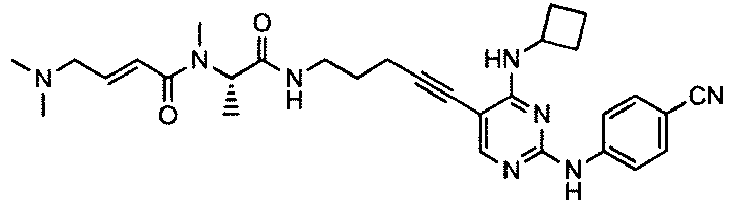
1H-NMR (CDCl3) δ: 7.99 (1H, s), 7.76 (2H, d, J=8.9Hz), 7.58 (2H, d, J=8.9Hz), 7.52-7.45 (1H, m), 6.95 (1H, dt, J=15.2, 5.9Hz), 6.64-6.52 (1H, m), 6.43 (1H, d, J=15.2Hz), 6.36-6.23 (1H, m), 5.20 (1H, q, J=7.0Hz), 4.68-4.51 (1H, m), 3.52-3.40 (2H, m), 3.14-3.07 (2H, m), 3.01 (3H, s), 2.51-2.35 (4H, m), 2.27 (6H, s), 2.21-2.06 (2H, m), 1.88-1.69 (4H, m), 1.38 (3H, d, J=7.3Hz) 10-48 
1H-NMR (CDCl3) δ: 7.98 (1H, s), 7.77 (2H, d, J=8.8Hz), 7.56 (2H, d, J=8.8Hz), 7.44-7.35 (1H, m), 6.95 (1H, dt, J=15.2, 5.9Hz), 6.62-6.50 (1H, m), 6.47-6.38 (1H, m), 5.96-5.82 (1H, m), 5.18 (1H, q, J=7.0Hz), 4.48-4.33 (1H, m), 3.50-3.34 (2H, m), 3.13-3.07 (2H, m), 2.99 (3H, s), 2.45 (2H, t, J=6.8Hz), 2.27 (6H, s), 2.17-2.03 (2H, m), 1.86-1.55 (8H, m), 1.36 (3H, d, J=6.9Hz) 10-49 
1H-NMR (CDCl3) δ: 7.98 (1H, s), 7.83-7.72 (1H, m), 7.78 (2H, d, J=8.6Hz), 7.56 (2H, d, J=8.6Hz), 6.95 (1H, dt, J=15.2, 5.9Hz), 6.72-6.52 (2H, m), 6.43 (1H, d, J=15.2Hz), 5.20 (1H, q, J=7.0Hz), 3.68-3.57 (2H, m), 3.56-3.47 (2H, m), 3.47-3.38 (2H, m), 3.36 (3H, s), 3.15-3.05 (2H, m), 3.00 (3H, s), 2.45 (2H, t, J=6.6Hz), 2.27 (6H, s), 2.02-1.90 (2H, m), 1.84-1.68 (2H, m), 1.36 (3H, d, J=6.9Hz) 10-50 
1H-NMR (CDCl3) δ: 8.00 (1H, s), 7.75 (2H, d, J=8.9Hz), 7.57 (2H, d, J=8.9Hz), 7.45-7.37 (1H, m), 6.95 (1H, dt, J=15.2, 5.9Hz), 6.67-6.53 (1H, m), 6.45-6.34 (1H, m), 6.43 (1H, d, J=15.2Hz), 5.19 (1H, q, J=7.0Hz), 3.78-3.67 (2H, m), 3.67-3.58 (2H, m), 3.48-3.34 (2H, m), 3.40 (3H, s), 3.14-3.06 (2H, m), 3.00 (3H, s), 2.52-2.37 (2H, m), 2.27 (6H, s), 1.84-1.67 (2H, m), 1.36 (3H, d, J=7.3Hz) 10-51 
1H-NMR (CDCl3) δ: 8.07 (1H, s), 7.71 (2H, d, J=8.8Hz), 7.56 (2H, d, J=8.8Hz), 7.46-7.36 (1H, m), 6.95 (1H, dt, J=15.2, 5.9Hz), 6.66-6.52 (1H, m), 6.42 (1H, d, J=15.2Hz), 5.17 (1H, q, J=7.0Hz), 4.00 (2H, t, J=5.9Hz), 3.64 (2H, t, J=5.9Hz), 3.45-3.20 (8H, m), 3.15-3.05 (2H, m), 2.99 (3H, s), 2.41 (2H, t, J=7.1Hz), 2.27 (6H, s), 1.84-1.66 (2H, m), 1.35 (3H, d, J=6.9Hz) [Table 169] Compound No. Structure Physicochemical data 10-52 
1H-NMR (CDCl3) δ: 8.14 (1H, d, J=2.0Hz), 7.95 (1H, s), 7.91 (1H, s), 7.47 (1H, dd, J=8.6, 2.0Hz), 7.32 (1H, d, J=8.6Hz), 7.13 (1H, s), 6.94 (1H, dt, J=15.2, 5.9Hz), 6.62-6.54 (1H, m), 6.48-6.37 (1H, m), 6.28-6.19 (1H, m), 5.19 (1H, q, J=7.0Hz), 4.06 (3H, s), 3.53-3.37 (2H, m), 3.15-3.05 (5H, m), 3.00 (3H, s), 2.43 (2H, t, J=6.6Hz), 2.27 (6H, s), 1.82-1.67 (2H, m), 1.37 (3H, d, J=7.0Hz) 10-53 
1H-NMR (CDCl3) δ: 8.12 (1H, d, J=2.0Hz), 7.97 (1H, s), 7.90 (1H, s), 7.46 (1H, dd, J=8.6, 2.0Hz), 7.32 (1H, d, J=8.6Hz), 7.03 (1H, s), 6.94 (1H, dt, J=15.2, 5.9Hz), 6.60-6.51 (1H, m), 6.47-6.36 (1H, m), 6.12-6.03 (1H, m), 5.19 (1H, q, J=7.3Hz), 4.06 (3H, s), 3.64-3.50 (2H, m), 3.50-3.37 (2H, m), 3.10 (2H, dd, J=5.9, 1.3Hz), 2.99 (3H, s), 2.44 (2H, t, J=6.9Hz), 2.27 (6H, s), 1.80-1.68 (2H, m), 1.36 (3H, d, J=7.3Hz), 1.30 (3H, t, J=7.3Hz) 10-54 
1H-NMR (CDCl3) δ: 8.34 (1H, d, J=2.0Hz), 7.98 (1H, s), 7.89 (1H, s), 7.49 (1H, dd, J=8.6, 2.0Hz), 7.31 (1H, d, J=8.6Hz), 7.16 (1H, s), 6.94 (1H, dt, J=15.2, 5.9Hz), 6.60-6.51 (1H, m), 6.48-6.37 (1H, m), 6.20-6.14 (1H, m), 5.19 (1H, q, J=7.0Hz), 4.06 (3H, s), 3.48-3.37 (2H, m), 3.10 (2H, dd, J=5.9, 1.3Hz), 3.00 (3H, s), 2.94-2.83 (1H, m), 2.43 (2H, t, J=6.6Hz), 2.27 (6H, s), 1.79-1.67 (2H, m), 1.37 (3H, d, J=7.0Hz), 0.94-0.83 (2H, m), 0.81-0.71 (2H, m) 10-55 
1H-NMR (CDCl3) δ: 8.13 (1H, d, J=2.0Hz), 7.97 (1H, s), 7.91 (1H, s), 7.44 (1H, dd, J=9.2, 2.0Hz), 7.32 (1H, d, J=9.2Hz), 7.08 (1H, s), 6.94 (1H, dt, J=15.2, 5.9Hz), 6.62-6.53 (1H, m), 6.47-6.31 (2H, m), 5.19 (1H, q, J=7.0Hz), 4.06 (3H, s), 3.68-3.58 (2H, m), 3.52 (2H, t, J=5.9Hz), 3.48-3.38 (2H, m), 3.35 (3H, s), 3.10 (2H, d, J=5.9Hz), 3.00 (3H, s), 2.45 (2H, t, J=6.9Hz), 2.27 (6H, s), 2.02-1.91 (2H, m), 1.82-1.69 (2H, m), 1.36 (3H, d, J=7.0Hz) [Table 170] Compound No. Structure Physicochemical data 10-56 
1H-NMR (CDCl3) δ: 8.40 (1H, s), 8.00 (1H, s), 7.87 (1H, s), 7.58 (1H, d, J=8.6Hz), 7.20 (1H, s), 7.01-6.88 (2H, m), 6.61-6.52 (1H, m), 6.48-6.33 (2H, m), 5.20 (1H, q, J=7.0Hz), 4.04 (3H, s), 3.53-3.40 (2H, m), 3.18 (3H, d, J=4.6Hz), 3.10 (2H, d, J=5.9Hz), 3.00 (3H, s), 2.44 (2H, t, J=6.3Hz), 2.27 (6H, s), 1.81-1.71 (2H, m), 1.37 (3H, d, J=7.0Hz) 10-57 
1H-NMR (CDCl3) δ: 8.36 (1H, s), 8.00 (1H, s), 7.87 (1H, s), 7.58 (1H, d, J=8.6Hz), 7.28-7.22 (1H, m), 7.01-6.86 (2H, m), 6.61-6.50 (1H, m), 6.43 (1H, d, J=15.2Hz), 6.33-6.23 (1H, m), 5.19 (1H, q, J=7.0Hz), 4.04 (3H, s), 3.74-3.61 (2H, m), 3.54-3.39 (2H, m), 3.11 (2H, d, J=5.3Hz), 3.00 (3H, s), 2.45 (2H, t, J=6.6Hz), 2.27 (6H, s), 1.82-1.67 (2H, m), 1.43-1.31 (6H, m) 10-58 
1H-NMR (CDCl3) δ: 8.36 (1H, s), 8.02 (1H, s), 7.87 (1H, s), 7.58 (1H, d, J=8.6Hz), 7.31-7.24 (1H, m), 7.03-6.89 (2H, m), 6.59-6.48 (1H, m), 6.47-6.38 (1H, m), 6.29-6.22 (1H, m), 5.19 (1H, q, J=6.8Hz), 4.02 (3H, s), 3.49-3.38 (2H, m), 3.11 (2H, dd, J=5.9, 1.3Hz), 3.04-2.93 (4H, m), 2.43 (2H, t, J=6.6Hz), 2.27 (6H, s), 1.80-1.69 (2H, m), 1.37 (3H, d, J=6.8Hz), 0.95-0.83 (2H, m), 0.83-0.74 (2H, m) 10-59 
1H-NMR (CDCl3) δ: 8.31 (1H, s), 8.01 (1H, s), 7.87 (1H, s), 7.58 (1H, d, J=8.6Hz), 7.29 (1H, s), 7.00-6.87 (2H, m), 6.62-6.51 (1H, m), 6.48-6.36 (2H, m), 5.19 (1H, q, J=7.0Hz), 4.05 (3H, s), 3.78-3.68 (2H, m), 3.53 (2H, t, J=5.9Hz), 3.49-3.38 (2H, m), 3.32 (3H, s), 3.11 (2H, dd, J=5.9, 1.3Hz), 3.00 (3H, s), 2.46 (2H, t, J=6.9Hz), 2.27 (6H, s), 2.06-1.94 (2H, m), 1.83-1.70 (2H, m), 1.36 (3H, d, J=7.0Hz) 10-60 
MS m/z (M+H): 518.5 10-61 
MS m/z (M+H): 532.5 [Table 171] Compound No. Structure Physicochemical data 10-62 
MS m/z (M+H): 576.5 10-63 
MS m/z (M+H): 518.5 10-64 
MS m/z (M+H): 532.5 10-65 
MS m/z (M+H): 576.5 10-66 
MS m/z (M+H): 530.5 10-67 
MS m/z (M+H): 544.5 10-68 
MS m/z (M+H): 588.5 10-69 
MS m/z (M+H): 530.5 10-70 
MS m/z (M+H): 544.5 [Table 172] Compound No. Structure Physicochemical data 10-71 
1H-NMR (CDCl3:CD3OD=10:1) δ: 8.39 (1H, s), 7.97-7.86 (2H, m), 7.61 (1H, d, J=8.6Hz), 7.03 (1H, d, J=8.6Hz), 6.91 (1H, dt, J=15.2, 6.3Hz), 6.35 (1H, d, J=15.2Hz), 4.56 (1H, d, J=6.6Hz), 3.78-3.63 (2H, m), 3.63-3.50 (2H, m), 3.50-3.22(7H, m), 3.18-3.09 (2H, m), 2.58-2.42 (2H, m), 2.29 (6H, s), 2.20-1.64 (8H, m) 10-72 
MS m/z (M+H): 544.5 10-73 
- 10-74 
1H-NMR (CDCl3:CD3OD=10:1) δ: 8.39 (1H, s), 7.95 (1H, s), 7.91 (1H, s), 7.51 (1H, dd, J=8.9, 2.0Hz), 7.44 (1H, d, J=8.9Hz), 6.91 (1H, dt, J=15.2, 6.3Hz), 6.36 (1H, d, J=15.2Hz), 4.59-4.51 (2H, m), 3.80-3.51 (2H, m), 3.50-3.26 (2H, m), 3.18-3.07 (2H, m), 2.90-2.78 (1H, m), 2.47 (2H, t, J=6.9Hz), 2.30 (6H, s), 2.22-1.88 (4H, m), 1.87-1.60 (2H, m), 0.96-0.82 (2H, m), 0.78-0.68 (2H, m) 10-75 
MS m/z (M+H): 556.5 -


- To a solution of 2-chloro-5-iodo-N-propylpyrimidin-4-amine (F1, 1.45 g), N-(4-pentynyl)phthalimide (2.08 g), bis(triphenylphosphine)palladium(II) dichloride (171 mg) and copper(I) iodide (47 mg) in N,N-dimethylformamide (15 mL), triethylamine (3.4 mL) was added at room temperature, and the mixture was stirred at 60°C for 1 hour and 15 minutes. The reaction mixture was cooled to room temperature, and then water and ethyl acetate were added to the reaction mixture. The organic layer was separated, washed successively with saturated aqueous sodium hydrogencarbonate, water and saturated aqueous sodium chloride, and then dried over anhydrous sodium sulfate, and the solvent was evaporated under reduced pressure. The obtained residue was purified by basic silica gel column chromatography (eluent, 70 to 40% hexane in ethyl acetate) to obtain 2-(5-(2-chloro-4-(propylamino)pyrimidin-5-yl)-4-pentyn-1-yl)isoindoline-1,3-dione (K1, 2.00 g).
-

- To a solution of 2-(5-(2-chloro-4-(propylamino)pyrimidin-5-yl)-4-pentyn-1-yl)isoindoline-1,3-dione (K1, 2.0 g) in ethanol (15 mL) and tetrahydrofuran (15 mL), hydrazine monohydrate (2.6 mL) was added at room temperature, and the mixture was stirred at the same temperature for 3 hours and 30 minutes. The reaction mixture was cooled on ice, and then neutralized by adding 1.0 mol/L aqueous hydrochloric acid. The insoluble matter was removed by filtration, and then water and ethyl acetate were added. The organic layer was separated, and the aqueous layer was extracted with ethyl acetate. The organic layer and the extract were combined, washed with saturated aqueous sodium hydrogencarbonate, and then dried over anhydrous sodium sulfate, and the solvent was evaporated under reduced pressure. The obtained residue was purified by basic silica gel column chromatography (eluent, 95 to 93% ethyl acetate in methanol) to obtain oily 5-(5-amino-1-pentyn-1-yl)-2-chloro-N-propylpyrimidin-4-amine (K2, 510 mg).
MS m/z (M+H): 253.1 -

- To a solution of 5-(5-amino-1-pentyn-1-yl)-2-chloro-N-propylpyrimidin-4-amine (K2, 510 mg), N-Boc-N-methyl-L-alanine (493 mg), 1-ethyl-3-(3-dimethylaminopropyl)carbodiimide hydrochloride (1.16 g) and 1-hydroxybenzotriazole monohydrate (930 mg) in N,N-dimethylformamide (10 mL), N,N-diisopropylethylamine (690 µL) was added at room temperature, and the mixture was stirred at the same temperature for 12 hours. To the reaction mixture, water and ethyl acetate were added. The organic layer was separated, and the aqueous layer was extracted with ethyl acetate. The organic layer and the extract were combined, washed successively with water and saturated aqueous sodium chloride, and then dried over anhydrous sodium sulfate, and the solvent was evaporated under reduced pressure. The obtained residue was purified by silica gel column chromatography (eluent, 70 to 40% hexane in ethyl acetate) to obtain (S)-tert-butyl (1-((5-(2-((1H-benzo[d][1,2,3]triazol-1-yl)oxy)-4-(propylamino)pyrimidin-5-yl)-4-pentyn-1-yl)amino)-1-oxopropan-2-yl)(methyl)carbamate (K3, 380 mg).
MS m/z (M+H): 537.3 -

- To (S)-tert-butyl (1-((5-(2-((1H-benzo[d][1,2,3]triazol-1-yl)oxy)-4-(propylamino)pyrimidin-5-yl)-4-pentyn-1-yl)amino)-1-oxopropan-2-yl)(methyl)carbamate (K3, 50 mg), a 2.0 mol/L solution of methylamine in tetrahydrofuran (1 mL) was added at room temperature, the reaction vessel was sealed, and then the mixture was stirred at 50°C for 5 hours by using a microwave reaction system. The reaction mixture was cooled to room temperature, and then the solvent was evaporated under reduced pressure. The obtained residue was purified by silica gel column chromatography (eluent, 40 to 0% hexane in ethyl acetate) to obtain oily (S)-tert-butyl methyl(1-((5-(2-(methylamino)-4-(propylamino)pyrimidin-5-yl)-4-pentyn-1-yl)amino)-1-oxopropan-2-yl)carbamate (K4, 35 mg).
MS m/z (M+H): 433.3 -

- To a solution of (S)-tert-butyl methyl(1-((5-(2-(methylamino)-4-(propylamino)pyrimidin-5-yl)-4-pentyn-1-yl)amino)-1-oxopropan-2-yl)carbamate (K4, 35 mg) in 1,4-dioxane (1 mL), a 4.0 mol/L solution of hydrochloric acid in 1,4-dioxane (1 mL) was added at room temperature, and the mixture was stirred at the same temperature for 30 minutes. The solvent was evaporated under reduced pressure. The obtained solid matter was dried under reduced pressure to obtain (S)-2-(methylamino)-N-(5-(2-(methylamino)-4-(propylamino)pyrimidin-5-yl)-4-pentyn-1-yl)propanamide (K5) dihydrochloride.
-

- To a solution of 4-dimethylaminocrotonic acid hydrochloride (67 mg) and N-methylmorpholine (90 µL) in N,N-dimethylformamide (1 mL), isobutyl chloroformate (43 µL) was added under ice cooling, a solution of (S)-2-(methylamino)-N-(5-(2-(methylamino)-4-(propylamino)pyrimidin-5-yl)-4-pentyn-1-yl)propanamide (K5) dihydrochloride obtained above in N,N-dimethylformamide (2 mL) was further added to the mixture, and the mixture was stirred at the same temperature for 30 minutes. The solvent was evaporated under reduced pressure. The obtained residue was purified by basic silica gel column chromatography (eluent, 99 to 96% ethyl acetate in methanol) to obtain oily (S,E)-4-(dimethylamino)-N-methyl-N-(1-((5-(2-(methylamino)-4-(propylamino)pyrimidin-5-yl)-4-pentyn-1-yl)amino)-1-oxopropan-2-yl)-2-butenamide (11-1,9 mg).
1H-NMR (CDCl3) δ: 7.86 (1H, s), 6.94 (1H, dt, J=15.2, 6.1Hz), 6.50 (1H, brs), 6.41 (1H, d, J=15.2Hz), 5.90 (1H, brs), 5.18 (1H, q, J=7.3Hz), 5.04 (1H, brs), 3.47-3.37 (4H, m), 3.10 (2H, d, J=6.1Hz), 2.98-2.94 (6H, m), 2.42 (2H, t, J=6.6Hz), 2.27 (6H, s), 1.78-1.59 (4H, m), 1.35 (3H, d, J=7.3Hz), 0.96 (3H, t, J=7.3Hz) - By using (S)-tert-butyl (1-((5-(2-((1H-benzo[d][1,2,3]triazol-1-yl)oxy)-4-(propylamino)pyrimidin-5-yl)-4-pentyn-1-yl)amino)-1-oxopropan-2-yl)(methyl)carbamate (K3), Intermediates (K6) to (K13), (K22) and (K23) were obtained in the same manner as that of Example 48, (4).
[Table 173] Compound No. Structure Physicochemical data K6 
MS m/z (M+H): 475.4 K7 
- K8 
- K9 
- K10 
- K11 
- K12 
- K13 
- K22 
MS m/z (M+H): 579.4 K23 
MS m/z (M+H): 563.4 - In the same manner as that of Example 48, (5), Intermediates (K14) to (K21), (K24) and (K25) were obtained.
[Table 174] Compound No. Structure Physicochemical data K14 
- K15 
- K16 
- K17 
- K18 
- K19 
- K20 
- K21 
- K24 
- K25 
- - In the same manner as that of Example 48, (6), Compounds (11-2) to (11-11) were obtained.
[Table 175] Compound No. Structure Physicochemical data 11-2 
1H-NMR (CDCl3) δ: 7.80 (1H, s), 6.89 (1H, dt, J=15.2, 5.6Hz), 6.52 (1H, brs), 6.42 (1H, d, J=15.2Hz), 5.92 (1H, brs), 5.18 (1H, q, J=7.0Hz), 5.09 (1H, brs), 3.47-3.37 (4H, m), 3.00 (2H, d, J=5.6Hz), 2.98 (3H, s), 2.41 (2H, t, J=6.6Hz), 2.26 (6H, s), 1.77-1.59 (4H, m), 1.43 (9H, s), 1.35 (3H, d, J=7.0Hz), 0.96 (3H, t, J=7.3Hz) 11-3 
1H-NMR (CDCl3) δ: 7.85 (1H, s), 6.93 (1H, dt, J=15.2, 5.9Hz), 6.52 (1H, brs), 6.42 (1H, d, J=15.2Hz), 5.89 (1H, brs), 5.18 (1H, q, J=7.0Hz), 5.02 (1H, brs), 3.48-3.36 (6H, m), 3.10 (2H, d, J=5.9Hz), 2.98 (3H, s), 2.41 (2H, t, J=7.0Hz), 2.27 (6H, s), 1.78-1.59 (4H, m), 1.35 (3H, d, J=7.0Hz), 1.20 (3H, t, J=7.3Hz), 0.96 (3H, t, J=7.3Hz) 11-4 
1H-NMR (CDCl3) δ: 7.84 (1H, s), 6.93 (1H, dt, J=15.2, 5.9Hz), 6.51 (1H, brs), 6.42 (1H, d, J=15.2Hz), 5.91 (1H, brs), 5.18 (2H, q, J=7.0Hz), 3.46-3.37 (4H, m), 3.20 (2H, t, J=6.6Hz), 3.10 (2H, d, J=5.9Hz), 2.98 (3H, s), 2.42 (2H, t, J=6.6Hz), 2.27 (6H, s), 1.91-1.59 (5H, m), 1.35 (3H, d, J=7.0Hz), 0.96 (9H, t, J=6.6Hz) 11-5 
1H-NMR (CDCl3) δ: 7.91 (1H, s), 6.95 (1H, dt, J=15.2, 5.9Hz), 6.53 (1H, brs), 6.42 (1H, d, J=15.2Hz), 5.88 (1H, brs), 5.21-5.12 (2H, m), 3.45-3.37 (4H, m), 3.09 (2H, d, J=5.9Hz), 3.00 (3H, s), 2.78-2.70 (1H, m), 2.42 (2H, t, J=6.6Hz), 2.27 (6H, s), 1.78-1.59 (4H, m), 1.35 (3H, d, J=7.3Hz), 0.95 (3H, t, J=7.6Hz), 0.76 (2H, dt, J=7.0, 4.0Hz), 0.52 (2H, dt, J=7.0, 4.0Hz) 11-6 
1H-NMR (CDCl3) δ: 7.82 (1H, s), 6.93 (1 H, dt, J=15.2, 5.9Hz), 6.55 (1H, brs), 6.42 (1H, d, J=15.2Hz), 5.93 (1H, brs), 5.37 (1H, brs), 5.18 (1H, q, J=6.8Hz), 3.46-3.37 (4H, m), 3.24 (2H, d, J=6.6Hz), 3.10 (2H, d, J=5.9Hz), 2.97 (3H, s), 2.42 (2H, t, J=6.6Hz), 2.27 (6H, s), 1.76-1.59 (4H, m), 1.35 (3H, d, J=6.8Hz), 0.96 (3H, t, J=7.6Hz), 0.94 (9H, s) [Table 176] Compound No. Structure Physicochemical data 11-7 
1H-NMR (CDCl3) δ: 8.02 (1H, s), 6.99-6.88 (2H, m), 6.82 (1H, s), 6.54 (1H, brs), 6.41 (1H, dd, J=15.2, 5.3Hz), 6.33 (1H, brs), 5.22-5.13 (1H, m), 3.52-3.43 (4H, m), 3.10 (2H, d, J=6.6Hz), 2.99 (3H, s), 2.45 (2H, t, J=6.6Hz), 2.27 (6H, s), 1.77-1.65 (7H, m), 1.35 (9H, s), 0.98 (3H, t, J=7.6Hz) 11-8 
1H-NMR (CDCl3) δ: 8.48 (1H, s), 8.14-8.08 (1H, m), 7.99 (1H, s), 7.81 (1H, brs), 6.97-6.82 (2H, m), 6.71 (1H, brs), 6.42 (1H, d, J=15.2Hz), 5.18 (1H, q, J=7.3Hz), 3.80 (4H, brs), 3.43-3.26 (2H, m), 3.10 (2H, d, J=5.9Hz), 3.00 (3H, s), 2.48-2.37 (2H, m), 2.30 (6H, s), 1.93 (4H, brs), 1.79-1.70 (2H, m), 1.35 (3H, d, J=7.3Hz) 11-9 
1H-NMR (CDCl3) δ: 8.39 (1H, s), 8.11-8.00 (2H, m), 7.91-7.78 (1H, m), 6.97-6.82 (2H, m), 6.74 (1H, s), 6.42 (1H, d, J=15.2Hz), 5.28-5.11 (1H, m), 4.06-3.87 (4H, m), 3.87-3.70 (4H, m), 3.47-3.20 (2H, m), 3.10 (2H, dd, J=5.9, 1.3Hz), 3.00 (3H, s), 2.54-2.36 (2H, m), 2.26 (6H, s), 1.83-1.69 (2H, m), 1.36 (3H, d, J=7.3Hz) 11-10 
1H-NMR (CDCl3) δ: 8.39 (1H, s), 7.99-7.94 (1H, m), 7.87 (1H, s), 7.54 (1H, d, J=8.6Hz), 7.37 (1H, t, J=7.9Hz), 7.22 (1H, d, J=7.9Hz), 6.94 (1H, dt, J=15.1, 6.0Hz), 6.77-6.68 (1H, m), 6.43 (1H, d, J=15.1Hz), 6.28 (1H, t, J=5.6Hz), 5.21 (1H, q, J=6.5Hz), 3.59-3.41 (4H, m), 3.10 (2H, d, J=6.0Hz), 3.01 (3H, s), 2.44 (2H, t, J=6.6Hz), 2.26 (6H, s), 1.79-1.65 (4H, m), 1.36 (3H, d, J=6.5Hz), 0.98 (3H, t, J=6.9Hz) 11-11 
1H-NMR (CDCl3) δ: 8.09-7.89 (2H, m), 7.60-7.35 (1H, m), 7.25 (2H, s), 7.03-6.88 (1H, m), 6.84 (1H, brs), 6.62 (1H, brs), 6.43 (1H, d, J=15.2Hz), 6.27 (1H, brs), 5.22-5.19 (1H, m), 3.62-3.37 (4H, m), 3.18-3.07 (2H, m), 3.00 (3H, s), 2.44 (2H, brs), 2.27 (6H, s), 2.14-1.62 (4H, m), 1.37 (3H, d, J=6.6Hz), 1.00 (3H, t, J=6.9Hz) -
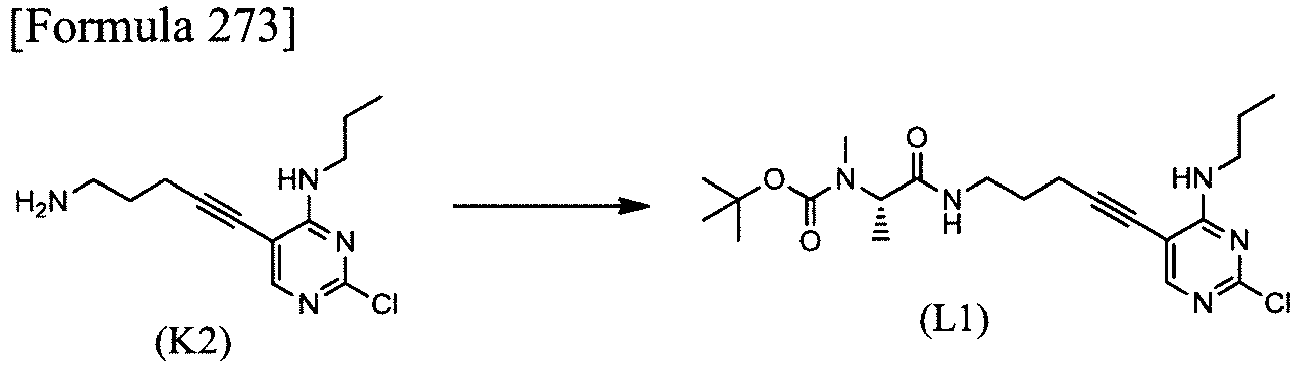
- To a solution of 5-(5-amino-1-pentyn-1-yl)-2-chloro-N-propylpyrimidin-4-amine (K2, 505 mg) and N-Boc-N-methyl-L-alanine (270 mg) in N,N-dimethylformamide (5 mL), 1-ethyl-3-(3-dimethylaminopropyl)carbodiimide hydrochloride (635 mg) and N,N-diisopropylethylamine (378 µL) were added at room temperature, and the mixture was stirred overnight at the same temperature. To the reaction mixture, saturated aqueous sodium carbonate and ethyl acetate were added. The organic layer was separated, washed with water, and then dried over anhydrous sodium sulfate, and the solvent was evaporated under reduced pressure. The obtained residue was purified by basic silica gel column chromatography (eluent, 50% hexane/50% ethyl acetate) to obtain (S)-tert-butyl (1-((5-(2-chloro-4-(propylamino)pyrimidin-5-yl)-4-pentyn-1-yl)amino)-1-oxopropan-2-yl)(methyl)carbamate (L1, 660 mg).
MS m/z (M+H): 438.3 -

- To a solution of (S)-tert-butyl (1-((5-(2-chloro-4-(propylamino)pyrimidin-5-yl)-4-pentyn-1-yl)amino)-1-oxopropan-2-yl)(methyl)carbamate (L1, 57 mg) and (1S)-(+)-10-camphorsulfonic acid (150 mg) in N-methylpyrrolidone (1 mL), aniline (60 µL) was added at room temperature, and the mixture was stirred at 60°C for 2 hours and 30 minutes. The reaction mixture was cooled to room temperature, and then saturated aqueous sodium hydrogencarbonate and ethyl acetate were added to the reaction mixture. The organic layer was separated, and the aqueous layer was extracted with ethyl acetate. The organic layer and the extract were combined, washed successively with water and saturated aqueous sodium chloride, and then dried over anhydrous sodium sulfate, and the solvent was evaporated under reduced pressure. The obtained residue was purified by silica gel column chromatography (eluent, 50 to 25% hexane in ethyl acetate) to obtain oily (S)-tert-butyl methyl(1-oxo-1-((5-(2-(phenylamino)-4-(propylamino)pyrimidin-5-yl)-4-pentyn-1-yl)amino)propan-2-yl)carbamate (L2, 52 mg).
-

- By using (S)-tert-butyl methyl(1-oxo-1-((5-(2-(phenylamino)-4-(propylamino)pyrimidin-5-yl)-4-pentyn-1-yl)amino)propan-2-yl)carbamate (L2), (S,E)-4-(dimethylamino)-N-methyl-N-(1-oxo-1-((5-(2-(phenylamino)-4-(propylamino)pyrimidin-5-yl)-4-pentyn-1-yl)amino)propan-2-yl)-2-butenamide (12-1) was obtained in the same manner as that of Example 35, (6) and (7).
1H-NMR (CDCl3) δ: 7.95 (1H, s), 7.64 (2H, d, J=7.3Hz), 7.34-7.27 (2H, m), 7.01-6.80 (2H, m), 6.63 (1H, t, J=5.6Hz), 6.42 (1H, d, J=15.2Hz), 6.18 (1H, t, J=5.6Hz), 5.19 (1H, q, J=6.6Hz), 3.53-3.40 (4H, m), 3.11-3.07 (2H, m), 2.99 (3H, s), 2.72 (1H, brs), 2.44 (2H, t, J=6.6Hz), 2.26 (6H, s), 1.79-1.65 (4H, m), 1.36 (3H, d, J=6.6Hz), 0.99 (3H, t, J=7.3Hz) -

- To a solution of (S)-tert-butyl (1-((5-(2-chloro-4-(propylamino)pyrimidin-5-yl)-4-pentyn-1-yl)amino)-1-oxopropan-2-yl)(methyl)carbamate (L1, 910 mg) in 1,4-dioxane (10 mL), a 4.0 mol/L solution of hydrochloric acid in dioxane (7 mL) was added at room temperature, and the mixture was stirred at the same temperature for 1 hour. The solvent was evaporated under reduced pressure to obtain (S)-N-(5-(2-chloro-4-(propylamino)pyrimidin-5-yl)-4-pentyn-1-yl)-2-(methylamino)propanamide (L3) hydrochloride.
MS m/z (M+H): 338.2 -
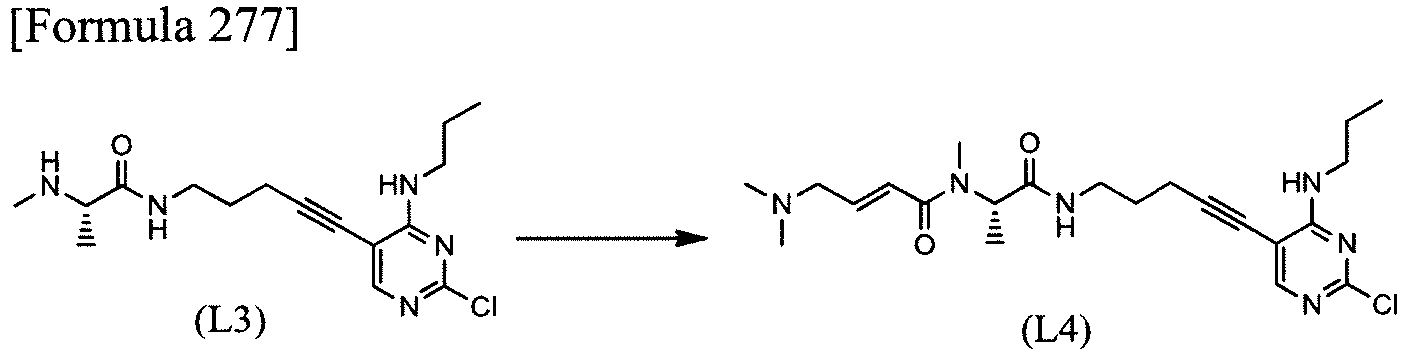
- To a solution of 4-dimethylaminocrotonic acid hydrochloride (1.0 g) in N,N-dimethylformamide (10 mL), N-methylmorpholine (2.3 mL) and isobutyl chloroformate (0.8 mL) were added under ice cooling, a solution of (S)-N-(5-(2-chloro-4-(propylamino)pyrimidin-5-yl)-4-pentyn-1-yl)-2-(methylamino)propanamide (L3) hydrochloride obtained above in N,N-dimethylformamide was further added, and the mixture was stirred at the same temperature for 2 hours. The solvent was evaporated under reduced pressure, and the obtained residue was purified by basic silica gel column chromatography (eluent, 100 to 90% ethyl acetate in methanol) to obtain (S,E)-N-(1-((5-(2-chloro-4-(propylamino)pyrimidin-5-yl)-4-pentyn-1-yl)amino)-1-oxopropan-2-yl)-4-(dimethylamino)-N-methyl-2-butenamide (L4, 610 mg).
MS m/z (M+H): 449.4 -

- To a solution of (S,E)-N-(1-((5-(2-chloro-4-(propylamino)pyrimidin-5-yl)-4-pentyn-1-yl)amino)-1-oxopropan-2-yl)-4-(dimethylamino)-N-methyl-2-butenamide (L4, 20 mg) and 3-chloroaniline (28 mg) in tetrahydrofuran (3 mL), (1S)-(+)-10-camphorsulfonic acid (52 mg) was added at room temperature, and the mixture was stirred at 70°C for 2 hours. The reaction mixture was cooled to room temperature, and then diethylamine was added until the mixture became basic. The solvent was evaporated under reduced pressure, and the obtained residue was purified by basic silica gel column chromatography to obtain (S,E)-N-(1-((5-(2-((3-chlorophenyl)amino)-4-(propylamino)pyrimidin-5-yl)-4-pentyn-1-yl)amino)-1-oxopropan-2-yl)-4-(dimethylamino)-N-methyl-2-butenamide (12-2, 4 mg).
1H-NMR (CDCl3) δ: 8.03 (1H, s), 7.95 (1H, s), 7.24-7.21 (1H, m), 7.02-6.97 (3H, m), 6.52-6.44 (2H, m), 6.28 (1H, brs), 5.21-5.18 (1H, m), 3.50-3.47 (4H, m), 3.13 (3H, d, J=7.9Hz), 2.99 (3H, s), 2.46-2.42 (2H, m), 2.27 (6H, s), 1.74-1.66 (4H, m), 1.39-1.35 (3H, m), 1.01 (3H, t, J=7.3Hz) - By using (S)-tert-butyl (1-((5-(2-chloro-4-(propylamino)pyrimidin-5-yl)-4-pentyn-1-yl)amino)-1-oxopropan-2-yl)(methyl)carbamate (L1), Compounds (12-3) to (12-12) were obtained in the same manner as that of Example 50.
[Table 177] Compound No. Structure Physicochemical data 12-3 
1H-NMR (CDCl3) δ: 7.95 (1H, brs), 7.59-7.54 (2H, m), 7.12 (1H, brs), 7.06-6.95 (2H, m), 6.58-6.40 (2H, m), 6.17 (1H, brs), 5.92 (1H, d, J=15.2Hz), 5.20-5.17 (1H, m), 3.55-3.33 (4H, m), 3.10 (2H, d, J=5.3Hz), 2.99 (3H, s), 2.44 (2H, t, J=6.3Hz), 2.27 (6H, s), 1.77-1.63 (4H, m), 1.35 (3H, d, J=7.3Hz), 0.98 (3H, t, J=7.6Hz) 12-4 
1H-NMR (CDCl3) δ: 7.84 (1H, s), 6.93 (1H, dt, J=15.2, 5.9Hz), 6.51 (1H, brs), 6.42 (1H, d, J=15.2Hz), 5.91 (1H, brs), 5.18 (1H, q, J=7.0Hz), 4.93 (1H, brs), 3.82-3.72 (1H, m), 3.44-3.38 (4H, m), 3.09 (2H, d, J=5.9Hz), 2.98 (3H, s), 2.42 (2H, t, J=6.6Hz), 2.27 (6H, s), 1.76-1.59 (8H, m), 1.46-1.14 (9H, m), 0.96 (3H, t, J=7.3Hz) 12-5 
1H-NMR (CDCl3) δ: 7.97 (1H, s), 7.76 (2H, d, J=8.6Hz), 7.53 (2H, d, J=9.2Hz), 7.32 (1H, brs), 6.94 (1H, dt, J=15.2, 5.9Hz), 6.58 (1H, brs), 6.43 (1H, d, J=15.2Hz), 6.31 (1H, brs), 5.19 (1H, q, J=6.6Hz), 3.53-3.44 (4H, m), 3.10 (2H, d, J=5.9Hz), 3.00 (3H, s), 2.44 (2H, t, J=6.6Hz), 2.27 (6H, s), 1.87-1.64 (4H, m), 1.36 (3H, d, J=6.6Hz), 1.01 (3H, t, J=7.6Hz) [Table 178] Compound No. Structure Physicochemical data 12-6 
1H-NMR (CDCl3) δ: 7.95 (1H, s), 7.65 (2H, d, J=7.3Hz), 7.16-7.13 (3H, m), 7.02-6.76 (1H, m), 6.57 (1H, brs), 6.42 (1H, dd, J=15.2, 1.3Hz), 6.23 (1H, brs), 5.19 (1H, q, J=7.0Hz), 3.48-3.43 (4H, m), 3.14-3.07 (2H, m), 2.99 (3H, s), 2.44 (2H, t, J=6.6Hz), 2.27 (6H, s), 1.79-1.64 (4H, m), 1.36 (3H, d, J=7.0Hz), 0.99 (3H, t, J=7.3Hz) 12-7 
1H-NMR (CDCl3) δ: 7.94 (1H, s), 7.54 (2H, d, J=7.9Hz), 7.23-7.18 (3H, m), 6.95-6.92 (2H, m), 6.50-6.43 (1H, m), 6.11 (1H, s), 5.19-5.17 (1H, m), 3.49-3.45 (4H, m), 3.13-3.10 (2H, m), 2.99 (3H, s), 2.88-2.86 (1H, m), 2.46-2.44 (2H, m), 2.27 (6H, s), 1.86-1.66 (4H, m), 1.35 (3H, d, J=6.6Hz), 1.25 (6H, s), 1.00 (3H, t, J=7.3Hz) 12-8 
1H-NMR (CDCl3) δ: 7.94 (1H, s), 7.58 (1H, d, J=9.2Hz), 7.46-7.42 (2H, m), 7.15-6.94 (4H, m), 6.51-6.43 (2H, m), 6.14 (1H, brs), 5.19 (1H, brs), 3.49-3.46 (4H, m), 3.13-3.10 (2H, m), 2.99 (3H, s), 2.45-2.42 (2H, m), 2.27 (6H, s), 2.17 (3H, s), 1.67-1.63 (4H, m), 1.38-1.35 (3H, m), 0.99 (3H, t, J=7.3Hz) 12-9 
1H-NMR (CDCl3) δ: 7.93 (1H, s), 7.50 (1H, d, J=8.6Hz), 7.25-7.22 (1H, brs), 7.11 (2H, d, J=8.6Hz), 6.95-6.91 (2H, m), 6.51 (1H, brs), 6.43 (1H, d, J=15.9Hz), 6.14 (1H, brs), 5.18 (1H, q, J=7.0Hz), 3.50-3.44 (4H, m), 3.11 (2H, d, J=5.3Hz), 2.99 (3H, s), 2.43 (2H, t, J=6.6Hz), 2.31 (3H, s), 2.28 (6H, s), 1.77-1.67 (4H, m), 1.35 (3H, d, J=7.0Hz), 0.99 (3H, t, J=7.6Hz) 12-10 
1H-NMR (CDCl3) δ: 8.55-8.52 (1H, m), 7.98 (1H, s), 7.11-7.06 (3H, m), 6.94-6.91 (2H, m), 6.49-6.44 (2H, m), 6.22 (1H, brs), 5.19-5.17 (1H, m), 3.59-3.37 (4H, m), 3.15-3.12 (2H, m), 2.99 (3H, s), 2.46-2.42 (2H, m), 2.29 (6H, s), 1.72-1.63 (4H, m), 1.36 (3H, d, J=7.3Hz), 1.00 (3H, t, J=7.6Hz) [Table 179] Compound No. Structure Physicochemical data 12-11 
1H-NMR (CDCl3) δ: 8.03 (1H, s), 7.96 (1H, d, J=2.6Hz), 7.67 (2H, d, J=8.6Hz), 7.30-7.22 (3H, m), 6.95 (1H, dt, J=15.2, 5.9Hz), 6.67 (1H, t, J=5.6Hz), 6.46 (1H, d, J=15.2Hz), 6.30 (1H, brs), 6.11 (1H, t, J=5.6Hz), 5.29 (2H, s), 4.04 (2H, s), 3.50-3.40 (4H, m), 3.20 (2H, s), 3.09 (3H, t, J=5.6Hz), 2.47 (2H, t, J=6.6Hz), 2.26 (6H, s), 1.81-1.63 (4H, m), 0.98 (3H, t, J=7.3Hz) 12-12 
1H-NMR (CDCl3) δ: 7.96 (1H, s), 7.66 (3H, t, J=8.3Hz), 7.45 (1H, s), 7.22 (2H, d, J=8.3Hz), 7.00-6.91 (2H, m), 6.59 (1H, brs), 6.46 (1H, d, J=15.2Hz), 6.10 (1H, t, J=5.6Hz), 5.51 (2H, s), 4.03 (2H, s), 3.50-3.41 (4H, m), 3.20 (3H, s), 3.09 (2H, t, J=5.9Hz), 2.47 (2H, t, J=6.6Hz), 2.27 (6H, s), 1.82-1.68 (4H, m), 0.99 (3H, t, J=7.3Hz) -

- To a solution of 4-(2-chloro-5-iodopyrimidin-4-yl)morpholine (H11, 300 mg), (S)-tert-butyl (1-((3-ethynylphenyl)amino)-1-oxopropan-2-yl)(methyl)carbamate (G1, 558 mg), bis(triphenylphosphine)palladium(II) dichloride (32 mg) and copper(I) iodide (9 mg) in N,N-dimethylformamide (5 mL), triethylamine (640 µL) was added at room temperature, and the mixture was stirred at the same temperature for 2 hours. To the reaction mixture, water and ethyl acetate were added. The organic layer was separated, washed successively with water and saturated aqueous sodium chloride, and then dried over anhydrous sodium sulfate, and the solvent was evaporated under reduced pressure. The obtained residue was purified by basic silica gel column chromatography (eluent, 85 to 70% hexane in ethyl acetate) to obtain (S)-tert-butyl (1-((3-((2-chloro-4-morpholinopyrimidin-5-yl)ethynyl)phenyl)amino)-1-oxopropan-2-yl)(methyl)carbamate (L5, 437 mg).
-

- To (S)-tert-butyl (1-((3-((2-chloro-4-morpholinopyrimidin-5-yl)ethynyl)phenyl)amino)-1-oxopropan-2-yl)(methyl)carbamate (L5, 437 mg), 4-(2-aminoethyl)pyridine (214 mg), tris(dibenzylideneacetone)dipalladium(0) (80 mg), 4,5'-bis(diphenylphosphino)-9,9'-dimethylxanthene (101 mg) and cesium carbonate (856 mg), 1,4-dioxane (10 mL) was added at room temperature, and the mixture was stirred at 100°C for 12 hours. The reaction mixture was cooled to room temperature, then the insoluble matter was removed by filtration through Cerite, and then the solvent was evaporated under reduced pressure. The obtained residue was purified by silica gel column chromatography (eluent, 95% ethyl acetate/5% methanol) to obtain (S)-tert-butyl methyl(1-((3-((4-morpholino-2-((2-(pyridin-4-yl)ethyl)amino)pyrimidin-5-yl)ethynyl)phenyl)amino)-1-oxopropan-2-yl)carbamate (L6, 104 mg).
-


- By using (S)-tert-butyl methyl(1-((3-((4-morpholino-2-((2-(pyridin-4-yl)ethyl)amino)pyrimidin-5-yl)ethynyl)phenyl)amino)-1-oxopropan-2-yl)carbamate (L6), (S,E)-4-(dimethylamino)-N-methyl-N-(1-((3-((4-morpholino-2-((2-(pyridin-4-yl)ethyl)amino)pyrimidin-5-yl)ethynyl)phenyl)amino)-1-oxopropan-2-yl)-2-butenamide (12-13) was obtained in the same manner as that of Example 35, (6) and (7).
1H-NMR (CD3OD) δ: 8.40 (2H, d, J=5.9Hz), 8.00 (1H, s), 7.71 (1H, s), 7.45 (1H, d, J=7.3Hz), 7.30-7.24 (3H, m), 7.11 (1H, d, J=7.3Hz), 6.87-6.70 (1H, m), 6.63 (1H, d, J=15.2Hz), 5.16 (1H, q, J=6.6Hz), 3.94 (4H, t, J=4.3Hz), 3.76 (4H, t, J=4.3Hz), 3.62 (2H, t, J=6.9Hz), 3.15 (5H, m), 2.93 (3H, t, J=6.9Hz), 2.27 (6H, s), 1.46 (3H, d, J=6.6Hz) -

- By using 2-chloro-5-iodo-4-(N-methyl-N-propylamino)pyrimidine (H12), (S,E)-4-(dimethylamino)-N-methyl-N-(1-((3-((4-(methyl(propyl)amino)-2-((2-(pyridin-4-yl)ethyl)amino)pyrimidin-5-yl)ethynyl)phenyl)amino)-1-oxopropan-2-yl)-2-butenamide (12-14) was obtained in the same manner as that of Example 52, (1) to (3).
1H-NMR (CD3OD) δ: 8.40 (2H, d, J=5.9Hz), 7.93 (1H, s), 7.69 (1H, s), 7.46 (1H, d, J=7.9Hz), 7.32-7.25 (3H, m), 7.14 (1H, d, J=7.9Hz), 6.87-6.72 (1H, m), 6.64 (1H, d, J=15.2Hz), 5.16 (1H, q, J=7.3Hz), 3.81 (2H, t, J=7.6Hz), 3.63 (2H, t, J=7.3Hz), 3.30 (3H, s), 3.19-3.15 (5H, m), 2.95 (2H, t, J=6.9Hz), 2.28 (6H, s), 1.79-1.67 (2H, m), 1.47 (3H, d, J=7.3Hz), 0.91 (3H, t, J=7.6Hz) -

- To (S,E)-N-(1-((5-(2-chloro-4-(propylamino)pyrimidin-5-yl)-4-pentyn-1-yl)amino)-1-oxopropan-2-yl)-4-(dimethylamino)-N-methyl-2-butenamide (L4, 30 mg), 4-(2-aminoethyl)morpholine (18 µL), tris(dibenzylideneacetone)dipalladium(0) (6.1 mg), 4,5'-bis(diphenylphosphino)-9,9'-dimethylxanthene (7.7 mg) and cesium carbonate (65 mg), 1,4-dioxane (2 mL) was added at room temperature, the reaction vessel was sealed, and then the mixture was stirred at 150°C for 30 minutes by using a microwave reaction system. The reaction mixture was cooled to room temperature, then the insoluble matter was removed by filtration, and the solvent was evaporated under reduced pressure. The obtained residue was purified by basic silica gel column chromatography (eluent, 95% ethyl acetate/5% methanol) to obtain oily (S,E)-4-(dimethylamino)-N-methyl-N-(1-((5-(2-((2-morpholinoethyl)amino)-4-(propyl amino)pyrimidin-5-yl)-4-pentyn-1-yl)amino)-1-oxopropan-2-yl)-2-butenamide (12-15, 2.9 mg).
1H-NMR (CDCl3) δ: 7.92 (1H, s), 6.98 (1H, dt, J=15.2, 5.9Hz), 6.43 (2H, d, J=15.2Hz), 6.15 (1H, brs), 5.75 (1H, brs), 5.17 (1H, q, J=7.0Hz), 3.70 (4H, t, J=4.6Hz), 3.47-3.36 (4H, m), 3.14 (6H, s), 3.00-2.95 (5H, m), 2.73 (2H, t, J=5.9Hz), 2.52-2.43 (8H, m), 1.76-1.60 (4H, m), 1.33 (3H, d, J=7.0Hz), 0.96 (3H, t, J=7.6Hz) - In the same manner as that of Example 53, (1), Compounds (12-16) to (12-19) were obtained.
[Table 180] Compound No. Structure Physicochemical data 12-16 
1H-NMR (CD3OD) δ: 7.71 (1H, s), 6.95 (1H, d, J=15.2Hz), 6.72 (1H, dt, J=15.0,8.6Hz), 3.92 (2H, d, J=5.9Hz), 3.75-3.37 (10H, m), 3.25-2.93 (10H, m), 2.80 (1H, t, J=7.9Hz), 2.50 (2H, t, J=6.3Hz), 2.38-2.32 (1H, m), 1.90-1.64 (5H, m), 1.41 (3H, d, J=7.3Hz), 0.96 (3H, t, J=7.6Hz) 12-17 
1H-NMR (CDCl3) δ: 7.91 (1H, s), 6.98 (1H, dt, J=15.2, 5.9Hz), 6.51 (1H, brs), 6.42 (1H, d, J=15.2Hz), 5.74 (1H, brs), 5.18 (1H, q, J=7.3Hz), 3.64 (3H, t, J=6.6Hz), 3.47-3.35 (6H, m), 3.14 (6H, s), 3.07-2.92 (5H, m), 2.66 (2H, t, J=6.6Hz), 2.42 (2H, t, J=6.6Hz), 1.50-1.26 (12H, m), 0.96 (3H, t, J=7.6Hz) 12-18 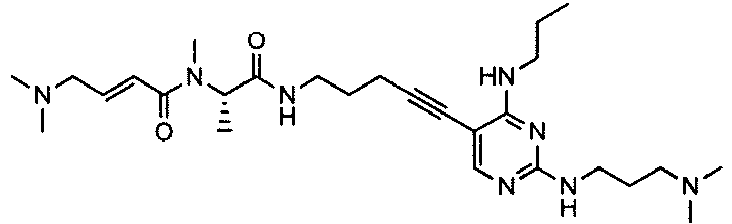
1H-NMR (CDCl3) δ: 7.92 (1H, s), 6.99 (1H, dt, J=15.2, 5.9Hz), 6.51-6.41 (2H, m), 5.75 (1H, brs), 5.18 (2H, q, J=7.3Hz), 3.47-3.36 (6H, m), 3.14 (6H, s), 2.98 (3H, s), 2.70 (2H, t, J=5.9Hz), 2.43 (2H, t, J=6.6Hz), 2.36 (2H, t, J=6.9Hz), 2.24 (6H, s), 1.76-1.64 (6H, m), 1.34 (3H, d, J=7.3Hz), 0.96 (3H, t, J=7.6Hz) 12-19 
1H-NMR (CDCl3):8.32 (1H, s), 7.99 (1H, s), 7.89 (1H, s), 7.58 (1H, d, J=8.6Hz), 7.00-6.80 (3H, m), 6.57-6.47 (1H, m), 6.42 (1H, dd, J=15.2, 1.7Hz), 6.28-6.19 (1H, m), 5.17 (1H, q, J=7.3Hz), 4.41 (2H, q, J=7.3Hz), 3.65-3.55 (2H, m), 3.50-3.40 (2H, m), 3.15-2.95 (5H, m), 2.49-2.41 (2H, m), 2.27 (6H, s), 1.85-1.65 (4H, m), 1.52 (3H, t, J=7.3Hz), 1.36 (3H, d, J=6.9Hz), 1.02 (3H, t, J=7.3Hz) -

- To a solution of (1R*,3S*)-3-((tert-butoxycarbonyl)amino)cyclohexanecarboxylic acid (M1, 3.00 g) as racemate synthesized according to the method described in Chemistry A European Journal, 2005, 11, pp.6543-6551 in methylene chloride (30 mL), carbonyldiimidazole (2.60 g) was added under ice cooling, and the mixture was stirred at the same temperature for 10 minutes. To the reaction mixture, N,N-diisopropylethylamine (2.72 mL) and methoxyamine hydrochloride (1.56 g) were added under ice cooling, and the mixture was stirred at room temperature for 1 hour. To the reaction mixture, 1.0 mol/L aqueous hydrochloric acid and methylene chloride were added. The organic layer was separated, and the aqueous layer was extracted with methylene chloride. The organic layer and the extract were combined, washed successively with water, saturated aqueous sodium hydrogencarbonate and saturated aqueous sodium chloride, and then dried over anhydrous magnesium sulfate, and the solvent was evaporated under reduced pressure to obtain oily tert-butyl ((1S*,3R*)-3-(methoxy(methyl)carbamoyl)cyclohexyl)carbamate (M2, 3.60 g).
MS m/z (M+H): 287.0 -

- To a solution of tert-butyl ((1S*,3R*)-3-(methoxy(methyl)carbamoyl)cyclohexyl)carbamate (M2, 200 mg) in tetrahydrofuran (2 mL), lithium aluminum hydride (80 mg) was added under ice cooling, and the mixture was stirred at the same temperature for 40 minutes. To the reaction mixture, saturated aqueous sodium sulfate was added, the mixture was stirred at room temperature 30 minutes, and then ethyl acetate was added to the reaction mixture. The organic layer was separated, and the aqueous layer was extracted with ethyl acetate. The organic layer and the extract were combined, and dried over anhydrous magnesium sulfate, and the solvent was evaporated under reduced pressure.
- To a solution of the residue obtained above and dimethyl (1-diazo-2-oxopropyl)phosphonate (126 µL) in methanol (6.5 mL), potassium carbonate (193 mg) was added under ice cooling, and the mixture was stirred at the same temperature for 35 minutes. To the reaction mixture, saturated aqueous ammonium chloride and ethyl acetate were added. The organic layer was separated, and the aqueous layer was extracted with ethyl acetate. The organic layer and the extract were combined, washed successively with saturated aqueous sodium hydrogencarbonate and saturated aqueous sodium chloride, and then dried over anhydrous magnesium sulfate, and the solvent was evaporated under reduced pressure. The obtained residue was purified by silica gel column chromatography (eluent, 96 to 80% hexane in ethyl acetate) to obtain tert-butyl ((1S*,3R*)-3-ethynylcyclohexyl)carbamate (M3, 119 mg) as white solid.
MS m/z (M+H): 224.2 -

- To a solution of N2-(3-fluorophenyl)-5-iodo-N4-propylpyrimidine-2,4-diamine (F2, 100 mg), bis(triphenylphosphine)palladium(II) dichloride (19 mg) and copper(I) iodide (10 mg) in N,N-dimethylformamide (2.7 mL), triethylamine (188 µL) and tert-butyl ((1S*,3R*)-3-ethynylcyclohexyl)carbamate (M3, 90 mg) were added at room temperature, and the mixture was stirred at the same temperature for 1 hour and 45 minutes. To the reaction mixture, water and ethyl acetate were added. The organic layer was separated, washed successively with saturated ammonium chloride and saturated aqueous sodium chloride, and then dried over anhydrous magnesium sulfate, and the solvent was evaporated under reduced pressure. The obtained residue was purified by silica gel column chromatography (eluent, 94 to 60% hexane in ethyl acetate) to obtain tert-butyl ((1S*,3R*)-3-((2-((3-fluorophenyl)amino)-4-(propylamino)pyrimidin-5-yl)ethynyl)cyclohexyl)carbamate (M4, 130 mg) as yellow solid.
MS m/z (M+H): 468.4 -

- To a solution of tert-butyl ((1S*,3R*)-3-((2-((3-fluorophenyl)amino)-4-(propylamino)pyrimidin-5-yl)ethynyl)cyclohexyl)carbamate (M4,130 mg) in 1,4-dioxane (3 mL), a 4.0 mol/L solution of hydrochloric acid in 1,4-dioxane (3 mL) was added at room temperature, and the mixture was stirred at the same temperature for 1 hour and 30 minutes. To the reaction mixture, 1,4-dioxane (2 mL) and a 4.0 mol/L solution of hydrochloric acid in 1,4-dioxane (2 mL) were added at room temperature, and the mixture was stirred at the same temperature for 3 hours. The solvent was evaporated under reduced pressure to obtain 5-(((1R*,3S*)-3-aminocyclohexyl)ethynyl)-N2-(3-fluorophenyl)-N4-propylpyrimidine-2,4-diamine (M5) dihydrochloride.
MS m/z (M+H): 368.3 -

- To a solution of 5-(((1R*,3S*)-3-aminocyclohexyl)ethynyl)-N2-(3-fluorophenyl)-N4-propylpyrimidine-2,4-diamine (M5) dihydrochloride obtained above, N-Boc-N-methyl-L-alanine (114 mg), 1-ethyl-3-(3-dimethylaminopropyl)carbodiimide hydrochloride (107 mg) and 1-hydroxybenzotriazole monohydrate (76 mg) in N,N-dimethylformamide (3 mL), N,N-diisopropylethylamine (286 µL) was added at room temperature, and the mixture was stirred at the same temperature for 40 minutes. To the reaction mixture, saturated aqueous sodium hydrogencarbonate and ethyl acetate were added. The organic layer was separated, and the aqueous layer was extracted with ethyl acetate. The organic layer and the extract were combined, washed successively with water, saturated aqueous sodium hydrogencarbonate and saturated aqueous sodium chloride, and then dried over anhydrous magnesium sulfate, and the solvent was evaporated under reduced pressure. The obtained residue was purified by silica gel column chromatography (eluent, 88 to 20% hexane in ethyl acetate) to obtain tert-butyl ((S)-1-((1S*,3R*)-(3-((2-((3-fluorophenyl)amino)-4-(propylamino)pyrimidin-5-yl)ethynyl)cyclohexyl)amino)-1-oxopropan-2-yl)(methyl)carbamate (M6, 113 mg).
MS m/z (M+H): 553.5 -

- To a solution of tert-butyl ((S)-1-((1S*,3R*)-(3-((2-((3-fluorophenyl)amino)-4-(propylamino)pyrimidin-5-yl)ethynyl)cyclohexyl)amino)-1-oxopropan-2-yl)(methyl)carbamate (M6, 113 mg) in 1,4-dioxane (2 mL), a 4.0 mol/L solution of hydrochloric acid in 1,4-dioxane (2 mL) was added at room temperature, and the mixture was stirred at the same temperature for 2 hours and 45 minutes. The solvent was evaporated under reduced pressure, and to the obtained residue, ethyl acetate was added. The solid matter was taken by filtration, and then ethyl acetate and saturated aqueous sodium hydrogencarbonate were added. The organic layer was separated, washed successively with saturated aqueous sodium hydrogencarbonate and saturated aqueous sodium chloride, and then dried over anhydrous sodium sulfate, and the solvent was evaporated under reduced pressure to obtain (S)-N-((1S*,3R*)-3-((2-((3-fluorophenyl)amino)-4-(propylamino)pyrimidin-5-yl)ethynyl)cyclohexyl)-2-(methylamino)propanamide (M7, 27 mg).
MS m/z (M+H): 453.4 -
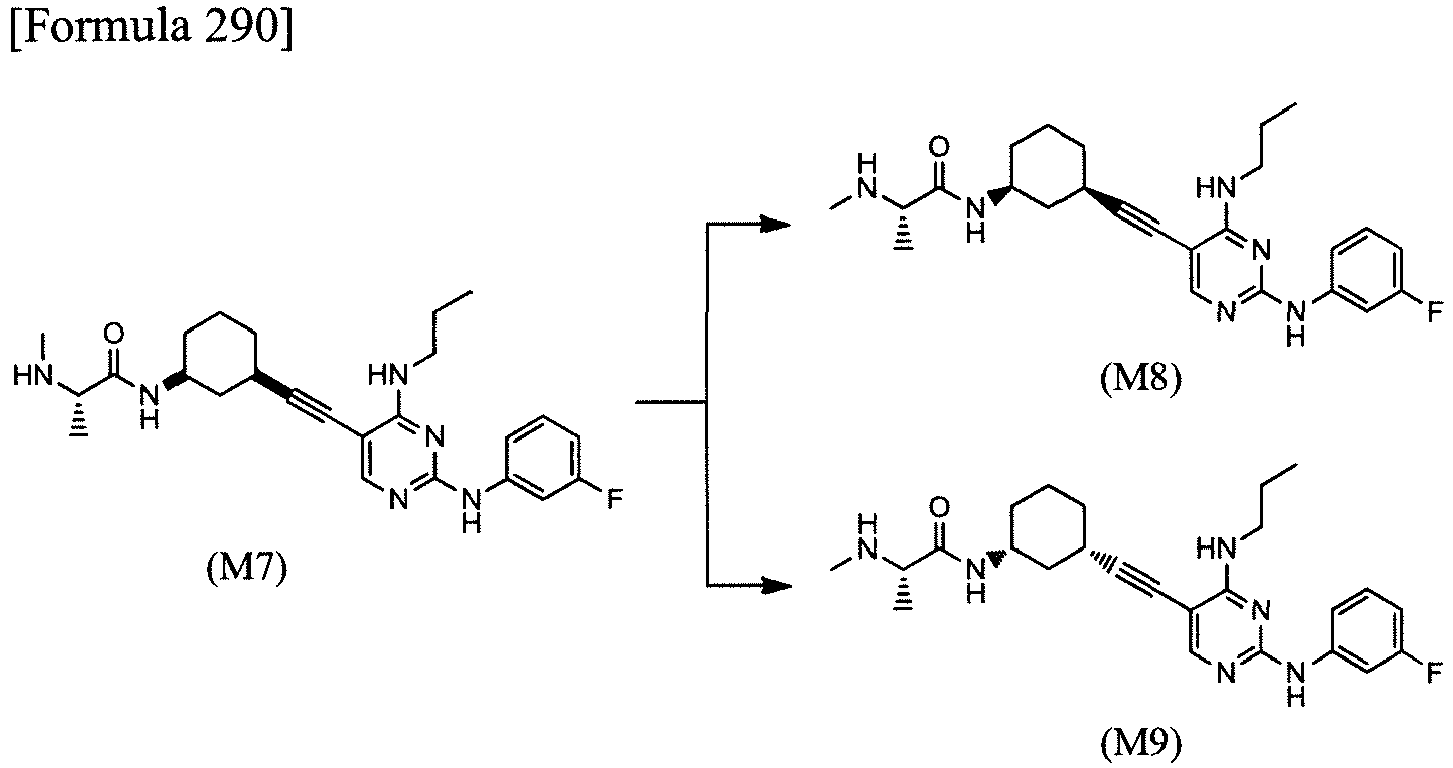
- By using a supercritical fluid chromatography purification apparatus (column, CHIRALPAKIA), stereoisomers of (S)-N-((1S*,3R*)-3-((2-((3-fluorophenyl)amino)-4-(propylamino)pyrimidin-5-yl)ethynyl)cyclohexyl)-2-(methylamino)propanamide (M7, 27 mg) were separated to obtain (S)-N-((1S,3R)-3-((2-((3-fluorophenyl)amino)-4-(propylamino)pyrimidin-5-yl)ethynyl)cyclohexyl)-2-(methylamino)propanamide (M8, 13.2 mg) and (S)-N-((1R,3S)-3-((2-((3-fluorophenyl)amino)-4-(propylamino)pyrimidin-5-yl)ethynyl)cyclohexyl)-2-(methylamino)propanamide (M9, 11.6 mg).
MS m/z (M+H): 453.4 -

- In the same manner as that of Example 35, (7), (E)-4-(dimethylamino)-N-((S)-1-(((1S,3R)-3-((2-((3-fluorophenyl)amino)-4-(propylamino)pyrimidin-5-yl)ethynyl)cyclohexyl)amino)-1-oxopropan-2-yl)-N-methyl-2-butenamide (13-1) was obtained from (S)-N-((1S,3R)-3-((2-((3-fluorophenyl)amino)-4-(propylamino)pyrimidin-5-yl)ethynyl)cyclohexyl)-2-(methylamino)propanamide (M8).
1H-NMR (CDCl3) δ: 7.96 (1H, s), 7.79 (1H, dt, J=11.8, 2.0Hz), 7.20 (1H, dd, J=7.9, 6.6Hz), 7.11-7.03 (2H, m), 6.93 (1H, dt, J=15.2, 5.9Hz), 6.68 (1H, dt, J=8.3, 2.2Hz), 6.42 (1H, d, J=15.2Hz), 6.28 (1H, d, J=8.6Hz), 5.51-5.43 (1H, m), 5.15 (1H, q, J=7.0Hz), 3.74-3.72 (1H, m), 3.52-3.44 (3H, m), 3.11 (3H, d, J=5.9Hz), 2.98 (4H, s), 2.68-2.56 (1H, m), 2.35-2.28 (1H, m), 2.28 (6H, s), 2.06-1.96 (1H, m), 1.88-1.78 (1H, m), 1.80-1.61 (2H, m), 1.43-1.20 (2H, m), 1.33 (3H, d, J=7.0Hz), 1.02 (3H, t, J=7.6Hz) -

- In the same manner as that of Example 35, (7), (E)-4-(dimethylamino)-N-((S)-1-(((1R,3S)-3-((2-((3-fluorophenyl)amino)-4-(propylamino)pyrimidin-5-yl)ethynyl)cyclohexyl)amino)-1-oxopropan-2-yl)-N-methyl-2-butenamide (13-2) was obtained from (S)-N-((1R,3S)-3-((2-((3-fluorophenyl)amino)-4-(propylamino)pyrimidin-5-yl)ethynyl)cyclohexyl)-2-(methylamino)propanamide (M9).
1H-NMR (CDCl3) δ: 7.95 (1H, s), 7.79 (1H, dt, J=11.9, 2.0Hz), 7.27-7.16 (1H, m), 7.20-7.13 (1H, m), 7.12-7.05 (1H, m), 6.94 (1H, dt, J=15.2, 5.9Hz), 6.68 (1H, dt, J=8.3, 2.2Hz), 6.43 (1H, d, J=15.2Hz), 6.30-6.23 (1H, m), 5.48 (1H, t, J=5.6Hz), 5.17 (1H, q, J=7.0Hz), 3.79-3.69 (1H, m), 3.52-3.43 (2H, m), 3.12 (2H, d, J=5.9Hz), 2.97 (3H, s), 2.67-2.55 (1H, m), 2.31-2.19 (1H, m), 2.27 (6H, s), 2.06-1.83 (4H, m), 1.76-1.64 (2H, m), 1.43-1.10 (4H, m), 1.33 (2H, d, J=7.3Hz), 1.02 (3H, t, J=8.0Hz) -

- To a solution of (1S*,3S*)-3-((tert-butoxycarbonyl)amino)cyclobutanecarboxylic acid (M10, 500 mg) in methylene chloride (5 mL), carbonyldiimidazole (490 mg), N,N-diisopropylethylamine (510 µL) and methoxyamine hydrochloride (293 mg) were added under ice cooling, and the mixture was stirred at room temperature for 1 hour. To the reaction mixture, 1.0 mol/L aqueous hydrochloric acid and methylene chloride were added. The organic layer was separated, and the aqueous layer was extracted with methylene chloride. The organic layer and the extract were combined, washed successively with water, saturated aqueous sodium hydrogencarbonate and saturated aqueous sodium chloride, and then dried over anhydrous magnesium sulfate, and the solvent was evaporated under reduced pressure to obtain tert-butyl ((1S*,3S*)-3-(methoxy(methyl)carbamoyl)cyclobutyl)carbamate (M11, 510 mg) as white solid.
MS m/z (M+H): 259.0 -

- To a solution oftert-butyl ((1S*,3S*)-3-(methoxy(methyl)carbamoyl)cyclobutyl)carbamate (M11, 510 mg) in tetrahydrofuran (6.5 mL), lithium aluminum hydride (261 mg) was added under ice cooling, and the mixture was stirred at the same temperature for 25 minutes. To the reaction mixture, saturated aqueous sodium sulfate and ethyl acetate were added. The organic layer was separated, and dried over anhydrous magnesium sulfate, and the solvent was evaporated under reduced pressure.
- To a solution of the residue obtained above and dimethyl (1-diazo-2-oxopropyl)phosphonate (414 µL) in methanol (20 mL), potassium carbonate (636 mg) was added under ice cooling, and the mixture was stirred at room temperature for 15 hours. To the reaction mixture, saturated aqueous ammonium chloride and ethyl acetate were added. The organic layer was separated, washed successively with saturated aqueous sodium hydrogencarbonate and saturated aqueous sodium chloride, and then dried over anhydrous magnesium sulfate, and the solvent was evaporated under reduced pressure. The obtained residue was purified by silica gel column chromatography (eluent, 94-80% hexane in ethyl acetate) to obtain tert-butyl ((1S*,3S*)-3-ethynylcyclobutyl)carbamate (M12, 207 mg) as white solid.
MS m/z (M+H): 196.1 -

- To a suspension of tert-butyl ((1S,3R)-3-(hydroxymethyl)cyclopentyl)carbamate (M13, 1.0 g) synthesized according to the method described in Journal of the American Chemical Society, 2005, 127, pp.8846-8855, 4-methylmorpholine-N-oxide (1.1 g) and anhydrous sodium sulfate (2.0 g) in methylene chloride (20 mL), tetrapropylammonium perruthenate (81 mg) was added at room temperature, and the mixture was stirred at the same temperature for 1 hour. The reaction mixture was purified by silica gel column chromatography (eluent, ethyl acetate) to obtain oily tert-butyl ((1S,3R)-3-(formylcyclopentyl)carbamate (M14, 583 mg).
-

- To a solution of tert-butyl ((1S,3R)-3-(formylcyclopentyl)carbamate (M 14, 583 mg) and dimethyl (1-diazo-2-oxopropyl)phosphonate (608 µL) in methanol (20 mL), potassium carbonate (746 mg) was added under ice cooling, and the mixture was stirred at the same temperature for 1 hour and 15 minutes, and then stirred at room temperature for 15 hours. To the reaction mixture, saturated aqueous ammonium chloride and ethyl acetate were added. The organic layer was separated, and the aqueous layer was extracted with ethyl acetate. The organic layer and the extract were combined, washed successively with saturated aqueous sodium hydrogencarbonate and saturated aqueous sodium chloride, and then dried over anhydrous magnesium sulfate, and the solvent was evaporated under reduced pressure. The obtained residue was purified by silica gel column chromatography (eluent, 96 to 80% hexane in ethyl acetate) to obtain tert-butyl ((1S,3R)-3-ethynylcyclopentyl)carbamate (M15, 465 mg) as white solid.
MS m/z (M+H): 210.1 - By using tert-butyl ((1S*,3R*)-3-ethynylcyclohexyl)carbamate (M3), tert-butyl ((1S*,3S*)-3-ethynylcyclobutyl)carbamate (M12), tert-butyl ((1S,3R)-3-ethynylcyclopentyl)carbamate (M15), or tert-butyl ((1S,3R)-3-ethynylcyclohexyl)carbamate (P0), Intermediates (M16) to (M23) and Intermediates (M50) to (M59) were obtained in the same manner as that of Example 54, (3),.

[Table 181] Compound No. Structure Physicochemical data M16 
- M17 
- M18 
- M19 
- M20 
MS m/z (M+H): 440.3 M21 
- [Table 182] Compound No. Structure Physicochemical data M22 
- M23 
- M50 
MS m/z (M+H): 412.3 M51 
MS m/z (M+H): 419.3 M52 
MS m/z (M+H): 419.3 M53 
MS m/z (M+H): 442.3 M54 
MS m/z (M+H): 447.3 M55 
MS m/z (M+H): 440.3 M56 
MS m/z (M+H): 412.3 [Table 183] Compound No. Structure Physicochemical data M57 
MS m/z (M+H): 445.4 M58 
MS m/z (M+H): 424.4 M59 
MS m/z (M+H): 425.4 - In the same manner as that of Example 54, (4), Intermediates (M24) to (M31) and Intermediates (M60) to (M69) were obtained.
[Table 184] Compound No. Structure Physicochemical data M24 
- M25 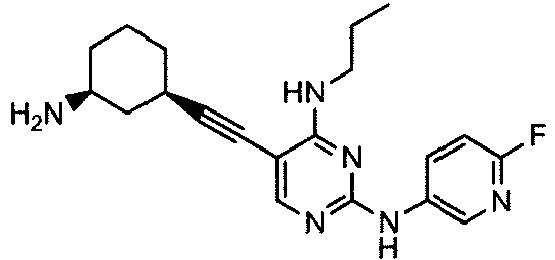
- M26 
- M27 
- [Table 185] Compound No. Structure Physicochemical data M28 
MS m/z (M+H): 340.2 M29 
- M30 
- M31 
- M60 
- M61 
- M62 
- M63 
MS m/z (M+H): 342.1 M64 
- [Table 186] Compound No. Structure Physicochemical data M65 
MS m/z (M+H): 340.3 M66 
MS m/z (M+H): 312.2 M67 
MS m/z (M+H): 345.3 M68 
- M69 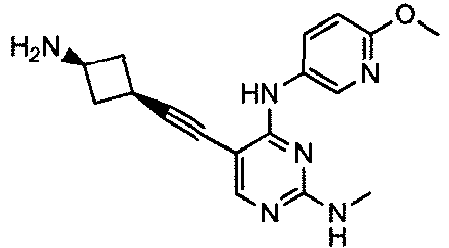
- - In the same manner as that of Example 54, (5), Intermediates (M32) to (M39) and Intermediates (M70) to (M79) were obtained.
[Table 187] Compound No. Structure Physicochemical data M32 
- M33 
- [Table 188] Compound No. Structure Physicochemical data M34 
- M35 
- M36 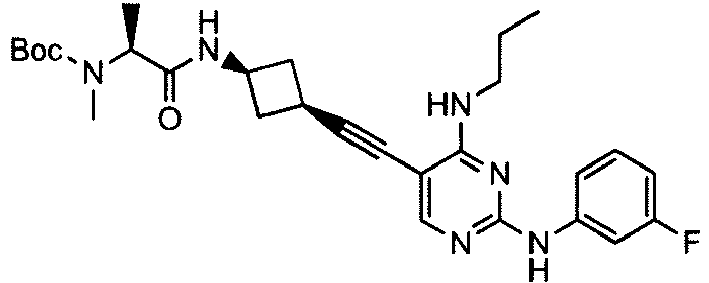
MS m/z (M+H): 525.4 M37 
- M38 
- M39 
- M70 
MS m/z (M+H): 497.4 M71 
MS m/z (M+H): 504.4 [Table 189] Compound No. Structure Physicochemical data M72 
MS m/z (M+H): 504.4 M73 
MS m/z (M+H): 527.4 M74 
MS m/z (M+H): 532.4 M75 
MS m/z (M+H): 525.4 M76 
MS m/z (M+H): 497.4 M77 
MS m/z (M+H): 530.5 M78 
MS m/z (M+H): 509.5 M79 
MS m/z (M+H): 510.4 - In the same manner as that of Example 54, (6), Intermediates (M40) to (M47) and Intermediates (M80) to (M89) were obtained.
[Table 190] Compound No. Structure Physicochemical data M40 
- M41 
- M42 
- M43 
- M44 
MS m/z (M+H): 425.3 M45 
- M46 
- M47 
- [Table 191] Compound No. Structure Physicochemical data M80 
- M81 
- M82 
- M83 
- M84 
- M85 
MS m/z (M+H): 425.4 M86 
MS m/z (M+H): 397.4 M87 
MS m/z (M+H): 430.4 [Table 192] Compound No. Structure Physicochemical data M88 
MS m/z (M+H): 409.4 M89 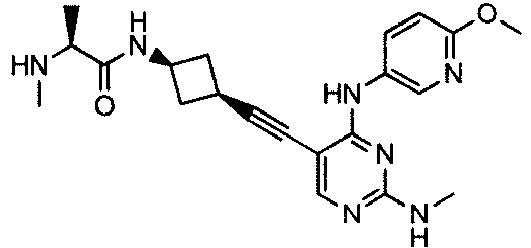
MS m/z (M+H): 410.4 - By using (S)-N-((1S*,3R*)-3-((2-((4-cyanophenyl)amino)-4-(propylamino)pyrimidin-5-yl)ethynyl)cyclohexyl)-2-(methylamino)propanamide (M40), Intermediates (M48) and (M49) were obtained in the same manner as that of Example 54, (7).
[Table 193] Compound No. Structure Physicochemical data M48 
- M49 
- - In the same manner as that of Example 54, Compounds (13-3) to (13-22) were obtained.
[Table 194] Compound No. Structure Physicochemical data 13-3 
1H-NMR (CDCl3) δ: 7.98 (1H, s), 7.75 (2H, d, J=9.2Hz), 7.57 (2H, d, J=9.2Hz), 7.18-7.12 (1H, m), 6.93 (1H, dt, J=15.2, 5.9Hz), 6.42 (1H, d, J=15.2Hz), 6.31-6.21 (1H, m), 5.55-5.44 (1H, m), 5.16 (1H, q, J=6.6Hz), 3.83-3.63 (1H, m), 3.53-3.40 (2H, m), 3.10 (2H, d, J=5.9Hz), 2.97 (3H, s), 2.71-2.52 (1H, m), 2.28 (6H, s), 2.28-2.19 (1H, m), 2.05-1.80 (3H, m), 1.76-1.62 (2H, m), 1.48-1.11 (4H, m), 1.32 (3H, d, J=8.9Hz), 1.02 (3H, t, J=6.6Hz) 13-4 
1H-NMR (CDCl3) δ: 7.98 (1H, s), 7.75 (2H, d, J=8.6Hz), 7.57 (2H, d, J=8.6Hz), 7.17 (1H, s), 6.93 (1H, dt, J=15.2, 5.9Hz), 6.42 (1H, d, J=15.2Hz), 6.34-6.25 (1H, m), 5.55-5.45 (1H, m), 5.16 (1H, q, J=7.2Hz), 3.83-3.65 (1H, m), 3.52-3.41 (2H, m), 3.11 (2H, d, J=5.9Hz), 2.98 (3H, s), 2.71-2.54 (1H, m), 2.29 (6H, s), 2.25-2.37 (1H, m), 2.10-1.93 (1H, m), 1.89-1.75 (2H, m), 1.77-1.63 (2H, m), 1.48-1.27 (4H, m), 1.34 (3H, d, J=7.3Hz), 1.02 (3H, t, J=7.0Hz) 13-5 
1H-NMR (CDCl3) δ: 8.37 (1H, s), 8.21-8.13 (1H, m), 7.95 (1H, s), 7.08-7.03 (1H, m), 6.98-6.89 (1H, m), 6.88 (1H, dd, J=8.9,3.6Hz), 6.42 (1H, d, J=15.2Hz), 6.32 (1H, d, J=7.3Hz), 5.46 (1H, t, J=5.6Hz), 5.15 (1H, q, J=7.0Hz), 3.79-3.65 (1H, m), 3.49-3.39 (2H, m), 3.11 (2H, d, J=5.9Hz), 2.98 (3H, s), 2.67-2.55 (1H, m), 2.34-2.25 (1H, m), 2.28 (6H, s), 2.04-1.95 (1H, m), 1.86-1.76 (2H, m), 1.72-1.62 (2H, m), 1.50-1.26 (4H, m), 1.34 (3H, d, J=7.0Hz), 1.00 (3H, t, J=7.3Hz) [Table 195] Compound No. Structure Physicochemical data 13-6 
1H-NMR (CDCl3) δ: 7.98 (1H, s), 7.75 (2H, d, J=8.6Hz), 7.57 (2H, d, J=8.6Hz), 6.94 (1H, dt, J=15.2, 5.9Hz), 6.46 (1H, d, J=15.2Hz), 6.38 (1H, d, J=7.9Hz), 5.54-5.46 (1H, m), 4.01 (2H, s), 3.81-3.71 (1H, m), 3.51-3.42 (2H, m), 3.18 (3H, s), 3.10 (3H, d, J=5.9Hz), 2.68-2.58 (1H, m), 2.32-2.24 (1H, m), 2.26 (6H, s), 2.05-1.81 (3H, m), 1.75-1.64 (2H, m), 1.47-1.10 (3H, m), 1.01 (3H, t, J=6.6Hz) 13-7 
1H-NMR (CDCl3) δ: 8.31 (1H, s), 7.97 (1H, s), 7.61-7.54 (1H, m), 7.36 (1H, dd, J=7.9, 7.9Hz), 7.26-7.22 (1H, m), 7.14-7.10 (1H, m), 6.93 (1H, dt, J=15.2, 5.9Hz), 6.42 (1H, d, J=15.2Hz), 6.33 (1H, d, J=7.9Hz), 5.51 (1H, t, J=5.6Hz), 5.15 (1H, q, J=7.0Hz), 3.79-3.67 (1H, m), 3.52-3.43 (2H, m), 3.11 (2H, d, J=5.9Hz), 2.98 (3H, s), 2.70-2.55 (1H, m), 2.35-2.28 (1H, m), 2.28 (6H, s), 2.05-1.98 (1H, m), 1.89-1.76 (2H, m), 1.77-1.64 (2H, m), 1.50-1.24 (4H, m), 1.34 (3H, d, J=7.0Hz), 1.04 (3H, t, J=7.3Hz) 13-8 
1H-NMR (CDCl3) δ: 7.99 (1H, s), 7.84-7.75 (1H, m), 7.27-7.17 (1H, m), 7.11-7.09 (1H, m), 7.09-7.06 (1H, m), 6.95 (1H, dt, J=15.2, 5.9Hz), 6.73-6.64 (1H, m), 6.66-6.58 (1H, m), 6.43 (1H, d, J=15.2Hz), 5.57-5.46 (1H, m), 5.16 (1H, q, J=7.0Hz), 4.35-4.20 (1H, m), 3.54-3.44 (2H, m), 3.11 (2H, d, J=5.9Hz), 3.01-2.88 (1H, m), 2.98 (3H, s), 2.84-2.70 (2H, m), 2.27 (6H, s), 2.14-1.98 (2H, m), 1.76-1.65 (2H, m), 1.34 (3H, d, J=7.0Hz), 1.02 (3H, t, J=7.3Hz) [Table 196] Compound No. Structure Physicochemical data 13-9 
1H-NMR (CDCl3) δ: 8.01 (1H, s), 7.76 (2H, d, J=8.6Hz), 7.57 (2H, d, J=8.6Hz), 7.26-7.22 (1H, m), 6.95 (1H, dt, J=15.2, 5.9Hz), 6.67-6.60 (1H, m), 6.43 (1H, d, J=15.2Hz), 5.61-5.51 (1H, m), 5.15 (1H, q, J=7.0Hz), 4.35-4.20 (1H, m), 3.53-3.42 (2H, m), 3.11 (2H, d, J=5.9Hz), 3.01-2.88 (1H, m), 2.98 (3H, s), 2.84-2.70 (2H, m), 2.28 (6H, s), 2.16-2.00 (2H, m), 1.76-1.65 (2H, m), 1.34 (3H, d, J=7.3Hz), 1.02 (3H, t, J=7.6Hz) 13-10 
1H-NMR (CDCl3) δ: 8.00 (1H, s), 7.81 (1H, d, J=11.9Hz), 7.26-7.17 (1H, m), 7.12-7.05 (2H, m), 6.91 (1H, dt, J=15.2, 5.9Hz), 6.68 (1H, td, J=8.3, 2.6Hz), 6.62-6.56 (1H, m), 6.40 (1H, d, J=15.2Hz), 5.74-5.65 (1H, m), 5.13 (1H, q, J=7.0Hz), 4.28-4.19 (1H, m), 3.52-3.43 (2H, m), 3.08 (2H, d, J=5.9Hz), 2.97 (3H, s), 2.49-2.38 (1H, m), 2.26 (6H, s), 2.08-1.94 (2H, m), 1.94-1.50 (4H, m), 1.76-1.64 (2H, m), 1.34 (3H, d, J=7.0Hz), 1.01 (3H, t, J=7.3Hz) 13-11 
1H-NMR (CDCl3) δ: 8.02 (1H, s), 7.76 (2H, d, J=8.6Hz), 7.57 (2H, d, J=8.6Hz), 7.22-7.18 (1H, m), 6.91 (1H, dt, J=15.2, 5.9Hz), 6.65-6.58 (1H, m), 6.41 (1H, d, J=15.2Hz), 5.78-5.73 (1H, m), 5.13 (1H, q, J=7.0Hz), 4.30-4.19 (1H, m), 3.50-3.42 (2H, m), 3.09 (2H, d, J=5.9Hz), 2.98 (3H, s), 2.49-2.39 (1H, m), 2.26 (6H, s), 2.11-1.94 (2H, m), 1.90-1.55 (4H, m), 1.75-1.65 (2H, m), 1.34 (3H, d, J=7.0Hz), 1.01 (3H, t, J=7.6Hz) 13-12 
1H-NMR (CDCl3) δ: 7.97 (1H, s), 7.76 (2H, d, J=9.2Hz), 7.57 (2H, d, J=9.2Hz), 7.39-7.35 (1H, m), 6.93 (1H, dt, J=15.2, 5.9Hz), 6.53-6.47 (1H, m), 6.43 (1H, d, J=15.2Hz), 5.55-5.48 (1H, m), 5.12 (1H, q, J=7.0Hz), 4.41-4.30 (1H, m), 3.51-3.42 (2H, m), 3.15-3.01 (1H, m), 3.12 (2H, d, J=4.6Hz), 2.98 (3H, s), 2.29 (6H, s), 2.22-1.88 (4H, m), 1.79-1.64 (2H, m), 1.46-1.23 (2H, m), 1.34 (3H, d, J=7.0Hz), 1.02 (3H, t, J=7.6Hz) [Table 197] Compound No. Structure Physicochemical data 13-13 
1H-NMR (CDCl3) δ: 7.98 (1H, s), 7.84-7.76 (1H, m), 7.25-7.18 (1H, m), 7.15-7.12 (1H, m), 7.13-7.09 (1H, m), 6.94 (1H, dt, J=15.2, 5.9Hz), 6.72-6.65 (1H, m), 6.68-6.63 (1H, m), 6.53 (1H, d, J=15.2Hz), 5.56-5.51 (1H, m), 5.15 (1H, q, J=7.3Hz), 4.32-4.23 (1H, m), 3.22 (2H, d, J=5.9Hz), 3.11 (3H, d, J=4.6Hz), 3.00 (3H, s), 2.98-2.90 (1H, m), 2.80-2.73 (2H, m), 2.37 (6H, s), 2.17-2.01 (2H, m), 1.34 (3H, d, J=7.3Hz) 13-14 
1H-NMR (CDCl3) δ: 8.00 (1H, s), 7.78 (2H, d, J=9.2Hz), 7.58-7.52 (1H, m), 7.57 (2H, d, J=9.2Hz), 6.94 (1H, dt, J=15.2, 5.9Hz), 6.76-6.69 (1H, m), 6.48 (1H, d, J=15.2Hz), 5.61-5.5 (1H, m), 5.15 (1H, q, J=7.0Hz), 4.33-4.23 (1H, m), 3.16 (2H, d, J=5.9Hz), 3.10 (3H, d, J=4.3Hz), 2.99 (3H, s), 2.98-2.88 (1H, m), 2.84-2.66 (2H, m), 2.32 (6H, s), 2.17-2.05 (2H, m), 1.34 (3H, d, J=7.0Hz) 13-15 
1H-NMR (CDCl3) δ: 8.34 (1H, s), 8.00 (1H, s), 7.65-7.59 (1H, m), 7.36 (1H, dd, J=7.0, 7.0Hz), 7.35-7.30 (1H, m), 7.28-7.24 (1H, m), 6.95 (1H, dt, J=15.2, 5.9Hz), 6.73-6.67 (1H, m), 6.53 (1H, d, J=15.2Hz), 5.61-5.55 (1H, m), 5.15 (1H, q, J=7.3Hz), 4.34-4.23 (1H, m), 3.22 (2H, d, J=5.9Hz), 3.11 (3H, d, J=4.6Hz), 3.00 (3H, s), 2.99-2.89 (1H, m), 2.83-2.71 (2H, m), 2.37 (6H, s), 2.17-2.05 (2H, m), 1.35 (3H, d, J=7.3Hz) 13-16 
1H-NMR (CDCl3) δ: 7.95 (1H, s), 7.79-7.71 (1H, m), 7.12-7.09 (1H, m), 7.09-7.06 (1H, m), 6.99-6.90 (1H, m), 6.94-6.86 (1H, m), 6.67-6.63 (1H, m), 6.55 (1H, d, J=15.2Hz), 5.54-5.50 (1H, m), 5.15 (1H, q, J=7.3Hz), 4.32-4.23 (1H, m), 3.87 (3H, s), 3.24 (2H, d, J=5.9Hz), 3.09 (3H, d, J=4.0Hz), 3.00 (3H, s), 2.97-2.87 (1H, m), 2.81-2.73 (2H, m), 2.39 (6H, s), 2.15-2.05 (2H, m), 1.34 (3H, d, J=7.3Hz) [Table 198] Compound No. Structure Physicochemical data 13-17 
1H-NMR (CDCl3) δ: 8.33 (1H, s), 7.99 (1H, s), 7.62-7.55 (1H, m), 7.59-7.53 (1H, m), 7.36 (1H, dd, J=7.9, 7.9Hz), 7.28-7.23 (1H, m), 6.94 (1H, dt, J=15.2, 5.9Hz), 6.73-6.66 (1H, m), 6.60(1H, d, J=15.2Hz), 5.62-5.55 (1H, m), 5.14 (1H, q, J=7.3Hz), 4.33-4.23 (1H, m), 3.53-3.47 (2H, m), 3.29 (2H, d, J=5.9Hz), 3.01 (3H, s), 3.00-2.89 (1H, m), 2.83-2.72 (2H, m), 2.43 (6H, s), 2.17-2.05 (2H, m), 1.77-1.68 (2H, m), 1.35 (3H, d, J=7.3Hz), 1.04 (3H, t, J=7.6Hz) 13-18 
1H-NMR (CDCl3) δ: 7.97 (1H, s), 7.60-7.52 (2H, m), 7.10-7.07 (1H, m), 7.04-6.96 (2H, m), 6.99-6.89 (1H, m), 6.68-6.62 (1H, m), 6.43 (1H, d, J=15.2Hz), 5.50-5.44 (1H, m), 5.16 (1H, q, J=7.3Hz), 4.32-4.23 (1H, m), 3.48-3.41 (2H, m), 3.12 (2H, d, J=5.9Hz), 2.98 (3H, s), 2.97-2.88 (1H, m), 2.81-2.71 (2H, m), 2.30 (6H, s), 2.12-2.00 (2H, m), 1.73-1.64 (2H, m), 1.34 (3H, d, J=7.3Hz), 1.00 (3H, t, J=7.6Hz) 13-19 
1H-NMR (CDCl3) δ: 7.97 (1H, s), 7.61-7.54 (2H, m), 7.18-7.15 (1H, m), 7.05-6.96 (2H, m), 6.99-6.89 (1H, m), 6.72-6.66 (1H, m), 6.43 (1H, d, J=15.2Hz), 5.48-5.43 (1H, m), 5.16 (1H, q, J=7.0Hz), 4.32-4.23 (1H, m), 3.11 (2H, d, J=5.9Hz), 3.07 (3H, d, J=4.6Hz), 2.98-2.87 (1H, m), 2.98 (3H, s), 2.81-2.71 (2H, m), 2.28 (6H, s), 2.13-1.99 (2H, m), 1.34 (3H, d, J=7.0Hz) 13-20 
1H-NMR (CDCl3) δ: 8.73 (1H, s), 8.01 (1H, s), 7.53-7.48 (1H, m), 7.36-7.31 (1H, m), 7.36 (1H, dd, J=7.0, 7.0Hz), 7.27-7.23 (1H, m), 6.95 (1H, dt, J=15.2, 5.9Hz), 6.73-6.63 (1H, m), 6.45 (1H, d, J=15.2Hz), 5.68-5.65 (1H, m), 5.15 (1H, q, J=7.3Hz), 4.33-4.23 (1H, m), 3.14 (2H, d, J=5.9Hz), 2.99 (3H, s), 2.96-2.89 (1H, m), 2.92-2.82 (1H, m), 2.84-2.68 (2H, m), 2.30 (6H, s), 2.11-2.02 (2H, m), 1.34 (3H, d, J=7.3Hz), 1.04-0.98 (2H, m), 0.72-0.66 (2H, m) [Table 199] Compound No. Structure Physicochemical data 13-21 
1H-NMR (CDCl3) δ: 8.04 (1H, s), 7.54 (2H, d, J=8.6Hz), 7.08-6.84 (4H, m), 6.65 (1H, d, J=7.3Hz), 6.42 (1H, d, J=15.2Hz), 5.16 (1H, q, J=7.0Hz), 5.09-4.98 (1H, m), 4.37-4.20 (1H, m), 3.81 (3H, s), 3.10 (2H, d, J=4.6Hz), 3.05-2.90 (7H, m), 2.87-2.69 (2H, m), 2.26 (6H, s), 2.21-1.99 (2H, m), 1.33 (3H, d, J=7.0Hz) 13-22 
1H-NMR (CDCl3) δ: 8.42-8.35 (1H, m), 8.06 (1H, s), 7.95-7.82 (1H, m), 7.02-6.88 (2H, m), 6.75 (1H, d, J=9.2Hz), 6.71-6.61 (1H, m), 6.42 (1H, d, J=15.2Hz), 5.15 (1H, q, J=7.0Hz), 5.09-4.97 (1H, m), 4.35-4.21 (1H, m), 3.94 (3H, s), 3.10 (2H, d, J=4.6Hz), 3.04-2.87 (7H, m), 2.87-2.69 (2H, m), 2.27 (6H, s), 2.21-2.01 (2H, m), 1.33 (3H, d, J=7.0Hz) -

- By using (1R,3S)-N-Boc-3-aminocyclohexanecarboxylic acid synthesized according to the method described in Journal of the American Chemical Society, 2003, 125, pp.2844-2845, tert-butyl ((1S,3R)-3-ethynylcyclohexyl)carbamate (P0) was obtained in the same manner as that of Example 54, (1) and (2).
- To a solution of 2-chloro-5-iodo-N-propylpyrimidin-4-amine (F1, 78 mg), bis(triphenylphosphine)palladium(II) dichloride (18 mg) and copper(I) iodide (10 mg) in N,N-dimethylformamide (2 mL), triethylamine (181 µL) and tert-butyl ((1S,3R)-3-ethynylcyclohexyl)carbamate (P0, 70 mg) were added at room temperature, and the mixture was stirred at the same temperature for 8 hours. To the reaction mixture, ethyl acetate and saturated aqueous ammonium chloride were added. The organic layer was separated, washed successively with saturated aqueous ammonium chloride, water and saturated aqueous sodium chloride, and then dried over anhydrous magnesium sulfate, and the solvent was evaporated under reduced pressure. The obtained residue was purified by silica gel column chromatography (eluent, 94 to 60% hexane in ethyl acetate) to obtain tert-butyl ((1S,3R)-3-((2-chloro-4-(propylamino)pyrimidin-5-yl)ethynyl)cyclohexyl)carbamate (P1, 83mg).
MS m/z (M+H): 393.3 -

- To tert-butyl ((1S,3R)-3-((2-chloro-4-(propylamino)pyrimidin-5-yl)ethynyl)cyclohexyl)carbamate (P1, 155 mg), 4-amino-2-fluoropyridine (89 mg), tris(dibenzylideneacetone)dipalladium(0) (36 mg), 4,5'-bis(diphenylphosphino)-9,9'-dimethylxanthene (45 mg) and cesium carbonate (381 mg), 1,4-dioxane (5 mL) was added at room temperature, the reaction vessel was sealed, and then the mixture was stirred at 150°C for 1 hour by using a microwave reaction system. The reaction mixture was cooled to room temperature, and then the solvent was evaporated under reduced pressure. The obtained residue was purified by silica gel column chromatography (eluent, 88 to 30% hexane in ethyl acetate) to obtain tert-butyl ((1S,3R)-3-((2-((2-fluoropyridin-4-yl)amino)-4-(propylamino)pyrimidin-5-yl)ethynyl)cyclohexyl)carbamate (P2).
MS m/z (M+H): 469.4 -


- To a solution of tert-butyl ((1S,3R)-3-((2-((2-fluoropyridin-4-yl)amino)-4-(propylamino)pyrimidin-5-yl)ethynyl)cyclohexyl)carbamate (P2) obtained above in 1,4-dioxane (2 mL), a 4.0 mol/L solution of hydrochloric acid in 1,4-dioxane (4 mL) was added at room temperature, and the mixture was stirred at the same temperature for 2 hours and 30 minutes. The solvent was evaporated under reduced pressure.
- To a solution of the residue obtained above, N-Boc-N-methyl-L-alanine (163 mg), 1-ethyl-3-(3-dimethylaminopropyl)carbodiimide hydrochloride (153 mg) and 1-hydroxybenzotriazole monohydrate (108 mg) in N,N-dimethylformamide (3 mL), N,N-diisopropylethylamine (408 µL) was added at room temperature, and the mixture was stirred at the same temperature for 2 hours. To the reaction mixture, ethyl acetate and saturated aqueous sodium hydrogencarbonate were added. The organic layer was separated, washed successively with saturated aqueous sodium hydrogencarbonate, water and saturated aqueous sodium chloride, and then dried over anhydrous magnesium sulfate, and the solvent was evaporated under reduced pressure. The obtained residue was purified by silica gel column chromatography (eluent, 70 to 20% hexane in ethyl acetate) to obtain tert-butyl ((S)-1-(((1S,3R)-3-((2-((2-fluoropyridin-4-yl)amino)-4-(propylamino)pyrimidin-5-yl)ethynyl)cyclohexyl)amino)-1-oxopropan-2-yl)(methyl)carbamate (P3, 32 mg).
MS m/z (M+H): 554.4 -


- By using tert-butyl ((S)-1-(((1S,3R)-3-((2-((2-fluoropyridin-4-yl)amino)-4-(propylamino)pyrimidin-5-yl)ethynyl)cyclohexyl)amino)-1-oxopropan-2-yl)(methyl)carbamate (P3), (E)-4-(dimethylamino)-N-((S)-1-(((1S,3R)-3-((2-((2-fluoropyridin-4-yl)amino)-4-(propylamino)pyrimidin-5-yl)ethynyl)cyclohexyl)amino)-1-oxopropan-2-yl)-N-methyl-2-butenamido(14-1) was obtained in the same manner as that of Example 35, (6) and (7).
1H-NMR (CDCl3) δ: 8.02-7.97 (2H, m), 7.62 (1H, d, J=2.0Hz), 7.10 (1H, d, J=5.9Hz), 6.93 (1H, dt, J=15.2, 5.9Hz), 6.42 (1H, d, J=15.2Hz), 6.35-6.29 (1H, m), 5.59-5.52 (1H, m), 5.15 (1H, q, J=7.0Hz), 3.81-3.65 (1H, m), 3.52-3.44 (2H, m), 3.11 (2H, d, J=5.9Hz), 2.98 (3H, s), 2.69-2.57 (1H, m), 2.35-2.28 (1H, m), 2.28 (6H, s), 2.05-1.97 (1H, m), 1.88-1.78 (2H, m), 1.80-1.66 (2H, m), 1.40-1.27 (5H, m), 1.34 (3H, d, J=7.3Hz), 1.03 (3H, t, J=6.6Hz) - In the same manner as that of Example 57, (1), Intermediates (P4) to (P6) were obtained.
[Table 200] Compound No. Structure Physicochemical data P4 
- P5 
- P6 
MS m/z (M+H): 365.2 - In the same manner as that of Example 57, (2), Intermediates (P7) to (P10) and Intermediates (P 15) were obtained.
[Table 201] Compound No. Structure Physicochemical data P7 
- P8 
- P9 
- P10 
- P15 
MS m/z (M+H): 453.4 - In the same manner as that of Example 57, (3), Intermediates (P11) to (P14) and Intermediates (P16) were obtained.
[Table 202] Compound No. Structure Physicochemical data P11 
- P12 
- P13 
- P14 
- P16 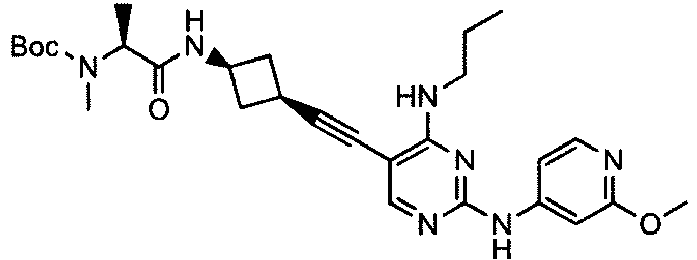
MS m/z (M+H): 538.5 - In the same manner as that of Example 57, (4), Compounds (14-2) to (14-6) were obtained.
[Table 203] Compound No. Structure Physicochemical data 14-2 
1H-NMR (CDCl3) δ: 8.02-7.97 (2H, m), 7.92 (1H, d, J=2.6Hz), 7.41-7.38 (1H, m), 7.12-7.06 (1H, m), 6.93 (1H, dt, J=15.2, 5.9Hz), 6.42 (1H, d, J=15.2Hz), 6.32 (1H, d, J=7.9Hz), 5.69-5.63 (1H, m), 5.15 (1H, q, J=6.8Hz), 3.77-3.68 (1H, m), 3.11 (2H, d, J=5.0Hz), 2.98 (3H, s), 2.65-2.55 (1H, m), 2.33-2.27 (1H, m), 2.28 (6H, s), 2.05-1.94 (1H, m), 1.87-1.78 (2H, m), 1.39-1.25 (1H, m), 1.34 (3H, d, J=7.3Hz), 1.25 (3H, t, J=6.2Hz), 1.15-1.01 (1H, m), 1.00-0.94 (2H, m), 0.70-0.65 (2H, m) 14-3 
1H-NMR (CDCl3) δ: 8.13 (1H, s), 8.01 (1H, d, J=5.9Hz), 7.47 (1H, d, J=2.0Hz), 7.35-7.30 (1H, m), 7.11 (1H, d, J=5.3Hz), 6.92 (1H, dt, J=15.2, 5.9Hz), 6.42 (1H, d, J=15.2Hz), 6.32 (1H, d, J=7.9Hz), 5.15 (1H, q, J=7.0Hz), 4.00-3.93 (4H, m), 3.84-3.78 (4H, m), 3.78-3.66 (1H, m), 3.11 (2H, d, J=5.9Hz), 2.98 (3H, s), 2.65-2.52 (1H, m), 2.30-2.24 (1H, m), 2.28 (6H, s), 2.01-1.92 (1H, m), 1.87-1.77 (2H, m), 1.40-1.04 (4H, m), 1.34 (3H, d, J=7.0Hz) 14-4 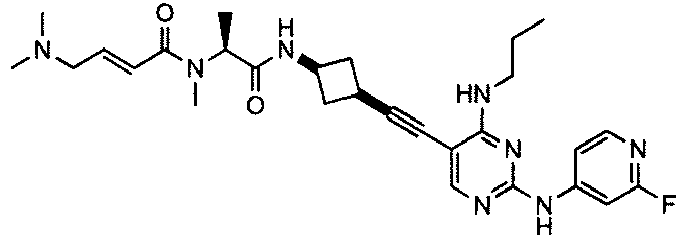
1H-NMR (CDCl3) δ: 8.03 (1H, s), 8.00 (1H, d, J=5.9Hz), 7.63 (1H, d, J=1.3Hz), 7.49-7.46 (1H, m), 7.13-7.09 (1H, m), 6.95 (1H, dt, J=15.2, 5.9Hz), 6.72-6.65 (1H, m), 6.43 (1H, d, J=15.2Hz), 5.67-5.58 (1H, m), 5.15 (1H, q, J=7.0Hz), 4.37-4.20 (1H, m), 3.54-3.45 (2H, m), 3.11 (2H, d, J=5.9Hz), 3.03-2.88 (1H, m), 2.98 (3H, s), 2.86-2.71 (2H, m), 2.28 (6H, s), 2.16-2.01 (2H, m), 1.79-1.68 (2H, m), 1.34 (3H, d, J=6.6Hz), 1.03 (3H, t, J=7.3Hz) 14-5 
1H-NMR (CDCl3) δ: 8.11 (1H, s), 7.68 (2H, d, J=8.6Hz), 7.58 (2H, d, J=8.6Hz), 7.36 (1H, s), 6.93 (1H, dt, J=15.2, 5.9Hz), 6.41 (1H, d, J=15.2Hz), 6.34 (1H, d, J=7.9Hz), 5.15 (1H, q, J=7.0Hz), 4.00-3.88 (4H, m), 3.86-3.64 (5H, m), 3.10 (2H, d, J=5.9Hz), 2.98 (3H, s), 2.66-2.52 (1H, m), 2.32-2.20 (7H, m), 2.02-1.74 (3H, m), 1.45-0.86 (7H, m) [Table 204] Compound No. Structure Physicochemical data 14-6 
1H-NMR (CDCl3) δ: 8.00 (1H, s), 7.98 (1H, d, J=5.9Hz), 7.29 (1H, d, J=2.0Hz), 7.07 (1H, s), 7.01-6.87 (2H, m), 6.67-6.60 (1H, m), 6.43 (1H, d, J=15.2Hz), 5.56 (1H, t, J=6.6Hz), 5.15 (1H, q, J=6.7Hz), 4.36-4.20 (1H, m), 3.93 (3H, s), 3.54-3.44 (2H, m), 3.12 (2H, d, J=5.3Hz), 2.98 (3H, s), 2.85-2.69 (1H, m), 2.28 (6H, s), 2.10 (2H, dt, J=17.8, 9.5Hz), 1.78-1.64 (4H, m), 1.34 (3H, d, J=6.7Hz), 1.03 (3H, t, J=7.3Hz) -

- To a solution of 2,4-dichloro-5-iodopyrimidine (500 mg) in tetrahydrofuran (4 mL) and N,N-dimethylformamide (4 mL), a 5.0 mol/L a solution of sodium methoxide in methanol (360 µL) was added under ice cooling, and the mixture was stirred at the same temperature for 1 hour. To the reaction mixture, water and ethyl acetate were added. The organic layer was separated, washed successively with water and saturated aqueous sodium chloride, and then dried over anhydrous magnesium sulfate to obtain 2-chloro-5-iodo-4-methoxypyrimidine (Q1, 460 mg).
1H-NMR (CDCl3) δ: 8.59 (1H, s), 4.08 (3H, s) -

- To a solution of 2-chloro-5-iodo-4-methoxypyrimidine (Q1, 101 mg), tert-butyl ((1S,3R)-3-ethynylcyclohexyl)carbamate (P0, 100 mg), bis(triphenylphosphine)palladium(II) dichloride (26 mg) and copper(I) iodide (14 mg) in N,N-dimethylformamide (3 mL), triethylamine (258 µL) was added at room temperature, and the mixture was stirred at the same temperature for 1 hour. To the reaction mixture, ethyl acetate and saturated aqueous ammonium chloride were added. The organic layer was separated, washed successively with water and saturated aqueous sodium chloride, and then dried over anhydrous magnesium sulfate, and the solvent was evaporated under reduced pressure. The obtained residue was purified by silica gel column chromatography (eluent, 88 to 50% hexane in ethyl acetate) to obtain tert-butyl ((1S,3R)-3-((2-chloro-4-methoxypyrimidin-5-yl)ethynyl)cyclohexyl)carbamate (Q2, 118 mg).
MS m/z (M+H): 366.2 -

- To a solution of tert-butyl ((1S,3R)-3-((2-chloro-4-methoxypyrimidin-5-yl)ethynyl)cyclohexyl)carbamate (Q2, 118 mg) in 1,4-dioxane (3 mL), a 4.0 mol/L solution of hydrochloric acid in 1,4-dioxane (3 mL) was added at room temperature, and the mixture was stirred at the same temperature for 1 hour. To the reaction mixture, a 4.0 mol/L solution of hydrochloric acid in 1,4-dioxane (3 mL) was added at room temperature, and the mixture was stirred at the same temperature for 50 minutes. The solvent was evaporated under reduced pressure to obtain (1S,3R)-3-((2-chloro-4-methoxypyrimidin-5-yl)ethynyl)cyclohexaneamine (Q3) hydrochloride.
MS m/z (M+H): 266.2 -

- To a solution of N-Boc-N-methyl-L-alanine (195 mg) in N,N-dimethylformamide (2.5 mL), N-methylmorpholine (246 µL) and isobutyl chloroformate (105 µL) were added under ice cooling, and the mixture was stirred at the same temperature for 2 minutes. To the reaction mixture, a solution of (1S,3R)-3-((2-chloro-4-methoxypyrimidin-5-yl)ethynyl)cyclohexaneamine (Q3) hydrochloride in N,N-dimethylformamide (2 mL) was added under ice cooling, and the mixture was stirred at the same temperature for 1 hour and 30 minutes. To the reaction mixture, saturated aqueous sodium hydrogencarbonate and ethyl acetate were added. The organic layer was separated, washed successively with water, saturated aqueous sodium hydrogencarbonate and saturated aqueous sodium chloride, and then dried over anhydrous magnesium sulfate, and the solvent was evaporated under reduced pressure. The obtained residue was purified by silica gel column chromatography (eluent, 88 to 40% hexane in ethyl acetate) to obtain tert-butyl ((S)-1-(((1S,3R)-3-((2-chloro-4-methoxypyrimidin-5-yl)ethynyl)cyclohexyl)amino)-1-oxopropan-2-yl)(methyl)carbamate (Q4, 120 mg).
MS m/z (M+H): 451.3 -

- To a solution of tert-butyl ((S)-1-(((1S,3R)-3-((2-chloro-4-methoxypyrimidin-5-yl)ethynyl)cyclohexyl)amino)-1-oxopropan-2-yl)(methyl)carbamate (Q4, 32 mg) in N-methylpyrrolidone (0.5 mL), 4-aminobenzonitrile (42 mg) and (1S)-(+)-10-camphorsulfonic acid (81 mg) were added at room temperature, and the mixture was stirred at 60°C for 7 hours and 30 minutes. The reaction mixture was cooled to room temperature, and then saturated aqueous sodium hydrogencarbonate and ethyl acetate were added to the reaction mixture. The organic layer was separated, washed successively with saturated aqueous sodium hydrogencarbonate, water and saturated aqueous sodium chloride, and then dried over anhydrous magnesium sulfate, and the solvent was evaporated under reduced pressure. The obtained residue was purified by silica gel column chromatography (eluent, 88 to 25% hexane in ethyl acetate) to obtain tert-butyl ((S)-1-(((1S,3R)-3-((2-((4-cyanophenyl)amino)-4-methoxypyrimidin-5-yl)ethynyl)cyclohexyl)amino)-1-oxopropan-2-yl)(methyl)carbamate (Q5, 11 mg).
MS m/z (M+H): 533.4 -

- In the same manner as that of Example 35, (6) and (7), (E)-N-((S)-1-(((1S,3R)-3-((2-((4-cyanophenyl)amino)-4-methoxypyrimidin-5-yl)ethynyl)cyclohexyl)amino)-1-oxopropan-2-yl)-4-(dimethylamino)-N-methyl-2-butenamide (15-1) was obtained from tert-butyl ((S)-1-(((1S,3R)-3-((2-((4-cyanophenyl)amino)-4-methoxypyrimidin-5-yl)ethynyl)cyclohexyl)amino)-1-oxopropan-2-yl)(methyl)carbamate (Q5).
1H-NMR (CDCl3) δ: 8.22 (1H, s), 7.76 (2H, d, J=9.2Hz), 7.61 (2H, d, J=9.2Hz), 6.92 (1H, dt, J=15.2, 5.9Hz), 6.42 (1H, d, J=15.2Hz), 6.30-6.24 (1H, m), 5.15 (1H, q, J=6.6Hz), 4.05 (3H, s), 3.82-3.65 (1H, m), 3.13 (2H, d, J=5.9Hz), 2.97 (3H, s), 2.67-2.58 (1H, m), 2.34-2.28 (1H, m), 2.29 (6H, s), 2.02-1.75 (4H, m), 1.42-1.31 (2H, m), 1.33 (3H, d, J=6.6Hz), 1.21-1.01 (1H, m) -

- 2-Chloro-5-iodo-N-methylpyrimidin-4-amine (Q6) was obtained in the same manner as that of Example 35, (1).
MS m/z (M+H): 270.0 - In the same manner as that of Example 59, (2), Intermediates (Q7), (Q8), (Q25) and (Q26) were obtained.
[Table 205] Compound No. Structure Physicochemical data Q7 
- Q8 
MS m/z (M+H): 363.2 Q25 
MS m/z (M+H): 383.2 Q26 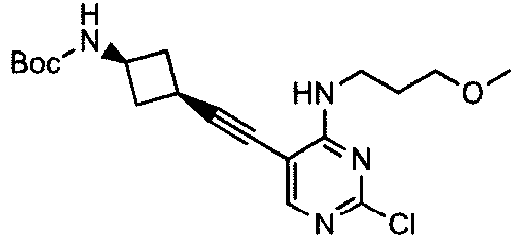
MS m/z (M+H): 395.3 - In the same manner as that of Example 59, (3), Intermediates (Q9), (Q10), (Q27) and (Q28) were obtained.
[Table 206] Compound No. Structure Physicochemical data Q9 
- Q10 
MS m/z (M+H): 263.1 Q27 
MS m/z (M+H): 283.2 Q28 
MS m/z (M+H): 295.2 - In the same manner as that of Example 59, (4), Intermediates (Q11) to (Q13), (Q29) and (Q30) were obtained.
[Table 207] Compound No. Structure Physicochemical data Q11 
- Q12 
MS m/z (M+H): 448.3 Q13 
- Q29 
MS m/z (M+H): 468.3 Q30 
MS m/z (M+H): 480.3 - In the same manner as that of Example 59, (5), Intermediates (Q14) to (Q24) and Intermediates (Q31) to (Q34) were obtained.
[Table 208] Compound No. Structure Physicochemical data Q14 
- Q15 
- Q16 
- Q17 
- Q18 
- Q19 
- Q20 
- Q21 
MS m/z (M+H): 523.4 Q22 
- [Table 209] Compound No. Structure Physicochemical data Q23 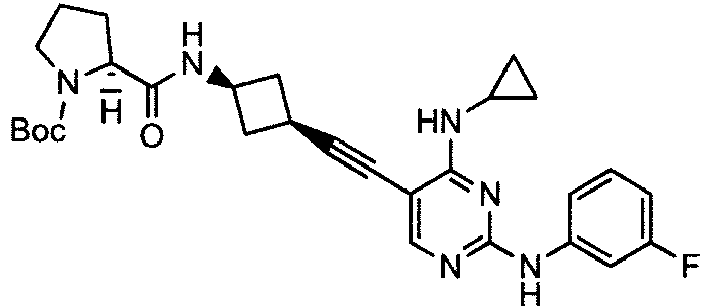
- Q24 
- Q31 
MS m/z (M+H): 543.4 Q32 
MS m/z (M+H): 550.4 Q33 
MS m/z (M+H): 555.4 Q34 
MS m/z (M+H): 562.4 - In the same manner as that of Example 59, (6), Compounds (15-2) to (15-16) were obtained.
[Table 210] Compound No. Structure Physicochemical data 15-2 
1H-NMR (CDCl3) δ: 8.38 (1H, s), 8.21-8.13 (1H, m), 8.20 (1H, s), 7.12-7.03 (1H, m), 6.98-6.86 (2H, m), 6.42 (1H, d, J=15.2Hz), 6.30-6.23 (1H, m), 5.15 (1H, q, J=7.3Hz), 4.00 (3H, s), 3.80-3.66 (1H, m), 3.11 (2H, d, J=5.9Hz), 2.97 (3H, s), 2.69-2.55 (1H, m), 2.33-2.26 (1H, m), 2.28 (6H, s), 2.05-1.95 (1H, m), 1.88-1.75 (2H, m), 1.63-1.30 (3H, m), 1.33 (3H, d, J=7.3Hz), 1.14-1.02 (1H, m) 15-3 
1H-NMR (CDCl3) δ: 8.40 (1H, s), 8.23-8.15 (1H, m), 7.95 (1H, s), 7.08-7.00 (1H, m), 6.98-6.89 (1H, m), 6.89 (1H, dd, J=8.9,3.6Hz), 6.42 (1H, d, J=15.2Hz), 6.35-6.29 (1H, m), 5.47-5.39 (1H, m), 5.15 (1H, q, J=7.3Hz), 3.80-3.65 (1H, m), 3.11 (2H, d, J=5.9Hz), 3.05 (3H, d, J=4.6Hz), 2.98 (3H, s), 2.66-2.55 (1H, m), 2.35-2.31 (1H, m), 2.28 (6H, s), 2.08-1.95 (1H, m), 1.90-1.60 (2H, m), 1.40-1.34 (3H, m), 1.34 (3H, d, J=7.3Hz), 1.16-1.04 (1H, m) 15-4 
1H-NMR (CDCl3) δ: 8.21 (1H, s), 7.70 (1H, d, J=11.2Hz), 7.28-7.21 (1H, m), 7.16-7.10 (2H, m), 6.92 (1H, dt, J=15.2, 5.9Hz), 6.77-6.69 (1H, m), 6.42 (1H, d, J=15.2Hz), 6.29-6.22 (1H, m), 5.15 (1H, q, J=7.3Hz), 4.04 (3H, s), 3.82-3.65 (1H, m), 3.11 (2H, d, J=5.9Hz), 2.97 (3H, s), 2.66-2.58 (1H, m), 2.33-2.27 (1H, m), 2.28 (6H, s), 2.06-1.95 (1H, m), 1.90-1.75 (2H, m), 1.39-1.30 (3H, m), 1.33 (3H, d, J=7.3Hz), 1.14-1.02 (1H, m) 15-5 
1H-NMR (CDCl3) δ: 7.98 (1H, s), 7.77 (2H, d, J=8.6Hz), 7.57 (2H, d, J=8.6Hz), 7.28-7.21 (1H, m), 6.93 (1H, dt, J=15.2, 5.9Hz), 6.42 (1H, d, J=15.2Hz), 6.32 (1H, d, J=7.9Hz), 5.52-5.42 (1H, m), 5.15 (1H, q, J=7.3Hz), 3.79-3.67 (1H, m), 3.12 (3H, s), 3.09 (2H, d, J=5.9Hz), 2.98 (3H, s), 2.66-2.58 (1H, m), 2.37-2.25 (1H, m), 2.28 (6H, s), 2.08-1.96 (1H, m), 1.88-1.77 (2H, m), 1.50-1.25 (3H, m), 1.34 (3H, d, J=8.3Hz), 1.16-1.04 (1H, m) [Table 211] Compound No. Structure Physicochemical data 15-6 
1H-NMR (CDCl3) δ: 7.97 (1H, s), 7.79 (1 H, dt, J=12.6, 2.0Hz), 7.26-7.18 (1H, m), 7.14-7.09 (1H, m), 7.09-7.03 (1H, m), 6.93 (1H, dt, J=15.2, 5.9Hz), 6.68 (1H, td, J=8.1, 2.2Hz), 6.42 (1H, d, J=15.2Hz), 6.30 (1H, d, J=7.9Hz), 5.45-5.37 (1H, m), 5.15 (1H, q, J=7.0Hz), 3.78-3.68 (1H, m), 3.12 (3H, s), 3.10 (2H, d, J=5.9Hz), 2.98 (3H, s), 2.66-2.55 (1H, m), 2.34-2.27 (1H, m), 2.28 (6H, s), 2.05-1.97 (1H, m), 1.92-1.57 (3H, m), 1.50-1.20 (2H, m), 1.34 (3H, d, J=7.3Hz), 1.19-1.01 (1H, m) 15-7 
1H-NMR (CDCl3) δ: 8.11 (1H, d, J=9.9Hz), 8.01 (1H, s), 7.26-7.16 (1H, m), 7.16-7.12 (1H, m), 7.10-7.04 (1H, m), 6.96 (1H, dt, J=15.2, 5.9Hz), 6.68 (1H, td, J=7.9, 2.0Hz), 6.64-6.58 (1H, m), 6.43 (1H, d, J=15.2Hz), 5.62-5.58 (1H, m), 5.15 (1H, q, J=7.0Hz), 4.35-4.20 (1H, m), 3.11 (2H, d, J=5.9Hz), 2.98-2.88 (1H, m), 2.98 (3H, s), 2.90-2.80 (1H, m), 2.81-2.70 (2H, m), 2.28 (6H, s), 2.13-1.97 (2H, m), 1.34 (3H, d, J=7.0Hz), 0.98-0.92 (2H, m), 0.70-0.64 (2H, m) 15-8 
1H-NMR (CDCl3) δ: 8.03 (1H, s), 7.87 (2H, d, J=9.2Hz), 7.57 (2H, d, J=9.2Hz), 7.32-7.29 (1H, m), 6.95 (1H, dt, J=15.2, 5.9Hz), 6.67-6.61 (1H, m), 6.43 (1H, d, J=15.2Hz), 5.66-5.61 (1H, m), 5.15 (1H, q, J=7.0Hz), 4.35-4.20 (1H, m), 3.11 (2H, d, J=5.9Hz), 2.98-2.88 (1H, m), 2.98 (3H, s), 2.87-2.79 (1H, m), 2.82-2.70 (2H, m), 2.28 (6H, s), 2.13-1.99 (2H, m), 1.34 (3H, d, J=7.0Hz), 0.95-0.89 (2H, m), 0.71-0.64 (2H, m) 15-9 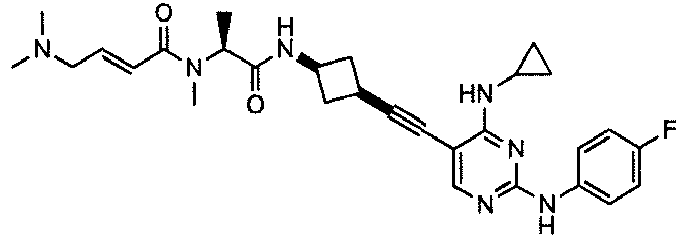
1H-NMR (CDCl3) δ: 7.99 (1H, s), 7.70-7.63 (2H, m), 7.03-6.95 (2H, m), 6.99-6.94 (1H, m), 6.98-6.89 (1H, m), 6.63-6.58 (1H, m), 6.43 (1H, d, J=15.2Hz), 5.57-5.51 (1H, m), 5.15 (1H, q, J=7.0Hz), 4.35-4.20 (1H, m), 3.11 (2H, d, J=5.9Hz), 3.01-2.85 (1H, m), 2.97 (3H, s), 2.86-2.78 (1H, m), 2.82-2.70 (2H, m), 2.28 (6H, s), 2.14-1.95 (2H, m), 1.33 (3H, d, J=7.3Hz), 0.91-0.84 (2H, m), 0.67-0.62 (2H, m) [Table 212] Compound No. Structure Physicochemical data 15-10 
1H-NMR (CDCl3) δ: 8.05 (1H, d, J=14.2Hz), 7.98 (1H, s), 7.07-7.01 (1H, m), 7.00-6.97 (1H, m), 7.00-6.91 (1H, m), 6.93-6.85 (1H, m), 6.64-6.57 (1H, m), 6.43 (1H, d, J=15.2Hz), 5.58-5.55 (1H, m), 5.15 (1H, q, J=6.8Hz), 4.35-4.20 (1H, m), 3.87 (3H, s), 3.11 (2H, d, J=5.9Hz), 2.99-2.88 (1H, m), 2.98 (3H, s), 2.87-2.77 (1H, m), 2.84-2.69 (2H, m), 2.28 (6H, s), 2.13-1.97 (2H, m), 1.33 (3H, d, J=7.3Hz), 0.96-0.90 (2H, m), 0.68-0.63 (2H, m) 15-11 
1H-NMR (CDCl3) δ: 8.11 (1H, d, J=12.6Hz), 8.01 (1H, s), 7.68-7.60 (1H, m), 7.25-7.16 (1H, m), 7.17-7.13 (1H, m), 7.10-7.05 (1H, m), 6.98 (1H, dt, J=15.2, 5.9Hz), 6.71-6.64 (1H, m), 6.33 (1H, d, J=15.2Hz), 5.63-5.59 (1H, m), 4.64 (1H, d, J=5.9Hz), 4.34-4.20 (1H, m), 3.72-3.63 (1H, m), 3.57-3.47 (1H, m), 3.11 (2H, d, J=5.9Hz), 2.97-2.85 (1H, m), 2.88-2.80 (1H, m), 2.80-2.68 (2H, m), 2.53-2.45 (1H, m), 2.27 (6H, s), 2.17-2.02 (2H, m), 2.10-1.96 (2H, m), 1.84-1.72 (1H, m), 0.96-0.93 (2H, m), 0.70-0.65 (2H, m) 15-12 
1H-NMR (CDCl3) δ: 8.03 (1H, s), 7.88 (2H, d, J=8.6Hz), 7.70-7.65 (1H, m), 7.57 (2H, d, J=8.6Hz), 7.38-7.35 (1H, m), 6.97 (1H, dt, J=15.2, 5.9Hz), 6.33 (1H, d, J=15.2Hz), 5.67-5.64 (1H, m), 4.64 (1H, d, J=6.6Hz), 4.33-4.21 (1H, m), 3.72-3.62 (1H, m), 3.56-3.48 (1H, m), 3.11 (2H, d, J=5.9Hz), 2.97-2.86 (1H, m), 2.87-2.79 (1H, m), 2.83-2.69 (2H, m), 2.53-2.45 (1H, m), 2.27 (6H, s), 2.17-2.04 (2H, m), 2.07-1.95 (2H, m), 1.86-1.71 (1H, m), 0.95-0.88 (2H, m), 0.70-0.66 (2H, m) [Table 213] Compound No. Structure Physicochemical data 15-13 
1H-NMR (CDCl3) δ: 8.00 (1H, s), 7.79-7.71 (1H, m), 7.26-7.18 (1H, m), 7.12-7.07 (1H, m), 7.05-7.02 (1 H, m), 6.95 (1 H, dt, J=15.2, 5.9Hz), 6.69 (1H, td, J=8.3, 2.0Hz), 6.64-6.57 (1H, m), 6.43 (1H, d, J=15.2Hz), 5.79-5.71 (1H, m), 5.16 (1H, q, J=7.3Hz), 4.64 (2H, dt, J=46.9, 5.2Hz), 4.33-4.23 (1H, m), 3.75-3.66 (2H, m), 3.11 (2H, d, J=5.9Hz), 2.98 (3H, s), 2.97-2.88 (1H, m), 2.82-2.72 (2H, m), 2.28 (6H, s), 2.19-2.10 (2H, m), 2.10-2.02 (2H, m), 1.33 (3H, d, J=7.3Hz) 15-14 
1H-NMR (CDCl3) δ: 8.02 (1H, s), 7.75 (2H, d, J=9.0Hz), 7.58 (2H, d, J=9.0Hz), 7.24-7.21 (1H, m), 6.94 (1H, dt, J=15.2, 5.9Hz), 6.65-6.61 (1H, m), 6.43 (1H, d, J=15.2Hz), 5.83-5.77 (1H, m), 5.15 (1H, q, J=7.3Hz), 4.64 (2H, dt, J=47.6, 5.3Hz), 4.34-4.22 (1H, m), 3.74-3.68 (2H, m), 3.11 (2H, d, J=5.9Hz), 2.98 (3H, s), 2.97-2.89 (1H, m), 2.82-2.73 (2H, m), 2.28 (6H, s), 2.17-2.10 (2H, m), 2.10-2.01 (2H, m), 1.34 (3H, d, J=7.3Hz) 15-15 
1H-NMR (CDCl3) δ: 7.99 (1H, s), 7.81-7.74 (1H, m), 7.25-7.17 (1H, m), 7.11-7.07 (1H, m), 7.06-7.03 (1H, m), 6.95 (1H, dt, J=15.2, 5.9Hz), 6.68 (1H, td, J=8.4, 2.2Hz), 6.67-6.60 (1H, m), 6.43 (1H, d, J=15.2Hz), 6.01-5.95 (1H, m), 5.16 (1H, q, J=6.9Hz), 4.32-4.23 (1H, m), 3.67-3.59 (2H, m), 3.55 (2H, t, J=5.6Hz), 3.36 (3H, s), 3.11 (2H, d, J=5.9Hz), 2.98-2.89 (1H, m), 2.98 (3H, s), 2.81-2.73 (2H, m), 2.28 (6H, s), 2.15-2.02 (2H, m), 1.99-1.91 (2H, m), 1.33 (3H, d, J=6.9Hz) 15-16 
1H-NMR (CDCl3) δ: 8.01 (1H, s), 7.75 (2H, d, J=8.6Hz), 7.57 (2H, d, J=8.6Hz), 7.25-7.21 (1H, m), 6.95 (1H, dt, J=15.2, 5.9Hz), 6.67-6.62 (1H, m), 6.43 (1H, d, J=15.2Hz), 6.09-6.04 (1H, m), 5.15 (1H, q, J=6.8Hz), 4.32-4.24 (1H, m), 3.67-3.58 (2H, m), 3.55 (2H, t, J=5.6Hz), 3.37 (3H, s), 3.11 (2H, d, J=5.9Hz), 2.98 (3H, s), 2.98-2.89 (1H, m), 2.81-2.73 (2H, m), 2.28 (6H, s), 2.16-2.04 (2H, m), 1.98-1.90 (2H, m), 1.33 (3H, d, J=6.8Hz) -

- To a solution of N-Boc-glycine (175 mg) in tetrahydrofuran (1 mL), N-methylmorpholine (165 µL) and isobutyl chloroformate (131 µL) were added under ice cooling, and the mixture was stirred at the same temperature for 40 minutes. To the reaction mixture, 3-bromophenethylamine (100 µL) was added under ice cooling, and the mixture was stirred at room temperature for 5 hours. To the reaction mixture, saturated aqueous sodium hydrogencarbonate and ethyl acetate were added. The organic layer was separated, and dried over anhydrous sodium sulfate, and the solvent was evaporated under reduced pressure to obtain tert-butyl (2-((3-bromophenethyl)amino)-2-oxoethyl)carbamate (R1, 290 mg).
MS m/z (M+H): 357.1 -

- To a solution of tert-butyl (2-((3-bromophenethyl)amino)-2-oxoethyl)carbamate (R1, 290 mg) in dimethyl sulfoxide (40 mL), bis(pinacolato)diboron (618 mg), 1,1'-bis(diphenylphosphino)ferrocene-palladium(II) dichloride-dichloromethane complex (99 mg) and potassium acetate (478 mg) were added at room temperature, and the mixture was stirred at 80°C for 14 hours. The reaction mixture was cooled to room temperature, and then saturated aqueous sodium hydrogencarbonate and ethyl acetate were added to the reaction mixture. The organic layer was separated, and dried over anhydrous sodium sulfate, and the solvent was evaporated under reduced pressure to obtain tert-butyl (2-oxo-2-((3-(4,4,5,5-tetramethyl-1,3,2-dioxaborolan-2-yl)phenethyl)amino)ethyl)carbamate (R2).
-


- To a solution of 4-((5-iodo-4-(propylamino)pyrimidin-2-yl)amino)benzamide (F23, 55 mg) and tert-butyl (2-oxo-2-((3-(4,4,5,5-tetramethyl-1,3,2-dioxaborolan-2-yl)phenethyl)amino)ethyl)carbamate (R2) obtained above in dimethoxyethane and water (5/1, 1 mL), bis(di-tert-butyl(4-dimethylaminophenyl)phosphine)dichloropalladium(II) (10 mg) and sodium carbonate (44 mg) were added at room temperature, and the mixture was stirred at 80°C for 4 hours and 40 minutes. The reaction mixture was cooled to room temperature, and then saturated aqueous sodium hydrogencarbonate and ethyl acetate were added to the reaction mixture. The organic layer was separated, and dried over anhydrous sodium sulfate, and the solvent was evaporated under reduced pressure. The obtained residue was purified by basic silica gel column chromatography (eluent, 91% chloroform/9% methanol) to obtain tert-butyl (2-((3-(2-((4-carbamoylphenyl)amino)-4-(propylamino)pyrimidin-5-yl)phenethyl)amino)-2-oxoethyl)carbamate (R3, 123 mg).
-

- In the same manner as that of Example 35, (6) and (7), (E)-4-((5-(3-(2-(2-(4-(dimethylamino)-2-butenamido)actamido)ethyl)phenyl)-4-(propylamino)pyrimidin-2-yl)amino)benzamide (16-1) was obtained from tert-butyl (2-((3-(2-((4-carbamoylphenyl)amino)-4-(propylamino)pyrimidin-5-yl)phenethyl)amino)-2-oxoethyl)carbamate (R3).
1H-NMR (CD3OD) δ: 7.86-7.82 (4H, m), 7.71 (1H, s), 7.39 (1H, t, J=7.6Hz), 7.27-7.20 (3H, m), 6.75-6.68 (1H, m), 6.11 (1H, d, J=15.2Hz), 3.83 (2H, s), 3.59-3.37 (4H, m), 3.13 (2H, t, J=6.6Hz), 2.85 (2H, t, J=6.9Hz), 2.26 (6H, s), 1.69-1.65 (2H, m), 0.98 (3H, t, J=7.3Hz) -

- To a solution of N-Boc-glycine (325 mg) in tetrahydrofuran (3 mL), N-methylmorpholine (1.0 mL) and isobutyl chloroformate (244 µL) were added under ice cooling, and the mixture was stirred at the same temperature for 30 minutes. To the reaction mixture, 4-iodobenzylamine hydrochloride (250 mg) was added under ice cooling, and the mixture was stirred at the same temperature for 1 hour and 30 minutes. To the reaction mixture, saturated aqueous sodium hydrogencarbonate and ethyl acetate were added. The organic layer was separated, and dried over anhydrous sodium sulfate, and the solvent was evaporated under reduced pressure to obtain tert-butyl (2-((4-iodobenzyl)amino)-2-oxoethyl)carbamate (R4, 430 mg).
MS m/z (M+H): 391.1 -
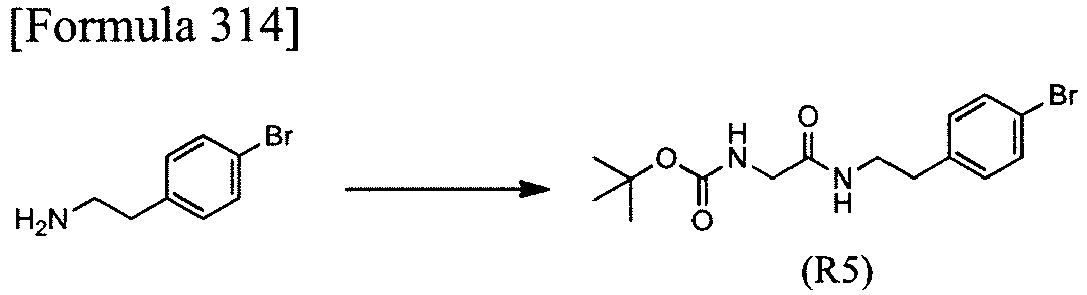
- To a solution of N-Boc-glycine (175 mg) in tetrahydrofuran (2 mL), N-methylmorpholine (165 µL) and isobutyl chloroformate (131 µL) were added under ice cooling, and the mixture was stirred at the same temperature for 40 minutes. To the reaction mixture, 2-(4-bromophenyl)ethylamine (100 µL) was added under ice cooling, and the mixture was stirred at room temperature for 5 hours. To the reaction mixture, saturated aqueous sodium hydrogencarbonate and ethyl acetate were added. The organic layer was separated, and dried over anhydrous sodium sulfate, and the solvent was evaporated under reduced pressure to obtain tert-butyl (2-((4-bromophenethyl)amino)-2-oxoethyl)carbamate (R5).
- By using Intermediates (R4) and (R5), Intermediates (R6) and (R7) were obtained in the same manner as that of Example 61, (2).
[Table 214] Compound No. Structure Physicochemical data R6 
- R7 
- - By using Intermediates (R6) and (R7), Intermediates (R8) and (R9) were obtained in the same manner as that of Example 61, (3).
[Table 215] Compound No. Structure Physicochemical data R8 
MS m/z (M+H): 534.3 R9 
- - By using Intermediates (R8) and (R9), Compounds (16-2) and (16-3) were obtained in the same manner as that of Example 61, (4).
[Table 216] Compound No. Structure Physicochemical data 16-2 
1H-NMR (CD3OD) δ: 7.84 (4H, s), 7.68 (1H, s), 7.40-7.33 (4H, m), 6.80 (1H, dt, J=15.2, 6.6Hz), 6.16 (1H, d, J=15.2Hz), 4.44 (2H, s), 3.97 (2H, s), 3.43 (2H, t, J=7.3Hz), 3.14 (2H, d, J=6.6Hz), 2.27 (6H, s), 1.68-1.63 (2H, m), 0.97 (3H, t, J=7.6Hz) 16-3 
1H-NMR (CD3OD) δ: 7.84 (4H, s), 7.68 (1H, s), 7.34-7.28 (4H, m), 6.78-6.73 (1H, m), 6.13 (1H, d, J=15.2Hz), 3.87 (2H, s), 3.73-3.54 (2H, m), 3.49-3.39 (2H, m), 3.12-3.08 (2H, m), 2.90-2.82 (2H, m), 2.25 (6H, s), 1.68-1.63 (2H, m), 0.97 (3H, t, J=7.6Hz) -

- To a solution of N2-(3-fluorophenyl)-5-iodo-N4-propylpyrimidine-2,4-diamine (F2, 500 mg), bis(triphenylphosphine)palladium(II) dichloride (94 mg) and copper(I) iodide (51 mg) in N,N-dimethylformamide (10 mL), triethylamine (934 µL) and trimethylsilylacetylene (285 µL) were added at room temperature, and the mixture was stirred at the same temperature for 1 hour. To the reaction mixture, ethyl acetate and saturated aqueous ammonium chloride were added. The organic layer was separated, washed successively with saturated aqueous ammonium chloride, water and saturated aqueous sodium chloride, and then dried over anhydrous magnesium sulfate, and the solvent was evaporated under reduced pressure. The obtained residue was purified by silica gel column chromatography (eluent, 95 to 85% hexane in ethyl acetate) to obtain N2-(3-fluorophenyl)-N4-propyl-5-((trimethylsilyl)ethynyl)pyrimidine-2,4-diamine (S1, 509 mg).
MS m/z (M+H): 343.2 -

- To a solution of N2-(3-fluorophenyl)-N4-propyl-5-((trimethylsilyl)ethynyl)pyrimidine-2,4-diamine (S1, 509 mg) in methanol (10 mL) and tetrahydrofuran (10 mL), potassium carbonate (246 mg) was added at room temperature, and the mixture was stirred at the same temperature for 30 minutes. To the reaction mixture, ethyl acetate and saturated aqueous ammonium chloride were added. The organic layer was separated, washed successively with saturated aqueous ammonium chloride and saturated aqueous sodium chloride, and then dried over anhydrous magnesium sulfate, and the solvent was evaporated under reduced pressure. The obtained residue was purified by silica gel column chromatography (eluent, 94 to 60% hexane in ethyl acetate) to obtain 5-ethynyl-N2-(3-fluorophenyl)-N4-propylpyrimidine-2,4-diamine (S2, 226 mg).
MS m/z (M+H): 271.2 -

- To a solution of 5-ethynyl-N2-(3-fluorophenyl)-N4-propylpyrimidine-2,4-diamine (S2, 30 mg) and tert-butyldimethyl(3-nitropropyloxy)silane (S3, 146 mg) synthesized according to the method described in Journal of Medicinal Chemistry, 2011, 54, pp.7280-7288 in toluene (1 mL), phenyl isocyanate (36 µL) and triethylamine (46 µL) were added at room temperature, and the mixture was stirred at 60°C for 4 hours and 40 minutes. To the reaction mixture, phenyl isocyanate (36 µL) and triethylamine (46 µL) were added, and the mixture was further stirred at 60°C for 6 hours. The reaction mixture was cooled to room temperature, and then water and ethyl acetate were added to the reaction mixture. The organic layer was separated, and dried over anhydrous magnesium sulfate, and the solvent was evaporated under reduced pressure to obtain 5-(3-(2-((tertbutyldimethylsilyl)oxy)ethyl)isoxazol-5-yl)-N2-(3-fluorophenyl)-N4-propylpyrimidine-2,4-diamine (S4, 22 mg).
MS m/z (M+H): 472.3 -

- To a solution of 5-(3-(2-((tert-butyldimethylsilyl)oxy)ethyl)isoxazol-5-yl)-N2-(3-fluorophenyl)-N4-propylpyrimidine-2,4-diamine (S4, 22 mg) in tetrahydrofuran (1 mL), a 1.0 mol/L solution of tetrabutylammonium fluoride in tetrahydrofuran (69 µL) was added under ice cooling, and the mixture was stirred at room temperature for 3 hours. To the reaction mixture, saturated aqueous sodium hydrogencarbonate and ethyl acetate were added. The organic layer was separated, washed successively with water and saturated aqueous sodium chloride, and then dried over anhydrous magnesium sulfate, and the solvent was evaporated under reduced pressure. The obtained residue was purified by silica gel column chromatography (eluent, 70 to 5% hexane in ethyl acetate) to obtain 2-(5-(2-((3-fluorophenyl)amino)-4-(propylamino)pyrimidin-5-yl)isoxazol-3-yl)ethanol (S5, 5.3 mg) as white solid.
MS m/z (M+H): 358.2 -


- To a solution of 2-(5-(2-((3-fluorophenyl)amino)-4-(propylamino)pyrimidin-5-yl)isoxazol-3-yl)ethanol (S5, 5.3 mg), phthalimide (10.9 mg) and triphenylphosphine (19.4 mg) in tetrahydrofuran (1 mL), a 1.9 mol/L solution of diisopropyl azodicarboxylate in toluene (39 µL) was added under ice cooling, and the mixture was stirred at the same temperature for 35 minutes, and then stirred at room temperature for 2 hours and 30 minutes. The solvent was evaporated under reduced pressure, and the obtained residue was purified by silica gel column chromatography (eluent, 84 to 35% hexane in ethyl acetate) to obtain 2-(2-(5-(2-((3-fluorophenyl)amino)-4-(propylamino)pyrimidin-5-yl)isoxazol-3-yl)ethyl)isoindoline-1,3-dione (S6, 8.9 mg) as white solid.
MS m/z (M+H): 487.3 -

- In the same manner as that of Example 35, (4) to (7), (S,E)-4-(dimethylamino)-N-(1-((2-(5-(2-((3-fluorophenyl)amino)-4-(propylamino)pyrimidin-5-yl)isoxazol-3-yl)ethyl)amino)-1-oxopropan-2-yl)-N-methyl-2-butenamide (17-1) was obtained from 2-(2-(5-(2-((3-fluorophenyl)amino)-4-(propylamino)pyrimidin-5-yl)isoxazol-3-yl)ethyl)isoindoline-1,3-dione (S6).
1H-NMR (CDCl3) δ: 8.26 (1H, s), 7.82 (1H, d, J=11.9Hz), 7.29-7.20 (1H, m), 7.22-7.18 (1H, m), 7.16-7.10 (1H, m), 6.89 (1H, dt, J=15.2, 5.9Hz), 6.76-6.67 (1H, m), 6.72-6.64 (1H, m), 6.61-6.56 (1H, m), 6.39 (1H, d, J=15.2Hz), 6.26 (1H, s), 5.15 (1H, q, J=7.0Hz), 3.71-3.57 (2H, m), 3.60-3.50 (2H, m), 3.07 (2H, d, J=5.9Hz), 2.94 (3H, s), 2.90 (2H, t, J=6.6Hz), 2.26 (6H, s), 1.80-1.69 (2H, m), 1.34 (3H, d, J=7.3Hz), 1.04 (3H, t, J=7.6Hz) -

- To 5-ethynyl-N2-(3-fluorophenyl)-N4-propylpyrimidine-2,4-diamine (S2, 62.4 mg) and tert-butyl (2-azidoethyl)carbamate (S18, 51.6 mg), tert-butanol (0.6 mL), water (0.6 mL), N,N-dimethylformamide (1.2 mL), sodium ascorbate (9.15 mg) and copper sulfate (3.69 mg) were added at room temperature, and the mixture was stirred at the same temperature for 12 hours. To the reaction mixture, ethyl acetate and water were added. The organic layer was separated, washed successively with water and saturated aqueous sodium chloride, and then dried over anhydrous sodium sulfate, and the solvent was evaporated under reduced pressure to obtain tert-butyl (2-(4-(2-((3-fluorophenyl)amino)-4-(propylamino)pyrimidin-5-yl)-1H-1,2,3-triazol-1-yl)ethyl)carbamate (S19, 32.5 mg).
MS m/z (M+H): 457.4 -


- By using tert-butyl (2-(4-(2-((3-fluorophenyl)amino)-4-(propylamino)pyrimidin-5-yl)-1H-1,2,3-triazol-1-yl)ethyl)carbamate (S19), (S,E)-4-(dimethylamino)-N-(1-((2-(4-(2-((3-fluorophenyl)amino)-4-(propylamino)pyrimidin-5-yl)-1H-1,2,3-triazol-1-yl)ethyl)amino)-1-oxopropan-2-yl)-N-methyl-2-butenamide (17-2) was obtained in the same manner as that of Example 54, (4) to (6) and Example 54, (8).
1H-NMR (CDCl3) δ: 8.55-8.45 (1H, m), 8.18 (1H, s), 7.87 (1H, dt, J=11.9, 2.3Hz), 7.82 (1H, s), 7.29-7.04 (3H, m), 6.87 (1H, dt, J=15.2, 5.9Hz), 6.81-6.72 (1H, m), 6.68 (1H, dt, J=8.1, 2.3Hz), 6.35 (1H, d, J=15.2Hz), 5.05 (1H, q, J=7.3Hz), 4.64-4.46 (2H, m), 3.92-3.76 (1H, m), 3.76-3.52 (3H, m), 3.04 (2H, d, J=5.9Hz), 2.94 (3H, s), 2.22 (6H, s), 1.85-1.70 (2H, m), 1.35 (3H, d, J=7.3Hz), 1.06 (3H, t, J=7.6Hz) -

- To a solution of 4-chloro-2-(methylthio)pyrimidine-5-carboxylic acid ethyl ester (5.0 g) in tetrahydrofuran (50 mL) and N,N-dimethylformamide (5 mL), benzyl alcohol (2.66 mL) and sodium hydride (60% wt, 946 mg) were added under ice cooling, and the mixture was stirred at the same temperature for 2 hours. To the reaction mixture, saturated aqueous sodium hydrogencarbonate and ethyl acetate were added. The organic layer was separated, washed successively with water and saturated aqueous sodium chloride, and then dried over anhydrous sodium sulfate, and the solvent was evaporated under reduced pressure. The obtained residue was purified by silica gel column chromatography to obtain oily ethyl 4-(benzyloxy)-2-(methylthio)pyrimidine-5-carboxylate (S25, 5.37 g).
MS m/z (M+H): 305.2 -

- To a solution of ethyl 4-(benzyloxy)-2-(methylthio)pyrimidine-5-carboxylate (S25, 3.02 g) in tetrahydrofuran (50 mL), lithium aluminum hydride (1.51 g) was added portionwise under ice cooling, and the mixture was stirred at the same temperature for 45 minutes. To the reaction mixture, saturated aqueous sodium hydrogencarbonate (300 mL) and ethyl acetate (200 mL) were added. The insoluble matter was removed by filtration through Cerite. The organic layer was separated, washed successively with water and saturated aqueous sodium chloride, and then dried over anhydrous sodium sulfate, and the solvent was evaporated under reduced pressure. The obtained residue was purified by silica gel column chromatography (eluent, 70 to 30% hexane in ethyl acetate) to obtain oily (4-(benzyloxy)-2-(methylthio)pyrimidin-5-yl)methanol (S26, 818 mg).
MS m/z (M+H): 263.2 -

- To a solution of (4-(benzyloxy)-2-(methylthio)pyrimidin-5-yl)methanol (S26, 818 mg) in toluene (30 mL), manganese dioxide (8.13 g) was added at room temperature, and the mixture was stirred at 50°C for 1 hour. The reaction mixture was cooled to room temperature, and then the insoluble matter was removed by filtration through Cerite. The solvent was evaporated under reduced pressure to obtain oily 4-(benzyloxy)-2-(methylthio)pyrimidine-5-carbaldehyde (S20, 666 mg).
MS m/z (M+H): 261.2 -
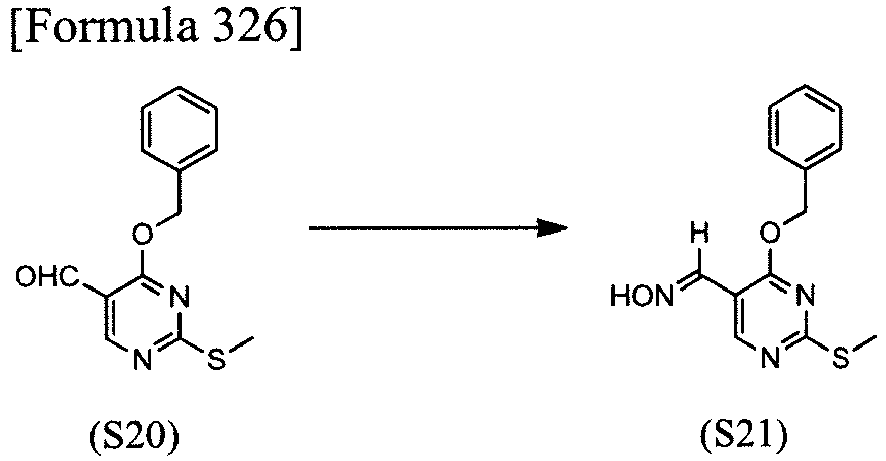
- To a solution of 4-(benzyloxy)-2-(methylthio)pyrimidine-5-carbaldehyde (S20, 223 mg) in pyridine (4.0 mL), hydroxylamine hydrochloride (95.8 mg) was added at room temperature, and the mixture was stirred at room temperature for 2 hours. To the reaction mixture, ethyl acetate and water were added. The organic layer was separated, washed successively with water and saturated aqueous sodium chloride, and then dried over anhydrous sodium sulfate, and the solvent was evaporated under reduced pressure to obtain 4-(benzyloxy)-2-(methylthio)pyrimidine-5-carbaldehyde oxime (S21, 233 mg).
MS m/z (M+H): 276.2 -

- To a solution of 4-(benzyloxy)-2-(methylthio)pyrimidine-5-carbaldehyde oxime (S21, 705 mg) in N,N-dimethylformamide (6.0 mL), pyridine (20.6 µL) and N-chlorosuccinimide (471 mg) were added under ice cooling, and the mixture was stirred at 50°C for 1 hour. The reaction mixture was cooled to room temperature, then a solution of N-(3-butynyl)phthalimide (765 mg) and triethylamine (603 µL) in tetrahydrofuran (8.5 mL) was added to the reaction mixture, and the mixture was stirred at 50°C for 2 hours. The reaction mixture was cooled to room temperature, and then ethyl acetate and water were added to the reaction mixture. The organic layer was separated, washed successively with water and saturated aqueous sodium chloride, and then dried over anhydrous sodium sulfate, and the solvent was evaporated under reduced pressure. The obtained residue was purified by silica gel column chromatography to obtain 2-(2-(3-(4-(benzyloxy)-2-(methylthio)pyrimidin-5-yl)isoxazol-5-yl)ethyl)isoindoline-1,3-dione (S22, 439 mg).
MS m/z (M+H): 473.3 -

- To a solution of 2-(2-(3-(4-(benzyloxy)-2-(methylthio)pyrimidin-5-yl)isoxazol-5-yl)ethyl)isoindoline-1,3-dione (S22, 329 mg) in N-methylpyrrolidone (4.0 mL), meta-chloroperbenzoic acid (70 to 75% wt, 561 mg) was added under ice cooling, and the mixture was stirred at room temperature for 30 minutes. To the reaction mixture, ethyl acetate and saturated aqueous sodium hydrogencarbonate were added. The organic layer was separated, washed successively with saturated aqueous sodium hydrogencarbonate, water and saturated aqueous sodium chloride, and then dried over anhydrous sodium sulfate, and the solvent was evaporated under reduced pressure. To a solution of the obtained white solid in N-methylpyrrolidone (4.0 mL), 3-fluoroaniline (267 µL) and (1S)-(+)-10-camphorsulfonic acid (648 mg) were added at room temperature, and the mixture was stirred at 70°C for 12 hours. The reaction mixture was cooled to room temperature, and then ethyl acetate and water were added to the reaction mixture. The organic layer was separated, washed successively with water, saturated aqueous sodium hydrogencarbonate and saturated aqueous sodium chloride, and then dried over anhydrous sodium sulfate, and the solvent was evaporated under reduced pressure to obtain 2-(2-(3-(4-(benzyloxy)-2-((3-fluorophenyl)amino)pyrimidin-5-yl)isoxazol-5-yl)ethyl)isoindoline-1,3-dione (S23, 235 mg) as white solid.
MS m/z (M+H): 536.4 -

- By using 2-(2-(3-(4-(benzyloxy)-2-((3-fluorophenyl)amino)pyrimidin-5-yl)isoxazol-5-yl)ethyl)isoindoline-1,3-dione (S23), 2-(2-(3-(2-((3-fluorophenyl)amino)-4-(propylamino)pyrimidin-5-yl)isoxazol-5-yl)ethyl)isoindoline-1,3-dione (S24) was obtained in the same manner as that of Example 44, (4) to (6).
MS m/z (M+H): 487.5 -

- In the same manner as that of Example 35, (4) to (7), (S,E)-4-(dimethylamino)-N-(1-((2-(3-(2-((3-fluorophenyl)amino)-4-(propylamino)pyrimidin-5-yl)isoxazol-5-yl)ethyl)amino)-1-oxopropan-2-yl)-N-methyl-2-butenamide (17-3) was obtained from 2-(2-(3-(2-((3-fluorophenyl)amino)-4-(propylamino)pyrimidin-5-yl)isoxazol-5-yl)ethyl)isoindoline-1,3-dione (S24).
1H-NMR (CDCl3) δ: 8.23 (1H, s), 7.97-7.89 (1H, m), 7.85 (1H, dt, J=11.9, 2.0Hz), 7.30-7.18 (2H, m), 7.18-7.11 (1H, m), 6.89 (1H, dt, J=15.2, 5.9Hz), 6.81-6.66 (2H, m), 6.41-6.31 (2H, m), 5.14 (1H, q, J=7.0Hz), 3.73-3.46 (4H, m), 3.10-2.97 (4H, m), 2.94 (3H, s), 2.23 (6H, s), 1.80-1.68 (2H, m), 1.34 (3H, d, J=7.0Hz), 1.05 (3H, t, J=7.6Hz) -

- To a solution of 2-chloro-4-amino-5-iodopyridine (252 mg) synthesized according to the method described in
EP2108641A1 and 4-dimethylaminopyridine (241 mg) in tetrahydrofuran (5 mL), triethylamine (208 µL) and di-tert-butyl dicarbonate (273 µL) were added at room temperature, and the mixture was stirred at the same temperature for 1 hour and 20 minutes, and then stirred for 2 hours under reflux by heating. The reaction mixture was cooled to room temperature, and then ethyl acetate and water were added to the reaction mixture. The organic layer was separated, washed with saturated aqueous sodium chloride, and then dried over anhydrous sodium sulfate, and the solvent was evaporated under reduced pressure. The obtained residue was purified by silica gel chromatography (eluent, 100 to 60% hexane in ethyl acetate) to obtain tert-butyl (2-chloro-5-iodopyridin-4-yl)carbamate (S8, 239 mg).
MS m/z (M+H): 355.0 -

- To a solution of tert-butyl (2-chloro-5-iodopyridin-4-yl)carbamate (S8, 239 mg) and propyl iodide (131 µL) in N-methylpyrrolidone (3 mL), sodium hydride (60% wt, 80 mg) was added under ice cooling, and the mixture was stirred at room temperature for 2 hours, and then stirred at 50°C for 3 hours. The reaction mixture was cooled to room temperature, and then ethyl acetate and water were added to the reaction mixture. The organic layer was separated, washed with saturated aqueous sodium chloride, and then dried over anhydrous sodium sulfate, and the solvent was evaporated under reduced pressure. The obtained residue was purified by silica gel chromatography (eluent, 100 to 70% hexane in ethyl acetate) to obtain tert-butyl (2-chloro-5-iodopyridin-4-yl)(propyl)carbamate (S9, 155 mg).
MS m/z (M+H): 397.1 -

- To a solution of tert-butyl (2-chloro-5-iodopyridin-4-yl)(propyl)carbamate (S9, 155 mg), bis(triphenylphosphine)palladium(II) dichloride (27 mg) and copper(I) iodide (15 mg) in N,N-dimethylformamide (4 mL), triethylamine (137 µL) and 4-butyn-1-ol (72 µL) were added at room temperature, and the mixture was stirred at the same temperature for 3 hours, and then stirred at 50°C for 3 hours. The reaction mixture was cooled to room temperature, and then ethyl acetate and water were added to the reaction mixture. The insoluble matter was removed by filtration through Cerite. The organic layer was separated, washed successively with water, saturated aqueous ammonium chloride and saturated aqueous sodium chloride, and then dried over anhydrous sodium sulfate, and the solvent was evaporated under reduced pressure. The obtained residue was purified by silica gel chromatography (eluent, 60 to 0% hexane in ethyl acetate) to obtain tert-butyl (2-chloro-5-(5-hydroxy-1-pentyn-1-yl)pyridin-4-yl)(propyl)carbamate (S10, 88 mg).
MS m/z (M+H): 353.2 -

- To tert-butyl (2-chloro-5-(5-hydroxy-1-pentyn-1-yl)pyridin-4-yl)(propyl)carbamate (S10, 88 mg), 4-aminobenzonitrile (59 mg), tris(dibenzylideneacetone)dipalladium(0) (22 mg), 4,5'-bis(diphenylphosphino)-9,9'-dimethylxanthene (29 mg) and cesium carbonate (203 mg), 1,4-dioxane (2.5 mL) was added at room temperature, and the mixture was stirred at 100°C for 10 hours. The reaction mixture was cooled to room temperature, and then ethyl acetate and water were added to the reaction mixture. The insoluble matter was removed by filtration through Cerite. The organic layer was separated, washed with saturated aqueous sodium chloride, and then dried over anhydrous sodium sulfate, and the solvent was evaporated under reduced pressure. The obtained residue was purified by silica gel chromatography (eluent, 100 to 30% hexane in ethyl acetate) to obtain tert-butyl (2-((4-cyanophenyl)amino)-5-(5-hydroxy-1-pentyn-1-yl)pyridin-4-yl)(propyl)carbamate (S11, 17 mg).
MS m/z (M+H): 435.3 -

- To a solution of tert-butyl (2-((4-cyanophenyl)amino)-5-(5-hydroxy-1-pentyn-1-yl)pyridin-4-yl)(propyl)carbamate (S11, 17 mg), phthalimide (12 mg) and triphenylphosphine (21 mg) in tetrahydrofuran (1 mL), a 2.2 mol/mL solution of diethyl azodicarboxylate in toluene (36 µL) was added under ice cooling, and the mixture was stirred at room temperature for 2 hours. To the reaction mixture, water and ethyl acetate were added. The organic layer was separated, washed with saturated aqueous sodium chloride, and then dried over anhydrous sodium sulfate, and the solvent was evaporated under reduced pressure. The obtained residue was purified by silica gel chromatography (eluent, 100 to 40% hexane in ethyl acetate) to obtain tert-butyl (2-((4-cyanophenyl)amino)-5-(5-(1,3-dioxoisoindolin-2-yl)-1-pentyn-1-yl)pyridin-4-yl)(propyl)carbamate (S12, 20 mg).
MS m/z (M+H): 564.4 -


- In the same manner as that of Example 35, (4) to (7), (S,E)-N-(1-((5-(6-((4-cyanophenyl)amino)-4-(propylamino)pyridin-3-yl)-4-pentyn-1-yl)amino)-1-oxopropan-2-yl)-4-(dimethylamino)-N-methyl-2-butenamide (18-1) was obtained from tert-butyl (2-((4-cyanophenyl)amino)-5-(5-(1,3-dioxoisoindolin-2-yl)-1-pentyn-1-yl)pyridin-4-yl)(propyl)carbamate (S12).
-

- To a solution of ethyl 4,6-dichloronicotinate (S 13, 1.0 g) synthesized according to the method described in
US200549419A1 and N,N-diisopropylethylamine (2.37 mL) in acetonitrile (10 mL), propylamine (0.90 mL) was added under ice cooling, and the mixture was stirred at the same temperature for 30 minutes, and then stirred at room temperature for 5 hours and 30 minutes. To the reaction mixture, water and ethyl acetate were added. The organic layer was separated, and dried over anhydrous sodium sulfate, and the solvent was evaporated under reduced pressure. The obtained residue was purified by silica gel column chromatography (eluent, 90% hexane/10% ethyl acetate) to obtain ethyl 6-chloro-4-(propylamino)nicotinate (S14, 1.1 g). -

- To a solution of tris(dibenzylideneacetone)dipalladium(0) (80 mg) and 4,5'-bis(diphenylphosphino)-9,9'-dimethylxanthene (100 mg) in 1,4-dioxane (5 mL), ethyl 6-chloro-4-(propylamino)nicotinate (S14, 210 mg), 3-fluoroaniline (193 mg) and cesium carbonate (565 mg) were added at room temperature, and the mixture was stirred at 80 to 90°C for 5 hours. The reaction mixture was cooled to room temperature, and then saturated aqueous sodium hydrogencarbonate and ethyl acetate were added to the reaction mixture. The insoluble matter was removed by filtration through Florisil. The organic layer was separated, washed with saturated aqueous sodium chloride, and then dried over anhydrous sodium sulfate, and the solvent was evaporated under reduced pressure. The obtained residue was purified by silica gel column chromatography (eluent, 90 to 60% hexane in ethyl acetate) to obtain ethyl 6-((3-fluorophenyl)amino)-4-(propylamino)nicotinate (S15, 247 mg).
MS m/z (M+H): 318.1 -

- To a solution of ethyl 6-((3-fluorophenyl)amino)-4-(propylamino)nicotinate (S 15, 247 mg) in ethanol (3 mL) and tetrahydrofuran (1.5 mL), 2.0 mol/L aqueous sodium hydroxide (0.78 mL) was added at room temperature, and the mixture was stirred at 50°C for 1 hour. To the reaction mixture, 2.0 mol/L aqueous sodium hydroxide (0.39 mL) was added at 50°C, and the mixture was stirred at the same temperature for 3 hours. The reaction mixture was cooled to room temperature, and then 1.0 mol/L aqueous hydrochloric acid was added to the reaction mixture until the mixture became acidic. The solid matter was taken by filtration, washed with water, and then dried under reduced pressure to obtain 6-((3-fluorophenyl)amino)-4-(propylamino)nicotinic acid (S16, 130 mg).
MS m/z (M+H): 290.1 -

- To a solution of 6-((3-fluorophenyl)amino)-4-(propylamino)nicotinic acid (S16, 87 mg), (S)-tert-butyl (1-((3-aminophenyl)amino)-1-oxopropan-2-yl)(methyl)carbamate (B9, 115 mg), 1-ethyl-3-(3-dimethylaminopropyl)carbodiimide hydrochloride (115 mg) and 1-hydroxybenzotriazole monohydrate (81 mg) in N,N-dimethylformamide (2 mL), N,N-diisopropylethylamine (157 µL) was added at room temperature, and the mixture was stirred at 40°C for 15 hours. The reaction mixture was cooled to room temperature, and then saturated aqueous sodium hydrogencarbonate was added to the reaction mixture. The solid matter was taken by filtration, washed with water, and then purified by silica gel column chromatography (eluent, 75 to 35% hexane in ethyl acetate) to obtain (S)-tert-butyl (1-((3-(6-((3-fluorophenyl)amino)-4-(propylamino)nicotinamido)phenyl)amino)-1-oxopropan-2-yl)(methyl)carbamate (S 17, 123 mg).
MS m/z (M+H): 565.3 -

- In the same manner as that of Example 35, (6) and (7), (S,E)-N-(3-(2-(4-(dimethylamino)-N-methyl-2-butenamido)propanamido)phenyl)-6-((3-fluorophenyl)amino)-4-(propylamino)nicotinamide (18-2) was obtained from (S)-tert-butyl (1-((3-(6-((3-fluorophenyl)amino)-4-(propylamino)nicotinamido)phenyl)amino)-1-oxopropan-2-yl)(methyl)carbamate (S 17).
1H-NMR (CDCl3) δ: 8.73 (1H, s), 8.31 (1H, s), 8.13 (1H, brs), 7.82 (1H, s), 7.72 (1H, s), 7.38-7.16 (5H, m), 7.06-6.94 (2H, m), 6.79-6.72 (1H, m), 6.66 (1H, s), 6.43 (1H, d, J=15.2Hz), 6.03 (1H, s), 5.31 (1H, q, J=7.3Hz), 3.14-3.04 (4H, m), 3.02 (3H, s), 2.27 (6H, s), 1.72-1.64 (2H, m), 1.43 (3H, d, J=6.6Hz), 1.00 (3H, t, J=7.3Hz) -

- To a solution of 2,4-dichloro-6-methylpyrimidine (1.00 g) in dimethyl sulfoxide (10 mL), N,N-diisopropylethylamine (1.07 mL) and propylamine (0.51 mL) were added at room temperature, and the mixture was stirred at the same temperature for 2 hours. To the reaction mixture, N,N-diisopropylethylamine (1.07 mL) and propylamine (0.51 mL) were added at room temperature, and the mixture was stirred at the same temperature for 2 hours. To the reaction mixture, water and ethyl acetate were added. The organic layer was separated, washed with saturated aqueous sodium chloride, and then dried over anhydrous sodium sulfate, and the solvent was evaporated under reduced pressure. The obtained residue was purified by silica gel column chromatography (eluent, 90 to 70% hexane in ethyl acetate) to obtain 2-chloro-6-methyl-N-propylpyrimidin-4-amine (T1, 776 mg).
MS m/z (M+H): 186.1, 188.1 -

- To a suspension of 2-chloro-6-methyl-N-propylpyrimidin-4-amine (T1, 200 mg) in acetic acid (4 mL), N-iodosuccinimide (485 mg) was added at room temperature, and the mixture was stirred at 80°C for 30 minutes. The reaction mixture was cooled to room temperature, and then saturated aqueous sodium hydrogensulfite, saturated aqueous sodium hydrogencarbonate and ethyl acetate were added to the reaction mixture. The organic layer was separated, washed with saturated aqueous sodium chloride, and then dried over anhydrous sodium sulfate, and the solvent was evaporated under reduced pressure. The obtained residue was purified by silica gel column chromatography (eluent, 90-75% hexane in ethyl acetate) to obtain 2-chloro-5-iodo-6-methyl-N-propylpyrimidin-4-amine (T2, 252 mg).
MS m/z (M+H): 312.0, 314.0 -

- To a solution of 2-chloro-5-iodo-6-methyl-N-propylpyrimidin-4-amine (T2, 150 mg) in N,N-dimethylformamide (3 mL), N-(4-pentynyl)phthalimide (133 mg), bis(triphenylphosphine)palladium(II) dichloride (34 mg), copper(I) iodide (18 mg) and triethylamine (334 µL) were added at room temperature, and the mixture was stirred at 45°C for 1 hour under a nitrogen atmosphere. The reaction mixture was cooled to room temperature, and then saturated aqueous ammonium chloride and ethyl acetate were added to the reaction mixture. The organic layer was separated, and the aqueous layer was extracted with ethyl acetate. The organic layer and the extract were combined, washed with saturated aqueous sodium chloride, and then dried over anhydrous sodium sulfate, and the solvent was evaporated under reduced pressure. The obtained residue was purified by silica gel column chromatography (eluent, 90 to 70% hexane in ethyl acetate) to obtain 2-(5-(2-chloro-4-methyl-6-(propylamino)pyrimidin-5-yl)-4-pentyn-1-yl)isoindoline-1,3-dione (T3, 131 mg).
MS m/z (M+H): 397.2, 399.2 -


- To a solution of 2-(5-(2-chloro-4-methyl-6-(propylamino)pyrimidin-5-yl)-4-pentyn-1-yl)isoindoline-1,3-dione (T3, 65 mg) in 1,4-dioxane (3 mL), 4-aminobenzonitrile (29 mg), cesium carbonate (133 mg), tris(dibenzylideneacetone)dipalladium(0) (30 mg) and 4,5'-bis(diphenylphosphino)-9,9'-dimethylxanthene (38 mg) were added at room temperature, the reaction vessel was sealed, and then by using a microwave reaction system, the mixture was stirred at 160°C for 20 minutes. The reaction mixture was cooled to room temperature, and then ethyl acetate was added to the reaction mixture. The insoluble matter was removed by filtration through Cerite, and then the solvent was evaporated under reduced pressure. The obtained residue was purified by silica gel column chromatography (eluent, 90 to 50% hexane in ethyl acetate) to obtain 4-((5-(5-(1,3-dioxoisoindolin-2-yl)-1-pentyn-1-yl)-4-methyl-6-(propylamino)pyrimidin-2-yl)amino)benzonitrile (T4, 72 mg) as pale yellow solid.
MS m/z (M+H): 479.3 -

- By using 4-((5-(5-(1,3-dioxoisoindolin-2-yl)-1-pentyn-1-yl)-4-methyl-6-(propylamino)pyrimidin-2-yl)amino)benzonitrile (T4), (S,E)-N-(1-((5-(2-((4-cyanophenyl) amino)-4-methyl-6-(propylamino)pyrimidin-5-yl)-4-pentyn-1-yl)amino)-1-oxopropan-2-yl)-4-(dimethylamino)-N-methyl-2-butenamide (19-1) was obtained in the same manner as that of Example 35, (4) to (7).
1H-NMR (CDCl3) δ: 7.77 (2H, d, J=8.8Hz), 7.55 (2H, d, J=8.8Hz), 7.21 (1H, s), 6.94 (1H, dt, J=15.2, 5.9Hz), 6.60-6.50 (1H, m), 6.43 (1H, d, J=15.2Hz), 6.32-6.22 (1H, m), 5.19 (1H, q, J=7.0Hz), 3.54-3.39 (4H, m), 3.14-3.07 (2H, m), 3.00 (3H, s), 2.49 (2H, t, J=6.6Hz), 2.37 (3H, s), 2.27 (6H, s), 1.82-1.62 (4H, m), 1.36 (3H, d, J=6.9Hz), 1.00 (3H, t, J=7.4Hz) - In the same manner as that of Example 65, (1) to (5), Compounds (19-2) to (19-5) were obtained.
[Table 217] Compound No. Structure Physicochemical data 19-2 
1H-NMR (CDCl3) δ: 7.98-7.85 (2H, m), 7.80 (2H, d, J=8.9Hz), 7.56 (2H, d, J=8.9Hz), 7.48-7.33 (3H, m), 7.32 (1H, s), 6.94 (1H, dt, J=15.2, 5.9Hz), 6.54-6.34 (2H, m), 6.42 (1H, d, J=15.2Hz), 5.17 (1H, q, J=7.0Hz), 3.59-3.49 (2H, m), 3.42-3.28 (2H, m), 3.10 (2H, dd, J=5.9, 1.3Hz), 2.99 (3H, s), 2.41 (2H, t, J=6.6Hz), 2.27 (6H, s), 1.87-1.62 (4H, m), 1.36 (3H, d, J=7.3Hz), 1.03 (3H, t, J=7.4Hz) 19-3 
1H-NMR (CDCl3) δ: 7.78 (2H, d, J=8.6Hz), 7.57-7.48 (1H, m), 7.56 (2H, d, J=8.6Hz), 7.45-7.35 (1H, m), 7.33-7.08 (3H, m), 6.94 (1H, dt, J=15.2, 5.9Hz), 6.50-6.36 (3H, m), 5.16 (1H, q, J=7.0Hz), 3.59-3.49 (2H, m), 3.30-3.22 (2H, m), 3.13-3.08 (2H, m), 2.98 (3H, s), 2.36-2.28 (2H, m), 2.27 (6H, s), 1.83-1.54 (4H, m), 1.35 (3H, d, J=6.9Hz), 1.03 (3H, t, J=7.4Hz) 19-4 
MS m/z (M+H): 641.4, 643.4 19-5 
1H-NMR (CDCl3) δ: 7.86 (1H, dt, J=12.2, 2.3Hz), 7.24-7.15 (1H, m), 7.10-7.04 (1H, m), 7.02-6.88 (2H, m), 6.70-6.60 (1H, m), 6.60-6.47 (1H, m), 6.42 (1H, d, J=15.2Hz), 6.22-6.07 (1H, m), 5.24-5.12 (1H, m), 3.55-3.37 (4H, m), 3.13-3.08 (2H, m), 2.99 (3H, s), 2.53-2.45 (2H, m), 2.36 (3H, s), 2.27 (6H, s), 1.80-1.64 (4H, m), 1.36 (3H, d, J=6.9Hz), 1.00 (3H, t, J=7.4Hz) -

- To a solution of 4-((4-chloro-5-iodopyrimidin-2-yl)amino)benzonitrile (J12, 100 mg) and tert-butyl (4-pentynyl)carbamate (77 mg) in N,N-dimethylformamide (3 mL), bis(triphenylphosphine)palladium(II) dichloride (20 mg), triethylamine (195 µL) and copper(I) iodide (11 mg) were added at room temperature, and the mixture was stirred at the same temperature for 1 hour. To the reaction mixture, saturated aqueous ammonium chloride and ethyl acetate were added. The organic layer was separated, washed with saturated aqueous sodium chloride, and then dried over anhydrous sodium sulfate, and the solvent was evaporated under reduced pressure. The obtained solid matter was washed with a mixture of hexane and ethyl acetate (5:1), and then air-dried to obtain tert-butyl (5-(4-chloro-2-((4-cyanophenyl)amino)pyrimidin-5-yl)-4-pentyn-1-yl)carbamate (T5, 73 mg) as pale yellow solid.
MS m/z (M+H): 412.4, 414.2 -

- To a solution of tert-butyl (5-(4-chloro-2-((4-cyanophenyl)amino)pyrimidin-5-yl)-4-pentyn-1-yl)carbamate (T5, 30 mg) in 1,4-dioxane (146 µL), 1.0 mol/L aqueous sodium carbonate (146 µL), phenylboronic acid (10 mg), triphenylphosphine (2 mg) and palladium(II) acetate (1 mg) were added at room temperature, and the mixture was stirred at 60°C for 3 hours. The reaction mixture was cooled to room temperature, and then water and ethyl acetate were added to the reaction mixture. The organic layer was separated, washed with saturated aqueous sodium chloride, and then dried over anhydrous sodium sulfate, and the solvent was evaporated under reduced pressure. The obtained residue was purified by silica gel column chromatography (eluent, 90 to 55% hexane in ethyl acetate) to obtain tert-butyl (5-(2-((4-cyanophenyl)amino)-4-phenylpyrimidin-5-yl)-4-pentyn-1-yl)carbamate (T6, 31 mg).
MS m/z (M+H): 454.3 -


- In the same manner as that of Example 54, (4) to (6) and Example 35, (7), (S,E)-N-(1-((5-(2-((4-cyanophenyl)amino)-4-phenylpyrimidin-5-yl)-4-pentyn-1-yl)amino)-1-oxopropan-2-yl)-4-(dimethylamino)-N-methyl-2-butenamide (20-1) was obtained from tert-butyl (5-(2-((4-cyanophenyl)amino)-4-phenylpyrimidin-5-yl)-4-pentyn-1-yl)carbamate (T6).
1H-NMR (CDCl3) δ: 8.57 (1H, s), 8.12-8.05 (2H, m), 7.83 (2H, d, J=10.9Hz), 7.62 (2H, d, J=10.9Hz), 7.55-7.45 (4H, m), 6.93 (1H, dt, J=15.2, 5.9Hz), 6.55-6.45 (1H, m), 6.42 (1H, d, J=15.2Hz), 5.16 (1H, q, J=6.9Hz), 3.40-3.17 (2H, m), 3.13-3.06 (2H, m), 2.98 (3H, s), 2.41 (2H, t, J=6.9Hz), 2.26 (6H, s), 1.82-1.68 (2H, m), 1.35 (3H, d, J=6.9Hz) -

- To a solution of tert-butyl (5-(4-chloro-2-((4-cyanophenyl)amino)pyrimidin-5-yl)-4-pentyn-1-yl)carbamate (T5, 30 mg) and pyrazole (7 mg) in N-methylpyrrolidone (1 mL), cesium carbonate (71 mg) was added at room temperature, and the mixture was stirred at 60°C for 3 hours. The reaction mixture was cooled to room temperature, and then water and ethyl acetate were added to the reaction mixture. The organic layer was separated, washed with saturated aqueous sodium chloride, and then dried over anhydrous sodium sulfate, and the solvent was evaporated under reduced pressure. The obtained residue was purified by silica gel column chromatography (eluent, 90 to 40% hexane in ethyl acetate) to obtain tert-butyl (5-(2-((4-cyanophenyl)amino)-4-(1H-pyrazol-1-yl)pyrimidin-5-yl)-4-pentyn-1-yl)carbamate (T7, 20 mg).
MS m/z (M+H): 444.3 -


- In the same manner as that of Example 54, (4) to (6) and Example 35, (7), (S,E)-N-(1-((5-(2-((4-cyanophenyl)amino)-4-(1H-pyrazol-1-yl)pyrimidin-5-yl)-4-pentyn-1-yl)amino)-1-oxopropan-2-yl)-4-(dimethylamino)-N-methyl-2-butenamide (20-2) was obtained from tert-butyl (5-(2-((4-cyanophenyl)amino)-4-(1H-pyrazol-1-yl)pyrimidin-5-yl)-4-pentyn-1-yl)carbamate (T7).
1H-NMR (CDCl3) δ: 8.67-8.60 (2H, m), 7.88-7.83 (1H, m), 7.78 (2H, d, J=8.9Hz), 7.65 (2H, d, J=8.9Hz), 7.62-7.59 (1H, m), 6.89 (1H, dt, J=15.2, 5.9Hz), 6.80-6.67 (1H, m), 6.54 (1H, dd, J=2.6, 1.0Hz), 6.38 (1H, d, J=15.2Hz), 5.17 (1H, q, J=7.3Hz), 3.54-3.32 (2H, m), 3.07 (2H, d, J=5.9Hz), 2.99 (3H, s), 2.52 (2H, t, J=6.9Hz), 2.25 (6H, s), 1.93-1.72 (2H, m), 1.34 (3H, d, J=7.3Hz) - By using tert-butyl (5-(4-chloro-2-((4-cyanophenyl)amino)pyrimidin-5-yl)-4-pentyn-1-yl)carbamate (T5), Compounds (20-3) and (20-4) were obtained in the same manner as that of Example 67.
[Table 218] Compound No. Structure Physicochemical data 20-3 
1H-NMR (CDCl3) δ: 8.73 (1H, s), 8.03 (2H, s), 7.84 (2H, d, J=8.9Hz), 7.70-7.62 (1H, m), 7.65 (2H, d, J=8.9Hz), 6.90 (1H, dt, J=15.2, 5.9Hz), 6.68-6.57 (1H, m), 6.39 (1H, d, J=15.2Hz), 5.17 (1H, q, J=6.9Hz), 3.54-3.33 (2H, m), 3.08 (2H, d, J=6.9Hz), 2.99 (3H, s), 2.50 (2H, t, J=6.9Hz), 2.25 (6H, s), 1.88-1.75 (2H, m), 1.35 (3H, d, J=6.9Hz) 20-4 
1H-NMR (CDCl3) δ: 9.32 (1H, s), 8.71 (1H, s), 8.21 (1H, s), 7.79 (2H, d, J=8.6Hz), 7.69-7.60 (3H, m), 7.00-6.83 (1H, m), 6.70-6.60 (1H, m), 6.40 (1H, d, J=15.2Hz), 5.16 (1H, q, J=6.9Hz), 3.51-3.28 (2H, m), 3.12-3.06 (2H, m), 2.99 (3H, s), 2.52 (2H, t, J=6.9Hz), 2.26 (6H, s), 1.90-1.75 (2H, m), 1.35 (3H, d, J=6.9Hz) -

- To tert-butyl ((1S,3R)-3-ethynylcyclohexyl)carbamate (P0, 1.4 g), a 4.0 mol/L solution of hydrochloric acid in 1,4-dioxane (30 mL) was added at room temperature, and the mixture was stirred at room temperature for 1 hour. The solvent was evaporated under reduced pressure to obtain (1S,3R)-3-ethynylcyclohexaneamine (U1) hydrochloride as white solid.
- To (1S,3R)-3-ethynylcyclohexaneamine (U1) hydrochloride obtained above, N-Boc-N-methyl-L-alanine (1.9 g), 1-ethyl-3-(3-dimethylaminopropyl)carbodiimide hydrochloride (1.8 g) and 1-hydroxybenzotriazole monohydrate (1.28 g), N,N-dimethylformamide (16 mL) and N,N-diisopropylethylamine (5.4 mL) were added under ice cooling, and the mixture was stirred at room temperature for 1 hour. To the reaction mixture, saturated aqueous sodium hydrogencarbonate and ethyl acetate were added. The organic layer was separated, and the aqueous layer was extracted twice with ethyl acetate. The organic layer and the extracts were combined, washed successively with saturated aqueous sodium hydrogencarbonate and saturated aqueous sodium chloride, and then dried over anhydrous magnesium sulfate, and the solvent was evaporated under reduced pressure. The obtained residue was purified by silica gel column chromatography (eluent, 88 to 50% hexane in ethyl acetate) to obtain oily tert-butyl ((S)-1-(((1S,3R)-3-ethynylcyclohexyl)amino)-1-oxopropan-2-yl)(methyl)carbamate (U2, 2.0 g).
-
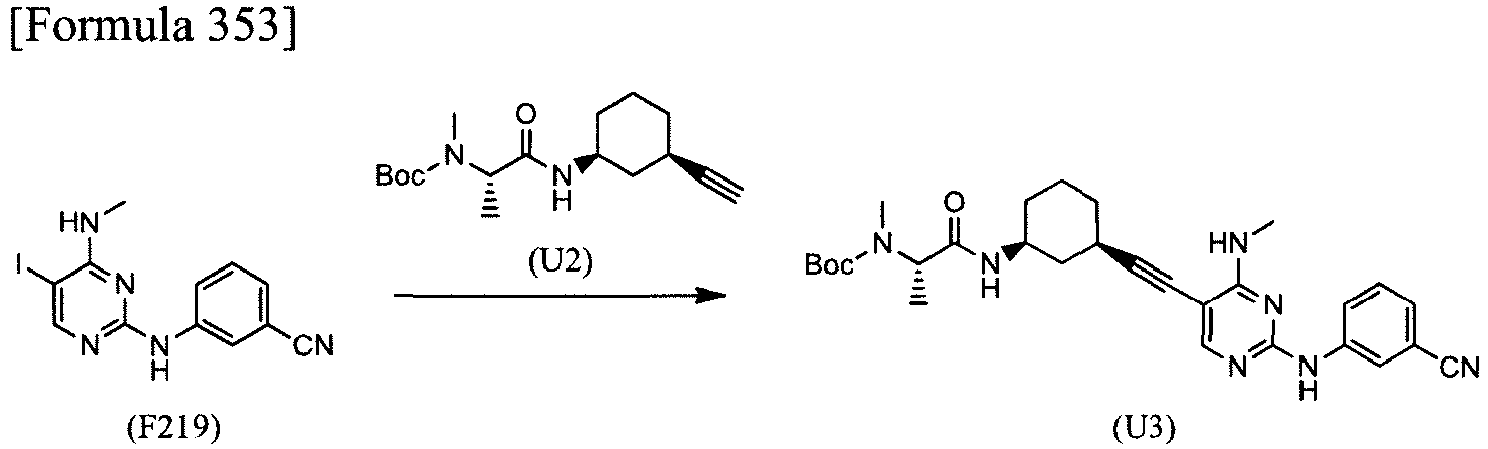
- To 3-((5-iodo-4-(methylamino)pyrimidin-2-yl)amino)benzonitrile (F219, 30 mg), tert-butyl ((S)-1-(((1S,3R)-3-ethynylcyclohexyl)amino)-1-oxopropan-2-yl)(methyl)carbamate (U2, 39.5 mg), bis(triphenylphosphine)palladium(II) dichloride (5.96 mg) and copper(I) iodide (3.24 mg), N,N-dimethylformamide (1 mL) and triethylamine (59 µL) were added at room temperature, and the mixture was stirred at the same temperature for 4 hours. To the reaction mixture, saturated aqueous sodium hydrogencarbonate and ethyl acetate were added. The organic layer was separated, washed successively with saturated aqueous ammonium chloride, water and saturated aqueous sodium chloride, and then dried over anhydrous sodium sulfate, and the solvent was evaporated under reduced pressure. The obtained residue was purified by silica gel column chromatography (eluent, 84 to 25% hexane in ethyl acetate) to obtain tert-butyl ((S)-1-(((1S,3R)-3-((2-((3-cyanophenyl)amino)-4-(methylamino)pyrimidin-5-yl)ethynyl)cyclohexyl)amino)-1-oxopropan-2-yl)(methyl)carbamate (U3, 27.4 mg) as pale yellow solid.
MS m/z (M+H): 532.4 -

- By using tert-butyl ((S)-1-(((1S,3R)-3-((2-((3-cyanophenyl)amino)-4-(methylamino)pyrimidin-5-yl)ethynyl)cyclohexyl)amino)-1-oxopropan-2-yl)(methyl)carbamate (U3), (E)-N-((S)-1-(((1S,3R)-3-((2-((3-cyanophenyl)amino)-4-(methylamino)pyrimidin-5-yl)ethynyl)cyclohexyl)amino)-1-oxopropan-2-yl)-4-(dimethylamino)-N-methyl-2-butenamide (21-1) was obtained in the same manner as that of Example 35, (6) and (7).
1H-NMR (CDCl3) δ: 8.33 (1H, s), 7.97 (1H, s), 7.66-7.61 (1H, m), 7.40-7.32 (2H, m), 7.27-7.21 (1H, m), 6.93 (1H, dt, J=15.2, 5.9Hz), 6.43 (1H, d, J=15.2Hz), 6.43-6.35 (1H, m), 5.50-5.43 (1H, m), 5.16 (1H, q, J=7.0Hz), 3.77-3.68 (1H, m), 3.13 (2H, d, J=5.9Hz), 3.10 (3H, d, J=4.6Hz), 2.98 (3H, s), 2.66-2.56 (1H, m), 2.43-2.27 (1H, m), 2.29 (6H, s), 2.07-1.98 (1H, m), 1.88-1.78 (2H, m), 1.44-1.24 (3H, m), 1.34 (3H, d, J=7.0Hz), 1.14-1.04 (1H, m) - In the same manner as that of Example 69, (1), Intermediates (U4) and (U5) were obtained.
[Table 219] Compound No. Structure Physicochemical data U4 
- U5 
- - In the same manner as that of Example 69, (2), Intermediates (U6) to (U56) were obtained.
[Table 220] Compound No. Structure Physicochemical data U6 
MS m/z (M+H): 529.4 U7 
MS m/z (M+H): 534.3 U8 
MS m/z (M+H): 525.2 U9 
MS m/z (M+H): 549.4 U10 
MS m/z (M+H): 549.4 U11 
MS m/z (M+H): 549.4 U12 
MS m/z (M+H): 599.5 [Table 221] Compound No. Structure Physicochemical data U13 
MS m/z (M+H): 549.4 U14 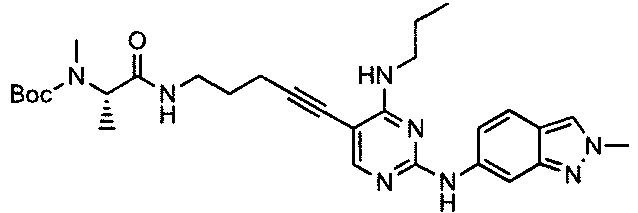
MS m/z (M+H): 549.4 U15 
MS m/z (M+H): 549.5 U16 
MS m/z (M+H): 532.4 U17 
MS m/z (M+H): 561.4 U18 
MS m/z (M+H): 543.4 U19 
MS m/z (M+H): 552.4 U20 
MS m/z (M+H): 576.4 U21 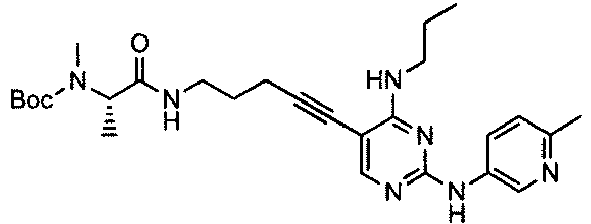
MS m/z (M+H): 510.4 [Table 222] Compound No. Structure Physicochemical data U22 
MS m/z (M+H): 524.4 U23 
MS m/z (M+H): 540.4 U24 
MS m/z (M+H): 547.4 U25 
MS m/z (M+H): 554.4 U26 
MS m/z (M+H): 561.4 U27 
MS m/z (M+H): 554.4 U28 
MS m/z (M+H): 607.4 U29 
MS m/z (M+H): 607.4 U30 
MS m/z (M+H): 607.4 [Table 223] Compound No. Structure Physicochemical data U31 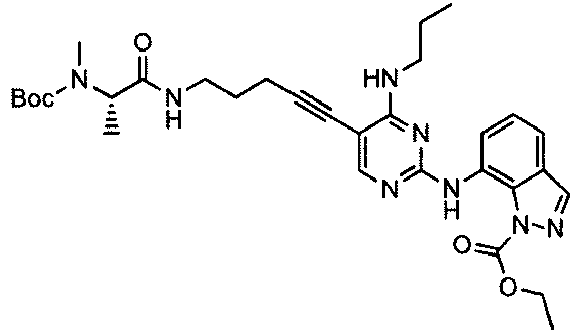
MS m/z (M+H): 607.4 U32 
MS m/z (M+H): 539.4 U33 
MS m/z (M+H): 546.4 U34 
MS m/z (M+H): 551.4 U35 
MS m/z (M+H): 553.4 U36 
MS m/z (M+H): 560.4 U37 
MS m/z (M+H): 555.4 U38 
MS m/z (M+H): 520.4 U39 
- [Table 224] Compound No. Structure Physicochemical data U40 
MS m/z (M+H): 473.4 U41 
MS m/z (M+H): 537.4 U42 
MS m/z (M+H): 525.4 U43 
MS m/z (M+H): 525.4 U44 
MS m/z (M-H): 519.5 U45 
MS m/z (M+H): 553.5 U46 
MS m/z (M+H): 525.4 U47 
MS m/z (M+H): 527.4 U48 
MS m/z (M+H): 497.4 U49 
MS m/z (M-H): 539.4 [Table 225] Compound No. Structure Physicochemical data U50 
MS m/z (M+H): 504.4 U51 
MS m/z (M+H): 551.5 U52 
MS m/z (M+H): 558.5 U53 
MS m/z (M+H): 497.4 U54 
MS m/z (M+H): 539.5 U55 
MS m/z (M+H): 539.5 U56 
MS m/z (M+H): 485.4 - In the same manner as that of Example 69, (3), Compounds (21-2) to (21-52) were obtained.
[Table 226] Compound No. Structure Physicochemical data 21-2 
1H-NMR (CDCl3) δ: 8.24 (1H, ddd, J=13.8, 7.2, 2.4Hz), 7.96 (1H, s), 7.12-6.88 (4H, m), 6.57-6.48 (1H, m), 6.42 (1H, d, J=15.2Hz), 6.29 (1H, s), 5.18 (1H, q, J=7.0Hz), 3.42 (2H, q, J=6.4Hz), 3.11 (2H, d, J=5.3Hz), 3.00 (3H, s), 2.90-2.80 (1H, m), 2.42 (2H, t, J=6.9Hz), 2.27 (6H, s), 1.80-1.68 (2H, m), 1.37 (3H, d, J=7.0Hz), 0.95-0.85 (2H, m), 0.79-0.68 (2H, m) 21-3 
1H-NMR (CDCl3) δ: 7.95 (1H, s), 7.66 (1H, s), 7.57-7.46 (2H, m), 7.17 (1H, s), 6.93 (1H, dt, J=15.2, 5.9Hz), 6.57-6.48 (1H, m), 6.47-6.34 (2H, m), 5.17 (1H, q, J=7.0Hz), 3.55-3.38 (4H, m), 3.10 (2H, d, J=5.9Hz), 2.98 (3H, s), 2.51 (3H, s), 2.43 (2H, t, J=6.6Hz), 2.26 (6H, s), 1.80-1.67 (4H, m), 1.35 (3H, d, J=7.0Hz), 0.99 (3H, t, J=7.3Hz) 21-4 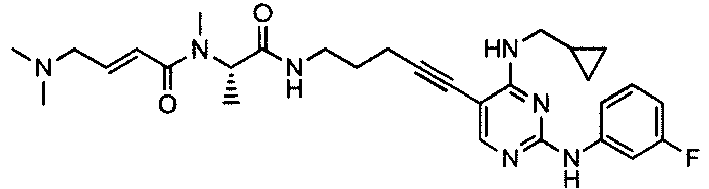
1H-NMR (CDCl3) δ: 7.97 (1H, s), 7.79 (1H, dt, J=11.9, 2.0Hz), 7.35-7.07 (3H, m), 6.94 (1H, dt, J=15.2, 5.9Hz), 6.67 (1H, dt, J=8.3, 2.0Hz), 6.62-6.52 (1H, m), 6.48-6.37 (1H, m), 6.32-6.20 (1H, m), 5.19 (1H, q, J=7.0Hz), 3.50-3.36 (4H, m), 3.10 (2H, dd, J=5.9, 1.3Hz), 2.99 (3H, s), 2.45 (2H, t, J=6.6Hz), 2.27 (6H, s), 1.83-1.70 (2H, m), 1.35 (3H, d, J=7.0Hz), 1.01-0.83 (1H, m), 0.59-0.49 (2H, m), 0.37-0.28 (2H, m) 21-5 
1H-NMR (CDCl3) δ: 8.09-7.99 (3H, m), 7.41-7.32 (1H, m), 7.27-7.23 (1H, m), 7.03 (1H, d, J=8.3Hz), 6.95 (1H, dt, J=14.9, 5.9Hz), 6.57-6.48 (1H, m), 6.47-6.38 (1H, m), 6.29-6.21 (1H, m), 5.19 (1H, q, J=7.0Hz), 4.07 (3H, s), 3.58-3.40 (4H, m), 3.14-3.06 (2H, m), 2.99 (3H, s), 2.50-2.40 (2H, m), 2.27 (6H, s), 1.82-1.63 (4H, m), 1.36 (3H, d, J=6.9Hz), 1.03 (3H, t, J=7.4Hz) [Table 227] Compound No. Structure Physicochemical data 21-6 
1H-NMR (CDCl3) δ: 8.15 (1H, d, J=1.7Hz), 7.97 (1H, s), 7.90 (1H, s), 7.44 (1H, dd, J=6.9, 2.0Hz), 7.32 (1H, d, J=8.9Hz), 7.09-7.02 (1H, m), 6.94 (1H, dt, J=15.2, 5.9Hz), 6.59-6.49 (1H, m), 6.42 (1H, d, J=15.2Hz), 6.23-6.12 (1H, m), 5.19 (1H, q, J=7.0Hz), 4.06 (3H, s), 3.45-3.38 (4H, m), 3.13-3.06 (2H, m), 2.99 (3H, s), 2.50-2.39 (2H, m), 2.27 (6H, s), 1.85-1.65 (4H, m), 1.36 (3H, d, J=7.3Hz), 1.01 (3H, t, J=7.4Hz) 21-7 
1H-NMR (CDCl3) δ: 8.14 (1H, d, J=2.0Hz), 7.97 (1H, s), 7.78 (1H, s), 7.61 (1H, d, J=9.2Hz), 7.24 (1H, dd, J=9.2, 2.0Hz), 7.02-6.87 (2H, m), 6.58-6.48 (1H, m), 6.42 (1H, d, J=15.2Hz), 6.20-6.11 (1H, m), 5.19 (1H, q, J=7.2Hz), 4.19 (3H, s), 3.55-3.37 (4H, m), 3.13-3.07 (2H, m), 2.99 (3H, s), 2.50-2.37 (2H, m), 2.27 (6H, s), 1.80-1.65 (4H, m), 1.36 (3H, d, J=6.9Hz), 1.01 (3H, t, J=7.4Hz) 21-8 
1H-NMR (CDCl3) δ: 8.18 (1H, dd, J=15.0, 2.0Hz), 7.99 (1H, d, J=2.0Hz), 7.95 (1H, s), 7.74-7.61 (1H, m), 6.94 (1H, dt, J=15.2, 5.9Hz), 6.68-6.54 (1H, m), 6.43 (1H, d, =15.2Hz), 6.35-6.25 (1H, m), 5.19 (1H, q, J=7.0Hz), 3.90-3.81 (4H, m), 3.52-3.40 (4H, m), 3.40-3.32 (4H, m), 3.14-3.06 (2H, m), 3.00 (3H, s), 2.50-2.38 (2H, m), 2.27 (6H, s), 1.82-1.63 (4H, m), 1.36 (3H, d, J=7.3Hz), 0.99 (3H, t, J=7.4Hz) 21-9 
1H-NMR (CDCl3) δ: 8.31 (1H, s), 8.01 (1H, s), 7.87 (1H, s), 7.58 (1H, d, J=8.6Hz), 7.35-7.28 (1H, m), 7.01-6.87 (2H, m), 6.62-6.51 (1H, m), 6.43 (1H, d, J=15.2Hz), 6.30-6.20 (1H, m), 5.20 (1H, q, J=6.9Hz), 4.04 (3H, s), 3.65-3.54 (2H, m), 3.50-3.39 (2H, m), 3.13-3.06 (2H, m), 3.00 (3H, s), 2.45 (2H, t, J=6.6Hz), 2.27 (6H, s), 1.84-1.68 (4H, m), 1.36 (3H, d, J=6.9Hz), 1.01 (3H, t, J=7.4Hz) [Table 228] Compound No. Structure Physicochemical data 21-10 
1H-NMR (CDCl3) δ: 8.18 (1H, s), 7.97 (1H, s), 7.79 (1H, s), 7.53 (1H, d, J=9.2Hz), 7.16-7.07 (2H, m), 6.94 (1H, dt, J=15.2, 5.9Hz), 6.60-6.48 (1H, m), 6.42 (1H, d, J=15.2Hz), 6.17-6.04 (1H, m), 5.19 (1H, q, J=7.1Hz), 4.17 (3H, s), 3.60-3.50 (2H, m), 3.48-3.38 (2H, m), 3.12-3.06 (2H, m), 2.99 (3H, s), 2.44 (2H, t, J=6.8Hz), 2.27 (6H, s), 1.83-1.66 (4H, m), 1.36 (3H, d, J=6.9Hz), 1.02 (3H, t, J=7.4Hz) 21-11 
1H-NMR (CDCl3) δ: 7.96 (1H, s), 7.91 (1H, s), 7.58 (1H, d, J=8.3Hz), 7.32 (1H, d, J=7.3Hz), 7.09 (1H, dd, J=7.6, 7.6Hz), 6.98-6.86 (2H, m), 6.57-6.46 (1H, m), 6.41 (1H, d, J=15.2Hz), 6.17-6.06 (1H, m), 5.16 (1H, q, J=7.0Hz), 4.13 (3H, s), 3.47-3.35 (2H, m), 3.22-3.12 (2H, m), 3.12-3.05 (2H, m), 2.97 (3H, s), 2.41 (2H, t, J=6.6Hz), 2.26 (6H, s), 1.78-1.66 (2H, m), 1.50-1.37 (2H, m), 1.33 (3H, d, J=6.9Hz), 0.75 (3H, t, J=7.4Hz) 21-12 
1H-NMR (CDCl3) δ: 7.98 (1H, s), 7.77 (2H, d, J=8.6Hz), 7.64-7.52 (3H, m), 6.94 (1H, dt, J=15.2, 5.9Hz), 6.65-6.56 (1H, m), 6.48-6.36 (2H, m), 5.19 (1H, q, J=7.3Hz), 3.51-3.36 (4H, m), 3.11 (2H, dd, J=5.9, 1.3Hz), 3.00 (3H, s), 2.46 (2H, t, J=6.6Hz), 2.27 (6H, s), 1.83-1.69 (2H, m), 1.36 (3H, d, J=7.3Hz), 1.29-1.16 (1H, m), 0.60-0.50 (2H, m), 0.37-0.27 (2H, m) 21-13 
1H-NMR (CDCl3) δ: 8.22 (1H, s), 7.74 (2H, d, J=8.6Hz), 7.60 (2H, d, J=8.6Hz), 7.30-7.27 (1H, m), 6.92 (1H, dt, J=15.2, 5.9Hz), 6.41 (1H, d, J=15.2Hz), 6.31-6.24 (1H, m), 5.16 (1H, q, J=7.3Hz), 4.35 (2H, t, J=6.6Hz), 3.78-3.70 (1H, m), 3.10 (2H, d, J=5.9Hz), 2.97 (3H, s), 2.65-2.56 (1H, m), 2.32-2.26 (1H, m), 2.28 (6H, s), 2.04-1.96 (1H, m), 1.93-1.82 (2H, m), 1.86-1.78 (2H, m), 1.48-1.25 (3H, m), 1.33 (3H, d, J=7.3Hz), 1.14-1.05 (1H, m), 1.09 (3H, t, J=8.9Hz) [Table 229] Compound No. Structure Physicochemical data 21-14 
1H-NMR (CDCl3) δ: 7.98-7.85 (3H, m), 6.94 (1H, dt, J=15.2, 5.9Hz), 6.80-6.73 (1H, m), 6.56-6.46 (1H, m), 6.42 (1H, d, J=15.2Hz), 6.22-6.12 (1H, m), 5.18 (1H, q, J=7.0Hz), 4.47-4.35 (1H, m), 3.52-3.37 (4H, m), 3.15-3.06 (2H, m), 3.03 (3H, d, J=5.0Hz), 2.99 (3H, s), 2.43 (2H, t, J=6.8Hz), 2.27 (6H, s), 1.85-1.58 (4H, m), 1.35 (3H, d, J=6.9Hz), 0.97 (3H, t, J=7.3Hz) 21-15 
MS m/z (M+H): 563.4 21-16 
1H-NMR (CDCl3) δ: 8.75-8.68 (2H, m), 8.02 (1H, s), 7.90 (1H, d, J=9.2Hz), 7.34-7.27 (1H, m), 7.21 (1H, dd, J=9.2, 2.6Hz), 7.02 (1H, d, J=2.6Hz), 6.95 (1H, dt, J=15.2, 5.9Hz), 6.60-6.48 (1H, m), 6.43 (1H, d, J=15.2Hz), 6.42-6.32 (1H, m), 5.20 (1H, q, J=7.1Hz), 3.93 (3H, s), 3.62-3.51 (2H, m), 3.50-3.40 (2H, m), 3.13-3.07 (2H, m), 3.00 (3H, s), 2.45 (2H, t, J=6.6Hz), 2.27 (6H, s), 1.85-1.68 (4H, m), 1.37 (3H, d, J=7.3Hz), 1.05 (3H, t, J=7.4Hz) 21-17 
1H-NMR (CDCl3) δ: 8.62 (1H, d, J=2.6Hz), 8.04 (1H, dd, J=8.6, 2.6Hz), 7.95 (1H, s), 7.09 (1H, d, J=8.3Hz), 6.99-6.93 (1H, m), 6.95 (1H, dt, J=15.2, 5.9Hz), 6.57-6.47 (1H, m), 6.42 (1H, d, J=15.2Hz), 6.25-6.15 (1H, m), 5.18 (1H, q, J=7.2Hz), 3.53-3.38 (4H, m), 3.14-3.06 (2H, m), 2.99 (3H, s), 2.51 (3H, s), 2.44 (2H, t, J=6.6Hz), 2.27 (6H, s), 1.82-1.62 (4H, m), 1.36 (3H, d, J=6.9Hz), 0.99 (3H, t, J=7.4Hz) 21-18 
1H-NMR (CDCl3) δ: 8.45 (1H, d, J=2.3Hz), 7.94 (1H, s), 7.92 (1H, d, J=2.0Hz), 7.00-6.87 (2H, m), 6.58-6.47 (1H, m), 6.42 (1H, d, J=15.2Hz), 6.25-6.15 (1H, m), 5.18 (1H, q, J=7.2Hz), 3.57-3.38 (4H, m), 3.12-3.07 (2H, m), 2.99 (3H, s), 2.52-2.38 (2H, m), 2.45 (3H, s), 2.28 (3H, s), 2.27 (6H, s), 1.83-1.63 (4H, m), 1.36 (3H, d, J=6.9Hz), 0.99 (3H, t, J=7.3Hz) [Table 230] Compound No. Structure Physicochemical data 21-19 
1H-NMR (CDCl3) δ: 8.20 (1H, s), 7.72-7.65 (1H, m), 7.28-7.21 (1H, m), 7.14-7.09 (1H, m), 7.12-7.09 (1H, m), 6.92 (1H, dt, J=15.2, 5.9Hz), 6.72 (1H, td, J=8.1, 2.2Hz), 6.41 (1H, d, J=15.2Hz), 6.28-6.23 (1H, m), 5.16 (1H, q, J=7.0Hz), 4.47 (2H, q, J=7.0Hz), 3.78-3.72 (1H, m), 3.10 (2H, d, J=5.9Hz), 2.97 (3H, s), 2.65-2.57 (1H, m), 2.32-2.26 (1H, m), 2.27 (6H, s), 2.06-1.96 (1H, m), 1.88-1.77 (2H, m), 1.46 (3H, t, J=7.0Hz), 1.37-1.26 (3H, m), 1.33 (3H, d, J=7.0Hz), 1.14-1.04 (1H, m) 21-20 
1H-NMR (CDCl3) δ: 8.23 (1H, s), 7.74 (2H, d, J=8.6Hz), 7.60 (2H, d, J=8.6Hz), 7.34-7.31 (1H, m), 6.92 (1H, dt, J=15.2, 5.9Hz), 6.41 (1H, d, J=15.2Hz), 6.32-6.25 (1H, m), 5.16 (1H, q, J=7.0Hz), 4.46 (2H, q, J=7.0Hz), 3.78-3.70 (1H, m), 3.10 (2H, d, J=5.9Hz), 2.97 (3H, s), 2.65-2.58 (1H, m), 2.34-2.26 (1H, m), 2.27 (6H, s), 2.05-1.96 (1H, m), 1.87-1.78 (2H, m), 1.47 (3H, t, J=7.3Hz), 1.38-1.25 (3H, m), 1.33 (3H, d, J=7.0Hz), 1.14-1.04 (1H, m) 21-21 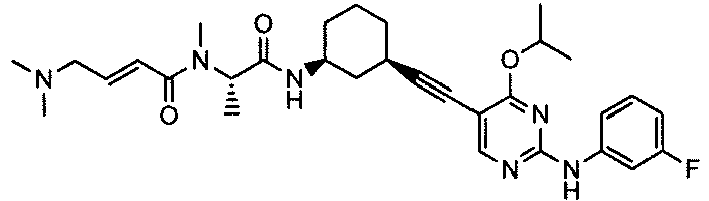
1H-NMR (CDCl3) δ: 8.18 (1H, s), 7.72-7.65 (1H, m), 7.28-7.19 (1H, m), 7.17-7.14 (1H, m), 7.13-7.08 (1H, m), 6.92 (1H, dt, J=15.2, 5.9Hz), 6.72 (1H, td, J=8.3, 2.2Hz), 6.42 (1H, d, J=15.2Hz), 6.29-6.21 (1H, m), 5.38-5.30 (1H, m), 5.16 (1H, q, J=7.0Hz), 3.78-3.70 (1H, m), 3.11 (2H, d, J=5.9Hz), 2.97 (3H, s), 2.64-2.56 (1H, m), 2.32-2.25 (1H, m), 2.28 (6H, s), 2.06-1.96 (1H, m), 1.86-1.74 (2H, m), 1.43 (6H, d, J=6.6Hz), 1.39-1.25 (3H, m), 1.33 (3H, d, J=7.0Hz), 1.14-1.04 (1H, m) 21-22 
1H-NMR (CDCl3) δ: 8.21 (1H, s), 7.73 (2H, d, J=8.6Hz), 7.60 (2H, d, J=8.6Hz), 7.29-7.25 (1H, m), 6.92 (1H, dt, J=15.2, 5.9Hz), 6.41 (1H, d, J=15.2Hz), 6.30-6.23 (1H, m), 5.37-5.28 (1H, m), 5.16 (1H, q, J=7.0Hz), 3.79-3.69 (1H, m), 3.10 (2H, d, J=5.9Hz), 2.97 (3H, s), 2.64-2.57 (1H, m), 2.32-2.26 (1H, m), 2.28 (6H, s), 2.05-1.95 (1H, m), 1.87-1.77 (2H, m), 1.43 (6H, d, J=5.9Hz), 1.39-1.31 (3H, m), 1.33 (3H, d, J=7.0Hz), 1.14-1.04 (1H, m) [Table 231] Compound No. Structure Physicochemical data 21-23 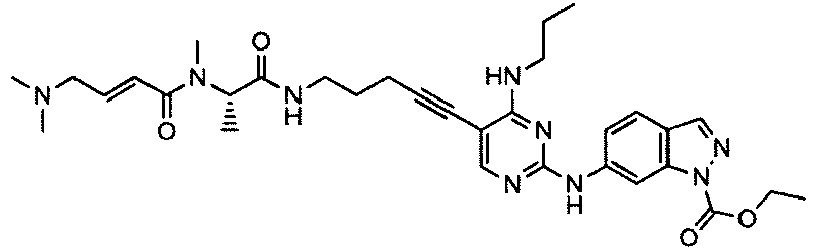
MS m/z (M+H): 618.5 21-24 
MS m/z (M+H): 618.5 21-25 
MS m/z (M+H): 618.5 21-26 
- 21-27 
1H-NMR (CDCl3) δ: 7.96 (1H, s), 7.82-7.74 (1H, m), 7.31-7.25 (1H, m), 7.27-7.21 (1H, m), 7.14-7.09 (1H, m), 6.93 (1H, dt, J=15.2, 5.9Hz), 6.72-6.64 (1H, m), 6.43 (1H, d, J=15.2Hz), 6.37-6.31 (1H, m), 5.43-5.35 (1H, m), 5.16 (1H, q, J=7.0Hz), 3.78-3.68 (1H, m), 3.61-3.50 (2H, m), 3.12 (2H, d, J=5.9Hz), 2.98 (3H, s), 2.66-2.57 (1H, m), 2.34-2.27 (1H, m), 2.29 (6H, s), 2.07-1.95 (1H, m), 1.88-1.78 (2H, m), 1.41-1.27 (3H, m), 1.33 (3H, t, J=6.3Hz), 1.32 (3H, d, J=7.0Hz), 1.16-1.05 (1H, m) 21-28 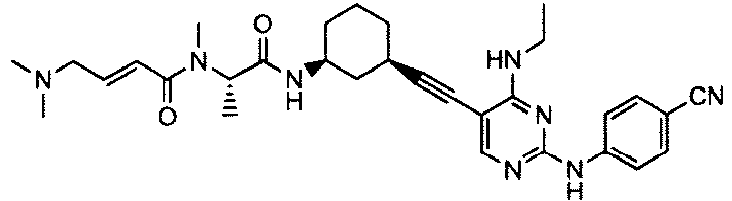
1H-NMR (CDCl3) δ: 7.98 (1H, s), 7.77 (2H, d, J=8.6Hz), 7.62-7.57 (1H, m), 7.57 (2H, d, J=8.6Hz), 6.93 (1H, dt, J=15.2, 5.9Hz), 6.49 (1H, d, J=15.2Hz), 6.40-6.35 (1H, m), 5.47-5.41 (1H, m), 5.15 (1H, q, J=7.0Hz), 3.78-3.70 (1H, m), 3.59-3.49 (2H, m), 3.18 (2H, d, J=5.9Hz), 3.01 (3H, s), 2.68-2.58 (1H, m), 2.36-2.28 (1H, m), 2.34 (6H, s), 2.08-1.96 (1H, m), 1.89-1.77 (2H, m), 1.47-1.24 (3H, m), 1.31 (3H, t, J=7.3Hz), 1.30 (3H, d, J=7.0Hz), 1.15-1.05 (1H, m) [Table 232] Compound No. Structure Physicochemical data 21-29 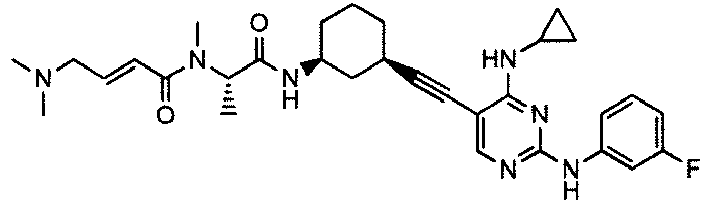
1H-NMR (CDCl3) δ: 8.15-8.08 (1H, m), 7.97 (1H, s), 7.37-7.33 (1H, m), 7.25-7.16 (1H, m), 7.12-7.05 (1H, m), 6.92 (1H, dt, J=15.2, 5.9Hz), 6.68 (1H, td, J=8.3, 2.2Hz), 6.51 (1H, d, J=15.2Hz), 6.35-6.28 (1H, m), 5.61-5.57 (1H, m), 5.15 (1H, q, J=6.9Hz), 3.78-3.68 (1H, m), 3.21 (2H, d, J=5.9Hz), 2.99 (3H, s), 2.88-2.81 (1H, m), 2.67-2.56 (1H, m), 2.36 (6H, s), 2.36-2.26 (1H, m), 2.03-1.95 (1H, m), 1.87-1.79 (2H, m), 1.47-1.28 (3H, m), 1.35 (3H, d, J=7.0Hz), 1.14-1.05 (1H, m), 0.98-0.88 (2H, m), 0.70-0.63 (2H, m) 21-30 
1H-NMR (CDCl3) δ: 7.95 (1H, s), 7.82-7.74 (1H, m), 7.29-7.25 (1H, m), 7.25-7.17 (1H, m), 7.13-7.07 (1H, m), 6.92 (1H, dt, J=15.2, 5.9Hz), 6.68 (1H, td, J=8.3, 2.0Hz), 6.51 (1H, d, J=15.2Hz), 6.35-6.28 (1H, m), 5.25-5.18 (1H, m), 5.15 (1H, q, J=7.3Hz), 4.34-4.23 (1H, m), 3.79-3.69 (1H, m), 3.21 (2H, d, J=5.9Hz), 3.00 (3H, s), 2.68-2.58 (1H, m), 2.38-2.27 (1H, m), 2.36 (6H, s), 2.05-1.97 (1H, m), 1.89-1.77 (2H, m), 1.47-1.24 (3H, m), 1.34 (3H, d, J=7.3Hz), 1.30 (6H, d, J=7.0Hz), 1.15-1.05 (1H, m) 21-31 
1H-NMR (CDCl3) δ: 7.97 (1H, s), 7.76 (2H, d, J=8.6Hz), 7.66-7.63 (1H, m), 7.57 (2H, d, J=8.6Hz), 6.92 (1H, dt, J=15.2, 5.9Hz), 6.50 (1H, d, J=15.2Hz), 6.41-6.35 (1H, m), 5.29-5.24 (1H, m), 5.16 (1H, q, J=7.0Hz), 4.32-4.20 (1H, m), 3.79-3.70 (1H, m), 3.19 (2H, d, J=5.9Hz), 3.00 (3H, s), 2.66-2.58 (1H, m), 2.35-2.26 (1H, m), 2.34 (6H, s), 2.05-1.97 (1H, m), 1.88-1.79 (2H, m), 1.47-1.27 (3H, m), 1.34 (3H, d, J=7.0Hz), 1.31 (6H, d, J=6.6Hz), 1.14-1.04 (1H, m) 21-32 
1H-NMR (CDCl3) δ: 7.94 (1H, s), 7.77-7.70 (1H, m), 7.11-7.06 (1H, m), 7.09-7.03 (1H, m), 6.97-6.87 (1H, m), 6.94-6.85 (1H, m), 6.43 (1H, d, J=15.2Hz), 6.37-6.30 (1H, m), 5.43-5.35 (1H, m), 5.15 (1H, q, J=7.3Hz), 3.87 (3H, s), 3.76-3.67 (1H, m), 3.12 (2H, d, J=5.9Hz), 3.07 (3H, d, J=5.3Hz), 2.98 (3H, s), 2.64-2.56 (1H, m), 2.43-2.29 (1H, m), 2.29 (6H, s), 2.09-1.98 (1H, m), 1.90-1.78 (2H, m), 1.43-1.24 (3H, m), 1.34 (3H, d, J=7.3Hz), 1.15-1.02 (1H, m) [Table 233] Compound No. Structure Physicochemical data 21-33 
1H-NMR (CDCl3) δ: 7.98 (1H, s), 7.75 (2H, d, J=8.6Hz), 7.57 (2H, d, J=8.6Hz), 7.49-7.46 (1H, m), 6.94 (1H, dt, J=15.2, 5.9Hz), 6.59-6.54 (1H, m), 6.44 (1H, d, J=15.2Hz), 5.88-5.83 (1H, m), 5.18 (1H, q, J=7.0Hz), 4.38-4.28 (1H, m), 3.46-3.39 (2H, m), 3.12 (2H, d, J=5.9Hz), 3.00 (3H, s), 2.45 (2H, t, J=6.9Hz), 2.29 (6H, s), 1.80-1.72 (2H, m), 1.36 (3H, d, J=7.0Hz), 1.32 (6H, d, J=6.6Hz) 21-34 
1H-NMR (CDCl3) δ: 8.02 (1H, d, J=1.3Hz), 7.95 (1H, t, J=2.3Hz), 7.59 (1H, d, J=2.0Hz), 7.53 (1H, s), 7.39 (2H, d, J=2.6Hz), 6.93 (1H, dt, J=15.1, 6.0Hz), 6.79 (1H, s), 6.71 (1H, brs), 6.42 (1H, d, J=15.1Hz), 6.17 (1H, t, J=5.9Hz), 5.19 (1H, q, J=7.2Hz), 3.54-3.37 (4H, m), 3.10 (2H, d, J=6.0Hz), 3.00 (3H, s), 2.44 (2H, t, J=6.6Hz), 2.26 (6H, s), 1.82-1.62 (4H, m), 1.35 (3H, d, J=7.2Hz), 0.99 (3H, t, J=7.3Hz) 21-35 
1H-NMR (CDCl3) δ: 7.87 (1H, s), 6.92 (1H, dt, J=15.2, 5.9Hz), 6.41 (1H, d, J=15.2Hz), 6.25 (1H, d, J=7.9Hz), 5.32-5.20 (1H, m), 5.15 (1H, q, J=7.0Hz), 4.88-4.77 (1H, m), 3.81-3.63 (1H, m), 3.47-3.34 (2H, m), 3.10 (2H, d, J=5.9Hz), 3.02-2.90 (6H, m), 2.67-2.53 (1H, m), 2.33-2.19(7H, m), 2.07-1.95 (1H, m), 1.89-1.74 (2H, m), 1.70-1.57 (2H, m), 1.40-1.18 (6H, m), 1.14-1.02 (1H, m), 0.97 (3H, t, J=7.6Hz) 21-36 
1H-NMR (CDCl3) δ: 8.01 (1H, s), 7.54 (2H, d, J=8.6Hz), 7.05 (1H, s), 6.98-6.84 (3H, m), 6.41 (1H, d, J=15.2Hz), 6.31 (1H, d, J=7.3Hz), 5.15 (1H, q, J=7.0Hz), 5.08-4.96 (1H, m), 3.81 (3H, s), 3.80-3.68 (1H, m), 3.10 (2H, d, J=5.3Hz), 3.01-2.92 (6H, m), 2.72-2.59 (1H, m), 2.39-2.17 (7H, m), 2.10-1.77 (3H, m), 1.48-1.25 (6H, m), 1.18-1.02 (1H, m) 21-37 
1H-NMR (CDCl3) δ: 8.03 (1H, s), 7.67-7.55 (2H, m), 7.12 (1H, s), 7.09-6.99 (2H, m), 6.92 (1H, dt, J=15.2, 5.9Hz), 6.42 (1H, d, J=15.2Hz), 6.31 (1H, d, J=7.9Hz), 5.15 (1H, q, J=7.0Hz), 5.10-5.00 (1H, m), 3.87-3.68 (1H, m), 3.11 (2H, d, J=5.9Hz), 3.02-2.91 (6H, m), 2.72-2.58 (1H, m), 2.42-2.23 (7H, m), 2.12-1.75 (3H, m), 1.51-1.20 (6H, m), 1.18-1.04 (1H, m) [Table 234] Compound No. Structure Physicochemical data 21-38 
1H-NMR (CDCl3) δ: 8.01 (1H, s), 7.66-7.53 (3H, m), 6.94 (1H, dt, J=15.2, 6.6Hz), 6.87 (2H, d, J=9.2Hz), 6.56-6.47 (1H, m), 6.41 (1H, d, J=15.2Hz), 5.18 (1H, q, J=7.0Hz), 5.04-4.93 (1H, m), 3.81 (3H, s), 3.50-3.38 (2H, m), 3.37-3.26 (2H, m), 3.09 (2H, d, J=6.6Hz), 2.97 (3H, s), 2.46 (2H, t, J=6.6Hz), 2.26 (6H, s), 1.84-1.69 (2H, m), 1.63-1.51 (2H, m), 1.34 (3H, d, J=6.6Hz), 0.96 (3H, t, J=7.6Hz) 21-39 
1H-NMR (CDCl3) δ: 7.91 (1H, s), 7.41-7.22 (5H, m), 6.92 (1H, dt, J=15.2, 5.9Hz), 6.40 (1H, d, J=15.2Hz), 6.25 (1H, d, J=7.9Hz), 5.66-5.55 (1H, m), 5.13 (1H, q, J=7.0Hz), 5.02-4.89 (1H, m), 4.72-4.64 (2H, m), 3.81-3.62 (1H, m), 3.10 (2H, d, J=5.9Hz), 3.03-2.85 (6H, m), 2.66-2.48 (1H, m), 2.32-2.16 (7H, m), 2.12-1.70 (3H, m), 1.45-1.16 (6H, m), 1.14-0.85 (1H, m) 21-40 
1H-NMR (CDCl3) δ: 7.94 (1H, s), 7.59-7.53 (2H, m), 7.22-7.16 (1H, m), 7.04-6.95 (2H, m), 6.93 (1H, dt, J=15.2, 5.9Hz), 6.42 (1H, d, J=15.2Hz), 6.37-6.31 (1H, m), 5.47-5.39 (1H, m), 5.16 (1H, q, J=7.3Hz), 3.78-3.68 (1H, m), 3.48-3.40 (2H, m), 3.11 (2H, d, J=5.9Hz), 2.98 (3H, s), 2.66-2.56 (1H, m), 2.35-2.26 (1H, m), 2.28 (6H, s), 2.05-1.96 (1H, m), 1.89-1.77 (2H, m), 1.74-1.61 (2H, m), 1.45-1.25 (3H, m), 1.34 (3H, d, J=7.3Hz), 1.16-1.02 (1H, m), 1.00 (3H, t, J=7.3Hz) 21-41 
1H-NMR (CDCl3) δ: 7.95 (1H, s), 7.60-7.54 (2H, m), 7.04-6.96 (2H, m), 6.97-6.87 (1H, m), 6.96-6.91 (1H, m), 6.42 (1H, d, J=15.2Hz), 6.34-6.27 (1H, m), 5.40-5.35 (1H, m), 5.15 (1H, q, J=7.0Hz), 3.76-3.68 (1H, m), 3.11 (2H, d, J=5.9Hz), 3.06 (3H, d, J=5.3Hz), 2.98 (3H, s), 2.65-2.56 (1H, m), 2.34-2.25 (1H, m), 2.28 (6H, s), 2.05-1.98 (1H, m), 1.88-1.78 (2H, m), 1.40-1.28 (3H, m), 1.34 (3H, d, J=7.0Hz), 1.15-1.04 (1H, m) [Table 235] Compound No. Structure Physicochemical data 21-42 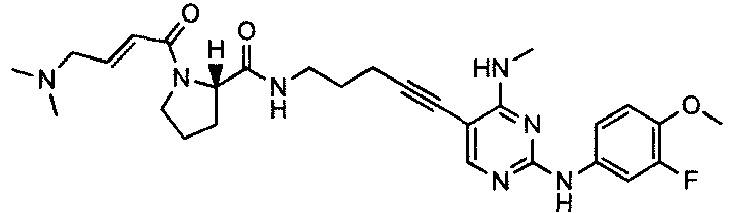
1H-NMR (CDCl3) δ: 7.92 (1H, s), 7.78 (1H, dd, J=14.2, 2.3Hz), 7.49 (1H, t, J=5.9Hz), 7.17 (1H, brs), 7.11-7.08 (1H, m), 7.01-6.86 (2H, m), 6.36-6.30 (2H, m), 4.68 (1H, d, J=6.6Hz), 3.87 (3H, s), 3.68 (1H, dt, J=9.1, 2.4Hz), 3.55-3.41 (3H, m), 3.10 (2H, d, J=5.9Hz), 3.07 (3H, d, J=4.6Hz), 2.48-2.43 (3H, m), 2.26 (6H, s), 1.96 (3H, brs), 1.78-1.73 (2H, m) 21-43 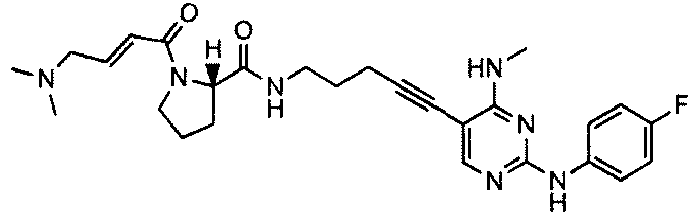
1H-NMR (CDCl3) δ: 7.93 (1H, s), 7.63-7.55 (2H, m), 7.49 (1H, t, J=5.9Hz), 7.30 (1H, brs), 7.03-6.91 (3H, m), 6.35-6.28 (2H, m), 4.68 (1H, d, J=6.6Hz), 3.71-3.64 (1H, m), 3.56-3.38 (3H, m), 3.10 (2H, d, J=5.3Hz), 3.05 (3H, d, J=5.1Hz), 2.48-2.43 (3H, m), 2.26 (6H, s), 2.10 (3H, brs), 1.78-1.73 (2H, m) 21-44 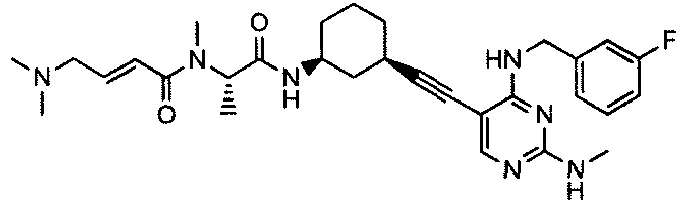
1H-NMR (CDCl3) δ: 7.93 (1H, s), 7.36-7.23 (1H, m), 7.15-7.00 (2H, m), 7.00-6.85 (2H, m), 6.40 (1H, d, J=15.2Hz), 6.27 (1H, d, J=7.9Hz), 5.70-5.55 (1H, m), 5.13 (1H, q, J=7.0Hz), 5.00-4.86 (1H, m), 4.74-4.62 (2H, m), 3.78-3.61 (1H, m), 3.09 (2H, d, J=5.3Hz), 3.01-2.86 (6H, m), 2.67-2.51 (1H, m), 2.34-2.19(7H, m), 2.08-1.71 (3H, m), 1.49-1.19 (6H, m), 1.15-0.97 (1H, m) 21-45 
1H-NMR (CDCl3) δ: 7.96 (1H, s), 7.80 (2H, d, J=8.6Hz), 7.71 (1H, brs), 7.56 (2H, d, J=8.6Hz), 7.51 (1H, t, J=5.9Hz), 6.96 (1H, dt, J=15.2, 5.9Hz), 6.54 (1H, brs), 6.33 (1H, d, J=15.2Hz), 4.69 (1H, d, J=6.6Hz), 3.72-3.65 (1H, m), 3.59-3.36 (3H, m), 3.12-3.07 (5H, m), 2.49-2.26 (3H, m), 2.26 (6H, s), 1.97 (3H, brs), 1.80-1.71 (2H, m) 21-46 
1H-NMR (CDCl3) δ: 7.96 (1H, s), 7.69-7.63 (2H, m), 7.04-6.98 (1H, m), 7.03-6.95 (2H, m), 6.93 (1H, dt, J=15.2, 5.9Hz), 6.41 (1H, d, J=15.2Hz), 6.33-6.26 (1H, m), 5.53-5.50 (1H, m), 5.15 (1H, q, J=7.0Hz), 3.78-3.68 (1H, m), 3.10 (2H, d, J=5.9Hz), 2.97 (3H, s), 2.85-2.77 (1H, m), 2.64-2.55 (1H, m), 2.31-2.24 (1 H, m), 2.28 (6H, s), 2.05-1.95 (1H, m), 1.88-1.75 (2H, m), 1.41-1.24 (3H, m), 1.34 (3H, d, J=7.0Hz), 1.15-1.02 (1H, m), 0.92-0.84 (2H, m), 0.67-0.59 (2H, m) [Table 236] Compound No. Structure Physicochemical data 21-47 
1H-NMR (CDCl3) δ: 8.74 (1H, s), 7.98 (1H, s), 7.87-7.84 (1H, m), 7.59-7.53 (1H, m), 7.35 (1H, dd, J=7.6, 7.6Hz), 7.27-7.22 (1H, m), 6.93 (1H, dt, J=15.2, 5.9Hz), 6.53-6.45 (1H, m), 6.43 (1H, d, J=15.2Hz), 5.65-5.62 (1H, m), 5.17 (1H, q, J=7.0Hz), 3.78-3.69 (1H, m), 3.12 (2H, d, J=5.9Hz), 3.00 (3H, s), 2.87-2.80 (1H, m), 2.65-2.56 (1H, m), 2.37-2.28 (1H, m), 2.28 (6H, s), 2.06-1.95 (1H, m), 1.89-1.76 (2H, m), 1.42-1.22 (3H, m), 1.34 (3H, d, J=7.0Hz), 1.14-1.07 (1H, m), 1.05-0.97 (2H, m), 0.74-0.65 (2H, m) 21-48 
1H-NMR (CDCl3) δ: 8.01 (1H, s), 7.69-7.55 (3H, m), 6.99-6.81 (3H, m), 6.57-6.49 (1H, m), 6.41 (1H, dt, J=15.2, 1.3Hz), 5.18 (1H, q, J=6.8Hz), 5.11-4.98 (1H, m), 3.81 (3H, s), 3.52-3.38 (2H, m), 3.10 (2H, dd, J=5.9, 1.3Hz), 3.01-2.89 (6H, m), 2.47 (2H, t, J=6.9Hz), 2.26 (6H, s), 1.87-1.62 (2H, m), 1.34 (3H, d, J=6.8Hz) 21-49 
1H-NMR (CDCl3) δ: 8.20 (1H, d, J=2.0Hz), 7.95 (1H, s), 7.42 (1H, dd, J=8,6, 2.0Hz), 7.22 (1H, dd, J=8.6, 2.0Hz), 7.14-7.05 (1H, m), 6.94 (1H, dt, J=15.2, 5.9Hz), 6.61-6.51 (1H, m), 6.43 (1H, d, J=15.2Hz), 6.34-6.24 (1H, m), 5.19 (1H, q, J=7.0Hz), 3.90 (3H, s), 3.52-3.39 (2H, m), 3.15-3.06 (5H, m), 3.00 (3H, s), 2.44 (2H, t, J=6.6Hz), 2.27 (6H, s), 1.82-1.68 (2H, m), 1.37 (3H, d, J=7.0Hz) 21-50 
1H-NMR (CDCl3) δ: 8.35 (1H, s), 8.00 (1H, s), 7.49 (1H, d, J=8.6Hz), 7.31 (1H, s), 7.01-6.84 (2H, m), 6.64-6.54 (1H, m), 6.48-6.38 (2H, m), 5.20 (1H, q, J=7.0Hz), 3.87 (3H, s), 3.52-3.41 (2H, m), 3.17 (3H, d, J=5.3Hz), 3.11 (2H, d, J=5.3Hz), 3.01 (3H, s), 2.44 (2H, t, J=6.3Hz), 2.27 (6H, s), 1.83-1.70 (2H, m), 1.38 (3H, d, J=7.0Hz) [Table 237] Compound No. Structure Physicochemical data 21-51 
1H-NMR (CDCl3) δ: 7.94 (1H, s), 7.61-7.55 (2H, m), 7.04-6.96 (2H, m), 6.98-6.94 (1H, m), 6.98-6.89 (1H, m), 6.57-6.51 (1H, m), 6.42 (1H, d, J=15.2Hz), 6.28-6.22 (1H, m), 5.19 (1H, q, J=7.0Hz), 3.51-3.38 (2H, m), 3.10 (2H, d, J=5.9Hz), 3.07 (3H, d, J=5.3Hz), 2.99 (3H, s), 2.43 (2H, t, J=6.3Hz), 2.27 (6H, s), 1.77-1.69 (2H, m), 1.36 (3H, d, J=7.0Hz) 21-52 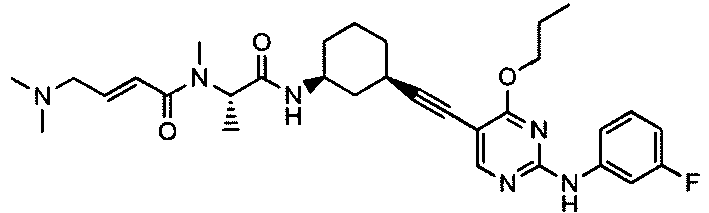
1H-NMR (CDCl3) δ: 8.19 (1H, s), 7.72-7.66 (1H, m), 7.28-7.21 (1H, m), 7.14-7.11 (1 H, m), 7.14-7.09 (1 H, m), 6.92 (1H, dt, J=15.2, 5.9Hz), 6.72 (1H, td, J=8.3, 2.0Hz), 6.41 (1H, d, J=15.2Hz), 6.29-6.22 (1H, m), 5.16 (1H, q, J=7.0Hz), 4.36 (2H, t, J=6.6Hz), 3.79-3.70 (1H, m), 3.10 (2H, d, J=5.9Hz), 2.97 (3H, s), 2.65-2.56 (1H, m), 2.32-2.25 (1H, m), 2.27 (6H, s), 2.03-1.96 (1H, m), 1.91-1.81 (2H, m), 1.86-1.77 (2H, m), 1.38-1.26 (3H, m), 1.33 (3H, d, J=7.0Hz), 1.10-1.03 (1H, m), 1.06 (3H, t, J=7.6Hz) -

- To (S,E)-ethyl 6-((5-(5-(2-(4-(dimethylamino)-N-methyl-2-butenamido)propaneamido)-1-pentyn-1-yl)-4-(propylamino)pyrimidin-2-yl)amino)-1H-indazole-1-carboxylate (21-23, 17.3 mg), tetrahydrofuran (1.0 mL) and 1.0 mol/L aqueous lithium hydroxide (1.0 mL) were added at room temperature, and the mixture was stirred at the same temperature for 30 minutes. To the reaction mixture, water and ethyl acetate were added. The organic layer was separated, washed with saturated aqueous sodium chloride, and then dried over anhydrous sodium sulfate, and the solvent was evaporated under reduced pressure. The obtained residue was purified by basic silica gel column chromatography (eluent, 100 to 90% ethyl acetate in methanol) to obtain (S,E)-N-(1-((5-(2-((1H-indazol-6-yl)amino)-4-(propylamino)pyrimidin-5-yl)-4-pentyn-1-yl)amino)-1-oxopropan-2-yl)-4-(dimethylamino)-N-methyl-2-butenamide (21-53, 9.8 mg) as pale yellow solid.
1H-NMR (CDCl3) δ: 10.6-10.2 (1H, m), 8.26 (1H, s), 8.03-7.92 (2H, m), 7.62 (1H, d, J=8.6Hz), 7.50-7.40 (1H, m), 7.17-7.05 (1H, m), 6.95 (1H, dt, J=15.2, 5.9Hz), 6.78-6.64 (1H, m), 6.44 (1H, d, J=15.2Hz), 6.26-6.12 (1H, m), 5.20 (1H, q, J=7.0Hz), 3.57-3.38 (4H, m), 3.16-3.08 (2H, m), 3.01 (3H, s), 2.45 (2H, t, J=6.6Hz), 2.28 (6H, s), 1.83-1.65 (4H, m), 1.37 (3H, d, J=6.9Hz), 1.01 (3H, t, J=7.4Hz) - By using Compounds (21-24) to (21-26), Compounds (21-54) to (21-56) were obtained in the same manner as that of Example 69, (7).
[Table 238] Compound No. Structure Physicochemical data 21-54 
1H-NMR (CDCl3) δ: 10.9-10.6 (1H, m), 8.31 (1H, s), 8.09 (1H, d, J=7.6Hz), 8.04 (1H, s), 7.82-7.68 (1H, m), 7.37 (1H, dd, J=8.3, 7.9Hz), 7.15 (1H, d, J=8.3Hz), 6.95 (1H, dt, J=15.2, 5.9Hz), 6.62-6.50 (1H, m), 6.44 (1H, d, J=15.2Hz), 6.32-6.20 (1H, m), 5.20 (1H, q, J=7.2Hz), 3.59-3.40 (4H, m), 3.16-3.07 (2H, m), 3.00 (3H, s), 2.45 (2H, t, J=6.8Hz), 2.28 (6H, s), 1.85-1.58 (4H, m), 1.37 (3H, d, J=6.9Hz), 1.01 (3H, t, J=7.4Hz) 21-55 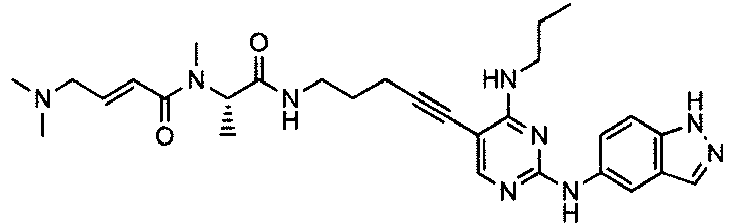
1H-NMR (CDCl3) δ: 10.5-10.0 (1H, m), 8.20 (1H, s), 8.00 (1H, s), 7.97 (1H, s), 7.48-7.37 (2H, m), 7.16-7.05 (1H, m), 6.95 (1H, dt, J=15.2, 5.9Hz), 6.63-6.50 (1H, m), 6.43 (1H, d, J=15.2Hz), 6.25-6.08 (1H, m), 5.20 (1H, q, J=7.0Hz), 3.65-3.37 (4H, m), 3.14-3.07 (2H, m), 3.00 (3H, s), 2.44 (2H, t, J=6.6Hz), 2.27 (6H, s), 1.85-1.61 (4H, m), 1.36 (3H, d, J=6.9Hz), 1.01 (3H, t, J=7.4Hz) 21-56 
1H-NMR (CDCl3) δ: 12.7-12.3 (1H, m), 8.06 (1H, s), 7.98 (1H, s), 7.52-7.43 (1H, m), 7.37-7.29 (1H, m), 7.12-7.03 (2H, m), 6.95 (1H, dt, J=15.2, 5.9Hz), 6.70-6.58 (1H, m), 6.43 (1H, d, J=15.2Hz), 6.32-6.24 (1H, m), 5.20 (1H, q, J=7.0Hz), 3.53-3.35 (4H, m), 3.15-3.05 (2H, m), 3.00 (3H, s), 2.45 (2H, t, J=6.6Hz), 2.27 (6H, s), 1.85-1.58 (4H, m), 1.36 (3H, d, J=6.9Hz), 0.95 (3H, t, J=7.4Hz) -

- To a solution of 2-chloro-5-iodo-N-propylpyrimidin-4-amine (F1, 2.00 g) and (S)-tert-butyl methyl(1-oxo-1-(4-pentyn-1-ylamino)propan-2-yl)carbamate (U4, 2.16 g) in N,N-dimethylformamide (40 mL), triethylamine (4.67 mL), bis(triphenylphosphine)palladium(II) dichloride (0.47 g) and copper(I) iodide (0.26 g) were added at room temperature, and the mixture was stirred at the same temperature for 1.5 hours, and then further stirred at 45°C for 0.5 hour. The reaction mixture was cooled to room temperature, and then saturated aqueous ammonium chloride and ethyl acetate were added to the reaction mixture. The organic layer was separated, washed with saturated aqueous sodium chloride, and then dried over anhydrous sodium sulfate, and the solvent was evaporated under reduced pressure. The obtained residue was purified by silica gel column chromatography (eluent, 80 to 30% hexane in ethyl acetate) to obtain (S)-tert-butyl (1-((5-(2-chloro-4-(propylamino)pyrimidin-5-yl)-4-pentyn-1-yl)amino)-1-oxopropan-2-yl)(methyl)carbamate (V1, 2.49 g) as pale yellow oil.
MS m/z (M+H): 438.3 -

- To a solution of tris(dibenzylideneacetone)dipalladium(0) (1.0 mg) in 1,4-dioxane (0.86 mL), 2-(dicyclohexylphosphino)-3,6-dimethoxy-2',4',6'-triisopropyl-1,1'-biphenyl (1.5 mg) was added at room temperature under a nitrogen atmosphere, and the mixture was stirred at 100°C for 5 minutes. The reaction mixture was cooled to room temperature, and then (S)-tert-butyl (1-((5-(2-chloro-4-(propylamino)pyrimidin-5-yl)-4-pentyn-1-yl)amino)-1-oxopropan-2-yl)(methyl)carbamate (V1, 12.5 mg), 2-methyl-4-aminopyridine (4.0 mg) and cesium carbonate (19 mg) were added, and the mixture was stirred at 70°C for 1 hour. The reaction mixture was cooled to room temperature, and then ethyl acetate was added to the reaction mixture. The insoluble matter was removed by filtration through Cerite, and then the solvent was evaporated under reduced pressure. The obtained residue was purified by silica gel column chromatography (eluent, 80 to 0% hexane in ethyl acetate) to obtain (S)-tert-butyl methyl(1-((5-(2-((2-methylpyridin-4-yl)amino)-4-(propylamino)pyrimidin-5-yl)-4-pentyn-1-yl)amino)-1-oxopropan-2-yl)carbamate(V2, 5.6 mg) as yellow oil.
MS m/z (M+H): 510.4 -

- By using (S)-tert-butyl methyl(1-((5-(2-((2-methylpyridin-4-yl)amino)-4-(propylamino)pyrimidin-5-yl)-4-pentyn-1-yl)amino)-1-oxopropan-2-yl)carbamate (V2), (S,E)-4-(dimethylamino)-N-methyl-N-(1-((5-(2-((2-methylpyridin-4-yl)amino)-4-(propylamino)pyrimidin-5-yl)-4-pentyn-1-yl)amino)-1-oxopropan-2-yl)-2-butenamide (22-1) was obtained in the same manner as that of Example 35, (6) and (7).
1H-NMR (CDCl3) δ: 8.30 (1H, d, J=5.6Hz), 7.98 (1H, s), 7.50 (1H, d, J=2.0Hz), 7.37 (1H, dd, J=5.6, 2.0Hz), 7.07-7.00 (1H, m), 6.95 (1H, dt, J=15.2, 5.9Hz), 6.59-6.48 (1H, m), 6.47-6.35 (2H, m), 5.19 (1H, q, J=7.0Hz), 3.60-3.40 (4H, m), 3.14-3.07 (2H, m), 3.00 (3H, s), 2.52 (3H, s), 2.44 (2H, t, J=6.6Hz), 2.27 (6H, s), 1.85-1.65 (4H, m), 1.36 (3H, d, J=6.9Hz), 1.01 (3H, t, J=7.3Hz) - In the same manner as that of Example 70, (1), Intermediates (V3) to (V5) were obtained.
[Table 239] Compound No. Structure Physicochemical data V3 
MS m/z (M+H): 503.4 V4 
MS m/z (M+H): 450.3 V5 
MS m/z (M+H): 494.3 - In the same manner as that of Example 70, (2), Intermediates (V6) to (V59) were obtained.
[Table 240] Compound No. Structure Physicochemical data V6 
MS m/z (M+H): 546.4 V7 
MS m/z (M+H): 546.4 V8 
MS m/z (M+H): 547.4 V9 
MS m/z (M+H): 560.5 V10 
MS m/z (M+H): 552.4 V11 
MS m/z (M+H): 566.4 V12 
MS m/z (M+H): 514.4 V13 
MS m/z (M+H): 530.4 V14 
MS m/z (M+H): 593.5 [Table 241] Compound No. Structure Physicochemical data V15 
MS m/z (M+H): 593.5 V16 
MS m/z (M+H): 592.5 V17 
MS m/z (M+H): 610.5 V18 
MS m/z (M+H): 623.5 V19 
MS m/z (M+H): 561.5 V20 
MS m/z (M+H): 562.4 V21 
MS m/z (M+H): 562.4 V22 
MS m/z (M+H): 561.5 V23 
MS m/z (M+H): 562.4 [Table 242] Compound No. Structure Physicochemical data V24 
MS m/z (M+H): 562.4 V25 
MS m/z (M+H): 499.4 V26 
MS m/z (M+H): 527.4 V27 
MS m/z (M+H): 579.5 V28 
MS m/z (M+H): 579.5 V29 
MS m/z (M+H): 550.5 V30 
MS m/z (M+H): 564.5 V31 
MS m/z (M+H): 580.5 V32 
MS m/z (M+H): 591.5 V33 
MS m/z (M+H): 561.5 [Table 243] Compound No. Structure Physicochemical data V34 
MS m/z (M+H): 561.5 V35 
MS m/z (M+H): 605.5 V36 
MS m/z (M+H): 619.5 V37 
MS m/z (M+H): 619.5 V38 
MS m/z (M+H): 594.5 V39 
MS m/z (M+H): 608.5 V40 
MS m/z (M+H): 591.5 V41 
MS m/z (M+H): 562.5 V42 
MS m/z (M+H): 606.5 V43 
MS m/z (M+H): 576.5 [Table 244] Compound No. Structure Physicochemical data V44 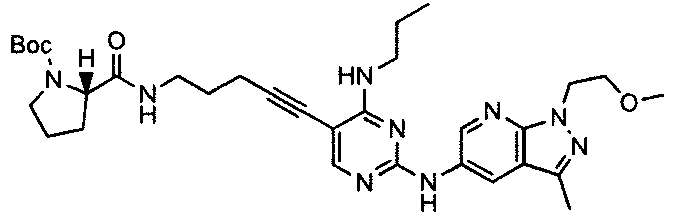
MS m/z (M+H): 620.5 V45 
MS m/z (M+H): 592.5 V46 
MS m/z (M+H): 637.6 V47 
MS m/z (M+H): 637.5 V48 
MS m/z (M+H): 623.5 V49 
MS m/z (M+H): 550.5 V50 
MS m/z (M+H): 638.5 V51 
MS m/z (M+H): 649.5 V52 
MS m/z (M+H): 649.5 V53 
MS m/z (M+H): 635.6 [Table 245] Compound No. Structure Physicochemical data V54 
MS m/z (M+H): 562.5 V55 
MS m/z (M+H): 578.5 V56 
MS m/z (M+H): 567.5 V57 
MS m/z (M+H): 579.5 V58 
MS m/z (M+H): 567.3 V59 
MS m/z (M+H): 579.5 - By using Intermediates (V3), Intermediates (V60) and (V61) were obtained in the same manner as that of Example 36, (11).
[Table 246] Compound No. Structure Physicochemical data V60 
MS m/z (M+H): 498.4 V61 
MS m/z (M+H): 524.5 - By using Intermediates (V5), Intermediates (V62) to (V65) were obtained in the same manner as that of Example 35, (2).
[Table 247] Compound No. Structure Physicochemical data V62 
MS m/z (M+H): 569.4 V63 
MS m/z (M+H): 569.4 V64 
MS m/z (M+H): 576.4 V65 
MS m/z (M+H): 576.4 - In the same manner as that of Example 35, (6) and (7), Compounds (22-2) to (22-61) were obtained.
[Table 248] Compound No. Structure Physicochemical data 22-2 
1H-NMR (CDCl3) δ: 8.77 (1H, dd, J=4.0, 1.5Hz), 8.40 (1H, d, J=2.3Hz), 8.10-7.96 (3H, m), 7.72 (1H, dd, J=8.9, 2.3Hz), 7.35 (1H, dd, J=8.3, 4.0Hz), 7.30-7.21 (1H, m), 6.95 (1H, dt, J=15.2, 5.9Hz), 6.62-6.50 (1H, m), 6.43 (1H, d, J=15.2Hz), 6.38-6.27 (1H, m), 5.20 (1H, q, J=7.0Hz), 3.63-3.51 (2H, m), 3.50-3.39 (2H, m), 3.14-3.07 (2H, m), 3.00 (3H, s), 2.45 (2H, t, J=6.6Hz), 2.27 (6H, s), 1.86-1.68 (4H, m), 1.37 (3H, d, J=7.3Hz), 1.04 (3H, t, J=7.4Hz) 22-3 
1H-NMR (CDCl3) δ: 8.87 (1H, d, J=2.6Hz), 8.81 (1H, d, J=2.6Hz), 8.07-7.98 (2H, m), 7.78-7.72 (1H, m), 7.63-7.40 (3H, m), 6.95 (1H, dt, J=15.2, 5.9Hz), 6.64-6.50 (1H, m), 6.50-6.33 (2H, m), 5.20 (1H, q, J=7.0Hz), 3.64-3.51 (2H, m), 3.51-3.40 (2H, m), 3.15-3.06 (2H, m), 3.00 (3H, s), 2.45 (2H, t, J=6.6Hz), 2.27 (6H, s), 1.87-1.67 (4H, m), 1.37 (3H, d, J=7.3Hz), 1.04 (3H, t, J=7.4Hz) 22-4 
1H-NMR (CDCl3) δ: 8.76 (1H, d, J=2.0Hz), 8.67 (1H, d, J=2.0Hz), 8.58 (1H, d, J=2.3Hz), 8.10-7.82 (3H, m), 7.55-7.45 (1H, m), 6.95 (1H, dt, J=15.2, 5.9Hz), 6.63-6.51 (1H, m), 6.48-6.30 (2H, m), 5.20 (1H, q, J=6.9Hz), 3.64-3.53 (2H, m), 3.50-3.40 (2H, m), 3.13-3.07 (2H, m), 3.00 (3H, s), 2.45 (2H, t, J=6.6Hz), 2.27 (6H, s), 1.85-1.68 (4H, m), 1.37 (3H, d, J=6.9Hz), 1.04 (3H, t, J=7.4Hz) 22-5 
1H-NMR (CDCl3) δ: 8.33 (1H, d, J=2.3Hz), 8.03-7.85 (3H, m), 7.70 (1H, dd, J=9.1, 2.5Hz), 7.28-7.15 (2H, m), 6.95 (1H, dt, J=15.2, 5.9Hz), 6.60-6.48 (1H, m), 6.46-6.38 (1H, m), 6.35-6.22 (1H, m), 5.20 (1H, q, J=7.0Hz), 3.62-3.50 (2H, m), 3.50-3.37 (2H, m), 3.14-3.06 (2H, m), 3.00 (3H, s), 2.71 (3H, s), 2.45 (2H, t, J=6.6Hz), 2.27 (6H, s), 1.86-1.66 (4H, m), 1.36 (3H, d, J=7.3Hz), 1.03 (3H, t, J=7.3Hz) [Table 249] Compound No. Structure Physicochemical data 22-6 
1H-NMR (CDCl3) δ: 8.84 (1H, s), 8.69 (1H, d, J=2.0Hz), 8.05-7.94 (2H, m), 7.44 (1 H, dd, J=8.9, 2.3Hz), 7.34-7.27 (1H, m), 6.95 (1H, dt, J=15.2, 5.9Hz), 6.62-6.50 (1H, m), 6.48-6.37 (1H, m), 6.37-6.25 (1H, m), 5.20 (1H, q, J=7.0Hz), 3.58-3.38 (4H, m), 3.14-3.05 (2H, m), 3.00 (3H, s), 2.45 (2H, t, J=6.6Hz), 2.27 (6H, s), 1.82-1.67 (4H, m), 1.36 (3H, d, J=6.9Hz), 1.03 (3H, t, J=7.4Hz) 22-7 
1H-NMR (CDCl3) δ: 8.28 (1H, d, J=2.0Hz), 7.97 (1H, s), 7.75-7.60 (2H, m), 7.17-7.08 (1H, m), 6.95 (1H, dt, J=15.2, 5.9Hz), 6.59-6.48 (1H, m), 6.42 (1H, d, J=15.2Hz), 6.25-6.10 (1H, m), 5.19 (1H, q, J=7.0Hz), 3.58-3.37 (4H, m), 3.15-3.06 (2H, m), 2.99 (3H, s), 2.82 (3H, s), 2.44 (2H, t, J=6.6Hz), 2.27 (6H, s), 1.85-1.65 (4H, m), 1.36 (3H, d, J=7.3Hz), 1.01 (3H, t, J=7.4Hz) 22-8 
1H-NMR (CDCl3) δ: 8.42-8.29 (2H, m), 8.08 (1H, d, J=2.6Hz), 7.97 (1H, s), 7.28-7.20 (1H, m), 6.95 (1H, dt, J=15.2, 5.9Hz), 6.60-6.48 (1H, m), 6.48-6.37 (2H, m), 5.19 (1H, q, J=7.0Hz), 3.67-3.38 (4H, m), 3.14-3.07 (2H, m), 3.00 (3H, s), 2.44 (2H, t, J=6.6Hz), 2.28 (6H, s), 1.85-1.61 (4H, m), 1.36 (3H, d, J=6.9Hz), 1.01 (3H, t, J=7.4Hz) 22-9 
1H-NMR (CDCl3) δ: 8.55 (1H, dd, J=2.0, 2.0Hz), 8.42 (1H, d, J=2.0Hz), 8.17 (1H, d, J=2.0Hz), 7.96 (1H, s), 7.27-7.20 (1H, m), 7.11-7.02 (1H, m), 7.00-6.89 (1H, m), 6.58-6.39 (2H, m), 5.18 (1H, q, J=7.3Hz), 3.57-3.39 (4H, m), 3.17-3.08 (2H, m), 3.00 (3H, s), 2.44 (2H, t, J=6.9Hz), 2.29 (6H, s), 1.83-1.65 (4H, m), 1.38 (3H, d, J=6.9Hz), 1.02 (3H, t, J=7.4Hz) [Table 250] Compound No. Structure Physicochemical data 22-10 
1H-NMR (CDCl3) δ: 8.15 (1H, s), 7.99-7.85 (2H, m), 7.50-7.32 (2H, m), 7.24-7.13 (1H, m), 6.95 (1H, dt, J=15.2, 5.9Hz), 6.65-6.54 (1H, m), 6.43 (1H, d, J=15.2Hz), 6.25-6.11 (1H, m), 5.18 (1H, q, J=6.9Hz), 4.59-4.43 (2H, m), 3.88-3.75 (2H, m), 3.57-3.35 (4H, m), 3.29 (3H, s), 3.15-3.05 (2H, m), 3.00 (3H, s), 2.51-2.39 (2H, m), 2.27 (6H, s), 1.85-1.60 (4H, m), 1.36 (3H, d, J=6.9Hz), 1.01 (3H, t, J=7.4Hz) 22-11 
MS m/z (M+H): 604.5 22-12 
MS m/z (M+H): 603.5 22-13 
MS m/z (M+H): 621.5 22-14 
1H-NMR (CDCl3) δ: 8.08 (1H, s), 7.98-7.88 (1H, m), 7.38 (1H, dd, J=8.9, 2.0Hz), 7.21 (1H, d, J=8.9Hz), 7.16-7.10 (1H, m), 6.95 (1H, dt, J=15.2, 5.9Hz), 6.63-6.53 (1H, m), 6.43 (1H, d, J=15.2Hz), 6.20-6.10 (1H, m), 5.19 (1H, q, J=7.3Hz), 4.37-4.23 (2H, m), 4.06 (3H, s), 3.80-3.70 (2H, m), 3.68-3.35 (4H, m), 3.29 (3H, s), 3.15-3.06 (2H, m), 3.00 (3H, s), 2.50-2.37 (2H, m), 2.27 (6H, s), 1.85-1.62 (4H, m), 1.36 (3H, d, J=7.3Hz), 1.01 (3H, t, J=7.4Hz) 22-15 
MS m/z (M+H): 572.5 [Table 251] Compound No. Structure Physicochemical data 22-16 
MS m/z (M+H): 573.5 22-17 
MS m/z (M+H): 573.5 22-18 
MS m/z (M+H): 572.5 22-19 
1H-NMR (CDCl3) δ: 8.77 (1H, s), 8.00-7.92 (1H, m), 7.79 (2H, s), 7.73-7.64 (1H, m), 7.47-7.32 (2H, m), 7.23-7.15 (1H, m), 6.95 (1H, dt, J=15.2, 5.9Hz), 6.60-6.48 (1H, m), 6.43 (1H, d, J=15.2Hz), 6.24-6.14 (1H, m), 5.19 (1H, q, J=6.8Hz), 3.66-3.52 (2H, m), 3.52-3.37 (2H, m), 3.15-3.06 (2H, m), 3.00 (3H, s), 2.53-2.40 (2H, m), 2.27 (6H, s), 1.84-1.61 (4H, m), 1.36 (3H, d, J=7.3Hz), 0.98 (3H, t, J=7.4Hz) 22-20 
MS m/z (M+H): 573.5 22-21 
1H-NMR (CDCl3) δ: 7.95 (1H, s), 7.30-7.20 (2H, m), 6.95 (1H, dt, J=15.2, 5.9Hz), 6.71 (1H, d, J=2.3Hz), 6.56-6.43 (1H, m), 6.42 (1H, d, J=15.2Hz), 6.14-6.01 (1H, m), 5.18 (1H, q, J=7.0Hz), 3.80 (3H, s), 3.54-3.36 (4H, m), 3.13-3.06 (2H, m), 2.98 (3H, s), 2.43 (2H, t, J=6.6Hz), 2.27 (6H, s), 1.80-1.60 (4H, m), 1.35 (3H, d, J=7.3Hz), 0.98 (3H, t, J=7.4Hz) [Table 252] Compound No. Structure Physicochemical data 22-22 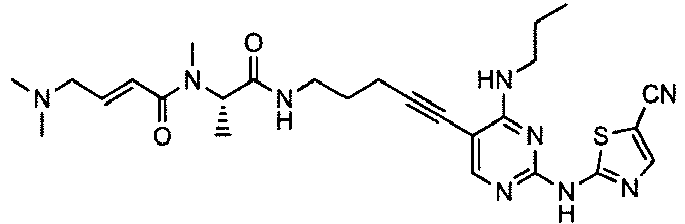
1H-NMR (CDCl3) δ: 8.22 (1H, s), 8.01 (1H, s), 7.32-7.25 (1H, m), 6.95 (1H, dt, J=15.2, 5.9Hz), 6.91-6.82 (1H, m), 6.62-6.52 (1H, m), 6.43 (1H, d, J=15.2Hz), 5.19 (1H, q, J=6.9Hz), 3.70-3.59 (2H, m), 3.53-3.43 (2H, m), 3.15-3.08 (2H, m), 3.01 (3H, s), 2.52-2.42 (2H, m), 2.28 (6H, s), 1.87-1.69 (4H, m), 1.38 (3H, d, J=7.3Hz), 1.04 (3H, t, J=7.4Hz) 22-23 
1H-NMR (CDCl3) δ: 8.51 (1H, d, J=2.0Hz), 8.07-7.94 (2H, m), 7.87 (1H, s), 6.93 (1H, dt, J=15.2, 5.9Hz), 6.71 (1H, d, J=8.6Hz), 6.62-6.53 (1H, m), 6.46-6.34 (1H, m), 5.17 (1H, q, J=7.0Hz), 5.08-4.95 (1H, m), 3.93 (3H, s), 3.48 (2H, q, J=6.2Hz), 3.09 (2H, dd, J=5.9, 1.3Hz), 3.01-2.90 (6H, m), 2.45 (2H, t, J=6.6Hz), 2.26 (6H, s), 1.81-1.67 (2H, m), 1.33 (3H, d, J=7.0Hz) 22-24 
1H-NMR (CDCl3) δ: 8.53 (1H, d, J=2.0Hz), 8.13-8.02 (2H, m), 7.91 (1H, s), 6.93 (1H, dt, J=15.2, 5.9Hz), 6.70 (1H, d, J=8.6Hz), 6.62-6.53 (1H, m), 6.46-6.36 (1H, m), 5.28-5.22 (1H, m), 5.17 (1H, q, J=7.3Hz), 3.92 (3H, s), 3.54-3.42 (2H, m), 3.10 (2H, dd, J=5.9, 1.3Hz), 2.96 (3H, s), 2.77-2.67 (1H, m), 2.45 (2H, t, J=6.6Hz), 2.26 (6H, s), 1.81-1.68 (2H, m), 1.33 (3H, d, J=7.3Hz), 0.83-0.73 (2H, m), 0.57-0.48 (2H, m) 22-25 
1H-NMR (CDCl3) δ: 8.07-8.03 (1H, m), 7.97-7.85 (1H, m), 7.45-7.35 (1H, m), 7.20-7.04 (2H, m), 6.95 (1H, dt, J=15.2, 5.9Hz), 6.58-6.47 (1H, m), 6.43 (1H, d, J=15.2Hz), 6.23-6.12 (1H, m), 5.20 (1H, q, J=7.0Hz), 4.07 (3H, s), 3.85 (3H, s), 3.58-3.37 (4H, m), 3.17-3.05 (2H, m), 2.99 (3H, s), 2.57-2.37 (2H, m), 2.27 (6H, s), 1.88-1.62 (4H, m), 1.36 (3H, d, J=6.9Hz), 1.01 (3H, t, J=7.3Hz) [Table 253] Compound No. Structure Physicochemical data 22-26 
1H-NMR (CDCl3) δ: 8.16-8.05 (1H, m), 8.02-7.93 (1H, m), 7.52-7.44 (1H, m), 7.35-7.28 (1H, m), 6.95 (1H, dt, J=15.2, 5.9Hz), 6.87-6.78 (1H, m), 6.60-6.51 (1H, m), 6.43 (1H, d, J=15.2Hz), 6.30-6.19 (1H, m), 5.19 (1H, q, J=6.9Hz), 4.06 (3H, s), 3.84 (3H, s), 3.63-3.38 (4H, m), 3.15-3.05 (2H, m), 3.00 (3H, s), 2.63-2.48 (2H, m), 2.27 (6H, s), 1.86-1.65 (4H, m), 1.36 (3H, d, J=7.3Hz), 1.01 (3H, t, J=7.4Hz) 22-27 
MS m/z (M+H): 561.5 22-28 
1H-NMR (CDCl3) δ: 8.58-8.43 (2H, m), 8.00-7.91 (1H, m), 7.23-7.13 (1H, m), 6.95 (1H, dt, J=15.2, 5.9Hz), 6.60-6.48 (1H, m), 6.43 (1H, d, J=15.2Hz), 6.28-6.18 (1H, m), 5.18 (1H, q, J=7.0Hz), 4.07 (3H, s), 3.57-3.37 (4H, m), 3.14-3.07 (2H, m), 2.99 (3H, s), 2.55 (3H, s), 2.52-2.38 (2H, m), 2.27 (6H, s), 1.72-1.63 (4H, m), 1.36 (3H, d, J=6.9Hz), 0.98 (3H, t, J=7.3Hz) 22-29 
1H-NMR (CDCl3) δ: 8.54-8.41 (2H, m), 7.97-7.90 (1H, m), 7.11-7.02 (1H, m), 6.95 (1H, dt, J=15.2, 5.9Hz), 6.57-6.47 (1H, m), 6.43 (1H, d, J=15.2Hz), 6.30-6.20 (1H, m), 5.18 (1H, q, J=7.3Hz), 4.07 (3H, s), 3.95 (3H, s), 3.56-3.36 (4H, m), 3.16-3.07 (2H, m), 2.99 (3H, s), 2.50-2.38 (2H, m), 2.28 (6H, s), 1.85-1.62 (4H, m), 1.36 (3H, d, J=7.3Hz), 0.99 (3H, t, J=7.3Hz) 22-30 
MS m/z (M+H): 602.5 [Table 254] Compound No. Structure Physicochemical data 22-31 
1H-NMR (CDCl3) δ: 8.19-8.10 (1H, m), 7.95 (1H, s), 7.93-7.85 (1H, m), 7.50-7.37 (1H, m), 7.44 (1H, dd, J=8.9, 2.0Hz), 7.31 (1H, d, J=8.9Hz), 7.10-7.03 (1H, m), 6.95 (1H, dt, J=15.2, 5.9Hz), 6.37-6.27 (1H, m), 6.27-6.17 (1H, m), 4.73-4.62 (1H, m), 4.06 (3H, s), 3.73-3.61 (2H, m), 3.60-3.28 (6H, m), 3.10 (2H, d, J=5.9Hz), 2.52-2.40 (2H, m), 2.27 (6H, s), 2.16-1.61 (6H, m), 1.00 (3H, t, J=7.4Hz) 22-32 
MS m/z (M+H): 572.5 22-33 
1H-NMR (CDCl3) δ: 8.30 (1H, s), 7.99 (1H, s), 7.90 (1H, s), 7.57 (1H, d, J=8.6Hz), 7.48-7.38 (1H, m), 7.10-6.90 (3H, m), 6.33 (1H, d, J=15.2Hz), 6.28-6.17 (1H, m), 4.72-4.64 (1H, m), 4.51 (2H, t, J=5.8Hz), 3.84 (2H, t, J=5.8Hz), 3.75-3.33 (6H, m), 3.31 (3H, s), 3.11 (2H, d, J=6.3Hz), 2.57-2.41 (2H, m), 2.27 (6H, s), 2.20-1.65 (8H, m), 1.02 (3H, t, J=7.4Hz) 22-34 
MS m/z (M+H): 630.5 22-35 
MS m/z (M+H): 630.5 [Table 255] Compound No. Structure Physicochemical data 22-36 
1H-NMR (CDCl3) δ: 7.97 (1H, s), 7.76-7.69 (1H, m), 7.26-7.16 (1H, m), 7.11-7.05 (1H, m), 7.09-7.05 (1H, m), 6.92 (1H, dt, J=15.2, 5.9Hz), 6.68 (1H, td, J=8.3, 2.2Hz), 6.42 (1H, d, J=15.2Hz), 6.33-6.26 (1H, m), 5.83-5.77 (1H, m), 5.15 (1H, q, J=7.0Hz), 3.77-3.66 (1H, m), 3.74-3.69 (2H, m), 3.65-3.59 (2H, m), 3.42 (3H, s), 3.11 (2H, d, J=5.3Hz), 2.98 (3H, s), 2.66-2.57 (1H, m), 2.35-2.27 (1H, m), 2.29 (6H, s), 2.05-1.97 (1H, m), 1.88-1.77 (2H, m), 1.42-1.28 (3H, m), 1.33 (3H, d, J=7.0Hz), 1.16-1.04 (1H, m) 22-37 
1H-NMR (CDCl3) δ: 7.95 (1H, s), 7.55-7.49 (2H, m), 7.05-6.95 (2H, m), 6.97-6.88 (1H, m), 6.95-6.89 (1H, m), 6.41 (1H, d, J=15.2Hz), 6.32-6.26 (1H, m), 5.78-5.73 (1H, m), 5.14 (1H, q, J=7.3Hz), 3.77-3.63 (1H, m), 3.69-3.63 (2H, m), 3.61-3.56 (2H, m), 3.41 (3H, s), 3.11 (2H, d, J=5.9Hz), 2.97 (3H, s), 2.66-2.57 (1H, m), 2.34-2.26 (1H, m), 2.28 (6H, s), 2.06-1.95 (1H, m), 1.88-1.77 (2H, m), 1.45-1.26 (3H, m), 1.33 (3H, d, J=7.3Hz), 1.15-1.04 (1H, m) 22-38 
1H-NMR (CDCl3) δ: 8.28 (1H, s), 7.98 (1H, s), 7.74 (1H, s), 7.66-7.60 (1H, m), 7.36 (1H, dd, J=7.9, 7.9Hz), 7.27-7.23 (1H, m), 6.93 (1H, dt, J=15.2, 5.9Hz), 6.54-6.48 (1H, m), 6.43 (1H, d, J=15.2Hz), 5.90-5.83 (1H, m), 5.17 (1H, q, J=7.0Hz), 3.78-3.68 (1H, m), 3.74-3.66 (2H, m), 3.67-3.60 (2H, m), 3.42 (3H, s), 3.12 (2H, d, J=5.9Hz), 3.00 (3H, s), 2.66-2.56 (1H, m), 2.47-2.31 (1H, m), 2.28 (6H, s), 2.07-1.96 (1H, m), 1.88-1.76 (2H, m), 1.47-1.26 (3H, m), 1.34 (3H, d, J=7.0Hz), 1.15-1.04 (1H, m) [Table 256] Compound No. Structure Physicochemical data 22-39 
1H-NMR (CDCl3) δ: 7.99 (1H, s), 7.73 (2H, d, J=9.2Hz), 7.57 (2H, d, J=9.2Hz), 7.26-7.20 (1H, m), 6.92 (1H, dt, J=15.2, 5.9Hz), 6.42 (1H, d, J=15.2Hz), 6.35-6.28 (1H, m), 5.88-5.81 (1H, m), 5.14 (1H, q, J=7.0Hz), 3.78-3.65 (1H, m), 3.72-3.64 (2H, m), 3.64-3.58 (2H, m), 3.42 (3H, s), 3.11 (2H, d, J=5.9Hz), 2.98 (3H, s), 2.67-2.57 (1H, m), 2.36-2.27 (1H, m), 2.28 (6H, s), 2.05-1.97 (1H, m), 1.89-1.77 (2H, m), 1.45-1.24 (3H, m), 1.33 (3H, d, J=7.0Hz), 1.15-1.05 (1H, m) 22-40 
1H-NMR (CDCl3:CD3OD=10:1) δ: 8.65-8.52 (2H, m), 7.96 (1H, s), 7.91 (1H, s), 6.91 (1H, dt, J=15.2, 6.2Hz), 6.44 (1H, d, J=15.2Hz), 5.23-5.08 (1H, m), 4.75-4.65 (2H, m), 3.95-3.85 (2H, m), 3.53-3.30 (7H, m), 3.18-3.08 (2H, m), 3.04 (3H, s), 2.56-2.42 (2H, m), 2.30 (6H, s), 1.88-1.63 (4H, m), 1.37 (3H, d, J=6.9Hz), 0.99 (3H, t, J=6.8Hz) 22-41 
1H-NMR (CDCl3:CD3OD=10:1) δ: 8.58-8.50 (2H, m), 7.91 (1H, s), 6.92-6.75 (1H, m), 6.44 (1H, d, J=15.9Hz), 5.21-5.10 (1H, m), 4.67-4.56 (2H, m), 3.92-3.82 (2H, m), 3.55-3.28(7H, m), 3.23-2.97 (5H, m), 2.56 (3H, s), 2.53-2.42 (2H, m), 2.28 (6H, s), 1.88-1.63 (4H, m), 1.36 (3H, d, J=6.9Hz), 0.98 (3H, t, J=7.3Hz) 22-42 
MS m/z (M+H): 602.5 22-43 
MS m/z (M+H): 573.5 [Table 257] Compound No. Structure Physicochemical data 22-44 
1H-NMR (CDCl3:CD3OD=10:1) δ: 8.60 (1H, d, J=2.3Hz), 8.58 (1H, d, J=2.3Hz), 7.96 (1H, s), 7.90 (1H, s), 6.91 (1H, dt, J=15.2, 6.3Hz), 6.35 (1H, d, J=15.2Hz), 4.69 (2H, t, J=5.6Hz), 4.59-4.51 (1H, m), 3.90 (2H, t, J=5.6Hz), 3.80-3.27 (9H, m), 3.25-3.09 (2H, m), 2.57-2.43 (2H, m), 2.29 (6H, s), 2.25-1.89 (4H, m), 1.88-1.60 (4H, m), 0.98 (3H, t, J=7.4Hz) 22-45 
MS m/z (M+H): 587.5 22-46 
1H-NMR (CDCl3:CD3OD=10:1) δ: 8.55 (1H, s), 8.54 (1H, s), 7.90 (1H, s), 6.91 (1H, dt, J=15.2, 6.3Hz), 6.35 (1H, d, J=15.2Hz), 4.61 (2H, t, J=5.6Hz), 4.60-4.52 (1H, m), 3.86 (2H, t, J=5.6Hz), 3.77-3.27 (9H, m), 3.20-3.07 (2H, m), 2.56 (3H, s), 2.53-2.42 (2H, m), 2.28 (6H, s), 2.22-1.89 (4H, m), 1.88-1.61 (4H, m), 0.97 (3H, t, J=7.4Hz) 22-47 
MS m/z (M+H): 603.6 22-48 
MS m/z (M+H): 648.6 22-49 
MS m/z (M+H): 648.6 22-50 
MS m/z (M+H): 634.6 [Table 258] Compound No. Structure Physicochemical data 22-51 
1H-NMR (CDCl3:CD3OD=10:1) δ: 8.58 (1H, s), 8.55 (1H, s), 7.91 (1H, s), 6.91 (1H, dt, J=14.9, 6.3Hz), 6.44 (1H, d, J=14.9Hz), 5.15 (1H, q, J=7.6Hz), 3.55-3.22 (4H, m), 3.19-3.09 (2H, m), 3.03 (3H, s), 2.57 (3H, s), 2.53-2.43 (2H, m), 2.29 (6H, s), 1.87-1.62 (4H, m), 1.36 (3H, d, J=6.9Hz), 0.97 (3H, t, J=7.3Hz) 22-52 
MS m/z (M+H): 649.6 22-53 
MS m/z (M+H): 660.6 22-54 
MS m/z (M+H): 660.6 22-55 
MS m/z (M+H): 646.6 22-56 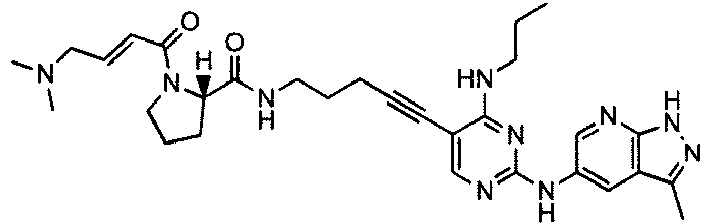
MS m/z (M+H): 573.5 22-57 
MS m/z (M+H): 589.5 [Table 259] Compound No. Structure Physicochemical data 22-58 
1H-NMR (CDCl3) δ: 8.27-8.22 (1H, m), 8.00 (1H, s), 7.49 (1H, d, J=8.6Hz), 7.30-7.23 (1H, m), 7.01-6.85 (2H, m), 6.59-6.50 (1H, m), 6.43 (1H, dt, J=15.0, 1.3Hz), 6.34-6.26 (1H, m), 5.19 (1H, q, J=7.0Hz), 3.88 (3H, s), 3.63-3.52 (2H, m), 3.50-3.39 (2H, m), 3.11 (2H, dd, J=5.9, 1.3Hz), 3.00 (3H, s), 2.45 (2H, t, J=6.6Hz), 2.27 (6H, s), 1.82-1.72 (4H, m), 1.36 (3H, d, J=7.0Hz), 1.01 (3H, t, J=7.3Hz) 22-59 
1H-NMR (CDCl3) δ: 8.27-8.23 (1H, m), 8.00 (1H, s), 7.49 (1H, d, J=8.6Hz), 7.47-7.40 (1H, m), 7.28-7.22 (1H, m), 6.97 (1H, dt, J=15.2, 5.9Hz), 6.90 (1H, dd, J=8.6, 1.7Hz), 6.38-6.27 (2H, m), 4.72-4.64 (1H, m), 3.88 (3H, s), 3.71-3.33 (6H, m), 3.11 (2H, d, J=5.9Hz), 2.48 (2H, t, J=6.6Hz), 2.27 (6H, s), 2.20-1.96 (2H, m), 1.88-1.70 (6H, m), 1.00 (3H, t, J=7.6Hz) 22-60 
1H-NMR (CDCl3) δ: 8.25-8.19 (1H, m), 7.95 (1H, s), 7.37 (1H, dd, J=9.2, 2.0Hz), 7.28-7.15 (2H, m), 6.94 (1H, dt, J=15.2, 5.9Hz), 6.58-6.49 (1H, m), 6.48-6.38 (1H, m), 6.32-6.22 (1H, m), 5.18 (1H, q, J=7.3Hz), 3.90 (3H, s), 3.57-3.38 (4H, m), 3.11 (2H, dd, J=5.9, 1.3Hz), 2.99 (3H, s), 2.44 (2H, t, J=6.6Hz), 2.27 (6H, s), 1.81-1.65 (4H, m), 1.36 (3H, d, J=7.3Hz), 1.01 (3H, t, J=7.3 Hz) 22-61 
1H-NMR (CDCl3) δ: 8.26-8.20 (1H, m), 7.94 (1H, s), 7.47-7.34 (2H, m), 7.30-7.16 (2H, m), 6.96 (1H, dt, J=15.2, 5.9Hz), 6.38-6.28 (2H, m), 4.71-4.63 (1H, m), 3.90 (3H, s), 3.73-3.30 (6H, m), 3.11 (2H, d, J=5.9Hz), 2.47 (2H, t, J=6.6Hz), 2.27 (6H, s), 2.19-1.96 (2H, m), 1.89-1.66 (6H, m), 1.00 (3H, t, J=7.6Hz) - In the same manner as that of Example 40, (2), Compounds (22-62) to (22-68) were obtained.
[Table 260] Compound No. Structure Physicochemical data 22-62 
MS m/z (M+H): 558.5 22-63 
1H-NMR (CDCl3:CD3OD=10:1) δ: 8.15 (1H, s), 7.93 (1H, s), 7.92 (1H, s), 7.63 (1H, d, J=8.9Hz), 7.17 (1H, dd, J=8.6, 1.7Hz), 6.91 (1H, dt, J=15.2, 6.3Hz), 6.36 (1H, d, J=15.2Hz), 4.62-4.48 (1H, m), 3.57-3.47 (2H, m), 3.46-3.32 (4H, m), 3.23-3.15 (2H, m), 2.56-2.43 (2H, m), 2.31 (6H, s), 2.24-1.89 (4H, m), 1.86-1.63 (4H, m), 1.01 (3H, t, J=7.4Hz) 22-64 
1H-NMR (CDCl3:CD3OD=10:1) δ: 8.16 (1H, s), 7.88 (1H, s), 7.40 (1H, dd, J=8.9, 2.0Hz), 7.24 (1H, d, J=8.9Hz), 6.91 (1H, dt, J=15.2, 6.3Hz), 6.45 (1H, d, J=15.2Hz), 5.15 (1H, q, J=6.9Hz), 4.07 (3H, s), 3.55-3.45 (2H, m), 3.44-3.35 (2H, m), 3.17-3.09 (2H, m), 3.03 (3H, s), 2.54-2.40 (2H, m), 2.29 (6H, s), 1.88-1.63 (4H, m), 1.36 (3H, d, J=7.3Hz), 1.01 (3H, t, J=7.3Hz) 22-65 
MS m/z (M+H): 576.5 22-66 
MS m/z (M+H): 577.5 [Table 261] Compound No. Structure Physicochemical data 22-67 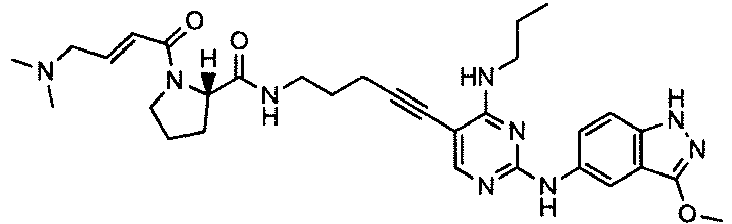
1H-NMR (CDCl3:CD3OD=10:1) δ: 8.16 (1H, s), 7.87 (1H, s), 7.39 (1H, d, J=8.8Hz), 7.24 (1H, d, J=8.8Hz), 6.91 (1H, dt, J=15.2, 6.3Hz), 6.36 (1H, d, J=15.2Hz), 4.60-4.48 (1H, m), 4.07 (3H, s), 3.78-3.30 (6H, m), 3.13-3.05 (2H, m), 2.57-2.42 (2H, m), 2.31 (6H, s), 2.25-1.88 (4H, m), 1.87-1.60 (4H, m), 1.00 (3H, t, J=6.9Hz) 22-68 
1H-NMR (CDCl3:CD3OD=10:1) δ: 7.96 (1H, s), 7.91 (1H, s), 7.53 (1H, d, J=8.8Hz), 7.07 (1H, d, J=8.8Hz), 6.91 (1H, dt, J=15.2, 6.3Hz), 6.35 (1H, d, J=15.2Hz), 4.61-4.42 (1H, m), 4.07 (3H, s), 3.80-3.33 (6H, m), 3.20-3.06 (2H, m), 2.57-2.44 (2H, m), 2.29 (6H, s), 2.22-1.88 (4H, m), 1.88-1.63 (4H, m), 1.01 (3H, t, J=6.9Hz)
Claims (31)
- A compound represented by the general formula [1]:
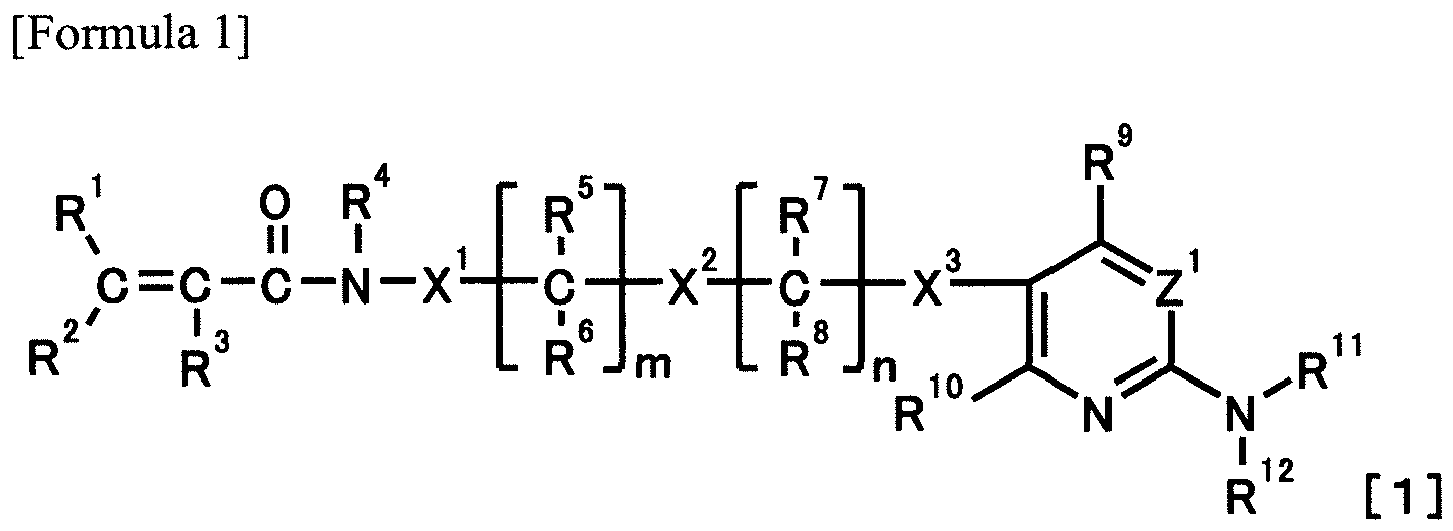
R1 represents hydrogen atom or a C1-6 alkyl group which may be substituted,
R2 represents hydrogen atom, a C1-6 alkyl group which may be substituted, a C2-6 alkenyl group which may be substituted or a C2-6 alkynyl group which may be substituted,
R3 represents hydrogen atom, a C1-6 alkyl group which may be substituted, a C2-6 alkenyl group which may be substituted or a C2-6 alkynyl group which may be substituted, or
R2 and R3 may bind together to form an atomic bond,
R4 represents hydrogen atom, a C1-6 alkyl group which may be substituted, a C2-6 alkenyl group which may be substituted, a C2-6 alkynyl group which may be substituted, a C3-8 cycloalkyl group which may be substituted or an imino protecting group,
m of R5 are the same or different, and represent hydrogen atom or a C1-6 alkyl group which may be substituted,
m of R6 are the same or different, and represent hydrogen atom or a C1-6 alkyl group which may be substituted, or
R5 and R6 binding to the same carbon atom may bind together to form a C2-6 alkylene group which may be substituted, an O-(C1-6 alkylene) group which may be substituted, an N(R13)-(C1-6 alkylene) group which may be substituted (in the formula, R13 represents hydrogen atom, a C1-6 alkyl group which may be substituted or an imino protecting group), a (C1-3 alkylene)-O-(C1-3 alkylene) group which may be substituted or a (C1-3 alkylene)-N(R13)-(C1-3 alkylene) group which maybe substituted (in the formula, R13 has the same meanings as that defined above),
n of R7 are the same or different, and represent hydrogen atom or a C1-6 alkyl group which may be substituted,
n of R8 are the same or different, and represent hydrogen atom or a C1-6 alkyl group which may be substituted, or
R7 and R8 binding to the same carbon atom may bind together to form a C2-6 alkylene group which may be substituted, an O-(C1-6 alkylene) group which may be substituted, an N(R14)-(C1-6 alkylene) group which may be substituted (in the formula, R14 represents hydrogen atom, a C1-6 alkyl group which may be substituted or an imino protecting group), a (C1-3 alkylene)-O-(C1-3 alkylene) group which maybe substituted or a (C1-3 alkylene)-N(R14)-(C1-3 alkylene) group which may be substituted (in the formula, R14 has the same meaning as that defined above),
R9 represents a C1-6 alkyl group which may be substituted, a C3-8 cycloalkyl group which may be substituted, an aryl group which may be substituted, a C1-6 alkoxy group which may be substituted, a heterocyclic group which may be substituted or N(R15)(R16) (in the formula, R15 represents hydrogen atom, a C1-6 alkyl group which may be substituted, a C2-6 alkenyl group which may be substituted, a C2-6 alkynyl group which may be substituted or a C3-8 cycloalkyl group which may be substituted, and R16 represents a C1-6 alkyl group which may be substituted, a C2-6 alkenyl group which may be substituted, a C2-6 alkynyl group which may be substituted, a C3-8 cycloalkyl group which may be substituted, an aryl group which may be substituted or a heterocyclic group which may be substituted, or R15 and R16 may form a cyclic amino group which may be substituted together with the nitrogen atom to which they bind),
R10 represents hydrogen atom, a halogen atom, a C1-6 alkyl group which may be substituted, a C3-8 cycloalkyl group which may be substituted, an aryl group which may be substituted, a C1-6 alkoxy group which may be substituted or a heterocyclic group which may be substituted,
R11 represents hydrogen atom, a C1-6 alkyl group which may be substituted, a C2-6 alkenyl group which may be substituted, a C2-6 alkynyl group which may be substituted or a C3-8 cycloalkyl group which may be substituted,
R12 represents a C1-6 alkyl group which may be substituted, a C2-6 alkenyl group which may be substituted, a C2-6 alkynyl group which may be substituted, a C3-8 cycloalkyl group which may be substituted, an aryl group which may be substituted, a heterocyclic group which may be substituted or a carbamoyl group which may be substituted,
X1 represents a group represented by the general formula [2]:
[Formula 2]
-X4-X5- [2]
(in the formula, X4 represents a divalent alicyclic hydrocarbon group which may be substituted, a divalent aromatic hydrocarbon group which may be substituted, a divalent heterocyclic group which may be substituted, a group represented by the general formula [3]
X5 represents oxygen atom, N(R21) (in the formula, R21 represents hydrogen atom, a C1-6 alkyl group which may be substituted, a C2-6 alkenyl group which may be substituted, a C2-6 alkynyl group which may be substituted or an imino protecting group, or R21 may bind with R4 to form a C1-6 alkylene group which may be substituted), C(=O), C(=O)-N(R21) (in the formula, R21 has the same meaning as that defined above), or an atomic bond),
X2 represents a C1-6 alkylene group which may be substituted, a divalent alicyclic hydrocarbon group which may be substituted, a divalent aromatic hydrocarbon group which may be substituted or a divalent heterocyclic group which may be substituted,
X3 represents a C1-6 alkylene group which may be substituted, a C2-6 alkenylene group which may be substituted, a C2-6 alkynylene group which may be substituted, an O-(C1-6 alkylene) group which maybe substituted, an S(O)q-(C1-6 alkylene) group which may be substituted (in the formula, q represents 0, 1 or 2), an N(R22)-(C1-6 alkylene) group which may be substituted (in the formula, R22 represents hydrogen atom, a C1-6 alkyl group which may be substituted, a C2-6 alkenyl group which may be substituted, a C2-6 alkynyl group which may be substituted or an imino protecting group), N(R22)-C(=O) (in the formula, R22 has the same meaning as that defined above), or an atomic bond,
Z1 represents nitrogen atom or C(R23) (in the formula, R23 represents hydrogen atom, a halogen atom, a C1-6 alkyl group which may be substituted, a C3-8 cycloalkyl group which may be substituted, an aryl group which may be substituted, a C1-6 alkoxy group which may be substituted or a heterocyclic group which may be substituted),
m represents an integer of 0 to 6, and
n represents an integer of 0 to 6) or a salt thereof. - The compound or a salt thereof according to claim 1, wherein Z1 is nitrogen atom.
- The compound or a salt thereof according to claim 1 or 2, wherein X3 is a C2-6 alkynylene group which may be substituted or N(R22)-C(=O) (in the formula, R22 represents hydrogen atom, a C1-6 alkyl group which may be substituted, a C2-6 alkenyl group which may be substituted, a C2-6 alkynyl group which may be substituted or an imino protecting group).
- The compound or a salt thereof according to claim 1 or 2, wherein X3 is ethynylene group.
- The compound or a salt thereof according to any one of claims 1 to 4, wherein R1 is hydrogen atom, and R2 is a C1-6 alkyl group which may be substituted.
- The compound or a salt thereof according to any one of claims 1 to 4, wherein R1 is hydrogen atom, and R2 is a C1-6 alkyl group substituted with a di(C1-6 alkyl)amino group.
- The compound or a salt thereof according to any one of claims 1 to 6, wherein R9 is N(R15)(R16) (in the formula, R15 represents hydrogen atom, a C1-6 alkyl group which may be substituted, a C2-6 alkenyl group which may be substituted, a C2-6 alkynyl group which may be substituted or a C3-8 cycloalkyl group which may be substituted, and R16 represents a C1-6 alkyl group which may be substituted, a C2-6 alkenyl group which may be substituted, a C2-6 alkynyl group which may be substituted, a C3-8 cycloalkyl group which may be substituted, an aryl group which may be substituted or a heterocyclic group which may be substituted, or R15 and R16 may form a cyclic amino group which may be substituted together with the nitrogen atom to which they bind).
- The compound or a salt thereof according to claim 7, wherein R15 is hydrogen atom, and R16 is a C1-6 alkyl group which may be substituted.
- The compound or a salt thereof according to any one of claims 1 to 8, wherein R11 is hydrogen atom, and R12 is an aryl group which may be substituted or a heterocyclic group which may be substituted.
- The compound or a salt thereof according to any one of claims 1 to 8, wherein R11 is hydrogen atom, and R12 is phenyl group which may be substituted, pyridyl group which may be substituted, pyrazolyl group which may be substituted, thienyl group which may be substituted, oxazolyl group which may be substituted, thiazolyl group which may be substituted, isothiazolyl group which may be substituted, indazolyl group which may be substituted, pyrazolopyridinyl group which may be substituted, quinolyl group which may be substituted, isoquinolyl group which may be substituted, cinnolinyl group which may be substituted, phthalazinyl group which may be substituted, quinoxalinyl group which may be substituted, benzofuranyl group which may be substituted or benzothiazolyl group which may be substituted.
- The compound or a salt thereof according to any one of claims 1 to 10, wherein R4 is hydrogen atom or a C1-6 alkyl group which may be substituted.
- The compound or a salt thereof according to any one of claims 1 to 10, wherein R4 is hydrogen atom or methyl group.
- The compound or a salt thereof according to any one of claims 1 to 12, wherein X2 is a C1-6 alkylene group which may be substituted or a divalent alicyclic hydrocarbon group which may be substituted.
- The compound or a salt thereof according to any one of claims 1 to 13, wherein X1 is a group represented by the general formula [2]:
[Formula 4]
-X4-X5- [2]
(in the formula, X4 represents a group represented by the general formula [3]
- The compound or a salt thereof according to any one of claims 1 to 14, wherein R3 is hydrogen atom or a C1-6 alkyl group which may be substituted.
- The compound or a salt thereof according to any one of claims 1 to 15, wherein R5, R6, R7 and R8 are hydrogen atoms.
- The compound or a salt thereof according to any one of claims 1 to 16, wherein R10 is hydrogen atom.
- A compound represented by the general formula [1]-(1):

R2a represents hydrogen atom or a C1-6 alkyl group which may be substituted,
R4a represents hydrogen atom or a C1-6 alkyl group which may be substituted,
R17a represents hydrogen atom or a C1-6 alkyl group which may be substituted, provided that R17a may form a divalent nitrogen-containing heterocyclic group which may be substituted together with R4a, the nitrogen atom to which R4a binds, and the carbon atom to which R17a binds,
R17b and R18b are the same or different, and represent hydrogen atom or a C1-6 alkyl group which may be substituted, provided that R17b and R18b may form C(=O) together with the carbon atom to which they bind, or R17b and R18b may form a heterocyclic group which may be substituted together with the carbon atom to which they bind,
R9a represents a C1-6 alkyl group which may be substituted, a C1-6 alkoxy group which may be substituted, a heterocyclic group which may be substituted or N(R15)(R16) (in the formula, R15 represents hydrogen atom, a C1-6 alkyl group which may be substituted, a C2-6 alkenyl group which may be substituted, a C2-6 alkynyl group which may be substituted or a C3-8 cycloalkyl group which may be substituted, and R16 represents a C1-6 alkyl group which may be substituted, a C2-6 alkenyl group which may be substituted, a C2-6 alkynyl group which may be substituted, a C3-8 cycloalkyl group which may be substituted, an aryl group which may be substituted or a heterocyclic group which may be substituted, or R15 and R16 may form a cyclic amino group which may be substituted together with the nitrogen atom to which they bind),
R12a represents a C1-6 alkyl group which may be substituted, an aryl group which may be substituted or a heterocyclic group which may be substituted,
X2a represents a C1-6 alkylene group which may be substituted, a divalent alicyclic hydrocarbon group which may be substituted or a divalent aromatic hydrocarbon group which may be substituted, and
X3a represents a C2-6 alkynylene group which may be substituted or N(R22)-C(=O) (in the formula, R22 represents hydrogen atom, a C1-6 alkyl group which may be substituted, a C2-6 alkenyl group which may be substituted, a C2-6 alkynyl group which may be substituted or an imino protecting group) or a salt thereof. - The compound or a salt thereof according to claim 18, wherein R2a is a C1-6 alkyl group which may be substituted, substituent of the C1-6 alkyl group which may be substituted as R2a is a halogen atom, hydroxyl group, a C1-6 alkylamino group which may be substituted with one or more groups selected from the substituent group A-3, a di(C1-6 alkyl)amino group which may be substituted with one or more groups selected from the substituent group A-3 or a heterocyclic group which may be substituted with one or more groups selected from the substituent group A-3, and the substituent group A-3 consists of a halogen atom, hydroxyl group which may be protected, and a C1-6 alkyl group which may be substituted with hydroxyl group.
- The compound or a salt thereof according to claim 18 or 19, wherein R4a is hydrogen atom or a C1-6 alkyl group.
- The compound or a salt thereof according to any one of claims 18 to 20, wherein R17a is hydrogen atom or a C1-6 alkyl group.
- The compound or a salt thereof according to any one of claims 18 to 21, wherein R17b and R18b are the same or different, and represent a C1-6 alkyl group, or R17b and R18b form C(=O) together with the carbon atom to which they bind.
- The compound or a salt thereof according to any one of claims 18 to 22, wherein R9a is N(R15)(R16) (in the formula, R15 represents hydrogen atom, a C1-6 alkyl group which may be substituted, a C2-6 alkenyl group which may be substituted, a C2-6 alkynyl group which may be substituted or a C3-8 cycloalkyl group which may be substituted, and R16 represents a C1-6 alkyl group which may be substituted, a C2-6 alkenyl group which may be substituted, a C2-6 alkynyl group which may be substituted, a C3-8 cycloalkyl group which may be substituted, an aryl group which may be substituted or a heterocyclic group which may be substituted, or R15 and R16 may form a cyclic amino group which may be substituted together with the nitrogen atom to which they bind).
- The compound or a salt thereof according to any one of claims 18 to 23, wherein R12a is an aryl group which may be substituted.
- The compound or a salt thereof according to any one of claims 18 to 24, wherein X2a is a C1-6 alkylene group which may be substituted or a divalent alicyclic hydrocarbon group which may be substituted.
- The compound or a salt thereof according to any one of claims 18 to 25, wherein X3a is a C2-6 alkynylene group which may be substituted.
- The compound or a salt thereof according to claim 1, which is a compound selected from (S,E)-N-(3-(2-(4-(dimethylamino)-N-methyl-2-butenamido)propanamido)phenyl)-4-(propylamino)-2-((2-(pyridin-4-yl)ethyl)amino)pyrimidine-5-carboxamide, (S,E)-2-((4-carbamoylphenyl)amino)-N-(3-(2-(4-(dimethylamino)-N-methyl-2-butenamido)propanamido)phenyl)-4-(propylamino)pyrimidine-5-carboxamide, (E)-2-((4-carbamoylphenyl)amino)-N-(3-(2-(4-(dimethylamino)-N-methyl-2-butenamido)actamido)cyclohexyl)-4-(propylamino)pyrimidine-5-carboxamide, (S,E)-2-((4-carbamoylphenyl)amino)-N-(3-(2-(4-(diethylamino)-N-methyl-2-butenamido)propanamido)phenyl)-4-(propylamino)pyrimidine-5-carboxamide, (S,E)-2-((4-carbamoylphenyl)amino)-N-(3-(2-(4-(dimethylamino)-N-methyl-2-butenamido)propaneamido)propyl)-4-(propylamino)pyrimidine-5-carboxamide, (S,E)-N-(3-(2-(4-(dimethylamino)-N-methyl-2-butenamido)propanamido)phenyl)-2-(isoquinolin-6-ylamino)-4-(propylamino)pyrimidine-S-carboxamide, (S,E)-2-(cinnolin-6-ylamino)-N-(3-(2-(4-(dimethylamino)-N-methyl-2-butenamido)propanamido)phenyl)-4-(propylamino)pyrimidine-5-carboxamide, (S,E)-4-(dimethylamino)-N-(1-((5-(2-((3-fluorophenyl)amino)-4-(propylamino)pyrimidin-5-yl)-4-pentyn-1-yl)amino)-1-oxopropan-2-yl)-N-methyl-2-butenamide, (S,E)-N-(1-((5-(2-((3-cyanophenyl)amino)-4-(propylamino)pyrimidin-5-yl)-4-pentyn-1-yl)amino)-1-oxopropan-2-yl)-4-(dimethylamino)-N-methyl-2-butenamide, (S,E)-4-((5-(5-(2-(4-(dimethylamino)-N-methyl-2-butenamido)propaneamido)-1-pentyn-1-yl)-4-(propylamino)pyrimidin-2-yl)amino)benzamide, (S,E)-N-(1-((5-(2-((4-cyanophenyl)amino)-4-(propyl amino)pyrimidin-5-yl)-4-pentyn-1-yl)amino)-1-oxopropan-2-yl)-4-(dimethylamino)-N-methyl-2-butenamide, (E)-4-(dimethylamino)-N-(2-((5-(2-((4-fluorophenyl)amino)-4-(propylamino)pyrimidin-5-yl)-4-pentyn-1-yl)amino)-2-oxoethyl)-N-methyl-2-butenamide, (E)-N-(2-((5-(2-((4-cyanophenyl)amino)-4-(propylamino)pyrimidin-5-yl)-4-pentyn-1-yl)amino)-2-oxoethyl)-4-(dimethylamino)-N-methyl-2-butenamide, (S,E)-4-(dimethylamino)-N-(1-((5-(2-((3-fluorophenyl)amino)-4-(propyl amino)pyrimidin-5-yl)-4-pentyn-1-yl)amino)-1-oxobutan-2-yl)-N-methyl-2-butenamide, (S,E)-4-(dimethylamino)-N-(1-((5-(2-((3-fluoro-4-methoxyphenyl)amino)-4-(propylamino)pyrimidin-5-yl)-4-pentyn-1-yl)amino)-1-oxopropan-2-yl)-N-methyl-2-butenamide, (S,E)-4-(dimethylamino)-N-(1-((5-(2-((6-fluoropyridin-3-yl)amino)-4-(propylamino)pyrimidin-5-yl)-4-pentyn-1-yl)amino)-1-oxopropan-2-yl)-N-methyl-2-butenamide, (S,E)-4-(dimethylamino)-N-(1-((5-(2-((6-fluoropyridin-3-yl)amino)-4-((4-methoxyphenyl)amino)pyrimidin-5-yl)-4-pentyn-1-yl)amino)-1-oxopropan-2-yl)-N-methyl-2-butenamide, (E)-4-(dimethylamino)-N-(2-((5-(2-((3-fluorophenyl)amino)-4-(propylamino)pyrimidin-5-yl)-4-pentyn-1-yl)amino)-2-oxoethyl)-N-methyl-2-butenamide, (S,E)-N-(5-(2-((4-cyanophenyl)amino)-4-(propylamino)pyrimidin-5-yl)-4-pentyn-1-yl)-1-(4-(dimethylamino)-2-butenoyl)pyrrolidine-2-carboxamide, (S,E)-N-(1-((5-(4-(cyclopropylamino)-2-((3-fluoro-4-methoxyphenyl)amino)pyrimidin-5-yl)-4-pentyn-1-yl)amino)-1-oxopropan-2-yl)-4-(dimethylamino)-N-methyl-2-butenamide, (S,E)-4-(dimethylamino)-N-(1-((5-(2-((3-fluoro-4-methoxyphenyl)amino)-4-((3-fluoropropyl)amino)pyrimidin-5-yl)-4-pentyn-1-yl)amino)-1-oxopropan-2-yl)-N-methyl-2-butenamide, (S,E)-N-(1-((5-(2-((4-cyanophenyl)amino)-4-(propylamino)pyrimidin-5-yl)-4-pentyn-1-yl)amino)-3-hydroxy-1-oxopropan-2-yl)-4-(dimethylamino)-N-methyl-2-butenamide, (2S,4R)-1-((E)-4-(dimethylamino)-2-butenoyl)-N-(5-(2-((3-fluorophenyl)amino)-4-(propylamino)pyrimidin-5-yl)-4-pentyn-1-yl)-4-hydroxypyrrolidine-2-carboxamide, (2S,4S)-1-((E)-4-(dimethylamino)-2-butenoyl)-4-fluoro-N-(5-(2-((3-fluorophenyl)amino)-4-(methylamino)pyrimidin-5-yl)-4-pentyn-1-yl)pyrrolidine-2-carboxamide, (2S,4S)-1-((E)-4-(dimethylamino)-2-butenoyl)-N-(5-(2-((3-fluorophenyl)amino)-4-(methylamino)pyrimidin-5-yl)-4-pentyn-1-yl)-4-methoxypyrrolidine-2-carboxamide, (2S,4S)-1-((E)-4-(dimethylamino)-2-butenoyl)-4-fluoro-N-(5-(2-((4-fluorophenyl)amino)-4-(methylamino)pyrimidin-5-yl)-4-pentyn-1-yl)pyrrolidine-2-carboxamide, (2S,4R)-1-((E)-4-(dimethylamino)-2-butenoyl)-4-fluoro-N-(5-(2-((4-fluorophenyl)amino)-4-(methylamino)pyrimidin-5-yl)-4-pentyn-1-yl)pyrrolidine-2-carboxamide, (2S,4S)-1-((E)-4-(dimethylamino)-2-butenoyl)-N-(5-(2-((4-fluorophenyl)amino)-4-(methylamino)pyrimidin-5-yl)-4-pentyn-1-yl)-4-methoxypyrrolidine-2-carboxamide, (2S,4R)-1-((E)-4-(dimethylamino)-2-butenoyl)-N-(5-(2-((4-fluorophenyl)amino)-4-(methylamino)pyrimidin-5-yl)-4-pentyn-1-yl)-4-methoxypyrrolidine-2-carboxamide, (S,E)-1-(4-(dimethylamino)-2-butenoyl)-N-(5-(2-((4-fluorophenyl)amino)-4-(methylamino)pyrimidin-5-yl)-4-pentyn-1-yl)azetidine-2-carboxamide, (2S,4S)-N-(5-(2-((4-cyanophenyl)amino)-4-(methylamino)pyrimidin-5-yl)-4-pentyn-1-yl)-1-((E)-4-(dimethylamino)-2-butenoyl)-4-fluoropyrrolidine-2-carboxamide, (E)-N-(2-((5-(2-((4-cyanophenyl)amino)-4-(methylamino)pyrimidin-5-yl)-4-pentyn-1-yl)amino)-2-oxoethyl)-4-(dimethylamino)-N-methyl-2-butenamide, (S,E)-4-(dimethylamino)-N-(1-((3-((2-((3-fluorophenyl)amino)-4-(propylamino)pyrimidin-5-yl)ethynyl)phenyl)amino)-1-oxopropan-2-yl)-N-methyl-2-butenamide, (S,E)-4-((5-((3-(2-(4-(dimethylamino)-N-methyl-2-butenamido)propanamido)phenyl)ethynyl)-4-(propylamino)pyrimidin-2-yl)amino)benzamide, (S,E)-N-(1-((5-(2-((4-cyanophenyl)amino)-4-(pyrrolidin-1-yl)pyrimidin-5-yl)-4-pentyn-1-yl)amino)-1-oxopropan-2-yl)-4-(dimethylamino)-N-methyl-2-butenamide, (S,E)-4-(dimethylamino)-N-(1-((5-(2-((2-fluoropyridin-4-yl)amino)-4-(pyrrolidin-1-yl)pyrimidin-5-yl)-4-pentyn-1-yl)amino)-1-oxopropan-2-yl)-N-methyl-2-butenamide, (S,E)-4-(dimethylamino)-N-(1-((5-(2-((2-fluoropyridin-4-yl)amino)-4-(propylamino)pyrimidin-5-yl)-4-pentyn-1-yl)amino)-1-oxopropan-2-yl)-N-methyl-2-butenamide, (S,E)-N-(1-((5-(4-(cyclopropylamino)-2-((2-fluoropyridin-4-yl)amino)pyrimidin-5-yl)-4-pentyn-1-yl)amino)-1-oxopropan-2-yl)-4-(dimethylamino)-N-methyl-2-butenamide, (S,E)-4-(dimethylamino)-N-methyl-N-(1-((5-(2-((3-methylisothiazol-5-yl)amino)-4-(propylamino)pyrimidin-5-yl)-4-pentyn-1-yl)amino)-1-oxopropan-2-yl)-2-butenamide, (S,E)-4-(dimethylamino)-N-(1-((5-(4-((3-methoxypropyl)amino)-2-((2-methoxypyridin-4-yl)amino)pyrimidin-5-yl)-4-pentyn-1-yl)amino)-1-oxopropan-2-yl)-N-methyl-2-butenamide, (S,E)-1-(4-(dimethylamino)-2-butenoyl)-N-(5-(4-((3-methoxypropyl)amino)-2-((methoxypyridin-4-yl)amino)pyrimidin-5-yl)-4-pentyn-1-yl)pyrrolidine-2-carboxamide, (2S,4S)-1-((E)-4-(dimethylamino)-2-butenoyl)-4-fluoro-N-(5-(4-((3-methoxypropyl)amino)-2-((methoxypyridin-4-yl)amino)pyrimidin-5-yl)-4-pentyn-1-yl)pyrrolidine-2-carboxamide, (S,E)-1-(4-(dimethylamino)-2-butenoyl)-N-(5-(2-((2-methoxypyridin-4-yl)amino)-4-(propylamino)pyrimidin-5-yl)-4-pentyn-1-yl)pyrrolidine-2-carboxamide, (2S,4S)-1-((E)-4-(dimethylamino)-2-butenoyl)-4-fluoro-N-(5-(2-((2-methoxypyridin-4-yl)amino)-4-(propylamino)pyrimidin-5-yl)-4-pentyn-1-yl)pyrrolidine-2-carboxamide, (E)-4-(dimethylamino)-N-(2-((5-(2-((2-methoxypyridin-4-yl)amino)-4-(propylamino)pyrimidin-5-yl)-4-pentyn-1-yl)amino)-2-oxoethyl)-N-methyl-2-butenamide, (S,E)-4-(dimethylamino)-N-(1-((5-(2-((3-fluorophenyl)amino)-4-((4-methoxyphenyl)amino)pyrimidin-5-yl)-4-pentyn-1-yl)amino)-1-oxopropan-2-yl)-N-methyl-2-butenamide, (S,E)-4-(dimethylamino)-N-(1-((5-(2-((3-fluorophenyl)amino)-4-morpholinopyrimidin-5-yl)-4-pentyn-1-yl)amino)-1-oxopropan-2-yl)-N-methyl-2-butenamide, (E)-4-(dimethylamino)-N-(2-((5-(2-((4-fluorophenyl)amino)-4-((3-fluoropropyl)amino)pyrimidin-5-yl)-4-pentyn-1-yl)amino)-2-oxoethyl)-N-methyl-2-butenamide, (S,E)-N-(1-((5-(2-((4-cyanophenyl)amino)-4-(cyclopropylamino)pyrimidin-5-yl)-4-pentyn-1-yl)amino)-1-oxopropan-2-yl)-4-(dimethylamino))-N-methyl-2-butenamide, (S,E)-N-(1-((5-(2-((4-cyanophenyl)amino)-4-((3-fluoropropyl)amino)pyrimidin-5-yl)-4-pentyn-1-yl)amino)-1-oxopropan-2-yl)-4-(dimethylamino))-N-methyl-2-butenamide, (S,E)-4-(dimethylamino))-N-(1-((5-(4-(ethylamino)-2-((1-methyl-1H-indazol-5-yl)amino)pyrimidin-5-yl)-4-pentyn-1-yl)amino)-1-oxopropan-2-yl)-N-methyl-2-butenamide, (S,E)-N-(1-((5-(4-(cyclopropylamino)-2-((1-methyl-1H-indazol-5-yl)amino)pyrimidin-5-yl)-4-pentyn-1-yl)amino)-1-oxopropan-2-yl)-4-(dimethylamino))-N-methyl-2-butenamide, (S,E)-4-(dimethylamino))-N-methyl-N-(1-((5-(2-((1-methyl-1H-indazol-5-yl)amino)-4-(methylamino)pyrimidin-5-yl)-4-pentyn-1-yl)amino)-1-oxopropan-2-yl)-2-butenamide, (S,E)-N-(5-(2-((1H-indazol-5-yl)amino)-4-(methylamino)pyrimidin-5-yl)-4-pentyn-1-yl)-1-(4-(dimethyl amino)-2-butenoyl)pyrrolidine-2-carboxamide, (S,E)-N-(5-(2-((1H-indazol-5-yl)amino)-4-(ethylamino)pyrimidin-5-yl)-4-pentyn-1-yl)-1-(4-(dimethylamino)-2-butenoyl)pyrrolidine-2-carboxamide, (S,E)-N-(5-(2-((1H-indazol-5-yl)amino)-4-((3-methoxypropyl)amino)pyrimidin-5-yl)-4-pentyn-1-yl)-1-(4-(dimethylamino)-2-butenoyl)pyrrolidine-2-carboxamide, (E)-4-(dimethylamino)-N-((S)-1-(((1S,3R)-3-((2-((3-fluorophenyl)amino)-4-(propylamino)pyrimidin-5-yl)ethynyl)cyclohexyl)amino)-1-oxopropan-2-yl)-N-methyl-2-butenamide, (E)-4-(dimethylamino)-N-((S)-1-(((1S,3R)-3-((2-((3-fluorophenyl)amino)-4-(propylamino)pyrimidin-5-yl)ethynyl)cyclobutyl)amino)-1-oxopropan-2-yl)-N-methyl-2-butenamide, (E)-N-((S)-1-(((1S,3R)-3-((2-((4-cyanophenyl)amino)-4-(methylamino)pyrimidin-5-yl)ethynyl)cyclobutyl)amino)-1-oxopropan-2-yl)-4-(dimethylamino)-N-methyl-2-butenamide, (E)-4-(dimethylamino)-N-((S)-1-(((1S,3R)-3-((2-((3-fluorophenyl)amino)-4-(methylamino)pyrimidin-5-yl)ethynyl)cyclobutyl)amino)-1-oxopropan-2-yl)-N-methyl-2-butenamide, (E)-N-((S)-1-(((1S,3R)-3-((2-((4-cyanophenyl)amino)-4-(methylamino)pyrimidin-5-yl)ethynyl)cyclobutyl)amino)-1-oxopropan-2-yl)-4-(dimethylamino)-N-methyl-2-butenamide, (E)-N-((S)-1-(((1S,3R)-3-((2-((3-cyanophenyl)amino)-4-(methylamino)pyrimidin-5-yl)ethynyl)cyclobutyl)amino)-1-oxopropan-2-yl)-4-(dimethylamino)-N-methyl-2-butenamide, (E)-4-(dimethylamino)-N-((S)-1-(((1S,3R)-3-((2-((3-fluoro-4-methoxyphenyl)amino)-4-(methylamino)pyrimidin-5-yl)ethynyl)cyclobutyl)amino)-1-oxopropan-2-yl)-N-methyl-2-butenamide, (E)-4-(dimethylamino)-N-((S)-1-(((1S,3R)-3-((2-((4-fluorophenyl)amino)-4-(methylamino)pyrimidin-5-yl)ethynyl)cyclobutyl)amino)-1-oxopropan-2-yl)-N-methyl-2-butenamide, (E)-N-((S)-1-(((1S,3R)-3-((2-((3-cyanophenyl)amino)-4-(cyclopropylamino)pyrimidin-5-yl)ethynyl)cyclobutyl)amino)-1-oxopropan-2-yl)-4-(dimethylamino)-N-methyl-2-butenamide, (E)-4-(dimethylamino)-N-((S)-1-(((1S*,3R*)-3-((2-((2-fluoropyridin-4-yl)amino)-4-(propylamino)pyrimidin-5-yl)ethynyl)cyclobutyl)amino)-1-oxopropan-2-yl)-N-methyl-2-butenamide, (E)-4-(dimethylamino)-N-((S)-1-(((1S,3R)-3-((2-((2-methoxypyridin-4-yl)amino)-4-(propylamino)pyrimidin-5-yl)ethynyl)cyclobutyl)amino)-1-oxopropan-2-yl)-N-methyl-2-butenamide, (E)-N-((S)-1-(((1S,3R)-3-((2-((4-cyanophenyl)amino)-4-(methylamino)pyrimidin-5-yl)ethynyl)cyclohexyl)amino)-1-oxopropan-2-yl)-4-(dimethylamino)-N-methyl-2-butenamide, (E)-N-((S)-1-(((1S*,3R*)-3-((2-((4-cyanophenyl)amino)-4-(cyclopropylamino)pyrimidin-5-yl)ethynyl)cyclobutyl)amino)-1-oxopropan-2-yl)-4-(dimethylamino)-N-methyl-2-butenamide, (E)-N-((S)-1-(((1S*,3R*)-3-((4-(cyclopropylamino)-2-((4-fluorophenyl)amino)pyrimidin-5-yl)ethynyl)cyclobutyl)amino)-1-oxopropan-2-yl)-4-(dimethylamino)-N-methyl-2-butenamide, (E)-N-((S)-1-(((1S*,3R*)-3-((4-(cyclopropylamino)-2-((3-fluoro-4-methoxyphenyl)amino)pyrimidin-5-yl)ethynyl)cyclobutyl)amino)-1-oxopropan-2-yl)-4-(dimethylamino)-N-methyl-2-butenamide, (E)-4-(dimethylamino)-N-((S)-1-(((1S,3R)-3-((2-((3-fluorophenyl)amino)-4-((3-fluoropropyl)amino)pyrimidin-5-yl)ethynyl)cyclobutyl)amino)-1-oxopropan-2-yl)-N-methyl-2-butenamide, (E)-N-((S)-1-(((1S,3R)-3-((2-((4-cyanophenyl)amino)-4-((3-fluoropropyl)amino)pyrimidin-5-yl)ethynyl)cyclobutyl)amino)-1-oxopropan-2-yl)-4-(dimethylamino)-N-methyl-2-butenamide, (E)-4-(dimethylamino)-N-((S)-1-(((1S,3R)-3-((2-((3-fluorophenyl)amino)-4-((3-methoxypropyl)amino)pyrimidin-5-yl)ethynyl)cyclobutyl)amino)-1-oxopropan-2-yl)-N-methyl-2-butenamide, (E)-N-((S)-1-(((1S,3R)-3-((2-((4-cyanophenyl)amino)-4-((3-methoxypropyl)amino)pyrimidin-5-yl)ethynyl)cyclobutyl)amino)-1-oxopropan-2-yl)-4-(dimethylamino)-N-methyl-2-butenamide, (E)-4-(dimethylamino)-N-((S)-1-(((1S,3R)-3-((2-((3-fluoro-4-methoxyphenyl)amino)-4-(methylamino)pyrimidin-5-yl)ethynyl)cyclohexyl)amino)-1-oxopropan-2-yl)-N-methyl-2-butenamide, (S,E)-4-(dimethylamino)-N-methyl-N-(1-((5-(2-((2-methylpyridin-4-yl)amino)-4-(propylamino)pyrimidin-5-yl)-4-pentyn-1-yl)amino)-1-oxopropan-2-yl)-2-butenamide, (S,E)-N-(1-((5-(2-(benzo[d]thiazol-6-ylamino)-4-(propylamino)pyrimidin-5-yl)-4-pentyn-1-yl)amino)-1-oxopropan-2-yl)-4-(dimethylamino)-N-methyl-2-butenamide, (S,E)-1-(4-(dimethylamino)-2-butenoyl)-N-(5-(2-((1-methyl-1H-indazol-5-yl)amino)-4-(propylamino)pyrimidin-5-yl)-4-pentyn-1-yl)pyrrolidine-2-carboxamide, (S,E)-1-(4-(dimethylamino)-2-butenoyl)-N-(5-(2-((1-methyl-1H-pyrazolo[3,4-b]pyridin-5-yl)amino)-4-(propylamino)pyrimidin-5-yl)-4-pentyn-1-yl)pyrrolidine-2-carboxamide, (S,E)-1-(4-(dimethylamino)-2-butenoyl)-N-(5-(2-((1-(2-methoxyethyl)-1H-pyrazolo[3,4-b]pyridin-5-yl)amino)-4-(propylamino)pyrimidin-5-yl)-4-pentyn-1-yl)pyrrolidine-2-carboxamide, (S,E)-4-(dimethylamino)-N-methyl-N-(1-((5-(2-((3-methyl-1H-pyrazolo[3,4-b]pyridin-5-yl)amino)-4-(propylamino)pyrimidin-5-yl)-4-pentyn-1-yl)amino)-1-oxopropan-2-yl)-2-butenamide, (S,E)-1-(4-(dimethylamino)-2-butenoyl)-N-(5-(2-((3-methyl-1H-pyrazolo[3,4-b]pyridin-5-yl)amino)-4-(propylamino)pyrimidin-5-yl)-4-pentyn-1-yl)pyrrolidine-2-carboxamide, and (S,E)-1-(4-(dimethylamino)-2-butenoyl)-N-(5-(2-((3-methoxy-1H-pyrazolo[3,4-b]pyridin-5-yl)amino)-4-(propylamino)pyrimidin-5-yl)-4-pentyn-1-yl)pyrrolidine-2-carboxamide.
- A pharmaceutical composition containing the compound or a salt thereof according to any one of claims 1 to 27.
- The pharmaceutical composition according to claim 28, which is for treatment of a disease or condition relating to FLT3.
- The pharmaceutical composition according to claim 28, which is for treatment of acute myeloid leukemia.
- An FLT3 inhibitor containing the compound or salt thereof according to any one of claims 1 to 27.
Priority Applications (5)
| Application Number | Priority Date | Filing Date | Title |
|---|---|---|---|
| SM20180037T SMT201800037T1 (en) | 2012-04-17 | 2013-04-16 | Nitrogen-containing heterocyclic compound or salt thereof |
| HRP20180037TT HRP20180037T1 (en) | 2012-04-17 | 2013-04-16 | Nitrogen-containing heterocyclic compound or salt thereof |
| PL13778349T PL2840080T3 (en) | 2012-04-17 | 2013-04-16 | Nitrogen-containing heterocyclic compound or salt thereof |
| SI201330883T SI2840080T1 (en) | 2012-04-17 | 2013-04-16 | A nitrogen-containing heterocyclic compound or a salt thereof |
| RS20180122A RS56887B1 (en) | 2012-04-17 | 2013-04-16 | Nitrogen-containing heterocyclic compound or salt thereof |
Applications Claiming Priority (3)
| Application Number | Priority Date | Filing Date | Title |
|---|---|---|---|
| JP2012094184 | 2012-04-17 | ||
| JP2013082479 | 2013-03-15 | ||
| PCT/JP2013/061273 WO2013157540A1 (en) | 2012-04-17 | 2013-04-16 | Nitrogen-containing heterocyclic compound or salt thereof |
Publications (3)
| Publication Number | Publication Date |
|---|---|
| EP2840080A1 true EP2840080A1 (en) | 2015-02-25 |
| EP2840080A4 EP2840080A4 (en) | 2015-09-23 |
| EP2840080B1 EP2840080B1 (en) | 2017-12-06 |
Family
ID=49383496
Family Applications (1)
| Application Number | Title | Priority Date | Filing Date |
|---|---|---|---|
| EP13778349.4A Active EP2840080B1 (en) | 2012-04-17 | 2013-04-16 | Nitrogen-containing heterocyclic compound or salt thereof |
Country Status (27)
| Country | Link |
|---|---|
| US (1) | US9145415B2 (en) |
| EP (1) | EP2840080B1 (en) |
| JP (1) | JP5736507B2 (en) |
| KR (2) | KR20160125527A (en) |
| CN (1) | CN104245671B (en) |
| AU (1) | AU2013250378B2 (en) |
| BR (1) | BR112014025564B8 (en) |
| CA (1) | CA2870264C (en) |
| CY (1) | CY1120179T1 (en) |
| DK (1) | DK2840080T3 (en) |
| ES (1) | ES2657955T3 (en) |
| HR (1) | HRP20180037T1 (en) |
| HU (1) | HUE036582T2 (en) |
| IL (1) | IL235051A (en) |
| LT (1) | LT2840080T (en) |
| MX (1) | MX358311B (en) |
| NO (1) | NO2840080T3 (en) |
| PL (1) | PL2840080T3 (en) |
| PT (1) | PT2840080T (en) |
| RS (1) | RS56887B1 (en) |
| RU (1) | RU2632253C2 (en) |
| SG (1) | SG11201406674XA (en) |
| SI (1) | SI2840080T1 (en) |
| SM (1) | SMT201800037T1 (en) |
| TW (1) | TWI596089B (en) |
| WO (1) | WO2013157540A1 (en) |
| ZA (1) | ZA201408397B (en) |
Cited By (10)
| Publication number | Priority date | Publication date | Assignee | Title |
|---|---|---|---|---|
| EP2852579A4 (en) * | 2012-05-22 | 2015-12-30 | Univ North Carolina | PYRIMIDINE COMPOUNDS FOR THE TREATMENT OF CANCER |
| US9555030B2 (en) | 2014-04-11 | 2017-01-31 | The University Of North Carolina At Chapel Hill | Therapeutic uses of selected pyrazolopyrimidine compounds with anti-Mer tyrosine kinase activity |
| US9562047B2 (en) | 2012-10-17 | 2017-02-07 | The University Of North Carolina At Chapel Hill | Pyrazolopyrimidine compounds for the treatment of cancer |
| US9744172B2 (en) | 2010-05-19 | 2017-08-29 | The University Of North Carolina At Chapel Hill | Pyrazolopyrimidine compounds for the treatment of cancer |
| US9771330B2 (en) | 2012-11-27 | 2017-09-26 | The University Of North Carolina At Chapel Hill | Pyrimidine compounds for the treatment of cancer |
| EP3323811A4 (en) * | 2015-07-15 | 2018-05-23 | FUJIFILM Corporation | Production method for nitrogen-containing heterocyclic compound, and intermediate of said nitrogen-containing heterocyclic compound |
| US10709708B2 (en) | 2016-03-17 | 2020-07-14 | The University Of North Carolina At Chapel Hill | Method of treating cancer with a combination of MER tyrosine kinase inhibitor and an epidermal growth factor receptor (EGFR) inhibitor |
| EP3559006A4 (en) * | 2016-12-23 | 2021-03-03 | Arvinas Operations, Inc. | COMPOUNDS AND METHODS FOR TARGETED DEGRADATION OF FETAL LIVER KINASE POLYPEPTIDES |
| WO2022053803A1 (en) * | 2020-09-11 | 2022-03-17 | MOA Technology Limited | Herbicidal pyrimidine derivatives |
| US11945785B2 (en) | 2021-12-30 | 2024-04-02 | Biomea Fusion, Inc. | Pyrazine compounds as inhibitors of FLT3 |
Families Citing this family (37)
| Publication number | Priority date | Publication date | Assignee | Title |
|---|---|---|---|---|
| JP2016521259A (en) * | 2013-03-20 | 2016-07-21 | バイエル・ファルマ・アクティエンゲゼルシャフト | Substituted N-biphenyl-3-acetylamino-benzamide and N- [3- (acetylamino) phenyl] -biphenyl-carboxamide and their use as inhibitors of the Wnt signaling pathway |
| GB201311891D0 (en) | 2013-07-03 | 2013-08-14 | Glaxosmithkline Ip Dev Ltd | Novel compound |
| GB201311888D0 (en) | 2013-07-03 | 2013-08-14 | Glaxosmithkline Ip Dev Ltd | Novel compounds |
| KR101744033B1 (en) * | 2013-10-16 | 2017-06-07 | 후지필름 가부시키가이샤 | Nitrogen-containing heterocyclic compound salt or crystal thereof, pharmaceutical composition, and flt3 inhibitor |
| CN103724211A (en) * | 2013-12-12 | 2014-04-16 | 重庆威尔德·浩瑞医药化工有限公司 | Preparation method for m-aminophenylacetylene |
| US20180228907A1 (en) | 2014-04-14 | 2018-08-16 | Arvinas, Inc. | Cereblon ligands and bifunctional compounds comprising the same |
| EP3195866B1 (en) * | 2014-08-22 | 2020-11-18 | FUJIFILM Corporation | Pharmaceutical composition for treating flt3 mutation-positive cancer, mutant flt3 inhibitor and uses thereof |
| BR112017020484B1 (en) * | 2015-03-25 | 2023-03-28 | Fujifilm Corporation | METHODS FOR MANUFACTURING A COMPOUND CONTAINING NITROGEN OR A SALT THEREOF AND A METAL COMPLEX, NITROGEN-containing COMPOUNDS, COMPLEXES OF SAID COMPOUNDS AND PHARMACEUTICAL COMPOSITIONS COMPRISING SAID COMPLEXES |
| US10689362B2 (en) * | 2016-10-10 | 2020-06-23 | Development Center For Biotechnology | Quinoxaline compounds as type III receptor tyrosine kinase inhibitors |
| CN106588884B (en) * | 2016-11-10 | 2019-04-09 | 浙江大学 | 2-polysubstituted aromatic ring-pyrimidine derivatives and their preparation and medicinal use |
| CN106588885B (en) * | 2016-11-10 | 2019-03-19 | 浙江大学 | 2-Substituted aromatic ring-pyrimidine derivatives and their preparation and application |
| CN110799190B (en) | 2017-03-27 | 2024-04-19 | 卡都瑞恩医药有限公司 | Heterocyclic compounds |
| WO2019126731A1 (en) * | 2017-12-22 | 2019-06-27 | Petra Pharma Corporation | Aminopyridine derivatives as phosphatidylinositol phosphate kinase inhibitors |
| WO2020051424A1 (en) | 2018-09-07 | 2020-03-12 | Pic Therapeutics | Eif4e inhibitors and uses thereof |
| WO2020056553A1 (en) * | 2018-09-17 | 2020-03-26 | 海门华祥医药科技有限公司 | Method for prepararing heterocyclic compound and salts thereof |
| CN109836400B (en) * | 2018-09-17 | 2022-12-09 | 南通华祥医药科技有限公司 | Process for producing heterocyclic compound and salt thereof |
| JP7447098B2 (en) | 2018-09-25 | 2024-03-11 | カーデュリオン・ファーマシューティカルズ・インコーポレイテッド | aminopyrimidine compounds |
| WO2020069187A1 (en) * | 2018-09-28 | 2020-04-02 | The Children's Medical Center Corporation | Combination therapy for acute myeloid leukemia |
| TW202027749A (en) | 2018-10-12 | 2020-08-01 | 日商富士軟片股份有限公司 | Antitumor agent for acute myeloid leukemia |
| CN113226321B (en) * | 2018-10-26 | 2024-12-17 | 阿利安制药有限责任公司 | Pyrazolyl compounds and methods of use thereof |
| TW202045174A (en) | 2019-02-28 | 2020-12-16 | 日商富士軟片股份有限公司 | Combinational medication |
| EA202192575A1 (en) | 2019-03-21 | 2022-01-14 | Онксео | DBAIT COMPOUNDS IN COMBINATION WITH KINASE INHIBITORS FOR CANCER TREATMENT |
| TW202112767A (en) | 2019-06-17 | 2021-04-01 | 美商佩特拉製藥公司 | Aminopyridine derivatives as phosphatidylinositol phosphate kinase inhibitors |
| JP7628108B2 (en) * | 2019-07-19 | 2025-02-07 | ブリッドジーン バイオサイエンシズ インコーポレイテッド | Tyrosine Kinase Inhibitors |
| KR102085692B1 (en) | 2019-08-13 | 2020-03-06 | 한양대학교 에리카산학협력단 | Novel imidazole derivatives having FLT3-inhibitory activity and use thereof |
| CN114761006A (en) | 2019-11-08 | 2022-07-15 | Inserm(法国国家健康医学研究院) | Methods of treating cancer resistant to kinase inhibitors |
| WO2021148581A1 (en) | 2020-01-22 | 2021-07-29 | Onxeo | Novel dbait molecule and its use |
| TW202146393A (en) | 2020-03-03 | 2021-12-16 | 美商皮克醫療公司 | Eif4e inhibitors and uses thereof |
| JP7824282B2 (en) | 2020-09-28 | 2026-03-04 | カーデュリオン・ファーマシューティカルズ・インコーポレイテッド | Fused heteroaryl compounds and their use as camkii inhibitors - Patent Application 20070122997 |
| WO2023027966A1 (en) | 2021-08-24 | 2023-03-02 | Biomea Fusion, Inc. | Pyrazine compounds as irreversible inhibitors of flt3 |
| US12157732B2 (en) | 2021-08-25 | 2024-12-03 | PIC Therapeutics, Inc. | eIF4E inhibitors and uses thereof |
| CA3229560A1 (en) | 2021-08-25 | 2023-03-02 | Christopher L. Vandeusen | Eif4e inhibitors and uses thereof |
| CN114539234A (en) * | 2022-02-11 | 2022-05-27 | 深圳湾实验室 | Synthesis method and application of C5-2-fatty amino pyrimidine azole compound |
| TW202345806A (en) | 2022-03-31 | 2023-12-01 | 美商艾伯維有限公司 | Thiazolo[5,4-b]pyridine malt-1 inhibitors |
| WO2023225005A1 (en) | 2022-05-17 | 2023-11-23 | Biomea Fusion, Inc. | Flt3 combination therapy for cancer and compositions therefor |
| CN120957983A (en) * | 2023-04-17 | 2025-11-14 | 亚飞络思制药公司 | Substituted acetylene derivatives and their pharmaceutical uses |
| WO2025212580A1 (en) * | 2024-04-01 | 2025-10-09 | Xdc Precision Therapeutics Llc | Antibody-kras binder conjugates, pharmaceutical compositions, and therapeutic applications |
Family Cites Families (21)
| Publication number | Priority date | Publication date | Assignee | Title |
|---|---|---|---|---|
| US4877779A (en) | 1988-05-17 | 1989-10-31 | Marion Laboratories, Inc. | 2-aminomethylalkynylalkyl-1,3-dithiane derivatives |
| GB8928839D0 (en) * | 1989-12-21 | 1990-02-28 | Beecham Group Plc | Novel compounds |
| US5807876A (en) | 1996-04-23 | 1998-09-15 | Vertex Pharmaceuticals Incorporated | Inhibitors of IMPDH enzyme |
| JP2006508997A (en) * | 2002-11-28 | 2006-03-16 | シエーリング アクチエンゲゼルシャフト | Chk-, Pdk- and Akt-inhibiting pyrimidines, their preparation and use as pharmaceuticals |
| US20060281755A1 (en) * | 2005-06-10 | 2006-12-14 | Baumann Christian A | Synergistic modulation of flt3 kinase using aminopyrimidines kinase modulators |
| JP5688877B2 (en) | 2005-11-11 | 2015-03-25 | ベーリンガー インゲルハイム インターナショナル ゲゼルシャフト ミット ベシュレンクテル ハフツング | Quinazoline derivatives for the treatment of cancer diseases |
| KR101449057B1 (en) | 2006-03-17 | 2014-10-10 | 암비트 바이오사이언시즈 코포레이션 | Imidazolothiazole compounds for the treatment of disease |
| PL2021335T3 (en) * | 2006-04-20 | 2011-10-31 | Janssen Pharmaceutica Nv | Heterocyclic compounds as inhibitors of c-fms kinase |
| EP2022785A1 (en) * | 2007-06-20 | 2009-02-11 | Bayer Schering Pharma Aktiengesellschaft | Alkynylpyrimidines as Tie2 kinase inhibitors |
| MX2010007973A (en) * | 2008-02-01 | 2010-11-09 | Akinion Pharmaceuticals Ab | Pyrazine derivatives and their use as protein kinase inhbitors. |
| HRP20161310T1 (en) * | 2008-04-16 | 2016-12-02 | Portola Pharmaceuticals, Inc. | 2,6-diamino-pyrimidin-5-yl-carboxamides as syk or jak kinases inhibitors |
| NZ603525A (en) * | 2008-06-27 | 2015-02-27 | Celgene Avilomics Res Inc | Pyrimidine based compound and uses thereof |
| CA2750577A1 (en) | 2008-12-03 | 2010-06-10 | Presidio Pharmaceuticals, Inc. | Inhibitors of hcv ns5a |
| US9908884B2 (en) * | 2009-05-05 | 2018-03-06 | Dana-Farber Cancer Institute, Inc. | EGFR inhibitors and methods of treating disorders |
| US9556426B2 (en) * | 2009-09-16 | 2017-01-31 | Celgene Avilomics Research, Inc. | Protein kinase conjugates and inhibitors |
| US9290485B2 (en) * | 2010-08-04 | 2016-03-22 | Novartis Ag | N-((6-amino-pyridin-3-yl)methyl)-heteroaryl-carboxamides |
| AR083475A1 (en) | 2010-10-18 | 2013-02-27 | Merz Pharma Gmbh & Co Kgaa | METABOTROPIC GLUTAMATE RECEIVERS MODULATORS |
| WO2012061303A1 (en) * | 2010-11-01 | 2012-05-10 | Avila Therapeutics, Inc. | Heteroaryl compounds and uses thereof |
| WO2012064706A1 (en) * | 2010-11-10 | 2012-05-18 | Avila Therapeutics, Inc. | Mutant-selective egfr inhibitors and uses thereof |
| JP6147727B2 (en) * | 2011-04-01 | 2017-06-14 | ユニヴァーシティー オブ ユタ リサーチ ファウンデーション | Substituted N- (3- (pyrimidin-4-yl) phenyl) acrylamide analogs as tyrosine receptor kinase BTK inhibitors |
| RU2616612C2 (en) * | 2011-05-04 | 2017-04-18 | ФОРМА ТиЭм, ЭлЭлСИ | Novel compounds and compositions for inhibiting nampt |
-
2013
- 2013-04-16 HR HRP20180037TT patent/HRP20180037T1/en unknown
- 2013-04-16 NO NO13778349A patent/NO2840080T3/no unknown
- 2013-04-16 ES ES13778349.4T patent/ES2657955T3/en active Active
- 2013-04-16 BR BR112014025564A patent/BR112014025564B8/en not_active IP Right Cessation
- 2013-04-16 LT LTEP13778349.4T patent/LT2840080T/en unknown
- 2013-04-16 CA CA2870264A patent/CA2870264C/en active Active
- 2013-04-16 EP EP13778349.4A patent/EP2840080B1/en active Active
- 2013-04-16 RS RS20180122A patent/RS56887B1/en unknown
- 2013-04-16 KR KR1020167029057A patent/KR20160125527A/en not_active Withdrawn
- 2013-04-16 HU HUE13778349A patent/HUE036582T2/en unknown
- 2013-04-16 CN CN201380020639.XA patent/CN104245671B/en not_active Expired - Fee Related
- 2013-04-16 RU RU2014145856A patent/RU2632253C2/en active
- 2013-04-16 SG SG11201406674XA patent/SG11201406674XA/en unknown
- 2013-04-16 SM SM20180037T patent/SMT201800037T1/en unknown
- 2013-04-16 JP JP2014511220A patent/JP5736507B2/en active Active
- 2013-04-16 PL PL13778349T patent/PL2840080T3/en unknown
- 2013-04-16 PT PT137783494T patent/PT2840080T/en unknown
- 2013-04-16 DK DK13778349.4T patent/DK2840080T3/en active
- 2013-04-16 MX MX2014012097A patent/MX358311B/en active IP Right Grant
- 2013-04-16 AU AU2013250378A patent/AU2013250378B2/en not_active Ceased
- 2013-04-16 SI SI201330883T patent/SI2840080T1/en unknown
- 2013-04-16 WO PCT/JP2013/061273 patent/WO2013157540A1/en not_active Ceased
- 2013-04-16 TW TW102113453A patent/TWI596089B/en not_active IP Right Cessation
- 2013-04-16 KR KR1020147031524A patent/KR101693179B1/en not_active Expired - Fee Related
-
2014
- 2014-10-07 IL IL235051A patent/IL235051A/en active IP Right Grant
- 2014-10-16 US US14/516,337 patent/US9145415B2/en active Active
- 2014-11-17 ZA ZA2014/08397A patent/ZA201408397B/en unknown
-
2018
- 2018-02-07 CY CY20181100157T patent/CY1120179T1/en unknown
Cited By (18)
| Publication number | Priority date | Publication date | Assignee | Title |
|---|---|---|---|---|
| US9744172B2 (en) | 2010-05-19 | 2017-08-29 | The University Of North Carolina At Chapel Hill | Pyrazolopyrimidine compounds for the treatment of cancer |
| US9567326B2 (en) | 2012-05-22 | 2017-02-14 | The University Of North Carolina At Chapel Hill | Pyrimidine compounds for the treatment of cancer |
| EP2852579A4 (en) * | 2012-05-22 | 2015-12-30 | Univ North Carolina | PYRIMIDINE COMPOUNDS FOR THE TREATMENT OF CANCER |
| US9562047B2 (en) | 2012-10-17 | 2017-02-07 | The University Of North Carolina At Chapel Hill | Pyrazolopyrimidine compounds for the treatment of cancer |
| US9771330B2 (en) | 2012-11-27 | 2017-09-26 | The University Of North Carolina At Chapel Hill | Pyrimidine compounds for the treatment of cancer |
| US10004755B2 (en) | 2014-04-11 | 2018-06-26 | The University Of North Carolina At Chapel Hill | Therapeutic uses of selected pyrrolopyrimidine compounds with anti-mer tyrosine kinase activity |
| US9649309B2 (en) | 2014-04-11 | 2017-05-16 | The University Of North Carolina At Chapel Hill | Therapeutic uses of selected pyrimidine compounds with anti-Mer tyrosine kinase activity |
| US9555031B2 (en) | 2014-04-11 | 2017-01-31 | The University Of North Carolina At Chapel Hill | Therapeutic uses of selected pyrrolopyrimidine compounds with anti-mer tyrosine kinase activity |
| US9555030B2 (en) | 2014-04-11 | 2017-01-31 | The University Of North Carolina At Chapel Hill | Therapeutic uses of selected pyrazolopyrimidine compounds with anti-Mer tyrosine kinase activity |
| US9603850B2 (en) | 2014-04-11 | 2017-03-28 | The University Of North Carolina At Chapel Hill | MerTK-specific pyrazolopyrimidine compounds |
| US10435377B2 (en) | 2015-07-15 | 2019-10-08 | Fujifilm Corporation | Method for manufacturing nitrogen-containing heterocyclic compound and intermediate of same |
| EP3323811A4 (en) * | 2015-07-15 | 2018-05-23 | FUJIFILM Corporation | Production method for nitrogen-containing heterocyclic compound, and intermediate of said nitrogen-containing heterocyclic compound |
| US10562862B2 (en) | 2015-07-15 | 2020-02-18 | Fujifilm Corporation | Method for manufacturing nitrogen-containing heterocyclic compound and intermediate of same |
| TWI711605B (en) * | 2015-07-15 | 2020-12-01 | 日商富士軟片股份有限公司 | Manufacturing method and intermediate of nitrogen-containing heterocyclic compound |
| US10709708B2 (en) | 2016-03-17 | 2020-07-14 | The University Of North Carolina At Chapel Hill | Method of treating cancer with a combination of MER tyrosine kinase inhibitor and an epidermal growth factor receptor (EGFR) inhibitor |
| EP3559006A4 (en) * | 2016-12-23 | 2021-03-03 | Arvinas Operations, Inc. | COMPOUNDS AND METHODS FOR TARGETED DEGRADATION OF FETAL LIVER KINASE POLYPEPTIDES |
| WO2022053803A1 (en) * | 2020-09-11 | 2022-03-17 | MOA Technology Limited | Herbicidal pyrimidine derivatives |
| US11945785B2 (en) | 2021-12-30 | 2024-04-02 | Biomea Fusion, Inc. | Pyrazine compounds as inhibitors of FLT3 |
Also Published As
Similar Documents
| Publication | Publication Date | Title |
|---|---|---|
| EP2840080B1 (en) | Nitrogen-containing heterocyclic compound or salt thereof | |
| US11174232B2 (en) | Substituted heterocyclyl derivatives as CDK inhibitors | |
| US8076486B2 (en) | Heteroaryl-substituted arylaminopyridine derivatives as MEK inhibitors | |
| EP3805233B1 (en) | (r) and (s) enantiomers of n-(5-(3-hydroxypyrrolidin-1-yl)-2-morpholinooxazolo[4,5-b]pyridin-6-yl)-2-(2-methylpyridin-4-yl)oxazole-carboxamide as irak4 inhibitors for the treatment of cancer | |
| JP6632746B2 (en) | 1-tetrahydropyranylcarbonyl-2,3-dihydro-1H-indole compounds for treating cancer | |
| AU2010258597B2 (en) | Janus kinase inhibitor compounds and methods | |
| US20110230465A1 (en) | Viral polymerase inhibitors | |
| CN114787150A (en) | Alkynyl quinazoline compounds | |
| US20200062707A1 (en) | Modulators of ror-gamma | |
| CN102753527A (en) | Cyclohexyl amide derivatives as crf receptor antagonists | |
| CA2932729A1 (en) | Serine/threonine kinase inhibitors | |
| AU2021285467A1 (en) | N-phenylaminocarbonyl pyridino-, pyrimidino and benzo-tropanes as modulators of GPR65 | |
| JP7364783B2 (en) | Aryl sulfonamide derivative | |
| JP2022508128A (en) | Novel compounds as protein kinase inhibitors and pharmaceutical compositions containing them | |
| CN116888125A (en) | TYK2 inhibitors and their uses | |
| JP6849668B2 (en) | Pyridine or pyrimidine derivatives | |
| US20250223306A1 (en) | Tead inhibitors and methods of use | |
| HK40121649A (en) | Alkynyl quinazoline compounds | |
| CN116783195A (en) | N-phenylaminocarbonylpyridyl-, pyrimidinyl-, and benzo-tropane as modulators of GPR65 |
Legal Events
| Date | Code | Title | Description |
|---|---|---|---|
| PUAI | Public reference made under article 153(3) epc to a published international application that has entered the european phase |
Free format text: ORIGINAL CODE: 0009012 |
|
| 17P | Request for examination filed |
Effective date: 20141111 |
|
| AK | Designated contracting states |
Kind code of ref document: A1 Designated state(s): AL AT BE BG CH CY CZ DE DK EE ES FI FR GB GR HR HU IE IS IT LI LT LU LV MC MK MT NL NO PL PT RO RS SE SI SK SM TR |
|
| AX | Request for extension of the european patent |
Extension state: BA ME |
|
| DAX | Request for extension of the european patent (deleted) | ||
| RA4 | Supplementary search report drawn up and despatched (corrected) |
Effective date: 20150826 |
|
| RIC1 | Information provided on ipc code assigned before grant |
Ipc: A61K 31/505 20060101ALI20150820BHEP Ipc: A61K 31/551 20060101ALI20150820BHEP Ipc: C07D 401/12 20060101ALI20150820BHEP Ipc: A61K 31/5377 20060101ALI20150820BHEP Ipc: C07D 239/49 20060101ALI20150820BHEP Ipc: C07D 403/12 20060101ALI20150820BHEP Ipc: C07D 239/48 20060101ALI20150820BHEP Ipc: C07D 409/12 20060101ALI20150820BHEP Ipc: A61K 31/506 20060101ALI20150820BHEP Ipc: A61P 35/02 20060101ALI20150820BHEP Ipc: C07D 405/12 20060101ALI20150820BHEP Ipc: C07D 401/14 20060101ALI20150820BHEP Ipc: C07D 213/74 20060101AFI20150820BHEP Ipc: A61K 31/55 20060101ALI20150820BHEP Ipc: A61P 43/00 20060101ALI20150820BHEP |
|
| 17Q | First examination report despatched |
Effective date: 20160510 |
|
| GRAP | Despatch of communication of intention to grant a patent |
Free format text: ORIGINAL CODE: EPIDOSNIGR1 |
|
| INTG | Intention to grant announced |
Effective date: 20170524 |
|
| GRAS | Grant fee paid |
Free format text: ORIGINAL CODE: EPIDOSNIGR3 |
|
| GRAJ | Information related to disapproval of communication of intention to grant by the applicant or resumption of examination proceedings by the epo deleted |
Free format text: ORIGINAL CODE: EPIDOSDIGR1 |
|
| GRAL | Information related to payment of fee for publishing/printing deleted |
Free format text: ORIGINAL CODE: EPIDOSDIGR3 |
|
| INTC | Intention to grant announced (deleted) | ||
| RAP1 | Party data changed (applicant data changed or rights of an application transferred) |
Owner name: FUJIFILM CORPORATION |
|
| RIN1 | Information on inventor provided before grant (corrected) |
Inventor name: TSUJINO, TOSHIAKI Inventor name: MIZUMOTO, SHINSUKE Inventor name: INUKI, SHINSUKE Inventor name: TERADA, DAISUKE Inventor name: SATO, KIMIHIKO Inventor name: OOKUBO, MEGUMI Inventor name: TAKASAKI, MASARU Inventor name: TANABE, SHINTAROU Inventor name: HIRAI, ATSUSHI |
|
| GRAR | Information related to intention to grant a patent recorded |
Free format text: ORIGINAL CODE: EPIDOSNIGR71 |
|
| GRAA | (expected) grant |
Free format text: ORIGINAL CODE: 0009210 |
|
| AK | Designated contracting states |
Kind code of ref document: B1 Designated state(s): AL AT BE BG CH CY CZ DE DK EE ES FI FR GB GR HR HU IE IS IT LI LT LU LV MC MK MT NL NO PL PT RO RS SE SI SK SM TR |
|
| INTG | Intention to grant announced |
Effective date: 20171030 |
|
| REG | Reference to a national code |
Ref country code: GB Ref legal event code: FG4D |
|
| RIN1 | Information on inventor provided before grant (corrected) |
Inventor name: OOKUBO, MEGUMI Inventor name: MIZUMOTO, SHINSUKE Inventor name: TAKASAKI, MASARU Inventor name: INUKI, SHINSUKE Inventor name: SATO, KIMIHIKO Inventor name: TERADA, DAISUKE Inventor name: HIRAI, ATSUSHI Inventor name: TSUJINO, TOSHIAKI Inventor name: TANABE, SHINTAROU |
|
| REG | Reference to a national code |
Ref country code: AT Ref legal event code: REF Ref document number: 952237 Country of ref document: AT Kind code of ref document: T Effective date: 20171215 Ref country code: CH Ref legal event code: NV Representative=s name: SERVOPATENT GMBH, CH Ref country code: CH Ref legal event code: EP |
|
| REG | Reference to a national code |
Ref country code: IE Ref legal event code: FG4D |
|
| REG | Reference to a national code |
Ref country code: HR Ref legal event code: TUEP Ref document number: P20180037 Country of ref document: HR |
|
| REG | Reference to a national code |
Ref country code: DE Ref legal event code: R096 Ref document number: 602013030476 Country of ref document: DE |
|
| REG | Reference to a national code |
Ref country code: DK Ref legal event code: T3 Effective date: 20180125 |
|
| REG | Reference to a national code |
Ref country code: RO Ref legal event code: EPE |
|
| REG | Reference to a national code |
Ref country code: PT Ref legal event code: SC4A Ref document number: 2840080 Country of ref document: PT Date of ref document: 20180206 Kind code of ref document: T Free format text: AVAILABILITY OF NATIONAL TRANSLATION Effective date: 20180129 |
|
| REG | Reference to a national code |
Ref country code: NL Ref legal event code: FP |
|
| REG | Reference to a national code |
Ref country code: SE Ref legal event code: TRGR |
|
| REG | Reference to a national code |
Ref country code: ES Ref legal event code: FG2A Ref document number: 2657955 Country of ref document: ES Kind code of ref document: T3 Effective date: 20180307 |
|
| REG | Reference to a national code |
Ref country code: FR Ref legal event code: PLFP Year of fee payment: 6 |
|
| REG | Reference to a national code |
Ref country code: HR Ref legal event code: T1PR Ref document number: P20180037 Country of ref document: HR |
|
| REG | Reference to a national code |
Ref country code: NO Ref legal event code: T2 Effective date: 20171206 |
|
| REG | Reference to a national code |
Ref country code: EE Ref legal event code: FG4A Ref document number: E015216 Country of ref document: EE Effective date: 20180305 |
|
| REG | Reference to a national code |
Ref country code: GR Ref legal event code: EP Ref document number: 20180400257 Country of ref document: GR Effective date: 20180518 |
|
| REG | Reference to a national code |
Ref country code: SK Ref legal event code: T3 Ref document number: E 26747 Country of ref document: SK |
|
| REG | Reference to a national code |
Ref country code: HU Ref legal event code: AG4A Ref document number: E036582 Country of ref document: HU |
|
| REG | Reference to a national code |
Ref country code: DE Ref legal event code: R097 Ref document number: 602013030476 Country of ref document: DE |
|
| PLBE | No opposition filed within time limit |
Free format text: ORIGINAL CODE: 0009261 |
|
| STAA | Information on the status of an ep patent application or granted ep patent |
Free format text: STATUS: NO OPPOSITION FILED WITHIN TIME LIMIT |
|
| 26N | No opposition filed |
Effective date: 20180907 |
|
| REG | Reference to a national code |
Ref country code: HR Ref legal event code: ODRP Ref document number: P20180037 Country of ref document: HR Payment date: 20190314 Year of fee payment: 7 |
|
| REG | Reference to a national code |
Ref country code: HR Ref legal event code: ODRP Ref document number: P20180037 Country of ref document: HR Payment date: 20200312 Year of fee payment: 8 |
|
| REG | Reference to a national code |
Ref country code: CH Ref legal event code: PCAR Free format text: NEW ADDRESS: WANNERSTRASSE 9/1, 8045 ZUERICH (CH) |
|
| REG | Reference to a national code |
Ref country code: AT Ref legal event code: UEP Ref document number: 952237 Country of ref document: AT Kind code of ref document: T Effective date: 20171206 |
|
| REG | Reference to a national code |
Ref country code: HR Ref legal event code: ODRP Ref document number: P20180037 Country of ref document: HR Payment date: 20210415 Year of fee payment: 9 |
|
| REG | Reference to a national code |
Ref country code: HR Ref legal event code: ODRP Ref document number: P20180037 Country of ref document: HR Payment date: 20220414 Year of fee payment: 10 |
|
| REG | Reference to a national code |
Ref country code: HR Ref legal event code: ODRP Ref document number: P20180037 Country of ref document: HR Payment date: 20230315 Year of fee payment: 11 |
|
| P01 | Opt-out of the competence of the unified patent court (upc) registered |
Effective date: 20230515 |
|
| REG | Reference to a national code |
Ref country code: HR Ref legal event code: ODRP Ref document number: P20180037 Country of ref document: HR Payment date: 20240308 Year of fee payment: 12 |
|
| PGFP | Annual fee paid to national office [announced via postgrant information from national office to epo] |
Ref country code: IS Payment date: 20250314 Year of fee payment: 13 |
|
| PGFP | Annual fee paid to national office [announced via postgrant information from national office to epo] |
Ref country code: BG Payment date: 20250317 Year of fee payment: 13 |
|
| PGFP | Annual fee paid to national office [announced via postgrant information from national office to epo] |
Ref country code: SI Payment date: 20250314 Year of fee payment: 13 |
|
| REG | Reference to a national code |
Ref country code: HR Ref legal event code: ODRP Ref document number: P20180037 Country of ref document: HR Payment date: 20250312 Year of fee payment: 13 |
|
| PGFP | Annual fee paid to national office [announced via postgrant information from national office to epo] |
Ref country code: RS Payment date: 20250321 Year of fee payment: 13 |
|
| PGFP | Annual fee paid to national office [announced via postgrant information from national office to epo] |
Ref country code: TR Payment date: 20250328 Year of fee payment: 13 |
|
| PGFP | Annual fee paid to national office [announced via postgrant information from national office to epo] |
Ref country code: LU Payment date: 20250416 Year of fee payment: 13 |
|
| PGFP | Annual fee paid to national office [announced via postgrant information from national office to epo] |
Ref country code: FI Payment date: 20250421 Year of fee payment: 13 |
|
| PGFP | Annual fee paid to national office [announced via postgrant information from national office to epo] |
Ref country code: DE Payment date: 20250305 Year of fee payment: 13 |
|
| PGFP | Annual fee paid to national office [announced via postgrant information from national office to epo] |
Ref country code: DK Payment date: 20250411 Year of fee payment: 13 Ref country code: ES Payment date: 20250506 Year of fee payment: 13 |
|
| PGFP | Annual fee paid to national office [announced via postgrant information from national office to epo] |
Ref country code: HU Payment date: 20250327 Year of fee payment: 13 Ref country code: NO Payment date: 20250409 Year of fee payment: 13 |
|
| PGFP | Annual fee paid to national office [announced via postgrant information from national office to epo] |
Ref country code: AL Payment date: 20250410 Year of fee payment: 13 |
|
| PGFP | Annual fee paid to national office [announced via postgrant information from national office to epo] |
Ref country code: PT Payment date: 20250410 Year of fee payment: 13 |
|
| PGFP | Annual fee paid to national office [announced via postgrant information from national office to epo] |
Ref country code: MT Payment date: 20250421 Year of fee payment: 13 |
|
| PGFP | Annual fee paid to national office [announced via postgrant information from national office to epo] |
Ref country code: CH Payment date: 20250501 Year of fee payment: 13 |
|
| PGFP | Annual fee paid to national office [announced via postgrant information from national office to epo] |
Ref country code: AT Payment date: 20250325 Year of fee payment: 13 |
|
| PGFP | Annual fee paid to national office [announced via postgrant information from national office to epo] |
Ref country code: CZ Payment date: 20250331 Year of fee payment: 13 |
|
| PGFP | Annual fee paid to national office [announced via postgrant information from national office to epo] |
Ref country code: MK Payment date: 20250306 Year of fee payment: 13 |
|
| PGFP | Annual fee paid to national office [announced via postgrant information from national office to epo] |
Ref country code: CY Payment date: 20250312 Year of fee payment: 13 |
|
| PGFP | Annual fee paid to national office [announced via postgrant information from national office to epo] |
Ref country code: SM Payment date: 20260330 Year of fee payment: 14 |
|
| PGFP | Annual fee paid to national office [announced via postgrant information from national office to epo] |
Ref country code: SE Payment date: 20260312 Year of fee payment: 14 |
|
| PGFP | Annual fee paid to national office [announced via postgrant information from national office to epo] |
Ref country code: GB Payment date: 20260313 Year of fee payment: 14 Ref country code: LT Payment date: 20260303 Year of fee payment: 14 |
|
| PGFP | Annual fee paid to national office [announced via postgrant information from national office to epo] |
Ref country code: MC Payment date: 20260325 Year of fee payment: 14 |
|
| PGFP | Annual fee paid to national office [announced via postgrant information from national office to epo] |
Ref country code: IE Payment date: 20260310 Year of fee payment: 14 |
|
| PGFP | Annual fee paid to national office [announced via postgrant information from national office to epo] |
Ref country code: HR Payment date: 20260311 Year of fee payment: 14 |
|
| PGFP | Annual fee paid to national office [announced via postgrant information from national office to epo] |
Ref country code: BE Payment date: 20260317 Year of fee payment: 14 Ref country code: RO Payment date: 20260318 Year of fee payment: 14 Ref country code: IT Payment date: 20260320 Year of fee payment: 14 |
|
| PGFP | Annual fee paid to national office [announced via postgrant information from national office to epo] |
Ref country code: NL Payment date: 20260317 Year of fee payment: 14 |
|
| PGFP | Annual fee paid to national office [announced via postgrant information from national office to epo] |
Ref country code: FR Payment date: 20260309 Year of fee payment: 14 |
|
| PGFP | Annual fee paid to national office [announced via postgrant information from national office to epo] |
Ref country code: GR Payment date: 20260310 Year of fee payment: 14 Ref country code: PL Payment date: 20260316 Year of fee payment: 14 |
|
| REG | Reference to a national code |
Ref country code: HR Ref legal event code: ODRP Ref document number: P20180037 Country of ref document: HR Payment date: 20260311 Year of fee payment: 14 |
|
| PGFP | Annual fee paid to national office [announced via postgrant information from national office to epo] |
Ref country code: EE Payment date: 20260305 Year of fee payment: 14 Ref country code: SK Payment date: 20260312 Year of fee payment: 14 Ref country code: LV Payment date: 20260303 Year of fee payment: 14 |