EP2839871A2 - Silver-coated fabric for filter membrane integration - Google Patents
Silver-coated fabric for filter membrane integration Download PDFInfo
- Publication number
- EP2839871A2 EP2839871A2 EP14170808.1A EP14170808A EP2839871A2 EP 2839871 A2 EP2839871 A2 EP 2839871A2 EP 14170808 A EP14170808 A EP 14170808A EP 2839871 A2 EP2839871 A2 EP 2839871A2
- Authority
- EP
- European Patent Office
- Prior art keywords
- fabrics
- filter media
- membrane
- silver
- spunbonded nonwoven
- Prior art date
- Legal status (The legal status is an assumption and is not a legal conclusion. Google has not performed a legal analysis and makes no representation as to the accuracy of the status listed.)
- Granted
Links
Images

Classifications
-
- B—PERFORMING OPERATIONS; TRANSPORTING
- B01—PHYSICAL OR CHEMICAL PROCESSES OR APPARATUS IN GENERAL
- B01D—SEPARATION
- B01D39/00—Filtering material for liquid or gaseous fluids
- B01D39/14—Other self-supporting filtering material ; Other filtering material
- B01D39/16—Other self-supporting filtering material ; Other filtering material of organic material, e.g. synthetic fibres
- B01D39/1607—Other self-supporting filtering material ; Other filtering material of organic material, e.g. synthetic fibres the material being fibrous
- B01D39/1623—Other self-supporting filtering material ; Other filtering material of organic material, e.g. synthetic fibres the material being fibrous of synthetic origin
-
- B—PERFORMING OPERATIONS; TRANSPORTING
- B01—PHYSICAL OR CHEMICAL PROCESSES OR APPARATUS IN GENERAL
- B01D—SEPARATION
- B01D69/00—Semi-permeable membranes for separation processes or apparatus characterised by their form, structure or properties; Manufacturing processes specially adapted therefor
- B01D69/10—Supported membranes; Membrane supports
- B01D69/105—Support pretreatment
-
- B—PERFORMING OPERATIONS; TRANSPORTING
- B01—PHYSICAL OR CHEMICAL PROCESSES OR APPARATUS IN GENERAL
- B01D—SEPARATION
- B01D69/00—Semi-permeable membranes for separation processes or apparatus characterised by their form, structure or properties; Manufacturing processes specially adapted therefor
- B01D69/12—Composite membranes; Ultra-thin membranes
- B01D69/1213—Laminated layers
-
- B—PERFORMING OPERATIONS; TRANSPORTING
- B01—PHYSICAL OR CHEMICAL PROCESSES OR APPARATUS IN GENERAL
- B01D—SEPARATION
- B01D69/00—Semi-permeable membranes for separation processes or apparatus characterised by their form, structure or properties; Manufacturing processes specially adapted therefor
- B01D69/12—Composite membranes; Ultra-thin membranes
- B01D69/1216—Three or more layers
-
- B—PERFORMING OPERATIONS; TRANSPORTING
- B01—PHYSICAL OR CHEMICAL PROCESSES OR APPARATUS IN GENERAL
- B01D—SEPARATION
- B01D71/00—Semi-permeable membranes for separation processes or apparatus characterised by the material; Manufacturing processes specially adapted therefor
- B01D71/02—Inorganic material
- B01D71/022—Metals
-
- B—PERFORMING OPERATIONS; TRANSPORTING
- B01—PHYSICAL OR CHEMICAL PROCESSES OR APPARATUS IN GENERAL
- B01D—SEPARATION
- B01D2239/00—Aspects relating to filtering material for liquid or gaseous fluids
- B01D2239/04—Additives and treatments of the filtering material
- B01D2239/0442—Antimicrobial, antibacterial, antifungal additives
-
- B—PERFORMING OPERATIONS; TRANSPORTING
- B01—PHYSICAL OR CHEMICAL PROCESSES OR APPARATUS IN GENERAL
- B01D—SEPARATION
- B01D2239/00—Aspects relating to filtering material for liquid or gaseous fluids
- B01D2239/06—Filter cloth, e.g. knitted, woven non-woven; self-supported material
- B01D2239/065—More than one layer present in the filtering material
- B01D2239/0668—The layers being joined by heat or melt-bonding
-
- B—PERFORMING OPERATIONS; TRANSPORTING
- B01—PHYSICAL OR CHEMICAL PROCESSES OR APPARATUS IN GENERAL
- B01D—SEPARATION
- B01D2325/00—Details relating to properties of membranes
- B01D2325/48—Antimicrobial properties
-
- C—CHEMISTRY; METALLURGY
- C02—TREATMENT OF WATER, WASTE WATER, SEWAGE, OR SLUDGE
- C02F—TREATMENT OF WATER, WASTE WATER, SEWAGE, OR SLUDGE
- C02F1/00—Treatment of water, waste water, or sewage
- C02F1/001—Processes for the treatment of water whereby the filtration technique is of importance
-
- C—CHEMISTRY; METALLURGY
- C02—TREATMENT OF WATER, WASTE WATER, SEWAGE, OR SLUDGE
- C02F—TREATMENT OF WATER, WASTE WATER, SEWAGE, OR SLUDGE
- C02F1/00—Treatment of water, waste water, or sewage
- C02F1/50—Treatment of water, waste water, or sewage by addition or application of a germicide or by oligodynamic treatment
- C02F1/505—Treatment of water, waste water, or sewage by addition or application of a germicide or by oligodynamic treatment by oligodynamic treatment
-
- C—CHEMISTRY; METALLURGY
- C02—TREATMENT OF WATER, WASTE WATER, SEWAGE, OR SLUDGE
- C02F—TREATMENT OF WATER, WASTE WATER, SEWAGE, OR SLUDGE
- C02F2201/00—Apparatus for treatment of water, waste water or sewage
- C02F2201/002—Construction details of the apparatus
- C02F2201/006—Cartridges
Definitions
- a potable water system is generally used to supply cabin outlet facilities (e.g., handwash basins in lavatories and sinks in onboard kitchens) with fresh water.
- cabin outlet facilities e.g., handwash basins in lavatories and sinks in onboard kitchens
- water filter media e.g., pathogen-retaining filter media
- biocide-containing nanofiber fabrics to kill pathogens contained in the water or air (see US patent application US 2011/0297609 A1 ).
- the invention provides a novel type of filter media that offers efficient disinfection effects, which also achieves a low water pressure drop and a high water flow rate when in use.
- the filter media of the invention includes a microorganism-killing membrane that contains a spunbonded nonwoven polymeric fabric coated with silver and a thermal binding layer.
- the filter media of the invention is adhesive free (i.e., containing no adhesive layers or pastes).
- the invention provides a method of preparing a filter medium, comprising thermally binding one or more silver-coated spunbonded nonwoven fabrics to at least one membrane selected from the group of a dirt-retaining membrane, a chemical-retaining membrane, and a pathogen-retaining membrane, or a combination thereof, wherein said silver-coated spunbonded nonwoven fabrics are prepared through depositing a silver film onto spunbonded nonwoven fabrics.
- the invention provides a filter media comprising a microorganism-killing membrane, wherein said microorganism-killing membrane comprises a thermal binding layer and a spunbonded nonwoven fabric coated with silver, and said spunbonded nonwoven fabric is thermally bound to the thermal binding layer.
- the filter media may not contain an adhesive layer.
- the filter media of the invention is adhesive-free (i.e. containing no adhesive layers or pastes).
- the spunbonded nonwoven polymeric fabrics coated with silver can be polyester fabrics, polypropylene fabrics, polyurethane fabrics, polyimide fabrics, or a combination thereof.
- the spunbonded nonwoven polymeric fabrics are polyester fabrics, such as, Reemay ® spunbonded polyester nonwoven fabrics (e.g., Reemay ® 2004 and Reemay ® 2250, available from Fiberweb Filtration PLC, Old Hickory, TN)
- the thermal binding layer employed herein can be composed of spunbonded nonwoven polymeric fabrics, such as, polyester fabrics, polypropylene fabrics, polyurethane fabrics, polyimide fabrics, or a combination thereof.
- spunbonded nonwoven polymeric fabrics are polyester fabrics, such as, Reemay ® spunbonded polyester nonwoven fabrics (e.g., Reemay ® 2004 and Reemay ® 2250, available from Fiberweb Filtration PLC, Old Hickory, TN).
- the invention provides a method of preparing a filter media, comprising thermally binding silver-coated spundbonded nonwoven fabrics to at least one membrane selected from the group of a dirt-retaining membrane, a chemical-retaining membrane, and a pathogen-retaining membrane, or a combination thereof, wherein said silver-coated spunbonded nonwoven fabrics are prepared through depositing a silver film onto spunbonded nonwoven fabrics.
- the silver film can be deposited onto the spunbonded nonwoven fabrics through a chemical vapor deposition, a physical vapor deposition, or a sol gel deposition, or a combination thereof.
- Chemical vapor deposition includes, but is not limited to, a vacuum vapor deposition, and a combustion chemical vapor deposition.
- the invention also provides a novel method for thermally binding silver-coated spunbonded nonwoven fabrics to a membrane selected from the group of a dirt-retaining membrane, a chemical-retaining membrane, and a pathogen-retaining membrane, or a combination thereof.
- Another aspect of the invention provides a water-purification cartridge that contains the filter media of the invention.
- the invention also features a potable water system containing the water-purification cartridge of the invention.
- the filter media according to the invention offers advantages, such as, maintaining a high water flow rate and a low water pressure drop.
- the filter media of the invention is also highly efficient in achieving good disinfection effects.
- the filter media of the invention can be used as an add-on component to dirt/chemical filter cartridges currently used in aircraft potable water systems to meet the requirements of disinfection without slowing down water flow rate and increasing water pressure drop.
- the invention provides a novel method of preparing a filter media, comprising thermally binding silver-coated spunbonded nonwoven fabrics to at least one membrane selected from the group of a dirt-retaining membrane, a chemical-retaining membrane, and a pathogen-retaining membrane, or a combination thereof, wherein said silver-coated spunbonded nonwoven fabrics are prepared by depositing a silver film onto nonwoven fabrics.
- the silver film can be deposited onto the spunbonded nonwoven fabrics through a chemical vapor deposition, a physical vapor deposition, or a sol gel deposition, or a combination thereof.
- Chemical vapor deposition includes methods, such as, traditional vacuum vapor deposition (CVD) and combustion chemical vapor deposition (CCVD) by nGima Company (www.nGimat.com). Physical vapor deposition (PVD) is performed, for example, by magnetron sputtering or electron beam.
- CVD traditional vacuum vapor deposition
- CCVD combustion chemical vapor deposition
- electron beam electron beam
- the chemical vapor deposition used herein is a vacuum vapor deposition or a combustion chemical vapor deposition.
- biocidal materials can be deposited onto the spunbonded nonwoven fabrics.
- the resulting biocidal-coated spunbonded nonwoven fabrics can replace the silver-coated spunbonded nonwoven fabrics used herein.
- the biocidal deposition can be achieved, for example, by a chemical vapor deposition, a physical vapor deposition, or a sol gel deposition, or a combination thereof.
- the thickness of the silver coating can be in a nano-range, generally between about 1 nm and 1,000 nm.
- the utility of the silver coated fabrics as above delineated avoids the use of nanoparticles or biocidal additive chemicals, which require a subsequent leach of nanoparticles or biocidal additive chemicals.
- the silver coatings used herein are not soluble. Thus, the possibility of having leaching issues in the process is low.
- the invention provides a method of preparing a filter media.
- the method comprises thermally binding silver-coated spunbonded nonwoven fabrics to at least one membrane, such as, a dirt-retaining membrane, a chemical-retaining membrane, and a pathogen-retaining membrane, or a combination thereof.
- the silver-coated spunbonded nonwoven fabrics used herein are prepared through depositing a silver film onto spunbonded nonwoven fabrics.
- the invention relates to the use of spunbonded nonwoven fabrics that are coated with a silver film (or other biocidal film forming material), which are either directly thermally bound to pathogen-retaining filter media or via a thermal binding layer onto pathogen-retaining filter media, for providing filter media with enhanced pathogen killing efficacy.
- the invention provides filter media comprising multiple turns of silver-coated spunbonded nonwoven fabrics for providing pathogen killing efficacy.
- At least a preferred embodiment of the invention provides filter media comprising a microorganism-killing membrane.
- the microorganism-killing membrane includes a thermal binding layer (also referred to as a spunbonded nonwoven fabric) and the silver-coated spunbonded nonwoven fabrics.
- the filter media does not contain an adhesive layer or adhesive pastes.
- spunbonded nonwoven polymeric fabrics can be used, including, for example, polyester fabrics, polypropylene fabrics, polyurethane fabrics, polyimide fabrics, or a combination thereof.
- Other polymers or combinations thereof that have high Fraizer permeability or high TEXTest permeability can also be used (Fraizer Air Permeability Tester or TEXTest tester can be used for standard air permeability test, ASTM D737).
- the spunbonded nonwoven polymeric fabrics for use in the thermal binding layer can be polyester fabrics.
- Exemplified spunbonded nonwoven polymeric fabrics that are used in the invention include, for example, Reemay ® spunbonded polyester fabrics.
- Reemay ® spunbonded polyester can be obtained as a sheet structure of continuous filament polyester fibers that are randomly arranged, highly dispersed, and bonded at the filament junctions.
- the chemical and thermal properties of Reemay ® polyester fabrics are essentially those of polyester fiber.
- the fibers' spunbonded structure offers a combination of physical properties, such as, high tensile and tear strength, non-raveling edges, excellent dimensional stability, no media migration, good chemical resistance, and controlled arrestance and permeability.
- Reemay ® fabrics are used in various industries as covers (e.g., garden blankets) or support materials.
- Reemay ® spunbonded polyester fabrics include either straight or crimped polyester fibers which give the fabrics different filtration and other general performance properties. It is believed that crimped fibers offer properties of softness, conformability, and greater porosity, while straight fibers yield stiffness, tighter structure, and finer arrestance.
- the Reemay ® spunbonded polyester fabrics used herein are straight polyester fabrics.
- Exemplified Reemay ® spunbonded polyester fabrics include, for example, Reemay ® spunbonded polyester nonwovens 2004 (or "Reemay ® 2004"), and Reemay ® spunbonded polyester nonwovens 2250 (or "Reemay ® 2250").
- These Reemay® fabrics are filtration grade spunbonded polyester fabrics: for Reemay ® 2004, thickness 5.0 mil, Fraizer 1400 cfm/ft 2 ; for Reemay ® 2250, thickness 5.0 mil, Fraizer 1080 cfm/ft 2 .
- the filter media may further include pathogen-retaining filter media, dirt holding filter media, or chemical holding filter media, or a combination thereof.
- the filter media of the invention includes pathogen-retaining media.
- the microorganism-killing membrane is thermally bound to the pathogen-retaining media via the same thermal binding layer or via another thermal binding layer.
- the filter media includes dirt/chemical holding filter media, and optionally one or more additional thermal binding layers.
- the microorganism-killing membrane is thermally bound via the thermal binding layers to both the pathogen-retaining medium and the dirt/chemical holding filter media via different surfaces.
- a microorganism-killing membrane that contains silver-coated fabrics can be rolled up by multiple turns on a screen roll, which is then placed inward of a dirt/chemical holding filter media (or cartridge).
- the microorganism-killing membrane of the invention can be rolled up and placed outside of the dirt/chemical holding filter media (or cartridge). The specific design of the roll-up forms depends upon the water-flow direction in a specific water system.
- rolled-up silver-coated fabrics may contain multiple microorganism-killing membranes of the invention.
- the rolled-up biocide-containing fabrics can be placed inward of a dirt/chemical holding filter media (or cartridge), or outside of the dirt/chemical holding filter media (or cartridge), depending on the water-flow direction.
- At least a preferred embodiment of the invention further features a water-purification cartridge containing the filter media of the invention.
- a potable water system containing the water-purification cartridge.
- a potable water system includes components, such as, a water storage tank, a pump, a supply line, a water-purification device (such as, a water-purification cartridge).
- a water-purification device such as, a water-purification cartridge.
- Reemay ® 2250 is provided as an example of spunbonded nonwoven polymeric fabrics that are used for a thermal binding layer (a thermal binder).
- the invention covers the use of other types of spunbonded nonwoven polymeric fabrics as silver-coated fabrics and a thermal binding layer and the use of other types of biocides.
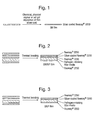
- FIG. 1 schematically shows that a spunbonded nonwoven polymeric fabric (Reemay ® ; R) can be coated with a thin silver film on one or both sides via combustion chemical vapor deposition (CCVD).
- CCVD combustion chemical vapor deposition
- the resulting silver-coated fabric is designated as a SR film.
- a CCVD process silver precursor compounds are added to a burning gas. Flame is moved closely above the surface to be coated. The high energy within the flame converts the precursor compounds into silver particles, which readily interact with the fabric, forming a firmly adhering silver deposit.
- the resulting micro-/nano-structure and thickness of the deposited silver layer can be controlled by varying process parameters, such as, speed of substrate or flame, number of passes, substrate temperature, and distance between flame and substrate.
- FIG. 2 schematically shows the use of Reemay ® 2250 (R) by thermal bonding to form a filter membrane of silver coated Reemay ® (SR) bonded with a Reemay ® layer (R) to a pathogen-retaining filter resin (P) further using Reemay ® fabric as the outermost layers of the filter membrane.
- the SR layer can readily kill pathogens retained on the pathogen retaining media to prevent biofouling.
- biofouling means accumulation of microorganisms on surfaces or pores of the filter media.
- FIG. 3 schematically shows the use of Reemay ® 2250 (R) by thermal bonding to form a filter membrane of silver coated Reemay ® (SR) bonded without a Reemay ® layer (R) to a pathogen-retaining filter resin (P) further using Reemay ® fabric to the outermost layers of the filter membrane.
- the SR layer can also readily kill pathogens retained on the pathogen retaining media to prevent biofouling.
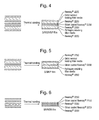
- FIG. 4 schematically shows that a SR/R/P assembly can be thermally laminated to a dirt/chemical-holding filter media via Reemay ® fabrics.
- the dirt/chemical filter can be NanoCeram-PAC TM media or other carbon filters.
- the resulting assembly is designated as a D/R/SR/R/P filter membrane.
- Use of the dirt/chemical-holding filter prevents SR/R/P layers from prematurely losing disinfection properties due to surface blockage by dirt and/or chemicals.
- FIG. 5 schematically shows that a SR/P assembly can be thermally laminated to a dirt/chemical-holding filter media without Reemay ® fabrics.
- the dirt/chemical filter can be NanoCeram-PAC TM media or other carbon filters.
- the resulting assembly is designated as a D/SR/P filter membrane.
- Use of the dirt/chemical-holding filter prevents SR/P layers from prematurely losing disinfection properties due to surface blockage by dirt and/or chemicals.
- FIG. 6 shows that two SR films can be thermally laminated together via Reemay ® fabrics. The resulting assemble is designated as a SR/R/SR film. More than two SR films can be thermally laminated if a better disinfection and filtration performance is needed.
- the SR film is laminated at the same time via Reemay ® 2250 layers onto pathogen-retaining media and onto dirt/chemical holding filter media from different sides.
- the SR film is first laminated via a Reemay ® 2250 layer onto pathogen-retaining media, and then onto dirt/chemical holding filter media via another Reemay ® 2250 layer.
- the SR film is laminated via a Reemay ® 2250 layer onto dirt/chemical holding filter media prior to its lamination to pathogen-retaining media via another Reemay ® 2250 layer.
- the Reemay ® 2250 layer used for laminating a biocidal film can be the Reemay ® ("R") layer (if included in the biocidal film) or a separate Reemay ® layer.
- FIG. 7 schematically shows that biocidal fabrics are rolled on a stiff screen roll multiple turns for providing an enhanced pathogen killing efficiency.
- the biocidal fabrics that can be used herein include, but are not limited to, a SR film.
- the biocidal fabrics are composed of thin Reemay ® fabrics, so that the total thickness of multiple layers of the biocidal fabrics is still thin, generally between about 10 mil and 30 mil.
- the use of such a rolled-up structure does not cause a reduced water flow rate or a significant drop in water pressure. In this drawing, the water flow direction is outward from the center of the filter media ring.
- FIG. 8 is similar to FIG. 7 .
- the biocidal fabrics are rolled on the dirt and chemical retaining filter ring.
- the water flow direct direction is inward toward the center.
- the biocidal fabrics used herein include, for example, a SR film.
- Reemay ® 2250 fabrics can be thermally bound to a membrane or other Reemay ® fabrics at a relative low temperature, e.g. about 100° to 130 °C with an appropriate pressure. It is appreciated that at such a low temperature, most fabrics or media will not be thermally damaged.
- the method includes a step of depositing a biocidal material (e.g., a silver film) onto the spunbonded nonwoven polymeric fabrics, resulting in silver-coated spunbonded nonwoven polymeric fabrics with pores essentially free of blockage of the deposited silver film.
- a biocidal material e.g., a silver film
- silver-coated spunbonded nonwoven polymeric fabrics avoids use of nano-silver particles.
- Such use of silver-coated fabrics eliminates concerns of silver particle leaching and decreased disinfection efficiency due to larger silver surfaces.
- the invention further relates to the use of silver-coated spunbonded nonwoven polymeric fabrics, which are bound to a thermal binding layer to provide pathogen killing efficacy.
- spunbonded nonwoven polymeric fabrics By using spunbonded nonwoven polymeric fabrics, a high water flow rate and low water pressure drop can be achieved.
- the invention provides more efficient disinfection filter media for fluid filtration, which offers desired properties, such as, a low pressure drop and a high flow rate when in use.
- thin spunbonded nonwoven polymeric fabrics of the invention are coated with a biocidal material, which is then either directly thermally bound onto pathogen-retaining filter media or via a thermal binder onto pathogen-retaining filter media, to provide an enhanced pathogen killing efficacy.
- filter media containing multiple-rolls of biocidal fabrics also provide good pathogen killing properties.
- the invention relates to a method of preparing filter media for use in a potable water system or an air filtration system.
- the method comprises thermally binding silver-coated spunbonded nonwoven polymeric fabrics with a thermal binding layer, optionally further with pathogen-retaining media.
- the thermal binding step can be conducted through processes, such as, hot calendaring, belt calendaring, through-air thermal bonding, ultrasonic bonding, radiant-heat bonding, hot laminators, vacuum bagging with heat, and autoclave with pressure and heat, or a combination thereof.
- the thermal binding step of the invention is designed to avoid or minimize melting fibers contained in the silver-coated fabrics and/or the thermal binding layer.
- the autoclave method can be performed by a process comprising the following steps: 1). Lay up fabrics and membranes; 2). Bag the fabrics and membranes on a flat metal support; 3). Vacuum the bag; 4). Place the assembly in an autoclave; 5). Apply pressure and heat for a period of time; 6). Cool the assembly down to ambient temperature and release vacuum; and 7). Check to ensure that thermal bonding is completed.
Landscapes
- Chemical & Material Sciences (AREA)
- Chemical Kinetics & Catalysis (AREA)
- Inorganic Chemistry (AREA)
- Filtering Materials (AREA)
- Separation Using Semi-Permeable Membranes (AREA)
- Engineering & Computer Science (AREA)
- Manufacturing & Machinery (AREA)
- Life Sciences & Earth Sciences (AREA)
- Hydrology & Water Resources (AREA)
- Environmental & Geological Engineering (AREA)
- Water Supply & Treatment (AREA)
- Organic Chemistry (AREA)
Abstract
Description
- In an aircraft, a potable water system is generally used to supply cabin outlet facilities (e.g., handwash basins in lavatories and sinks in onboard kitchens) with fresh water. Such a potable water system may use water filter media (e.g., pathogen-retaining filter media) combined with biocide-containing nanofiber fabrics to kill pathogens contained in the water or air (see US patent application
US 2011/0297609 A1 ). - However, when the potable water system uses biocide-containing nanofiber fabrics bound via adhesive layers to the filter media for disinfestation, it has been found that the incorporation of the nanofiber fabrics and the adhesive layers, no matter how thin they are, usually causes a significant drop in the water flow rate and also in the water pressure. Thus, there is a need for the development of a new type of filtration system that can be used in a potable water system in the aviation field. It is desired that such a filtration system offers efficient disinfection effects while achieving a low pressure drop and a high flow rate when in use.
- The invention provides a novel type of filter media that offers efficient disinfection effects, which also achieves a low water pressure drop and a high water flow rate when in use. Specifically, the filter media of the invention includes a microorganism-killing membrane that contains a spunbonded nonwoven polymeric fabric coated with silver and a thermal binding layer.
- Advantageously, the filter media of the invention is adhesive free (i.e., containing no adhesive layers or pastes).
- Thus, viewed from a first aspect, the invention provides a method of preparing a filter medium, comprising thermally binding one or more silver-coated spunbonded nonwoven fabrics to at least one membrane selected from the group of a dirt-retaining membrane, a chemical-retaining membrane, and a pathogen-retaining membrane, or a combination thereof, wherein said silver-coated spunbonded nonwoven fabrics are prepared through depositing a silver film onto spunbonded nonwoven fabrics.
- Viewed from a second aspect, the invention provides a filter media comprising a microorganism-killing membrane, wherein said microorganism-killing membrane comprises a thermal binding layer and a spunbonded nonwoven fabric coated with silver, and said spunbonded nonwoven fabric is thermally bound to the thermal binding layer.
- The filter media may not contain an adhesive layer. In certain embodiments, the filter media of the invention is adhesive-free (i.e. containing no adhesive layers or pastes).
- In one embodiment, the spunbonded nonwoven polymeric fabrics coated with silver can be polyester fabrics, polypropylene fabrics, polyurethane fabrics, polyimide fabrics, or a combination thereof. In certain instances, the spunbonded nonwoven polymeric fabrics are polyester fabrics, such as, Reemay® spunbonded polyester nonwoven fabrics (e.g., Reemay® 2004 and Reemay® 2250, available from Fiberweb Filtration PLC, Old Hickory, TN)
- In another embodiment, the thermal binding layer employed herein can be composed of spunbonded nonwoven polymeric fabrics, such as, polyester fabrics, polypropylene fabrics, polyurethane fabrics, polyimide fabrics, or a combination thereof. In certain instances, the spunbonded nonwoven polymeric fabrics are polyester fabrics, such as, Reemay® spunbonded polyester nonwoven fabrics (e.g., Reemay® 2004 and Reemay® 2250, available from Fiberweb Filtration PLC, Old Hickory, TN).
- In a separate aspect, the invention provides a method of preparing a filter media, comprising thermally binding silver-coated spundbonded nonwoven fabrics to at least one membrane selected from the group of a dirt-retaining membrane, a chemical-retaining membrane, and a pathogen-retaining membrane, or a combination thereof, wherein said silver-coated spunbonded nonwoven fabrics are prepared through depositing a silver film onto spunbonded nonwoven fabrics.
- In certain embodiments, the silver film can be deposited onto the spunbonded nonwoven fabrics through a chemical vapor deposition, a physical vapor deposition, or a sol gel deposition, or a combination thereof. Chemical vapor deposition includes, but is not limited to, a vacuum vapor deposition, and a combustion chemical vapor deposition.
- The invention also provides a novel method for thermally binding silver-coated spunbonded nonwoven fabrics to a membrane selected from the group of a dirt-retaining membrane, a chemical-retaining membrane, and a pathogen-retaining membrane, or a combination thereof.
- Another aspect of the invention provides a water-purification cartridge that contains the filter media of the invention.
- The invention also features a potable water system containing the water-purification cartridge of the invention.
- When in use, the filter media according to the invention offers advantages, such as, maintaining a high water flow rate and a low water pressure drop. The filter media of the invention is also highly efficient in achieving good disinfection effects. Thus, the filter media of the invention can be used as an add-on component to dirt/chemical filter cartridges currently used in aircraft potable water systems to meet the requirements of disinfection without slowing down water flow rate and increasing water pressure drop.
- Certain preferred embodiments of the invention will now be described in greater detail by way of example only and with reference to the accompanying drawings, in which:
-
FIG. 1 shows a process of producing a silver coated Reemay® ("SR") film by depositing a thin silver coating onto a Reemay® layer ("R"); -
FIG. 2 demonstrates a process of making a SR/R/P membrane by thermally laminating a SR film onto a pathogen-retaining media ("P") via a separate thermal binding layer of Reemay® fabric: the resulting assembly (SR/R/P) is capped from both sides with Reemay® layers for protection; -
FIG. 3 demonstrates a process of making a SR/P membrane by thermally laminating a SR film onto a pathogen-retaining media without a separate thermal binding layer of Reemay® fabric: the resulting assembly (SR/P) is capped from both sides with Reemay® layers for protection; -
FIG. 4 shows a process of producing a D/R/SR/R/P membrane by thermally binding a SR/R/P film onto a dirt/chemical holding filter via a separate thermal binding layer of Reemay® fabric: the resulting assembly (D/R/SR/R/P) is capped from both sides with Reemay® layers for protection; -
FIG. 5 shows a process of producing a D/SR/P membrane by thermally binding a SR/P film onto a dirt/chemical holding filter ("D") without a separate thermal binding layers of Reemay® fabric: the resulting assembly (D/SR/P) is capped from both sides with Reemay® layers for protection; -
FIG. 6 shows a process of producing a SR/R/SR membrane by thermally binding two SR film via a separate thermal binding layer of Reemay® fabric: the resulting assembly (SR/R/SR) is capped from both sides with Reemay® layers for protection; -
FIG. 7 shows a structure having multiple rolls of biocidal fabrics incorporated inward of a dirt/chemical retaining filter cartridge; and -
FIG. 8 shows a structure having multiple-turn rolls of biocidal fabrics incorporated outward of a dirt/chemical retaining filter cartridge. - The invention provides a novel method of preparing a filter media, comprising thermally binding silver-coated spunbonded nonwoven fabrics to at least one membrane selected from the group of a dirt-retaining membrane, a chemical-retaining membrane, and a pathogen-retaining membrane, or a combination thereof, wherein said silver-coated spunbonded nonwoven fabrics are prepared by depositing a silver film onto nonwoven fabrics.
- In one embodiment, the silver film can be deposited onto the spunbonded nonwoven fabrics through a chemical vapor deposition, a physical vapor deposition, or a sol gel deposition, or a combination thereof.
- Chemical vapor deposition includes methods, such as, traditional vacuum vapor deposition (CVD) and combustion chemical vapor deposition (CCVD) by nGima Company (www.nGimat.com). Physical vapor deposition (PVD) is performed, for example, by magnetron sputtering or electron beam.
- In certain embodiments, the chemical vapor deposition used herein is a vacuum vapor deposition or a combustion chemical vapor deposition.
- It is contemplated that other biocidal materials can be deposited onto the spunbonded nonwoven fabrics. The resulting biocidal-coated spunbonded nonwoven fabrics can replace the silver-coated spunbonded nonwoven fabrics used herein. The biocidal deposition can be achieved, for example, by a chemical vapor deposition, a physical vapor deposition, or a sol gel deposition, or a combination thereof.
- The thickness of the silver coating can be in a nano-range, generally between about 1 nm and 1,000 nm. By coating the spunbonded nonwoven fabrics with a silver film, the use of biocidal nano-particles can be avoided. Accordingly, the invention provides a nano-particles leach-free method.
- The utility of the silver coated fabrics as above delineated avoids the use of nanoparticles or biocidal additive chemicals, which require a subsequent leach of nanoparticles or biocidal additive chemicals. Generally, the silver coatings used herein are not soluble. Thus, the possibility of having leaching issues in the process is low.
- In a separate aspect, the invention provides a method of preparing a filter media. The method comprises thermally binding silver-coated spunbonded nonwoven fabrics to at least one membrane, such as, a dirt-retaining membrane, a chemical-retaining membrane, and a pathogen-retaining membrane, or a combination thereof. The silver-coated spunbonded nonwoven fabrics used herein are prepared through depositing a silver film onto spunbonded nonwoven fabrics.
- Further, in at least a preferred embodiment, the invention relates to the use of spunbonded nonwoven fabrics that are coated with a silver film (or other biocidal film forming material), which are either directly thermally bound to pathogen-retaining filter media or via a thermal binding layer onto pathogen-retaining filter media, for providing filter media with enhanced pathogen killing efficacy. Alternatively, the invention provides filter media comprising multiple turns of silver-coated spunbonded nonwoven fabrics for providing pathogen killing efficacy.
- Accordingly, at least a preferred embodiment of the invention provides filter media comprising a microorganism-killing membrane. The microorganism-killing membrane includes a thermal binding layer (also referred to as a spunbonded nonwoven fabric) and the silver-coated spunbonded nonwoven fabrics. According to at least a preferred embodiment of the invention, the filter media does not contain an adhesive layer or adhesive pastes.
- Various spunbonded nonwoven polymeric fabrics can be used, including, for example, polyester fabrics, polypropylene fabrics, polyurethane fabrics, polyimide fabrics, or a combination thereof. Other polymers or combinations thereof that have high Fraizer permeability or high TEXTest permeability can also be used (Fraizer Air Permeability Tester or TEXTest tester can be used for standard air permeability test, ASTM D737).
- For example, the spunbonded nonwoven polymeric fabrics for use in the thermal binding layer can be polyester fabrics. Exemplified spunbonded nonwoven polymeric fabrics that are used in the invention include, for example, Reemay® spunbonded polyester fabrics.
- Reemay® spunbonded polyester can be obtained as a sheet structure of continuous filament polyester fibers that are randomly arranged, highly dispersed, and bonded at the filament junctions. The chemical and thermal properties of Reemay® polyester fabrics are essentially those of polyester fiber. The fibers' spunbonded structure offers a combination of physical properties, such as, high tensile and tear strength, non-raveling edges, excellent dimensional stability, no media migration, good chemical resistance, and controlled arrestance and permeability. Reemay® fabrics are used in various industries as covers (e.g., garden blankets) or support materials.
- Reemay® spunbonded polyester fabrics include either straight or crimped polyester fibers which give the fabrics different filtration and other general performance properties. It is believed that crimped fibers offer properties of softness, conformability, and greater porosity, while straight fibers yield stiffness, tighter structure, and finer arrestance.
- In certain embodiments of the invention, the Reemay® spunbonded polyester fabrics used herein are straight polyester fabrics. Exemplified Reemay® spunbonded polyester fabrics include, for example, Reemay® spunbonded polyester nonwovens 2004 (or "Reemay® 2004"), and Reemay® spunbonded polyester nonwovens 2250 (or "Reemay® 2250"). These Reemay® fabrics are filtration grade spunbonded polyester fabrics: for Reemay® 2004, thickness 5.0 mil, Fraizer 1400 cfm/ft2; for Reemay® 2250, thickness 5.0 mil, Fraizer 1080 cfm/ft2.
- According to at least a preferred embodiment of the present invention, the filter media may further include pathogen-retaining filter media, dirt holding filter media, or chemical holding filter media, or a combination thereof.
- In certain embodiments, the filter media of the invention includes pathogen-retaining media. The microorganism-killing membrane is thermally bound to the pathogen-retaining media via the same thermal binding layer or via another thermal binding layer.
- In other embodiments of the invention, the filter media includes dirt/chemical holding filter media, and optionally one or more additional thermal binding layers. When pathogen-retaining media are also included, the microorganism-killing membrane is thermally bound via the thermal binding layers to both the pathogen-retaining medium and the dirt/chemical holding filter media via different surfaces.
- As known in the art, adhesives block some pores of media and biocide sites, further causing reduced flow rate and high pressure drops in a filtration system. By using thin Reemay® fabrics as binders in the filter media, the use of chemical adhesives can be eliminated. Further, the use of Reemay® fabrics also makes it possible to fabricate the fabrics contained in the filter media.
- Accordingly, in at least a preferred embodiment of the invention, a microorganism-killing membrane that contains silver-coated fabrics (such as, silver coated Reemay® fabrics) can be rolled up by multiple turns on a screen roll, which is then placed inward of a dirt/chemical holding filter media (or cartridge). Alternatively, the microorganism-killing membrane of the invention can be rolled up and placed outside of the dirt/chemical holding filter media (or cartridge). The specific design of the roll-up forms depends upon the water-flow direction in a specific water system.
- Further, rolled-up silver-coated fabrics may contain multiple microorganism-killing membranes of the invention. The rolled-up biocide-containing fabrics can be placed inward of a dirt/chemical holding filter media (or cartridge), or outside of the dirt/chemical holding filter media (or cartridge), depending on the water-flow direction.
- At least a preferred embodiment of the invention further features a water-purification cartridge containing the filter media of the invention.
- Also provided is a potable water system containing the water-purification cartridge. Generally, a potable water system includes components, such as, a water storage tank, a pump, a supply line, a water-purification device (such as, a water-purification cartridge). For a detailed description on potable water systems and functions thereof, see
US 2011/0297609 . - A variety of configurations according to preferred embodiments of the invention are presented in the drawings. In these drawings, Reemay® 2250 is provided as an example of spunbonded nonwoven polymeric fabrics that are used for a thermal binding layer (a thermal binder). The invention covers the use of other types of spunbonded nonwoven polymeric fabrics as silver-coated fabrics and a thermal binding layer and the use of other types of biocides.
-
FIG. 1 schematically shows that a spunbonded nonwoven polymeric fabric (Reemay® ; R) can be coated with a thin silver film on one or both sides via combustion chemical vapor deposition (CCVD). The resulting silver-coated fabric is designated as a SR film. - In a CCVD process, silver precursor compounds are added to a burning gas. Flame is moved closely above the surface to be coated. The high energy within the flame converts the precursor compounds into silver particles, which readily interact with the fabric, forming a firmly adhering silver deposit. The resulting micro-/nano-structure and thickness of the deposited silver layer can be controlled by varying process parameters, such as, speed of substrate or flame, number of passes, substrate temperature, and distance between flame and substrate.
-
FIG. 2 schematically shows the use of Reemay® 2250 (R) by thermal bonding to form a filter membrane of silver coated Reemay® (SR) bonded with a Reemay® layer (R) to a pathogen-retaining filter resin (P) further using Reemay® fabric as the outermost layers of the filter membrane. The SR layer can readily kill pathogens retained on the pathogen retaining media to prevent biofouling. - As used herein, biofouling (or "biological fouling") means accumulation of microorganisms on surfaces or pores of the filter media.
-
FIG. 3 schematically shows the use of Reemay® 2250 (R) by thermal bonding to form a filter membrane of silver coated Reemay® (SR) bonded without a Reemay® layer (R) to a pathogen-retaining filter resin (P) further using Reemay® fabric to the outermost layers of the filter membrane. The SR layer can also readily kill pathogens retained on the pathogen retaining media to prevent biofouling. -
FIG. 4 schematically shows that a SR/R/P assembly can be thermally laminated to a dirt/chemical-holding filter media via Reemay® fabrics. The dirt/chemical filter can be NanoCeram-PAC™ media or other carbon filters. The resulting assembly is designated as a D/R/SR/R/P filter membrane. Use of the dirt/chemical-holding filter prevents SR/R/P layers from prematurely losing disinfection properties due to surface blockage by dirt and/or chemicals. -
FIG. 5 schematically shows that a SR/P assembly can be thermally laminated to a dirt/chemical-holding filter media without Reemay® fabrics. The dirt/chemical filter can be NanoCeram-PAC™ media or other carbon filters. The resulting assembly is designated as a D/SR/P filter membrane. Use of the dirt/chemical-holding filter prevents SR/P layers from prematurely losing disinfection properties due to surface blockage by dirt and/or chemicals. -
FIG. 6 shows that two SR films can be thermally laminated together via Reemay® fabrics. The resulting assemble is designated as a SR/R/SR film. More than two SR films can be thermally laminated if a better disinfection and filtration performance is needed. - The two thermal lamination steps can be performed concurrently or sequentially. In one embodiment, the SR film is laminated at the same time via Reemay® 2250 layers onto pathogen-retaining media and onto dirt/chemical holding filter media from different sides. In another embodiment, the SR film is first laminated via a Reemay® 2250 layer onto pathogen-retaining media, and then onto dirt/chemical holding filter media via another Reemay® 2250 layer. Alternatively, the SR film is laminated via a Reemay® 2250 layer onto dirt/chemical holding filter media prior to its lamination to pathogen-retaining media via another Reemay® 2250 layer.
- As well understood by an ordinarily skilled artisan, the Reemay® 2250 layer used for laminating a biocidal film can be the Reemay® ("R") layer (if included in the biocidal film) or a separate Reemay® layer.
-
FIG. 7 schematically shows that biocidal fabrics are rolled on a stiff screen roll multiple turns for providing an enhanced pathogen killing efficiency. The biocidal fabrics that can be used herein include, but are not limited to, a SR film. - In certain instances, the biocidal fabrics are composed of thin Reemay® fabrics, so that the total thickness of multiple layers of the biocidal fabrics is still thin, generally between about 10 mil and 30 mil. The use of such a rolled-up structure does not cause a reduced water flow rate or a significant drop in water pressure. In this drawing, the water flow direction is outward from the center of the filter media ring.
-
FIG. 8 is similar toFIG. 7 . In this case, the biocidal fabrics are rolled on the dirt and chemical retaining filter ring. The water flow direct direction is inward toward the center. Likewise, the biocidal fabrics used herein include, for example, a SR film. - Further, the Reemay® 2250 fabrics can be thermally bound to a membrane or other Reemay® fabrics at a relative low temperature, e.g. about 100° to 130 °C with an appropriate pressure. It is appreciated that at such a low temperature, most fabrics or media will not be thermally damaged.
- Also disclosed is a method of coating spunbonded nonwoven polymeric fabrics with a thin biocidal coating. The method includes a step of depositing a biocidal material (e.g., a silver film) onto the spunbonded nonwoven polymeric fabrics, resulting in silver-coated spunbonded nonwoven polymeric fabrics with pores essentially free of blockage of the deposited silver film.
- As discussed above, the use of silver-coated spunbonded nonwoven polymeric fabrics avoids use of nano-silver particles. Such use of silver-coated fabrics eliminates concerns of silver particle leaching and decreased disinfection efficiency due to larger silver surfaces.
- In at least a preferred embodiment, the invention further relates to the use of silver-coated spunbonded nonwoven polymeric fabrics, which are bound to a thermal binding layer to provide pathogen killing efficacy. By using spunbonded nonwoven polymeric fabrics, a high water flow rate and low water pressure drop can be achieved.
- Although the application focuses on a potable water filtration system, it is believed that the filter media of the invention works equally well for an air filtration system or other types of fluid filtration systems.
- Accordingly, the invention provides more efficient disinfection filter media for fluid filtration, which offers desired properties, such as, a low pressure drop and a high flow rate when in use. Specifically, thin spunbonded nonwoven polymeric fabrics of the invention are coated with a biocidal material, which is then either directly thermally bound onto pathogen-retaining filter media or via a thermal binder onto pathogen-retaining filter media, to provide an enhanced pathogen killing efficacy. Alternatively, filter media containing multiple-rolls of biocidal fabrics also provide good pathogen killing properties.
- Still further, the invention relates to a method of preparing filter media for use in a potable water system or an air filtration system. The method comprises thermally binding silver-coated spunbonded nonwoven polymeric fabrics with a thermal binding layer, optionally further with pathogen-retaining media. The thermal binding step can be conducted through processes, such as, hot calendaring, belt calendaring, through-air thermal bonding, ultrasonic bonding, radiant-heat bonding, hot laminators, vacuum bagging with heat, and autoclave with pressure and heat, or a combination thereof. Specifically, the thermal binding step of the invention is designed to avoid or minimize melting fibers contained in the silver-coated fabrics and/or the thermal binding layer.
- For example, the autoclave method can be performed by a process comprising the following steps: 1). Lay up fabrics and membranes; 2). Bag the fabrics and membranes on a flat metal support; 3). Vacuum the bag; 4). Place the assembly in an autoclave; 5). Apply pressure and heat for a period of time; 6). Cool the assembly down to ambient temperature and release vacuum; and 7). Check to ensure that thermal bonding is completed.
- Those skilled in the art will recognize, or be able to ascertain using no more than routine experimentation, numerous equivalents to the specific procedures described herein. Such equivalents are considered to be within the scope of this invention and are covered by the following claims.
Claims (15)
- A method of preparing a filter medium, comprising thermally binding one or more silver-coated spunbonded nonwoven fabrics to at least one membrane selected from the group of a dirt-retaining membrane, a chemical-retaining membrane, and a pathogen-retaining membrane, or a combination thereof, wherein said silver-coated spunbonded nonwoven fabrics are prepared through depositing a silver film onto spunbonded nonwoven fabrics.
- The method of claim 1, wherein the spunbonded nonwoven fabrics are selected from the group of polyester fabrics, polypropylene fabrics, polyurethane fabrics, polyimide fabrics, or a combination thereof.
- The method of claim 1 or 2, wherein the silver film is deposited through a chemical vapor deposition, a physical vapor deposition, or a sol gel deposition, or a combination thereof.
- The method of claim 3, wherein said chemical vapor deposition is a vacuum vapor deposition or a combustion chemical vapor deposition.
- Filter media comprising a microorganism-killing membrane, wherein said microorganism-killing membrane comprises a thermal binding layer and a spunbonded nonwoven fabric coated with silver, and said spunbonded nonwoven fabric is thermally bound to the thermal binding layer, and wherein said filter media does not contain an adhesive layer.
- The filter media of claim 5, wherein the thermal binding layer comprises spunbonded nonwoven polymeric fabrics, preferably wherein the spunbonded nonwoven polymeric fabrics are selected from the group of polyester fabrics, polypropylene fabrics, polyurethane fabrics, polyimide fabrics, or a combination thereof, further preferably wherein the spunbonded nonwoven polymeric fabrics comprise Reemay® spunbonded polyester nonwoven fabrics.
- The filter media of claim 6, wherein the spunbonded nonwoven polymeric fabric coated with silver is selected from the group of polyester fabrics, polypropylene fabrics, polyurethane fabrics, polyimide fabrics, or a combination thereof, preferably wherein the spunbonded nonwoven polymeric fabric coated with silver comprises Reemay® spunbonded polyester nonwoven fabrics.
- The filter media of any one of claims 5 to 7, wherein said filter media further comprises at least one additional membrane selected from pathogen-retaining filter media, dirt holding filter media, and chemical holding filter media.
- The filter media of any one of claims 5 to 8, wherein said filter media comprises a pathogen-retaining medium, wherein the microorganism-killing membrane is bound to the pathogen-retaining medium via said thermal binding layer or via another thermal binding layer.
- The filter media of claim 9, wherein said filter media comprises dirt/chemical holding filter media and one or more additional thermal binding layers, and the microorganism-killing membrane, via said additional thermal binding layer(s), is bound to the dirt/chemical holding filter media at a surface different from the surface used for binding with the pathogen-retaining medium.
- The filter media of any one of claims 5 to 10, wherein said filter media comprises at least two of said microorganism-killing membranes, the thermal binding layers in each of said microorganism-killing membranes is coated with silver film, wherein said two microorganism-killing membranes are bound to each other through another thermal binding layer.
- The filter media of any one of claims 5 to 11, wherein the microorganism-killing membrane is in a multiple-turn rolled-up form, and said filter media further comprises dirt/chemical holding filter media.
- The filter media of claim 12, wherein the rolled-up microorganism-killing membrane is placed inward of the dirt/chemical holding filter media, or wherein the rolled-up microorganism-killing membrane is outside of the dirt/chemical holding filter media.
- A water purification cartridge comprising the filter media of claim 5.
- A water purification system for generating potable water comprising the water purification cartridge of claim 14.
Applications Claiming Priority (1)
| Application Number | Priority Date | Filing Date | Title |
|---|---|---|---|
| US13/907,264 US20140353238A1 (en) | 2013-05-31 | 2013-05-31 | Silver-coated fabric for filter membrane integration |
Publications (3)
| Publication Number | Publication Date |
|---|---|
| EP2839871A2 true EP2839871A2 (en) | 2015-02-25 |
| EP2839871A3 EP2839871A3 (en) | 2015-03-11 |
| EP2839871B1 EP2839871B1 (en) | 2016-04-27 |
Family
ID=50897389
Family Applications (1)
| Application Number | Title | Priority Date | Filing Date |
|---|---|---|---|
| EP14170808.1A Active EP2839871B1 (en) | 2013-05-31 | 2014-06-02 | Silver-coated fabric for filter membrane integration |
Country Status (5)
| Country | Link |
|---|---|
| US (1) | US20140353238A1 (en) |
| EP (1) | EP2839871B1 (en) |
| CN (1) | CN104208949B (en) |
| BR (1) | BR102014013063B1 (en) |
| CA (1) | CA2852584C (en) |
Families Citing this family (3)
| Publication number | Priority date | Publication date | Assignee | Title |
|---|---|---|---|---|
| WO2021189179A1 (en) * | 2020-03-23 | 2021-09-30 | 李辉 | Nano-titanium and hemp fiber composite material |
| CN111286868A (en) * | 2020-03-30 | 2020-06-16 | 嘉兴市阿福纺织品有限公司 | From taking antibacterial bonded melt-blown fabric and melt-blown preparation facilities |
| FR3109591B1 (en) * | 2020-04-24 | 2023-03-31 | Ferrari Serge Sas | PVC-coated membrane comprising silver, and its method of manufacture |
Citations (1)
| Publication number | Priority date | Publication date | Assignee | Title |
|---|---|---|---|---|
| US20110297609A1 (en) | 2010-06-04 | 2011-12-08 | Jin Hu | Aircraft potable water system |
Family Cites Families (7)
| Publication number | Priority date | Publication date | Assignee | Title |
|---|---|---|---|---|
| JP2000176262A (en) * | 1998-12-11 | 2000-06-27 | Daikin Ind Ltd | Porous materials, air filter media, air filter units and support materials for air filter media |
| US6831025B2 (en) * | 2001-06-18 | 2004-12-14 | E. I. Du Pont De Nemours And Company | Multiple component spunbond web and laminates thereof |
| JP2003205211A (en) * | 2001-11-09 | 2003-07-22 | Nitto Denko Corp | Antibacterial air filter medium and filter unit using the same |
| EP1415699B8 (en) * | 2002-12-06 | 2004-07-28 | Eurofilters N.V. | Filter medium for a vacuum cleaner bag |
| US7051883B2 (en) * | 2003-07-07 | 2006-05-30 | Reemay, Inc. | Wetlaid-spunbond laminate membrane support |
| CN103381316B (en) * | 2012-05-04 | 2015-05-13 | 东莞市导谷电子材料科技有限公司 | Air filter screen with sterilization and bacteriostasis functions and preparation method thereof |
| CN103015166B (en) * | 2012-12-13 | 2014-08-13 | 北京航空航天大学 | Nano-silver antibacterial fabric and preparation method thereof |
-
2013
- 2013-05-31 US US13/907,264 patent/US20140353238A1/en not_active Abandoned
-
2014
- 2014-05-23 CA CA2852584A patent/CA2852584C/en active Active
- 2014-05-29 BR BR102014013063-2A patent/BR102014013063B1/en active IP Right Grant
- 2014-05-30 CN CN201410238836.5A patent/CN104208949B/en active Active
- 2014-06-02 EP EP14170808.1A patent/EP2839871B1/en active Active
Patent Citations (1)
| Publication number | Priority date | Publication date | Assignee | Title |
|---|---|---|---|---|
| US20110297609A1 (en) | 2010-06-04 | 2011-12-08 | Jin Hu | Aircraft potable water system |
Also Published As
| Publication number | Publication date |
|---|---|
| BR102014013063A2 (en) | 2015-05-12 |
| BR102014013063B1 (en) | 2021-12-07 |
| CA2852584C (en) | 2022-05-03 |
| CN104208949A (en) | 2014-12-17 |
| EP2839871A3 (en) | 2015-03-11 |
| CN104208949B (en) | 2017-08-18 |
| CA2852584A1 (en) | 2014-11-30 |
| EP2839871B1 (en) | 2016-04-27 |
| US20140353238A1 (en) | 2014-12-04 |
Similar Documents
| Publication | Publication Date | Title |
|---|---|---|
| EP2803405B1 (en) | Silver-coated nanofiber fabrics for pathogen removal filtration | |
| EP2801400B1 (en) | Biocide-loaded electrospun nanofibers supported by adhesive-free thin fabric for pathogen removal filtration | |
| JP5784458B2 (en) | Air filter media | |
| EP3160616A1 (en) | Filter media including oriented fibers | |
| EP2398633A1 (en) | Multi-layer, fluid transmissive fiber structures containing nanofibers and a method of manufacturing such structures | |
| ES2387566T3 (en) | Laminated membrane support made of non-woven textile material obtained wet | |
| US20160220927A1 (en) | Filtration media fiber structure and method of making same | |
| EP2839871B1 (en) | Silver-coated fabric for filter membrane integration | |
| GB2494761B (en) | Membrane distillation modules using oleophobically and antimicrobially treated microporous membranes | |
| JP2020516446A (en) | Filter material and its use | |
| KR102898557B1 (en) | composite membrane | |
| JP2009112887A (en) | Filter medium, its manufacturing method, and cartridge filter | |
| KR20190023254A (en) | Filter for water purifier and method for making the filter media | |
| JP2009066534A (en) | Pleated filter cartridge for liquid | |
| CN206278989U (en) | Multifunctional composite filter core | |
| CA2927280A1 (en) | Filtration media fiber structure and method of making same | |
| TW201420171A (en) | Filter for a water purifier, and a water purifier including the same |
Legal Events
| Date | Code | Title | Description |
|---|---|---|---|
| PUAL | Search report despatched |
Free format text: ORIGINAL CODE: 0009013 |
|
| PUAI | Public reference made under article 153(3) epc to a published international application that has entered the european phase |
Free format text: ORIGINAL CODE: 0009012 |
|
| 17P | Request for examination filed |
Effective date: 20140602 |
|
| AK | Designated contracting states |
Kind code of ref document: A2 Designated state(s): AL AT BE BG CH CY CZ DE DK EE ES FI FR GB GR HR HU IE IS IT LI LT LU LV MC MK MT NL NO PL PT RO RS SE SI SK SM TR |
|
| AX | Request for extension of the european patent |
Extension state: BA ME |
|
| AK | Designated contracting states |
Kind code of ref document: A3 Designated state(s): AL AT BE BG CH CY CZ DE DK EE ES FI FR GB GR HR HU IE IS IT LI LT LU LV MC MK MT NL NO PL PT RO RS SE SI SK SM TR |
|
| AX | Request for extension of the european patent |
Extension state: BA ME |
|
| RIC1 | Information provided on ipc code assigned before grant |
Ipc: B01D 39/16 20060101AFI20150130BHEP |
|
| R17P | Request for examination filed (corrected) |
Effective date: 20150911 |
|
| RBV | Designated contracting states (corrected) |
Designated state(s): AL AT BE BG CH CY CZ DE DK EE ES FI FR GB GR HR HU IE IS IT LI LT LU LV MC MK MT NL NO PL PT RO RS SE SI SK SM TR |
|
| GRAP | Despatch of communication of intention to grant a patent |
Free format text: ORIGINAL CODE: EPIDOSNIGR1 |
|
| INTG | Intention to grant announced |
Effective date: 20151104 |
|
| GRAS | Grant fee paid |
Free format text: ORIGINAL CODE: EPIDOSNIGR3 |
|
| GRAA | (expected) grant |
Free format text: ORIGINAL CODE: 0009210 |
|
| AK | Designated contracting states |
Kind code of ref document: B1 Designated state(s): AL AT BE BG CH CY CZ DE DK EE ES FI FR GB GR HR HU IE IS IT LI LT LU LV MC MK MT NL NO PL PT RO RS SE SI SK SM TR |
|
| REG | Reference to a national code |
Ref country code: GB Ref legal event code: FG4D |
|
| REG | Reference to a national code |
Ref country code: CH Ref legal event code: EP |
|
| REG | Reference to a national code |
Ref country code: AT Ref legal event code: REF Ref document number: 794087 Country of ref document: AT Kind code of ref document: T Effective date: 20160515 |
|
| REG | Reference to a national code |
Ref country code: IE Ref legal event code: FG4D |
|
| REG | Reference to a national code |
Ref country code: DE Ref legal event code: R096 Ref document number: 602014001662 Country of ref document: DE |
|
| REG | Reference to a national code |
Ref country code: FR Ref legal event code: PLFP Year of fee payment: 3 |
|
| REG | Reference to a national code |
Ref country code: LT Ref legal event code: MG4D |
|
| REG | Reference to a national code |
Ref country code: NL Ref legal event code: MP Effective date: 20160427 |
|
| REG | Reference to a national code |
Ref country code: AT Ref legal event code: MK05 Ref document number: 794087 Country of ref document: AT Kind code of ref document: T Effective date: 20160427 |
|
| PG25 | Lapsed in a contracting state [announced via postgrant information from national office to epo] |
Ref country code: NL Free format text: LAPSE BECAUSE OF FAILURE TO SUBMIT A TRANSLATION OF THE DESCRIPTION OR TO PAY THE FEE WITHIN THE PRESCRIBED TIME-LIMIT Effective date: 20160427 |
|
| PG25 | Lapsed in a contracting state [announced via postgrant information from national office to epo] |
Ref country code: LT Free format text: LAPSE BECAUSE OF FAILURE TO SUBMIT A TRANSLATION OF THE DESCRIPTION OR TO PAY THE FEE WITHIN THE PRESCRIBED TIME-LIMIT Effective date: 20160427 Ref country code: FI Free format text: LAPSE BECAUSE OF FAILURE TO SUBMIT A TRANSLATION OF THE DESCRIPTION OR TO PAY THE FEE WITHIN THE PRESCRIBED TIME-LIMIT Effective date: 20160427 Ref country code: NO Free format text: LAPSE BECAUSE OF FAILURE TO SUBMIT A TRANSLATION OF THE DESCRIPTION OR TO PAY THE FEE WITHIN THE PRESCRIBED TIME-LIMIT Effective date: 20160727 Ref country code: PL Free format text: LAPSE BECAUSE OF FAILURE TO SUBMIT A TRANSLATION OF THE DESCRIPTION OR TO PAY THE FEE WITHIN THE PRESCRIBED TIME-LIMIT Effective date: 20160427 |
|
| PG25 | Lapsed in a contracting state [announced via postgrant information from national office to epo] |
Ref country code: SE Free format text: LAPSE BECAUSE OF FAILURE TO SUBMIT A TRANSLATION OF THE DESCRIPTION OR TO PAY THE FEE WITHIN THE PRESCRIBED TIME-LIMIT Effective date: 20160427 Ref country code: PT Free format text: LAPSE BECAUSE OF FAILURE TO SUBMIT A TRANSLATION OF THE DESCRIPTION OR TO PAY THE FEE WITHIN THE PRESCRIBED TIME-LIMIT Effective date: 20160829 Ref country code: ES Free format text: LAPSE BECAUSE OF FAILURE TO SUBMIT A TRANSLATION OF THE DESCRIPTION OR TO PAY THE FEE WITHIN THE PRESCRIBED TIME-LIMIT Effective date: 20160427 Ref country code: HR Free format text: LAPSE BECAUSE OF FAILURE TO SUBMIT A TRANSLATION OF THE DESCRIPTION OR TO PAY THE FEE WITHIN THE PRESCRIBED TIME-LIMIT Effective date: 20160427 Ref country code: GR Free format text: LAPSE BECAUSE OF FAILURE TO SUBMIT A TRANSLATION OF THE DESCRIPTION OR TO PAY THE FEE WITHIN THE PRESCRIBED TIME-LIMIT Effective date: 20160728 Ref country code: LV Free format text: LAPSE BECAUSE OF FAILURE TO SUBMIT A TRANSLATION OF THE DESCRIPTION OR TO PAY THE FEE WITHIN THE PRESCRIBED TIME-LIMIT Effective date: 20160427 Ref country code: RS Free format text: LAPSE BECAUSE OF FAILURE TO SUBMIT A TRANSLATION OF THE DESCRIPTION OR TO PAY THE FEE WITHIN THE PRESCRIBED TIME-LIMIT Effective date: 20160427 Ref country code: AT Free format text: LAPSE BECAUSE OF FAILURE TO SUBMIT A TRANSLATION OF THE DESCRIPTION OR TO PAY THE FEE WITHIN THE PRESCRIBED TIME-LIMIT Effective date: 20160427 |
|
| PG25 | Lapsed in a contracting state [announced via postgrant information from national office to epo] |
Ref country code: BE Free format text: LAPSE BECAUSE OF FAILURE TO SUBMIT A TRANSLATION OF THE DESCRIPTION OR TO PAY THE FEE WITHIN THE PRESCRIBED TIME-LIMIT Effective date: 20160427 Ref country code: IT Free format text: LAPSE BECAUSE OF FAILURE TO SUBMIT A TRANSLATION OF THE DESCRIPTION OR TO PAY THE FEE WITHIN THE PRESCRIBED TIME-LIMIT Effective date: 20160427 |
|
| REG | Reference to a national code |
Ref country code: DE Ref legal event code: R097 Ref document number: 602014001662 Country of ref document: DE |
|
| PG25 | Lapsed in a contracting state [announced via postgrant information from national office to epo] |
Ref country code: MC Free format text: LAPSE BECAUSE OF FAILURE TO SUBMIT A TRANSLATION OF THE DESCRIPTION OR TO PAY THE FEE WITHIN THE PRESCRIBED TIME-LIMIT Effective date: 20160427 Ref country code: SK Free format text: LAPSE BECAUSE OF FAILURE TO SUBMIT A TRANSLATION OF THE DESCRIPTION OR TO PAY THE FEE WITHIN THE PRESCRIBED TIME-LIMIT Effective date: 20160427 Ref country code: RO Free format text: LAPSE BECAUSE OF FAILURE TO SUBMIT A TRANSLATION OF THE DESCRIPTION OR TO PAY THE FEE WITHIN THE PRESCRIBED TIME-LIMIT Effective date: 20160427 Ref country code: CZ Free format text: LAPSE BECAUSE OF FAILURE TO SUBMIT A TRANSLATION OF THE DESCRIPTION OR TO PAY THE FEE WITHIN THE PRESCRIBED TIME-LIMIT Effective date: 20160427 Ref country code: DK Free format text: LAPSE BECAUSE OF FAILURE TO SUBMIT A TRANSLATION OF THE DESCRIPTION OR TO PAY THE FEE WITHIN THE PRESCRIBED TIME-LIMIT Effective date: 20160427 Ref country code: EE Free format text: LAPSE BECAUSE OF FAILURE TO SUBMIT A TRANSLATION OF THE DESCRIPTION OR TO PAY THE FEE WITHIN THE PRESCRIBED TIME-LIMIT Effective date: 20160427 |
|
| PG25 | Lapsed in a contracting state [announced via postgrant information from national office to epo] |
Ref country code: SM Free format text: LAPSE BECAUSE OF FAILURE TO SUBMIT A TRANSLATION OF THE DESCRIPTION OR TO PAY THE FEE WITHIN THE PRESCRIBED TIME-LIMIT Effective date: 20160427 |
|
| PLBE | No opposition filed within time limit |
Free format text: ORIGINAL CODE: 0009261 |
|
| STAA | Information on the status of an ep patent application or granted ep patent |
Free format text: STATUS: NO OPPOSITION FILED WITHIN TIME LIMIT |
|
| REG | Reference to a national code |
Ref country code: IE Ref legal event code: MM4A |
|
| 26N | No opposition filed |
Effective date: 20170130 |
|
| REG | Reference to a national code |
Ref country code: FR Ref legal event code: PLFP Year of fee payment: 4 |
|
| PG25 | Lapsed in a contracting state [announced via postgrant information from national office to epo] |
Ref country code: IE Free format text: LAPSE BECAUSE OF NON-PAYMENT OF DUE FEES Effective date: 20160602 Ref country code: SI Free format text: LAPSE BECAUSE OF FAILURE TO SUBMIT A TRANSLATION OF THE DESCRIPTION OR TO PAY THE FEE WITHIN THE PRESCRIBED TIME-LIMIT Effective date: 20160427 |
|
| REG | Reference to a national code |
Ref country code: CH Ref legal event code: PL |
|
| PG25 | Lapsed in a contracting state [announced via postgrant information from national office to epo] |
Ref country code: LI Free format text: LAPSE BECAUSE OF NON-PAYMENT OF DUE FEES Effective date: 20170630 Ref country code: CH Free format text: LAPSE BECAUSE OF NON-PAYMENT OF DUE FEES Effective date: 20170630 |
|
| REG | Reference to a national code |
Ref country code: FR Ref legal event code: PLFP Year of fee payment: 5 |
|
| PG25 | Lapsed in a contracting state [announced via postgrant information from national office to epo] |
Ref country code: HU Free format text: LAPSE BECAUSE OF FAILURE TO SUBMIT A TRANSLATION OF THE DESCRIPTION OR TO PAY THE FEE WITHIN THE PRESCRIBED TIME-LIMIT; INVALID AB INITIO Effective date: 20140602 |
|
| PG25 | Lapsed in a contracting state [announced via postgrant information from national office to epo] |
Ref country code: MK Free format text: LAPSE BECAUSE OF FAILURE TO SUBMIT A TRANSLATION OF THE DESCRIPTION OR TO PAY THE FEE WITHIN THE PRESCRIBED TIME-LIMIT Effective date: 20160427 Ref country code: IS Free format text: LAPSE BECAUSE OF FAILURE TO SUBMIT A TRANSLATION OF THE DESCRIPTION OR TO PAY THE FEE WITHIN THE PRESCRIBED TIME-LIMIT Effective date: 20160427 Ref country code: LU Free format text: LAPSE BECAUSE OF NON-PAYMENT OF DUE FEES Effective date: 20160602 Ref country code: CY Free format text: LAPSE BECAUSE OF FAILURE TO SUBMIT A TRANSLATION OF THE DESCRIPTION OR TO PAY THE FEE WITHIN THE PRESCRIBED TIME-LIMIT Effective date: 20160427 Ref country code: MT Free format text: LAPSE BECAUSE OF NON-PAYMENT OF DUE FEES Effective date: 20160630 |
|
| PG25 | Lapsed in a contracting state [announced via postgrant information from national office to epo] |
Ref country code: BG Free format text: LAPSE BECAUSE OF FAILURE TO SUBMIT A TRANSLATION OF THE DESCRIPTION OR TO PAY THE FEE WITHIN THE PRESCRIBED TIME-LIMIT Effective date: 20160427 |
|
| PG25 | Lapsed in a contracting state [announced via postgrant information from national office to epo] |
Ref country code: TR Free format text: LAPSE BECAUSE OF FAILURE TO SUBMIT A TRANSLATION OF THE DESCRIPTION OR TO PAY THE FEE WITHIN THE PRESCRIBED TIME-LIMIT Effective date: 20160427 Ref country code: AL Free format text: LAPSE BECAUSE OF FAILURE TO SUBMIT A TRANSLATION OF THE DESCRIPTION OR TO PAY THE FEE WITHIN THE PRESCRIBED TIME-LIMIT Effective date: 20160427 |
|
| REG | Reference to a national code |
Ref country code: DE Ref legal event code: R082 Ref document number: 602014001662 Country of ref document: DE |
|
| P01 | Opt-out of the competence of the unified patent court (upc) registered |
Effective date: 20230522 |
|
| PGFP | Annual fee paid to national office [announced via postgrant information from national office to epo] |
Ref country code: DE Payment date: 20250520 Year of fee payment: 12 |
|
| PGFP | Annual fee paid to national office [announced via postgrant information from national office to epo] |
Ref country code: GB Payment date: 20250520 Year of fee payment: 12 |
|
| PGFP | Annual fee paid to national office [announced via postgrant information from national office to epo] |
Ref country code: FR Payment date: 20250520 Year of fee payment: 12 |