EP2839294B1 - Breath alcohol tester calibration station - Google Patents
Breath alcohol tester calibration station Download PDFInfo
- Publication number
- EP2839294B1 EP2839294B1 EP13828370.0A EP13828370A EP2839294B1 EP 2839294 B1 EP2839294 B1 EP 2839294B1 EP 13828370 A EP13828370 A EP 13828370A EP 2839294 B1 EP2839294 B1 EP 2839294B1
- Authority
- EP
- European Patent Office
- Prior art keywords
- calibration
- breath alcohol
- alcohol tester
- station
- tester
- Prior art date
- Legal status (The legal status is an assumption and is not a legal conclusion. Google has not performed a legal analysis and makes no representation as to the accuracy of the status listed.)
- Active
Links
Images



Classifications
-
- G—PHYSICS
- G01—MEASURING; TESTING
- G01N—INVESTIGATING OR ANALYSING MATERIALS BY DETERMINING THEIR CHEMICAL OR PHYSICAL PROPERTIES
- G01N33/00—Investigating or analysing materials by specific methods not covered by groups G01N1/00 - G01N31/00
- G01N33/0004—Gaseous mixtures, e.g. polluted air
- G01N33/0006—Calibrating gas analysers
- G01N33/0008—Details concerning storage of calibration data, e.g. in EEPROM
-
- G—PHYSICS
- G01—MEASURING; TESTING
- G01N—INVESTIGATING OR ANALYSING MATERIALS BY DETERMINING THEIR CHEMICAL OR PHYSICAL PROPERTIES
- G01N33/00—Investigating or analysing materials by specific methods not covered by groups G01N1/00 - G01N31/00
- G01N33/48—Biological material, e.g. blood, urine; Haemocytometers
- G01N33/483—Physical analysis of biological material
- G01N33/497—Physical analysis of biological material of gaseous biological material, e.g. breath
- G01N33/4972—Determining alcohol content
Definitions
- a breath alcohol tester is a device for estimating a blood alcohol content (BAC) of a user by analyzing a sample of the user's breath.
- BAC blood alcohol content
- the user exhales into the breath alcohol tester and any ethanol present in the user's breath is oxidized to yield acetic acid and hydrogen at an anode of the breath alcohol tester.
- the hydrogen reacts with atmospheric oxygen to yield water at a cathode of the breath alcohol tester.
- This chemical reaction produces an electric current between the anode and the cathode and a sensor (and associated circuitry) within the breath alcohol tester measures the magnitude of the electric current.
- the breath alcohol tester outputs an approximation (or representation) of the user's BAC based on the measured electric current.
- the anode, cathode, sensor, or other components of the breath alcohol tester may be prone to contamination and interference from substances other than breath alcohol. Further, over time, sensor aging, humidity, and contamination can alter the output of the breath alcohol tester. As a result, the breath alcohol tester may require regular calibration checks or recalibration (collectively calibration processes) to ensure that the breath alcohol tester outputs an accurate estimation (or representation) of BAC. Further, even if the breath alcohol tester does not require regular calibration for accuracy, regular calibration and/or calibration checks of the breath alcohol tester may be required to comply with equipment limitations and/or applicable administrative or legal (e.g., Federal, State, and Local) laws and regulations, for example. There may be other factors that cause the need for regular calibration checks or recalibration of the breath alcohol tester.
- Calibration of the breath alcohol tester may be performed using a Dry-Gas method, for example, although other calibration methods are contemplated herein.
- the Dry-Gas method utilizes a calibration standard, which is a precise mixture of alcohol and inert nitrogen available in a portable pressurized canister.
- the breath alcohol tester is connected to the calibration standard and measures the alcohol content of the calibration standard.
- the measured alcohol content is compared with the known alcohol content of the calibration standard.
- the calibration of the breath alcohol tester is adjusted, if necessary, to match the alcohol content of the calibration standard within a desired degree of accuracy (e.g., within (0.005%).
- Calibration of the breath alcohol tester may require specially trained users to accurately and consistently calibrate the breath alcohol tester. Further, if the trained users do not perform the calibration regularly, the users may avoid performing the calibration, induce errors in the calibration, and/or forget how to do the calibration and become uncomfortable performing the calibration. Still further, a failure to correctly calibrate the breath alcohol tester (or not calibrate the breath alcohol tester at all) may render the results obtained from the breath alcohol tester invalid.
- WO2009029788 , WO88/08085 and US2007/044534 are representative of the state of the art.
- Implementations described and claimed herein address the foregoing problems by providing a method of performing a calibration process on a breath alcohol tester using a calibration station in accordance with claim 1.
- Advantageous feature are in the dependent claims.
- FIG. 1 is a first perspective view of an example calibration station 100 with a breath alcohol tester 102 mounted thereon.
- the breath alcohol tester 102 is selectively mounted to the calibration station 100 using a device dock 104 (alternatively referred to herein as a docking station, receiving station, or mounting interface).
- the calibration standard 124 is a pressurized fluid containing a precise known mixture of alcohol (e.g., ethanol) and inert nitrogen.
- the ethanol content of the calibration standard 124 is less than about 1100 parts per million.
- the breath alcohol tester 102 is placed into the device dock 104 and held in place via a friction, snap, or slip fit, for example. Further, gravitational or other forces may aid in keeping the breath alcohol tester 102 secured within the device dock 104.
- the device dock 104 is equipped with an ejection button or slider (not shown) for facilitating removal of the breath alcohol tester 102 from the device dock 104.
- the calibration station 100 does not include a device dock 104.
- the fluid connection between the breath alcohol tester 102 and the calibration standard 124 may be made by connecting a hose extending from the calibration standard 124 directly to the breath alcohol tester 102, or vice versa.
- the calibration station 100 includes a housing 108, which encloses internal components (e.g., a portion of the calibration standard 124, associated hose(s) and valve(s), power supply circuitry, communications circuitry, sensing circuitry, batteries, etc.) of the calibration station 100 (not shown).
- the housing 108 includes an access door (not shown) that may be removed or opened to access the internal components of the calibration station 100.
- the access door may be removably attached to a remainder of a housing 108 of the calibration station 100 using a slip-fit, screwed, sliding, or other removable connection.
- the calibration standard 124 may take the form of a precise known mixture of alcohol and an inert substance (e.g., nitrogen) stored within a compressed canister, as shown in FIG. 1 .
- the calibration standard 124 may connect to one or more valves and regulators stored within the housing 108, which selectively meter fluid from the calibration standard 124, through one or more tubes hoses, to a calibration fluid interface (not shown, see e.g., FIG. 3 ) of the breath alcohol tester 102.
- the valves and regulators may be automatically actuated via user input control to the calibration station 100 and/or the breath alcohol tester 102. In another implementation, the valves and regulators are automatically actuated without user input control.
- the calibration standard 124 is inserted into an aperture (not shown) in the device dock 104 and screwed or otherwise secured in place and fluidly connected to the breath alcohol tester 102.
- the user may unscrew the calibration standard 124 when it is empty or nearly empty from a valve and regulator assembly within the calibration station 100 and replace the calibration standard 124 with a new calibration standard.
- the new calibration standard is screwed back into the valve and regulator assembly.
- the sensing circuitry may include one or more pressure sensors, mass flow rate sensors, and/or temperature sensors.
- a pressure sensor may detect the ambient pressure in the surrounding environment and adjust calibration settings of the calibration station 100 and/or the breath alcohol tester 102 accordingly. Further, a pressure sensor may detect the pressure within the calibration standard 124 to determine its state of fill.
- a mass flow rate sensor may determine the mass flow rate of calibration fluid exiting the calibration standard 124 to accurately meter the fluid and/or determine the state of fill of the calibration standard 124.
- a mass flow rate sensor may also detect a leaking calibration standard 124. Then, the calibration station 100 may alert the user to adjust the calibration standard 124 mounting or that the calibration station 100 needs service.
- a temperature sensor may detect the temperature of the calibration fluid exiting the calibration standard 124 and adjust the calibration settings accordingly.
- the sensing circuitry may include multiple pressure sensors, mass flow rate sensors, and/or temperature sensors for redundancy purposes.
- the calibration station 100 includes a power supply port 110 with which a user may connect a power supply cord (not shown) to directly power the calibration station 100 and/or charge one or more batteries (not shown) within the calibration station 100. Further, the power supply port 110 may be used to directly power the breath alcohol tester 102 and/or charge one or more batteries within the breath alcohol tester 102.
- the calibration station 100 may run off AC or DC power at a variety of voltage and current levels. In one implementation, the calibration station 100 runs off of 110/120 VAC power, but includes an AC-DC converter (not shown) either external to or within the calibration station 100.
- the calibration station 100 may further be selectively turned on and off using an on/off button 112. In other implementations, the on/off button 112 may be a switch or not included at all. For example, the calibration station 100 may automatically turn on when the breath alcohol tester 102 is mounted to the calibration station 100 and turn off when the breath alcohol tester 102 is removed from the calibration station 100.
- the calibration station 100 still further includes a display 114 that communicates visual information to the user of the calibration station 100. Further, the display 114 may function as a touchscreen and accept user inputs. In other implementations, the calibration station 100 may communicate with an external display (not shown) such as that found in various smart phones, tablet computers, laptop computers, personal computers, and other computing devices. In other implementations, there are separate user input buttons (not shown) on the calibration station 100.
- the calibration station 100 may also include one or more internal or external speakers (not shown) that communicate audio information (e.g., bells, voice instructions, etc.) to the user.
- the calibration station 100 may also include one or more internal or external microphones (not shown) that accept audio input from the user (e.g., voice recognition commands).
- the breath alcohol tester 102 serves as a user input device to the calibration station 100, or vice versa.
- the information communicated to the user and received from the user via the display 114, the breath alcohol tester 102, the input button(s), the speaker(s), and/or the mic(s) is discussed in further detail below.
- the display 114 is omitted.
- the calibration standard 124 is equipped with a radiofrequency identification (RFID) tag or a barcode / quick response (QR) code. Reading the RFID tag or barcode / quick response (QR) code using an appropriate scanner communicates information specific to the calibration standard 124 back to the calibration station 100, where in turn, the information may be communicated to the user via the display 114.
- This information may include calibration standard capacity, calibration standard alcohol concentration, calibration standard point of origin, calibration standard expiration date, etc.
- instructions may be communicated to the user based on the status of the calibration standard (e.g., the tank is expired, please provide a new tank; the tank is low, please have a new tank ready; and the tank is full).
- the RFID or QR code may also be used to determine if an allowed calibration standard is used and automatically utilize the correct calibration tables that correspond to the calibration standard alcohol content.
- the calibration station 100 may utilize a variety of calibration standards from a variety of sources and with a variety of alcohol contents.
- the calibration standard 124 may be connected internally to an electronic sensing device that is connected to and/or built into the calibration station 100 to perform the functions described above.
- the calibration station 100 still further includes a communications and/or power cable 118 (e.g., a RS-232 cable) that electrically connects the breath alcohol tester 102 to the calibration station 100.
- the cable 118 provides power for charging the breath alcohol tester 102 and/or a communications medium for transmitting data (i.e., a data connection) between the calibration station 100 and the breath alcohol tester 102.
- data i.e., a data connection
- no communications and/or power cable is connected to the breath alcohol tester 102. Further, the breath alcohol tester 102 may be charged separately from the calibration station 100.
- the breath alcohol tester 102 and/or the calibration station 100 may each include one or more wireless communication standards (e.g., Global Positioning System (GPS), Bluetooth, Wifi, infrared, etc.) to establish the data connection between the calibration station 100, the breath alcohol tester 102, and individuals responsible for the calibration station 100 and/or the breath alcohol tester 102 in various capacities (e.g., owners, users, manufacturers, maintenance personnel, and consumables (e.g., calibration standards) suppliers).
- GPS Global Positioning System
- Wifi Wireless Fidelity
- GPS receiver/transmitters may be incorporated into the breath alcohol tester 102 and/or the calibration station 100 in order to track the location of the units, recover lost/stolen units, and track unit locations relative to legal jurisdictional boundaries, for example.
- calibration settings and/or intervals may be automatically adjusted based on the physical location of the breath alcohol tester 102 and/or the calibration station 100 as determined by the GPS receiver/transmitter.
- the calibration station 100 may also include a self-cleaning function that releases a burst of calibration fluid from the calibration standard 124 to clear the valves and regulators, tubes and hoses, and calibration fluid interface prior to calibration. In one implementation, this function is performed automatically on a time or number of uses schedule. In another implementation, the user requests that the calibration station 100 utilize the self-cleaning function. In yet another implementation, the calibration station 100 utilizes the self-cleaning function when it detects a potential problem using the pressure and mass flow rate sensors, for example.
- the calibration station 100 may also include a calibration standard purging function. For example, when the calibration fluid runs low enough that it can no longer be used for reliable calibration of the breath alcohol tester 102, the calibration station 100 may automatically or upon user approval purge the remainder of the calibration fluid from the calibration standard 124 to render the calibration standard 124 safe for long term storage, transportation, recycling, and/or disposal.
- the calibration station 100 also includes a cable clasp 103 that is used to selectively secure and store the cable 118 when it is not connected to the breath alcohol tester 102.
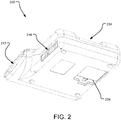
- FIG. 2 is a second perspective view of an example calibration station 200.
- a breath alcohol tester (not shown) is selectively mounted to the calibration station 200 using a device dock 204.
- the calibration station 200 includes a power supply port (not shown, see port 210 of FIG. 1 ) with which a user may connect a power supply cord (not shown) to directly power the calibration station 200 and/or charge one or more batteries (not shown) within the calibration station 200.
- the batteries may be permanently stored within the calibration station 200 or removable and replaceable. Further, the batteries may be located behind door 234.
- Other power supply sources may also be used (e.g., mechanical power, solar power, wind power, etc.) to power the calibration station 200.
- the calibration station 200 still further includes communication ports 216 (e.g., USB, serial, Ethernet, HDMI, etc. ports), internal/external input devices, storage devices, and output devices.
- the communication ports 216 allow the calibration station 200 to establish a data connection to a local area network, the Internet, integrated or peripheral input devices (e.g., a mouse, a touchpad, etc.), integrated or peripheral output devices (e.g., a monitor, a printer, etc.), integrated or peripheral storage devices (e.g., a disc drive, a CD drive, a flash drive, a flash card, a tape drive, etc.), and so on.
- the calibration station 200 may be configured to communicate with the local area network, the Internet, the peripheral devices, etc.
- the data connection may permit software on the calibration station 200 to be updated, information stored within the calibration station 200 to be downloaded to another location, and/or information to be communicated between the user and the calibration station 200.
- wireless communication standards e.g., Bluetooth, Wi-Fi, etc.
- the calibration station 200 further includes an aperture 217 that receives a calibration standard (not shown).
- the calibration standard is a bottle or canister of a pressurized fluid with a precise known alcohol content percentage.
- the calibration standard is used as a comparison standard to check calibration and/or recalibrate (i.e., perform calibration processes) on the breath alcohol tester.
- the calibration fluid supply is inserted into the aperture 217 in the device dock 204 and screwed or otherwise secured in place and fluidly connected to the breath alcohol tester.
- the aperture 217 may be sized to receive a particular calibration standard bottle size or be adjustable to accept a variety of calibration standard bottle sizes. In other implementations, multiple apertures may be provided in the calibration station 200 for receiving multiple calibration standards.
- FIG. 3 is a third perspective view of an example calibration station 300.
- a breath alcohol tester (not shown, see breath alcohol tester 102 of FIG. 1 ) is selectively mounted to the calibration station 300 using a device dock 304 as discussed in detail with regard to FIG. 1 .
- the device dock 304 may include a metallic or magnetic receptacle 305 that interfaces with a corresponding magnetic protrusion on the breath alcohol tester. This aids the alignment and secured fit of the breath alcohol tester to the calibration station 300.
- the device dock 304 is contoured so that a user may easily grasp around the breath alcohol tester to remove it from the device dock 304.
- the device dock 304 may also include a docking sensor (e.g., a switch or a proximity sensor) that detects if the breath alcohol tester is properly docked within the device dock 304. If not, the calibration station 300 may alert a user via a visual or audio alarm.
- a docking sensor e.g., a switch or a proximity sensor
- the calibration station 300 may be mounted in a variety of orientations (e.g., on a generally horizontal surface like a desk or on a generally vertical surface like a wall).
- the calibration station 300 may also be configured to fit inside a travel case for portability (e.g., for use in the field or on the road).
- a magnetic interface between the calibration station 300 and the breath alcohol tester can allow the breath alcohol tester to remain properly docked in a variety of orientations of the calibration station 300.
- one or more hooks, clasps, doors, or other securing mechanisms may also be used to secure the breath alcohol tester in the device dock 304.
- the calibration station 300 may include multiple device docks where multiple breath alcohol testers may be simultaneously mounted thereon. As a result, a singular calibration station 300 may be used to recharge and perform calibration processes on multiple breath alcohol testers simultaneously or in quick order. Further, the calibration station 300 may actively monitor the docked breath alcohol testers and perform calibration processes on them automatically as necessary or as desired and as discussed in detail herein.
- the device dock 304 also includes a calibration fluid interface 322, which creates a fluid connection between the breath alcohol tester and a calibration standard (not shown) when the breath alcohol tester is properly mounted onto the calibration station 300.
- the calibration fluid interface 322 connects to the breath alcohol tester in the same manner and location as a mouthpiece for the breath alcohol tester.
- the calibration fluid interface 322 is identical to the mouthpiece of the breath alcohol tester.
- the calibration fluid interface 322 is not identical to the mouthpiece of the breath alcohol tester, it closely replicates a user's breath path (e.g., tube inner form factor, e.g., shape and size) for accurate calibration.
- the calibration fluid interface 322 may be attached to the breath alcohol tester first and then connected to the calibration station 300 via the device dock 304, or vice versa. Further, the calibration fluid interface 322 may be permanently affixed to or removable from the calibration station 300.
- the device dock 304 may also include one or more electrical ports (not shown) which provide a power and/or a data connection between the breath alcohol tester and the device dock 304 when the breath alcohol tester is docked with the calibration station 300. In such an implementation, there are one or more corresponding electrical ports (not shown) on the rear of the breath alcohol tester.
- FIG. 4 illustrates example operations 400 for performing a calibration process on a breath alcohol tester using a calibration station according to the presently disclosed technology.
- a first establishing operation 402 establishes a fluid connection between the breath alcohol tester and the calibration station.
- the breath alcohol tester is attached to the calibration station via a device dock that includes a calibration fluid interface.
- the fluid connection is established via the calibration fluid interface.
- the calibration station does not include a device dock.
- the fluid connection between the breath alcohol tester and the calibration standard may be made by connecting a hose extending from the calibration standard directly to the breath alcohol tester, or vice versa.
- a second establishing operation 405 establishes a data connection between the breath alcohol tester and the calibration station.
- the second establishing operation 405 may be accomplished by physically connecting a data cable between the breath alcohol tester and the calibration station or establishing a wireless data connection between the breath alcohol tester and the calibration station.
- a main menu presents a user with various options for performing calibration processes on the breath alcohol tester.
- the user is presented with three options, "Calibrate,” "Cal Check,” and “Settings.”
- the main menu may present greater or fewer options to the user. Further, the main menu is displayed on a display of the calibration station.
- the calibration station may receive various data from the breath alcohol tester when the data connection is established. For example, the calibration station may detect and compare the model number and software version of the breath alcohol tester with the model number and software version of the calibration station to determine compatibility. The calibration station may be configured to update its counterpart breath alcohol tester with the latest or necessary software to proceed with operations 400. Further yet, the calibration station may communicate calibration standard properties (e.g., state of fill, alcohol content, etc.) to the breath alcohol tester. Still further, the calibration station may detect ambient temperature, humidity, and barometric pressure conditions and store them for use as variables in the calibration processes. More specifically, the calibration station may detect the ambient barometric pressure and apply an adjustment factor dependent on the ambient barometric pressure to the calibration processes.
- calibration standard properties e.g., state of fill, alcohol content, etc.
- the calibration station may communicate to central technical support entity via a wireless (e.g., Wi-Fi, Bluetooth, or Cellular signal) or wired (e.g., Ethernet, PTSN) data connection.
- Central technical support may upload information (e.g., commands and software updates) to and/or download information from the calibration station.
- the central technical support may perform remote diagnostic procedures on the calibration station for example, and retrieve the results of the diagnostic procedures from the calibration station.
- Central technical support may also be able to remotely enable or disable the calibration station and/or the breath alcohol tester or various features thereof.
- central technical support may use the data collected and stored on a cloud database to compare the operation of individual calibration station and/or the breath alcohol tester units in the field and recommend procedural adjustments to users / owners of units with a poor calibration / use record in order to optimize their use of the calibration stations. Still further, central technical support can use the collected data to predict a total cost of ownership and a timeline of cost to current and prospective owners based on aggregate costs experienced over the entire network of calibration stations and/or the breath alcohol testers. Further yet, central technical support may use the data collected and stored on the cloud database to make geographical and jurisdictional comparisons between different users operating different units in different areas. Further still, central technical support may use the data collected and stored on the cloud database to automate the reordering of calibration standards for the calibration stations.
- a decision operation 410 the user selects one of "Calibrate,” “Cal Check,” or “Settings” from the main menu to execute a calibration process by sending one or more commands to the breath alcohol tester.
- the calibration station / breath alcohol tester displays may also include battery status of the calibration station and/or breath alcohol tester and fill level / expiration date of the calibration standard.
- the calibration station may be connected to the Internet and automatically reorder or prompt the user to reorder a new calibration standard when the calibration standard is low, empty, nearing expiration, and/or expired.
- the user is redirected to one or more additional menus where the user can adjust the settings of one or both of the calibration station and the breath alcohol tester.
- the user adjusts one or more of the calibration station and/or breath alcohol tester settings using user inputs into the one or more additional menus.
- the user may be presented with options on the calibration station display to check and/or adjust "General Settings” (e.g., date / time, date format, time format, and time zone, etc.), "Dry Gas settings” (e.g., alcohol concentration level, expiration date, tank size, life status, and barometric pressure, etc.), and “About” (e.g., display serial number, software version, model number, last recalibration date / time, last calibration check date / time, software updates, etc.).
- the "Settings" menus may present greater or fewer options to the user, or may be absent all together.
- the performing operation 420 may include one or more of verifying sufficient calibration fluid quantity and pressure for the calibration check, changing the breath alcohol tester to a calibration check mode, opening the fluid connection (e.g., opening a valve) between the calibration standard and the breath alcohol tester, waiting an appropriate time (e.g., 3 seconds) for the calibration fluid to reach the breath alcohol tester, taking a sample of the released calibration fluid, closing the fluid connection (e.g., closing the valve) between the calibration standard and the breath alcohol tester, and analyzing the alcohol content of the calibration fluid sample.
- the aforementioned wait time may range from 1 to 14 seconds.
- the calibration check is referred to herein as an example calibration process.
- the menu may display instructions to the user to wait for completion of the calibration check and/or display an estimated time until completion of the calibration check.
- decision operation 425 determines if the breath alcohol tester passed the calibration check (i.e., the detected alcohol content of the calibration standard is within a predetermined tolerance from the actual alcohol content of the calibration standard.
- the calibration station automatically performs the decision operation 425 without any additional input from the user and outputs via the display whether the calibration check was successful or not.
- displaying operation 430 informs the user that the breath alcohol tester is calibrated.
- a disconnecting operation 435 the user may disconnect the breath alcohol tester from the calibration station and put the breath alcohol tester into service.
- the calibration station may instruct the user when it is appropriate to perform the disconnecting operation 435 by displaying a message to the user.
- suggestion operation 440 displays to the user a message suggesting that the user recalibrate the breath alcohol tester.
- the suggestion operation 440 may be performed by the calibration station and then after a predetermined time or after user acknowledgment of the message, the calibration station returns to the main menu again presenting the user the "Calibrate,” “Cal Check,” and “Settings” options (see decision operation 410). Further, the suggestion operation 440 may automatically trigger recalibration of the breath alcohol tester.
- calibration operation 445 recalibrates the connected breath alcohol tester.
- the calibration station automatically performs the calibration operation 445 without any additional input from the user.
- the calibration operation 445 may include one or more of verifying sufficient calibration fluid quantity and pressure for recalibration, changing the breath alcohol tester to a calibration mode, opening the fluid connection (e.g., opening a valve) between the calibration standard and the breath alcohol tester, waiting an appropriate time (e.g., 3 seconds) for the calibration fluid to reach the breath alcohol tester, taking a sample of the released calibration fluid, closing the fluid connection (e.g., closing the valve) between the calibration standard and the breath alcohol tester, analyzing the alcohol content of the calibration fluid sample, and adjusting the calibration state of the breath alcohol tester to match the known alcohol content of the released calibration fluid.
- the aforementioned wait time may range from 1 to 14 seconds.
- the menu may display instructions to the user to wait for completion of the calibration operation 445 and/or display an estimated time till completion of the calibration operation 445.
- decision operation 450 determines if the breath alcohol tester was successfully calibrated (i.e., an additional calibration check may determines if the detected alcohol content of the calibration standard is within a predetermined tolerance (e.g., 0.005%) from the actual alcohol content of the calibration standard).
- the calibration station automatically performs the decision operation 450 without any additional input from the user and outputs via the display whether the calibration was successful or not.
- suggestion operation 440 displays to the user a message suggesting that the user try to calibrate the breath alcohol tester again.
- the suggestion operation 440 may be performed by the calibration station and then after a predetermined time or after user acknowledgment of the message, the calibration station returns to the main menu presenting use the "Calibrate,” “Cal Check,” and “Settings” options (see decision operation 410).
- the suggestion operation 455 may suggest that the user check and/or replace the calibration standard.
- displaying operation 430 displays to the user that the breath alcohol tester is calibrated.
- a disconnecting operation 435 the user disconnects the breath alcohol tester from the calibration station and may put the breath alcohol tester into service.
- the calibration station may instruct the user when it is appropriate to perform the disconnecting operation 435 by displaying a message to the user.
- the calibration station may turn off or go into a low power state if not used within a predetermined time (e.g., 15 minutes). Still further, the calibration station may include password protection to limit access to authorized users. Further yet, the calibration station may store a number of previous calibrations or calibration checks (e.g., a log of up to 50 previous recalibrations or calibration checks). This data may be stored within the calibration station, within the breath alcohol tester, and/or output to a local area network, the Internet, a printer, or an external storage device, for example.
- a predetermined time e.g. 15 minutes
- the calibration station may include password protection to limit access to authorized users.
- the calibration station may store a number of previous calibrations or calibration checks (e.g., a log of up to 50 previous recalibrations or calibration checks). This data may be stored within the calibration station, within the breath alcohol tester, and/or output to a local area network, the Internet, a printer, or an external storage device, for example.
- the calibration station performs each of the operations 400.
- the embodiments of the invention described herein are implemented as logical steps in one or more computer systems.
- the logical operations of the present invention are implemented (1) as a sequence of computer processor-implemented steps executing in one or more computer systems and (2) as interconnected machine or circuit modules within one or more computer systems.
- the implementation is a matter of choice, dependent on the performance requirements of the computer system implementing the invention. Accordingly, the logical operations making up the embodiments of the invention described herein are referred to variously as operations, steps, objects, or modules.
- logical operations may be performed in any order, unless explicitly claimed otherwise or a specific order is inherently necessitated by the claim language.
Landscapes
- Life Sciences & Earth Sciences (AREA)
- Health & Medical Sciences (AREA)
- Chemical & Material Sciences (AREA)
- Engineering & Computer Science (AREA)
- Physics & Mathematics (AREA)
- General Physics & Mathematics (AREA)
- Biochemistry (AREA)
- Pathology (AREA)
- Immunology (AREA)
- General Health & Medical Sciences (AREA)
- Food Science & Technology (AREA)
- Medicinal Chemistry (AREA)
- Analytical Chemistry (AREA)
- Biomedical Technology (AREA)
- Molecular Biology (AREA)
- Combustion & Propulsion (AREA)
- Biophysics (AREA)
- Urology & Nephrology (AREA)
- Hematology (AREA)
- Investigating Or Analysing Biological Materials (AREA)
Description
- The present application claims benefit of priority to
U.S. Provisional Patent Application No. 61/680,325 U.S. Provisional Patent Application No. 61/759,022 - A breath alcohol tester is a device for estimating a blood alcohol content (BAC) of a user by analyzing a sample of the user's breath. Typically, the user exhales into the breath alcohol tester and any ethanol present in the user's breath is oxidized to yield acetic acid and hydrogen at an anode of the breath alcohol tester. Further, the hydrogen reacts with atmospheric oxygen to yield water at a cathode of the breath alcohol tester. This chemical reaction produces an electric current between the anode and the cathode and a sensor (and associated circuitry) within the breath alcohol tester measures the magnitude of the electric current. The breath alcohol tester outputs an approximation (or representation) of the user's BAC based on the measured electric current.
- The anode, cathode, sensor, or other components of the breath alcohol tester may be prone to contamination and interference from substances other than breath alcohol. Further, over time, sensor aging, humidity, and contamination can alter the output of the breath alcohol tester. As a result, the breath alcohol tester may require regular calibration checks or recalibration (collectively calibration processes) to ensure that the breath alcohol tester outputs an accurate estimation (or representation) of BAC. Further, even if the breath alcohol tester does not require regular calibration for accuracy, regular calibration and/or calibration checks of the breath alcohol tester may be required to comply with equipment limitations and/or applicable administrative or legal (e.g., Federal, State, and Local) laws and regulations, for example. There may be other factors that cause the need for regular calibration checks or recalibration of the breath alcohol tester.
- Calibration of the breath alcohol tester may be performed using a Dry-Gas method, for example, although other calibration methods are contemplated herein. The Dry-Gas method utilizes a calibration standard, which is a precise mixture of alcohol and inert nitrogen available in a portable pressurized canister. The breath alcohol tester is connected to the calibration standard and measures the alcohol content of the calibration standard. The measured alcohol content is compared with the known alcohol content of the calibration standard. The calibration of the breath alcohol tester is adjusted, if necessary, to match the alcohol content of the calibration standard within a desired degree of accuracy (e.g., within (0.005%).
- Calibration of the breath alcohol tester may require specially trained users to accurately and consistently calibrate the breath alcohol tester. Further, if the trained users do not perform the calibration regularly, the users may avoid performing the calibration, induce errors in the calibration, and/or forget how to do the calibration and become uncomfortable performing the calibration. Still further, a failure to correctly calibrate the breath alcohol tester (or not calibrate the breath alcohol tester at all) may render the results obtained from the breath alcohol tester invalid.
-
- Implementations described and claimed herein address the foregoing problems by providing a method of performing a calibration process on a breath alcohol tester using a calibration station in accordance with
claim 1. Advantageous feature are in the dependent claims. - Implementations described and claimed herein address the foregoing problems by further providing a calibration system of claim 5. Advantageous features are in the dependent claims.
-
-
FIG. 1 is a first perspective view of an example calibration station with a breath alcohol tester and a calibration standard mounted thereon. -
FIG. 2 is a second perspective view of an example calibration station. -
FIG. 3 is a third perspective view of an example calibration station. -
FIG. 4 illustrates example operations for performing a calibration process on a breath alcohol tester using a calibration station according to the presently disclosed technology. -
FIG. 1 is a first perspective view of anexample calibration station 100 with abreath alcohol tester 102 mounted thereon. Thebreath alcohol tester 102 is selectively mounted to thecalibration station 100 using a device dock 104 (alternatively referred to herein as a docking station, receiving station, or mounting interface). This fluidly connects thebreath alcohol tester 102 to acalibration standard 124 via one or more tubes, hoses, regulators, and/or valves (collectively, a calibration fluid interface, not shown). Thecalibration standard 124 is a pressurized fluid containing a precise known mixture of alcohol (e.g., ethanol) and inert nitrogen. In various implementations, the ethanol content of thecalibration standard 124 is less than about 1100 parts per million. - The
breath alcohol tester 102 is placed into thedevice dock 104 and held in place via a friction, snap, or slip fit, for example. Further, gravitational or other forces may aid in keeping thebreath alcohol tester 102 secured within thedevice dock 104. In other implementations, thedevice dock 104 is equipped with an ejection button or slider (not shown) for facilitating removal of thebreath alcohol tester 102 from thedevice dock 104. In other implementations, thecalibration station 100 does not include adevice dock 104. In those implementations, the fluid connection between thebreath alcohol tester 102 and thecalibration standard 124 may be made by connecting a hose extending from thecalibration standard 124 directly to thebreath alcohol tester 102, or vice versa. - The
calibration station 100 includes ahousing 108, which encloses internal components (e.g., a portion of thecalibration standard 124, associated hose(s) and valve(s), power supply circuitry, communications circuitry, sensing circuitry, batteries, etc.) of the calibration station 100 (not shown). In one implementation, thehousing 108 includes an access door (not shown) that may be removed or opened to access the internal components of thecalibration station 100. The access door may be removably attached to a remainder of ahousing 108 of thecalibration station 100 using a slip-fit, screwed, sliding, or other removable connection. - The
calibration standard 124 may take the form of a precise known mixture of alcohol and an inert substance (e.g., nitrogen) stored within a compressed canister, as shown inFIG. 1 . Thecalibration standard 124 may connect to one or more valves and regulators stored within thehousing 108, which selectively meter fluid from thecalibration standard 124, through one or more tubes hoses, to a calibration fluid interface (not shown, see e.g.,FIG. 3 ) of thebreath alcohol tester 102. The valves and regulators may be automatically actuated via user input control to thecalibration station 100 and/or thebreath alcohol tester 102. In another implementation, the valves and regulators are automatically actuated without user input control. Thecalibration standard 124 is inserted into an aperture (not shown) in thedevice dock 104 and screwed or otherwise secured in place and fluidly connected to thebreath alcohol tester 102. The user may unscrew thecalibration standard 124 when it is empty or nearly empty from a valve and regulator assembly within thecalibration station 100 and replace thecalibration standard 124 with a new calibration standard. The new calibration standard is screwed back into the valve and regulator assembly. - The sensing circuitry (not shown) may include one or more pressure sensors, mass flow rate sensors, and/or temperature sensors. A pressure sensor may detect the ambient pressure in the surrounding environment and adjust calibration settings of the
calibration station 100 and/or thebreath alcohol tester 102 accordingly. Further, a pressure sensor may detect the pressure within thecalibration standard 124 to determine its state of fill. A mass flow rate sensor may determine the mass flow rate of calibration fluid exiting thecalibration standard 124 to accurately meter the fluid and/or determine the state of fill of thecalibration standard 124. A mass flow rate sensor may also detect a leakingcalibration standard 124. Then, thecalibration station 100 may alert the user to adjust the calibration standard 124 mounting or that thecalibration station 100 needs service. A temperature sensor may detect the temperature of the calibration fluid exiting thecalibration standard 124 and adjust the calibration settings accordingly. The sensing circuitry may include multiple pressure sensors, mass flow rate sensors, and/or temperature sensors for redundancy purposes. - The
calibration station 100 includes apower supply port 110 with which a user may connect a power supply cord (not shown) to directly power thecalibration station 100 and/or charge one or more batteries (not shown) within thecalibration station 100. Further, thepower supply port 110 may be used to directly power thebreath alcohol tester 102 and/or charge one or more batteries within thebreath alcohol tester 102. Thecalibration station 100 may run off AC or DC power at a variety of voltage and current levels. In one implementation, thecalibration station 100 runs off of 110/120 VAC power, but includes an AC-DC converter (not shown) either external to or within thecalibration station 100. Thecalibration station 100 may further be selectively turned on and off using an on/offbutton 112. In other implementations, the on/offbutton 112 may be a switch or not included at all. For example, thecalibration station 100 may automatically turn on when thebreath alcohol tester 102 is mounted to thecalibration station 100 and turn off when thebreath alcohol tester 102 is removed from thecalibration station 100. - The
calibration station 100 still further includes adisplay 114 that communicates visual information to the user of thecalibration station 100. Further, thedisplay 114 may function as a touchscreen and accept user inputs. In other implementations, thecalibration station 100 may communicate with an external display (not shown) such as that found in various smart phones, tablet computers, laptop computers, personal computers, and other computing devices. In other implementations, there are separate user input buttons (not shown) on thecalibration station 100. Thecalibration station 100 may also include one or more internal or external speakers (not shown) that communicate audio information (e.g., bells, voice instructions, etc.) to the user. Thecalibration station 100 may also include one or more internal or external microphones (not shown) that accept audio input from the user (e.g., voice recognition commands). In another implementation, thebreath alcohol tester 102 serves as a user input device to thecalibration station 100, or vice versa. The information communicated to the user and received from the user via thedisplay 114, thebreath alcohol tester 102, the input button(s), the speaker(s), and/or the mic(s) is discussed in further detail below. In other implementations, thedisplay 114 is omitted. - In one implementation, the
calibration standard 124 is equipped with a radiofrequency identification (RFID) tag or a barcode / quick response (QR) code. Reading the RFID tag or barcode / quick response (QR) code using an appropriate scanner communicates information specific to thecalibration standard 124 back to thecalibration station 100, where in turn, the information may be communicated to the user via thedisplay 114. This information may include calibration standard capacity, calibration standard alcohol concentration, calibration standard point of origin, calibration standard expiration date, etc. Further, instructions may be communicated to the user based on the status of the calibration standard (e.g., the tank is expired, please provide a new tank; the tank is low, please have a new tank ready; and the tank is full). The RFID or QR code may also be used to determine if an allowed calibration standard is used and automatically utilize the correct calibration tables that correspond to the calibration standard alcohol content. As a result, thecalibration station 100 may utilize a variety of calibration standards from a variety of sources and with a variety of alcohol contents. Further, thecalibration standard 124 may be connected internally to an electronic sensing device that is connected to and/or built into thecalibration station 100 to perform the functions described above. - The
calibration station 100 still further includes a communications and/or power cable 118 (e.g., a RS-232 cable) that electrically connects thebreath alcohol tester 102 to thecalibration station 100. Thecable 118 provides power for charging thebreath alcohol tester 102 and/or a communications medium for transmitting data (i.e., a data connection) between thecalibration station 100 and thebreath alcohol tester 102. In some implementations, no communications and/or power cable is connected to thebreath alcohol tester 102. Further, thebreath alcohol tester 102 may be charged separately from thecalibration station 100. - Further, the
breath alcohol tester 102 and/or thecalibration station 100 may each include one or more wireless communication standards (e.g., Global Positioning System (GPS), Bluetooth, Wifi, infrared, etc.) to establish the data connection between thecalibration station 100, thebreath alcohol tester 102, and individuals responsible for thecalibration station 100 and/or thebreath alcohol tester 102 in various capacities (e.g., owners, users, manufacturers, maintenance personnel, and consumables (e.g., calibration standards) suppliers). Such communications may take place over the Internet or other data networks. For example, data collected by thebreath alcohol tester 102 and/or thecalibration station 100 may be communicated to a cloud computing server for safe, secure, and convenient storage and retrieval. This data may include calibration results, breath alcohol test results, calibration station usage, calibration standard expiration, calibration logs, tester use logs, and software updates, for example. - Still further, GPS receiver/transmitters may be incorporated into the
breath alcohol tester 102 and/or thecalibration station 100 in order to track the location of the units, recover lost/stolen units, and track unit locations relative to legal jurisdictional boundaries, for example. Still further, calibration settings and/or intervals may be automatically adjusted based on the physical location of thebreath alcohol tester 102 and/or thecalibration station 100 as determined by the GPS receiver/transmitter. - The
calibration station 100 may also include a self-cleaning function that releases a burst of calibration fluid from thecalibration standard 124 to clear the valves and regulators, tubes and hoses, and calibration fluid interface prior to calibration. In one implementation, this function is performed automatically on a time or number of uses schedule. In another implementation, the user requests that thecalibration station 100 utilize the self-cleaning function. In yet another implementation, thecalibration station 100 utilizes the self-cleaning function when it detects a potential problem using the pressure and mass flow rate sensors, for example. - The
calibration station 100 may also include a calibration standard purging function. For example, when the calibration fluid runs low enough that it can no longer be used for reliable calibration of thebreath alcohol tester 102, thecalibration station 100 may automatically or upon user approval purge the remainder of the calibration fluid from thecalibration standard 124 to render thecalibration standard 124 safe for long term storage, transportation, recycling, and/or disposal. Thecalibration station 100 also includes acable clasp 103 that is used to selectively secure and store thecable 118 when it is not connected to thebreath alcohol tester 102. -
FIG. 2 is a second perspective view of anexample calibration station 200. A breath alcohol tester (not shown) is selectively mounted to thecalibration station 200 using adevice dock 204. Thecalibration station 200 includes a power supply port (not shown, see port 210 ofFIG. 1 ) with which a user may connect a power supply cord (not shown) to directly power thecalibration station 200 and/or charge one or more batteries (not shown) within thecalibration station 200. The batteries may be permanently stored within thecalibration station 200 or removable and replaceable. Further, the batteries may be located behinddoor 234. Other power supply sources may also be used (e.g., mechanical power, solar power, wind power, etc.) to power thecalibration station 200. - The
calibration station 200 still further includes communication ports 216 (e.g., USB, serial, Ethernet, HDMI, etc. ports), internal/external input devices, storage devices, and output devices. Thecommunication ports 216 allow thecalibration station 200 to establish a data connection to a local area network, the Internet, integrated or peripheral input devices (e.g., a mouse, a touchpad, etc.), integrated or peripheral output devices (e.g., a monitor, a printer, etc.), integrated or peripheral storage devices (e.g., a disc drive, a CD drive, a flash drive, a flash card, a tape drive, etc.), and so on. Further, thecalibration station 200 may be configured to communicate with the local area network, the Internet, the peripheral devices, etc. via one or more wireless communication standards (e.g., Bluetooth, Wi-Fi, etc.). The data connection may permit software on thecalibration station 200 to be updated, information stored within thecalibration station 200 to be downloaded to another location, and/or information to be communicated between the user and thecalibration station 200. - The
calibration station 200 further includes anaperture 217 that receives a calibration standard (not shown). In one implementation, the calibration standard is a bottle or canister of a pressurized fluid with a precise known alcohol content percentage. The calibration standard is used as a comparison standard to check calibration and/or recalibrate (i.e., perform calibration processes) on the breath alcohol tester. The calibration fluid supply is inserted into theaperture 217 in thedevice dock 204 and screwed or otherwise secured in place and fluidly connected to the breath alcohol tester. Theaperture 217 may be sized to receive a particular calibration standard bottle size or be adjustable to accept a variety of calibration standard bottle sizes. In other implementations, multiple apertures may be provided in thecalibration station 200 for receiving multiple calibration standards. -
FIG. 3 is a third perspective view of anexample calibration station 300. A breath alcohol tester (not shown, seebreath alcohol tester 102 ofFIG. 1 ) is selectively mounted to thecalibration station 300 using adevice dock 304 as discussed in detail with regard toFIG. 1 . Further, thedevice dock 304 may include a metallic ormagnetic receptacle 305 that interfaces with a corresponding magnetic protrusion on the breath alcohol tester. This aids the alignment and secured fit of the breath alcohol tester to thecalibration station 300. Further, thedevice dock 304 is contoured so that a user may easily grasp around the breath alcohol tester to remove it from thedevice dock 304. Thedevice dock 304 may also include a docking sensor (e.g., a switch or a proximity sensor) that detects if the breath alcohol tester is properly docked within thedevice dock 304. If not, thecalibration station 300 may alert a user via a visual or audio alarm. - The
calibration station 300 may be mounted in a variety of orientations (e.g., on a generally horizontal surface like a desk or on a generally vertical surface like a wall). Thecalibration station 300 may also be configured to fit inside a travel case for portability (e.g., for use in the field or on the road). A magnetic interface between thecalibration station 300 and the breath alcohol tester can allow the breath alcohol tester to remain properly docked in a variety of orientations of thecalibration station 300. In other implementations, one or more hooks, clasps, doors, or other securing mechanisms may also be used to secure the breath alcohol tester in thedevice dock 304. - In other implementations, the
calibration station 300 may include multiple device docks where multiple breath alcohol testers may be simultaneously mounted thereon. As a result, asingular calibration station 300 may be used to recharge and perform calibration processes on multiple breath alcohol testers simultaneously or in quick order. Further, thecalibration station 300 may actively monitor the docked breath alcohol testers and perform calibration processes on them automatically as necessary or as desired and as discussed in detail herein. - The
device dock 304 also includes acalibration fluid interface 322, which creates a fluid connection between the breath alcohol tester and a calibration standard (not shown) when the breath alcohol tester is properly mounted onto thecalibration station 300. In one implementation, thecalibration fluid interface 322 connects to the breath alcohol tester in the same manner and location as a mouthpiece for the breath alcohol tester. In some implementations, thecalibration fluid interface 322 is identical to the mouthpiece of the breath alcohol tester. In other implementations, while thecalibration fluid interface 322 is not identical to the mouthpiece of the breath alcohol tester, it closely replicates a user's breath path (e.g., tube inner form factor, e.g., shape and size) for accurate calibration. - In various implementations, the
calibration fluid interface 322 may be attached to the breath alcohol tester first and then connected to thecalibration station 300 via thedevice dock 304, or vice versa. Further, thecalibration fluid interface 322 may be permanently affixed to or removable from thecalibration station 300. - The
device dock 304 may also include one or more electrical ports (not shown) which provide a power and/or a data connection between the breath alcohol tester and thedevice dock 304 when the breath alcohol tester is docked with thecalibration station 300. In such an implementation, there are one or more corresponding electrical ports (not shown) on the rear of the breath alcohol tester. -
FIG. 4 illustratesexample operations 400 for performing a calibration process on a breath alcohol tester using a calibration station according to the presently disclosed technology. Afirst establishing operation 402 establishes a fluid connection between the breath alcohol tester and the calibration station. In one implementation, the breath alcohol tester is attached to the calibration station via a device dock that includes a calibration fluid interface. When the breath alcohol tester is docked within the device dock, the fluid connection is established via the calibration fluid interface. In other implementations, the calibration station does not include a device dock. In those implementations, the fluid connection between the breath alcohol tester and the calibration standard may be made by connecting a hose extending from the calibration standard directly to the breath alcohol tester, or vice versa. - A
second establishing operation 405 establishes a data connection between the breath alcohol tester and the calibration station. In various implementations, thesecond establishing operation 405 may be accomplished by physically connecting a data cable between the breath alcohol tester and the calibration station or establishing a wireless data connection between the breath alcohol tester and the calibration station. Either upon completion of thesecond establishing operation 405 or upon turning the calibration station on, a main menu presents a user with various options for performing calibration processes on the breath alcohol tester. In one implementation, the user is presented with three options, "Calibrate," "Cal Check," and "Settings." In other implementations, the main menu may present greater or fewer options to the user. Further, the main menu is displayed on a display of the calibration station. - The calibration station may receive various data from the breath alcohol tester when the data connection is established. For example, the calibration station may detect and compare the model number and software version of the breath alcohol tester with the model number and software version of the calibration station to determine compatibility. The calibration station may be configured to update its counterpart breath alcohol tester with the latest or necessary software to proceed with
operations 400. Further yet, the calibration station may communicate calibration standard properties (e.g., state of fill, alcohol content, etc.) to the breath alcohol tester. Still further, the calibration station may detect ambient temperature, humidity, and barometric pressure conditions and store them for use as variables in the calibration processes. More specifically, the calibration station may detect the ambient barometric pressure and apply an adjustment factor dependent on the ambient barometric pressure to the calibration processes. - In one implementation, the calibration station may communicate to central technical support entity via a wireless (e.g., Wi-Fi, Bluetooth, or Cellular signal) or wired (e.g., Ethernet, PTSN) data connection. Central technical support may upload information (e.g., commands and software updates) to and/or download information from the calibration station. The central technical support may perform remote diagnostic procedures on the calibration station for example, and retrieve the results of the diagnostic procedures from the calibration station. Central technical support may also be able to remotely enable or disable the calibration station and/or the breath alcohol tester or various features thereof.
- Further, central technical support may use the data collected and stored on a cloud database to compare the operation of individual calibration station and/or the breath alcohol tester units in the field and recommend procedural adjustments to users / owners of units with a poor calibration / use record in order to optimize their use of the calibration stations. Still further, central technical support can use the collected data to predict a total cost of ownership and a timeline of cost to current and prospective owners based on aggregate costs experienced over the entire network of calibration stations and/or the breath alcohol testers. Further yet, central technical support may use the data collected and stored on the cloud database to make geographical and jurisdictional comparisons between different users operating different units in different areas. Further still, central technical support may use the data collected and stored on the cloud database to automate the reordering of calibration standards for the calibration stations.
- In a
decision operation 410, the user selects one of "Calibrate," "Cal Check," or "Settings" from the main menu to execute a calibration process by sending one or more commands to the breath alcohol tester. The calibration station / breath alcohol tester displays may also include battery status of the calibration station and/or breath alcohol tester and fill level / expiration date of the calibration standard. Still further, the calibration station may be connected to the Internet and automatically reorder or prompt the user to reorder a new calibration standard when the calibration standard is low, empty, nearing expiration, and/or expired. - If the user selects "Settings," the user is redirected to one or more additional menus where the user can adjust the settings of one or both of the calibration station and the breath alcohol tester. In an adjusting operation 415, the user adjusts one or more of the calibration station and/or breath alcohol tester settings using user inputs into the one or more additional menus. For example, the user may be presented with options on the calibration station display to check and/or adjust "General Settings" (e.g., date / time, date format, time format, and time zone, etc.), "Dry Gas settings" (e.g., alcohol concentration level, expiration date, tank size, life status, and barometric pressure, etc.), and "About" (e.g., display serial number, software version, model number, last recalibration date / time, last calibration check date / time, software updates, etc.). In other implementations, the "Settings" menus may present greater or fewer options to the user, or may be absent all together.
- If the user selects "Cal Check," performing
operation 420 performs a calibration check on the breath alcohol tester. - The performing
operation 420 may include one or more of verifying sufficient calibration fluid quantity and pressure for the calibration check, changing the breath alcohol tester to a calibration check mode, opening the fluid connection (e.g., opening a valve) between the calibration standard and the breath alcohol tester, waiting an appropriate time (e.g., 3 seconds) for the calibration fluid to reach the breath alcohol tester, taking a sample of the released calibration fluid, closing the fluid connection (e.g., closing the valve) between the calibration standard and the breath alcohol tester, and analyzing the alcohol content of the calibration fluid sample. In various implementations, the aforementioned wait time may range from 1 to 14 seconds. The calibration check is referred to herein as an example calibration process. - Further, the menu may display instructions to the user to wait for completion of the calibration check and/or display an estimated time until completion of the calibration check. Upon completion of the calibration check,
decision operation 425 determines if the breath alcohol tester passed the calibration check (i.e., the detected alcohol content of the calibration standard is within a predetermined tolerance from the actual alcohol content of the calibration standard. In one implementation, the calibration station automatically performs thedecision operation 425 without any additional input from the user and outputs via the display whether the calibration check was successful or not. - If the calibration check on the breath alcohol tester was successful, displaying operation 430 informs the user that the breath alcohol tester is calibrated. In a
disconnecting operation 435, the user may disconnect the breath alcohol tester from the calibration station and put the breath alcohol tester into service. In some implementations, the calibration station may instruct the user when it is appropriate to perform the disconnectingoperation 435 by displaying a message to the user. - If the calibration check of the breath alcohol tester was not successful,
suggestion operation 440 displays to the user a message suggesting that the user recalibrate the breath alcohol tester. Thesuggestion operation 440 may be performed by the calibration station and then after a predetermined time or after user acknowledgment of the message, the calibration station returns to the main menu again presenting the user the "Calibrate," "Cal Check," and "Settings" options (see decision operation 410). Further, thesuggestion operation 440 may automatically trigger recalibration of the breath alcohol tester. - If the user selects "Calibrate," calibration operation 445 recalibrates the connected breath alcohol tester. In one implementation, the calibration station automatically performs the calibration operation 445 without any additional input from the user. The calibration operation 445 may include one or more of verifying sufficient calibration fluid quantity and pressure for recalibration, changing the breath alcohol tester to a calibration mode, opening the fluid connection (e.g., opening a valve) between the calibration standard and the breath alcohol tester, waiting an appropriate time (e.g., 3 seconds) for the calibration fluid to reach the breath alcohol tester, taking a sample of the released calibration fluid, closing the fluid connection (e.g., closing the valve) between the calibration standard and the breath alcohol tester, analyzing the alcohol content of the calibration fluid sample, and adjusting the calibration state of the breath alcohol tester to match the known alcohol content of the released calibration fluid. In various implementations, the aforementioned wait time may range from 1 to 14 seconds.
- Further, the menu may display instructions to the user to wait for completion of the calibration operation 445 and/or display an estimated time till completion of the calibration operation 445. Upon completion of the calibration operation 445,
decision operation 450 determines if the breath alcohol tester was successfully calibrated (i.e., an additional calibration check may determines if the detected alcohol content of the calibration standard is within a predetermined tolerance (e.g., 0.005%) from the actual alcohol content of the calibration standard). In one implementation, the calibration station automatically performs thedecision operation 450 without any additional input from the user and outputs via the display whether the calibration was successful or not. - If the calibration operation 445 was not successful,
suggestion operation 440 displays to the user a message suggesting that the user try to calibrate the breath alcohol tester again. Thesuggestion operation 440 may be performed by the calibration station and then after a predetermined time or after user acknowledgment of the message, the calibration station returns to the main menu presenting use the "Calibrate," "Cal Check," and "Settings" options (see decision operation 410). In other implementations, thesuggestion operation 455 may suggest that the user check and/or replace the calibration standard. - If the calibration operation 445 was successful, displaying operation 430 displays to the user that the breath alcohol tester is calibrated. In a
disconnecting operation 435, the user disconnects the breath alcohol tester from the calibration station and may put the breath alcohol tester into service. In some implementations, the calibration station may instruct the user when it is appropriate to perform the disconnectingoperation 435 by displaying a message to the user. - Further, the calibration station may turn off or go into a low power state if not used within a predetermined time (e.g., 15 minutes). Still further, the calibration station may include password protection to limit access to authorized users. Further yet, the calibration station may store a number of previous calibrations or calibration checks (e.g., a log of up to 50 previous recalibrations or calibration checks). This data may be stored within the calibration station, within the breath alcohol tester, and/or output to a local area network, the Internet, a printer, or an external storage device, for example.
- The calibration station performs each of the
operations 400. - The embodiments of the invention described herein are implemented as logical steps in one or more computer systems. The logical operations of the present invention are implemented (1) as a sequence of computer processor-implemented steps executing in one or more computer systems and (2) as interconnected machine or circuit modules within one or more computer systems. The implementation is a matter of choice, dependent on the performance requirements of the computer system implementing the invention. Accordingly, the logical operations making up the embodiments of the invention described herein are referred to variously as operations, steps, objects, or modules. Furthermore, it should be understood that logical operations may be performed in any order, unless explicitly claimed otherwise or a specific order is inherently necessitated by the claim language.
Claims (9)
- A method of performing a calibration check process on a breath alcohol tester (102) using a calibration station (100, 200, 300), the method comprising:establishing (402) a fluid connection between the breath alcohol tester and a calibration standard (124) with a known alcohol content;establishing (405) a data connection between the breath alcohol tester and the calibration station;executing (420) the calibration check process on the breath alcohol tester in response to user selection of a calibration check option on a main menu displayed on a display (114) of the calibration station, the calibration check process comprising the steps of:opening the fluid connection between the breath alcohol tester and the calibration standard (124);detecting the alcohol content of the calibration standard using the breath alcohol tester;closing the fluid connection between the breath alcohol tester and the calibration standard in response to the detecting operation;comparing, by the calibration station, the detected alcohol content with the known alcohol content of the calibration standard to determine (425) if the breath alcohol tester passed the calibration check based on the detected alcohol content being within a predetermined tolerance from the known alcohol content of the calibration standard; andoutputting a result of the comparing operation to a user.
- The method of claim 1, further comprising: if the breath alcohol tester did not pass the calibration check, suggesting (440) to recalibrate the the breath alcohol tester.
- The method of claim 1, further comprising:
measuring an ambient barometric pressure, wherein the detecting operation is dependent on the measured barometric pressure. - The method of claim 1, wherein the known alcohol content of the calibration standard is less than 1100 parts per million of ethanol.
- A calibration system comprising a calibration station (100, 200, 300) and a breath alcohol tester (102), the calibration station comprising:circuitry configured to establish a data connection between the breath alcohol tester and the calibration station;a calibration fluid interface (322) configured to fluidly connect a calibration standard (124) to the breath alcohol tester;a valve configured to open the fluid connection between the calibration station and the breath alcohol tester in response to execution of a calibration process on the breath alcohol tester;a user input interface comprising a display (114) configured to present a calibration check option on a main menu of the display; andwherein the system is configured toexecute (420) a calibration check process on the breath alcohol tester in response to user selection of the calibration check option on the main menu displayed on the display of the calibration station, the calibration check process comprising the steps of:open the fluid connection between the breath alcohol tester and the calibration standard (124);detect the alcohol content of the calibration standard using the breath alcohol tester;close the fluid connection between the breath alcohol tester and the calibration standard in response to the detecting operation;compare, by the calibration station, the detected alcohol content with the known alcohol content of the calibration standard to determine (425) if the breath alcohol tester passed the calibration check based on the detected alcohol content being within a predetermined tolerance from the known alcohol content of the calibration standard; andoutput a result of the comparing operation to a user.
- The system of claim 5, wherein the calibration station further comprises:
a device dock configured to receive the breath alcohol tester onto the calibration station and establish the calibration fluid interface between the breath alcohol tester and the calibration station. - The system of claim 6, wherein the device dock includes a docking sensor configured to indicate that the breath alcohol tester is properly received onto the calibration station.
- The system of claim 5 wherein the result of the comparing operation is output to the display of the calibration station.
- The system of claim 5 wherein the calibration station further comprises:
one or more barometric pressure sensors that measure an ambient barometric pressure, wherein the calibration process is dependent on the measured barometric pressure.
Applications Claiming Priority (3)
| Application Number | Priority Date | Filing Date | Title |
|---|---|---|---|
| US201261680325P | 2012-08-07 | 2012-08-07 | |
| US201361759022P | 2013-01-31 | 2013-01-31 | |
| PCT/US2013/053308 WO2014025623A1 (en) | 2012-08-07 | 2013-08-01 | Breath alcohol tester calibration station |
Publications (3)
| Publication Number | Publication Date |
|---|---|
| EP2839294A1 EP2839294A1 (en) | 2015-02-25 |
| EP2839294A4 EP2839294A4 (en) | 2015-11-18 |
| EP2839294B1 true EP2839294B1 (en) | 2019-09-25 |
Family
ID=50065160
Family Applications (1)
| Application Number | Title | Priority Date | Filing Date |
|---|---|---|---|
| EP13828370.0A Active EP2839294B1 (en) | 2012-08-07 | 2013-08-01 | Breath alcohol tester calibration station |
Country Status (5)
| Country | Link |
|---|---|
| US (1) | US9562883B2 (en) |
| EP (1) | EP2839294B1 (en) |
| AU (1) | AU2013299968B2 (en) |
| NZ (1) | NZ702353A (en) |
| WO (1) | WO2014025623A1 (en) |
Families Citing this family (34)
| Publication number | Priority date | Publication date | Assignee | Title |
|---|---|---|---|---|
| US8122753B2 (en) * | 2007-08-31 | 2012-02-28 | Air Liquide Advanced Technologies U.S. Llc | Portable metered flow apparatus for calibration/bump testing |
| AU2013244090B2 (en) | 2012-04-05 | 2018-04-05 | Fisher & Paykel Healthcare Limited | Respiratory assistance apparatus |
| US10458975B1 (en) | 2013-07-31 | 2019-10-29 | 1A Smart Start, Llc | Calibration device and method for calibrating an ignition interlock device |
| US9772318B1 (en) | 2013-07-31 | 2017-09-26 | Michael Lyon | Interlock data collection and calibration system |
| US11105668B2 (en) * | 2013-09-17 | 2021-08-31 | Sensia Llc | Smart measurement system |
| US11262215B2 (en) | 2013-09-17 | 2022-03-01 | Sensia Llc | Smart measurement system |
| US11262354B2 (en) | 2014-10-20 | 2022-03-01 | Boston Scientific Scimed, Inc. | Disposable sensor elements, systems, and related methods |
| FR3028316B1 (en) * | 2014-11-07 | 2016-12-02 | Peugeot Citroen Automobiles Sa | AIR MONITORING DEVICE OF A VEHICLE, A SENSOR CALIBRATED WITH MEASUREMENTS PROVIDED BY AN INFORMATION SERVICE, AND CALIBRATION METHOD THEREOF |
| US20160161468A1 (en) * | 2014-12-08 | 2016-06-09 | Soberlink Healthcare Llc | Remote sobriety monitoring systems, devices and methods |
| US9922508B2 (en) | 2015-10-09 | 2018-03-20 | Soberlink Healthcare, Llc | Bioresistive-fingerprint based sobriety monitoring system |
| US10604011B2 (en) | 2015-10-13 | 2020-03-31 | Consumer Safety Technology, Llc | Networked intoxication vehicle immobilization |
| US10557844B2 (en) | 2016-04-08 | 2020-02-11 | Soberlink Healthcare, Llc | Bioresistive-fingerprint based sobriety monitoring system |
| WO2017218464A1 (en) | 2016-06-15 | 2017-12-21 | Boston Scientific Scimed, Inc. | Gas sampling catheters |
| DE102016009834A1 (en) * | 2016-08-15 | 2018-02-15 | Dräger Safety AG & Co. KGaA | Device, substance measuring device, method, computer program camera and mobile device for identifying a substance measuring device |
| WO2018048010A1 (en) * | 2016-09-07 | 2018-03-15 | 김영우 | Apparatus for providing blood alcohol information, method for providing blood alcohol information and computer readable recording medium |
| US10877008B2 (en) | 2016-09-09 | 2020-12-29 | Consumer Safety Technology, Llc | Reference gas management in a breath alcohol calibration station |
| US10663440B2 (en) | 2016-09-09 | 2020-05-26 | Consumer Safety Technology, Llc | Secure data handling in a breath alcohol calibration station |
| EP3528703A1 (en) * | 2016-10-21 | 2019-08-28 | Boston Scientific Scimed, Inc. | Gas sampling device |
| US10770182B2 (en) | 2017-05-19 | 2020-09-08 | Boston Scientific Scimed, Inc. | Systems and methods for assessing the health status of a patient |
| US10852264B2 (en) | 2017-07-18 | 2020-12-01 | Boston Scientific Scimed, Inc. | Systems and methods for analyte sensing in physiological gas samples |
| CA3087363C (en) | 2018-02-02 | 2022-08-16 | Honeywell International Inc. | System and method for gas reuse in testing of hazardous gas detecting instruments |
| EP3867639A1 (en) | 2018-10-19 | 2021-08-25 | Regents of the University of Minnesota | Systems and methods for detecting a brain condition |
| EP3861329A1 (en) | 2018-11-27 | 2021-08-11 | Boston Scientific Scimed Inc. | Systems and methods for detecting a health condition |
| WO2020131567A1 (en) | 2018-12-18 | 2020-06-25 | Boston Scientific Scimed, Inc. | Systems and methods for measuring kinetic response of chemical sensor elements |
| MX2021008203A (en) | 2019-01-10 | 2021-08-11 | Lifeloc Tech Inc | Breath alcohol content device security and sensing. |
| US12613212B2 (en) | 2020-05-01 | 2026-04-28 | Regents Of The University Of Minnesota | Non-invasive bladder cancer detection system via liquid and gaseous phase analysis |
| US12480907B2 (en) | 2021-04-16 | 2025-11-25 | Regents Of The University Of Minnesota | Systems utilizing graphene varactor hysteresis effects for sample characterization |
| US12085546B2 (en) | 2021-05-14 | 2024-09-10 | Consumer Safety Technology, Llc | Method and system of ignition interlock device calibration and cleaning |
| CN113721007A (en) * | 2021-09-01 | 2021-11-30 | 福建省计量科学研究院(福建省眼镜质量检验站) | Calibration method and device for rapid screening type alcohol detector |
| US12311759B1 (en) | 2022-02-02 | 2025-05-27 | Consumer Safety Technology, Llc | Wireless vehicle interface for immobilization system |
| WO2023178454A1 (en) | 2022-03-25 | 2023-09-28 | Cannabix Technologies Inc. | Contact-free breath analysis device and method |
| CN115219817B (en) * | 2022-07-05 | 2024-10-01 | 福建省计量科学研究院(福建省眼镜质量检验站) | A portable calibration system and method for alcohol lock |
| WO2026006566A1 (en) * | 2024-06-28 | 2026-01-02 | Consumer Safety Technology, Llc | Calibration station for personal breath tester device |
| CN120721984B (en) * | 2025-07-08 | 2026-04-28 | 艾科思电子科技(常州)有限公司 | Calibration devices and testing equipment for alcohol meters |
Family Cites Families (15)
| Publication number | Priority date | Publication date | Assignee | Title |
|---|---|---|---|---|
| US4749553A (en) * | 1987-04-08 | 1988-06-07 | Life Loc, Inc. | Breath alcohol detector with improved compensation for environmental variables |
| GB8711573D0 (en) * | 1987-05-15 | 1987-06-17 | Lion Lab Ltd | Measuring apparatus |
| GB9521260D0 (en) * | 1995-10-17 | 1995-12-20 | Lion Lab Plc | Sample container |
| DE19740342C2 (en) | 1997-09-13 | 2000-01-05 | Draeger Sicherheitstech Gmbh | Method for calibrating a breath alcohol measuring device and breath alcohol measuring device |
| US6442639B1 (en) | 2000-04-19 | 2002-08-27 | Industrial Scientific Corporation | Docking station for environmental monitoring instruments |
| GB2362217B (en) * | 2000-05-11 | 2004-07-07 | Zellweger Analytics Ltd | Gas sensor calibration system |
| GB2369888A (en) * | 2000-12-11 | 2002-06-12 | Zellweger Analytics Ltd | Gas detector calibration device |
| US8174394B2 (en) * | 2001-04-11 | 2012-05-08 | Trutouch Technologies, Inc. | System for noninvasive determination of analytes in tissue |
| US20030000281A1 (en) | 2001-06-28 | 2003-01-02 | Rel-Tek | Automatic gas sensor calibration system |
| WO2007092864A2 (en) * | 2006-02-06 | 2007-08-16 | Crespo Pierre M | Calibration arrangement for breath testing equipment |
| WO2007106140A2 (en) * | 2006-02-22 | 2007-09-20 | Aks Solutions Usa Llc | Replaceable module for a breathalyzer |
| US8122753B2 (en) | 2007-08-31 | 2012-02-28 | Air Liquide Advanced Technologies U.S. Llc | Portable metered flow apparatus for calibration/bump testing |
| US8418523B2 (en) * | 2008-03-03 | 2013-04-16 | Keith Lueck | Calibration and accuracy check system for a breath tester |
| US8957771B2 (en) * | 2008-07-17 | 2015-02-17 | Consumer Safety Technology, Inc. | Apparatus, system, and method for implementing and monitoring breath alcohol testing programs, usually from a fixed point location, such as a home |
| USD708757S1 (en) | 2012-12-25 | 2014-07-08 | Sysmex Corporation | Sample analyzer |
-
2013
- 2013-08-01 US US13/957,180 patent/US9562883B2/en active Active
- 2013-08-01 NZ NZ702353A patent/NZ702353A/en active IP Right Revival
- 2013-08-01 AU AU2013299968A patent/AU2013299968B2/en active Active
- 2013-08-01 WO PCT/US2013/053308 patent/WO2014025623A1/en not_active Ceased
- 2013-08-01 EP EP13828370.0A patent/EP2839294B1/en active Active
Non-Patent Citations (1)
| Title |
|---|
| None * |
Also Published As
| Publication number | Publication date |
|---|---|
| WO2014025623A1 (en) | 2014-02-13 |
| EP2839294A1 (en) | 2015-02-25 |
| US9562883B2 (en) | 2017-02-07 |
| EP2839294A4 (en) | 2015-11-18 |
| AU2013299968B2 (en) | 2017-12-07 |
| AU2013299968A1 (en) | 2014-12-18 |
| US20140041436A1 (en) | 2014-02-13 |
| NZ702353A (en) | 2018-01-26 |
Similar Documents
| Publication | Publication Date | Title |
|---|---|---|
| US9562883B2 (en) | Breath alcohol tester calibration station | |
| US20250306000A1 (en) | Portable gas analyzer | |
| EP3275163B1 (en) | Expanding capabilities of mobile computing devices | |
| WO2012073044A2 (en) | Measurement and reporting apparatus | |
| US9664585B2 (en) | Method and device for verification and/or calibration of a pressure sensor | |
| US10324073B2 (en) | Modular gas monitoring system | |
| CN102858241A (en) | Handheld Random Breath Test Device | |
| KR101589678B1 (en) | Gas cylinder information providing system using short range wireless communication for manufacturing semiconductor device | |
| US10458975B1 (en) | Calibration device and method for calibrating an ignition interlock device | |
| WO2013051992A1 (en) | A device, a system and a method for alcohol measurement | |
| US20210361211A1 (en) | Measuring device and measuring system | |
| US12326431B2 (en) | Gas detector device control based upon accessory identification | |
| CN109425781A (en) | The proof unit being used together with electric test tool | |
| KR102534993B1 (en) | Calibration and calibration device for portable gas meter and calibration method using the same | |
| WO2026006566A1 (en) | Calibration station for personal breath tester device | |
| CN120380339A (en) | Gas detector device accessory identification and analysis | |
| US12228543B2 (en) | Handheld portable oxygen monitor | |
| JP7298012B2 (en) | packaging with a system for monitoring its usage | |
| CN202421161U (en) | Alcohol content measuring instrument and corresponding measuring system |
Legal Events
| Date | Code | Title | Description |
|---|---|---|---|
| PUAI | Public reference made under article 153(3) epc to a published international application that has entered the european phase |
Free format text: ORIGINAL CODE: 0009012 |
|
| 17P | Request for examination filed |
Effective date: 20141119 |
|
| AK | Designated contracting states |
Kind code of ref document: A1 Designated state(s): AL AT BE BG CH CY CZ DE DK EE ES FI FR GB GR HR HU IE IS IT LI LT LU LV MC MK MT NL NO PL PT RO RS SE SI SK SM TR |
|
| AX | Request for extension of the european patent |
Extension state: BA ME |
|
| DAX | Request for extension of the european patent (deleted) | ||
| RA4 | Supplementary search report drawn up and despatched (corrected) |
Effective date: 20151020 |
|
| RIC1 | Information provided on ipc code assigned before grant |
Ipc: G01N 35/00 20060101ALI20151014BHEP Ipc: G01N 33/497 20060101ALI20151014BHEP Ipc: G01N 33/98 20060101AFI20151014BHEP |
|
| 17Q | First examination report despatched |
Effective date: 20160606 |
|
| STAA | Information on the status of an ep patent application or granted ep patent |
Free format text: STATUS: EXAMINATION IS IN PROGRESS |
|
| GRAP | Despatch of communication of intention to grant a patent |
Free format text: ORIGINAL CODE: EPIDOSNIGR1 |
|
| STAA | Information on the status of an ep patent application or granted ep patent |
Free format text: STATUS: GRANT OF PATENT IS INTENDED |
|
| INTG | Intention to grant announced |
Effective date: 20190325 |
|
| GRAS | Grant fee paid |
Free format text: ORIGINAL CODE: EPIDOSNIGR3 |
|
| GRAA | (expected) grant |
Free format text: ORIGINAL CODE: 0009210 |
|
| STAA | Information on the status of an ep patent application or granted ep patent |
Free format text: STATUS: THE PATENT HAS BEEN GRANTED |
|
| AK | Designated contracting states |
Kind code of ref document: B1 Designated state(s): AL AT BE BG CH CY CZ DE DK EE ES FI FR GB GR HR HU IE IS IT LI LT LU LV MC MK MT NL NO PL PT RO RS SE SI SK SM TR |
|
| REG | Reference to a national code |
Ref country code: GB Ref legal event code: FG4D |
|
| REG | Reference to a national code |
Ref country code: CH Ref legal event code: EP |
|
| REG | Reference to a national code |
Ref country code: AT Ref legal event code: REF Ref document number: 1184317 Country of ref document: AT Kind code of ref document: T Effective date: 20191015 |
|
| REG | Reference to a national code |
Ref country code: IE Ref legal event code: FG4D |
|
| REG | Reference to a national code |
Ref country code: DE Ref legal event code: R096 Ref document number: 602013061045 Country of ref document: DE |
|
| REG | Reference to a national code |
Ref country code: SE Ref legal event code: TRGR |
|
| REG | Reference to a national code |
Ref country code: NL Ref legal event code: FP |
|
| PG25 | Lapsed in a contracting state [announced via postgrant information from national office to epo] |
Ref country code: BG Free format text: LAPSE BECAUSE OF FAILURE TO SUBMIT A TRANSLATION OF THE DESCRIPTION OR TO PAY THE FEE WITHIN THE PRESCRIBED TIME-LIMIT Effective date: 20191225 Ref country code: NO Free format text: LAPSE BECAUSE OF FAILURE TO SUBMIT A TRANSLATION OF THE DESCRIPTION OR TO PAY THE FEE WITHIN THE PRESCRIBED TIME-LIMIT Effective date: 20191225 Ref country code: LT Free format text: LAPSE BECAUSE OF FAILURE TO SUBMIT A TRANSLATION OF THE DESCRIPTION OR TO PAY THE FEE WITHIN THE PRESCRIBED TIME-LIMIT Effective date: 20190925 Ref country code: HR Free format text: LAPSE BECAUSE OF FAILURE TO SUBMIT A TRANSLATION OF THE DESCRIPTION OR TO PAY THE FEE WITHIN THE PRESCRIBED TIME-LIMIT Effective date: 20190925 Ref country code: FI Free format text: LAPSE BECAUSE OF FAILURE TO SUBMIT A TRANSLATION OF THE DESCRIPTION OR TO PAY THE FEE WITHIN THE PRESCRIBED TIME-LIMIT Effective date: 20190925 |
|
| REG | Reference to a national code |
Ref country code: LT Ref legal event code: MG4D |
|
| PG25 | Lapsed in a contracting state [announced via postgrant information from national office to epo] |
Ref country code: GR Free format text: LAPSE BECAUSE OF FAILURE TO SUBMIT A TRANSLATION OF THE DESCRIPTION OR TO PAY THE FEE WITHIN THE PRESCRIBED TIME-LIMIT Effective date: 20191226 Ref country code: LV Free format text: LAPSE BECAUSE OF FAILURE TO SUBMIT A TRANSLATION OF THE DESCRIPTION OR TO PAY THE FEE WITHIN THE PRESCRIBED TIME-LIMIT Effective date: 20190925 Ref country code: RS Free format text: LAPSE BECAUSE OF FAILURE TO SUBMIT A TRANSLATION OF THE DESCRIPTION OR TO PAY THE FEE WITHIN THE PRESCRIBED TIME-LIMIT Effective date: 20190925 |
|
| REG | Reference to a national code |
Ref country code: AT Ref legal event code: MK05 Ref document number: 1184317 Country of ref document: AT Kind code of ref document: T Effective date: 20190925 |
|
| PG25 | Lapsed in a contracting state [announced via postgrant information from national office to epo] |
Ref country code: AL Free format text: LAPSE BECAUSE OF FAILURE TO SUBMIT A TRANSLATION OF THE DESCRIPTION OR TO PAY THE FEE WITHIN THE PRESCRIBED TIME-LIMIT Effective date: 20190925 Ref country code: EE Free format text: LAPSE BECAUSE OF FAILURE TO SUBMIT A TRANSLATION OF THE DESCRIPTION OR TO PAY THE FEE WITHIN THE PRESCRIBED TIME-LIMIT Effective date: 20190925 Ref country code: AT Free format text: LAPSE BECAUSE OF FAILURE TO SUBMIT A TRANSLATION OF THE DESCRIPTION OR TO PAY THE FEE WITHIN THE PRESCRIBED TIME-LIMIT Effective date: 20190925 Ref country code: ES Free format text: LAPSE BECAUSE OF FAILURE TO SUBMIT A TRANSLATION OF THE DESCRIPTION OR TO PAY THE FEE WITHIN THE PRESCRIBED TIME-LIMIT Effective date: 20190925 Ref country code: PL Free format text: LAPSE BECAUSE OF FAILURE TO SUBMIT A TRANSLATION OF THE DESCRIPTION OR TO PAY THE FEE WITHIN THE PRESCRIBED TIME-LIMIT Effective date: 20190925 Ref country code: PT Free format text: LAPSE BECAUSE OF FAILURE TO SUBMIT A TRANSLATION OF THE DESCRIPTION OR TO PAY THE FEE WITHIN THE PRESCRIBED TIME-LIMIT Effective date: 20200127 Ref country code: IT Free format text: LAPSE BECAUSE OF FAILURE TO SUBMIT A TRANSLATION OF THE DESCRIPTION OR TO PAY THE FEE WITHIN THE PRESCRIBED TIME-LIMIT Effective date: 20190925 Ref country code: RO Free format text: LAPSE BECAUSE OF FAILURE TO SUBMIT A TRANSLATION OF THE DESCRIPTION OR TO PAY THE FEE WITHIN THE PRESCRIBED TIME-LIMIT Effective date: 20190925 |
|
| PG25 | Lapsed in a contracting state [announced via postgrant information from national office to epo] |
Ref country code: SK Free format text: LAPSE BECAUSE OF FAILURE TO SUBMIT A TRANSLATION OF THE DESCRIPTION OR TO PAY THE FEE WITHIN THE PRESCRIBED TIME-LIMIT Effective date: 20190925 Ref country code: SM Free format text: LAPSE BECAUSE OF FAILURE TO SUBMIT A TRANSLATION OF THE DESCRIPTION OR TO PAY THE FEE WITHIN THE PRESCRIBED TIME-LIMIT Effective date: 20190925 Ref country code: CZ Free format text: LAPSE BECAUSE OF FAILURE TO SUBMIT A TRANSLATION OF THE DESCRIPTION OR TO PAY THE FEE WITHIN THE PRESCRIBED TIME-LIMIT Effective date: 20190925 Ref country code: IS Free format text: LAPSE BECAUSE OF FAILURE TO SUBMIT A TRANSLATION OF THE DESCRIPTION OR TO PAY THE FEE WITHIN THE PRESCRIBED TIME-LIMIT Effective date: 20200224 |
|
| REG | Reference to a national code |
Ref country code: DE Ref legal event code: R097 Ref document number: 602013061045 Country of ref document: DE |
|
| PG2D | Information on lapse in contracting state deleted |
Ref country code: IS |
|
| PG25 | Lapsed in a contracting state [announced via postgrant information from national office to epo] |
Ref country code: IS Free format text: LAPSE BECAUSE OF FAILURE TO SUBMIT A TRANSLATION OF THE DESCRIPTION OR TO PAY THE FEE WITHIN THE PRESCRIBED TIME-LIMIT Effective date: 20200126 Ref country code: DK Free format text: LAPSE BECAUSE OF FAILURE TO SUBMIT A TRANSLATION OF THE DESCRIPTION OR TO PAY THE FEE WITHIN THE PRESCRIBED TIME-LIMIT Effective date: 20190925 |
|
| PLBE | No opposition filed within time limit |
Free format text: ORIGINAL CODE: 0009261 |
|
| STAA | Information on the status of an ep patent application or granted ep patent |
Free format text: STATUS: NO OPPOSITION FILED WITHIN TIME LIMIT |
|
| 26N | No opposition filed |
Effective date: 20200626 |
|
| PG25 | Lapsed in a contracting state [announced via postgrant information from national office to epo] |
Ref country code: SI Free format text: LAPSE BECAUSE OF FAILURE TO SUBMIT A TRANSLATION OF THE DESCRIPTION OR TO PAY THE FEE WITHIN THE PRESCRIBED TIME-LIMIT Effective date: 20190925 |
|
| PG25 | Lapsed in a contracting state [announced via postgrant information from national office to epo] |
Ref country code: MC Free format text: LAPSE BECAUSE OF FAILURE TO SUBMIT A TRANSLATION OF THE DESCRIPTION OR TO PAY THE FEE WITHIN THE PRESCRIBED TIME-LIMIT Effective date: 20190925 |
|
| REG | Reference to a national code |
Ref country code: CH Ref legal event code: PL |
|
| PG25 | Lapsed in a contracting state [announced via postgrant information from national office to epo] |
Ref country code: LU Free format text: LAPSE BECAUSE OF NON-PAYMENT OF DUE FEES Effective date: 20200801 Ref country code: LI Free format text: LAPSE BECAUSE OF NON-PAYMENT OF DUE FEES Effective date: 20200831 Ref country code: CH Free format text: LAPSE BECAUSE OF NON-PAYMENT OF DUE FEES Effective date: 20200831 |
|
| REG | Reference to a national code |
Ref country code: BE Ref legal event code: MM Effective date: 20200831 |
|
| PG25 | Lapsed in a contracting state [announced via postgrant information from national office to epo] |
Ref country code: IE Free format text: LAPSE BECAUSE OF NON-PAYMENT OF DUE FEES Effective date: 20200801 Ref country code: BE Free format text: LAPSE BECAUSE OF NON-PAYMENT OF DUE FEES Effective date: 20200831 |
|
| PG25 | Lapsed in a contracting state [announced via postgrant information from national office to epo] |
Ref country code: TR Free format text: LAPSE BECAUSE OF FAILURE TO SUBMIT A TRANSLATION OF THE DESCRIPTION OR TO PAY THE FEE WITHIN THE PRESCRIBED TIME-LIMIT Effective date: 20190925 Ref country code: MT Free format text: LAPSE BECAUSE OF FAILURE TO SUBMIT A TRANSLATION OF THE DESCRIPTION OR TO PAY THE FEE WITHIN THE PRESCRIBED TIME-LIMIT Effective date: 20190925 Ref country code: CY Free format text: LAPSE BECAUSE OF FAILURE TO SUBMIT A TRANSLATION OF THE DESCRIPTION OR TO PAY THE FEE WITHIN THE PRESCRIBED TIME-LIMIT Effective date: 20190925 |
|
| PG25 | Lapsed in a contracting state [announced via postgrant information from national office to epo] |
Ref country code: MK Free format text: LAPSE BECAUSE OF FAILURE TO SUBMIT A TRANSLATION OF THE DESCRIPTION OR TO PAY THE FEE WITHIN THE PRESCRIBED TIME-LIMIT Effective date: 20190925 |
|
| PGFP | Annual fee paid to national office [announced via postgrant information from national office to epo] |
Ref country code: NL Payment date: 20250827 Year of fee payment: 13 |
|
| PGFP | Annual fee paid to national office [announced via postgrant information from national office to epo] |
Ref country code: DE Payment date: 20250828 Year of fee payment: 13 |
|
| PGFP | Annual fee paid to national office [announced via postgrant information from national office to epo] |
Ref country code: GB Payment date: 20250829 Year of fee payment: 13 |
|
| PGFP | Annual fee paid to national office [announced via postgrant information from national office to epo] |
Ref country code: FR Payment date: 20250828 Year of fee payment: 13 |
|
| PGFP | Annual fee paid to national office [announced via postgrant information from national office to epo] |
Ref country code: SE Payment date: 20250829 Year of fee payment: 13 |