EP2837113B1 - Method and device for visible light communication - Google Patents
Method and device for visible light communication Download PDFInfo
- Publication number
- EP2837113B1 EP2837113B1 EP13724875.3A EP13724875A EP2837113B1 EP 2837113 B1 EP2837113 B1 EP 2837113B1 EP 13724875 A EP13724875 A EP 13724875A EP 2837113 B1 EP2837113 B1 EP 2837113B1
- Authority
- EP
- European Patent Office
- Prior art keywords
- frequencies
- light intensity
- light
- sequence
- frequency
- Prior art date
- Legal status (The legal status is an assumption and is not a legal conclusion. Google has not performed a legal analysis and makes no representation as to the accuracy of the status listed.)
- Not-in-force
Links
- 238000000034 method Methods 0.000 title claims description 47
- 238000004891 communication Methods 0.000 title claims description 20
- 238000001228 spectrum Methods 0.000 claims description 26
- 238000013459 approach Methods 0.000 description 16
- 230000005540 biological transmission Effects 0.000 description 2
- 238000001514 detection method Methods 0.000 description 2
- 230000006870 function Effects 0.000 description 2
- 101150115425 Slc27a2 gene Proteins 0.000 description 1
- 230000001419 dependent effect Effects 0.000 description 1
- 230000007613 environmental effect Effects 0.000 description 1
- 238000005286 illumination Methods 0.000 description 1
- 238000012986 modification Methods 0.000 description 1
- 230000004048 modification Effects 0.000 description 1
- 230000010363 phase shift Effects 0.000 description 1
- 238000012545 processing Methods 0.000 description 1
- 230000011664 signaling Effects 0.000 description 1
- 238000003817 vacuum liquid chromatography Methods 0.000 description 1
- 230000000007 visual effect Effects 0.000 description 1
- 239000012224 working solution Substances 0.000 description 1
Images



Classifications
-
- H—ELECTRICITY
- H04—ELECTRIC COMMUNICATION TECHNIQUE
- H04B—TRANSMISSION
- H04B10/00—Transmission systems employing electromagnetic waves other than radio-waves, e.g. infrared, visible or ultraviolet light, or employing corpuscular radiation, e.g. quantum communication
- H04B10/50—Transmitters
- H04B10/564—Power control
-
- H—ELECTRICITY
- H04—ELECTRIC COMMUNICATION TECHNIQUE
- H04B—TRANSMISSION
- H04B10/00—Transmission systems employing electromagnetic waves other than radio-waves, e.g. infrared, visible or ultraviolet light, or employing corpuscular radiation, e.g. quantum communication
- H04B10/07—Arrangements for monitoring or testing transmission systems; Arrangements for fault measurement of transmission systems
- H04B10/075—Arrangements for monitoring or testing transmission systems; Arrangements for fault measurement of transmission systems using an in-service signal
- H04B10/079—Arrangements for monitoring or testing transmission systems; Arrangements for fault measurement of transmission systems using an in-service signal using measurements of the data signal
- H04B10/0795—Performance monitoring; Measurement of transmission parameters
- H04B10/07955—Monitoring or measuring power
-
- H—ELECTRICITY
- H04—ELECTRIC COMMUNICATION TECHNIQUE
- H04B—TRANSMISSION
- H04B10/00—Transmission systems employing electromagnetic waves other than radio-waves, e.g. infrared, visible or ultraviolet light, or employing corpuscular radiation, e.g. quantum communication
- H04B10/11—Arrangements specific to free-space transmission, i.e. transmission through air or vacuum
- H04B10/114—Indoor or close-range type systems
- H04B10/116—Visible light communication
Definitions
- the present invention relates to the field of visible light communication, and is directed towards an improved method and device for transmitting data by visible light communication.
- Visible light communications is a growing wireless communication technique, utilizing a light source, such as a LED, for communicating various types of data.
- a light source such as a LED
- an IEEE 802.15.7 standard for VLC has been released, and future enhancements will be likely forthcoming.
- WO 2009010909 is directed towards a method for employing visible light from lamps in order to transmit data to a receiver.
- the document discloses that bi-phase modulation of the signal may be utilized in order to prevent interference from low-frequency components in the environmental illumination.
- a method for visible light communication comprising: selecting a first sequence of light intensity frequencies to represent a first symbol for embedding data, and selecting a second sequence, different from the first, of light intensity frequencies, to represent a second symbol for embedding data; and transmitting a light signal comprising a first time period in which a light intensity of the light signal is sequentially controlled according to the first sequence of frequencies, and comprising a second time period in which the light intensity of the light signal is sequentially controlled according to the second sequence of frequencies, thereby generating a frequency hopping light signal.
- the light signal is composed by a plurality of subsequent time periods. During one such time period, the light signal is sequentially controlled such that it varies between different intensities with a frequency according to one of the selected sequences of light intensity frequencies.
- sequentially is meant that the intensity frequency in a time period varies according to the order of the frequencies in the corresponding selected sequence.
- the light signal comprises at least two time periods in which the light signal is sequentially controlled according to different sequences of light intensity frequencies.
- the frequency hopping signal represents a sequence of symbols forming data.
- the first symbol may correspond to a bit 0 and the second symbol may correspond to a bit 1, wherein the data for transmission is composed by bits of 1 and 0.
- the frequency hopping scheme could be predetermined, i.e. the transmitter and receiver could be configured such that the first sequence and second sequence of light intensity frequencies are determined once and thereafter remains fixed.
- the frequency hopping scheme could be flexible, i.e. the first and/or second sequences of light intensity frequencies are re-selected over time.
- Information about the frequency hopping scheme for a particular data packet could be transmitted to the receiver in a header to the data packet.
- the part of the light signal comprising the header could be modulated according to a known modulation of VLC signals.
- the invention provides an intensity frequency modulation for light signals for transmitting data by VLC.
- the method provides, relative to known techniques, an improved robustness against surrounding interferences.
- the interference intensity frequencies may comprise fundamental intensity frequencies, and/or comprise multiple harmonics of intensity frequencies.
- Interferences are periodical, i.e. consist of a fixed intensity frequency, or flexible, i.e. consist of an intensity frequency which varies over time.
- VLC Voice Call Detection
- light sources which can potentially be interference sources, such as lamps, computer and laptop screens, or TVs.
- the strength of these interferences can be much higher, such as an order of magnitude higher, than the light signal utilized in the VLC.
- VLCs can employ any part of the visible light spectrum for the purpose of communications.
- the common approach of letting different communication devices employ non-overlapping signal bandwidths, or share the common bandwidth via multiple access schemes, is thus not applicable since there are currently no regulations foreseen for the VLC frequency spectrum.
- the light intensity frequency of the light signal according to the present approach varies sequentially according to a sequence of different frequencies, the light signal becomes distinct relative to surrounding interferences.
- data can be transmitted even with interferences present.
- the data may be transmitted even though some of the intensity frequencies coincide with intensity frequencies of surrounding interference sources, since at least a part of the light signal transmitted during a time period corresponding to a specific symbol is likely to be transmitted to the receiver arranged to received the light signal.
- the corresponding symbol could be extracted when the received parts uniquely identifies the symbol.
- the VLC according to the present approach may utilize frequencies in the same bandwidth as for the intensity frequencies of interference sources.
- the range of feasible intensity frequencies is widened relative to known techniques in which frequencies in the same bandwidth are avoided in order to avoid the corresponding interferences.
- the second sequence of frequencies may comprise the same frequencies as the first sequence of frequencies, but arranged in a different order than the first sequence of frequencies.
- the second sequence of frequencies may be arranged in a reverse order relative to the first sequence of frequencies.
- the light intensity of the light signal may be controlled by shifting the light intensity between a first intensity and a second intensity.
- the frequency period of the time periods may have a duty cycle of 50 %.
- duty cycle is meant the ratio of the time the light signal having a higher intensity to the total time of the light signal. In some transmitter configurations, this is a convenient approach.
- the light signal is composed of on-off sequences with varying on-off intensity frequencies.
- the light signal may be equal to a pulse-width modulation signal which is utilized for controlling power to a transmitter arranged for transmitting the light signal.
- the method may further comprise: selecting a reference frequency; and generating a set of candidate light intensity frequencies by dividing the reference frequency by a plurality of mutually different divisors, wherein each quotient defines a candidate light intensity frequency.
- the first and second sequences of light intensity frequencies are selected from the set of candidate light intensity frequencies.
- An advantage with this approach is that it provides an effective generation of the light intensity frequencies. Especially, the approach is more effective than using a frequency synthesizer.
- the divisors may be selected to be prime numbers.
- the light intensity frequencies utilized in the light signal are not multiples of each other. It is thereby avoided that a first selected light intensity frequency is detected as a second selected light intensity frequency being a multiple of the first selected light intensity frequency. Further, it is avoided that more than one selected frequency is interfered by an interference frequency or a multiple harmonic thereof.
- the reference frequency may be a clock frequency for a clock in a transmitter arranged to transmit the light signal.
- the method may further comprise: measuring a frequency spectrum comprising light intensity frequencies in surrounding light; and generating a set of candidate light intensity frequencies by selecting light intensity frequencies which are unequal to frequencies, or unequal to multiples of frequencies, of the frequency spectrum, wherein each selected frequency defines a candidate light intensity frequency.
- the first and second sequences of light intensity frequencies are selected from the set of candidate light intensity frequencies.
- the light intensity frequencies for the light signal can be selected such that the signal is not exposed to interference from the surrounding light.
- the method may further comprise: selecting a reference frequency; generating a first set of candidate light intensity frequencies by dividing the reference frequency by a plurality of mutually different divisors, wherein each quotient defines a candidate light intensity frequency in the first set of candidate light intensity frequencies; measuring a frequency spectrum comprising light intensity frequencies in surrounding light; generating a second set of candidate light intensity frequencies by selecting light intensity frequencies which are unequal to frequencies, or unequal to multiples of frequencies, of the frequency spectrum, wherein each selected frequency defines a candidate light intensity frequency in the second set of candidate light intensity frequencies; and generating a set of candidate light intensity frequencies by selecting the light intensity frequencies which form the intersection between the first set of candidate light intensity frequencies and the second set of candidate light intensity frequencies.
- the first and second sequences of light intensity frequencies are selected from the set of candidate light intensity frequencies.
- This approach combines the advantages mentioned above: that an effective generation of the light intensity frequencies is provided, and that the light intensity frequencies for the light signal can be selected such that the signal is not exposed to interference from the surrounding light.
- the generating of the first set of candidate light intensity frequencies and the second set of candidate light intensity frequencies may alternatively be performed in the reverse order or in parallel to each other.
- the light intensity frequencies in the first sequence and/or the second sequence of light intensity frequencies may be mutually prime.
- the light intensity frequencies utilized in the light signal are not multiples of each other. It is thereby avoided that a first selected light intensity frequency is detected as a second selected light intensity frequency being a multiple of the first selected light intensity frequency. Further, it is avoided that more than one selected frequency is interfered by an interference frequency or a multiple harmonic thereof.
- the light intensity frequencies in the first and second sequences may be in the order of 100 Hz up to a few MHz.
- the light intensity frequencies lie within the range of 100 Hz to 50 000 Hz.
- Most of the known VLC approaches focus on the frequency spectrum above 100 kHz for the VLC signal, such as the IEEE 802.15.7 standard, in order to not be interfered by interference frequency intensities which normally lie below tens of kHz. Frequencies in the order of above 100 kHz require specifically designed light sources and driver components, which are high-cost components.
- the present approach for VLC it is possible to also use frequencies in the same range as the interference frequencies.
- This feature provides a more low-cost implementation of the VLC. It may be noted that in order to enable a light emitter to produce a light signal at above 100 kHz or even a few MHz, the driver of the light emitter needs to be specially designed. Further, more powerful and expensive analog and digital components usually need to be employed. Moreover, additional careful means have to be taken to avoid electro-magnetic compliance (EMC) issues. Because of these reasons, the cost of the light emitter will be significantly increased. However, if the light emitter is driven at a lower frequency, as possible according to the present approach, specially designed light emitters and expensive components are normally not needed. For instance, the capability of varying the light output at a lower frequency may be already available, e.g. by a present pulse-width modulation dimming signal, which could be utilized. The requirement on EMC issues is also less strict at lower frequencies, thus reducing the implementation costs further.
- EMC electro-magnetic compliance
- a light transmitter device for visible light communication comprising: a frequency sequence selector for selecting a first sequence of light intensity frequencies to represent a first symbol for embedding data, and for selecting a second sequence, different from the first, of light intensity frequencies, to represent a second symbol for embedding data; and a light emitter arranged for emitting a light signal comprising a first time period in which a light intensity of the light signal is sequentially controlled according to the first sequence of frequencies, and comprising a second time period in which the light intensity of the light signal is sequentially controlled according to the second sequence of frequencies, thereby generating a frequency hopping light signal.
- the light emitter may be chosen from the group of: light emitting diodes (LED), incandescent lamps, fluorescent lamps, laser light sources, or a combination thereof. Other suitable light emitters or combinations thereof are of course also feasible.
- LED light emitting diodes
- incandescent lamps fluorescent lamps
- laser light sources or a combination thereof.
- Other suitable light emitters or combinations thereof are of course also feasible.
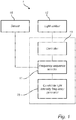
- a light transmitter device 1 is illustrated in figure 1 .
- the light transmitter device 1 comprises a frequency sequence selector 11, a light emitter 12, a controller 13, a candidate light intensity frequency generator 15, and an optional sensor 16.
- the light transmitter device 1 is arranged for visible light communication, i.e. transmitting data by a light signal.
- the frequency sequence selector 11 is arranged for selecting a sequence of frequencies. By sequence of frequencies is meant a plurality of frequencies which are arranged in a specific order.
- the frequency sequence selector 11 could be a hardware, such as a processor, or a software implemented method.
- the selected sequence represents a symbol for embedding data.
- the light emitter 12 is arranged for emitting light forming a light signal for embedding data.
- the light emitter 12 could for example be a LED, an incandescent lamp, a fluorescent lamp, a laser light source, or any other suitable light source. A combination of light sources is also feasible.
- the controller 13 is arranged to sequentially control the light intensity of the light signal according to a selected sequence of frequencies and during a time period of the light signal, thereby generating a frequency hopping light signal.
- the controller 13 could be a hardware, such as a processor, or a software implemented method.
- the candidate light intensity frequency generator 15 is arranged to generate candidate light intensity frequencies which the sequence of frequencies may be selected from.
- the candidate light intensity frequency generator 15 could be a hardware, such as a processor, or a software implemented method. The function of the candidate light intensity frequency generator 15 will be disclosed in detail below.
- the sensor 16 is arranged to measure a frequency spectrum which comprises the light intensity frequencies which are present in the area surrounding the light transmitter device 1.
- the sensor 16 could be integrated in the light transmitter device 1, or could alternatively be arranged as a separate hardware in connection to the light transmitter device 1.
- the sensor 16 could for example be a photo sensor, such as a photo diode, together with associated sensor signal processing circuits.
- the light transmitter device may further comprise a memory (not illustrated) for storing various data, such as generated candidate light intensity frequencies, selected sequences, previously transmitter light signals, predetermined frequency hopping schemes, etc.
- the frequency sequence selector 11, controller 13, and candidate light intensity frequency generator 15 could be integrated in a single component, as indicated by the figure. Various configurations of the components are feasible, as understood by the skilled person.
- the method comprises selecting 201 a first sequence F 1 of light intensity frequencies and a second sequence F 2 of light intensity frequencies.
- the first sequence F 1 consists of intensity frequencies f 1 , f 2 , f 3 , and f 4 arranged in that order.
- the second sequence F 2 may consist of intensity frequencies f 4 , f 3 , f 2 , and f 1 arranged in that order.
- the first sequence F 1 represents a first symbol "Bit 0" for embedding data
- the second sequence F 2 represents a second symbol "Bit 1" for embedding data.
- the first sequence F 1 and second sequence F 2 are different, but may, as in this embodiment, be composed by the same frequencies but arranged in different orders.
- the frequencies in the sequences may be selected such that they are mutually prime to each other, preferably both within a single sequence and for all frequencies in all sequences. Thereby, the risk of suffering from multiple harmonics of a single interference frequency is at least reduced. For instance, if f 1 is selected to be a frequency in the first sequence F 1 , then a multiple of the intensity frequency f 1 , such as 2 ⁇ f 1 , 3 ⁇ f 1 , or 4 ⁇ f 1 , would not be selected as an intensity frequency in either the first sequence F 1 or the second sequence F 2 .
- the method further comprises transmitting 202 a light signal.
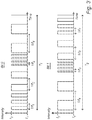
- the light signal is composed by time periods in which the light intensity is controlled. The time periods are illustrated in figure 3 .
- a first time period T 1 represents the first symbol "Bit 0" and a second time period T 2 represents the second symbol "Bit 1".
- the intensity of light in the time period T 1 representing "Bit 0" is controlled by shifting the intensity between a first intensity I 1 and a second, different from the first, intensity I 2 .
- the light intensity is shifted between two intensity levels.
- the light intensity may be shifted, or controlled, between more than two intensities, however still in a periodical manner with a specific frequency.
- the intensity I 1 is zero.
- the light signal is shifted between an on state and an off state.
- the light signal could be controlled by varying the intensity according to e.g. a sinus function, the light signal could be controlled to vary between several intensities, or a combination of these variations could be utilized.
- sequentially controlling according to a sequence of light intensity frequencies is meant to control the intensity according to the first intensity frequency in the sequence for a first part of the time period, according to the second frequency in the sequence for a subsequent second period of the time period, etc., such that the light intensity frequencies of the light signal during the time period varies according to the light intensity frequencies in the sequence, and varies according to the order of the light intensity frequencies in the sequence.
- the light intensity of the light signal during the second time period T 2 is controlled in the same manner as for the first time period T 1 .
- the intensities between which the light signal intensity is shifted in the second time period T 2 does not need to be the same as for the first time period T 1 .
- the second time period T 2 could also be of different length than the first time period T 1 .
- the number of periods for each time period part, in which the light intensity is controlled according to an intensity frequency of one of the sequences of light intensity frequencies could differ between different parts, different time periods and different embodiments.
- the number of periods could e.g. be predetermined according to a standard, or be flexible such that is may be altered depending on embodiment.
- the frequencies of the second sequence F 2 are the same frequencies as in the first sequence F 1 .
- This approach makes it easier for a receiver, arranged to receive the light signal, to detect the frequencies in the light signal, since the number of frequencies is limited. It could be predetermined and preconfigured in the receiver that the second sequence F 2 should be composed on the basis of the first sequence F 1 , e.g. by the same frequencies but in the reverse order or alternatively in another permutation. Thus, only information regarding the first sequence of frequencies needs to be known to the receiver, thereby reducing the amount of data that need to be transmitted to or configured in the receiver.
- the frequencies of the second sequence F 2 may be arranged in the reverse order relative to the first sequence F 1 . This arrangement makes the first sequence F 1 and second sequence F 2 distinct from each other. It is thereby easier for the receiver to distinguish them from each other.
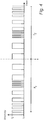
- the light signal which comprises time periods T 1 and T 2 representing the first symbol ("Bit 0") and the second symbol ("Bit 1"), respectively, are illustrated in figure 4 .
- the light signal comprises a combination of a much greater amount of the consecutive symbols for embedding data.
- Data which are represented by a combination of symbols in a sequence, may thus be transmitted.
- the first sequence F 1 and second sequence F 2 of frequencies are selected as illustrated in figure 5 .
- the method according to above then further comprises selecting 501 a reference frequency f ref , and generating 502 a set of candidate light intensity frequencies F cand .
- the reference frequency f ref is in this embodiment selected to be a clock frequency of a clock (not illustrated) which is arranged in the light transmitter device 1.
- Clocks are according to common practice arranged in various components such as transmitters, transceivers, processors, etc. Such a clock often runs at a high frequency, such as in the order of MHz.
- the reference frequency f ref is selected to 1 MHz.
- the set of candidate light intensity frequencies F cand is generated by dividing the f ref by divisors.
- the divisors are integer values. Each formed quotient defines a candidate light intensity frequency. Together, the candidate light intensity frequencies form the set of candidate frequencies F cand .
- the first sequence F 1 and second sequence F 2 of light intensity frequencies are selected. Hence, the generating 502 of the set of candidate light intensity frequencies F cand is performed before the selecting 201 of the first sequence F 1 and second sequence F 2 of light intensity frequencies.
- the divisors may be prime numbers. Thereby, the divisors, and consequently the quotients, are mutually prime relative to each other. Thus, the light intensity frequencies in the first sequence F 1 and second sequence F 2 becomes mutually prime to each other, which, as mentioned above, simplifies for the transmitter to generate the candidate light intensity frequencies.
- the set of candidate light intensity frequencies F cand is generated by the candidate light intensity frequency generator 15.
- the light signal is equal to a present pulse-width modulation dimming signal, i.e. equal to a pulse-width modulation signal which is utilized for controlling power to a light transmitter device for transmitting the light signal.
- the intensity frequency of the light signal is same as the PWM dimming frequency.
- the PWM dimming frequency is varying according to the frequency variation of the frequency hopping light signal.
- the duty cycle of the light signal train is prescribed by the PWM dimming level. In this way, the light signal is generated in compatibility with the PWM dimming.
- the light intensity frequencies of the first sequence F 1 and the second sequence F 2 may be selected while taking into account interference frequencies which are present in the VLC channel. Thus, these interference frequencies can be avoided, thereby achieving an even more improved robustness of the VLC. Embodiments explaining this approach will be disclosed in the following.
- the first sequence F 1 and second sequence F 2 of light intensity frequencies are selected as illustrated in figure 6 .
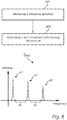
- the method according to figure 2 comprises further measuring 601 a frequency spectrum F spec and generating 602 a set of candidate light intensity frequencies F' cand .
- the set of candidate light intensity frequencies F' cand comprises light intensity frequencies which are unequal to frequencies, or unequal to multiples of frequencies, of the frequency spectrum F spec .
- the frequency spectrum F spec comprises the interference frequencies in the VLC channel.
- the interferences originate from surrounding interference sources, e.g. a laptop, a TV, or another VLC channel.
- intensity peaks 61, 61', 61" each correspond to a frequency which is present in the surrounding.
- the light intensity frequencies are selected from the frequency areas denoted by 62 and 62', where the intensity is low.
- the frequency spectrum F spec could be obtained by sensing light from the surroundings, and applying Fast Fourier transform (FFT) to obtain the frequency spectrum. Other methods for obtaining the frequencies present in the surroundings are also feasible.
- the frequency spectrum F spec is not limited to a visual spectrum, as illustrated in figure 6 , but could instead be represented by e.g. a table of data.
- the first sequence F 1 and second sequence F 2 of light intensity frequencies are selected. Hence, the intensity frequencies in the light signal do not coincide with any present interference frequencies.
- the frequency spectrum F spec may be measured by the sensor 16, and the set of candidate light intensity frequencies F' cand is generated by the candidate light intensity frequency generator 15.
- the measuring 601 of the frequency spectrum F spec and generating 602 of the set of candidate light intensity frequencies F' cand could be performed on a regular basis, or only once depending on the surrounding interference sources.
- a regular measuring 601 may be selected when the surrounding interference sources are expected to vary over time, whereas it could be sufficient to perform the measuring 601 once for a surrounding where the interference sources are expected to be stationary.
- the first sequence F 1 and second sequence F 2 of light intensity frequencies could be selected by combining the previous embodiments for selecting the sequences.
- a reference frequency f' ref is selected, as denoted by 701.
- a first set of candidate light intensity frequencies F cand1 is generated, as denoted by 702. This is performed according to a previously disclosed manner, i.e. by dividing the reference frequency f' ref by a plurality of mutually different divisors. Further, a frequency spectrum F' spec is measured, as denoted by 703.
- a second set of candidate light intensity frequencies F cand2 is generated, as denoted by 704. This is performed according to a previously disclosed manner, i.e. by selecting light intensity frequencies which are unequal to frequencies, or unequal to multiples of frequencies, of the light intensity spectrum F' spec .
- the selected light intensity frequencies form the second set of candidate light intensity frequencies F cand2 .
- a set of candidate light intensity frequency F" cand is generated by selecting the light intensity frequencies which form the intersection between the first set of candidate light intensity frequencies F cand1 and the second set of candidate light intensity frequencies F cand2 , i.e. the light intensity frequencies which are present in both the first set and second set of candidate light intensity frequencies.
- the first sequence F 1 and second sequence F 2 of light intensity frequencies are selected.
- the generating 702 of the first set of candidate light intensity frequencies and the generating 704 of the second set of candidate light intensity frequencies may be performed in another order than indicated by figure 7 . They could also be performed parallel with each other or in the reverse order.
- the light transmitter device 1 can be a part of a VLC system, which further comprises a receiver, which has been described in some of the above disclosed embodiments.
- the frequency hopping signal may have a fixed allocation, i.e. the first and second sequences are fixedly determined for representing symbols for embedding data.
- the receiver can be preconfigured for those hopping frequencies before undertaking the communications.
- the frequency hopping signal may be flexible, i.e. the first and/or second sequences composing the light signal may be reselected between different transmissions.
- the communication can be based on a predefined signaling approach. For instance, every data packet may contain a packet header.
- the packet header is modulated by a fixed way of modulation, such as Binary Phase Shift Keying (BPSK), which is known to the receiver.
- BPSK Binary Phase Shift Keying
- the packet header contains information about how the rest of the packet is being modulated, i.e. which intensity frequencies are selected.
- the light transmitter device 1 may be a part of a light transceiver device, which further comprises a receiver arranged to receive a light signal from another light transmitter device.
- the light emitter and receiver may be the same component.
- Two light transceiver devices may be arranged for VLC between them.
- the light transceiver devices may form a stand-alone network, or be a part of a greater network.
- a method and device for visible light communication comprises selecting a first sequence and a second sequence of light intensity frequencies to represent a first symbol and a second symbol, respectively, for embedding data.
- the method comprises further transmitting a light signal.
- the light signal comprises time periods in which a light intensity of the light signal is sequentially controlled according to the selected sequence of light intensity frequencies. Thereby, a frequency hopping light signal is generated, in which data may be embedded.
- the light signal may be generated and transmitted by the device comprising a light emitter.
- a sequence of light intensity frequencies could be selected from a predetermined set of candidate light intensity frequencies which e.g. is determined by a standard VLC protocol.
- Another example of variation is to transmit data utilizing more than two symbols for embedding data, which is also feasible within the scope of the present invention.
Landscapes
- Physics & Mathematics (AREA)
- Electromagnetism (AREA)
- Engineering & Computer Science (AREA)
- Computer Networks & Wireless Communication (AREA)
- Signal Processing (AREA)
- Optical Communication System (AREA)
Applications Claiming Priority (2)
| Application Number | Priority Date | Filing Date | Title |
|---|---|---|---|
| US201261623603P | 2012-04-13 | 2012-04-13 | |
| PCT/IB2013/052484 WO2013153476A1 (en) | 2012-04-13 | 2013-03-28 | Method and device for visible light communication |
Publications (2)
| Publication Number | Publication Date |
|---|---|
| EP2837113A1 EP2837113A1 (en) | 2015-02-18 |
| EP2837113B1 true EP2837113B1 (en) | 2017-08-23 |
Family
ID=48485227
Family Applications (1)
| Application Number | Title | Priority Date | Filing Date |
|---|---|---|---|
| EP13724875.3A Not-in-force EP2837113B1 (en) | 2012-04-13 | 2013-03-28 | Method and device for visible light communication |
Country Status (6)
| Country | Link |
|---|---|
| US (1) | US9473248B2 (enExample) |
| EP (1) | EP2837113B1 (enExample) |
| JP (1) | JP6185982B2 (enExample) |
| CN (1) | CN104205677B (enExample) |
| RU (1) | RU2623492C2 (enExample) |
| WO (1) | WO2013153476A1 (enExample) |
Families Citing this family (20)
| Publication number | Priority date | Publication date | Assignee | Title |
|---|---|---|---|---|
| US9100124B2 (en) | 2007-05-24 | 2015-08-04 | Federal Law Enforcement Development Services, Inc. | LED Light Fixture |
| US9455783B2 (en) | 2013-05-06 | 2016-09-27 | Federal Law Enforcement Development Services, Inc. | Network security and variable pulse wave form with continuous communication |
| US9414458B2 (en) | 2007-05-24 | 2016-08-09 | Federal Law Enforcement Development Services, Inc. | LED light control assembly and system |
| US11265082B2 (en) | 2007-05-24 | 2022-03-01 | Federal Law Enforcement Development Services, Inc. | LED light control assembly and system |
| US20080317475A1 (en) | 2007-05-24 | 2008-12-25 | Federal Law Enforcement Development Services, Inc. | Led light interior room and building communication system |
| US8890773B1 (en) | 2009-04-01 | 2014-11-18 | Federal Law Enforcement Development Services, Inc. | Visible light transceiver glasses |
| US10291329B2 (en) * | 2013-12-20 | 2019-05-14 | Infineon Technologies Ag | Exchanging information between time-of-flight ranging devices |
| US20150198941A1 (en) | 2014-01-15 | 2015-07-16 | John C. Pederson | Cyber Life Electronic Networking and Commerce Operating Exchange |
| EP3487192A1 (en) | 2014-08-12 | 2019-05-22 | ABL IP Holding LLC | System and method for estimating the position and orientation of a mobile communications device in a beacon-based positioning system |
| WO2016188760A1 (en) | 2015-05-26 | 2016-12-01 | Philips Lighting Holding B.V. | Determining the position of a portable device relative to a luminaire |
| US20170048953A1 (en) | 2015-08-11 | 2017-02-16 | Federal Law Enforcement Development Services, Inc. | Programmable switch and system |
| CN105515678B (zh) * | 2015-12-21 | 2018-01-12 | 桂林理工大学 | 一种可见光跳频通信收发装置 |
| TWI616071B (zh) * | 2016-04-08 | 2018-02-21 | 凌通科技股份有限公司 | 應用於可見光的可調光與光通訊之發光裝置與互動裝置 |
| FR3074008B1 (fr) * | 2017-11-20 | 2021-05-21 | Floch Albert Le | Dispositif d'eclairage facilitant la lecture. |
| CN113424620A (zh) * | 2019-02-19 | 2021-09-21 | 华为技术有限公司 | 跨LF和mmWave的服务连续性的方法和装置 |
| US11328564B2 (en) | 2019-08-31 | 2022-05-10 | Appleton Grp Llc | Event indications of hazardous environment luminaires using visual sequences |
| US11232684B2 (en) | 2019-09-09 | 2022-01-25 | Appleton Grp Llc | Smart luminaire group control using intragroup communication |
| US11219112B2 (en) | 2019-09-09 | 2022-01-04 | Appleton Grp Llc | Connected controls infrastructure |
| US11343898B2 (en) | 2019-09-20 | 2022-05-24 | Appleton Grp Llc | Smart dimming and sensor failure detection as part of built in daylight harvesting inside the luminaire |
| WO2025242300A1 (fr) * | 2024-05-22 | 2025-11-27 | Luxwave | Procédé et dispositif de modulation et démodulation d'un signal lumineux pour la transmission de symbole |
Family Cites Families (14)
| Publication number | Priority date | Publication date | Assignee | Title |
|---|---|---|---|---|
| US6794831B2 (en) * | 1998-04-15 | 2004-09-21 | Talking Lights Llc | Non-flickering illumination based communication |
| CA2327710A1 (en) * | 1998-04-15 | 1999-10-21 | Talking Lights Llc | Dual-use electronic transceiver set for wireless data networks |
| US6961367B2 (en) * | 2003-02-24 | 2005-11-01 | Qualcomm, Incorporated | Forward link repeater frequency watermarking scheme |
| CA2609877C (en) * | 2005-01-25 | 2015-05-26 | Tir Technology Lp | Method and apparatus for illumination and communication |
| EP2179521B1 (en) | 2007-07-19 | 2016-09-07 | Philips Lighting Holding B.V. | Method, system and device for transmitting lighting device data |
| JP5121503B2 (ja) * | 2008-02-27 | 2013-01-16 | 太陽誘電株式会社 | 通信方式選択方法,可視光通信方法,その装置 |
| US8643286B2 (en) * | 2008-05-06 | 2014-02-04 | Koninklijke Philips N.V. | Illumination system and method for processing light |
| US8111042B2 (en) * | 2008-08-05 | 2012-02-07 | Broadcom Corporation | Integrated wireless resonant power charging and communication channel |
| US8521034B2 (en) * | 2009-02-20 | 2013-08-27 | Samsung Electronics Co., Ltd. | Apparatus and method for interference mitigation and channel selection for visible light communication |
| KR20120055715A (ko) | 2009-08-27 | 2012-05-31 | 코닌클리즈케 필립스 일렉트로닉스 엔.브이. | 광원 제어를 위한 인지 식별자 할당 |
| US8706271B2 (en) * | 2010-02-18 | 2014-04-22 | Redwood Systems, Inc. | Integration of computing device and lighting system |
| WO2012052935A1 (en) | 2010-10-20 | 2012-04-26 | Koninklijke Philips Electronics N.V. | Modulation for coded light transmission |
| KR20120054889A (ko) * | 2010-11-22 | 2012-05-31 | 주식회사 팬택 | 가시광 통신 시스템에서 빛의 파장을 이용해서 통신하는 송수신 장치 및 방법 |
| WO2013001408A1 (en) | 2011-06-29 | 2013-01-03 | Koninklijke Philips Electronics N.V. | Methods for encoding and decoding coded light |
-
2013
- 2013-03-28 RU RU2014145541A patent/RU2623492C2/ru not_active IP Right Cessation
- 2013-03-28 EP EP13724875.3A patent/EP2837113B1/en not_active Not-in-force
- 2013-03-28 JP JP2015505036A patent/JP6185982B2/ja not_active Expired - Fee Related
- 2013-03-28 WO PCT/IB2013/052484 patent/WO2013153476A1/en not_active Ceased
- 2013-03-28 US US14/391,821 patent/US9473248B2/en not_active Expired - Fee Related
- 2013-03-28 CN CN201380019649.1A patent/CN104205677B/zh not_active Expired - Fee Related
Non-Patent Citations (1)
| Title |
|---|
| None * |
Also Published As
| Publication number | Publication date |
|---|---|
| CN104205677A (zh) | 2014-12-10 |
| JP2015516750A (ja) | 2015-06-11 |
| RU2623492C2 (ru) | 2017-06-27 |
| RU2014145541A (ru) | 2016-06-10 |
| US9473248B2 (en) | 2016-10-18 |
| EP2837113A1 (en) | 2015-02-18 |
| CN104205677B (zh) | 2017-08-25 |
| US20150078743A1 (en) | 2015-03-19 |
| WO2013153476A1 (en) | 2013-10-17 |
| JP6185982B2 (ja) | 2017-08-23 |
Similar Documents
| Publication | Publication Date | Title |
|---|---|---|
| EP2837113B1 (en) | Method and device for visible light communication | |
| US9548815B2 (en) | Apparatus for visible light communications in accordance with UFSOOK and FSK dimming | |
| US10382129B2 (en) | Transmission of identifiers using visible light communication | |
| US9838121B2 (en) | Apparatus configured for visible-light communications (VLC) using under-sampled frequency shift on-off keying (UFSOOK) | |
| KR101610685B1 (ko) | 가시광 통신시스템, 송신장치, 및 신호 전송 방법 | |
| EP2478745B1 (en) | Coded light transmission and reception | |
| EP2974079B1 (en) | A communication system, lighting system and method of transmitting information | |
| EP2805586B1 (en) | Visible light communications using a remote control | |
| JP4885234B2 (ja) | 可視光及び赤外光を用いた光空間伝送システム | |
| JP6009450B2 (ja) | 符号化光送信のための変調 | |
| JP2009529272A (ja) | 自由空間光伝送用エレクトロルミネセンス送信装置 | |
| US9608724B2 (en) | Method, light module and receiving unit for light coding | |
| KR101038239B1 (ko) | 무선 가시광 통신 시스템에서의 데이터 전송 방법 및 장치 | |
| Kobo et al. | Home intercommunication system using visible light communications | |
| KR20170043247A (ko) | 가시광 통신 장치 및 이의 가시광 통신 방법 | |
| Chow et al. | Visible Light Communication |
Legal Events
| Date | Code | Title | Description |
|---|---|---|---|
| PUAI | Public reference made under article 153(3) epc to a published international application that has entered the european phase |
Free format text: ORIGINAL CODE: 0009012 |
|
| 17P | Request for examination filed |
Effective date: 20141113 |
|
| AK | Designated contracting states |
Kind code of ref document: A1 Designated state(s): AL AT BE BG CH CY CZ DE DK EE ES FI FR GB GR HR HU IE IS IT LI LT LU LV MC MK MT NL NO PL PT RO RS SE SI SK SM TR |
|
| AX | Request for extension of the european patent |
Extension state: BA ME |
|
| DAX | Request for extension of the european patent (deleted) | ||
| RAP1 | Party data changed (applicant data changed or rights of an application transferred) |
Owner name: PHILIPS LIGHTING HOLDING B.V. |
|
| GRAP | Despatch of communication of intention to grant a patent |
Free format text: ORIGINAL CODE: EPIDOSNIGR1 |
|
| INTG | Intention to grant announced |
Effective date: 20170321 |
|
| GRAS | Grant fee paid |
Free format text: ORIGINAL CODE: EPIDOSNIGR3 |
|
| GRAA | (expected) grant |
Free format text: ORIGINAL CODE: 0009210 |
|
| RIN1 | Information on inventor provided before grant (corrected) |
Inventor name: PANDHARIPANDE, ASHISH, VIJAY Inventor name: YANG, HONGMING |
|
| AK | Designated contracting states |
Kind code of ref document: B1 Designated state(s): AL AT BE BG CH CY CZ DE DK EE ES FI FR GB GR HR HU IE IS IT LI LT LU LV MC MK MT NL NO PL PT RO RS SE SI SK SM TR |
|
| REG | Reference to a national code |
Ref country code: GB Ref legal event code: FG4D |
|
| REG | Reference to a national code |
Ref country code: CH Ref legal event code: EP |
|
| REG | Reference to a national code |
Ref country code: AT Ref legal event code: REF Ref document number: 922362 Country of ref document: AT Kind code of ref document: T Effective date: 20170915 |
|
| REG | Reference to a national code |
Ref country code: IE Ref legal event code: FG4D |
|
| REG | Reference to a national code |
Ref country code: DE Ref legal event code: R096 Ref document number: 602013025438 Country of ref document: DE |
|
| REG | Reference to a national code |
Ref country code: NL Ref legal event code: MP Effective date: 20170823 |
|
| REG | Reference to a national code |
Ref country code: LT Ref legal event code: MG4D |
|
| REG | Reference to a national code |
Ref country code: AT Ref legal event code: MK05 Ref document number: 922362 Country of ref document: AT Kind code of ref document: T Effective date: 20170823 |
|
| PG25 | Lapsed in a contracting state [announced via postgrant information from national office to epo] |
Ref country code: HR Free format text: LAPSE BECAUSE OF FAILURE TO SUBMIT A TRANSLATION OF THE DESCRIPTION OR TO PAY THE FEE WITHIN THE PRESCRIBED TIME-LIMIT Effective date: 20170823 Ref country code: NO Free format text: LAPSE BECAUSE OF FAILURE TO SUBMIT A TRANSLATION OF THE DESCRIPTION OR TO PAY THE FEE WITHIN THE PRESCRIBED TIME-LIMIT Effective date: 20171123 Ref country code: SE Free format text: LAPSE BECAUSE OF FAILURE TO SUBMIT A TRANSLATION OF THE DESCRIPTION OR TO PAY THE FEE WITHIN THE PRESCRIBED TIME-LIMIT Effective date: 20170823 Ref country code: AT Free format text: LAPSE BECAUSE OF FAILURE TO SUBMIT A TRANSLATION OF THE DESCRIPTION OR TO PAY THE FEE WITHIN THE PRESCRIBED TIME-LIMIT Effective date: 20170823 Ref country code: NL Free format text: LAPSE BECAUSE OF FAILURE TO SUBMIT A TRANSLATION OF THE DESCRIPTION OR TO PAY THE FEE WITHIN THE PRESCRIBED TIME-LIMIT Effective date: 20170823 Ref country code: FI Free format text: LAPSE BECAUSE OF FAILURE TO SUBMIT A TRANSLATION OF THE DESCRIPTION OR TO PAY THE FEE WITHIN THE PRESCRIBED TIME-LIMIT Effective date: 20170823 Ref country code: LT Free format text: LAPSE BECAUSE OF FAILURE TO SUBMIT A TRANSLATION OF THE DESCRIPTION OR TO PAY THE FEE WITHIN THE PRESCRIBED TIME-LIMIT Effective date: 20170823 |
|
| PG25 | Lapsed in a contracting state [announced via postgrant information from national office to epo] |
Ref country code: PL Free format text: LAPSE BECAUSE OF FAILURE TO SUBMIT A TRANSLATION OF THE DESCRIPTION OR TO PAY THE FEE WITHIN THE PRESCRIBED TIME-LIMIT Effective date: 20170823 Ref country code: ES Free format text: LAPSE BECAUSE OF FAILURE TO SUBMIT A TRANSLATION OF THE DESCRIPTION OR TO PAY THE FEE WITHIN THE PRESCRIBED TIME-LIMIT Effective date: 20170823 Ref country code: IS Free format text: LAPSE BECAUSE OF FAILURE TO SUBMIT A TRANSLATION OF THE DESCRIPTION OR TO PAY THE FEE WITHIN THE PRESCRIBED TIME-LIMIT Effective date: 20171223 Ref country code: LV Free format text: LAPSE BECAUSE OF FAILURE TO SUBMIT A TRANSLATION OF THE DESCRIPTION OR TO PAY THE FEE WITHIN THE PRESCRIBED TIME-LIMIT Effective date: 20170823 Ref country code: BG Free format text: LAPSE BECAUSE OF FAILURE TO SUBMIT A TRANSLATION OF THE DESCRIPTION OR TO PAY THE FEE WITHIN THE PRESCRIBED TIME-LIMIT Effective date: 20171123 Ref country code: GR Free format text: LAPSE BECAUSE OF FAILURE TO SUBMIT A TRANSLATION OF THE DESCRIPTION OR TO PAY THE FEE WITHIN THE PRESCRIBED TIME-LIMIT Effective date: 20171124 Ref country code: RS Free format text: LAPSE BECAUSE OF FAILURE TO SUBMIT A TRANSLATION OF THE DESCRIPTION OR TO PAY THE FEE WITHIN THE PRESCRIBED TIME-LIMIT Effective date: 20170823 |
|
| REG | Reference to a national code |
Ref country code: FR Ref legal event code: PLFP Year of fee payment: 6 |
|
| PG25 | Lapsed in a contracting state [announced via postgrant information from national office to epo] |
Ref country code: CZ Free format text: LAPSE BECAUSE OF FAILURE TO SUBMIT A TRANSLATION OF THE DESCRIPTION OR TO PAY THE FEE WITHIN THE PRESCRIBED TIME-LIMIT Effective date: 20170823 Ref country code: DK Free format text: LAPSE BECAUSE OF FAILURE TO SUBMIT A TRANSLATION OF THE DESCRIPTION OR TO PAY THE FEE WITHIN THE PRESCRIBED TIME-LIMIT Effective date: 20170823 Ref country code: RO Free format text: LAPSE BECAUSE OF FAILURE TO SUBMIT A TRANSLATION OF THE DESCRIPTION OR TO PAY THE FEE WITHIN THE PRESCRIBED TIME-LIMIT Effective date: 20170823 |
|
| PGFP | Annual fee paid to national office [announced via postgrant information from national office to epo] |
Ref country code: GB Payment date: 20180329 Year of fee payment: 6 |
|
| REG | Reference to a national code |
Ref country code: DE Ref legal event code: R097 Ref document number: 602013025438 Country of ref document: DE |
|
| PG25 | Lapsed in a contracting state [announced via postgrant information from national office to epo] |
Ref country code: SM Free format text: LAPSE BECAUSE OF FAILURE TO SUBMIT A TRANSLATION OF THE DESCRIPTION OR TO PAY THE FEE WITHIN THE PRESCRIBED TIME-LIMIT Effective date: 20170823 Ref country code: IT Free format text: LAPSE BECAUSE OF FAILURE TO SUBMIT A TRANSLATION OF THE DESCRIPTION OR TO PAY THE FEE WITHIN THE PRESCRIBED TIME-LIMIT Effective date: 20170823 Ref country code: EE Free format text: LAPSE BECAUSE OF FAILURE TO SUBMIT A TRANSLATION OF THE DESCRIPTION OR TO PAY THE FEE WITHIN THE PRESCRIBED TIME-LIMIT Effective date: 20170823 Ref country code: SK Free format text: LAPSE BECAUSE OF FAILURE TO SUBMIT A TRANSLATION OF THE DESCRIPTION OR TO PAY THE FEE WITHIN THE PRESCRIBED TIME-LIMIT Effective date: 20170823 |
|
| PGFP | Annual fee paid to national office [announced via postgrant information from national office to epo] |
Ref country code: FR Payment date: 20180329 Year of fee payment: 6 |
|
| PLBE | No opposition filed within time limit |
Free format text: ORIGINAL CODE: 0009261 |
|
| STAA | Information on the status of an ep patent application or granted ep patent |
Free format text: STATUS: NO OPPOSITION FILED WITHIN TIME LIMIT |
|
| PGFP | Annual fee paid to national office [announced via postgrant information from national office to epo] |
Ref country code: DE Payment date: 20180530 Year of fee payment: 6 |
|
| 26N | No opposition filed |
Effective date: 20180524 |
|
| PG25 | Lapsed in a contracting state [announced via postgrant information from national office to epo] |
Ref country code: SI Free format text: LAPSE BECAUSE OF FAILURE TO SUBMIT A TRANSLATION OF THE DESCRIPTION OR TO PAY THE FEE WITHIN THE PRESCRIBED TIME-LIMIT Effective date: 20170823 |
|
| REG | Reference to a national code |
Ref country code: CH Ref legal event code: PL |
|
| PG25 | Lapsed in a contracting state [announced via postgrant information from national office to epo] |
Ref country code: MC Free format text: LAPSE BECAUSE OF FAILURE TO SUBMIT A TRANSLATION OF THE DESCRIPTION OR TO PAY THE FEE WITHIN THE PRESCRIBED TIME-LIMIT Effective date: 20170823 |
|
| REG | Reference to a national code |
Ref country code: BE Ref legal event code: MM Effective date: 20180331 |
|
| REG | Reference to a national code |
Ref country code: IE Ref legal event code: MM4A |
|
| PG25 | Lapsed in a contracting state [announced via postgrant information from national office to epo] |
Ref country code: LU Free format text: LAPSE BECAUSE OF NON-PAYMENT OF DUE FEES Effective date: 20180328 |
|
| PG25 | Lapsed in a contracting state [announced via postgrant information from national office to epo] |
Ref country code: IE Free format text: LAPSE BECAUSE OF NON-PAYMENT OF DUE FEES Effective date: 20180328 |
|
| PG25 | Lapsed in a contracting state [announced via postgrant information from national office to epo] |
Ref country code: CH Free format text: LAPSE BECAUSE OF NON-PAYMENT OF DUE FEES Effective date: 20180331 Ref country code: LI Free format text: LAPSE BECAUSE OF NON-PAYMENT OF DUE FEES Effective date: 20180331 Ref country code: BE Free format text: LAPSE BECAUSE OF NON-PAYMENT OF DUE FEES Effective date: 20180331 |
|
| REG | Reference to a national code |
Ref country code: DE Ref legal event code: R119 Ref document number: 602013025438 Country of ref document: DE |
|
| GBPC | Gb: european patent ceased through non-payment of renewal fee |
Effective date: 20190328 |
|
| PG25 | Lapsed in a contracting state [announced via postgrant information from national office to epo] |
Ref country code: GB Free format text: LAPSE BECAUSE OF NON-PAYMENT OF DUE FEES Effective date: 20190328 Ref country code: MT Free format text: LAPSE BECAUSE OF NON-PAYMENT OF DUE FEES Effective date: 20180328 Ref country code: DE Free format text: LAPSE BECAUSE OF NON-PAYMENT OF DUE FEES Effective date: 20191001 |
|
| PG25 | Lapsed in a contracting state [announced via postgrant information from national office to epo] |
Ref country code: FR Free format text: LAPSE BECAUSE OF NON-PAYMENT OF DUE FEES Effective date: 20190331 |
|
| PG25 | Lapsed in a contracting state [announced via postgrant information from national office to epo] |
Ref country code: TR Free format text: LAPSE BECAUSE OF FAILURE TO SUBMIT A TRANSLATION OF THE DESCRIPTION OR TO PAY THE FEE WITHIN THE PRESCRIBED TIME-LIMIT Effective date: 20170823 |
|
| PG25 | Lapsed in a contracting state [announced via postgrant information from national office to epo] |
Ref country code: PT Free format text: LAPSE BECAUSE OF FAILURE TO SUBMIT A TRANSLATION OF THE DESCRIPTION OR TO PAY THE FEE WITHIN THE PRESCRIBED TIME-LIMIT Effective date: 20170823 |
|
| PG25 | Lapsed in a contracting state [announced via postgrant information from national office to epo] |
Ref country code: CY Free format text: LAPSE BECAUSE OF FAILURE TO SUBMIT A TRANSLATION OF THE DESCRIPTION OR TO PAY THE FEE WITHIN THE PRESCRIBED TIME-LIMIT Effective date: 20170823 Ref country code: MK Free format text: LAPSE BECAUSE OF NON-PAYMENT OF DUE FEES Effective date: 20170823 Ref country code: HU Free format text: LAPSE BECAUSE OF FAILURE TO SUBMIT A TRANSLATION OF THE DESCRIPTION OR TO PAY THE FEE WITHIN THE PRESCRIBED TIME-LIMIT; INVALID AB INITIO Effective date: 20130328 |
|
| PG25 | Lapsed in a contracting state [announced via postgrant information from national office to epo] |
Ref country code: AL Free format text: LAPSE BECAUSE OF FAILURE TO SUBMIT A TRANSLATION OF THE DESCRIPTION OR TO PAY THE FEE WITHIN THE PRESCRIBED TIME-LIMIT Effective date: 20170823 |