EP2831054B1 - Improved process for producing (s)-equol - Google Patents
Improved process for producing (s)-equol Download PDFInfo
- Publication number
- EP2831054B1 EP2831054B1 EP13767847.0A EP13767847A EP2831054B1 EP 2831054 B1 EP2831054 B1 EP 2831054B1 EP 13767847 A EP13767847 A EP 13767847A EP 2831054 B1 EP2831054 B1 EP 2831054B1
- Authority
- EP
- European Patent Office
- Prior art keywords
- formula
- hydroxyphenyl
- dihydroxyphenyl
- acid
- hydroxy
- Prior art date
- Legal status (The legal status is an assumption and is not a legal conclusion. Google has not performed a legal analysis and makes no representation as to the accuracy of the status listed.)
- Not-in-force
Links
- ADFCQWZHKCXPAJ-GFCCVEGCSA-N equol Chemical compound C1=CC(O)=CC=C1[C@@H]1CC2=CC=C(O)C=C2OC1 ADFCQWZHKCXPAJ-GFCCVEGCSA-N 0.000 title claims description 90
- 238000000034 method Methods 0.000 title claims description 49
- ADFCQWZHKCXPAJ-UHFFFAOYSA-N indofine Natural products C1=CC(O)=CC=C1C1CC2=CC=C(O)C=C2OC1 ADFCQWZHKCXPAJ-UHFFFAOYSA-N 0.000 title claims description 47
- ZWSZGLSUFUKLCL-ZDUSSCGKSA-N (2s)-3-(2,4-dihydroxyphenyl)-2-(4-hydroxyphenyl)propanoic acid Chemical compound C([C@H](C(=O)O)C=1C=CC(O)=CC=1)C1=CC=C(O)C=C1O ZWSZGLSUFUKLCL-ZDUSSCGKSA-N 0.000 claims description 35
- 239000000203 mixture Substances 0.000 claims description 34
- 150000001875 compounds Chemical class 0.000 claims description 27
- WMFOQBRAJBCJND-UHFFFAOYSA-M Lithium hydroxide Chemical compound [Li+].[OH-] WMFOQBRAJBCJND-UHFFFAOYSA-M 0.000 claims description 21
- 238000002360 preparation method Methods 0.000 claims description 19
- 230000015572 biosynthetic process Effects 0.000 claims description 16
- KWYUFKZDYYNOTN-UHFFFAOYSA-M Potassium hydroxide Chemical compound [OH-].[K+] KWYUFKZDYYNOTN-UHFFFAOYSA-M 0.000 claims description 15
- ZWSZGLSUFUKLCL-UHFFFAOYSA-N 3-(2,4-dihydroxyphenyl)-2-(4-hydroxyphenyl)propanoic acid Chemical compound C=1C=C(O)C=CC=1C(C(=O)O)CC1=CC=C(O)C=C1O ZWSZGLSUFUKLCL-UHFFFAOYSA-N 0.000 claims description 14
- 150000001412 amines Chemical class 0.000 claims description 13
- UTCRNTNQGHQHGM-UHFFFAOYSA-N methyl 3-(2,4-dihydroxyphenyl)-2-(4-hydroxyphenyl)propanoate Chemical compound C=1C=C(O)C=CC=1C(C(=O)OC)CC1=CC=C(O)C=C1O UTCRNTNQGHQHGM-UHFFFAOYSA-N 0.000 claims description 13
- FLVROUNAFWXBQG-UHFFFAOYSA-N 7-hydroxy-3-(4-hydroxyphenyl)chromen-2-one Chemical compound C1=CC(O)=CC=C1C1=CC2=CC=C(O)C=C2OC1=O FLVROUNAFWXBQG-UHFFFAOYSA-N 0.000 claims description 12
- SRUZJXFKTNHVQL-GFCCVEGCSA-N 4-[(2s)-3-hydroxy-2-(4-hydroxyphenyl)propyl]benzene-1,3-diol Chemical compound C([C@H](CO)C=1C=CC(O)=CC=1)C1=CC=C(O)C=C1O SRUZJXFKTNHVQL-GFCCVEGCSA-N 0.000 claims description 11
- LFPNSUWIISXTOM-UHFFFAOYSA-N [4-(7-acetyloxy-2-oxochromen-3-yl)phenyl] acetate Chemical compound C1=CC(OC(=O)C)=CC=C1C1=CC2=CC=C(OC(C)=O)C=C2OC1=O LFPNSUWIISXTOM-UHFFFAOYSA-N 0.000 claims description 11
- IUNJCFABHJZSKB-UHFFFAOYSA-N 2,4-dihydroxybenzaldehyde Chemical compound OC1=CC=C(C=O)C(O)=C1 IUNJCFABHJZSKB-UHFFFAOYSA-N 0.000 claims description 10
- XQXPVVBIMDBYFF-UHFFFAOYSA-N 4-hydroxyphenylacetic acid Chemical compound OC(=O)CC1=CC=C(O)C=C1 XQXPVVBIMDBYFF-UHFFFAOYSA-N 0.000 claims description 10
- KMPWYEUPVWOPIM-UHFFFAOYSA-N cinchonidine Natural products C1=CC=C2C(C(C3N4CCC(C(C4)C=C)C3)O)=CC=NC2=C1 KMPWYEUPVWOPIM-UHFFFAOYSA-N 0.000 claims description 10
- WFDIJRYMOXRFFG-UHFFFAOYSA-N Acetic anhydride Chemical compound CC(=O)OC(C)=O WFDIJRYMOXRFFG-UHFFFAOYSA-N 0.000 claims description 9
- KMPWYEUPVWOPIM-KODHJQJWSA-N cinchonidine Chemical compound C1=CC=C2C([C@H]([C@H]3[N@]4CC[C@H]([C@H](C4)C=C)C3)O)=CC=NC2=C1 KMPWYEUPVWOPIM-KODHJQJWSA-N 0.000 claims description 9
- 150000003839 salts Chemical class 0.000 claims description 9
- JGFZNNIVVJXRND-UHFFFAOYSA-N N,N-Diisopropylethylamine (DIPEA) Chemical compound CCN(C(C)C)C(C)C JGFZNNIVVJXRND-UHFFFAOYSA-N 0.000 claims description 8
- 239000003638 chemical reducing agent Substances 0.000 claims description 8
- RQEUFEKYXDPUSK-ZETCQYMHSA-N (1S)-1-phenylethanamine Chemical class C[C@H](N)C1=CC=CC=C1 RQEUFEKYXDPUSK-ZETCQYMHSA-N 0.000 claims description 7
- KDLHZDBZIXYQEI-UHFFFAOYSA-N Palladium Chemical group [Pd] KDLHZDBZIXYQEI-UHFFFAOYSA-N 0.000 claims description 7
- 150000008065 acid anhydrides Chemical class 0.000 claims description 7
- 238000005984 hydrogenation reaction Methods 0.000 claims description 7
- QMMFVYPAHWMCMS-UHFFFAOYSA-N Dimethyl sulfide Chemical compound CSC QMMFVYPAHWMCMS-UHFFFAOYSA-N 0.000 claims description 6
- 230000003301 hydrolyzing effect Effects 0.000 claims description 6
- RQEUFEKYXDPUSK-UHFFFAOYSA-N 1-phenylethylamine Chemical compound CC(N)C1=CC=CC=C1 RQEUFEKYXDPUSK-UHFFFAOYSA-N 0.000 claims description 5
- UORVGPXVDQYIDP-UHFFFAOYSA-N borane Chemical compound B UORVGPXVDQYIDP-UHFFFAOYSA-N 0.000 claims description 5
- LOUPRKONTZGTKE-UHFFFAOYSA-N cinchonine Natural products C1C(C(C2)C=C)CCN2C1C(O)C1=CC=NC2=CC=C(OC)C=C21 LOUPRKONTZGTKE-UHFFFAOYSA-N 0.000 claims description 5
- ZRRNJJURLBXWLL-REWJHTLYSA-N (2r,3r,4r,5s)-6-(octylamino)hexane-1,2,3,4,5-pentol Chemical compound CCCCCCCCNC[C@H](O)[C@@H](O)[C@H](O)[C@H](O)CO ZRRNJJURLBXWLL-REWJHTLYSA-N 0.000 claims description 4
- HVVNJUAVDAZWCB-YFKPBYRVSA-N [(2s)-pyrrolidin-2-yl]methanol Chemical compound OC[C@@H]1CCCN1 HVVNJUAVDAZWCB-YFKPBYRVSA-N 0.000 claims description 4
- 125000002777 acetyl group Chemical group [H]C([H])([H])C(*)=O 0.000 claims description 4
- 239000002638 heterogeneous catalyst Substances 0.000 claims description 4
- PEUGKEHLRUVPAN-UHFFFAOYSA-N piperidin-3-amine Chemical compound NC1CCCNC1 PEUGKEHLRUVPAN-UHFFFAOYSA-N 0.000 claims description 4
- AKQXKEBCONUWCL-UHFFFAOYSA-N tert-butyl 3-aminopiperidine-1-carboxylate Chemical compound CC(C)(C)OC(=O)N1CCCC(N)C1 AKQXKEBCONUWCL-UHFFFAOYSA-N 0.000 claims description 4
- AQFLVLHRZFLDDV-UHFFFAOYSA-N 1-phenylpropan-1-amine Chemical compound CCC(N)C1=CC=CC=C1 AQFLVLHRZFLDDV-UHFFFAOYSA-N 0.000 claims description 3
- JOZZAIIGWFLONA-UHFFFAOYSA-N 3-methylbutan-2-amine Chemical compound CC(C)C(C)N JOZZAIIGWFLONA-UHFFFAOYSA-N 0.000 claims description 3
- 229910000085 borane Inorganic materials 0.000 claims description 3
- DLSOILHAKCBARI-UHFFFAOYSA-N n-benzyl-2-methylpropan-2-amine Chemical compound CC(C)(C)NCC1=CC=CC=C1 DLSOILHAKCBARI-UHFFFAOYSA-N 0.000 claims description 3
- RIWRFSMVIUAEBX-UHFFFAOYSA-N n-methyl-1-phenylmethanamine Chemical compound CNCC1=CC=CC=C1 RIWRFSMVIUAEBX-UHFFFAOYSA-N 0.000 claims description 3
- 238000006243 chemical reaction Methods 0.000 description 66
- KFZMGEQAYNKOFK-UHFFFAOYSA-N Isopropanol Chemical compound CC(C)O KFZMGEQAYNKOFK-UHFFFAOYSA-N 0.000 description 39
- OKKJLVBELUTLKV-UHFFFAOYSA-N Methanol Chemical compound OC OKKJLVBELUTLKV-UHFFFAOYSA-N 0.000 description 36
- 239000002904 solvent Substances 0.000 description 35
- XLYOFNOQVPJJNP-UHFFFAOYSA-N water Substances O XLYOFNOQVPJJNP-UHFFFAOYSA-N 0.000 description 32
- XEKOWRVHYACXOJ-UHFFFAOYSA-N Ethyl acetate Chemical group CCOC(C)=O XEKOWRVHYACXOJ-UHFFFAOYSA-N 0.000 description 30
- WYURNTSHIVDZCO-UHFFFAOYSA-N Tetrahydrofuran Chemical compound C1CCOC1 WYURNTSHIVDZCO-UHFFFAOYSA-N 0.000 description 26
- LFQSCWFLJHTTHZ-UHFFFAOYSA-N Ethanol Chemical compound CCO LFQSCWFLJHTTHZ-UHFFFAOYSA-N 0.000 description 25
- VEXZGXHMUGYJMC-UHFFFAOYSA-N Hydrochloric acid Chemical compound Cl VEXZGXHMUGYJMC-UHFFFAOYSA-N 0.000 description 24
- ZMXDDKWLCZADIW-UHFFFAOYSA-N N,N-Dimethylformamide Chemical compound CN(C)C=O ZMXDDKWLCZADIW-UHFFFAOYSA-N 0.000 description 24
- 239000002253 acid Substances 0.000 description 18
- 239000007787 solid Substances 0.000 description 18
- 239000002585 base Substances 0.000 description 16
- 239000011541 reaction mixture Substances 0.000 description 16
- RYHBNJHYFVUHQT-UHFFFAOYSA-N 1,4-Dioxane Chemical compound C1COCCO1 RYHBNJHYFVUHQT-UHFFFAOYSA-N 0.000 description 14
- 238000004128 high performance liquid chromatography Methods 0.000 description 14
- RTZKZFJDLAIYFH-UHFFFAOYSA-N Diethyl ether Chemical compound CCOCC RTZKZFJDLAIYFH-UHFFFAOYSA-N 0.000 description 13
- 239000003960 organic solvent Substances 0.000 description 13
- 238000003786 synthesis reaction Methods 0.000 description 13
- YLQBMQCUIZJEEH-UHFFFAOYSA-N tetrahydrofuran Natural products C=1C=COC=1 YLQBMQCUIZJEEH-UHFFFAOYSA-N 0.000 description 13
- QTBSBXVTEAMEQO-UHFFFAOYSA-N Acetic acid Chemical compound CC(O)=O QTBSBXVTEAMEQO-UHFFFAOYSA-N 0.000 description 12
- WEVYAHXRMPXWCK-UHFFFAOYSA-N Acetonitrile Chemical compound CC#N WEVYAHXRMPXWCK-UHFFFAOYSA-N 0.000 description 12
- YXFVVABEGXRONW-UHFFFAOYSA-N Toluene Chemical compound CC1=CC=CC=C1 YXFVVABEGXRONW-UHFFFAOYSA-N 0.000 description 12
- BZLVMXJERCGZMT-UHFFFAOYSA-N Methyl tert-butyl ether Chemical compound COC(C)(C)C BZLVMXJERCGZMT-UHFFFAOYSA-N 0.000 description 11
- ZQSIJRDFPHDXIC-UHFFFAOYSA-N daidzein Chemical compound C1=CC(O)=CC=C1C1=COC2=CC(O)=CC=C2C1=O ZQSIJRDFPHDXIC-UHFFFAOYSA-N 0.000 description 11
- 239000000243 solution Substances 0.000 description 11
- QAOWNCQODCNURD-UHFFFAOYSA-N Sulfuric acid Chemical compound OS(O)(=O)=O QAOWNCQODCNURD-UHFFFAOYSA-N 0.000 description 10
- DKGAVHZHDRPRBM-UHFFFAOYSA-N Tert-Butanol Chemical compound CC(C)(C)O DKGAVHZHDRPRBM-UHFFFAOYSA-N 0.000 description 10
- 239000000047 product Substances 0.000 description 10
- CSCPPACGZOOCGX-UHFFFAOYSA-N Acetone Chemical compound CC(C)=O CSCPPACGZOOCGX-UHFFFAOYSA-N 0.000 description 9
- YMWUJEATGCHHMB-UHFFFAOYSA-N Dichloromethane Chemical compound ClCCl YMWUJEATGCHHMB-UHFFFAOYSA-N 0.000 description 9
- HEMHJVSKTPXQMS-UHFFFAOYSA-M Sodium hydroxide Chemical compound [OH-].[Na+] HEMHJVSKTPXQMS-UHFFFAOYSA-M 0.000 description 9
- 238000005160 1H NMR spectroscopy Methods 0.000 description 8
- IAZDPXIOMUYVGZ-UHFFFAOYSA-N Dimethylsulphoxide Chemical compound CS(C)=O IAZDPXIOMUYVGZ-UHFFFAOYSA-N 0.000 description 8
- BWHMMNNQKKPAPP-UHFFFAOYSA-L potassium carbonate Chemical compound [K+].[K+].[O-]C([O-])=O BWHMMNNQKKPAPP-UHFFFAOYSA-L 0.000 description 8
- 150000001298 alcohols Chemical class 0.000 description 7
- MUBZPKHOEPUJKR-UHFFFAOYSA-N Oxalic acid Chemical compound OC(=O)C(O)=O MUBZPKHOEPUJKR-UHFFFAOYSA-N 0.000 description 6
- NBIIXXVUZAFLBC-UHFFFAOYSA-N Phosphoric acid Chemical compound OP(O)(O)=O NBIIXXVUZAFLBC-UHFFFAOYSA-N 0.000 description 6
- CDBYLPFSWZWCQE-UHFFFAOYSA-L Sodium Carbonate Chemical compound [Na+].[Na+].[O-]C([O-])=O CDBYLPFSWZWCQE-UHFFFAOYSA-L 0.000 description 6
- XBDQKXXYIPTUBI-UHFFFAOYSA-N dimethylselenoniopropionate Natural products CCC(O)=O XBDQKXXYIPTUBI-UHFFFAOYSA-N 0.000 description 6
- 239000012044 organic layer Substances 0.000 description 6
- 0 *C([C@@](Cc(ccc(O)c1)c1O)c(cc1)ccc1O)=O Chemical compound *C([C@@](Cc(ccc(O)c1)c1O)c(cc1)ccc1O)=O 0.000 description 5
- XHOIEEFBQGYGRQ-UHFFFAOYSA-N 7-hydroxy-3-(4-hydroxyphenyl)-3,4-dihydrochromen-2-one Chemical compound C1=CC(O)=CC=C1C1C(=O)OC2=CC(O)=CC=C2C1 XHOIEEFBQGYGRQ-UHFFFAOYSA-N 0.000 description 5
- GRYLNZFGIOXLOG-UHFFFAOYSA-N Nitric acid Chemical compound O[N+]([O-])=O GRYLNZFGIOXLOG-UHFFFAOYSA-N 0.000 description 5
- 235000019126 equol Nutrition 0.000 description 5
- 238000001914 filtration Methods 0.000 description 5
- 238000006460 hydrolysis reaction Methods 0.000 description 5
- 239000010410 layer Substances 0.000 description 5
- 229910017604 nitric acid Inorganic materials 0.000 description 5
- HEDRZPFGACZZDS-UHFFFAOYSA-N Chloroform Chemical compound ClC(Cl)Cl HEDRZPFGACZZDS-UHFFFAOYSA-N 0.000 description 4
- UFHFLCQGNIYNRP-UHFFFAOYSA-N Hydrogen Chemical compound [H][H] UFHFLCQGNIYNRP-UHFFFAOYSA-N 0.000 description 4
- UIIMBOGNXHQVGW-UHFFFAOYSA-M Sodium bicarbonate Chemical compound [Na+].OC([O-])=O UIIMBOGNXHQVGW-UHFFFAOYSA-M 0.000 description 4
- 235000011054 acetic acid Nutrition 0.000 description 4
- 239000012267 brine Substances 0.000 description 4
- 235000007240 daidzein Nutrition 0.000 description 4
- 229910052739 hydrogen Inorganic materials 0.000 description 4
- 239000001257 hydrogen Substances 0.000 description 4
- 229910000027 potassium carbonate Inorganic materials 0.000 description 4
- 235000011181 potassium carbonates Nutrition 0.000 description 4
- 235000011118 potassium hydroxide Nutrition 0.000 description 4
- 239000012279 sodium borohydride Substances 0.000 description 4
- 229910000033 sodium borohydride Inorganic materials 0.000 description 4
- HPALAKNZSZLMCH-UHFFFAOYSA-M sodium;chloride;hydrate Chemical compound O.[Na+].[Cl-] HPALAKNZSZLMCH-UHFFFAOYSA-M 0.000 description 4
- -1 tet-butanol Chemical compound 0.000 description 4
- RIOQSEWOXXDEQQ-UHFFFAOYSA-N triphenylphosphine Chemical compound C1=CC=CC=C1P(C=1C=CC=CC=1)C1=CC=CC=C1 RIOQSEWOXXDEQQ-UHFFFAOYSA-N 0.000 description 4
- BMYNFMYTOJXKLE-UHFFFAOYSA-N 3-azaniumyl-2-hydroxypropanoate Chemical compound NCC(O)C(O)=O BMYNFMYTOJXKLE-UHFFFAOYSA-N 0.000 description 3
- ZAFNJMIOTHYJRJ-UHFFFAOYSA-N Diisopropyl ether Chemical compound CC(C)OC(C)C ZAFNJMIOTHYJRJ-UHFFFAOYSA-N 0.000 description 3
- ZMANZCXQSJIPKH-UHFFFAOYSA-N Triethylamine Chemical compound CCN(CC)CC ZMANZCXQSJIPKH-UHFFFAOYSA-N 0.000 description 3
- 125000000217 alkyl group Chemical group 0.000 description 3
- 229910000147 aluminium phosphate Inorganic materials 0.000 description 3
- 239000007864 aqueous solution Substances 0.000 description 3
- 125000005604 azodicarboxylate group Chemical group 0.000 description 3
- 238000002425 crystallisation Methods 0.000 description 3
- 230000008025 crystallization Effects 0.000 description 3
- 150000002148 esters Chemical class 0.000 description 3
- 150000002170 ethers Chemical class 0.000 description 3
- VLKZOEOYAKHREP-UHFFFAOYSA-N n-Hexane Chemical compound CCCCCC VLKZOEOYAKHREP-UHFFFAOYSA-N 0.000 description 3
- 235000011007 phosphoric acid Nutrition 0.000 description 3
- 239000011736 potassium bicarbonate Substances 0.000 description 3
- 229910000028 potassium bicarbonate Inorganic materials 0.000 description 3
- 235000015497 potassium bicarbonate Nutrition 0.000 description 3
- TYJJADVDDVDEDZ-UHFFFAOYSA-M potassium hydrogencarbonate Chemical compound [K+].OC([O-])=O TYJJADVDDVDEDZ-UHFFFAOYSA-M 0.000 description 3
- 235000019260 propionic acid Nutrition 0.000 description 3
- 238000000746 purification Methods 0.000 description 3
- IUVKMZGDUIUOCP-BTNSXGMBSA-N quinbolone Chemical compound O([C@H]1CC[C@H]2[C@H]3[C@@H]([C@]4(C=CC(=O)C=C4CC3)C)CC[C@@]21C)C1=CCCC1 IUVKMZGDUIUOCP-BTNSXGMBSA-N 0.000 description 3
- 229910000029 sodium carbonate Inorganic materials 0.000 description 3
- 235000017550 sodium carbonate Nutrition 0.000 description 3
- 235000011121 sodium hydroxide Nutrition 0.000 description 3
- 239000000126 substance Substances 0.000 description 3
- 238000010626 work up procedure Methods 0.000 description 3
- PAMIQIKDUOTOBW-UHFFFAOYSA-N 1-methylpiperidine Chemical compound CN1CCCCC1 PAMIQIKDUOTOBW-UHFFFAOYSA-N 0.000 description 2
- LWRSYTXEQUUTKW-UHFFFAOYSA-N 2,4-dimethoxybenzaldehyde Chemical compound COC1=CC=C(C=O)C(OC)=C1 LWRSYTXEQUUTKW-UHFFFAOYSA-N 0.000 description 2
- HBAQYPYDRFILMT-UHFFFAOYSA-N 8-[3-(1-cyclopropylpyrazol-4-yl)-1H-pyrazolo[4,3-d]pyrimidin-5-yl]-3-methyl-3,8-diazabicyclo[3.2.1]octan-2-one Chemical class C1(CC1)N1N=CC(=C1)C1=NNC2=C1N=C(N=C2)N1C2C(N(CC1CC2)C)=O HBAQYPYDRFILMT-UHFFFAOYSA-N 0.000 description 2
- KZMGYPLQYOPHEL-UHFFFAOYSA-N Boron trifluoride etherate Chemical compound FB(F)F.CCOCC KZMGYPLQYOPHEL-UHFFFAOYSA-N 0.000 description 2
- 239000012448 Lithium borohydride Substances 0.000 description 2
- FXHOOIRPVKKKFG-UHFFFAOYSA-N N,N-Dimethylacetamide Chemical compound CN(C)C(C)=O FXHOOIRPVKKKFG-UHFFFAOYSA-N 0.000 description 2
- IMNFDUFMRHMDMM-UHFFFAOYSA-N N-Heptane Chemical compound CCCCCCC IMNFDUFMRHMDMM-UHFFFAOYSA-N 0.000 description 2
- FEWJPZIEWOKRBE-UHFFFAOYSA-N Tartaric Acid Chemical compound [H+].[H+].[O-]C(=O)C(O)C(O)C([O-])=O FEWJPZIEWOKRBE-UHFFFAOYSA-N 0.000 description 2
- HEDRZPFGACZZDS-MICDWDOJSA-N Trichloro(2H)methane Chemical compound [2H]C(Cl)(Cl)Cl HEDRZPFGACZZDS-MICDWDOJSA-N 0.000 description 2
- 239000003054 catalyst Substances 0.000 description 2
- 239000012043 crude product Substances 0.000 description 2
- 229940113088 dimethylacetamide Drugs 0.000 description 2
- LZCLXQDLBQLTDK-UHFFFAOYSA-N ethyl 2-hydroxypropanoate Chemical compound CCOC(=O)C(C)O LZCLXQDLBQLTDK-UHFFFAOYSA-N 0.000 description 2
- 239000000706 filtrate Substances 0.000 description 2
- 229930195733 hydrocarbon Natural products 0.000 description 2
- 150000002430 hydrocarbons Chemical class 0.000 description 2
- 230000007062 hydrolysis Effects 0.000 description 2
- 238000004811 liquid chromatography Methods 0.000 description 2
- ZLNQQNXFFQJAID-UHFFFAOYSA-L magnesium carbonate Chemical compound [Mg+2].[O-]C([O-])=O ZLNQQNXFFQJAID-UHFFFAOYSA-L 0.000 description 2
- 239000001095 magnesium carbonate Substances 0.000 description 2
- 229910000021 magnesium carbonate Inorganic materials 0.000 description 2
- 235000014380 magnesium carbonate Nutrition 0.000 description 2
- 238000004519 manufacturing process Methods 0.000 description 2
- 235000006408 oxalic acid Nutrition 0.000 description 2
- BASFCYQUMIYNBI-UHFFFAOYSA-N platinum Chemical compound [Pt] BASFCYQUMIYNBI-UHFFFAOYSA-N 0.000 description 2
- 229910000030 sodium bicarbonate Inorganic materials 0.000 description 2
- 235000017557 sodium bicarbonate Nutrition 0.000 description 2
- 230000003595 spectral effect Effects 0.000 description 2
- GETQZCLCWQTVFV-UHFFFAOYSA-N trimethylamine Chemical compound CN(C)C GETQZCLCWQTVFV-UHFFFAOYSA-N 0.000 description 2
- NAWXUBYGYWOOIX-SFHVURJKSA-N (2s)-2-[[4-[2-(2,4-diaminoquinazolin-6-yl)ethyl]benzoyl]amino]-4-methylidenepentanedioic acid Chemical compound C1=CC2=NC(N)=NC(N)=C2C=C1CCC1=CC=C(C(=O)N[C@@H](CC(=C)C(O)=O)C(O)=O)C=C1 NAWXUBYGYWOOIX-SFHVURJKSA-N 0.000 description 1
- PEUGKEHLRUVPAN-YFKPBYRVSA-N (3s)-piperidin-3-amine Chemical class N[C@H]1CCCNC1 PEUGKEHLRUVPAN-YFKPBYRVSA-N 0.000 description 1
- AVFZOVWCLRSYKC-UHFFFAOYSA-N 1-methylpyrrolidine Chemical compound CN1CCCC1 AVFZOVWCLRSYKC-UHFFFAOYSA-N 0.000 description 1
- ZNHQWIUVDRRBOV-UHFFFAOYSA-N 2-bromo-1-(chloromethyl)-4-methoxybenzene Chemical compound COC1=CC=C(CCl)C(Br)=C1 ZNHQWIUVDRRBOV-UHFFFAOYSA-N 0.000 description 1
- MSXVEPNJUHWQHW-UHFFFAOYSA-N 2-methyl-2-butanol Substances CCC(C)(C)O MSXVEPNJUHWQHW-UHFFFAOYSA-N 0.000 description 1
- NHFAABIHBNXKDT-UHFFFAOYSA-N 4,5-dihydro-1,3-oxazole;phosphane Chemical compound P.C1CN=CO1 NHFAABIHBNXKDT-UHFFFAOYSA-N 0.000 description 1
- RKAGKHNCSWOFTB-GFCCVEGCSA-N 4-[(2s)-3-bromo-2-(4-hydroxyphenyl)propyl]benzene-1,3-diol Chemical compound C1=CC(O)=CC=C1[C@@H](CBr)CC1=CC=C(O)C=C1O RKAGKHNCSWOFTB-GFCCVEGCSA-N 0.000 description 1
- 229910015900 BF3 Inorganic materials 0.000 description 1
- 241000894006 Bacteria Species 0.000 description 1
- BVKZGUZCCUSVTD-UHFFFAOYSA-M Bicarbonate Chemical compound OC([O-])=O BVKZGUZCCUSVTD-UHFFFAOYSA-M 0.000 description 1
- OKTJSMMVPCPJKN-UHFFFAOYSA-N Carbon Chemical compound [C] OKTJSMMVPCPJKN-UHFFFAOYSA-N 0.000 description 1
- 239000004215 Carbon black (E152) Substances 0.000 description 1
- 102000000509 Estrogen Receptor beta Human genes 0.000 description 1
- 108010041356 Estrogen Receptor beta Proteins 0.000 description 1
- AMQJEAYHLZJPGS-UHFFFAOYSA-N N-Pentanol Chemical compound CCCCCO AMQJEAYHLZJPGS-UHFFFAOYSA-N 0.000 description 1
- AHVYPIQETPWLSZ-UHFFFAOYSA-N N-methyl-pyrrolidine Natural products CN1CC=CC1 AHVYPIQETPWLSZ-UHFFFAOYSA-N 0.000 description 1
- 238000003684 Perkin reaction Methods 0.000 description 1
- 206010060862 Prostate cancer Diseases 0.000 description 1
- 208000000236 Prostatic Neoplasms Diseases 0.000 description 1
- 239000007868 Raney catalyst Substances 0.000 description 1
- 229910000564 Raney nickel Inorganic materials 0.000 description 1
- NPXOKRUENSOPAO-UHFFFAOYSA-N Raney nickel Chemical compound [Al].[Ni] NPXOKRUENSOPAO-UHFFFAOYSA-N 0.000 description 1
- KJTLSVCANCCWHF-UHFFFAOYSA-N Ruthenium Chemical compound [Ru] KJTLSVCANCCWHF-UHFFFAOYSA-N 0.000 description 1
- UIIMBOGNXHQVGW-DEQYMQKBSA-M Sodium bicarbonate-14C Chemical compound [Na+].O[14C]([O-])=O UIIMBOGNXHQVGW-DEQYMQKBSA-M 0.000 description 1
- JEDZLBFUGJTJGQ-UHFFFAOYSA-N [Na].COCCO[AlH]OCCOC Chemical compound [Na].COCCO[AlH]OCCOC JEDZLBFUGJTJGQ-UHFFFAOYSA-N 0.000 description 1
- XOSVSTOLRAMNCX-PZORYLMUSA-M [O-]c1cc(O)ccc1C[C@H](CO)C(C=C1)=CCC1O Chemical compound [O-]c1cc(O)ccc1C[C@H](CO)C(C=C1)=CCC1O XOSVSTOLRAMNCX-PZORYLMUSA-M 0.000 description 1
- 125000003158 alcohol group Chemical group 0.000 description 1
- 150000001299 aldehydes Chemical class 0.000 description 1
- VZTDIZULWFCMLS-UHFFFAOYSA-N ammonium formate Chemical compound [NH4+].[O-]C=O VZTDIZULWFCMLS-UHFFFAOYSA-N 0.000 description 1
- 239000008346 aqueous phase Substances 0.000 description 1
- 230000037358 bacterial metabolism Effects 0.000 description 1
- SIPUZPBQZHNSDW-UHFFFAOYSA-N bis(2-methylpropyl)aluminum Chemical compound CC(C)C[Al]CC(C)C SIPUZPBQZHNSDW-UHFFFAOYSA-N 0.000 description 1
- 230000037180 bone health Effects 0.000 description 1
- 239000006227 byproduct Substances 0.000 description 1
- 229910052799 carbon Inorganic materials 0.000 description 1
- FAMRKDQNMBBFBR-BQYQJAHWSA-N diethyl azodicarboxylate Substances CCOC(=O)\N=N\C(=O)OCC FAMRKDQNMBBFBR-BQYQJAHWSA-N 0.000 description 1
- 238000004090 dissolution Methods 0.000 description 1
- 229940116333 ethyl lactate Drugs 0.000 description 1
- JBTWLSYIZRCDFO-UHFFFAOYSA-N ethyl methyl carbonate Chemical compound CCOC(=O)OC JBTWLSYIZRCDFO-UHFFFAOYSA-N 0.000 description 1
- FAMRKDQNMBBFBR-UHFFFAOYSA-N ethyl n-ethoxycarbonyliminocarbamate Chemical compound CCOC(=O)N=NC(=O)OCC FAMRKDQNMBBFBR-UHFFFAOYSA-N 0.000 description 1
- 239000012458 free base Substances 0.000 description 1
- 239000012535 impurity Substances 0.000 description 1
- 238000011065 in-situ storage Methods 0.000 description 1
- 150000007529 inorganic bases Chemical class 0.000 description 1
- 210000000936 intestine Anatomy 0.000 description 1
- 229910052741 iridium Inorganic materials 0.000 description 1
- GKOZUEZYRPOHIO-UHFFFAOYSA-N iridium atom Chemical compound [Ir] GKOZUEZYRPOHIO-UHFFFAOYSA-N 0.000 description 1
- NNQSGBRGJHSRFN-UHFFFAOYSA-N isoflavan Chemical class C1OC2=CC=CC=C2CC1C1=CC=CC=C1 NNQSGBRGJHSRFN-UHFFFAOYSA-N 0.000 description 1
- 235000002324 isoflavanes Nutrition 0.000 description 1
- GOMNOOKGLZYEJT-UHFFFAOYSA-N isoflavone Chemical compound C=1OC2=CC=CC=C2C(=O)C=1C1=CC=CC=C1 GOMNOOKGLZYEJT-UHFFFAOYSA-N 0.000 description 1
- CJWQYWQDLBZGPD-UHFFFAOYSA-N isoflavone Natural products C1=C(OC)C(OC)=CC(OC)=C1C1=COC2=C(C=CC(C)(C)O3)C3=C(OC)C=C2C1=O CJWQYWQDLBZGPD-UHFFFAOYSA-N 0.000 description 1
- 235000008696 isoflavones Nutrition 0.000 description 1
- 239000003446 ligand Substances 0.000 description 1
- 239000012280 lithium aluminium hydride Substances 0.000 description 1
- 230000009245 menopause Effects 0.000 description 1
- 235000019796 monopotassium phosphate Nutrition 0.000 description 1
- 229910000402 monopotassium phosphate Inorganic materials 0.000 description 1
- 235000019799 monosodium phosphate Nutrition 0.000 description 1
- 229910000403 monosodium phosphate Inorganic materials 0.000 description 1
- 229910052763 palladium Inorganic materials 0.000 description 1
- 229910052697 platinum Inorganic materials 0.000 description 1
- GNSKLFRGEWLPPA-UHFFFAOYSA-M potassium dihydrogen phosphate Chemical compound [K+].OP(O)([O-])=O GNSKLFRGEWLPPA-UHFFFAOYSA-M 0.000 description 1
- 230000002265 prevention Effects 0.000 description 1
- VVWRJUBEIPHGQF-UHFFFAOYSA-N propan-2-yl n-propan-2-yloxycarbonyliminocarbamate Chemical compound CC(C)OC(=O)N=NC(=O)OC(C)C VVWRJUBEIPHGQF-UHFFFAOYSA-N 0.000 description 1
- 239000012264 purified product Substances 0.000 description 1
- 229910052703 rhodium Inorganic materials 0.000 description 1
- 239000010948 rhodium Substances 0.000 description 1
- MHOVAHRLVXNVSD-UHFFFAOYSA-N rhodium atom Chemical compound [Rh] MHOVAHRLVXNVSD-UHFFFAOYSA-N 0.000 description 1
- 238000007363 ring formation reaction Methods 0.000 description 1
- 229910052707 ruthenium Inorganic materials 0.000 description 1
- 239000002002 slurry Substances 0.000 description 1
- 239000012419 sodium bis(2-methoxyethoxy)aluminum hydride Substances 0.000 description 1
- AJPJDKMHJJGVTQ-UHFFFAOYSA-M sodium dihydrogen phosphate Chemical compound [Na+].OP(O)([O-])=O AJPJDKMHJJGVTQ-UHFFFAOYSA-M 0.000 description 1
- 125000003003 spiro group Chemical group 0.000 description 1
- RKBCYCFRFCNLTO-UHFFFAOYSA-N triisopropylamine Chemical compound CC(C)N(C(C)C)C(C)C RKBCYCFRFCNLTO-UHFFFAOYSA-N 0.000 description 1
Classifications
-
- C—CHEMISTRY; METALLURGY
- C07—ORGANIC CHEMISTRY
- C07D—HETEROCYCLIC COMPOUNDS
- C07D311/00—Heterocyclic compounds containing six-membered rings having one oxygen atom as the only hetero atom, condensed with other rings
- C07D311/02—Heterocyclic compounds containing six-membered rings having one oxygen atom as the only hetero atom, condensed with other rings ortho- or peri-condensed with carbocyclic rings or ring systems
- C07D311/04—Benzo[b]pyrans, not hydrogenated in the carbocyclic ring
-
- C—CHEMISTRY; METALLURGY
- C07—ORGANIC CHEMISTRY
- C07C—ACYCLIC OR CARBOCYCLIC COMPOUNDS
- C07C211/00—Compounds containing amino groups bound to a carbon skeleton
- C07C211/01—Compounds containing amino groups bound to a carbon skeleton having amino groups bound to acyclic carbon atoms
- C07C211/26—Compounds containing amino groups bound to a carbon skeleton having amino groups bound to acyclic carbon atoms of an unsaturated carbon skeleton containing at least one six-membered aromatic ring
- C07C211/27—Compounds containing amino groups bound to a carbon skeleton having amino groups bound to acyclic carbon atoms of an unsaturated carbon skeleton containing at least one six-membered aromatic ring having amino groups linked to the six-membered aromatic ring by saturated carbon chains
-
- C—CHEMISTRY; METALLURGY
- C07—ORGANIC CHEMISTRY
- C07C—ACYCLIC OR CARBOCYCLIC COMPOUNDS
- C07C51/00—Preparation of carboxylic acids or their salts, halides or anhydrides
- C07C51/09—Preparation of carboxylic acids or their salts, halides or anhydrides from carboxylic acid esters or lactones
-
- C—CHEMISTRY; METALLURGY
- C07—ORGANIC CHEMISTRY
- C07C—ACYCLIC OR CARBOCYCLIC COMPOUNDS
- C07C59/00—Compounds having carboxyl groups bound to acyclic carbon atoms and containing any of the groups OH, O—metal, —CHO, keto, ether, groups, groups, or groups
- C07C59/40—Unsaturated compounds
- C07C59/42—Unsaturated compounds containing hydroxy or O-metal groups
- C07C59/52—Unsaturated compounds containing hydroxy or O-metal groups a hydroxy or O-metal group being bound to a carbon atom of a six-membered aromatic ring
-
- C—CHEMISTRY; METALLURGY
- C07—ORGANIC CHEMISTRY
- C07D—HETEROCYCLIC COMPOUNDS
- C07D311/00—Heterocyclic compounds containing six-membered rings having one oxygen atom as the only hetero atom, condensed with other rings
- C07D311/02—Heterocyclic compounds containing six-membered rings having one oxygen atom as the only hetero atom, condensed with other rings ortho- or peri-condensed with carbocyclic rings or ring systems
- C07D311/04—Benzo[b]pyrans, not hydrogenated in the carbocyclic ring
- C07D311/06—Benzo[b]pyrans, not hydrogenated in the carbocyclic ring with oxygen or sulfur atoms directly attached in position 2
- C07D311/08—Benzo[b]pyrans, not hydrogenated in the carbocyclic ring with oxygen or sulfur atoms directly attached in position 2 not hydrogenated in the hetero ring
- C07D311/16—Benzo[b]pyrans, not hydrogenated in the carbocyclic ring with oxygen or sulfur atoms directly attached in position 2 not hydrogenated in the hetero ring substituted in position 7
-
- C—CHEMISTRY; METALLURGY
- C07—ORGANIC CHEMISTRY
- C07D—HETEROCYCLIC COMPOUNDS
- C07D311/00—Heterocyclic compounds containing six-membered rings having one oxygen atom as the only hetero atom, condensed with other rings
- C07D311/02—Heterocyclic compounds containing six-membered rings having one oxygen atom as the only hetero atom, condensed with other rings ortho- or peri-condensed with carbocyclic rings or ring systems
- C07D311/04—Benzo[b]pyrans, not hydrogenated in the carbocyclic ring
- C07D311/06—Benzo[b]pyrans, not hydrogenated in the carbocyclic ring with oxygen or sulfur atoms directly attached in position 2
- C07D311/20—Benzo[b]pyrans, not hydrogenated in the carbocyclic ring with oxygen or sulfur atoms directly attached in position 2 hydrogenated in the hetero ring
Definitions
- the present application relates to an improved process for the production of ( S )-equol (1).
- ( S )-Equol (1) is chemically known as 4',7-isoflavandiol. It is produced in the human intestine by bacterial metabolism of daidzein (2). However, only about 30-50 % of human population has daidzein to equol converting bacteria.
- ( S )-Equol (1) binds to estrogen receptor- ⁇ and is believed to be useful in the prevention of prostate cancer.
- ( S )-Equol (1) is also believed to be responsible for maintaining bone health and physiological changes during menopause.
- Takashima et al. discloses a process for the preparation of ( S )-Equol (1) starting from naturally occurring ethyl lactate.
- the disclosed process is an eleven-step process and the total yield obtained by the process is only 31.6 %.
- ( S )-Equol (1) produced by this method has low enantiomeric purity of 91 %.
- Takashima et al. (Tetrahedron Letters, 2010, 66, 197-207 ) further discloses a process for the preparation of ( S )-Equol (1) starting from 2,4-dimethoxy benzaldehyde and including the cyclization of ( S )-4-(3-bromo-2-(4-hydroxyphenyl)propyl)benzene-1,3-diol in presence of potassium carbonate.
- ( S )-Equol (1) produced by this method has also enantiomeric purity of 91 %.
- WO 2004/069774 A2 discloses a process for the preparation of [3,4,8- 13 C 3 ]-equol starting from triply 13 C-labeled daidzein.
- WO 2010/018199 A1 discloses a process for preparation of isoflavanes by enantioselective reduction of the 4-keto group of the isoflavone.
- One embodiment of the present application relates to a process for the preparation of ( S )-equol (1) comprising:
- the present invention relates to compound of formula (7) and its use for synthesis of ( S )-Equol (1)
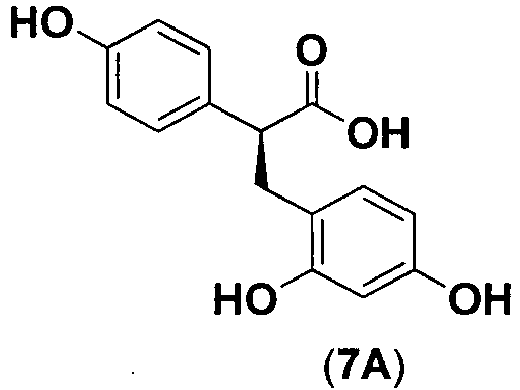
- the present invention relates to compound of formula (7A) and its use for synthesis of ( S )-Equol (1)
- the present invention relates to compound of formula (8) and its use for synthesis of ( S )-Equol (1)
- One embodiment of the present application relates to a process for the preparation of ( S )-equol (1) comprising:
- the first step of the process for preparation of ( S )-equol (1) involves Perkin reaction between 4-hydroxy phenyl acetic acid and 2,4-dihydroxy benzaldehyde in presence of an acid anhydride and a base.
- the most suitable acid anhydride is acetic anhydride although other acid anhydrides may also be used for the reaction.
- the base may be selected from a group of organic amines like triethylamine, diisopropylethylamine, trimethylamine, triisopropylamine, N-methylpiperidine and inorganic bases like sodium bicarbonate, potassium bicarbonate, potassium biphosphate, sodium biphosphate, potassium carbonate, sodium carbonate.
- the base may be selected from a group of organic amines and more specifically the base may be diisopropylethylamine.
- the reaction is carried out at a temperature of about 100 °C to about 200 °C for a period of about 30 hours to about 60 hours. Specifically, the reaction is carried out at a temperature of about 90 °C to about 150 °C for a period of about 35 hours to about 45 hours and more specifically the reaction is carried out at a temperature of about 115 °C to about 120 °C for a period of about 38 hours to about 42 hours.
- the reaction mixture is cooled from about 10 °C to about 30 °C and specifically from about 20 °C to about 25 °C and water is added. The precipitated solid is filtered and washed with water and optionally dried to provide 4-(7-acetoxy-2-oxo-2H-chromen-3-yl)phenyl acetate of formula (3).
- the acetyl groups of compound of formula (3) are hydrolyzed in presence of a base in the next step.
- the base may be selected from a group of lithium hydroxide, potassium hydroxide, sodium hydroxide, potassium carbonate, magnesium carbonate, sodium carbonate, sodium bicarbonate and potassium bicarbonate.
- the base is lithium hydroxide.
- the solvent for the hydrolysis reaction may be selected from a group of water, alcohols, tetrahydrofuran (THF), acetonitrile (ACN), dimethyl formamide (DMF), dimethyl sulfoxide (DMSO) and a mixture thereof. Specifically, water is used as solvent.
- the hydrolysis reaction is carried out at a temperature of about 30 °C to about 100 °C for a period of about 30 minutes to about 5 hours. Specifically, the reaction is carried out at a temperature of about 50 °C to about 80 °C for a period of about 1 hour to about 4 hours and more specifically the reaction is carried out at a temperature of about 60 °C to about 70 °C for a period of about 1 hour to about 2 hours.
- the reaction mixture is diluted by the addition of water and acidified by adding an aqueous solution of an acid.
- the acid may be selected from a group of acetic acid, hydrochloric acid, sulfuric acid, oxalic acid, nitric acid, phosphoric acid and hydrobromic acid, specifically hydrochloric acid.
- the precipitated solid is collected by filtration and optionally dried to afford 7-hydroxy-3-(4-hydroxyphenyl)-2H-chromen-2-one of formula (4).
- the compound of formula (4) is then hydrogenated to provide a mixture of 7-hydroxy-3-(4-hydroxyphenyl)-2H-chroman-2-one of formula (5) and methyl 3-(2,4-dihydroxyphenyl)-2-(4-hydroxyphenyl)propanoate of formula (6).
- the compound of formula (4) may be dissolved in a suitable solvent selected from the group of alcohols, DMF, dimethyl acetamide, N-methyl pyrrolidine, THF, DMSO, acetonitrile and a mixture thereof.
- the solvent is selected from a group of alcohols, DMF and a mixture thereof.
- the alcohols may be selected from a group of methanol, ethanol, isopropanol (IPA), tert-butanol and amyl alcohol.
- the suitable solvent for hydrogenation is methanol.
- the hydrogenation is performed in presence of a heterogeneous catalyst selected from a group of palladium on solid carrier, Raney nickel, platinum, rhodium and ruthenium.
- the solid carrier may be for example carbon.
- the heterogeneous catalyst is palladium on charcoal.
- the hydrogenation is carried out at about 5 bar to about 15 bar of hydrogen pressure at about 30 °C to about 100 °C for a period of about 5 hours to about 24 hours.
- the hydrogenation is carried out at about 7 bar to about 12 bar of hydrogen pressure at about 40 °C to about 80 °C for a period of about 7 hours to about 15 hours and more specifically the hydrogenation is carried out at about 8 bar to about 10 bar of hydrogen pressure at about 60 °C to about 65 °C for a period of about 10 hours to about 12 hours.
- the reaction mixture is filtered to remove the catalyst and the filtrate is distilled off to provide a mixture of 7-hydroxy-3-(4-hydroxyphenyl)-2H-chroman-2-one of formula (5) and methyl 3-(2,4-dihydroxyphenyl)-2-(4-hydroxyphenyl)propanoate of formula (6).
- the resulted product is carried forward for the next reaction without further purification.
- the mixture of compound of formula (5) and compound of formula (6) is hydrolyzed in presence of a base to afford 3-(2,4-dihydroxyphenyl)-2-(4-hydroxyphenyl)propanoic acid of formula (7).
- the base may be selected from a group of potassium hydroxide, sodium hydroxide, lithium hydroxide, sodium carbonate, potassium carbonate, magnesium carbonate, potassium bicarbonate, sodium bicarbonate and a mixture thereof.
- the base is potassium hydroxide.
- the solvent for the hydrolysis reaction may be selected from a group of water, alcohols, THF, acetonitrile, DMF, DMSO and a mixture thereof. Specifically, the solvent is water.
- the hydrolysis is carried out at a temperature of about 0 °C to about 50 °C. Specifically, the hydrolysis is carried out at a temperature below 20 °C.
- the reaction mixture is acidified by adding an acid.
- the acid may be selected from a group of hydrochloric acid, sulfuric acid, nitric acid, phosphoric acid, acetic acid and hydrobromic acid. Specifically, the acid is hydrochloric acid.
- the pH of the reaction mixture is adjusted from about 1 to about 4. Specifically, the pH of the reaction mixture is adjusted from about 2 to about 3.
- the product is extracted with an organic solvent which is immiscible in water.
- the organic solvent may be selected from a group of esters, ethers and hydrocarbon solvents.
- the organic solvent is an ester. More specifically, the organic solvent is ethyl acetate. The organic solvent is distilled off under vacuum to provide 3-(2,4-dihydroxyphenyl)-2-(4-hydroxyphenyl)propanoic acid of formula (7).
- One preferred embodiment of the present application relates to 3-(2,4-dihydroxyphenyl)-2-(4-hydroxyphenyl)propanoic acid of formula (7)
- Another preferred embodiment of the present application relates to use of 3-(2,4-dihydroxyphenyl)-2-(4-hydroxyphenyl)propanoic acid of formula (7) in the preparation of ( S )-equol ( 1 ).
- the racemic acid of formula (7) may be resolved into its enantiomers by forming a diastereomeric salt with a chiral amine.
- the chiral amine may be selected from a group of ⁇ -methylbenzylamine, N-octyl-D-glucamine, L-prolinol, cinchonidine, cinchonine, N-Boc-3-amino piperidine and 3-amino piperidine.
- the chiral amine is ⁇ -methylbenzylamine.
- the racemic acid of formula (7) and the chiral amine is dissolved in a suitable solvent at suitable condition.
- the solvent may be selected from a group of ethers, alcohols, water, hydrocarbons and mixture thereof.
- the solvent is selected from a group of methanol, ethanol, isopropanol, tet-butanol, diethyl ether, diisopropyl ether, methyl tert-butyl ether, 1,4-dioxane, tetrahydrofuran, toluene, heptane, hexane, water and mixture thereof. More specifically, the solvent is an alcohol and most specifically, the solvent is isopropanol.
- the reaction mass is heated to a temperature of about 40 °C to about 80 °C and specifically from about 50 °C to about 70 °C. More specifically, the reaction mass is heated to a temperature of about 55 °C to about 65 °C.
- the reaction is maintained for about 30 minutes to about 2 hours and specifically the reaction mass is maintained for about 45 minutes to about 1.5 hours. More specifically, the reaction mass is maintained for about 1 hour.
- the reaction mass is cooled from about 0 °C to about 30 °C and specifically the reaction mass is cooled from about 15 °C to about 25 °C.
- the reaction mass is maintained at this temperature for a period of about 2 hours to about 10 hours. Specifically, the reaction mass is maintained at this temperature for a period of about 4 hours to about 8 hours and more specifically the reaction mass is maintained at this temperature for a period of about 5 hours to about 6 hours.
- the resulting diastereomeric salt of ( S )-3-(2,4-dihydroxyphenyl)-2-(4-hydroxyphenyl)propanoic acid is isolated by known techniques such as filtration.
- the diastereomeric salt may optionally be crystallized to provide a pure product.
- the solvent for crystallization may be selected from a group of methanol, ethanol, isopropanol, tert-butanol, water, ethyl acetate, acetone, 1,4-dioxane, tetrahydrofuran and mixture thereof.
- the solvent for crystallization is selected from a group of methanol, ethanol, isopropanol, tert-butanol, water and mixture thereof. More specifically, the solvent for crystallization is a mixture of isopropanol and water.
- the crude solid is mixed with the solvent and heated from about 40 °C to about 80 °C and specifically from about 50 °C to about 70 °C to dissolve the solid in the solvent. After complete dissolution of the solid in the solvent, the reaction mass is cooled from about - 30 °C to about 10 °C and specifically from about -10 °C to about 0 °C. The resulting solid is filtered to afford pure diastereomeric salt of ( S )-3-(2,4-dihydroxyphenyl)-2-(4-hydroxyphenyl)propanoic acid.
- One preferred embodiment of the present application relates to chiral amine salt of ( S )-3-(2,4-dihydroxyphenyl)-2-(4-hydroxyphenyl)propanoic acid
- the chiral amine may be selected from a group of N-tert-butylbenzylamine, N-benzylmethylamine, ⁇ -methylbenzylamine, ⁇ -ethylbenzylamine, 2-amino-3-methylbutane, N-octyl-D-glucamine, L-prolinol, cinchonidine, cinchonine, N-Boc-3-amino piperidine and 3-amino piperidine.
- Another preferred embodiment of the present application relates to ( S )- ⁇ -methylbenzylamine salt of ( S )-3-(2,4-dihydroxyphenyl)-2-(4-hydroxyphenyl)propanoic acid of formula (8)
- substantially pure ( S )- ⁇ -methylbenzylamine salt of ( S )-3-(2,4-dihydroxyphenyl)-2-(4-hydroxyphenyl)-propanoic acid (8) is substantially pure.
- substantially pure compound of formula (8) means that the compound is having at least about 95 % diastereomeric purity (diastereomeric excess, d.e.) by HPLC.
- the compound of formula (8) is having at least 97 % diastereomeric purity by HPLC and more specifically the compound of formula (8) is having more than about 99 % diastereomeric purity by HPLC.
- Still another preferred embodiment of the present application relates to use of diastereomeric salt of ( S )-3-(2,4-dihydroxyphenyl)-2-(4-hydroxyphenyl)propanoic acid for the preparation of ( S )-equol (1).
- Another preferred embodiment of the present application relates to use of ( S )- ⁇ -methylbenzylamine salt of ( S )-3-(2,4-dihydroxyphenyl)-2-(4-hydroxyphenyl)propanoic acid of formula (8) for the preparation of ( S )-equol (1).
- ( S )- ⁇ -methylbenzylamine salt of ( S )-3-(2,4-dihydroxyphenyl)-2-(4-hydroxyphenyl)propanoic acid of formula (8) may be treated with suitable acid in suitable solvent to provide ( S )-3-(2,4-dihydroxyphenyl)-2-(4-hydroxyphenyl)propanoic acid of formula (7A).
- the acid may be selected from a group of hydrochloric acid, hydrobromic acid, sulfuric acid, nitric acid, oxalic acid, acetic acid, propionic acid and phosphoric acid.
- the acid is selected from a group of hydrochloric acid, sulfuric acid and nitric acid.
- the acid is hydrochloric acid.
- the solvent may be selected from a group of esters, alcohols, ethers, water and mixture thereof. Specifically, the solvent is a mixture of ester solvent and water. More specifically, the solvent is a mixture of ethyl acetate and water.
- the organic solvent is separated from the aqueous phase and evaporated under vacuum to provide (S)-3-(2,4-dihydroxyphenyl)-2-(4-hydroxyphenyl)propanoic acid of formula (7A).
- One preferred embodiment of the present application relates to ( S )-3-(2,4-dihydroxyphenyl)-2-(4-hydroxyphenyl)propanoic acid of formula (7A)
- Another preferred embodiment of the present application relates to use of ( S )-3-(2,4-dihydroxyphenyl)-2-(4-hydroxyphenyl)propanoic acid of formula (7A) in the preparation of ( S )-equol ( 1 ).
- substantially pure compound of formula (7A) means that the compound is having at least about 95 % enantiomeric purity (enantiomeric excess, e.e.) by HPLC.
- the compound of formula (7A) is having at least 97 % enantiomeric purity by HPLC and more specifically the compound of formula (7A) is having more than about 99 % enantiomeric purity by HPLC.
- the optically active acid of formula (7A) is reacted with a suitable reducing agent in presence of a solvent to provide ( S )-4-(3-hydroxy-2-(4-hydroxyphenyl)propyl)benzene-1,3-diol of formula (9).
- the reducing agent may be selected from a group of borane and dimethyl sulfide complex (BH 3 -DMS), sodium borohydride, lithium borohydride, lithium aluminum hydride, boron trifluoride etherate (BF 3 :Et 2 O), diisobutyl aluminum hydride and sodium bis(2-methoxyethoxy)aluminumhydride (REDAL).
- the reducing agent is BH 3 -DMS.
- the solvent may be selected from the group of methanol, ethanol, 1,4-dioxane, toluene, tetrahydrofuran, diethyl ether, diisopropyl ether and mixture thereof. Specifically, the solvent is selected from a group of 1,4-dioxane and tetrahydrofuran. More specifically, the solvent is 1,4-dioxane.
- a solution comprising optically active acid of formula (7A) in 1,4-dioxane is added to a mixture comprising 1,4-dioxane and BH 3 -DMS.
- the mixture comprising 1,4-dioxane and BH 3 -DMS may be added to the solution comprising optically active acid of formula (7A) in 1,4-dioxane.
- the reaction mass is heated to a temperature of 50 °C to about 200 °C for a period of about 2 hours to about 10 hours.
- the reaction mass is heated to a temperature of 80 °C to about 150 °C for a period of about 4 hours to about 8 hours and more specifically reaction mass is heated to a temperature of 90 °C to about 95 °C for a period of about 5 hours to about 6 hours.
- reaction mass contains about 70 % of desired alcohol of formula (9) along with about 30 % of corresponding aldehyde of formula (10) after the completion of the reaction
- the reducing agent is selected from a group of sodium borohydride, lithium borohydride and the like.
- another reducing agent of the present application is sodium borohydride.
- the reaction is maintained for a period of about 30 minutes to about 3 hours after the addition of reducing agent.
- the reaction mass is maintained for a period of about 1 hour to about 2 hours.
- the reaction mass is quenched by dilute hydrochloric acid and extracted with a water immiscible organic solvent.
- the water immiscible organic solvent may be selected from a group of toluene, chloroform, dichloromethane, methyl tert-butyl ether, diethyl ether and ethyl acetate. Specifically, the water immiscible organic solvent is ethyl acetate.
- the organic solvent is distilled off up to about 1 to about 2 volumes and dichloromethane is added to the product.
- the reaction mass is maintained from about 3 hours to about 10 hours and specifically maintained from about 5 hours to about 6 hours.
- the precipitated solid is isolated by filtration to afford ( S )-4-(3-hydroxy-2-(4-hydroxyphenyl)propyl)benzene-1,3-diol of formula (9).
- the alcohol of formula (9) can be cyclized under Mitsunobu conditions to provide ( S )-equol (1).
- the solvent used for the reaction may be selected from a group of tetrahydrofuran, diisopropyl ether, 1,4-dioxane, methyl tert-butyl ether, dimethyl formamide, dimethyl acetamide and mixture thereof. Specifically, the solvent is tetrahydrofuran.
- triphenyl phosphine and suitable solvent alkyl derivative of azodicarboxylate is added. The addition of azodicarboxylate may be in single lot or in several portions.
- the alkyl derivative of azodicarboxylate is selected from a group of diispropyl azodicarboxylate, diethyl azodicarboxylate and the like. Specifically, the alkyl derivative of azodicarboxylate is diispropyl azodicarboxylate.
- the reaction mass is maintained at a temperature of about 5 °C to about 25 °C for a period from about 30 minutes to about 3 hours. Specifically, the reaction mass is maintained at a temperature of about 15 °C to about 20 °C for a period from about 1 hour to about 2 hours.
- the reaction mass is quenched with an aqueous solution of lithium hydroxide and extracted with a water immiscible organic solvent to remove the side products.
- the water immiscible organic solvent may be selected from a group of ethyl acetate, diethyl ether, methyl tert-butyl ether, toluene and chloroform. Specifically, the water immiscible organic solvent is methyl tert-butyl ether.
- the aqueous layer is acidified with an acid.
- the acid may be selected from a group of hydrochloric acid, sulfuric acid, nitric acid and propionic acid. Specifically, the acid is dilute hydrochloric acid.
- the pH of the aqueous layer is adjusted from about pH 0.5 to about pH 5. Specifically, the pH of the aqueous layer is adjusted from about pH 1 to about pH 4.
- the reaction mass is maintained from about 2 hours to about 10 hours. Specifically, the reaction mass is maintained from about 3 hours to about 8 hours. More specifically, the reaction mass is maintained from about 5 hours to about 6 hours.
- the solid is isolated by filtration to provide ( S )-equol (1).
- the isolated solid is optionally slurry washed with a solvent to provide a purified product.
- the suitable solvent is selected from a group of methanol, ethanol, isopropanol, tert-butanol, acetone, THF, 1,4-dioxane, water, acetic acid, propionic acid and mixture thereof.
- the solvent is selected from a group of methanol, ethanol, isopropanol, tert-butanol, acetone, water and mixture thereof. More specifically, the solvent is a mixture of isopropanol and water.
- the reaction mass is maintained for a period from about 5 hours to about 20 hours. Specifically, the reaction mass is maintained for a period from about 7 hours to about 15 hours and more specifically maintained for a period from about 12 hours to about 14 hours.
- the solid is isolated by filtration to provide ( S )-equol (1).
- ( S )-equol (1) obtained by a process of instant application has chemical purity of more than about 95 % when measured by HPLC technique. Specifically, ( S )-equol (1) obtained by a process of instant application has more than about 97 % purity and more specifically (S)-equol (1) obtained by a process of instant application has more than about 98 % purity.
- ( S )-equol (1) obtained by a process of instant application has enantiomeric purity of more than about 95 % when measured by HPLC technique. Specifically, ( S )-equol (1) obtained by a process of instant application has more than about 97 % enantiomeric purity and more specifically ( S )-equol (1) obtained by a process of instant application has more than about 99 % enantiomeric purity.
- IPA (20 mL) was added to the crude mass obtained from example 4 and distilled off under vacuum below 45 °C up to 9-10 volumes. Cinchonine (1.03 g) was added into the reaction mass. The reaction mass was heated to 55-65 °C and maintained for 1 hr. The reaction mixture was then cooled to RT and maintained at that temperature for 5-6 hours. The product was filtered off, washed with IPA (1 mL) and dried at 70-75 °C for 6-8 hours to afford the title compound. Yield: 0.26 g Chiral Purity (by HPLC): 36.9 % d.e.
Landscapes
- Chemical & Material Sciences (AREA)
- Organic Chemistry (AREA)
- Engineering & Computer Science (AREA)
- Oil, Petroleum & Natural Gas (AREA)
- Organic Low-Molecular-Weight Compounds And Preparation Thereof (AREA)
- Pyrane Compounds (AREA)
- Low-Molecular Organic Synthesis Reactions Using Catalysts (AREA)
Description
- The present application relates to an improved process for the production of (S)-equol (1).
- (S)-Equol (1) is chemically known as 4',7-isoflavandiol. It is produced in the human intestine by bacterial metabolism of daidzein (2). However, only about 30-50 % of human population has daidzein to equol converting bacteria. (S)-Equol (1) binds to estrogen receptor-β and is believed to be useful in the prevention of prostate cancer. (S)-Equol (1) is also believed to be responsible for maintaining bone health and physiological changes during menopause.

- Takashima et al. (Tetrahedron Letters, 2008, 49, 5156-5158) discloses a process for the preparation of (S)-Equol (1) starting from naturally occurring ethyl lactate. The disclosed process is an eleven-step process and the total yield obtained by the process is only 31.6 %. Also, (S)-Equol (1) produced by this method has low enantiomeric purity of 91 %.
- Takashima et al. (Tetrahedron Letters, 2010, 66, 197-207) further discloses a process for the preparation of (S)-Equol (1) starting from 2,4-dimethoxy benzaldehyde and including the cyclization of (S)-4-(3-bromo-2-(4-hydroxyphenyl)propyl)benzene-1,3-diol in presence of potassium carbonate. (S)-Equol (1) produced by this method has also enantiomeric purity of 91 %.
- Muthyala et al. (Bioorganic & Medicinal Chemistry, 2004, 12, 1559-1567) teaches a process for the preparation of (S)-Equol (1). The process involves the reduction of daidzein (2) by ammonium formate in presence of palladium-charcoal to produce racemic equol. The racemic equol is then resolved into enantiomerically pure isomer by chiral liquid chromatography. The process is not acceptable for commercial preparation of (S)-Equol (1) as it requires chiral liquid chromatography technique to separate the enantiomers of racemic equol.
- Hemstra et al. (Organic Letters, 2006, 8, 5441-5443) discloses a process for the preparation of (S)-Equol (1) starting from 2-bromo-4-methoxy benzyl chloride. Although the process produces about 99.9 % enantiomerically pure (S)-Equol (1), the main disadvantage of the process is its poor yield i.e., only 9.8 %.
- Yang et al. (Tetrahedron 2012, 68 (26), 5172-5178) describes a process for the preparation of (S)-equol comprising hydrogenation of α-arylcinnamic acid by using iridium catalyst based on chiral spiro phosphine-oxazoline ligands.
-
WO 2004/069774 A2 discloses a process for the preparation of [3,4,8-13C3]-equol starting from triply 13C-labeled daidzein. -
WO 2010/018199 A1 discloses a process for preparation of isoflavanes by enantioselective reduction of the 4-keto group of the isoflavone. - The prior art processes for the synthesis of (S)-Equol (1) are not suitable for commercial production because of their low yield and/or low enantiomeric purity of the product. Hence, there is a need in the art for an efficient process for the preparation of (S)-Equol (1).
- One embodiment of the present application relates to a process for the preparation of (S)-equol (1)

- (a) reacting 4-hydroxy phenyl acetic acid and 2,4-dihydroxy benzaldehyde in presence of an acid anhydride and a base to provide 4-(7-acetoxy-2-oxo-2H-chromen-3-yl)phenyl acetate of formula (3)

- (b) hydrolyzing the acetyl groups of 4-(7-acetoxy-2-oxo-2H-chromen-3-yl)phenyl acetate of formula (3) in presence of a base to provide 7-hydroxy-3-(4-hydroxyphenyl)-2H-chromen-2-one of formula (4)

- (c) hydrogenating 7-hydroxy-3-(4-hydroxyphenyl)-2H-chromen-2-one of formula (4) to provide a mixture of 7-hydroxy-3-(4-hydroxyphenyl)-2H-chroman-2-one of formula (5) and methyl 3-(2,4-dihydroxyphenyl)-2-(4-hydroxyphenyl)propanoate of formula (6)

- (d) hydrolyzing the mixture of 7-hydroxy-3-(4-hydroxyphenyl)-2H-chroman-2-one of formula (5) and methyl 3-(2,4-dihydroxyphenyl)-2-(4-hydroxyphenyl)propanoate of formula (6) by a base to provide 3-(2,4-dihydroxyphenyl)-2-(4-hydroxyphenyl)propanoic acid of formula (7)

- (e) resolving 3-(2,4-dihydroxyphenyl)-2-(4-hydroxyphenyl)propanoic acid of formula (7) to its corresponding (S)-isomer (7A) via diastereomeric salt formation with a chiral amine

- (f) reducing (S)-3-(2,4-dihydroxyphenyl)-2-(4-hydroxyphenyl)propanoic acid of formula (7A) to provide (S)-4-(3-hydroxy-2-(4-hydroxyphenyl)propyl)benzene-1,3-diol of formula (9)

- (g) cyclizing (S)-4-(3-hydroxy-2-(4-hydroxyphenyl)propyl)benzene-1,3-diol of formula (9) to provide (S)-equol (1).
- In another embodiment the present invention relates to compound of formula (7) and its use for synthesis of (S)-Equol (1)

- In yet another embodiment the present invention relates to compound of formula (7A) and its use for synthesis of (S)-Equol (1)
- In still another embodiment the present invention relates to compound of formula (8) and its use for synthesis of (S)-Equol (1)

- One embodiment of the present application relates to a process for the preparation of (S)-equol (1)

- (a) reacting 4-hydroxy phenyl acetic acid and 2,4-dihydroxy benzaldehyde in presence of an acid anhydride and a base to provide 4-(7-acetoxy-2-oxo-2H-chromen-3-yl)phenyl acetate of formula (3)

- (b) hydrolyzing the acetyl groups of 4-(7-acetoxy-2-oxo-2H-chromen-3-yl)phenyl acetate of formula (3) in presence of a base to provide 7-hydroxy-3-(4-hydroxyphenyl)-2H-chromen-2-one of formula (4)

- (c) hydrogenating 7-hydroxy-3-(4-hydroxyphenyl)-2H-chromen-2-one of formula (4) to provide a mixture of 7-hydroxy-3-(4-hydroxyphenyl)-2H-chroman-2-one of formula (5) and methyl 3-(2,4-dihydroxyphenyl)-2-(4-hydroxyphenyl)propanoate of formula (6)

- (d) hydrolyzing the mixture of 7-hydroxy-3-(4-hydroxyphenyl)-2H-chroman-2-one of formula (5) and methyl 3-(2,4-dihydroxyphenyl)-2-(4-hydroxyphenyl)propanoate of formula (6) by a base to provide 3-(2,4-dihydroxyphenyl)-2-(4-hydroxyphenyl)propanoic acid of formula (7)

- (e) resolving 3-(2,4-dihydroxyphenyl)-2-(4-hydroxyphenyl)propanoic acid of formula (7) to its corresponding (S)-isomer (7A) via diastereomeric salt formation with a chiral amine

- (f) reducing (S)-3-(2,4-dihydroxyphenyl)-2-(4-hydroxyphenyl)propanoic acid of formula (7A) to provide (S)-4-(3-hydroxy-2-(4-hydroxyphenyl)propyl)benzene-1,3-diol of formula (9)

- (g) cyclizing (S)-4-(3-hydroxy-2-(4-hydroxyphenyl)propyl)benzene-1,3-diol of formula (9) to provide (S)-equol (1).
- The schematic representation of the instant process for the preparation of (S)-equol (1) is shown in Scheme I.

- The first step of the process for preparation of (S)-equol (1) involves Perkin reaction between 4-hydroxy phenyl acetic acid and 2,4-dihydroxy benzaldehyde in presence of an acid anhydride and a base. The most suitable acid anhydride is acetic anhydride although other acid anhydrides may also be used for the reaction. The base may be selected from a group of organic amines like triethylamine, diisopropylethylamine, trimethylamine, triisopropylamine, N-methylpiperidine and inorganic bases like sodium bicarbonate, potassium bicarbonate, potassium biphosphate, sodium biphosphate, potassium carbonate, sodium carbonate. Specifically, the base may be selected from a group of organic amines and more specifically the base may be diisopropylethylamine. The reaction is carried out at a temperature of about 100 °C to about 200 °C for a period of about 30 hours to about 60 hours. Specifically, the reaction is carried out at a temperature of about 90 °C to about 150 °C for a period of about 35 hours to about 45 hours and more specifically the reaction is carried out at a temperature of about 115 °C to about 120 °C for a period of about 38 hours to about 42 hours. After the reaction is completed, the reaction mixture is cooled from about 10 °C to about 30 °C and specifically from about 20 °C to about 25 °C and water is added. The precipitated solid is filtered and washed with water and optionally dried to provide 4-(7-acetoxy-2-oxo-2H-chromen-3-yl)phenyl acetate of formula (3).
- The acetyl groups of compound of formula (3) are hydrolyzed in presence of a base in the next step. The base may be selected from a group of lithium hydroxide, potassium hydroxide, sodium hydroxide, potassium carbonate, magnesium carbonate, sodium carbonate, sodium bicarbonate and potassium bicarbonate. Specifically, the base is lithium hydroxide. The solvent for the hydrolysis reaction may be selected from a group of water, alcohols, tetrahydrofuran (THF), acetonitrile (ACN), dimethyl formamide (DMF), dimethyl sulfoxide (DMSO) and a mixture thereof. Specifically, water is used as solvent. The hydrolysis reaction is carried out at a temperature of about 30 °C to about 100 °C for a period of about 30 minutes to about 5 hours. Specifically, the reaction is carried out at a temperature of about 50 °C to about 80 °C for a period of about 1 hour to about 4 hours and more specifically the reaction is carried out at a temperature of about 60 °C to about 70 °C for a period of about 1 hour to about 2 hours. After the completion of the reaction, the reaction mixture is diluted by the addition of water and acidified by adding an aqueous solution of an acid. The acid may be selected from a group of acetic acid, hydrochloric acid, sulfuric acid, oxalic acid, nitric acid, phosphoric acid and hydrobromic acid, specifically hydrochloric acid. The precipitated solid is collected by filtration and optionally dried to afford 7-hydroxy-3-(4-hydroxyphenyl)-2H-chromen-2-one of formula (4).
- The compound of formula (4) is then hydrogenated to provide a mixture of 7-hydroxy-3-(4-hydroxyphenyl)-2H-chroman-2-one of formula (5) and methyl 3-(2,4-dihydroxyphenyl)-2-(4-hydroxyphenyl)propanoate of formula (6). The compound of formula (4) may be dissolved in a suitable solvent selected from the group of alcohols, DMF, dimethyl acetamide, N-methyl pyrrolidine, THF, DMSO, acetonitrile and a mixture thereof. Specifically, the solvent is selected from a group of alcohols, DMF and a mixture thereof. The alcohols may be selected from a group of methanol, ethanol, isopropanol (IPA), tert-butanol and amyl alcohol. Specifically, the suitable solvent for hydrogenation is methanol. The hydrogenation is performed in presence of a heterogeneous catalyst selected from a group of palladium on solid carrier, Raney nickel, platinum, rhodium and ruthenium. The solid carrier may be for example carbon. Specifically, the heterogeneous catalyst is palladium on charcoal. The hydrogenation is carried out at about 5 bar to about 15 bar of hydrogen pressure at about 30 °C to about 100 °C for a period of about 5 hours to about 24 hours. Specifically, the hydrogenation is carried out at about 7 bar to about 12 bar of hydrogen pressure at about 40 °C to about 80 °C for a period of about 7 hours to about 15 hours and more specifically the hydrogenation is carried out at about 8 bar to about 10 bar of hydrogen pressure at about 60 °C to about 65 °C for a period of about 10 hours to about 12 hours. After the reaction is complete, the reaction mixture is filtered to remove the catalyst and the filtrate is distilled off to provide a mixture of 7-hydroxy-3-(4-hydroxyphenyl)-2H-chroman-2-one of formula (5) and methyl 3-(2,4-dihydroxyphenyl)-2-(4-hydroxyphenyl)propanoate of formula (6). The resulted product is carried forward for the next reaction without further purification.
- The mixture of compound of formula (5) and compound of formula (6) is hydrolyzed in presence of a base to afford 3-(2,4-dihydroxyphenyl)-2-(4-hydroxyphenyl)propanoic acid of formula (7). The base may be selected from a group of potassium hydroxide, sodium hydroxide, lithium hydroxide, sodium carbonate, potassium carbonate, magnesium carbonate, potassium bicarbonate, sodium bicarbonate and a mixture thereof. Specifically, the base is potassium hydroxide. The solvent for the hydrolysis reaction may be selected from a group of water, alcohols, THF, acetonitrile, DMF, DMSO and a mixture thereof. Specifically, the solvent is water. The hydrolysis is carried out at a temperature of about 0 °C to about 50 °C. Specifically, the hydrolysis is carried out at a temperature below 20 °C. After the completion of the reaction, the reaction mixture is acidified by adding an acid. The acid may be selected from a group of hydrochloric acid, sulfuric acid, nitric acid, phosphoric acid, acetic acid and hydrobromic acid. Specifically, the acid is hydrochloric acid. The pH of the reaction mixture is adjusted from about 1 to about 4. Specifically, the pH of the reaction mixture is adjusted from about 2 to about 3. The product is extracted with an organic solvent which is immiscible in water. The organic solvent may be selected from a group of esters, ethers and hydrocarbon solvents. Specifically, the organic solvent is an ester. More specifically, the organic solvent is ethyl acetate. The organic solvent is distilled off under vacuum to provide 3-(2,4-dihydroxyphenyl)-2-(4-hydroxyphenyl)propanoic acid of formula (7).
- One preferred embodiment of the present application relates to 3-(2,4-dihydroxyphenyl)-2-(4-hydroxyphenyl)propanoic acid of formula (7)
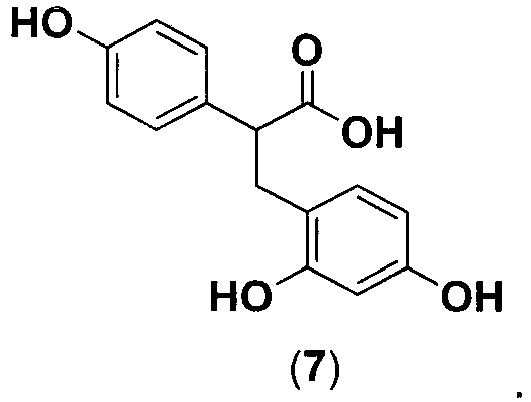
- Another preferred embodiment of the present application relates to use of 3-(2,4-dihydroxyphenyl)-2-(4-hydroxyphenyl)propanoic acid of formula (7) in the preparation of (S)-equol (1).
- The racemic acid of formula (7) may be resolved into its enantiomers by forming a diastereomeric salt with a chiral amine. The chiral amine may be selected from a group of α-methylbenzylamine, N-octyl-D-glucamine, L-prolinol, cinchonidine, cinchonine, N-Boc-3-amino piperidine and 3-amino piperidine. Specifically, the chiral amine is α-methylbenzylamine. The racemic acid of formula (7) and the chiral amine is dissolved in a suitable solvent at suitable condition. The solvent may be selected from a group of ethers, alcohols, water, hydrocarbons and mixture thereof. Specifically, the solvent is selected from a group of methanol, ethanol, isopropanol, tet-butanol, diethyl ether, diisopropyl ether, methyl tert-butyl ether, 1,4-dioxane, tetrahydrofuran, toluene, heptane, hexane, water and mixture thereof. More specifically, the solvent is an alcohol and most specifically, the solvent is isopropanol. The reaction mass is heated to a temperature of about 40 °C to about 80 °C and specifically from about 50 °C to about 70 °C. More specifically, the reaction mass is heated to a temperature of about 55 °C to about 65 °C. The reaction is maintained for about 30 minutes to about 2 hours and specifically the reaction mass is maintained for about 45 minutes to about 1.5 hours. More specifically, the reaction mass is maintained for about 1 hour. The reaction mass is cooled from about 0 °C to about 30 °C and specifically the reaction mass is cooled from about 15 °C to about 25 °C. The reaction mass is maintained at this temperature for a period of about 2 hours to about 10 hours. Specifically, the reaction mass is maintained at this temperature for a period of about 4 hours to about 8 hours and more specifically the reaction mass is maintained at this temperature for a period of about 5 hours to about 6 hours. The resulting diastereomeric salt of (S)-3-(2,4-dihydroxyphenyl)-2-(4-hydroxyphenyl)propanoic acid is isolated by known techniques such as filtration.
- The diastereomeric salt may optionally be crystallized to provide a pure product. The solvent for crystallization may be selected from a group of methanol, ethanol, isopropanol, tert-butanol, water, ethyl acetate, acetone, 1,4-dioxane, tetrahydrofuran and mixture thereof. Specifically, the solvent for crystallization is selected from a group of methanol, ethanol, isopropanol, tert-butanol, water and mixture thereof. More specifically, the solvent for crystallization is a mixture of isopropanol and water. The crude solid is mixed with the solvent and heated from about 40 °C to about 80 °C and specifically from about 50 °C to about 70 °C to dissolve the solid in the solvent. After complete dissolution of the solid in the solvent, the reaction mass is cooled from about - 30 °C to about 10 °C and specifically from about -10 °C to about 0 °C. The resulting solid is filtered to afford pure diastereomeric salt of (S)-3-(2,4-dihydroxyphenyl)-2-(4-hydroxyphenyl)propanoic acid.
- One preferred embodiment of the present application relates to chiral amine salt of (S)-3-(2,4-dihydroxyphenyl)-2-(4-hydroxyphenyl)propanoic acid wherein the chiral amine may be selected from a group of N-tert-butylbenzylamine, N-benzylmethylamine, α-methylbenzylamine, α-ethylbenzylamine, 2-amino-3-methylbutane, N-octyl-D-glucamine, L-prolinol, cinchonidine, cinchonine, N-Boc-3-amino piperidine and 3-amino piperidine.
- Another preferred embodiment of the present application relates to (S)-α-methylbenzylamine salt of (S)-3-(2,4-dihydroxyphenyl)-2-(4-hydroxyphenyl)propanoic acid of formula (8)

- Yet another preferred embodiment of the present application relates to substantially pure (S)-α-methylbenzylamine salt of (S)-3-(2,4-dihydroxyphenyl)-2-(4-hydroxyphenyl)-propanoic acid (8). Substantially pure compound of formula (8) means that the compound is having at least about 95 % diastereomeric purity (diastereomeric excess, d.e.) by HPLC. Specifically, the compound of formula (8) is having at least 97 % diastereomeric purity by HPLC and more specifically the compound of formula (8) is having more than about 99 % diastereomeric purity by HPLC.
- Still another preferred embodiment of the present application relates to use of diastereomeric salt of (S)-3-(2,4-dihydroxyphenyl)-2-(4-hydroxyphenyl)propanoic acid for the preparation of (S)-equol (1).
- Another preferred embodiment of the present application relates to use of (S)-α-methylbenzylamine salt of (S)-3-(2,4-dihydroxyphenyl)-2-(4-hydroxyphenyl)propanoic acid of formula (8) for the preparation of (S)-equol (1).
- The chiral amine salt of (S)-3-(2,4-dihydroxyphenyl)-2-(4-hydroxyphenyl)propanoic acid wherein the chiral amine may be selected from a group of N-tert-butylbenzylamine, N-benzylmethylamine, α-methylbenzylamine, α-ethylbenzylamine, 2-amino-3-methylbutane, N-octyl-D-glucamine, L-prolinol, cinchonidine, cinchonine, N-Boc-3-amino piperidine and 3-amino piperidine may be treated with suitable acid in suitable solvent to provide (S)-3-(2,4-dihydroxyphenyl)-2-(4-hydroxyphenyl)propanoic acid of formula (7A). Specifically, (S)-α-methylbenzylamine salt of (S)-3-(2,4-dihydroxyphenyl)-2-(4-hydroxyphenyl)propanoic acid of formula (8) may be treated with suitable acid in suitable solvent to provide (S)-3-(2,4-dihydroxyphenyl)-2-(4-hydroxyphenyl)propanoic acid of formula (7A). The acid may be selected from a group of hydrochloric acid, hydrobromic acid, sulfuric acid, nitric acid, oxalic acid, acetic acid, propionic acid and phosphoric acid. Specifically, the acid is selected from a group of hydrochloric acid, sulfuric acid and nitric acid. More specifically, the acid is hydrochloric acid. The solvent may be selected from a group of esters, alcohols, ethers, water and mixture thereof. Specifically, the solvent is a mixture of ester solvent and water. More specifically, the solvent is a mixture of ethyl acetate and water. The organic solvent is separated from the aqueous phase and evaporated under vacuum to provide (S)-3-(2,4-dihydroxyphenyl)-2-(4-hydroxyphenyl)propanoic acid of formula (7A).
- One preferred embodiment of the present application relates to (S)-3-(2,4-dihydroxyphenyl)-2-(4-hydroxyphenyl)propanoic acid of formula (7A)

- Another preferred embodiment of the present application relates to use of (S)-3-(2,4-dihydroxyphenyl)-2-(4-hydroxyphenyl)propanoic acid of formula (7A) in the preparation of (S)-equol (1).
- Yet another preferred embodiment of the present application relates to substantially pure (S)-3-(2,4-dihydroxyphenyl)-2-(4-hydroxyphenyl)-propanoic acid (7A). Substantially pure compound of formula (7A) means that the compound is having at least about 95 % enantiomeric purity (enantiomeric excess, e.e.) by HPLC. Specifically, the compound of formula (7A) is having at least 97 % enantiomeric purity by HPLC and more specifically the compound of formula (7A) is having more than about 99 % enantiomeric purity by HPLC.
- The optically active acid of formula (7A) is reacted with a suitable reducing agent in presence of a solvent to provide (S)-4-(3-hydroxy-2-(4-hydroxyphenyl)propyl)benzene-1,3-diol of formula (9). The reducing agent may be selected from a group of borane and dimethyl sulfide complex (BH3-DMS), sodium borohydride, lithium borohydride, lithium aluminum hydride, boron trifluoride etherate (BF3:Et2O), diisobutyl aluminum hydride and sodium bis(2-methoxyethoxy)aluminumhydride (REDAL). Specifically, the reducing agent is BH3-DMS. The solvent may be selected from the group of methanol, ethanol, 1,4-dioxane, toluene, tetrahydrofuran, diethyl ether, diisopropyl ether and mixture thereof. Specifically, the solvent is selected from a group of 1,4-dioxane and tetrahydrofuran. More specifically, the solvent is 1,4-dioxane. A solution comprising optically active acid of formula (7A) in 1,4-dioxane is added to a mixture comprising 1,4-dioxane and BH3-DMS. Alternatively, the mixture comprising 1,4-dioxane and BH3-DMS may be added to the solution comprising optically active acid of formula (7A) in 1,4-dioxane. The reaction mass is heated to a temperature of 50 °C to about 200 °C for a period of about 2 hours to about 10 hours. Specifically, the reaction mass is heated to a temperature of 80 °C to about 150 °C for a period of about 4 hours to about 8 hours and more specifically reaction mass is heated to a temperature of 90 °C to about 95 °C for a period of about 5 hours to about 6 hours.
- It has been surprisingly observed by the inventors of the present application that the reaction mass contains about 70 % of desired alcohol of formula (9) along with about 30 % of corresponding aldehyde of formula (10) after the completion of the reaction

- In order to improve the yield and quality of the required product another suitable reducing agent is added to the reaction mass before work-up. The reducing agent is selected from a group of sodium borohydride, lithium borohydride and the like. Specifically, another reducing agent of the present application is sodium borohydride. The reaction is maintained for a period of about 30 minutes to about 3 hours after the addition of reducing agent. Specifically, the reaction mass is maintained for a period of about 1 hour to about 2 hours. The reaction mass is quenched by dilute hydrochloric acid and extracted with a water immiscible organic solvent. The water immiscible organic solvent may be selected from a group of toluene, chloroform, dichloromethane, methyl tert-butyl ether, diethyl ether and ethyl acetate. Specifically, the water immiscible organic solvent is ethyl acetate. The organic solvent is distilled off up to about 1 to about 2 volumes and dichloromethane is added to the product. The reaction mass is maintained from about 3 hours to about 10 hours and specifically maintained from about 5 hours to about 6 hours. The precipitated solid is isolated by filtration to afford (S)-4-(3-hydroxy-2-(4-hydroxyphenyl)propyl)benzene-1,3-diol of formula (9).
- The alcohol of formula (9) can be cyclized under Mitsunobu conditions to provide (S)-equol (1). The solvent used for the reaction may be selected from a group of tetrahydrofuran, diisopropyl ether, 1,4-dioxane, methyl tert-butyl ether, dimethyl formamide, dimethyl acetamide and mixture thereof. Specifically, the solvent is tetrahydrofuran. To the reaction mass comprising alcohol of formula (9), triphenyl phosphine and suitable solvent, alkyl derivative of azodicarboxylate is added. The addition of azodicarboxylate may be in single lot or in several portions. The alkyl derivative of azodicarboxylate is selected from a group of diispropyl azodicarboxylate, diethyl azodicarboxylate and the like. Specifically, the alkyl derivative of azodicarboxylate is diispropyl azodicarboxylate. The reaction mass is maintained at a temperature of about 5 °C to about 25 °C for a period from about 30 minutes to about 3 hours. Specifically, the reaction mass is maintained at a temperature of about 15 °C to about 20 °C for a period from about 1 hour to about 2 hours. The reaction mass is quenched with an aqueous solution of lithium hydroxide and extracted with a water immiscible organic solvent to remove the side products. The water immiscible organic solvent may be selected from a group of ethyl acetate, diethyl ether, methyl tert-butyl ether, toluene and chloroform. Specifically, the water immiscible organic solvent is methyl tert-butyl ether. The aqueous layer is acidified with an acid. The acid may be selected from a group of hydrochloric acid, sulfuric acid, nitric acid and propionic acid. Specifically, the acid is dilute hydrochloric acid. The pH of the aqueous layer is adjusted from about pH 0.5 to about pH 5. Specifically, the pH of the aqueous layer is adjusted from about pH 1 to about pH 4. The reaction mass is maintained from about 2 hours to about 10 hours. Specifically, the reaction mass is maintained from about 3 hours to about 8 hours. More specifically, the reaction mass is maintained from about 5 hours to about 6 hours. The solid is isolated by filtration to provide (S)-equol (1). The isolated solid is optionally slurry washed with a solvent to provide a purified product. The suitable solvent is selected from a group of methanol, ethanol, isopropanol, tert-butanol, acetone, THF, 1,4-dioxane, water, acetic acid, propionic acid and mixture thereof. Specifically, the solvent is selected from a group of methanol, ethanol, isopropanol, tert-butanol, acetone, water and mixture thereof. More specifically, the solvent is a mixture of isopropanol and water. The reaction mass is maintained for a period from about 5 hours to about 20 hours. Specifically, the reaction mass is maintained for a period from about 7 hours to about 15 hours and more specifically maintained for a period from about 12 hours to about 14 hours. The solid is isolated by filtration to provide (S)-equol (1).
- The process of the instant application has provided (S)-equol (1) with improved yield and improved chemical as well as enantiomeric purity when measured by HPLC technique. The process of the instant application provides more than about 22 % of overall yield, much better than prior art processes.
- (S)-equol (1) obtained by a process of instant application has chemical purity of more than about 95 % when measured by HPLC technique. Specifically, (S)-equol (1) obtained by a process of instant application has more than about 97 % purity and more specifically (S)-equol (1) obtained by a process of instant application has more than about 98 % purity.
- (S)-equol (1) obtained by a process of instant application has enantiomeric purity of more than about 95 % when measured by HPLC technique. Specifically, (S)-equol (1) obtained by a process of instant application has more than about 97 % enantiomeric purity and more specifically (S)-equol (1) obtained by a process of instant application has more than about 99 % enantiomeric purity.
- Certain specific embodiments will be further explained in the following examples, which are being provided only for the purpose of illustration, and the scope of this application is not limited thereto.
- To a mixture of 4-hydroxyphenyl acetic acid (50 g) and 2,4-dihydroxybenzaldehyde (45.46 g) acetic anhydride (250 mL) and diisopropylethylamine (200 mL) were added and the reaction mixture was heated at 115-120 °C for about 40 ± 2 hours. The reaction mixture was then cooled to RT and then water (1000 mL) was added. The reaction mass was maintained at RT for 4-5 hours. The solid was filtered off, washed with water (250 mL) and dried at 70-75 °C for 12-14 hours to afford the title compound.
Yield: 103 g
1H NMR 400 MHz, CDCl3) δ: 2.33 (s, 3H), 2.35 (s, 3H), 7.06-7.09 (dd, , J=8.4 Hz, J=2.4 Hz 1H), 7.15-7.20 (m, 3H), 7.54 (d, J=8.4 Hz, 1H), 7.71-7.75 (m, 2H), 7.79 (s, 1H).
MS: m/z = 339.20 [M+1]. - To a solution of 4-(7-acetoxy-2-oxo-2H-chromen-3-yl)phenyl acetate of formula (3) (80 gm) in DMF (400 mL) an aqueous solution of lithium hydroxide (29.8 g, 0.71mol) was added at RT and maintained at 60-70°C for 1-2 hours. After the completion of the reaction, water (800 mL) and dilute hydrochloric acid (112 mL) was added to the reaction mass. The reaction mass was maintained at RT for 1-2 hours. The solid was filtered and dried at 70-75°C for 6-8 hours to afford the title compound.
Yield: 57 g
1H NMR (400 MHz, DMSO- d6) δ: 6.75 (d, J=1.6 Hz, 1H), 6.79-6.83 (m, 3H), 7.53-7.58 (m, 3H), 8.02 (s, 1 H), 9.66 (s, 1 H), 10.55 (s, 1 H). - MS: m/z = 255.10 [M+1].
- To a solution of 7-hydroxy-3-(4-hydroxyphenyl)-2H-chromen-2-one (4) (57 gm) in DMF (320 mL) and methanol (320 mL), palladium-charcoal (6.4 g) was added. The reaction mixture was then hydrogenated at 8-10 bar hydrogen pressure at 60-65°C for 12-16 hours till the reaction was completed. The reaction mixture was cooled to RT and palladium-charcoal was filtered off. The filtrate was distilled off under vacuum below 55 °C up to 5 volumes, and the crude concentrated reaction mixture was taken for the next stage of the process without any further work up or purifications.
- 1H NMR (400 MHz, DMSO- d6) δ: 2.98-3.03 (m, 1 H), 3.16-3.22 (m, 1 H), 4.01-4.04 (m, 1 H), 6.46 (d, J=2.0 Hz, 1 H), 6.52-6.54 (dd, , J=8.4 Hz, J=2.0 Hz 1 H), 6.70 (d, J=8.4 Hz, 2H), 7.06-7.08 (m, 3H), 9.36 (s, 1H), 9.63 (s, 1 H).
MS: m/z = 257.20 [M+1]. - 1H NMR (400 MHz, DMSO- d6) δ: 2.73-2.78 (m, 1 H), 2.97-3.03 (m, 1 H), 3.49 (s, 3H), 3.79-3.82 (m, 1 H), 6.00-6.03 (dd, J=7.6 Hz, J=1.6 Hz 1 H), 6.23 (d, J=2.4 Hz, 1 H), 6.61-6.68 (m, 3H), 7.04 (d, J=8.4 Hz, 2H), 8.96 (s, 1H), 9.20 (s, 1H), 9.30 (s, 1 H).
MS: m/z = 289.20 [M+1]. - Potassium hydroxide (39.76 g) in water (800 mL) was added to the crude mass obtained from example 3 at below 20 °C. After the completion of the reaction, the pH of reaction mass was adjusted to 2-3 using dilute hydrochloric acid. The product was extracted by ethyl acetate (2 x 400 mL). The organic layer was washed with 10% brine solution (800 mL). The organic layer was distilled off under vacuum below 45 °C up to 1-1.5 volumes, and the crude concentrated reaction mixture was taken for the next stage of the process without any further work up or purification.
1H NMR (400 MHz, DMSO- d6) δ: 2.67-2.72 (m, 1H), 2.96-3.01 (m, 1H), 3.68-3.72 (m, 1 H), 6.01-6.03 (dd, J=8.0 Hz, J=2.4 Hz 1 H), 6.23 (d, J=2.8 Hz, 1 H), 6.64-6.68 (m, 3H), 7.05 (d, J=8.4 Hz, 2H), 8.96 (s, 1H), 9.15 (s, 1H), 9.28 (s, 1H), 11.00-12.90 (b, 1H).
MS: m/z = 275.20 [M+1]. - Isopropyl alcohol (IPA, 1040 mL) was added to the crude mass obtained from example 4 and distilled off under vacuum below 45 °C up to 11-12 volumes. (S)-(-)-α-methyl benzyl amine (25.7 g) was added to the reaction mass. The reaction mass was heated to 55-65 °C and maintained for 1 hr. The reaction mixture was then cooled to RT and maintained at that temperature for 5-6 hours. The product was filtered off and the crude product was taken in a mixture of IPA (5 vol) and water (5 vol). The reaction mass was heated to 55-65 °C and maintained for 1 hr. The reaction mixture was then cooled to -10 °C and maintained at that temperature for 5-6 hours. The solid was filtered off and dried at 70-75 °C for 6-8 hours to afford the title compound.
Yield: 26 g
1H NMR (400 MHz, DMSO- d6) δ: 1.04 (d, J=6.4 Hz, 1H),1.32 (d, J=8.0 Hz, 3H), 3.01-3.07 (m, 1 H), 3.46-3.51 (m, 2H), 4.10-4.15 (m, 1 H), 6.04-6.07 (dd, J=8.4 Hz, J=2.4 Hz 1 H), 6.17 (d, J=2.4 Hz, 1 H), 6.63-6.69 (m, 3H), 7.06 (d, J=8.8 Hz, 2H), 7.24-7.41 (m, 5H), 8.20-9.60 (b, 3H).
Chiral Purity (by HPLC): 99.5 % d.e. - IPA (20 mL) was added to the crude mass obtained from example 4 and distilled off under vacuum below 45 °C up to 10 volumes. (S)-(-)-aminopiperidine hydrochloride (0.602 gm) was in-situ converted to free base with methanolic sodium hydroxide (0.27 gm) in methanol (15 mL), and the methanol was distilled off completely. To the residue, IPA solution of acid of formula (7) was added and the reaction mass was heated to 55-65 °C and maintained for 1 hr. The reaction mixture was then cooled to RT and maintained at that temperature for 5-6 hours. The solid was filtered off, washed with IPA (1 mL) and dried at 70-75 °C for 6-8 hours to afford the title compound.
Yield: 0.51 g
Chiral Purity (by HPLC): 64.8 % d.e. - IPA (20 mL) was added to the crude mass obtained from example 4 and distilled off under vacuum below 45 °C up to 9-10 volumes. Cinchonine (1.03 g) was added into the reaction mass. The reaction mass was heated to 55-65 °C and maintained for 1 hr. The reaction mixture was then cooled to RT and maintained at that temperature for 5-6 hours. The product was filtered off, washed with IPA (1 mL) and dried at 70-75 °C for 6-8 hours to afford the title compound.
Yield: 0.26 g
Chiral Purity (by HPLC): 36.9 % d.e. - Dilute hydrochloric acid (25 mL) was added to a mixture of compound of formula (8A) (50 g) in ethyl acetate (250 mL) and water (250 mL). The aqueous layer was extracted with ethyl acetate (150 mL). The combined organic layer was washed with 10% brine solution (150 mL). The organic layer was distilled off under vacuum below 45 °C up to 1-1.5 volumes and re-distilled with 1,4-dioxane (2 x 50 mL) to afford (S)-3-(2,4-dihydroxyphenyl)-2-(4-hydroxyphenyl)propanoic acid as residue. The residue was dissolved in 1,4-dioxane (400 mL). It was added slowly into a mixture of BH3:DMS (252 mL) in 1,4-dioxane (250 mL). After the addition was over, the reaction mass was maintained at 90-95 °C for 5-6 hours. Once the reaction was completed, the reaction mass was cooled to RT and methanol (150 mL) and sodium borohydride (3.58 g) was added. The reaction mass was maintained at RT for 1-2 hours. After the completion of the reaction, the reaction mass was acidified with dilute hydrochloric acid (25 mL) and distilled off under vacuum up to about 5 volumes. About 20% brine solution (250 mL) was added into the above reaction mass and extracted with ethyl acetate (2 x 250 mL). The organic layer was washed with bicarbonate solution followed by brine solution. The organic layer was distilled off under vacuum below 50 °C up to 1-2 volumes and added dichloromethane (500 mL). The reaction mass maintained at RT for 5-6 hours. The solid was filtered off and dried at 85-90 °C for 10-12 hours to afford the title compound.
Yield: 24 g
1H NMR (400 MHz, DMSO- d6) δ: 2.77-2.89 (m, 2H), 3.45 (t, J=5.2 Hz 2H), 4.39 (t, J=5.6 Hz 1H), 5.99-6.02 (dd, J=8.0 Hz, J=2.4 Hz, 1H), 6.20 (d, J=2.4 Hz, 1H), 6.60 (d, J=8.4 Hz, 3H), 6.95 (d, J=8.4 Hz, 2H), 8.85 (s, 1 H), 8.99 (s, 1 H), 9.01 (s, 1 H).
MS: m/z = 261.20 [M+1]. - To a mixture of alcohol of formula (9) (50 g) and triphenyl phosphine (151 g) in THF (2.5 L) diisopropyl azodicarboxylate (116.5 g) in THF (500 mL) was added at 15-20 °C and maintained at that temperature for 1-2 hours. About 5% lithium hydroxide solution (1000 mL) was added into the reaction mass and extracted with MTBE (3 x 750 mL) to remove the organic impurities. The pH of the aqueous layer was adjusted to 1-4 by dilute hydrochloric acid (250 mL). The reaction mass was maintained at RT for 5-6 hours and the product was filtered off. The crude product was taken with IPA (7.5 vol) and added water (22.5 vol). The reaction mass was then maintained at RT for 12-14 hours. The solid was filtered and dried at 50-55°C for 10-12 hours to afford the title compound.
Yield: 36 g
Chemical purity (by HPLC): 98.9%.
Chiral purity (by HPLC): 99.7% e.e.
1H NMR (400 MHz, DMSO- d6) δ: 2.50-2.87 (m, 2H), 2.97-3.34 (m, 1H), 3.86-3.92 (m, 1 H), 4.13-4.16 (m, 1 H), 6.18 (d, J=2.4 Hz, 1H), 6.27-6.29 (dd, J=8.0 Hz, J=2.0 Hz, 1 H), 6.71 (d, J=8.8 Hz, 2H), 6.86 (d, J=7.6 Hz, 1 H), 7.10 (d, J=8.4 Hz, 2H), 9.14 (s, 1H), 9.26 (s, 1 H).
MS: m/z = 243.10 [M+1].
Claims (13)
- A process for the preparation of (S)-equol (1)
 (a) reacting 4-hydroxy phenyl acetic acid and 2,4-dihydroxy benzaldehyde in presence of an acid anhydride and a base to provide 4-(7-acetoxy-2-oxo-2H-chromen-3-yl)phenyl acetate of formula (3)
 (b) hydrolyzing the acetyl groups of 4-(7-acetoxy-2-oxo-2H-chromen-3-yl)phenyl acetate of formula (3) in presence of a base to provide 7-hydroxy-3-(4-hydroxyphenyl)-2H-chromen-2-one of formula (4)
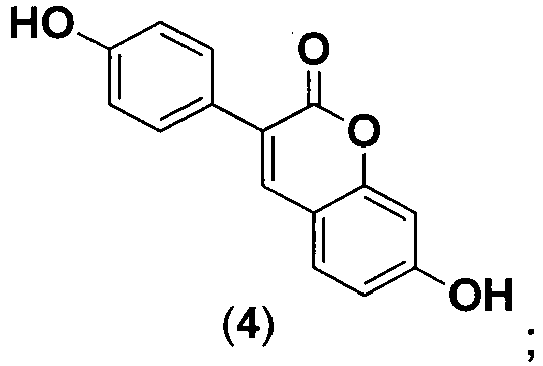 (c) hydrogenating 7-hydroxy-3-(4-hydroxyphenyl)-2H-chromen-2-one of formula (4) to provide a mixture of 7-hydroxy-3-(4-hydroxyphenyl)-2H-chroman-2-one of formula (5) and methyl 3-(2,4-dihydroxyphenyl)-2-(4-hydroxyphenyl)propanoate of formula (6)
 (d) hydrolyzing the mixture of 7-hydroxy-3-(4-hydroxyphenyl)-2H-chroman-2-one of formula (5) and methyl 3-(2,4-dihydroxyphenyl)-2-(4-hydroxyphenyl)propanoate of formula (6) with a base to provide 3-(2,4-dihydroxyphenyl)-2-(4-hydroxyphenyl)-propanoic acid of formula (7)
 (e) resolving 3-(2,4-dihydroxyphenyl)-2-(4-hydroxyphenyl)propanoic acid of formula (7) to its corresponding (S)-isomer (7A) via diastereomeric salt formation with a chiral amine
 (f) reducing (S)-3-(2,4-dihydroxyphenyl)-2-(4-hydroxyphenyl)propanoic acid of formula (7A) to provide (S)-4-(3-hydroxy-2-(4-hydroxyphenyl)propyl)benzene-1,3-diol of formula (9)
 (g) cyclizing (S)-4-(3-hydroxy-2-(4-hydroxyphenyl)propyl)benzene-1,3-diol of formula (9) to provide (S)-equol (1).
 - The process of claim 1, wherein the acid anhydride of step (a) is acetic anhydride.
- The process of claim 1, wherein the base of step (a) is diisopropylethylamine.
- The process of claim 1, wherein the base of step (b) is lithium hydroxide.
- The process of claim 1, wherein hydrogenation of step (c) is performed in presence of a heterogeneous catalyst.
- The process of claim 5, wherein the heterogeneous catalyst is palladium on charcoal.
- The process of claim 1, wherein the base of step (d) is potassium hydroxide.
- The process of claim 1, wherein the chiral amine of step (e) is selected from a group of N-tert-butylbenzylamine, N-benzylmethylamine, α-methylbenzylamine, α-ethyl-benzylamine, 2-amino-3-methylbutane, N-octyl-D-glucamine, L-prolinol, cinchonidine, cinchonine, N-boc-3-amino piperidine and 3-amino piperidine.
- The process of claim 1, wherein the reducing agent of step (f) is borane and dimethyl sulfide complex (BH3-DMS).
- A compound, 3-(2,4-dihydroxyphenyl)-2-(4-hydroxyphenyl)propanoic acid of formula (7)

- A compound, (S)-3-(2,4-dihydroxyphenyl)-2-(4-hydroxyphenyl)propanoic acid of formula (7A)

- Use of (S)-3-(2,4-dihydroxyphenyl)-2-(4-hydroxyphenyl)propanoic acid of formula (7A) for the preparation of (S)-equol (1).
- A compound, (S)-α-methylbenzylamine salt of (S)-3-(2,4-dihydroxyphenyl)-2-(4-hydroxyphenyl)propanoic acid of formula (8)

Applications Claiming Priority (2)
| Application Number | Priority Date | Filing Date | Title |
|---|---|---|---|
| IN1197CH2012 | 2012-03-28 | ||
| PCT/IB2013/052428 WO2013144857A1 (en) | 2012-03-28 | 2013-03-27 | Improved process for producing (s)-equol |
Publications (3)
| Publication Number | Publication Date |
|---|---|
| EP2831054A1 EP2831054A1 (en) | 2015-02-04 |
| EP2831054A4 EP2831054A4 (en) | 2015-09-23 |
| EP2831054B1 true EP2831054B1 (en) | 2016-11-30 |
Family
ID=49258342
Family Applications (1)
| Application Number | Title | Priority Date | Filing Date |
|---|---|---|---|
| EP13767847.0A Not-in-force EP2831054B1 (en) | 2012-03-28 | 2013-03-27 | Improved process for producing (s)-equol |
Country Status (5)
| Country | Link |
|---|---|
| US (1) | US9051291B2 (en) |
| EP (1) | EP2831054B1 (en) |
| JP (1) | JP6113826B2 (en) |
| ES (1) | ES2616066T3 (en) |
| WO (1) | WO2013144857A1 (en) |
Families Citing this family (1)
| Publication number | Priority date | Publication date | Assignee | Title |
|---|---|---|---|---|
| CN114196226B (en) * | 2021-11-21 | 2024-02-13 | 大连理工大学 | A type of coumarin dye, a composite initiator that can be used for ultrasonic curing, and its preparation method and application |
Family Cites Families (3)
| Publication number | Priority date | Publication date | Assignee | Title |
|---|---|---|---|---|
| GB0302465D0 (en) | 2003-02-04 | 2003-03-05 | Univ St Andrews | "13C-labelled synthesis" |
| KR100565423B1 (en) * | 2003-10-20 | 2006-03-30 | 빅 바이오 주식회사 | Method for preparing isoflavone derivatives or isoflavone derivatives |
| EP2154133A1 (en) | 2008-08-14 | 2010-02-17 | System Biologie AG | Equol synthesis |
-
2013
- 2013-03-27 EP EP13767847.0A patent/EP2831054B1/en not_active Not-in-force
- 2013-03-27 WO PCT/IB2013/052428 patent/WO2013144857A1/en not_active Ceased
- 2013-03-27 JP JP2015502526A patent/JP6113826B2/en not_active Expired - Fee Related
- 2013-03-27 ES ES13767847.0T patent/ES2616066T3/en active Active
- 2013-03-27 US US14/384,625 patent/US9051291B2/en not_active Expired - Fee Related
Also Published As
| Publication number | Publication date |
|---|---|
| EP2831054A1 (en) | 2015-02-04 |
| JP2015516384A (en) | 2015-06-11 |
| JP6113826B2 (en) | 2017-04-12 |
| US20150057456A1 (en) | 2015-02-26 |
| US9051291B2 (en) | 2015-06-09 |
| WO2013144857A1 (en) | 2013-10-03 |
| ES2616066T3 (en) | 2017-06-09 |
| EP2831054A4 (en) | 2015-09-23 |
Similar Documents
| Publication | Publication Date | Title |
|---|---|---|
| JP5149238B2 (en) | Process for producing benzoxazine derivative and its intermediate | |
| AU2007304419B2 (en) | Process for preparing Nebivolol | |
| EA023266B1 (en) | Synthesis routes to 2(s),4(s),5(s),7(s)-2,7-dialkyl-4-hydroxy-5-amino-8-aryl-octanoyl amides | |
| AU2006346311B2 (en) | A process for preparation of racemic Nebivolol | |
| EP1803715A1 (en) | A process for preparation of racemic nebivolol | |
| KR101797799B1 (en) | Process for the preparation of nebivolol | |
| EP3199516B1 (en) | Process for the preparation of metaraminol | |
| WO2008117305A2 (en) | A novel process for preparing pregabalin and its acid addition salts | |
| JP5744738B2 (en) | Preparation method of nebivolol | |
| US9051291B2 (en) | Process for producing (S)-equol | |
| SI21701A (en) | Intermediates in producing phenoxyacetic acid derivatives and method of using the same | |
| WO2016189542A1 (en) | Novel process for the preparation of sapropterin dihydrochloride and its key intermediate, l-biopterin | |
| MX2012009920A (en) | Process for the obtention of praziquantel enantiomers and 4' ûhydroxylated derivatives thereof. | |
| WO2014181362A1 (en) | A process for the preparation of 3-aryl-2-hydroxy propanoic acid compounds | |
| JP2010037206A (en) | Method for producing optically active o-methylserine or its salt | |
| Jiang et al. | A highly enantioselective synthesis of (R)-salmeterol using a chiral auxiliary | |
| JPH08269024A (en) | Production of (-)3(s)-methylbenzoxazine derivative | |
| ME00154B (en) | Succinate and malonate salt of trans-4-(ir,3s)-6-chloro-3-phenylindan-1-yl)-1,2,2-trimethylpiperazine and the use as a medicament | |
| EP0214905A2 (en) | Tetrahydroisoquinoline derivatives | |
| CN119306608A (en) | A chiral synthesis method for milobarlin intermediate | |
| KR100524145B1 (en) | Preparation methods of high purity chiral 3-hydroxy-γ-butyrolactone | |
| WO2019207517A1 (en) | Process for preparation of ((3r,11br)-1,3,4,6,7,11b-hexahydro-9,10-di(methoxy-d 3)-3-(2-methylpropyl)-2h-benzo[a]quinolizin-2-one | |
| JP2005008530A (en) | Method for producing hexahydrofurofuranol derivative and intermediate therefor and method for producing the same | |
| JPH04198153A (en) | Optically active compound, its production and production of liquid crystal compound |
Legal Events
| Date | Code | Title | Description |
|---|---|---|---|
| PUAI | Public reference made under article 153(3) epc to a published international application that has entered the european phase |
Free format text: ORIGINAL CODE: 0009012 |
|
| 17P | Request for examination filed |
Effective date: 20141016 |
|
| AK | Designated contracting states |
Kind code of ref document: A1 Designated state(s): AL AT BE BG CH CY CZ DE DK EE ES FI FR GB GR HR HU IE IS IT LI LT LU LV MC MK MT NL NO PL PT RO RS SE SI SK SM TR |
|
| AX | Request for extension of the european patent |
Extension state: BA ME |
|
| DAX | Request for extension of the european patent (deleted) | ||
| RA4 | Supplementary search report drawn up and despatched (corrected) |
Effective date: 20150824 |
|
| RIC1 | Information provided on ipc code assigned before grant |
Ipc: C07C 57/38 20060101ALI20150818BHEP Ipc: C07D 311/76 20060101AFI20150818BHEP Ipc: C07C 39/15 20060101ALI20150818BHEP |
|
| GRAP | Despatch of communication of intention to grant a patent |
Free format text: ORIGINAL CODE: EPIDOSNIGR1 |
|
| INTG | Intention to grant announced |
Effective date: 20160616 |
|
| GRAS | Grant fee paid |
Free format text: ORIGINAL CODE: EPIDOSNIGR3 |
|
| GRAA | (expected) grant |
Free format text: ORIGINAL CODE: 0009210 |
|
| AK | Designated contracting states |
Kind code of ref document: B1 Designated state(s): AL AT BE BG CH CY CZ DE DK EE ES FI FR GB GR HR HU IE IS IT LI LT LU LV MC MK MT NL NO PL PT RO RS SE SI SK SM TR |
|
| REG | Reference to a national code |
Ref country code: CH Ref legal event code: EP Ref country code: GB Ref legal event code: FG4D |
|
| REG | Reference to a national code |
Ref country code: AT Ref legal event code: REF Ref document number: 849670 Country of ref document: AT Kind code of ref document: T Effective date: 20161215 |
|
| REG | Reference to a national code |
Ref country code: IE Ref legal event code: FG4D |
|
| REG | Reference to a national code |
Ref country code: DE Ref legal event code: R096 Ref document number: 602013014805 Country of ref document: DE |
|
| PG25 | Lapsed in a contracting state [announced via postgrant information from national office to epo] |
Ref country code: LV Free format text: LAPSE BECAUSE OF FAILURE TO SUBMIT A TRANSLATION OF THE DESCRIPTION OR TO PAY THE FEE WITHIN THE PRESCRIBED TIME-LIMIT Effective date: 20161130 |
|
| REG | Reference to a national code |
Ref country code: FR Ref legal event code: PLFP Year of fee payment: 5 |
|
| REG | Reference to a national code |
Ref country code: LT Ref legal event code: MG4D |
|
| REG | Reference to a national code |
Ref country code: NL Ref legal event code: MP Effective date: 20161130 |
|
| REG | Reference to a national code |
Ref country code: AT Ref legal event code: MK05 Ref document number: 849670 Country of ref document: AT Kind code of ref document: T Effective date: 20161130 |
|
| PG25 | Lapsed in a contracting state [announced via postgrant information from national office to epo] |
Ref country code: GR Free format text: LAPSE BECAUSE OF FAILURE TO SUBMIT A TRANSLATION OF THE DESCRIPTION OR TO PAY THE FEE WITHIN THE PRESCRIBED TIME-LIMIT Effective date: 20170301 Ref country code: LT Free format text: LAPSE BECAUSE OF FAILURE TO SUBMIT A TRANSLATION OF THE DESCRIPTION OR TO PAY THE FEE WITHIN THE PRESCRIBED TIME-LIMIT Effective date: 20161130 Ref country code: SE Free format text: LAPSE BECAUSE OF FAILURE TO SUBMIT A TRANSLATION OF THE DESCRIPTION OR TO PAY THE FEE WITHIN THE PRESCRIBED TIME-LIMIT Effective date: 20161130 Ref country code: NO Free format text: LAPSE BECAUSE OF FAILURE TO SUBMIT A TRANSLATION OF THE DESCRIPTION OR TO PAY THE FEE WITHIN THE PRESCRIBED TIME-LIMIT Effective date: 20170228 |
|
| PG25 | Lapsed in a contracting state [announced via postgrant information from national office to epo] |
Ref country code: RS Free format text: LAPSE BECAUSE OF FAILURE TO SUBMIT A TRANSLATION OF THE DESCRIPTION OR TO PAY THE FEE WITHIN THE PRESCRIBED TIME-LIMIT Effective date: 20161130 Ref country code: PL Free format text: LAPSE BECAUSE OF FAILURE TO SUBMIT A TRANSLATION OF THE DESCRIPTION OR TO PAY THE FEE WITHIN THE PRESCRIBED TIME-LIMIT Effective date: 20161130 Ref country code: HR Free format text: LAPSE BECAUSE OF FAILURE TO SUBMIT A TRANSLATION OF THE DESCRIPTION OR TO PAY THE FEE WITHIN THE PRESCRIBED TIME-LIMIT Effective date: 20161130 Ref country code: PT Free format text: LAPSE BECAUSE OF FAILURE TO SUBMIT A TRANSLATION OF THE DESCRIPTION OR TO PAY THE FEE WITHIN THE PRESCRIBED TIME-LIMIT Effective date: 20170330 Ref country code: FI Free format text: LAPSE BECAUSE OF FAILURE TO SUBMIT A TRANSLATION OF THE DESCRIPTION OR TO PAY THE FEE WITHIN THE PRESCRIBED TIME-LIMIT Effective date: 20161130 Ref country code: AT Free format text: LAPSE BECAUSE OF FAILURE TO SUBMIT A TRANSLATION OF THE DESCRIPTION OR TO PAY THE FEE WITHIN THE PRESCRIBED TIME-LIMIT Effective date: 20161130 |
|
| REG | Reference to a national code |
Ref country code: ES Ref legal event code: FG2A Ref document number: 2616066 Country of ref document: ES Kind code of ref document: T3 Effective date: 20170609 |
|
| PG25 | Lapsed in a contracting state [announced via postgrant information from national office to epo] |
Ref country code: NL Free format text: LAPSE BECAUSE OF FAILURE TO SUBMIT A TRANSLATION OF THE DESCRIPTION OR TO PAY THE FEE WITHIN THE PRESCRIBED TIME-LIMIT Effective date: 20161130 |
|
| PG25 | Lapsed in a contracting state [announced via postgrant information from national office to epo] |
Ref country code: SK Free format text: LAPSE BECAUSE OF FAILURE TO SUBMIT A TRANSLATION OF THE DESCRIPTION OR TO PAY THE FEE WITHIN THE PRESCRIBED TIME-LIMIT Effective date: 20161130 Ref country code: EE Free format text: LAPSE BECAUSE OF FAILURE TO SUBMIT A TRANSLATION OF THE DESCRIPTION OR TO PAY THE FEE WITHIN THE PRESCRIBED TIME-LIMIT Effective date: 20161130 Ref country code: CZ Free format text: LAPSE BECAUSE OF FAILURE TO SUBMIT A TRANSLATION OF THE DESCRIPTION OR TO PAY THE FEE WITHIN THE PRESCRIBED TIME-LIMIT Effective date: 20161130 Ref country code: DK Free format text: LAPSE BECAUSE OF FAILURE TO SUBMIT A TRANSLATION OF THE DESCRIPTION OR TO PAY THE FEE WITHIN THE PRESCRIBED TIME-LIMIT Effective date: 20161130 Ref country code: RO Free format text: LAPSE BECAUSE OF FAILURE TO SUBMIT A TRANSLATION OF THE DESCRIPTION OR TO PAY THE FEE WITHIN THE PRESCRIBED TIME-LIMIT Effective date: 20161130 |
|
| PG25 | Lapsed in a contracting state [announced via postgrant information from national office to epo] |
Ref country code: SM Free format text: LAPSE BECAUSE OF FAILURE TO SUBMIT A TRANSLATION OF THE DESCRIPTION OR TO PAY THE FEE WITHIN THE PRESCRIBED TIME-LIMIT Effective date: 20161130 Ref country code: BE Free format text: LAPSE BECAUSE OF FAILURE TO SUBMIT A TRANSLATION OF THE DESCRIPTION OR TO PAY THE FEE WITHIN THE PRESCRIBED TIME-LIMIT Effective date: 20161130 Ref country code: BG Free format text: LAPSE BECAUSE OF FAILURE TO SUBMIT A TRANSLATION OF THE DESCRIPTION OR TO PAY THE FEE WITHIN THE PRESCRIBED TIME-LIMIT Effective date: 20170228 |
|
| REG | Reference to a national code |
Ref country code: DE Ref legal event code: R097 Ref document number: 602013014805 Country of ref document: DE |
|
| REG | Reference to a national code |
Ref country code: CH Ref legal event code: NV Representative=s name: BOHEST AG, CH |
|
| PLBE | No opposition filed within time limit |
Free format text: ORIGINAL CODE: 0009261 |
|
| STAA | Information on the status of an ep patent application or granted ep patent |
Free format text: STATUS: NO OPPOSITION FILED WITHIN TIME LIMIT |
|
| 26N | No opposition filed |
Effective date: 20170831 |
|
| PG25 | Lapsed in a contracting state [announced via postgrant information from national office to epo] |
Ref country code: SI Free format text: LAPSE BECAUSE OF FAILURE TO SUBMIT A TRANSLATION OF THE DESCRIPTION OR TO PAY THE FEE WITHIN THE PRESCRIBED TIME-LIMIT Effective date: 20161130 Ref country code: MC Free format text: LAPSE BECAUSE OF FAILURE TO SUBMIT A TRANSLATION OF THE DESCRIPTION OR TO PAY THE FEE WITHIN THE PRESCRIBED TIME-LIMIT Effective date: 20161130 |
|
| REG | Reference to a national code |
Ref country code: IE Ref legal event code: MM4A |
|
| PG25 | Lapsed in a contracting state [announced via postgrant information from national office to epo] |
Ref country code: LU Free format text: LAPSE BECAUSE OF NON-PAYMENT OF DUE FEES Effective date: 20170327 |
|
| PG25 | Lapsed in a contracting state [announced via postgrant information from national office to epo] |
Ref country code: IE Free format text: LAPSE BECAUSE OF NON-PAYMENT OF DUE FEES Effective date: 20170327 |
|
| REG | Reference to a national code |
Ref country code: FR Ref legal event code: PLFP Year of fee payment: 6 |
|
| PG25 | Lapsed in a contracting state [announced via postgrant information from national office to epo] |
Ref country code: MT Free format text: LAPSE BECAUSE OF NON-PAYMENT OF DUE FEES Effective date: 20170327 |
|
| PG25 | Lapsed in a contracting state [announced via postgrant information from national office to epo] |
Ref country code: HU Free format text: LAPSE BECAUSE OF FAILURE TO SUBMIT A TRANSLATION OF THE DESCRIPTION OR TO PAY THE FEE WITHIN THE PRESCRIBED TIME-LIMIT; INVALID AB INITIO Effective date: 20130327 |
|
| PG25 | Lapsed in a contracting state [announced via postgrant information from national office to epo] |
Ref country code: CY Free format text: LAPSE BECAUSE OF FAILURE TO SUBMIT A TRANSLATION OF THE DESCRIPTION OR TO PAY THE FEE WITHIN THE PRESCRIBED TIME-LIMIT Effective date: 20161130 |
|
| PG25 | Lapsed in a contracting state [announced via postgrant information from national office to epo] |
Ref country code: MK Free format text: LAPSE BECAUSE OF FAILURE TO SUBMIT A TRANSLATION OF THE DESCRIPTION OR TO PAY THE FEE WITHIN THE PRESCRIBED TIME-LIMIT Effective date: 20161130 |
|
| PG25 | Lapsed in a contracting state [announced via postgrant information from national office to epo] |
Ref country code: TR Free format text: LAPSE BECAUSE OF FAILURE TO SUBMIT A TRANSLATION OF THE DESCRIPTION OR TO PAY THE FEE WITHIN THE PRESCRIBED TIME-LIMIT Effective date: 20161130 |
|
| PG25 | Lapsed in a contracting state [announced via postgrant information from national office to epo] |
Ref country code: AL Free format text: LAPSE BECAUSE OF FAILURE TO SUBMIT A TRANSLATION OF THE DESCRIPTION OR TO PAY THE FEE WITHIN THE PRESCRIBED TIME-LIMIT Effective date: 20161130 Ref country code: IS Free format text: LAPSE BECAUSE OF FAILURE TO SUBMIT A TRANSLATION OF THE DESCRIPTION OR TO PAY THE FEE WITHIN THE PRESCRIBED TIME-LIMIT Effective date: 20170330 |
|
| REG | Reference to a national code |
Ref country code: DE Ref legal event code: R081 Ref document number: 602013014805 Country of ref document: DE Owner name: AURIGENE PHARMACEUTICAL SERVICES LTD., BANGALO, IN Free format text: FORMER OWNER: DR. REDDY'S LABORATORIES LTD., HYDERABAD, IN |
|
| REG | Reference to a national code |
Ref country code: GB Ref legal event code: 732E Free format text: REGISTERED BETWEEN 20220331 AND 20220406 |
|
| PGFP | Annual fee paid to national office [announced via postgrant information from national office to epo] |
Ref country code: GB Payment date: 20220324 Year of fee payment: 10 Ref country code: DE Payment date: 20220315 Year of fee payment: 10 Ref country code: CH Payment date: 20220330 Year of fee payment: 10 |
|
| PGFP | Annual fee paid to national office [announced via postgrant information from national office to epo] |
Ref country code: FR Payment date: 20220324 Year of fee payment: 10 |
|
| REG | Reference to a national code |
Ref country code: ES Ref legal event code: PC2A Owner name: AURIGENE PHARMACEUTICAL SERVICES LIMITED Effective date: 20220607 |
|
| PGFP | Annual fee paid to national office [announced via postgrant information from national office to epo] |
Ref country code: IT Payment date: 20220331 Year of fee payment: 10 Ref country code: ES Payment date: 20220407 Year of fee payment: 10 |
|
| REG | Reference to a national code |
Ref country code: DE Ref legal event code: R119 Ref document number: 602013014805 Country of ref document: DE |
|
| REG | Reference to a national code |
Ref country code: CH Ref legal event code: PL |
|
| GBPC | Gb: european patent ceased through non-payment of renewal fee |
Effective date: 20230327 |
|
| PG25 | Lapsed in a contracting state [announced via postgrant information from national office to epo] |
Ref country code: GB Free format text: LAPSE BECAUSE OF NON-PAYMENT OF DUE FEES Effective date: 20230327 |
|
| PG25 | Lapsed in a contracting state [announced via postgrant information from national office to epo] |
Ref country code: LI Free format text: LAPSE BECAUSE OF NON-PAYMENT OF DUE FEES Effective date: 20230331 Ref country code: GB Free format text: LAPSE BECAUSE OF NON-PAYMENT OF DUE FEES Effective date: 20230327 Ref country code: FR Free format text: LAPSE BECAUSE OF NON-PAYMENT OF DUE FEES Effective date: 20230331 Ref country code: DE Free format text: LAPSE BECAUSE OF NON-PAYMENT OF DUE FEES Effective date: 20231003 Ref country code: CH Free format text: LAPSE BECAUSE OF NON-PAYMENT OF DUE FEES Effective date: 20230331 |
|
| PG25 | Lapsed in a contracting state [announced via postgrant information from national office to epo] |
Ref country code: IT Free format text: LAPSE BECAUSE OF NON-PAYMENT OF DUE FEES Effective date: 20230327 |
|
| REG | Reference to a national code |
Ref country code: ES Ref legal event code: FD2A Effective date: 20240529 |
|
| PG25 | Lapsed in a contracting state [announced via postgrant information from national office to epo] |
Ref country code: ES Free format text: LAPSE BECAUSE OF NON-PAYMENT OF DUE FEES Effective date: 20230328 |
|
| PG25 | Lapsed in a contracting state [announced via postgrant information from national office to epo] |
Ref country code: ES Free format text: LAPSE BECAUSE OF NON-PAYMENT OF DUE FEES Effective date: 20230328 |