EP2829293A1 - Injection device including a controlled-flow needle - Google Patents
Injection device including a controlled-flow needle Download PDFInfo
- Publication number
- EP2829293A1 EP2829293A1 EP12867440.5A EP12867440A EP2829293A1 EP 2829293 A1 EP2829293 A1 EP 2829293A1 EP 12867440 A EP12867440 A EP 12867440A EP 2829293 A1 EP2829293 A1 EP 2829293A1
- Authority
- EP
- European Patent Office
- Prior art keywords
- needle
- aspiration
- administration
- line
- syringe
- Prior art date
- Legal status (The legal status is an assumption and is not a legal conclusion. Google has not performed a legal analysis and makes no representation as to the accuracy of the status listed.)
- Withdrawn
Links
Images



Classifications
-
- A—HUMAN NECESSITIES
- A61—MEDICAL OR VETERINARY SCIENCE; HYGIENE
- A61M—DEVICES FOR INTRODUCING MEDIA INTO, OR ONTO, THE BODY; DEVICES FOR TRANSDUCING BODY MEDIA OR FOR TAKING MEDIA FROM THE BODY; DEVICES FOR PRODUCING OR ENDING SLEEP OR STUPOR
- A61M5/00—Devices for bringing media into the body in a subcutaneous, intra-vascular or intramuscular way; Accessories therefor, e.g. filling or cleaning devices, arm rests
- A61M5/14—Infusion devices, e.g. infusing by gravity; Blood infusion; Accessories therefor
- A61M5/158—Needles for infusions; Accessories therefor, e.g. for inserting infusion needles, or for holding them on the body
-
- A—HUMAN NECESSITIES
- A61—MEDICAL OR VETERINARY SCIENCE; HYGIENE
- A61M—DEVICES FOR INTRODUCING MEDIA INTO, OR ONTO, THE BODY; DEVICES FOR TRANSDUCING BODY MEDIA OR FOR TAKING MEDIA FROM THE BODY; DEVICES FOR PRODUCING OR ENDING SLEEP OR STUPOR
- A61M1/00—Suction or pumping devices for medical purposes; Devices for carrying-off, for treatment of, or for carrying-over, body-liquids; Drainage systems
- A61M1/71—Suction drainage systems
- A61M1/74—Suction control
- A61M1/743—Suction control by changing the cross-section of the line, e.g. flow regulating valves
-
- A—HUMAN NECESSITIES
- A61—MEDICAL OR VETERINARY SCIENCE; HYGIENE
- A61M—DEVICES FOR INTRODUCING MEDIA INTO, OR ONTO, THE BODY; DEVICES FOR TRANSDUCING BODY MEDIA OR FOR TAKING MEDIA FROM THE BODY; DEVICES FOR PRODUCING OR ENDING SLEEP OR STUPOR
- A61M39/00—Tubes, tube connectors, tube couplings, valves, access sites or the like, specially adapted for medical use
- A61M39/22—Valves or arrangement of valves
-
- A—HUMAN NECESSITIES
- A61—MEDICAL OR VETERINARY SCIENCE; HYGIENE
- A61M—DEVICES FOR INTRODUCING MEDIA INTO, OR ONTO, THE BODY; DEVICES FOR TRANSDUCING BODY MEDIA OR FOR TAKING MEDIA FROM THE BODY; DEVICES FOR PRODUCING OR ENDING SLEEP OR STUPOR
- A61M5/00—Devices for bringing media into the body in a subcutaneous, intra-vascular or intramuscular way; Accessories therefor, e.g. filling or cleaning devices, arm rests
- A61M5/14—Infusion devices, e.g. infusing by gravity; Blood infusion; Accessories therefor
- A61M5/142—Pressure infusion, e.g. using pumps
- A61M5/14212—Pumping with an aspiration and an expulsion action
- A61M5/14228—Pumping with an aspiration and an expulsion action with linear peristaltic action, i.e. comprising at least three pressurising members or a helical member
-
- A—HUMAN NECESSITIES
- A61—MEDICAL OR VETERINARY SCIENCE; HYGIENE
- A61M—DEVICES FOR INTRODUCING MEDIA INTO, OR ONTO, THE BODY; DEVICES FOR TRANSDUCING BODY MEDIA OR FOR TAKING MEDIA FROM THE BODY; DEVICES FOR PRODUCING OR ENDING SLEEP OR STUPOR
- A61M39/00—Tubes, tube connectors, tube couplings, valves, access sites or the like, specially adapted for medical use
- A61M39/22—Valves or arrangement of valves
- A61M39/223—Multiway valves
- A61M2039/224—Multiway valves of the slide-valve type
Definitions
- the object of the invention is a needle/cannula which allows control of fluid flow therethrough and in the direction thereof enabling, among other applications, the performance of nerve blocks through the administration of local anaesthetics (LA) without need for an assistant, whether using neurostimulation or ultrasound as the nerve location or identification method.
- LA local anaesthetics
- the performance of regional anaesthesia is a first-line anaesthesia option.
- the object of any regional blocking technique is to deposit the sufficient volume and concentration of the local anaesthetic as close as possible to the nerves to be blocked. Blocking of peripheral or plexus nerves is used in surgical anaesthesia and to provide adequate postoperative analgesia to the patient with minimum side effects, as well as in the treatment of various chronological pathologies.
- the election of a certain nerve location technique will depend on personal preference, the anaesthesiologist's experience and the possibilities of the environment in which it is performed and of the patients themselves.
- peripheral nerve stimulator or neurostimulator is a current nerve location and identification alternative which has displaced other direct classical techniques, such as parasthesias, and indirect techniques, such as "clicks".
- This method aims to locate the motor component of one or several peripheral nerves through the administration of a continuous current, that stimulates the nerve by means of a Teflon-coated needle, which acts as a coating of the needle cylinder that prevents dispersion of the electric current, connected to an anode (negative), the frequency (in Hz), current (in mA) and duration (in msec) of which, according to the device, are controlled by the operator.
- the nerve to be stimulated remains interposed between the needle and the electrode. It is a highly widespread technique that necessarily requires the presence of an assistant for execution thereof. When the needle approximates the nerve, muscular responses are produced that the anaesthesiologist must be aware of for that block in particular, consequently performing injection of LA with the assistant's aid.
- the dynamism and flexibility of the ultrasound enables the nerve path to be traced from its origin to the distal ends thereof. This allows the plexuses and nerves to be located and blocked in any point along their path, adapting to each specific situation and personalising the technique for each specific patient.
- ultrasound offers a significant number of advantages that convert it into the perfect technique for application in regional anaesthesia, as:
- the object of the controlled-flow needle is to facilitate the performance of nerve blocks through the administration of local anaesthetics without the aid of an assistant.
- the controlled-flow needle essentially includes a manual flow controller in the needle connector which allows both the administration of the local anaesthetic and negative suction by means of two independent lines in the needle itself, controlled by the anaesthesiologist using the hand that performs the puncture.
- the needle is supplied in the form of a set or kit comprising said needle, the suction and/or administration controller, a line for administering local anaesthetic, a suction line, a vacuum syringe, a 20 ml pressurised injection syringe, with or without LA, and an inner lining for housing catheters.
- the needle advocated by the present invention facilitates and enhances the performance of nerve blocks, with total synchronisation between the progress of the needle and the moment in which the LA is administered, as it is all performed by the same person, thereby adapting the distribution around the nerve to be blocked and reducing complications. Likewise, this also favours greater efficiency and dynamism in the performance of local and regional techniques.
- Suction must be performed before depositing a volume of local anaesthetic in any area as it considerably reduces the possibility of intravascular injection.
- the purpose of the suction is to determine whether the needle tip rests inside a blood vessel. Suction requires the generation of negative pressure that is transferred to the needle tip. Any trace of blood constitutes positive suction, in which case the LA must not be deposited.
- the needle object of the invention has a suction line which allows suction to be controlled by the anaesthesiologist performing the block, thereby providing a safety measure for the patient aimed at preventing possible complications, as well as a means for adapting the volume of LA injected by the administration line.
- the needle object of the present patent on including a structural element that manually controls the administration of LA by the anaesthesiologist in a standard nerve block needle, improves nerve block efficiency, facilitating execution thereof and involving a safer technique, i.e. with less possibility of errors.
- the use of the needle object of the invention could become a new actuation standard, improving the resources used, i.e. with greater efficiency.
- this device could have other applications in different areas whenever someone must suction/inject a substance through a needle and requires the aid of another person, as said aid is not required.
- the greatest advantage of the invention is independence with respect to an assistant.
- the device described is essentially manual, although there is a possibility of adaptations to electronic systems or mechanical modifications, always aimed at controlling flow through a needle.
- the possibility of taking samples (suction) using the same needle could be used in substance infusion systems in accordance with their plasmatic concentrations (open-loop TCI or maintenance of blood glucose levels, currently under development) or any type of medical suction and irrigation application, for example, in ophthalmological applications.
- a new field of application is opened, for example in ophthalmology, where a surgeon inserts a coaxial phacoemulsification probe, which consists of a hollow cylindrical tip surrounded by an irrigation hose, in such a manner that it remains as a tube (suction) in the interior of another tube (irrigation).
- Phacoemulsification systems normally regulate the control panel disposed at the front of the equipment and the programmed system functions are controlled by means of a pedal.
- the device object of this patent could enable the implementation of manually governed phacoemulsification systems. Logically, the precision and rigour of the operator's hand would be superior to those of his/her foot, which could lead to the substitution of pedals.
- the present invention proposes a controlled-flow needle that includes means for controlling fluid flow in the needle which allow, manually and at will by the dominant hand of the anaesthesiologist performing the nerve block, both the timing and volume required during the performance of the technique, obviating the need for a collaborator and thereby increasing the effectiveness, speed and safety of the procedure.
- the controlled-flow needle object of the present invention comprises, at least:
- the flow control element (10) is manual, mechanical and sliding. This controller has three positions: neutral (13), suction (11) and administration (12).
- the neutral position (13) does not administer or suction, and is constituted at the starting point.
- the suction position (11) is the position where the independent suction line (5) remains open and is also the position to which the flow controller (10) will return, provided that the fluid administration position (12) does not remain activated.
- the flow controller (10) comprises two particular embodiments:
- the dotted line represents a resistance (14) that must be overcome from the neutral position (13) before moving to the suction position (11).
- This resistance (14) is materialised in a ring or protuberance that hampers sliding (option (a)) or pressure (option (b)). Therefore, when the pressure ceases, it will never move to the neutral position unless purposefully actuated, for example at the start of the procedure or priming.
- the use of the needle object of the present invention begins with a first stage of preparation or priming, performed in the same manner as in the current state of the art. The purpose is to avoid the introduction of air bubbles which, in the case of ultrasound, also hampers the view of the images due to the opacity of the air for the ultrasound waves.
- the independent administration line (4) is connected to a pressurised syringe with the system defined and the independent suction line (5) is left open. Subsequently, the controller is moved to the administration position (12) until the local anaesthetic flows out of the needle tip (1). At that moment the administration is suspended and controller returns to the neutral position (13). At that moment, connection can be made to the independent administration line (5) and the device is ready for use.
- the anaesthesiologist can, in a self-sufficient manner and without need for an external collaborator, perform the technique correctly and safely.
- the controller is moved to the first working position, i.e. to the suction position (11), in such a manner that what happens to the needle tip will be under permanent suction conditions.
- the needle tip (1) is not intravascular, preventing systemic toxicities or damage to any vascular structure during the progress of the needle (1). This implies an improvement in whatever technique is used to detect the nerve in question during this phase.
- the anaesthesiologist using the hand that performs the puncture, will proceed to administer or dissect the tissues with the local anaesthetic, surrounding and thereby adapting the distribution of the anaesthetic around the nerve to be blocked.
- the combination of the progress of the needle and the displacement of the tissues by the injection of local anaesthetic is significantly improved by the invention, as it is the anaesthesiologist who controls the time and volume of the anaesthetic he/she administers in a dynamic and synchronised manner, facilitating the positioning of the needle in the exact location and avoiding obstacles by means of careful hydrodissection.
- the level of sensitivity is also better than if performed using a pedal-type system or with an assistant, as the controller element (10) is held in the anaesthesiologist's dominant hand and index finger thereof, on the same progressing needle (1).
- the response time which is also important, is immediate in the invention with respect to other remotely controlled drug pumps, as the length of the line mitigates the response to changes in pressure and the volume administered is modified.
Landscapes
- Health & Medical Sciences (AREA)
- Heart & Thoracic Surgery (AREA)
- Hematology (AREA)
- Engineering & Computer Science (AREA)
- Anesthesiology (AREA)
- Biomedical Technology (AREA)
- Life Sciences & Earth Sciences (AREA)
- Animal Behavior & Ethology (AREA)
- General Health & Medical Sciences (AREA)
- Public Health (AREA)
- Veterinary Medicine (AREA)
- Vascular Medicine (AREA)
- Pulmonology (AREA)
- Infusion, Injection, And Reservoir Apparatuses (AREA)
Abstract
Description
- The object of the invention is a needle/cannula which allows control of fluid flow therethrough and in the direction thereof enabling, among other applications, the performance of nerve blocks through the administration of local anaesthetics (LA) without need for an assistant, whether using neurostimulation or ultrasound as the nerve location or identification method.
- The performance of regional anaesthesia is a first-line anaesthesia option. The object of any regional blocking technique is to deposit the sufficient volume and concentration of the local anaesthetic as close as possible to the nerves to be blocked. Blocking of peripheral or plexus nerves is used in surgical anaesthesia and to provide adequate postoperative analgesia to the patient with minimum side effects, as well as in the treatment of various chronological pathologies.
- The regional techniques known in the current state of the art are based on surface anatomy landmarks, i.e. on "blind" methods for locating nerve structures, aided by the appearance of "clicks", parasthesias, etc. At present, through advances in technology, more precise techniques such as neurostimulation and ultrasonography are applied, representing a current nerve location and identification alternative which has displaced classical techniques.
- In general, the election of a certain nerve location technique will depend on personal preference, the anaesthesiologist's experience and the possibilities of the environment in which it is performed and of the patients themselves.
- The use of a peripheral nerve stimulator or neurostimulator is a current nerve location and identification alternative which has displaced other direct classical techniques, such as parasthesias, and indirect techniques, such as "clicks". This method aims to locate the motor component of one or several peripheral nerves through the administration of a continuous current, that stimulates the nerve by means of a Teflon-coated needle, which acts as a coating of the needle cylinder that prevents dispersion of the electric current, connected to an anode (negative), the frequency (in Hz), current (in mA) and duration (in msec) of which, according to the device, are controlled by the operator. The nerve to be stimulated remains interposed between the needle and the electrode. It is a highly widespread technique that necessarily requires the presence of an assistant for execution thereof. When the needle approximates the nerve, muscular responses are produced that the anaesthesiologist must be aware of for that block in particular, consequently performing injection of LA with the assistant's aid.
- The use of ultrasound to perform regional blocks has dramatically changed this situation, reaching an increasingly ideal situation in the practice of nerve blocks. Now, not only is it possible to directly view the nerve structure to be blocked in order to deposit anaesthesia in the periphery thereof, but it is also possible to locate the adjacent structures to prevent complications such as vascular punctions or pneumothorax and, even more importantly, the distribution of the local anaesthetic around these nerve structures can be observed in real time and can be modified by repositioning the needle to achieve enhanced nerve block.
- The technical problem raised in this solution arises from the real location and anatomic integration in the patient of the image shown on the ultrasound screen, the need to be familiarised with ultrasound systems and for in-depth knowledge of the underlying anatomy.
- It is standard practice, during the performance of nerve block, for the anaesthesiologist to use both hands (ultrasound probe and needle), the dominant hand being that holding the needle. Once the place to deposit the LA has been chosen, the anaesthesiologist has the imperative need for an assistant or collaborator. The collaboration of an assistant who follows the anaesthesiologist's instructions with respect to the suction through a line connected to the needle and/or administration of small volumes of LA is required. This process, in addition to requiring close collaboration, is repeated throughout the performance of the technique and discrepancies and errors often occur in the administration of the local anaesthetic in terms of exact location, distribution and desired volumes.
- The dynamism and flexibility of the ultrasound enables the nerve path to be traced from its origin to the distal ends thereof. This allows the plexuses and nerves to be located and blocked in any point along their path, adapting to each specific situation and personalising the technique for each specific patient.
- Therefore, ultrasound offers a significant number of advantages that convert it into the perfect technique for application in regional anaesthesia, as:
- a) A direct view of the structures is obtained.
- b) The distribution of the local anaesthetic around the nerve is observed in real time.
- c) The total doses of the drug (local anaesthetic) are optimised.
- d) Safety is increased.
- e) The aforementioned indications advised against are obviated.
- f) It can be combined with other techniques such as neurostimulation.
- The technical problem of this technique is that during the performance of the nerve block the anaesthesiologist uses both hands, although this problem has been addressed through the use of drug pumps operated by the anaesthesiologist, this system has not become widespread and continues to be an unsolved problem.
- Therefore, a system that facilities or enhances the performance of the technique, improving its synchronisation and the administration of LA, is required.
- The object of the controlled-flow needle is to facilitate the performance of nerve blocks through the administration of local anaesthetics without the aid of an assistant.
- The controlled-flow needle essentially includes a manual flow controller in the needle connector which allows both the administration of the local anaesthetic and negative suction by means of two independent lines in the needle itself, controlled by the anaesthesiologist using the hand that performs the puncture.
- In general, the needle is supplied in the form of a set or kit comprising said needle, the suction and/or administration controller, a line for administering local anaesthetic, a suction line, a vacuum syringe, a 20 ml pressurised injection syringe, with or without LA, and an inner lining for housing catheters.
- The needle advocated by the present invention facilitates and enhances the performance of nerve blocks, with total synchronisation between the progress of the needle and the moment in which the LA is administered, as it is all performed by the same person, thereby adapting the distribution around the nerve to be blocked and reducing complications. Likewise, this also favours greater efficiency and dynamism in the performance of local and regional techniques.
- Given that most of the nerves blocked are surrounded by important blood vessels which are anatomically proximate to vital organs, complications during nerve blocks may be vascular, respiratory and neurological. These risks are minimised by adequate nerve location, adequate dosage of LA and successive suctions. Suction must be performed before depositing a volume of local anaesthetic in any area as it considerably reduces the possibility of intravascular injection. The purpose of the suction is to determine whether the needle tip rests inside a blood vessel. Suction requires the generation of negative pressure that is transferred to the needle tip. Any trace of blood constitutes positive suction, in which case the LA must not be deposited. The needle object of the invention has a suction line which allows suction to be controlled by the anaesthesiologist performing the block, thereby providing a safety measure for the patient aimed at preventing possible complications, as well as a means for adapting the volume of LA injected by the administration line.
- Therefore, the needle object of the present patent, on including a structural element that manually controls the administration of LA by the anaesthesiologist in a standard nerve block needle, improves nerve block efficiency, facilitating execution thereof and involving a safer technique, i.e. with less possibility of errors.
- The use of the needle object of the invention could become a new actuation standard, improving the resources used, i.e. with greater efficiency. Likewise, this device could have other applications in different areas whenever someone must suction/inject a substance through a needle and requires the aid of another person, as said aid is not required. In general, the greatest advantage of the invention is independence with respect to an assistant.
- The device described is essentially manual, although there is a possibility of adaptations to electronic systems or mechanical modifications, always aimed at controlling flow through a needle. In this regard, the possibility of taking samples (suction) using the same needle could be used in substance infusion systems in accordance with their plasmatic concentrations (open-loop TCI or maintenance of blood glucose levels, currently under development) or any type of medical suction and irrigation application, for example, in ophthalmological applications.
- A new field of application is opened, for example in ophthalmology, where a surgeon inserts a coaxial phacoemulsification probe, which consists of a hollow cylindrical tip surrounded by an irrigation hose, in such a manner that it remains as a tube (suction) in the interior of another tube (irrigation). Phacoemulsification systems normally regulate the control panel disposed at the front of the equipment and the programmed system functions are controlled by means of a pedal. The device object of this patent could enable the implementation of manually governed phacoemulsification systems. Logically, the precision and rigour of the operator's hand would be superior to those of his/her foot, which could lead to the substitution of pedals.
- Throughout the description and claims, the word "comprises" and its variants does not aim to exclude other technical characteristics, additives, components or steps. For persons skilled in the art, other objects, advantages and characteristics of the invention shall be inferred partially by the description and partially from the practice of the invention. The following examples and drawings have been provided for illustrative and non-limiting purposes. The present invention also covers all the possible combinations of the particular and preferred embodiments indicated herein.
- Following is a brief description of a series of drawings that help to better understand the invention and which are expressly related to an embodiment of said invention, presented as a non-limiting example thereof.
-
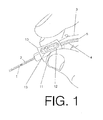
FIG. 1 shows an image of the controlled-flow needle with the three position possibilities: R1: "neutral", R2: Suction; R3: "administration". -
FIG. 2 shows an external diagram of the controller with the slidable pusher. -
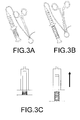
FIG. 3 shows the syringes with mechanical-type (spring) positive suction and pressure system. The line connected to the syringe is shown, displaying the effect of the suction (FIG. 3A ) and its loss (FIG. 3B). FIG. 3C shows the syringe with the reverse spring for connecting to the administration line (positive pressure). -
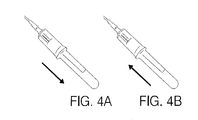
FIG. 4 shows the syringes with "vacutainer"® type positive suction and pressure system. (FIG. 4A and 4B ). -
FIG. 5 shows an internal diagram of the controller (FIG. 5A ) showing the controller sliding in the direction of the needle axis; and whereFIG. 5B and 5C show the controller in the suction and administration positions. -
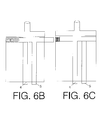
FIG. 6 shows an internal diagram of the controller (FIG. 6A ) showing the controller sliding transversely to the needle axis; and whereFIG. 6B and 6C show the controller in the suction and administration positions. - The present invention proposes a controlled-flow needle that includes means for controlling fluid flow in the needle which allow, manually and at will by the dominant hand of the anaesthesiologist performing the nerve block, both the timing and volume required during the performance of the technique, obviating the need for a collaborator and thereby increasing the effectiveness, speed and safety of the procedure.
- As can be observed in the attached figures, the controlled-flow needle object of the present invention comprises, at least:
- A needle or cannula (1) with standard coating for performing nerve blocks, with or without neurostimulation. In a particular embodiment a 21G calibre needle is preferably used.
- An outer sheath (2) over the needle (1) with a flange for sliding it upon administering the local anaesthetic and which also allows the passage of a catheter if necessary.
- A cable for electrostimulation (3).
- An independent line for administering local anaesthetic (4).
- An independent line for suction (5).
- A flow controller element (10) which moves from the suction position (11) to the administration position (12). It is indistinct whether the sliding is in the direction of the needle (1) axis or transversely thereto.
- A pressurised syringe with or without local anaesthetic (between 5 ml and 20 ml depending on the application).
- A mechanical suction syringe, i.e. having a spring in the plunger, or a "vacutainer"® type vacuum syringe.
- The flow control element (10) is manual, mechanical and sliding. This controller has three positions: neutral (13), suction (11) and administration (12). The neutral position (13) does not administer or suction, and is constituted at the starting point. The suction position (11) is the position where the independent suction line (5) remains open and is also the position to which the flow controller (10) will return, provided that the fluid administration position (12) does not remain activated.
- The flow controller (10) comprises two particular embodiments:
- a) Sliding in the direction of the needle, where the controller can be located on one of the sides, preferably in the upper position, to be slid using the index finger. In
figure 5a , it begins in a neutral position (13) where, after the puncture, the controller is slid towards a first suction position (11), as can be observed infigure 5b , in correspondence with the independent suction line (5), position to which the controller will always return provided that the anaesthesiologist does not maintain the second administration position (12) activated, in correspondence with the independent administration line (4),figure 5c . - b) Transverse sliding in the direction of the needle, where the controller can be located on one of the sides to be pressed. As in the previous embodiment, the controller begins in a neutral position (13),
figure 6a , and after the puncture, the first working position or suction position (11) is slid or pressed in correspondence with the independent suction line (5),figure 6b , position to which the controller will always return provided that the anaesthesiologist does not maintain a second administration position (12) activated, in correspondence with the independent administration line (4),figure 6c . - In both options, the dotted line represents a resistance (14) that must be overcome from the neutral position (13) before moving to the suction position (11). This resistance (14) is materialised in a ring or protuberance that hampers sliding (option (a)) or pressure (option (b)). Therefore, when the pressure ceases, it will never move to the neutral position unless purposefully actuated, for example at the start of the procedure or priming. The use of the needle object of the present invention begins with a first stage of preparation or priming, performed in the same manner as in the current state of the art. The purpose is to avoid the introduction of air bubbles which, in the case of ultrasound, also hampers the view of the images due to the opacity of the air for the ultrasound waves. Therefore, in a first phase, with the controller element (10) in the neutral position (13), the independent administration line (4) is connected to a pressurised syringe with the system defined and the independent suction line (5) is left open. Subsequently, the controller is moved to the administration position (12) until the local anaesthetic flows out of the needle tip (1). At that moment the administration is suspended and controller returns to the neutral position (13). At that moment, connection can be made to the independent administration line (5) and the device is ready for use.
- Once the needle object of the invention has been primed, the anaesthesiologist can, in a self-sufficient manner and without need for an external collaborator, perform the technique correctly and safely. Once the needle punctures the skin, the controller is moved to the first working position, i.e. to the suction position (11), in such a manner that what happens to the needle tip will be under permanent suction conditions. This guarantees that the needle tip (1) is not intravascular, preventing systemic toxicities or damage to any vascular structure during the progress of the needle (1). This implies an improvement in whatever technique is used to detect the nerve in question during this phase.
- Once the nerve to be blocked has been located, whether via neurostimulation and/or ultrasound, the anaesthesiologist, using the hand that performs the puncture, will proceed to administer or dissect the tissues with the local anaesthetic, surrounding and thereby adapting the distribution of the anaesthetic around the nerve to be blocked.
- The combination of the progress of the needle and the displacement of the tissues by the injection of local anaesthetic is significantly improved by the invention, as it is the anaesthesiologist who controls the time and volume of the anaesthetic he/she administers in a dynamic and synchronised manner, facilitating the positioning of the needle in the exact location and avoiding obstacles by means of careful hydrodissection.
- Similarly, it is sufficient to cease the pressure/displacement during administration and the controller will return to the suction position (11) as many times as required, as the vacuum syringe, unless it suctions due to inadvertent vascular puncture, should not lose significant volume as no air is suctioned in the tissues.
- The level of sensitivity is also better than if performed using a pedal-type system or with an assistant, as the controller element (10) is held in the anaesthesiologist's dominant hand and index finger thereof, on the same progressing needle (1).
- Lastly, the response time, which is also important, is immediate in the invention with respect to other remotely controlled drug pumps, as the length of the line mitigates the response to changes in pressure and the volume administered is modified.
- Although the device described is essentially manual, it is evident to a person skilled in the art that an obvious evolution of the invention would be the remote control thereof. This would be carried out on the basis of the concept advocated in the present invention wherethrough it is controlled by the anaesthesiologist's hand, but using a remote control. Therefore, using a wireless system and the same three positions as the described controller, fluid suction or administration commands would be sent to a peristaltic pump.
Claims (6)
- Injection device comprising a needle or cannula (1) with standard coating for performing nerve blocks; a first independent line for administering local anaesthetic (4) a second independent aspiration line (5) ; and at least one high-pressure syringe and a mechanical aspiration syringe; said controlled-flow needle characterised in that it also comprises a manual flow control element (10) which by sliding it switches from a neutral position (13) to an aspiration position (11) and from there to an administration position (12) by means of continuous pressure exerted by the anaesthesiologist, returning to the aspiration position (11) when said pressure is no longer exerted towards the administration position (12); and wherein said aspiration position (11) enables the connection between the second independent aspiration line (5) and the metal needle (1), while the administration position (12) enables the connection between the first independent administration line (4) and the needle or cannula (1).
- Needle, according to claim 1, wherein the needle or cannula (1) is equipped with an outer sleeve (2) having a flange configured to be slid upon administering the local anaesthetic and where through a catheter can pass through said outer sleeve (2).
- Needle, according to claim 1, which also comprises an electro-stimulation cable (3).
- Needle, according to claim 1, wherein the control element (10) is a remote control connected electrically or wirelessly to a peristaltic/vVenturi pump that would regulate the switching between the neutral (13), aspiration (11); administration (12) work positions.
- Needle, according to claim 1, which incorporates at least one mechanical aspiration syringe or Vacutainer®-type syringe.
- Needle, according to claim 1, which incorporates at least one mechanical aspiration syringe or Vacutainer®-type syringe.
Applications Claiming Priority (1)
| Application Number | Priority Date | Filing Date | Title |
|---|---|---|---|
| PCT/ES2012/070048 WO2013113948A1 (en) | 2012-01-30 | 2012-01-30 | Injection device including a controlled-flow needle |
Publications (2)
| Publication Number | Publication Date |
|---|---|
| EP2829293A1 true EP2829293A1 (en) | 2015-01-28 |
| EP2829293A4 EP2829293A4 (en) | 2016-01-13 |
Family
ID=48904433
Family Applications (1)
| Application Number | Title | Priority Date | Filing Date |
|---|---|---|---|
| EP12867440.5A Withdrawn EP2829293A4 (en) | 2012-01-30 | 2012-01-30 | Injection device including a controlled-flow needle |
Country Status (3)
| Country | Link |
|---|---|
| US (1) | US9364607B2 (en) |
| EP (1) | EP2829293A4 (en) |
| WO (1) | WO2013113948A1 (en) |
Cited By (1)
| Publication number | Priority date | Publication date | Assignee | Title |
|---|---|---|---|---|
| WO2019243853A1 (en) * | 2018-06-22 | 2019-12-26 | Medovate Limited | Fluid delivery system |
Families Citing this family (2)
| Publication number | Priority date | Publication date | Assignee | Title |
|---|---|---|---|---|
| US20200315657A1 (en) | 2019-04-08 | 2020-10-08 | Daniel E. Matthews | Adductor Canal Block Introducer |
| CN113197627A (en) * | 2021-05-19 | 2021-08-03 | 贵州省骨科医院 | Novel nerve block needle |
Family Cites Families (13)
| Publication number | Priority date | Publication date | Assignee | Title |
|---|---|---|---|---|
| US3957082A (en) | 1974-09-26 | 1976-05-18 | Arbrook, Inc. | Six-way stopcock |
| US4269174A (en) * | 1979-08-06 | 1981-05-26 | Medical Dynamics, Inc. | Transcutaneous vasectomy apparatus and method |
| DE3309916C2 (en) * | 1982-03-29 | 1993-12-09 | Smiths Industries Plc | Suction and flushing device |
| US5247966A (en) | 1991-01-11 | 1993-09-28 | Tahoe Surgical Instruments, Inc. | Suction irrigator valve apparatus |
| US5697914A (en) * | 1995-03-16 | 1997-12-16 | Becton Dickinson And Company | Control forward/flashback forward one hand introducer needle and catheter assembly |
| US6159161A (en) * | 1995-10-20 | 2000-12-12 | Hodosh; Milton | Microprocessor-controlled fluid dispensing apparatus |
| US8079982B1 (en) * | 1998-06-04 | 2011-12-20 | Biosense Webster, Inc. | Injection catheter with needle electrode |
| DE10100976C2 (en) * | 2001-01-11 | 2003-10-02 | Horst Pajunk | Catheter for nerve block |
| AU2003284115A1 (en) * | 2002-10-10 | 2004-05-04 | Becton, Dickinson And Company | Method of delivering local anesthesia |
| US20050027262A1 (en) | 2003-07-31 | 2005-02-03 | Appling William M. | Endovascular tumescent infusion apparatus and method |
| GB2425484A (en) * | 2005-04-29 | 2006-11-01 | Univ Hospital Birmingham Nhs F | Improvement in and relating to catheter needles |
| DE102006020363A1 (en) * | 2006-04-28 | 2007-10-31 | Gebr. Pajunk Besitzverwaltung Ohg | Catheter set for epidural or peripheral nerve block |
| WO2009086182A1 (en) * | 2007-12-21 | 2009-07-09 | Carticept Medical, Inc. | Articular injection system |
-
2012
- 2012-01-30 US US14/375,471 patent/US9364607B2/en not_active Expired - Fee Related
- 2012-01-30 EP EP12867440.5A patent/EP2829293A4/en not_active Withdrawn
- 2012-01-30 WO PCT/ES2012/070048 patent/WO2013113948A1/en not_active Ceased
Cited By (1)
| Publication number | Priority date | Publication date | Assignee | Title |
|---|---|---|---|---|
| WO2019243853A1 (en) * | 2018-06-22 | 2019-12-26 | Medovate Limited | Fluid delivery system |
Also Published As
| Publication number | Publication date |
|---|---|
| US9364607B2 (en) | 2016-06-14 |
| WO2013113948A1 (en) | 2013-08-08 |
| EP2829293A4 (en) | 2016-01-13 |
| US20150165116A1 (en) | 2015-06-18 |
Similar Documents
| Publication | Publication Date | Title |
|---|---|---|
| EP3251109B1 (en) | Injection simulation device and method | |
| US20110112511A1 (en) | Method and apparatus for administering anesthetics to peripheral nerve regions | |
| US20110202014A1 (en) | Adapter device for application of small amounts of fat graft material by use of syringes | |
| US9713680B2 (en) | Anesthesia applicators/injectors for dental and other applications and methods of use | |
| AU2225899A (en) | Catheter system for administration of continuous peripheral nerve anesthetic | |
| EP2586407A1 (en) | Aid device for intraocular injection | |
| US7927281B2 (en) | Automated needle pen drug delivery system | |
| US20240042173A1 (en) | Ultrasound-placed pain management system and method with subcutaneous catheter and neuromodulation | |
| US9364607B2 (en) | Injection device including a controlled-flow needle | |
| US11400235B2 (en) | Anesthesia applicators/injectors for dental and other applications and methods of use | |
| CN106038053A (en) | Retrobulbar drug injection device | |
| CN203280890U (en) | An intelligent positioning bone marrow transfusion puncture system | |
| WO2016127121A1 (en) | Nerve block injection systems and methods | |
| EP2307074A1 (en) | Syringe for injection through zone of body | |
| US9498595B2 (en) | Methods for placing a sympathetic block, catheters, catheter assemblies and related methods | |
| JP2020518377A (en) | Method and apparatus for performing peripheral nerve block | |
| US9937317B2 (en) | Modified medical syringe with a flow regulator for the administration of local anaesthetic | |
| CN202620427U (en) | Multiple-nozzle jet injection system for local anesthesia | |
| CN102727980B (en) | Multi-nozzle jet flow injection system used for local anesthesia | |
| KR20210000199U (en) | Medical cannula with multiple structures | |
| CN213666114U (en) | A needle for intrastromal injection | |
| EP2397180A1 (en) | Infusion site interface with improved tubing connection | |
| US20210069413A1 (en) | Infusion Set with Full Insertion and Removal Action | |
| CN217772920U (en) | Novel nerve block needle | |
| CN209018872U (en) | A kind of positioning remaining needle for continuous peripheral blockade |
Legal Events
| Date | Code | Title | Description |
|---|---|---|---|
| PUAI | Public reference made under article 153(3) epc to a published international application that has entered the european phase |
Free format text: ORIGINAL CODE: 0009012 |
|
| 17P | Request for examination filed |
Effective date: 20140901 |
|
| AK | Designated contracting states |
Kind code of ref document: A1 Designated state(s): AL AT BE BG CH CY CZ DE DK EE ES FI FR GB GR HR HU IE IS IT LI LT LU LV MC MK MT NL NO PL PT RO RS SE SI SK SM TR |
|
| AX | Request for extension of the european patent |
Extension state: BA ME |
|
| DAX | Request for extension of the european patent (deleted) | ||
| RA4 | Supplementary search report drawn up and despatched (corrected) |
Effective date: 20151210 |
|
| RIC1 | Information provided on ipc code assigned before grant |
Ipc: A61M 1/00 20060101ALI20151204BHEP Ipc: A61M 5/142 20060101ALI20151204BHEP Ipc: A61M 5/158 20060101ALI20151204BHEP Ipc: A61M 5/168 20060101ALI20151204BHEP Ipc: F16K 11/065 20060101ALI20151204BHEP Ipc: A61M 5/32 20060101AFI20151204BHEP Ipc: A61M 39/22 20060101ALI20151204BHEP |
|
| STAA | Information on the status of an ep patent application or granted ep patent |
Free format text: STATUS: THE APPLICATION IS DEEMED TO BE WITHDRAWN |
|
| 18D | Application deemed to be withdrawn |
Effective date: 20160719 |