EP2827649A1 - User equipment and method for user equipment feedback of flow-to-rat mapping preferences - Google Patents
User equipment and method for user equipment feedback of flow-to-rat mapping preferences Download PDFInfo
- Publication number
- EP2827649A1 EP2827649A1 EP20140171648 EP14171648A EP2827649A1 EP 2827649 A1 EP2827649 A1 EP 2827649A1 EP 20140171648 EP20140171648 EP 20140171648 EP 14171648 A EP14171648 A EP 14171648A EP 2827649 A1 EP2827649 A1 EP 2827649A1
- Authority
- EP
- European Patent Office
- Prior art keywords
- flow
- rat
- mapping
- base station
- user equipment
- Prior art date
- Legal status (The legal status is an assumption and is not a legal conclusion. Google has not performed a legal analysis and makes no representation as to the accuracy of the status listed.)
- Granted
Links
Images


Classifications
-
- H—ELECTRICITY
- H04—ELECTRIC COMMUNICATION TECHNIQUE
- H04W—WIRELESS COMMUNICATION NETWORKS
- H04W48/00—Access restriction; Network selection; Access point selection
- H04W48/18—Selecting a network or a communication service
-
- H—ELECTRICITY
- H04—ELECTRIC COMMUNICATION TECHNIQUE
- H04W—WIRELESS COMMUNICATION NETWORKS
- H04W28/00—Network traffic management; Network resource management
- H04W28/16—Central resource management; Negotiation of resources or communication parameters, e.g. negotiating bandwidth or QoS [Quality of Service]
- H04W28/18—Negotiating wireless communication parameters
-
- H—ELECTRICITY
- H04—ELECTRIC COMMUNICATION TECHNIQUE
- H04W—WIRELESS COMMUNICATION NETWORKS
- H04W88/00—Devices specially adapted for wireless communication networks, e.g. terminals, base stations or access point devices
- H04W88/02—Terminal devices
- H04W88/06—Terminal devices adapted for operation in multiple networks or having at least two operational modes, e.g. multi-mode terminals
Definitions
- Embodiments described herein generally relate to wireless networks. Some embodiments relate generally to user equipment feedback in a wireless network.
- Wireless radio access networks enable mobile devices (e.g., radiotelephones, cellular telephones, user equipment (UE)) to communicate within that network with a fixed landline infrastructure (e.g., base station, access point, evolved node B (eNodeB or eNB)).
- a fixed landline infrastructure e.g., base station, access point, evolved node B (eNodeB or eNB)
- these radio access networks can include WiFiTM, 3 rd Generation Partnership Projects (3GPP), or BluetoothTM.
- Typical UEs and landline infrastructure may be equipped with multiple radios, each radio using a different radio access technology (RAT).
- RAT radio access technology
- Most data traffic may be supported over best effort services (e.g., Quality of Service Class Identifier #9 (QCI #9, Bearer)).
- QCI #9 Quality of Service Class Identifier #9
- Bearer e.g., Quality of Service Class Identifier #9
- the QCI #9 typically has real-time flows such as voice over Internet Protocol (VoIP)/conversation and non-real time flows, such as streaming/file downloading. This may not be the best way to handle different flows since each RAT may handle a different flow more efficiently.
- VoIP voice over Internet Protocol
- non-real time flows such as streaming/file downloading. This may not be the best way to handle different flows since each RAT may handle a different flow more efficiently.
- RAT radio access technology
- a RAT refers to an underlying physical connection method for a radio based communication network.
- Each radio may be configured to support a different RAT (e.g., WiFiTM, 3GPP, BluetoothTM, 4G, Long Term Evolution (LTE), wireless local area network (WLAN)).
- the WiFiTM may be part of an IEEE 802.11 standard.
- base station may be used subsequently to refer to any fixed transceiver apparatus that may communicate using one or more particular radio technologies.
- base station can refer to an access point, an eNodeB, or a cell site.
- UE User equipment
- base stations each may include a plurality of radios each associated with a different RAT of multiple RATs that may select various networks or be "steered" to those networks.
- the UE RATs can employ network selection or traffic steering between different radio access networks (RAN) such as WiFiTM, 3GPP, BluetoothTM, 4G, LTE, or other wireless networks.
- RAN radio access networks
- RAN radio access networks
- Several solutions, based on UE-centric and network centric techniques may be used for load balancing between one network using a first radio technology (e.g., 3GPP) and second network using a second radio technology (e.g., WLAN).
- a first radio technology e.g., 3GPP
- WLAN second radio technology
- a best-effort service is a single service model in which an application sends data whenever it must, in any quantity, and without requesting permission or first informing the network.
- the network delivers data if it can, without any assurance of reliability, delay bounds, or throughput.
- the network does not know which flow from the best-effort pipe to be offloaded to another RAT (e.g., WLAN). In such an embodiment, the network typically would offload all of the flows in the best-effort bearer to WLAN.
- the UE cannot assist the eNodeB/network with a preference regarding which RAT is better for the kind of application that the UE is executing. This may degrade performance of the applications such as VoIP.
- the user may end up getting poor service or the user may end up turning off WLAN or the RAT with undesirable QoS. Either scenario may not be desirable for either the network operator or the user.
- the present embodiments enable the UE to provide feedback to the network regarding its preference of flow mapping to a BS RAT, of various RATs, in order to assist the BS/network in determining a Flow-to-RAT mapping for the various UEs communicating with the network.
- the network may use the feedback to determine to offload only one or more of the existing flows, rather than all of them, to other RATs (e.g., WLAN).
- the decision on which flows are mapped to which RAT may still be made by the base station/network.
- FIG. 1 illustrates a flow diagram of an embodiment of a method for feedback of UE preference for Flow-to-RAT mapping.
- the UE 100 transmits a message 101 (e.g., assistance message) to the base station 110 (e.g., eNodeB, access point, base station).
- the message 101 may include the UE preferences for Flow-to-RAT mapping.
- the UE Preference for Flow-to-RAT mapping may be transmitted as part of another message or as a separate, independent message.
- the message 101 from the UE 100 to the BS 110 may include a Flow-to-RAT mapping preference table, such as the table illustrated in FIG. 2 .
- the Flow-to-RAT mapping of this table indicates the mapping preferences of the UE's flows to the RATs of the BS 110.
- a typical flow entry e.g., FLOW 1 - FLOW N
- FLOW 1 - FLOW N may include information such as the Internet Protocol (IP) addresses and port number of the source and destination pairs.
- RAT 1 may be a 3GPP/LTE RAT and RAT 2 may be a WLAN RAT. However, these designations are for purposes of illustration only as the present embodiments are not limited to any certain RAT.
- FLOW 1 is shown in FIG. 2 as having a preference for RAT 1 (e.g., 3GPP/LTE) of the BS.
- FLOW 2 is shown as also having a preference for RAT 1 of the BS.
- FLOW N is shown as having a preference for RAT 2 (e.g., WLAN) of the BS.
- the base station 110 transmits a Flow-to-RAT mapping message 102 to the UE 100 in response to the message 101 from the UE 100.
- the Flow-to-RAT mapping message 102 may be based on the received UE's preference, network loads at RATs, neighboring UEs to the base station 110, and/or other mapping preferences already known by the base station 110.
- the BS/network may consider the UE's preference for Flow-to-RAT mapping while splitting the traffic flows over RATs. However, the BS/network may also consider other factors such as network loads in RATs and other UE preferences for Flow-to-RAT mapping, while deciding about the Flow-to-RAT mapping table for the UE.
- One example of such a mapping table received by the UE is illustrated in FIG. 3 .
- FIG. 3 illustrates one embodiment of a mapping table for UE prepared at BS/network based on the UE's preference as given in the table of FIG. 2 and network loading in various RATs.
- the BS/network has not accepted all of the UE's preferences.
- the BS/network has mapped FLOW 2 to RAT 2 instead of the UE requested RAT 1. This may be due to different load conditions in various RATs of the BS as well as neighboring UEs' preferences that have been received by the BS/network.
- radio resource control (RRC) messages may be used to exchange the mapping table over the UE-BS air interface.
- the UE may also use capability exchange message at the beginning of the RRC connection to signal whether it supports the preference capability.
- FIG. 4 illustrates a diagram of an embodiment of a wireless communication system comprising the UE 401 in a multiple base station environment.
- the illustrated communication system includes a plurality of antennas 402, 403 for communicating with the UE 401.
- the antennas 402, 403 may be part of base stations (e.g., eNodeBs) for communicating in a cellular environment.
- the antennas 402, 403 may also be part of access points (APs) for communicating in a WiFi environment.
- APs access points
- the first antenna 402 may be part of an eNodeB to enable the UE 401 to communicate in a 3GPP/LTE environment.
- the second antenna 403 may be part of an access point to enable the UE 401 to communicate in a WLAN environment.
- the method for UE feedback of Flow-to-RAT preferences may be used in the communication system to enable it to seamlessly switch between the 3GPP/LTE environment to the WiFi environment.
- the UE 401 may be executing an application that would benefit from using a WLAN RAT of the network side of the system.
- the UE 401 may transmit this preference to a BS/network 403 as discussed previously.
- the BS/network 403 may transmit back a Flow mapping table to instruct the UE 401 to use either the preferred RAT or another RAT, as determined by the BS/network, for the particular Flow in question.
- the UE may then switch to that particular UE RAT when executing that particular Flow.
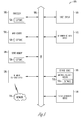
- FIG. 5 is a block diagram illustrating a machine in the example form of user equipment 500, within which a set or sequence of instructions may be executed to cause the machine to perform any one of the methodologies discussed herein, according to an example embodiment.
- the machine operates as a standalone device or may be connected (e.g., networked) to other machines.
- the machine may operate in the capacity of either a server or a client machine in server-client network environments, or it may act as a peer machine in peer-to-peer (or distributed) network environments.
- the machine may be a mobile communication device (e.g., cellular telephone), a computer, a personal computer (PC), a tablet PC, a hybrid tablet, a personal digital assistant (PDA), or any machine capable of executing instructions (sequential or otherwise) that specify actions to be taken by that machine.
- a mobile communication device e.g., cellular telephone
- PC personal computer
- PDA personal digital assistant
- machine shall also be taken to include any collection of machines that individually or jointly execute a set (or multiple sets) of instructions to perform any one or more of the methodologies discussed herein.
- the term "processor-based system” shall be taken to include any set of one or more machines that are controlled by or operated by a processor (e.g., a computer) to individually or jointly execute instructions to perform any one or more of the methodologies discussed herein.
- Example user equipment 500 includes at least one processor 502 (e.g., a central processing unit (CPU), a graphics processing unit (GPU) or both, processor cores, compute nodes, etc.), a main memory 504 and a static memory 506, which communicate with each other via a link 508 (e.g., bus).
- the user equipment 500 may further include a video display unit 510 and an alphanumeric input device 512 (e.g., a keypad). In one embodiment, the video display unit 510 and input device 512 are incorporated into a touch screen display.
- the user equipment 500 may additionally include a storage device 516 (e.g., a drive unit), a signal generation device 518 (e.g., a speaker), a network interface device 520, and one or more sensors (not shown).
- the storage device 516 includes a machine-readable medium 522 on which is stored one or more sets of data structures and instructions 524 (e.g., software) embodying or utilized by any one or more of the methodologies or functions described herein.
- the instructions 524 may also reside, completely or at least partially, within the main memory 504, static memory 506, and/or within the processor 502 during execution thereof by the user equipment 500, with the main memory 504, static memory 506, and the processor 502 also constituting machine-readable media.
- machine-readable medium 522 is illustrated in an example embodiment to be a single medium, the term “machine-readable medium” may include a single medium or multiple media (e.g., a centralized or distributed database, and/or associated caches and servers) that store the one or more instructions 524.
- the term “machine-readable medium” shall also be taken to include any tangible medium that is capable of storing, encoding or carrying instructions for execution by the machine and that cause the machine to perform any one or more of the methodologies of the present disclosure or that is capable of storing, encoding or carrying data structures utilized by or associated with such instructions.
- the term “machine-readable medium” shall accordingly be taken to include, but not be limited to, solid-state memories, and optical and magnetic media.
- machine-readable media include nonvolatile memory, including but not limited to, by way of example, semiconductor memory devices (e.g., electrically programmable read-only memory (EPROM), electrically erasable programmable read-only memory (EEPROM)) and flash memory devices; magnetic disks such as internal hard disks and removable disks; magneto-optical disks; and CD-ROM and DVD-ROM disks.
- semiconductor memory devices e.g., electrically programmable read-only memory (EPROM), electrically erasable programmable read-only memory (EEPROM)
- EPROM electrically programmable read-only memory
- EEPROM electrically erasable programmable read-only memory
- flash memory devices e.g., electrically programmable read-only memory (EPROM), electrically erasable programmable read-only memory (EEPROM)
- flash memory devices e.g., electrically programmable read-only memory (EPROM), electrically erasable programmable read-only memory (EEPROM)
- the instructions 524 may further be transmitted or received over a communications network 526 using a transmission medium via the network interface device 520 utilizing any one of a number of well-known transfer protocols (e.g., HTTP).
- Examples of communication networks include a local area network (LAN), a wide area network (WAN), a wireless local area network (WLAN) the Internet, mobile telephone networks, plain old telephone (POTS) networks, and wireless data networks (e.g., WI-FITM (IEEE 802.11), 3GPP, 4G LTE/LTE-A or WiMAX networks).
- transmission medium shall be taken to include any intangible medium that is capable of storing, encoding, or carrying instructions for execution by the machine, and includes digital or analog communications signals or other intangible medium to facilitate communication of such software.
- the network interface device may include one or more antennas for communicating with the wireless network.
Landscapes
- Engineering & Computer Science (AREA)
- Computer Networks & Wireless Communication (AREA)
- Signal Processing (AREA)
- Computer Security & Cryptography (AREA)
- Mobile Radio Communication Systems (AREA)
Abstract
Description
- Embodiments described herein generally relate to wireless networks. Some embodiments relate generally to user equipment feedback in a wireless network.
- Wireless radio access networks (RAN) enable mobile devices (e.g., radiotelephones, cellular telephones, user equipment (UE)) to communicate within that network with a fixed landline infrastructure (e.g., base station, access point, evolved node B (eNodeB or eNB)). For example, these radio access networks can include WiFi™, 3rd Generation Partnership Projects (3GPP), or Bluetooth™.
- Typical UEs and landline infrastructure may be equipped with multiple radios, each radio using a different radio access technology (RAT). Most data traffic may be supported over best effort services (e.g., Quality of Service Class Identifier #9 (QCI #9, Bearer)). The QCI #9 typically has real-time flows such as voice over Internet Protocol (VoIP)/conversation and non-real time flows, such as streaming/file downloading. This may not be the best way to handle different flows since each RAT may handle a different flow more efficiently.
- There are general needs for improved Flow-to-RAT mapping by a network.
-
-
FIG. 1 illustrates an embodiment of a signal flow diagram in accordance with a method for feedback of UE preference for Flow-to-RAT mapping. -
FIG. 2 illustrates a table for UE feedback of UE preferences for Flow-to-RAT mapping. -
FIG. 3 illustrates a table showing Flow-to-RAT mapping for the UE prepared by the base station/network. -
FIG. 4 illustrates a diagram of an embodiment of a communication system. -
FIG. 5 illustrates a block diagram of an embodiment of user equipment. - Subsequent use of the term radio access technology (RAT) may refer to a radio dedicated to a particular wireless technology. As is known by one of ordinary skill in the art, a RAT refers to an underlying physical connection method for a radio based communication network. Each radio may be configured to support a different RAT (e.g., WiFi™, 3GPP, Bluetooth™, 4G, Long Term Evolution (LTE), wireless local area network (WLAN)). The WiFi™ may be part of an IEEE 802.11 standard.
- The term "base station" (BS) may be used subsequently to refer to any fixed transceiver apparatus that may communicate using one or more particular radio technologies. For example, base station can refer to an access point, an eNodeB, or a cell site.
- User equipment (UE) and base stations each may include a plurality of radios each associated with a different RAT of multiple RATs that may select various networks or be "steered" to those networks. For example, the UE RATs can employ network selection or traffic steering between different radio access networks (RAN) such as WiFi™, 3GPP, Bluetooth™, 4G, LTE, or other wireless networks. Several solutions, based on UE-centric and network centric techniques may be used for load balancing between one network using a first radio technology (e.g., 3GPP) and second network using a second radio technology (e.g., WLAN).
- In current network technology, all flows using a best-effort service may be treated the same. As is known to one of ordinary skill in the art, a best-effort service is a single service model in which an application sends data whenever it must, in any quantity, and without requesting permission or first informing the network. For best-effort service, the network delivers data if it can, without any assurance of reliability, delay bounds, or throughput. In current network technology, the network does not know which flow from the best-effort pipe to be offloaded to another RAT (e.g., WLAN). In such an embodiment, the network typically would offload all of the flows in the best-effort bearer to WLAN.
- Using current technology, the UE cannot assist the eNodeB/network with a preference regarding which RAT is better for the kind of application that the UE is executing. This may degrade performance of the applications such as VoIP. The user may end up getting poor service or the user may end up turning off WLAN or the RAT with undesirable QoS. Either scenario may not be desirable for either the network operator or the user.
- The present embodiments enable the UE to provide feedback to the network regarding its preference of flow mapping to a BS RAT, of various RATs, in order to assist the BS/network in determining a Flow-to-RAT mapping for the various UEs communicating with the network. The network may use the feedback to determine to offload only one or more of the existing flows, rather than all of them, to other RATs (e.g., WLAN). The decision on which flows are mapped to which RAT may still be made by the base station/network.
-
FIG. 1 illustrates a flow diagram of an embodiment of a method for feedback of UE preference for Flow-to-RAT mapping. The UE 100 transmits a message 101 (e.g., assistance message) to the base station 110 (e.g., eNodeB, access point, base station). Themessage 101 may include the UE preferences for Flow-to-RAT mapping. The UE Preference for Flow-to-RAT mapping may be transmitted as part of another message or as a separate, independent message. - The
message 101 from the UE 100 to the BS 110 may include a Flow-to-RAT mapping preference table, such as the table illustrated inFIG. 2 . The Flow-to-RAT mapping of this table indicates the mapping preferences of the UE's flows to the RATs of theBS 110. A typical flow entry (e.g., FLOW 1 - FLOW N) may include information such as the Internet Protocol (IP) addresses and port number of the source and destination pairs. RAT 1 may be a 3GPP/LTE RAT andRAT 2 may be a WLAN RAT. However, these designations are for purposes of illustration only as the present embodiments are not limited to any certain RAT. - As one example,
FLOW 1 is shown inFIG. 2 as having a preference for RAT 1 (e.g., 3GPP/LTE) of the BS. FLOW 2 is shown as also having a preference forRAT 1 of the BS. FLOW N is shown as having a preference for RAT 2 (e.g., WLAN) of the BS. - Referring again to the flow diagram of
FIG. 1 , thebase station 110 transmits a Flow-to-RAT mapping message 102 to the UE 100 in response to themessage 101 from the UE 100. The Flow-to-RAT mapping message 102 may be based on the received UE's preference, network loads at RATs, neighboring UEs to thebase station 110, and/or other mapping preferences already known by thebase station 110. - The BS/network may consider the UE's preference for Flow-to-RAT mapping while splitting the traffic flows over RATs. However, the BS/network may also consider other factors such as network loads in RATs and other UE preferences for Flow-to-RAT mapping, while deciding about the Flow-to-RAT mapping table for the UE. One example of such a mapping table received by the UE is illustrated in
FIG. 3 . -
FIG. 3 illustrates one embodiment of a mapping table for UE prepared at BS/network based on the UE's preference as given in the table ofFIG. 2 and network loading in various RATs. Note that, in the illustrated embodiment, the BS/network has not accepted all of the UE's preferences. For example, the BS/network has mapped FLOW 2 toRAT 2 instead of the UE requestedRAT 1. This may be due to different load conditions in various RATs of the BS as well as neighboring UEs' preferences that have been received by the BS/network. - In other embodiments, radio resource control (RRC) messages may be used to exchange the mapping table over the UE-BS air interface. The UE may also use capability exchange message at the beginning of the RRC connection to signal whether it supports the preference capability.
-
FIG. 4 illustrates a diagram of an embodiment of a wireless communication system comprising the UE 401 in a multiple base station environment. The illustrated communication system includes a plurality ofantennas 402, 403 for communicating with the UE 401. - The
antennas 402, 403 may be part of base stations (e.g., eNodeBs) for communicating in a cellular environment. Theantennas 402, 403 may also be part of access points (APs) for communicating in a WiFi environment. For example, the first antenna 402 may be part of an eNodeB to enable theUE 401 to communicate in a 3GPP/LTE environment. Thesecond antenna 403 may be part of an access point to enable theUE 401 to communicate in a WLAN environment. - The method for UE feedback of Flow-to-RAT preferences may be used in the communication system to enable it to seamlessly switch between the 3GPP/LTE environment to the WiFi environment. In such a scenario, the
UE 401 may be executing an application that would benefit from using a WLAN RAT of the network side of the system. TheUE 401 may transmit this preference to a BS/network 403 as discussed previously. The BS/network 403 may transmit back a Flow mapping table to instruct theUE 401 to use either the preferred RAT or another RAT, as determined by the BS/network, for the particular Flow in question. The UE may then switch to that particular UE RAT when executing that particular Flow. -
FIG. 5 is a block diagram illustrating a machine in the example form ofuser equipment 500, within which a set or sequence of instructions may be executed to cause the machine to perform any one of the methodologies discussed herein, according to an example embodiment. In alternative embodiments, the machine operates as a standalone device or may be connected (e.g., networked) to other machines. In a networked deployment, the machine may operate in the capacity of either a server or a client machine in server-client network environments, or it may act as a peer machine in peer-to-peer (or distributed) network environments. The machine may be a mobile communication device (e.g., cellular telephone), a computer, a personal computer (PC), a tablet PC, a hybrid tablet, a personal digital assistant (PDA), or any machine capable of executing instructions (sequential or otherwise) that specify actions to be taken by that machine. Further, while only a single machine is illustrated, the term "machine" shall also be taken to include any collection of machines that individually or jointly execute a set (or multiple sets) of instructions to perform any one or more of the methodologies discussed herein. Similarly, the term "processor-based system" shall be taken to include any set of one or more machines that are controlled by or operated by a processor (e.g., a computer) to individually or jointly execute instructions to perform any one or more of the methodologies discussed herein. -
Example user equipment 500 includes at least one processor 502 (e.g., a central processing unit (CPU), a graphics processing unit (GPU) or both, processor cores, compute nodes, etc.), amain memory 504 and astatic memory 506, which communicate with each other via a link 508 (e.g., bus). Theuser equipment 500 may further include avideo display unit 510 and an alphanumeric input device 512 (e.g., a keypad). In one embodiment, thevideo display unit 510 andinput device 512 are incorporated into a touch screen display. Theuser equipment 500 may additionally include a storage device 516 (e.g., a drive unit), a signal generation device 518 (e.g., a speaker), anetwork interface device 520, and one or more sensors (not shown). - The
storage device 516 includes a machine-readable medium 522 on which is stored one or more sets of data structures and instructions 524 (e.g., software) embodying or utilized by any one or more of the methodologies or functions described herein. Theinstructions 524 may also reside, completely or at least partially, within themain memory 504,static memory 506, and/or within theprocessor 502 during execution thereof by theuser equipment 500, with themain memory 504,static memory 506, and theprocessor 502 also constituting machine-readable media. - While the machine-
readable medium 522 is illustrated in an example embodiment to be a single medium, the term "machine-readable medium" may include a single medium or multiple media (e.g., a centralized or distributed database, and/or associated caches and servers) that store the one ormore instructions 524. The term "machine-readable medium" shall also be taken to include any tangible medium that is capable of storing, encoding or carrying instructions for execution by the machine and that cause the machine to perform any one or more of the methodologies of the present disclosure or that is capable of storing, encoding or carrying data structures utilized by or associated with such instructions. The term "machine-readable medium" shall accordingly be taken to include, but not be limited to, solid-state memories, and optical and magnetic media. Specific examples of machine-readable media include nonvolatile memory, including but not limited to, by way of example, semiconductor memory devices (e.g., electrically programmable read-only memory (EPROM), electrically erasable programmable read-only memory (EEPROM)) and flash memory devices; magnetic disks such as internal hard disks and removable disks; magneto-optical disks; and CD-ROM and DVD-ROM disks. - The
instructions 524 may further be transmitted or received over acommunications network 526 using a transmission medium via thenetwork interface device 520 utilizing any one of a number of well-known transfer protocols (e.g., HTTP). Examples of communication networks include a local area network (LAN), a wide area network (WAN), a wireless local area network (WLAN) the Internet, mobile telephone networks, plain old telephone (POTS) networks, and wireless data networks (e.g., WI-FI™ (IEEE 802.11), 3GPP, 4G LTE/LTE-A or WiMAX networks). The term "transmission medium" shall be taken to include any intangible medium that is capable of storing, encoding, or carrying instructions for execution by the machine, and includes digital or analog communications signals or other intangible medium to facilitate communication of such software. The network interface device may include one or more antennas for communicating with the wireless network.
Claims (10)
- A method for user equipment (UE) feedback of Flow-to-radio access technology (RAT) preferences in a wireless network, the method comprising:the UE transmitting a preference for Flow-to-RAT mapping to a base station of the wireless network; andthe UE receiving a Flow-to-RAT mapping from the base station.
- The method of claim 1 wherein the UE receives an indication from the base station regarding a split of best effort traffic flows to a plurality of RATs of the UE.
- The method of claim 1 wherein the UE transmitting the preference for the Flow-to-RAT mapping comprises a radio resource control message.
- The method of claim. 1 wherein the UE transmitting the preference for the Flow-to-RAT mapping comprises transmitting a capability exchange message prior to or during an RRC connection to signal support for a Flow-to-RAT preference capability.
- The method of claim 1 wherein the Flow-to-RAT mapping from the base station is based on the UE preference, network loads at base station RATs, and neighboring UEs to the base station.
- The method of claim 1 wherein the UE receiving the Flow-to-RAT mapping from the base station comprises receiving the Flow-to-RAT mapping that does not equal the UE preference for Flow-to-RAT mapping.
- The method of claim 1 wherein the UE transmitting the performance metrics to the second radio comprises the UE transmitting the performance metrics during session transfer.
- The method of claim 1 wherein the UE transmitting a preference for Flow-to-RAT mapping comprises transmitting a table of preferences for a plurality of UE Flows with associated preferred RATs.
- User equipment (UE) for operating in a wireless network, the user equipment comprising:a network interface device to communicate with a plurality of base stations, the network interface device to transmit a UE preference Flow-to-radio access technology (RAT) mapping to a base station of the plurality of base stations and receive a Flow-to-RAT mapping from the base station;a plurality of radios, each radio to operate on a different RAT; anda processor coupled to the network interface and the plurality of radios to control operation of the user equipment and dynamically switch to the RAT specified by the received Flow-to-RAT mapping from the base station when a Flow of the Flow-to-RAT mapping is executed.
- The user equipment of claim 9 wherein the plurality of radios each operate on one of IEEE 802.11, 3GPP, 4G LTE/LTE-A, WLAN, or WiMAX network radio access technology.
Applications Claiming Priority (2)
| Application Number | Priority Date | Filing Date | Title |
|---|---|---|---|
| US201361841230P | 2013-06-28 | 2013-06-28 | |
| US14/136,554 US9794870B2 (en) | 2013-06-28 | 2013-12-20 | User equipment and method for user equipment feedback of flow-to-rat mapping preferences |
Publications (2)
| Publication Number | Publication Date |
|---|---|
| EP2827649A1 true EP2827649A1 (en) | 2015-01-21 |
| EP2827649B1 EP2827649B1 (en) | 2018-03-21 |
Family
ID=51014154
Family Applications (1)
| Application Number | Title | Priority Date | Filing Date |
|---|---|---|---|
| EP14171648.0A Active EP2827649B1 (en) | 2013-06-28 | 2014-06-09 | User equipment and method for user equipment feedback of flow-to-rat mapping preferences |
Country Status (5)
| Country | Link |
|---|---|
| US (1) | US9794870B2 (en) |
| EP (1) | EP2827649B1 (en) |
| CN (1) | CN104254067B (en) |
| ES (1) | ES2667808T3 (en) |
| HU (1) | HUE037654T2 (en) |
Cited By (1)
| Publication number | Priority date | Publication date | Assignee | Title |
|---|---|---|---|---|
| US10420100B2 (en) | 2013-06-28 | 2019-09-17 | Intel Corporation | Resuming packet services in a mobile network |
Families Citing this family (12)
| Publication number | Priority date | Publication date | Assignee | Title |
|---|---|---|---|---|
| CN106851311B (en) * | 2011-08-29 | 2019-08-13 | 苗太平洋控股有限公司 | Video decoding apparatus |
| JPWO2014054610A1 (en) * | 2012-10-02 | 2016-08-25 | シャープ株式会社 | Mobile communication system, first base station apparatus, mobile station apparatus, and communication method for mobile communication system |
| WO2014054644A1 (en) * | 2012-10-02 | 2014-04-10 | シャープ株式会社 | Mobile communication system, second base station, mobile station, and communication method for mobile communication system |
| US9794870B2 (en) | 2013-06-28 | 2017-10-17 | Intel Corporation | User equipment and method for user equipment feedback of flow-to-rat mapping preferences |
| US10104643B2 (en) * | 2014-11-06 | 2018-10-16 | Mediatek Inc. | Method and apparatus for heterogeneous communication |
| WO2018022225A1 (en) * | 2016-07-26 | 2018-02-01 | Intel IP Corporation | Device for and method of radio access technology selection among multiple radio access technologies |
| EP3620011A4 (en) * | 2017-05-02 | 2021-01-13 | Nokia Solutions and Networks Oy | Improving communication reliability |
| CN111031572B (en) * | 2018-10-09 | 2022-04-29 | 华为技术有限公司 | Data transmission method and device |
| US11076330B2 (en) * | 2019-05-02 | 2021-07-27 | Apple Inc. | Intelligent core network selection |
| CN111601365B (en) * | 2019-06-06 | 2022-02-11 | 维沃移动通信有限公司 | Connection management method, terminal and network side equipment |
| US11252740B2 (en) * | 2019-09-19 | 2022-02-15 | Cisco Technology, Inc. | Controlling communications in heterogeneous networks |
| US11632271B1 (en) | 2022-02-24 | 2023-04-18 | T-Mobile Usa, Inc. | Location-based channel estimation in wireless communication systems |
Citations (2)
| Publication number | Priority date | Publication date | Assignee | Title |
|---|---|---|---|---|
| US20130034082A1 (en) * | 2011-08-01 | 2013-02-07 | Kamran Etemad | Opportunistic device-to-device communication |
| US20130083661A1 (en) * | 2011-10-03 | 2013-04-04 | Vivek Gupta | Multi-RAT Carrier Aggregation for Integrated WWAN-WLAN Operation |
Family Cites Families (103)
| Publication number | Priority date | Publication date | Assignee | Title |
|---|---|---|---|---|
| JP3641961B2 (en) | 1999-02-01 | 2005-04-27 | 株式会社日立製作所 | Wireless communication device using adaptive array antenna |
| US20140206367A1 (en) | 2000-06-13 | 2014-07-24 | Comcast Cable Communications, Llc | Method and apparatus for optimization of wireless multipoint electromagnetic communication networks |
| EP1637901A4 (en) | 2003-06-25 | 2007-12-26 | Fujitsu Ltd | METHOD AND APPARATUS FOR ESTIMATING THE ARRIVAL DIRECTION OF A WAVE |
| US8654815B1 (en) | 2004-04-02 | 2014-02-18 | Rearden, Llc | System and method for distributed antenna wireless communications |
| US8170081B2 (en) | 2004-04-02 | 2012-05-01 | Rearden, LLC. | System and method for adjusting DIDO interference cancellation based on signal strength measurements |
| US8213978B1 (en) | 2005-08-29 | 2012-07-03 | At&T Mobility Ii Llc | Estimating mobile local propagation environment characteristics for wireless communications |
| US20070211813A1 (en) | 2006-03-10 | 2007-09-13 | Shilpa Talwar | MIMO precoding in the presence of co-channel interference |
| KR20080074004A (en) | 2007-02-07 | 2008-08-12 | 엘지전자 주식회사 | Uplink virtual multi-antenna transmission method using feedback information and mobile terminal supporting same |
| US8259599B2 (en) | 2008-02-13 | 2012-09-04 | Qualcomm Incorporated | Systems and methods for distributed beamforming based on carrier-to-caused interference |
| US9100068B2 (en) | 2008-03-17 | 2015-08-04 | Qualcomm, Incorporated | Multi-resolution beamforming in MIMO systems |
| US8965338B2 (en) * | 2008-06-09 | 2015-02-24 | Apple Inc | Network access control methods and apparatus |
| KR100912226B1 (en) | 2008-06-27 | 2009-08-14 | 삼성전자주식회사 | Codebook design method for multiple input / output systems and method of using the codebook |
| US8194762B2 (en) | 2008-08-19 | 2012-06-05 | Motorola Mobility, Inc. | Feedforward of non-quantized precoding weights in a wireless communications system |
| US9112562B2 (en) | 2008-09-02 | 2015-08-18 | Intel Corporation | Techniques utilizing adaptive codebooks for beamforming in wireless networks |
| US20100054237A1 (en) | 2008-09-04 | 2010-03-04 | Motorola, Inc. | Synchronization for femto-cell base stations |
| ATE511737T1 (en) | 2008-09-19 | 2011-06-15 | Alcatel Lucent | METHOD FOR SETTING UP MOBILE STATIONS IN MIMO SYSTEMS, CORRESPONDING MOBILE STATION, BASE STATION, OPERATION AND MAINTENANCE CENTER AND RADIO COMMUNICATIONS NETWORK |
| US8565193B2 (en) | 2008-10-16 | 2013-10-22 | Elektrobit Wireless Communications Oy | Beam forming method, apparatus and system |
| US9320067B2 (en) | 2008-11-24 | 2016-04-19 | Qualcomm Incorporated | Configuration of user equipment for peer-to-peer communication |
| CN101742609A (en) | 2008-11-26 | 2010-06-16 | 三星电子株式会社 | Positioning method based on AOA (Activity on Arrows)and terminal moving track under single-cell environment |
| CN101800582A (en) | 2009-02-09 | 2010-08-11 | 中兴通讯股份有限公司 | Multi-user beam-forming method and device |
| US20130153298A1 (en) | 2009-02-19 | 2013-06-20 | Interdigital Patent Holdings, Inc. | Method and apparatus for enhancing cell-edge user performance and signaling radio link failure conditions via downlink cooperative component carriers |
| US8547969B2 (en) * | 2009-03-31 | 2013-10-01 | Interdigital Patent Holdings, Inc. | Method and apparatus for providing non-packet switched service in a target radio access technology network |
| US8160976B2 (en) * | 2009-04-17 | 2012-04-17 | Research In Motion Limited | Systems and methods for achieving PLMN continuity when moving between networks of different types through network selection |
| WO2010121359A1 (en) | 2009-04-21 | 2010-10-28 | Research In Motion Limited | Methods and apparatus to suspend packet switched services |
| US8243610B2 (en) | 2009-04-21 | 2012-08-14 | Futurewei Technologies, Inc. | System and method for precoding codebook adaptation with low feedback overhead |
| US9046591B1 (en) | 2009-05-07 | 2015-06-02 | Sigtem Technology, Inc. | Coordinate-free measurement-domain navigation and guidance using location-dependent radio signal measurements |
| ES2793573T3 (en) | 2009-06-16 | 2020-11-16 | Blackberry Ltd | Method and apparatus for accessing a service not available through a network cell |
| EP2271153A1 (en) | 2009-06-25 | 2011-01-05 | NEC Corporation | A method for managing a CS IRAT handover from a 2g/3g network to a LTE network |
| KR101638668B1 (en) | 2009-08-21 | 2016-07-11 | 인터디지탈 패튼 홀딩스, 인크 | Method and apparatus for a multi-radio access technology layer for splitting downlink-uplink over different radio access technologies |
| GB0915152D0 (en) | 2009-09-01 | 2009-10-07 | Vodafone Plc | LTE voice call handling |
| US8781005B2 (en) | 2009-10-01 | 2014-07-15 | Qualcomm Incorporated | Scalable quantization of channel state information for MIMO transmission |
| EP2306764A1 (en) | 2009-10-02 | 2011-04-06 | Thomson Telecom Belgium | A method for configuring a plurality of parameters in a device |
| US20110143759A1 (en) | 2009-12-15 | 2011-06-16 | Yong Seouk Choi | Method of performing handover in wireless communication system |
| US20110151874A1 (en) | 2009-12-17 | 2011-06-23 | Telefonaktiebolaget Lm Ericsson (Publ) | Link report relay in access division multiplexing systems |
| US9319251B2 (en) | 2010-01-04 | 2016-04-19 | Samsung Electronics Co., Ltd. | Multiple-input multiple-output (MIMO) communication system using a codebook and method of designing the codebook |
| JP5258002B2 (en) | 2010-02-10 | 2013-08-07 | マーベル ワールド トレード リミテッド | Device, mobile communication terminal, chipset, and method in MIMO communication system |
| KR101276855B1 (en) | 2010-03-08 | 2013-06-18 | 엘지전자 주식회사 | A method and a user equipment for transmitting precoding matrix information, and a method and a base station for configuring a precoding matrix |
| US8478269B2 (en) | 2010-03-24 | 2013-07-02 | Qualcomm Incorporated | Method and apparatus to enable a UE to return to a wireless network after failure to obtain service |
| JP5072999B2 (en) | 2010-04-05 | 2012-11-14 | 株式会社エヌ・ティ・ティ・ドコモ | Wireless communication control device and wireless communication control method |
| US8582627B2 (en) | 2010-04-07 | 2013-11-12 | Telefonaktiebolaget Lm Ericsson (Publ) | Precode structure for MIMO precoding |
| US9485069B2 (en) | 2010-04-15 | 2016-11-01 | Qualcomm Incorporated | Transmission and reception of proximity detection signal for peer discovery |
| US8504052B2 (en) | 2010-05-06 | 2013-08-06 | Nokia Corporation | Measurements and fast power adjustments in D2D communications |
| WO2011150549A1 (en) | 2010-06-01 | 2011-12-08 | Nokia Corporation | Apparatus and method for selection of beam groups and subset of beams in communication system |
| JP2011259263A (en) | 2010-06-10 | 2011-12-22 | Hitachi Kokusai Electric Inc | Communication apparatus |
| CN102083047B (en) | 2010-06-18 | 2014-12-10 | 电信科学技术研究院 | An activation/deactivation ISR optimization method and network side equipment |
| US8908636B2 (en) | 2010-06-21 | 2014-12-09 | Qualcomm Incorporated | Method and apparatus for QoS context transfer during inter radio access technology handover in a wireless communication system |
| EP2586263B8 (en) | 2010-06-28 | 2016-02-24 | Telefonaktiebolaget LM Ericsson (publ) | Methods and apparatuses for supporting handover of a ps voice call to a cs voice call by using srvcc function |
| KR20120002875A (en) | 2010-07-01 | 2012-01-09 | 주식회사 팬택 | Channel information transmission / reception method and terminal, base station |
| US8219138B2 (en) | 2010-07-19 | 2012-07-10 | King Fahd University Of Petroleum And Minerals | Optimal power allocation method for an LSSTC wireless transmission system |
| US8873480B2 (en) * | 2010-10-01 | 2014-10-28 | Intel Corporation | Techniques for dynamic spectrum management, allocation, and sharing |
| CN103210683A (en) | 2010-11-11 | 2013-07-17 | 高通股份有限公司 | Systems and methods for improving circuit switched fallback performance |
| JP5703709B2 (en) | 2010-11-19 | 2015-04-22 | 富士通株式会社 | Wireless communication system, transmitter, wireless communication method, and transmitter control method |
| WO2012096607A1 (en) | 2011-01-13 | 2012-07-19 | Telefonaktiebolaget L M Ericsson (Publ) | Enhanced angle-of-arrival positioning |
| CN103703694B (en) | 2011-02-01 | 2016-09-28 | 黑莓有限公司 | downlink multi-user interference alignment scheme |
| WO2012125931A1 (en) | 2011-03-16 | 2012-09-20 | Interdigital Patent Holdings, Inc. | Methods for providing precoding and feedback and base station |
| EP2689610B1 (en) * | 2011-03-24 | 2020-07-01 | BlackBerry Limited | Device-empowered radio resource selection |
| CN106301500B (en) * | 2011-04-29 | 2019-12-10 | 英特尔公司 | System and method for rank adaptation in a MIMO communication system |
| US8675762B2 (en) | 2011-05-02 | 2014-03-18 | Alcatel Lucent | Method of transforming pre-coded signals for multiple-in-multiple-out wireless communication |
| US20120322489A1 (en) | 2011-06-15 | 2012-12-20 | Jennifer Liu | Apparatus and method for idle-state signaling reduction control in wireless networks |
| GB2492799B (en) | 2011-07-12 | 2014-06-25 | Samsung Electronics Co Ltd | Improved signalling in a wireless network |
| CN102883440B (en) | 2011-07-15 | 2015-11-25 | 华为技术有限公司 | A wireless broadband communication method, device and system |
| US9565545B2 (en) | 2011-07-21 | 2017-02-07 | Lg Electronics Inc. | Method for communicating between wireless devices and wireless device using same |
| EP2549814B1 (en) | 2011-07-22 | 2016-12-28 | Alcatel Lucent | A method and a base station for beam coordination |
| US20130021925A1 (en) | 2011-07-22 | 2013-01-24 | Sharp Laboratories Of America, Inc. | Coordinated multipoint (comp) transmission method selection and feedback requirements |
| JP5810219B2 (en) | 2011-08-12 | 2015-11-11 | エルジー エレクトロニクス インコーポレイティド | Method for processing data associated with idle mode signaling reduction in a wireless communication system |
| KR101828836B1 (en) | 2011-08-23 | 2018-02-13 | 삼성전자주식회사 | Apparatus and method for scheduling using beam scanning in beamformed wireless communication system |
| WO2013028128A1 (en) | 2011-08-25 | 2013-02-28 | Telefonaktiebolaget L M Ericsson (Publ) | Adapting a triggering threshold for cell re -selection measurements |
| US9246558B2 (en) | 2011-09-26 | 2016-01-26 | Samsung Electronics Co., Ltd. | CoMP measurement system and method |
| US9025479B2 (en) | 2011-10-03 | 2015-05-05 | Qualcomm Incorporated | Increasing CSI-RS overhead via antenna port augmentation |
| WO2013052805A1 (en) * | 2011-10-07 | 2013-04-11 | Interdigital Patent Holdings Inc. | Method and apparatus for integrating different radio access technologies using carrier aggregation |
| KR20130040749A (en) | 2011-10-14 | 2013-04-24 | 한국전자통신연구원 | Method for peer discovery using device-to-device link |
| EP2772093B1 (en) | 2011-10-28 | 2020-02-26 | BlackBerry Limited | Method and apparatus to handle bearers during circuit switched fallback operation |
| US20130114576A1 (en) | 2011-11-03 | 2013-05-09 | Pantech Co., Ltd. | Apparatus and method for performing uplink synchronization in multiple component carrier system |
| EP2590336A1 (en) | 2011-11-07 | 2013-05-08 | Panasonic Corporation | Precoding matrix set quality measurement and reporting |
| US9094977B2 (en) | 2011-11-11 | 2015-07-28 | Samsung Electronics Co., Ltd. | Apparatus and method for supporting mobility management in communication systems with large number of antennas |
| KR20130059694A (en) | 2011-11-29 | 2013-06-07 | 주식회사 팬택 | Apparatus and method for transmitting and receiving cell selective signal in multiple component carrier system |
| EP2789111A4 (en) | 2011-12-06 | 2015-04-08 | Ericsson Telefon Ab L M | Doppler shift compensation apparatus and method |
| GB2497589A (en) | 2011-12-16 | 2013-06-19 | Renesas Mobile Corp | Resource Allocation in a Wireless Communication System |
| EP3131218B1 (en) | 2011-12-16 | 2019-06-19 | LG Electronics Inc. | Method for measuring channel state information in a wireless access system and apparatus for same |
| GB2497752B (en) | 2011-12-19 | 2014-08-06 | Broadcom Corp | Apparatus and methods for supporting device-to-device discovery in cellular communications |
| KR101921669B1 (en) | 2011-12-27 | 2018-11-27 | 삼성전자주식회사 | Method and appratus for limited feedback of channel state information in massive mimo system based frequency division duplexing wireless communication |
| US8462688B1 (en) | 2012-01-25 | 2013-06-11 | Ofinno Technologies, Llc | Base station and wireless device radio resource control configuration |
| EP2823683A1 (en) * | 2012-02-03 | 2015-01-14 | Interdigital Patent Holdings, Inc. | Method and apparatus for coexistence among wireless transmit/receive units (wtrus) operating in the same spectrum |
| US8982725B2 (en) | 2012-02-03 | 2015-03-17 | Mediatek Inc. | Method and apparatus for collecting and providing diverse traffic information in cellular networks |
| WO2013129985A1 (en) | 2012-03-02 | 2013-09-06 | Telefonaktiebolaget L M Ericsson (Publ) | Radio base station and method therein for transforming a data transmission signal |
| CN103430600B (en) | 2012-03-13 | 2016-12-28 | Lg电子株式会社 | Method for controlling transmission power of user equipment in wireless communication system |
| US20130244649A1 (en) | 2012-03-19 | 2013-09-19 | Htc Corporation | Method of Transferring Short Message Service |
| WO2013149372A1 (en) | 2012-04-01 | 2013-10-10 | Qualcomm Incorporated | Connected mode mobility between radio access networks |
| GB2501088B (en) | 2012-04-11 | 2014-11-12 | Broadcom Corp | Methods and apparatus for transmitting and/or controlling device-to-device discovery signals |
| US9002281B2 (en) | 2012-04-30 | 2015-04-07 | Intel Corporation | Apparatus and method to enable device-to-device (D2D) communication in cellular networks |
| US8565793B1 (en) * | 2012-05-15 | 2013-10-22 | Cisco Technology, Inc. | System and method for scoped paging in multi-radio heterogeneous networks |
| WO2014003457A1 (en) | 2012-06-28 | 2014-01-03 | 엘지전자 주식회사 | Method and apparatus for carrying out device-to-device communication in wireless communications system |
| US9420613B2 (en) * | 2012-07-06 | 2016-08-16 | Qualcomm Incorporated | Configurable host interface using multi-radio device and architecture for WLAN offload |
| KR101686758B1 (en) | 2012-10-10 | 2016-12-14 | 텔레폰악티에볼라겟엘엠에릭슨(펍) | Discontinuous Reception Method and User Equipment using the same |
| CN104737603A (en) | 2012-10-10 | 2015-06-24 | Lg电子株式会社 | Tracking area update method and user equipment |
| US9131368B2 (en) | 2012-11-02 | 2015-09-08 | General Dynamics C4 Systems, Inc. | Method and apparatus for communicating in an increased coverage area to a wireless communication unit |
| US9271324B2 (en) | 2012-12-19 | 2016-02-23 | Blackberry Limited | Method and apparatus for assisted serving cell configuration in a heterogeneous network architecture |
| US8971437B2 (en) | 2012-12-20 | 2015-03-03 | Google Technology Holdings LLC | Method and apparatus for antenna array channel feedback |
| EP2979369B1 (en) | 2013-03-29 | 2019-12-11 | Intel IP Corporation | Enodeb reference signal reduction |
| US9479230B2 (en) | 2013-05-31 | 2016-10-25 | Blackberry Limited | Systems and methods for data offload in wireless networks |
| US9794870B2 (en) | 2013-06-28 | 2017-10-17 | Intel Corporation | User equipment and method for user equipment feedback of flow-to-rat mapping preferences |
| US9814037B2 (en) | 2013-06-28 | 2017-11-07 | Intel Corporation | Method for efficient channel estimation and beamforming in FDD system by exploiting uplink-downlink correspondence |
| US20160278069A1 (en) | 2013-11-29 | 2016-09-22 | Samsung Electronics Co., Ltd | Method and apparatus for application recognition qos-differentiated device-to-device communication in wireless communication system |
-
2013
- 2013-12-20 US US14/136,554 patent/US9794870B2/en active Active
-
2014
- 2014-06-09 EP EP14171648.0A patent/EP2827649B1/en active Active
- 2014-06-09 HU HUE14171648A patent/HUE037654T2/en unknown
- 2014-06-09 ES ES14171648.0T patent/ES2667808T3/en active Active
- 2014-06-27 CN CN201410295081.2A patent/CN104254067B/en active Active
Patent Citations (2)
| Publication number | Priority date | Publication date | Assignee | Title |
|---|---|---|---|---|
| US20130034082A1 (en) * | 2011-08-01 | 2013-02-07 | Kamran Etemad | Opportunistic device-to-device communication |
| US20130083661A1 (en) * | 2011-10-03 | 2013-04-04 | Vivek Gupta | Multi-RAT Carrier Aggregation for Integrated WWAN-WLAN Operation |
Non-Patent Citations (1)
| Title |
|---|
| LG ELECTRONICS: "Clarification on the scope of ISRP Filter Rule priority", 3GPP DRAFT; S2-115168_WAS4541_23402_CR1022_FILTERRULES, 3RD GENERATION PARTNERSHIP PROJECT (3GPP), MOBILE COMPETENCE CENTRE ; 650, ROUTE DES LUCIOLES ; F-06921 SOPHIA-ANTIPOLIS CEDEX ; FRANCE, vol. SA WG2, no. San Francisco, CA, US; 20111114 - 20111118, 7 November 2011 (2011-11-07), XP050575581 * |
Cited By (1)
| Publication number | Priority date | Publication date | Assignee | Title |
|---|---|---|---|---|
| US10420100B2 (en) | 2013-06-28 | 2019-09-17 | Intel Corporation | Resuming packet services in a mobile network |
Also Published As
| Publication number | Publication date |
|---|---|
| US9794870B2 (en) | 2017-10-17 |
| ES2667808T3 (en) | 2018-05-14 |
| EP2827649B1 (en) | 2018-03-21 |
| US20150004980A1 (en) | 2015-01-01 |
| CN104254067A (en) | 2014-12-31 |
| CN104254067B (en) | 2018-02-09 |
| HUE037654T2 (en) | 2018-09-28 |
Similar Documents
| Publication | Publication Date | Title |
|---|---|---|
| US9794870B2 (en) | User equipment and method for user equipment feedback of flow-to-rat mapping preferences | |
| US9313697B2 (en) | Optimized offloading to WLAN in 3GPP-RAT mobility | |
| US10841838B2 (en) | Communication method and device | |
| US9392539B2 (en) | User equipment and method for feedback of user equipment performance metrics during dynamic radio switching | |
| US10015643B2 (en) | Managing multicast traffic | |
| EP2868134B1 (en) | Devices and methods for radio communication network guided traffic offload | |
| CN102972089B (en) | System, method and apparatus for determining network interface preference policy | |
| US11234157B2 (en) | Network latency aware mobile edge computing routing | |
| US20140307551A1 (en) | Automatic learning of wi-fi neighbors and network characteristics | |
| JP2022502929A (en) | Data transmission control methods, network equipment and storage media | |
| WO2020082945A1 (en) | Load balancing method and device | |
| US9883439B2 (en) | Offloading method and apparatus | |
| EP3804401B1 (en) | Triggering terminal handover after session-request message | |
| US9936432B2 (en) | Method and a network node for improved resource utilization in a load balanced radio communication system | |
| CN104823485B (en) | Communication means, base station and user equipment under a kind of dual link | |
| JP6667662B2 (en) | Route processing method and apparatus, and terminal | |
| WO2014170541A1 (en) | Providing wifi radio availability information | |
| US8204062B2 (en) | Quality of service handling in a S4-serving general packet radio service support node | |
| WO2014183276A1 (en) | Offloading method and device of wireless network | |
| US20150319683A1 (en) | Communication system, communication device, and connection selection control method | |
| CN104144457A (en) | A method and device for migrating services from a WLAN network to a cellular network | |
| CN111247837B (en) | Method and device for binding data stream and computer storage medium | |
| CN119316875A (en) | Data transmission method and device | |
| WO2016119451A1 (en) | Method and device for user equipment to select network | |
| HK1217145B (en) | User equipment and method for feedback of user equipment performance metrics during dynamic radio switching |
Legal Events
| Date | Code | Title | Description |
|---|---|---|---|
| 17P | Request for examination filed |
Effective date: 20140609 |
|
| AK | Designated contracting states |
Kind code of ref document: A1 Designated state(s): AL AT BE BG CH CY CZ DE DK EE ES FI FR GB GR HR HU IE IS IT LI LT LU LV MC MK MT NL NO PL PT RO RS SE SI SK SM TR |
|
| AX | Request for extension of the european patent |
Extension state: BA ME |
|
| PUAI | Public reference made under article 153(3) epc to a published international application that has entered the european phase |
Free format text: ORIGINAL CODE: 0009012 |
|
| GRAP | Despatch of communication of intention to grant a patent |
Free format text: ORIGINAL CODE: EPIDOSNIGR1 |
|
| INTG | Intention to grant announced |
Effective date: 20171009 |
|
| GRAS | Grant fee paid |
Free format text: ORIGINAL CODE: EPIDOSNIGR3 |
|
| GRAA | (expected) grant |
Free format text: ORIGINAL CODE: 0009210 |
|
| AK | Designated contracting states |
Kind code of ref document: B1 Designated state(s): AL AT BE BG CH CY CZ DE DK EE ES FI FR GB GR HR HU IE IS IT LI LT LU LV MC MK MT NL NO PL PT RO RS SE SI SK SM TR |
|
| REG | Reference to a national code |
Ref country code: GB Ref legal event code: FG4D |
|
| REG | Reference to a national code |
Ref country code: CH Ref legal event code: EP |
|
| REG | Reference to a national code |
Ref country code: AT Ref legal event code: REF Ref document number: 982434 Country of ref document: AT Kind code of ref document: T Effective date: 20180415 |
|
| REG | Reference to a national code |
Ref country code: IE Ref legal event code: FG4D |
|
| REG | Reference to a national code |
Ref country code: DE Ref legal event code: R096 Ref document number: 602014022513 Country of ref document: DE |
|
| REG | Reference to a national code |
Ref country code: ES Ref legal event code: FG2A Ref document number: 2667808 Country of ref document: ES Kind code of ref document: T3 Effective date: 20180514 |
|
| REG | Reference to a national code |
Ref country code: FR Ref legal event code: PLFP Year of fee payment: 5 |
|
| REG | Reference to a national code |
Ref country code: NL Ref legal event code: FP |
|
| PG25 | Lapsed in a contracting state [announced via postgrant information from national office to epo] |
Ref country code: HR Free format text: LAPSE BECAUSE OF FAILURE TO SUBMIT A TRANSLATION OF THE DESCRIPTION OR TO PAY THE FEE WITHIN THE PRESCRIBED TIME-LIMIT Effective date: 20180321 Ref country code: LT Free format text: LAPSE BECAUSE OF FAILURE TO SUBMIT A TRANSLATION OF THE DESCRIPTION OR TO PAY THE FEE WITHIN THE PRESCRIBED TIME-LIMIT Effective date: 20180321 Ref country code: CY Free format text: LAPSE BECAUSE OF FAILURE TO SUBMIT A TRANSLATION OF THE DESCRIPTION OR TO PAY THE FEE WITHIN THE PRESCRIBED TIME-LIMIT Effective date: 20180321 Ref country code: FI Free format text: LAPSE BECAUSE OF FAILURE TO SUBMIT A TRANSLATION OF THE DESCRIPTION OR TO PAY THE FEE WITHIN THE PRESCRIBED TIME-LIMIT Effective date: 20180321 Ref country code: NO Free format text: LAPSE BECAUSE OF FAILURE TO SUBMIT A TRANSLATION OF THE DESCRIPTION OR TO PAY THE FEE WITHIN THE PRESCRIBED TIME-LIMIT Effective date: 20180621 |
|
| REG | Reference to a national code |
Ref country code: LT Ref legal event code: MG4D |
|
| REG | Reference to a national code |
Ref country code: EE Ref legal event code: FG4A Ref document number: E015728 Country of ref document: EE Effective date: 20180611 |
|
| PG25 | Lapsed in a contracting state [announced via postgrant information from national office to epo] |
Ref country code: RS Free format text: LAPSE BECAUSE OF FAILURE TO SUBMIT A TRANSLATION OF THE DESCRIPTION OR TO PAY THE FEE WITHIN THE PRESCRIBED TIME-LIMIT Effective date: 20180321 Ref country code: BG Free format text: LAPSE BECAUSE OF FAILURE TO SUBMIT A TRANSLATION OF THE DESCRIPTION OR TO PAY THE FEE WITHIN THE PRESCRIBED TIME-LIMIT Effective date: 20180621 Ref country code: SE Free format text: LAPSE BECAUSE OF FAILURE TO SUBMIT A TRANSLATION OF THE DESCRIPTION OR TO PAY THE FEE WITHIN THE PRESCRIBED TIME-LIMIT Effective date: 20180321 Ref country code: LV Free format text: LAPSE BECAUSE OF FAILURE TO SUBMIT A TRANSLATION OF THE DESCRIPTION OR TO PAY THE FEE WITHIN THE PRESCRIBED TIME-LIMIT Effective date: 20180321 |
|
| REG | Reference to a national code |
Ref country code: HU Ref legal event code: AG4A Ref document number: E037654 Country of ref document: HU |
|
| REG | Reference to a national code |
Ref country code: SK Ref legal event code: T3 Ref document number: E 27546 Country of ref document: SK |
|
| PG25 | Lapsed in a contracting state [announced via postgrant information from national office to epo] |
Ref country code: AL Free format text: LAPSE BECAUSE OF FAILURE TO SUBMIT A TRANSLATION OF THE DESCRIPTION OR TO PAY THE FEE WITHIN THE PRESCRIBED TIME-LIMIT Effective date: 20180321 Ref country code: PL Free format text: LAPSE BECAUSE OF FAILURE TO SUBMIT A TRANSLATION OF THE DESCRIPTION OR TO PAY THE FEE WITHIN THE PRESCRIBED TIME-LIMIT Effective date: 20180321 Ref country code: RO Free format text: LAPSE BECAUSE OF FAILURE TO SUBMIT A TRANSLATION OF THE DESCRIPTION OR TO PAY THE FEE WITHIN THE PRESCRIBED TIME-LIMIT Effective date: 20180321 Ref country code: IT Free format text: LAPSE BECAUSE OF FAILURE TO SUBMIT A TRANSLATION OF THE DESCRIPTION OR TO PAY THE FEE WITHIN THE PRESCRIBED TIME-LIMIT Effective date: 20180321 |
|
| PG25 | Lapsed in a contracting state [announced via postgrant information from national office to epo] |
Ref country code: SM Free format text: LAPSE BECAUSE OF FAILURE TO SUBMIT A TRANSLATION OF THE DESCRIPTION OR TO PAY THE FEE WITHIN THE PRESCRIBED TIME-LIMIT Effective date: 20180321 Ref country code: CZ Free format text: LAPSE BECAUSE OF FAILURE TO SUBMIT A TRANSLATION OF THE DESCRIPTION OR TO PAY THE FEE WITHIN THE PRESCRIBED TIME-LIMIT Effective date: 20180321 |
|
| PG25 | Lapsed in a contracting state [announced via postgrant information from national office to epo] |
Ref country code: PT Free format text: LAPSE BECAUSE OF FAILURE TO SUBMIT A TRANSLATION OF THE DESCRIPTION OR TO PAY THE FEE WITHIN THE PRESCRIBED TIME-LIMIT Effective date: 20180723 |
|
| REG | Reference to a national code |
Ref country code: DE Ref legal event code: R097 Ref document number: 602014022513 Country of ref document: DE |
|
| PLBE | No opposition filed within time limit |
Free format text: ORIGINAL CODE: 0009261 |
|
| REG | Reference to a national code |
Ref country code: GR Ref legal event code: EP Ref document number: 20180401725 Country of ref document: GR Effective date: 20190109 |
|
| STAA | Information on the status of an ep patent application or granted ep patent |
Free format text: STATUS: NO OPPOSITION FILED WITHIN TIME LIMIT |
|
| PG25 | Lapsed in a contracting state [announced via postgrant information from national office to epo] |
Ref country code: DK Free format text: LAPSE BECAUSE OF FAILURE TO SUBMIT A TRANSLATION OF THE DESCRIPTION OR TO PAY THE FEE WITHIN THE PRESCRIBED TIME-LIMIT Effective date: 20180321 |
|
| 26N | No opposition filed |
Effective date: 20190102 |
|
| PG25 | Lapsed in a contracting state [announced via postgrant information from national office to epo] |
Ref country code: MC Free format text: LAPSE BECAUSE OF FAILURE TO SUBMIT A TRANSLATION OF THE DESCRIPTION OR TO PAY THE FEE WITHIN THE PRESCRIBED TIME-LIMIT Effective date: 20180321 Ref country code: LU Free format text: LAPSE BECAUSE OF NON-PAYMENT OF DUE FEES Effective date: 20180609 |
|
| PG25 | Lapsed in a contracting state [announced via postgrant information from national office to epo] |
Ref country code: SI Free format text: LAPSE BECAUSE OF FAILURE TO SUBMIT A TRANSLATION OF THE DESCRIPTION OR TO PAY THE FEE WITHIN THE PRESCRIBED TIME-LIMIT Effective date: 20180321 |
|
| PG25 | Lapsed in a contracting state [announced via postgrant information from national office to epo] |
Ref country code: MT Free format text: LAPSE BECAUSE OF NON-PAYMENT OF DUE FEES Effective date: 20180609 |
|
| REG | Reference to a national code |
Ref country code: EE Ref legal event code: GB1A Ref document number: E015728 Country of ref document: EE |
|
| PG25 | Lapsed in a contracting state [announced via postgrant information from national office to epo] |
Ref country code: TR Free format text: LAPSE BECAUSE OF FAILURE TO SUBMIT A TRANSLATION OF THE DESCRIPTION OR TO PAY THE FEE WITHIN THE PRESCRIBED TIME-LIMIT Effective date: 20180321 |
|
| REG | Reference to a national code |
Ref country code: ES Ref legal event code: PC2A Owner name: APPLE INC. Effective date: 20200330 |
|
| REG | Reference to a national code |
Ref country code: CH Ref legal event code: PUE Owner name: APPLE, INC., US Free format text: FORMER OWNER: INTEL CORPORATION, US |
|
| REG | Reference to a national code |
Ref country code: NL Ref legal event code: PD Owner name: APPLE INC.; US Free format text: DETAILS ASSIGNMENT: CHANGE OF OWNER(S), ASSIGNMENT; FORMER OWNER NAME: INTEL CORPORATION Effective date: 20200527 |
|
| PG25 | Lapsed in a contracting state [announced via postgrant information from national office to epo] |
Ref country code: MK Free format text: LAPSE BECAUSE OF NON-PAYMENT OF DUE FEES Effective date: 20180321 |
|
| REG | Reference to a national code |
Ref country code: DE Ref legal event code: R081 Ref document number: 602014022513 Country of ref document: DE Owner name: APPLE INC., CUPERTINO, US Free format text: FORMER OWNER: INTEL CORPORATION, SANTA CLARA, CALIF., US |
|
| REG | Reference to a national code |
Ref country code: CH Ref legal event code: PK Free format text: BERICHTIGUNG INHABER |
|
| REG | Reference to a national code |
Ref country code: HU Ref legal event code: GB9C Owner name: APPLE INC., US Free format text: FORMER OWNER(S): INTEL CORPORATION, US |
|
| PG25 | Lapsed in a contracting state [announced via postgrant information from national office to epo] |
Ref country code: IS Free format text: LAPSE BECAUSE OF FAILURE TO SUBMIT A TRANSLATION OF THE DESCRIPTION OR TO PAY THE FEE WITHIN THE PRESCRIBED TIME-LIMIT Effective date: 20180721 |
|
| PGFP | Annual fee paid to national office [announced via postgrant information from national office to epo] |
Ref country code: EE Payment date: 20200429 Year of fee payment: 7 Ref country code: IE Payment date: 20200609 Year of fee payment: 7 Ref country code: GR Payment date: 20200513 Year of fee payment: 7 Ref country code: CH Payment date: 20200616 Year of fee payment: 7 |
|
| PGFP | Annual fee paid to national office [announced via postgrant information from national office to epo] |
Ref country code: BE Payment date: 20200515 Year of fee payment: 7 Ref country code: SK Payment date: 20200515 Year of fee payment: 7 Ref country code: HU Payment date: 20200502 Year of fee payment: 7 |
|
| REG | Reference to a national code |
Ref country code: SK Ref legal event code: PC4A Ref document number: E 27546 Country of ref document: SK Owner name: APPLE INC., CUPERTINO, CA, US Free format text: FORMER OWNER: INTEL CORPORATION, SANTA CLARA CA, US Effective date: 20200819 |
|
| PGFP | Annual fee paid to national office [announced via postgrant information from national office to epo] |
Ref country code: AT Payment date: 20200526 Year of fee payment: 7 |
|
| PGFP | Annual fee paid to national office [announced via postgrant information from national office to epo] |
Ref country code: ES Payment date: 20200701 Year of fee payment: 7 |
|
| REG | Reference to a national code |
Ref country code: AT Ref legal event code: PC Ref document number: 982434 Country of ref document: AT Kind code of ref document: T Owner name: APPLE INC., US Effective date: 20201110 |
|
| REG | Reference to a national code |
Ref country code: BE Ref legal event code: PD Owner name: APPLE INC.; US Free format text: DETAILS ASSIGNMENT: CHANGE OF OWNER(S), CESSION Effective date: 20200512 Ref country code: BE Ref legal event code: PD Owner name: APPLE INC.; US Free format text: DETAILS ASSIGNMENT: CHANGE OF OWNER(S), CESSION; FORMER OWNER NAME: INTEL CORPORATION Effective date: 20200512 |
|
| REG | Reference to a national code |
Ref country code: EE Ref legal event code: MM4A Ref document number: E015728 Country of ref document: EE Effective date: 20210630 |
|
| REG | Reference to a national code |
Ref country code: CH Ref legal event code: PL |
|
| REG | Reference to a national code |
Ref country code: AT Ref legal event code: MM01 Ref document number: 982434 Country of ref document: AT Kind code of ref document: T Effective date: 20210609 |
|
| REG | Reference to a national code |
Ref country code: SK Ref legal event code: MM4A Ref document number: E 27546 Country of ref document: SK Effective date: 20210609 |
|
| REG | Reference to a national code |
Ref country code: BE Ref legal event code: MM Effective date: 20210630 |
|
| REG | Reference to a national code |
Ref country code: AT Ref legal event code: UEP Ref document number: 982434 Country of ref document: AT Kind code of ref document: T Effective date: 20180321 |
|
| PG25 | Lapsed in a contracting state [announced via postgrant information from national office to epo] |
Ref country code: LI Free format text: LAPSE BECAUSE OF NON-PAYMENT OF DUE FEES Effective date: 20210630 Ref country code: IE Free format text: LAPSE BECAUSE OF NON-PAYMENT OF DUE FEES Effective date: 20210609 Ref country code: CH Free format text: LAPSE BECAUSE OF NON-PAYMENT OF DUE FEES Effective date: 20210630 Ref country code: AT Free format text: LAPSE BECAUSE OF NON-PAYMENT OF DUE FEES Effective date: 20210609 |
|
| PG25 | Lapsed in a contracting state [announced via postgrant information from national office to epo] |
Ref country code: SK Free format text: LAPSE BECAUSE OF NON-PAYMENT OF DUE FEES Effective date: 20210609 Ref country code: GR Free format text: LAPSE BECAUSE OF NON-PAYMENT OF DUE FEES Effective date: 20220105 Ref country code: EE Free format text: LAPSE BECAUSE OF NON-PAYMENT OF DUE FEES Effective date: 20210630 |
|
| PG25 | Lapsed in a contracting state [announced via postgrant information from national office to epo] |
Ref country code: BE Free format text: LAPSE BECAUSE OF NON-PAYMENT OF DUE FEES Effective date: 20210630 |
|
| REG | Reference to a national code |
Ref country code: ES Ref legal event code: FD2A Effective date: 20220826 |
|
| PG25 | Lapsed in a contracting state [announced via postgrant information from national office to epo] |
Ref country code: ES Free format text: LAPSE BECAUSE OF NON-PAYMENT OF DUE FEES Effective date: 20210610 |
|
| REG | Reference to a national code |
Ref country code: FR Ref legal event code: PLFP Year of fee payment: 10 |
|
| PG25 | Lapsed in a contracting state [announced via postgrant information from national office to epo] |
Ref country code: HU Free format text: LAPSE BECAUSE OF NON-PAYMENT OF DUE FEES Effective date: 20210610 |
|
| P01 | Opt-out of the competence of the unified patent court (upc) registered |
Effective date: 20230526 |
|
| REG | Reference to a national code |
Ref country code: GB Ref legal event code: 732E Free format text: REGISTERED BETWEEN 20250306 AND 20250312 |
|
| PGFP | Annual fee paid to national office [announced via postgrant information from national office to epo] |
Ref country code: NL Payment date: 20250409 Year of fee payment: 12 |
|
| PGFP | Annual fee paid to national office [announced via postgrant information from national office to epo] |
Ref country code: DE Payment date: 20250402 Year of fee payment: 12 |
|
| PGFP | Annual fee paid to national office [announced via postgrant information from national office to epo] |
Ref country code: GB Payment date: 20250401 Year of fee payment: 12 |
|
| PGFP | Annual fee paid to national office [announced via postgrant information from national office to epo] |
Ref country code: FR Payment date: 20250401 Year of fee payment: 12 |