EP2827467A2 - Stabilized power generation - Google Patents
Stabilized power generation Download PDFInfo
- Publication number
- EP2827467A2 EP2827467A2 EP20140177357 EP14177357A EP2827467A2 EP 2827467 A2 EP2827467 A2 EP 2827467A2 EP 20140177357 EP20140177357 EP 20140177357 EP 14177357 A EP14177357 A EP 14177357A EP 2827467 A2 EP2827467 A2 EP 2827467A2
- Authority
- EP
- European Patent Office
- Prior art keywords
- converter
- power
- directional
- energy store
- generating component
- Prior art date
- Legal status (The legal status is an assumption and is not a legal conclusion. Google has not performed a legal analysis and makes no representation as to the accuracy of the status listed.)
- Withdrawn
Links
Images





Classifications
-
- H—ELECTRICITY
- H02—GENERATION; CONVERSION OR DISTRIBUTION OF ELECTRIC POWER
- H02J—ELECTRIC POWER NETWORKS; CIRCUIT ARRANGEMENTS OR SYSTEMS FOR SUPPLYING OR DISTRIBUTING ELECTRIC POWER; SYSTEMS FOR STORING ELECTRIC ENERGY
- H02J3/00—Circuit arrangements for AC mains or AC distribution networks
- H02J3/38—Arrangements for feeding a single network from two or more generators or sources in parallel; Arrangements for feeding already energised networks from additional generators or sources in parallel
- H02J3/381—Dispersed generators
-
- H—ELECTRICITY
- H02—GENERATION; CONVERSION OR DISTRIBUTION OF ELECTRIC POWER
- H02J—ELECTRIC POWER NETWORKS; CIRCUIT ARRANGEMENTS OR SYSTEMS FOR SUPPLYING OR DISTRIBUTING ELECTRIC POWER; SYSTEMS FOR STORING ELECTRIC ENERGY
- H02J7/00—Circuit arrangements for charging or discharging batteries or for supplying loads from batteries
- H02J7/02—Circuit arrangements for charging or discharging batteries or for supplying loads from batteries for charging batteries from AC mains by converters
-
- H—ELECTRICITY
- H02—GENERATION; CONVERSION OR DISTRIBUTION OF ELECTRIC POWER
- H02J—ELECTRIC POWER NETWORKS; CIRCUIT ARRANGEMENTS OR SYSTEMS FOR SUPPLYING OR DISTRIBUTING ELECTRIC POWER; SYSTEMS FOR STORING ELECTRIC ENERGY
- H02J7/00—Circuit arrangements for charging or discharging batteries or for supplying loads from batteries
- H02J7/34—Parallel operation in networks using both storage and other DC sources, e.g. providing buffering
- H02J7/35—Parallel operation in networks using both storage and other DC sources, e.g. providing buffering with light sensitive cells
-
- H—ELECTRICITY
- H02—GENERATION; CONVERSION OR DISTRIBUTION OF ELECTRIC POWER
- H02J—ELECTRIC POWER NETWORKS; CIRCUIT ARRANGEMENTS OR SYSTEMS FOR SUPPLYING OR DISTRIBUTING ELECTRIC POWER; SYSTEMS FOR STORING ELECTRIC ENERGY
- H02J2101/00—Supply or distribution of decentralised, dispersed or local electric power generation
- H02J2101/20—Dispersed power generation using renewable energy sources
- H02J2101/22—Solar energy
- H02J2101/24—Photovoltaics
- H02J2101/25—Photovoltaics involving maximum power point tracking control for photovoltaic sources
-
- H—ELECTRICITY
- H02—GENERATION; CONVERSION OR DISTRIBUTION OF ELECTRIC POWER
- H02J—ELECTRIC POWER NETWORKS; CIRCUIT ARRANGEMENTS OR SYSTEMS FOR SUPPLYING OR DISTRIBUTING ELECTRIC POWER; SYSTEMS FOR STORING ELECTRIC ENERGY
- H02J7/00—Circuit arrangements for charging or discharging batteries or for supplying loads from batteries
- H02J7/34—Parallel operation in networks using both storage and other DC sources, e.g. providing buffering
- H02J7/345—Parallel operation in networks using both storage and other DC sources, e.g. providing buffering using capacitors as storage or buffering devices
-
- H—ELECTRICITY
- H02—GENERATION; CONVERSION OR DISTRIBUTION OF ELECTRIC POWER
- H02M—APPARATUS FOR CONVERSION BETWEEN AC AND AC, BETWEEN AC AND DC, OR BETWEEN DC AND DC, AND FOR USE WITH MAINS OR SIMILAR POWER SUPPLY SYSTEMS; CONVERSION OF DC OR AC INPUT POWER INTO SURGE OUTPUT POWER; CONTROL OR REGULATION THEREOF
- H02M3/00—Conversion of DC power input into DC power output
- H02M3/22—Conversion of DC power input into DC power output with intermediate conversion into AC
- H02M3/24—Conversion of DC power input into DC power output with intermediate conversion into AC by static converters
- H02M3/28—Conversion of DC power input into DC power output with intermediate conversion into AC by static converters using discharge tubes with control electrode or semiconductor devices with control electrode to produce the intermediate AC
- H02M3/325—Conversion of DC power input into DC power output with intermediate conversion into AC by static converters using discharge tubes with control electrode or semiconductor devices with control electrode to produce the intermediate AC using devices of a triode or a transistor type requiring continuous application of a control signal
- H02M3/335—Conversion of DC power input into DC power output with intermediate conversion into AC by static converters using discharge tubes with control electrode or semiconductor devices with control electrode to produce the intermediate AC using devices of a triode or a transistor type requiring continuous application of a control signal using semiconductor devices only
- H02M3/33569—Conversion of DC power input into DC power output with intermediate conversion into AC by static converters using discharge tubes with control electrode or semiconductor devices with control electrode to produce the intermediate AC using devices of a triode or a transistor type requiring continuous application of a control signal using semiconductor devices only having several active switching elements
- H02M3/33576—Conversion of DC power input into DC power output with intermediate conversion into AC by static converters using discharge tubes with control electrode or semiconductor devices with control electrode to produce the intermediate AC using devices of a triode or a transistor type requiring continuous application of a control signal using semiconductor devices only having several active switching elements having at least one active switching element at the secondary side of an isolation transformer
- H02M3/33584—Bidirectional converters
-
- Y—GENERAL TAGGING OF NEW TECHNOLOGICAL DEVELOPMENTS; GENERAL TAGGING OF CROSS-SECTIONAL TECHNOLOGIES SPANNING OVER SEVERAL SECTIONS OF THE IPC; TECHNICAL SUBJECTS COVERED BY FORMER USPC CROSS-REFERENCE ART COLLECTIONS [XRACs] AND DIGESTS
- Y02—TECHNOLOGIES OR APPLICATIONS FOR MITIGATION OR ADAPTATION AGAINST CLIMATE CHANGE
- Y02E—REDUCTION OF GREENHOUSE GAS [GHG] EMISSIONS, RELATED TO ENERGY GENERATION, TRANSMISSION OR DISTRIBUTION
- Y02E10/00—Energy generation through renewable energy sources
- Y02E10/50—Photovoltaic [PV] energy
- Y02E10/56—Power conversion systems, e.g. maximum power point trackers
Definitions
- This invention relates generally to power generation and, in particular, to stabilizing a renewable power generating component's output.
- the output of a power generating component could be subject to variation.
- output power variations could be caused by clouds, shadows etc.
- the power output could be similarly affected by changes in wind speed or direction.
- a stabilized power generator includes a power generating component, an energy store, a bi-directional Direct Current (DC) / DC converter, and a bi-directional DC / Alternating Current (AC) converter.
- the bi-directional DC/DC converter is electrically coupled between the power generating component and the energy store.
- the bi-directional DC/AC converter is electrically coupled at a DC side of the bi-directional DC/AC converter to a circuit path between the power generating component and the bi-directional DC/DC converter, and is to be electrically coupled at an AC side of the bi-directional DC/AC converter to an electrical grid.
- the stabilized power generator could also include a single physical enclosure, attached to the power generating component, to enclose the energy store, the bi-directional DC/DC converter, and the bi-directional DC/AC converter.
- the power generating component includes a PV panel in an embodiment, or could include multiple panels.
- the energy store could include, for example, a capacitor, a battery, and/or an ultracapacitor.
- the bi-directional DC/AC converter includes a first DC/DC stage electrically coupled to the circuit path between the power generating component and the bi-directional DC/DC converter, and the first DC/DC stage includes a Dual Active Bridge (DAB) circuit.
- DAB Dual Active Bridge
- a controller could be coupled to the bi-directional DC/AC converter, to control current flowing through the bi-directional DC/AC converter by controlling switching in the bi-directional DC/AC converter, with the current flowing through the bi-directional DC/AC converter in turn controlling storage current flowing to or from the energy store.
- the stabilized power generator could also include a controller, coupled to the bi-directional DC/DC converter, to control voltage at a PV panel side of the bi-directional DC/DC converter at which the bi-directional DC/DC converter is electrically coupled to the PV panel, by controlling switching in the bi-directional DC/DC converter.
- the controller could be configured to control switching in the bi-directional DC/DC converter to track Maximum Power Point (MPP) for the PV panel.
- MPP Maximum Power Point
- a stabilized power generator could also include a controller to control charging and discharging of the energy store to provide power smoothing of output power from the power generating component.
- the controller could be configured to calculate an expected power output of the power generating component, and to control charging and discharging of the energy store based on the expected power output.
- the controller could be configured to calculate an expected power output of the power generating component based on previous, time averaged power values of the output power from the power generating component.
- HMA Hull Moving Average
- the stabilized power generator includes a controller to control charging and discharging of the energy store based on maintaining a State of Charge (SoC) of the energy store at a target value.
- SoC State of Charge
- the target value of the SoC could be 50%, for example.
- the controller could be coupled to the bi-directional DC/AC converter, to control the bi-directional DC/AC converter to convert power from the electrical grid to DC for charging the energy store and maintaining the State of Charge (SoC) of the energy store at the target value
- SoC State of Charge
- the stabilized power generator could include a controller to control charging and discharging of the energy store to provide both power smoothing of output power from the power generating component and maintenance of a State of Charge (SoC) of the energy store at a target value, with the controller being configured to control the maintenance of the SoC with a slower response time than a response time of the power smoothing.
- SoC State of Charge
- a method involves controlling a bi-directional DC/DC converter, electrically coupled between a power generating component and an energy store, for DC/DC conversion of power flow into and out of the energy store; and controlling a bi-directional DC/AC converter, electrically coupled at a DC side of the bi-directional DC/AC converter to a circuit path between the power generating component and the bi-directional DC/DC converter and to be electrically coupled at an AC side of the bi-directional DC/AC converter to an electrical grid, for AC/DC conversion of power flow between the AC grid and the bi-directional DC/DC converter.
- the power generating component could include one or more PV panels.
- the power generating component includes a PV panel
- controlling the bi-directional DC/DC converter involves controlling voltage at a PV panel side of the bi-directional DC/DC converter at which the bi-directional DC/DC converter is electrically coupled to the PV panel, by controlling switching in the bi-directional DC/DC converter, and controlling the bi-directional DC/DC converter further includes controlling switching in the bi-directional DC/DC converter to track MPP for the PV panel.
- Controlling the bi-directional DC/AC converter could involve controlling current flowing through the bi-directional DC/AC converter by controlling switching in the bi-directional DC/AC converter.
- the current flowing through the bi-directional DC/AC converter controls storage current flowing to or from the energy store.
- the storage current controls charging and discharging of the energy store to provide power smoothing of output power from the power generating component in an embodiment.
- the storage current controls charging and discharging of the energy store
- the method further includes calculating an expected power output of the power generating component, and controlling current flowing through the bi-directional DC/AC converter involves controlling the current based on the expected power output.
- Calculating the expected power output could involve calculating the expected power output based on previous, time averaged power values of the output power from the power generating component.
- HMA Hull Moving Average
- Controlling current flowing through the bi-directional DC/AC converter could involve controlling the current to provide both power smoothing of output power from the power generating component and maintenance of a State of Charge (SoC) of the energy store at a target value, with the controlling involving control for maintenance of the SoC with a slower response time than a response time of control for power smoothing.
- SoC State of Charge
- a microgrid includes an AC power grid and a stabilized power generator.
- the stabilized power generator includes a power generating component, an energy store, a bi-directional Direct Current (DC) / DC converter electrically coupled between the power generating component and the energy store, and a bi-directional DC / Alternating Current (AC) converter having a DC port and an AC port, and electrically coupled to the DC/DC converter at its DC port and connected to the AC power grid at its AC port.
- DC Direct Current
- AC Alternating Current
- renewable generators such as for example solar Photo-Voltaic (PV) generation, wind turbines or tidal power generators can be intermittent and dependent on prevailing weather conditions such as amount of cloud cover or wind speed.
- the output of renewable generators could be stabilized by the addition of energy storage.
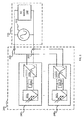
- FIG. 1 is a block diagram of a conventionally stabilized power generation system.
- Power system 100 comprises PV generators 106, 108, bi-directional inverter 114, central energy storage 130 and terminal pair 160, 162.
- PV power system 100 connects to Alternating Current (AC) grid 150 at terminal pair 160, 162.
- PV generator 106 comprises PV panel 102 and inverter 110.
- PV generator 108 comprises PV panel 104 and inverter 112.
- PV panels 102, 104 provide Direct Current (DC) power to inverters 110, 112 respectively.
- Inverters 110, 112 are uni-directional and provide AC power to AC grid 150.
- AC grid 150 comprises AC loads 140 and AC generator 120.
- AC generator 120 could be a non-renewable generator, for example a diesel generator, and provide power for night time operation.
- AC loads 140 could comprise lighting, heating, cooling, electric motors or industrial machinery.
- AC grid 150 could be a microgrid such as a remote mining facility, military forward operating base or a university campus. AC grid 150 could also be a utility grid.
- Central energy storage 130 connects to bidirectional inverter 114.
- Bi-directional inverter 114 couples to AC grid 150 through terminal pair 160, 162.
- central energy storage 130 could absorb the excess power and store energy.
- central energy storage 130 could provide power to AC grid 150.
- the action of central energy storage 130 reduces the required variation in power output from AC generator 120 caused by the variability in output of PV panels 102, 104. In the case of AC generator 120 being a diesel generator, this could beneficially improve its fuel efficiency.
- Central energy storage 130 does not reduce the variation in power output of PV generators 106, 108 but merely compensates for their variation.
- output power stabilization could be achieved with an energy store such as a battery or a capacitance (illustratively an ultracapacitor).
- a PV panel, and/or other power generating component could connect to the energy store through a DC / DC converter and to an electrical grid or microgrid through a DC / AC converter, also referred to as an inverter.
- expected power output for the PV panel is determined, based on time of day for instance, and compared to the actual power being produced. Any difference is either sourced or sunk by the energy store. Short term output fluctuations could be smoothed out in this manner.
- a dual-active-bridge based bi-directional micro-inverter with integrated short-term Li-ion ultra-capacitor storage and active power smoothing for modular PV systems is provided.
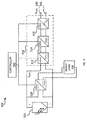
- FIG. 2 is a block diagram of an example stabilized PV power system using integrated energy storage.
- PV power system 200 comprises PV generators 240 1 ... 240 N and terminal pair 260, 262, which could be discrete terminals or simply connections.
- PV generator 240 1 comprises PV panel 202 1 , inverter 210 1 and distributed energy storage 232 1 .
- PV generator 240 N comprises PV panel 202 N , inverter 210 N and distributed energy storage 232 N .
- PV power system 200 connects to AC grid 150.
- Inverters 210 1 ... 210 N are bi-directional and convert the DC power of PV panels 202 1 ... 202 N into AC power. Inverters 210 1 ... 210 N can also convert AC power from AC grid 150 into DC power to charge distributed storage 232 1 ... 232 N . Thus, although referred to as inverters, the inverters 210 1 ... 210 N and inverters in other example embodiments herein are not limited to inverting DC power to AC power. The inverters can also perform AC to DC conversion, and therefore could be considered a form of DC / AC converter. Inverters 210 1 ... 210 N could also be capable of four quadrant operation and provide reactive as well as real power. Inverters 210 1 ...
- 210 N could also be capable of stand-alone operation with distributed frequency and voltage regulation such that the frequency and voltage of AC grid 150 is maintained even if generator 120 were to cease power generation, from running out of fuel or experiencing mechanical breakdown for example. Any of various types of inverters could be used to implement inverters 210 1 ... 210 N , and illustrative examples are provided herein.
- Distributed energy storage 232 1 ... 232 N provide power smoothing and stabilization of the power output of individual PV generators 240 1 ... 240 N and PV power system 200 and reduces the variation in power output from AC generator 120 that would otherwise be required.
- Distributed energy storage 232 1 ... 232 N could employ any of a variety of storage technologies including one or more batteries and / or one or more ultracapacitors.
- DC/DC conversion is provided within distributed energy storage 232 1 ... 232 N in the embodiment shown.
- each distributed energy storage 232 1 ... 232 N includes a DC/DC converter and an energy store.
- Power system 200 using distributed storage in the form of energy storage 232 1 ... 232 N could have an advantage over power system 100 ( FIG. 1 ).
- Power system 200 is modular. Generating capacity can be added to power system 200 in increments as small as a single additional PV generator. In contrast, the addition of more generating capacity to power system 100 could require the replacement of inverter 114 and/or central energy store 130 with larger capacity units. Power system 200 could be more efficient than power system 100.
- To store power in energy store 130 PV panel power must first be converted from DC power to AC power by one of inverters 110, 112 and then converted back to DC power by inverter 114.
- PV power need only be converted once from the DC level of PV panel 202 1 ... 202 N to the DC level of distributed energy storage 232 1 ... 232 N .
- Central energy storage 130 could comprise a large number of individual storage cells such as batteries. Complicated and inefficient cell balancing could be required to ensure that individual cells are not under or over-charged. Cell balancing in distributed storage 232 1 ... 232 N might not be required due to its smaller number of cells or the complexity of cell balancing could be greatly reduced. For example, in one embodiment, each of the distributed energy storage 232 1 ... 232 N comprises only two individual serially connected storage cells.
- Power system 200 could also provide a more stable Root-Mean-Square (RMS) voltage for AC grid 150 than power system 100 ( FIG. 1 ).
- RMS Root-Mean-Square
- a reduction in the power generation of PV panel 102 or 104 and a consequent requirement for central energy storage 130 to source power can only be signaled to central energy storage 130 by a decrease in the RMS voltage of AC grid 150.
- a reduction in power generation of PV panel 202 1 ... 202 N can be signaled to distributed energy storage 232 1 ... 232 N without a decrease in the voltage of AC grid 150 since each of PV panel 202 1 ... 202 N is directly connected to each of distributed energy storage 232 1 ... 232 N .
- Power system 200 could also be more fault tolerant than power system 100 ( FIG. 1 ).
- central energy storage 130 and inverter 114 represent single points of failure and could compromise the ability of power system 100 to compensate for fluctuation in the output of PV generators 106, 108.
- Storage in power system 200 however, is distributed across all PV generators 240 1 ... 240 N and there is no single point of failure.
- Power system 200 is an example only. In other embodiments a PV panel generator could comprise multiple, serially connected PV panels rather than a single panel. Although power system 200 is depicted as a single-phase system, in other embodiments it could be multi-phase. Other power generating components could be used instead of or in addition to PV panels, including wind turbines, tidal turbines and/or other renewable generators.
- FIG. 3 is a block diagram of an example PV generator such as PV generator 240 1 ... 240 N of power system 200 of FIG.2 .
- PV generator 300 comprises PV panel 302, bi-directional inverter 310, bi-directional storage DC/DC converter 320, energy storage 330 and controller 350.
- the terminals shown at 340, 342 could be discrete terminals or simply connections to an AC grid such as AC grid 150 ( FIG. 2 ).
- the output power and voltage of PV panel 302 is variable and dependent on the level of insolation it receives.
- Storage DC/DC converter 320 and energy store 330 stabilize the output of PV generator 300.
- DC/ DC converter 320 converts the excess power and stores it in energy store 330.
- DC/ DC converter 320 takes power from energy store 330 and provides it to inverter 310.
- Energy store 330 could include capacitance, and could stabilize the output of PV generator 302 in the short term (minutes) to smooth its power output. It could also support the voltage V GRID of AC grid 150 ( FIG. 2 ) in the short term to mitigate transient loads such as the start up of a motor.
- energy store 330 is a Lithium-Ion Ultra-Capacitor (LIC).
- Ultracapacitors have a symmetric input and output specific power in the range of 0.5-25 kW/kg, which is at least one order of magnitude higher than typical lithium-ion (Li-Ion) based batteries. Ultracapacitors also offer higher cycle-life, lower Equivalent Series Resistance (ESR) and less susceptibility to high depths-of-discharge.
- a LIC is a hybrid device that combines the intercalation mechanism of traditional Lithium-Ion batteries with the cathode of an ultracapacitor. The cathode often employs activated carbon material at which charges are stored at the interface between the carbon and the electrolyte.
- the anode is generally pre-doped with Lithium ions, resulting in a lower anode voltage, and a higher cell voltage.
- LICs have 3-4x higher energy density than ultracapacitors.
- LICs are well suited to applications where both high energy, high power and high cycle-life are required.
- LIC technology matches with the 20-25 year expected lifespan of PV systems. To deal with power fluctuations of a PV system, relatively high energy-density is necessary, since irradiance fluctuations occur in the timescales of minutes.
- energy store 330 comprises two serial connected LICs each of capacitance of 2,200 F and with a total storage capacity of 8.8 Watt-hours.
- Energy store 330 could also or instead include a battery and stabilize the output of PV generator 302 and support the voltage V GRID of AC grid 150 ( FIG. 2 ) for longer periods.
- Storage DC/DC converter 320 can also convert power from inverter 310 and supply it to energy store 330 to maintain the State of Charge (SoC) of energy store 330 at a target level.
- SoC State of Charge
- the SoC of an energy storage device is the amount of energy stored divided by the energy storage capacity of the device and is normally expressed as a percentage. For example a fully charged device would have an SoC of 100%.
- storage DC/DC converter 320 regulates the output voltage of PV panel 302 to a reference voltage V MPP .
- V MPP corresponds to the Maximum Power Point of the PV panel and represents the point on the PV panel's current versus voltage curve corresponding to maximum output power.
- V MPP varies with the amount of insolation the PV panel receives.
- PV panel 302 is a 100W panel
- V MPP is 10 V
- I MPP the current at the maximum power point
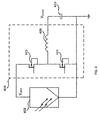
- FIG. 4 is a schematic diagram of an example synchronous half bridge DC/DC converter connected to a PV panel and capacitance.
- Synchronous half bridge 400 comprises N channel MOSFETs 402, 404 and inductance 406.
- the gates of MOSFETS 402, 404 are coupled to receive control signals, from the controller 350 ( FIG. 3 ), for example.
- Synchronous half bridge 400 is bi-directional and couples power between PV panel 408 at a voltage of V MPP and capacitance 410 at a voltage of V STORE .
- N channel MOSFETs 402, 404 are switched with a period "T" and controlled in a complementary fashion. When one of 402, 404 is conducting (ON) the other of 402, 404 is non-conducting (OFF).
- the voltage of PV panel 408 could be regulated to V MPP by controlling the duty cycle of storage DC/DC converter 400.
- the duty cycle "D" of storage DC/DC converter 400 is defined as the ratio of the ON time of switch 402 to the switching period T and is normally expressed as a percentage.
- the duty cycle may range from 0 to 100%. For example, if switch 402 is ON for 70% of the switching period then the duty cycle is 70%.
- the relationship of converter 400's output voltage V STORE to its input voltage V MPP depends on its duty cycle D and is given by the equation.
- V STORE D ⁇ V MPP
- V MPP is 10 V and the voltage at capacitance 410 varies from 4.4 V to 7.6 V.
- the duty cycle of MOSFETs 402, 404 could be determined by a Maximum Power Point Tracking controller which is not shown in FIG. 4 .
- Maximum Power Point Tracking could be implemented in the same controller that controls switching of the MOSFETs 402, 404, such as the controller 350 ( FIG. 3 ), or separately.
- inverter 310 is bi-directional and can convert the DC power of PV panel 302 to AC power for AC grid 150. Inverter 310 can also convert AC power from AC grid 150 to DC power to supply energy store 330 with power through storage DC/DC converter 320 and maintain a target level SoC level of energy store 330.
- Inverter 310 in FIG. 3 comprises first DC/DC stage 312, second DC/DC stage 314 and DC/AC stage 316.
- First DC/DC stage 312 converts the power of PV panel 302 at V MPP (which could vary with insolation levels) to power at substantially constant DC bus voltage ( V BUS ).
- First DC/DC stage 312 is bi-directional and can also perform the reverse operation.
- the current drawn or supplied by energy store 330 is regulated by first DC/DC stage 312.
- first DC/DC stage 312 the time constant of the storage current regulation running in DC/DC converter 312 could be made much longer than the time constant of the PV panel output voltage regulation controlling the duty cycle of storage DC/DC converter 320 .
- first DC/DC stage 312 is an isolated Dual Active Bridge (DAB) circuit.
- DAB Dual Active Bridge
- FIG. 5A is a schematic diagram of an example isolated Dual Active Bridge (DAB).
- DAB 500 comprises input capacitance 501, N type MOSFETs 502, 504, 506, 508, 510, 512, 514, 516, inductance 520 of size or value "L", transformer 522 of turns ratio of 1:N T and leakage inductance 520 of size L LEAK , output capacitance 524 and terminal pair 526, 528 which could be discrete terminals or simply connections.
- DAB 500 is bi-directional and couples power between PV panel 530 and terminal pair 526, 528.
- MOSFETS 502, 504, 506, 508 comprise a first bridge 530 and MOSFETs 510, 512, 514, 516 comprise a second bridge 532. Bridges 530 and 532 couple together through inductance 520 and transformer 522.
- MOSFETS 502, 504, 506, 508, 510, 512, 514, 516 are coupled to receive control signals, from the controller 350 ( FIG. 3 ), for example.
- MOSFET pair 502, 508 and MOSFET pair 504, 506 in bridge 530 are controlled in a complementary fashion.
- MOSFET pair 502, 508 are ON and conducting MOSFET pair 504, 506 are OFF and non-conducting, and when MOSFET pair 502, 508 are OFF and non-conducting MOSFET pair 504, 506 are ON and conducting.
- MOSFET pair 502, 508 and MOSFET pair 504, 506 are switched at a frequency of f s .
- MOSFET pair 510, 516 and MOSFET pair 512, 514 in bridge 532 are also operated in a complementary fashion.
- MOSFET pair 510, 516 are ON and conducting MOSFET pair 512, 514 are OFF and non-conducting
- MOSFET pair 510, 516 are OFF and non-conducting MOSFET pair 512, 514 are ON and conducting.
- MOSFET pair 502, 508 and MOSFET pair 504, 506 are switched at the same frequency of f s as MOSFET pairs 502, 508 and 504, 506.
- the DAB topology could be operated in soft-switching operation and use phase-shifting between the switching of bridge 530 and bridge 532 to achieve power control.
- DAB 500 could be used as the DC/DC converter 312 in inverter 310.
- the current drawn by energy store 330 could be regulated by controlling the phase delay ⁇ between the switching of first bridge 530 and second bridge 532. For example, to increase the current sourced from or decrease the current drawn by energy store 330, the current drawn by DAB 500 could be increased by increasing ⁇ . To decrease the current sourced from or increase the current drawn by energy store 330, the current drawn by DAB 500 could be decreased by decreasing ⁇ .
- the time constant of the storage current regulation controlling the phase of DAB 500 could be made much longer than the time constant of the PV panel output voltage regulation controlling the duty cycle of storage DC/DC converter 320.
- FIG 5B is an example control flow diagram, for the control of storage DC/DC converter 400 ( FIG. 4 ) and DAB 500 ( FIG. 5A ).
- Measurements of panel voltage (V PV ) and current (I PV ) are received by an MPP Tracking (MPPT) control block 560 which generates an MPP voltage V MPP .
- the difference between V MPP and V PV is calculated at 562 and transformed by the MPP transfer function G C2 (s) at block 564.
- the MPP transfer function G C2 (s) is a function in the Laplace transform variable "s" and could represent an integration, a differentiation and/or a scaling of the input signal.
- the transformed difference is input to Pulse Width Modulator block 566 which generates timing control signals for synchronous half bridge 400 ( FIG. 4 ).
- the MPP transfer function could also be implemented in continuous or discrete time.
- Pulse Width Modulator block 556 generates timing control signals for first bridge 530 of DAB 500 ( FIG. 5A ).
- the difference between a storage current reference I STORE , REF and the storage current I STORE is calculated at 552 and transformed by the current control loop transfer function G C1 (s) at 554.
- the loop transfer function G C1 (s) is a function in the Laplace transform variable "s" and could represent an integration, a differentiation and/or a scaling of the input signal.
- the transformed difference is input to phase shift block 558 which generates phase shifted version of the timing signals of first bridge 530 for second bridge 532 ( FIG 5A ).
- the loop transfer function could also be implemented in continuous or discrete time.
- Second DC/DC stage 314 ( FIG. 3 ) could regulate the value of V BUS to a DC voltage somewhat higher than the peak ( V PEAK ) of the AC voltage (V GRID ) to which inverter 310 connects (AC grid 150 of FIG.2 for example) by sinking or sourcing current.
- V BUS is regulated to be 20% higher than V PEAK .
- V PEAK is equal to 2 ⁇ V GRID where V GRID is the RMS (Root Mean Square) voltage of the AC grid voltage.
- V GRID is 240 Volts.
- Second DC/DC stage 314 ( FIG. 3 ) is bi-directional and couples power between first DC/DC stage 312 and DC/AC stage 316. Second stage DC/DC converter 314 could be a synchronous buck converter, for example.
- DC/AC stage 316 converts DC power to AC power at the voltage of the AC grid it is connected to (for example AC grid 150 of FIG. 2 ).
- DC/AC stage 316 is bi-directional and can also perform the reverse operation.
- DC/AC stage 316 could be an unfolding bridge, for example.
- FIG. 6 is a schematic diagram of an example synchronous buck converter coupled to an unfolding bridge.
- Synchronous buck converter 650 comprises MOSFETS 602, 604, input capacitance 601, buck inductance 620 of value L BUCK and buck capacitance 622.
- Unfolding bridge 652 comprises MOSFETS 606, 608, 610 and 612.
- Synchronous buck 650 converter and unfolding bridge 652 are bi-directional and can couple power between terminal pair 630, 632 and terminal pair 640, 642.
- Terminal pair 640, 642 could connect to an AC grid such as for example, AC grid 150 of FIG. 2 .
- Terminal pairs 630, 632 and 640, 642 need not necessarily be discrete terminals, and could instead simply be connections to other components.
- the inductance 620 has a value of 500 ⁇ H.
- MOSFETS 602, 604, 606, 608, 610, 612 are coupled to receive control signals, from the controller 350 ( FIG. 3 ), for example.
- controller 350 FIG. 3
- synchronous buck converter 650 and unfolding bridge 652 could be used to implement second DC/DC stage 314 and DC/AC stage 316, respectively.
- Synchronous buck converter 650 could regulate the DC link voltage V BUS by controlling the amount of current sunk into or sourced from input capacitance 601. It could also shape the current through buck inductance 620 to be a rectified sinusoid. The rectified sinusoid could be at twice the frequency of and in phase with the AC voltage at terminal pair 640, 642 to achieve a high power factor. Synchronous buck converter 650 could be operated in boundary conduction mode for soft-switching and high-efficiency.
- T ON L BUCK ⁇ ⁇ ⁇ I V BUS - V PEAK where ⁇ I is the current change.
- the T ON values for the half sinusoid could be pre-calculated and stored in a Lookup Table (LUT).
- the LUT could be stored in a memory accessible by a controller, such as controller 350 in FIG. 3 , that controls switching of the synchronous buck converter MOSFETs 602, 604.
- Unfolding bridge 652 could "unfold" the rectified sinusoid generated by synchronous buck converter 650 to produce a full sinusoid in phase with and at the frequency of the AC voltage at terminal pair 640, 642.
- MOSFET pair 606, 612 and MOSFET pair 610, 608 in unfolding bridge 652 are controlled in a complementary fashion.
- MOSFET pair 606, 612 are ON and conducting MOSFET pair 610, 608 are OFF and non-conducting
- MOSFET pair 606, 612 are OFF and non-conducting MOSFET pair 610, 608 are ON and conducting.
- MOSFET pair 606, 612 and MOSFET pair 610, 608 are switched at a frequency of twice the frequency of the AC voltage at terminal pair 640, 642.
- MOSFETs 606, 608, 610, 612 could be soft-switched to minimize losses.
- Controller 350 controls the operation of storage DC/DC converter 320 and bi-directional inverter 310 including first DC/DC stage 312, second DC/DC stage 314 and DC/AC stage 316. Although depicted as a single control block, controller 350 could comprise multiple control modules or controllers which control different components or functions. Controller 350 could control switch timings such as for example any one or more of: the duty factor and/or timing of MOSFETs 402, 404 in synchronous half bridge 400 ( FIG. 4 ); the relative phase difference between first bridge 530 and second bridge 532 of DAB 500 ( FIG.
- Controller 350 could contain one or more measurement modules or means, such as one or more voltmeters and/or one or more ammeters, for monitoring parameters such as any one or more of: the current and/or voltage of PV panel 302; the voltage of energy store 330; the current and/or voltage at one or both sides of DC/DC converter 320; the input current of first DC stage 312; and/or the grid voltage at terminal pair 340, 342. Controller 350 could store various values and parameters such as for example any one or more of: the T ON values for the half sinusoid produced by synchronous buck converter 650; and/or a target SoC value for storage 330.
- Controller 350 could execute various control methods such as for example any one or more of: an MPPT control method for PV panel 302; a power smoothing method for the output of PV power generator 300; and/or an SoC maintenance method for storage 330.
- Controller 350 could comprise a processor or multiple processors for the calculation of various values and execution of algorithms, volatile and/or non-volatile memory for the storage of control software / firmware, parameters, values and/or measurements. Controller 350 could also comprise measurement modules or means such as, for example, one or more analog to digital converters for the measurement of voltages and/or currents. In one embodiment controller 350 comprises a Field Programmable Gate Array (FPGA) to control first DC/DC stage 312 and a 16-bit microcontroller to control second DC/DC stage 314 and DC/AC stage 316.
- FPGA Field Programmable Gate Array
- controller 350, DC/DC converter 320, inverter 310 and energy store 330 are contained within a single physical enclosure and attached to PV module 302. This embodiment could provide improved modularity and reduced installation costs compared to the power system of FIG. 1 .
- distributed energy storage 232 1 ... 232 N could be used to smooth and reduce the short term variation in the output power of PV generators 240 1 ... 240 N , from fluctuations in their insolation for example. This could reduce the stress on AC generator 120 by reducing the required compensating change in its power output. If AC generator 120 were a diesel generator for example, its lifetime could be extended and its fuel economy improved by allowing it to operate with less variation in its output. In addition, the frequency regulation of AC grid 150 could be improved by reducing the disturbance on the droop control of AC generator 120.
- the power fluctuation of an individual PV generator 240 1 ... 240 N is stabilized by a forecasting mechanism that runs in real-time and outputs a current reference to regulate the PV generator's power output to an expected value.
- the expected value could be calculated based on a time series of average power output values, and the average values could be calculated over a smoothing period.
- the expected value is predominantly determined by fluctuations in insolation that occur on a time scale of the same order as the smoothing period.
- the expected value is only slightly or not at all affected by fluctuations that occur on a time scale much shorter than the smoothing period.
- the length of the smoothing period could be determined by the amount of storage. Since the storage must compensate for the difference between actual and expected power output over the smoothing period longer smoothing periods could involve providing larger amounts of storage.
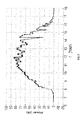
- FIG. 7 is a representative plot of power versus time for an example 100 W PV panel on a cloudy day with surrounding shadowing obstacles. Similar or different results could be obtained under similar or different conditions using a similar or different PV panel.
- Power is almost zero in the morning before about 8:00, increases to maximum of around 90W at around 12:00 and then decreases back to almost zero after 18:00.
- Significant (> 50%) and short term (minutes) variation in power is evident at, for example around 14:00 and 15:00. These types of variation could be especially difficult and expensive for an AC grid to accommodate since many types of conventional generation sources cannot respond on these time scales and the price of reserve generating capacity is typically inversely proportional to the required response time.
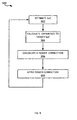
- FIG. 8 is a flow diagram illustrating an example power smoothing method 800, for a stabilized power generator such as PV generators 240 1 .... 240 N of FIG. 2 or PV generator 300 of FIG. 3 .
- the current panel power P PV
- P AVE a smoothed value of panel power
- P AVE is a time average and is calculated using a weighted moving averaging window. The size of this window could be scaled based on the storage capacity of the energy store and the desired level of power smoothing.
- P PV is calculated every 10 seconds and P AVE is calculated using a five minute wide window.
- a Hull Moving Average is used.
- WMA ( f ( x ) ,M ) is a weighted moving average of the function f(x) calculated over the last M values.
- a Hull moving average could reduce the latency in the value of P AVE . relative to a value of P AVE calculated using a simple Weighted Moving Average, while still providing smoothing.
- M has the value of 30.
- linear weights are used with the most recent value given the highest weight. For example, in one embodiment there are 30 values and the most recent value is given a weight of 30, the previous sample is given a weight of 29 and so on.
- an expected value of panel power P EXP is calculated based on previous values of P AVE .
- the expected value of panel power is calculated using a polynomial s ( n, ⁇ ) fitted to previously measured values of P AVE where ⁇ is a vector representing the polynomial coefficients and "n" is the measurement index.
- LSE Least Square Estimation
- a power correction is applied to change the power generator's output by the amount P DIFF .
- the power generator will attempt to provide the power difference using the power generator's distributed storage such as for example distributed energy storage 232 1 ... 232 N of FIG. 2 . If P DIFF is a positive value the distributed storage will source power. If P DIFF is a negative value then the distributed storage will store power.
- a current reference signal could be supplied to first DC/DC stage 312 of inverter 310 to control its current.
- the power correction could be a change in this current reference signal which would cause a change in the current drawn by first DC/DC stage 312 and a complementary change in the current of DC/DC converter 320.
- first DC/DC stage 312 For example, if the current drawn by first DC/DC stage 312 increases then the current sourced by energy store 330 and DC/DC storage converter 320 will also increase. If the current drawn by first DC/DC stage 312 decreases then the current sourced by energy store 330 and DC/DC storage converter 320 will decrease and could be negative in which case energy store 330 would sink current and store energy.
- SoC State-of-Charge
- the target value is 50% of SoC and the power generator is controlled to attempt to maintain the SoC of the energy store at 50%.
- This SoC control method could operate in conjunction with the power smoothing method but on a longer time scale to prevent instability.
- FIG. 9 is a flow diagram of an example SoC maintenance method 900.
- the SoC of the power generator's energy store is estimated.
- the energy store is a capacitance of value C STORE
- a power correction is calculated based on the difference.
- the correction is applied. For example, referring to FIG. 3 , in one embodiment a current reference signal is supplied to first DC/DC stage 312 of inverter 310 to control its current.
- the power correction could be a change in this current reference signal which would cause a change in the current drawn by first DC/DC stage 312 and a complementary change in the current of DC/DC converter 320.
- the current drawn by first DC/DC stage 312 increases then the current sourced by energy store 330 and DC/DC storage converter 320 will also increase and the SoC of energy store 330 will decrease.
- the current drawn by first DC/DC stage 312 decreases then the current sourced by energy store 330 and DC/DC storage converter 320 will decrease and could be negative in which case the SoC of energy store 330 would increase.
- FIG. 10 is a control flow diagram of a combined power smoothing and SoC management control loop 1000 for PV generator 300.
- the PV panel power P PV is calculated from measurements of the PV panel voltage (V PV ) and current (I PV ).
- the moving average of the PV panel power ( P AVE ) is calculated.
- an expected value of PV panel power ( P EXP ) is estimated based on previous values of P AVE .
- a power difference P DIFF is calculated between the expected PV panel power and the actual PV panel power.
- a power smoothing current correction (I SM ) is calculated by dividing P DIFF by the storage voltage V STORE .
- an estimate of SoC is calculated based on the value of V STORE .
- the difference between the target SoC value (SoC REF ) and the SoC estimate is calculated.
- an SOC current correction I SoC is generated using the difference between the SoC target and estimated values and the SoC control loop transfer function G c (s).
- the SoC transfer function is a function in the Laplace transform variable "s" and could represent an integration, a differentiation and/or a scaling of the input signal.
- the MPP transfer function could also be implemented in continuous or discrete time. The transfer function could be designed to provide the SoC control loop a slower response time than the power smoothing loop.
- the power smoothing current and SoC current corrections are summed and a total current correction I COR calculated.
- the total current correction could be applied to the first DC/DC stage 312 PV generator 300, for example.
- a stabilized power generator includes a power generating component.
- the power generating component could be a PV panel or there could be multiple PV panels. This type of power generating component is shown at 202 1 ... 202 N in FIG. 2 , 302 in FIG. 3 , 408 in FIG. 4 , and 530 in FIG. 5A .
- Other types of power generating components such as wind turbines and tidal power generators, are also contemplated.
- An energy store is also provided in a stabilized power generator, as shown at 330 in FIG. 3 .
- the energy store could include, for example, capacitance, a battery, and/or an ultracapacitor.
- a bi-directional DC/DC converter is electrically coupled between the power generating component and the energy store. This is shown, for example, at 320 in FIG. 3 . Such a converter could be implemented together with the energy store, in distributed storage 232 1 ... 232 N ( FIG. 2 ).
- a bi-directional DC/AC converter is electrically coupled at a DC side of the bi-directional DC/AC converter to a circuit path between the power generating component and the bi-directional DC/DC converter, and is to be electrically coupled at an AC side of the bi-directional DC/AC converter to an electrical grid.
- bi-directional DC/AC converters are shown at 210 1 ... 210 N , and each is coupled at its DC side to a path between a PV panel 202 1 ... 202 N and distributed storage 232 1 ... 232 N .
- each distributed storage 232 1 ... 232 N includes a bi-directional DC/DC converter.
- 210 N is further coupled at its AC side to an electrical grid in the form of AC grid 150.
- Interconnections between a bi-directional DC/AC converter 310 and other components are also shown in FIG. 3 .
- a bi-directional DC/DC converter is shown at 320 as being electrically coupled between the power generating component, specifically PV panel 302 in this example, and energy store 330.
- a DC side of bi-directional DC/AC converter 310 is coupled to a circuit path between PV panel 302 and bi-directional DC/DC converter 320, and an AC side of the bi-directional DC/AC converter can be coupled to an electrical grid at terminals 340, 342.
- bi-directional DC/AC converter 310 could include a first DC/DC stage 312 electrically coupled to the circuit path between the power generating component 302 (PV panel 302) and bi-directional DC/DC converter 320.
- First DC/DC stage 312 could include a DAB circuit, such as the DAB shown in FIG. 5A .
- a controller such as controller 350 in FIG. 3 could be coupled to bi-directional DC/AC converter 310, to control current flowing through the bi-directional DC/AC converter by controlling switching in that converter.
- the current flowing through bi-directional DC/AC converter 310 in turn controls storage current flowing to or from energy store 330.
- the current drawn by first DC/DC stage 312 increases then the current sourced by energy store 330 and DC/DC storage converter 320 will also increase and the SoC of energy store 330 will decrease.
- the current drawn by first DC/DC stage 312 decreases then the current sourced by energy store 330 and DC/DC storage converter 320 will decrease and could be negative in which case the SoC of energy store 330 would increase.
- the controller 350 could control voltage at a PV panel side of the converter at which the converter is electrically coupled to PV panel 302. This voltage control could be implemented, for example, through control of switching in bi-directional DC/DC converter 320.
- the controller could be configured to control switching in bi-directional DC/DC converter 320 to track MPP for PV panel 302.
- Charging and discharging of energy store 330 could also be provided by controller 350 or multiple controllers / control modules, to provide power smoothing of output power from the power generating component, which in FIG. 3 is the PV panel 302.
- controller 350 could be configured to calculate an expected power output of the PV panel 302, and to control charging and discharging of energy store 330 based on the expected power output.
- the expected power output of PV panel 302 could be based on previous, time averaged power values of the output power from the PV panel.
- Controller 350 could be configured to calculate the expected power output based on a moving average of the output power P from PV panel 302.
- HMA Hull Moving Average
- Controller 350 could control charging and discharging of energy store 330 based on maintaining an SoC of the energy store at a target value.
- the target value of the SoC could be 50%, for example, but could instead be variable.
- a fixed SoC target value could be stored in a memory and accessed by controller 350.
- Different SoC target values could similarly be stored in a memory and accessed by controller 350 to provide different SoC target values at different times of day. Changes to SoC target values could then be made by changing the target value(s) stored in memory.
- controller 350 is coupled to bi-directional DC/AC converter 310, to control the converter to convert power from an electrical grid, such as AC grid 150 ( FIG. 2 ) at terminals 340, 342 to DC for charging energy store 330 and maintaining the SoC of the energy store at the target value.
- an electrical grid such as AC grid 150 ( FIG. 2 ) at terminals 340, 342 to DC for charging energy store 330 and maintaining the SoC of the energy store at the target value.
- Controller 350 could control charging and discharging of energy store 330 to provide both power smoothing of output power from PV panel 302 and maintenance of the SoC of the energy store at a target value.
- controller 350 could be configured to control the maintenance of the SoC with a slower response time than a response time of the power smoothing.
- a stabilized power generator could include a single physical enclosure, attached to the power generating component, to enclose the energy store, the bi-directional DC/DC converter, and the bi-directional DC/AC converter. Such an enclosure could be attached to the back of a PV panel, for example, to hold other components of the stabilized power generator.
- This provides an integrated panel in which a PV panel is equipped with stabilized power generation, ready to install in a Building Integrated PV (BIPV) system or other power system.
- BIPV Building Integrated PV
- a method of operation of a stabilized power generator involves controlling a bi-directional DC/DC converter and controlling a bi-directional DC/AC converter.
- the a bi-directional DC/DC converter is electrically coupled between a power generating component and an energy store, and is controlled for DC/DC conversion of power flow into and out of the energy store.
- the bi-directional DC/AC converter is electrically coupled at a DC side of the bi-directional DC/AC converter to a circuit path between the power generating component and the bi-directional DC/DC converter, is to be electrically coupled at an AC side of the bi-directional DC/AC converter to an electrical grid, and is controlled for AC/DC conversion of power flow between the AC grid and the bi-directional DC/DC converter.
- FIG. 3 shows an example of such a stabilized power generator, including bi-directional DC/DC converter 320, bi-directional DC/AC converter 310, a power generating component in the form of PV panel 302, and energy store 330.
- controlling bi-directional DC/DC converter 320 could involve controlling voltage at a PV panel side of the converter at which the converter is electrically coupled to PV panel 302, by controlling switching in that converter to track MPP for the PV panel.
- An MPPT block is shown at 560 in FIG. 5B , for example.
- Controlling bi-directional DC/AC converter 310 could involve controlling current flowing through the converter by controlling switching in the converter.
- the current flowing through bi-directional DC/AC converter 310 controls storage current flowing to or from energy store 330 as described herein.
- FIG. 8 is a flow diagram illustrating an example power smoothing method, and is described in detail above.
- This example method 800 involves calculating an expected power output at 806, and the power correction applied at 810 could involve controlling current flowing through bi-directional DC/AC converter 310 ( FIG. 3 ) based on the expected power output.
- Calculating the expected power output could involve calculating the expected power output based on previous, time averaged power values of output power, as shown at 804.
- HMA Hull Moving Average
- Controlling current flowing through bi-directional DC/AC converter 310 could also or instead involve controlling the current to provide maintenance of SoC of energy store 330 at a target value.
- FIG. 9 is a flow diagram of an example SoC maintenance method.
- FIG. 10 is a control flow diagram of an example combined power smoothing and SoC management control loop.
- a microgrid could include an AC power grid such as AC grid 150 ( FIGS. 2 and 3 ) and a stabilized power generator 240 1 ... 240 N , 300. There could be one or more stabilized power generators.
- the stabilized power generator includes a power generating component (such as PV panels 202 1 ... 202 N in FIG. 2 , 302 in FIG. 3 , 408 in FIG. 4 , and 530 in FIG. 5A ), an energy store 330 ( FIG. 3 ), a bi-directional DC/DC converter 320 electrically coupled between the power generating component and the energy store, and a bi-directional DC/AC converter 210 1 ...
- Each bi-directional DC/AC converter 210 1 ... 210 N , 310 is electrically coupled to the DC/DC converter at its DC port and connected to the AC power grid at its AC port.
- any divisions of function in the drawings are not intended to be limiting or exhaustive.
- Other embodiments could include additional, fewer, and/or different components than shown.
- other method embodiments could include additional, fewer, and/or different operations performed in an order similar to or different from the orders shown in the drawings and described above.
Landscapes
- Engineering & Computer Science (AREA)
- Power Engineering (AREA)
- Charge And Discharge Circuits For Batteries Or The Like (AREA)
Abstract
Description
- This invention relates generally to power generation and, in particular, to stabilizing a renewable power generating component's output.
- The output of a power generating component could be subject to variation. In the case of a photovoltaic (PV) cell, panel, or panel array for example, output power variations could be caused by clouds, shadows etc. In the case of a wind turbine the power output could be similarly affected by changes in wind speed or direction.
- According to an embodiment, a stabilized power generator includes a power generating component, an energy store, a bi-directional Direct Current (DC) / DC converter, and a bi-directional DC / Alternating Current (AC) converter. The bi-directional DC/DC converter is electrically coupled between the power generating component and the energy store. The bi-directional DC/AC converter is electrically coupled at a DC side of the bi-directional DC/AC converter to a circuit path between the power generating component and the bi-directional DC/DC converter, and is to be electrically coupled at an AC side of the bi-directional DC/AC converter to an electrical grid.
- The stabilized power generator could also include a single physical enclosure, attached to the power generating component, to enclose the energy store, the bi-directional DC/DC converter, and the bi-directional DC/AC converter.
- The power generating component includes a PV panel in an embodiment, or could include multiple panels.
- The energy store could include, for example, a capacitor, a battery, and/or an ultracapacitor.
- In an embodiment, the bi-directional DC/AC converter includes a first DC/DC stage electrically coupled to the circuit path between the power generating component and the bi-directional DC/DC converter, and the first DC/DC stage includes a Dual Active Bridge (DAB) circuit.
- A controller could be coupled to the bi-directional DC/AC converter, to control current flowing through the bi-directional DC/AC converter by controlling switching in the bi-directional DC/AC converter, with the current flowing through the bi-directional DC/AC converter in turn controlling storage current flowing to or from the energy store.
- In an embodiment in which the power generating component includes a PV panel, the stabilized power generator could also include a controller, coupled to the bi-directional DC/DC converter, to control voltage at a PV panel side of the bi-directional DC/DC converter at which the bi-directional DC/DC converter is electrically coupled to the PV panel, by controlling switching in the bi-directional DC/DC converter. The controller could be configured to control switching in the bi-directional DC/DC converter to track Maximum Power Point (MPP) for the PV panel.
- A stabilized power generator could also include a controller to control charging and discharging of the energy store to provide power smoothing of output power from the power generating component.
- The controller could be configured to calculate an expected power output of the power generating component, and to control charging and discharging of the energy store based on the expected power output.
- The controller could be configured to calculate an expected power output of the power generating component based on previous, time averaged power values of the output power from the power generating component.
- The controller could be configured to calculate an expected power output of the power generating component based on a moving average of the output power P from the power generating component, the moving average comprising a Hull Moving Average (HMA) of a form:

where WMA(f(x),M)
is a weighted moving average of the function f(x) calculated over the last M values. - In some embodiments, the stabilized power generator includes a controller to control charging and discharging of the energy store based on maintaining a State of Charge (SoC) of the energy store at a target value. The target value of the SoC could be 50%, for example.
- The controller could be coupled to the bi-directional DC/AC converter, to control the bi-directional DC/AC converter to convert power from the electrical grid to DC for charging the energy store and maintaining the State of Charge (SoC) of the energy store at the target value
- The stabilized power generator could include a controller to control charging and discharging of the energy store to provide both power smoothing of output power from the power generating component and maintenance of a State of Charge (SoC) of the energy store at a target value, with the controller being configured to control the maintenance of the SoC with a slower response time than a response time of the power smoothing.
- A method according to another aspect of the invention involves controlling a bi-directional DC/DC converter, electrically coupled between a power generating component and an energy store, for DC/DC conversion of power flow into and out of the energy store; and controlling a bi-directional DC/AC converter, electrically coupled at a DC side of the bi-directional DC/AC converter to a circuit path between the power generating component and the bi-directional DC/DC converter and to be electrically coupled at an AC side of the bi-directional DC/AC converter to an electrical grid, for AC/DC conversion of power flow between the AC grid and the bi-directional DC/DC converter.
- The power generating component could include one or more PV panels.
- In an embodiment, the power generating component includes a PV panel, controlling the bi-directional DC/DC converter involves controlling voltage at a PV panel side of the bi-directional DC/DC converter at which the bi-directional DC/DC converter is electrically coupled to the PV panel, by controlling switching in the bi-directional DC/DC converter, and controlling the bi-directional DC/DC converter further includes controlling switching in the bi-directional DC/DC converter to track MPP for the PV panel.
- Controlling the bi-directional DC/AC converter could involve controlling current flowing through the bi-directional DC/AC converter by controlling switching in the bi-directional DC/AC converter. The current flowing through the bi-directional DC/AC converter controls storage current flowing to or from the energy store.
- The storage current controls charging and discharging of the energy store to provide power smoothing of output power from the power generating component in an embodiment.
- In another embodiment, the storage current controls charging and discharging of the energy store, the method further includes calculating an expected power output of the power generating component, and controlling current flowing through the bi-directional DC/AC converter involves controlling the current based on the expected power output.
- Calculating the expected power output could involve calculating the expected power output based on previous, time averaged power values of the output power from the power generating component.
- In another embodiment, calculating the expected power output involves calculating the expected power output based on a moving average of the output power P from the power generating component, the moving average comprising a Hull Moving Average (HMA) of a form:

where WMA(f(x),M)
is a weighted moving average of the function f(x) calculated over the last M values. - Controlling current flowing through the bi-directional DC/AC converter could involve controlling the current to provide both power smoothing of output power from the power generating component and maintenance of a State of Charge (SoC) of the energy store at a target value, with the controlling involving control for maintenance of the SoC with a slower response time than a response time of control for power smoothing.
- A microgrid includes an AC power grid and a stabilized power generator. The stabilized power generator includes a power generating component, an energy store, a bi-directional Direct Current (DC) / DC converter electrically coupled between the power generating component and the energy store, and a bi-directional DC / Alternating Current (AC) converter having a DC port and an AC port, and electrically coupled to the DC/DC converter at its DC port and connected to the AC power grid at its AC port.
- Other aspects and features of embodiments of the present disclosure will become apparent to those ordinarily skilled in the art upon review of the following description.
- Examples of embodiments of the invention will now be described in greater detail with reference to the accompanying drawings.
-
FIG. 1 is a block diagram of a conventionally stabilized power generation system. -
FIG. 2 is a block diagram of an example stabilized PV power system using integrated energy storage. -
FIG. 3 is a block diagram of an example PV generator. -
FIG. 4 is a schematic diagram of an example synchronous half bridge DC/DC converter connected to a PV panel and a capacitance. -
FIG. 5A is a schematic diagram of an example isolated Dual Active Bridge (DAB). -
FIG 5B is an example control flow diagram. -
FIG. 6 is a schematic diagram of an example synchronous buck converter coupled to an unfolding bridge. -
FIG. 7 is a representative plot of power versus time for an example PV panel. -
FIG. 8 is a flow diagram illustrating an example power smoothing method. -
FIG. 9 is a flow diagram of an example SoC maintenance method. -
FIG. 10 is a control flow diagram of an example combined power smoothing and SoC management control loop. - Power generation from renewable sources is becoming increasingly important. The power output from renewable generators, such as for example solar Photo-Voltaic (PV) generation, wind turbines or tidal power generators can be intermittent and dependent on prevailing weather conditions such as amount of cloud cover or wind speed. The output of renewable generators could be stabilized by the addition of energy storage.
-
FIG. 1 is a block diagram of a conventionally stabilized power generation system. -
Power system 100 comprisesPV generators bi-directional inverter 114,central energy storage 130 andterminal pair PV power system 100 connects to Alternating Current (AC)grid 150 atterminal pair PV generator 106 comprisesPV panel 102 andinverter 110.PV generator 108 comprisesPV panel 104 andinverter 112. -
PV panels inverters Inverters AC grid 150. -
AC grid 150 comprises AC loads 140 andAC generator 120.AC generator 120 could be a non-renewable generator, for example a diesel generator, and provide power for night time operation. AC loads 140 could comprise lighting, heating, cooling, electric motors or industrial machinery.AC grid 150 could be a microgrid such as a remote mining facility, military forward operating base or a university campus.AC grid 150 could also be a utility grid. -
Central energy storage 130 connects tobidirectional inverter 114.Bi-directional inverter 114 couples toAC grid 150 throughterminal pair AC grid 150, from excess power generation fromPV panels central energy storage 130 could absorb the excess power and store energy. When there is a deficiency of power on theAC grid 150, from reduced power generation fromPV panels central energy storage 130 could provide power toAC grid 150. The action ofcentral energy storage 130 reduces the required variation in power output fromAC generator 120 caused by the variability in output ofPV panels AC generator 120 being a diesel generator, this could beneficially improve its fuel efficiency.Central energy storage 130 does not reduce the variation in power output ofPV generators - As described in detail herein, output power stabilization could be achieved with an energy store such as a battery or a capacitance (illustratively an ultracapacitor). A PV panel, and/or other power generating component, could connect to the energy store through a DC / DC converter and to an electrical grid or microgrid through a DC / AC converter, also referred to as an inverter. In an embodiment, expected power output for the PV panel is determined, based on time of day for instance, and compared to the actual power being produced. Any difference is either sourced or sunk by the energy store. Short term output fluctuations could be smoothed out in this manner.
- In an embodiment, a dual-active-bridge based bi-directional micro-inverter with integrated short-term Li-ion ultra-capacitor storage and active power smoothing for modular PV systems is provided.
- These and other embodiments are described in further detail herein.
-
FIG. 2 is a block diagram of an example stabilized PV power system using integrated energy storage.PV power system 200 comprises PV generators 2401 ... 240N andterminal pair PV power system 200 connects toAC grid 150. - Inverters 2101 ... 210N are bi-directional and convert the DC power of PV panels 2021... 202N into AC power. Inverters 2101 ... 210N can also convert AC power from
AC grid 150 into DC power to charge distributed storage 2321 ... 232N. Thus, although referred to as inverters, the inverters 2101 ... 210N and inverters in other example embodiments herein are not limited to inverting DC power to AC power. The inverters can also perform AC to DC conversion, and therefore could be considered a form of DC / AC converter. Inverters 2101 ... 210N could also be capable of four quadrant operation and provide reactive as well as real power. Inverters 2101 ... 210N could also be capable of stand-alone operation with distributed frequency and voltage regulation such that the frequency and voltage ofAC grid 150 is maintained even ifgenerator 120 were to cease power generation, from running out of fuel or experiencing mechanical breakdown for example. Any of various types of inverters could be used to implement inverters 2101 ... 210N, and illustrative examples are provided herein. - Distributed energy storage 2321 ... 232N provide power smoothing and stabilization of the power output of individual PV generators 2401 ... 240N and
PV power system 200 and reduces the variation in power output fromAC generator 120 that would otherwise be required. Distributed energy storage 2321 ... 232N could employ any of a variety of storage technologies including one or more batteries and / or one or more ultracapacitors. Although not explicitly shown inFIG. 2 , DC/DC conversion is provided within distributed energy storage 2321 ... 232N in the embodiment shown. Thus, each distributed energy storage 2321 ... 232N includes a DC/DC converter and an energy store. -
Power system 200 using distributed storage in the form of energy storage 2321 ... 232N could have an advantage over power system 100 (FIG. 1 ).Power system 200 is modular. Generating capacity can be added topower system 200 in increments as small as a single additional PV generator. In contrast, the addition of more generating capacity topower system 100 could require the replacement ofinverter 114 and/orcentral energy store 130 with larger capacity units.Power system 200 could be more efficient thanpower system 100. To store power inenergy store 130, PV panel power must first be converted from DC power to AC power by one ofinverters inverter 114. In contrast, to store power in distributed energy storage 2321 ... 232N, PV power need only be converted once from the DC level of PV panel 2021 ... 202N to the DC level of distributed energy storage 2321 ... 232N. -
Central energy storage 130 could comprise a large number of individual storage cells such as batteries. Complicated and inefficient cell balancing could be required to ensure that individual cells are not under or over-charged. Cell balancing in distributed storage 2321 ... 232N might not be required due to its smaller number of cells or the complexity of cell balancing could be greatly reduced. For example, in one embodiment, each of the distributed energy storage 2321 ... 232N comprises only two individual serially connected storage cells. -
Power system 200 could also provide a more stable Root-Mean-Square (RMS) voltage forAC grid 150 than power system 100 (FIG. 1 ). For example, a reduction in the power generation ofPV panel central energy storage 130 to source power can only be signaled tocentral energy storage 130 by a decrease in the RMS voltage ofAC grid 150. In power system 200 a reduction in power generation of PV panel 2021 ... 202N can be signaled to distributed energy storage 2321 ... 232N without a decrease in the voltage ofAC grid 150 since each of PV panel 2021 ... 202N is directly connected to each of distributed energy storage 2321 ... 232N. -
Power system 200 could also be more fault tolerant than power system 100 (FIG. 1 ). For example,central energy storage 130 andinverter 114 represent single points of failure and could compromise the ability ofpower system 100 to compensate for fluctuation in the output ofPV generators power system 200 however, is distributed across all PV generators 2401 ... 240N and there is no single point of failure. -
Power system 200 is an example only. In other embodiments a PV panel generator could comprise multiple, serially connected PV panels rather than a single panel. Althoughpower system 200 is depicted as a single-phase system, in other embodiments it could be multi-phase. Other power generating components could be used instead of or in addition to PV panels, including wind turbines, tidal turbines and/or other renewable generators. -
FIG. 3 is a block diagram of an example PV generator such as PV generator 2401 ... 240N ofpower system 200 ofFIG.2 .PV generator 300 comprisesPV panel 302,bi-directional inverter 310, bi-directional storage DC/DC converter 320, energy storage 330 andcontroller 350. The terminals shown at 340, 342 could be discrete terminals or simply connections to an AC grid such as AC grid 150 (FIG. 2 ). - The output power and voltage of
PV panel 302 is variable and dependent on the level of insolation it receives. Storage DC/DC converter 320 and energy store 330 stabilize the output ofPV generator 300. When there is an excess of PV panel power, DC/DC converter 320 converts the excess power and stores it in energy store 330. When there is a deficiency of PV panel power, DC/DC converter 320 takes power from energy store 330 and provides it toinverter 310. - Energy store 330 could include capacitance, and could stabilize the output of
PV generator 302 in the short term (minutes) to smooth its power output. It could also support the voltage VGRID of AC grid 150 (FIG. 2 ) in the short term to mitigate transient loads such as the start up of a motor. In one embodiment energy store 330 is a Lithium-Ion Ultra-Capacitor (LIC). - Ultracapacitors have a symmetric input and output specific power in the range of 0.5-25 kW/kg, which is at least one order of magnitude higher than typical lithium-ion (Li-Ion) based batteries. Ultracapacitors also offer higher cycle-life, lower Equivalent Series Resistance (ESR) and less susceptibility to high depths-of-discharge. A LIC is a hybrid device that combines the intercalation mechanism of traditional Lithium-Ion batteries with the cathode of an ultracapacitor. The cathode often employs activated carbon material at which charges are stored at the interface between the carbon and the electrolyte. The anode is generally pre-doped with Lithium ions, resulting in a lower anode voltage, and a higher cell voltage. As a consequence, LICs have 3-4x higher energy density than ultracapacitors. LICs are well suited to applications where both high energy, high power and high cycle-life are required. LIC technology matches with the 20-25 year expected lifespan of PV systems. To deal with power fluctuations of a PV system, relatively high energy-density is necessary, since irradiance fluctuations occur in the timescales of minutes. In one embodiment energy store 330 comprises two serial connected LICs each of capacitance of 2,200 F and with a total storage capacity of 8.8 Watt-hours.
- Energy store 330 could also or instead include a battery and stabilize the output of
PV generator 302 and support the voltage VGRID of AC grid 150 (FIG. 2 ) for longer periods. - Storage DC/
DC converter 320 can also convert power frominverter 310 and supply it to energy store 330 to maintain the State of Charge (SoC) of energy store 330 at a target level. The SoC of an energy storage device is the amount of energy stored divided by the energy storage capacity of the device and is normally expressed as a percentage. For example a fully charged device would have an SoC of 100%. - In one embodiment, storage DC/
DC converter 320 regulates the output voltage ofPV panel 302 to a reference voltage VMPP. VMPP corresponds to the Maximum Power Point of the PV panel and represents the point on the PV panel's current versus voltage curve corresponding to maximum output power. VMPP varies with the amount of insolation the PV panel receives. In one embodiment,PV panel 302 is a 100W panel, VMPP is 10 V and the current at the maximum power point (IMPP) is 10 A. - Storage DC/
DC converter 320 could be a synchronous half bridge.FIG. 4 is a schematic diagram of an example synchronous half bridge DC/DC converter connected to a PV panel and capacitance.Synchronous half bridge 400 comprisesN channel MOSFETs inductance 406. Although not explicitly shown inFIG. 4 , the gates ofMOSFETS FIG. 3 ), for example. -
Synchronous half bridge 400 is bi-directional and couples power betweenPV panel 408 at a voltage of VMPP andcapacitance 410 at a voltage of VSTORE.N channel MOSFETs inductor 406 has a value of LLIC = 10 µH. The voltage ofPV panel 408 could be regulated to VMPP by controlling the duty cycle of storage DC/DC converter 400. - The duty cycle "D" of storage DC/
DC converter 400 is defined as the ratio of the ON time ofswitch 402 to the switching period T and is normally expressed as a percentage. The duty cycle may range from 0 to 100%. For example, ifswitch 402 is ON for 70% of the switching period then the duty cycle is 70%. The relationship ofconverter 400's output voltage VSTORE to its input voltage VMPP depends on its duty cycle D and is given by the equation.
- In one embodiment VMPP is 10 V and the voltage at
capacitance 410 varies from 4.4 V to 7.6 V. The duty cycle ofMOSFETs FIG. 4 . Maximum Power Point Tracking could be implemented in the same controller that controls switching of theMOSFETs FIG. 3 ), or separately. - Referring to
FIG. 3 ,inverter 310 is bi-directional and can convert the DC power ofPV panel 302 to AC power forAC grid 150.Inverter 310 can also convert AC power fromAC grid 150 to DC power to supply energy store 330 with power through storage DC/DC converter 320 and maintain a target level SoC level of energy store 330. -
Inverter 310 inFIG. 3 , comprises first DC/DC stage 312, second DC/DC stage 314 and DC/AC stage 316. First DC/DC stage 312 converts the power ofPV panel 302 at VMPP (which could vary with insolation levels) to power at substantially constant DC bus voltage (VBUS ). First DC/DC stage 312 is bi-directional and can also perform the reverse operation. - In an embodiment the current drawn or supplied by energy store 330 is regulated by first DC/
DC stage 312. To maintain stability the time constant of the storage current regulation running in DC/DC converter 312 could be made much longer than the time constant of the PV panel output voltage regulation controlling the duty cycle of storage DC/DC converter 320 . - In one embodiment first DC/
DC stage 312 is an isolated Dual Active Bridge (DAB) circuit. -
FIG. 5A is a schematic diagram of an example isolated Dual Active Bridge (DAB).DAB 500 comprisesinput capacitance 501,N type MOSFETs inductance 520 of size or value "L",transformer 522 of turns ratio of 1:NT andleakage inductance 520 of size LLEAK,output capacitance 524 andterminal pair DAB 500 is bi-directional and couples power betweenPV panel 530 andterminal pair MOSFETS first bridge 530 andMOSFETs second bridge 532.Bridges inductance 520 andtransformer 522. - Although not explicitly shown in
FIG. 5A , the gates ofMOSFETS FIG. 3 ), for example. -
MOSFET pair 502, 508 andMOSFET pair 504, 506 inbridge 530 are controlled in a complementary fashion. WhenMOSFET pair 502, 508 are ON and conductingMOSFET pair 504, 506 are OFF and non-conducting, and whenMOSFET pair 502, 508 are OFF andnon-conducting MOSFET pair 504, 506 are ON and conducting.MOSFET pair 502, 508 andMOSFET pair 504, 506 are switched at a frequency of fs . -
MOSFET pair MOSFET pair bridge 532 are also operated in a complementary fashion. WhenMOSFET pair MOSFET pair MOSFET pair non-conducting MOSFET pair MOSFET pair 502, 508 andMOSFET pair 504, 506 are switched at the same frequency of fs as MOSFET pairs 502, 508 and 504, 506. - In one embodiment of
DAB 500 the fs is 156 kHz, the turns ratio oftransformer 522 is 10, theoutput capacitance 524 has a value of 270 uF, theinput capacitance 501 has a value of 1 mF, theinductance 520 has a value of 4.7 µH and VBUS = 420 V. - The DAB topology could be operated in soft-switching operation and use phase-shifting between the switching of
bridge 530 and bridge 532 to achieve power control. The real power flow (P) inDAB 500 fromPV panel 530 tooutput terminal pair 
where -π/2 < Φ < π/2 where LTOT = L + LLEAK is the value of total inductance, and Φ is the phase-shift between the switching offirst bridge 530 andsecond bridge 532. No power is transferred when Φ = 0. A maximum amount of power is transferred fromPV panel 530 toterminal pair FIGS. 3 and5A ,DAB 500 could be used as the DC/DC converter 312 ininverter 310. The current drawn by energy store 330 could be regulated by controlling the phase delay Φ between the switching offirst bridge 530 andsecond bridge 532. For example, to increase the current sourced from or decrease the current drawn by energy store 330, the current drawn byDAB 500 could be increased by increasing Φ. To decrease the current sourced from or increase the current drawn by energy store 330, the current drawn byDAB 500 could be decreased by decreasing Φ. - To maintain stability the time constant of the storage current regulation controlling the phase of
DAB 500 could be made much longer than the time constant of the PV panel output voltage regulation controlling the duty cycle of storage DC/DC converter 320. -
FIG 5B is an example control flow diagram, for the control of storage DC/DC converter 400 (FIG. 4 ) and DAB 500 (FIG. 5A ). Measurements of panel voltage (VPV) and current (IPV) are received by an MPP Tracking (MPPT)control block 560 which generates an MPP voltage VMPP. The difference between VMPP and VPV is calculated at 562 and transformed by the MPP transfer function GC2(s) atblock 564. The MPP transfer function GC2(s) is a function in the Laplace transform variable "s" and could represent an integration, a differentiation and/or a scaling of the input signal. The transformed difference is input to PulseWidth Modulator block 566 which generates timing control signals for synchronous half bridge 400 (FIG. 4 ). The MPP transfer function could also be implemented in continuous or discrete time. - Pulse
Width Modulator block 556 generates timing control signals forfirst bridge 530 of DAB 500 (FIG. 5A ). The difference between a storage current reference ISTORE, REF and the storage current ISTORE is calculated at 552 and transformed by the current control loop transfer function GC1(s) at 554. The loop transfer function GC1(s) is a function in the Laplace transform variable "s" and could represent an integration, a differentiation and/or a scaling of the input signal. The transformed difference is input tophase shift block 558 which generates phase shifted version of the timing signals offirst bridge 530 for second bridge 532 (FIG 5A ). The loop transfer function could also be implemented in continuous or discrete time. - Second DC/DC stage 314 (
FIG. 3 ) could regulate the value of VBUS to a DC voltage somewhat higher than the peak (VPEAK ) of the AC voltage (VGRID) to whichinverter 310 connects (AC grid 150 ofFIG.2 for example) by sinking or sourcing current. In one embodiment VBUS is regulated to be 20% higher than VPEAK. VPEAK is equal to
FIG. 3 ) is bi-directional and couples power between first DC/DC stage 312 and DC/AC stage 316. Second stage DC/DC converter 314 could be a synchronous buck converter, for example. - DC/
AC stage 316 converts DC power to AC power at the voltage of the AC grid it is connected to (forexample AC grid 150 ofFIG. 2 ). DC/AC stage 316 is bi-directional and can also perform the reverse operation. DC/AC stage 316 could be an unfolding bridge, for example. -
FIG. 6 is a schematic diagram of an example synchronous buck converter coupled to an unfolding bridge.Synchronous buck converter 650 comprisesMOSFETS input capacitance 601, buck inductance 620 of value LBUCK andbuck capacitance 622. Unfoldingbridge 652 comprisesMOSFETS Synchronous buck 650 converter and unfoldingbridge 652 are bi-directional and can couple power betweenterminal pair terminal pair Terminal pair AC grid 150 ofFIG. 2 . Terminal pairs 630, 632 and 640, 642 need not necessarily be discrete terminals, and could instead simply be connections to other components. - In one embodiment the inductance 620 has a value of 500 µH.
- Although not explicitly shown in
FIG. 6 , the gates ofMOSFETS FIG. 3 ), for example. Referring toFIGS. 3 and6 ,synchronous buck converter 650 and unfoldingbridge 652 could be used to implement second DC/DC stage 314 and DC/AC stage 316, respectively. -
Synchronous buck converter 650 could regulate the DC link voltage VBUS by controlling the amount of current sunk into or sourced frominput capacitance 601. It could also shape the current through buck inductance 620 to be a rectified sinusoid. The rectified sinusoid could be at twice the frequency of and in phase with the AC voltage atterminal pair Synchronous buck converter 650 could be operated in boundary conduction mode for soft-switching and high-efficiency. - The on-time, TON, of high-
side MOSFET 602 in positive, real power flow operation to produce the change in current through buck inductance 620 that produces a rectified half sinusoid can be calculated using the equation:
where ΔI is the current change. - Similarly, the on-time, TON, of
MOSFET 604 in negative, real power flow operation can be derived from the same equation. - The TON values for the half sinusoid could be pre-calculated and stored in a Lookup Table (LUT). The LUT could be stored in a memory accessible by a controller, such as
controller 350 inFIG. 3 , that controls switching of the synchronousbuck converter MOSFETs - Unfolding
bridge 652 could "unfold" the rectified sinusoid generated bysynchronous buck converter 650 to produce a full sinusoid in phase with and at the frequency of the AC voltage atterminal pair -
MOSFET pair MOSFET pair bridge 652 are controlled in a complementary fashion. WhenMOSFET pair MOSFET pair MOSFET pair non-conducting MOSFET pair MOSFET pair MOSFET pair terminal pair MOSFETs - Controller 350 (
FIG. 3 ) controls the operation of storage DC/DC converter 320 andbi-directional inverter 310 including first DC/DC stage 312, second DC/DC stage 314 and DC/AC stage 316. Although depicted as a single control block,controller 350 could comprise multiple control modules or controllers which control different components or functions.Controller 350 could control switch timings such as for example any one or more of: the duty factor and/or timing ofMOSFETs FIG. 4 ); the relative phase difference betweenfirst bridge 530 andsecond bridge 532 of DAB 500 (FIG. 5A ) and/or the timing ofMOSFETs MOSFETs FIG. 6 ); and/or the timing ofMOSFETs bridge 652.Controller 350 could contain one or more measurement modules or means, such as one or more voltmeters and/or one or more ammeters, for monitoring parameters such as any one or more of: the current and/or voltage ofPV panel 302; the voltage of energy store 330; the current and/or voltage at one or both sides of DC/DC converter 320; the input current offirst DC stage 312; and/or the grid voltage atterminal pair Controller 350 could store various values and parameters such as for example any one or more of: the TON values for the half sinusoid produced bysynchronous buck converter 650; and/or a target SoC value for storage 330. -
Controller 350 could execute various control methods such as for example any one or more of: an MPPT control method forPV panel 302; a power smoothing method for the output ofPV power generator 300; and/or an SoC maintenance method for storage 330. -
Controller 350 could comprise a processor or multiple processors for the calculation of various values and execution of algorithms, volatile and/or non-volatile memory for the storage of control software / firmware, parameters, values and/or measurements.Controller 350 could also comprise measurement modules or means such as, for example, one or more analog to digital converters for the measurement of voltages and/or currents. In oneembodiment controller 350 comprises a Field Programmable Gate Array (FPGA) to control first DC/DC stage 312 and a 16-bit microcontroller to control second DC/DC stage 314 and DC/AC stage 316. - In one
embodiment controller 350, DC/DC converter 320,inverter 310 and energy store 330 are contained within a single physical enclosure and attached toPV module 302. This embodiment could provide improved modularity and reduced installation costs compared to the power system ofFIG. 1 . - Referring to
FIG. 2 , distributed energy storage 2321 ... 232N could be used to smooth and reduce the short term variation in the output power of PV generators 2401 ... 240N, from fluctuations in their insolation for example. This could reduce the stress onAC generator 120 by reducing the required compensating change in its power output. IfAC generator 120 were a diesel generator for example, its lifetime could be extended and its fuel economy improved by allowing it to operate with less variation in its output. In addition, the frequency regulation ofAC grid 150 could be improved by reducing the disturbance on the droop control ofAC generator 120. - In an embodiment, the power fluctuation of an individual PV generator 2401 ... 240N is stabilized by a forecasting mechanism that runs in real-time and outputs a current reference to regulate the PV generator's power output to an expected value. The expected value could be calculated based on a time series of average power output values, and the average values could be calculated over a smoothing period. In this embodiment the expected value is predominantly determined by fluctuations in insolation that occur on a time scale of the same order as the smoothing period. The expected value is only slightly or not at all affected by fluctuations that occur on a time scale much shorter than the smoothing period.
- For example, if the smoothing period is five minutes then fluctuations in insolation that occur from rapid (a few tens of seconds, for example) cloud movements will not affect the expected value and these changes will be compensated for. Insolation fluctuations from the gradual (five minutes or more, for example) darkening of the sky will affect the expected value and will not be compensated for.
- The length of the smoothing period could be determined by the amount of storage. Since the storage must compensate for the difference between actual and expected power output over the smoothing period longer smoothing periods could involve providing larger amounts of storage.
-
FIG. 7 is a representative plot of power versus time for an example 100 W PV panel on a cloudy day with surrounding shadowing obstacles. Similar or different results could be obtained under similar or different conditions using a similar or different PV panel. - Power is almost zero in the morning before about 8:00, increases to maximum of around 90W at around 12:00 and then decreases back to almost zero after 18:00. Significant (> 50%) and short term (minutes) variation in power is evident at, for example around 14:00 and 15:00. These types of variation could be especially difficult and expensive for an AC grid to accommodate since many types of conventional generation sources cannot respond on these time scales and the price of reserve generating capacity is typically inversely proportional to the required response time.
-
FIG. 8 is a flow diagram illustrating an examplepower smoothing method 800, for a stabilized power generator such as PV generators 2401 .... 240N ofFIG. 2 orPV generator 300 ofFIG. 3 . At 802 the current panel power (PPV ) is calculated, from measurements of the PV panel voltage and current, for example,. At 804 a smoothed value of panel power (PAVE ) is calculated. In one embodiment PAVE is a time average and is calculated using a weighted moving averaging window. The size of this window could be scaled based on the storage capacity of the energy store and the desired level of power smoothing. In one embodiment PPV is calculated every 10 seconds and PAVE is calculated using a five minute wide window. In one embodiment a Hull Moving Average is used. A Hull moving average can be calculated using the formula
where WMA(f(x),M)
is a weighted moving average of the function f(x) calculated over the last M values. A Hull moving average could reduce the latency in the value of PAVE. relative to a value of PAVE calculated using a simple Weighted Moving Average, while still providing smoothing. - In one embodiment M has the value of 30. In one embodiment linear weights are used with the most recent value given the highest weight. For example, in one embodiment there are 30 values and the most recent value is given a weight of 30, the previous sample is given a weight of 29 and so on. At 806 an expected value of panel power PEXP is calculated based on previous values of PAVE.
- In one embodiment, the expected value of panel power is calculated using a polynomial s(n, θ) fitted to previously measured values of PAVE where θ is a vector representing the polynomial coefficients and "n" is the measurement index. In this embodiment a Least Square Estimation (LSE) method is used to find θ̂, the value of θ which best fits the curve of previous PAVE values using the formula:

where arg min is a minimization function in θ. - This equation is formed at each sample-time N and s(n, θ) is updated. By evaluating s(N +1, θ), the expected value of PAVE is estimated.
- At 808 the power difference PDIFF between the expected value and the measured value of panel power is calculated.
- At 810 a power correction is applied to change the power generator's output by the amount PDIFF. The power generator will attempt to provide the power difference using the power generator's distributed storage such as for example distributed energy storage 2321 ... 232N of
FIG. 2 . If PDIFF is a positive value the distributed storage will source power. If PDIFF is a negative value then the distributed storage will store power. For example, referring toFIG. 3 , in one embodiment a current reference signal could be supplied to first DC/DC stage 312 ofinverter 310 to control its current. In this embodiment the power correction could be a change in this current reference signal which would cause a change in the current drawn by first DC/DC stage 312 and a complementary change in the current of DC/DC converter 320. For example, if the current drawn by first DC/DC stage 312 increases then the current sourced by energy store 330 and DC/DC storage converter 320 will also increase. If the current drawn by first DC/DC stage 312 decreases then the current sourced by energy store 330 and DC/DC storage converter 320 will decrease and could be negative in which case energy store 330 would sink current and store energy. - It could be desirable to maintain the State-of-Charge (SoC) of a stabilized power generator's energy store at a target value. This could improve the ability of the energy store to respond to power fluctuations. In one embodiment the target value is 50% of SoC and the power generator is controlled to attempt to maintain the SoC of the energy store at 50%. This SoC control method could operate in conjunction with the power smoothing method but on a longer time scale to prevent instability.
-
FIG. 9 is a flow diagram of an exampleSoC maintenance method 900. At 902 the SoC of the power generator's energy store is estimated. For embodiments where the energy store is a capacitance of value CSTORE the SoC of the capacitance could be estimated according to the well-known formula for energy stored in a capacitance
where VSTORE is the voltage of the capacitance. - At 904 the difference between the target and estimated SoC values is calculated. At 906 a power correction is calculated based on the difference. At 908 the correction is applied. For example, referring to
FIG. 3 , in one embodiment a current reference signal is supplied to first DC/DC stage 312 ofinverter 310 to control its current. - In this embodiment the power correction could be a change in this current reference signal which would cause a change in the current drawn by first DC/
DC stage 312 and a complementary change in the current of DC/DC converter 320. For example, if the current drawn by first DC/DC stage 312 increases then the current sourced by energy store 330 and DC/DC storage converter 320 will also increase and the SoC of energy store 330 will decrease. If the current drawn by first DC/DC stage 312 decreases then the current sourced by energy store 330 and DC/DC storage converter 320 will decrease and could be negative in which case the SoC of energy store 330 would increase. - It could be desirable to dynamically adjust the target SoC of the energy store throughout the day.
-
FIG. 10 is a control flow diagram of a combined power smoothing and SoCmanagement control loop 1000 forPV generator 300. At 1002 the PV panel power PPV is calculated from measurements of the PV panel voltage (VPV) and current (IPV). At 1004 the moving average of the PV panel power (PAVE ) is calculated. At 1006 an expected value of PV panel power (PEXP ) is estimated based on previous values of PAVE. At 1008 a power difference PDIFF is calculated between the expected PV panel power and the actual PV panel power. At 1010 a power smoothing current correction (ISM) is calculated by dividing PDIFF by the storage voltage VSTORE. At 1012 an estimate of SoC is calculated based on the value of VSTORE. At 1014 the difference between the target SoC value (SoCREF) and the SoC estimate is calculated. At 1016 an SOC current correction ISoC is generated using the difference between the SoC target and estimated values and the SoC control loop transfer function Gc(s). The SoC transfer function is a function in the Laplace transform variable "s" and could represent an integration, a differentiation and/or a scaling of the input signal. The MPP transfer function could also be implemented in continuous or discrete time. The transfer function could be designed to provide the SoC control loop a slower response time than the power smoothing loop. - At 1018 the power smoothing current and SoC current corrections are summed and a total current correction ICOR calculated. The total current correction could be applied to the first DC/
DC stage 312PV generator 300, for example. - Various embodiments are described above, with reference to the drawings. According to the present disclosure, any of several techniques could be used to stabilize power generation.A stabilized power generator includes a power generating component. For example, the power generating component could be a PV panel or there could be multiple PV panels. This type of power generating component is shown at 2021 ... 202N in
FIG. 2 , 302 inFIG. 3 , 408 inFIG. 4 , and 530 inFIG. 5A . Other types of power generating components, such as wind turbines and tidal power generators, are also contemplated. - An energy store is also provided in a stabilized power generator, as shown at 330 in
FIG. 3 . The energy store could include, for example, capacitance, a battery, and/or an ultracapacitor. - A bi-directional DC/DC converter is electrically coupled between the power generating component and the energy store. This is shown, for example, at 320 in
FIG. 3 . Such a converter could be implemented together with the energy store, in distributed storage 2321 ... 232N (FIG. 2 ). - In a stabilized power generator, a bi-directional DC/AC converter is electrically coupled at a DC side of the bi-directional DC/AC converter to a circuit path between the power generating component and the bi-directional DC/DC converter, and is to be electrically coupled at an AC side of the bi-directional DC/AC converter to an electrical grid. With reference to
FIG. 2 , for example, bi-directional DC/AC converters are shown at 2101 ... 210N, and each is coupled at its DC side to a path between a PV panel 2021 ... 202N and distributed storage 2321 ... 232N. InFIG. 2 , each distributed storage 2321 ... 232N includes a bi-directional DC/DC converter. Each bi-directional DC/AC converter 2101 ... 210N, is further coupled at its AC side to an electrical grid in the form ofAC grid 150. Interconnections between a bi-directional DC/AC converter 310 and other components are also shown inFIG. 3 . A bi-directional DC/DC converter is shown at 320 as being electrically coupled between the power generating component, specificallyPV panel 302 in this example, and energy store 330. A DC side of bi-directional DC/AC converter 310 is coupled to a circuit path betweenPV panel 302 and bi-directional DC/DC converter 320, and an AC side of the bi-directional DC/AC converter can be coupled to an electrical grid atterminals - As shown in
FIG. 3 , bi-directional DC/AC converter 310 could include a first DC/DC stage 312 electrically coupled to the circuit path between the power generating component 302 (PV panel 302) and bi-directional DC/DC converter 320. First DC/DC stage 312 could include a DAB circuit, such as the DAB shown inFIG. 5A . - A controller such as
controller 350 inFIG. 3 could be coupled to bi-directional DC/AC converter 310, to control current flowing through the bi-directional DC/AC converter by controlling switching in that converter. The current flowing through bi-directional DC/AC converter 310 in turn controls storage current flowing to or from energy store 330. For example, as described herein, if the current drawn by first DC/DC stage 312 increases then the current sourced by energy store 330 and DC/DC storage converter 320 will also increase and the SoC of energy store 330 will decrease. If the current drawn by first DC/DC stage 312 decreases then the current sourced by energy store 330 and DC/DC storage converter 320 will decrease and could be negative in which case the SoC of energy store 330 would increase. - The
controller 350, or possibly a different controller or control module coupled to bi-directional DC/DC converter 320, could control voltage at a PV panel side of the converter at which the converter is electrically coupled toPV panel 302. This voltage control could be implemented, for example, through control of switching in bi-directional DC/DC converter 320. The controller could be configured to control switching in bi-directional DC/DC converter 320 to track MPP forPV panel 302. - Charging and discharging of energy store 330 could also be provided by
controller 350 or multiple controllers / control modules, to provide power smoothing of output power from the power generating component, which inFIG. 3 is thePV panel 302. - For example,
controller 350 could be configured to calculate an expected power output of thePV panel 302, and to control charging and discharging of energy store 330 based on the expected power output. The expected power output ofPV panel 302 could be based on previous, time averaged power values of the output power from the PV panel. -
Controller 350 could be configured to calculate the expected power output based on a moving average of the output power P fromPV panel 302. In an embodiment, the moving average is a Hull Moving Average (HMA) of a form:
where WMA(f(x),M)
is a weighted moving average of the function f(x) calculated over the last M values. -
Controller 350 could control charging and discharging of energy store 330 based on maintaining an SoC of the energy store at a target value. The target value of the SoC could be 50%, for example, but could instead be variable. For instance, a fixed SoC target value could be stored in a memory and accessed bycontroller 350. Different SoC target values could similarly be stored in a memory and accessed bycontroller 350 to provide different SoC target values at different times of day. Changes to SoC target values could then be made by changing the target value(s) stored in memory. - In an embodiment,
controller 350 is coupled to bi-directional DC/AC converter 310, to control the converter to convert power from an electrical grid, such as AC grid 150 (FIG. 2 ) atterminals -
Controller 350 could control charging and discharging of energy store 330 to provide both power smoothing of output power fromPV panel 302 and maintenance of the SoC of the energy store at a target value. In thiscase controller 350 could be configured to control the maintenance of the SoC with a slower response time than a response time of the power smoothing. - A stabilized power generator could include a single physical enclosure, attached to the power generating component, to enclose the energy store, the bi-directional DC/DC converter, and the bi-directional DC/AC converter. Such an enclosure could be attached to the back of a PV panel, for example, to hold other components of the stabilized power generator. This provides an integrated panel in which a PV panel is equipped with stabilized power generation, ready to install in a Building Integrated PV (BIPV) system or other power system.
- A method of operation of a stabilized power generator involves controlling a bi-directional DC/DC converter and controlling a bi-directional DC/AC converter. The a bi-directional DC/DC converter is electrically coupled between a power generating component and an energy store, and is controlled for DC/DC conversion of power flow into and out of the energy store. The bi-directional DC/AC converter is electrically coupled at a DC side of the bi-directional DC/AC converter to a circuit path between the power generating component and the bi-directional DC/DC converter, is to be electrically coupled at an AC side of the bi-directional DC/AC converter to an electrical grid, and is controlled for AC/DC conversion of power flow between the AC grid and the bi-directional DC/DC converter.
FIG. 3 shows an example of such a stabilized power generator, including bi-directional DC/DC converter 320, bi-directional DC/AC converter 310, a power generating component in the form ofPV panel 302, and energy store 330. There could be one ormore PV panels 302, as shown at 2021 ... 202N inFIG. 2 , for example. - In a PV panel embodiment, controlling bi-directional DC/
DC converter 320 could involve controlling voltage at a PV panel side of the converter at which the converter is electrically coupled toPV panel 302, by controlling switching in that converter to track MPP for the PV panel. An MPPT block is shown at 560 inFIG. 5B , for example. - Controlling bi-directional DC/
AC converter 310 could involve controlling current flowing through the converter by controlling switching in the converter. The current flowing through bi-directional DC/AC converter 310 controls storage current flowing to or from energy store 330 as described herein. - The storage current controls charging and discharging of energy store 330 to provide power smoothing of output power from
PV panel 302 in an embodiment.FIG. 8 is a flow diagram illustrating an example power smoothing method, and is described in detail above. Thisexample method 800 involves calculating an expected power output at 806, and the power correction applied at 810 could involve controlling current flowing through bi-directional DC/AC converter 310 (FIG. 3 ) based on the expected power output. Calculating the expected power output could involve calculating the expected power output based on previous, time averaged power values of output power, as shown at 804. - In another embodiment, calculating the expected power output involves calculating the expected power output based on a moving average of the output power P from the power generating component, the moving average comprising a Hull Moving Average (HMA) of a form:

where WMA(f(x),M)
is a weighted moving average of the function f(x) calculated over the last M values. - Controlling current flowing through bi-directional DC/
AC converter 310 could also or instead involve controlling the current to provide maintenance of SoC of energy store 330 at a target value.FIG. 9 is a flow diagram of an example SoC maintenance method. - In an embodiment that involves controlling current flowing through bi-directional DC/
AC converter 310 to provide both power smoothing and maintenance of SoC of energy store 330 at a target value, the control for maintenance of the SoC has a slower response time than a response time of control for power smoothing.FIG. 10 is a control flow diagram of an example combined power smoothing and SoC management control loop. - Considering a stabilized power generator implementation and its operating environment, a microgrid could include an AC power grid such as AC grid 150 (
FIGS. 2 and3 ) and a stabilized power generator 2401 ... 240N, 300. There could be one or more stabilized power generators. The stabilized power generator includes a power generating component (such as PV panels 2021 ... 202N inFIG. 2 , 302 inFIG. 3 , 408 inFIG. 4 , and 530 inFIG. 5A ), an energy store 330 (FIG. 3 ), a bi-directional DC/DC converter 320 electrically coupled between the power generating component and the energy store, and a bi-directional DC/AC converter 2101 ... 210N, 310 having a DC port at its left-hand side inFIGS. 2 and3 and an AC port at its right-hand side inFIGS. 2 and3 (also shown asterminals FIG. 3 ). Each bi-directional DC/AC converter 2101 ... 210N, 310 is electrically coupled to the DC/DC converter at its DC port and connected to the AC power grid at its AC port. - What has been described is merely illustrative of the application of principles of embodiments of the present disclosure. Other arrangements and methods can be implemented by those skilled in the art.
- For example, any divisions of function in the drawings are not intended to be limiting or exhaustive. Other embodiments could include additional, fewer, and/or different components than shown. Similarly, other method embodiments could include additional, fewer, and/or different operations performed in an order similar to or different from the orders shown in the drawings and described above.
- Also, although described primarily in the context of methods and systems, other implementations are also contemplated, as instructions stored on a non-transitory computer-readable medium, for example.
Claims (17)
- A stabilized power generator comprising:a power generating component;an energy store;a bi-directional Direct Current (DC) / DC converter electrically coupled between the power generating component and the energy store;a bi-directional DC / Alternating Current (AC) converter electrically coupled at a DC side of the bi-directional DC/AC converter to a circuit path between the power generating component and the bi-directional DC/DC converter, and to be electrically coupled at an AC side of the bi-directional DC/AC converter to an electrical grid;a controller to control charging and discharging of the energy store to provide power smoothing of output power from the power generating component.
- The stabilized power generator of claim 1, the power generating component comprising a PhotoVoltaic (PV) panel.
- The stabilized power generator of claim 1, the energy store comprising a capacitor.
- The stabilized power generator of claim 1, the energy store comprising a battery.
- The stabilized power generator of claim 1, the bi-directional DC/AC converter comprising a first DC/DC stage electrically coupled to the circuit path between the power generating component and the bi-directional DC/DC converter, the first DC/DC stage comprising a Dual Active Bridge (DAB) circuit.
- The stabilized power generator of claim 1, the controller being coupled to the bi-directional DC/AC converter, to control current flowing through the bi-directional DC/AC converter by controlling switching in the bi-directional DC/AC converter, the current flowing through the bi-directional DC/AC converter controlling storage current flowing to or from the energy store.
- The stabilized power generator of claim 1,
the power generating component comprising a PhotoVoltaic (PV) panel,
the controller being coupled to the bi-directional DC/DC converter, to control voltage at a PV panel side of the bi-directional DC/DC converter at which the bi-directional DC/DC converter is electrically coupled to the PV panel, by controlling switching in the bi-directional DC/DC converter,
the controller being configured to control switching in the bi-directional DC/DC converter to track the Maximum Power Point (MPP) for the PV panel. - The stabilized power generator of claim 1, the controller being configured to calculate an expected power output of the power generating component, and to control charging and discharging of the energy store based on the expected power output.
- The stabilized power generator of claim 1,
the controller being further configured to control charging and discharging of the energy store based on maintaining a State of Charge (SoC) of the energy store at a target value,
the controller being coupled to the bi-directional DC/AC converter, to control the bi-directional DC/AC converter to convert power from the electrical grid to DC for charging the energy store and maintaining the State of Charge (SoC) of the energy store at the target value - The stabilized power generator of claim 1,
the controller being configured to control charging and discharging of the energy store to provide both power smoothing of output power from the power generating component and maintenance of a State of Charge (SoC) of the energy store at a target value,
the controller being configured to control the maintenance of the SoC with a slower response time than a response time of the power smoothing. - The stabilized power generator of claim 1, further comprising:a single physical enclosure, attached to the power generating component, to enclose the energy store, the bi-directional DC/DC converter, the bi-directional DC/AC converter, and the controller.
- A method comprising:controlling a bi-directional Direct Current (DC) / DC converter, electrically coupled between a power generating component and an energy store, for DC/DC conversion of power flow into and out of the energy store;controlling a bi-directional DC / Alternating Current (AC) converter, electrically coupled at a DC side of the bi-directional DC/AC converter to a circuit path between the power generating component and the bi-directional DC/DC converter and to be electrically coupled at an AC side of the bi-directional DC/AC converter to an electrical grid, for AC/DC conversion of power flow between the AC grid and the bi-directional DC/DC converter;controlling the bi-directional DC/AC converter comprising controlling current flowing through the bi-directional DC/AC converter by controlling switching in the bi-directional DC/AC converter, the current flowing through the bi-directional DC/AC converter controlling storage current flowing to or from the energy store, the storage current controlling charging and discharging of the energy store to provide power smoothing of output power from the power generating component.
- The method of claim 12,
the power generating component comprising a PhotoVoltaic (PV) panel,
controlling the bi-directional DC/DC converter comprising controlling voltage at a PV panel side of the bi-directional DC/DC converter at which the bi-directional DC/DC converter is electrically coupled to the PV panel, by controlling switching in the bi-directional DC/DC converter,
controlling the bi-directional DC/DC converter further comprising controlling switching in the bi-directional DC/DC converter to track the Maximum Power Point (MPP) for the PV panel. - The method of claim 12, further comprising:calculating an expected power output of the power generating component,controlling current flowing through the bi-directional DC/AC converter comprising controlling the current based on the expected power output.
- The method of claim 14, calculating the expected power output comprising calculating the expected power output based on previous, time averaged power values of the output power from the power generating component.
- The method of claim 14, calculating the expected power output comprising calculating the expected power output based on a moving average of the output power P from the power generating component, the moving average comprising a Hull Moving Average (HMA) of a form:

where WMA(f(x),M)
is a weighted moving average of the function f(x) calculated over the last M values. - The method of claim 12,
controlling current flowing through the bi-directional DC/AC converter comprising controlling the current to provide both power smoothing of output power from the power generating component and maintenance of a State of Charge (SoC) of the energy store at a target value,
the controlling comprising control for maintenance of the SoC with a slower response time than a response time of control for power smoothing.
Applications Claiming Priority (1)
| Application Number | Priority Date | Filing Date | Title |
|---|---|---|---|
| US201361847761P | 2013-07-18 | 2013-07-18 |
Publications (2)
| Publication Number | Publication Date |
|---|---|
| EP2827467A2 true EP2827467A2 (en) | 2015-01-21 |
| EP2827467A3 EP2827467A3 (en) | 2015-04-22 |
Family
ID=51301118
Family Applications (1)
| Application Number | Title | Priority Date | Filing Date |
|---|---|---|---|
| EP20140177357 Withdrawn EP2827467A3 (en) | 2013-07-18 | 2014-07-17 | Stabilized power generation |
Country Status (2)
| Country | Link |
|---|---|
| US (1) | US20150021998A1 (en) |
| EP (1) | EP2827467A3 (en) |
Cited By (7)
| Publication number | Priority date | Publication date | Assignee | Title |
|---|---|---|---|---|
| CN104852407A (en) * | 2015-05-26 | 2015-08-19 | 中国电力科学研究院 | Bidirectional droop control method for IC (Interlinking Converter) in AC-DC (Alternating Current-Direct Current) mixed microgrid |
| CN106159991A (en) * | 2015-04-13 | 2016-11-23 | 深圳光汇联合科技有限公司 | A kind of cut-in method that generating electricity by way of merging two or more grid systems of the built-in inverter of slot type |
| WO2017123241A1 (en) * | 2016-01-15 | 2017-07-20 | General Electric Company | System and method for operating a dc to dc power converter |
| WO2017215752A1 (en) | 2016-06-15 | 2017-12-21 | Power-Blox Ag | Electric energy supply unit and controller for same |
| CN111799820A (en) * | 2020-05-27 | 2020-10-20 | 广西大学 | A dual-layer intelligent hybrid sporadic cloud energy storage countermeasure method for power system |
| US20220014106A1 (en) * | 2020-07-10 | 2022-01-13 | Uti Limited Partnership | Control system and method for dual active bridge dc/dc converters |
| WO2023033840A1 (en) * | 2021-09-03 | 2023-03-09 | Redx Technology Australia Pty Ltd | Single stage buck-boost inverter with step modulation |
Families Citing this family (28)
| Publication number | Priority date | Publication date | Assignee | Title |
|---|---|---|---|---|
| JP5702000B2 (en) * | 2012-01-06 | 2015-04-15 | 株式会社日立製作所 | Power system stabilization system and power system stabilization method |
| WO2014011706A1 (en) | 2012-07-09 | 2014-01-16 | Inertech Ip Llc | Transformerless multi-level medium-voltage uninterruptible power supply (ups) systems and methods |
| US9312699B2 (en) | 2012-10-11 | 2016-04-12 | Flexgen Power Systems, Inc. | Island grid power supply apparatus and methods using energy storage for transient stabilization |
| US10289080B2 (en) | 2012-10-11 | 2019-05-14 | Flexgen Power Systems, Inc. | Multi-generator applications using variable speed and solid state generators for efficiency and frequency stabilization |
| US9553517B2 (en) | 2013-03-01 | 2017-01-24 | Fllexgen Power Systems, Inc. | Hybrid energy storage system and methods |
| JP6130711B2 (en) * | 2013-04-17 | 2017-05-17 | キヤノン株式会社 | Communication device, control method, and program |
| US10291031B2 (en) * | 2013-09-30 | 2019-05-14 | Acciona Energia, S.A. | Method for controlling power fluctuation ramps having energy storage systems in plants for intermittent energy generation |
| EP3241262B1 (en) | 2014-12-30 | 2020-08-19 | Flexgen Power Systems, Inc. | Transient power stabilization device with active and reactive power control |
| JP6464848B2 (en) * | 2015-03-19 | 2019-02-06 | 株式会社Ihi | Output smoothing apparatus and output smoothing method |
| JP6158243B2 (en) * | 2015-03-24 | 2017-07-05 | 株式会社豊田中央研究所 | Power conversion circuit system |
| US10511178B2 (en) | 2015-12-03 | 2019-12-17 | Enphase Energy, Inc. | Autonomous charge balancing of distributed AC coupled batteries with droop offset |
| JP6220904B2 (en) * | 2016-01-14 | 2017-10-25 | 本田技研工業株式会社 | Power storage device |
| CN108702106B (en) * | 2016-01-14 | 2022-05-24 | 捷普有限公司 | Low-voltage low-frequency multi-level power converter |
| FR3050593A1 (en) | 2016-04-25 | 2017-10-27 | Inst Supergrid | METHOD FOR CONTROLLING A DOUBLE-BRIDGED DC / DC CONVERTER |
| CN106329578B (en) * | 2016-08-31 | 2019-04-16 | 新奥泛能网络科技股份有限公司 | A method and device for determining the installed capacity of CCHP generators |
| US11309714B2 (en) | 2016-11-02 | 2022-04-19 | Tesla, Inc. | Micro-batteries for energy generation systems |
| JP6426775B2 (en) * | 2017-02-23 | 2018-11-21 | ファナック株式会社 | Motor drive |
| FR3064428B1 (en) | 2017-03-23 | 2019-04-19 | Supergrid Institute | METHOD FOR CONTROLLING A MULTINIVE AC / DC CONVERTER |
| JP6771156B2 (en) * | 2017-03-29 | 2020-10-21 | パナソニックIpマネジメント株式会社 | Power converter |
| US10992139B1 (en) * | 2018-09-20 | 2021-04-27 | Farid Dibachi | Electrical power system |
| JP7099356B2 (en) * | 2019-02-19 | 2022-07-12 | オムロン株式会社 | Power converter |
| CN110474419B (en) * | 2019-06-27 | 2021-11-12 | 武汉船用机械有限责任公司 | Discharge device of uninterrupted power supply |
| US11108333B2 (en) | 2019-11-06 | 2021-08-31 | Hamilton Sundstrand Corporation | DC-DC converters |
| RU194680U1 (en) * | 2019-11-08 | 2019-12-19 | Общество с ограниченной ответственностью «НЕОКОМ» | ALARM POWER SUPPLY DEVICE |
| KR102245969B1 (en) * | 2019-11-21 | 2021-04-29 | 연세대학교 산학협력단 | System and Method for Controlling Constant Power Generation of Photovoltaic System |
| US11894682B2 (en) | 2020-05-15 | 2024-02-06 | Caterpillar Inc. | Methods and systems for off-grid load stabilization of energy distribution systems |
| CN113328611B (en) * | 2021-06-04 | 2022-05-03 | 南京工程学院 | Method and device for restraining bias current of transformer for double active bridges |
| US20230402665A1 (en) * | 2022-06-14 | 2023-12-14 | GM Global Technology Operations LLC | Solar charging using adjustable secondary battery |
Citations (1)
| Publication number | Priority date | Publication date | Assignee | Title |
|---|---|---|---|---|
| EP2511999A1 (en) * | 2011-04-15 | 2012-10-17 | ABB Research Ltd. | Reconfigurable power converters, systems and plants |
Family Cites Families (12)
| Publication number | Priority date | Publication date | Assignee | Title |
|---|---|---|---|---|
| EP1623495B1 (en) * | 2003-05-06 | 2009-10-07 | Enecsys Limited | Power supply circuits |
| US6949843B2 (en) * | 2003-07-11 | 2005-09-27 | Morningstar, Inc. | Grid-connected power systems having back-up power sources and methods of providing back-up power in grid-connected power systems |
| JP2005312138A (en) * | 2004-04-19 | 2005-11-04 | Canon Inc | Power controller, power generation system and power system |
| CN102395758B (en) * | 2009-02-13 | 2014-07-02 | 第一太阳能有限公司 | Method and system for reducing power output rate change variability |
| WO2011065375A1 (en) * | 2009-11-25 | 2011-06-03 | シャープ株式会社 | Power conversion apparatus, power generating system, and charge/discharge control method |
| KR101166020B1 (en) * | 2010-05-31 | 2012-07-19 | 삼성에스디아이 주식회사 | Contactless charging system and energy storage system including the same |
| KR101116428B1 (en) * | 2010-07-14 | 2012-03-05 | 삼성에스디아이 주식회사 | Energy Storage System |
| CN102215012B (en) * | 2011-06-07 | 2014-05-07 | 天宝电子(惠州)有限公司 | Bidirectional transformation system of solar energy and electric energy |
| JP6031759B2 (en) * | 2011-12-28 | 2016-11-24 | 株式会社Ihi | Solar cell power generation system |
| KR20130104771A (en) * | 2012-03-15 | 2013-09-25 | 삼성에스디아이 주식회사 | Energy storage system and control method thereof |
| KR101631064B1 (en) * | 2012-08-06 | 2016-06-16 | 삼성에스디아이 주식회사 | Battery pack, voltage measuring method of the same, and energy storage system including the battery pack |
| KR101698771B1 (en) * | 2013-01-16 | 2017-01-23 | 삼성에스디아이 주식회사 | temperature controlling system of battery and controlling method thereof |
-
2014
- 2014-07-17 EP EP20140177357 patent/EP2827467A3/en not_active Withdrawn
- 2014-07-17 US US14/333,959 patent/US20150021998A1/en not_active Abandoned
Patent Citations (1)
| Publication number | Priority date | Publication date | Assignee | Title |
|---|---|---|---|---|
| EP2511999A1 (en) * | 2011-04-15 | 2012-10-17 | ABB Research Ltd. | Reconfigurable power converters, systems and plants |
Non-Patent Citations (1)
| Title |
|---|
| A. NASIRI: "Integrating energy storage with renewable energy systems", IECON 2013 - 39TH ANNUAL CONFERENCE OF THE IEEE INDUSTRIAL ELECTRONICS SOCIETY, 1 November 2008 (2008-11-01), pages 17 - 18, XP055242921, ISSN: 1553-572X, DOI: 10.1109/IECON.2008.4757918 * |
Cited By (13)
| Publication number | Priority date | Publication date | Assignee | Title |
|---|---|---|---|---|
| CN106159991B (en) * | 2015-04-13 | 2018-11-23 | 深圳光汇联合科技有限公司 | A kind of access system of generating electricity by way of merging two or more grid systems of the built-in inverter of slot type |
| CN106159991A (en) * | 2015-04-13 | 2016-11-23 | 深圳光汇联合科技有限公司 | A kind of cut-in method that generating electricity by way of merging two or more grid systems of the built-in inverter of slot type |
| CN104852407A (en) * | 2015-05-26 | 2015-08-19 | 中国电力科学研究院 | Bidirectional droop control method for IC (Interlinking Converter) in AC-DC (Alternating Current-Direct Current) mixed microgrid |
| WO2017123241A1 (en) * | 2016-01-15 | 2017-07-20 | General Electric Company | System and method for operating a dc to dc power converter |
| US10211747B2 (en) | 2016-01-15 | 2019-02-19 | General Electric Company | System and method for operating a DC to DC power converter |
| WO2017215752A1 (en) | 2016-06-15 | 2017-12-21 | Power-Blox Ag | Electric energy supply unit and controller for same |
| WO2017216308A2 (en) | 2016-06-15 | 2017-12-21 | Power-Blox Ag | Electrical energy supply unit and control therefor |
| US11296537B2 (en) | 2016-06-15 | 2022-04-05 | Power-Blox Ag | Electrical energy supply unit and control therefor |
| CN111799820A (en) * | 2020-05-27 | 2020-10-20 | 广西大学 | A dual-layer intelligent hybrid sporadic cloud energy storage countermeasure method for power system |
| CN111799820B (en) * | 2020-05-27 | 2022-07-05 | 广西大学 | Double-layer intelligent hybrid zero-star cloud energy storage countermeasure regulation and control method for power system |
| US20220014106A1 (en) * | 2020-07-10 | 2022-01-13 | Uti Limited Partnership | Control system and method for dual active bridge dc/dc converters |
| US11837962B2 (en) * | 2020-07-10 | 2023-12-05 | Uti Limited Partnership | Control system and method for dual active bridge DC/DC converters |
| WO2023033840A1 (en) * | 2021-09-03 | 2023-03-09 | Redx Technology Australia Pty Ltd | Single stage buck-boost inverter with step modulation |
Also Published As
| Publication number | Publication date |
|---|---|
| US20150021998A1 (en) | 2015-01-22 |
| EP2827467A3 (en) | 2015-04-22 |
Similar Documents
| Publication | Publication Date | Title |
|---|---|---|
| EP2827467A2 (en) | Stabilized power generation | |
| CN102185533B (en) | Stored energy type standard-Z source photovoltaic power generation control system and method | |
| KR20210096656A (en) | Virtual Synchronous Generator Systems and Methods | |
| KR101851921B1 (en) | The Solar Power Grid-connected Power Supply | |
| Liu et al. | Control of hybrid battery/ultra-capacitor energy storage for stand-alone photovoltaic system | |
| Jou et al. | Operation strategy for a lab-scale grid-connected photovoltaic generation system integrated with battery energy storage | |
| Poshtkouhi et al. | A dual-active-bridge based bi-directional micro-inverter with integrated short-term li-ion ultra-capacitor storage and active power smoothing for modular pv systems | |
| Irmak et al. | A modified droop control method for PV systems in island mode DC microgrid | |
| Solanki et al. | Power smoothing techniques to mitigate solar intermittency | |
| Rezkallah et al. | Hybrid standalone power generation system using hydro-PV-battery for residential green buildings | |
| Kumar et al. | Dynamic Operation of AC Micro-Grid Integrated PV-BESS using 3-phase97-level CHBMLI | |
| Hasan et al. | Control of energy storage interface with a bidirectional converter for photovoltaic systems | |
| Sohail et al. | A reliable modular based PV-battery hybrid system with peak shaving capability | |
| Ahmed et al. | Power quality improvement by using multiple sources of PV and battery for DSTATCOM based on coordinated design | |
| Jin et al. | A new control strategy of dc microgrid with photovoltaic generation and hybrid energy storage | |
| Babaei et al. | Compensation of voltage sags and swells using photovoltaic source based DVR | |
| Abderrahim et al. | Control and management of grid connected PV-Battery hybrid system based on three-level DCI | |
| Singh | Intelligent control of SPV-battery-hydro based microgrid | |
| Essakiappan et al. | A utility scale battery energy storage system for intermittency mitigation in multilevel medium voltage photovoltaic system | |
| Zhang et al. | Decentralized control coordination of pv-bss systems in islanded dc nanogrids | |
| Marinescu et al. | PV-battery system with enhanced control for microgrid integration | |
| Waleed et al. | Hybrid power management and control of pv systems with hybrid energy storage | |
| Pozzebon et al. | A grid-connected multilevel converter for interfacing PV arrays and energy storage devices | |
| Kumar et al. | Synchronization of solar PV array-BES microgrid to AC grid for buildings application | |
| Chokchai | Power flow control and MPPT parameter selection for residential grid-connected PV systems with battery storage |
Legal Events
| Date | Code | Title | Description |
|---|---|---|---|
| 17P | Request for examination filed |
Effective date: 20140717 |
|
| AK | Designated contracting states |
Kind code of ref document: A2 Designated state(s): AL AT BE BG CH CY CZ DE DK EE ES FI FR GB GR HR HU IE IS IT LI LT LU LV MC MK MT NL NO PL PT RO RS SE SI SK SM TR |
|
| AX | Request for extension of the european patent |
Extension state: BA ME |
|
| PUAI | Public reference made under article 153(3) epc to a published international application that has entered the european phase |
Free format text: ORIGINAL CODE: 0009012 |
|
| PUAL | Search report despatched |
Free format text: ORIGINAL CODE: 0009013 |
|
| AK | Designated contracting states |
Kind code of ref document: A3 Designated state(s): AL AT BE BG CH CY CZ DE DK EE ES FI FR GB GR HR HU IE IS IT LI LT LU LV MC MK MT NL NO PL PT RO RS SE SI SK SM TR |
|
| AX | Request for extension of the european patent |
Extension state: BA ME |
|
| RIC1 | Information provided on ipc code assigned before grant |
Ipc: H02J 3/32 20060101AFI20150318BHEP Ipc: H02J 5/00 20060101ALI20150318BHEP Ipc: H02J 3/38 20060101ALI20150318BHEP Ipc: H02J 7/35 20060101ALI20150318BHEP |
|
| R17P | Request for examination filed (corrected) |
Effective date: 20151021 |
|
| RBV | Designated contracting states (corrected) |
Designated state(s): AL AT BE BG CH CY CZ DE DK EE ES FI FR GB GR HR HU IE IS IT LI LT LU LV MC MK MT NL NO PL PT RO RS SE SI SK SM TR |
|
| 17Q | First examination report despatched |
Effective date: 20160126 |
|
| STAA | Information on the status of an ep patent application or granted ep patent |
Free format text: STATUS: THE APPLICATION IS DEEMED TO BE WITHDRAWN |
|
| 18D | Application deemed to be withdrawn |
Effective date: 20160607 |