EP2827377A1 - Solar cell module - Google Patents
Solar cell module Download PDFInfo
- Publication number
- EP2827377A1 EP2827377A1 EP12871482.1A EP12871482A EP2827377A1 EP 2827377 A1 EP2827377 A1 EP 2827377A1 EP 12871482 A EP12871482 A EP 12871482A EP 2827377 A1 EP2827377 A1 EP 2827377A1
- Authority
- EP
- European Patent Office
- Prior art keywords
- solar cell
- light
- surface member
- sealing material
- rear surface
- Prior art date
- Legal status (The legal status is an assumption and is not a legal conclusion. Google has not performed a legal analysis and makes no representation as to the accuracy of the status listed.)
- Withdrawn
Links
Images

Classifications
-
- H—ELECTRICITY
- H10—SEMICONDUCTOR DEVICES; ELECTRIC SOLID-STATE DEVICES NOT OTHERWISE PROVIDED FOR
- H10F—INORGANIC SEMICONDUCTOR DEVICES SENSITIVE TO INFRARED RADIATION, LIGHT, ELECTROMAGNETIC RADIATION OF SHORTER WAVELENGTH OR CORPUSCULAR RADIATION
- H10F19/00—Integrated devices, or assemblies of multiple devices, comprising at least one photovoltaic cell covered by group H10F10/00, e.g. photovoltaic modules
- H10F19/80—Encapsulations or containers for integrated devices, or assemblies of multiple devices, having photovoltaic cells
- H10F19/804—Materials of encapsulations
-
- B—PERFORMING OPERATIONS; TRANSPORTING
- B32—LAYERED PRODUCTS
- B32B—LAYERED PRODUCTS, i.e. PRODUCTS BUILT-UP OF STRATA OF FLAT OR NON-FLAT, e.g. CELLULAR OR HONEYCOMB, FORM
- B32B27/00—Layered products comprising a layer of synthetic resin
- B32B27/06—Layered products comprising a layer of synthetic resin as the main or only constituent of a layer, which is next to another layer of the same or of a different material
- B32B27/08—Layered products comprising a layer of synthetic resin as the main or only constituent of a layer, which is next to another layer of the same or of a different material of synthetic resin
-
- B—PERFORMING OPERATIONS; TRANSPORTING
- B32—LAYERED PRODUCTS
- B32B—LAYERED PRODUCTS, i.e. PRODUCTS BUILT-UP OF STRATA OF FLAT OR NON-FLAT, e.g. CELLULAR OR HONEYCOMB, FORM
- B32B27/00—Layered products comprising a layer of synthetic resin
- B32B27/30—Layered products comprising a layer of synthetic resin comprising vinyl (co)polymers; comprising acrylic (co)polymers
- B32B27/306—Layered products comprising a layer of synthetic resin comprising vinyl (co)polymers; comprising acrylic (co)polymers comprising vinyl acetate or vinyl alcohol (co)polymers
-
- B—PERFORMING OPERATIONS; TRANSPORTING
- B32—LAYERED PRODUCTS
- B32B—LAYERED PRODUCTS, i.e. PRODUCTS BUILT-UP OF STRATA OF FLAT OR NON-FLAT, e.g. CELLULAR OR HONEYCOMB, FORM
- B32B27/00—Layered products comprising a layer of synthetic resin
- B32B27/32—Layered products comprising a layer of synthetic resin comprising polyolefins
-
- B—PERFORMING OPERATIONS; TRANSPORTING
- B32—LAYERED PRODUCTS
- B32B—LAYERED PRODUCTS, i.e. PRODUCTS BUILT-UP OF STRATA OF FLAT OR NON-FLAT, e.g. CELLULAR OR HONEYCOMB, FORM
- B32B27/00—Layered products comprising a layer of synthetic resin
- B32B27/36—Layered products comprising a layer of synthetic resin comprising polyesters
-
- B—PERFORMING OPERATIONS; TRANSPORTING
- B32—LAYERED PRODUCTS
- B32B—LAYERED PRODUCTS, i.e. PRODUCTS BUILT-UP OF STRATA OF FLAT OR NON-FLAT, e.g. CELLULAR OR HONEYCOMB, FORM
- B32B9/00—Layered products comprising a layer of a particular substance not covered by groups B32B11/00 - B32B29/00
- B32B9/005—Layered products comprising a layer of a particular substance not covered by groups B32B11/00 - B32B29/00 comprising one layer of ceramic material, e.g. porcelain, ceramic tile
-
- B—PERFORMING OPERATIONS; TRANSPORTING
- B32—LAYERED PRODUCTS
- B32B—LAYERED PRODUCTS, i.e. PRODUCTS BUILT-UP OF STRATA OF FLAT OR NON-FLAT, e.g. CELLULAR OR HONEYCOMB, FORM
- B32B9/00—Layered products comprising a layer of a particular substance not covered by groups B32B11/00 - B32B29/00
- B32B9/04—Layered products comprising a layer of a particular substance not covered by groups B32B11/00 - B32B29/00 comprising such particular substance as the main or only constituent of a layer, which is next to another layer of the same or of a different material
- B32B9/045—Layered products comprising a layer of a particular substance not covered by groups B32B11/00 - B32B29/00 comprising such particular substance as the main or only constituent of a layer, which is next to another layer of the same or of a different material of synthetic resin
-
- B—PERFORMING OPERATIONS; TRANSPORTING
- B32—LAYERED PRODUCTS
- B32B—LAYERED PRODUCTS, i.e. PRODUCTS BUILT-UP OF STRATA OF FLAT OR NON-FLAT, e.g. CELLULAR OR HONEYCOMB, FORM
- B32B2457/00—Electrical equipment
- B32B2457/12—Photovoltaic modules
-
- Y—GENERAL TAGGING OF NEW TECHNOLOGICAL DEVELOPMENTS; GENERAL TAGGING OF CROSS-SECTIONAL TECHNOLOGIES SPANNING OVER SEVERAL SECTIONS OF THE IPC; TECHNICAL SUBJECTS COVERED BY FORMER USPC CROSS-REFERENCE ART COLLECTIONS [XRACs] AND DIGESTS
- Y02—TECHNOLOGIES OR APPLICATIONS FOR MITIGATION OR ADAPTATION AGAINST CLIMATE CHANGE
- Y02E—REDUCTION OF GREENHOUSE GAS [GHG] EMISSIONS, RELATED TO ENERGY GENERATION, TRANSMISSION OR DISTRIBUTION
- Y02E10/00—Energy generation through renewable energy sources
- Y02E10/50—Photovoltaic [PV] energy
Definitions
- the invention relates to a solar cell module.
- Patent Document 1 discloses a solar cell module in which solar cells are disposed between a transparent light-receiving side sealing material containing an ethylene-vinyl acetate copolymer (EVA) and a white-colored rear side sealing material containing the ethylene-vinyl acetate copolymer.
- EVA ethylene-vinyl acetate copolymer
- Patent Document 1 Japanese Patent Application Publication No. 2005-50928
- Amain objective of the invention is to provide a solar cell module with improved reliability.
- a solar cell module is provided with a solar cell, a light-receiving surface member, a rear surface member, and a sealing material.
- the light-receiving surface member is disposed on a light-receiving side of the solar cell.
- the rear surface member is disposed on a rear side of the solar cell.
- the rear surface member has higher permeability of acetic acid than that of the light-receiving surface member.
- the sealing material is disposed between the light-receiving surface member and the rear surface member. The sealing material seals the solar cell.
- the sealing material includes a light-receiving side sealing material and a rear side sealing material. The light-receiving side sealing material is positioned on the light-receiving side of the solar cell.
- the light-receiving side sealing material does not contain an ethylene-vinyl acetate copolymer.
- the rear side sealing material is positioned on the rear side of the solar cell.
- the rear side sealing material contains the ethylene-vinyl acetate copolymer.
- the invention can provide a solar cell module with improved reliability.
- solar cell module 1 includes multiple solar cells 12 electrically connected to one another with wiring materials 15. Multiple solar cells 12 are disposed at intervals in a matrix. Meanwhile, a solar cell module may be provided with only one solar cell.
- Solar cell 12 can be formed of, for example, a crystal silicon solar cell, a thin-film solar cell, or the like. Solar cell 12 may generate power only when light is received on light-receiving surface 12a. Solar cell 12 may be a bifacial solar cell that generates power not only when light is received on light-receiving surface 12a but also when light is received on rear surface 12b.
- the "light-receiving surface” indicates a major surface on which light is mainly received.
- Light-receiving surface member 10 is disposed on a light-receiving surface 12a side of solar cell 12.
- Light-receiving surface member 10 can be formed of, for example, a glass plate, a ceramic plate, or an acrylic resin plate.
- Rear surface member 11 is disposed on a rear surface 12b side of solar cell 12.
- Rear surface member 11 can be formed of a resin sheet, for example.
- Rear surface member 11 does not include a barrier layer such as a metal layer or an inorganic oxide layer.
- Sealing material 13 is disposed between light-receiving surface member 10 and rear surface member 11. Sealing material 13 seals solar cells 12.
- Sealing material 13 includes light-receiving side sealing material 13a and rear side sealing material 13b.
- Rear side sealing material 13b is positioned at a side of rear surface 12b of solar cell 12.
- Rear side sealing material 13b contains an ethylene-vinyl acetate copolymer that is a cross-linking resin.
- Rear side sealing material 13b may be made of an ethylene-vinyl acetate copolymer, or may be made of a resin composition containing an ethylene-vinyl acetate copolymer.
- Light-receiving side sealing material 13a is positioned at a side of light-receiving surface 12a of solar cell 12. Light-receiving side sealing material 13a does not contain an ethylene-vinyl acetate copolymer. Light-receiving side sealing material 13a can be made of, for example, polyolefin that is a non-crosslinking resin, or a resin composition containing polyolefin.
- rear side sealing material 13b contains an ethylene-vinyl acetate copolymer that is a cross-linking resin. This results in the low fluidity of rear side sealing material 13b under high temperature. Therefore, even when the temperature in solar cell module 1 is raised, solar cells 12 are less likely to be displaced. Thus, a solar cell module with improved reliability can be obtained.
- the permeability of acetic acid of rear surface member 11 is higher than that of light-receiving surface member 10. Accordingly, acetic acid generated in rear side sealing material 13b containing an ethylene-vinyl acetate copolymer is easily discharged through rear surface member 11 to the outside of solar cell module 1. Moreover, light-receiving side sealing material 13a does not contain an ethylene-vinyl acetate copolymer. Accordingly, no acetic acid is substantially generated in light-receiving side sealing material 13a. Thus, the concentration of the acetic acid in sealing material 13 is less likely to increase. Thus, solar cells 12 and the like are resistant to deterioration due to the acetic acid. This leads to achievement of improved reliability.
- the permeability of acetic acid of rear surface member 11 is preferably higher than that of light-receiving side sealing material 13a. In this case, the acetic acid is easily discharged through rear surface member 11, and the acetic acid is less likely to enter light-receiving side sealing material 13a. Thus, solar cells 12 and the like are resistant to deterioration due to the acetic acid. This can achieve the improved reliability.
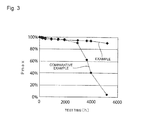
- a graph illustrated by a solid line in Fig. 3 is a graph representing the maximum output (Pmax) when a solar cell module according to an example under the following conditions is held in an atmosphere at temperature of 85°C and at humidity of 85%.
- a graph illustrated by a dashed line in Fig. 3 is a graph representing the maximum output when a solar cell module according to a comparative example in which only a rear surface member is different from that of the solar cell module according to the example is held in the atmosphere at temperature of 85°C and at humidity of 85%.
- a longitudinal axis in the graph illustrated in Fig. 3 represents the maximum output when Pmax of the solar cell module in the holding time being zero is 100%.
- a horizontal axis represents the holding time in the atmosphere at temperature of 85°C and at humidity of 85%.
- Light-receiving surface member a glass plate Rear surface member: a PET sheet of a single layer
- Light-receiving side sealing material polyolefin Rear side sealing material: an ethylene-vinyl acetate copolymer
- Rear surface member a laminated PET sheet containing an inorganic oxide layer as a barrier layer
- the permeability of acetic acid of the rear surface member is higher than that of the light-receiving surface member. Moreover, the permeability of acetic acid of the rear surface member is higher than that of the light-receiving side sealing material.
- the permeability of acetic acid of the rear surface member is lower than that of the light-receiving side sealing material.
- the permeability of acetic acid of rear surface member 11 and light-receiving side sealing material 13a can be determined by using solubility parameters (SP values). For example, the permeability of acetic acid of rear surface member 11 being higher than that of light-receiving side sealing material 13a indicates that an SP value of rear surface member 11 is closer to an SP value of acetic acid than an SP value of light-receiving side sealing material 13a is.
- SP values solubility parameters
- the SP value of the acetic acid is 10.1 (cal/cm 3 ) 1/2 .
- rear surface member 11 is preferably made of a material having an SP value of 8.5 to 12 (cal/cm 3 ) 1/2 .
- materials for example, preferably contained is at least any one of polyethylene terephthalate, polybutylene terephthalate, polyethylene naphthalate, polymethyl acrylate, polyamide, polyimide, and polymethyl acrylate.
- rear surface member 11 is preferably made of a material having an SP value of 9.5 to 11
- Rear surface member 11 preferably contains, as such a material, for example, at least any one of polyethylene terephthalate, polybutylene terephthalate, polyethylene naphthalate, and polyamide. In these cases, the SP value of rear surface member 11 is closer to the SP value of the acetic acid than the SP value of light-receiving side sealing material 13a is. Accordingly, rear surface member 11 has higher permeability of acetic acid than light-receiving side sealing material 13a.
Landscapes
- Engineering & Computer Science (AREA)
- Ceramic Engineering (AREA)
- Chemical & Material Sciences (AREA)
- Photovoltaic Devices (AREA)
- Sealing Material Composition (AREA)
- Compositions Of Macromolecular Compounds (AREA)
Abstract
Description
- The invention relates to a solar cell module.
-
Patent Document 1 discloses a solar cell module in which solar cells are disposed between a transparent light-receiving side sealing material containing an ethylene-vinyl acetate copolymer (EVA) and a white-colored rear side sealing material containing the ethylene-vinyl acetate copolymer. - Patent Document 1: Japanese Patent Application Publication No.
2005-50928 - There is a demand for further improvement of the reliability of a solar cell module.
- Amain objective of the invention is to provide a solar cell module with improved reliability.
- A solar cell module according to the invention is provided with a solar cell, a light-receiving surface member, a rear surface member, and a sealing material. The light-receiving surface member is disposed on a light-receiving side of the solar cell. The rear surface member is disposed on a rear side of the solar cell. The rear surface member has higher permeability of acetic acid than that of the light-receiving surface member. The sealing material is disposed between the light-receiving surface member and the rear surface member. The sealing material seals the solar cell. The sealing material includes a light-receiving side sealing material and a rear side sealing material. The light-receiving side sealing material is positioned on the light-receiving side of the solar cell. The light-receiving side sealing material does not contain an ethylene-vinyl acetate copolymer. The rear side sealing material is positioned on the rear side of the solar cell. The rear side sealing material contains the ethylene-vinyl acetate copolymer.
- The invention can provide a solar cell module with improved reliability.
-
- [
Fig. 1] Fig. 1 is a schematic plan view of a solar cell module according to an embodiment of the invention. - [
Fig. 2] Fig. 2 is a schematic cross-sectional view of a line II-II part inFig. 1 . - [
Fig. 3] Fig. 3 is a graph illustrating Pmax of solar cell modules according to an example and a comparative example. - Hereinafter, examples of preferred embodiments carrying out the invention are described. It should be noted that the following embodiments are provided just for illustrative purposes. The invention should not be limited at all to the following embodiments.
- In the drawings referred to in the embodiments and other parts, components having substantially the same function are referred to with the same reference numeral. In addition, the drawings referred to in the embodiments and other parts are illustrated schematically, and the dimensional ratio and the like of objects depicted in the drawings are different from those of actual objects in some cases. The dimensional ratio and the like of objects are also different among the drawings in some cases. The specific dimensional ratio and the like of objects should be determined with the following description taken into consideration.
- As illustrated in
Fig. 1 and Fig. 2 ,solar cell module 1 includes multiplesolar cells 12 electrically connected to one another withwiring materials 15. Multiplesolar cells 12 are disposed at intervals in a matrix. Meanwhile, a solar cell module may be provided with only one solar cell. - The type of
solar cell 12 is not specially limited.Solar cell 12 can be formed of, for example, a crystal silicon solar cell, a thin-film solar cell, or the like.Solar cell 12 may generate power only when light is received on light-receiving surface 12a.Solar cell 12 may be a bifacial solar cell that generates power not only when light is received on light-receivingsurface 12a but also when light is received onrear surface 12b. Herein, the "light-receiving surface" indicates a major surface on which light is mainly received. - Light-receiving
surface member 10 is disposed on a light-receivingsurface 12a side ofsolar cell 12. Light-receivingsurface member 10 can be formed of, for example, a glass plate, a ceramic plate, or an acrylic resin plate.Rear surface member 11 is disposed on arear surface 12b side ofsolar cell 12.Rear surface member 11 can be formed of a resin sheet, for example.Rear surface member 11 does not include a barrier layer such as a metal layer or an inorganic oxide layer.Sealing material 13 is disposed between light-receivingsurface member 10 andrear surface member 11. Sealingmaterial 13 sealssolar cells 12. -
Sealing material 13 includes light-receivingside sealing material 13a and rearside sealing material 13b. Rearside sealing material 13b is positioned at a side ofrear surface 12b ofsolar cell 12. Rearside sealing material 13b contains an ethylene-vinyl acetate copolymer that is a cross-linking resin. Rearside sealing material 13b may be made of an ethylene-vinyl acetate copolymer, or may be made of a resin composition containing an ethylene-vinyl acetate copolymer. - Light-receiving
side sealing material 13a is positioned at a side of light-receivingsurface 12a ofsolar cell 12. Light-receivingside sealing material 13a does not contain an ethylene-vinyl acetate copolymer. Light-receivingside sealing material 13a can be made of, for example, polyolefin that is a non-crosslinking resin, or a resin composition containing polyolefin. - In
solar cell module 1, rearside sealing material 13b contains an ethylene-vinyl acetate copolymer that is a cross-linking resin. This results in the low fluidity of rearside sealing material 13b under high temperature. Therefore, even when the temperature insolar cell module 1 is raised,solar cells 12 are less likely to be displaced. Thus, a solar cell module with improved reliability can be obtained. - In
solar cell module 1, the permeability of acetic acid ofrear surface member 11 is higher than that of light-receivingsurface member 10. Accordingly, acetic acid generated in rearside sealing material 13b containing an ethylene-vinyl acetate copolymer is easily discharged throughrear surface member 11 to the outside ofsolar cell module 1. Moreover, light-receivingside sealing material 13a does not contain an ethylene-vinyl acetate copolymer. Accordingly, no acetic acid is substantially generated in light-receivingside sealing material 13a. Thus, the concentration of the acetic acid in sealingmaterial 13 is less likely to increase. Thus,solar cells 12 and the like are resistant to deterioration due to the acetic acid. This leads to achievement of improved reliability. - The permeability of acetic acid of
rear surface member 11 is preferably higher than that of light-receivingside sealing material 13a. In this case, the acetic acid is easily discharged throughrear surface member 11, and the acetic acid is less likely to enter light-receivingside sealing material 13a. Thus,solar cells 12 and the like are resistant to deterioration due to the acetic acid. This can achieve the improved reliability. - A graph illustrated by a solid line in
Fig. 3 is a graph representing the maximum output (Pmax) when a solar cell module according to an example under the following conditions is held in an atmosphere at temperature of 85°C and at humidity of 85%. A graph illustrated by a dashed line inFig. 3 is a graph representing the maximum output when a solar cell module according to a comparative example in which only a rear surface member is different from that of the solar cell module according to the example is held in the atmosphere at temperature of 85°C and at humidity of 85%. A longitudinal axis in the graph illustrated inFig. 3 represents the maximum output when Pmax of the solar cell module in the holding time being zero is 100%. A horizontal axis represents the holding time in the atmosphere at temperature of 85°C and at humidity of 85%. - Light-receiving surface member: a glass plate
Rear surface member: a PET sheet of a single layer
Light-receiving side sealing material: polyolefin
Rear side sealing material: an ethylene-vinyl acetate copolymer - Rear surface member: a laminated PET sheet containing an inorganic oxide layer as a barrier layer
- In the example, the permeability of acetic acid of the rear surface member is higher than that of the light-receiving surface member. Moreover, the permeability of acetic acid of the rear surface member is higher than that of the light-receiving side sealing material.
- Meanwhile, in the comparative example, the permeability of acetic acid of the rear surface member is lower than that of the light-receiving side sealing material.
- From the result illustrated in
Fig. 3 , it is understood that making the permeability of acetic acid of the rear surface member higher than that of the light-receiving side sealing material makes it possible to suppress a time-dependent decrease of the output characteristic of the solar cell module, and therefore achieve the improved reliability. - Note that, the permeability of acetic acid of
rear surface member 11 and light-receivingside sealing material 13a can be determined by using solubility parameters (SP values). For example, the permeability of acetic acid ofrear surface member 11 being higher than that of light-receivingside sealing material 13a indicates that an SP value ofrear surface member 11 is closer to an SP value of acetic acid than an SP value of light-receivingside sealing material 13a is. - Specifically, the SP value of the acetic acid is 10.1 (cal/cm3)1/2. Accordingly, when light-receiving
side sealing material 13a contains polyolefin having an SP value of 7.7 to 8.4 (cal/cm3)1/2,rear surface member 11 is preferably made of a material having an SP value of 8.5 to 12 (cal/cm3)1/2. As such materials, for example, preferably contained is at least any one of polyethylene terephthalate, polybutylene terephthalate, polyethylene naphthalate, polymethyl acrylate, polyamide, polyimide, and polymethyl acrylate. Moreover, when light-receivingside sealing material 13a contains polymethyl acrylate having an SP value of 9.0 to 9.2 (cal/cm3)1/2,rear surface member 11 is preferably made of a material having an SP value of 9.5 to 11 - (cal/cm3)1/2.
Rear surface member 11 preferably contains, as such a material, for example, at least any one of polyethylene terephthalate, polybutylene terephthalate, polyethylene naphthalate, and polyamide. In these cases, the SP value ofrear surface member 11 is closer to the SP value of the acetic acid than the SP value of light-receivingside sealing material 13a is. Accordingly,rear surface member 11 has higher permeability of acetic acid than light-receivingside sealing material 13a. -
- 1
- solar cell module
- 10
- light-receiving surface member
- 11
- rear surface member
- 12
- solar cell
- 12a
- light-receiving surface
- 12b
- rear surface
- 13
- sealing material
- 13a
- light-receiving side sealing material
- 13b
- rear side sealing material
Claims (6)
- A solar cell module comprising:a solar cell;a light-receiving surface member disposed on a light-receiving side of the solar cell;a rear surface member disposed on a rear side of the solar cell, and having higher permeability of acetic acid than that of the light-receiving surface member; anda sealing material disposed between the light-receiving surface member and the rear surface member, and sealing the solar cell, wherein,the sealing material includes:a light-receiving side sealing material positioned on the light-receiving side of the solar cell, and does not contain an ethylene-vinyl acetate copolymer; anda rear side sealing material positioned on the rear side of the solar cell, and contains the ethylene-vinyl acetate copolymer.
- The solar cell module according to claim 1, wherein,
the permeability of acetic acid of the rear surface member is higher than that of the light-receiving side sealing material. - The solar cell module according to claim 1 or 2, wherein
the rear surface member is a resin sheet. - The solar cell module according to claim 3, wherein,
the light-receiving side sealing material contains polyolefin, and
the rear surface member contains at least any one of polyethylene terephthalate, polybutylene terephthalate, polyethylene naphthalate, polymethyl acrylate, polyamide, polyimide, and polymethyl acrylate. - The solar cell module according to claim 3, wherein,
the light-receiving side sealing material contains polymethyl acrylate, and
the rear surface member contains at least any one of polyethylene terephthalate, polybutylene terephthalate, polyethylene naphthalate, and polyamide. - The solar cell module according to any one of claims 1 to 5, wherein
the light-receiving surface member is a glass plate, a ceramic plate, or an acrylic resin plate.
Applications Claiming Priority (1)
| Application Number | Priority Date | Filing Date | Title |
|---|---|---|---|
| PCT/JP2012/056872 WO2013136513A1 (en) | 2012-03-16 | 2012-03-16 | Solar cell module |
Publications (2)
| Publication Number | Publication Date |
|---|---|
| EP2827377A1 true EP2827377A1 (en) | 2015-01-21 |
| EP2827377A4 EP2827377A4 (en) | 2015-12-02 |
Family
ID=49160479
Family Applications (1)
| Application Number | Title | Priority Date | Filing Date |
|---|---|---|---|
| EP12871482.1A Withdrawn EP2827377A4 (en) | 2012-03-16 | 2012-03-16 | SOLAR CELL MODULE |
Country Status (4)
| Country | Link |
|---|---|
| US (1) | US20140345691A1 (en) |
| EP (1) | EP2827377A4 (en) |
| CN (1) | CN104170096A (en) |
| WO (1) | WO2013136513A1 (en) |
Families Citing this family (2)
| Publication number | Priority date | Publication date | Assignee | Title |
|---|---|---|---|---|
| JP6541106B2 (en) * | 2015-07-02 | 2019-07-10 | パナソニックIpマネジメント株式会社 | Solar cell module |
| JP7206809B2 (en) * | 2018-10-30 | 2023-01-18 | 大日本印刷株式会社 | Transparent protective sheet for solar cell modules |
Family Cites Families (8)
| Publication number | Priority date | Publication date | Assignee | Title |
|---|---|---|---|---|
| JP2001077390A (en) * | 1999-06-30 | 2001-03-23 | Canon Inc | Solar cell module |
| JP2005050928A (en) | 2003-07-30 | 2005-02-24 | Kyocera Corp | Solar cell module, its manufacturing method, and installation structure thereof |
| US8197928B2 (en) * | 2006-12-29 | 2012-06-12 | E. I. Du Pont De Nemours And Company | Intrusion resistant safety glazings and solar cell modules |
| US8168885B2 (en) * | 2007-02-12 | 2012-05-01 | E.I. Du Pont De Nemours And Company | Low modulus solar cell encapsulant sheets with enhanced stability and adhesion |
| US20080264471A1 (en) * | 2007-04-30 | 2008-10-30 | Richard Allen Hayes | Solar cell modules comprising compositionally distinct encapsulant layers |
| ES2751084T3 (en) * | 2008-06-02 | 2020-03-30 | Performance Mat Na Inc | Solar cell module that has a low turbidity encapsulating layer |
| KR101620308B1 (en) * | 2008-11-06 | 2016-05-12 | 다우 글로벌 테크놀로지스 엘엘씨 | Co-extruded, multilayered polyolefin-based backsheet for electronic device modules |
| WO2011132707A1 (en) * | 2010-04-20 | 2011-10-27 | 京セラ株式会社 | Solar cell elements and solar cell module using same |
-
2012
- 2012-03-16 EP EP12871482.1A patent/EP2827377A4/en not_active Withdrawn
- 2012-03-16 CN CN201280071487.1A patent/CN104170096A/en active Pending
- 2012-03-16 WO PCT/JP2012/056872 patent/WO2013136513A1/en not_active Ceased
-
2014
- 2014-08-12 US US14/457,158 patent/US20140345691A1/en not_active Abandoned
Also Published As
| Publication number | Publication date |
|---|---|
| EP2827377A4 (en) | 2015-12-02 |
| US20140345691A1 (en) | 2014-11-27 |
| CN104170096A (en) | 2014-11-26 |
| WO2013136513A1 (en) | 2013-09-19 |
Similar Documents
| Publication | Publication Date | Title |
|---|---|---|
| Sinha et al. | Glass/glass photovoltaic module reliability and degradation: a review | |
| EP2549549B1 (en) | Solar cell module | |
| WO2012054088A3 (en) | Improved photovoltaic modules, and/or methods of making the same | |
| WO2008156521A3 (en) | Textured rear electrode structure for use in photovoltaic device such as cigs/cis solar cell | |
| WO2010129325A3 (en) | Backskin material for solar energy modules | |
| US20130092231A1 (en) | Photovoltaic package | |
| US9306100B2 (en) | Solar cell module | |
| EP1921684A1 (en) | Solar cell module and process for manufacture thereof | |
| EP2437311A3 (en) | Solar cell module and manufacturing method thereof | |
| US20110139218A1 (en) | Encapsulant material for photovoltaic modules | |
| WO2009016581A3 (en) | Light output device | |
| US9196774B2 (en) | Solar module and method for manufacturing the same | |
| US9209334B2 (en) | Solar cell module | |
| US20140345691A1 (en) | Solar cell module | |
| US20160043249A1 (en) | Solar cell module and method of fabricating the same | |
| US20130037084A1 (en) | Photovoltaic Module Light Manipulation for Increased Module Output | |
| US20170025559A1 (en) | Photovoltaic element with optically functional conversion layer for improving the conversion of the incident light and method for producing said photovoltaic element | |
| EP2993702A3 (en) | Thin film solar cell module | |
| US20110272025A1 (en) | Photovoltaic module | |
| JP2015070143A (en) | Solar cell module | |
| WO2010133735A3 (en) | Transparent lithium-ion secondary battery | |
| KR20220116768A (en) | A solar cell module | |
| CN111540799A (en) | Photovoltaic module with flexible structure | |
| KR101470065B1 (en) | Solar cell module | |
| CN205920980U (en) | solar panel module |
Legal Events
| Date | Code | Title | Description |
|---|---|---|---|
| PUAI | Public reference made under article 153(3) epc to a published international application that has entered the european phase |
Free format text: ORIGINAL CODE: 0009012 |
|
| 17P | Request for examination filed |
Effective date: 20140910 |
|
| AK | Designated contracting states |
Kind code of ref document: A1 Designated state(s): AL AT BE BG CH CY CZ DE DK EE ES FI FR GB GR HR HU IE IS IT LI LT LU LV MC MK MT NL NO PL PT RO RS SE SI SK SM TR |
|
| AX | Request for extension of the european patent |
Extension state: BA ME |
|
| DAX | Request for extension of the european patent (deleted) | ||
| RAP1 | Party data changed (applicant data changed or rights of an application transferred) |
Owner name: PANASONIC INTELLECTUAL PROPERTY MANAGEMENT CO., LT |
|
| RA4 | Supplementary search report drawn up and despatched (corrected) |
Effective date: 20151029 |
|
| RIC1 | Information provided on ipc code assigned before grant |
Ipc: H01L 31/048 20140101AFI20151023BHEP |
|
| STAA | Information on the status of an ep patent application or granted ep patent |
Free format text: STATUS: THE APPLICATION HAS BEEN WITHDRAWN |
|
| 18W | Application withdrawn |
Effective date: 20160405 |