EP2824157B1 - Novel sugar-derived gelling agent - Google Patents
Novel sugar-derived gelling agent Download PDFInfo
- Publication number
- EP2824157B1 EP2824157B1 EP13757549.4A EP13757549A EP2824157B1 EP 2824157 B1 EP2824157 B1 EP 2824157B1 EP 13757549 A EP13757549 A EP 13757549A EP 2824157 B1 EP2824157 B1 EP 2824157B1
- Authority
- EP
- European Patent Office
- Prior art keywords
- gel
- gelator
- compound
- acid
- water
- Prior art date
- Legal status (The legal status is an assumption and is not a legal conclusion. Google has not performed a legal analysis and makes no representation as to the accuracy of the status listed.)
- Active
Links
Images


Classifications
-
- C—CHEMISTRY; METALLURGY
- C07—ORGANIC CHEMISTRY
- C07H—SUGARS; DERIVATIVES THEREOF; NUCLEOSIDES; NUCLEOTIDES; NUCLEIC ACIDS
- C07H9/00—Compounds containing a hetero ring sharing at least two hetero atoms with a saccharide radical
- C07H9/02—Compounds containing a hetero ring sharing at least two hetero atoms with a saccharide radical the hetero ring containing only oxygen as ring hetero atoms
- C07H9/04—Cyclic acetals
-
- C—CHEMISTRY; METALLURGY
- C07—ORGANIC CHEMISTRY
- C07H—SUGARS; DERIVATIVES THEREOF; NUCLEOSIDES; NUCLEOTIDES; NUCLEIC ACIDS
- C07H15/00—Compounds containing hydrocarbon or substituted hydrocarbon radicals directly attached to hetero atoms of saccharide radicals
- C07H15/02—Acyclic radicals, not substituted by cyclic structures
- C07H15/04—Acyclic radicals, not substituted by cyclic structures attached to an oxygen atom of the saccharide radical
-
- A—HUMAN NECESSITIES
- A23—FOODS OR FOODSTUFFS; TREATMENT THEREOF, NOT COVERED BY OTHER CLASSES
- A23L—FOODS, FOODSTUFFS OR NON-ALCOHOLIC BEVERAGES, NOT OTHERWISE PROVIDED FOR; PREPARATION OR TREATMENT THEREOF
- A23L29/00—Foods or foodstuffs containing additives; Preparation or treatment thereof
- A23L29/20—Foods or foodstuffs containing additives; Preparation or treatment thereof containing gelling or thickening agents
-
- A—HUMAN NECESSITIES
- A61—MEDICAL OR VETERINARY SCIENCE; HYGIENE
- A61K—PREPARATIONS FOR MEDICAL, DENTAL OR TOILETRY PURPOSES
- A61K47/00—Medicinal preparations characterised by the non-active ingredients used, e.g. carriers or inert additives; Targeting or modifying agents chemically bound to the active ingredient
- A61K47/06—Organic compounds, e.g. natural or synthetic hydrocarbons, polyolefins, mineral oil, petrolatum or ozokerite
- A61K47/26—Carbohydrates, e.g. sugar alcohols, amino sugars, nucleic acids, mono-, di- or oligo-saccharides; Derivatives thereof, e.g. polysorbates, sorbitan fatty acid esters or glycyrrhizin
-
- A—HUMAN NECESSITIES
- A61—MEDICAL OR VETERINARY SCIENCE; HYGIENE
- A61K—PREPARATIONS FOR MEDICAL, DENTAL OR TOILETRY PURPOSES
- A61K8/00—Cosmetics or similar toiletry preparations
- A61K8/02—Cosmetics or similar toiletry preparations characterised by special physical form
- A61K8/04—Dispersions; Emulsions
- A61K8/042—Gels
-
- A—HUMAN NECESSITIES
- A61—MEDICAL OR VETERINARY SCIENCE; HYGIENE
- A61K—PREPARATIONS FOR MEDICAL, DENTAL OR TOILETRY PURPOSES
- A61K8/00—Cosmetics or similar toiletry preparations
- A61K8/18—Cosmetics or similar toiletry preparations characterised by the composition
- A61K8/30—Cosmetics or similar toiletry preparations characterised by the composition containing organic compounds
- A61K8/60—Sugars; Derivatives thereof
-
- A—HUMAN NECESSITIES
- A61—MEDICAL OR VETERINARY SCIENCE; HYGIENE
- A61K—PREPARATIONS FOR MEDICAL, DENTAL OR TOILETRY PURPOSES
- A61K9/00—Medicinal preparations characterised by special physical form
- A61K9/06—Ointments; Bases therefor; Other semi-solid forms, e.g. creams, sticks, gels
-
- A—HUMAN NECESSITIES
- A61—MEDICAL OR VETERINARY SCIENCE; HYGIENE
- A61Q—SPECIFIC USE OF COSMETICS OR SIMILAR TOILETRY PREPARATIONS
- A61Q19/00—Preparations for care of the skin
-
- C—CHEMISTRY; METALLURGY
- C09—DYES; PAINTS; POLISHES; NATURAL RESINS; ADHESIVES; COMPOSITIONS NOT OTHERWISE PROVIDED FOR; APPLICATIONS OF MATERIALS NOT OTHERWISE PROVIDED FOR
- C09K—MATERIALS FOR MISCELLANEOUS APPLICATIONS, NOT PROVIDED FOR ELSEWHERE
- C09K3/00—Materials not provided for elsewhere
-
- H—ELECTRICITY
- H01—ELECTRIC ELEMENTS
- H01B—CABLES; CONDUCTORS; INSULATORS; SELECTION OF MATERIALS FOR THEIR CONDUCTIVE, INSULATING OR DIELECTRIC PROPERTIES
- H01B1/00—Conductors or conductive bodies characterised by the conductive materials; Selection of materials as conductors
- H01B1/06—Conductors or conductive bodies characterised by the conductive materials; Selection of materials as conductors mainly consisting of other non-metallic substances
- H01B1/12—Conductors or conductive bodies characterised by the conductive materials; Selection of materials as conductors mainly consisting of other non-metallic substances organic substances
-
- H—ELECTRICITY
- H01—ELECTRIC ELEMENTS
- H01M—PROCESSES OR MEANS, e.g. BATTERIES, FOR THE DIRECT CONVERSION OF CHEMICAL ENERGY INTO ELECTRICAL ENERGY
- H01M10/00—Secondary cells; Manufacture thereof
- H01M10/05—Accumulators with non-aqueous electrolyte
- H01M10/052—Li-accumulators
-
- H—ELECTRICITY
- H01—ELECTRIC ELEMENTS
- H01M—PROCESSES OR MEANS, e.g. BATTERIES, FOR THE DIRECT CONVERSION OF CHEMICAL ENERGY INTO ELECTRICAL ENERGY
- H01M10/00—Secondary cells; Manufacture thereof
- H01M10/05—Accumulators with non-aqueous electrolyte
- H01M10/056—Accumulators with non-aqueous electrolyte characterised by the materials used as electrolytes, e.g. mixed inorganic/organic electrolytes
- H01M10/0564—Accumulators with non-aqueous electrolyte characterised by the materials used as electrolytes, e.g. mixed inorganic/organic electrolytes the electrolyte being constituted of organic materials only
- H01M10/0565—Polymeric materials, e.g. gel-type or solid-type
-
- A—HUMAN NECESSITIES
- A23—FOODS OR FOODSTUFFS; TREATMENT THEREOF, NOT COVERED BY OTHER CLASSES
- A23V—INDEXING SCHEME RELATING TO FOODS, FOODSTUFFS OR NON-ALCOHOLIC BEVERAGES AND LACTIC OR PROPIONIC ACID BACTERIA USED IN FOODSTUFFS OR FOOD PREPARATION
- A23V2002/00—Food compositions, function of food ingredients or processes for food or foodstuffs
-
- A—HUMAN NECESSITIES
- A61—MEDICAL OR VETERINARY SCIENCE; HYGIENE
- A61K—PREPARATIONS FOR MEDICAL, DENTAL OR TOILETRY PURPOSES
- A61K2800/00—Properties of cosmetic compositions or active ingredients thereof or formulation aids used therein and process related aspects
- A61K2800/10—General cosmetic use
-
- A—HUMAN NECESSITIES
- A61—MEDICAL OR VETERINARY SCIENCE; HYGIENE
- A61K—PREPARATIONS FOR MEDICAL, DENTAL OR TOILETRY PURPOSES
- A61K2800/00—Properties of cosmetic compositions or active ingredients thereof or formulation aids used therein and process related aspects
- A61K2800/40—Chemical, physico-chemical or functional or structural properties of particular ingredients
- A61K2800/48—Thickener, Thickening system
-
- H—ELECTRICITY
- H01—ELECTRIC ELEMENTS
- H01M—PROCESSES OR MEANS, e.g. BATTERIES, FOR THE DIRECT CONVERSION OF CHEMICAL ENERGY INTO ELECTRICAL ENERGY
- H01M2300/00—Electrolytes
- H01M2300/0085—Immobilising or gelification of electrolyte
-
- Y—GENERAL TAGGING OF NEW TECHNOLOGICAL DEVELOPMENTS; GENERAL TAGGING OF CROSS-SECTIONAL TECHNOLOGIES SPANNING OVER SEVERAL SECTIONS OF THE IPC; TECHNICAL SUBJECTS COVERED BY FORMER USPC CROSS-REFERENCE ART COLLECTIONS [XRACs] AND DIGESTS
- Y02—TECHNOLOGIES OR APPLICATIONS FOR MITIGATION OR ADAPTATION AGAINST CLIMATE CHANGE
- Y02E—REDUCTION OF GREENHOUSE GAS [GHG] EMISSIONS, RELATED TO ENERGY GENERATION, TRANSMISSION OR DISTRIBUTION
- Y02E60/00—Enabling technologies; Technologies with a potential or indirect contribution to GHG emissions mitigation
- Y02E60/10—Energy storage using batteries
Definitions
- the present invention relates to a novel use of a compound containing a sugar derivative as gelator, and a gel.
- a structure that has a three-dimensional network structure formed by a substance having the ability to form a gel (hereinafter called a gelator) and contains a fluid in the network structure is called a gel.
- a gel containing water as the fluid is called a hydrogel
- another gel containing an organic liquid (such as organic solvents and oils) except water is called an organogel or an oil gel.
- the oil gel (organogel) is used in the fields of cosmetics, pharmaceutical products, agrochemicals, foods, adhesives, paints, resins, and other products to control the flowabilities of cosmetics and paints.
- the oil gel (organogel) is also widely used in the field of environmental preservation, for example, to form a gel as a solid from oil waste, thus preventing water pollution.
- a urea compound has been disclosed as a low-molecular weight gelator capable of forming a gel having excellent stability from various organic solvents by adding a small amount of the compound (for example, Patent Documents 1 and 2). It is also disclosed that an ⁇ -aminolactam derivative has the ability to form gels from squalane, a liquid paraffin, and other substances (for example, Patent Document 3).
- Non-Patent Document 1 Sugar derivatives derived from various monosaccharides have a structure readily forming strong hydrogen bonds to each other, and it has been disclosed that the sugar derivatives form gels from various organic solvents.
- JP H01-139519 A is concerned with nonirritating cosmetics comprising one of the following compounds.
- WO 2007/107285 A1 relates to sugar derived lipid A antagonists, which can be prepared using the compound shown below as an intermediate.
- US 2011/0136748 A1 is concerned with a drug for treating and/or preventing enveloped virus infections.
- the following compound is disclosed as an intermediate.
- JP H03-218390 A ( EP 0 413 162 A2 ) is concerned with cyclic acetals, which are used as delayed release flavorants and odorants.
- the following compound is disclosed.
- Non-Patent Document 1 S. Shinkai et al., Chem. Eur. J., 2001, 7, No. 20, 4327-4334
- Oil gelators of low-molecular weight compounds for non-aqueous mediums such as organic solvents have been developed, but have disadvantages such that mediums for forming a gel are limited. On this account, in order to develop a novel oil gel having new applications and functions, a new low-molecular weight oil gelator capable of forming gels from various mediums have been sought.
- Gelators of sugar derivatives can form gels from various solvents by changing the type of the sugar. However, it is quite difficult to form gels from a wide variety of solvents by using a single sugar derivative. A gel obtained by using the sugar derivative described in Non-Patent Document 1 has no storage stability.
- a glucose gelator that can form a gel not only from water or oil (hydrophilic organic solvents and hydrophobic organic solvents) alone but also from a mixed solvent of water and oil (hydrophilic organic solvents and hydrophobic organic solvents), especially, from a mixed solvent of water and oil (hydrophobic organic solvents), and have accomplished the present invention.
- the inventors of the present invention have found that by converting substituents on a sugar derivative and using the resultant product as a gelator for water, organic solvents, and other liquids, the gelator surprisingly can form a gel from both an organic solvent and water without changing the type of the sugar used for the sugar derivative and that control of the type of substituents allows a change in the type of a solvent that is to form a gel, and have accomplished the present invention.
- the present invention relates to a use of a compound as a gelator, wherein the compound is selected from the following compounds M1, M2, M3, M4, M5, M6, M8, M10, G3 and G8:
- the present invention relates to a gel obtainable by gelation of a solvent with a gelator, wherein gelator is a compound as defined in the first aspect and the solvent is a hydrophobic organic solvent, a hydrophilic organic solvent, water, a hydrophilic organic solution, a hydrophobic organic solution, or an aqueous solution.
- gelator is a compound as defined in the first aspect and the solvent is a hydrophobic organic solvent, a hydrophilic organic solvent, water, a hydrophilic organic solution, a hydrophobic organic solution, or an aqueous solution.
- the present invention relates to the gel according to the second aspect, in which the hydrophobic organic solvent is at least one selected from the group consisting of plant oils, esters, silicone oils, and hydrocarbons.
- the present invention relates to the gel according to the second aspect, in which the hydrophilic organic solvent is at least one selected from the group consisting of methanol, ethanol, 2-propanol, i-butanol, pentanol, hexanol, 1-octanol, isooctanol, acetone, cyclohexanone, acetonitrile, dioxane, glycerol, propylene glycol, ethylene glycol, and dimethyl sulfoxide.
- the hydrophilic organic solvent is at least one selected from the group consisting of methanol, ethanol, 2-propanol, i-butanol, pentanol, hexanol, 1-octanol, isooctanol, acetone, cyclohexanone, acetonitrile, dioxane, glycerol, propylene glycol, ethylene glycol, and dimethyl sulfox
- the present invention relates to the gel according to the second aspect, in which the hydrophilic organic solution is a mixed solvent of the hydrophilic organic solvent as described in the fourth aspect and water.
- the present invention relates to the gel according to the second aspect, in which the hydrophobic organic solution is a mixed solvent of the hydrophobic organic solvent as described in the third aspect and water.
- the present invention relates to the gel according to the second aspect, in which the aqueous solution is an aqueous solution containing an organic acid, an inorganic acid, at least one inorganic salt selected from the group consisting of inorganic carbonates, inorganic sulfates, inorganic phosphates, and inorganic hydrogen phosphates, or at least one organic salt selected from the group consisting of acetates, lactates, citrates, organic amine hydrochlorides, and organic amine acetates.
- the aqueous solution is an aqueous solution containing an organic acid, an inorganic acid, at least one inorganic salt selected from the group consisting of inorganic carbonates, inorganic sulfates, inorganic phosphates, and inorganic hydrogen phosphates, or at least one organic salt selected from the group consisting of acetates, lactates, citrates, organic amine hydrochlorides, and organic amine acetates.
- the present invention relates to the gel according to the seventh aspect, in which the organic acid is at least one selected from the group consisting of acetic acid, citric acid, succinic acid, lactic acid, malic acid, maleic acid, fumaric acid, and trifluoroacetic acid, the inorganic acid is at least one selected from the group consisting of hydrochloric acid, phosphoric acid, carbonic acid, sulfuric acid, nitric acid, and boric acid, the inorganic salt is at least one selected from the group consisting of calcium carbonate, sodium carbonate, potassium carbonate, sodium sulfate, potassium sulfate, magnesium sulfate, potassium phosphate, sodium phosphate, disodium hydrogen phosphate, and sodium dihydrogen phosphate, and the organic salt is at least one selected from the group consisting of sodium acetate, potassium acetate, sodium lactate, potassium lactate, sodium citrate, potassium citrate, ethylenediamine hydrochloride, ethylenediaminet
- the present invention relates to the gel according to the second aspect, wherein the gel contains additives and inorganic compounds.
- the present invention relates to the gel according to the ninth aspect, wherein the additives are selected from organic compounds such as surfactants, ultraviolet absorbers, moisturizers, antiseptics, antioxidants, aromatics, and physiologically active substances, and the inorganic compounds are selected from titanium oxide, talc, mica, and water.
- the additives are selected from organic compounds such as surfactants, ultraviolet absorbers, moisturizers, antiseptics, antioxidants, aromatics, and physiologically active substances
- the inorganic compounds are selected from titanium oxide, talc, mica, and water.
- the present invention relates to the use according to the first aspect, wherein the compound is used as a gelator in a base material for cosmetics or a base material for medical use.
- the present invention relates to the use according to the eleventh aspect, wherein the base material for cosmetics or a base material for medical use further comprises at least one polymer compound.
- the present invention relates to the use according to the first aspect, wherein the compound is used as a gelator in a gel electrolyte.
- the present invention relates to the use according to the first aspect, wherein the compound is used as a gelator in a cell culture base material.
- the present invention relates to the use according to the first aspect, wherein the compound is used as a gelator in a base material for preserving biomolecules.
- the present invention relates to the use according to the first aspect, wherein the compound is used as a gelator in a base material for external use.
- the present invention relates to the use according to the first aspect, wherein the compound is used as a gelator in a base material for biochemistry.
- the present invention relates to the use according to the first aspect, wherein the compound is used as a gelator in a base material for food.
- the present invention relates to the use according to the first aspect, wherein the compound is used as a gelator in a base material for dryland farming.
- the compound used as a gelator according to the present invention can form a gel from an aqueous system, an organic solvent system, or both the systems.
- the type of a substituent on a sugar derivative of the compound used as a gelator according to the present invention can be changed.
- the compound used as a gelator according to the present invention has good storage stability.
- the compound used as a gelator according to the present invention is produced from a monosaccharide such as glucose, mannose, and derivatives thereof as raw materials, and thus can form a gel having excellent biological safety.
- the compound of Formula (7) (hereinafter called a glucose gelator) having a glucose moiety is produced from glucose, which is a common monosaccharide.
- glucose which is a common monosaccharide.
- the synthesis of the gelator achieves a high total yield throughout all processes and is unlikely to cause side reactions.
- the glucose gelator can be easily produced as compared with related art gelators, and the production cost can be extremely reduced.
- the glucose gelator has the ability to form gels from both water and oil (hydrophobic organic solvents) and can form a water/oil dispersion gel.
- the glucose gelator can also form a gel from alcoholic solvents.
- the glucose gelator is a highly versatile gelator that can be used at a low concentration to form a transparent gel from mediums having a wide variety of characteristics.
- the glucose gelator can form a highly transparent gel from water.
- the compound of Formula (8) (hereinafter called a mannose gelator) having a mannose moiety can form a highly transparent gel from oil (hydrophilic organic solvents and hydrophobic organic solvents) and can yield a gel having excellent thixotropic properties.
- the mannose gelator can form a self-standing, transparent gel (having self-standing properties) and thus is useful for a base material for sticks.
- the production method can produce the above-mentioned gelator from derivatives of glucose and mannose in a one-pot system and can simply, inexpensively produce a compound to be the gelator.
- the method eliminates methanol and metal catalysts during the production and thus can produce a compound usable as the gelator particularly for base materials that are required to have high safety, such as base materials for cosmetics, base materials for medical use, and base materials for food.
- R 1 is preferably a butyl group, or a hexyl group.
- R 1 is preferably an octyl group, a decyl group, or a dodecyl group.
- R 1 is preferably a butyl group.
- the compound of Formula (1) or (2) can be produced by a known method, for example, by reacting a benzaldehyde dimethyl acetal having the above-mentioned substituents on the benzene ring with a monosaccharide.
- the monosaccharide may be any monosaccharide having a pyranose ring structure, and usable examples of the monosaccharide include allose, altrose, glucose, mannose, gulose, idose, galactose, and talose.
- the monosaccharide is preferably glucose or mannose.
- Such monosaccharides are relatively inexpensive and should particularly provide biocompatibility.
- compounds [G3] and [G8] are compounds of Formula (7) having a glucose moiety
- compounds M1, M2, M3, M4, M5, M6, M8, and M10 are compounds of Formula (8) having a mannose moiety.
- the gel forming ability of the compound of Formula (7) is quite different from the gel forming ability of the compound of Formula (8) (mannose gelator).
- the compounds can form gels from solvents, which varies with the compounds.
- the compound of Formula (7) (glucose gelator) has the ability to form a gel from both water and oil (hydrophobic organic solvents), which is the greatest feature of the glucose gelator, and can form a water/oil dispersion gel from a mixed solvent of water and oil.
- the compound of Formula (7) can form a gel from an alcoholic solvent and forms a highly transparent gel from water.
- the compound of Formula (8) (mannose gelator) can form a highly transparent gel from oil (hydrophilic organic solvents and hydrophobic organic solvents) and can yield a gel having excellent thixotropic properties.
- the compound of Formula (8) also can characteristically form a self-standing, transparent gel (having self-standing properties).
- the glucose gelator and the mannose gelator have different gel forming abilities, and thus should be applied to a wide variety of fields suitable to the respective features.
- a gel of the present invention can be produced by gelation of a solvent with the gelator.
- the production method is exemplified by dissolving a predetermined amount of the gelator in a solvent with heating and then cooling the solution.
- the gelator is preferably, completely dissolved.
- the gelation means making a flowable liquid lose the flowability.
- the amount of the gelator is not limited as long as the effects of the present invention are exerted, but is typically 20 to 0.001% by mass and preferably 2 to 0.05% by mass relative to the mass of a solvent to form a gel.
- the solvent is selected from hydrophobic organic solvents, hydrophilic organic solvents, water, mixed solvents of water and hydrophilic organic solvents (in the present specification, called hydrophilic organic solutions), mixed solvents of hydrophobic organic solvents and water (in the present specification, called hydrophobic organic solutions), and aqueous solutions in which an organic acid or an inorganic acid is dissolved in water or an inorganic salt or an organic salt is dissolved in water (in the present specification, called aqueous solutions).
- hydrophobic organic solvent examples include plant oils such as olive oil, coconut oil, castor oil, jojoba oil, and sunflower oil; esters such as cetyl octanoate, isopropyl myristate, and isopropyl palmitate; and hydrocarbons such as toluene, xylene, n-hexane, cyclohexane, octane, mineral oils, silicone oils, and hydrogenated polyisobutene.
- plant oils such as olive oil, coconut oil, castor oil, jojoba oil, and sunflower oil
- esters such as cetyl octanoate, isopropyl myristate, and isopropyl palmitate
- hydrocarbons such as toluene, xylene, n-hexane, cyclohexane, octane, mineral oils, silicone oils, and hydrogenated polyisobutene.
- the hydrophobic organic solvent is preferably olive oil, isopropyl myristate, toluene, cyclohexane, silicone oils such as linear silicones, cyclic silicones, alkyl-modified silicones, phenyl-modified silicones, dimethicone, and dimethiconol, and octane.
- the silicone oil may be linear silicone (trade name: 2-1184), cyclic silicone (trade name: SH245), alkyl-modified silicone (trade name: SS-3408), phenyl-modified silicone (trade name: PH-1555), dimethicone (trade name: BY-11-0 series), and dimethiconol (trade name: CB-1556) available from Dow Corning Toray Silicone Co., Ltd., for example.
- the hydrophilic organic solvent means an organic solvent that can be dissolved in water at any ratio and is exemplified by alcohols, acetone, cyclohexanone, acetonitrile, dioxane, glycerol, and dimethyl sulfoxide.
- the alcohol is preferably water-soluble alcohols that can be freely dissolved in water and is more preferably exemplified by C 1-9 alcohols, polyhydric alcohols, higher alcohols, and glycerides.
- C 1-9 alcohol examples include methanol, ethanol, 2-propanol, i-butanol, pentanol, hexanol, 1-octanol, and isooctanol; specific examples of the polyhydric alcohol include ethylene glycol, propylene glycol, and polypropylene glycol; specific examples of the higher alcohol include octyldodecanol, stearyl alcohol, and oleyl alcohol; and specific examples of the glyceride include trioctanoin, capric/caprylic triglyceride, and glyceryl stearate.
- the hydrophilic organic solvent is preferably methanol, ethanol, 2-propanol, i-butanol, pentanol, hexanol, 1-octanol, isooctanol, acetone, cyclohexanone, acetonitrile, dioxane, glycerol, propylene glycol, ethylene glycol, and dimethyl sulfoxide, and more preferably glycerol, propylene glycol, and ethylene glycol.
- a plurality of the organic acids or the inorganic acids may be added.
- Preferred examples of the organic acid include acetic acid, citric acid, succinic acid, lactic acid, malic acid, maleic acid, fumaric acid, and trifluoroacetic acid.
- the organic acid is more preferably acetic acid, citric acid, succinic acid, lactic acid, and malic acid, and even more preferably acetic acid, citric acid, and lactic acid.
- Preferred examples of the inorganic acid include hydrochloric acid, phosphoric acid, carbonic acid, sulfuric acid, nitric acid, and boric acid.
- the inorganic acid is more preferably hydrochloric acid, phosphoric acid, carbonic acid, and sulfuric acid, and even more preferably hydrochloric acid, phosphoric acid, and carbonic acid.
- a plurality of the inorganic salts or the organic salts may be added, but one or two salts are preferably added.
- a solution obtaining a buffer capacity by adding two salts is also preferred.
- the inorganic salt include inorganic carbonates, inorganic sulfates, inorganic phosphates, and inorganic hydrogen phosphates.
- the inorganic salt is more preferably calcium carbonate, sodium carbonate, potassium carbonate, sodium sulfate, potassium sulfate, magnesium sulfate, potassium phosphate, sodium phosphate, disodium hydrogen phosphate, and sodium dihydrogen phosphate, and even more preferably calcium carbonate, magnesium sulfate, disodium hydrogen phosphate, and sodium dihydrogen phosphate.
- organic salt examples include salts of organic acids with inorganic bases, such as inorganic acetates, inorganic lactates, and inorganic citrates, hydrochlorides of organic amines, and acetates of organic amines.
- the organic salt is more preferably sodium acetate, potassium acetate, sodium lactate, potassium lactate, sodium citrate, potassium citrate, ethylenediamine hydrochloride, ethylenediaminetetraacetate, and trishydroxymethylaminomethane hydrochloride.
- the gelator is used in an amount of 0.001 to 10% by mass, preferably 0.1 to 10% by mass, for example, 0.1 to 5% by mass relative to the hydrophobic organic solvent, the hydrophilic organic solvent, the water, the hydrophilic organic solution, the hydrophobic organic solution, or the aqueous solution as a medium.
- the gelator is added to the hydrophobic organic solvent, the hydrophilic organic solvent, the water, the hydrophilic organic solution, the hydrophobic organic solution, or the aqueous solution as a medium, and is dissolved by stirring with heating, as necessary, and then the solution is left at room temperature, thus yielding a gel.
- the strength of the gel can be adjusted by the concentration of the gelator.
- the gel formed with the gelator may contain various additives (including organic compounds such as surfactants, ultraviolet absorbers, moisturizers, antiseptics, antioxidants, aromatics, and physiologically active substances (medical components) and inorganic compounds such as titanium oxide, talc, mica, and water) depending on applications and purposes, as necessary, to an extent not impairing the gel forming ability of the gelator.
- additives including organic compounds such as surfactants, ultraviolet absorbers, moisturizers, antiseptics, antioxidants, aromatics, and physiologically active substances (medical components) and inorganic compounds such as titanium oxide, talc, mica, and water
- a base material for cosmetics or a base material for medical use includes the above-mentioned gelator.
- the base material for cosmetics or the base material for medical use can contain water, alcohols, polyhydric alcohols, hydrophilic organic solvents, hydrophobic organic solvents, and mixed solutions of them in addition to the gelator.
- the alcohol, the polyhydric alcohol, the hydrophilic organic solvent, and the hydrophobic organic solvent include the compounds exemplified as the alcohol, the polyhydric alcohol, the hydrophilic organic solvent, and the hydrophobic organic solvent.
- the base material for cosmetics or the base material for medical use can contain additives such as physiological active substances and functional substances that are commonly contained in base materials for cosmetics or base materials for medical use, as necessary.
- additives include oil base materials, moisturizers, texture improvers, surfactants, polymers, thickeners/gelators, solvents, propellants, antioxidants, reducing agents, oxidizing agents, preservatives, antimicrobial agents, antiseptics, chelating agents, pH adjusters, acids, alkalis, fine particles, inorganic salts, ultraviolet absorbers, whitening agents, vitamins and derivatives thereof, hair growth-promoting agents, blood circulation promoters, stimulants, hormones, anti-wrinkle agents, anti-aging agents, slimming agents, cooling agents, warming agents, wound healing promoters, abirritants, analgesics, cell activators, plant/animal/microbial extracts, antipruritics, cuticle peeling and dissolving agents, antiperspirants, algefacients, styptics
- the base material for cosmetics or the base material for medical use contains the gelator and at least one polymer compound.
- polymer compound examples include gelatin, sodium alginate, propylene glycol alginate, gum arabic, polyvinyl alcohol, polyacrylic acid, sodium polyacrylate, carboxymethylcellulose, gellan gum, xanthan gum, carrageenan polystyrene, polymethyl methacrylate, polyvinylpyrrolidone, polyethylene oxide, polylactic acid, polystyrene sulfonate, polyacrylonitrile, polyethylene, and polyethylene terephthalate.
- a gel electrolyte is obtained by gelation of an electrolytic solution (liquid electrolyte) including an organic solvent or water.
- the gelator and the electrolytic solution to be used are not limited and may be appropriately selected depending on an intended use.
- the electrolytic solution including an organic solvent is a solution of an electrolyte salt in at least one aprotic organic solvent.
- aprotic organic solvent examples include glyme, alkene carbonates, alkyl carbonates, cyclic ethers, amides, nitriles, ketones, and esters.
- Preferred examples of the aprotic organic solvent specifically include propylene carbonate, ethylene carbonate, diethyl carbonate, ⁇ -butyrolactone, 1,2-dimethoxyethane, tetrahydrofuran, 2-methyltetrahydrofuran, dimethyl sulfoxide, 1,3-dioxolane, formamide, dimethylformamide, 1,4-dioxane, acetonitrile, nitromethane, ethyl monoglyme, phosphotriester, trimethoxymethane, dioxolane derivatives, sulfolane, 3-methyl-2-oxazolidinone, propylene carbonate derivatives, tetrahydrofuran derivatives, diethyl ether, and 1,3-propane sul
- the electrolyte salt is composed of a cationic metal and a counter anion.
- the cationic metal include Li + , Na + , and K + .
- the counter anion include ClO 4 - , LiBF 4 - , PF 6 - , CF 3 SO 3 - , CF 3 CO 2 - , AsF 6 - , SbF 6 - , (CF 3 SO 2 ) 2 N - , B 10 Cl 10 2- , (1,2-dimethoxyethane) 2 ClO 4 - , lower aliphatic carboxylates, AlCl 4 - , Cl - , Br - , I - , chloroborane compounds, and tetraphenylboric acid.
- a preferred electrolyte salt is exemplified by lithium salts. These electrolyte salts can be used singly or in combination of two or more of them.
- the compound used as gelator and the gel obtained from the compound used as a gelator according to the present invention can be used for materials in various fields, such as cell culture base materials, base materials for preserving biomolecules such as cells and proteins, base materials for external use, base materials for biochemistry, base materials for food, contact lenses, disposable diapers, artificial actuators, and base materials for dryland farming.
- the gelator and the gel can also be widely used for bioreactor carriers for enzymes and other substances in studies, medicines, analysis, and various industries.
- the production method is characterized by reacting a compound of Formula [A]: (where each of R 1 and R 3 is independently a linear or branched alkyl group having a carbon atom number of 1 to 20, or a linear or branched alkenyl group having a carbon atom number of 2 to 20; and n is 0) with an acetalizing agent, and subsequently subjecting the obtained acetal derivative to annulation reaction with glucose, mannose, or a derivative thereof, thus producing the compound of Formula (1) or Formula (2), in which the reactions are carried out in a one-pot system in the presence of ethanol and p-toluenesulfonic acid.
- Methyl ⁇ -D-mannopyranoside, p-methoxybenzaldehyde, p-ethoxybenzaldehyde, p-(dodecyloxy)benzaldehyde, 4-bromo-1-butene, 1-bromo-3-methyl-2-butene, 1-bromobutane, 1-bromohexane, D(+)-glucose, and ethyl ⁇ -D-glucoside were purchased from Wako Pure Chemical Industries, Ltd.
- N,N-dimethylformamide (DMF) dehydrated, for organic synthesis
- methanol dehydrated, for organic synthesis
- ethanol super dehydrated, for organic synthesis
- Sodium sulfate (guaranteed reagent), sodium chloride (guaranteed reagent), sodium hydrogen carbonate (guaranteed reagent), and diethyl ether (guaranteed reagent), which were used for after treatment of reaction and purification, were purchased from Wako Pure Chemical Industries, Ltd. Hexane (guaranteed reagent), ethyl acetate (guaranteed reagent), chloroform (guaranteed reagent), and diisopropyl ether (guaranteed reagent), which were also used for after treatment of reaction and purification, were purchased from Kanto Chemical Co., Inc.
- Deuterated chloroform (containing 0.03% TMS (tetramethylsilane)) and deuterated dimethylformamide, which were used for NMR measurement, were purchased from Sigma-Aldrich Japan.
- Ethylene glycol (guaranteed reagent) was purchased from Kanto Chemical Co., Inc. SH245 was purchased from Dow Corning Toray Co., Ltd. Pentylene glycol was purchased from ITO. Dimethyl sulfoxide (DMSO) was purchased from Tokyo Chemical Industry Co., Ltd. Water used was pure water.
- DMSO dimethyl sulfoxide
- Methylparaben and 2-phenoxyethanol were purchased from Wako Pure Chemical Industries, Ltd.
- Surfactants Polyoxyethylene sorbitan monolaurate (Tween 20), sodium dodecyl sulfate (SDS, extra pure reagent), stearyltrimethylammonium bromide (STAB), and 3-[(3-cholamidopropyl)dimethylammonio]propanesulfonate (CHAPS) were purchased from Wako Pure Chemical Industries, Ltd.
- the annulation reaction of the aromatic aldehyde compound and a sugar is typically carried out by annulation reaction of an acetal derived from the aldehyde or carried out by annulation reaction of the aldehyde in heating conditions.
- Another feature is a one-step annulation reaction of the aromatic aldehyde compound at room temperature.
- the resultant mixture was subjected to a liquid separation operation, and the organic phase was extracted.
- the organic phase was washed with saturated sodium chloride.
- the organic phase was dried over sodium sulfate, then the sodium sulfate was filtered off, and the filtrate was concentrated under reduced pressure.
- compound [G3] was synthesized as glucose gelator from an aromatic aldehyde compound in one step.
- Gelation test was carried out as follows. Into a 4-mL screw tube, a gelator and various solvents were added, and the mixture was heated for 30 minutes to be dissolved under a heating condition as follows: at 90°C for cyclohexane, acetonitrile, methanol, ethanol, and a mixed solvent of ethanol and water; at 100°C for toluene, water, and a mixed solvent of DMSO and water; and at 120°C for octane, SH245, olive oil, isopropyl myristate, ethylene glycol, and glycerol. The obtained solution was allowed to cool to room temperature and left for 1 hour, and the gel formation was observed.
- a heating condition as follows: at 90°C for cyclohexane, acetonitrile, methanol, ethanol, and a mixed solvent of ethanol and water; at 100°C for toluene, water, and a mixed solvent of DMSO and water; and at 120°C
- the numeric characters in Tables are minimum gelation concentrations (wt%), the signs in Tables show states of the gels formed, where a transparent gel is represented as "G”, a translucent gel is represented as “#G”, a cloudy gel is represented as “*G”, a crystallized gel is represented as "Cr”, a partial gel is represented as "PG”, and a sample failed to form a gel even at a gelator concentration of 2 wt% is represented as "-”.
- Table 1 shows the results of the gelation test of compounds M1 to M10 as mannose gelators and compound A
- Table 2 shows the results of the gelation test of compounds G3 and G8 as glucose gelators and compound B.
- Table 1 Gelation test results of mannose gelators (M1 to M10) and a known substance (A) Solvent A M1 M2 M3 M4 M5 M6 M8 M10 Octane 0.25 ⁇ G 0.1 G 0.05 G 0.1 G 0.1 G 0.25 G 0.1 G 0.05 G Cyclohexane 0.5 ⁇ G 0.25 G 0.05 G 0.05 G 0.1 G 0.25 G 0.1 G 0.5 G 0.25 G Toluene 0.5 ⁇ G 0.5 G 0.5 G 1 G 1 G 2 G 2 G 0.5 G - SH245 0.025 G 0.05 G 0.05 G 0.05 G 0.25 G 0.25 G 0.5 G 0.05 G 0.1 G Olive oil 1 #G 0.5 G 0.5 G 1 G 1 G 1 G 0.5 G - Isopropyl myr
- Table 1 and Table 2 show that the gelators can form highly transparent gels from various solvents as compared with the gelator including compound A or compound B as known substances and have low minimum gelation concentrations.
- the gelator is a compound prepared by introducing a hydrocarbon group as a hydrophobic functional group to compound A or compound B as a known substance, but has high ability to form a gel from polar solvents (water, ethanol, and ethylene glycol) having high polarity while maintaining the ability to form a gel from nonpolar solvents (octane, toluene, and SH245).
- polar solvents water, ethanol, and ethylene glycol
- G3 as the glucose gelator formed a comparatively, highly transparent gel from water.
- the thixotropic properties of various gels formed with mannose gelators were evaluated.
- the thixotropic property test was carried out as follows. A gel was prepared at a minimum gelation concentration in the same manner as in Example 2. The gel was shook with a vortex mixer to be disintegrated until a sol was formed, and was left at room temperature for 1 hour. After 1 hour, the sample tube containing the solution was placed in reverse, and a state where the solution did not run off was determined as "having thixotropic properties". Table 5 shows the obtained results. In Table, a sample determined to have thixotropic properties is represented as " ⁇ ", a sample determined to have no thixotropic properties is represented as " ⁇ ”, and a sample failed to form a gel is represented as "-”.
- the results obtained reveal that the gelator released a smaller amount of liquid and thus had excellent storage stability as compared with the gelator including compound A as a known substance.
- the results obtained also reveal that a gelator compound having a longer alkyl chain as the hydrocarbon group bonded to the benzene ring released a smaller amount of liquid, and this suggests that the alkyl chain length greatly affects the storage stability of the gel.
- Example 2 to Example 4 the result obtained reveal that each of the mannose gelators and the glucose gelators as the gelators has good gel forming ability as compared with compound A and compound B as known substances.
- the results obtained also suggest that the introduction of an alkyl chain allows the gelator to form a gel having excellent thixotropic properties and storage stability.
- the glucose gelators which were suggested to have relatively high ability to form a gel from polar solvents, were subjected to gelation test by using oils (isopropyl myristate, olive oil, and SH245) that are frequently used in cosmetics and by using an aqueous solution containing alcohol (ethanol).
- oils isopropyl myristate, olive oil, and SH245
- ethanol aqueous solution containing alcohol
- Example 5 The test where alcohol was added in Example 5 has revealed the amount of alcohol in an aqueous solution that can form a gel with each glucose gelator.
- the thixotropic property test of the gels formed from an aqueous solution containing alcohol was then carried out in the same manner as in Example 3.
- the thixotropic property test was carried out as follows. A gel was prepared in the same manner as in Example 5, and the thixotropic property test was carried out in the same manner as in Example 3.
- the gelator was first prepared at the minimum gelation concentration, and the concentration gradually increased until the resulting gel exhibited thixotropic properties while the expression of the thixotropic properties was observed. The results are shown in Table 7.
- the numeric character (lower line) in each frame is the concentration (wt%) of the gelator where thixotropic properties were observed, and the numeric character and symbol in parentheses (upper line) are a minimum gelation concentration and a gel state shown in Example 5.
- the results of compound B as a known substance are the same as those shown in Example 2.
- the concentration of the gelator was set to 0.1, 0.25, 0.5, 1.0, and 2.0 wt%.
- a gelator failed to exhibit the thixotropic properties within the set concentrations is represented as " ⁇ ".
- Cosmetics and quasi-drugs commonly contain preservatives and surfactants.
- the ability of the gelator to form a gel was studied when a preservative or a surfactant was added.
- Preservative addition test was carried out as follows. A preservative was dissolved in water so as to give a predetermined concentration to prepare an aqueous preservative solution. Into a 4-mL screw tube, a gelator (glucose gelator G3) was added so as to give a predetermined concentration, the aqueous preservative solution prepared above was added, and the mixture was heated at 100°C for 30 minutes and dissolved. The obtained solution was allowed to cool to room temperature and left for 1 hour. The screw tube was placed in reverse, and the gel formation was observed. The results are shown in Table 8. The preservatives used were methylparaben alone, phenoxyethanol alone, and a mixture of them.
- Surfactant addition test was carried out as follows. A surfactant was dissolved in water so as to give a predetermined concentration to prepare an aqueous surfactant solution. Into a 4-mL screw tube, a gelator (glucose gelator G3) was added so as to give a predetermined concentration, then the aqueous surfactant solution prepared above was added, and the mixture was heated at 100°C for 30 minutes and dissolved. The obtained solution was allowed to cool to room temperature and left for 1 hour. The screw tube was placed in reverse, and the gel formation was observed. The results are shown in Table 9.
- the surfactants used were polyoxyethylene sorbitan monolaurate (Tween 20) as a nonionic surfactant, sodium dodecyl sulfate (SDS) as an anionic surfactant, stearyltrimethylammonium bromide (STAB) as a cationic surfactant, and 3-[(3-cholamidopropyl)dimethylammonio]propanesulfonate (CHAPS) as an amphoteric surfactant.
- SDS sodium dodecyl sulfate
- STAB stearyltrimethylammonium bromide
- CHAPS 3-[(3-cholamidopropyl)dimethylammonio]propanesulfonate
- Table 9 Surfactant addition test G3 concentration 2.0 wt% Surfactant Tween 20 SDS STAB CHAPS Surfactant concentration 2.5 wt% Result Gelated Gelated Gelated Gelated Gelated Gelated Gelated
- a surfactant is commonly used in order to uniformly disperse an oil and water and to stabilize the dispersion in creams and cleansing creams of cosmetics.
- the amount of the surfactant is required to be reduced due to skin irritation and rough skin.
- Example 7 The results obtained in Example 7 reveal that the gelator forms a good gel even when a surfactant is added. As shown in Example 2 and Example 5, the results obtained reveal that the gelator, specifically, glucose gelators G1 forms a gel from both water and oil solvents. The results suggest that the gelator can uniformly disperse water and oil and can stabilize the dispersion without any surfactant. In Example 8, a water/oil dispersion test was thus carried out to determine whether the gelator can uniformly disperse both the solvents of water and an oil.
- the water/oil dispersion test was carried out as follows. Into a 4-mL screw tube, a gelator (glucose gelator G4 or G5) and various solvents were added so as to give a predetermined concentration, and the mixture was heated at 100°C for 30 minutes and dissolved. The mixture was then sheared with a vortex mixer for 2 minutes and then was left at room temperature for 1 hour, and the dispersion state was observed. After the cooling, a state where the solution had no flowability and did not run off even when the sample tube was placed in reverse, and water and oil were uniformly dispersed was determined as "water/oil dispersion gel".
- a gelator glue gelator G4 or G5
- various solvents were added so as to give a predetermined concentration, and the mixture was heated at 100°C for 30 minutes and dissolved. The mixture was then sheared with a vortex mixer for 2 minutes and then was left at room temperature for 1 hour, and the dispersion state was observed. After the cooling, a state where the solution
- a minimum concentration (wt%) of the gelator required for forming the water/oil dispersion gel is regarded as a minimum gelation concentration.
- the obtained results are shown in Table 10.
- the numeric characters are minimum gelation concentrations, a water/oil dispersion gel is represented as "G”, a water/oil dispersion having flowability is represented as "W-sol”, and a partial gel is represented as "PG".
- G4 having the ability to form a gel from both water and oils and G5 having the ability to form a gel from oils alone were used.
- concentrations of these gelators were 2.0, 1.0, 0.5, 0.25, and 0.1 wt%.
- the results obtained reveal that each of G4 and G5 formed a water/oil dispersion gel.
- the results obtained reveal that G4 that can form a gel from both water and oils has a lower minimum gelation concentration and can form the dispersion of water and oil in a wider range of combination ratio as compared with G5 that forms a gel from oils alone.
- the results reveal that in the systems represented by the water/oil dispersion gels (G) and W-sol, the water and the oil were not separated, and the shape (gel or flowable shape) was able to be maintained for 4 months at room temperature.
- FIG. 4 shows the observation results of the water/oil dispersion gels from isopropyl myristate (IPM) and water with G4 as a gelator, under an optical microscope.
- the droplets observed under an optical microscope had a size of about 10 to 50 ⁇ m.
- FIG. 5 shows the appearances of the obtained water/oil dispersion gels.
- FIG. 6 shows the observation results of the water/oil dispersion gels under a confocal laser scanning microscope.
- the results obtained reveal that G3 has a low minimum gelation concentration, can form a dispersion of water and the oil in a wide range of combination ratio, and can form a good water/oil dispersion gel. From the results of the observation under a confocal laser scanning microscope shown in FIG. 6 , the droplets observed have a comparatively uniform size of about 10 to 50 ⁇ m.
- Example 8 In the water/oil dispersion test in Example 8, the gelator was dissolved in a solvent by heating, and then the solution was stirred with a vortex mixer.
- the water/oil dispersion test was carried out by using a homogenizer that is a stirring means having higher shear strength. By applying high shear strength with a homogenizer, formed droplets should have a smaller size.
- the water/oil dispersion test with a homogenizer was carried out as follows. Into a test tube, glucose gelator G3 (0.25 wt%) and a solvent (mixed solvent of SH245 and water: 30/70 to 70/30 (vol/vol)) were added, and the mixture was heated in an air bath at 100°C for 30 minutes and dissolved. The solution was then sheared with a homogenizer for 5 minutes, and left at room temperature for 1 hour. The dispersion state was observed under a confocal laser scanning microscope. FIG. 7 shows the results.
- the gelation test and the water/oil dispersion test in Example 2 to Example 9 were carried out by adding the gelator (compound) powder to various solvents and then heating and dissolving the mixture.
- the method is not a general-purpose method because it takes much time to dissolve the gelator powder in various solvents, and the time for dissolution varies with respective solvents. If a dispersion liquid in which the powder gelator is dissolved at high concentration is prepared in advance, and the addition of the dispersion liquid to various solvents allows speedy preparation of a gel or a water/oil dispersion gel, such a method would be speedy and simple in terms of the process for preparing a gel.
- premix a dispersion liquid in which the gelator can be dissolved at high concentration was studied.
- Solvents used in a dispersion liquid were studied as follows.
- the gelator (glucose gelator G4) was added to various solvents so as to give a predetermined concentration (10 wt%), and the mixture was heated in an air bath at 80 to 100°C for 30 minutes. The dissolution state of the gelator was observed, and the mixture was allowed to cool for 1 hour to room temperature. In order to determine whether the mixture can be used as a dispersion liquid for premix, redissolution test was carried out at 80°C.
- Solvents used in the dispersion liquids were alcoholic solvents of ethanol (EtOH), propylene glycol (PG), butylene glycol (BG), pentylene glycol (PenG), and glycerin (Gly).
- the dispersion liquids prepared by adding G4 at a concentration of 10 wt% to various alcoholic solvents it was ascertained that the dispersion liquids in ethanol, propylene glycol, butylene glycol, and pentylene glycol were uniformly dissolved on heating and were redissolved at 80°C after cooling.
- the dispersion liquid in glycerin was ascertained to remain a residue both on heating and on reheating, and this indicated insufficient solubility of a 10 wt% dispersion liquid of G4. The glycerin was thus determined to be unsuitable for a dispersion liquid for premix.
- the propylene glycol that was able to redissolve the gelator was selected as the solvent for a dispersion liquid, and the premix test was carried out in accordance with the procedure below.
- the premix test was carried out as follows. First, into a screw tube, isopropyl myristate (21 g) was added and heated at 80°C. Into the screw tube, a 10 wt% dispersion liquid of G4 in propylene glycol (6.6 g) heated at 80°C was added and made into a homogeneous solution, and then water (9 g) heated at 70°C was added. The mixture was stirred with a homogenizer for 10 minutes, thus yielding a water/isopropyl myristate dispersion gel.
- FIGS. 8 show the appearance of the water/isopropyl myristate dispersion gel ( FIG. 8A ) and the result of microscope observation ( FIG. 8B ).
- Table 12 Final composition of gel after premix test Mass/g % by mass Isopropyl myristate 21.0 57.4 Water 9.00 24.6 Propylene glycol 5.94 16.2 Gelator G4* 0.66 1.8 Total amount 36.6 100 *For reference, not part of the claimed invention.
- the results obtained reveal that a good water/oil dispersion gel is also formed by the premix method ( FIG. 8A ).
- the results obtained reveal that the droplets have substantially the same size (a maximum size of about 30 ⁇ m) as that prepared from the powder.
- the gel prepared with the gelator has a solidity sufficient for self-standing, but is very fragile against shear to exhibit liquidity, and solidifies immediately after the shearing. Due to these features, a prepared gel can be easily released from a container, can be easily cut with a sharp knife, and can maintain a gel shape without causing syneresis after the cutting.
- FIGS. 9 show photographs of the appearance of the gel released from the sample tube.
- FIG. 9A is a photograph of the gel immediately after the release;
- FIG. 9B is a photograph of gels prepared by cutting the released gel with a cover glass (a thickness of 0.12 to 0.17 mm);
- FIG. 9C is a photograph of a stacked gel by joining the cut sections of the cut gel to each other.
- the results obtained reveal that the released gel is a self-standing gel (having self-standing properties), can form a gel shape without causing syneresis after shearing, and can be rebonded by stacking cut sections with each other, that is, can have self-repairing properties.
- the gel release test was carried out by using G4 as the glucose gelator.
- G4 glucose gelator
- various solvents were added so as to give a predetermined concentration, and the mixture was heated at 120 to 130°C for 30 minutes and dissolved.
- the solution (about 2 mL) was then poured into a standing cylindrical tube and was allowed to cool to room temperature for 1 hour, thus yielding a gel.
- the gel was slowly pushed out of the cylindrical tube and subjected to the gel release test. The results are shown in Table 13.
- the gel prepared from the gelator is a gel having solidity sufficient for self-standing, but is very fragile against shear to exhibit liquidity, and solidifies immediately after the shearing. Owing to these features, the gel should be uniformly sprayed when used with an atomizer such as a sprayer typically used for cosmetics, and should immediately form a gel after spray, thus achieving good coating characteristics without dripping.
- the spray test was carried out as follows. Into a sample tube, glucose gelator (G3 or G6) and a mixed solvent of water and ethanol (75/25 or 50/50 (vol/vol) (4 mL) were added so as to give a concentration of 0.25 wt%, and the mixture was heated at 80°C for 30 minutes and dissolved. The solution was then poured into a spray vial (manufactured by Maruemu Corporation, No. 3L) and allowed to cool to room temperature for 1 hour, yielding a gel in the spray vial. Next, the gel in the spray vial prepared was sprayed toward a glass plate (10 ⁇ 7.5 cm) positioned 4 cm apart from the spray vial, and whether the gel can be sprayed was evaluated.
- a glass plate (10 ⁇ 7.5 cm
- the results obtained reveal that each of the gels prepared by using G3 was uniformly dispersed on the glass plate without dripping, and thus the gel can be sprayed.
- the results indicate that the gels prepared with G3 have thixotropic properties, as shown in Example 6. The gel can maintain the shape even when placed in reverse, and this suggests that the spray performance can be exerted even when a spray container is placed in reverse.
- T gel A sol-gel phase transition temperature (T gel ) of a toluene gel was determined.
- a gel was prepared in a sample tube from toluene with mannose gelator (M1 to M6, M8) or compound A as a known substance.
- M1 to M6, M8 mannose gelator
- the sample tube was placed in an air bath the temperature of which was controlled, and left at 25°C for 5 minutes.
- the sample tube was then taken out of the air bath and placed in reverse. Whether the gel was turned into a solution to fall down was observed.
- the air bath was adjusted to 30°C, then the sample tube containing the gel was placed in the air bath and left for 5 minutes, and the same operation was carried out.
- FIG. 10 shows the sol-gel phase transition temperature (T gel ) with respect to the gelator concentration of the toluene gel prepared with each gelator.
- each toluene gel has a tendency to have a higher sol-gel phase transition temperature T gel as the gelator concentration increases, and each toluene gel has a lower sol-gel phase transition temperature as the gelator has a longer alkyl chain as the hydrocarbon group bonded to the benzene ring. This is supposed to be because the gelator itself obtains higher affinity with the solvent.
- the comparison of gelators M2 (CH 3 (CH 2 ) 3 O-) and M8 (3-butenyl-O-) both of which had alkyl chains having the same length reveals that the sol-gel phase transition temperature is increased by introducing an olefinic structure to an alkyl end.
- the results obtained reveal that the SH245 gels prepared by using gelators M1 to M6 and M8 had higher sol-gel phase transition temperatures as compared with known gelator compound A as a known substance. This indicates that the gelator can form a thermally stable gel as compared with known compound A.
- a toluene gel containing 1 wt% of mannose gelator M2 prepared in Example 1 or compound A as a known substance was prepared, and the gel was dried under vacuum for 24 hours to yield a xerogel, which was observed under a scanning microscope (SEM). The obtained results are shown in FIG. 11 .
- the image of the toluene gel (xerogel) with gelator A shows fibers having a width of about 500 nm to 800 nm
- the image of the toluene gel (xerogel) with gelator M2 shows plates.
- FIG. 12 also shows photographs of the appearances of gels formed at minimum gelation concentrations (M2: 0.5 wt%, M6: 2 wt%).
- the gel (xerogel) prepared from the toluene solution containing gelator M2 had a fiber structure having a height of about 3.5 nm from the HOPG.
- the result suggests that the plate of gelator M2 observed in the SEM image in Example 13 seems to be formed by bundling fiber structures having a width of about 3.5 nm.
- the obtained result reveal that the gel (xerogel) prepared from the toluene solution containing M2 seems to form a fiber structure having a height of about 3.5 nm, and the gel (xerogel) prepared from the toluene solution containing M6 seems to form a tape-like structure by bundling fibers having a height of 3.1 nm to 3.8 nm.
- Example 16 SEMM observation of toluene gel and aqueous gel (xerogels) using gelator M2]
- a toluene gel was prepared by using 0.5 wt% of mannose gelator M2 produced in Example 1.
- An aqueous gel was prepared by using 0.1 wt% of mannose gelator M2.
- Each gel was freeze-dried for 24 hours, and the obtained xerogel was observed under SEM. The obtained results are shown in FIG. 13 .
- the results obtained reveal that the toluene gel (xerogel) is a plate formed by bundling fibers, and the aqueous gel (xerogel) forms a fiber structure having a width of about 200 nm.
- An aqueous gel was prepared by using 0.1 wt% of mannose gelator M2 or glucose gelator G3 produced in Example 1 and was freeze-dried for 24 hours to yield a xerogel, which was observed under SEM. The obtained results are shown in FIG. 14 .
- the results obtained reveal that the aqueous gel (xerogel) formed by using M2 forms a fiber structure having a width of about 200 nm, and the aqueous gel (xerogel) formed by using G3 forms a fiber structure having a width of about 40 to 50 nm.
Landscapes
- Chemical & Material Sciences (AREA)
- Health & Medical Sciences (AREA)
- Life Sciences & Earth Sciences (AREA)
- General Health & Medical Sciences (AREA)
- Engineering & Computer Science (AREA)
- Organic Chemistry (AREA)
- Veterinary Medicine (AREA)
- Public Health (AREA)
- Animal Behavior & Ethology (AREA)
- Epidemiology (AREA)
- Molecular Biology (AREA)
- Biochemistry (AREA)
- Dispersion Chemistry (AREA)
- General Chemical & Material Sciences (AREA)
- Chemical Kinetics & Catalysis (AREA)
- Birds (AREA)
- Genetics & Genomics (AREA)
- Biotechnology (AREA)
- Physics & Mathematics (AREA)
- Electrochemistry (AREA)
- Manufacturing & Machinery (AREA)
- Spectroscopy & Molecular Physics (AREA)
- Medicinal Chemistry (AREA)
- Pharmacology & Pharmacy (AREA)
- Crystallography & Structural Chemistry (AREA)
- Materials Engineering (AREA)
- Dermatology (AREA)
- Condensed Matter Physics & Semiconductors (AREA)
- General Physics & Mathematics (AREA)
- Inorganic Chemistry (AREA)
- Oil, Petroleum & Natural Gas (AREA)
- Food Science & Technology (AREA)
- Nutrition Science (AREA)
- Polymers & Plastics (AREA)
- Cosmetics (AREA)
- Medicinal Preparation (AREA)
- Jellies, Jams, And Syrups (AREA)
- Micro-Organisms Or Cultivation Processes Thereof (AREA)
- Saccharide Compounds (AREA)
- Compositions Of Macromolecular Compounds (AREA)
Description
- The present invention relates to a novel use of a compound containing a sugar derivative as gelator, and a gel.
- A structure that has a three-dimensional network structure formed by a substance having the ability to form a gel (hereinafter called a gelator) and contains a fluid in the network structure is called a gel. In general, a gel containing water as the fluid is called a hydrogel, and another gel containing an organic liquid (such as organic solvents and oils) except water is called an organogel or an oil gel. The oil gel (organogel) is used in the fields of cosmetics, pharmaceutical products, agrochemicals, foods, adhesives, paints, resins, and other products to control the flowabilities of cosmetics and paints. The oil gel (organogel) is also widely used in the field of environmental preservation, for example, to form a gel as a solid from oil waste, thus preventing water pollution.
- Gelators have been studied mainly on polymer compounds, but in recent years, low-molecular weight compounds, to which various functions can be easily introduced as compared with the polymer compounds, have been being studied. As described above, the oil gels (organogels) have been used in a wide variety of fields and are expected to be used in wider fields in future. On this account, as the application fields of the oil gels expand, gelators of low-molecular weight compounds (hereinafter also called low-molecular weight gelators) are required to have ability to form a gel from a wide variety of organic solvents. To address these requirements, a urea compound has been disclosed as a low-molecular weight gelator capable of forming a gel having excellent stability from various organic solvents by adding a small amount of the compound (for example,
Patent Documents 1 and 2). It is also disclosed that an α-aminolactam derivative has the ability to form gels from squalane, a liquid paraffin, and other substances (for example, Patent Document 3). - Sugar derivatives derived from various monosaccharides have a structure readily forming strong hydrogen bonds to each other, and it has been disclosed that the sugar derivatives form gels from various organic solvents (Non-Patent Document 1).
- Furthermore,
JP H01-139519 A 
- P.-P. Lu et al., Bioorganic & Medicinal Chemistry, 1996, Vol. 4, pp. 2011-2022 relates to the synthesis of inhibitors for N-acetylglucosaminyltransferase-V. The compound depicted below is used as an intermediate.

- In R. Selke et al., Tetrahedron 1996, Vol. 52, pp. 15079-15102, carbohydrate derivatives such as 4,6-O-anisylidene-glucopyranosides are used as chiral ligands.
-
WO 2007/107285 A1 relates to sugar derived lipid A antagonists, which can be prepared using the compound shown below as an intermediate.
-
US 2011/0136748 A1 is concerned with a drug for treating and/or preventing enveloped virus infections. The following compound is disclosed as an intermediate.
- P. M. Collins et al., J.C.S. Perkin Transactions I 1975, pp. 1700-1706 discusses the photochemistry of carbohydrate derivatives such as the following compound 22.
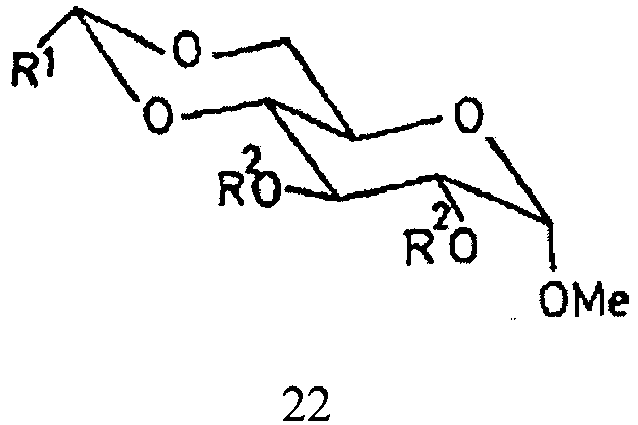
- K. Yamamoto, Bulletin of the Chemical Society of Japan 1973, Vol. 46, pp. 290-291 inter alia describes the formation of the following compound II.

- K. L. Matta et al., Carbohydrate Research 1977, Vol. 53, pp. 209-216 discloses the following compound as an intermediate, wherein R = H, R' = p-MeOC6H4, and Y = p-NO2C6H5.

-
JP H03-218390 A EP 0 413 162 A2
-
- Patent Document 1: Japanese Patent Application Publication No.
2000-256303 JP 2000-256303 A - Patent Document 2: Japanese Patent Application Publication No.
2004-359643 JP 2004-359643 A - Patent Document 3: Japanese Patent Application Publication No.
10-265761 JP 10-265761 A - Non-Patent Document 1: S. Shinkai et al., Chem. Eur. J., 2001, 7, No. 20, 4327-4334
- Oil gelators of low-molecular weight compounds for non-aqueous mediums such as organic solvents have been developed, but have disadvantages such that mediums for forming a gel are limited. On this account, in order to develop a novel oil gel having new applications and functions, a new low-molecular weight oil gelator capable of forming gels from various mediums have been sought. Gelators of sugar derivatives can form gels from various solvents by changing the type of the sugar. However, it is quite difficult to form gels from a wide variety of solvents by using a single sugar derivative. A gel obtained by using the sugar derivative described in Non-Patent
Document 1 has no storage stability. - No gelator capable of forming a gel from both solvents of water and oil (hydrophilic organic solvents and hydrophobic organic solvents) has been developed as far as the inventors of the present invention know, and a gelator exerting such a gelation performance has been demanded until now. In particular, a gelator capable of forming a gel from a mixed solvent of water and oil (a hydrophobic organic solvent) without using a surfactant or a similar agent is useful in base materials for cosmetics and pharmaceutical products, which require high biological safety, but such a revolutionary gelator has not been developed.
- In view of the above, it is an object of the present invention to provide a novel use of a compound as a gelator and to provide a gel. In particular, the inventors of the present invention have found a glucose gelator that can form a gel not only from water or oil (hydrophilic organic solvents and hydrophobic organic solvents) alone but also from a mixed solvent of water and oil (hydrophilic organic solvents and hydrophobic organic solvents), especially, from a mixed solvent of water and oil (hydrophobic organic solvents), and have accomplished the present invention.
- As a result of intensive studies for solving the disadvantages, the inventors of the present invention have found that by converting substituents on a sugar derivative and using the resultant product as a gelator for water, organic solvents, and other liquids, the gelator surprisingly can form a gel from both an organic solvent and water without changing the type of the sugar used for the sugar derivative and that control of the type of substituents allows a change in the type of a solvent that is to form a gel, and have accomplished the present invention.
- Specifically, as a first aspect, the present invention relates to a use of a compound as a gelator, wherein the compound is selected from the following compounds M1, M2, M3, M4, M5, M6, M8, M10, G3 and G8:

[M1] R1 = CH3O, R2 = H [M2] R1 = CH3(CH2)3O, R2 = H [M3] R1 = CH3(CH2)5O, R2 = H [M4] R1 = CH3(CH2)7O, R2 = H [M5] R1 = CH3(CH2)9O, R2 = H [M6] R1 = CH3(CH2)11O, R2 = H [M8] R1 = 3-Butenyl-O-, R2 = H [M10] R1 = 2-Ethylhexyl-O-, R2 = H 
[G3] R1 = CH3(CH2)3O-, R2 = H [G8] R1 = CH3(CH2)11O-, R2 = H. - As a second aspect, the present invention relates to a gel obtainable by gelation of a solvent with a gelator, wherein gelator is a compound as defined in the first aspect and the solvent is a hydrophobic organic solvent, a hydrophilic organic solvent, water, a hydrophilic organic solution, a hydrophobic organic solution, or an aqueous solution.
- As a third aspect, the present invention relates to the gel according to the second aspect, in which the hydrophobic organic solvent is at least one selected from the group consisting of plant oils, esters, silicone oils, and hydrocarbons.
- As a fourth aspect, the present invention relates to the gel according to the second aspect, in which the hydrophilic organic solvent is at least one selected from the group consisting of methanol, ethanol, 2-propanol, i-butanol, pentanol, hexanol, 1-octanol, isooctanol, acetone, cyclohexanone, acetonitrile, dioxane, glycerol, propylene glycol, ethylene glycol, and dimethyl sulfoxide.
- As a fifth aspect, the present invention relates to the gel according to the second aspect, in which the hydrophilic organic solution is a mixed solvent of the hydrophilic organic solvent as described in the fourth aspect and water.
- As an sixth aspect, the present invention relates to the gel according to the second aspect, in which the hydrophobic organic solution is a mixed solvent of the hydrophobic organic solvent as described in the third aspect and water.
- As a seventh aspect, the present invention relates to the gel according to the second aspect, in which the aqueous solution is an aqueous solution containing an organic acid, an inorganic acid, at least one inorganic salt selected from the group consisting of inorganic carbonates, inorganic sulfates, inorganic phosphates, and inorganic hydrogen phosphates, or at least one organic salt selected from the group consisting of acetates, lactates, citrates, organic amine hydrochlorides, and organic amine acetates.
- As a eighth aspect, the present invention relates to the gel according to the seventh aspect, in which the organic acid is at least one selected from the group consisting of acetic acid, citric acid, succinic acid, lactic acid, malic acid, maleic acid, fumaric acid, and trifluoroacetic acid, the inorganic acid is at least one selected from the group consisting of hydrochloric acid, phosphoric acid, carbonic acid, sulfuric acid, nitric acid, and boric acid, the inorganic salt is at least one selected from the group consisting of calcium carbonate, sodium carbonate, potassium carbonate, sodium sulfate, potassium sulfate, magnesium sulfate, potassium phosphate, sodium phosphate, disodium hydrogen phosphate, and sodium dihydrogen phosphate, and the organic salt is at least one selected from the group consisting of sodium acetate, potassium acetate, sodium lactate, potassium lactate, sodium citrate, potassium citrate, ethylenediamine hydrochloride, ethylenediaminetetraacetate, and trishydroxymethylaminomethane hydrochloride.
- As a ninth aspect, the present invention relates to the gel according to the second aspect, wherein the gel contains additives and inorganic compounds.
- As a tenth aspect, the present invention relates to the gel according to the ninth aspect, wherein the additives are selected from organic compounds such as surfactants, ultraviolet absorbers, moisturizers, antiseptics, antioxidants, aromatics, and physiologically active substances, and the inorganic compounds are selected from titanium oxide, talc, mica, and water.
- As an eleventh aspect, the present invention relates to the use according to the first aspect, wherein the compound is used as a gelator in a base material for cosmetics or a base material for medical use.
- As a twelfth aspect, the present invention relates to the use according to the eleventh aspect, wherein the base material for cosmetics or a base material for medical use further comprises at least one polymer compound.
- As a thirteenth aspect, the present invention relates to the use according to the first aspect, wherein the compound is used as a gelator in a gel electrolyte.
- As a fourteenth aspect, the present invention relates to the use according to the first aspect, wherein the compound is used as a gelator in a cell culture base material.
- As a fifteenth aspect, the present invention relates to the use according to the first aspect, wherein the compound is used as a gelator in a base material for preserving biomolecules.
- As a sixteenth aspect, the present invention relates to the use according to the first aspect, wherein the compound is used as a gelator in a base material for external use.
- As a seventeenth aspect, the present invention relates to the use according to the first aspect, wherein the compound is used as a gelator in a base material for biochemistry.
- As an eighteenth aspect, the present invention relates to the use according to the first aspect, wherein the compound is used as a gelator in a base material for food.
- As a nineteenth aspect, the present invention relates to the use according to the first aspect, wherein the compound is used as a gelator in a base material for dryland farming.
- The compound used as a gelator according to the present invention can form a gel from an aqueous system, an organic solvent system, or both the systems. In addition, by changing the type of a substituent on a sugar derivative of the compound used as a gelator according to the present invention, the type of a solvent that is to form a gel can be changed. The compound used as a gelator according to the present invention has good storage stability.
- The compound used as a gelator according to the present invention is produced from a monosaccharide such as glucose, mannose, and derivatives thereof as raw materials, and thus can form a gel having excellent biological safety.
- In particular, the compound of Formula (7) (hereinafter called a glucose gelator) having a glucose moiety is produced from glucose, which is a common monosaccharide. This can reduce the material cost for producing the gelator to an extremely low level. In addition, the synthesis of the gelator achieves a high total yield throughout all processes and is unlikely to cause side reactions. Thus, the glucose gelator can be easily produced as compared with related art gelators, and the production cost can be extremely reduced. Furthermore, the glucose gelator has the ability to form gels from both water and oil (hydrophobic organic solvents) and can form a water/oil dispersion gel. The glucose gelator can also form a gel from alcoholic solvents. On this account, the glucose gelator is a highly versatile gelator that can be used at a low concentration to form a transparent gel from mediums having a wide variety of characteristics. In particular, the glucose gelator can form a highly transparent gel from water.
- The compound of Formula (8) (hereinafter called a mannose gelator) having a mannose moiety can form a highly transparent gel from oil (hydrophilic organic solvents and hydrophobic organic solvents) and can yield a gel having excellent thixotropic properties. The mannose gelator can form a self-standing, transparent gel (having self-standing properties) and thus is useful for a base material for sticks.
- The production method can produce the above-mentioned gelator from derivatives of glucose and mannose in a one-pot system and can simply, inexpensively produce a compound to be the gelator. In addition, the method eliminates methanol and metal catalysts during the production and thus can produce a compound usable as the gelator particularly for base materials that are required to have high safety, such as base materials for cosmetics, base materials for medical use, and base materials for food.
-
- [
FIG. 1] FIG. 1 is a view showing an HPLC chart of a purified compound [G3"] prepared in Examples. - [
FIG. 2] FIG. 2 is a view showing a 1H NMR (500 MHz, in deuterated DMF) spectrum of the purified compound [G3"] prepared in Examples. - [
FIG. 3] FIG. 3 is a view showing stabilities of SH245 gels that were prepared form SH245 with mannose gelators M1 and M3 and compound A as a known substance (each 0.05 wt%) and left at room temperature for 7 days. - [
FIG. 4] FIG. 4 is a view showing micrographs of water/oil dispersion gels from isopropyl myristate (IPM) and water with glucose gelator G4 (1 wt%). - [
FIG. 5] FIG. 5 is a view showing the appearances of water/oil dispersion gels from SH245 and water with glucose gelator G3 (0.25 to 1 wt%). - [
FIG. 6] FIG. 6 is a view showing confocal laser scanning micrographs of water/oil dispersion gels from SH245 and water with glucose gelator G3 (0.25 wt%) (stirring means: vortex mixer). - [
FIG. 7] FIG. 7 is a view showing confocal laser scanning micrographs of water/oil dispersion gels from SH245 and water with glucose gelator G3 (0.25 wt%) (stirring means: homogenizer). - [
FIGS. 8] FIGS. 8 are views showing the appearance (FIG. 8A ) and a micrograph (FIG. 8B ) of a gel prepared with a premix containing glucose gelator G4. - [
FIGS. 9] FIGS. 9 are views showing the appearances of a squalene gel that was prepared with mannose gelator M3 (0.5 wt%) and released from a sample tube.FIG. 9A is a view showing the gel immediately after the release;FIG. 9B is a view showing gels prepared by cutting the released gel with a cover glass (a thickness of 0.12 to 0.17 mm); andFIG. 9C is a view showing a stacked gel by joining the cut sections of the cut gel to each other. - [
FIG. 10] FIG. 10 is a view showing sol-gel phase transition temperature (Tgel) with respect to concentration of gelators in toluene gels prepared with mannose gelators M1 to M6 and M8 and compound A as a known substance. - [
FIG. 11] FIG. 11 is a view showing the appearances of toluene gels (1 wt%) prepared with mannose gelator M2 and compound A as a known substance and SEM images of xerogels thereof. - [
FIG. 12] FIG. 12 is a view showing the appearances of toluene gels prepared with mannose gelators M2 and M6 and AFM images of xerogels thereof. - [
FIG. 13] FIG. 13 is a view showing the appearances of a toluene gel (0.5 wt%) and an aqueous gel (0.1 wt%) prepared with mannose gelator M2 and SEM images of xerogels thereof. - [
FIG. 14] FIG. 14 is a view showing the appearances of aqueous gels (0.1 wt%) prepared with mannose gelator M2 and glucose gelator G3 and SEM images of xerogels thereof. - The compound used as a gelator according to the present invention is a compound selected from the following compounds M1, M2, M3, M4, M5, M6, M8, M10, G3 and G8:

[M1] R1 = CH3O, R2 = H [M2] R1 = CH3(CH2)3O, R2 = H [M3] R1 = CH3(CH2)5O, R2 = H [M4] R1 = CH3(CH2)7O, R2 = H [M5] R1 = CH3(CH2)9O, R2 = H [M6] R1 = CH3(CH2)11O, R2 = H [M8] R1 = 3-Butenyl-O-, R2 = H [M10] R1 = 2-Ethylhexyl-O-, R2 = H 
[G3] R1 = CH3(CH2)3O-, R2 = H [G8] R1 = CH3(CH2)11O-, R2 = H. - The above compounds can be subsumed under Formula (1) or Formula (2).

- each of R1 and R3 is independently a linear or branched alkyl group having a carbon atom number of 1 to 20, or a linear or branched alkenyl group having a carbon atom number of 2 to 20; n is 0;
- R2 is a linear alkyl group having a carbon atom number of 1; and
- R4 and R5 are each a hydroxy group)
- From the viewpoint that the gelator can form a highly transparent gel without syneresis when used for a hydrophobic organic solvent, R1 is preferably a butyl group, or a hexyl group.
- From the viewpoint that the gelator can form a highly transparent gel without syneresis when used for a hydrophilic organic solvent, R1 is preferably an octyl group, a decyl group, or a dodecyl group.
- From the viewpoint that the gelator can form a highly uniform gel from water optionally containing a hydrophilic organic solvent, a hydrophobic organic solvent such as oils, or a mixture of both the solvents, R1 is preferably a butyl group.
- The compound of Formula (1) or (2) can be produced by a known method, for example, by reacting a benzaldehyde dimethyl acetal having the above-mentioned substituents on the benzene ring with a monosaccharide.
- The monosaccharide may be any monosaccharide having a pyranose ring structure, and usable examples of the monosaccharide include allose, altrose, glucose, mannose, gulose, idose, galactose, and talose.
- For the compounds used as a gelator according to the present invention, the monosaccharide is preferably glucose or mannose. Such monosaccharides are relatively inexpensive and should particularly provide biocompatibility.
- Among the compounds used as a gelator according to the present invention, compounds [G3] and [G8] are compounds of Formula (7) having a glucose moiety, and compounds M1, M2, M3, M4, M5, M6, M8, and M10 are compounds of Formula (8) having a mannose moiety.


- As described above, the gel forming ability of the compound of Formula (7) (glucose gelator) is quite different from the gel forming ability of the compound of Formula (8) (mannose gelator). For example, the compounds can form gels from solvents, which varies with the compounds.
- In particular, the compound of Formula (7) (glucose gelator) has the ability to form a gel from both water and oil (hydrophobic organic solvents), which is the greatest feature of the glucose gelator, and can form a water/oil dispersion gel from a mixed solvent of water and oil. In addition, the compound of Formula (7) can form a gel from an alcoholic solvent and forms a highly transparent gel from water.
- The compound of Formula (8) (mannose gelator) can form a highly transparent gel from oil (hydrophilic organic solvents and hydrophobic organic solvents) and can yield a gel having excellent thixotropic properties. The compound of Formula (8) also can characteristically form a self-standing, transparent gel (having self-standing properties).
- As described above, the glucose gelator and the mannose gelator have different gel forming abilities, and thus should be applied to a wide variety of fields suitable to the respective features.
- A gel of the present invention can be produced by gelation of a solvent with the gelator. Specifically, the production method is exemplified by dissolving a predetermined amount of the gelator in a solvent with heating and then cooling the solution. Typically, for the dissolution with heating, the gelator is preferably, completely dissolved.
- In the present application, the gelation means making a flowable liquid lose the flowability.
- For the gelation of a solvent, the amount of the gelator is not limited as long as the effects of the present invention are exerted, but is typically 20 to 0.001% by mass and preferably 2 to 0.05% by mass relative to the mass of a solvent to form a gel.
- The solvent is selected from hydrophobic organic solvents, hydrophilic organic solvents, water, mixed solvents of water and hydrophilic organic solvents (in the present specification, called hydrophilic organic solutions), mixed solvents of hydrophobic organic solvents and water (in the present specification, called hydrophobic organic solutions), and aqueous solutions in which an organic acid or an inorganic acid is dissolved in water or an inorganic salt or an organic salt is dissolved in water (in the present specification, called aqueous solutions).
- Specific examples of the hydrophobic organic solvent include plant oils such as olive oil, coconut oil, castor oil, jojoba oil, and sunflower oil; esters such as cetyl octanoate, isopropyl myristate, and isopropyl palmitate; and hydrocarbons such as toluene, xylene, n-hexane, cyclohexane, octane, mineral oils, silicone oils, and hydrogenated polyisobutene.
- Among them, the hydrophobic organic solvent is preferably olive oil, isopropyl myristate, toluene, cyclohexane, silicone oils such as linear silicones, cyclic silicones, alkyl-modified silicones, phenyl-modified silicones, dimethicone, and dimethiconol, and octane.
- The silicone oil may be linear silicone (trade name: 2-1184), cyclic silicone (trade name: SH245), alkyl-modified silicone (trade name: SS-3408), phenyl-modified silicone (trade name: PH-1555), dimethicone (trade name: BY-11-0 series), and dimethiconol (trade name: CB-1556) available from Dow Corning Toray Silicone Co., Ltd., for example.
- The hydrophilic organic solvent means an organic solvent that can be dissolved in water at any ratio and is exemplified by alcohols, acetone, cyclohexanone, acetonitrile, dioxane, glycerol, and dimethyl sulfoxide.
- The alcohol is preferably water-soluble alcohols that can be freely dissolved in water and is more preferably exemplified by C1-9 alcohols, polyhydric alcohols, higher alcohols, and glycerides.
- Specific examples of the C1-9 alcohol include methanol, ethanol, 2-propanol, i-butanol, pentanol, hexanol, 1-octanol, and isooctanol; specific examples of the polyhydric alcohol include ethylene glycol, propylene glycol, and polypropylene glycol; specific examples of the higher alcohol include octyldodecanol, stearyl alcohol, and oleyl alcohol; and specific examples of the glyceride include trioctanoin, capric/caprylic triglyceride, and glyceryl stearate.
- Among them, the hydrophilic organic solvent is preferably methanol, ethanol, 2-propanol, i-butanol, pentanol, hexanol, 1-octanol, isooctanol, acetone, cyclohexanone, acetonitrile, dioxane, glycerol, propylene glycol, ethylene glycol, and dimethyl sulfoxide, and more preferably glycerol, propylene glycol, and ethylene glycol.
- A plurality of the organic acids or the inorganic acids may be added. Preferred examples of the organic acid include acetic acid, citric acid, succinic acid, lactic acid, malic acid, maleic acid, fumaric acid, and trifluoroacetic acid. The organic acid is more preferably acetic acid, citric acid, succinic acid, lactic acid, and malic acid, and even more preferably acetic acid, citric acid, and lactic acid.
- Preferred examples of the inorganic acid include hydrochloric acid, phosphoric acid, carbonic acid, sulfuric acid, nitric acid, and boric acid. The inorganic acid is more preferably hydrochloric acid, phosphoric acid, carbonic acid, and sulfuric acid, and even more preferably hydrochloric acid, phosphoric acid, and carbonic acid.
- A plurality of the inorganic salts or the organic salts may be added, but one or two salts are preferably added. A solution obtaining a buffer capacity by adding two salts is also preferred.
- Preferred examples of the inorganic salt include inorganic carbonates, inorganic sulfates, inorganic phosphates, and inorganic hydrogen phosphates. The inorganic salt is more preferably calcium carbonate, sodium carbonate, potassium carbonate, sodium sulfate, potassium sulfate, magnesium sulfate, potassium phosphate, sodium phosphate, disodium hydrogen phosphate, and sodium dihydrogen phosphate, and even more preferably calcium carbonate, magnesium sulfate, disodium hydrogen phosphate, and sodium dihydrogen phosphate.
- Preferred examples of the organic salt include salts of organic acids with inorganic bases, such as inorganic acetates, inorganic lactates, and inorganic citrates, hydrochlorides of organic amines, and acetates of organic amines. The organic salt is more preferably sodium acetate, potassium acetate, sodium lactate, potassium lactate, sodium citrate, potassium citrate, ethylenediamine hydrochloride, ethylenediaminetetraacetate, and trishydroxymethylaminomethane hydrochloride.
- The gelator is used in an amount of 0.001 to 10% by mass, preferably 0.1 to 10% by mass, for example, 0.1 to 5% by mass relative to the hydrophobic organic solvent, the hydrophilic organic solvent, the water, the hydrophilic organic solution, the hydrophobic organic solution, or the aqueous solution as a medium.
- The gelator is added to the hydrophobic organic solvent, the hydrophilic organic solvent, the water, the hydrophilic organic solution, the hydrophobic organic solution, or the aqueous solution as a medium, and is dissolved by stirring with heating, as necessary, and then the solution is left at room temperature, thus yielding a gel. The strength of the gel can be adjusted by the concentration of the gelator.
- The gel formed with the gelator may contain various additives (including organic compounds such as surfactants, ultraviolet absorbers, moisturizers, antiseptics, antioxidants, aromatics, and physiologically active substances (medical components) and inorganic compounds such as titanium oxide, talc, mica, and water) depending on applications and purposes, as necessary, to an extent not impairing the gel forming ability of the gelator.
- A base material for cosmetics or a base material for medical use includes the above-mentioned gelator.
- The base material for cosmetics or the base material for medical use can contain water, alcohols, polyhydric alcohols, hydrophilic organic solvents, hydrophobic organic solvents, and mixed solutions of them in addition to the gelator. Examples of the alcohol, the polyhydric alcohol, the hydrophilic organic solvent, and the hydrophobic organic solvent include the compounds exemplified as the alcohol, the polyhydric alcohol, the hydrophilic organic solvent, and the hydrophobic organic solvent.
- The base material for cosmetics or the base material for medical use can contain additives such as physiological active substances and functional substances that are commonly contained in base materials for cosmetics or base materials for medical use, as necessary. Examples of such additives include oil base materials, moisturizers, texture improvers, surfactants, polymers, thickeners/gelators, solvents, propellants, antioxidants, reducing agents, oxidizing agents, preservatives, antimicrobial agents, antiseptics, chelating agents, pH adjusters, acids, alkalis, fine particles, inorganic salts, ultraviolet absorbers, whitening agents, vitamins and derivatives thereof, hair growth-promoting agents, blood circulation promoters, stimulants, hormones, anti-wrinkle agents, anti-aging agents, slimming agents, cooling agents, warming agents, wound healing promoters, abirritants, analgesics, cell activators, plant/animal/microbial extracts, antipruritics, cuticle peeling and dissolving agents, antiperspirants, algefacients, styptics, enzymes, nucleic acids, perfumes, coloring agents, colorants, dyes, pigments, antiphlogistics, anti-inflammatory agents, anti-asthmatic agents, agents for chronic obstructive pulmonary diseases, antiallergic agents, immunomodulators, anti-infective agents, and antifungal agents.
- The base material for cosmetics or the base material for medical use contains the gelator and at least one polymer compound.
- Examples of the polymer compound include gelatin, sodium alginate, propylene glycol alginate, gum arabic, polyvinyl alcohol, polyacrylic acid, sodium polyacrylate, carboxymethylcellulose, gellan gum, xanthan gum, carrageenan polystyrene, polymethyl methacrylate, polyvinylpyrrolidone, polyethylene oxide, polylactic acid, polystyrene sulfonate, polyacrylonitrile, polyethylene, and polyethylene terephthalate.
- A gel electrolyte is obtained by gelation of an electrolytic solution (liquid electrolyte) including an organic solvent or water. The gelator and the electrolytic solution to be used are not limited and may be appropriately selected depending on an intended use.
- For example, the electrolytic solution including an organic solvent is a solution of an electrolyte salt in at least one aprotic organic solvent.
- Examples of the aprotic organic solvent include glyme, alkene carbonates, alkyl carbonates, cyclic ethers, amides, nitriles, ketones, and esters. Preferred examples of the aprotic organic solvent specifically include propylene carbonate, ethylene carbonate, diethyl carbonate, γ-butyrolactone, 1,2-dimethoxyethane, tetrahydrofuran, 2-methyltetrahydrofuran, dimethyl sulfoxide, 1,3-dioxolane, formamide, dimethylformamide, 1,4-dioxane, acetonitrile, nitromethane, ethyl monoglyme, phosphotriester, trimethoxymethane, dioxolane derivatives, sulfolane, 3-methyl-2-oxazolidinone, propylene carbonate derivatives, tetrahydrofuran derivatives, diethyl ether, and 1,3-propane sultone. These organic solvents can be used singly or in combination of two or more of them.
- The electrolyte salt is composed of a cationic metal and a counter anion. Examples of the cationic metal include Li+, Na+, and K+. Examples of the counter anion include ClO4 -, LiBF4 -, PF6 -, CF3SO3 -, CF3CO2 -, AsF6 -, SbF6 -, (CF3SO2)2N-, B10Cl10 2-, (1,2-dimethoxyethane)2ClO4 -, lower aliphatic carboxylates, AlCl4 -, Cl-, Br-, I-, chloroborane compounds, and tetraphenylboric acid. Among them, a preferred electrolyte salt is exemplified by lithium salts. These electrolyte salts can be used singly or in combination of two or more of them.
- The compound used as gelator and the gel obtained from the compound used as a gelator according to the present invention can be used for materials in various fields, such as cell culture base materials, base materials for preserving biomolecules such as cells and proteins, base materials for external use, base materials for biochemistry, base materials for food, contact lenses, disposable diapers, artificial actuators, and base materials for dryland farming. The gelator and the gel can also be widely used for bioreactor carriers for enzymes and other substances in studies, medicines, analysis, and various industries.
- A method for producing the compound of Formula (1) or Formula (2) is described.
- In other words, the production method is characterized by reacting a compound of Formula [A]:

- Examples will be described below in order to further explain the feature of the present invention, but the present invention is not limited by these examples.
- The signs shown in scheme A and
schemes 1 to 10 below are signs given in the respective schemes and differ from the signs given in the detailed description of the invention and claims. - Reagents used as synthetic raw materials in examples are shown below.
- Methyl α-D-mannopyranoside, p-methoxybenzaldehyde, p-ethoxybenzaldehyde, p-(dodecyloxy)benzaldehyde, 4-bromo-1-butene, 1-bromo-3-methyl-2-butene, 1-bromobutane, 1-bromohexane, D(+)-glucose, and ethyl α-D-glucoside were purchased from Wako Pure Chemical Industries, Ltd. Methyl α-D-glucopyranoside, p-toluenesulfonic acid monohydrate, 4-propoxybenzaldehyde, 4-n-butoxybenzaldehyde, 4-n-pentyloxybenzaldehyde, 4-n-hexyloxybenzaldehyde, 4-n-octyloxybenzaldehyde, 4-n-decyloxybenzaldehyde, trimethyl orthoformate, bromocyclohexane, tetrabutylammonium iodide, triethyl orthoformate, 4-hydroxybenzaldehyde, 3-hydroxybenzaldehyde, vanillin, p-toluenesulfonic acid (anhydride), and 3,4-dimethoxybenzaldehyde were purchased from Tokyo Chemical Industry Co., Ltd. Copper(II) tetrafluoroborate hydrate, 2-ethylhexyl bromide, and geranyl bromide were purchased from Sigma-Aldrich Japan.
- N,N-dimethylformamide (DMF) (dehydrated, for organic synthesis), methanol (dehydrated, for organic synthesis), and ethanol (super dehydrated, for organic synthesis), which were used as reaction solvents, were purchased from Wako Pure Chemical Industries, Ltd.
- Sodium sulfate (guaranteed reagent), sodium chloride (guaranteed reagent), sodium hydrogen carbonate (guaranteed reagent), and diethyl ether (guaranteed reagent), which were used for after treatment of reaction and purification, were purchased from Wako Pure Chemical Industries, Ltd. Hexane (guaranteed reagent), ethyl acetate (guaranteed reagent), chloroform (guaranteed reagent), and diisopropyl ether (guaranteed reagent), which were also used for after treatment of reaction and purification, were purchased from Kanto Chemical Co., Inc.
- Deuterated chloroform (containing 0.03% TMS (tetramethylsilane)) and deuterated dimethylformamide, which were used for NMR measurement, were purchased from Sigma-Aldrich Japan.
- Solvents used in gelation tests are shown below.
- Octane (guaranteed reagent), cyclohexane (guaranteed reagent), toluene (guaranteed reagent), ethanol (guaranteed reagent), olive oil, isopropyl myristate (extra pure reagent), glycerol (guaranteed reagent), squalane (extra pure reagent), squalene (guaranteed reagent), acetonitrile (guaranteed reagent), methanol (guaranteed reagent), propylene glycol (guaranteed reagent), 1,3-butanediol (another name: butylene glycol) (guaranteed reagent), and glycerin (guaranteed reagent) were purchased from Wako Pure Chemical Industries, Ltd. Ethylene glycol (guaranteed reagent) was purchased from Kanto Chemical Co., Inc. SH245 was purchased from Dow Corning Toray Co., Ltd. Pentylene glycol was purchased from ITO. Dimethyl sulfoxide (DMSO) was purchased from Tokyo Chemical Industry Co., Ltd. Water used was pure water.
- Preservatives and surfactants used in gelation test are shown below.
- Preservatives: Methylparaben and 2-phenoxyethanol (guaranteed reagent) were purchased from Wako Pure Chemical Industries, Ltd.
- Surfactants: Polyoxyethylene sorbitan monolaurate (Tween 20), sodium dodecyl sulfate (SDS, extra pure reagent), stearyltrimethylammonium bromide (STAB), and 3-[(3-cholamidopropyl)dimethylammonio]propanesulfonate (CHAPS) were purchased from Wako Pure Chemical Industries, Ltd.
- Apparatuses and conditions used for various measurements and analyses are shown below.
- (1) 1H-NMR spectrum
* Apparatus: AVANCE 500, manufactured by Bruker BioSpin K.K. JNM-ECA 600, manufactured by JEOL Ltd. - (2) High performance liquid chromatography (HPLC)
* Apparatus: 1200 series, manufactured by Agilent Technologies, Inc. - (3) LC-MS
* Apparatus: e2695 (LC), 2489 (UV), 3100 (MS), manufactured by Nihon Waters K.K. - (4) Optical microscope
* Apparatus: DM 2500, manufactured by Leica Microsystems - (5) Confocal laser scanning microscope
* Apparatus: LSM 700, manufactured by Carl Zeiss - (6) Scanning electron microscope (SEM)
* Apparatus: SU 8000, manufactured by Hitachi High-Technologies Corporation - (7) Atomic force microscope (AFM)
* Apparatus: Nanocute, manufactured by SII NanoTechnology Inc. - (8) Vortex mixer
* Apparatus:Voltex Genie 2, manufactured by Scientific Industries - (9) Homogenizer
* Apparatus: Omni Tip™ Homogenizing Kit, manufactured by Omni International - Compounds to be mannose gelators and glucose gelators can be synthesized in accordance with scheme A shown below. Commercially available aromatic aldehyde compounds that have various hydrocarbon groups and are raw materials for the gelators were purchased (see the description above), and commercially unavailable aromatic aldehyde compounds were synthesized in accordance with
scheme 1 described later. - The annulation reaction of the aromatic aldehyde compound and a sugar is typically carried out by annulation reaction of an acetal derived from the aldehyde or carried out by annulation reaction of the aldehyde in heating conditions. Another feature is a one-step annulation reaction of the aromatic aldehyde compound at room temperature.

- In accordance with
scheme 1 below, aromatic aldehyde compounds having various hydrocarbon groups were synthesized.
- Synthesis of compound [1]: Under a nitrogen atmosphere, p-hydroxybenzaldehyde (4.9 g, 40 mmol), 4-bromo-1-butene (8.1 g, 60 mmol), and potassium carbonate (8.3 g, 60 mmol) were added in 80 mL of dry N,N-dimethylformamide (DMF), and the whole was heated at 80°C for 6 hours. The reaction solution was allowed to cool to room temperature, then insolubles were removed by filtration, and the filtrate was concentrated under reduced pressure. To the residue, ethyl acetate and saturated sodium chloride were added. The resultant mixture was subjected to a liquid separation operation, and the organic phase was extracted. The organic phase was washed with saturated sodium chloride. The organic phase was dried over sodium sulfate, then the sodium sulfate was filtered off, and the filtrate was concentrated under reduced pressure. The residue was purified by column chromatography (silica gel, hexane : ethyl acetate = 9:1 (v/v)), yielding the target compound: Yield 91%; 1H NMR (500 MHz, CDCl3): δ9.88 (s, 1H), 7.85-7.81 (m, 2H), 7.02-6.95 (m, 2H), 5.95-5.86 (m, 1H), 5.22-5.12 (m, 2H), 4.15-4.05 (m, 2H), 2.61-2.55 (m, 2H).
- Synthesis of compound [2]: Under a nitrogen atmosphere, 4-hydroxybenzaldehyde (10.0 g, 82 mmol), bromocyclohexane (15.0 mL, 122 mmol), potassium carbonate (34.0 g, 246 mmol), and tetrabutylammonium iodide (0.25 g, 0.67 mmol) were added in 80 mL of dry N,N-dimethylformamide (DMF), and the whole was heated at 150°C for 12 hours. The reaction solution was allowed to cool to room temperature, then insolubles were removed by filtration, and the filtrate was concentrated under reduced pressure. To the residue, ethyl acetate and saturated sodium chloride were added. The resultant mixture was subjected to a liquid separation operation, and the organic phase was extracted. The organic phase was washed with saturated sodium chloride. The organic phase was dried over sodium sulfate, then the sodium sulfate was filtered off, and the filtrate was concentrated under reduced pressure. The residue was purified by column chromatography (silica gel, hexane : ethyl acetate = 9:1 (v/v)), yielding the target compound:
Yield 12%; δ9.85 (s, 1H), 7.83-7.79 (m, 2H), 7.00-6.96 (m, 2H), 4.41-4.35 (m, 1H), 2.05-1.98 (m, 2H), 1.87-1.79 (m, 2H), 1.63-1.50 (m, 3H), 1.45-1.29 (m, 3H). - Synthesis of compound [3]: Under a nitrogen atmosphere, 4-hydroxybenzaldehyde (4.9 g, 40 mmol), 2-ethylhexyl bromide (9.7 g, 50 mmol), and potassium carbonate (8.3 g, 60 mmol) were added in 80 mL of dry N,N-dimethylformamide (DMF), and the whole was heated at 80°C for 3 hours. The reaction solution was allowed to cool to room temperature, then insolubles were removed by filtration, and the filtrate was concentrated under reduced pressure. To the residue, ethyl acetate and saturated sodium chloride were added. The resultant mixture was subjected to a liquid separation operation, and the organic phase was extracted. The organic phase was washed with saturated sodium chloride. The organic phase was dried over sodium sulfate, then the sodium sulfate was filtered off, and the filtrate was concentrated under reduced pressure. The residue was purified by column chromatography (silica gel, hexane : ethyl acetate = 9:1 (v/v)), yielding the target compound: Yield 95%; 1H NMR (500 MHz, CDCl3): δ9.88 (s, 1H), 7.85-7.81 (m, 2H), 7.02-6.98 (m, 2H), 3.94-3.91 (m, 2H), 1.78-1.73 (m, 1H), 1.53-1.30 (m, 8H), 0.95-0.85 (m, 6H).
- In accordance with
scheme 2 below, aromatic aldehyde compounds were subjected to dimethyl acetalization, yielding acetal derivatives [17] to [32].
- Synthesis of compound [17]: Under a nitrogen atmosphere, p-methoxybenzaldehyde [7] (2.7 g, 20 mmol) and trimethyl orthoformate (4.4 mL, 40 mmol) were dissolved in 8 mL of dry methanol, and to the solution, copper(II) tetrafluoroborate hydrate (48 mg) was added. The mixture was stirred at room temperature for 1 hour, and saturated sodium hydrogen carbonate was added to stop the reaction. To the solution, ethyl acetate was added to perform extraction and the organic phase was then washed with saturated sodium chloride. The organic phase was dried over sodium sulfate, then the sodium sulfate was filtered off, and the filtrate was concentrated under reduced pressure: Yield 99%; 1H NMR (500 MHz, CDCl3): δ 7.36 (d, 2H, J = 8.8 Hz), 6.89 (d, 2H, J = 8.8 Hz), 5.35 (s, 1H), 3.81 (s, 3H), 3.31 (s, 6H).
- Other compounds [18] to [32] were also synthesized in the same manner as for compound [17]. For these compounds, analysis data alone are shown below.
- Compound [18]: Yield 94%; 1H NMR (500 MHz, CDCl3): δ 7.35 (d, 2H, J = 8.8 Hz), 6.88 (d, 2H, J = 8.8 Hz), 5.35 (s, 1H), 4.04 (q, 2H, J = 6.9 Hz), 3.31 (s, 6H), 1.41 (t, 3H, J = 7.1 Hz).
- Compound [19]: Yield 95%; 1H NMR (500 MHz, CDCl3): δ 7.37 (d, 2H, J = 8.2 Hz), 6.91 (d, 2H, J = 8.8 Hz), 5.37 (s, 1H), 3.95 (t, 2H, J = 6.5 Hz), 3.34 (s, 6H), 1.91-1.79 (m, 2H), 1.06 (t, 3H, J = 7.5 Hz).
- Compound [20]: Yield 99%; 1H NMR (500 MHz, CDCl3): δ 7.35 (d, 2H, J = 8.8 Hz), 6.89 (d, 2H, J = 8.8 Hz), 5.35 (s, 1H), 3.96 (t, 2H, J = 6.6 Hz), 3.31 (s, 6H), 1.80-1.73 (m, 2H), 1.54-1.44 (m, 2H), 0.97 (t, 3H, J = 7.6 Hz).
- Compound [21]: Yield 95%; 1H NMR (500 MHz, CDCl3): δ 7.35 (d, 2H, J = 8.8 Hz), 6.88 (d, 2H, J = 8.5 Hz), 5.35 (s, 1H), 3.96 (t, 2H, J = 6.6 Hz), 3.31 (s, 6H), 1.82-1.75 (m, 2H), 1.48-1.33 (m, 4H), 0.93 (t, 3H, J = 7.1 Hz).
- Compound [22]: Yield 99%; 1H NMR (500 MHz, CDCl3): δ 7.35 (d, 2H, J = 8.8 Hz), 6.88 (d, 2H, J = 8.8 Hz), 5.35 (s, 1H), 3.95 (t, 2H, J = 6.6 Hz), 3.31 (s, 6H), 1.81-1.74 (m, 2H), 1.51-1.41 (m, 2H), 1.39-1.29 (m, 4H), 0.94-0.87 (m, 3H).
- Compound [23]: Yield 99%; 1H NMR (500 MHz, CDCl3): δ 7.35 (d, 2H, J = 8.8 Hz), 6.88 (d, 2H, J = 8.8 Hz), 5.35 (s, 1H), 3.95 (t, 2H, J = 6.6 Hz), 3.31 (s, 6H), 1.82-1.73 (m, 2H), 1.50-1.40 (m, 2H), 1.39-1.22 (m, 8H), 0.92-0.85 (m, 3H).
- Compound [24]: Yield 98%; 1H NMR (500 MHz, CDCl3): δ 7.34 (d, 2H, J = 8.8 Hz), 6.88 (d, 2H, J = 8.8 Hz), 5.34 (s, 1H), 3.95 (t, 2H, J = 6.6 Hz), 3.31 (s, 6H), 1.82-1.73 (m, 2H), 1.50-1.40 (m, 2H), 1.39-1.20 (m, 12H), 0.92-0.85 (m, 3H).
- Compound [25]: Yield 99%; 1H NMR (500 MHz, CDCl3): δ 7.35 (d, 2H, J = 8.8 Hz), 6.88 (d, 2H, J = 8.8 Hz), 5.35 (s, 1H), 3.95 (t, 2H, J = 6.6 Hz), 3.31 (s, 6H), 1.81-1.73 (m, 2H), 1.49-1.40 (m, 2H), 1.39-1.20 (m, 16H), 0.88 (t, 3H, J = 6.9 Hz).
- Compound [26]: Yield 97%; 1H NMR (500 MHz, CDCl3): δ 7.02-6.97 (m, 2H), 6.88-6.84 (m, 1H), 5.33 (s, 1H), 3.90 (s, 3H), 3.89 (s, 3H), 3.33 (s, 6H).
- Compound [27]: Yield 75%; 1H NMR (500 MHz, CDCl3): δ 7.37-7.33 (m, 2H), 6.92-6.87 (m, 2H), 5.96-5.85 (m, 1H), 5.35 (s, 1H), 5.21-5.08 (m, 2H), 4.02 (t, 2H, J = 6.6 Hz), 3.31 (s, 6H), 2.58-2.51 (m, 2H).
- Compound [28]: Yield 98%; 1H NMR (500 MHz, CDCl3): δ 7.33 (d, 2H, J = 8.8 Hz), 6.88 (d, 2H, J = 8.8 Hz), 5.33 (s, 1H), 4.31-4.23 (m, 1H), 3.32 (s, 6H), 2.03-1.92 (m, 2H), 1.86-1.73 (m, 2H), 1.64-1.23 (m, 6H).
- Compound [29]: Yield 97%; 1H NMR (500 MHz, CDCl3): δ 7.37-7.33 (m, 2H), 6.92-6.87 (m, 2H), 5.35 (s, 1H), 3.87-3.80 (m, 2H), 3.31 (s, 6H), 1.77-1.67 (m, 1H), 1.55-1.25 (m, 8H), 0.96-0.86 (m, 6H).
- In accordance with
scheme 3, an aromatic aldehyde compound was subjected to dimethyl acetalization, yielding acetal derivative [21]. (Reference)
- Synthesis of compound [21]: Under a nitrogen atmosphere, 4-n-pentyloxybenzaldehyde [11] (1.9 g, 10 mmol) and trimethyl orthoformate (2.2 mL, 20 mmol) were dissolved in 4 mL of dry methanol, and to the solution, p-toluenesulfonic acid monohydrate (8 mg) was added. The mixture was stirred at room temperature for 1 hour, and saturated sodium hydrogen carbonate was added to stop the reaction. To the solution, ethyl acetate was added to perform extraction and the organic phase was then washed with saturated sodium chloride. The organic phase was dried over sodium sulfate, then the sodium sulfate was filtered off, and the filtrate was concentrated under reduced pressure: Yield 94%.
- In accordance with scheme 4 below, aromatic aldehyde compounds were subjected to diethyl acetalization, yielding acetal derivatives [20'] and [21'].

- Synthesis of compound [20']: Under a nitrogen atmosphere, 4-n-butoxybenzaldehyde [10] (2.5 g, 14 mmol) and triethyl orthoformate (5.0 mL, 38 mmol) were dissolved in 10 mL of dry ethanol, and to the solution, p-toluenesulfonic acid monohydrate (7 mg) was added. The mixture was stirred at room temperature for 1 hour, and saturated sodium hydrogen carbonate was added to stop the reaction. To the solution, ethyl acetate was added to perform extraction and the organic phase was then washed with saturated sodium chloride. The organic phase was dried over sodium sulfate, then the sodium sulfate was filtered off, and the filtrate was concentrated under reduced pressure: Yield 78%; 1H NMR (500 MHz, CDCl3): δ 7.37 (d, 2H, J = 8.8 Hz), 6.88 ((d, 2H, J = 8.8 Hz), 3.96 (t, 2H, J = 6.5 Hz), 3.63-3.57 (m, 2H), 3.54-3.48 (m, 2H), 1.80-1.72 (m, 2H), 1.54-1.44 (m, 2H), 1.23 (t, 6H, J = 7.1 Hz), 0.97 (t, 3H, J = 7.5 Hz).
- Synthesis of compound [21']: Under a nitrogen atmosphere, 4-n-pentyloxybenzaldehyde [11] (1.9 g, 10 mmol) and triethyl orthoformate (3.4 mL, 20 mmol) were dissolved in 4 mL of dry ethanol, and to the solution, p-toluenesulfonic acid monohydrate (8 mg) was added. The mixture was stirred at room temperature for 1 hour, and saturated sodium hydrogen carbonate was added to stop the reaction. To the solution, ethyl acetate was added to perform extraction and the organic phase was then washed with saturated sodium chloride. The organic phase was dried over sodium sulfate, then the sodium sulfate was filtered off, and the filtrate was concentrated under reduced pressure: Yield 95%; 1H NMR (500 MHz, CDCl3): δ 7.37 (d, 2H, J = 8.5 Hz), 6.87 (d, 2H, J = 8.5 Hz), 5.46 (s, 1H), 3.95 (t, 2H, J = 6.7 Hz), 3.64-3.57 (m, 2H), 3.55-3.47 (m, 2H), 1.81-1.74 (m, 2H), 1.47-1.33 (m, 4H), 1.23 (t, 6H, J = 7.1 Hz), 0.93 (t, 3H, J = 7.1 Hz).
- In accordance with scheme 5 below, dimethyl acetal derivatives were reacted with methyl α-D-mannopyranoside, yielding compounds [M1] to [M10] as mannose gelators.

- Synthesis of compound [M1]: Under a nitrogen atmosphere, to a solution of methyl α-D-mannopyranoside (4.3 g, 22 mmol) in DMF (20 mL), p-toluenesulfonic acid (190 mg, 0.5 mmol) was added, and the mixed solution was stirred at room temperature for 5 minutes. To the mixed solution, a solution of 4-methoxybenzaldehyde dimethyl acetal [17] (2.7 g, 20 mmol) in DMF (10 mL) was added dropwise at room temperature. After the dropwise addition, the mixed solution was stirred at room temperature for 10 minutes and stirred under reduced pressure for 2 hours. To the reaction solution, a saturated aqueous sodium hydrogen carbonate solution was added, and the mixture was extracted with ethyl acetate. The extract was washed with a saturated salt solution and then was dried over anhydrous sodium sulfate. After filtration, the filtrate was concentrated under reduced pressure, and the obtained solid was washed with diisopropyl ether, yielding the target compound as a white solid: Yield 55%; 1H NMR (600 MHz, CDCl3): δ 7.44-7.39 (m, 2H), 6.92-6.87 (m, 2H), 5.52 (s, 1H), 4.75 (s, 1H), 4.30-4.22 (m, 1H), 4.07-4.00 (m, 2H), 3.93-3.86 (m, 1H), 3.85-3.76 (m, 5H), 3.40 (s, 3H), 2.66 (br, 2H).
- Other compounds [M2] to [M10] were also synthesized in the same manner. For these compounds, analysis data alone are shown below.
- Compound [M2]: Yield 45%; 1H NMR (600 MHz, CDCl3): δ 7.42-7.37 (m, 2H), 6.91-6.86 (m, 2H), 5.52 (s, 1H), 4.76 (d, 1H, J = 2.4 Hz), 4.30-4.23 (m, 1H), 4.09-4.02 (m, 2H), 3.96 (t, 2H, J = 6.6 Hz), 3.93-3.86 (m, 1H), 3.85-3.76 (m, 2H), 3.40 (s, 3H), 2.64-2.56 (m, 2H), 1.79-1.72 (m, 2H), 1.52-1.44 (m, 2H), 0.97 (t, 3H, J = 7.6 Hz).
- Compound [M3]: Yield 49%; 1H NMR (600 MHz, CDCl3): δ 7.39 (d, 2H, J = 8.8 Hz), 6.89 (d, 2H, J = 8.8 Hz), 5.52 (s, 1H), 4.76 (s, 1H), 4.30-4.22 (m, 1H), 4.08-4.02 (m, 2H), 3.98-3.93 (m, 2H), 3.92-3.86 (m, 1H), 3.84-3.76 (m, 2H), 3.40 (s, 3H), 2.64-2.59 (br, 2H), 1.81-1.73 (m, 2H), 1.48-1.40 (m, 2H), 1.38-1.29 (m, 4H), 0.93-0.86 (m, 3H).
- Compound [M4]: Yield 48%; 1H NMR (600 MHz, CDCl3): δ 7.39 (d, 2H, J = 8.8 Hz), 6.88 (d, 2H, J = 8.8 Hz), 5.52 (s, 1H), 4.76 (s, 1H), 4.30-4.23 (m, 1H), 4.08-4.02 (m, 2H), 3.98-3.86 (m, 3H), 3.85-3.76 (m, 2H), 3.40 (s, 3H), 2.65-2.59 (br, 2H), 1.80-1.73 (m, 2H), 1.47-1.40 (m, 2H), 1.37-1.22 (m, 8H), 0.92-0.85 (m, 3H).
- Compound [M5]: Yield 43%; 1H NMR (600 MHz, CDCl3): δ 7.39 (d, 2H, J = 8.8 Hz), 6.88 (d, 2H, J = 8.8 Hz), 5.52 (s, 1H), 4.76 (d, 1H, J = 2.4 Hz), 4.30-4.22 (m, 1H), 4.08-4.01 (m, 2H), 3.97-3.86 (m, 3H), 3.84-3.76 (m, 2H), 3.40 (s, 3H), 2.65-2.56 (br, 2H), 1.80-1.73 (m, 2H), 1.47-1.39 (m, 2H), 1.37-1.21 (m, 12H), 0.88 (t, 3H, J = 6.9 Hz).
- Compound [M6]: Yield 41%; 1H NMR (600 MHz, CDCl3): δ 7.42-7.36 (m, 2H), 6.91-6.85 (m, 2H), 5.51 (s, 1H), 4.75 (s, 1H), 4.29-4.22 (m, 1H), 4.08-4.01 (m, 2H), 3.97-3.85 (m, 3H), 3.84-3.76 (m, 2H), 3.40 (s, 3H), 2.68-2.63 (br, 2H), 1.80-1.72 (m, 2H), 1.57-1.39 (m, 2H), 1.38-1.20 (m, 16H), 0.88 (t, 3H, J = 6.9 Hz).
- Compound [M8]: Yield 45%; 1H NMR (600 MHz, CDCl3): δ 7.40 (d, 2H, J= 8.6 Hz), 6.89 (d, 2H, J = 8.8 Hz), 5.93-5.85 (m, 1H), 5.51 (s, 1H), 5.18-5.13 (m, 1H), 5.12-5.08 (m, 1H), 4.73 (s, 1H), 4.29-4.21 (m, 1H), 4.06-3.98 (m, 4H), 3.91-3.85 (m, 1H), 3.83-3.75 (m, 2H), 3.39 (s, 3H), 2.81-2.78 (m, 1H), 2.77-2.75 (m, 1H), 2.56-2.50 (m, 2H).
- Compound [M10]:
Yield 40%; 1H NMR (600 MHz, CDCl3): δ 7.39 (d, 2H, J = 8.6 Hz), 6.88 (d, 2H, J = 8.6 Hz), 5.50 (s, 1H), 4.69 (s, 1H), 4.27-4.20 (m, 1H), 4.03-3.94 (m, 2H), 3.89-3.74 (m, 5H), 3.37 (s, 3H), 3.05 (d, 1H, J = 2.9 Hz), 3.00 (s, 1H), 1.74-1.67 (m, 1H), 1.53-1.24 (m, 8H), 0.94-0.87 (m, 6H). - In accordance with scheme 6 below, dimethyl acetal derivatives were reacted with methyl α-D-glucopyranoside, yielding compounds [G1] to [G9] and [G11] to [G13] as glucose gelators.

- Synthesis of compound [G3]: Under a nitrogen atmosphere, to a solution of methyl α-D-glucopyranoside (4.3 g, 22 mmol) in DMF (20 mL), p-toluenesulfonic acid (190 mg, 0.5 mmol) was added, and the mixed solution was stirred at room temperature for 5 minutes. To the mixed solution, a solution of 4-butoxybenzaldehyde dimethyl acetal [20] (4.7 g, 21 mmol) in DMF (10 mL) was added dropwise at room temperature. After the dropwise addition, the mixed solution was stirred at room temperature for 10 minutes and stirred under reduced pressure for 1 hour. To the reaction solution, a saturated aqueous sodium hydrogen carbonate solution was added, and the mixture was extracted with ethyl acetate. The extract was washed with a saturated salt solution and then was dried over anhydrous sodium sulfate. After filtration, the filtrate was concentrated under reduced pressure, and the obtained solid was washed with diethyl ether, yielding the target compound as a white solid: Yield 85%; 1H NMR (500 MHz, CDCl3): δ 7.40 (d, 2H, J = 8.8 Hz), 6.88 (d, 2H, J = 8.8 Hz), 5.49 (s, 1H), 4.81 (d, 1H, J = 3.8 Hz), 4.28 (dd, 1H, J = 9.8, 4.4 Hz), 3.97-3.91 (m, 3H), 3.83-3.70 (m, 2H), 3.64 (dt, 1H, J = 9.5, 4.1 Hz), 3.50-3.47 (m, 4H), 2.67 (s, 1H), 2.24 (d, 1H, J = 9.5 Hz), 1.75 (m, 2H), 1.48 (sext, 2H, J = 7.6 Hz), 0.96 (t, 3H, J = 7.6 Hz).
- Synthesis of reference compound [G4]: Under a nitrogen atmosphere, to a solution of methyl α-D-glucopyranoside (2.7 g, 14 mmol) in DMF (12 mL), p-toluenesulfonic acid (59 mg, 0.3 mmol) was added, and the mixed solution was stirred at room temperature for 5 minutes. To the mixed solution, a solution of 4-pentyloxybenzaldehyde dimethyl acetal [21] (3.0 g, 13 mmol) in DMF (6 mL) was added dropwise at room temperature. After the dropwise addition, the mixed solution was stirred at room temperature for 10 minutes and stirred under reduced pressure for 1 hour. To the reaction solution, a saturated aqueous sodium hydrogen carbonate solution was added, and the mixture was extracted with ethyl acetate. The extract was washed with a saturated salt solution and then was dried over anhydrous sodium sulfate. After filtration, the filtrate was concentrated under reduced pressure, and the obtained solid was washed with diisopropyl ether, yielding the target compound as a white solid:
Yield 60%; 1H NMR (500 MHz, CDCl3): δ 7.40 (d, 2H, J = 8.8 Hz), 6.88 (d, 2H, J = 8.9 Hz), 5.49 (s, 1H), 4.81 (s, 1H), 4.28 (d, 1H, J = 10.0 Hz), 3.97-3.90 (m, 3H), 3.80 (t, 1H, J = 9.9 Hz), 3.73 (t, 1H, J = 10.3 Hz), 3.64 (t, 1H, J = 9.4 Hz), 3.52-3.45 (m, 4H), 2.66 (s, 1H), 2.23 (d, 1H, J = 9.7 Hz), 1.81-1.73 (m, 2H), 1.47-1.32 (m, 4H), 0.92 (t, 3H, J = 7.3 Hz). - Synthesis of reference compound [G5]: Under a nitrogen atmosphere, to a solution of methyl α-D-glucopyranoside (2.1 g, 11 mmol) in DMF (10 mL), p-toluenesulfonic acid (98 mg, 0.5 mmol) was added, and the mixed solution was stirred at room temperature for 5 minutes. To the mixed solution, a solution of 4-hexyloxybenzaldehyde dimethyl acetal [22] (2.5 g, 10 mmol) in DMF (5 mL) was added dropwise at room temperature. After the dropwise addition, the mixed solution was stirred at room temperature for 10 minutes and stirred under reduced pressure for 1 hour. To the reaction solution, a saturated aqueous sodium hydrogen carbonate solution was added, and the mixture was extracted with ethyl acetate. The extract was washed with a saturated salt solution and then was dried over anhydrous sodium sulfate. After filtration, the filtrate was concentrated under reduced pressure, and the obtained solid was washed with diethyl ether, yielding the target compound as a white solid: Yield 72%; 1H NMR (500 MHz, CDCl3): δ 7.40 (d, 2H, J = 8.8 Hz), 6.88 (d, 2H, J = 8.9 Hz), 5.49 (s, 1H), 4.81 (s, 1H), 4.28 (d, 1H, J = 9.9 Hz), 3.97-3.90 (m, 3H), 3.80 (t, 1H, J = 9.9 Hz), 3.73 (t, 1H, J = 10.3 Hz), 3.64 (t, 1H, J = 9.4 Hz), 3.51-3.45 (m, 4H), 2.61 (s, 1H), 2.20 (d, 1H, J = 9.5 Hz), 1.81-1.72 (m, 2H), 1.48-1.40 (m, 2H), 1.38-1.30 (m, 4H), 0.90 (t, 3H, J = 7.1 Hz).
- Compound [G8]: Under a nitrogen atmosphere, to a solution of methyl α-D-glucopyranoside (4.3 g, 22 mmol) in DMF (20 mL), p-toluenesulfonic acid (190 mg, 1.0 mmol) was added, and the mixed solution was stirred at room temperature for 5 minutes. To the mixed solution, a solution of 4-dodecyloxybenzaldehyde dimethyl acetal [25] (6.8 g, 20 mmol) in DMF (10 mL) was added dropwise at room temperature. After the dropwise addition, the mixed solution was stirred at room temperature for 10 minutes and stirred under reduced pressure for 1 hour. To the reaction solution, a saturated aqueous sodium hydrogen carbonate solution was added, and the mixture was extracted with ethyl acetate. The extract was washed with a saturated salt solution and then was dried over anhydrous sodium sulfate. After filtration, the filtrate was concentrated under reduced pressure, and the obtained solid was washed with diethyl ether, yielding the target compound as a white solid: Yield 33%; 1H NMR (500 MHz, CDCl3): δ 7.39 (d, 2H, J = 8.8 Hz), 6.88 (d, 2H, J = 8.8 Hz), 5.49 (s, 1H), 4.81 (d, 1H, J = 4.1 Hz), 4.28 (dd, 1H, J = 9.8, 4.4 Hz), 3.97-3.90 (m, 3H), 3.83-3.77 (m, 1H), 3.73 (d, 1H, J = 10.1 Hz), 3.64 (dt, 1H, J = 9.2, 4.1 Hz), 3.51-3.45 (m, 4H), 2.66 (s, 1H), 2.23 (d, 1H, J = 9.5 Hz), 1.80-1.72 (m, 2H), 1.47-1.39 (m, 2H), 1.37-1.20 (m, 16H), 0.88 (t, 3H, J = 6.9 Hz).
- In accordance with scheme 7 below, a diethyl acetal derivative was reacted with methyl α-D-glucopyranoside, yielding compound [G3] as glucose gelator.

- Synthesis of compound [G3]: Under a nitrogen atmosphere, to a solution of methyl α-D-glucopyranoside (2.5 g, 13 mmol) in DMF (6 mL), p-toluenesulfonic acid (46 mg, 0.3 mmol) was added, and the mixed solution was stirred at room temperature for 5 minutes. To the mixed solution, a solution of 4-butoxybenzaldehyde diethyl acetal [20'] (2.9 g, 12 mmol) in DMF (6 mL) was added dropwise at room temperature. After the dropwise addition, the mixed solution was stirred at room temperature for 10 minutes and stirred under reduced pressure for 1 hour. To the reaction solution, a saturated aqueous sodium hydrogen carbonate solution was added, and the mixture was extracted with ethyl acetate. The extract was washed with a saturated salt solution and then was dried over anhydrous sodium sulfate. After filtration, the filtrate was concentrated under reduced pressure, and the obtained solid was washed with diisopropyl ether, yielding the target compound as a white solid: Yield 85%.
- In accordance with
scheme 8 below, compound [G3] was synthesized as glucose gelator from an aromatic aldehyde compound in one step.
- Synthesis of compound [G3]: Under a nitrogen atmosphere, to a solution of methyl α-D-glucopyranoside (1.9 g, 10 mmol) in DMF (7 mL), 4-butoxybenzaldehyde [10] (1.8 g, 10 mmol) and p-toluenesulfonic acid (52 mg, 0.27 mmol) were added, and the mixed solution was stirred at room temperature for 10 minutes. To the mixed solution, triethyl orthoformate (1.5 g, 10 mmol) was added dropwise at room temperature. After the dropwise addition, the mixed solution was stirred at room temperature for 20 minutes and stirred under reduced pressure for 2 hours. To the reaction solution, a saturated aqueous sodium hydrogen carbonate solution was added, and the mixture was extracted with ethyl acetate. The extract was washed with a saturated salt solution and then was dried over anhydrous sodium sulfate. After filtration, the filtrate was concentrated under reduced pressure, and the obtained solid was washed with hexane, yielding the target compound as a white solid: Yield 78%.
- Evaluation of the abilities of compounds M1 to M10, G1 to G9, and G11 to G13 synthesized in Example 1 as gelators to form gels (gel forming ability) from various solvents and various evaluations of gels obtained were carried out. At the same time, each gel forming ability was compared with those of compound A of methyl α-D-4,6-benzylidenemannose and compound B of methyl α-D-4,6-benzylideneglucose that are known substances (Non-Patent Document 1).

- Gelation test was carried out as follows. Into a 4-mL screw tube, a gelator and various solvents were added, and the mixture was heated for 30 minutes to be dissolved under a heating condition as follows: at 90°C for cyclohexane, acetonitrile, methanol, ethanol, and a mixed solvent of ethanol and water; at 100°C for toluene, water, and a mixed solvent of DMSO and water; and at 120°C for octane, SH245, olive oil, isopropyl myristate, ethylene glycol, and glycerol. The obtained solution was allowed to cool to room temperature and left for 1 hour, and the gel formation was observed. After the cooling, a state where the solution had no flowability and did not run off even when the sample tube was placed in reverse was determined as "gelated". The gelation test was carried out at gelator concentrations of 2.0, 1.0, 0.5, 0.25, and 0.1 wt%, and the minimum gelator concentration (wt%) required for the gelation was regarded as a minimum gelation concentration. Here, wt% representing the unit for concentration means wt/vol × 100. The obtained results are shown in Table 1 and Table 2. The numeric characters in Tables are minimum gelation concentrations (wt%), the signs in Tables show states of the gels formed, where a transparent gel is represented as "G", a translucent gel is represented as "#G", a cloudy gel is represented as "*G", a crystallized gel is represented as "Cr", a partial gel is represented as "PG", and a sample failed to form a gel even at a gelator concentration of 2 wt% is represented as "-".
- Table 1 shows the results of the gelation test of compounds M1 to M10 as mannose gelators and compound A, and Table 2 shows the results of the gelation test of compounds G3 and G8 as glucose gelators and compound B.
Table 1 Gelation test results of mannose gelators (M1 to M10) and a known substance (A) Solvent A M1 M2 M3 M4 M5 M6 M8 M10 Octane 0.25 ∗G 0.1 G 0.05 G 0.1 G 0.1 G 0.1 G 0.25 G 0.1 G 0.05 G Cyclohexane 0.5∗ G 0.25 G 0.05 G 0.05 G 0.1 G 0.25 G 0.1 G 0.5 G 0.25 G Toluene 0.5 ∗G 0.5 G 0.5 G 1 G 1 G 2 G 2 G 0.5 G - SH245 0.025 G 0.05 G 0.05 G 0.05 G 0.25 G 0.25 G 0.5 G 0.05 G 0.1 G Olive oil 1 #G 0.5 G 0.5 G 1 G 1 G 1 G 1 G 0.5 G - Isopropyl myristate 1 ∗G 0.5 G 0.5 G 1 G 1 G 1 G 1 G 0.5 G - Ethylene glycol - - 2 #G 2 #G 1 #G 0.5 #G 0.25 #G - - Glycerol - - 2 #G - - - - 2 #G - Water 3 ∗G - 0.1 ∗G - - - - 0.1 #G - * The numerical values in Table are minimum concentrations (wt%) of the gelators (compounds) required for the gelation of respective solvents.
* G: transparent gel; #G: translucent gel; *G: cloudy gel; Cr: crystallized gel; PG: partial gel; -: failed to form a gelTable 2 Gelation test results of glucose gelators (G3 and G8) and known substance (B) Solvent B G3 G8 Toluene 1 Cr 1 G 1 G SH245 0.5∗G 0.25 G 0.1 PG Acetonitrile - - 2 #G Methanol - - 2 #G Ethanol - - 2 G Ethylene glycol - 2∗G 0.05 G Water 2∗G 0.1 G - DMSO/water (75/25) - - 0.1 G DMSO/water (50/50) - 1 #G 0.25 #G DMSO/water (25/75) - 0.25 #G - Ethanol/water (75/25) - - 0.5 #G Ethanol/water (50/50) - - 0.05 #G Ethanol/water (25/75) - 0.25 #G 1 ∗G * The numerical values in Table are minimum concentrations (wt%) of the gelators (compounds) required for the gelation of respective solvents.
* G: transparent gel; #G: translucent gel; *G: cloudy gel; Cr: crystallized gel; PG: partial gel; -: failed to form a gel - Table 1 and Table 2 show that the gelators can form highly transparent gels from various solvents as compared with the gelator including compound A or compound B as known substances and have low minimum gelation concentrations. Interestingly, the results show that the gelator is a compound prepared by introducing a hydrocarbon group as a hydrophobic functional group to compound A or compound B as a known substance, but has high ability to form a gel from polar solvents (water, ethanol, and ethylene glycol) having high polarity while maintaining the ability to form a gel from nonpolar solvents (octane, toluene, and SH245). In particular, G3 as the glucose gelator formed a comparatively, highly transparent gel from water.
- Next, the gelation test of mannose gelators M2, M4, and M6 synthesized in Example 1 and compound A as a known substance was carried out by using a mixed solvent of ethanol and water and a mixed solvent of DMSO and water in accordance with the procedure described above, and the gel forming abilities of the gelators were evaluated. The obtained results are shown in Table 3 and Table 4.
Table 3 Results of gelation test of a mixed solvent of ethanol and water Ethanol/water (vol/vol) 100/0 75/25 50/50 25/75 0/100 A - - - - - M2 - - 1 ∗G 0.1 #G 0.1 ∗G M4 - - 0.5 ∗G 0.2 #G - M6 - 1G 1 ∗G - - * The numerical values in Table are minimum concentrations (wt%) of the gelators (compounds) required for the gelation of respective mixed solvents.
* G: transparent gel; #G: translucent gel; *G: cloudy gel; Cr: crystallized gel; PG: partial gel; -: failed to form a gelTable 4 Results of gelation test of a mixed solvent of DMSO and water DMSO/water (vol/vol) 100/0 75/25 50/50 25/75 0/100 A - - - - - M2 - - 0.25 #G 0.1 #G 0.1 ∗G M4 - 2 G 2 G 1 #G - M6 - 0.5 #G 1 #G - - * The numerical values in Table are minimum concentrations (wt%) of the gelators (compounds) required for the gelation of respective mixed solvents.
* G: transparent gel; #G: translucent gel; *G: cloudy gel; Cr: crystallized gel; PG: partial gel; -: failed to form a gel - As shown in Table 3 and Table 4, neither the mixed solvent of ethanol and water nor the mixed solvent of DMSO and water formed a gel with compound A as a known substance. In contrast, the results obtained reveal that mannose gelators M2, M4, and M6 synthesized in Example 1 can form a gel from the mixed solvent of ethanol and water and from the mixed solvent of DMSO and water. The results also reveal that a gelator compound having a shorter alkyl chain as the hydrocarbon group bonded to the benzene ring can form a gel from a mixed solvent containing water at a higher ratio.
- The thixotropic properties of various gels formed with mannose gelators were evaluated. The thixotropic property test was carried out as follows. A gel was prepared at a minimum gelation concentration in the same manner as in Example 2. The gel was shook with a vortex mixer to be disintegrated until a sol was formed, and was left at room temperature for 1 hour. After 1 hour, the sample tube containing the solution was placed in reverse, and a state where the solution did not run off was determined as "having thixotropic properties". Table 5 shows the obtained results. In Table, a sample determined to have thixotropic properties is represented as "○", a sample determined to have no thixotropic properties is represented as "×", and a sample failed to form a gel is represented as "-".
Table 5 Thixotropic property evaluation of mannose gelators A M1 M2 M3 M4 M5 M6 M8 M10 Toluene × ○ ○ ○ ○ ○ ○ ○ - SH245 × × × × × ○ ○ × × - As shown in Table 5, the results obtained reveal that the gelators having a hydrocarbon group form a gel having thixotropic properties, as compared with known compound A.
- Gels of SH245 containing 0.05 wt% of mannose gelators M1 and M3 produced in Example 1 and compound A as a known substance were left at room temperature for 7 days, and the stability of each gel was evaluated. The obtained results are shown in
FIG. 3 . - As shown in
FIG. 3 , the results obtained reveal that the gelator released a smaller amount of liquid and thus had excellent storage stability as compared with the gelator including compound A as a known substance. The results obtained also reveal that a gelator compound having a longer alkyl chain as the hydrocarbon group bonded to the benzene ring released a smaller amount of liquid, and this suggests that the alkyl chain length greatly affects the storage stability of the gel. - As shown in Example 2 to Example 4, the result obtained reveal that each of the mannose gelators and the glucose gelators as the gelators has good gel forming ability as compared with compound A and compound B as known substances. The results obtained also suggest that the introduction of an alkyl chain allows the gelator to form a gel having excellent thixotropic properties and storage stability.
- Considering these results, the glucose gelators, which were suggested to have relatively high ability to form a gel from polar solvents, were subjected to gelation test by using oils (isopropyl myristate, olive oil, and SH245) that are frequently used in cosmetics and by using an aqueous solution containing alcohol (ethanol). The results are shown in Table 6. The gelation test was carried out under the same conditions as in Example 2.
Table 6 Gelation test results of glucose gelators Aqueous solution containing alcohol Oil Ethanol/water (vol/vol) Isopropyl myristate Olive oil SH245 100/0 75/25 50/50 25/75 0/100 G3 - - - 0.25 #G 0.1 G 0.5 PG 1 #G 0.25 G G4** - - 2 #G 0.1 G 0.1 PG 0.5 #G 1 #G 0.25 G G5** - - 1 PG 0.1 #G - 1 #G 1 #G 0.25 G G8 2 G 0.5 #G 0.05 #G 1 ∗G - 1 #G 1 #G 0.1 PG * The numerical values in Table are minimum concentrations (wt%) of the gelators (compounds) required for the gelation of respective solvents.
* G: transparent gel; #G: translucent gel; *G: cloudy gel; Cr: crystallized gel; PG: partial gel; *PG: partially cloudy gel; -: failed to form a gel
**For reference, not part of the claimed invention. - As shown in Table 6, almost all the gelators formed gels from the oils used in the test. In particular, the results obtained reveal that G1 to G4, G9, and G13 formed comparatively highly transparent gels from water. The test results of G1 to G8 where ethanol was added reveal that a gelator compound having a longer alkyl chain as the hydrocarbon group bonded to the benzene ring tends to be able to form a gel even when an aqueous solution contains the alcohol at a higher ratio.
- The test where alcohol was added in Example 5 has revealed the amount of alcohol in an aqueous solution that can form a gel with each glucose gelator. The thixotropic property test of the gels formed from an aqueous solution containing alcohol was then carried out in the same manner as in Example 3. The thixotropic property test was carried out as follows. A gel was prepared in the same manner as in Example 5, and the thixotropic property test was carried out in the same manner as in Example 3. Here, the gelator was first prepared at the minimum gelation concentration, and the concentration gradually increased until the resulting gel exhibited thixotropic properties while the expression of the thixotropic properties was observed. The results are shown in Table 7. In Table, the numeric character (lower line) in each frame is the concentration (wt%) of the gelator where thixotropic properties were observed, and the numeric character and symbol in parentheses (upper line) are a minimum gelation concentration and a gel state shown in Example 5. The results of compound B as a known substance are the same as those shown in Example 2. The concentration of the gelator was set to 0.1, 0.25, 0.5, 1.0, and 2.0 wt%. A gelator failed to exhibit the thixotropic properties within the set concentrations is represented as "×".
Table 7 Thixotropic property evaluation of gel formed from aqueous solution containing alcohol Aqueous solution containing alcohol Ethanol/water (vol/vol) 100/0 75/25 50/50 25/75 0/100 B (-) (-) (-) (-) (2 ∗G) × G3 (-) (-) (-) (0.25 #G) 0.25 (0.1 G) 1 G5** (-) (-) (1 PG) 1 (0.1 #G) 0.25 (-) G8 (2 G) 2 (0.5 #G) 1 (0.05 #G) 0.25 (1 ∗G) × (-) * The numerical values in parentheses are minimum concentrations (wt%) of the gelators (compounds) required for the gelation.
* G: transparent gel; #G: translucent gel; *G: cloudy gel; Cr: crystallized gel; PG: partial gel; -: failed to form a gel
* The numerical values in lower lines are concentrations (wt%) of gelators (compounds) exhibiting the thixotropic properties.
(×: Failed to exhibit thixotropic properties)
**For reference, not part of the claimed invention. - As shown in Table 7, as a gelator compound had a longer alkyl chain as the hydrocarbon group bonded to the benzene ring, the expression of thixotropic properties was observed. Compound B as a known compound was observed to express no thixotropic properties. Specifically, the results obtained reveal that the gels that form transparent gels or translucent gels represented as G or #G tend to achieve thixotropic properties at around the minimum gelation concentration.
- Cosmetics and quasi-drugs commonly contain preservatives and surfactants. The ability of the gelator to form a gel was studied when a preservative or a surfactant was added.
- Preservative addition test was carried out as follows. A preservative was dissolved in water so as to give a predetermined concentration to prepare an aqueous preservative solution. Into a 4-mL screw tube, a gelator (glucose gelator G3) was added so as to give a predetermined concentration, the aqueous preservative solution prepared above was added, and the mixture was heated at 100°C for 30 minutes and dissolved. The obtained solution was allowed to cool to room temperature and left for 1 hour. The screw tube was placed in reverse, and the gel formation was observed. The results are shown in Table 8. The preservatives used were methylparaben alone, phenoxyethanol alone, and a mixture of them.
Table 8 Preservative addition test G3 concentration 0.1 wt% Preservative Methylparaben Phenoxyethanol Methylparaben + phenoxyethanol Preservative concentration 0.2 wt% 0.5 wt% 0.2 wt% + 0.5 wt% Result Gelated Gelated Gelated - As shown in Table 8, the results obtained reveal that the gelator can form a gel even when the preservative is added.
- Surfactant addition test was carried out as follows. A surfactant was dissolved in water so as to give a predetermined concentration to prepare an aqueous surfactant solution. Into a 4-mL screw tube, a gelator (glucose gelator G3) was added so as to give a predetermined concentration, then the aqueous surfactant solution prepared above was added, and the mixture was heated at 100°C for 30 minutes and dissolved. The obtained solution was allowed to cool to room temperature and left for 1 hour. The screw tube was placed in reverse, and the gel formation was observed. The results are shown in Table 9. The surfactants used were polyoxyethylene sorbitan monolaurate (Tween 20) as a nonionic surfactant, sodium dodecyl sulfate (SDS) as an anionic surfactant, stearyltrimethylammonium bromide (STAB) as a cationic surfactant, and 3-[(3-cholamidopropyl)dimethylammonio]propanesulfonate (CHAPS) as an amphoteric surfactant.
Table 9 Surfactant addition test G3 concentration 2.0 wt % Surfactant Tween 20 SDS STAB CHAPS Surfactant concentration 2.5 wt% Result Gelated Gelated Gelated Gelated - As shown in Table 9, the results obtained reveal that the gelator can form a gel even when the surfactant is added.
- A surfactant is commonly used in order to uniformly disperse an oil and water and to stabilize the dispersion in creams and cleansing creams of cosmetics. However, the amount of the surfactant is required to be reduced due to skin irritation and rough skin.
- The results obtained in Example 7 reveal that the gelator forms a good gel even when a surfactant is added. As shown in Example 2 and Example 5, the results obtained reveal that the gelator, specifically, glucose gelators G1 forms a gel from both water and oil solvents. The results suggest that the gelator can uniformly disperse water and oil and can stabilize the dispersion without any surfactant. In Example 8, a water/oil dispersion test was thus carried out to determine whether the gelator can uniformly disperse both the solvents of water and an oil.
- The water/oil dispersion test was carried out as follows. Into a 4-mL screw tube, a gelator (glucose gelator G4 or G5) and various solvents were added so as to give a predetermined concentration, and the mixture was heated at 100°C for 30 minutes and dissolved. The mixture was then sheared with a vortex mixer for 2 minutes and then was left at room temperature for 1 hour, and the dispersion state was observed. After the cooling, a state where the solution had no flowability and did not run off even when the sample tube was placed in reverse, and water and oil were uniformly dispersed was determined as "water/oil dispersion gel". At the time, a minimum concentration (wt%) of the gelator required for forming the water/oil dispersion gel is regarded as a minimum gelation concentration. The obtained results are shown in Table 10. In Table, the numeric characters are minimum gelation concentrations, a water/oil dispersion gel is represented as "G", a water/oil dispersion having flowability is represented as "W-sol", and a partial gel is represented as "PG".
- For the water/oil dispersion test, G4 having the ability to form a gel from both water and oils and G5 having the ability to form a gel from oils alone were used. The concentrations of these gelators were 2.0, 1.0, 0.5, 0.25, and 0.1 wt%.
Table 10 Water/oil dispersion test with glucose gelator G4** G5** Squalane/water (vol/vol) 7/3 W-sol W-sol 5/5 0.1 G W- sol 3/7 PG 0.25 G SH245/water (vol/vol) 7/3 0.5 G 2.0 G 5/5 0.25 G 2.0 G 3/7 0.25 G 1.0 G Isopropyl myristate/water (vol/vol) 7/3 1.0 G 1.0 G 5/5 1.0 G 1.0 G 3/7 1.0 G PG Olive oil/water (vol/vol) 7/3 0.25 G 0.25 G 5/5 0.25 G 1.0 G 3/7 0.25 G PG * The numerical values are minimum concentrations (wt%) of gelators (compounds) required for forming a water/oil dispersion gel.
*G: forming a water/oil dispersion gel; PG: partial gel; W-sol: a water/oil dispersion having flowability
**For reference, not part of the claimed invention. - As shown in Table 10, the results obtained reveal that each of G4 and G5 formed a water/oil dispersion gel. In particular, the results obtained reveal that G4 that can form a gel from both water and oils has a lower minimum gelation concentration and can form the dispersion of water and oil in a wider range of combination ratio as compared with G5 that forms a gel from oils alone. Interestingly, the results reveal that in the systems represented by the water/oil dispersion gels (G) and W-sol, the water and the oil were not separated, and the shape (gel or flowable shape) was able to be maintained for 4 months at room temperature.
-
FIG. 4 shows the observation results of the water/oil dispersion gels from isopropyl myristate (IPM) and water with G4 as a gelator, under an optical microscope. The droplets observed under an optical microscope had a size of about 10 to 50 µm. - In the same manner as for G4, G3 that can form a gel from both water and oil was subjected to the water/oil dispersion test using SH245 as the oil in the same conditions.
FIG. 5 shows the appearances of the obtained water/oil dispersion gels.FIG. 6 shows the observation results of the water/oil dispersion gels under a confocal laser scanning microscope. - As shown in
FIG. 5 , as with G4, the results obtained reveal that G3 has a low minimum gelation concentration, can form a dispersion of water and the oil in a wide range of combination ratio, and can form a good water/oil dispersion gel. From the results of the observation under a confocal laser scanning microscope shown inFIG. 6 , the droplets observed have a comparatively uniform size of about 10 to 50 µm. - In the water/oil dispersion test in Example 8, the gelator was dissolved in a solvent by heating, and then the solution was stirred with a vortex mixer. In the example, the water/oil dispersion test was carried out by using a homogenizer that is a stirring means having higher shear strength. By applying high shear strength with a homogenizer, formed droplets should have a smaller size.
- The water/oil dispersion test with a homogenizer was carried out as follows. Into a test tube, glucose gelator G3 (0.25 wt%) and a solvent (mixed solvent of SH245 and water: 30/70 to 70/30 (vol/vol)) were added, and the mixture was heated in an air bath at 100°C for 30 minutes and dissolved. The solution was then sheared with a homogenizer for 5 minutes, and left at room temperature for 1 hour. The dispersion state was observed under a confocal laser scanning microscope.
FIG. 7 shows the results. - As with the case using a vortex mixer, a uniform water/oil dispersion gel was formed by stirring with a homogenizer. The observation under a confocal laser scanning microscope reveal that the droplets formed with a homogenizer had a maximum size of about 30 µm (
FIG. 7 ), which was relatively small as compared with the size (10 to 50 µm:FIG. 6 ) of the droplets formed with a vortex mixer. In other words, the results obtained suggest that by controlling the shear velocity after the gelator is heated and dissolved, the droplet diameter of the water/oil dispersion obtained can be controlled. - The gelation test and the water/oil dispersion test in Example 2 to Example 9 were carried out by adding the gelator (compound) powder to various solvents and then heating and dissolving the mixture. The method is not a general-purpose method because it takes much time to dissolve the gelator powder in various solvents, and the time for dissolution varies with respective solvents. If a dispersion liquid in which the powder gelator is dissolved at high concentration is prepared in advance, and the addition of the dispersion liquid to various solvents allows speedy preparation of a gel or a water/oil dispersion gel, such a method would be speedy and simple in terms of the process for preparing a gel. The method of adding a high concentration dispersion liquid of the gelator to various solvents later and forming a gel or a water/oil dispersion gel in this manner is defined as "premix" in the present specification. In order to carry out premix test to determine whether the gelator can be applied to the premix, a dispersion liquid in which the gelator can be dissolved at high concentration was studied.
- Solvents used in a dispersion liquid were studied as follows. The gelator (glucose gelator G4) was added to various solvents so as to give a predetermined concentration (10 wt%), and the mixture was heated in an air bath at 80 to 100°C for 30 minutes. The dissolution state of the gelator was observed, and the mixture was allowed to cool for 1 hour to room temperature. In order to determine whether the mixture can be used as a dispersion liquid for premix, redissolution test was carried out at 80°C. Solvents used in the dispersion liquids were alcoholic solvents of ethanol (EtOH), propylene glycol (PG), butylene glycol (BG), pentylene glycol (PenG), and glycerin (Gly). The results are shown in Table 11.
Table 11 Results of study for G4 dispersion liquid * EtOH PG BG PenG Gly Gelator concentration/ wt% 10 Heating temperature/° C 80 100 100 100 100 On heating Soluble Soluble Soluble Soluble Insoluble After cooling Opaque gel Translucent gel Translucent gel Transparent gel Opaque gel On reheating at 80°C Soluble Soluble Soluble Soluble Insoluble PG: propylene glycol; BG: butylene glycol; PenG: pentylene glycol; Gly: glycerin
*For reference, not part of the claimed invention. - As shown in Table 11, as for the dispersion liquids prepared by adding G4 at a concentration of 10 wt% to various alcoholic solvents, it was ascertained that the dispersion liquids in ethanol, propylene glycol, butylene glycol, and pentylene glycol were uniformly dissolved on heating and were redissolved at 80°C after cooling. In contrast, the dispersion liquid in glycerin was ascertained to remain a residue both on heating and on reheating, and this indicated insufficient solubility of a 10 wt% dispersion liquid of G4. The glycerin was thus determined to be unsuitable for a dispersion liquid for premix.
- From these results, the propylene glycol that was able to redissolve the gelator was selected as the solvent for a dispersion liquid, and the premix test was carried out in accordance with the procedure below.
- The premix test was carried out as follows. First, into a screw tube, isopropyl myristate (21 g) was added and heated at 80°C. Into the screw tube, a 10 wt% dispersion liquid of G4 in propylene glycol (6.6 g) heated at 80°C was added and made into a homogeneous solution, and then water (9 g) heated at 70°C was added. The mixture was stirred with a homogenizer for 10 minutes, thus yielding a water/isopropyl myristate dispersion gel.
- The final composition after the premix test was shown in Table 12.
FIGS. 8 show the appearance of the water/isopropyl myristate dispersion gel (FIG. 8A ) and the result of microscope observation (FIG. 8B ).Table 12 Final composition of gel after premix test Mass/g % by mass Isopropyl myristate 21.0 57.4 Water 9.00 24.6 Propylene glycol 5.94 16.2 Gelator G4* 0.66 1.8 Total amount 36.6 100 *For reference, not part of the claimed invention. - As shown in
FIGS. 8 , the results obtained reveal that a good water/oil dispersion gel is also formed by the premix method (FIG. 8A ). As shown in the microscope observation (FIG. 8B ), the results obtained reveal that the droplets have substantially the same size (a maximum size of about 30 µm) as that prepared from the powder. - The gel prepared with the gelator has a solidity sufficient for self-standing, but is very fragile against shear to exhibit liquidity, and solidifies immediately after the shearing. Due to these features, a prepared gel can be easily released from a container, can be easily cut with a sharp knife, and can maintain a gel shape without causing syneresis after the cutting.
- The gel release test using mannose gelator (M3) was carried out as follows: Into a sample tube, M3 and squalene (2.5 mL) were added so as to give a concentration of 0.5 wt%, the mixture was heated at 130°C for 30 minutes and dissolved, and the solution was allowed to cool to room temperature for 1 hour, thus yielding a gel. The gel was then slowly released with a spatula.
FIGS. 9 show photographs of the appearance of the gel released from the sample tube.FIG. 9A is a photograph of the gel immediately after the release;FIG. 9B is a photograph of gels prepared by cutting the released gel with a cover glass (a thickness of 0.12 to 0.17 mm); andFIG. 9C is a photograph of a stacked gel by joining the cut sections of the cut gel to each other. - As shown in
FIGS. 9 , the results obtained reveal that the released gel is a self-standing gel (having self-standing properties), can form a gel shape without causing syneresis after shearing, and can be rebonded by stacking cut sections with each other, that is, can have self-repairing properties. - In the same manner as for mannose gelator (M3), the gel release test was carried out by using G4 as the glucose gelator. Into a sample tube, glucose gelator (G4) and various solvents were added so as to give a predetermined concentration, and the mixture was heated at 120 to 130°C for 30 minutes and dissolved. The solution (about 2 mL) was then poured into a standing cylindrical tube and was allowed to cool to room temperature for 1 hour, thus yielding a gel. The gel was slowly pushed out of the cylindrical tube and subjected to the gel release test. The results are shown in Table 13. The symbols in Table, a gel capable of maintaining a gel shape after the release was determined as "○", a little loose gel was determined as "Δ", and a gel that failed to maintain the shape was determined as "×". The oblique lines indicate not tested.
Table 13 Release test results of G4 gels** Solvent SH245 Olive oil Isopropyl myristate Squalane Squalene Heating temperature/°C 130 130 120 130 130 G4 wt% 0.5 Δ / × Δ / 1.0 ○ × Δ ○ × 2.0 ○ Δ ○ ○ ○ 3.0 / ○ / / / * ○: A gel shape was maintained after release; Δ: a gel shape was a little loosened after release; ×: a gel shape was failed to be maintained after release.
**For reference, not part of the claimed invention. - As shown in Table 13, as with mannose gelator (M3), the results obtained reveal that the gels prepared by using glucose gelator (G4) can also be released.
- As shown in the results in Example 11, the gel prepared from the gelator is a gel having solidity sufficient for self-standing, but is very fragile against shear to exhibit liquidity, and solidifies immediately after the shearing. Owing to these features, the gel should be uniformly sprayed when used with an atomizer such as a sprayer typically used for cosmetics, and should immediately form a gel after spray, thus achieving good coating characteristics without dripping.
- The spray test was carried out as follows. Into a sample tube, glucose gelator (G3 or G6) and a mixed solvent of water and ethanol (75/25 or 50/50 (vol/vol) (4 mL) were added so as to give a concentration of 0.25 wt%, and the mixture was heated at 80°C for 30 minutes and dissolved. The solution was then poured into a spray vial (manufactured by Maruemu Corporation, No. 3L) and allowed to cool to room temperature for 1 hour, yielding a gel in the spray vial. Next, the gel in the spray vial prepared was sprayed toward a glass plate (10 × 7.5 cm) positioned 4 cm apart from the spray vial, and whether the gel can be sprayed was evaluated. The expanse (height and width) of the sprayed gel and dripping after 1 minute were observed. The spray test results are shown in Table 14.
Table 14 Spray test results Gelator G3 Gelator concentration 0.25 wt% Water/ethanol (v/v) 75/25 Spray Possible Height/cm 2.0 Width/cm 2.2 Dripping None - As shown in Table 14, the results obtained reveal that each of the gels prepared by using G3 was uniformly dispersed on the glass plate without dripping, and thus the gel can be sprayed. The results indicate that the gels prepared with G3 have thixotropic properties, as shown in Example 6. The gel can maintain the shape even when placed in reverse, and this suggests that the spray performance can be exerted even when a spray container is placed in reverse.
- A sol-gel phase transition temperature (Tgel) of a toluene gel was determined. For the measurement, a gel was prepared in a sample tube from toluene with mannose gelator (M1 to M6, M8) or compound A as a known substance. The sample tube was placed in an air bath the temperature of which was controlled, and left at 25°C for 5 minutes. The sample tube was then taken out of the air bath and placed in reverse. Whether the gel was turned into a solution to fall down was observed. When a gel maintained the gel state, the air bath was adjusted to 30°C, then the sample tube containing the gel was placed in the air bath and left for 5 minutes, and the same operation was carried out. The operation was repeated while the temperature of the air bath was raised by 5°C, and the temperature at which the gel was turned into a solution to fall down when the sample tube placed in reverse was regarded as Tgel.
FIG. 10 shows the sol-gel phase transition temperature (Tgel) with respect to the gelator concentration of the toluene gel prepared with each gelator. - A similar test was carried out by changing the solvent to SH245, and the gelator concentration of the SH245 gel prepared at a minimum gelation concentration and the sol-gel phase transition temperature (Tgel) are shown in Table 15.
Table 15 Sol-gel phase transition temperature of SH245 gel A M1 M2 M3 M4 M5 M6 M8 M10 Concentration/wt% 0.025 0.05 0.05 0.05 0.25 0.25 0.5 0.05 0.1 Tgel/°C 55 85 70 70 95 95 100 90 40 - As shown in
FIG. 10 , the results obtained reveal that each toluene gel has a tendency to have a higher sol-gel phase transition temperature Tgel as the gelator concentration increases, and each toluene gel has a lower sol-gel phase transition temperature as the gelator has a longer alkyl chain as the hydrocarbon group bonded to the benzene ring. This is supposed to be because the gelator itself obtains higher affinity with the solvent. The comparison of gelators M2 (CH3(CH2)3O-) and M8 (3-butenyl-O-) both of which had alkyl chains having the same length reveals that the sol-gel phase transition temperature is increased by introducing an olefinic structure to an alkyl end. - As shown in Table 15, the results obtained reveal that the SH245 gels prepared by using gelators M1 to M6 and M8 had higher sol-gel phase transition temperatures as compared with known gelator compound A as a known substance. This indicates that the gelator can form a thermally stable gel as compared with known compound A.
- A toluene gel containing 1 wt% of mannose gelator M2 prepared in Example 1 or compound A as a known substance was prepared, and the gel was dried under vacuum for 24 hours to yield a xerogel, which was observed under a scanning microscope (SEM). The obtained results are shown in
FIG. 11 . - From the SEM images shown in
FIG. 11 , the image of the toluene gel (xerogel) with gelator A shows fibers having a width of about 500 nm to 800 nm, and the image of the toluene gel (xerogel) with gelator M2 shows plates. - In order to obtain detailed information of the plates of the toluene gel (xerogel) that are observed in the SEM image in Example 14 and obtained with the gelator, AFM image observation was carried out.
- A toluene solution containing mannose gelator M2 (0.02 wt%) or M6 (0.02 wt%) synthesized in Example 1 was heated at 100°C, and the solution was cast on a graphite substrate (HOPG). The solution on HOPG was left for 1 hour and dried under vacuum for 24 hours, and the HOPG was observed under an atomic force microscope (AFM). The obtained results are shown in
FIG. 12. FIG. 12 also shows photographs of the appearances of gels formed at minimum gelation concentrations (M2: 0.5 wt%, M6: 2 wt%). - From the AFM images shown in
FIG. 12 , the gel (xerogel) prepared from the toluene solution containing gelator M2 had a fiber structure having a height of about 3.5 nm from the HOPG. The result suggests that the plate of gelator M2 observed in the SEM image in Example 13 seems to be formed by bundling fiber structures having a width of about 3.5 nm. - By comparing the gels (xerogels) prepared from respective toluene solutions containing gelators M2 and M6 under AFM, the obtained result reveal that the gel (xerogel) prepared from the toluene solution containing M2 seems to form a fiber structure having a height of about 3.5 nm, and the gel (xerogel) prepared from the toluene solution containing M6 seems to form a tape-like structure by bundling fibers having a height of 3.1 nm to 3.8 nm.
- A toluene gel was prepared by using 0.5 wt% of mannose gelator M2 produced in Example 1. An aqueous gel was prepared by using 0.1 wt% of mannose gelator M2. Each gel was freeze-dried for 24 hours, and the obtained xerogel was observed under SEM. The obtained results are shown in
FIG. 13 . - From the SEM images shown in
FIG. 13 , the results obtained reveal that the toluene gel (xerogel) is a plate formed by bundling fibers, and the aqueous gel (xerogel) forms a fiber structure having a width of about 200 nm. - An aqueous gel was prepared by using 0.1 wt% of mannose gelator M2 or glucose gelator G3 produced in Example 1 and was freeze-dried for 24 hours to yield a xerogel, which was observed under SEM. The obtained results are shown in
FIG. 14 . - From the SEM images shown in
FIG. 14 , the results obtained reveal that the aqueous gel (xerogel) formed by using M2 forms a fiber structure having a width of about 200 nm, and the aqueous gel (xerogel) formed by using G3 forms a fiber structure having a width of about 40 to 50 nm. - The results obtained above reveal that by changing the sugar structure of the gelator from mannose to glucose, the aqueous gel obtains high transparency, and the fiber structure formed of each gelator tends to have a smaller width.
Claims (19)
- Use of a compound as a gelator, wherein the compound is selected from the following compounds M1, M2, M3, M4, M5, M6, M8, M10, G3 and G8:

[M1] R1 = CH3O, R2 = H [M2] R1 = CH3(CH2)3O, R2 = H [M3] R1 = CH3(CH2)3O, R2 = H [M4] R1 = CH3(CH2)7O, R2 = H [M5] R1 = CH3(CH2)9O, R2 = H [M6] R1 = CH3(CH2)11O, R2 = H [M8] R1 = 3-Butenyl-O-, R2 = H [M10] R1 = 2-Ethylhexyl-O-, R2 = H 
[G3] R1 = CH3(CH2)3O-, R2 = H [G8] R1 = CH3(CH2)11O-, R2 = H. - A gel obtainable by gelation of a solvent with a gelator, wherein
the gelator is a compound as defined in claim 1; and
the solvent is a hydrophobic organic solvent, a hydrophilic organic solvent, water, a hydrophilic organic solution, a hydrophobic organic solution, or an aqueous solution. - The gel according to claim 2, wherein
the hydrophobic organic solvent is at least one selected from the group consisting of plant oils, esters, silicone oils, and hydrocarbons. - The gel according to claim 2, wherein
the hydrophilic organic solvent is at least one selected from the group consisting of methanol, ethanol, 2-propanol, i-butanol, pentanol, hexanol, 1-octanol, isooctanol, acetone, cyclohexanone, acetonitrile, dioxane, glycerol, propylene glycol, ethylene glycol, and dimethyl sulfoxide. - The gel according to claim 2, wherein
the hydrophilic organic solution is a mixed solvent of the hydrophilic organic solvent as defined in claim 4 and water. - The gel according to claim 2, wherein
the hydrophobic organic solution is a mixed solvent of the hydrophobic organic solvent as defined in claim 3 and water. - The gel according to claim 2, wherein
the aqueous solution is an aqueous solution containing an organic acid, an inorganic acid, at least one inorganic salt selected from the group consisting of inorganic carbonates, inorganic sulfates, inorganic phosphates, and inorganic hydrogen phosphates, or at least one organic salt selected from the group consisting of acetates, lactates, citrates, organic amine hydrochlorides, and organic amine acetates. - The gel according to claim 7, wherein
the organic acid is at least one selected from the group consisting of acetic acid, citric acid, succinic acid, lactic acid, malic acid, maleic acid, fumaric acid, and trifluoroacetic acid, the inorganic acid is at least one selected from the group consisting of hydrochloric acid, phosphoric acid, carbonic acid, sulfuric acid, nitric acid, and boric acid, the inorganic salt is at least one selected from the group consisting of calcium carbonate, sodium carbonate, potassium carbonate, sodium sulfate, potassium sulfate, magnesium sulfate, potassium phosphate, sodium phosphate, disodium hydrogen phosphate, and sodium dihydrogen phosphate, and the organic salt is at least one selected from the group consisting of sodium acetate, potassium acetate, sodium lactate, potassium lactate, sodium citrate, potassium citrate, ethylenediamine hydrochloride, ethylenediaminetetraacetate, and trishydroxymethylaminomethane hydrochloride. - The gel according to claim 2, wherein
the gel contains additives and inorganic compounds. - The gel according to claim 9, wherein
the additives are selected from organic compounds such as surfactants, ultraviolet absorbers, moisturizers, antiseptics, antioxidants, aromatics, and physiologically active substances, and
the inorganic compounds are selected from titanium oxide, talc, mica, and water. - The use according to claim 1, wherein
the compound is used as a gelator in a base material for cosmetics or a base material for medical use. - The use according to claim 11, wherein
the base material for cosmetics or the base material for medical use further comprises at least one polymer compound. - The use according to claim 1, wherein
the compound is used as a gelator in a gel electrolyte. - The use according to claim 1, wherein
the compound is used as a gelator in a cell culture base material. - The use according to claim 1, wherein
the compound is used as a gelator in a base material for preserving biomolecules. - The use according to claim 1, wherein
the compound is used as a gelator in a base material for external use. - The use according to claim 1, wherein
the compound is used as a gelator in a base material for biochemistry. - The use according to claim 1, wherein
the compound is used as a gelator in a base material for food. - The use according to claim 1, wherein
the compound is used as a gelator in a base material for dryland farming.
Applications Claiming Priority (2)
| Application Number | Priority Date | Filing Date | Title |
|---|---|---|---|
| JP2012052272 | 2012-03-08 | ||
| PCT/JP2013/056493 WO2013133419A1 (en) | 2012-03-08 | 2013-03-08 | Novel sugar-derived gelling agent |
Publications (3)
| Publication Number | Publication Date |
|---|---|
| EP2824157A1 EP2824157A1 (en) | 2015-01-14 |
| EP2824157A4 EP2824157A4 (en) | 2015-11-18 |
| EP2824157B1 true EP2824157B1 (en) | 2020-02-12 |
Family
ID=49116886
Family Applications (1)
| Application Number | Title | Priority Date | Filing Date |
|---|---|---|---|
| EP13757549.4A Active EP2824157B1 (en) | 2012-03-08 | 2013-03-08 | Novel sugar-derived gelling agent |
Country Status (6)
| Country | Link |
|---|---|
| US (1) | US9278989B2 (en) |
| EP (1) | EP2824157B1 (en) |
| JP (1) | JP6347742B2 (en) |
| KR (1) | KR102073769B1 (en) |
| CN (2) | CN106349299B (en) |
| WO (1) | WO2013133419A1 (en) |
Families Citing this family (12)
| Publication number | Priority date | Publication date | Assignee | Title |
|---|---|---|---|---|
| CN104478847B (en) * | 2014-12-10 | 2016-08-24 | 天津大学 | The substituted glucose amide of acetal and preparation method and the method preparing supermolecular gel |
| JPWO2017034005A1 (en) * | 2015-08-25 | 2018-08-23 | 日産化学株式会社 | Preparation method of high water content emulsion gel with oil gelling agent |
| CN108350012B (en) * | 2015-08-25 | 2021-11-05 | 国立大学法人九州大学 | New sugar derivative gelling agents |
| WO2017099232A1 (en) | 2015-12-11 | 2017-06-15 | 国立大学法人静岡大学 | Oil-gelling agent |
| EP3478690B1 (en) | 2016-06-30 | 2022-05-04 | Hindustan Petroleum Corporation Limited | C5 sugar based gelators for oil spills |
| JP6799671B2 (en) | 2016-08-09 | 2020-12-16 | シムライズ アーゲー | (E) A mixture containing -3-benzo [1,3] dioxol-5-yl-N, N-diphenyl-2-propeneamide. |
| CN108492989A (en) * | 2018-03-01 | 2018-09-04 | 成都理工大学 | A kind of preparation method of the quasi-solid electrolyte based on cholesterol derivative |
| EP3725769A1 (en) | 2019-04-17 | 2020-10-21 | Newron Pharmaceuticals S.p.A. | Process for the production of substituted 2-[2-(phenyl) ethylamino]alkaneamide derivatives |
| EP3725768A1 (en) | 2019-04-17 | 2020-10-21 | Newron Pharmaceuticals S.p.A. | Process for the production of substituted 2-[2-(phenyl) ethylamino]alkaneamide derivatives |
| US11344058B2 (en) | 2020-06-04 | 2022-05-31 | China Tobacco Yunnan Industrial Co., Ltd | Atomizing liquid gel with reversible phase transition characteristics, preparation method and applications thereof |
| CN112142805B (en) * | 2020-09-09 | 2022-03-25 | 江南大学 | N-alkylglucosamine small-molecule alcohol gel and preparation method and application thereof |
| CN113363603A (en) * | 2021-06-07 | 2021-09-07 | 南开大学 | Weak-acid electrolyte additive for water system rechargeable zinc battery and application thereof |
Family Cites Families (11)
| Publication number | Priority date | Publication date | Assignee | Title |
|---|---|---|---|---|
| JPH01139519A (en) * | 1987-11-24 | 1989-06-01 | Kanebo Ltd | Cosmetic having suppressed skin-irritation |
| JPH0363224A (en) * | 1989-08-02 | 1991-03-19 | Kureha Chem Ind Co Ltd | Sugar derivative of protocatechuic aldehydes |
| US5147463A (en) * | 1989-08-18 | 1992-09-15 | Basf K&F Corporation | Cyclic acetals |
| JP3690052B2 (en) | 1997-03-24 | 2005-08-31 | Jsr株式会社 | Oil gelling agent |
| JP3916330B2 (en) | 1998-03-13 | 2007-05-16 | 独立行政法人科学技術振興機構 | Gelling agent comprising sugar benzylidene derivative |
| JP4099891B2 (en) | 1999-03-11 | 2008-06-11 | 味の素株式会社 | Gelling or solidifying agent for liquid organic medium |
| WO2002096921A1 (en) * | 2001-05-30 | 2002-12-05 | Nisshin Seifun Group Inc. | Novel glucose derivative inducing apoptosis, process for producing the same, and use thereof as medicine |
| JP3920815B2 (en) * | 2003-06-09 | 2007-05-30 | 協和発酵ケミカル株式会社 | Lysine derivatives and gelling agents |
| ITMI20060530A1 (en) * | 2006-03-22 | 2007-09-23 | Univ Milano Bicocca | ANTI-INFLAMMATORY MONOSACCHARIDIC STRUCTURE |
| FR2934998B1 (en) * | 2008-08-12 | 2010-09-03 | Robert Vachy | NOVEL GLUCOPYRANOSE DERIVATIVES, THEIR PREPARATION AND BIOLOGICAL APPLICATIONS |
| CN101735284B (en) * | 2008-11-24 | 2012-05-23 | 上海医药工业研究院 | Preparation method of 4, 6-O-benzylidene-D-glucopyranose |
-
2013
- 2013-03-08 US US14/383,654 patent/US9278989B2/en active Active
- 2013-03-08 JP JP2014503563A patent/JP6347742B2/en not_active Expired - Fee Related
- 2013-03-08 CN CN201610635933.7A patent/CN106349299B/en not_active Expired - Fee Related
- 2013-03-08 WO PCT/JP2013/056493 patent/WO2013133419A1/en not_active Ceased
- 2013-03-08 EP EP13757549.4A patent/EP2824157B1/en active Active
- 2013-03-08 CN CN201380013053.0A patent/CN104159992B/en not_active Expired - Fee Related
- 2013-03-08 KR KR1020147026154A patent/KR102073769B1/en not_active Expired - Fee Related
Non-Patent Citations (1)
| Title |
|---|
| None * |
Also Published As
| Publication number | Publication date |
|---|---|
| WO2013133419A1 (en) | 2013-09-12 |
| JP6347742B2 (en) | 2018-06-27 |
| KR102073769B1 (en) | 2020-02-05 |
| US20150025157A1 (en) | 2015-01-22 |
| EP2824157A1 (en) | 2015-01-14 |
| CN106349299B (en) | 2019-09-27 |
| KR20140138748A (en) | 2014-12-04 |
| CN106349299A (en) | 2017-01-25 |
| US9278989B2 (en) | 2016-03-08 |
| JPWO2013133419A1 (en) | 2015-07-30 |
| CN104159992A (en) | 2014-11-19 |
| EP2824157A4 (en) | 2015-11-18 |
| CN104159992B (en) | 2017-03-08 |
Similar Documents
| Publication | Publication Date | Title |
|---|---|---|
| EP2824157A1 (en) | Novel sugar-derived gelling agent | |
| RU2592787C2 (en) | Compounds and compositions with polyglycerol | |
| JPS6078914A (en) | Cosmetics and pharmaceutical compositions | |
| CN102697672A (en) | Multiple emulsion of arbutin and preparation method thereof | |
| JP2003012438A (en) | New quaternary ammonium compound formulation | |
| JPH11156175A (en) | Emulsified composition primarily comprising polyglycoside and fatty alcohol | |
| EP3003258A1 (en) | Esters of oligo-hydroxycarboxylic acids and use thereof | |
| CN117551277B (en) | A low-pH azelaic acid liquid supramolecular self-recognition system and its preparation and application | |
| CN101773452B (en) | Structured lotions | |
| WO2013081120A1 (en) | Lecithin-organogel-forming agent | |
| EP3279205B1 (en) | Phytospingosine derivative and composition containing same | |
| EP3335692A1 (en) | Method for preparing high-water-content emulsion gel using oil gel-forming agent | |
| JP7619529B2 (en) | Aqueous composition and topical skin preparation | |
| JP6869129B2 (en) | Aqueous gel composition for whitening | |
| CN117567761B (en) | Supermolecule self-identification system for solving azelaic acid application defect | |
| EP2272488B1 (en) | Vesicle and cosmetic containing the same | |
| JP6931227B2 (en) | Moisturizer | |
| EP4484452A1 (en) | Structure of polymeric hyaluronic acid, method for preparing same, and cosmetic composition comprising same | |
| JP4542876B2 (en) | Gel or cream external composition | |
| JPWO2014112280A1 (en) | Oily composition and thickening or gel forming agent | |
| EP2813208B1 (en) | Ascorbic acid derivative composition and method for producing same, ascorbic acid derivative solution, and external preparation for skin | |
| CN114317125A (en) | Natural essential oil soap and preparation method thereof | |
| KR20230041421A (en) | Composition comprising physically crosslinked high-molecular hyaluronic acid or salt thereof | |
| KR20120026802A (en) | Nanoparticles prepared from amphipilic star polymer with self-assembling and containing non-soluble compounds, and the skin external composition comprising the nanoparticles | |
| MXPA99005002A (en) | Sugar compounds, gelling agents, gelling agent compositions, processes for the preparation of them, and gel compositions |
Legal Events
| Date | Code | Title | Description |
|---|---|---|---|
| PUAI | Public reference made under article 153(3) epc to a published international application that has entered the european phase |
Free format text: ORIGINAL CODE: 0009012 |
|
| 17P | Request for examination filed |
Effective date: 20140910 |
|
| AK | Designated contracting states |
Kind code of ref document: A1 Designated state(s): AL AT BE BG CH CY CZ DE DK EE ES FI FR GB GR HR HU IE IS IT LI LT LU LV MC MK MT NL NO PL PT RO RS SE SI SK SM TR |
|
| AX | Request for extension of the european patent |
Extension state: BA ME |
|
| DAX | Request for extension of the european patent (deleted) | ||
| RIC1 | Information provided on ipc code assigned before grant |
Ipc: A61K 8/60 20060101ALI20150702BHEP Ipc: A61K 47/26 20060101ALI20150702BHEP Ipc: C07H 15/04 20060101ALI20150702BHEP Ipc: C12N 1/00 20060101ALI20150702BHEP Ipc: A61Q 19/00 20060101ALI20150702BHEP Ipc: H01M 10/052 20100101ALI20150702BHEP Ipc: C07H 9/04 20060101ALI20150702BHEP Ipc: H01M 10/0565 20100101ALI20150702BHEP Ipc: C09K 3/00 20060101AFI20150702BHEP Ipc: A23L 1/05 20060101ALI20150702BHEP Ipc: H01B 1/12 20060101ALI20150702BHEP Ipc: A61K 8/04 20060101ALI20150702BHEP |
|
| RA4 | Supplementary search report drawn up and despatched (corrected) |
Effective date: 20151020 |
|
| RIC1 | Information provided on ipc code assigned before grant |
Ipc: C07H 15/04 20060101ALI20151014BHEP Ipc: A61K 47/26 20060101ALI20151014BHEP Ipc: A61Q 19/00 20060101ALI20151014BHEP Ipc: C07H 9/04 20060101ALI20151014BHEP Ipc: C12N 1/00 20060101ALI20151014BHEP Ipc: H01M 10/052 20100101ALI20151014BHEP Ipc: C09K 3/00 20060101AFI20151014BHEP Ipc: A23L 1/05 20060101ALI20151014BHEP Ipc: A61K 8/04 20060101ALI20151014BHEP Ipc: A61K 8/60 20060101ALI20151014BHEP Ipc: H01B 1/12 20060101ALI20151014BHEP Ipc: H01M 10/0565 20100101ALI20151014BHEP |
|
| STAA | Information on the status of an ep patent application or granted ep patent |
Free format text: STATUS: REQUEST FOR EXAMINATION WAS MADE |
|
| R17P | Request for examination filed (corrected) |
Effective date: 20140910 |
|
| STAA | Information on the status of an ep patent application or granted ep patent |
Free format text: STATUS: EXAMINATION IS IN PROGRESS |
|
| 17Q | First examination report despatched |
Effective date: 20180329 |
|
| RAP1 | Party data changed (applicant data changed or rights of an application transferred) |
Owner name: KYUSHU UNIVERSITY Owner name: NISSAN CHEMICAL CORPORATION Owner name: INSTITUTE OF SYSTEMS, INFORMATION TECHNOLOGIES AND |
|
| GRAP | Despatch of communication of intention to grant a patent |
Free format text: ORIGINAL CODE: EPIDOSNIGR1 |
|
| STAA | Information on the status of an ep patent application or granted ep patent |
Free format text: STATUS: GRANT OF PATENT IS INTENDED |
|
| RIC1 | Information provided on ipc code assigned before grant |
Ipc: A61K 8/04 20060101ALI20190507BHEP Ipc: A61Q 19/00 20060101ALI20190507BHEP Ipc: C07H 15/04 20060101ALI20190507BHEP Ipc: A61K 8/60 20060101ALI20190507BHEP Ipc: H01M 10/052 20100101ALI20190507BHEP Ipc: H01M 10/0565 20100101ALI20190507BHEP Ipc: A61K 47/26 20060101ALI20190507BHEP Ipc: C12N 1/00 20060101ALI20190507BHEP Ipc: H01B 1/12 20060101ALI20190507BHEP Ipc: C07H 9/04 20060101ALI20190507BHEP Ipc: C09K 3/00 20060101AFI20190507BHEP |
|
| INTG | Intention to grant announced |
Effective date: 20190607 |
|
| GRAJ | Information related to disapproval of communication of intention to grant by the applicant or resumption of examination proceedings by the epo deleted |
Free format text: ORIGINAL CODE: EPIDOSDIGR1 |
|
| STAA | Information on the status of an ep patent application or granted ep patent |
Free format text: STATUS: EXAMINATION IS IN PROGRESS |
|
| GRAP | Despatch of communication of intention to grant a patent |
Free format text: ORIGINAL CODE: EPIDOSNIGR1 |
|
| STAA | Information on the status of an ep patent application or granted ep patent |
Free format text: STATUS: GRANT OF PATENT IS INTENDED |
|
| INTC | Intention to grant announced (deleted) | ||
| INTG | Intention to grant announced |
Effective date: 20190916 |
|
| GRAS | Grant fee paid |
Free format text: ORIGINAL CODE: EPIDOSNIGR3 |
|
| GRAA | (expected) grant |
Free format text: ORIGINAL CODE: 0009210 |
|
| STAA | Information on the status of an ep patent application or granted ep patent |
Free format text: STATUS: THE PATENT HAS BEEN GRANTED |
|
| AK | Designated contracting states |
Kind code of ref document: B1 Designated state(s): AL AT BE BG CH CY CZ DE DK EE ES FI FR GB GR HR HU IE IS IT LI LT LU LV MC MK MT NL NO PL PT RO RS SE SI SK SM TR |
|
| REG | Reference to a national code |
Ref country code: GB Ref legal event code: FG4D |
|
| REG | Reference to a national code |
Ref country code: CH Ref legal event code: EP |
|
| REG | Reference to a national code |
Ref country code: AT Ref legal event code: REF Ref document number: 1232099 Country of ref document: AT Kind code of ref document: T Effective date: 20200215 |
|
| REG | Reference to a national code |
Ref country code: IE Ref legal event code: FG4D |
|
| REG | Reference to a national code |
Ref country code: DE Ref legal event code: R096 Ref document number: 602013065708 Country of ref document: DE |
|
| PG25 | Lapsed in a contracting state [announced via postgrant information from national office to epo] |
Ref country code: FI Free format text: LAPSE BECAUSE OF FAILURE TO SUBMIT A TRANSLATION OF THE DESCRIPTION OR TO PAY THE FEE WITHIN THE PRESCRIBED TIME-LIMIT Effective date: 20200212 Ref country code: NO Free format text: LAPSE BECAUSE OF FAILURE TO SUBMIT A TRANSLATION OF THE DESCRIPTION OR TO PAY THE FEE WITHIN THE PRESCRIBED TIME-LIMIT Effective date: 20200512 Ref country code: RS Free format text: LAPSE BECAUSE OF FAILURE TO SUBMIT A TRANSLATION OF THE DESCRIPTION OR TO PAY THE FEE WITHIN THE PRESCRIBED TIME-LIMIT Effective date: 20200212 |
|
| REG | Reference to a national code |
Ref country code: LT Ref legal event code: MG4D |
|
| REG | Reference to a national code |
Ref country code: NL Ref legal event code: MP Effective date: 20200212 |
|
| PG25 | Lapsed in a contracting state [announced via postgrant information from national office to epo] |
Ref country code: HR Free format text: LAPSE BECAUSE OF FAILURE TO SUBMIT A TRANSLATION OF THE DESCRIPTION OR TO PAY THE FEE WITHIN THE PRESCRIBED TIME-LIMIT Effective date: 20200212 Ref country code: GR Free format text: LAPSE BECAUSE OF FAILURE TO SUBMIT A TRANSLATION OF THE DESCRIPTION OR TO PAY THE FEE WITHIN THE PRESCRIBED TIME-LIMIT Effective date: 20200513 Ref country code: IS Free format text: LAPSE BECAUSE OF FAILURE TO SUBMIT A TRANSLATION OF THE DESCRIPTION OR TO PAY THE FEE WITHIN THE PRESCRIBED TIME-LIMIT Effective date: 20200612 Ref country code: LV Free format text: LAPSE BECAUSE OF FAILURE TO SUBMIT A TRANSLATION OF THE DESCRIPTION OR TO PAY THE FEE WITHIN THE PRESCRIBED TIME-LIMIT Effective date: 20200212 Ref country code: SE Free format text: LAPSE BECAUSE OF FAILURE TO SUBMIT A TRANSLATION OF THE DESCRIPTION OR TO PAY THE FEE WITHIN THE PRESCRIBED TIME-LIMIT Effective date: 20200212 Ref country code: BG Free format text: LAPSE BECAUSE OF FAILURE TO SUBMIT A TRANSLATION OF THE DESCRIPTION OR TO PAY THE FEE WITHIN THE PRESCRIBED TIME-LIMIT Effective date: 20200512 |
|
| PG25 | Lapsed in a contracting state [announced via postgrant information from national office to epo] |
Ref country code: NL Free format text: LAPSE BECAUSE OF FAILURE TO SUBMIT A TRANSLATION OF THE DESCRIPTION OR TO PAY THE FEE WITHIN THE PRESCRIBED TIME-LIMIT Effective date: 20200212 |
|
| PG25 | Lapsed in a contracting state [announced via postgrant information from national office to epo] |
Ref country code: EE Free format text: LAPSE BECAUSE OF FAILURE TO SUBMIT A TRANSLATION OF THE DESCRIPTION OR TO PAY THE FEE WITHIN THE PRESCRIBED TIME-LIMIT Effective date: 20200212 Ref country code: SM Free format text: LAPSE BECAUSE OF FAILURE TO SUBMIT A TRANSLATION OF THE DESCRIPTION OR TO PAY THE FEE WITHIN THE PRESCRIBED TIME-LIMIT Effective date: 20200212 Ref country code: LT Free format text: LAPSE BECAUSE OF FAILURE TO SUBMIT A TRANSLATION OF THE DESCRIPTION OR TO PAY THE FEE WITHIN THE PRESCRIBED TIME-LIMIT Effective date: 20200212 Ref country code: DK Free format text: LAPSE BECAUSE OF FAILURE TO SUBMIT A TRANSLATION OF THE DESCRIPTION OR TO PAY THE FEE WITHIN THE PRESCRIBED TIME-LIMIT Effective date: 20200212 Ref country code: PT Free format text: LAPSE BECAUSE OF FAILURE TO SUBMIT A TRANSLATION OF THE DESCRIPTION OR TO PAY THE FEE WITHIN THE PRESCRIBED TIME-LIMIT Effective date: 20200705 Ref country code: RO Free format text: LAPSE BECAUSE OF FAILURE TO SUBMIT A TRANSLATION OF THE DESCRIPTION OR TO PAY THE FEE WITHIN THE PRESCRIBED TIME-LIMIT Effective date: 20200212 Ref country code: CZ Free format text: LAPSE BECAUSE OF FAILURE TO SUBMIT A TRANSLATION OF THE DESCRIPTION OR TO PAY THE FEE WITHIN THE PRESCRIBED TIME-LIMIT Effective date: 20200212 Ref country code: ES Free format text: LAPSE BECAUSE OF FAILURE TO SUBMIT A TRANSLATION OF THE DESCRIPTION OR TO PAY THE FEE WITHIN THE PRESCRIBED TIME-LIMIT Effective date: 20200212 Ref country code: SK Free format text: LAPSE BECAUSE OF FAILURE TO SUBMIT A TRANSLATION OF THE DESCRIPTION OR TO PAY THE FEE WITHIN THE PRESCRIBED TIME-LIMIT Effective date: 20200212 |
|
| REG | Reference to a national code |
Ref country code: CH Ref legal event code: PL |
|
| REG | Reference to a national code |
Ref country code: DE Ref legal event code: R097 Ref document number: 602013065708 Country of ref document: DE |
|
| REG | Reference to a national code |
Ref country code: AT Ref legal event code: MK05 Ref document number: 1232099 Country of ref document: AT Kind code of ref document: T Effective date: 20200212 |
|
| PG25 | Lapsed in a contracting state [announced via postgrant information from national office to epo] |
Ref country code: MC Free format text: LAPSE BECAUSE OF FAILURE TO SUBMIT A TRANSLATION OF THE DESCRIPTION OR TO PAY THE FEE WITHIN THE PRESCRIBED TIME-LIMIT Effective date: 20200212 |
|
| PLBE | No opposition filed within time limit |
Free format text: ORIGINAL CODE: 0009261 |
|
| STAA | Information on the status of an ep patent application or granted ep patent |
Free format text: STATUS: NO OPPOSITION FILED WITHIN TIME LIMIT |
|
| REG | Reference to a national code |
Ref country code: BE Ref legal event code: MM Effective date: 20200331 |
|
| PG25 | Lapsed in a contracting state [announced via postgrant information from national office to epo] |
Ref country code: LU Free format text: LAPSE BECAUSE OF NON-PAYMENT OF DUE FEES Effective date: 20200308 |
|
| 26N | No opposition filed |
Effective date: 20201113 |
|
| PG25 | Lapsed in a contracting state [announced via postgrant information from national office to epo] |
Ref country code: IE Free format text: LAPSE BECAUSE OF NON-PAYMENT OF DUE FEES Effective date: 20200308 Ref country code: IT Free format text: LAPSE BECAUSE OF FAILURE TO SUBMIT A TRANSLATION OF THE DESCRIPTION OR TO PAY THE FEE WITHIN THE PRESCRIBED TIME-LIMIT Effective date: 20200212 Ref country code: AT Free format text: LAPSE BECAUSE OF FAILURE TO SUBMIT A TRANSLATION OF THE DESCRIPTION OR TO PAY THE FEE WITHIN THE PRESCRIBED TIME-LIMIT Effective date: 20200212 Ref country code: LI Free format text: LAPSE BECAUSE OF NON-PAYMENT OF DUE FEES Effective date: 20200331 Ref country code: CH Free format text: LAPSE BECAUSE OF NON-PAYMENT OF DUE FEES Effective date: 20200331 |
|
| PG25 | Lapsed in a contracting state [announced via postgrant information from national office to epo] |
Ref country code: SI Free format text: LAPSE BECAUSE OF FAILURE TO SUBMIT A TRANSLATION OF THE DESCRIPTION OR TO PAY THE FEE WITHIN THE PRESCRIBED TIME-LIMIT Effective date: 20200212 Ref country code: BE Free format text: LAPSE BECAUSE OF NON-PAYMENT OF DUE FEES Effective date: 20200331 Ref country code: PL Free format text: LAPSE BECAUSE OF FAILURE TO SUBMIT A TRANSLATION OF THE DESCRIPTION OR TO PAY THE FEE WITHIN THE PRESCRIBED TIME-LIMIT Effective date: 20200212 |
|
| PG25 | Lapsed in a contracting state [announced via postgrant information from national office to epo] |
Ref country code: TR Free format text: LAPSE BECAUSE OF FAILURE TO SUBMIT A TRANSLATION OF THE DESCRIPTION OR TO PAY THE FEE WITHIN THE PRESCRIBED TIME-LIMIT Effective date: 20200212 Ref country code: MT Free format text: LAPSE BECAUSE OF FAILURE TO SUBMIT A TRANSLATION OF THE DESCRIPTION OR TO PAY THE FEE WITHIN THE PRESCRIBED TIME-LIMIT Effective date: 20200212 Ref country code: CY Free format text: LAPSE BECAUSE OF FAILURE TO SUBMIT A TRANSLATION OF THE DESCRIPTION OR TO PAY THE FEE WITHIN THE PRESCRIBED TIME-LIMIT Effective date: 20200212 |
|
| PG25 | Lapsed in a contracting state [announced via postgrant information from national office to epo] |
Ref country code: MK Free format text: LAPSE BECAUSE OF FAILURE TO SUBMIT A TRANSLATION OF THE DESCRIPTION OR TO PAY THE FEE WITHIN THE PRESCRIBED TIME-LIMIT Effective date: 20200212 Ref country code: AL Free format text: LAPSE BECAUSE OF FAILURE TO SUBMIT A TRANSLATION OF THE DESCRIPTION OR TO PAY THE FEE WITHIN THE PRESCRIBED TIME-LIMIT Effective date: 20200212 |
|
| P01 | Opt-out of the competence of the unified patent court (upc) registered |
Effective date: 20230522 |
|
| PGFP | Annual fee paid to national office [announced via postgrant information from national office to epo] |
Ref country code: DE Payment date: 20240130 Year of fee payment: 12 Ref country code: GB Payment date: 20240201 Year of fee payment: 12 |
|
| PGFP | Annual fee paid to national office [announced via postgrant information from national office to epo] |
Ref country code: FR Payment date: 20240213 Year of fee payment: 12 |
|
| REG | Reference to a national code |
Ref country code: DE Ref legal event code: R119 Ref document number: 602013065708 Country of ref document: DE |
|
| GBPC | Gb: european patent ceased through non-payment of renewal fee |
Effective date: 20250308 |
|
| PG25 | Lapsed in a contracting state [announced via postgrant information from national office to epo] |
Ref country code: DE Free format text: LAPSE BECAUSE OF NON-PAYMENT OF DUE FEES Effective date: 20251001 |
|
| PG25 | Lapsed in a contracting state [announced via postgrant information from national office to epo] |
Ref country code: GB Free format text: LAPSE BECAUSE OF NON-PAYMENT OF DUE FEES Effective date: 20250308 |
|
| PG25 | Lapsed in a contracting state [announced via postgrant information from national office to epo] |
Ref country code: FR Free format text: LAPSE BECAUSE OF NON-PAYMENT OF DUE FEES Effective date: 20250331 |