EP2822945B1 - Aminomethylene pyrazolones with therapeutic activity - Google Patents
Aminomethylene pyrazolones with therapeutic activity Download PDFInfo
- Publication number
- EP2822945B1 EP2822945B1 EP13707635.2A EP13707635A EP2822945B1 EP 2822945 B1 EP2822945 B1 EP 2822945B1 EP 13707635 A EP13707635 A EP 13707635A EP 2822945 B1 EP2822945 B1 EP 2822945B1
- Authority
- EP
- European Patent Office
- Prior art keywords
- dihydropyrazol
- benzothiazol
- give
- nmr
- dmso
- Prior art date
- Legal status (The legal status is an assumption and is not a legal conclusion. Google has not performed a legal analysis and makes no representation as to the accuracy of the status listed.)
- Active
Links
- 0 *c(c(Br)c1)ccc1C(*(C1=O)=CN)=NN1c1nc2ccccc2[s]1 Chemical compound *c(c(Br)c1)ccc1C(*(C1=O)=CN)=NN1c1nc2ccccc2[s]1 0.000 description 1
- LGEFJRDNRJRFTE-UHFFFAOYSA-N CC1=CC2C=CC=CC2CS1 Chemical compound CC1=CC2C=CC=CC2CS1 LGEFJRDNRJRFTE-UHFFFAOYSA-N 0.000 description 1
- HJWUFNVXAHPTDQ-VURMDHGXSA-N CCC(CC/C(/Cl)=C/[ClH+])=C Chemical compound CCC(CC/C(/Cl)=C/[ClH+])=C HJWUFNVXAHPTDQ-VURMDHGXSA-N 0.000 description 1
- ACDLOOGOFKSUPO-UHFFFAOYSA-N Cc([s]1)ccc1Br Chemical compound Cc([s]1)ccc1Br ACDLOOGOFKSUPO-UHFFFAOYSA-N 0.000 description 1
- LWEOTDUTCJHHMG-UANPFBGCSA-N N=N/C=C(\C(c1ccccc1)=NN1c([s]c2c3)nc2ccc3Cl)/C1=O Chemical compound N=N/C=C(\C(c1ccccc1)=NN1c([s]c2c3)nc2ccc3Cl)/C1=O LWEOTDUTCJHHMG-UANPFBGCSA-N 0.000 description 1
Classifications
-
- C—CHEMISTRY; METALLURGY
- C07—ORGANIC CHEMISTRY
- C07D—HETEROCYCLIC COMPOUNDS
- C07D403/00—Heterocyclic compounds containing two or more hetero rings, having nitrogen atoms as the only ring hetero atoms, not provided for by group C07D401/00
- C07D403/02—Heterocyclic compounds containing two or more hetero rings, having nitrogen atoms as the only ring hetero atoms, not provided for by group C07D401/00 containing two hetero rings
- C07D403/04—Heterocyclic compounds containing two or more hetero rings, having nitrogen atoms as the only ring hetero atoms, not provided for by group C07D401/00 containing two hetero rings directly linked by a ring-member-to-ring-member bond
-
- A—HUMAN NECESSITIES
- A61—MEDICAL OR VETERINARY SCIENCE; HYGIENE
- A61K—PREPARATIONS FOR MEDICAL, DENTAL OR TOILETRY PURPOSES
- A61K31/00—Medicinal preparations containing organic active ingredients
- A61K31/33—Heterocyclic compounds
- A61K31/395—Heterocyclic compounds having nitrogen as a ring hetero atom, e.g. guanethidine or rifamycins
- A61K31/41—Heterocyclic compounds having nitrogen as a ring hetero atom, e.g. guanethidine or rifamycins having five-membered rings with two or more ring hetero atoms, at least one of which being nitrogen, e.g. tetrazole
- A61K31/415—1,2-Diazoles
- A61K31/4155—1,2-Diazoles non condensed and containing further heterocyclic rings
-
- A—HUMAN NECESSITIES
- A61—MEDICAL OR VETERINARY SCIENCE; HYGIENE
- A61K—PREPARATIONS FOR MEDICAL, DENTAL OR TOILETRY PURPOSES
- A61K31/00—Medicinal preparations containing organic active ingredients
- A61K31/33—Heterocyclic compounds
- A61K31/395—Heterocyclic compounds having nitrogen as a ring hetero atom, e.g. guanethidine or rifamycins
- A61K31/41—Heterocyclic compounds having nitrogen as a ring hetero atom, e.g. guanethidine or rifamycins having five-membered rings with two or more ring hetero atoms, at least one of which being nitrogen, e.g. tetrazole
- A61K31/4164—1,3-Diazoles
- A61K31/4184—1,3-Diazoles condensed with carbocyclic rings, e.g. benzimidazoles
-
- A—HUMAN NECESSITIES
- A61—MEDICAL OR VETERINARY SCIENCE; HYGIENE
- A61K—PREPARATIONS FOR MEDICAL, DENTAL OR TOILETRY PURPOSES
- A61K31/00—Medicinal preparations containing organic active ingredients
- A61K31/33—Heterocyclic compounds
- A61K31/395—Heterocyclic compounds having nitrogen as a ring hetero atom, e.g. guanethidine or rifamycins
- A61K31/41—Heterocyclic compounds having nitrogen as a ring hetero atom, e.g. guanethidine or rifamycins having five-membered rings with two or more ring hetero atoms, at least one of which being nitrogen, e.g. tetrazole
- A61K31/425—Thiazoles
- A61K31/428—Thiazoles condensed with carbocyclic rings
-
- A—HUMAN NECESSITIES
- A61—MEDICAL OR VETERINARY SCIENCE; HYGIENE
- A61K—PREPARATIONS FOR MEDICAL, DENTAL OR TOILETRY PURPOSES
- A61K31/00—Medicinal preparations containing organic active ingredients
- A61K31/33—Heterocyclic compounds
- A61K31/395—Heterocyclic compounds having nitrogen as a ring hetero atom, e.g. guanethidine or rifamycins
- A61K31/435—Heterocyclic compounds having nitrogen as a ring hetero atom, e.g. guanethidine or rifamycins having six-membered rings with one nitrogen as the only ring hetero atom
- A61K31/44—Non condensed pyridines; Hydrogenated derivatives thereof
- A61K31/445—Non condensed piperidines, e.g. piperocaine
- A61K31/4523—Non condensed piperidines, e.g. piperocaine containing further heterocyclic ring systems
- A61K31/454—Non condensed piperidines, e.g. piperocaine containing further heterocyclic ring systems containing a five-membered ring with nitrogen as a ring hetero atom, e.g. pimozide, domperidone
-
- A—HUMAN NECESSITIES
- A61—MEDICAL OR VETERINARY SCIENCE; HYGIENE
- A61K—PREPARATIONS FOR MEDICAL, DENTAL OR TOILETRY PURPOSES
- A61K45/00—Medicinal preparations containing active ingredients not provided for in groups A61K31/00 - A61K41/00
- A61K45/06—Mixtures of active ingredients without chemical characterisation, e.g. antiphlogistics and cardiaca
-
- A—HUMAN NECESSITIES
- A61—MEDICAL OR VETERINARY SCIENCE; HYGIENE
- A61P—SPECIFIC THERAPEUTIC ACTIVITY OF CHEMICAL COMPOUNDS OR MEDICINAL PREPARATIONS
- A61P35/00—Antineoplastic agents
-
- A—HUMAN NECESSITIES
- A61—MEDICAL OR VETERINARY SCIENCE; HYGIENE
- A61P—SPECIFIC THERAPEUTIC ACTIVITY OF CHEMICAL COMPOUNDS OR MEDICINAL PREPARATIONS
- A61P35/00—Antineoplastic agents
- A61P35/04—Antineoplastic agents specific for metastasis
-
- C—CHEMISTRY; METALLURGY
- C07—ORGANIC CHEMISTRY
- C07D—HETEROCYCLIC COMPOUNDS
- C07D417/00—Heterocyclic compounds containing two or more hetero rings, at least one ring having nitrogen and sulfur atoms as the only ring hetero atoms, not provided for by group C07D415/00
- C07D417/02—Heterocyclic compounds containing two or more hetero rings, at least one ring having nitrogen and sulfur atoms as the only ring hetero atoms, not provided for by group C07D415/00 containing two hetero rings
- C07D417/04—Heterocyclic compounds containing two or more hetero rings, at least one ring having nitrogen and sulfur atoms as the only ring hetero atoms, not provided for by group C07D415/00 containing two hetero rings directly linked by a ring-member-to-ring-member bond
-
- C—CHEMISTRY; METALLURGY
- C07—ORGANIC CHEMISTRY
- C07D—HETEROCYCLIC COMPOUNDS
- C07D417/00—Heterocyclic compounds containing two or more hetero rings, at least one ring having nitrogen and sulfur atoms as the only ring hetero atoms, not provided for by group C07D415/00
- C07D417/14—Heterocyclic compounds containing two or more hetero rings, at least one ring having nitrogen and sulfur atoms as the only ring hetero atoms, not provided for by group C07D415/00 containing three or more hetero rings
Definitions
- the invention is in the field of medicinal compounds and pharmaceutical compositions for use in the medicinal treatment of carcinoma.
- the invention relates to compounds with a core structure of aminomethylene pyrazolone.
- Carcinomas which are cancers that originate from epithelial tissues, comprise the most dangerous types of cancers.
- Gastric, bladder and esophageal cancer are examples of carcinomas of epithelial origin.
- Glandular tissue often is of epithelial origin, so that breast cancer, prostate cancer and pancreas cancer also belong to the group of cancers from epithelial origin.
- cancers can grow slowly and can remain locally confined for many years without causing overt symptoms. Notorious in this respect is prostate cancer. Therefore, such types of cancer often remain undiagnosed until cancerous cells have already spread beyond the prostate into the surrounding tissues (local spread) or eventually migrate (metastasize) through the blood stream or lymphatic spread into other areas of the body.
- Angiogenesis is a normal and vital process in growth and development, such as in wound healing, but also a fundamental step in the transition of tumors from small harmless clusters of cells to a malignant tumor. Angiogenesis is also required for the spread, or metastasis, of a tumor.
- Single cancer cells can break away from an established solid tumor, enter the blood vessel, and be carried to a distant site, where they can implant and begin the growth of a secondary tumor.
- Such spread to other tissues involves invasion of other parts of the body by mesenchymal cells. Cancer cell invasion and spread is determined by epithelial-mesenchymal-transition (EMT). The spread to other tissues is preceded by transition of the epithelial cells to mesenchymal cells, indicated as epithelial-mesenchymal transition (EMT).
- EMT epithelial-mesenchymal transition
- the incipient cancer cells acquire mesenchymal, fibroblast-like properties and show reduced intercellular adhesion and increased motility, endowing the incipient cancer cells with invasive and metastatic properties.
- MET mesenchymal-to-epithelial transition
- prostate or breast cancer endocrine therapy also called hormone deprivation therapy
- hormone deprivation therapy has long been considered as the main suppression therapy to control neoplasms. The goal is to limit the body's production of the hormones.
- current endocrine therapy does not cure prostate or breast cancer.
- expansive growth of cancer cells that become unresponsive (resistant) to the current available endocrine therapies is inevitable.
- the hormone receptor mediated signaling pathway is still active, even at extremely low hormone levels. At this stage, the cancer can no longer be treated with available therapy and often results in progression to a lethal disease.
- Docetaxel is the current standard of care for patients that are unresponsive to the currently available endocrine therapies.
- Such compounds may advantageously be used for therapy, i.e. the prevention or treatment of a disease. More in particular they may be used in the prevention or treatment of a carcinoma. Even more in particular the compounds as disclosed herein may be used in the treatment or prevention of metastasis of a carcinoma.
- carcinoma is used herein to indicate a cancer of epithelial origin, more in particular a disease selected from the group consisting of gastric cancer, bladder cancer, esophageal cancer, breast cancer, prostate cancer or pancreas cancer.
- a disease selected from the group consisting of gastric cancer, bladder cancer, esophageal cancer, breast cancer, prostate cancer or pancreas cancer.
- the use for the treatment or prevention of metastasis of prostate cancer is preferred.
- the disclosure also provides a compound having the structure and meanings of symbols according to formula I and wherein R 3 and R 4 are independently hydrogen, methyl, ethyl, or propyl or a group as represented in the following list of structures: or R 3 ad R 4 form together an optionally substituted ring as represented in the following structures
- R 1 is H or (1C-4C)alkyl
- R 2 is (1C-4C)alkyl, phenyl or a monocyclic aromatic ring having one or more N-, O- or S- atoms in the ring, which alkyl, phenyl or aromatic ring is optionally substituted with one or more groups selected from (1C-4C)alkyl, OCF3 or halogen
- R 5 and R 6 are hydrogen; or pharmaceutically acceptable addition salts thereof.
- R 1 is H or (1C-4C)alkyl and wherein R 2 is(1C-4C)alkyl or phenyl.
- R 3 and R 4 are both methyl or wherein R 3 is hydrogen and R 4 is as defined in the respective compounds above.
- R 6 is (1C-4C)alkyl, (1C-4C)alkyloxy, halo(1C-4C)alkyl, halo(1C-4C)alkyloxy, nitro or halogen;
- Also described herein is a compound according to formula II: or a pharmaceutically acceptable addition salt thereof.
- the compound has the structure according the formula I, whereby X is S; R 1 is H; R 2 is Z and Z is phenyl, optionally substituted at meta or para position, or at both positions, with one or two substituents selected from the list consisting of - NO 2 , halogen, CF 3 , (1C-4C)alkyl and methoxy; or Z is thien-2-yl, optionally substituted at position 3, 4 or 5 with halogen; or Z is N-methylpyrol-3-yl or benzo[b]thien-2-yl or 2-naphthalenyl; R 3 ,R 4 are H,H or H,CH 3 or CH 3 , CH 3 ; R 5 is H; and R 6 is H, halogen or methoxy;
- R 2 is phenyl, optionally substituted at meta or para position, or at both positions, with one or two substituents selected from the list consisting of halogen, CF 3 , (1C-4C)alkyl and methoxy or R 2 is thien-2-yl, optionally substituted at position 3, 4 or 5 with halogen or R 2 is N-methylpyrol-3-yl or benzo[b]thien-2-yl or 2-naphthalenyl; Also described herein is a compound having the structure according to formula III wherein:
- the compound has preferably R 6 being methoxy.
- R 1 is H, CH 3 ;
- R 2 is CF3, CH3, phenylethyl, wherein R a is H, F, Cl, Br, I, NO 2 , methyl, ethyl, isopropyl, t-butyl, methoxy or CF3 and R b is H, Cl or CH 3 ;
- R 3 , R 4 is H, H or H, CH3, or CH3, CH3 or one of R 3 or R 4 is -CN or p-methoxyphenylmethyl or
- R 3 and R 4 together represent a ring on the nitrogen of Formula III to represent a piperidyl or R 3 and R 4 together represent a ring on the nitrogen of Formula III to pyrrolidinyl, or R 3 is methyl and R 4 is dichlorbenzyl
- R 5 is H, Cl, F, Br, Me, NO 2 , t-butyl, OCF3, OCH3, CF3,
- R 6 is H,
- the compounds defined comprise also their pharmaceutically acceptable addition salts.
- R 1 is H, CH 3 ;
- R 2 is phenylethyl, wherein R a is F, Cl, Br, I, NO 2 , methyl, ethyl, isopropyl, t-butyl, methoxy or CF 3 and R b is H, Cl or CH 3 ;
- R 3 , R 4 is H, H or H, CH3, or CH3, CH3 or one of R 3 or R 4 is -CN or p-methoxyphenylmethyl or
- R 3 and R 4 together represent a ring on the nitrogen of Formula III to represent a piperidyl or R 3 and R 4 together represent a ring on the nitrogen of Formula III to pyrrolidinyl, or R 3 is methyl and R 4 is dichlorbenzyl
- R 5 is H, Cl, F, Br, Me, NO 2 , t-butyl, OCF3, OCH3, CF3;preferred is R 5 is H, CI;
- R 1 is H
- R 2 is wherein R a is F, Cl, Br, I, methyl, ethyl, isopropyl, t-butyl or CF 3 and R b is H, Cl or CH 3
- R 3 , R 4 is H, H or H, CH3, or together represent a ring on the nitrogen of Formula III to represent piperidyl, or R 3 is methyl and R 4 is dichlorbenzyl
- R 5 is H
- R 6 is H, Cl, NO 2 , CH 3 , OCH 3 , OCF 3
- R 7 is H.
- this description also provides for the use of the compounds in therapy, more specifically carcinoma, as are gastric cancer, bladder cancer, esophageal cancer, breast cancer, prostate cancer or pancreas cancer and in particular for patients wherein metastasis of the carcinoma, in particular prostate cancer, is diagnosed.
- the terms used in the description have the following meaning:
- the prefix (1C-4C) refers to the number of 1-4 carbon atoms in the alkyl, alkenyl or alkynyl group.
- the definition includes amongst others a methyl, ethyl, propyl, isopropyl, butyl, tertiairy butyl, vinyl, ethynyl, cyclopropyl and propynyl..
- Halo or halogen means fluorine, chlorine, bromine, iodine.
- Haloalkyl, haloalkenyl or haloalkynyl means respectively an alkyl, alkenyl and alkynyl substitued with one or more halogens.
- a pharmaceutically acceptable addition salt is known in the art of pharmaceutics, such as a chloride, maleate, lactate etc.
- the double bond at the methylene, or methylidene if R 1 has an alkyl meaning, and the imino bond can be in Z or E configuration.
- the compound as described herein is not specified regarding this isomerism. Only the outcome of the syntheses of specified compounds has determined and thereby implicitly defines such characteristic of particular compounds.
- the cyclization product is usually collected by filtration, rinsing of the filter cake with ethanol and in vacuo drying.
- the thus obtained 1,2-dihydropyrazol-3-one is subjected to an aminomethylenation reaction in THF at room temperature.
- the precipitated product may be purified by filtration, rinsing of the filter cake with a suitable solvent and in vacuo drying.
- the aminomethylidenepyrazol-3-one is treated with a suitable primary amine in methanol or ethanol at room temperature or at any temperature leading up to reflux temperature of the reaction solvent.
- the product may be purified by filtration and rinsing with methanol or ethanol and in vacuo drying.
- a pharmaceutically acceptable addition salt of a compound may be prepared according to conventional methods. Salts are usually obtained by combining the free base with inorganic or organic acids such as hydrochloric, fumaric, maleic, citric or succinic acid.
- the therapeutic or preventive effect of a compound as described herein can be obtained by administration of the compound to a patient (human or animal, male or female) in need of treatment by administering the compound either topically, locally or systemically.
- Any enteral or parenteral route such as transdermal, transmucosal, oral, rectal, intravenous, intramuscular or subcutaneous, can be selected as most suitable under the circumstances of the condition of the patient and the location of cancer cells.
- the administration will be greatly aided by the manufacture of pharmaceutical compositions comprising a compound as described herein.
- a pharmaceutical formulation of a compound as described herein can be prepared according to methods known in the art, varying from conventional pills, tablets and solutions to more sophisticated formulations for depot formulations or formulations adapted for particular routes of administration. Resorption of the compound as described herein by the patient can be facilitated or delayed by pharmaceutical additives.
- Dose selection depends on routes of administration and type and condition of the treated patient.
- the effective dose per administration or per day will usually be in the range of 0.001 - 1000 mg per patient, or, expressed in amount per kg patient, in particular in consideration of small weight patients (for example children or animals) between 0.0001 - 100 mg/kg.
- the preferred range is 0.01 - 5 mg/kg or 1- 350 mg for an average human patient
- a preferred compound as described herein inhibits tumor cell invasion more than 25%. Particularly preferred compound also showed dose-dependent anti-invasion activity of over 40%.
- the compounds as described herein are thus capable of interfering with the acquisition of an invasive phenotype in human prostate cancer by inhibiting the EMT process. The more potent compounds for this effect are most preferred in view of the reduced dosage needed for use in therapy.
- Compound Results % inhibition of invasion in invasion assays If more values are given these are results of repeated assays 52 49 45 35 93 45 91 91 89 % 89 82 78 88 87 76 86 76 % 75 % 73 70 67 57 % 57 56
- mice with 4-[1-aminomethylidene]-2-benzothiazol-2-yl-5-phenyl-2,4-dihydro-pyrazol-3-one decreased the number of bone lesions and metastatic tumor burden. Cancer cells and tumor burden were monitored by whole body bioluminescence imaging. The data show that a compound as described herein affects the formation of de novo skeletal metastases by PC-3M-Pro4luc+ cells in vivo. Such in vivo testing may lead to further selection, preference, deselection or disfavour of individual compounds for further programs for development of a compound for use in a prescription medicine.
- a particular compound of interest for such advanced testing is, 4-(aminomethylene)-2-(2-benzothiazolyl)-2,4-dihydro-5-(3-chlorophenyl)-3 H -pyrazol-3-one.
- Example 1 preparation of 4-[1-Aminomethylidene]-2-benzothiazol-2-yl-5-(2-methoxyphenyl)-2,4-dihydropyrazol-3-one.
- Example 2 Preparation of 4-[1-Aminomethylidenel-2-benzothiazol-2-yl-5-phenyl-2,4 dihydro-pyrazol-3-one.
- 5-Chlorobenzothiazole-2-thiol (5.21g, 25.83mmol) was dissolved in 50ml DMF at room temperature under a nitrogen atmosphere. To the reaction mixture were added 4.28g (31.00mmol) of potassium carbonate and 1.93ml (31.00mmol) of methyl iodide and stirring was continued over night after which time TLC (silica, 25% EtOAc in PE 40/60) indicated complete consumption of the starting material. Water was added to the reaction mixture and the resulting solids were filtered off, washed with water and dried to give 5.35g (24.80mmol, 96%) of 5-chloro-2-methylsulfanylbenzothiazole. 1 H-NMR (DMSO-d6): ⁇ 8.05 (d, 1H), 7.90 (s, 1H), 7.40 (d, 1H), 2.75 (s, 3H).
- Example 6 Preparation of 4-[1-Aminomethylidene1-2-(6-chlorobenzothiazol-2-yl)-5-phenyl-2,4-dihydropvrazol-3-one.
- 6-Chlorobenzothiazol-2-ylamine (5.44g, 27.84mmol) was suspended in 35ml of ethylene glycol at room temperature under a nitrogen atmosphere. Hydrazine hydrate (4.06ml, 83.52mmol) was added followed by concentrated hydrochloric acid (2.28ml, 27.84mmol) and the resulting reaction mixture was heated on an oil bath to 150°C. After 3h the mixture was cooled, poured onto water and the resulting solids were filtered, washed with water and dried to give 4.98g (24.94mmol, 90%) of (6-chlorobenzothiazol-2-yl)-hydrazine.
- Example 7 Preparation of 4-[1-Aminomethylidenel-2-(6-methoxybenzothiazol-2-yl)-5 (3-trifluoromethylphenyl)-2,4-dihydropyrazol-3-one.
- 6-Methoxybenzothiazol-2-ylamine (7.20g, 40.00mmol) was suspended in 40ml of ethylene glycol at room temperature under a nitrogen atmosphere. Hydrazine hydrate (5.80ml, 120.00mmol) was added followed by concentrated hydrochloric acid (3.28ml, 40.00mmol) and the resulting reaction mixture was heated on an oil bath to 150°C. After 2.5h the mixture was cooled water was added and the resulting solids were filtered, washed with water and dried to give 7.09g (36.31 mmol, 91%) of (6-methoxybenzothiazol-2-yl)-hydrazine.
- 1 H-NMR (DMSO-d6) ⁇ 8.75 (s, 1H), 7.30 (s, 1H), 7.20 (d, 1H), 6.80 (d, 1H), 4.90 (bs, 2H), 3.70 (s, 3H).
- reaction volume was concentrated to ca 10% of the original volume, diethyl ether was added and the solids were filtered off, washed with diethyl ether and dried to give 450mg (1.00mmol, 86%) of 2-(6-methoxybenzothiazol-2-yl)-4-[1-dimethylaminomethylidene]-5-(3-trifluoromethylphenyl)-2,4-dihydropyrazol-3-one.
- Example 8 Preparation of 4-[1-Aminomethylidene1-2-benzothiazol-2-yl-5-(3-trifluoromethylphenyl)-2,4-dihydro-pyrazol-3-one.
- Example 10 Preparation of 4-[1-Aminomethylidenel-2-benzothiazol-2-yl-5-(3-methylphenyl)-2,4-dihydropyrazol-3-one.
- Example 11 Preparation of 4-[1-Aminomethylidenel-2-benzothiazol-2-yl-5-(3-methoxyphenyl)-2,4-dihydro-pyrazo1-3-one.
- Example 12 Preparation of 4-[1-Aminomethylidene1-2-benzothiazol-2-yl-5-(3-bromo-4-methylphenyl)-2,4-dihydro-pyrazol-3-one.
- Example 13 Preparation of 4-[1-Aminomethylidene1-5-benzo[b]thiophen-2-yl-2-benzothiazol-2-yl-2,4-dihydropyrazol-3-one.
- Example 14 Preparation of 4-[1-Aminomethylidene]-2-benzothiazol-2-yl-5-thiophen-2-yl-2,4-dihydropyrazol-3-one.
- Example 15 Preparation of 4-[1-Aminomethylidene]-2-benzothiazol-2-yl-5-(5-bromothiophen-2-yl)-2,4-dihydropyrazol-3-one.
- Example 16 4-[1-Aminomethylidenel-2-benzothiazol-2-yl-5-(3-bromophenyl)-2,4-dihydropyrazol-3-one.
- Example 17 4-[1-Aminomethylidene]-2-benzothiazol-2-yl-5-(3-iodophenyl)-2,4-dihydropyrazol-3-one.
- Example 18 4-[1-Aminomethylidenel-2-benzothiazol-2-yl-5-(3-fluorophenyl)-2,4-dihvdropyrazol-3-one.
- Example 19 4-[1-Aminomethylidene]-2-benzothiazol-2-yl-5-(3-t-butylphenyl)-2,4-dihydropyrazol-3-one.
- Example 20 4-[1-Aminomethylidene]-2-(6-methoxybenzothiazol-2-yl)-5-phenyl-2.4-dihydropyrazol-3-one.
- Example 21 4-[1-Aminomethylidene]-2-benzothiazol-2-yl-5-(3-bromothiophen-2-yl)-2,4-dihydropyrazol-3-one.
- Example 22 2-Benzothiazol-2-yl-4-[1-methylaminomethylidene]-5-thiophen-2-yl-2.4-dihydropyrazol-3-one.
- PC-3 prostate cancer cell line (ATCC# CRL-1435) was maintained in RPMI-1640 medium (Invitrogen, 31870), supplemented with 10% Fetal Bovine Serum (Sigma, F7524), L-Glutamine (Invitrogen 25030-024). Cells were split once a week at a 1:10 ratio.
- PC3 cells were incubated in the presence of a compound as described herein (10 uM) for 4 days, prior to the invasion assay. Forty thousand cells were seeded into BD Biocoat Matrigel Invasion chambers (8 micron; BD 354480) in serum-free medium. The invasion chamber was placed in a 24-well containing medium with 10% fetal calf serum as chemo-attractant. As a control, the same amount of cells was seeded in 24-well culture plates. After 48 hours incubation, cells in the invasion chamber were removed by aspiration and cleaning the inner compartment with a cotton swab.
- a compound as described herein 10 uM
- the invasion chamber was then put into CellTiter-GLO (CTG, Promega-G7571) cell viability reagent, incubated for 15 minutes, and then analyzed on a Victor3 luminometer.
- Cell invasion was calculated as the CTG activity on the lower part of the membrane divided by the CTG activity of the cells grown in a 24 well plate.
- Inhibition of cell invasion by a specific compound was estimated by comparing the amount of cell invasion of compound-treated cells versus DMSO treated cells.
Landscapes
- Chemical & Material Sciences (AREA)
- Health & Medical Sciences (AREA)
- Organic Chemistry (AREA)
- Life Sciences & Earth Sciences (AREA)
- General Health & Medical Sciences (AREA)
- Veterinary Medicine (AREA)
- Public Health (AREA)
- Pharmacology & Pharmacy (AREA)
- Medicinal Chemistry (AREA)
- Animal Behavior & Ethology (AREA)
- Epidemiology (AREA)
- Chemical Kinetics & Catalysis (AREA)
- General Chemical & Material Sciences (AREA)
- Nuclear Medicine, Radiotherapy & Molecular Imaging (AREA)
- Oncology (AREA)
- Pharmaceuticals Containing Other Organic And Inorganic Compounds (AREA)
- Plural Heterocyclic Compounds (AREA)
Description
- The invention is in the field of medicinal compounds and pharmaceutical compositions for use in the medicinal treatment of carcinoma. In particular, the invention relates to compounds with a core structure of aminomethylene pyrazolone.
- Carcinomas, which are cancers that originate from epithelial tissues, comprise the most dangerous types of cancers. Gastric, bladder and esophageal cancer are examples of carcinomas of epithelial origin. Glandular tissue often is of epithelial origin, so that breast cancer, prostate cancer and pancreas cancer also belong to the group of cancers from epithelial origin.
- If a carcinoma is diagnosed early and still localized, the disease is curable by surgery, radiation therapy with or without (neo)adjuvant and chances of survival are high (>90%). However, in early stages, cancers can grow slowly and can remain locally confined for many years without causing overt symptoms. Notorious in this respect is prostate cancer. Therefore, such types of cancer often remain undiagnosed until cancerous cells have already spread beyond the prostate into the surrounding tissues (local spread) or eventually migrate (metastasize) through the blood stream or lymphatic spread into other areas of the body.
- Progressive growth of epithelial cancer and invasive metastasis involves a multistep process. Tumors can generally not grow beyond a certain size, due to a lack of oxygen and other essential nutrients. However, tumors induce blood vessel growth by secreting various growth factors which induce capillary growth into the tumor to supply nutrients, allowing for tumor expansion. This physiological process is called angiogenesis. Angiogenesis is a normal and vital process in growth and development, such as in wound healing, but also a fundamental step in the transition of tumors from small harmless clusters of cells to a malignant tumor. Angiogenesis is also required for the spread, or metastasis, of a tumor. Single cancer cells can break away from an established solid tumor, enter the blood vessel, and be carried to a distant site, where they can implant and begin the growth of a secondary tumor. Such spread to other tissues (metastasis) involves invasion of other parts of the body by mesenchymal cells. Cancer cell invasion and spread is determined by epithelial-mesenchymal-transition (EMT). The spread to other tissues is preceded by transition of the epithelial cells to mesenchymal cells, indicated as epithelial-mesenchymal transition (EMT). Thereby the incipient cancer cells acquire mesenchymal, fibroblast-like properties and show reduced intercellular adhesion and increased motility, endowing the incipient cancer cells with invasive and metastatic properties. The reversed process in which mesenchymal-to-epithelial transition (MET), creates new secondary tumors at the other sites. Many patients die when diagnosed with an aggressive form of cancer in which the cancerous cells have spread, or metastasized.
- It is important to improve the efficacy of medicinal treatment by providing compounds which can interfere with the metastasis of cells, more in particular compounds that can reverse EMT or interfere with the process of EMT.
- Some treatment options of carcinomas are available, but are of limited success and provide no permanent cure. For prostate or breast cancer endocrine therapy, also called hormone deprivation therapy, has long been considered as the main suppression therapy to control neoplasms. The goal is to limit the body's production of the hormones. However, current endocrine therapy does not cure prostate or breast cancer. Moreover, it has become clear that expansive growth of cancer cells that become unresponsive (resistant) to the current available endocrine therapies is inevitable. In addition, it was found that in the majority of advanced cancers the hormone receptor mediated signaling pathway is still active, even at extremely low hormone levels. At this stage, the cancer can no longer be treated with available therapy and often results in progression to a lethal disease.
- New chemotherapeutic drugs demonstrating improved response rates and prolonged survival are being developed. One of the examples is docetaxel (Taxotere). Unfortunately, chemotherapy reaches all parts of the body, not just only the cancer cells. It has been established that these therapies have serious side effects. Patients will undergo low blood cell counts, nausea, vomiting, abdominal pain, diarrhea, hair loss, impotence, incontinence and other unwanted symptoms. Hence, the side effects significantly hamper the quality of life of the patients. Many scientists are convinced that this treatment will offer little room for future improvements and has come close to the end of its product life cycle. Docetaxel is the current standard of care for patients that are unresponsive to the currently available endocrine therapies. In view of limited curative potential of docetaxel, and also in view of better understanding of the underlying etiology of the disease and improved early diagnosis, there is an urgent need for novel treatment strategies to prevent the progression, treat the tumor and avoid metastasis of this disease. The present description provides new compounds and a new use of such compounds for use in these novel treatment strategies, within a chemical group with a core structure of 4-(aminomethylene)-2-(2-benzothiazolyl)-2,4-dihydro-3H-pyrazol-3-one or 4-(aminomethylene)-2-(1 H-benzimidazol-2-yl)-2,4-dihydro-3H-pyrazol-3-one. In Wu et al (J. Med Chem, vol 55 - 2597-2605; 2012) a compound 2-(2-benzothiazolyl)-4-[1-[[(3,4-dichlorphenyl)methyl]amino] ethylidene]-2,4-dihydro-5-(trifluoromethyl)-3H-pyrazol-3-one is drawn in a table, whereby some weak activity in one of the used biochemical assays for inhibition of 5-lipoxygenase is displayed. The activity is not confirmed in a second assay, so a speculative link to any therapeutic activity cannot be justified from this information. In published texts on suggested inhibitors of O-linked and N-linked glycan glycosylation two structures of compounds within this chemical group, namely 2-(2-benzothiazolyl)-4-[1-[(2-ethoxyphenyl)amino]ethylidene]-2,4-dihydro-5-phenyl-3H-pyrazol-3-one and 2-(2-benzothiazolyl)-2,4-dihydro-4-[[[(4-methoxyphenyl])methyl]amino]methylene]-5-phenyl-3H-pyrazol-3-one are drawn without indicating a method of synthesis. In this context the possibility is discussed of therapeutic activity of such inhibitors, but such a target is not plausibly validated as model for any treatment target. Compounds with the mentioned core structures seem also to have been passed in screening tests with targets for anti-infective effects (
US20030229065 ), for: 'Life span prolongation' (WO2009086303 ,US2009,163545 ), for herbicide and fungicide activity (EP0274642 ), for muscular dystrophy (WO2007/091106 ) and for anti-inflammatory effects by phosphodiesterase inhibition(PDE4) (WO2008/045664 ). InWO2005,094805 the compound 2-(2-benzothiazolyl)-4-[(dimethylamino)methylene]-2,4-dihydro-5-methyl-3H-pyrazol-3-one is used as synthesis intermediate. In compounds in Reis et al (Eur J Med Chem vol 46 pp 1448-1452, 2011) the aminomethylene pyrazolone structure may be recognized in a fixed structure of pyrazoloquinolinones. None of these disclosures reach out to the present invention. - The present invention provides for compounds having the structure according to formula I

- X is S;
- R1 is H;
- R2 is Z and Z is phenyl, optionally substituted at meta or para position, or at both positions, with one or two substituents selected from the list consisting of -NO2, halogen, CF3, (1C-4C)alkyl and methoxy;
- or Z is thien-2-yl, optionally substituted at position 3, 4 or 5 with halogen;
- or Z is N-methylpyrol-3-yl or benzo[b]thien-2-yl or 2-naphthalenyl;
- R3,R4 are H,H or H,CH3 or CH3,CH3;
- R5 is H;
- R6 is halogen or methoxy;
- or a pharmaceutically acceptable addition salt thereof.
- Such compounds may advantageously be used for therapy, i.e. the prevention or treatment of a disease. More in particular they may be used in the prevention or treatment of a carcinoma. Even more in particular the compounds as disclosed herein may be used in the treatment or prevention of metastasis of a carcinoma.
- The term carcinoma is used herein to indicate a cancer of epithelial origin, more in particular a disease selected from the group consisting of gastric cancer, bladder cancer, esophageal cancer, breast cancer, prostate cancer or pancreas cancer. In particular the use for the treatment or prevention of metastasis of prostate cancer is preferred.
- The disclosure also provides a compound having the structure and meanings of symbols according to formula I and wherein R3 and R4 are independently hydrogen, methyl, ethyl, or propyl or a group as represented in the following list of structures:


- Also provided herein are compounds as described above,wherein R1 is H or (1C-4C)alkyl
R2 is (1C-4C)alkyl, phenyl or a monocyclic aromatic ring having one or more N-, O- or S- atoms in the ring, which alkyl, phenyl or aromatic ring is optionally substituted with one or more groups selected from (1C-4C)alkyl, OCF3 or halogen;
and R5 and R6 are hydrogen; or pharmaceutically acceptable addition salts thereof. - Also disclosed herein are compounds as those defined above wherein the meaning of X is S.
- Also described herein are compounds as defined above, wherein R1 is H or (1C-4C)alkyl and wherein R2 is(1C-4C)alkyl or phenyl.
- Also described herein are compounds as defined above wherein R3 and R4 are both methyl or wherein R3 is hydrogen and R4 is as defined in the respective compounds above.
- Also described herein are compounds as defined above, wherein R6 is (1C-4C)alkyl, (1C-4C)alkyloxy, halo(1C-4C)alkyl, halo(1C-4C)alkyloxy, nitro or halogen;
- Also described herein is a compound according to formula II:

- Also described herein is a compound having the structure according to formula I
wherein: - X is NH or S;
- R1 is H or (1C-4C)alkyl;
- R2 is -Z or -Y-Z, wherein Y is -CH2- or -CH2-CH2- , and Z is phenyl or a monocyclic aromatic ring having one or more N-, O- or S- atoms in the ring, optionally substituted with one or more groups selected from (1C-4C)alkyl, (1C-4C)alkyloxy, halo(1C-4C)alkyl, halo(1C-4C)alkyloxy, phenyloxy , phenylthio, halogen, or nitro from (1C-4C)alkyl, (1C-4C)alkyloxy, halo(1C-4C)alkyl, halo(1C-4C)alkyloxy, phenyloxy , phenylthio, halogen, or nitro
- or Z is thien-2-yl, optionally substituted at position 3, 4 or 5 with halogen
- or Z is N-methylpyrol-3-yl or benzo[b]thien-2-yl or 2-naphthalenyl;
- R3 and R4 are each independently H, (1C-6C)alkyl, (2C-6C) alkenyl, (2C-6C)alkynyl, cyano, (3C-6C)cycloalkyl, phenyl, a monocyclic aromatic ring having one or more N-, O- or S- atoms in the ring, a monocyclic non-aromatic ring having one or more N-, O- or S- atoms in the ring, each optionally substituted with hydroxyl, (1C-4C)alkoxy, phenyl, cycloalkyl, piperidyl, piperazinyl, furyl, thienyl, pirazinyl, pyrrolyl, 2H-pyrrolyl, pyrazolyl, isoxazolyl, isothiazolyl, pyrrolidonyl, pyrrolinyl, imidazolinyl, imidazolyl, a monocyclic aromatic ring having one or more N-, O- or S- atoms in the ring, whereby each of these optional substituents is optionally further substituted with (1C-4C)alkyl, (1C-4C)alkyloxy, halo(1C-4C)alkyl, halo(1C-4C)alkyloxy, halogen, nitro or (1C-2C)dioxol forming a ring;
- or R3 and R4 form together pyrrolyl, imidazolyl, pyrazolyl, pyrrolidinyl, pyrrolinylimidazolidinyl, imidazolinyl, piperidyl, piperazinylmorpholinyl, each optionally substituted with (1C-6C)alkyl, phenyl(1C-4C)alkyl, phenylketo(1C-4C)alkyl;
- R5 is H or CF3;
- R6 is H, (1C-4C)alkyl, (1C-4C)alkyloxy, halo(1C-4C)alkyl, halo(1C-4C)alkyloxy, nitro or halogen;
- or pharmaceutically acceptable addition salts thereof.
- It is preferred that the compound has the structure according the formula I, whereby X is S; R1 is H; R2 is Z and Z is phenyl, optionally substituted at meta or para position, or at both positions, with one or two substituents selected from the list consisting of - NO2, halogen, CF3, (1C-4C)alkyl and methoxy; or Z is thien-2-yl, optionally substituted at position 3, 4 or 5 with halogen; or Z is N-methylpyrol-3-yl or benzo[b]thien-2-yl or 2-naphthalenyl; R3,R4 are H,H or H,CH3 or CH3, CH3; R5 is H; and R6 is H, halogen or methoxy;
- Also described herein is acompound as defined in the previous paragraph, but R2 is phenyl, optionally substituted at meta or para position, or at both positions, with one or two substituents selected from the list consisting of halogen, CF3, (1C-4C)alkyl and methoxy or R2 is thien-2-yl, optionally substituted at position 3, 4 or 5 with halogen or R2 is N-methylpyrol-3-yl or benzo[b]thien-2-yl or 2-naphthalenyl;
Also described herein is a compound having the structure according to formula III
- X is NH or S;
- R1 is H or (1C-4C)alkyl;
- R2 is -Z or -Y-Z, wherein Y is -CH2- or -CH2-CH2- , and Z is phenyl or a monocyclic aromatic ring having one or more N-, O- or S- atoms in the ring, optionally substituted with one or more groups selected from (1C-4C)alkyl, (1C-4C)alkyloxy, halo(1C-4C)alkyl, halo(1C-4C)alkyloxy, phenyloxy , phenylthio, halogen, or nitro from (1C-4C)alkyl, (1C-4C)alkyloxy, halo(1C-4C)alkyl, halo(1C-4C)alkyloxy, phenyloxy , phenylthio, halogen, or nitro
- or Z is thien-2-yl, optionally substituted at position 3, 4 or 5 with halogen
- or Z is N-methylpyrol-3-yl or benzo[b]thien-2-yl or 2-naphthalenyl;
- R3 and R4 are each independently H, (1C-6C)alkyl, (2C-6C) alkenyl, (2C-6C)alkynyl, cyano, (3C-6C)cycloalkyl, phenyl, a monocyclic aromatic ring having one or more N-, O- or S- atoms in the ring, a monocyclic non-aromatic ring having one or more N-, O- or S- atoms in the ring, each optionally substituted with hydroxyl, (1C-4C)alkoxy, phenyl, cycloalkyl, piperidyl, piperazinyl, furyl, thienyl, pirazinyl, pyrrolyl, 2H-pyrrolyl, pyrazolyl, isoxazolyl, isothiazolyl, pyrrolidonyl, pyrrolinyl, imidazolinyl, imidazolyl, a monocyclic aromatic ring having one or more N-, O- or S- atoms in the ring, whereby each of these optional substituents is optionally further substituted with (1C-4C)alkyl, (1C-4C)alkyloxy, halo(1C-4C)alkyl, halo(1C-4C)alkyloxy, halogen, nitro or (1C-2C)dioxol forming a ring;
- or R3 and R4 form together pyrrolyl, imidazolyl, pyrazolyl, pyrrolidinyl, pyrrolinylimidazolidinyl, imidazolinyl, piperidyl, piperazinylmorpholinyl, each optionally substituted with (1C-6C)alkyl, phenyl(1C-4C)alkyl, phenylketo(1C-4C)alkyl;
- R5 is H, Cl, F, Br, Me, NO2, t-butyl, OCF3, OCH3, CF3;
- R6 is H, (1C-4C)alkyl, (1C-4C)alkyloxy, halo(1C-4C)alkyl, halo(1C-4C)alkyloxy, nitro or halogen;
- R7 is H, F, Cl, Br, Me, NO2, t-butyl, OCF3, OCH3, CF3,
- Also described herein is a compound having the structure according the formula III, whereby X is S; R1 is H; R2 is Z and Z is phenyl, optionally substituted at meta or para position, or at both positions, with one or two substituents selected from the list consisting of -NO2, halogen, CF3, (1C-4C)alkyl and methoxy; or Z is thien-2-yl, optionally substituted at position 3, 4 or 5 with halogen; or Z is N-methylpyrol-3-yl or benzo[b]thien-2-yl or 2-naphthalenyl; R3,R4 are H,H or H,CH3 or CH3,CH3; R5 is H; and R6 is H, halogen or methoxy; R7 is H or Cl.
- In all of the above described compounds, excepting in those whereby R6 is H, the compound has preferably R6 being methoxy.
- Also described herein is a compound according to Formula III
wherein X is S;
R1 is H, CH3;
R2 is CF3, CH3, phenylethyl,
R3, R4 is H, H or H, CH3, or CH3, CH3 or one of R3 or R4 is -CN or p-methoxyphenylmethyl or R3 and R4 together represent a ring


R6 is H, F, Cl, Br, NO2, CH3, t-butyl, OCH3, OCF3, CF3;
R7 is H, F, Cl, Br, Me, NO2, t-butyl, OCF3, OCH3, CF3,
Also described herein is a compound according to formula III, wherein
wherein X is S;
R1 is H, CH3;
R2 is CF3, CH3, phenylethyl,
Rb is H, Cl or CH3;
R3, R4 is H, H or H, CH3, or CH3, CH3 or one of R3 or R4 is -CN or p-methoxyphenylmethyl or R3 and R4 together represent a ring

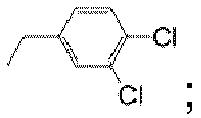
R6 is H, F, Cl, NO2, CH3, t-butyl, OCH3 or OCF3;
R7 is H, Cl. - Also described herein is a compound according to formula III
wherein X is S;
R1 is H;
R2 is CF3, CH3, phenylethyl,
R3, R4 is H, H or H, CH3, or together represent a ring

R6 is H, Cl, NO2, CH3, OCH3, OCF3;
R7 is H. - Also described herein is a compound accordng to formula III, wherein X is S;
R1 is H;
R2 is CF3, CH3,
R3, R4 is H, H or H, CH3, or together represent a ring

R6 is H, Cl, NO2, CH3, OCH3, OCF3;
R7 is H. - In all embodiments the compounds defined comprise also their pharmaceutically acceptable addition salts.
- Also described herein is a compound according to formula III and defined as in the compounds according to formula III above but wherein R3 or R4 is not p-methoxyphenylmethyl.
- Also described herein is a compound for use in a treatment of carcinoma, according to formula I
wherein: - X is NH or S;
- R1 is H or (1C-4C)alkyl;
- R2 is -Z or -Y-Z, wherein Y is -CH2- or -CH2-CH2- , and Z is phenyl or a monocyclic aromatic ring having one or more N-, O- or S- atoms in the ring, optionally substituted with one or more groups selected from (1C-4C)alkyl, (1C-4C)alkyloxy, halo(1C-4C)alkyl, halo(1C-4C)alkyloxy, phenyloxy , phenylthio, halogen, or nitro from (1C-4C)alkyl, (1C-4C)alkyloxy, halo(1C-4C)alkyl, halo(1C-4C)alkyloxy, phenyloxy , phenylthio, halogen, or nitro
- or Z is thien-2-yl, optionally substituted at position 3, 4 or 5 with halogen
- or Z is N-methylpyrol-3-yl or benzo[b]thien-2-yl or 2-naphthalenyl;
- R3 and R4 are each independently H, (1C-6C)alkyl, (2C-6C) alkenyl, (2C-6C)alkynyl, cyano, (3C-6C)cycloalkyl, a monocyclic aromatic ring having one or more N-, O- or S-atoms in the ring, a monocyclic non-aromatic ring having one or more N-, O- or S-atoms in the ring, each optionally substituted with hydroxyl, (1C-4C)alkoxy, cycloalkyl, piperidyl, piperazinyl, furyl, thienyl, pirazinyl, pyrrolyl, 2H-pyrrolyl, pyrazolyl, isoxazolyl, isothiazolyl, pyrrolidonyl, pyrrolinyl, imidazolinyl, imidazolyl, a monocyclic aromatic ring having one or more N-, O- or S- atoms in the ring, whereby each of these optional substituents is optionally further substituted with (1C-4C)alkyl, (1C-4C)alkyloxy, halo(1C-4C)alkyl, halo(1C-4C)alkyloxy, halogen, nitro or (1C-2C)dioxol forming a ring; or R3 and R4 form together pyrrolyl, imidazolyl, pyrazolyl, pyrrolidinyl, pyrrolinylimidazolidinyl, imidazolinyl, piperidyl, piperazinylmorpholinyl, each optionally substituted with (1C-6C)alkyl, phenyl(1C-4C)alkyl, phenylketo(1C-4C)alkyl;
- R5 is H or CF3;
- R6 is H, (1C-4C)alkyl, (1C-4C)alkyloxy, halo(1C-4C)alkyl, halo(1C-4C)alkyloxy, nitro or halogen;
- or pharmaceutically acceptable addition salts thereof.
- Also described herein is a compound according to formula I
wherein: - X is NH or S;
- R1 is H or (1C-4C)alkyl;
- R2 is a monocyclic aromatic ring having one or more N-, O- or S-atoms in the ring, which aromatic ring is optionally substituted with one or more groups selected from (1C-4C)alkyl, (1C-4C)alkyloxy, halo(1C-4C)alkyl, halo(1C-4C)alkyloxy, phenyloxy , phenylthio, halogen, or nitro;
- R3 and R4 are each independently H, (1C-6C)alkyl, (2C-6C) alkenyl, (2C-6C)alkynyl, cyano, (3C-6C)cycloalkyl, a monocyclic non-aromatic ring having one or more N-, O- or S- atoms in the ring, each optionally substituted with hydroxyl, (1C-4C)alkoxy, cycloalkyl, piperidyl, piperazinyl, furyl, thienyl, pyrrolyl, 2H-pyrrolyl, pyrazolyl, isoxazolyl, isothiazolyl, pyrrolidonyl, pyrrolinyl, imidazolinyl, imidazolyl, whereby each of these optional substituents is optionally further substituted with (1C-4C)alkyl, (1C-4C)alkyloxy, halo(1C-4C)alkyl, halo(1C-4C)alkyloxy, halogen, nitro or (1C-2C)dioxol forming a ring; or
- R3 and R4 form together pyrrolyl, imidazolyl, pyrazolyl, pyrrolidinyl, pyrrolinylimidazolidinyl, imidazolinyl, piperidyl, piperazinylmorpholinyl, each optionally substituted with (1C-6C)alkyl, phenyl(1C-4C)alkyl, phenylketo(1C-4C)alkyl;
- R5 is H or CF3;
- R6 is H, (1C-4C)alkyl, (1C-4C)alkyloxy, halo(1C-4C)alkyl, halo(1C-4C)alkyloxy, nitro or halogen;
- and pharmaceutically acceptable addition salts thereof.
- Also described herein is a compound according to formula III
wherein X is S;
R1 is H, CH3;
R2 is phenylethyl,
R3, R4 is H, H or H, CH3, or CH3, CH3 or one of R3 or R4 is -CN or p-methoxyphenylmethyl or R3 and R4 together represent a ring


R6 is H, F, Cl, Br, NO2, CH3, t-butyl, OCH3, OCF3, CF3;
R7 is H, F, Cl, Br, Me, NO2, t-butyl, OCF3, OCH3, CF3; preferred is R7 is H or Cl. - Most preferred is a compound according to formula III
wherein X is S;
R1 is H;
R2 is
R3, R4 is H, H or H, CH3, or together represent a ring

R6 is H, Cl, NO2, CH3, OCH3, OCF3;
R7 is H. - When embodiments are defined as characteristics of a compound this description also provides for the use of the compounds in therapy, more specifically carcinoma, as are gastric cancer, bladder cancer, esophageal cancer, breast cancer, prostate cancer or pancreas cancer and in particular for patients wherein metastasis of the carcinoma, in particular prostate cancer, is diagnosed.
- The terms used in the description have the following meaning:
The prefix (1C-4C) refers to the number of 1-4 carbon atoms in the alkyl, alkenyl or alkynyl group. The definition includes amongst others a methyl, ethyl, propyl, isopropyl, butyl, tertiairy butyl, vinyl, ethynyl, cyclopropyl and propynyl.. - Halo or halogen means fluorine, chlorine, bromine, iodine.
- Haloalkyl, haloalkenyl or haloalkynyl means respectively an alkyl, alkenyl and alkynyl substitued with one or more halogens.
- A pharmaceutically acceptable addition salt is known in the art of pharmaceutics, such as a chloride, maleate, lactate etc.
- It should be realized that the compounds as described herein exist in tautomeric isomers when R3 and/or R4 are hydrogen. As shown in the formulas A, B and C below the double bond system over the aminomethylenepyrazolone [A] can shift to the iminomethylpyrazolone system in [B] so that the delocalized representation as in formula [C] would be an equivalent manner to represent the compounds as described herein. Anyway, these tautomeric isomers are comprised into the definition of the compounds as described herein as defined with the support of the formulas.


- Furthermore, the double bond at the methylene, or methylidene if R1 has an alkyl meaning, and the imino bond can be in Z or E configuration. The compound as described herein is not specified regarding this isomerism. Only the outcome of the syntheses of specified compounds has determined and thereby implicitly defines such characteristic of particular compounds.
- A compound as described herein may be prepared, for example, by starting with preparation a 2,4-dihydropyrazol-3-one scaffold, which is synthesized through a condensation-cyclization reaction of suitable hydrazines and acetoacetate esters in either ethanol or ethanol / acetic acid mixtures at reflux temperatures where X=S and in methanol containing a catalytic amount of concentrated HCI where X=N. The cyclization product is usually collected by filtration, rinsing of the filter cake with ethanol and in vacuo drying.
- In the second reaction step, the thus obtained 1,2-dihydropyrazol-3-one is subjected to an aminomethylenation reaction in THF at room temperature. The precipitated product may be purified by filtration, rinsing of the filter cake with a suitable solvent and in vacuo drying.
- In the third and final step, the aminomethylidenepyrazol-3-one is treated with a suitable primary amine in methanol or ethanol at room temperature or at any temperature leading up to reflux temperature of the reaction solvent. The product may be purified by filtration and rinsing with methanol or ethanol and in vacuo drying.
- A pharmaceutically acceptable addition salt of a compound may be prepared according to conventional methods. Salts are usually obtained by combining the free base with inorganic or organic acids such as hydrochloric, fumaric, maleic, citric or succinic acid.
- The therapeutic or preventive effect of a compound as described herein can be obtained by administration of the compound to a patient (human or animal, male or female) in need of treatment by administering the compound either topically, locally or systemically. Any enteral or parenteral route, such as transdermal, transmucosal, oral, rectal, intravenous, intramuscular or subcutaneous, can be selected as most suitable under the circumstances of the condition of the patient and the location of cancer cells. The administration will be greatly aided by the manufacture of pharmaceutical compositions comprising a compound as described herein. A pharmaceutical formulation of a compound as described herein can be prepared according to methods known in the art, varying from conventional pills, tablets and solutions to more sophisticated formulations for depot formulations or formulations adapted for particular routes of administration. Resorption of the compound as described herein by the patient can be facilitated or delayed by pharmaceutical additives.
- In therapeutic use it is possible to select particular regimens of administration for continuous or multiple dosing per day, or for detailed treatment regimens for a certain period of time, for example a week, a month or other continuous or intermittent periods. In the field of cancer therapy it is often needed or beneficial to use more than one method to combat the disease. A compound as described herein is suitable for combination treatment with other treatments.
- Dose selection depends on routes of administration and type and condition of the treated patient. The effective dose per administration or per day will usually be in the range of 0.001 - 1000 mg per patient, or, expressed in amount per kg patient, in particular in consideration of small weight patients (for example children or animals) between 0.0001 - 100 mg/kg. The preferred range is 0.01 - 5 mg/kg or 1- 350 mg for an average human patient
- Without wanting to be bound by theory in the use of the invention, it was found that an important contribution to the therapeutic mechanism of compounds of the invention can reside in interference with the process of invasion into healthy tissue, as for example the interaction between prostate cancer cells and the bone micro-environment.
- For determining the effectiveness of the compounds according to the invention, we employed a model assay based on the migration of cells in a migration chamber. This model is accepted in the art as providing representative data on the ability of cells to metastasize.
- We found that a preferred compound as described herein inhibits tumor cell invasion more than 25%. Particularly preferred compound also showed dose-dependent anti-invasion activity of over 40%. The compounds as described herein are thus capable of interfering with the acquisition of an invasive phenotype in human prostate cancer by inhibiting the EMT process. The more potent compounds for this effect are most preferred in view of the reduced dosage needed for use in therapy.
Compound Results % inhibition of invasion in invasion assays If more values are given these are results of repeated assays 
52 49 45 
35 
93 45 
91 
91 
89 % 
89 82 78 
88 
87 76 
86 
76 % 
75 % 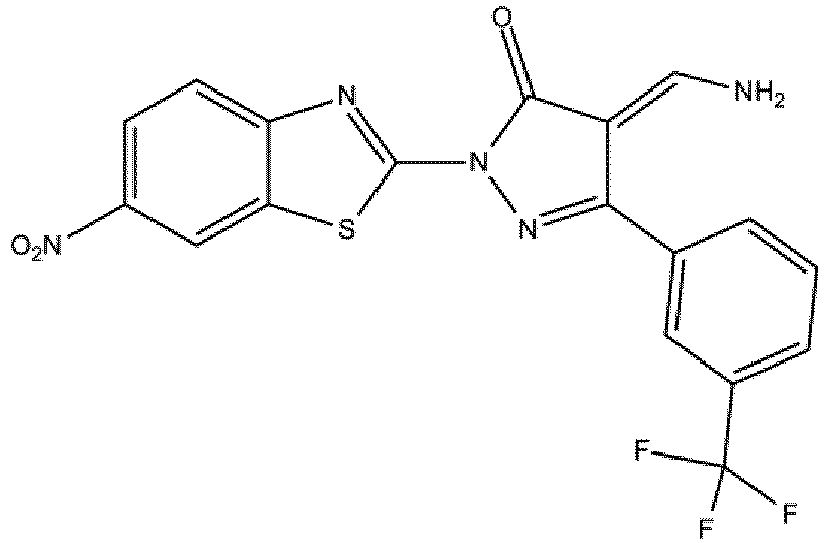
73 
70 
67 
57 % 
57 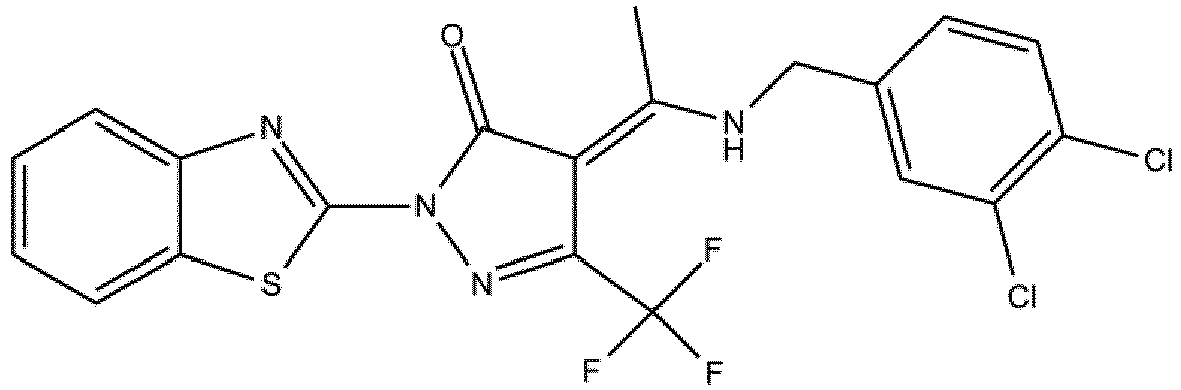
56 - The description also provides compounds shown in the following table:


- Treatment of mice with 4-[1-aminomethylidene]-2-benzothiazol-2-yl-5-phenyl-2,4-dihydro-pyrazol-3-one decreased the number of bone lesions and metastatic tumor burden. Cancer cells and tumor burden were monitored by whole body bioluminescence imaging. The data show that a compound as described herein affects the formation of de novo skeletal metastases by PC-3M-Pro4luc+ cells in vivo. Such in vivo testing may lead to further selection, preference, deselection or disfavour of individual compounds for further programs for development of a compound for use in a prescription medicine. A particular compound of interest for such advanced testing is, 4-(aminomethylene)-2-(2-benzothiazolyl)-2,4-dihydro-5-(3-chlorophenyl)-3H-pyrazol-3-one.
- A solution of 1.00g (4.45mmol) of ethyl (2-methoxybenzoyl)acetate and 743mg (4.45mmol) of 2-hydrazinobenzothiazole in 15ml of ethanol, containing a few drops of AcOH, was refluxed overnight under a nitrogen atmosphere. After evaporating the reaction solvent and replacing it with diethyl ether containing a small amount of acetone, the precipitate was filtered, washed with diethyl ether and dried to give 1.33g (4.11 mmol, 92%) of 2-benzothiazol-2-yl-5-(2-methoxyphenyl)-1,2-dihydropyrazol-3-one. 1H-NMR (DMSO-d6): δ 12.40 (bs, 1H), 8.05 (d, 1H), 7.90 (d, 1H), 7.80 (s, 1H), 7.50 (m, 2H), 7.40 (t, 1H), 7.20 (d, 1H), 7.10 (m, 1H), 6.05 (s, 1H), 3.90 (s, 3H).
- To a solution of 722mg (2.23mmol) of 2-benzothiazol-2-yl-5-(2-methoxyphenyl)-1,2-dihydropyrazol-3-one in 15ml of THF was added N,N-dimethylformamide dimethylacetal (326µl, 2.46mmol). The reaction was stirred over night at room temperature under a nitrogen atmosphere after which the reaction mixture was diluted with a small amount of diethyl ether. The solids were filtered off, washed with diethyl ether and dried to give 824mg (2.18mmol, 98%) of 2-benzothiazol-2-yl-4-[1-dimethylaminomethylidene]-5-(2-methoxy-phenyl)-2,4-dihydropyrazol-3-one. 1H-NMR (DMSO-d6): δ 8.00 (d, 1H), 7.75 (d, 1H), 7.50 (t, 1H), 7.40 (m, 2H), 7.30 (m, 2H), 7.20 (d, 1H), 7.10 (t, 1H), 3.80 (s, 3H), 3.70 (s, 3H), 3.35 (s, 3H).
- A suspension of 625mg (1.65mmol) of 2-benzothiazol-2-yl-4-[1-dimethylaminomethylidene]-5-(2-methoxy-phenyl)-2,4-dihydropyrazol-3-one in 10ml ethanol and 10ml of a 25% ammonia solution was heated to 60ºC under a nitrogen atmosphere over night. After cooling to room temperature, the reaction mixture was diluted with a little water, the solids were filtered, washed with ethanol and dried to give 481mg (1.37mmol, 83%) of 4-[1-aminomethylidene]-2-benzothiazol-2-yl-5-(2-methoxyphenyl)-2,4-dihydropyrazol-3-one. 1H-NMR (DMSO-d6): δ 9.40 (bs, 2H), 8.00 (d, 1H), 7.80 (d, 1H), 7.70 (s, 1H), 7.45 (m, 3H), 7.30 (t, 1H), 7.20 (d, 1H), 7.10 (t, 1H), 3.80 (s, 3H).
- A solution of 1.75g (9.08mmol) of ethyl benzoylacetate and 1.50g (9.08mmol) of 2-hydrazinobenzothiazole in 30ml of ethanol was refluxed for 4h under a nitrogen atmosphere. After cooling to room temperature, the precipitate was filtered, washed with cold ethanol, diethylether and dried to give 1.66g (5.66mmol, 62%) of 2-benzothiazol-2-yl-5-phenyl-1,2-dihydropyrazol-3-one as a white solid. 1H-NMR (DMSO-d6): δ 12.90 (bs, 1H), 8.05 (d, 1H), 7.90 (m, 3H), 7.50 (m, 4H), 7.30 (t, 1H), 6.10 (s, 1H).
- To a solution of 190mg (0.648mmol) of 2-benzothiazol-2-yl-5-phenyl-1,2-dihydropyrazol-3-one in 10ml of THFwas added N,N-dimethylformamide dimethylacetal (90µl, 0.680mmol). The reaction was stirred for 3h at room temperature under a nitrogen atmosphere, the solids were filtered off, washed with acetone and dried to give 125mg (0.359mmol, 55%) of 2-benzothiazol-2-yl-4-[1-dimethylaminomethylidene]-5-phenyl-2,4-dihydropyrazol-3-one as a yellow solid. 1H-NMR (DMSO-d6): δ 8.00 (d, 1H), 7.80 (d, 1H), 7.70 (s, 1H), 7.65 (m, 2H), 7.55 (m, 3H), 7.40 (t, 1H), 7.30 (t, 1H), 3.75 (s, 3H), 3.40 (s, 3H).
- A suspension of 100mg (0.287mmol) of 2-benzothiazol-2-yl-4-[1-dimethylaminomethylidene]-5-phenyl-2,4-dihydropyrazol-3-one in 5ml of a 25% ammonia solution was heated to 120ºC in a pressure vessel overnight. After cooling to room temperature, the solids were filtered, washed with water and dried to give 48mg (0.150mmol, 52%) of 4-[1-aminomethylidene]-2-benzothiazol-2-yl-5-phenyl-2,4-dihydropyrazol-3-one as a yellow solid. 1H-NMR (DMSO-d6): δ 9.05 (bs, 2H), 8.00 (m, 2H), 7.85 (d, 1H), 7.75 (m, 2H), 7.55 (m, 3H), 7.45 (t, 1H), 7.30 (t, 1H).
- A solution of 500mg (3.37mmol) of 2-hydrazino-1H-benzimidazole and 713mg (3.70mmol) of ethyl benzoylacetate of in 15ml of methanol containing a catalytic amount of concentrated HCl. The reaction mixture was stirred at 65ºC under a nitrogen atmosphere over night. After cooling to room temperature, the precipitate was filtered and dried to give 966mg (3.09mmol, 92%) of 2-(1H-benzoimidazol-2-yl)-5-phenyl-1,2-dihydropyrazol-3-one as the hydrochloride salt. 1H-NMR (DMSO-d6): δ 7.95 (m, 2H), 7.65 (m, 2H), 7.45 (m, 3H), 7.20 (m 2H), 6.10 (s, 1H).
- To a suspension of 100mg (0.36mmol) of 2-(1H-benzoimidazol-2-yl)-5-phenyl-1,2-dihydropyrazol-3-one hydrochloride salt in 5ml of dioxane was added N,N-dimethylformamide dimethylacetal (52µl, 0.39mmol). The reaction was stirred for 2h at room temperature under a nitrogen atmosphere after which the reaction mixture was cooled on an ice bath and diluted with a small amount of diethyl ether. The solids were filtered off, washed with diethyl ether and dried to give 99mg (0.30mmol, 83%) of 2-(1H-benzoimidazol-2-yl)-4-[1-dimethylaminomethylidene]-5-phenyl-2,4-dihydropyrazol-3-one as a yellow solid. 1H-NMR (DMSO-d6): δ 13.40 (bs, 1H), 8.55 (bs, 2H), 7.70 (s, 1H), 7.65 (m, 2H), 7.55 (m, 3H), 7.20 (m, 2H), 3.70 (s, 3H), 3.40 (s, 3H).
- A suspension of 50mg (0.15mmol) of 2-(1H-benzoimidazol-2-yl)-4-[1-dimethylaminomethylidene]-5-phenyl-2,4-dihydropyrazol-3-one in 3ml of a 25% ammonia solution was heated to 65ºC under a nitrogen atmosphere for 3h. After cooling to room temperature, the solids were filtered and dried to give 32mg (0.11mmol, 70%) of 4-[1-aminomethylidene]-2-(1H-benzoimidazol-2-yl)-5-phenyl-2,4-dihydropyrazol-3-one as a yellow solid. 1H-NMR (DMSO-d6): δ 12.20 (bs, 1H), 9.40 (bs, 2H), 8.05 (m, 1H), 7.70 (m, 2H), 7.50 (m, 5H), 7.10 (m, 2H).
- 4-Chlorobenzothiazol-2-ylamine (5.04g, 27.29mmol) was suspended in 35ml of ethylene glycol at room temperature under a nitrogen atmosphere. Hydrazine hydrate (3.98ml, 81.87mmol) was added followed by concentrated hydrochloric acid (2.24ml, 27.29mmol) and the resulting reaction mixture was heated on an oil bath to 150°C. After 1.5h a precipitate was formed and heating was continued for an additional 1.5h after which time the mixture was cooled, water was added and the resulting solids were filtered, washed with water and dried to give 5.33g (26.69mmol, 98%) of (4-chlorobenzothiazol-2-yl)-hydrazine. 1H-NMR (DMSO-d6): δ 9.40 (bs, 1H), 7.62 (d, 1H), 7.25 (d, 1H), 6.95 (t, 1H), 5.15 (bs, 2H).
- A solution of 1.09g (5.46mmol) of (4-chlorobenzothiazol-2-yl)-hydrazine and 1.15g (6.01 mmol) of ethyl benzoylacetate in 30ml of ethanol was refluxed for 2 days under a nitrogen atmosphere. The reaction mixture was cooled and the precipitate was collected by filtration, washed with a little EtOH and dried to give 1.56g (4.76mmol, 87%) of 2-(4-chlorobenzothiazol-2-yl)-5-phenyl-1,2-dihydropyrazol-3-one. 1H-NMR (DMSO-d6): δ 12.80 (bs, 1H), 8.05 (d, 1H), 7.85 (m, 2H), 7.60-7.40 (m, 4H), 7.35 (t, 1H), 6.15 (s, 1H).
- To a solution of 657mg (2.00mmol) of 2-(4-chlorobenzothiazol-2-yl)-5-phenyl-1,2-dihydro-pyrazol-3-one in 20ml of THF was added N,N-dimethylformamide dimethylacetal (293µl, 2.26mmol). The reaction was stirred over night at room temperature under a nitrogen atmosphere after which the solids were filtered off, washed with diethyl ether and dried to give 681 mg (1.78mmol, 89%) of 2-(4-chlorobenzothiazol-2-yl)-4-[1-dimethylaminomethylidene]-5-phenyl-2,4-dihydropyrazol-3-one. 1H-NMR (DMSO-d6): δ 7.95 (d, 1H), 7.60 (m, 3H), 7.55 (m, 4H), 7.25 (t, 1H), 3.75 (s, 3H), 3.40 (s, 3H).
- A suspension of 545mg (1.42mmol) of 2-(4-chlorobenzothiazol-2-yl)-4-[1-dimethylaminomethylidene]-5-phenyl-2,4-dihydro-pyrazol-3-one in 10ml 7N ammonia solution in MeOH was heated to 100ºC in a pressure vessel for 18h. After cooling to room temperature, the solids were filtered, washed with a little EtOH and dried to give 460mg (1.37mmol, 91%) of 4-[1-aminomethylidene]-2-(4-chlorobenzothiazol-2-yl)-5-phenyl-2,4-dihydropyrazol-3-one. 1H-NMR (DMSO-d6): δ 9.45 (bs, 2H), 8.00 (m, 2H), 7.75 (m, 2H), 7.50 (m, 4H), 7.35 (t, 1H).
- 5-Chlorobenzothiazole-2-thiol (5.21g, 25.83mmol) was dissolved in 50ml DMF at room temperature under a nitrogen atmosphere. To the reaction mixture were added 4.28g (31.00mmol) of potassium carbonate and 1.93ml (31.00mmol) of methyl iodide and stirring was continued over night after which time TLC (silica, 25% EtOAc in PE 40/60) indicated complete consumption of the starting material. Water was added to the reaction mixture and the resulting solids were filtered off, washed with water and dried to give 5.35g (24.80mmol, 96%) of 5-chloro-2-methylsulfanylbenzothiazole. 1H-NMR (DMSO-d6): δ 8.05 (d, 1H), 7.90 (s, 1H), 7.40 (d, 1H), 2.75 (s, 3H).
- A mixture of 5-chloro-2-methylsulfanylbenzothiazole (5.03g, 23.32mmol) and hydrazine hydrate (11.33ml, 233.17mmol) in 5ml of EtOH was heated under a nitrogen atmosphere to 100°C. After 3h a heavy precipitation was present in the reaction mixture after which time the suspension was cooled, water was added and the resulting solids were collected, washed with water and dried to give 4.43g (22.83mmol, 95%) of (5-chlorobenzothiazol-2-yl)-hydrazine. 1H-NMR (DMSO-d6): δ 9.10 (bs, 1H), 7.65 (d, 1H), 7.30 (s, 1H), 6.95 (d, 1H), 5.10 (bs, 2H).
- A solution of 935g (4.68mmol) of (5-chlorobenzothiazol-2-yl)-hydrazine and 990mg (5.15mmol) of ethyl benzoylacetate in 30ml of ethanol was refluxed over night under a nitrogen atmosphere. The reaction mixture was cooled and the precipitate was collected by filtration, washed with a little EtOH and dried to give 970mg (2.96mmol, 63%) of 2-(5-chlorobenzothiazol-2-yl)-5-phenyl-1,2-dihydropyrazol-3-one. 1H-NMR (DMSO-d6): δ 13.00 (bs, 1H), 8.05 (d, 1H), 7.90 (m, 3H), 7.50 (m, 3H), 7.40 (t, 1H), 6.10 (s, 1H).
- To a solution of 800mg (2.44mmol) of 2-(5-chlorobenzothiazol-2-yl)-5-phenyl-1,2-dihydro-pyrazol-3-one in 20ml of THF was added N,N-dimethylformamide dimethylacetal (357µl, 2.68mmol). The reaction was stirred over night at room temperature under a nitrogen atmosphere after which ether was added and the solids were filtered off, washed with diethyl ether and dried to give 790mg (2.06mmol, 85%) of 2-(5-chlorobenzothiazol-2-yl)-4-[1-dimethylaminomethylidene]-5-phenyl-2,4-dihydropyrazol-3-one. 1H-NMR (DMSO-d6): δ 8.05 (d, 1H), 7.85 (s, 1H), 7.70 (s, 1H), 7.60-7.40 (m, 5H), 7.35 (d, 1H), 3.75 (s, 3H), 3.40 (s, 3H).
- A suspension of 650mg (1.70mmol) of 2-(5-chlorobenzothiazol-2-yl)-4-[1-dimethylaminomethylidene]-5-phenyl-2,4-dihydropyrazol-3-one in 10ml 7N ammonia solution in MeOH was heated to 100ºC in a pressure vessel for 24h. After cooling to room temperature, the solids were filtered, washed with a little EtOH and dried to give 439mg (1.38mmol, 82%) of 4-[1-aminomethylidene]-2-(5-chlorobenzothiazol-2-yl)-5-phenyl-2,4-dihydropyrazol-3-one. 1H-NMR (DMSO-d6): δ 9.50 (bs, 2H), 8.05 (m, 2H), 7.90 (s, 1H), 7.75 (m, 2H), 7.50 (m, 3H), 7.40 (t, 1H).
- 6-Chlorobenzothiazol-2-ylamine (5.44g, 27.84mmol) was suspended in 35ml of ethylene glycol at room temperature under a nitrogen atmosphere. Hydrazine hydrate (4.06ml, 83.52mmol) was added followed by concentrated hydrochloric acid (2.28ml, 27.84mmol) and the resulting reaction mixture was heated on an oil bath to 150°C. After 3h the mixture was cooled, poured onto water and the resulting solids were filtered, washed with water and dried to give 4.98g (24.94mmol, 90%) of (6-chlorobenzothiazol-2-yl)-hydrazine. 1H-NMR (DMSO-d6): δ 9.15 (bs, 1H), 7.70 (s, 1H), 7.25 (d, 1H), 7.15 (d, 1H), 5.05 (bs, 2H).
- A solution of 1.06g (5.28mmol) of (6-chlorobenzothiazol-2-yl)-hydrazine and 1.01g (5.82mmol) of ethyl benzoylacetate in 25ml of ethanol was refluxed for 5h under a nitrogen atmosphere. The reaction mixture was filtered while warm, washed with EtOH and dried to give 580mg (4.76mmol, 34%) of 2-(6-chlorobenzothiazol-2-yl)-5-phenyl-1,2-dihydropyrazol-3-one. 1H-NMR (DMSO-d6): δ 13.00 (bs, 1H), 8.20 (s, 1H), 7.90 (m, 3H), 7.50 (m, 4H), 6.10 (s, 1H).
- To a solution of 580mg (1.77mmol) of 2-(6-chlorobenzothiazol-2-yl)-5-phenyl-1,2-dihydropyrazol-3-one in 20ml of THF was added N,N-dimethylformamide dimethylacetal (282 µl, 2.12mmol). The reaction was stirred for 3h at room temperature under a nitrogen atmosphere after which the solids were filtered off, washed with diethyl ether and dried to give 628mg (1.78mmol, 93%) of 2-(6-chlorobenzothiazol-2-yl)-4-[1-dimethylaminomethylidene]-5-phenyl-2,4-dihydropyrazol-3-one. 1H-NMR (DMSO-d6): δ 8.15 (s, 1H), 7.80 (d, 1H), 7.70 (s, 1H), 7.60 (m, 2H), 7.50 (m, 3H), 7.45 (d, 1H), 3.70 (s, 3H), 3.40 (s, 3H).
- A suspension of 420mg (1.10mmol) of 2-(6-chlorobenzothiazol-2-yl)-4-[1-dimethylaminomethylidene]-5-phenyl-2,4-dihydro-pyrazol-3-one in 10ml 7N ammonia solution in MeOH was heated to 100ºC in a pressure vessel for 24h. After cooling to room temperature, the solids were filtered, washed with a little EtOH and dried to give 275mg (0.775mmol, 70%) of 4-[1-aminomethylidene]-2-(6-chlorobenzothiazol-2-yl)-5-phenyl-2,4-dihydropyrazol-3-one. 1H-NMR (DMSO-d6): δ 9.50 (2bs, 2H), 8.20 (s, 1H), 8.00 (bs, 1H), 7.80 (d, 1H), 7.70 (m, 2H), 7.50 (m, 4H).
- 6-Methoxybenzothiazol-2-ylamine (7.20g, 40.00mmol) was suspended in 40ml of ethylene glycol at room temperature under a nitrogen atmosphere. Hydrazine hydrate (5.80ml, 120.00mmol) was added followed by concentrated hydrochloric acid (3.28ml, 40.00mmol) and the resulting reaction mixture was heated on an oil bath to 150°C. After 2.5h the mixture was cooled water was added and the resulting solids were filtered, washed with water and dried to give 7.09g (36.31 mmol, 91%) of (6-methoxybenzothiazol-2-yl)-hydrazine. 1H-NMR (DMSO-d6): δ 8.75 (s, 1H), 7.30 (s, 1H), 7.20 (d, 1H), 6.80 (d, 1H), 4.90 (bs, 2H), 3.70 (s, 3H).
- A solution of 789mg (4.04mmol) of (6-methoxybenzothiazol-2-yl)-hydrazine and 9.95mg (4.04mmol) of methyl (3-trifluorobenzoyl)acetate in 30ml of ethanol was refluxed for 5h under a nitrogen atmosphere, cooled, the solids were filtered, washed with EtOH and dried to give 1.06g (2.71 mmol, 67%) of 2-(6-methoxybenzothiazol-2-yl)-5-(3-trifluoromethylphenyl)-1,2-dihydropyrazol-3-one. 1H-NMR (DMSO-d6): δ 12.80 (bs, 1H), 8.20 (m, 2H), 7.80 (m, 2H), 7.70 (t, 1H), 7.60 (s, 1H), 7.10 (d, 1H), 6.20 (s, 1H), 3.80 (s, 3H).
- To a solution of 458mg (1.17mmol) of 2-(6-methoxybenzothiazol-2-yl)-5-(3-trifluoromethylphenyl)-1,2-dihydro-pyrazol-3-one in 20ml of THF was added N,N-dimethylformamide dimethylacetal (171 µl, 1.29mmol). The reaction was stirred for 2h at room temperature under a nitrogen atmosphere. Diethyl ether was added to induce precipitation. After an additional hour of stirring, the reaction volume was concentrated to ca 10% of the original volume, diethyl ether was added and the solids were filtered off, washed with diethyl ether and dried to give 450mg (1.00mmol, 86%) of 2-(6-methoxybenzothiazol-2-yl)-4-[1-dimethylaminomethylidene]-5-(3-trifluoromethylphenyl)-2,4-dihydropyrazol-3-one. 1H-NMR (DMSO-d6): δ 8.00-7.80 (m, 3H), 7.80-7.70 (m, 3H), 7.55 (s, 1H), 7.05 (d, 1H), 3.80 (s, 3H), 3.70 (s, 3H), 3.40 (s, 3H).
- A suspension of 355mg (0.725mmol) of 2-(6-methoxybenzothiazol-2-yl)-4-[1-dimethylaminomethylidene]-5-(3-trifluoromethylphenyl)-2,4-dihydropyrazol-3-one in 10ml 7N ammonia solution in MeOH was heated to 100ºC in a pressure vessel over night. After cooling to room temperature, the solids were filtered, washed with a little EtOH and dried to give 280mg (0.669mmol, 92%) of 4-[1-aminomethylidene]-2-(6-methoxybenzothiazol-2-yl)-5-(3-trifluoromethylphenyl)-2,4-dihydropyrazol-3-one. 1H-NMR (DMSO-d6): δ 9.50 (2bs, 2H), 8.10 (m, 3H), 7.85 (d, 1H), 7.75 (m, 2H), 7.60 (s, 1H), 7.05 (d, 1H), 3.80 (s, 3H).
- A solution of 1.80g (7.31mmol) of benzothiazol-2-yl-hydrazine and 1.21 g (7.31mmol) of 3-(3-trifluoromethylphenyl)-3-oxo-propionic acid methyl ester in 50ml of ethanol was refluxed for 5h under a nitrogen atmosphere, cooled, the solids were filtered, washed with EtOH and dried to give 2.12g (5.87mmol, 80%) of 2-benzothiazol-2-yl-5-(3-trifluoromethylphenyl)-1,2-dihydropyrazol-3-one. 1H-NMR (DMSO-d6): δ 13.00 (bs, 1H), 8.20 (m, 2H), 8.05 (d, 1H), 7.90 (d, 1H), 7.80 (s, 1H), 7.70 (m, 1H), 7.50 (t, 1H), 7.40 (t, 1H), 6.25 (s, 1H).
- To a solution of 414mg (1.15mmol) of 2-benzothiazol-2-yl-5-(3-trifluoromethylphenyl)-1,2-dihydro-pyrazol-3-one in 10ml of THF was added N,N-dimethylformamide dimethylacetal (160µl, 1.20mmol). The reaction was stirred for 3h at room temperature under a nitrogen atmosphere. A small amount of diethyl ether was added and the solids were filtered off, washed with diethyl ether and dried to give 398mg (0.956mmol, 83%) of 2-benzothiazol-2-yl-4-[1-dimethylaminomethylidene]-5-(3-trifluoromethylphenyl)-2,4-dihydropyrazol-3-one. 1H-NMR (DMSO-d6): δ 8.00-7.70 (m, 7H), 7.50 (t, 1H), 7.45 (t, 1H), 3.70 (s, 3H), 3.40 (s, 3H).
- A suspension of 239mg (0.574mmol) of 2-benzothiazol-2-yl-4-[1-dimethylaminomethylidene]-5-(3-trifluoromethylphenyl)-2,4-dihydropyrazol-3-one in 10ml 7N ammonia solution in MeOH was heated to 100ºC in a pressure vessel over night. After cooling to room temperature, the solids were filtered, washed with a little EtOH and dried to give 163mg (0.420mmol, 73%) of 4-[1-aminomethylidene]-2-benzothiazol-2-yl-5-(3-trifluoromethylphenyl)-2,4-dihydropyrazol-3-one. 1H-NMR (DMSO-d6): δ 9.60 (bs, 2H), 8.10 (m, 4H), 7.90 (m, 2H), 7.80 (m, 1H), 7.45 (t, 1H), 7.30 (t, 1H).
- A solution of 1.00g (4.20mmol) of benzothiazol-2-yl-hydrazine and 730mg (4.20mmol) of 3-(3-chlorophenyl)-3-oxopropionic acid ethyl ester in 20ml of ethanol was refluxed over night under a nitrogen atmosphere, cooled, the solids were filtered, washed with EtOH and dried to give 1.25g (3.81mmol, 91%) of 2-benzothiazol-2-yl-5-(3-chlorophenyl)-1,2-dihydropyrazol-3-one. 1H-NMR (DMSO-d6): δ 13.00 (bs, 1H), 8.10 (d, 1H), 8.00-7.80 (m, 3H), 7.50 (m, 3H), 7.40 (t, 1H), 6.20 (s, 1H).
- To a solution of 647mg (1.97mmol) of 2-benzothiazol-2-yl-5-(3-chlorophenyl)-1,2-dihydro-pyrazol-3-one in 15ml of THF was added N,N-dimethylformamide dimethylacetal (288µl, 2.17mmol). The reaction was stirred for 2 days at room temperature under a nitrogen atmosphere. The solids were filtered off, washed with diethyl ether and dried to give 706mg (1.84mmol, 94%) of 2-benzothiazol-2-yl-5-(3-chlorophenyl)-4-[1-dimethylaminomethylidene]-2,4-dihydropyrazol-3-one. 1H-NMR (DMSO-d6): δ 8.00 (d, 1H), 7.80 (d, 1H), 7.70 (2s, 2H), 7.60 (m, 3H), 7.40 (t, 1H), 7.30 (t, 1H), 3.70 (s, 3H), 3.40 (s, 3H).
- A suspension of 424mg (1.11mmol) of 2-benzothiazol-2-yl-5-(3-chlorophenyl)-4-[1-dimethylaminomethylidene]-2,4-dihydropyrazol-3-one in 5ml EtOH and 20ml of 25% aqueous ammonia solution was heated to 60ºC over night. After cooling to room temperature, the solids were filtered, washed with a little EtOH and dried to give 386mg (1.09mmol, 98%) of 4-[1-aminomethylidene]-2-benzothiazol-2-yl-5-(3-chlorophenyl)-2,4-dihydropyrazol-3-one. 1H-NMR (DMSO-d6): δ 9.60 (bs, 2H), 8.10 (s, 1H), 8.00 (d, 1H), 7.90 (s, 1H), 7.85 (d, 1H),7.65 (m, 2H), 7.45 (m, 2H), 7.30 (t, 1H).
- A solution of 801mg (4.85mmol) of benzothiazol-2-yl-hydrazine and 1.00g (4.20mmol) of 3-(3-methylphenyl)-3-oxopropionic acid ethyl ester in 25ml of ethanol was refluxed for 22h under a nitrogen atmosphere, cooled, the solids were filtered, washed with a little cold EtOH and dried to give 1.41 g (4.59mmol, 95%) of 2-benzothiazol-2-yl-5-(3-methylphenyl)-1,2-dihydropyrazol-3-one. 1H-NMR (DMSO-d6): δ 12.90 (bs, 1H), 8.10 (d, 1H), 7.90 (d, 1H), 7.75 (s, 1H), 7.70 (d, 1H), 7.50 (t, 1H), 7.40-7.20 (m, 4H), 6.10 (s, 1H), 2.40 (s, 3H).
- To a solution of 525mg (1.71mmol) of 2-benzothiazol-2-yl-5-(3-methylphenyl)-1,2-dihydropyrazol-3-one in 10ml of THF was added N,N-dimethylformamide dimethylacetal (238µl, 1.79mmol). The reaction was stirred for 4h at room temperature under a nitrogen atmosphere. The solids were filtered off, washed with diethyl ether and dried to give 565mg (1.56mmol, 91%) of 2-benzothiazol-2-yl-5-(3-methylphenyl)-4-[1-dimethylaminomethylidene]-2,4-dihydropyrazol-3-one. 1H-NMR (DMSO-d6): δ 8.00 (d, 1H), 7.80 (d, 1H), 7.70 (s, 1H), 7.50-7.20 (m, 6H), 3.70 (s, 3H), 3.40 (s, 3H), 2.40 (s, 3H).
- A suspension of 350mg (0.966mmol) of 2-benzothiazol-2-yl-5-(3-methylphenyl)-4-[1-dimethylaminomethylidene]-2,4-dihydropyrazol-3-one in 10ml 7N ammonia solution in MeOH was heated to 100ºC in a pressure vessel over night. After cooling to room temperature, the solids were filtered, washed with a little EtOH and dried to give 300mg (0.897mmol, 93%) of 4-[1-aminomethylidene]-2-benzothiazol-2-yl-5-(3-methylphenyl)-2,4-dihydropyrazol-3-one. 1H-NMR (DMSO-d6): δ 9.45 (bs, 2H), 8.00 (m, 2H), 7.80 (d, 1H), 7.60 (s, 1H), 7.55 (d, 1H), 7.45-7.30 (m, 4H), 2.40 (s, 3H).
- A solution of 1.23g (7.44mmol) of benzothiazol-2-yl-hydrazine and 1.65g (7.44mmol) of 3-(3-methoxyphenyl)-3-oxopropionic acid ethyl ester in 40ml of ethanol was refluxed for 5h under a nitrogen atmosphere, cooled, the solids were filtered, washed with EtOH and dried to give 1.68g (5.20mmol, 70%) of 2-benzothiazol-2-yl-5-(3-methoxyphenyl)-1,2-dihydropyrazol-3-one. 1H-NMR (DMSO-d6): δ 13.00 (bs, 1H), 8.10 (d, 1H), 7.90 (d, 1H), 7.55-7.30 (m, 5H), 7.05 (m, 1H), 6.10 (s, 1H), 3.85 (s, 3H).
- To a solution of 504mg (1.56mmol) of 2-benzothiazol-2-yl-5-(3-methoxyphenyl)-1,2-dihydro-pyrazol-3-one in 10ml of THF was added N,N-dimethylformamide dimethylacetal (217µl, 1.64mmol). The reaction was stirred over night at room temperature under a nitrogen atmosphere. The solids were filtered off, washed with acetone and dried to give 549mg (1.45mmol, 93%) of 2-benzothiazol-2-yl-5-(3-methoxyphenyl)-4-[1-dimethylaminomethylidene]-2,4-dihydropyrazol-3-one. 1H-NMR (DMSO-d6): δ 8.00 (d, 1H), 7.80 (d, 1H), 7.70 (s, 1H), 7.45 (m, 2H), 7.30 (t, 1H), 7.15 (m, 2H), 7.10 (d, 1H), 3.80 (s, 3H), 3.70 (s, 3H), 3.40 (s, 3H).
- A suspension of 266mg (0.703mmol) of 2-benzothiazol-2-yl-5-(3-methoxyphenyl)-4-[1-dimethylaminomethylidene]-2,4-dihydropyrazol-3-one in 10ml 7N ammonia solution in MeOH was heated to 100ºC in a pressure vessel over night. After cooling to room temperature, the solids were filtered, washed with a little EtOH and dried to give 168mg (0.479mmol, 68%) of 4-[1-aminomethylidene]-2-benzothiazol-2-yl-5-(3-methoxyphenyl)-2,4-dihydropyrazol-3-one. 1H-NMR (DMSO-d6): δ 9.40 (bs, 2H), 8.00 (m, 2H), 7.85 (d, 1H), 7.45 (m, 2H), 7.40-7.20 (m, 3H), 7.10 (d, 1H), 3.80 (s, 3H).
- To a suspension of 376mg NaH (9.39mmol, 60% dispersion in mineral oil) in 30ml of dry THF under a nitrogen atmosphere was slowly added diethyl carbonate (1.14ml, 9.39mmol) and 3-bromo-4-methylacetophenone (1.00g, 4.69mmol). The reaction mixture was heated to 70°C for 4h after which TLC (silica, EtOAc/PE 40-60 2:3) indicated complete consumption of the starting material. The mixture was cooled, 20ml of water was slowly added followed by 10 drops of AcOH and extraction with 2x200ml of EtOAc. The combined organic layers were washed with 20ml of water, 20 ml of brine, dried over magnesium sulfate and evaporated to give 1.34g of 3-(3-bromo-4-methylphenyl)-3-oxopropionic acid ethyl ester which was used without further purification. 1H-NMR (CDCl3): δ 8.15 (s, 1H), 7.80 (d, 1H), 7.40 (d, 1H), 4.20 (q, 2H), 3.90 (s, 2H), 2.50 (s, 3H), 1.30 (t, 3H).
- A solution of 776mg (4.70mmol) of benzothiazol-2-yl-hydrazine and 1.34g (4.70mmol) of 3-(3-bromo-4-methylphenyl)-3-oxopropionic acid ethyl ester in 15ml of ethanol was refluxed over night under a nitrogen atmosphere, cooled, the solids were filtered, washed with a little cold EtOH and dried to give 1.80g (4.66mmol, 99%) of 2-benzothiazol-2-yl-5-(3-bromo-4-methylphenyl)-1,2-dihydropyrazol-3-one. 1H-NMR (DMSO-d6): δ 12.90 (bs, 1H), 8.10 (s, 1H), 8.05 (d, 1H), 7.90 (d, 1H), 7.80 (d, 1H), 7.50 (m, 2H), 7.40 (t, 1H), 6.15 (s, 1H), 2.40 (s, 3H).
- To a solution of 630mg (1.63mmol) of 2-benzothiazol-2-yl-5-(3-bromo-4-methylphenyl)-1,2-dihydropyrazol-3-one in 10ml of THF was added N,N-dimethylformamide dimethylacetal (240µl, 1.79mmol). The reaction was stirred for 2h at room temperature under a nitrogen atmosphere. The solids were filtered off, washed with diethyl ether and dried to give 610mg (1.38mmol, 85%) of 2-benzothiazol-2-yl-5-(3-bromo-4-methylphenyl)-4-[1-dimethylaminomethylidene]-2,4-dihydropyrazol-3-one. 1H-NMR (DMSO-d6): δ 8.00 (d, 1H), 7.80 (m, 2H), 7.70 (s, 1H), 7.50 (m, 2H), 7.45 (t, 1H), 7.30 (t, 1H), 3.70 (s, 3H), 3.40 (s, 3H), 2.40 (s, 3H).
- A suspension of 250mg (0.583mmol) of 2-benzothiazol-2-yl-5-(3-bromo-4-methylphenyl)-4-[1-dimethylaminomethylidene]-2,4-dihydropyrazol-3-one in 5ml EtOH and 5ml of 25% aqueous ammonia solution was heated to 60ºC over night. After cooling to room temperature, the solids were filtered, washed with a little EtOH and dried to give 185mg (0.448mmol, 77%) of 4-[1-aminomethylidene]-2-benzothiazol-2-yl-5-(3-bromo-4-methylphenyl)-2,4-dihydropyrazol-3-one. 1H-NMR (DMSO-d6): δ 9.50 (bs, 2H), 8.10 (s, 1H), 8.05 (d, 1H), 7.95 (s, 1H), 7.85 (d, 1H),7.65 (d, 1H), 7.50 (m, 2H), 7.35 (t, 1H), 2.40 (s, 3H).
- To a suspension of 452mg NaH (11.30mmol, 60% dispersion in mineral oil) in 30ml of dry THF under a nitrogen atmosphere was slowly added diethyl carbonate (1.38ml, 11.30mmol) and 2-acetylbenzo[b]thiophene (1.00g, 5.67mmol). The reaction mixture was heated to 70°C for 3h, cooled, 20ml of water was slowly added followed by 10 drops of AcOH and the mixture was extracted with 3x200ml of EtOAc. The combined organic layers were washed with 20ml of water, 100 ml of brine, dried over magnesium sulfate and evaporated to give 1.47g of 3-benzo[b]thiophen-2-yl-3-oxopropionic acid ethyl ester which was used without further purification. 1H-NMR (DMSO-d6): δ 8.20 (s, 1H), 8.05 (2d, 2H), 7.55 (t, 1H), 7.50 (t, 1H), 4.25 (s, 2H), 4.10 (q, 2H), 1.20 (t, 3H).
- A solution of 665mg (4.03mmol) of benzothiazol-2-yl-hydrazine and 1.0g (4.70mmol) of 3-benzo[b]thiophen-2-yl-3-oxopropionic acid ethyl ester in 10ml of ethanol and 2ml of HOAc was refluxed overnight under a nitrogen atmosphere, cooled, the solids were filtered, washed with a little cold EtOH and dried to give 240mg (0.689mmol, 17%) of 5-benzo[b]thiophen-2-yl-2-benzothiazol-2-yl-1,2-dihydropyrazol-3-one. 1H-NMR (DMSO-d6): δ 12.90 (bs, 1H), 8.10-7.80 (m, 5H), 7.55 (t, 1H), 7.40 (m, 3H), 6.10 (s, 1H).
- To a solution of 400mg (1.15mmol) of 5-benzo[b]thiophen-2-yl-2-benzothiazol-2-yl-1,2-dihydropyrazol-3-one in 10ml of THF was added N,N-dimethylformamide dimethylacetal (170µl, 1.26mmol). The reaction was stirred over night at room temperature under a nitrogen atmosphere. The solids were filtered off, washed with THF and dried to give 286mg (0.707mmol, 61%) of 5-benzo[b]thiophen-2-yl-2-benzothiazol-2-yl-4-[1-dimethylaminomethylidene]-2,4-dihydropyrazol-3-one. 1H-NMR (DMSO-d6): δ 8.10 (s, 1H), 8.05 (m, 2H), 7.90 (m, 3H), 7.50 (m, 3H), 7.35 (t, 1H), 3.75 (s, 3H), 3.55 (s, 3H).
- A suspension of 100mg (0.247mmol) of 5-benzo[b]thiophen-2-yl-2-benzothiazol-2-yl-4-[1-dimethylaminomethylidene]-2,4-dihydropyrazol-3-one in 4ml EtOH and 4ml of 25% aqueous ammonia solution was heated to 60ºC for 2h. After cooling to room temperature, the solids were filtered, washed with a little EtOH and dried to give 55mg (0.146mmol, 59%) of 4-[1-aminomethylidene]-5-benzo[b]thiophen-2-yl-2-benzothiazol-2-yl-2,4-dihydropyrazol-3-one. 1H-NMR (DMSO-d6): δ 9.70 (bs, 2H), 8.50 (s, 1H), 8.10 (s, 1H), 8.05 (m, 2H), 7.90 (m, 2H), 7.50 (m, 3H), 7.35 (t, 1H).
- To a suspension of 630mg NaH (15.85mmol, 60% dispersion in mineral oil) in 40ml of dry toluene under a nitrogen atmosphere was slowly added diethyl carbonate (1.92ml, 15.85mmol) and 2-acetylthiophene (1.00g, 7.93mmol). The reaction mixture was heated to 70°C for 1h, cooled, 200ml of water was slowly added followed by 2ml of AcOH and the mixture was extracted with 3x200ml of EtOAc. The combined organic layers were washed with 100ml of water, 300 ml of brine, dried over magnesium sulfate and evaporated to give a crude oil that was purified by column chromatography (silica, 10% EtOAc in PE 40-60) to give 1.00g (5.04mmol, 64%) of 3-thiophen-2-yl-3-oxopropionic acid ethyl ester. 1H-NMR (CDCl3): δ 8.15 (s, 1H), 7.55 (m, 1H), 7.35 (m, 1H), 4.20 (q, 2H), 3.90 (s, 2H), 1.25 (t, 3H).
- A solution of 870mg (5.25mmol) of benzothiazol-2-yl-hydrazine and 1.04g (5.25mmol) of 3-thiophen-2-yl-3-oxopropionic acid ethyl ester in 15ml of ethanol was refluxed for 18h under a nitrogen atmosphere, cooled, the solids were filtered, washed with a little cold EtOH and dried to give 1.38g (4.61mmol, 88%) of 2-benzothiazol-2-yl-5-thiophen-2-yl-1,2-dihydropyrazol-3-one. 1H-NMR (DMSO-d6): δ 12.90 (bs, 1H), 8.05 (d, 1H), 7.90 (d, 1H), 7.65 (m, 2H), 7.50 (t, 1H), 7.40 (t, 1H), 7.10 (s, 1H), 5.95 (s, 1H).
- To a solution of 720mg (2.41mmol) of 2-benzothiazol-2-yl-5-thiophen-2-yl-1,2-dihydropyrazol-3-one in 10ml of THF was added N,N-dimethylformamide dimethylacetal (350µl, 2.56mmol). The reaction was stirred for 2h at room temperature under a nitrogen atmosphere. Diethyl ether was added to induce precipitation after which the solids were filtered off, washed with diethyl ether and dried to give 753mg (2.12mmol, 88%) of 2-benzothiazol-2-yl-4-[1-dimethylaminomethylidene]-5-thiophen-2-yl-2,4-dihydropyrazol-3-one as a mixture of isomers. In order to obtain one of the isomers pure, 5ml of DCM was added to the solid isomeric mixture, stirred thoroughly and the liquid decanted from the remaining solids. The liquid was concentrated, the solids filtered and washed with 2ml of DCM. The combined solids after two DCM washing cycles weighed 82mg and consisted of one single isomer. 1H-NMR (DMSO-d6): δ 8.00 (m, 2H), 7.85 (m, 1H), 7.75 (s, 1H), 7.50 (s, 1H), 7.45 (m, 1H), 7.30 (m, 1H), 7.25 (s, 1H), 3.75 (s, 3H), 3.50 (s, 3H).
- A suspension of 500mg (1.41mmol) of 2-benzothiazol-2-yl-4-[1-dimethylaminomethylidene]-5-thiophen-2-yl-2,4-dihydropyrazol-3-one in 5ml EtOH and 5ml of 25% aqueous ammonia solution was heated to 60ºC for 1h. After cooling to room temperature, the solids were filtered, washed with a little EtOH and dried to give 357mg (1.09mmol, 78%) of 4-[1-aminomethylidene]-2-benzothiazol-2-yl-5-thiophen-2-yl-2,4-dihydropyrazol-3-one. 1H-NMR (DMSO-d6): δ 9.40 (bs, 2H), 8.30 (s, 1H), 8.05 (d, 1H), 7.90 (d, 1H), 7.75 (d, 1H), 7.65 (m, 1H), 7.50 (t, 1H), 7.35 (t, 1H), 7.25 (m, 1H).
- To a suspension of 597mg NaH (14.92mmol, 60% dispersion in mineral oil) in 75ml of dry THF under a nitrogen atmosphere was slowly added diethyl carbonate (1.81ml, 14.92mmol) and 2-acetyl-5-bromothiophene (1.53g, 7.46mmol). The reaction mixture was heated to 70°C for 2h, cooled, poured into iced water and acidified with AcOH. The mixture was extracted with EtOAc twice and the combined organic layers were washed with water, brine, dried over magnesium sulfate and evaporated to give 1.82g (6.57mmol, 88%) of 3-(5-bromothiophen-2-yl)-3-oxopro
pionic acid ethyl ester. 1H-NMR (CDCl3): δ 7.5 (d, 1H), 7.30 (s, 1H), 7.15 (d, 1H), 4.20 (q, 2H), 3.85 (s, 2H), 1.25 (t, 3H). - A solution of 1.08g (6.57mmol) of benzothiazol-2-yl-hydrazine and 1.82g (6.57mmol) of 3-(5-bromothiophen-2-yl)-3-oxopropionic acid ethyl ester in 25ml of ethanol containing 5ml of AcOH was refluxed overnight under a nitrogen atmosphere, cooled, the solids were filtered, washed with a little cold EtOH and dried to give 1.58g (4.18mmol, 64%) of 2-benzothiazol-2-yl-5-(5-bromothiophen-2-yl)-1,2-dihydropyrazol-3-one. 1H-NMR (DMSO-d6): δ 13.00 (bs, 1H), 8.05 (d, 1H), 7.90 (d, 1H), 7.50 (m, 2H), 7.40 (t, 1H), 7.30 (s, 1H), 6.05 (s, 1H).
- To a solution of 793mg (2.10mmol) of 2-benzothiazol-2-yl-5-(5-bromothiophen-2-yl)-1,2-dihydropyrazol-3-one in 15ml of THF was added N,N-dimethylformamide dimethylacetal (292µl, 2.20mmol). The reaction was stirred for 15 minutes at room temperature under a nitrogen atmosphere. The solids were filtered off, washed with THF and dried to give 621mg (1.43mmol, 68%) of 2-benzothiazol-2-yl-5-(5-bromothiophen-2-yl)-4-[1-dimethylaminomethylidene]-2,4-dihydropyrazol-3-one. 1H-NMR (DMSO-d6): δ 8.00 (d, 1H), 7.95 (s, 1H), 7.85 (d, 1H), 7.45 (t, 1H), 7.40-7.30 (m, 3H), 3.70 (s, 3H), 3.45 (s, 3H).
- A suspension of 260mg (0.60mmol) of 2-benzothiazol-2-yl-5-(5-bromothiophen-2-yl)-4-[1-dimethylaminomethylidene]-2,4-dihydropyrazol-3-one in 10ml 7N ammonia solution in MeOH was stirred at room temperature in a closed flask for 2 days followed by evaporation of the solvent to give 241 mg (0.59mmol, 99%) of 4-[1-aminomethylidene]-2-benzothiazol-2-yl-5-(5-bromothiophen-2-yl)-2,4-dihydropyrazol-3-one. 1H-NMR (DMSO-d6): δ 9.60 (bs, 2H), 8.30 (s, 1H), 8.05 (d, 1H), 7.90 (d, 1H), 7.55 (m, 1H), 7.50 (t, 1H), 7.35 (m, 2H).
- A solution of 609mg (3.69mmol) of benzothiazol-2-yl-hydrazine and 1.00g (3.69mmol) of 3-(3-bromophenyl)-3-oxopropionic acid ethyl ester in 20ml of EtOH was refluxed overnight under a nitrogen atmosphere, cooled, 2ml of water was added and the solids were filtered, washed with EtOH and dried to give 1.23g (3.30mmol, 90%) of 2-benzothiazol-2-yl-5-(3-bromophenyl)-1,2-dihydropyrazol-3-one. 1H-NMR (DMSO-d6): δ 12.90 (bs, 1H), 8.10 (m, 2H), 7.90 (m, 2H), 7.65 (m, 1H), 7.50-7.30 (m, 3H), 6.20 (s, 1H).
- To a solution of 470mg (1.26mmol) of 2-benzothiazol-2-yl-5-(3-bromophenyl)-1,2-dihydropyrazol-3-one in 10ml of THF was added N,N-dimethylformamide dimethylacetal (185µl, 1.39mmol). The reaction was stirred overnight at room temperature under a nitrogen atmosphere. Diethyl ether was added and the solids were filtered off, washed with diethyl ether and dried to give 487mg (1.13mmol, 90%) of 2-benzothiazol-2-yl-5-(3-bromophenyl)-4-[1-dimethylaminomethylidene]-2,4-dihydropyrazol-3-one. 1H-NMR (DMSO-d6): δ 8.00 (d, 1H), 7.80 (m, 2H), 7.70 (m, 2H), 7.65 (d, 1H), 7.45 (2t, 2H), 7.35 (t, 1H), 3.70 (s, 3H), 3.40 (s, 3H).
- A suspension of 467mg (1.09mmol) of 2-benzothiazol-2-yl-5-(3-bromophenyl)-4-[1-dimethylaminomethylidene]-2,4-dihydropyrazol-3-one in 10ml 7N NH3 in MeOH was heated in a pressure vessel to 100ºC overnight. After cooling to room temperature, the solids were filtered, washed with a little EtOH and dried to give 382mg (0.957mmol, 88%) of 4-[1-aminomethylidene]-2-benzothiazol-2-yl-5-(3-bromophenyl)-2,4-dihydropyrazol-3-one. 1H-NMR (DMSO-d6): δ 9.60 (bs, 2H), 8.10 (s, 1H), 8.00 (d, 1H), 7.90 (d, 1H), 7.80 (s, 1H),7.70 (m, 1H), 7.55 (m, 2H), 7.45 (t, 1H), 7.30 (t, 1H).
- A solution of 519mg (3.14mmol) of benzothiazol-2-yl-hydrazine and 1.00g (3.14mmol) of 3-(3-iodophenyl)-3-oxopropionic acid ethyl ester in 20ml of EtOH was refluxed overnight under a nitrogen atmosphere, cooled, 2ml of water was added and the solids were filtered, washed with EtOH and dried to give 1.14g (2.71mmol, 86%) of 2-benzothiazol-2-yl-5-(3-iodophenyl)-1,2-dihydropyrazol-3-one. 1H-NMR (DMSO-d6): δ 13.00 (bs, 1H), 8.25 (s, 1H), 8.05 (d, 1H), 7.90 (m, 2H), 7.80 (m, 1H), 7.50 (t, 1H), 7.40 (t, 1H), 7.30 (t, 1H), 6.20 (s, 1H).
- To a solution of 393mg (0.94mmol) of 2-benzothiazol-2-yl-5-(3-iodophenyl)-1,2-dihydropyrazol-3-one in 20ml of THF was added N,N-dimethylformamide dimethylacetal (137µl, 1.03mmol). The reaction was stirred for 1 hour at room temperature under a nitrogen atmosphere. Diethyl ether was added and the solids were filtered off, washed with diethyl ether and dried to give 424mg (0.89mmol, 95%) of 2-benzothiazol-2-yl-5-(3-iodophenyl)-4-[1-dimethylaminomethylidene]-2,4-dihydropyrazol-3-one. 1H-NMR (DMSO-d6): δ 8.00 (m, 2H), 7.90 (d, 1H), 7.80 (d, 1H), 7.70 (s, 1H), 7.60 (d, 1H), 7.40 (t, 1H), 7.30 (m, 2H), 3.70 (s, 3H), 3.40 (s, 3H).
- A suspension of 196mg (0.413mmol) of 2-benzothiazol-2-yl-5-(3-iodophenyl)-4-[1-dimethylaminomethylidene]-2,4-dihydropyrazol-3-one in 3ml 7N NH3 in MeOH was heated to 50ºC for 1.5 hours and left to cool overnight. The solids were filtered, washed with a little EtOH and dried to give 137mg (0.307mmol, 74%) of 4-[1-aminomethylidene]-2-benzothiazol-2-yl-5-(3-iodophenyl)-2,4-dihydropyrazol-3-one. 1H-NMR (DMSO-d6): δ 9.50 (bs, 2H), 8.10 (s, 1H), 8.00 (m, 2H), 7.85 (m, 2H), 7.80 (d, 1H), 7.45 (t, 1H), 7.30 (m, 2H).
- A solution of 786mg (4.76mmol) of benzothiazol-2-yl-hydrazine and 1.00g (4.76mmol) of 3-(3-fluorophenyl)-3-oxopropionic acid ethyl ester in 25ml of EtOH was refluxed for 5 hours under a nitrogen atmosphere, cooled and the solids were filtered, washed with EtOH and dried to give 870mg (2.79mmol, 59%) of 2-benzothiazol-2-yl-5-(3-fluorophenyl)-1,2-dihydropyrazol-3-one. 1H-NMR (DMSO-d6): δ 13.00 (bs, 1H), 8.10 (d, 1H), 7.90 (d, 1H), 7.75 (m, 2H), 7.50 (m, 2H), 7.40 (t, 1H), 7.30 (m, 1H), 6.20 (s, 1H).
- To a solution of 480mg (1.54mmol) of 2-benzothiazol-2-yl-5-(3-fluorophenyl)-1,2-dihydropyrazol-3-one in 10ml of THF was added N,N-dimethylformamide dimethylacetal (225µl, 1.70mmol). The reaction was stirred for 3 hours at room temperature under a nitrogen atmosphere. Diethyl ether was added and the solids were filtered off, washed with diethyl ether and dried to give 520mg (1.42mmol, 92%) of 2-benzothiazol-2-yl-5-(3-fluorophenyl)-4-[1-dimethylaminomethylidene]-2,4-dihydropyrazol-3-one. 1H-NMR (DMSO-d6): δ 8.00 (d, 1H), 7.80 (d, 1H), 7.70 (s, 1H), 7.60 (m, 1H), 7.50-7.40 (m, 3H), 7.40-7.30 (m, 2H), 3.70 (s, 3H), 3.40 (s, 3H).
- A suspension of 360mg (0.819mmol) of 2-benzothiazol-2-yl-5-(3-fluorophenyl)-4-[1-dimethylaminomethylidene]-2,4-dihydropyrazol-3-one in 3ml 7N NH3 in MeOH was heated in a pressure vessel to 100ºC overnight. After cooling to room temperature the solids were filtered, washed with a little EtOH and dried to give 249mg (0.736mmol, 90%) of 4-[1-aminomethylidene]-2-benzothiazol-2-yl-5-(3-fluorophenyl)-2,4-dihydropyrazol-3-one. 1H-NMR (DMSO-d6): δ 9.40 (bs, 2H), 8.10 (s, 1H), 8.00 (d, 1H), 7.85 (d, 1H), 7.60 (m, 3H), 7.45 (t, 1H), 7.35 (m, 2H).
- To a suspension of 984mg NaH (24.60mmol, 60% dispersion in mineral oil) in 15ml of dry benzene under a nitrogen atmosphere was slowly added diethyl carbonate (2.10ml, 16.40mmol) and 3-t-butylacetophenone (1.45g, 8.20mmol). The reaction mixture was heated to reflux for 30 minutes. The mixture was cooled to room temperature, 3ml of AcOH was slowly added followed by water and extraction with EtOAc. The organic layer was dried over magnesium sulfate, evaporated and the residue was purified by column chromatography (silica, PE (40-60) / EtOAc 20:1) to give 1.45g (5.84mmol, 71%) of 3-(3-t-butylphenyl)-3-oxopropionic acid ethyl ester.
- A solution of 964mg (5.84mmol) of benzothiazol-2-yl-hydrazine and 1.45g (5.84mmol) of 3-(3-t-butylphenyl)-3-oxopropionic acid ethyl ester in 5ml of EtOH and 5ml of HOAc was refluxed overnight under a nitrogen atmosphere, cooled and the solids were filtered, washed with EtOH and dried to give 1.70g (4.86mmol, 83%) of 2-benzothiazol-2-yl-5-(3-t-butylphenyl)-1,2-dihydropyrazol-3-one. 1H-NMR (DMSO-d6): δ 13.05 (bs, 1H), 8.10 (d, 1H), 7.90 (m, 2H), 7.70 (d, 1H), 7.55-7.30 (m, 4H), 6.10 (s, 1H), 1.35 (s, 9H).
- To a solution of 1.00g (2.86mmol) of 2-benzothiazol-2-yl-5-(3-t-butylphenyl)-1,2-dihydropyrazol-3-one in 20ml of THF was added N,N-dimethylformamide dimethylacetal (4.20µl, 3.15mmol). The reaction was stirred for 3 hours at room temperature under a nitrogen atmosphere, the solids were filtered off, washed with diethyl ether and dried to give 690mg (1.70mmol, 60%) of 2-benzothiazol-2-yl-5-(3-t-butylphenyl)-4-[1-dimethylaminomethylidene]-2,4-dihydropyrazol-3-one. 1H-NMR (DMSO-d6): δ 8.00 (d, 1H), 7.80 (d, 1H), 7.65 (s, 1H), 7.60 (s, 1H), 7.55 (m, 1H), 7.45 (m, 3H), 7.30 (t, 1H), 3.70 (s, 3H), 3.40 (s, 3H), 1.35 (s, 9H).
- A suspension of 150mg (0.371mmol) of 2-benzothiazol-2-yl-5-(3-t-butylphenyl)-4-[1-dimethylaminomethylidene]-2,4-dihydropyrazol-3-one in 5ml 7N NH3 in MeOH was heated to 60ºC for 2 hours. After cooling to room temperature the solids were filtered, washed with a little EtOH and dried to give 114mg (0.302mmol, 82%) of 4-[1-aminomethylidene]-2-benzothiazol-2-yl-5-(3-t-butylphenyl)-2,4-dihydropyrazol-3-one. 1H-NMR (DMSO-d6): δ 9.45 (bs, 2H), 8.05 (d, 1H), 7.95 (s, 1H), 7.85 (d, 1H), 7.70 (s, 1H), 7.60-7.40 (m, 3H), 7.30 (m, 2H), 1.35 (s, 9H).
- A solution of 1.33g (6.81mmol) of (6-methoxybenzothiazol-2-yl)-hydrazine and 1.44g (7.49mmol) of ethyl benzoylacetate in 40ml of EtOH was refluxed overnight under a nitrogen atmosphere. The solids were filtered off, washed with EtOH and dried to give 1.96g (6.06mmol, 89%) of 2-(6-methoxybenzothiazol-2-yl)-5-phenyl-1,2-dihydropyrazol-3-one. H-NMR (DMSO-d6): δ 12.85 (bs, 1H), 7.85 (m, 2H), 8.00 (d, 1H), 7.65 (d, 1H), 7.45 (m, 2H), 7.10 (d, 1h), 6.10 (s, 1H), 3.80 (s, 3H).
- To a solution of 364mg (1.13mmol) of 2-(6-methoxybenzothiazol-2-yl)-5-phenyl-1,2-dihydropyrazol-3-one in 15ml of THF was added N,N-dimethylformamide dimethylacetal (164µl, 1.24mmol). The reaction was stirred overnight at room temperature under a nitrogen atmosphere after which the solids were filtered off, washed with diethyl ether and dried to give 372mg (0.983mmol, 87%) of 2-(6-methoxybenzothiazol-2-yl)-4-[1-dimethylaminomethylidene]-5-phenyl-2,4-dihydropyrazol-3-one. 1H-NMR (DMSO-d6): δ 7.70-7.45 (m, 8H), 7.00 (d, 1H), 3.80 (s, 3H), 3.70 (s, 3H), 3.40 (s, 3H).
- A suspension of 240mg (0.634mmol) of 2-(6-methoxybenzothiazol-2-yl)-4-[1-dimethylaminomethylidene]-5-phenyl-2,4-dihydropyrazol-3-one in 10ml 7N NH3 in MeOH was heated to 100ºC in a pressure vessel overnight. After cooling to room temperature, the solids were filtered, washed with a little EtOH and dried to give 192mg (0.548mmol, 86%) of 4-[1-aminomethylidene]-2-(6-methoxybenzothiazol-2-yl)-5-phenyl-2,4-dihydropyrazol-3-one. 1H-NMR (DMSO-d6): δ 9.45 (bs, 2H), 8.00 (bs, 1H), 7.70 (m, 3H), 7.60 (s, 1H), 7.50 (m, 3H), 7.05 (d, 1H), 3.80 (s, 3H).
- To a suspension of 628mg NaH (15.70mmol, 60% dispersion in mineral oil) in 25ml of THF under a nitrogen atmosphere was slowly added diethyl carbonate (1.90ml, 15.70mmol) and 1-(3-bromo-thiophen-2-yl)-ethanone (1.61g, 7.85mmol). The reaction mixture was heated to 70°C for 2 hours, cooled to room temperature poured into ice water followed by some AcOH and extracted with 2x EtOAc. The combined organic layers were washed with water 3x, washed with brine, dried over magnesium sulfate, evaporated and the residue was purified by column chromatography (silica, 25% EtOAc in PE (40/60) to give 1.54g (5.84mmol, 71%) of 3-(3-bromothiophen-2-yl)-3-oxo-propionic acid ethyl ester.
- A solution of 918mg (5.56mmol) of benzothiazol-2-yl-hydrazine and 1.54g (5.56mmol) of 3-(3-bromothiophen-2-yl)-3-oxo-propionic acid ethyl ester in 25ml of EtOH/AcOH (1:1) was refluxed overnight under a nitrogen atmosphere, cooled, the solids were filtered off, washed with EtOH and dried to give 711mg (1.88mmol, 34%) of 2-benzothiazol-2-yl-5-(3-bromothiophen-2-yl)-1,2-dihydropyrazol-3-one. 1H-NMR (DMSO-d6): δ 13.00 (bs, 1H), 8.10 (d, 1H), 7.90 (d, 1H), 7.70 (s, 1H), 7.50 (t, 1H), 7.40 (t, 1H), 7.20 (m, 1h), 6.30 (s, 1H).
- To a solution of 700mg (1.85mmol) of 2-benzothiazol-2-yl-5-(3-bromothiophen-2-yl)-1,2-dihydropyrazol-3-one in 7ml of THF was added N,N-dimethylformamide dimethylacetal (258µl, 1.94mmol). The reaction was stirred for 1 hour at room temperature under a nitrogen atmosphere after which the solids were filtered off, washed with diethyl ether and dried to give 550mg (1.26mmol, 69%) of 2-benzothiazol-2-yl-5-(3-bromothiophen-2-yl)-4-[1-dimethylaminomethylidene]-2,4-dihydropyrazol-3-one. 1H-NMR (DMSO-d6): δ 8.00 (d, 1H), 7.90 (d, 1H), 7.80 (d, 1H), 7.60 (s, 1H), 7.45 (t, 1H), 7.30 (m, 2H), 3.80 (s, 3H), 3.40 (s, 3H).
- A suspension of 210mg (0.485mmol) of 2-benzothiazol-2-yl-5-(3-bromothiophen-2-yl)-4-[1-dimethylaminomethylidene]-2,4-dihydropyrazol-3-one in 5ml 7N NH3 in MeOH was heated to 60ºC overnight. After cooling to room temperature, the solids were filtered, washed with a little EtOH and dried to give 198mg (0.472mmol, 97%) of 4-[1-aminomethylidene]-2-benzothiazol-2-yl-5-(3-bromothiophen-2-yl)-2,4-dihydropyrazol-3-one. 1H-NMR (DMSO-d6): δ 9.25 (bs, 2H), 8.05 (d, 1H), 7.85 (m, 3H), 7.45 (t, 1H), 7.30 (m, 2H).
- To a suspension of 628mg NaH (15.70mmol, 60% dispersion in mineral oil) in 10ml of THF under a nitrogen atmosphere was slowly added diethyl carbonate (1.90ml, 15.70mmol) and 2-acetylthiophene (1.00g, 7.92mmol). The reaction mixture was heated to 70°C for 1 hour, cooled to room temperature poured into ice water, AcOH was added and the reaction mixture was with extracted twice with diethyl ether. The combined organic layers were washed with water, brine, dried over magnesium sulfate, evaporated and the residue was purified by column chromatography (silica, DCM) to give 1.27g (6.41mmol, 80%) of 3-oxo-3-thiophen-2-yl-propionic acid ethyl ester.
- A solution of 1.06g (6.41mmol) of benzothiazol-2-yl-hydrazine and 1.27g (6.41mmol) of 3-oxo-3-thiophen-2-yl-propionic acid ethyl ester in 15ml of EtOH was refluxed overnight under a nitrogen atmosphere, cooled, the solids were filtered off, washed with EtOH and dried to give 1.30g (4.34mmol, 68%) of 2-benzothiazol-2-yl-5-thiophen-2-yl-1,2-dihydropyrazol-3-one. H-NMR (DMSO-d6): δ 13.00 (bs, 1H), 8.05 (d, 1H), 7.90 (d, H), 7.70 (m, 2H), 7.50 (t, H), 7.40 (t, H), 7.20 (s, 1h), 6.00 (s, H).
- To a solution of 137mg (0.458mmol) of 2-benzothiazol-2-yl-5-thiophen-2-yl-1,2-dihydropyrazol-3-one in 6ml of THF was added N,N-dimethylformamide dimethylacetal (64µl, 0.480mmol). The reaction was stirred for 10 minutes at room temperature under a nitrogen atmosphere after which the solids were filtered off, washed with diethyl ether and dried to give 162mg (0.458mmol, 100%) of 2-benzothiazol-2-yl-4-[1-dimethylaminomethylidene]-5-thiophen-2-yl-2,4-dihydropyrazol-3-one. 1H-NMR (DMSO-d6): δ 8.00 (m, 2H), 7.85 (d, 1H), 7.75 (d, 1H), 7.55 (m, 1H), 7.45 (t, 1H), 7.30 (t, 1H), 7.20 (m, 1H), 3.80 (s, 3H), 3.45 (s, 3H).
- A suspension of 162mg (0.458mmol) of 2-benzothiazol-2-yl-4-[1-dimethylaminomethylidene]-5-thiophen-2-yl-2,4-dihydropyrazol-3-one in 5ml of 33% MeNH2 in EtOH was stirred at room temperature for 1.5 hours, the solids were filtered, washed with EtOH and dried to give 47mg (0.138mmol, 30%) of 2-benzothiazol-2-yl-4-[1-methylaminomethylidene]-5-thiophen-2-yl-2,4-dihydropyrazol-3-one. 1H-NMR (DMSO-d6): δ 9.95 (bs, 1H), 8.20 (s, 1H), 8.00 (d, 1H), 7.85 (d, 1H), 7.75 (m, 2H), 7.45 (t, 1H), 7.35 (t, 1H), 7.20 (s, 1H), 3.30 (s, 3H).
- A solution of 2.00g (12.10mmol) of benzothiazol-2-ylhydrazine and 1.62ml (12.71mmol) of ethyl acetoacetate in 40ml of acetic acid was refluxed under a nitrogen atmosphere for 2.5 hours and stirred at room temperature overnight. 50ml of water was added and the precipitate was collected by filtration, washed with water and dried to give 2.68g (11.59mmol, 96%) of 2-benzothiazol-2-yl-5-methyl-1,2-dihydropyrazol-3-one. 1H-NMR (DMSO-d6): δ 12.80 (bs, 1H), 8.00 (d, 1H), 7.80 (d, 1H), 7.50 (t, 1H), 7.35 (t, 1H), 5.25 (s, 1H), 2.20 (s, 3H).
- To a suspension of 220mg (0.951mmol) of 2-benzothiazol-2-yl-5-methyl-1,2-dihydropyrazol-3-one in 20ml toluene was added N,N-dimethylformamide dimethylacetal (135µl, 1.00mmol). The reaction was stirred for 4 hours at room temperature under a nitrogen atmosphere after which time the solvent was evaporated and the remaining solids were washed with diethyl ether and dried to give 180mg (0.629mmol, 66%) of 2-benzothiazol-2-yl-4-[1-dimethylaminomethylidene]-5-methyl-2,4-dihydropyrazol-3-one. 1H-NMR (DMSO-d6): δ 7.95 (d, 1H), 7.75 (d, 1H), 7.65 (s, 1H), 7.40 (t, 1H), 7.25 (t, 1H), 3.75 (s, 3H), 3.40 (s, 3H), 2.20 (s, 3H).
- To a suspension of 1.80g (6.29mmol) of 2-benzothiazol-2-yl-4-[1-dimethylaminomethylidene]-5-methyl-2,4-dihydropyrazol-3-one in a mixture of 15ml of toluene and 10ml of DMF was added 5ml of a 4N NaOH solution. The reaction mixture was stirred under a nitrogen atmosphere at room temperature for 4 hours after which time the solids were filtered off and dried in vacuo to give 2-benzothiazol-2-yl-5-methyl-3-oxo-2,3-dihydro-1H-pyrazole-4-carbaldehyde (6.29mmol; 100%). 1H-NMR (DMSO-d6): δ 9.30 (s, 1H), 8.45 (s, 1H), 7.90 (d, 1H), 7.70 (d, 1H), 7.40 (t, 1H), 7.20 (t, 1H), 2.20 (2, 3H).
- A mixture of 160mg (0.617mmol) of 2-benzothiazol-2-yl-5-methyl-3-oxo-2,3-dihydro-1H-pyrazole-4-carbaldehyde, piperidine (720µl, 7.35mmol) and 2 drops of concentrated HCI was refluxed overnight under a nitrogen atmosphere, cooled, evaporated to dryness and the residue purified by column chromatography (silica, 4% methanol in dichloromethane) to give 100mg (0.306mmol, 50%) of 2-benzothiazol-2-yl-5-methyl-4-[1-piperidin-1-yl-methylidene]-2,4-dihydropyrazol-3-one. H-NMR (DMSO-d6): δ 7.95 (d, 1H), 7.75 (d, 1H), 7.65 (s, 1H), 7.40 (t, 1H), 7.25 (t, 1H), 4.50 (bs, 2H), 3.75 (bs, 2H), 2.00 (s, 3H), 1.70 (bs, 4H), 1.65 (bs, 2H).
- The PC-3 prostate cancer cell line (ATCC# CRL-1435) was maintained in RPMI-1640 medium (Invitrogen, 31870), supplemented with 10% Fetal Bovine Serum (Sigma, F7524), L-Glutamine (Invitrogen 25030-024). Cells were split once a week at a 1:10 ratio.
- For cell invasion assays, PC3 cells were incubated in the presence of a compound as described herein (10 uM) for 4 days, prior to the invasion assay. Forty thousand cells were seeded into BD Biocoat Matrigel Invasion chambers (8 micron; BD 354480) in serum-free medium. The invasion chamber was placed in a 24-well containing medium with 10% fetal calf serum as chemo-attractant. As a control, the same amount of cells was seeded in 24-well culture plates. After 48 hours incubation, cells in the invasion chamber were removed by aspiration and cleaning the inner compartment with a cotton swab. The invasion chamber was then put into CellTiter-GLO (CTG, Promega-G7571) cell viability reagent, incubated for 15 minutes, and then analyzed on a Victor3 luminometer. Cell invasion was calculated as the CTG activity on the lower part of the membrane divided by the CTG activity of the cells grown in a 24 well plate. Inhibition of cell invasion by a specific compound was estimated by comparing the amount of cell invasion of compound-treated cells versus DMSO treated cells.
Claims (11)
- A compound according to formula I
 X is S;R1 is H;R2 is Z and Z is phenyl, optionally substituted at meta or para position, or at both positions, with one or two substituents selected from the list consisting of -NO2, halogen, CF3, (1C-4C)alkyl and methoxy;or Z is thien-2-yl, optionally substituted at position 3, 4 or 5 with halogen;or Z is N-methylpyrol-3-yl or benzo[b]thien-2-yl or 2-naphthalenyl;R3,R4 are H,H or H,CH3 or CH3,CH3;R5 is H;R6 is halogen or methoxy;or a pharmaceutically acceptable addition salt thereof.
 - The compound according to claim 1, characterized in that R6 is methoxy.
- The compound according to claim 1 having the following structure:

- The compound according to claim 1 having the following structure:

- A pharmaceutical composition comprising a compound according to any one of claims 1 - 4.
- The pharmaceutical composition according to claim 5, characterized in that the composition comprises one or more additional compounds with therapeutic effects in the treatment of a carcinoma.
- The compound according to any one of claims 1 - 4 or the pharmaceutical composition according to any one of claims 5 or 6 for use in the treatment or prevention of a disease.
- The compound for use or the composition for use according to claim 7 wherein the disease is a carcinoma.
- The compound for use or composition for use according to claim 8 wherein the carcinoma is selected from the group consisting of gastric cancer, bladder cancer, esophageal cancer, breast cancer, prostate cancer and pancreas cancer.
- The compound for use or composition for use according to claim 9 wherein the carcinoma is prostate cancer.
- The compound for use or composition for use according to any one of claims 7 - 10 wherein the treatment is directed towards delaying, preventing, treating or reversing metastasis.
Priority Applications (1)
| Application Number | Priority Date | Filing Date | Title |
|---|---|---|---|
| EP13707635.2A EP2822945B1 (en) | 2012-03-06 | 2013-03-05 | Aminomethylene pyrazolones with therapeutic activity |
Applications Claiming Priority (4)
| Application Number | Priority Date | Filing Date | Title |
|---|---|---|---|
| EP12158253.0A EP2636673A1 (en) | 2012-03-06 | 2012-03-06 | Aminomethylene pyrazolones with therapeutic activity |
| EP12183784 | 2012-09-10 | ||
| EP13707635.2A EP2822945B1 (en) | 2012-03-06 | 2013-03-05 | Aminomethylene pyrazolones with therapeutic activity |
| PCT/EP2013/054449 WO2013131931A1 (en) | 2012-03-06 | 2013-03-05 | Aminomethylene pyrazolones with therapeutic activity |
Publications (2)
| Publication Number | Publication Date |
|---|---|
| EP2822945A1 EP2822945A1 (en) | 2015-01-14 |
| EP2822945B1 true EP2822945B1 (en) | 2019-06-19 |
Family
ID=47827209
Family Applications (1)
| Application Number | Title | Priority Date | Filing Date |
|---|---|---|---|
| EP13707635.2A Active EP2822945B1 (en) | 2012-03-06 | 2013-03-05 | Aminomethylene pyrazolones with therapeutic activity |
Country Status (13)
| Country | Link |
|---|---|
| US (4) | US9453012B2 (en) |
| EP (1) | EP2822945B1 (en) |
| JP (1) | JP6328570B2 (en) |
| CN (1) | CN104245694B (en) |
| AU (1) | AU2013229589A1 (en) |
| BR (1) | BR112014021809A2 (en) |
| CA (1) | CA2864954C (en) |
| EA (1) | EA201400983A1 (en) |
| ES (1) | ES2746064T3 (en) |
| HK (1) | HK1201258A1 (en) |
| NZ (1) | NZ629362A (en) |
| WO (1) | WO2013131931A1 (en) |
| ZA (1) | ZA201406324B (en) |
Families Citing this family (1)
| Publication number | Priority date | Publication date | Assignee | Title |
|---|---|---|---|---|
| ES2746064T3 (en) | 2012-03-06 | 2020-03-04 | Compound Handling B V | Aminomethylene pyrazolones with therapeutic activity |
Family Cites Families (16)
| Publication number | Priority date | Publication date | Assignee | Title |
|---|---|---|---|---|
| US875997A (en) | 1905-10-30 | 1908-01-07 | Curtain Supply Co | Curtain-holding device. |
| DE3728278A1 (en) * | 1986-12-17 | 1988-06-23 | Bayer Ag | HERBICIDES AND FUNGICIDES ON THE BASIS OF SUBSTITUTED PYRAZOLIN-5-ON DERIVATIVES |
| JPS63165367A (en) * | 1986-12-17 | 1988-07-08 | バイエル・アクチエンゲゼルシヤフト | Substituted pyrazolin-5-one derivative and its use |
| US20050178060A1 (en) * | 2003-05-08 | 2005-08-18 | Weder Donald E. | Collapsible and/or erectable floral containers |
| AU2002367953C1 (en) | 2001-05-04 | 2009-02-19 | Paratek Pharmaceuticals, Inc | Transcription factor modulating compounds and methods of use thereof |
| JP2007525494A (en) * | 2004-02-06 | 2007-09-06 | インサイト バイオファーマシューティカルズ リミテッド | Heparanase inhibitors and uses thereof |
| WO2005094805A1 (en) * | 2004-04-01 | 2005-10-13 | Institute Of Medicinal Molecular Design. Inc. | Imine derivative and amide derivative |
| GB0602768D0 (en) * | 2006-02-10 | 2006-03-22 | Vastox Plc | Treatment of muscular dystrophy |
| US8518980B2 (en) | 2006-02-10 | 2013-08-27 | Summit Corporation Plc | Treatment of Duchenne muscular dystrophy |
| WO2008045664A2 (en) * | 2006-10-06 | 2008-04-17 | Kalypsys, Inc. | Heterocyclic pde4 inhibitors as antiinflammatory agents |
| TW200911237A (en) | 2007-08-03 | 2009-03-16 | Summit Corp Plc | Drug combinations for the treatment of duchenne muscular dystrophy |
| US8642660B2 (en) | 2007-12-21 | 2014-02-04 | The University Of Rochester | Method for altering the lifespan of eukaryotic organisms |
| US20120100609A1 (en) | 2009-03-27 | 2012-04-26 | Crawford Brett E | N-linked glycan biosynthesis modulators |
| WO2010118347A2 (en) * | 2009-04-10 | 2010-10-14 | Zacharon Pharmaceuticals, Inc. | O-linked glycan biosynthesis modulators |
| US20110077250A1 (en) * | 2009-06-26 | 2011-03-31 | Ryder Sean | Compounds for modulating rna binding proteins and uses therefor |
| ES2746064T3 (en) * | 2012-03-06 | 2020-03-04 | Compound Handling B V | Aminomethylene pyrazolones with therapeutic activity |
-
2013
- 2013-03-05 ES ES13707635T patent/ES2746064T3/en active Active
- 2013-03-05 JP JP2014560344A patent/JP6328570B2/en active Active
- 2013-03-05 NZ NZ629362A patent/NZ629362A/en unknown
- 2013-03-05 BR BR112014021809A patent/BR112014021809A2/en not_active Application Discontinuation
- 2013-03-05 CN CN201380012931.7A patent/CN104245694B/en active Active
- 2013-03-05 WO PCT/EP2013/054449 patent/WO2013131931A1/en not_active Ceased
- 2013-03-05 US US14/383,083 patent/US9453012B2/en active Active
- 2013-03-05 HK HK15101655.7A patent/HK1201258A1/en unknown
- 2013-03-05 EA EA201400983A patent/EA201400983A1/en unknown
- 2013-03-05 CA CA2864954A patent/CA2864954C/en active Active
- 2013-03-05 AU AU2013229589A patent/AU2013229589A1/en not_active Abandoned
- 2013-03-05 EP EP13707635.2A patent/EP2822945B1/en active Active
-
2014
- 2014-08-27 ZA ZA2014/06324A patent/ZA201406324B/en unknown
-
2016
- 2016-07-22 US US15/216,884 patent/US9676764B2/en active Active
-
2017
- 2017-05-09 US US15/590,797 patent/US9790205B2/en active Active
- 2017-10-10 US US15/729,267 patent/US10071987B2/en active Active
Non-Patent Citations (1)
| Title |
|---|
| None * |
Also Published As
| Publication number | Publication date |
|---|---|
| WO2013131931A1 (en) | 2013-09-12 |
| EP2822945A1 (en) | 2015-01-14 |
| US9790205B2 (en) | 2017-10-17 |
| EA201400983A1 (en) | 2015-02-27 |
| CA2864954A1 (en) | 2013-09-12 |
| CN104245694B (en) | 2017-11-03 |
| US10071987B2 (en) | 2018-09-11 |
| US9676764B2 (en) | 2017-06-13 |
| CN104245694A (en) | 2014-12-24 |
| US20170240531A1 (en) | 2017-08-24 |
| US20180030035A1 (en) | 2018-02-01 |
| JP6328570B2 (en) | 2018-05-23 |
| HK1201258A1 (en) | 2015-08-28 |
| US20150073019A1 (en) | 2015-03-12 |
| US9453012B2 (en) | 2016-09-27 |
| AU2013229589A1 (en) | 2014-09-11 |
| ZA201406324B (en) | 2022-05-25 |
| US20160326152A1 (en) | 2016-11-10 |
| ES2746064T3 (en) | 2020-03-04 |
| CA2864954C (en) | 2020-10-13 |
| BR112014021809A2 (en) | 2017-07-11 |
| JP2015509516A (en) | 2015-03-30 |
| NZ629362A (en) | 2017-01-27 |
Similar Documents
| Publication | Publication Date | Title |
|---|---|---|
| JP2020528428A (en) | Compounds and compositions for treating conditions associated with NLRP activity | |
| KR20040004705A (en) | Substituted 3-aryl-5-aryl-[1,2,4]-oxadiazoles and analogs as activators of caspases and inducers of apoptosis and the use thereof | |
| TW200918521A (en) | Heterocyclic amides and methods of use thereof | |
| WO1999019303A1 (en) | Pyrazole derivatives | |
| KR20110005716A (en) | Novel Estrogen Receptor Ligands | |
| JP6284158B2 (en) | New pyrazole derivatives | |
| EP1932832A1 (en) | Triarylcarboxylic acid derivative | |
| CN106008340A (en) | Fused ring derivatives, their preparation methods, intermediates, pharmaceutical compositions and applications | |
| JP2013520490A (en) | Oxadiazole compounds, and their production and use | |
| JP2019523237A (en) | 1H-pyrazol-1-yl-thiazole as inhibitors of lactate dehydrogenase and methods for their use | |
| JPWO2010007943A1 (en) | Nitrogen-containing heterocyclic compounds | |
| JP2022518260A (en) | Sulfonimideamide compounds and compositions for treating conditions associated with NLRP activity | |
| JP2022501436A (en) | Treatment for non-alcoholic fatty liver disease | |
| JP2021529186A (en) | NLRP regulator | |
| US20150291563A1 (en) | 4,5-dihydro-1h-pyrazole derivative or salts thereof, and pharmaceutical composition comprising same | |
| JP4385414B2 (en) | Amides or amine derivatives | |
| CN101503402A (en) | 2-aniline pyrimidine derivative, as well as preparation and uses thereof | |
| US20040132807A1 (en) | Aurones as telomerase inhibitors | |
| WO2005118543A1 (en) | Kinase inhibitor and use thereof | |
| JP6328570B2 (en) | Aminomethylenepyrazolone with therapeutic activity | |
| JP2023134657A (en) | New antitumor agent | |
| US20250353831A1 (en) | Novel heterobicyclic compound for inhibiting yap-tead interaction and pharmaceutical composition comprising same | |
| WO2007076709A1 (en) | Tri-substituted 1h-imidazolyl compounds, preparation methods, pharmaceutical compositions and pharmaceutical uses thereof | |
| EP2636673A1 (en) | Aminomethylene pyrazolones with therapeutic activity |
Legal Events
| Date | Code | Title | Description |
|---|---|---|---|
| PUAI | Public reference made under article 153(3) epc to a published international application that has entered the european phase |
Free format text: ORIGINAL CODE: 0009012 |
|
| 17P | Request for examination filed |
Effective date: 20140908 |
|
| AK | Designated contracting states |
Kind code of ref document: A1 Designated state(s): AL AT BE BG CH CY CZ DE DK EE ES FI FR GB GR HR HU IE IS IT LI LT LU LV MC MK MT NL NO PL PT RO RS SE SI SK SM TR |
|
| AX | Request for extension of the european patent |
Extension state: BA ME |
|
| DAX | Request for extension of the european patent (deleted) | ||
| REG | Reference to a national code |
Ref country code: HK Ref legal event code: DE Ref document number: 1201258 Country of ref document: HK |
|
| STAA | Information on the status of an ep patent application or granted ep patent |
Free format text: STATUS: EXAMINATION IS IN PROGRESS |
|
| 17Q | First examination report despatched |
Effective date: 20170215 |
|
| RIC1 | Information provided on ipc code assigned before grant |
Ipc: C07D 417/04 20060101AFI20181129BHEP Ipc: A61K 31/454 20060101ALI20181129BHEP Ipc: A61K 31/4436 20060101ALI20181129BHEP Ipc: A61K 31/4439 20060101ALI20181129BHEP Ipc: A61P 35/00 20060101ALI20181129BHEP Ipc: C07D 403/04 20060101ALI20181129BHEP Ipc: A61K 31/428 20060101ALI20181129BHEP Ipc: A61K 31/4184 20060101ALI20181129BHEP Ipc: C07D 417/14 20060101ALI20181129BHEP Ipc: A61K 31/4155 20060101ALI20181129BHEP |
|
| GRAP | Despatch of communication of intention to grant a patent |
Free format text: ORIGINAL CODE: EPIDOSNIGR1 |
|
| STAA | Information on the status of an ep patent application or granted ep patent |
Free format text: STATUS: GRANT OF PATENT IS INTENDED |
|
| INTG | Intention to grant announced |
Effective date: 20190104 |
|
| GRAS | Grant fee paid |
Free format text: ORIGINAL CODE: EPIDOSNIGR3 |
|
| GRAA | (expected) grant |
Free format text: ORIGINAL CODE: 0009210 |
|
| STAA | Information on the status of an ep patent application or granted ep patent |
Free format text: STATUS: THE PATENT HAS BEEN GRANTED |
|
| RAP1 | Party data changed (applicant data changed or rights of an application transferred) |
Owner name: STICHTING KATHOLIEKE UNIVERSITEIT Owner name: COMPOUND HANDLING B.V. |
|
| AK | Designated contracting states |
Kind code of ref document: B1 Designated state(s): AL AT BE BG CH CY CZ DE DK EE ES FI FR GB GR HR HU IE IS IT LI LT LU LV MC MK MT NL NO PL PT RO RS SE SI SK SM TR |
|
| REG | Reference to a national code |
Ref country code: GB Ref legal event code: FG4D |
|
| RIN1 | Information on inventor provided before grant (corrected) |
Inventor name: PIET, DENNIS PATRICK Inventor name: SCHALKEN, JACOBUS ANTONIUS Inventor name: DEERENBERG, SIRIK Inventor name: TANG, SIU HA Inventor name: MAAS, PETRUS EMMANUEL MARIE Inventor name: VIETOR, HENDRIK ENGELBERTUS Inventor name: HOOIJ, VAN, ONNO Inventor name: SPRENKELS, NANDA ELISABETH Inventor name: TIJHUIS, JOHANN HEINRICH |
|
| REG | Reference to a national code |
Ref country code: CH Ref legal event code: EP |
|
| REG | Reference to a national code |
Ref country code: IE Ref legal event code: FG4D |
|
| REG | Reference to a national code |
Ref country code: DE Ref legal event code: R096 Ref document number: 602013056754 Country of ref document: DE |
|
| REG | Reference to a national code |
Ref country code: AT Ref legal event code: REF Ref document number: 1145343 Country of ref document: AT Kind code of ref document: T Effective date: 20190715 |
|
| REG | Reference to a national code |
Ref country code: NL Ref legal event code: FP |
|
| REG | Reference to a national code |
Ref country code: CH Ref legal event code: NV Representative=s name: CABINET GERMAIN AND MAUREAU, CH |
|
| PG25 | Lapsed in a contracting state [announced via postgrant information from national office to epo] |
Ref country code: AL Free format text: LAPSE BECAUSE OF FAILURE TO SUBMIT A TRANSLATION OF THE DESCRIPTION OR TO PAY THE FEE WITHIN THE PRESCRIBED TIME-LIMIT Effective date: 20190619 Ref country code: HR Free format text: LAPSE BECAUSE OF FAILURE TO SUBMIT A TRANSLATION OF THE DESCRIPTION OR TO PAY THE FEE WITHIN THE PRESCRIBED TIME-LIMIT Effective date: 20190619 Ref country code: SE Free format text: LAPSE BECAUSE OF FAILURE TO SUBMIT A TRANSLATION OF THE DESCRIPTION OR TO PAY THE FEE WITHIN THE PRESCRIBED TIME-LIMIT Effective date: 20190619 Ref country code: NO Free format text: LAPSE BECAUSE OF FAILURE TO SUBMIT A TRANSLATION OF THE DESCRIPTION OR TO PAY THE FEE WITHIN THE PRESCRIBED TIME-LIMIT Effective date: 20190919 Ref country code: FI Free format text: LAPSE BECAUSE OF FAILURE TO SUBMIT A TRANSLATION OF THE DESCRIPTION OR TO PAY THE FEE WITHIN THE PRESCRIBED TIME-LIMIT Effective date: 20190619 Ref country code: LT Free format text: LAPSE BECAUSE OF FAILURE TO SUBMIT A TRANSLATION OF THE DESCRIPTION OR TO PAY THE FEE WITHIN THE PRESCRIBED TIME-LIMIT Effective date: 20190619 |
|
| REG | Reference to a national code |
Ref country code: LT Ref legal event code: MG4D |
|
| PG25 | Lapsed in a contracting state [announced via postgrant information from national office to epo] |
Ref country code: RS Free format text: LAPSE BECAUSE OF FAILURE TO SUBMIT A TRANSLATION OF THE DESCRIPTION OR TO PAY THE FEE WITHIN THE PRESCRIBED TIME-LIMIT Effective date: 20190619 Ref country code: LV Free format text: LAPSE BECAUSE OF FAILURE TO SUBMIT A TRANSLATION OF THE DESCRIPTION OR TO PAY THE FEE WITHIN THE PRESCRIBED TIME-LIMIT Effective date: 20190619 Ref country code: GR Free format text: LAPSE BECAUSE OF FAILURE TO SUBMIT A TRANSLATION OF THE DESCRIPTION OR TO PAY THE FEE WITHIN THE PRESCRIBED TIME-LIMIT Effective date: 20190920 Ref country code: BG Free format text: LAPSE BECAUSE OF FAILURE TO SUBMIT A TRANSLATION OF THE DESCRIPTION OR TO PAY THE FEE WITHIN THE PRESCRIBED TIME-LIMIT Effective date: 20190919 |
|
| REG | Reference to a national code |
Ref country code: AT Ref legal event code: MK05 Ref document number: 1145343 Country of ref document: AT Kind code of ref document: T Effective date: 20190619 |
|
| PG25 | Lapsed in a contracting state [announced via postgrant information from national office to epo] |
Ref country code: AT Free format text: LAPSE BECAUSE OF FAILURE TO SUBMIT A TRANSLATION OF THE DESCRIPTION OR TO PAY THE FEE WITHIN THE PRESCRIBED TIME-LIMIT Effective date: 20190619 Ref country code: EE Free format text: LAPSE BECAUSE OF FAILURE TO SUBMIT A TRANSLATION OF THE DESCRIPTION OR TO PAY THE FEE WITHIN THE PRESCRIBED TIME-LIMIT Effective date: 20190619 Ref country code: PT Free format text: LAPSE BECAUSE OF FAILURE TO SUBMIT A TRANSLATION OF THE DESCRIPTION OR TO PAY THE FEE WITHIN THE PRESCRIBED TIME-LIMIT Effective date: 20191021 Ref country code: SK Free format text: LAPSE BECAUSE OF FAILURE TO SUBMIT A TRANSLATION OF THE DESCRIPTION OR TO PAY THE FEE WITHIN THE PRESCRIBED TIME-LIMIT Effective date: 20190619 Ref country code: RO Free format text: LAPSE BECAUSE OF FAILURE TO SUBMIT A TRANSLATION OF THE DESCRIPTION OR TO PAY THE FEE WITHIN THE PRESCRIBED TIME-LIMIT Effective date: 20190619 Ref country code: CZ Free format text: LAPSE BECAUSE OF FAILURE TO SUBMIT A TRANSLATION OF THE DESCRIPTION OR TO PAY THE FEE WITHIN THE PRESCRIBED TIME-LIMIT Effective date: 20190619 |
|
| PG25 | Lapsed in a contracting state [announced via postgrant information from national office to epo] |
Ref country code: SM Free format text: LAPSE BECAUSE OF FAILURE TO SUBMIT A TRANSLATION OF THE DESCRIPTION OR TO PAY THE FEE WITHIN THE PRESCRIBED TIME-LIMIT Effective date: 20190619 Ref country code: IS Free format text: LAPSE BECAUSE OF FAILURE TO SUBMIT A TRANSLATION OF THE DESCRIPTION OR TO PAY THE FEE WITHIN THE PRESCRIBED TIME-LIMIT Effective date: 20191019 |
|
| REG | Reference to a national code |
Ref country code: ES Ref legal event code: FG2A Ref document number: 2746064 Country of ref document: ES Kind code of ref document: T3 Effective date: 20200304 |
|
| PG25 | Lapsed in a contracting state [announced via postgrant information from national office to epo] |
Ref country code: TR Free format text: LAPSE BECAUSE OF FAILURE TO SUBMIT A TRANSLATION OF THE DESCRIPTION OR TO PAY THE FEE WITHIN THE PRESCRIBED TIME-LIMIT Effective date: 20190619 |
|
| PG25 | Lapsed in a contracting state [announced via postgrant information from national office to epo] |
Ref country code: PL Free format text: LAPSE BECAUSE OF FAILURE TO SUBMIT A TRANSLATION OF THE DESCRIPTION OR TO PAY THE FEE WITHIN THE PRESCRIBED TIME-LIMIT Effective date: 20190619 Ref country code: DK Free format text: LAPSE BECAUSE OF FAILURE TO SUBMIT A TRANSLATION OF THE DESCRIPTION OR TO PAY THE FEE WITHIN THE PRESCRIBED TIME-LIMIT Effective date: 20190619 |
|
| PG25 | Lapsed in a contracting state [announced via postgrant information from national office to epo] |
Ref country code: IS Free format text: LAPSE BECAUSE OF FAILURE TO SUBMIT A TRANSLATION OF THE DESCRIPTION OR TO PAY THE FEE WITHIN THE PRESCRIBED TIME-LIMIT Effective date: 20200224 |
|
| REG | Reference to a national code |
Ref country code: DE Ref legal event code: R097 Ref document number: 602013056754 Country of ref document: DE |
|
| PLBE | No opposition filed within time limit |
Free format text: ORIGINAL CODE: 0009261 |
|
| STAA | Information on the status of an ep patent application or granted ep patent |
Free format text: STATUS: NO OPPOSITION FILED WITHIN TIME LIMIT |
|
| PG2D | Information on lapse in contracting state deleted |
Ref country code: IS |
|
| 26N | No opposition filed |
Effective date: 20200603 |
|
| PG25 | Lapsed in a contracting state [announced via postgrant information from national office to epo] |
Ref country code: SI Free format text: LAPSE BECAUSE OF FAILURE TO SUBMIT A TRANSLATION OF THE DESCRIPTION OR TO PAY THE FEE WITHIN THE PRESCRIBED TIME-LIMIT Effective date: 20190619 |
|
| PG25 | Lapsed in a contracting state [announced via postgrant information from national office to epo] |
Ref country code: MC Free format text: LAPSE BECAUSE OF FAILURE TO SUBMIT A TRANSLATION OF THE DESCRIPTION OR TO PAY THE FEE WITHIN THE PRESCRIBED TIME-LIMIT Effective date: 20190619 |
|
| PG25 | Lapsed in a contracting state [announced via postgrant information from national office to epo] |
Ref country code: IE Free format text: LAPSE BECAUSE OF NON-PAYMENT OF DUE FEES Effective date: 20200305 |
|
| REG | Reference to a national code |
Ref country code: HK Ref legal event code: WD Ref document number: 1201258 Country of ref document: HK |
|
| PG25 | Lapsed in a contracting state [announced via postgrant information from national office to epo] |
Ref country code: MT Free format text: LAPSE BECAUSE OF FAILURE TO SUBMIT A TRANSLATION OF THE DESCRIPTION OR TO PAY THE FEE WITHIN THE PRESCRIBED TIME-LIMIT Effective date: 20190619 Ref country code: CY Free format text: LAPSE BECAUSE OF FAILURE TO SUBMIT A TRANSLATION OF THE DESCRIPTION OR TO PAY THE FEE WITHIN THE PRESCRIBED TIME-LIMIT Effective date: 20190619 |
|
| PG25 | Lapsed in a contracting state [announced via postgrant information from national office to epo] |
Ref country code: MK Free format text: LAPSE BECAUSE OF FAILURE TO SUBMIT A TRANSLATION OF THE DESCRIPTION OR TO PAY THE FEE WITHIN THE PRESCRIBED TIME-LIMIT Effective date: 20190619 |
|
| P01 | Opt-out of the competence of the unified patent court (upc) registered |
Effective date: 20230527 |
|
| REG | Reference to a national code |
Ref country code: NL Ref legal event code: RC Free format text: DETAILS LICENCE OR PLEDGE: RIGHT OF PLEDGE, ESTABLISHED Name of requester: OXFORD FINANCE LLC Effective date: 20231020 Ref country code: NL Ref legal event code: PD Owner name: SPECS COMPOUND HANDLING B.V.; NL Free format text: DETAILS ASSIGNMENT: CHANGE OF OWNER(S), ASSIGNMENT; FORMER OWNER NAME: STICHTING KATHOLIEKE UNIVERSITEIT Effective date: 20231020 Ref country code: NL Ref legal event code: HC Owner name: STICHTING KATHOLIEKE UNIVERSITEIT; NL Free format text: DETAILS ASSIGNMENT: CHANGE OF OWNER(S), CHANGE OF OWNER(S) NAME; FORMER OWNER NAME: STICHTING KATHOLIEKE UNIVERSITEIT Effective date: 20231020 |
|
| REG | Reference to a national code |
Ref country code: DE Ref legal event code: R081 Ref document number: 602013056754 Country of ref document: DE Owner name: SPECS COMPOUND HANDLING B.V., NL Free format text: FORMER OWNERS: COMPOUND HANDLING B.V., ZOETERMEER, NL; STICHTING KATHOLIEKE UNIVERSITEIT, NIJMEGEN, NL |
|
| REG | Reference to a national code |
Ref country code: LU Ref legal event code: RC Name of requester: OXFORD FINANCE LLC Effective date: 20231103 Ref country code: LU Ref legal event code: PD Owner name: SPECS COMPOUND HANDLING B.V.; NL Free format text: FORMER OWNER: STICHTING KATHOLIEKE UNIVERSITEIT Effective date: 20231103 Ref country code: LU Ref legal event code: HC Owner name: SPECS COMPOUND HANDLING B.V.; NL Free format text: FORMER OWNER: COMPOUND HANDLING B.V. Effective date: 20231103 |
|
| REG | Reference to a national code |
Ref country code: GB Ref legal event code: 732E Free format text: REGISTERED BETWEEN 20231116 AND 20231122 |
|
| REG | Reference to a national code |
Ref country code: BE Ref legal event code: RC Free format text: DETAILS PLEDGE: RIGHT OF PLEDGE, ESTABLISHED Name of requester: OXFORD FINANCE LLC Effective date: 20231019 Ref country code: BE Ref legal event code: PD Owner name: COMPOUND HANDLING B.V.; NL Free format text: DETAILS ASSIGNMENT: CHANGE OF OWNER(S), ASSIGNMENT; FORMER OWNER NAME: STICHTING KATHOLIEKE UNIVERSITEIT Effective date: 20231019 Ref country code: BE Ref legal event code: HC Owner name: SPECS COMPOUND HANDLING B.V.; NL Free format text: DETAILS ASSIGNMENT: CHANGE OF OWNER(S), CHANGE OF OWNER(S) NAME; FORMER OWNER NAME: COMPOUND HANDLING B.V. Effective date: 20231019 |
|
| REG | Reference to a national code |
Ref country code: ES Ref legal event code: PC2A Owner name: SPECS COMPOUND HANDLING B.V. Effective date: 20240717 |
|
| REG | Reference to a national code |
Ref country code: ES Ref legal event code: PC2A Owner name: SPECS COMPOUND HANDLING B.V. Effective date: 20240718 |
|
| PGFP | Annual fee paid to national office [announced via postgrant information from national office to epo] |
Ref country code: ES Payment date: 20250429 Year of fee payment: 13 |
|
| PGFP | Annual fee paid to national office [announced via postgrant information from national office to epo] |
Ref country code: CH Payment date: 20250401 Year of fee payment: 13 |
|
| REG | Reference to a national code |
Ref country code: CH Ref legal event code: U11 Free format text: ST27 STATUS EVENT CODE: U-0-0-U10-U11 (AS PROVIDED BY THE NATIONAL OFFICE) Effective date: 20260401 |
|
| PGFP | Annual fee paid to national office [announced via postgrant information from national office to epo] |
Ref country code: GB Payment date: 20260324 Year of fee payment: 14 |
|
| PGFP | Annual fee paid to national office [announced via postgrant information from national office to epo] |
Ref country code: DE Payment date: 20260319 Year of fee payment: 14 |
|
| PGFP | Annual fee paid to national office [announced via postgrant information from national office to epo] |
Ref country code: LU Payment date: 20260319 Year of fee payment: 14 Ref country code: BE Payment date: 20260319 Year of fee payment: 14 Ref country code: IT Payment date: 20260324 Year of fee payment: 14 |
|
| PGFP | Annual fee paid to national office [announced via postgrant information from national office to epo] |
Ref country code: NL Payment date: 20260319 Year of fee payment: 14 |
|
| PGFP | Annual fee paid to national office [announced via postgrant information from national office to epo] |
Ref country code: FR Payment date: 20260320 Year of fee payment: 14 |