EP2822142A2 - Method for wireless charging authentication and related wireless charging system - Google Patents
Method for wireless charging authentication and related wireless charging system Download PDFInfo
- Publication number
- EP2822142A2 EP2822142A2 EP20140175244 EP14175244A EP2822142A2 EP 2822142 A2 EP2822142 A2 EP 2822142A2 EP 20140175244 EP20140175244 EP 20140175244 EP 14175244 A EP14175244 A EP 14175244A EP 2822142 A2 EP2822142 A2 EP 2822142A2
- Authority
- EP
- European Patent Office
- Prior art keywords
- authentication
- wireless charging
- electronic device
- charging device
- authentication information
- Prior art date
- Legal status (The legal status is an assumption and is not a legal conclusion. Google has not performed a legal analysis and makes no representation as to the accuracy of the status listed.)
- Granted
Links
Images






Classifications
-
- G—PHYSICS
- G06—COMPUTING OR CALCULATING; COUNTING
- G06Q—INFORMATION AND COMMUNICATION TECHNOLOGY [ICT] SPECIALLY ADAPTED FOR ADMINISTRATIVE, COMMERCIAL, FINANCIAL, MANAGERIAL OR SUPERVISORY PURPOSES; SYSTEMS OR METHODS SPECIALLY ADAPTED FOR ADMINISTRATIVE, COMMERCIAL, FINANCIAL, MANAGERIAL OR SUPERVISORY PURPOSES, NOT OTHERWISE PROVIDED FOR
- G06Q50/00—Information and communication technology [ICT] specially adapted for implementation of business processes of specific business sectors, e.g. utilities or tourism
- G06Q50/06—Energy or water supply
-
- G—PHYSICS
- G06—COMPUTING OR CALCULATING; COUNTING
- G06Q—INFORMATION AND COMMUNICATION TECHNOLOGY [ICT] SPECIALLY ADAPTED FOR ADMINISTRATIVE, COMMERCIAL, FINANCIAL, MANAGERIAL OR SUPERVISORY PURPOSES; SYSTEMS OR METHODS SPECIALLY ADAPTED FOR ADMINISTRATIVE, COMMERCIAL, FINANCIAL, MANAGERIAL OR SUPERVISORY PURPOSES, NOT OTHERWISE PROVIDED FOR
- G06Q20/00—Payment architectures, schemes or protocols
- G06Q20/38—Payment protocols; Details thereof
- G06Q20/40—Authorisation, e.g. identification of payer or payee, verification of customer or shop credentials; Review and approval of payers, e.g. check credit lines or negative lists
-
- H—ELECTRICITY
- H02—GENERATION; CONVERSION OR DISTRIBUTION OF ELECTRIC POWER
- H02J—ELECTRIC POWER NETWORKS; CIRCUIT ARRANGEMENTS OR SYSTEMS FOR SUPPLYING OR DISTRIBUTING ELECTRIC POWER; SYSTEMS FOR STORING ELECTRIC ENERGY
- H02J50/00—Circuit arrangements or systems for wireless supply or distribution of electric power
- H02J50/10—Circuit arrangements or systems for wireless supply or distribution of electric power using inductive coupling
-
- H—ELECTRICITY
- H02—GENERATION; CONVERSION OR DISTRIBUTION OF ELECTRIC POWER
- H02J—ELECTRIC POWER NETWORKS; CIRCUIT ARRANGEMENTS OR SYSTEMS FOR SUPPLYING OR DISTRIBUTING ELECTRIC POWER; SYSTEMS FOR STORING ELECTRIC ENERGY
- H02J50/00—Circuit arrangements or systems for wireless supply or distribution of electric power
- H02J50/40—Circuit arrangements or systems for wireless supply or distribution of electric power using two or more transmitting or receiving devices
-
- H—ELECTRICITY
- H02—GENERATION; CONVERSION OR DISTRIBUTION OF ELECTRIC POWER
- H02J—ELECTRIC POWER NETWORKS; CIRCUIT ARRANGEMENTS OR SYSTEMS FOR SUPPLYING OR DISTRIBUTING ELECTRIC POWER; SYSTEMS FOR STORING ELECTRIC ENERGY
- H02J50/00—Circuit arrangements or systems for wireless supply or distribution of electric power
- H02J50/80—Circuit arrangements or systems for wireless supply or distribution of electric power involving the exchange of data, concerning supply or distribution of electric power, between transmitting devices and receiving devices
-
- H—ELECTRICITY
- H02—GENERATION; CONVERSION OR DISTRIBUTION OF ELECTRIC POWER
- H02J—ELECTRIC POWER NETWORKS; CIRCUIT ARRANGEMENTS OR SYSTEMS FOR SUPPLYING OR DISTRIBUTING ELECTRIC POWER; SYSTEMS FOR STORING ELECTRIC ENERGY
- H02J7/00—Circuit arrangements for charging or discharging batteries or for supplying loads from batteries
- H02J7/40—Circuit arrangements for charging or discharging batteries or for supplying loads from batteries characterised by the exchange of charge or discharge related data
- H02J7/47—Arrangements for checking compatibility or authentication between one component, e.g. a battery or a battery charger, and another component, e.g. a power source
-
- H—ELECTRICITY
- H01—ELECTRIC ELEMENTS
- H01M—PROCESSES OR MEANS, e.g. BATTERIES, FOR THE DIRECT CONVERSION OF CHEMICAL ENERGY INTO ELECTRICAL ENERGY
- H01M10/00—Secondary cells; Manufacture thereof
- H01M10/42—Methods or arrangements for servicing or maintenance of secondary cells or secondary half-cells
- H01M10/44—Methods for charging or discharging
-
- Y—GENERAL TAGGING OF NEW TECHNOLOGICAL DEVELOPMENTS; GENERAL TAGGING OF CROSS-SECTIONAL TECHNOLOGIES SPANNING OVER SEVERAL SECTIONS OF THE IPC; TECHNICAL SUBJECTS COVERED BY FORMER USPC CROSS-REFERENCE ART COLLECTIONS [XRACs] AND DIGESTS
- Y02—TECHNOLOGIES OR APPLICATIONS FOR MITIGATION OR ADAPTATION AGAINST CLIMATE CHANGE
- Y02E—REDUCTION OF GREENHOUSE GAS [GHG] EMISSIONS, RELATED TO ENERGY GENERATION, TRANSMISSION OR DISTRIBUTION
- Y02E60/00—Enabling technologies; Technologies with a potential or indirect contribution to GHG emissions mitigation
- Y02E60/10—Energy storage using batteries
Definitions
- the present invention relates to a method used in a wireless charging system and related wireless charging device, and more particularly, to a method of wireless charging authentication in a wireless charging system and related wireless charging device.
- wireless charging in which portable electronic device(s) comprising a power receiver is placed on and charged through a wireless charging device (e.g. a power base station comprising a power transmitter). Therefore, the current trend aims at providing wireless charging in public areas such as coffee shops, stores, train stations, airports, and restaurants, so that people can easily find a wireless power supply to charge their portable electronic devices.
- Wireless Power Consortium is a leading organization in the world to define wireless charging specifications.
- the document "Wireless Power Transfer - Volume I, part I” and the document “Wireless Power Transfer - Volume 2, part I” define the interaction between a power base station (or a power transmitter) and a mobile device (or a power receiver).
- An objective of the present invention is to provide a method and related wireless charging device and wireless charging system for wireless charging authentication.
- the present invention discloses a method of wireless charging authentication for a wireless charging device.
- the method includes receiving an authentication information from an electronic device for authentication of charging; determining whether the authentication succeeds or not according to the authentication information; and supplying wireless power to the electronic device for charging if the authentication succeeds or stopping to supply wireless power to the electronic device if the authentication fails.
- the present invention further discloses a wireless charging system.
- the wireless charging system includes an electronic device; and a wireless charging device, for providing wireless power to charge at least one electronic device including said electronic device.
- the wireless charging device is configured to receive an authentication information from the electronic device for authentication of charging, determine whether the authentication succeeds or not according to the authentication information, and supply wireless power to the electronic device for charging if the authentication succeeds or stop supplying wireless power to the electronic device if the authentication fails.
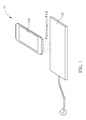
- FIG. 1 illustrates a schematic diagram of a wireless charging system 10 according to an example of the present disclosure.
- a wireless charging system may include at least one wireless charging device and at least one electronic device that can be charged by the wireless charging device.
- the wireless charging system 10 is briefly composed of an electronic device 100 and a wireless charging device 120.
- the wireless charging device 120 may represent a power base station (PBS), including a power transmitter or a power transmitting module with digital/analog chip(s), to supply wireless power to the electronic device 100.
- PBS power base station
- the electronic device 100 may be any portable electronic device such as a mobile device (MD), a mobile phone, a laptop, a tablet computer, an electronic book, a portable computer system, or at least a power receiver or a power receiving module.
- the electronic device 100 may be any electronic device using battery as its power supply, such as a wearable computing device, a wearable medical device, a portable MP3 player, etc.
- the electronic device 100 may directly attach to the wireless charging device 120 or keep within a distance from the wireless charging device 120 for wireless charging. As shown in FIG. 1 , the electronic device 100 receives wireless power from the wireless charging device 120 by electromagnetic induction so that the battery of the electronic device 100 is charged without using any wire connection.
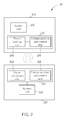
- FIG. 2 is a functional block diagram of a wireless charging system 20 according to an example of the present invention.
- the wireless charging system 20 includes an electronic device 200 and a wireless charging device 220.
- the electronic device 200 may be the electronic device 100 shown in FIG. 1
- the wireless charging device 220 may be the wireless charging device 120 shown in FIG. 1 .
- the electronic device 200 includes a battery unit 202 and a power receiver 210.
- the power receiver 210 may include a power pick-up unit 204 used for receiving wireless power to charge the battery unit 202 and a communication and control unit 206 used for communicating, i.e., sending/receiving signals or packets, with the wireless charging device 220 via power signals and controlling the operation of the power pick-up unit 204.
- the wireless charging device 220 includes a power transmitter 230 and a system unit 222.
- the power transmitter 230 may include a power conversion unit 224 used for supplying wireless power and a communication and control unit 226 used for communicating, i.e., sending/receiving signals or packets, with the electronic device 200 and controlling the operation of the power conversion unit 224.
- the system unit 222 may include a processing means such as a microcontroller, microprocessor or an Application Specific Integrated Circuit (ASIC), for handling wireless charging authentication function activated by a processing result of the power transmitter 230.
- the wireless charging device 220 contains one power transmitter 230.
- the wireless charging device may contain multiple power transmitters for supplying wireless power to multiple portable electronic devices.
- the communication and control units 206 and 226 preferably utilize an in-band communication channel for communication, in which communication channels are attached on wireless power signal.
- communication from wireless charging device 220 to electronic device 200 may be carried out by using frequency-shift keying (FSK) modulation on the wireless power for transmission.
- FSK frequency-shift keying
- LM load modulation
- the communication and control units 206 and 226 may be implemented by radio transceivers that transmit and receive radio signals (e.g., messages, emails, or packets) in an out-of-band communication channel (e.g. a short-range communication protocol such as Bluetooth, Bluetooth LE, Wi-Fi).
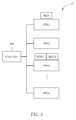
- FIG. 3 illustrates a schematic diagram of a wireless charging system 30 in accordance with an example of the present invention.
- the wireless system 30 include mobile devices MD1, MD2-1, MD2-2, power base stations PBS1-PBSn, and a controller 300 connected to each of the power base stations.
- the power base stations PBS1-PBSn may be deployed in areas such as coffee shops, stores, train stations, airports, and restaurants for public use.
- the controller 300 may be a computer or a server at a control center or a front desk of the public area that monitors the usage or performs necessary computation for the power base stations PBS1-PBSn.
- signals or messages relating to the power base station may be sent to the controller 300 so that people in the control center or the front desk can provide timely assistance.
- a wireless charging device may be able to charge more than one electronic devices at the same time, as the example of the power base station PBS3 charging the mobile devices MD2-1 and MD2-2 shown in FIG. 3 . Therefore, signals or the messages sent to the controller 300 may include necessary information (e.g. an identity of the mobile device) to distinguish the mobile devices MD2-1 and MD2-2 if only one of them encounters problem during wireless charging.
- FIG. 4 is a flowchart of a process 40 according to an example of the present invention.
- the process 40 may be utilized for a wireless charging device, such as the wireless charging device 120 shown in FIG. 1 , to realize wireless charging authentication in a wireless charging system.
- the wireless charging device is able to detect its proximity and know whether an electronic device with a power receiver comes close to the wireless charging device. After the wireless charging device detects the electronic device, it starts the process 40, which includes the following steps:
- thewireless charging device is configured to receive the authentication information from the electronic device, and determine whether the electronic device is authorized for receiving wireless power according to the received authentication information.
- the authentication information may be included in a message sent by the electronic device via an in-band communication channel or an out-of-band communication channel.
- the wireless charging device may start supplying wireless power if the authentication succeeds. If the authentication fails, the wireless charging device may avoid supplying wireless power or release a warning signal.
- the wireless charging device has already supplied wireless power before receiving the authentication information. In such a condition, the wireless charging device keeps on supplying wireless power if the authentication succeeds. If the authentication fails, the wireless charging device may stop supplying wireless power or release a warning signal. In this manner, the service of wireless charging is under control.
- the process 40 is an example of the present invention.
- the wireless charging device may have a configuration for enabling or disabling the wireless charging authentication function.
- the owner of the wireless charging device can configure whether to execute the process 40 or not.
- the wireless charging device may send an authentication information request to the electronic device, and receive the authentication information from the electronic device.
- the authentication information request may be included in a message sent from the wireless charging device to the electronic device.
- the electronic device may send the authentication information to the wireless charging device in response or send a notice (may be included in a message) to inform that the electronic device does not intend to receive wireless power from the wireless charging device.
- This example is applicable to a wireless charging system where there is a communication channel from the wireless charging device to the electronic device.
- the signal diagram of this example is shown in FIG. 5 .
- the wireless charging authentication procedure may be initiated by the electronic device.
- the electronic device may send a query message to the wireless charging device to explicitly ask whether the authentication is needed.
- the wireless charging device may send a first response to the electronic device to indicate whether the authentication is needed or not. If the electronic device receives the first response indicating that the authentication is needed, the electronic device sends the authentication information to the wireless charging device in a message, and the system proceeds to the Step 402.
- the electronic device may send a default authentication information to the wireless charging device to initiate the wireless charging authentication procedure.
- the default authentication information may be any code such as a series of zero bits, numbers (e.g. 1234), or any identity (ID) of the electronic device. If the electronic device receives a negative-acknowledgement (NACK) from the wireless charging device, it understands that the authentication is needed, and then the system proceeds to the wireless charging authentication procedure.
- NACK negative-acknowledgement
- the wireless charging system does not support a communication channel from the wireless charging device to electronic device.
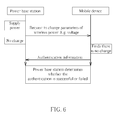
- the electronic device may send a message or a packet (e.g. a control error packet or reconfiguration packet) to request the wireless charging device to adjust/increase/decrease/reconfigure a parameter (e.g. voltage, current, amplitude, duty cycle, frequency, or power in watt) of the wireless power and then detect if there is any change in the wireless power. If the electronic device does not detect that the parameter changes over a threshold, the electronic device determines that wireless charging authentication is needed and sends the authentication information to the wireless charging device.
- the signal diagram of this example is shown in FIG. 6 .
- the electronic device may record the number of times that the wireless charging device removes or restarts wireless power within certain duration. If the electronic device detects that the wireless power is on and off for more than a predefined number of times within a certain duration, the electronic device knows that the authentication is required and may send the authentication information to the wireless charging device, or send a notice (may be included in a message) to inform that the electronic device does not intend to receive wireless power from the wireless charging device.
- This example is also applicable for the case when the wireless charging system does not support a communication channel from the wireless charging device to electronic device.
- the signal diagram of this example is shown in FIG. 7 .
- the examples regarding Fig. 6 and Fig. 7 may be combined together for indicating to the electronic device that the authentication is needed.
- the electronic device may send the authentication information upon starting to receive wireless power or send the notice to inform that it does not intend to receive wireless power from the wireless charging device, regardless of whether the communication channel from the wireless charging device to electronic device is supported or not. So this example is applicable for both cases when the wireless charging system supports a communication channel from the wireless charging device to electronic device(i.e. the system supports bidirectional communication between the wireless charging device and the electronic device) and when the wireless charging system does not support a communication channel from the wireless charging device to the electronic device.
- the signal diagram of this example is shown in FIG. 8 .
- the authentication information may comprise a security code, a password, full or partial of an identity of the electronic device, an input to the electronic device, and information indicating that a user of the electronic device has completed a certain operation on the electronic device (e.g. the user had clicked an advertisement link).
- the security code and the password may be represented by a series of bits, any possible input to the electronic such as a plot and a series of numbers, or an image (e.g. user's face or fingerprint) recognized by the electronic device.
- the identity of the electronic device may be a unique ID of the power receiver (e.g., the power receiver 210) equipped in the electronic device.
- This identity may be determined by the manufacturer of the power receiver, such as the device ID which includes Manufacture Code and (Basic/Extended) Device Identifier.
- the identity of the electronic device may be represented by other modules in the electronic device. In an example, it may be the International Mobile Subscriber Identity (IMSI) or the Radio Network Temporary Identifier (RNTI) from cellular modules in the electronic device. In another example, it may be the Near Field Communication (NFC) or Bluetooth low energy (BLE) ID from NFC or Bluetooth modules in the electronic device.
- the identity of the electronic device which is represented by the identity of modules other than the receiver module may be encoded (e.g. scrambled, truncated) before sending to the wireless charging device as the authentication information.
- a timer may be set in the wireless charging device at the beginning of the wireless charging procedure for waiting the authentication information. If the wireless charging device receives the authentication information within a predefined duration, it checks whether the authentication succeeds or fails. On the other hand, if the wireless charging device does not receive the authentication information for the predefined duration, the wireless charging device may determine that the authentication is failed.
- the wireless charging device may determine whether the authentication succeeds or not by comparing the received authentication information with data stored in a memory of the wireless charging device. In other words, the wireless charging device compares the received authentication information (e.g. a password) with the authentication information data (e.g. a referenced password) stored in its memory. If it matches, the authentication is successful. If it does not match, the authentication is failed.
- the received authentication information e.g. a password
- the authentication information data e.g. a referenced password
- the wireless charging device may determine whether the authentication succeeds or not by manipulating the received authentication information and checking if a value derived from manipulation of the received authentication information equals a predefined value. In a case when the authentication information is a number, for example, the wireless charging device may take modulo operation on the number by a predetermined number. If the remainder matches a specific number, the authentication is successful; otherwise, the authentication is failed.
- the wireless charging device may be managed by a remote device so that the authentication information may be processed in the remote device instead.
- the wireless charging device may send the received authentication information to a controller (e.g., the controller 300 as shown in FIG. 3 ) of the wireless charging system for determining the authentication succeeds or not by the controller.
- the controller may perform manipulation on the authentication information and compare to check if the derived value equals the predefined value. Then, the controller sends the comparison result back to the wireless charging device.
- the wireless charging device may send an authentication success message to the controller to inform that the authentication of the electronic device succeeds.
- the authentication success message may comprise at least one of the following: an identity of the electronic device, an identity of the wireless charging device, and a location of the wireless charging device or the electronic device.
- the wireless charging device may stop supplying power, as shown in the signal diagram of FIG. 9 .
- the wireless charging device may request the authentication information from the electronic device again after it determines the authentication fails.
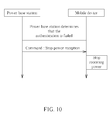
- the wireless charging device may send a first command (e.g. a stop power reception command) to the electronic device which requests the electronic device to stop receiving wireless power from the wireless charging device.
- a first command e.g. a stop power reception command
- the electronic device may send a notice (which may be included in a message) to inform that the electronic device does not intend to receive wireless power from the wireless charging device.
- the wireless charging device may send a second command to the electronic device which requests the electronic device to resend the authentication information when the authentication fails or when the wireless charging device is supplying wireless power.
- the electronic device may resend the authentication information to the wireless charging device or send a notice (which may be included in a message) to inform that the electronic device does not intend to receive wireless power from the wireless charging device.
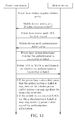
- the wireless charging device may send an authentication failure message to a controller (e.g. controller 300) if the authentication fails.
- the authentication failure message informs the controller that the authentication for the electronic device fails.
- the authentication failure message may comprise at least one of the following: an identity of the electronic device, an identity of the wireless charging device, a location of the wireless charging device or the electronic device, and the reason of authentication failure.
- the wireless charging device may release a warning signal, which can bring immediate attentions of the surrounding people.
- the warning signal may be in any forms such as voice, speech, audio, image, and/or video.
- the wireless charging device may send a third command to the electronic device to request authentication information again.
- the electronic device receives the third command, it sends authentication information to the wireless charging device.
- the electronic device may spontaneously send the authentication information to the wireless charging device from time to time during wireless charging so that the wireless charging device may receive the authentication information from the electronic device periodically.
- the wireless charging device may send a second response to the electronic device to indicate whether the authentication succeeds or fails after determining the authentication result.
- the second response may be in a form of acknowledgement (ACK)/negative-acknowledgement (NACK). If the electronic device receives a NACK, it may display an error message on the screen of the electronic device so that the user can know what happened.
- ACK acknowledgement
- NACK negative-acknowledgement
- the wireless charging system may restart the protocol cycle from the beginning. For example, in a wireless charging system conforming to the WPC specification, the wireless charging system may rewind to the selection phase to start over the protocol cycle. Alternatively, the wireless charging system may go back to one of the previous protocol phases (e.g. ping phase, identification and configuration phase, or negotiation phase).
- the wireless charging system may go back to one of the previous protocol phases (e.g. ping phase, identification and configuration phase, or negotiation phase).
- the abovementioned steps of the process 40 including suggested steps may be realized by means of hardware, software, firmware, or an electronic system.
- Examples of hardware may include analog, digital and mixed circuits known as microcircuit, microchip, or silicon chip.
- Examples of the electronic system may include a system on chip (SOC), system in package (SiP), and a computer on module (COM).
- SOC system on chip
- SiP system in package
- COM computer on module
- the present invention provides a method and related wireless charging device and wireless charging system for wireless charging authentication.
- the present invention may be applied to wireless power systems which requires payment for wireless charging, or wireless power systems which provides free charging service.
- the wireless charging authentication may be enabled in order to block unauthorized charging.
- the type of service (e.g., free or not free) which the wireless charging system provides may depend on the configurations of the wireless charging systems. Since the present invention can be applied to wireless power systems which provides free charging services, the wireless charging device is backward compatible, and is also suitable for private use.
Landscapes
- Engineering & Computer Science (AREA)
- Business, Economics & Management (AREA)
- Power Engineering (AREA)
- Computer Networks & Wireless Communication (AREA)
- Health & Medical Sciences (AREA)
- Economics (AREA)
- Theoretical Computer Science (AREA)
- General Business, Economics & Management (AREA)
- General Physics & Mathematics (AREA)
- Physics & Mathematics (AREA)
- Strategic Management (AREA)
- Tourism & Hospitality (AREA)
- Primary Health Care (AREA)
- Human Resources & Organizations (AREA)
- Marketing (AREA)
- General Health & Medical Sciences (AREA)
- Water Supply & Treatment (AREA)
- Public Health (AREA)
- Accounting & Taxation (AREA)
- Computer Security & Cryptography (AREA)
- Finance (AREA)
- Charge And Discharge Circuits For Batteries Or The Like (AREA)
Abstract
Description
- This application claims the benefit of
U.S. Provisional Application No. 61/841,431 U.S. Provisional Application No. 61/897,833 U.S. Provisional Application No. 61/925,665, filed on Jan. 10th, 2014 U.S. Provisional Application No. 61/979,010, filed on Apr. 14th, 2014 - The present invention relates to a method used in a wireless charging system and related wireless charging device, and more particularly, to a method of wireless charging authentication in a wireless charging system and related wireless charging device.
- With the proliferation of portable electronic devices such as mobile device (MD), smart phone and tablet PC, the demand for charging devices, especially for those provided in public areas, is increasing. In addition, people would like to get rid of annoying wires if possible. One technology which realizes this desire is wireless charging, in which portable electronic device(s) comprising a power receiver is placed on and charged through a wireless charging device (e.g. a power base station comprising a power transmitter). Therefore, the current trend aims at providing wireless charging in public areas such as coffee shops, stores, train stations, airports, and restaurants, so that people can easily find a wireless power supply to charge their portable electronic devices.
- Wireless Power Consortium (WPC) is a leading organization in the world to define wireless charging specifications. The document "Wireless Power Transfer - Volume I, part I" and the document "Wireless Power Transfer - Volume 2, part I" define the interaction between a power base station (or a power transmitter) and a mobile device (or a power receiver).
- However, all the existing protocol states are used for power charging and there is no consideration for other applications. The place which provides wireless charging cannot bill their customer for power charging, since there is no authentication in the protocol.
- Therefore, there is a need to implement authentication mechanism for wireless charging in order to meet the business requirement of deploying wireless charging services in public areas.
- An objective of the present invention is to provide a method and related wireless charging device and wireless charging system for wireless charging authentication.
- The present invention discloses a method of wireless charging authentication for a wireless charging device. The method includes receiving an authentication information from an electronic device for authentication of charging; determining whether the authentication succeeds or not according to the authentication information; and supplying wireless power to the electronic device for charging if the authentication succeeds or stopping to supply wireless power to the electronic device if the authentication fails.
- The present invention further discloses a wireless charging system. The wireless charging system includes an electronic device; and a wireless charging device, for providing wireless power to charge at least one electronic device including said electronic device. The wireless charging device is configured to receive an authentication information from the electronic device for authentication of charging, determine whether the authentication succeeds or not according to the authentication information, and supply wireless power to the electronic device for charging if the authentication succeeds or stop supplying wireless power to the electronic device if the authentication fails.
- These and other objectives of the present invention will no doubt become obvious to those of ordinary skill in the art after reading the following detailed description of the preferred embodiment that is illustrated in the various figures and drawings.
-
-
FIG. 1 is a schematic diagram of a wireless charging system according to an example of the present invention. -
FIG. 2 is a functional block diagram of a wireless charging system according to an example of the present invention. -
FIG. 3 illustrates a schematic diagram of a wireless charging system in accordance with an example of the present invention. -
FIG. 4 is a flowchart of a process according to an example of the present invention. -
FIG. 5 shows a signal diagram of a wireless charging authentication procedure where there is a communication channel from the power base station to the mobile device according to an example of the present invention. -
FIG. 6 shows a signal diagram of a wireless charging authentication procedure where there is no communication channel from the power base station to the mobile device according to an example of the present invention. -
FIG. 7 shows a signal diagram of a wireless charging authentication procedure where there is no communication channel from the power base station to the mobile device according to another example of the present invention. -
FIG. 8 shows a signal diagram of a wireless charging authentication procedure according to an example of the present invention. -
FIG. 9 shows a signal diagram for the steps executed when the power base station determines that the authentication is failed according to an example of the present invention. -
FIG. 10 shows a signal diagram for the steps executed when the power base station determines that the authentication is failed according to an example of the present invention. -
FIG. 11 shows a signal diagram for the steps executed when the power base station determines that the authentication is failed according to an example of the present invention. -
FIG. 12 shows a signal diagram for the steps executed when the power base station determines that the authentication is failed according to an example of the present invention. -
FIG. 13 shows a signal diagram of a wireless charging authentication procedure according an example of the present invention. - Please refer to
FIG. 1 , which illustrates a schematic diagram of awireless charging system 10 according to an example of the present disclosure. A wireless charging system may include at least one wireless charging device and at least one electronic device that can be charged by the wireless charging device. For simplicity, inFIG. 1 , thewireless charging system 10 is briefly composed of anelectronic device 100 and awireless charging device 120. Thewireless charging device 120 may represent a power base station (PBS), including a power transmitter or a power transmitting module with digital/analog chip(s), to supply wireless power to theelectronic device 100. Theelectronic device 100 may be any portable electronic device such as a mobile device (MD), a mobile phone, a laptop, a tablet computer, an electronic book, a portable computer system, or at least a power receiver or a power receiving module. Alternatively, theelectronic device 100 may be any electronic device using battery as its power supply, such as a wearable computing device, a wearable medical device, a portable MP3 player, etc. Theelectronic device 100 may directly attach to thewireless charging device 120 or keep within a distance from thewireless charging device 120 for wireless charging. As shown inFIG. 1 , theelectronic device 100 receives wireless power from thewireless charging device 120 by electromagnetic induction so that the battery of theelectronic device 100 is charged without using any wire connection. - Please refer to
FIG. 2 , which is a functional block diagram of awireless charging system 20 according to an example of the present invention. Thewireless charging system 20 includes anelectronic device 200 and awireless charging device 220. Theelectronic device 200 may be theelectronic device 100 shown inFIG. 1 , and thewireless charging device 220 may be thewireless charging device 120 shown inFIG. 1 . Theelectronic device 200 includes abattery unit 202 and apower receiver 210. Thepower receiver 210 may include a power pick-up unit 204 used for receiving wireless power to charge thebattery unit 202 and a communication andcontrol unit 206 used for communicating, i.e., sending/receiving signals or packets, with thewireless charging device 220 via power signals and controlling the operation of the power pick-up unit 204. - The
wireless charging device 220 includes apower transmitter 230 and asystem unit 222. Thepower transmitter 230 may include apower conversion unit 224 used for supplying wireless power and a communication andcontrol unit 226 used for communicating, i.e., sending/receiving signals or packets, with theelectronic device 200 and controlling the operation of thepower conversion unit 224. Thesystem unit 222 may include a processing means such as a microcontroller, microprocessor or an Application Specific Integrated Circuit (ASIC), for handling wireless charging authentication function activated by a processing result of thepower transmitter 230. In the example ofFIG. 2 , thewireless charging device 220 contains onepower transmitter 230. In other examples, the wireless charging device may contain multiple power transmitters for supplying wireless power to multiple portable electronic devices. - The communication and
control units wireless charging device 220 toelectronic device 200 may be carried out by using frequency-shift keying (FSK) modulation on the wireless power for transmission. In another example, communication fromelectronic device 200 towireless charging device 220 may rely on load modulation (LM). Alternatively, the communication andcontrol units -
FIG. 3 illustrates a schematic diagram of awireless charging system 30 in accordance with an example of the present invention. Thewireless system 30 include mobile devices MD1, MD2-1, MD2-2, power base stations PBS1-PBSn, and acontroller 300 connected to each of the power base stations. The power base stations PBS1-PBSn may be deployed in areas such as coffee shops, stores, train stations, airports, and restaurants for public use. Thecontroller 300 may be a computer or a server at a control center or a front desk of the public area that monitors the usage or performs necessary computation for the power base stations PBS1-PBSn. In addition, if the user of a certain power base station encounters any problem, signals or messages relating to the power base station may be sent to thecontroller 300 so that people in the control center or the front desk can provide timely assistance. Note that a wireless charging device may be able to charge more than one electronic devices at the same time, as the example of the power base station PBS3 charging the mobile devices MD2-1 and MD2-2 shown inFIG. 3 . Therefore, signals or the messages sent to thecontroller 300 may include necessary information (e.g. an identity of the mobile device) to distinguish the mobile devices MD2-1 and MD2-2 if only one of them encounters problem during wireless charging. - Please refer to
FIG. 4 , which is a flowchart of aprocess 40 according to an example of the present invention. Theprocess 40 may be utilized for a wireless charging device, such as thewireless charging device 120 shown inFIG. 1 , to realize wireless charging authentication in a wireless charging system. The wireless charging device is able to detect its proximity and know whether an electronic device with a power receiver comes close to the wireless charging device. After the wireless charging device detects the electronic device, it starts theprocess 40, which includes the following steps: - Step 400: Start.
- Step 402: Receive an authentication information from an electronic device for authentication of charging.
- Step 404: Determine whether the authentication succeeds or not according to the authentication information.
- Step 406: Supply wireless power to the electronic device for charging if the authentication succeeds or stop to supply wireless power to the electronic device if the authentication fails.
- Step 408: End.
- According to the
process 40, thewireless charging device is configured to receive the authentication information from the electronic device, and determine whether the electronic device is authorized for receiving wireless power according to the received authentication information. The authentication information may be included in a message sent by the electronic device via an in-band communication channel or an out-of-band communication channel. In the case of using out-of-band communication channel, the wireless charging device may start supplying wireless power if the authentication succeeds. If the authentication fails, the wireless charging device may avoid supplying wireless power or release a warning signal. In the case of using in-band communication channel, the wireless charging device has already supplied wireless power before receiving the authentication information. In such a condition, the wireless charging device keeps on supplying wireless power if the authentication succeeds. If the authentication fails, the wireless charging device may stop supplying wireless power or release a warning signal. In this manner, the service of wireless charging is under control. - Note that the
process 40 is an example of the present invention. Those skilled in the art should readily make combinations, modifications and/or alterations on the abovementioned description and examples. For example, the wireless charging device may have a configuration for enabling or disabling the wireless charging authentication function. Thus, the owner of the wireless charging device can configure whether to execute theprocess 40 or not. - In an example, the wireless charging device may send an authentication information request to the electronic device, and receive the authentication information from the electronic device. The authentication information request may be included in a message sent from the wireless charging device to the electronic device. When the electronic device receives the authentication information request, it may send the authentication information to the wireless charging device in response or send a notice (may be included in a message) to inform that the electronic device does not intend to receive wireless power from the wireless charging device. This example is applicable to a wireless charging system where there is a communication channel from the wireless charging device to the electronic device. The signal diagram of this example is shown in
FIG. 5 . - The above describes the example where the wireless charging authentication procedure is initiated by the wireless charging device. In some cases, the wireless charging authentication procedure (or the communication) may be initiated by the electronic device. The electronic device may send a query message to the wireless charging device to explicitly ask whether the authentication is needed. In response, the wireless charging device may send a first response to the electronic device to indicate whether the authentication is needed or not. If the electronic device receives the first response indicating that the authentication is needed, the electronic device sends the authentication information to the wireless charging device in a message, and the system proceeds to the
Step 402. - Alternatively, the electronic device may send a default authentication information to the wireless charging device to initiate the wireless charging authentication procedure. This example is regarded as an implicit query about whether the authentication is needed. The default authentication information may be any code such as a series of zero bits, numbers (e.g. 1234), or any identity (ID) of the electronic device. If the electronic device receives a negative-acknowledgement (NACK) from the wireless charging device, it understands that the authentication is needed, and then the system proceeds to the wireless charging authentication procedure.
- In some examples, the wireless charging system does not support a communication channel from the wireless charging device to electronic device. In order to know whether the wireless charging authentication is required, the electronic device may send a message or a packet (e.g. a control error packet or reconfiguration packet) to request the wireless charging device to adjust/increase/decrease/reconfigure a parameter (e.g. voltage, current, amplitude, duty cycle, frequency, or power in watt) of the wireless power and then detect if there is any change in the wireless power. If the electronic device does not detect that the parameter changes over a threshold, the electronic device determines that wireless charging authentication is needed and sends the authentication information to the wireless charging device. The signal diagram of this example is shown in
FIG. 6 . - Alternatively, the electronic device may record the number of times that the wireless charging device removes or restarts wireless power within certain duration. If the electronic device detects that the wireless power is on and off for more than a predefined number of times within a certain duration, the electronic device knows that the authentication is required and may send the authentication information to the wireless charging device, or send a notice (may be included in a message) to inform that the electronic device does not intend to receive wireless power from the wireless charging device. This example is also applicable for the case when the wireless charging system does not support a communication channel from the wireless charging device to electronic device.The signal diagram of this example is shown in
FIG. 7 . The examples regardingFig. 6 andFig. 7 may be combined together for indicating to the electronic device that the authentication is needed. - In an example, the electronic device may send the authentication information upon starting to receive wireless power or send the notice to inform that it does not intend to receive wireless power from the wireless charging device, regardless of whether the communication channel from the wireless charging device to electronic device is supported or not. So this example is applicable for both cases when the wireless charging system supports a communication channel from the wireless charging device to electronic device(i.e. the system supports bidirectional communication between the wireless charging device and the electronic device) and when the wireless charging system does not support a communication channel from the wireless charging device to the electronic device. The signal diagram of this example is shown in
FIG. 8 . - The authentication information may comprise a security code, a password, full or partial of an identity of the electronic device, an input to the electronic device, and information indicating that a user of the electronic device has completed a certain operation on the electronic device (e.g. the user had clicked an advertisement link). The security code and the password may be represented by a series of bits, any possible input to the electronic such as a plot and a series of numbers, or an image (e.g. user's face or fingerprint) recognized by the electronic device. The identity of the electronic device may be a unique ID of the power receiver (e.g., the power receiver 210) equipped in the electronic device. This identity may be determined by the manufacturer of the power receiver, such as the device ID which includes Manufacture Code and (Basic/Extended) Device Identifier. Alternatively, the identity of the electronic device may be represented by other modules in the electronic device. In an example, it may be the International Mobile Subscriber Identity (IMSI) or the Radio Network Temporary Identifier (RNTI) from cellular modules in the electronic device. In another example, it may be the Near Field Communication (NFC) or Bluetooth low energy (BLE) ID from NFC or Bluetooth modules in the electronic device. The identity of the electronic device which is represented by the identity of modules other than the receiver module may be encoded (e.g. scrambled, truncated) before sending to the wireless charging device as the authentication information.
- A timer may be set in the wireless charging device at the beginning of the wireless charging procedure for waiting the authentication information. If the wireless charging device receives the authentication information within a predefined duration, it checks whether the authentication succeeds or fails. On the other hand, if the wireless charging device does not receive the authentication information for the predefined duration, the wireless charging device may determine that the authentication is failed.
- The wireless charging device may determine whether the authentication succeeds or not by comparing the received authentication information with data stored in a memory of the wireless charging device. In other words, the wireless charging device compares the received authentication information (e.g. a password) with the authentication information data (e.g. a referenced password) stored in its memory. If it matches, the authentication is successful. If it does not match, the authentication is failed.
- In another aspect, the wireless charging device may determine whether the authentication succeeds or not by manipulating the received authentication information and checking if a value derived from manipulation of the received authentication information equals a predefined value. In a case when the authentication information is a number, for example, the wireless charging device may take modulo operation on the number by a predetermined number. If the remainder matches a specific number, the authentication is successful; otherwise, the authentication is failed.
- The above descriptions illustrate examples where the wireless charging device verifies the authentication information locally. In some cases, the wireless charging device may be managed by a remote device so that the authentication information may be processed in the remote device instead. In such a situation, the wireless charging device may send the received authentication information to a controller (e.g., the
controller 300 as shown inFIG. 3 ) of the wireless charging system for determining the authentication succeeds or not by the controller. The controller may perform manipulation on the authentication information and compare to check if the derived value equals the predefined value. Then, the controller sends the comparison result back to the wireless charging device. - If the authentication succeeds, the wireless charging device may send an authentication success message to the controller to inform that the authentication of the electronic device succeeds. The authentication success message may comprise at least one of the following: an identity of the electronic device, an identity of the wireless charging device, and a location of the wireless charging device or the electronic device.
- If the authentication fails, the wireless charging device may stop supplying power, as shown in the signal diagram of
FIG. 9 . In an example, the wireless charging device may request the authentication information from the electronic device again after it determines the authentication fails. - Referring to the example shown in
FIG. 10 , if the authentication fails, the wireless charging device may send a first command (e.g. a stop power reception command) to the electronic device which requests the electronic device to stop receiving wireless power from the wireless charging device. When the electronic device receives the first command, it should stop receiving wireless power. If the electronic device does not need charging (e.g. the battery is full), it may send a notice (which may be included in a message) to inform that the electronic device does not intend to receive wireless power from the wireless charging device. - Moreover, the wireless charging device may send a second command to the electronic device which requests the electronic device to resend the authentication information when the authentication fails or when the wireless charging device is supplying wireless power. When the electronic device receives the second command, it may resend the authentication information to the wireless charging device or send a notice (which may be included in a message) to inform that the electronic device does not intend to receive wireless power from the wireless charging device.
- Referring to the example shown in
FIG. 11 , the wireless charging device may send an authentication failure message to a controller (e.g. controller 300) if the authentication fails. The authentication failure message informs the controller that the authentication for the electronic device fails. The authentication failure message may comprise at least one of the following: an identity of the electronic device, an identity of the wireless charging device, a location of the wireless charging device or the electronic device, and the reason of authentication failure. Thus, people who monitor the controller can diagnose the failure issue based on the authentication failure message and provide assistance if needed. - Referring to the example shown in
FIG. 12 , when the authentication fails, the wireless charging device may release a warning signal, which can bring immediate attentions of the surrounding people. The warning signal may be in any forms such as voice, speech, audio, image, and/or video. - To make sure that the electronic device is not replaced by other device during wireless charging, the wireless charging device may send a third command to the electronic device to request authentication information again. When the electronic device receives the third command, it sends authentication information to the wireless charging device. Alternatively, the electronic device may spontaneously send the authentication information to the wireless charging device from time to time during wireless charging so that the wireless charging device may receive the authentication information from the electronic device periodically.
- Referring to the example shown in
FIG. 13 , the wireless charging device may send a second response to the electronic device to indicate whether the authentication succeeds or fails after determining the authentication result. The second response may be in a form of acknowledgement (ACK)/negative-acknowledgement (NACK). If the electronic device receives a NACK, it may display an error message on the screen of the electronic device so that the user can know what happened. - If the wireless charging authentication procedure completes and the authentication fails, the wireless charging system may restart the protocol cycle from the beginning. For example, in a wireless charging system conforming to the WPC specification, the wireless charging system may rewind to the selection phase to start over the protocol cycle. Alternatively, the wireless charging system may go back to one of the previous protocol phases (e.g. ping phase, identification and configuration phase, or negotiation phase).
- The abovementioned steps of the
process 40 including suggested steps may be realized by means of hardware, software, firmware, or an electronic system. Examples of hardware may include analog, digital and mixed circuits known as microcircuit, microchip, or silicon chip. Examples of the electronic system may include a system on chip (SOC), system in package (SiP), and a computer on module (COM). - To sum up, the present invention provides a method and related wireless charging device and wireless charging system for wireless charging authentication. The present invention may be applied to wireless power systems which requires payment for wireless charging, or wireless power systems which provides free charging service. In some situations, the wireless charging authentication may be enabled in order to block unauthorized charging. The type of service (e.g., free or not free) which the wireless charging system provides may depend on the configurations of the wireless charging systems. Since the present invention can be applied to wireless power systems which provides free charging services, the wireless charging device is backward compatible, and is also suitable for private use.
- Those skilled in the art will readily observe that numerous modifications and alterations of the device and method may be made while retaining the teachings of the invention. Accordingly, the above disclosure should be construed as limited only by the metes and bounds of the appended claims.
Claims (15)
- A method of wireless charging authentication for a wireless charging device, comprising:receiving an authentication information from an electronic device for authentication of charging;determining whether the authentication succeeds or not according to the authentication information; andsupplying wireless power to the electronic device for charging if the authentication succeeds or stopping to supply wireless power to the electronic device if the authentication fails.
- The method of claim 1, further comprising:sending a first response to the electronic device to indicate whether the authentication is needed in response to a query received from the electronic device.
- The method of claim 1, wherein the step of determining whether the authentication succeeds or not according to the authentication information comprises:determining that the authentication fails if the wireless charging device does not receive the authentication information for a predefined duration.
- The method of claim 1, further comprising:sending a second response to the electronic device to indicate whether the authentication succeeds or fails.
- The method of claim 1, wherein the wireless charging device starts supplying wireless power or keeps on supplying wireless power if the authentication succeeds.
- The method of claim 1, wherein the wireless charging device stops supplying wireless power or releases a warning signal if the authentication fails.
- The method of claim 1, wherein the wireless charging device receives the authentication information from the electronic device periodically.
- The method of claim 1, wherein the authentication information comprises at least one of a security code, a password, full or partial of an identity of the electronic device, an input to the electronic device, and information indicating that a user of the electronic device has completed a certain operation on the electronic device.
- The method of claim 1, wherein the wireless charging device determines whether the authentication succeeds or not by comparing the received authentication information with data stored in a memory of the wireless charging device.
- The method of claim 1, wherein the wireless charging device determines whether the authentication succeeds or not by manipulating the received authentication information and checking if a value derived from manipulation of the received authentication information equals a predefined value.
- The method of claim 1, wherein the step of determining whether the authentication succeeds or not according to the authentication information comprises:sending the received authentication information to a controller for determining the authentication succeeds or not by the controller.
- The method of claim 1, further comprising:sending an authentication success message to a controller to inform that the authentication for the electronic device succeeds;wherein the authentication success message comprises at least
one of an identity of the electronic device, an identity of the wireless charging device, and a location of the wireless charging device or the electronic device. - The method of claim 1, further comprising:sending an authentication failure message to a controller to inform that the authentication for the electronic device fails;wherein the authentication failure message comprises at least one of an identity of the electronic device, an identity of the wireless charging device, a location of the wireless charging device or the electronic device, and the reason of authentication failure.
- The method of claim 1, further comprising:sending a request to the electronic device for receiving the authentication information from the electronic device.
- A wireless charging system, comprising:an electronic device; anda wireless charging device, for providing wireless power to charge at least one electronic device comprising the electronic device;wherein the wireless charging device is configured to perform the method of any of claims 1-14.
Applications Claiming Priority (4)
| Application Number | Priority Date | Filing Date | Title |
|---|---|---|---|
| US201361841431P | 2013-07-01 | 2013-07-01 | |
| US201361897833P | 2013-10-31 | 2013-10-31 | |
| US201461925665P | 2014-01-10 | 2014-01-10 | |
| US201461979010P | 2014-04-14 | 2014-04-14 |
Publications (3)
| Publication Number | Publication Date |
|---|---|
| EP2822142A2 true EP2822142A2 (en) | 2015-01-07 |
| EP2822142A3 EP2822142A3 (en) | 2015-02-25 |
| EP2822142B1 EP2822142B1 (en) | 2017-12-06 |
Family
ID=51063296
Family Applications (1)
| Application Number | Title | Priority Date | Filing Date |
|---|---|---|---|
| EP14175244.4A Active EP2822142B1 (en) | 2013-07-01 | 2014-07-01 | Method for wireless charging authentication and related wireless charging system |
Country Status (3)
| Country | Link |
|---|---|
| US (1) | US20150006395A1 (en) |
| EP (1) | EP2822142B1 (en) |
| CN (1) | CN104281802A (en) |
Families Citing this family (50)
| Publication number | Priority date | Publication date | Assignee | Title |
|---|---|---|---|---|
| US10242355B2 (en) * | 2013-11-15 | 2019-03-26 | Nxp B.V. | Wireless power supply to enable payment transaction |
| CN105404450B (en) * | 2014-09-10 | 2019-08-27 | 联想(北京)有限公司 | An information processing method and electronic device |
| US9651744B2 (en) | 2014-10-29 | 2017-05-16 | Compass Electro Optical Systems Ltd. | Multi-fiber ferrule |
| US9645328B2 (en) | 2014-10-29 | 2017-05-09 | Compass Electro Optical Systems Ltd. | No-polish optical element attachment for optical fiber ferrule |
| KR102022707B1 (en) * | 2014-11-03 | 2019-09-19 | 주식회사 위츠 | Non contact type power transmission apparatus, mobile terminal, server and service system based location using the same |
| CN104916876B (en) * | 2015-03-27 | 2017-10-27 | 惠州Tcl移动通信有限公司 | The traversal matching process and system of a kind of low-power consumption bluetooth control quick charge |
| CN104835990B (en) * | 2015-03-27 | 2017-11-10 | 惠州Tcl移动通信有限公司 | A kind of charger charging method and system based on low-power consumption bluetooth |
| CN104935085A (en) * | 2015-05-24 | 2015-09-23 | 郭和友 | Biological recognition payment electronic equipment of wireless charging and supply type |
| US10873212B2 (en) * | 2015-05-29 | 2020-12-22 | Hewlett-Packard Development Company, L.P. | Wireless charging at a lower class type |
| US9953174B2 (en) * | 2015-08-31 | 2018-04-24 | Nxp B.V. | Method and system for in-band password management for inductive wireless charging |
| JP2017060263A (en) * | 2015-09-15 | 2017-03-23 | 東芝テック株式会社 | Power receiving apparatus and program |
| CN106936476B (en) * | 2015-12-31 | 2020-06-16 | 比亚迪股份有限公司 | A wireless charging method, wireless charging device and terminal |
| WO2017171561A1 (en) * | 2016-04-01 | 2017-10-05 | Powerbyproxi Limited | Method of authentication for a wireless charging system |
| US10039147B2 (en) * | 2016-09-30 | 2018-07-31 | Intel IP Corporation | Apparatus, system and method of triggering a wireless docking session between a mobile device and a wireless docking device |
| KR20180037473A (en) * | 2016-10-04 | 2018-04-12 | 삼성전자주식회사 | Mobile payment method, electronic device and external payment device therefor |
| CN106451629B (en) * | 2016-10-31 | 2019-10-25 | 上海斐讯数据通信技术有限公司 | Method for wireless charging of router with specified MAC address and router device |
| EP4164091A1 (en) * | 2016-11-15 | 2023-04-12 | LG Electronics, Inc. | Wireless power transferring method and device therefor |
| US10790703B2 (en) * | 2016-12-19 | 2020-09-29 | Koji Yoden | Smart wireless power transfer between devices |
| CN106602654B (en) * | 2016-12-26 | 2020-03-24 | Oppo广东移动通信有限公司 | Charging authentication method, related equipment and system |
| CN106786987A (en) * | 2017-02-13 | 2017-05-31 | 上海斐讯数据通信技术有限公司 | A kind of router wireless charging method and system based on specified IP address |
| US10574167B2 (en) * | 2017-02-24 | 2020-02-25 | Fuji Electric Co., Ltd. | Load control system |
| JP6883116B2 (en) * | 2017-05-01 | 2021-06-09 | エルジー エレクトロニクス インコーポレイティド | Devices and methods for authentication in wireless power transfer systems |
| CN107231019B (en) * | 2017-05-19 | 2021-04-30 | 上海掌门科技有限公司 | Method and equipment for charging user equipment through charging device |
| CN107104484B (en) * | 2017-05-19 | 2020-12-18 | 上海掌门科技有限公司 | A method and device for charging user equipment through a charging device |
| KR102397287B1 (en) * | 2017-07-11 | 2022-05-13 | 삼성전자 주식회사 | Data communication method for wireless power supply and electronic device using the same |
| JP6890504B2 (en) * | 2017-08-28 | 2021-06-18 | キヤノン株式会社 | Transmission device, power receiving device, wireless power transmission system and their control method |
| HUE060263T2 (en) * | 2018-10-26 | 2023-02-28 | Lg Electronics Inc | Apparatus for transmitting or receiving data in wireless power transmission system |
| JP7358043B2 (en) * | 2018-10-31 | 2023-10-10 | キヤノン株式会社 | Power receiving device, power transmitting device, control method and program |
| CN109466366B (en) * | 2018-11-02 | 2021-03-05 | 东软睿驰汽车技术(沈阳)有限公司 | Charging authentication method and device for electric vehicle |
| GB201818552D0 (en) * | 2018-11-14 | 2018-12-26 | Smith & Nephew | Health care provider autorization of data acquisition by sensor enabled wound dressing and devices |
| KR102709993B1 (en) | 2019-02-19 | 2024-09-26 | 삼성전자 주식회사 | Data communication method for wireless power supply and electronic device using the same |
| CN110011425A (en) * | 2019-03-13 | 2019-07-12 | 浙江帅康电气股份有限公司 | A kind of electric power supply method and system |
| JP7336264B2 (en) * | 2019-05-29 | 2023-08-31 | 株式会社マキタ | battery pack |
| CN112020044B (en) | 2019-05-31 | 2021-10-01 | 北京小米移动软件有限公司 | Wireless charging communication method, device, device and storage medium |
| EP3787151A1 (en) * | 2019-08-27 | 2021-03-03 | Koninklijke Philips N.V. | A power transmitter, system and method therefor |
| CN110474436B (en) * | 2019-08-30 | 2021-08-24 | 维沃移动通信有限公司 | A wireless charging method and related equipment |
| KR102801229B1 (en) | 2019-09-04 | 2025-04-29 | 삼성전자 주식회사 | electronic device and method for authenticating of the same |
| US11524769B1 (en) * | 2020-02-19 | 2022-12-13 | Rockwell Collins, Inc. | Wireless cabin control panels |
| WO2021182818A1 (en) * | 2020-03-09 | 2021-09-16 | 엘지전자 주식회사 | Wireless power transmission device, wireless power reception device, and authentication method therefor |
| CN111566897A (en) * | 2020-03-20 | 2020-08-21 | 北京小米移动软件有限公司 | Wireless charging authentication method and device, communication equipment and storage medium |
| EP4142109A4 (en) * | 2020-04-21 | 2024-05-29 | LG Electronics, Inc. | Wireless power receiver and wireless power transmitter |
| US11375973B2 (en) | 2020-05-11 | 2022-07-05 | GE Precision Healthcare LLC | Methods and systems for wirelessly charging digital x-ray detectors |
| CN112152283A (en) * | 2020-09-04 | 2020-12-29 | 湖南铁山信息科技有限公司 | Charging identification method, device, iron shoe, storage medium and processor |
| EP4283878A4 (en) * | 2021-01-20 | 2024-07-03 | Panasonic Intellectual Property Management Co., Ltd. | COMMUNICATION DEVICE |
| US11881727B2 (en) | 2021-03-10 | 2024-01-23 | Cisco Technology, Inc. | Communication pairing for telephone based on wireless charging protocol |
| KR20250150156A (en) * | 2021-08-24 | 2025-10-17 | 엘지전자 주식회사 | Method and device for data communication reset and forced abort in a wireless power transfer system |
| CN114156965B (en) * | 2021-10-26 | 2023-07-14 | 荣耀终端有限公司 | Method, device and storage medium for inter-device charging |
| CN117526471A (en) * | 2022-07-28 | 2024-02-06 | 北京小米移动软件有限公司 | Wireless charging circuits and wearable devices applied to wearable devices |
| CN118042458A (en) * | 2022-11-01 | 2024-05-14 | 北京小米移动软件有限公司 | A wireless charging key verification method, device and storage medium |
| US12395339B2 (en) * | 2023-05-18 | 2025-08-19 | Cisco Technology, Inc. | Fast repowering using cryptographically protected identity |
Family Cites Families (44)
| Publication number | Priority date | Publication date | Assignee | Title |
|---|---|---|---|---|
| US7375492B2 (en) * | 2003-12-12 | 2008-05-20 | Microsoft Corporation | Inductively charged battery pack |
| JP4155408B2 (en) * | 2005-09-29 | 2008-09-24 | ソニー・エリクソン・モバイルコミュニケーションズ株式会社 | Charging device and charging system |
| KR100736053B1 (en) * | 2005-10-24 | 2007-07-06 | 삼성전자주식회사 | Apparatus and method for sharing power wirelessly by induction |
| US8169185B2 (en) * | 2006-01-31 | 2012-05-01 | Mojo Mobility, Inc. | System and method for inductive charging of portable devices |
| US7952322B2 (en) * | 2006-01-31 | 2011-05-31 | Mojo Mobility, Inc. | Inductive power source and charging system |
| US7498766B2 (en) * | 2006-05-30 | 2009-03-03 | Symbol Technologies, Inc. | System and method for authenticating a battery |
| EP2882070B1 (en) * | 2006-11-08 | 2016-08-31 | Panasonic Corporation | Non-contact charger and non-contact charge system |
| JP2008243189A (en) * | 2007-02-26 | 2008-10-09 | Semiconductor Energy Lab Co Ltd | Storage device |
| JP4743173B2 (en) * | 2007-06-29 | 2011-08-10 | セイコーエプソン株式会社 | Power transmission control device, power transmission device, non-contact power transmission system, and electronic device |
| JP4407753B2 (en) * | 2008-01-15 | 2010-02-03 | トヨタ自動車株式会社 | Electric vehicle charging system |
| US8111042B2 (en) * | 2008-08-05 | 2012-02-07 | Broadcom Corporation | Integrated wireless resonant power charging and communication channel |
| EP2313957B1 (en) * | 2008-08-18 | 2020-05-20 | Nxp B.V. | A mobile device to control a charge pad system |
| US8069100B2 (en) * | 2009-01-06 | 2011-11-29 | Access Business Group International Llc | Metered delivery of wireless power |
| RU2011132943A (en) * | 2009-01-06 | 2013-02-20 | Эксесс Бизнес Груп Интернешнл Ллс | WIRELESS CHARGING SYSTEM WITH ACCORDING TO THE POWER SUPPLY OF THE DEVICE |
| US9318917B2 (en) * | 2009-04-09 | 2016-04-19 | Sony Corporation | Electric storage apparatus and power control system |
| CN101877493A (en) * | 2009-04-28 | 2010-11-03 | 鸿富锦精密工业(深圳)有限公司 | Wireless charging authentication system and method |
| US9312728B2 (en) * | 2009-08-24 | 2016-04-12 | Access Business Group International Llc | Physical and virtual identification in a wireless power network |
| JP2011135740A (en) * | 2009-12-25 | 2011-07-07 | Makita Corp | Battery pack for power tool and battery connection device |
| JP2011155710A (en) * | 2010-01-25 | 2011-08-11 | Sony Corp | POWER MANAGEMENT DEVICE, ELECTRONIC DEVICE, AND POWER MANAGEMENT METHOD |
| KR101114587B1 (en) * | 2010-01-28 | 2012-03-05 | 주식회사 팬택 | System, mobile station, management server and wireless power transfer for transmitting/receiving wireless power |
| KR20110103297A (en) * | 2010-03-12 | 2011-09-20 | 삼성전자주식회사 | Wireless power charging method and device |
| TWI406471B (en) * | 2010-05-14 | 2013-08-21 | 崇越科技股份有限公司 | Charging system and charging method thereof |
| JP2012019636A (en) * | 2010-07-08 | 2012-01-26 | Denso Corp | Charging device for vehicle |
| JP2012019666A (en) * | 2010-07-09 | 2012-01-26 | Sony Corp | Wireless charging device and wireless charging system |
| DE102010042395A1 (en) * | 2010-10-13 | 2012-04-19 | Continental Automotive Gmbh | Method for inductive charging of battery in vehicle e.g. electric car, involves performing the inductive coupling of primary coil in loading station and secondary coil of vehicle while maintaining preset gap between coils |
| DE112010006090B4 (en) * | 2010-12-24 | 2021-10-21 | Toyota Jidosha Kabushiki Kaisha | Contactless charging system, contactless charging method, contactless charging vehicle, and contactless charging management device |
| CN103518311B (en) * | 2011-02-18 | 2017-07-04 | Lg电子株式会社 | The method and apparatus of wireless charging |
| KR101768723B1 (en) * | 2011-03-30 | 2017-08-17 | 삼성전자주식회사 | Method and system for wireless charging in a portable terminal |
| KR101785456B1 (en) * | 2011-04-25 | 2017-11-06 | 엘지전자 주식회사 | Apparatus and system for providing wireless power charge service |
| KR101897544B1 (en) * | 2011-05-17 | 2018-09-12 | 삼성전자주식회사 | Apparatus and method for controlling wireless power transmission |
| JP2012239814A (en) * | 2011-05-24 | 2012-12-10 | Fujifilm Corp | Radiographic apparatus |
| JP6064337B2 (en) * | 2011-08-10 | 2017-01-25 | ソニー株式会社 | Power feeding system, power feeding device and electronic device |
| KR101831993B1 (en) * | 2011-11-18 | 2018-02-26 | 삼성전자주식회사 | Apparatus and method for controlling amount of charging current for wireless power receiver |
| KR20130090703A (en) * | 2012-02-06 | 2013-08-14 | 삼성전자주식회사 | Wireless power charging method and apparatus |
| US9407106B2 (en) * | 2012-04-03 | 2016-08-02 | Qualcomm Incorporated | System and method for wireless power control communication using bluetooth low energy |
| KR101924341B1 (en) * | 2012-04-09 | 2018-12-03 | 삼성전자주식회사 | Apparatus and method for controlling wireless power transmission |
| US9755437B2 (en) * | 2012-04-25 | 2017-09-05 | Nokia Technologies Oy | Method, apparatus, and computer program product for wireless charging detection |
| KR101807899B1 (en) * | 2012-10-19 | 2017-12-11 | 삼성전자주식회사 | Wireless power transmitter, wireless power receiver and method for permitting wireless power receiver of wireless power transmitter in wireless power network |
| US9137019B2 (en) * | 2013-01-07 | 2015-09-15 | Nxp, B.V. | Secure wireless charging |
| KR101800287B1 (en) * | 2013-01-21 | 2017-11-23 | 주식회사 케이티 | Method and system of management for checking out sharing-EV(electric vehicle) |
| US9973038B2 (en) * | 2013-06-10 | 2018-05-15 | Celico Partnership | Self optimizing antenna for NFC and wireless charging |
| US9774208B2 (en) * | 2013-06-10 | 2017-09-26 | Cellco Partnership | NFC assisted wireless charging |
| US9362773B2 (en) * | 2013-06-28 | 2016-06-07 | Nokia Technologies Oy | Method and apparatus for determination of a non-charging operation |
| US9088305B2 (en) * | 2013-07-08 | 2015-07-21 | Blackberry Limited | Docking station connectivity monitor/controller |
-
2014
- 2014-07-01 CN CN201410326540.9A patent/CN104281802A/en active Pending
- 2014-07-01 EP EP14175244.4A patent/EP2822142B1/en active Active
- 2014-07-01 US US14/320,672 patent/US20150006395A1/en not_active Abandoned
Non-Patent Citations (2)
| Title |
|---|
| WIRELESS POWER TRANSFER - VOLUME 2, PART I, vol. 2 |
| WIRELESS POWER TRANSFER - VOLUME I, PART I, vol. 1 |
Also Published As
| Publication number | Publication date |
|---|---|
| US20150006395A1 (en) | 2015-01-01 |
| CN104281802A (en) | 2015-01-14 |
| EP2822142B1 (en) | 2017-12-06 |
| EP2822142A3 (en) | 2015-02-25 |
Similar Documents
| Publication | Publication Date | Title |
|---|---|---|
| EP2822142A2 (en) | Method for wireless charging authentication and related wireless charging system | |
| US9847667B2 (en) | Method of handling wireless charging authentication | |
| US20150199665A1 (en) | Method of Payment for Wireless Charging Service | |
| JP6883116B2 (en) | Devices and methods for authentication in wireless power transfer systems | |
| JP7414526B2 (en) | Apparatus and method for transmitting data streams in a wireless power transmission system | |
| US20190044393A1 (en) | Method of authentication | |
| JP7832394B2 (en) | Apparatus and method for power control in a wireless power transmission system | |
| TWI607615B (en) | Wireless charging method and charge controller thereof | |
| US9548795B2 (en) | Method of identifying wireless power receiver in wireless power system | |
| US20140298447A1 (en) | Method for Enhancing Security of Portable Electronic Device and Related Wireless Charging System | |
| US11444662B2 (en) | Device and method for transmitting data in wireless power transmission system | |
| US20150031334A1 (en) | Method of Handling Authentication for Wireless Charging | |
| EP2942854A2 (en) | Electronic device for handling sharing of communication hardware in wireless charging system | |
| US12294230B2 (en) | Power receiving apparatus, power transmitting apparatus, control methods thereof, and non-transitory computer-readable storage medium | |
| US11689064B2 (en) | Wireless power transmission system and method for detecting RFID/NFC card | |
| EP3343727B1 (en) | User privacy protection in wireless charging system | |
| TWM525019U (en) | Power supplying device and power receiving device of wireless charging system and charge controller thereof | |
| KR102312355B1 (en) | Wireless charging equipment, terminal, service providing device, wireless charging system comprising the same, control method thereof and computer readable medium having computer program recorded therefor |
Legal Events
| Date | Code | Title | Description |
|---|---|---|---|
| PUAI | Public reference made under article 153(3) epc to a published international application that has entered the european phase |
Free format text: ORIGINAL CODE: 0009012 |
|
| 17P | Request for examination filed |
Effective date: 20140701 |
|
| AK | Designated contracting states |
Kind code of ref document: A2 Designated state(s): AL AT BE BG CH CY CZ DE DK EE ES FI FR GB GR HR HU IE IS IT LI LT LU LV MC MK MT NL NO PL PT RO RS SE SI SK SM TR |
|
| AX | Request for extension of the european patent |
Extension state: BA ME |
|
| PUAL | Search report despatched |
Free format text: ORIGINAL CODE: 0009013 |
|
| AK | Designated contracting states |
Kind code of ref document: A3 Designated state(s): AL AT BE BG CH CY CZ DE DK EE ES FI FR GB GR HR HU IE IS IT LI LT LU LV MC MK MT NL NO PL PT RO RS SE SI SK SM TR |
|
| AX | Request for extension of the european patent |
Extension state: BA ME |
|
| RIC1 | Information provided on ipc code assigned before grant |
Ipc: B60L 11/18 20060101ALI20150122BHEP Ipc: H01M 10/44 20060101ALI20150122BHEP Ipc: H02J 7/02 20060101AFI20150122BHEP |
|
| RAP1 | Party data changed (applicant data changed or rights of an application transferred) |
Owner name: HTC CORPORATION |
|
| 17Q | First examination report despatched |
Effective date: 20150309 |
|
| RBV | Designated contracting states (corrected) |
Designated state(s): AL AT BE BG CH CY CZ DE DK EE ES FI FR GB GR HR HU IE IS IT LI LT LU LV MC MK MT NL NO PL PT RO RS SE SI SK SM TR |
|
| GRAP | Despatch of communication of intention to grant a patent |
Free format text: ORIGINAL CODE: EPIDOSNIGR1 |
|
| INTG | Intention to grant announced |
Effective date: 20170628 |
|
| GRAS | Grant fee paid |
Free format text: ORIGINAL CODE: EPIDOSNIGR3 |
|
| GRAA | (expected) grant |
Free format text: ORIGINAL CODE: 0009210 |
|
| AK | Designated contracting states |
Kind code of ref document: B1 Designated state(s): AL AT BE BG CH CY CZ DE DK EE ES FI FR GB GR HR HU IE IS IT LI LT LU LV MC MK MT NL NO PL PT RO RS SE SI SK SM TR |
|
| REG | Reference to a national code |
Ref country code: GB Ref legal event code: FG4D |
|
| REG | Reference to a national code |
Ref country code: AT Ref legal event code: REF Ref document number: 953204 Country of ref document: AT Kind code of ref document: T Effective date: 20171215 Ref country code: CH Ref legal event code: EP |
|
| REG | Reference to a national code |
Ref country code: IE Ref legal event code: FG4D |
|
| REG | Reference to a national code |
Ref country code: DE Ref legal event code: R096 Ref document number: 602014018096 Country of ref document: DE |
|
| REG | Reference to a national code |
Ref country code: NL Ref legal event code: FP |
|
| REG | Reference to a national code |
Ref country code: LT Ref legal event code: MG4D |
|
| PG25 | Lapsed in a contracting state [announced via postgrant information from national office to epo] |
Ref country code: NO Free format text: LAPSE BECAUSE OF FAILURE TO SUBMIT A TRANSLATION OF THE DESCRIPTION OR TO PAY THE FEE WITHIN THE PRESCRIBED TIME-LIMIT Effective date: 20180306 Ref country code: LT Free format text: LAPSE BECAUSE OF FAILURE TO SUBMIT A TRANSLATION OF THE DESCRIPTION OR TO PAY THE FEE WITHIN THE PRESCRIBED TIME-LIMIT Effective date: 20171206 Ref country code: SE Free format text: LAPSE BECAUSE OF FAILURE TO SUBMIT A TRANSLATION OF THE DESCRIPTION OR TO PAY THE FEE WITHIN THE PRESCRIBED TIME-LIMIT Effective date: 20171206 Ref country code: ES Free format text: LAPSE BECAUSE OF FAILURE TO SUBMIT A TRANSLATION OF THE DESCRIPTION OR TO PAY THE FEE WITHIN THE PRESCRIBED TIME-LIMIT Effective date: 20171206 Ref country code: FI Free format text: LAPSE BECAUSE OF FAILURE TO SUBMIT A TRANSLATION OF THE DESCRIPTION OR TO PAY THE FEE WITHIN THE PRESCRIBED TIME-LIMIT Effective date: 20171206 |
|
| REG | Reference to a national code |
Ref country code: AT Ref legal event code: MK05 Ref document number: 953204 Country of ref document: AT Kind code of ref document: T Effective date: 20171206 |
|
| PG25 | Lapsed in a contracting state [announced via postgrant information from national office to epo] |
Ref country code: BG Free format text: LAPSE BECAUSE OF FAILURE TO SUBMIT A TRANSLATION OF THE DESCRIPTION OR TO PAY THE FEE WITHIN THE PRESCRIBED TIME-LIMIT Effective date: 20180306 Ref country code: RS Free format text: LAPSE BECAUSE OF FAILURE TO SUBMIT A TRANSLATION OF THE DESCRIPTION OR TO PAY THE FEE WITHIN THE PRESCRIBED TIME-LIMIT Effective date: 20171206 Ref country code: LV Free format text: LAPSE BECAUSE OF FAILURE TO SUBMIT A TRANSLATION OF THE DESCRIPTION OR TO PAY THE FEE WITHIN THE PRESCRIBED TIME-LIMIT Effective date: 20171206 Ref country code: HR Free format text: LAPSE BECAUSE OF FAILURE TO SUBMIT A TRANSLATION OF THE DESCRIPTION OR TO PAY THE FEE WITHIN THE PRESCRIBED TIME-LIMIT Effective date: 20171206 Ref country code: GR Free format text: LAPSE BECAUSE OF FAILURE TO SUBMIT A TRANSLATION OF THE DESCRIPTION OR TO PAY THE FEE WITHIN THE PRESCRIBED TIME-LIMIT Effective date: 20180307 |
|
| REG | Reference to a national code |
Ref country code: FR Ref legal event code: PLFP Year of fee payment: 5 |
|
| PG25 | Lapsed in a contracting state [announced via postgrant information from national office to epo] |
Ref country code: CZ Free format text: LAPSE BECAUSE OF FAILURE TO SUBMIT A TRANSLATION OF THE DESCRIPTION OR TO PAY THE FEE WITHIN THE PRESCRIBED TIME-LIMIT Effective date: 20171206 Ref country code: SK Free format text: LAPSE BECAUSE OF FAILURE TO SUBMIT A TRANSLATION OF THE DESCRIPTION OR TO PAY THE FEE WITHIN THE PRESCRIBED TIME-LIMIT Effective date: 20171206 Ref country code: EE Free format text: LAPSE BECAUSE OF FAILURE TO SUBMIT A TRANSLATION OF THE DESCRIPTION OR TO PAY THE FEE WITHIN THE PRESCRIBED TIME-LIMIT Effective date: 20171206 |
|
| PG25 | Lapsed in a contracting state [announced via postgrant information from national office to epo] |
Ref country code: RO Free format text: LAPSE BECAUSE OF FAILURE TO SUBMIT A TRANSLATION OF THE DESCRIPTION OR TO PAY THE FEE WITHIN THE PRESCRIBED TIME-LIMIT Effective date: 20171206 Ref country code: PL Free format text: LAPSE BECAUSE OF FAILURE TO SUBMIT A TRANSLATION OF THE DESCRIPTION OR TO PAY THE FEE WITHIN THE PRESCRIBED TIME-LIMIT Effective date: 20171206 Ref country code: AT Free format text: LAPSE BECAUSE OF FAILURE TO SUBMIT A TRANSLATION OF THE DESCRIPTION OR TO PAY THE FEE WITHIN THE PRESCRIBED TIME-LIMIT Effective date: 20171206 Ref country code: SM Free format text: LAPSE BECAUSE OF FAILURE TO SUBMIT A TRANSLATION OF THE DESCRIPTION OR TO PAY THE FEE WITHIN THE PRESCRIBED TIME-LIMIT Effective date: 20171206 Ref country code: IT Free format text: LAPSE BECAUSE OF FAILURE TO SUBMIT A TRANSLATION OF THE DESCRIPTION OR TO PAY THE FEE WITHIN THE PRESCRIBED TIME-LIMIT Effective date: 20171206 |
|
| REG | Reference to a national code |
Ref country code: DE Ref legal event code: R097 Ref document number: 602014018096 Country of ref document: DE |
|
| PLBE | No opposition filed within time limit |
Free format text: ORIGINAL CODE: 0009261 |
|
| STAA | Information on the status of an ep patent application or granted ep patent |
Free format text: STATUS: NO OPPOSITION FILED WITHIN TIME LIMIT |
|
| 26N | No opposition filed |
Effective date: 20180907 |
|
| PG25 | Lapsed in a contracting state [announced via postgrant information from national office to epo] |
Ref country code: SI Free format text: LAPSE BECAUSE OF FAILURE TO SUBMIT A TRANSLATION OF THE DESCRIPTION OR TO PAY THE FEE WITHIN THE PRESCRIBED TIME-LIMIT Effective date: 20171206 Ref country code: DK Free format text: LAPSE BECAUSE OF FAILURE TO SUBMIT A TRANSLATION OF THE DESCRIPTION OR TO PAY THE FEE WITHIN THE PRESCRIBED TIME-LIMIT Effective date: 20171206 |
|
| REG | Reference to a national code |
Ref country code: CH Ref legal event code: PL |
|
| PG25 | Lapsed in a contracting state [announced via postgrant information from national office to epo] |
Ref country code: LU Free format text: LAPSE BECAUSE OF NON-PAYMENT OF DUE FEES Effective date: 20180701 Ref country code: MC Free format text: LAPSE BECAUSE OF FAILURE TO SUBMIT A TRANSLATION OF THE DESCRIPTION OR TO PAY THE FEE WITHIN THE PRESCRIBED TIME-LIMIT Effective date: 20171206 |
|
| REG | Reference to a national code |
Ref country code: BE Ref legal event code: MM Effective date: 20180731 |
|
| REG | Reference to a national code |
Ref country code: IE Ref legal event code: MM4A |
|
| PG25 | Lapsed in a contracting state [announced via postgrant information from national office to epo] |
Ref country code: IE Free format text: LAPSE BECAUSE OF NON-PAYMENT OF DUE FEES Effective date: 20180701 Ref country code: CH Free format text: LAPSE BECAUSE OF NON-PAYMENT OF DUE FEES Effective date: 20180731 Ref country code: LI Free format text: LAPSE BECAUSE OF NON-PAYMENT OF DUE FEES Effective date: 20180731 |
|
| PG25 | Lapsed in a contracting state [announced via postgrant information from national office to epo] |
Ref country code: BE Free format text: LAPSE BECAUSE OF NON-PAYMENT OF DUE FEES Effective date: 20180731 |
|
| PG25 | Lapsed in a contracting state [announced via postgrant information from national office to epo] |
Ref country code: MT Free format text: LAPSE BECAUSE OF NON-PAYMENT OF DUE FEES Effective date: 20180701 |
|
| PG25 | Lapsed in a contracting state [announced via postgrant information from national office to epo] |
Ref country code: TR Free format text: LAPSE BECAUSE OF FAILURE TO SUBMIT A TRANSLATION OF THE DESCRIPTION OR TO PAY THE FEE WITHIN THE PRESCRIBED TIME-LIMIT Effective date: 20171206 |
|
| PG25 | Lapsed in a contracting state [announced via postgrant information from national office to epo] |
Ref country code: PT Free format text: LAPSE BECAUSE OF FAILURE TO SUBMIT A TRANSLATION OF THE DESCRIPTION OR TO PAY THE FEE WITHIN THE PRESCRIBED TIME-LIMIT Effective date: 20171206 Ref country code: HU Free format text: LAPSE BECAUSE OF FAILURE TO SUBMIT A TRANSLATION OF THE DESCRIPTION OR TO PAY THE FEE WITHIN THE PRESCRIBED TIME-LIMIT; INVALID AB INITIO Effective date: 20140701 |
|
| PG25 | Lapsed in a contracting state [announced via postgrant information from national office to epo] |
Ref country code: MK Free format text: LAPSE BECAUSE OF NON-PAYMENT OF DUE FEES Effective date: 20171206 Ref country code: CY Free format text: LAPSE BECAUSE OF FAILURE TO SUBMIT A TRANSLATION OF THE DESCRIPTION OR TO PAY THE FEE WITHIN THE PRESCRIBED TIME-LIMIT Effective date: 20171206 |
|
| PG25 | Lapsed in a contracting state [announced via postgrant information from national office to epo] |
Ref country code: AL Free format text: LAPSE BECAUSE OF FAILURE TO SUBMIT A TRANSLATION OF THE DESCRIPTION OR TO PAY THE FEE WITHIN THE PRESCRIBED TIME-LIMIT Effective date: 20171206 Ref country code: IS Free format text: LAPSE BECAUSE OF FAILURE TO SUBMIT A TRANSLATION OF THE DESCRIPTION OR TO PAY THE FEE WITHIN THE PRESCRIBED TIME-LIMIT Effective date: 20180406 |
|
| P01 | Opt-out of the competence of the unified patent court (upc) registered |
Effective date: 20230602 |
|
| PGFP | Annual fee paid to national office [announced via postgrant information from national office to epo] |
Ref country code: GB Payment date: 20250605 Year of fee payment: 12 |
|
| PGFP | Annual fee paid to national office [announced via postgrant information from national office to epo] |
Ref country code: NL Payment date: 20250613 Year of fee payment: 12 |
|
| PGFP | Annual fee paid to national office [announced via postgrant information from national office to epo] |
Ref country code: FR Payment date: 20250610 Year of fee payment: 12 |
|
| PGFP | Annual fee paid to national office [announced via postgrant information from national office to epo] |
Ref country code: DE Payment date: 20250604 Year of fee payment: 12 |