EP2821993B1 - Voice frequency signal processing method and device - Google Patents
Voice frequency signal processing method and device Download PDFInfo
- Publication number
- EP2821993B1 EP2821993B1 EP13754564.6A EP13754564A EP2821993B1 EP 2821993 B1 EP2821993 B1 EP 2821993B1 EP 13754564 A EP13754564 A EP 13754564A EP 2821993 B1 EP2821993 B1 EP 2821993B1
- Authority
- EP
- European Patent Office
- Prior art keywords
- signal
- parameter
- high frequency
- frequency signal
- time
- Prior art date
- Legal status (The legal status is an assumption and is not a legal conclusion. Google has not performed a legal analysis and makes no representation as to the accuracy of the status listed.)
- Active
Links
Images



Classifications
-
- G—PHYSICS
- G10—MUSICAL INSTRUMENTS; ACOUSTICS
- G10L—SPEECH ANALYSIS TECHNIQUES OR SPEECH SYNTHESIS; SPEECH RECOGNITION; SPEECH OR VOICE PROCESSING TECHNIQUES; SPEECH OR AUDIO CODING OR DECODING
- G10L19/00—Speech or audio signals analysis-synthesis techniques for redundancy reduction, e.g. in vocoders; Coding or decoding of speech or audio signals, using source filter models or psychoacoustic analysis
- G10L19/04—Speech or audio signals analysis-synthesis techniques for redundancy reduction, e.g. in vocoders; Coding or decoding of speech or audio signals, using source filter models or psychoacoustic analysis using predictive techniques
- G10L19/16—Vocoder architecture
- G10L19/18—Vocoders using multiple modes
- G10L19/24—Variable rate codecs, e.g. for generating different qualities using a scalable representation such as hierarchical encoding or layered encoding
-
- G—PHYSICS
- G10—MUSICAL INSTRUMENTS; ACOUSTICS
- G10L—SPEECH ANALYSIS TECHNIQUES OR SPEECH SYNTHESIS; SPEECH RECOGNITION; SPEECH OR VOICE PROCESSING TECHNIQUES; SPEECH OR AUDIO CODING OR DECODING
- G10L21/00—Speech or voice signal processing techniques to produce another audible or non-audible signal, e.g. visual or tactile, in order to modify its quality or its intelligibility
- G10L21/02—Speech enhancement, e.g. noise reduction or echo cancellation
- G10L21/0208—Noise filtering
- G10L21/0216—Noise filtering characterised by the method used for estimating noise
- G10L21/0224—Processing in the time domain
-
- G—PHYSICS
- G10—MUSICAL INSTRUMENTS; ACOUSTICS
- G10L—SPEECH ANALYSIS TECHNIQUES OR SPEECH SYNTHESIS; SPEECH RECOGNITION; SPEECH OR VOICE PROCESSING TECHNIQUES; SPEECH OR AUDIO CODING OR DECODING
- G10L19/00—Speech or audio signals analysis-synthesis techniques for redundancy reduction, e.g. in vocoders; Coding or decoding of speech or audio signals, using source filter models or psychoacoustic analysis
- G10L19/04—Speech or audio signals analysis-synthesis techniques for redundancy reduction, e.g. in vocoders; Coding or decoding of speech or audio signals, using source filter models or psychoacoustic analysis using predictive techniques
- G10L19/08—Determination or coding of the excitation function; Determination or coding of the long-term prediction parameters
- G10L19/083—Determination or coding of the excitation function; Determination or coding of the long-term prediction parameters the excitation function being an excitation gain
-
- G—PHYSICS
- G10—MUSICAL INSTRUMENTS; ACOUSTICS
- G10L—SPEECH ANALYSIS TECHNIQUES OR SPEECH SYNTHESIS; SPEECH RECOGNITION; SPEECH OR VOICE PROCESSING TECHNIQUES; SPEECH OR AUDIO CODING OR DECODING
- G10L19/00—Speech or audio signals analysis-synthesis techniques for redundancy reduction, e.g. in vocoders; Coding or decoding of speech or audio signals, using source filter models or psychoacoustic analysis
- G10L19/04—Speech or audio signals analysis-synthesis techniques for redundancy reduction, e.g. in vocoders; Coding or decoding of speech or audio signals, using source filter models or psychoacoustic analysis using predictive techniques
- G10L19/08—Determination or coding of the excitation function; Determination or coding of the long-term prediction parameters
- G10L19/12—Determination or coding of the excitation function; Determination or coding of the long-term prediction parameters the excitation function being a code excitation, e.g. in code excited linear prediction [CELP] vocoders
- G10L19/125—Pitch excitation, e.g. pitch synchronous innovation CELP [PSI-CELP]
-
- G—PHYSICS
- G10—MUSICAL INSTRUMENTS; ACOUSTICS
- G10L—SPEECH ANALYSIS TECHNIQUES OR SPEECH SYNTHESIS; SPEECH RECOGNITION; SPEECH OR VOICE PROCESSING TECHNIQUES; SPEECH OR AUDIO CODING OR DECODING
- G10L21/00—Speech or voice signal processing techniques to produce another audible or non-audible signal, e.g. visual or tactile, in order to modify its quality or its intelligibility
- G10L21/02—Speech enhancement, e.g. noise reduction or echo cancellation
- G10L21/0208—Noise filtering
- G10L21/0216—Noise filtering characterised by the method used for estimating noise
- G10L21/0232—Processing in the frequency domain
-
- G—PHYSICS
- G10—MUSICAL INSTRUMENTS; ACOUSTICS
- G10L—SPEECH ANALYSIS TECHNIQUES OR SPEECH SYNTHESIS; SPEECH RECOGNITION; SPEECH OR VOICE PROCESSING TECHNIQUES; SPEECH OR AUDIO CODING OR DECODING
- G10L21/00—Speech or voice signal processing techniques to produce another audible or non-audible signal, e.g. visual or tactile, in order to modify its quality or its intelligibility
- G10L21/02—Speech enhancement, e.g. noise reduction or echo cancellation
- G10L21/038—Speech enhancement, e.g. noise reduction or echo cancellation using band spreading techniques
-
- G—PHYSICS
- G10—MUSICAL INSTRUMENTS; ACOUSTICS
- G10L—SPEECH ANALYSIS TECHNIQUES OR SPEECH SYNTHESIS; SPEECH RECOGNITION; SPEECH OR VOICE PROCESSING TECHNIQUES; SPEECH OR AUDIO CODING OR DECODING
- G10L19/00—Speech or audio signals analysis-synthesis techniques for redundancy reduction, e.g. in vocoders; Coding or decoding of speech or audio signals, using source filter models or psychoacoustic analysis
- G10L19/02—Speech or audio signals analysis-synthesis techniques for redundancy reduction, e.g. in vocoders; Coding or decoding of speech or audio signals, using source filter models or psychoacoustic analysis using spectral analysis, e.g. transform vocoders or subband vocoders
- G10L19/0204—Speech or audio signals analysis-synthesis techniques for redundancy reduction, e.g. in vocoders; Coding or decoding of speech or audio signals, using source filter models or psychoacoustic analysis using spectral analysis, e.g. transform vocoders or subband vocoders using subband decomposition
Definitions
- the present invention relates to the field of digital signal processing technologies, and in particular, to a speech/audio signal processing method and apparatus.
- Audio is digitized, and is transmitted from one terminal to another terminal by using an audio communications network.
- the terminal herein may be a mobile phone, a digital telephone terminal, or an audio terminal of any other type, where the digital telephone terminal is, for example, a VOIP telephone, an ISDN telephone, a computer, or a cable communications telephone.
- the speech/audio signal is compressed at a transmit end and then transmitted to a receive end, and at the receive end, the speech/audio signal is restored by means of decompression processing and is played.
- a network truncates bit streams at different bit rates, where the bit streams are transmitted from an encoder to the network, and at a decoder, the truncated bit streams are decoded into speech/audio signals of different bandwidths.
- the output speech/audio signals switch between different bandwidths.
- An objective of the present invention is to provide a speech/audio signal processing method and apparatus, so as to improve aural comfort during bandwidth switching of speech/audio signals.
- a speech/audio signal processing method includes:
- obtaining a time-domain global gain parameter of the initial high frequency signal according to a spectrum tilt parameter of the current frame of speech/audio signal and a correlation between a current frame of narrow frequency signal and a historical frame of narrow frequency signal comprises:
- the first type of signal is a fricative signal
- the second type of signal is a non-fricative signal
- the narrow frequency signal is classified as a fricative signal, the rest being non-fricative signals
- the first predetermined value is 8
- the first preset range is [0.5, 1].
- the first possible implementation manner of the first aspect and the second possible implementation manner of the first aspect in a third possible implementation manner, wherein the correcting the initial high frequency signal by using the time-domain global gain parameter, to obtain a corrected high frequency time-domain signal comprises:
- the first possible implementation manner of the first aspect and the second possible implementation manner of the first aspect in a fourth possible implementation manner, further comprising:
- a speech/audio signal processing method includes:
- the bandwidth switching is switching from a wide frequency signal to a narrow frequency signal
- the obtaining a time-domain global gain parameter of the initial high frequency signal comprises:
- obtaining a time-domain global gain parameter of the high frequency signal according to a spectrum tilt parameter of a current frame of speech/audio signal and a correlation between a current frame of narrow frequency signal and a historical frame of narrow frequency signal comprises:
- the first type of signal is a fricative signal
- the second type of signal is a non-fricative signal
- the narrow frequency signal is classified as a fricative, the rest being non-fricatives
- the first predetermined value is 8
- the first preset range is [0.5, 1].
- bandwidth switching is switching from a wide frequency signal to a narrow frequency signal
- obtaining an initial high frequency signal corresponding to a current frame of speech/audio signal comprises:
- the bandwidth switching is switching from a narrow frequency signal to a wide frequency signal
- the method further comprises:
- a speech/audio signal processing apparatus includes:
- the parameter obtaining unit comprises:
- the first type of signal is a fricative signal
- the second type of signal is a non-fricative signal
- the narrow frequency signal is classified as a fricative, the rest being non-fricatives
- the first predetermined value is 8
- the first preset range is [0.5, 1].
- the first possible implementation manner of the third aspect and the second possible implementation manner of the third aspect in a third possible implementation manner, further comprising:
- the parameter obtaining unit is further configured to obtain a time-domain envelope parameter corresponding to the initial high frequency signal; and the correcting unit is configured to correct the initial high frequency signal by using the time-domain envelope parameter and the time-domain global gain parameter.
- a speech/audio signal processing apparatus includes:
- the bandwidth switching is switching from a wide frequency signal to a narrow frequency signal
- the parameter obtaining unit comprises:
- the global gain parameter obtaining unit comprises:
- the first type of signal is a fricative signal
- the second type of signal is a non-fricative signal
- the narrow frequency signal is classified as a fricative, the rest being non-fricatives
- the first predetermined value is 8
- the first preset range is [0.5, 1].
- the apparatus further comprises:
- the acquiring unit comprises:
- the apparatus further comprises:
- a high frequency signal is corrected, so as to implement a smooth transition of the high frequency signal between the wide frequency band and the narrow frequency band, thereby effectively eliminating aural discomfort caused by the switching between the wide frequency band and the narrow frequency band; in addition, because a bandwidth switching algorithm and a coding/decoding algorithm of the high frequency signal before switching are in a same signal domain, it not only ensures that no extra delay is added and the algorithm is simple, it also ensures performance of an output signal.
- audio codecs and video codecs are widely applied in various electronic devices, for example, a mobile phone, a wireless apparatus, a personal data assistant (PDA), a handheld or portable computer, a GPS receiver/navigator, a camera, an audio/video player, a video camera, a video recorder, and a monitoring device.
- this type of electronic device includes an audio coder or an audio decoder, where the audio coder or decoder may be directly implemented by a digital circuit or a chip, for example, a DSP (digital signal processor), or be implemented by a software code driving a processor to execute a process in the software code.
- DSP digital signal processor
- bandwidth switching includes switching from a narrow frequency signal to a wide frequency signal and switching from a wide frequency signal to a narrow frequency signal.
- the narrow frequency signal mentioned in the present invention is a speech signal that only has a low frequency component and a high frequency component is empty after up-sampling and low-pass filtering, while the wide frequency speech/audio signal has both a low frequency signal component and a high frequency signal component.
- the narrow frequency signal and the wide frequency signal are relative. For example, for a narrowband signal, a wideband signal is a wide frequency signal; and for a wideband signal, a super-wideband signal is a wide frequency signal.
- a narrowband signal is a speech/audio signal of which a sampling rate is 8 kHz;
- a wideband signal is a speech/audio signal of which a sampling rate is 16 kHz;
- a super-wideband signal is a speech/audio signal of which a sampling rate is 32 kHz.
- a switching algorithm is kept in a signal domain for processing, where the signal domain is the same as that of the high frequency coding/decoding algorithm before the switching.
- a time-domain switching algorithm is used as a switching algorithm to be used; when the frequency-domain coding/decoding algorithm is used for the high frequency signal before the switching, a frequency-domain switching algorithm is used as a switching algorithm to be used.
- a time-domain frequency band extension algorithm is used before switching, a similar time-domain switching technology is not used after the switching.
- a current input audio frame that needs to be processed is a current frame of speech/audio signal.
- the current frame of speech/audio signal includes a narrow frequency signal and a high frequency signal, that is, a current frame of narrow frequency signal and a current frame of high frequency signal.
- Any frame of speech/audio signal before the current frame of high frequency signal is a historical frame of speech/audio signal, which also includes a historical frame of narrow frequency signal and a historical frame of high frequency signal.
- a frame of speech/audio signal previous to the current frame of speech/audio signal is a previous frame of speech/audio signal.
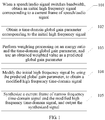
- an embodiment of a speech/audio signal processing method of the present invention includes:
- the current frame of speech/audio signal includes a current frame of narrow frequency signal and a current frame of high frequency time-domain signal.
- Bandwidth switching includes switching from a narrow frequency signal to a wide frequency signal and switching from a wide frequency signal to a narrow frequency signal.
- the current frame of speech/audio signal is the current frame of wide frequency signal, including a narrow frequency signal and a high frequency signal
- the initial high frequency signal of the current frame of speech/audio signal is a real signal and may be directly obtained from the current frame of speech/audio signal.
- the current frame of speech/audio signal is the current frame of narrow frequency signal of which a current frame of high frequency time-domain signal is empty, the initial high frequency signal of the current frame of speech/audio signal is a predicted signal, and a high frequency signal corresponding to the current frame of narrow frequency signal needs to be predicted and used as the initial high frequency signal.
- the time-domain global gain parameter of the high frequency signal may be obtained by decoding.
- the time-domain global gain parameter of the high frequency signal may be obtained according to the current frame of signal: the time-domain global gain parameter of the high frequency signal is obtained according to a spectrum tilt parameter of the narrow frequency signal and a correlation between a current frame of narrow frequency signal and a historical frame of narrow frequency signal.
- S103 Perform weighting processing on an energy ratio and the time-domain global gain parameter, and use an obtained weighted value as a predicted global gain parameter, where the energy ratio is a ratio between energy of a high frequency time-domain signal of a historical frame of speech/audio signal and energy of the initial high frequency signal of the current frame of speech/audio signal.
- a historical frame of final output speech/audio signal is used as the historical frame of speech/audio signal is used, and the initial high frequency signal is used as the current frame of speech/audio signal.
- the energy ratio Ratio Esyn(-1)/Esyn_tmp, where Esyn(-1) represents the energy of the output high frequency time-domain signal syn of the historical frame, and Esyn_tmp represents the energy of the initial high frequency time-domain signal syn corresponding to the current frame.
- S104 Correct the initial high frequency signal by using the predicted global gain parameter, to obtain a corrected high frequency time-domain signal.
- the correction refers to that the signal is multiplied, that is, the initial high frequency signal is multiplied by the predicted global gain parameter.
- step S102 a time-domain envelope parameter and the time-domain global gain parameter that are corresponding to the initial high frequency signal are obtained; therefore, in step S104, the initial high frequency signal is corrected by using the time-domain envelope parameter and the predicted global gain parameter, to obtain the corrected high frequency time-domain signal; that is, the predicted high frequency signal is multiplied by the time-domain envelope parameter and the predicted time-domain global gain parameter, to obtain the corrected high frequency time-domain signal.
- the time-domain envelope parameter of the high frequency signal may be obtained by decoding.
- the time-domain envelope parameter of the high frequency signal may be obtained according to the current frame of signal: a series of predetermined values or a high frequency time-domain envelope parameter of the historical frame may be used as the high frequency time-domain envelope parameter of the current frame of speech/audio signal.
- S105 Synthesize a current frame of narrow frequency time-domain signal and the corrected high frequency time-domain signal and output the synthesized signal.
- a high frequency signal is corrected, so as to implement a smooth transition of the high frequency signal between the wide frequency band and the narrow frequency band, thereby effectively eliminating aural discomfort caused by the switching between the wide frequency band and the narrow frequency band; in addition, because a bandwidth switching algorithm and a coding/decoding algorithm of the high frequency signal before switching are in a same signal domain, it not only ensures that no extra delay is added and the algorithm is simple, it also ensures performance of an output signal.
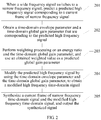
- FIG. 2 another embodiment of a speech/audio signal processing method of the present invention includes:
- the step of predicting a predicted high frequency signal corresponding to a current frame of narrow frequency signal includes: predicting an excitation signal of the high frequency signal of the current frame of speech/audio signal according to the current frame of narrow frequency signal; predicting an LPC (Linear Predictive Coding, linear predictive coding) coefficient of the high frequency signal of the current frame of speech/audio signal; and synthesizing the predicted high frequency excitation signal and the LPC coefficient, to obtain the predicted high frequency signal syn_tmp.
- LPC Linear Predictive Coding, linear predictive coding
- parameters such as a pitch period, an algebraic codebook, and a gain may be extracted from the narrow frequency signal, and the high frequency excitation signal is predicted by resampling and filtering.
- operations such as up-sampling, low-pass, and obtaining of an absolute value or a square may be performed on the narrow frequency time-domain signal or a narrow frequency time-domain excitation signal, so as to predict the high frequency excitation signal.
- a high frequency LPC coefficient of a historical frame or a series of preset values may be used as the LPC coefficient of the current frame; or different prediction manners may be used for different signal types.
- S202 Obtain a time-domain envelope parameter and a time-domain global gain parameter that are corresponding to the predicted high frequency signal.
- a series of predetermined values may be used as the high frequency time-domain envelope parameter of the current frame.
- Narrowband signals may be generally classified into several types, a series of values may be preset for each type, and a group of preset time-domain envelope parameters may be selected according to types of current frame of narrowband signals; or a group of time-domain envelope values may be set, for example, when the number of time-domain envelops is M, the preset values may be M 0.3536s.
- the obtaining of a time-domain envelope parameter is an optional but not a necessary step.
- the time-domain global gain parameter of the high frequency signal is obtained according to a spectrum tilt parameter of the narrow frequency signal and a correlation between a current frame of narrow frequency signal and a historical frame of narrow frequency signal, which includes the following steps in an embodiment:
- the parameter cor showing the correlation between the current frame of narrow frequency signal and the historical frame of narrow frequency signal may be determined according to an energy magnitude relationship between signals of a same frequency band, or may be determined according to an energy relationship between several same frequency bands, or may be calculated according to a formula showing a self-correlation or a cross-correlation between time-domain signals or showing a self-correlation or a cross-correlation between time-domain excitation signals.
- S2022 When the current frame of speech/audio signal is a first type of signal, limit the spectrum tilt parameter to less than or equal to a first predetermined value, to obtain a spectrum tilt parameter limit value, and use the spectrum tilt parameter limit value as the time-domain global gain parameter of the high frequency signal. That is, when the spectrum tilt parameter of the current frame of speech/audio signal is less than or equal to the first predetermined value, an original value of the spectrum tilt parameter is kept as the spectrum tilt parameter limit value; when spectrum tilt parameter of the current frame of speech/audio signal is greater than the first predetermined value, the first predetermined value is used as the spectrum tilt parameter limit value.
- the spectrum tilt parameter of the current frame of speech/audio signal belongs to the first range, an original value of the spectrum tilt parameter is kept as the spectrum tilt parameter limit value; when the spectrum tilt parameter of the current frame of speech/audio signal is greater than an upper limit of the first range, the upper limit of the first range is used as the spectrum tilt parameter limit value; when the spectrum tilt parameter of the current frame of speech/audio signal is less than a lower limit of the first range, the lower limit of the first range is used as the spectrum tilt parameter limit value.
- a spectrum tilt parameter may be any value greater than 5, and for a non-fricative, a spectrum tilt parameter may be any value less than or equal to 5, or may be greater than 5.
- S203 Perform weighting processing on an energy ratio and the time-domain global gain parameter, and use an obtained weighted value as a predicted global gain parameter, where the energy ratio is a ratio between energy of a high frequency time-domain signal of a historical frame of speech/audio signal and energy of the initial high frequency signal of the current frame of speech/audio signal.
- the predicted high frequency signal is multiplied by the time-domain envelope parameter and the predicted time-domain global gain parameter, to obtain the high frequency time-domain signal.
- the time-domain envelope parameter is optional.
- the predicted high frequency signal may be corrected by using the predicted global gain parameter, to obtain the corrected high frequency time-domain signal. That is, the predicted high frequency signal is multiplied by the predicted global gain parameter, to obtain the corrected high frequency time-domain signal.
- S205 Synthesize the current frame of narrow frequency time-domain signal and the corrected high frequency time-domain signal and output the synthesized signal.
- the energy Esyn of the high frequency time-domain signal syn is used to predict a time-domain global gain parameter of a next frame. That is, a value of Esyn is assigned to Esyn(-1).
- a high frequency band of a narrow frequency signal following a wide frequency signal is corrected, so as to implement a smooth transition of the high frequency part between a wide frequency band and a narrow frequency band, thereby effectively eliminating aural discomfort caused by the switching between the wide frequency band and the narrow frequency band; in addition, because corresponding processing is performed on the frame during the switching, a problem that occurs during parameter and status updating is indirectly eliminated.
- a bandwidth switching algorithm and a coding/decoding algorithm of the high frequency signal before the switching in a same signal domain, it not only ensures that no extra delay is added and the algorithm is simple, it also ensures performance of an output signal.
- FIG. 3 another embodiment of a speech/audio signal processing method of the present invention includes:
- a narrow frequency signal switches to a wide frequency signal
- a previous frame is a narrow frequency signal
- a current frame is a wide frequency signal
- S302 Obtain a time-domain envelope parameter and a time-domain global gain parameter that are corresponding to the high frequency signal.
- the time-domain envelope parameter and the time-domain global gain parameter may be directly obtained from the current frame of high frequency signal.
- the obtaining of a time-domain envelope parameter is an optional step.
- S303 Perform weighting processing on an energy ratio and the time-domain global gain parameter, and use an obtained weighted value as a predicted global gain parameter, where the energy ratio is a ratio between energy of a high frequency time-domain signal of a historical frame of speech/audio signal and energy of an initial high frequency signal of a current frame of speech/audio signal.
- the time-domain global gain parameter is smoothed in the following manner:
- a value obtained by attenuating, according to a step size, a weighting factor alfa of an energy ratio corresponding to the previous frame of speech/audio signal is used as a weighting factor of an energy ratio corresponding to the current audio frame, where the attenuation is performed frame by frame until alfa is 0.
- alfa is attenuated frame by frame according to a step size until alfa is attenuated to 0; when the narrow frequency signals of the consecutive frames have no correlation, alfa is directly attenuated to 0, that is, a current decoding result is maintained without performing weighting or correcting.
- S304 Correct the high frequency signal by using the time-domain envelope parameter and the predicted global gain parameter, to obtain a corrected high frequency time-domain signal.
- the correction refers to that the high frequency signal is multiplied by the time-domain envelope parameter and the predicted time-domain global gain parameter, to obtain the corrected high frequency time-domain signal.
- the time-domain envelope parameter is optional.
- the high frequency signal may be corrected by using the predicted global gain parameter, to obtain the corrected high frequency time-domain signal. That is, the high frequency signal is multiplied by the predicted global gain parameter, to obtain the corrected high frequency time-domain signal.
- S305 Synthesize a current frame of narrow frequency time-domain signal and the corrected high frequency time-domain signal and output the synthesized signal.
- a high frequency band of a wide frequency signal following a narrow frequency signal is corrected, so as to implement a smooth transition of the high frequency part between a wide frequency band and a narrow frequency band, thereby effectively eliminating aural discomfort caused by the switching between the wide frequency band and the narrow frequency band; in addition, because corresponding processing is performed on the frame of during the switching, a problem that occurs during parameter and status updating is indirectly eliminated.
- a bandwidth switching algorithm and a coding/decoding algorithm of the high frequency signal before the switching in a same signal domain, it not only ensures that no extra delay is added and the algorithm is simple, it also ensures performance of an output signal.
- FIG. 4 another embodiment of a speech/audio signal processing method of the present invention includes:
- the step of predicting an initial high frequency signal corresponding to a current frame of narrow frequency signal includes: predicting an excitation signal of the high frequency signal of the current frame of speech/audio signal according to the current frame of narrow frequency signal; predicting an LPC coefficient of the high frequency signal of the current frame of speech/audio signal; and synthesizing the predicted high frequency excitation signal and the LPC coefficient, to obtain the predicted high frequency signal syn_tmp.
- parameters such as a pitch period, an algebraic codebook, and a gain may be extracted from the narrow frequency signal, and the high frequency excitation signal is predicted by resampling and filtering.
- operations such as up-sampling, low-pass, and obtaining of an absolute value or a square may be performed on the narrow frequency time-domain signal or a narrow frequency time-domain excitation signal, so as to predict the high frequency excitation signal.
- a high frequency LPC coefficient of a historical frame or a series of preset values may be used as the LPC coefficient of the current frame; or different prediction manners may be used for different signal types.
- S402 Obtain a time-domain global gain parameter of the high frequency signal according to a spectrum tilt parameter of the current frame of speech/audio signal and a correlation between a current frame of narrow frequency signal and a historical frame of narrow frequency signal.
- the narrow frequency signal when the spectrum tilt parameter tilt>5, and a correlation parameter cor is less than a given value, the narrow frequency signal is classified as a fricative, the rest being non-fricatives.
- the parameter cor showing the correlation between the current frame of narrow frequency signal and the historical frame of narrow frequency signal may be determined according to an energy magnitude relationship between signals of a same frequency band, or may be determined according to an energy relationship between several same frequency bands, or may be calculated according to a formula showing a self-correlation or a cross-correlation between time-domain signals or showing a self-correlation or a cross-correlation between time-domain excitation signals.
- S2022 When the current frame of speech/audio signal is a first type of signal, limit the spectrum tilt parameter to less than or equal to a first predetermined value, to obtain a spectrum tilt parameter limit value, and use the spectrum tilt parameter limit value as the time-domain global gain parameter of the high frequency signal. That is, when the spectrum tilt parameter of the current frame of speech/audio signal is less than or equal to the first predetermined value, an original value of the spectrum tilt parameter is kept as the spectrum tilt parameter limit value; when spectrum tilt parameter of the current frame of speech/audio signal is greater than the first predetermined value, the first predetermined value is used as the spectrum tilt parameter limit value.
- the spectrum tilt parameter of the current frame of speech/audio signal belongs to the first range, an original value of the spectrum tilt parameter is kept as the spectrum tilt parameter limit value; when the spectrum tilt parameter of the current frame of speech/audio signal is greater than an upper limit of the first range, the upper limit of the first range is used as the spectrum tilt parameter limit value; when the spectrum tilt parameter of the current frame of speech/audio signal is less than a lower limit of the first range, the lower limit of the first range is used as the spectrum tilt parameter limit value.
- a spectrum tilt parameter may be any value greater than 5, and for a non-fricative, a spectrum tilt parameter may be any value less than or equal to 5, or may be greater than 5.
- the initial high frequency signal is multiplied by the time-domain global gain parameter, to obtain the corrected high frequency time-domain signal.
- step S403 may include:
- the method may further include:
- S404 Synthesize a current frame of narrow frequency time-domain signal and the corrected high frequency time-domain signal and output the synthesized signal.
- a time-domain global gain parameter of a high frequency signal is obtained according to a spectrum tilt parameter and an interframe correlation.
- the narrow frequency spectrum tilt parameter an energy relationship between a narrow frequency signal and a high frequency signal can be correctly estimated, so as to better estimate energy of the high frequency signal.
- the interframe correlation an interframe correlation between high frequency signals can be estimated by making a good use of the correlation between narrow frequency frames. In this way, when weighting is performed to obtain a high frequency global gain, the foregoing real information can be used well, and an undesirable noise is not introduced.
- the high frequency signal is corrected by using the time-domain global gain parameter, so as to implement a smooth transition of the high frequency part between the wide frequency band and the narrow frequency band, thereby effectively eliminating aural discomfort caused by the switching between the wide frequency band and the narrow frequency band.
- the present invention further provides a speech/audio signal processing apparatus.
- the apparatus may be located in a terminal device, a network device, or a test device.
- the speech/audio signal processing apparatus may be implemented by a hardware circuit, or may be implemented by software in combination with hardware.
- a processor invokes the speech/audio signal processing apparatus, to implement speech/audio signal processing.
- the speech/audio signal processing apparatus may execute the methods and processes in the foregoing method embodiments.
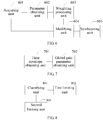
- an embodiment of a speech/audio signal processing apparatus includes:
- the bandwidth switching is switching from a wide frequency signal to a narrow frequency signal
- the parameter obtaining unit 602 includes:
- the bandwidth switching is switching from a wide frequency signal to a narrow frequency signal
- the parameter obtaining unit 602 includes:
- the correcting unit 604 is configured to correct the initial high frequency signal by using the time-domain envelope parameter and the predicted global gain parameter, to obtain the corrected high frequency time-domain signal.
- an embodiment of the global gain parameter obtaining unit 702 includes:
- the first type of signal is a fricative signal
- the second type of signal is a non-fricative signal
- the narrow frequency signal is classified as a fricative, the rest being non-fricatives
- the first predetermined value is 8
- the first preset range is [0.5, 1].
- the acquiring unit 601 includes:
- the bandwidth switching is switching from a narrow frequency signal to a wide frequency signal
- the speech/audio signal processing apparatus further includes:
- FIG. 10 another embodiment of a speech/audio signal processing apparatus includes:
- the parameter obtaining unit 1002 includes:
- the first type of signal is a fricative signal
- the second type of signal is a non-fricative signal
- the narrow frequency signal is classified as a fricative, the rest being non-fricatives
- the first predetermined value is 8
- the first preset range is [0.5, 1].
- the speech/audio signal processing apparatus further includes:
- the parameter obtaining unit is further configured to obtain a time-domain envelope parameter corresponding to the initial high frequency signal; and the correcting unit is configured to correct the initial high frequency signal by using the time-domain envelope parameter and the time-domain global gain parameter.
- the program may be stored in a computer readable storage medium. When the program runs, the processes of the methods in the embodiments are performed.
- the storage medium may include: a magnetic disk, an optical disc, a read-only memory (Read-Only Memory, ROM), or a random access memory (Random Access Memory, RAM).
Landscapes
- Engineering & Computer Science (AREA)
- Physics & Mathematics (AREA)
- Multimedia (AREA)
- Health & Medical Sciences (AREA)
- Audiology, Speech & Language Pathology (AREA)
- Human Computer Interaction (AREA)
- Computational Linguistics (AREA)
- Acoustics & Sound (AREA)
- Signal Processing (AREA)
- Quality & Reliability (AREA)
- Compression, Expansion, Code Conversion, And Decoders (AREA)
- Telephone Function (AREA)
- Transmitters (AREA)
- Circuit For Audible Band Transducer (AREA)
- Tone Control, Compression And Expansion, Limiting Amplitude (AREA)
Priority Applications (3)
| Application Number | Priority Date | Filing Date | Title |
|---|---|---|---|
| EP18199234.8A EP3534365B1 (en) | 2012-03-01 | 2013-03-01 | Speech/audio signal processing method and apparatus |
| EP16187948.1A EP3193331B1 (en) | 2012-03-01 | 2013-03-01 | Speech/audio signal processing method and apparatus |
| PL18199234T PL3534365T3 (pl) | 2012-03-01 | 2013-03-01 | Sposób i aparat do przetwarzania sygnału mowy/dźwięku |
Applications Claiming Priority (2)
| Application Number | Priority Date | Filing Date | Title |
|---|---|---|---|
| CN201210051672.6A CN103295578B (zh) | 2012-03-01 | 2012-03-01 | 一种语音频信号处理方法和装置 |
| PCT/CN2013/072075 WO2013127364A1 (zh) | 2012-03-01 | 2013-03-01 | 一种语音频信号处理方法和装置 |
Related Child Applications (3)
| Application Number | Title | Priority Date | Filing Date |
|---|---|---|---|
| EP18199234.8A Division EP3534365B1 (en) | 2012-03-01 | 2013-03-01 | Speech/audio signal processing method and apparatus |
| EP16187948.1A Division EP3193331B1 (en) | 2012-03-01 | 2013-03-01 | Speech/audio signal processing method and apparatus |
| EP16187948.1A Division-Into EP3193331B1 (en) | 2012-03-01 | 2013-03-01 | Speech/audio signal processing method and apparatus |
Publications (3)
| Publication Number | Publication Date |
|---|---|
| EP2821993A1 EP2821993A1 (en) | 2015-01-07 |
| EP2821993A4 EP2821993A4 (en) | 2015-02-25 |
| EP2821993B1 true EP2821993B1 (en) | 2017-05-10 |
Family
ID=49081655
Family Applications (3)
| Application Number | Title | Priority Date | Filing Date |
|---|---|---|---|
| EP13754564.6A Active EP2821993B1 (en) | 2012-03-01 | 2013-03-01 | Voice frequency signal processing method and device |
| EP18199234.8A Active EP3534365B1 (en) | 2012-03-01 | 2013-03-01 | Speech/audio signal processing method and apparatus |
| EP16187948.1A Active EP3193331B1 (en) | 2012-03-01 | 2013-03-01 | Speech/audio signal processing method and apparatus |
Family Applications After (2)
| Application Number | Title | Priority Date | Filing Date |
|---|---|---|---|
| EP18199234.8A Active EP3534365B1 (en) | 2012-03-01 | 2013-03-01 | Speech/audio signal processing method and apparatus |
| EP16187948.1A Active EP3193331B1 (en) | 2012-03-01 | 2013-03-01 | Speech/audio signal processing method and apparatus |
Country Status (20)
| Country | Link |
|---|---|
| US (4) | US9691396B2 (enExample) |
| EP (3) | EP2821993B1 (enExample) |
| JP (3) | JP6010141B2 (enExample) |
| KR (3) | KR101667865B1 (enExample) |
| CN (2) | CN105469805B (enExample) |
| BR (1) | BR112014021407B1 (enExample) |
| CA (1) | CA2865533C (enExample) |
| DK (1) | DK3534365T3 (enExample) |
| ES (3) | ES2741849T3 (enExample) |
| HU (1) | HUE053834T2 (enExample) |
| IN (1) | IN2014KN01739A (enExample) |
| MX (2) | MX345604B (enExample) |
| MY (1) | MY162423A (enExample) |
| PL (1) | PL3534365T3 (enExample) |
| PT (2) | PT3193331T (enExample) |
| RU (2) | RU2616557C1 (enExample) |
| SG (2) | SG11201404954WA (enExample) |
| TR (1) | TR201911006T4 (enExample) |
| WO (1) | WO2013127364A1 (enExample) |
| ZA (1) | ZA201406248B (enExample) |
Families Citing this family (35)
| Publication number | Priority date | Publication date | Assignee | Title |
|---|---|---|---|---|
| CN105469805B (zh) | 2012-03-01 | 2018-01-12 | 华为技术有限公司 | 一种语音频信号处理方法和装置 |
| CN108364657B (zh) | 2013-07-16 | 2020-10-30 | 超清编解码有限公司 | 处理丢失帧的方法和解码器 |
| CN108172239B (zh) * | 2013-09-26 | 2021-01-12 | 华为技术有限公司 | 频带扩展的方法及装置 |
| CA2927716C (en) | 2013-10-18 | 2020-09-01 | Fraunhofer-Gesellschaft Zur Foerderung Der Angewandten Forschung E.V. | Concept for encoding an audio signal and decoding an audio signal using speech related spectral shaping information |
| ES2839086T3 (es) * | 2013-10-18 | 2021-07-05 | Fraunhofer Ges Forschung | Concepto para codificar una señal de audio y decodificar una señal de audio usando información determinista y con características de ruido |
| US9524720B2 (en) * | 2013-12-15 | 2016-12-20 | Qualcomm Incorporated | Systems and methods of blind bandwidth extension |
| KR101864122B1 (ko) | 2014-02-20 | 2018-06-05 | 삼성전자주식회사 | 전자 장치 및 전자 장치의 제어 방법 |
| CN106683681B (zh) | 2014-06-25 | 2020-09-25 | 华为技术有限公司 | 处理丢失帧的方法和装置 |
| GB2578386B (en) | 2017-06-27 | 2021-12-01 | Cirrus Logic Int Semiconductor Ltd | Detection of replay attack |
| GB2563953A (en) | 2017-06-28 | 2019-01-02 | Cirrus Logic Int Semiconductor Ltd | Detection of replay attack |
| GB201713697D0 (en) | 2017-06-28 | 2017-10-11 | Cirrus Logic Int Semiconductor Ltd | Magnetic detection of replay attack |
| GB201801526D0 (en) | 2017-07-07 | 2018-03-14 | Cirrus Logic Int Semiconductor Ltd | Methods, apparatus and systems for authentication |
| GB201801528D0 (en) | 2017-07-07 | 2018-03-14 | Cirrus Logic Int Semiconductor Ltd | Method, apparatus and systems for biometric processes |
| GB201801532D0 (en) | 2017-07-07 | 2018-03-14 | Cirrus Logic Int Semiconductor Ltd | Methods, apparatus and systems for audio playback |
| GB201801527D0 (en) | 2017-07-07 | 2018-03-14 | Cirrus Logic Int Semiconductor Ltd | Method, apparatus and systems for biometric processes |
| GB201801530D0 (en) | 2017-07-07 | 2018-03-14 | Cirrus Logic Int Semiconductor Ltd | Methods, apparatus and systems for authentication |
| GB201801664D0 (en) | 2017-10-13 | 2018-03-21 | Cirrus Logic Int Semiconductor Ltd | Detection of liveness |
| GB2567503A (en) | 2017-10-13 | 2019-04-17 | Cirrus Logic Int Semiconductor Ltd | Analysing speech signals |
| GB201719734D0 (en) * | 2017-10-30 | 2018-01-10 | Cirrus Logic Int Semiconductor Ltd | Speaker identification |
| GB201801663D0 (en) | 2017-10-13 | 2018-03-21 | Cirrus Logic Int Semiconductor Ltd | Detection of liveness |
| GB201804843D0 (en) | 2017-11-14 | 2018-05-09 | Cirrus Logic Int Semiconductor Ltd | Detection of replay attack |
| GB201801874D0 (en) | 2017-10-13 | 2018-03-21 | Cirrus Logic Int Semiconductor Ltd | Improving robustness of speech processing system against ultrasound and dolphin attacks |
| GB201803570D0 (en) | 2017-10-13 | 2018-04-18 | Cirrus Logic Int Semiconductor Ltd | Detection of replay attack |
| GB201801659D0 (en) | 2017-11-14 | 2018-03-21 | Cirrus Logic Int Semiconductor Ltd | Detection of loudspeaker playback |
| US11475899B2 (en) | 2018-01-23 | 2022-10-18 | Cirrus Logic, Inc. | Speaker identification |
| US11264037B2 (en) | 2018-01-23 | 2022-03-01 | Cirrus Logic, Inc. | Speaker identification |
| US11735189B2 (en) | 2018-01-23 | 2023-08-22 | Cirrus Logic, Inc. | Speaker identification |
| US10692490B2 (en) | 2018-07-31 | 2020-06-23 | Cirrus Logic, Inc. | Detection of replay attack |
| US10915614B2 (en) | 2018-08-31 | 2021-02-09 | Cirrus Logic, Inc. | Biometric authentication |
| US11037574B2 (en) | 2018-09-05 | 2021-06-15 | Cirrus Logic, Inc. | Speaker recognition and speaker change detection |
| CN111554309B (zh) * | 2020-05-15 | 2024-11-22 | 腾讯科技(深圳)有限公司 | 一种语音处理方法、装置、设备及存储介质 |
| CN112927709B (zh) * | 2021-02-04 | 2022-06-14 | 武汉大学 | 一种基于时频域联合损失函数的语音增强方法 |
| CN113571079B (zh) * | 2021-02-08 | 2025-07-11 | 腾讯科技(深圳)有限公司 | 语音增强方法、装置、设备及存储介质 |
| CN113470691B (zh) * | 2021-07-08 | 2024-08-30 | 浙江大华技术股份有限公司 | 一种语音信号的自动增益控制方法及其相关装置 |
| CN115294947B (zh) * | 2022-07-29 | 2024-06-11 | 腾讯科技(深圳)有限公司 | 音频数据处理方法、装置、电子设备及介质 |
Family Cites Families (26)
| Publication number | Priority date | Publication date | Assignee | Title |
|---|---|---|---|---|
| CA2252170A1 (en) | 1998-10-27 | 2000-04-27 | Bruno Bessette | A method and device for high quality coding of wideband speech and audio signals |
| WO2000065866A1 (en) | 1999-04-26 | 2000-11-02 | Lucent Technologies Inc. | Path switching according to transmission requirements |
| CA2290037A1 (en) * | 1999-11-18 | 2001-05-18 | Voiceage Corporation | Gain-smoothing amplifier device and method in codecs for wideband speech and audio signals |
| US6606591B1 (en) | 2000-04-13 | 2003-08-12 | Conexant Systems, Inc. | Speech coding employing hybrid linear prediction coding |
| US7113522B2 (en) | 2001-01-24 | 2006-09-26 | Qualcomm, Incorporated | Enhanced conversion of wideband signals to narrowband signals |
| JP2003044098A (ja) | 2001-07-26 | 2003-02-14 | Nec Corp | 音声帯域拡張装置及び音声帯域拡張方法 |
| US7895035B2 (en) | 2004-09-06 | 2011-02-22 | Panasonic Corporation | Scalable decoding apparatus and method for concealing lost spectral parameters |
| CN101213590B (zh) * | 2005-06-29 | 2011-09-21 | 松下电器产业株式会社 | 可扩展解码装置及丢失数据插值方法 |
| RU2414009C2 (ru) * | 2006-01-18 | 2011-03-10 | ЭлДжи ЭЛЕКТРОНИКС ИНК. | Устройство и способ для кодирования и декодирования сигнала |
| KR20080101872A (ko) | 2006-01-18 | 2008-11-21 | 연세대학교 산학협력단 | 부호화/복호화 장치 및 방법 |
| US9454974B2 (en) | 2006-07-31 | 2016-09-27 | Qualcomm Incorporated | Systems, methods, and apparatus for gain factor limiting |
| GB2444757B (en) | 2006-12-13 | 2009-04-22 | Motorola Inc | Code excited linear prediction speech coding |
| JP4733727B2 (ja) | 2007-10-30 | 2011-07-27 | 日本電信電話株式会社 | 音声楽音擬似広帯域化装置と音声楽音擬似広帯域化方法、及びそのプログラムとその記録媒体 |
| JP5547081B2 (ja) * | 2007-11-02 | 2014-07-09 | 華為技術有限公司 | 音声復号化方法及び装置 |
| CN100585699C (zh) * | 2007-11-02 | 2010-01-27 | 华为技术有限公司 | 一种音频解码的方法和装置 |
| KR100930061B1 (ko) * | 2008-01-22 | 2009-12-08 | 성균관대학교산학협력단 | 신호 검출 방법 및 장치 |
| CN101499278B (zh) * | 2008-02-01 | 2011-12-28 | 华为技术有限公司 | 音频信号切换处理方法和装置 |
| CN101751925B (zh) * | 2008-12-10 | 2011-12-21 | 华为技术有限公司 | 一种语音解码方法及装置 |
| JP5448657B2 (ja) * | 2009-09-04 | 2014-03-19 | 三菱重工業株式会社 | 空気調和機の室外機 |
| US8484020B2 (en) * | 2009-10-23 | 2013-07-09 | Qualcomm Incorporated | Determining an upperband signal from a narrowband signal |
| CN102044250B (zh) * | 2009-10-23 | 2012-06-27 | 华为技术有限公司 | 频带扩展方法及装置 |
| JP5287685B2 (ja) * | 2009-11-30 | 2013-09-11 | ダイキン工業株式会社 | 空調室外機 |
| CN101964189B (zh) * | 2010-04-28 | 2012-08-08 | 华为技术有限公司 | 语音频信号切换方法及装置 |
| US8000968B1 (en) * | 2011-04-26 | 2011-08-16 | Huawei Technologies Co., Ltd. | Method and apparatus for switching speech or audio signals |
| AR085895A1 (es) * | 2011-02-14 | 2013-11-06 | Fraunhofer Ges Forschung | Generacion de ruido en codecs de audio |
| CN105469805B (zh) * | 2012-03-01 | 2018-01-12 | 华为技术有限公司 | 一种语音频信号处理方法和装置 |
-
2012
- 2012-03-01 CN CN201510991494.9A patent/CN105469805B/zh active Active
- 2012-03-01 CN CN201210051672.6A patent/CN103295578B/zh active Active
-
2013
- 2013-03-01 RU RU2016115109A patent/RU2616557C1/ru active
- 2013-03-01 CA CA2865533A patent/CA2865533C/en active Active
- 2013-03-01 IN IN1739KON2014 patent/IN2014KN01739A/en unknown
- 2013-03-01 EP EP13754564.6A patent/EP2821993B1/en active Active
- 2013-03-01 MY MYPI2014002393A patent/MY162423A/en unknown
- 2013-03-01 TR TR2019/11006T patent/TR201911006T4/tr unknown
- 2013-03-01 PT PT16187948T patent/PT3193331T/pt unknown
- 2013-03-01 EP EP18199234.8A patent/EP3534365B1/en active Active
- 2013-03-01 WO PCT/CN2013/072075 patent/WO2013127364A1/zh not_active Ceased
- 2013-03-01 BR BR112014021407-7A patent/BR112014021407B1/pt active IP Right Grant
- 2013-03-01 ES ES16187948T patent/ES2741849T3/es active Active
- 2013-03-01 ES ES13754564.6T patent/ES2629135T3/es active Active
- 2013-03-01 KR KR1020147025655A patent/KR101667865B1/ko active Active
- 2013-03-01 JP JP2014559077A patent/JP6010141B2/ja active Active
- 2013-03-01 EP EP16187948.1A patent/EP3193331B1/en active Active
- 2013-03-01 MX MX2014010376A patent/MX345604B/es active IP Right Grant
- 2013-03-01 DK DK18199234.8T patent/DK3534365T3/da active
- 2013-03-01 ES ES18199234T patent/ES2867537T3/es active Active
- 2013-03-01 PT PT137545646T patent/PT2821993T/pt unknown
- 2013-03-01 PL PL18199234T patent/PL3534365T3/pl unknown
- 2013-03-01 KR KR1020177002148A patent/KR101844199B1/ko active Active
- 2013-03-01 RU RU2014139605/08A patent/RU2585987C2/ru active
- 2013-03-01 KR KR1020167028242A patent/KR101702281B1/ko active Active
- 2013-03-01 MX MX2017001662A patent/MX364202B/es unknown
- 2013-03-01 SG SG11201404954WA patent/SG11201404954WA/en unknown
- 2013-03-01 HU HUE18199234A patent/HUE053834T2/hu unknown
- 2013-03-01 SG SG10201608440XA patent/SG10201608440XA/en unknown
-
2014
- 2014-08-25 ZA ZA2014/06248A patent/ZA201406248B/en unknown
- 2014-08-27 US US14/470,559 patent/US9691396B2/en active Active
-
2016
- 2016-09-15 JP JP2016180496A patent/JP6378274B2/ja active Active
-
2017
- 2017-06-07 US US15/616,188 patent/US10013987B2/en active Active
-
2018
- 2018-06-28 US US16/021,621 patent/US10360917B2/en active Active
- 2018-07-26 JP JP2018140054A patent/JP6558748B2/ja active Active
-
2019
- 2019-06-28 US US16/457,165 patent/US10559313B2/en active Active
Also Published As
Similar Documents
| Publication | Publication Date | Title |
|---|---|---|
| US10559313B2 (en) | Speech/audio signal processing method and apparatus | |
| EP3249648B1 (en) | Method and apparatus for switching speech or audio signals | |
| KR101668401B1 (ko) | 오디오 신호를 인코딩하기 위한 방법 및 장치 | |
| RU2617926C1 (ru) | Способ, устройство и система для обработки аудиоданных | |
| EP1047045A2 (en) | Sound synthesizing apparatus and method | |
| CN114550732B (zh) | 一种高频音频信号的编解码方法和相关装置 | |
| EP2660812A1 (en) | Bandwidth expansion method and apparatus | |
| JP2016529542A (ja) | ロストフレームを処理するための方法および復号器 | |
| CN101136200B (zh) | 音频信号转换编码方法与系统 | |
| HK1190838A (en) | Signal coding and decoding method and equipment thereof | |
| HK1190838B (en) | Signal coding and decoding method and equipment thereof | |
| HK1199540B (en) | Forecasting method for high-frequency band signal, encoding device and decoding device |
Legal Events
| Date | Code | Title | Description |
|---|---|---|---|
| PUAI | Public reference made under article 153(3) epc to a published international application that has entered the european phase |
Free format text: ORIGINAL CODE: 0009012 |
|
| 17P | Request for examination filed |
Effective date: 20141001 |
|
| AK | Designated contracting states |
Kind code of ref document: A1 Designated state(s): AL AT BE BG CH CY CZ DE DK EE ES FI FR GB GR HR HU IE IS IT LI LT LU LV MC MK MT NL NO PL PT RO RS SE SI SK SM TR |
|
| AX | Request for extension of the european patent |
Extension state: BA ME |
|
| A4 | Supplementary search report drawn up and despatched |
Effective date: 20150123 |
|
| RIC1 | Information provided on ipc code assigned before grant |
Ipc: G10L 19/24 20130101ALI20150119BHEP Ipc: G10L 21/02 20130101ALI20150119BHEP Ipc: G10L 19/00 20130101AFI20150119BHEP |
|
| DAX | Request for extension of the european patent (deleted) | ||
| REG | Reference to a national code |
Ref country code: DE Ref legal event code: R079 Ref document number: 602013020969 Country of ref document: DE Free format text: PREVIOUS MAIN CLASS: G10L0019000000 Ipc: G10L0019083000 |
|
| RIC1 | Information provided on ipc code assigned before grant |
Ipc: G10L 19/02 20130101ALI20151012BHEP Ipc: G10L 19/083 20130101AFI20151012BHEP |
|
| GRAP | Despatch of communication of intention to grant a patent |
Free format text: ORIGINAL CODE: EPIDOSNIGR1 |
|
| INTG | Intention to grant announced |
Effective date: 20160506 |
|
| GRAJ | Information related to disapproval of communication of intention to grant by the applicant or resumption of examination proceedings by the epo deleted |
Free format text: ORIGINAL CODE: EPIDOSDIGR1 |
|
| INTC | Intention to grant announced (deleted) | ||
| GRAP | Despatch of communication of intention to grant a patent |
Free format text: ORIGINAL CODE: EPIDOSNIGR1 |
|
| INTG | Intention to grant announced |
Effective date: 20161028 |
|
| GRAS | Grant fee paid |
Free format text: ORIGINAL CODE: EPIDOSNIGR3 |
|
| GRAA | (expected) grant |
Free format text: ORIGINAL CODE: 0009210 |
|
| AK | Designated contracting states |
Kind code of ref document: B1 Designated state(s): AL AT BE BG CH CY CZ DE DK EE ES FI FR GB GR HR HU IE IS IT LI LT LU LV MC MK MT NL NO PL PT RO RS SE SI SK SM TR |
|
| REG | Reference to a national code |
Ref country code: GB Ref legal event code: FG4D |
|
| REG | Reference to a national code |
Ref country code: AT Ref legal event code: REF Ref document number: 893098 Country of ref document: AT Kind code of ref document: T Effective date: 20170515 Ref country code: CH Ref legal event code: EP |
|
| REG | Reference to a national code |
Ref country code: IE Ref legal event code: FG4D |
|
| REG | Reference to a national code |
Ref country code: DE Ref legal event code: R096 Ref document number: 602013020969 Country of ref document: DE |
|
| REG | Reference to a national code |
Ref country code: PT Ref legal event code: SC4A Ref document number: 2821993 Country of ref document: PT Date of ref document: 20170713 Kind code of ref document: T Free format text: AVAILABILITY OF NATIONAL TRANSLATION Effective date: 20170704 |
|
| REG | Reference to a national code |
Ref country code: NL Ref legal event code: FP |
|
| REG | Reference to a national code |
Ref country code: ES Ref legal event code: FG2A Ref document number: 2629135 Country of ref document: ES Kind code of ref document: T3 Effective date: 20170807 |
|
| REG | Reference to a national code |
Ref country code: SE Ref legal event code: TRGR |
|
| REG | Reference to a national code |
Ref country code: LT Ref legal event code: MG4D |
|
| REG | Reference to a national code |
Ref country code: AT Ref legal event code: MK05 Ref document number: 893098 Country of ref document: AT Kind code of ref document: T Effective date: 20170510 |
|
| PG25 | Lapsed in a contracting state [announced via postgrant information from national office to epo] |
Ref country code: LT Free format text: LAPSE BECAUSE OF FAILURE TO SUBMIT A TRANSLATION OF THE DESCRIPTION OR TO PAY THE FEE WITHIN THE PRESCRIBED TIME-LIMIT Effective date: 20170510 Ref country code: HR Free format text: LAPSE BECAUSE OF FAILURE TO SUBMIT A TRANSLATION OF THE DESCRIPTION OR TO PAY THE FEE WITHIN THE PRESCRIBED TIME-LIMIT Effective date: 20170510 Ref country code: GR Free format text: LAPSE BECAUSE OF FAILURE TO SUBMIT A TRANSLATION OF THE DESCRIPTION OR TO PAY THE FEE WITHIN THE PRESCRIBED TIME-LIMIT Effective date: 20170811 Ref country code: AT Free format text: LAPSE BECAUSE OF FAILURE TO SUBMIT A TRANSLATION OF THE DESCRIPTION OR TO PAY THE FEE WITHIN THE PRESCRIBED TIME-LIMIT Effective date: 20170510 Ref country code: NO Free format text: LAPSE BECAUSE OF FAILURE TO SUBMIT A TRANSLATION OF THE DESCRIPTION OR TO PAY THE FEE WITHIN THE PRESCRIBED TIME-LIMIT Effective date: 20170810 |
|
| PG25 | Lapsed in a contracting state [announced via postgrant information from national office to epo] |
Ref country code: IS Free format text: LAPSE BECAUSE OF FAILURE TO SUBMIT A TRANSLATION OF THE DESCRIPTION OR TO PAY THE FEE WITHIN THE PRESCRIBED TIME-LIMIT Effective date: 20170910 Ref country code: LV Free format text: LAPSE BECAUSE OF FAILURE TO SUBMIT A TRANSLATION OF THE DESCRIPTION OR TO PAY THE FEE WITHIN THE PRESCRIBED TIME-LIMIT Effective date: 20170510 Ref country code: PL Free format text: LAPSE BECAUSE OF FAILURE TO SUBMIT A TRANSLATION OF THE DESCRIPTION OR TO PAY THE FEE WITHIN THE PRESCRIBED TIME-LIMIT Effective date: 20170510 Ref country code: BG Free format text: LAPSE BECAUSE OF FAILURE TO SUBMIT A TRANSLATION OF THE DESCRIPTION OR TO PAY THE FEE WITHIN THE PRESCRIBED TIME-LIMIT Effective date: 20170810 Ref country code: RS Free format text: LAPSE BECAUSE OF FAILURE TO SUBMIT A TRANSLATION OF THE DESCRIPTION OR TO PAY THE FEE WITHIN THE PRESCRIBED TIME-LIMIT Effective date: 20170510 |
|
| PG25 | Lapsed in a contracting state [announced via postgrant information from national office to epo] |
Ref country code: SK Free format text: LAPSE BECAUSE OF FAILURE TO SUBMIT A TRANSLATION OF THE DESCRIPTION OR TO PAY THE FEE WITHIN THE PRESCRIBED TIME-LIMIT Effective date: 20170510 Ref country code: EE Free format text: LAPSE BECAUSE OF FAILURE TO SUBMIT A TRANSLATION OF THE DESCRIPTION OR TO PAY THE FEE WITHIN THE PRESCRIBED TIME-LIMIT Effective date: 20170510 Ref country code: DK Free format text: LAPSE BECAUSE OF FAILURE TO SUBMIT A TRANSLATION OF THE DESCRIPTION OR TO PAY THE FEE WITHIN THE PRESCRIBED TIME-LIMIT Effective date: 20170510 Ref country code: CZ Free format text: LAPSE BECAUSE OF FAILURE TO SUBMIT A TRANSLATION OF THE DESCRIPTION OR TO PAY THE FEE WITHIN THE PRESCRIBED TIME-LIMIT Effective date: 20170510 Ref country code: RO Free format text: LAPSE BECAUSE OF FAILURE TO SUBMIT A TRANSLATION OF THE DESCRIPTION OR TO PAY THE FEE WITHIN THE PRESCRIBED TIME-LIMIT Effective date: 20170510 |
|
| REG | Reference to a national code |
Ref country code: DE Ref legal event code: R097 Ref document number: 602013020969 Country of ref document: DE |
|
| REG | Reference to a national code |
Ref country code: FR Ref legal event code: PLFP Year of fee payment: 6 |
|
| PG25 | Lapsed in a contracting state [announced via postgrant information from national office to epo] |
Ref country code: SM Free format text: LAPSE BECAUSE OF FAILURE TO SUBMIT A TRANSLATION OF THE DESCRIPTION OR TO PAY THE FEE WITHIN THE PRESCRIBED TIME-LIMIT Effective date: 20170510 |
|
| PLBE | No opposition filed within time limit |
Free format text: ORIGINAL CODE: 0009261 |
|
| STAA | Information on the status of an ep patent application or granted ep patent |
Free format text: STATUS: NO OPPOSITION FILED WITHIN TIME LIMIT |
|
| 26N | No opposition filed |
Effective date: 20180213 |
|
| PG25 | Lapsed in a contracting state [announced via postgrant information from national office to epo] |
Ref country code: SI Free format text: LAPSE BECAUSE OF FAILURE TO SUBMIT A TRANSLATION OF THE DESCRIPTION OR TO PAY THE FEE WITHIN THE PRESCRIBED TIME-LIMIT Effective date: 20170510 |
|
| PG25 | Lapsed in a contracting state [announced via postgrant information from national office to epo] |
Ref country code: MC Free format text: LAPSE BECAUSE OF FAILURE TO SUBMIT A TRANSLATION OF THE DESCRIPTION OR TO PAY THE FEE WITHIN THE PRESCRIBED TIME-LIMIT Effective date: 20170510 |
|
| REG | Reference to a national code |
Ref country code: BE Ref legal event code: MM Effective date: 20180331 |
|
| REG | Reference to a national code |
Ref country code: IE Ref legal event code: MM4A |
|
| PG25 | Lapsed in a contracting state [announced via postgrant information from national office to epo] |
Ref country code: LU Free format text: LAPSE BECAUSE OF NON-PAYMENT OF DUE FEES Effective date: 20180301 |
|
| PG25 | Lapsed in a contracting state [announced via postgrant information from national office to epo] |
Ref country code: IE Free format text: LAPSE BECAUSE OF NON-PAYMENT OF DUE FEES Effective date: 20180301 |
|
| PG25 | Lapsed in a contracting state [announced via postgrant information from national office to epo] |
Ref country code: BE Free format text: LAPSE BECAUSE OF NON-PAYMENT OF DUE FEES Effective date: 20180331 |
|
| PG25 | Lapsed in a contracting state [announced via postgrant information from national office to epo] |
Ref country code: MT Free format text: LAPSE BECAUSE OF NON-PAYMENT OF DUE FEES Effective date: 20180301 |
|
| PG25 | Lapsed in a contracting state [announced via postgrant information from national office to epo] |
Ref country code: TR Free format text: LAPSE BECAUSE OF FAILURE TO SUBMIT A TRANSLATION OF THE DESCRIPTION OR TO PAY THE FEE WITHIN THE PRESCRIBED TIME-LIMIT Effective date: 20170510 |
|
| PG25 | Lapsed in a contracting state [announced via postgrant information from national office to epo] |
Ref country code: HU Free format text: LAPSE BECAUSE OF FAILURE TO SUBMIT A TRANSLATION OF THE DESCRIPTION OR TO PAY THE FEE WITHIN THE PRESCRIBED TIME-LIMIT; INVALID AB INITIO Effective date: 20130301 |
|
| PG25 | Lapsed in a contracting state [announced via postgrant information from national office to epo] |
Ref country code: MK Free format text: LAPSE BECAUSE OF NON-PAYMENT OF DUE FEES Effective date: 20170510 Ref country code: CY Free format text: LAPSE BECAUSE OF FAILURE TO SUBMIT A TRANSLATION OF THE DESCRIPTION OR TO PAY THE FEE WITHIN THE PRESCRIBED TIME-LIMIT Effective date: 20170510 |
|
| PG25 | Lapsed in a contracting state [announced via postgrant information from national office to epo] |
Ref country code: AL Free format text: LAPSE BECAUSE OF FAILURE TO SUBMIT A TRANSLATION OF THE DESCRIPTION OR TO PAY THE FEE WITHIN THE PRESCRIBED TIME-LIMIT Effective date: 20170510 |
|
| P01 | Opt-out of the competence of the unified patent court (upc) registered |
Free format text: CASE NUMBER: UPC_APP_430275/2023 Effective date: 20230524 |
|
| PGFP | Annual fee paid to national office [announced via postgrant information from national office to epo] |
Ref country code: NL Payment date: 20260213 Year of fee payment: 14 |
|
| REG | Reference to a national code |
Ref country code: CH Ref legal event code: U11 Free format text: ST27 STATUS EVENT CODE: U-0-0-U10-U11 (AS PROVIDED BY THE NATIONAL OFFICE) Effective date: 20260401 |
|
| PGFP | Annual fee paid to national office [announced via postgrant information from national office to epo] |
Ref country code: SE Payment date: 20260211 Year of fee payment: 14 |
|
| PGFP | Annual fee paid to national office [announced via postgrant information from national office to epo] |
Ref country code: GB Payment date: 20260202 Year of fee payment: 14 |
|
| PGFP | Annual fee paid to national office [announced via postgrant information from national office to epo] |
Ref country code: DE Payment date: 20260204 Year of fee payment: 14 |
|
| PGFP | Annual fee paid to national office [announced via postgrant information from national office to epo] |
Ref country code: FI Payment date: 20260312 Year of fee payment: 14 Ref country code: IT Payment date: 20260220 Year of fee payment: 14 |
|
| PGFP | Annual fee paid to national office [announced via postgrant information from national office to epo] |
Ref country code: FR Payment date: 20260209 Year of fee payment: 14 |
|
| PGFP | Annual fee paid to national office [announced via postgrant information from national office to epo] |
Ref country code: PT Payment date: 20260220 Year of fee payment: 14 |
|
| PGFP | Annual fee paid to national office [announced via postgrant information from national office to epo] |
Ref country code: ES Payment date: 20260406 Year of fee payment: 14 |
|
| PGFP | Annual fee paid to national office [announced via postgrant information from national office to epo] |
Ref country code: CH Payment date: 20260401 Year of fee payment: 14 |