EP2821802A1 - In-vehicle charger - Google Patents
In-vehicle charger Download PDFInfo
- Publication number
- EP2821802A1 EP2821802A1 EP13754081.1A EP13754081A EP2821802A1 EP 2821802 A1 EP2821802 A1 EP 2821802A1 EP 13754081 A EP13754081 A EP 13754081A EP 2821802 A1 EP2821802 A1 EP 2821802A1
- Authority
- EP
- European Patent Office
- Prior art keywords
- ground fault
- voltage
- bridge rectifier
- detecting circuit
- test
- Prior art date
- Legal status (The legal status is an assumption and is not a legal conclusion. Google has not performed a legal analysis and makes no representation as to the accuracy of the status listed.)
- Granted
Links
Images




Classifications
-
- B—PERFORMING OPERATIONS; TRANSPORTING
- B60—VEHICLES IN GENERAL
- B60L—PROPULSION OF ELECTRICALLY-PROPELLED VEHICLES; SUPPLYING ELECTRIC POWER FOR AUXILIARY EQUIPMENT OF ELECTRICALLY-PROPELLED VEHICLES; ELECTRODYNAMIC BRAKE SYSTEMS FOR VEHICLES IN GENERAL; MAGNETIC SUSPENSION OR LEVITATION FOR VEHICLES; MONITORING OPERATING VARIABLES OF ELECTRICALLY-PROPELLED VEHICLES; ELECTRIC SAFETY DEVICES FOR ELECTRICALLY-PROPELLED VEHICLES
- B60L3/00—Electric devices on electrically-propelled vehicles for safety purposes; Monitoring operating variables, e.g. speed, deceleration or energy consumption
-
- B—PERFORMING OPERATIONS; TRANSPORTING
- B60—VEHICLES IN GENERAL
- B60L—PROPULSION OF ELECTRICALLY-PROPELLED VEHICLES; SUPPLYING ELECTRIC POWER FOR AUXILIARY EQUIPMENT OF ELECTRICALLY-PROPELLED VEHICLES; ELECTRODYNAMIC BRAKE SYSTEMS FOR VEHICLES IN GENERAL; MAGNETIC SUSPENSION OR LEVITATION FOR VEHICLES; MONITORING OPERATING VARIABLES OF ELECTRICALLY-PROPELLED VEHICLES; ELECTRIC SAFETY DEVICES FOR ELECTRICALLY-PROPELLED VEHICLES
- B60L3/00—Electric devices on electrically-propelled vehicles for safety purposes; Monitoring operating variables, e.g. speed, deceleration or energy consumption
- B60L3/0023—Detecting, eliminating, remedying or compensating for drive train abnormalities, e.g. failures within the drive train
- B60L3/0069—Detecting, eliminating, remedying or compensating for drive train abnormalities, e.g. failures within the drive train relating to the isolation, e.g. ground fault or leak current
-
- B—PERFORMING OPERATIONS; TRANSPORTING
- B60—VEHICLES IN GENERAL
- B60L—PROPULSION OF ELECTRICALLY-PROPELLED VEHICLES; SUPPLYING ELECTRIC POWER FOR AUXILIARY EQUIPMENT OF ELECTRICALLY-PROPELLED VEHICLES; ELECTRODYNAMIC BRAKE SYSTEMS FOR VEHICLES IN GENERAL; MAGNETIC SUSPENSION OR LEVITATION FOR VEHICLES; MONITORING OPERATING VARIABLES OF ELECTRICALLY-PROPELLED VEHICLES; ELECTRIC SAFETY DEVICES FOR ELECTRICALLY-PROPELLED VEHICLES
- B60L3/00—Electric devices on electrically-propelled vehicles for safety purposes; Monitoring operating variables, e.g. speed, deceleration or energy consumption
- B60L3/04—Cutting off the power supply under fault conditions
-
- B—PERFORMING OPERATIONS; TRANSPORTING
- B60—VEHICLES IN GENERAL
- B60L—PROPULSION OF ELECTRICALLY-PROPELLED VEHICLES; SUPPLYING ELECTRIC POWER FOR AUXILIARY EQUIPMENT OF ELECTRICALLY-PROPELLED VEHICLES; ELECTRODYNAMIC BRAKE SYSTEMS FOR VEHICLES IN GENERAL; MAGNETIC SUSPENSION OR LEVITATION FOR VEHICLES; MONITORING OPERATING VARIABLES OF ELECTRICALLY-PROPELLED VEHICLES; ELECTRIC SAFETY DEVICES FOR ELECTRICALLY-PROPELLED VEHICLES
- B60L53/00—Methods of charging batteries, specially adapted for electric vehicles; Charging stations or on-board charging equipment therefor; Exchange of energy storage elements in electric vehicles
-
- B—PERFORMING OPERATIONS; TRANSPORTING
- B60—VEHICLES IN GENERAL
- B60L—PROPULSION OF ELECTRICALLY-PROPELLED VEHICLES; SUPPLYING ELECTRIC POWER FOR AUXILIARY EQUIPMENT OF ELECTRICALLY-PROPELLED VEHICLES; ELECTRODYNAMIC BRAKE SYSTEMS FOR VEHICLES IN GENERAL; MAGNETIC SUSPENSION OR LEVITATION FOR VEHICLES; MONITORING OPERATING VARIABLES OF ELECTRICALLY-PROPELLED VEHICLES; ELECTRIC SAFETY DEVICES FOR ELECTRICALLY-PROPELLED VEHICLES
- B60L53/00—Methods of charging batteries, specially adapted for electric vehicles; Charging stations or on-board charging equipment therefor; Exchange of energy storage elements in electric vehicles
- B60L53/50—Charging stations characterised by energy-storage or power-generation means
- B60L53/53—Batteries
-
- B—PERFORMING OPERATIONS; TRANSPORTING
- B60—VEHICLES IN GENERAL
- B60L—PROPULSION OF ELECTRICALLY-PROPELLED VEHICLES; SUPPLYING ELECTRIC POWER FOR AUXILIARY EQUIPMENT OF ELECTRICALLY-PROPELLED VEHICLES; ELECTRODYNAMIC BRAKE SYSTEMS FOR VEHICLES IN GENERAL; MAGNETIC SUSPENSION OR LEVITATION FOR VEHICLES; MONITORING OPERATING VARIABLES OF ELECTRICALLY-PROPELLED VEHICLES; ELECTRIC SAFETY DEVICES FOR ELECTRICALLY-PROPELLED VEHICLES
- B60L58/00—Methods or circuit arrangements for monitoring or controlling batteries or fuel cells, specially adapted for electric vehicles
- B60L58/10—Methods or circuit arrangements for monitoring or controlling batteries or fuel cells, specially adapted for electric vehicles for monitoring or controlling batteries
-
- G—PHYSICS
- G01—MEASURING; TESTING
- G01R—MEASURING ELECTRIC VARIABLES; MEASURING MAGNETIC VARIABLES
- G01R31/00—Arrangements for testing electric properties; Arrangements for locating electric faults; Arrangements for electrical testing characterised by what is being tested not provided for elsewhere
- G01R31/005—Testing of electric installations on transport means
- G01R31/006—Testing of electric installations on transport means on road vehicles, e.g. automobiles or trucks
-
- G—PHYSICS
- G01—MEASURING; TESTING
- G01R—MEASURING ELECTRIC VARIABLES; MEASURING MAGNETIC VARIABLES
- G01R31/00—Arrangements for testing electric properties; Arrangements for locating electric faults; Arrangements for electrical testing characterised by what is being tested not provided for elsewhere
- G01R31/50—Testing of electric apparatus, lines, cables or components for short-circuits, continuity, leakage current or incorrect line connections
- G01R31/52—Testing for short-circuits, leakage current or ground faults
-
- H—ELECTRICITY
- H02—GENERATION; CONVERSION OR DISTRIBUTION OF ELECTRIC POWER
- H02H—EMERGENCY PROTECTIVE CIRCUIT ARRANGEMENTS
- H02H3/00—Emergency protective circuit arrangements for automatic disconnection directly responsive to an undesired change from normal electric working condition with or without subsequent reconnection ; integrated protection
- H02H3/16—Emergency protective circuit arrangements for automatic disconnection directly responsive to an undesired change from normal electric working condition with or without subsequent reconnection ; integrated protection responsive to fault current to earth, frame or mass
-
- H—ELECTRICITY
- H02—GENERATION; CONVERSION OR DISTRIBUTION OF ELECTRIC POWER
- H02H—EMERGENCY PROTECTIVE CIRCUIT ARRANGEMENTS
- H02H3/00—Emergency protective circuit arrangements for automatic disconnection directly responsive to an undesired change from normal electric working condition with or without subsequent reconnection ; integrated protection
- H02H3/16—Emergency protective circuit arrangements for automatic disconnection directly responsive to an undesired change from normal electric working condition with or without subsequent reconnection ; integrated protection responsive to fault current to earth, frame or mass
- H02H3/17—Emergency protective circuit arrangements for automatic disconnection directly responsive to an undesired change from normal electric working condition with or without subsequent reconnection ; integrated protection responsive to fault current to earth, frame or mass by means of an auxiliary voltage injected into the installation to be protected
-
- H—ELECTRICITY
- H02—GENERATION; CONVERSION OR DISTRIBUTION OF ELECTRIC POWER
- H02J—ELECTRIC POWER NETWORKS; CIRCUIT ARRANGEMENTS OR SYSTEMS FOR SUPPLYING OR DISTRIBUTING ELECTRIC POWER; SYSTEMS FOR STORING ELECTRIC ENERGY
- H02J7/00—Circuit arrangements for charging or discharging batteries or for supplying loads from batteries
- H02J7/60—Circuit arrangements for charging or discharging batteries or for supplying loads from batteries including safety or protection arrangements
- H02J7/663—Circuit arrangements for charging or discharging batteries or for supplying loads from batteries including safety or protection arrangements using battery or load disconnect circuits
-
- B—PERFORMING OPERATIONS; TRANSPORTING
- B60—VEHICLES IN GENERAL
- B60L—PROPULSION OF ELECTRICALLY-PROPELLED VEHICLES; SUPPLYING ELECTRIC POWER FOR AUXILIARY EQUIPMENT OF ELECTRICALLY-PROPELLED VEHICLES; ELECTRODYNAMIC BRAKE SYSTEMS FOR VEHICLES IN GENERAL; MAGNETIC SUSPENSION OR LEVITATION FOR VEHICLES; MONITORING OPERATING VARIABLES OF ELECTRICALLY-PROPELLED VEHICLES; ELECTRIC SAFETY DEVICES FOR ELECTRICALLY-PROPELLED VEHICLES
- B60L2210/00—Converter types
- B60L2210/30—AC to DC converters
-
- Y—GENERAL TAGGING OF NEW TECHNOLOGICAL DEVELOPMENTS; GENERAL TAGGING OF CROSS-SECTIONAL TECHNOLOGIES SPANNING OVER SEVERAL SECTIONS OF THE IPC; TECHNICAL SUBJECTS COVERED BY FORMER USPC CROSS-REFERENCE ART COLLECTIONS [XRACs] AND DIGESTS
- Y02—TECHNOLOGIES OR APPLICATIONS FOR MITIGATION OR ADAPTATION AGAINST CLIMATE CHANGE
- Y02T—CLIMATE CHANGE MITIGATION TECHNOLOGIES RELATED TO TRANSPORTATION
- Y02T10/00—Road transport of goods or passengers
- Y02T10/60—Other road transportation technologies with climate change mitigation effect
- Y02T10/70—Energy storage systems for electromobility, e.g. batteries
-
- Y—GENERAL TAGGING OF NEW TECHNOLOGICAL DEVELOPMENTS; GENERAL TAGGING OF CROSS-SECTIONAL TECHNOLOGIES SPANNING OVER SEVERAL SECTIONS OF THE IPC; TECHNICAL SUBJECTS COVERED BY FORMER USPC CROSS-REFERENCE ART COLLECTIONS [XRACs] AND DIGESTS
- Y02—TECHNOLOGIES OR APPLICATIONS FOR MITIGATION OR ADAPTATION AGAINST CLIMATE CHANGE
- Y02T—CLIMATE CHANGE MITIGATION TECHNOLOGIES RELATED TO TRANSPORTATION
- Y02T10/00—Road transport of goods or passengers
- Y02T10/60—Other road transportation technologies with climate change mitigation effect
- Y02T10/7072—Electromobility specific charging systems or methods for batteries, ultracapacitors, supercapacitors or double-layer capacitors
-
- Y—GENERAL TAGGING OF NEW TECHNOLOGICAL DEVELOPMENTS; GENERAL TAGGING OF CROSS-SECTIONAL TECHNOLOGIES SPANNING OVER SEVERAL SECTIONS OF THE IPC; TECHNICAL SUBJECTS COVERED BY FORMER USPC CROSS-REFERENCE ART COLLECTIONS [XRACs] AND DIGESTS
- Y02—TECHNOLOGIES OR APPLICATIONS FOR MITIGATION OR ADAPTATION AGAINST CLIMATE CHANGE
- Y02T—CLIMATE CHANGE MITIGATION TECHNOLOGIES RELATED TO TRANSPORTATION
- Y02T10/00—Road transport of goods or passengers
- Y02T10/60—Other road transportation technologies with climate change mitigation effect
- Y02T10/72—Electric energy management in electromobility
-
- Y—GENERAL TAGGING OF NEW TECHNOLOGICAL DEVELOPMENTS; GENERAL TAGGING OF CROSS-SECTIONAL TECHNOLOGIES SPANNING OVER SEVERAL SECTIONS OF THE IPC; TECHNICAL SUBJECTS COVERED BY FORMER USPC CROSS-REFERENCE ART COLLECTIONS [XRACs] AND DIGESTS
- Y02—TECHNOLOGIES OR APPLICATIONS FOR MITIGATION OR ADAPTATION AGAINST CLIMATE CHANGE
- Y02T—CLIMATE CHANGE MITIGATION TECHNOLOGIES RELATED TO TRANSPORTATION
- Y02T90/00—Enabling technologies or technologies with a potential or indirect contribution to GHG emissions mitigation
- Y02T90/10—Technologies relating to charging of electric vehicles
- Y02T90/12—Electric charging stations
-
- Y—GENERAL TAGGING OF NEW TECHNOLOGICAL DEVELOPMENTS; GENERAL TAGGING OF CROSS-SECTIONAL TECHNOLOGIES SPANNING OVER SEVERAL SECTIONS OF THE IPC; TECHNICAL SUBJECTS COVERED BY FORMER USPC CROSS-REFERENCE ART COLLECTIONS [XRACs] AND DIGESTS
- Y02—TECHNOLOGIES OR APPLICATIONS FOR MITIGATION OR ADAPTATION AGAINST CLIMATE CHANGE
- Y02T—CLIMATE CHANGE MITIGATION TECHNOLOGIES RELATED TO TRANSPORTATION
- Y02T90/00—Enabling technologies or technologies with a potential or indirect contribution to GHG emissions mitigation
- Y02T90/10—Technologies relating to charging of electric vehicles
- Y02T90/14—Plug-in electric vehicles
Definitions
- the present invention relates to an in-vehicle charging apparatus which charges a battery mounted on a vehicle, using a predetermined power supply.
- PTL 1 discloses a vehicle ground fault detecting apparatus which highly precisely detects a ground fault of a DC power supply (battery).
- the vehicle ground fault detecting apparatus applies a rectangular wave pulse signal to one end (a measurement point A) of a coupling capacitor, obtains a measurement voltage when the rectangular wave pulse signal is an H level and a measurement voltage when the rectangular wave pulse signal is an L level, and detects an occurrence of a ground fault based on a difference between the measurement voltages.
- the vehicle ground fault detecting apparatus of PTL 1 has the following problem.
- the vehicle ground fault detecting apparatus of PTL 1 when the DC power supply is charged through a charger including a bridge rectifier from a commercial power supply, a direct current which is converted from an alternating current by the bridge rectifier is supplied to the DC power supply. In such case, even when a rectangular wave pulse signal for detecting a ground fault is outputted, a test current does not flow through an interval where the alternating current flows if a test voltage for detecting the ground fault is smaller than a forward voltage (Vf) of a diode constituting the bridge rectifier. For this reason, the ground fault occurring in the interval where the alternating current flows cannot be detected.
- Vf forward voltage
- the vehicle ground fault detecting apparatus of PTL 1 can detect a ground fault occurring in the interval where a direct current flows, but cannot detect a ground fault occurring in the interval where an alternating current flows.
- An object of the invention is to provide an in-vehicle charging apparatus capable of detecting a ground fault occurring in the interval where an alternating current flows.
- An in-vehicle charging apparatus is an apparatus that charges a battery mounted on a vehicle, the apparatus including: a bridge rectifier that converts an alternating current supplied from a power supply into a direct current; a ground fault detecting circuit that is provided at a side of the bridge rectifier where the direct current obtained by the conversion of the bridge rectifier flows, that outputs a test voltage, and that detects a ground fault occurring in the in-vehicle charging apparatus, based on a test current which changes in response to the presence or absence of a ground fault resistance; and a control section that controls the ground fault detecting circuit so that the ground fault detecting circuit outputs the test voltage of a value larger than a forward voltage of a diode included in the bridge rectifier.
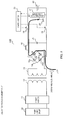
- FIG. 1 is a diagram illustrating the configuration of in-vehicle charging apparatus 100 according to the embodiment of the present invention.
- In-vehicle charging apparatus 100 includes a charger and a battery apparatus.
- the charger includes power supply circuit 10, primary inverter 11, primary transformer 12, secondary transformer 13, bridge rectifier 14, choke coil 16, and capacitor 17.
- the battery apparatus includes P-side relay 18, N-side relay 19, vehicle-side GND (ground) 20, ground fault detecting circuit 21, battery 22, and control section 23.
- an alternating current which is supplied from the primary side (power supply circuit 10, primary inverter 11, and primary transformer 12) is inputted to secondary transformer 13.
- Secondary transformer 13 steps up or down the alternating current inputted from primary transformer 12 and inputs the result to bridge rectifier 14.
- Bridge rectifier 14 converts the alternating current inputted from secondary transformer 13 into a direct current after the rectification thereof, and inputs the direct current to choke coil 16.
- Bridge rectifier 14 includes diodes 15a, 15b, 15c, and 15d.
- the interval on the left side of bridge rectifier 14 as a boundary in the drawing for example, the interval between bridge rectifier 14 and secondary transformer 13 (on the side of bridge rectifier 14 which is opposite to ground fault detecting circuit 21) is referred to as an "AC interval” in that an alternating current flows through the interval.
- the interval on the right side of bridge rectifier 14 as a boundary in the drawing for example, the interval between bridge rectifier 14 and battery 22 (on the side of bridge rectifier 14 where ground fault detecting circuit 21 exists) is referred to as a "DC interval” in that a direct current flows through the interval.
- Choke coil 16 is configured with a predetermined impedance and constitutes a low-pass filter along with capacitor 17. Then, when P-side relay 18 is connected (becomes an ON state) by the control of control section 23, choke coil 16 smoothes the direct current inputted from bridge rectifier 14 in cooperation with capacitor 17.
- the smoothed direct current is inputted to battery 22 as a secondary battery. Accordingly, battery 22 is charged.
- Control section 23 controls ON (connection)/OFF (disconnection) states of P-side relay 18 and N-side relay 19. Further, control section 23 controls an operation involving the ground fault detection of ground fault detecting circuit 21.
- the arrows indicated by the dashed lines illustrated in FIG. 1 indicate a control signal (an instruction and a command) from control section 23.
- control section 23 includes, for example, a central processing unit (CPU), a read only memory (ROM), and a random access memory (RAM). Control section 23 performs the above-described control and other controls involving in vehicle charging apparatus 100 in a manner such that a CPU executes a program stored in a ROM, using a RAM.
- CPU central processing unit
- ROM read only memory
- RAM random access memory
- ground fault detecting circuit 21 Upon reception of an instruction for performing a ground fault detection and an instruction for a value of a test voltage to be outputted (applied) from control section 23, ground fault detecting circuit 21 outputs a test voltage of the instructed value in order to detect a ground fault occurring in in-vehicle charging apparatus 100.
- the test voltage may be outputted as a DC voltage or an AC voltage.
- P-side relay 18 and N-side relay 19 become an ON (connection) state by the control of control section 23.
- Ground fault detecting circuit 21 detects the occurrence of the ground fault based on a change in the test current.
- ground fault detecting circuit 21 detects the occurrence of the ground fault if a state where the test current becomes larger than the predetermined value is detected when the test voltage is outputted, and detects that no ground fault occurs if a state where the test current becomes larger than the predetermined value is not detected.
- the predetermined value is set in advance for the test voltage in the state where no ground fault occurs, so that the predetermined value becomes larger than the test current obtained when the ground fault caused by the impedance among the DC interval, the AC interval, and the vehicle body does not occur.
- ground fault detection circuit 21 may be, for example, a method disclosed in PTL 1. That is, a method which is generally used in the related art may be employed.
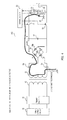
- FIG. 2 illustrates a case where value V1 of a test voltage instructed from control section 23 to ground fault detecting circuit 21 is smaller than a forward voltage Vf of diode 15a, 15b, or the like included in bridge rectifier 14.
- Vf a forward voltage of diode 15a, 15b, or the like included in bridge rectifier 14.
- the forward voltage Vf is, for example 0.5 V to 2V.
- test current since test voltage V1 is smaller than forward voltage Vf, the test current may not flow through, for example, diode 15b. Accordingly, the test current does not flow through the AC interval and flows only through the DC interval.
- the arrow indicated by the bold line illustrated in FIG 2 indicates the test current which flows in the event of ground fault resistance R1.
- ground fault detecting circuit 21 cannot detect the ground fault occurring in the AC interval (for example, a ground fault resistance R2), but can detect the ground fault occurring only in the DC interval (for example, the ground fault resistance R1).
- FIG. 3 illustrates a case where value V2 of a test voltage instructed from control section 23 to ground fault detecting circuit 21 is larger than forward voltage Vf of diode 15a, 15b, or the like included in bridge rectifier 14.
- Ground fault detecting circuit 21 can output an AC voltage as a test voltage.
- the "state where value V2 of the test voltage is larger than forward voltage Vf of diode 15a, 15b, or the like" means that control section 23 performs a control so that the amplitude of the AC voltage outputted from ground fault detecting circuit 21 is larger than forward voltage Vf.
- test voltage V2 is outputted from ground fault detecting circuit 21
- the test current becomes larger than the predetermined value if the ground fault occurs, and the test current becomes smaller than the predetermined value if no ground fault occurs in this case.
- test current may flow through diode 15b, for example. Accordingly, the test current flows through the AC interval.
- the arrow of the bold line illustrated in FIG. 3 indicates the test current which flows in the event of ground fault resistance R2.
- ground fault detecting circuit 21 can detect the ground fault occurring in the AC interval (for example, the ground fault resistance R2).
- FIG 4 illustrates a case where value V2 of the test voltage instructed from control section 23 to ground fault detecting circuit 21 is larger than forward voltage Vf of diode 15a, 15b, or the like included in bridge rectifier 14 and test voltage V2 is an AC voltage.
- the configuration illustrated in FIG. 4 is different from the configurations illustrated in FIGS. 1 to 3 in that resonance capacitors 24 and 25 are provided between bridge rectifier 14 and secondary transformer 13.
- test voltage V2 needs to be larger than forward voltage Vf and needs to be an AC voltage in order that the test voltage V2 flows through the AC interval so as to detect the ground fault between secondary transformer 13 and resonance capacitors 24 and 25. Therefore, in the case of the configuration illustrated in FIG. 4 , a voltage which is outputted from ground fault detecting circuit 21 is set as an AC voltage in advance.
- test voltage V2 is larger than forward voltage Vf and is an AC voltage
- the test current can flow through the AC interval provided with resonance capacitors 24 and 25.
- the arrow of the bold line illustrated in FIG 4 indicates the test current flowing in the event of ground fault resistance R2.
- ground fault detecting circuit 21 can detect the ground fault occurring in the AC interval (for example, the ground fault resistance R2).
- the test voltage which is outputted from ground fault detecting circuit 21 is variable. Accordingly, the ground fault occurring in the DC interval can be detected by setting the test voltage to be outputted to a value smaller than the forward voltage of the diode, and the ground fault occurring in the AC interval can be detected by setting the test voltage to be outputted to a value larger than the forward voltage of the diode. Further, since the test voltage to be outputted is set to a value larger than the forward voltage of the diode and is set to an AC voltage, it is possible to detect the ground fault occurring in the AC interval provided with the resonance capacitor.
- FIG. 5 is a flowchart illustrating operation example 1 of in-vehicle charging apparatus 100. The operation illustrated in FIG. 5 is performed before charging, for example.
- ground fault detection for battery 22 alone is performed (step S100). That is, control section 23 performs a control so that P-side relay 18 and N-side relay 19 become an OFF state and instructs ground fault detecting circuit 21 to perform the ground fault detection and instructs ground fault detecting circuit 21 to use a value of the test voltage to be outputted. This value is, for example, value V1 smaller than that of forward voltage Vf.
- Ground fault detecting circuit 21 which receives the instruction from control section 23 outputs a test voltage of the instructed value and performs ground fault detection based on a magnitude relation between the test current and the predetermined value.
- ground fault detecting circuit 21 detects a test current larger than the predetermined value (YES in step S101), a signal indicating the detection result (a detection result signal) is outputted to control section 23.
- control section 23 determines that a ground fault exists (a ground fault occurs) (step S102). This determination result may be output from an indicator (not illustrated), for example.
- ground fault detecting circuit 21 when not detecting a test current larger than the predetermined value (NO in step S101), ground fault detecting circuit 21 outputs a detection result signal indicating the detection result to control section 23.
- control section 23 Upon reception of a detection result signal indicating that a test current larger than the predetermined value has not been detected from ground fault detecting circuit 21 as input, control section 23 turns on P-side relay 18 and N-side relay 19 (step S103).
- ground fault detection is performed on the AC interval of in-vehicle charging apparatus 100 (step S104). That is, control section 23 instructs ground fault detecting circuit 21 to perform the ground fault detection and instructs ground fault detecting circuit 21 to use a value of the test voltage to be outputted. This value is, for example, value V2 larger than forward voltage Vf. Then, upon reception of the instruction from control section 23, ground fault detecting circuit 21 outputs a test voltage of the instructed value and performs ground fault detection based on the magnitude relation between the test current and the predetermined value.
- ground fault detecting circuit 21 When detecting a test current larger than the predetermined value (YES in step S105), ground fault detecting circuit 21 outputs a detection result signal indicating the detection result to control section 23. Subsequently, the operation proceeds to step S102 described above.
- ground fault detecting circuit 21 when not detecting a test current larger than the predetermined value (NO in step S105), ground fault detecting circuit 21 outputs a detection result signal indicating the detection result to control section 23.
- control section 23 determines that there is no ground fault (ground fault does not occur) (step S106).
- the determination result may be outputted using an indicator (not illustrated), for example.
- the target of the ground fault detection in step S104 can be a DC interval.
- the test voltage can be an AC voltage.
- FIG. 6 is a flowchart illustrating operation example 2 of in-vehicle charging apparatus 100. The operation illustrated in FIG. 6 may be replaced by step S104 and step S105 of operation example 1.
- a ground fault detection using test voltage V1 is performed (step S201). That is, control section 23 instructs ground fault detecting circuit 21 to perform the ground fault detection and instructs ground fault detecting circuit 21 to use value V1 of the test voltage to be outputted. This value V1 is smaller than that of forward voltage Vf.
- ground fault detecting circuit 21 Upon reception of the instruction from control section 23, ground fault detecting circuit 21 outputs a test voltage of the instructed value V1 and performs ground fault detection on the DC interval based on the magnitude relation between the test current and the predetermined value.
- ground fault detecting circuit 21 When detecting a test current larger than the predetermined value (YES in step S202), ground fault detecting circuit 21 outputs a detection result signal indicating the detection result to control section 23.
- control section 23 Upon reception of a detection result signal indicating that a test current larger than the predetermined value has been detected from ground fault detecting circuit 21 as input, control section 23 determines that there is a ground fault (ground fault occurs) in the DC interval (step S203). The determination result may be outputted using an indicator (not illustrated), for example.
- ground fault detecting circuit 21 when not detecting a test current larger than the predetermined value (NO in step S202), ground fault detecting circuit 21 outputs a detection result signal indicating the detection result to control section 23.
- control section 23 determines that there is a ground fault (ground fault occurs) in the AC interval (step S203).
- step S204 ground fault detection using test voltage V2 is performed (step S204). That is, control section 23 instructs ground fault detecting circuit 21 to perform the ground fault detection and instructs ground fault detecting circuit 21 to use value V2 of the test voltage to be outputted. This value V2 is larger than that of forward voltage Vf.
- ground fault detecting circuit 21 Upon reception of the instruction from control section 23, ground fault detecting circuit 21 outputs a test voltage of the instructed value V2 and performs ground fault detection on the AC interval in addition to the DC interval based on the magnitude relation between the test current and the predetermined value.
- ground fault detecting circuit 21 When detecting a test current larger than the predetermined value (YES in step S205), ground fault detecting circuit 21 outputs a detection result signal indicating the detection result to control section 23. Subsequently, the procedure proceeds to step S203 described above.
- ground fault detecting circuit 21 when not detecting a test current larger than the predetermined value (NO in step S205), ground fault detecting circuit 21 outputs a detection result signal indicating the detection result to control section 23.
- control section 23 Upon reception of a detection result signal indicating that a test current larger than the predetermined value has not been detected from ground fault detecting circuit 21 as input, control section 23 determines that there is no ground fault (ground fault does not occur) in the AC interval in addition to the DC interval (step S206). This determination result may be outputted using an indicator (not illustrated), for example.
- step S202 When it is determined that there is a ground fault in step S202, it can be estimated that a ground fault occurs at the side of bridge rectifier 14 where ground fault detecting circuit 21 exists (the DC interval).
- step S205 When it is determined that there is a ground fault in step S205 after it is determined that a ground fault does not exist in step S202, it can be estimated that a ground fault occurs at the side (the AC interval) of bridge rectifier 14 which is opposite to ground fault detecting circuit 21.
- step S202 since value V1 of the test voltage is smaller than that of forward voltage Vf, the ground fault detection of the DC interval may be performed. Meanwhile, when it is determined that there is a ground fault in step S205, value V2 of the test voltage is larger than that of forward voltage Vf, and hence the ground fault detection of at least one of the DC interval and the AC interval can be performed.
- step S202 By combining step S202 and step S205, it is possible to identify in which one of the DC interval and the AC interval the ground fault occurs.
- the detection interval is changed in two stages, but may be changed in two stages or more.
- test voltage may be an AC voltage.
- a predetermined value used to determine the ground fault may be a different value according to the test interval and the test voltage to be applied.
- operation example 2 may be performed alone without the replacement of step S104 to step S105 of operation example 1.
- the AC voltage serving as the test voltage is not limited to a sine wave, and may be a rectangular wave or a triangular wave.
- the embodiment it is possible to detect the ground default occurring in the AC interval by performing a control so that a test voltage larger than the forward voltage of the diode included in the bridge rectifier is outputted.
- An in-vehicle charging apparatus is suitable for ground fault detection when a battery mounted on a vehicle is charged using a predetermined power supply.
Landscapes
- Engineering & Computer Science (AREA)
- Power Engineering (AREA)
- Transportation (AREA)
- Mechanical Engineering (AREA)
- Sustainable Energy (AREA)
- Sustainable Development (AREA)
- Life Sciences & Earth Sciences (AREA)
- Physics & Mathematics (AREA)
- General Physics & Mathematics (AREA)
- Chemical & Material Sciences (AREA)
- Combustion & Propulsion (AREA)
- Electric Propulsion And Braking For Vehicles (AREA)
- Testing Of Short-Circuits, Discontinuities, Leakage, Or Incorrect Line Connections (AREA)
- Charge And Discharge Circuits For Batteries Or The Like (AREA)
- Emergency Protection Circuit Devices (AREA)
Abstract
Description
- The present invention relates to an in-vehicle charging apparatus which charges a battery mounted on a vehicle, using a predetermined power supply.
- Since a high-voltage battery is mounted on a vehicle such as an electric automobile or a hybrid automobile, there is a need to provide a ground fault detector in order to ensure the safety of a passenger.
- As an example of the ground fault detector, for example, PTL 1 discloses a vehicle ground fault detecting apparatus which highly precisely detects a ground fault of a DC power supply (battery). The vehicle ground fault detecting apparatus applies a rectangular wave pulse signal to one end (a measurement point A) of a coupling capacitor, obtains a measurement voltage when the rectangular wave pulse signal is an H level and a measurement voltage when the rectangular wave pulse signal is an L level, and detects an occurrence of a ground fault based on a difference between the measurement voltages.
- PTL1
Japanese Patent Application Laid-Open No.2003-250201 - However, the vehicle ground fault detecting apparatus of PTL 1 has the following problem.
- In the vehicle ground fault detecting apparatus of PTL 1, when the DC power supply is charged through a charger including a bridge rectifier from a commercial power supply, a direct current which is converted from an alternating current by the bridge rectifier is supplied to the DC power supply. In such case, even when a rectangular wave pulse signal for detecting a ground fault is outputted, a test current does not flow through an interval where the alternating current flows if a test voltage for detecting the ground fault is smaller than a forward voltage (Vf) of a diode constituting the bridge rectifier. For this reason, the ground fault occurring in the interval where the alternating current flows cannot be detected.
- Due to the above-described circumstance, there arises a problem in that although the vehicle ground fault detecting apparatus of PTL 1 can detect a ground fault occurring in the interval where a direct current flows, but cannot detect a ground fault occurring in the interval where an alternating current flows.
- An object of the invention is to provide an in-vehicle charging apparatus capable of detecting a ground fault occurring in the interval where an alternating current flows.
- An in-vehicle charging apparatus according to an aspect of the present invention is an apparatus that charges a battery mounted on a vehicle, the apparatus including: a bridge rectifier that converts an alternating current supplied from a power supply into a direct current; a ground fault detecting circuit that is provided at a side of the bridge rectifier where the direct current obtained by the conversion of the bridge rectifier flows, that outputs a test voltage, and that detects a ground fault occurring in the in-vehicle charging apparatus, based on a test current which changes in response to the presence or absence of a ground fault resistance; and a control section that controls the ground fault detecting circuit so that the ground fault detecting circuit outputs the test voltage of a value larger than a forward voltage of a diode included in the bridge rectifier.
- According to the invention, it is possible to detect a ground fault occurring in the interval where an alternating current flows.
-
-
FIG. 1 is a diagram illustrating the configuration of an in-vehicle charging apparatus according to an embodiment of the present invention; -
FIG. 2 is a diagram illustrating a case where a test voltage in the in-vehicle charging apparatus according to the embodiment of the present invention is smaller than Vf; -
FIG 3 is a diagram illustrating a case where the test voltage in the in-vehicle charging apparatus according to the embodiment of the present invention is larger than Vf; -
FIG. 4 is a diagram illustrating a case where the test voltage in the in-vehicle charging apparatus according to the embodiment of the present invention is larger than Vf and is an AC voltage; -
FIG. 5 is a flowchart illustrating an example of a ground fault detection operation of the in-vehicle charging apparatus according to the embodiment of the present invention; and -
FIG. 6 is a flowchart illustrating an example of a test voltage conversion operation of the in-vehicle charging apparatus according to the embodiment of the present invention. - Hereinafter, an embodiment of the invention will be described in detail with reference to the accompanying drawings.
-
FIG. 1 is a diagram illustrating the configuration of in-vehicle charging apparatus 100 according to the embodiment of the present invention. - In-
vehicle charging apparatus 100 includes a charger and a battery apparatus. The charger includespower supply circuit 10,primary inverter 11,primary transformer 12,secondary transformer 13,bridge rectifier 14,choke coil 16, andcapacitor 17. Further, the battery apparatus includes P-side relay 18, N-side relay 19, vehicle-side GND (ground) 20, groundfault detecting circuit 21,battery 22, andcontrol section 23. - In the charger, an alternating current which is supplied from the primary side (
power supply circuit 10,primary inverter 11, and primary transformer 12) is inputted tosecondary transformer 13. -
Secondary transformer 13 steps up or down the alternating current inputted fromprimary transformer 12 and inputs the result tobridge rectifier 14. -
Bridge rectifier 14 converts the alternating current inputted fromsecondary transformer 13 into a direct current after the rectification thereof, and inputs the direct current to chokecoil 16.Bridge rectifier 14 includesdiodes - Furthermore, in the description below, the interval on the left side of
bridge rectifier 14 as a boundary in the drawing, for example, the interval betweenbridge rectifier 14 and secondary transformer 13 (on the side ofbridge rectifier 14 which is opposite to ground fault detecting circuit 21) is referred to as an "AC interval" in that an alternating current flows through the interval. Meanwhile, the interval on the right side of bridge rectifier 14 as a boundary in the drawing, for example, the interval betweenbridge rectifier 14 and battery 22 (on the side ofbridge rectifier 14 where groundfault detecting circuit 21 exists) is referred to as a "DC interval" in that a direct current flows through the interval. -
Choke coil 16 is configured with a predetermined impedance and constitutes a low-pass filter along withcapacitor 17. Then, when P-side relay 18 is connected (becomes an ON state) by the control ofcontrol section 23,choke coil 16 smoothes the direct current inputted frombridge rectifier 14 in cooperation withcapacitor 17. - The smoothed direct current is inputted to
battery 22 as a secondary battery. Accordingly,battery 22 is charged. -
Control section 23 controls ON (connection)/OFF (disconnection) states of P-side relay 18 and N-side relay 19. Further,control section 23 controls an operation involving the ground fault detection of groundfault detecting circuit 21. The arrows indicated by the dashed lines illustrated inFIG. 1 indicate a control signal (an instruction and a command) fromcontrol section 23. - Further,
control section 23 includes, for example, a central processing unit (CPU), a read only memory (ROM), and a random access memory (RAM).Control section 23 performs the above-described control and other controls involving invehicle charging apparatus 100 in a manner such that a CPU executes a program stored in a ROM, using a RAM. - Upon reception of an instruction for performing a ground fault detection and an instruction for a value of a test voltage to be outputted (applied) from
control section 23, groundfault detecting circuit 21 outputs a test voltage of the instructed value in order to detect a ground fault occurring in in-vehicle charging apparatus 100. The test voltage may be outputted as a DC voltage or an AC voltage. At this time, P-side relay 18 and N-side relay 19 become an ON (connection) state by the control ofcontrol section 23. - When the test voltage is outputted from ground
fault detecting circuit 21, a test current changes in in-vehicle charging apparatus 100 in response to the occurrence of the ground fault. Groundfault detecting circuit 21 detects the occurrence of the ground fault based on a change in the test current. - That is, a test current larger than a predetermined value flows when the ground fault occurs in the case where the test voltage is outputted, but only a test current of a value smaller than the predetermined value flows when no ground fault occurs in the same case. Accordingly, ground
fault detecting circuit 21 detects the occurrence of the ground fault if a state where the test current becomes larger than the predetermined value is detected when the test voltage is outputted, and detects that no ground fault occurs if a state where the test current becomes larger than the predetermined value is not detected. The predetermined value is set in advance for the test voltage in the state where no ground fault occurs, so that the predetermined value becomes larger than the test current obtained when the ground fault caused by the impedance among the DC interval, the AC interval, and the vehicle body does not occur. - Furthermore, a route through which the test current flows when the ground fault occurs becomes a route having the lowest impedance. Further, the arrow of the one-dotted chain line illustrated in
FIG. 1 indicates a detection result signal (which will be described in detail later) to controlsection 23. Further, the method of the ground fault detection which is performed by groundfault detecting circuit 21 may be, for example, a method disclosed in PTL 1. That is, a method which is generally used in the related art may be employed. - Hereinafter, a description will be given of examples of the ground fault detection which is performed by in-
vehicle charging apparatus 100 with reference toFIGS. 2 to 4 . -
FIG. 2 illustrates a case where value V1 of a test voltage instructed fromcontrol section 23 to groundfault detecting circuit 21 is smaller than a forward voltage Vf ofdiode bridge rectifier 14. When the ground fault occurs when the test voltage V1 is outputted from groundfault detecting circuit 21, a test current larger than the predetermined value flows, and the test current is smaller than the predetermined value when the ground fault does not occur. Furthermore, the forward voltage Vf is, for example 0.5 V to 2V. - In the case of
FIG. 2 , since test voltage V1 is smaller than forward voltage Vf, the test current may not flow through, for example,diode 15b. Accordingly, the test current does not flow through the AC interval and flows only through the DC interval. The arrow indicated by the bold line illustrated inFIG 2 indicates the test current which flows in the event of ground fault resistance R1. - Accordingly, in the case of
FIG. 2 , groundfault detecting circuit 21 cannot detect the ground fault occurring in the AC interval (for example, a ground fault resistance R2), but can detect the ground fault occurring only in the DC interval (for example, the ground fault resistance R1). -
FIG. 3 illustrates a case where value V2 of a test voltage instructed fromcontrol section 23 to groundfault detecting circuit 21 is larger than forward voltage Vf ofdiode bridge rectifier 14. Groundfault detecting circuit 21 can output an AC voltage as a test voltage. The "state where value V2 of the test voltage is larger than forward voltage Vf ofdiode control section 23 performs a control so that the amplitude of the AC voltage outputted from groundfault detecting circuit 21 is larger than forward voltage Vf. In a case where the test voltage V2 is outputted from groundfault detecting circuit 21, When the ground fault occurs in the case where the test voltage V2 is outputted from groundfault detecting circuit 21, the test current becomes larger than the predetermined value if the ground fault occurs, and the test current becomes smaller than the predetermined value if no ground fault occurs in this case. - In the case of
FIG. 3 , since test voltage V2 is larger than forward voltage Vf, the test current may flow throughdiode 15b, for example. Accordingly, the test current flows through the AC interval. The arrow of the bold line illustrated inFIG. 3 indicates the test current which flows in the event of ground fault resistance R2. - Accordingly, in the case of
FIG. 3 , groundfault detecting circuit 21 can detect the ground fault occurring in the AC interval (for example, the ground fault resistance R2). -
FIG 4 illustrates a case where value V2 of the test voltage instructed fromcontrol section 23 to groundfault detecting circuit 21 is larger than forward voltage Vf ofdiode bridge rectifier 14 and test voltage V2 is an AC voltage. The configuration illustrated inFIG. 4 is different from the configurations illustrated inFIGS. 1 to 3 in thatresonance capacitors bridge rectifier 14 andsecondary transformer 13. - When the AC interval is provided with
resonance capacitors secondary transformer 13 andresonance capacitors FIG. 4 , a voltage which is outputted from groundfault detecting circuit 21 is set as an AC voltage in advance. - In the case of
FIG. 4 , since test voltage V2 is larger than forward voltage Vf and is an AC voltage, the test current can flow through the AC interval provided withresonance capacitors FIG 4 indicates the test current flowing in the event of ground fault resistance R2. - Accordingly, in the case of
FIG. 4 , groundfault detecting circuit 21 can detect the ground fault occurring in the AC interval (for example, the ground fault resistance R2). - As described above, in in-
vehicle charging apparatus 100 of the embodiment, the test voltage which is outputted from groundfault detecting circuit 21 is variable. Accordingly, the ground fault occurring in the DC interval can be detected by setting the test voltage to be outputted to a value smaller than the forward voltage of the diode, and the ground fault occurring in the AC interval can be detected by setting the test voltage to be outputted to a value larger than the forward voltage of the diode. Further, since the test voltage to be outputted is set to a value larger than the forward voltage of the diode and is set to an AC voltage, it is possible to detect the ground fault occurring in the AC interval provided with the resonance capacitor. - Next, an operation example according to the ground fault detection of in-
vehicle charging apparatus 100 will be described with reference toFIGS. 5 and6 . -
FIG. 5 is a flowchart illustrating operation example 1 of in-vehicle charging apparatus 100. The operation illustrated inFIG. 5 is performed before charging, for example. - First, ground fault detection for
battery 22 alone is performed (step S100). That is,control section 23 performs a control so that P-side relay 18 and N-side relay 19 become an OFF state and instructs groundfault detecting circuit 21 to perform the ground fault detection and instructs groundfault detecting circuit 21 to use a value of the test voltage to be outputted. This value is, for example, value V1 smaller than that of forward voltage Vf. Groundfault detecting circuit 21 which receives the instruction fromcontrol section 23 outputs a test voltage of the instructed value and performs ground fault detection based on a magnitude relation between the test current and the predetermined value. - When ground
fault detecting circuit 21 detects a test current larger than the predetermined value (YES in step S101), a signal indicating the detection result (a detection result signal) is outputted to controlsection 23. - Upon reception of a detection result signal indicating that the test current larger than the predetermined value has been detected from ground
fault detecting circuit 21 as input,control section 23 determines that a ground fault exists (a ground fault occurs) (step S102). This determination result may be output from an indicator (not illustrated), for example. - Meanwhile, when not detecting a test current larger than the predetermined value (NO in step S101), ground
fault detecting circuit 21 outputs a detection result signal indicating the detection result to controlsection 23. - Upon reception of a detection result signal indicating that a test current larger than the predetermined value has not been detected from ground
fault detecting circuit 21 as input,control section 23 turns on P-side relay 18 and N-side relay 19 (step S103). - Here, ground fault detection is performed on the AC interval of in-vehicle charging apparatus 100 (step S104). That is,
control section 23 instructs groundfault detecting circuit 21 to perform the ground fault detection and instructs groundfault detecting circuit 21 to use a value of the test voltage to be outputted. This value is, for example, value V2 larger than forward voltage Vf. Then, upon reception of the instruction fromcontrol section 23, groundfault detecting circuit 21 outputs a test voltage of the instructed value and performs ground fault detection based on the magnitude relation between the test current and the predetermined value. - When detecting a test current larger than the predetermined value (YES in step S105), ground
fault detecting circuit 21 outputs a detection result signal indicating the detection result to controlsection 23. Subsequently, the operation proceeds to step S102 described above. - Meanwhile, when not detecting a test current larger than the predetermined value (NO in step S105), ground
fault detecting circuit 21 outputs a detection result signal indicating the detection result to controlsection 23. - Upon reception of a detection result signal indicating that a test current larger than the predetermined value has not been detected from ground
fault detecting circuit 21 as input,control section 23 determines that there is no ground fault (ground fault does not occur) (step S106). The determination result may be outputted using an indicator (not illustrated), for example. After step S106, the charging operation for battery apparatus 2 starts. - Furthermore, in operation example 1, the target of the ground fault detection in step S104 can be a DC interval. Further, in operation example 1, the test voltage can be an AC voltage.
-
FIG. 6 is a flowchart illustrating operation example 2 of in-vehicle charging apparatus 100. The operation illustrated inFIG. 6 may be replaced by step S104 and step S105 of operation example 1. - First, a ground fault detection using test voltage V1 is performed (step S201). That is,
control section 23 instructs groundfault detecting circuit 21 to perform the ground fault detection and instructs groundfault detecting circuit 21 to use value V1 of the test voltage to be outputted. This value V1 is smaller than that of forward voltage Vf. Upon reception of the instruction fromcontrol section 23, groundfault detecting circuit 21 outputs a test voltage of the instructed value V1 and performs ground fault detection on the DC interval based on the magnitude relation between the test current and the predetermined value. - When detecting a test current larger than the predetermined value (YES in step S202), ground
fault detecting circuit 21 outputs a detection result signal indicating the detection result to controlsection 23. - Upon reception of a detection result signal indicating that a test current larger than the predetermined value has been detected from ground
fault detecting circuit 21 as input,control section 23 determines that there is a ground fault (ground fault occurs) in the DC interval (step S203). The determination result may be outputted using an indicator (not illustrated), for example. - Meanwhile, when not detecting a test current larger than the predetermined value (NO in step S202), ground
fault detecting circuit 21 outputs a detection result signal indicating the detection result to controlsection 23. - Upon reception of a detection result signal indicating that a test current larger than the predetermined value is not detected from ground
fault detecting circuit 21 as input,control section 23 determines that there is a ground fault (ground fault occurs) in the AC interval (step S203). - Next, ground fault detection using test voltage V2 is performed (step S204). That is,
control section 23 instructs groundfault detecting circuit 21 to perform the ground fault detection and instructs groundfault detecting circuit 21 to use value V2 of the test voltage to be outputted. This value V2 is larger than that of forward voltage Vf. Upon reception of the instruction fromcontrol section 23, groundfault detecting circuit 21 outputs a test voltage of the instructed value V2 and performs ground fault detection on the AC interval in addition to the DC interval based on the magnitude relation between the test current and the predetermined value. - When detecting a test current larger than the predetermined value (YES in step S205), ground
fault detecting circuit 21 outputs a detection result signal indicating the detection result to controlsection 23. Subsequently, the procedure proceeds to step S203 described above. - Meanwhile, when not detecting a test current larger than the predetermined value (NO in step S205), ground
fault detecting circuit 21 outputs a detection result signal indicating the detection result to controlsection 23. - Upon reception of a detection result signal indicating that a test current larger than the predetermined value has not been detected from ground
fault detecting circuit 21 as input,control section 23 determines that there is no ground fault (ground fault does not occur) in the AC interval in addition to the DC interval (step S206). This determination result may be outputted using an indicator (not illustrated), for example. - The description of operation example 2 has been given thus far. When it is determined that there is a ground fault in step S202, it can be estimated that a ground fault occurs at the side of
bridge rectifier 14 where groundfault detecting circuit 21 exists (the DC interval). When it is determined that there is a ground fault in step S205 after it is determined that a ground fault does not exist in step S202, it can be estimated that a ground fault occurs at the side (the AC interval) ofbridge rectifier 14 which is opposite to groundfault detecting circuit 21. - In step S202, since value V1 of the test voltage is smaller than that of forward voltage Vf, the ground fault detection of the DC interval may be performed. Meanwhile, when it is determined that there is a ground fault in step S205, value V2 of the test voltage is larger than that of forward voltage Vf, and hence the ground fault detection of at least one of the DC interval and the AC interval can be performed.
- By combining step S202 and step S205, it is possible to identify in which one of the DC interval and the AC interval the ground fault occurs.
- In this way, it is possible to estimate where the ground fault occurs by performing the ground fault detection in two stages as in this operation example. Further, it is possible to detect the ground fault by automatically changing the detection interval (range). Furthermore, in the operation example, the detection interval is changed in two stages, but may be changed in two stages or more.
- Further, in operation example 2, the test voltage may be an AC voltage.
- Further, a predetermined value used to determine the ground fault may be a different value according to the test interval and the test voltage to be applied.
- Further, operation example 2 may be performed alone without the replacement of step S104 to step S105 of operation example 1.
- Further, in operation examples 1 and 2, the AC voltage serving as the test voltage is not limited to a sine wave, and may be a rectangular wave or a triangular wave.
- According to the embodiment, it is possible to detect the ground default occurring in the AC interval by performing a control so that a test voltage larger than the forward voltage of the diode included in the bridge rectifier is outputted.
- Further, according to the embodiment, it is possible to estimate where the ground fault occurs by performing a control on the test voltage to be outputted so that a voltage of a value larger or smaller than the forward voltage of the diode included in the bridge rectifier is selectively outputted.
- Further, according to the embodiment, it is possible to detect the ground fault occurring in the AC interval even when the resonance capacitor is provided in the AC interval, by outputting an AC voltage as the test voltage.
- While the embodiment has been described, the present invention is not limited to the description above, and various modifications may be made within a scope without departing from the gist of the present invention.
- The disclosure of Japanese Patent Application No.
2012-043048 filed on February 29, 2012 - An in-vehicle charging apparatus according to the present invention is suitable for ground fault detection when a battery mounted on a vehicle is charged using a predetermined power supply.
-
- 10 Power supply circuit
- 11 Primary inverter
- 12 Primary transformer
- 13 Secondary transformer
- 14 Bridge rectifier
- 15a, 15b, 15c, 15d Diode
- 16 Choke coil
- 17 Capacitor
- 18 P-side relay
- 19 N-side relay
- 20 Vehicle-side GND
- 21 Ground fault detecting circuit
- 22 Battery
- 23 Control section
- 24, 25 Resonance capacitor
- 100 In-vehicle charging apparatus
Claims (5)
- An in-vehicle charging apparatus that charges a battery mounted on a vehicle, the in-vehicle charging apparatus comprising:a bridge rectifier that converts an alternating current supplied from a power supply into a direct current;a ground fault detecting circuit that is provided at a side of the bridge rectifier where the direct current obtained by the conversion of the bridge rectifier flows, that outputs a test voltage, and that detects a ground fault occurring in the in-vehicle charging apparatus, based on a test current which changes in response to the presence or absence of a ground fault resistance; anda control section that controls the ground fault detecting circuit so that the ground fault detecting circuit outputs the test voltage of a value larger than a forward voltage of a diode included in the bridge rectifier.
- The in-vehicle charging apparatus according to claim 1, wherein the control section controls the ground fault detecting circuit so that the ground fault detecting circuit selectively outputs the test voltage of a value larger than the forward voltage of the diode included in the bridge rectifier or the test voltage of a value smaller than the forward voltage of the diode included in the bridge rectifier.
- The in-vehicle charging apparatus according to claim 2, wherein:the control section determines that a ground fault occurs at the side of the bridge rectifier where the ground fault detecting circuit is present, if the ground fault is detected when the test voltage is a value smaller than the forward voltage of the diode; andthe control section determines that a ground fault occurs at a side of the bridge rectifier which is opposite to the side of the bridge rectifier where the ground fault detecting circuit is present, if no ground fault is detected when the test voltage is a value smaller than the forward voltage of the diode but a ground fault is detected when the test voltage is a value larger than the forward voltage of the diode.
- The in-vehicle charging apparatus according to claim 1, wherein the test voltage is an AC voltage.
- The in-vehicle charging apparatus according to claim 1, further comprising a resonance capacitor that is provided at a side of the bridge rectifier where the alternating current supplied from the power supply of the bridge rectifier flows.
Applications Claiming Priority (2)
| Application Number | Priority Date | Filing Date | Title |
|---|---|---|---|
| JP2012043048A JP5200175B1 (en) | 2012-02-29 | 2012-02-29 | In-vehicle charger |
| PCT/JP2013/000963 WO2013128851A1 (en) | 2012-02-29 | 2013-02-21 | In-vehicle charger |
Publications (3)
| Publication Number | Publication Date |
|---|---|
| EP2821802A1 true EP2821802A1 (en) | 2015-01-07 |
| EP2821802A4 EP2821802A4 (en) | 2015-12-09 |
| EP2821802B1 EP2821802B1 (en) | 2019-02-06 |
Family
ID=48534076
Family Applications (1)
| Application Number | Title | Priority Date | Filing Date |
|---|---|---|---|
| EP13754081.1A Active EP2821802B1 (en) | 2012-02-29 | 2013-02-21 | In-vehicle charger |
Country Status (5)
| Country | Link |
|---|---|
| US (1) | US9579978B2 (en) |
| EP (1) | EP2821802B1 (en) |
| JP (1) | JP5200175B1 (en) |
| CN (1) | CN104094127B (en) |
| WO (1) | WO2013128851A1 (en) |
Cited By (1)
| Publication number | Priority date | Publication date | Assignee | Title |
|---|---|---|---|---|
| CN105676112A (en) * | 2016-03-02 | 2016-06-15 | 武汉新能源接入装备与技术研究院有限公司 | Universal fault detection method and apparatus for twelve-phase rectifier bridge |
Families Citing this family (4)
| Publication number | Priority date | Publication date | Assignee | Title |
|---|---|---|---|---|
| JP6401599B2 (en) * | 2014-12-18 | 2018-10-10 | カルソニックカンセイ株式会社 | Ground fault detection device for vehicles |
| DE102017213357B3 (en) * | 2017-08-02 | 2018-10-31 | Heidelberger Druckmaschinen Ag | Method and device for earthing resistance detection in a charging cable |
| TWI689733B (en) * | 2017-11-26 | 2020-04-01 | 台達電子工業股份有限公司 | On board charge device and operating method thereof |
| CN110488205B (en) * | 2018-10-24 | 2021-02-26 | 新华三技术有限公司 | Fault recognition device |
Family Cites Families (20)
| Publication number | Priority date | Publication date | Assignee | Title |
|---|---|---|---|---|
| JPH07146321A (en) * | 1993-11-22 | 1995-06-06 | Fuji Electric Co Ltd | Storage battery ground fault detection circuit for uninterruptible power supply |
| JPH0965509A (en) * | 1995-06-14 | 1997-03-07 | Toyota Autom Loom Works Ltd | Electric vehicle battery charging method and electric vehicle charger |
| JP3563967B2 (en) | 1998-06-30 | 2004-09-08 | 松下電工株式会社 | Solar power system |
| JP4158253B2 (en) * | 1998-12-11 | 2008-10-01 | 松下電器産業株式会社 | Inverter device |
| US6556395B1 (en) * | 1999-07-07 | 2003-04-29 | Leviton Manufacturing Co., Inc. | Ground fault circuit interrupter for circuits operating with non-sinusoidal waveforms |
| JP3783633B2 (en) | 2002-02-26 | 2006-06-07 | 日産自動車株式会社 | Ground fault detection device for vehicles |
| JP2005304138A (en) * | 2004-04-08 | 2005-10-27 | Toyota Motor Corp | Motor drive device |
| CN101910856B (en) * | 2008-01-29 | 2014-06-18 | 立维腾制造有限公司 | Self testing fault circuit interrupter apparatus and method |
| JP4802232B2 (en) | 2008-10-22 | 2011-10-26 | 三菱電機株式会社 | Power supply |
| JP5219145B2 (en) * | 2008-12-25 | 2013-06-26 | オムロンオートモーティブエレクトロニクス株式会社 | Detection apparatus and method |
| JP5417862B2 (en) | 2009-01-27 | 2014-02-19 | 日産自動車株式会社 | Ground fault detection device for vehicles |
| JP5381467B2 (en) | 2009-07-30 | 2014-01-08 | トヨタ自動車株式会社 | DRIVE DEVICE, ITS INSULATION RESISTANCE LOW LOCATION DETERMINING METHOD, AND VEHICLE |
| WO2011040128A1 (en) * | 2009-09-29 | 2011-04-07 | 株式会社 日立製作所 | Earth fault detection circuit and power source device |
| JP5401250B2 (en) | 2009-10-06 | 2014-01-29 | 日立オートモティブシステムズ株式会社 | Ground fault detection device |
| US9132741B2 (en) * | 2009-10-08 | 2015-09-15 | Ford Global Technologies, Llc | Method and system for controlling current flow through a power distribution circuit |
| JP2011220812A (en) * | 2010-04-08 | 2011-11-04 | Toyota Motor Corp | Electric leakage inspection method for hybrid vehicle |
| AT509839A3 (en) * | 2010-04-14 | 2018-12-15 | Eaton Gmbh | Residual Current Device |
| JP5382813B2 (en) * | 2010-08-04 | 2014-01-08 | オムロンオートモーティブエレクトロニクス株式会社 | Earth leakage detector |
| JP5727851B2 (en) * | 2010-08-09 | 2015-06-03 | 矢崎総業株式会社 | Method and apparatus for detecting insulation state of ungrounded power supply |
| CN201828640U (en) | 2010-10-26 | 2011-05-11 | 上海天晶电力科技发展有限公司 | Direct-detecting intelligent apparatus for diagnosing insulation and status of direct-current (DC) system |
-
2012
- 2012-02-29 JP JP2012043048A patent/JP5200175B1/en not_active Expired - Fee Related
-
2013
- 2013-02-21 US US14/381,298 patent/US9579978B2/en active Active
- 2013-02-21 EP EP13754081.1A patent/EP2821802B1/en active Active
- 2013-02-21 CN CN201380007945.XA patent/CN104094127B/en active Active
- 2013-02-21 WO PCT/JP2013/000963 patent/WO2013128851A1/en not_active Ceased
Cited By (1)
| Publication number | Priority date | Publication date | Assignee | Title |
|---|---|---|---|---|
| CN105676112A (en) * | 2016-03-02 | 2016-06-15 | 武汉新能源接入装备与技术研究院有限公司 | Universal fault detection method and apparatus for twelve-phase rectifier bridge |
Also Published As
| Publication number | Publication date |
|---|---|
| CN104094127B (en) | 2017-04-12 |
| JP2013178200A (en) | 2013-09-09 |
| WO2013128851A1 (en) | 2013-09-06 |
| JP5200175B1 (en) | 2013-05-15 |
| US20150127201A1 (en) | 2015-05-07 |
| EP2821802A4 (en) | 2015-12-09 |
| CN104094127A (en) | 2014-10-08 |
| EP2821802B1 (en) | 2019-02-06 |
| US9579978B2 (en) | 2017-02-28 |
Similar Documents
| Publication | Publication Date | Title |
|---|---|---|
| US9696385B2 (en) | Apparatus for detecting the state of a rechargeable battery to be checked | |
| US11691515B2 (en) | Charging management apparatus | |
| US10384545B2 (en) | Device and method for monitoring an electrical insulation in a vehicle electrical system | |
| EP3159202B1 (en) | Vehicle-use control device | |
| US20130249283A1 (en) | Vehicle | |
| EP2821802B1 (en) | In-vehicle charger | |
| CN106707152A (en) | A kind of adhesion detection circuit and detection method of electric vehicle power relay | |
| EP2783903B1 (en) | Signal generation circuit for generation a pilot signal | |
| KR102485478B1 (en) | Device for preventing a reverse current of the DC-DC converter of vehicle and method thereof | |
| US20090167314A1 (en) | Method and Device for Detecting Ground Faults in a Supply Cable | |
| JP5443094B2 (en) | Electric vehicle quick charger charging cable insulation test equipment | |
| CN106063101A (en) | Precharge switch arrangement, power supply arrangement and method for connecting a load to a high DC voltage source | |
| US10358036B2 (en) | Vehicle ground fault detection apparatus | |
| KR101398224B1 (en) | Current detecting apparatus for low voltage dc-dc converter of electric vehicle | |
| US9287704B2 (en) | Device and method for detecting a polarity reversal on a low voltage side of a DC voltage transformer in a dual-voltage vehicle electrical system | |
| US9748832B2 (en) | Power converter and power conversion method | |
| KR102488133B1 (en) | Method for establishing a functional diagnosis for a buck static dc-dc voltage converter | |
| CN107533097B (en) | Method for detecting the intended connection of at least one energy storage device to the on-board electrical system | |
| CN106787043A (en) | Control method and device for temperature protection device, charging gun, and vehicle-mounted charger | |
| JP2013183630A (en) | Onboard charging device | |
| JP6862122B2 (en) | DC ground fault detector | |
| EP3275720B1 (en) | Auxiliary power supply device | |
| KR20120074585A (en) | Low voltage dc/dc converter for hybrid vehicle | |
| KR101567701B1 (en) | Apparatus and method for auxiliary battery charging on the MDPS system | |
| KR20130042129A (en) | Apparatus for detecting safety plug of high voltage battery |
Legal Events
| Date | Code | Title | Description |
|---|---|---|---|
| PUAI | Public reference made under article 153(3) epc to a published international application that has entered the european phase |
Free format text: ORIGINAL CODE: 0009012 |
|
| 17P | Request for examination filed |
Effective date: 20140814 |
|
| AK | Designated contracting states |
Kind code of ref document: A1 Designated state(s): AL AT BE BG CH CY CZ DE DK EE ES FI FR GB GR HR HU IE IS IT LI LT LU LV MC MK MT NL NO PL PT RO RS SE SI SK SM TR |
|
| AX | Request for extension of the european patent |
Extension state: BA ME |
|
| RAP1 | Party data changed (applicant data changed or rights of an application transferred) |
Owner name: PANASONIC INTELLECTUAL PROPERTY MANAGEMENT CO., LT |
|
| RAP1 | Party data changed (applicant data changed or rights of an application transferred) |
Owner name: PANASONIC INTELLECTUAL PROPERTY MANAGEMENT CO., LT |
|
| DAX | Request for extension of the european patent (deleted) | ||
| RA4 | Supplementary search report drawn up and despatched (corrected) |
Effective date: 20151105 |
|
| RIC1 | Information provided on ipc code assigned before grant |
Ipc: G01R 31/02 20060101AFI20151030BHEP Ipc: B60L 11/18 20060101ALI20151030BHEP Ipc: H02M 7/219 20060101ALI20151030BHEP Ipc: H02M 7/5387 20070101ALI20151030BHEP Ipc: G01R 31/00 20060101ALI20151030BHEP Ipc: B60L 3/00 20060101ALI20151030BHEP Ipc: H02H 3/16 20060101ALI20151030BHEP Ipc: H02J 7/00 20060101ALI20151030BHEP Ipc: B60L 3/04 20060101ALI20151030BHEP |
|
| STAA | Information on the status of an ep patent application or granted ep patent |
Free format text: STATUS: EXAMINATION IS IN PROGRESS |
|
| 17Q | First examination report despatched |
Effective date: 20161121 |
|
| GRAP | Despatch of communication of intention to grant a patent |
Free format text: ORIGINAL CODE: EPIDOSNIGR1 |
|
| STAA | Information on the status of an ep patent application or granted ep patent |
Free format text: STATUS: GRANT OF PATENT IS INTENDED |
|
| RIC1 | Information provided on ipc code assigned before grant |
Ipc: H02J 7/00 20060101ALI20180809BHEP Ipc: G01R 31/02 20060101AFI20180809BHEP Ipc: H02M 7/219 20060101ALI20180809BHEP Ipc: G01R 31/00 20060101ALI20180809BHEP Ipc: B60L 3/04 20060101ALI20180809BHEP Ipc: B60L 3/00 20060101ALI20180809BHEP Ipc: B60L 11/18 20060101ALI20180809BHEP Ipc: H02M 7/5387 20070101ALI20180809BHEP Ipc: H02H 3/16 20060101ALI20180809BHEP Ipc: H02H 3/17 20060101ALI20180809BHEP |
|
| INTG | Intention to grant announced |
Effective date: 20180828 |
|
| GRAS | Grant fee paid |
Free format text: ORIGINAL CODE: EPIDOSNIGR3 |
|
| GRAA | (expected) grant |
Free format text: ORIGINAL CODE: 0009210 |
|
| STAA | Information on the status of an ep patent application or granted ep patent |
Free format text: STATUS: THE PATENT HAS BEEN GRANTED |
|
| AK | Designated contracting states |
Kind code of ref document: B1 Designated state(s): AL AT BE BG CH CY CZ DE DK EE ES FI FR GB GR HR HU IE IS IT LI LT LU LV MC MK MT NL NO PL PT RO RS SE SI SK SM TR |
|
| REG | Reference to a national code |
Ref country code: GB Ref legal event code: FG4D |
|
| RIC2 | Information provided on ipc code assigned after grant |
Ipc: H02H 3/17 20060101ALI20180809BHEP Ipc: B60L 3/04 20060101ALI20180809BHEP Ipc: B60L 3/00 20190101ALI20180809BHEP Ipc: G01R 31/00 20060101ALI20180809BHEP Ipc: H02H 3/16 20060101ALI20180809BHEP Ipc: H02M 7/219 20060101ALI20180809BHEP Ipc: H02M 7/5387 20070101ALI20180809BHEP Ipc: G01R 31/02 20060101AFI20180809BHEP Ipc: B60L 11/18 20060101ALI20180809BHEP Ipc: H02J 7/00 20060101ALI20180809BHEP |
|
| REG | Reference to a national code |
Ref country code: CH Ref legal event code: EP Ref country code: AT Ref legal event code: REF Ref document number: 1095246 Country of ref document: AT Kind code of ref document: T Effective date: 20190215 |
|
| REG | Reference to a national code |
Ref country code: DE Ref legal event code: R096 Ref document number: 602013050504 Country of ref document: DE |
|
| REG | Reference to a national code |
Ref country code: IE Ref legal event code: FG4D |
|
| REG | Reference to a national code |
Ref country code: NL Ref legal event code: MP Effective date: 20190206 |
|
| REG | Reference to a national code |
Ref country code: LT Ref legal event code: MG4D |
|
| PG25 | Lapsed in a contracting state [announced via postgrant information from national office to epo] |
Ref country code: FI Free format text: LAPSE BECAUSE OF FAILURE TO SUBMIT A TRANSLATION OF THE DESCRIPTION OR TO PAY THE FEE WITHIN THE PRESCRIBED TIME-LIMIT Effective date: 20190206 Ref country code: NO Free format text: LAPSE BECAUSE OF FAILURE TO SUBMIT A TRANSLATION OF THE DESCRIPTION OR TO PAY THE FEE WITHIN THE PRESCRIBED TIME-LIMIT Effective date: 20190506 Ref country code: LT Free format text: LAPSE BECAUSE OF FAILURE TO SUBMIT A TRANSLATION OF THE DESCRIPTION OR TO PAY THE FEE WITHIN THE PRESCRIBED TIME-LIMIT Effective date: 20190206 Ref country code: SE Free format text: LAPSE BECAUSE OF FAILURE TO SUBMIT A TRANSLATION OF THE DESCRIPTION OR TO PAY THE FEE WITHIN THE PRESCRIBED TIME-LIMIT Effective date: 20190206 Ref country code: PT Free format text: LAPSE BECAUSE OF FAILURE TO SUBMIT A TRANSLATION OF THE DESCRIPTION OR TO PAY THE FEE WITHIN THE PRESCRIBED TIME-LIMIT Effective date: 20190606 Ref country code: NL Free format text: LAPSE BECAUSE OF FAILURE TO SUBMIT A TRANSLATION OF THE DESCRIPTION OR TO PAY THE FEE WITHIN THE PRESCRIBED TIME-LIMIT Effective date: 20190206 |
|
| REG | Reference to a national code |
Ref country code: AT Ref legal event code: MK05 Ref document number: 1095246 Country of ref document: AT Kind code of ref document: T Effective date: 20190206 |
|
| PG25 | Lapsed in a contracting state [announced via postgrant information from national office to epo] |
Ref country code: RS Free format text: LAPSE BECAUSE OF FAILURE TO SUBMIT A TRANSLATION OF THE DESCRIPTION OR TO PAY THE FEE WITHIN THE PRESCRIBED TIME-LIMIT Effective date: 20190206 Ref country code: BG Free format text: LAPSE BECAUSE OF FAILURE TO SUBMIT A TRANSLATION OF THE DESCRIPTION OR TO PAY THE FEE WITHIN THE PRESCRIBED TIME-LIMIT Effective date: 20190506 Ref country code: HR Free format text: LAPSE BECAUSE OF FAILURE TO SUBMIT A TRANSLATION OF THE DESCRIPTION OR TO PAY THE FEE WITHIN THE PRESCRIBED TIME-LIMIT Effective date: 20190206 Ref country code: IS Free format text: LAPSE BECAUSE OF FAILURE TO SUBMIT A TRANSLATION OF THE DESCRIPTION OR TO PAY THE FEE WITHIN THE PRESCRIBED TIME-LIMIT Effective date: 20190606 Ref country code: GR Free format text: LAPSE BECAUSE OF FAILURE TO SUBMIT A TRANSLATION OF THE DESCRIPTION OR TO PAY THE FEE WITHIN THE PRESCRIBED TIME-LIMIT Effective date: 20190507 Ref country code: LV Free format text: LAPSE BECAUSE OF FAILURE TO SUBMIT A TRANSLATION OF THE DESCRIPTION OR TO PAY THE FEE WITHIN THE PRESCRIBED TIME-LIMIT Effective date: 20190206 |
|
| REG | Reference to a national code |
Ref country code: CH Ref legal event code: PL |
|
| PG25 | Lapsed in a contracting state [announced via postgrant information from national office to epo] |
Ref country code: DK Free format text: LAPSE BECAUSE OF FAILURE TO SUBMIT A TRANSLATION OF THE DESCRIPTION OR TO PAY THE FEE WITHIN THE PRESCRIBED TIME-LIMIT Effective date: 20190206 Ref country code: EE Free format text: LAPSE BECAUSE OF FAILURE TO SUBMIT A TRANSLATION OF THE DESCRIPTION OR TO PAY THE FEE WITHIN THE PRESCRIBED TIME-LIMIT Effective date: 20190206 Ref country code: AL Free format text: LAPSE BECAUSE OF FAILURE TO SUBMIT A TRANSLATION OF THE DESCRIPTION OR TO PAY THE FEE WITHIN THE PRESCRIBED TIME-LIMIT Effective date: 20190206 Ref country code: LU Free format text: LAPSE BECAUSE OF NON-PAYMENT OF DUE FEES Effective date: 20190221 Ref country code: CZ Free format text: LAPSE BECAUSE OF FAILURE TO SUBMIT A TRANSLATION OF THE DESCRIPTION OR TO PAY THE FEE WITHIN THE PRESCRIBED TIME-LIMIT Effective date: 20190206 Ref country code: IT Free format text: LAPSE BECAUSE OF FAILURE TO SUBMIT A TRANSLATION OF THE DESCRIPTION OR TO PAY THE FEE WITHIN THE PRESCRIBED TIME-LIMIT Effective date: 20190206 Ref country code: RO Free format text: LAPSE BECAUSE OF FAILURE TO SUBMIT A TRANSLATION OF THE DESCRIPTION OR TO PAY THE FEE WITHIN THE PRESCRIBED TIME-LIMIT Effective date: 20190206 Ref country code: SK Free format text: LAPSE BECAUSE OF FAILURE TO SUBMIT A TRANSLATION OF THE DESCRIPTION OR TO PAY THE FEE WITHIN THE PRESCRIBED TIME-LIMIT Effective date: 20190206 Ref country code: ES Free format text: LAPSE BECAUSE OF FAILURE TO SUBMIT A TRANSLATION OF THE DESCRIPTION OR TO PAY THE FEE WITHIN THE PRESCRIBED TIME-LIMIT Effective date: 20190206 |
|
| REG | Reference to a national code |
Ref country code: DE Ref legal event code: R097 Ref document number: 602013050504 Country of ref document: DE |
|
| REG | Reference to a national code |
Ref country code: BE Ref legal event code: MM Effective date: 20190228 |
|
| REG | Reference to a national code |
Ref country code: DE Ref legal event code: R079 Ref document number: 602013050504 Country of ref document: DE Free format text: PREVIOUS MAIN CLASS: G01R0031020000 Ipc: G01R0031500000 |
|
| REG | Reference to a national code |
Ref country code: IE Ref legal event code: MM4A |
|
| PG25 | Lapsed in a contracting state [announced via postgrant information from national office to epo] |
Ref country code: SM Free format text: LAPSE BECAUSE OF FAILURE TO SUBMIT A TRANSLATION OF THE DESCRIPTION OR TO PAY THE FEE WITHIN THE PRESCRIBED TIME-LIMIT Effective date: 20190206 Ref country code: PL Free format text: LAPSE BECAUSE OF FAILURE TO SUBMIT A TRANSLATION OF THE DESCRIPTION OR TO PAY THE FEE WITHIN THE PRESCRIBED TIME-LIMIT Effective date: 20190206 |
|
| PLBE | No opposition filed within time limit |
Free format text: ORIGINAL CODE: 0009261 |
|
| STAA | Information on the status of an ep patent application or granted ep patent |
Free format text: STATUS: NO OPPOSITION FILED WITHIN TIME LIMIT |
|
| PG25 | Lapsed in a contracting state [announced via postgrant information from national office to epo] |
Ref country code: MC Free format text: LAPSE BECAUSE OF FAILURE TO SUBMIT A TRANSLATION OF THE DESCRIPTION OR TO PAY THE FEE WITHIN THE PRESCRIBED TIME-LIMIT Effective date: 20190206 Ref country code: LI Free format text: LAPSE BECAUSE OF NON-PAYMENT OF DUE FEES Effective date: 20190228 Ref country code: AT Free format text: LAPSE BECAUSE OF FAILURE TO SUBMIT A TRANSLATION OF THE DESCRIPTION OR TO PAY THE FEE WITHIN THE PRESCRIBED TIME-LIMIT Effective date: 20190206 Ref country code: CH Free format text: LAPSE BECAUSE OF NON-PAYMENT OF DUE FEES Effective date: 20190228 |
|
| 26N | No opposition filed |
Effective date: 20191107 |
|
| GBPC | Gb: european patent ceased through non-payment of renewal fee |
Effective date: 20190506 |
|
| PG25 | Lapsed in a contracting state [announced via postgrant information from national office to epo] |
Ref country code: IE Free format text: LAPSE BECAUSE OF NON-PAYMENT OF DUE FEES Effective date: 20190221 |
|
| PG25 | Lapsed in a contracting state [announced via postgrant information from national office to epo] |
Ref country code: BE Free format text: LAPSE BECAUSE OF NON-PAYMENT OF DUE FEES Effective date: 20190228 Ref country code: FR Free format text: LAPSE BECAUSE OF NON-PAYMENT OF DUE FEES Effective date: 20190406 Ref country code: SI Free format text: LAPSE BECAUSE OF FAILURE TO SUBMIT A TRANSLATION OF THE DESCRIPTION OR TO PAY THE FEE WITHIN THE PRESCRIBED TIME-LIMIT Effective date: 20190206 |
|
| PG25 | Lapsed in a contracting state [announced via postgrant information from national office to epo] |
Ref country code: TR Free format text: LAPSE BECAUSE OF FAILURE TO SUBMIT A TRANSLATION OF THE DESCRIPTION OR TO PAY THE FEE WITHIN THE PRESCRIBED TIME-LIMIT Effective date: 20190206 |
|
| PG25 | Lapsed in a contracting state [announced via postgrant information from national office to epo] |
Ref country code: GB Free format text: LAPSE BECAUSE OF NON-PAYMENT OF DUE FEES Effective date: 20190506 |
|
| PG25 | Lapsed in a contracting state [announced via postgrant information from national office to epo] |
Ref country code: MT Free format text: LAPSE BECAUSE OF NON-PAYMENT OF DUE FEES Effective date: 20190221 |
|
| PG25 | Lapsed in a contracting state [announced via postgrant information from national office to epo] |
Ref country code: CY Free format text: LAPSE BECAUSE OF FAILURE TO SUBMIT A TRANSLATION OF THE DESCRIPTION OR TO PAY THE FEE WITHIN THE PRESCRIBED TIME-LIMIT Effective date: 20190206 |
|
| PG25 | Lapsed in a contracting state [announced via postgrant information from national office to epo] |
Ref country code: HU Free format text: LAPSE BECAUSE OF FAILURE TO SUBMIT A TRANSLATION OF THE DESCRIPTION OR TO PAY THE FEE WITHIN THE PRESCRIBED TIME-LIMIT; INVALID AB INITIO Effective date: 20130221 |
|
| PG25 | Lapsed in a contracting state [announced via postgrant information from national office to epo] |
Ref country code: MK Free format text: LAPSE BECAUSE OF FAILURE TO SUBMIT A TRANSLATION OF THE DESCRIPTION OR TO PAY THE FEE WITHIN THE PRESCRIBED TIME-LIMIT Effective date: 20190206 |
|
| REG | Reference to a national code |
Ref country code: DE Ref legal event code: R081 Ref document number: 602013050504 Country of ref document: DE Owner name: PANASONIC AUTOMOTIVE SYSTEMS CO., LTD., YOKOHA, JP Free format text: FORMER OWNER: PANASONIC INTELLECTUAL PROPERTY MANAGEMENT CO., LTD., OSAKA, JP |
|
| PGFP | Annual fee paid to national office [announced via postgrant information from national office to epo] |
Ref country code: DE Payment date: 20250218 Year of fee payment: 13 |