EP2819653B1 - Tamper resistant immediate release formulations - Google Patents
Tamper resistant immediate release formulations Download PDFInfo
- Publication number
- EP2819653B1 EP2819653B1 EP13713496.1A EP13713496A EP2819653B1 EP 2819653 B1 EP2819653 B1 EP 2819653B1 EP 13713496 A EP13713496 A EP 13713496A EP 2819653 B1 EP2819653 B1 EP 2819653B1
- Authority
- EP
- European Patent Office
- Prior art keywords
- dosage form
- active agent
- immediate release
- solid oral
- oral dosage
- Prior art date
- Legal status (The legal status is an assumption and is not a legal conclusion. Google has not performed a legal analysis and makes no representation as to the accuracy of the status listed.)
- Active
Links
Images


Classifications
-
- A—HUMAN NECESSITIES
- A61—MEDICAL OR VETERINARY SCIENCE; HYGIENE
- A61K—PREPARATIONS FOR MEDICAL, DENTAL OR TOILETRY PURPOSES
- A61K31/00—Medicinal preparations containing organic active ingredients
- A61K31/33—Heterocyclic compounds
- A61K31/395—Heterocyclic compounds having nitrogen as a ring hetero atom, e.g. guanethidine or rifamycins
- A61K31/435—Heterocyclic compounds having nitrogen as a ring hetero atom, e.g. guanethidine or rifamycins having six-membered rings with one nitrogen as the only ring hetero atom
- A61K31/47—Quinolines; Isoquinolines
- A61K31/485—Morphinan derivatives, e.g. morphine, codeine
-
- A—HUMAN NECESSITIES
- A61—MEDICAL OR VETERINARY SCIENCE; HYGIENE
- A61K—PREPARATIONS FOR MEDICAL, DENTAL OR TOILETRY PURPOSES
- A61K45/00—Medicinal preparations containing active ingredients not provided for in groups A61K31/00 - A61K41/00
- A61K45/06—Mixtures of active ingredients without chemical characterisation, e.g. antiphlogistics and cardiaca
-
- A—HUMAN NECESSITIES
- A61—MEDICAL OR VETERINARY SCIENCE; HYGIENE
- A61K—PREPARATIONS FOR MEDICAL, DENTAL OR TOILETRY PURPOSES
- A61K9/00—Medicinal preparations characterised by special physical form
- A61K9/14—Particulate form, e.g. powders, Processes for size reducing of pure drugs or the resulting products, Pure drug nanoparticles
- A61K9/16—Agglomerates; Granulates; Microbeadlets ; Microspheres; Pellets; Solid products obtained by spray drying, spray freeze drying, spray congealing,(multiple) emulsion solvent evaporation or extraction
- A61K9/1605—Excipients; Inactive ingredients
- A61K9/1629—Organic macromolecular compounds
- A61K9/1635—Organic macromolecular compounds obtained by reactions only involving carbon-to-carbon unsaturated bonds, e.g. polyvinyl pyrrolidone, poly(meth)acrylates
-
- A—HUMAN NECESSITIES
- A61—MEDICAL OR VETERINARY SCIENCE; HYGIENE
- A61K—PREPARATIONS FOR MEDICAL, DENTAL OR TOILETRY PURPOSES
- A61K9/00—Medicinal preparations characterised by special physical form
- A61K9/14—Particulate form, e.g. powders, Processes for size reducing of pure drugs or the resulting products, Pure drug nanoparticles
- A61K9/16—Agglomerates; Granulates; Microbeadlets ; Microspheres; Pellets; Solid products obtained by spray drying, spray freeze drying, spray congealing,(multiple) emulsion solvent evaporation or extraction
- A61K9/167—Agglomerates; Granulates; Microbeadlets ; Microspheres; Pellets; Solid products obtained by spray drying, spray freeze drying, spray congealing,(multiple) emulsion solvent evaporation or extraction with an outer layer or coating comprising drug; with chemically bound drugs or non-active substances on their surface
- A61K9/1676—Agglomerates; Granulates; Microbeadlets ; Microspheres; Pellets; Solid products obtained by spray drying, spray freeze drying, spray congealing,(multiple) emulsion solvent evaporation or extraction with an outer layer or coating comprising drug; with chemically bound drugs or non-active substances on their surface having a drug-free core with discrete complete coating layer containing drug
-
- A—HUMAN NECESSITIES
- A61—MEDICAL OR VETERINARY SCIENCE; HYGIENE
- A61K—PREPARATIONS FOR MEDICAL, DENTAL OR TOILETRY PURPOSES
- A61K9/00—Medicinal preparations characterised by special physical form
- A61K9/14—Particulate form, e.g. powders, Processes for size reducing of pure drugs or the resulting products, Pure drug nanoparticles
- A61K9/16—Agglomerates; Granulates; Microbeadlets ; Microspheres; Pellets; Solid products obtained by spray drying, spray freeze drying, spray congealing,(multiple) emulsion solvent evaporation or extraction
- A61K9/1682—Processes
-
- A—HUMAN NECESSITIES
- A61—MEDICAL OR VETERINARY SCIENCE; HYGIENE
- A61K—PREPARATIONS FOR MEDICAL, DENTAL OR TOILETRY PURPOSES
- A61K9/00—Medicinal preparations characterised by special physical form
- A61K9/20—Pills, tablets, discs, rods
- A61K9/2004—Excipients; Inactive ingredients
- A61K9/2013—Organic compounds, e.g. phospholipids, fats
- A61K9/2018—Sugars, or sugar alcohols, e.g. lactose, mannitol; Derivatives thereof, e.g. polysorbates
-
- A—HUMAN NECESSITIES
- A61—MEDICAL OR VETERINARY SCIENCE; HYGIENE
- A61K—PREPARATIONS FOR MEDICAL, DENTAL OR TOILETRY PURPOSES
- A61K9/00—Medicinal preparations characterised by special physical form
- A61K9/20—Pills, tablets, discs, rods
- A61K9/2004—Excipients; Inactive ingredients
- A61K9/2022—Organic macromolecular compounds
- A61K9/205—Polysaccharides, e.g. alginate, gums; Cyclodextrin
- A61K9/2054—Cellulose; Cellulose derivatives, e.g. hydroxypropyl methylcellulose
-
- A—HUMAN NECESSITIES
- A61—MEDICAL OR VETERINARY SCIENCE; HYGIENE
- A61K—PREPARATIONS FOR MEDICAL, DENTAL OR TOILETRY PURPOSES
- A61K9/00—Medicinal preparations characterised by special physical form
- A61K9/20—Pills, tablets, discs, rods
- A61K9/2072—Pills, tablets, discs, rods characterised by shape, structure or size; Tablets with holes, special break lines or identification marks; Partially coated tablets; Disintegrating flat shaped forms
- A61K9/2077—Tablets comprising drug-containing microparticles in a substantial amount of supporting matrix; Multiparticulate tablets
-
- A—HUMAN NECESSITIES
- A61—MEDICAL OR VETERINARY SCIENCE; HYGIENE
- A61K—PREPARATIONS FOR MEDICAL, DENTAL OR TOILETRY PURPOSES
- A61K9/00—Medicinal preparations characterised by special physical form
- A61K9/20—Pills, tablets, discs, rods
- A61K9/2072—Pills, tablets, discs, rods characterised by shape, structure or size; Tablets with holes, special break lines or identification marks; Partially coated tablets; Disintegrating flat shaped forms
- A61K9/2077—Tablets comprising drug-containing microparticles in a substantial amount of supporting matrix; Multiparticulate tablets
- A61K9/2081—Tablets comprising drug-containing microparticles in a substantial amount of supporting matrix; Multiparticulate tablets with microcapsules or coated microparticles according to A61K9/50
-
- A—HUMAN NECESSITIES
- A61—MEDICAL OR VETERINARY SCIENCE; HYGIENE
- A61K—PREPARATIONS FOR MEDICAL, DENTAL OR TOILETRY PURPOSES
- A61K9/00—Medicinal preparations characterised by special physical form
- A61K9/20—Pills, tablets, discs, rods
- A61K9/2095—Tabletting processes
-
- A—HUMAN NECESSITIES
- A61—MEDICAL OR VETERINARY SCIENCE; HYGIENE
- A61K—PREPARATIONS FOR MEDICAL, DENTAL OR TOILETRY PURPOSES
- A61K9/00—Medicinal preparations characterised by special physical form
- A61K9/20—Pills, tablets, discs, rods
- A61K9/28—Dragees; Coated pills or tablets, e.g. with film or compression coating
- A61K9/2806—Coating materials
- A61K9/2833—Organic macromolecular compounds
- A61K9/284—Organic macromolecular compounds obtained by reactions only involving carbon-to-carbon unsaturated bonds, e.g. polyvinyl pyrrolidone
- A61K9/2846—Poly(meth)acrylates
-
- A—HUMAN NECESSITIES
- A61—MEDICAL OR VETERINARY SCIENCE; HYGIENE
- A61K—PREPARATIONS FOR MEDICAL, DENTAL OR TOILETRY PURPOSES
- A61K9/00—Medicinal preparations characterised by special physical form
- A61K9/20—Pills, tablets, discs, rods
- A61K9/28—Dragees; Coated pills or tablets, e.g. with film or compression coating
- A61K9/2806—Coating materials
- A61K9/2833—Organic macromolecular compounds
- A61K9/2853—Organic macromolecular compounds obtained otherwise than by reactions only involving carbon-to-carbon unsaturated bonds, e.g. polyethylene glycol, polyethylene oxide, poloxamers, poly(lactide-co-glycolide)
-
- A—HUMAN NECESSITIES
- A61—MEDICAL OR VETERINARY SCIENCE; HYGIENE
- A61K—PREPARATIONS FOR MEDICAL, DENTAL OR TOILETRY PURPOSES
- A61K9/00—Medicinal preparations characterised by special physical form
- A61K9/48—Preparations in capsules, e.g. of gelatin, of chocolate
- A61K9/50—Microcapsules having a gas, liquid or semi-solid filling; Solid microparticles or pellets surrounded by a distinct coating layer, e.g. coated microspheres, coated drug crystals
- A61K9/5073—Microcapsules having a gas, liquid or semi-solid filling; Solid microparticles or pellets surrounded by a distinct coating layer, e.g. coated microspheres, coated drug crystals having two or more different coatings optionally including drug-containing subcoatings
- A61K9/5078—Microcapsules having a gas, liquid or semi-solid filling; Solid microparticles or pellets surrounded by a distinct coating layer, e.g. coated microspheres, coated drug crystals having two or more different coatings optionally including drug-containing subcoatings with drug-free core
-
- A—HUMAN NECESSITIES
- A61—MEDICAL OR VETERINARY SCIENCE; HYGIENE
- A61P—SPECIFIC THERAPEUTIC ACTIVITY OF CHEMICAL COMPOUNDS OR MEDICINAL PREPARATIONS
- A61P25/00—Drugs for disorders of the nervous system
-
- A—HUMAN NECESSITIES
- A61—MEDICAL OR VETERINARY SCIENCE; HYGIENE
- A61P—SPECIFIC THERAPEUTIC ACTIVITY OF CHEMICAL COMPOUNDS OR MEDICINAL PREPARATIONS
- A61P25/00—Drugs for disorders of the nervous system
- A61P25/04—Centrally acting analgesics, e.g. opioids
Definitions
- the present invention relates to the field of pharmaceutical dosage forms that are resistant to tampering and abuse.
- opioid agonist may be more potent when administered parenterally as compared to the same dose administered orally.
- Some formulations can be tampered with to provide the opioid agonist contained therein for illicit use.
- Opioid agonist formulations intended for oral use are sometimes crushed or subject to extraction with solvents (e.g., ethanol) by drug abusers to provide the opioid contained therein for non-prescribed illicit use (e.g., nasal or parenteral administration).
- naloxone is intended to curb a form of misuse of oral pentazocine which occurs when the dosage form is solubilized and injected. Therefore, this dosage has lower potential for parenteral misuse than previous oral pentazocine formulations.
- a fixed combination therapy comprising tilidine (50 mg) and naloxone (4 mg) has been available in Germany for the management of severe pain since 1978 (Valoron® N, Goedecke). The rationale for the combination of these drugs is effective pain relief and the prevention of tilidine addiction through naloxone-induced antagonisms at the morphine receptor.
- a fixed combination of buprenorphine and naloxone was introduced in 1991 in New Zealand (Temgesic® Nx, Reckitt & Colman) for the treatment of pain.
- WO 2010/066034 A1 discloses an oral drug formulation for reducing potential for abuse comprising a pharmaceutically acceptable salt of a narcotic drug, wherein the narcotic drug has a chemical structure that includes at least one positively charged protonated amine, and an alkalizing agent for reducing the solubility of the narcotic drug in a non-acidic solution.
- US 2008/0152595 A1 discloses a therapeutic pharmaceutical composite having at least two immediate release sequestered subunits, comprising (a) a first immediate release sequestered subunit comprising a mixture of a gel forming polymer; a nasal tissue irritant; and a disintegrant; and (b) a second immediate release sequestered subunit comprising an opioid analgesic.
- WO 2010/069050 A1 discloses a solid composition for oral administration of at least one pharmaceutically active agent, comprising a first layer comprising a first population of controlled release microparticles having a pharmaceutically active agent disposed therein, a second layer comprising a pharmaceutically active agent disposed therein, and a superabsorbent material disposed within the first layer, the second layer, or both the first layer and the second layer.
- the pharmaceutically active agent disposed in the second layer is initially released at a faster rate than the pharmaceutically active agent disposed in the first layer, and (ii) when the composition is crushed and exposed to an aqueous environment, the superabsorbent material swells to create a hard gel that traps the microparticles, whereupon the hard gel, the microparticles or both the hard gel and microparticles provide controlled release of at least the pharmaceutically active agent disposed within the microparticles.
- an immediate release solid oral dosage form comprising an active agent (e.g., an opioid analgesic) which is tamper resistant.
- an active agent e.g., an opioid analgesic
- an immediate release solid oral dosage form comprising an active agent (e.g., an opioid analgesic) which is subject to less parenteral abuse than other dosage forms.
- an active agent e.g., an opioid analgesic
- an immediate release solid oral dosage form comprising an active agent (e.g., an opioid analgesic) which is subject to less intranasal abuse than other dosage forms.
- an active agent e.g., an opioid analgesic
- an active agent e.g., an opioid analgesic
- a disease or condition e.g., pain
- an active agent e.g., an opioid analgesic
- a medicament e.g., an opioid analgesic
- a tamper-resistant dosage form as disclosed herein for the treatment of a disease state (e.g., pain).
- an immediate release solid oral dosage form comprising a plurality of particles, each particle comprising (i) an active agent; and (ii) a material that is sensitive to acidic pH; wherein the plurality of particles are dispersed in a matrix comprising a gelling agent selected from the group consisting of pregelatinized starch, hydroxyethylcellulose, guar gum, xanthan gum, alginate, carrageenan and mixtures thereof; and wherein the dosage form releases at least about 70% of the active agent within 45 minutes as measured by in-vitro dissolution in a USP Apparatus 2 (paddle) at 50 rpm in 500 ml 0.1N HCl at 37° C.
- a gelling agent selected from the group consisting of pregelatinized starch, hydroxyethylcellulose, guar gum, xanthan gum, alginate, carrageenan and mixtures thereof
- the material that is sensitive to acidic pH is less soluble in a pH range of between about 6 and about 8.5 than a pH range of between about 1 and about 5.
- the plurality of particles are dispersed in the matrix and compressed into a tablet or contained within a pharmaceutically acceptable capsule.
- the matrix can contain at least one of a disintegrant or a filler.
- the solid oral dosage form disclosed herein releases at least about 70% by weight, or at least about 75% by weight, or at least about 80% by weight, or at least about 85% by weight, or at least about 90% by weight, or at least about 95% by weight of the drug (e.g., opioid agonist) within 45 minutes as measured by in-vitro dissolution in a USP Apparatus 2 (paddle) at 50 rpm in 500 ml 0.1N HCl at 37° C.
- the drug e.g., opioid agonist
- the solid oral dosage form disclosed herein releases at least about 85% by weight, at least about 90% by weight, or at least about 95% by weight, or at least about 98% by weight of the drug (e.g., opioid agonist) within 60 minutes as measured by in-vitro dissolution in a USP Apparatus 2 (paddle) at 50 rpm in 500 ml 0.1N HCl at 37° C.
- the drug e.g., opioid agonist
- the viscosity resulting from mixing a unit dose of the dosage form with from about 0.5 to about 10 ml of distilled water prevents or reduces the ability of the drug (e.g., opioid agonist) from being drawn up into a syringe, or from being systemically absorbed, when administered by the parenteral or nasal route.
- the drug e.g., opioid agonist
- the viscosity resulting from mixing a unit dose of the dosage form with from about 0.5 to about 10 ml of distilled water prevents or reduces the ability of the first active agent, the second active agent, or both agents from being drawn up into a syringe, or from being systemically absorbed, when administered by the parenteral or nasal route.
- the present invention is directed to an immediate release solid oral dosage form comprising a plurality of particles, each particle comprising (i) an opioid agonist; and (ii) a material that is sensitive to acidic pH; wherein the plurality of particles are dispersed in a matrix comprising (i) a gelling agent selected from the group consisting of pregelatinized starch, hydroxyethylcellulose, guar gum, xanthan gum, alginate, carrageenan and mixtures thereof; and (ii) an optional disintegrant; wherein the dosage form releases at least about 70% of the opioid agonist within 45 minutes as measured by in-vitro dissolution in a USP Apparatus 2 (paddle) at 50 rpm in 500 ml 0.1N HCl at 37° C; and wherein the viscosity of the dosage form mixed with from about 0.5 to about 10 ml of distilled water prevents or reduces the ability of the opioid agonist from being drawn up into a syringe, or
- the present invention is directed to immediate release solid oral dosage forms as disclosed herein comprising more than one active agent.
- an immediate release solid oral dosage form may comprise a plurality of particles, each particle comprising (i) a core comprising a first active agent; (ii) a coating comprising a second active agent layered over the core; and (iii) a material that is sensitive to acidic pH layered over the coated core; wherein the dosage form releases at least about 70% of the first active agent, the second active agent or both active agents, within 45 minutes as measured by in-vitro dissolution in a USP Apparatus 2 (paddle) at 50 rpm in 500 ml 0.1N HCl at 37° C.
- Contemplated active agent combinations include, but are not limited to, opioid analgesics and non-opioid analgesics.
- Exemplary combinations include oxycodone or a pharmaceutically acceptable salt thereof and acetaminophen; oxycodone or a pharmaceutically acceptable salt thereof and aspirin; oxycodone or a pharmaceutically acceptable salt thereof and ibuprofen; hydrocodone or a pharmaceutically acceptable salt thereof and acetaminophen; and hydrocodone or a pharmaceutically acceptable salt thereof and ibuprofen.
- the present invention is directed to an immediate release solid oral dosage form comprising a plurality of particles, each particle comprising (i) an opioid agonist; and (ii) a material that is sensitive to acidic pH; wherein the plurality of particles are dispersed in a matrix comprising a gelling agent selected from the group consisting of pregelatinized starch, hydroxyethylcellulose, guar gum, xanthan gum, alginate, carrageenan and mixtures thereof; and a disintegrant; wherein the dosage form releases at least about 70% of the opioid agonist within 45 minutes as measured by in-vitro dissolution in a USP Apparatus 2 (paddle) at 50 rpm in 500 ml 0.1N HCl at 37° C; and wherein the viscosity of the dosage form mixed with from about 0.5 to about 10 ml of distilled water prevents the opioid agonist from being systemically absorbed, or reduces the ability of the opioid agonist to be systemically absorbed, when administered by
- the present invention is directed to an immediate release solid oral dosage form comprising a plurality of particles, each particle comprising (i) a core comprising a first active agent (e.g., a non-opioid analgesic such as acetaminophen, ibuprofen or aspirin); (ii) a coating comprising a second active agent (e.g., an opioid agonist such as oxycodone, hydrocodone or a pharmaceutically acceptable salt thereof) layered over the core; and (iii) a material that is sensitive to acidic pH layered over the coated core; wherein the plurality of particles are dispersed in a matrix comprising a gelling agent selected from the group consisting of pregelatinized starch, hydroxyethylcellulose, guar gum, xanthan gum, alginate, carrageenan and mixtures thereof; and a disintegrant; wherein the dosage form releases at least about 70% of the opioid agonist within 45 minutes as measured by in-
- the present invention is directed to a process for preparing an immediate release solid oral dosage form comprising (i) preparing a plurality of particles, each particle comprising an active agent and a material that is sensitive to acidic pH; and (ii) dispersing the plurality of particles into a matrix comprising a gelling agent selected from the group consisting of pregelatinized starch, hydroxyethylcellulose, guar gum, xanthan gum, alginate, carrageenan and mixtures thereof; wherein the dosage form releases at least about 70% of the active agent within 45 minutes as measured by in-vitro dissolution in a USP Apparatus 2 (paddle) at 50 rpm in 500 ml 0.1N HCl at 37° C.
- a gelling agent selected from the group consisting of pregelatinized starch, hydroxyethylcellulose, guar gum, xanthan gum, alginate, carrageenan and mixtures thereof
- the present disclosure is directed to a process for preparing an immediate release solid oral dosage form comprising (i) granulating an active agent and a material that is sensitive to acidic pH to obtain a granulation; (ii) compressing the granulation into a tablet or containing the granulation in a capsule; wherein the dosage form releases at least about 70% of the active agent within 45 minutes as measured by in-vitro dissolution in a USP Apparatus 2 (paddle) at 50 rpm in 500 ml 0.1N HCl at 37° C.
- the present invention is directed to a process for the preparation of a dosage form as disclosed herein that releases at least about 70% by weight, or at least about 75% by weight, or at least about 80% by weight, or at least about 85% by weight, or at least about 90% by weight, or at least about 95% by weight of the drug (e.g., opioid agonist) within 45 minutes as measured by in-vitro dissolution in a USP Apparatus 2 (paddle) at 50 rpm in 500 ml 0.1N HCl at 37° C.
- the drug e.g., opioid agonist
- the present invention is directed to a process for the preparation of a solid oral dosage form as disclosed herein that releases at least about 85% by weight, or at least about 90% by weight, or at least about 95% by weight, or at least about 98% by weight of the drug (e.g., opioid agonist) within 60 minutes as measured by in-vitro dissolution in a USP Apparatus 2 (paddle) at 50 rpm in 500 ml 0.1N HCl at 37° C.
- the drug e.g., opioid agonist
- the present invention is directed to a process for the preparation of a solid oral dosage form as disclosed herein comprising (a) preparing a plurality of particles, each particle comprising (i) a core comprising a first active agent (e.g., an non-opioid analgesic); (ii) a coating comprising a second active agent (e.g., an opioid analgesic); and (iii) a material that is sensitive to acidic pH layered over the coated core; wherein the dosage form releases at least about 70% of the first active agent, the second active agent or both active agents, within 45 minutes as measured by in-vitro dissolution in a USP Apparatus 2 (paddle) at 50 rpm in 500 ml 0.1N HCl at 37° C.
- a first active agent e.g., an non-opioid analgesic
- a coating comprising a second active agent (e.g., an opioid analgesic)
- the present invention is directed to a process for the preparation of a dosage form as disclosed herein wherein the viscosity resulting from mixing a unit dose of the dosage form (crushed or uncrushed) with from about 0.5 to about 10 ml of distilled water prevents or reduces the ability of the drug (e.g., opioid agonist) from being drawn up into a syringe, or from being systemically absorbed, when administered by the parenteral or nasal route.
- the drug e.g., opioid agonist
- an active agent includes a single active agent as well as a mixture of two or more different active agents
- gelling agent includes a single gelling agent as well as a mixture of two or more different gelling agents, and the like.
- active agent refers to any material that is intended to produce a therapeutic, prophylactic, or other intended effect, whether or not approved by a government agency for that purpose.
- active agents include all pharmaceutically active forms of the agent, including the free base form of the agent, and all pharmaceutically acceptable salts, complexes, stereoisomers, crystalline forms, co-crystals, ether, esters, hydrates, solvates, and mixtures thereof, where the form is pharmaceutically active.
- the terms "therapeutically effective” refers to the amount of drug or the rate of drug administration needed to produce a desired therapeutic result.
- prophylactically effective refers to the amount of drug or the rate of drug administration needed to produce a desired prophylactic result.
- stereoisomers is a general term for all isomers of individual molecules that differ only in the orientation of their atoms in space. It includes enantiomers and isomers of compounds with one or more chiral centers that are not mirror images of one another (diastereomers).
- enantiomer or “enantiomeric” refers to a molecule that is non-superimposable on its mirror image and hence optically active wherein the enantiomer rotates the plane of polarized light in one direction by a certain degree, and its mirror image rotates the plane of polarized light by the same degree but in the opposite direction.
- chiral center refers to a carbon atom to which four different groups are attached.
- racemic refers to a mixture of enantiomers.
- resolution refers to the separation or concentration or depletion of one of the two enantiomeric forms of a molecule.
- patient means a subject, particularly a human, who has presented a clinical manifestation of a particular symptom or symptoms suggesting the need for treatment, who is treated preventatively or prophylactically for a condition, or who has been diagnosed with a condition to be treated.
- subject is inclusive of the definition of the term “patient” and does not exclude individuals who are entirely normal in all respects or with respect to a particular condition.
- “Pharmaceutically acceptable salts” include, but are not limited to, inorganic acid salts such as hydrochloride, hydrobromide, sulfate, phosphate and the like; organic acid salts such as formate, acetate, trifluoroacetate, maleate, tartrate and the like; sulfonates such as methanesulfonate, benzenesulfonate, p-toluenesulfonate and the like; amino acid salts such as arginate, asparaginate, glutamate and the like; metal salts such as sodium salt, potassium salt, cesium salt and the like; alkaline earth metals such as calcium salt, magnesium salt and the like; and organic amine salts such as triethylamine salt, pyridine salt, picoline salt, ethanolamine salt, triethanolamine salt, discyclohexylamine salt, N,N'-dibenzylethylenediamine salt and the like.
- inorganic acid salts such as
- ppm means "parts per million”.
- ppm means parts per million of 14-hydroxycodeinone in a particular sample product.
- the 14-hydroxycodeinone level can be determined by any method known in the art, preferably by HPLC analysis using UV detection.
- layered means being completely or partially coated onto a substrate (e.g., an inert core).
- bioavailability is defined for purposes of the present invention as the relevant extent to which the drug (e.g., oxycodone) is absorbed from the unit dosage forms. Bioavailability is also referred to as AUC (i.e., area under the plasma concentration/time curve).
- C max denotes the maximum plasma concentration obtained during the dosing interval.
- T max denotes the time to maximum plasma concentration (C max ).
- population of patients or “population of subjects” or “population of healthy subjects” means that the discussion (or claim) is directed to the mean pharmacokinetic parameters of at least two patients, subjects, or healthy subjects; at least six patients, subjects or healthy subjects; or at least twelve patients, subjects or healthy subjects.
- the formulations disclosed herein are preferably dose proportional.
- the pharmacokinetic parameters e.g., AUC and C max
- in-vitro release increase linearly from one dosage strength to another. Therefore, the pharmacokinetic and in-vitro parameters of a particular dose can be inferred from the parameters of a different dose of the same formulation.
- Particle based formulations of active agents have utilized various materials in order to control the release of the active agent after oral administration.
- polymer based active agent formulations can be designed to release the active agent over a prolonged period of time or to target the release of the active agent at a specific point in the gastro-intestinal system based on a pH dependent differential release.
- gelling agents have been contemplated for use in pharmaceutical formulations in order to deter the abuse of dosage forms containing a drug susceptible to abuse.
- One form of abuse is the crushing of a controlled release dosage form in order to liberate the drug contained therein for illicit use such as parenteral administration or through absorption across a mucosal surface.
- a dosage form having a gelling agent is crushed and then mixed with a solution, a viscosity is obtained which may inhibit the drug from being drawn into a needle, thereby hindering parenteral abuse.
- the crushed dosage form is applied to a mucosal surface (e.g., the nasal cavity) the composition will gel upon contact with mucosal moisture, thereby inhibiting absorption.
- Controlled release dosage forms of drugs of abuse have received considerable attention in an attempt to develop tamper-resistant technologies as the crushing of the dosage form may liberate an amount of active agent normally intended for prolonged release (e.g., 12 to 24 hours).
- Immediate release dosage forms are also the subject of abuse and present public safety issues when administered by other than the intended route.
- One problem to overcome in incorporating a polymer and/or a gelling agent into an immediate release dosage form is controlled release characteristics that such an agent may impart to a dosage form when included in sufficient amounts to inhibit tampering.
- an immediate release dosage form can be abused without crushing, e.g., by contacting the intact dosage form with a liquid to dissolve the active agent contained therein. This can be a particular issue with intact immediate release dosage forms that are in particulate form, given the larger surface area and increased dissolution of such dosage forms.
- Immediate release dosage forms play a vital role in the management of both acute and chronic conditions (e.g., pain management with opioid analgesics). Therefore, it is important to provide a tamper-resistant dosage form of a drug susceptible to abuse that maintains an immediate release profile.
- the immediate release profile is such that the dosage form releases at least about 70% w/w of the drug within 45 minutes as measured by in-vitro dissolution in a USP Apparatus 2 (paddle) at 50 rpm in 500 ml 0.1N HCl or simulated gastric fluid without enzymes (SGF) at 37° C.
- the immediate release profile is such that the dosage form releases at least about 70% w/w of the drug within 45 minutes as measured by in-vitro dissolution in a USP Apparatus 1 (basket) at 50 rpm in 900 ml distilled water at 37° C.
- the present invention is directed to an immediate release solid oral dosage form comprising a plurality of particles, each particle comprising (i) an active agent; and (ii) a material that is sensitive to acidic pH; wherein the plurality of particles are dispersed in a matrix comprising a gelling agent selected from the group consisting of pregelatinized starch, hydroxyethylcellulose, guar gum, xanthan gum, alginate, carrageenan and mixtures thereof; and wherein the dosage form releases at least about 70% of the active agent within 45 minutes as measured by in-vitro dissolution in a USP Apparatus 2 (paddle) at 50 rpm in 500 ml 0.1N HCl or simulated gastric fluid without enzymes (SGF) at 37° C.
- a gelling agent selected from the group consisting of pregelatinized starch, hydroxyethylcellulose, guar gum, xanthan gum, alginate, carrageenan and mixtures thereof
- such embodiments can release at least about 70% w/w of the drug within 45 minutes as measured by in-vitro dissolution in a USP Apparatus 1 (basket) at 50 rpm in 900 ml distilled water at 37° C.
- the present invention is directed to an immediate release solid oral dosage form comprising a plurality of particles, each particle comprising (i) an active agent susceptible to abuse (e.g., an opioid agonist); and (ii) a material that is sensitive to acidic pH; wherein the plurality of particles are dispersed in a matrix comprising (i) a gelling agent selected from the group consisting of pregelatinized starch, hydroxyethylcellulose, guar gum, xanthan gum, alginate, carrageenan and mixtures thereof; and (ii) an optional disintegrant; wherein the dosage form releases at least about 70% of the active agent within 45 minutes as measured by in-vitro dissolution in a USP Apparatus 2 (paddle) at 50 rpm in 500 ml 0.1N HCl or simulated gastric fluid without enzymes (SGF) at 37° C.
- an active agent susceptible to abuse e.g., an opioid agonist
- a material that is sensitive to acidic pH wherein the pluralit
- such embodiments can release at least about 70% w/w of the drug within 45 minutes as measured by in-vitro dissolution in a USP Apparatus 1 (basket) at 50 rpm in 900 ml distilled water at 37° C.
- the rate of release of the active agent is slower in water as compared to 0.1N HCL.
- the amount of active agent released at one or more time points selected from 5, 10, 15, 30, 45 or 60 minutes as measured by in-vitro dissolution in a USP Apparatus 2 (paddle) at 50 rpm in 500 ml of distilled water at 37° C is less than the amount of active agent released at the same time point(s) as measured by in-vitro dissolution in a USP Apparatus 1 (basket) at 50 rpm in 900 ml of 0.1N HCl at 37° C.
- the ratio of the amount released in water to the amount released in 0.1N HCl at each of the time point(s) is about 1:10 to less than 1:1; about 1:5 to about 9:10, about 3:10 to about 4:5, or about 2:5 to about 7:10 or about 1:2 to about 3:5. In other embodiments, the ratio is about 1:10 to about 9:10, about 3:10 to about 9:10, about 1:2 to about 9:10, about 7:10 to about 9:10 or about 4:5 to about 9:10. In other embodiments, the ratio is about 1:10, about 1:5, about 3:10, about 2:5, about 1:2, about 3:5, about 7:10; about 4:5 or about 9:10.
- a unit dose of an immediate release dosage form of the present invention may include without limitation, from about 2 to about 75 particles; from about 10 to about 50 particles; or from about 15 to about 25 particles.
- a unit dose of an immediate release dosage form of the present invention may include without limitation, from about 50 to about 500 particles; from about 75 to about 350 particles; from about 100 to about 300 particles; or from about 150 to about 250 particles.
- the particles utilized in the present invention may have a mean diameter from about 0.1 mm to about 10 mm; from about 0.5 mm to about 8 mm; from about 1 mm to about 6 mm; or from about 2 mm to about 4 mm.
- the viscosity of the dosage form (crushed or intact) mixed with from about 0.5 to about 10 ml of distilled water prevents or reduces the ability of the active agent from being drawn up into a syringe, or from being systemically absorbed, when administered by the parenteral or nasal route.
- each particle comprises (i) a core comprising the active agent; and (ii) the material that is sensitive to acidic pH layered on the core.
- the core may comprise (i) an inert excipient (e.g., a sugar sphere) layered with the active agent or (ii) the active agent dispersed in a pharmaceutically acceptable excipient.
- the core can comprise the active agent without an excipient or with minimal excipient.
- each particle comprises (i) a core comprising an inert excipient; and (ii) a coating comprising both the active agent and the material that is sensitive to acidic pH layered on the core.
- each particle comprises the active agent dispersed in the material that is sensitive to acidic pH (e.g., in the form of a blend or a granulation).
- the particle may have an optional coating such as a film coat.
- each core of the plurality of particles can comprise an additional active agent in place of, or in addition to, an inert excipient.
- a first active agent can be used as a substrate for coating a second active agent thereon.
- the first active agent can be a substantially pure active pharmaceutical ingredient or can be mixed with a pharmaceutically acceptable excipient prior to coating with the second active agent.
- the first active agent utilized as a substrate can be in the form of, e.g., a powder or granules.
- the second active agent can be applied to the first active agent by any means such as spray-coating.
- the core may comprise a first active agent layered onto an inert excipient and the second active agent layered thereon.
- the first active agent can be dispersed in a pharmaceutically acceptable excipient to form a plurality of substrates and the second active agent can be layered thereon.
- An optional subcoat of a film forming material e.g., hydroxypropylmethylcellulose or polyvinyl alcohol
- a film forming material e.g., hydroxypropylmethylcellulose or polyvinyl alcohol
- the core may comprise an inert excipient layered with a coating comprising a mixture of the first active agent and the second active agent.
- the first active agent and the second active agent can both be dispersed in a pharmaceutically acceptable excipient to form a plurality of substrates and the material sensitive to acidic pH can be layered thereon.
- the material that is sensitive to acidic pH of the present invention may be a polymer.
- the polymer is soluble in a pH of between about 1 and about 5.
- the polymer is insoluble in a pH of between about 6 and about 8.5.
- the polymer is less soluble in a pH range of between about 6 and about 8.5 than in a pH range of between about 1 and about 5.
- the material that is sensitive to acidic pH provides less dissolution of active agent (e.g., opioid agonist) in an amount of solvent typically used for illicit extraction (e.g., 0.5 to about 10 ml of water) as compared to the dissolution in the gastric system upon administration.
- active agent e.g., opioid agonist
- solvent typically used for illicit extraction e.g., 0.5 to about 10 ml of water
- This can be tested by in-vitro dissolution in a USP Apparatus 2 (paddle) at 50 rpm in 500 ml of distilled water at 37° C and an in-vitro dissolution in a USP Apparatus 1 (basket) at 50 rpm in 900 ml of 0.1N HCl at 37° C.
- the ratio of the amount released in water to the amount released in 0.1N HCl at one or more time points selected from 5, 10, 15, 30, 45 or 60 is about 1:10 to less than 1:1; about 1:5 to about 9:10, about 3:10 to about 4:5, or about 2:5 to about 7:10 or about 1:2 to about 3:5. In other embodiments, the ratio is about 1:10 to about 9:10, about 3:10 to about 9:10, about 1:2 to about 9:10, about 7:10 to about 9:10 or about 4:5 to about 9:10. In other embodiments, the ratio is about 1:10, about 1:5, about 3:10, about 2:5, about 1:2, about 3:5, about 7:10; about 4:5 or about 9:10.
- the polymer utilized in the present invention can be, e.g., a polyacrylate, a polysaccharide, an ion exchange resin, or a mixture thereof.
- Another example is a copolymer comprising methyl methacrylate, butyl methacrylate and dimethylaminoethyl methacrylate such as commercially available as Eudragit E 100® (granules) or Eudragit E PO® (powder) from Evonik.
- the polyacrylate is applied to the particles in an amount to provide a weight gain from about 10% (w/w) to about 90%(w/w); or from about 20%(w/w) to about 80%(w/w); or from about 30% (w/w) to about 70%(w/w); or from about 40% (w/w) to about 60%(w/w).
- polysaccharide that can be utilized in the present invention is chitosan.
- ion exchange resins examples include polacrilex resin, polacrilin salt, sodium polystyrene sulfonate, cholestyramine resin or a mixture thereof.
- the gelling agent may be in an amount from about 0.25% to about 50% (w/w) or from about 0.25% to about 10% (w/w) of the total dosage form.
- the gelling agent utilized in the immediate release dosage forms of the present disclosure can be selected from sugars, sugar derived alcohols (e.g., mannitol, sorbitol, and the like), starch and starch derivatives, cellulose derivatives (e.g., microcrystalline cellulose, sodium carboxymethyl cellulose, methylcellulose, ethyl cellulose, hydroxyethyl cellulose, hydroxypropyl cellulose, and hydroxypropyl methylcellulose), attapulgites, bentonites, dextrins, alginates, carrageenan, gums (e.g., gum tragacanth, gum acacia, guar gum, and xanthan gum), pectin, gelatin, kaolin, lecithin, magnesium aluminum silicate, carbomers, carbopols, polyvinylpyrrolidone, polyethylene glycol, polyethylene oxide, polyvinyl alcohol, silicon dioxide, curdlan, furcelleran, egg white powder, lacto albumin, so
- the gelling agent is xanthan gum.
- the gelling agent is pectin.
- the pectin or pectic substances include purified or isolated pectates and crude natural pectin from sources such as apple, citrus or sugar beet residues which have been subjected, when necessary, to esterification or de-esterification (e.g., by alkali or enzymes).
- the pectins may also be derived from citrus fruits such as lime, lemon, grapefruit, and orange.
- the gelling agent may be selected from the group consisting of pregelatinized starch (e.g., Swelstar® from Asahi Kasei), hydroxyethylcellulose (e.g., Natrosol® from Ashland Inc.), guar gum (e.g., Supercol® from Ashland Inc.), xanthan gum, alginate, carrageenan, and a mixture thereof.
- pregelatinized starch e.g., Swelstar® from Asahi Kasei
- hydroxyethylcellulose e.g., Natrosol® from Ashland Inc.
- guar gum e.g., Supercol® from Ashland Inc.
- xanthan gum alginate, carrageenan, and a mixture thereof.
- the gelling agent is preferably included in the dosage form such that the viscosity of the dosage form mixed (crushed or intact) with from about 0.5 to about 10 ml of distilled water prevents or reduces the ability of the active agent (e.g., opioid agonist) from being drawn up into a syringe, or from being systemically absorbed when administered by the parenteral or nasal route.
- the viscosity can be, e.g., from about 10 cP to about 100 cP; from about 25 cP to about 75 cP; at least about 20 cP; at least about 40 cP or at least about 60 cP.
- the weight amount of gelling agent contained in the immediate release dosage form of the present invention is not more than the weight amount of drug (e.g., opioid agonist). In other embodiments, the weight amount of gelling agent contained in the immediate release dosage forms of the present invention is less than the weight amount of drug. In further embodiments, the weight amount of gelling agent contained in the immediate release dosage forms of the present invention is more than the weight amount of drug.
- drug e.g., opioid agonist
- the immediate release dosage forms of the present invention contain a weight ratio of gelling agent to drug (e.g., opioid agonist) from about 10:1 to about 1:10; from about 5:1 to about 1:5; from about 3:1 to about 1:3; from about 1:1 to about 1:1.5; from about 1.5:1 to about 1:1; about 1:1.25; or about 1.25:1.
- drug e.g., opioid agonist
- the disintegrant may be in an amount from about 0.2% to about 25% (w/w) or from about 1% to about 10% (w/w) of the total dosage form.
- the disintegrant can be selected from the group consisting of cross-linked sodium carboxymethylcellulose, starch, sodium starch glycolate, cross-linked polyvinylpyrrolidone, crospovidone and a mixture thereof.
- the filler may be a in an amount from about 15% to about 95% (w/w) or from about 25% to about 50% (w/w) of the total dosage form.
- the filler can be a saccharide, e.g., selected from the group consisting of sucrose, dextrose, lactose, fructose, mannitol, a cellulosic derivative and a mixture thereof.
- the filler can be lactose (e.g., Fast Flo® from Foremost Farms) or microcrystalline cellulose (e.g., Avicel® from FMC BioPolymer.
- the particles of the dosage form can be layered with a barrier layer.
- the barrier layer can be included, e.g., to provide stability or to prevent the migration of the active agent into the matrix.
- the material and/or amount of material utilized preferably will not substantially interfere with the release profile of the active agent from the dosage form.
- the material for the barrier layer can be, e.g., an acrylic polymer, a cellulosic polymer or a vinyl polymer.
- Preferred barrier layers of the present invention include hydroxypropylmethylcellulose, polyvinyl alcohol, povidone or a mixture thereof.
- the barrier layer is applied to the particles in an amount to provide a weight gain from about 1%(w/w) to about 10%(w/w); or from about 4%(w/w) to about 7%(w/w).
- the dosage forms of the present invention can include an aversive agent to further deter the illicit use of the active agent contained therein.
- the aversive agent can be included in the plurality of particles, the matrix, or in both components of the dosage form.
- the aversive agent can be, e.g., an emetic, an antagonist, a bittering agent, an irritant, or a mixture thereof.
- the emetic may be selected from, e.g., the group consisting of methyl cephaeline, cephaeline, emetine hydrochloride, psychotrine, O-methylpsychotrine, emetamine, ipecamine, hydro-ipecamine, ipecacunhic acid and a mixture thereof.
- the emetic is ipecac.
- the antagonist may be selected from, e.g., the group consisting of naltrexone, naloxone, nalmefene, cyclazacine, levallorphan, pharmaceutically acceptable salts thereof and mixtures thereof.
- the bittering agent may be selected from, e.g., the group consisting of flavor oils, flavoring aromatics, oleoresins, plant extracts, leaf extracts, flower extracts, fruit extracts, sucrose derivatives, chlorosucrose derivatives, quinine sulphate, denatonium benzoate and a mixture thereof.
- the bittering agent is spearmint oil, peppermint oil, eucalyptus oil, oil of nutmeg, allspice, mace, oil of bitter almonds, menthol or a mixture thereof.
- the bittering agent extracted from a fruit selected from the group consisting of lemon, orange, lime, grapefruit and a mixture thereof.
- the bittering agent is denatonium benzoate.
- the irritant may be selected from, e.g., a surfactant, capsaicin or a capsaicin analog.
- the capsaicin analog can be selected from the group consisting of resiniferatoxin, tinyatoxin, heptanoylisobutylamide, heptanoyl guaiacylamide, an isobutylamide, a guaiacylamide, dihydrocapsaicin, homovanillyl octylester, nonanoyl vanillylamide and a mixture thereof.
- the surfactant can be selected from the group consisting of poloxamer, a sorbitan monoester, a glyceryl monooleate, sodium lauryl sulfate and a mixture thereof.
- the immediate release solid oral dosage form of the present invention releases, e.g., at least about 70%, at least about 75%, at least about 80%, at least about 85%, at least about 90% or at least about 95% of the active agent (e.g., opioid agonist) within 45 minutes as measured by in-vitro dissolution in a USP Apparatus 2 (paddle) at 50 rpm in 500 ml 0.1N HCl or simulated gastric fluid without enzymes (SGF) at 37° C.
- the active agent e.g., opioid agonist
- the immediate release solid oral dosage form of the present invention releases, e.g., at least about 85%, at least about 90%, at least about 95% or at least about 98% of the active agent (e.g., opioid agonist) within 60 minutes as measured by in-vitro dissolution in a USP Apparatus 2 (paddle) at 50 rpm in 500 ml 0.1N HCl or simulated gastric fluid without enzymes (SGF) at 37° C.
- the active agent e.g., opioid agonist
- the immediate release solid oral dosage form of the present invention releases, e.g., at least about 70%, at least about 75%, at least about 80%, at least about 85%, at least about 90% or at least about 95% of the active agent (e.g., opioid agonist) within 45 minutes as measured by in-vitro dissolution in a USP Apparatus 1 (basket) at 50 rpm in 900 ml distilled water at 37° C.
- the active agent e.g., opioid agonist
- the immediate release solid oral dosage form of the present invention releases, e.g., at least about 85%, at least about 90%, at least about 95% or at least about 98% of the active agent (e.g., opioid agonist) within 60 minutes as measured by in-vitro dissolution in a USP Apparatus 1 (basket) at 50 rpm in 900 ml distilled water at 37° C.
- the active agent e.g., opioid agonist
- the immediate release solid oral dosage form of the present invention releases, e.g., one or more of (i) at least about 15%, at least about 25%, or at least about 35% of the active agent (e.g., opioid agonist) at 15 minutes or (ii) at least about 25%, at least about 35% or at least about 45% of the active agent at 30 minutes as measured by in-vitro dissolution in a USP Apparatus 2 (paddle) at 50 rpm in 500 ml distilled water at 37° C.
- the active agent e.g., opioid agonist
- the immediate release solid oral dosage form of the present invention releases, e.g., (i) from about 15% to about 70% of the active agent (e.g., opioid agonist) at 15 minutes, (ii) from about 25% to about 80% of the active agent at 30 minutes, and at least about 90% of the active agent at 45 minutes as measured by in-vitro dissolution in a USP Apparatus 2 (paddle) at 50 rpm in 500 ml 0.1N HCl or simulated gastric fluid without enzymes (SGF) at 37° C.
- the active agent e.g., opioid agonist
- the immediate release solid oral dosage form of the present invention releases, e.g., one or more of (i) at least about 15%, at least about 25%, or at least about 35% of the active agent (e.g., opioid agonist) at 15 minutes or (ii) at least about 25%, at least about 35% or at least about 45% of the active agent at 30 minutes as measured by in-vitro dissolution in a USP Apparatus 1 (basket) at 50 rpm in 900 ml distilled water at 37° C.
- the active agent e.g., opioid agonist
- the immediate release solid oral dosage form of the present invention releases, e.g., (i) from about 15% to about 70% of the active agent (e.g., opioid agonist) at 15 minutes, (ii) from about 25% to about 80% of the active agent at 30 minutes, and at least about 90% of the active agent at 45 minutes as measured by in-vitro dissolution in a USP Apparatus 1 (basket) at 50 rpm in 900 ml distilled water at 37° C.
- the active agent e.g., opioid agonist
- the immediate release dosage form of the present invention can be in the form of a compressed tablet or contained within a pharmaceutically acceptable capsule.
- an immediate release dosage form (10) of the present invention may comprise a plurality of particles (11), each particle comprising (i) an active agent (12) (e.g., an opioid agonist); and (ii) a material that is sensitive to acidic pH (13) (e.g., chitosan, a polyacrylate or an ion exchange resin); wherein the plurality of particles are dispersed in a matrix (14) comprising (i) a gelling agent; (ii) a disintegrant; and (iii) a filler; wherein the dosage form releases at least about 85% of the active agent within 45 minutes as measured by in-vitro dissolution in a USP Apparatus 2 (paddle) at 50 rpm in 500 ml 0.1N HCl at 37° C; and wherein the viscosity of the dosage form mixed with from about 0.5 to about 10 ml of distilled water which prevents or reduces the ability of the active agent from
- the recovery of the active agent is, e.g., less than about 10%, less than about 8%, less than about 6%, less than about 4%, less than about 2%, less than about 1%, less than about 0.8%, less than about 0.6%, less than about 0.4%, or less than less than about 0.2%, based on a syringability test whereby the dosage form is mixed or crushed and mixed with 5 mL solvent and the resultant solution is aspired with a 27 1/2 gauge needle.
- the active agent e.g., opioid agonist
- the solvent utilized in the syringability test can be, e.g., tap water, distilled water, sterile saline, vinegar or 40% ethanol. Also, during the syringability test, the solvent (before or after mixing with the dosage form) can be subject to heat from any source such as, e.g., by the use of a butane lighter.
- the recovery of the drug is, e.g., less than about 10%, less than about 8%, less than about 6%, less than about 4%, less than about 2%, less than about 1%, less than about 0.8%, less than about 0.6%, less than about 0.4%, or less than less than about 0.2%, based on both heated and unheated syringability tests, whereby the dosage form is mixed or crushed and mixed with 5 mL solvent and the resultant solution is aspired with a 27 1/2 gauge needle.
- the ratio of extraction from an unheated stability test to a heated stability test is from about 1:5 to about 5:1; from about 1:4 to about 4:1; from about 1:3 to about 3:1; from about 1:2 to about 2:1; from about 1:1.5 to about 1.5:1; from about 1:1.3 to about 1.3:1 or from about 1:1.1 to about 1.1:1.
- the active agent used in the solid oral dosage form of the present invention is selected from the group consisting of ACE inhibitors, adenohypophoseal hormones, adrenergic neuron blocking agents, adrenocortical steroids, inhibitors of the biosynthesis of adrenocortical steroids, alpha-adrenergic agonists, alpha-adrenergic antagonists, selective alpha-two-adrenergic agonists, analgesics, anti-pyretics, anti-inflammatory agents, androgens, local and general anesthetics, anti-addictive agents, anti-androgens, anti-arrhythmic agents, antiasthmatic agents, anti-cholinergic agents, anti-cholinesterase agents, anti-coagulants, anti-diabetic agents, anti-diarrheal agents, anti-diuretic, anti-emetic agents, pro-kinetic agents, anti-epileptic agents, anti-estrogens, anti-
- the active agent is susceptible to abuse (e.g., an opioid analgesic such as an an opioid agonist).
- the opioid analgesic is selected from the group consisting of alfentanil, allylprodine, alphaprodine, anileridine, benzylmorphine, bezitramide, buprenorphine, butorphanol, clonitazene, codeine, desomorphine, dextromoramide, dezocine, diampromide, diamorphone, dihydrocodeine, dihydromorphine, dimenoxadol, dimepheptanol, dimethylthiambutene, dioxaphetyl butyrate, dipipanone, eptazocine, ethoheptazine, ethylmethylthiambutene, ethylmorphine, etonitazene, fentanyl, heroin, hydrocodone, hydromorphone,
- the opioid agonist is selected from the group consisting of codeine, fentanyl, hydromorphone, hydrocodone, oxycodone, dihydrocodeine, dihydromorphine, morphine, tramadol, oxymorphone, pharmaceutically acceptable salts thereof, and mixtures thereof.
- the opioid agonist is oxycodone or pharmaceutically acceptable salts thereof in an amount, e.g., of about 2.5 mg, 5 mg, 7.5 mg, 10 mg, 15 mg, 20 mg, 25 mg or 30 mg.
- oxycodone hydrochloride is used having a 14-hydroxycodeinone level of less than about 25 ppm, less than about 15 ppm, less than about 10 ppm, less than about 5 ppm, less than about 2 ppm, less than about 1 ppm, less than about 0.5 ppm or less than about 0.25 ppm.
- the oral solid dosage form of the present invention comprises an active agent that is an opioid antagonist (with or without an opioid agonist).
- the opioid antagonist is selected from the group consisting of amiphenazole, naltrexone, methylnaltrexone, naloxone, nalbuphine, nalorphine, nalorphine dinicotinate, nalmefene, nadide, levallorphan, cyclozocine, pharmaceutically acceptable salts thereof and mixtures thereof.
- the solid oral dosage form of the present invention comprises an active agent that is a non-opioid analgesic.
- the non-opioid analgesic is acetaminophen or a non-steroidal anti-inflammatory agent selected from the group consisting of aspirin, celecoxib, ibuprofen, diclofenac, naproxen, benoxaprofen, flurbiprofen, fenoprofen, flubufen, ketoprofen, indoprofen, piroprofen, carprofen, oxaprozin, pramoprofen, muroprofen, trioxaprofen, suprofen, aminoprofen, tiaprofenic acid, fluprofen, bucloxic acid, indomethacin, sulindac, tolmetin, zomepirac, tiopinac, zidometacin, acemetacin, f
- the present invention is directed to the dosage forms disclosed herein utilizing active agents such as benzodiazepines, barbiturates or amphetamines, their antagonists, or combinations thereof.
- Benzodiazepines to be used in the present invention may be selected from alprazolam, bromazepam, chlordiazepoxide, clorazepate, diazepam, estazolam, flurazepam, halazepam, ketazolam, lorazepam, nitrazepam, oxazepam, prazepam, quazepam, temazepam, triazolam, and pharmaceutically acceptable salts, hydrates, and solvates and mixtures thereof.
- Benzodiazepine antagonists that can be used in the present invention include, but are not limited to, flumazenil and pharmaceutically acceptable salts, hydrates, and solvates.
- Barbiturates to be used in the present invention include, but are not limited to, amobarbital, aprobarbotal, butabarbital, butalbital, methohexital, mephobarbital, metharbital, pentobarbital, phenobarbital, secobarbital and pharmaceutically acceptable salts, hydrates, and solvates mixtures thereof.
- Barbiturate antagonists that can be used in the present invention include, but are not limited to, amphetamines and pharmaceutically acceptable salts, hydrates, and solvates.
- Stimulants to be used in the present invention include, but are not limited to, amphetamines, such as amphetamine, dextroamphetamine resin complex, dextroamphetamine, methamphetamine, methylphenidate and pharmaceutically acceptable salts, hydrates, and solvates and mixtures thereof.
- Stimulant antagonists that can be used in the present invention include, but are not limited to, benzodiazepines, and pharmaceutically acceptable salts, hydrates, and solvates as described herein.
- the first active agent can be a non-opioid analgesic and the second active agent can be an opioid agonist.
- the first active agent can be an opioid agonist and the second active agent can be a non-opioid analgesic.
- the non-opioid analgesic is acetaminophen or a non-steroidal anti-inflammatory agent (e.g., ibuprofen, aspirin or diclofenac) and the opioid agonist is oxycodone, hydrocodone or pharmaceutically acceptable salts thereof (e.g., oxycodone hydrochloride or hydrocodone bitartrate).
- a non-steroidal anti-inflammatory agent e.g., ibuprofen, aspirin or diclofenac
- the opioid agonist is oxycodone, hydrocodone or pharmaceutically acceptable salts thereof (e.g., oxycodone hydrochloride or hydrocodone bitartrate).
- the immediate release solid oral dosage forms of the present invention may comprise, e.g., from about 2.5 mg to about 10 mg oxycodone or a pharmaceutically acceptable salt thereof; from about 2.5 mg to about 15 mg hydrocodone or a pharmaceutically acceptable salt thereof; from about 325 mg to about 650 mg acetaminophen; from about 100 mg to about 800 mg ibuprofen, or from about 325 mg to about 750 mg aspirin.
- Specific formulations may comprise about 2.5 mg oxycodone or a pharmaceutically acceptable salt thereof and about 325 mg acetaminophen; about 5 mg oxycodone or a pharmaceutically acceptable salt thereof and about 325 mg acetaminophen; about 7.5 mg oxycodone or a pharmaceutically acceptable salt thereof and about 325 mg acetaminophen; about 10 mg oxycodone or a pharmaceutically acceptable salt thereof and about 325 mg acetaminophen; about 7.5 mg oxycodone or a pharmaceutically acceptable salt thereof and about 500 mg acetaminophen; about 10 mg oxycodone or a pharmaceutically acceptable salt thereof and about 650 mg acetaminophen; about 5 mg oxycodone or a pharmaceutically acceptable salt thereof and about 500 mg acetaminophen; about 2.5 mg oxycodone or a pharmaceutically acceptable salt thereof and about 300 mg acetaminophen; about 5 mg oxycodone or a pharmaceutically acceptable salt thereof and about
- formulations may comprise about 2.5 mg oxycodone or a pharmaceutically acceptable salt thereof and about 325 mg aspirin; about 5 mg oxycodone or a pharmaceutically acceptable salt thereof and about 325 mg aspirin; about 7.5 mg oxycodone or a pharmaceutically acceptable salt thereof and about 325 mg aspirin; about 10 mg oxycodone or a pharmaceutically acceptable salt thereof and about 325 mg aspirin; about 2.5 mg oxycodone or a pharmaceutically acceptable salt thereof and about 500 mg aspirin; about 5 mg oxycodone or a pharmaceutically acceptable salt thereof and about 500 mg aspirin; about 7.5 mg oxycodone or a pharmaceutically acceptable salt thereof and about 500 mg aspirin; about 10 mg oxycodone or a pharmaceutically acceptable salt thereof and about 500 mg aspirin
- the formulation comprises about 4.8355 mg oxycodone or a pharmaceutically acceptable salt thereof and 325 mg aspirin.
- Further formulations may comprise about 5 mg hydrocodone or a pharmaceutically acceptable salt thereof and about 500 mg acetaminophen; about 10 mg hydrocodone or a pharmaceutically acceptable salt thereof and about 660 mg acetaminophen; about 7.5 mg hydrocodone or a pharmaceutically acceptable salt thereof and about 750 mg acetaminophen; about 5 mg hydrocodone or a pharmaceutically acceptable salt thereof and about 325 mg acetaminophen; about 7.5 mg hydrocodone or a pharmaceutically acceptable salt thereof and about 325 mg acetaminophen; about 10 mg hydrocodone or a pharmaceutically acceptable salt thereof and about 325 mg acetaminophen; about 7.5 mg hydrocodone or a pharmaceutically acceptable salt thereof and about 650 mg acetaminophen; about 10 mg hydrocodone or a pharmaceutically acceptable salt thereof and about 750 mg acetaminophen; about 10 mg hydrocodone or a pharmaceutically acceptable salt thereof and about 500 mg aceta
- Additional formulations may comprise about 2.5 mg hydrocodone or a pharmaceutically acceptable salt thereof and about 200 mg ibuprofen; about 5 mg hydrocodone or a pharmaceutically acceptable salt thereof and about 200 mg ibuprofen; about 7.5 mg hydrocodone or a pharmaceutically acceptable salt thereof and about 200 mg ibuprofen; or about 10 mg hydrocodone or a pharmaceutically acceptable salt thereof and about 200 mg ibuprofen.
- the formulations of the present invention comprise an opioid agonist (e.g., oxycodone hydrochloride) and preferably provide a Tmax from about 0.5 hour to about 6 hours, or from about 1 hour to about 5 hours, or from about 2 hours to about 4 hours, or from about 2 hours to about 3 hours, or from about 1 hour to about 3 hours, or about 2.5 hours.
- opioid agonist e.g., oxycodone hydrochloride
- the formulation preferably provides a Cmax of about 30 ng/mL to about 50 ng/mL, or about 35 ng/mL to about 45 ng/mL, or about 38 to about 42 ng/mL based on a single dose of about 15 mg to a subject; or a mean Cmax of about 30 ng/mL to about 50 ng/mL, or about 35 ng/mL to about 45 ng/mL, or about 38 to about 38 ng/mL based on a single dose of about 15 mg to a population of subjects.
- the formulation preferably provides a Cmax of about 20 ng/mL to about 35 ng/mL, or about 22 ng/mL to about 32 ng/mL, or about 25 to about 30 ng/mL based on a single dose of about 10 mg to a subject; or a mean Cmax of about 20 ng/mL to about 35 ng/mL, or about 22 ng/mL to about 32 ng/mL, or about 25 to about 30 ng/mL based on a single dose of about 10 mg to a population of subjects.
- oxycodone or a pharmaceutically acceptable salt thereof e.g., oxycodone hydrochloride
- the formulation preferably provides a Cmax of about 8 ng/mL to about 20 ng/mL, or about 10 ng/mL to about 18 ng/mL, or about 12 to about 16 ng/mL based on a single dose of about 5 mg to a subject; or a mean Cmax of about 8 ng/mL to about 20 ng/mL, or about 10 ng/mL to about 18 ng/mL, or about 12 to about 16 ng/mL based on a single dose of about 5 mg to a population of subjects.
- the formulation preferably provides a Cmax of about 4 ng/mL to about 12 ng/mL, or about 5 ng/mL to about 10 ng/mL, or about 6 to about 8 ng/mL based on a single dose of about 2.5 mg to a subject; or a mean Cmax of about 4 ng/mL to about 12 ng/mL, or about 5 ng/mL to about 10 ng/mL, or about 6 to about 8 ng/mL based on a single dose of about 2.5 mg to a population of subjects.
- the formulation preferably provides a AUC o-t of about 150 ng*h/mL to about 350 ng*h/mL, or about 200 ng*h/mL to about 300 ng*h/mL, or about 225 ng*h/mL to about 275 ng*h/mL based on a single dose of about 15 mg to a subject; or a mean AUC o-t of about 150 ng*h/mL to about 350 ng*h/mL, or about 200 ng*h/mL to about 300 ng*h/mL, or about 225 ng*h/mL to about 275 ng*h/mL based on a single dose of about 15 mg to a population of subjects.
- a AUC o-t of about 150 ng*h/mL to about 350 ng*h/mL, or about 200 ng*h/mL to about 300 ng*h/mL, or about 225 ng*h/mL to about 275 ng
- the formulation preferably provides a AUC o-t of about 100 ng*h/mL to about 300 ng*h/mL, or about 120 ng*h/mL to about 240 ng*h/mL, or about 150 ng*h/mL to about 200 ng*h/mL based on a single dose of about 10 mg to a subject; or a mean AUC o-t of about 100 ng*h/mL to about 300 ng*h/mL, or about 120 ng*h/mL to about 240 ng*h/mL, or about 150 ng*h/mL to about 200 ng*h/mL based on a single dose of about 10 mg to a population of subjects.
- a AUC o-t of about 100 ng*h/mL to about 300 ng*h/mL, or about 120 ng*h/mL to about 240 ng*h/mL, or about 150 ng*h/mL to about 200 ng*h/
- the formulation preferably provides a AUC o-t of about 50 ng*h/mL to about 150 ng*h/mL, or about 60 ng*h/mL to about 120 ng*h/mL, or about 75 ng*h/mL to about 100 ng*h/mL based on a single dose of about 5 mg to a subject; or a mean AUC o-t of about 50 ng*h/mL to about 150 ng*h/mL, or about 60 ng*h/mL to about 120 ng*h/mL, or about 75 ng*h/mL to about 100 ng*h/mL based on a single dose of about 5 mg to a population of subjects.
- a AUC o-t of about 50 ng*h/mL to about 150 ng*h/mL, or about 60 ng*h/mL to about 120 ng*h/mL, or about 75 ng*h/mL to about 100 ng*h/mL
- the formulation preferably provides a AUC o-t of about 20 ng*h/mL to about 100 ng*h/mL, or about 25 ng*h/mL to about 75 ng*h/mL, or about 30 ng*h/mL to about 50 ng*h/mL based on a single dose of about 2.5 mg to a subject; or a mean AUC o-t of about 20 ng*h/mL to about 100 ng*h/mL, or about 25 ng*h/mL to about 75 ng*h/mL, or about 30 ng*h/mL to about 50 ng*h/mL based on a single dose of about 2.5 mg to a population of subjects.
- a AUC o-t of about 20 ng*h/mL to about 100 ng*h/mL, or about 25 ng*h/mL to about 75 ng*h/mL, or about 30 ng*h/mL to about 50 ng*h/mL
- the present invention is also directed to a process for preparing the immediate release solid oral dosage forms disclosed herein.
- the process comprises (i) preparing a plurality of particles, each particle comprising an active agent and a material that is sensitive to acidic pH; and (ii) dispersing the plurality of particles into a matrix comprising a gelling agent selected from the group consisting of pregelatinized starch, hydroxyethylcellulose, guar gum, xanthan gum, alginate, carrageenan and mixtures thereof; wherein the dosage form releases at least about 70% or at least about 85% of the active agent within 45 minutes as measured by in-vitro dissolution in a USP Apparatus 2 (paddle) at 50 rpm in 500 ml 0.1N HCl at 37° C.
- a gelling agent selected from the group consisting of pregelatinized starch, hydroxyethylcellulose, guar gum, xanthan gum, alginate, carrageenan and mixtures thereof
- the process comprises dispersing a plurality of particles, each particle comprising an active agent and a material that is sensitive to acidic pH, into a matrix comprising a gelling agent selected from the group consisting of pregelatinized starch, hydroxyethylcellulose, guar gum, xanthan gum, alginate, carrageenan and mixtures thereof; wherein the dosage form releases at least about 85% of the active agent within 45 minutes as measured by in-vitro dissolution in a USP Apparatus 1 (paddle) at 50 rpm in 500 ml 0.1N HCl at 37° C.
- a gelling agent selected from the group consisting of pregelatinized starch, hydroxyethylcellulose, guar gum, xanthan gum, alginate, carrageenan and mixtures thereof
- the matrix can include one or more of a disintegrant or a filler.
- the particles can be prepared by layering a core comprising the active agent with the material that is sensitive to acidic pH.
- the core can be prepared by layering an inert excipient (e.g., a microcrystalline cellulose bead or a sugar sphere) with an active agent or by dispersing the active agent in a pharmaceutically acceptable excipient.
- an active agent e.g., acetaminophen
- an additional active agent e.g., an opioid agonist
- the particles can be prepared by layering a core comprising an inert excipient with a coating comprising the active agent and the material that is sensitive to acidic pH.
- the particles can be prepared by dispersing the active agent in the material that is sensitive to acidic pH.
- the immediate release dosage forms can be prepared by (i) granulating an active agent and a material that is sensitive to acidic pH to obtain a granulation; (ii) compressing the granulation into a tablet or containing the granulation in a capsule; wherein the dosage form releases at least about 85% of the active agent within 45 minutes as measured by in-vitro dissolution in a USP Apparatus 1 (paddle) at 50 rpm in 500 ml 0.1N HCl at 37° C.
- This process may also incorporate one or more of a gelling agent, a disintegrant or a filler.
- the filler can be spray dried with a solution comprising the active agent and the acid pH sensitive material to obtain a spray dried composition as depicted in Figures 2 and 3 .
- the spray dried granulation may then be granulated with the gelling agent and the disintegrant and other excipients prior to compression into a unit dosage form as further depicted in Figures 2 and 3 .
- the present invention is further directed to an immediate release solid oral dosage form as decribed herein for use in a method of treating a disease or condition in a patient in need thereof.
- the patient is treated for pain, diarrhea, or constipation.
- Types of pain that can be treated with the immediate release solid oral dosage forms of the present invention include pain caused by pancreatitis, kidney stones, headaches, dysmenorrhoea, musculoskeletal pain, sprains, visceral pain, ovarian cysts, prostatitis, cystitis, interstitial cystitis, inflammatory bowel disease, post-operative pain, dental pain, post-surgical pain, migraine, trigeminal neuralgia, pain from burns and/or wounds, pain associated with trauma, neuropathic pain, post-herpetic neuralgia, pain associated with musculoskeletal diseases, rheumatoid arthritis, osteoarthritis, ankylosing spondilitis, periarticular pathologies, oncological pain, pain from bone metastase, pain from HIV or pain from myocardial infarction.
- the immediate release solid oral dosage forms of the present invention can be used to treat "break through" pain (i.e., pain that comes on suddenly for short
- the method of treatment of the present invention may comprise administering the solid oral dosage form described herein in combination with another pharmaceutical composition.
- the other pharmaceutical composition is administered to treat the same condition or disease.
- the other pharmaceutical composition is administered to treat a different condition or disease.
- the method of treatment of the present invention further comprises monitoring the patient for how the patient metabolizes the active agent, or how the patient responds to the active agent. In certain embodiments, the method of treatment further comprises altering the dose of the solid oral dosage form in response to said monitoring. In certain embodiments, certain baseline measurements are taken from the patient prior to administering the oral solid dosage form to the patient.
- Formulations 1A to 1O are gelling matrices that can be utilized in the present invention for dispersing active agent particles comprising a material sensitive to acidic pH.
- the formulations were prepared in accordance with the following general procedure (the procedures can be modified to use particles of the present invention in place of naloxone):
- Tables 1A to 1O show the formulations of Examples 1A and 1O, respectively.
- Table 1A No. Ingredients mg/tab Qty/Batch (g) % 1 Naloxone HCl Dihydrate 6.10 1.83 1.220 2 Lactose Monohydrate (Fast Flo 316) 232.58 69.77 46.51 5 3 MCC (Avicel pH 102) 232.58 69.77 46.51 5 4 N/A 0.00 0.00 0.000 5 Crospovidone 25.00 7.50 5.000 6 Magnesium Stearate 3.75 1.13 0.750 Total 500 150 100.0 Table 1B No.
- Formulations 2A (Pellets) and 2B (Tablets) were prepared in accordance with the following general procedure:
- Tables 2A and 2B show the formulations of Examples 2A and 2B, respectively.
- Table 2A Ingredient Liquid (g) Solid (g) 1 MCC Sphere 1500 2 Naloxone HCl Dihydrate 52 3 Kollicoat Smartseal 30 D 1000 300 4 Triethyl Citrate 45 45 5 Talc 240 6 Water 1663 Total solution 3000 Total solids: 2137 Table 2B No. Ingredients mg/tab % 1 Drug Layered MCC Pellets of Ex.
- Table 2C shows the dissolution data of Example 2B in both water and 0.1N HCl.
- Table 2C Time (Minutes) Dissolution of Naloxone in Media (% Dissolved) (n 3) Water 0.1N HCl 0 0 0 5 86 54 10 91 91 15 95 100 30 98 101 45 100 102 60 101 110
- Formulations 3A (Pellets) and 3B (Tablets) were prepared in accordance with the following general procedure:
- Tables 3A and 3B show the formulations of Examples 3A and 3B, respectively.
- Table 3A Ingredient Liquid (g) Solid (g) 1 MCC Sphere 1000.0 2 Naloxone HCl Dihydrate 35.0 3 Kollicoat Smartseal 30 D 1000 300 4 Triethyl Citrate 45 45 5 Talc 240 6 Water 1680 Total solution 3000 Total solids: 1620 Table 3B No. Ingredients mg/tab % Lot # 1 Drug Layered MCC Pellets of Ex.
- Table 3C shows the dissolution data of Example 3B in both water and 0.1N HCl.
- Table 3C Time (Minutes) Dissolution of Naloxone in different media (% Dissolved) (n 3) Water 0.1N HCl 0 0 0 5 6 31 10 15 52 15 21 62 30 36 82 45 50 92 60 62 98
- Formulation 4A (Drug Layered Pellet), 4B (Acrylic Coated Pellets with Kollicoat Smartseal 30D), 4C (Acrylic Coated Pellets with Eudragit E100), 4D (Tablets) and 4E (Tablets) were prepared in accordance with the following general procedure:
- Tables 4A to 4E show the formulations of Examples 4A to 4E, respectively.
- Table 4A Ingredient Liquid (g) Solid (g) 1 MCC Sphere 1500 2 Naloxone HCl Dihydrate 52 3 Povidone K29/30 60 4 Water 2888 Total solution 3000 Total solids: 1612
- Table 4B Ingredient Liquid (g) Solid (g) 1 Drug Layered MCC sphere of Ex. 4A 500 2 Kollicoat Smartseal 30 D 513 153.8 3 Triethyl Citrate 23.1 23.1 4 Talc 123 5 Water 1003 Total solution 1538 Total solids: 800
- Table 4C Ingredient Liquid (g) Solid (g) 1 Drug Layered MCC sphere of Ex.
- Tables 5A and 5B show the formulations for Formulations 5A and 5B, respectively.
- Table 5C shows the dissolution data of Formulation 5A (15 mg) in 0.1N HCl.
- Table 5C Sample Description Dissolution Profile of Prototype Oxycodone HCl Formulation, 15 mg Tablets in 0.1N HCl % Oxycodone HCl Dissolved 5 10 15 30 45 60 Tablet 1 80 98 100 101 102 103 Tablet 2 76 87 89 92 94 95 Tablet 3 71 85 87 89 91 94 Tablet 4 80 98 99 100 101 101 Tablet 5 72 88 90 94 96 97 Tablet 6 66 87 89 92 94 95 Ave 74 91 92 95 96 98 RSD 7.4 6.5 6.1 5.1 3.8
- Demographics Subjects were representative of a healthy adult male and female population, ranging from 18 to 43 years of age. Overall mean (SD) age was 29.6 (7.78) years and mean (SD) Body mass index (BMI) was 26.5 (2.64) kg/m 2 . Racial composition was 10 (55.6 %) Black and 8 (44.4%) White.
- subjects Following an overnight fast of at least 10 hours, subjects completed a high fat breakfast within approximately 5 minutes prior to dosing. Subjects then received a single oral dose of the reference or test formulation with approximately 240 mL room temperature water at approximately 0800 hours ( ⁇ 1 hour).
- Serial blood samples for determination of oxycodone plasma concentrations and PK analysis were obtained on Day 1 at time 0 (within 90 minutes pre-dose) and 0.5, 1, 1.5, 2, 2.5, 3, 4, 6, 8, 10, 12, 16, 24 and 36 hours post-dose. Subjects were discharged from the research facility approximately 36 hours after receiving their dose of study drug. During Period 2, Day 8 following a washout period of 7 days, subjects crossed over to an alternate formulation and the same procedures were performed.
- Plasma oxycodone concentration levels are listed and summarized using descriptive statistics.
- PK parameters (AUC 0-t , AUC 0-inf , C max , t max , t1 ⁇ 2 and K el ) of plasma oxycodone are listed and summarized by treatment. Relative bioavailability of the test and reference formulations was determined based on AUC 0- AUC 0-inf and C max of oxycodone.
- Log-transformed PK parameters AUC 0- , AUC 0-inf and C max were analyzed using analysis of variance (ANOVA) including terms for sequence, formulation, and period as fixed effects, and subject nested within sequence as a random effect.
- ANOVA analysis of variance
- the arithmetic means, geometric means, ratio of the geometric means and 90% confidence intervals (CIs) on the ratio of test to reference study drug are displayed.
- Table 5D Geometric means Parameter Test Reference Ratio (T/R) 90% C.I. (T/R) C max (ng/mL) 40.88 40.51 1.01 (92.14, 110.56) AUC 0-t (ng*h /mL) 245.28 237.01 1.03 (99.04,108.14) AUC 0-inf (ng*h /mL) 246.32 238.16 1.03 (98.99, 108.06)
- Formulations 6A Drug Layered Granules
- 6B Eudragit E PO® coated Granules
- 6C Tablets
- Tables 6A to 6C show the formulations for Formulations 6A to 6C, respectively.
- Table 6D shows the amounts of pregelatinized starch and crospovidone in various formulations prepared in accordance with Example 6C.
- Table 6C No. Ingredients mg/tab Qty/Batch (g.) % 1 Eudragit E PO coated Naloxone-APAP Granules 552.75 11.055 73.7 2 Lactose Monohydrate (Fast Flo 316) 41.625-146.625 0.833-2.933 5.55-19.55 3
- Pregelatinized Starch (Swelstar MX-1) 7.5-37.5 0.15-0.75 1-5 4 Crospovidone 37.5-112.5 0.75-2.25 5-15 5
- Formulation 7 was prepared in accordance with the following general procedure:
- Table 7 shows the formulation for Formulation 7.
- Table 7A shows the amounts of pregelatinized starch and crospovidone in various formulations prepared in accordance with Example 7.
- Table 7 No. Ingredients mg/tab Qty/Batch (g.) % 1 Naloxone HCl Dihydrate 6.10 0.122 0.813 2 APAP (Granules) 361.11 7.22 48.15 3 Lactose Monohydrate (Fast Flo 316) 227.25-332.25 4.545-6.645 30.3-44.3 4
- Pregelatinized Starch (Swelstar MX-1) 7.5-37.5 0.15-0.75 1-5 5 Crospovidone 37.5-112.5 0.75-2.25 5-15 6
- Table 7A Ref. No. % Pregelatinized Starch (Swelstar MX-1) % Crospovidone 8 0 5 9 1 5 10 1 15 11 2.5 5 12 2.5 15 13 5 5 14 5
- Tables 8A, 8B and 8C below show the dissolution data of Formulations 6B, 6C and 7 in both water and 0.1N HCl.
- Formulation 6C was prepared using coated Naloxone-APAP beads (Formulation 6B), 1% Swelstar, 5% Crospovidone and other excipients. The dissolution in 0.1N HCl reaches 94% of Naloxone at 45 minutes. In water however, the dissolution study shows a release of 9% of Naloxone at 45 minutes.
- Formulation 7 was prepared using uncoated active agents (Naloxone and APAP), 5% Swelstar, 5% Crospovidone and other excipients.
- the dissolution in 0.1N HCl is slower than in water for Naloxone and suggests the gelling polymer alone may not be satisfactory enough to impart abuse deterrent properties based on preferential dissolution to the opioid combination drug product.
- Oxycodone HCl Abuse-Deterrent Immediate Release tablets (Example 5A) of the present invention against Reference Listed Drug (RLD) product, Roxicodone® tablet (15mg) were evaluated.
- Roxicodone is a commercially available oxycodone hydrochloride immediate release tablets.
- T10 sample For the 10 minute time point ( T10 sample ): the same procedure as above was followed and the sampled boiled. Samples were allowed to remain in vial for 10 minutes before aspirating.
- Extraction solvents used were Tap Water, Vinegar, 0.9% Saline and 40% Ethanol.
- Test formulation significantly improved both syringability and extractability compared with reference product (Roxicodone 15mg) at T0 time point.
- the extraction volumes in different media were reduced from about 3.6-4.6 ml to a range of 0.15-1.4ml.
- Oxycodone extractions were also reduced from range of about 59.7-80.0% to range a range of 3.36-8.44%.
- Syringability and extractability of 15mg Naloxone HCl Blend (High dose Naloxone pellets with 1% Swelstar and 0.5% Xanthan Gum) was evaluated.
- the formulation was prepared in accordance with the above procedures (replacing a portion of Swelstar with Xanthan Gum) and is set forth in Table 10 below.
- Dissolution profiles of naloxone as a surrogate in this formulation are shown in Figure 11 .
- Dissolution media and conditions were as follows: 500 ml Media, USP Apparatus 2 (Paddle), at 50 RPM. Drug loading was approximately 90% of the theoretical amount in tablets.
- Table 10F-10I show the syringability and extraction results on Oxycodone HCl Tablets in different extraction media.
- the tablets were prepared in accordance with Example 5B with the addition of 0.5% silicone dioxide (Cab-o-Sil®) and a corresponding reduction in magnesium stearate. Table 10F.
Landscapes
- Health & Medical Sciences (AREA)
- Engineering & Computer Science (AREA)
- Bioinformatics & Cheminformatics (AREA)
- Life Sciences & Earth Sciences (AREA)
- Veterinary Medicine (AREA)
- Public Health (AREA)
- General Health & Medical Sciences (AREA)
- Animal Behavior & Ethology (AREA)
- Pharmacology & Pharmacy (AREA)
- Chemical & Material Sciences (AREA)
- Medicinal Chemistry (AREA)
- Epidemiology (AREA)
- Neurosurgery (AREA)
- Nuclear Medicine, Radiotherapy & Molecular Imaging (AREA)
- General Chemical & Material Sciences (AREA)
- Chemical Kinetics & Catalysis (AREA)
- Neurology (AREA)
- Biomedical Technology (AREA)
- Organic Chemistry (AREA)
- Emergency Medicine (AREA)
- Molecular Biology (AREA)
- Biophysics (AREA)
- Pain & Pain Management (AREA)
- Medicinal Preparation (AREA)
- Pharmaceuticals Containing Other Organic And Inorganic Compounds (AREA)
- Medicines That Contain Protein Lipid Enzymes And Other Medicines (AREA)
- Acyclic And Carbocyclic Compounds In Medicinal Compositions (AREA)
Description
- The present invention relates to the field of pharmaceutical dosage forms that are resistant to tampering and abuse.
- Pharmaceutical products are sometimes the subject of abuse. For example, a particular dose of opioid agonist may be more potent when administered parenterally as compared to the same dose administered orally. Some formulations can be tampered with to provide the opioid agonist contained therein for illicit use. Opioid agonist formulations intended for oral use are sometimes crushed or subject to extraction with solvents (e.g., ethanol) by drug abusers to provide the opioid contained therein for non-prescribed illicit use (e.g., nasal or parenteral administration).
- There have previously been attempts in the art to control the abuse potential associated with immediate release opioid analgesics. For example, the combination of pentazocine and naloxone has been utilized in tablets available in the United States, commercially available as Talwin® Nx from Sanofi-Winthrop. Talwin® Nx contains pentazocine hydrochloride equivalent to 50 mg base and naloxone hydrochloride equivalent to 0.5 mg base. Talwin® Nx is indicated for the relief of moderate to severe pain. The amount of naloxone present in this combination has low activity when taken orally, and minimally interferes with the pharmacologic action of pentazocine. However, this amount of naloxone given parenterally has profound antagonistic action to narcotic analgesics. Thus, the inclusion of naloxone is intended to curb a form of misuse of oral pentazocine which occurs when the dosage form is solubilized and injected. Therefore, this dosage has lower potential for parenteral misuse than previous oral pentazocine formulations. A fixed combination therapy comprising tilidine (50 mg) and naloxone (4 mg) has been available in Germany for the management of severe pain since 1978 (Valoron® N, Goedecke). The rationale for the combination of these drugs is effective pain relief and the prevention of tilidine addiction through naloxone-induced antagonisms at the morphine receptor. A fixed combination of buprenorphine and naloxone was introduced in 1991 in New Zealand (Temgesic® Nx, Reckitt & Colman) for the treatment of pain.
-
WO 2010/066034 A1 discloses an oral drug formulation for reducing potential for abuse comprising a pharmaceutically acceptable salt of a narcotic drug, wherein the narcotic drug has a chemical structure that includes at least one positively charged protonated amine, and an alkalizing agent for reducing the solubility of the narcotic drug in a non-acidic solution. - Aslani et al. (J. Microencapsulation, 1996, Vol. 13, No. 5, 601-614) discuss the effect of gelation conditions and dissolution media on the release of paracetamol from alginate gel beads.
-
US 2008/0152595 A1 discloses a therapeutic pharmaceutical composite having at least two immediate release sequestered subunits, comprising (a) a first immediate release sequestered subunit comprising a mixture of a gel forming polymer; a nasal tissue irritant; and a disintegrant; and (b) a second immediate release sequestered subunit comprising an opioid analgesic. -
WO 2010/069050 A1 discloses a solid composition for oral administration of at least one pharmaceutically active agent, comprising a first layer comprising a first population of controlled release microparticles having a pharmaceutically active agent disposed therein, a second layer comprising a pharmaceutically active agent disposed therein, and a superabsorbent material disposed within the first layer, the second layer, or both the first layer and the second layer. It is stated that (i) when the composition is intact and exposed to an aqueous environment, the pharmaceutically active agent disposed in the second layer is initially released at a faster rate than the pharmaceutically active agent disposed in the first layer, and (ii) when the composition is crushed and exposed to an aqueous environment, the superabsorbent material swells to create a hard gel that traps the microparticles, whereupon the hard gel, the microparticles or both the hard gel and microparticles provide controlled release of at least the pharmaceutically active agent disposed within the microparticles. - There exists a need in the art for an immediate release dosage form containing a drug susceptible to abuse that is resistant to parenteral and nasal abuse. In the case of opioid analgesics, there exists a need for a tamper resistant immediate release formulation that does not solely rely upon the inclusion of an antagonist in the formulation to deter parenteral and nasal abuse.
- It is an object of certain embodiments of the present invention to provide an immediate release solid oral dosage form comprising an active agent (e.g., an opioid analgesic) which is tamper resistant.
- It is an object of certain embodiments of the present invention to provide an immediate release solid oral dosage form comprising an active agent (e.g., an opioid analgesic) which is subject to less parenteral abuse than other dosage forms.
- It is an object of certain embodiments of the present invention to provide an immediate release solid oral dosage form comprising an active agent (e.g., an opioid analgesic) which is subject to less intranasal abuse than other dosage forms.
- It is a further object of certain embodiments of the present invention to provide an immediate release solid oral dosage form comprising an active agent (e.g., an opioid analgesic) which is subject to less diversion than other dosage forms.
- It is a further object of certain embodiments of the present invention to treat a disease or condition (e.g., pain) in human patients by administering an immediate release solid oral dosage form as disclosed herein to a patient in need thereof.
- It is a further object of certain embodiments of the present invention to provide a method of treating pain in human patients with an immediate release solid oral dosage form comprising an opioid analgesic while reducing the abuse potential of the dosage form.
- It is a further object of certain embodiments of the present invention to provide a method of manufacturing an immediate release solid oral dosage form of an active agent (e.g., an opioid analgesic) as disclosed herein.
- It is a further object of certain embodiments of the present invention to provide a use of a medicament (e.g., an opioid analgesic) in the manufacture of a tamper-resistant dosage form as disclosed herein for the treatment of a disease state (e.g., pain).
- The above objects of the present invention and others can be achieved by the present invention, which in certain embodiments is directed to an immediate release solid oral dosage form comprising a plurality of particles, each particle comprising (i) an active agent; and (ii) a material that is sensitive to acidic pH; wherein the plurality of particles are dispersed in a matrix comprising a gelling agent selected from the group consisting of pregelatinized starch, hydroxyethylcellulose, guar gum, xanthan gum, alginate, carrageenan and mixtures thereof; and wherein the dosage form releases at least about 70% of the active agent within 45 minutes as measured by in-vitro dissolution in a USP Apparatus 2 (paddle) at 50 rpm in 500 ml 0.1N HCl at 37° C.
- In certain embodiments, the material that is sensitive to acidic pH is less soluble in a pH range of between about 6 and about 8.5 than a pH range of between about 1 and about 5.
- In certain embodiments, the plurality of particles are dispersed in the matrix and compressed into a tablet or contained within a pharmaceutically acceptable capsule. The matrix can contain at least one of a disintegrant or a filler.
- In certain embodiments, the solid oral dosage form disclosed herein releases at least about 70% by weight, or at least about 75% by weight, or at least about 80% by weight, or at least about 85% by weight, or at least about 90% by weight, or at least about 95% by weight of the drug (e.g., opioid agonist) within 45 minutes as measured by in-vitro dissolution in a USP Apparatus 2 (paddle) at 50 rpm in 500 ml 0.1N HCl at 37° C.
- In certain embodiments, the solid oral dosage form disclosed herein releases at least about 85% by weight, at least about 90% by weight, or at least about 95% by weight, or at least about 98% by weight of the drug (e.g., opioid agonist) within 60 minutes as measured by in-vitro dissolution in a USP Apparatus 2 (paddle) at 50 rpm in 500 ml 0.1N HCl at 37° C.
- In other embodiments, the viscosity resulting from mixing a unit dose of the dosage form with from about 0.5 to about 10 ml of distilled water prevents or reduces the ability of the drug (e.g., opioid agonist) from being drawn up into a syringe, or from being systemically absorbed, when administered by the parenteral or nasal route.
- In embodiments with a first and second active agent, the viscosity resulting from mixing a unit dose of the dosage form with from about 0.5 to about 10 ml of distilled water prevents or reduces the ability of the first active agent, the second active agent, or both agents from being drawn up into a syringe, or from being systemically absorbed, when administered by the parenteral or nasal route.
- In certain embodiments, the present invention is directed to an immediate release solid oral dosage form comprising a plurality of particles, each particle comprising (i) an opioid agonist; and (ii) a material that is sensitive to acidic pH; wherein the plurality of particles are dispersed in a matrix comprising (i) a gelling agent selected from the group consisting of pregelatinized starch, hydroxyethylcellulose, guar gum, xanthan gum, alginate, carrageenan and mixtures thereof; and (ii) an optional disintegrant; wherein the dosage form releases at least about 70% of the opioid agonist within 45 minutes as measured by in-vitro dissolution in a USP Apparatus 2 (paddle) at 50 rpm in 500 ml 0.1N HCl at 37° C; and wherein the viscosity of the dosage form mixed with from about 0.5 to about 10 ml of distilled water prevents or reduces the ability of the opioid agonist from being drawn up into a syringe, or from being systemically absorbed, when administered by the parenteral or nasal route.
- In certain embodiments, the present invention is directed to immediate release solid oral dosage forms as disclosed herein comprising more than one active agent. By way of example, such an immediate release solid oral dosage form may comprise a plurality of particles, each particle comprising (i) a core comprising a first active agent; (ii) a coating comprising a second active agent layered over the core; and (iii) a material that is sensitive to acidic pH layered over the coated core; wherein the dosage form releases at least about 70% of the first active agent, the second active agent or both active agents, within 45 minutes as measured by in-vitro dissolution in a USP Apparatus 2 (paddle) at 50 rpm in 500 ml 0.1N HCl at 37° C. Contemplated active agent combinations include, but are not limited to, opioid analgesics and non-opioid analgesics. Exemplary combinations include oxycodone or a pharmaceutically acceptable salt thereof and acetaminophen; oxycodone or a pharmaceutically acceptable salt thereof and aspirin; oxycodone or a pharmaceutically acceptable salt thereof and ibuprofen; hydrocodone or a pharmaceutically acceptable salt thereof and acetaminophen; and hydrocodone or a pharmaceutically acceptable salt thereof and ibuprofen.
- In certain embodiments, the present invention is directed to an immediate release solid oral dosage form comprising a plurality of particles, each particle comprising (i) an opioid agonist; and (ii) a material that is sensitive to acidic pH; wherein the plurality of particles are dispersed in a matrix comprising a gelling agent selected from the group consisting of pregelatinized starch, hydroxyethylcellulose, guar gum, xanthan gum, alginate, carrageenan and mixtures thereof; and a disintegrant; wherein the dosage form releases at least about 70% of the opioid agonist within 45 minutes as measured by in-vitro dissolution in a USP Apparatus 2 (paddle) at 50 rpm in 500 ml 0.1N HCl at 37° C; and wherein the viscosity of the dosage form mixed with from about 0.5 to about 10 ml of distilled water prevents the opioid agonist from being systemically absorbed, or reduces the ability of the opioid agonist to be systemically absorbed, when administered by the parenteral or nasal route.
- In certain embodiments, the present invention is directed to an immediate release solid oral dosage form comprising a plurality of particles, each particle comprising (i) a core comprising a first active agent (e.g., a non-opioid analgesic such as acetaminophen, ibuprofen or aspirin); (ii) a coating comprising a second active agent (e.g., an opioid agonist such as oxycodone, hydrocodone or a pharmaceutically acceptable salt thereof) layered over the core; and (iii) a material that is sensitive to acidic pH layered over the coated core; wherein the plurality of particles are dispersed in a matrix comprising a gelling agent selected from the group consisting of pregelatinized starch, hydroxyethylcellulose, guar gum, xanthan gum, alginate, carrageenan and mixtures thereof; and a disintegrant; wherein the dosage form releases at least about 70% of the opioid agonist within 45 minutes as measured by in-vitro dissolution in a USP Apparatus 2 (paddle) at 50 rpm in 500 ml 0.1N HCl at 37° C; and wherein the viscosity of the dosage form mixed with from about 0.5 to about 10 ml of distilled water prevents the opioid agonist from being systemically absorbed, or reduces the ability of the opioid agonist to be systemically absorbed, when administered by the parenteral or nasal route.
- In certain embodiments, the present invention is directed to a process for preparing an immediate release solid oral dosage form comprising (i) preparing a plurality of particles, each particle comprising an active agent and a material that is sensitive to acidic pH; and (ii) dispersing the plurality of particles into a matrix comprising a gelling agent selected from the group consisting of pregelatinized starch, hydroxyethylcellulose, guar gum, xanthan gum, alginate, carrageenan and mixtures thereof; wherein the dosage form releases at least about 70% of the active agent within 45 minutes as measured by in-vitro dissolution in a USP Apparatus 2 (paddle) at 50 rpm in 500 ml 0.1N HCl at 37° C.
- In certain embodiments, the present disclosure is directed to a process for preparing an immediate release solid oral dosage form comprising (i) granulating an active agent and a material that is sensitive to acidic pH to obtain a granulation; (ii) compressing the granulation into a tablet or containing the granulation in a capsule; wherein the dosage form releases at least about 70% of the active agent within 45 minutes as measured by in-vitro dissolution in a USP Apparatus 2 (paddle) at 50 rpm in 500 ml 0.1N HCl at 37° C.
- In certain embodiments, the present invention is directed to a process for the preparation of a dosage form as disclosed herein that releases at least about 70% by weight, or at least about 75% by weight, or at least about 80% by weight, or at least about 85% by weight, or at least about 90% by weight, or at least about 95% by weight of the drug (e.g., opioid agonist) within 45 minutes as measured by in-vitro dissolution in a USP Apparatus 2 (paddle) at 50 rpm in 500 ml 0.1N HCl at 37° C.
- In certain embodiments, the present invention is directed to a process for the preparation of a solid oral dosage form as disclosed herein that releases at least about 85% by weight, or at least about 90% by weight, or at least about 95% by weight, or at least about 98% by weight of the drug (e.g., opioid agonist) within 60 minutes as measured by in-vitro dissolution in a USP Apparatus 2 (paddle) at 50 rpm in 500 ml 0.1N HCl at 37° C.
- In certain embodiments, the present invention is directed to a process for the preparation of a solid oral dosage form as disclosed herein comprising (a) preparing a plurality of particles, each particle comprising (i) a core comprising a first active agent (e.g., an non-opioid analgesic); (ii) a coating comprising a second active agent (e.g., an opioid analgesic); and (iii) a material that is sensitive to acidic pH layered over the coated core; wherein the dosage form releases at least about 70% of the first active agent, the second active agent or both active agents, within 45 minutes as measured by in-vitro dissolution in a USP Apparatus 2 (paddle) at 50 rpm in 500 ml 0.1N HCl at 37° C.
- In other embodiments, the present invention is directed to a process for the preparation of a dosage form as disclosed herein wherein the viscosity resulting from mixing a unit dose of the dosage form (crushed or uncrushed) with from about 0.5 to about 10 ml of distilled water prevents or reduces the ability of the drug (e.g., opioid agonist) from being drawn up into a syringe, or from being systemically absorbed, when administered by the parenteral or nasal route.
- In describing the present invention, the following terms are to be used as indicated below. As used herein, the singular forms "a," "an," and "the" include plural references unless the context clearly indicates otherwise. Thus, for example, reference to "an active agent" includes a single active agent as well as a mixture of two or more different active agents, and reference to a "gelling agent" includes a single gelling agent as well as a mixture of two or more different gelling agents, and the like.
- As used herein, the terms "active agent," "active ingredient," "pharmaceutical agent," and "drug" refer to any material that is intended to produce a therapeutic, prophylactic, or other intended effect, whether or not approved by a government agency for that purpose. These terms with respect to specific agents include all pharmaceutically active forms of the agent, including the free base form of the agent, and all pharmaceutically acceptable salts, complexes, stereoisomers, crystalline forms, co-crystals, ether, esters, hydrates, solvates, and mixtures thereof, where the form is pharmaceutically active.
- As used herein, the terms "therapeutically effective" refers to the amount of drug or the rate of drug administration needed to produce a desired therapeutic result.
- As used herein, the terms "prophylactically effective" refers to the amount of drug or the rate of drug administration needed to produce a desired prophylactic result.
- As used herein, the term "stereoisomers" is a general term for all isomers of individual molecules that differ only in the orientation of their atoms in space. It includes enantiomers and isomers of compounds with one or more chiral centers that are not mirror images of one another (diastereomers).
- The term "enantiomer" or "enantiomeric" refers to a molecule that is non-superimposable on its mirror image and hence optically active wherein the enantiomer rotates the plane of polarized light in one direction by a certain degree, and its mirror image rotates the plane of polarized light by the same degree but in the opposite direction.
- The term "chiral center" refers to a carbon atom to which four different groups are attached.
- The term "racemic" refers to a mixture of enantiomers.
- The term "resolution" refers to the separation or concentration or depletion of one of the two enantiomeric forms of a molecule.
- The term "patient" means a subject, particularly a human, who has presented a clinical manifestation of a particular symptom or symptoms suggesting the need for treatment, who is treated preventatively or prophylactically for a condition, or who has been diagnosed with a condition to be treated. The term "subject" is inclusive of the definition of the term "patient" and does not exclude individuals who are entirely normal in all respects or with respect to a particular condition.
- "Pharmaceutically acceptable salts" include, but are not limited to, inorganic acid salts such as hydrochloride, hydrobromide, sulfate, phosphate and the like; organic acid salts such as formate, acetate, trifluoroacetate, maleate, tartrate and the like; sulfonates such as methanesulfonate, benzenesulfonate, p-toluenesulfonate and the like; amino acid salts such as arginate, asparaginate, glutamate and the like; metal salts such as sodium salt, potassium salt, cesium salt and the like; alkaline earth metals such as calcium salt, magnesium salt and the like; and organic amine salts such as triethylamine salt, pyridine salt, picoline salt, ethanolamine salt, triethanolamine salt, discyclohexylamine salt, N,N'-dibenzylethylenediamine salt and the like.
- The term "ppm" as used herein means "parts per million". Regarding 14-hydroxycodeinone, "ppm" means parts per million of 14-hydroxycodeinone in a particular sample product. The 14-hydroxycodeinone level can be determined by any method known in the art, preferably by HPLC analysis using UV detection.
- The term "layered" means being completely or partially coated onto a substrate (e.g., an inert core).
- The term "bioavailability" is defined for purposes of the present invention as the relevant extent to which the drug (e.g., oxycodone) is absorbed from the unit dosage forms. Bioavailability is also referred to as AUC (i.e., area under the plasma concentration/time curve).
- The term "Cmax" denotes the maximum plasma concentration obtained during the dosing interval.
- The term "Tmax" denotes the time to maximum plasma concentration (Cmax).
- The term "population of patients" or "population of subjects" or "population of healthy subjects" means that the discussion (or claim) is directed to the mean pharmacokinetic parameters of at least two patients, subjects, or healthy subjects; at least six patients, subjects or healthy subjects; or at least twelve patients, subjects or healthy subjects.
- For purposes of the present invention, the formulations disclosed herein are preferably dose proportional. In dose proportional formulations, the pharmacokinetic parameters (e.g., AUC and Cmax) and/or in-vitro release increase linearly from one dosage strength to another. Therefore, the pharmacokinetic and in-vitro parameters of a particular dose can be inferred from the parameters of a different dose of the same formulation.
-
-
Figure 1 is a graphical depiction of a formulation according to the present invention. -
Figure 2 is an alternate graphical depiction of a formulation according to the present invention. -
Figure 3 is a graphical depiction of a process for preparing an embodiment of the present invention. -
Figure 4 is a graphical depiction of the pharmacokinetic results from Example 5. -
Figure 5 is a graphical depiction of the dissolution data of Formulation 6B from Example 8. -
Figure 6 is a graphical depiction of the dissolution data of Formulation 6C from Example 8. -
Figure 7 is a graphical depiction of the dissolution data of Formulation 7 from Example 8. -
Figure 8 is a flow chart of a manufacturing process for layering a first active agent with a second active agent. -
Figure 9 is a flow chart of a manufacturing process for layering a material sensitive to acidic pH on substrates in accordance with an embodiment of the invention. -
Figure 10 is a flow chart of a manufacturing process for preparing a tablet in accordance with an embodiment of the invention. -
Figure 11 is a graphical depiction of the dissolution data for Example 10. - Particle based formulations of active agents have utilized various materials in order to control the release of the active agent after oral administration. For example, polymer based active agent formulations can be designed to release the active agent over a prolonged period of time or to target the release of the active agent at a specific point in the gastro-intestinal system based on a pH dependent differential release.
- In addition, gelling agents have been contemplated for use in pharmaceutical formulations in order to deter the abuse of dosage forms containing a drug susceptible to abuse. One form of abuse is the crushing of a controlled release dosage form in order to liberate the drug contained therein for illicit use such as parenteral administration or through absorption across a mucosal surface. When a dosage form having a gelling agent is crushed and then mixed with a solution, a viscosity is obtained which may inhibit the drug from being drawn into a needle, thereby hindering parenteral abuse. Similarly, when the crushed dosage form is applied to a mucosal surface (e.g., the nasal cavity) the composition will gel upon contact with mucosal moisture, thereby inhibiting absorption.
- Controlled release dosage forms of drugs of abuse have received considerable attention in an attempt to develop tamper-resistant technologies as the crushing of the dosage form may liberate an amount of active agent normally intended for prolonged release (e.g., 12 to 24 hours).
- Immediate release dosage forms are also the subject of abuse and present public safety issues when administered by other than the intended route. One problem to overcome in incorporating a polymer and/or a gelling agent into an immediate release dosage form is controlled release characteristics that such an agent may impart to a dosage form when included in sufficient amounts to inhibit tampering.
- In certain situations, an immediate release dosage form can be abused without crushing, e.g., by contacting the intact dosage form with a liquid to dissolve the active agent contained therein. This can be a particular issue with intact immediate release dosage forms that are in particulate form, given the larger surface area and increased dissolution of such dosage forms.
- Immediate release dosage forms play a vital role in the management of both acute and chronic conditions (e.g., pain management with opioid analgesics). Therefore, it is important to provide a tamper-resistant dosage form of a drug susceptible to abuse that maintains an immediate release profile. In certain embodiments, the immediate release profile is such that the dosage form releases at least about 70% w/w of the drug within 45 minutes as measured by in-vitro dissolution in a USP Apparatus 2 (paddle) at 50 rpm in 500 ml 0.1N HCl or simulated gastric fluid without enzymes (SGF) at 37° C. In other embodiments, the immediate release profile is such that the dosage form releases at least about 70% w/w of the drug within 45 minutes as measured by in-vitro dissolution in a USP Apparatus 1 (basket) at 50 rpm in 900 ml distilled water at 37° C.
- In certain embodiments, the present invention is directed to an immediate release solid oral dosage form comprising a plurality of particles, each particle comprising (i) an active agent; and (ii) a material that is sensitive to acidic pH; wherein the plurality of particles are dispersed in a matrix comprising a gelling agent selected from the group consisting of pregelatinized starch, hydroxyethylcellulose, guar gum, xanthan gum, alginate, carrageenan and mixtures thereof; and wherein the dosage form releases at least about 70% of the active agent within 45 minutes as measured by in-vitro dissolution in a USP Apparatus 2 (paddle) at 50 rpm in 500 ml 0.1N HCl or simulated gastric fluid without enzymes (SGF) at 37° C. Alternatively, such embodiments can release at least about 70% w/w of the drug within 45 minutes as measured by in-vitro dissolution in a USP Apparatus 1 (basket) at 50 rpm in 900 ml distilled water at 37° C.
- In certain embodiments, the present invention is directed to an immediate release solid oral dosage form comprising a plurality of particles, each particle comprising (i) an active agent susceptible to abuse (e.g., an opioid agonist); and (ii) a material that is sensitive to acidic pH; wherein the plurality of particles are dispersed in a matrix comprising (i) a gelling agent selected from the group consisting of pregelatinized starch, hydroxyethylcellulose, guar gum, xanthan gum, alginate, carrageenan and mixtures thereof; and (ii) an optional disintegrant; wherein the dosage form releases at least about 70% of the active agent within 45 minutes as measured by in-vitro dissolution in a USP Apparatus 2 (paddle) at 50 rpm in 500 ml 0.1N HCl or simulated gastric fluid without enzymes (SGF) at 37° C. Alternatively, such embodiments can release at least about 70% w/w of the drug within 45 minutes as measured by in-vitro dissolution in a USP Apparatus 1 (basket) at 50 rpm in 900 ml distilled water at 37° C.
- In certain embodiments, the rate of release of the active agent (e.g., opioid agonist) is slower in water as compared to 0.1N HCL. For example, the amount of active agent released at one or more time points selected from 5, 10, 15, 30, 45 or 60 minutes as measured by in-vitro dissolution in a USP Apparatus 2 (paddle) at 50 rpm in 500 ml of distilled water at 37° C is less than the amount of active agent released at the same time point(s) as measured by in-vitro dissolution in a USP Apparatus 1 (basket) at 50 rpm in 900 ml of 0.1N HCl at 37° C. In certain embodiments the ratio of the amount released in water to the amount released in 0.1N HCl at each of the time point(s) is about 1:10 to less than 1:1; about 1:5 to about 9:10, about 3:10 to about 4:5, or about 2:5 to about 7:10 or about 1:2 to about 3:5. In other embodiments, the ratio is about 1:10 to about 9:10, about 3:10 to about 9:10, about 1:2 to about 9:10, about 7:10 to about 9:10 or about 4:5 to about 9:10. In other embodiments, the ratio is about 1:10, about 1:5, about 3:10, about 2:5, about 1:2, about 3:5, about 7:10; about 4:5 or about 9:10.
- A unit dose of an immediate release dosage form of the present invention may include without limitation, from about 2 to about 75 particles; from about 10 to about 50 particles; or from about 15 to about 25 particles. In other embodiments, a unit dose of an immediate release dosage form of the present invention may include without limitation, from about 50 to about 500 particles; from about 75 to about 350 particles; from about 100 to about 300 particles; or from about 150 to about 250 particles.
- The particles utilized in the present invention may have a mean diameter from about 0.1 mm to about 10 mm; from about 0.5 mm to about 8 mm; from about 1 mm to about 6 mm; or from about 2 mm to about 4 mm.
- In certain embodiments comprising a gelling agent, the viscosity of the dosage form (crushed or intact) mixed with from about 0.5 to about 10 ml of distilled water prevents or reduces the ability of the active agent from being drawn up into a syringe, or from being systemically absorbed, when administered by the parenteral or nasal route.
- In certain embodiments, with regard to the plurality of particles of the present invention, each particle comprises (i) a core comprising the active agent; and (ii) the material that is sensitive to acidic pH layered on the core. In such embodiments, the core may comprise (i) an inert excipient (e.g., a sugar sphere) layered with the active agent or (ii) the active agent dispersed in a pharmaceutically acceptable excipient. Alternatively, the core can comprise the active agent without an excipient or with minimal excipient.
- In other embodiments, with regard to the plurality of particles, each particle comprises (i) a core comprising an inert excipient; and (ii) a coating comprising both the active agent and the material that is sensitive to acidic pH layered on the core.
- In further embodiments, with regard to the plurality of particles, each particle comprises the active agent dispersed in the material that is sensitive to acidic pH (e.g., in the form of a blend or a granulation). In such an embodiment, the particle may have an optional coating such as a film coat.
- In other embodiments, each core of the plurality of particles can comprise an additional active agent in place of, or in addition to, an inert excipient. For example, a first active agent can be used as a substrate for coating a second active agent thereon. The first active agent can be a substantially pure active pharmaceutical ingredient or can be mixed with a pharmaceutically acceptable excipient prior to coating with the second active agent. The first active agent utilized as a substrate can be in the form of, e.g., a powder or granules. The second active agent can be applied to the first active agent by any means such as spray-coating.
- In other embodiments, the core may comprise a first active agent layered onto an inert excipient and the second active agent layered thereon. Alternatively, the first active agent can be dispersed in a pharmaceutically acceptable excipient to form a plurality of substrates and the second active agent can be layered thereon. An optional subcoat of a film forming material (e.g., hydroxypropylmethylcellulose or polyvinyl alcohol) can be layered between the first and second active agent.
- In additional embodiments, the core may comprise an inert excipient layered with a coating comprising a mixture of the first active agent and the second active agent. Alternatively, the first active agent and the second active agent can both be dispersed in a pharmaceutically acceptable excipient to form a plurality of substrates and the material sensitive to acidic pH can be layered thereon.
- The material that is sensitive to acidic pH of the present invention may be a polymer. In certain embodiments, the polymer is soluble in a pH of between about 1 and about 5. In other embodiments, the polymer is insoluble in a pH of between about 6 and about 8.5. In further embodiments, the polymer is less soluble in a pH range of between about 6 and about 8.5 than in a pH range of between about 1 and about 5.
- In certain embodiments, the material that is sensitive to acidic pH provides less dissolution of active agent (e.g., opioid agonist) in an amount of solvent typically used for illicit extraction (e.g., 0.5 to about 10 ml of water) as compared to the dissolution in the gastric system upon administration. This can be tested by in-vitro dissolution in a USP Apparatus 2 (paddle) at 50 rpm in 500 ml of distilled water at 37° C and an in-vitro dissolution in a USP Apparatus 1 (basket) at 50 rpm in 900 ml of 0.1N HCl at 37° C. The ratio of the amount released in water to the amount released in 0.1N HCl at one or more time points selected from 5, 10, 15, 30, 45 or 60 is about 1:10 to less than 1:1; about 1:5 to about 9:10, about 3:10 to about 4:5, or about 2:5 to about 7:10 or about 1:2 to about 3:5. In other embodiments, the ratio is about 1:10 to about 9:10, about 3:10 to about 9:10, about 1:2 to about 9:10, about 7:10 to about 9:10 or about 4:5 to about 9:10. In other embodiments, the ratio is about 1:10, about 1:5, about 3:10, about 2:5, about 1:2, about 3:5, about 7:10; about 4:5 or about 9:10.
- The polymer utilized in the present invention can be, e.g., a polyacrylate, a polysaccharide, an ion exchange resin, or a mixture thereof.
- An example of a polyacrylate that can be utilized in the present invention is a copolymer comprising amino and/or alkylamino and/or dialkylamino groups such as copolymers comprising methyl methacrylate and diethylaminoethyl methacrylate such as commercially available as Kollicoat Smartseal 30 D® from BASF. Another example is a copolymer comprising methyl methacrylate, butyl methacrylate and dimethylaminoethyl methacrylate such as commercially available as
Eudragit E 100® (granules) or Eudragit E PO® (powder) from Evonik. In certain embodiments, the polyacrylate is applied to the particles in an amount to provide a weight gain from about 10% (w/w) to about 90%(w/w); or from about 20%(w/w) to about 80%(w/w); or from about 30% (w/w) to about 70%(w/w); or from about 40% (w/w) to about 60%(w/w). - An example of a polysaccharide that can be utilized in the present invention is chitosan.
- Examples of ion exchange resins that can be utilized in the present invention include polacrilex resin, polacrilin salt, sodium polystyrene sulfonate, cholestyramine resin or a mixture thereof.
- In embodiments comprising a gelling agent in the matrix, the gelling agent may be in an amount from about 0.25% to about 50% (w/w) or from about 0.25% to about 10% (w/w) of the total dosage form.
- The gelling agent utilized in the immediate release dosage forms of the present disclosure can be selected from sugars, sugar derived alcohols (e.g., mannitol, sorbitol, and the like), starch and starch derivatives, cellulose derivatives (e.g., microcrystalline cellulose, sodium carboxymethyl cellulose, methylcellulose, ethyl cellulose, hydroxyethyl cellulose, hydroxypropyl cellulose, and hydroxypropyl methylcellulose), attapulgites, bentonites, dextrins, alginates, carrageenan, gums (e.g., gum tragacanth, gum acacia, guar gum, and xanthan gum), pectin, gelatin, kaolin, lecithin, magnesium aluminum silicate, carbomers, carbopols, polyvinylpyrrolidone, polyethylene glycol, polyethylene oxide, polyvinyl alcohol, silicon dioxide, curdlan, furcelleran, egg white powder, lacto albumin, soy protein, chitosan, surfactants, mixed surfactant/wetting agent systems, emulsifiers, other polymeric materials, and mixtures thereof. In certain embodiments of the present invention, the gelling agent is xanthan gum. In other embodiments of the present disclosure, the gelling agent is pectin. The pectin or pectic substances include purified or isolated pectates and crude natural pectin from sources such as apple, citrus or sugar beet residues which have been subjected, when necessary, to esterification or de-esterification (e.g., by alkali or enzymes). The pectins may also be derived from citrus fruits such as lime, lemon, grapefruit, and orange. According to the present invention, the gelling agent may be selected from the group consisting of pregelatinized starch (e.g., Swelstar® from Asahi Kasei), hydroxyethylcellulose (e.g., Natrosol® from Ashland Inc.), guar gum (e.g., Supercol® from Ashland Inc.), xanthan gum, alginate, carrageenan, and a mixture thereof.
- The gelling agent is preferably included in the dosage form such that the viscosity of the dosage form mixed (crushed or intact) with from about 0.5 to about 10 ml of distilled water prevents or reduces the ability of the active agent (e.g., opioid agonist) from being drawn up into a syringe, or from being systemically absorbed when administered by the parenteral or nasal route. The viscosity can be, e.g., from about 10 cP to about 100 cP; from about 25 cP to about 75 cP; at least about 20 cP; at least about 40 cP or at least about 60 cP.
- In certain embodiments, the weight amount of gelling agent contained in the immediate release dosage form of the present invention is not more than the weight amount of drug (e.g., opioid agonist). In other embodiments, the weight amount of gelling agent contained in the immediate release dosage forms of the present invention is less than the weight amount of drug. In further embodiments, the weight amount of gelling agent contained in the immediate release dosage forms of the present invention is more than the weight amount of drug.
- In certain embodiments, the immediate release dosage forms of the present invention contain a weight ratio of gelling agent to drug (e.g., opioid agonist) from about 10:1 to about 1:10; from about 5:1 to about 1:5; from about 3:1 to about 1:3; from about 1:1 to about 1:1.5; from about 1.5:1 to about 1:1; about 1:1.25; or about 1.25:1.
- In embodiments comprising a disintegrant in the matrix, the disintegrant may be in an amount from about 0.2% to about 25% (w/w) or from about 1% to about 10% (w/w) of the total dosage form.
- The disintegrant can be selected from the group consisting of cross-linked sodium carboxymethylcellulose, starch, sodium starch glycolate, cross-linked polyvinylpyrrolidone, crospovidone and a mixture thereof.
- In embodiments comprising a filler in the matrix, the filler may be a in an amount from about 15% to about 95% (w/w) or from about 25% to about 50% (w/w) of the total dosage form.
- The filler can be a saccharide, e.g., selected from the group consisting of sucrose, dextrose, lactose, fructose, mannitol, a cellulosic derivative and a mixture thereof. In particular embodiments, the filler can be lactose (e.g., Fast Flo® from Foremost Farms) or microcrystalline cellulose (e.g., Avicel® from FMC BioPolymer.
- In certain embodiments, the particles of the dosage form can be layered with a barrier layer. The barrier layer can be included, e.g., to provide stability or to prevent the migration of the active agent into the matrix. In embodiments with a barrier layer, the material and/or amount of material utilized preferably will not substantially interfere with the release profile of the active agent from the dosage form. The material for the barrier layer can be, e.g., an acrylic polymer, a cellulosic polymer or a vinyl polymer. Preferred barrier layers of the present invention include hydroxypropylmethylcellulose, polyvinyl alcohol, povidone or a mixture thereof. In certain embodiments, the barrier layer is applied to the particles in an amount to provide a weight gain from about 1%(w/w) to about 10%(w/w); or from about 4%(w/w) to about 7%(w/w).
- The dosage forms of the present invention can include an aversive agent to further deter the illicit use of the active agent contained therein. The aversive agent can be included in the plurality of particles, the matrix, or in both components of the dosage form. The aversive agent can be, e.g., an emetic, an antagonist, a bittering agent, an irritant, or a mixture thereof.
- The emetic may be selected from, e.g., the group consisting of methyl cephaeline, cephaeline, emetine hydrochloride, psychotrine, O-methylpsychotrine, emetamine, ipecamine, hydro-ipecamine, ipecacunhic acid and a mixture thereof. In particular embodiments, the emetic is ipecac.
- The antagonist may be selected from, e.g., the group consisting of naltrexone, naloxone, nalmefene, cyclazacine, levallorphan, pharmaceutically acceptable salts thereof and mixtures thereof.
- The bittering agent may be selected from, e.g., the group consisting of flavor oils, flavoring aromatics, oleoresins, plant extracts, leaf extracts, flower extracts, fruit extracts, sucrose derivatives, chlorosucrose derivatives, quinine sulphate, denatonium benzoate and a mixture thereof. In certain embodiments, the bittering agent is spearmint oil, peppermint oil, eucalyptus oil, oil of nutmeg, allspice, mace, oil of bitter almonds, menthol or a mixture thereof. In other embodiments, the bittering agent extracted from a fruit selected from the group consisting of lemon, orange, lime, grapefruit and a mixture thereof. In a particular embodiment, the bittering agent is denatonium benzoate.
- The irritant may be selected from, e.g., a surfactant, capsaicin or a capsaicin analog. The capsaicin analog can be selected from the group consisting of resiniferatoxin, tinyatoxin, heptanoylisobutylamide, heptanoyl guaiacylamide, an isobutylamide, a guaiacylamide, dihydrocapsaicin, homovanillyl octylester, nonanoyl vanillylamide and a mixture thereof.
- The surfactant can be selected from the group consisting of poloxamer, a sorbitan monoester, a glyceryl monooleate, sodium lauryl sulfate and a mixture thereof.
- In certain embodiments, the immediate release solid oral dosage form of the present invention releases, e.g., at least about 70%, at least about 75%, at least about 80%, at least about 85%, at least about 90% or at least about 95% of the active agent (e.g., opioid agonist) within 45 minutes as measured by in-vitro dissolution in a USP Apparatus 2 (paddle) at 50 rpm in 500 ml 0.1N HCl or simulated gastric fluid without enzymes (SGF) at 37° C.
- In certain embodiments, the immediate release solid oral dosage form of the present invention releases, e.g., at least about 85%, at least about 90%, at least about 95% or at least about 98% of the active agent (e.g., opioid agonist) within 60 minutes as measured by in-vitro dissolution in a USP Apparatus 2 (paddle) at 50 rpm in 500 ml 0.1N HCl or simulated gastric fluid without enzymes (SGF) at 37° C.
- In certain embodiments, the immediate release solid oral dosage form of the present invention releases, e.g., at least about 70%, at least about 75%, at least about 80%, at least about 85%, at least about 90% or at least about 95% of the active agent (e.g., opioid agonist) within 45 minutes as measured by in-vitro dissolution in a USP Apparatus 1 (basket) at 50 rpm in 900 ml distilled water at 37° C.
- In certain embodiments, the immediate release solid oral dosage form of the present invention releases, e.g., at least about 85%, at least about 90%, at least about 95% or at least about 98% of the active agent (e.g., opioid agonist) within 60 minutes as measured by in-vitro dissolution in a USP Apparatus 1 (basket) at 50 rpm in 900 ml distilled water at 37° C.
- In certain embodiments, the immediate release solid oral dosage form of the present invention releases, e.g., one or more of (i) at least about 15%, at least about 25%, or at least about 35% of the active agent (e.g., opioid agonist) at 15 minutes or (ii) at least about 25%, at least about 35% or at least about 45% of the active agent at 30 minutes as measured by in-vitro dissolution in a USP Apparatus 2 (paddle) at 50 rpm in 500 ml distilled water at 37° C.
- In certain embodiments, the immediate release solid oral dosage form of the present invention releases, e.g., (i) from about 15% to about 70% of the active agent (e.g., opioid agonist) at 15 minutes, (ii) from about 25% to about 80% of the active agent at 30 minutes, and at least about 90% of the active agent at 45 minutes as measured by in-vitro dissolution in a USP Apparatus 2 (paddle) at 50 rpm in 500 ml 0.1N HCl or simulated gastric fluid without enzymes (SGF) at 37° C.
- In certain embodiments, the immediate release solid oral dosage form of the present invention releases, e.g., one or more of (i) at least about 15%, at least about 25%, or at least about 35% of the active agent (e.g., opioid agonist) at 15 minutes or (ii) at least about 25%, at least about 35% or at least about 45% of the active agent at 30 minutes as measured by in-vitro dissolution in a USP Apparatus 1 (basket) at 50 rpm in 900 ml distilled water at 37° C.
- In certain embodiments, the immediate release solid oral dosage form of the present invention releases, e.g., (i) from about 15% to about 70% of the active agent (e.g., opioid agonist) at 15 minutes, (ii) from about 25% to about 80% of the active agent at 30 minutes, and at least about 90% of the active agent at 45 minutes as measured by in-vitro dissolution in a USP Apparatus 1 (basket) at 50 rpm in 900 ml distilled water at 37° C.
- The immediate release dosage form of the present invention can be in the form of a compressed tablet or contained within a pharmaceutically acceptable capsule.
- In a particular embodiment as depicted in
Figure 1 , an immediate release dosage form (10) of the present invention may comprise a plurality of particles (11), each particle comprising (i) an active agent (12) (e.g., an opioid agonist); and (ii) a material that is sensitive to acidic pH (13) (e.g., chitosan, a polyacrylate or an ion exchange resin); wherein the plurality of particles are dispersed in a matrix (14) comprising (i) a gelling agent; (ii) a disintegrant; and (iii) a filler; wherein the dosage form releases at least about 85% of the active agent within 45 minutes as measured by in-vitro dissolution in a USP Apparatus 2 (paddle) at 50 rpm in 500 ml 0.1N HCl at 37° C; and wherein the viscosity of the dosage form mixed with from about 0.5 to about 10 ml of distilled water which prevents or reduces the ability of the active agent from being drawn up into a syringe, or from being systemically absorbed, when administered by the parenteral or nasal route. - In certain embodiments, the recovery of the active agent (e.g., opioid agonist) is, e.g., less than about 10%, less than about 8%, less than about 6%, less than about 4%, less than about 2%, less than about 1%, less than about 0.8%, less than about 0.6%, less than about 0.4%, or less than less than about 0.2%, based on a syringability test whereby the dosage form is mixed or crushed and mixed with 5 mL solvent and the resultant solution is aspired with a 27 1/2 gauge needle.
- The solvent utilized in the syringability test can be, e.g., tap water, distilled water, sterile saline, vinegar or 40% ethanol. Also, during the syringability test, the solvent (before or after mixing with the dosage form) can be subject to heat from any source such as, e.g., by the use of a butane lighter.
- In certain embodiments of the present invention, the recovery of the drug is, e.g., less than about 10%, less than about 8%, less than about 6%, less than about 4%, less than about 2%, less than about 1%, less than about 0.8%, less than about 0.6%, less than about 0.4%, or less than less than about 0.2%, based on both heated and unheated syringability tests, whereby the dosage form is mixed or crushed and mixed with 5 mL solvent and the resultant solution is aspired with a 27 1/2 gauge needle.
- In certain embodiments, the ratio of extraction from an unheated stability test to a heated stability test is from about 1:5 to about 5:1; from about 1:4 to about 4:1; from about 1:3 to about 3:1; from about 1:2 to about 2:1; from about 1:1.5 to about 1.5:1; from about 1:1.3 to about 1.3:1 or from about 1:1.1 to about 1.1:1.
- In certain embodiments, the active agent used in the solid oral dosage form of the present invention is selected from the group consisting of ACE inhibitors, adenohypophoseal hormones, adrenergic neuron blocking agents, adrenocortical steroids, inhibitors of the biosynthesis of adrenocortical steroids, alpha-adrenergic agonists, alpha-adrenergic antagonists, selective alpha-two-adrenergic agonists, analgesics, anti-pyretics, anti-inflammatory agents, androgens, local and general anesthetics, anti-addictive agents, anti-androgens, anti-arrhythmic agents, antiasthmatic agents, anti-cholinergic agents, anti-cholinesterase agents, anti-coagulants, anti-diabetic agents, anti-diarrheal agents, anti-diuretic, anti-emetic agents, pro-kinetic agents, anti-epileptic agents, anti-estrogens, anti-fungal agents, antihypertensive agents, anti-microbial agents, anti-migraine agents, anti-muscarinic agents, anti-neoplastic agents, anti-parasitic agents, anti-parkinson's agents, antiplatelet agents, anti-progestins, anti-schizophrenia agents, anti-thyroid agents, anti-tussives, anti-viral agents, atypical anti-depressants, azaspirodecanediones, barbiturates, benzodiazepines, benzothiadiazides, beta-adrenergic agonists, beta-adrenergic antagonists, selective beta-one-adrenergic antagonists, selective beta-two-adrenergic agonists, bile salts, agents affecting volume and composition of body fluids, butyrophenones, agents affecting calcification, calcium channel blockers, cardiovascular drugs, cannabinoids, catecholamines and sympathomimetic drugs, cholinergic agonists, cholinesterase reactivators, contraceptive agents, dermatological agents, diphenylbutylpiperidines, diuretics, ergot alkaloids, estrogens, ganglionic blocking agents, ganglionic stimulating agents, hydantoins, agents for control of gastric acidity and treatment of peptic ulcers, hematopoietic agents, histamines, histamine antagonists, hormones, 5-hydroxytryptamine antagonists, drugs for the treatment of hyperlipoproteinemia, hypnotics, sedatives, immunosuppressive agents, laxatives, methylxanthines, moncamine oxidase inhibitors, neuromuscular blocking agents, organic nitrates, opioid agonists, opioid antagonists, pancreatic enzymes, phenothiazines, progestins, prostaglandins, agents for the treatment of psychiatric disorders, psychotropics, retinoids, sodium channel blockers, agents for spasticity and acute muscle spasms, succinimides, testosterones, thioxanthines, thrombolytic agents, thyroid agents, tricyclic antidepressants, inhibitors of tubular transport of organic compounds, drugs affecting uterine motility, vasodilators, vitamins, and mixtures thereof.
- In certain embodiments, the active agent is susceptible to abuse (e.g., an opioid analgesic such as an an opioid agonist). In such embodiments, the opioid analgesic is selected from the group consisting of alfentanil, allylprodine, alphaprodine, anileridine, benzylmorphine, bezitramide, buprenorphine, butorphanol, clonitazene, codeine, desomorphine, dextromoramide, dezocine, diampromide, diamorphone, dihydrocodeine, dihydromorphine, dimenoxadol, dimepheptanol, dimethylthiambutene, dioxaphetyl butyrate, dipipanone, eptazocine, ethoheptazine, ethylmethylthiambutene, ethylmorphine, etonitazene, fentanyl, heroin, hydrocodone, hydromorphone, hydroxypethidine, isomethadone, ketobemidone, levorphanol, levophenacylmorphan, lofentanil, meperidine, meptazinol, metazocine, methadone, metopon, morphine, myrophine, nalbuphine, narceine, nicomorphine, norlevorphanol, normethadone, nalorphine, normorphine, norpipanone, opium, oxycodone, oxymorphone, papaveretum, pentazocine, phenadoxone, phenomorphan, phenazocine, phenoperidine, piminodine, piritramide, proheptazine, promedol, properidine, propiram, propoxyphene, sufentanil, tilidine, tramadol, pharmaceutically acceptable salts thereof, and mixtures thereof. In certain embodiments, the opioid agonist is selected from the group consisting of codeine, fentanyl, hydromorphone, hydrocodone, oxycodone, dihydrocodeine, dihydromorphine, morphine, tramadol, oxymorphone, pharmaceutically acceptable salts thereof, and mixtures thereof.
- In certain embodiments, the opioid agonist is oxycodone or pharmaceutically acceptable salts thereof in an amount, e.g., of about 2.5 mg, 5 mg, 7.5 mg, 10 mg, 15 mg, 20 mg, 25 mg or 30 mg.
- In certain embodiments of the present invention, wherein the active agent is oxycodone hydrochloride, oxycodone hydrochloride is used having a 14-hydroxycodeinone level of less than about 25 ppm, less than about 15 ppm, less than about 10 ppm, less than about 5 ppm, less than about 2 ppm, less than about 1 ppm, less than about 0.5 ppm or less than about 0.25 ppm.
-
WO 2005/097801 A1 ,U.S. Pat. No. 7,129,248 B2 andUS 2006/0173029 A1 , all of which are hereby incorporated by reference, describe a process for preparing oxycodone hydrochloride having low levels of 14-hydroxycodeinone. - In certain embodiments, the oral solid dosage form of the present invention comprises an active agent that is an opioid antagonist (with or without an opioid agonist). In such embodiments, the opioid antagonist is selected from the group consisting of amiphenazole, naltrexone, methylnaltrexone, naloxone, nalbuphine, nalorphine, nalorphine dinicotinate, nalmefene, nadide, levallorphan, cyclozocine, pharmaceutically acceptable salts thereof and mixtures thereof.
- In certain embodiments, the solid oral dosage form of the present invention comprises an active agent that is a non-opioid analgesic. In such embodiments, the non-opioid analgesic is acetaminophen or a non-steroidal anti-inflammatory agent selected from the group consisting of aspirin, celecoxib, ibuprofen, diclofenac, naproxen, benoxaprofen, flurbiprofen, fenoprofen, flubufen, ketoprofen, indoprofen, piroprofen, carprofen, oxaprozin, pramoprofen, muroprofen, trioxaprofen, suprofen, aminoprofen, tiaprofenic acid, fluprofen, bucloxic acid, indomethacin, sulindac, tolmetin, zomepirac, tiopinac, zidometacin, acemetacin, fentiazac, clidanac, oxpinac, mefenamic acid, meclofenamic acid, flufenamic acid, niflumic acid, tolfenamic acid, diflurisal, flufenisal, piroxicam, sudoxicam, isoxicam, pharmaceutically acceptable salts thereof and mixtures thereof.
- In other embodiments, the present invention is directed to the dosage forms disclosed herein utilizing active agents such as benzodiazepines, barbiturates or amphetamines, their antagonists, or combinations thereof.
- Benzodiazepines to be used in the present invention may be selected from alprazolam, bromazepam, chlordiazepoxide, clorazepate, diazepam, estazolam, flurazepam, halazepam, ketazolam, lorazepam, nitrazepam, oxazepam, prazepam, quazepam, temazepam, triazolam, and pharmaceutically acceptable salts, hydrates, and solvates and mixtures thereof. Benzodiazepine antagonists that can be used in the present invention include, but are not limited to, flumazenil and pharmaceutically acceptable salts, hydrates, and solvates.
- Barbiturates to be used in the present invention include, but are not limited to, amobarbital, aprobarbotal, butabarbital, butalbital, methohexital, mephobarbital, metharbital, pentobarbital, phenobarbital, secobarbital and pharmaceutically acceptable salts, hydrates, and solvates mixtures thereof. Barbiturate antagonists that can be used in the present invention include, but are not limited to, amphetamines and pharmaceutically acceptable salts, hydrates, and solvates.
- Stimulants to be used in the present invention include, but are not limited to, amphetamines, such as amphetamine, dextroamphetamine resin complex, dextroamphetamine, methamphetamine, methylphenidate and pharmaceutically acceptable salts, hydrates, and solvates and mixtures thereof. Stimulant antagonists that can be used in the present invention include, but are not limited to, benzodiazepines, and pharmaceutically acceptable salts, hydrates, and solvates as described herein.
- In embodiments comprising a first active agent and a second active agent as disclosed herein (e.g., the first active agent is a substrate for coating a second active agent thereon), the first active agent can be a non-opioid analgesic and the second active agent can be an opioid agonist. Alternatively, the first active agent can be an opioid agonist and the second active agent can be a non-opioid analgesic. In particular embodiments, the non-opioid analgesic is acetaminophen or a non-steroidal anti-inflammatory agent (e.g., ibuprofen, aspirin or diclofenac) and the opioid agonist is oxycodone, hydrocodone or pharmaceutically acceptable salts thereof (e.g., oxycodone hydrochloride or hydrocodone bitartrate).
- The immediate release solid oral dosage forms of the present invention may comprise, e.g., from about 2.5 mg to about 10 mg oxycodone or a pharmaceutically acceptable salt thereof; from about 2.5 mg to about 15 mg hydrocodone or a pharmaceutically acceptable salt thereof; from about 325 mg to about 650 mg acetaminophen; from about 100 mg to about 800 mg ibuprofen, or from about 325 mg to about 750 mg aspirin.
- Specific formulations may comprise about 2.5 mg oxycodone or a pharmaceutically acceptable salt thereof and about 325 mg acetaminophen; about 5 mg oxycodone or a pharmaceutically acceptable salt thereof and about 325 mg acetaminophen; about 7.5 mg oxycodone or a pharmaceutically acceptable salt thereof and about 325 mg acetaminophen; about 10 mg oxycodone or a pharmaceutically acceptable salt thereof and about 325 mg acetaminophen; about 7.5 mg oxycodone or a pharmaceutically acceptable salt thereof and about 500 mg acetaminophen; about 10 mg oxycodone or a pharmaceutically acceptable salt thereof and about 650 mg acetaminophen; about 5 mg oxycodone or a pharmaceutically acceptable salt thereof and about 500 mg acetaminophen; about 2.5 mg oxycodone or a pharmaceutically acceptable salt thereof and about 300 mg acetaminophen; about 5 mg oxycodone or a pharmaceutically acceptable salt thereof and about 300 mg acetaminophen; about 7.5 mg oxycodone or a pharmaceutically acceptable salt thereof and about 300 mg acetaminophen; about 10 mg oxycodone or a pharmaceutically acceptable salt thereof and about 400 mg acetaminophen; about 2.5 mg oxycodone or a pharmaceutically acceptable salt thereof and about 400 mg acetaminophen; about 5 mg oxycodone or a pharmaceutically acceptable salt thereof and about 400 mg acetaminophen; or about 7.5 mg oxycodone or a pharmaceutically acceptable salt thereof and about 400 mg acetaminophen.
- Other formulations may comprise about 2.5 mg oxycodone or a pharmaceutically acceptable salt thereof and about 325 mg aspirin; about 5 mg oxycodone or a pharmaceutically acceptable salt thereof and about 325 mg aspirin; about 7.5 mg oxycodone or a pharmaceutically acceptable salt thereof and about 325 mg aspirin; about 10 mg oxycodone or a pharmaceutically acceptable salt thereof and about 325 mg aspirin; about 2.5 mg oxycodone or a pharmaceutically acceptable salt thereof and about 500 mg aspirin; about 5 mg oxycodone or a pharmaceutically acceptable salt thereof and about 500 mg aspirin; about 7.5 mg oxycodone or a pharmaceutically acceptable salt thereof and about 500 mg aspirin; about 10 mg oxycodone or a pharmaceutically acceptable salt thereof and about 500 mg aspirin In certain embodiments, the formulation comprises about 4.8355 mg oxycodone or a pharmaceutically acceptable salt thereof and 325 mg aspirin.
- Further formulations may comprise about 5 mg hydrocodone or a pharmaceutically acceptable salt thereof and about 500 mg acetaminophen; about 10 mg hydrocodone or a pharmaceutically acceptable salt thereof and about 660 mg acetaminophen; about 7.5 mg hydrocodone or a pharmaceutically acceptable salt thereof and about 750 mg acetaminophen; about 5 mg hydrocodone or a pharmaceutically acceptable salt thereof and about 325 mg acetaminophen; about 7.5 mg hydrocodone or a pharmaceutically acceptable salt thereof and about 325 mg acetaminophen; about 10 mg hydrocodone or a pharmaceutically acceptable salt thereof and about 325 mg acetaminophen; about 7.5 mg hydrocodone or a pharmaceutically acceptable salt thereof and about 650 mg acetaminophen; about 10 mg hydrocodone or a pharmaceutically acceptable salt thereof and about 750 mg acetaminophen; about 10 mg hydrocodone or a pharmaceutically acceptable salt thereof and about 500 mg acetaminophen; about 5 mg hydrocodone or a pharmaceutically acceptable salt thereof and about 400 mg acetaminophen; about 7.5 mg hydrocodone or a pharmaceutically acceptable salt thereof and about 400 mg acetaminophen; about 10 mg hydrocodone or a pharmaceutically acceptable salt thereof and about 400 mg acetaminophen.
- Additional formulations may comprise about 2.5 mg hydrocodone or a pharmaceutically acceptable salt thereof and about 200 mg ibuprofen; about 5 mg hydrocodone or a pharmaceutically acceptable salt thereof and about 200 mg ibuprofen; about 7.5 mg hydrocodone or a pharmaceutically acceptable salt thereof and about 200 mg ibuprofen; or about 10 mg hydrocodone or a pharmaceutically acceptable salt thereof and about 200 mg ibuprofen.
- In preferred embodiments, the formulations of the present invention comprise an opioid agonist (e.g., oxycodone hydrochloride) and preferably provide a Tmax from about 0.5 hour to about 6 hours, or from about 1 hour to about 5 hours, or from about 2 hours to about 4 hours, or from about 2 hours to about 3 hours, or from about 1 hour to about 3 hours, or about 2.5 hours.
- In embodiments comprising oxycodone or a pharmaceutically acceptable salt thereof (e.g., oxycodone hydrochloride), the formulation preferably provides a Cmax of about 30 ng/mL to about 50 ng/mL, or about 35 ng/mL to about 45 ng/mL, or about 38 to about 42 ng/mL based on a single dose of about 15 mg to a subject; or a mean Cmax of about 30 ng/mL to about 50 ng/mL, or about 35 ng/mL to about 45 ng/mL, or about 38 to about 38 ng/mL based on a single dose of about 15 mg to a population of subjects.
- In embodiments comprising oxycodone or a pharmaceutically acceptable salt thereof (e.g., oxycodone hydrochloride), the formulation preferably provides a Cmax of about 20 ng/mL to about 35 ng/mL, or about 22 ng/mL to about 32 ng/mL, or about 25 to about 30 ng/mL based on a single dose of about 10 mg to a subject; or a mean Cmax of about 20 ng/mL to about 35 ng/mL, or about 22 ng/mL to about 32 ng/mL, or about 25 to about 30 ng/mL based on a single dose of about 10 mg to a population of subjects.
- In embodiments comprising oxycodone or a pharmaceutically acceptable salt thereof (e.g., oxycodone hydrochloride), the formulation preferably provides a Cmax of about 8 ng/mL to about 20 ng/mL, or about 10 ng/mL to about 18 ng/mL, or about 12 to about 16 ng/mL based on a single dose of about 5 mg to a subject; or a mean Cmax of about 8 ng/mL to about 20 ng/mL, or about 10 ng/mL to about 18 ng/mL, or about 12 to about 16 ng/mL based on a single dose of about 5 mg to a population of subjects.
- In embodiments comprising oxycodone or a pharmaceutically acceptable salt thereof (e.g., oxycodone hydrochloride), the formulation preferably provides a Cmax of about 4 ng/mL to about 12 ng/mL, or about 5 ng/mL to about 10 ng/mL, or about 6 to about 8 ng/mL based on a single dose of about 2.5 mg to a subject; or a mean Cmax of about 4 ng/mL to about 12 ng/mL, or about 5 ng/mL to about 10 ng/mL, or about 6 to about 8 ng/mL based on a single dose of about 2.5 mg to a population of subjects.
- In embodiments comprising oxycodone or a pharmaceutically acceptable salt thereof (e.g., oxycodone hydrochloride), the formulation preferably provides a AUCo-t of about 150 ng*h/mL to about 350 ng*h/mL, or about 200 ng*h/mL to about 300 ng*h/mL, or about 225 ng*h/mL to about 275 ng*h/mL based on a single dose of about 15 mg to a subject; or a mean AUCo-t of about 150 ng*h/mL to about 350 ng*h/mL, or about 200 ng*h/mL to about 300 ng*h/mL, or about 225 ng*h/mL to about 275 ng*h/mL based on a single dose of about 15 mg to a population of subjects.
- In embodiments comprising oxycodone or a pharmaceutically acceptable salt thereof (e.g., oxycodone hydrochloride), the formulation preferably provides a AUCo-t of about 100 ng*h/mL to about 300 ng*h/mL, or about 120 ng*h/mL to about 240 ng*h/mL, or about 150 ng*h/mL to about 200 ng*h/mL based on a single dose of about 10 mg to a subject; or a mean AUCo-t of about 100 ng*h/mL to about 300 ng*h/mL, or about 120 ng*h/mL to about 240 ng*h/mL, or about 150 ng*h/mL to about 200 ng*h/mL based on a single dose of about 10 mg to a population of subjects.
- In embodiments comprising oxycodone or a pharmaceutically acceptable salt thereof (e.g., oxycodone hydrochloride), the formulation preferably provides a AUCo-t of about 50 ng*h/mL to about 150 ng*h/mL, or about 60 ng*h/mL to about 120 ng*h/mL, or about 75 ng*h/mL to about 100 ng*h/mL based on a single dose of about 5 mg to a subject; or a mean AUCo-t of about 50 ng*h/mL to about 150 ng*h/mL, or about 60 ng*h/mL to about 120 ng*h/mL, or about 75 ng*h/mL to about 100 ng*h/mL based on a single dose of about 5 mg to a population of subjects.
- In embodiments comprising oxycodone or a pharmaceutically acceptable salt thereof (e.g., oxycodone hydrochloride), the formulation preferably provides a AUCo-t of about 20 ng*h/mL to about 100 ng*h/mL, or about 25 ng*h/mL to about 75 ng*h/mL, or about 30 ng*h/mL to about 50 ng*h/mL based on a single dose of about 2.5 mg to a subject; or a mean AUCo-t of about 20 ng*h/mL to about 100 ng*h/mL, or about 25 ng*h/mL to about 75 ng*h/mL, or about 30 ng*h/mL to about 50 ng*h/mL based on a single dose of about 2.5 mg to a population of subjects.
- The present invention is also directed to a process for preparing the immediate release solid oral dosage forms disclosed herein. In certain embodiments, the process comprises (i) preparing a plurality of particles, each particle comprising an active agent and a material that is sensitive to acidic pH; and (ii) dispersing the plurality of particles into a matrix comprising a gelling agent selected from the group consisting of pregelatinized starch, hydroxyethylcellulose, guar gum, xanthan gum, alginate, carrageenan and mixtures thereof; wherein the dosage form releases at least about 70% or at least about 85% of the active agent within 45 minutes as measured by in-vitro dissolution in a USP Apparatus 2 (paddle) at 50 rpm in 500 ml 0.1N HCl at 37° C.
- In another embodiment, the process comprises dispersing a plurality of particles, each particle comprising an active agent and a material that is sensitive to acidic pH, into a matrix comprising a gelling agent selected from the group consisting of pregelatinized starch, hydroxyethylcellulose, guar gum, xanthan gum, alginate, carrageenan and mixtures thereof; wherein the dosage form releases at least about 85% of the active agent within 45 minutes as measured by in-vitro dissolution in a USP Apparatus 1 (paddle) at 50 rpm in 500 ml 0.1N HCl at 37° C.
- In certain embodiments, the matrix can include one or more of a disintegrant or a filler.
- The particles can be prepared by layering a core comprising the active agent with the material that is sensitive to acidic pH. The core can be prepared by layering an inert excipient (e.g., a microcrystalline cellulose bead or a sugar sphere) with an active agent or by dispersing the active agent in a pharmaceutically acceptable excipient. Alternatively, an active agent (e.g., acetaminophen) can be used in place of the inert excipient with an additional active agent (e.g., an opioid agonist) layered thereon.
- In other embodiments, the particles can be prepared by layering a core comprising an inert excipient with a coating comprising the active agent and the material that is sensitive to acidic pH. In alternative embodiments, the particles can be prepared by dispersing the active agent in the material that is sensitive to acidic pH.
- In alternative embodiments of the present disclosure, the immediate release dosage forms can be prepared by (i) granulating an active agent and a material that is sensitive to acidic pH to obtain a granulation; (ii) compressing the granulation into a tablet or containing the granulation in a capsule; wherein the dosage form releases at least about 85% of the active agent within 45 minutes as measured by in-vitro dissolution in a USP Apparatus 1 (paddle) at 50 rpm in 500 ml 0.1N HCl at 37° C.
- This process may also incorporate one or more of a gelling agent, a disintegrant or a filler. The filler can be spray dried with a solution comprising the active agent and the acid pH sensitive material to obtain a spray dried composition as depicted in
Figures 2 and3 . The spray dried granulation may then be granulated with the gelling agent and the disintegrant and other excipients prior to compression into a unit dosage form as further depicted inFigures 2 and3 . - The present invention is further directed to an immediate release solid oral dosage form as decribed herein for use in a method of treating a disease or condition in a patient in need thereof. In certain embodiments, the patient is treated for pain, diarrhea, or constipation.
- Types of pain that can be treated with the immediate release solid oral dosage forms of the present invention include pain caused by pancreatitis, kidney stones, headaches, dysmenorrhoea, musculoskeletal pain, sprains, visceral pain, ovarian cysts, prostatitis, cystitis, interstitial cystitis, inflammatory bowel disease, post-operative pain, dental pain, post-surgical pain, migraine, trigeminal neuralgia, pain from burns and/or wounds, pain associated with trauma, neuropathic pain, post-herpetic neuralgia, pain associated with musculoskeletal diseases, rheumatoid arthritis, osteoarthritis, ankylosing spondilitis, periarticular pathologies, oncological pain, pain from bone metastase, pain from HIV or pain from myocardial infarction. In certain embodiments, the immediate release solid oral dosage forms of the present invention can be used to treat "break through" pain (i.e., pain that comes on suddenly for short periods of time and is not alleviated by the patients' normal pain management).
- The method of treatment of the present invention may comprise administering the solid oral dosage form described herein in combination with another pharmaceutical composition. In certain embodiments, the other pharmaceutical composition is administered to treat the same condition or disease. In other embodiments, the other pharmaceutical composition is administered to treat a different condition or disease.
- In certain embodiments, the method of treatment of the present invention further comprises monitoring the patient for how the patient metabolizes the active agent, or how the patient responds to the active agent. In certain embodiments, the method of treatment further comprises altering the dose of the solid oral dosage form in response to said monitoring. In certain embodiments, certain baseline measurements are taken from the patient prior to administering the oral solid dosage form to the patient.
- The following examples are set forth to assist in understanding the invention and should not be construed as specifically limiting the invention described and claimed herein. Such variations of the invention, including the substitution of all equivalents now known or later developed, which would be within the purview of those skilled in the art, and changes in formulation or minor changes in experimental design, are to be considered to fall within the scope of the invention incorporated herein.
- Examples which are not comprised in the appended claims represent reference examples.
- Formulations 1A to 1O are gelling matrices that can be utilized in the present invention for dispersing active agent particles comprising a material sensitive to acidic pH. The formulations were prepared in accordance with the following general procedure (the procedures can be modified to use particles of the present invention in place of naloxone):
- Procedure:
- 1. Pass items #1-5 (naloxone, lactose, microcrystalline cellulose (MCC), gelling polymer and crospovidone, respectively) through a 20 Mesh screen and load into a V-blender and mix for 10 minutes.
- 2. Pass item #6 (magnesium stearate) through a 30 Mesh screen into the above V-blender and mix for 3 minutes.
- 3. Compress the mixture of
step 2 above into tablets (round shape) at a target weight of 500 mg and a target hardness of 3-5 kp using a Stokes, Fette or Killian rotary press.
- Tables 1A to 1O show the formulations of Examples 1A and 1O, respectively.
Table 1A No. Ingredients mg/tab Qty/Batch (g) % 1 Naloxone HCl Dihydrate 6.10 1.83 1.220 2 Lactose Monohydrate (Fast Flo 316) 232.58 69.77 46.51 5 3 MCC (Avicel pH 102) 232.58 69.77 46.51 5 4 N/A 0.00 0.00 0.000 5 Crospovidone 25.00 7.50 5.000 6 Magnesium Stearate 3.75 1.13 0.750 Total 500 150 100.0 Table 1B No. Ingredients mg/tab Qty/Batch (g) % 1 Naloxone HCl Dihydrate 6.10 1.83 1.220 2 Lactose Monohydrate (Fast Flo 316) 230.08 69.02 46.015 3 MCC (Avicel pH 102) 230.08 69.02 46.015 4 Hydroxyethylcellulose (Natrosol - HHX) 5.00 1.50 1.000 5 Crospovidone 25.00 7.50 5.000 6 Magnesium Stearate 3.75 1.13 0.750 Total 500 150 100.0 Table 1C No. Ingredients mg/tab Qty/Batch (g) % 1 Naloxone HCl Dihydrate 6.10 1.83 1.220 2 Lactose Monohydrate (Fast Flo 316) 220.08 66.02 44.015 3 MCC (Avicel pH 102) 220.08 66.02 44.015 4 Hydroxyethylcellulose (Natrosol -HHX) 25.00 7.50 5.000 5 Crospovidone 25.00 7.50 5.000 6 Magnesium Stearate 3.75 1.13 0.750 Total 500 150 100.0 Table 1D No. Ingredients mg/tab Qty/Batch (g) % 1 Naloxone HCl Dihydrate 6.10 1.83 1.220 2 Lactose Monohydrate (Fast Flo 316) 215.08 64.52 43.015 3 MCC (Avicel pH 102) 215.08 64.52 43.015 4 Hydroxyethylcellulose (Natrosol - HHX) 35.00 10.50 7.000 5 Crospovidone 25.00 7.50 5.000 6 Magnesium Stearate 3.75 1.13 0.750 Total 500 150 100.0 Table 1E No. Ingredients mg/tab Qty/Batch (gram) % 1 Naloxone HCl Dihydrate 6.10 1.83 1.220 2 Lactose Monohydrate (Fast Flo 316) 207.58 62.27 41.515 3 MCC (Avicel pH 102) 207.58 62.27 41.515 4 Hydroxyethylcellulose (Natrosol - HHX) 50.00 15.00 10.000 5 Crospovidone 25.00 7.50 5.000 6 Magnesium Stearate 3.75 1.13 0.750 Total 500 150 100.0 Table 1F No. Ingredients mg/tab Qty/Batch (g) % 1 Naloxone HCl Dihydrate 6.10 1.83 1.220 2 Lactose Monohydrate (Fast Flo 316) 182.58 54.77 36.515 3 MCC (Avicel pH 102) 182.58 54.77 36.515 4 Hydroxyethylcellulose (Natrosol - HHX) 100.00 30.00 20.000 5 Crospovidone 25.00 7.50 5.000 6 Magnesium Stearate 3.75 1.13 0.750 Total 500 150 100.0 Table 1G No. Ingredients mg/tab Qty/Batch (gram) % 1 Naloxone HCl Dihydrate 6.10 1.83 1.220 2 Lactose Monohydrate (Fast Flo 316) 226.33 67.90 45.265 3 MCC (Avicel pH 102) 226.33 67.90 45.265 4 Guar Gum (Supercol U) 12.50 3.75 2.500 5 Crospovidone 25.00 7.50 5.000 6 Magnesium Stearate 3.75 1.13 0.750 Total 500 150 100.0 Table 1H No. Ingredients mg/tab Qty/Batch (gram) % 1 Naloxone HCl Dihydrate 6.10 1.83 1.220 2 Lactose Monohydrate (Fast Flo 316) 220.08 66.02 44.015 3 MCC (Avicel pH 102) 220.08 66.02 44.015 4 Guar Gum (Supercol U) 25.00 7.50 5.000 5 Crospovidone 25.00 7.50 5.000 6 Magnesium Stearate 3.75 1.13 0.750 Total 500 150 100.0 Table 1I No. Ingredients mg/tab Qty/Batch (g) % 1 Naloxone HCl Dihydrate 6.10 1.83 1.220 2 Lactose Monohydrate (Fast Flo 316) 207.58 62.27 41.515 3 MCC (Avicel pH 102) 207.58 62.27 41.515 4 Guar Gum (Supercol U) 50.00 15.00 10.000 5 Crospovidone 25.00 7.50 5.000 6 Magnesium Stearate 3.75 1.13 0.750 Total 500 150 100.0 Table 1J No. Ingredients mg/tab Qty/Batch (gram) % 1 Naloxone HCl Dihydrate 6.10 1.83 1.220 2 Lactose Monohydrate (Fast Flo 316) 220.08 66.02 44.015 3 MCC (Avicel pH 102) 220.08 66.02 44.015 4 Hydroxyethylcellulose (Natrosol-HX) 25.00 7.50 5.000 5 Crospovidone 25.00 7.50 5.000 6 Magnesium Stearate 3.75 1.13 0.750 Total 500 150 100.0 Table 1K No. Ingredients mg/tab Qty/Batch (g) % 1 Naloxone HCl Dihydrate 6.10 1.83 1.220 2 Lactose Monohydrate (Fast Flo 316) 207.58 62.27 41.515 3 MCC (Avicel pH 102) 207.58 62.27 41.515 4 Hydroxyethylcellulose (Natrosol-HX) 50.00 15.00 10.000 5 Crospovidone 25.00 7.50 5.000 6 Magnesium Stearate 3.75 1.13 0.750 Total 500 150 100.0 Table 1L No. Ingredients mg/tab Qty/Batch (g) % 1 Naloxone HCl Dihydrate 6.10 1.83 1.220 2 Lactose Monohydrate (Fast Flo 316) 182.58 54.77 36.515 3 MCC (Avicel pH 102) 182.58 54.77 36.515 4 Hydroxyethylcellulose (Natrosol-HX) 100.00 30.00 20.000 5 Crospovidone 25.00 7.50 5.000 6 Magnesium Stearate 3.75 1.13 0.750 Total 500 150 100.0 Table 1M No. Ingredients mg/tab Qty/Batch (g) % 1 Naloxone HCl Dihydrate 6.10 1.83 1.220 2 Lactose Monohydrate (Fast Flo 316) 230.08 69.02 46.015 3 MCC (Avicel pH 102) 230.08 69.02 46.015 4 Pregelatinized Starch (Swelstar MX-1) 5.00 1.50 1.000 5 Crospovidone 25.00 7.50 5.000 6 Magnesium Stearate 3.75 1.13 0.750 Total 500 150 100.0 Table 1N No. Ingredients mg/tab Qty/Batch (g) % 1 Naloxone HCl Dihydrate 6.10 1.83 1.220 2 Lactose Monohydrate (Fast Flo 316) 226.33 67.90 45.265 3 MCC (Avicel pH 102) 226.33 67.90 45.265 4 Pregelatinized Starch (Swelstar MX-1) 12.50 3.75 2.500 5 Crospovidone 25.00 7.50 5.000 6 Magnesium Stearate 3.75 1.13 0.750 Total 500 150 100.0 Table1O No. Ingredients mg/tab Qty/Batch (g) % 1 Naloxone HCl Dihydrate 6.10 1.83 1.220 2 Lactose Monohydrate (Fast Flo 316) 220.08 66.02 44.015 3 MCC (Avicel pH 102) 220.08 66.02 44.015 4 Pregelatinized Starch (Swelstar MX-1) 25.00 7.50 5.000 5 Crospovidone 25.00 7.50 5.000 6 Magnesium Stearate 3.75 1.13 0.750 Total 500 150 100.0 - Formulations 2A (Pellets) and 2B (Tablets) were prepared in accordance with the following general procedure:
- Procedure for 2A & 2B:
- 1. Add item #2 (naloxone) and item #5 (talc) to item #6 (water) and mix for approximately 30 minutes in a mixing vessel, such as a V-blender.
- 2. While still stirring, add item #3 (aqueous dispersion of a co-polymer comprising methyl methacrylate and diethylaminoethyl methacrylate (Kollicoat Smartseal 30 D)) and item #4 (triethyl citrate) into the above drug suspension, keep mixing for at least 2 hours. Homogenize for 5 minutes and screen through 200 Mesh screen before spraying.
- 3. Load item#1 (microcrystalline cellulose spheres) in a spray dryer (GPCG-3 fluid bed dryer). Set up the machine and
spray step # 2 coating suspension at about 5-15g/minutes. - 4. After completing the spray process, continue to dry the resultant beads or pellets for approximately 30 minutes at about 40±5°C.
- 5. Collect the coated beads of Example 2A after passing through 40 Mesh and 100 Mesh screens consecutively to remove lumps and fines.
- 6. Mix the coated beads with other excipients in Example 2B (lactose, microcrystalline cellulose, gelling polymer, crospovidone, and magnesium stearate and compress into tablets at a target weight of 500 mg and target hardness of 3-5 kP using a Stokes, Fette or Killian rotary press.
- Tables 2A and 2B show the formulations of Examples 2A and 2B, respectively.
Table 2A Ingredient Liquid (g) Solid (g) 1 MCC Sphere 1500 2 Naloxone HCl Dihydrate 52 3 Kollicoat Smartseal 30 D 1000 300 4 Triethyl Citrate 45 45 5 Talc 240 6 Water 1663 Total solution 3000 Total solids: 2137 Table 2B No. Ingredients mg/ tab % 1 Drug Layered MCC Pellets of Ex. 2A 250.00 50.000 2 Lactose Monohydrate (Fast Flo 316) 216.00 43.200 3 Avicel pH 102 0.00 0.000 4 Pregelatinized Starch (Swelstar MX-1) 5.00 1.000 5 Crospovidone 25.00 5.000 6 Magnesium stearate 3.75 0.750 Total 500 100.0 - Dissolution was tested on Example 2B under the following conditions:
- Method: USP apparatus II (Paddle)
- Paddle speed: 75 rpm
- Medium: Distilled water or 0.1N HCl
- Volume: 500 mL
- Sampling intervals: 5, 10, 15, 30, 45 and 60 minutes
- Table 2C shows the dissolution data of Example 2B in both water and 0.1N HCl.
Table 2C Time (Minutes) Dissolution of Naloxone in Media (% Dissolved) (n=3) Water 0.1 N HCl 0 0 0 5 86 54 10 91 91 15 95 100 30 98 101 45 100 102 60 101 110 - Formulations 3A (Pellets) and 3B (Tablets) were prepared in accordance with the following general procedure:
- Procedure for 3A & 3B:
- 1. Add item #5 (talc) to item #6 (water) and mix for approximately 30 minutes in a mixing vessel, such as a V-blender.
- 2. While stirring, add item #3 (aqueous dispersion of a co-polymer comprising methyl methacrylate and diethylaminoethyl methacrylate) and item #4 (triethyl citrate) to the above suspension. Continue to mix for at least 2 hours.
- 3. Divide the above coating suspension into two parts (500 ml Part I, and 2500 ml Part II). Add item #2 (naloxone) to Part I and keep mixing.
- 4. Homogenize both Parts I and II coating suspensions for approximately 5 minutes and screen through 200 Mesh before spraying.
- 5. Load item#1 (microcrystalline cellulose spheres) in a spray dryer (GPCG-3 fluid bed dryer) and set up the machine with appropriate process parameters. Spray step 4 coating suspension at approximately 5-15g/minutes, beginning first with Part I, and then with Part II.
- 6. After completing the spray process, continue to dry the pellets for approximately 30 minutes at approximately 40±5°C.
- 7. Collect the coated beads of Example 3A after respectively screening through 40 Mesh and 100 Mesh sieves to remove lumps and fines.
- 8. Mix the coated beads with other excipients in Example #3B (lactose, microcrystalline cellulose, gelling polymer, crospovidone and magnesium stearate) and compress to make tablets at a target weight of 500 mg and a target hardness of approximately 3-5 kp using a Stokes, Fette or Killian rotary press.
- Tables 3A and 3B show the formulations of Examples 3A and 3B, respectively.
Table 3A Ingredient Liquid (g) Solid (g) 1 MCC Sphere 1000.0 2 Naloxone HCl Dihydrate 35.0 3 Kollicoat Smartseal 30 D 1000 300 4 Triethyl Citrate 45 45 5 Talc 240 6 Water 1680 Total solution 3000 Total solids: 1620 Table 3B No. Ingredients mg/tab % Lot # 1 Drug Layered MCC Pellets of Ex. 3A 330.00 66.000 Example 3A 2 Lactose Monohydrate (Fast Flo 316) 136.00 27.200 8511071661 3 Avicel pH 102 0.00 0.000 P211823096 4 Pregelatinized Starch(Swelstar MX-1) 5.00 1.000 9111 5 Crospovidone 25.00 5.000 54752224U0 6 Magnesium stearate 3.75 0.750 C005160 Total 500 100.0 - Dissolution testing was performed on Example 3B under the following conditions:
- Method: USP apparatus II (Paddle)
- Paddle speed: 75 rpm
- Medium: Distilled water or 0.1N HCl
- Volume: 500 mL
- Sampling intervals: 5, 10, 15, 30, 45 and 60 minutes
- Table 3C shows the dissolution data of Example 3B in both water and 0.1N HCl.
Table 3C Time (Minutes) Dissolution of Naloxone in different media (% Dissolved) (n=3) Water 0.1 N HCl 0 0 0 5 6 31 10 15 52 15 21 62 30 36 82 45 50 92 60 62 98 - Formulation 4A (Drug Layered Pellet), 4B (Acrylic Coated Pellets with Kollicoat Smartseal 30D), 4C (Acrylic Coated Pellets with Eudragit E100), 4D (Tablets) and 4E (Tablets) were prepared in accordance with the following general procedure:
- Procedure for 4A, 4B, 4C, 4D & 4E:
- 4A: Drug layer coating
- Dissolve item #3 (povidone) into item #4 (water) to make a binder solution, and add item #2 (naloxone) into the binder to prepare a coating solution. Spray the above coating solution onto item#l (MCC spheres) using a GPCG-3. Use the drug layered pellets for the following examples 4B and 4C for further coating. 4B & 4D: Kollicoat Smartseal 30D top layered pellets and tablets
- 1. Add item #4 (talc) to item #5 (water) and mix for approximately 30 minutes.
- 2. While stirring, add items #2 (Kollicoat Smartseal 30D) and #3 (Triethyl Citrate) to the above suspension and continue mixing for at least 2 hours.
- 3. Homogenize the above coating suspension for about 5 minutes and screen through a 200 Mesh screen before spraying.
- 4.
Load item # 1 drug layered MCC sphere in a spray dryer (GPCG-3 fluid bed dryer).Spray # 3 coating suspension at approximately 5-15g/minutes. - 5. After completing the spraying process, continue to dry the pellets for approximately 30 minutes at 40±5°C.
- 6. Collect the coated beads of Example 4B after sequentially screening through 40 Mesh and 100 Mesh screens to remove lumps and fines.
- 7. Mix the coated beads with other excipients in Example 4D (lactose, microcrystalline cellulose, gelling polymer, crospovidone and magnesium stearate) to make tablets at a target weight of approximately 500 mg at a target hardness of approximately 3-5 kp using a Stokes, Fette or Killian rotary press.
- 4C & 4E:
Eudragit E 100 top layered pellets and tablets- 1.
Mix item # 3, 4, and 5 (IPA, Acetone and Water) to make the solvent system. - 2. Add
Item # 2Eudragit E 100 into half of the solvent system fromStep 1. Keep mixing until dissolved. - 3. Add
Items # 6 and #7 (Triethyl Citrate and Talc) into the remaining half of the solvent system fromStep # 1 and homogenize for approximately 10 minutes. - 4. Add
Step # 3 suspension to Step #2 solution and keep mixing. Pass the suspension through 0.5 mm sieve before spraying. - 5. Load item #1 (drug layered MCC spheres) in a spray dryer (GPCG-3 fluid bed dryer). Spray step #4 coating suspension at approximately 5-15g/minutes.
- 6. After completing the spray process, continue to dry the beads for approximately 30 minutes at 40±5°C.
- 7. Collect the coated beads of Example 4C after consecutively passing them through 40 Mesh and 100 mesh screens to remove lumps and fines.
- 8. Mix the coated beads with other excipients in Example 4E (lactose, microcrystalline cellulose, gelling polymer, crospovidone and magnesium stearate) and compress into tablets at a target weight of 500 mg and at a target hardness of approximately 3-5 kp using a Stokes, Fette or Killian rotary press.
- 1.
- Tables 4A to 4E show the formulations of Examples 4A to 4E, respectively.
Table 4A Ingredient Liquid (g) Solid (g) 1 MCC Sphere 1500 2 Naloxone HCl Dihydrate 52 3 Povidone K29/30 60 4 Water 2888 Total solution 3000 Total solids: 1612 Table 4B Ingredient Liquid (g) Solid (g) 1 Drug Layered MCC sphere of Ex. 4A 500 2 Kollicoat Smartseal 30 D 513 153.8 3 Triethyl Citrate 23.1 23.1 4 Talc 123 5 Water 1003 Total solution 1538 Total solids: 800 Table 4C Ingredient Liquid (g) Solid (g) 1 Drug Layered MCC sphere of Ex. 4A 700 2 Eudragit E 100176.4 3 IPA 1542.6 4 Acetone 1028.7 5 Water 128.7 6 Triethyl Citrate 35.4 35.4 7 Talc 88.2 Total solution 3000 Total solids: 1000 Table 4D No. Ingredients mg/ tab % 1 Drug Layered MCC Pellets of Ex. 4B 300.00 60.000 2 Lactose Monohydrate (Fast Flo 316) 166.00 33.200 3 MCC (Avicel pH 102) 0.00 0.000 4 Pregelatinized Starch (Swelstar MX-1) 5.00 1.000 5 Crospovidone 25.00 5.000 6 Magnesium stearate 3.75 0.750 Total 500 100.0 Table 4E No. Ingredients mg/ tab % 1 Drug Layered MCC Pellets of Ex. 4C 300.00 60.000 2 Lactose Monohydrate (Fast Flo 316) 166.00 33.200 3 MCC (Avicel pH 102) 0.00 0.000 4 Pregelatinized Starch (Swelstar MX-1) 5.00 1.000 5 Crospovidone 25.00 5.000 6 Magnesium stearate 3.75 0.750 Total 500 100.0 - Dissolution tests were performed on Examples 4D and 4E under the following conditions:
- Method: USP apparatus II (Paddle)
- Paddle speed: 75 rpm
- Medium: Distilled water or 0.1N HCl
- Volume: 500 mL
- Sampling intervals: 5, 10, 15, 30, 45 and 60 minutes
- Table 4F shows the dissolution data for Example 4D, and Table 4G shows the dissolution data for Example 4E.
- The formulations of Formula 5A (Oxycodone HCl Tablet, USP (5 mg and 10 mg)) and 5B (Oxycodone HCl Tablets, USP (20 mg and 30 mg)) were prepared in accordance with the following general procedure:
- 1.: Drug Layer:
- Oxycodone HCl and Povidone (PVP) are dissolved into purified water in a 50-Gallon stainless steel tank using an overhead mixer to make the drug layered coating solution. The solution is applied to MCC spheres using a GPCG-60 with an 18" Wurster insert. The resulting drug layered pellets are screened using a Sweco sifter configured with US 140 mesh and
US 50 mesh screens.
- Oxycodone HCl and Povidone (PVP) are dissolved into purified water in a 50-Gallon stainless steel tank using an overhead mixer to make the drug layered coating solution. The solution is applied to MCC spheres using a GPCG-60 with an 18" Wurster insert. The resulting drug layered pellets are screened using a Sweco sifter configured with US 140 mesh and
- 2.: Polymer Coating:
- A polymer coating suspension (Eudragit E PO, Sodium lauryl sulfate (SLS), Stearic acid and Talc) prepared in a 100-Gallon stainless steel tank using an overhead mixer, is applied onto Oxycodone HCl drug layered pellets using a GPCG-60 with an 18" Wurster insert. After the polymer coating is completed, the pellets are screened using a Sweco sifter configured with US 140 mesh and
US 40 mesh screens.
- A polymer coating suspension (Eudragit E PO, Sodium lauryl sulfate (SLS), Stearic acid and Talc) prepared in a 100-Gallon stainless steel tank using an overhead mixer, is applied onto Oxycodone HCl drug layered pellets using a GPCG-60 with an 18" Wurster insert. After the polymer coating is completed, the pellets are screened using a Sweco sifter configured with US 140 mesh and
- 3.: Blending:
- Polymer coated pellets and excipients (Lactose Monohydrate, Crospovidone, Pregelatinized Starch (Swelstar MX-1), FD&C No. 6 Yellow (20 mg and 30 mg doses only)) are passed through a
US 25 mesh screen into a 10 Cu. Ft. V-Blender and mixed for 10 minutes. Magnesium Stearate is passed through aUS 30 mesh screen into the V-blender and lubricated for 3 minutes to make the final blend.
- Polymer coated pellets and excipients (Lactose Monohydrate, Crospovidone, Pregelatinized Starch (Swelstar MX-1), FD&C No. 6 Yellow (20 mg and 30 mg doses only)) are passed through a
- 4.:Compression:
- The final blend is compressed into required tablet strengths using a Manesty 700 Rotary Tablet Press.
- Tables 5A and 5B show the formulations for Formulations 5A and 5B, respectively.


- Dissolution was tested on Formulation 5A (15 mg tablets) under the following conditions:
- Method: USP apparatus II (Paddle)
- Paddle speed: 50 rpm
- Medium: 0.1N HCl
- Volume: 900 mL
- Sampling intervals: 5, 10, 15, 30, 45 and 60 minutes
- Table 5C below shows the dissolution data of Formulation 5A (15 mg) in 0.1N HCl.
Table 5C Sample Description Dissolution Profile of Prototype Oxycodone HCl Formulation, 15 mg Tablets in 0.1N HCl % Oxycodone HCl Dissolved 5 10 15 30 45 60 Tablet 180 98 100 101 102 103 Tablet 276 87 89 92 94 95 Tablet 371 85 87 89 91 94 Tablet 4 80 98 99 100 101 101 Tablet 572 88 90 94 96 97 Tablet 666 87 89 92 94 95 Ave 74 91 92 95 96 98 RSD 7.4 6.5 6.1 5.1 4.5 3.8 - Eighteen healthy subjects (8 male, 10 female) were enrolled and randomized to receive the Formulation 5A (15mg) and 17 (94.4 %) subjects completed the study as planned. Seventeen (94.4%) subjects received their assigned dose of test study drug and 18 (100%) subjects received their assigned dose of reference study drug. Eighteen subjects were included in the safety population, and 17 subjects were included in the pharmacokinetic (PK) population.
- Demographics: Subjects were representative of a healthy adult male and female population, ranging from 18 to 43 years of age. Overall mean (SD) age was 29.6 (7.78) years and mean (SD) Body mass index (BMI) was 26.5 (2.64) kg/m2. Racial composition was 10 (55.6 %) Black and 8 (44.4%) White.
- Methodology: This was a single-center, randomized, open-label, single-dose, two-period, crossover study to assess the pharmacokinetics (PK) and relative bioavailability of single doses of a test (T) formulation of oxycodone HCl immediate-release (IR) 15 mg tablets (Formula 5A) and
Roxicodone® 15 mg tablets (Reference Drug) (R) in healthy adult male and female subjects under fed conditions. Each subject was randomized to one of two treatment sequences (T-R, R-T) according to a randomization schedule prepared prior to the start of the study. - There was a 7-day washout between each single dose administration. Subjects were dosed on the same day for
Day 1 ofPeriod 1, and crossed over to an alternate formulation to be dosed on the same day for Day 8 ofPeriod 2. - Subjects received a single dose of
naltrexone 50 mg with approximately 240 mLroom temperature water 12 hours (±1 hour) and one hour (±10 minutes) prior to, and 12 hours (±30 minutes) after receiving each study drug dose duringPeriods - Following an overnight fast of at least 10 hours, subjects completed a high fat breakfast within approximately 5 minutes prior to dosing. Subjects then received a single oral dose of the reference or test formulation with approximately 240 mL room temperature water at approximately 0800 hours (± 1 hour).
- Serial blood samples for determination of oxycodone plasma concentrations and PK analysis were obtained on
Day 1 at time 0 (within 90 minutes pre-dose) and 0.5, 1, 1.5, 2, 2.5, 3, 4, 6, 8, 10, 12, 16, 24 and 36 hours post-dose. Subjects were discharged from the research facility approximately 36 hours after receiving their dose of study drug. DuringPeriod 2, Day 8 following a washout period of 7 days, subjects crossed over to an alternate formulation and the same procedures were performed. - Subjects completing both treatment periods with no major protocol violations and providing plasma drug concentration data were included in the PK analysis population. Plasma oxycodone concentration levels are listed and summarized using descriptive statistics. PK parameters (AUC0-t, AUC0-inf, Cmax, tmax, t½ and Kel) of plasma oxycodone are listed and summarized by treatment. Relative bioavailability of the test and reference formulations was determined based on AUC0-AUC0-inf and Cmax of oxycodone. Log-transformed PK parameters AUC0-, AUC0-inf and Cmax were analyzed using analysis of variance (ANOVA) including terms for sequence, formulation, and period as fixed effects, and subject nested within sequence as a random effect. The arithmetic means, geometric means, ratio of the geometric means and 90% confidence intervals (CIs) on the ratio of test to reference study drug are displayed.
- Plots of mean concentration levels of plasma oxycodone versus time were generated for each treatment group and are shown in
Figure 4 and Table 5D below.Table 5D Geometric means Parameter Test Reference Ratio (T/R) 90% C.I. (T/R) Cmax(ng/mL) 40.88 40.51 1.01 (92.14, 110.56) AUC0-t(ng*h /mL) 245.28 237.01 1.03 (99.04,108.14) AUC0-inf(ng*h /mL) 246.32 238.16 1.03 (98.99, 108.06) - The results from the pharmacokinetic parameters for the PK population are shown in Table 5E below.
Table 5E Treatment Group Parameter (unit) Statistic Test N=17 Reference N=17 Cmax(ng/mL) Mean (SD) 41.7 (8.39) 42.4 (12.11) AUC0-t(ng*h /mL) Mean (SD) 252 (53.4) 248 (74.0) AUC0-inf (ng*h/mL) Mean (SD) 253 (53.9) 249 (74.5) tmax(h) Median (Range) 2.50 (0.50-6.00) 2.00 (0.50-4.00) t1/2(h) Mean (SD) 4.78 (0.580) 4.66 (0.647) Kel (1/h) Mean (SD) 0.147(0.0184) 0.152 (0.0234) - The dissolution and pharmacokinetic results suggest the dosage form is identical in drug release rates compared with the reference drug product.
- Formulations 6A (Drug Layered Granules), 6B (Eudragit E PO® coated Granules), and 6C (Tablets) were prepared in accordance with the following general procedure:
- Procedure for Formulation 6A: Drug layer coating
- Dissolve item #3 (povidone) into item #4 (water) to make a binder solution, and add item #2 (naloxone) into the binder solution to prepare a coating solution. Spray the above coating solution onto item# 1 (acetaminophen (APAP) Granules) using an appropriate spray dryer such as a Model GPCG-3 from Glatt Techniques.
- Procedure for Formulation 6B: Eudragit E PO top layered Naloxone-APAP Granules (45% weight gain)
- 1. Use the drug layered APAP Granules as described in 5A for further coating.
- 2. Add
item # 3 and 4 (sodium lauryl sulfate (SLS) and Stearic acid) into item #6 (water) and keep mixing until dissolution. - 3. Add item #2 (Eudragit E PO) into the above solution, keep mixing until a yellowish solution forms.
- 4. Add item #5 (Talc) into the above polymer solution and keep mixing for at least 30 minutes.
- 5. Load item#1 (drug layered APAP Granules) into a GPCG-3 fluid bed dryer, set up the machine and spray step #3 (coating suspension) at 5-15 g/minute. Collect samples as necessary.
- 6. After completing the spray process, continue to dry the granules for around 15 minutes at around 40±5°C.
- 7. Collect the coated granules after passing through 40 mesh and 140 mesh screens to remove lumps and fines.
- Procedure for Formulation 6C: Tablet containing Eudragit E PO top layered Naloxone-APAP Granules
- 1. Pass items #1-4 (Coated Naloxone-APAP Granules, Lactose, Pregelatinized Starch and Crospovidone) through a 20 Mesh screen and mix for 10 minutes.
- 2. Pass item #5 (Magnesium Stearate) through a 30 Mesh screen into the above blend and mix for about 3 minutes.
- 3. Compress into caplet shaped tablets at a target weight of about 750 mg and a target hardness of about 5-10 kp.
- Tables 6A to 6C show the formulations for Formulations 6A to 6C, respectively. Table 6D shows the amounts of pregelatinized starch and crospovidone in various formulations prepared in accordance with Example 6C.

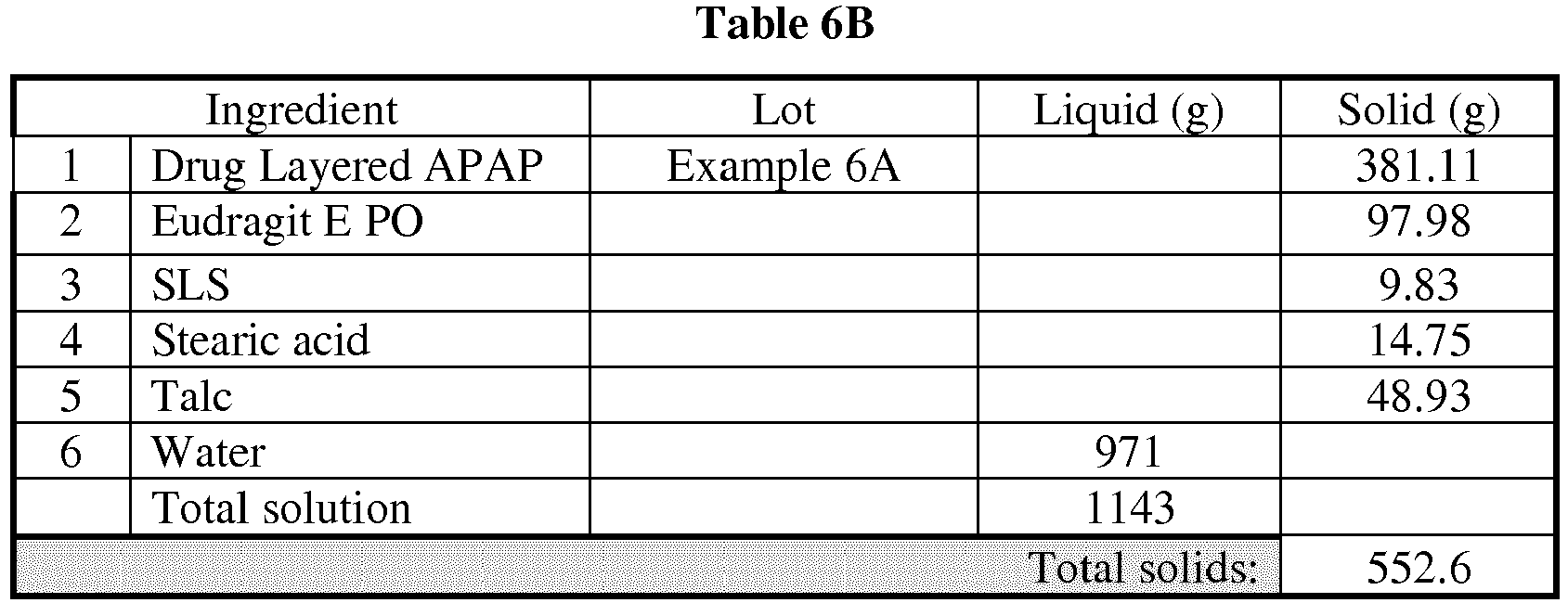
Table 6C No. Ingredients mg/tab Qty/Batch (g.) % 1 Eudragit E PO coated Naloxone-APAP Granules 552.75 11.055 73.7 2 Lactose Monohydrate (Fast Flo 316) 41.625-146.625 0.833-2.933 5.55-19.55 3 Pregelatinized Starch (Swelstar MX-1) 7.5-37.5 0.15-0.75 1-5 4 Crospovidone 37.5-112.5 0.75-2.25 5-15 5 Magnesium stearate 5.625 0.11 0.75 Total 750 15 100.0 Table 6D Ref. No. % Pregelatinized Starch (Swelstar MX-1) % Crospovidone 1 0 5 2 1 5 3 1 15 4 2.5 5 5 2.5 15 6 5 5 7 5 15 - Formulation 7 was prepared in accordance with the following general procedure:
- Procedure:
- 1. Pass items #1-5 (Naloxone, APAP, Lactose, Pregelatinized Starch and Crospovidone) through a 20 Mesh screen and mix for about 10 minutes.
- 2. Pass item #6 (Magnesium Stearate) through a 30 Mesh screen into the above blend and mix for about 3 minutes.
- 3. Compress into caplet shaped tablets at a target weight of about 750 mg and a target hardness of about 5-10 kp.
- Table 7 shows the formulation for Formulation 7. Table 7A shows the amounts of pregelatinized starch and crospovidone in various formulations prepared in accordance with Example 7.
Table 7 No. Ingredients mg/tab Qty/Batch (g.) % 1 Naloxone HCl Dihydrate 6.10 0.122 0.813 2 APAP (Granules) 361.11 7.22 48.15 3 Lactose Monohydrate (Fast Flo 316) 227.25-332.25 4.545-6.645 30.3-44.3 4 Pregelatinized Starch (Swelstar MX-1) 7.5-37.5 0.15-0.75 1-5 5 Crospovidone 37.5-112.5 0.75-2.25 5-15 6 Magnesium stearate 5.625 0.11 0.75 Total 750 15 100.0 Table 7A Ref. No. % Pregelatinized Starch (Swelstar MX-1) % Crospovidone 8 0 5 9 1 5 10 1 15 11 2.5 5 12 2.5 15 13 5 5 14 5 15 - Dissolution was tested on Formulation 6B, Formulation 6C and Formulation 7 under the following conditions:
- Method: USP apparatus 2 (Paddle)
- Paddle speed: 50 rpm
- Medium: Distilled water or 0.1N HCl
- Volume: 900 mL
- Sampling intervals: 5, 10, 15, 30, and 45 minutes
- Tables 8A, 8B and 8C below (and
Figures 5 ,6 and7 ) show the dissolution data of Formulations 6B, 6C and 7 in both water and 0.1N HCl.Table 8A (Formulation 6B: Eudragit E PO coated Naloxone-APAP Granules) Time (Minutes) Dissolution of Naloxone-APAP in different media (%) (n=1) Naloxone Water 0.1 N HCl 0 0 0 5 39 84 10 55 95 15 65 90 30 80 84 45 85 79 - Polymer Eudragit E PO coated Naloxone loaded APAP Granules (Formulation 6B) showed pH dependent dissolution profiles for Naloxone in varying dissolution media. Dissolution in 0.1N HCl releases >80% of Naloxone within 5 minutes. Dissolution in water is slower for Naloxone than in 0.1N HCl.
Table 8B (Formulation 6C: Formulation containing Eudragit E PO coated Naloxone-APAP Granules, 1% Swelstar and 5% Crospovidone) Time (Minutes) Dissolution of Naloxone-APAP in different media (%) (n=1) Naloxone Water 0.1 N HCl 0 0 0 5 1 43 10 2 61 15 4 71 30 7 88 45 9 94 - Formulation 6C was prepared using coated Naloxone-APAP beads (Formulation 6B), 1% Swelstar, 5% Crospovidone and other excipients. The dissolution in 0.1N HCl reaches 94% of Naloxone at 45 minutes. In water however, the dissolution study shows a release of 9% of Naloxone at 45 minutes.
Table 8C (Formulation 7: Formulation containing uncoated Naloxone, APAP Granules, 5% Swelstar and 5% Crospovidone) Time (Minutes) Dissolution of Naloxone-APAP in different media (%) (n=1) Naloxone Water 0.1 N HCl 0 0 0 5 22 15 10 76 23 15 98 29 30 108 90 45 109 95 - Formulation 7 was prepared using uncoated active agents (Naloxone and APAP), 5% Swelstar, 5% Crospovidone and other excipients. The dissolution in 0.1N HCl is slower than in water for Naloxone and suggests the gelling polymer alone may not be satisfactory enough to impart abuse deterrent properties based on preferential dissolution to the opioid combination drug product.
- Syringability and extractability of Oxycodone HCl Abuse-Deterrent Immediate Release tablets (Example 5A) of the present invention against Reference Listed Drug (RLD) product, Roxicodone® tablet (15mg) were evaluated. Roxicodone is a commercially available oxycodone hydrochloride immediate release tablets.
Materials and Equipment: - Small weigh boat
- 5 mL syringe
- 20 mL scintillation vial
- Cotton
- 27&1/2 G needle
- Clear glass mortar & pestle
- Timer
- Tablets were ground/blended using following method:
- 1. One (1) tablet or powder blend equivalence to one tablet was placed in a 2 oz. glass mortar.
- 2. The tablet was crushed and ground or blended 6-7 times using a glass pestle to break up the tablet or blend into small pieces.
- 3. The timer was started the pieces were ground using vigorous circular motions.
- 4. The material from the sides of the mortar was brought to the bottom by tapping the mortar on the counter while grinding.
- 5. Grinding continued for 1 minute to form a uniform fine powder.
- 5 mL of appropriate extraction solvent was added to the vial and the timer started while shaking by hand for 30 seconds and then poured into a small weigh boat containing a pea-size piece of cotton. Using a 27&1/2 gauge needle and a 5 mL syringe, an attempt to syringe as much liquid as possible through the cotton was conducted and the volume aspirated during a 5 minute period (T0 sample) was recorded. Aspirated samples were submitted for assay. In cases of heated/boiled samples, the same instructions were followed above with heating the solution while shaking until it just starts to boil, then pour out into weigh boat containing cotton.
- For the 10 minute time point (T10 sample): the same procedure as above was followed and the sampled boiled. Samples were allowed to remain in vial for 10 minutes before aspirating.
- Extraction solvents used were Tap Water, Vinegar, 0.9% Saline and 40% Ethanol.
- The following tables show the syringability and extraction study results on Oxycodone HCl Tablets 15mg in different medium.
Table 9A. Syringability and Extraction study on Oxycodone HCl Tablets in Tap water (n=2) Sample T0 T10 Extraction volume (ml) Oxycodone extracted (%) Extraction volume (ml) Oxycodone extracted (%) Roxicodone 15mg tablets (RLD) 4.6 77.4 Not needed; T0 exceeds Q value in Specifications Not needed; T0 exceeds Q value in Specifications Example 5A, 15mg .4 8.44 3.60 28.57 Table 9B. Syringability and Extraction study on Oxycodone HCl Tablets in Vinegar (n=2) Sample T0 T10 Extraction volume (ml) Oxycodone extracted (%) Extraction volume (ml) Oxycodone extracted (%) Roxicodone 15mg tablets (RLD) 4.5 80.0 Not needed; T0 exceeds Q value in Specifications Not needed; T0 exceeds Q value in Specifications Example 5A, 15mg 0.15 4.42 3.10 46.83 Table 9C. Syringability and Extraction study on Oxycodone HCl Tablets in 40% EtOH (n=2) Sample T0 T10 Extraction volume (ml) Oxycodone extracted (%) Extraction volume (ml) Oxycodone extracted (%) Roxicodone 15mg tablets (RLD) 3.6 59.7 Not performed Not performed Example 5A, 15mg 0.20 3.36 3.15 38.04 Table 9D. Syringability and Extraction study on Oxycodone HCl Tablets in 0.9% Saline (n=2) Sample T0 T10 Extraction volume (ml) Oxycodone extracted (%) Extraction volume (ml) Oxycodone extracted (%) Roxicodone 15mg tablets (RLD) 4.5 79.8 Not needed; T0 exceeds Q value in Specifications Not needed; T0 exceeds Q value in Specifications Example 5A, 15mg 0.85 3.78 1.80 15.30 - Test formulation (Example 5A, 15mg) significantly improved both syringability and extractability compared with reference product (Roxicodone 15mg) at T0 time point. The extraction volumes in different media were reduced from about 3.6-4.6 ml to a range of 0.15-1.4ml. Oxycodone extractions were also reduced from range of about 59.7-80.0% to range a range of 3.36-8.44%.
- Syringability and extractability of 15mg Naloxone HCl Blend (High dose Naloxone pellets with 1% Swelstar and 0.5% Xanthan Gum) was evaluated. The formulation was prepared in accordance with the above procedures (replacing a portion of Swelstar with Xanthan Gum) and is set forth in Table 10 below.

- Results were shown in Table 10A below.
Table 10A. Syringability and Extraction study on the Naloxone HCl Tablets (60% weight gain of Eudragit EPO and 0.5% Xanthan gum) in different extraction media at T0 (n=2) S ample/Medium Tap Water 0.9% Saline Extraction volume (ml) Naloxone extracted (%) Extraction volume (ml) Naloxone extracted (%) Ex. 10A 0.7 5.5 1.6 11.2 - Dissolution profiles of naloxone as a surrogate in this formulation are shown in
Figure 11 . Dissolution media and conditions were as follows: 500 ml Media, USP Apparatus 2 (Paddle), at 50 RPM. Drug loading was approximately 90% of the theoretical amount in tablets. - The formulations yield results demonstrating the use of a higher loading of the acid sensitive polymer Eudragit EPO at 60% and inclusion of 0.5% Xanthan Gum, coupled with the standard 1% Swelstar dramatically reduces extraction amounts of the opioid drug consistent with very low syringability results compared to other formulations as summarized below.
- Syringability and extractability of 20mg Oxycodone HCl Blend (High dose Oxycodone pellets with different concentration of Swelstar) was evaluated. Results are shown in Tables 10B-10E below. The blends were prepared in accordance with example 5B except for the compression step.
Table 10B. Syringability and Extraction study on 20mg oxycodone HCl blend in Tap water (n=2) Sample T0 T10 Extraction volume (ml) Oxycodone extracted (%) Extraction volume (ml) Oxycodone extracted (%) Oxycodone Blend (1.0% Swelstar) 3.3 21.62 1.6 25.66 Oxycodone Blend (1.5% Swelstar) 2.0 10.58 1.3 16.32 Oxycodone Blend (2.0% Swelstar) 2.5 7.80 2.0 25.90 Table 10C. Syringability and Extraction study on 20mg Oxycodone HCl blend in vinegar (n=2) Sample T0 T10 Extraction volume (ml) Oxycodone extracted (%) Extraction volume (ml) Oxycodone extracted (%) Oxycodone Blend (1.0% Swelstar) 0.2 3.47 1.0 22.16 Oxycodone Blend (1.5% Swelstar) 1.6 28.44 1.3 26.26 Oxycodone Blend (2.0% Swelstar) 1.1 21.5 0.6 13.10 Table 10D. Syringability and Extraction of 20mg Oxycodone HCl blends in 40% EtOH (n=2) Sample T0 T10 Extraction volume (ml) Oxycodone extracted (%) Extraction volume (ml) Oxycodone extracted (%) Oxycodone Blend (1.0% Swelstar) 2.3 37.19 1.3 23.51 Oxycodone Blend (1.5% Swelstar) 2.2 30.53 1.4 28.54 Oxycodone Blend (2.0% Swelstar) 1.2 15.80 1.5 27.30 Table 10E. Syringability and Extraction study on 20mg Oxycodone HCl blend in 0.9% Saline (n=2) Sample T0 T10 Extraction volume (ml) Oxycodone extracted (%) Extraction volume (ml) Oxycodone extracted (%) Oxycodone Blend (1.0% Swelstar) 2.3 5.10 2.3 21.2 Oxycodone Blend (1.5% Swelstar) 2.0 4.19 2.0 22.38 Oxycodone Blend (2.0% Swelstar) 2.3 5.50 2.3 27.20 - The following tables, Table 10F-10I show the syringability and extraction results on Oxycodone HCl Tablets in different extraction media. The tablets were prepared in accordance with Example 5B with the addition of 0.5% silicone dioxide (Cab-o-Sil®) and a corresponding reduction in magnesium stearate.
Table 10F. Syringability and Extraction study on Oxycodone HCl Tablets in Tap water (n=2) Sample T0 T10 Extraction volume (ml) Oxycodone extracted (%) Extraction volume (ml) Oxycodone extracted (%) Roxicodone 15mg tablets (RLD) 4.6 77.4 Not needed; T0 exceeds Q value in Specifications Not needed; T0 exceeds Q value in Specifications Example 5A, 15mg 1.4 8.44 3.60 28.57 Oxecta 7.5mg 0.13 0.6 Not performed Not performed Table 10G. Syringability and Extraction study on Oxycodone HCl Tablets in Vinegar (n=2) Sample T0 T10 Extraction volume (ml) Oxycodone extracted (%) Extraction volume (ml) Oxycodone extracted (%) Roxicodone 15mg tablets (RLD) 4.5 80.0 Not needed; T0 exceeds Q value in Specifications Not needed; T0 exceeds Q value in Specifications Example 5A, 15mg 0.15 4.42 3.10 46.83 Oxecta 7.5mg 0.1 0.7 Not performed Not performed Table 10H. Syringability and Extraction study on Oxycodone HCl Tablets in 40% EtOH (n=2) Sample T0 T10 Extraction volume (ml) Oxycodone extracted (%) Extraction volume (ml) Oxycodone extracted (%) Roxicodone 15mg tablets (RLD) 3.6 59.7 Not needed; T0 exceeds Q value in Specifications Not needed; T0 exceeds Q value in Specifications Example 5A, 15mg 0.20 3.36 3.15 38.04 Oxecta 7.5mg 0.1 0.1 N/A N/A Table 10I. Syringability and Extraction study on Oxycodone HCl Tablets in 0.9% Saline (n=2) Sample T0 T10 Extraction volume (ml) Oxycodone extracted (%) Extraction volume (ml) Oxycodone extracted (%) Roxicodone 15mg tablets (RLD) 4.5 79.8 Not needed; T0 exceeds Q value in Specifications Not needed; T0 exceeds Q value in Specifications Example 5A, 15mg 0.85 3.78 1.80 15.30 Oxecta 7.5mg 0.1 0.4 N/A N/A - The present invention is not to be limited in scope by the specific embodiments disclosed in the examples which are intended as illustrations of a few aspects of the invention and any embodiments that are functionally equivalent are within the scope of this invention. Indeed, various modifications of the invention in addition to those shown and described herein will become apparent to those skilled in the art and are intended to fall within the scope of the appended claims.
| Time (Minutes) | Dissolution of Naloxone in different media (% Dissolved) (n=3) | |
| Water | 0.1 | |
| 0 | 0 | 0 |
| 5 | 43 | 44 |
| 10 | 53 | 57 |
| 15 | 61 | 62 |
| 30 | 72 | 70 |
| 45 | 75 | 74 |
| 60 | 80 | 80 |
| Time (Minutes) | Dissolution of Naloxone in different media (% Dissolved) (n=3) | |
| Water | 0.1 | |
| 0 | 0 | 0 |
| 5 | 3 | 21 |
| 10 | 9 | 47 |
| 15 | 14 | 64 |
| 30 | 26 | 81 |
| 45 | 35 | 82 |
| 60 | 40 | 85 |
Claims (34)
- An immediate release solid oral dosage form comprising a plurality of particles, each particle comprising:(i) an active agent; and(ii) a material that is sensitive to acidic pH;wherein the plurality of particles are dispersed in a matrix comprising a gelling agent selected from the group consisting of pregelatinized starch, hydroxyethylcellulose, guar gum, xanthan gum, alginate, carrageenan and mixtures thereof; and
wherein the dosage form releases at least about 70% of the active agent within 45 minutes as measured by in-vitro dissolution in a USP Apparatus 2 (paddle) at 50 rpm in 500 ml 0.1N HCl at 37° C. - The immediate release solid oral dosage form of claim 1, wherein the matrix comprises a disintegrant.
- The immediate release solid oral dosage form of claim 1 or 2, wherein the matrix comprises a filler.
- The immediate release solid oral dosage form of claim 1, wherein each particle comprises either (I) a core comprising the active agent and the material sensitive to acidic pH layered on the core; or (II) a core comprising a first active agent, a coating comprising a second active agent layered over the core and a material that is sensitive to acidic pH layered over the coated core.
- The immediate release solid oral dosage form of claim 4, wherein the core comprises an inert excipient layered with the active agent, or
wherein the core comprises the active agent dispersed in a pharmaceutically acceptable excipient. - The immediate release solid oral dosage form of claim 1, wherein each particle comprises:(i) a core comprising an inert excipient; and(ii) a coating comprising both the active agent and the material sensitive to acidic pH layered on the core.
- The immediate release solid oral dosage form of claim 1, wherein each particle comprises the active agent dispersed in the material sensitive to acidic pH, wherein the plurality of particles are preferably in the form of a granulation.
- The immediate release solid oral dosage form of claim 1, wherein the material sensitive to acidic pH is a polymer.
- The immediate release solid oral dosage form of claim 8,
wherein the polymer is soluble in a pH of between about 1 and about 5; or
wherein the polymer is insoluble in a pH of between about 6 and about 8.5; or wherein the polymer is soluble in a pH of between about 1 and about 5 and insoluble in a pH of between about 6 and about 8.5; or
wherein the polymer is less soluble in a pH range of between about 6 and about 8.5 than a pH range of between about 1 and about 5. - The immediate release solid oral dosage form of claim 8, wherein the polymer is a polyacrylate, a polysaccharide, an ion exchange resin, or a mixture thereof.
- The immediate release solid oral dosage form of claim 10, wherein the polymer is a polyacrylate, preferably a copolymer comprising methyl methacrylate and diethylaminoethyl methacrylate or a copolymer comprising methyl methacrylate, butyl methacrylate and dimethylaminoethyl methacrylate.
- The immediate release solid oral dosage form of claim 10, wherein the polymer is a polysaccharide, preferably chitosan, or an ion exchange resin, preferably a polacrilex resin, a polacrilin salt, sodium polystyrene sulfonate, a cholestyramine resin or a mixture thereof.
- The immediate release solid oral dosage form of claim 1,
wherein the viscosity of the dosage form mixed with from about 0.5 to about 10 ml of distilled water prevents the active agent from being systemically absorbed, or reduces the ability of the active agent to be systemically absorbed, when administered by the parenteral or nasal route; and/or
wherein the viscosity of the solid oral dosage form after crushing and mixing with from about 0.5 to about 10 ml of distilled water prevents the active agent from being systemically absorbed, or reduces the ability of the active agent to be systemically absorbed, when administered by the parenteral or nasal route;
wherein the viscosity after mixing with from about 0.5 to about 10 ml of distilled water is preferably from about 10 cP to about 100 cP, more preferably from about 25 cP to about 75 cP. - The immediate release solid oral dosage form of claim 2,
wherein the disintegrant is selected from the group consisting of cross-linked sodium carboxymethylcellulose, starch, sodium starch glycolate, cross-linked polyvinylpyrrolidone and mixtures thereof; and/or
wherein the immediate release solid oral dosage form comprises the disintegrant in an amount from about 2% to about 25% (w/w) of the dosage form, preferably in an amount from about 2% to about 10% (w/w) of the dosage form. - The immediate release solid oral dosage form of claim 3,
wherein the immediate release solid oral dosage form comprises the filler in an amount from about 15% to about 95% (w/w) of the dosage form, preferably in an amount from about 25% to about 50% (w/w) of the dosage form, and/or
wherein the filler is a saccharide, preferably selected from the group consisting of sucrose, dextrose, lactose, fructose, mannitol, a cellulosic derivative and a mixture thereof, more preferably lactose or microcrystalline cellulose. - The immediate release solid oral dosage form of claim 1,
wherein each particle is layered with a barrier layer, wherein the barrier layer preferably comprises a material selected from the group consisting of hydroxypropylmethylcellulose, polyvinyl alcohol, povidone and mixtures thereof. - The immediate release solid oral dosage form of claim 1,
wherein the plurality of particles comprise a therapeutically effective amount of the active agent; and/or
wherein the active agent is selected from the group consisting of opioid agonists, tranquilizers, CNS depressants, CNS stimulants, sedative hypnotics, and mixtures thereof. - The immediate release solid oral dosage form of claim 1, wherein the active agent is an opioid agonist, preferably selected from the group consisting of codeine, morphine, oxycodone, oxymorphone, hydrocodone, hydromorphone, pharmaceutically acceptable salts thereof, and mixtures thereof.
- The immediate release solid oral dosage form of claim 4, wherein the first active agent is a non-opioid analgesic and the second active agent is an opioid, wherein the non-opioid analgesic is preferably acetaminophen, aspirin or ibuprofen or pharmaceutically acceptable salts thereof.
- The immediate release solid oral dosage form of any one of claims 1, 18 or 19, further comprising an aversive agent,
wherein the aversive agent is preferably contained in the plurality of particles and/or the matrix, and/or
wherein the aversive agent is selected from the group consisting of emetics, antagonists, bittering agents, irritants and mixtures thereof. - The immediate release solid oral dosage form of claim 20,
wherein the aversive agent is an emetic selected from the group consisting of methyl cephaeline, cephaeline, emetine hydrochloride, psychotrine, O-methylpsychotrine, emetamine, ipecamine, hydro-ipecamine, ipecacunhic acid and mixtures thereof, wherein the emetic is preferably ipecac; or
wherein the aversive agent is an antagonist selected from the group consisting of naltrexone, naloxone, nalmefene, cyclazacine, levallorphan, pharmaceutically acceptable salts thereof, and mixtures thereof; or
wherein the aversive agent is a bittering agent selected from the group consisting of flavor oils, flavoring aromatics, oleoresins, plant extracts, leaf extracts, flower extracts, fruit extracts, sucrose derivatives, chlorosucrose derivatives, quinine sulphate, denatonium benzoate and mixtures thereof; or
wherein the aversive agent is a bittering agent selected from the group consisting of spearmint oil, peppermint oil, eucalyptus oil, oil of nutmeg, allspice, mace, oil of bitter almonds, menthol and mixtures thereof ; or
wherein the aversive agent is a bittering agent extracted from a fruit selected from the group consisting of lemon, orange, lime, grapefruit and mixtures thereof; or wherein the aversive agent is denatonium benzoate; or
wherein the aversive agent is an irritant,
wherein the irritant is preferably a surfactant, capsaicin or a capsaicin analog, wherein the capsaicin analog is preferably selected from the group consisting of resiniferatoxin, tinyatoxin, heptanoylisobutylamide, heptanoyl guaiacylamide, an isobutylamide, a guaiacylamide, dihydrocapsaicin, homovanillyl octylester, nonanoyl vanillylamide and mixtures thereof ; or
wherein the surfactant is preferably selected from the group consisting of poloxamer, a sorbitan monoester, a glyceryl monooleate, sodium lauryl sulfate and mixtures thereof. - The immediate release solid oral dosage form of claim 1,
wherein the dosage form releases at least about 85% of the active agent within 45 minutes as measured by in-vitro dissolution in a USP Apparatus 2 (paddle) at 50 rpm in 500 ml 0.1N HCl at 37° C; and/or
wherein the dosage form releases at least about 90% of the active agent within 45 minutes as measured by in-vitro dissolution in a USP Apparatus 2 (paddle) at 50 rpm in 500 ml 0.1N HCl at 37° C; and/or
wherein the dosage form releases at least about 85% of the active agent within 60 minutes as measured by in-vitro dissolution in a USP Apparatus 2 (paddle) at 50 rpm in 500 ml 0.1N HCl at 37° C; and/or
wherein the dosage form releases at least about 90% of the active agent within 60 minutes as measured by in-vitro dissolution in a USP Apparatus 2 (paddle) at 50 rpm in 500 ml 0.1N HCl at 37° C; and/or
wherein the dosage form releases at least about 95% of the active agent within 60 minutes as measured by in-vitro dissolution in a USP Apparatus 2 (paddle) at 50 rpm in 500 ml 0.1N HCl at 37° C. - The immediate release solid oral dosage form of claim 1, comprising the gelling agent in an amount from about 0.25% to about 50% (w/w) of the dosage form, preferably from about 0.25% to about 10% (w/w) of the dosage form.
- The immediate release solid oral dosage form of claim 1, in the form of a compressed tablet or contained in a pharmaceutically acceptable capsule.
- The immediate release solid oral dosage form of claim 1 comprising a plurality of particles, each particle comprising:(i) an opioid agonist; and(ii) a material that is sensitive to acidic pH;wherein the plurality of particles are dispersed in a matrix comprising:(i) a gelling agent selected from the group consisting of pregelatinized starch, hydroxyethylcellulose, guar gum, xanthan gum, alginate, carrageenan and mixtures thereof; and(ii) a disintegrant;wherein the dosage form releases at least about 70% of the opioid agonist within 45 minutes as measured by in-vitro dissolution in a USP Apparatus 2 (paddle) at 50 rpm in 500 ml 0.1N HCl at 37° C; and
wherein the viscosity of the dosage form mixed with from about 0.5 to about 10 ml of distilled water prevents the opioid agonist from being systemically absorbed, or reduces the ability of the opioid agonist to be systemically absorbed, when administered by the parenteral or nasal route. - A process for preparing an immediate release solid oral dosage form comprising:(i) preparing a plurality of particles, each particle comprising an active agent and a material that is sensitive to acidic pH; and(ii) dispersing the plurality of particles into a matrix comprising a gelling agent selected from the group consisting of pregelatinized starch, hydroxyethylcellulose, guar gum, xanthan gum, alginate, carrageenan and mixtures thereof;wherein the dosage form releases at least about 70% of the active agent within 45 minutes as measured by in-vitro dissolution in a USP Apparatus 2 (paddle) at 50 rpm in 500 ml 0.1N HCl at 37° C.
- The process of claim 26, wherein the matrix comprises a disintegrant and/or a filler.
- The process of claim 26, wherein the particles are prepared by layering a core comprising the active agent with the material sensitive to acidic pH,
wherein the core preferably comprises an inert excipient layered with the active agent, or wherein the core comprises the active agent dispersed in a pharmaceutically acceptable excipient. - The process of claim 26, wherein the particles are prepared by coating a core comprising an inert excipient with the active agent and the material sensitive to acidic pH; or
wherein the particles are prepared by dispersing the active agent in the material sensitive to acidic pH. - The immediate release solid oral dosage form of claim 1 comprising a plurality of particles, each particle comprising:(i) an opioid agonist; and(ii) a material that is sensitive to acidic pH;wherein the plurality of particles are dispersed in a matrix comprising:(i) a gelling agent selected from the group consisting of pregelatinized starch, hydroxyethylcellulose, guar gum, xanthan gum, alginate, carrageenan and mixtures thereof; and optionally(ii) a disintegrant;wherein the dosage form releases at least about 70% of the opioid agonist within 45 minutes as measured by in-vitro dissolution in a USP Apparatus 2 (paddle) at 50 rpm in 500 ml 0. IN HCl at 37° C; and
provides a viscosity after mixing with from about 0.5 to about 10 ml of distilled water from about 10 cP to about 100 cP or from about 25 cP to about 75 cP. - The immediate release solid oral dosage form of claim 30,
wherein the material that is sensitive to acidic pH provides for less dissolution of active agent from the dosage form in 500 ml distilled water after 5 minutes, preferably after 10 minutes as measured by in-vitro dissolution in a USP paddle Apparatus at 50 rpm and 37° C as compared to the dissolution in 900 ml 0.1 N HCl after 5 or 10 minutes, respectively, as measured by in-vitro dissolution in a USP basket Apparatus at 50 rpm and 37° C,
wherein the ratio of the amount released in water to the amount released in 0. IN HCl is preferably about 1:10 to less than 1:1, about 1:5 to about 9:10, about 3:10 to about 4:5, or about 2:5 to about 7:10 or about 1:2 to about 3:5; and/or the ratio is about 1:10 to about 9:10, about 3:10 to about 9:10, about 1:2 to about 9:10, about 7:10 to about 9:10 or about 4:5 to about 9:10; and/or the ratio is about 1:10, about 1:5, about 3:10, about 2:5, about 1:2, about 3:5, about 7:10; about 4:5 or about 9:10. - The immediate release solid oral dosage form of claim 30 or 31,
wherein the material that is sensitive to acidic pH is selected from the group of copolymers including amino-, and/or monoalkylamino-, and/or dialkylamino groups, preferably a copolymer comprising methyl methacrylate, butylmethacrylate and dimethylaminoethyl methacrylate, and/or
wherein the gelling agent is selected from a mixture of pregelatinized starch and xanthan gum; and/or
wherein the viscosity of the dosage form mixed with from about 0.5 to about 10 ml of distilled water prevents the opioid agonist from being systemically absorbed, or reduces the ability of the opioid agonist to be systemically absorbed, when administered by the parenteral or nasal route, and/or
wherein the active agent is susceptible to abuse, wherein the active agent is preferably an opioid analgesic; more preferably oxycodone hydrochloride. - An immediate release solid oral dosage form according to any one of claims 1 to 25 and 30 to 32 for use in a method of treating a disease or condition in a patient in need thereof.
- An immediate release solid oral dosage form according to any one of claims 18, 19, 25, and 30 to 32 for use in a method of treating pain in a patient in need thereof.
Priority Applications (1)
| Application Number | Priority Date | Filing Date | Title |
|---|---|---|---|
| EP17150886.4A EP3170492B1 (en) | 2012-03-02 | 2013-03-01 | Tamper resistant immediate release formulations |
Applications Claiming Priority (3)
| Application Number | Priority Date | Filing Date | Title |
|---|---|---|---|
| US201261606156P | 2012-03-02 | 2012-03-02 | |
| US201261724141P | 2012-11-08 | 2012-11-08 | |
| PCT/IB2013/000444 WO2013128276A2 (en) | 2012-03-02 | 2013-03-01 | Tamper resistant immediate release formulations |
Related Child Applications (1)
| Application Number | Title | Priority Date | Filing Date |
|---|---|---|---|
| EP17150886.4A Division EP3170492B1 (en) | 2012-03-02 | 2013-03-01 | Tamper resistant immediate release formulations |
Publications (2)
| Publication Number | Publication Date |
|---|---|
| EP2819653A2 EP2819653A2 (en) | 2015-01-07 |
| EP2819653B1 true EP2819653B1 (en) | 2017-01-11 |
Family
ID=48044945
Family Applications (2)
| Application Number | Title | Priority Date | Filing Date |
|---|---|---|---|
| EP17150886.4A Active EP3170492B1 (en) | 2012-03-02 | 2013-03-01 | Tamper resistant immediate release formulations |
| EP13713496.1A Active EP2819653B1 (en) | 2012-03-02 | 2013-03-01 | Tamper resistant immediate release formulations |
Family Applications Before (1)
| Application Number | Title | Priority Date | Filing Date |
|---|---|---|---|
| EP17150886.4A Active EP3170492B1 (en) | 2012-03-02 | 2013-03-01 | Tamper resistant immediate release formulations |
Country Status (21)
| Country | Link |
|---|---|
| US (3) | US11173155B2 (en) |
| EP (2) | EP3170492B1 (en) |
| JP (2) | JP6199321B2 (en) |
| CN (2) | CN104144681A (en) |
| AR (1) | AR090218A1 (en) |
| AU (2) | AU2013203493B2 (en) |
| CA (1) | CA2852042C (en) |
| CL (1) | CL2014002283A1 (en) |
| EA (1) | EA028224B1 (en) |
| ES (2) | ES2619574T3 (en) |
| IL (1) | IL234256B (en) |
| IN (1) | IN2014MN01901A (en) |
| MX (1) | MX354677B (en) |
| NZ (1) | NZ629468A (en) |
| PE (1) | PE20142320A1 (en) |
| PH (1) | PH12014501910B1 (en) |
| SG (1) | SG11201405011PA (en) |
| TW (2) | TW201722406A (en) |
| UY (1) | UY34651A (en) |
| WO (1) | WO2013128276A2 (en) |
| ZA (1) | ZA201405960B (en) |
Families Citing this family (55)
| Publication number | Priority date | Publication date | Assignee | Title |
|---|---|---|---|---|
| US7776314B2 (en) | 2002-06-17 | 2010-08-17 | Grunenthal Gmbh | Abuse-proofed dosage system |
| EP1610767B1 (en) | 2003-03-26 | 2011-01-19 | Egalet A/S | Morphine controlled release system |
| DE10336400A1 (en) | 2003-08-06 | 2005-03-24 | Grünenthal GmbH | Anti-abuse dosage form |
| DE102005005446A1 (en) | 2005-02-04 | 2006-08-10 | Grünenthal GmbH | Break-resistant dosage forms with sustained release |
| US20070048228A1 (en) | 2003-08-06 | 2007-03-01 | Elisabeth Arkenau-Maric | Abuse-proofed dosage form |
| DE10361596A1 (en) | 2003-12-24 | 2005-09-29 | Grünenthal GmbH | Process for producing an anti-abuse dosage form |
| DE102004032049A1 (en) | 2004-07-01 | 2006-01-19 | Grünenthal GmbH | Anti-abuse, oral dosage form |
| DE102005005449A1 (en) | 2005-02-04 | 2006-08-10 | Grünenthal GmbH | Process for producing an anti-abuse dosage form |
| JP2010522135A (en) | 2006-10-09 | 2010-07-01 | チャールストン ラボラトリーズ,インコーポレイテッド | Pharmaceutical composition |
| JP5714910B2 (en) | 2008-01-09 | 2015-05-07 | チャールストン ラボラトリーズ,インコーポレイテッド | Pharmaceutical composition |
| CA2713128C (en) | 2008-01-25 | 2016-04-05 | Gruenenthal Gmbh | Pharmaceutical dosage form |
| NZ594207A (en) | 2009-02-06 | 2013-03-28 | Egalet Ltd | Immediate release composition resistant to abuse by intake of alcohol |
| WO2010149169A2 (en) | 2009-06-24 | 2010-12-29 | Egalet A/S | Controlled release formulations |
| EP3311667A1 (en) | 2009-07-08 | 2018-04-25 | Charleston Laboratories, Inc. | Pharmaceutical compositions |
| RU2015138422A (en) | 2009-07-22 | 2018-12-25 | Грюненталь Гмбх | STABLE DURING OXIDATION, STRONG-BREAKED DOSAGE FORM |
| CN102573805A (en) | 2009-07-22 | 2012-07-11 | 格吕伦塔尔有限公司 | Hot-melt extruded controlled release dosage form |
| BR112013005234A2 (en) | 2010-09-02 | 2016-05-03 | Gruenenthal Gmbh | Tamper resistant dosage form comprising an anionic polymer. |
| NZ607392A (en) | 2010-09-02 | 2015-03-27 | Gruenenthal Chemie | Tamper resistant dosage form comprising inorganic salt |
| PE20141638A1 (en) | 2011-07-29 | 2014-11-22 | Gruenenthal Chemie | HANDLE PROOF TABLET PROVIDING IMMEDIATE DRUG RELEASE |
| RS56527B1 (en) | 2011-07-29 | 2018-02-28 | Gruenenthal Gmbh | Tamper-resistant tablet providing immediate drug release |
| MX356421B (en) | 2012-02-28 | 2018-05-29 | Gruenenthal Gmbh | Tamper-resistant dosage form comprising pharmacologically active compound and anionic polymer. |
| DK2838512T3 (en) | 2012-04-18 | 2018-11-19 | Gruenenthal Gmbh | MANIPULATED AND DOSAGE DUMPED PHARMACEUTICAL DOSAGE FORM |
| US10064945B2 (en) | 2012-05-11 | 2018-09-04 | Gruenenthal Gmbh | Thermoformed, tamper-resistant pharmaceutical dosage form containing zinc |
| JP6445537B2 (en) | 2013-05-29 | 2018-12-26 | グリュネンタール・ゲゼルシャフト・ミト・ベシュレンクテル・ハフツング | Tamper-resistant dosage forms containing one or more particles |
| AR096439A1 (en) | 2013-05-29 | 2015-12-30 | Gruenenthal Gmbh | DOSAGE METHOD RESISTING TO INDEED USE CONTAINING ONE OR MORE PARTICLES |
| US10624862B2 (en) | 2013-07-12 | 2020-04-21 | Grünenthal GmbH | Tamper-resistant dosage form containing ethylene-vinyl acetate polymer |
| AU2014306759B2 (en) | 2013-08-12 | 2018-04-26 | Pharmaceutical Manufacturing Research Services, Inc. | Extruded immediate release abuse deterrent pill |
| US9770514B2 (en) | 2013-09-03 | 2017-09-26 | ExxPharma Therapeutics LLC | Tamper-resistant pharmaceutical dosage forms |
| CA2900858C (en) * | 2013-10-31 | 2017-05-02 | Cima Labs Inc. | Immediate release abuse-deterrent granulated dosage forms |
| US20150118300A1 (en) * | 2013-10-31 | 2015-04-30 | Cima Labs Inc. | Immediate Release Abuse-Deterrent Granulated Dosage Forms |
| AU2014356581C1 (en) | 2013-11-26 | 2020-05-28 | Grunenthal Gmbh | Preparation of a powdery pharmaceutical composition by means of cryo-milling |
| US10172797B2 (en) | 2013-12-17 | 2019-01-08 | Pharmaceutical Manufacturing Research Services, Inc. | Extruded extended release abuse deterrent pill |
| US9492444B2 (en) | 2013-12-17 | 2016-11-15 | Pharmaceutical Manufacturing Research Services, Inc. | Extruded extended release abuse deterrent pill |
| US10632113B2 (en) | 2014-02-05 | 2020-04-28 | Kashiv Biosciences, Llc | Abuse-resistant drug formulations with built-in overdose protection |
| US9642811B2 (en) * | 2014-03-26 | 2017-05-09 | Sun Pharma Advanced Research Company Ltd. | Abuse deterrent immediate release biphasic matrix solid dosage form |
| MX2016014738A (en) | 2014-05-12 | 2017-03-06 | Gruenenthal Gmbh | Tamper resistant immediate release capsule formulation comprising tapentadol. |
| MX2016015417A (en) | 2014-05-26 | 2017-02-22 | Gruenenthal Gmbh | Multiparticles safeguarded against ethanolic dose-dumping. |
| EP3169315B1 (en) | 2014-07-17 | 2020-06-24 | Pharmaceutical Manufacturing Research Services, Inc. | Immediate release abuse deterrent liquid fill dosage form |
| US9132096B1 (en) | 2014-09-12 | 2015-09-15 | Alkermes Pharma Ireland Limited | Abuse resistant pharmaceutical compositions |
| US20160106737A1 (en) | 2014-10-20 | 2016-04-21 | Pharmaceutical Manufacturing Research Services, Inc. | Extended Release Abuse Deterrent Liquid Fill Dosage Form |
| CA2970065A1 (en) | 2014-12-08 | 2016-06-16 | Cima Labs Inc. | Immediate release abuse-deterrent granulated dosage forms |
| US20160310437A1 (en) * | 2015-04-24 | 2016-10-27 | Grünenthal GmbH | Tamper-resistant fixed dose combination providing fast release of two drugs from particles |
| MX2017013643A (en) * | 2015-04-24 | 2018-03-08 | Gruenenthal Gmbh | FIXED DOSE COMBINATION RESISTANT TO HANDLING THAT PROVIDES A QUICK RELEASE OF TWO DRUGS FROM PARTICLES AND A MATRIX. |
| WO2016170095A1 (en) * | 2015-04-24 | 2016-10-27 | Grünenthal GmbH | Tamper-resistant fixed dose combination providing fast release of two drugs from particles and a powder |
| JP2018517676A (en) | 2015-04-24 | 2018-07-05 | グリュネンタール・ゲゼルシャフト・ミト・ベシュレンクテル・ハフツング | Anti-modification formulation with immediate release and resistance to solvent extraction |
| US20160310428A1 (en) * | 2015-04-24 | 2016-10-27 | Grunenthal Gmbh | Tamper-resistant fixed dose combination providing fast release of two drugs from different particles |
| US20180185352A1 (en) * | 2015-06-09 | 2018-07-05 | KVK-Tech, Inc. | Abuse deterrent pharmaceutical compositions |
| AU2016319203A1 (en) | 2015-09-10 | 2018-02-22 | Grünenthal GmbH | Protecting oral overdose with abuse deterrent immediate release formulations |
| CA3039920A1 (en) | 2016-10-10 | 2018-04-19 | Rhodes Pharmaceuticals L.P. | Pharmaceutical resinate compositions and methods of making and using thereof |
| CA3047325A1 (en) * | 2016-12-21 | 2018-06-28 | Tioga Pharmaceuticals Inc. | Solid pharmaceutical formulations of asimadoline |
| WO2019074829A1 (en) | 2017-10-09 | 2019-04-18 | Rhodes Pharmaceuticals L.P. | Pharmaceutical resinate compositions and methods of making and using thereof |
| EP3965733A4 (en) | 2019-05-07 | 2023-01-11 | Clexio Biosciences Ltd. | Abuse-deterrent dosage forms containing esketamine |
| US12589083B2 (en) | 2019-05-07 | 2026-03-31 | Clexio Biosciences Ltd. | Abuse-deterrent dosage forms containing esketamine |
| CN117715538A (en) * | 2021-05-03 | 2024-03-15 | 剑桥糖质科学有限公司 | Soluble sugar and insoluble sugar compositions and related methods |
| CN118660697A (en) * | 2022-02-09 | 2024-09-17 | 德罗塔斯塔有限责任公司 | Pharmaceutical combination of spasmolytic and anxiolytic |
Citations (21)
| Publication number | Priority date | Publication date | Assignee | Title |
|---|---|---|---|---|
| US4070494A (en) | 1975-07-09 | 1978-01-24 | Bayer Aktiengesellschaft | Enteral pharmaceutical compositions |
| US6455557B1 (en) | 2001-11-28 | 2002-09-24 | Elan Pharmaceuticals, Inc. | Method of reducing somnolence in patients treated with tizanidine |
| US20030068375A1 (en) | 2001-08-06 | 2003-04-10 | Curtis Wright | Pharmaceutical formulation containing gelling agent |
| US20040091544A1 (en) | 2002-11-08 | 2004-05-13 | Ruff Michael D. | Coated dibasic calcium phosphate |
| US6740341B1 (en) | 1998-11-25 | 2004-05-25 | Cima Labs Inc. | Taste masking rapid release coating system |
| WO2004067039A1 (en) | 2003-01-28 | 2004-08-12 | Collegium Pharmaceutical, Inc. | Multiparticulate compositions of milnacipran for oral administration |
| WO2004069135A2 (en) | 2003-02-05 | 2004-08-19 | Ethypharm | Composition comprising a mixture of active principles, and method of preparation |
| US20050112195A1 (en) | 2003-09-26 | 2005-05-26 | Evangeline Cruz | Drug coating providing high drug loading and methods for providing same |
| WO2005046684A1 (en) | 2003-11-04 | 2005-05-26 | Shire Laboratories, Inc. | Once daily dosage forms of trospium |
| US20060210630A1 (en) | 2004-09-30 | 2006-09-21 | Likan Liang | Controlled release compositions of gamma-hydroxybutyrate |
| WO2007120135A1 (en) | 2006-04-17 | 2007-10-25 | Forest Laboratories, Inc. | Lercanidipine immediate release composition |
| WO2008012474A2 (en) | 2006-07-28 | 2008-01-31 | Bouchara-Recordati | Pharmaceutical compositions of active substances difficult to improperly divert from their intended route of administration |
| US20080063725A1 (en) | 2006-05-24 | 2008-03-13 | Flamel Technologies | Prolonged-release multimicroparticulate oral pharmaceutical form |
| US20080152595A1 (en) | 2004-11-24 | 2008-06-26 | Acura Pharmaceuticals, Inc. | Methods and compositions for deterring abuse of orally administered pharmaceutical products |
| EP1967183A1 (en) | 2005-12-28 | 2008-09-10 | Takeda Pharmaceutical Company Limited | Controlled release solid preparation |
| US20090022798A1 (en) | 2007-07-20 | 2009-01-22 | Abbott Gmbh & Co. Kg | Formulations of nonopioid and confined opioid analgesics |
| WO2010044842A1 (en) | 2008-10-16 | 2010-04-22 | University Of Tennessee Research Foundation | Tamper resistant oral dosage forms containing an embolizing agent |
| WO2010066034A1 (en) | 2008-12-12 | 2010-06-17 | Paladin Labs Inc. | Methadone formulation |
| WO2010069050A1 (en) | 2008-12-16 | 2010-06-24 | Labopharm Inc. | Misuse preventative, controlled release formulation |
| WO2011041414A1 (en) | 2009-09-30 | 2011-04-07 | Acura Pharmaceuticals, Inc. | Methods and compositions for deterring abuse |
| WO2013038267A1 (en) | 2011-09-16 | 2013-03-21 | Purdue Pharma L.P. | Tamper resistant pharmaceutical formulations |
Family Cites Families (14)
| Publication number | Priority date | Publication date | Assignee | Title |
|---|---|---|---|---|
| US5965161A (en) * | 1994-11-04 | 1999-10-12 | Euro-Celtique, S.A. | Extruded multi-particulates |
| TWI256309B (en) * | 1999-10-13 | 2006-06-11 | Akzo Nobel Nv | New formulation of mirtazapine |
| CA2455420A1 (en) * | 2001-08-06 | 2003-02-20 | Euro-Celtique, S.A. | Compositions and methods to prevent abuse of opioids |
| US20030044458A1 (en) * | 2001-08-06 | 2003-03-06 | Curtis Wright | Oral dosage form comprising a therapeutic agent and an adverse-effect agent |
| US20030068276A1 (en) * | 2001-09-17 | 2003-04-10 | Lyn Hughes | Dosage forms |
| US8906413B2 (en) * | 2003-05-12 | 2014-12-09 | Supernus Pharmaceuticals, Inc. | Drug formulations having reduced abuse potential |
| US7201920B2 (en) | 2003-11-26 | 2007-04-10 | Acura Pharmaceuticals, Inc. | Methods and compositions for deterring abuse of opioid containing dosage forms |
| TWI483944B (en) | 2004-03-30 | 2015-05-11 | Euro Celtique Sa | A oxycodone hydrochloride composition containing less than 25 PPM of 14-hydroxycodeinone, a pharmaceutical dosage form, a delayed release oral dosage form, and a pharmaceutically acceptable package |
| CA2608361A1 (en) * | 2005-05-13 | 2006-11-23 | Alpharma, Inc. | Morphine sulphate formulations |
| EP2010154A2 (en) * | 2006-04-27 | 2009-01-07 | Takeda Pharmaceutical Company Limited | Mask-tasting solid preparation of pioglitazone |
| US20080057122A1 (en) * | 2006-08-31 | 2008-03-06 | Aaipharma Inc. | Acetaminophen pharmaceutical compositions |
| US20100151034A1 (en) * | 2008-09-30 | 2010-06-17 | Astellas Pharma Inc. | Granular pharmaceutical composition of atorvastatin for oral administration |
| CN102665688A (en) * | 2009-10-28 | 2012-09-12 | 巴斯夫欧洲公司 | Stable protective coatings for pharmaceutical dosage forms |
| CN103764120A (en) | 2011-06-29 | 2014-04-30 | 阿勒根公司 | Polyethylene glycol 15 hydroxystearate preparation |
-
2013
- 2013-03-01 TW TW105127500A patent/TW201722406A/en unknown
- 2013-03-01 AR ARP130100669A patent/AR090218A1/en unknown
- 2013-03-01 EP EP17150886.4A patent/EP3170492B1/en active Active
- 2013-03-01 EP EP13713496.1A patent/EP2819653B1/en active Active
- 2013-03-01 PE PE2014001346A patent/PE20142320A1/en not_active Application Discontinuation
- 2013-03-01 ES ES13713496.1T patent/ES2619574T3/en active Active
- 2013-03-01 CN CN201380012104.8A patent/CN104144681A/en active Pending
- 2013-03-01 JP JP2014559310A patent/JP6199321B2/en active Active
- 2013-03-01 SG SG11201405011PA patent/SG11201405011PA/en unknown
- 2013-03-01 EA EA201400972A patent/EA028224B1/en not_active IP Right Cessation
- 2013-03-01 AU AU2013203493A patent/AU2013203493B2/en active Active
- 2013-03-01 TW TW102107275A patent/TWI614037B/en not_active IP Right Cessation
- 2013-03-01 WO PCT/IB2013/000444 patent/WO2013128276A2/en not_active Ceased
- 2013-03-01 US US14/377,900 patent/US11173155B2/en active Active
- 2013-03-01 ES ES17150886T patent/ES2821773T3/en active Active
- 2013-03-01 NZ NZ629468A patent/NZ629468A/en not_active IP Right Cessation
- 2013-03-01 IN IN1901MUN2014 patent/IN2014MN01901A/en unknown
- 2013-03-01 CN CN201910170603.9A patent/CN109820830A/en active Pending
- 2013-03-01 CA CA2852042A patent/CA2852042C/en active Active
- 2013-03-01 UY UY0001034651A patent/UY34651A/en not_active Application Discontinuation
- 2013-03-01 MX MX2014010534A patent/MX354677B/en active IP Right Grant
-
2014
- 2014-08-14 ZA ZA2014/05960A patent/ZA201405960B/en unknown
- 2014-08-21 IL IL234256A patent/IL234256B/en active IP Right Grant
- 2014-08-22 PH PH12014501910A patent/PH12014501910B1/en unknown
- 2014-08-28 CL CL2014002283A patent/CL2014002283A1/en unknown
-
2016
- 2016-05-04 AU AU2016202846A patent/AU2016202846B2/en active Active
-
2017
- 2017-08-23 JP JP2017159995A patent/JP6509287B2/en active Active
-
2021
- 2021-10-14 US US17/501,641 patent/US12128042B2/en active Active
-
2024
- 2024-08-27 US US18/816,179 patent/US20240423974A1/en active Pending
Patent Citations (22)
| Publication number | Priority date | Publication date | Assignee | Title |
|---|---|---|---|---|
| US4070494A (en) | 1975-07-09 | 1978-01-24 | Bayer Aktiengesellschaft | Enteral pharmaceutical compositions |
| US6740341B1 (en) | 1998-11-25 | 2004-05-25 | Cima Labs Inc. | Taste masking rapid release coating system |
| US20030068375A1 (en) | 2001-08-06 | 2003-04-10 | Curtis Wright | Pharmaceutical formulation containing gelling agent |
| US8999961B2 (en) | 2001-08-06 | 2015-04-07 | Purdue Pharma, L.P. | Pharmaceutical formulation containing gelling agent |
| US6455557B1 (en) | 2001-11-28 | 2002-09-24 | Elan Pharmaceuticals, Inc. | Method of reducing somnolence in patients treated with tizanidine |
| US20040091544A1 (en) | 2002-11-08 | 2004-05-13 | Ruff Michael D. | Coated dibasic calcium phosphate |
| WO2004067039A1 (en) | 2003-01-28 | 2004-08-12 | Collegium Pharmaceutical, Inc. | Multiparticulate compositions of milnacipran for oral administration |
| WO2004069135A2 (en) | 2003-02-05 | 2004-08-19 | Ethypharm | Composition comprising a mixture of active principles, and method of preparation |
| US20050112195A1 (en) | 2003-09-26 | 2005-05-26 | Evangeline Cruz | Drug coating providing high drug loading and methods for providing same |
| WO2005046684A1 (en) | 2003-11-04 | 2005-05-26 | Shire Laboratories, Inc. | Once daily dosage forms of trospium |
| US20060210630A1 (en) | 2004-09-30 | 2006-09-21 | Likan Liang | Controlled release compositions of gamma-hydroxybutyrate |
| US20080152595A1 (en) | 2004-11-24 | 2008-06-26 | Acura Pharmaceuticals, Inc. | Methods and compositions for deterring abuse of orally administered pharmaceutical products |
| EP1967183A1 (en) | 2005-12-28 | 2008-09-10 | Takeda Pharmaceutical Company Limited | Controlled release solid preparation |
| WO2007120135A1 (en) | 2006-04-17 | 2007-10-25 | Forest Laboratories, Inc. | Lercanidipine immediate release composition |
| US20080063725A1 (en) | 2006-05-24 | 2008-03-13 | Flamel Technologies | Prolonged-release multimicroparticulate oral pharmaceutical form |
| WO2008012474A2 (en) | 2006-07-28 | 2008-01-31 | Bouchara-Recordati | Pharmaceutical compositions of active substances difficult to improperly divert from their intended route of administration |
| US20090022798A1 (en) | 2007-07-20 | 2009-01-22 | Abbott Gmbh & Co. Kg | Formulations of nonopioid and confined opioid analgesics |
| WO2010044842A1 (en) | 2008-10-16 | 2010-04-22 | University Of Tennessee Research Foundation | Tamper resistant oral dosage forms containing an embolizing agent |
| WO2010066034A1 (en) | 2008-12-12 | 2010-06-17 | Paladin Labs Inc. | Methadone formulation |
| WO2010069050A1 (en) | 2008-12-16 | 2010-06-24 | Labopharm Inc. | Misuse preventative, controlled release formulation |
| WO2011041414A1 (en) | 2009-09-30 | 2011-04-07 | Acura Pharmaceuticals, Inc. | Methods and compositions for deterring abuse |
| WO2013038267A1 (en) | 2011-09-16 | 2013-03-21 | Purdue Pharma L.P. | Tamper resistant pharmaceutical formulations |
Non-Patent Citations (13)
| Title |
|---|
| "Chitosan", HANDBOOK OF PHARMACEUTICAL EXCIPIENTS, 2003, pages 132 - 135, XP055430426 |
| "Eudragit Brochure", EVONIK INDUSTRIES, 1954, pages 1 - 15, XP055430421 |
| "Handbook of Pharmaceutical Excipients", 2003, article "Crospovidone", pages: 184 - 185, XP055430186 |
| "Polacrilin potassium", HANDBOOK OF PHARMACEUTICAL EXCIPIENTS, 2003, pages 444 - 445, XP055430425 |
| "Starch, Pregelatinized", HANDBOOK OF PHARMACEUTICAL EXCIPIENTS, 2003, pages 609 - 611, XP055430429 |
| "SWELSTAR Pregelatinized Starch NF PD-1(Disintegrant) from Asahi Kasei", AMERICAN PHARMACEUTICAL REVIEW, XP055430435, Retrieved from the Internet <URL:http://www.americanpharmaceuticalreview.com/25283- Pharmaceutical-Excipients/5821931-SWELSTAR-Pregelatinized-Starch-NF-PD-1-Disintegrant> |
| AL-TAANI BASHAR M ET AL.: "Effect of microenvironment pH of swellable and erodable buffered matrices on the release characteristics of diclofenac sodium.", AAPS PHARMSCITECH 2003, vol. 4, no. 3, 2003, pages E43, XP002712111 |
| ASLANI P ET AL.: "EFFECT OF GELATION CONDITIONS AND DISSOLUTION MEDIA ON THE RELEASE OF PARACETAMOL FROM ALGINATE GEL BEADS", JOURNAL OF MICROENCAPSULATION, TAYLOR AND FRANCIS, BASINGSTOKE", JOURNAL OF MICROENCAPSULATION, vol. 13, no. 5, 1 September 1996 (1996-09-01), pages 601 - 614, XP000599290 |
| JAY H. CHANG: "DEPARTMENT OF HEAL TH AND HUMAN SERVICES PUBLIC HEAL TH SERVICE FOOD AND DRUG ADMINISTRATION CENTER FOR DRUG EVALUATION AND RESEARCH", PHARMACOLOGY/TOXICOLOGY NOA REVIEW AND EVALUATION, 2010, XP055430125 |
| KOHANE D S ET AL.: "pH-triggered release of macromolecules from spray-dried polymethacrylate microparticles", PHARMACEUTICAL RESEARCH, vol. 20, no. 10, 1 October 2003 (2003-10-01), pages 1533 - 1538, XP002316974 |
| MOORMAN-LI ET AL.: "A Review of Abuse-Deterrent Opioids For Chronic Nonmalignant Pain", P&T, vol. 37, no. 7, July 2012 (2012-07-01), pages 412 - 418, XP055430115 |
| THOMAS HEINZE ET AL.: "Carboxymethyl Ethers of Cellulose and Starch - A Review", MACROMOLECULAR SYMPOSIA, vol. 223, no. 1, 1 March 2005 (2005-03-01), pages 13 - 39, XP055077336 |
| YUN XU ET AL.: "Addendum to the Primary Clinical Pharmacology Review CLINICAL PHARMACOLOGY AND BIOPHARMACEUTICS REVIEW(S)", CENTER FOR DRUG EVALUATION AND RESEARCH, 16 May 2011 (2011-05-16), XP055430175 |
Also Published As
Similar Documents
| Publication | Publication Date | Title |
|---|---|---|
| US12128042B2 (en) | Tamper resistant immediate release formulations | |
| US10517832B2 (en) | Tamper resistant pharmaceutical formulations | |
| EP2953618B1 (en) | Tamper resistant pharmaceutical formulations | |
| US20140294947A1 (en) | Tamper resistant immediate release formulations | |
| CA2847613A1 (en) | Tamper resistant immediate release formulations | |
| HK40009174A (en) | Tamper resistant immediate release formulations |
Legal Events
| Date | Code | Title | Description |
|---|---|---|---|
| PUAI | Public reference made under article 153(3) epc to a published international application that has entered the european phase |
Free format text: ORIGINAL CODE: 0009012 |
|
| 17P | Request for examination filed |
Effective date: 20140929 |
|
| AK | Designated contracting states |
Kind code of ref document: A2 Designated state(s): AL AT BE BG CH CY CZ DE DK EE ES FI FR GB GR HR HU IE IS IT LI LT LU LV MC MK MT NL NO PL PT RO RS SE SI SK SM TR |
|
| AX | Request for extension of the european patent |
Extension state: BA ME |
|
| RIN1 | Information on inventor provided before grant (corrected) |
Inventor name: KUPPER, ROBERT, JOE Inventor name: CHEN, SIBAO Inventor name: MANCINELLI, VINCENT Inventor name: ADJEI, AKWETE, L. |
|
| 17Q | First examination report despatched |
Effective date: 20150925 |
|
| RIC1 | Information provided on ipc code assigned before grant |
Ipc: A61K 31/485 20060101ALI20160530BHEP Ipc: A61P 25/04 20060101ALI20160530BHEP Ipc: A61K 9/50 20060101ALI20160530BHEP Ipc: A61K 9/16 20060101AFI20160530BHEP Ipc: A61K 9/20 20060101ALI20160530BHEP Ipc: A61K 45/06 20060101ALI20160530BHEP Ipc: A61K 9/28 20060101ALI20160530BHEP |
|
| GRAP | Despatch of communication of intention to grant a patent |
Free format text: ORIGINAL CODE: EPIDOSNIGR1 |
|
| INTG | Intention to grant announced |
Effective date: 20160726 |
|
| STAA | Information on the status of an ep patent application or granted ep patent |
Free format text: STATUS: GRANT OF PATENT IS INTENDED |
|
| GRAS | Grant fee paid |
Free format text: ORIGINAL CODE: EPIDOSNIGR3 |
|
| GRAA | (expected) grant |
Free format text: ORIGINAL CODE: 0009210 |
|
| STAA | Information on the status of an ep patent application or granted ep patent |
Free format text: STATUS: THE PATENT HAS BEEN GRANTED |
|
| AK | Designated contracting states |
Kind code of ref document: B1 Designated state(s): AL AT BE BG CH CY CZ DE DK EE ES FI FR GB GR HR HU IE IS IT LI LT LU LV MC MK MT NL NO PL PT RO RS SE SI SK SM TR |
|
| AX | Request for extension of the european patent |
Extension state: BA ME |
|
| REG | Reference to a national code |
Ref country code: GB Ref legal event code: FG4D |
|
| REG | Reference to a national code |
Ref country code: CH Ref legal event code: EP |
|
| REG | Reference to a national code |
Ref country code: AT Ref legal event code: REF Ref document number: 860621 Country of ref document: AT Kind code of ref document: T Effective date: 20170115 |
|
| REG | Reference to a national code |
Ref country code: IE Ref legal event code: FG4D |
|
| REG | Reference to a national code |
Ref country code: FR Ref legal event code: PLFP Year of fee payment: 5 |
|
| REG | Reference to a national code |
Ref country code: CH Ref legal event code: NV Representative=s name: BOVARD AG PATENT- UND MARKENANWAELTE, CH |
|
| REG | Reference to a national code |
Ref country code: DE Ref legal event code: R096 Ref document number: 602013016440 Country of ref document: DE |
|
| REG | Reference to a national code |
Ref country code: NL Ref legal event code: FP |
|
| REG | Reference to a national code |
Ref country code: LT Ref legal event code: MG4D |
|
| REG | Reference to a national code |
Ref country code: AT Ref legal event code: MK05 Ref document number: 860621 Country of ref document: AT Kind code of ref document: T Effective date: 20170111 |
|
| REG | Reference to a national code |
Ref country code: ES Ref legal event code: FG2A Ref document number: 2619574 Country of ref document: ES Kind code of ref document: T3 Effective date: 20170626 |
|
| PG25 | Lapsed in a contracting state [announced via postgrant information from national office to epo] |
Ref country code: GR Free format text: LAPSE BECAUSE OF FAILURE TO SUBMIT A TRANSLATION OF THE DESCRIPTION OR TO PAY THE FEE WITHIN THE PRESCRIBED TIME-LIMIT Effective date: 20170412 Ref country code: HR Free format text: LAPSE BECAUSE OF FAILURE TO SUBMIT A TRANSLATION OF THE DESCRIPTION OR TO PAY THE FEE WITHIN THE PRESCRIBED TIME-LIMIT Effective date: 20170111 Ref country code: FI Free format text: LAPSE BECAUSE OF FAILURE TO SUBMIT A TRANSLATION OF THE DESCRIPTION OR TO PAY THE FEE WITHIN THE PRESCRIBED TIME-LIMIT Effective date: 20170111 Ref country code: LT Free format text: LAPSE BECAUSE OF FAILURE TO SUBMIT A TRANSLATION OF THE DESCRIPTION OR TO PAY THE FEE WITHIN THE PRESCRIBED TIME-LIMIT Effective date: 20170111 Ref country code: IS Free format text: LAPSE BECAUSE OF FAILURE TO SUBMIT A TRANSLATION OF THE DESCRIPTION OR TO PAY THE FEE WITHIN THE PRESCRIBED TIME-LIMIT Effective date: 20170511 Ref country code: NO Free format text: LAPSE BECAUSE OF FAILURE TO SUBMIT A TRANSLATION OF THE DESCRIPTION OR TO PAY THE FEE WITHIN THE PRESCRIBED TIME-LIMIT Effective date: 20170411 |
|
| PG25 | Lapsed in a contracting state [announced via postgrant information from national office to epo] |
Ref country code: PL Free format text: LAPSE BECAUSE OF FAILURE TO SUBMIT A TRANSLATION OF THE DESCRIPTION OR TO PAY THE FEE WITHIN THE PRESCRIBED TIME-LIMIT Effective date: 20170111 Ref country code: SE Free format text: LAPSE BECAUSE OF FAILURE TO SUBMIT A TRANSLATION OF THE DESCRIPTION OR TO PAY THE FEE WITHIN THE PRESCRIBED TIME-LIMIT Effective date: 20170111 Ref country code: BG Free format text: LAPSE BECAUSE OF FAILURE TO SUBMIT A TRANSLATION OF THE DESCRIPTION OR TO PAY THE FEE WITHIN THE PRESCRIBED TIME-LIMIT Effective date: 20170411 Ref country code: LV Free format text: LAPSE BECAUSE OF FAILURE TO SUBMIT A TRANSLATION OF THE DESCRIPTION OR TO PAY THE FEE WITHIN THE PRESCRIBED TIME-LIMIT Effective date: 20170111 Ref country code: AT Free format text: LAPSE BECAUSE OF FAILURE TO SUBMIT A TRANSLATION OF THE DESCRIPTION OR TO PAY THE FEE WITHIN THE PRESCRIBED TIME-LIMIT Effective date: 20170111 Ref country code: PT Free format text: LAPSE BECAUSE OF FAILURE TO SUBMIT A TRANSLATION OF THE DESCRIPTION OR TO PAY THE FEE WITHIN THE PRESCRIBED TIME-LIMIT Effective date: 20170511 Ref country code: RS Free format text: LAPSE BECAUSE OF FAILURE TO SUBMIT A TRANSLATION OF THE DESCRIPTION OR TO PAY THE FEE WITHIN THE PRESCRIBED TIME-LIMIT Effective date: 20170111 |
|
| REG | Reference to a national code |
Ref country code: DE Ref legal event code: R026 Ref document number: 602013016440 Country of ref document: DE |
|
| PLBI | Opposition filed |
Free format text: ORIGINAL CODE: 0009260 |
|
| PG25 | Lapsed in a contracting state [announced via postgrant information from national office to epo] |
Ref country code: EE Free format text: LAPSE BECAUSE OF FAILURE TO SUBMIT A TRANSLATION OF THE DESCRIPTION OR TO PAY THE FEE WITHIN THE PRESCRIBED TIME-LIMIT Effective date: 20170111 Ref country code: RO Free format text: LAPSE BECAUSE OF FAILURE TO SUBMIT A TRANSLATION OF THE DESCRIPTION OR TO PAY THE FEE WITHIN THE PRESCRIBED TIME-LIMIT Effective date: 20170111 Ref country code: SK Free format text: LAPSE BECAUSE OF FAILURE TO SUBMIT A TRANSLATION OF THE DESCRIPTION OR TO PAY THE FEE WITHIN THE PRESCRIBED TIME-LIMIT Effective date: 20170111 Ref country code: CZ Free format text: LAPSE BECAUSE OF FAILURE TO SUBMIT A TRANSLATION OF THE DESCRIPTION OR TO PAY THE FEE WITHIN THE PRESCRIBED TIME-LIMIT Effective date: 20170111 |
|
| 26 | Opposition filed |
Opponent name: SAGITTARIUS INTELLECTUAL PROPERTY LLP Effective date: 20171011 |
|
| PLAX | Notice of opposition and request to file observation + time limit sent |
Free format text: ORIGINAL CODE: EPIDOSNOBS2 |
|
| PG25 | Lapsed in a contracting state [announced via postgrant information from national office to epo] |
Ref country code: MC Free format text: LAPSE BECAUSE OF FAILURE TO SUBMIT A TRANSLATION OF THE DESCRIPTION OR TO PAY THE FEE WITHIN THE PRESCRIBED TIME-LIMIT Effective date: 20170111 Ref country code: DK Free format text: LAPSE BECAUSE OF FAILURE TO SUBMIT A TRANSLATION OF THE DESCRIPTION OR TO PAY THE FEE WITHIN THE PRESCRIBED TIME-LIMIT Effective date: 20170111 Ref country code: SM Free format text: LAPSE BECAUSE OF FAILURE TO SUBMIT A TRANSLATION OF THE DESCRIPTION OR TO PAY THE FEE WITHIN THE PRESCRIBED TIME-LIMIT Effective date: 20170111 |
|
| REG | Reference to a national code |
Ref country code: IE Ref legal event code: MM4A |
|
| PG25 | Lapsed in a contracting state [announced via postgrant information from national office to epo] |
Ref country code: LU Free format text: LAPSE BECAUSE OF NON-PAYMENT OF DUE FEES Effective date: 20170301 |
|
| REG | Reference to a national code |
Ref country code: FR Ref legal event code: PLFP Year of fee payment: 6 |
|
| PG25 | Lapsed in a contracting state [announced via postgrant information from national office to epo] |
Ref country code: SI Free format text: LAPSE BECAUSE OF FAILURE TO SUBMIT A TRANSLATION OF THE DESCRIPTION OR TO PAY THE FEE WITHIN THE PRESCRIBED TIME-LIMIT Effective date: 20170111 Ref country code: IE Free format text: LAPSE BECAUSE OF NON-PAYMENT OF DUE FEES Effective date: 20170301 |
|
| REG | Reference to a national code |
Ref country code: BE Ref legal event code: MM Effective date: 20170331 |
|
| PLBB | Reply of patent proprietor to notice(s) of opposition received |
Free format text: ORIGINAL CODE: EPIDOSNOBS3 |
|
| PG25 | Lapsed in a contracting state [announced via postgrant information from national office to epo] |
Ref country code: BE Free format text: LAPSE BECAUSE OF NON-PAYMENT OF DUE FEES Effective date: 20170331 |
|
| PG25 | Lapsed in a contracting state [announced via postgrant information from national office to epo] |
Ref country code: MT Free format text: LAPSE BECAUSE OF NON-PAYMENT OF DUE FEES Effective date: 20170301 |
|
| PLBP | Opposition withdrawn |
Free format text: ORIGINAL CODE: 0009264 |
|
| PLBD | Termination of opposition procedure: decision despatched |
Free format text: ORIGINAL CODE: EPIDOSNOPC1 |
|
| REG | Reference to a national code |
Ref country code: DE Ref legal event code: R100 Ref document number: 602013016440 Country of ref document: DE |
|
| PLBM | Termination of opposition procedure: date of legal effect published |
Free format text: ORIGINAL CODE: 0009276 |
|
| 27C | Opposition proceedings terminated |
Effective date: 20190209 |
|
| PG25 | Lapsed in a contracting state [announced via postgrant information from national office to epo] |
Ref country code: HU Free format text: LAPSE BECAUSE OF FAILURE TO SUBMIT A TRANSLATION OF THE DESCRIPTION OR TO PAY THE FEE WITHIN THE PRESCRIBED TIME-LIMIT; INVALID AB INITIO Effective date: 20130301 |
|
| PG25 | Lapsed in a contracting state [announced via postgrant information from national office to epo] |
Ref country code: CY Free format text: LAPSE BECAUSE OF FAILURE TO SUBMIT A TRANSLATION OF THE DESCRIPTION OR TO PAY THE FEE WITHIN THE PRESCRIBED TIME-LIMIT Effective date: 20170111 |
|
| PG25 | Lapsed in a contracting state [announced via postgrant information from national office to epo] |
Ref country code: MK Free format text: LAPSE BECAUSE OF FAILURE TO SUBMIT A TRANSLATION OF THE DESCRIPTION OR TO PAY THE FEE WITHIN THE PRESCRIBED TIME-LIMIT Effective date: 20170111 |
|
| PG25 | Lapsed in a contracting state [announced via postgrant information from national office to epo] |
Ref country code: TR Free format text: LAPSE BECAUSE OF FAILURE TO SUBMIT A TRANSLATION OF THE DESCRIPTION OR TO PAY THE FEE WITHIN THE PRESCRIBED TIME-LIMIT Effective date: 20170111 |
|
| PG25 | Lapsed in a contracting state [announced via postgrant information from national office to epo] |
Ref country code: AL Free format text: LAPSE BECAUSE OF FAILURE TO SUBMIT A TRANSLATION OF THE DESCRIPTION OR TO PAY THE FEE WITHIN THE PRESCRIBED TIME-LIMIT Effective date: 20170111 |
|
| P01 | Opt-out of the competence of the unified patent court (upc) registered |
Effective date: 20230504 |
|
| PGFP | Annual fee paid to national office [announced via postgrant information from national office to epo] |
Ref country code: ES Payment date: 20250401 Year of fee payment: 13 |
|
| PGFP | Annual fee paid to national office [announced via postgrant information from national office to epo] |
Ref country code: CH Payment date: 20250401 Year of fee payment: 13 |
|
| PGFP | Annual fee paid to national office [announced via postgrant information from national office to epo] |
Ref country code: NL Payment date: 20260219 Year of fee payment: 14 |
|
| REG | Reference to a national code |
Ref country code: CH Ref legal event code: U11 Free format text: ST27 STATUS EVENT CODE: U-0-0-U10-U11 (AS PROVIDED BY THE NATIONAL OFFICE) Effective date: 20260401 |
|
| PGFP | Annual fee paid to national office [announced via postgrant information from national office to epo] |
Ref country code: GB Payment date: 20260220 Year of fee payment: 14 |
|
| PGFP | Annual fee paid to national office [announced via postgrant information from national office to epo] |
Ref country code: DE Payment date: 20260219 Year of fee payment: 14 |
|
| PGFP | Annual fee paid to national office [announced via postgrant information from national office to epo] |
Ref country code: IT Payment date: 20260219 Year of fee payment: 14 |
|
| PGFP | Annual fee paid to national office [announced via postgrant information from national office to epo] |
Ref country code: FR Payment date: 20260219 Year of fee payment: 14 |