EP2819396A1 - Moving image generating apparatus and moving image generating method - Google Patents
Moving image generating apparatus and moving image generating method Download PDFInfo
- Publication number
- EP2819396A1 EP2819396A1 EP14172761.0A EP14172761A EP2819396A1 EP 2819396 A1 EP2819396 A1 EP 2819396A1 EP 14172761 A EP14172761 A EP 14172761A EP 2819396 A1 EP2819396 A1 EP 2819396A1
- Authority
- EP
- European Patent Office
- Prior art keywords
- moving image
- images
- section
- capture
- captured
- Prior art date
- Legal status (The legal status is an assumption and is not a legal conclusion. Google has not performed a legal analysis and makes no representation as to the accuracy of the status listed.)
- Granted
Links
Images



Classifications
-
- H—ELECTRICITY
- H04—ELECTRIC COMMUNICATION TECHNIQUE
- H04N—PICTORIAL COMMUNICATION, e.g. TELEVISION
- H04N5/00—Details of television systems
- H04N5/76—Television signal recording
- H04N5/91—Television signal processing therefor
- H04N5/915—Television signal processing therefor for field- or frame-skip recording or reproducing
-
- H—ELECTRICITY
- H04—ELECTRIC COMMUNICATION TECHNIQUE
- H04N—PICTORIAL COMMUNICATION, e.g. TELEVISION
- H04N23/00—Cameras or camera modules comprising electronic image sensors; Control thereof
- H04N23/70—Circuitry for compensating brightness variation in the scene
- H04N23/743—Bracketing, i.e. taking a series of images with varying exposure conditions
-
- H—ELECTRICITY
- H04—ELECTRIC COMMUNICATION TECHNIQUE
- H04N—PICTORIAL COMMUNICATION, e.g. TELEVISION
- H04N1/00—Scanning, transmission or reproduction of documents or the like, e.g. facsimile transmission; Details thereof
- H04N1/21—Intermediate information storage
- H04N1/2104—Intermediate information storage for one or a few pictures
- H04N1/2112—Intermediate information storage for one or a few pictures using still video cameras
- H04N1/2129—Recording in, or reproducing from, a specific memory area or areas, or recording or reproducing at a specific moment
- H04N1/2133—Recording or reproducing at a specific moment, e.g. time interval or time-lapse
-
- H—ELECTRICITY
- H04—ELECTRIC COMMUNICATION TECHNIQUE
- H04N—PICTORIAL COMMUNICATION, e.g. TELEVISION
- H04N23/00—Cameras or camera modules comprising electronic image sensors; Control thereof
- H04N23/80—Camera processing pipelines; Components thereof
-
- H—ELECTRICITY
- H04—ELECTRIC COMMUNICATION TECHNIQUE
- H04N—PICTORIAL COMMUNICATION, e.g. TELEVISION
- H04N5/00—Details of television systems
- H04N5/76—Television signal recording
- H04N5/91—Television signal processing therefor
- H04N5/93—Regeneration of the television signal or of selected parts thereof
-
- H—ELECTRICITY
- H04—ELECTRIC COMMUNICATION TECHNIQUE
- H04N—PICTORIAL COMMUNICATION, e.g. TELEVISION
- H04N5/00—Details of television systems
- H04N5/222—Studio circuitry; Studio devices; Studio equipment
- H04N5/262—Studio circuits, e.g. for mixing, switching-over, change of character of image, other special effects ; Cameras specially adapted for the electronic generation of special effects
- H04N5/2625—Studio circuits, e.g. for mixing, switching-over, change of character of image, other special effects ; Cameras specially adapted for the electronic generation of special effects for obtaining an image which is composed of images from a temporal image sequence, e.g. for a stroboscopic effect
Definitions
- the present invention relates to a moving image generating apparatus and a moving image generating method.
- a moving image generating apparatus comprising: a control section which controls to output periodically-captured images; and a generating section which generates a moving image by using, among a plurality of images outputted under control of the control section, temporally-adjacent images where a degree of change therebetween is equal to or more than a preset degree as frames.
- a moving image generating method comprising: a control step of controlling to output periodically-captured images; and a generating step of generating a moving image by using, among a plurality of images outputted under control of the control step, temporally-adjacent images where a degree of change therebetween is equal to or more than a preset degree as frames.
- FIG. 1 is a block diagram depicting the structure of an imaging apparatus 1 according to a first embodiment of the present invention.
- the imaging apparatus 1 includes a communication control section 10, an imaging section 11, an image processing section 14, a display section 15, an external memory 18, a flash memory 19, a SDRAM (Synchronous Dynamic Random Access Memory) 20, a CPU (Central Processing Unit) 21, a key operating section 22, an audio control section 23, a loudspeaker 24, a microphone 25, a power supply (battery) 26, and a power supply control section 27.
- the communication control section 10 transfers captured image data (still images or moving images) to a server on the Internet, or to an information processing device such as a personal computer via the Internet, etc. This communication control section 10 can also transfer a live view image or images being recorded to an external replay/display apparatus via peer-to-peer communications.
- the imaging section 11 includes a lens block 12 constituted by an optical lens group and an image sensor 13 such as a CCD (Charge Coupled Device) or CMOS (Complementary Metal-Oxide Semiconductor).
- the image sensor 13 converts an image entering from the lens block 12 to a digital signal.
- the image processing section 14 performs image processing (such as pixel interpolation processing, y correction, luminance color-difference signal generation, white balance processing, and exposure correction processing) and compression and expansion of image data (for example, compression and expansion of a JPEG (Joint Photographic Experts Group) format, Motion-JPEG format, or MPEG (Moving Picture Experts Group) format).
- the display section 15 includes a liquid-crystal display device or an organic EL (Electro Luminescence) display device, and displays various menu screens, a live view screen at the time of imaging, and a replay screen for captured image data, etc.
- the external memory 18 is a removable storage medium, and stores image data captured by the imaging section 11 and the like.
- the flash memory 19 is a storage medium for storing image data captured by the imaging section 11 and the like.
- the SDRAM 20 is used as a buffer memory for temporarily storing image data captured by the imaging section 11 and then sent to the CPU 21, and is also used as a working memory for the CPU 21.
- the CPU 21, which is a one-chip microcomputer for controlling each section of the imaging apparatus 1, causes the imaging section 11 to perform still image photographing, starts and stops moving image recording, switches between still-image photographing and moving image capturing, or the like.
- the CPU 21 of the first embodiment performs still image photographing based on a capture interval and a capture length set for each scene in advance.
- the CPU 21 records a capture threshold (a difference between an image captured at current capture timing and an image captured at the preceding capture timing; hereinafter referred to as "inter-frame difference") set in advance for the scene, and causes all of the captured images to be stored.
- the CPU 21 extracts a plurality of images from the captured images based on their capture thresholds, and generates a moving image (hereinafter referred to as "time-lapse moving image") by using these images obtained by the interval photographing as frames.
- the CPU 21 of the first embodiment calculates a difference between captured images, writes a judgment flag indicating whether the difference is exceeding a capture threshold in EXIF information, and causes all captured images to be stored. Then, when the interval photographing is ended, the CPU 21 reads out the captured images, performs time-lapse moving image generation processing by using images having a positive judgment flag in the EXIF information, and causes the result to be stored.
- a capture threshold regarding an inter-frame change amount can be set for each capture scene, and a time-lapse moving image can be generated by which time-compressed subtle changes of a photographed scene in a plurality of images captured by interval photographing performed over a long period of time can be efficiently enjoyed.
- the key operating section 22 inputs an operation mode or an operation instruction such as start capturing, pause, or stop in response to a user operation.
- the audio control section 23 converts audio (such as alarm sound) at the time of moving image replay to an analog signal and outputs it from the loudspeaker 24. Also, the audio control section 23 digitalizes and captures environmental sounds collected by the microphone 25 at the time of moving image capturing.
- the power supply (battery) 26 is a rechargeable secondary battery.
- the power supply control section 27 stabilizes the output voltage of the power supply (battery) 26, and supplies drive electric power to each section.
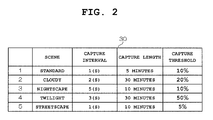
- FIG. 2 is a conceptual diagram depicting the data structure of a parameter table 30 including photographing conditions for each photographing environment (scene) desired to be replayed as the above-mentioned time-lapse moving image in the first embodiment.
- the imaging apparatus 1 has this parameter table 30 for each scene in interval photographing, in the SDRAM 20 or the like.
- a capture interval, a capture length, and a capture threshold have been stored for each scene in interval photographing. Examples of scenes include standard, cloudy, nightscape, twilight, and streetscape.
- the capture threshold herein is a threshold for selecting captured images to be used to generate a time-lapse moving image, which corresponds to a difference between images captured at temporally-consecutive capture timings, such as current capture timing and the preceding capture timing. For example, when the capture threshold is 10%, and the difference between images captured at temporally-consecutive capture timings (for example, the difference for each pixel value) is equal to or larger than 10%, these captured images are selected as frames for generating a time-lapse moving image. Also, this capture threshold can be set (changed) by a user when interval photographing is performed. As such, by time-lapse moving image generation using captured images having a relatively large capture threshold (difference between captured images), a more effective time-lapse moving image can be generated by which subtle changes among images obtained by image capturing performed over a long period of time can be enjoyed.
- FIG. 3 is a conceptual diagram depicting a setting screen 40 for setting a capture threshold in the imaging apparatus 1 according to the first embodiment.
- the user when arbitrarily changing a capture threshold, the user performs a predetermined operation, so that the setting screen 40 is displayed on the display section 15 of the imaging apparatus 1, as depicted in FIG. 3 .
- a capture threshold setting slider 41 indicating a capture threshold is displayed by being superimposed on a captured image.
- the capture threshold setting slider 41 indicating a capture threshold By operating the capture threshold setting slider 41 indicating a capture threshold while viewing the screen, the user can set (change) the capture threshold. Note that, when nothing has been set, the default setting (the setting value in the parameter table 30) is maintained.
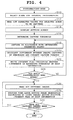
- FIG. 4 is a flowchart for describing the operation of the imaging apparatus 1 according to the first embodiment in interval photographing.
- the flowchart of FIG. 4 is started, and the CPU 21 of the imaging apparatus 1 prompts the user to select a scene for interval photographing (cloudy, nightscape, etc.) (Step S10).
- the CPU 21 reads out parameter values set for the selected scene (capture interval, capture length, and capture threshold) from the parameter table 30 (Step S12).
- the CPU 21 displays the setting screen 40 on the display section 15, as depicted in FIG. 4 (Step S14). Subsequently, the user sets (changes) the capture threshold while viewing the screen. In a case where nothing is set, the default setting (the setting value in the parameter table 30) is maintained. Then, the CPU 21 determines the capture threshold according to the user's operation (Step S16).
- the CPU 21 controls the imaging section 11, the image processing section 14, and the like, and thereby starts interval photographing in accordance with determined parameter values (capture interval and capture length) (Step S18).
- the CPU 21 calculates a difference between an image (N) captured at the preceding capture timing and the image (N+1) captured at the current capture timing (Step S20), and then writes a judgment flag indicating whether the difference is exceeding the capture threshold in EXIF information (Step S22).
- Step S24 judges whether the whole photographing has been ended, that is, the capture length has elapsed.
- the CPU 21 returns to Step S18, and continues the interval photographing.
- a difference between captured images is calculated, a judgment flag indicating whether the difference is exceeding a capture threshold is written in EXIF information, and all captured images are stored.
- Step S24 when judged that the interval photographing has been ended (YES at Step S24), the CPU 21 reads out the captured images (Step S26), refers to each judgment flag recorded in the EXIF information, selects captured images regarded as "valid", that is, captured images having a capture threshold satisfying the set value stored in the parameter table 30, and generates a time-lapse moving image using these images as frames (Step S28).
- the CPU 21 judges whether the judgment and selection processing has been performed on all of the captured images (Step S30). When judged that not all of the captured images have been processed (NO at Step S30), the CPU 21 returns to Step S26 to repeat the above-described processing on the next captured image.
- Step S30 when judged that all of the captured images have been processed (YES at Step S30), the processing is ended.
- a difference between images captured at temporally-consecutive capture timings is calculated, a judgment flag indicating whether the difference is exceeding a capture threshold is written in EXIF information, and all captured images are stored. Then, after the interval photographing is ended, the captured images are read out, and a time-lapse moving image is generated by using captured images having a positive judgment flag in the EXIF information.
- a capture threshold for an inter-frame change amount can be set for each photographing environment (scene) to be replayed as a time-lapse moving image. Also, efficient time-lapse moving image generation processing can be performed.
- the preset degree of change between temporally-adjacent images is stored in the parameter table 30. Accordingly, captured images having moderate changes, which are suitable for generating a time-lapse moving image, can be easily extracted.
- a plurality of images having a difference exceeding a capture threshold are extracted to generate a time-lapse moving image. Therefore, a time-lapse moving image can be generated by which subtle changes among captured images can be effectively enjoyed.
- the structure of the imaging apparatus 1 of the second embodiment ( FIG. 1 ), the data structure of the parameter table 30 ( FIG. 2 ), and the setting screen 40 ( FIG. 3 ) are similar to those of the first embodiment described above, and therefore the descriptions thereof are omitted.
- the CPU 21 performs still image photographing based on a capture interval and a capture length set for each scene in advance.
- the CPU 21 selects images to be extracted as a time-lapse moving image from among the captured images, in accordance with a capture threshold set in advance for the scene (inter-frame difference). Then, the CPU 21 generates a time-lapse moving image by using the selected captured images.
- the CPU 21 of the second embodiment calculates a difference between images captured at temporally-consecutive capture timings, and causes all captured images to be stored without writing a judgment flag indicating whether the difference is exceeding a capture threshold in EXIF information. Then, when the interval photographing is ended, the CPU 21 reads out the captured images, calculates differences among the captured images, selects captured images to be extracted as a time-lapse moving image, and generates a time-lapse moving image from the selected captured images.
- a capture threshold regarding an inter-frame change amount can be set for each scene (starry sky, nightscape, miniature, etc.), and efficient time-lapse moving image generation processing can be performed.
- FIG. 5 is a flowchart for describing the operation of the imaging apparatus 1 according to the second embodiment in interval photographing.
- the flowchart of FIG. 5 is started, and the CPU 21 of the imaging apparatus 1 prompts the user to select a scene for interval photographing (cloudy, nightscape, etc.) (Step S40).
- the CPU 21 reads out parameter values set for the selected scene (capture interval, capture length, and capture threshold) (Step S42).
- Step S44 the CPU 21 controls the imaging section 11, the image processing section 14, and the like, and thereby starts interval photographing in accordance with determined parameter values (capture interval and capture length) (Step S44).
- Step S46 judges whether the whole photographing has been ended, that is, the capture length has elapsed (Step S46).
- Step S46 the CPU 21 returns to Step S44, and continues the interval photographing.
- a difference between captured images is calculated, and all captured images are stored without writing a judgment flag indicating whether the difference is exceeding a threshold in the EXIF information.
- Step S46 when judged that the interval photographing has been ended (YES at Step S46), the CPU 21 reads out the captured images (Step S48), and judges whether a capture threshold is to be set, based on a detection of a user operation (Step S50). Then, when it is detected that a capture threshold is not to be set (NO at Step S50), the CPU 21 proceeds to Step S56 described below.
- Step S50 when it is detected that a capture threshold is to be set (YES at Step S50), the CPU 21 causes the setting screen 40 to be displayed on the display section 15, as depicted in FIG. 3 (Step S52).
- the user sets (changes) the capture threshold while viewing the screen.
- the judgment result at Step 50 is NO, the default setting (the value set in the parameter table 30) is maintained. Then, the CPU 21 determines the capture threshold in accordance with the user's operation (Step S54).
- the CPU 21 calculates a difference between read images captured at temporally-consecutive capture timings (Step S56), and judges whether there are captured images having a difference equal to or larger than the capture threshold (Step S58).
- the CPU 21 does not select captured images having a difference smaller than the capture threshold (NO at Step S58), and judges whether all of the captured images have been processed (Step S62).
- the CPU 21 returns to Step S48 to repeat the above-described processing. That is, captured images having a difference smaller than the capture threshold are not selected as frames for generating a time-lapse moving image.
- Step S58 when there are captured images having a difference equal to or larger than the capture threshold (YES at Step S58), the CPU 21 generates a time-lapse moving image using these images as frames (Step S60). As a result of this configuration, a more effective time-lapse moving image can be generated by which subtle changes among images obtained by image capturing performed over a long period of time can be enjoyed. Then, the CPU 21 judges whether all of the captured images have been processed (Step S62). When judged that there remain unprocessed captured image (NO at Step S62), the CPU 21 returns to Step S48 and repeats the above-described processing on the unprocessed captured images. When judged that the processing has been performed on all of the captured images (YES at Step S62), the processing is ended.
- a difference between captured images is calculated, and all captured images are stored without writing a judgment flag indicating whether the difference is exceeding a threshold in EXIF information. Then, after the interval photographing is ended, a difference between read captured images is calculated, captured images to be extracted as a time-lapse moving image are selected, and a time-lapse moving image is generated from the selected captured images. Therefore, a more effective time-lapse moving image can be generated by which subtle changes among images obtained by image capturing performed over a long period of time can be enjoyed.
- the preset degree of change is stored in the parameter table 30 for each scene. Therefore, captured images having moderate changes, which are suitable for generating a time-lapse moving image, can be easily extracted.
- a plurality of images having a difference exceeding a capture threshold is extracted after interval photographing so as to generate a time-lapse moving image. Therefore, captured images with small changes can be excluded, and a more effective time-lapse moving image can be generated and replayed.
Landscapes
- Engineering & Computer Science (AREA)
- Multimedia (AREA)
- Signal Processing (AREA)
- Studio Devices (AREA)
- Television Signal Processing For Recording (AREA)
- Image Analysis (AREA)
- Shutter-Related Mechanisms (AREA)
- Camera Bodies And Camera Details Or Accessories (AREA)
Abstract
Description
- The present invention relates to a moving image generating apparatus and a moving image generating method.
- Conventionally, there is a technology for interval photographing for capturing images at predetermined time intervals, in which the importance level of a photographed subject and a change in difference are detected to dynamically change the capture intervals, as described in Japanese Patent Application Laid-Open (Kokai) Publication Nos.
2002-218309 2007-150993 - However, in this conventional technology, the capture intervals themselves are changed. Accordingly, in a case where the number of still images after the end of interval photographing are small and therefore these still images cannot be used as moving image frames, or a case where change among captured images is small relative to the capture length intervals and therefore is hardly confirmed when these images are used as a moving image, the photographing conditions have to be changed, and photographing over a long period of time has to be performed again.
- In accordance with one aspect of the present invention, there is provided a moving image generating apparatus comprising: a control section which controls to output periodically-captured images; and a generating section which generates a moving image by using, among a plurality of images outputted under control of the control section, temporally-adjacent images where a degree of change therebetween is equal to or more than a preset degree as frames.
- In accordance with another aspect of the present invention, there is provided a moving image generating method comprising: a control step of controlling to output periodically-captured images; and a generating step of generating a moving image by using, among a plurality of images outputted under control of the control step, temporally-adjacent images where a degree of change therebetween is equal to or more than a preset degree as frames.
- The above and further objects and novel features of the present invention will more fully appear from the following detailed description when the same is read in conjunction with the accompanying drawings. It is to be expressly understood, however, that the drawings are for the purpose of illustration only and are not intended as a definition of the limits of the invention.
-
-
FIG. 1 is a block diagram depicting the structure of animaging apparatus 1 according to a first embodiment of the present invention; -
FIG. 2 is a conceptual diagram depicting the data structure of a parameter table 30 having stored therein photographing conditions for each scene in interval photographing by theimaging apparatus 1 according to the first embodiment; -
FIG. 3 is a conceptual diagram of a settingscreen 40 of theimaging apparatus 1 according to the first embodiment; -
FIG. 4 is a flowchart for describing the operation of theimaging apparatus 1 according to the first embodiment in interval photographing; and -
FIG. 5 is a flowchart for describing the operation of theimaging apparatus 1 according to a second embodiment in interval photographing. - Hereafter, embodiments of the present invention are described with reference to the drawings.
-
FIG. 1 is a block diagram depicting the structure of animaging apparatus 1 according to a first embodiment of the present invention. InFIG. 1 , theimaging apparatus 1 includes acommunication control section 10, animaging section 11, animage processing section 14, adisplay section 15, anexternal memory 18, aflash memory 19, a SDRAM (Synchronous Dynamic Random Access Memory) 20, a CPU (Central Processing Unit) 21, akey operating section 22, anaudio control section 23, aloudspeaker 24, amicrophone 25, a power supply (battery) 26, and a powersupply control section 27. - The
communication control section 10 transfers captured image data (still images or moving images) to a server on the Internet, or to an information processing device such as a personal computer via the Internet, etc. Thiscommunication control section 10 can also transfer a live view image or images being recorded to an external replay/display apparatus via peer-to-peer communications. Theimaging section 11 includes alens block 12 constituted by an optical lens group and animage sensor 13 such as a CCD (Charge Coupled Device) or CMOS (Complementary Metal-Oxide Semiconductor). - The
image sensor 13 converts an image entering from thelens block 12 to a digital signal. Theimage processing section 14 performs image processing (such as pixel interpolation processing, y correction, luminance color-difference signal generation, white balance processing, and exposure correction processing) and compression and expansion of image data (for example, compression and expansion of a JPEG (Joint Photographic Experts Group) format, Motion-JPEG format, or MPEG (Moving Picture Experts Group) format). Thedisplay section 15 includes a liquid-crystal display device or an organic EL (Electro Luminescence) display device, and displays various menu screens, a live view screen at the time of imaging, and a replay screen for captured image data, etc. - The
external memory 18 is a removable storage medium, and stores image data captured by theimaging section 11 and the like. Theflash memory 19 is a storage medium for storing image data captured by theimaging section 11 and the like. The SDRAM 20 is used as a buffer memory for temporarily storing image data captured by theimaging section 11 and then sent to theCPU 21, and is also used as a working memory for theCPU 21. - The
CPU 21, which is a one-chip microcomputer for controlling each section of theimaging apparatus 1, causes theimaging section 11 to perform still image photographing, starts and stops moving image recording, switches between still-image photographing and moving image capturing, or the like. In particular, when performing interval photographing, theCPU 21 of the first embodiment performs still image photographing based on a capture interval and a capture length set for each scene in advance. Then, for each captured still image, theCPU 21 records a capture threshold (a difference between an image captured at current capture timing and an image captured at the preceding capture timing; hereinafter referred to as "inter-frame difference") set in advance for the scene, and causes all of the captured images to be stored. When the interval photographing is ended, theCPU 21 extracts a plurality of images from the captured images based on their capture thresholds, and generates a moving image (hereinafter referred to as "time-lapse moving image") by using these images obtained by the interval photographing as frames. - More specifically, in interval photographing, the
CPU 21 of the first embodiment calculates a difference between captured images, writes a judgment flag indicating whether the difference is exceeding a capture threshold in EXIF information, and causes all captured images to be stored. Then, when the interval photographing is ended, theCPU 21 reads out the captured images, performs time-lapse moving image generation processing by using images having a positive judgment flag in the EXIF information, and causes the result to be stored. As a result of this configuration, a capture threshold regarding an inter-frame change amount can be set for each capture scene, and a time-lapse moving image can be generated by which time-compressed subtle changes of a photographed scene in a plurality of images captured by interval photographing performed over a long period of time can be efficiently enjoyed. - The
key operating section 22 inputs an operation mode or an operation instruction such as start capturing, pause, or stop in response to a user operation. Theaudio control section 23 converts audio (such as alarm sound) at the time of moving image replay to an analog signal and outputs it from theloudspeaker 24. Also, theaudio control section 23 digitalizes and captures environmental sounds collected by themicrophone 25 at the time of moving image capturing. The power supply (battery) 26 is a rechargeable secondary battery. The powersupply control section 27 stabilizes the output voltage of the power supply (battery) 26, and supplies drive electric power to each section. -
FIG. 2 is a conceptual diagram depicting the data structure of a parameter table 30 including photographing conditions for each photographing environment (scene) desired to be replayed as the above-mentioned time-lapse moving image in the first embodiment. Theimaging apparatus 1 has this parameter table 30 for each scene in interval photographing, in theSDRAM 20 or the like. In the parameter table 30, a capture interval, a capture length, and a capture threshold have been stored for each scene in interval photographing. Examples of scenes include standard, cloudy, nightscape, twilight, and streetscape. - In the scene "standard", the capture interval is "1 (s=second)", the capture length is "5 minutes" , and the capture threshold is "10%". In the scene "cloudy", the capture interval is "2(s)", the capture length is "30 minutes", and the capture threshold is "20%". In the scene "nightscape", the capture interval is "5(s)", the capture length is "10 minutes", and the capture threshold is "10%". In the scene "twilight", the capture interval is "3(s)", the capture length is "30 minutes", and the capture threshold is "50%". In the scene "streetscape", the capture interval is "1(s)", the capture length is "10 minutes", and the capture threshold is "5%".
- Note that the capture threshold herein is a threshold for selecting captured images to be used to generate a time-lapse moving image, which corresponds to a difference between images captured at temporally-consecutive capture timings, such as current capture timing and the preceding capture timing. For example, when the capture threshold is 10%, and the difference between images captured at temporally-consecutive capture timings (for example, the difference for each pixel value) is equal to or larger than 10%, these captured images are selected as frames for generating a time-lapse moving image. Also, this capture threshold can be set (changed) by a user when interval photographing is performed. As such, by time-lapse moving image generation using captured images having a relatively large capture threshold (difference between captured images), a more effective time-lapse moving image can be generated by which subtle changes among images obtained by image capturing performed over a long period of time can be enjoyed.
-
FIG. 3 is a conceptual diagram depicting asetting screen 40 for setting a capture threshold in theimaging apparatus 1 according to the first embodiment. In the first embodiment, when arbitrarily changing a capture threshold, the user performs a predetermined operation, so that thesetting screen 40 is displayed on thedisplay section 15 of theimaging apparatus 1, as depicted inFIG. 3 . On thesetting screen 40, a capturethreshold setting slider 41 indicating a capture threshold is displayed by being superimposed on a captured image. By operating the capturethreshold setting slider 41 indicating a capture threshold while viewing the screen, the user can set (change) the capture threshold. Note that, when nothing has been set, the default setting (the setting value in the parameter table 30) is maintained. -
FIG. 4 is a flowchart for describing the operation of theimaging apparatus 1 according to the first embodiment in interval photographing. First, when the user selects an interval photographing mode, the flowchart ofFIG. 4 is started, and theCPU 21 of theimaging apparatus 1 prompts the user to select a scene for interval photographing (cloudy, nightscape, etc.) (Step S10). Then, when a scene for interval photographing is selected by the user, theCPU 21 reads out parameter values set for the selected scene (capture interval, capture length, and capture threshold) from the parameter table 30 (Step S12). - Next, the
CPU 21 displays thesetting screen 40 on thedisplay section 15, as depicted inFIG. 4 (Step S14). Subsequently, the user sets (changes) the capture threshold while viewing the screen. In a case where nothing is set, the default setting (the setting value in the parameter table 30) is maintained. Then, theCPU 21 determines the capture threshold according to the user's operation (Step S16). - Next, the
CPU 21 controls theimaging section 11, theimage processing section 14, and the like, and thereby starts interval photographing in accordance with determined parameter values (capture interval and capture length) (Step S18). When an image is captured, theCPU 21 calculates a difference between an image (N) captured at the preceding capture timing and the image (N+1) captured at the current capture timing (Step S20), and then writes a judgment flag indicating whether the difference is exceeding the capture threshold in EXIF information (Step S22). - Next, the
CPU 21 judges whether the whole photographing has been ended, that is, the capture length has elapsed (Step S24). When judged that the interval photographing has not been ended (NO at Step S24), theCPU 21 returns to Step S18, and continues the interval photographing. As such, in the first embodiment, in interval photographing, a difference between captured images is calculated, a judgment flag indicating whether the difference is exceeding a capture threshold is written in EXIF information, and all captured images are stored. - At Step S24, when judged that the interval photographing has been ended (YES at Step S24), the
CPU 21 reads out the captured images (Step S26), refers to each judgment flag recorded in the EXIF information, selects captured images regarded as "valid", that is, captured images having a capture threshold satisfying the set value stored in the parameter table 30, and generates a time-lapse moving image using these images as frames (Step S28). Next, theCPU 21 judges whether the judgment and selection processing has been performed on all of the captured images (Step S30). When judged that not all of the captured images have been processed (NO at Step S30), theCPU 21 returns to Step S26 to repeat the above-described processing on the next captured image. As a result of this configuration, a more effective time-lapse moving image can be generated by which subtle changes among images obtained by image capturing performed over a long period of time can be enjoyed. At Step S30, when judged that all of the captured images have been processed (YES at Step S30), the processing is ended. - In the above-described first embodiment, a difference between images captured at temporally-consecutive capture timings is calculated, a judgment flag indicating whether the difference is exceeding a capture threshold is written in EXIF information, and all captured images are stored. Then, after the interval photographing is ended, the captured images are read out, and a time-lapse moving image is generated by using captured images having a positive judgment flag in the EXIF information. As a result of this configuration, a capture threshold for an inter-frame change amount can be set for each photographing environment (scene) to be replayed as a time-lapse moving image. Also, efficient time-lapse moving image generation processing can be performed.
- Also, in the first embodiment, the preset degree of change between temporally-adjacent images is stored in the parameter table 30. Accordingly, captured images having moderate changes, which are suitable for generating a time-lapse moving image, can be easily extracted.
- Moreover, in the first embodiment, a plurality of images having a difference exceeding a capture threshold are extracted to generate a time-lapse moving image. Therefore, a time-lapse moving image can be generated by which subtle changes among captured images can be effectively enjoyed.
- Next, a second embodiment of the present invention is described.
- The structure of the
imaging apparatus 1 of the second embodiment (FIG. 1 ), the data structure of the parameter table 30 (FIG. 2 ), and the setting screen 40 (FIG. 3 ) are similar to those of the first embodiment described above, and therefore the descriptions thereof are omitted. - In the second embodiment, in interval photographing, the
CPU 21 performs still image photographing based on a capture interval and a capture length set for each scene in advance. When the interval photographing is ended, theCPU 21 selects images to be extracted as a time-lapse moving image from among the captured images, in accordance with a capture threshold set in advance for the scene (inter-frame difference). Then, theCPU 21 generates a time-lapse moving image by using the selected captured images. - More specifically, in interval photographing, the
CPU 21 of the second embodiment calculates a difference between images captured at temporally-consecutive capture timings, and causes all captured images to be stored without writing a judgment flag indicating whether the difference is exceeding a capture threshold in EXIF information. Then, when the interval photographing is ended, theCPU 21 reads out the captured images, calculates differences among the captured images, selects captured images to be extracted as a time-lapse moving image, and generates a time-lapse moving image from the selected captured images. As a result of this configuration, a capture threshold regarding an inter-frame change amount can be set for each scene (starry sky, nightscape, miniature, etc.), and efficient time-lapse moving image generation processing can be performed. -
FIG. 5 is a flowchart for describing the operation of theimaging apparatus 1 according to the second embodiment in interval photographing. First, when the user selects an interval photographing mode, the flowchart ofFIG. 5 is started, and theCPU 21 of theimaging apparatus 1 prompts the user to select a scene for interval photographing (cloudy, nightscape, etc.) (Step S40). Then, when a scene for interval photographing is selected by the user, theCPU 21 reads out parameter values set for the selected scene (capture interval, capture length, and capture threshold) (Step S42). - Next, the
CPU 21 controls theimaging section 11, theimage processing section 14, and the like, and thereby starts interval photographing in accordance with determined parameter values (capture interval and capture length) (Step S44). Next, theCPU 21 judges whether the whole photographing has been ended, that is, the capture length has elapsed (Step S46). When judged that the interval photographing has not been ended (NO at Step S46), theCPU 21 returns to Step S44, and continues the interval photographing. As such, in the second embodiment, in interval photographing, a difference between captured images is calculated, and all captured images are stored without writing a judgment flag indicating whether the difference is exceeding a threshold in the EXIF information. - At Step S46, when judged that the interval photographing has been ended (YES at Step S46), the
CPU 21 reads out the captured images (Step S48), and judges whether a capture threshold is to be set, based on a detection of a user operation (Step S50). Then, when it is detected that a capture threshold is not to be set (NO at Step S50), theCPU 21 proceeds to Step S56 described below. - At Step S50, when it is detected that a capture threshold is to be set (YES at Step S50), the
CPU 21 causes thesetting screen 40 to be displayed on thedisplay section 15, as depicted inFIG. 3 (Step S52). Here, the user sets (changes) the capture threshold while viewing the screen. However, when the judgment result atStep 50 is NO, the default setting (the value set in the parameter table 30) is maintained. Then, theCPU 21 determines the capture threshold in accordance with the user's operation (Step S54). - Next, the
CPU 21 calculates a difference between read images captured at temporally-consecutive capture timings (Step S56), and judges whether there are captured images having a difference equal to or larger than the capture threshold (Step S58). Here, theCPU 21 does not select captured images having a difference smaller than the capture threshold (NO at Step S58), and judges whether all of the captured images have been processed (Step S62). When judged that there remain unprocessed captured images (NO at Step S62), theCPU 21 returns to Step S48 to repeat the above-described processing. That is, captured images having a difference smaller than the capture threshold are not selected as frames for generating a time-lapse moving image. - At Step S58, when there are captured images having a difference equal to or larger than the capture threshold (YES at Step S58), the
CPU 21 generates a time-lapse moving image using these images as frames (Step S60). As a result of this configuration, a more effective time-lapse moving image can be generated by which subtle changes among images obtained by image capturing performed over a long period of time can be enjoyed. Then, theCPU 21 judges whether all of the captured images have been processed (Step S62). When judged that there remain unprocessed captured image (NO at Step S62), theCPU 21 returns to Step S48 and repeats the above-described processing on the unprocessed captured images. When judged that the processing has been performed on all of the captured images (YES at Step S62), the processing is ended. - In the above-described second embodiment, in interval photographing, a difference between captured images is calculated, and all captured images are stored without writing a judgment flag indicating whether the difference is exceeding a threshold in EXIF information. Then, after the interval photographing is ended, a difference between read captured images is calculated, captured images to be extracted as a time-lapse moving image are selected, and a time-lapse moving image is generated from the selected captured images. Therefore, a more effective time-lapse moving image can be generated by which subtle changes among images obtained by image capturing performed over a long period of time can be enjoyed.
- Also, in the second embodiment, the preset degree of change is stored in the parameter table 30 for each scene. Therefore, captured images having moderate changes, which are suitable for generating a time-lapse moving image, can be easily extracted.
- Moreover, in the second embodiment, a plurality of images having a difference exceeding a capture threshold is extracted after interval photographing so as to generate a time-lapse moving image. Therefore, captured images with small changes can be excluded, and a more effective time-lapse moving image can be generated and replayed.
Claims (8)
- A moving image generating apparatus (1) comprising:a control section (21) which controls to output periodically-captured images; anda generating section (21) which generates a moving image by using, among a plurality of images outputted under control of the control section (21), temporally-adjacent images where a degree of change therebetween is equal to or more than a preset degree as frames.
- The moving image generating apparatus (1) according to claim 1, further comprising:a storage section (20) which stores a plurality of set degrees; anda setting section (41) which selects a specific degree from among the plurality of degrees stored in the storage section (20) and sets the specific degree.
- The moving image generating apparatus (1) according to claim 1 or 2, further comprising:an imaging section (11) which captures an image,wherein the control section (21) controls to output the periodically-captured images from the imaging section (11).
- The moving image generating apparatus (1) according to claim 1 or 2, further comprising:an image storage section (20) which stores a plurality of periodically-captured images,wherein the control section (21) controls to sequentially output the plurality of periodically-captured images stored in the image storage section (20).
- The moving image generating apparatus (1) according to claim 4, further comprising:an imaging section (11) which captures an image,wherein the image storage section (20) stores a plurality of images periodically captured by the imaging section (11).
- The moving image generating apparatus (1) according to any one of claims 1 to 5, further comprising:a replay section (15) which replays the moving image generated by the generating section (21).
- The moving image generating apparatus (1) according to any one of claims 1 to 6, wherein the periodically-captured images are images captured at predetermined intervals and recorded as still images.
- A moving image generating method comprising:a control step of controlling to output periodically-captured images; anda generating step of generating a moving image by using, among a plurality of images outputted under control of the control step, temporally-adjacent images where a degree of change therebetween is equal to or more than a preset degree as frames.
Applications Claiming Priority (1)
| Application Number | Priority Date | Filing Date | Title |
|---|---|---|---|
| JP2013133833A JP5962600B2 (en) | 2013-06-26 | 2013-06-26 | MOVIE GENERATION DEVICE, MOVIE GENERATION METHOD, AND PROGRAM |
Publications (2)
| Publication Number | Publication Date |
|---|---|
| EP2819396A1 true EP2819396A1 (en) | 2014-12-31 |
| EP2819396B1 EP2819396B1 (en) | 2020-12-23 |
Family
ID=50980937
Family Applications (1)
| Application Number | Title | Priority Date | Filing Date |
|---|---|---|---|
| EP14172761.0A Not-in-force EP2819396B1 (en) | 2013-06-26 | 2014-06-17 | Moving image generating apparatus and moving image generating method |
Country Status (5)
| Country | Link |
|---|---|
| US (1) | US9560270B2 (en) |
| EP (1) | EP2819396B1 (en) |
| JP (1) | JP5962600B2 (en) |
| KR (1) | KR20150002478A (en) |
| CN (1) | CN104253941B (en) |
Families Citing this family (7)
| Publication number | Priority date | Publication date | Assignee | Title |
|---|---|---|---|---|
| US9712756B2 (en) | 2013-08-21 | 2017-07-18 | Canon Kabushiki Kaisha | Image capturing apparatus and control method thereof |
| JP6391383B2 (en) * | 2014-02-10 | 2018-09-19 | キヤノン株式会社 | Image processing apparatus, control method therefor, program, and storage medium |
| US10192582B2 (en) * | 2015-05-21 | 2019-01-29 | Adobe Inc. | Automatic generation of time-lapse videos |
| US9734872B2 (en) * | 2016-01-19 | 2017-08-15 | Htc Corporation | Method and electronic apparatus for generating time-lapse video and recording medium using the method |
| WO2019061546A1 (en) * | 2017-09-30 | 2019-04-04 | 深圳传音通讯有限公司 | Mobile terminal photographing method, device and computer readable storage medium |
| JP7511387B2 (en) * | 2020-06-01 | 2024-07-05 | キヤノン株式会社 | Imaging device, control method and program |
| CN113810596B (en) * | 2021-07-27 | 2023-01-31 | 荣耀终端有限公司 | Time-delay shooting method and device |
Citations (6)
| Publication number | Priority date | Publication date | Assignee | Title |
|---|---|---|---|---|
| JP2002218309A (en) | 2001-01-16 | 2002-08-02 | Toshiba Corp | Photographing apparatus and interval photographing method of the same |
| US20040136689A1 (en) * | 2002-12-10 | 2004-07-15 | Masaaki Oka | Method and apparatus for editing images, and method and apparatus for reproducing the edited images |
| JP2005260324A (en) * | 2004-03-09 | 2005-09-22 | Canon Inc | Digital camera |
| JP2007150993A (en) | 2005-11-30 | 2007-06-14 | Olympus Corp | Image pickup apparatus and image pickup apparatus having interval shooting function |
| JP2009135762A (en) * | 2007-11-30 | 2009-06-18 | Olympus Corp | camera |
| US20120133791A1 (en) * | 2006-10-24 | 2012-05-31 | Sony Corporation | Image pickup apparatus and reproduction control apparatus |
Family Cites Families (10)
| Publication number | Priority date | Publication date | Assignee | Title |
|---|---|---|---|---|
| JP3952684B2 (en) * | 2000-10-23 | 2007-08-01 | カシオ計算機株式会社 | Imaging method and imaging apparatus |
| KR100693598B1 (en) * | 2004-09-08 | 2007-03-14 | 주식회사 팬택앤큐리텔 | Wireless communication terminal with video generation function using still image and its method |
| JP2006276262A (en) * | 2005-03-28 | 2006-10-12 | Casio Comput Co Ltd | Shooting device, interval shooting method, interval shooting program |
| CN100518247C (en) * | 2005-09-08 | 2009-07-22 | 索尼株式会社 | Video signal capturing, signal processing and transferring system and method and device |
| TWI399081B (en) * | 2006-10-16 | 2013-06-11 | Casio Computer Co Ltd | Imaging apparatus, continuous imaging method, and recording medium for recording a program |
| KR20090124319A (en) * | 2008-05-29 | 2009-12-03 | 삼성디지털이미징 주식회사 | Recording medium storing digital photographing device, control method and program for executing control method |
| KR20110043612A (en) * | 2008-06-24 | 2011-04-27 | 코닌클리케 필립스 일렉트로닉스 엔.브이. | Image processing |
| JP2010016599A (en) * | 2008-07-03 | 2010-01-21 | Victor Co Of Japan Ltd | Camera |
| KR101475427B1 (en) * | 2008-12-18 | 2014-12-22 | 삼성전자주식회사 | An interval photographing method having a plurality of photographing conditions and a photographing apparatus using the same |
| JP5333522B2 (en) * | 2011-06-06 | 2013-11-06 | カシオ計算機株式会社 | MOVIE GENERATION DEVICE, MOVIE GENERATION METHOD, AND PROGRAM |
-
2013
- 2013-06-26 JP JP2013133833A patent/JP5962600B2/en not_active Expired - Fee Related
-
2014
- 2014-06-10 US US14/301,019 patent/US9560270B2/en not_active Expired - Fee Related
- 2014-06-17 EP EP14172761.0A patent/EP2819396B1/en not_active Not-in-force
- 2014-06-19 KR KR1020140074938A patent/KR20150002478A/en not_active Ceased
- 2014-06-23 CN CN201410283322.1A patent/CN104253941B/en not_active Expired - Fee Related
Patent Citations (6)
| Publication number | Priority date | Publication date | Assignee | Title |
|---|---|---|---|---|
| JP2002218309A (en) | 2001-01-16 | 2002-08-02 | Toshiba Corp | Photographing apparatus and interval photographing method of the same |
| US20040136689A1 (en) * | 2002-12-10 | 2004-07-15 | Masaaki Oka | Method and apparatus for editing images, and method and apparatus for reproducing the edited images |
| JP2005260324A (en) * | 2004-03-09 | 2005-09-22 | Canon Inc | Digital camera |
| JP2007150993A (en) | 2005-11-30 | 2007-06-14 | Olympus Corp | Image pickup apparatus and image pickup apparatus having interval shooting function |
| US20120133791A1 (en) * | 2006-10-24 | 2012-05-31 | Sony Corporation | Image pickup apparatus and reproduction control apparatus |
| JP2009135762A (en) * | 2007-11-30 | 2009-06-18 | Olympus Corp | camera |
Also Published As
| Publication number | Publication date |
|---|---|
| JP5962600B2 (en) | 2016-08-03 |
| EP2819396B1 (en) | 2020-12-23 |
| KR20150002478A (en) | 2015-01-07 |
| US9560270B2 (en) | 2017-01-31 |
| CN104253941B (en) | 2017-09-12 |
| US20150002691A1 (en) | 2015-01-01 |
| CN104253941A (en) | 2014-12-31 |
| JP2015012313A (en) | 2015-01-19 |
Similar Documents
| Publication | Publication Date | Title |
|---|---|---|
| EP2819396B1 (en) | Moving image generating apparatus and moving image generating method | |
| US8638374B2 (en) | Image pickup apparatus, image pickup system, and image pickup method | |
| US8848097B2 (en) | Image processing apparatus, and method, for providing special effect | |
| CN104349060B (en) | Image processing apparatus, image processing method and storage medium | |
| CN104065876B (en) | Image processing apparatus, image processing method and recording medium | |
| JP2013046259A (en) | Video apparatus, control method, and program | |
| KR20150090999A (en) | Image processing apparatus, image processing method and computer readable recording medium having program for generating time-lapse moving image | |
| JP6116299B2 (en) | Imaging apparatus and control method thereof | |
| US9485452B2 (en) | Imaging device, video content generating method and storage medium | |
| US10032482B2 (en) | Moving image generating apparatus, moving image generating method and storage medium | |
| JP4556195B2 (en) | Imaging device, moving image playback device, and program | |
| JP5896181B2 (en) | Imaging apparatus, imaging control method, and program | |
| CN112584008B (en) | Image processing device, image processing method, imaging device and storage medium | |
| JP2015154447A (en) | Imaging apparatus, and control method and program for the same | |
| JP6147116B2 (en) | Imaging apparatus, control method thereof, and control program | |
| JP2018074523A (en) | Imaging device, control method thereof, program, and recording medium | |
| JP6282136B2 (en) | Imaging apparatus and control method thereof | |
| JP5991495B2 (en) | Image generating apparatus, imaging apparatus, and program | |
| JP6090485B2 (en) | Imaging apparatus, imaging control method, and program | |
| JP2025071976A (en) | Image processing device, method for controlling image processing device, and program | |
| JP2018023033A (en) | Image data generation device, image data reproduction device, and image data editing device | |
| JP2004032713A (en) | Imaging apparatus, imaging method, program, and storage medium | |
| JP5715179B2 (en) | Reproduction display device and reproduction display method | |
| JP2018207418A (en) | Imaging device | |
| JP2010233254A (en) | Imaging device, moving image playback device, and program |
Legal Events
| Date | Code | Title | Description |
|---|---|---|---|
| PUAI | Public reference made under article 153(3) epc to a published international application that has entered the european phase |
Free format text: ORIGINAL CODE: 0009012 |
|
| 17P | Request for examination filed |
Effective date: 20140617 |
|
| AK | Designated contracting states |
Kind code of ref document: A1 Designated state(s): AL AT BE BG CH CY CZ DE DK EE ES FI FR GB GR HR HU IE IS IT LI LT LU LV MC MK MT NL NO PL PT RO RS SE SI SK SM TR |
|
| AX | Request for extension of the european patent |
Extension state: BA ME |
|
| STAA | Information on the status of an ep patent application or granted ep patent |
Free format text: STATUS: EXAMINATION IS IN PROGRESS |
|
| 17Q | First examination report despatched |
Effective date: 20161109 |
|
| GRAP | Despatch of communication of intention to grant a patent |
Free format text: ORIGINAL CODE: EPIDOSNIGR1 |
|
| STAA | Information on the status of an ep patent application or granted ep patent |
Free format text: STATUS: GRANT OF PATENT IS INTENDED |
|
| INTG | Intention to grant announced |
Effective date: 20200528 |
|
| GRAJ | Information related to disapproval of communication of intention to grant by the applicant or resumption of examination proceedings by the epo deleted |
Free format text: ORIGINAL CODE: EPIDOSDIGR1 |
|
| STAA | Information on the status of an ep patent application or granted ep patent |
Free format text: STATUS: EXAMINATION IS IN PROGRESS |
|
| GRAP | Despatch of communication of intention to grant a patent |
Free format text: ORIGINAL CODE: EPIDOSNIGR1 |
|
| STAA | Information on the status of an ep patent application or granted ep patent |
Free format text: STATUS: GRANT OF PATENT IS INTENDED |
|
| INTC | Intention to grant announced (deleted) | ||
| GRAS | Grant fee paid |
Free format text: ORIGINAL CODE: EPIDOSNIGR3 |
|
| INTG | Intention to grant announced |
Effective date: 20201022 |
|
| GRAA | (expected) grant |
Free format text: ORIGINAL CODE: 0009210 |
|
| STAA | Information on the status of an ep patent application or granted ep patent |
Free format text: STATUS: THE PATENT HAS BEEN GRANTED |
|
| AK | Designated contracting states |
Kind code of ref document: B1 Designated state(s): AL AT BE BG CH CY CZ DE DK EE ES FI FR GB GR HR HU IE IS IT LI LT LU LV MC MK MT NL NO PL PT RO RS SE SI SK SM TR |
|
| REG | Reference to a national code |
Ref country code: GB Ref legal event code: FG4D |
|
| REG | Reference to a national code |
Ref country code: DE Ref legal event code: R096 Ref document number: 602014073522 Country of ref document: DE |
|
| REG | Reference to a national code |
Ref country code: AT Ref legal event code: REF Ref document number: 1348829 Country of ref document: AT Kind code of ref document: T Effective date: 20210115 |
|
| REG | Reference to a national code |
Ref country code: IE Ref legal event code: FG4D |
|
| PG25 | Lapsed in a contracting state [announced via postgrant information from national office to epo] |
Ref country code: GR Free format text: LAPSE BECAUSE OF FAILURE TO SUBMIT A TRANSLATION OF THE DESCRIPTION OR TO PAY THE FEE WITHIN THE PRESCRIBED TIME-LIMIT Effective date: 20210324 Ref country code: RS Free format text: LAPSE BECAUSE OF FAILURE TO SUBMIT A TRANSLATION OF THE DESCRIPTION OR TO PAY THE FEE WITHIN THE PRESCRIBED TIME-LIMIT Effective date: 20201223 Ref country code: FI Free format text: LAPSE BECAUSE OF FAILURE TO SUBMIT A TRANSLATION OF THE DESCRIPTION OR TO PAY THE FEE WITHIN THE PRESCRIBED TIME-LIMIT Effective date: 20201223 Ref country code: NO Free format text: LAPSE BECAUSE OF FAILURE TO SUBMIT A TRANSLATION OF THE DESCRIPTION OR TO PAY THE FEE WITHIN THE PRESCRIBED TIME-LIMIT Effective date: 20210323 |
|
| REG | Reference to a national code |
Ref country code: AT Ref legal event code: MK05 Ref document number: 1348829 Country of ref document: AT Kind code of ref document: T Effective date: 20201223 |
|
| REG | Reference to a national code |
Ref country code: NL Ref legal event code: MP Effective date: 20201223 |
|
| PG25 | Lapsed in a contracting state [announced via postgrant information from national office to epo] |
Ref country code: SE Free format text: LAPSE BECAUSE OF FAILURE TO SUBMIT A TRANSLATION OF THE DESCRIPTION OR TO PAY THE FEE WITHIN THE PRESCRIBED TIME-LIMIT Effective date: 20201223 Ref country code: LV Free format text: LAPSE BECAUSE OF FAILURE TO SUBMIT A TRANSLATION OF THE DESCRIPTION OR TO PAY THE FEE WITHIN THE PRESCRIBED TIME-LIMIT Effective date: 20201223 Ref country code: BG Free format text: LAPSE BECAUSE OF FAILURE TO SUBMIT A TRANSLATION OF THE DESCRIPTION OR TO PAY THE FEE WITHIN THE PRESCRIBED TIME-LIMIT Effective date: 20210323 |
|
| PG25 | Lapsed in a contracting state [announced via postgrant information from national office to epo] |
Ref country code: NL Free format text: LAPSE BECAUSE OF FAILURE TO SUBMIT A TRANSLATION OF THE DESCRIPTION OR TO PAY THE FEE WITHIN THE PRESCRIBED TIME-LIMIT Effective date: 20201223 Ref country code: HR Free format text: LAPSE BECAUSE OF FAILURE TO SUBMIT A TRANSLATION OF THE DESCRIPTION OR TO PAY THE FEE WITHIN THE PRESCRIBED TIME-LIMIT Effective date: 20201223 |
|
| REG | Reference to a national code |
Ref country code: LT Ref legal event code: MG9D |
|
| PG25 | Lapsed in a contracting state [announced via postgrant information from national office to epo] |
Ref country code: RO Free format text: LAPSE BECAUSE OF FAILURE TO SUBMIT A TRANSLATION OF THE DESCRIPTION OR TO PAY THE FEE WITHIN THE PRESCRIBED TIME-LIMIT Effective date: 20201223 Ref country code: PT Free format text: LAPSE BECAUSE OF FAILURE TO SUBMIT A TRANSLATION OF THE DESCRIPTION OR TO PAY THE FEE WITHIN THE PRESCRIBED TIME-LIMIT Effective date: 20210423 Ref country code: SK Free format text: LAPSE BECAUSE OF FAILURE TO SUBMIT A TRANSLATION OF THE DESCRIPTION OR TO PAY THE FEE WITHIN THE PRESCRIBED TIME-LIMIT Effective date: 20201223 Ref country code: LT Free format text: LAPSE BECAUSE OF FAILURE TO SUBMIT A TRANSLATION OF THE DESCRIPTION OR TO PAY THE FEE WITHIN THE PRESCRIBED TIME-LIMIT Effective date: 20201223 Ref country code: EE Free format text: LAPSE BECAUSE OF FAILURE TO SUBMIT A TRANSLATION OF THE DESCRIPTION OR TO PAY THE FEE WITHIN THE PRESCRIBED TIME-LIMIT Effective date: 20201223 Ref country code: CZ Free format text: LAPSE BECAUSE OF FAILURE TO SUBMIT A TRANSLATION OF THE DESCRIPTION OR TO PAY THE FEE WITHIN THE PRESCRIBED TIME-LIMIT Effective date: 20201223 Ref country code: SM Free format text: LAPSE BECAUSE OF FAILURE TO SUBMIT A TRANSLATION OF THE DESCRIPTION OR TO PAY THE FEE WITHIN THE PRESCRIBED TIME-LIMIT Effective date: 20201223 |
|
| PG25 | Lapsed in a contracting state [announced via postgrant information from national office to epo] |
Ref country code: AT Free format text: LAPSE BECAUSE OF FAILURE TO SUBMIT A TRANSLATION OF THE DESCRIPTION OR TO PAY THE FEE WITHIN THE PRESCRIBED TIME-LIMIT Effective date: 20201223 Ref country code: PL Free format text: LAPSE BECAUSE OF FAILURE TO SUBMIT A TRANSLATION OF THE DESCRIPTION OR TO PAY THE FEE WITHIN THE PRESCRIBED TIME-LIMIT Effective date: 20201223 |
|
| REG | Reference to a national code |
Ref country code: DE Ref legal event code: R097 Ref document number: 602014073522 Country of ref document: DE |
|
| PG25 | Lapsed in a contracting state [announced via postgrant information from national office to epo] |
Ref country code: IS Free format text: LAPSE BECAUSE OF FAILURE TO SUBMIT A TRANSLATION OF THE DESCRIPTION OR TO PAY THE FEE WITHIN THE PRESCRIBED TIME-LIMIT Effective date: 20210423 |
|
| PG25 | Lapsed in a contracting state [announced via postgrant information from national office to epo] |
Ref country code: AL Free format text: LAPSE BECAUSE OF FAILURE TO SUBMIT A TRANSLATION OF THE DESCRIPTION OR TO PAY THE FEE WITHIN THE PRESCRIBED TIME-LIMIT Effective date: 20201223 Ref country code: IT Free format text: LAPSE BECAUSE OF FAILURE TO SUBMIT A TRANSLATION OF THE DESCRIPTION OR TO PAY THE FEE WITHIN THE PRESCRIBED TIME-LIMIT Effective date: 20201223 |
|
| PLBE | No opposition filed within time limit |
Free format text: ORIGINAL CODE: 0009261 |
|
| STAA | Information on the status of an ep patent application or granted ep patent |
Free format text: STATUS: NO OPPOSITION FILED WITHIN TIME LIMIT |
|
| PG25 | Lapsed in a contracting state [announced via postgrant information from national office to epo] |
Ref country code: ES Free format text: LAPSE BECAUSE OF FAILURE TO SUBMIT A TRANSLATION OF THE DESCRIPTION OR TO PAY THE FEE WITHIN THE PRESCRIBED TIME-LIMIT Effective date: 20201223 Ref country code: DK Free format text: LAPSE BECAUSE OF FAILURE TO SUBMIT A TRANSLATION OF THE DESCRIPTION OR TO PAY THE FEE WITHIN THE PRESCRIBED TIME-LIMIT Effective date: 20201223 |
|
| 26N | No opposition filed |
Effective date: 20210924 |
|
| REG | Reference to a national code |
Ref country code: DE Ref legal event code: R119 Ref document number: 602014073522 Country of ref document: DE |
|
| PG25 | Lapsed in a contracting state [announced via postgrant information from national office to epo] |
Ref country code: MC Free format text: LAPSE BECAUSE OF FAILURE TO SUBMIT A TRANSLATION OF THE DESCRIPTION OR TO PAY THE FEE WITHIN THE PRESCRIBED TIME-LIMIT Effective date: 20201223 |
|
| REG | Reference to a national code |
Ref country code: CH Ref legal event code: PL |
|
| GBPC | Gb: european patent ceased through non-payment of renewal fee |
Effective date: 20210617 |
|
| PG25 | Lapsed in a contracting state [announced via postgrant information from national office to epo] |
Ref country code: SI Free format text: LAPSE BECAUSE OF FAILURE TO SUBMIT A TRANSLATION OF THE DESCRIPTION OR TO PAY THE FEE WITHIN THE PRESCRIBED TIME-LIMIT Effective date: 20201223 |
|
| REG | Reference to a national code |
Ref country code: BE Ref legal event code: MM Effective date: 20210630 |
|
| PG25 | Lapsed in a contracting state [announced via postgrant information from national office to epo] |
Ref country code: LU Free format text: LAPSE BECAUSE OF NON-PAYMENT OF DUE FEES Effective date: 20210617 |
|
| PG25 | Lapsed in a contracting state [announced via postgrant information from national office to epo] |
Ref country code: LI Free format text: LAPSE BECAUSE OF NON-PAYMENT OF DUE FEES Effective date: 20210630 Ref country code: IE Free format text: LAPSE BECAUSE OF NON-PAYMENT OF DUE FEES Effective date: 20210617 Ref country code: GB Free format text: LAPSE BECAUSE OF NON-PAYMENT OF DUE FEES Effective date: 20210617 Ref country code: DE Free format text: LAPSE BECAUSE OF NON-PAYMENT OF DUE FEES Effective date: 20220101 Ref country code: CH Free format text: LAPSE BECAUSE OF NON-PAYMENT OF DUE FEES Effective date: 20210630 |
|
| PG25 | Lapsed in a contracting state [announced via postgrant information from national office to epo] |
Ref country code: IS Free format text: LAPSE BECAUSE OF FAILURE TO SUBMIT A TRANSLATION OF THE DESCRIPTION OR TO PAY THE FEE WITHIN THE PRESCRIBED TIME-LIMIT Effective date: 20210423 Ref country code: FR Free format text: LAPSE BECAUSE OF NON-PAYMENT OF DUE FEES Effective date: 20210630 |
|
| PG25 | Lapsed in a contracting state [announced via postgrant information from national office to epo] |
Ref country code: BE Free format text: LAPSE BECAUSE OF NON-PAYMENT OF DUE FEES Effective date: 20210630 |
|
| PG25 | Lapsed in a contracting state [announced via postgrant information from national office to epo] |
Ref country code: HU Free format text: LAPSE BECAUSE OF FAILURE TO SUBMIT A TRANSLATION OF THE DESCRIPTION OR TO PAY THE FEE WITHIN THE PRESCRIBED TIME-LIMIT; INVALID AB INITIO Effective date: 20140617 |
|
| PG25 | Lapsed in a contracting state [announced via postgrant information from national office to epo] |
Ref country code: CY Free format text: LAPSE BECAUSE OF FAILURE TO SUBMIT A TRANSLATION OF THE DESCRIPTION OR TO PAY THE FEE WITHIN THE PRESCRIBED TIME-LIMIT Effective date: 20201223 |
|
| PG25 | Lapsed in a contracting state [announced via postgrant information from national office to epo] |
Ref country code: MK Free format text: LAPSE BECAUSE OF FAILURE TO SUBMIT A TRANSLATION OF THE DESCRIPTION OR TO PAY THE FEE WITHIN THE PRESCRIBED TIME-LIMIT Effective date: 20201223 |
|
| PG25 | Lapsed in a contracting state [announced via postgrant information from national office to epo] |
Ref country code: TR Free format text: LAPSE BECAUSE OF FAILURE TO SUBMIT A TRANSLATION OF THE DESCRIPTION OR TO PAY THE FEE WITHIN THE PRESCRIBED TIME-LIMIT Effective date: 20201223 |
|
| PG25 | Lapsed in a contracting state [announced via postgrant information from national office to epo] |
Ref country code: MT Free format text: LAPSE BECAUSE OF FAILURE TO SUBMIT A TRANSLATION OF THE DESCRIPTION OR TO PAY THE FEE WITHIN THE PRESCRIBED TIME-LIMIT Effective date: 20201223 |