EP2818552B1 - Method for producing glucaric acid - Google Patents
Method for producing glucaric acid Download PDFInfo
- Publication number
- EP2818552B1 EP2818552B1 EP13751346.1A EP13751346A EP2818552B1 EP 2818552 B1 EP2818552 B1 EP 2818552B1 EP 13751346 A EP13751346 A EP 13751346A EP 2818552 B1 EP2818552 B1 EP 2818552B1
- Authority
- EP
- European Patent Office
- Prior art keywords
- inositol
- gene
- expression cassette
- nucleic acid
- encodes
- Prior art date
- Legal status (The legal status is an assumption and is not a legal conclusion. Google has not performed a legal analysis and makes no representation as to the accuracy of the status listed.)
- Active
Links
- DSLZVSRJTYRBFB-LLEIAEIESA-N D-glucaric acid Chemical compound OC(=O)[C@@H](O)[C@@H](O)[C@H](O)[C@@H](O)C(O)=O DSLZVSRJTYRBFB-LLEIAEIESA-N 0.000 title claims description 53
- 238000004519 manufacturing process Methods 0.000 title claims description 33
- 101710144867 Inositol monophosphatase Proteins 0.000 claims description 96
- 230000014509 gene expression Effects 0.000 claims description 61
- 102000006029 inositol monophosphatase Human genes 0.000 claims description 54
- 108010077393 Inositol oxygenase Proteins 0.000 claims description 36
- 244000005700 microbiome Species 0.000 claims description 35
- 150000007523 nucleic acids Chemical class 0.000 claims description 28
- 108020004707 nucleic acids Proteins 0.000 claims description 26
- 102000039446 nucleic acids Human genes 0.000 claims description 26
- 102000010081 Inositol Oxygenase Human genes 0.000 claims description 25
- 108091000020 Myo-Inositol-1-Phosphate Synthase Proteins 0.000 claims description 25
- 241000588724 Escherichia coli Species 0.000 claims description 24
- 241000894006 Bacteria Species 0.000 claims description 23
- 101710088194 Dehydrogenase Proteins 0.000 claims description 21
- 239000002253 acid Substances 0.000 claims description 20
- CDAISMWEOUEBRE-UHFFFAOYSA-N inositol Chemical compound OC1C(O)C(O)C(O)C(O)C1O CDAISMWEOUEBRE-UHFFFAOYSA-N 0.000 claims description 20
- OKTJSMMVPCPJKN-UHFFFAOYSA-N Carbon Chemical compound [C] OKTJSMMVPCPJKN-UHFFFAOYSA-N 0.000 claims description 15
- 229910052799 carbon Inorganic materials 0.000 claims description 15
- WQZGKKKJIJFFOK-GASJEMHNSA-N Glucose Natural products OC[C@H]1OC(O)[C@H](O)[C@@H](O)[C@@H]1O WQZGKKKJIJFFOK-GASJEMHNSA-N 0.000 claims description 13
- 102000018463 Myo-Inositol-1-Phosphate Synthase Human genes 0.000 claims description 12
- CDAISMWEOUEBRE-GPIVLXJGSA-N inositol Chemical compound O[C@H]1[C@H](O)[C@@H](O)[C@H](O)[C@H](O)[C@@H]1O CDAISMWEOUEBRE-GPIVLXJGSA-N 0.000 claims description 12
- 229960000367 inositol Drugs 0.000 claims description 12
- 150000001875 compounds Chemical class 0.000 claims description 9
- 241000193830 Bacillus <bacterium> Species 0.000 claims description 7
- 241000186216 Corynebacterium Species 0.000 claims description 7
- NBSCHQHZLSJFNQ-GASJEMHNSA-N D-Glucose 6-phosphate Chemical compound OC1O[C@H](COP(O)(O)=O)[C@@H](O)[C@H](O)[C@H]1O NBSCHQHZLSJFNQ-GASJEMHNSA-N 0.000 claims description 7
- VFRROHXSMXFLSN-UHFFFAOYSA-N Glc6P Natural products OP(=O)(O)OCC(O)C(O)C(O)C(O)C=O VFRROHXSMXFLSN-UHFFFAOYSA-N 0.000 claims description 7
- 239000002028 Biomass Substances 0.000 claims description 6
- 241000588901 Zymomonas Species 0.000 claims description 6
- 239000001913 cellulose Substances 0.000 claims description 5
- 229920002678 cellulose Polymers 0.000 claims description 5
- 229920002472 Starch Polymers 0.000 claims description 4
- 150000004676 glycans Chemical class 0.000 claims description 4
- 238000012423 maintenance Methods 0.000 claims description 4
- 229920001282 polysaccharide Polymers 0.000 claims description 4
- 239000005017 polysaccharide Substances 0.000 claims description 4
- 239000008107 starch Substances 0.000 claims description 4
- 235000019698 starch Nutrition 0.000 claims description 4
- 240000007594 Oryza sativa Species 0.000 claims description 3
- 235000007164 Oryza sativa Nutrition 0.000 claims description 3
- 229930006000 Sucrose Natural products 0.000 claims description 3
- CZMRCDWAGMRECN-UGDNZRGBSA-N Sucrose Chemical compound O[C@H]1[C@H](O)[C@@H](CO)O[C@@]1(CO)O[C@@H]1[C@H](O)[C@@H](O)[C@H](O)[C@@H](CO)O1 CZMRCDWAGMRECN-UGDNZRGBSA-N 0.000 claims description 3
- WQZGKKKJIJFFOK-VFUOTHLCSA-N beta-D-glucose Chemical compound OC[C@H]1O[C@@H](O)[C@H](O)[C@@H](O)[C@@H]1O WQZGKKKJIJFFOK-VFUOTHLCSA-N 0.000 claims description 3
- 235000010980 cellulose Nutrition 0.000 claims description 3
- 235000013379 molasses Nutrition 0.000 claims description 3
- 229920001542 oligosaccharide Polymers 0.000 claims description 3
- 150000002482 oligosaccharides Chemical class 0.000 claims description 3
- 235000009566 rice Nutrition 0.000 claims description 3
- 239000005720 sucrose Substances 0.000 claims description 3
- 230000001131 transforming effect Effects 0.000 claims description 3
- DSLZVSRJTYRBFB-LLEIAEIESA-L D-glucarate(2-) Chemical compound [O-]C(=O)[C@@H](O)[C@@H](O)[C@H](O)[C@@H](O)C([O-])=O DSLZVSRJTYRBFB-LLEIAEIESA-L 0.000 claims description 2
- 230000000694 effects Effects 0.000 description 52
- 108090000623 proteins and genes Proteins 0.000 description 31
- 108091026890 Coding region Proteins 0.000 description 30
- 210000004027 cell Anatomy 0.000 description 30
- 108020004414 DNA Proteins 0.000 description 26
- 238000000034 method Methods 0.000 description 25
- 239000013612 plasmid Substances 0.000 description 17
- 230000001105 regulatory effect Effects 0.000 description 17
- 230000035772 mutation Effects 0.000 description 16
- 101150032811 suhB gene Proteins 0.000 description 14
- 101150097717 udh gene Proteins 0.000 description 14
- 101150089916 Miox gene Proteins 0.000 description 12
- 238000012261 overproduction Methods 0.000 description 12
- 230000000813 microbial effect Effects 0.000 description 10
- 239000002773 nucleotide Substances 0.000 description 10
- 125000003729 nucleotide group Chemical group 0.000 description 10
- 239000013598 vector Substances 0.000 description 10
- LIKBJVNGSGBSGK-UHFFFAOYSA-N iron(3+);oxygen(2-) Chemical compound [O-2].[O-2].[O-2].[Fe+3].[Fe+3] LIKBJVNGSGBSGK-UHFFFAOYSA-N 0.000 description 9
- 108020004705 Codon Proteins 0.000 description 8
- 239000000047 product Substances 0.000 description 8
- INAPMGSXUVUWAF-UOTPTPDRSA-N 1D-myo-inositol 1-phosphate Chemical compound O[C@H]1[C@H](O)[C@@H](O)[C@H](OP(O)(O)=O)[C@H](O)[C@@H]1O INAPMGSXUVUWAF-UOTPTPDRSA-N 0.000 description 7
- 102000004190 Enzymes Human genes 0.000 description 7
- 108090000790 Enzymes Proteins 0.000 description 7
- 230000006696 biosynthetic metabolic pathway Effects 0.000 description 7
- 229940088598 enzyme Drugs 0.000 description 7
- 239000008103 glucose Substances 0.000 description 7
- 239000000758 substrate Substances 0.000 description 7
- IAJILQKETJEXLJ-UHFFFAOYSA-N Galacturonsaeure Natural products O=CC(O)C(O)C(O)C(O)C(O)=O IAJILQKETJEXLJ-UHFFFAOYSA-N 0.000 description 6
- 108700007698 Genetic Terminator Regions Proteins 0.000 description 6
- 230000004913 activation Effects 0.000 description 6
- IAJILQKETJEXLJ-QTBDOELSSA-N aldehydo-D-glucuronic acid Chemical compound O=C[C@H](O)[C@@H](O)[C@H](O)[C@H](O)C(O)=O IAJILQKETJEXLJ-QTBDOELSSA-N 0.000 description 6
- 230000015572 biosynthetic process Effects 0.000 description 6
- 238000006243 chemical reaction Methods 0.000 description 6
- 238000011156 evaluation Methods 0.000 description 6
- 238000010353 genetic engineering Methods 0.000 description 6
- 229940097043 glucuronic acid Drugs 0.000 description 6
- XLYOFNOQVPJJNP-ZSJDYOACSA-N heavy water Substances [2H]O[2H] XLYOFNOQVPJJNP-ZSJDYOACSA-N 0.000 description 6
- 230000001939 inductive effect Effects 0.000 description 6
- 230000006798 recombination Effects 0.000 description 6
- UXVMQQNJUSDDNG-UHFFFAOYSA-L Calcium chloride Chemical compound [Cl-].[Cl-].[Ca+2] UXVMQQNJUSDDNG-UHFFFAOYSA-L 0.000 description 5
- 108091028043 Nucleic acid sequence Proteins 0.000 description 5
- 150000001413 amino acids Chemical group 0.000 description 5
- 239000001110 calcium chloride Substances 0.000 description 5
- 229910001628 calcium chloride Inorganic materials 0.000 description 5
- 238000005215 recombination Methods 0.000 description 5
- 238000002415 sodium dodecyl sulfate polyacrylamide gel electrophoresis Methods 0.000 description 5
- 102000016928 DNA-directed DNA polymerase Human genes 0.000 description 4
- 108010014303 DNA-directed DNA polymerase Proteins 0.000 description 4
- 238000012408 PCR amplification Methods 0.000 description 4
- 102000004160 Phosphoric Monoester Hydrolases Human genes 0.000 description 4
- 108090000608 Phosphoric Monoester Hydrolases Proteins 0.000 description 4
- 229960000723 ampicillin Drugs 0.000 description 4
- AVKUERGKIZMTKX-NJBDSQKTSA-N ampicillin Chemical compound C1([C@@H](N)C(=O)N[C@H]2[C@H]3SC([C@@H](N3C2=O)C(O)=O)(C)C)=CC=CC=C1 AVKUERGKIZMTKX-NJBDSQKTSA-N 0.000 description 4
- 230000002708 enhancing effect Effects 0.000 description 4
- 238000000855 fermentation Methods 0.000 description 4
- 230000004151 fermentation Effects 0.000 description 4
- 238000012262 fermentative production Methods 0.000 description 4
- 101150050740 ino1 gene Proteins 0.000 description 4
- 102000004169 proteins and genes Human genes 0.000 description 4
- 239000000126 substance Substances 0.000 description 4
- 238000003786 synthesis reaction Methods 0.000 description 4
- 230000009466 transformation Effects 0.000 description 4
- 241000282414 Homo sapiens Species 0.000 description 3
- 240000004808 Saccharomyces cerevisiae Species 0.000 description 3
- 235000014680 Saccharomyces cerevisiae Nutrition 0.000 description 3
- 239000003242 anti bacterial agent Substances 0.000 description 3
- 229940088710 antibiotic agent Drugs 0.000 description 3
- 210000000349 chromosome Anatomy 0.000 description 3
- 238000010367 cloning Methods 0.000 description 3
- IJGRMHOSHXDMSA-UHFFFAOYSA-N Atomic nitrogen Chemical compound N#N IJGRMHOSHXDMSA-UHFFFAOYSA-N 0.000 description 2
- 229910021580 Cobalt(II) chloride Inorganic materials 0.000 description 2
- 229910021592 Copper(II) chloride Inorganic materials 0.000 description 2
- KCXVZYZYPLLWCC-UHFFFAOYSA-N EDTA Chemical compound OC(=O)CN(CC(O)=O)CCN(CC(O)=O)CC(O)=O KCXVZYZYPLLWCC-UHFFFAOYSA-N 0.000 description 2
- 229910021578 Iron(III) chloride Inorganic materials 0.000 description 2
- 229910021380 Manganese Chloride Inorganic materials 0.000 description 2
- GLFNIEUTAYBVOC-UHFFFAOYSA-L Manganese chloride Chemical compound Cl[Mn]Cl GLFNIEUTAYBVOC-UHFFFAOYSA-L 0.000 description 2
- BAWFJGJZGIEFAR-NNYOXOHSSA-O NAD(+) Chemical compound NC(=O)C1=CC=C[N+]([C@H]2[C@@H]([C@H](O)[C@@H](COP(O)(=O)OP(O)(=O)OC[C@@H]3[C@H]([C@@H](O)[C@@H](O3)N3C4=NC=NC(N)=C4N=C3)O)O2)O)=C1 BAWFJGJZGIEFAR-NNYOXOHSSA-O 0.000 description 2
- 229910004619 Na2MoO4 Inorganic materials 0.000 description 2
- 108091034117 Oligonucleotide Proteins 0.000 description 2
- 238000004458 analytical method Methods 0.000 description 2
- QVGXLLKOCUKJST-UHFFFAOYSA-N atomic oxygen Chemical compound [O] QVGXLLKOCUKJST-UHFFFAOYSA-N 0.000 description 2
- 230000008901 benefit Effects 0.000 description 2
- 230000003570 biosynthesizing effect Effects 0.000 description 2
- KGBXLFKZBHKPEV-UHFFFAOYSA-N boric acid Chemical compound OB(O)O KGBXLFKZBHKPEV-UHFFFAOYSA-N 0.000 description 2
- 238000010276 construction Methods 0.000 description 2
- ORTQZVOHEJQUHG-UHFFFAOYSA-L copper(II) chloride Chemical compound Cl[Cu]Cl ORTQZVOHEJQUHG-UHFFFAOYSA-L 0.000 description 2
- 239000012228 culture supernatant Substances 0.000 description 2
- 238000012217 deletion Methods 0.000 description 2
- 230000037430 deletion Effects 0.000 description 2
- 229910052564 epsomite Inorganic materials 0.000 description 2
- 239000012527 feed solution Substances 0.000 description 2
- RBTARNINKXHZNM-UHFFFAOYSA-K iron trichloride Chemical compound Cl[Fe](Cl)Cl RBTARNINKXHZNM-UHFFFAOYSA-K 0.000 description 2
- 239000011565 manganese chloride Substances 0.000 description 2
- 230000002503 metabolic effect Effects 0.000 description 2
- BDAGIHXWWSANSR-UHFFFAOYSA-N methanoic acid Natural products OC=O BDAGIHXWWSANSR-UHFFFAOYSA-N 0.000 description 2
- 238000012986 modification Methods 0.000 description 2
- 230000004048 modification Effects 0.000 description 2
- 238000005457 optimization Methods 0.000 description 2
- 230000003647 oxidation Effects 0.000 description 2
- 238000007254 oxidation reaction Methods 0.000 description 2
- 239000001301 oxygen Substances 0.000 description 2
- 229910052760 oxygen Inorganic materials 0.000 description 2
- 230000037361 pathway Effects 0.000 description 2
- BASFCYQUMIYNBI-UHFFFAOYSA-N platinum Chemical compound [Pt] BASFCYQUMIYNBI-UHFFFAOYSA-N 0.000 description 2
- 239000002994 raw material Substances 0.000 description 2
- 230000009467 reduction Effects 0.000 description 2
- 239000011684 sodium molybdate Substances 0.000 description 2
- TVXXNOYZHKPKGW-UHFFFAOYSA-N sodium molybdate (anhydrous) Chemical compound [Na+].[Na+].[O-][Mo]([O-])(=O)=O TVXXNOYZHKPKGW-UHFFFAOYSA-N 0.000 description 2
- 239000000243 solution Substances 0.000 description 2
- 238000003756 stirring Methods 0.000 description 2
- 238000012360 testing method Methods 0.000 description 2
- 210000001519 tissue Anatomy 0.000 description 2
- 229940088594 vitamin Drugs 0.000 description 2
- 235000013343 vitamin Nutrition 0.000 description 2
- 239000011782 vitamin Substances 0.000 description 2
- 229930003231 vitamin Natural products 0.000 description 2
- 101710099475 3'-phosphoadenosine 5'-phosphate phosphatase Proteins 0.000 description 1
- OSJPPGNTCRNQQC-UWTATZPHSA-N 3-phospho-D-glyceric acid Chemical compound OC(=O)[C@H](O)COP(O)(O)=O OSJPPGNTCRNQQC-UWTATZPHSA-N 0.000 description 1
- OSWFIVFLDKOXQC-UHFFFAOYSA-N 4-(3-methoxyphenyl)aniline Chemical compound COC1=CC=CC(C=2C=CC(N)=CC=2)=C1 OSWFIVFLDKOXQC-UHFFFAOYSA-N 0.000 description 1
- 241000589158 Agrobacterium Species 0.000 description 1
- VHUUQVKOLVNVRT-UHFFFAOYSA-N Ammonium hydroxide Chemical compound [NH4+].[OH-] VHUUQVKOLVNVRT-UHFFFAOYSA-N 0.000 description 1
- 108010065511 Amylases Proteins 0.000 description 1
- 241000219194 Arabidopsis Species 0.000 description 1
- 241000186146 Brevibacterium Species 0.000 description 1
- 101710132601 Capsid protein Proteins 0.000 description 1
- 108010059892 Cellulase Proteins 0.000 description 1
- 108020004638 Circular DNA Proteins 0.000 description 1
- 101710094648 Coat protein Proteins 0.000 description 1
- 241001337994 Cryptococcus <scale insect> Species 0.000 description 1
- YLKFQNUGXOLRNI-QDQPNEQZSA-N D-glucaro-1,5-lactone Chemical compound O[C@H]1[C@H](O)[C@@H](C(O)=O)OC(=O)[C@@H]1O YLKFQNUGXOLRNI-QDQPNEQZSA-N 0.000 description 1
- 102000004163 DNA-directed RNA polymerases Human genes 0.000 description 1
- 108090000626 DNA-directed RNA polymerases Proteins 0.000 description 1
- 241000196324 Embryophyta Species 0.000 description 1
- 241000588722 Escherichia Species 0.000 description 1
- 241001302584 Escherichia coli str. K-12 substr. W3110 Species 0.000 description 1
- 241000701959 Escherichia virus Lambda Species 0.000 description 1
- 108700039691 Genetic Promoter Regions Proteins 0.000 description 1
- 241000626621 Geobacillus Species 0.000 description 1
- 101710150242 Glutamate decarboxylase A Proteins 0.000 description 1
- 102000002667 Glycine hydroxymethyltransferase Human genes 0.000 description 1
- 108010043428 Glycine hydroxymethyltransferase Proteins 0.000 description 1
- 102100021181 Golgi phosphoprotein 3 Human genes 0.000 description 1
- SQUHHTBVTRBESD-UHFFFAOYSA-N Hexa-Ac-myo-Inositol Natural products CC(=O)OC1C(OC(C)=O)C(OC(C)=O)C(OC(C)=O)C(OC(C)=O)C1OC(C)=O SQUHHTBVTRBESD-UHFFFAOYSA-N 0.000 description 1
- 241000282412 Homo Species 0.000 description 1
- 101000998969 Homo sapiens Inositol-3-phosphate synthase 1 Proteins 0.000 description 1
- 108010020056 Hydrogenase Proteins 0.000 description 1
- 101710148713 Inositol oxygenase 1 Proteins 0.000 description 1
- 101710180095 Inositol-1-monophosphatase Proteins 0.000 description 1
- 102100036881 Inositol-3-phosphate synthase 1 Human genes 0.000 description 1
- 239000007836 KH2PO4 Substances 0.000 description 1
- 241000186781 Listeria Species 0.000 description 1
- 101710125418 Major capsid protein Proteins 0.000 description 1
- 241000124008 Mammalia Species 0.000 description 1
- 241000589325 Methylobacillus Species 0.000 description 1
- 241000589345 Methylococcus Species 0.000 description 1
- 241000863391 Methylophilus Species 0.000 description 1
- GRYLNZFGIOXLOG-UHFFFAOYSA-N Nitric acid Chemical compound O[N+]([O-])=O GRYLNZFGIOXLOG-UHFFFAOYSA-N 0.000 description 1
- 101710141454 Nucleoprotein Proteins 0.000 description 1
- 101710173384 Nus factor SuhB Proteins 0.000 description 1
- 241000282569 Pongo Species 0.000 description 1
- 101710083689 Probable capsid protein Proteins 0.000 description 1
- 241000586779 Protaminobacter Species 0.000 description 1
- 102000001253 Protein Kinase Human genes 0.000 description 1
- 241000589516 Pseudomonas Species 0.000 description 1
- 241000589517 Pseudomonas aeruginosa Species 0.000 description 1
- 241000589626 Pseudomonas syringae pv. tomato Species 0.000 description 1
- 101710113809 Putative Nus factor SuhB Proteins 0.000 description 1
- 230000006819 RNA synthesis Effects 0.000 description 1
- 101000950703 Rattus norvegicus Inositol oxygenase Proteins 0.000 description 1
- 240000003768 Solanum lycopersicum Species 0.000 description 1
- 235000002560 Solanum lycopersicum Nutrition 0.000 description 1
- 101000950721 Sus scrofa Inositol oxygenase Proteins 0.000 description 1
- 239000004098 Tetracycline Substances 0.000 description 1
- 240000008042 Zea mays Species 0.000 description 1
- 235000005824 Zea mays ssp. parviglumis Nutrition 0.000 description 1
- 235000002017 Zea mays subsp mays Nutrition 0.000 description 1
- JLCPHMBAVCMARE-UHFFFAOYSA-N [3-[[3-[[3-[[3-[[3-[[3-[[3-[[3-[[3-[[3-[[3-[[5-(2-amino-6-oxo-1H-purin-9-yl)-3-[[3-[[3-[[3-[[3-[[3-[[5-(2-amino-6-oxo-1H-purin-9-yl)-3-[[5-(2-amino-6-oxo-1H-purin-9-yl)-3-hydroxyoxolan-2-yl]methoxy-hydroxyphosphoryl]oxyoxolan-2-yl]methoxy-hydroxyphosphoryl]oxy-5-(5-methyl-2,4-dioxopyrimidin-1-yl)oxolan-2-yl]methoxy-hydroxyphosphoryl]oxy-5-(6-aminopurin-9-yl)oxolan-2-yl]methoxy-hydroxyphosphoryl]oxy-5-(6-aminopurin-9-yl)oxolan-2-yl]methoxy-hydroxyphosphoryl]oxy-5-(6-aminopurin-9-yl)oxolan-2-yl]methoxy-hydroxyphosphoryl]oxy-5-(6-aminopurin-9-yl)oxolan-2-yl]methoxy-hydroxyphosphoryl]oxyoxolan-2-yl]methoxy-hydroxyphosphoryl]oxy-5-(5-methyl-2,4-dioxopyrimidin-1-yl)oxolan-2-yl]methoxy-hydroxyphosphoryl]oxy-5-(4-amino-2-oxopyrimidin-1-yl)oxolan-2-yl]methoxy-hydroxyphosphoryl]oxy-5-(5-methyl-2,4-dioxopyrimidin-1-yl)oxolan-2-yl]methoxy-hydroxyphosphoryl]oxy-5-(5-methyl-2,4-dioxopyrimidin-1-yl)oxolan-2-yl]methoxy-hydroxyphosphoryl]oxy-5-(6-aminopurin-9-yl)oxolan-2-yl]methoxy-hydroxyphosphoryl]oxy-5-(6-aminopurin-9-yl)oxolan-2-yl]methoxy-hydroxyphosphoryl]oxy-5-(4-amino-2-oxopyrimidin-1-yl)oxolan-2-yl]methoxy-hydroxyphosphoryl]oxy-5-(4-amino-2-oxopyrimidin-1-yl)oxolan-2-yl]methoxy-hydroxyphosphoryl]oxy-5-(4-amino-2-oxopyrimidin-1-yl)oxolan-2-yl]methoxy-hydroxyphosphoryl]oxy-5-(6-aminopurin-9-yl)oxolan-2-yl]methoxy-hydroxyphosphoryl]oxy-5-(4-amino-2-oxopyrimidin-1-yl)oxolan-2-yl]methyl [5-(6-aminopurin-9-yl)-2-(hydroxymethyl)oxolan-3-yl] hydrogen phosphate Polymers Cc1cn(C2CC(OP(O)(=O)OCC3OC(CC3OP(O)(=O)OCC3OC(CC3O)n3cnc4c3nc(N)[nH]c4=O)n3cnc4c3nc(N)[nH]c4=O)C(COP(O)(=O)OC3CC(OC3COP(O)(=O)OC3CC(OC3COP(O)(=O)OC3CC(OC3COP(O)(=O)OC3CC(OC3COP(O)(=O)OC3CC(OC3COP(O)(=O)OC3CC(OC3COP(O)(=O)OC3CC(OC3COP(O)(=O)OC3CC(OC3COP(O)(=O)OC3CC(OC3COP(O)(=O)OC3CC(OC3COP(O)(=O)OC3CC(OC3COP(O)(=O)OC3CC(OC3COP(O)(=O)OC3CC(OC3COP(O)(=O)OC3CC(OC3COP(O)(=O)OC3CC(OC3COP(O)(=O)OC3CC(OC3COP(O)(=O)OC3CC(OC3CO)n3cnc4c(N)ncnc34)n3ccc(N)nc3=O)n3cnc4c(N)ncnc34)n3ccc(N)nc3=O)n3ccc(N)nc3=O)n3ccc(N)nc3=O)n3cnc4c(N)ncnc34)n3cnc4c(N)ncnc34)n3cc(C)c(=O)[nH]c3=O)n3cc(C)c(=O)[nH]c3=O)n3ccc(N)nc3=O)n3cc(C)c(=O)[nH]c3=O)n3cnc4c3nc(N)[nH]c4=O)n3cnc4c(N)ncnc34)n3cnc4c(N)ncnc34)n3cnc4c(N)ncnc34)n3cnc4c(N)ncnc34)O2)c(=O)[nH]c1=O JLCPHMBAVCMARE-UHFFFAOYSA-N 0.000 description 1
- 238000005273 aeration Methods 0.000 description 1
- 239000003513 alkali Substances 0.000 description 1
- 235000011114 ammonium hydroxide Nutrition 0.000 description 1
- 230000003321 amplification Effects 0.000 description 1
- 230000009286 beneficial effect Effects 0.000 description 1
- 230000003115 biocidal effect Effects 0.000 description 1
- 239000007844 bleaching agent Substances 0.000 description 1
- 230000003197 catalytic effect Effects 0.000 description 1
- 229960005091 chloramphenicol Drugs 0.000 description 1
- WIIZWVCIJKGZOK-RKDXNWHRSA-N chloramphenicol Chemical compound ClC(Cl)C(=O)N[C@H](CO)[C@H](O)C1=CC=C([N+]([O-])=O)C=C1 WIIZWVCIJKGZOK-RKDXNWHRSA-N 0.000 description 1
- 238000000975 co-precipitation Methods 0.000 description 1
- 238000011109 contamination Methods 0.000 description 1
- 235000005822 corn Nutrition 0.000 description 1
- MNNHAPBLZZVQHP-UHFFFAOYSA-N diammonium hydrogen phosphate Chemical compound [NH4+].[NH4+].OP([O-])([O-])=O MNNHAPBLZZVQHP-UHFFFAOYSA-N 0.000 description 1
- 229910000388 diammonium phosphate Inorganic materials 0.000 description 1
- 238000004520 electroporation Methods 0.000 description 1
- 238000005516 engineering process Methods 0.000 description 1
- 230000004907 flux Effects 0.000 description 1
- 235000019253 formic acid Nutrition 0.000 description 1
- 230000004927 fusion Effects 0.000 description 1
- 239000007789 gas Substances 0.000 description 1
- 230000002068 genetic effect Effects 0.000 description 1
- 102000006602 glyceraldehyde-3-phosphate dehydrogenase Human genes 0.000 description 1
- 108020004445 glyceraldehyde-3-phosphate dehydrogenase Proteins 0.000 description 1
- 230000002414 glycolytic effect Effects 0.000 description 1
- 238000004128 high performance liquid chromatography Methods 0.000 description 1
- 238000009396 hybridization Methods 0.000 description 1
- 230000003301 hydrolyzing effect Effects 0.000 description 1
- 229960000318 kanamycin Drugs 0.000 description 1
- 229930027917 kanamycin Natural products 0.000 description 1
- SBUJHOSQTJFQJX-NOAMYHISSA-N kanamycin Chemical compound O[C@@H]1[C@@H](O)[C@H](O)[C@@H](CN)O[C@@H]1O[C@H]1[C@H](O)[C@@H](O[C@@H]2[C@@H]([C@@H](N)[C@H](O)[C@@H](CO)O2)O)[C@H](N)C[C@@H]1N SBUJHOSQTJFQJX-NOAMYHISSA-N 0.000 description 1
- 229930182823 kanamycin A Natural products 0.000 description 1
- 150000002596 lactones Chemical class 0.000 description 1
- 239000003550 marker Substances 0.000 description 1
- 239000013028 medium composition Substances 0.000 description 1
- 108020004999 messenger RNA Proteins 0.000 description 1
- 238000009629 microbiological culture Methods 0.000 description 1
- 239000000203 mixture Substances 0.000 description 1
- 238000010369 molecular cloning Methods 0.000 description 1
- 229910000402 monopotassium phosphate Inorganic materials 0.000 description 1
- 230000008450 motivation Effects 0.000 description 1
- 239000003471 mutagenic agent Substances 0.000 description 1
- 231100000707 mutagenic chemical Toxicity 0.000 description 1
- 230000003505 mutagenic effect Effects 0.000 description 1
- 229930027945 nicotinamide-adenine dinucleotide Natural products 0.000 description 1
- BOPGDPNILDQYTO-NNYOXOHSSA-N nicotinamide-adenine dinucleotide Chemical compound C1=CCC(C(=O)N)=CN1[C@H]1[C@H](O)[C@H](O)[C@@H](COP(O)(=O)OP(O)(=O)OC[C@@H]2[C@H]([C@@H](O)[C@@H](O2)N2C3=NC=NC(N)=C3N=C2)O)O1 BOPGDPNILDQYTO-NNYOXOHSSA-N 0.000 description 1
- 229910017604 nitric acid Inorganic materials 0.000 description 1
- 229910052757 nitrogen Inorganic materials 0.000 description 1
- 238000003199 nucleic acid amplification method Methods 0.000 description 1
- 235000021048 nutrient requirements Nutrition 0.000 description 1
- 229920001778 nylon Polymers 0.000 description 1
- 230000002018 overexpression Effects 0.000 description 1
- 229910052697 platinum Inorganic materials 0.000 description 1
- GNSKLFRGEWLPPA-UHFFFAOYSA-M potassium dihydrogen phosphate Chemical compound [K+].OP(O)([O-])=O GNSKLFRGEWLPPA-UHFFFAOYSA-M 0.000 description 1
- 108060006633 protein kinase Proteins 0.000 description 1
- 210000001938 protoplast Anatomy 0.000 description 1
- 230000010076 replication Effects 0.000 description 1
- 238000011160 research Methods 0.000 description 1
- 108091008146 restriction endonucleases Proteins 0.000 description 1
- 150000003839 salts Chemical class 0.000 description 1
- 238000012216 screening Methods 0.000 description 1
- 239000002904 solvent Substances 0.000 description 1
- 235000000346 sugar Nutrition 0.000 description 1
- 150000008163 sugars Chemical class 0.000 description 1
- 239000006228 supernatant Substances 0.000 description 1
- 229960002180 tetracycline Drugs 0.000 description 1
- 229930101283 tetracycline Natural products 0.000 description 1
- 235000019364 tetracycline Nutrition 0.000 description 1
- 150000003522 tetracyclines Chemical class 0.000 description 1
- 239000011573 trace mineral Substances 0.000 description 1
- 235000013619 trace mineral Nutrition 0.000 description 1
- 238000013518 transcription Methods 0.000 description 1
- 230000035897 transcription Effects 0.000 description 1
- 238000001890 transfection Methods 0.000 description 1
- 238000003151 transfection method Methods 0.000 description 1
- 238000013519 translation Methods 0.000 description 1
- 241001430294 unidentified retrovirus Species 0.000 description 1
- 238000011144 upstream manufacturing Methods 0.000 description 1
- 238000009423 ventilation Methods 0.000 description 1
- 238000005406 washing Methods 0.000 description 1
Images


Classifications
-
- C—CHEMISTRY; METALLURGY
- C12—BIOCHEMISTRY; BEER; SPIRITS; WINE; VINEGAR; MICROBIOLOGY; ENZYMOLOGY; MUTATION OR GENETIC ENGINEERING
- C12P—FERMENTATION OR ENZYME-USING PROCESSES TO SYNTHESISE A DESIRED CHEMICAL COMPOUND OR COMPOSITION OR TO SEPARATE OPTICAL ISOMERS FROM A RACEMIC MIXTURE
- C12P7/00—Preparation of oxygen-containing organic compounds
- C12P7/40—Preparation of oxygen-containing organic compounds containing a carboxyl group including Peroxycarboxylic acids
- C12P7/58—Aldonic, ketoaldonic or saccharic acids
-
- C—CHEMISTRY; METALLURGY
- C12—BIOCHEMISTRY; BEER; SPIRITS; WINE; VINEGAR; MICROBIOLOGY; ENZYMOLOGY; MUTATION OR GENETIC ENGINEERING
- C12N—MICROORGANISMS OR ENZYMES; COMPOSITIONS THEREOF; PROPAGATING, PRESERVING, OR MAINTAINING MICROORGANISMS; MUTATION OR GENETIC ENGINEERING; CULTURE MEDIA
- C12N9/00—Enzymes; Proenzymes; Compositions thereof; Processes for preparing, activating, inhibiting, separating or purifying enzymes
- C12N9/14—Hydrolases (3)
- C12N9/16—Hydrolases (3) acting on ester bonds (3.1)
-
- C—CHEMISTRY; METALLURGY
- C12—BIOCHEMISTRY; BEER; SPIRITS; WINE; VINEGAR; MICROBIOLOGY; ENZYMOLOGY; MUTATION OR GENETIC ENGINEERING
- C12Y—ENZYMES
- C12Y301/00—Hydrolases acting on ester bonds (3.1)
- C12Y301/03—Phosphoric monoester hydrolases (3.1.3)
- C12Y301/03025—Inositol-phosphate phosphatase (3.1.3.25)
-
- Y—GENERAL TAGGING OF NEW TECHNOLOGICAL DEVELOPMENTS; GENERAL TAGGING OF CROSS-SECTIONAL TECHNOLOGIES SPANNING OVER SEVERAL SECTIONS OF THE IPC; TECHNICAL SUBJECTS COVERED BY FORMER USPC CROSS-REFERENCE ART COLLECTIONS [XRACs] AND DIGESTS
- Y02—TECHNOLOGIES OR APPLICATIONS FOR MITIGATION OR ADAPTATION AGAINST CLIMATE CHANGE
- Y02P—CLIMATE CHANGE MITIGATION TECHNOLOGIES IN THE PRODUCTION OR PROCESSING OF GOODS
- Y02P20/00—Technologies relating to chemical industry
- Y02P20/50—Improvements relating to the production of bulk chemicals
- Y02P20/52—Improvements relating to the production of bulk chemicals using catalysts, e.g. selective catalysts
Definitions
- the present invention relates to the application of gene recombination technology in the production of glucaric acid.
- Glucaric acid (tetrahydroxyadipic acid) is a compound discovered long ago in plants and mammals.
- Non-patent Reference 1 the U.S. National Renewable Energy Laboratory listed glucaric acid among the top 12 compounds.
- This report gives glucaro- ⁇ -lactone, glucaro- ⁇ -lactone, glucarodilactone, and other such lactones (which can be expected to be used as solvents), polyhydroxypolyamides (which can be expected to be used as novel nylons), and the like as examples of glucaric acid derivatives that can be prepared using glucaric acid as a raw material.
- This report also states that nitric acid oxidation of starch and catalytic oxidation in the presence of basic bleach can be utilized as known methods of producing glucaric acid.
- Patent Reference 1 also more recently disclosed transformants capable of biosynthesizing glucaric acid.
- an Escherichia coli host was transfected by three genes encoding myo-inositol-1-phosphate synthase (Ino1), myo-inositol oxygenase (MIOX), and uronic acid dehydrogenase (udh).
- Ino1 myo-inositol-1-phosphate synthase
- MIOX myo-inositol oxygenase
- udh uronic acid dehydrogenase
- Patent Reference 1 concludes that an inositol monophosphatase gene need not be introduced into transformants to biosynthesize glucaric acid based on metabolic analysis of the transformants produced. Specifically, Patent Reference 1 states "It should also be noted that we did not overexpress the suhB gene or a homologous phosphatase. However, no myo-inositol-1- phosphate was detected among the culture products, while myo-inositol did accumulate. Therefore, we conclude that the phosphatase activity is not limiting flux through the pathway.” (page 33, lines 2-5).
- Patent Reference 1 WO2009/145838 pamphlet
- Non-patent Reference 1 Top Value Added Chemicals from Biomass Volume 1-Results of Screening for Potential Candidates from Sugars and Synthesis Gas, http://www1.eere.energy.gov/biomass/pdfs/35523.pdf, T. Werpy and G. Peterson, published August 2004 .
- the problem to be solved by the invention is the production of transformants having significantly improved glucaric acid production capacity and their utilization.
- Patent Reference 1 that disclosed transformants capable of biosynthesizing glucaric acid does not introduce an inositol monophosphatase gene into these transformants and paid no particular attention to this activity.
- the first aspect of the present invention is
- glucaric acid of the present invention it is preferable to use a carbon source containing a compound suited to the production of glucose-6-phosphate, which is a substrate of inositol-1-phosphate synthase (the above-mentioned activity 2). Therefore, preferred embodiments of the present invention are:
- Prokaryotic microorganisms typified by Escherichia coli are very attractive from the viewpoint of industrial fermentative production due to their rapid growth ability and ease of fermentation control and have advantages from the viewpoint of the practical accomplimeshment in the application of gene recombination techniques and the established safety.
- the many prokaryotic microorganisms that do not have a glucaric acid biosynthetic pathway from glucose via myo-inositol also have an advantage in ease of glucaric acid productivity by the use of synthetic biology techniques in cooperation with genetic recombination techniques.
- Prokaryotic microbial hosts such as E.
- preferred embodiments of the present invention are:
- inducing overproduction of inositol monophosphatase within the cell can enhance the inositol monophosphatase activity of the cell.
- Inositol monophosphatase overproduction can be induced in the cell by applying various known techniques. Therefore, described herein are
- the inositol monophosphatase activity of the cell can be enhanced by the following embodiments as well.
- the present invention also intends transformants for use in the production method of glucaric acid. Therefore, the second aspect of the present invention is:
- transformant possessing an inositol-1-phosphate synthase gene, inositol monophosphatase gene, myo-inositol oxygenase gene, and uronic acid dehydrogenase gene, the transformant being characterized by having a gene recombination or mutation to induce functional inositol monophosphatase overproduction or inositol monophosphatase activation.
- Embodiments mentioned with regard to the first aspect of the present invention are also true for the second aspect of the present invention. These embodiments include:
- the present invention makes it possible to achieve more efficient industrial glucaric acid production through microbial culture techniques.
- the problem of the present invention is solved by enhancing the inositol monophosphatase activity in a transformant possessing an inositol-1-phosphate synthase gene, inositol monophosphatase gene, myo-inositol oxygenase gene, and uronic acid dehydrogenase gene.
- the transformant of the present invention can be made using various host microbial cells.
- the use of prokaryotes as a host makes it possible to newly construct a glucaric acid biosynthetic pathway in the host cell (that is, without the effect of an existing endogenous pathway). This is extremely attractive for the application of synthetic biology techniques.
- Prokaryotic microorganisms that can be given as examples are bacteria belonging to the genera Escherichia, Pseudomonas, Bacillus, Geobacillus, Methanomonas, Methylobacillus, Methylophilus, Protaminobacter, Methylococcus, Corynebacterium, Brevibacterium, Zymomonas, and Listeria.
- Nonlimiting examples of prokaryotic microorganisms suited to industrial fermentative production include Escherichia coli, bacteria belonging to the genus Bacillus, bacteria belonging to the genus Corynebacterium, and bacteria belonging to the genus Zymomonas.
- Escherichia coli is an especially preferred example of a host microorganism of the present invention because of its rapid growth capacity and ease of fermentation control.
- Cell lines that can be utilized as host cells of the present invention may be wild types in the ordinary sense or may be auxotrophic mutants or antibiotic-resistant mutants. Cell lines that can be utilized as host cells of the present invention may also be already transformed so as to have various marker genes related to the above mutations. These mutations and genes make it possible to provide properties beneficial to the production, maintenance, and control of the transformants of the present invention. Preferably, the use of a strain presenting resistance to chloramphenicol, ampicillin, kanamycin, tetracycline, and another such antibiotics makes it possible to produce the glucaric acid of the present invention easily.
- an exogenous inositol-1-phosphate synthase gene is introduced to construct a new glucaric acid biosynthetic pathway in the host cell.
- exogenous is used to mean that a gene or nucleic acid sequence based on the present invention is introduced into a host in a case in which the host microorganism prior to transformation does not have the gene to be introduced by the present invention, in a case in which it substantially does not express the enzyme encoded by this gene, and in a case in which the amino acid sequence of this enzyme is encoded by a different gene, but endogenous enzyme activity comparable to that after transformation is not expressed.
- Inositol-1-phosphate synthase genes are known (for example, GenBank Accession Nos. AB032073, AF056325, AF071103, AF078915, AF120146, AF207640, AF284065, BC111160, L23520, U32511), and any of these can be used for the purposes of the present invention.
- An inositol-1-phosphate synthase gene having a coding region nucleotide sequence shown by SEQ ID NO: 1 in particular can be used preferably in the present invention.
- inositol-1-phosphate synthase genes that can be utilized in the present invention are not limited to the above and may be derived from other organisms or may be artificially synthesized, as long as they are capable of expressing substantial inositol-1-phosphase synthase activity within the host microbial cells.
- inositol-1-phosphate synthase genes that can be utilized for purposes of the present invention may have any mutations capable of occurring in the natural world and artificially introduced mutations and modifications as long as they are capable of expressing substantial inositol-1-phosphase synthase activity within the host microbial cells.
- the presence of excess codons is known in various codons that encode specific amino acids.
- Alternate codons that are finally translated into the same amino acids may therefore also be utilized in the present invention.
- multiple codons can be used to encode certain specific amino acids, and the amino acid sequence can therefore be encoded by a DNA oligonucleotide similar to any one set.
- DNA that encodes the native sequence can be identified and isolated.
- suitable stringent conditions for example, hybridization by 3 ⁇ SSC, 68°C,; washing by 2 ⁇ SSC, 0.1% SDS, and 68°C
- DNA that encodes the native sequence can be identified and isolated.
- Such genes can also be utilized in the present invention.
- "codon optimization" in accordance with the host microorganism can also be useful in the present invention.
- expression cassette means a nucleotide containing a nucleic acid sequence that regulates transcription and translation functionally linked to the nucleic acid to be expressed or the gene to be expressed.
- an expression cassette of the present invention contains a promoter sequence 5' upstream from the coding sequence, a terminator sequence 3' downstream from the sequence. Sometimes it contains a further normal regulatory element in a functionally linked state. In such cases, the nucleic acid to be expressed or the gene to be expressed is "introduced expressibly" into the host microorganism.
- a promoter is defined as a DNA sequence that links RNA polymerase to DNA and initiates RNA synthesis, regardless of whether it is a constitutive promoter or a regulatory promoter.
- a strong promoter means a promoter that initiates mRNA synthesis at high frequency and is also preferably used in the present invention.
- a lac promoter, trp promoter, TAC or TRC promoter, major operator and promoter regions of ⁇ phage, fd coat protein control region, promoters for a glycolytic enzymes (for example, 3-phosphoglycerate kinase, glyceraldehyde-3-phosphate dehydrogenase), glutamate decarboxylase A, serine hydroxymethyl transferase, and the like can be utilized in accordance with the properties and the like of the host cells.
- examples of regulatory elements include selection markers, amplification signals, replication origins, and the like. Suitable regulatory sequences are listed, for example, in “ Gene Expression Technology: Methods in Enzymology 185," Academic Press (1990 ).
- the expression cassette explained above is incorporated, for example, into a vector consisting of a plasmid, phage, transposon, IS element, phasmid, cosmid, linear or circular DNA, or the like, and inserted into the host microorganism. Plasmids and phages are preferred. These vectors may be autonomously replicated in the host microorganism or may be replicated chromosomally. Suitable plasmids include, for example, E.
- the expression cassette can be introduced into the vector by ordinary methods, including excision by suitable restriction enzymes, cloning, and ligation.
- inositol monophosphatase activity plays an important role in transformants obtained by introducing a glucaric acid biosynthetic pathway into a host microorganism not having an endogenous glucaric acid biosynthetic pathway.
- inositol monophosphatase activity plays an important role in transformants obtained by introducing a glucaric acid biosynthetic pathway into a host microorganism not having an endogenous glucaric acid biosynthetic pathway.
- none of the research conducted up to this point paid any particular attention to inositol monophosphatase activity.
- enhancing the inositol monophosphatase activity unexpectedly greatly improved the glucaric acid production capacity of such transformants.
- one embodiment of the present invention encompasses inducing overproduction of inositol monophosphatase in transformants possessing an inositol-1-phosphate synthase gene, inositol monophosphatase gene, myo-inositol oxygenase gene, and uronic acid dehydrogenase gene.
- the inositol monophosphatase intended in the present invention includes proteins capable of substantially hydrolyzing inositol-1-phosphate by presenting phosphoric monoester hydrolase activity capable of acting on a wide range of substrates in addition to those presenting high substrate specificity for inositol-1-phosphate.
- inositol-1-monophosphatase is known as a typical inositol monophosphatase, and this gene (suhB gene) from many organisms has been published in GenBank Accession Nos. ZP_04619988, YP_001451848, and the like.
- the use of a suhB gene from E. coli (SEQ ID NO: 3: AAC75586 (MG1655)) is especially convenient when E. coli is used as the host cell.
- myo-inositol oxygenase activity This enzyme typically converts myo-inositol into glucuronic acid by the following reaction. [Chemical Formula 1] Myo-inositol + O 2 ⁇ glucuronic acid +H 2 O
- myo-inositol oxygenase genes are known and can be utilized.
- WO2002/074926 pamphlet discloses myo-inositol oxygenase genes derived from Cryptococcus and humans and heterologous expression thereof.
- the myo-inositol oxygenase genes disclosed in Patent Reference 1 can be used in the present invention.
- the following myo-inositol oxygenase genes derived from many organisms to which the following GenBank Accession numbers have been assigned, for example, are also useful in the present invention.
- the final bioactivity that the transformed microorganism of the present invention should have is uronic acid dehydrogenase activity.
- This enzyme typically converts glucuronic acid into glucaric acid in the presence of NAD + by the following reaction.
- uronic acid dehydrogenase genes are known and can be utilized.
- uronic acid dehydrogenase from Pseudomonas aeruginosa and bacteria belonging to the genus Agrobacterium disclosed in Patent Reference 1 can also be used in the present invention.
- the udh genes to which the following GenBank Accession numbers have been assigned, for example, are also useful in the present invention.
- the transformed host cell of the present invention possess four expression cassettes: an expression cassette containing nucleic acid that encodes inositol-1-phosphate synthase, an expression cassette containing nucleic acid that encodes an inositol monophosphatase gene, an expression cassette containing nucleic acid that encodes myo-inositol oxygenase, and an expression cassette containing nucleic acid that encodes uronic acid dehydrogenase.
- Preferred transformants of the present invention possess an expression cassette containing nucleic acid having a nucleotide sequence shown by SEQ ID NO: 1, an expression cassette containing nucleic acid having a nucleotide sequence shown by SEQ ID NO: 3, an expression cassette containing nucleic acid having a nucleotide sequence shown by SEQ ID NO: 5, and an expression cassette containing nucleic acid having a nucleotide sequence shown by SEQ ID NO: 7.
- These four expression cassettes may be placed on one vector and transfected into a host microorganism.
- a vector on which any two or more of the expression cassettes are placed and a vector on which the remaining expression cassettes are placed may be co-transfected into a host microorganism, or four vectors, each with an expression cassette, may be co-transfected into a host microorganism.
- any one or more of the above four expression cassettes may be incorporated into the genome of a host microorganism, and the remaining expression cassettes may be present as plasmids within the transformed microorganism.
- a plasmid having an expression cassette containing nucleic acid that encodes myo-inositol oxygenase and an expression cassette containing nucleic acid that encodes uronic acid dehydrogenase can also be transfected into E. coli AKC-018 (deposited as FERM P-22181 on October 25, 2011 at the Incorporated Administrative Agency National Institute of Technology and Evaluation, Patent Micoorganisms Depositary.
- inositol monophosphatase activity that is, to have an endogenous gene that encodes inositol monophosphatase activity
- overproduction of inositol monophosphatase can also be induced in the present invention by increasing the number of copies of an endogenous inositol monophosphatase gene; introducing a mutation into a regulatory region of an endogenous inositol monophosphatase gene; replacing a regulatory region of an endogenous inositol monophosphatase gene with a high expression-inducing exogenous regulatory region; and deleting a regulatory region of an endogenous inositol monophosphatase gene.
- overexpression of inositol monophosphatase can be achieved by transforming the above-mentioned host microorganism by a construct containing an endogenous inositol monophosphatase gene or an expression cassette having a suitable regulatory region added to the region that encodes this endogenous gene, thereby substantially increasing the number of copies of the inositol monophosphatase gene in the transformant in comparison to that of the original host cell; mutating, adding, and deleting chromosomes with regard to an original host cell having an endogenous inositol monophosphatase gene by known genetic recombination techniques; or introducing mutations randomly into the chromosomes using a mutagen or the like.
- Overproduction of inositol monophosphatase can be confirmed by using known SDS-PAGE analytical methods, and the like.
- Another means to enhance the inositol monophosphatase activity includes inducing activation of inositol monophosphatase in the above-mentioned host microbial cells.
- techniques used for this purpose include 1) introduction of mutation into an endogenous inositol monophosphatase gene, 2) partial or complete replacement of an endogenous inositol monophosphatase gene, 3) partial deletion of an endogenous inositol monophosphatase gene, 4) reduction of the quantity of other proteins that lower inositol monophosphatase activity, and/or 5) reduction of production of compounds that lower inositol monophosphatase activity.
- inositol monophosphatase having enhanced inositol monophosphatase activity can be obtained by evaluating the activity of inositol monophosphatase encoded by this gene after having subjected the inositol monophosphatase gene to mutation, addition, or deletion.
- transformants obtained as described above are cultured and maintained under conditions suited to the growth and/or maintenance of the transformants to produce the glucaric acid of the present invention.
- Suitable medium compositions, culture conditions, and culture times for transformants derived from various host microbial cells are known to those skilled in the art.
- the medium may be natural, semisynthetic, or synthetic medium containing one or more carbon sources, nitrogen sources, inorganic salts, vitamins, and, sometimes, trace elements or vitamins, and other such trace components.
- the medium used must properly satisfy the nutrient requirements of the transformants to be cultured.
- the medium of the present invention should contain a carbon source that can ultimately be utilized as a substrate for glucaric acid production, that is, a compound that can be converted into glucose-6-phosphate within the transformant.
- the carbon source can be D-glucose, sucrose, oligosaccharide, polysaccharide, starch, cellulose, rice bran, or molasses, or a biomass containing D-glucose.
- suitable biomasses include decomposed corn solution and decomposed cellulose solution.
- the transformants express useful additional traits, for example, when they have resistance markers for antibiotics, the medium may contain the corresponding antibiotics. This reduces the risk of contamination by foreign bacteria during fermentation.
- the host microorganisms can be adapted to glucaric acid production using these carbon sources by introducing an exogenous gene or other such known genetic engineering techniques.
- exogenous genes include cellulase genes, amylase genes, and the like.
- Culture may be either by batch or continuous. In either case, it may be in the form of supplying additional above-mentioned carbon source and the like at a suitable point in time during culture. Culture should also be continued while maintaining a suitable temperature, oxygen concentration, pH, and the like.
- a suitable culture temperature for transformants derived from common microbial host cells is usually in the range of 15-45°C, preferably 25-37°C. When the host microorganism is aerobic, shaking (flask culture and the like), stirring/aeration (jar fermenter culture and the like) is necessary to assure a suitable oxygen concentration during fermentation. These culture conditions are easy to establish for those skilled in the art.
- E. coli W3110 (NBRC 12713) was shake-cultured at 37°C in LB medium (2 mL). After culture had been completed, the cells were collected from the culture broth, and the genomic DNA was extracted using Nucleo Spin Tissue (product name, manufactured by Macherey-Nagel). Using the extracted genomic DNA as a template, PCR amplification (PrimeSTAR Max DNA Polymerase (product name, manufactured by Takara Bio), reaction conditions: 98°C for 10 sec, 55°C for 5 sec, 72°C for 20 sec; 28 cycles) was carried out by the following primers, and the coding region of the suhB gene (SEQ ID NO: 3) was cloned.
- PCR amplification PrimeSTAR Max DNA Polymerase
- the suhB coding region obtained was inserted transcribably downstream of a promoter of the following sequence.
- a terminator sequence and the above promoter sequence were inserted at the multicloning site of plasmid pNFP-A51 (deposited as FERM P-22182 on October 25, 2011 at the Incorporated Administrative Agency National Institute of Technology and Evaluation, Patent Microorganisms Depositary. International accession number: FERM BP-11515).
- the suhB coding region cloned as described above was ligated downstream of the promoter sequence introduced, and pNFP-A54 was constructed.
- the pNFP-A54 constructed was transfected into E. coli AKC-016 (deposited as FERM P-22014 on April 20, 2011 at the Incorporated Administrative Agency National Institute of Technology and Evaluation, Patent Microorganisms Depositary.
- the cells were collected from the culture broth of distillery yeast, and the genomic DNA was extracted using Nucleo Spin Tissue (product name, manufactured by Macherey-Nagel). Using the extracted genomic DNA as a template, PCR amplification (PrimeSTAR Max DNA Polymerase (product name, manufactured by Takara Bio), reaction conditions: 98°C for 10 sec, 55°C for 5 sec, 72°C for 20 sec; 28 cycles) was carried out by the following primers, and the coding region of the INO1 gene (SEQ ID NO: 1) was cloned.
- the ino1 coding region obtained was inserted transcribably downstream of a promoter of the following sequence.
- a terminator sequence and the above promoter sequence were inserted at the multicloning site of the above plasmid pNFP-A51.
- the ino1 coding region cloned as described above was ligated downstream of the promoter sequence introduced, and pNFP-D78 was constructed.
- the pNFP-D78 constructed was transfected into E. coli AKC-016 (deposited as FERM P-22104 on April 20, 2011 at the Incorporated Administrative Agency National Institute of Technology and Evaluation, Patent Microorganisms Depositary. International accession number: FERM BP-11512) by the calcium chloride method (refer to Genetic Engineering Laboratory Notebook (part I), by Takaaki Tamura, Yodosha). High expression of inositol-1-phosphate synthase was confirmed in the soluble fraction of this E. coli by SDS-PAGE.
- DNA having a nucleotide sequence of SEQ ID NO: 5 was produced by artificial synthesis. Using this DNA as a template, PCR amplification (PrimeSTAR Max DNA Polymerase (product name, manufactured by Takara Bio), reaction conditions: 98°C for 10 sec, 55°C for 5 sec, 72°C for 20 sec; 28 cycles) was carried out by the following primers, and a myo-inositol oxygenase (miox) gene was obtained.
- PCR amplification PrimeSTAR Max DNA Polymerase (product name, manufactured by Takara Bio)
- reaction conditions 98°C for 10 sec, 55°C for 5 sec, 72°C for 20 sec; 28 cycles
- the miox coding region obtained was inserted transcribably downstream of a promoter of SEQ ID NO: 11. Specifically, a terminator sequence and the above promoter sequence were inserted at the multicloning site of the above plasmid pNFP-A51.
- the miox coding region cloned as described above was ligated downstream of the promoter sequence introduced, and pNFP-H26 was constructed.
- the pNFP-H26 constructed was transfected into E. coli FERM P-22104 by the calcium chloride method (refer to Genetic Engineering Laboratory Notebook (part I), by Takaaki Tamura, Yodosha). High expression of myo-inositol oxygenase was confirmed in the soluble fraction of this E. coli by SDS-PAGE.
- DNA having a nucleotide sequence of SEQ ID NO: 7 was produced by artificial synthesis. Using this DNA as a template, PCR amplification (PrimeSTAR Max DNA Polymerase (product name, manufactured by Takara Bio), reaction conditions: 98°C for 10 sec, 55°C for 5 sec, 72°C for 20 sec; 28 cycles) was carried out by the following primers, and a uronic acid dehydrogenase (udh) gene was obtained.
- PCR amplification PrimeSTAR Max DNA Polymerase (product name, manufactured by Takara Bio)
- reaction conditions 98°C for 10 sec, 55°C for 5 sec, 72°C for 20 sec; 28 cycles
- udh uronic acid dehydrogenase
- the udh coding region obtained was inserted transcribably downstream of a promoter of SEQ ID NO: 11. Specifically, a terminator sequence and the above promoter sequence were inserted at the multicloning site of the above plasmid pNFP-A51.
- the udh coding region cloned as described above was ligated downstream of the promoter sequence introduced, and pNFP-H45 was constructed.
- the pNFP-H45 constructed was transfected into E. coli FERM P-22104 by the calcium chloride method (refer to Genetic Engineering Laboratory Notebook (part I), by Takaaki Tamura, Yodosha). High expression of uronic acid dehydrogenase was confirmed in the soluble fraction of this E. coli by SDS-PAGE.
- p-NFP-D78 produced as described above was digested by Sal I, blunted, and the 5' end dephosphorylated.
- the suhB expression cassette was cloned in pNFP-A54, and ligated into pNFP-D78.
- pNFP-G22 having an INO1 expression cassette and an suhB expression cassette in the forward direction ligated in pNFP-D78 was obtained.
- p-NFP-G22 was digested by Sal I, blunted, and the 5' end dephosphorylated.
- the miox expression cassette in pNFP-H26 and the udh expression cassette in pNFP-H45 produced in Example 1 were cloned, and the two expression cassettes were ligated into pNFP-G22.
- a plasmid of the present invention having a miox expression cassette and a udh expression cassette in the forward direction ligated in pNFP-G22 was obtained.
- a plasmid of the present invention constructed according to the above procedure was transfected into E. coli AKC-016 (deposited as FERM P-22014 on April 20, 2011 at the Incorporated Administrative Agency National Institute of Technology and Evaluation, Patent Microorganisms Depositary. International accession number: FERM BP-11512) by the calcium chloride method (refer to Genetic Engineering Laboratory Notebook (part I), by Takaaki Tamura, Yodosha).
- the transformant obtained was cultured for one day at 37°C on LB plates containing ampicillin (100 mg/L) to form colonies. Thirty milliliters of LB medium containing ampicillin (100 mg/L) was placed in a 150 mL flask and inoculated by a platinum loop with colonies from the above plate. Culture was carried out at 37°C for 3-5 hours at 180 rpm until OD (600 nm) reached approximately 0.5. This was taken as preculture broth for the main culture.
- a quantity of 10 g/L of glucose and 300 mL of synthetic medium (Table 1) containing 100 mg/L of ampicillin were placed in a 1000 mL jar fermenter; 6 mL of preculture broth was added, and the main culture (glucaric acid production test using a jar fermenter) was conducted.
- the culture conditions were as follows: Culture temperature 32°C; culture pH 6.0 [lower limit]; alkali added 28% (W/V) ammonia water; stirring 850 rpm; ventilation 1 vvm.
- the glucose feed solution (Table 2) that served as the raw material was added as was appropriate to make a glucose concentration of 0-5 g/L in the culture broth.
- the above culture broth was centrifuged at 4°C for 10 min at 10,000 ⁇ g, and the supernatant was collected.
- the glucaric acid concentration in the culture supernatant was assayed by HPLC (detector: RI, column temperature: 40°C, flow rate: 1 mL/min, mobile phase 0.1% formic acid) by linking a Shim-Pak SCR-H (guard column) and Shim-Pak SCR-101H (both trade names, manufactured by Shimadzu GLC, Ltd.).
- the present invention can be utilized in the industrial fermentative production of glucaric acid.
Landscapes
- Chemical & Material Sciences (AREA)
- Organic Chemistry (AREA)
- Life Sciences & Earth Sciences (AREA)
- Engineering & Computer Science (AREA)
- Zoology (AREA)
- Wood Science & Technology (AREA)
- Health & Medical Sciences (AREA)
- Genetics & Genomics (AREA)
- Bioinformatics & Cheminformatics (AREA)
- General Health & Medical Sciences (AREA)
- Biochemistry (AREA)
- General Engineering & Computer Science (AREA)
- Microbiology (AREA)
- Biotechnology (AREA)
- Chemical Kinetics & Catalysis (AREA)
- General Chemical & Material Sciences (AREA)
- Biomedical Technology (AREA)
- Molecular Biology (AREA)
- Medicinal Chemistry (AREA)
- Micro-Organisms Or Cultivation Processes Thereof (AREA)
- Preparation Of Compounds By Using Micro-Organisms (AREA)
- Enzymes And Modification Thereof (AREA)
Description
- The present invention relates to the application of gene recombination technology in the production of glucaric acid.
- Glucaric acid (tetrahydroxyadipic acid) is a compound discovered long ago in plants and mammals.
- In a recent report on high value-added chemicals to be made from biomass (Non-patent Reference 1), the U.S. National Renewable Energy Laboratory listed glucaric acid among the top 12 compounds. This report gives glucaro-γ-lactone, glucaro-δ-lactone, glucarodilactone, and other such lactones (which can be expected to be used as solvents), polyhydroxypolyamides (which can be expected to be used as novel nylons), and the like as examples of glucaric acid derivatives that can be prepared using glucaric acid as a raw material. This report also states that nitric acid oxidation of starch and catalytic oxidation in the presence of basic bleach can be utilized as known methods of producing glucaric acid.
-
Patent Reference 1 also more recently disclosed transformants capable of biosynthesizing glucaric acid. Specifically, inPatent Reference 1, an Escherichia coli host was transfected by three genes encoding myo-inositol-1-phosphate synthase (Ino1), myo-inositol oxygenase (MIOX), and uronic acid dehydrogenase (udh). It states that the transformants obtained in this way produced glucaric acid in a concentration of 0.72-1.13 g/L in the medium. However, the inventors ofPatent Reference 1 held that introduction of an inositol monophosphatase (suhB) gene into the transformants of this patent reference was unnecessary. - Specifically, five activities are theoretically required in a glucaric acid biosynthetic pathway using glucose as a substrate:
- activity 1: activity to produce glucose-6-phosphate from a suitable carbon source;
- activity 2: activity to convert glucose-6-phosphate into myo-inositol-1-phosphate, that is, inositol-1-phosphate synthase activity;
- activity 3: activity to convert myo-inositol-1-phosphate into myo-inositol, that is, phosphatase activity taking myo-inositol-1-phosphate as a substrate
- activity 4: activity to convert myo-inositol into glucuronic acid, that is, myo-inositol oxygenase activity; and
- activity 5: activity to convert glucuronic acid into glucaric acid, that is, uronic acid dehydrogenase activity. However, since the glucose-6-phosphate that is a product of
activity 1 is in fact a metabolic intermediate universally produced by prokaryotic microorganisms, it is not essential to impart this activity to prokaryotic microorganisms. - With regard to
activity 3 as well, many microbial strains are known to express endogenous inositol monophosphatase or to have general monophosphatase activity capable of using myo-inositol-1-phosphate as a substrate. It is therefore understandable that no inositol monophosphatase gene was introduced into the transformants ofPatent Reference 1. - Therefore,
Patent Reference 1 concludes that an inositol monophosphatase gene need not be introduced into transformants to biosynthesize glucaric acid based on metabolic analysis of the transformants produced. Specifically,Patent Reference 1 states "It should also be noted that we did not overexpress the suhB gene or a homologous phosphatase. However, no myo-inositol-1- phosphate was detected among the culture products, while myo-inositol did accumulate. Therefore, we conclude that the phosphatase activity is not limiting flux through the pathway." (page 33, lines 2-5). - Therefore, there existed no obvious motivation for introducing an inositol monophosphatase gene into transformants for the biosynthesis of glucaric acid.
- Patent Reference 1:
WO2009/145838 pamphlet - Non-patent Reference 1: Top Value Added Chemicals from Biomass Volume 1-Results of Screening for Potential Candidates from Sugars and Synthesis Gas, http://www1.eere.energy.gov/biomass/pdfs/35523.pdf, T. Werpy and G. Peterson, published August 2004.
- The problem to be solved by the invention is the production of transformants having significantly improved glucaric acid production capacity and their utilization.
- As was discussed above, even
Patent Reference 1 that disclosed transformants capable of biosynthesizing glucaric acid does not introduce an inositol monophosphatase gene into these transformants and paid no particular attention to this activity. - However, contrary to the expectations of
Patent Reference 1, the present inventors discovered that inositol monophosphatase activity plays an important role in transformants for glucaric acid biosynthesis. Among other things, enhancing the inositol monophosphatase activity improves the glucaric acid production capacity of such transformants an astonishing several ten to several hundredfold. - Therefore, the first aspect of the present invention is
- (1) A method for producing glucaric acid including the following steps:
- 1) a step transforming a host cell with an expression cassette containing nucleic acid that encodes inositol-1-phosphate synthase, an expression cassette containing nucleic acid that encodes an inositol monophosphatase, an expression cassette containing nucleic acid that encodes myo-inositol oxygenase, and an expression cassette containing nucleic acid that encodes uronic acid dehydrogenase;
- 2) a step for bringing the transformed host cell of step 1) into contact with a carbon source that can be converted into glucaric acid by the transformant under conditions suited to growth and/or maintenance of the transformant; and
- 3) a step for separating the glucaric acid or glucarate from culture obtained in the step 2).
- In the fermentative production of glucaric acid of the present invention, it is preferable to use a carbon source containing a compound suited to the production of glucose-6-phosphate, which is a substrate of inositol-1-phosphate synthase (the above-mentioned activity 2). Therefore, preferred embodiments of the present invention are:
- (2) The production method according to (1) above, wherein the carbon source contains a compound that can be converted into glucose-6-phosphate within the transformant; and
- (3) The method according to (2) above, wherein the carbon source is one or more selected from the group consisting of D-glucose, sucrose, oligosaccharide, polysaccharide, starch, cellulose, rice bran, molasses, and biomass containing D-glucose.
- Prokaryotic microorganisms typified by Escherichia coli are very attractive from the viewpoint of industrial fermentative production due to their rapid growth ability and ease of fermentation control and have advantages from the viewpoint of the practical accomplimeshment in the application of gene recombination techniques and the established safety. The many prokaryotic microorganisms that do not have a glucaric acid biosynthetic pathway from glucose via myo-inositol also have an advantage in ease of glucaric acid productivity by the use of synthetic biology techniques in cooperation with genetic recombination techniques. Prokaryotic microbial hosts such as E. coli in particular make the application of synthetic biology techniques even easier since they do not have the ability to assimilate(ability to decompose) myo-inositol, an intermediate of the glucaric acid biosynthetic pathway. Therefore, preferred embodiments of the present invention are:
- (4) The production method according to any of (1) to (3) above, wherein the host cell of step 1) is a microorganism not having myo-inositol assimilation capacity;
and - (5) The production method according to any of (1) to (4) above, wherein the host cell of step 1) is derived from a bacterium selected from the group consisting of Escherichia coli, bacteria belonging to the genus Bacillus, bacteria belonging to the genus Corynebacterium, and bacteria belonging to the genus Zymomonas.
- Regardless of whether or not the host microorganism has endogenous inositol monophosphatase activity, inducing overproduction of inositol monophosphatase within the cell can enhance the inositol monophosphatase activity of the cell. Inositol monophosphatase overproduction can be induced in the cell by applying various known techniques. Therefore, described herein are
- (6) The production method described herein
wherein the inositol monophosphatase overproduction is induced by, in the transformant:- a) introducing an exogenous inositol monophosphatase gene,
- b) increasing the number of copies of an endogenous inositol monophosphatase gene,
- c) introducing a mutation into a regulatory region of the endogenous inositol monophosphatase gene,
- d) replacing the regulatory region of the endogenous inositol monophosphatase gene with a high expression-inducing exogenous regulatory region, or
- e) deleting the regulatory region of the endogenous inositol monophosphatase gene; and
- (7) The production method according to (6) above, wherein the inositol monophosphatase overproduction is induced by introducing the exogenous inositol monophosphatase gene into the above transformant.
- In addition, when the host cell has an endogenous inositol monophosphatase gene, the inositol monophosphatase activity of the cell can be enhanced by the following embodiments as well.
- (8) The production method according to any of (1) to (5) above, wherein the inositol monophosphatase activation is induced by, in the transformant:
- f) introducing a mutation into the endogenous inositol monophosphatase gene,
- g) replacing all or part of the endogenous inositol monophosphatase gene,
- h) deleting part of the endogenous inositol monophosphatase gene,
- i) reducing other proteins that lower inositol monophosphatase activity, or
- j) reducing production of compounds that lower inositol monophosphatase activity.
- The present invention also intends transformants for use in the production method of glucaric acid. Therefore, the second aspect of the present invention is:
- (9) A transformant possessing an inositol-1-phosphate synthase gene, inositol monophosphatase gene, myo-inositol oxygenase gene, and uronic acid dehydrogenase gene, the transformant having a gene recombination or mutation to induce functional inositol monophosphatase overproduction or inositol monophosphatase activation within the transformant.
- More specifically, it is a transformant possessing an inositol-1-phosphate synthase gene, inositol monophosphatase gene, myo-inositol oxygenase gene, and uronic acid dehydrogenase gene, the transformant being characterized by having a gene recombination or mutation to induce functional inositol monophosphatase overproduction or inositol monophosphatase activation.
- Embodiments mentioned with regard to the first aspect of the present invention are also true for the second aspect of the present invention. These embodiments include:
- (10) The transformant according to (9) above, wherein the transformant is derived from a microorganism not having myo-inositol assimilation capacity;
- (11) The transformant according to either (9) or (10) above, wherein the transformant is derived from a bacterium selected from the group consisting of Escherichia coli, bacteria belonging to the genus Bacillus, bacteria belonging to the genus Corynebacterium, and bacteria belonging to the genus Zymomonas;
- (12) The transformant according to any of (9) to (11) above, wherein the inositol monophosphatase overproduction is induced by, in the transformant:
- a) introducing an exogenous inositol monophosphatase gene,
- b) increasing the number of copies of an endogenous inositol monophosphatase gene,
- c) introducing a mutation into a regulatory region of the endogenous inositol monophosphatase gene,
- d) replacing the regulatory region of the endogenous inositol monophosphatase gene with a high expression-inducing exogenous regulatory region, or
- e) deleting the regulatory region of the endogenous inositol monophosphatase gene;
- (13) The transformant according to (12) above, wherein the inositol monophosphatase overproduction is induced by introducing the exogenous inositol monophosphatase gene into the transformant; and
- (14) The transformant according to any of (9) to (11) above, wherein the inositol monophosphatase activation is induced by, in the transformant:
- f) introducing a mutation into the endogenous inositol monophosphatase gene,
- g) replacing all or part of the endogenous inositol monophosphatase gene,
- h) deleting part of the endogenous inositol monophosphatase gene,
- i) reducing other proteins that lower inositol monophosphatase activity, or
- j) reducing production of compounds that lower inositol monophosphatase activity.
- The present invention makes it possible to achieve more efficient industrial glucaric acid production through microbial culture techniques.
-
- [
FIG. 1 ] shows a coding region of INO1 gene (SEQ ID NO: 1). - [
FIG. 2 ] shows a coding region of suhB gene (SEQ ID NO: 3). - [
FIG. 3 ] shows a coding region of miox gene (SEQ ID NO: 5). - [
FIG. 4 ] shows a coding region of udh gene (SEQ ID NO: 7). - The problem of the present invention is solved by enhancing the inositol monophosphatase activity in a transformant possessing an inositol-1-phosphate synthase gene, inositol monophosphatase gene, myo-inositol oxygenase gene, and uronic acid dehydrogenase gene.
- The transformant of the present invention can be made using various host microbial cells. In particular, the use of prokaryotes as a host makes it possible to newly construct a glucaric acid biosynthetic pathway in the host cell (that is, without the effect of an existing endogenous pathway). This is extremely attractive for the application of synthetic biology techniques. Prokaryotic microorganisms that can be given as examples are bacteria belonging to the genera Escherichia, Pseudomonas, Bacillus, Geobacillus, Methanomonas, Methylobacillus, Methylophilus, Protaminobacter, Methylococcus, Corynebacterium, Brevibacterium, Zymomonas, and Listeria. Nonlimiting examples of prokaryotic microorganisms suited to industrial fermentative production include Escherichia coli, bacteria belonging to the genus Bacillus, bacteria belonging to the genus Corynebacterium, and bacteria belonging to the genus Zymomonas. Escherichia coli is an especially preferred example of a host microorganism of the present invention because of its rapid growth capacity and ease of fermentation control.
- Cell lines that can be utilized as host cells of the present invention may be wild types in the ordinary sense or may be auxotrophic mutants or antibiotic-resistant mutants. Cell lines that can be utilized as host cells of the present invention may also be already transformed so as to have various marker genes related to the above mutations. These mutations and genes make it possible to provide properties beneficial to the production, maintenance, and control of the transformants of the present invention. Preferably, the use of a strain presenting resistance to chloramphenicol, ampicillin, kanamycin, tetracycline, and another such antibiotics makes it possible to produce the glucaric acid of the present invention easily.
- In the present invention directed toward synthetic biology, when the host microorganism does not express endogenous inositol-1-phosphate synthase, an exogenous inositol-1-phosphate synthase gene is introduced to construct a new glucaric acid biosynthetic pathway in the host cell. Furthermore, in this specification, the term "exogenous" is used to mean that a gene or nucleic acid sequence based on the present invention is introduced into a host in a case in which the host microorganism prior to transformation does not have the gene to be introduced by the present invention, in a case in which it substantially does not express the enzyme encoded by this gene, and in a case in which the amino acid sequence of this enzyme is encoded by a different gene, but endogenous enzyme activity comparable to that after transformation is not expressed.
- Inositol-1-phosphate synthase genes are known (for example, GenBank Accession Nos. AB032073, AF056325, AF071103, AF078915, AF120146, AF207640, AF284065, BC111160, L23520, U32511), and any of these can be used for the purposes of the present invention. An inositol-1-phosphate synthase gene having a coding region nucleotide sequence shown by SEQ ID NO: 1 in particular can be used preferably in the present invention. However, inositol-1-phosphate synthase genes that can be utilized in the present invention are not limited to the above and may be derived from other organisms or may be artificially synthesized, as long as they are capable of expressing substantial inositol-1-phosphase synthase activity within the host microbial cells.
- Therefore, inositol-1-phosphate synthase genes that can be utilized for purposes of the present invention may have any mutations capable of occurring in the natural world and artificially introduced mutations and modifications as long as they are capable of expressing substantial inositol-1-phosphase synthase activity within the host microbial cells. For example, the presence of excess codons (redundancy) is known in various codons that encode specific amino acids. Alternate codons that are finally translated into the same amino acids may therefore also be utilized in the present invention. In other words, since the genetic code degenerates, multiple codons can be used to encode certain specific amino acids, and the amino acid sequence can therefore be encoded by a DNA oligonucleotide similar to any one set. While only one member of that set is identical to the genetic sequence of the native enzyme, even mismatched DNA oligonucleotides can hybridize with the native sequence under suitable stringent conditions (for example, hybridization by 3 × SSC, 68°C,; washing by 2 × SSC, 0.1% SDS, and 68°C), and DNA that encodes the native sequence can be identified and isolated. Such genes can also be utilized in the present invention. In particular, since virtually all organisms are known to use subsets of specific codons (optimal codons) preferentially (Gene, Vol. 105, pp. 61-72, 1991, and the like), "codon optimization" in accordance with the host microorganism can also be useful in the present invention.
- Those skilled in the art will appreciate that a more stable, higher level of inositol-1-phosphate synthase activity is obtained, in the present invention as well, by introducing an inositol-1-phosphate synthase gene into the host microbial cell as an "expression cassette." In this specification, "expression cassette" means a nucleotide containing a nucleic acid sequence that regulates transcription and translation functionally linked to the nucleic acid to be expressed or the gene to be expressed. Typically, an expression cassette of the present invention contains a promoter sequence 5' upstream from the coding sequence, a terminator sequence 3' downstream from the sequence. Sometimes it contains a further normal regulatory element in a functionally linked state. In such cases, the nucleic acid to be expressed or the gene to be expressed is "introduced expressibly" into the host microorganism.
- A promoter is defined as a DNA sequence that links RNA polymerase to DNA and initiates RNA synthesis, regardless of whether it is a constitutive promoter or a regulatory promoter. A strong promoter means a promoter that initiates mRNA synthesis at high frequency and is also preferably used in the present invention. A lac promoter, trp promoter, TAC or TRC promoter, major operator and promoter regions of λ phage, fd coat protein control region, promoters for a glycolytic enzymes (for example, 3-phosphoglycerate kinase, glyceraldehyde-3-phosphate dehydrogenase), glutamate decarboxylase A, serine hydroxymethyl transferase, and the like can be utilized in accordance with the properties and the like of the host cells. In addition to promoter and terminator sequences, examples of regulatory elements include selection markers, amplification signals, replication origins, and the like. Suitable regulatory sequences are listed, for example, in "Gene Expression Technology: Methods in Enzymology 185," Academic Press (1990).
- The expression cassette explained above is incorporated, for example, into a vector consisting of a plasmid, phage, transposon, IS element, phasmid, cosmid, linear or circular DNA, or the like, and inserted into the host microorganism. Plasmids and phages are preferred. These vectors may be autonomously replicated in the host microorganism or may be replicated chromosomally. Suitable plasmids include, for example, E. coli pLG338, pACYC184, pBR322, pUC18, pUC19, pKC30, pRep4, pHS1, pKK223-3, pDHE19.2, pHS2, pPLc236, pMBL24, pLG200, pUR290, pIN-III113-B1, λgt11 or pBdCI; Bacillus pUB110, pC194 or pBD214; Corynebacterium pSA77 or pAJ667; and the like. Plasmids and the like that can also be used in addition to these are listed in "Cloning Vectors," Elsevier, 1985. The expression cassette can be introduced into the vector by ordinary methods, including excision by suitable restriction enzymes, cloning, and ligation.
- After having constructed a vector having an expression cassette of the present invention as discussed above, coprecipitation, protoplast fusion, electroporation, retrovirus transfection, and other such ordinary cloning methods and transfection methods are used as methods that can be used to introduce the vector into the host microorganism. Examples of these are listed in "Current Protocols in Molecular Biology," F. Ausubel et al., Publ. Wiley Interscience, New York, 1997 or Sambrook et al., "Molecular Cloning: Laboratory Manual," 2nd edition, Cold Spring Harbor Laboratory, Cold Spring Harbor Laboratory Press, Cold Spring Harbor, NY, 1989.
- Surprisingly enough, the present inventors discovered that inositol monophosphatase activity plays an important role in transformants obtained by introducing a glucaric acid biosynthetic pathway into a host microorganism not having an endogenous glucaric acid biosynthetic pathway. As was mentioned above, none of the research conducted up to this point paid any particular attention to inositol monophosphatase activity. However, enhancing the inositol monophosphatase activity unexpectedly greatly improved the glucaric acid production capacity of such transformants.
- Therefore, one embodiment of the present invention encompasses inducing overproduction of inositol monophosphatase in transformants possessing an inositol-1-phosphate synthase gene, inositol monophosphatase gene, myo-inositol oxygenase gene, and uronic acid dehydrogenase gene.
- The inositol monophosphatase intended in the present invention includes proteins capable of substantially hydrolyzing inositol-1-phosphate by presenting phosphoric monoester hydrolase activity capable of acting on a wide range of substrates in addition to those presenting high substrate specificity for inositol-1-phosphate. For example, inositol-1-monophosphatase is known as a typical inositol monophosphatase, and this gene (suhB gene) from many organisms has been published in GenBank Accession Nos. ZP_04619988, YP_001451848, and the like. The use of a suhB gene from E. coli (SEQ ID NO: 3: AAC75586 (MG1655)) is especially convenient when E. coli is used as the host cell.
- The next bioactivity that the transformant of the present invention should have is myo-inositol oxygenase activity. This enzyme typically converts myo-inositol into glucuronic acid by the following reaction.
[Chemical Formula 1] Myo-inositol + O2 ↔ glucuronic acid +H2O
- Various myo-inositol oxygenase genes are known and can be utilized. For example,
WO2002/074926 pamphlet discloses myo-inositol oxygenase genes derived from Cryptococcus and humans and heterologous expression thereof. In addition, the myo-inositol oxygenase genes disclosed inPatent Reference 1 can be used in the present invention. The following myo-inositol oxygenase genes derived from many organisms to which the following GenBank Accession numbers have been assigned, for example, are also useful in the present invention. - ACCESSION No. AY738258 (Homo sapien s myo-inositol oxygenase (MIOX))
- ACCESSION No. NM101319 (Arabidopsis thailiana inositol oxygenase 1 (MI OX1))
- ACCESSION No. NM001101065 (Bos taur us myo-inositol oxygenase (MIOX))
- ACCESSION No.NM001030266(Danio re rio myo-inositol oxygenase (miox))
- ACCESSION No. NM214102 (Sus scrofa myo-inositol oxygenase (MIOX))
- ACCESSION No. AY064416(Homo sapien s myo-inositol oxygenase (MIOX))
- ACCESSION No. NM001247664 (Solanum lycopersicum myo-inositol oxygenas e (MIOX))
- ACCESSION No. XM630762 (Dictyosteli um discoideum AX4 inositol oxygena se (miox))
- ACCESSION No. NM145771 (Rattus norv egicus myo-inositol oxygenase (Mio x))
- ACCESSION No. NM017584 (Homo sapien s myo-inositol oxygenase (MIOX))
- ACCESSION No. NM001131282 (Pongo ab elii myo-inositol oxygenase (MIOX) )
- It is especially convenient to use a miox gene having a coding region nucleotide sequence shown by SEQ ID NO: 5.
- The final bioactivity that the transformed microorganism of the present invention should have is uronic acid dehydrogenase activity. This enzyme typically converts glucuronic acid into glucaric acid in the presence of NAD+ by the following reaction.
- Various uronic acid dehydrogenase genes are known and can be utilized. For example, uronic acid dehydrogenase from Pseudomonas aeruginosa and bacteria belonging to the genus Agrobacterium disclosed in
Patent Reference 1 can also be used in the present invention. The udh genes to which the following GenBank Accession numbers have been assigned, for example, are also useful in the present invention. - ACCESSION No. BK006462 (Agrobacteri um tumefaciens str. C58 uronate de hydrogenase (udh) gene)
- ACCESSION No. EU377538 (Pseudomonas syringae pv. tomato str. Doc3000 u rotate dehydrogenase. (udh) gene)
- It is especially convenient to use a udh gene having a coding region nucleotide sequence shown by SEQ ID NO: 7.
- Those skilled in the art will readily appreciate that all the above explanation of mutation, modification, and codon optimization, expression cassette, promoter and other regulator sequences and plasmids, and transformation thereby given with regard to the inositol-1-phosphate synthase gene holds true for the inositol monophosphatase genes, myo-inositol oxygenase genes, and uronic acid dehydrogenase genes of the present invention. Therefore, the transformed host cell of the present invention possess four expression cassettes: an expression cassette containing nucleic acid that encodes inositol-1-phosphate synthase, an expression cassette containing nucleic acid that encodes an inositol monophosphatase gene, an expression cassette containing nucleic acid that encodes myo-inositol oxygenase, and an expression cassette containing nucleic acid that encodes uronic acid dehydrogenase. Preferred transformants of the present invention possess an expression cassette containing nucleic acid having a nucleotide sequence shown by SEQ ID NO: 1, an expression cassette containing nucleic acid having a nucleotide sequence shown by SEQ ID NO: 3, an expression cassette containing nucleic acid having a nucleotide sequence shown by SEQ ID NO: 5, and an expression cassette containing nucleic acid having a nucleotide sequence shown by SEQ ID NO: 7.
- These four expression cassettes may be placed on one vector and transfected into a host microorganism. Alternatively, a vector on which any two or more of the expression cassettes are placed and a vector on which the remaining expression cassettes are placed may be co-transfected into a host microorganism, or four vectors, each with an expression cassette, may be co-transfected into a host microorganism. Furthermore, any one or more of the above four expression cassettes may be incorporated into the genome of a host microorganism, and the remaining expression cassettes may be present as plasmids within the transformed microorganism. For example, a plasmid having an expression cassette containing nucleic acid that encodes myo-inositol oxygenase and an expression cassette containing nucleic acid that encodes uronic acid dehydrogenase can also be transfected into E. coli AKC-018 (deposited as FERM P-22181 on October 25, 2011 at the Incorporated Administrative Agency National Institute of Technology and Evaluation, Patent Micoorganisms Depositary. International accession number: FERM BP-11514) having both an expression cassette containing inositol-1-phosphate synthase encoding nucleic acid (INO1) and an expression cassette containing nucleic acid encoding inositol monophosphatase (suhB) on a chromosome.
- Furthermore, many microbial cells are known to express the inositol monophosphatase activity (that is, to have an endogenous gene that encodes inositol monophosphatase activity) intended in the present invention. Therefore, overproduction of inositol monophosphatase can also be induced in the present invention by increasing the number of copies of an endogenous inositol monophosphatase gene; introducing a mutation into a regulatory region of an endogenous inositol monophosphatase gene; replacing a regulatory region of an endogenous inositol monophosphatase gene with a high expression-inducing exogenous regulatory region; and deleting a regulatory region of an endogenous inositol monophosphatase gene. Specifically, overexpression of inositol monophosphatase can be achieved by transforming the above-mentioned host microorganism by a construct containing an endogenous inositol monophosphatase gene or an expression cassette having a suitable regulatory region added to the region that encodes this endogenous gene, thereby substantially increasing the number of copies of the inositol monophosphatase gene in the transformant in comparison to that of the original host cell; mutating, adding, and deleting chromosomes with regard to an original host cell having an endogenous inositol monophosphatase gene by known genetic recombination techniques; or introducing mutations randomly into the chromosomes using a mutagen or the like. Overproduction of inositol monophosphatase can be confirmed by using known SDS-PAGE analytical methods, and the like.
- Another means to enhance the inositol monophosphatase activity includes inducing activation of inositol monophosphatase in the above-mentioned host microbial cells. Examples of techniques used for this purpose include 1) introduction of mutation into an endogenous inositol monophosphatase gene, 2) partial or complete replacement of an endogenous inositol monophosphatase gene, 3) partial deletion of an endogenous inositol monophosphatase gene, 4) reduction of the quantity of other proteins that lower inositol monophosphatase activity, and/or 5) reduction of production of compounds that lower inositol monophosphatase activity.
- With regard to the above methods 1)-5) to enhance inositol monophosphatase activity, inositol monophosphatase having enhanced inositol monophosphatase activity can be obtained by evaluating the activity of inositol monophosphatase encoded by this gene after having subjected the inositol monophosphatase gene to mutation, addition, or deletion.
- The transformants obtained as described above are cultured and maintained under conditions suited to the growth and/or maintenance of the transformants to produce the glucaric acid of the present invention. Suitable medium compositions, culture conditions, and culture times for transformants derived from various host microbial cells are known to those skilled in the art.
- The medium may be natural, semisynthetic, or synthetic medium containing one or more carbon sources, nitrogen sources, inorganic salts, vitamins, and, sometimes, trace elements or vitamins, and other such trace components. However, it goes without saying that the medium used must properly satisfy the nutrient requirements of the transformants to be cultured. To bring the transformant into contact with a carbon source that can be converted into glucaric acid by the transformant, the medium of the present invention should contain a carbon source that can ultimately be utilized as a substrate for glucaric acid production, that is, a compound that can be converted into glucose-6-phosphate within the transformant. The carbon source can be D-glucose, sucrose, oligosaccharide, polysaccharide, starch, cellulose, rice bran, or molasses, or a biomass containing D-glucose. Examples of suitable biomasses include decomposed corn solution and decomposed cellulose solution. When the transformants express useful additional traits, for example, when they have resistance markers for antibiotics, the medium may contain the corresponding antibiotics. This reduces the risk of contamination by foreign bacteria during fermentation.
- When the host microorganisms cannot assimilate cellulose, polysaccharides, or another such carbon source, the host microorganisms can be adapted to glucaric acid production using these carbon sources by introducing an exogenous gene or other such known genetic engineering techniques. Examples of exogenous genes include cellulase genes, amylase genes, and the like.
- Culture may be either by batch or continuous. In either case, it may be in the form of supplying additional above-mentioned carbon source and the like at a suitable point in time during culture. Culture should also be continued while maintaining a suitable temperature, oxygen concentration, pH, and the like. A suitable culture temperature for transformants derived from common microbial host cells is usually in the range of 15-45°C, preferably 25-37°C. When the host microorganism is aerobic, shaking (flask culture and the like), stirring/aeration (jar fermenter culture and the like) is necessary to assure a suitable oxygen concentration during fermentation. These culture conditions are easy to establish for those skilled in the art.
- Methods known to those skilled in the art can be combined to refine glucaric acid from the above culture. For example, useful methods of detecting and assaying glucaric acid for this purpose are described concretely in
Patent Reference 1. - Those skilled in the art who have been provided with the above explanation can implement the present invention adequately. Examples are given below for the sake of further explanation. Therefore, the present invention is not limited to these examples. Furthermore, the nucleotide sequences in this specification are described in the direction from 5' to 3' unless stated otherwise.
- E. coli W3110 (NBRC 12713) was shake-cultured at 37°C in LB medium (2 mL). After culture had been completed, the cells were collected from the culture broth, and the genomic DNA was extracted using Nucleo Spin Tissue (product name, manufactured by Macherey-Nagel). Using the extracted genomic DNA as a template, PCR amplification (PrimeSTAR Max DNA Polymerase (product name, manufactured by Takara Bio), reaction conditions: 98°C for 10 sec, 55°C for 5 sec, 72°C for 20 sec; 28 cycles) was carried out by the following primers, and the coding region of the suhB gene (SEQ ID NO: 3) was cloned.

- The suhB coding region obtained was inserted transcribably downstream of a promoter of the following sequence.
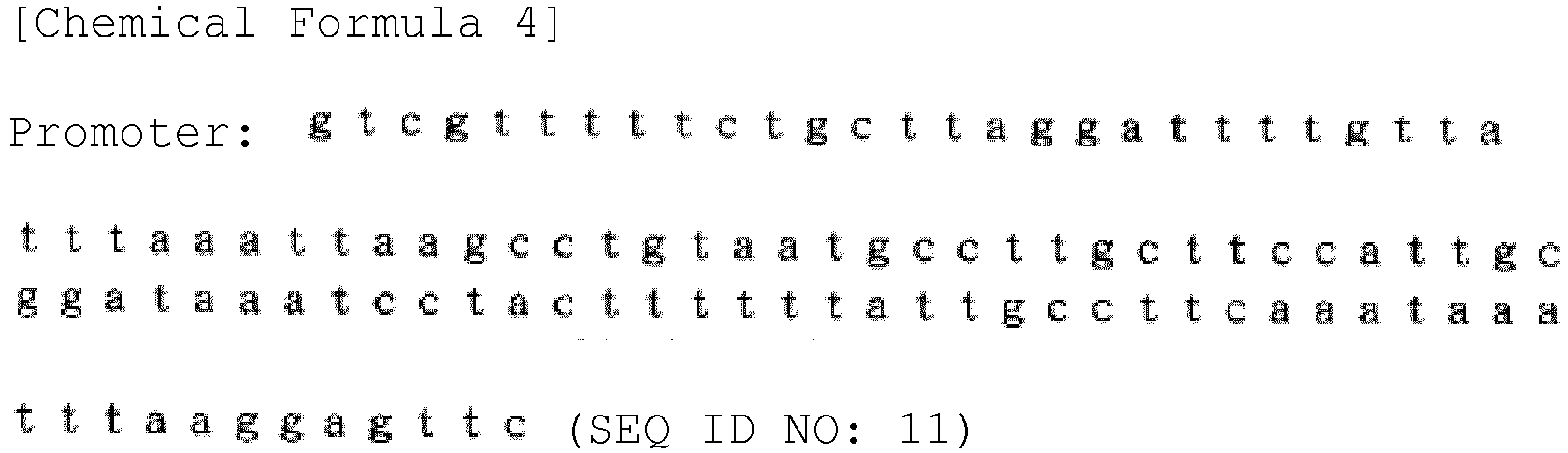
- Specifically, a terminator sequence and the above promoter sequence were inserted at the multicloning site of plasmid pNFP-A51 (deposited as FERM P-22182 on October 25, 2011 at the Incorporated Administrative Agency National Institute of Technology and Evaluation, Patent Microorganisms Depositary. International accession number: FERM BP-11515). The suhB coding region cloned as described above was ligated downstream of the promoter sequence introduced, and pNFP-A54 was constructed. The pNFP-A54 constructed was transfected into E. coli AKC-016 (deposited as FERM P-22014 on April 20, 2011 at the Incorporated Administrative Agency National Institute of Technology and Evaluation, Patent Microorganisms Depositary. International accession number: FERM BP-11512) by the calcium chloride method (refer to Genetic Engineering Laboratory Notebook (vol. I), by Takaaki Tamura, Yodosha). High expression of inositol monophosphatase was confirmed in the soluble fraction of this E. coli by SDS-PAGE.
- The cells were collected from the culture broth of distillery yeast, and the genomic DNA was extracted using Nucleo Spin Tissue (product name, manufactured by Macherey-Nagel). Using the extracted genomic DNA as a template, PCR amplification (PrimeSTAR Max DNA Polymerase (product name, manufactured by Takara Bio), reaction conditions: 98°C for 10 sec, 55°C for 5 sec, 72°C for 20 sec; 28 cycles) was carried out by the following primers, and the coding region of the INO1 gene (SEQ ID NO: 1) was cloned.

- The ino1 coding region obtained was inserted transcribably downstream of a promoter of the following sequence.
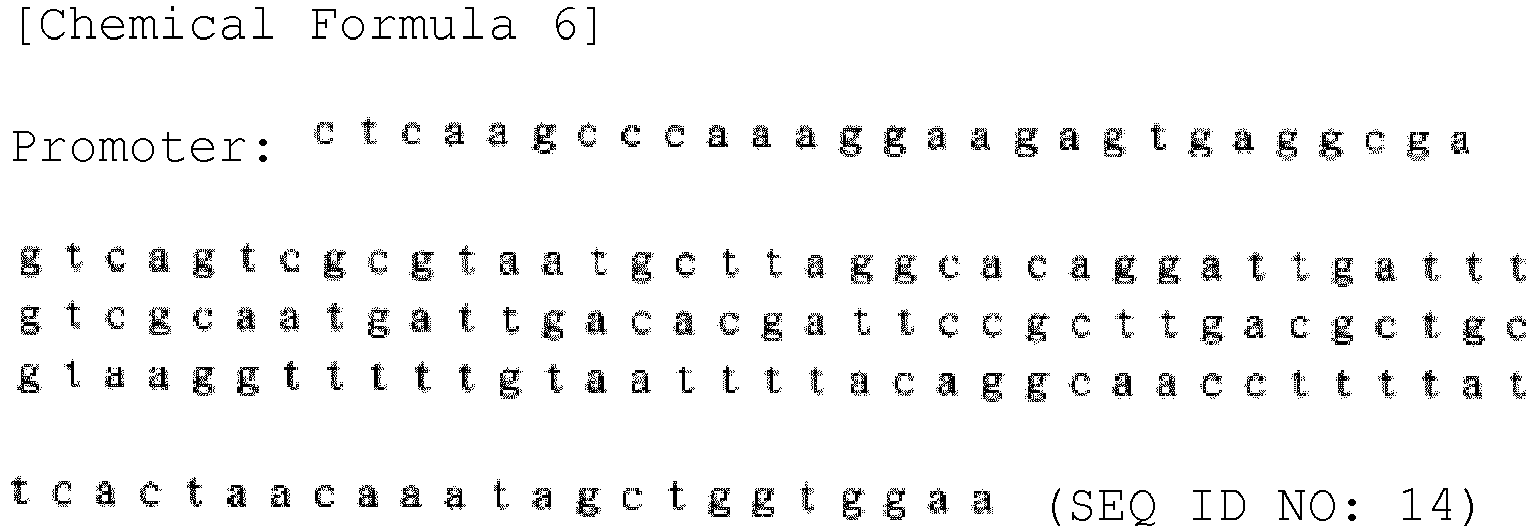
- Specifically, a terminator sequence and the above promoter sequence were inserted at the multicloning site of the above plasmid pNFP-A51. The ino1 coding region cloned as described above was ligated downstream of the promoter sequence introduced, and pNFP-D78 was constructed. The pNFP-D78 constructed was transfected into E. coli AKC-016 (deposited as FERM P-22104 on April 20, 2011 at the Incorporated Administrative Agency National Institute of Technology and Evaluation, Patent Microorganisms Depositary. International accession number: FERM BP-11512) by the calcium chloride method (refer to Genetic Engineering Laboratory Notebook (part I), by Takaaki Tamura, Yodosha). High expression of inositol-1-phosphate synthase was confirmed in the soluble fraction of this E. coli by SDS-PAGE.
- DNA having a nucleotide sequence of SEQ ID NO: 5 was produced by artificial synthesis. Using this DNA as a template, PCR amplification (PrimeSTAR Max DNA Polymerase (product name, manufactured by Takara Bio), reaction conditions: 98°C for 10 sec, 55°C for 5 sec, 72°C for 20 sec; 28 cycles) was carried out by the following primers, and a myo-inositol oxygenase (miox) gene was obtained.

- The miox coding region obtained was inserted transcribably downstream of a promoter of SEQ ID NO: 11. Specifically, a terminator sequence and the above promoter sequence were inserted at the multicloning site of the above plasmid pNFP-A51. The miox coding region cloned as described above was ligated downstream of the promoter sequence introduced, and pNFP-H26 was constructed. The pNFP-H26 constructed was transfected into E. coli FERM P-22104 by the calcium chloride method (refer to Genetic Engineering Laboratory Notebook (part I), by Takaaki Tamura, Yodosha). High expression of myo-inositol oxygenase was confirmed in the soluble fraction of this E. coli by SDS-PAGE.
- DNA having a nucleotide sequence of SEQ ID NO: 7 was produced by artificial synthesis. Using this DNA as a template, PCR amplification (PrimeSTAR Max DNA Polymerase (product name, manufactured by Takara Bio), reaction conditions: 98°C for 10 sec, 55°C for 5 sec, 72°C for 20 sec; 28 cycles) was carried out by the following primers, and a uronic acid dehydrogenase (udh) gene was obtained.

- The udh coding region obtained was inserted transcribably downstream of a promoter of SEQ ID NO: 11. Specifically, a terminator sequence and the above promoter sequence were inserted at the multicloning site of the above plasmid pNFP-A51. The udh coding region cloned as described above was ligated downstream of the promoter sequence introduced, and pNFP-H45 was constructed. The pNFP-H45 constructed was transfected into E. coli FERM P-22104 by the calcium chloride method (refer to Genetic Engineering Laboratory Notebook (part I), by Takaaki Tamura, Yodosha). High expression of uronic acid dehydrogenase was confirmed in the soluble fraction of this E. coli by SDS-PAGE.
- p-NFP-D78 produced as described above was digested by Sal I, blunted, and the 5' end dephosphorylated. The suhB expression cassette was cloned in pNFP-A54, and ligated into pNFP-D78. pNFP-G22 having an INO1 expression cassette and an suhB expression cassette in the forward direction ligated in pNFP-D78 was obtained. Next, p-NFP-G22 was digested by Sal I, blunted, and the 5' end dephosphorylated. The miox expression cassette in pNFP-H26 and the udh expression cassette in pNFP-H45 produced in Example 1 were cloned, and the two expression cassettes were ligated into pNFP-G22. A plasmid of the present invention having a miox expression cassette and a udh expression cassette in the forward direction ligated in pNFP-G22 was obtained.
- A plasmid of the present invention constructed according to the above procedure was transfected into E. coli AKC-016 (deposited as FERM P-22014 on April 20, 2011 at the Incorporated Administrative Agency National Institute of Technology and Evaluation, Patent Microorganisms Depositary. International accession number: FERM BP-11512) by the calcium chloride method (refer to Genetic Engineering Laboratory Notebook (part I), by Takaaki Tamura, Yodosha).
- The transformant obtained was cultured for one day at 37°C on LB plates containing ampicillin (100 mg/L) to form colonies. Thirty milliliters of LB medium containing ampicillin (100 mg/L) was placed in a 150 mL flask and inoculated by a platinum loop with colonies from the above plate. Culture was carried out at 37°C for 3-5 hours at 180 rpm until OD (600 nm) reached approximately 0.5. This was taken as preculture broth for the main culture.
- A quantity of 10 g/L of glucose and 300 mL of synthetic medium (Table 1) containing 100 mg/L of ampicillin were placed in a 1000 mL jar fermenter; 6 mL of preculture broth was added, and the main culture (glucaric acid production test using a jar fermenter) was conducted. The culture conditions were as follows: Culture temperature 32°C; culture pH 6.0 [lower limit]; alkali added 28% (W/V) ammonia water; stirring 850 rpm;
ventilation 1 vvm. The glucose feed solution (Table 2) that served as the raw material was added as was appropriate to make a glucose concentration of 0-5 g/L in the culture broth.
[Table 1](Table 1) Synthetic medium composition KH2PO4 13.3 g (NH4)2HPO4 4 g MgSO4·7H2O 1.2 g EDTA·2Na 8.4 mg CoCl2·6H2O 2.5 mg MnCl2·4H2O 15 mg CuCl2·2H2O 1.5 mg H3BO3 3 mg Na2MoO4·2H2O 2.5 mg Zn(CH3COO)2·2H2O 13 mg FeCl3·6H2O 100 mg total 1 L - [Table 2]
(Table 2) Glucose feed solution Glucose 700 g MgSO4·7H2O 20 9 EDTA·2Na 13 mg CoCl2·6H2O 5 mg MnCl2·4H2O 29 mg CuCl2·2H2O 4 mg H3BO3 5 mg Na2MoO4·2H2O 4 mg Zn(CH3COO)2·2H2O 21 mg FeCl3·6H2O 41 mg total 1 L - The above culture broth was centrifuged at 4°C for 10 min at 10,000 × g, and the supernatant was collected. The glucaric acid concentration in the culture supernatant was assayed by HPLC (detector: RI, column temperature: 40°C, flow rate: 1 mL/min, mobile phase 0.1% formic acid) by linking a Shim-Pak SCR-H (guard column) and Shim-Pak SCR-101H (both trade names, manufactured by Shimadzu GLC, Ltd.).
- As a result, approximately 73 g/L (culture time 68 hours) of glucaric acid was produced in the culture supernatant of this transformant by enhancing the inositol monophosphatase activity in a transformant possessing an inositol-1-phosphate synthase gene, inositol monophosphatase gene, myo-inositol oxygenase gene, and uronic acid dehydrogenase gene according to the present invention.
- Reference Example:
- Only 0.26 g/L of glucaric acid was produced with a culture time of 68 hours when a glucaric acid production test was conducted in accordance with Example 2 except that a transformant that does not overproduce inositol monophosphatase was produced and this unenhanced inositol monophosphatase strain was used.
- When it is stated that the plasmids and microorganisms mentioned in this specification have been deposited, all were deposited with the (name of depository institution) "IPOD National Institute of Technology and Evaluation, Patent Microorganisms Depositary (IPOD, NITE)"; (address of depository institution) Central 6, 1-1-1 Higashi, Tsukuba-shi, Ibaraki-ken, 305-8566, JAPAN."
- The present invention can be utilized in the industrial fermentative production of glucaric acid.
-
- <110> ASAHI KASEI CHEMICALS
- <120> Method of production of glucaric acid
- <130> F112222-WO
- <150> Japanese Patent Application No.
2012-39129
<151> 2012-02-24 - <160> 18
- <170> PatentIn version 3.5
- <210> 1
<211> 1602
<212> DNA
<213> Saccharomyces cerevisiae - <220>
<221> CDS
<222> (1)..(1602) - <400> 1


- <210> 2
<211> 533
<212> PRT
<213> Saccharomyces cerevisiae - <400> 2


- <210> 3
<211> 804
<212> DNA
<213> Escherichia coli - <220>
<221> CDS
<222> (1)..(804) - <400> 3


- <210> 4
<211> 267
<212> PRT
<213> Escherichia coli - <400> 4
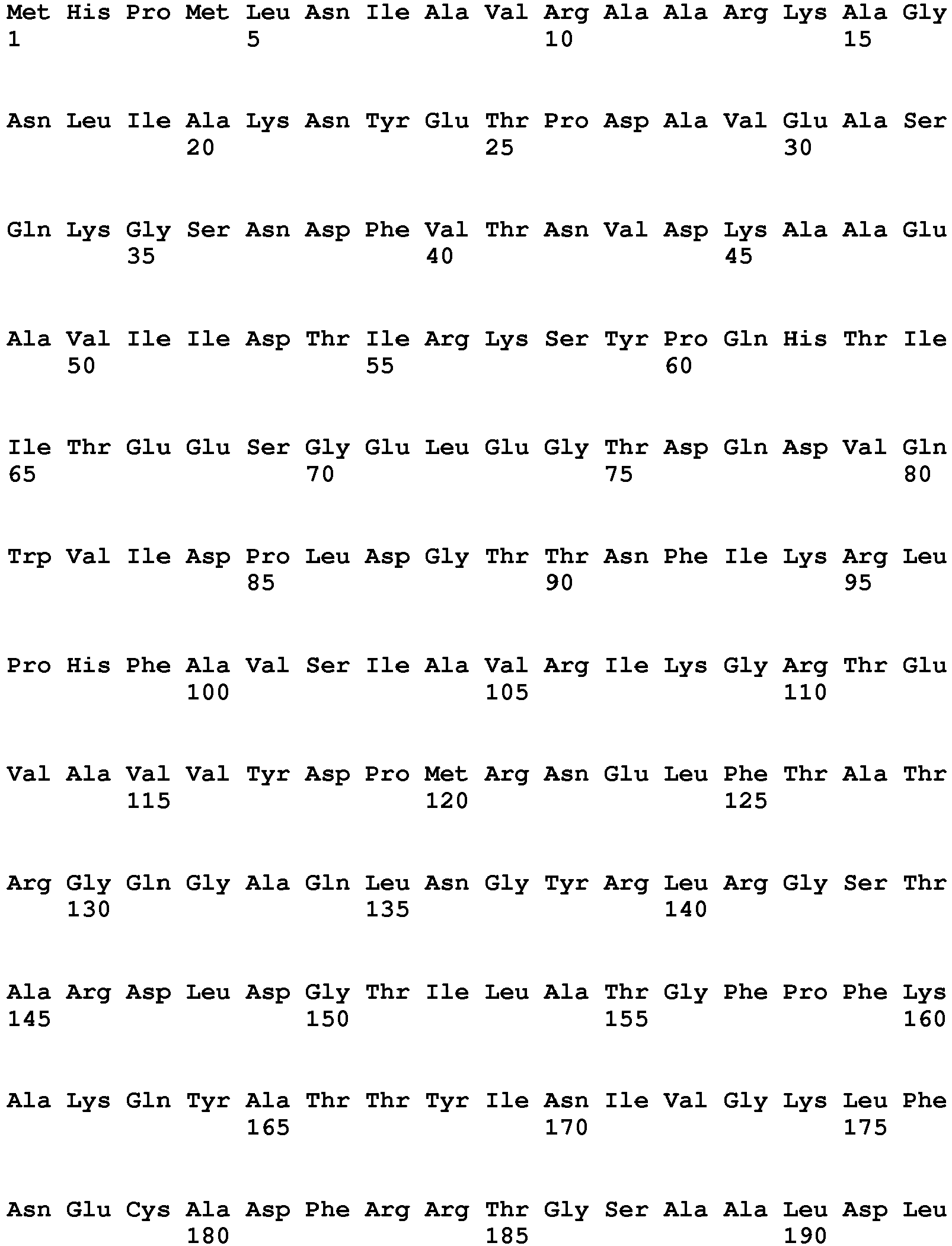

- <210> 5
<211> 858
<212> DNA
<213> Artificial Sequence - <220>
<223> miox gene coding region - <220>
<221> CDS
<222> (1)..(858) - <400> 5


- <210> 6
<211> 285
<212> PRT
<213> Artificial Sequence - <220>
<223> Synthetic Construct - <400> 6


- <210> 7
<211> 807
<212> DNA
<213> Artificial Sequence - <220>
<223> udh gene coding region - <220>
<221> CDS
<222> (1)..(807) - <400> 7


- <210> 8
<211> 268
<212> PRT
<213> Artificial Sequence - <220>
<223> Synthetic Construct - <400> 8


- <210> 9
<211> 18
<212> DNA
<213> Artificial Sequence - <220>
<223> Forward PCR Primer for suhB Coding Region - <400> 9
atgcatccga tgctgaac 18 - <210> 10
<211> 19
<212> DNA
<213> Artificial Sequence - <220>
<223> Reverse PCR Primer for suhB Coding Region - <400> 10
ttaacgcttc agagcgtcg 19 - <210> 11
<211> 109
<212> DNA
<213> Artificial Sequence - <220>
<223> Promoter for suhB coding region - <400> 11

- <210> 12
<211> 22
<212> DNA
<213> Artificial Sequence - <220>
<223> Forward PCR Primer for INO1 Coding Region - <400> 12
atgacagaag ataatattgc tc 22 - <210> 13
<211> 19
<212> DNA
<213> Artificial Sequence - <220>
<223> Reverse PCR Primer for INO1 Coding Region - <400> 13
ttacaacaat ctctcttcg 19 - <210> 14
<211> 155
<212> DNA
<213> Artificial Sequence - <220>
<223> Promoter for INO1 coding sequence - <400> 14

- <210> 15
<211> 22
<212> DNA
<213> Artificial Sequence - <220>
<223> Forward PCR Primer for miox Coding Region - <400> 15
atgaaagttg atgttggtcc tg 22 - <210> 16
<211> 18
<212> DNA
<213> Artificial Sequence - <220>
<223> Reverse PCR Primer for Miox Coding Region - <400> 16
ttaccaggac agggtgcc 18 - <210> 17
<211> 21
<212> DNA
<213> Artificial Sequence - <220>
<223> Forward PCR Primer for Udh Coding Region - <400> 17
atgaccacta cccccttcaa t 21 - <210> 18
<211> 17
<212> DNA
<213> Artificial Sequence - <220>
<223> Reverse PCR Primer for Udh Coding Region - <400> 18
tcagttgaac gggccgg 17
Claims (7)
- A method for producing glucaric acid including the following steps:1) a step of transforming a host cell with an expression cassette containing a nucleic acid that encodes inositol-1-phosphate synthase, an expression cassette containing a nucleic acid that encodes an inositol monophosphatase, an expression cassette containing a nucleic acid that encodes myo-inositol oxygenase, and an expression cassette containing a nucleic acid that encodes uronic acid dehydrogenase;2) a step for bringing the transformed host cell of step 1) into contact with a carbon source that can be converted into glucaric acid by the transformant under conditions suited to growth and/or maintenance of the transformant; and3) a step for separating the glucaric acid or glucarate from culture obtained in the step 2).
- The production method according to Claim 1, wherein the carbon source contains a compound that can be converted into glucose-6-phosphate within the transformant.
- The production method according to Claim 2, wherein the carbon source is one or more selected from the group consisting of D-glucose, sucrose, oligosaccharide, polysaccharide, starch, cellulose, rice bran, molasses, and biomass containing D-glucose.
- The production method according to any of Claims 1 to 3, wherein the host cell of step 1) is a microorganism not having myo-inositol assimilation capacity.
- The production method according to any of Claims 1 to 4, wherein the host cell of step 1) is a bacterium selected from the group consisting of Escherichia coli, bacteria belonging to the genus Bacillus, bacteria belonging to the genus Corynebacterium, and bacteria belonging to the genus Zymomonas.
- A transformed host cell possessing an expression cassette containing a nucleic acid that encodes inositol-1-phosphate synthase, an expression cassette containing a nucleic acid that encodes an inositol monophosphatase, an expression cassette containing a nucleic acid that encodes myo-inositol oxygenase, and an expression cassette containing a nucleic acid that encodes uronic acid dehydrogenase.
- The transformed host cell according to Claim 6, wherein the transformed host cell is a bacterium selected from the group consisting of Escherichia coli, bacteria belonging to the genus Bacillus, bacteria belonging to the genus Corynebacterium, and bacteria belonging to the genus Zymomonas.
Applications Claiming Priority (2)
| Application Number | Priority Date | Filing Date | Title |
|---|---|---|---|
| JP2012039129 | 2012-02-24 | ||
| PCT/JP2013/053958 WO2013125509A1 (en) | 2012-02-24 | 2013-02-19 | Method for producing glucaric acid |
Publications (3)
| Publication Number | Publication Date |
|---|---|
| EP2818552A1 EP2818552A1 (en) | 2014-12-31 |
| EP2818552A4 EP2818552A4 (en) | 2015-06-17 |
| EP2818552B1 true EP2818552B1 (en) | 2017-12-27 |
Family
ID=49005694
Family Applications (1)
| Application Number | Title | Priority Date | Filing Date |
|---|---|---|---|
| EP13751346.1A Active EP2818552B1 (en) | 2012-02-24 | 2013-02-19 | Method for producing glucaric acid |
Country Status (6)
| Country | Link |
|---|---|
| US (1) | US9506091B2 (en) |
| EP (1) | EP2818552B1 (en) |
| JP (2) | JP6012703B2 (en) |
| CN (1) | CN104080918B (en) |
| TW (1) | TWI488970B (en) |
| WO (1) | WO2013125509A1 (en) |
Families Citing this family (9)
| Publication number | Priority date | Publication date | Assignee | Title |
|---|---|---|---|---|
| CN104312987B (en) * | 2014-10-21 | 2017-12-29 | 江南大学 | A kind of method of biosynthesis glucuronic acid and glucaric acid |
| CN104312934A (en) * | 2014-10-22 | 2015-01-28 | 江南大学 | Method for establishing recombinant yeast for biologically synthesizing glucuronic acid |
| CN107022514A (en) * | 2017-03-30 | 2017-08-08 | 华南理工大学 | A kind of recombination bacillus coli and its construction method and the method that glucuronic acid is produced by metabolic engineering |
| CN106929459B (en) * | 2017-03-30 | 2026-03-20 | 华南理工大学 | A recombinant Escherichia coli and its construction method and a method for producing gluconic acid via metabolic engineering |
| CN116148481A (en) | 2017-03-31 | 2023-05-23 | 学校法人庆应义塾 | Sensitivity judgment markers for anticancer agents |
| CN108384796B (en) * | 2018-03-05 | 2021-11-26 | 北京化工大学 | Method for biosynthesizing D-glucaric acid by utilizing sucrose |
| WO2024192251A1 (en) * | 2023-03-14 | 2024-09-19 | Solugen, Inc. | Multifunctional cement additives and methods of using same |
| CN119506231B (en) * | 2023-08-23 | 2026-03-10 | 安徽华恒生物科技股份有限公司 | Inositol oxygenase mutant and application thereof in preparation of glucaric acid |
| WO2025098128A1 (en) * | 2023-11-06 | 2025-05-15 | Enzymaster (Ningbo) Bio-Engineering Co., Ltd. | A method of synthesizing glucaric acid and the enzymes used thereof |
Family Cites Families (2)
| Publication number | Priority date | Publication date | Assignee | Title |
|---|---|---|---|---|
| WO2002074926A2 (en) | 2001-03-19 | 2002-09-26 | Cargill Incorporated | Myo-inositol oxygenases |
| CN102066552B (en) * | 2008-04-04 | 2014-03-12 | 麻省理工学院 | Cellular production of glucaric acid |
-
2013
- 2013-02-19 JP JP2014500708A patent/JP6012703B2/en active Active
- 2013-02-19 US US14/377,559 patent/US9506091B2/en active Active
- 2013-02-19 WO PCT/JP2013/053958 patent/WO2013125509A1/en not_active Ceased
- 2013-02-19 CN CN201380006973.XA patent/CN104080918B/en active Active
- 2013-02-19 EP EP13751346.1A patent/EP2818552B1/en active Active
- 2013-02-22 TW TW102106172A patent/TWI488970B/en active
-
2016
- 2016-05-19 JP JP2016100208A patent/JP6144804B2/en active Active
Non-Patent Citations (1)
| Title |
|---|
| None * |
Also Published As
| Publication number | Publication date |
|---|---|
| US9506091B2 (en) | 2016-11-29 |
| JP6012703B2 (en) | 2016-10-25 |
| US20150010969A1 (en) | 2015-01-08 |
| TW201339306A (en) | 2013-10-01 |
| EP2818552A1 (en) | 2014-12-31 |
| EP2818552A4 (en) | 2015-06-17 |
| WO2013125509A1 (en) | 2013-08-29 |
| CN104080918B (en) | 2017-02-22 |
| JPWO2013125509A1 (en) | 2015-07-30 |
| JP2016163587A (en) | 2016-09-08 |
| JP6144804B2 (en) | 2017-06-07 |
| TWI488970B (en) | 2015-06-21 |
| CN104080918A (en) | 2014-10-01 |
Similar Documents
| Publication | Publication Date | Title |
|---|---|---|
| US9506091B2 (en) | Method for producing glucaric acid | |
| EP2781600B1 (en) | Method for producing myo-inositol and myo-inositol derivative | |
| US10006064B2 (en) | Biosynthetic pathways, recombinant cells, and methods | |
| JP6110542B2 (en) | Method for producing scyllo-inositol | |
| US20130210097A1 (en) | Glycolic acid fermentative production with a modified microorganism | |
| JP2017534268A (en) | Modified microorganisms and methods for the production of useful products | |
| KR20220032084A (en) | Genetically Recombinant Microorganisms and Methods for Manufacturing Diamine Compounds | |
| WO2010032698A1 (en) | Method for producing lactic acid from plant-derived raw material, and lactic-acid-producing bacterium | |
| Yue et al. | Enhanced trans‐2, 3‐dihydro‐3‐hydroxyanthranilic acid production by pH control and glycerol feeding strategies in engineered Pseudomonas chlororaphis GP72 | |
| US11136601B2 (en) | Conversion of S-lignin compounds to useful intermediates | |
| JP6576650B2 (en) | Glucose elution suppression method |
Legal Events
| Date | Code | Title | Description |
|---|---|---|---|
| PUAI | Public reference made under article 153(3) epc to a published international application that has entered the european phase |
Free format text: ORIGINAL CODE: 0009012 |
|
| 17P | Request for examination filed |
Effective date: 20140915 |
|
| AK | Designated contracting states |
Kind code of ref document: A1 Designated state(s): AL AT BE BG CH CY CZ DE DK EE ES FI FR GB GR HR HU IE IS IT LI LT LU LV MC MK MT NL NO PL PT RO RS SE SI SK SM TR |
|
| AX | Request for extension of the european patent |
Extension state: BA ME |
|
| DAX | Request for extension of the european patent (deleted) | ||
| RA4 | Supplementary search report drawn up and despatched (corrected) |
Effective date: 20150515 |
|
| RIC1 | Information provided on ipc code assigned before grant |
Ipc: C12N 5/10 20060101ALI20150508BHEP Ipc: C12N 1/19 20060101ALI20150508BHEP Ipc: C12N 15/09 20060101ALI20150508BHEP Ipc: C12N 1/15 20060101ALI20150508BHEP Ipc: C12N 1/21 20060101ALI20150508BHEP Ipc: C12P 7/58 20060101AFI20150508BHEP |
|
| 17Q | First examination report despatched |
Effective date: 20150601 |
|
| STAA | Information on the status of an ep patent application or granted ep patent |
Free format text: STATUS: EXAMINATION IS IN PROGRESS |
|
| GRAP | Despatch of communication of intention to grant a patent |
Free format text: ORIGINAL CODE: EPIDOSNIGR1 |
|
| STAA | Information on the status of an ep patent application or granted ep patent |
Free format text: STATUS: GRANT OF PATENT IS INTENDED |
|
| INTG | Intention to grant announced |
Effective date: 20170718 |
|
| RIN1 | Information on inventor provided before grant (corrected) |
Inventor name: KONISHI, KAZUNOBU Inventor name: IMAZU, SHINICHI |
|
| GRAS | Grant fee paid |
Free format text: ORIGINAL CODE: EPIDOSNIGR3 |
|
| GRAA | (expected) grant |
Free format text: ORIGINAL CODE: 0009210 |
|
| STAA | Information on the status of an ep patent application or granted ep patent |
Free format text: STATUS: THE PATENT HAS BEEN GRANTED |
|
| AK | Designated contracting states |
Kind code of ref document: B1 Designated state(s): AL AT BE BG CH CY CZ DE DK EE ES FI FR GB GR HR HU IE IS IT LI LT LU LV MC MK MT NL NO PL PT RO RS SE SI SK SM TR |
|
| RAP1 | Party data changed (applicant data changed or rights of an application transferred) |
Owner name: ASAHI KASEI KABUSHIKI KAISHA |
|
| REG | Reference to a national code |
Ref country code: GB Ref legal event code: FG4D |
|
| REG | Reference to a national code |
Ref country code: CH Ref legal event code: EP |
|
| REG | Reference to a national code |
Ref country code: FR Ref legal event code: PLFP Year of fee payment: 6 |
|
| REG | Reference to a national code |
Ref country code: AT Ref legal event code: REF Ref document number: 958338 Country of ref document: AT Kind code of ref document: T Effective date: 20180115 |
|
| REG | Reference to a national code |
Ref country code: IE Ref legal event code: FG4D |
|
| REG | Reference to a national code |
Ref country code: DE Ref legal event code: R096 Ref document number: 602013031374 Country of ref document: DE |
|
| PG25 | Lapsed in a contracting state [announced via postgrant information from national office to epo] |
Ref country code: FI Free format text: LAPSE BECAUSE OF FAILURE TO SUBMIT A TRANSLATION OF THE DESCRIPTION OR TO PAY THE FEE WITHIN THE PRESCRIBED TIME-LIMIT Effective date: 20171227 Ref country code: NO Free format text: LAPSE BECAUSE OF FAILURE TO SUBMIT A TRANSLATION OF THE DESCRIPTION OR TO PAY THE FEE WITHIN THE PRESCRIBED TIME-LIMIT Effective date: 20180327 Ref country code: LT Free format text: LAPSE BECAUSE OF FAILURE TO SUBMIT A TRANSLATION OF THE DESCRIPTION OR TO PAY THE FEE WITHIN THE PRESCRIBED TIME-LIMIT Effective date: 20171227 |
|
| REG | Reference to a national code |
Ref country code: NL Ref legal event code: MP Effective date: 20171227 |
|
| REG | Reference to a national code |
Ref country code: LT Ref legal event code: MG4D |
|
| REG | Reference to a national code |
Ref country code: AT Ref legal event code: MK05 Ref document number: 958338 Country of ref document: AT Kind code of ref document: T Effective date: 20171227 |
|
| PG25 | Lapsed in a contracting state [announced via postgrant information from national office to epo] |
Ref country code: RS Free format text: LAPSE BECAUSE OF FAILURE TO SUBMIT A TRANSLATION OF THE DESCRIPTION OR TO PAY THE FEE WITHIN THE PRESCRIBED TIME-LIMIT Effective date: 20171227 Ref country code: LV Free format text: LAPSE BECAUSE OF FAILURE TO SUBMIT A TRANSLATION OF THE DESCRIPTION OR TO PAY THE FEE WITHIN THE PRESCRIBED TIME-LIMIT Effective date: 20171227 Ref country code: HR Free format text: LAPSE BECAUSE OF FAILURE TO SUBMIT A TRANSLATION OF THE DESCRIPTION OR TO PAY THE FEE WITHIN THE PRESCRIBED TIME-LIMIT Effective date: 20171227 Ref country code: GR Free format text: LAPSE BECAUSE OF FAILURE TO SUBMIT A TRANSLATION OF THE DESCRIPTION OR TO PAY THE FEE WITHIN THE PRESCRIBED TIME-LIMIT Effective date: 20180328 Ref country code: BG Free format text: LAPSE BECAUSE OF FAILURE TO SUBMIT A TRANSLATION OF THE DESCRIPTION OR TO PAY THE FEE WITHIN THE PRESCRIBED TIME-LIMIT Effective date: 20180327 |
|
| PG25 | Lapsed in a contracting state [announced via postgrant information from national office to epo] |
Ref country code: NL Free format text: LAPSE BECAUSE OF FAILURE TO SUBMIT A TRANSLATION OF THE DESCRIPTION OR TO PAY THE FEE WITHIN THE PRESCRIBED TIME-LIMIT Effective date: 20171227 |
|
| PG25 | Lapsed in a contracting state [announced via postgrant information from national office to epo] |
Ref country code: SK Free format text: LAPSE BECAUSE OF FAILURE TO SUBMIT A TRANSLATION OF THE DESCRIPTION OR TO PAY THE FEE WITHIN THE PRESCRIBED TIME-LIMIT Effective date: 20171227 Ref country code: EE Free format text: LAPSE BECAUSE OF FAILURE TO SUBMIT A TRANSLATION OF THE DESCRIPTION OR TO PAY THE FEE WITHIN THE PRESCRIBED TIME-LIMIT Effective date: 20171227 Ref country code: CY Free format text: LAPSE BECAUSE OF FAILURE TO SUBMIT A TRANSLATION OF THE DESCRIPTION OR TO PAY THE FEE WITHIN THE PRESCRIBED TIME-LIMIT Effective date: 20171227 Ref country code: CZ Free format text: LAPSE BECAUSE OF FAILURE TO SUBMIT A TRANSLATION OF THE DESCRIPTION OR TO PAY THE FEE WITHIN THE PRESCRIBED TIME-LIMIT Effective date: 20171227 Ref country code: ES Free format text: LAPSE BECAUSE OF FAILURE TO SUBMIT A TRANSLATION OF THE DESCRIPTION OR TO PAY THE FEE WITHIN THE PRESCRIBED TIME-LIMIT Effective date: 20171227 |
|
| PG25 | Lapsed in a contracting state [announced via postgrant information from national office to epo] |
Ref country code: PL Free format text: LAPSE BECAUSE OF FAILURE TO SUBMIT A TRANSLATION OF THE DESCRIPTION OR TO PAY THE FEE WITHIN THE PRESCRIBED TIME-LIMIT Effective date: 20171227 Ref country code: SM Free format text: LAPSE BECAUSE OF FAILURE TO SUBMIT A TRANSLATION OF THE DESCRIPTION OR TO PAY THE FEE WITHIN THE PRESCRIBED TIME-LIMIT Effective date: 20171227 Ref country code: IT Free format text: LAPSE BECAUSE OF FAILURE TO SUBMIT A TRANSLATION OF THE DESCRIPTION OR TO PAY THE FEE WITHIN THE PRESCRIBED TIME-LIMIT Effective date: 20171227 Ref country code: RO Free format text: LAPSE BECAUSE OF FAILURE TO SUBMIT A TRANSLATION OF THE DESCRIPTION OR TO PAY THE FEE WITHIN THE PRESCRIBED TIME-LIMIT Effective date: 20171227 Ref country code: IS Free format text: LAPSE BECAUSE OF FAILURE TO SUBMIT A TRANSLATION OF THE DESCRIPTION OR TO PAY THE FEE WITHIN THE PRESCRIBED TIME-LIMIT Effective date: 20180427 Ref country code: AT Free format text: LAPSE BECAUSE OF FAILURE TO SUBMIT A TRANSLATION OF THE DESCRIPTION OR TO PAY THE FEE WITHIN THE PRESCRIBED TIME-LIMIT Effective date: 20171227 |
|
| REG | Reference to a national code |
Ref country code: CH Ref legal event code: PL |
|
| PG25 | Lapsed in a contracting state [announced via postgrant information from national office to epo] |
Ref country code: MC Free format text: LAPSE BECAUSE OF FAILURE TO SUBMIT A TRANSLATION OF THE DESCRIPTION OR TO PAY THE FEE WITHIN THE PRESCRIBED TIME-LIMIT Effective date: 20171227 |
|
| REG | Reference to a national code |
Ref country code: DE Ref legal event code: R097 Ref document number: 602013031374 Country of ref document: DE |
|
| PLBE | No opposition filed within time limit |
Free format text: ORIGINAL CODE: 0009261 |
|
| STAA | Information on the status of an ep patent application or granted ep patent |
Free format text: STATUS: NO OPPOSITION FILED WITHIN TIME LIMIT |
|
| REG | Reference to a national code |
Ref country code: IE Ref legal event code: MM4A |
|
| REG | Reference to a national code |
Ref country code: BE Ref legal event code: MM Effective date: 20180228 |
|
| PG25 | Lapsed in a contracting state [announced via postgrant information from national office to epo] |
Ref country code: LU Free format text: LAPSE BECAUSE OF NON-PAYMENT OF DUE FEES Effective date: 20180219 Ref country code: DK Free format text: LAPSE BECAUSE OF FAILURE TO SUBMIT A TRANSLATION OF THE DESCRIPTION OR TO PAY THE FEE WITHIN THE PRESCRIBED TIME-LIMIT Effective date: 20171227 Ref country code: CH Free format text: LAPSE BECAUSE OF NON-PAYMENT OF DUE FEES Effective date: 20180228 Ref country code: LI Free format text: LAPSE BECAUSE OF NON-PAYMENT OF DUE FEES Effective date: 20180228 |
|
| 26N | No opposition filed |
Effective date: 20180928 |
|
| PG25 | Lapsed in a contracting state [announced via postgrant information from national office to epo] |
Ref country code: IE Free format text: LAPSE BECAUSE OF NON-PAYMENT OF DUE FEES Effective date: 20180219 |
|
| PG25 | Lapsed in a contracting state [announced via postgrant information from national office to epo] |
Ref country code: BE Free format text: LAPSE BECAUSE OF NON-PAYMENT OF DUE FEES Effective date: 20180228 Ref country code: SI Free format text: LAPSE BECAUSE OF FAILURE TO SUBMIT A TRANSLATION OF THE DESCRIPTION OR TO PAY THE FEE WITHIN THE PRESCRIBED TIME-LIMIT Effective date: 20171227 |
|
| PG25 | Lapsed in a contracting state [announced via postgrant information from national office to epo] |
Ref country code: MT Free format text: LAPSE BECAUSE OF NON-PAYMENT OF DUE FEES Effective date: 20180219 |
|
| PG25 | Lapsed in a contracting state [announced via postgrant information from national office to epo] |
Ref country code: TR Free format text: LAPSE BECAUSE OF FAILURE TO SUBMIT A TRANSLATION OF THE DESCRIPTION OR TO PAY THE FEE WITHIN THE PRESCRIBED TIME-LIMIT Effective date: 20171227 |
|
| PG25 | Lapsed in a contracting state [announced via postgrant information from national office to epo] |
Ref country code: PT Free format text: LAPSE BECAUSE OF FAILURE TO SUBMIT A TRANSLATION OF THE DESCRIPTION OR TO PAY THE FEE WITHIN THE PRESCRIBED TIME-LIMIT Effective date: 20171227 Ref country code: HU Free format text: LAPSE BECAUSE OF FAILURE TO SUBMIT A TRANSLATION OF THE DESCRIPTION OR TO PAY THE FEE WITHIN THE PRESCRIBED TIME-LIMIT; INVALID AB INITIO Effective date: 20130219 |
|
| PG25 | Lapsed in a contracting state [announced via postgrant information from national office to epo] |
Ref country code: SE Free format text: LAPSE BECAUSE OF FAILURE TO SUBMIT A TRANSLATION OF THE DESCRIPTION OR TO PAY THE FEE WITHIN THE PRESCRIBED TIME-LIMIT Effective date: 20171227 Ref country code: MK Free format text: LAPSE BECAUSE OF NON-PAYMENT OF DUE FEES Effective date: 20171227 |
|
| PG25 | Lapsed in a contracting state [announced via postgrant information from national office to epo] |
Ref country code: AL Free format text: LAPSE BECAUSE OF FAILURE TO SUBMIT A TRANSLATION OF THE DESCRIPTION OR TO PAY THE FEE WITHIN THE PRESCRIBED TIME-LIMIT Effective date: 20171227 |
|
| PGFP | Annual fee paid to national office [announced via postgrant information from national office to epo] |
Ref country code: GB Payment date: 20241227 Year of fee payment: 13 |
|
| PGFP | Annual fee paid to national office [announced via postgrant information from national office to epo] |
Ref country code: FR Payment date: 20241231 Year of fee payment: 13 |
|
| PGFP | Annual fee paid to national office [announced via postgrant information from national office to epo] |
Ref country code: DE Payment date: 20241231 Year of fee payment: 13 |