EP2818466A1 - Amine-based compound and organic light-emitting device including the same - Google Patents
Amine-based compound and organic light-emitting device including the same Download PDFInfo
- Publication number
- EP2818466A1 EP2818466A1 EP14173599.3A EP14173599A EP2818466A1 EP 2818466 A1 EP2818466 A1 EP 2818466A1 EP 14173599 A EP14173599 A EP 14173599A EP 2818466 A1 EP2818466 A1 EP 2818466A1
- Authority
- EP
- European Patent Office
- Prior art keywords
- group
- salt
- hydrazone
- hydrazine
- amidino
- Prior art date
- Legal status (The legal status is an assumption and is not a legal conclusion. Google has not performed a legal analysis and makes no representation as to the accuracy of the status listed.)
- Ceased
Links
- 0 CC(*c1c2*)=C(*)c1c(*)c(*)c2N(*)** Chemical compound CC(*c1c2*)=C(*)c1c(*)c(*)c2N(*)** 0.000 description 20
- QZVKONUEHCLWEG-UHFFFAOYSA-N C(C1)C=CC=C1c([o]c1cc(N(c2cccc(-c3ccncc3)c2)c2cc(c(cccc3)c3c(N(c3ccc4c(-c5ccccc5)c(-c5ccccc5)[o]c4c3)c3cc(-c4ccncc4)ccc3)c3)c3c3ccccc23)ccc11)c1-c1ccccc1 Chemical compound C(C1)C=CC=C1c([o]c1cc(N(c2cccc(-c3ccncc3)c2)c2cc(c(cccc3)c3c(N(c3ccc4c(-c5ccccc5)c(-c5ccccc5)[o]c4c3)c3cc(-c4ccncc4)ccc3)c3)c3c3ccccc23)ccc11)c1-c1ccccc1 QZVKONUEHCLWEG-UHFFFAOYSA-N 0.000 description 1
- GUBBFUCDXWURBT-UHFFFAOYSA-N C(CC(c1ccccc1)=C(C1C=C2)c3ccccc3)C1C=C2N(c1cccc(-c2ccncc2)c1)c1cc(c(cccc2)c2c(N(c(cc2)cc3c2c(-c2ccccc2)c(-c2ccccc2)[s]3)c2cc(-c3ccncc3)ccc2)c2)c2c2ccccc12 Chemical compound C(CC(c1ccccc1)=C(C1C=C2)c3ccccc3)C1C=C2N(c1cccc(-c2ccncc2)c1)c1cc(c(cccc2)c2c(N(c(cc2)cc3c2c(-c2ccccc2)c(-c2ccccc2)[s]3)c2cc(-c3ccncc3)ccc2)c2)c2c2ccccc12 GUBBFUCDXWURBT-UHFFFAOYSA-N 0.000 description 1
- CJNPWNREELWYNG-DCFDNNIBSA-N C/C(/N)=C\C=C(\CNC=C1)/C1=C Chemical compound C/C(/N)=C\C=C(\CNC=C1)/C1=C CJNPWNREELWYNG-DCFDNNIBSA-N 0.000 description 1
- IADACVFBVDJJNS-HYXAFXHYSA-N C/C=C\c(c(C=C)c1)ncc1N Chemical compound C/C=C\c(c(C=C)c1)ncc1N IADACVFBVDJJNS-HYXAFXHYSA-N 0.000 description 1
- TZYMVPKQHLVNJG-UHFFFAOYSA-N C1C=CC(C2(c(cc(cc3)[F](c(cc4)cc5c4c(-c4ccccc4)c(-c4ccccc4)[s]5)c4cccc5c4cccc5)c3-c(cc3)c2cc3N(c2ccc3c(-c4ccccc4)c(-c4ccccc4)[s]c3c2)c2cccc3c2cccc3)c2ccccc2)=CC1 Chemical compound C1C=CC(C2(c(cc(cc3)[F](c(cc4)cc5c4c(-c4ccccc4)c(-c4ccccc4)[s]5)c4cccc5c4cccc5)c3-c(cc3)c2cc3N(c2ccc3c(-c4ccccc4)c(-c4ccccc4)[s]c3c2)c2cccc3c2cccc3)c2ccccc2)=CC1 TZYMVPKQHLVNJG-UHFFFAOYSA-N 0.000 description 1
- ZCRLPKFBQALGAL-UHFFFAOYSA-N C1C=CC=CC1c1c(-c2ccccc2)[o]c2c1ccc(N(c1ccccc1)c1cc(c(cccc3)c3c(N(c3ccccc3)c(cc3)cc4c3c(-c3ccccc3)c(-c3ccccc3)[o]4)c3)c3c3ccccc13)c2 Chemical compound C1C=CC=CC1c1c(-c2ccccc2)[o]c2c1ccc(N(c1ccccc1)c1cc(c(cccc3)c3c(N(c3ccccc3)c(cc3)cc4c3c(-c3ccccc3)c(-c3ccccc3)[o]4)c3)c3c3ccccc13)c2 ZCRLPKFBQALGAL-UHFFFAOYSA-N 0.000 description 1
- RMSVSOJGDAPQQL-UHFFFAOYSA-N C1C=CC=CC1c1c(-c2ccccc2)[s]c2cc(N(c3cc(cccc4)c4cc3)C(C=CC3c(cc4)c5cc4N(c4ccc6c(-c7ccccc7)c(-c7ccccc7)[s]c6c4)c4cc6ccccc6cc4)=CC3C5(c3ccccc3)c3ccccc3)ccc12 Chemical compound C1C=CC=CC1c1c(-c2ccccc2)[s]c2cc(N(c3cc(cccc4)c4cc3)C(C=CC3c(cc4)c5cc4N(c4ccc6c(-c7ccccc7)c(-c7ccccc7)[s]c6c4)c4cc6ccccc6cc4)=CC3C5(c3ccccc3)c3ccccc3)ccc12 RMSVSOJGDAPQQL-UHFFFAOYSA-N 0.000 description 1
- RXUIBHAOODIHOA-UHFFFAOYSA-N C1C=Nc2cc(N(c3ccc4c(-c5ccccc5)c(-c5ccccc5)[o]c4c3)c3ccc(cc4)c5c3ccc(cc3)c5c4c3N(c3ccc4c(-c5ccccc5)c(-c5ccccc5)[o]c4c3)c3cc(nccc4)c4cc3)ccc2C1 Chemical compound C1C=Nc2cc(N(c3ccc4c(-c5ccccc5)c(-c5ccccc5)[o]c4c3)c3ccc(cc4)c5c3ccc(cc3)c5c4c3N(c3ccc4c(-c5ccccc5)c(-c5ccccc5)[o]c4c3)c3cc(nccc4)c4cc3)ccc2C1 RXUIBHAOODIHOA-UHFFFAOYSA-N 0.000 description 1
- OEJWNFWTEOBROM-UHFFFAOYSA-N CC(C(c1ccccc1)c(c(O)c1)ccc1N(C1C=CC=C2C=CC=CC12)c1ccc(cc2)c3c1ccc(cc1)c3c2c1N(c1ccc2c(-c3ccccc3)c(C3C=CC=CC3)[o]c2c1)c1cccc2c1cccc2)c1ccccc1 Chemical compound CC(C(c1ccccc1)c(c(O)c1)ccc1N(C1C=CC=C2C=CC=CC12)c1ccc(cc2)c3c1ccc(cc1)c3c2c1N(c1ccc2c(-c3ccccc3)c(C3C=CC=CC3)[o]c2c1)c1cccc2c1cccc2)c1ccccc1 OEJWNFWTEOBROM-UHFFFAOYSA-N 0.000 description 1
- FMTFLXHDHQKDPP-UHFFFAOYSA-N CN1c(cc(cc2)N)c2C=CC1 Chemical compound CN1c(cc(cc2)N)c2C=CC1 FMTFLXHDHQKDPP-UHFFFAOYSA-N 0.000 description 1
- IGVGTGIDGWGOPE-UHFFFAOYSA-N CS(c1cc(N(c2ccccc2)c2ccc(cc3)c4c2ccc(cc2)c4c3c2N(c2ccccc2)c2ccc3c(-c4ccccc4)c(-c4ccccc4)[s]c3c2)ccc11)C(c2ccccc2)=C1C1=CC=CCC1 Chemical compound CS(c1cc(N(c2ccccc2)c2ccc(cc3)c4c2ccc(cc2)c4c3c2N(c2ccccc2)c2ccc3c(-c4ccccc4)c(-c4ccccc4)[s]c3c2)ccc11)C(c2ccccc2)=C1C1=CC=CCC1 IGVGTGIDGWGOPE-UHFFFAOYSA-N 0.000 description 1
- DXPQTHAFYUTZRR-UHFFFAOYSA-N Cc1ncc(cccc2)c2n1 Chemical compound Cc1ncc(cccc2)c2n1 DXPQTHAFYUTZRR-UHFFFAOYSA-N 0.000 description 1
- VQMRXMRLQCLMFR-UHFFFAOYSA-N NC1C=CC=C2C=CC=NC12 Chemical compound NC1C=CC=C2C=CC=NC12 VQMRXMRLQCLMFR-UHFFFAOYSA-N 0.000 description 1
- AQPBJVLMGTZNGJ-UHFFFAOYSA-N Nc1c(CCC=C2)c2ccn1 Chemical compound Nc1c(CCC=C2)c2ccn1 AQPBJVLMGTZNGJ-UHFFFAOYSA-N 0.000 description 1
- XMIAFAKRAAMSGX-UHFFFAOYSA-N Nc1c(cccn2)c2ccc1 Chemical compound Nc1c(cccn2)c2ccc1 XMIAFAKRAAMSGX-UHFFFAOYSA-N 0.000 description 1
- YUHPQTGQDWUGEK-UHFFFAOYSA-N Nc1ncc(C=CCC2)c2c1 Chemical compound Nc1ncc(C=CCC2)c2c1 YUHPQTGQDWUGEK-UHFFFAOYSA-N 0.000 description 1
- DNONTWJGEBMCJG-UHFFFAOYSA-N c(cc1)ccc1-c1c(-c2ccccc2)[o]c2cc(N(c3c(cccc4)c4ccc3)c3cc(c4ccccc4c(N(c4ccc5c(-c6ccccc6)c(-c6ccccc6)[o]c5c4)c4cccc5c4cccc5)c4)c4c4c3cccc4)ccc12 Chemical compound c(cc1)ccc1-c1c(-c2ccccc2)[o]c2cc(N(c3c(cccc4)c4ccc3)c3cc(c4ccccc4c(N(c4ccc5c(-c6ccccc6)c(-c6ccccc6)[o]c5c4)c4cccc5c4cccc5)c4)c4c4c3cccc4)ccc12 DNONTWJGEBMCJG-UHFFFAOYSA-N 0.000 description 1
- BPYOFZNIGSBNIR-UHFFFAOYSA-N c(cc1)ccc1-c1c(-c2ccccc2)[o]c2cc(N(c3cc(nccc4)c4cc3)c3cc(c(cccc4)c4c(N(c4ccc5c(-c6ccccc6)c(-c6ccccc6)[o]c5c4)c4cc5ncccc5cc4)c4)c4c4ccccc34)ccc12 Chemical compound c(cc1)ccc1-c1c(-c2ccccc2)[o]c2cc(N(c3cc(nccc4)c4cc3)c3cc(c(cccc4)c4c(N(c4ccc5c(-c6ccccc6)c(-c6ccccc6)[o]c5c4)c4cc5ncccc5cc4)c4)c4c4ccccc34)ccc12 BPYOFZNIGSBNIR-UHFFFAOYSA-N 0.000 description 1
- LOUSRZBZMCWOLX-UHFFFAOYSA-N c(cc1)ccc1-c1c(-c2ccccc2)[s]c2c1ccc(Nc1ccccc1)c2 Chemical compound c(cc1)ccc1-c1c(-c2ccccc2)[s]c2c1ccc(Nc1ccccc1)c2 LOUSRZBZMCWOLX-UHFFFAOYSA-N 0.000 description 1
- YUOIDEVNCBKLSF-UHFFFAOYSA-N c(cc1)ccc1-c1c(-c2ccccc2)[s]c2cc(N(c(cc3)ccc3-c3ccccc3)c3c(ccc(c4c5cc6)ccc5N(c(cc5)ccc5-c5ccccc5)c(cc5)cc7c5c(-c5ccccc5)c(-c5ccccc5)[s]7)c4c6cc3)ccc12 Chemical compound c(cc1)ccc1-c1c(-c2ccccc2)[s]c2cc(N(c(cc3)ccc3-c3ccccc3)c3c(ccc(c4c5cc6)ccc5N(c(cc5)ccc5-c5ccccc5)c(cc5)cc7c5c(-c5ccccc5)c(-c5ccccc5)[s]7)c4c6cc3)ccc12 YUOIDEVNCBKLSF-UHFFFAOYSA-N 0.000 description 1
- SHTHXEWKTSWATI-UHFFFAOYSA-N c(cc1)ccc1-c1c(-c2ccccc2)[s]c2cc(N(c(cc3)ccc3-c3cccnc3)c3cc(c(cccc4)c4c(N(c(cc4)ccc4C4=CC=C=CC=C4)c(cc4)cc5c4c(-c4ccccc4)c(-c4ccccc4)[s]5)c4)c4c4ccccc34)ccc12 Chemical compound c(cc1)ccc1-c1c(-c2ccccc2)[s]c2cc(N(c(cc3)ccc3-c3cccnc3)c3cc(c(cccc4)c4c(N(c(cc4)ccc4C4=CC=C=CC=C4)c(cc4)cc5c4c(-c4ccccc4)c(-c4ccccc4)[s]5)c4)c4c4ccccc34)ccc12 SHTHXEWKTSWATI-UHFFFAOYSA-N 0.000 description 1
- MHUGJUMHNJXQAW-UHFFFAOYSA-N c(cc1)ccc1-c1c(-c2ccccc2)[s]c2cc(N(c(cc3)ccc3-c3ccncc3)c3cc(c(cccc4)c4c(N(c(cc4)ccc4-c4ccncc4)c(cc4)cc5c4c(-c4ccccc4)c(-c4ccccc4)[s]5)c4)c4c4ccccc34)ccc12 Chemical compound c(cc1)ccc1-c1c(-c2ccccc2)[s]c2cc(N(c(cc3)ccc3-c3ccncc3)c3cc(c(cccc4)c4c(N(c(cc4)ccc4-c4ccncc4)c(cc4)cc5c4c(-c4ccccc4)c(-c4ccccc4)[s]5)c4)c4c4ccccc34)ccc12 MHUGJUMHNJXQAW-UHFFFAOYSA-N 0.000 description 1
- SVAIPUXROWWSBG-UHFFFAOYSA-N c(cc1)ccc1-c1c(-c2ccccc2)[s]c2cc(N(c3ccccc3)c3cc(c(cccc4)c4c(N(c4ccccc4)c(cc4)cc5c4c(-c4ccccc4)c(-c4ccccc4)[s]5)c4)c4c4ccccc34)ccc12 Chemical compound c(cc1)ccc1-c1c(-c2ccccc2)[s]c2cc(N(c3ccccc3)c3cc(c(cccc4)c4c(N(c4ccccc4)c(cc4)cc5c4c(-c4ccccc4)c(-c4ccccc4)[s]5)c4)c4c4ccccc34)ccc12 SVAIPUXROWWSBG-UHFFFAOYSA-N 0.000 description 1
- UQLYHRWTBQJWQD-UHFFFAOYSA-N c1ccc(C2(c(cc(cc3)N(c(cc4)ccc4-c4ccncc4)c4ccc5c(-c6ccccc6)c(-c6ccccc6)[o]c5c4)c3-c(cc3)c2cc3N(c(cc2)ccc2-c2ccncc2)c(cc2)cc3c2c(-c2ccccc2)c(-c2ccccc2)[o]3)c2ccccc2)cc1 Chemical compound c1ccc(C2(c(cc(cc3)N(c(cc4)ccc4-c4ccncc4)c4ccc5c(-c6ccccc6)c(-c6ccccc6)[o]c5c4)c3-c(cc3)c2cc3N(c(cc2)ccc2-c2ccncc2)c(cc2)cc3c2c(-c2ccccc2)c(-c2ccccc2)[o]3)c2ccccc2)cc1 UQLYHRWTBQJWQD-UHFFFAOYSA-N 0.000 description 1
Images

Classifications
-
- H—ELECTRICITY
- H10—SEMICONDUCTOR DEVICES; ELECTRIC SOLID-STATE DEVICES NOT OTHERWISE PROVIDED FOR
- H10K—ORGANIC ELECTRIC SOLID-STATE DEVICES
- H10K85/00—Organic materials used in the body or electrodes of devices covered by this subclass
- H10K85/60—Organic compounds having low molecular weight
- H10K85/631—Amine compounds having at least two aryl rest on at least one amine-nitrogen atom, e.g. triphenylamine
-
- C—CHEMISTRY; METALLURGY
- C07—ORGANIC CHEMISTRY
- C07D—HETEROCYCLIC COMPOUNDS
- C07D333/00—Heterocyclic compounds containing five-membered rings having one sulfur atom as the only ring hetero atom
- C07D333/50—Heterocyclic compounds containing five-membered rings having one sulfur atom as the only ring hetero atom condensed with carbocyclic rings or ring systems
- C07D333/52—Benzo[b]thiophenes; Hydrogenated benzo[b]thiophenes
- C07D333/54—Benzo[b]thiophenes; Hydrogenated benzo[b]thiophenes with only hydrogen atoms, hydrocarbon or substituted hydrocarbon radicals, directly attached to carbon atoms of the hetero ring
-
- C—CHEMISTRY; METALLURGY
- C07—ORGANIC CHEMISTRY
- C07D—HETEROCYCLIC COMPOUNDS
- C07D209/00—Heterocyclic compounds containing five-membered rings, condensed with other rings, with one nitrogen atom as the only ring hetero atom
- C07D209/02—Heterocyclic compounds containing five-membered rings, condensed with other rings, with one nitrogen atom as the only ring hetero atom condensed with one carbocyclic ring
- C07D209/04—Indoles; Hydrogenated indoles
- C07D209/08—Indoles; Hydrogenated indoles with only hydrogen atoms or radicals containing only hydrogen and carbon atoms, directly attached to carbon atoms of the hetero ring
-
- C—CHEMISTRY; METALLURGY
- C07—ORGANIC CHEMISTRY
- C07D—HETEROCYCLIC COMPOUNDS
- C07D307/00—Heterocyclic compounds containing five-membered rings having one oxygen atom as the only ring hetero atom
- C07D307/77—Heterocyclic compounds containing five-membered rings having one oxygen atom as the only ring hetero atom ortho- or peri-condensed with carbocyclic rings or ring systems
- C07D307/78—Benzo [b] furans; Hydrogenated benzo [b] furans
- C07D307/79—Benzo [b] furans; Hydrogenated benzo [b] furans with only hydrogen atoms, hydrocarbon or substituted hydrocarbon radicals, directly attached to carbon atoms of the hetero ring
-
- C—CHEMISTRY; METALLURGY
- C07—ORGANIC CHEMISTRY
- C07D—HETEROCYCLIC COMPOUNDS
- C07D401/00—Heterocyclic compounds containing two or more hetero rings, having nitrogen atoms as the only ring hetero atoms, at least one ring being a six-membered ring with only one nitrogen atom
- C07D401/14—Heterocyclic compounds containing two or more hetero rings, having nitrogen atoms as the only ring hetero atoms, at least one ring being a six-membered ring with only one nitrogen atom containing three or more hetero rings
-
- C—CHEMISTRY; METALLURGY
- C07—ORGANIC CHEMISTRY
- C07D—HETEROCYCLIC COMPOUNDS
- C07D405/00—Heterocyclic compounds containing both one or more hetero rings having oxygen atoms as the only ring hetero atoms, and one or more rings having nitrogen as the only ring hetero atom
- C07D405/02—Heterocyclic compounds containing both one or more hetero rings having oxygen atoms as the only ring hetero atoms, and one or more rings having nitrogen as the only ring hetero atom containing two hetero rings
- C07D405/12—Heterocyclic compounds containing both one or more hetero rings having oxygen atoms as the only ring hetero atoms, and one or more rings having nitrogen as the only ring hetero atom containing two hetero rings linked by a chain containing hetero atoms as chain links
-
- C—CHEMISTRY; METALLURGY
- C07—ORGANIC CHEMISTRY
- C07D—HETEROCYCLIC COMPOUNDS
- C07D405/00—Heterocyclic compounds containing both one or more hetero rings having oxygen atoms as the only ring hetero atoms, and one or more rings having nitrogen as the only ring hetero atom
- C07D405/14—Heterocyclic compounds containing both one or more hetero rings having oxygen atoms as the only ring hetero atoms, and one or more rings having nitrogen as the only ring hetero atom containing three or more hetero rings
-
- C—CHEMISTRY; METALLURGY
- C07—ORGANIC CHEMISTRY
- C07D—HETEROCYCLIC COMPOUNDS
- C07D407/00—Heterocyclic compounds containing two or more hetero rings, at least one ring having oxygen atoms as the only ring hetero atoms, not provided for by group C07D405/00
- C07D407/02—Heterocyclic compounds containing two or more hetero rings, at least one ring having oxygen atoms as the only ring hetero atoms, not provided for by group C07D405/00 containing two hetero rings
- C07D407/12—Heterocyclic compounds containing two or more hetero rings, at least one ring having oxygen atoms as the only ring hetero atoms, not provided for by group C07D405/00 containing two hetero rings linked by a chain containing hetero atoms as chain links
-
- C—CHEMISTRY; METALLURGY
- C07—ORGANIC CHEMISTRY
- C07D—HETEROCYCLIC COMPOUNDS
- C07D409/00—Heterocyclic compounds containing two or more hetero rings, at least one ring having sulfur atoms as the only ring hetero atoms
- C07D409/14—Heterocyclic compounds containing two or more hetero rings, at least one ring having sulfur atoms as the only ring hetero atoms containing three or more hetero rings
-
- H—ELECTRICITY
- H10—SEMICONDUCTOR DEVICES; ELECTRIC SOLID-STATE DEVICES NOT OTHERWISE PROVIDED FOR
- H10K—ORGANIC ELECTRIC SOLID-STATE DEVICES
- H10K50/00—Organic light-emitting devices
-
- H—ELECTRICITY
- H10—SEMICONDUCTOR DEVICES; ELECTRIC SOLID-STATE DEVICES NOT OTHERWISE PROVIDED FOR
- H10K—ORGANIC ELECTRIC SOLID-STATE DEVICES
- H10K50/00—Organic light-emitting devices
- H10K50/10—OLEDs or polymer light-emitting diodes [PLED]
- H10K50/11—OLEDs or polymer light-emitting diodes [PLED] characterised by the electroluminescent [EL] layers
-
- H—ELECTRICITY
- H10—SEMICONDUCTOR DEVICES; ELECTRIC SOLID-STATE DEVICES NOT OTHERWISE PROVIDED FOR
- H10K—ORGANIC ELECTRIC SOLID-STATE DEVICES
- H10K85/00—Organic materials used in the body or electrodes of devices covered by this subclass
- H10K85/60—Organic compounds having low molecular weight
- H10K85/615—Polycyclic condensed aromatic hydrocarbons, e.g. anthracene
- H10K85/622—Polycyclic condensed aromatic hydrocarbons, e.g. anthracene containing four rings, e.g. pyrene
-
- H—ELECTRICITY
- H10—SEMICONDUCTOR DEVICES; ELECTRIC SOLID-STATE DEVICES NOT OTHERWISE PROVIDED FOR
- H10K—ORGANIC ELECTRIC SOLID-STATE DEVICES
- H10K85/00—Organic materials used in the body or electrodes of devices covered by this subclass
- H10K85/60—Organic compounds having low molecular weight
- H10K85/615—Polycyclic condensed aromatic hydrocarbons, e.g. anthracene
- H10K85/626—Polycyclic condensed aromatic hydrocarbons, e.g. anthracene containing more than one polycyclic condensed aromatic rings, e.g. bis-anthracene
-
- H—ELECTRICITY
- H10—SEMICONDUCTOR DEVICES; ELECTRIC SOLID-STATE DEVICES NOT OTHERWISE PROVIDED FOR
- H10K—ORGANIC ELECTRIC SOLID-STATE DEVICES
- H10K85/00—Organic materials used in the body or electrodes of devices covered by this subclass
- H10K85/60—Organic compounds having low molecular weight
- H10K85/631—Amine compounds having at least two aryl rest on at least one amine-nitrogen atom, e.g. triphenylamine
- H10K85/633—Amine compounds having at least two aryl rest on at least one amine-nitrogen atom, e.g. triphenylamine comprising polycyclic condensed aromatic hydrocarbons as substituents on the nitrogen atom
-
- H—ELECTRICITY
- H10—SEMICONDUCTOR DEVICES; ELECTRIC SOLID-STATE DEVICES NOT OTHERWISE PROVIDED FOR
- H10K—ORGANIC ELECTRIC SOLID-STATE DEVICES
- H10K85/00—Organic materials used in the body or electrodes of devices covered by this subclass
- H10K85/60—Organic compounds having low molecular weight
- H10K85/631—Amine compounds having at least two aryl rest on at least one amine-nitrogen atom, e.g. triphenylamine
- H10K85/636—Amine compounds having at least two aryl rest on at least one amine-nitrogen atom, e.g. triphenylamine comprising heteroaromatic hydrocarbons as substituents on the nitrogen atom
-
- H—ELECTRICITY
- H10—SEMICONDUCTOR DEVICES; ELECTRIC SOLID-STATE DEVICES NOT OTHERWISE PROVIDED FOR
- H10K—ORGANIC ELECTRIC SOLID-STATE DEVICES
- H10K85/00—Organic materials used in the body or electrodes of devices covered by this subclass
- H10K85/60—Organic compounds having low molecular weight
- H10K85/649—Aromatic compounds comprising a hetero atom
-
- H—ELECTRICITY
- H10—SEMICONDUCTOR DEVICES; ELECTRIC SOLID-STATE DEVICES NOT OTHERWISE PROVIDED FOR
- H10K—ORGANIC ELECTRIC SOLID-STATE DEVICES
- H10K85/00—Organic materials used in the body or electrodes of devices covered by this subclass
- H10K85/60—Organic compounds having low molecular weight
- H10K85/649—Aromatic compounds comprising a hetero atom
- H10K85/654—Aromatic compounds comprising a hetero atom comprising only nitrogen as heteroatom
-
- H—ELECTRICITY
- H10—SEMICONDUCTOR DEVICES; ELECTRIC SOLID-STATE DEVICES NOT OTHERWISE PROVIDED FOR
- H10K—ORGANIC ELECTRIC SOLID-STATE DEVICES
- H10K85/00—Organic materials used in the body or electrodes of devices covered by this subclass
- H10K85/60—Organic compounds having low molecular weight
- H10K85/649—Aromatic compounds comprising a hetero atom
- H10K85/657—Polycyclic condensed heteroaromatic hydrocarbons
- H10K85/6572—Polycyclic condensed heteroaromatic hydrocarbons comprising only nitrogen in the heteroaromatic polycondensed ring system, e.g. phenanthroline or carbazole
-
- H—ELECTRICITY
- H10—SEMICONDUCTOR DEVICES; ELECTRIC SOLID-STATE DEVICES NOT OTHERWISE PROVIDED FOR
- H10K—ORGANIC ELECTRIC SOLID-STATE DEVICES
- H10K85/00—Organic materials used in the body or electrodes of devices covered by this subclass
- H10K85/60—Organic compounds having low molecular weight
- H10K85/649—Aromatic compounds comprising a hetero atom
- H10K85/657—Polycyclic condensed heteroaromatic hydrocarbons
- H10K85/6574—Polycyclic condensed heteroaromatic hydrocarbons comprising only oxygen in the heteroaromatic polycondensed ring system, e.g. cumarine dyes
-
- H—ELECTRICITY
- H10—SEMICONDUCTOR DEVICES; ELECTRIC SOLID-STATE DEVICES NOT OTHERWISE PROVIDED FOR
- H10K—ORGANIC ELECTRIC SOLID-STATE DEVICES
- H10K85/00—Organic materials used in the body or electrodes of devices covered by this subclass
- H10K85/60—Organic compounds having low molecular weight
- H10K85/649—Aromatic compounds comprising a hetero atom
- H10K85/657—Polycyclic condensed heteroaromatic hydrocarbons
- H10K85/6576—Polycyclic condensed heteroaromatic hydrocarbons comprising only sulfur in the heteroaromatic polycondensed ring system, e.g. benzothiophene
Definitions
- One or more embodiments relate to an amine-based compound and an organic light-emitting device including the amine-based compound.
- OLEDs organic light-emitting devices
- OLEDs which are self-emitting devices, have advantages such as wide viewing angles, excellent contrast, quick response, high brightness, and excellent driving voltage characteristics and can provide multicolored images.
- An organic light-emitting device may include an anode, a cathode, and an emission layer disposed between the anode and the cathode.
- the organic light-emitting device may include a hole transport region between the anode and the emission layer, and an electron transport region between the emission layer and the cathode. Holes injected from the anode move to the emission layer via the hole transport region, while electrons injected from the cathode move to the emission layer via the electron transport region. Carriers such as holes and electrons recombine in the emission layer to generate excitons. When the excitons drop from an excited state to a ground state, light is emitted.
- L 1 , L 2 , L 11 , L 12 , L 21 , and L 22 are each independently selected from the groups represented by Formulae 3-1 to 3-19 below:
- R 1 , R 2 , R 11 , and R 12 may each independently be selected from the groups represented by Formulae 4-1 to 4-29 below;
- R 1 , R 2 , R 11 , and R 12 may each independently be selected from the groups represented by Formulae 5-1 to 5-36 below;
- R 4 and R 5 are hydrogen atoms.
- indices b3 and b6 are 2 and R 3 and R 6 are phenyl.
- the amine-based compound of Formula 1 may be a compound represented by Formula 1A below: wherein, in Formula 1A, A 1 , X 1 , X 2 , L 11 , L 12 , L 21 , L 22 , a11, a12, a21, a22, R 11 , and R 12 are the same as those defined in claim 1, and R 21 to R 30 are the same as R 3 defined in claim 1.
- the amine-based compound of Formula 1 may be a compound represented by one of Formulae 1A(1)to 1 A(4) below: wherein, in Formulae 1A(1) to 1A(4),
- R 23 to R 25 and R 28 to R 30 are hydrogen atoms.
- R 21 , R 22 , R 26 , and R 27 are phenyl.
- the amine-based compound of Formula 1 may be one of Compounds 1 to 108 below:
- Embodiments are also directed to an organic light-emitting device including a first electrode, a second electrode, and an organic layer disposed between the first electrode and the second electrode, and including an emission layer and at least one of the above mentioned amine-based compounds.
- the first electrode may be an anode
- the second electrode may be a cathode
- the organic layer may include i) a hole transport region between the first electrode and the emission layer and including at least one of a hole injection layer, a hole transport layer, and an electron blocking layer, and ii) an electron transport region between the emission layer and the second electrode and including at least one of a hole blocking layer, an electron transport layer, and an electron injection layer.
- the organic layer may further include a compound represented by Formula 1000 below: ⁇ Formula 1000> Y 1 -A 2 -Y 2
- the amine-based compound may be in the emission layer.
- the amine-based compound and the compound of Formula 1000 may both be in the emission layer, and an amount of the amine-based compound in the emission layer may less than an amount of the compound of Formula 1000.
- the hole transport region may include at least one of a compound represented by Formula 300 below and a compound represented by Formula 301 below:
- an amine-based compound represented by Formula 1 In Formula 1, A 1 is selected from
- a 1 in Formula 1 above may be selected from
- a 1 in Formula 1 above may be selected from a naphthylene group, a dimethylfluorenylene group, a diphenylfluorenyl group, a spiro-fluorenylene group, a phenanthrenylene group, an anthracenylene group, a triphenylenylene group, a pyrenylene group, a chrysenylene group, and a benzofluoranthenylene group, but is not limited thereto.
- X 1 is selected from N-[(L 1 ) a1 -(R 1 ) b1 ], S, and O
- X 2 is selected from N-[(L 2 ) a2 -R 2 ], S, and O.
- L 1 , L 2 , R 1 , R 2 , a1, a2, and b1 will be defined below.
- X 1 and X 2 may be identical to or different from each other.
- X 1 and X 2 in Formula 1 may be identical to each other.
- X 1 and X 2 in Formula 1 may be both S, or X 1 and X 2 in Formula 1 may be both O.
- L 1 , L 2 , L 11 , L 12 , L 21 , and L 22 are each independently selected from
- L 1 , L 2 , L 11 , L 12 , L 21 , and L 22 in Formula 1 may be each independently selected from
- L 1 , L 2 , L 11 , L 12 , L 21 and L 22 in Formula 1 above may be each independently selected from the groups represented by Formulae 2-1 to 2-30 below:
- * indicates a binding site of A 1 in Formula 1 or an adjacent group of L 1 , L 2 , L 11 , L 12 , L 21 , and L 22 ; and *' indicates a binding site of an adjacent group of L 1 , L 2 , L 11 , L 12 , L 21 , and L 22 , or a binding site of R 1 , R 2 , R 11 , R 12 , R 21 , and R 22 .
- Z 1 to Z 7 may be each independently selected from a hydrogen atom, a deuterium atom, a halogen atom, a hydroxyl group, a cyano group, a nitro group, an amino group, an amidino group, a hydrazine, a hydrazone, a carboxylic acid group or a salt thereof, a sulfonic acid group or a salt thereof, a phosphoric acid group or a salt thereof, a C 1 -C 20 alkyl group, a C 2 -C 20 alkenyl group, a C 2 -C 20 alkynyl group, a C 1 -C 20 alkoxy group, a phenyl group, a naphthyl group, an anthracenyl group, a pyrenyl group, a phenanthrenyl group, a fluorenyl group, a carbazolyl group, a benzocarbazo
- L 1 , L 2 , L 11 , L 12 , L 21 , and L 22 in Formula 1 may be each independently selected from the groups represented by Formulae 3-1 to 3-19:
- a1 indicates the number of L 1 s, which may be 0, 1, 2, 3, 4, or 5.
- a1 may be 0, 1, or 2, and in some embodiments, may be 0 or 1.
- R 1 is bound directly to N.
- at least two L 1 s may be identical to or different from each other.
- a2 indicates the number of L 2 s, which may be 0, 1, 2, 3, 4, or 5.
- a2 may be 0, 1, or 2, and in some embodiments, may be 0 or 1.
- R 2 is bound directly to N.
- at least two L 2 s may be identical to or different from each other.
- a11 indicates the number of L 11 s, which may be 0, 1, 2, 3, 4, or 5.
- a11 may be 0, 1, or 2, and in some embodiments, may be 0 or 1.
- R 11 is bound directly to N.
- at least two L 11 s may be identical to or different from each other.
- a12 indicates the number of L 12 s, which may be 0, 1, 2, 3, 4, or 5.
- a1 may be 0, 1, or 2, and in some embodiments, may be 0 or 1.
- R 12 is bound directly to N.
- at least two L 12 s may be identical to or different from each other.
- a21 indicates the number of L 21 s, which may be 0, 1, 2, 3, 4, or 5.
- a1 may be 0, 1, or 2, and in some embodiments, may be 0 or 1.
- N in Formula 1 is bound directly to A 1 .
- at least two L 21 s may be identical to or different from each other.
- a22 indicates the number of L 22 s, which may be 0, 1, 2, 3, 4, or 5.
- a1 may be 0, 1, or 2, and in some embodiments, may be 0 or 1.
- R 22 is bound directly to N in Formula 1.
- at least two L 22 s may be identical to or different from each other.
- R 1 , R 2 , R 11 , and R 12 are each independently selected from
- R 3 to R 6 are each independently selected from
- the Q 11 to Q 15 , and Q 1 to Q 7 in this specification are each independently selected from
- R 3 to R 6 may be each independently selected from
- R 1 , R 2 , R 11 , and R 12 may be each independently selected from the groups represented by Formulae 4-1 to 4-29; and R 3 to R 6 may be each independently selected from
- Z 31 to Z 37 may be each independently selected from a hydrogen atom, a deuterium atom, a halogen atom, a hydroxyl group, a cyano group, a nitro group, an amino group, an amidino group, a hydrazine, a hydrazone, a carboxylic acid group or a salt thereof, a sulfonic acid group or a salt thereof, a phosphoric acid group or a salt thereof, a C 1 -C 20 alkyl group, a C 2 -C 20 alkenyl group, a C 2 -C 20 alkynyl group, a C 1 -C 20 alkoxy group, a phenyl group, a naphthyl group, an anthracenyl group, a pyrenyl group, a phenanthrenyl group, a fluorenyl group, a carbazolyl group, a benzocarbazo
- e1, e2, e3, e4, e5, and e6 may be each independently 1 or 2.
- R 1 , R 2 , R 11 , and R 12 may be each independently selected from the groups represented by Formulae 5-1 to 5-36;
- b1 indicates the number of R i s, and may be an integer from 1 to 3.
- b1 may be 1 or 2, and in some embodiments, may be 1.
- at least two R 1 s may be identical to or different from each other.
- b3 indicates the number of R 3 s, and may be 1 or 2. When b3 is 2 two R 3 s may be identical to or different from each other.
- b4 indicates the number of R 4 s, and may be 1, 2, or 3. When b4 is 2 or greater, at least two R 4 s may be identical to or different from each other.
- b5 indicates the number of R 5 s, and may be 1, 2 or 3. When b5 is 2 or greater, at least two R 5 s may be identical to or different from each other.
- b6 indicates the number of R 6 s, and may be 1 or, 2. When b6 is 2 two R 6 s may be identical to or different from each other.
- R 4 and R 5 may be both hydrogen atoms.
- the amine-based compound of Formula 1 above may be a compound represented by Formula 1A below.
- a 1 , X 1 , X 2 , L 11 , L 12 , L 21 , L 22 , a11, a12, a21, a22, R 11 , and R 12 are the same as those defined above in conduction with Formula 1.
- R 21 to R 30 in Formula 1A are the same as R 3 defined above in connection with Formula 1.
- a 1 may be selected from
- a 1 may be selected from a naphthylene group, a dimethylfluorenylene group, a diphenylfluorenylene group, a spiro-fluorenylene group, a phenanthrenylene group, an anthracenylene group, a triphenylenylene group, a pyrenylene group, a chrysenylene group, and a benzofluoranthenylene group;
- R 23 to R 25 , and R 28 to R 30 may be all hydrogen atoms.
- the amine-based compound of Formula 1 above may be a compound represented by one of Formulae 1A(1) to 1A(4) below:
- X 1 , X 2 , L 11 , L 12 , L 21 , L 22 , a11, a12, a21, a22, R 11 , and R 12 are the same as those defined above in conjunction with Formula 1, and R 21 to R 34 are the same as R 3 defined above in conjunction with Formula 1.
- a31 and a32 may be each independently an integer from 1 to 4, a33 may be an integer from 1 to 8, a34 and a35 may be each independently an integer from 1 to 3, and a36 and a37 may be each independently an integer from 1 to 5.
- X 1 and X 2 may be identical to each other;
- X 1 and X 2 may be both S, or X 1 and X 2 may be both O;
- R 23 to R 25 , and R 28 to R 30 may be all hydrogen atoms.
- R 3 , and R 32 may be each independently selected from a C 1 -C 10 alkyl group, a C 1 -C 10 alkoxy group, a phenyl group, a naphthyl group, and an anthracenyl group.
- a21 and a22 may be both an integer of 1.
- R 3 , and R 32 may be all hydrogen atoms.
- R 33 and R 34 may be all hydrogen atoms.
- the amine-based compound of Formula 1 above may be a compound represented by one of the Compounds 1 to 108 below:
- X 1 is selected from N-[(L 1 ) a1 -(R 1 ) b1 ], S, and O
- X 2 is selected from N-[(L 2 ) a2 -R 2 ], S, and O. Accordingly, the amine-based compound of Formula 1 may optimize electron injection balance. Thus, an organic light-emitting device including the amine-based compound of Formula 1 has improved efficiency characteristics.
- amine-based compound represented by Formula 1 “N” is bound to a "benzo group” of an "indole-based moiety” (refer to Formula 1' below), which may provide improved electrical stability, not causing denaturation and/or decomposition of the compound despite of persistent movements of electrons. Accordingly, the amine-based compound of Formula 1 may optimize electron injection balance. Thus, an organic light-emitting device including the amine-based compound of Formula 1 may have improved efficiency characteristics.
- a synthesis method of the amine-based compound of Formula 1 above may be understood by those of ordinary skill in the art from Synthesis Examples 1 to 8 that will be described below.
- the amine-based compound of Formula 1 above may be appropriate for use in an organic layer of an organic light-emitting device, for example, as a dopant of an emission layer of the organic layer.
- an organic light-emitting device includes a first electrode, a second electrode, and an organic layer disposed between the first electrode and the second electrode and including at least one of the amine-based compounds of Formula 1 above.
- the organic light-emitting device may have a low driving voltage, a high efficiency, high luminance, long lifetime, and improved color purity.
- an X coordinate may be from about 0.14 to about 0.16, and a Y coordinate may be about 0.18 or less, and in some embodiments, from about 0.10 to about 0.15, and in some other embodiments, may be from about 0.12 to about 0.14.
- the amine-based compound of Formula 1 may emit blue light, for example, fluorescent blue light.
- the amine-based compound of Formula 1 above may be used between a pair of electrodes of an organic light-emitting device.
- the amine-based compound of Formula 1 above may be in at least one of an emission layer, a hole transport region between the first electrode and the emission layer (for example, including at least one of a hole injection layer, a hole transport layer, and an electron blocking layer), and an electron transport region between the emission layer and the second electrode (for example, including at least one of a hole blocking layer, an electron transport layer, and an electron injection layer).
- the amine-based compound of Formula 1 may be in at least one of the hole transport region, the electron transport region, and the emission layer.
- the amine-based compound of Formula 1 above may be in the emission layer of the organic light-emitting device.
- the amine-based compound of Formula 1 above may be a fluorescent dopant emitting, for example, blue light based on fluorescence mechanism.
- the organic light-emitting device may further include a compound represented by Formula 1000 below, in addition to the amine-based compound of Formula 1 above.
- Formula 1000 Y 1 -A 2 -Y 2
- a 2 may be selected from
- a 2 may be the same as A 1 defined above in conjunction with Formula 1.
- Y 1 and Y 2 may be each independently selected from
- Y 1 and Y 2 may be each independently selected from
- the amine-based compound of Formula 1 above and the compound of Formula 1000 above may be both in the emission layer of the organic light-emitting device.
- An amount of the amine-based compound of Formula 1 in the emission layer may be less than that of the compound of Formula 1000 above. That is, the amine-based compound of Formula 1 above may serve as a dopant, while the compound of Formula 1000 may serve as a host.
- the organic layer including at least one amine-based compound means that "(the organic layer) including one of the amine-based compounds of Formula 1 above, or at least two different amine-based compounds of Formula 1 above".
- the organic layer may include only Compound 1 above as the amine-based compound.
- the Compound 1 may be in the EML layer of the organic light-emitting device.
- the organic layer may include Compounds 1 and 2 as the amine-based compound.
- Compounds 1 and 2 may be present in the same layer (for example, in the emission layer) or may be present in different layers.
- the first electrode may be an anode as a hole injection electrode, while the second electrode may be a cathode as an electron injection electrode. In some embodiments, the first electrode may be a cathode as an electron injection electrode, while the second electrode may be a cathode as a hole injection electrode.
- the first electrode may be an anode
- the second electrode may be a cathode
- the organic layer may include i) a hole transport region disposed between the first electrode and the emission layer and including at least one of a hole injection layer, a hole transport layer, and an electron blocking layer, and ii) an electron transport region disposed between the emission layer and the second electrode and including at least one of a hole blocking layer, an electron transport layer, and an electron injection layer.
- organic layer refers to a single layer and/or a plurality of layers disposed between the first and second electrodes of the organic light-emitting device.
- the “organic layer” may include an organic compound and an organic metal complex including metal.
- FIG. 1 illustrates a schematic sectional view of an organic light-emitting device 10 according to an embodiment.
- the organic light-emitting device 10 has a structure in which a substrate 11, a first electrode 13, an organic layer 15, and a second electrode 17 are sequentially stacked in this order.
- the substrate 11 may be any substrate that is used in existing organic light-emitting devices.
- the substrate 11 may be a glass substrate or a transparent plastic substrate with strong mechanical strength, thermal stability, transparency, surface smoothness, ease of handling, and water resistance.
- the first electrode 13 may be formed by depositing or sputtering a first electrode-forming material on the substrate 11.
- the first electrode 13 may be an anode.
- a material for the first electrode 13 may be a material having a high work function to facilitate hole injection.
- the first electrode 13 may be a reflective electrode or a transmission electrode.
- the material for the first electrode 13 may be indium tin oxide (ITO), indium zinc oxide (IZO), tin oxide (SnO 2 ), or zinc oxide (ZnO).
- the first electrode 13 may be formed as a reflective electrode from magnesium (Mg), aluminum (Al), aluminum-lithium (Al-Li), calcium (Ca), magnesium-indium (Mg-In), magnesium-silver (Mg-Ag), or the like.
- the first electrode 13 may have a single-layer structure or a multi-layer structure including at least two layers.
- the first electrode 13 may have a three-layered structure of ITO/Ag/ITO.
- the organic layer 15 may be disposed on the first electrode 13.
- the organic layer 15 may include a hole transport region including a hole injection layer (HIL) and a hole transport layer (HTL) that are sequentially stacked upon one another; an emission layer (EML); and an electron transport region including an electron transport layer (ETL) and an electron injection layer (EIL) that are sequentially stacked upon one another.
- HIL hole injection layer
- HTL hole transport layer
- EML emission layer
- EIL electron injection layer
- the HIL may be formed on the first electrode 13 by any of a variety of methods, including vacuum deposition, spin coating, casting, Langmuir-Blodgett (LB) deposition, and the like.
- vacuum deposition conditions may vary according to the compound that is used to form the HIL, and the desired structure and thermal properties of the HIL to be formed.
- vacuum deposition may be performed at a temperature of about 100°C to about 500°C, a pressure of about 10 -8 torr to about 10 -3 torr, and a deposition rate of about 0.01 to about 100 ⁇ /sec.
- the deposition conditions are not limited thereto.
- the coating conditions may vary according to the compound that is used to form the HIL, and the desired structure and thermal properties of the HIL to be formed.
- the coating rate may be in the range of about 2000 rpm to about 5000 rpm, and a temperature at which heat treatment is performed to remove a solvent after coating may be in the range of about 80 °C to about 200°C.
- the coating conditions are not limited thereto.
- the HIL may be formed of any known hole injecting material.
- materials for the HIL are N,N'-diphenyl-N,N'-bis-[4-(phenyl-m-tolyl-amino)-phenyl]-biphenyl-4,4'-diamine, (DNTPD), 4,4',4"-tris (3-methylphenylphenylamino) triphenylamine (m-MTDATA), N,N'-di(1-naphthyl)-N,N'-diphenylbenzidine (NPB), TDATA (refer to a formula below), 2-TNATA (refer to a formula below), polyaniline/dodecylbenzenesulfonic acid (Pani/DBSA), poly(3,4-ethylenedioxythiophene)/poly(4-styrenesulfonate) (PEDOT/PSS), polyaniline/camphor sulfonic acid (Pani/CSA), and polyaniline
- the thickness of the HIL may be about 100 ⁇ to about 10000 ⁇ , and in some embodiments, may be from about 100 ⁇ to about 1000 ⁇ . When the thickness of the HIL is within these ranges, the HIL may have good hole injecting ability without a substantial increase in driving voltage.
- a HTL may be formed on the HIL by using vacuum deposition, spin coating, casting, Langmuir-Blodgett (LB) deposition, or the like.
- LB Langmuir-Blodgett
- the conditions for deposition and coating may be similar to those for the formation of the HIL, though the conditions for the deposition and coating may vary according to the material that is used to form the HTL.
- HTL forming materials are carbazole derivatives, such as N-phenylcarbazole or polyvinylcarbazole, N,N'-bis(3-methylphenyl)-N,N'-diphenyl-[1,1-biphenyl]-4,4'-diamine (TPD), 4,4',4"-tris(N-carbazolyl)triphenylamine (TCTA), and N,N'-di(1-naphthyl)-N,N'-diphenylbenzidine) (NPB).
- carbazole derivatives such as N-phenylcarbazole or polyvinylcarbazole, N,N'-bis(3-methylphenyl)-N,N'-diphenyl-[1,1-biphenyl]-4,4'-diamine (TPD), 4,4',4"-tris(N-carbazolyl)triphenylamine (TCTA), and N,N'-di(1-
- the thickness of the HTL may be from about 50 ⁇ to about 2000 ⁇ , and in some embodiments, may be from about 100 ⁇ to about 1500 ⁇ . When the thickness of the HTL is within these ranges, the HTL may have good hole transporting ability without a substantial increase in driving voltage.
- At least one of the HIL and HTL may include at least one of a compound of Formula 300 below and a compound of Formula 301 below:
- Ar 101 and Ar 102 may be each independently selected from
- xa and xb may be each independently an integer from 0 to 5, for example, may be 0, 1, or 2.
- xa may be 1, and xb may be 0, but are not limited thereto.
- R 101 to R 108 , R 111 to R 119 , and R 121 to R 124 may be each independently selected from
- R 109 may be one of a phenyl group, a naphthyl group, an anthryl group, a biphenyl group, a pyridyl group; and a phenyl group, a naphthyl group, an anthracenyl group, a biphenyl group, and a pyridyl group, each substituted with at least one of a deuterium atom, a halogen atom, a hydroxyl group, a cyano group, a nitro group, an amino group, an amidino group, a hydrazine, a hydrazone, a carboxylic acid group or a salt thereof, a sulfonic acid group or a salt thereof, a phosphoric acid group or a salt thereof, a substituted or unsubstituted C 1 -C 20 alkyl group, and a substituted or unsubstituted C 1 -C 20 alkoxy group.
- the compound of Formula 300 may be a compound represented by Formula 300A below:
- R 101 , R 111 , R 112 , and R 109 may be as defined above.
- At least one of the HIL and HTL may include at least one of compounds represented by Formulae 301 to 320 below:
- the hole transport region may further include a charge-generating material for improved layer conductivity, in addition to a widely-known hole injection material and a widely-known hole transport material.
- the charge-generating material may be, for example, a p-dopant.
- the p-dopant may be one of quinine derivatives, metal oxides, and compounds with a cyano group, but are not limited thereto.
- Non-limiting examples of the p-dopant are quinone derivatives such as tetracyanoquinonedimethane (TCNQ), 2,3,5,6-tetrafluoro-tetracyano-1,4-benzoquinonedimethane (F4-TCNQ), and the like; metal oxides such as tungsten oxide, molybdenum oxide, and the like; and cyano-containing compounds such as Compound 200 below.
- the charge-generating material may be homogeneously dispersed or inhomogeneously distributed in the hole transport region.
- the hole transport region may further include a buffer layer between the HTL and the EML.
- the buffer layer may compensate for an optical resonance distance of light according to a wavelength of the light emitted from the EML, and thus may increase efficiency.
- the butter layer may include any hole injecting material or hole transporting material that are widely known.
- the buffer layer may include the same material as one of the materials in the HTL underlying the buffer layer.
- the EML may be formed on the hole transport region by using vacuum deposition, spin coating, casting, LB deposition, or the like.
- the deposition and coating conditions may be similar to those for the formation of the HIL, though the conditions for deposition and coating may vary depending on the material used to form the EML.
- the emission layer may include a host, and a dopant
- the host may further include at least one of Alq 3 , 4,4'-N,N'- dicarbazole-biphenyl (CBP), 9,10-di(naphthalene-2-yl)anthracene (DNA), TCTA (refer to a formula below), 1,3,5-tris(N-phenylbenzimidazole-2-yl)benzene (TPBI), 3-tert-butyl-9,10-di-2-naphthylanthracene (TBADN), E3 (refer to a formula below), dmCBP (refer to a formula below), and Compounds 501 to 509 below.
- CBP 4,4'-N,N'- dicarbazole-biphenyl
- DNA 9,10-di(naphthalene-2-yl)anthracene
- TCTA (refer to a formula below)
- the host may include an anthracene-based compound represented by Formula 400 below.
- Ar 111 and Ar 112 in Formula 400 may be each independently selected from a phenylene group, a naphthylene group, a phenanthrenylene group, or a pyrenylene group; or a phenylene group, a naphthylene group, a phenanthrenylene group, a fluorenyl group, or a pyrenylene group, each substituted with at least one of a phenyl group, a naphthyl group, and an anthracenyl group.
- Ar 113 to Ar 116 may be each independently selected from a C 1 -C 10 alkyl group; a phenyl group, a naphthyl group, a phenanthrenyl group, and a pyrenyl group; and a phenyl group, a naphthyl group, a phenanthrenyl group, a fluorenyl group, and a pyrenyl group, each substituted with at least one of a phenyl group, a naphthyl group, and an anthracenyl group.
- g, h, i, and j may be each independently an integer from 0 to 5, for example, may be 0, 1, or 2.
- Ar 113 to Ar 116 may be each independently selected from
- anthracene-based compound of Formula 400 above may be one of the compounds represented by the following formulae:
- an anthracene-based compound represented by Formula 401 below may be used as the host.
- Ar 122 to Ar 125 in Formula 401 above may be defined as described above in conjunction with Ar 113 of Formula 400, and thus detailed descriptions thereof will not be provided here.
- Ar 126 and Ar 127 in Formula 401 above may be each independently a C 1 -C 10 alkyl group, for example, a methyl group, an ethyl group, or a propyl group.
- k and I may be each independently an integer from 0 to 4, for example, 0, 1, or 2.
- anthracene compound of Formula 401 above may be one of the compounds represented by the following formulae:
- the emission layer may be patterned into a red emission layer, a green emission layer, and a blue emission layer.
- the EML may have a stack structure including a red emission layer, a green emission layer, and/or a blue emission layer that are stacked upon one another to emit white light.
- the EML of the light-emitting device may include a dopant, which may be a fluorescent dopant emitting light based on fluorescence mechanism, or a phosphorescent dopant emitting light based on phosphorescence mechanism.
- the fluorescent dopant may include the amine-based compound of Formula 1 above.
- the organic light-emitting device may further include a known dopant, in addition to the amine-based compound of Formula 1 above.
- the blue emission layer of the organic light-emitting device may include the amine-based compound of Formula 1 as a dopant, and the green and red emission layers may include a known phosphorescent dopant, which will be described below.
- the known phosphorescent dopant may include an organometallic complex including a transition metal, for example, iridium (Ir), platinum (Pt), osmium (Os), or rhodium (Rh).
- a transition metal for example, iridium (Ir), platinum (Pt), osmium (Os), or rhodium (Rh).
- red dopant examples are compounds represented by the following formulae.
- green dopant examples are compounds represented by the following formulae.
- Examples of known dopants that may be used in the EML are organometallic complexes represented by the following formulae.
- the amount of the dopant may be from about 0.01 to about 15 parts by weight based on 100 parts by weight of the host.
- the thickness of the EML may be about 100 ⁇ to about 1000 ⁇ , and in some embodiments, may be from about 200 ⁇ to about 600 ⁇ . When the thickness of the EML is within these ranges, the EML may have good light emitting ability without a substantial increase in driving voltage.
- an ETL may be formed on the EML by vacuum deposition, spin coating, casting, or the like.
- the deposition and coating conditions may be similar to those for the formation of the HIL, though the deposition and coating conditions may vary according to a compound that is used to form the ETL.
- a material for the ETL may be any known material that can stably transport electrons injected from an electron injecting electrode (cathode).
- materials for the ETL are a quinoline derivative, such as tris(8-quinolinorate)aluminum (Alq 3 ), TAZ (refer to a formula below), BAlq (refer to a formula below), beryllium bis(benzoquinolin-10-olate (Bebq 2 ), 9,10-di(naphthalene-2-yl)anthracene (DNA, refer to a formula below), Compound 201, and Compound 202.
- the thickness of the ETL may be from about 100 ⁇ to about 1,000 ⁇ , and in some embodiments, may be from about 150 ⁇ to about 500 ⁇ . When the thickness of the ETL is within these ranges, the ETL may have satisfactory electron transporting ability without a substantial increase in driving voltage.
- the ETL may further include a metal-containing material, in addition to the above-listed known electron-transporting organic compounds.
- the metal-containing material may include a lithium (Li) complex.
- Li lithium
- Examples of the Li complex are lithium quinolate (LiQ) and Compound 203 below:
- the EIL which facilitates injection of electrons from the second electrode (cathode) 17, may be formed on the ETL.
- Examples of materials for forming the EIL are LiF, NaCl, CsF, Li 2 O, and BaO, which are known in the art.
- the deposition and coating conditions for forming the EIL may be similar to those for the formation of the HIL, though the deposition and coating conditions may vary depending on the material that is used to form the EIL.
- the thickness of the EIL may be from about 1 ⁇ to about 100 ⁇ , and in some embodiments, may be from about 3 ⁇ to about 90 ⁇ . When the thickness of the EIL is within these ranges, the EIL may have satisfactory electron injection ability without a substantial increase in driving voltage.
- the second electrode 17 is disposed on the organic layer 15.
- the second electrode 17 may be a cathode.
- a material for the second electrode 17 may be a metal, an alloy, or an electrically conductive compound, which have a low work function, or a combination thereof. Examples of the material for the second electrode 17 are lithium (Li), magnesium (Mg), aluminum (Al), aluminum-lithium (Al-Li), calcium (Ca), magnesium-indium (Mg-In), and magnesium-silver (Mg-Ag), or the like.
- the second electrode 177 may be formed as a transmissive electrode from, for example, indium tin oxide (ITO) or indium zinc oxide (IZO).
- the first electrode 13 may be a cathode
- the second electrode 17 may be an anode.
- the electron transport region may be disposed between the first electrode 13 and the EML and the hole transport region may be disposed between the EML and the second electrode 17.
- a hole blocking layer may be formed between the EML and the ETL by using vacuum deposition, spin coating, casting, Langmuir-Blodgett (LB) deposition, or the like, in order to prevent diffusion of triplet excitons or holes into the ETL.
- the conditions for deposition and coating may be similar to those for the formation of the HIL, although the conditions for deposition and coating may vary according to the material that is used to form the HBL.
- Any known hole-blocking material may be used.
- Non-limiting examples of hole-blocking materials are oxadiazole derivatives, triazole derivatives, and phenanthroline derivatives.
- bathocuproine (BCP) represented by the following formula may be used as a material for forming the HBL.
- the thickness of the HBL may be from about 20 ⁇ to about 1000 ⁇ , and in some embodiments, may be from about 30 ⁇ to about 300 ⁇ . When the thickness of the HBL is within these ranges, the HBL may have improved hole blocking ability without a substantial increase in driving voltage.
- a C 1 -C 60 alkyl group may be a linear or branched C1-C60 alkyl group, including, for example, a methyl group, an ethyl group, a propyl group, an isobutyl group, a sec-butyl group, a pentyl group, an iso-amyl group, and a hexyl group.
- a C 1 -C 60 alkylene group refers to a divalent group having the same structure as the C 1 -C 60 alkyl group.
- a C 1 -C 60 alkoxy group refer to a moiety represented by -OA (where A is a C 1 -C 60 alkyl group).
- A is a C 1 -C 60 alkyl group.
- Examples of the C 1 -C 60 alkoxy group are a methoxy group, an ethoxy group, and an isopropyloxy group.
- a C 2 -C 60 alkenyl group refers to a moiety with at least one carbon double bond in the middle or at a terminal of thereof.
- Examples of the C 2 -C 60 alkenyl group are an ethenyl group, a propenyl group, and a butenyl group.
- a C 2 -C 60 alkenylene group refers to a divalent group having the same structure as the C 1 -C 60 alkenyl group.
- a C 2 -C 60 alkynyl group refers to a moiety with at least one carbon-carbon triple bond in the middle or at a terminal thereof.
- Examples of the C 2 -C 60 alkynyl group are an ethenyl group and a propynyl group.
- a C 2 -C 60 alkynylene group refers to a divalent group having the same structure as the C 1 -C 60 alkynyl group.
- a C 3 -C 10 cycloalkyl group refers to a cyclic alkyl group including 3 to 10 carbon atoms.
- Examples of the C 3 -C 10 cycloalkyl group are a cyclopentyl group, a cyclohexyl group, and a cycloheptyl group.
- a C 3 -C 10 cycloalkylene group refers to a divalent group having the same structure as the C 3 -C 10 cycloalkyl group.
- a C 3 -C 10 heterocycloalkyl group refers to a C 3 -C 10 cycloalkyl group including at least one heteroatom of N, S, O, or P.
- Examples of the C 3 -C 10 heterocycloalkyl group are a tetrahydrofuranyl group and a tetrahydrothiophenyl group.
- a C 3 -C 10 heterocycloalkylene group refers to a divalent group having the same structure as the C 3 -C 10 heterocycloalkyl group.
- a C 3 -C 10 cycloalkenyl group refers to a cyclic alkenyl group including 3 to 10 carbon atoms.
- Examples of the C 3 -C 10 cycloalkenyl group are a cyclopentenyl group, a cyclohexenyl group, and a cycloheptenyl group.
- a C 3 -C 10 cycloalkenylene group refers to a divalent group having the same structure as the C 3 -C 10 cycloalkenyl group.
- a C 3 -C 10 heterocycloalkenyl group refers to a C 3 -C 10 cycloalkenyl group with at least one heteroatom of N, S, O, or P.
- Examples of the C 3 -C 10 heterocycloalkenyl group are a 2,3-dihydrofuranyl group and a 2,3-dihydrothiophenyl group.
- a C 3 -C 10 heterocycloalkenylene group refers to a divalent group having the same structure as the C 3 -C 10 heterocycloalkenyl group.
- a C 6 -C 60 aryl group refers to a monovalent carbocyclic aromatic system including 6 to 60 carbon atoms and at least one aromatic ring.
- a C 6 -C 60 arylene group refers to a divalent group having the same structure as the C 6 -C 60 aryl group. When the C 6 -C 60 aryl group and the C 6 -C 60 arylene group have at least two rings, the at least two rings may be fused together.
- C 6 -C 60 aryl group and "a C 6 -C 60 aryl group substituted with at least one selected from a deuterium atom, a halogen atom, a hydroxyl group, a cyano group, a nitro group, an amino group, an amidino group, a hydrazine, a hydrazone, a carboxylic acid group or a salt thereof, a sulfonic acid group or a salt thereof, a phosphoric acid group or a salt thereof, a C 1 -C 60 alkyl group, a C 2 -C 60 alkenyl group, a C 2 -C 60 alkynyl group, a C 1 -C 60 alkoxy group, a C 3 -C 10 cycloalkyl group, a C 3 -C 10 heterocycloalkyl group, a C 3 -C 10 cycloalkenyl group, a C 3 -C 10 heterocycloalkenyl group,
- a C 2 -C 60 heteroaryl group refers to a monovalent carbocyclic group having at least one aromatic ring having at least one of the heteroatoms selected from N, O, P, and S.
- a C 2 -C 60 heteroarylene group refers to a divalent group having the same structure as the C 2 -C 60 heteroaryl group. When the C 2 -C 60 heteroaryl group and the C 2 -C 60 heteroarylene group have at least two rings, the at least two rings may be fused together.
- Examples of the C 2 -C 60 heteroaryl group are a pyrazolyl group, an imidazolyl group, an oxazolyl group, a thiazolyl group, a triazolyl group, a tetrazolyl group, an oxadiazolyl group, a pyridinyl group, a pyridazinyl group, a pyrimidinyl group, a triazinyl group, a carbazolyl group, an indolyl group, a quinolinyl group, an isoquinolinyl group, a benzoimidazolyl group, an imidazopyridinyl group and an imidazopyrimidinyl group.
- a C 6 -C 60 aryloxy group indicates -OA 2 (where A 2 is a C 6 -C 60 aryl group described above), and a C 6 -C 60 arylthio group indicates -SA 3 (where A 3 is a C 6 -C 60 aryl group described above).
- a corning 15 ⁇ /cm 2 (1200 A) ITO glass substrate was cut to a size of 50 mm x 50 mm x 0.7 mm and then sonicated in isopropyl alcohol and pure water each for five minutes, and then cleaned by irradiation of ultraviolet rays for 30 minutes and exposure to ozone.
- the resulting glass substrate was loaded into a vacuum deposition device.
- 2-TNATA was vacuum-deposited on the ITO anode to form an HIL having a thickness of 600 ⁇ on the anode, and then 4,4'-bis[N-(1-naphthyl)-N-phenylamino]biphenyl (NPB) was vacuum-deposited on the HIL to form a HTL having a thickness of 300 ⁇ .
- ADN host
- Compound 1 dopant
- LiF was deposited on the ETL to form an EIL having a thickness of about 10 ⁇
- Al was deposited on the EIL to form a cathode having a thickness of about 3000 ⁇ , thereby completing the manufacture of an organic light-emitting device.
- An organic light-emitting device was manufactured in the same manner as in Example 1, except that Compound 2, instead of Compound 1, was used as a dopant in forming the EML.
- An organic light-emitting device was manufactured in the same manner as in Example 1, except that Compound 3, instead of Compound 1, was used as a dopant in forming the EML.
- An organic light-emitting device was manufactured in the same manner as in Example 1, except that Compound 16, instead of Compound 1, was used as a dopant in forming the EML.
- An organic light-emitting device was manufactured in the same manner as in Example 1, except that Compound 37, instead of Compound 1, was used as a dopant in forming the EML.
- An organic light-emitting device was manufactured in the same manner as in Example 1, except that Compound 64, instead of Compound 1, was used as a dopant in forming the EML.
- An organic light-emitting device was manufactured in the same manner as in Example 1, except that Compound 82, instead of Compound 1, was used as a dopant in forming the EML.
- An organic light-emitting device was manufactured in the same manner as in Example 1, except that Compound 91, instead of Compound 1, was used as a dopant in forming the EML.
- An organic light-emitting device was manufactured in the same manner as in Example 1, except that DPVBi, instead of Compound 1, was used as a dopant in forming the EML.
- An organic light-emitting device was manufactured in the same manner as in Example 1, except that Compound A below, instead of Compound 1, was used as a dopant in forming the EML.
- An organic light-emitting device was manufactured in the same manner as in Example 1, except that Compound B below, instead of Compound 1, was used as a dopant in forming the EML.
- An organic light-emitting device was manufactured in the same manner as in Example 1, except that Compound C below, instead of Compound 1, was used as a dopant in forming the EML.
- An organic light-emitting device was manufactured in the same manner as in Example 1, except that Compound D below, instead of Compound 1, was used as a dopant in forming the EML.
- An organic light-emitting device was manufactured in the same manner as in Example 1, except that Compound E below, instead of Compound 1, was used as a dopant in forming the EML.
- the organic light-emitting devices of Examples 1 to 8 were found to have improved emission efficiencies and improved color purities, compared to the organic light-emitting devices of Comparative Examples 1 to 6.
- an amine-based compound of Formula 1 above have improved electrical characteristics and improved thermal stability. Accordingly, an organic light-emitting device including the amine-based compound has improved emission efficiency and improved color purity characteristics.
Landscapes
- Chemical & Material Sciences (AREA)
- Organic Chemistry (AREA)
- Physics & Mathematics (AREA)
- Spectroscopy & Molecular Physics (AREA)
- Engineering & Computer Science (AREA)
- Materials Engineering (AREA)
- Optics & Photonics (AREA)
- Electroluminescent Light Sources (AREA)
- Pyridine Compounds (AREA)
- Furan Compounds (AREA)
Abstract

Description
- One or more embodiments relate to an amine-based compound and an organic light-emitting device including the amine-based compound.
- Organic light-emitting devices (OLEDs), which are self-emitting devices, have advantages such as wide viewing angles, excellent contrast, quick response, high brightness, and excellent driving voltage characteristics and can provide multicolored images.
- An organic light-emitting device may include an anode, a cathode, and an emission layer disposed between the anode and the cathode. The organic light-emitting device may include a hole transport region between the anode and the emission layer, and an electron transport region between the emission layer and the cathode. Holes injected from the anode move to the emission layer via the hole transport region, while electrons injected from the cathode move to the emission layer via the electron transport region. Carriers such as holes and electrons recombine in the emission layer to generate excitons. When the excitons drop from an excited state to a ground state, light is emitted.
- According to the present invention there is provided an amine-based compound represented by Formula 1 below:

- a pentalenylene group, an indenylene group, a naphthylene group, an azulenylene group, a heptalenylene group, an indacenylene group, an acenaphthylene group, a fluorenylene group, a spiro-fluorenylene group, a phenalenylene group, a phenanthrenylene group, an anthracenylene group, a fluoranthrenylene group, a triphenylenylene group, a pyrenylene group, a chrysenylene group, a naphthacenylene group, a picenylene group, a perylenylene group, a pentaphenylene group, a hexacenylene group, and a benzofluoranthenylene group, and
- a pentalenylene group, an indenylene group, a naphthylene group, an azulenylene group, a heptalenylene group, an indacenylene group, an acenaphthylene group, a fluorenylene group, a spiro-fluorenylene group, a phenalenylene group, a phenanthrenylene group, an anthracenylene group, a fluoranthrenylene group, a triphenylenylene group, a pyrenylene group, a chrysenylene group, a naphthacenylene group, a picenylene group, a perylenylene group, a pentaphenylene group, a hexacenylene group, and a benzofluoranthenylene group, each substituted with at least one of a deuterium atom, a halogen atom, a hydroxyl group, a cyano group, a nitro group, an amino group, an amidino group, a hydrazine, a hydrazone, a carboxylic acid group or a salt thereof, a sulfonic acid group or a salt thereof, a phosphoric acid group or a salt thereof, a C1-C60 alkyl group, a C2-C60 alkenyl group, a C2-C60 alkynyl group, a C1-C60 alkoxy group, a C3-C10 cycloalkyl group, a C3-C10 heterocycloalkyl group, a C3-C10 cycloalkenyl group, a C3-C10 heterocycloalkenyl group, a C6-C60 aryl group, a C6-C60 aryloxy group, a C6-C60 arylthio group, a C2-C60 heteroaryl group, -N(Q11)(Q12), and - Si(Q13)(Q14)(Q15);
- X1 is selected from N-[(L1)a1-(R1)b1], S, and O;
- X2 is selected from N-[(L2)a2-R2], S, and O;
- L1, L2, L11, L12, L21, and L22 are each independently selected from
- a C3-C10 cycloalkylene group, a C3-C10 heterocycloalkylene group, a C3-C10 cycloalkenylene group, a C3-C10 heterocycloalkenylene group, a C6-C60 arylene group, and a C2-C60 heteroarylene group, and
- a C3-C10 cycloalkylene group, a C3-C10 heterocycloalkylene group, a C3-C10 cycloalkenylene group, a C3-C10 heterocycloalkenylene group, a C6-C60 arylene group, and a C2-C60 heteroarylene group, each substituted with at least one selected from a deuterium atom, a halogen atom, a hydroxyl group, a cyano group, a nitro group, an amino group, an amidino group, a hydrazine, a hydrazone, a carboxylic acid group or a salt thereof, a sulfonic acid group or a salt thereof, a phosphoric acid group or a salt thereof, a C1-C60 alkyl group, a C2-C60 alkenyl group, a C2-C60 alkynyl group, a C1-C60 alkoxy group, a C3-C10 cycloalkyl group, a C3-C10 heterocycloalkyl group, a C3-C10 cycloalkenyl group, a C3-C10 heterocycloalkenyl group, a C6-C60 aryl group, a C6-C60 aryloxy group, a C6-C60 arylthio group, a C2-C60 heteroaryl group, -N(Q11)(Q12), and -Si(Q13)(Q14)(Q15);
- a1, a2, a11, a12, a21, and a22 are each independently an integer from 0 to 5;
- R1, R2, R11, and R12 are each independently selected from
- a hydrogen atom, a deuterium atom, a halogen atom, a hydroxyl group, a cyano group, a nitro group, an amino group, an amidino group, a hydrazine, a hydrazone, a carboxylic acid group or a salt thereof, a sulfonic acid group or a salt thereof, a phosphoric acid group or a salt thereof, a C1-C60 alkyl group, a C2-C60 alkenyl group, and a C2-C60 alkynyl group,
- a C1-C60 alkyl group, a C2-C60 alkenyl group, and a C2-C60 alkynyl group, each substituted with at least one of a deuterium atom, a halogen atom, a hydroxyl group, a cyano group, a nitro group, an amino group, an amidino group, a hydrazine, a hydrazone, a carboxylic acid group or a salt thereof, a sulfonic acid group or a salt thereof, a phosphoric acid group or a salt thereof, a C3-C10 cycloalkyl group, a C3-C10 heterocycloalkyl group, a C3-C10cycloalkenyl group, a C3-C10 heterocycloalkenyl group, a C6-C60 aryl group, a C6-C60 aryloxy group, a C6-C60 arylthio group, and a C2-C60 heteroaryl group,
- a C3-C10 cycloalkyl group, a C3-C10 heterocycloalkyl group, a C3-C10 cycloalkenyl group, a C3-C10 heterocycloalkenyl group, a C6-C60 aryl group, and a C2-C60 heteroaryl group, and
- a C3-C10 cycloalkyl group, a C3-C10 heterocycloalkyl group, a C3-C10 cycloalkenyl group, a C3-C10 heterocycloalkenyl group, a C6-C60 aryl group, and a C2-C60 heteroaryl group, each substituted with at least one selected from a deuterium atom, a halogen atom, a hydroxyl group, a cyano group, a nitro group, an amino group, an amidino group, a hydrazine, a hydrazone, a carboxylic acid group or a salt thereof, a sulfonic acid group or a salt thereof, a phosphoric acid group or a salt thereof, a C1-C60 alkyl group, a C2-C60 alkenyl group, a C2-C60 alkynyl group, a C1-C60 alkoxy group, a C3-C10 cycloalkyl group, a C3-C10 heterocycloalkyl group, a C3-C10 cycloalkenyl group, a C3-C10 heterocycloalkenyl group, a C6-C60 aryl group, a C6-C60 aryloxy group, a C6-C60 arylthio group, and a C2-C60 heteroaryl group;
- R3 to R6 are each independently selected from
- a hydrogen atom, a deuterium atom, a halogen atom, a hydroxyl group, a cyano group, a nitro group, an amino group, an amidino group, a hydrazine, a hydrazone, a carboxylic acid group or a salt thereof, a sulfonic acid group or a salt thereof, a phosphoric acid group or a salt thereof, a C1-C60 alkyl group, a C2-C60 alkenyl group, a C2-C60 alkynyl group, and a C1-C60 alkoxy group,
- a C1-C60 alkyl group, a C2-C60 alkenyl group, a C2-C60 alkynyl group, and a C1-C60 alkoxy group, each substituted with at least one of a deuterium atom, a halogen atom, a hydroxyl group, a cyano group, a nitro group, an amino group, an amidino group, a hydrazine, a hydrazone, a carboxylic acid group or a salt thereof, a sulfonic acid group or a salt thereof, a phosphoric acid group or a salt thereof, a C3-C10 cycloalkyl group, a C3-C10 heterocycloalkyl group, a C3-C10 cycloalkenyl group, a C3-C10 heterocycloalkenyl group, a C6-C60 aryl group, a C6-C60 aryloxy group, a C6-C60 arylthio group, and a C2-C60 heteroaryl group,
- a C3-C10 cycloalkyl group, a C3-C10 heterocycloalkyl group, a C3-C10 cycloalkenyl group, a C3-C10 heterocycloalkenyl group, a C6-C60 aryl group, a C6-C60 aryloxy group, a C6-C60 arylthio group, and a C2-C60 heteroaryl group,
- a C3-C10 cycloalkyl group, a C3-C10 heterocycloalkyl group, a C3-C10 cycloalkenyl group, a C3-C10 heterocycloalkenyl group, a C6-C60 aryl group, a C6-C60 aryloxy group, a C6-C60 arylthio group, and a C2-C60 heteroaryl group, each substituted with at least one selected from a deuterium atom, a halogen atom, a hydroxyl group, a cyano group, a nitro group, an amino group, an amidino group, a hydrazine, a hydrazone, a carboxylic acid group or a salt thereof, a sulfonic acid group or a salt thereof, a phosphoric acid group or a salt thereof, a C1-C60 alkyl group, a C2-C60 alkenyl group, a C2-C60 alkynyl group, a C1-C60 alkoxy group, a C3-C10 cycloalkyl group, a C3-C10 heterocycloalkyl group, a C3-C10 cycloalkenyl group, a C3-C10 heterocycloalkenyl group, a C6-C60 aryl group, a C6-C60 aryloxy group, a C6-C60 arylthio group, and a C2-C60 heteroaryl group, and -N(Q1)(Q2), -Si(Q3)(Q4)(Q5), and -B(Q6)(Q7);
- Q11 to Q15, and Q1 to Q7 are each independently selected from
- a hydrogen atom, a deuterium atom, a halogen atom, a hydroxyl group, a cyano group, a nitro group, an amino group, an amidino group, a hydrazine, a hydrazone, a carboxylic acid group or a salt thereof, a sulfonic acid group or a salt thereof, a phosphoric acid group or a salt thereof, a C1-C60 alkyl group, a C2-C60 alkenyl group, a C2-C60 alkynyl group, and a C1-C60 alkoxy group,
- a C1-C60 alkyl group, a C2-C60 alkenyl group, a C2-C60 alkynyl group, and a C1-C60 alkoxy group, each substituted with at least one of a deuterium atom, a halogen atom, a hydroxyl group, a cyano group, a nitro group, an amino group, an amidino group, a hydrazine, a hydrazone, a carboxylic acid group or a salt thereof, a sulfonic acid group or a salt thereof, a phosphoric acid group or a salt thereof, a C3-C10 cycloalkyl group, a C3-C10 heterocycloalkyl group, a C3-C10 cycloalkenyl group, a C3-C10 heterocycloalkenyl group, a C6-C60 aryl group, a C6-C60 aryloxy group, a C6-C60 arylthio group, and a C2-C60 heteroaryl group,
- a C3-C10 cycloalkyl group, a C3-C10 heterocycloalkyl group, a C3-C10 cycloalkenyl group, a C3-C10 heterocycloalkenyl group, a C6-C60 aryl group, a C6-C60 aryloxy group, a C6-C60 arylthio group, and a C2-C60 heteroaryl group, and
- a C3-C10 cycloalkyl group, a C3-C10 heterocycloalkyl group, a C3-C10 cycloalkenyl group, a C3-C10 heterocycloalkenyl group, a C6-C60 aryl group, a C6-C60 aryloxy group, a C6-C60 arylthio group, and a C2-C60 heteroaryl group, each substituted with at least one of a deuterium atom, a halogen atom, a hydroxyl group, a cyano group, a nitro group, an amino group, an amidino group, a hydrazine, a hydrazone, a carboxylic acid group or a salt thereof, a sulfonic acid group or a salt thereof, a phosphoric acid group or a salt thereof, a C1-C60 alkyl group, a C2-C60 alkenyl group, a C2-C60 alkynyl group, a C1-C60 alkoxy group, a C3-C10 cycloalkyl group, a C3-C10 heterocycloalkyl group, a C3-C10 cycloalkenyl group, a C3-C10 heterocycloalkenyl group, a C6-C60 aryl group, a C6-C60 aryloxy group, a C6-C60 arylthio group, and a C2-C60 heteroaryl group;
- b3 and b6 are each independently 1 or 2; and
- b1, b4 and b5 are each independently 1, 2, or 3.
- A1 may be selected from a naphthylene group, a fluorenylene group, a spiro-fluorenylene group, a phenanthrenylene group, an anthracenylene group, a triphenylenylene group, a pyrenylene group, a chrysenylene group, and a benzofluoranthenylene group, and
- a naphthylene group, a fluorenylene group, a spiro-fluorenylene group, a phenanthrenylene group, an anthracenylene group, a triphenylenylene group, a pyrenylene group, a chrysenylene group, and a benzofluoranthenylene group, each substituted with at least one of a deuterium atom, a halogen atom, a hydroxyl group, a cyano group, a nitro group, an amino group, an amidino group, a hydrazine, a hydrazone, a carboxylic acid group or a salt thereof, a sulfonic acid group or a salt thereof, a phosphoric acid group or a salt thereof, a C1-C20 alkyl group, a C2-C20 alkenyl group, a C2-C20 alkynyl group, a C1-C20 alkoxy group, a phenyl group, a naphthyl group, an anthracenyl group, a pyrenyl group, a phenanthrenyl group, a fluorenyl group, a carbazolyl group, a benzocarbazolyl group, a dibenzocarbazolyl group, a pyridinyl group, a pyrimidinyl group, a triazinyl group, a quinolinyl group, an isoquinolinyl group, and a quinazolinyl group.
- X1 and X2 may both be S, or X1 and X2 may both be O.
- L1, L2, L11, L12, L21, and L22 may each independently be selected from a phenylene group, a pentalenylene group, an indenylene group, a naphthylene group, an azulenylene group, a heptalenylene group, an indacenylene group, an acenaphthylene group, a fluorenylene group, a spiro-fluorenylene group, a phenalenylene group, a phenanthrenylene group, an anthracenylene group, a fluoranthrenylene group, a triphenylenylene group, a pyrenylene group, a chrysenylene group, a naphthacenylene group, a picenylene group, a perylenylene group, a pentaphenylene group, a hexacenylene group, a pyrrolylene group, an imidazolylene group, a pyrazolylene group, a pyridinylene group, a pyrazinylene group, a pyrimidinylene group, a pyridazinylene group, an isoindolylene group, an indolylene group, an indazolylene group, a purinylene group, a quinolinylene group, an isoquinolinylene group, a benzoquinolinylene group, a phthalazinylene group, a naphthyridinylene group, a quinoxalinylene group, a quinazolinylene group, a cinnolinylene group, a carbazolylene group, a phenanthridinylene group, an acridinylene group, a phenanthrolinylene group, a phenazinylene group, a benzooxazolylene group, a benzoimidazolylene group, a furanylene group, a benzofuranylene group, a thiophenylene group, a benzothiophenylene group, a thiazolylene group, an isothiazolylene group, a benzothiazolylene group, an isoxazolylene group, an oxazolylene group, a triazolylene group, a tetrazolylene group, an oxadiazolylene group, a triazinylene group, a dibenzofuranylene group, a dibenzothiophenylene group, a benzocarbazolylene group, and a dibenzocarbazolylene group, and
- a phenylene group, a pentalenylene group, an indenylene group, a naphthylene group, an azulenylene group, a heptalenylene group, an indacenylene group, an acenaphthylene group, a fluorenylene group, a spiro-fluorenylene group, a phenalenylene group, a phenanthrenylene group, an anthracenylene group, a fluoranthrenylene group, a triphenylenylene group, a pyrenylene group, a chrysenylene group, a naphthacenylene group, a picenylene group, a perylenylene group, a pentaphenylene group, a hexacenylene group, a pyrrolylene group, an imidazolylene group, a pyrazolylene group, a pyridinylene group, a pyrazinylene group, a pyrimidinylene group, a pyridazinylene group, an isoindolylene group, an indolylene group, an indazolylene group, a purinylene group, a quinolinylene group, an isoquinolinylene group, a benzoquinolinylene group, a phthalazinylene group, a naphthyridinylene group, a quinoxalinylene group, a quinazolinylene group, a cinnolinylene group, a carbazolylene group, a phenanthridinylene group, an acridinylene group, a phenanthrolinylene group, a phenazinylene group, a benzooxazolylene group, a benzoimidazolylene group, a furanylene group, a benzofuranylene group, a thiophenylene group, a benzothiophenylene group, a thiazolylene group, an isothiazolylene group, a benzothiazolylene group, an isoxazolylene group, an oxazolylene group, a triazolylene group, a tetrazolylene group, an oxadiazolylene group, a triazinylene group, a dibenzofuranylene group, a dibenzothiophenylene group, a benzocarbazolylene group, and a dibenzocarbazolylene group, each substitute with at least one of a deuterium atom, a halogen atom, a hydroxyl group, a cyano group, a nitro group, an amino group, an amidino group, a hydrazine, a hydrazone, a carboxylic acid group or a salt thereof, a sulfonic acid group or a salt thereof, a phosphoric acid group or a salt thereof, a C1-C20 alkyl group, a C2-C20 alkenyl group, a C2-C20 alkynyl group, a C1-C20 alkoxy group, a phenyl group, a naphthyl group, an anthracenyl group, a pyrenyl group, a phenanthrenyl group, a fluorenyl group, a carbazolyl group, a benzocarbazolyl group, a dibenzocarbazolyl group, a pyridinyl group, a pyrimidinyl group, a triazinyl group, a quinolinyl group, an isoquinolinyl group, and a quinazolinyl group.
- L1, L2, L11, L12, L21, and L22 may each independently be selected from the groups represented by Formulae 2-1 to 2-30 below:


- wherein, in Formulae 2-1 to 2-30,
- Y1 is O, S, S(=O), S(=O)2, C(Z3)(Z4), N(Z5), or Si(Z6)(Z7);
- Z1 to Z7 are each independently selected from a hydrogen atom, a deuterium atom, a halogen atom, a hydroxyl group, a cyano group, a nitro group, an amino group, an amidino group, a hydrazine, a hydrazone, a carboxylic acid group or a salt thereof, a sulfonic acid group or a salt thereof, a phosphoric acid group or a salt thereof, a C1-C20 alkyl group, a C2-C20 alkenyl group, a C2-C20 alkynyl group, a C1-C20 alkoxy group, a phenyl group, a naphthyl group, an anthracenyl group, a pyrenyl group, a phenanthrenyl group, a fluorenyl group, a carbazolyl group, a benzocarbazolyl group, a dibenzocarbazolyl group, a pyridinyl group, a pyrimidinyl group, a triazinyl group, a quinolinyl group, an isoquinolinyl group, and a quinazolinyl group;
- d1 is an integer from 1 to 4;
- d2 is an integer from 1 to 3;
- d3 is an integer from 1 to 6;
- d4 is an integer from 1 to 8;
- d5 is 1 or 2;
- d6 is an integer from 1 to 5; and
- * and *' indicate binding sites of adjacent atoms.
- L1, L2, L11, L12, L21, and L22 are each independently selected from the groups represented by Formulae 3-1 to 3-19 below:


- a1, a2, a11, a12, a21, and a22 may each independently be 0, 1, or 2.
- R1, R2, R11, and R12 may each independently be selected from
- a phenyl group, a pentalenyl group, an indenyl group, a naphthyl group, an azulenyl group, a heptalenyl group, an indacenyl group, an acenaphthyl group, a fluorenyl group, a spiro-fluorenyl group, a phenalenyl group, a phenanthrenyl group, an anthracenyl group, a fluoranthrenyl group, a triphenylenyl group, a pyrenyl group, a chrysenyl group, a naphthacenyl group, a picenyl group, a perylenyl group, a pentaphenyl group, a hexacenyl group, a pyrrolyl group, an imidazolyl group, a pyrazolyl group, a pyridinyl group, a pyrazinyl group, a pyrimidinyl group, a pyridazinyl group, an isoindolyl group, an indolyl group, an indazolyl group, a purinyl group, a quinolinyl group, an isoquinolinyl group, a benzoquinolinyl group, a phthalazinyl group, a naphthyridinyl group, a quinoxalinyl group, a quinazolinyl group, a cinnolinyl group, a carbazolyl group, a phenanthridinyl group, an acridinyl group, a phenanthrolinyl group, a phenazinyl group, a benzooxazolyl group, a benzoimidazolyl group, a furanyl group, a benzofuranyl group, a thiophenyl group, a benzothiophenyl group, a thiazolyl group, an isothiazolyl group, a benzothiazolyl group, an isoxazolyl group, an oxazolyl group, a triazolyl group, a tetrazolyl group, an oxadiazolyl group, a triazinyl group, a benzooxazolyl group, a dibenzofuranyl group, a dibenzothiophenyl group, a benzocarbazolyl group, and a dibenzocarbazolyl group, and
- a phenyl group, a pentalenyl group, an indenyl group, a naphthyl group, an azulenyl group, a heptalenyl group, an indacenyl group, an acenaphthyl group, a fluorenyl group, a spiro-fluorenyl group, a phenalenyl group, a phenanthrenyl group, an anthracenyl group, a fluoranthrenyl group, a triphenylenyl group, a pyrenyl group, a chrysenyl group, a naphthacenyl group, a picenyl group, a perylenyl group, a pentaphenyl group, a hexacenyl group, a pyrrolyl group, an imidazolyl group, a pyrazolyl group, a pyridinyl group, a pyrazinyl group, a pyrimidinyl group, a pyridazinyl group, an isoindolyl group, an indolyl group, an indazolyl group, a purinyl group, a quinolinyl group, an isoquinolinyl group, a benzoquinolinyl group, a phthalazinyl group, a naphthyridinyl group, a quinoxalinyl group, a quinazolinyl group, a cinnolinyl group, a carbazolyl group, a phenanthridinyl group, an acridinyl group, a phenanthrolinyl group, a phenazinyl group, a benzooxazolyl group, a benzoimidazolyl group, a furanyl group, a benzofuranyl group, a thiophenyl group, a benzothiophenyl group, a thiazolyl group, an isothiazolyl group, a benzothiazolyl group, an isoxazolyl group, an oxazolyl group, a triazolyl group, a tetrazolyl group, an oxadiazolyl group, a triazinyl group, a dibenzofuranyl group, a dibenzothiophenyl group, a benzocarbazolyl group, and a benzocarbazolyl group, each substituted with at least one of a deuterium atom, a halogen atom, a hydroxyl group, a cyano group, a nitro group, an amino group, an amidino group, a hydrazine, a hydrazone, a carboxylic acid group or a salt thereof, a sulfonic acid group or a salt thereof, a phosphoric acid group or a salt thereof, a C1-C20 alkyl group, a C2-C20 alkenyl group, a C2-C20 alkynyl group, a C1-C20 alkoxy group, a phenyl group, a naphthyl group, an anthracenyl group, a pyrenyl group, a phenanthrenyl group, a fluorenyl group, a carbazolyl group, a benzocarbazolyl group, a dibenzocarbazolyl group, a pyridinyl group, a pyrimidinyl group, a triazinyl group, a quinolinyl group, an isoquinolinyl group, and a quinazolinyl group.
- R3 to R6 may each independently be selected from
- a hydrogen atom, a deuterium atom, a halogen atom, a hydroxyl group, a cyano group, a nitro group, an amino group, an amidino group, a hydrazine, a hydrazone, a carboxylic acid group or a salt thereof, a sulfonic acid group or a salt thereof, a phosphoric acid group or a salt thereof, a C1-C20 alkyl group, and a C1-C20 alkoxy group;
- a C1-C20 alkyl group and a C1-C60 alkoxy group, each substituted with at least one of a deuterium atom, a halogen atom, a hydroxyl group, a cyano group, a nitro group, an amino group, an amidino group, a hydrazine, a hydrazone, a carboxylic acid group or a salt thereof, a sulfonic acid group or a salt thereof, a phosphoric acid group or a salt thereof, a phenyl group, a naphthyl group, an anthracenyl group, a pyrenyl group, a phenanthrenyl group, a fluorenyl group, a carbazolyl group, a benzocarbazolyl group, a dibenzocarbazolyl group, a pyridinyl group, a pyrimidinyl group, a triazinyl group, a quinolinyl group, an isoquinolinyl group, and a quinazolinyl group;
- a phenyl group, a pentalenyl group, an indenyl group, a naphthyl group, an azulenyl group, a heptalenyl group, an indacenyl group, an acenaphthyl group, a fluorenyl group, a spiro-fluorenyl group, a phenalenyl group, a phenanthrenyl group, an anthracenyl group, a fluoranthrenyl group, a triphenylenyl group, a pyrenyl group, a chrysenyl group, a naphthacenyl group, a picenyl group, a perylenyl group, a pentaphenyl group, a hexacenyl group, a pyrrolyl group, an imidazolyl group, a pyrazolyl group, a pyridinyl group, a pyrazinyl group, a pyrimidinyl group, a pyridazinyl group, an isoindolyl group, an indolyl group, an indazolyl group, a purinyl group, a quinolinyl group, an isoquinolinyl group, a benzoquinolinyl group, a phthalazinyl group, a naphthyridinyl group, a quinoxalinyl group, a quinazolinyl group, a cinnolinyl group, a carbazolyl group, a phenanthridinyl group, an acridinyl group, a phenanthrolinyl group, a phenazinyl group, a benzooxazolyl group, a benzoimidazolyl group, a furanyl group, a benzofuranyl group, a thiophenyl group, a benzothiophenyl group, a thiazolyl group, an isothiazolyl group, a benzothiazolyl group, an isoxazolyl group, an oxazolyl group, a triazolyl group, a tetrazolyl group, an oxadiazolyl group, a triazinyl group, a benzooxazolyl group, a dibenzofuranyl group, a dibenzothiophenyl group, a benzocarbazolyl group, and a dibenzocarbazolyl group;
- a phenyl group, a pentalenyl group, an indenyl group, a naphthyl group, an azulenyl group, a heptalenyl group, an indacenyl group, an acenaphthyl group, a fluorenyl group, a spiro-fluorenyl group, a phenalenyl group, a phenanthrenyl group, an anthracenyl group, a fluoranthrenyl group, a triphenylenyl group, a pyrenyl group, a chrysenyl group, a naphthacenyl group, a picenyl group, a perylenyl group, a pentaphenyl group, a hexacenyl group, a pyrrolyl group, an imidazolyl group, a pyrazolyl group, a pyridinyl group, a pyrazinyl group, a pyrimidinyl group, a pyridazinyl group, an isoindolyl group, an indolyl group, an indazolyl group, a purinyl group, a quinolinyl group, an isoquinolinyl group, a benzoquinolinyl group, a phthalazinyl group, a naphthyridinyl group, a quinoxalinyl group, a quinazolinyl group, a cinnolinyl group, a carbazolyl group, a phenanthridinyl group, an acridinyl group, a phenanthrolinyl group, a phenazinyl group, a benzooxazolyl group, a benzoimidazolyl group, a furanyl group, a benzofuranyl group, a thiophenyl group, a benzothiophenyl group, a thiazolyl group, an isothiazolyl group, a benzothiazolyl group, an isoxazolyl group, an oxazolyl group, a triazolyl group, a tetrazolyl group, an oxadiazolyl group, a triazinyl group, a dibenzofuranyl group, a dibenzothiophenyl group, a benzocarbazolyl group, and a benzocarbazolyl group, each substituted with at least one of a deuterium atom, a halogen atom, a hydroxyl group, a cyano group, a nitro group, an amino group, an amidino group, a hydrazine, a hydrazone, a carboxylic acid group or a salt thereof, a sulfonic acid group or a salt thereof, a phosphoric acid group or a salt thereof, a C1-C20 alkyl group, a C2-C20 alkenyl group, a C2-C20 alkynyl group, a C1-C20 alkoxy group, a phenyl group, a naphthyl group, an anthracenyl group, a pyrenyl group, a phenanthrenyl group, a fluorenyl group, a carbazolyl group, a benzocarbazolyl group, a dibenzocarbazolyl group, a pyridinyl group, a pyrimidinyl group, a triazinyl group, a quinolinyl group, an isoquinolinyl group, and a quinazolinyl group ; and
- -N(Q1)(Q2), and -Si(Q3)(Q4)(Q5), wherein Q1 to Q5 are each independently selected from
- a hydrogen atom, a C1-C20 alkyl group, a phenyl group, a naphthyl group, an anthracenyl group, a pyrenyl group, a phenanthrenyl group, a fluorenyl group, a carbazolyl group, a benzocarbazolyl group, a dibenzocarbazolyl group, a pyridinyl group, a pyrimidinyl group, a triazinyl group, a quinolinyl group, an isoquinolinyl group, and a quinazolinyl group; and
- a phenyl group, a naphthyl group, an anthracenyl group, a pyrenyl group, a phenanthrenyl group, a fluorenyl group, a carbazolyl group, a benzocarbazolyl group, a dibenzocarbazolyl group, a pyridinyl group, a pyrimidinyl group, a triazinyl group, a quinolinyl group, an isoquinolinyl group, and a quinazolinyl group, each substituted with at least one of a deuterium atom, a halogen atom, a hydroxyl group, a cyano group, a nitro group, an amino group, an amidino group, a hydrazine, a hydrazone, a carboxylic acid group or a salt thereof, a sulfonic acid group or a salt thereof, a phosphoric acid group or a salt thereof, a C1-C20 alkyl group, a C2-C20 alkenyl group, a C2-C20 alkynyl group, a C1-C20 alkoxy group, a phenyl group, a naphthyl group, an anthracenyl group, a pyrenyl group, a phenanthrenyl group, a fluorenyl group, a carbazolyl group, a pyridinyl group, a pyrimidinyl group, a triazinyl group, a quinolinyl group, an isoquinolinyl group, and a quinazolinyl group.
- R1, R2, R11, and R12 may each independently be selected from the groups represented by Formulae 4-1 to 4-29 below; and
- R3 to R6 may each independently be selected from
- a hydrogen atom, a deuterium atom, a halogen atom, a hydroxyl group, a cyano group, a nitro group, an amino group, an amidino group, a hydrazine, a hydrazone, a carboxylic acid group or a salt thereof, a sulfonic acid group or a salt thereof, a phosphoric acid group or a salt thereof, a C1-C20 alkyl group, and a C1-C20 alkoxy group,
- a C1-C20 alkyl group and a C1-C20 alkoxy group, each substituted with at least one of a deuterium atom, a halogen atom, a hydroxyl group, a cyano group, a nitro group, an amino group, an amidino group, a hydrazine, a hydrazone, a carboxylic acid group or a salt thereof, a sulfonic acid group or a salt thereof, a phosphoric acid group or a salt thereof, a phenyl group, a naphthyl group, an anthracenyl group, a pyrenyl group, a phenanthrenyl group, a fluorenyl group, a carbazolyl group, a pyridinyl group, a pyrimidinyl group, a triazinyl group, a quinolinyl group, an isoquinolinyl group, and a quinazolinyl group,
- the groups represented by Formulae 4-1 to 4-29 below, and
- -N(Q1)(Q2) and -Si(Q3)(Q4)(Q5), wherein Q1 to Q5 are each independently selected from
- a hydrogen atom, a C1-C20 alkyl group, a phenyl group, a naphthyl group, an anthracenyl group, a pyrenyl group, a phenanthrenyl group, a fluorenyl group, a carbazolyl group, a benzocarbazolyl group, a dibenzocarbazolyl group, a pyridinyl group, a pyrimidinyl group, a triazinyl group, a quinolinyl group, an isoquinolinyl group, and a quinazolinyl group; and
- a phenyl group, a naphthyl group, an anthracenyl group, a pyrenyl group, a phenanthrenyl group, a fluorenyl group, a carbazolyl group, a benzocarbazolyl group, a dibenzocarbazolyl group, a pyridinyl group, a pyrimidinyl group, a triazinyl group, a quinolinyl group, an isoquinolinyl group, and a quinazolinyl group, each substituted with at least one of a deuterium atom, a halogen atom, a hydroxyl group, a cyano group, a nitro group, an amino group, an amidino group, a hydrazine, a hydrazone, a carboxylic acid group or a salt thereof, a sulfonic acid group or a salt thereof, a phosphoric acid group or a salt thereof, a C1-C20 alkyl group, a C2-C20 alkenyl group, a C2-C20 alkynyl group, a C1-C20 alkoxy group, a phenyl group, a naphthyl group, an anthracenyl group, a pyrenyl group, a phenanthrenyl group, a fluorenyl group, a carbazolyl group, a pyridinyl group, a pyrimidinyl group, a triazinyl group, a quinolinyl group, an isoquinolinyl group, and a quinazolinyl group:


- wherein, in Formulae 4-1 to 4-29,
- Y31 is O, S, C(Z33)(Z34), N(Z35), or Si(Z36)(Z37);
- Z31 to Z37 are each independently selected from a hydrogen atom, a deuterium atom, a halogen atom, a hydroxyl group, a cyano group, a nitro group, an amino group, an amidino group, a hydrazine, a hydrazone, a carboxylic acid group or a salt thereof, a sulfonic acid group or a salt thereof, a phosphoric acid group or a salt thereof, a C1-C20 alkyl group, a C2-C20 alkenyl group, a C2-C20 alkynyl group, a C1-C20 alkoxy group, a phenyl group, a naphthyl group, an anthracenyl group, a pyrenyl group, a phenanthrenyl group, a fluorenyl group, a carbazolyl group, a benzocarbazolyl group, a dibenzocarbazolyl group, a pyridinyl group, a pyrimidinyl group, a triazinyl group, a quinolinyl group, an isoquinolinyl group, and a quinazolinyl group;
- e1 is an integer from 1 to 5;
- e2 is an integer from 1 to 7;
- e3 is an integer from 1 to 3;
- e4 is an integer from 1 to 4;
- e5 is 1 or 2;
- e6 is an integer from 1 to 6; and
- * indicates a binding site of an adjacent atom.
- R1, R2, R11, and R12 may each independently be selected from the groups represented by Formulae 5-1 to 5-36 below; and
- R3 to R6 are each independently selected from
- a hydrogen atom, a deuterium atom, a halogen atom, a hydroxyl group, a cyano group, a nitro group, an amino group, an amidino group, a hydrazine, a hydrazone, a carboxylic acid group or a salt thereof, a sulfonic acid group or a salt thereof, a phosphoric acid group or a salt thereof, a C1-C20 alkyl group, and a C1-C20 alkoxy group,
- a C1-C20 alkyl group and a C1-C20 alkoxy group, each substituted with at least one of a deuterium atom, a halogen atom, a hydroxyl group, a cyano group, a nitro group, an amino group, an amidino group, a hydrazine, a hydrazone, a carboxylic acid group or a salt thereof, a sulfonic acid group or a salt thereof, a phosphoric acid group or a salt thereof, a phenyl group, a naphthyl group, an anthracenyl group, a pyrenyl group, a phenanthrenyl group, a fluorenyl group, a carbazolyl group, a pyridinyl group, a pyrimidinyl group, a triazinyl group, a quinolinyl group, an isoquinolinyl group, and a quinazolinyl group,
- the groups represented by Formulae 5-1 to 5-36 below, and
- -N(Q1)(Q2), and -Si(Q3)(Q4)(Q5), wherein Q1 to Q5 are each independently selected from
- a hydrogen atom, a C1-C20 alkyl group, a phenyl group, a naphthyl group, an anthracenyl group, a pyrenyl group, a phenanthrenyl group, a fluorenyl group, a carbazolyl group, a benzocarbazolyl group, a dibenzocarbazolyl group, a pyridinyl group, a pyrimidinyl group, a triazinyl group, a quinolinyl group, an isoquinolinyl group, and a quinazolinyl group; and
- a phenyl group, a naphthyl group, an anthracenyl group, a pyrenyl group, a phenanthrenyl group, a fluorenyl group, a carbazolyl group, a benzocarbazolyl group, a dibenzocarbazolyl group, a pyridinyl group, a pyrimidinyl group, a triazinyl group, a quinolinyl group, an isoquinolinyl group, and a quinazolinyl group, each substituted with at least one of a deuterium atom, a halogen atom, a hydroxyl group, a cyano group, a nitro group, an amino group, an amidino group, a hydrazine, a hydrazone, a carboxylic acid group or a salt thereof, a sulfonic acid group or a salt thereof, a phosphoric acid group or a salt thereof, a C1-C20 alkyl group, a C2-C20 alkenyl group, a C2-C20 alkynyl group, a C1-C20 alkoxy group, a phenyl group, a naphthyl group, an anthracenyl group, a pyrenyl group, a phenanthrenyl group, a fluorenyl group, a carbazolyl group, a pyridinyl group, a pyrimidinyl group, a triazinyl group, a quinolinyl group, an isoquinolinyl group, and a quinazolinyl group:


- According to a preferred embodiment, R4 and R5 are hydrogen atoms. According to another preferred embodiment, indices b3 and b6 are 2 and R3 and R6 are phenyl.
- The amine-based compound of Formula 1 may be a compound represented by Formula 1A below:

- The amine-based compound of Formula 1 may be a compound represented by one of Formulae 1A(1)to 1 A(4) below:


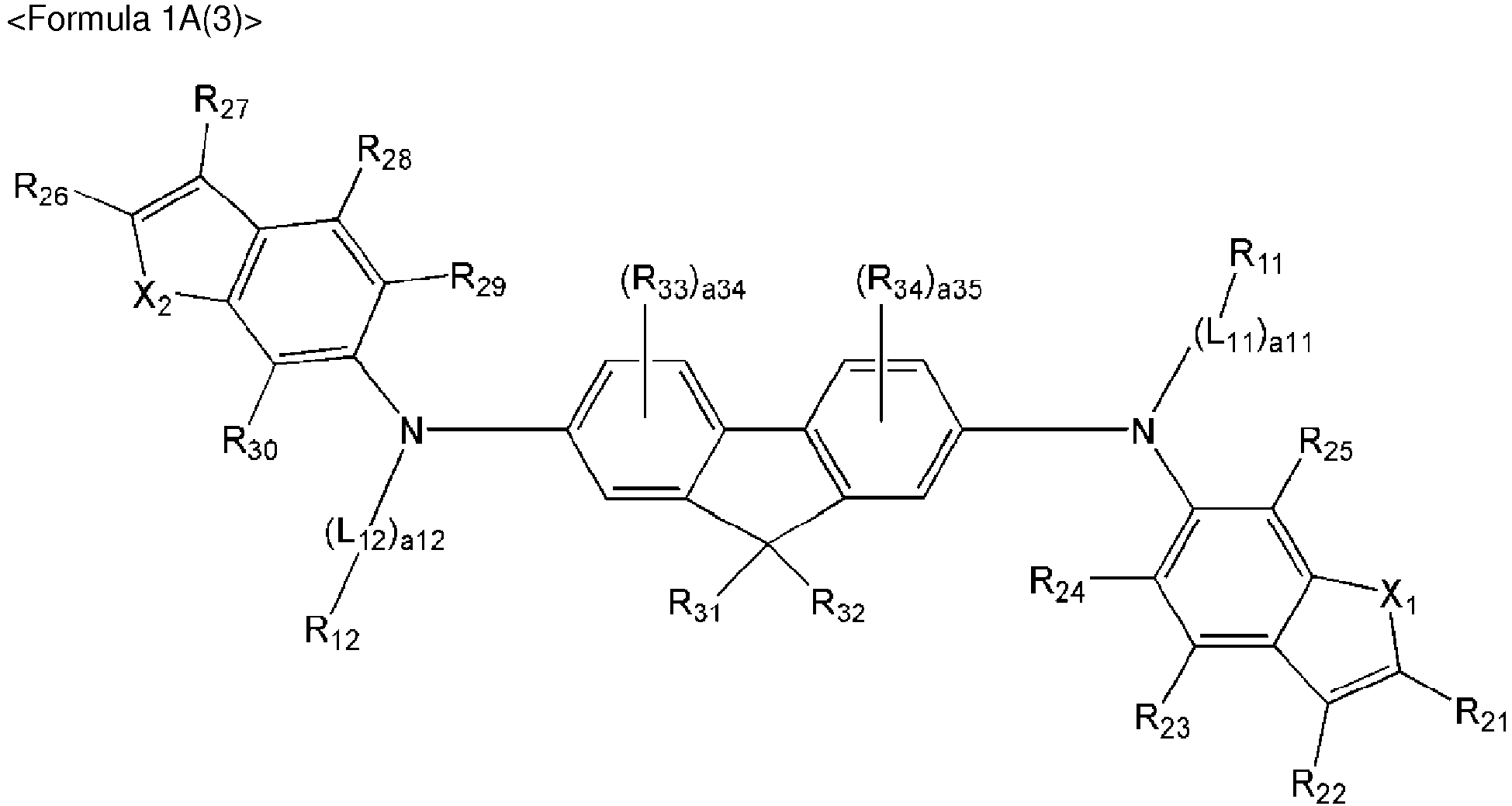

- X1 X2, L11, L12, L21, L22, a11, a12, a21, a22, R11, and R12 are the same as those defined in claim 1;
- R21 to R34 are the same as R3 defined in claim 1;
- a31 and a32 are each independently an integer from 1 to 4;
- a33 is an integer from 1 to 8;
- a34 and a35 are each independently an integer from 1 to 3;
- a36 and a37 are each independently an integer from 1 to 5.
- According to a preferred embodiment, R23 to R25 and R28 to R30 are hydrogen atoms. According to another preferred embodiment, R21, R22, R26, and R27 are phenyl.
- The amine-based compound of Formula 1 may be one of Compounds 1 to 108 below:


- Embodiments are also directed to an organic light-emitting device including a first electrode, a second electrode, and an organic layer disposed between the first electrode and the second electrode, and including an emission layer and at least one of the above mentioned amine-based compounds.
- The first electrode may be an anode, the second electrode may be a cathode, and the organic layer may include i) a hole transport region between the first electrode and the emission layer and including at least one of a hole injection layer, a hole transport layer, and an electron blocking layer, and ii) an electron transport region between the emission layer and the second electrode and including at least one of a hole blocking layer, an electron transport layer, and an electron injection layer.
- The organic layer may further include a compound represented by Formula 1000 below:
<Formula 1000> Y1-A2-Y2
- wherein, in Formula 1000, A2 is selected from
- a pentalenylene group, an indenylene group, a naphthylene group, an azulenylene group, a heptalenylene group, an indacenylene group, an acenaphthylene group, a fluorenylene group, a spiro-fluorenylene group, a phenalenylene group, a phenanthrenylene group, an anthracenylene group, a fluoranthrenylene group, a triphenylenylene group, a pyrenylene group, a chrysenylene group, a naphthacenylene group, a picenylene group, a perylenylene group, a pentaphenylene group, a hexacenylene group, and a benzofluoranthenylene group, and
- a pentalenylene group, an indenylene group, a naphthylene group, an azulenylene group, a heptalenylene group, an indacenylene group, an acenaphthylene group, a fluorenylene group, a spiro-fluorenylene group, a phenalenylene group, a phenanthrenylene group, an anthracenylene group, a fluoranthrenylene group, a triphenylenylene group, a pyrenylene group, a chrysenylene group, a naphthacenylene group, a picenylene group, a perylenylene group, a pentaphenylene group, a hexacenylene group, and a benzofluoranthenylene group, each substituted with at least one of a deuterium atom, a halogen atom, a hydroxyl group, a cyano group, a nitro group, an amino group, an amidino group, a hydrazine, a hydrazone, a carboxylic acid group or a salt thereof, a sulfonic acid group or a salt thereof, a phosphoric acid group or a salt thereof, a C1-C60 alkyl group, a C2-C60 alkenyl group, a C2-C60 alkynyl group, a C1-C60 alkoxy group, a C3-C10 cycloalkyl group, a C3-C10 heterocycloalkyl group, a C3-C10 cycloalkenyl group, a C3-C10 heterocycloalkenyl group, a C6-C60 aryl group, a C6-C60 aryloxy group, a C6-C60 arylthio group, a C2-C60 heteroaryl group, - N(Q11)(Q12), and -Si(Q13)(Q14)(Q15);
- Y1 and Y2 are each independently selected from
- a C3-C10 cycloalkyl group, a C3-C10 heterocycloalkyl group, a C3-C10 cycloalkenyl group, a C3-C10 heterocycloalkenyl group, a C6-C60 aryl group, a C6-C60 aryloxy group, a C6-C60 arylthio group, and a C2-C60 heteroaryl group, and
- a C3-C10 cycloalkyl group, a C3-C10 heterocycloalkyl group, a C3-C10 cycloalkenyl group, a C3-C10 heterocycloalkenyl group, a C6-C60 aryl group, a C6-C60 aryloxy group, a C6-C60 arylthio group, and a C2-C60 heteroaryl group, each substituted with at least one of a deuterium atom, a halogen atom, a hydroxyl group, a cyano group, a nitro group, an amino group, an amidino group, a hydrazine, a hydrazone, a carboxylic acid group or a salt thereof, a sulfonic acid group or a salt thereof, a phosphoric acid group or a salt thereof, a C1-C60 alkyl group, a C2-C60 alkenyl group, a C2-C60 alkynyl group, a C1-C60 alkoxy group, a C3-C10 cycloalkyl group, a C3-C10 heterocycloalkyl group, a C3-C10 cycloalkenyl group, a C3-C10 heterocycloalkenyl group, a C6-C60 aryl group, a C6-C6o aryloxy group, a C6-C60 arylthio group, a C2-C60 heteroaryl group, and -N(Q101)(Q102); and
- Q101 and Q102 are each independently selected from
- a hydrogen atom, a deuterium atom, a halogen atom, a hydroxyl group, a cyano group, a nitro group, an amino group, an amidino group, a hydrazine, a hydrazone, a carboxylic acid group or a salt thereof, a sulfonic acid group or a salt thereof, a phosphoric acid group or a salt thereof, a C1-C60 alkyl group, a C2-C60 alkenyl group, a C2-C60 alkynyl group, and a C1-C60 alkoxy group, and
- a C1-C60 alkyl group, a C2-C60 alkenyl group, a C2-C60 alkynyl group, and a C1-C60 alkoxy group, each substituted with at least one of a deuterium atom, a halogen atom, a hydroxyl group, a cyano group, a nitro group, an amino group, an amidino group, a hydrazine, a hydrazone, a carboxylic acid group or a salt thereof, a sulfonic acid group or a salt thereof, a phosphoric acid group or a salt thereof, a C3-C10 cycloalkyl group, a C3-C10 heterocycloalkyl group, a C3-C10 cycloalkenyl group, a C3-C10 heterocycloalkenyl group, a C6-C60 aryl group, a C6-C60 aryloxy group, a C6-C60 arylthio group, and a C2-C60 heteroaryl group,
- a C3-C10 cycloalkyl group, a C3-C10 heterocycloalkyl group, a C3-C10 cycloalkenyl group, a C3-C10 heterocycloalkenyl group, a C6-C60 aryl group, a C6-C60 aryloxy group, a C6-C60 arylthio group, and a C2-C60 heteroaryl group, and
- a C3-C10 cycloalkyl group, a C3-C10 heterocycloalkyl group, a C3-C10 cycloalkenyl group, a C3-C10 heterocycloalkenyl group, a C6-C60 aryl group, a C6-C60 aryloxy group, a C6-C60 arylthio group, and a C2-C60 heteroaryl group, each substituted with at least one of a deuterium atom, a halogen atom, a hydroxyl group, a cyano group, a nitro group, an amino group, an amidino group, a hydrazine, a hydrazone, a carboxylic acid group or a salt thereof, a sulfonic acid group or a salt thereof, a phosphoric acid group or a salt thereof, a C1-C60 alkyl group, a C2-C60 alkenyl group, a C2-C60 alkynyl group, a C1-C60 alkoxy group, a C3-C10 cycloalkyl group, a C3-C10 heterocycloalkyl group, a C3-C10 cycloalkenyl group, a C3-C10 heterocycloalkenyl group, a C6-C60 aryl group, a C6-C60 aryloxy group, a C6-C60 arylthio group, and a C2-C60 heteroaryl group.
- The amine-based compound may be in the emission layer.
- The amine-based compound and the compound of Formula 1000 may both be in the emission layer, and an amount of the amine-based compound in the emission layer may less than an amount of the compound of Formula 1000.
- The hole transport region may include at least one of a compound represented by Formula 300 below and a compound represented by Formula 301 below:


- wherein, in Formula 300, Ar101 and Ar102 are each independently selected from
- a phenylene group, a pentalenylene group, an indenylene group, a naphthylene group, an azulenylene group, a heptalenylene group, an acenaphthylene group, a fluorenylene group, a phenalenylene group, a phenanthrenylene group, an anthracenylene group, a fluoranthenylene group, a triphenylenylene group, a pyrenylene group, a chrysenylene group, a naphthacenylene group, a picenylene group, a perylenylene group, and a pentacenylene group, and
- a phenylene group, a pentalenylene group, an indenylene group, a naphthylene group, an azulenylene group, a heptalenylene group, an acenaphthylene group, a fluorenylene group, a phenalenylene group, a phenanthrenylene group, an anthracenylene group, a fluoranthenylene group, a triphenylenylene group, a pyrenylene group, a chrysenylene group, a naphthacenylene group, a picenylene group, a perylenylene group, and a pentacenylene group, each substituted with at least one of a deuterium atom, a halogen atom, a hydroxyl group, a cyano group, a nitro group, an amino group, an amidino group, a hydrazine, a hydrazone, a carboxylic acid group or a salt thereof, a sulfonic acid group or a salt thereof, a phosphoric acid group or a salt thereof, a C1-C60 alkyl group, a C2-C60 alkenyl group, a C2-C60 alkynyl group, a C1-C60 alkoxy group, a C3-C10 cycloalkyl group, a C3-C10 cycloalkenyl group, a C3-C10 heterocycloalkyl group, a C3-C10 heterocycloalkenyl group, a C6-C60 aryl group, a C6-C60 aryloxy group, a C6-C60 arylthio group, and a C2-C60 heteroaryl group;
- xa and xb in Formula 300 are each independently 0, 1, or 2;
- R101 to R108, R111 to R119, and R121 to R124 in Formulae 300 and 301 are each independently selected from
- a hydrogen atom, a deuterium atom, a halogen atom, a hydroxyl group, a cyano group, a nitro group, an amino group, an amidino group, a hydrazine, a hydrazone, a carboxylic acid group or a salt thereof, a sulfonic acid group or a salt thereof, a phosphoric acid group or a salt thereof, a C1-C10 alkyl group, and a C1-C10 alkoxy group,
- a C1-C10 alkyl group and a C1-C10 alkoxy group, each substituted with at least one of a deuterium atom, a halogen atom, a hydroxyl group, a cyano group, a nitro group, an amino group, an amidino group, a hydrazine, a hydrazone, a carboxylic acid group or a salt thereof, a sulfonic acid group or a salt thereof, and a phosphoric acid group or a salt thereof,
- a phenyl group, a naphthyl group, an anthracenylene group, a fluorenyl group, and a pyrenyl group, and
- a phenyl group, a naphthyl group, an anthracenyl group, a fluorenyl group, and a pyrenyl group, each substituted with at least one of a deuterium atom, a halogen atom, a hydroxyl group, a cyano group, a nitro group, an amino group, an amidino group, a hydrazine, a hydrazone, a carboxylic acid group or a salt thereof, a sulfonic acid group or a salt thereof, a phosphoric acid group or a salt thereof, a C1-C10 alkyl group, and a C1-C10 alkoxy group; and
- R109 in Formula 300 is selected from a phenyl group, a naphthyl group, an anthracenyl group, a biphenyl group, and a pyridyl group; and a phenyl group, a naphthyl group, an anthracenyl group, a biphenyl group, and a pyridyl group, each substituted with at least one of a deuterium atom, a halogen atom, a hydroxyl group, a cyano group, a nitro group, an amino group, an amidino group, a hydrazine, a hydrazone, a carboxylic acid group or a salt thereof, a sulfonic acid group or a salt thereof, a phosphoric acid group or a salt thereof, a C1-C20 alkyl group, and a C1-C20 alkoxy group.
- Features will become apparent to those of skill in the art by describing in detail exemplary embodiments with reference to the attached drawings in which:
-
FIG. 1 illustrates a schematic view of an organic light-emitting device according to an embodiment. - Example embodiments will now be described more fully hereinafter with reference to the accompanying drawing.
- In the drawing figure, the dimensions of layers and regions may be exaggerated for clarity of illustration. It will also be understood that when a layer or element is referred to as being "on" another layer or substrate, it can be directly on the other layer or substrate, or intervening layers may also be present. Further, it will be understood that when a layer is referred to as being "under" another layer, it can be directly under, and one or more intervening layers may also be present. In addition, it will also be understood that when a layer is referred to as being "between" two layers, it can be the only layer between the two layers, or one or more intervening layers may also be present. As used herein, the term "and/or" includes any and all combinations of one or more of the associated listed items. Expressions such as "at least one of," when preceding a list of elements, modify the entire list of elements and do not modify the individual elements of the list.
- According to the present invention, there is provided an amine-based compound represented by Formula 1:

- a pentalenylene group, an indenylene group, a naphthylene group, an azulenylene group, a heptalenylene group, an indacenylene group, an acenaphthylene group, a fluorenylene group, a spiro-fluorenylene group, a phenalenylene group, a phenanthrenylene group, an anthracenylene group, a fluoranthrenylene group, a triphenylenylene group, a pyrenylene group, a chrysenylene group, a naphthacenylene group, a picenylene group, a perylenylene group, a pentaphenylene group, a hexacenylene group, and a benzofluoranthenylene group, and
- a pentalenylene group, an indenylene group, a naphthylene group, an azulenylene group, a heptalenylene group, an indacenylene group, an acenaphthylene group, a fluorenylene group, a spiro-fluorenylene group, a phenalenylene group, a phenanthrenylene group, an anthracenylene group, a fluoranthrenylene group, a triphenylenylene group, a pyrenylene group, a chrysenylene group, a naphthacenylene group, a picenylene group, a perylenylene group, a pentaphenylene group, a hexacenylene group, and a benzofluoranthenylene group, each substituted with at least one selected from a deuterium atom, a halogen atom, a hydroxyl group, a cyano group, a nitro group, an amino group, an amidino group, a hydrazine, a hydrazone, a carboxylic acid group or a salt thereof, a sulfonic acid group or a salt thereof, a phosphoric acid group or a salt thereof, a C1-C60 alkyl group, a C2-C60 alkenyl group, a C2-C60 alkynyl group, a C1-C60 alkoxy group, a C3-C10 cycloalkyl group, a C3-C10 heterocycloalkyl group, a C3-C10 cycloalkenyl group, a C3-C10 heterocycloalkenyl group, a C6-C60 aryl group, a C6-C60 aryloxy group, a C6-C60 arylthio group, a C2-C60 heteroaryl group, -N(Q11)(Q12), and -Si(Q13)(Q14)(Q15), wherein Q11 to Q15 will be defined below.
- For example, A1 in Formula 1 above may be selected from
- a naphthylene group, a fluorenylene group, a spiro-fluorenylene group, a phenanthrenylene group, an anthracenylene group, a triphenylenylene group, a pyrenylene group, a chrysenylene group, and a benzofluoranthenylene group, and
- a naphthylene group, a fluorenylene group, a spiro-fluorenylene group, a phenanthrenylene group, an anthracenylene group, a triphenylenylene group, a pyrenylene group, a chrysenylene group, and a benzofluoranthenylene group, each substituted with at least one of a deuterium atom, a halogen atom, a hydroxyl group, a cyano group, a nitro group, an amino group, an amidino group, a hydrazine, a hydrazone, a carboxylic acid group or a salt thereof, a sulfonic acid group or a salt thereof, a phosphoric acid group or a salt thereof, a C1-C20 alkyl group, a C2-C20 alkenyl group, a C2-C20 alkynyl group, a C1-C20 alkoxy group, a phenyl group, a naphthyl group, an anthracenyl group, a pyrenyl group, a phenanthrenyl group, a fluorenyl group, a carbazolyl group, a benzocarbazolyl group, a dibenzocarbazolyl group, a pyridinyl group, a pyrimidinyl group, a triazinyl group, a quinolinyl group, an isoquinolinyl group, and a quinazolinyl group, but is not limited thereto.
- In some embodiments, A1 in Formula 1 above may be selected from a naphthylene group, a dimethylfluorenylene group, a diphenylfluorenyl group, a spiro-fluorenylene group, a phenanthrenylene group, an anthracenylene group, a triphenylenylene group, a pyrenylene group, a chrysenylene group, and a benzofluoranthenylene group, but is not limited thereto.
- In Formula 1, X1 is selected from N-[(L1)a1-(R1)b1], S, and O, and X2 is selected from N-[(L2)a2-R2], S, and O. L1, L2, R1, R2, a1, a2, and b1 will be defined below.
- In Formula 1 above, X1 and X2 may be identical to or different from each other. Preferably, X1 and X2 in Formula 1 may be identical to each other.
- Preferably, X1 and X2 in Formula 1 may be both S, or X1 and X2 in Formula 1 may be both O.
- In Formula 1, L1, L2, L11, L12, L21, and L22 are each independently selected from
- a C3-C10 cycloalkylene group, a C3-C10 heterocycloalkylene group, a C3-C10 cycloalkenylene group, a C3-C10 heterocycloalkenylene group, a C6-C60 arylene group, and a C2-C60 heteroarylene group, and
- a C3-C10 cycloalkylene group, a C3-C10 heterocycloalkylene group, a C3-C10 cycloalkenylene group, a C3-C10 heterocycloalkenylene group, a C6-C60 arylene group, and a C2-C60 heteroarylene group, each substituted with at least one of a deuterium atom, a halogen atom, a hydroxyl group, a cyano group, a nitro group, an amino group, an amidino group, a hydrazine, a hydrazone, a carboxylic acid group or a salt thereof, a sulfonic acid group or a salt thereof, a phosphoric acid group or a salt thereof, a C1-C60 alkyl group, a C2-C60 alkenyl group, a C2-C60 alkynyl group, a C1-C60 alkoxy group, a C3-C10 cycloalkyl group, a C3-C10 heterocycloalkyl group, a C3-C10 cycloalkenyl group, a C3-C10 heterocycloalkenyl group, a C6-C60 aryl group, a C6-C60 aryloxy group, a C6-C60 arylthio group, a C2-C60 heteroaryl group, -N(Q11)(Q12), and -Si(Q13)(Q14)(Q15).
- In some embodiments, L1, L2, L11, L12, L21, and L22 in Formula 1 may be each independently selected from
- a phenylene group, a pentalenylene group, an indenylene group, a naphthylene group, an azulenylene group, a heptalenylene group, an indacenylene group, an acenaphthylene group, a fluorenylene group, a spiro-fluorenylene group, a phenalenylene group, a phenanthrenylene group, an anthracenylene group, a fluoranthrenylene group, a triphenylenylene group, a pyrenylene group, a chrysenylene group, a naphthacenylene group, a picenylene group, a perylenylene group, a pentaphenylene group, a hexacenylene group, a pyrrolylene group, an imidazolylene group, a pyrazolylene group, a pyridinylene group, a pyrazinylene group, a pyrimidinylene group, a pyridazinylene group, an isoindolylene group, an indolylene group, an indazolylene group, a purinylene group, a quinolinylene group, an isoquinolinylene group, a benzoquinolinylene group, a phthalazinylene group, a naphthyridinylene group, a quinoxalinylene group, a quinazolinylene group, a cinnolinylene group, a carbazolylene group, a phenanthridinylene group, an acridinylene group, a phenanthrolinylene group, a phenazinylene group, a benzooxazolylene group, a benzoimidazolylene group, a furanylene group, a benzofuranylene group, a thiophenylene group, a benzothiophenylene group, a thiazolylene group, an isothiazolylene group, a benzothiazolylene group, an isoxazolylene group, an oxazolylene group, a triazolylene group, a tetrazolylene group, an oxadiazolylene group, a triazinylene group, a dibenzofuranylene group, a dibenzothiophenylene group, a benzocarbazolylene group, and a dibenzocarbazolylene group, and
- a phenylene group, a pentalenylene group, an indenylene group, a naphthylene group, an azulenylene group, a heptalenylene group, an indacenylene group, an acenaphthylene group, a fluorenylene group, a spiro-fluorenylene group, a phenalenylene group, a phenanthrenylene group, an anthracenylene group, a fluoranthrenylene group, a triphenylenylene group, a pyrenylene group, a chrysenylene group, a naphthacenylene group, a picenylene group, a perylenylene group, a pentaphenylene group, a hexacenylene group, a pyrrolylene group, an imidazolylene group, a pyrazolylene group, a pyridinylene group, a pyrazinylene group, a pyrimidinylene group, a pyridazinylene group, an isoindolylene group, an indolylene group, an indazolylene group, a purinylene group, a quinolinylene group, an isoquinolinylene group, a benzoquinolinylene group, a phthalazinylene group, a naphthyridinylene group, a quinoxalinylene group, a quinazolinylene group, a cinnolinylene group, a carbazolylene group, a phenanthridinylene group, an acridinylene group, a phenanthrolinylene group, a phenazinylene group, a benzooxazolylene group, a benzoimidazolylene group, a furanylene group, a benzofuranylene group, a thiophenylene group, a benzothiophenylene group, a thiazolylene group, an isothiazolylene group, a benzothiazolylene group, an isoxazolylene group, an oxazolylene group, a triazolylene group, a tetrazolylene group, an oxadiazolylene group, a triazinylene group, a dibenzofuranylene group, a dibenzothiophenylene group, a benzocarbazolylene group, and a dibenzocarbazolylene group, each substituted with at least one of a deuterium atom, a halogen atom, a hydroxyl group, a cyano group, a nitro group, an amino group, an amidino group, a hydrazine, a hydrazone, a carboxylic acid group or a salt thereof, a sulfonic acid group or a salt thereof, a phosphoric acid group or a salt thereof, a C1-C20 alkyl group, a C2-C20 alkenyl group, a C2-C20 alkynyl group, a C1-C20 alkoxy group, a phenyl group, a naphthyl group, an anthracenyl group, a pyrenyl group, a phenanthrenyl group, a fluorenyl group, a carbazolyl group, a benzocarbazolyl group, a dibenzocarbazolyl group, a pyridinyl group, a pyrimidinyl group, a triazinyl group, a quinolinyl group, an isoquinolinyl group, and a quinazolinyl group.
- In some other embodiments, L1, L2, L11, L12, L21 and L22 in Formula 1 above may be each independently selected from the groups represented by Formulae 2-1 to 2-30 below:


- Y1 may be O, S, S(=O), S(=O)2, C(Z3)(Z4), N(Z5), or Si(Z6)(Z7);
- Z1 to Z7 may be each independently selected from a hydrogen atom, a deuterium atom, a halogen atom, a hydroxyl group, a cyano group, a nitro group, an amino group, an amidino group, a hydrazine, a hydrazone, a carboxylic acid group or a salt thereof, a sulfonic acid group or a salt thereof, a phosphoric acid group or a salt thereof, a C1-C60 alkyl group, a C2-C60 alkenyl group, a C2-C60 alkynyl group, a C1-C60 alkoxy group, a C3-C10 cycloalkyl group, a C3-C10 heterocycloalkyl group, a C3-C10 cycloalkenyl group, a C3-C10 heterocycloalkenyl group, a C6-C60 aryl group, a C6-C60 aryloxy group, a C6-C60 arylthio group, a C2-C60 heteroaryl group, -N(Q11)(Q12), and -Si(Q13)(Q14)(Q15) (where Q11 to Q15 are the same as defined in the specification);
- d1 may be an integer from 1 to 4;
- d2 may be an integer from 1 to 3;
- d3 may be an integer from 1 to 6;
- d4 may be an integer from 1 to 8;
- d5 may be 1 or 2;
- d6 may be an integer from 1 to 5; and
- * and *' indicate binding sites to adjacent atoms.
- For example, in Formulae 2-1 to 2-30, * indicates a binding site of A1 in Formula 1 or an adjacent group of L1, L2, L11, L12, L21, and L22; and *' indicates a binding site of an adjacent group of L1, L2, L11, L12, L21, and L22, or a binding site of R1, R2, R11, R12, R21, and R22.
- For example, in Formulae 2-1 to 2-30, Z1 to Z7 may be each independently selected from a hydrogen atom, a deuterium atom, a halogen atom, a hydroxyl group, a cyano group, a nitro group, an amino group, an amidino group, a hydrazine, a hydrazone, a carboxylic acid group or a salt thereof, a sulfonic acid group or a salt thereof, a phosphoric acid group or a salt thereof, a C1-C20 alkyl group, a C2-C20 alkenyl group, a C2-C20 alkynyl group, a C1-C20 alkoxy group, a phenyl group, a naphthyl group, an anthracenyl group, a pyrenyl group, a phenanthrenyl group, a fluorenyl group, a carbazolyl group, a benzocarbazolyl group, a dibenzocarbazolyl group, a pyridinyl group, a pyrimidinyl group, a triazinyl group, a quinolinyl group, an isoquinolinyl group, and a quinazolinyl group, but are not limited thereto.
- In some other embodiments, L1, L2, L11, L12, L21, and L22 in Formula 1 may be each independently selected from the groups represented by Formulae 3-1 to 3-19:
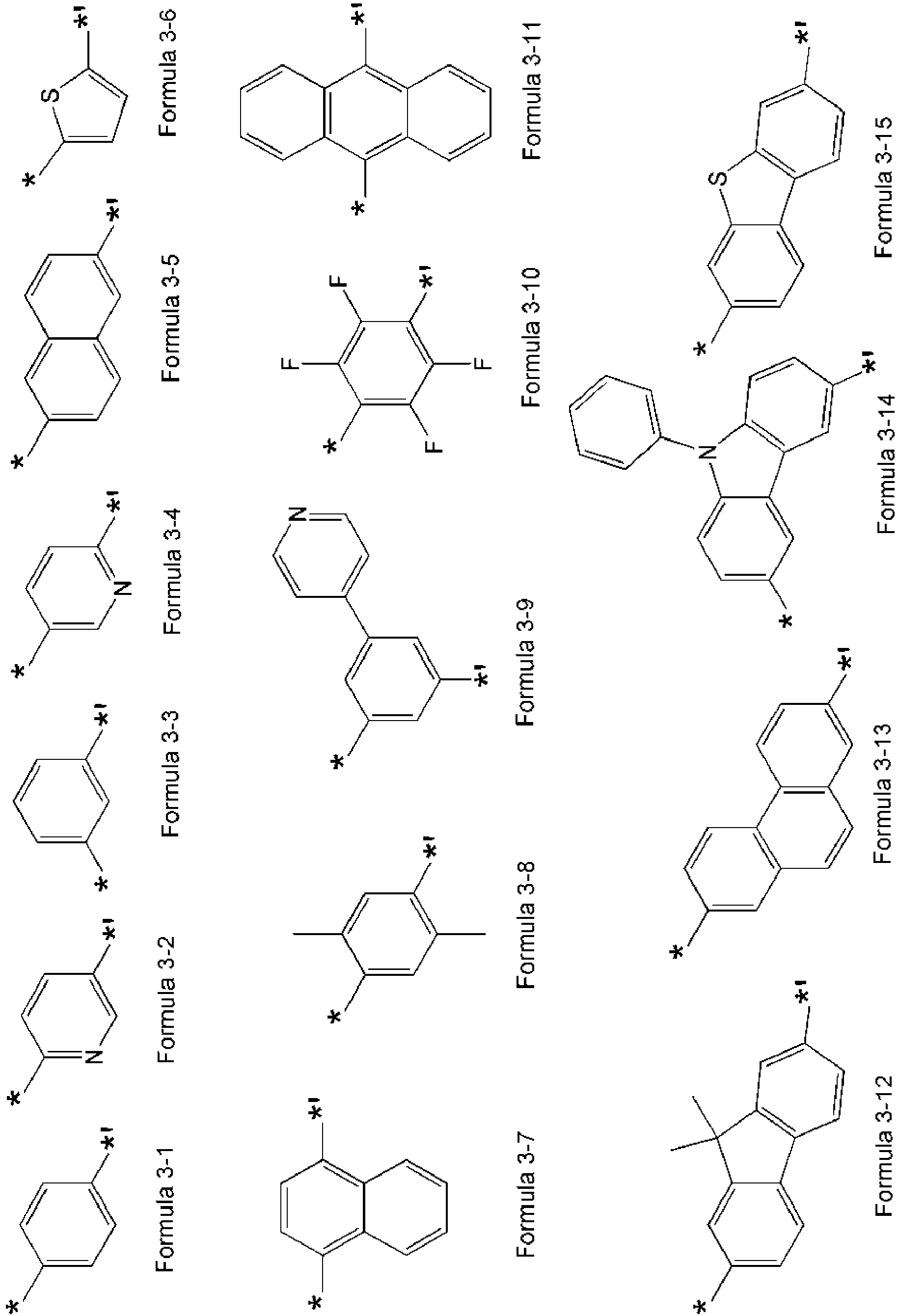

- In Formula 1, a1 indicates the number of L1s, which may be 0, 1, 2, 3, 4, or 5. For example, a1 may be 0, 1, or 2, and in some embodiments, may be 0 or 1. When a1 is 0, R1 is bound directly to N. When a1 is 2 or greater, at least two L1s may be identical to or different from each other.
- In Formula 1, a2 indicates the number of L2s, which may be 0, 1, 2, 3, 4, or 5. For example, a2 may be 0, 1, or 2, and in some embodiments, may be 0 or 1. When a2 is 0, R2 is bound directly to N. When a2 is 2 or greater, at least two L2s may be identical to or different from each other.
- In Formula 1, a11 indicates the number of L11s, which may be 0, 1, 2, 3, 4, or 5. For example, a11 may be 0, 1, or 2, and in some embodiments, may be 0 or 1. When a11 is 0, R11 is bound directly to N. When a11 is 2 or greater, at least two L11s may be identical to or different from each other.
- In Formula 1, a12 indicates the number of L12s, which may be 0, 1, 2, 3, 4, or 5. For example, a1 may be 0, 1, or 2, and in some embodiments, may be 0 or 1. When a'2 is 0, R12 is bound directly to N. When a12 is 2 or greater, at least two L12s may be identical to or different from each other.
- In Formula 1, a21 indicates the number of L21s, which may be 0, 1, 2, 3, 4, or 5. For example, a1 may be 0, 1, or 2, and in some embodiments, may be 0 or 1. When a21 is 0, N in Formula 1 is bound directly to A1. When a21 is 2 or greater, at least two L21s may be identical to or different from each other.
- In Formula 1, a22 indicates the number of L22s, which may be 0, 1, 2, 3, 4, or 5. For example, a1 may be 0, 1, or 2, and in some embodiments, may be 0 or 1. When a22 is 0, R22 is bound directly to N in Formula 1. When a22 is 2 or greater, at least two L22s may be identical to or different from each other.
- In Formula 1, R1, R2, R11, and R12 are each independently selected from
- a hydrogen atom, a deuterium atom, a halogen atom, a hydroxyl group, a cyano group, a nitro group, an amino group, an amidino group, a hydrazine, a hydrazone, a carboxylic acid group or a salt thereof, a sulfonic acid group or a salt thereof, a phosphoric acid group or a salt thereof, a C1-C60 alkyl group, a C1-C20 alkenyl group, and a C2-C60 alkynyl group,
- a C1-C60 alkyl group, a C2-C60 alkenyl group, and a C2-C60 alkynyl group, each substituted with at least one of a deuterium atom, a halogen atom, a hydroxyl group, a cyano group, a nitro group, an amino group, an amidino group, a hydrazine, a hydrazone, a carboxylic acid group or a salt thereof, a sulfonic acid group or a salt thereof, a phosphoric acid group or a salt thereof, a C3-C10 cycloalkyl group, a C3-C10 heterocycloalkyl group, a C3-C10 cycloalkenyl group, a C3-C10 heterocycloalkenyl group, a C6-C60 aryl group, a C6-C60 aryloxy group, a C6-C60 arylthio group, and a C2-C60 heteroaryl group,
- a C3-C10 cycloalkyl group, a C3-C10 heterocycloalkyl group, a C3-C10 cycloalkenyl group, a C3-C10 heterocycloalkenyl group, a C6-C60 aryl group, and a C2-C60 heteroaryl group, and
- a C3-C10 cycloalkyl group, a C3-C10 heterocycloalkyl group, a C3-C10 cycloalkenyl group, a C3-C10 heterocycloalkenyl group, a C6-C60 aryl group, and a C2-C60 heteroaryl group, each substituted with at least one selected from a deuterium atom, a halogen atom, a hydroxyl group, a cyano group, a nitro group, an amino group, an amidino group, a hydrazine, a hydrazone, a carboxylic acid group or a salt thereof, a sulfonic acid group or a salt thereof, a phosphoric acid group or a salt thereof, a C1-C60 alkyl group, a C2-C60 alkenyl group, a C2-C60 alkynyl group, a C1-C60 alkoxy group, a C3-C10 cycloalkyl group, a C3-C10 heterocycloalkyl group, a C3-C10 cycloalkenyl group, a C3-C10 heterocycloalkenyl group, a C6-C60 aryl group, a C6-C60 aryloxy group, a C6-C60 arylthio group, and a C2-C60 heteroaryl group.
- In Formula 1, R3 to R6 are each independently selected from
- a hydrogen atom, a deuterium atom, a halogen atom, a hydroxyl group, a cyano group, a nitro group, an amino group, an amidino group, a hydrazine, a hydrazone, a carboxylic acid group or a salt thereof, a sulfonic acid group or a salt thereof, a phosphoric acid group or a salt thereof, a C1-C60 alkyl group, a C2-C60 alkenyl group, a C2-C60 alkynyl group, and a C1-C60 alkoxy group;
- a C1-C60 alkyl group, a C2-C60 alkenyl group, a C2-C60 alkynyl group, and a C1-C60 alkoxy group, each substituted with at least one of a deuterium atom, a halogen atom, a hydroxyl group, a cyano group, a nitro group, an amino group, an amidino group, a hydrazine, a hydrazone, a carboxylic acid group or a salt thereof, a sulfonic acid group or a salt thereof, a phosphoric acid group or a salt thereof, a C3-C10 cycloalkyl group, a C3-C10 heterocycloalkyl group, a C3-C10 cycloalkenyl group, a C3-C10 heterocycloalkenyl group, a C6-C60 aryl group, a C6-C60 aryloxy group, a C6-C60 arylthio group, and a C2-C60 heteroaryl group;
- a C3-C10 cycloalkyl group, a C3-C10 heterocycloalkyl group, a C3-C10 cycloalkenyl group, a C3-C10 heterocycloalkenyl group, a C6-C60 aryl group, a C6-C60 aryloxy group, a C6-C60 arylthio group, and a C2-C60 heteroaryl group;
- a C3-C10 cycloalkyl group, a C3-C10 heterocycloalkyl group, a C3-C10 cycloalkenyl group, a C3-C10 heterocycloalkenyl group, a C6-C60 aryl group, a C6-C60 aryloxy group, a C6-C60 arylthio group, and a C2-C60 heteroaryl group, each substituted with at least one selected from a deuterium atom, a halogen atom, a hydroxyl group, a cyano group, a nitro group, an amino group, an amidino group, a hydrazine, a hydrazone, a carboxylic acid group or a salt thereof, a sulfonic acid group or a salt thereof, a phosphoric acid group or a salt thereof, a C1-C60 alkyl group, a C2-C60 alkenyl group, a C2-C60 alkynyl group, a C1-C60 alkoxy group, a C3-C10 cycloalkyl group, a C3-C10 heterocycloalkyl group, a C3-C10 cycloalkenyl group, a C3-C10 heterocycloalkenyl group, a C6-C60 aryl group, a C6-C60 aryloxy group, a C6-C60 arylthio group, and a C2-C60 heteroaryl group; and
-N(Q1)(Q2), -Si(Q3)(Q4)(Q5), and -B(Q6)(Q7). - The Q11 to Q15, and Q1 to Q7 in this specification are each independently selected from
- a hydrogen atom, a deuterium atom, a halogen atom, a hydroxyl group, a cyano group, a nitro group, an amino group, an amidino group, a hydrazine, a hydrazone, a carboxylic acid group or a salt thereof, a sulfonic acid group or a salt thereof, a phosphoric acid group or a salt thereof, a C1-C60 alkyl group, a C2-C60 alkenyl group, a C2-C60 alkynyl group, and a C1-C60 alkoxy group;
- a C1-C60 alkyl group, a C2-C60 alkenyl group, a C2-C60 alkynyl group, and a C1-C60 alkoxy group, each substituted with at least one of a deuterium atom, a halogen atom, a hydroxyl group, a cyano group, a nitro group, an amino group, an amidino group, a hydrazine, a hydrazone, a carboxylic acid group or a salt thereof, a sulfonic acid group or a salt thereof, a phosphoric acid group or a salt thereof, a C3-C10 cycloalkyl group, a C3-C10 heterocycloalkyl group, a C3-C10 cycloalkenyl group, a C3-C10 heterocycloalkenyl group, a C6-C60 aryl group, a C6-C60 aryloxy group, a C6-C60 arylthio group, and a C2-C60 heteroaryl group;
- a C3-C10 cycloalkyl group, a C3-C10 heterocycloalkyl group, a C3-C10 cycloalkenyl group, a C3-C10 heterocycloalkenyl group, a C6-C60 aryl group, a C6-C60 aryloxy group, a C6-C60 arylthio group, and a C2-C60 heteroaryl group; and
- a C3-C10 cycloalkyl group, a C3-C10 heterocycloalkyl group, a C3-C10 cycloalkenyl group, a C3-C10 heterocycloalkenyl group, a C6-C60 aryl group, a C6-C60 aryloxy group, a C6-C60 arylthio group, and a C2-C60 heteroaryl group, each substituted with at least one selected from a deuterium atom, a halogen atom, a hydroxyl group, a cyano group, a nitro group, an amino group, an amidino group, a hydrazine, a hydrazone, a carboxylic acid group or a salt thereof, a sulfonic acid group or a salt thereof, a phosphoric acid group or a salt thereof, a C1-C60 alkyl group, a C2-C60 alkenyl group, a C2-C60 alkynyl group, a C1-C60 alkoxy group, a C3-C10 cycloalkyl group, a C3-C10 heterocycloalkyl group, a C3-C10 cycloalkenyl group, a C3-C10 heterocycloalkenyl group, a C6-C60 aryl group, a C6-C60 aryloxy group, a C6-C60 arylthio group, and a C2-C60 heteroaryl group.
- in some embodiments, R1, R2, R11, and R12 may be each independently selected from
- a phenyl group, a pentalenyl group, an indenyl group, a naphthyl group, an azulenyl group, a heptalenyl group, an indacenyl group, an acenaphthyl group, a fluorenyl group, a spiro-fluorenyl group, a phenalenyl group, a phenanthrenyl group, an anthracenyl group, a fluoranthrenyl group, a triphenylenyl group, a pyrenyl group, a chrysenyl group, a naphthacenyl group, a picenyl group, a perylenyl group, a pentaphenyl group, a hexacenyl group, a pyrrolyl group, an imidazolyl group, a pyrazolyl group, a pyridinyl group, a pyrazinyl group, a pyrimidinyl group, a pyridazinyl group, an isoindolyl group, an indolyl group, an indazolyl group, a purinyl group, a quinolinyl group, an isoquinolinyl group, a benzoquinolinyl group, a phthalazinyl group, a naphthyridinyl group, a quinoxalinyl group, a quinazolinyl group, a cinnolinyl group, a carbazolyl group, a phenanthridinyl group, an acridinyl group, a phenanthrolinyl group, a phenazinyl group, a benzooxazolyl group, a benzoimidazolyl group, a furanyl group, a benzofuranyl group, a thiophenyl group, a benzothiophenyl group, a thiazolyl group, an isothiazolyl group, a benzothiazolyl group, an isoxazolyl group, an oxazolyl group, a triazolyl group, a tetrazolyl group, an oxadiazolyl group, a triazinyl group, a benzooxazolyl group, a dibenzofuranyl group, a dibenzothiophenyl group, a benzocarbazolyl group, and a dibenzocarbazolyl group; and
- a phenyl group, a pentalenyl group, an indenyl group, a naphthyl group, an azulenyl group, a heptalenyl group, an indacenyl group, an acenaphthyl group, a fluorenyl group, a spiro-fluorenyl group, a phenalenyl group, a phenanthrenyl group, an anthracenyl group, a fluoranthrenyl group, a triphenylenyl group, a pyrenyl group, a chrysenyl group, a naphthacenyl group, a picenyl group, a perylenyl group, a pentaphenyl group, a hexacenyl group, a pyrrolyl group, an imidazolyl group, a pyrazolyl group, a pyridinyl group, a pyrazinyl group, a pyrimidinyl group, a pyridazinyl group, an isoindolyl group, an indolyl group, an indazolyl group, a purinyl group, a quinolinyl group, an isoquinolinyl group, a benzoquinolinyl group, a phthalazinyl group, a naphthyridinyl group, a quinoxalinyl group, a quinazolinyl group, a cinnolinyl group, a carbazolyl group, a phenanthridinyl group, an acridinyl group, a phenanthrolinyl group, a phenazinyl group, a benzooxazolyl group, a benzoimidazolyl group, a furanyl group, a benzofuranyl group, a thiophenyl group, a benzothiophenyl group, a thiazolyl group, an isothiazolyl group, a benzothiazolyl group, an isoxazolyl group, an oxazolyl group, a triazolyl group, a tetrazolyl group, an oxadiazolyl group, a triazinyl group, a dibenzofuranyl group, a dibenzothiophenyl group, a benzocarbazolyl group, and a benzocarbazolyl group, each substituted with at least one of a deuterium atom, a halogen atom, a hydroxyl group, a cyano group, a nitro group, an amino group, an amidino group, a hydrazine, a hydrazone, a carboxylic acid group or a salt thereof, a sulfonic acid group or a salt thereof, a phosphoric acid group or a salt thereof, a C1-C20 alkyl group, a C2-C20 alkenyl group, a C2-C20 alkynyl group, a C1-C20 alkoxy group, a phenyl group, a naphthyl group, an anthracenyl group, a pyrenyl group, a phenanthrenyl group, a fluorenyl group, a carbazolyl group, a benzocarbazolyl group, a dibenzocarbazolyl group, a pyridinyl group, a pyrimidinyl group, a triazinyl group, a quinolinyl group, an isoquinolinyl group, and a quinazolinyl group, but are not limited thereto.
- In some other embodiments, R3 to R6 may be each independently selected from
- a hydrogen atom, a deuterium atom, a halogen atom, a hydroxyl group, a cyano group, a nitro group, an amino group, an amidino group, a hydrazine, a hydrazone, a carboxylic acid group or a salt thereof, a sulfonic acid group or a salt thereof, a phosphoric acid group or a salt thereof, a C1-C20 alkyl group, and a C1-C20 alkoxy group;
- a C1-C20 alkyl group and a C1-C60 alkoxy group, each substituted with at least one of a deuterium atom, a halogen atom, a hydroxyl group, a cyano group, a nitro group, an amino group, an amidino group, a hydrazine, a hydrazone, a carboxylic acid group or a salt thereof, a sulfonic acid group or a salt thereof, a phosphoric acid group or a salt thereof, a phenyl group, a naphthyl group, an anthracenyl group, a pyrenyl group, a phenanthrenyl group, a fluorenyl group, a carbazolyl group, a benzocarbazolyl group, a dibenzocarbazolyl group, a pyridinyl group, a pyrimidinyl group, a triazinyl group, a quinolinyl group, an isoquinolinyl group, and a quinazolinyl group;
- a phenyl group, a pentalenyl group, an indenyl group, a naphthyl group, an azulenyl group, a heptalenyl group, an indacenyl group, an acenaphthyl group, a fluorenyl group, a spiro-fluorenyl group, a phenalenyl group, a phenanthrenyl group, an anthracenyl group, a fluoranthrenyl group, a triphenylenyl group, a pyrenyl group, a chrysenyl group, a naphthacenyl group, a picenyl group, a perylenyl group, a pentaphenyl group, a hexacenyl group, a pyrrolyl group, an imidazolyl group, a pyrazolyl group, a pyridinyl group, a pyrazinyl group, a pyrimidinyl group, a pyridazinyl group, an isoindolyl group, an indolyl group, an indazolyl group, a purinyl group, a quinolinyl group, an isoquinolinyl group, a benzoquinolinyl group, a phthalazinyl group, a naphthyridinyl group, a quinoxalinyl group, a quinazolinyl group, a cinnolinyl group, a carbazolyl group, a phenanthridinyl group, an acridinyl group, a phenanthrolinyl group, a phenazinyl group, a benzooxazolyl group, a benzoimidazolyl group, a furanyl group, a benzofuranyl group, a thiophenyl group, a benzothiophenyl group, a thiazolyl group, an isothiazolyl group, a benzothiazolyl group, an isoxazolyl group, an oxazolyl group, a triazolyl group, a tetrazolyl group, an oxadiazolyl group, a triazinyl group, a benzooxazolyl group, a dibenzofuranyl group, a dibenzothiophenyl group, a benzocarbazolyl group, and a dibenzocarbazolyl group;
- a phenyl group, a pentalenyl group, an indenyl group, a naphthyl group, an azulenyl group, a heptalenyl group, an indacenyl group, an acenaphthyl group, a fluorenyl group, a spiro-fluorenyl group, a phenalenyl group, a phenanthrenyl group, an anthracenyl group, a fluoranthrenyl group, a triphenylenyl group, a pyrenyl group, a chrysenyl group, a naphthacenyl group, a picenyl group, a perylenyl group, a pentaphenyl group, a hexacenyl group, a pyrrolyl group, an imidazolyl group, a pyrazolyl group, a pyridinyl group, a pyrazinyl group, a pyrimidinyl group, a pyridazinyl group, an isoindolyl group, an indolyl group, an indazolyl group, a purinyl group, a quinolinyl group, an isoquinolinyl group, a benzoquinolinyl group, a phthalazinyl group, a naphthyridinyl group, a quinoxalinyl group, a quinazolinyl group, a cinnolinyl group, a carbazolyl group, a phenanthridinyl group, an acridinyl group, a phenanthrolinyl group, a phenazinyl group, a benzooxazolyl group, a benzoimidazolyl group, a furanyl group, a benzofuranyl group, a thiophenyl group, a benzothiophenyl group, a thiazolyl group, an isothiazolyl group, a benzothiazolyl group, an isoxazolyl group, an oxazolyl group, a triazolyl group, a tetrazolyl group, an oxadiazolyl group, a triazinyl group, a dibenzofuranyl group, a dibenzothiophenyl group, a benzocarbazolyl group, and a benzocarbazolyl group, each substituted with at least one of a deuterium atom, a halogen atom, a hydroxyl group, a cyano group, a nitro group, an amino group, an amidino group, a hydrazine, a hydrazone, a carboxylic acid group or a salt thereof, a sulfonic acid group or a salt thereof, a phosphoric acid group or a salt thereof, a C1-C20 alkyl group, a C2-C20 alkenyl group, a C2-C20 alkynyl group, a C1-C20 alkoxy group, a phenyl group, a naphthyl group, an anthracenyl group, a pyrenyl group, a phenanthrenyl group, a fluorenyl group, a carbazolyl group, a benzocarbazolyl group, a dibenzocarbazolyl group, a pyridinyl group, a pyrimidinyl group, a triazinyl group, a quinolinyl group, an isoquinolinyl group, and a quinazolinyl group; and
- -N(Q1)(Q2) and -Si(Q3)(Q4)(Q5), wherein Q1 to Q5 may be each independently selected from a hydrogen atom, a C1-C20 alkyl group, a phenyl group, a naphthyl group, an anthracenyl group, a pyrenyl group, a phenanthrenyl group, a fluorenyl group, a carbazolyl group, a benzocarbazolyl group, a dibenzocarbazolyl group, a pyridinyl group, a pyrimidinyl group, a triazinyl group, a quinolinyl group, an isoquinolinyl group, and a quinazolinyl group; and a phenyl group, a naphthyl group, an anthracenyl group, a pyrenyl group, a phenanthrenyl group, a fluorenyl group, a carbazolyl group, a benzocarbazolyl group, a dibenzocarbazolyl group, a pyridinyl group, a pyrimidinyl group, a triazinyl group, a quinolinyl group, an isoquinolinyl group, and a quinazolinyl group, each substituted with at least one of a deuterium atom, a halogen atom, a hydroxyl group, a cyano group, a nitro group, an amino group, an amidino group, a hydrazine, a hydrazone, a carboxylic acid group or a salt thereof, a sulfonic acid group or a salt thereof, a phosphoric acid group or a salt thereof, a C1-C20 alkyl group, a C2-C20 alkenyl group, a C2-C20 alkynyl group, a C1-C20 alkoxy group, a phenyl group, a naphthyl group, an anthracenyl group, a pyrenyl group, a phenanthrenyl group, a fluorenyl group, a carbazolyl group, a pyridinyl group, a pyrimidinyl group, a triazinyl group, a quinolinyl group, an isoquinolinyl group, and a quinazolinyl group.
- In some other embodiments, R1, R2, R11, and R12 may be each independently selected from the groups represented by Formulae 4-1 to 4-29; and R3 to R6 may be each independently selected from
- a hydrogen atom, a deuterium atom, a halogen atom, a hydroxyl group, a cyano group, a nitro group, an amino group, an amidino group, a hydrazine, a hydrazone, a carboxylic acid group or a salt thereof, a sulfonic acid group or a salt thereof, a phosphoric acid group or a salt thereof, a C1-C20 alkyl group, and a C1-C20 alkoxy group;
- a C1-C20 alkyl group and a C1-C60 alkoxy group, each substituted with at least one of a deuterium atom, a halogen atom, a hydroxyl group, a cyano group, a nitro group, an amino group, an amidino group, a hydrazine, a hydrazone, a carboxylic acid group or a salt thereof, a sulfonic acid group or a salt thereof, a phosphoric acid group or a salt thereof, a phenyl group, a naphthyl group, an anthracenyl group, a pyrenyl group, a phenanthrenyl group, a fluorenyl group, a carbazolyl group, a pyridinyl group, a pyrimidinyl group, a triazinyl group, a quinolinyl group, an isoquinolinyl group, and a quinazolinyl group;
- the groups represented by Formulae 4-1 to 4-29; and
- -N(Q1)(Q2) and -Si(Q3)(Q4)(Q5), wherein Q1 to Q5 may be each independently selected from a hydrogen atom, a C1-C20 alkyl group, a phenyl group, a naphthyl group, an anthracenyl group, a pyrenyl group, a phenanthrenyl group, a fluorenyl group, a carbazolyl group, a benzocarbazolyl group, a dibenzocarbazolyl group, a pyridinyl group, a pyrimidinyl group, a triazinyl group, a quinolinyl group, an isoquinolinyl group, and a quinazolinyl group; and a phenyl group, a naphthyl group, an anthracenyl group, a pyrenyl group, a phenanthrenyl group, a fluorenyl group, a carbazolyl group, a benzocarbazolyl group, a dibenzocarbazolyl group, a pyridinyl group, a pyrimidinyl group, a triazinyl group, a quinolinyl group, an isoquinolinyl group, and a quinazolinyl group, each substituted with at least one of a deuterium atom, a halogen atom, a hydroxyl group, a cyano group, a nitro group, an amino group, an amidino group, a hydrazine, a hydrazone, a carboxylic acid group or a salt thereof, a sulfonic acid group or a salt thereof, a phosphoric acid group or a salt thereof, a C1-C20 alkyl group, a C2-C20 alkenyl group, a C2-C20 alkynyl group, a C1-C20 alkoxy group, a phenyl group, a naphthyl group, an anthracenyl group, a pyrenyl group, a phenanthrenyl group, a fluorenyl group, a carbazolyl group, a pyridinyl group, a pyrimidinyl group, a triazinyl group, a quinolinyl group, an isoquinolinyl group, and a quinazolinyl group.


- In Formulae 4-1 to 4-29,
- Y31 may be O, S, C(Z33)(Z34), N(Z35), or Si(Z36)(Z37);
- Z31 to Z37 may be each independently selected from a hydrogen atom, a deuterium atom, a halogen atom, a hydroxyl group, a cyano group, a nitro group, an amino group, an amidino group, a hydrazine, a hydrazone, a carboxylic acid group or a salt thereof, a sulfonic acid group or a salt thereof, a phosphoric acid group or a salt thereof, a C1-C60alkyl group, a C2-C60 alkenyl group, a C2-C60 alkynyl group, a C1-C60 alkoxy group, a C3-C10 cycloalkyl group, a C3-C10 heterocycloalkyl group, a C3-C10 cycloalkenyl group, a C3-C10heterocycloalkenyl group, a C6-C60 aryl group, a C6-C60 aryloxy group, aC6-C60 arylthio group, and a C2-C60 heteroaryl group;
- e1 may be an integer from 1 to 5;
- e2 may be an integer from 1 to 7;
- e3 may be an integer from 1 to 3;
- e4 may be an integer from 1 to 4;
- e5 may be 1 or 2;
- e6 may be an integer from 1 to 6; and
- * indicates a binding site of an adjacent atom.
- For example, in Formulae 4-1 to 4-29, Z31 to Z37 may be each independently selected from a hydrogen atom, a deuterium atom, a halogen atom, a hydroxyl group, a cyano group, a nitro group, an amino group, an amidino group, a hydrazine, a hydrazone, a carboxylic acid group or a salt thereof, a sulfonic acid group or a salt thereof, a phosphoric acid group or a salt thereof, a C1-C20 alkyl group, a C2-C20 alkenyl group, a C2-C20 alkynyl group, a C1-C20 alkoxy group, a phenyl group, a naphthyl group, an anthracenyl group, a pyrenyl group, a phenanthrenyl group, a fluorenyl group, a carbazolyl group, a benzocarbazolyl group, a dibenzocarbazolyl group, a pyridinyl group, a pyrimidinyl group, a triazinyl group, a quinolinyl group, an isoquinolinyl group, and a quinazolinyl group.
- For example, in Formulae 4-1 to 4-29, e1, e2, e3, e4, e5, and e6 may be each independently 1 or 2.
- In some embodiments, in Formula 1, R1, R2, R11, and R12 may be each independently selected from the groups represented by Formulae 5-1 to 5-36; and
- R3 to R6 may be each independently selected from
- a hydrogen atom, a deuterium atom, a halogen atom, a hydroxyl group, a cyano group, a nitro group, an amino group, an amidino group, a hydrazine, a hydrazone, a carboxylic acid group or a salt thereof, a sulfonic acid group or a salt thereof, a phosphoric acid group or a salt thereof, a C1-C20 alkyl group, and a C1-C20 alkoxy group;
- a C1-C20 alkyl group and a C1-C60 alkoxy group, each substituted with at least one of a deuterium atom, a halogen atom, a hydroxyl group, a cyano group, a nitro group, an amino group, an amidino group, a hydrazine, a hydrazone, a carboxylic acid group or a salt thereof, a sulfonic acid group or a salt thereof, a phosphoric acid group or a salt thereof, a phenyl group, a naphthyl group, an anthracenyl group, a pyrenyl group, a phenanthrenyl group, a fluorenyl group, a carbazolyl group, a pyridinyl group, a pyrimidinyl group, a triazinyl group, a quinolinyl group, an isoquinolinyl group, and a quinazolinyl group;
- the groups represented by Formulae 5-1 to 5-36 below; and
- -N(Q1)(Q2), and -Si(Q3)(Q4)(Q5), wherein Q1 to Q5 may be each independently selected from a hydrogen atom, a C1-C20 alkyl group, a phenyl group, a naphthyl group, an anthracenyl group, a pyrenyl group, a phenanthrenyl group, a fluorenyl group, a carbazolyl group, a benzocarbazolyl group, a dibenzocarbazolyl group, a pyridinyl group, a pyrimidinyl group, a triazinyl group, a quinolinyl group, an isoquinolinyl group, and a quinazolinyl group; and a phenyl group, a naphthyl group, an anthracenyl group, a pyrenyl group, a phenanthrenyl group, a fluorenyl group, a carbazolyl group, a benzocarbazolyl group, a dibenzocarbazolyl group, a pyridinyl group, a pyrimidinyl group, a triazinyl group, a quinolinyl group, an isoquinolinyl group, and a quinazolinyl group, each substituted with at least one of a deuterium atom, a halogen atom, a hydroxyl group, a cyano group, a nitro group, an amino group, an amidino group, a hydrazine, a hydrazone, a carboxylic acid group or a salt thereof, a sulfonic acid group or a salt thereof, a phosphoric acid group or a salt thereof, a C1-C20 alkyl group, a C2-C20 alkenyl group, a C2-C20 alkynyl group, a C1-C20 alkoxy group, a phenyl group, a naphthyl group, an anthracenyl group, a pyrenyl group, a phenanthrenyl group, a fluorenyl group, a carbazolyl group, a pyridinyl group, a pyrimidinyl group, a triazinyl group, a quinolinyl group, an isoquinolinyl group, and a quinazolinyl group.


- In Formula 1, b1 indicates the number of Ris, and may be an integer from 1 to 3. For example, b1 may be 1 or 2, and in some embodiments, may be 1. When b1 is 2 or greater, at least two R1s may be identical to or different from each other.
- In Formula 1, b3 indicates the number of R3s, and may be 1 or 2. When b3 is 2 two R3s may be identical to or different from each other.
- In Formula 1, b4 indicates the number of R4s, and may be 1, 2, or 3. When b4 is 2 or greater, at least two R4s may be identical to or different from each other.
- In Formula 1, b5 indicates the number of R5s, and may be 1, 2 or 3. When b5 is 2 or greater, at least two R5s may be identical to or different from each other.
- In Formula 1, b6 indicates the number of R6s, and may be 1 or, 2. When b6 is 2 two R6s may be identical to or different from each other.
- In Formula 1, R4 and R5 may be both hydrogen atoms.
- The amine-based compound of Formula 1 above may be a compound represented by Formula 1A below.

- In Formula 1A, A1, X1, X2, L11, L12, L21, L22, a11, a12, a21, a22, R11, and R12 are the same as those defined above in conduction with Formula 1. R21 to R30 in Formula 1A are the same as R3 defined above in connection with Formula 1.
- For example, in Formula 1A, A1 may be selected from
- a naphthylene group, a fluorenylene group, a spiro-fluorenylene group, a phenanthrenylene group, an anthracenylene group, a triphenylenylene group, a pyrenylene group, a chrysenylene group, and a benzofluoranthenylene group, and
- a naphthylene group, a fluorenylene group, a spiro-fluorenylene group, a phenanthrenylene group, an anthracenylene group, a triphenylenylene group, a pyrenylene group, a chrysenylene group, and a benzofluoranthenylene group, each substituted with at least one of a deuterium atom, a halogen atom, a hydroxyl group, a cyano group, a nitro group, an amino group, an amidino group, a hydrazine, a hydrazone, a carboxylic acid group or a salt thereof, a sulfonic acid group or a salt thereof, a phosphoric acid group or a salt thereof, a C1-C20 alkyl group, a C2-C20 alkenyl group, a C2-C20 alkynyl group, a C1-C20 alkoxy group, a phenyl group, a naphthyl group, an anthracenyl group, a pyrenyl group, a phenanthrenyl group, a fluorenyl group, a carbazolyl group, a benzocarbazolyl group, a dibenzocarbazolyl group, a pyridinyl group, a pyrimidinyl group, a triazinyl group, a quinolinyl group, an isoquinolinyl group, and a quinazolinyl group;
- X1 and X2 may be identical to each other;
- L1, L2, L11, L12, L21, and L22 may be each independently selected from the groups represented by Formulae 2-1 to 2-30;
- a1, a2, a11, a12, a21, and a22 may be each independently 0 or 1;
- R1, R2, R11, and R12 may be each independently selected from the groups represented by Formulae 4-1 to 4-29;
- R21 to R30 may be each independently selected from
- a hydrogen atom, a deuterium atom, a halogen atom, a hydroxyl group, a cyano group, a nitro group, an amino group, an amidino group, a hydrazine, a hydrazone, a carboxylic acid group or a salt thereof, a sulfonic acid group or a salt thereof, a phosphoric acid group or a salt thereof, a C1-C20 alkyl group, and a C1-C20 alkoxy group;
- a C1-C20 alkyl group and a C1-C60 alkoxy group, each substituted with at least one of a deuterium atom, a halogen atom, a hydroxyl group, a cyano group, a nitro group, an amino group, an amidino group, a hydrazine, a hydrazone, a carboxylic acid group or a salt thereof, a sulfonic acid group or a salt thereof, a phosphoric acid group or a salt thereof, a phenyl group, a naphthyl group, an anthracenyl group, a pyrenyl group, a phenanthrenyl group, a fluorenyl group, a carbazolyl group, a pyridinyl group, a pyrimidinyl group, a triazinyl group, a quinolinyl group, an isoquinolinyl group, and a quinazolinyl group, and
- the groups represented by Formulae 4-1 to 4-29 above.
- In some other embodiments, in Formula 1A, A1 may be selected from a naphthylene group, a dimethylfluorenylene group, a diphenylfluorenylene group, a spiro-fluorenylene group, a phenanthrenylene group, an anthracenylene group, a triphenylenylene group, a pyrenylene group, a chrysenylene group, and a benzofluoranthenylene group;
- X1 and X2 may be both S, or X1 and X2 may be both O;
- L11, L12, L21, and L22 may be each independently selected from the groups represented by Formulae 3-1 to 3-19 above;
- a11, a12, a21, and a22 may be each independently 0 or 1;
- R11 and R12 may be each independently selected from the groups represented by Formulae 5-1 to 5-36 above;
- R21 to R30 may be each independently selected from
- a hydrogen atom, a deuterium atom, a halogen atom, a hydroxyl group, a cyano group, a nitro group, an amino group, an amidino group, a hydrazine, a hydrazone, a carboxylic acid group or a salt thereof, a sulfonic acid group or a salt thereof, a phosphoric acid group or a salt thereof, a C1-C20 alkyl group, and a C1-C20 alkoxy group, and
- a C1-C20 alkyl group and a C1-C60 alkoxy group, each substituted with at least one of a deuterium atom, a halogen atom, a hydroxyl group, a cyano group, a nitro group, an amino group, an amidino group, a hydrazine, a hydrazone, a carboxylic acid group or a salt thereof, a sulfonic acid group or a salt thereof, a phosphoric acid group or a salt thereof, a phenyl group, a naphthyl group, an anthracenyl group, a pyrenyl group, a phenanthrenyl group, a fluorenyl group, a carbazolyl group, a pyridinyl group, a pyrimidinyl group, a triazinyl group, a quinolinyl group, an isoquinolinyl group, and a quinazolinyl group; and
- the groups represented by Formulae 5-1 to 5-36 above.
- For example, in Formula 1 A, R23 to R25, and R28 to R30 may be all hydrogen atoms.
- In some embodiments, the amine-based compound of Formula 1 above may be a compound represented by one of Formulae 1A(1) to 1A(4) below:

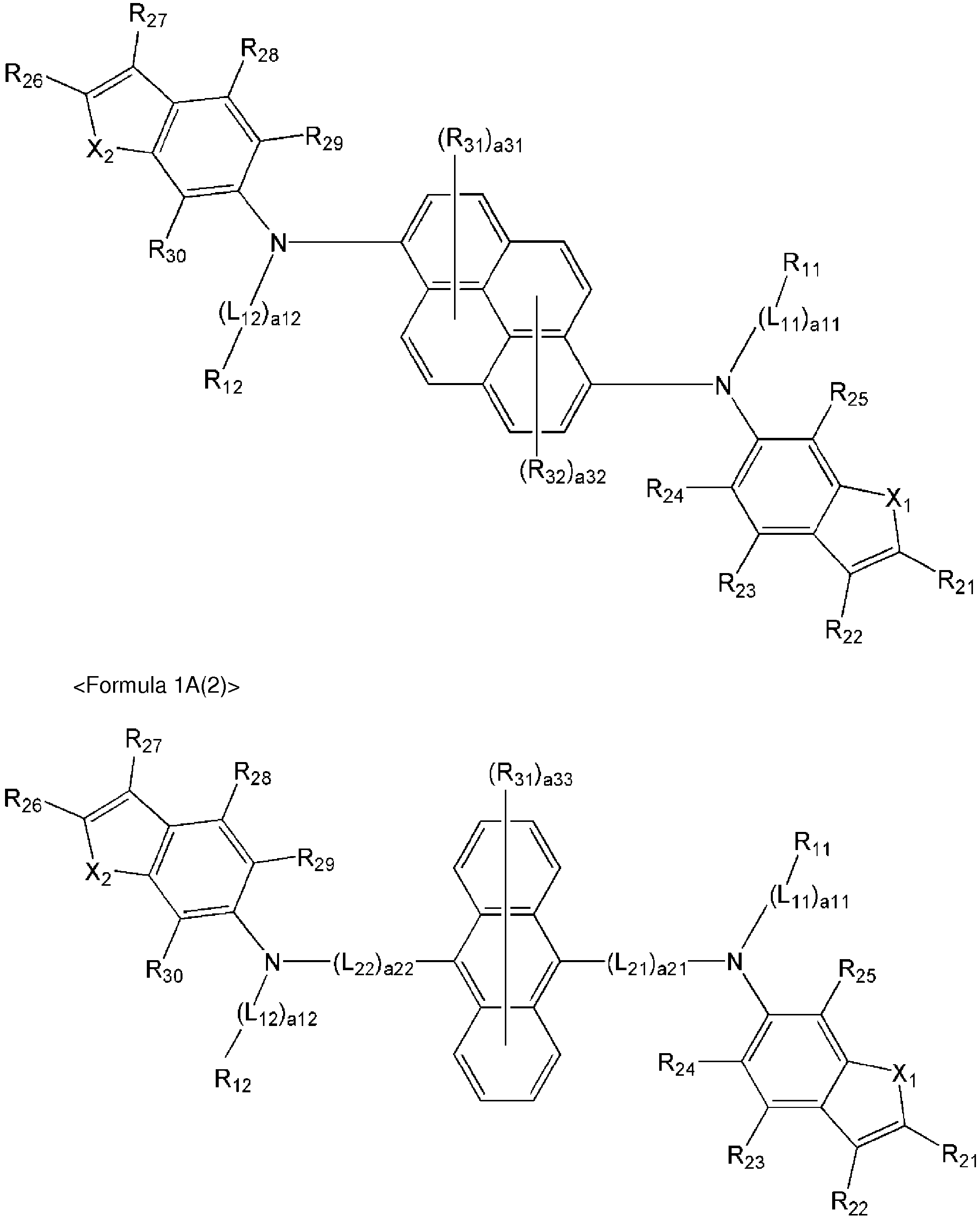


- In Formulae 1A(1) to 1A(4), X1, X2, L11, L12, L21, L22, a11, a12, a21, a22, R11, and R12 are the same as those defined above in conjunction with Formula 1, and R21 to R34 are the same as R3 defined above in conjunction with Formula 1.
- In Formulae 1A(1) to 1A(4), a31 and a32 may be each independently an integer from 1 to 4, a33 may be an integer from 1 to 8, a34 and a35 may be each independently an integer from 1 to 3, and a36 and a37 may be each independently an integer from 1 to 5.
- In some other embodiments, in Formulae 1A(1) to 1A(4), X1 and X2 may be identical to each other;
- L1, L2, L11, L12, L21, and L22 may be each independently selected from the groups represented by Formulae 2-1 to 2-30;
- a1, a2, a11, a12, a21, and a22 may be each independently 0 or 1;
- R1, R2, R11, and R12 may be each independently selected from the groups represented by Formulae 4-1 to 4-29;
- R21 to R34 may be each independently selected from
- a hydrogen atom, a deuterium atom, a halogen atom, a hydroxyl group, a cyano group, a nitro group, an amino group, an amidino group, a hydrazine, a hydrazone, a carboxylic acid group or a salt thereof, a sulfonic acid group or a salt thereof, a phosphoric acid group or a salt thereof, a C1-C20 alkyl group, and a C1-C20 alkoxy group, and
- a C1-C20 alkyl group and a C1-C60 alkoxy group, each substituted with at least one of a deuterium atom, a halogen atom, a hydroxyl group, a cyano group, a nitro group, an amino group, an amidino group, a hydrazine, a hydrazone, a carboxylic acid group or a salt thereof, a sulfonic acid group or a salt thereof, a phosphoric acid group or a salt thereof, a phenyl group, a naphthyl group, an anthracenyl group, a pyrenyl group, a phenanthrenyl group, a fluorenyl group, a carbazolyl group, a pyridinyl group, a pyrimidinyl group, a triazinyl group, a quinolinyl group, an isoquinolinyl group, and a quinazolinyl group, and
- the groups represented by Formulae 4-1 to 4-29 above; and
- b1 may be 1 or 2. However, embodiments are not limited thereto.
- In some other embodiments, in Formulae 1A(1) to 1A(4), X1 and X2 may be both S, or X1 and X2 may be both O;
- L11, L12, L21, and L22 may be each independently selected from the groups represented by Formulae 3-1 to 3-19 above;
- a11, a12, a21, and a22 may be each independently 0 or 1;
- R11 and R12 may be each independently selected from the groups represented by Formulae 5-1 to 5-36 above;
- R21 to R34 may be each independently selected from
- a hydrogen atom, a deuterium atom, a halogen atom, a hydroxyl group, a cyano group, a nitro group, an amino group, an amidino group, a hydrazine, a hydrazone, a carboxylic acid group or a salt thereof, a sulfonic acid group or a salt thereof, a phosphoric acid group or a salt thereof, a C1-C20 alkyl group, and a C1-C20 alkoxy group,
- a C1-C20 alkyl group and a C1-C60 alkoxy group, each substituted with at least one of a deuterium atom, a halogen atom, a hydroxyl group, a cyano group, a nitro group, an amino group, an amidino group, a hydrazine, a hydrazone, a carboxylic acid group or a salt thereof, a sulfonic acid group or a salt thereof, a phosphoric acid group or a salt thereof, a phenyl group, a naphthyl group, an anthracenyl group, a pyrenyl group, a phenanthrenyl group, a fluorenyl group, a carbazolyl group, a pyridinyl group, a pyrimidinyl group, a triazinyl group, a quinolinyl group, an isoquinolinyl group, and a quinazolinyl group, and
- the groups represented by Formulae 5-1 to 5-36 above.
- For example, in Formulae 1A(1) to 1A(4), R23 to R25, and R28 to R30 may be all hydrogen atoms.
- In Formula 1A(3), R3, and R32 may be each independently selected from a C1-C10 alkyl group, a C1-C10 alkoxy group, a phenyl group, a naphthyl group, and an anthracenyl group.
- In Formula 1A(2), a21 and a22 may be both an integer of 1.
- In Formulae 1A(1), 1A(2), and 1A(4), R3, and R32 may be all hydrogen atoms.
- In Formulae 1A(3), R33 and R34 may be all hydrogen atoms.
- In some embodiments, the amine-based compound of Formula 1 above may be a compound represented by one of the Compounds 1 to 108 below:


- In the amine-based compound represented by Formula 1 above, X1 is selected from N-[(L1)a1-(R1)b1], S, and O, and X2 is selected from N-[(L2)a2-R2], S, and O. Accordingly, the amine-based compound of Formula 1 may optimize electron injection balance. Thus, an organic light-emitting device including the amine-based compound of Formula 1 has improved efficiency characteristics.
- In the amine-based compound represented by Formula 1 above, "N" is bound to a "benzo group" of an "indole-based moiety" (refer to Formula 1' below), which may provide improved electrical stability, not causing denaturation and/or decomposition of the compound despite of persistent movements of electrons. Accordingly, the amine-based compound of Formula 1 may optimize electron injection balance. Thus, an organic light-emitting device including the amine-based compound of Formula 1 may have improved efficiency characteristics.

- A synthesis method of the amine-based compound of Formula 1 above may be understood by those of ordinary skill in the art from Synthesis Examples 1 to 8 that will be described below.
- The amine-based compound of Formula 1 above may be appropriate for use in an organic layer of an organic light-emitting device, for example, as a dopant of an emission layer of the organic layer.
- According to another aspect, an organic light-emitting device includes a first electrode, a second electrode, and an organic layer disposed between the first electrode and the second electrode and including at least one of the amine-based compounds of Formula 1 above.
- Due to the inclusion of the organic layer including the amine-based compound of Formula 1 above, the organic light-emitting device may have a low driving voltage, a high efficiency, high luminance, long lifetime, and improved color purity.
- With regard to the color purity of the organic light-emitting device including the amine-based compound of Formula 1 above, an X coordinate may be from about 0.14 to about 0.16, and a Y coordinate may be about 0.18 or less, and in some embodiments, from about 0.10 to about 0.15, and in some other embodiments, may be from about 0.12 to about 0.14. For example, the amine-based compound of Formula 1 may emit blue light, for example, fluorescent blue light.
- The amine-based compound of Formula 1 above may be used between a pair of electrodes of an organic light-emitting device. For example, the amine-based compound of Formula 1 above may be in at least one of an emission layer, a hole transport region between the first electrode and the emission layer (for example, including at least one of a hole injection layer, a hole transport layer, and an electron blocking layer), and an electron transport region between the emission layer and the second electrode (for example, including at least one of a hole blocking layer, an electron transport layer, and an electron injection layer). In some embodiments, the amine-based compound of Formula 1 may be in at least one of the hole transport region, the electron transport region, and the emission layer.
- In some other embodiments, the amine-based compound of Formula 1 above may be in the emission layer of the organic light-emitting device. The amine-based compound of Formula 1 above may be a fluorescent dopant emitting, for example, blue light based on fluorescence mechanism.
- In some embodiments, the organic light-emitting device may further include a compound represented by Formula 1000 below, in addition to the amine-based compound of Formula 1 above.
<Formula 1000> Y1-A2-Y2
- In Formula 1000, A2 may be selected from
- a pentalenylene group, an indenylene group, a naphthylene group, an azulenylene group, a heptalenylene group, an indacenylene group, an acenaphthylene group, a fluorenylene group, a spiro-fluorenylene group, a phenalenylene group, a phenanthrenylene group, an anthracenylene group, a fluoranthrenylene group, a triphenylenylene group, a pyrenylene group, a chrysenylene group, a naphthacenylene group, a picenylene group, a perylenylene group, a pentaphenylene group, a hexacenylene group, and a benzofluoranthenylene group, and
- a pentalenylene group, an indenylene group, a naphthylene group, an azulenylene group, a heptalenylene group, an indacenylene group, an acenaphthylene group, a fluorenylene group, a spiro-fluorenylene group, a phenalenylene group, a phenanthrenylene group, an anthracenylene group, a fluoranthrenylene group, a triphenylenylene group, a pyrenylene group, a chrysenylene group, a naphthacenylene group, a picenylene group, a perylenylene group, a pentaphenylene group, a hexacenylene group, and a benzofluoranthenylene group, each substituted with at least one selected from a deuterium atom, a halogen atom, a hydroxyl group, a cyano group, a nitro group, an amino group, an amidino group, a hydrazine, a hydrazone, a carboxylic acid group or a salt thereof, a sulfonic acid group or a salt thereof, a phosphoric acid group or a salt thereof, a C1-C60 alkyl group, a C2-C60 alkenyl group, a C2-C60 alkynyl group, a C1-C60 alkoxy group, a C3-C10 cycloalkyl group, a C3-C10 heterocycloalkyl group, a C3-C10 cycloalkenyl group, a C3-C10 heterocycloalkenyl group, a C6-C60 aryl group, a C6-C60 aryloxy group, aC6-C60 arylthio group, a C2-C60 heteroaryl group, -N(Q11)(Q12), and -Si(Q13)(Q14)(Q15).
- In Formula 1000, A2 may be the same as A1 defined above in conjunction with Formula 1.
- In Formula 1000, Y1 and Y2 may be each independently selected from
- a C3-C10 cycloalkyl group, a C3-C10 heterocycloalkyl group, a C3-C10 cycloalkenyl group, a C3-C10 heterocycloalkenyl group, a C6-C60 aryl group, a C6-C60 aryloxy group, a C6-C60 arylthio group, and a C2-C60 heteroaryl group, and
- a C3-C10 cycloalkyl group, a C3-C10 heterocycloalkyl group, a C3-C10 cycloalkenyl group, a C3-C10 heterocycloalkenyl group, a C6-C60 aryl group, a C6-C60 aryloxy group, a C6-C60 arylthio group, and a C2-C60 heteroaryl group, each substituted with at least one selected from a deuterium atom, a halogen atom, a hydroxyl group, a cyano group, a nitro group, an amino group, an amidino group, a hydrazine, a hydrazone, a carboxylic acid group or a salt thereof, a sulfonic acid group or a salt thereof, a phosphoric acid group or a salt thereof, a C1-C60 alkyl group, a C2-C60 alkenyl group, a C2-C60 alkynyl group, a C1-C60 alkoxy group, a C3-C10 cycloalkyl group, a C3-C10 heterocycloalkyl group, a C3-C10 cycloalkenyl group, a C3-C10 heterocycloalkenyl group, a C6-C60 aryl group, a C6-C60 aryloxy group, a C6-C60 arylthio group, a C2-C60 heteroaryl group, and -N(Q101)(Q102); wherein
- Q101 and Q102 may be each independently selected from
- a hydrogen atom, a deuterium atom, a halogen atom, a hydroxyl group, a cyano group, a nitro group, an amino group, an amidino group, a hydrazine, a hydrazone, a carboxylic acid group or a salt thereof, a sulfonic acid group or a salt thereof, a phosphoric acid group or a salt thereof, a C1-C60 alkyl group, a C2-C60 alkenyl group, a C2-C60 alkynyl group, and a C1-C60 alkoxy group,
- a C1-C60 alkyl group, a C2-C60 alkenyl group, a C2-C60 alkynyl group, and a C1-C60 alkoxy group, each substituted with at least one of a deuterium atom, a halogen atom, a hydroxyl group, a cyano group, a nitro group, an amino group, an amidino group, a hydrazine, a hydrazone, a carboxylic acid group or a salt thereof, a sulfonic acid group or a salt thereof, a phosphoric acid group or a salt thereof, a C3-C10 cycloalkyl group, a C3-C10 heterocycloalkyl group, a C3-C10 cycloalkenyl group, a C3-C10 heterocycloalkenyl group, a C6-C60 aryl group, a C6-C60 aryloxy group, a C6-C60 arylthio group, and a C2-C60 heteroaryl group,
- a C3-C10 cycloalkyl group, a C3-C10 heterocycloalkyl group, a C3-C10 cycloalkenyl group, a C3-C10 heterocycloalkenyl group, a C6-C60 aryl group, a C6-C60 aryloxy group, a C6-C60 arylthio group, and a C2-C60 heteroaryl group, and
- a C3-C10 cycloalkyl group, a C3-C10 heterocycloalkyl group, a C3-C10 cycloalkenyl group, a C3-C10 heterocycloalkenyl group, a C6-C60 aryl group, a C6-C60 aryloxy group, a C6-C60 arylthio group, and a C2-C60 heteroaryl group, each substituted with at least one of a deuterium atom, a halogen atom, a hydroxyl group, a cyano group, a nitro group, an amino group, an amidino group, a hydrazine, a hydrazone, a carboxylic acid group or a salt thereof, a sulfonic acid group or a salt thereof, a phosphoric acid group or a salt thereof, a C1-C60 alkyl group, a C2-C60 alkenyl group, a C2-C60 alkynyl group, a C1-C60alkoxy group, a C3-C10 cycloalkyl group, a C3-C10 heterocycloalkyl group, a C3-C10 cycloalkenyl group, a C3-C10 heterocycloalkenyl group, a C6-C60 aryl group, a C6-C60 aryloxy group, a C6-C60 arylthio group, and a C2-C60 heteroaryl group.
- In some embodiments, in Formula 1000, Y1 and Y2 may be each independently selected from
- a phenyl group, a pentalenyl group, an indenyl group, a naphthyl group, an azulenyl group, a heptalenyl group, an indacenyl group, an acenaphthyl group, a fluorenyl group, a spiro-fluorenyl group, a phenalenyl group, a phenanthrenyl group, an anthracenyl group, a fluoranthrenyl group, a triphenylenyl group, a pyrenyl group, a chrysenyl group, a naphthacenyl group, a picenyl group, a perylenyl group, a pentaphenyl group, a hexacenyl group, a pyrrolyl group, an imidazolyl group, a pyrazolyl group, a pyridinyl group, a pyrazinyl group, a pyrimidinyl group, a pyridazinyl group, an isoindolyl group, an indolyl group, an indazolyl group, a purinyl group, a quinolinyl group, an isoquinolinyl group, a benzoquinolinyl group, a phthalazinyl group, a naphthyridinyl group, a quinoxalinyl group, a quinazolinyl group, a cinnolinyl group, a carbazolyl group, a phenanthridinyl group, an acridinyl group, a phenanthrolinyl group, a phenazinyl group, a benzooxazolyl group, a benzoimidazolyl group, a furanyl group, a benzofuranyl group, a thiophenyl group, a benzothiophenyl group, a thiazolyl group, an isothiazolyl group, a benzothiazolyl group, an isoxazolyl group, an oxazolyl group, a triazolyl group, a tetrazolyl group, an oxadiazolyl group, a triazinyl group, a dibenzofuranyl group, a dibenzothiophenyl group, a benzocarbazolyl group, and a dibenzocarbazolyl group, and
- a phenyl group, a pentalenyl group, an indenyl group, a naphthyl group, an azulenyl group, a heptalenyl group, an indacenyl group, an acenaphthyl group, a fluorenyl group, a spiro-fluorenyl group, a phenalenyl group, a phenanthrenyl group, an anthracenyl group, a fluoranthrenyl group, a triphenylenyl group, a pyrenyl group, a chrysenyl group, a naphthacenyl group, a picenyl group, a perylenyl group, a pentaphenyl group, a hexacenyl group, a pyrrolyl group, an imidazolyl group, a pyrazolyl group, a pyridinyl group, a pyrazinyl group, a pyrimidinyl group, a pyridazinyl group, an isoindolyl group, an indolyl group, an indazolyl group, a purinyl group, a quinolinyl group, an isoquinolinyl group, a benzoquinolinyl group, a phthalazinyl group, a naphthyridinyl group, a quinoxalinyl group, a quinazolinyl group, a cinnolinyl group, a carbazolyl group, a phenanthridinyl group, an acridinyl group, a phenanthrolinyl group, a phenazinyl group, a benzooxazolyl group, a benzoimidazolyl group, a furanyl group, a benzofuranyl group, a thiophenyl group, a benzothiophenyl group, a thiazolyl group, an isothiazolyl group, a benzothiazolyl group, an isoxazolyl group, an oxazolyl group, a triazolyl group, a tetrazolyl group, an oxadiazolyl group, a triazinyl group, a dibenzofuranyl group, a dibenzothiophenyl group, a benzocarbazolyl group, and a benzocarbazolyl group, each substituted with at least one of a deuterium atom, a halogen atom, a hydroxyl group, a cyano group, a nitro group, an amino group, an amidino group, a hydrazine, a hydrazone, a carboxylic acid group or a salt thereof, a sulfonic acid group or a salt thereof, a phosphoric acid group or a salt thereof, a C1-C20 alkyl group, a C2-C20 alkenyl group, a C2-C20 alkynyl group, a C1-C20 alkoxy group, a phenyl group, a naphthyl group, an anthracenyl group, a pyrenyl group, a phenanthrenyl group, a fluorenyl group, a carbazolyl group, a benzocarbazolyl group, a dibenzocarbazolyl group, a pyridinyl group, a pyrimidinyl group, a triazinyl group, a quinolinyl group, an isoquinolinyl group, a quinazolinyl group, and -N(Q101)(Q102); wherein
- Q101 and Q102 may be each independently selected from a phenyl group, a pentalenyl group, an indenyl group, a naphthyl group, an azulenyl group, a heptalenyl group, an indacenyl group, an acenaphthyl group, a fluorenyl group, a spiro-fluorenyl group, a phenalenyl group, a phenanthrenyl group, an anthracenyl group, a fluoranthrenyl group, a triphenylenyl group, a pyrenyl group, a chrysenyl group, a naphthacenyl group, a picenyl group, a perylenyl group, a pentaphenyl group, a hexacenyl group, a pyrrolyl group, an imidazolyl group, a pyrazolyl group, a pyridinyl group, a pyrazinyl group, a pyrimidinyl group, a pyridazinyl group, an isoindolyl group, an indolyl group, an indazolyl group, a purinyl group, a quinolinyl group, an isoquinolinyl group, a benzoquinolinyl group, a phthalazinyl group, a naphthyridinyl group, a quinoxalinyl group, a quinazolinyl group, a cinnolinyl group, a carbazolyl group, a phenanthridinyl group, an acridinyl group, a phenanthrolinyl group, a phenazinyl group, a benzooxazolyl group, a benzoimidazolyl group, a furanyl group, a benzofuranyl group, a thiophenyl group, a benzothiophenyl group, a thiazolyl group, an isothiazolyl group, a benzothiazolyl group, an isoxazolyl group, an oxazolyl group, a triazolyl group, a tetrazolyl group, an oxadiazolyl group, a triazinyl group, a dibenzofuranyl group, a dibenzothiophenyl group, a benzocarbazolyl group, and a benzocarbazolyl group.
- The amine-based compound of Formula 1 above and the compound of Formula 1000 above may be both in the emission layer of the organic light-emitting device. An amount of the amine-based compound of Formula 1 in the emission layer may be less than that of the compound of Formula 1000 above. That is, the amine-based compound of Formula 1 above may serve as a dopant, while the compound of Formula 1000 may serve as a host.
- As used herein, "(for example, the organic layer) including at least one amine-based compound means that "(the organic layer) including one of the amine-based compounds of Formula 1 above, or at least two different amine-based compounds of Formula 1 above".
- In some embodiments, the organic layer may include only Compound 1 above as the amine-based compound. The Compound 1 may be in the EML layer of the organic light-emitting device. In some embodiments, the organic layer may include Compounds 1 and 2 as the amine-based compound. In this regard, Compounds 1 and 2 may be present in the same layer (for example, in the emission layer) or may be present in different layers.
- The first electrode may be an anode as a hole injection electrode, while the second electrode may be a cathode as an electron injection electrode. In some embodiments, the first electrode may be a cathode as an electron injection electrode, while the second electrode may be a cathode as a hole injection electrode.
- For example, the first electrode may be an anode, the second electrode may be a cathode, and the organic layer may include i) a hole transport region disposed between the first electrode and the emission layer and including at least one of a hole injection layer, a hole transport layer, and an electron blocking layer, and ii) an electron transport region disposed between the emission layer and the second electrode and including at least one of a hole blocking layer, an electron transport layer, and an electron injection layer.
- The term "organic layer" as used herein refers to a single layer and/or a plurality of layers disposed between the first and second electrodes of the organic light-emitting device. The "organic layer" may include an organic compound and an organic metal complex including metal.
-
FIG. 1 illustrates a schematic sectional view of an organic light-emittingdevice 10 according to an embodiment. Hereinafter, a structure of an organic light-emitting device according to an embodiment and a method of manufacturing the same will now be described with reference toFIG. 1 . Referring toFIG. 1 , the organic light-emittingdevice 10 has a structure in which asubstrate 11, afirst electrode 13, anorganic layer 15, and asecond electrode 17 are sequentially stacked in this order. - The
substrate 11 may be any substrate that is used in existing organic light-emitting devices. In some embodiments thesubstrate 11 may be a glass substrate or a transparent plastic substrate with strong mechanical strength, thermal stability, transparency, surface smoothness, ease of handling, and water resistance. - The
first electrode 13 may be formed by depositing or sputtering a first electrode-forming material on thesubstrate 11. Thefirst electrode 13 may be an anode. A material for thefirst electrode 13 may be a material having a high work function to facilitate hole injection. Thefirst electrode 13 may be a reflective electrode or a transmission electrode. The material for thefirst electrode 13 may be indium tin oxide (ITO), indium zinc oxide (IZO), tin oxide (SnO2), or zinc oxide (ZnO). Thefirst electrode 13 may be formed as a reflective electrode from magnesium (Mg), aluminum (Al), aluminum-lithium (Al-Li), calcium (Ca), magnesium-indium (Mg-In), magnesium-silver (Mg-Ag), or the like. - The
first electrode 13 may have a single-layer structure or a multi-layer structure including at least two layers. For example, thefirst electrode 13 may have a three-layered structure of ITO/Ag/ITO. - The
organic layer 15 may be disposed on thefirst electrode 13. - The
organic layer 15 may include a hole transport region including a hole injection layer (HIL) and a hole transport layer (HTL) that are sequentially stacked upon one another; an emission layer (EML); and an electron transport region including an electron transport layer (ETL) and an electron injection layer (EIL) that are sequentially stacked upon one another. - The HIL may be formed on the
first electrode 13 by any of a variety of methods, including vacuum deposition, spin coating, casting, Langmuir-Blodgett (LB) deposition, and the like. - When the HIL is formed using vacuum deposition, vacuum deposition conditions may vary according to the compound that is used to form the HIL, and the desired structure and thermal properties of the HIL to be formed. For example, vacuum deposition may be performed at a temperature of about 100°C to about 500°C, a pressure of about 10-8 torr to about 10-3 torr, and a deposition rate of about 0.01 to about 100 Å/sec. However, the deposition conditions are not limited thereto.
- When the HIL is formed using spin coating, the coating conditions may vary according to the compound that is used to form the HIL, and the desired structure and thermal properties of the HIL to be formed. For example, the coating rate may be in the range of about 2000 rpm to about 5000 rpm, and a temperature at which heat treatment is performed to remove a solvent after coating may be in the range of about 80 °C to about 200°C. However, the coating conditions are not limited thereto.
- The HIL may be formed of any known hole injecting material. Examples of materials for the HIL are N,N'-diphenyl-N,N'-bis-[4-(phenyl-m-tolyl-amino)-phenyl]-biphenyl-4,4'-diamine, (DNTPD), 4,4',4"-tris (3-methylphenylphenylamino) triphenylamine (m-MTDATA), N,N'-di(1-naphthyl)-N,N'-diphenylbenzidine (NPB), TDATA (refer to a formula below), 2-TNATA (refer to a formula below), polyaniline/dodecylbenzenesulfonic acid (Pani/DBSA), poly(3,4-ethylenedioxythiophene)/poly(4-styrenesulfonate) (PEDOT/PSS), polyaniline/camphor sulfonic acid (Pani/CSA), and polyaniline)/poly(4-styrenesulfonate (PANI/PSS).

- The thickness of the HIL may be about 100 Å to about 10000 Å, and in some embodiments, may be from about 100 Å to about 1000 Å. When the thickness of the HIL is within these ranges, the HIL may have good hole injecting ability without a substantial increase in driving voltage.
- Then, a HTL may be formed on the HIL by using vacuum deposition, spin coating, casting, Langmuir-Blodgett (LB) deposition, or the like. When the HTL is formed using vacuum deposition or spin coating, the conditions for deposition and coating may be similar to those for the formation of the HIL, though the conditions for the deposition and coating may vary according to the material that is used to form the HTL.
- Examples of suitable known HTL forming materials are carbazole derivatives, such as N-phenylcarbazole or polyvinylcarbazole, N,N'-bis(3-methylphenyl)-N,N'-diphenyl-[1,1-biphenyl]-4,4'-diamine (TPD), 4,4',4"-tris(N-carbazolyl)triphenylamine (TCTA), and N,N'-di(1-naphthyl)-N,N'-diphenylbenzidine) (NPB).

- The thickness of the HTL may be from about 50 Å to about 2000 Å, and in some embodiments, may be from about 100 Å to about 1500 Å. When the thickness of the HTL is within these ranges, the HTL may have good hole transporting ability without a substantial increase in driving voltage.
- In some embodiments, at least one of the HIL and HTL may include at least one of a compound of Formula 300 below and a compound of Formula 301 below:
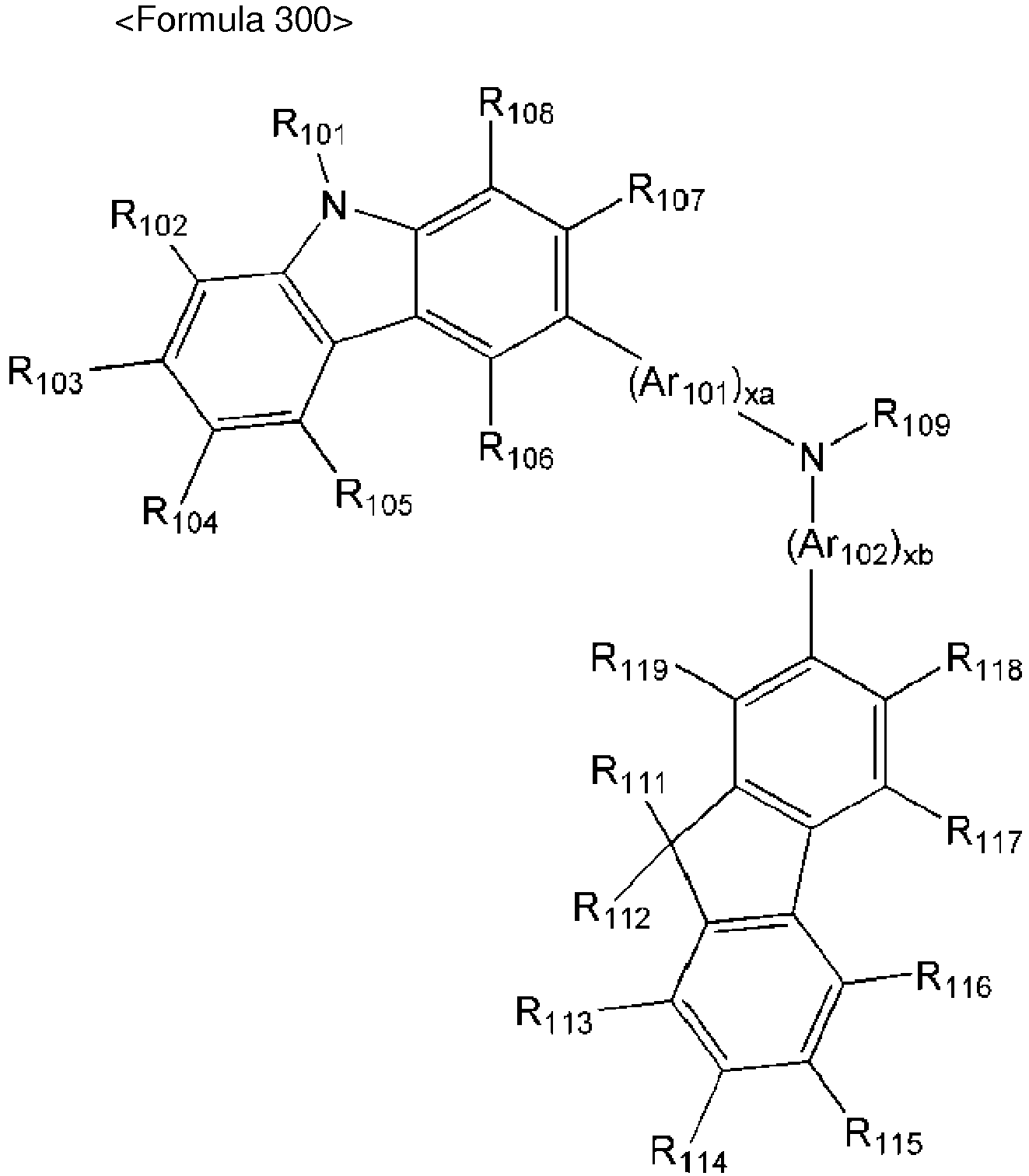
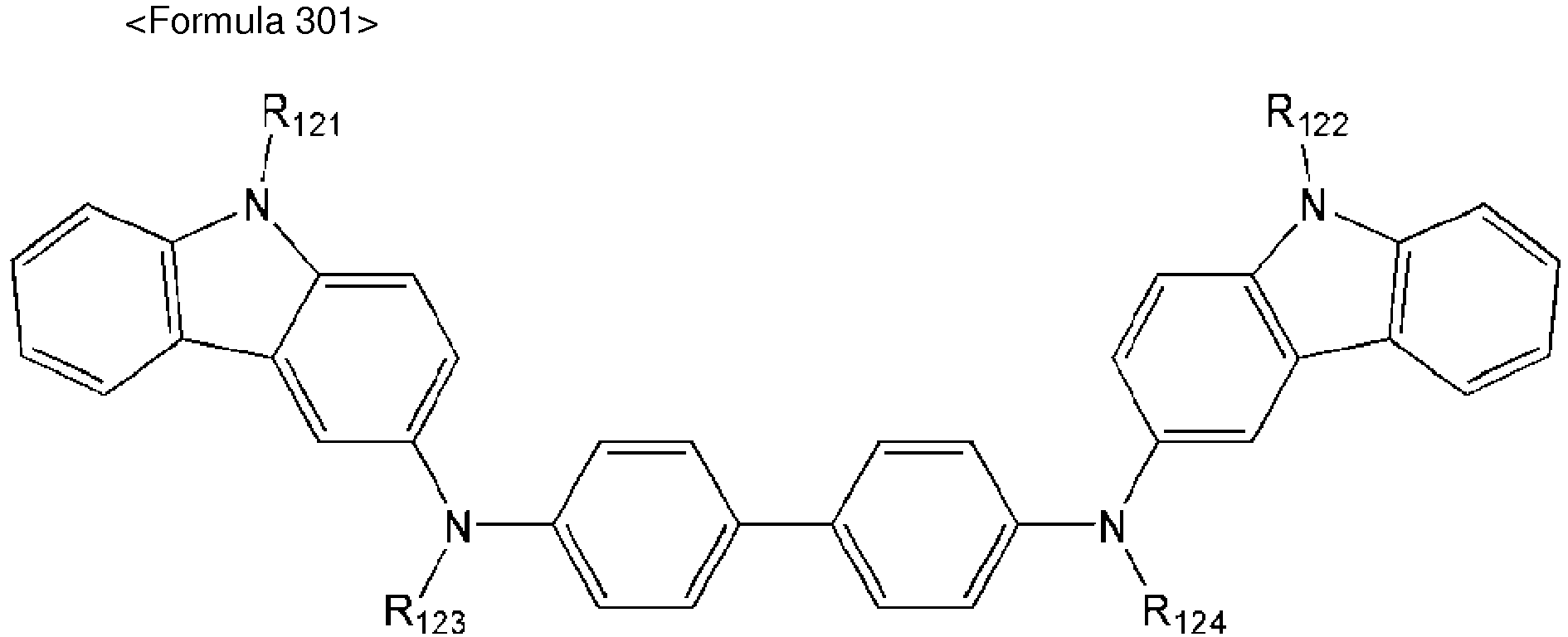
- In Formula 300, Ar101 and Ar102 may be each independently selected from
- a phenylene group, a pentalenylene group, an indenylene group, a naphthylene group, an azulenylene group, a heptalenylene group, an acenaphthylene group, a fluorenylene group, a phenalenylene group, a phenanthrenylene group, an anthracenylene group, a fluoranthenylene group, a triphenylenylene group, a pyrenylene group, a chrysenylene group, a naphthacenylene group, a picenylene group, a perylenylene group, and a pentacenylene group, and
- a phenylene group, a pentalenylene group, an indenylene group, a naphthylene group, an azulenylene group, a heptalenylene group, an acenaphthylene group, a fluorenylene group, a phenalenylene group, a phenanthrenylene group, an anthracenylene group, a fluoranthenylene group, a triphenylenylene group, a pyrenylene group, a chrysenylene group, a naphthacenylene group, a picenylene group, a perylenylene group, and a pentacenylene group, each substituted with at least one of a deuterium atom, a halogen atom, a hydroxyl group, a nitro group, a cyano group, an amino group, an amidino group, a hydrazine, a hydrazone, a carboxylic acid group or salt thereof, a sulfuric acid group or salt thereof, a phosphoric acid group or salt thereof, a C1-C60 alkyl group, a C2-C60 alkenyl group, a C2-C60 alkynyl group, a C1-C60 alkoxy group, a C3-C10 cycloalkyl group, a C3-C10 cycloalkenyl group, a C3-C10 heterocycloalkyl group, a C3-C10 heterocycloalkenyl group, a C6-C60 aryl group, a C6-C60 aryloxy group, a C6-C60 arylthio group, and a C2-C60 heteroaryl group.
- In Formula 300, xa and xb may be each independently an integer from 0 to 5, for example, may be 0, 1, or 2. For example, xa may be 1, and xb may be 0, but are not limited thereto.
- In Formulae 300 and 301, R101 to R108, R111 to R119, and R121 to R124 may be each independently selected from
- a hydrogen atom, a deuterium atom, a halogen atom, a hydroxyl group, a cyano group, a nitro group, an amino group, an amidino group, a hydrazine, a hydrazone, a carboxylic acid group or a salt thereof, a sulfonic acid group or a salt thereof, a phosphoric acid group or a salt thereof, a C1-C10 alkyl group (for example, a methyl group, an ethyl group, a propyl group, a butyl group, a pentyl group, or a hexyl group), and a C1-C10 alkoxy group (for example, a methoxy group, an ethoxy group, a propoxy group, a butoxy group, or a pentoxy group),
- a C1-C10 alkyl group and a C1-C10 alkoxy group, each substituted with at least one of a deuterium atom, a halogen atom, a hydroxyl group, a cyano group, a nitro group, an amino group, an amidino group, a hydrazine, a hydrazone, a carboxylic acid group or a salt thereof, a sulfonic acid group or a salt thereof, and a phosphoric acid group or a salt thereof,
- a phenyl group, a naphthyl group, an anthracenylene group, a fluorenyl group, and a pyrenyl group, and
- a phenyl group, a naphthyl group, an anthracenyl group, a fluorenyl group, and a pyrenyl group, each substituted with at least one of a deuterium atom, a halogen atom, a hydroxyl group, a cyano group, a nitro group, an amino group, an amidino group, a hydrazine, a hydrazone, a carboxylic acid group or a salt thereof, a sulfonic acid group or a salt thereof, a phosphoric acid group or a salt thereof, a C1-C10 alkyl group, and a C1-C10 alkoxy group.
- In Formula 300, R109 may be one of a phenyl group, a naphthyl group, an anthryl group, a biphenyl group, a pyridyl group; and a phenyl group, a naphthyl group, an anthracenyl group, a biphenyl group, and a pyridyl group, each substituted with at least one of a deuterium atom, a halogen atom, a hydroxyl group, a cyano group, a nitro group, an amino group, an amidino group, a hydrazine, a hydrazone, a carboxylic acid group or a salt thereof, a sulfonic acid group or a salt thereof, a phosphoric acid group or a salt thereof, a substituted or unsubstituted C1-C20 alkyl group, and a substituted or unsubstituted C1-C20 alkoxy group.
- In an embodiment the compound of Formula 300 may be a compound represented by Formula 300A below:


- In Formula 300A, R101, R111, R112, and R109 may be as defined above.
- In some embodiments, at least one of the HIL and HTL may include at least one of compounds represented by Formulae 301 to 320 below:


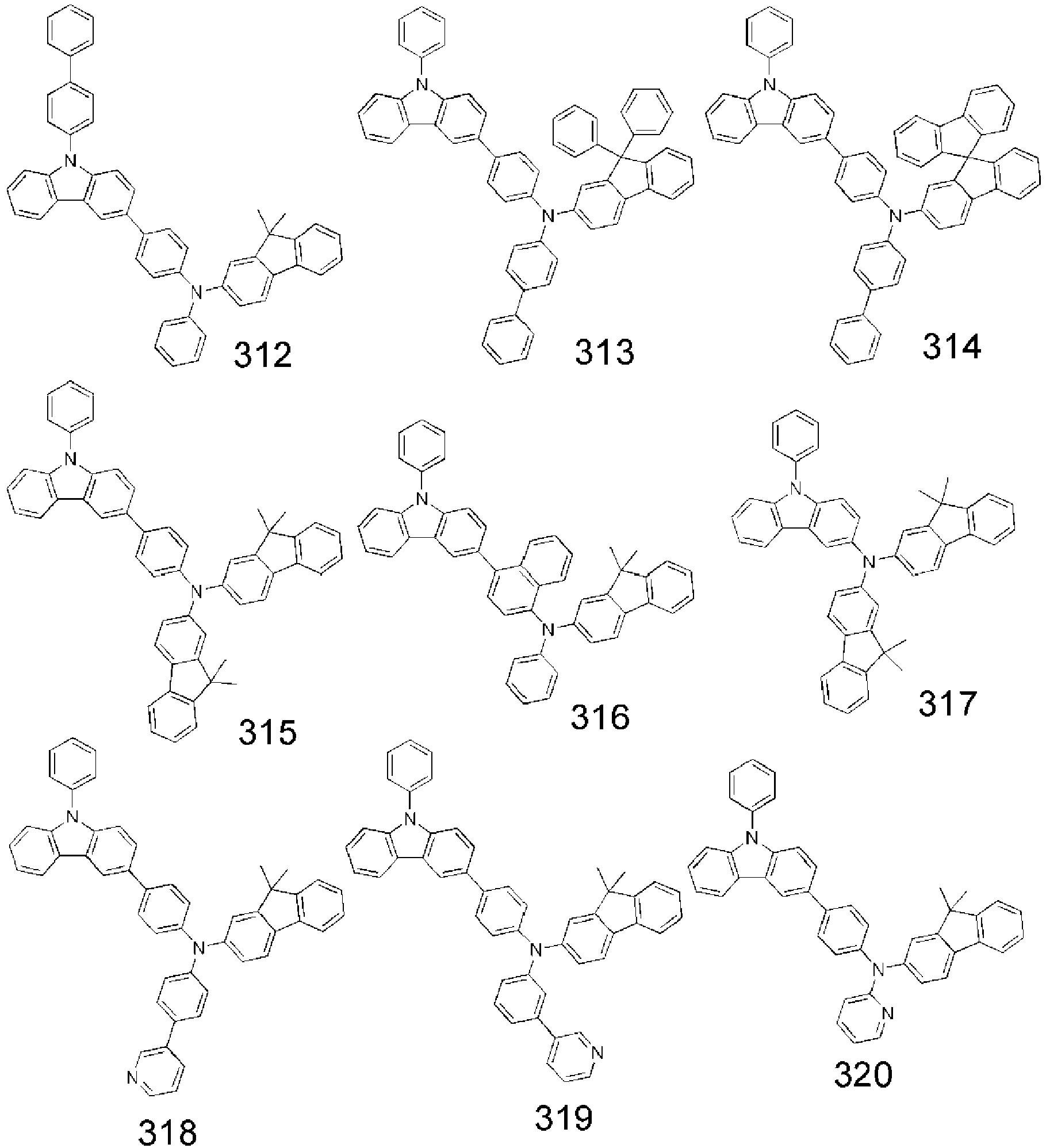
- The hole transport region may further include a charge-generating material for improved layer conductivity, in addition to a widely-known hole injection material and a widely-known hole transport material.
- The charge-generating material may be, for example, a p-dopant. The p-dopant may be one of quinine derivatives, metal oxides, and compounds with a cyano group, but are not limited thereto. Non-limiting examples of the p-dopant are quinone derivatives such as tetracyanoquinonedimethane (TCNQ), 2,3,5,6-tetrafluoro-tetracyano-1,4-benzoquinonedimethane (F4-TCNQ), and the like; metal oxides such as tungsten oxide, molybdenum oxide, and the like; and cyano-containing compounds such as Compound 200 below.

- When the hole transport region further includes such a charge-generating material as described above, the charge-generating material may be homogeneously dispersed or inhomogeneously distributed in the hole transport region.
- The hole transport region may further include a buffer layer between the HTL and the EML.
- The buffer layer may compensate for an optical resonance distance of light according to a wavelength of the light emitted from the EML, and thus may increase efficiency. The butter layer may include any hole injecting material or hole transporting material that are widely known. In some embodiments, the buffer layer may include the same material as one of the materials in the HTL underlying the buffer layer.
- Subsequently, the EML may be formed on the hole transport region by using vacuum deposition, spin coating, casting, LB deposition, or the like. When the EML is formed using vacuum deposition or spin coating, the deposition and coating conditions may be similar to those for the formation of the HIL, though the conditions for deposition and coating may vary depending on the material used to form the EML.
- The emission layer may include a host, and a dopant,
- For example, the host may further include at least one of Alq3, 4,4'-N,N'- dicarbazole-biphenyl (CBP), 9,10-di(naphthalene-2-yl)anthracene (DNA), TCTA (refer to a formula below), 1,3,5-tris(N-phenylbenzimidazole-2-yl)benzene (TPBI), 3-tert-butyl-9,10-di-2-naphthylanthracene (TBADN), E3 (refer to a formula below), dmCBP (refer to a formula below), and Compounds 501 to 509 below.

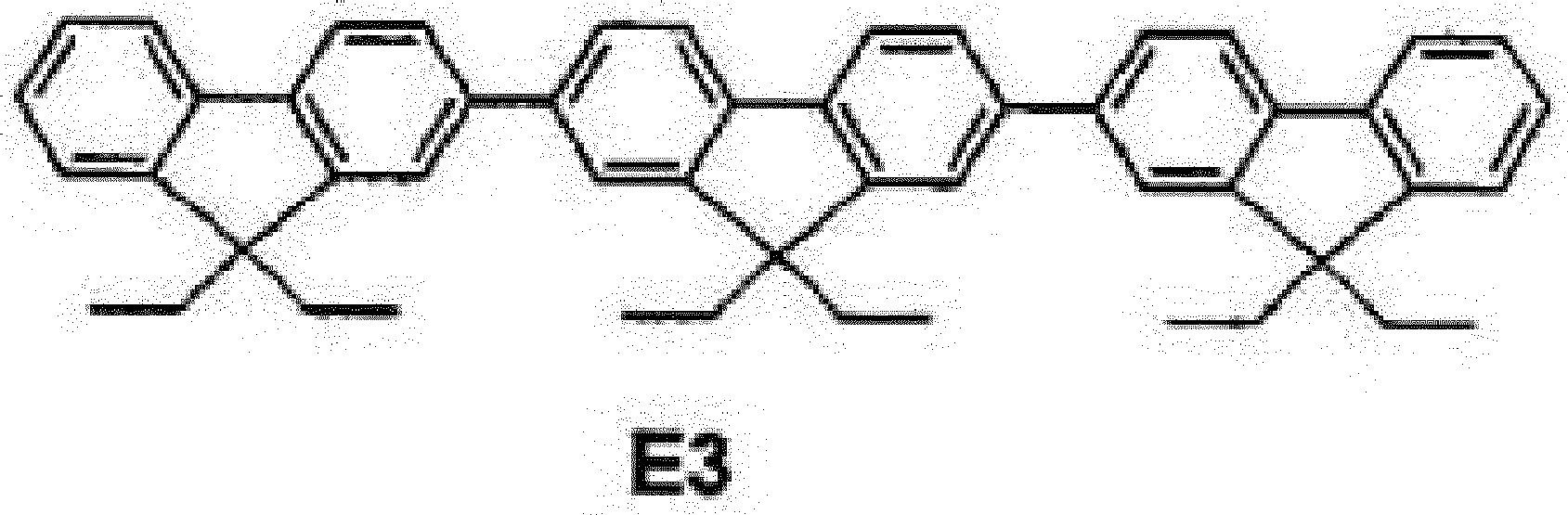


- In some embodiments, the host may include an anthracene-based compound represented by Formula 400 below.

- In some embodiments, Ar111 and Ar112 in Formula 400 may be each independently selected from a phenylene group, a naphthylene group, a phenanthrenylene group, or a pyrenylene group; or a phenylene group, a naphthylene group, a phenanthrenylene group, a fluorenyl group, or a pyrenylene group, each substituted with at least one of a phenyl group, a naphthyl group, and an anthracenyl group.
- In Formula 400, Ar113 to Ar116 may be each independently selected from a C1-C10alkyl group; a phenyl group, a naphthyl group, a phenanthrenyl group, and a pyrenyl group; and a phenyl group, a naphthyl group, a phenanthrenyl group, a fluorenyl group, and a pyrenyl group, each substituted with at least one of a phenyl group, a naphthyl group, and an anthracenyl group.
- In Formula 400, g, h, i, and j may be each independently an integer from 0 to 5, for example, may be 0, 1, or 2.
- In Formula 400, Ar113 to Ar116 may be each independently selected from
- a C1-C10alkyl group substituted with at least one of a phenyl group, a naphthyl group, and an anthracenyl group;
- a phenyl group, a naphthyl group, an anthracenyl group, a pyrenyl group, a phenanthrenyl group, and a fluorenyl group;
- a phenyl group, a naphthyl group, an anthracenyl group, a pyrenyl group, a phenanthrenyl group, and a fluorenyl group, each substituted with at least one of a deuterium atom, a halogen atom, a hydroxyl group, a cyano group, a nitro group, an amino group, an amidino group, a hydrazine, a hydrazone, a carboxylic acid group or a salt thereof, a sulfonic acid group or a salt thereof, a phosphoric acid group or a salt thereof, a C1-C60 alkyl group, a C2-C60 alkenyl group, a C2-C60 alkynyl group, a C1-C60 alkoxy group, a phenyl group, a naphthyl group, an anthracenyl group, a pyrenyl group, a phenanthrenyl group, and a fluorenyl group; and

- For example, the anthracene-based compound of Formula 400 above may be one of the compounds represented by the following formulae:


- In some embodiments, an anthracene-based compound represented by Formula 401 below may be used as the host.

- Ar122 to Ar125 in Formula 401 above may be defined as described above in conjunction with Ar113 of Formula 400, and thus detailed descriptions thereof will not be provided here.
- Ar126 and Ar127 in Formula 401 above may be each independently a C1-C10 alkyl group, for example, a methyl group, an ethyl group, or a propyl group.
- In Formula 401, k and I may be each independently an integer from 0 to 4, for example, 0, 1, or 2.
- For example, the anthracene compound of Formula 401 above may be one of the compounds represented by the following formulae:
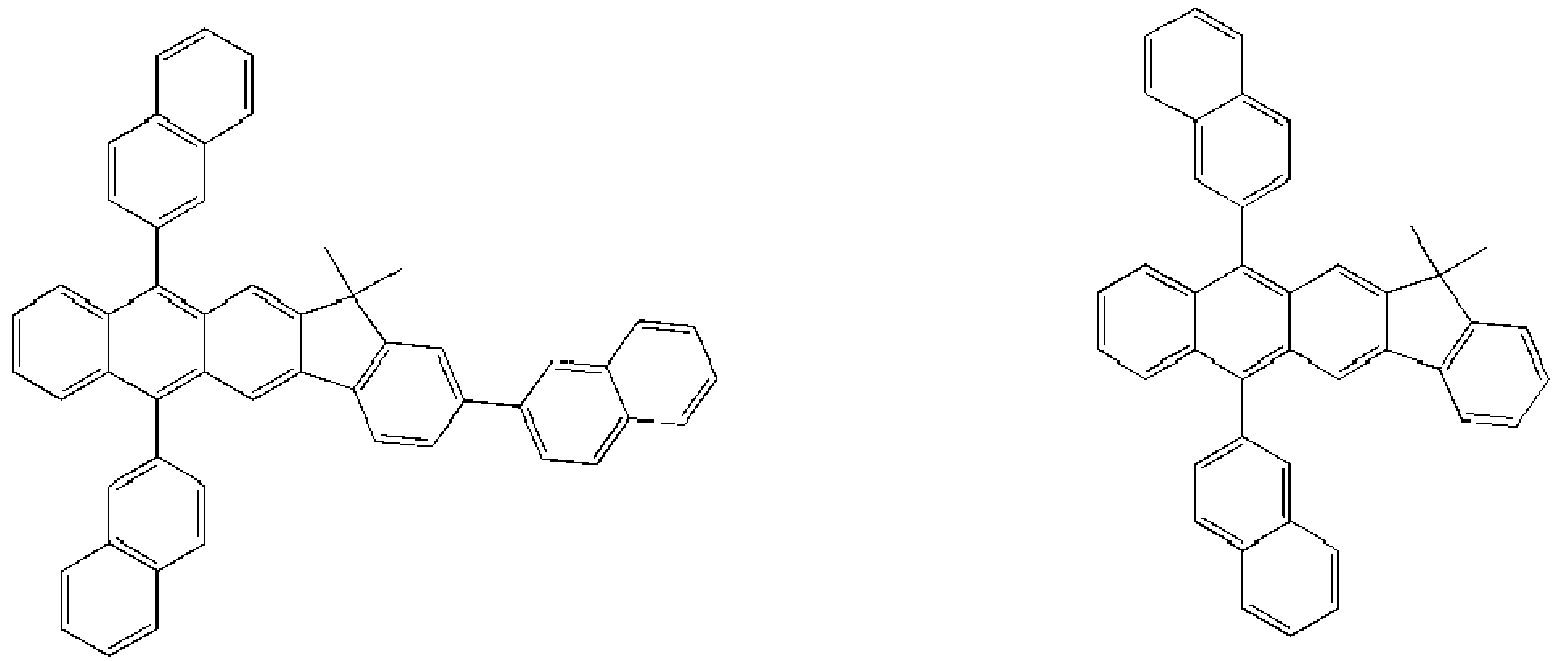
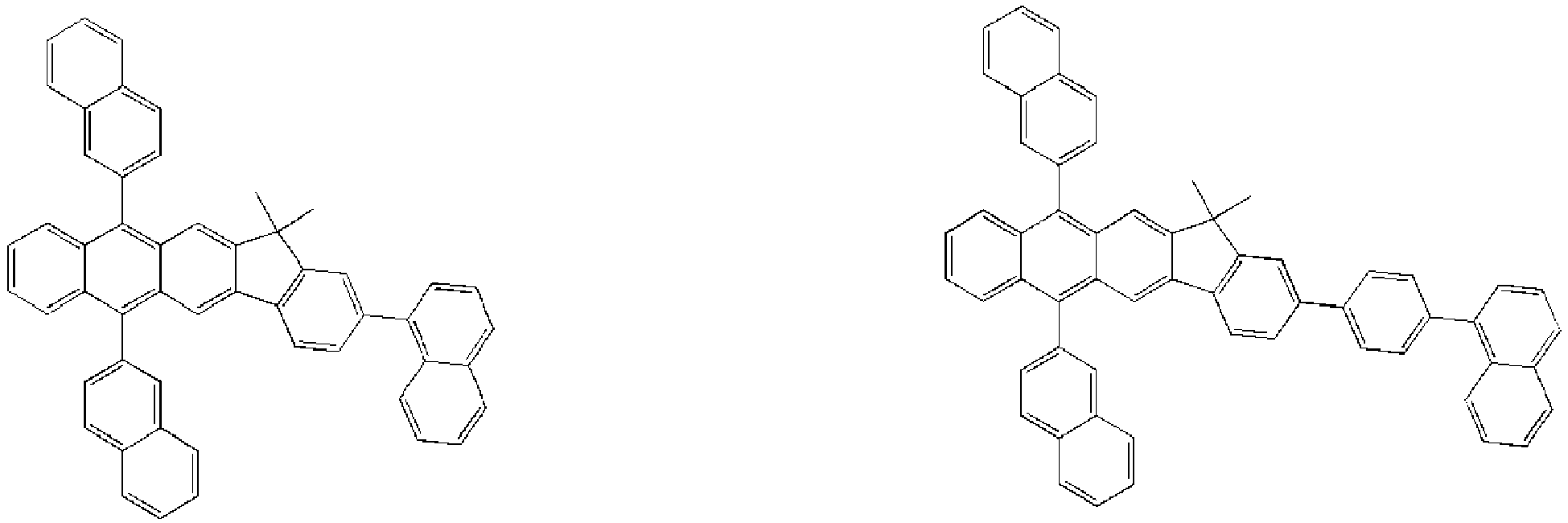
- When the organic light-emitting device is a full color organic light-emitting device, the emission layer may be patterned into a red emission layer, a green emission layer, and a blue emission layer. In some embodiments, the EML may have a stack structure including a red emission layer, a green emission layer, and/or a blue emission layer that are stacked upon one another to emit white light.
- The EML of the light-emitting device may include a dopant, which may be a fluorescent dopant emitting light based on fluorescence mechanism, or a phosphorescent dopant emitting light based on phosphorescence mechanism. When the EML includes a fluorescent dopant, the fluorescent dopant may include the amine-based compound of Formula 1 above.
- For full color emission, the organic light-emitting device may further include a known dopant, in addition to the amine-based compound of Formula 1 above. For example, the blue emission layer of the organic light-emitting device may include the amine-based compound of Formula 1 as a dopant, and the green and red emission layers may include a known phosphorescent dopant, which will be described below.
- The known phosphorescent dopant may include an organometallic complex including a transition metal, for example, iridium (Ir), platinum (Pt), osmium (Os), or rhodium (Rh).
- Examples of the red dopant are compounds represented by the following formulae.


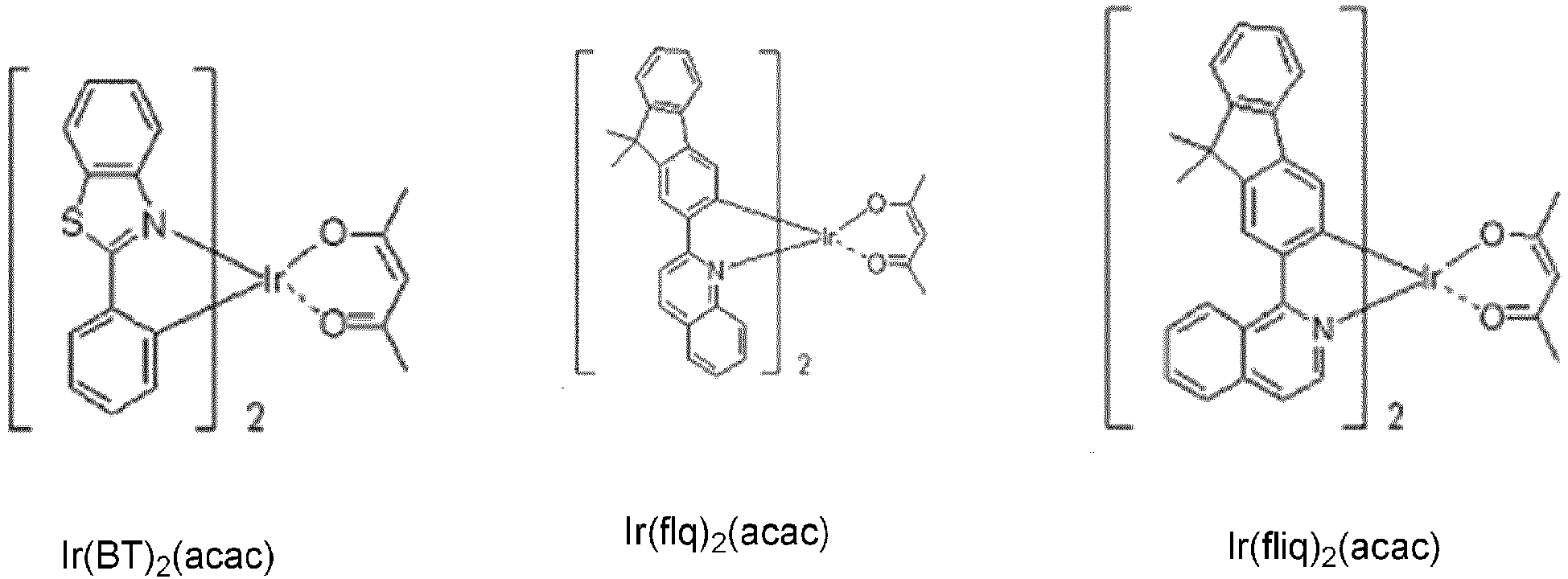

- Examples of the green dopant are compounds represented by the following formulae.


- Examples of known dopants that may be used in the EML are organometallic complexes represented by the following formulae.


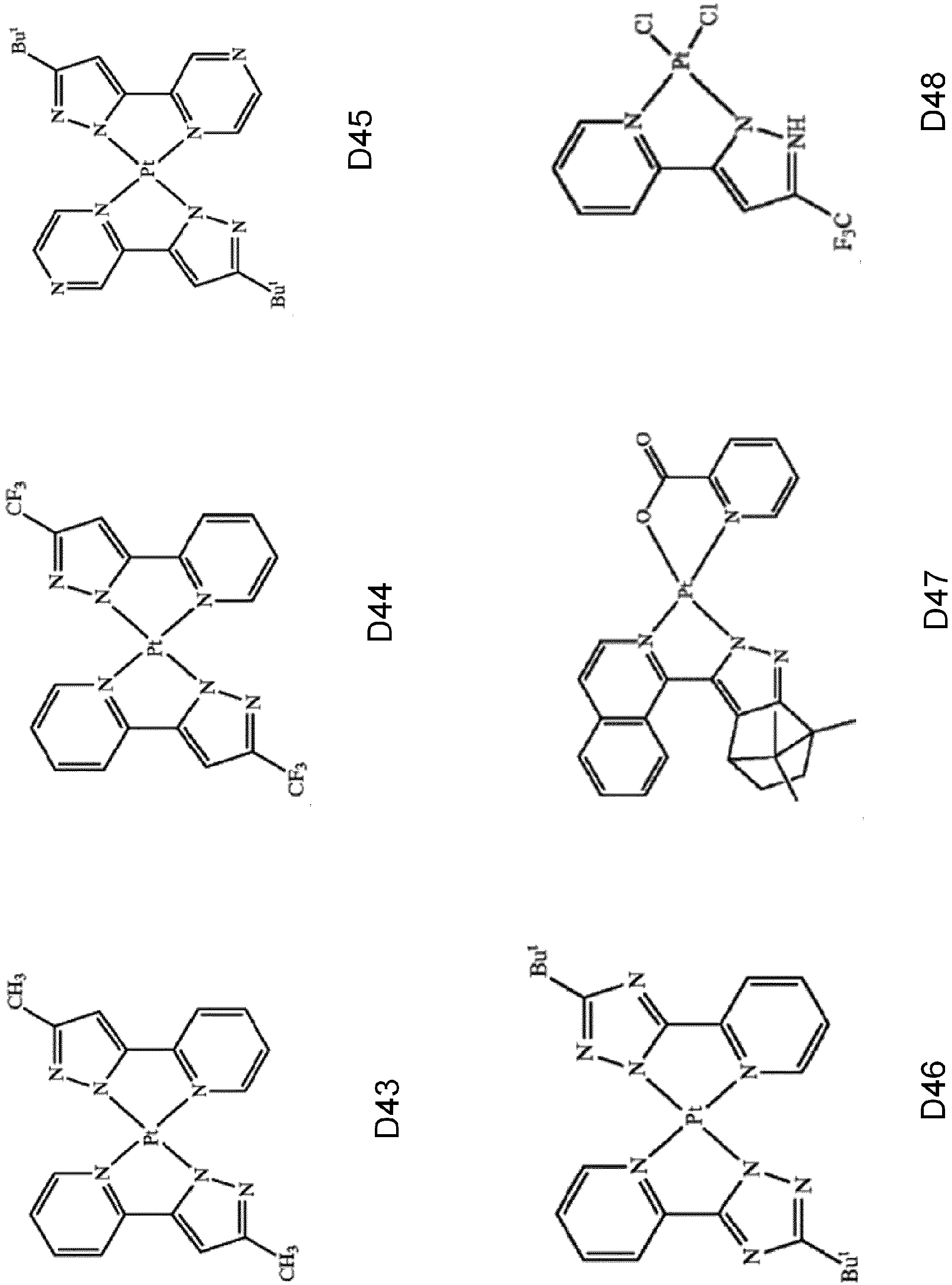


- When the EML includes both a host and a dopant, the amount of the dopant may be from about 0.01 to about 15 parts by weight based on 100 parts by weight of the host.
- The thickness of the EML may be about 100 Å to about 1000 Å, and in some embodiments, may be from about 200 Å to about 600 Å. When the thickness of the EML is within these ranges, the EML may have good light emitting ability without a substantial increase in driving voltage.
- Then, an ETL may be formed on the EML by vacuum deposition, spin coating, casting, or the like. When the ETL is formed using vacuum deposition or spin coating, the deposition and coating conditions may be similar to those for the formation of the HIL, though the deposition and coating conditions may vary according to a compound that is used to form the ETL.
- A material for the ETL may be any known material that can stably transport electrons injected from an electron injecting electrode (cathode). Examples of materials for the ETL are a quinoline derivative, such as tris(8-quinolinorate)aluminum (Alq3), TAZ (refer to a formula below), BAlq (refer to a formula below), beryllium bis(benzoquinolin-10-olate (Bebq2), 9,10-di(naphthalene-2-yl)anthracene (DNA, refer to a formula below), Compound 201, and Compound 202.
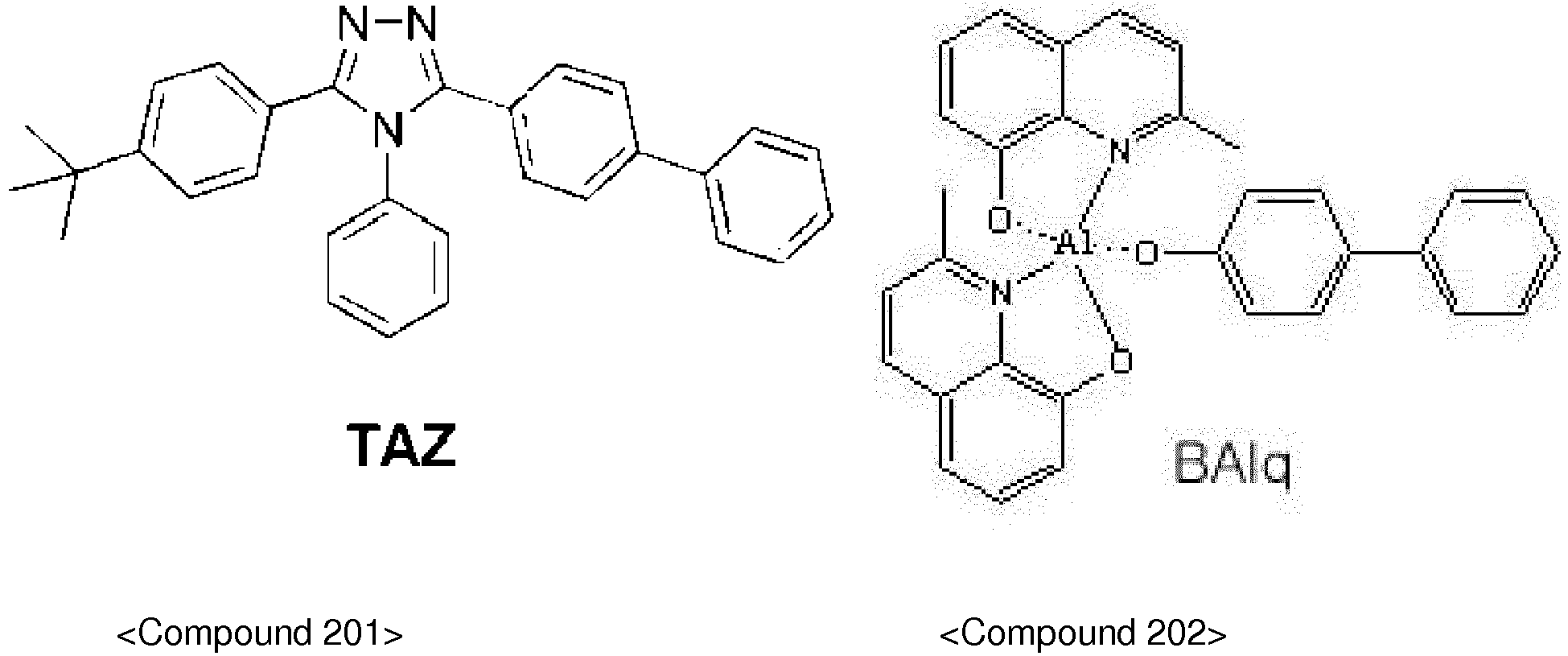


- The thickness of the ETL may be from about 100Å to about 1,000 Å, and in some embodiments, may be from about 150 Å to about 500 Å. When the thickness of the ETL is within these ranges, the ETL may have satisfactory electron transporting ability without a substantial increase in driving voltage.
- In some embodiments the ETL may further include a metal-containing material, in addition to the above-listed known electron-transporting organic compounds.
- The metal-containing material may include a lithium (Li) complex. Examples of the Li complex are lithium quinolate (LiQ) and Compound 203 below:


- In addition, the EIL, which facilitates injection of electrons from the second electrode (cathode) 17, may be formed on the ETL.
- Examples of materials for forming the EIL are LiF, NaCl, CsF, Li2O, and BaO, which are known in the art. The deposition and coating conditions for forming the EIL may be similar to those for the formation of the HIL, though the deposition and coating conditions may vary depending on the material that is used to form the EIL.
- The thickness of the EIL may be from about 1Å to about 100 Å, and in some embodiments, may be from about 3Å to about 90Å. When the thickness of the EIL is within these ranges, the EIL may have satisfactory electron injection ability without a substantial increase in driving voltage.
- The
second electrode 17 is disposed on theorganic layer 15. Thesecond electrode 17 may be a cathode. A material for thesecond electrode 17 may be a metal, an alloy, or an electrically conductive compound, which have a low work function, or a combination thereof. Examples of the material for thesecond electrode 17 are lithium (Li), magnesium (Mg), aluminum (Al), aluminum-lithium (Al-Li), calcium (Ca), magnesium-indium (Mg-In), and magnesium-silver (Mg-Ag), or the like. In some embodiments, to manufacture a top-emission light-emitting device, the second electrode 177 may be formed as a transmissive electrode from, for example, indium tin oxide (ITO) or indium zinc oxide (IZO). - Although the organic light-emitting device of
FIG. 1 is described above, embodiments are not limited thereto. - For example, in the organic light-emitting device of
FIG. 1 , thefirst electrode 13 may be a cathode, and thesecond electrode 17 may be an anode. The electron transport region may be disposed between thefirst electrode 13 and the EML and the hole transport region may be disposed between the EML and thesecond electrode 17. - A hole blocking layer (HBL) may be formed between the EML and the ETL by using vacuum deposition, spin coating, casting, Langmuir-Blodgett (LB) deposition, or the like, in order to prevent diffusion of triplet excitons or holes into the ETL. When the HBL is formed using vacuum deposition or spin coating, the conditions for deposition and coating may be similar to those for the formation of the HIL, although the conditions for deposition and coating may vary according to the material that is used to form the HBL. Any known hole-blocking material may be used. Non-limiting examples of hole-blocking materials are oxadiazole derivatives, triazole derivatives, and phenanthroline derivatives. For example, bathocuproine (BCP) represented by the following formula may be used as a material for forming the HBL.
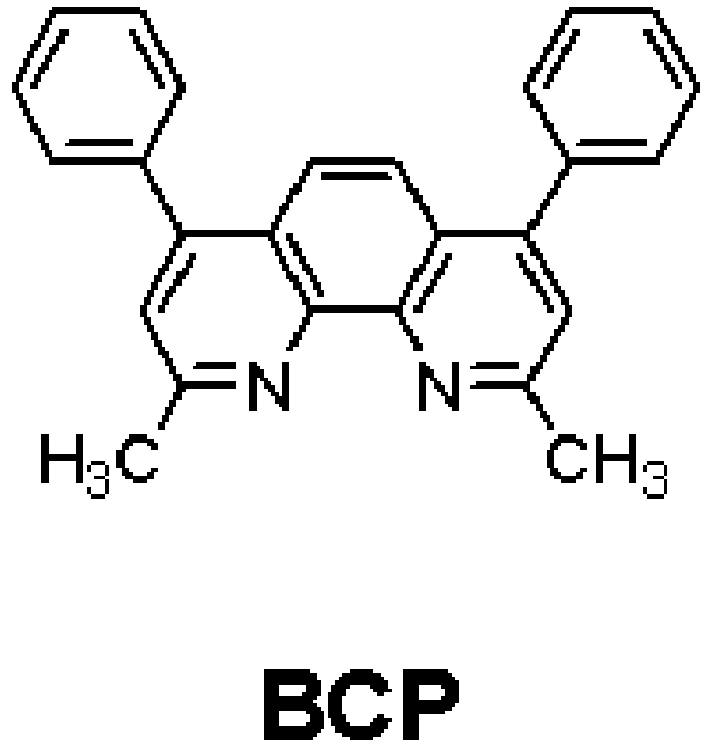
- The thickness of the HBL may be from about 20Å to about 1000Å, and in some embodiments, may be from about 30Å to about 300Å. When the thickness of the HBL is within these ranges, the HBL may have improved hole blocking ability without a substantial increase in driving voltage.
- As used herein, a C1-C60 alkyl group may be a linear or branched C1-C60 alkyl group, including, for example, a methyl group, an ethyl group, a propyl group, an isobutyl group, a sec-butyl group, a pentyl group, an iso-amyl group, and a hexyl group. A C1-C60 alkylene group refers to a divalent group having the same structure as the C1-C60 alkyl group.
- As used herein, a C1-C60 alkoxy group refer to a moiety represented by -OA (where A is a C1-C60 alkyl group). Examples of the C1-C60 alkoxy group are a methoxy group, an ethoxy group, and an isopropyloxy group.
- As used herein, a C2-C60 alkenyl group refers to a moiety with at least one carbon double bond in the middle or at a terminal of thereof. Examples of the C2-C60 alkenyl group are an ethenyl group, a propenyl group, and a butenyl group. A C2-C60 alkenylene group refers to a divalent group having the same structure as the C1-C60 alkenyl group.
- As used herein, a C2-C60 alkynyl group refers to a moiety with at least one carbon-carbon triple bond in the middle or at a terminal thereof. Examples of the C2-C60 alkynyl group are an ethenyl group and a propynyl group. A C2-C60 alkynylene group refers to a divalent group having the same structure as the C1-C60 alkynyl group.
- As used herein, a C3-C10 cycloalkyl group refers to a cyclic alkyl group including 3 to 10 carbon atoms. Examples of the C3-C10 cycloalkyl group are a cyclopentyl group, a cyclohexyl group, and a cycloheptyl group. A C3-C10 cycloalkylene group refers to a divalent group having the same structure as the C3-C10 cycloalkyl group.
- As used herein, a C3-C10 heterocycloalkyl group refers to a C3-C10 cycloalkyl group including at least one heteroatom of N, S, O, or P. Examples of the C3-C10 heterocycloalkyl group are a tetrahydrofuranyl group and a tetrahydrothiophenyl group. A C3-C10 heterocycloalkylene group refers to a divalent group having the same structure as the C3-C10 heterocycloalkyl group.
- As used herein, a C3-C10 cycloalkenyl group refers to a cyclic alkenyl group including 3 to 10 carbon atoms. Examples of the C3-C10 cycloalkenyl group are a cyclopentenyl group, a cyclohexenyl group, and a cycloheptenyl group. A C3-C10 cycloalkenylene group refers to a divalent group having the same structure as the C3-C10 cycloalkenyl group.
- As used herein, a C3-C10 heterocycloalkenyl group refers to a C3-C10 cycloalkenyl group with at least one heteroatom of N, S, O, or P. Examples of the C3-C10 heterocycloalkenyl group are a 2,3-dihydrofuranyl group and a 2,3-dihydrothiophenyl group. A C3-C10 heterocycloalkenylene group refers to a divalent group having the same structure as the C3-C10 heterocycloalkenyl group.
- As used herein, a C6-C60 aryl group refers to a monovalent carbocyclic aromatic system including 6 to 60 carbon atoms and at least one aromatic ring. A C6-C60 arylene group refers to a divalent group having the same structure as the C6-C60 aryl group. When the C6-C60 aryl group and the C6-C60 arylene group have at least two rings, the at least two rings may be fused together.
- Examples of the "C6-C60 aryl group" and "a C6-C60 aryl group substituted with at least one selected from a deuterium atom, a halogen atom, a hydroxyl group, a cyano group, a nitro group, an amino group, an amidino group, a hydrazine, a hydrazone, a carboxylic acid group or a salt thereof, a sulfonic acid group or a salt thereof, a phosphoric acid group or a salt thereof, a C1-C60 alkyl group, a C2-C60 alkenyl group, a C2-C60 alkynyl group, a C1-C60 alkoxy group, a C3-C10 cycloalkyl group, a C3-C10 heterocycloalkyl group, a C3-C10 cycloalkenyl group, a C3-C10 heterocycloalkenyl group, a C6-C60 aryl group, a C6-C60 aryloxy group, a C6-C60 arylthio group, a C2-C60 heteroaryl group, - N(Q11)(Q12), and -Si(Q13)(Q14)(Q15) " are a phenyl group, a C1-C10 alkylphenyl group (for example, an ethylphenyl group), a C1-C10 alkylbiphenyl group (for example, an ethylbiphenyl group), a halophenyl group (for example, o-, m- , or p-fluorophenyl group, or a dichlorophenyl group), a dicyanophenyl group, a trifluoromethoxyphenyl group, o-, m-, and p-tolyl group, o-, m- and p-cumenyl group, a mesityl group, a phenoxyphenyl group (α,α-dimethylbenzene), a phenyl group, a (N,N'-dimethyl)aminophenyl group, a N,N'-diphenyl)aminophenyl group, a pentalenyl group, an indenyl group, a naphthyl group, a halonaphthyl group (for example, a fluoronaphthyl group), a C1-C10 alkylnaphthyl group (for example, a methylnaphthyl group), a C1-C10 alkoxynaphthyl group (for example, a methoxynaphthyl group), an anthracenyl group, an azulenyl group, a heptalenyl group, an acenaphthyl group, a phenalenyl group, a fluorenyl group, a methylanthracenyl group, a phenanthrenyl group, a triphenylenyl group, a pyrenyl group, a chrysenyl group, an ethyl-chrysenyl group, a picenyl group, a perylenyl group, a chloroperylenyl group, a pentaphenyl group, a pentacenyl group, a tetraphenylenyl group, a hexaphenyl group, a hexacenyl group, a rubicenyl group, a coronenyl group, a trinaphthylenyl group, a heptaphenyl group, a heptacenyl group, a pyranthrenyl group, and an ovalenyl group.
- As used herein, a C2-C60 heteroaryl group refers to a monovalent carbocyclic group having at least one aromatic ring having at least one of the heteroatoms selected from N, O, P, and S. A C2-C60 heteroarylene group refers to a divalent group having the same structure as the C2-C60 heteroaryl group. When the C2-C60 heteroaryl group and the C2-C60 heteroarylene group have at least two rings, the at least two rings may be fused together.
- Examples of the C2-C60 heteroaryl group are a pyrazolyl group, an imidazolyl group, an oxazolyl group, a thiazolyl group, a triazolyl group, a tetrazolyl group, an oxadiazolyl group, a pyridinyl group, a pyridazinyl group, a pyrimidinyl group, a triazinyl group, a carbazolyl group, an indolyl group, a quinolinyl group, an isoquinolinyl group, a benzoimidazolyl group, an imidazopyridinyl group and an imidazopyrimidinyl group.
- As used herein, a C6-C60 aryloxy group indicates -OA2 (where A2 is a C6-C60 aryl group described above), and a C6-C60 arylthio group indicates -SA3 (where A3 is a C6-C60 aryl group described above).
- Hereinafter, embodiments will be described in detail with reference to the following synthesis examples and other examples.
-

- 160.5 mg (0.175 mmol) of Pd2(dba)3 and 70.9 mg (0.350 mmol) of t-Bu3P were dissolved in 50 mL of o-xylene, and then stirred at room temperature for about 10 minutes. 5 g (17.52 mmol) of 2,3-diphenylbenzofuran-6-amine (Intermediate I-1), 3.9 g (19.28 mmol) of iodobenzene, and 1.01 g (10.51 mmol) of t-BuONa were added into the mixture and refluxed at about 160°C for about 48 hours while stirring. After completion of the reaction, 20 mL of cool distilled water was added into the reaction product, followed by extraction with ethylacetate, drying with magnesium sulfate, filtering, and removing the solvent. The resulting product was purified by column chromatography to obtain 4.82 g of Intermediate I-2 (N,2,3-triphenylbenzofuran-6-amine) (Yield: 76%).
- 76.3 mg (0.083 mmol) of Pd2(dba)3 and 33.7 mg (0.167 mmol) of t-Bu3P were dissolved in 30 mL of o-xylene, and then stirred at room temperature for about 10 minutes. 3 g (8.33 mmol) of 1,6-dibromopyrene, 3.3 g (9.17 mmol) of Intermediate I-2, and 480 mg (5.00 mmol) of t-BuONa were added into the mixture and refluxed at about 160°C for about 48 hours while stirring. After completion of the reaction, 20 mL of cool distilled water was added into the reaction product, followed by extraction with ethylacetate, drying with magnesium sulfate, filtering, and removing the solvent. The resulting product was purified by column chromatography to obtain 5.64 g of Compound 1 (N1,N6-bis(2,3-diphenylbenzofuran-6-yl)-N1,N6-diphenylpyrene-1,6-diamine) (Yield: 73%).
1H NMR (300 MHz, a CDCl3), d (ppm): 8.99-8.87 (4H, m), 8.32-8.26 (2H, d), 8.26-8.20 (2H, m), 8.03-7.97 (2H, d), 7.95-7.85 (6H, m), 7.75-7.68 (2H, m), 7.63-7.48 (10H, m), 7.47-7.36 (6H, m), 7.31-7.23 (4H, t), 7.19-7.10 (4H, m), 7.01-6.93 (2H, m).
EI-MS, m/e, calcd for C68H44N2O2 920.34, found 920.38. -

- 5.68 g (Yield 74%) of Intermediate I-3 (N-([1,1'-biphenyl]-4-yl)-2,3-diphenylbenzofuran-6-amine) was obtained in the same manner as in the synthesis of Intermediate I-2 in Synthesis Example 1, except that 5.4 g (19.28 mmol) of 4-iodo-1,1'-biphenyl, instead of iodobenzene, was used.
- 6.48 g (Yield 72%) of Compound 2 (N1,N6-di([1,1'-biphenyl]-4-yl)-N1,N6-bis(2,3-diphenylbenzofuran-6-yl)pyrene-1,6-diamine) was obtained in the same manner as in the synthesis of Compound 1 in Synthesis Example 1, except that 4.0 g (9.17 mmol) of Intermediate I-3, instead of Intermediate I-2, was used.
1H NMR (300 MHz, a CDCl3), d (ppm): 9.00-8.90 (4H, m), 8.69-8.59 (4H, m), 8.44-8.37 (2H, d), 8.26-8.20 (2H, m), 8.14-8.07 (2H, m), 8.00-7.94 (4H, d), 7.93-7.86 (4H, m), 7.65-7.55 (10H, m), 7.55-7.48 (4H, t), 7.48-7.34 (10H, m), 7.32-7.25 (2H, m), 7.22-7.12 (4H, m).
EI-MS, m/e, calcd for C80H52N2O2 1072.40, found 1072.46. -

- 5.26 g (Yield 68%) of Intermediate I-4 (2,3-diphenyl-N-(4-(pyridin-4-yl)phenyl)benzofuran-6-amine) was obtained in the same manner as in the synthesis of Intermediate I-2 in Synthesis Example 1, except that 5.4 g (19.28 mmol) of 4-(4-iodophenyl)pyridine, instead of iodobenzene, was used.
- 6.82 g (Yield 76%) of Compound 3 (N1,N6-bis(2,3-diphenylbenzofuran-6-yl)-N1,N6-bis(4-(pyridin-4-yl)phenyl)pyrene-1,6-diamine) was obtained in the same manner as in the synthesis of Compound 1 in Synthesis Example 1, except that 4.0 g (9.17 mmol) of Intermediate I-4, instead of Intermediate I-2, was used.
1H NMR (300 MHz, a CDCl3), d (ppm): 9.00-8.92 (4H, m), 8.89-8.82 (4H, d), 8.53-8.47 (4H, d), 8.43-8.37 (2H, d), 8.22-8.17 (2H, m), 8.12-8.06 (2H, m), 7.96-7.87 (8H, m), 7.64-7.55 (6H, m), 7.54-7.48 (4H, t), 7.48-7.38 (4H, m), 7.38-7.33 (4H, d), 7.31-7.26 (2H, m), 7.22-7.13 (4H, m).
EI-MS, m/e, calcd for C78H50N4O2 1074.39, found 1074.43. -

- 4.86 g (Yield 69%) of Intermediate I-6 (N-(naphthalen-2-yl)-2,3-diphenylbenzo[b]thiophen-6-amine) was obtained in the same manner as in the synthesis of Intermediate I-2 in Synthesis Example 1, except that 5 g (16.59 mmol) of 2,3-diphenylbenzo[b]thiophen-6-amine (Intermediate I-5) and 4.6 g (18.25 mmol) of 2-iodonaphthalene, instead of 2,3-diphenylbenzofuran-6-amine and iodobenzene, respectively, were used.
- 6.97 g (Yield 79%) of Compound 16 (N1,N6-bis(2,3-diphenylbenzo[b]thiophen-6-yl)-N1,N6-di(naphthalen-2-yl)pyrene-1,6-diamine) was obtained in the same manner as in the synthesis of Compound 1 in Synthesis Example 1, except that 3.9 g (9.17 mmol) of Intermediate I-6, instead of Intermediate I-2, was used.
1H NMR (300 MHz, a CDCl3), d (ppm): 9.08-9.01 (2H, m), 8.70-8.64 (2H, d), 8.33-8.24 (2H, m), 8.19-8.09 (6H, m), 8.04-7.95 (6H, m), 7.92-7.85 (2H, m), 7.81-7.72 (6H, m), 7.65-7.60 (2H, d), 7.60-7.47 (10H, m), 7.44-7.34 (4H, m), 7.33-7.29 (2H, m), 7.29-7.23 (2H, d), 7.22-7.15 (2H, m).
EI-MS, m/e, calcd for C76H48N2S2 1052.33, found 1052.36. -

- 4.74 g (Yield 76%) of Intermediate I-7 (N,2,3-triphenylbenzo[b]thiophen-6-amine) was obtained in the same manner as in the synthesis of Intermediate I-4 in Synthesis Example 4, except that 3.7 g (18.25 mmol) of iodobenzene, instead of 2-iodonaphthalene, was used.
- 5.68 g (Yield 85%) of Compound 37 (N,N'-(anthracene-9,10-diylbis(4,1-phenylene))bis(N,2,3-triphenylbenzo[b]thiophen-6-amine)) was obtained in the same manner as in the synthesis of Compound 16 in Synthesis Example 4, except that 3 g (6.14 mmol) of 9,10-bis(4-bromophenyl)anthracene) and 2.6 g (6.76 mmol) of Intermediate I-7, instead of 1,6-dibromopyrene and Intermediate I-6, respectively, were used.
1H NMR (300 MHz, a CDCl3), d (ppm): 9.91-9.79 (4H, m), 8.11-8.02 (2H, d), 7.99-7.92 (4H, m), 7.92-7.86 (2H, d), 7.86-7.79 (4H, m), 7.58-7.53 (4H, t), 7.52-7.48 (4H, d), 7.47-7.37 (14H, m), 7.36-7.29 (2H, m), 7.14-7.07 (4H, t), 7.06-6.99 (4H, m), 6.87-6.79 (2H, m).
EI-MS, m/e, calcd for C78H52N2S2 1080.36, found 1080.42. -

- 5.82 g (Yield 86%) of Compound 64 (N2,N7-bis(2,3-diphenylbenzo[b]thiophen-6-yl)-N2,N7,9,9-tetraphenyl-9H-fluorene-2,7-diamine) was obtained in the same manner as in the synthesis of Compound 37 in Synthesis Example 5, except that 3 g (6.29 mmol) of 2,7-dibromo-9,9-diphenyl-9H-fluorene, instead of 1,6-dibromopyrene, was used.
1H NMR (300 MHz, a CDCl3), d (ppm): 9.89-9.81 (2H, d), 8.14-8.09 (2H, m), 7.82-7.72 (8H, m), 7.71-7.66 (2H, m), 7.59-7.55 (2H, m), 7.50-7.42 (10H, m), 7.40-7.20 (18, m), 7.18-7.12 (4H, m), 7.12-7.07 (2H, m), 6.99-6.93 (2H, m).
EI-MS, m/e, calcd for C77H52N2S2 1068.36, found 1068.41 -

- 5.42 g (Yield 74%) of Compound 82 (N6,N12-bis(2,3-diphenylbenzofuran-6-yl)-N6,N12-diphenylchrysene-6,12-diamine) was obtained in the same manner as in the synthesis of Compound 1 in Synthesis Example 1, except that 3 g (7.77 mmol) of 6,12-dibromochrysene, instead of 1,6-dibromopyrene, was used, and the amount of Intermediate I-2 was changed to 3.1 g (8.55 mmol).
1H NMR (300 MHz, a CDCl3), d (ppm): 8.77-8.70 (2H, m), 8.53-8.44 (4H, m), 8.06-7.99 (4H, m), 7.83-7.78 (2H, m), 7.77-7.59 (14H, m), 7.57-7.50 (4H, m), 7.49-7.41 (2H, m), 7.28-7.19 (4H, t), 7.15-7.06 (4H, m), 6.99-6.89 (4H, m), 6.42-6.34 (2H, m).
EI-MS, m/e, calcd for C70H46N2O2 946.36, found 946.36 -

- 5.84 g (Yield 76%) of Compound 91 (N6,N12-bis(2,3-diphenylbenzofuran-6-yl)-N6,N12-diphenylchrysene-6,12-diamine) was obtained in the same manner as in the synthesis of Compound 37 in Synthesis Example 5, except that 3 g (7.77 mmol) of 6,12-dibromochrysene, instead of 1,6-dibromopyrene, was used, and the amount of Intermediate I-7 was changed to 3.2 g (8.54 mmol).
1H NMR (300 MHz, a CDCl3), d (ppm): 8.85-8.76 (2H, m), 8.19-8.11 (4H, m), 8.00-7.93 (4H, m), 7.84-7.75 (6H, m), 7.75-7.66 (4H, m), 7.52-7.42 (10H, m), 7.42-7.31 (6H, m), 7.29-7.21 (4H, m), 7.17-7.10 (4H, m), 6.99-6.90 (2H, m).
EI-MS, m/e, calcd for C70H46N2S2 978.31, found 978.38. - To manufacture an anode, a
corning 15 Ω/cm2 (1200 A) ITO glass substrate was cut to a size of 50 mm x 50 mm x 0.7 mm and then sonicated in isopropyl alcohol and pure water each for five minutes, and then cleaned by irradiation of ultraviolet rays for 30 minutes and exposure to ozone. The resulting glass substrate was loaded into a vacuum deposition device. - 2-TNATA was vacuum-deposited on the ITO anode to form an HIL having a thickness of 600Å on the anode, and then 4,4'-bis[N-(1-naphthyl)-N-phenylamino]biphenyl (NPB) was vacuum-deposited on the HIL to form a HTL having a thickness of 300Å.

- ADN (host) and Compound 1 (dopant) were co-deposited in a weight ratio of about 98:2 on the HTL to form an EML having a thickness of about 400Å, followed by depositing Alq3 on the EML to form an ETL having a thickness of about 300Å. LiF was deposited on the ETL to form an EIL having a thickness of about 10Å, and Al was deposited on the EIL to form a cathode having a thickness of about 3000Å, thereby completing the manufacture of an organic light-emitting device.
- An organic light-emitting device was manufactured in the same manner as in Example 1, except that Compound 2, instead of Compound 1, was used as a dopant in forming the EML.
- An organic light-emitting device was manufactured in the same manner as in Example 1, except that Compound 3, instead of Compound 1, was used as a dopant in forming the EML.
- An organic light-emitting device was manufactured in the same manner as in Example 1, except that Compound 16, instead of Compound 1, was used as a dopant in forming the EML.
- An organic light-emitting device was manufactured in the same manner as in Example 1, except that Compound 37, instead of Compound 1, was used as a dopant in forming the EML.
- An organic light-emitting device was manufactured in the same manner as in Example 1, except that Compound 64, instead of Compound 1, was used as a dopant in forming the EML.
- An organic light-emitting device was manufactured in the same manner as in Example 1, except that Compound 82, instead of Compound 1, was used as a dopant in forming the EML.
- An organic light-emitting device was manufactured in the same manner as in Example 1, except that Compound 91, instead of Compound 1, was used as a dopant in forming the EML.
- An organic light-emitting device was manufactured in the same manner as in Example 1, except that DPVBi, instead of Compound 1, was used as a dopant in forming the EML.

- An organic light-emitting device was manufactured in the same manner as in Example 1, except that Compound A below, instead of Compound 1, was used as a dopant in forming the EML.

- An organic light-emitting device was manufactured in the same manner as in Example 1, except that Compound B below, instead of Compound 1, was used as a dopant in forming the EML.

- An organic light-emitting device was manufactured in the same manner as in Example 1, except that Compound C below, instead of Compound 1, was used as a dopant in forming the EML.

- An organic light-emitting device was manufactured in the same manner as in Example 1, except that Compound D below, instead of Compound 1, was used as a dopant in forming the EML.

- An organic light-emitting device was manufactured in the same manner as in Example 1, except that Compound E below, instead of Compound 1, was used as a dopant in forming the EML.

- Efficiencies and color purities of the organic light-emitting devices of Examples 1 to 8 and Comparative Examples 1 to 6 were measured using a voltage source-measure unit (Kethley SMU 236) as a power supply and a PR650 (Spectroscan) Source Measurement Unit (available from Photo Research, Inc.). The results are shown in Table 1.
[Table 1] Example Host Dopant Current density (mA/cm2) Emission efficiency (cd/A) Color coordinates CIE x CIE y Example 1 ADN Compound 1 10 7.2 0.14 0.12 Example 2 ADN Compound 2 10 6.7 0.15 0.11 Example 3 ADN Compound 3 10 6.9 0.14 0.12 Example 4 ADN Compound 16 10 7.1 0.15 0.13 Example 5 ADN Compound 37 10 7.5 0.15 0.11 Example 6 ADN Compound 64 10 6.8 0.15 0.10 Example 7 ADN Compound 82 10 6.6 0.14 0.11 Example 8 ADN Compound 91 10 7.1 0.15 0.12 Comparative Example 1 ADN DPVBi 10 4.3 0.15 0.20 Comparative Example 2 ADN Compound A 10 4.1 0.15 0.21 Comparative Example 3 ADN Compound B 10 4.4 0.14 0.19 Comparative Example 4 ADN Compound C 10 4.3 0.15 0.22 Comparative Example 5 ADN Compound D 10 4.5 0.15 0.21 Comparative Example 6 ADN Compound E 10 4.4 0.15 0.24 - Referring to Table 1, the organic light-emitting devices of Examples 1 to 8 were found to have improved emission efficiencies and improved color purities, compared to the organic light-emitting devices of Comparative Examples 1 to 6.
- As described above, according to the one or more embodiments, an amine-based compound of Formula 1 above have improved electrical characteristics and improved thermal stability. Accordingly, an organic light-emitting device including the amine-based compound has improved emission efficiency and improved color purity characteristics.
Claims (15)
- An amine-based compound represented by Formula 1 below:
 a pentalenylene group, an indenylene group, a naphthylene group, an azulenylene group, a heptalenylene group, an indacenylene group, an acenaphthylene group, a fluorenylene group, a spiro-fluorenylene group, a phenalenylene group, a phenanthrenylene group, an anthracenylene group, a fluoranthrenylene group, a triphenylenylene group, a pyrenylene group, a chrysenylene group, a naphthacenylene group, a picenylene group, a perylenylene group, a pentaphenylene group, a hexacenylene group, and a benzofluoranthenylene group, anda pentalenylene group, an indenylene group, a naphthylene group, an azulenylene group, a heptalenylene group, an indacenylene group, an acenaphthylene group, a fluorenylene group, a spiro-fluorenylene group, a phenalenylene group, a phenanthrenylene group, an anthracenylene group, a fluoranthrenylene group, a triphenylenylene group, a pyrenylene group, a chrysenylene group, a naphthacenylene group, a picenylene group, a perylenylene group, a pentaphenylene group, a hexacenylene group, and a benzofluoranthenylene group, each substituted with at least one of a deuterium atom, a halogen atom, a hydroxyl group, a cyano group, a nitro group, an amino group, an amidino group, a hydrazine, a hydrazone, a carboxylic acid group or a salt thereof, a sulfonic acid group or a salt thereof, a phosphoric acid group or a salt thereof, a C1-C60 alkyl group, a C2-C60 alkenyl group, a C2-C60 alkynyl group, a C1-C60 alkoxy group, a C3-C10cycloalkyl group, a C3-C10 heterocycloalkyl group, a C3-C10 cycloalkenyl group, a C3-C10 heterocycloalkenyl group, a C6-C60 aryl group, a C6-C60 aryloxy group, a C6-C60 arylthio group, a C2-C60 heteroaryl group, - N(Q11)(Q12), and -Si(Q13)(Q14)(Q15);X1 is selected from N-[(L1)a1-(R1)b1], S, and O;X2 is selected from N-[(L2)a2-R2], S, and O;L1, L2, L11, L12, L21, and L22 are each independently selected froma C3-C10 cycloalkylene group, a C3-C10 heterocycloalkylene group, a C3-C10 cycloalkenylene group, a C3-C10 heterocycloalkenylene group, a C6-C60 arylene group, and a C2-C60 heteroarylene group, anda C3-C10cycloalkylene group, a C3-C10 heterocycloalkylene group, a C3-C10 cycloalkenylene group, a C3-C10 heterocycloalkenylene group, a C6-C60 arylene group, and a C2-C60 heteroarylene group, each substituted with at least one selected from a deuterium atom, a halogen atom, a hydroxyl group, a cyano group, a nitro group, an amino group, an amidino group, a hydrazine, a hydrazone, a carboxylic acid group or a salt thereof, a sulfonic acid group or a salt thereof, a phosphoric acid group or a salt thereof, a C1-C60 alkyl group, a C2-C60 alkenyl group, a C2-C60 alkynyl group, a C1-C60alkoxy group, a C3-C10 cycloalkyl group, a C3-C10 heterocycloalkyl group, a C3-C10 cycloalkenyl group, a C3-C10 heterocycloalkenyl group, a C6-C60 aryl group, a C6-C60 aryloxy group, a C6-C60 arylthio group, a C2-C60 heteroaryl group, -N(Q11)(Q12), and -Si(Q13)(Q14)(Q15);a1, a2, a11, a12, a21, and a22 are each independently an integer from 0 to 5;R1, R2, R11, and R12 are each independently selected froma hydrogen atom, a deuterium atom, a halogen atom, a hydroxyl group, a cyano group, a nitro group, an amino group, an amidino group, a hydrazine, a hydrazone, a carboxylic acid group or a salt thereof, a sulfonic acid group or a salt thereof, a phosphoric acid group or a salt thereof, a C1-C60 alkyl group, a C2-C60 alkenyl group, and a C2-C60 alkynyl group,a C1-C60 alkyl group, a C2-C60 alkenyl group, and a C2-C60 alkynyl group, each substituted with at least one of a deuterium atom, a halogen atom, a hydroxyl group, a cyano group, a nitro group, an amino group, an amidino group, a hydrazine, a hydrazone, a carboxylic acid group or a salt thereof, a sulfonic acid group or a salt thereof, a phosphoric acid group or a salt thereof, a C3-C10 cycloalkyl group, a C3-C10 heterocycloalkyl group, a C3-C10 cycloalkenyl group, a C3-C10 heterocycloalkenyl group, a C6-C60 aryl group, a C6-C60 aryloxy group, a C6-C60 arylthio group, and a C2-C60 heteroaryl group,a C3-C10 cycloalkyl group, a C3-C10 heterocycloalkyl group, a C3-C10 cycloalkenyl group, a C3-C10 heterocycloalkenyl group, a C6-C60 aryl group, and a C2-C60 heteroaryl group, anda C3-C10 cycloalkyl group, a C3-C10 heterocycloalkyl group, a C3-C10 cycloalkenyl group, a C3-C10 heterocycloalkenyl group, a C6-C60 aryl group, and a C2-C60 heteroaryl group, each substituted with at least one selected from a deuterium atom, a halogen atom, a hydroxyl group, a cyano group, a nitro group, an amino group, an amidino group, a hydrazine, a hydrazone, a carboxylic acid group or a salt thereof, a sulfonic acid group or a salt thereof, a phosphoric acid group or a salt thereof, a C1-C60 alkyl group, a C2-C60 alkenyl group, a C2-C60 alkynyl group, a C1-C60alkoxy group, a C3-C10 cycloalkyl group, a C3-C10 heterocycloalkyl group, a C3-C10 cycloalkenyl group, a C3-C10 heterocycloalkenyl group, a C6-C60 aryl group, a C6-C60 aryloxy group, a C6-C60 arylthio group, and a C2-C60 heteroaryl group;R3 to R6 are each independently selected froma hydrogen atom, a deuterium atom, a halogen atom, a hydroxyl group, a cyano group, a nitro group, an amino group, an amidino group, a hydrazine, a hydrazone, a carboxylic acid group or a salt thereof, a sulfonic acid group or a salt thereof, a phosphoric acid group or a salt thereof, a C1-C60 alkyl group, a C2-C60 alkenyl group, a C2-C60 alkynyl group, and a C1-C60 alkoxy group,a C1-C60 alkyl group, a C2-C60 alkenyl group, a C2-C60 alkynyl group, and a C1-C60 alkoxy group, each substituted with at least one of a deuterium atom, a halogen atom, a hydroxyl group, a cyano group, a nitro group, an amino group, an amidino group, a hydrazine, a hydrazone, a carboxylic acid group or a salt thereof, a sulfonic acid group or a salt thereof, a phosphoric acid group or a salt thereof, a C3-C10 cycloalkyl group, a C3-C10 heterocycloalkyl group, a C3-C10 cycloalkenyl group, a C3-C10 heterocycloalkenyl group, a C6-C60 aryl group, a C6-C60 aryloxy group, a C6-C60 arylthio group, and a C2-C60 heteroaryl group,a C3-C10 cycloalkyl group, a C3-C10 heterocycloalkyl group, a C3-C10 cycloalkenyl group, a C3-C10 heterocycloalkenyl group, a C6-C60 aryl group, a C6-C60 aryloxy group, a C6-C60 arylthio group, and a C2-C60 heteroaryl group,a C3-C10 cycloalkyl group, a C3-C10 heterocycloalkyl group, a C3-C10 cycloalkenyl group, a C3-C10 heterocycloalkenyl group, a C6-C60 aryl group, a C6-C60 aryloxy group, a C6-C60 arylthio group, and a C2-C60 heteroaryl group, each substituted with at least one selected from a deuterium atom, a halogen atom, a hydroxyl group, a cyano group, a nitro group, an amino group, an amidino group, a hydrazine, a hydrazone, a carboxylic acid group or a salt thereof, a sulfonic acid group or a salt thereof, a phosphoric acid group or a salt thereof, a C1-C60 alkyl group, a C2-C60 alkenyl group, a C2-C60 alkynyl group, a C1-C60 alkoxy group, a C3-C10 cycloalkyl group, a C3-C10 heterocycloalkyl group, a C3-C10 cycloalkenyl group, a C3-C10 heterocycloalkenyl group, a C6-C60 aryl group, a C6-C60 aryloxy group, a C6-C60 arylthio group, and a C2-C60 heteroaryl group, and
-N(Q1)(Q2), -Si(Q3)(Q4)(Q5), and -B(Q6)(Q7);
Q11 to Q15, and Q1 to Q7 are each independently selected froma hydrogen atom, a deuterium atom, a halogen atom, a hydroxyl group, a cyano group, a nitro group, an amino group, an amidino group, a hydrazine, a hydrazone, a carboxylic acid group or a salt thereof, a sulfonic acid group or a salt thereof, a phosphoric acid group or a salt thereof, a C1-C60 alkyl group, a C2-C60 alkenyl group, a C2-C60 alkynyl group, and a C1-C60 alkoxy group,a C1-C60 alkyl group, a C2-C60 alkenyl group, a C2-C60 alkynyl group, and a C1-C60 alkoxy group, each substituted with at least one of a deuterium atom, a halogen atom, a hydroxyl group, a cyano group, a nitro group, an amino group, an amidino group, a hydrazine, a hydrazone, a carboxylic acid group or a salt thereof, a sulfonic acid group or a salt thereof, a phosphoric acid group or a salt thereof, a C3-C10 cycloalkyl group, a C3-C10 heterocycloalkyl group, a C3-C10 cycloalkenyl group, a C3-C10 heterocycloalkenyl group, a C6-C60 aryl group, a C6-C60 aryloxy group, a C6-C60 arylthio group, and a C2-C60 heteroaryl group,a C3-C10 cycloalkyl group, a C3-C10 heterocycloalkyl group, a C3-C10 cycloalkenyl group, a C3-C10 heterocycloalkenyl group, a C6-C60 aryl group, a C6-C60 aryloxy group, a C6-C60 arylthio group, and a C2-C60 heteroaryl group, anda C3-C10 cycloalkyl group, a C3-C10 heterocycloalkyl group, a C3-C10 cycloalkenyl group, a C3-C10 heterocycloalkenyl group, a C6-C60 aryl group, a C6-C60 aryloxy group, a C6-C60 arylthio group, and a C2-C60 heteroaryl group, each substituted with at least one of a deuterium atom, a halogen atom, a hydroxyl group, a cyano group, a nitro group, an amino group, an amidino group, a hydrazine, a hydrazone, a carboxylic acid group or a salt thereof, a sulfonic acid group or a salt thereof, a phosphoric acid group or a salt thereof, a C1-C60 alkyl group, a C2-C60 alkenyl group, a C2-C60 alkynyl group, a C1-C60 alkoxy group, a C3-C10 cycloalkyl group, a C3-C10 heterocycloalkyl group, a C3-C10 cycloalkenyl group, a C3-C10 heterocycloalkenyl group, a C6-C60 aryl group, a C6-C60 aryloxy group, a C6-C60 arylthio group, and a C2-C60 heteroaryl group;b3 and b6 are each independently 1 or 2; andb1, b4 and b5 are each independently 1, 2, or 3. - The amine-based compound as claimed in claim 1, wherein A1 is selected froma naphthylene group, a fluorenylene group, a spiro-fluorenylene group, a phenanthrenylene group, an anthracenylene group, a triphenylenylene group, a pyrenylene group, a chrysenylene group, and a benzofluoranthenylene group, anda naphthylene group, a fluorenylene group, a spiro-fluorenylene group, a phenanthrenylene group, an anthracenylene group, a triphenylenylene group, a pyrenylene group, a chrysenylene group, and a benzofluoranthenylene group, each substituted with at least one of a deuterium atom, a halogen atom, a hydroxyl group, a cyano group, a nitro group, an amino group, an amidino group, a hydrazine, a hydrazone, a carboxylic acid group or a salt thereof, a sulfonic acid group or a salt thereof, a phosphoric acid group or a salt thereof, a C1-C20 alkyl group, a C2-C20 alkenyl group, a C2-C20 alkynyl group, a C1-C20 alkoxy group, a phenyl group, a naphthyl group, an anthracenyl group, a pyrenyl group, a phenanthrenyl group, a fluorenyl group, a carbazolyl group, a benzocarbazolyl group, a dibenzocarbazolyl group, a pyridinyl group, a pyrimidinyl group, a triazinyl group, a quinolinyl group, an isoquinolinyl group, and a quinazolinyl group.
- The amine-based compound as claimed in claim 1 or 2, wherein X1 and X2 are both S, or X1 and X2 are both O.
- The amine-based compound as claimed in any one of proceeding claims, wherein L1, L2, L11, L12, L21, and L22 are each independently selected from a phenylene group, a pentalenylene group, an indenylene group, a naphthylene group, an azulenylene group, a heptalenylene group, an indacenylene group, an acenaphthylene group, a fluorenylene group, a spiro-fluorenylene group, a phenalenylene group, a phenanthrenylene group, an anthracenylene group, a fluoranthrenylene group, a triphenylenylene group, a pyrenylene group, a chrysenylene group, a naphthacenylene group, a picenylene group, a perylenylene group, a pentaphenylene group, a hexacenylene group, a pyrrolylene group, an imidazolylene group, a pyrazolylene group, a pyridinylene group, a pyrazinylene group, a pyrimidinylene group, a pyridazinylene group, an isoindolylene group, an indolylene group, an indazolylene group, a purinylene group, a quinolinylene group, an isoquinolinylene group, a benzoquinolinylene group, a phthalazinylene group, a naphthyridinylene group, a quinoxalinylene group, a quinazolinylene group, a cinnolinylene group, a carbazolylene group, a phenanthridinylene group, an acridinylene group, a phenanthrolinylene group, a phenazinylene group, a benzooxazolylene group, a benzoimidazolylene group, a furanylene group, a benzofuranylene group, a thiophenylene group, a benzothiophenylene group, a thiazolylene group, an isothiazolylene group, a benzothiazolylene group, an isoxazolylene group, an oxazolylene group, a triazolylene group, a tetrazolylene group, an oxadiazolylene group, a triazinylene group, a dibenzofuranylene group, a dibenzothiophenylene group, a benzocarbazolylene group, and a dibenzocarbazolylene group, and
a phenylene group, a pentalenylene group, an indenylene group, a naphthylene group, an azulenylene group, a heptalenylene group, an indacenylene group, an acenaphthylene group, a fluorenylene group, a spiro-fluorenylene group, a phenalenylene group, a phenanthrenylene group, an anthracenylene group, a fluoranthrenylene group, a triphenylenylene group, a pyrenylene group, a chrysenylene group, a naphthacenylene group, a picenylene group, a perylenylene group, a pentaphenylene group, a hexacenylene group, a pyrrolylene group, an imidazolylene group, a pyrazolylene group, a pyridinylene group, a pyrazinylene group, a pyrimidinylene group, a pyridazinylene group, an isoindolylene group, an indolylene group, an indazolylene group, a purinylene group, a quinolinylene group, an isoquinolinylene group, a benzoquinolinylene group, a phthalazinylene group, a naphthyridinylene group, a quinoxalinylene group, a quinazolinylene group, a cinnolinylene group, a carbazolylene group, a phenanthridinylene group, an acridinylene group, a phenanthrolinylene group, a phenazinylene group, a benzooxazolylene group, a benzoimidazolylene group, a furanylene group, a benzofuranylene group, a thiophenylene group, a benzothiophenylene group, a thiazolylene group, an isothiazolylene group, a benzothiazolylene group, an isoxazolylene group, an oxazolylene group, a triazolylene group, a tetrazolylene group, an oxadiazolylene group, a triazinylene group, a dibenzofuranylene group, a dibenzothiophenylene group, a benzocarbazolylene group, and a dibenzocarbazolylene group, each substitute with at least one of a deuterium atom, a halogen atom, a hydroxyl group, a cyano group, a nitro group, an amino group, an amidino group, a hydrazine, a hydrazone, a carboxylic acid group or a salt thereof, a sulfonic acid group or a salt thereof, a phosphoric acid group or a salt thereof, a C1-C20alkyl group, a C2-C20alkenyl group, a C2-C20alkynyl group, a C1-C20alkoxy group, a phenyl group, a naphthyl group, an anthracenyl group, a pyrenyl group, a phenanthrenyl group, a fluorenyl group, a carbazolyl group, a benzocarbazolyl group, a dibenzocarbazolyl group, a pyridinyl group, a pyrimidinyl group, a triazinyl group, a quinolinyl group, an isoquinolinyl group, and a quinazolinyl group. - The amine-based compound as claimed in any one of proceeding claims, wherein L1, L2, L11, L12, L21, and L22 are each independently selected from the groups represented by Formulae 2-1 to 2-30 below:

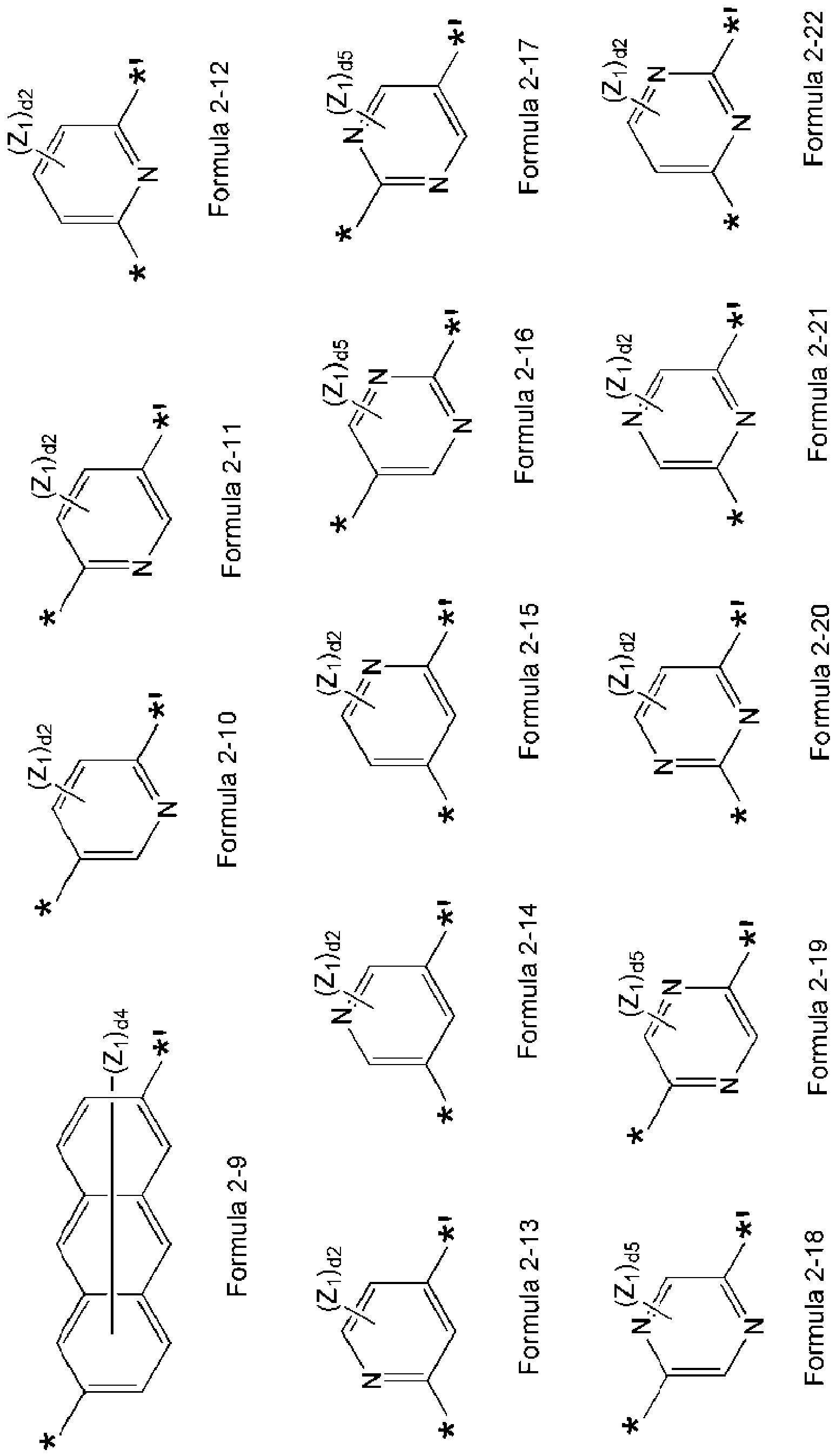
 wherein, in Formulae 2-1 to 2-30,Y1 is O, S, S(=O), S(=O)2, C(Z3)(Z4), N(Z5), or Si(Z6)(Z7);Z1 to Z7 are each independently selected from a hydrogen atom, a deuterium atom, a halogen atom, a hydroxyl group, a cyano group, a nitro group, an amino group, an amidino group, a hydrazine, a hydrazone, a carboxylic acid group or a salt thereof, a sulfonic acid group or a salt thereof, a phosphoric acid group or a salt thereof, a C1-C20alkyl group, a C2-C20 alkenyl group, a C2-C20alkynyl group, a C1-C20 alkoxy group, a phenyl group, a naphthyl group, an anthracenyl group, a pyrenyl group, a phenanthrenyl group, a fluorenyl group, a carbazolyl group, a benzocarbazolyl group, a dibenzocarbazolyl group, a pyridinyl group, a pyrimidinyl group, a triazinyl group, a quinolinyl group, an isoquinolinyl group, and a quinazolinyl group;d1 is an integer from 1 to 4;d2 is an integer from 1 to 3;d3 is an integer from 1 to 6;d4 is an integer from 1 to 8;d5 is 1 or 2;d6 is an integer from 1 to 5; and* and *' indicate binding sites of adjacent atoms.
 - The amine-based compound as claimed in any one of proceeding claims, wherein R1, R2, R11, and R12 are each independently selected from
a phenyl group, a pentalenyl group, an indenyl group, a naphthyl group, an azulenyl group, a heptalenyl group, an indacenyl group, an acenaphthyl group, a fluorenyl group, a spiro-fluorenyl group, a phenalenyl group, a phenanthrenyl group, an anthracenyl group, a fluoranthrenyl group, a triphenylenyl group, a pyrenyl group, a chrysenyl group, a naphthacenyl group, a picenyl group, a perylenyl group, a pentaphenyl group, a hexacenyl group, a pyrrolyl group, an imidazolyl group, a pyrazolyl group, a pyridinyl group, a pyrazinyl group, a pyrimidinyl group, a pyridazinyl group, an isoindolyl group, an indolyl group, an indazolyl group, a purinyl group, a quinolinyl group, an isoquinolinyl group, a benzoquinolinyl group, a phthalazinyl group, a naphthyridinyl group, a quinoxalinyl group, a quinazolinyl group, a cinnolinyl group, a carbazolyl group, a phenanthridinyl group, an acridinyl group, a phenanthrolinyl group, a phenazinyl group, a benzooxazolyl group, a benzoimidazolyl group, a furanyl group, a benzofuranyl group, a thiophenyl group, a benzothiophenyl group, a thiazolyl group, an isothiazolyl group, a benzothiazolyl group, an isoxazolyl group, an oxazolyl group, a triazolyl group, a tetrazolyl group, an oxadiazolyl group, a triazinyl group, a benzooxazolyl group, a dibenzofuranyl group, a dibenzothiophenyl group, a benzocarbazolyl group, and a dibenzocarbazolyl group, and
a phenyl group, a pentalenyl group, an indenyl group, a naphthyl group, an azulenyl group, a heptalenyl group, an indacenyl group, an acenaphthyl group, a fluorenyl group, a spiro-fluorenyl group, a phenalenyl group, a phenanthrenyl group, an anthracenyl group, a fluoranthrenyl group, a triphenylenyl group, a pyrenyl group, a chrysenyl group, a naphthacenyl group, a picenyl group, a perylenyl group, a pentaphenyl group, a hexacenyl group, a pyrrolyl group, an imidazolyl group, a pyrazolyl group, a pyridinyl group, a pyrazinyl group, a pyrimidinyl group, a pyridazinyl group, an isoindolyl group, an indolyl group, an indazolyl group, a purinyl group, a quinolinyl group, an isoquinolinyl group, a benzoquinolinyl group, a phthalazinyl group, a naphthyridinyl group, a quinoxalinyl group, a quinazolinyl group, a cinnolinyl group, a carbazolyl group, a phenanthridinyl group, an acridinyl group, a phenanthrolinyl group, a phenazinyl group, a benzooxazolyl group, a benzoimidazolyl group, a furanyl group, a benzofuranyl group, a thiophenyl group, a benzothiophenyl group, a thiazolyl group, an isothiazolyl group, a benzothiazolyl group, an isoxazolyl group, an oxazolyl group, a triazolyl group, a tetrazolyl group, an oxadiazolyl group, a triazinyl group, a dibenzofuranyl group, a dibenzothiophenyl group, a benzocarbazolyl group, and a benzocarbazolyl group, each substituted with at least one of a deuterium atom, a halogen atom, a hydroxyl group, a cyano group, a nitro group, an amino group, an amidino group, a hydrazine, a hydrazone, a carboxylic acid group or a salt thereof, a sulfonic acid group or a salt thereof, a phosphoric acid group or a salt thereof, a C1-C20 alkyl group, a C2-C20 alkenyl group, a C2-C20 alkynyl group, a C1-C20 alkoxy group, a phenyl group, a naphthyl group, an anthracenyl group, a pyrenyl group, a phenanthrenyl group, a fluorenyl group, a carbazolyl group, a benzocarbazolyl group, a dibenzocarbazolyl group, a pyridinyl group, a pyrimidinyl group, a triazinyl group, a quinolinyl group, an isoquinolinyl group, and a quinazolinyl group. - The amine-based compound as claimed in any one of proceeding claims, wherein R3 to R6 are each independently selected from
a hydrogen atom, a deuterium atom, a halogen atom, a hydroxyl group, a cyano group, a nitro group, an amino group, an amidino group, a hydrazine, a hydrazone, a carboxylic acid group or a salt thereof, a sulfonic acid group or a salt thereof, a phosphoric acid group or a salt thereof, a C1-C20 alkyl group, and a C1-C20 alkoxy group;
a C1-C20 alkyl group and a C1-C60 alkoxy group, each substituted with at least one of a deuterium atom, a halogen atom, a hydroxyl group, a cyano group, a nitro group, an amino group, an amidino group, a hydrazine, a hydrazone, a carboxylic acid group or a salt thereof, a sulfonic acid group or a salt thereof, a phosphoric acid group or a salt thereof, a phenyl group, a naphthyl group, an anthracenyl group, a pyrenyl group, a phenanthrenyl group, a fluorenyl group, a carbazolyl group, a benzocarbazolyl group, a dibenzocarbazolyl group, a pyridinyl group, a pyrimidinyl group, a triazinyl group, a quinolinyl group, an isoquinolinyl group, and a quinazolinyl group;
a phenyl group, a pentalenyl group, an indenyl group, a naphthyl group, an azulenyl group, a heptalenyl group, an indacenyl group, an acenaphthyl group, a fluorenyl group, a spiro-fluorenyl group, a phenalenyl group, a phenanthrenyl group, an anthracenyl group, a fluoranthrenyl group, a triphenylenyl group, a pyrenyl group, a chrysenyl group, a naphthacenyl group, a picenyl group, a perylenyl group, a pentaphenyl group, a hexacenyl group, a pyrrolyl group, an imidazolyl group, a pyrazolyl group, a pyridinyl group, a pyrazinyl group, a pyrimidinyl group, a pyridazinyl group, an isoindolyl group, an indolyl group, an indazolyl group, a purinyl group, a quinolinyl group, an isoquinolinyl group, a benzoquinolinyl group, a phthalazinyl group, a naphthyridinyl group, a quinoxalinyl group, a quinazolinyl group, a cinnolinyl group, a carbazolyl group, a phenanthridinyl group, an acridinyl group, a phenanthrolinyl group, a phenazinyl group, a benzooxazolyl group, a benzoimidazolyl group, a furanyl group, a benzofuranyl group, a thiophenyl group, a benzothiophenyl group, a thiazolyl group, an isothiazolyl group, a benzothiazolyl group, an isoxazolyl group, an oxazolyl group, a triazolyl group, a tetrazolyl group, an oxadiazolyl group, a triazinyl group, a benzooxazolyl group, a dibenzofuranyl group, a dibenzothiophenyl group, a benzocarbazolyl group, and a dibenzocarbazolyl group;
a phenyl group, a pentalenyl group, an indenyl group, a naphthyl group, an azulenyl group, a heptalenyl group, an indacenyl group, an acenaphthyl group, a fluorenyl group, a spiro-fluorenyl group, a phenalenyl group, a phenanthrenyl group, an anthracenyl group, a fluoranthrenyl group, a triphenylenyl group, a pyrenyl group, a chrysenyl group, a naphthacenyl group, a picenyl group, a perylenyl group, a pentaphenyl group, a hexacenyl group, a pyrrolyl group, an imidazolyl group, a pyrazolyl group, a pyridinyl group, a pyrazinyl group, a pyrimidinyl group, a pyridazinyl group, an isoindolyl group, an indolyl group, an indazolyl group, a purinyl group, a quinolinyl group, an isoquinolinyl group, a benzoquinolinyl group, a phthalazinyl group, a naphthyridinyl group, a quinoxalinyl group, a quinazolinyl group, a cinnolinyl group, a carbazolyl group, a phenanthridinyl group, an acridinyl group, a phenanthrolinyl group, a phenazinyl group, a benzooxazolyl group, a benzoimidazolyl group, a furanyl group, a benzofuranyl group, a thiophenyl group, a benzothiophenyl group, a thiazolyl group, an isothiazolyl group, a benzothiazolyl group, an isoxazolyl group, an oxazolyl group, a triazolyl group, a tetrazolyl group, an oxadiazolyl group, a triazinyl group, a dibenzofuranyl group, a dibenzothiophenyl group, a benzocarbazolyl group, and a benzocarbazolyl group, each substituted with at least one of a deuterium atom, a halogen atom, a hydroxyl group, a cyano group, a nitro group, an amino group, an amidino group, a hydrazine, a hydrazone, a carboxylic acid group or a salt thereof, a sulfonic acid group or a salt thereof, a phosphoric acid group or a salt thereof, a C1-C20 alkyl group, a C2-C20 alkenyl group, a C2-C20 alkynyl group, a C1-C20 alkoxy group, a phenyl group, a naphthyl group, an anthracenyl group, a pyrenyl group, a phenanthrenyl group, a fluorenyl group, a carbazolyl group, a benzocarbazolyl group, a dibenzocarbazolyl group, a pyridinyl group, a pyrimidinyl group, a triazinyl group, a quinolinyl group, an isoquinolinyl group, and a quinazolinyl group ; and
-N(Q1)(Q2), and -Si(Q3)(Q4)(Q5), wherein Q1 to Q5 are each independently selected from
a hydrogen atom, a C1-C20 alkyl group, a phenyl group, a naphthyl group, an anthracenyl group, a pyrenyl group, a phenanthrenyl group, a fluorenyl group, a carbazolyl group, a benzocarbazolyl group, a dibenzocarbazolyl group, a pyridinyl group, a pyrimidinyl group, a triazinyl group, a quinolinyl group, an isoquinolinyl group, and a quinazolinyl group; and
a phenyl group, a naphthyl group, an anthracenyl group, a pyrenyl group, a phenanthrenyl group, a fluorenyl group, a carbazolyl group, a benzocarbazolyl group, a dibenzocarbazolyl group, a pyridinyl group, a pyrimidinyl group, a triazinyl group, a quinolinyl group, an isoquinolinyl group, and a quinazolinyl group, each substituted with at least one of a deuterium atom, a halogen atom, a hydroxyl group, a cyano group, a nitro group, an amino group, an amidino group, a hydrazine, a hydrazone, a carboxylic acid group or a salt thereof, a sulfonic acid group or a salt thereof, a phosphoric acid group or a salt thereof, a C1-C20 alkyl group, a C2-C20 alkenyl group, a C2-C20 alkynyl group, a C1-C20 alkoxy group, a phenyl group, a naphthyl group, an anthracenyl group, a pyrenyl group, a phenanthrenyl group, a fluorenyl group, a carbazolyl group, a pyridinyl group, a pyrimidinyl group, a triazinyl group, a quinolinyl group, an isoquinolinyl group, and a quinazolinyl group. - The amine-based compound as claimed in any one of proceeding claims, wherein R1, R2, R11, and R12 are each independently selected from the groups represented by Formulae 4-1 to 4-29 below; and
R3 to R6 are each independently selected from
a hydrogen atom, a deuterium atom, a halogen atom, a hydroxyl group, a cyano group, a nitro group, an amino group, an amidino group, a hydrazine, a hydrazone, a carboxylic acid group or a salt thereof, a sulfonic acid group or a salt thereof, a phosphoric acid group or a salt thereof, a C1-C20 alkyl group, and a C1-C20 alkoxy group,
a C1-C20 alkyl group and a C1-C20 alkoxy group, each substituted with at least one of a deuterium atom, a halogen atom, a hydroxyl group, a cyano group, a nitro group, an amino group, an amidino group, a hydrazine, a hydrazone, a carboxylic acid group or a salt thereof, a sulfonic acid group or a salt thereof, a phosphoric acid group or a salt thereof, a phenyl group, a naphthyl group, an anthracenyl group, a pyrenyl group, a phenanthrenyl group, a fluorenyl group, a carbazolyl group, a pyridinyl group, a pyrimidinyl group, a triazinyl group, a quinolinyl group, an isoquinolinyl group, and a quinazolinyl group,
the groups represented by Formulae 4-1 to 4-29 below, and
-N(Q1)(Q2) and -Si(Q3)(Q4)(Q5), wherein Q1 to Q5 are each independently selected from
a hydrogen atom, a C1-C20 alkyl group, a phenyl group, a naphthyl group, an anthracenyl group, a pyrenyl group, a phenanthrenyl group, a fluorenyl group, a carbazolyl group, a benzocarbazolyl group, a dibenzocarbazolyl group, a pyridinyl group, a pyrimidinyl group, a triazinyl group, a quinolinyl group, an isoquinolinyl group, and a quinazolinyl group; and
a phenyl group, a naphthyl group, an anthracenyl group, a pyrenyl group, a phenanthrenyl group, a fluorenyl group, a carbazolyl group, a benzocarbazolyl group, a dibenzocarbazolyl group, a pyridinyl group, a pyrimidinyl group, a triazinyl group, a quinolinyl group, an isoquinolinyl group, and a quinazolinyl group, each substituted with at least one of a deuterium atom, a halogen atom, a hydroxyl group, a cyano group, a nitro group, an amino group, an amidino group, a hydrazine, a hydrazone, a carboxylic acid group or a salt thereof, a sulfonic acid group or a salt thereof, a phosphoric acid group or a salt thereof, a C1-C20 alkyl group, a C2-C20 alkenyl group, a C2-C20 alkynyl group, a C1-C20 alkoxy group, a phenyl group, a naphthyl group, an anthracenyl group, a pyrenyl group, a phenanthrenyl group, a fluorenyl group, a carbazolyl group, a pyridinyl group, a pyrimidinyl group, a triazinyl group, a quinolinyl group, an isoquinolinyl group, and a quinazolinyl group:
 wherein, in Formulae 4-1 to 4-29,Y31 is O, S, C(Z33)(Z34), N(Z35), or Si(Z36)(Z37);Z31 to Z37 are each independently selected from a hydrogen atom, a deuterium atom, a halogen atom, a hydroxyl group, a cyano group, a nitro group, an amino group, an amidino group, a hydrazine, a hydrazone, a carboxylic acid group or a salt thereof, a sulfonic acid group or a salt thereof, a phosphoric acid group or a salt thereof, a C1-C20alkyl group, a C2-C20 alkenyl group, a C2-C20 alkynyl group, a C1-C20 alkoxy group, a phenyl group, a naphthyl group, an anthracenyl group, a pyrenyl group, a phenanthrenyl group, a fluorenyl group, a carbazolyl group, a benzocarbazolyl group, a dibenzocarbazolyl group, a pyridinyl group, a pyrimidinyl group, a triazinyl group, a quinolinyl group, an isoquinolinyl group, and a quinazolinyl group;e1 is an integer from 1 to 5;e2 is an integer from 1 to 7;e3 is an integer from 1 to 3;e4 is an integer from 1 to 4;e5 is 1 or 2;e6 is an integer from 1 to 6; and* indicates a binding site of an adjacent atom.
 - The amine-based compound as claimed in any one of proceeding claims, wherein R1, R2, R11, and R12 are each independently selected from the groups represented by Formulae 5-1 to 5-36 below; and
R3 to R6 are each independently selected from
a hydrogen atom, a deuterium atom, a halogen atom, a hydroxyl group, a cyano group, a nitro group, an amino group, an amidino group, a hydrazine, a hydrazone, a carboxylic acid group or a salt thereof, a sulfonic acid group or a salt thereof, a phosphoric acid group or a salt thereof, a C1-C20 alkyl group, and a C1-C20 alkoxy group,
a C1-C20 alkyl group and a C1-C20 alkoxy group, each substituted with at least one of a deuterium atom, a halogen atom, a hydroxyl group, a cyano group, a nitro group, an amino group, an amidino group, a hydrazine, a hydrazone, a carboxylic acid group or a salt thereof, a sulfonic acid group or a salt thereof, a phosphoric acid group or a salt thereof, a phenyl group, a naphthyl group, an anthracenyl group, a pyrenyl group, a phenanthrenyl group, a fluorenyl group, a carbazolyl group, a pyridinyl group, a pyrimidinyl group, a triazinyl group, a quinolinyl group, an isoquinolinyl group, and a quinazolinyl group,
the groups represented by Formulae 5-1 to 5-36 below, and
-N(Q1)(Q2), and -Si(Q3)(Q4)(Q5), wherein Q1 to Q5 are each independently selected from
a hydrogen atom, a C1-C20 alkyl group, a phenyl group, a naphthyl group, an anthracenyl group, a pyrenyl group, a phenanthrenyl group, a fluorenyl group, a carbazolyl group, a benzocarbazolyl group, a dibenzocarbazolyl group, a pyridinyl group, a pyrimidinyl group, a triazinyl group, a quinolinyl group, an isoquinolinyl group, and a quinazolinyl group; and
a phenyl group, a naphthyl group, an anthracenyl group, a pyrenyl group, a phenanthrenyl group, a fluorenyl group, a carbazolyl group, a benzocarbazolyl group, a dibenzocarbazolyl group, a pyridinyl group, a pyrimidinyl group, a triazinyl group, a quinolinyl group, an isoquinolinyl group, and a quinazolinyl group, each substituted with at least one of a deuterium atom, a halogen atom, a hydroxyl group, a cyano group, a nitro group, an amino group, an amidino group, a hydrazine, a hydrazone, a carboxylic acid group or a salt thereof, a sulfonic acid group or a salt thereof, a phosphoric acid group or a salt thereof, a C1-C20 alkyl group, a C2-C20 alkenyl group, a C2-C20 alkynyl group, a C1-C20 alkoxy group, a phenyl group, a naphthyl group, an anthracenyl group, a pyrenyl group, a phenanthrenyl group, a fluorenyl group, a carbazolyl group, a pyridinyl group, a pyrimidinyl group, a triazinyl group, a quinolinyl group, an isoquinolinyl group, and a quinazolinyl group:
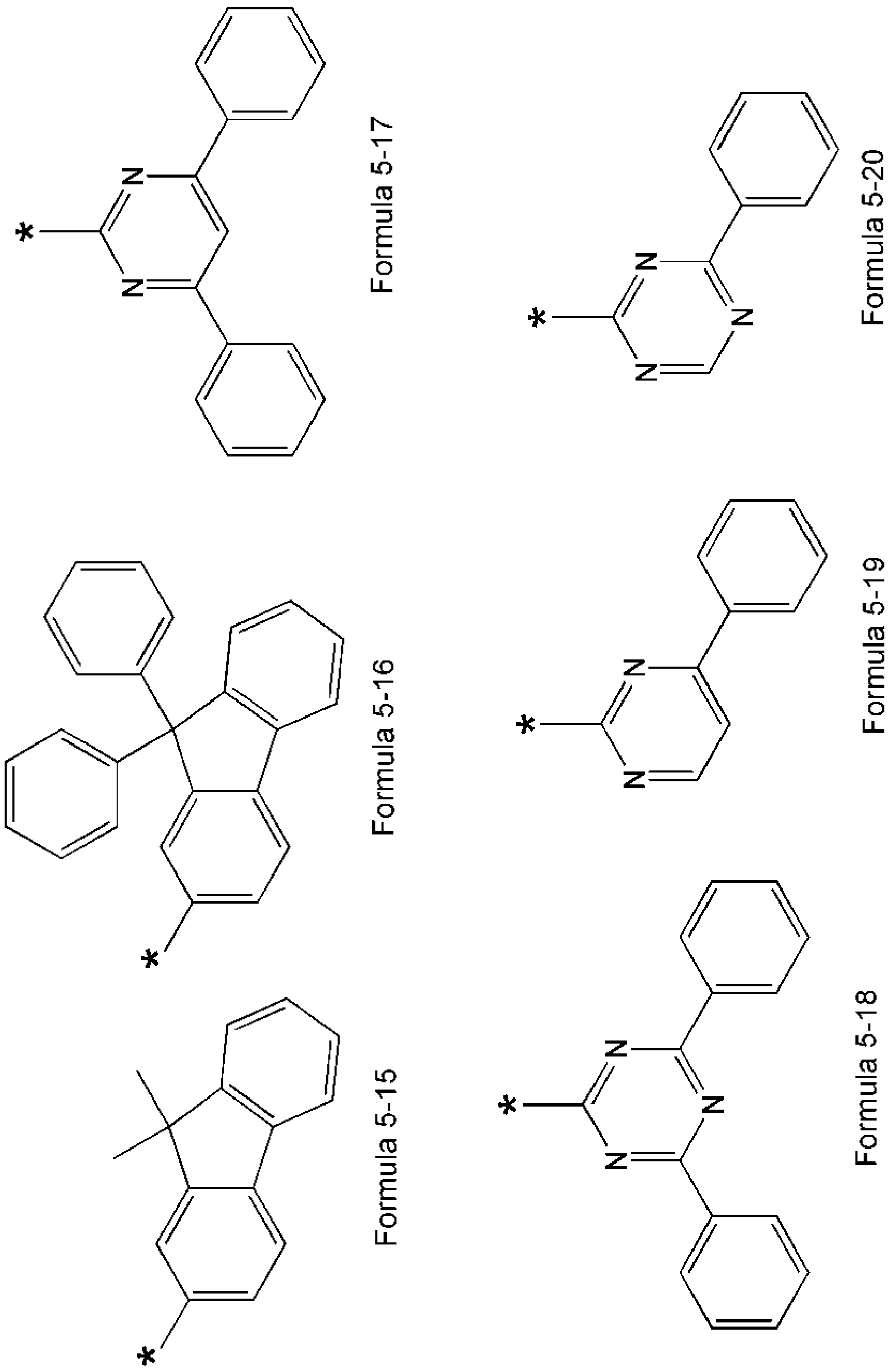


- The amine-based compound as claimed in any one of proceeding claims, wherein the amine-based compound of Formula 1 is a compound represented by Formula 1A below:
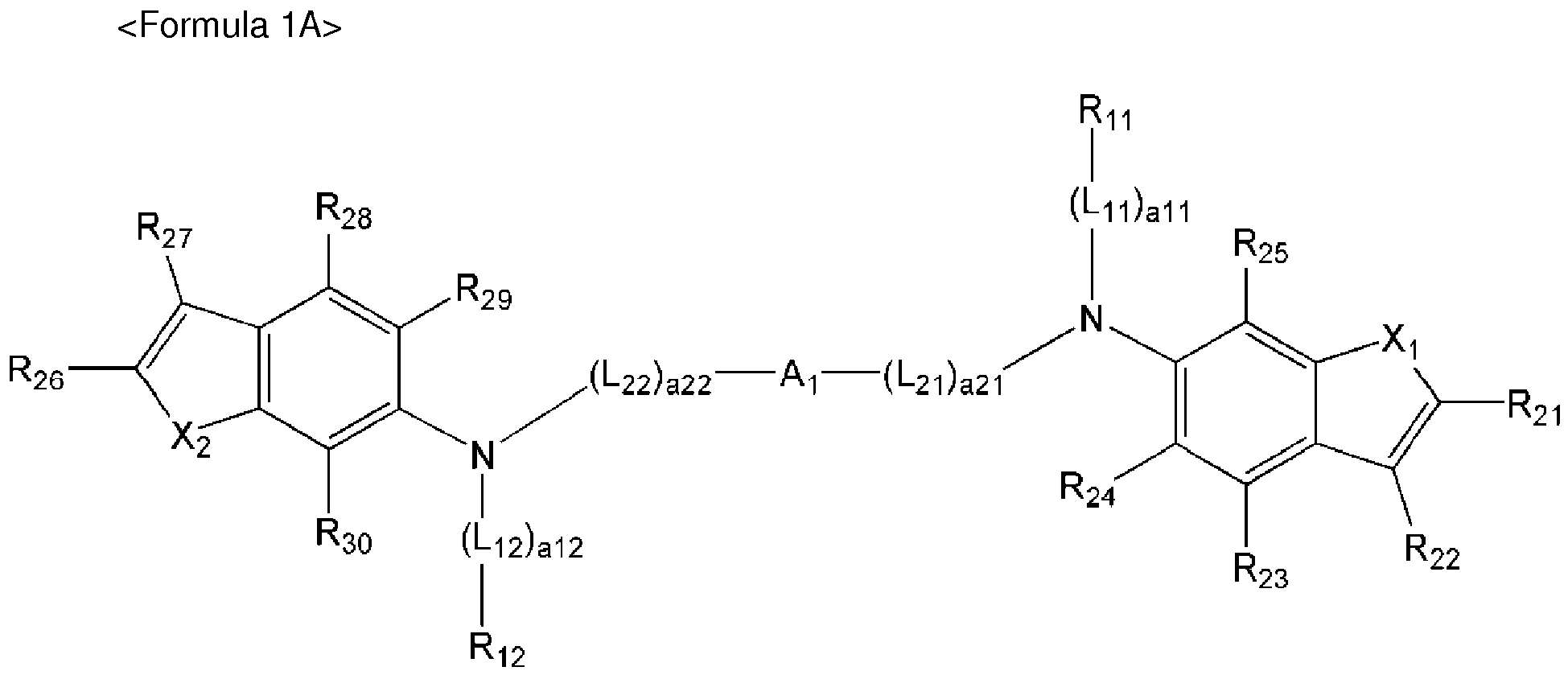
- The amine-based compound as claimed in any one of proceeding claims, wherein the amine-based compound of Formula 1 is a compound represented by one of Formulae 1A(1) to 1A(4) below:


 X1, X2, L11, L12, L21, L22, a11, a12, a21, a22, R11, and R12 are the same as those defined in claim 1;R21 to R34 are the same as R3 defined in claim 1;a31 and a32 are each independently an integer from 1 to 4;a33 is an integer from 1 to 8;a34 and a35 are each independently an integer from 1 to 3;a36 and a37 are each independently an integer from 1 to 5.
 - The amine-based compound as claimed in any one of proceeding claims, wherein the amine-based compound of Formula 1 is one of Compounds 1 to 108 below:


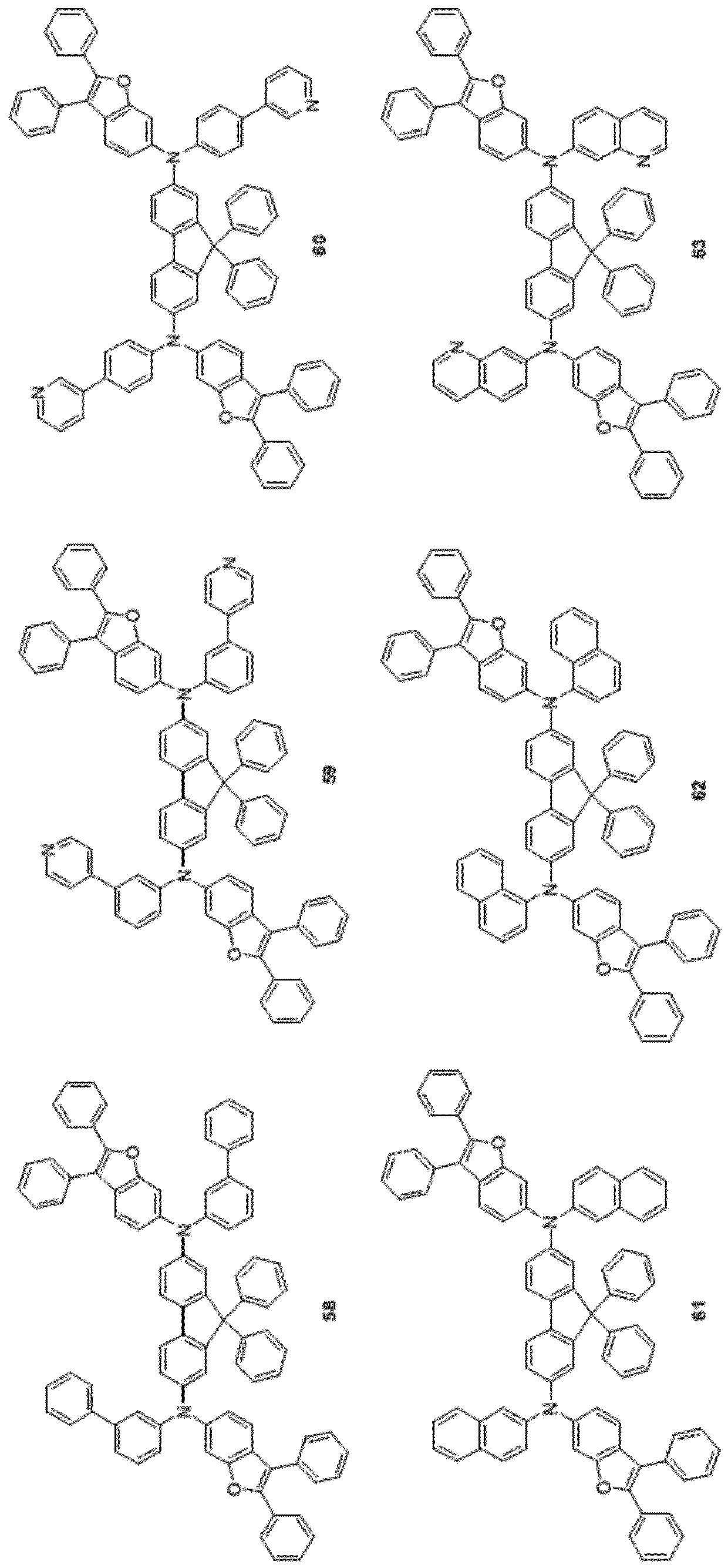


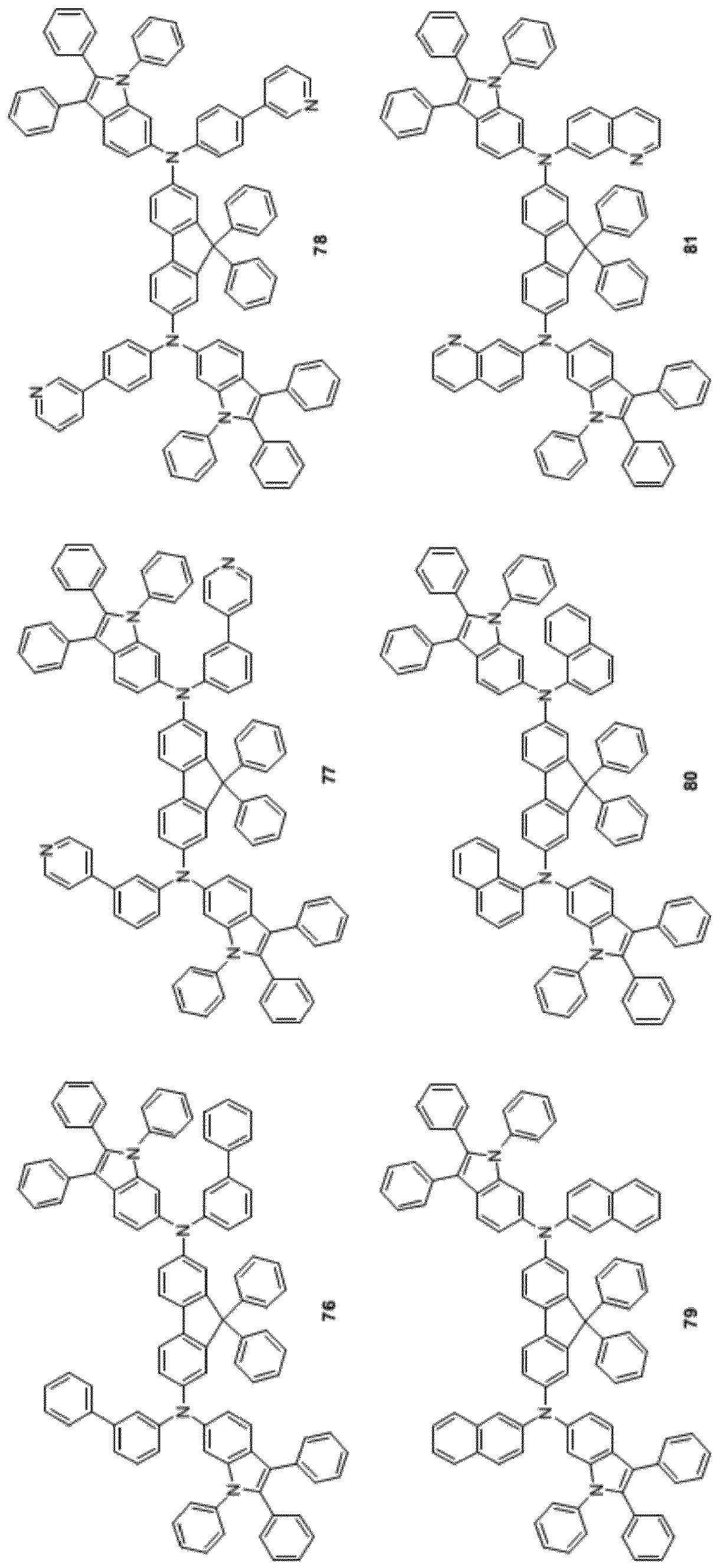


- An organic light-emitting device, comprising:a first electrode;a second electrode; andan organic layer disposed between the first electrode and the second electrode, and including an emission layer and at least one of the amine-based compounds of any one of claims 1 to 12.
- The organic light-emitting device as claimed in claim 13, wherein the organic layer further includes a compound represented by Formula 1000 below:
<Formula 1000> Y1-A2-Y2
wherein, in Formula 1000, A2 is selected froma pentalenylene group, an indenylene group, a naphthylene group, an azulenylene group, a heptalenylene group, an indacenylene group, an acenaphthylene group, a fluorenylene group, a spiro-fluorenylene group, a phenalenylene group, a phenanthrenylene group, an anthracenylene group, a fluoranthrenylene group, a triphenylenylene group, a pyrenylene group, a chrysenylene group, a naphthacenylene group, a picenylene group, a perylenylene group, a pentaphenylene group, a hexacenylene group, and a benzofluoranthenylene group, anda pentalenylene group, an indenylene group, a naphthylene group, an azulenylene group, a heptalenylene group, an indacenylene group, an acenaphthylene group, a fluorenylene group, a spiro-fluorenylene group, a phenalenylene group, a phenanthrenylene group, an anthracenylene group, a fluoranthrenylene group, a triphenylenylene group, a pyrenylene group, a chrysenylene group, a naphthacenylene group, a picenylene group, a perylenylene group, a pentaphenylene group, a hexacenylene group, and a benzofluoranthenylene group, each substituted with at least one of a deuterium atom, a halogen atom, a hydroxyl group, a cyano group, a nitro group, an amino group, an amidino group, a hydrazine, a hydrazone, a carboxylic acid group or a salt thereof, a sulfonic acid group or a salt thereof, a phosphoric acid group or a salt thereof, a C1-C60alkyl group, a C2-C60 alkenyl group, a C2-C60 alkynyl group, a C1-C60 alkoxy group, a C3-C10 cycloalkyl group, a C3-C10 heterocycloalkyl group, a C3-C10 cycloalkenyl group, a C3-C10 heterocycloalkenyl group, a C6-C60 aryl group, a C6-C60 aryloxy group, a C6-C60 arylthio group, a C2-C60 heteroaryl group, - N(Q11)(Q12), and -Si(Q13)(Q14)(Q15);Y1 and Y2 are each independently selected froma C3-C10 cycloalkyl group, a C3-C10 heterocycloalkyl group, a C3-C10 cycloalkenyl group, a C3-C10 heterocycloalkenyl group, a C6-C60 aryl group, a C6-C60 aryloxy group, a C6-C60 arylthio group, and a C2-C60 heteroaryl group, anda C3-C10 cycloalkyl group, a C3-C10 heterocycloalkyl group, a C3-C10 cycloalkenyl group, a C3-C10 heterocycloalkenyl group, a C6-C60 aryl group, a C6-C60 aryloxy group, a C6-C60 arylthio group, and a C2-C60 heteroaryl group, each substituted with at least one of a deuterium atom, a halogen atom, a hydroxyl group, a cyano group, a nitro group, an amino group, an amidino group, a hydrazine, a hydrazone, a carboxylic acid group or a salt thereof, a sulfonic acid group or a salt thereof, a phosphoric acid group or a salt thereof, a C1-C60alkyl group, a C2-C60 alkenyl group, a C2-C60 alkynyl group, a C1-C60 alkoxy group, a C3-C10 cycloalkyl group, a C3-C10 heterocycloalkyl group, a C3-C10 cycloalkenyl group, a C3-C10 heterocycloalkenyl group, a C6-C60 aryl group, a C6-C60 aryloxy group, a C6-C60 arylthio group, a C2-C60 heteroaryl group, and -N(Q101)(Q102); andQ101 and Q102 are each independently selected froma hydrogen atom, a deuterium atom, a halogen atom, a hydroxyl group, a cyano group, a nitro group, an amino group, an amidino group, a hydrazine, a hydrazone, a carboxylic acid group or a salt thereof, a sulfonic acid group or a salt thereof, a phosphoric acid group or a salt thereof, a C1-C60 alkyl group, a C2-C60 alkenyl group, a C2-C60 alkynyl group, and a C1-C60 alkoxy group, anda C1-C60 alkyl group, a C2-C60 alkenyl group, a C2-C60 alkynyl group, and a C1-C60 alkoxy group, each substituted with at least one of a deuterium atom, a halogen atom, a hydroxyl group, a cyano group, a nitro group, an amino group, an amidino group, a hydrazine, a hydrazone, a carboxylic acid group or a salt thereof, a sulfonic acid group or a salt thereof, a phosphoric acid group or a salt thereof, a C3-C10 cycloalkyl group, a C3-C10 heterocycloalkyl group, a C3-C10 cycloalkenyl group, a C3-C10 heterocycloalkenyl group, a C6-C60 aryl group, a C6-C60 aryloxy group, a C6-C60 arylthio group, and a C2-C60 heteroaryl group,a C3-C10 cycloalkyl group, a C3-C10 heterocycloalkyl group, a C3-C10 cycloalkenyl group, a C3-C10 heterocycloalkenyl group, a C6-C60 aryl group, a C6-C60 aryloxy group, a C6-C60 arylthio group, and a C2-C60 heteroaryl group, anda C3-C10 cycloalkyl group, a C3-C10 heterocycloalkyl group, a C3-C10 cycloalkenyl group, a C3-C10 heterocycloalkenyl group, a C6-C60 aryl group, a C6-C60 aryloxy group, a C6-C60 arylthio group, and a C2-C60 heteroaryl group, each substituted with at least one of a deuterium atom, a halogen atom, a hydroxyl group, a cyano group, a nitro group, an amino group, an amidino group, a hydrazine, a hydrazone, a carboxylic acid group or a salt thereof, a sulfonic acid group or a salt thereof, a phosphoric acid group or a salt thereof, a C1-C60 alkyl group, a C2-C60 alkenyl group, a C2-C60 alkynyl group, a C1-C60 alkoxy group, a C3-C10 cycloalkyl group, a C3-C10 heterocycloalkyl group, a C3-C10 cycloalkenyl group, a C3-C10 heterocycloalkenyl group, a C6-C60 aryl group, a C6-C60 aryloxy group, a C6-C60 arylthio group, and a C2-C60 heteroaryl group. - The organic light-emitting device as claimed in claim 13 or 14, wherein the amine-based compound is in the emission layer.
Applications Claiming Priority (1)
| Application Number | Priority Date | Filing Date | Title |
|---|---|---|---|
| KR1020130072718A KR20150000366A (en) | 2013-06-24 | 2013-06-24 | Amined-basd compound and organic light emitting diode including the same |
Publications (1)
| Publication Number | Publication Date |
|---|---|
| EP2818466A1 true EP2818466A1 (en) | 2014-12-31 |
Family
ID=50979658
Family Applications (1)
| Application Number | Title | Priority Date | Filing Date |
|---|---|---|---|
| EP14173599.3A Ceased EP2818466A1 (en) | 2013-06-24 | 2014-06-24 | Amine-based compound and organic light-emitting device including the same |
Country Status (5)
| Country | Link |
|---|---|
| US (1) | US20150001494A1 (en) |
| EP (1) | EP2818466A1 (en) |
| JP (1) | JP2015007042A (en) |
| KR (1) | KR20150000366A (en) |
| CN (1) | CN104230861A (en) |
Families Citing this family (11)
| Publication number | Priority date | Publication date | Assignee | Title |
|---|---|---|---|---|
| KR102203101B1 (en) * | 2014-04-18 | 2021-01-15 | 삼성디스플레이 주식회사 | Amine-based compounds and organic light-emitting device comprising the same |
| KR20160124284A (en) * | 2015-04-16 | 2016-10-27 | 삼성디스플레이 주식회사 | Condensed-cyclic compound and organic light emitting device comprising the same |
| JP6737266B2 (en) * | 2015-05-19 | 2020-08-05 | ソニー株式会社 | Imaging device and imaging device |
| KR102458685B1 (en) * | 2015-08-21 | 2022-10-26 | 삼성디스플레이 주식회사 | organic light-emitting device |
| US12384796B2 (en) | 2016-06-03 | 2025-08-12 | Lg Chem, Ltd. | Electroactive compounds |
| US11239426B2 (en) | 2016-11-23 | 2022-02-01 | Lg Chem, Ltd. | Electroactive compounds |
| CN109251176B (en) * | 2017-07-12 | 2020-11-13 | 北京鼎材科技有限公司 | Organic electroluminescent device |
| KR102758167B1 (en) | 2019-02-11 | 2025-01-24 | 삼성디스플레이 주식회사 | Organic electroluminescence device and monoamine compound for organic electroluminescence device |
| KR102819937B1 (en) * | 2019-09-16 | 2025-06-13 | 삼성디스플레이 주식회사 | A heterocyclic compound and organic light-emitting device comprising the same |
| CN116199655B (en) * | 2022-12-31 | 2025-04-04 | 维思普新材料(苏州)有限公司 | A 7-aminodiphenylbenzofuran compound and preparation method thereof |
| CN117466848A (en) * | 2023-09-22 | 2024-01-30 | 深圳市华星光电半导体显示技术有限公司 | Organic compounds and their preparation methods and applications |
Citations (3)
| Publication number | Priority date | Publication date | Assignee | Title |
|---|---|---|---|---|
| JP2008133225A (en) * | 2006-11-29 | 2008-06-12 | Toyo Ink Mfg Co Ltd | Indole derivatives and uses thereof |
| EP2239259A1 (en) * | 2007-12-28 | 2010-10-13 | Idemitsu Kosan Co., Ltd. | Aromatic amine derivative and organic electroluminescent device using the same |
| KR20130133515A (en) * | 2012-05-29 | 2013-12-09 | 주식회사 이엘엠 | Organic light emitting material and organic light emitting diode having the same |
Family Cites Families (4)
| Publication number | Priority date | Publication date | Assignee | Title |
|---|---|---|---|---|
| JPH11121147A (en) * | 1997-10-20 | 1999-04-30 | Yamaki Denki Kk | Far infrared radiation ceramic heater |
| GB0117377D0 (en) * | 2001-07-17 | 2001-09-05 | Opsys Ltd | "Tertiary diamines containing heterocyclic groups and their use in organic electroluminescent devices" |
| GB0405310D0 (en) * | 2004-03-09 | 2004-04-21 | Prototech As | Pipeline pig |
| KR20110012114A (en) * | 2009-07-29 | 2011-02-09 | 엘지전자 주식회사 | Battery control device and method of the car |
-
2013
- 2013-06-24 KR KR1020130072718A patent/KR20150000366A/en not_active Ceased
-
2014
- 2014-03-31 US US14/230,403 patent/US20150001494A1/en not_active Abandoned
- 2014-06-24 JP JP2014129391A patent/JP2015007042A/en active Pending
- 2014-06-24 EP EP14173599.3A patent/EP2818466A1/en not_active Ceased
- 2014-06-24 CN CN201410289502.0A patent/CN104230861A/en active Pending
Patent Citations (3)
| Publication number | Priority date | Publication date | Assignee | Title |
|---|---|---|---|---|
| JP2008133225A (en) * | 2006-11-29 | 2008-06-12 | Toyo Ink Mfg Co Ltd | Indole derivatives and uses thereof |
| EP2239259A1 (en) * | 2007-12-28 | 2010-10-13 | Idemitsu Kosan Co., Ltd. | Aromatic amine derivative and organic electroluminescent device using the same |
| KR20130133515A (en) * | 2012-05-29 | 2013-12-09 | 주식회사 이엘엠 | Organic light emitting material and organic light emitting diode having the same |
Also Published As
| Publication number | Publication date |
|---|---|
| US20150001494A1 (en) | 2015-01-01 |
| JP2015007042A (en) | 2015-01-15 |
| CN104230861A (en) | 2014-12-24 |
| KR20150000366A (en) | 2015-01-02 |
Similar Documents
| Publication | Publication Date | Title |
|---|---|---|
| EP2750213B1 (en) | Organic light-emitting diode | |
| EP2818466A1 (en) | Amine-based compound and organic light-emitting device including the same | |
| EP2626399B1 (en) | Amine-based compound and organic light-emitting diode including the same | |
| KR102184674B1 (en) | Anthracene-based compounds and Organic light emitting device comprising the same | |
| KR102194819B1 (en) | Organic light emitting diode comprising the same | |
| KR102107106B1 (en) | Styryl-based compound and organic light emitting diode comprising the same | |
| US20160308142A1 (en) | Condensed cyclic compound and organic light-emitting device including the same | |
| EP2371828A1 (en) | Condensed-Cyclic Compound and Organic Light-Emitting Device Including the Same | |
| KR102105076B1 (en) | Condensed cyclic compound and organic light-emitting diode comprising the same | |
| KR102086551B1 (en) | Organic light emitting diode comprising amine-based compounds and pyrene-based compounds | |
| KR102052070B1 (en) | Amine-based compound and organic light emitting diode comprising the same | |
| KR20140126610A (en) | Organic light emitting diode | |
| KR102147840B1 (en) | Amined-basd compound and organic light emitting diode including the same | |
| KR102145886B1 (en) | Heterocyclic compounds and Organic light emitting device comprising the same | |
| KR20140142088A (en) | Aryl amine-based compound and Organic light emitting diode comprising the same | |
| US9966545B2 (en) | Anthracene-based compounds and organic light-emitting device including the same | |
| KR102134844B1 (en) | Amine-based compound and organic light emitting diode comprising the same | |
| KR20140096659A (en) | Silicon-based compound and Organic light emitting diode comprising the same | |
| KR102155600B1 (en) | Condensed cyclic compound and organic light emitting device including the same | |
| KR102203099B1 (en) | Condensed compound and organic light emitting diode comprising the same | |
| EP2535331B1 (en) | Condensed-Cyclic Compound and Organic Light-Emitting Diode Comprising the Same | |
| US9257656B2 (en) | Organic light-emitting diodes | |
| KR102208958B1 (en) | Condensed compound and organic light emitting diode including the same | |
| KR20140122613A (en) | Heteroaryl-based compound and Organic light emitting diode comprising the same | |
| KR20140091344A (en) | Organic light emitting diode comprising amine-based compounds and antracene-based compounds |
Legal Events
| Date | Code | Title | Description |
|---|---|---|---|
| PUAI | Public reference made under article 153(3) epc to a published international application that has entered the european phase |
Free format text: ORIGINAL CODE: 0009012 |
|
| 17P | Request for examination filed |
Effective date: 20140624 |
|
| AK | Designated contracting states |
Kind code of ref document: A1 Designated state(s): AL AT BE BG CH CY CZ DE DK EE ES FI FR GB GR HR HU IE IS IT LI LT LU LV MC MK MT NL NO PL PT RO RS SE SI SK SM TR |
|
| AX | Request for extension of the european patent |
Extension state: BA ME |
|
| R17P | Request for examination filed (corrected) |
Effective date: 20150624 |
|
| RBV | Designated contracting states (corrected) |
Designated state(s): AL AT BE BG CH CY CZ DE DK EE ES FI FR GB GR HR HU IE IS IT LI LT LU LV MC MK MT NL NO PL PT RO RS SE SI SK SM TR |
|
| 17Q | First examination report despatched |
Effective date: 20150828 |
|
| RAP1 | Party data changed (applicant data changed or rights of an application transferred) |
Owner name: SAMSUNG DISPLAY CO., LTD. |
|
| STAA | Information on the status of an ep patent application or granted ep patent |
Free format text: STATUS: THE APPLICATION HAS BEEN REFUSED |
|
| 18R | Application refused |
Effective date: 20170302 |