EP2817301B1 - Use of 1h-indazole-3-carboxamide compounds as glycogen synthase kinase 3 beta inhibitors - Google Patents
Use of 1h-indazole-3-carboxamide compounds as glycogen synthase kinase 3 beta inhibitors Download PDFInfo
- Publication number
- EP2817301B1 EP2817301B1 EP13703799.0A EP13703799A EP2817301B1 EP 2817301 B1 EP2817301 B1 EP 2817301B1 EP 13703799 A EP13703799 A EP 13703799A EP 2817301 B1 EP2817301 B1 EP 2817301B1
- Authority
- EP
- European Patent Office
- Prior art keywords
- disorders
- group
- methyl
- indazole
- carboxamide
- Prior art date
- Legal status (The legal status is an assumption and is not a legal conclusion. Google has not performed a legal analysis and makes no representation as to the accuracy of the status listed.)
- Active
Links
- 0 C*(CC1CC*(C)CC1)C(C(C1=CC)=**(C)(C)C1=C[C@](C)(C*)C=C(CC=CC)C(C)=C)=O Chemical compound C*(CC1CC*(C)CC1)C(C(C1=CC)=**(C)(C)C1=C[C@](C)(C*)C=C(CC=CC)C(C)=C)=O 0.000 description 2
- HEJUNQANWHZANT-UHFFFAOYSA-N COc1ccc2[nH]nc(C(NCC3CCN(Cc(cc4)ccc4OCc4ccccc4)CC3)=O)c2c1 Chemical compound COc1ccc2[nH]nc(C(NCC3CCN(Cc(cc4)ccc4OCc4ccccc4)CC3)=O)c2c1 HEJUNQANWHZANT-UHFFFAOYSA-N 0.000 description 2
- JPBJGSYWESOYTD-UHFFFAOYSA-N COC(c1c(CN2CCC(CNC(c(c3c4)n[nH]c3ccc4OC)=O)CC2)[o]cc1)=O Chemical compound COC(c1c(CN2CCC(CNC(c(c3c4)n[nH]c3ccc4OC)=O)CC2)[o]cc1)=O JPBJGSYWESOYTD-UHFFFAOYSA-N 0.000 description 1
- IFOCWYIZCJPIJY-UHFFFAOYSA-N COC(c1c[s]c(CN2CCC(CNC(c(c3c4)n[nH]c3ccc4OC)=O)CC2)n1)=O Chemical compound COC(c1c[s]c(CN2CCC(CNC(c(c3c4)n[nH]c3ccc4OC)=O)CC2)n1)=O IFOCWYIZCJPIJY-UHFFFAOYSA-N 0.000 description 1
- AVJQHXNWTOBVDY-UHFFFAOYSA-N COc1ccc2[nH]nc(C(NCC3CCN(Cc(cc4)ccc4O)CC3)=O)c2c1 Chemical compound COc1ccc2[nH]nc(C(NCC3CCN(Cc(cc4)ccc4O)CC3)=O)c2c1 AVJQHXNWTOBVDY-UHFFFAOYSA-N 0.000 description 1
- GHWVUEGSGMRWNC-UHFFFAOYSA-N NCC1CCN(Cc(c(Cl)c2)ccc2Cl)CC1 Chemical compound NCC1CCN(Cc(c(Cl)c2)ccc2Cl)CC1 GHWVUEGSGMRWNC-UHFFFAOYSA-N 0.000 description 1
Classifications
-
- A—HUMAN NECESSITIES
- A61—MEDICAL OR VETERINARY SCIENCE; HYGIENE
- A61K—PREPARATIONS FOR MEDICAL, DENTAL OR TOILETRY PURPOSES
- A61K31/00—Medicinal preparations containing organic active ingredients
- A61K31/33—Heterocyclic compounds
- A61K31/395—Heterocyclic compounds having nitrogen as a ring hetero atom, e.g. guanethidine or rifamycins
- A61K31/435—Heterocyclic compounds having nitrogen as a ring hetero atom, e.g. guanethidine or rifamycins having six-membered rings with one nitrogen as the only ring hetero atom
- A61K31/44—Non condensed pyridines; Hydrogenated derivatives thereof
- A61K31/445—Non condensed piperidines, e.g. piperocaine
- A61K31/4523—Non condensed piperidines, e.g. piperocaine containing further heterocyclic ring systems
- A61K31/454—Non condensed piperidines, e.g. piperocaine containing further heterocyclic ring systems containing a five-membered ring with nitrogen as a ring hetero atom, e.g. pimozide, domperidone
-
- A—HUMAN NECESSITIES
- A61—MEDICAL OR VETERINARY SCIENCE; HYGIENE
- A61K—PREPARATIONS FOR MEDICAL, DENTAL OR TOILETRY PURPOSES
- A61K31/00—Medicinal preparations containing organic active ingredients
- A61K31/33—Heterocyclic compounds
- A61K31/395—Heterocyclic compounds having nitrogen as a ring hetero atom, e.g. guanethidine or rifamycins
- A61K31/435—Heterocyclic compounds having nitrogen as a ring hetero atom, e.g. guanethidine or rifamycins having six-membered rings with one nitrogen as the only ring hetero atom
- A61K31/44—Non condensed pyridines; Hydrogenated derivatives thereof
- A61K31/445—Non condensed piperidines, e.g. piperocaine
- A61K31/4523—Non condensed piperidines, e.g. piperocaine containing further heterocyclic ring systems
- A61K31/4545—Non condensed piperidines, e.g. piperocaine containing further heterocyclic ring systems containing a six-membered ring with nitrogen as a ring hetero atom, e.g. pipamperone, anabasine
-
- A—HUMAN NECESSITIES
- A61—MEDICAL OR VETERINARY SCIENCE; HYGIENE
- A61K—PREPARATIONS FOR MEDICAL, DENTAL OR TOILETRY PURPOSES
- A61K31/00—Medicinal preparations containing organic active ingredients
- A61K31/33—Heterocyclic compounds
- A61K31/395—Heterocyclic compounds having nitrogen as a ring hetero atom, e.g. guanethidine or rifamycins
- A61K31/535—Heterocyclic compounds having nitrogen as a ring hetero atom, e.g. guanethidine or rifamycins having six-membered rings with at least one nitrogen and one oxygen as the ring hetero atoms, e.g. 1,2-oxazines
- A61K31/5375—1,4-Oxazines, e.g. morpholine
- A61K31/5377—1,4-Oxazines, e.g. morpholine not condensed and containing further heterocyclic rings, e.g. timolol
-
- A—HUMAN NECESSITIES
- A61—MEDICAL OR VETERINARY SCIENCE; HYGIENE
- A61P—SPECIFIC THERAPEUTIC ACTIVITY OF CHEMICAL COMPOUNDS OR MEDICINAL PREPARATIONS
- A61P15/00—Drugs for genital or sexual disorders; Contraceptives
-
- A—HUMAN NECESSITIES
- A61—MEDICAL OR VETERINARY SCIENCE; HYGIENE
- A61P—SPECIFIC THERAPEUTIC ACTIVITY OF CHEMICAL COMPOUNDS OR MEDICINAL PREPARATIONS
- A61P21/00—Drugs for disorders of the muscular or neuromuscular system
- A61P21/02—Muscle relaxants, e.g. for tetanus or cramps
-
- A—HUMAN NECESSITIES
- A61—MEDICAL OR VETERINARY SCIENCE; HYGIENE
- A61P—SPECIFIC THERAPEUTIC ACTIVITY OF CHEMICAL COMPOUNDS OR MEDICINAL PREPARATIONS
- A61P25/00—Drugs for disorders of the nervous system
-
- A—HUMAN NECESSITIES
- A61—MEDICAL OR VETERINARY SCIENCE; HYGIENE
- A61P—SPECIFIC THERAPEUTIC ACTIVITY OF CHEMICAL COMPOUNDS OR MEDICINAL PREPARATIONS
- A61P25/00—Drugs for disorders of the nervous system
- A61P25/08—Antiepileptics; Anticonvulsants
-
- A—HUMAN NECESSITIES
- A61—MEDICAL OR VETERINARY SCIENCE; HYGIENE
- A61P—SPECIFIC THERAPEUTIC ACTIVITY OF CHEMICAL COMPOUNDS OR MEDICINAL PREPARATIONS
- A61P25/00—Drugs for disorders of the nervous system
- A61P25/14—Drugs for disorders of the nervous system for treating abnormal movements, e.g. chorea, dyskinesia
-
- A—HUMAN NECESSITIES
- A61—MEDICAL OR VETERINARY SCIENCE; HYGIENE
- A61P—SPECIFIC THERAPEUTIC ACTIVITY OF CHEMICAL COMPOUNDS OR MEDICINAL PREPARATIONS
- A61P25/00—Drugs for disorders of the nervous system
- A61P25/14—Drugs for disorders of the nervous system for treating abnormal movements, e.g. chorea, dyskinesia
- A61P25/16—Anti-Parkinson drugs
-
- A—HUMAN NECESSITIES
- A61—MEDICAL OR VETERINARY SCIENCE; HYGIENE
- A61P—SPECIFIC THERAPEUTIC ACTIVITY OF CHEMICAL COMPOUNDS OR MEDICINAL PREPARATIONS
- A61P25/00—Drugs for disorders of the nervous system
- A61P25/18—Antipsychotics, i.e. neuroleptics; Drugs for mania or schizophrenia
-
- A—HUMAN NECESSITIES
- A61—MEDICAL OR VETERINARY SCIENCE; HYGIENE
- A61P—SPECIFIC THERAPEUTIC ACTIVITY OF CHEMICAL COMPOUNDS OR MEDICINAL PREPARATIONS
- A61P25/00—Drugs for disorders of the nervous system
- A61P25/24—Antidepressants
-
- A—HUMAN NECESSITIES
- A61—MEDICAL OR VETERINARY SCIENCE; HYGIENE
- A61P—SPECIFIC THERAPEUTIC ACTIVITY OF CHEMICAL COMPOUNDS OR MEDICINAL PREPARATIONS
- A61P25/00—Drugs for disorders of the nervous system
- A61P25/28—Drugs for disorders of the nervous system for treating neurodegenerative disorders of the central nervous system, e.g. nootropic agents, cognition enhancers, drugs for treating Alzheimer's disease or other forms of dementia
-
- A—HUMAN NECESSITIES
- A61—MEDICAL OR VETERINARY SCIENCE; HYGIENE
- A61P—SPECIFIC THERAPEUTIC ACTIVITY OF CHEMICAL COMPOUNDS OR MEDICINAL PREPARATIONS
- A61P25/00—Drugs for disorders of the nervous system
- A61P25/30—Drugs for disorders of the nervous system for treating abuse or dependence
- A61P25/36—Opioid-abuse
-
- A—HUMAN NECESSITIES
- A61—MEDICAL OR VETERINARY SCIENCE; HYGIENE
- A61P—SPECIFIC THERAPEUTIC ACTIVITY OF CHEMICAL COMPOUNDS OR MEDICINAL PREPARATIONS
- A61P29/00—Non-central analgesic, antipyretic or antiinflammatory agents, e.g. antirheumatic agents; Non-steroidal antiinflammatory drugs [NSAID]
-
- A—HUMAN NECESSITIES
- A61—MEDICAL OR VETERINARY SCIENCE; HYGIENE
- A61P—SPECIFIC THERAPEUTIC ACTIVITY OF CHEMICAL COMPOUNDS OR MEDICINAL PREPARATIONS
- A61P3/00—Drugs for disorders of the metabolism
-
- A—HUMAN NECESSITIES
- A61—MEDICAL OR VETERINARY SCIENCE; HYGIENE
- A61P—SPECIFIC THERAPEUTIC ACTIVITY OF CHEMICAL COMPOUNDS OR MEDICINAL PREPARATIONS
- A61P3/00—Drugs for disorders of the metabolism
- A61P3/04—Anorexiants; Antiobesity agents
-
- A—HUMAN NECESSITIES
- A61—MEDICAL OR VETERINARY SCIENCE; HYGIENE
- A61P—SPECIFIC THERAPEUTIC ACTIVITY OF CHEMICAL COMPOUNDS OR MEDICINAL PREPARATIONS
- A61P3/00—Drugs for disorders of the metabolism
- A61P3/08—Drugs for disorders of the metabolism for glucose homeostasis
- A61P3/10—Drugs for disorders of the metabolism for glucose homeostasis for hyperglycaemia, e.g. antidiabetics
-
- A—HUMAN NECESSITIES
- A61—MEDICAL OR VETERINARY SCIENCE; HYGIENE
- A61P—SPECIFIC THERAPEUTIC ACTIVITY OF CHEMICAL COMPOUNDS OR MEDICINAL PREPARATIONS
- A61P35/00—Antineoplastic agents
-
- A—HUMAN NECESSITIES
- A61—MEDICAL OR VETERINARY SCIENCE; HYGIENE
- A61P—SPECIFIC THERAPEUTIC ACTIVITY OF CHEMICAL COMPOUNDS OR MEDICINAL PREPARATIONS
- A61P35/00—Antineoplastic agents
- A61P35/02—Antineoplastic agents specific for leukemia
-
- A—HUMAN NECESSITIES
- A61—MEDICAL OR VETERINARY SCIENCE; HYGIENE
- A61P—SPECIFIC THERAPEUTIC ACTIVITY OF CHEMICAL COMPOUNDS OR MEDICINAL PREPARATIONS
- A61P43/00—Drugs for specific purposes, not provided for in groups A61P1/00-A61P41/00
-
- C—CHEMISTRY; METALLURGY
- C07—ORGANIC CHEMISTRY
- C07D—HETEROCYCLIC COMPOUNDS
- C07D401/00—Heterocyclic compounds containing two or more hetero rings, having nitrogen atoms as the only ring hetero atoms, at least one ring being a six-membered ring with only one nitrogen atom
- C07D401/02—Heterocyclic compounds containing two or more hetero rings, having nitrogen atoms as the only ring hetero atoms, at least one ring being a six-membered ring with only one nitrogen atom containing two hetero rings
- C07D401/12—Heterocyclic compounds containing two or more hetero rings, having nitrogen atoms as the only ring hetero atoms, at least one ring being a six-membered ring with only one nitrogen atom containing two hetero rings linked by a chain containing hetero atoms as chain links
-
- C—CHEMISTRY; METALLURGY
- C07—ORGANIC CHEMISTRY
- C07D—HETEROCYCLIC COMPOUNDS
- C07D401/00—Heterocyclic compounds containing two or more hetero rings, having nitrogen atoms as the only ring hetero atoms, at least one ring being a six-membered ring with only one nitrogen atom
- C07D401/14—Heterocyclic compounds containing two or more hetero rings, having nitrogen atoms as the only ring hetero atoms, at least one ring being a six-membered ring with only one nitrogen atom containing three or more hetero rings
-
- C—CHEMISTRY; METALLURGY
- C07—ORGANIC CHEMISTRY
- C07D—HETEROCYCLIC COMPOUNDS
- C07D405/00—Heterocyclic compounds containing both one or more hetero rings having oxygen atoms as the only ring hetero atoms, and one or more rings having nitrogen as the only ring hetero atom
- C07D405/14—Heterocyclic compounds containing both one or more hetero rings having oxygen atoms as the only ring hetero atoms, and one or more rings having nitrogen as the only ring hetero atom containing three or more hetero rings
-
- C—CHEMISTRY; METALLURGY
- C07—ORGANIC CHEMISTRY
- C07D—HETEROCYCLIC COMPOUNDS
- C07D413/00—Heterocyclic compounds containing two or more hetero rings, at least one ring having nitrogen and oxygen atoms as the only ring hetero atoms
- C07D413/14—Heterocyclic compounds containing two or more hetero rings, at least one ring having nitrogen and oxygen atoms as the only ring hetero atoms containing three or more hetero rings
-
- C—CHEMISTRY; METALLURGY
- C07—ORGANIC CHEMISTRY
- C07D—HETEROCYCLIC COMPOUNDS
- C07D417/00—Heterocyclic compounds containing two or more hetero rings, at least one ring having nitrogen and sulfur atoms as the only ring hetero atoms, not provided for by group C07D415/00
- C07D417/14—Heterocyclic compounds containing two or more hetero rings, at least one ring having nitrogen and sulfur atoms as the only ring hetero atoms, not provided for by group C07D415/00 containing three or more hetero rings
Definitions
- Protein kinases constitute a large family of structurally related enzymes, which transfer phosphate groups from high-energy donor molecules (such as adenosine triphosphate, ATP) to specific substrates, usually proteins. After phosphorylation, the substrate undergoes to a functional change, by which kinases can modulate various biological functions.
- high-energy donor molecules such as adenosine triphosphate, ATP
- protein kinases can be divided in several groups, according to the substrate that is phosphorylated.
- serine/threonine kinase phosphorylates the hydroxyl group on the side chain of serine or threonine aminoacid.
- GSK-3 Human GSK-3 are encoded by two different and independent genes, which leads to GSK-3 ⁇ and GSK-3 ⁇ proteins, with molecular weights of about 51 and 47 kDa, respectively.
- the two isoforms share nearly identical sequences in their kinase domains, while outside of the kinase domain, their sequences differ substantially ( Benedetti et al., Neuroscience Letters, 2004, 368, 123-126 ).
- GSK-3 ⁇ is a multifunctional protein serine kinase and GSK-3 ⁇ is a serine-threonine kinase.
- GSK-3 ⁇ is widely expressed in all tissues, with widespread expression in the adult brain, suggesting a fundamental role in neuronal signaling pathways ( Grimes and Jope, Progress in Neurobiology, 2001, 65, 391-426 ).
- Interest in glycogen synthase kinases 3 arises from its role in various physiological pathways, such as, for example, metabolism, cell cycle, gene expression, embryonic development oncogenesis and neuroprotection ( Geetha et al., British Journal Pharmacology, 2009, 156, 885-898 ) .
- GSK-3 ⁇ was originally identified for its role in the regulation of glycogen synthase for the conversion of glucose to glycogen ( Embi et al., Eur J Biochem, 1980, 107, 519-527 ). GSK-3 ⁇ showed a high degree of specificity for glycogen synthase.
- GSK-3 ⁇ selective inhibitors of GSK-3 ⁇ are expected to enhances insulin signaling in prediabetic insulin-resistant rat skeletal muscle, thus making GSK-3 ⁇ an attractive target for the treatment of skeletal muscle insulin resistance in the pre-diabetic state ( Dokken et al., Am J. Physiol. Endocrinol. Metab., 2005, 288, E1188-E1194 ).
- GSK-3 ⁇ was also found to be a potential drug target in others pathological conditions due to insulin-resistance disorders, such as syndrome X, obesity and polycystic ovary syndrome ( Ring DB et al., Diabetes, 2003, 52: 588-595 ).
- GSK-3 ⁇ is involved in the abnormal phosphorylation of pathological tau in Alzheimer's disease ( Hanger et al., Neurosci. Lett., 1992, 147, 58-62 ; Mazanetz and Fischer, Nat Rev Drug Discov., 2007, 6, 464-479 ; Hong and Lee, J. Biol. Chem., 1997, 272, 19547-19553 ). Moreover, it was proved that early activation of GSK-3 ⁇ , induced by apolipoprotein ApoE4 and ⁇ -amyloid, could lead to apoptosis and tau hyperphosphorylation ( Cedazo-Minguez et al., Journal of Neurochemistry, 2003, 87, 1152-1164 ). Among other aspect of Alzheimer's disease, it was also reported the relevance of activation of GSK-3 ⁇ at molecular level ( Hernandez and Avila, FEBS Letters, 2008, 582, 3848-3854 ).
- GSK-3 ⁇ is involved in the genesis and maintenance of neurodegenerative changes associated with Parkinson's disease ( Duka T. et al., The FASEB Journal, 2009; 23, 2820-2830 ).
- inhibitors of GSK-3 ⁇ may find applications in the treatment of the neuropathological consequences and the cognitive and attention deficits associated with tauopathies; Alzheimer's disease; Parkinson's disease; Huntington's disease (the involvement of GSK-3 ⁇ in such deficits and diseases is disclosed in Meijer L. et al., TRENDS Pharm Sci, 2004; 25, 471-480 ); dementia, such as, but not limited to, vascular dementia, post-traumatic dementia, dementia caused by meningitis and the like; acute stroke; traumatic injuries; cerebrovascular accidents; brain and spinal cord trauma; peripheral neuropathies; retinopathies and glaucoma (the involvement of GSK-3 ⁇ in such conditions is disclosed in WO 2010/109005 ).
- spinal neurodegenerative disorders like amyotrophic lateral sclerosis, multiple sclerosis, spinal muscular atrophy and neurodegeneration due to spinal cord injury has been also suggested in several studies related to GSK-3 ⁇ inhibition, such as, for example in Calderó J. et al., "Lithium prevents excitotoxic cell death of motoneurons in organotypic slice cultures of spinal cord", Neuroscience. 2010 Feb 17;165(4):1353-69 , Léger B.
- GSK-3 ⁇ has been linked to the mood disorders, such as bipolar disorders, depression, and schizophrenia.
- GSK-3 ⁇ may be an important therapeutic target of mood stabilizers, and regulation of GSK-3 ⁇ may be involved in the therapeutic effects of other drugs used in psychiatry.
- Dysregulated GSK-3 ⁇ in mood disorder, bipolar disorder, depression and schizophrenia could have multiple effects that could impair neural plasticity, such as modulation of neuronal architecture, neurogenesis, gene expression and the ability of neurons to respond to stressful, potentially lethal conditions ( Jope and Roh, Curr. Drug Targets, 2006, 7, 1421-1434 ).
- GSK-3 ⁇ in mood disorder was highlighted by the study of lithium and valproate ( Chen et al., J. Neurochem., 1999, 72, 1327-1330 ; Klein and Melton, Proc. Natl. Acad. Sci. USA, 1996, 93, 8455-8459 ), both of which are GSK-3 ⁇ inhibitors and are used to treat mood disorders. There are also existing reports from the genetic perspective supporting the role of GSK-3 ⁇ in the disease physiology of bipolar disorder ( Gould, Expert. Opin. Ther. Targets, 2006, 10, 377-392 ) .
- GSK-3 ⁇ the role of GSK-3 ⁇ in cancer is a well-accepted phenomenon.
- GSK-3 ⁇ expression and activation are associated with prostate cancer progression ( Rinnab et al., Neoplasia, 2008, 10, 624-633 ) and the inhibition of GSK3b was also proposed as specific target for pancreatic cancer ( Garcea et al., Current Cancer Drug Targets, 2007, 7, 209-215 ) and ovarian cancer ( Qi Cao et al., Cell Research, 2006, 16 671-677 ).
- Acute inhibition of GSK-3 ⁇ in colon-rectal cancer cells activates p53-dependent apoptosis and antagonizes tumor growth ( Ghosh et al., Clin Cancer Res 2005, 11, 4580-4588 ).
- GSK-3 ⁇ inhibition may be a promising therapy that is selective for transformed cells that are dependent on HOX overexpression ( Birch et al., Cancer Cell, 2010, 17, 529-531 ).
- GSK-3 ⁇ is involved in numerous inflammatory signalling pathways, for example, among others GSK-3 ⁇ inhibition has been shown to induce secretion of the anti-inflammatory cytokine IL-10. According to this finding, GSK-3 ⁇ inhibitors could be useful to regulate suppression of inflammation ( G. Klamer et al., Current Medicinal Chemistry, 2010, 17(26), 2873-2281 , Wang et al., Cytokine, 2010, 53, 130-140 ).
- GSK-3 ⁇ inhibition has been also shown to attenuate cocaine-induced behaviors in mice.
- the administration of cocaine in mice pretreated with a GSK-3 ⁇ inhibitor demonstrated that pharmacological inhibition of GSK3 reduced both the acute behavioral responses to cocaine and the long-term neuroadaptations produced by repeated cocaine ( Cocaine-induced hyperactivity and sensitization are dependent on GSK3, Miller JS et al. Neuropharmacology. 2009 Jun; 56(8):1116-23 , Epub 2009 Mar 27).
- GSK-3 ⁇ The role of GSK-3 ⁇ in the development of several forms of epilepsies has been demonstrated in several studies, which suggest that inhibition of GSK-3 ⁇ could be a pathway for the treatment of epilepsy ( Novel glycogen synthase kinase 3 and ubiquitination pathways in progressive myoclonus epilepsy, Lohi H et al., Hum Mol Genet. 2005 Sep 15;14(18):2727-36 and Hyperphosphorylation and aggregation of Tau in laforin-deficient mice, an animal model for Lafora disease, Puri R et al., J Biol Chem. 2009 Aug 21;284(34):22657-63 ).
- GSK-3 ⁇ role in therapeutic landscape and development of modulators
- WO 2004/014864 discloses 1 H-indazole-3-carboxamide compounds as selective cyclin-dependant kinases (CDK) inhibitors. Such compounds are assumed to be useful in the treatment of cancer, through a mechanism mediated by CDK 2 , and neurodegenerative diseases, in particular Alzheimer's disease, through a mechanism mediated by CDK 5 , and as anti-viral and anti-fungine, through a mechanism mediated by CDK 7 , CDK 8 and CDK 9 .
- CDK cyclin-dependant kinases
- Cyclin-dependant kinases are serine/threonine kinases, first discovered for their role in regulating the cell cycle. CDKs are also involved in regulating transcription, mRNA processing, and the differentiation of nerve cells. Such kinases activate only after their interaction and binding with regulatory subunits, namely cyclins.
- 1 H-indazole-3-carboxamide compounds were also described as analgesics in the treatment of chronic and neuropathic pain (see, for example, WO 2004/074275 and WO 2004/101548 ) and as 5-HT 4 receptor antagonists, useful in the treatment of gastrointestinal disorders, central nervous system disorders and cardiovascular disorders (see, for example, WO 1994/10174 ).
- the 1 H-indazole-3-carboxamide compounds of formula (I) are capable of inhibit GSK-3 ⁇ and have very high affinity for GSK-3 ⁇ , when compared with other kinases.
- said compounds are capable of selectively inhibiting GSK-3 ⁇ .
- the useful compounds according to this invention are capable of selectively inhibiting the activity of GSK-3 ⁇ and are, therefore, useful for the treatment of the pathological conditions arising from the uncontrolled activation and/or over-expression of GSK-3 ⁇ , selected from the group comprising (i) insulin-resistance disorders, such as type-2 diabetes, syndrome X, obesity and polycystic ovary syndrome; (ii) neurodegenerative diseases, such as Parkinson's disease, Alzheimer's disease, Huntington's disease and spinal neurodegenerative disorders;; (iii) mood disorders, such as bipolar disorders and depressive disorders; (iv) schizophrenic disorders; (v) cancerous disorders, such as prostate, pancreatic, ovarian, and colon-rectal cancer and MLL-associated leukaemia; (vi) inflammation; (vii) substance abuse disorders; and (viii) epilepsies.
- insulin-resistance disorders such as type-2 diabetes, syndrome X, obesity and polycystic ovary syndrome
- neurodegenerative diseases such as
- the present invention relates to a compound of formula (I) for use in a method of treatment of a pathological state arising from the uncontrolled activation and/or over-expression of GSK-3 ⁇ , selected from the group consisting of (i) insulin-resistance disorders, such as type-2 diabetes, syndrome X, obesity and polycystic ovary syndrome; (ii) neurodegenerative diseases, such as Parkinson's disease, Alzheimer's disease, Huntington's disease and spinal neurodegenerative disorders; (iii) mood disorders, such as bipolar disorders and depressive disorders; (iv) schizophrenic disorders; (v) cancerous disorders, such as prostate, pancreatic, ovarian, and colon-rectal cancer and MLL-associated leukaemia; (vi) inflammation; (vii) substance abuse disorders; and (viii) epilepsies by the administration to a human being in need thereof of an effective amount of a 1 H-indazole-3-carboxamide having the following general formula (I) wherein R
- the present invention also includes the ester prodrugs, stereoisomers, and enantiomers of the compounds of formula (I) described above.
- the present invention relates to 1 H-indazole-3-carboxamides compounds of formula:
- C 1-6 alkyl is intended to indicate linear or branched alkyl groups having from 1 to 6 carbon atoms, such as methyl, ethyl, propyl, isopropyl, n-butyl, isobutyl, sec-butyl, tert-butyl, n-pentyl, sec-pentyl, 3-pentyl, iso-pentyl, neo-pentyl, n-hexyl, sec-hexyl and neo-hexyl.
- C 1-4 alkyl is intended to indicate linear or branched alkyl groups having from 1 to 4 carbon atoms, such as methyl, ethyl, propyl, isopropyl, n-butyl, isobutyl, sec-butyl and tert-butyl.
- C 1-3 alkyl is intended to indicate linear or branched alkyl groups having from 1 to 3 carbon atoms, such as methyl, ethyl, propyl and isopropyl.
- C 2-6 alkenyl is intended to indicate linear or branched alkyl groups having from 2 to 6 carbon atoms and at least one double bond, such as ethenyl (vinyl), 1-propenyl, 2-propenyl (allyl), isopropenyl, butenyl, pentenyl and hexenyl.
- C 2-4 alkenyl is intended to indicate linear or branched alkyl groups having from 2 to 4 carbon atoms and at least one double bond, such as ethenyl (vinyl), 1-propenyl, 2-propenyl (allyl), isopropenyl and butenyl.
- C 2-6 alkynyl is intended to indicate linear or branched alkyl groups having from 2 to 6 carbon atoms and at least one triple bond, such as ethynyl, 1-propynyl, 2-propynyl (propargyl), butynyl, pentynyl and hexynyl.
- C 2-4 alkynyl is intended to indicate linear or branched alkyl groups having from 2 to 4 carbon atoms and at least one triple bond, such as ethynyl, 1-propynyl, 2-propynyl (propargyl) and butynyl.
- C 1-6 alkoxy is intended to indicate linear or branched alkoxy groups having from 1 to 6 carbon atoms, such as methoxy, ethoxy, n-propoxy, iso-propoxy, n-butoxy, tert-butoxy, n-penthoxy, sec-penthoxy, isopenthoxy and n-esiloxy.
- C 1-3 alkoxy is intended to indicate linear or branched alkoxy groups having from 1 to 3 carbon atoms, such as methoxy, ethoxy, n-propoxy and iso-propoxy.
- R a and R a ' are a hydrogen atom; a halogen atom, selected from chlorine, bromine and iodine; a C 1 -C 6 alkyl, and C 1 -C 6 alkoxy group, optionally substituted by one or more substituents selected from the group consisting of halogen, hydroxy,-NH 2 , or C 1 -C 3 alkoxy; a carbocyclic or heterocyclic ring, aliphatic or aromatic, having from 4 to 10 members, optionally substituted by one or more substituents selected from the group consisting of halogen, hydroxy, C 1 -C 6 alkyl, C 1 -C 6 alkoxy, -NR 1 R 2 , -C(O)OH, -C(O)OR 1 and - C(O)NR 1 R 2 .
- a halogen atom selected from chlorine, bromine and iodine
- R a and R a ' are a halogen atom, selected from chlorine and bromine; a C 1 -C 6 alkyl group; a C 1 -C 6 alkoxy group; or a carbocyclic or heterocyclic ring, aliphatic or aromatic, having from 5 to 6 members, optionally substituted by one or more substituents, selected from the group consisting of halogen, hydroxy, C 1 -C 6 alkyl, C 1 -C 6 alkoxy, -NR 1 R 2 and -C(O)OH.
- R a and R a ' are a bromine atom, a C 1 -C 3 alkoxy group; or an aromatic carbocyclic or heterocyclic ring, having 6 members, optionally substituted by one or two substituents selected from the group consisting of halogen, hydroxy, C 1 -C 3 alkyl, C 1 -C 3 alkoxy, -NR 1 R 2 and -C(O)OH.
- said carbocyclic or heterocyclic ring, aliphatic or aromatic, having 6 members is selected from phenyl, pyridine, pyrimidine, pyrazine, pyridazine, 2H-pyran, cyclohexyl, piperidine, piperazine.
- said carbocyclic or heterocyclic ring, aliphatic or aromatic, having 6 members is selected from phenyl, pyridine, pyrimidine, 2H-pyran, cyclohexyl.
- Y is a bond, C 1 -C 6 alkyl group, optionally substituted by one or more substituents selected from the group consisting of halogen, hydroxy, -NH 2 , and C 1 -C 3 alkoxy.
- Y is a C 1 -C 6 alkyl group.
- Y is a C 1 -C 3 alkyl group.
- R b is a carbocyclic or heterocyclic ring, aliphatic or aromatic, having from 5 to 6 members, substituted by one or more substituents, selected from the group consisting of halogen, hydroxy, nitro, -CF 3 , C 1 -C 6 alkoxy, benzyloxy, -NHSO 2 CH 3 , -SO 2 NH 2 , -Z-C(O)OH and -Z-C(O)OR 1 , wherein Z is a ⁇ -bond or (C 1 -C 3 )alkyl.
- R b is an aromatic carbocyclic ring having 6 members substituted by one or two substituents selected from the group consisting of halogen, hydroxy, nitro, -CF 3 , C 1 -C 3 alkoxy and benzyloxy.
- said carbocyclic or heterocyclic ring, aliphatic or aromatic, having 6 members is selected from phenyl, pyridine, pyrimidine, pyrazine, pyridazine, morpholine, 2H-pyran, cyclohexyl, piperidine, piperazine.
- said carbocyclic or heterocyclic ring, aliphatic or aromatic, having 5 members is selected from furan, thiophene, thiazole, oxazole, and 1-oxa-2,4-diazole.
- R 1 and R 2 are both a methyl group.
- said carbocyclic or etherocyclic ring, aliphatic or aromatic, having from 5 to 6 members is selected from the group consisting of phenyl, ciclohexane, ciclopentane, pyridine, pyrazine, pyrimidine, pyridazine, piperidine, piperazine, furan, thiophene, pyrrole, pyrrolidine, imidazole, morpholine, thiazole, thiazolidine, thiadiazole, thiadiazolidine, oxazole, oxazolidine, isoxazole, isoxazolidine, pyrazole.
- said carbocyclic ring is phenyl and said etherocyclic ring is pyridine, oxazole, imidazole and pyrrole.
- the compounds useful in the present invention are preferably employed as salts with pharmaceutically acceptable organic and inorganic acids or bases.
- the pharmaceutically acceptable inorganic acids are selected from the group consisting of hydrochloric, hydrobromic, phosphoric and sulfuric acid.
- the pharmaceutically acceptable inorganic bases are selected from the group consisting of hydroxide or carbonate of alkaline or alkaline-earth metals, such as sodium, potassium and calcium.
- the present invention also includes the use of prodrugs, stereoisomers, and enantiomers of the compounds of formula (I) described above.
- Ester prodrugs of the compounds disclosed herein are specifically contemplated.
- An ester may be formed from a carboxylic acid functional group linked to a compound of formula (I) above by reaction with an alcohol or phenol.
- an ester may be formed from a hydroxyl functional group linked to a compound of formula (I) above by reaction with a carboxylic acid or an aminoacid.
- an ester may be an alkyl ester, an aryl ester, or a heteroaryl ester.
- alkyl has the meaning generally understood by those skilled in the art and refers to linear, branched, or cyclic alkyl moieties.
- C 1-6 alkyl esters are particularly useful, where alkyl part of the ester has from 1 to 6 carbon atoms and includes, but is not limited to, methyl, ethyl, propyl, isopropyl, n-butyl, sec-butyl, iso-butyl, t-butyl, pentyl isomers, hexyl isomers, cyclopropyl, cyclobutyl, cyclopentyl, cyclohexyl, and combinations thereof having from 1-6 carbon atoms.
- the compounds of the present invention according to formula (I) above can be used for the treatment of a pathological state arising from the uncontrolled activation and/or overexpression of GSK-3 ⁇ , selected from the group consisting of (i) insulin-resistance disorders; (ii) neurodegenerative diseases; (iii) mood disorders; (iv) schizophrenic disorders; (v) cancerous disorders; (vi) inflammation; (vii) substance abuse disorders; and (viii) epilepsies.
- a pathological state arising from the uncontrolled activation and/or overexpression of GSK-3 ⁇ , selected from the group consisting of (i) insulin-resistance disorders; (ii) neurodegenerative diseases; (iii) mood disorders; (iv) schizophrenic disorders; (v) cancerous disorders; (vi) inflammation; (vii) substance abuse disorders; and (viii) epilepsies.
- acute and chronic neurodegenerative diseases are Parkinson's disease, Alzheimer's disease, Huntington's disease and spinal neurodegenerative disorders.
- spinal neurodegenerative disorders are amyotrophic lateral sclerosis, multiple sclerosis, spinal muscular atrophy and neurodegeneration due to spinal cord injury..
- mood disorders are bipolar disorders and depressive disorders.
- bipolar disorders are bipolar I, bipolar II, cyclothymia and bipolar disorder not otherwise specified (BD-NOS),
- depressive disorders are major depressive disorder (MDD), atypical depression (AD), melancholic depression, psychotic major depression (PMD), catatonic depression, postpartum depression (PPD), seasonal affective disorder (SAD), dysthymia, and depressive disorder not otherwise specified (DD-NOS)
- MDD major depressive disorder
- AD atypical depression
- PMD psychotic major depression
- PPD catatonic depression
- PPD postpartum depression
- SAD seasonal affective disorder
- dysthymia dysthymia
- DD-NOS depressive disorder not otherwise specified
- schizophrenic disorders are paranoid schizophrenia, disorganized schizophrenia, catatonic schizophrenia, simple schizophrenia, residual schizophrenia, and undifferentiated schizophrenia.
- cancerous disorders are prostate, pancreatic, ovarian, and colon-rectal cancer and MLL-associated leukaemia.
- substance abuse disorders are abuse disorders due to psychostimulants.
- the 1 H-indazole-3-carboxamide according to formula (I) useful in this invention are administered in the form of a pharmaceutical composition.
- a further aspect of the present invention relates to a pharmaceutical composition
- a pharmaceutical composition comprising at least one compound of formula (I) as described above and at least one inert pharmaceutically acceptable excipient, for use in the treatment of a pathological state arising from the uncontrolled activation and/or over-expression of GSK-3 ⁇ , selected from the group consisting of (i) insulin-resistance disorders, such as type-2 diabetes, syndrome X, obesity and polycystic ovary syndrome; (ii) neurodegenerative diseases, such as Parkinson's disease, Alzheimer's disease, Huntington's disease, and spinal neurodegenerative disorders; (iii) mood disorders, such as bipolar disorders and depressive disorders; (iv) schizophrenic disorders; (v) cancerous disorders, such as prostate, pancreatic, ovarian, and colon-rectal cancer and MLL-associated leukaemia; (vi) inflammation, (vii) substance abuse disorders; and (viii) epilepsies.
- insulin-resistance disorders such as type
- the pharmaceutical composition of the present invention is prepared in suitable dosage forms comprising an effective amount of at least one compound of formula (I) as described above, a salt thereof with a pharmaceutically acceptable organic or inorganic acid or base, or a prodrug thereof, and at least one inert pharmaceutically acceptable excipient.
- suitable dosage forms are tablets, capsules, coated tablets, granules, solutions and syrups for oral administration; solutions, pomade and ointment for topical administration; medicated patches for transdermal administration; suppositories for rectal administration and injectable sterile solutions.
- Suitable dosage forms are those with sustained release and those based on liposomes for oral, injectable or transdermal administration.
- the dosage forms can also contain other traditional ingredients such as: preservatives, stabilizers, surfactants, buffers, salts for regulating osmotic pressure, emulsifiers, sweeteners, colorants, flavourings and the like.
- the amount of the 1 H-indazole-3-carboxamide according to formula (I) or of the pharmaceutically acceptable salt of acid addition thereof in the pharmaceutical composition of the present invention can vary over a wide range depending on known factors, for example, the type of pathology, the severity of the disease, the patient's body weight, the dosage form, the chosen route of administration, the number of administrations per day and the efficacy of the selected 1 H-indazole-3-carboxamide compound according to formula (I). However, a person skilled in the art can determine the optimum amount in easily and routinely manner.
- the amount of compound of formula (I) or of the pharmaceutically acceptable salt of acid addition thereof in the pharmaceutical composition of the present invention will be such as to ensure a level of administration from 0.0001 to 100 mg/kg/day.
- the level of administration is from 0.001 to 50 mg/kg/day, and even more preferably from 0.01 to 10 mg/kg/day.
- the dosage forms of the pharmaceutical composition of the present invention can be prepared by techniques that are familiar to a pharmaceutical chemist, and comprise mixing, granulation, compression, dissolution, sterilization and the like.
- Non-limiting examples of compounds of formula (I) that are useful according to the present invention are those of the following table 1.
- Table 1 IUPAC name Structure 1 N-( ⁇ 1-[2-(4-hydroxyphenyl)ethyl]-piperidin-4-yl ⁇ methyl)-5-methoxy-1H-indazole-3-carboxamide 2 5-methoxy-N-( ⁇ 1-[2-(4-methoxyphenyl)ethyl]piperidin-4-yl ⁇ methyl)-1H-indazole-3-carboxamide 3 N- ⁇ [1-(2,4-dichlorobenzyl)piperidin-4-yl]methyl ⁇ -5-methoxy-1H-indazole-3-carboxamide 4 5-methoxy-N-( ⁇ 1-[4-(trifluoromethyl)benzyl]piperidin-4-yl ⁇ methyl)-1H-indazole-3-carboxamide 5 N-( ⁇ 1-[4-(benzyloxy)benzyl]piperidin-4
- the mixture was stirred at 0 °C for 2 hours then it was left to reach room temperature during the night.
- the mixture was diluted with AcOEt then the solid was removed by filtration.
- the solution was extracted three time with hydrochloridric acid (HCl) 2N.
- the pH of the acid phase was increased (about 13) with 5N NaOH and solution was extracted three times with dichloromethane (DCM).
- the organic phase was dried with anhydrous Na 2 SO 4 .
- the solution was refluxed for 8 hours, then cooled and concentrated by evaporating the solvent under reduced pressure.
- the reaction mixture was diluted with 3N HCl and stirred at room temperature for 3 hours.
- the acid solution was then washed with dichloromethane and made alkaline.
- the aqueous phase was extracted with three portions of dichloromethane, which were reunited and dried over Na 2 SO 4 .
- the intermediate (vii) has been prepared by means of the same method described for the preparation of intermediate (v), using 2,4-dichloro-1-(chloromethyl)benzene (compound vi) as starting reagent.
- the intermediate (ix) has been prepared by means of the same method described for the preparation of intermediate (v), using 1-(bromomethyl)-4-(trifluoromethyl)benzene (compound viii) as starting reagent.
- the intermediate (xi) has been prepared by means of the same method described for the preparation of intermediate (v), using 1-(benzyloxy)-4-(chloromethyl)benzene (compound x) as starting reagent.
- Compound (5) can be prepared using compounds (xii) and (xi) as starting materials, following method A disclosed above.
- H-Cube micro reactor continuous flow system
- compound (3) can be prepared following method C described below.
- Flash chromatography was carried out with a Biotage Flash Master Personal system on 20-45 ⁇ M silica cartridge or Grace Reveleris flash chromatography system with 40 ⁇ M silica cartridge.
- LC/MS system consisted of a Waters 2767 Sample manager, a Waters 2478 dual ⁇ absorbance detector and a Waters Micromass ZQ single quadrupole mass spectrometer with an electrospray ionization (ESI) source.
- the column used was a X-Bridge Prep C18 5 ⁇ m with 19x10mm (Waters) pre-column. Fraction collection was available from the system software MassLynx TM v. 4.1. Detection wavelength was set to 230 nm and temperature to 25°C.
- the sample was dissolved (50 mg/ml) in DMSO/CH 3 CN in 1:1 ratio.
- the mobile phase was:
- Table 2 shows both the preparation and the purification method for each compound of formula (I), as listed in Table 1, and the monoisotopic mass for each compound.
- Table 2 N° Preparation method Purification method Parameters or solvent used for the purification MM founded [M+H + ] MM calculated [M+H + ] 1 B (b) CHCl 3 409.2226 409.2234 2 C (b) EtOH abs/AcOEt 423.2402 423.2396 3 C (b) Hex/AcOEt 447.1357 447.1349 4 C (a) CHCl 3 /MeOH 447.2003 447.2002 5 A or C (b) THF 485.2548 485.2547 6 A (a) CHCl 3 /MeOH 395.2083 395.2078 MM : monoisotopic mass CHCl 3 : chloroform EtOH abs: absolute ethanol AcOEt : ethyl acetate Hex: hexane MeOH: m
- the compounds 7 to 31 were prepared as described hereinbelow.
- 1-Hydroxybenzotriazole (HOBt, 24.3 g, 142 mmoles) and N,N'-dicyclohexylcarbodiimide (DCC, 29.3 g, 142 mmoles) were added to a solution of 5-methoxy-1H-indazole-3-carboxylic acid (30 g, 129 mmoles) in DMF (400 mL) at 0°C. After 1 hour, a solution of ethyl [4-(aminomethyl)piperidin-1-yl]acetate (26 g, 129 mmoles) in DMF (250 mL) was added at the same temperature.
- Methyl 2- ⁇ [4-( ⁇ [(5-methoxy-1H-indazol-3-yl)carbonyl]amino ⁇ methyl) piperidin-1-yl]methyl ⁇ -1,3-oxazole-4-carboxylate 9 was prepared, according to the procedure described for compound 7 , using methyl 2-(chloromethyl)-1,3-oxazole-4-carboxylate. Yield: 410 mg, 45%.
- Ethyl 4- ⁇ [4-( ⁇ [(5-methoxy-1H-indazol-3-yl)carbonyl]amino ⁇ methyl) piperidin-1-yl]methyl ⁇ -1,3-thiazole-2-carboxylate 13 was prepared, according to the procedure described for compound 7 , using ethyl 4-(chloromethyl)-1,3-thiazole-2-carboxylate. Yield: 45 mg, 11%.
- Ethyl 5- ⁇ [4-( ⁇ [(5-bromo-1H-indazol-3-yl)carbonyl]amino ⁇ methyl) piperidin-1-yl]methyl ⁇ furan-2-carboxylate 15 was prepared, according to the procedure described for compound 7 , from 11 b and ethyl 5-(chloromethyl)furan-2-carboxylate. Yield: 300 mg, 62%.
- Ethyl 5- ⁇ [4-( ⁇ [(5-methoxy-1H-indazol-3-yl)carbonyl]amino ⁇ methyl) piperidin-1-yl]methyl ⁇ furan-2-carboxylate 23 was prepared, according to the procedure described for compound 7, starting from ethyl 5-(chloromethyl)furan-2-carboxylate. Yield: 290 mg, 71%.
- N-[(1- ⁇ 3-[(2R,6S)-2,6-dimethylmorpholin-4-yl]propyl ⁇ piperidin-4-yl) methyl]-5-methoxy-1 H-indazole-3-carboxamide 26, was prepared, according to the procedure described for compound 25, using (2R,6S)-4-(3-chloropropyl)-2,6-dimethylmorpholine and methanol as solvent. Yield 91 mg (59.1 %).
- Methyl 5- ⁇ [4-( ⁇ [(5-methoxy-1H-indazol-3-yl)carbonyl]amino ⁇ methyl) piperidin-1-yl]methyl ⁇ pyridine-2-carboxylate 29a was prepared according to the procedure described for compound 25 using methyl 5-(chloromethyl)pyridine-2-carboxylate as reagent and CH 3 CN as solvent and used for the subsequent step without further purification.
- Test I Activity on human GSK-3 ⁇ (test in vitro )
- IC 50 values concentration causing a half maximal inhibition of control specific activity
- Table 4 Compound N° % Inhibition [10 ⁇ M] IC 50 [ ⁇ M] 1 94 0.35 2 91 0.56 3 0.31 4 0.64 5 0.35 6 0.40 7 0.13 8 0.17 9 0.21 10 0.31 11 0.36 12 0.01 13 0.95 14 0.23 15 0.26 16 0.36 17 0.02 18 0.30 19 0.01 20 0.02 21 0.01 22 0.21 23 0.33 24 0.40 25 1.40 26 2.10 27 0.31 28 0.45 29 0.32 30 0.31 31 7.20
- Tested kinases were representative of following kinase sub-families:
- Human recombinant kinases were incubated in the presence of specific peptide substrates plus ATP for different times (10, 15, 30, 60 or 90 minutes) at 22°C. Phosphorylated substrate was detected by LANCE or HTRF technology (CISBIO, MA, USA).
- Compound 1 was tested at 10 ⁇ M in duplicate.
- Compound 1 was also assayed to determine the IC 50 values for three different kinases (PCTAIRE1, DYRK1a, and CDK2) in comparison to Gsk3 ⁇ .
- the assay was conducted with the same method described above in test I, second assay. The results are summarized in the following Table 5A.
- Table 5A Compound IC50 [ ⁇ M] Ask3 ⁇ IC50 [ ⁇ M] PCTAIRE1 IC50 [ ⁇ M] DYRK1a IC50 [ ⁇ M] CDK2 1 0.35 1.50 2.90 36.0
- the IC 50 values of Table 5a showed a selectivity of compound 1 for Gsk3 ⁇ better than that for PCTAIRE1, DYRK1a, and CDK2 kinases.
Landscapes
- Health & Medical Sciences (AREA)
- Chemical & Material Sciences (AREA)
- Organic Chemistry (AREA)
- Medicinal Chemistry (AREA)
- Veterinary Medicine (AREA)
- Public Health (AREA)
- General Health & Medical Sciences (AREA)
- Animal Behavior & Ethology (AREA)
- Life Sciences & Earth Sciences (AREA)
- Pharmacology & Pharmacy (AREA)
- Chemical Kinetics & Catalysis (AREA)
- Nuclear Medicine, Radiotherapy & Molecular Imaging (AREA)
- Bioinformatics & Cheminformatics (AREA)
- Engineering & Computer Science (AREA)
- General Chemical & Material Sciences (AREA)
- Neurology (AREA)
- Biomedical Technology (AREA)
- Neurosurgery (AREA)
- Epidemiology (AREA)
- Diabetes (AREA)
- Hematology (AREA)
- Pain & Pain Management (AREA)
- Psychiatry (AREA)
- Obesity (AREA)
- Endocrinology (AREA)
- Addiction (AREA)
- Psychology (AREA)
- Oncology (AREA)
- Rheumatology (AREA)
- Child & Adolescent Psychology (AREA)
- Hospice & Palliative Care (AREA)
- Reproductive Health (AREA)
- Orthopedic Medicine & Surgery (AREA)
- Physical Education & Sports Medicine (AREA)
- Emergency Medicine (AREA)
- Pharmaceuticals Containing Other Organic And Inorganic Compounds (AREA)
- Plural Heterocyclic Compounds (AREA)
Description
- The present invention relates to 1H-indazole-3-carboxamide compounds acting as glycogen synthase kinase 3 beta (GSK-3β) inhibitors for use in the treatment of GSK-3β-related disorders such as (i) insulin-resistance disorders; (ii) neurodegenerative diseases; (iii) mood disorders; (iv) schizophrenic disorders; (v) cancerous disorders; (vi) inflammation, (vii) substance abuse disorders; and (viii) epilepsies.
- Protein kinases constitute a large family of structurally related enzymes, which transfer phosphate groups from high-energy donor molecules (such as adenosine triphosphate, ATP) to specific substrates, usually proteins. After phosphorylation, the substrate undergoes to a functional change, by which kinases can modulate various biological functions.
- In general, protein kinases can be divided in several groups, according to the substrate that is phosphorylated. For example, serine/threonine kinase phosphorylates the hydroxyl group on the side chain of serine or threonine aminoacid.
- Glycogen synthase kinases 3 (GSK-3) are constitutively active multifunctional enzymes, quite recently discovered, belonging to the serine/threonine kinases group.
- Human GSK-3 are encoded by two different and independent genes, which leads to GSK-3α and GSK-3β proteins, with molecular weights of about 51 and 47 kDa, respectively. The two isoforms share nearly identical sequences in their kinase domains, while outside of the kinase domain, their sequences differ substantially (Benedetti et al., Neuroscience Letters, 2004, 368, 123-126). GSK-3α is a multifunctional protein serine kinase and GSK-3β is a serine-threonine kinase.
- It has been found that GSK-3β is widely expressed in all tissues, with widespread expression in the adult brain, suggesting a fundamental role in neuronal signaling pathways ( Grimes and Jope, Progress in Neurobiology, 2001, 65, 391-426 ). Interest in glycogen synthase kinases 3 arises from its role in various physiological pathways, such as, for example, metabolism, cell cycle, gene expression, embryonic development oncogenesis and neuroprotection (Geetha et al., British Journal Pharmacology, 2009, 156, 885-898).
- GSK-3β was originally identified for its role in the regulation of glycogen synthase for the conversion of glucose to glycogen (Embi et al., Eur J Biochem, 1980, 107, 519-527 ). GSK-3β showed a high degree of specificity for glycogen synthase.
- Type 2 diabetes was the first disease condition implicated with GSK-3β, due to its negative regulation of several aspects of insulin signaling pathway. In this pathway 3-phosphoinositide-dependent protein kinase 1 (PDK-1) activates PKB, which in turn inactivates GSK-3β. This inactivation of GSK-3β leads to the dephosphorylation and activation of glycogen synthase, which helps glycogen synthesis ( Cohen et al., FEBS Lett., 1997, 410, 3-10 ). Moreover, selective inhibitors of GSK-3β are expected to enhances insulin signaling in prediabetic insulin-resistant rat skeletal muscle, thus making GSK-3β an attractive target for the treatment of skeletal muscle insulin resistance in the pre-diabetic state ( Dokken et al., Am J. Physiol. Endocrinol. Metab., 2005, 288, E1188-E1194 ).
- GSK-3β was also found to be a potential drug target in others pathological conditions due to insulin-resistance disorders, such as syndrome X, obesity and polycystic ovary syndrome ( Ring DB et al., Diabetes, 2003, 52: 588-595 ).
- It has been found that GSK-3β is involved in the abnormal phosphorylation of pathological tau in Alzheimer's disease (Hanger et al., Neurosci. Lett., 1992, 147, 58-62 ; Mazanetz and Fischer, Nat Rev Drug Discov., 2007, 6, 464-479 ; Hong and Lee, J. Biol. Chem., 1997, 272, 19547-19553 ). Moreover, it was proved that early activation of GSK-3β, induced by apolipoprotein ApoE4 and β-amyloid, could lead to apoptosis and tau hyperphosphorylation (Cedazo-Minguez et al., Journal of Neurochemistry, 2003, 87, 1152-1164 ). Among other aspect of Alzheimer's disease, it was also reported the relevance of activation of GSK-3β at molecular level (Hernandez and Avila, FEBS Letters, 2008, 582, 3848-3854 ).
- Moreover, it was demonstrated that GSK-3β is involved in the genesis and maintenance of neurodegenerative changes associated with Parkinson's disease (Duka T. et al., The FASEB Journal, 2009; 23, 2820-2830 ).
- Accordingly to these experimental observations, inhibitors of GSK-3β may find applications in the treatment of the neuropathological consequences and the cognitive and attention deficits associated with tauopathies; Alzheimer's disease; Parkinson's disease; Huntington's disease (the involvement of GSK-3β in such deficits and diseases is disclosed in Meijer L. et al., TRENDS Pharm Sci, 2004; 25, 471-480); dementia, such as, but not limited to, vascular dementia, post-traumatic dementia, dementia caused by meningitis and the like; acute stroke; traumatic injuries; cerebrovascular accidents; brain and spinal cord trauma; peripheral neuropathies; retinopathies and glaucoma (the involvement of GSK-3β in such conditions is disclosed in
WO 2010/109005 ). - The treatment of spinal neurodegenerative disorders, like amyotrophic lateral sclerosis, multiple sclerosis, spinal muscular atrophy and neurodegeneration due to spinal cord injury has been also suggested in several studies related to GSK-3β inhibition, such as, for example in Calderó J. et al., "Lithium prevents excitotoxic cell death of motoneurons in organotypic slice cultures of spinal cord", Neuroscience. 2010 Feb 17;165(4):1353-69, Léger B. et al., "Atrogin-1, MuRF1, and FoXO, as well as phosphorylated GSK-3beta and 4E-BP1 are reduced in skeletal muscle of chronic spinal cord-injured patients", Muscle Nerve, 2009 Jul; 40(1):69-78, and Galimberti D. et al., "GSK3β genetic variability in patients with Multiple Sclerosis", Neurosci Lett. 2011 Jun 15;497(1):46-8.
- Furthermore, GSK-3β has been linked to the mood disorders, such as bipolar disorders, depression, and schizophrenia.
- Inhibition of GSK-3β may be an important therapeutic target of mood stabilizers, and regulation of GSK-3β may be involved in the therapeutic effects of other drugs used in psychiatry. Dysregulated GSK-3β in mood disorder, bipolar disorder, depression and schizophrenia could have multiple effects that could impair neural plasticity, such as modulation of neuronal architecture, neurogenesis, gene expression and the ability of neurons to respond to stressful, potentially lethal conditions (Jope and Roh, Curr. Drug Targets, 2006, 7, 1421-1434 ).
- The role of GSK-3β in mood disorder was highlighted by the study of lithium and valproate (Chen et al., J. Neurochem., 1999, 72, 1327-1330 ; Klein and Melton, Proc. Natl. Acad. Sci. USA, 1996, 93, 8455-8459 ), both of which are GSK-3β inhibitors and are used to treat mood disorders. There are also existing reports from the genetic perspective supporting the role of GSK-3β in the disease physiology of bipolar disorder ( Gould, Expert. Opin. Ther. Targets, 2006, 10, 377-392).
- It was reported a decrease in AKT1 protein levels and its phosphorylation of GSK-3β at Serine-9 in the peripheral lymphocytes and brains of individuals with schizophrenia. Accordingly, this finding supports the proposal that alterations in AKT1-GSK-3β signaling contribute to schizophrenia pathogenesis (Emamian et al., Nat Genet, 2004, 36, 131-137).
- Additionally, the role of GSK-3β in cancer is a well-accepted phenomenon.
- The potential of small molecules that inhibit GSK-3β has been evidenced for some specific cancer treatments (Jia Luo, Cancer Letters, 2009, 273, 194-200). GSK-3β expression and activation are associated with prostate cancer progression (Rinnab et al., Neoplasia, 2008, 10, 624-633) and the inhibition of GSK3b was also proposed as specific target for pancreatic cancer (Garcea et al., Current Cancer Drug Targets, 2007, 7, 209-215) and ovarian cancer (Qi Cao et al., Cell Research, 2006, 16 671-677). Acute inhibition of GSK-3β in colon-rectal cancer cells activates p53-dependent apoptosis and antagonizes tumor growth (Ghosh et al., Clin Cancer Res 2005, 11, 4580-4588).
- The identification of a functional role for GSK-3β in MLL-associated leukaemia suggests that GSK-3β inhibition may be a promising therapy that is selective for transformed cells that are dependent on HOX overexpression (Birch et al., Cancer Cell, 2010, 17, 529-531).
- GSK-3β is involved in numerous inflammatory signalling pathways, for example, among others GSK-3β inhibition has been shown to induce secretion of the anti-inflammatory cytokine IL-10. According to this finding, GSK-3β inhibitors could be useful to regulate suppression of inflammation ( G. Klamer et al., Current Medicinal Chemistry, 2010, 17(26), 2873-2281 , Wang et al., Cytokine, 2010, 53, 130-140).
- GSK-3β inhibition has been also shown to attenuate cocaine-induced behaviors in mice. The administration of cocaine in mice pretreated with a GSK-3β inhibitor demonstrated that pharmacological inhibition of GSK3 reduced both the acute behavioral responses to cocaine and the long-term neuroadaptations produced by repeated cocaine (Cocaine-induced hyperactivity and sensitization are dependent on GSK3, Miller JS et al. Neuropharmacology. 2009 Jun; 56(8):1116-23 , Epub 2009 Mar 27).
- The role of GSK-3β in the development of several forms of epilepsies has been demonstrated in several studies, which suggest that inhibition of GSK-3β could be a pathway for the treatment of epilepsy (Novel glycogen synthase kinase 3 and ubiquitination pathways in progressive myoclonus epilepsy, Lohi H et al., Hum Mol Genet. 2005 Sep 15;14(18):2727-36 and Hyperphosphorylation and aggregation of Tau in laforin-deficient mice, an animal model for Lafora disease, Puri R et al., J Biol Chem. 2009 Aug 21;284(34):22657-63).
- The relationship between GSK-3β inhibition and treatment of pain has been demonstrated by Martins DF et al. in "The antinociceptive effects of AR-A014418, a selective inhibitor of glycogen synthase kinase-3 beta, in mice", J. Pain, 2011 Mar;12(3):315-22.
- A review on GSK-3β, its function, its therapeutic potential and its possible inhibitors is given in "GSK-3β: role in therapeutic landscape and development of modulators" (S. Phukan et al., British Journal of Pharmacology (2010), 160, 1-19).
-
WO 2004/014864 discloses 1 H-indazole-3-carboxamide compounds as selective cyclin-dependant kinases (CDK) inhibitors. Such compounds are assumed to be useful in the treatment of cancer, through a mechanism mediated by CDK2, and neurodegenerative diseases, in particular Alzheimer's disease, through a mechanism mediated by CDK5, and as anti-viral and anti-fungine, through a mechanism mediated by CDK7, CDK8 and CDK9. - Cyclin-dependant kinases (CDKs) are serine/threonine kinases, first discovered for their role in regulating the cell cycle. CDKs are also involved in regulating transcription, mRNA processing, and the differentiation of nerve cells. Such kinases activate only after their interaction and binding with regulatory subunits, namely cyclins.
- Moreover, 1 H-indazole-3-carboxamide compounds were also described as analgesics in the treatment of chronic and neuropathic pain (see, for example,
WO 2004/074275 andWO 2004/101548 ) and as 5-HT4 receptor antagonists, useful in the treatment of gastrointestinal disorders, central nervous system disorders and cardiovascular disorders (see, for example,WO 1994/10174 - As GSK-3β had been only recently discovered as a pharmacological target, there is a strong need to find compounds that selectively inhibits GSK-3β.
- The Applicant has surprisingly found that the 1 H-indazole-3-carboxamide compounds of formula (I) are capable of inhibit GSK-3β and have very high affinity for GSK-3β, when compared with other kinases. Thus, said compounds are capable of selectively inhibiting GSK-3β.
- Accordingly, the useful compounds according to this invention are capable of selectively inhibiting the activity of GSK-3β and are, therefore, useful for the treatment of the pathological conditions arising from the uncontrolled activation and/or over-expression of GSK-3β, selected from the group comprising (i) insulin-resistance disorders, such as type-2 diabetes, syndrome X, obesity and polycystic ovary syndrome; (ii) neurodegenerative diseases, such as Parkinson's disease, Alzheimer's disease, Huntington's disease and spinal neurodegenerative disorders;; (iii) mood disorders, such as bipolar disorders and depressive disorders; (iv) schizophrenic disorders; (v) cancerous disorders, such as prostate, pancreatic, ovarian, and colon-rectal cancer and MLL-associated leukaemia; (vi) inflammation; (vii) substance abuse disorders; and (viii) epilepsies.
- Then, in a first aspect, the present invention relates to 1H-indazole-3-carboxamide compounds having the following general formula (I)

Ra and Ra', equal or different each other, is a hydrogen atom; a halogen atom; a C1-C6 alkyl, C2-C6 alkenyl, C2-C6 alkynyl and C1-C6 alkoxy group, optionally substituted by one or more substituents selected from the group consisting of halogen, hydroxy, -NH2, and C1-C3 alkoxy; a carbocyclic or heterocyclic ring, aliphatic or aromatic, having from 3 to 12 members, optionally substituted by one or more substituents selected from the group consisting of halogen, hydroxy, C1-C6 alkyl, C1-C6 alkoxy, -NR1R2, -C(O)OH, -C(O)OR1 and -C(O)NR1R2;
Y is a bond, a C1-C6 alkyl, C2-C6 alkenyl or C2-C6 alkynyl group, optionally substituted by one or more substituents selected from the group consisting of halogen, hydroxy, -NH2, and C1-C3 alkoxy;
Rb is a carbocyclic or heterocyclic ring, aliphatic or aromatic, having from 3 to 12 members, substituted by one or more substituents selected from the group consisting of halogen, hydroxy, nitro, cyano, -CF3, C1-C6 alkoxy, benzyloxy, C1-C4 alkyl, C2-C4 alkenyl, and C2-C4 alkynyl, - NHSO2CH3, -SO2NH2, -Z-C(O)OH, -Z-C(O)OR1 and -Z-C(O)NR1R2, wherein Z is a σ-bond or (C1-C3)alkyl;
R1 and R2 are independently a hydrogen atom, a C1-C4 alkyl group, a C2-C4 alkenyl group, a C2-C4 alkynyl group, and a phenyl group;
and its salts of addition with pharmaceutically acceptable organic and inorganic acids and bases;
for use in the treatment of a disease arising from the uncontrolled activation and/or over-expression of GSK-3β, selected from the group consisting of (i) insulin-resistance disorders, such as type-2 diabetes, syndrome X, obesity and polycystic ovary syndrome; (ii) neurodegenerative diseases, such as Parkinson's disease, Alzheimer's disease, Huntington's disease and spinal neurodegenerative disorders; (iii) mood disorders, such as bipolar disorders and depressive disorders; (iv) schizophrenic disorders; (v) cancerous disorders, such as prostate, pancreatic, ovarian, and colon-rectal cancer and MLL-associated leukaemia; (vi) inflammation; (vii) substance abuse disorders; and (viii) epilepsies. - In a second aspect, the present invention relates to a compound of formula (I) for use in a method of treatment of a pathological state arising from the uncontrolled activation and/or over-expression of GSK-3β, selected from the group consisting of (i) insulin-resistance disorders, such as type-2 diabetes, syndrome X, obesity and polycystic ovary syndrome; (ii) neurodegenerative diseases, such as Parkinson's disease, Alzheimer's disease, Huntington's disease and spinal neurodegenerative disorders; (iii) mood disorders, such as bipolar disorders and depressive disorders; (iv) schizophrenic disorders; (v) cancerous disorders, such as prostate, pancreatic, ovarian, and colon-rectal cancer and MLL-associated leukaemia; (vi) inflammation; (vii) substance abuse disorders; and (viii) epilepsies by the administration to a human being in need thereof of an effective amount of a 1 H-indazole-3-carboxamide having the following general formula (I)

Ra and Ra', equal or different each other, is a hydrogen atom; a halogen atom; a C1-C6 alkyl, C2-C6 alkenyl, C2-C6 alkynyl and C1-C6 alkoxy group, optionally substituted by one or more substituents selected from the group consisting of halogen, hydroxy, -NH2, and C1-C3 alkoxy; a carbocyclic or heterocyclic ring, aliphatic or aromatic, having from 3 to 12 members, optionally substituted by one or more substituents selected from the group consisting of halogen, hydroxy, C1-C6 alkyl, C1-C6 alkoxy, -NR1R2, -C(O)OH, -C(O)OR1 and -C(O)NR1R2;
Y is a bond, a C1-C6 alkyl, C2-C6 alkenyl or C2-C6 alkynyl group, optionally substituted by one or more substituents selected from the group consisting of halogen, hydroxy, -NH2, and C1-C3 alkoxy;
Rb is a carbocyclic or heterocyclic ring, aliphatic or aromatic, having from 3 to 12 members, substituted by one or more substituents selected from the group consisting of halogen, hydroxy, nitro, cyano, -CF3, C1-C6 alkoxy, benzyloxy, C1-C4 alkyl, C2-C4 alkenyl, and C2-C4 alkynyl, - NHSO2CH3, -SO2NH2, -Z-C(O)OH, -Z-C(O)OR1 and -Z-C(O)NR1R2, wherein Z is a σ-bond or (C1-C3)alkyl;
R1 and R2 are independently a hydrogen atom, a C1-C4 alkyl group, a C2-C4 alkenyl group, a C2-C4 alkynyl group, and a phenyl group;
and its salts of addition with pharmaceutically acceptable organic and inorganic acids and bases. - The present invention also includes the ester prodrugs, stereoisomers, and enantiomers of the compounds of formula (I) described above.
- Some compounds falling within the above formula (I) are new, i.e., were never disclosed and exemplified in a printed publication before the date of filing of the present application.
- Accordingly, in a third aspect, the present invention relates to 1 H-indazole-3-carboxamides compounds of formula:
- N-{[1-(2,4-dichlorobenzyl)piperidin-4-yl]methyl}-5-methoxy-1 H-indazole-3-carboxamide and
- N-({1-[4-(benzyloxy)benzyl]piperidin-4-yl}methyl)-5-methoxy-1H-indazole-3-carboxamide.
- Throughout the present description and the following claims, "C1-6 alkyl" is intended to indicate linear or branched alkyl groups having from 1 to 6 carbon atoms, such as methyl, ethyl, propyl, isopropyl, n-butyl, isobutyl, sec-butyl, tert-butyl, n-pentyl, sec-pentyl, 3-pentyl, iso-pentyl, neo-pentyl, n-hexyl, sec-hexyl and neo-hexyl.
- Throughout the present description and the following claims, "C1-4 alkyl" is intended to indicate linear or branched alkyl groups having from 1 to 4 carbon atoms, such as methyl, ethyl, propyl, isopropyl, n-butyl, isobutyl, sec-butyl and tert-butyl.
- Throughout the present description and the following claims, "C1-3 alkyl" is intended to indicate linear or branched alkyl groups having from 1 to 3 carbon atoms, such as methyl, ethyl, propyl and isopropyl.
- Throughout the present description and the following claims, "C2-6 alkenyl" is intended to indicate linear or branched alkyl groups having from 2 to 6 carbon atoms and at least one double bond, such as ethenyl (vinyl), 1-propenyl, 2-propenyl (allyl), isopropenyl, butenyl, pentenyl and hexenyl.
- Throughout the present description and the following claims, "C2-4 alkenyl" is intended to indicate linear or branched alkyl groups having from 2 to 4 carbon atoms and at least one double bond, such as ethenyl (vinyl), 1-propenyl, 2-propenyl (allyl), isopropenyl and butenyl.
- Throughout the present description and the following claims, "C2-6 alkynyl" is intended to indicate linear or branched alkyl groups having from 2 to 6 carbon atoms and at least one triple bond, such as ethynyl, 1-propynyl, 2-propynyl (propargyl), butynyl, pentynyl and hexynyl.
- Throughout the present description and the following claims, "C2-4 alkynyl" is intended to indicate linear or branched alkyl groups having from 2 to 4 carbon atoms and at least one triple bond, such as ethynyl, 1-propynyl, 2-propynyl (propargyl) and butynyl.
- Throughout the present description and the following claims, "C1-6 alkoxy" is intended to indicate linear or branched alkoxy groups having from 1 to 6 carbon atoms, such as methoxy, ethoxy, n-propoxy, iso-propoxy, n-butoxy, tert-butoxy, n-penthoxy, sec-penthoxy, isopenthoxy and n-esiloxy.
- Throughout the present description and the following claims, "C1-3 alkoxy" is intended to indicate linear or branched alkoxy groups having from 1 to 3 carbon atoms, such as methoxy, ethoxy, n-propoxy and iso-propoxy.
- According to a preferred embodiment of the invention, the meanings of Ra, Ra', Rb and Y of the formula (I) above are described here in below.
- Preferably, Ra and Ra', equal or different each other, is a hydrogen atom; a halogen atom, selected from chlorine, bromine and iodine; a C1-C6 alkyl, and C1-C6 alkoxy group, optionally substituted by one or more substituents selected from the group consisting of halogen, hydroxy,-NH2, or C1-C3 alkoxy; a carbocyclic or heterocyclic ring, aliphatic or aromatic, having from 4 to 10 members, optionally substituted by one or more substituents selected from the group consisting of halogen, hydroxy, C1-C6 alkyl, C1-C6 alkoxy, -NR1R2, -C(O)OH, -C(O)OR1 and - C(O)NR1R2.
- More preferably, Ra and Ra', equal or different each other, is a halogen atom, selected from chlorine and bromine; a C1-C6 alkyl group; a C1-C6 alkoxy group; or a carbocyclic or heterocyclic ring, aliphatic or aromatic, having from 5 to 6 members, optionally substituted by one or more substituents, selected from the group consisting of halogen, hydroxy, C1-C6 alkyl, C1-C6 alkoxy, -NR1R2 and -C(O)OH.
- Advantageously, said carbocyclic or heterocyclic ring, aliphatic or aromatic, having 5 or 6 members is selected from phenyl, pyridine, pyrimidine, pyrazine, pyridazine, pyrrole, furan, thiophene, oxazole, isoxazole, thiazole, isothiazole, 2H-pyran, cyclohexyl, cyclopenthyl piperidine, piperazine.
- Even more preferably, Ra and Ra', equal or different each other, is a bromine atom, a C1-C3 alkoxy group; or an aromatic carbocyclic or heterocyclic ring, having 6 members, optionally substituted by one or two substituents selected from the group consisting of halogen, hydroxy, C1-C3 alkyl, C1-C3 alkoxy, -NR1R2 and -C(O)OH.
- In a preferred embodiment, said carbocyclic or heterocyclic ring, aliphatic or aromatic, having 6 members is selected from phenyl, pyridine, pyrimidine, pyrazine, pyridazine, 2H-pyran, cyclohexyl, piperidine, piperazine.
- In an even more preferred embodiment, said carbocyclic or heterocyclic ring, aliphatic or aromatic, having 6 members is selected from phenyl, pyridine, pyrimidine, 2H-pyran, cyclohexyl.
- Preferably, Y is a bond, C1-C6 alkyl group, optionally substituted by one or more substituents selected from the group consisting of halogen, hydroxy, -NH2, and C1-C3 alkoxy.
- More preferably, Y is a C1-C6 alkyl group.
- Even more preferably, Y is a C1-C3 alkyl group.
- Preferably, Rb is a carbocyclic or heterocyclic ring, aliphatic or aromatic, having from 4 to 10 members, substituted by one or more substituents selected from the group consisting of halogen, hydroxy, nitro, cyano, -CF3, C1-C6 alkoxy, benzyloxy, C1-C4 alkyl, -NHSO2CH3, - SO2NH2, -Z-C(O)OH, -Z-C(O)OR1 and -Z-C(O)NR1R2, wherein Z is a σ-bond or (C1-C3)alkyl.
- More preferably, Rb is a carbocyclic or heterocyclic ring, aliphatic or aromatic, having from 5 to 6 members, substituted by one or more substituents, selected from the group consisting of halogen, hydroxy, nitro, -CF3, C1-C6 alkoxy, benzyloxy, -NHSO2CH3, -SO2NH2, -Z-C(O)OH and -Z-C(O)OR1, wherein Z is a σ-bond or (C1-C3)alkyl.
- Advantageously, said carbocyclic or heterocyclic ring, aliphatic or aromatic, having 5 or 6 members is selected from phenyl, pyridine, pyrimidine, pyrazine, pyridazine, morpholine, pyrrole, furan, thiophene, oxazole, isoxazole, thiazole, isothiazole, 1-oxa-2,4-diazole, 2H-pyran, cyclohexyl, cyclopenthyl piperidine, piperazine.
- Even more preferably, Rb is an aromatic carbocyclic ring having 6 members substituted by one or two substituents selected from the group consisting of halogen, hydroxy, nitro, -CF3, C1-C3 alkoxy and benzyloxy.
- In a preferred embodiment, said carbocyclic or heterocyclic ring, aliphatic or aromatic, having 6 members is selected from phenyl, pyridine, pyrimidine, pyrazine, pyridazine, morpholine, 2H-pyran, cyclohexyl, piperidine, piperazine.
- In an even more preferred embodiment, said carbocyclic or heterocyclic ring, aliphatic or aromatic, having 6 members is selected from phenyl, pyridine, pyrimidine, morpholine, 2H-pyran, cyclohexyl.
- In an even more preferred embodiment, said carbocyclic or heterocyclic ring, aliphatic or aromatic, having 5 members is selected from furan, thiophene, thiazole, oxazole, and 1-oxa-2,4-diazole.
- Preferably, R1 and R2 are independently a hydrogen atom, a C1-C4 alkyl group, or a phenyl group.
- More preferably, R1 and R2 are independently a C1-C3 alkyl group.
- Even more preferably, R1 and R2 are both a methyl group.
- Preferably, said carbocyclic or etherocyclic ring, aliphatic or aromatic, having from 5 to 6 members is selected from the group consisting of phenyl, ciclohexane, ciclopentane, pyridine, pyrazine, pyrimidine, pyridazine, piperidine, piperazine, furan, thiophene, pyrrole, pyrrolidine, imidazole, morpholine, thiazole, thiazolidine, thiadiazole, thiadiazolidine, oxazole, oxazolidine, isoxazole, isoxazolidine, pyrazole.
- More preferably, said carbocyclic ring is phenyl and said etherocyclic ring is pyridine, oxazole, imidazole and pyrrole.
- The compounds useful in the present invention are preferably employed as salts with pharmaceutically acceptable organic and inorganic acids or bases.
- Preferably, the pharmaceutically acceptable organic acids are selected from the group consisting of oxalic, maleic, methanesulphonic, paratoluenesulphonic, succinic, citric, malic, tartaric lactic acid.
- Preferably, the pharmaceutically acceptable organic bases are selected from the group consisting of tromethamine, lysine, arginine, glycine, alanine and ethanolamine.
- Preferably, the pharmaceutically acceptable inorganic acids are selected from the group consisting of hydrochloric, hydrobromic, phosphoric and sulfuric acid.
- Preferably, the pharmaceutically acceptable inorganic bases are selected from the group consisting of hydroxide or carbonate of alkaline or alkaline-earth metals, such as sodium, potassium and calcium.
- The present invention also includes the use of prodrugs, stereoisomers, and enantiomers of the compounds of formula (I) described above.
- Ester prodrugs of the compounds disclosed herein are specifically contemplated. An ester may be formed from a carboxylic acid functional group linked to a compound of formula (I) above by reaction with an alcohol or phenol. Alternatively, an ester may be formed from a hydroxyl functional group linked to a compound of formula (I) above by reaction with a carboxylic acid or an aminoacid. While not intending to be limiting, an ester may be an alkyl ester, an aryl ester, or a heteroaryl ester. The term alkyl has the meaning generally understood by those skilled in the art and refers to linear, branched, or cyclic alkyl moieties. C1-6alkyl esters are particularly useful, where alkyl part of the ester has from 1 to 6 carbon atoms and includes, but is not limited to, methyl, ethyl, propyl, isopropyl, n-butyl, sec-butyl, iso-butyl, t-butyl, pentyl isomers, hexyl isomers, cyclopropyl, cyclobutyl, cyclopentyl, cyclohexyl, and combinations thereof having from 1-6 carbon atoms.
- The compounds of the present invention according to formula (I) above can be used for the treatment of a pathological state arising from the uncontrolled activation and/or overexpression of GSK-3β, selected from the group consisting of (i) insulin-resistance disorders; (ii) neurodegenerative diseases; (iii) mood disorders; (iv) schizophrenic disorders; (v) cancerous disorders; (vi) inflammation; (vii) substance abuse disorders; and (viii) epilepsies.
- Advantageously, insulin-resistance disorders are type-2 diabetes, syndrome X, obesity and polycystic ovary syndrome.
- Advantageously, acute and chronic neurodegenerative diseases are Parkinson's disease, Alzheimer's disease, Huntington's disease and spinal neurodegenerative disorders.
- Preferably, spinal neurodegenerative disorders are amyotrophic lateral sclerosis, multiple sclerosis, spinal muscular atrophy and neurodegeneration due to spinal cord injury..
- Advantageously, mood disorders are bipolar disorders and depressive disorders.
- Preferably, bipolar disorders are bipolar I, bipolar II, cyclothymia and bipolar disorder not otherwise specified (BD-NOS),
- Preferably, depressive disorders are major depressive disorder (MDD), atypical depression (AD), melancholic depression, psychotic major depression (PMD), catatonic depression, postpartum depression (PPD), seasonal affective disorder (SAD), dysthymia, and depressive disorder not otherwise specified (DD-NOS)
- Advantageously, schizophrenic disorders are paranoid schizophrenia, disorganized schizophrenia, catatonic schizophrenia, simple schizophrenia, residual schizophrenia, and undifferentiated schizophrenia.
- Advantageously, cancerous disorders are prostate, pancreatic, ovarian, and colon-rectal cancer and MLL-associated leukaemia.
- Advantageously, substance abuse disorders are abuse disorders due to psychostimulants.
- Typically, the 1 H-indazole-3-carboxamide according to formula (I) useful in this invention are administered in the form of a pharmaceutical composition.
- Accordingly, a further aspect of the present invention relates to a pharmaceutical composition comprising at least one compound of formula (I) as described above and at least one inert pharmaceutically acceptable excipient, for use in the treatment of a pathological state arising from the uncontrolled activation and/or over-expression of GSK-3β, selected from the group consisting of (i) insulin-resistance disorders, such as type-2 diabetes, syndrome X, obesity and polycystic ovary syndrome; (ii) neurodegenerative diseases, such as Parkinson's disease, Alzheimer's disease, Huntington's disease, and spinal neurodegenerative disorders; (iii) mood disorders, such as bipolar disorders and depressive disorders; (iv) schizophrenic disorders; (v) cancerous disorders, such as prostate, pancreatic, ovarian, and colon-rectal cancer and MLL-associated leukaemia; (vi) inflammation, (vii) substance abuse disorders; and (viii) epilepsies.
- Preferably, the pharmaceutical composition of the present invention is prepared in suitable dosage forms comprising an effective amount of at least one compound of formula (I) as described above, a salt thereof with a pharmaceutically acceptable organic or inorganic acid or base, or a prodrug thereof, and at least one inert pharmaceutically acceptable excipient.
- Examples of suitable dosage forms are tablets, capsules, coated tablets, granules, solutions and syrups for oral administration; solutions, pomade and ointment for topical administration; medicated patches for transdermal administration; suppositories for rectal administration and injectable sterile solutions.
- Other suitable dosage forms are those with sustained release and those based on liposomes for oral, injectable or transdermal administration.
- The dosage forms can also contain other traditional ingredients such as: preservatives, stabilizers, surfactants, buffers, salts for regulating osmotic pressure, emulsifiers, sweeteners, colorants, flavourings and the like.
- The amount of the 1 H-indazole-3-carboxamide according to formula (I) or of the pharmaceutically acceptable salt of acid addition thereof in the pharmaceutical composition of the present invention can vary over a wide range depending on known factors, for example, the type of pathology, the severity of the disease, the patient's body weight, the dosage form, the chosen route of administration, the number of administrations per day and the efficacy of the selected 1 H-indazole-3-carboxamide compound according to formula (I). However, a person skilled in the art can determine the optimum amount in easily and routinely manner.
- Typically, the amount of compound of formula (I) or of the pharmaceutically acceptable salt of acid addition thereof in the pharmaceutical composition of the present invention will be such as to ensure a level of administration from 0.0001 to 100 mg/kg/day. Preferably, the level of administration is from 0.001 to 50 mg/kg/day, and even more preferably from 0.01 to 10 mg/kg/day.
- The dosage forms of the pharmaceutical composition of the present invention can be prepared by techniques that are familiar to a pharmaceutical chemist, and comprise mixing, granulation, compression, dissolution, sterilization and the like.
- Non-limiting examples of compounds of formula (I) that are useful according to the present invention are those of the following table 1.
Table 1 IUPAC name Structure 1 N-({1-[2-(4-hydroxyphenyl)ethyl]-piperidin-4-yl}methyl)-5-methoxy-1H-indazole-3-carboxamide 
2 5-methoxy-N-({1-[2-(4-methoxyphenyl)ethyl]piperidin-4-yl}methyl)-1H-indazole-3-carboxamide 
3 N-{[1-(2,4-dichlorobenzyl)piperidin-4-yl]methyl}-5-methoxy-1H-indazole-3-carboxamide 
4 5-methoxy-N-({1-[4-(trifluoromethyl)benzyl]piperidin-4-yl}methyl)-1H-indazole-3-carboxamide 
5 N-({1-[4-(benzyloxy)benzyl]piperidin-4-yl}methyl)-5-methoxy-1H-indazole-3-carboxamide 
6 N-{[1-(4-hydroxybenzyl)piperidin-4-yl]methyl}-5-methoxy-1H-indazole-3-carboxamide 
- 1H-NMR spectroscopy: internal standard = Tetramethylsilane; DMSO-d6 = deuterated dimethyl sulfoxide; (s) = singlet; (d) = doublet; (t) = triplet; (br) = broad; (dd) = double doublet; (dt) = double triplet; (ddd) = double double doublet ;(dtd) = double triple doublet; (m) = multiplet; J = coupling constant; δ = chemical shift (in ppm).
- Compounds of formula (I) can be obtained by methods known to persons skilled in the art, for example by the following methods A to D.
-

- 1-Hydroxybenzotriazole (HOBt, 7.40 g, 54.8 mmoles) and N,N'-dicyclohexylcarbodiimide (DCC, 11 g, 53.3 mmoles) were added to a solution of a convenient substituted 1 H-indazole-3-carboxylic acid (compound i, 12 g, 49.8 mmoles) in DMF (200 ml) at 0°C. After 1 hour, a solution of a convenient 1-substituted [piperidin-4-yl]methanamine (compound ii, 10 g, 58.1 mmoles) in DMF (100 ml) was added at the same temperature. The mixture was stirred at 0 °C for 2 hours then it was left to reach room temperature during the night. The mixture was diluted with AcOEt then the solid was removed by filtration. The solution was extracted three time with hydrochloridric acid (HCl) 2N. The pH of the acid phase was increased (about 13) with 5N NaOH and solution was extracted three times with dichloromethane (DCM). The organic phase was dried with anhydrous Na2SO4.
- The solvent was filtered, evaporated under reduced pressure and the residue was adequately purified.
- The following intermediate compounds (a-d) can be used as compound (ii) in the synthetic pathway above:
-

- To a stirred solution of N-[phenylmethylidene]-1-(piperidin-4-yl)methanamine (compound iii; 0.158 moles; 31.9 g), prepared as described in
WO2004/101548 in absolute ethanol (70 ml), 1-(2-bromoethyl)-4-methoxybenzene (compound iv; 0.237 moles; 32.7 g) and potassium carbonate were added. - The solution was refluxed for 8 hours, then cooled and concentrated by evaporating the solvent under reduced pressure. The reaction mixture was diluted with 3N HCl and stirred at room temperature for 3 hours. The acid solution was then washed with dichloromethane and made alkaline. The aqueous phase was extracted with three portions of dichloromethane, which were reunited and dried over Na2SO4.
- The solvent was removed by evaporating under reduced pressure and the product (v) thus obtained was used as such without any further purification.
- 1H NMR (300 MHz, DMSO-d6). δ 7.00 - 7.19 (m, 2H), 6.76 - 6.89 (m, 2H), 3.71 (s, 3H), 2.91 (d, J = 11.56 Hz, 2H), 2.55 - 2.72 (m, 4H), 2.37 - 2.47 (m, 2H), 1.90 (dt, J = 1.98, 11.56 Hz, 2H), 1.70 (d, J = 11.89 Hz, 2H), 1.52 (ddd, J = 3.96, 7.27, 10.90 Hz, 1 H), 1.15 (dtd, J = 3.80, 12.01, 12.14 Hz, 2H).
- [M.M.+H+] calculated 249.1961; [M.M.+H+] found 249.1950
-

- The intermediate (vii) has been prepared by means of the same method described for the preparation of intermediate (v), using 2,4-dichloro-1-(chloromethyl)benzene (compound vi) as starting reagent.
- The product (vii) has been purified with flash chromatography (SiO2, CHCl3/MeOH = 9/1).
-

- The intermediate (ix) has been prepared by means of the same method described for the preparation of intermediate (v), using 1-(bromomethyl)-4-(trifluoromethyl)benzene (compound viii) as starting reagent.
- The product (ix) has been purified with flash chromatography (SiO2, CHCl3/MeOH = 9/1).
-

- The intermediate (xi) has been prepared by means of the same method described for the preparation of intermediate (v), using 1-(benzyloxy)-4-(chloromethyl)benzene (compound x) as starting reagent.
- The product (xi) thus obtained was used as such without any further purification.
- For example, compounds (5) and (6) can be prepared according to method A as described below.
-

- Compound (5) can be prepared using compounds (xii) and (xi) as starting materials, following method A disclosed above.
-

- Compound (5) (0.6 mmoles) was hydrogenated in a micro reactor continuous flow system (H-Cube) using CartCart Pd/C 10% as cartridge. Key parameters of H-Cube were set as follows: temperature 80 °C; pressure 1 bar; flow 1 ml/minute.
- The solvent was removed by evaporating under reduced pressure, and the compound (6) was purified as disclosed in Table 2.
-

- To a suspension of a convenient compound (xiii) (2.13 g; 0.0061 moles) in toluene (50 ml) was added drop wise a solution of 1-(1-benzylpiperidin-4-yl)methanamine (compound xiv; 2,52 g; 0.012 moles), prepared as described in
WO 94/10174 - The product obtained (xv) was adequately crystallized.
-

- A solution of a convenient N-[(1-benzylpiperidin-4-yl)methyl]-1 H-indazole-3-carboxamide (compound xv; 0.506 g; 1.34 mmol) in absolute ethanol (8 ml) and glacial acetic acid (0.8 ml) was hydrogenated in a micro reactor continuous flow system (H-Cube) using CartCart Pd/C 10% as cartridge. Key parameters of H-Cube were set as follow: temperature 80°; pressure 10 bar; flow 1 ml/minute.
- After three hours, the solution was concentrated by reduced pressure, diluted with water and transferred into a separating funnel. The aqueous phase was then washed with ethyl acetate, made alkaline with 1 N NaOH and extracted with ethyl acetate. The organic layers were collected, dried over Na2SO4 and solvent was removed by evaporation under reduced pressure.
- The solid thus obtained was dried in a stove under vacuum to give 0.27 g of the desired substituted N-(piperidin-4-ylmethyl)-1 H-indazole-3-carboxamide (xvi), which was used without any further purification.
-

- To a solution of compound (xvi) (0.75 mmol; 215 mg) in methyl-ethyl-ketone (MEK; 9 ml) stirred at 85°C, the convenient halogenated compound (xvii; 1.05 Eq) and triethylamine (TEA; 210 µl; 2 Eq) were added drop wise. The reaction mixture was refluxed for 8 hours, then cooled and diluted with ethyl acetate. The organic layer was washed with a saturated NH4Cl solution and water. The organic phase was separated out and dried over Na2SO4.
- The solvent was removed by evaporating under reduced pressure, and the product (I) was purified as described in Table 2.
-

- Thionyl chloride (SOCl2; 9,3 ml; 0.128 moles) was added to a suspension of a convenient substituted 1 H-indazole-3-carboxylic acid (compound i; 2,36 g; 0.0123 moles) in toluene (77 ml), and the reaction mixture was refluxed for 4 hours. The solvent was removed by evaporation under reduced pressure and the residue was taken up twice in toluene to give 2.13 g of the desired product (xiii) 2,10-substituted 7H,14H-pyrazino[1,2-b:4,5-b']di-indazole-7,14-dione.
-

- To a suspension of (xiii) (5,2 mmol) in toluene (40 ml), a solution of the convenient amine (compound ii; 2,1 Eq) and triethylamine (TEA; 3,6 Eq; 2.6 ml) was added drop wise. The mixture reaction was refluxed for 8 hours, then cooled and stirred in 2N HCl (20 ml) for 8 hours. The suspension was transferred in a separating funnel and aqueous phase was separating out and made alkaline with 1 N NaOH.
- The solvent was removed by evaporating under reduced pressure, and the product (I) was purified as described below.
- For example, compound (3) can be prepared following method C described below.
-

- Thionyl chloride (SOCl2; 9,3 ml; 0.128 moles) was added to a suspension of 5-methoxy-1H-indazole-3-carboxylic acid (compound xii; 2,36 g; 0.0123 moles) in toluene (77 ml), and the reaction mixture was refluxed for 4 hours. The solvent was removed by evaporation under reduced pressure and the residue was taken up twice in toluene to give 2.13 g of the desired product 2,10-dimethoxy-7H,14H-pyrazino[1,2-b:4,5-b']di-indazole-7,14-dione (xviii).
- 1H NMR (300 MHz, CHLOROFORM-d): δ 8.53 (dd, J = 0.58, 9.17 Hz, 2H), 7.64 (d, J = 1.98 Hz, 2H), 7.35 (dd, J = 2.48, 9.08 Hz, 2H), 3.97 (s, 6H).
- [M.M.+H+] calculated 349.0937; [M.M.+H+] found 349.0922.
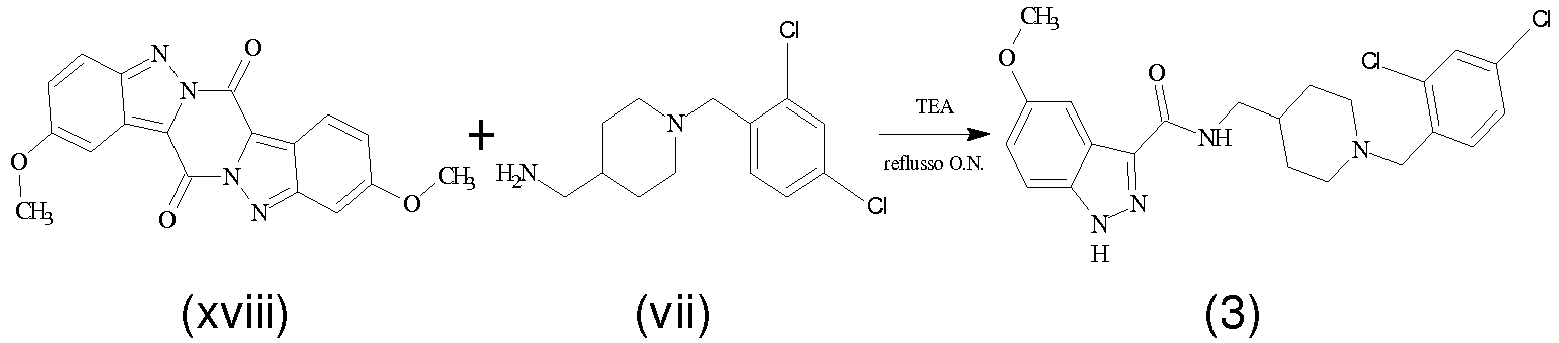
- To a suspension of compound (xviii) (2.13 g; 0.0061 moles) in toluene (50 ml) was added drop wise a solution of the intermediate compound (vii) (2,52 g; 0.012 moles), prepared as described in method A, and triethylamine (TEA; 3.2 ml; 0.023 moles) in toluene (10 ml). The reaction mixture was refluxed for 12 hours, and then filtered. Solvent was removed by evaporation under reduced pressure and residue was taken up with ethyl acetate. The organic phase was transferred into a separated funnel, washed with saturated NaHCO3 solution and water, separated out and dried over Na2SO4.
- Compound (3) thus obtained was crystallized as disclosed in following Table 2.
- 1H NMR (300 MHz, DMSO-d6): δ 13.39 (br. s., 1 H), 8.25 (t, J = 6.04 Hz, 1 H), 7.56 (d, J = 2.01 Hz, 1 H), 7.50 (dd, J = 0.55, 8.96 Hz, 1 H), 7.17 - 7.36 (m, 5H), 7.05 (dd, J = 2.47, 9.06 Hz, 1 H), 3.80 (s, 3H), 3.43 (s, 2H), 3.20 (t, J = 6.13 Hz, 2H), 2.79 (d, J = 11.16 Hz, 2H), 1.89 (t, J = 10.61 Hz, 2H), 1.46 - 1.74 (m, 3H), 1.07 - 1.34 (m, 2H).
[M.M.+H+] calculated 379.2134; [M.M.+H+] found 379.2129 -

- A solution of product (xix), a conveniently substituted arylboronic acid (compound xx), [1,1'-bis(diphenylphosphino)ferrocene]-dichloro-palladium(II) [Pd(dppf)Cl2], caesium carbonate in 1,4-dioxane and water (ratio 3:1) was subjected to microwave irradiation.
- Programme was set as follows:
- 3'; T1=160°C, T2=130°C; max power 300W
- 45'; T1=160°C, T2=130°C; max power 300W
- 5' ; T1=20°C, T2=15°C.
- After one cycle of microwave irradiation, solvents were removed by evaporating under reduce pressure and the reaction mixture was diluted with a solution of chloroform and methanol in a 2:1 ratio and filtered.
- Products (I) thus obtained were purified as described below.
- Compounds of formula (I), obtained according to one of method A to D, can be purified with one of the following techniques (a) - (c).
- Flash chromatography was carried out with a Biotage Flash Master Personal system on 20-45 µM silica cartridge or Grace Reveleris flash chromatography system with 40 µM silica cartridge.
- Flow = 60 ml/min.
- The solvents used as eluents are shown in the following Table 2.
- A different crystallization solvent was used depending on the compound to be purified. The solvents are shown in the following Table 2.
- LC/MS system consisted of a Waters 2767 Sample manager, a Waters 2478 dual λ absorbance detector and a Waters Micromass ZQ single quadrupole mass spectrometer with an electrospray ionization (ESI) source. The column used was a X-Bridge Prep C18 5 µm with 19x10mm (Waters) pre-column. Fraction collection was available from the system software MassLynx™ v. 4.1. Detection wavelength was set to 230 nm and temperature to 25°C.
- The sample was dissolved (50 mg/ml) in DMSO/CH3CN in 1:1 ratio. The mobile phase was:
- channel A = CH3CN + 0.1 % formic acid (Eluent A)
- channel B = H2O + 0.1 % formic acid (Eluent B)
- flow = 40 ml/min
- gradient = minimum and maximum percentage of eluent A reached in 15 minutes ranges from 2 to 20 and from 25 to 55, respectively.
- The following Table 2 shows both the preparation and the purification method for each compound of formula (I), as listed in Table 1, and the monoisotopic mass for each compound.
Table 2 N° Preparation method Purification method Parameters or solvent used for the purification MM founded [M+H+] MM calculated [M+H+] 1 B (b) CHCl3 409.2226 409.2234 2 C (b) EtOH abs/AcOEt 423.2402 423.2396 3 C (b) Hex/AcOEt 447.1357 447.1349 4 C (a) CHCl3/MeOH 447.2003 447.2002 5 A or C (b) THF 485.2548 485.2547 6 A (a) CHCl3/MeOH 395.2083 395.2078 MM : monoisotopic mass
CHCl3: chloroform
EtOH abs: absolute ethanol
AcOEt : ethyl acetate
Hex: hexane
MeOH: methanol
THF: tetrahydrofuraneTable 3 N° 1H-NMR peaks 1 DMSO-d6; δ 13.40 (br. S., 1H), 9.07 (s, 1H), 8.26 (t, J = 6.16 Hz, 1H), 7.55 (d, J = 2.42 Hz, 1H), 7.50 (dd, J = 0.61, 9.08 Hz, 1H), 7.05 (dd, J = 2.50, 9.10 Hz, 1H), 6.94 - 7.02 (m, 2H), 6.60 - 6.68 (m, 2H), 3.80 (s, 3H), 3.19 (t, J = 6.36 Hz, 2H), 2.89 (d, J = 11.30 Hz, 2H), 2.53 - 2.65 (m, 2H), 2.30 - 2.46 (m, 2H), 1.79 - 2.00 (m, 2H), 1.47 - 1.74 (m, 3H), 1.06 - 1.31 (m, 2H) 2 DMSO-d6; δ 13.62 (br. s., 1H), 8.24 (t, J = 6.06 Hz, 1H), 7.55 (d, J = 2.42 Hz, 1H), 7.52 (dd, J = 0.61, 8.88 Hz, 1H), 7.07 - 7.16 (m, 2H), 7.03 (dd, J = 2.42, 8.88 Hz, 1H), 6.75 - 6.87 (m, 2H), 3.80 (s, 3H), 3.71 (s, 3H), 3.19 (t, J = 6.26 Hz, 2H), 2.90 (d, J = 11.10 Hz, 2H), 2.57 - 2.74 (m, 2H), 2.34 - 2.47 (m, 2H), 1.80 - 1.98 (m, 2H), 1.46 - 1.76 (m, 3H), 1.08 - 1.30 (m, 2H) 3 DMSO-d6; δ 13.38 (br. s., 1H), 8.28 (t, J=6.22 Hz, 1H), 7.56 (t, J=2.38 Hz, 2H), 7.52 (d, J=2.56 Hz, 1H), 7.50 (d, J=1.83 Hz, 1H), 7.41 (dd, J=2.20, 8.20 Hz, 1H), 7.06 (dd, J=2.56, 9.15 Hz, 1H), 3.81 (s, 3H), 3.51 (s, 2H), 3.21 (t, J=6.22 Hz, 2H), 2.80 (d, J=11.34 Hz, 2H), 2.01 (t, J=10.79 Hz, 2H), 1.48-1.78 (m, 3H), 1.07-1.35 (m, 2H) 4 DMSO-d6; δ 13.40 (s, 1H), 8.27 (t, J=6.10 Hz, 1H), 7.67 (d, J=8.01 Hz, 2H), 7.47-7.57 (m, 4H), 7.05 (dd, J=2.44, 9.06 Hz, 1H), 3.80 (s, 3H), 3.53 (s, 2H), 3.20 (t, J=6.27 Hz, 2H), 2.78 (d, J=11.50 Hz, 2H), 1.94 (t, J=10.80 Hz, 2H), 1.47-1.77 (m, 3H), 1.12-1.36 (m, 2H) 5 DMSO-d6; δ 13.44 (br. s., 1H), 8.25 (t, J=6.22 Hz, 1H), 7.55 (d, J=1.83 Hz, 1H), 7.50 (d, J=9.15 Hz, 1H), 7.28-7.46 (m, 5H), 7.14-7.21 (m, 2H), 7.04 (dd, J=2.38, 8.96 Hz, 1H), 6.88-6.98 (m, 2H), 5.07 (s, 2H), 3.79 (s, 3H), 3.35 (s, 2H), 3.18 (t, J=6.22 Hz, 2H), 2.77 (d, J=11.34 Hz, 2H), 1.85 (t, J=10.79 Hz, 2H), 1.45-1.71 (m, 3H), 1.00-1.32 (m, 2H) 6 DMSO-d6; δ 13.50 (s, 1H), 9.70 (br. s., 1H), 8.35 (d, J=17.17 Hz, 1H), 7.55 (d, J=2.31 Hz, 1H), 7.51 (d, J=8.92 Hz, 1H), 7.27 (br. s., 2H), 7.05 (dd, J=2.31, 8.92 Hz, 1H), 6.78 (d, J=7.60 Hz, 2H), 3.80 (s, 3H), 2.60-3.59 (m, 8H), 0.99-2.15 (m, 5H) DMSO: dimethyl sulfoxide - The compounds 7 to 31 were prepared as described hereinbelow.
- 1-Hydroxybenzotriazole (HOBt, 24.3 g, 142 mmoles) and N,N'-dicyclohexylcarbodiimide (DCC, 29.3 g, 142 mmoles) were added to a solution of 5-methoxy-1H-indazole-3-carboxylic acid (30 g, 129 mmoles) in DMF (400 mL) at 0°C. After 1 hour, a solution of ethyl [4-(aminomethyl)piperidin-1-yl]acetate (26 g, 129 mmoles) in DMF (250 mL) was added at the same temperature. The mixture was stirred at 0 °C for 2 hours then was left to reach room temperature during the night. The mixture was diluted with EtOAc and the solid was removed by filtration. The solution was extracted three times with hydrochloridric acid (HCl) 2N. The pH of the acid phase was increased (about 13) with 5N NaOH and the solution was extracted three times with dichloromethane (DCM). The organic phase was dried over anhydrous Na2SO4 and the solvent was filtered and evaporated under reduced pressure providing Tert-butyl 4-({[(5-methoxy-1H-indazol-3-yl)carbonyl]amino}methyl)piperidine-1-carboxylate 7a (96% yield).
- MS: 389 m/z (M+H)+.
- 2 M HCl in Et2O (1.8 L) was added to a solution of compound 7a (92.8 g, 0.24 moles) in MeOH (500 mL). The mixture was stirred for 3 hours at room temperature then the resulting solid was filtered and dried to give 5-methoxy-N-(piperidin-4-ylmethyl)-1 H-indazole-3-carboxamide hydrochloride 7b (61.1 g, 89% yield).
- MS: 289 m/z (M+H)+.
- Finally, a mixture of compound 7b (637 mg, 1.96 mmoles) and potassium carbonate (813 mg, 5.88 mmoles) in acetonitrile (5 mL) was heated to reflux for 1 hour, then a solution of methyl 2-(chloromethyl)-1,3-thiazole-4-carboxylate (500 mg, 2.6 mmoles) in acetonitrile (5 mL) was added dropwise. The mixture was refluxed overnight then was cooled, diluted with EtOAc and filtered. The resulting solid was washed with water, dried and purified via flash chromatography (silica, from CHCl3 to CHCl3:MeOH 9:1) providing 280 mg (32% yield) of methyl 2-{[4-({[(5-methoxy-1 H-indazol-3-yl)carbonyl]amino}methyl)piperidin-1-yl]methyl}-1,3-thiazole-4-carboxylate 7.
- 1H NMR (300MHz, DMSO-d6) δ = 13.41 (s, 1 H), 8.46 (s, 1 H), 8.29 (t, J=6.0 Hz, 1 H), 7.55 (d, J=2.2 Hz, 1 H), 7.50 (d, J=9.1 Hz, 1 H), 7.05 (dd, J=2.4, 9.0 Hz, 1 H), 3.81 (s, 3H), 3.80 (s, 5H), 3.21 (t, J=6.2 Hz, 2H), 2.89 (d, J=11.3 Hz, 2H), 2.13 (t, J=10.8 Hz, 2H), 1.78 - 1.54 (m, 3H), 1.37 - 1.14 (m, 2H)
- MS: 444 m/z (M+H)+.
- To a solution of compound 7 (1.85 mmoles) in MeOH (10 mL) aqueous 1M NaOH (3.7 mL) was added. The solution was refluxed overnight then the organic solvent was removed under vacuum, the residue was diluted with H2O and the pH was adjusted to 5 by adding 1 M HCl. The mixture was kept at 4°C overnight then the resulting solid was filtered, washed with fresh water and dried under vacuum to give 2-{[4-({[(5-Methoxy-1 H-indazol-3-yl)carbonyl]amino}methyl)piperidin-1-yl]methyl}-1,3-thiazole-4-carboxylic acid 8 (43% yield).
- 1H NMR (300MHz, DMSO-d6) δ = 13.42 (br. s., 1H), 12.91 (br. s., 1 H), 8.34 (s, 1 H), 8.29 (t, J=6.0 Hz, 1 H), 7.56 (d, J=2.2 Hz, 1 H), 7.51 (d, J=9.1 Hz, 1 H), 7.05 (dd, J=2.6, 9.1 Hz, 1 H), 3.87 - 3.69 (m, 5H), 3.22 (t, J=6.2 Hz, 2H), 2.89 (d, J=11.3 Hz, 2H), 2.12 (t, J=10.6 Hz, 2H), 1.81 - 1.50 (m, 3H), 1.37 - 1.11 (m, 2H)
- MS: 430 m/z (M+H)+.
- Methyl 2-{[4-({[(5-methoxy-1H-indazol-3-yl)carbonyl]amino}methyl) piperidin-1-yl]methyl}-1,3-oxazole-4-carboxylate 9 was prepared, according to the procedure described for compound 7, using methyl 2-(chloromethyl)-1,3-oxazole-4-carboxylate. Yield: 410 mg, 45%.
- 1H NMR (300MHz, DMSO-d6) δ = 13.40 (br. s., 1 H), 8.80 (s, 1 H), 8.26 (t, J=6.2 Hz, 1 H), 7.55 (d, J=2.6 Hz, 1 H), 7.51 (d, J=9.1 Hz, 1 H), 7.05 (dd, J=2.4, 9.0 Hz, 1 H), 3.80 (s, 6H), 3.67 (s, 2H), 3.18 (t, J=6.2 Hz, 2H), 2.82 (d, J=11.3 Hz, 2H), 2.14 - 1.93 (m, 2H), 1.74 - 1.45 (m, 3H), 1.29 - 1.10 (m, 2H)
- MS: 428 m/z (M+H)+.
- 2-{[4-({[(5-Methoxy-1H-indazol-3-yl)carbonyl]amino}methyl) piperidin-1-yl]methyl}-1,3-oxazole-4-carboxylic acid hydrate 10 was prepared, according to the procedure described for compound 8, starting from compound 9. Yield: 238 mg, 82%.
- 1H NMR (300MHz, DMSO-d6) δ = 13.40 (s, 1 H), 12.99 (br. s., 1 H), 8.67 (s, 1 H), 8.26 (t, J=6.0 Hz, 1 H), 7.55 (d, J=2.2 Hz, 1 H), 7.50 (d, J=9.5 Hz, 1 H), 7.04 (dd, J=2.6, 9.1 Hz, 1 H), 3.80 (s, 3H), 3.66 (s, 2H), 3.18 (t, J=6.4 Hz, 2H), 2.82 (d, J=11.0 Hz, 2H), 2.05 (t, J=10.4 Hz, 2H), 1.76 - 1.44 (m, 3H), 1.33 - 1.05 (m, 2H)
- MS: 414 m/z (M+H)+.
- Tert-butyl 4-({[(5-bromo-1H-indazol-3-yl)carbonyl]amino}methyl) piperidine-1-carboxylate 11a was prepared, according to the procedure described for compound 7, from 5-bromo-1H-indazole-3-carboxylic acid and tert-butyl 4-(aminomethyl)piperidine-1-carboxylate. Yield: 40.6 g, 87%
- MS: 437 m/z (M+H)+.
- 2M HCl in Et2O (1.8 L) was added to a solution of compound tert-butyl 4-(aminomethyl)piperidine-1-carboxylate 11a (0.24 moles) in MeOH (500 mL). The mixture was stirred for 3 hours at room temperature then the resulting solid was filtered and dried to give 5-Bromo-N-(piperidin-4-ylmethyl)-1 H-indazole-3-carboxamide hydrochloride 11 b (76% yield).
- MS: 337 m/z (M+H)+.
- Finally, methyl 2-{[4-({[(5-bromo-1 H-indazol-3-yl)carbonyl] amino}methyl)piperidin-1-yl]methyl}-1,3-oxazole-4-carboxylate 11 was prepared, according to the procedure described for compound 7, from 11 b and methyl 2-(chloromethyl)-1,3-oxazole-4-carboxylate. Yield: 166 mg, 16%.
- 1H NMR (300MHz, DMSO-d6) δ = 13.73 (br. s., 1 H), 8.80 (s, 1 H), 8.42 (t, J=6.0 Hz, 1 H), 8.31 (dd, J=0.8, 1.8 Hz, 1 H), 7.60 (dd, J=0.8, 8.8 Hz, 1 H), 7.52 (dd, J=1.8, 8.8 Hz, 1 H), 3.80 (s, 3H), 3.67 (s, 2H), 3.18 (t, J=6.4 Hz, 2H), 2.81 (d, J=11.3 Hz, 2H), 2.13 - 1.95 (m, 2H), 1.74 - 1.44 (m, 3H), 1.32 - 1.06 (m, 2H)
- MS: 428 m/z (M+H)+.
- A solution of compound 11 (0.44 mmoles), (2,3-difluorophenyl)boronic acid (1.77 mmoles), [1,1'-bis(diphenylphosphino)ferrocene]-dichloro-palladium(II) [Pd(dppf)Cl2] (81 mg, 0.11 mmoles) and caesium carbonate (575 mg, 1.76 mmoles) in 1,4-dioxane and water (ratio 3:1, 8 mL) was subjected to microwave irradiation as follows:
- Time period = 3'; T1=160°C, T2=130°C; max power 300W
- Time period = 45'; T1=160°C, T2=130°C; max power 300W
- Time period = 5' ; T1=20 °C, T2=15°C.
- After one cycle of microwave irradiation, solvents were removed by evaporating under reduce pressure and the reaction mixture was diluted with a solution of methanol (20 mL), filtered over Celite and dried under vacuum. The crude product was filtered on a silica cartridge and washed with chloroform and methanol in a 1:1 ratio. The resulting solid was dissolved in DMSO and purified via preparative HPLC (channel A = CH3CN + 0.1 % formic acid; channel B = H2O + 0.1% formic acid: flow = 40 ml/min; gradient = 15% - 50%of eluent A in 15 minutes), providing 2-({4-[({[5-(2,3-Difluorophenyl)-1H-indazol-3-yl]carbonyl}amino)methyl] piperidin-1-yl}methyl)-1,3-oxazole-4-carboxylic acid hydrate 12 (6% yield).
- 1H NMR (300MHz, DMSO-d6) δ = 13.70 (s, 1 H), 12.99 (br. s., 1 H), 8.57 (s, 1 H), 8.42 (t, J=6.0 Hz, 1 H), 8.34 (d, J=0.7 Hz, 1 H), 7.73 (dd, J=0.8, 8.8 Hz, 1 H), 7.61 (td, J=1.8, 8.7 Hz, 1 H), 7.52 - 7.21 (m, 3H), 3.64 (s, 2H), 3.20 (t, J=6.2 Hz, 2H), 2.82 (d, J=11.0 Hz, 2H), 2.04 (t, J=10.6 Hz, 2H), 1.73 - 1.45 (m, 3H), 1.33 - 1.09 (m, 2H)
- MS: 496 m/z (M+H)+.
- Ethyl 4-{[4-({[(5-methoxy-1H-indazol-3-yl)carbonyl]amino}methyl) piperidin-1-yl]methyl}-1,3-thiazole-2-carboxylate 13 was prepared, according to the procedure described for compound 7, using ethyl 4-(chloromethyl)-1,3-thiazole-2-carboxylate. Yield: 45 mg, 11%.
- 1H NMR (300MHz, DMSO-d6) δ = 13.39 (s, 1 H), 8.26 (t, J=6.0 Hz, 1 H), 7.86 (s, 1 H), 7.55 (d, J=2.2 Hz, 1 H), 7.50 (d, J=8.8 Hz, 1 H), 7.04 (dd, J=2.2, 8.8 Hz, 1 H), 4.37 (q, J=7.0 Hz, 2H), 3.80 (s, 3H), 3.64 (s, 2H), 3.19 (t, J=6.2 Hz, 2H), 2.85 (d, J=11.3 Hz, 2H), 1.98 (t, J=10.6 Hz, 2H), 1.79 - 1.45 (m, 3H), 1.33 (t, J=7.1 Hz, 3H), 1.29 - 0.96 (m, 2H)
- MS: 458 m/z (M+H)+.
- Methyl 2-{[4-({[(5-methoxy-1H-indazol-3-yl)carbonyl]amino}methyl) piperidin-1-yl]methyl}furan-3-carboxylate 14 was prepared, according to the procedure described for compound 7, using methyl 2-(chloromethyl)furan-3-carboxylate. Yield: 120 mg, 13%.
- 1H NMR (300MHz, DMSO-d6) δ = 13.39 (s, 1 H), 8.23 (t, J=6.0 Hz, 1 H), 7.70 (d, J=2.2 Hz, 1 H), 7.54 (d, J=2.6 Hz, 1 H), 7.50 (d, J=8.4 Hz, 1 H), 7.04 (dd, J=2.4, 9.0 Hz, 1 H), 6.70 (d, J=2.2 Hz, 1 H), 3.83 (s, 2H), 3.80 (s, 3H), 3.76 (s, 3H), 3.17 (t, J=6.4 Hz, 2H), 2.80 (d, J=11.3 Hz, 2H), 2.10 - 1.88 (m, 2H), 1.70 - 1.42 (m, 3H), 1.31 - 1.02 (m, 2H)
- MS: 427 m/z (M+H)+.
- Ethyl 5-{[4-({[(5-bromo-1H-indazol-3-yl)carbonyl]amino}methyl) piperidin-1-yl]methyl}furan-2-carboxylate 15 was prepared, according to the procedure described for compound 7, from 11 b and ethyl 5-(chloromethyl)furan-2-carboxylate. Yield: 300 mg, 62%.
- 1H NMR (300 MHz, DMSO-d6) δ = 13.73 (br. s., 1 H), 8.41 (t, J=6.04 Hz, 1 H), 8.32 (dd, J=0.73, 1.83 Hz, 1 H), 7.57-7.65 (m, 1 H), 7.45-7.56 (m, 1 H), 7.21 (d, J=3.66 Hz, 1 H), 6.48 (d, J=3.66 Hz, 1 H), 4.27 (q, J=7.32 Hz, 2H), 3.53 (s, 2H), 3.19 (t, J=6.40 Hz, 2H), 2.81 (d, J=11.34 Hz, 2H), 1.82-2.09 (m, 2H), 1.64 (d, J=12.44 Hz, 3H), 1.02-1.36 (m, 5H)
- MS: 489 m/z (M+H)+.
- 5-({4-[({[5-(2-Methoxypyridin-3-yl)-1H-indazol-3-yl]carbonyl}amino) methyl]piperidin-1-yl}methyl)furan-2-carboxylic acid hydrate 16 was prepared, according to the procedure described for compound 12, from compound 15 and (2-methoxypyridin-3-yl)boronic acid and using the following preparative HPLC parameters for the purification: channel A = CH3CN + 0.1 % formic acid; channel B = H2O + 0.1% formic acid: flow = 40 ml/min; gradient = 10% - 45% of eluent A in 15 minutes. Yield: 14 mg, 5%.
- 1H NMR (300 MHz, DMSO-d6) δ 13.62 (br. s., 1H), 8.36 (t, J=6.04 Hz, 1 H), 8.28 (s, 1 H), 8.19 (dd, J=1.83, 5.12 Hz, 1 H), 7.77 (dd, J=2.20, 7.32 Hz, 1 H), 7.65 (dd, J=0.80, 8.80 Hz, 1 H), 7.58 (dd, J=1.80, 8.80 Hz, 1 H), 7.11 (dd, J=5.12, 7.32 Hz, 1 H), 6.84 (br. s., 1 H), 6.31 (d, J=2.93 Hz, 1 H), 3.89 (s, 3H), 3.47 (s, 2H), 3.19 (t, J=6.22 Hz, 2H), 2.99 (s, 1 H), 2.82 (d, J=10.98 Hz, 2H), 1.83-2.04 (m, 2H), 1.41-1.75 (m, 3H), 1.06-1.34 (m, 2H)
- MS: 490 m/z (M+H)+.
- 5-({4-[({[5-(6-Methoxypyridin-3-yl)-1H-indazol-3-yl]carbonyl}amino) methyl]piperidin-1-yl}methyl)furan-2-carboxylic acid hydrate 17 was prepared, according to the procedure described for compound 12, from compound 15 and (6-methoxypyridin-3-yl)boronic acid and using the following preparative HPLC parameters for the purification: channel A = CH3CN + 0.1 % formic acid; channel B = H2O + 0.1% formic acid: flow = 40 ml/min; gradient = 10% - 45% of eluent A in 15 minutes. Yield: 23 mg, 8%.
- 1H NMR (300 MHz, DMSO-d6) δ 13.65 (br. s., 1 H), 8.48 (d, J=2.02 Hz, 1 H), 8.39 (t, J=6.06 Hz, 1 H), 8.34 (s, 1 H), 7.96-8.07 (m, 1 H), 7.70 (d, J=1.21 Hz, 2H), 7.03 (d, J=3.23 Hz, 1 H), 6.94 (d, J=8.07 Hz, 1 H), 6.40 (d, J=3.23 Hz, 1 H), 3.92 (s, 3H), 3.51 (s, 2H), 3.21 (t, J=6.26 Hz, 2H), 2.83 (d, J=10.90 Hz, 2H), 1.98 (t, J=10.90 Hz, 2H), 1.48-1.78 (m, 3H), 1.07-1.34 (m, 2H)
- MS: 490 m/z (M+H)+.
- 5-({4-[({[5-(4-Methoxyphenyl)-1H-indazol-3-yl]carbonyl}amino) methyl]piperidin-1-yl}methyl)furan-2-carboxylic acid hydrate 18 was prepared, according to the procedure described for compound 12, from compound 15 and (4-methoxyphenyl)boronic acid and using the following preparative HPLC parameters for the purification: channel A = CH3CN + 0.1 % formic acid; channel B = H2O + 0.1% formic acid: flow = 40 ml/min; gradient = 15% - 50% of eluent A in 15 minutes. Yield: 14 mg, 5%.
- 1H NMR (300 MHz, DMSO-d6) δ 13.55 (s, 1H), 8.27-8.41 (m, 2H), 7.64-7.72 (m, 2H), 7.61 (d, J=8.88 Hz, 2H), 7.05 (d, J=8.88 Hz, 2H), 6.96 (br. s., 1 H), 6.37 (d, J=3.23 Hz, 1 H), 3.81 (s, 3H), 3.49 (s, 2H), 3.20 (t, J=6.26 Hz, 2H), 2.82 (d, J=10.90 Hz, 2H), 1.86-2.05 (m, 2H), 1.66 (d, J=12.11 Hz, 3H), 1.09-1.33 (m, 2H)
- MS: 489 m/z (M+H)+.
- 5-({4-[({[5-(2,3-Difluorophenyl)-1H-indazol-3-yl]carbonyl}amino) methyl]piperidin-1-yl}methyl)furan-2-carboxylic acid 19 was prepared, according to the procedure described for compound 12, from compound 15 and (2,3-difluorophenyl)boronic acid and using the following preparative HPLC parameters for the purification: channel A = CH3CN + 0.1% formic acid; channel B = H2O + 0.1% formic acid: flow = 40 ml/min; gradient = 15% - 50% of eluent A in 15 minutes. Yield: 32 mg, 11%.
- 1H NMR (300 MHz, DMSO-d6) δ 13.74 (br. s., 1H), 8.42 (t, J=5.65 Hz, 1 H), 8.35 (s, 1 H), 7.69-7.80 (m, 1 H), 7.55-7.67 (m, 1 H), 7.21-7.54 (m, 3H), 7.05 (d, J=3.23 Hz, 1 H), 6.41 (d, J=3.23 Hz, 1 H), 3.52 (s, 2H), 3.20 (t, J=6.06 Hz, 2H), 2.83 (d, J=10.50 Hz, 2H), 1.98 (t, J=10.70 Hz, 2H), 1.42-1.79 (m, 3H), 1.04-1.35 (m, 2H)
- MS: 495 m/z (M+H)+.
- 5-({4-[({[5-(2-Fluorophenyl)-1H-indazol-3-yl]carbonyl}amino) methyl]piperidin-1-yl}methyl)furan-2-carboxylic acid hydrate 20 was prepared, according to the procedure described for compound 12, from compound 15 and (2-fluorophenyl)boronic acid and using the following preparative HPLC parameters for the purification: channel A = CH3CN + 0.1% formic acid; channel B = H2O + 0.1% formic acid: flow = 40 ml/min; gradient = 10% - 45% of eluent A in 15 minutes. Yield: 20 mg, 7%.
- 1H NMR (300 MHz, DMSO-d6) δ 13.66 (br. s., 1H), 8.39 (t, J=6.04 Hz, 1 H), 8.32 (s, 1 H), 7.65-7.76 (m, 1 H), 7.50-7.63 (m, 2H), 7.38-7.50 (m, 1 H), 7.23-7.38 (m, 2H), 7.08 (d, J=3.29 Hz, 1 H), 6.43 (d, J=3.29 Hz, 1H), 3.52 (s, 2H), 3.20 (t, J=6.22 Hz, 2H), 2.82 (d, J=10.98 Hz, 2H), 1.98 (t, J=10.79 Hz, 2H), 1.44-1.79 (m, 3H), 1.02-1.38 (m, 2H)
- MS: 477 m/z (M+H)+.
- 5-({4-[({[5-(4-Methoxypyridin-3-yl)-1H-indazol-3-yl]carbonyl}amino) methyl]piperidin-1-yl}methyl)furan-2-carboxylic acid formate 21 was prepared, according to the procedure described for compound 12, from compound 15 and (4-methoxypyridin-3-yl)boronic acid and using the following preparative HPLC parameters for the purification: channel A = CH3CN + 0.1 % formic acid; channel B = H2O + 0.1% formic acid: flow = 40 ml/min; gradient = 2% - 40% of eluent A in 15 minutes. Yield: 40 mg, 14%.
- 1H NMR (300 MHz, DMSO-d6) δ 13.61 (br. s., 1 H), 8.47 (d, J=5.85 Hz, 1 H), 8.31-8.43 (m, 2H), 8.24 (s, 1 H), 7.66 (d, J=8.78 Hz, 1 H), 7.53 (dd, J=1.46, 8.42 Hz, 1 H), 7.18 (d, J=5.49 Hz, 1 H), 7.09 (d, J=3.29 Hz, 1 H), 6.43 (d, J=3.29 Hz, 1 H), 3.86 (s, 3H), 3.54 (s, 2H), 3.19 (t, J=6.04 Hz, 2H), 2.83 (d, J=10.98 Hz, 2H), 1.99 (t, J=10.79 Hz, 2H), 1.44-1.79 (m, 3H), 0.98-1.36 (m, 2H)
- MS: 490 m/z (M+H)+.
- 5-{[4-({[(5-Bromo-1H-indazol-3-yl)carbonyl]amino}methyl)piperidin-1-yl]methyl}furan-2-carboxylic acid 22 was prepared, according to the procedure described for compound 8, starting from compound 15 and using EtOH as solvent. Yield: 264 mg, 98%.
- 1H NMR (300 MHz, DMSO-d6) δ 13.78 (br. s., 1H), 8.43 (t, J=5.85 Hz, 1 H), 8.32 (d, J=1.21 Hz, 1 H), 7.61 (d, J=8.80 Hz, 1 H), 7.53 (dd, J=2.00, 8.80 Hz, 1 H), 7.11 (d, J=3.63 Hz, 1 H), 6.45 (d, J=3.23 Hz, 1 H), 3.57 (s, 2H), 3.19 (t, J=6.26 Hz, 2H), 2.85 (d, J=11.30 Hz, 2H), 2.02 (t, J=10.90 Hz, 2H), 1.45-1.77 (m, 3H), 1.08-1.37 (m, 2H)
- MS: 461 m/z (M+H)+.
- Ethyl 5-{[4-({[(5-methoxy-1H-indazol-3-yl)carbonyl]amino}methyl) piperidin-1-yl]methyl}furan-2-carboxylate 23 was prepared, according to the procedure described for compound 7, starting from ethyl 5-(chloromethyl)furan-2-carboxylate. Yield: 290 mg, 71%.
- 1H NMR (300 MHz, DMSO-d6) δ 13.37 (br. s., 1H), 8.25 (t, J=6.04 Hz, 1 H), 7.42-7.60 (m, 2H), 7.21 (d, J=3.29 Hz, 1 H), 6.97-7.12 (m, 1 H), 6.48 (d, J=3.29 Hz, 1 H), 4.26 (q, J=7.32 Hz, 2H), 3.80 (s, 3H), 3.53 (s, 2H), 3.18 (t, J=6.22 Hz, 2H), 2.81 (d, J=11.34 Hz, 2H), 1.87-2.05 (m, 2H), 1.46-1.73 (m, 3H), 1.28 (t, J=6.95 Hz, 3H), 1.01-1.41 (m, 2H)
- MS: 441 m/z (M+H)+.
- 5-{[4-({[(5-Methoxy-1H-indazol-3-yl)carbonyl]amino}methyl) piperidin-1-yl]methyl}furan-2-carboxylic acid 24 was prepared, according to the procedure described for compound 8, starting from compound 23 and using EtOH as solvent. Yield: 64 mg, 84%.
- 1H NMR (300 MHz, DMSO-d6) δ 12.78-14.43 (m, 1H), 8.26 (t, J=6.04 Hz, 1 H), 7.55 (d, J=2.56 Hz, 1 H), 7.52 (d, J=9.15 Hz, 1 H), 7.04 (dd, J=2.60, 9.10 Hz, 1 H), 6.91 (d, J=3.29 Hz, 1 H), 6.35 (d, J=3.29 Hz, 1 H), 4.04 (br. s., 1 H), 3.80 (s, 3H), 3.50 (s, 2H), 3.18 (t, J=6.22 Hz, 2H), 2.83 (d, J=11.34 Hz, 2H), 1.97 (t, J=10.79 Hz, 2H), 1.47-1.73 (m, 3H), 1.04-1.33 (m, 2H)
- MS: 413 m/z (M+H)+.
- A mixture of compound 7b (8 g, 24.6 mmoles) and potassium carbonate (17 g, 123 mmoles) in acetone (250 mL) was refluxed for 1 hour, then (2R,6S)-4-(2-chloroethyl)-2,6-dimethylmorpholine (25.9 mmoles) was added dropwise. The mixture was refluxed overnight then was cooled and filtered. The resulting solid was dried and purified via preparative HPLC (channel A = CH3CN + 0.1% formic acid; channel B = H2O + 0.1% formic acid: flow = 40 ml/min; gradient = 10% - 45% of eluent A in 15 minutes) providing N-[(1-{2-[(2R,6S)-2,6-dimethylmorpholin-4-yl]ethyl}piperidin-4-yl)methyl]-5-methoxy-1H-indazole-3-carboxamide 25 (48.3% yield)
- 1H NMR (300 MHz, DMSO-d6) δ = 13.40 (s, 1H), 8.30-8.14 (t, J=6.11 Hz, 1H), 7.58-7.53 (d, J=1.98 Hz, 1H), 7.53-7.46 (dd, J=8.92, 0.66 Hz, 1 H), 7.11-6.96 (dd, J=8.92, 2.31 Hz, 1H), 3.80 (s, 3H), 3.57-3.43 (m, 2H), 3.21-3.11 (t, J=6.28 Hz, 2H), 2.92-2.77 (d, J=11.23 Hz, 2H), 2.76-2.63 (d, J=10.24 Hz, 2H), 2.44-2.26 (m, 4H), 1.97-1.77 (t, J=10,90 Hz, 2H), 1.71-1.46 (t, J=10.73 Hz, 4H), 1.27-1.07 (m, 3H), 1.06-0.94 (d, J=6.28 Hz, 6H)
- LC-MS: 430.28 (MH+)
- N-[(1-{3-[(2R,6S)-2,6-dimethylmorpholin-4-yl]propyl}piperidin-4-yl) methyl]-5-methoxy-1 H-indazole-3-carboxamide 26, was prepared, according to the procedure described for compound 25, using (2R,6S)-4-(3-chloropropyl)-2,6-dimethylmorpholine and methanol as solvent. Yield = 91 mg (59.1 %).
- 1H NMR (300 MHz, DMSO-d6) δ = 12.12 (s, 1H), 7.80-7.62 (d, J=2.20 Hz, 1 H), 7.40-7.32 (d, J=9.15, 1 H), 7.27-7.18 (t, J=6.04 Hz, 1 H), 7.07-6.99 (dd, J=9.15, 2.20 Hz, 1 H), 3.89-3.78 (s, 3H), 3.76-3.53 (m, 2H), 3.47-3.30 (t, J=6.22 Hz, 2H), 3.07-2.93 (m, 2H), 2.75-2.68 (d, J=10.98 Hz, 2H), 2.45-2.24 (m, 4H), 2.07-1.88 (t, J=10.79 Hz, 2H), 1.83-1.59 (m, 7H), 1.53-1.35 (m, 2H), 1.18-1.05 (d, J=6.22 Hz, 6H)
- LC-MS: 444.30 (MH+)
- A solution of compound 11b (420 mg, 1.46 mmol) in DMF (45 ml) and triethylamine (0.61 ml, 4.4 mmol) was stirred at 80 °C for 1h and then was treated with 1-(2-bromoethyl)-3-methylcyclohexane (300 mg, 1.46 mmol). The mixture was stirred overnight at the same temperature. The reaction was then cooled to room temperature and the solvent was removed by evaporation at reduced pressure. The crude 5-methoxy-N-({1-[2-(3-methylcyclohexyl)ethyl]piperidin-4-yl}methyl)-1H-indazole-3-carboxamide 27 was purified by flash chromatography on silica gel, using a 9/1 mixture of CH3Cl/CH3OH as eluent. Yield = 45 mg (18.0 %).
- 1H NMR (300 MHz, DMSO-d6) δ = 13.41 (s, 1H), 8.30-8.20 (t, J=6.11 Hz, 1 H), 7.58-7.53 (d, J=2.31 Hz, 1 H), 7.53-7.47 (d, J=8.59 Hz, 1H), 7.08-7.02 (dd, J=8.92, 2.32 Hz, 1H), 3.80 (s, 3H), 3.23-3.13 (t, J=6.28 Hz, 2H), 2.90-2.78 (d, J=10.57 Hz, 2H), 2.35-2.20 (m, 2H), 1.97-1.05 (m, 17H), 0.90-0.45 (m, 5H)
- LC-MS: 413.29 (MH+)
- 4-{[4-({[(5-methoxy-1H-indazol-3-yl)carbonyl]amino}methyl) piperidin-1-yl]methyl}pyridine-2-carboxylic acid 28, was prepared, according to the procedure described for compound 25, using methyl 4-(chloromethyl)pyridine-2-carboxylate as reagent and CH3CN as solvent. Yield = 335 mg (16 %).
- 1H NMR (300 MHz, DMSO-d6) δ = 13.25 (s, 1 H), 8.54 (d, J=4.8 Hz, 1 H), 8.27 (t, J=6.0 Hz, 1 H), 7.93 (s, 1 H), 7.56 (d, J=2.2 Hz, 1 H), 7.51 (d, J=9.5 Hz, 1 H), 7.43 (d, J=4.0 Hz, 1 H), 7.04 (dd, J=2.2, 9.5 Hz, 1 H), 3.80 (s, 3H), 3.53 (s, 2H), 3.20 (t, J=6.0 Hz, 2H), 2.78 (d, J=11.0 Hz, 2H), 1.96 (t, J=10.6 Hz, 2H), 1.75 - 1.45 (m, 3H), 1.35 - 1.16 (m, 2H)
- Methyl 5-{[4-({[(5-methoxy-1H-indazol-3-yl)carbonyl]amino}methyl) piperidin-1-yl]methyl}pyridine-2-carboxylate 29a, was prepared according to the procedure described for compound 25 using methyl 5-(chloromethyl)pyridine-2-carboxylate as reagent and CH3CN as solvent and used for the subsequent step without further purification.
- Then, a solution of crude methyl 5-{[4-({[(5-methoxy-1H-indazol-3-yl)carbonyl]amino}methyl)piperidin-1-yl]methyl}pyridine-2-carboxylate 29a (1.2 g, 2.7 mmol) in ethanol (10 ml) was treated with a solution of NaOH (0.22g, 5.5 mmol) in water (10 ml) at reflux for 3h. The mixture is cooled to room temperature and solvents were evaporated under reduced pressure. The sodium 5-{[4-({[(5-methoxy-1H-indazol-3-yl)carbonyl]amino}methyl)piperidin-1-yl]methyl}pyridine-2-carboxylate 29 was crystallized by a mixture of ethanol/ethyl acetate (1.09 g, 91%).
- 1 H NMR (300MHz, DMSO-d6) δ = 13.86 (br. s., 1 H), 8.37 (d, J=1.2 Hz, 1 H), 8.24 (t, J=6.1 Hz, 1 H), 7.91 (d, J=8.1 Hz, 1 H), 7.65 (dd, J=2.0, 8.1 Hz, 1 H), 7.61 - 7.48 (m, 2H), 7.01 (dd, J=2.5, 8.8 Hz, 1 H), 3.79 (s, 3H), 3.47 (s, 2H), 3.19 (t, J=6.1 Hz, 2H), 2.77 (d, J=10.9 Hz, 2H), 1.91 (t, J=10.9 Hz, 2H), 1.65 (s, 3H), 1.35 - 1.07 (m, 2H)
- N-({1-[(5-carbamoyl-1,2,4-oxadiazol-3-yl)methyl]piperidin-4-yl} methyl)-5-methoxy-1 H-indazole-3-carboxamide 30, was prepared, according to the procedure described for compound 25, using ethyl 3-(chloromethyl)-1,2,4-oxadiazole-5-carboxylate as reagent and CH3CN as solvent. Yield = 80 mg (4 %).
- 1H NMR (300 MHz, DMSO-d6) δ = 13.18 (br. s., 1H), 8.70 (br. s., 1 H), 8.32 (br. s., 1 H), 8.26 (t, J=6.2 Hz, 1 H), 7.55 (d, J=1.8 Hz, 1 H), 7.50 (dd, J=0.7, 9.1 Hz, 1 H), 7.05 (dd, J=1.8, 9.1 Hz, 1 H), 3.80 (s, 3H), 3.69 (s, 2H), 3.19 (t, J=6.2 Hz, 2H), 2.86 (d, J=11.0 Hz, 2H), 2.19 - 1.93 (m, 2H), 1.82 - 1.39 (m, 3H), 1.33 - 1.07 (m, 2H)
- A mixture of 7H,14H-pyrazino[1,2-b:4,5-b']diindazole-7,14-dione (8.2 g, 28.5 mmol), 1-{1-[2-(4-nitrophenyl)ethyl]piperidin-4-yl}methanamine (15 g, 57 mmol) in toluene (300 ml) was stirred at room temperature over night. The solid so obtained was filtered, dissolved with 2N HCl (100 ml) and washed with diethylether (3x 150 ml). The acid phase was basified with NaOH and extracted with DCM (3x 200 ml). The solvent was removed by vacuum and the residue was then poured in THF (30 ml) and treated with 1.25 M HCl in MeOH. The crude, solid N-({1-[2-(4-nitrophenyl)ethyl]piperidin-4-yl}methyl)-1H-indazole-3-carboxamide hydrochloride 31 so obtained was filtered and cristallized from EtOH.
- 1H NMR (300MHz, DMSO-d6) δ = 13.70 (s, 1 H), 10.82 (br. s., 1 H), 8.55 (t, J=6.1 Hz, 1 H), 8.30 - 8.10 (m, 3H), 7.67 - 7.52 (m, 3H), 7.41 (ddd, J=1.2, 7.0, 8.4 Hz, 1H), 7.24 (ddd, J=0.8, 7.0, 8.0 Hz, 1H), 3.57 (d, J=11.7 Hz, 2H), 3.48 - 3.15 (m, 6H), 3.04 - 2.83 (m, 2H), 1.90 (d, J=11.5 Hz, 3H), 1.75 - 1.50 (m, 2H)
- The following Table 1A summarizes the chemical name and structure of the above described compounds 7-31.
TABLE 1A IUPAC name Structure 7 Methyl 2-{[4-({[(5-methoxy-1H-indazol-3-yl)carbonyl]amino}methyl)piperidin-1-yl]methyl}-1,3-thiazole-4-carboxylate 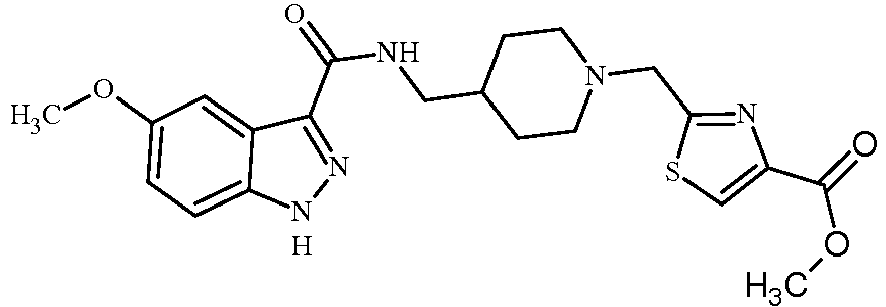
8 2-{[4-({[(5-Methoxy-1H-indazol-3-yl)carbonyl]amino}methyl)piperidin-1-yl]methyl}-1,3-thiazole-4-carboxylic acid 
9 Methyl 2-{[4-({[(5-methoxy-1H-indazol-3-yl)carbonyl]amino}methyl)piperidin-1-yl]methyl}-1,3-oxazole-4-carboxylate 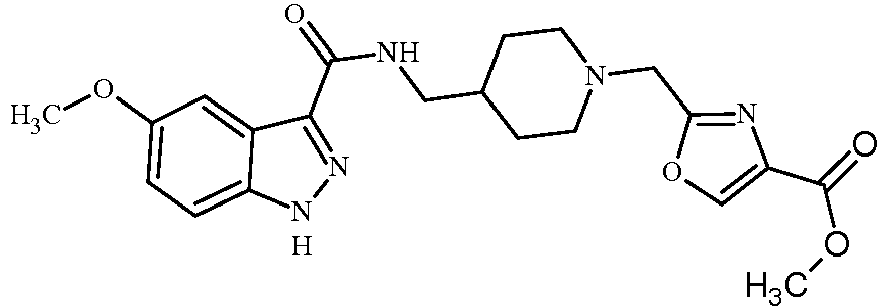
10 2-{[4-({[(5-Methoxy-1H-indazol-3-yl)carbonyl]amino}methyl)piperidin-1-yl]methyl}-1,3-oxazole-4-carboxylic acid hydrate 
11 Methyl 2-{[4-({[(5-bromo-1H-indazol-3-yl)carbonyl]amino}methyl)piperidin-1-yl]methyl}-1,3-oxazole-4-carboxylate 
12 2-({4-[({[5-(2,3-Difluorophenyl)-1H-indazol-3-yl]carbonyl}amino)methyl]piperidin-1-yl}methyl)-1,3-oxazole-4-carboxylic acid hydrate 
13 Ethyl 4-{[4-({[(5-methoxy-1H-indazol-3-yl)carbonyl]amino}methyl)piperidin-1-yl]methyl}-1,3-thiazole-2-carboxylate 
14 Methyl 2-{[4-({[(5-methoxy-1H-indazol-3-yl)carbonyl]amino}methyl)piperidin-1-yl]methyl}furan-3-carboxylate 
15 Ethyl 5-{[4-({[(5-bromo-1H-indazol-3-yl)carbonyl]amino}methyl) piperidin-1-yl]methyl}furan-2-carboxylate 
16 5-({4-[({[5-(2-Methoxypyridin-3-yl)-1H-indazol-3-yl]carbonyl}amino) methyl]piperidin-1-yl}methyl)furan-2-carboxylic acid hydrate 
17 5-({4-[({[5-(6-Methoxypyridin-3-yl)-1H-indazol-3-yl]carbonyl}amino)methyl]piperidin-1-yl}methyl)furan-2-carboxylic acid hydrate 
18 5-({4-[({[5-(4-Methoxyphenyl)-1H-indazol-3-yl]carbonyl}amino)methyl]piperidin-1-yl}methyl)furan-2-carboxylic acid hydrate 
19 5-({4-[({[5-(2,3-Difluorophenyl)-1H-indazol-3-yl]carbonyl}amino)methyl]piperidin-1-yl}methyl)furan-2-carboxylic acid 
20 5-({4-[({[5-(2-Fluorophenyl)-1H-indazol-3-yl]carbonyl}amino)methyl]piperidin-1-yl}methyl)furan-2-carboxylic acid hydrate 
21 5-({4-[({[5-(4-Methoxypyridin-3-yl)-1H-indazol-3-yl]carbonyl}amino)methyl]piperidin-1-yl}methyl)furan-2-carboxylic acid formate 
22 5-{[4-({[(5-Bromo-1H-indazol-3-yl)carbonyl]amino}methyl)piperidin-1-yl]methyl}furan-2-carboxylic acid 
23 Ethyl 5-{[4-({[(5-methoxy-1H-indazol-3-yl)carbonyl]amino}methyl)piperidin-1-yl]methyl}furan-2-carboxylate 
24 5-{[4-({[(5-Methoxy-1H-indazol-3-yl)carbonyl]amino}methyl)piperidin-1-yl]methyl}furan-2-carboxylic acid 
25 N-[(1-{2-[(2R,6S)-2,6-dimethylmorpholin-4-yl]ethyl}piperidin-4-yl)methyl]-5-methoxy-1H-indazole-3-carboxamide 
26 N-[(1-{3-[(2R,6S)-2,6-dimethylmorpholin-4-yl]propyl}piperidin-4-yl)methyl]-5-methoxy-1H-indazole-3-carboxamide 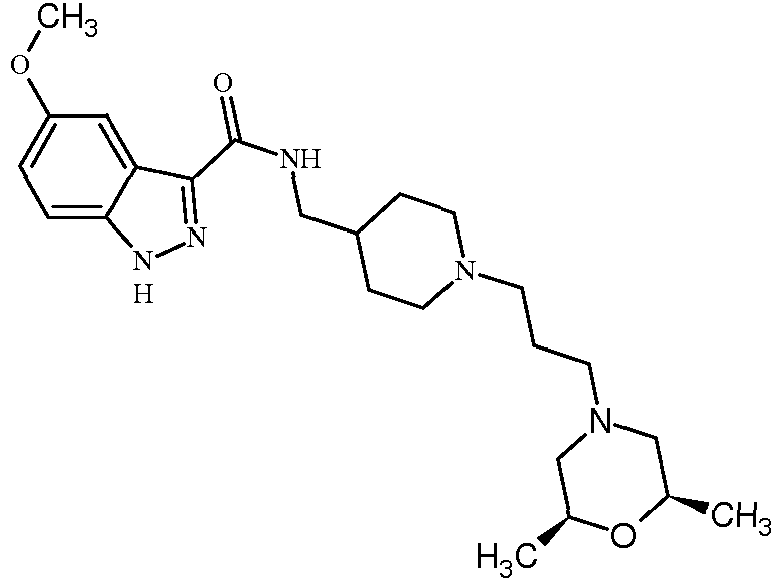
27 5-methoxy-N-({1-[2-(3-methylcyclohexyl)ethyl]piperidin-4-yl}methyl)-1H-indazole-3-carboxamide 
28 4-{[4-({[(5-methoxy-1H-indazol-3-yl)carbonyl]amino}methyl)piperidin-1-yl]methyl}pyridine-2-carboxylic acid 
29 Sodium 5-{[4-({[(5-methoxy-1H-indazol-3-yl)carbonyl]amino}methyl)piperidin-1-yl]methyl}pyridine-2-carboxylate 
30 N-({1-[(5-carbamoyl-1,2,4-oxadiazol-3-yl)methyl]piperidin-4-yl}methyl)-5-methoxy-1 H-indazole-3-carboxamide 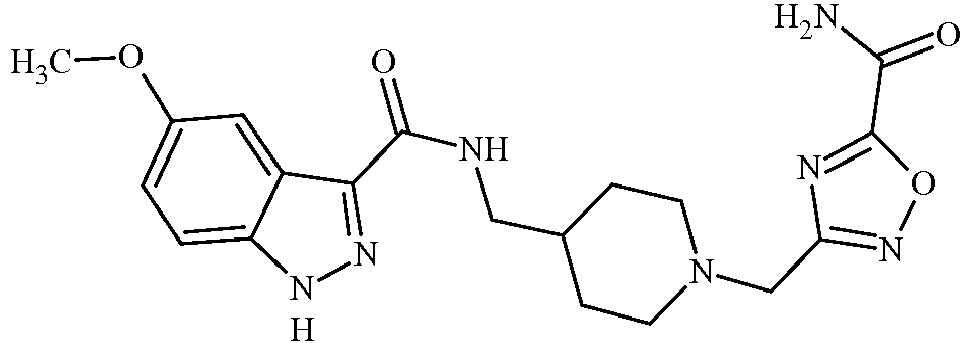
31 N-({1-[2-(4-nitrophenyl)ethyl]piperidin-4-yl}methyl)-1H-indazole-3-carboxamide hydrochloride 
- The pharmacological properties of the compounds of formula (I) useful in the present invention were evaluated by the methods described in the following sections.
- Activity on human GSK-3β was assessed using the following methods (according to Meijer et al., Chem. Biol., 2003-10:1255-1266).
- In a first screening assay, compounds were tested in duplicate at a concentration of 10 µM.
- Human recombinant enzyme GSK-3β was incubated for 90 minutes at 22°C in the presence of compounds or vehicle in a reaction buffer containing ATP plus 100 nM unphosphorylated specific substrate peptide (Ulight-CFFKNIVTPRTPPPSQGK-amide). Substrate phosphorylation was measured by LANCE technology (PerkinElmer, CT, USA).
- The results, reported in the following Table 4, are expressed as a percent of inhibition of control specific activity obtained in the presence of the test compounds (as % inhibition at 10 µM).
- In a second assay, the same compounds were assayed at five concentrations ranging from 100 µM to 10 nM with ten-fold dilutions in duplicate. Compounds 1 to 7, 9, 11 and 13 to 26 were tested using the same first assay, compounds 8, 10, 12, and 27 to 31 were tested in another assay based on the binding and displacement of AlexaFluor® 647 labeled, ATP-competitive Kinase inhibitor scaffold using LanthaScreen™ TR-FRET technology Eu Kinase assay packet according to manufacturer's instruction (Life Technologies, Italy). The results of the two assays are comparable.
- The IC50 values (concentration causing a half maximal inhibition of control specific activity), reported in table 4, were determined by nonlinear regression analysis of the inhibition curves generated with mean replicate values using Hill equation curve fitting.
Table 4 Compound N° % Inhibition [10 µM] IC50[µM] 1 94 0.35 2 91 0.56 3 0.31 4 0.64 5 0.35 6 0.40 7 0.13 8 0.17 9 0.21 10 0.31 11 0.36 12 0.01 13 0.95 14 0.23 15 0.26 16 0.36 17 0.02 18 0.30 19 0.01 20 0.02 21 0.01 22 0.21 23 0.33 24 0.40 25 1.40 26 2.10 27 0.31 28 0.45 29 0.32 30 0.31 31 7.20 - The results showed that the compounds 1 and 2 according to the present invention had good inhibitory activity in this assay: at 10 µM the % of inhibition is greater that 90% and the IC50 is obtained with less than 0.60 µM of each compound.
- Most of compounds 3 to 31 according to the present invention showed an IC50 value lower than 1.00 µM. Some of them showed an IC50 value at the lowest concentration of the assay (10 nM). The values of IC50 higher than 1.00 µM obtained with compounds 25, 26 and 31 are still acceptable.
- (a) Compound 1 was tested against a panel of 60 kinases in order to assess its selectivity. The assays were chosen taking into consideration the diversity of assay families.
- Tested kinases were representative of following kinase sub-families:
- protein-serine/threonine kinases;
- protein-tyrosine kinases;
- other kinases; and
- atypical kinases.
- Human recombinant kinases were incubated in the presence of specific peptide substrates plus ATP for different times (10, 15, 30, 60 or 90 minutes) at 22°C. Phosphorylated substrate was detected by LANCE or HTRF technology (CISBIO, MA, USA).
- Compound 1 was tested at 10 µM in duplicate.
- The results are expressed as a percent of inhibition of control specific activity obtained in the presence of the test compound 1 and are reported in the following Table 5.
Table 5 Kinase Family Kinase Sub-Family Assay % inhibition of control values for compound 1 RTK c-Met kinase (h) 0 RTK EphA4 kinase (h) 0 RTK EphB2 kinase (h) 0 RTK EphB4 kinase (h) 0 RTK FGFR1 kinase (h) 6 RTK FGFR4 kinase (h) 2 Protein-tyrosine kinases RTK IGF1R kinase (h) 5 RTK IRK (h) (InsR) 18 RTK Ret kinase (h) 1 RTK TRKA (h) 10 CTK Abl kinase (h) 0 CTK JAK1 (h) 0 CTK JAK2 (h) 0 CTK Fyn kinase (h) 13 CTK Src kinase (h) 0 Protein serine/th reonine CMGC GSK3beta (h) 92 CMGC DYRK1a (h) 63 CMGC PCTAIRE1 kinase (h) 87 kinases CMGC CDC2/CDK1 (h) (cycB) 31 CMGC CDK2 (h) (cycA) 27 CMGC CDK5 /p35 (h) 30 CMGC ERK1 (h) 35 CMGC ERK2 (h) (P42mapk) 33 CMGC p38alpha kinase (h) 0 CMGC p38gamma kinase (h) 2 CMGC p38delta kinase (h) 12 CaMK CHK1 (h) 12 CaMK AMPKalpha 13 CaMK CaMK4 (h) 14 CaMK DAPK1 (h) 10 CaMK DCAMKL1 (h) 4 CaMK Pim2 kinase (h) 4 CaMK MAPKAPK2 (h) 0 CaMK MNK2 (h) 1 CaMK PhKgamma 2 (h) 6 CaMK Pim1 kinase (h) 2 CaMK smMLCK (h) (MYLK) 0 AGC GRK3 /BARK2 (h) (ADRBK2) 8 AGC Akt1/PKBalpha (h) 7 AGC MSK1 (h) 8 AGC PDK1 (h) 8 AGC RSK2 (h) 3 AGC PKA (h) 0 AGC PKCalpha (h) 8 AGC PKCbeta 1 (h) 9 AGC PKCgamma (h) 0 CK1 CK1alpha (h) 15 STE PAK1 (h) 4 STE HGK (h) (MAP4K4) 17 STE MEK1/MAP2K1 (h) 25 STE TAOK2 (TA01) (h) 41 TKL DLK1 (h) (MAP3K12) 10 TKL IRAK4 (h) 0 Other kinases - IKKalpha (h) 0 - IKKepsilon (h) (IKBKE) 4 - MYT1 kinase (h) 1 - NEK1 (h) 1 - NEK7 (h) 9 - AurA/Aur2 kinase (h) 1 - AurB/Aur1 kinase (h) 11 Atypical kinases - mTOR kinase (h) (FRAP1) 0 - Compound 1 was also assayed to determine the IC50 values for three different kinases (PCTAIRE1, DYRK1a, and CDK2) in comparison to Gsk3β. The assay was conducted with the same method described above in test I, second assay. The results are summarized in the following Table 5A.
TABLE 5A Compound IC50 [µM] Ask3β IC50 [µM] PCTAIRE1 IC50 [µM] DYRK1a IC50 [µM] CDK2 1 0.35 1.50 2.90 36.0 - Results confirmed that compound 1 had an inhibitory activity on GSK-3β and higher affinity to GSK-3β when compared to the other kinases, showing a good selectivity profile. In fact, the IC50 values of Table 5a showed a selectivity of compound 1 for Gsk3β better than that for PCTAIRE1, DYRK1a, and CDK2 kinases.
- (b) Compounds 7, 12, 21 and 24 were tested against the same panel of 60 kinases under the same conditions described above for compound 1.
- The results are expressed as a percent of inhibition of control specific activity obtained in the presence of the test compounds and are reported in the following Table 6.
TABLE 6 Kinase Family Kinase Sub-Family Assay Compound 7 Compound 12 Compound 21 Compound 24 RTK c-Met kinase (h) -- -- 0 2 RTK EphA4 kinase (h) -- -- 2 0 RTK EphB2 kinase (h) -- -- 2 0 RTK EphB4 kinase (h) -- -- 3 0 RTK FGFR1 kinase (h) -- -- 13 0 RTK FGFR4 kinase (h) -- -- 0 4 Protein-tyrosine kinases RTK IGF1R kinase (h) -- -- 0 0 RTK IRK (h) (InsR) 0 0 0 3 RTK Ret kinase (h) -- -- 0 0 RTK TRKA (h) 1 5 4 1 CTK Abl kinase (h) -- -- 0 0 CTK JAK1 (h) -- -- 10 1 CTK JAK2 (h) -- -- 2 0 CTK Fyn kinase (h) -- -- 10 3 CTK Src kinase (h) 9 15 0 0 CMGC GSK3beta (h) 96 100 96 94 CMGC DYRK1a (h) 88 99 99 59 CMGC PCTAIRE1 kinase (h) 2 42 94 1 CMGC CDC2/CDK1 (h) (cycB) 6 77 99 10 CMGC CDK2 (h) (cycA) 48 96 100 36 CMGC CDK5 /p35 (h) 21 87 98 16 Protein serine/threonine kinases CMGC ERK1 (h) 31 85 81 22 CMGC ERK2 (h) (P42mapk) 33 91 89 35 CMGC p38alpha kinase (h) -- -- 1 0 CMGC p38gamma kinase (h) -- -- -- CMGC p38delta kinase (h) -- -- 35 4 CaMK CHK1 (h) -- -- 1 0 CaMK AMPKalpha -- -- 70 21 CaMK CaMK4 (h) -- -- 13 11 CaMK DAPK1 (h) -- -- 5 15 CaMK DCAMKL1 (h) -- -- 0 0 CaMK Pim2 kinase (h) -- -- 5 3 CaMK MAPKAPK2 (h) -- -- 0 0 CaMK MNK2 (h) -- -- 6 0 CaMK PhKgamma 2 (h) -- -- 0 0 CaMK Pim1 kinase (h) -- -- 10 2 CaMK smMLCK (h) (MYLK) 26 36 AGC GRK3 /BARK2 (h) (ADRBK2) -- -- 4 0 AGC Akt1/PKBalpha (h) -- -- 0 0 AGC MSK1 (h) -- -- AGC PDK1 (h) -- -- 0 0 AGC RSK2 (h) -- -- 20 1 AGC PKA (h) -- -- 3 0 AGC PKCalpha (h) -- -- 20 0 AGC PKCbeta 1 (h) -- -- 0 0 AGC PKCgamma (h) -- -- 0 0 CK1 CK1alpha (h) -- -- 2 0 STE PAK1 (h) -- -- 4 1 STE HGK (h) (MAP4K4) 21 98 99 19 STE MEK1/MAP2K1 (h) 27 86 STE TAOK2 (TAO1) (h) 16 81 54 8 TKL DLK1 (h) (MAP3K12) -- -- 46 0 TKL IRAK4 (h) -- -- 18 1 - IKKalpha (h) -- -- 5 2 - IKKepsilon (h) (IKBKE) -- -- 21 0 - MYT1 kinase (h) -- -- 0 0 Other kinases - NEK1 (h) 0 30 - NEK7 (h) -- -- 5 3 - AurA/Aur2 kinase (h) -- -- 30 4 - AurB/Aur1 kinase (h) -- -- 10 0 Atypical kinases - mTOR kinase (h) (FRAP1) -- -- -- -- - Results confirmed that also compounds 7 and 24 had an inhibitory activity on GSK-3β and higher affinity to GSK-3β when compared to all other kinases, showing a good selectivity profile, and that compounds 12 and 21 had an inhibitory activity on GSK-3β and good affinity to GSK-3β when compared to most of other kinases of the same family and to the kinases of different families.
Claims (12)

Ra and Ra', equal or different each other, is a hydrogen atom; a halogen atom; a C1-C6 alkyl, C2-C6 alkenyl, C2-C6 alkynyl and C1-C6 alkoxy group, optionally substituted by one or more substituents selected from the group consisting of halogen, hydroxy, -NH2, and C1-C3 alkoxy; a carbocyclic or heterocyclic ring, aliphatic or aromatic, having from 3 to 12 members, optionally substituted by one or more substituents selected from the group consisting of halogen, hydroxy, C1-C6 alkyl, C1-C6 alkoxy, -NR1R2, -C(O)OH, - C(O)OR1 and -C(O)NR1R2;
Y is a bond, a C1-C6 alkyl, C2-C6 alkenyl or C2-C6 alkynyl group, optionally substituted by one or more substituents selected from the group consisting of halogen, hydroxy, -NH2, and C1-C3 alkoxy;
Rb is a carbocyclic or heterocyclic ring, aliphatic or aromatic, having from 3 to 12 members, substituted by one or more substituents selected from the group consisting of halogen, hydroxy, nitro, cyano, -CF3, C1-C6 alkoxy, benzyloxy, C1-C4 alkyl, C2-C4 alkenyl, and C2-C4 alkynyl, -NHSO2CH3, -SO2NH2, -Z-C(O)OH, -Z-C(O)OR1 and -Z-C(O)NR1R2, wherein Z is a σ-bond or (C1-C3)alkyl;
R1 and R2 are independently a hydrogen atom, a C1-C4 alkyl group, a C2-C4 alkenyl group, a C2-C4 alkynyl group, and a phenyl group;
and its salts of addition with pharmaceutically acceptable organic and inorganic acids and bases;
for use in the treatment of a disease arising from the uncontrolled activation and/or overexpression of GSK-3β, selected from the group consisting of (i) insulin-resistance disorders; (ii) neurodegenerative diseases; (iii) mood disorders; (iv) schizophrenic disorders; (v) cancerous disorders; (vi) inflammation, (vii) substance abuse disorders; and (viii) epilepsies.
Priority Applications (5)
| Application Number | Priority Date | Filing Date | Title |
|---|---|---|---|
| MEP-2016-30A ME02354B (en) | 2012-02-21 | 2013-02-08 | USE OF 1H-INDAZOLE-3-CARBOXAMIDE COMPOUNDS AS GLYCOGEN SYNTHASE KINASE-3-BETA INHIBITORS |
| SI201330133T SI2817301T1 (en) | 2012-02-21 | 2013-02-08 | Use of 1h-indazole-3-carboxamide compounds as glycogen synthase kinase 3 beta inhibitors |
| HRP20160124TT HRP20160124T1 (en) | 2012-02-21 | 2013-02-08 | USE OF 1H-INDASOL-3-CARBOXAMIDE COMPOUNDS AS A GLYCOGEN KINASE-3 BETA INHIBITOR |
| PL13703799T PL2817301T3 (en) | 2012-02-21 | 2013-02-08 | Use of 1h-indazole-3-carboxamide compounds as glycogen synthase kinase 3 beta inhibitors |
| CY20161100218T CY1117467T1 (en) | 2012-02-21 | 2016-03-15 | USE OF THE COMPOUNDS 1H-INDIAZOL-3- CARBOXAMIDE AS INHIBITORS OF GLYCOGEN SYNTHESIS 3B |
Applications Claiming Priority (2)
| Application Number | Priority Date | Filing Date | Title |
|---|---|---|---|
| EP12156298 | 2012-02-21 | ||
| PCT/EP2013/052523 WO2013124169A1 (en) | 2012-02-21 | 2013-02-08 | Use of 1h-indazole-3-carboxamide compounds as glycogen synthase kinase 3 beta inhibitors |
Publications (2)
| Publication Number | Publication Date |
|---|---|
| EP2817301A1 EP2817301A1 (en) | 2014-12-31 |
| EP2817301B1 true EP2817301B1 (en) | 2015-12-23 |
Family
ID=47710141
Family Applications (1)
| Application Number | Title | Priority Date | Filing Date |
|---|---|---|---|
| EP13703799.0A Active EP2817301B1 (en) | 2012-02-21 | 2013-02-08 | Use of 1h-indazole-3-carboxamide compounds as glycogen synthase kinase 3 beta inhibitors |
Country Status (26)
| Country | Link |
|---|---|
| US (2) | US9163013B2 (en) |
| EP (1) | EP2817301B1 (en) |
| JP (1) | JP6285873B2 (en) |
| KR (1) | KR102101702B1 (en) |
| CN (1) | CN104080781B (en) |
| AR (1) | AR090085A1 (en) |
| AU (1) | AU2013224313B2 (en) |
| BR (1) | BR112014018657B1 (en) |
| CA (1) | CA2860466C (en) |
| CY (1) | CY1117467T1 (en) |
| DK (1) | DK2817301T3 (en) |
| EA (1) | EA026952B1 (en) |
| ES (1) | ES2564033T3 (en) |
| GE (1) | GEP201606552B (en) |
| HR (1) | HRP20160124T1 (en) |
| HU (1) | HUE027445T2 (en) |
| IL (1) | IL233825A (en) |
| MX (1) | MX351288B (en) |
| PL (1) | PL2817301T3 (en) |
| PT (1) | PT2817301E (en) |
| RS (1) | RS54539B1 (en) |
| SG (2) | SG10201701171TA (en) |
| SI (1) | SI2817301T1 (en) |
| SM (1) | SMT201600054B (en) |
| UA (1) | UA113189C2 (en) |
| WO (1) | WO2013124169A1 (en) |
Families Citing this family (9)
| Publication number | Priority date | Publication date | Assignee | Title |
|---|---|---|---|---|
| WO2013124169A1 (en) * | 2012-02-21 | 2013-08-29 | Aziende Chimiche Riunite Angelini Francesco A.C.R.A.F. S.P.A. | Use of 1h-indazole-3-carboxamide compounds as glycogen synthase kinase 3 beta inhibitors |
| US10954240B2 (en) | 2014-09-03 | 2021-03-23 | Merck Sharp & Dohme Corp. | Compounds inhibiting leucine-rich repeat kinase enzyme activity |
| CN107709314A (en) | 2015-06-11 | 2018-02-16 | 巴斯利尔药物国际股份公司 | Efflux pump inhibitor and its therapeutic use |
| WO2017093157A1 (en) * | 2015-11-30 | 2017-06-08 | Basilea Pharmaceutica Ag | Piperidine, pyrrolidine and 2-oxo-1,3-oxazinane derivatives as inhibitors of bacterial efflux-pumps for the treatment of microbial infections |
| RU2018145734A (en) * | 2016-06-08 | 2020-07-14 | Глэксосмитклайн Интеллекчуал Проперти Дивелопмент Лимитед | CHEMICAL COMPOUNDS AS ATF4 PATH INHIBITORS |
| ES2913975T3 (en) * | 2018-05-07 | 2022-06-07 | Acraf | 1H-indazole-3-carboxamide compounds as inhibitors of glycogen synthase kinase-3 beta |
| KR102906523B1 (en) | 2018-09-13 | 2025-12-30 | 브리스톨-마이어스 스큅 컴퍼니 | 1H-Indazole Carboxamide as a Receptor-Interacting Protein Kinase 1 (RIPK1) Inhibitor |
| KR102793119B1 (en) | 2018-09-13 | 2025-04-07 | 브리스톨-마이어스 스큅 컴퍼니 | Indazole carboxamide as a kinase inhibitor |
| CN117186027B (en) * | 2023-09-11 | 2024-04-19 | 上海蓝木化工有限公司 | Glycogen synthase kinase-3 inhibitor and preparation method thereof |
Family Cites Families (11)
| Publication number | Priority date | Publication date | Assignee | Title |
|---|---|---|---|---|
| US5705498A (en) | 1992-11-05 | 1998-01-06 | Smithkline Beecham Plc. | Piperidine derivatives as 5-HT4 receptor antagonists |
| WO1996038420A1 (en) * | 1995-05-31 | 1996-12-05 | Nisshin Flour Milling Co., Ltd. | Indazole derivatives having monocyclic amino group |
| IT1291569B1 (en) * | 1997-04-15 | 1999-01-11 | Angelini Ricerche Spa | Indazolamides as serotonergic agents |
| GB0218625D0 (en) | 2002-08-10 | 2002-09-18 | Astex Technology Ltd | Pharmaceutical compounds |
| ITMI20030287A1 (en) | 2003-02-18 | 2004-08-19 | Acraf | INDAZOLAMIDS EQUIPPED WITH ANALGESIC ACTIVITY METHOD, FOR |
| ITMI20030972A1 (en) | 2003-05-15 | 2004-11-16 | Acraf | INDAZOLO EQUIPPED WITH ANALGESIC ACTIVITY, METHOD TO PREPARE IT AND PHARMACEUTICAL COMPOSITION THAT INCLUDES IT. |
| UA99927C2 (en) | 2007-11-12 | 2012-10-25 | Ацьенде Кимике Риуните Анджелини Франческо А.Чи.Р.А.Ф. С.П.А. | Pharmaceutical composition that is active in the treatment of neuropathic pain |
| TW201040191A (en) | 2009-03-27 | 2010-11-16 | Abbott Gmbh & Co Kg | Heterocyclic compounds and their use as glycogen synthase kinase-3 inhibitors |
| US7947728B1 (en) * | 2009-11-11 | 2011-05-24 | Hoffmann-La Roche Inc. | Indole and indazole analogs as glycogen synthase activators |
| EA024939B1 (en) | 2012-02-21 | 2016-11-30 | Ацьенде Кимике Рьюните Анджелини Франческо А.К.Р.А.Ф. С.П.А. | 1h-indazole-3-carboxamide compounds as glycogen synthase kinase 3 beta inhibitors |
| WO2013124169A1 (en) * | 2012-02-21 | 2013-08-29 | Aziende Chimiche Riunite Angelini Francesco A.C.R.A.F. S.P.A. | Use of 1h-indazole-3-carboxamide compounds as glycogen synthase kinase 3 beta inhibitors |
-
2013
- 2013-02-08 WO PCT/EP2013/052523 patent/WO2013124169A1/en not_active Ceased
- 2013-02-08 BR BR112014018657-0A patent/BR112014018657B1/en not_active IP Right Cessation
- 2013-02-08 CN CN201380007410.2A patent/CN104080781B/en not_active Expired - Fee Related
- 2013-02-08 HR HRP20160124TT patent/HRP20160124T1/en unknown
- 2013-02-08 JP JP2014556994A patent/JP6285873B2/en active Active
- 2013-02-08 PT PT137037990T patent/PT2817301E/en unknown
- 2013-02-08 AU AU2013224313A patent/AU2013224313B2/en not_active Ceased
- 2013-02-08 CA CA2860466A patent/CA2860466C/en active Active
- 2013-02-08 MX MX2014009298A patent/MX351288B/en active IP Right Grant
- 2013-02-08 RS RS20160091A patent/RS54539B1/en unknown
- 2013-02-08 US US14/373,393 patent/US9163013B2/en active Active
- 2013-02-08 PL PL13703799T patent/PL2817301T3/en unknown
- 2013-02-08 DK DK13703799.0T patent/DK2817301T3/en active
- 2013-02-08 GE GEAP201313572A patent/GEP201606552B/en unknown
- 2013-02-08 KR KR1020147022709A patent/KR102101702B1/en not_active Expired - Fee Related
- 2013-02-08 EA EA201491448A patent/EA026952B1/en unknown
- 2013-02-08 SG SG10201701171TA patent/SG10201701171TA/en unknown
- 2013-02-08 SI SI201330133T patent/SI2817301T1/en unknown
- 2013-02-08 SG SG11201403788VA patent/SG11201403788VA/en unknown
- 2013-02-08 HU HUE13703799A patent/HUE027445T2/en unknown
- 2013-02-08 ES ES13703799.0T patent/ES2564033T3/en active Active
- 2013-02-08 EP EP13703799.0A patent/EP2817301B1/en active Active
- 2013-02-19 AR ARP130100501A patent/AR090085A1/en unknown
- 2013-08-02 UA UAA201407125A patent/UA113189C2/en unknown
-
2014
- 2014-07-27 IL IL233825A patent/IL233825A/en active IP Right Grant
-
2015
- 2015-08-13 US US14/825,261 patent/US9700551B2/en active Active
-
2016
- 2016-02-23 SM SM201600054T patent/SMT201600054B/en unknown
- 2016-03-15 CY CY20161100218T patent/CY1117467T1/en unknown
Also Published As
Similar Documents
| Publication | Publication Date | Title |
|---|---|---|
| US9700551B2 (en) | Use of 1H-indazole-3-carboxamide compounds as glycogen synthase kinase 3 beta inhibitors | |
| US10160746B2 (en) | 1H-indazole-3-carboxamide compounds as glycogen synthase kinase 3 beta inhibitors | |
| US20100256133A1 (en) | Novel compounds having indazole frameworks, methods for preparing the same and pharmaceutical composition comprising the same | |
| US20210053956A1 (en) | 1h-indazole-3-carboxamide compounds as glycogen synthase kinase 3 beta inhibitors | |
| HK1203931B (en) | Use of 1h-indazole-3-carboxamide compounds as glycogen synthase kinase 3 beta inhibitors | |
| HK1203930B (en) | 1h-indazole-3-carboxamide compounds as glycogen synthase kinase 3 beta inhibitors |
Legal Events
| Date | Code | Title | Description |
|---|---|---|---|
| PUAI | Public reference made under article 153(3) epc to a published international application that has entered the european phase |
Free format text: ORIGINAL CODE: 0009012 |
|
| 17P | Request for examination filed |
Effective date: 20140909 |
|
| AK | Designated contracting states |
Kind code of ref document: A1 Designated state(s): AL AT BE BG CH CY CZ DE DK EE ES FI FR GB GR HR HU IE IS IT LI LT LU LV MC MK MT NL NO PL PT RO RS SE SI SK SM TR |
|
| AX | Request for extension of the european patent |
Extension state: BA ME |
|
| RIN1 | Information on inventor provided before grant (corrected) |
Inventor name: GAROFALO, BARBARA Inventor name: FURLOTTI, GUIDO Inventor name: OMBRATO, ROSELLA Inventor name: MANCINI, FRANCESCA Inventor name: CAZZOLLA, NICOLA Inventor name: ALISI, MARIA, ALESSANDRA Inventor name: MAGARO', GABRIELE |
|
| GRAP | Despatch of communication of intention to grant a patent |
Free format text: ORIGINAL CODE: EPIDOSNIGR1 |
|
| INTG | Intention to grant announced |
Effective date: 20150723 |
|
| GRAS | Grant fee paid |
Free format text: ORIGINAL CODE: EPIDOSNIGR3 |
|
| REG | Reference to a national code |
Ref country code: HK Ref legal event code: DE Ref document number: 1203931 Country of ref document: HK |
|
| GRAA | (expected) grant |
Free format text: ORIGINAL CODE: 0009210 |
|
| AK | Designated contracting states |
Kind code of ref document: B1 Designated state(s): AL AT BE BG CH CY CZ DE DK EE ES FI FR GB GR HR HU IE IS IT LI LT LU LV MC MK MT NL NO PL PT RO RS SE SI SK SM TR |
|
| AX | Request for extension of the european patent |
Extension state: BA ME |
|
| REG | Reference to a national code |
Ref country code: GB Ref legal event code: FG4D |
|
| REG | Reference to a national code |
Ref country code: CH Ref legal event code: EP |
|
| REG | Reference to a national code |
Ref country code: IE Ref legal event code: FG4D |
|
| REG | Reference to a national code |
Ref country code: AT Ref legal event code: REF Ref document number: 766509 Country of ref document: AT Kind code of ref document: T Effective date: 20160115 |
|
| REG | Reference to a national code |
Ref country code: CH Ref legal event code: NV Representative=s name: E. BLUM AND CO. AG PATENT- UND MARKENANWAELTE , CH |
|
| REG | Reference to a national code |
Ref country code: HR Ref legal event code: TUEP Ref document number: P20160124 Country of ref document: HR |
|
| REG | Reference to a national code |
Ref country code: DE Ref legal event code: R096 Ref document number: 602013004248 Country of ref document: DE |
|
| REG | Reference to a national code |
Ref country code: FR Ref legal event code: PLFP Year of fee payment: 4 |
|
| REG | Reference to a national code |
Ref country code: RO Ref legal event code: EPE |
|
| REG | Reference to a national code |
Ref country code: HR Ref legal event code: T1PR Ref document number: P20160124 Country of ref document: HR |
|
| REG | Reference to a national code |
Ref country code: DK Ref legal event code: T3 Effective date: 20160307 Ref country code: PT Ref legal event code: SC4A Free format text: AVAILABILITY OF NATIONAL TRANSLATION Effective date: 20160217 |
|
| REG | Reference to a national code |
Ref country code: SE Ref legal event code: TRGR |
|
| REG | Reference to a national code |
Ref country code: ES Ref legal event code: FG2A Ref document number: 2564033 Country of ref document: ES Kind code of ref document: T3 Effective date: 20160317 |
|
| REG | Reference to a national code |
Ref country code: NL Ref legal event code: FP |
|
| REG | Reference to a national code |
Ref country code: EE Ref legal event code: FG4A Ref document number: E011628 Country of ref document: EE Effective date: 20160307 |
|
| REG | Reference to a national code |
Ref country code: NO Ref legal event code: T2 Effective date: 20151223 |
|
| PG25 | Lapsed in a contracting state [announced via postgrant information from national office to epo] |
Ref country code: LV Free format text: LAPSE BECAUSE OF FAILURE TO SUBMIT A TRANSLATION OF THE DESCRIPTION OR TO PAY THE FEE WITHIN THE PRESCRIBED TIME-LIMIT Effective date: 20151223 |
|
| REG | Reference to a national code |
Ref country code: SK Ref legal event code: T3 Ref document number: E 20539 Country of ref document: SK |
|
| REG | Reference to a national code |
Ref country code: GR Ref legal event code: EP Ref document number: 20160400536 Country of ref document: GR Effective date: 20160505 |
|
| REG | Reference to a national code |
Ref country code: HK Ref legal event code: GR Ref document number: 1203931 Country of ref document: HK |
|
| REG | Reference to a national code |
Ref country code: DE Ref legal event code: R097 Ref document number: 602013004248 Country of ref document: DE |
|
| REG | Reference to a national code |
Ref country code: HU Ref legal event code: AG4A Ref document number: E027445 Country of ref document: HU |
|
| PLBE | No opposition filed within time limit |
Free format text: ORIGINAL CODE: 0009261 |
|
| STAA | Information on the status of an ep patent application or granted ep patent |
Free format text: STATUS: NO OPPOSITION FILED WITHIN TIME LIMIT |
|
| 26N | No opposition filed |
Effective date: 20160926 |
|
| REG | Reference to a national code |
Ref country code: FR Ref legal event code: PLFP Year of fee payment: 5 |
|
| REG | Reference to a national code |
Ref country code: AT Ref legal event code: UEP Ref document number: 766509 Country of ref document: AT Kind code of ref document: T Effective date: 20151223 |
|
| REG | Reference to a national code |
Ref country code: FR Ref legal event code: PLFP Year of fee payment: 6 |
|
| REG | Reference to a national code |
Ref country code: HR Ref legal event code: ODRP Ref document number: P20160124 Country of ref document: HR Payment date: 20190122 Year of fee payment: 7 |
|
| REG | Reference to a national code |
Ref country code: HR Ref legal event code: ODRP Ref document number: P20160124 Country of ref document: HR Payment date: 20200127 Year of fee payment: 8 |
|
| REG | Reference to a national code |
Ref country code: HR Ref legal event code: ODRP Ref document number: P20160124 Country of ref document: HR Payment date: 20210201 Year of fee payment: 9 |
|
| REG | Reference to a national code |
Ref country code: HR Ref legal event code: ODRP Ref document number: P20160124 Country of ref document: HR Payment date: 20220128 Year of fee payment: 10 |
|
| PGFP | Annual fee paid to national office [announced via postgrant information from national office to epo] |
Ref country code: RS Payment date: 20220128 Year of fee payment: 10 Ref country code: LT Payment date: 20220120 Year of fee payment: 10 Ref country code: IE Payment date: 20220216 Year of fee payment: 10 Ref country code: HU Payment date: 20220213 Year of fee payment: 10 Ref country code: FI Payment date: 20220217 Year of fee payment: 10 Ref country code: DK Payment date: 20220218 Year of fee payment: 10 Ref country code: BG Payment date: 20220217 Year of fee payment: 10 Ref country code: AT Payment date: 20220217 Year of fee payment: 10 |
|
| PGFP | Annual fee paid to national office [announced via postgrant information from national office to epo] |
Ref country code: IS Payment date: 20220210 Year of fee payment: 10 Ref country code: TR Payment date: 20220204 Year of fee payment: 10 Ref country code: SM Payment date: 20220120 Year of fee payment: 10 Ref country code: SK Payment date: 20220223 Year of fee payment: 10 Ref country code: SE Payment date: 20220216 Year of fee payment: 10 Ref country code: RO Payment date: 20220131 Year of fee payment: 10 Ref country code: PT Payment date: 20220127 Year of fee payment: 10 Ref country code: PL Payment date: 20220121 Year of fee payment: 10 Ref country code: NO Payment date: 20220218 Year of fee payment: 10 Ref country code: NL Payment date: 20220216 Year of fee payment: 10 Ref country code: MT Payment date: 20220201 Year of fee payment: 10 Ref country code: MK Payment date: 20220121 Year of fee payment: 10 Ref country code: MC Payment date: 20220218 Year of fee payment: 10 Ref country code: LV Payment date: 20220221 Year of fee payment: 10 Ref country code: LU Payment date: 20220216 Year of fee payment: 10 Ref country code: HR Payment date: 20220128 Year of fee payment: 10 Ref country code: GR Payment date: 20220211 Year of fee payment: 10 Ref country code: EE Payment date: 20220221 Year of fee payment: 10 Ref country code: CZ Payment date: 20220207 Year of fee payment: 10 Ref country code: BE Payment date: 20220216 Year of fee payment: 10 |
|
| PGFP | Annual fee paid to national office [announced via postgrant information from national office to epo] |
Ref country code: SI Payment date: 20220201 Year of fee payment: 10 |
|
| PGFP | Annual fee paid to national office [announced via postgrant information from national office to epo] |
Ref country code: CY Payment date: 20220207 Year of fee payment: 10 |
|
| PGFP | Annual fee paid to national office [announced via postgrant information from national office to epo] |
Ref country code: AL Payment date: 20220222 Year of fee payment: 10 |
|
| P01 | Opt-out of the competence of the unified patent court (upc) registered |
Effective date: 20230526 |
|
| REG | Reference to a national code |
Ref country code: HR Ref legal event code: PBON Ref document number: P20160124 Country of ref document: HR Effective date: 20230208 |
|
| REG | Reference to a national code |
Ref country code: LT Ref legal event code: MM4D Effective date: 20230208 |
|
| REG | Reference to a national code |
Ref country code: EE Ref legal event code: MM4A Ref document number: E011628 Country of ref document: EE Effective date: 20230228 |
|
| REG | Reference to a national code |
Ref country code: NO Ref legal event code: MMEP Ref country code: DK Ref legal event code: EBP Effective date: 20230228 |
|
| REG | Reference to a national code |
Ref country code: SK Ref legal event code: MM4A Ref document number: E 20539 Country of ref document: SK Effective date: 20230208 |
|
| PG25 | Lapsed in a contracting state [announced via postgrant information from national office to epo] |
Ref country code: MC Free format text: LAPSE BECAUSE OF NON-PAYMENT OF DUE FEES Effective date: 20230228 |
|
| REG | Reference to a national code |
Ref country code: SE Ref legal event code: EUG |
|
| REG | Reference to a national code |
Ref country code: NL Ref legal event code: MM Effective date: 20230301 |
|
| REG | Reference to a national code |
Ref country code: AT Ref legal event code: MM01 Ref document number: 766509 Country of ref document: AT Kind code of ref document: T Effective date: 20230208 |
|
| REG | Reference to a national code |
Ref country code: BE Ref legal event code: MM Effective date: 20230228 |
|
| PG25 | Lapsed in a contracting state [announced via postgrant information from national office to epo] |
Ref country code: SM Free format text: LAPSE BECAUSE OF NON-PAYMENT OF DUE FEES Effective date: 20230905 Ref country code: SE Free format text: LAPSE BECAUSE OF NON-PAYMENT OF DUE FEES Effective date: 20230209 Ref country code: RO Free format text: LAPSE BECAUSE OF NON-PAYMENT OF DUE FEES Effective date: 20230208 Ref country code: PT Free format text: LAPSE BECAUSE OF NON-PAYMENT OF DUE FEES Effective date: 20230808 Ref country code: NO Free format text: LAPSE BECAUSE OF NON-PAYMENT OF DUE FEES Effective date: 20230228 Ref country code: LU Free format text: LAPSE BECAUSE OF NON-PAYMENT OF DUE FEES Effective date: 20230208 Ref country code: FI Free format text: LAPSE BECAUSE OF NON-PAYMENT OF DUE FEES Effective date: 20230208 Ref country code: EE Free format text: LAPSE BECAUSE OF NON-PAYMENT OF DUE FEES Effective date: 20230228 Ref country code: CZ Free format text: LAPSE BECAUSE OF NON-PAYMENT OF DUE FEES Effective date: 20230208 Ref country code: CY Free format text: LAPSE BECAUSE OF NON-PAYMENT OF DUE FEES Effective date: 20230208 Ref country code: AT Free format text: LAPSE BECAUSE OF NON-PAYMENT OF DUE FEES Effective date: 20230208 |
|
| PG25 | Lapsed in a contracting state [announced via postgrant information from national office to epo] |
Ref country code: SK Free format text: LAPSE BECAUSE OF NON-PAYMENT OF DUE FEES Effective date: 20230208 Ref country code: SI Free format text: LAPSE BECAUSE OF NON-PAYMENT OF DUE FEES Effective date: 20230209 Ref country code: RS Free format text: LAPSE BECAUSE OF NON-PAYMENT OF DUE FEES Effective date: 20230811 Ref country code: NL Free format text: LAPSE BECAUSE OF NON-PAYMENT OF DUE FEES Effective date: 20230301 Ref country code: LV Free format text: LAPSE BECAUSE OF NON-PAYMENT OF DUE FEES Effective date: 20230208 Ref country code: LT Free format text: LAPSE BECAUSE OF NON-PAYMENT OF DUE FEES Effective date: 20230208 Ref country code: HU Free format text: LAPSE BECAUSE OF NON-PAYMENT OF DUE FEES Effective date: 20230209 Ref country code: HR Free format text: LAPSE BECAUSE OF NON-PAYMENT OF DUE FEES Effective date: 20230208 Ref country code: GR Free format text: LAPSE BECAUSE OF NON-PAYMENT OF DUE FEES Effective date: 20230906 |
|
| REG | Reference to a national code |
Ref country code: SI Ref legal event code: KO00 Effective date: 20231023 |
|
| REG | Reference to a national code |
Ref country code: IE Ref legal event code: MM4A |
|
| PG25 | Lapsed in a contracting state [announced via postgrant information from national office to epo] |
Ref country code: IE Free format text: LAPSE BECAUSE OF NON-PAYMENT OF DUE FEES Effective date: 20230208 Ref country code: DK Free format text: LAPSE BECAUSE OF NON-PAYMENT OF DUE FEES Effective date: 20230228 |
|
| PG25 | Lapsed in a contracting state [announced via postgrant information from national office to epo] |
Ref country code: BE Free format text: LAPSE BECAUSE OF NON-PAYMENT OF DUE FEES Effective date: 20230228 |
|
| PG25 | Lapsed in a contracting state [announced via postgrant information from national office to epo] |
Ref country code: PL Free format text: LAPSE BECAUSE OF NON-PAYMENT OF DUE FEES Effective date: 20230208 |
|
| PG25 | Lapsed in a contracting state [announced via postgrant information from national office to epo] |
Ref country code: PL Free format text: LAPSE BECAUSE OF NON-PAYMENT OF DUE FEES Effective date: 20230208 |
|
| PG25 | Lapsed in a contracting state [announced via postgrant information from national office to epo] |
Ref country code: BG Free format text: LAPSE BECAUSE OF NON-PAYMENT OF DUE FEES Effective date: 20230208 |
|
| PG25 | Lapsed in a contracting state [announced via postgrant information from national office to epo] |
Ref country code: BG Free format text: LAPSE BECAUSE OF NON-PAYMENT OF DUE FEES Effective date: 20230208 |
|
| PGFP | Annual fee paid to national office [announced via postgrant information from national office to epo] |
Ref country code: DE Payment date: 20250218 Year of fee payment: 13 |
|
| PGFP | Annual fee paid to national office [announced via postgrant information from national office to epo] |
Ref country code: CH Payment date: 20250301 Year of fee payment: 13 |
|
| PGFP | Annual fee paid to national office [announced via postgrant information from national office to epo] |
Ref country code: FR Payment date: 20250221 Year of fee payment: 13 |
|
| PGFP | Annual fee paid to national office [announced via postgrant information from national office to epo] |
Ref country code: IT Payment date: 20250218 Year of fee payment: 13 Ref country code: GB Payment date: 20250219 Year of fee payment: 13 |
|
| PGFP | Annual fee paid to national office [announced via postgrant information from national office to epo] |
Ref country code: ES Payment date: 20250331 Year of fee payment: 13 |
|
| PG25 | Lapsed in a contracting state [announced via postgrant information from national office to epo] |
Ref country code: IS Free format text: LAPSE BECAUSE OF NON-PAYMENT OF DUE FEES Effective date: 20230906 |
|
| PG25 | Lapsed in a contracting state [announced via postgrant information from national office to epo] |
Ref country code: TR Free format text: LAPSE BECAUSE OF NON-PAYMENT OF DUE FEES Effective date: 20230208 |