EP2816559A2 - Übersetzungssystem mit einer Anzeigevorrichtung sowie Server und Steuerverfahren dafür - Google Patents
Übersetzungssystem mit einer Anzeigevorrichtung sowie Server und Steuerverfahren dafür Download PDFInfo
- Publication number
- EP2816559A2 EP2816559A2 EP20140172224 EP14172224A EP2816559A2 EP 2816559 A2 EP2816559 A2 EP 2816559A2 EP 20140172224 EP20140172224 EP 20140172224 EP 14172224 A EP14172224 A EP 14172224A EP 2816559 A2 EP2816559 A2 EP 2816559A2
- Authority
- EP
- European Patent Office
- Prior art keywords
- voice
- user
- face
- translated
- shape
- Prior art date
- Legal status (The legal status is an assumption and is not a legal conclusion. Google has not performed a legal analysis and makes no representation as to the accuracy of the status listed.)
- Ceased
Links
Images




Classifications
-
- G—PHYSICS
- G06—COMPUTING OR CALCULATING; COUNTING
- G06F—ELECTRIC DIGITAL DATA PROCESSING
- G06F40/00—Handling natural language data
- G06F40/40—Processing or translation of natural language
-
- G—PHYSICS
- G06—COMPUTING OR CALCULATING; COUNTING
- G06T—IMAGE DATA PROCESSING OR GENERATION, IN GENERAL
- G06T17/00—Three-dimensional [3D] modelling for computer graphics
-
- G—PHYSICS
- G06—COMPUTING OR CALCULATING; COUNTING
- G06F—ELECTRIC DIGITAL DATA PROCESSING
- G06F16/00—Information retrieval; Database structures therefor; File system structures therefor
- G06F16/50—Information retrieval; Database structures therefor; File system structures therefor of still image data
-
- G—PHYSICS
- G06—COMPUTING OR CALCULATING; COUNTING
- G06F—ELECTRIC DIGITAL DATA PROCESSING
- G06F16/00—Information retrieval; Database structures therefor; File system structures therefor
- G06F16/60—Information retrieval; Database structures therefor; File system structures therefor of audio data
- G06F16/68—Retrieval characterised by using metadata, e.g. metadata not derived from the content or metadata generated manually
- G06F16/683—Retrieval characterised by using metadata, e.g. metadata not derived from the content or metadata generated manually using metadata automatically derived from the content
-
- G—PHYSICS
- G06—COMPUTING OR CALCULATING; COUNTING
- G06F—ELECTRIC DIGITAL DATA PROCESSING
- G06F3/00—Input arrangements for transferring data to be processed into a form capable of being handled by the computer; Output arrangements for transferring data from processing unit to output unit, e.g. interface arrangements
- G06F3/14—Digital output to display device ; Cooperation and interconnection of the display device with other functional units
-
- G—PHYSICS
- G06—COMPUTING OR CALCULATING; COUNTING
- G06F—ELECTRIC DIGITAL DATA PROCESSING
- G06F40/00—Handling natural language data
- G06F40/40—Processing or translation of natural language
- G06F40/42—Data-driven translation
-
- G—PHYSICS
- G06—COMPUTING OR CALCULATING; COUNTING
- G06F—ELECTRIC DIGITAL DATA PROCESSING
- G06F40/00—Handling natural language data
- G06F40/40—Processing or translation of natural language
- G06F40/58—Use of machine translation, e.g. for multi-lingual retrieval, for server-side translation for client devices or for real-time translation
-
- G—PHYSICS
- G06—COMPUTING OR CALCULATING; COUNTING
- G06T—IMAGE DATA PROCESSING OR GENERATION, IN GENERAL
- G06T13/00—Animation
- G06T13/20—Three-dimensional [3D] animation
- G06T13/40—Three-dimensional [3D] animation of characters, e.g. humans, animals or virtual beings
-
- G—PHYSICS
- G10—MUSICAL INSTRUMENTS; ACOUSTICS
- G10L—SPEECH ANALYSIS TECHNIQUES OR SPEECH SYNTHESIS; SPEECH RECOGNITION; SPEECH OR VOICE PROCESSING TECHNIQUES; SPEECH OR AUDIO CODING OR DECODING
- G10L15/00—Speech recognition
-
- G—PHYSICS
- G10—MUSICAL INSTRUMENTS; ACOUSTICS
- G10L—SPEECH ANALYSIS TECHNIQUES OR SPEECH SYNTHESIS; SPEECH RECOGNITION; SPEECH OR VOICE PROCESSING TECHNIQUES; SPEECH OR AUDIO CODING OR DECODING
- G10L21/00—Speech or voice signal processing techniques to produce another audible or non-audible signal, e.g. visual or tactile, in order to modify its quality or its intelligibility
- G10L21/06—Transformation of speech into a non-audible representation, e.g. speech visualisation or speech processing for tactile aids
- G10L21/10—Transforming into visible information
-
- G—PHYSICS
- G06—COMPUTING OR CALCULATING; COUNTING
- G06V—IMAGE OR VIDEO RECOGNITION OR UNDERSTANDING
- G06V40/00—Recognition of biometric, human-related or animal-related patterns in image or video data
- G06V40/20—Movements or behaviour, e.g. gesture recognition
-
- G—PHYSICS
- G10—MUSICAL INSTRUMENTS; ACOUSTICS
- G10L—SPEECH ANALYSIS TECHNIQUES OR SPEECH SYNTHESIS; SPEECH RECOGNITION; SPEECH OR VOICE PROCESSING TECHNIQUES; SPEECH OR AUDIO CODING OR DECODING
- G10L13/00—Speech synthesis; Text to speech systems
- G10L13/02—Methods for producing synthetic speech; Speech synthesisers
- G10L13/033—Voice editing, e.g. manipulating the voice of the synthesiser
-
- G—PHYSICS
- G10—MUSICAL INSTRUMENTS; ACOUSTICS
- G10L—SPEECH ANALYSIS TECHNIQUES OR SPEECH SYNTHESIS; SPEECH RECOGNITION; SPEECH OR VOICE PROCESSING TECHNIQUES; SPEECH OR AUDIO CODING OR DECODING
- G10L15/00—Speech recognition
- G10L15/26—Speech to text systems
-
- G—PHYSICS
- G10—MUSICAL INSTRUMENTS; ACOUSTICS
- G10L—SPEECH ANALYSIS TECHNIQUES OR SPEECH SYNTHESIS; SPEECH RECOGNITION; SPEECH OR VOICE PROCESSING TECHNIQUES; SPEECH OR AUDIO CODING OR DECODING
- G10L21/00—Speech or voice signal processing techniques to produce another audible or non-audible signal, e.g. visual or tactile, in order to modify its quality or its intelligibility
- G10L21/06—Transformation of speech into a non-audible representation, e.g. speech visualisation or speech processing for tactile aids
- G10L21/10—Transforming into visible information
- G10L2021/105—Synthesis of the lips movements from speech, e.g. for talking heads
Definitions
- the present invention relates to a translation system including a display apparatus and a server, and a method of controlling the display apparatus. More particularly, the present invention relates to a translation system including a display apparatus configured to convert an input voice and image and to output the converted voice and image, a server, and a method of controlling the display apparatus.
- a display apparatus includes: an inputter configured to receive a user's face shape and voice; voice processor configured to analyze the input voice and extract translated data, and convert the translated data into translated voice; an image processor configured to detect information related to a mouth area of the user's face shape which corresponds to the translated data, and create a changed user's face shape based on the detected information related to the mouth area; and an outputter configured to output the translated voice and changed shape of the user's face.
- the image processor may be configured to synchronize the changed shape of the user's face to correspond to the translated voice.
- the voice processor may be configured to compare a length of the input voice and a length of the translated voice and adjust the length of the translated voice.
- the voice processor may extract at least one characteristic of a tone, pitch and sound quality of the input voice and apply the extracted characteristic to the translated voice.
- the information related to the mouth area may be mesh information where characteristic points of the stored mouth-shaped image are connected, and the image processor may be configured to extract a phoneme from the translated data and search for a corresponding mouth shaped image, and map the mesh information where the characteristic points of the searched mouth shape image are connected to the user's face shape in order to create a changed shape of the user's face.
- the information related to the mouth area may be a stored mouth shape image
- the image processor may extract a phoneme from the translated data and search for a corresponding mouth-shaped image, and edit the searched mouth-shaped image in the shape of the face in order to create a changed shape of the user's face.
- the display apparatus may further include a communicator configured to communicate with a server, and the communicator may transmit the shape of the user's face and input voice to the server, and receive the translated voice and changed shape of the user's face from the server.
- a communicator configured to communicate with a server, and the communicator may transmit the shape of the user's face and input voice to the server, and receive the translated voice and changed shape of the user's face from the server.
- the display apparatus may further include a communicator configured to communicate with a server, the communicator may be configured to transmit the user's face shape and input voice to the server and receive the translated voice and mouth area information from the server, and the image processor may create the changed shape of the user's face based on the received information related to the mouth area.
- a communicator configured to communicate with a server
- the communicator may be configured to transmit the user's face shape and input voice to the server and receive the translated voice and mouth area information from the server
- the image processor may create the changed shape of the user's face based on the received information related to the mouth area.
- a server configured to communicate with a display apparatus, the server including: a communicator configured to receive a user's face shape and voice from the display apparatus; a voice processor configured to analyze the received voice and to extract translated data, and convert the translated data into translated voice; and an image processor configured to detect information related to a mouth area of the user's face shape which corresponds to the translated data, wherein the communicator transmits the information of the mouth area to the display apparatus, together with the translated voice.
- the image processor may create a changed shape of a user's face based on the detected information related to the mouth area, and the communicator may transmit the changed shape of the user's face to the display apparatus together with the translated voice.
- a conversion system comprising a display apparatus and a server
- the system including: a display apparatus configured to transmit the input user's face shape and input voice to the server; and a server configured to analyze the input voice and extract the translated data and convert the translated data into translated voice, and detect information related to a mouth area of the user's face shape which corresponds to the translated data in order to create a changed user's face shape mapped from the user's face shape, wherein the display apparatus receives the changed shape of the user's face or information related to the mouth area from the server together with the translated voice.
- a method of controlling a display apparatus including: receiving a user's face shape and voice; analyzing the input voice and extracting the translated data; detecting information related to a mouth area of the user's face shape which corresponds to the translated data, and creating a changed shape of user's face based on the detected information related to the mouth area; converting the translated data into a translated voice; and outputting the translated voice and changed shape of the user's face shape.
- the outputting may synchronize the changed shape of the user's face to the translated voice.
- the method of controlling the display apparatus may further include comparing a length of the input voice and a length of the translated voice and adjusting the length of the translated voice, based on the comparison.
- the method of controlling the display apparatus may further include extracting at least one characteristic of a tone, pitch and sound quality of the input voice and applying the extracted characteristic to the translated voice.
- the information related to the mouth area may be mesh information where characteristic points of the stored mouth-shaped image are connected, and the creating a changed shape of a user's face may extract a phoneme from the translated data and search for a corresponding mouth-shaped image, and map the mesh information where the characteristic points of the searched mouth-shaped image are connected to the user's face shape in order to create a changed shape of a user's face.
- the information of the mouth area may be a stored mouth-shaped image
- the creating a changed shape of a user's face may include extracting a phoneme from the translated data and searching for a corresponding mouth-shaped image, and edit the searched mouth-shaped image in the face shape to create a changed shape of user's face.
- the method of controlling the display apparatus may further comprise transmitting the user's face shape and input voice to the server, and receiving from the server the translated voice and changed shape of the user's face, and the outputting may output the received translated voice and received changed shape of the user's face.
- the method of controlling the display apparatus may further comprise transmitting the user's face shape and input voice to the server, and receiving from the translated voice and changed shape of the user's face shape, and the creating the changed user's face shape may create the changed user's face shape based on the received information related to the mouth area.
- An aspect of an exemplary embodiment may provide a display apparatus including: a voice processor configured to analyze an input voice and extract translated data, and convert the translated data into translated voice; and an image processor configured to detect information related to a mouth area of the user's face shape which corresponds to the translated data, and create a changed shape of a user's face based on the detected information.
- the display apparatus may further include an inputter configured to receive a user's face shape and voice.
- the display apparatus may further include an outputter configured to output the translated voice and changed shape of the user's face.
- the image processor may be configured to synchronize the changed shape of the user's face to the translated voice.
- the voice processor may be configured to compare a length of the input voice and a length of the translated voice and adjust the length of the translated voice based on the comparison.
- the voice processor may be configured to extract at least one characteristic of a tone, pitch and sound quality of the input voice and applies the extracted characteristic to the translated voice.
- the information related to the mouth area may be configured to be a stored mouth-shaped image.
- the image processor may be configured to extract a phoneme from the translated data and searches for a corresponding mouth-shaped image, and edits the searched mouth-shaped image in the face shape to create a changed shape of the user's face.
- the display apparatus may further include: a communicator configured to communicate with a server, wherein the communicator transmits the user's face shape and input voice to the server, and receives from the server the translated voice and changed shaped of the user's face.
- a communicator configured to communicate with a server, wherein the communicator transmits the user's face shape and input voice to the server, and receives from the server the translated voice and changed shaped of the user's face.
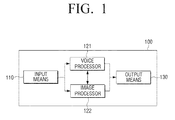
- FIG. 1 is a block diagram of a display apparatus according to an exemplary embodiment.
- the display apparatus 100 includes an input means 110 (also referred to as an inputter), voice processor 121, image processor 122, and output means 130 (also referred to as an outputter).
- input means 110 also referred to as an inputter
- voice processor 121 voice processor 121
- image processor 122 image processor 122
- output means 130 also referred to as an outputter
- a display apparatus 100 may be a tablet PC, portable multimedia player (PMP), personal digital assistant (PDA), smart phone, mobile phone, digital photo frame, game machine, PC, laptop computer, digital TV, or kiosk, etc.
- PMP portable multimedia player
- PDA personal digital assistant
- smart phone mobile phone, digital photo frame, game machine, PC, laptop computer, digital TV, or kiosk, etc.
- the inputter 110 receives an input of a user's face shape and voice.
- the voice processor 121 analyzes the input voice and extracts translated data, and converts the extracted translated data into translated voice.
- the voice processor 121 receives an audio signal having an analogue format containing a user's voice and converts it into a digital signal. Noise is removed from the input digital signal. Text information is created from the digital signal from which noise has been removed. The created text information is analyzed and is then translated into a determined language. It is possible to set a particular language as a default language. Or the user may select a translatable language. For example, English may be set as the default language, and then the user may change the default language to Japanese, Korean, French and Spanish, etc.
- Translated data may be used in the image processor 122 to change the shape of the user's face. Furthermore, translated data may be converted into translated voice having an analogue format to be processed by the voice processor 121.
- the voice processor 121 may compare the length of the input voice and the length of the translated voice and adjust the length of the translated voice. In addition, the voice processor 121 may extract at least one characteristic of the tone of the input voice, pitch, and sound quality and apply the extracted characteristic to the translated voice. This process will be explained in further detail, hereinbelow.
- the image processor 122 may detect information related to a mouth area of a user's face shape which corresponds to the translated data, and create a changed shape of a user's face based on the detected mouth area information.
- the image processor 122 extracts a phoneme from the translated data.
- a phoneme is the smallest unit of sound which is significant in a language. For example, Hello may be expressed as being pronounced "helou", and a user may pronounce it according to the pronunciation symbol. Therefore, the phoneme of Hello may be separated into [hel], [lo], and [u].
- the image processor 122 searches for a corresponding visual phoneme from among the visual phoneme or stored viseme.
- a visual phoneme refers to an image that may be used to describe a particular sound. For example, it may be a mouth-shaped image which corresponds to each phoneme.
- the image processor 122 searches for a mouth shape image which corresponds to [hel], [lo], and [u].
- a correlation may be used to search for a mouth shape image that is most correlated as the corresponding mouth shape image.
- the image processor 122 detects information related to the mouth area from the searched mouth shape image.
- the information related to the mouth area may be mesh information having characteristic points of the stored mouth shape image that have been connected or a stored mouth shape image.
- the image processor 122 may map the mesh information to the shape of the input user's face in order to create a changed shape of a user's face. Otherwise, the image processor 122 may edit the searched mouth shape image in the input user's face shape to create a changed user's face shape.
- the image processor 122 may synchronize the changed user's face shape to the translated voice.
- the outputter 130 outputs the translated voice and changed shape of the user's face.
- FIG. 2 is a block diagram of a display apparatus according to another exemplary embodiment.
- the display apparatus 100a may include an inputter 110, controller 120, outputter 130 and communicator 140.
- the inputter 110 receives an input of a user's face shape and voice.
- the inputter 110 may include a microphone 111 and/or a camera 112.
- the microphone 111 receives a user's voice, and the camera 112 receives a user's face shape.
- the microphone 111 converts mechanical vibrations made by sound waves of the user's voice into electrical signals and transmit the converted electrical signals to the image processor 122.
- the inputter 110 includes a microphone 111, and camera 112, but the inputter 110 may receive an input of a face shape and a voice from the communicator 140 and storage (not illustrated) etc.
- the inputter 110 may receive an input of a face shape and voice from another display apparatus or server through the communicator 140, or may receive an input of a face shape and voice from contents stored in the storage. In this case, the inputter 110 may operate in the same manner as an input interface.
- the controller 120 may include a voice processor 121 and an image processor 122. Operations of the voice processor 121 and the image processor 122 are the same as explained in FIG. 1 and thus further explanation is omitted. However, FIG. 1 illustrates the voice processor 121 and the image processor 122 being separate from each other, but they may be separate modules of one controller 120, as in FIG. 2 .
- the outputter 130 outputs the translated voice and changed shape of the user's face.
- the outputter 130 may include a speaker 131 and displayer 132. That is, the speaker 131 may output the translated voice, and the displayer 132 may output the changed shape of the user's face. Furthermore, the outputter 130 may output the translated voice and changed shape of the user's face shape to the communicator 140 and the storage (not illustrated). For example, the outputter 130 may transmit the translated voice and user's face shape to another display apparatus or server etc. through the communicator 140, or may store the translated voice and user's face shape in the storage. In this case, the outputter 130 may operate in the same manner as an output interface.
- the communicator 140 may perform communication with the server in order to transmit the user's face shape and voice to the server, and may receive the translated voice from the server. In addition, the communicator 140 may receive the changed shape of the user's face or mouth area information.
- the server may store a mouth-shaped image which corresponds to a phoneme in a database.
- the display apparatus 100 may transmit to the server the shape of the user's face and voice input through the communicator 140.
- the server may convert the user's voice into a translated voice.
- the server may detect mouth area information that may be used to create a changed shape of a user's face or may change the user's face shape.
- the communicator 140 may receive the changed shape of the user's face or detected mouth information together with the translated voice.
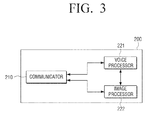
- FIG. 3 is a block diagram of a server according to an exemplary embodiment.
- the server 200 includes a communicator 210, voice processor 221 and image processor 222.
- the communicator 210 receives a user's face shape and voice from the display apparatus.
- the voice processor 221 analyzes the received voice and extracts translated data, and converts the extracted translated data into translated voice.
- the voice processor 221 creates text information from the received voice and analyzes the created text information to perform translation. When the translation is performed, translated data is created. In addition, the voice processor 221 converts the translated data into translated voice.
- the voice processor 221 may compare the length of the input voice and the length of the translated voice and may adjust the length of the translated voice. In addition, the voice processor 221 may extract at least one characteristic of the input voice tone, pitch, and sound quality, and may apply the extracted characteristic to the translated voice.
- the image processor 222 uses the created translated data to detect the information related to the mouth area of the user's face shape.
- the server 200 may store a phoneme or a mouth shape image which corresponds to the phoneme.
- the server 200 may create a user profile, and may store a mouth-shaped image which corresponds to a phoneme for each user in the user profile.
- the server 200 may use the received user's face shape and voice to store a new mouth-shaped image or update the stored mouth-shaped image.
- the image processor 222 extracts a phoneme from the translated data and searches for a corresponding mouth-shaped image. When there is no corresponding mouth-shaped image, a correlation may be used to search for a mouth-shaped image that is most closely correlated as the corresponding mouth-shaped image.
- the image processor 222 may detect mouth area information from the searched mouth-shaped image.
- the mouth area information may be mesh information having characteristic points of the stored mouth-shaped image that have been connected or a stored mouth-shaped image.
- the communicator 210 may transmit the translated voice and mouth area information to the display apparatus.
- the image processor 222 may detect mouth area information related to the shape of the user's face which corresponds to the translated data, and create a changed shape of the user's face based on the detected mouth area information.
- the mesh information may be mapped to the mouth area of the received user's face shape in order to create a changed shape of the user's face.
- the searched mouth-shaped image may be edited in the received user's face shape in order to create a changed shape of the user's face.
- the communicator 210 may transmit the translated voice and changed shape of the user's face to the display apparatus.
- Aforementioned was an explanation related to the configuration of a display apparatus and a server of the exemplary embodiments.
- Hereinbelow is an explanation related to a process of detecting mouth area information and creating a changed shape of a user's face.
- FIG. 4 is a view which explains a process of detecting mouth area information according to an exemplary embodiment.
- a phoneme and a visual viseme corresponding to the phoneme are illustrated.
- a phoneme is the smallest unit of sound which is significant in a language.
- a visual viseme may be a mouth-shaped image which corresponds to each phoneme.
- the display apparatus may store a phoneme and a mouth-shaped image which corresponds to the phoneme.
- the phoneme 11-1 of the pronunciation symbol [a] corresponds to the mouth shape image 11-2 when pronouncing [a]
- the phoneme 11-1 of [a] and the mouth shape image 11-2 when pronouncing [a] is stored in the display apparatus.
- phonemes 13-1, 15-1, 17-1, and 19-1 of pronunciation symbols [e], [i], [o], [u] and mouth shape images 13-2, 15-2, 17-2, 19-2 which corresponds to each pronunciation symbol is stored in the display apparatus.
- the display apparatus at an initial stage may have a mouth-shaped image of a standard user which corresponds to each phoneme stored therein.
- the display apparatus may match the received user's mouth shape image to the corresponding phoneme, and may additional store the input user's mouth-shaped image, or may substitute the stored mouth shape image for a newly input mouth-shaped image. Since a phoneme and a corresponding mouth-shaped image are based on pronunciation symbols, they may be used regardless of language.
- the display apparatus analyzes the input voice and extracts translated data.
- the input voice is converted into text information, and the converted text information is translated into another language.
- the translated text information is called translated data.
- the display apparatus separates the translated data into phonemes and searches for a mouth-shaped image which corresponds to each phoneme. For example, when the display apparatus determines a [a] pronunciation 11-1, it searches for a mouth-shaped image 11-2 which corresponds to [a] pronunciation. As such, the display apparatus searches for a mouth-shaped image based on the translated data.
- the display apparatus detects mouth area information from the searched mouth-shaped image and creates a changed shape of a user's face.
- FIG. 5 is a view which explains a process of creating a changed shape of a user's face, according to an exemplary embodiment.
- FIG. 5 illustrates an input user's face shape 21-1 and a changed shape of a user's face 12-2.
- the display apparatus detects mouth area information from a mouth-shaped image.
- the mouth area information may be mesh information where characteristic points have been connected.
- the display apparatus extracts the characteristic points from the mouth area 23-1 of the input user's face shape. For example, a plurality of characteristic points may be extracted according to the lip line.
- the display apparatus connects the extracted characteristic points and creates a mesh structure.
- the display apparatus extracts a plurality of characteristic points and connects the same along the lip line of the searched mouth-shaped image to create a mesh structure.
- a mesh structure refers to a triangular structure formed by connecting three characteristic points. It is desirable that the number and location of characteristic points of the mouth area 23-1 of the user's face shape is identical to the number and location of the characteristic points of the searched mouth-shaped image.
- the display apparatus calculates a changed value of the mouth area 23-1 of the user's face shape using the difference between the coordinates of the characteristic points of the mouth area 23-1 of the user's face shape and the characteristic points of the searched mouth-shaped image, and the size area of the corresponding mesh structure.
- the display apparatus applies the calculated changed value to the mouth area 23-1 of the user's face shape.
- the mouth area 23-1 of the user's face shape is changed as in the searched mouth-shaped image. Accordingly, a changed user's face shape 21-2 including the changed mouth area 23-2 is created.
- FIG. 6 is a view which explains a process of creating a changed shape of a user's face according to another exemplary embodiment.
- a shape of the user's face 25-1 and a changed shape of the user's face 25-2, input are illustrated according to another exemplary embodiment.
- the display apparatus detects mouth area information.
- mouth area information refers to the searched mouth-shaped image.
- the display apparatus detects the mouth area 27-1 from the input user's face shape 25-1 and extracts a certain area.
- the display apparatus edits the searched mouth shape image in the mouth area 27-1 of the user's face shape 25-1. Accordingly, a changed shape of a user's face 25-2 having the searched mouth-shaped image 27-2 is created.
- the display apparatus may additionally perform image processing on the boundary of the extracted area so that editing of the mouth area can seem natural. For example, gradation may be applied to reduce the color difference, or an image processing process such as 'blur' may be performed to reduce the sense of difference. Furthermore, the display apparatus may extract the characteristic points for the boundary line of a certain detected area and perform a process of changing the boundary line as well. The display apparatus may convert the translated data into translated voice and output the same together with the changed shape of the user's face.
- FIG. 7 is a view which explains outputting a changed voice and image according to an exemplary embodiment.
- FIG. 7 illustrates a process where a hello is translated and is then output together with a changed image of a user.
- the display apparatus converts the translated data into translated voice. Conversion into translated voice may be performed by the voice processor.
- the display apparatus may extract the characteristics of the input voice and apply the same to the translated voice. For example, characteristics of a voice are tone, pitch, and sound quality etc. Voice characteristics such as the tone, pitch and sound quality of a voice may be extracted by detecting the frequency characteristics and the degree of noise. In addition, the detected frequency characteristics and the degree of noise may be applied to the converted translated voice and thus may be converted into a translated voice similar to the input voice.
- the display apparatus may compare the length of the input voice and the length of the translated voice in order to adjust the length of the translated voice. For example, when the length of the user's input voice is 5 seconds and the length of the translated voice is 7 seconds, the length of the translated voice may be adjusted to be 5 seconds or close to 5 seconds. A real time video telephone or video conference is made possible by adjusting the length of the translated voice.
- the display apparatus may adjust such that the characteristics of the input voice are applied to the translated voice, and that the length of the translated voice becomes similar to the length of the input voice.
- the display apparatus may synchronize the changed shape of the user's face to the translated voice and output the result. Synchronization refers to outputting the mouth shape of the changed shape of the user's face shape and the translated voice at the same time so that they correspond to each other.
- the translated voice is output as [he-] 31-2, and the synchronized mouth shape 31-1 is also output as pronouncing [he-].
- the translated voice is output as 1110-133-2, and the synchronized mouth shape 33-1 is output as pronouncing [llo-] as well.
- the translated voice is output as [u-] 35-2, and the synchronized mouth shape 35-1 is output as pronouncing [u-].
- creating a changed shape of a user's face may be performed in a server instead.
- a process of creating a changed shape of a user's face in a server is identical to the process performed in a display apparatus.
- a server may perform voice translation and extraction of mouth area information, and a display apparatus may receive the extracted mouth area information and create a changed shape of a user's face.
- FIG. 8 is a timing diagram which explains a conversion system according to an exemplary embodiment.
- the display apparatus 100 transmits a user's face shape and voice to the server 200 (S810).
- the server 200 analyzes the received voice and extracts the translated data, converts the translated data into translated voice, and detects mouth area information related to the shape of the user's face which corresponds to the translated data (S820).
- the server 200 converts the received voice into text information and translates the converted text information.
- the server 200 then separates the translated data into phonemes and searches for a mouth-shaped image which corresponds to the phonemes.
- the server 200 In response to the mouth area information being mesh information, the server 200 extracts characteristic points from the searched mouth-shaped image and received user's face shape mouth area and extracts mesh information. The server 200 calculates a conversion relationship using the difference in mesh information between the searched mouth-shaped image and the received user's face shape mouth area. That is, the mouth area information may be mesh information that has a conversion relationship or is information used to calculate a conversion relationship, or is itself a searched mouth-shaped image.
- the server 200 transmits the translated voice and detected mouth area information to the display apparatus 100 (S830).
- the display apparatus 100 creates a user's face shape based on the received mouth area information and outputs the translated voice and changed user's face shape (S840).
- FIG. 9 is a timing diagram explaining a conversion system according to another exemplary embodiment.
- the display apparatus 100 transmits the user's face shape and voice to the server 200 (S910).
- the server 200 analyzes the received voice and extracts translated data and converts the translated data into translated voice, and detects mouth area information related to the user's face shape which corresponds to the translated data and forms a changed shape of a user's face which is mapped from the user's face shape (S920).
- the mouth area information may be a conversion relationship calculated from the mesh information of the mouth area of the user's face shape and the mesh information of the mouth shape image, mesh information itself, or a searched mouth-shaped image.
- the server 200 transmits the translated voice and changed shape of the user's face to the display apparatus 100 (S930).
- the display apparatus 100 outputs the received translated voice and changed shape of the user's face (S940).
- the specific process is the same as aforementioned, and is thus omitted.
- FIGs. 8 and 9 illustrate a process where the display apparatus 100 transmits the user's face shape and voice to the server 200, and receives from the server 200 the mouth area information or changed shape of the user's face, together with the translated voice.
- the server 200 may transmit the detected or created data to another display apparatus besides the display apparatus that transmitted the user's face shape and voice.
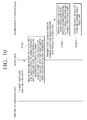
- FIG. 10 is a timing view which explains a conversion system according to another exemplary embodiment.
- the conversion system may include a first display apparatus 100-1, second display apparatus 100-2 and server 200.
- the first display apparatus 100-1 transmits the user's face shape and voice to the server 200 (S1010).
- the user's face shape and voice may be input into the first display apparatus 100-1 and be transmitted in real time, or may be stored in the storage of the first display apparatus 100-1 and then transmitted.
- the server analyzes the received voice and extracts translated data and converts the translated data into translated voice.
- the server 200 detects mouth area information related to the shape of the user's face which corresponds to the translated data.
- the server 200 may create a changed shape of a user's face mapped from detected mouth area information (S1020).
- the server 200 When the server 200 detects the mouth area information, the server 200 transmits the mouth area information to the second display apparatus 100-2 together with the translated voice. Otherwise, when the server 200 created a changed shape of a user's face, the server 200 may transmit the created changed shape of the user's face together with the translated voice (S1030).
- the second display apparatus 100-2 When the server 200 transmitted the mouth area information to the second display apparatus 100-2, the second display apparatus 100-2 creates a changed shape of the user's face based on the received mouth area information, and outputs the translated voice and changed shape of the user's face (S1040-1).
- the second display apparatus 100-2 When the server 200 transmitted the changed user's face shape to the second display apparatus 100-2, the second display apparatus 100-2 outputs the received changed shape of the user's face together with the translated voice (S1040-2).
- the second display apparatus 100-2 may create a changed shape of a user's face and output the same, or output the changed shape of the user's face received from the server 200. Otherwise, the server 200 may transmit the changed shape of the user's face or mouth area information to the display apparatus that transmitted the user's face shape and voice, or may transmit the changed shape of the user's face and mouth area information to another display apparatus.
- FIG. 11 is a flowchart of a method of controlling a display apparatus according to an exemplary embodiment.
- the display apparatus receives a user's face shape and voice (S1110).
- the display apparatus analyzes the input voice and calculates translated data (S1120).
- the translated data is data made by converting the input voice into text information and translating the converted text information.
- the display apparatus detects a phoneme using the translated data, and searches a mouth-shaped image which corresponds to the detected phoneme.
- the display apparatus detects the mouth area information of the user's face shape which corresponds to the translated data, and creates a changed shape of a user's face based on the detected mouth area information (S1130). An explanation of the specific process was aforementioned and is thus omitted.
- the display apparatus converts the translated data into translated voice (S1140).
- the display apparatus may extract at least one characteristic of the input voice tone, pitch, and sound quality, and may apply the extracted characteristic to the translated voice.
- the display apparatus may compare the length of the input voice and the length of the translated voice and may adjust the length of the translated voice.
- the display apparatus outputs the translated voice and changed shape of the user's face (S1150).
- the display apparatus may synchronize the changed shape of the user's face to the translated voice and may output the same.
- the method of controlling the display apparatus according to the aforementioned various exemplary embodiments may be embodied in a program and be provided in a display apparatus.
- a non-transitory computer readable storage medium which stores a program therein as a data structure, and performs a step of analyzing input voice and extracting translated data, a step of detecting information related to a mouth area of the user's face shape which corresponds to the translated data and creating a changed shape of the user's face shape based on the information related to the detected mouth area, a step of converting the translated data into translated voice, and a step of outputting the translated voice and the changed shape of the user's face.
- a non-transitory readable storage medium refers to a medium where it is possible to store data semi-permanently and not temporarily and read the stored data by a device, such as a resistor, cache, and memory etc. More specifically, the aforementioned various applications or programs may be stored and provided in non-transitory readable storage medium such as a CD, DVD, hard disk, Blueray DiskTM, USB, memory card, and ROM etc.
Landscapes
- Engineering & Computer Science (AREA)
- Theoretical Computer Science (AREA)
- Physics & Mathematics (AREA)
- General Physics & Mathematics (AREA)
- Health & Medical Sciences (AREA)
- Computational Linguistics (AREA)
- Audiology, Speech & Language Pathology (AREA)
- General Engineering & Computer Science (AREA)
- Human Computer Interaction (AREA)
- Multimedia (AREA)
- Artificial Intelligence (AREA)
- Data Mining & Analysis (AREA)
- General Health & Medical Sciences (AREA)
- Acoustics & Sound (AREA)
- Signal Processing (AREA)
- Quality & Reliability (AREA)
- Library & Information Science (AREA)
- Databases & Information Systems (AREA)
- Computer Graphics (AREA)
- Geometry (AREA)
- Software Systems (AREA)
- User Interface Of Digital Computer (AREA)
Applications Claiming Priority (1)
| Application Number | Priority Date | Filing Date | Title |
|---|---|---|---|
| KR1020130069993A KR20140146965A (ko) | 2013-06-18 | 2013-06-18 | 디스플레이 장치, 서버를 포함하는 변환 시스템 및 디스플레이 장치의 제어 방법 |
Publications (2)
| Publication Number | Publication Date |
|---|---|
| EP2816559A2 true EP2816559A2 (de) | 2014-12-24 |
| EP2816559A3 EP2816559A3 (de) | 2015-01-21 |
Family
ID=51178654
Family Applications (1)
| Application Number | Title | Priority Date | Filing Date |
|---|---|---|---|
| EP20140172224 Ceased EP2816559A3 (de) | 2013-06-18 | 2014-06-12 | Übersetzungssystem mit einer Anzeigevorrichtung sowie Server und Steuerverfahren dafür |
Country Status (4)
| Country | Link |
|---|---|
| US (1) | US20140372100A1 (de) |
| EP (1) | EP2816559A3 (de) |
| KR (1) | KR20140146965A (de) |
| CN (1) | CN104239394A (de) |
Cited By (1)
| Publication number | Priority date | Publication date | Assignee | Title |
|---|---|---|---|---|
| GB2601162A (en) * | 2020-11-20 | 2022-05-25 | Yepic Ai Ltd | Methods and systems for video translation |
Families Citing this family (17)
| Publication number | Priority date | Publication date | Assignee | Title |
|---|---|---|---|---|
| KR20150068609A (ko) * | 2013-12-12 | 2015-06-22 | 삼성전자주식회사 | 이미지 정보 표시 방법 및 장치 |
| JP6663444B2 (ja) * | 2015-10-29 | 2020-03-11 | 株式会社日立製作所 | 視覚情報と聴覚情報の同期方法および情報処理装置 |
| CN108234735A (zh) * | 2016-12-14 | 2018-06-29 | 中兴通讯股份有限公司 | 一种媒体显示方法及终端 |
| CN109712065A (zh) * | 2017-10-25 | 2019-05-03 | 丽宝大数据股份有限公司 | 身体信息分析装置及其脸形模拟方法 |
| US10657972B2 (en) * | 2018-02-02 | 2020-05-19 | Max T. Hall | Method of translating and synthesizing a foreign language |
| EP3815050B1 (de) | 2018-05-24 | 2024-01-24 | Warner Bros. Entertainment Inc. | Anpassung der mundform und -bewegung in einem digitalen video an alternatives audio |
| DE102018212902B4 (de) * | 2018-08-02 | 2024-12-19 | Bayerische Motoren Werke Aktiengesellschaft | Verfahren zum Bestimmen eines digitalen Assistenten zum Ausführen einer Fahrzeugfunktion aus einer Vielzahl von digitalen Assistenten in einem Fahrzeug, computerlesbares Medium, System, und Fahrzeug |
| JP7500582B2 (ja) * | 2019-01-25 | 2024-06-17 | ソウル マシーンズ リミティド | 発話アニメーションのリアルタイム生成 |
| KR102885235B1 (ko) | 2019-09-17 | 2025-11-12 | 삼성전자주식회사 | 동시 통역 방법 및 장치 |
| KR20210112726A (ko) * | 2020-03-06 | 2021-09-15 | 엘지전자 주식회사 | 차량의 좌석별로 대화형 비서를 제공하는 방법 |
| KR20220059629A (ko) * | 2020-11-03 | 2022-05-10 | 현대자동차주식회사 | 차량 및 그의 제어방법 |
| CN112562721B (zh) * | 2020-11-30 | 2024-04-16 | 清华珠三角研究院 | 一种视频翻译方法、系统、装置及存储介质 |
| US12086501B2 (en) * | 2020-12-09 | 2024-09-10 | Cerence Operating Company | Automotive infotainment system with spatially-cognizant applications that interact with a speech interface |
| US12175970B2 (en) * | 2020-12-24 | 2024-12-24 | Cerence Operating Company | Speech dialog system for multiple passengers in a car |
| KR102360919B1 (ko) * | 2021-05-28 | 2022-02-09 | 주식회사 유콘 | 음성 더빙 기반의 진행자 영상 편집 시스템 |
| CN115497448B (zh) * | 2021-06-17 | 2026-01-30 | 腾讯科技(深圳)有限公司 | 语音动画的合成方法、装置、电子设备及存储介质 |
| CN116844561B (zh) * | 2023-07-07 | 2025-12-05 | 福建星网视易信息系统有限公司 | 用户音高条的显示方法及计算机可读存储介质 |
Family Cites Families (9)
| Publication number | Priority date | Publication date | Assignee | Title |
|---|---|---|---|---|
| US6232965B1 (en) * | 1994-11-30 | 2001-05-15 | California Institute Of Technology | Method and apparatus for synthesizing realistic animations of a human speaking using a computer |
| SE519244C2 (sv) * | 1995-12-06 | 2003-02-04 | Telia Ab | Anordning och metod vid talsyntes |
| JP2003503925A (ja) * | 1999-06-24 | 2003-01-28 | コーニンクレッカ フィリップス エレクトロニクス エヌ ヴィ | 情報ストリームのポスト同期 |
| JP4011844B2 (ja) * | 2000-09-22 | 2007-11-21 | 株式会社国際電気通信基礎技術研究所 | 翻訳装置、翻訳方法および媒体 |
| JP4310916B2 (ja) * | 2000-11-08 | 2009-08-12 | コニカミノルタホールディングス株式会社 | 映像表示装置 |
| US6925438B2 (en) * | 2002-10-08 | 2005-08-02 | Motorola, Inc. | Method and apparatus for providing an animated display with translated speech |
| JP4087400B2 (ja) * | 2005-09-15 | 2008-05-21 | 株式会社東芝 | 音声対話翻訳装置、音声対話翻訳方法および音声対話翻訳プログラム |
| US8224652B2 (en) * | 2008-09-26 | 2012-07-17 | Microsoft Corporation | Speech and text driven HMM-based body animation synthesis |
| KR101378811B1 (ko) * | 2012-09-18 | 2014-03-28 | 김상철 | 단어 자동 번역에 기초한 입술 모양 변경 장치 및 방법 |
-
2013
- 2013-06-18 KR KR1020130069993A patent/KR20140146965A/ko not_active Withdrawn
-
2014
- 2014-06-12 EP EP20140172224 patent/EP2816559A3/de not_active Ceased
- 2014-06-18 US US14/308,141 patent/US20140372100A1/en not_active Abandoned
- 2014-06-18 CN CN201410274057.0A patent/CN104239394A/zh active Pending
Non-Patent Citations (1)
| Title |
|---|
| None |
Cited By (4)
| Publication number | Priority date | Publication date | Assignee | Title |
|---|---|---|---|---|
| GB2601162A (en) * | 2020-11-20 | 2022-05-25 | Yepic Ai Ltd | Methods and systems for video translation |
| WO2022106654A2 (en) | 2020-11-20 | 2022-05-27 | Yepic AI Limited | Methods and systems for video translation |
| WO2022106654A3 (en) * | 2020-11-20 | 2022-07-21 | Yepic AI Limited | Methods and systems for video translation |
| GB2601162B (en) * | 2020-11-20 | 2024-07-24 | Yepic Ai Ltd | Methods and systems for video translation |
Also Published As
| Publication number | Publication date |
|---|---|
| CN104239394A (zh) | 2014-12-24 |
| US20140372100A1 (en) | 2014-12-18 |
| EP2816559A3 (de) | 2015-01-21 |
| KR20140146965A (ko) | 2014-12-29 |
Similar Documents
| Publication | Publication Date | Title |
|---|---|---|
| US20140372100A1 (en) | Translation system comprising display apparatus and server and display apparatus controlling method | |
| US11887578B2 (en) | Automatic dubbing method and apparatus | |
| WO2014141054A1 (en) | Method, apparatus and system for regenerating voice intonation in automatically dubbed videos | |
| CN101518055A (zh) | 字幕生成装置、字幕生成方法及字幕生成程序 | |
| CN103561217A (zh) | 一种生成字幕的方法及终端 | |
| KR20150057591A (ko) | 동영상파일에 대한 자막데이터 생성방법 및 장치 | |
| JP2005064600A (ja) | 情報処理装置、情報処理方法、およびプログラム | |
| KR20140037410A (ko) | 단어 자동 번역에 기초한 입술 모양 변경 장치 및 방법 | |
| KR20150021258A (ko) | 디스플레이장치 및 그 제어방법 | |
| KR20160056734A (ko) | 영상표시장치, 영상표시장치의 구동방법 및 컴퓨터 판독가능 기록매체 | |
| US20230326369A1 (en) | Method and apparatus for generating sign language video, computer device, and storage medium | |
| CN101753915A (zh) | 数据处理设备、数据处理方法及程序 | |
| KR20200027331A (ko) | 음성 합성 장치 | |
| KR20200142282A (ko) | 컨텐츠 번역 서비스를 제공하는 전자 장치 및 그 제어 방법 | |
| JP2014146066A (ja) | 文書データ生成装置、文書データ生成方法及びプログラム | |
| KR101517975B1 (ko) | 동시 통/번역 기능을 가지는 이어폰 장치 | |
| CN110534085A (zh) | 用于生成信息的方法和装置 | |
| JP2025508844A (ja) | ビデオ処理方法、装置、機器及び媒体 | |
| JP2020140326A (ja) | コンテンツ生成システム、及びコンテンツ生成方法 | |
| JP2018067050A (ja) | 音声処理装置、ウェアラブル端末、携帯端末、および音声処理方法 | |
| KR102160117B1 (ko) | 장애인을 위한 실시간 방송 컨텐츠 제작 시스템 | |
| US20140019132A1 (en) | Information processing apparatus, information processing method, display control apparatus, and display control method | |
| KR101618777B1 (ko) | 파일 업로드 후 텍스트를 추출하여 영상 또는 음성간 동기화시키는 서버 및 그 방법 | |
| KR100849027B1 (ko) | 음성 신호에 대한 립싱크 동기화 방법 및 장치 | |
| CN115171645A (zh) | 一种配音方法、装置、电子设备以及存储介质 |
Legal Events
| Date | Code | Title | Description |
|---|---|---|---|
| PUAL | Search report despatched |
Free format text: ORIGINAL CODE: 0009013 |
|
| PUAI | Public reference made under article 153(3) epc to a published international application that has entered the european phase |
Free format text: ORIGINAL CODE: 0009012 |
|
| 17P | Request for examination filed |
Effective date: 20140612 |
|
| AK | Designated contracting states |
Kind code of ref document: A2 Designated state(s): AL AT BE BG CH CY CZ DE DK EE ES FI FR GB GR HR HU IE IS IT LI LT LU LV MC MK MT NL NO PL PT RO RS SE SI SK SM TR |
|
| AX | Request for extension of the european patent |
Extension state: BA ME |
|
| AK | Designated contracting states |
Kind code of ref document: A3 Designated state(s): AL AT BE BG CH CY CZ DE DK EE ES FI FR GB GR HR HU IE IS IT LI LT LU LV MC MK MT NL NO PL PT RO RS SE SI SK SM TR |
|
| AX | Request for extension of the european patent |
Extension state: BA ME |
|
| RIC1 | Information provided on ipc code assigned before grant |
Ipc: G10L 21/10 20130101AFI20141215BHEP Ipc: G06F 17/28 20060101ALI20141215BHEP Ipc: G06T 13/40 20110101ALI20141215BHEP |
|
| R17P | Request for examination filed (corrected) |
Effective date: 20150721 |
|
| RBV | Designated contracting states (corrected) |
Designated state(s): AL AT BE BG CH CY CZ DE DK EE ES FI FR GB GR HR HU IE IS IT LI LT LU LV MC MK MT NL NO PL PT RO RS SE SI SK SM TR |
|
| 17Q | First examination report despatched |
Effective date: 20151123 |
|
| STAA | Information on the status of an ep patent application or granted ep patent |
Free format text: STATUS: THE APPLICATION HAS BEEN REFUSED |
|
| 18R | Application refused |
Effective date: 20170421 |