EP2816080A1 - Malodor neutralizing compositions comprising citric acid - Google Patents
Malodor neutralizing compositions comprising citric acid Download PDFInfo
- Publication number
- EP2816080A1 EP2816080A1 EP14173492.1A EP14173492A EP2816080A1 EP 2816080 A1 EP2816080 A1 EP 2816080A1 EP 14173492 A EP14173492 A EP 14173492A EP 2816080 A1 EP2816080 A1 EP 2816080A1
- Authority
- EP
- European Patent Office
- Prior art keywords
- methyl
- ester
- araliphatic
- aliphatic
- oil
- Prior art date
- Legal status (The legal status is an assumption and is not a legal conclusion. Google has not performed a legal analysis and makes no representation as to the accuracy of the status listed.)
- Granted
Links
Classifications
-
- A—HUMAN NECESSITIES
- A61—MEDICAL OR VETERINARY SCIENCE; HYGIENE
- A61Q—SPECIFIC USE OF COSMETICS OR SIMILAR TOILETRY PREPARATIONS
- A61Q15/00—Anti-perspirants or body deodorants
-
- A—HUMAN NECESSITIES
- A61—MEDICAL OR VETERINARY SCIENCE; HYGIENE
- A61K—PREPARATIONS FOR MEDICAL, DENTAL OR TOILETRY PURPOSES
- A61K8/00—Cosmetics or similar toiletry preparations
- A61K8/18—Cosmetics or similar toiletry preparations characterised by the composition
- A61K8/30—Cosmetics or similar toiletry preparations characterised by the composition containing organic compounds
- A61K8/33—Cosmetics or similar toiletry preparations characterised by the composition containing organic compounds containing oxygen
- A61K8/36—Carboxylic acids; Salts or anhydrides thereof
- A61K8/361—Carboxylic acids having more than seven carbon atoms in an unbroken chain; Salts or anhydrides thereof
-
- A—HUMAN NECESSITIES
- A61—MEDICAL OR VETERINARY SCIENCE; HYGIENE
- A61K—PREPARATIONS FOR MEDICAL, DENTAL OR TOILETRY PURPOSES
- A61K8/00—Cosmetics or similar toiletry preparations
- A61K8/18—Cosmetics or similar toiletry preparations characterised by the composition
- A61K8/30—Cosmetics or similar toiletry preparations characterised by the composition containing organic compounds
- A61K8/33—Cosmetics or similar toiletry preparations characterised by the composition containing organic compounds containing oxygen
- A61K8/36—Carboxylic acids; Salts or anhydrides thereof
- A61K8/365—Hydroxycarboxylic acids; Ketocarboxylic acids
-
- A—HUMAN NECESSITIES
- A61—MEDICAL OR VETERINARY SCIENCE; HYGIENE
- A61K—PREPARATIONS FOR MEDICAL, DENTAL OR TOILETRY PURPOSES
- A61K8/00—Cosmetics or similar toiletry preparations
- A61K8/18—Cosmetics or similar toiletry preparations characterised by the composition
- A61K8/30—Cosmetics or similar toiletry preparations characterised by the composition containing organic compounds
- A61K8/33—Cosmetics or similar toiletry preparations characterised by the composition containing organic compounds containing oxygen
- A61K8/37—Esters of carboxylic acids
-
- A—HUMAN NECESSITIES
- A61—MEDICAL OR VETERINARY SCIENCE; HYGIENE
- A61K—PREPARATIONS FOR MEDICAL, DENTAL OR TOILETRY PURPOSES
- A61K8/00—Cosmetics or similar toiletry preparations
- A61K8/18—Cosmetics or similar toiletry preparations characterised by the composition
- A61K8/30—Cosmetics or similar toiletry preparations characterised by the composition containing organic compounds
- A61K8/40—Cosmetics or similar toiletry preparations characterised by the composition containing organic compounds containing nitrogen
- A61K8/44—Aminocarboxylic acids or derivatives thereof, e.g. aminocarboxylic acids containing sulfur; Salts; Esters or N-acylated derivatives thereof
-
- A—HUMAN NECESSITIES
- A61—MEDICAL OR VETERINARY SCIENCE; HYGIENE
- A61Q—SPECIFIC USE OF COSMETICS OR SIMILAR TOILETRY PREPARATIONS
- A61Q11/00—Preparations for care of the teeth, of the oral cavity or of dentures; Dentifrices, e.g. toothpastes; Mouth rinses
-
- C—CHEMISTRY; METALLURGY
- C08—ORGANIC MACROMOLECULAR COMPOUNDS; THEIR PREPARATION OR CHEMICAL WORKING-UP; COMPOSITIONS BASED THEREON
- C08K—Use of inorganic or non-macromolecular organic substances as compounding ingredients
- C08K5/00—Use of organic ingredients
- C08K5/04—Oxygen-containing compounds
- C08K5/09—Carboxylic acids; Metal salts thereof; Anhydrides thereof
- C08K5/092—Polycarboxylic acids
-
- C—CHEMISTRY; METALLURGY
- C08—ORGANIC MACROMOLECULAR COMPOUNDS; THEIR PREPARATION OR CHEMICAL WORKING-UP; COMPOSITIONS BASED THEREON
- C08K—Use of inorganic or non-macromolecular organic substances as compounding ingredients
- C08K5/00—Use of organic ingredients
- C08K5/04—Oxygen-containing compounds
- C08K5/10—Esters; Ether-esters
- C08K5/101—Esters; Ether-esters of monocarboxylic acids
-
- A—HUMAN NECESSITIES
- A61—MEDICAL OR VETERINARY SCIENCE; HYGIENE
- A61L—METHODS OR APPARATUS FOR STERILISING MATERIALS OR OBJECTS IN GENERAL; DISINFECTION, STERILISATION OR DEODORISATION OF AIR; CHEMICAL ASPECTS OF BANDAGES, DRESSINGS, ABSORBENT PADS OR SURGICAL ARTICLES; MATERIALS FOR BANDAGES, DRESSINGS, ABSORBENT PADS OR SURGICAL ARTICLES
- A61L9/00—Disinfection, sterilisation or deodorisation of air
- A61L9/01—Deodorant compositions
Definitions
- This invention relates to odor neutralizer compositions and their use for reducing malodors.
- malodors are used for masking malodors. Annoyance caused by malodors occurs frequently in daily life and impairs personal well-being. Such malodors are, for example, those resulting from substances transpired or excreted by humans, in particular, perspiration, mouth odors, feces and urine, odors caused by animal feces or urine, in particular, those of domestic pets, kitchen odors, such as those resulting from the preparation of onions, garlic, cabbage or fish, odors due to tobacco smoke, garbage, bathrooms, molds and waste.
- malodors may be caused by many industrially produced basic materials used in cleansing agents, such as, for example, detergents and fabric softeners, or in body care products, such as, for example, soaps and cosmetics.
- cleansing agents such as, for example, detergents and fabric softeners
- body care products such as, for example, soaps and cosmetics.
- specific cosmetic preparations such as, for example, hair dyes, hair-forming agents and depilatories, also produce malodors.
- malodors are usually caused by particularly odorous substances which are, however, generally only present in trace amounts.
- Such substances include, for example, nitrogen-containing compounds such as ammonia and amines, heterocyclic compounds such as pyridines, pyrazines, indoles, etc., and sulfur-containing compounds such as hydrogen sulfide, mercaptans, sulfides, etc.
- Malodor counteractings are particularly advantageous when they are capable of reducing the intensity of malodors without themselves possessing any significantly intense odor or fragrance. Such active ingredients do not mask malodors; rather, they neutralize the malodors. This has the advantage that, when using such active ingredients for perfuming objects or products having malodors, perfume oils of any desired type of fragrance can be used. The consumer can, therefore, be offered a considerably broader range of fragrance types for combating malodors.
- active ingredients which neutralize malodors provide the possibility of reducing the quantity of perfume oil previously required for masking odors. It is also possible to use less intensely odorous perfumes for combating malodors than those heretofore employed.
- malodor reducing compositions find utility is in breath freshening compositions such as chewing gum, mints, mouthwashes, lozenges and sprays.
- breath freshening compositions such as chewing gum, mints, mouthwashes, lozenges and sprays.
- flavoring and perfuming ingredients which mask oral malodors, it is also useful to neutralize the ingredients which cause such malodors.
- U.S. Patent No. 6,495,097 describes the use of undecylenic acid and its lower alkyl esters as deodorants and odor neutralizers useful in a wide variety of compositions, perfumed and unperfumed.
- U.S. Patent No. 4,010,253 discloses the use of certain esters of citric acid or acetylcitric acid in compositions for suppressing body odor. Citric acid itself has been used in personal deodorant compositions, as indicated in U.S. Patent No. 5,098,694 and 5,662,937 .
- esters disclosed in the prior art are quite effective in neutralizing malodors, and undecylenic acid (and its derivatives) has also shown some effectiveness in this area. It has now been discovered that combinations of undecylenic acid or citric acid and certain esters within particular molecular weight ranges have surprisingly shown synergistic effectiveness in neutralizing malodors.
- compositions comprising a combination of undecylenic acid or citric acid and one or more of certain esters within a particular molecular weight range.
- the molecular weight range for esters in combination with undecylenic acid is between 150 and 200.
- the molecular weight range for esters in combination with citric acid is between 130 and 230. These combinations exhibit a synergistic effect in neutralizing malodors.
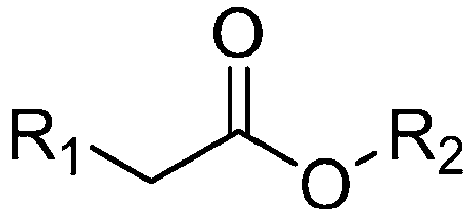
- the esters within these particular molecular weight ranges which, in combination with undecylenic acid or citric acid, provide the synergistic effects are of the Formula (I) have the structure in which
- compositions of this invention can be admixed with fragrancing ingredients to yield perfumed products which also have malodor neutralizing affects. Additionally, these compositions can be incorporated into household products such as detergents and other laundry products, air fresheners and disinfectants. These compositions can also be incorporated into personal care products of all types.
- Undecylenic acid, citric acid and the esters of the Formula (I) are known odor neutralizers but it has now been discovered that a combination of undecylenic acid with at least one of said esters in the molecular weight range of between 150 and 200 provides a synergistic effect in odor neutralization. Likewise, it has now been discovered that compositions comprising a combination of citric acid and one or more ester of Formula (I) in the wider molecular weight range of between 130 and 230 provide a synergistic effect in odor neutralization.
- undecylenic acid refers to undec-10-enoic acid of the formula. It is used in the manufacture of pharmaceuticals, cosmetics and perfumery, including antidandruff shampoos, anti-microbial powders and as a musk in perfumes and aromas.
- U.S. Patent No. 6,495,097 discloses its use, as well as the use of certain derivatives such as its methyl and ethyl esters, as substances that provide odor neutralization.
- Citric acid (3-carboxy-3-hydroxypentanedioic acid) is used extensively in food products to add an acidic or sour taste and is also used in cleaning products. Additionally, as indicated in recent U.S. Patent Nos. 6,906,045 and 7,147,822 , citric acid can function as an odor neutralizer.
- Citric acid has the formula
- esters which, in combination with undecylenic acid or citric acid are synergistically effective in neutralizing malodors have molecular weights within the specified particular ranges and have the structure (I) wherein
- R 1 as an alkylene radical substituted by phenyl at the 2- carbon is cinnamate.
- An example of an alkyl radical substituted at the 3- carbon is 3-phenylpropyl.
- R 1 and R 2 are unbranched alkyls
- butyl butyrate and ethyl heptanate would be within the scope of Formula (I).
- Pentyl hexanate is an example of a compound which would not be included in Formula (I).
- a preferred group of compounds in this class are those in which the total number of carbon atoms in R 1 and R 2 is not greater than 8.
- the combination of undecylenic acid or citric acid and the esters of Formula (I) may be used in admixture. They may be used in pure form or in suitable solvents such as, for example, ethanol, isopropanol or other solvents well known for use in deodorizing formulations.
- the ratio of undecylenic acid or citric acid to the ester of Formula (I) can range between about 10% to 90%, preferably from about 25% to 75%. A weight ratio of about 50% is particularly preferred and convenient.
- esters within the Formula (I) are those in which R 2 is C 1 -C 5 (straight-chain or branched) alkyl or benzyl.
- Preferred particular compounds within the Formula (I) for combination with undecylenic acid include the following:
- Preferred particular compounds within Formula (I) for combination with citric acid include, in addition to those preferred for combination with undecylenic acid, the following:
- compositions according to the present invention can be combined with one or more of a wide variety of fragrancing ingredients.
- esters that fall within the scope of Formula (I), in which cases, a product comprising the composition of this invention will contain two or more of such esters.
- the odor neutralizers containing the esters according to the present invention can be adsorbed onto a carrier which ensures both the fine distribution of the odor neutralizer in the product and controlled release during use.
- a carrier can be porous inorganic materials such as light sulfates, salts, silica gels, borates, carbonates, soda ash, tripolyphosphates, zeolites, gypsums, clays, granulated clays, aerated concrete, etc., or organic materials such as wood, starches and other cellulose-based materials.
- the odor neutralizers containing undecylenic acid or citric acid and the esters of Formula (I) can also be in microencapsulated or spray-dried form or in the form of inclusion complexes or extrusion products and they can be added in these forms to the product whose odor is to be improved or which is to be perfumed.
- compositions of the present invention may be added to a wide variety of consumer products, such as household products, personal care products and cosmetics, both perfumed and perfume-free, and both scented and scent-free.
- Household products which may comprise a composition according to the invention include fabric washing powder and washing liquid, detergent, surface cleaner (including hard surface cleaner), air freshener in various forms (e.g., solids, gels, candles, liquids, etc.), softener, bleach, fabric refresher and room spray, disinfection products, scourer and cat litter.
- fabric washing powder and washing liquid detergent, surface cleaner (including hard surface cleaner), air freshener in various forms (e.g., solids, gels, candles, liquids, etc.), softener, bleach, fabric refresher and room spray, disinfection products, scourer and cat litter.
- Personal care products and cosmetics which may comprise a composition according to the invention include lotion, e.g. after-shave lotion, shampoo, conditioner, styling spray, mousse, gel, hair wipe, hair spray, hair pomade, bath and shower gel, bath salt, hygiene products, deodorant, antiperspirant, breath-freshening sprays, breath-freshening chewing gum, mouthwashes, lozenges and mints, vanishing cream, depilatory, and talcum powder.
- lotion e.g. after-shave lotion, shampoo, conditioner, styling spray, mousse, gel, hair wipe, hair spray, hair pomade, bath and shower gel, bath salt, hygiene products, deodorant, antiperspirant, breath-freshening sprays, breath-freshening chewing gum, mouthwashes, lozenges and mints, vanishing cream, depilatory, and talcum powder.
- the list of personal care products and cosmetics is given by way of illustration and is not to be regarded as being in any way limiting.
- the products using the composition of this invention comprise from about 0.0001% to about 20% by weight, preferably about 0.001% to about 10% by weight, of a combination of undecylenic acid or citric acid and at least one ester of Formula (I) based on the product.
- the effective amount depends upon the type of product into which the combination is admixed.
- the combination may be added to a fragrance composition at around 1% by weight which is then added to the product at around 0.1 % by weight, i.e. the fabric refresher comprises about 0.001% by weight of the composition as hereinabove described.
- the fabric refresher may be added at higher concentration - typically around 20% - and may be present as 100% of the composition.
- the present invention refers in a further aspect to a consumer product comprising an effective malodor-counteracting amount of a composition comprising undecylenic acid or citric acid and at least one ester of Formula (I).
- Another aspect of the invention are methods of removing malodor from the air or from surfaces, comprising contacting the source of said malodor with an effective amount of a composition comprising undecylenic acid or citric acid and at least one ester of Formula (I) as hereinabove described.
- the methods can be, for example, spraying the ambient air surrounding the source of the malodors, or spraying an aerosol formulation directly onto the source of the malodor.
- the invention refers to a method of enhancing the malodor reduction properties of a consumer product, such as household products and personal care products, comprising admixing to the product effective amounts of at least undecylenic acid or citric acid and at least one ester of Formula (I) as hereinabove described.
- a malodor evaluation panel of 14 persons was assembled and asked to evaluate the odor neutralizing effectiveness of undecylenic acid and of certain esters falling within the scope of Formula (I) in the molecular weight range of between 150 and 200, separately and in combination.
- the source of the malodor tested was cat urine.
- Swatches of 100% untreated cotton fabric were cut into 15 cm (6-inch) squares and were placed on weighing boats. 0.5 grams of cat urine was pipetted onto each of the swatches. A period of three minutes was allowed for the urine to be absorbed by the fabric.
- Each swatch was placed in the middle of a 60cm by 50 cm (2 feet by 2 feet) cubicle and all doors were closed. Actual testing was begun after thirty minutes.
- Each member of the panel was asked to sniff the malodor control first and was notified that the control has a rating of 7 - indicating very strong malodor. They were then asked to proceed to sniff the other samples and provide a rating for malodor remaining. Thus, the remaining malodor was evaluated on a sliding scale, with 1 being the absence of perceived malodor. The panelists were instructed to ignore any fragrance that they may detect and rate only for malodor.
- Neodol 91-8 is a C 9 -C 11 alcohol with an average of approximately 8 moles of ethylene oxide per mole of alcohol.
- the fabric spray base was an aqueous solution containing 10% ethanol, 1% of fragrance and 2% of non-ionic surfactant.
Landscapes
- Health & Medical Sciences (AREA)
- Life Sciences & Earth Sciences (AREA)
- Animal Behavior & Ethology (AREA)
- General Health & Medical Sciences (AREA)
- Public Health (AREA)
- Veterinary Medicine (AREA)
- Birds (AREA)
- Epidemiology (AREA)
- Chemical & Material Sciences (AREA)
- Emergency Medicine (AREA)
- Chemical Kinetics & Catalysis (AREA)
- Medicinal Chemistry (AREA)
- Polymers & Plastics (AREA)
- Organic Chemistry (AREA)
- Oral & Maxillofacial Surgery (AREA)
- Cosmetics (AREA)
- Fats And Perfumes (AREA)
- Treatments For Attaching Organic Compounds To Fibrous Goods (AREA)
- Agricultural Chemicals And Associated Chemicals (AREA)
- Disinfection, Sterilisation Or Deodorisation Of Air (AREA)
- Organic Low-Molecular-Weight Compounds And Preparation Thereof (AREA)
Abstract
Description
- This invention relates to odor neutralizer compositions and their use for reducing malodors.
- In many applicational areas, perfumes are used for masking malodors. Annoyance caused by malodors occurs frequently in daily life and impairs personal well-being. Such malodors are, for example, those resulting from substances transpired or excreted by humans, in particular, perspiration, mouth odors, feces and urine, odors caused by animal feces or urine, in particular, those of domestic pets, kitchen odors, such as those resulting from the preparation of onions, garlic, cabbage or fish, odors due to tobacco smoke, garbage, bathrooms, molds and waste.
- In addition, malodors may be caused by many industrially produced basic materials used in cleansing agents, such as, for example, detergents and fabric softeners, or in body care products, such as, for example, soaps and cosmetics. The use of specific cosmetic preparations, such as, for example, hair dyes, hair-forming agents and depilatories, also produce malodors.
- Many rubber and plastic products also produce malodors if, due to the method of their manufacture, they still contain quantities of highly odorous, volatile active ingredients. These malodors are usually caused by particularly odorous substances which are, however, generally only present in trace amounts. Such substances include, for example, nitrogen-containing compounds such as ammonia and amines, heterocyclic compounds such as pyridines, pyrazines, indoles, etc., and sulfur-containing compounds such as hydrogen sulfide, mercaptans, sulfides, etc.
- The masking of malodors is a problem which is difficult to handle and solve with perfume compositions. Usually, it is only possible to mask malodors by means of a specially developed perfume oil having specific types of fragrances.
- Malodor counteractings are particularly advantageous when they are capable of reducing the intensity of malodors without themselves possessing any significantly intense odor or fragrance. Such active ingredients do not mask malodors; rather, they neutralize the malodors. This has the advantage that, when using such active ingredients for perfuming objects or products having malodors, perfume oils of any desired type of fragrance can be used. The consumer can, therefore, be offered a considerably broader range of fragrance types for combating malodors.
- In addition, active ingredients which neutralize malodors, provide the possibility of reducing the quantity of perfume oil previously required for masking odors. It is also possible to use less intensely odorous perfumes for combating malodors than those heretofore employed.
- Another area in which malodor reducing compositions find utility is in breath freshening compositions such as chewing gum, mints, mouthwashes, lozenges and sprays. In addition to flavoring and perfuming ingredients which mask oral malodors, it is also useful to neutralize the ingredients which cause such malodors.
- In recent years, a wide variety of substances have been proposed for use in neutralizing and/or suppressing malodors. These include certain acids such as undecylenic acid and a wide variety of esters, including esters of citric acid.
-
U.S. Patent No. 6,495,097 describes the use of undecylenic acid and its lower alkyl esters as deodorants and odor neutralizers useful in a wide variety of compositions, perfumed and unperfumed.U.S. Patent No. 4,010,253 discloses the use of certain esters of citric acid or acetylcitric acid in compositions for suppressing body odor. Citric acid itself has been used in personal deodorant compositions, as indicated inU.S. Patent No. 5,098,694 and5,662,937 . - Recent patent literature disclosing the use of different classes of esters as malodor neutralizers include
U.S. Patents Nos. 7,157,411 ,7,407,922 and7,638,118 , and Published ApplicationsUS 2010/0021413 ,US 2010/0028288 andUS 2010/0034766 . - Many of the esters disclosed in the prior art are quite effective in neutralizing malodors, and undecylenic acid (and its derivatives) has also shown some effectiveness in this area. It has now been discovered that combinations of undecylenic acid or citric acid and certain esters within particular molecular weight ranges have surprisingly shown synergistic effectiveness in neutralizing malodors.
- This invention provides compositions comprising a combination of undecylenic acid or citric acid and one or more of certain esters within a particular molecular weight range. The molecular weight range for esters in combination with undecylenic acid is between 150 and 200. The molecular weight range for esters in combination with citric acid is between 130 and 230. These combinations exhibit a synergistic effect in neutralizing malodors. The esters within these particular molecular weight ranges which, in combination with undecylenic acid or citric acid, provide the synergistic effects are of the Formula (I) have the structure

- R1 is hydrogen, phenyl substituted by hydroxy or an amino group, or a C1-C11 alkyl group which can optionally contain 1 or 2 double bonds and which optionally can be substituted by a phenyl group, and
- R2 is C1-C6 unbranched alkyl, a C3-C12 branched alkyl group which can optionally contain 1 or 2 double bonds, or benzyl,
- (i) where R1 is a C1-C11 alkyl or alkylene radical substituted by phenyl, such substitution occurs at the 2- or higher carbon atom, and
- (ii) where both R1 and R2 are unbranched alkyls, the total number of carbon atoms in said alkyls is not greater than 12 and, if said total number of carbon atoms is greater than 8, the difference between the number of carbon atoms in R1 and R2 is at least 2.
- The compositions of this invention can be admixed with fragrancing ingredients to yield perfumed products which also have malodor neutralizing affects. Additionally, these compositions can be incorporated into household products such as detergents and other laundry products, air fresheners and disinfectants. These compositions can also be incorporated into personal care products of all types.
- Undecylenic acid, citric acid and the esters of the Formula (I) are known odor neutralizers but it has now been discovered that a combination of undecylenic acid with at least one of said esters in the molecular weight range of between 150 and 200 provides a synergistic effect in odor neutralization. Likewise, it has now been discovered that compositions comprising a combination of citric acid and one or more ester of Formula (I) in the wider molecular weight range of between 130 and 230 provide a synergistic effect in odor neutralization.
- The term "undecylenic acid" as used herein refers to undec-10-enoic acid of the formula.
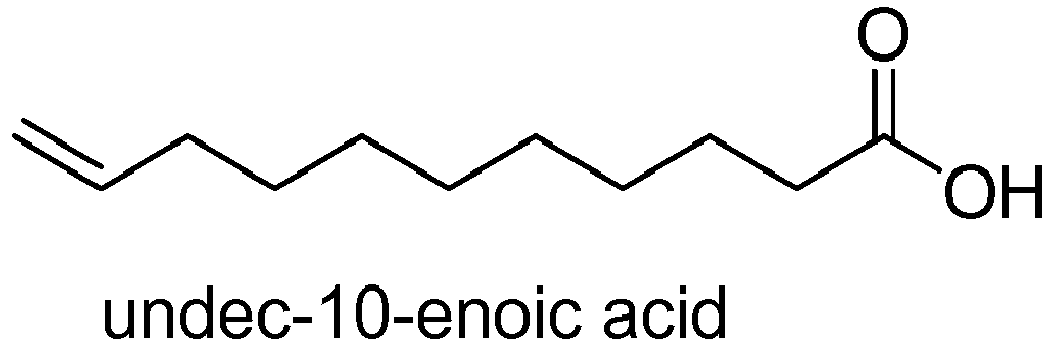
U.S. Patent No. 6,495,097 discloses its use, as well as the use of certain derivatives such as its methyl and ethyl esters, as substances that provide odor neutralization. - Citric acid (3-carboxy-3-hydroxypentanedioic acid) is used extensively in food products to add an acidic or sour taste and is also used in cleaning products. Additionally, as indicated in recent
U.S. Patent Nos. 6,906,045 and7,147,822 , citric acid can function as an odor neutralizer. - Citric acid has the formula

- The esters which, in combination with undecylenic acid or citric acid are synergistically effective in neutralizing malodors have molecular weights within the specified particular ranges and have the structure (I)

- R1 is hydrogen, phenyl substituted by hydroxyl or an amino group, or a C1-C11 alkyl group which can optionally contain one or two double bonds and which optionally can be substituted by phenyl group, and
- R2 is C1-C6 unbranched alkyl, a C3-C12 branched alkyl group which can optionally contain one or two double bonds, or benzyl,
- (i) where R1 is a C1-C11 alkyl or alkylene radical substituted by phenyl, such substitution occurs at the 2- or higher carbon atom, and
- (ii) where both R1 and R2 are unbranched alkyls, the total number of carbon atoms in said alkyls is not greater than 12 and, if said total number of carbon is greater than 8, the difference between the number of carbon atoms in R1 and R2 is at least 2.
- An example of R1 as an alkylene radical substituted by phenyl at the 2- carbon is cinnamate. An example of an alkyl radical substituted at the 3- carbon is 3-phenylpropyl.
- With respect to compounds in which both R1 and R2 are unbranched alkyls, butyl butyrate and ethyl heptanate, for example, would be within the scope of Formula (I). Pentyl hexanate is an example of a compound which would not be included in Formula (I). A preferred group of compounds in this class are those in which the total number of carbon atoms in R1 and R2 is not greater than 8.
- In order to combat malodors, the combination of undecylenic acid or citric acid and the esters of Formula (I) may be used in admixture. They may be used in pure form or in suitable solvents such as, for example, ethanol, isopropanol or other solvents well known for use in deodorizing formulations.
- The ratio of undecylenic acid or citric acid to the ester of Formula (I) can range between about 10% to 90%, preferably from about 25% to 75%. A weight ratio of about 50% is particularly preferred and convenient.
- A preferred group of esters within the Formula (I) are those in which R2 is C1-C5 (straight-chain or branched) alkyl or benzyl.
- Preferred particular compounds within the Formula (I) for combination with undecylenic acid include the following:


- Preferred particular compounds within Formula (I) for combination with citric acid include, in addition to those preferred for combination with undecylenic acid, the following:


- For odor neutralizing purposes, the compositions according to the present invention can be combined with one or more of a wide variety of fragrancing ingredients.
- The following may be mentioned as examples of ingredients used in fragrancing compositions, in particular:
- extracts from natural raw materials such as essential oils, resins, resinoids, balsams, tinctures such as for example ambergris tincture; amyris oil; angelica seed oil; angelica root oil; aniseed oil; valerian oil; basil oil; tree moss absolute; bay oil; armoise oil; benzoe resinoid; bergamot oil; beeswax absolute; birch tar oil; bitter almond oil; savory oil; buchu leaf oil; cabreuva oil; cade oil; calamus oil; camphor oil; cananga oil; cardamom oil; cascarilla oil; cassia oil; cassie absolute; castoreum absolute; cedar leaf oil; cedar wood oil; cistus oil; citronella oil; lemon oil; copaiba balsam; copaiba balsam oil; coriander oil; costus root oil; cumin oil; cypress oil; davana oil; dill weed oil; dill seed oil; eau de brouts absolute; oakmoss absolute; elemi oil; estragon oil; eucalyptus citriodora oil; eucalyptus oil (cineole type); fennel oil; fir needle oil; galbanum oil; galbanum resin; geranium oil; grapefruit oil; guaiacwood oil; gurjun balsam; gurjun balsam oil; helichrysum absolute; helichrysum oil; ginger oil; iris root absolute; iris root oil; jasmine absolute; calamus oil; blue camomile oil; Roman camomile oil; carrot seed oil; cascarilla oil; pine needle oil; spearmint oil; caraway oil; labdanum oil; labdanum absolute; labdanum resin; lavandin absolute; lavandin oil; lavender absolute; lavender oil; lemon-grass oil; lovage oil; lime oil distilled; lime oil expressed; linaloe oil; Litsea cubeba oil; laurel leaf oil; mace oil; marjoram oil; mandarin oil; massoi (bark) oil; mimosa absolute; ambrette seed oil; musk tincture; clary sage oil; nutmeg oil; myrrh absolute; myrrh oil; myrtle oil; clove leaf oil; clove bud oil; neroli oil; olibanum absolute; olibanum oil; opopanax oil; orange flower absolute; orange oil; origanum oil; palmarosa oil; patchouli oil; perilla oil; Peru balsam oil; parsley leaf oil; parsley seed oil; petitgrain oil; peppermint oil; pepper oil; pimento oil; pine oil; pennyroyal oil; rose absolute; rosewood oil; rose oil; rosemary oil; Dalmatian sage oil; Spanish sage oil; sandalwood oil; celery seed oil: spike-lavender oil; star anise oil; storax oil; tagetes oil; fir needle oil; tea tree oil; turpentine oil; thyme oil; Tolu balsam; tonka bean absolute; tuberose absolute; vanilla extract; violet leaf absolute; verbena oil; vetiver oil; juniperberry oil; wine lees oil; wormwood oil; wintergreen oil; ylang-ylang oil; hyssop oil; civet absolute; cinnamon leaf oil; cinnamon bark oil; and fractions thereof or ingredients isolated therefrom;
- individual fragrance ingredients from the group comprising hydrocarbons, such as for example 3-carene; α-pinene; β-pinene; α-terpinene; γ-terpinene; p-cymene; bisabolene; camphene; caryophyllene; cedrene; farnesene; limonene; longifolene; myrcene; ocimene; valencene; (E,Z)-1,3,5-undecatriene; styrene; diphenylmethane; aliphatic alcohols, such as for example hexanol; octanol; 3-octanol; 2,6-dimethyl-heptanol; 2-methyl-2-heptanol, 2-methyl-2-octanol; (E)-2-hexenol; (E)- and (Z)-3-hexenol; 1-octen-3-ol; a mixture of 3,4,5,6,6-pentamethyl-3,4-hepten-2-ol and 3,5,6,6-tetramethyl-4-methyleneheptan-2-ol; (E,Z)-2,6-nonadienol; 3,7-dimethyl-7-methoxyoctan-2-ol; 9-decenol; 10-undecenol; 4-methyl-3-decen-5-ol;
- aliphatic aldehydes and their acetals such as for example hexanal; heptanal; octanal; nonanal; decanal; undecanal; dodecanal; tridecanal; 2-methyloctanal; 2-methylnonanal; (E)-2-hexenal; (Z)-4-heptenal; 2,6-dimethyl-5-heptenal; 10-undecenal; (E)-4-decenal; 2-dodecenal; 2,6,10-trimethyl-5,9-undecadienal; heptanal-diethylacetal; 1,1-dimethoxy-2,2,5-trimethyl-4-hexene; citronellyl oxyacetaldehyde;
- aliphatic ketones and oximes thereof, such as for example 2-heptanone; 2-octanone; 3-octanone; 2-nonanone; 5-methyl-3-heptanone; 5-methyl-3-heptanone oxime; 2,4,4,7-tetramethyl-6-octen-3-one;
- aliphatic sulfur-containing compounds, such as for example 3-methylthiohexanol; 3-methylthiohexyl acetate; 3-mercaptohexanol; 3-mercaptohexyl acetate; 3-mercaptohexyl butyrate; 3-acetyltbiohexyl acetate; 1-menthene-8-thiol;
- aliphatic nitriles, such as for example 2-nonenenitrile; 2-tridecenenitrile; 2,12-tridecenenitrile; 3,7-dimethyl-2,6-octadienenitrile; 3,7-dimethyl-6-octenenitrile;
- aliphatic carboxylic acids and esters thereof, such as for example (E)- and (Z)-3-hexenylformate; ethyl acetoacetate; isoamyl acetate; hexyl acetate; 3,5,5-trimethylhexyl acetate; 3-methyl-2-butenyl acetate; (E)-2-hexenyl acetate; (E)- and (Z)-3-hexenyl acetate; octyl acetate; 3-octyl acetate; 1-octen-3-yl acetate; ethyl butyrate; butyl butyrate; isoamyl butyrate; hexylbutyrate; (E)- and (Z)-3-hexenyl isobutyrate; hexyl crotonate; ethylisovalerate; ethyl-2-methyl pentanoate; ethyl hexanoate; allyl hexanoate; ethyl heptanoate; allyl heptanoate; ethyl octanoate; ethyl-(E,Z)-2,4-decadienoate; methyl-2-octinate; methyl-2-noninate; allyl-2-isoamyl oxyacetate; methyl-3,7-dimethyl-2, 6-octadienoate;
- acyclic terpene alcohols, such as, for example, citronellol; geraniol; nerol; linalool; lavandulol; nerolidol; farnesol; tetrahydrolinalool; tetrahydrogeraniol; 2,6-dimethyl-7-octen-2-ol; 2,6-dimethyloctan-2-ol; 2-methyl-6-methylene-7-octen-2-ol; 2,6-dimethyl -5,7-octadien-2-ol; 2,6-dimethyl-3,5-octadien-2-ol; 3,7-dimethyl-4,6-octadien-3-ol; 3,7-dimethyl-1,5,7-octatrien-3-ol 2,6-dimethyl-2,5,7-octatrien-1-ol; as well as formates, acetates, propionates, isobutyrates, butyrates, isovalerates, pentanoates, hexanoates, crotonates, tiglinates and 3-methyl-2-butenoates thereof;
- acyclic terpene aldehydes and ketones, such as, for example, geranial; neral; citronellal; 7-hydroxy-3,7-dimethyloctanal; 7-methoxy-3,7-dimethyloctanal; 2,6,10-trimethyl-9-undecenal; α-sinensal; β-sinensal; geranylacetone; as well as the dimethyl- and diethylacetals of geranial, neral and 7-hydroxy-3,7-dimethyloctanal;
- cyclic terpene alcohols, such as, for example, menthol; isopulegol; alpha-terpineol; terpinen-4-ol; menthan-8-ol; menthan-1-ol; menthan-7-ol; borneol; isoborneol; linalool oxide; nopol; cedrol; ambrinol; vetiverol; guaiol; and the formates, acetates, propionates, isobutyrates, butyrates, isovalerates, pentanoates, hexanoates, crotonates, tiglinates and 3-methyl-2-butenoates of alpha-terpineol, terpinen-4-ol; methan-8-ol, methan-1-ol, methan-7-ol, borneol, isoborneol, linalool oxide, nopol, cedrol, ambrinol, vetiverol and guaiol;
- cyclic terpene aldehydes and ketones, such as, for example, menthone; isomenthone; 8-mercaptomenthan-3-one; carvone; camphor; fenchone; alpha-ionone; beta-ionone; alpha-n-methylionone; beta-n-methylionone; alpha-isomethylionone; beta-isomethylionone; alpha-irone; alphadamascone; beta-damascone; beta-danascenone; deltadamascone; gamma-damascone; 1-(2,4,4-trimethyl-2-cyclohexen-1-yl)-2-buten-1-one; 1,3,4,6,7,8a-hexahydrol; 1,1,5,5-tetramethyl-2H-2,4a-methanonaphthalen-8(5H)-one; nootkatone; dihydronootkatone; acetylated cedarwood oil (cedryl methyl ketone);
- cyclic alcohols, such as, for example, 4-tert.-butylcyclohexanal; 3,3,5-trimethylcyclohexanol; 3-isocamphylcyclohexanol; 2,6,9-trimethyl-Z2,Z5,E9-cyclododecatrien-1-ol; 2-isobutyl-4-methyltetrahydro-2H-pyran-4-ol;
- cycloaliphatic alcohols, such as, for example, alpha-3,3-trimethylcyclo-hexyl-methanol; 2-methyl-4-(2,2,3-trimethyl-3-cyclopent-1-yl)-butanol; 2-methyl-4-(2,2,3-trimethyl-3-cyclopent-1-yl)-2-buten-1-ol; 2-ethyl-4-(2,2,3-trimethyl-3-cyclopent-1-yl)-2-buten-1-ol; 3-methyl-5-(2,2,3-trimethyl-3-cyclopent-1-yl)-pentan-2-ol; 3-methyl-5-(2,2,3-trimethyl-3-cyclopent-1-yl)-4-penten-2-ol; 3,3-dimethyl-5-(2,2,3-trimethyl-3-cyclopent-1-yl)-4-penten-2-ol; 1-(2,2,6-trimethylcyclohexyl)-pentan-3-ol; 1-(2,2,6-trimethylcyclohexyl)-hexan-3-ol;
- cyclic and cycloaliphatic ethers, such as, for example, cineole; cedryl methyl ether; cyclododecyl methyl ether; (ethoxymethoxy)-cyclododecane; alpha-cedrene epoxide; 3a,6,6,9a-tetramethyldodecahydronaphtho[2,1-b]furan; 3a-ethyl-6,6, 9a-trimethyl-dodecahydronaphtho[2,1-b]furan; 1,5,9-trimethyl-13-oxabicyclo[10.1.0]-trideca-4,8-diene; rose oxide; 2-(2,4-dimethyl-3-cyclohexen-1-yl)-5-methyl-5-(1-methyl-propyl)-1,3-dioxan;
- cyclic ketones, such as, for example, 4-tert.-butylcyclohexanone; 2,2,5-trimethyl-5-pentylcyclopentanone; 2-heptylcyclopentanone; 2-pentylcyclopentanone; 2-hydroxy-3-methyl-2-cyclopenten-1-one; 3-methyl-cis-2-penten-1-yl-2-cyclopenten-1-one; 3-methyl-2-pentyl-2cyclopenten-1-one; 3-methyl-4-cyclopentadecenone; 3-methyl-5-cyclopentadecenone; 3-methylcyclopentadecanone; 4-(1-ethoxyvinyl)-3,3,5,5-tetramethylcyclo-hexanone; 4-tert.-pentylcyclohexanone; 5-cyclohexadecen-lone; 6,7-dihydro-1,1,2,3,3-pentamethyl-4(5H)-indanone; 5-cyclohexadecen-1-one; 8-cyclohexadecen-1-one; 9-cycloheptadecen-1-one; cyclopentadecanone; cycloaliphatic aldehydes, such as, for example, 2,4-dimethyl-3-cyclohexene carbaldehyde; 2-methyl-4-(2,2,6-trimethyl-cyclohexen-1-yl)-2-butenal; 4-(4-hydroxy-4-methylpentyl)-3-cyclohexene carbaldehyde; 4-(4-methyl-3penten-1-yl)-3-cyclohexene carbaldehyde;
- cycloaliphatic ketones, such as, for example, 1-(3,3-dimethylcyclohexyl)-4-penten-1-one; 1-(5,5-dimethyl-1-cyclohexen-1-yl)-4-penten-1-one; 2,3,8,8-tetramethyl-1,2,3,4,5,6,7,8-octahydro-2-naphtalenyl methyl ketone; methyl-2,6,10-trimethyl-2,5,9-cyclododecatrienyl ketone; tert.-butyl-(2,4-dimethyl-3-cyclohexen-1-yl)-ketone; esters of cyclic alcohols, such as, for example, 2-tert.butylcyclohexyl acetate; 4-tert.-butylcyclohexyl acetate; 2-tert.-pentylcyclohexyl acetate; 4-tert.-pentylcyclohexyl acetate; decahydro-2-naphthyl acetate; 3-pentyltetrahy-dro-2H-pyran-4-yl acetate; decahydro-2,5,5,8a-tetramethyl-2-naphthyl acetate; 4,7-methano-3a,4,5,6,7,7a-hexa-hydro-5 or 6-indenyl acetate; 4,7-methano-3a,4,5,6,7,7a-hexahydro-5 or 6-indenyl propionate; 4,7-methano-3a,4,5,6,7,7a-hexahydro-5 or 6-indenyl isobutyrate; 4,7-methanooctahydro-5 or 6-indenyl acetate;
- esters of cycloaliphatic carboxylic acids, such as, for example, allyl 3-cyclohexyl-propionate; allyl cyclohexyl oxyacetate; methyl dihydrojasmonate; methyl j asmonate; methyl 2-hexyl-3-oxocyclopentanecarboxylate; ethyl 2-ethyl-6,6-dimethyl-2-cyclohexenecarboxylate; ethyl 2,3,6,6-tetramethyl-2-cyclohexenecarboxylate; ethyl 2-methyl-1,3-dioxolane-2-acetate;
- araliphatic alcohols, such as, for example, benzyl alcohol; 1-phenylethyl alcohol; 2-phenylethyl alcohol; 3-phenyl-propanol; 2-phenylpropanol; 2-phenoxyethanol; 2,2-dimethyl-3-phenylpropanol; 2,2-dimethyl-3-(3-methylphenyl)propanol; 1,1-dimethyl-2-phenylethyl alcohol; 1,1dimethyl-3-phenylpropanol; 1-ethyl-1-methyl-3-phenylpropanol; 2-methyl-5-phenylpentanol; 3-methyl-5-phenylpentanol; 3-phenyl-2-propen-1-ol; 4-methoxybenzyl alcohol; 1-(4-isopropylphenyl)ethanol;
- esters of araliphatic alcohols and aliphatic carboxylic acids, such as, for example, benzyl acetate; benzyl propionate; benzyl isobutyrate; benzyl isovalerate; 2-phenylethyl acetate; 2-phenylethyl propionate; 2-phenylethyl isobutyrate; 2-phenylethyl isovalerate; 1-phenylethyl acetate; alpha-trichloromethylbenzyl acetate; alpha,alpha-dimethylphenylethyl acetate; alpha,alpha-dimethylphenylethyl butyrate; cinnamyl acetate; 2-phenoxyethyl isobutyrate; 4-methoxybenzyl acetate;
- araliphatic ethers, such as for example 2-phenylethyl methyl ether; 2-phenylethyl isoamyl ether; 2-phenylethyl-1-ethoxyethyl ether; phenylacetaldehyde dimethyl acetal; phenylacetaldehyde diethyl acetal; hydratropaaldehyde dimethyl acetal; phenylacetaldehyde glycerol acetal; 2,4,6-trimethyl-4-phenyl-1,3-dioxane; 4,4a,5,9b-tetrahydroindeno[1,2-d]-m-dioxin; 4,4a,5,9b-tetrahydro-2,4-dimethylindeno[1,2-d]-m-dioxin;
- aromatic and araliphatic aldehydes, such as, for example, benzaldehyde; phenylacetaldehyde; 3-phenylpropanal; hydratropaldehyde; 4-methylbenzaldehyde; 4-methylphenylacetaldehyde; 3-(4-ethylphenyl)-2,2-dimethylproparral; 2-methyl-3-(4-isopropylphenyl)-propanal; 2-methyl-3-(4-tert.-butylphenyl)propanal; 3-(4-tert.-butylphenyl)propanal; cinnamaldehyde; alpha-butylcinnamaldehyde; alpha-amylcinnamaldehyde; alpha-hexylcinnamaldehyde; 3-methyl-5-phenylpentanal; 4-methoxybenzaldehyde; 4-hydroxy-3-methoxybenzaldehyde; 4-hydroxy-3-ethoxybenzaldehyde; 3,4-methylene-dioxybenzaldehyde; 3,4-dimethoxybenzaldehyde; 2-methyl-3-(4-methoxyphenyl)-propanal; 2-methyl-3-(4-methylendioxyphenyl)-propanal;
- aromatic and araliphatic ketones, such as, for example, acetophenone; 4-methylacetophenone; 4-methoxyacetophenone; 4-tert.-butyl-2,6-dimethylacetophenone; 4-phenyl-2-butanone; 4-(4-hydroxyphenyl)-2-butanone; 1-(2-naphthalenyl)ethanone; benzophenone; 1,1,2,3,3,6-hexamethyl-5-indanyl methyl ketone; 6-tert.-butyl-1,1,1-dimethyl-4-indanyl methyl ketone; 1-[2,3-dihydro-1,1,2,6-tetramethyl-3-(1-methyl-ethyl)-1H-5-indenyl]ethanone; 5',6',7',8'-tetrahydro-3',5',5',6',8',8'-hexamethyl-2-acetonaphthone;
- aromatic and araliphatic carboxylic acids and esters thereof, such as, for example, benzoic acid; phenylacetic acid; methyl benzoate; ethyl benzoate; hexyl benzoate; benzyl benzoate; methyl phenylacetate; ethyl phenylacetate; geranyl phenylacetate; phenylethyl phenylacetate; methyl cinnamate; ethyl cinnamate; benzyl cinnamate; phenylethyl cinnamate; cinnamyl cinnamate; allyl phenoxyacetate; methyl salicylate; isoamyl salicylate; hexyl salicylate; cyclohexyl salicylate; cis-3-hexenyl salicylate; benzyl salicylate; phenylethyl salicylate; methyl 2,4-dihydroxy-3,6-dimethylbenzoate; ethyl 3-phenylglycidate; ethyl 3-methyl-3-phenylglycidate;
- nitrogen-containing aromatic compounds, such as, for example, 2,4,6-trinitro-1,3-dimethyl-5-tert-butylbenzene; 3,5-dinitro-2,6-dimethyl-4-tert.-butylacetophenone; cinnamonitrile; 5-phenyl-3-methyl-2-pentenonitrile; 5-phenyl-3-methylpentanonitrile; methyl anthranilate; methyN-methylanthranilate; Schiffs bases of methyl anthranilate with 7-hydroxy-3,7-dimethyloctanal, 2-methyl-3-(4-tert.-butylphenyl)-propanal or 2,4-dimethyl-3-cyclohexene carbaldehyde; 6-isopropylquinoline; 6-isobutylquinoline; 6-sec.-butylquinoline; indole; skatole; 2-methoxy-3-isopropyl-pyrazine; 2-isobutyl-3methoxypyrazine;
- phenols, phenyl ethers and phenyl esters, such as, for example, estragole; anethole; eugenol; eugenyl methyl ether; isoeugenol; isoeugenol methyl ether; thymol; carvacrol; diphenyl ether; beta-naphthyl methyl ether; betanaphthyl ethyl ether; beta-naphthyl isobutyl ether; 1,4-dimethoxybenzene; eugenyl acetate; 2-methoxy-4-methylphenol; 2-ethoxy-5-(1-propenyl)-phenol; p-cresyl phenylacetate;
- heterocyclic compounds, such as, for example, 2,5-dimethyl-4-hydroxy-2H-furan-3-one; 2-ethyl-4-hydroxy-5 -methyl-2H-furan-3 -one; 3-hydroxy-2-methyl-4H-pyran4-one; 2-ethyl-3-hydroxy-4H-pyran-4-one;
- lactones, such as, for example, 1,4-octanolide; 3-methyl-1,4-octanolide; 1,4-nonanolide; 1,4-decanolide; 8-decen-1,4-olide; 1,4-undecanolide; 1,4-dodecanolide; 1,5-decanolide; 1,5-dodecanolide; 1,15-pentadecanolide; cis- andtrans-11-pentadecen-1,15-olide; cis- and trans-12-pentadecen-1,15-olide; 1,16-hexadecanolide; 9-hexadecen-1,16-olide; 10-oxa-1,16-hexadecanolide; 11-oxa-1,16-hexadecanolide; 12-oxa-1,16-hexadecanolide; ethylene-1,12-dodecanedioate; ethylene-1,13-tridecanedioate; coumarin; 2,3-dihydrocoumarin; octahydrocoumarin.
- The foregoing lists include some esters that fall within the scope of Formula (I), in which cases, a product comprising the composition of this invention will contain two or more of such esters.
- In addition, the odor neutralizers containing the esters according to the present invention can be adsorbed onto a carrier which ensures both the fine distribution of the odor neutralizer in the product and controlled release during use. Such carriers can be porous inorganic materials such as light sulfates, salts, silica gels, borates, carbonates, soda ash, tripolyphosphates, zeolites, gypsums, clays, granulated clays, aerated concrete, etc., or organic materials such as wood, starches and other cellulose-based materials.
- The odor neutralizers containing undecylenic acid or citric acid and the esters of Formula (I) can also be in microencapsulated or spray-dried form or in the form of inclusion complexes or extrusion products and they can be added in these forms to the product whose odor is to be improved or which is to be perfumed.
- The compositions of the present invention may be added to a wide variety of consumer products, such as household products, personal care products and cosmetics, both perfumed and perfume-free, and both scented and scent-free.
- Household products which may comprise a composition according to the invention include fabric washing powder and washing liquid, detergent, surface cleaner (including hard surface cleaner), air freshener in various forms (e.g., solids, gels, candles, liquids, etc.), softener, bleach, fabric refresher and room spray, disinfection products, scourer and cat litter. The list of household products is given by way of illustration and is not to be regarded as being in any way limiting.
- Personal care products and cosmetics which may comprise a composition according to the invention include lotion, e.g. after-shave lotion, shampoo, conditioner, styling spray, mousse, gel, hair wipe, hair spray, hair pomade, bath and shower gel, bath salt, hygiene products, deodorant, antiperspirant, breath-freshening sprays, breath-freshening chewing gum, mouthwashes, lozenges and mints, vanishing cream, depilatory, and talcum powder. The list of personal care products and cosmetics is given by way of illustration and is not to be regarded as being in any way limiting.
- Typically, the products using the composition of this invention comprise from about 0.0001% to about 20% by weight, preferably about 0.001% to about 10% by weight, of a combination of undecylenic acid or citric acid and at least one ester of Formula (I) based on the product. The effective amount depends upon the type of product into which the combination is admixed.
- For example, if used in a fabric refresher the combination may be added to a fragrance composition at around 1% by weight which is then added to the product at around 0.1 % by weight, i.e. the fabric refresher comprises about 0.001% by weight of the composition as hereinabove described. Or, in a liquid electrical air freshener composition, it may be added at higher concentration - typically around 20% - and may be present as 100% of the composition.
- Accordingly, the present invention refers in a further aspect to a consumer product comprising an effective malodor-counteracting amount of a composition comprising undecylenic acid or citric acid and at least one ester of Formula (I).
- Another aspect of the invention are methods of removing malodor from the air or from surfaces, comprising contacting the source of said malodor with an effective amount of a composition comprising undecylenic acid or citric acid and at least one ester of Formula (I) as hereinabove described. The methods can be, for example, spraying the ambient air surrounding the source of the malodors, or spraying an aerosol formulation directly onto the source of the malodor.
- In a further aspect, the invention refers to a method of enhancing the malodor reduction properties of a consumer product, such as household products and personal care products, comprising admixing to the product effective amounts of at least undecylenic acid or citric acid and at least one ester of Formula (I) as hereinabove described.
- A malodor evaluation panel of 14 persons was assembled and asked to evaluate the odor neutralizing effectiveness of undecylenic acid and of certain esters falling within the scope of Formula (I) in the molecular weight range of between 150 and 200, separately and in combination. The source of the malodor tested was cat urine.
- Swatches of 100% untreated cotton fabric were cut into 15 cm (6-inch) squares and were placed on weighing boats. 0.5 grams of cat urine was pipetted onto each of the swatches. A period of three minutes was allowed for the urine to be absorbed by the fabric.
- Onto each swatch, 3.0 grams of a composition was sprayed. As a control, 3.0 grams of water was sprayed on certain swatches.
- Each swatch was placed in the middle of a 60cm by 50 cm (2 feet by 2 feet) cubicle and all doors were closed. Actual testing was begun after thirty minutes.
- Each member of the panel was asked to sniff the malodor control first and was notified that the control has a rating of 7 - indicating very strong malodor. They were then asked to proceed to sniff the other samples and provide a rating for malodor remaining. Thus, the remaining malodor was evaluated on a sliding scale, with 1 being the absence of perceived malodor. The panelists were instructed to ignore any fragrance that they may detect and rate only for malodor.
- For undecylenic acid alone and the ester of Formula (I) alone, the fabric sprays consisted of:
- Test substance - 1%
- Neodol 91-8-1%
- Fabric spray base - 98%
- For fabric sprays comprising both undecylenic acid and a subject ester, the formulation was:
- Undecylenic acid - 1%
- Ester - 1%
- Neodol 91-8 - 2%
- Fabric spray base - 96.0%
- Neodol 91-8 is a C9-C11 alcohol with an average of approximately 8 moles of ethylene oxide per mole of alcohol. The fabric spray base was an aqueous solution containing 10% ethanol, 1% of fragrance and 2% of non-ionic surfactant.
- The results are shown in the following Table 1. Each panelist tested all of the esters, the undecylenic acid and the combination. The scores reported are therefore the average of 14 replications.
Table 1 Ester Molecular Weight Score Alone (at 1%) Score in comb. with Undecylenic Acid (1% + 1%) Undecylenic Acid (at 1%) Score alone-score in comb. Undecylenic Acid - score in comb. Benzyl Acetate 150.174 2.64 1.94 3.03 0.69 1.08 Methyl Anthranilate 151.163 4.09 3.05 3.77 1.04 0.72 Methyl Salicylate 152.147 3.58 2.75 4.13 0.83 1.38 Ethyl Heptanate 158.238 3.41 2.56 3.80 0.85 1.24 Methyl Cinnamate 162.185 4.20 3.05 3.56 1.15 0.51 Amyl Isovalerate 172.264 4.55 3.40 3.70 1.15 0.30 Ethyl Cinnamate 176.212 3.46 2.47 4.17 0.99 1.70 Bornyl Acetate 196.286 2.40 1.94 3.50 0.45 1.56 Geranyl Acetate 196.286 3.86 3.24 4.08 0.62 0.84 - Following the procedure of Example I, the odor neutralizing effectiveness of citric acid and of certain esters of Formula I in the molecular weight range of between 130 and 230 was evaluated. The results are shown in the following Table 2.
Table 2 Ester Molecular Weight Score Alone (at 1%) Score in comb. with Citric Acid (1% + 1%) Citric Acid (at 1%) Score alone-score in comb. Undecylenic Acid - score in comb. Ethyl Isovalerate 130.185 3.42 3.25 4.50 0.17 1.25 Methyl Benzoate 136.148 3.54 3.21 3.54 0.33 0.33 Butyl Butyrate 144.211 3.04 2.88 3.75 0.17 0.88 Methyl Anthranilate 151.163 4.00 3.29 4.43 0.71 1.14 Methyl Cinnamate 162.185 3.75 3.21 4.38 0.54 1.17 Amyl Isovalerate 172.265 3.86 3.55 4.05 0.32 0.50 Bornyl Acetate 196.286 3.95 1.77 4.00 2.18 2.23 Geranyl Acetate 196.286 3.27 3.00 4.36 0.27 1.36 Ethyl Decylate 200.318 3.62 2.96 3.88 0.65 0.92 Linalyl Butyrate 224.339 4.40 2.10 2.60 2.30 0.50 Ethyl Laurate 228.371 3.64 2.77 3.27 0.86 0.50 - Although the present invention is defined in the attached claims, it is to be understood that the invention can alternatively also be defined in accordance with the following embodiments:
-
- 1. A malodor neutralizing composition comprising:
- (1) undecylenic acid or citric acid, and
- (2) at least one ester of the formula

- R1 is hydrogen, phenyl substituted by hydroxy or an amino group, or a C1-C11 alkyl group which can optionally contain 1 or 2 double bonds and which optionally can be substituted by a phenyl group, and
- R2 is C1-C6 unbranched alkyl, a C3-C12 branched alkyl group which can optionally contain 1 or 2 double bonds, or benzyl,
- with the proviso that
- (i) where R1 is a C1-C11 alkyl or alkylene radical substituted by phenyl, such substitution occurs at the 2- or higher carbon atom, and
- (ii) where both R1 and R2 are unbranched alkyls, the total number of carbon atoms in said alkyls is not greater than 12 and, if said total number of carbon atoms is greater than 8, the difference between the number of carbon atoms in R1 and R2 is at least 2,
- said ester having a molecular weight of between 150 and 200 when ingredient (1) is undecylenic acid and a molecular weight of between 130 and 230 when ingredient (1) is citric acid
- 2. A malodor neutralizing composition according to embodiment 1 in which ingredient (1) is undecylenic acid and if, in ingredient (2), both R1 and R2 are unbranched alkyls, the total number of carbon atoms in said alkyls is not greater than 8.
- 3. A malodor neutralizing composition according to embodiment 2 in which, in ingredient (2), R2 is C1-C5 alkyl or benzyl.
- 4. A malodor neutralizing composition according to embodiment 2 in which ingredient (2) is benzyl acetate, methyl anthranilate, methyl salicylate, ethyl heptanate, methyl cinnamate, ethyl cinnamate, amyl isovalerate, bornyl acetate or geranyl acetate.
- 5. A malodor neutralizing composition according to embodiment 4 in which ingredient (2) is bornyl acetate.
- 6. A perfumed product comprising a malodor neutralizing composition according to any of embodiments 2-5.
- 7. A perfumed product according to embodiment 6 in which ingredient (2) of the malodor neutralizing composition is benzyl acetate, methyl anthranilate, methyl salicylate, ethyl heptanate, methyl cinnamate, ethyl cinnamate, amyl isovalerate, bornyl acetate or geranyl acetate.
- 8. A household product comprising a malodor neutralizing composition according to any of embodiments 2-5.
- 9. A household product comprising a malodor neutralizing composition according to embodiment 8 in which ingredient (2) of the malodor neutralizing composition is benzyl acetate, methyl anthranilate, methyl salicylate, ethyl heptanate, methyl cinnamate, ethyl cinnamate, amyl isovalerate, bornyl acetate or geranyl acetate.
- 10. A personal care product comprising a malodor neutralizing composition according to any of embodiments 2-5.
- 11. A personal care product comprising a malodor neutralizing composition according to embodiment 10 in which ingredient (2) of the malodor neutralizing composition is benzyl acetate, methyl anthranilate, methyl salicylate, ethyl heptanate, methyl cinnamate, ethyl cinnamate, amyl isovalerate, bornyl acetate or geranyl acetate.
- 12. A malodor neutralizing composition according to embodiment 1 in which ingredient (1) is citric acid.
- 13. A malodor neutralizing composition according to embodiment 12 in which ingredient (2) is ethyl isovalerate, methyl benzoate, butyl butyrate, methyl anthranilate, methyl cinnamate, amyl isovalerate, bornyl acetate, geranyl acetate, ethyl decylate, linalyl butyrate or ethyl laurate.
- 14. A malodor neutralizing composition according to embodiment 13 in which ingredient (2) is bornyl acetate.
- 15. A perfumed product comprising a malodor neutralizing composition according to embodiment 12.
- 16. A perfumed product according to embodiment 15 in which ingredient (2) of the malodor neutralizing composition is ethyl isovalerate, methyl benzoate, butyl butyrate, methyl anthranilate, methyl cinnamate, amyl isovalerate, bornyl acetate, geranyl acetate, ethyl decylate, linalyl butyrate or ethyl laurate.
- 17. A household product comprising a malodor neutralizing composition according to embodiment 12.
- 18. A household product comprising a malodor neutralizing composition according to embodiment 16 in which ingredient (2) of the malodor neutralizing composition is ethyl isovalerate, methyl benzoate, butyl butyrate, methyl anthranilate, methyl cinnamate, amyl isovalerate, bornyl acetate, geranyl acetate, ethyl decylate, linalyl butyrate or ethyl laurate.
- 19. A personal care product comprising a malodor neutralizing composition according to embodiment 12.
- 20. A personal care product comprising a malodor neutralizing composition according to embodiment 19 in which ingredient (2) of the malodor neutralizing composition is ethyl isovalerate, methyl benzoate, butyl butyrate, methyl anthranilate, methyl cinnamate, amyl isovalerate, bornyl acetate, geranyl acetate, ethyl decylate, linalyl butyrate or ethyl laurate.
- 21. A method for reducing malodors which comprises contacting the source of said malodors with an effective amount of a malodor neutralizing composition comprising:
- (1) undecylenic acid or citric acid, and
- (2) at least one ester of the formula
- R1 is hydrogen, phenyl substituted by hydroxy or an amino group, or a C1-C11 alkyl group which can optionally contain 1 or 2 double bonds and which optionally can be substituted by a phenyl group, and
- R2 is C1-C6 unbranched alkyl, a C3-C12 branched alkyl group which can optionally contain 1 or 2 double bonds, or benzyl,
- with the proviso that
- (i) where R1 is a C1-C11 alkyl radical substituted by phenyl, such substitution occurs at the 2- or higher carbon atom, and
- (ii) where both R1 and R2 are unbranched alkyls, the total number of carbon atoms in said alkyls is not greater than 12 and, if said total number of carbons is greater than 8, the difference between the number of carbon atoms in R1 and R2 is at least 2,
- said ester having a molecular weight of between 150 and 200 when ingredient (1) is undecylenic acid and a molecular weight of between 130 and 230 when ingredient (1) is citric acid.
- 22. A method according to embodiment 21 in which ingredient (1) of the malodor neutralizing composition is undecylenic acid and if, in ingredient (2), both R1 and R2 are unbranched alkyls, the total number of carbon atoms in said alkyls is not greater than 8.
- 23. A method according to embodiment 22 in which ingredient (2) of the malodor neutralizing composition is benzyl acetate, methyl anthranilate, methyl salicylate, ethyl heptanate, methyl cinnamate, ethyl cinnamate, amyl isovalerate, bornyl acetate or geranyl acetate.
- 24. A method according to embodiment 23 in which ingredient (2) of the malodor neutralizing composition is bornyl acetate.
- 25. A method according to embodiment 21 in which ingredient (1) of the malodor neutralizing composition is citric acid.
- 26. A method according to embodiment 25 in which ingredient (2) of the malodor neutralizing composition is ethyl isovalerate, methyl benzoate, butyl butyrate, methyl anthranilate, methyl cinnamate, amyl isovalerate, bornyl acetate, geranyl acetate, ethyl decylate, linalyl butyrate or ethyl laurate.
- 27. A method according to embodiment 26 in which ingredient (2) is bornyl acetate.
- 28. A method for reducing malodors emanating from household or personal care products which comprises admixing to said products an effective amount of a malodor neutralizing composition comprising
- (1) undecylenic acid or citric acid
- (2) at least one ester of the formula

- R1 is hydrogen, phenyl substituted by hydroxy or an amino group, or a C1-C11 alkyl group which can optionally contain 1 or 2 double bonds and which optionally can be substituted by a phenyl group, and
- R2 is C1-C6 unbranched alkyl, a C3-C12 branched alkyl group which can optionally contain 1 or 2 double bonds, or benzyl,
- with the proviso that
- (i) where R1 is a C1-C11 alkyl radical substituted by phenyl, such substitution occurs at the 2- or higher carbon atom, and
- (ii) where both R1 and R2 are unbranched alkyls, the total number of carbon atoms in said alkyls is not greater than 12 and, if said total number of carbons is greater than 8, the difference between the number of carbon atoms in R1 and R2 is at least 2,
- said ester having a molecular weight of between 150 and 200 when ingredient (1) is undecylenic acid and a molecular weight of between 130 and 230 when ingredient (1) is citric acid.
- 29. A method according to embodiment 28 in which ingredient (1) of the malodor neutralizing composition is undecylenic acid and if, in ingredient (2), both R1 and R2 is are unbranched alkyls, the total number of carbon atoms in said alkyls is not greater than 8.
- 30. A method according to embodiment 29 in which ingredient (2) of the malodor neutralizing composition is benzyl acetate, methyl anthranilate, methyl salicylate, ethyl heptanate, methyl cinnamate, ethyl cinnamate, amyl isovalerate, bornyl acetate or geranyl acetate.
- 31. A method according to embodiment 30 in which ingredient (2) of the malodor neutralizer composition is bornyl acetate.
- 32. A method according to embodiment 28 in which ingredient (1) of the malodor composition is citric acid.
- 33. A method according to embodiment 32 in which ingredient (2) of the malodor neutralizing composition is ethyl isovalerate, methyl benzoate, butyl butyrate, methyl anthranilate, methyl cinnamate, amyl isovalerate, bornyl acetate, geranyl acetate, ethyl decylate, linalyl butyrate or ethyl laurate.
- 34. A method according to embodiment 33 in which ingredient (2) of the malodor neutralizing composition is bornyl acetate.
- A number of implementations have been described. Nevertheless, it will be understood that various modifications may be made without departing from the spirit and scope of the following claims. Accordingly, other implementations are within the scope of the following claims.
Claims (13)
- A malodor neutralizing composition, comprising:(1) citric acid, and(2) at least one ester of the formula (I):
 R1 is hydrogen, phenyl optionally substituted by hydroxy or an amino group, or a C1-C11 alkyl group which can optionally contain 1 or 2 double bonds and which optionally can be substituted by a phenyl group, andR2 is C1-C6 unbranched alkyl, or a C3-C12 branched alkyl group which can optionally contain 1 or 2 double bonds,with the proviso that(i) where R1 is a C1-C11 alkyl or alkylene radical substituted by phenyl, such substitution occurs at the 2- or higher carbon atom, and(ii) where both R1 and R2 are unbranched alkyls, the total number of carbon atoms in said alkyls is not greater than 12 and, if said total number of carbon atoms is greater than 8, the difference between the number of carbon atoms in R1 and R2 is at least 2,said ester havinga molecular weight of between 130 and 230, andthe amount of ingredient (2) is 50-90% by weight of the total amount of ingredients (1) and (2).
 - The composition of claim 1, wherein, in ingredient (2), R2 is C1-C5 alkyl.
- The composition of claim 1, wherein ingredient (2) is ethyl heptanate, amyl isovalerate, or geranyl acetate.
- The composition of claim 1, wherein ingredient (2) is ethyl isovalerate, butyl butyrate, amyl isovalerate, bornyl acetate, geranyl acetate, ethyl decylate, linalyl butyrate or ethyl laurate.
- The composition of claim 1, wherein the composition consists of(1) citric acid,(2) at least one ester of the formula (I), and(3) at least one component selected from the group consisting of: an extract from a raw natural material, a hydrocarbon, an aliphatic alcohol, an aliphatic aldehyde, an aliphatic acetal, an aliphatic ketone, an aliphatic oxime, an aliphatic sulfur-containing compound, an aliphatic nitrile, an aliphatic carboxylic acid, an acyclic terpene alcohol, an acyclic terpene aldehyde, an acyclic terpene ketone, a cyclic terpene alcohol, a cyclic terpene aldehyde, a cyclic terpene ketone, a cyclic alcohol, a cycloaliphatic alcohol, a cyclic ether, a cycloaliphatic ether, a cyclic ketone, a cycloaliphatic ketone, a cyclic alcohol ester, a cycloaliphatic carboxylic acid ester, an araliphatic alcohol, an araliphatic alcohol ester, an araliphatic carboxylic acid ester, an araliphatic ether, an aromatic aldehyde, an araliphatic aldehyde, an aromatic ketone, an araliphatic ketone, an aromatic carboxylic acid, an araliphatic carboxylic acid, an aromatic carboxylic acid ester, an araliphatic carboxylic acid ester, a nitrogen-containing aromatic compound, a phenol, a phenyl ether, a phenyl ester, a heterocyclic compound, and a lactone.
- The composition of claim 1, comprising:(1) citric acid, and(2) at least one ester selected from the group consisting of methyl anthranilate, methyl salicylate, methyl cinnamate, ethyl cinnamate, bornyl acetate, and methyl benzoate,
wherein the amount of ingredient (2) is 50-90% by weight of the total amount of ingredients (1) and (2). - The composition of claim 6, wherein ingredient (2) is bornyl acetate.
- The composition of claim 6, wherein the composition consists of(1) citric acid,(2) at least one ester selected from the group consisting of methyl anthranilate, methyl salicylate, methyl cinnamate, ethyl cinnamate, bornyl acetate, and methyl benzoate, and(3) at least one component selected from the group consisting of: an extract from a raw natural material, a hydrocarbon, an aliphatic alcohol, an aliphatic aldehyde, an aliphatic acetal, an aliphatic ketone, an aliphatic oxime, an aliphatic sulfur-containing compound, an aliphatic nitrile, an aliphatic carboxylic acid, an acyclic terpene alcohol, an acyclic terpene aldehyde, an acyclic terpene ketone, a cyclic terpene alcohol, a cyclic terpene aldehyde, a cyclic terpene ketone, a cyclic alcohol, a cycloaliphatic alcohol, a cyclic ether, a cycloaliphatic ether, a cyclic ketone, a cycloaliphatic ketone, a cyclic alcohol ester, a cycloaliphatic carboxylic acid ester, an araliphatic alcohol, an araliphatic alcohol ester, an araliphatic carboxylic acid ester, an araliphatic ether, an aromatic aldehyde, an araliphatic aldehyde, an aromatic ketone, an araliphatic ketone, an aromatic carboxylic acid, an araliphatic carboxylic acid, an aromatic carboxylic acid ester, an araliphatic carboxylic acid ester, a nitrogen-containing aromatic compound, a phenol, a phenyl ether, a phenyl ester, a heterocyclic compound, and a lactone.
- A perfumed product, comprising the composition of any of claims 1-8.
- A household product, comprising the composition of any of claims 1-8.
- A personal care product, comprising the composition of any of claims 1-8.
- A method for reducing malodors, comprising contacting a source of the malodors with an effective amount of the composition of any of claims 1-8.
- A method for reducing malodors emanating from a household or personal care product, comprising admixing to the product an effective amount of the composition of any of claims 1-8.
Applications Claiming Priority (4)
| Application Number | Priority Date | Filing Date | Title |
|---|---|---|---|
| US35143510P | 2010-06-04 | 2010-06-04 | |
| US12/974,716 US8741275B2 (en) | 2010-06-04 | 2010-12-21 | Malodor neutralizing compositions comprising undecylenic acid or citric acid |
| EP11702366.3A EP2576680B1 (en) | 2010-06-04 | 2011-01-27 | Malodor neutralizing compositions comprising undecylenic acid or citric acid |
| PCT/US2011/022697 WO2011152886A2 (en) | 2010-06-04 | 2011-01-27 | Malodor neutralizing compositions comprising undecylenic acid or citric acid |
Related Parent Applications (1)
| Application Number | Title | Priority Date | Filing Date |
|---|---|---|---|
| EP11702366.3A Division EP2576680B1 (en) | 2010-06-04 | 2011-01-27 | Malodor neutralizing compositions comprising undecylenic acid or citric acid |
Publications (2)
| Publication Number | Publication Date |
|---|---|
| EP2816080A1 true EP2816080A1 (en) | 2014-12-24 |
| EP2816080B1 EP2816080B1 (en) | 2026-02-25 |
Family
ID=44625084
Family Applications (3)
| Application Number | Title | Priority Date | Filing Date |
|---|---|---|---|
| EP14173478.0A Active EP2816079B1 (en) | 2010-06-04 | 2011-01-27 | Malodor neutralizing compositions comprising undecylenic acid |
| EP11702366.3A Active EP2576680B1 (en) | 2010-06-04 | 2011-01-27 | Malodor neutralizing compositions comprising undecylenic acid or citric acid |
| EP14173492.1A Active EP2816080B1 (en) | 2010-06-04 | 2011-01-27 | Malodor neutralizing compositions comprising citric acid |
Family Applications Before (2)
| Application Number | Title | Priority Date | Filing Date |
|---|---|---|---|
| EP14173478.0A Active EP2816079B1 (en) | 2010-06-04 | 2011-01-27 | Malodor neutralizing compositions comprising undecylenic acid |
| EP11702366.3A Active EP2576680B1 (en) | 2010-06-04 | 2011-01-27 | Malodor neutralizing compositions comprising undecylenic acid or citric acid |
Country Status (6)
| Country | Link |
|---|---|
| US (1) | US8741275B2 (en) |
| EP (3) | EP2816079B1 (en) |
| CA (1) | CA2798239C (en) |
| ES (3) | ES2496091T3 (en) |
| PL (1) | PL2816079T3 (en) |
| WO (1) | WO2011152886A2 (en) |
Families Citing this family (20)
| Publication number | Priority date | Publication date | Assignee | Title |
|---|---|---|---|---|
| US8178078B2 (en) | 2008-06-13 | 2012-05-15 | S.C. Johnson & Son, Inc. | Compositions containing a solvated active agent suitable for dispensing as a compressed gas aerosol |
| US8741275B2 (en) | 2010-06-04 | 2014-06-03 | Robetet, Inc. | Malodor neutralizing compositions comprising undecylenic acid or citric acid |
| US9200241B2 (en) | 2011-01-27 | 2015-12-01 | Robertet, Inc. | Malodor neutralizing compositions comprising bornyl acetate or isobornyl acetate |
| US20130210775A1 (en) | 2012-02-09 | 2013-08-15 | Kao Corporation | Agent for inhibiting odor of pyrazine derivatives |
| US9114180B2 (en) * | 2012-03-30 | 2015-08-25 | Robertet, Inc. | Malodor neutralizing compositions containing acids and alicyclic ketones |
| WO2016049397A1 (en) | 2014-09-26 | 2016-03-31 | The Procter & Gamble Company | Freshening compositions and devices comprising same |
| CN108697599B (en) | 2016-03-24 | 2024-09-17 | 宝洁公司 | Hair care compositions comprising malodor reducing compositions |
| JP6974928B2 (en) | 2017-10-10 | 2021-12-01 | ザ プロクター アンド ギャンブル カンパニーThe Procter & Gamble Company | Compact shampoo composition |
| US10780044B2 (en) * | 2018-05-30 | 2020-09-22 | Jo Ann Feltman | Natural and organic deodorant and method of making the deodorant |
| WO2021113583A1 (en) | 2019-12-06 | 2021-06-10 | The Procter & Gamble Company | Sulfate free composition with enhanced deposition of scalp active |
| US11622944B2 (en) | 2020-01-31 | 2023-04-11 | Babak Ghalili | Stabilized menthol and other volatile compound compositions and methods |
| FR3106980B1 (en) | 2020-02-10 | 2022-02-18 | Jafer Entpr R&D Sl | Deodorant composition containing 1,8-para-menthenethiol, 3-mercaptohexyl acetate and undecylenic acid or its derivatives |
| WO2021173203A1 (en) | 2020-02-27 | 2021-09-02 | The Procter & Gamble Company | Anti-dandruff compositions with sulfur having enhanced efficacy and aesthetics |
| US20220031901A1 (en) * | 2020-07-28 | 2022-02-03 | Takasago International Corporation | Fragrance composition |
| WO2022109094A1 (en) | 2020-11-23 | 2022-05-27 | The Procter & Gamble Company | Personal care compositions free of sulfated surfactants |
| JP7768985B2 (en) * | 2020-12-04 | 2025-11-12 | ザ プロクター アンド ギャンブル カンパニー | Hair care compositions containing malodor-reducing substances |
| US12409125B2 (en) | 2021-05-14 | 2025-09-09 | The Procter & Gamble Company | Shampoo compositions containing a sulfate-free surfactant system and sclerotium gum thickener |
| US11986543B2 (en) | 2021-06-01 | 2024-05-21 | The Procter & Gamble Company | Rinse-off compositions with a surfactant system that is substantially free of sulfate-based surfactants |
| CA3235522A1 (en) | 2021-12-09 | 2023-06-15 | The Procter & Gamble Company | Sulfate free personal cleansing composition comprising effective preservation |
| EP4356894A1 (en) * | 2022-10-17 | 2024-04-24 | Beiersdorf AG | Sustainable product with malodors |
Citations (14)
| Publication number | Priority date | Publication date | Assignee | Title |
|---|---|---|---|---|
| US4010253A (en) | 1974-04-16 | 1977-03-01 | Henkel & Cie G.M.B.H. | Process of suppressing odors employing deodorants containing esters of citric acid |
| US5098694A (en) | 1990-09-25 | 1992-03-24 | The Procter & Gamble Company | Natural deodorant compositions |
| US5662937A (en) | 1994-08-26 | 1997-09-02 | Mccuaig; Dorothy | Long life deodorant composition |
| US6495097B1 (en) | 1999-03-02 | 2002-12-17 | Shaw Mildge & Company | Fragrance and flavor compositions containing odor neutralizing agents |
| US20040221858A1 (en) * | 2000-11-06 | 2004-11-11 | Nobukazu Higashi | Tobacco odor deodorizing perfume composition, tobacco odor deodrant, cigarette low in sidestream smoke odor, and tobacco package |
| US6906045B2 (en) | 2001-03-09 | 2005-06-14 | Wyeth | Method for reducing malodor of chondroitin |
| WO2006102052A2 (en) * | 2005-03-17 | 2006-09-28 | Ridodor Inc. | Method and composition for neutralizing odors |
| US7147822B2 (en) | 2003-07-07 | 2006-12-12 | Sl Parkhurst Corporation | Aerosol odor eliminator |
| US7157411B2 (en) | 1999-12-13 | 2007-01-02 | Symrise Gmbh & Co. Kg | Odor neutralizers |
| US7407922B2 (en) | 2005-10-13 | 2008-08-05 | S.C. Johnson & Son, Inc. | Deodorizing compositions |
| US7638118B2 (en) | 2003-09-02 | 2009-12-29 | Givaudan Sa | Aminoalkyl substituted esters and amides of fumaric acid for neutralizing malodor |
| US20100021413A1 (en) | 2006-11-07 | 2010-01-28 | Givaudan Sa | Malodor Counteracting Compositions |
| US20100028288A1 (en) | 2006-08-28 | 2010-02-04 | Firmenich Sa | Malodor counteracting compositions and method for their use |
| US20100034766A1 (en) | 2006-10-24 | 2010-02-11 | Givaudan Sa | Malodor Counteracting Compositions |
Family Cites Families (44)
| Publication number | Priority date | Publication date | Assignee | Title |
|---|---|---|---|---|
| GB801726A (en) | 1956-01-25 | 1958-09-17 | Havva Rabinovitch | Improvements in or relating to pharmaceutical preparations |
| AU463173B2 (en) | 1971-01-20 | 1975-07-17 | Warner-Lambert Company | Reodorant compositions |
| US4009253A (en) | 1973-11-05 | 1977-02-22 | Monsanto Company | 4-cyclohexyl-4-methyl-2-pentanone useful as a malodor counteractant |
| US4107289A (en) | 1975-08-07 | 1978-08-15 | Naarden International Holland, B.V. | Use of substituted pyrans as deodorant chemicals |
| US4000329A (en) | 1975-10-07 | 1976-12-28 | International Flavors & Fragrances Inc. | Flavoring compositions and foods containing one or more alkyl side chain methyl substituted or unsubstituted 2,2,6-trimethyl-1-cyclohexen-1-vinyl alkanoates |
| DE2909833C2 (en) | 1979-03-13 | 1982-02-25 | GAO Gesellschaft für Automation und Organisation mbH, 8000 München | Stacking device for flat goods |
| DE3045483A1 (en) | 1980-12-03 | 1982-12-02 | Rudolf Dr Med Anderson | Immunostimulant preparation for bronchial asthma treatment - contg. borneol, fenchol, terpineol, terpenyl and bornyl acetate, terpenol(s), pine terpineol, bi-cyclic terpene(s), polymer prods. etc. |
| US4814164A (en) | 1986-03-10 | 1989-03-21 | Colgate-Palmolive Company | Solid antitartar mouth deodorant composition |
| JPH0816049B2 (en) | 1986-09-09 | 1996-02-21 | ライオン株式会社 | Oral composition for deodorizing tobacco tar |
| US5198144A (en) | 1988-04-01 | 1993-03-30 | Kao Corporation | Bathing preparation |
| US5795566A (en) | 1989-05-29 | 1998-08-18 | Robertet S.A. | Deodorant compositions containing at least two aldehydes and the deodorant products containing them |
| US5089258A (en) | 1990-10-09 | 1992-02-18 | Jacam Chemical Partners, Ltd. | Composition and method for absorbing odors using citric acid and citrate |
| US5202124A (en) | 1990-12-13 | 1993-04-13 | The United States Of America As Represented By The Secretary Of Agriculture | Attractants for the rose chafer, Macrodactylus subspinosus (F.), containing α-ionone |
| JP3560989B2 (en) | 1991-11-08 | 2004-09-02 | クウエスト・インターナシヨナル・ベー・ベー | Fragrance composition |
| US5589164A (en) | 1992-05-19 | 1996-12-31 | Cox; James P. | Stabilization of biowastes |
| JP3197371B2 (en) | 1992-11-04 | 2001-08-13 | 稲畑香料株式会社 | Peracetic acid-based germicidal composition having an aroma and bleach composition |
| FR2706773B1 (en) | 1993-06-23 | 1995-09-22 | Atochem Elf Sa | |
| EP0731717B1 (en) | 1993-11-30 | 2002-07-31 | Quest International B.V. | Anti-smoke perfumes and compositions |
| JPH07291809A (en) | 1994-04-28 | 1995-11-07 | Inabata Koryo Kk | Peracetic acid-based oxidative composition having aroma |
| GB9509603D0 (en) | 1995-05-11 | 1995-07-05 | Unilever Plc | Insect-repellant compositions comprising polymer and nonionic surfactant |
| US5733535A (en) | 1995-10-25 | 1998-03-31 | The Procter & Gamble Co. | Topical compositions containing N-acetylcysteine and odor masking materials |
| US5800897A (en) | 1996-01-25 | 1998-09-01 | Eastman Chemical Company | Air freshener composition containing a fiber pad |
| ID28183A (en) | 1997-06-09 | 2001-05-10 | Procter & Gamble | FOOD CLEANING COMPOSITION CONTAINING CYCODODSTRINE |
| GB9824450D0 (en) | 1998-11-06 | 1999-01-06 | Bush Boake Allen Ltd | Malodour counteractant compositions |
| WO2000037117A1 (en) | 1998-12-22 | 2000-06-29 | Quest International B.V. | Improvements in or relating to reduction of malodour |
| JP3701498B2 (en) | 1999-01-26 | 2005-09-28 | 花王株式会社 | Deodorant cleaning agent |
| WO2000072890A1 (en) | 1999-05-31 | 2000-12-07 | Givaudan Sa | Aqueous odor absorbing composition |
| US20030134772A1 (en) | 2001-10-19 | 2003-07-17 | Dykstra Robert Richard | Benefit agent delivery systems |
| US6652845B2 (en) | 2001-12-18 | 2003-11-25 | Kimberly-Clark Worldwide, Inc. | Layer materials treated with durable acidic odor control/binder systems |
| US6852904B2 (en) | 2001-12-18 | 2005-02-08 | Kimberly-Clark Worldwide, Inc. | Cellulose fibers treated with acidic odor control agents |
| US7097872B2 (en) | 2002-11-08 | 2006-08-29 | International Flavors & Fragrances Inc. | Fruit, berry, cranberry and hedonically-stable citrus flavored compositions and process for preparing same |
| US7771737B2 (en) | 2004-01-09 | 2010-08-10 | Ecolab Inc. | Medium chain peroxycarboxylic acid compositions |
| US20060228250A1 (en) | 2005-03-17 | 2006-10-12 | Brown Robert C | Method and composition for neutralizing odors |
| GB0511623D0 (en) | 2005-06-08 | 2005-07-13 | Quest Int Serv Bv | Malodour combating fragrance compositions |
| WO2007026331A1 (en) | 2005-09-02 | 2007-03-08 | The Procter & Gamble Company | Laundry scent customization |
| DE102005043188A1 (en) | 2005-09-09 | 2007-03-22 | Henkel Kgaa | Consumable products with changing odor images |
| DE102005043189A1 (en) | 2005-09-09 | 2007-03-15 | Henkel Kgaa | Consumable products with fragrance variety |
| US7261742B2 (en) | 2005-10-13 | 2007-08-28 | S.C. Johnson & Son, Inc. | Method of deodorizing a textile |
| US7803353B2 (en) | 2006-03-29 | 2010-09-28 | The Procter & Gamble Company | Oral care compositions having improved consumer aesthetics and taste |
| EP2346535A1 (en) * | 2008-11-04 | 2011-07-27 | The Procter & Gamble Company | Malodor control system |
| US20110305659A1 (en) | 2009-09-18 | 2011-12-15 | Ricky Ah-Man Woo | Freshening compositions comprising malodor binding polymers and malodor control components |
| AU2009101152A4 (en) | 2009-11-11 | 2010-01-07 | Susan Gaskon | The Treatment of Urine |
| ES2701018T3 (en) | 2010-04-01 | 2019-02-20 | Procter & Gamble | Odor control of the entire mouth through a combination of antibacterial agents and deodorants |
| US8741275B2 (en) | 2010-06-04 | 2014-06-03 | Robetet, Inc. | Malodor neutralizing compositions comprising undecylenic acid or citric acid |
-
2010
- 2010-12-21 US US12/974,716 patent/US8741275B2/en active Active
-
2011
- 2011-01-27 WO PCT/US2011/022697 patent/WO2011152886A2/en not_active Ceased
- 2011-01-27 CA CA2798239A patent/CA2798239C/en active Active
- 2011-01-27 PL PL14173478T patent/PL2816079T3/en unknown
- 2011-01-27 ES ES11702366.3T patent/ES2496091T3/en active Active
- 2011-01-27 ES ES14173478.0T patent/ES2608836T3/en active Active
- 2011-01-27 EP EP14173478.0A patent/EP2816079B1/en active Active
- 2011-01-27 EP EP11702366.3A patent/EP2576680B1/en active Active
- 2011-01-27 ES ES14173492T patent/ES3068941T3/en active Active
- 2011-01-27 EP EP14173492.1A patent/EP2816080B1/en active Active
Patent Citations (14)
| Publication number | Priority date | Publication date | Assignee | Title |
|---|---|---|---|---|
| US4010253A (en) | 1974-04-16 | 1977-03-01 | Henkel & Cie G.M.B.H. | Process of suppressing odors employing deodorants containing esters of citric acid |
| US5098694A (en) | 1990-09-25 | 1992-03-24 | The Procter & Gamble Company | Natural deodorant compositions |
| US5662937A (en) | 1994-08-26 | 1997-09-02 | Mccuaig; Dorothy | Long life deodorant composition |
| US6495097B1 (en) | 1999-03-02 | 2002-12-17 | Shaw Mildge & Company | Fragrance and flavor compositions containing odor neutralizing agents |
| US7157411B2 (en) | 1999-12-13 | 2007-01-02 | Symrise Gmbh & Co. Kg | Odor neutralizers |
| US20040221858A1 (en) * | 2000-11-06 | 2004-11-11 | Nobukazu Higashi | Tobacco odor deodorizing perfume composition, tobacco odor deodrant, cigarette low in sidestream smoke odor, and tobacco package |
| US6906045B2 (en) | 2001-03-09 | 2005-06-14 | Wyeth | Method for reducing malodor of chondroitin |
| US7147822B2 (en) | 2003-07-07 | 2006-12-12 | Sl Parkhurst Corporation | Aerosol odor eliminator |
| US7638118B2 (en) | 2003-09-02 | 2009-12-29 | Givaudan Sa | Aminoalkyl substituted esters and amides of fumaric acid for neutralizing malodor |
| WO2006102052A2 (en) * | 2005-03-17 | 2006-09-28 | Ridodor Inc. | Method and composition for neutralizing odors |
| US7407922B2 (en) | 2005-10-13 | 2008-08-05 | S.C. Johnson & Son, Inc. | Deodorizing compositions |
| US20100028288A1 (en) | 2006-08-28 | 2010-02-04 | Firmenich Sa | Malodor counteracting compositions and method for their use |
| US20100034766A1 (en) | 2006-10-24 | 2010-02-11 | Givaudan Sa | Malodor Counteracting Compositions |
| US20100021413A1 (en) | 2006-11-07 | 2010-01-28 | Givaudan Sa | Malodor Counteracting Compositions |
Non-Patent Citations (1)
| Title |
|---|
| "Bitter Orange (Citrus aurantium var. amara) Extracts and Constituents (±)-p-Synephrine [CAS No. 94-07-5] and (±)-p-Octopamine [CAS No. 104-14-3]", REVIEW OF TOXICOLOGICAL LITERATURE, 1 June 2004 (2004-06-01), XP055293833 |
Also Published As
| Publication number | Publication date |
|---|---|
| WO2011152886A2 (en) | 2011-12-08 |
| ES2608836T3 (en) | 2017-04-17 |
| EP2816079A1 (en) | 2014-12-24 |
| CA2798239C (en) | 2015-01-20 |
| US8741275B2 (en) | 2014-06-03 |
| PL2816079T3 (en) | 2017-03-31 |
| US20110300095A1 (en) | 2011-12-08 |
| WO2011152886A3 (en) | 2012-08-23 |
| EP2816079B1 (en) | 2016-09-28 |
| CA2798239A1 (en) | 2011-12-08 |
| ES2496091T3 (en) | 2014-09-18 |
| EP2576680A2 (en) | 2013-04-10 |
| EP2816080B1 (en) | 2026-02-25 |
| EP2576680B1 (en) | 2014-06-25 |
| ES3068941T3 (en) | 2026-06-03 |
Similar Documents
| Publication | Publication Date | Title |
|---|---|---|
| EP2816079B1 (en) | Malodor neutralizing compositions comprising undecylenic acid | |
| EP2668255B1 (en) | Malodor neutralizing compositions comprising bornyl acetate or isobornyl acetate | |
| US7157411B2 (en) | Odor neutralizers | |
| US8852565B2 (en) | Odour-reducing substances | |
| US20190367837A1 (en) | High performing, high impact bloom accord | |
| US20210403830A1 (en) | Jasmol | |
| WO2017146183A1 (en) | Stimulating agent | |
| EP2830715B1 (en) | Malodor neutralizing compositions containing acids and alicyclic ketones | |
| US20170196786A1 (en) | Extended Release Fragrance Compositions | |
| US20250120900A1 (en) | Composition and methods for imparting a liking, caring or fresh attribute | |
| EP4665291A1 (en) | Transparent alcohol-free base for fragrance compositions | |
| WO2020015880A1 (en) | Bi-phase deodorizing cosmetic composition |
Legal Events
| Date | Code | Title | Description |
|---|---|---|---|
| PUAI | Public reference made under article 153(3) epc to a published international application that has entered the european phase |
Free format text: ORIGINAL CODE: 0009012 |
|
| 17P | Request for examination filed |
Effective date: 20140623 |
|
| AC | Divisional application: reference to earlier application |
Ref document number: 2576680 Country of ref document: EP Kind code of ref document: P |
|
| AK | Designated contracting states |
Kind code of ref document: A1 Designated state(s): AL AT BE BG CH CY CZ DE DK EE ES FI FR GB GR HR HU IE IS IT LI LT LU LV MC MK MT NL NO PL PT RO RS SE SI SK SM TR |
|
| 17Q | First examination report despatched |
Effective date: 20150108 |
|
| STAA | Information on the status of an ep patent application or granted ep patent |
Free format text: STATUS: EXAMINATION IS IN PROGRESS |
|
| TPAC | Observations filed by third parties |
Free format text: ORIGINAL CODE: EPIDOSNTIPA |
|
| GRAP | Despatch of communication of intention to grant a patent |
Free format text: ORIGINAL CODE: EPIDOSNIGR1 |
|
| STAA | Information on the status of an ep patent application or granted ep patent |
Free format text: STATUS: GRANT OF PATENT IS INTENDED |
|
| INTG | Intention to grant announced |
Effective date: 20240613 |
|
| TPAC | Observations filed by third parties |
Free format text: ORIGINAL CODE: EPIDOSNTIPA |
|
| GRAJ | Information related to disapproval of communication of intention to grant by the applicant or resumption of examination proceedings by the epo deleted |
Free format text: ORIGINAL CODE: EPIDOSDIGR1 |
|
| STAA | Information on the status of an ep patent application or granted ep patent |
Free format text: STATUS: EXAMINATION IS IN PROGRESS |
|
| INTC | Intention to grant announced (deleted) | ||
| GRAP | Despatch of communication of intention to grant a patent |
Free format text: ORIGINAL CODE: EPIDOSNIGR1 |
|
| STAA | Information on the status of an ep patent application or granted ep patent |
Free format text: STATUS: GRANT OF PATENT IS INTENDED |
|
| TPAC | Observations filed by third parties |
Free format text: ORIGINAL CODE: EPIDOSNTIPA |
|
| INTG | Intention to grant announced |
Effective date: 20250325 |
|
| GRAJ | Information related to disapproval of communication of intention to grant by the applicant or resumption of examination proceedings by the epo deleted |
Free format text: ORIGINAL CODE: EPIDOSDIGR1 |
|
| STAA | Information on the status of an ep patent application or granted ep patent |
Free format text: STATUS: EXAMINATION IS IN PROGRESS |
|
| INTC | Intention to grant announced (deleted) | ||
| GRAP | Despatch of communication of intention to grant a patent |
Free format text: ORIGINAL CODE: EPIDOSNIGR1 |
|
| STAA | Information on the status of an ep patent application or granted ep patent |
Free format text: STATUS: GRANT OF PATENT IS INTENDED |
|
| INTG | Intention to grant announced |
Effective date: 20250923 |
|
| GRAS | Grant fee paid |
Free format text: ORIGINAL CODE: EPIDOSNIGR3 |
|
| GRAA | (expected) grant |
Free format text: ORIGINAL CODE: 0009210 |
|
| STAA | Information on the status of an ep patent application or granted ep patent |
Free format text: STATUS: THE PATENT HAS BEEN GRANTED |
|
| AC | Divisional application: reference to earlier application |
Ref document number: 2576680 Country of ref document: EP Kind code of ref document: P |
|
| AK | Designated contracting states |
Kind code of ref document: B1 Designated state(s): AL AT BE BG CH CY CZ DE DK EE ES FI FR GB GR HR HU IE IS IT LI LT LU LV MC MK MT NL NO PL PT RO RS SE SI SK SM TR |
|
| P01 | Opt-out of the competence of the unified patent court (upc) registered |
Free format text: CASE NUMBER: UPC_APP_0001585_2816080/2026 Effective date: 20260116 |
|
| REG | Reference to a national code |
Ref country code: CH Ref legal event code: F10 Free format text: ST27 STATUS EVENT CODE: U-0-0-F10-F00 (AS PROVIDED BY THE NATIONAL OFFICE) Effective date: 20260225 Ref country code: GB Ref legal event code: FG4D |
|
| REG | Reference to a national code |
Ref country code: DE Ref legal event code: R096 Ref document number: 602011075618 Country of ref document: DE |
|
| REG | Reference to a national code |
Ref country code: IE Ref legal event code: FG4D |
|
| REG | Reference to a national code |
Ref country code: NL Ref legal event code: FP |
|
| REG | Reference to a national code |
Ref country code: ES Ref legal event code: FG2A Ref document number: 3068941 Country of ref document: ES Kind code of ref document: T3 Effective date: 20260603 |
|
| PG25 | Lapsed in a contracting state [announced via postgrant information from national office to epo] |
Ref country code: RS Free format text: LAPSE BECAUSE OF FAILURE TO SUBMIT A TRANSLATION OF THE DESCRIPTION OR TO PAY THE FEE WITHIN THE PRESCRIBED TIME-LIMIT Effective date: 20260525 |
|
| PG25 | Lapsed in a contracting state [announced via postgrant information from national office to epo] |
Ref country code: GR Free format text: LAPSE BECAUSE OF FAILURE TO SUBMIT A TRANSLATION OF THE DESCRIPTION OR TO PAY THE FEE WITHIN THE PRESCRIBED TIME-LIMIT Effective date: 20260526 |
|
| REG | Reference to a national code |
Ref country code: LT Ref legal event code: MG9D |
|
| PG25 | Lapsed in a contracting state [announced via postgrant information from national office to epo] |
Ref country code: LT Free format text: LAPSE BECAUSE OF FAILURE TO SUBMIT A TRANSLATION OF THE DESCRIPTION OR TO PAY THE FEE WITHIN THE PRESCRIBED TIME-LIMIT Effective date: 20260225 |
|
| PG25 | Lapsed in a contracting state [announced via postgrant information from national office to epo] |
Ref country code: NO Free format text: LAPSE BECAUSE OF FAILURE TO SUBMIT A TRANSLATION OF THE DESCRIPTION OR TO PAY THE FEE WITHIN THE PRESCRIBED TIME-LIMIT Effective date: 20260525 |
|
| PG25 | Lapsed in a contracting state [announced via postgrant information from national office to epo] |
Ref country code: FI Free format text: LAPSE BECAUSE OF FAILURE TO SUBMIT A TRANSLATION OF THE DESCRIPTION OR TO PAY THE FEE WITHIN THE PRESCRIBED TIME-LIMIT Effective date: 20260225 Ref country code: SE Free format text: LAPSE BECAUSE OF FAILURE TO SUBMIT A TRANSLATION OF THE DESCRIPTION OR TO PAY THE FEE WITHIN THE PRESCRIBED TIME-LIMIT Effective date: 20260225 |
|
| PG25 | Lapsed in a contracting state [announced via postgrant information from national office to epo] |
Ref country code: HR Free format text: LAPSE BECAUSE OF FAILURE TO SUBMIT A TRANSLATION OF THE DESCRIPTION OR TO PAY THE FEE WITHIN THE PRESCRIBED TIME-LIMIT Effective date: 20260225 |
|
| PG25 | Lapsed in a contracting state [announced via postgrant information from national office to epo] |
Ref country code: PT Free format text: LAPSE BECAUSE OF FAILURE TO SUBMIT A TRANSLATION OF THE DESCRIPTION OR TO PAY THE FEE WITHIN THE PRESCRIBED TIME-LIMIT Effective date: 20260625 Ref country code: IS Free format text: LAPSE BECAUSE OF FAILURE TO SUBMIT A TRANSLATION OF THE DESCRIPTION OR TO PAY THE FEE WITHIN THE PRESCRIBED TIME-LIMIT Effective date: 20260625 |
|
| PG25 | Lapsed in a contracting state [announced via postgrant information from national office to epo] |
Ref country code: LV Free format text: LAPSE BECAUSE OF FAILURE TO SUBMIT A TRANSLATION OF THE DESCRIPTION OR TO PAY THE FEE WITHIN THE PRESCRIBED TIME-LIMIT Effective date: 20260225 |
|
| PG25 | Lapsed in a contracting state [announced via postgrant information from national office to epo] |
Ref country code: BG Free format text: LAPSE BECAUSE OF FAILURE TO SUBMIT A TRANSLATION OF THE DESCRIPTION OR TO PAY THE FEE WITHIN THE PRESCRIBED TIME-LIMIT Effective date: 20260225 |