EP2811405A1 - Prozessmigrationsverfahren, Computersystem und Zwischenberechnungsressourcen - Google Patents
Prozessmigrationsverfahren, Computersystem und Zwischenberechnungsressourcen Download PDFInfo
- Publication number
- EP2811405A1 EP2811405A1 EP13170481.9A EP13170481A EP2811405A1 EP 2811405 A1 EP2811405 A1 EP 2811405A1 EP 13170481 A EP13170481 A EP 13170481A EP 2811405 A1 EP2811405 A1 EP 2811405A1
- Authority
- EP
- European Patent Office
- Prior art keywords
- computing resources
- resources
- changed
- execution
- current
- Prior art date
- Legal status (The legal status is an assumption and is not a legal conclusion. Google has not performed a legal analysis and makes no representation as to the accuracy of the status listed.)
- Ceased
Links
Images




Classifications
-
- G—PHYSICS
- G06—COMPUTING OR CALCULATING; COUNTING
- G06F—ELECTRIC DIGITAL DATA PROCESSING
- G06F9/00—Arrangements for program control, e.g. control units
- G06F9/06—Arrangements for program control, e.g. control units using stored programs, i.e. using an internal store of processing equipment to receive or retain programs
- G06F9/46—Multiprogramming arrangements
- G06F9/48—Program initiating; Program switching, e.g. by interrupt
- G06F9/4806—Task transfer initiation or dispatching
- G06F9/4843—Task transfer initiation or dispatching by program, e.g. task dispatcher, supervisor, operating system
- G06F9/485—Task life-cycle, e.g. stopping, restarting, resuming execution
- G06F9/4856—Task life-cycle, e.g. stopping, restarting, resuming execution resumption being on a different machine, e.g. task migration, virtual machine migration
-
- G—PHYSICS
- G06—COMPUTING OR CALCULATING; COUNTING
- G06F—ELECTRIC DIGITAL DATA PROCESSING
- G06F9/00—Arrangements for program control, e.g. control units
- G06F9/06—Arrangements for program control, e.g. control units using stored programs, i.e. using an internal store of processing equipment to receive or retain programs
- G06F9/46—Multiprogramming arrangements
- G06F9/50—Allocation of resources, e.g. of the central processing unit [CPU]
- G06F9/5061—Partitioning or combining of resources
- G06F9/5077—Logical partitioning of resources; Management or configuration of virtualized resources
-
- H—ELECTRICITY
- H04—ELECTRIC COMMUNICATION TECHNIQUE
- H04L—TRANSMISSION OF DIGITAL INFORMATION, e.g. TELEGRAPHIC COMMUNICATION
- H04L47/00—Traffic control in data switching networks
- H04L47/70—Admission control; Resource allocation
Definitions
- the present invention relates to migration of computing processes, in particular to when the processes are running in parallel on a distributed computing system with distributed memory. It also relates to the choice of computing resources (memory and processing capability) used during migration and/or after migration.
- the invention has practical applications in particular in the area of computer programs which use distributed memory and exchange information dynamically.
- Many of these programs use distributed processing and memory, such as an interconnected group of CPUs, each with their own memory.
- the group may be divided to correspond to individual elements, for which some form of computation is required.
- One example of such a distributed parallel application is a computer program monitoring a sensor network, or a communications network.
- Each sensor in a sensor network can be viewed as an individual element requiring computation, for instance to process sensed values and/or to determine characteristics such as overall processing load.
- the computations can be carried out by a computing program which monitors the sensor network, and can also control the sensor network.
- each entity such as a mobile terminal or user equipment (UE), base station or relay station
- UE user equipment
- base station or relay station
- the computations can be carried out by a computing program which monitors and/or controls the communications network.
- a further example is in monitoring stock trading, for instance to analyse the data for illegal trading practices. Computation may be required to track the transactions of each trader.
- a yet further example is simulation.
- an iterative computation or iterative sets of computations are carried out, each computation corresponding to a single element in the simulation.
- Simulation elements may be linked in that a computation for one element of the simulation may require values from other elements of the simulation, so that data transfer between processes carrying out the simulation is considerable.
- Computer programs carrying out such simulations require the workload associated with the computations to be allocated to suitable computing resource, for example within a distributed system.
- CFD computational fluid dynamics
- the geometry (physical bounds) of the problem is defined; and the volume occupied by the fluid or other material is divided into discrete cells or nodes (the mesh).
- the mesh may be uniform or non uniform and its division into cells or nodes may be adaptive, to change the mesh size as appropriate during simulation.
- the physical modelling is defined using appropriate equations and boundary conditions are defined. In CFD this involves specifying the fluid behaviour and properties at the boundaries of the problem. For transient problems, the initial conditions are also defined.
- the data for each mesh node or discrete cell can be viewed as a single element in the simulation.
- agent modelling also referred to as agent-based modelling
- individuals can be viewed as elements of a simulation.
- An agent-based model (also sometimes related to the term multi-agent system or multi-agent simulation) is a computational model for simulating the actions and interactions of autonomous agents with a view to assessing their effects on the system as a whole.
- each agent is an individual (person, animal or other autonomous element).
- the individual is given attributes, such as a moveable position and rule-based reactions to stimuli, including other individuals.
- a further example of simulation is particle simulation, which simulates a dynamic system of particles, usually under the influence of physical forces such as gravity. Each particle may be viewed as a single element in such a simulation.
- HPC high performance computer
- a popular approach to high-performance computing is the cluster system, in which a plurality of nodes each having one or more multicore processors (or "chips") are interconnected by a high-speed network. Each node (or sometimes each core) is assumed to have its own area of memory.
- the cluster system can be programmed by a human programmer who writes source code, making use of existing code libraries to carry out generic functions.
- the source code is then compiled to lower-level executable code, for example code at the ISA (Instruction Set Architecture) level capable of being executed by processor types having a specific instruction set, or to assembly language dedicated to a specific processor. There is often a final stage of assembling or (in the case of a virtual machine, interpreting) the assembly code into executable machine code.
- the executable form of an application (sometimes simply referred to as an "executable") is run under supervision of an operating system (OS).
- OS operating system
- migration of an execution can require synchronisation of data.
- a "fixed number of processors" model assumes that the workload to be distributed, the priority of the job (i.e. how urgently the results are required) and the system on which the job is running will remain constant over the duration of the simulation. However, this may not be the case.
- Some examples of when the number of processes may change are:
- execution of the computer program itself may require a change in resource within the same system or in a new system, for instance due to development of factors within the program or to external considerations.
- a process migration method comprising executing a computer program on current computing resources, in a current partition of parallel processes to computations, each parallel process carrying out at least one computation; communicating current partition data to intermediate computing resources; using the intermediate computing resources to calculate new partition data including a new allocation of computations to processes for use on changed computing resources; and migrating the process execution to the changed computing resources by communicating the new partition data to the changed computing resources.
- three different set of computing resources are used: current computing resources, intermediate computing resources and changed computing resources.
- the resources for re-partitioning can be chosen specifically for the task of re-partitioning.
- the task of re-partitioning will not take up valuable computing time in the resources which are allocated to carry out the process itself.
- migration methodology may be simpler if the partitioning is carried out completely separately from the process for migration.
- Some technical issues in moving a distributed parallel application to a different number of processes are: identifying where it is most appropriate to run the application following a change in its behaviour, re-partitioning the application data (i.e. determining which data is located on which process), moving data around to reflect the new partition and synchronizing the application following the migration so that the application can continue.
- Minimising migration time, to make sure that there is as little interruption as possible to the progress of the application, is highly advantageous. This is particularly important on a distributed memory system (or when the simulation is being moved from one system to another) since the process of re-partitioning the data across the system (and possibly of communicating the data to its new location) can be time consuming.
- the application has to be stopped and the data from each process consolidated in one location and written to file (checkpointing).
- a new application is then started from the checkpointed data, resulting in a delay while the data is consolidated, the output files written, the application resubmitted via the queuing system, the new resources initialized (primarily computing how to distribute the problem over the available resources) and the output files read back in to initiate the application.
- this dead time is reduced by allowing the application to continue running on the system from which it is to be moved until the system to which it will be moved is available and while that system carries out the start-up phase.
- continued computation overlaps with communication of information to allow the execution to continue on the new system (or other changed computing resources).
- the time interval between computation stopping on the old system and re-starting on the new is minimised.
- the state data is then communicated directly to the new system, removing the need to read and write files.
- the inventors have realised that the problem remaining is how (and where) best to partition the data.
- the related art suggests that if new resources are to be allocated then these carry out the partitioning before execution is switched from the old resources. This has a major drawback in that this system cannot immediately begin running the simulation when it becomes available. This problem is exacerbated since a massively parallel system may not be able to be used efficiently to partition an application's data: a single large-memory SMP (symmetric multiprocessor) node is likely to be more suitable for such a problem than many thin nodes.
- SMP symmetric multiprocessor
- Invention embodiments allow increased computing resources to be brought on stream or removed from use more quickly than is currently possible. Thus for example any application for which a surge in information requires immediate processing that cannot be handled by current resources may benefit from the invention. Equally, efficient use of computing resources can be furthered by the invention, because when there is a drop in processing requirement of one program, computing resources can be efficiently freed for use by other programs.
- the execution can resume on the changed resources, so that the execution switches from the current resources to the changed resources.
- Use of the intermediate computing resources can allow time overlap between processes which were previously carried out sequentially.
- the calculation of new partition data overlaps in time with continued execution using the current computing resources. Additionally or alternatively, the calculation of new partition data can overlap in time with allocation of new resources within the changed computing resources.
- the changed resources may be running other jobs and, hence, not be available immediately (even if these other jobs are to be stopped or moved the process of doing this may not be instantaneous). This is also the case for the intermediate resources. However, as it is anticipated that the intermediate resources are smaller (and there may be more potential locations for them) it is likely that they can be freed sooner and can begin to prepare for when the changed resources become available.
- the method of invention embodiments is suitable for use with many different configurations of computing resource, some configurations are particularly suitable for executing the process and others (with a different configuration) may be more suitable for re-partitioning.
- the current and changed computing resources comprise distributed memory computing resources and the intermediate computing resources comprise a shared memory computing resource.
- the intermediate resources may comprise a SMP node.
- the SMP node may be a "fat” or large node which will have a large memory size and probably also contain many more cores than a standard "thin” node (it may, for example, be a GPGPU (General-Purpose Graphics Processing Unit) or more likely a CPU augmented with a GPGPU accelerator.
- a standard "thin” node may, for example, be a GPGPU (General-Purpose Graphics Processing Unit) or more likely a CPU augmented with a GPGPU accelerator.
- the "fat" node may be a CPU with lots of memory, and a large number of processing cores and it may possibly be accelerated via a co-processor (e.g. a GPGPU or Intel Xeon Phi).
- the SMP node may have ten times, fifty times or even one hundred times the memory available in a node of the current and/or changed computing resources. In one example, how much more memory per node available in such a node may depend on the relative size of the intermediate and current resources. For example, if the partition data is 100 GB in size and there are 100 nodes in the current resources then each of these requires 1 GB of memory to handle the partition data. If, however, only 10 nodes are to be used to re-partition then it will be necessary for each of these to have at least 10 GB of memory available. (If only one node was to be used then that would need 100 GB of memory).
- Some embodiments of the present invention also provide a way of selecting the intermediate resources.
- the intermediate computing resources may be selected by collecting available resource information detailing a plurality of configurations of computing resources available to execute the re-partitioning, and selecting a configuration from among the plurality of configurations detailed in the available resource information which, based on execution information, will be suitable for re-partitioning.
- the execution information may include information about computing resources available and their effect on execution rate of the partitioning.
- Some embodiments of the present invention additionally or alternatively provide an analogous way of selecting the changed resources, in which the changed computing resources are selected by collecting available resource information detailing a plurality of configurations of computing resources available to execute the process, and selecting a configuration from among the plurality of configurations detailed in the available resource information which, based on execution information, will be suitable for execution.
- the execution information may include information about computing resources available and their effect on execution rate.
- the configurations may each include an indication of an amount and/or type of computing resource available in each of a plurality of categories of computing resource; and the execution information may be in the form of application execution scalability information including a scalability matrix encoding, for computing resources in at least one of the plurality of categories, an indication of how different amounts and/or types of computing resource in that category correlate with execution rate.
- the execution information in the matrix can be used to demonstrate the timing implications of using different configurations.
- the scalability matrix may include an entry for each pair of factors from among a plurality of factors comprising each of the plurality of categories of computing resource and execution rate, the entry representing the effect of a proportional change along a linear scale representing usage of different amounts/types of a first factor from the pair of factors on the amount/type required of a second factor from the pair of factors, in terms of a proportional change along a linear scale representing different amounts/types of the second factor.
- Invention embodiments are effective in shared memory and distributed memory configurations, but are particularly well suited to distributed memory environments (of which the intermediate resources may be a part using shared memory, or may also use distributed memory).
- each process may use individual current and changed resources including a single processing unit executing the computation and a single region of memory to store process data for the computation.
- the memory region may be different to each processing unit.
- the processing unit may be a node or a processor or a core of a multi-core processor in a distributed memory computing system.
- Each process may include one iterative computation (for example corresponding to one mesh node of a simulation) or it may include more than one computation (for example so that each process carries out linked computations for more than one mesh node of a simulation).
- Migration includes communication of partition data that indicates the allocation of computations to processes.
- the partition data is sent from the current resources to the intermediate resources. Once the current partition data has been received, the processes may be divided among the changed resources. There may be a re-division of computations between processes (re-partitioning) before or after receipt of the partition data (although the re-partitioning has no effect if there is migration to a new system, but no change in the amount of resource available). Both these steps can overlap with computation in the current resources.
- the intermediate computing resources are also used to provide a mapping of processes to individual changed resources before migration of the new partition data.
- the mapping is transferred to the changed resources at the same time as the new partition data.
- Synchronisation follows migration/re-partitioning.
- Synchronisation can include any communication that provides synchronisation between processes. It could be communication of time-dependent process data, for example relating to the migrated computations, the communication taking place between the current resources and the changed resources.
- Initialisation can comprise setting up the new resources after migration and synchronisation, so that the processes can continue on the changed resources.
- Initialisation/set-up may include, for example, setting up required data structures in memory, and calculating the values of any dependent variables that are not directly communicated.
- synchronisation may be required between new group data and current group data (group data is effectively data in memory belonging to all the processes in the group of parallel processes).
- the synchronisation may not be of all the new (migrated) and current data. For example if only a small percentage of processes is divided to give more detail in one area of a simulation, synchronisation may take into account only the area which is being modelled in more detail and potentially a limited area around the area. Synchronisation is carried out as required.
- synchronisation includes communication of state data, which may take any form required by the computer program or application.
- state data refers to the time variable data held by the application in memory for each process.
- the cumulative state data for all the processes makes up the group data.
- For a mesh-based simulation it could be the values of each variable at each mesh point "owned” by a particular process (responsible for a particular process).
- For a particle-based simulation it could be the current locations and velocities of each owned particle.
- the synchronisation can be carried out as part of the computer program or as an external process. If the computer program includes synchronisation functionality, this functionality may be associated with the computations so that synchronisation is carried out at the end of one instance of all the computations.
- Some invention embodiments include synchronisation of the migrated execution using communication of state data relating to the migrated computations, the communication taking place between the current resources and the changed resources.
- State data transfer can take place after re-partitioning: state data is likely to change during continued computations and so its transfer advantageously takes place after re-partitioning and just before the start of execution on the changed computing resources.
- the synchronisation is associated with a software implemented equation solver running the computations, preferably either embedded within it or in the form of a wrapper.
- synchronisation may be carried out at the end of one loop, and preferably include running computations for the next loop in both the current computing resources and the changed computing resources, with comparison of the results (as an integrity check).
- current resources are no longer to be used, it may be sufficient to restart the execution in the changed resources with received state data corresponding to a synchronised position in the iterative computation/simulation loops.
- the computations may each correspond to a single element or a group of elements in the computer program, such as sensors or nodes in a sensor network, or entities in a communications network.
- elements in the computer program such as sensors or nodes in a sensor network, or entities in a communications network.
- one of the preferred computer program types used in progress migration methods of invention embodiments is a simulation program.
- each element may correspond to a collection of mesh node of a mesh simulation, one or more agents of an agent simulation or one or more particles of a particle simulation.
- Moving the execution may simply move the processes to new resources without change to the allocation of computations to processes.
- the allocation of computations between processes may be changed.
- a process previously included two linked, iterative computations one of these may be moved to a different process during migration.
- a process which previously contained a single computation only might be amalgamated with another process during migration to form a single process with two or more linked computations.
- migration may take place at a time when the overall number of computations in the executable is changed (for example to add or remove elements), thus changing the number of processes.
- the overall number of computations in the executable is changed (for example to add or remove elements), thus changing the number of processes.
- more detail may be required for a part of a simulation, involving production of a finer mesh at that position.
- migration may allow an increase or decrease in the number of processes when the number of computations is altered and/or by a changed division of computations into processes.
- Selection between increasing and decreasing the number of processes can be made according to whether computing resource requirements of the computer program have increased or decreased.
- the user may specify the number of processes on which the computer program runs, both at the start of the execution and/or for the migration.
- the method of invention embodiments is not limited to increasing/decreasing or maintaining the resources and can be used to move to a completely new system.
- the relationship between the current computing resources and the changed computing resources in the invention embodiments may be any suitable relationship.
- the changed resources may be a sub-set or a super-set of the current resources, or the changed resources may be completely new resources (for example of a different computer system) with a capacity the same as, more or less than the current computing resources.
- the method of invention embodiments caters for all of these different migration scenarios. It may include a choice between the scenarios (which may be part of the decision to change the resources used). The decision and choice may be made automatically, for example, according to changing resource requirements of the computer program or of other computer programs. Thus a job scheduler could make the decision and/or choice according to pre-defined rules. Alternatively user input may be provided to influence or determine the choice, for instance by prioritising one job in a system over others. Optionally the choice is made according to the resource requirements of the computer program.
- the method may include initially deciding to change the resources used, and making a choice between increasing the resources used; decreasing the resources used; and moving to different resources, wherein moving to different resources can include increase, decrease or maintenance of the resources used.
- the intermediate resources may be part of the same or a different system from the current resources and/or changed resources.
- Invention embodiments may also allow user input if desired.
- a user may specify one or more of: the migration itself; the choice of the new and/or intermediate computing resources; a job priority or other input which triggers the decision to migrate; the number of processes on which the computer program runs and/or a performance target (such as an execution-related performance target) for the intermediate computing resources and/or changed computing resources, the performance target being used in selection of computing resources.
- intermediate computing resources within a system comprising the intermediate computing resources, current computing resources executing a computer program, in a current partition of parallel processes to computations, each parallel process carrying out at least one computation, and changed computing resources, all connected via an interconnect, the system being operable to carry out process migration; the intermediate computing resources being configured to receive current partition data from the interconnect, to calculate new partition data including a new allocation of computations to processes for use on changed computing resources; and to communicate the new partition to the changed computing resources so that the changed computing resources can take over the execution.
- a method of selecting re-partitioning computing resources for a process migration method comprising executing a computer program on current computing resources, in a current partition of parallel processes to computations, each parallel process carrying out at least one computation; selecting re-partitioning computing resources by collecting available resource information detailing a plurality of configurations of computing resources available to execute the process, and selecting a configuration from among the plurality of configurations detailed in the available resource information which, based on execution information, will be suitable for re-partitioning; communicating current partition data to the re-partitioning computing resources; using the re-partitioning computing resources to calculate new partition data including a new allocation of computations to processes for use on changed computing resources; and migrating the process execution to the changed computing resources by communicating the new partition data to the changed computing resources.
- the re-partitioning computing resources are not necessarily limited to being different from the current and changed computing resources. For example, if no "fat" SMP node is available, it may be appropriate to use the changed computing resources for partitioning. In this case, communication of partition data may be within the same system.
- the computer system may further include other components such as a graphical user interface GUI for the user to input data such as the number of processes required (or data from which the number of processes may be calculated) and output means, for example in the form of a screen for visualisation of the results and/or a printer to provide printed results.
- GUI graphical user interface
- a program which when loaded onto a computing apparatus such as a distributed memory computer system configures the computing apparatus to carry out the method steps according to any of the preceding method definitions or any combination thereof.
- inventions and sub-features of any of the different aspects of the invention may be freely combined.
- preferred embodiments of the computer system may be configured to incorporate functionality corresponding to one or more preferred features of one or more of the methods.
- Features of the selection method may be combined with features and sub-features of the migration method.
- the invention can be implemented in computer hardware, firmware, software, or in combinations of them.
- the invention can be implemented as a computer program or computer program product, i.e., a computer program tangibly embodied in an information carrier, e.g., in a machine-readable storage device or in a propagated signal, for execution by, or to control the operation of, one or more hardware modules.
- a computer program can be in the form of a computer program portion or more than one computer program and can be written in any form of programming language, including compiled or interpreted languages, and it can be deployed in any form, including as a stand-alone program or as a module, component, subroutine, or other unit suitable for use in a data processing environment.
- a computer program can be deployed to be executed on one module or on multiple modules at one site or distributed across multiple sites and interconnected by a communication network.
- Method steps of the invention can be performed by one or more programmable processors executing a computer program to perform functions of the invention by operating on input data and generating output.
- Each processor may have one or more cores.
- processors suitable for the execution of a computer program include, by way of example, both general and special purpose microprocessors, and any one or more processors of any kind of digital or biological computer.
- a processor will receive instructions and data from a read-only memory or a random access memory or both.
- the essential elements of a computer are a processor for executing instructions coupled to one or more memory devices for storing instructions and data.
- the apparatus is described as configured, operable or arranged to carry out certain functions. This configuration or arrangement could be by use of hardware or middleware or any other suitable system. In preferred embodiments, the configuration or arrangement is by software.
- Preferred embodiments of the invention manage the migration of data during the process of moving a running simulation between two different systems or between a different number of processors on the same system.
- the application finds many applications in the field of high-performance computing, in particular in job scheduling and management.
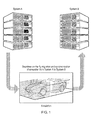
- Figure 1 is an overview diagram showing how embodiments of the invention can move a simulation of airflow over a vehicle from execution on system A to execution on system B.
- the movement is referred to as seamless on-the-fly migration and synchronisation. Due to use of the intermediate computing resources, it is not necessary to completely stop the simulation process in order to migrate it from system A to system B.
- Figure 2 is a time-based schematic diagram showing the movement of execution of an application from current resources 10 to changed resources 30, using intermediate resources 20.
- the three resources are depicted separately but may be part of the same system.
- execution is in the current resources.
- the migration is then triggered.
- requests are generated for re-partitioning and for allocation of new resources.
- the requests may be made at substantially the same time. For example, at time T2 partition data is send to the intermediate resources and new resources are allocated. At time T3 execution in the current resources stops. At time T4 execution in the changed resources resumes.
- Synchronisation including transfer of state data from the current resources to the new resources
- Synchronisation is not shown but can take place so that state data from the current resources is available after partitioning of the new resources and execution can begin.
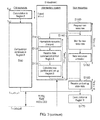
- Figure 3 compares the related art process with an invention embodiment.
- the novel steps compared to the related art process are in the shaded box.
- step S10 New resources are requested in step S20 and there is a delay in step S30 before new resources are allocated in step S40.
- new resource allocation takes time K.
- step S50 the new resources receive data from region A, in the form of a partition, and in step S60 the new resources compute a new partition.
- re-partitioning takes time L.
- step S70 the new resources receive and set up state date and this synchronisation takes time M.
- the related art process provides an overlap between continued execution and migration and/or synchronisation.
- step S90 overlaps with partitioning in the intermediate system, in which intermediate resources are allocated (step S110), partition data is received from region A (step S120) and a new partition is calculated and region B set up (step S130).
- step S140 the new state data is received and set up and in step S170 computation resumes in Region B.
- a map to determine where data is sent may be calculated.
- the idea of the synchronisation step is to ensure that the contents of memory on the old and new systems are consistent. Since computation continues on the old system while initialising the new one, it is necessary to synchronise at the appropriate time (not just send state data at the same time as partition data). Equally, execution does not begin on the new system while still running on the old (unless for synchronisation purposes as explained later). This would duplicate computation work.
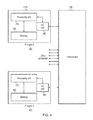
- FIG 4 shows a schematic diagram illustrating n+1 processes, of which two processes (60), referred to specifically as Process 0 and Process n are shown. Each process uses individual resources including a single processing unit or element (70) and memory (80). The processing unit (70) is connected to an input/output unit (90) and all the processes are interconnected using interconnect (100).
- each process is a thread of work that takes place in a single resource block as shown.
- Each process "owns" at least one computation and may own several linked computations.
- the process can include computation for several adjacent mesh nodes. It can be advantageous to group computations for adjacent mesh nodes in this way because data from adjacent nodes is usually required for the computation for a node in question.
- Nodes are re-allocated between processes in re-partitioning.
- a simple example of re-partitioning is explained below.
- process 0 also keeps in memory a copy of the information about the values of variables at ("halo owns") node 51 and process 1 halo owns node 50. This is because these nodes are nearest neighbours to a node that is owned by the process and the data is likely to be required to update the data at these owned nodes.
- the new process 0 (which may or may not be on the same processor as the old process 0) may be responsible for the region 0 ⁇ x ⁇ 0.33 (i.e. nodes 0-33) and halo own node 34; the new process 1 may be responsible for 0.33 ⁇ x ⁇ 0.67 (i.e. nodes 34-67) and halo own nodes 33 and 68; and the new process 2 may be responsible for 0.67 ⁇ x ⁇ 1 (i.e. nodes 68-101) and halo own node 67.
- the new partition creates more halo owned nodes as it spreads out computation across more processes. However spreading out the processes allows use of larger resources for the same computations.
- the maximum number of processing units was two, which becomes three due to the re-partitioning.
- the old process 0 must send the state data for nodes 0-34 to the new process 0 and the state data for nodes 33-50 to the new process 1; and the old process 1 must send the state data for nodes 51-68 to the new process 1 and the state data for nodes 67-101 to the new process 2.
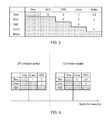
- Figure 5 shows a scalability matrix which may be used to select intermediate and/or changed computing resources.
- the scalability matrix is a simple, compact and efficient format for expressing application execution scalability information.
- the scalability matrix includes an entry for each pairing of execution variables including time (or execution rate) and at least one category of computing resource.
- the entry represents the impact of changing the amount or type of one of the pair on the amount or type of the other required to execute the application. Hence, a non-zero entry represents some correlation, or a coupling, between one execution variable and another.
- the scalability matrix may be obtained by the application.
- the scalability matrix can be read from a third party module, such as a database.
- the scalability matrix may represent first order (i.e. linear) relationships between execution variables, or may be configured to contain more than one entry per execution variable pairing in order to represent more complex relationships.
- a first order scalability matrix is considered.
- the exemplary first order scalability matrix has the following properties:
- the Figure 5 matrix is an exemplary first order scalability matrix.
- the matrix contains the execution time (Time) plus four state variables: (hard disk drive) HDD performance Memory size (RAM), the number of cores per CPU socket (Cores) and the number of nodes (Nodes).
- HDD, RAM, Cores, and Nodes are examples of categories of computing resource. Specifically, they are categories of computing resource in which a type or amount of that category of resource can be selected for use in executing the application.
- the first row shows how the execution time depends on the state variables.
- the fact that a change in HDD performance or available RAM does not impact on the execution time is represented by a "0"entry.
- the execution time is strongly influenced by the number of cores and number of nodes.
- a value of "1"or “-1” represents perfect scalability, wherein the negative sign indicates decrease.
- the "-1" value for Cores shows the fact that a doubling in the number of cores will halve the execution time.
- the second row shows that there is no coupling between the HDD performance and the rest of the execution variables while the third row indicates that the amount of available RAM scales perfectly with the number of nodes, e.g. a doubling of the number of nodes results in half the needed RAM.
- the entries of the 1st order scalability matrix are a numerical indication of the linear part of the scalability curves of the scaling relationship between two execution variables. For a more accurate representation of the scaling relationship (dependence), higher order terms can be added to the 1st order terms resulting in higher order scalability matrices.
- Cost which may be a financial cost of the service or any other cost, e.g. power, CO2.
- some of the execution variables may be related to Cost, where the values are received with the available resource information, e.g. the resource table, from the execution environment 120. For example, the number of cores, the number of nodes and the size of the data stored on the HDD may incur a cost.
- the scalability matrix serves two main purposes:
- a scalability matrix can be created either from benchmarks conducted by the developer or from previous knowledge related to the particular type of algorithm that is being used. Moreover, updated scalability matrices can be provided when the application enters a different execution mode.
- Figure 6 illustrates how a scalability matrix can change during execution of an application.
- the number of cores scales perfectly with execution time, because the application being executed is processing-intensive at that stage.
- the number of cores does not scale with execution time, but the available hard disk space does (although the scalability is moderated by a factor of 0.9).
- the changed scalability matrix may lead to selection of changed computing resources.
- Figure 7 is a hardware diagram showing nodes of a computer system linked by an interconnect 100 and illustrating how current resources, changed resources and intermediate resources can be embodied as different nodes.
- the changed resources are larger (in terms of number of nodes) than the current resources, implying that a decision has been made to increase the resources used.
- the current and changed resources have overlapping resource (nodes).
- the intermediate resources are smaller than both the current and the changed resources, and do not overlap with the current or changed computing resources.
- Figure 8 is an overview of the blocks of resource in figure 7 and the use of the interconnect relationship in migration.
- FIG. 9 is a diagram of communication during the migration process.
- step S200 computation uses current resources.
- step S210 changed resources are requested (the request is shown in the current resources, but could be external).
- step S220 the system identifies appropriate intermediate and changed resources, potentially using a scalability matrix.
- step S230 computation continues in the current resources.
- step S240 there is a delay waiting for intermediate resources to be available. This delay is in parallel with the longer delay of step S310 waiting for the larger changed resources to be available.
- step S250 intermediate resources are allocated and this is notified in step S260 to the current resources, which send the current partition to the intermediate resources in step S270.
- the intermediate resources receive the data (step S280) along with details of changed resources.
- the intermediate resources also receive information about what changed resources will be allocated (for example how many nodes, what type of node, etc) from the system so that they know how to re-partition the data that they receive from the current resources.
- the intermediate resources calculate a new partition and set up the changed resources (S290) as necessary. This set up may include a mapping of processes to individual changed resources, such as individual nodes, (defining what should be sent from where to where). It is also possible that the intermediate resources may be able to do some other initialization (e.g. calculation of some domain-dependent parameter values) and send this direct to the changed resources.
- step S300 the intermediate resources sends the new partition (and mapping) to the changed resources previously allocated in step S320.
- the allocation is notified to the current resources in step S330, which in return send state data in step S340.
- the new resources receive and set up the state date in step S350 and computation resumes using the changed resources in step S360.
- a possible synchronisation step of executing one loop of computations simultaneously in the current and changed resources and comparing the results is not shown.
Landscapes
- Engineering & Computer Science (AREA)
- Software Systems (AREA)
- Theoretical Computer Science (AREA)
- Physics & Mathematics (AREA)
- General Engineering & Computer Science (AREA)
- General Physics & Mathematics (AREA)
- Computer Networks & Wireless Communication (AREA)
- Signal Processing (AREA)
- Hardware Redundancy (AREA)
- Multi Processors (AREA)
Priority Applications (3)
| Application Number | Priority Date | Filing Date | Title |
|---|---|---|---|
| EP13170481.9A EP2811405A1 (de) | 2013-06-04 | 2013-06-04 | Prozessmigrationsverfahren, Computersystem und Zwischenberechnungsressourcen |
| JP2014092686A JP6265033B2 (ja) | 2013-06-04 | 2014-04-28 | プロセスマイグレーション方法、プロセスマイグレーションを実行するよう動作するコンピュータシステム、そのようなシステム内の中間計算リソース、及びプロセスマイグレーション方法のためのパーティショニング前の計算リソースの選択方法 |
| US14/266,301 US9553823B2 (en) | 2013-06-04 | 2014-04-30 | Process migration method, computer system and intermediate computing resources |
Applications Claiming Priority (1)
| Application Number | Priority Date | Filing Date | Title |
|---|---|---|---|
| EP13170481.9A EP2811405A1 (de) | 2013-06-04 | 2013-06-04 | Prozessmigrationsverfahren, Computersystem und Zwischenberechnungsressourcen |
Publications (1)
| Publication Number | Publication Date |
|---|---|
| EP2811405A1 true EP2811405A1 (de) | 2014-12-10 |
Family
ID=48607078
Family Applications (1)
| Application Number | Title | Priority Date | Filing Date |
|---|---|---|---|
| EP13170481.9A Ceased EP2811405A1 (de) | 2013-06-04 | 2013-06-04 | Prozessmigrationsverfahren, Computersystem und Zwischenberechnungsressourcen |
Country Status (3)
| Country | Link |
|---|---|
| US (1) | US9553823B2 (de) |
| EP (1) | EP2811405A1 (de) |
| JP (1) | JP6265033B2 (de) |
Families Citing this family (20)
| Publication number | Priority date | Publication date | Assignee | Title |
|---|---|---|---|---|
| US9330053B1 (en) * | 2013-07-24 | 2016-05-03 | Sprint Communications Company L.P. | True push architecture for internet protocol notification |
| CN107577530A (zh) * | 2016-07-04 | 2018-01-12 | 中兴通讯股份有限公司 | 均衡板卡内存利用率的板卡、方法和系统 |
| US12135989B2 (en) | 2016-08-11 | 2024-11-05 | Rescale, Inc. | Compute recommendation engine |
| US10387198B2 (en) | 2016-08-11 | 2019-08-20 | Rescale, Inc. | Integrated multi-provider compute platform |
| US10193762B2 (en) | 2016-08-11 | 2019-01-29 | Rescale, Inc. | Dynamic optimization of simulation resources |
| US10452296B1 (en) | 2018-03-23 | 2019-10-22 | Amazon Technologies, Inc. | Accelerated volumes |
| US11023157B2 (en) * | 2018-04-30 | 2021-06-01 | Amazon Technologies, Inc. | Intermediary duplication to facilitate copy requests in distributed storage systems |
| EP3788466B1 (de) * | 2018-04-30 | 2026-09-16 | Amazon Technologies, Inc. | Verteilte replik für blockspeichersysteme |
| US11343314B1 (en) | 2018-04-30 | 2022-05-24 | Amazon Technologies, Inc. | Stream-based logging for distributed storage systems |
| US10459655B1 (en) | 2018-04-30 | 2019-10-29 | Amazon Technologies, Inc. | Rapid volume backup generation from distributed replica |
| US10956442B1 (en) | 2018-07-30 | 2021-03-23 | Amazon Technologies, Inc. | Dedicated source volume pool for accelerated creation of block data volumes from object data snapshots |
| US10931750B1 (en) | 2018-07-30 | 2021-02-23 | Amazon Technologies, Inc. | Selection from dedicated source volume pool for accelerated creation of block data volumes |
| US11112514B2 (en) | 2019-02-27 | 2021-09-07 | Saudi Arabian Oil Company | Systems and methods for computed resource hydrocarbon reservoir simulation and development |
| US11068192B1 (en) | 2019-03-26 | 2021-07-20 | Amazon Technologies, Inc. | Utilizing mutiple snapshot sources for creating new copy of volume in a networked environment wherein additional snapshot sources are reserved with lower performance levels than a primary snapshot source |
| US10983719B1 (en) | 2019-03-28 | 2021-04-20 | Amazon Technologies, Inc. | Replica pools to support volume replication in distributed storage systems |
| US11422851B2 (en) * | 2019-04-22 | 2022-08-23 | EMC IP Holding Company LLC | Cloning running computer systems having logical partitions in a physical computing system enclosure |
| US11210138B1 (en) * | 2020-09-24 | 2021-12-28 | OnScale, Inc. | Dynamic resource allocation for computational simulation |
| US12380000B1 (en) | 2020-12-01 | 2025-08-05 | Amazon Technologies, Inc. | Database table restoration for data with skewed distribution |
| WO2023113385A1 (ko) * | 2021-12-15 | 2023-06-22 | 삼성전자 주식회사 | 분산 유닛 스케일링을 수행하는 네트워크 및 그 동작 방법 |
| US12675379B1 (en) * | 2024-04-19 | 2026-07-07 | Nvidia Corporation | Job rescheduling using a dynamic number of processors |
Citations (6)
| Publication number | Priority date | Publication date | Assignee | Title |
|---|---|---|---|---|
| US20040267782A1 (en) * | 2003-06-30 | 2004-12-30 | Yukio Nakano | Database system |
| US20080256327A1 (en) * | 2007-04-16 | 2008-10-16 | Stuart Zachary Jacobs | System and Method for Maintaining Page Tables Used During a Logical Partition Migration |
| US20090144346A1 (en) * | 2007-11-29 | 2009-06-04 | Microsoft Corporation | Partitioning and repartitioning for data parallel operations |
| US20090182970A1 (en) * | 2008-01-16 | 2009-07-16 | Battista Robert J | Data Transmission for Partition Migration |
| US20120011519A1 (en) * | 2010-07-12 | 2012-01-12 | International Business Machines Corporation | Parallel checkpointing for migration of workload partitions |
| US20120084747A1 (en) * | 2010-10-01 | 2012-04-05 | Nec Laboratories America, Inc. | Partitioned iterative convergance programming model |
Family Cites Families (9)
| Publication number | Priority date | Publication date | Assignee | Title |
|---|---|---|---|---|
| JP2002358293A (ja) * | 2001-05-31 | 2002-12-13 | Nec Corp | 実行時負荷分散システム及び実行時負荷分散方法並びにプログラム |
| US7065549B2 (en) | 2002-03-29 | 2006-06-20 | Illinois Institute Of Technology | Communication and process migration protocols for distributed heterogeneous computing |
| US8156490B2 (en) | 2004-05-08 | 2012-04-10 | International Business Machines Corporation | Dynamic migration of virtual machine computer programs upon satisfaction of conditions |
| US9207990B2 (en) | 2007-09-28 | 2015-12-08 | Hewlett-Packard Development Company, L.P. | Method and system for migrating critical resources within computer systems |
| US8239538B2 (en) | 2008-11-21 | 2012-08-07 | Samsung Electronics Co., Ltd. | Execution allocation cost assessment for computing systems and environments including elastic computing systems and environments |
| US9244737B2 (en) * | 2011-02-04 | 2016-01-26 | Hitachi, Ltd. | Data transfer control method of parallel distributed processing system, parallel distributed processing system, and recording medium |
| US9495139B2 (en) | 2011-04-11 | 2016-11-15 | University Of Florida Research Foundation, Inc. | Elastic computing |
| CN102170474A (zh) | 2011-04-22 | 2011-08-31 | 广州杰赛科技股份有限公司 | 一种云计算网络中虚拟资源动态调度方法及系统 |
| JP2013069189A (ja) * | 2011-09-26 | 2013-04-18 | Hitachi Ltd | 並列分散処理方法および並列分散処理システム |
-
2013
- 2013-06-04 EP EP13170481.9A patent/EP2811405A1/de not_active Ceased
-
2014
- 2014-04-28 JP JP2014092686A patent/JP6265033B2/ja not_active Expired - Fee Related
- 2014-04-30 US US14/266,301 patent/US9553823B2/en not_active Expired - Fee Related
Patent Citations (6)
| Publication number | Priority date | Publication date | Assignee | Title |
|---|---|---|---|---|
| US20040267782A1 (en) * | 2003-06-30 | 2004-12-30 | Yukio Nakano | Database system |
| US20080256327A1 (en) * | 2007-04-16 | 2008-10-16 | Stuart Zachary Jacobs | System and Method for Maintaining Page Tables Used During a Logical Partition Migration |
| US20090144346A1 (en) * | 2007-11-29 | 2009-06-04 | Microsoft Corporation | Partitioning and repartitioning for data parallel operations |
| US20090182970A1 (en) * | 2008-01-16 | 2009-07-16 | Battista Robert J | Data Transmission for Partition Migration |
| US20120011519A1 (en) * | 2010-07-12 | 2012-01-12 | International Business Machines Corporation | Parallel checkpointing for migration of workload partitions |
| US20120084747A1 (en) * | 2010-10-01 | 2012-04-05 | Nec Laboratories America, Inc. | Partitioned iterative convergance programming model |
Also Published As
| Publication number | Publication date |
|---|---|
| US20140359130A1 (en) | 2014-12-04 |
| JP2014235734A (ja) | 2014-12-15 |
| JP6265033B2 (ja) | 2018-01-24 |
| US9553823B2 (en) | 2017-01-24 |
Similar Documents
| Publication | Publication Date | Title |
|---|---|---|
| US9553823B2 (en) | Process migration method, computer system and intermediate computing resources | |
| JP6698784B2 (ja) | マルチスレッドプロセッサにおけるマルチスレッドの結合状態 | |
| Xu et al. | λDNN: Achieving predictable distributed DNN training with serverless architectures | |
| KR102262483B1 (ko) | 복수-타일 프로세싱 구성에서의 동기화 | |
| Ousterhout et al. | Monotasks: Architecting for performance clarity in data analytics frameworks | |
| CN109814986B (zh) | 任务并行处理方法、存储介质、计算机设备、装置和系统 | |
| US10235213B2 (en) | Process migration method, computer system and computer program | |
| Ghorbian et al. | A survey on the cold start latency approaches in serverless computing: an optimization-based perspective | |
| CN114327829B (zh) | 一种多核实时任务调度分析与仿真系统及方法 | |
| KR102183118B1 (ko) | 복수-타일 프로세싱 구성에서의 동기화 | |
| CN101443733A (zh) | 在基于图的计算中的计算资源管理 | |
| Baresi et al. | Fine-grained dynamic resource allocation for big-data applications | |
| Qu et al. | Decoupling the control plane from program control flow for flexibility and performance in cloud computing | |
| Tchernykh et al. | Mitigating uncertainty in developing and applying scientific applications in an integrated computing environment | |
| Mon et al. | Clustering based on task dependency for data-intensive workflow scheduling optimization | |
| Galante et al. | Adaptive parallel applications: from shared memory architectures to fog computing (2002–2022) | |
| Ousterhout et al. | Performance clarity as a first-class design principle | |
| CN121387501A (zh) | Eda仿真任务调度方法、装置、设备、介质及程序产品 | |
| Wang et al. | The formal design model of a real-time operating system (RTOS+): conceptual and architectural frameworks | |
| CN119225918A (zh) | 一种算子处理方法及相关装置 | |
| Deng et al. | Cost-driven autonomous mobility | |
| Lou et al. | Efficient Far Memory-Aware Scheduling With FaMAS | |
| Huang et al. | A Hierarchical Neural Task Scheduling Algorithm in the Operating System of Neuromorphic Computers | |
| Lőrincz et al. | A method for job scheduling in Grid based on job execution status | |
| Andonovski et al. | Introduction to scientific computing technologies for global analysis of multidimensional nonlinear dynamical systems |
Legal Events
| Date | Code | Title | Description |
|---|---|---|---|
| PUAI | Public reference made under article 153(3) epc to a published international application that has entered the european phase |
Free format text: ORIGINAL CODE: 0009012 |
|
| 17P | Request for examination filed |
Effective date: 20140707 |
|
| AK | Designated contracting states |
Kind code of ref document: A1 Designated state(s): AL AT BE BG CH CY CZ DE DK EE ES FI FR GB GR HR HU IE IS IT LI LT LU LV MC MK MT NL NO PL PT RO RS SE SI SK SM TR |
|
| AX | Request for extension of the european patent |
Extension state: BA ME |
|
| STAA | Information on the status of an ep patent application or granted ep patent |
Free format text: STATUS: EXAMINATION IS IN PROGRESS |
|
| 17Q | First examination report despatched |
Effective date: 20171117 |
|
| STAA | Information on the status of an ep patent application or granted ep patent |
Free format text: STATUS: THE APPLICATION HAS BEEN REFUSED |
|
| 18R | Application refused |
Effective date: 20190929 |