EP2810634A1 - Immobilisation device for patients confined to bed - Google Patents
Immobilisation device for patients confined to bed Download PDFInfo
- Publication number
- EP2810634A1 EP2810634A1 EP13743870.1A EP13743870A EP2810634A1 EP 2810634 A1 EP2810634 A1 EP 2810634A1 EP 13743870 A EP13743870 A EP 13743870A EP 2810634 A1 EP2810634 A1 EP 2810634A1
- Authority
- EP
- European Patent Office
- Prior art keywords
- patient
- bands
- immobilization device
- truss
- bed
- Prior art date
- Legal status (The legal status is an assumption and is not a legal conclusion. Google has not performed a legal analysis and makes no representation as to the accuracy of the status listed.)
- Withdrawn
Links
- 210000001015 abdomen Anatomy 0.000 claims description 3
- 230000000295 complement effect Effects 0.000 claims description 3
- 210000004392 genitalia Anatomy 0.000 claims description 3
- 210000002640 perineum Anatomy 0.000 claims description 2
- 230000003187 abdominal effect Effects 0.000 description 4
- 230000036544 posture Effects 0.000 description 3
- 230000003387 muscular Effects 0.000 description 2
- 238000009423 ventilation Methods 0.000 description 2
- 206010003504 Aspiration Diseases 0.000 description 1
- 206010010071 Coma Diseases 0.000 description 1
- 208000028373 Neck injury Diseases 0.000 description 1
- 208000030886 Traumatic Brain injury Diseases 0.000 description 1
- 210000000038 chest Anatomy 0.000 description 1
- 239000003814 drug Substances 0.000 description 1
- 210000001624 hip Anatomy 0.000 description 1
- 238000009434 installation Methods 0.000 description 1
- 238000007917 intracranial administration Methods 0.000 description 1
- 239000000463 material Substances 0.000 description 1
- 238000005399 mechanical ventilation Methods 0.000 description 1
- 210000004197 pelvis Anatomy 0.000 description 1
- 230000002035 prolonged effect Effects 0.000 description 1
- 230000009529 traumatic brain injury Effects 0.000 description 1
- 238000005406 washing Methods 0.000 description 1
Images
Classifications
-
- A—HUMAN NECESSITIES
- A61—MEDICAL OR VETERINARY SCIENCE; HYGIENE
- A61G—TRANSPORT, PERSONAL CONVEYANCES, OR ACCOMMODATION SPECIALLY ADAPTED FOR PATIENTS OR DISABLED PERSONS; OPERATING TABLES OR CHAIRS; CHAIRS FOR DENTISTRY; FUNERAL DEVICES
- A61G7/00—Beds specially adapted for nursing; Devices for lifting patients or disabled persons
- A61G7/05—Parts, details or accessories of beds
- A61G7/065—Rests specially adapted therefor
- A61G7/07—Rests specially adapted therefor for the head or torso, e.g. special back-rests
- A61G7/072—Rests specially adapted therefor for the head or torso, e.g. special back-rests for the head only
-
- A—HUMAN NECESSITIES
- A61—MEDICAL OR VETERINARY SCIENCE; HYGIENE
- A61F—FILTERS IMPLANTABLE INTO BLOOD VESSELS; PROSTHESES; DEVICES PROVIDING PATENCY TO, OR PREVENTING COLLAPSING OF, TUBULAR STRUCTURES OF THE BODY, e.g. STENTS; ORTHOPAEDIC, NURSING OR CONTRACEPTIVE DEVICES; FOMENTATION; TREATMENT OR PROTECTION OF EYES OR EARS; BANDAGES, DRESSINGS OR ABSORBENT PADS; FIRST-AID KITS
- A61F5/00—Orthopaedic methods or devices for non-surgical treatment of bones or joints; Nursing devices ; Anti-rape devices
- A61F5/37—Restraining devices for the body or for body parts; Restraining shirts
- A61F5/3707—Restraining devices for the body or for body parts; Restraining shirts for the head
-
- A—HUMAN NECESSITIES
- A61—MEDICAL OR VETERINARY SCIENCE; HYGIENE
- A61F—FILTERS IMPLANTABLE INTO BLOOD VESSELS; PROSTHESES; DEVICES PROVIDING PATENCY TO, OR PREVENTING COLLAPSING OF, TUBULAR STRUCTURES OF THE BODY, e.g. STENTS; ORTHOPAEDIC, NURSING OR CONTRACEPTIVE DEVICES; FOMENTATION; TREATMENT OR PROTECTION OF EYES OR EARS; BANDAGES, DRESSINGS OR ABSORBENT PADS; FIRST-AID KITS
- A61F5/00—Orthopaedic methods or devices for non-surgical treatment of bones or joints; Nursing devices ; Anti-rape devices
- A61F5/37—Restraining devices for the body or for body parts; Restraining shirts
- A61F5/3769—Restraining devices for the body or for body parts; Restraining shirts for attaching the body to beds, wheel-chairs or the like
- A61F5/3776—Restraining devices for the body or for body parts; Restraining shirts for attaching the body to beds, wheel-chairs or the like by means of a blanket or belts
- A61F5/3784—Restraining devices for the body or for body parts; Restraining shirts for attaching the body to beds, wheel-chairs or the like by means of a blanket or belts directly connected to the trunk, e.g. with jacket
Definitions
- the invention is included within the field of medicine, and more specifically relates to a truss designed to immobilize patients who must remain bedridden for a long time in a certain position and sitting up to a variable degree as prescribed.
- Fixing devices which are especially designed for this purpose, such as, for example the abdominal securing bands of the brand Clipbelt or bed fasteners from the brand Vettel. These fasteners fundamentally consist of a type of belt which fastens to the patient's abdominal area, and which has a pair of side bands which are fixed to the sides of the bed or side rails if any.
- the present invention discloses a novel immobilization device for bedridden patients which overcomes the aforementioned drawbacks thanks to two main characteristics: it uses a truss to secure the patient and he/she is secured to the headboard instead of to one of the sides.
- This device has, in first place, the advantage of not compressing the abdominal area of the patient, since the traction is performed from the sides of the truss and in a direction parallel to the patient's trunk.
- the patient is secured to the bed headboard instead of to the sides, it avoids the possibility that he/she falls down the bed when it is inclined.
- the immobilization device for bedridden patients of the present invention is fundamentally formed by a truss whereto are fixed two elastic securing bands to the bed headboard. Each one of these elements is described in more detail below.
- the truss when placed on the patient, goes from the perineum to the abdomen, and has a front zip which allows access to the patient's genital area to check catheters and wash the patient.
- the truss can, in principle, be made from any material typical of this type of garments.
- each elastic securing band has a first end fixed to the side area of the truss and a second end which is adapted to be fixed to the bed headboard.
- the elastic bands have sufficient length to go from the patient's hip area to the bed headboard. For example, this length could be between 80 cm and 140 cm, more preferably between 100 cm and 120 cm.
- first end of the elastic bands can be sewn to the sides of the truss, or said first end and the truss may have complementary Velcro pieces suitably located to perform their joining and adaptability.
- the sides of the truss comprise different rings whereto the elastic bands are fixed by means of knots, buttons, Velcro or others.
- the immobilization device of the present invention it is sufficient to place the truss on the patient and fix the second ends of the elastic bands to the bed headboard beside the patient's head.
- the elastic bands run along the entire patient's body side area, helping stabilize his/her position, and as they are fixed to the bed headboard, they suitably secure the patient, even when the bed is inclined.
- the elastic securing bands preferably comprise padded parts to improve the lateral stability throughout the patient's trunk. Furthermore, the securing through the truss avoids compressing the patient's abdominal area.
- the second end of the elastic bands has Velcro areas to be fixed to said bed headboard, thus allowing a fast and simple installation.
- this second end of the bands may further comprise different pads adapted to be placed on the sides of the patient's neck and head area.
- the second end of the bands can be crossed over the patient's head, passing over the bed headboard, suitably placing the pads to also immobilize the head and neck, something indispensable for patients with reduced consciousness, loss of muscular tone or neck injuries.
- These pads may have an ergonomic form complementary to the shape of the side of the patient's neck and head area.
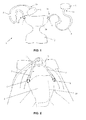
- FIG. 1 An example of device (1) according to the present invention is described below, making references to attached Figs. 1 and 2 . Therein it is observed how the device (1) is formed by a large truss (2) which passes under the patient's legs and reaches the area of the abdomen.
- the truss (2) has a zip (2a) which serves to facilitate access to the genital area to the medical professionals for washing and checking catheters.
- the sides of the truss (2) have, in this example, a ring (4) fixed whereto is fixed in turn the first end (3a) of the lateral elastic bands (3).
- These bands (3) have an approximate length of 100 cm to allow the fixing of its second end (3b) to the area of the headboard of the patient's bed.
- the fixing to the headboard can be carried out in several ways, although in one embodiment of the invention (not shown) the second end (3b) of the bands (3) has surfaces equipped with Velcro.
- the device (1) shown in this example has pads (5) fixed to the second end (3b) of the bands (3) which can be placed on the sides of the patient's head with the aim of keeping it in a suitable position in the event of reduction in level of consciousness, loss of muscular tone or coma.
- the bands (3) may have padded areas to be more easily moulded to the patient's trunk and help keep it in a suitable position.
- This novel device (1) resolves the aforementioned problems, making it possible to incline the patient's bed as much as necessary in accordance with the needs and prescription at any given time without the fear that he/she will slide downwards on the bed. At the same time it enables the stability of the trunk, head and neck.
Landscapes
- Health & Medical Sciences (AREA)
- Life Sciences & Earth Sciences (AREA)
- Veterinary Medicine (AREA)
- Nursing (AREA)
- Public Health (AREA)
- General Health & Medical Sciences (AREA)
- Animal Behavior & Ethology (AREA)
- Orthopedic Medicine & Surgery (AREA)
- Vascular Medicine (AREA)
- Heart & Thoracic Surgery (AREA)
- Biomedical Technology (AREA)
- Engineering & Computer Science (AREA)
- Otolaryngology (AREA)
- Orthopedics, Nursing, And Contraception (AREA)
- Invalid Beds And Related Equipment (AREA)
Abstract
Description
- The invention is included within the field of medicine, and more specifically relates to a truss designed to immobilize patients who must remain bedridden for a long time in a certain position and sitting up to a variable degree as prescribed.
- In hospitalization units, observation areas of hospitals, patients are frequently admitted with the need for prolonged bed rest, and on many occasions it is necessary to maintain a certain inclination posture by prescription, and avoid sliding on the bed, unsuitable postures and falls of patients.
- Fixing devices currently exist which are especially designed for this purpose, such as, for example the abdominal securing bands of the brand Clipbelt or bed fasteners from the brand Vettel. These fasteners fundamentally consist of a type of belt which fastens to the patient's abdominal area, and which has a pair of side bands which are fixed to the sides of the bed or side rails if any.
- However, although these devices suitably resolve the problem in certain situations, they have various drawbacks. Firstly, it is not compatible with certain inclinations of the patient's bed, which tends to slide downward as the bed's inclination increases with respect to the horizontal. Furthermore, it cannot be used in the cases where it is not recommendable to compress the patient's rib cage or pelvis.
- The present invention discloses a novel immobilization device for bedridden patients which overcomes the aforementioned drawbacks thanks to two main characteristics: it uses a truss to secure the patient and he/she is secured to the headboard instead of to one of the sides. This device has, in first place, the advantage of not compressing the abdominal area of the patient, since the traction is performed from the sides of the truss and in a direction parallel to the patient's trunk. Furthermore, as the patient is secured to the bed headboard instead of to the sides, it avoids the possibility that he/she falls down the bed when it is inclined. This allows the patient to adopt a suitable position for non-invasive mechanical ventilation, avoiding postures that increase the risk of aspiration, inadequate ventilation and, therefore, also the risk of lack of ventilation. The prescription of different degrees of inclination is also necessary in patients with traumatic brain injury with increase in intracranial pressure among other indications.
- The immobilization device for bedridden patients of the present invention is fundamentally formed by a truss whereto are fixed two elastic securing bands to the bed headboard. Each one of these elements is described in more detail below.
- The truss, when placed on the patient, goes from the perineum to the abdomen, and has a front zip which allows access to the patient's genital area to check catheters and wash the patient. The truss can, in principle, be made from any material typical of this type of garments.
- On the other hand, each elastic securing band has a first end fixed to the side area of the truss and a second end which is adapted to be fixed to the bed headboard. In principle, the elastic bands have sufficient length to go from the patient's hip area to the bed headboard. For example, this length could be between 80 cm and 140 cm, more preferably between 100 cm and 120 cm.
- The fixing between the first end of the elastic bands and the sides of the truss can be performed in various ways. For example, the first end of the bands may be sewn to the sides of the truss, or said first end and the truss may have complementary Velcro pieces suitably located to perform their joining and adaptability. However, in a preferred embodiment of the invention, the sides of the truss comprise different rings whereto the elastic bands are fixed by means of knots, buttons, Velcro or others.
- Thus, to use the immobilization device of the present invention it is sufficient to place the truss on the patient and fix the second ends of the elastic bands to the bed headboard beside the patient's head. The elastic bands run along the entire patient's body side area, helping stabilize his/her position, and as they are fixed to the bed headboard, they suitably secure the patient, even when the bed is inclined. Additionally, the elastic securing bands preferably comprise padded parts to improve the lateral stability throughout the patient's trunk. Furthermore, the securing through the truss avoids compressing the patient's abdominal area.
- According to a preferred embodiment of the invention, the second end of the elastic bands has Velcro areas to be fixed to said bed headboard, thus allowing a fast and simple installation. Furthermore, this second end of the bands may further comprise different pads adapted to be placed on the sides of the patient's neck and head area. Thus, the second end of the bands can be crossed over the patient's head, passing over the bed headboard, suitably placing the pads to also immobilize the head and neck, something indispensable for patients with reduced consciousness, loss of muscular tone or neck injuries. These pads may have an ergonomic form complementary to the shape of the side of the patient's neck and head area.
-
-
Fig.1 shows a view of a device according to the present invention. -
Fig. 2 shows a patient on which an immobilization device according to the invention has been used. - An example of device (1) according to the present invention is described below, making references to attached
Figs. 1 and 2 . Therein it is observed how the device (1) is formed by a large truss (2) which passes under the patient's legs and reaches the area of the abdomen. The truss (2) has a zip (2a) which serves to facilitate access to the genital area to the medical professionals for washing and checking catheters. - The sides of the truss (2) have, in this example, a ring (4) fixed whereto is fixed in turn the first end (3a) of the lateral elastic bands (3). These bands (3) have an approximate length of 100 cm to allow the fixing of its second end (3b) to the area of the headboard of the patient's bed. The fixing to the headboard can be carried out in several ways, although in one embodiment of the invention (not shown) the second end (3b) of the bands (3) has surfaces equipped with Velcro. Furthermore, the device (1) shown in this example has pads (5) fixed to the second end (3b) of the bands (3) which can be placed on the sides of the patient's head with the aim of keeping it in a suitable position in the event of reduction in level of consciousness, loss of muscular tone or coma. To do this, it would be sufficient to cross the bands (3) behind the bed headboard and place the pads (5) so that they secure the head and/or the neck of the patient. Additionally, the bands (3) may have padded areas to be more easily moulded to the patient's trunk and help keep it in a suitable position.
- This novel device (1) resolves the aforementioned problems, making it possible to incline the patient's bed as much as necessary in accordance with the needs and prescription at any given time without the fear that he/she will slide downwards on the bed. At the same time it enables the stability of the trunk, head and neck.
Claims (8)
- Immobilization device (1) for bedridden patients characterized in that it comprises:a truss (2) which, when it is placed on the patient, goes from the perineum to the abdomen, and which has a front zip (2a) which allows access to the genital area of the patient; anda pair of elastic securing bands (3), each one of which has a first end (3a) fixed to the side area of the truss (2) and a second end (3b) adapted to be fixed to the bed headboard.
- Immobilization device (1) according to claim 1, where the second end (3b) of the elastic bands (3) has Velcro areas to be fixed to said bed headboard.
- Immobilization device (1) according to any of the preceding claims, where the sides of the truss (2) comprise different rings (4) to allow the fixing of the first ends (3a) of the elastic bands (3).
- Immobilization device (1) according to any of the preceding claims, where the elastic securing bands (3) comprise padded parts to improve the lateral stability throughout the patient's trunk.
- Immobilization device (1) according to any of the preceding claims, where the second ends (3b) of the elastic securing bands (3) further comprise different pads (5) adapted to be placed on the sides of the patient's neck and head area.
- Immobilization device (1) according to preceding claim, where the pads (5) have an ergonomic form complementary to the shape of the side of the patient's neck and head area.
- Immobilization device (1) according to any of the preceding claims, where the stretched elastic securing bands (3) have a length of between 80 cm and 140 cm.
- Immobilization device (1) according to the preceding claim, where the stretched elastic securing bands (3) have a length of between 100 cm and 120 cm.
Applications Claiming Priority (2)
| Application Number | Priority Date | Filing Date | Title |
|---|---|---|---|
| ES201230100U ES1076327Y (en) | 2012-01-31 | 2012-01-31 | IMMOBILIZATION DEVICE FOR ENCHANTED PATIENTS |
| PCT/ES2013/070050 WO2013113968A1 (en) | 2012-01-31 | 2013-01-31 | Immobilisation device for patients confined to bed |
Publications (2)
| Publication Number | Publication Date |
|---|---|
| EP2810634A1 true EP2810634A1 (en) | 2014-12-10 |
| EP2810634A4 EP2810634A4 (en) | 2016-02-17 |
Family
ID=45566644
Family Applications (1)
| Application Number | Title | Priority Date | Filing Date |
|---|---|---|---|
| EP13743870.1A Withdrawn EP2810634A4 (en) | 2012-01-31 | 2013-01-31 | IMMOBILIZATION DEVICE FOR ALIVE PATIENTS |
Country Status (3)
| Country | Link |
|---|---|
| EP (1) | EP2810634A4 (en) |
| ES (1) | ES1076327Y (en) |
| WO (1) | WO2013113968A1 (en) |
Family Cites Families (11)
| Publication number | Priority date | Publication date | Assignee | Title |
|---|---|---|---|---|
| US3566864A (en) * | 1968-07-22 | 1971-03-02 | William Peter Garrow | Infant safety garment having integral means for securing the same |
| US4117840A (en) * | 1977-03-22 | 1978-10-03 | Rebecca Ann Rasure | Pediatric restraint garment |
| US4524768A (en) * | 1983-09-21 | 1985-06-25 | Giovanni Argentino | Restraint garment |
| CA2002800C (en) * | 1989-11-10 | 1992-11-17 | L. Charles Masur | Spinal restraint device |
| ES1028104Y (en) * | 1994-05-13 | 1995-06-01 | Larrosa Francisco Falguera | HARNESS FOR THE BODY SUPPORT OF A PATIENT. |
| ES1035473Y (en) * | 1996-02-26 | 1997-12-01 | Santillana Ronda Pablo | BED ANTI-FALL SKIRT. |
| ES1036953Y (en) * | 1997-04-15 | 1998-05-01 | Samper Rivas Cristina | PORTABLE SECURITY SUPPORT FOR CHILDREN. |
| ES1040181Y (en) * | 1998-05-18 | 1999-07-16 | Alsina Dominguez Francisca | HARNESS OF ATTACHMENT OF A PATIENT TO A BED OR SIMILAR. |
| ES1045696Y (en) * | 1999-07-16 | 2001-07-01 | Cruz Gonzalez Guadalupe De | DEVICE IMMOBILIZING DEVICE ON THE BED. |
| ES1058371Y (en) * | 2004-09-28 | 2005-03-16 | La Cruz Gonzalez Guadalupe De | ANTICAL DEVICE OF A PERSON SITTED ON A CHAIR. |
| US7251846B1 (en) * | 2006-02-24 | 2007-08-07 | Cr Enterprises, Llc | Harness for securing an infant to reflux wedge |
-
2012
- 2012-01-31 ES ES201230100U patent/ES1076327Y/en not_active Expired - Fee Related
-
2013
- 2013-01-31 EP EP13743870.1A patent/EP2810634A4/en not_active Withdrawn
- 2013-01-31 WO PCT/ES2013/070050 patent/WO2013113968A1/en not_active Ceased
Also Published As
| Publication number | Publication date |
|---|---|
| EP2810634A4 (en) | 2016-02-17 |
| WO2013113968A1 (en) | 2013-08-08 |
| ES1076327Y (en) | 2012-05-28 |
| ES1076327U (en) | 2012-02-27 |
Similar Documents
| Publication | Publication Date | Title |
|---|---|---|
| US10881900B2 (en) | Neck training apparatus | |
| SE0950988A1 (en) | Dorsal forearm plate | |
| US20160228743A1 (en) | Portable physical therapy and exercising device | |
| US8851079B1 (en) | Medical tray and backboard | |
| KR20190036815A (en) | Posture correcting device | |
| US20120019015A1 (en) | Lift assist device | |
| US2308466A (en) | Restraining device | |
| US20110131701A1 (en) | Short camisole with lumbar and cervical cushion | |
| US8376918B2 (en) | Leg exercising apparatus | |
| US20130160204A1 (en) | Single Patient Disposable Lift Strap Device And Method To Use The Device | |
| US20250169609A1 (en) | Support and restraint system for the human body, or for a segment of the human body, provided with retaining means | |
| US10245200B2 (en) | Traction device | |
| CN207666590U (en) | A kind of Medical lumbar load harness | |
| CN205515114U (en) | Adjustable restraint nursing device | |
| CN202620055U (en) | Protecting bed specially used for psychiatric patient | |
| CN202761634U (en) | Prone position mat for operation | |
| Ar'kov et al. | The role of physiotherapy in the rehabilitation treatment of athletes at the Sochi Olympics | |
| CN107519546A (en) | A kind of rumpbone drainage system | |
| CN209450750U (en) | restraint belt | |
| JP2015009133A (en) | Improvement tool for lower back pain or spinal cord injury pain using gravity | |
| US20200179200A1 (en) | Apparatus for a protective pad for beds with rails | |
| CN110731851A (en) | medical adjustable restraint strap | |
| US20240074932A1 (en) | Buttock support for at least partial load-relief of the body weight of a person, and load-relief system comprising such a buttock support | |
| WO2013113968A1 (en) | Immobilisation device for patients confined to bed | |
| CN204931944U (en) | A kind of children intravenous injection restraint garment |
Legal Events
| Date | Code | Title | Description |
|---|---|---|---|
| PUAI | Public reference made under article 153(3) epc to a published international application that has entered the european phase |
Free format text: ORIGINAL CODE: 0009012 |
|
| 17P | Request for examination filed |
Effective date: 20140829 |
|
| AK | Designated contracting states |
Kind code of ref document: A1 Designated state(s): AL AT BE BG CH CY CZ DE DK EE ES FI FR GB GR HR HU IE IS IT LI LT LU LV MC MK MT NL NO PL PT RO RS SE SI SK SM TR |
|
| AX | Request for extension of the european patent |
Extension state: BA ME |
|
| DAX | Request for extension of the european patent (deleted) | ||
| RIC1 | Information provided on ipc code assigned before grant |
Ipc: A47C 21/08 20060101ALI20151223BHEP Ipc: A61F 5/37 20060101ALI20151223BHEP Ipc: A61G 7/05 20060101AFI20151223BHEP |
|
| RA4 | Supplementary search report drawn up and despatched (corrected) |
Effective date: 20160118 |
|
| RIC1 | Information provided on ipc code assigned before grant |
Ipc: A47C 21/08 20060101ALI20160112BHEP Ipc: A61G 7/05 20060101AFI20160112BHEP Ipc: A61F 5/37 20060101ALI20160112BHEP |
|
| STAA | Information on the status of an ep patent application or granted ep patent |
Free format text: STATUS: THE APPLICATION IS DEEMED TO BE WITHDRAWN |
|
| 18D | Application deemed to be withdrawn |
Effective date: 20160802 |