EP2810045B1 - Uhrenidentifizierung und authentifizierungssystem und -verfahren - Google Patents
Uhrenidentifizierung und authentifizierungssystem und -verfahren Download PDFInfo
- Publication number
- EP2810045B1 EP2810045B1 EP13706184.2A EP13706184A EP2810045B1 EP 2810045 B1 EP2810045 B1 EP 2810045B1 EP 13706184 A EP13706184 A EP 13706184A EP 2810045 B1 EP2810045 B1 EP 2810045B1
- Authority
- EP
- European Patent Office
- Prior art keywords
- timepiece
- gemstone
- identifier
- determining
- luminescence
- Prior art date
- Legal status (The legal status is an assumption and is not a legal conclusion. Google has not performed a legal analysis and makes no representation as to the accuracy of the status listed.)
- Active
Links
Images









Classifications
-
- G—PHYSICS
- G06—COMPUTING OR CALCULATING; COUNTING
- G06K—GRAPHICAL DATA READING; PRESENTATION OF DATA; RECORD CARRIERS; HANDLING RECORD CARRIERS
- G06K5/00—Methods or arrangements for verifying the correctness of markings on a record carrier; Column detection devices
- G06K5/04—Verifying the alignment of markings
-
- G—PHYSICS
- G01—MEASURING; TESTING
- G01N—INVESTIGATING OR ANALYSING MATERIALS BY DETERMINING THEIR CHEMICAL OR PHYSICAL PROPERTIES
- G01N21/00—Investigating or analysing materials by the use of optical means, i.e. using sub-millimetre waves, infrared, visible or ultraviolet light
- G01N21/17—Systems in which incident light is modified in accordance with the properties of the material investigated
- G01N21/21—Polarisation-affecting properties
- G01N21/23—Bi-refringence
-
- G—PHYSICS
- G01—MEASURING; TESTING
- G01N—INVESTIGATING OR ANALYSING MATERIALS BY DETERMINING THEIR CHEMICAL OR PHYSICAL PROPERTIES
- G01N21/00—Investigating or analysing materials by the use of optical means, i.e. using sub-millimetre waves, infrared, visible or ultraviolet light
- G01N21/62—Systems in which the material investigated is excited whereby it emits light or causes a change in wavelength of the incident light
- G01N21/63—Systems in which the material investigated is excited whereby it emits light or causes a change in wavelength of the incident light optically excited
- G01N21/64—Fluorescence; Phosphorescence
- G01N21/6408—Fluorescence; Phosphorescence with measurement of decay time, time resolved fluorescence
-
- G—PHYSICS
- G01—MEASURING; TESTING
- G01N—INVESTIGATING OR ANALYSING MATERIALS BY DETERMINING THEIR CHEMICAL OR PHYSICAL PROPERTIES
- G01N21/00—Investigating or analysing materials by the use of optical means, i.e. using sub-millimetre waves, infrared, visible or ultraviolet light
- G01N21/84—Systems specially adapted for particular applications
- G01N21/87—Investigating jewels
-
- G—PHYSICS
- G04—HOROLOGY
- G04B—MECHANICALLY-DRIVEN CLOCKS OR WATCHES; MECHANICAL PARTS OF CLOCKS OR WATCHES IN GENERAL; TIME PIECES USING THE POSITION OF THE SUN, MOON OR STARS
- G04B47/00—Time-pieces combined with other articles which do not interfere with the running or the time-keeping of the time-piece
- G04B47/04—Time-pieces combined with other articles which do not interfere with the running or the time-keeping of the time-piece with attached ornaments or amusement apparatus
-
- G—PHYSICS
- G04—HOROLOGY
- G04D—APPARATUS OR TOOLS SPECIALLY DESIGNED FOR MAKING OR MAINTAINING CLOCKS OR WATCHES
- G04D7/00—Measuring, counting, calibrating, testing or regulating apparatus
-
- G—PHYSICS
- G06—COMPUTING OR CALCULATING; COUNTING
- G06K—GRAPHICAL DATA READING; PRESENTATION OF DATA; RECORD CARRIERS; HANDLING RECORD CARRIERS
- G06K7/00—Methods or arrangements for sensing record carriers, e.g. for reading patterns
- G06K7/10—Methods or arrangements for sensing record carriers, e.g. for reading patterns by electromagnetic radiation, e.g. optical sensing; by corpuscular radiation
- G06K7/10544—Methods or arrangements for sensing record carriers, e.g. for reading patterns by electromagnetic radiation, e.g. optical sensing; by corpuscular radiation by scanning of the records by radiation in the optical part of the electromagnetic spectrum
- G06K7/10821—Methods or arrangements for sensing record carriers, e.g. for reading patterns by electromagnetic radiation, e.g. optical sensing; by corpuscular radiation by scanning of the records by radiation in the optical part of the electromagnetic spectrum further details of bar or optical code scanning devices
Definitions
- Embodiments of the present invention relate to timepieces and watches, and more particularly to a watch identification and authentication system and method.
- Expensive watches are vulnerable to counterfeiting, and have been counterfeited for decades.
- a counterfeit watch is an illegal copy of a part or all of an authentic watch.
- According to estimates by the Swiss Customs Service there are some 30 to 40 million counterfeit watches put into circulation each year. It is a common cliché that any visitor to New York City will be approached on a street corner by a vendor with a dozen such counterfeit watches inside his coat, offered at bargain prices.
- Extremely authentic looking, but very poor quality watch fakes with self-winding mechanisms and fully working movements can sell for as little as twenty dollars. The problem is becoming more and more serious, with the quality of the counterfeits constantly increasing.
- Authentication solutions that have been used for protection of consumer goods from counterfeiting are often based on marking the item with a specific material, code, or marking, engraving, etc.
- these methods modify the nature and the appearance of the object, and this is often not acceptable in the watch (and other luxury items) industry, where the design of the object and its visual appearance is of paramount importance.
- these methods require an active intervention at the time of manufacturing and, correspondingly an important change of the production process.
- Another method for identification and/or authentication involves tagging (e.g., a micro tag or RFID tag).
- the tagging approach requires intervention and may be impracticable. Moreover, such an approach may not fulfill all of watchmakers needs and constraints to protect against counterfeits.
- CH 694 111 discloses a wristwatch including a movable decorative element, which is placed at the interior of the recess delimited by the watch glass and a wall parallel to the glass and susceptible to slide in a parallel direction to itself in all directions.
- the movable decorative element includes a transponder constituted by an antenna and an IC chip-card, in which the two components are placed in the decorative movable element in a position allowing identification by a card reader.
- Independent claim 1 relates to a method for creating an storing a timepiece identifier.
- Independent claim 2 relates to a method for authentication and/or identification of a timepiece.
- Independent claim 18 relates to a system for determining a timepiece identifier.
- a watch is a small timepiece, typically worn either on the wrist or attached on a chain and carried in a pocket, with wristwatches being the most common type of watch used today.
- a mechanical watch is a watch that uses a mechanical mechanism to measure the passage of time, as opposed to modem quartz watches which function electronically.
- the internal mechanism of a watch excluding the face and hands, is called the movement.
- the watch is driven by a spring (called a mainspring), which is wound periodically to store mechanical energy to power the watch.
- the mainspring's force is transmitted through a series of gears (or gear train) to power the balance wheel.
- the gear train has the dual function of transmitting the force of the mainspring to the balance wheel and adding up the swings of the balance wheel to get units of seconds, minutes, and hours, etc.
- a separate part of the gear train called the keyless work, allows the user to wind the mainspring and enables the hands to be moved to set the time.
- Jewel bearings were introduced in watches to reduce friction.
- the advantage of using jewels is that their ultrahard slick surface has a lower coefficient of friction with metal.
- Jewels in modem watches are usually synthetic sapphire or (usually) ruby, made of corundum (Al 2 O 3 ), one of the hardest substances known (only diamond is harder). Corundum is clear in color. The only difference between sapphire and ruby is that different impurities have been added to change the clear color of the corundum; there is no difference in their properties as a bearing.
- Jewels serve multiple purposes in a watch.
- Watches utilize two different types of jewels in bearings.
- Hole jewels are donut shaped sleeve bearings used to support the arbor (or shaft) of most wheels.
- Capstones or cap jewels are positioned at each end of the arbor. When the arbor is in a vertical position, its rounded end bears against the surface of the capstone, lowering friction.
- FIG. 1 illustrates an exemplary cross section view of components of a watch.
- a hole jewel 10 is used to support the arbor (or shaft) 15, and a capstone (or cap jewel) 20 is positioned at each end of the arbor (with only one end shown in FIG. 1 ).
- Jewels are also utilized in the escapement for the parts that function by sliding friction.
- pallets are the angled rectangular surfaces on the lever that are pushed against by the teeth of the escape wheel.
- the pallets are a primary source of friction in a watch movement, and were one of the first sites to which jewels were applied.
- one or more properties of a plurality of the jewels are used for identification and/or authentication of a timepiece. It has been surprisingly found that the jewels can be used for authentication and/or identification, by analysis of specific characteristics, linked to the nature of the jewel, its chemical composition and/or its physical properties. In embodiments, these characteristics for a respective jewel include the luminescence of the stone, its position in space, and its orientation.
- a watch can be uniquely identified through an analysis and measurement of the specific characteristics of one or more jewels of the watch.
- the analysis and measurement may be performed, for example, during or after manufacture of the watch.
- these specific characteristics of the jewels (or, for example, a numerical representation thereof) can be stored in a storage system (e.g., a database) along with an identification number (e.g., a serial number).
- a storage system e.g., a database
- an identification number e.g., a serial number
- While a watch may have, for example, as many as twenty-seven jewels, typically five to seven jewels (and sometime more) are visible in the movement, for example, through a clear back plate, or after the back plate has been removed.
- the invention contemplates that the five to seven viewable jewels may be used for identification and/or authentication.
- Jewels other than the "visible" jewels (which are viewable, for example, after further disassembly of the timepiece, or prior to complete assembly of the timepiece) may be used, for example, as an alternative to, or in addition to, the "visible" jewels, for identification and/or authentication.
- Embodiments of the present invention provide an improved watch identification and authentication system and method that provides the identification and authentication functionalities, while requiring minimal or no intervention in the manufacturing process.
- the invention contemplates that, in embodiments, other (or additional) types of dopants may be used, which may result in the jewels exhibiting differing lifetimes and/or luminescence ranges.
- other (or additional) types of dopants may be used, which may result in the jewels exhibiting differing lifetimes and/or luminescence ranges.
- Ti or Fe doping (amongst other contemplated dopants) may be used to modulate the luminescence lifetime.
- Other types of contemplated dopants in particular, with garnets (which are slightly less hard than corundum, but are also used in timepieces), include rare earths, such as, Nd, Er, Yb, Tm, and Ho.
- the natural variations of the stones can be exploited to create an identification and authentication security feature.
- a manufacturer may use jewels that were synthesized to have a target synthesis (e.g., particular properties).
- concentration of dopants can be specified at the synthesis.
- the stones may be corundum (Al 2 O 3 ) and/or garnet containing one or more "dopant" metal ions in the 4 th period (Fe, Ti, V, Cr, ...) present, for example, up to a few percent concentration.
- the few percent concentration includes a range of 0.1% to 5%.
- the dopant ions may be Cr3+.
- the jewels can be natural and/or synthetic.
- a watch is subject to an illumination source, and the luminescence of a number of jewels of the watch are measured over a period of intervals.
- luminescence it is intended phosphorescence and/or fluorescence emitted by a stone upon excitation with light.
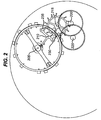
- FIG. 2 illustrates an exemplary schematic view of a watch showing jewels that are subjected to illumination.
- FIG. 2 represents a schematic illustration of a watch, and does not illustrate all the components of the watch.
- seven jewels (205, 210, 215, 220, 225, 230, and 235) have been subjected to illumination.
- different watches may have differing numbers of jewels and/or differing number of viewable jewels (e.g., through a transparent back and/or upon removal of a back cover), and the invention contemplates using any number of jewels for identification and/or authentication.
- jewels 205, 210, 215, 220, and 225 are capstone jewels
- jewels 230 and 235 are escapement jewels.
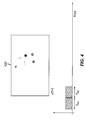
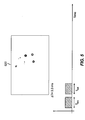
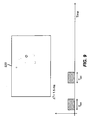
- FIG. 3 illustrates an overview of the jewel luminescence measurement in accordance with aspects of the invention.
- an illumination source 305 is activated to provide excitation light to the jewels of a watch.
- ⁇ T the luminescence of the jewels is detected and measured by a reader 310 during T det .
- Image 315 schematically illustrates the jewels during illumination with the excitation light.
- Image 320 illustrates the jewels during the time period T det .
- the reader 310 may comprise, for example, a fixed device, a handheld device, a mobile phone, and/or a camera, amongst other contemplated readers.
- the luminescence of the jewels may be detected and measured at several intervals.
- two or more time intervals which can be the same or different (e.g., a plurality of jewels' luminescence are measured during the same time interval, i.e., simultaneously, or, during different time intervals, i.e., sequentially), overlapping or non-overlapping, have the same duration or different duration, be regularly spaced or not, during which the luminescence is measured.
- the relative positions of the respective jewels may be detected, e.g., by the reader.
- the position may comprise the coordinates (x1, y1) of a stone with respect to a coordinate system associated with the timepiece.
- the jewels may be identified by a position number (e.g., "Position 1," “Position 2,” etc.).
- the relative position of each jewel may be associated (for example, in a database) with the respective luminescent properties (e.g., lifetime, decay curve, decay rate, etc.) for identification and/or authentication.
- the respective luminescent properties e.g., lifetime, decay curve, decay rate, etc.
- the respective luminescent properties of each of the seven jewels are detected and associated (e.g., in a database) with the relative positions of the respective jewels.
- ⁇ 0 1.1 ms
- ⁇ 1 1.5 ms
- ⁇ 2 1.5 ms
- ⁇ 3 ...
- ⁇ 4 ...
- ⁇ 5 ...
- ⁇ 6 ...
- ⁇ is the lifetime
- 0 - 6 is the jewel number (or relative jewel position).
- this association between the luminescent properties and relative locations of the respective jewels creates a map, for example, of which jewel has which lifetime, and provides a unique (or substantially unique) identifier or biometric signature for the watch for identification and/or authentication.
- the invention contemplates that any number of jewels may serve as an identifier or biometric signature, with a larger number of jewels providing a greater level of uniqueness.
- the jewels e.g., the capstones
- the jewels are round, and when assembled, are positioned arbitrarily with respect to a rotation axis. That is, while two watches of a same manufacturer may have the same layout of jewels (i.e., corresponding jewels are placed in the same relative location, these jewels are arbitrarily placed with respect to an orientation about the jewels' axes, such that the two watches will have the jewels positioned at differing orientations.
- the orientation of one or more jewels may be used as an identifier for identification and/or authentication of a timepiece.
- the orientation of the stones can be measured in a simple way when the stones are made of a birefringent material, such as, for example, corundum, as explained further below.
- the relative orientation of the respective jewels may be detected, e.g., by the reader. Additionally, the relative orientation of each jewel may be associated (for example, in a database) with the respective position of each jewel and/or the respective luminescent properties (e.g., lifetime, decay rate, etc.) for identification and/or authentication.
- the respective luminescent properties e.g., lifetime, decay rate, etc.
- rubies and corundum exhibit strong birefringence.
- Birefringence or double refraction, is the decomposition of a ray of light into two rays when it passes through certain anisotropic materials, such as crystals of calcite or boron nitride, and the property of such materials.
- anisotropic materials such as crystals of calcite or boron nitride
- the simplest instance of the effect arises in materials with uniaxial anisotropy. That is, the structure of the material is such that it has an axis of symmetry with no equivalent axis in the plane perpendicular to it.
- This axis is known as the optical axis of the material, and light with linear polarizations parallel and perpendicular to it experiences unequal indices of refraction, denoted n e and n o , respectively, where the suffixes stand for extraordinary and ordinary.
- ruby birefringence may be utilized as a security feature.
- stone orientation may easily be measured with an optical method (for example, polarized light with a polarized filter, or crossed polarizers) to determine the relative orientation of one or more of the optical axes of a birefringent stone.
- An optical method for example, polarized light with a polarized filter, or crossed polarizers
- a particularly simple method involves using two crossed linear polarizers, one for polarizing the light used to illuminate the stone and the other one to analyze the light reflected by the stone.
- the relative orientation of the two polarizers with respect to the stone is then changed, either by turning the polarizers or by turning the stone, until a minimum of the reflected intensity is observed.
- the axis of the polarizers are aligned with the fast and slow directions described above.
- FIG. 17 illustrates views of an exemplary orientation measurement in accordance with aspects of the invention.
- FIG. 17 (a) illustrates a schematic view of an exemplary timepiece 1700 (and the viewable jewels 1705 therein).
- FIGS. 17(b) - 17(h) illustrate the exemplary orientation measurement in accordance with aspects of the invention.
- FIGS. 17(b) - 17(h) schematically illustrate watch 1700 with the schematic movement (which is shown in FIG. 17(a) ) removed to more clearly illustrate aspects of the present invention. As shown in FIGS.
- FIG. 17(b) - 17(h) seven measurements of the timepiece 1700 (and the viewable jewels 1705 therein) are taken in 15 degree increments staring at 0 degrees ( FIG. 17(b) ) and ending at 90 degrees ( FIG. 17(h) ), for example, using crossed polarizers.
- the orientation of the crossed polarizers is represented in each of FIGS. 17(b) to 17(h) by reference number 1710.
- the relative orientation of each jewel 1705 can be determined based on the birefringence. While the example of FIG. 17 illustrates measurements, taken in 15 degree increments, other increments (for example, 5 degree increments) may be used to provide a finer or coarser measurement.
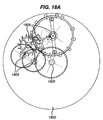
- FIGS. 18A and 18B illustrate exemplary results of an orientation measurement in accordance with aspects of the invention.
- FIGS. 18A and 18B represent schematic illustrations of a watch, and do not illustrate all the components of the watch.
- FIG. 18A illustrates the jewels with additional components of the watch movement
- FIG. 18B only illustrates the jewels themselves.
- watch 1800 includes six jewels 1805.
- the respective relative orientation of each of the six jewels 1805 are detected and associated (e.g., in a database) with the relative positions of the respective jewels.
- an association between the relative location and both the respective luminescent properties and the respective orientations provide a greater level of identification uniqueness.
- measuring both the luminescent properties and the orientations of the stones does not require much greater time or cost than measuring only one of these properties. For example, there may be 2-10 bits of information per stone.
- the orientation of watch face cover itself which is usually made of corundum, may serve as an additional identifier of the watch.
- the relative orientation of the cover may be determined, and used as an identifier of the watch.
- the present invention may utilize a detection of the orientation of the watch face cover to determine if a watch has been tampered with. That is, if a detection of the current watch face cover orientation does not match that of a stored watch face cover orientation for the corresponding watch (e.g., as identified with a serial number), then the present invention indicates that the watch has been tampered with.
- the measured luminescence properties, relative positions and/or orientations of the respective jewels may be used to create an identifier (e.g., an identification code or map).
- creating an identifier includes converting the measured information into a digital representation, which can be stored.
- the identifier is based on one or more of: (i) the position(s) of the stones; (ii) the orientation of the stones; (iii) the luminescence of the stones; and (iv) the value inscribed on one part of the timepiece serving as a first identifier (e.g., the serial number of the case or the movement).
- the identifier can be a code (e.g., an alphanumeric code) or map, or another type of information related to the measurement (including the raw data, e.g., an image).
- comparison may be based on the measurement of the stone characteristics (e.g. luminescence or decay time curve, or light reflected from the stone as a function of orientation of the polarizers (for determining the birefringence)), e.g. without determining any relative positions of the stones.
- the timepiece may be self-authenticating (e.g., authenticatable without comparison to a database of previously identified timepieces). For example, at the manufacturing stage, a manufacturer may determine a code based on the position(s) and one or more of: (i) the orientation; (ii) the luminescence of the stones. This code, for example, in an encrypted format, may then be added on the timepiece as an identification number (e.g., a serial number). Then, upon a subsequent authentication process, the position(s) and one or more of: (i) the orientation; (ii) the luminescence of the stones may be again measured to generate a determined code, which can then be compared to the identification number of the timepiece.
- a manufacturer may determine a code based on the position(s) and one or more of: (i) the orientation; (ii) the luminescence of the stones. This code, for example, in an encrypted format, may then be added on the timepiece as an identification number (e.g., a serial number). The
- Each of those watches will always have one letter or one number in common (which may be associated with the stone with the prescribed lifetime), and the remaining digits will be based and determined, as mentioned elsewhere in the examples.
- a manufacturer may dictate that for a watch having certain serial numbers (e.g., ending in "2"), the watch must contain a stone having particular properties in position "2.”
- the watch may be self-authenticating (i.e., without needing to access a database to authenticate).
- a watchmaker may prescribe particular relative relationships between the stones. For example, a manufacturer may dictate that the stone in "Position 1" must have a lifetime that is 0.5 ms longer than the stone in "Position 4.”
- the present invention provides a robust solution, as the jewels' properties (e.g., luminescence, orientation, and position) will not change substantially with time. Additionally, the present invention utilizes timepiece components that are naturally present, thus requiring no change of assembly process.
- the present invention utilizes properties that are easily measured and may utilize several bits of information per stone (or jewel). Additionally, in accordance with examples the stones can be configured with more bits per stone.
- the jewels' properties e.g., luminescence, orientation, and position
- the position, orientation, luminescence of the stones can be deliberately specified at the manufacturing to create a specific code, or taken as such from the manufacturer. For example, the orientations of one or more stones may be imposed by a manufacturer to create, for example, a predetermined identifying code.
- a watch manufacturer or a merchant may perform an analysis of a watch to determine an identification code based on the position(s) of the stones and one or more of: (i) the orientation; (ii) the luminescence of the stones. Subsequently, by performing an analysis of the watch to determine a created identification code based on the position(s) of the stones and one or more of: (i) the orientation; (ii) the luminescence of the stones, and comparing the created identification code to one or more stored identification codes, a watch owner, a manufacturer, customs, and/or a repair shop, amongst others, for example, can have the watch authenticated.
- the initial analysis of the watch may be performed downstream from the original manufacturing.
- a watch owner may have their used watch analyzed to determine an identification code, which may then be sent to the watchmaker for future authentication and/or identification.
- the present invention may be embodied as a timepiece, a system, a method or a computer program product. Accordingly, the present invention may take the form of entirely hardware , entirely software (including firmware, resident software, micro-code, etc.) or combining software and hardware aspects that may all generally be referred to herein as a "circuit,” “module” or “system.” Furthermore, the present invention may take the form of a computer program product embodied in any tangible medium of expression having computer-usable program code embodied in the medium.
- the computer-usable or computer-readable medium may be, for example but not limited to, an electronic, magnetic, optical, electromagnetic, infrared, or semiconductor system, apparatus, device, or propagation medium. More specific examples (a non-exhaustive list) of the computer-readable medium would include the following:
- a computer-usable or computer-readable medium may be any medium that can contain, store, communicate, propagate, or transport the program for use by or in connection with the instruction execution system, apparatus, or device.
- the computer-usable medium may include a propagated data signal with the computer-usable program code embodied therewith, either in baseband or as part of a carrier wave.
- the computer usable program code may be transmitted using any appropriate medium, including but not limited to wireless, wireline, optical fiber cable, RF, etc.
- Computer program code for carrying out operations of the present invention may be written in any combination of one or more programming languages, including an object oriented programming language such as Java, Smalltalk, C++ or the like and conventional procedural programming languages, such as the "C" programming language or similar programming languages.
- the program code may execute entirely on the user's computer, partly on the user's computer, as a stand-alone software package, partly on the user's computer and partly on a remote computer or entirely on the remote computer or server.
- the remote computer may be connected to the user's computer through any type of network. This may include, for example, a local area network (LAN) or a wide area network (WAN), or the connection may be made to an external computer (for example, through the Internet using an Internet Service Provider).
- the present invention may be embodied in a field programmable gate array (FPGA).
- FPGA field programmable gate array
- FIG. 19 shows an illustrative environment 1900 for managing the processes in accordance with the invention.
- the environment 1900 includes a server or other computing system 1905 that can perform the processes described herein.
- the server 1905 includes a computing device 1910.
- the computing device 1910 can be resident on a network infrastructure or computing device of a third party service provider (any of which is generally represented in FIG. 1900).
- the computing device 1910 includes a luminescence measuring tool 1945, a position measuring tool 1950, an orientation measuring tool 1955, a code generation tool 1960, and a code comparison tool 1965, which are operable to measure one or more detected luminescent properties, measure one or more detected relative positions, measure one or more detected relative orientations, generate an identification code based on relative position, the luminescent properties, the relative orientations, and/or the serial number, and compare measured properties or measured codes with stored properties or stored codes e.g., the processes described herein.
- the luminescence measuring tool 1945, the position measuring tool 1950, the orientation measuring tool 1955, the code generation tool 1960, and the code comparison tool 1965 can be implemented as one or more program code in the program control 1940 stored in memory 1925A as separate or combined modules.
- the computing device 1910 also includes a processor 1920, memory 1925A, an I/O interface 1930, and a bus 1926.
- the memory 1925A can include local memory employed during actual execution of program code, bulk storage, and cache memories which provide temporary storage of at least some program code in order to reduce the number of times code must be retrieved from bulk storage during execution.
- the computing device includes random access memory (RAM), a read-only memory (ROM), and an operating system (O/S).
- RAM random access memory
- ROM read-only memory
- O/S operating system
- the computing device 1910 is in communication with the external I/O device/resource 1935 and the storage system 1925B.
- the I/O device 1935 can comprise any device that enables an individual to interact with the computing device 1910 or any device that enables the computing device 1910 to communicate with one or more other computing devices using any type of communications link.
- the external I/O device/resource 1935 may be for example, a handheld device, PDA, handset, keyboard, smartphone, etc.
- the environment 1900 includes an illumination device 1970 for providing illumination, and one or more readers 1975 for measuring luminescent properties, relative position, and/or relative orientation of the jewels.
- the processor 1920 executes computer program code (e.g., program control 1940), which can be stored in the memory 1925A and/or storage system 1925B.
- program control 1940 having program code controls the luminescence measuring tool 1945, the position measuring tool 1950, the orientation measuring tool 1955, the code generation tool 1960, and the code comparison tool 1960.
- the processor 1920 can read and/or write data to/from memory 1925A, storage system 1925B, and/or I/O interface 1930.
- the program code executes the processes of the invention.
- the bus 1926 provides a communications link between each of the components in the computing device 1910.
- the computing device 1910 can comprise any general purpose computing article of manufacture capable of executing computer program code installed thereon (e.g., a personal computer, server, etc.). However, it is understood that the computing device 1910 is only representative of various possible equivalent-computing devices that may perform the processes described herein. To this extent, in examples, the functionality provided by the computing device 1910 can be implemented by a computing article of manufacture that includes any combination of general and/or specific purpose hardware and/or computer program code. In each example, the program code and hardware can be created using standard programming and engineering techniques, respectively.
- the computing infrastructure 1905 is only illustrative of various types of computer infrastructures for implementing the invention.
- the server 1905 comprises two or more computing devices (e.g., a server cluster) that communicate over any type of communications link, such as a network, a shared memory, or the like, to perform the process described herein.
- one or more computing devices on the server 1905 can communicate with one or more other computing devices external to the server 1905 using any type of communications link.
- the communications link can comprise any combination of wired and/or wireless links; any combination of one or more types of networks (e.g., the Internet, a wide area network, a local area network, a virtual private network, etc.); and/or utilize any combination of transmission techniques and protocols.
- networks e.g., the Internet, a wide area network, a local area network, a virtual private network, etc.
- FIGS. 20 and 21 show exemplary flows for performing aspects of the present invention.
- the steps of FIGS. 20 and 21 may be implemented in the environment of FIG. 19 , for example.
- the flow diagrams may equally represent a high-level block diagrams of the invention.
- the flowcharts and/or block diagrams in FIGS. 20 and 21 illustrate the architecture, functionality, and operation of possible implementations of systems, methods and computer program products according to various embodiments of the present invention.
- each block in the flowcharts or block diagrams may represent a module, segment, or portion of code, which comprises one or more executable instructions for implementing the specified logical function(s).
- the functions noted in the block may occur out of the order noted in the figures.
- each block of each flowchart, and combinations of the flowchart illustrations can be implemented by special purpose hardware-based systems that perform the specified functions or acts, or combinations of special purpose hardware and computer instructions and/or software, as described above.
- the steps of the flow diagrams may be implemented and executed from either a server, in a client server relationship, or they may run on a user workstation with operative information conveyed to the user workstation.
- the software elements include firmware, resident software, microcode, etc.
- the invention can take the form of a computer program product accessible from a computer-usable or computer-readable medium providing program code for use by or in connection with a computer or any instruction execution system.
- the software and/or computer program product can be implemented in the environment of FIG. 19 .
- a computer-usable or computer readable medium can be any apparatus that can contain, store, communicate, propagate, or transport the program for use by or in connection with the instruction execution system, apparatus, or device.
- the medium can be an electronic, magnetic, optical, electromagnetic, infrared, or semiconductor system (or apparatus or device) or a propagation medium.
- FIG. 20 illustrates an exemplary flow 2000 for creating and storing an identification code for a timepiece.
- the position measuring tool detects the relative position of the one or more jewels.
- the luminescence measuring tool measures luminescence properties of one or more jewels, for example, at one or more intervals.
- the orientation measuring tool detects the relative orientation of the one or more jewels.
- the code generation tool creates an identification code based on the relative position, the luminescent properties, and/or the relative orientation of the one or more jewels. For example the code generation tool may additionally utilize a serial number of the timepiece in creating the identification code.
- the code generation tool stores the identification code in a storage system, e.g., a database.
- FIG. 21 illustrates an exemplary flow 2100 for authentication and/or identification of a time piece.
- the position measuring tool detects the relative position of the one or more jewels.
- the luminescence measuring tool measures luminescence properties of one or more jewels, for example, at one or more intervals.
- the orientation measuring tool detects the relative orientation of the one or more jewels.
- the code creation tool creates an obtained identification code based on the luminescent properties, the relative position, and the relative orientation of the one or more jewels.
- the code comparison tool compares the obtained code with stored identification codes.
- the code comparison tool determines whether the obtained code matches a stored identification code.
- the code comparison tool determines that the obtained code matches a stored identification code, at step 2135, the timepiece is determined to be authentic. If, at step 2130, the code comparison tool determines that the obtained code match does not match a stored identification code, at step 2140, the timepiece is determined to be un-authentic.
Landscapes
- Physics & Mathematics (AREA)
- General Physics & Mathematics (AREA)
- Health & Medical Sciences (AREA)
- General Health & Medical Sciences (AREA)
- Life Sciences & Earth Sciences (AREA)
- Chemical & Material Sciences (AREA)
- Analytical Chemistry (AREA)
- Biochemistry (AREA)
- Immunology (AREA)
- Pathology (AREA)
- Engineering & Computer Science (AREA)
- Electromagnetism (AREA)
- Theoretical Computer Science (AREA)
- Nuclear Medicine, Radiotherapy & Molecular Imaging (AREA)
- Toxicology (AREA)
- Artificial Intelligence (AREA)
- Computer Vision & Pattern Recognition (AREA)
- Adornments (AREA)
- Investigating Materials By The Use Of Optical Means Adapted For Particular Applications (AREA)
- Investigating, Analyzing Materials By Fluorescence Or Luminescence (AREA)
- Traffic Control Systems (AREA)
Claims (19)
- Verfahren zum Erzeugen und Speichern eines Uhrenidentifikators für eine Uhr mit mindestens einem Edelstein, der Teil des Uhrwerks ist, wobei das Verfahren Folgendes aufweist:Bestimmen (2010) einer oder mehrerer Eigenschaften des mindestens einen Edelsteins des Uhrwerks;Erzeugen (2020) des Uhrenidentifikators für die Uhr in Abhängigkeit von mindestens einer der einen oder mehreren Eigenschaften des mindestens einen Edelsteins des Uhrwerks; undSpeichern (2025) des Uhrenidentifikators in einer Datenbank oder Vorrichtung.
- Verfahren zur Authentifizierung und/oder Identifizierung einer Uhr mit mindestens einem Edelstein, der Teil des Uhrwerks ist, wobei das Verfahren Folgendes aufweist:Bestimmen (2110) einer oder mehrerer Eigenschaften des mindestens einen Edelsteins des Uhrwerks;Erzeugen (2120) eines Uhrenidentifikators für die Uhr in Abhängigkeit von mindestens einer der einen oder mehreren Eigenschaften des mindestens einen Edelsteins des Uhrwerks; undVergleichen (2125, 2130) des erzeugten Uhrenidentifikators mit einem oder mehreren gespeicherten Uhrenidentifikatoren, um zu bestimmen, ob die Uhr authentisch oder eine Fälschung ist.
- Verfahren nach Anspruch 1 oder 2, wobei:das Verfahren ferner den Schritt des Erkennens (2015, 2115) einer relativen Position des mindestens einen Edelsteins in der Uhr aufweist; undder erzeugte Uhrenidentifikator in Abhängigkeit von der entsprechenden relativen Position des mindestens einen Edelsteins erzeugt wird.
- Verfahren nach Anspruch 3, bei Abhängigkeit von Anspruch 1, wobei das Bestimmen einer oder mehrerer Eigenschaften eines der Folgenden aufweist:(i) Bestimmen der einen oder mehreren Eigenschaften in einem oder mehreren Intervallen (Tdet);(ii) Bestimmen spektraler Eigenschaften in einem oder mehreren spektralen Intervallen; und(iii) Bestimmen einer Lumineszenz in zwei oder mehr Zeitintervallen (Tdet), während welchen die Lumineszenz gemessen wird.
- Verfahren nach Anspruch 4, wobei das Bestimmen einer oder mehrerer Eigenschaften das Bestimmen der Lumineszenz in zwei oder mehr Zeitintervallen (Tdet) aufweist und die zwei oder mehr Zeitintervalle eines der Folgenden sind:(i) gleichzeitig und aufeinanderfolgend;(ii) überlappende Zeitintervalle;(iii) nichtüberlappende Zeitintervalle;(iv) Zeitintervalle einer gleichen Dauer; und(v) Zeitintervalle unterschiedlicher Dauer.
- Verfahren nach Anspruch 4, wobei das Bestimmen einer oder mehrerer Eigenschaften das Bestimmen einer Lumineszenz in zwei oder mehr Zeitintervallen (Tdet) aufweist und ferner das Bestimmen einer Lumineszenz in drei oder mehr Zeitintervallen, welche gleichmäßig verteilt sind oder welche ungleichmäßig verteilt sind, aufweist.
- Verfahren nach Anspruch 1, 2 oder 3, wobei die eine oder die mehreren Eigenschaften lumineszierende Eigenschaften aufweisen und wobei die lumineszierenden Eigenschaften wahlweise mindestens entweder Phosphoreszenz oder Fluoreszenz, die durch den mindestens einen Edelstein bei Anregung mit Licht emittiert wird, aufweisen.
- Verfahren nach Anspruch 3 oder 7, wobei die eine oder die mehreren Eigenschaften eine Ausrichtung (θ) aufweisen und die Ausrichtung (θ) eines entsprechenden Edelsteins wahlweise auf der Grundlage einer Ausrichtung von einer oder mehreren der optischen Achsen des entsprechenden Edelsteins identifiziert wird.
- Verfahren nach Anspruch 8, welches ferner das Messen von Doppelbrechungseigenschaften des mindestens einen Edelsteins zum Bestimmen der Ausrichtung des mindestens einen Edelsteins aufweist und wobei die Doppelbrechungseigenschaften wahlweise mittels eines der Folgenden gemessen werden:(i)polarisiertes Licht und ein polarisierender Filter; und(ii) mehrere polarisierende Filter.
- Verfahren nach Anspruch 7, wobei das Bestimmen der einen oder der mehreren Eigenschaften das Bestimmen mindestens entweder spektraler Eigenschaften oder einer Abklingzeit einer Lumineszenz aufweist und wobei die spektralen Eigenschaften wahlweise mindestens entweder eine Intensität oder einen Wellenlängen (λ) - Bereich der Lumineszenz aufweisen.
- Verfahren nach Anspruch 3, bei Abhängigkeit von Anspruch 1, wobei der Uhrenidentifikator ein eindeutiger Identifikator ist oder wobei der Identifikator einen Identifikationscode aufweist und wobei das Erzeugen des Uhrenidentifikators wahlweise das Umwandeln der erkannten relativen Position des mindestens einen Edelsteins und entsprechender bestimmter Eigenschaften des mindestens einen Edelsteins in eine digitale Darstellung aufweist.
- Verfahren nach Anspruch 3, bei Abhängigkeit von Anspruch 1, wobei der mindestens eine Edelstein entweder Korund oder Granat aufweist.
- Verfahren nach Anspruch 12, wobei der Edelstein Korund aufweist und das Korund ferner ein oder mehrere Dotiermetallionen aus der 4. Periode des Periodensystems der Elemente, die bis zu wenigen Prozent Konzentration vorliegen, aufweist und wobei wahlweise:die Dotiermetallionen Cr3+ aufweisen; unddie Konzentration einen Bereich von 0,1 % bis 5 % aufweist.
- Verfahren nach Anspruch 12, wobei der Edelstein Granat aufweist und der Granat ein oder mehrere Dotiermetallionen aus den Seltenerdmetallen aufweist und wobei das eine oder die mehreren Dotiermetallionen aus den Seltenerdmetallen wahlweise eines oder mehrere aus der Gruppe bestehend aus Nd, Er, Yb, Tm und Ho aufweisen.
- Verfahren nach Anspruch 3, bei Abhängigkeit von Anspruch 1, wobei die Uhr entweder eine Kleinuhr oder eine Großuhr aufweist und der mindestens eine Edelstein wahlweise entweder natürlich oder synthetisch ist.
- Verfahren nach Anspruch 3, bei Abhängigkeit von Anspruch 1, wobei das Erkennen der relativen Position eines entsprechenden Edelsteins das Bestimmen von Koordinaten (a1, b1) des entsprechenden Edelsteins in Bezug auf ein Koordinatensystem im Zusammenhang mit der Uhr aufweist.
- Verfahren nach Anspruch 3, wobei:das Bestimmen der einen oder der mehreren Eigenschaften des mindestens einen Edelsteins das Messen von lumineszierenden Eigenschaften des mindestens einen Edelsteins und das Messen von Doppelbrechungseigenschaften des mindestens einen Edelsteins aufweist; undder Uhrenidentifikator in Abhängigkeit von mindestens einer gemessenen lumineszierenden Eigenschaft des mindestens einen Edelsteins, mindestens einer gemessenen Doppelbrechungseigenschaft des mindestens einen Edelsteins und der entsprechenden relativen Position des mindestens einen Edelsteins erzeugt wird.
- System (1900) zum Bestimmen eines Uhrenidentifikators von einer Uhr mit mindestens einem Edelstein, der Teil des Uhrwerks ist, wobei das System Folgendes aufweist:mindestens ein Lesegerät (1975), das zum Bestimmen einer oder mehrerer Eigenschaften und Erkennen einer relativen Position des mindestens einen Edelsteins in der Uhr konfiguriert ist, wobei der mindestens eine Edelstein Teil des Uhrwerks ist;einen Prozessor (1920), der zum Erzeugen des Uhrenidentifikators für die Uhr in Abhängigkeit von mindestens einer der einen oder mehreren Eigenschaften des mindestens einen Edelsteins und der entsprechenden relativen Position des mindestens einen Edelsteins konfiguriert ist; undein Speichersystem (1925B), das zum Speichern des Uhrenidentifikators konfiguriert ist, und wobei das System (1900) ferner wahlweise einen Komparator (1965) aufweist, der zum Vergleichen des Uhrenidentifikators mit einem oder mehreren gespeicherten Uhrenidentifikatoren konfiguriert ist, um die Uhr als entweder authentisch oder eine Fälschung zu identifizieren.
- System (1900) nach Anspruch 18, wobei die eine oder die mehreren Eigenschaften mindestens eines der Folgenden aufweisen:(i)lumineszierende Eigenschaften des mindestens einen Edelsteins; und(ii) Doppelbrechungseigenschaften des mindestens einen Edelsteins.
Priority Applications (1)
| Application Number | Priority Date | Filing Date | Title |
|---|---|---|---|
| EP13706184.2A EP2810045B1 (de) | 2012-02-03 | 2013-02-01 | Uhrenidentifizierung und authentifizierungssystem und -verfahren |
Applications Claiming Priority (4)
| Application Number | Priority Date | Filing Date | Title |
|---|---|---|---|
| US201261594734P | 2012-02-03 | 2012-02-03 | |
| EP12154063 | 2012-02-06 | ||
| PCT/EP2013/052027 WO2013113869A1 (en) | 2012-02-03 | 2013-02-01 | Watch identification and authentication system and method |
| EP13706184.2A EP2810045B1 (de) | 2012-02-03 | 2013-02-01 | Uhrenidentifizierung und authentifizierungssystem und -verfahren |
Publications (2)
| Publication Number | Publication Date |
|---|---|
| EP2810045A1 EP2810045A1 (de) | 2014-12-10 |
| EP2810045B1 true EP2810045B1 (de) | 2016-09-14 |
Family
ID=48902034
Family Applications (1)
| Application Number | Title | Priority Date | Filing Date |
|---|---|---|---|
| EP13706184.2A Active EP2810045B1 (de) | 2012-02-03 | 2013-02-01 | Uhrenidentifizierung und authentifizierungssystem und -verfahren |
Country Status (17)
| Country | Link |
|---|---|
| US (1) | US9367710B2 (de) |
| EP (1) | EP2810045B1 (de) |
| JP (1) | JP6123094B2 (de) |
| KR (1) | KR20140131347A (de) |
| CN (1) | CN104081185B (de) |
| AR (1) | AR091307A1 (de) |
| BR (1) | BR112014017434A8 (de) |
| CA (1) | CA2860457A1 (de) |
| CL (1) | CL2014002061A1 (de) |
| CO (1) | CO7020884A2 (de) |
| IL (1) | IL233479A0 (de) |
| MA (1) | MA37251B1 (de) |
| MX (1) | MX2014009124A (de) |
| RU (1) | RU2014135709A (de) |
| SG (1) | SG11201403860UA (de) |
| UY (1) | UY34599A (de) |
| WO (1) | WO2013113869A1 (de) |
Families Citing this family (12)
| Publication number | Priority date | Publication date | Assignee | Title |
|---|---|---|---|---|
| WO2014009562A1 (en) * | 2012-07-13 | 2014-01-16 | Sicpa Holding Sa | Method and system for authenticating a timepiece |
| US9223293B2 (en) * | 2012-12-11 | 2015-12-29 | Sicpa Holding Sa | Method and system for authenticating a timepiece |
| KR20160048792A (ko) * | 2013-08-23 | 2016-05-04 | 시크파 홀딩 에스에이 | 석영 발진기를 이용한 인증 방법 및 시스템 |
| CN104657852B (zh) | 2013-11-22 | 2019-01-22 | 宏达国际电子股份有限公司 | 电子装置及其授权方法 |
| CN104835069A (zh) * | 2014-02-12 | 2015-08-12 | 闪盾国际有限责任公司 | 安全钻石智能卡及其交易系统 |
| GB201511461D0 (en) * | 2015-06-30 | 2015-08-12 | Beers Uk De Ltd | Luminescence measurements in diamond |
| RU2657324C2 (ru) * | 2016-10-20 | 2018-06-13 | ООО "НПО "Синергетика" | Применение промышленного часового камня в качестве корпуса полупроводникового устройства миллиметрового диапазона длин волн и генератор колебаний с таким устройством |
| SG11201909458VA (en) | 2017-04-24 | 2019-11-28 | Patek Philippe Sa Geneve | Method for identifying a timepiece |
| ES3032674T3 (en) * | 2017-09-05 | 2025-07-23 | Swisens Ag | Measuring device for determining materials in real time by means of fluorescence lifetime measuring in the frequency domain |
| CN110006920B (zh) * | 2018-12-27 | 2021-06-15 | 浙江大学台州研究院 | 一种复杂表面红宝石轴承缺陷检测的装置及方法 |
| US20220164590A1 (en) * | 2020-11-23 | 2022-05-26 | TruWatch LLC | Methods and systems for identifying and authenticating provenance of watches |
| CN117274978A (zh) * | 2022-06-13 | 2023-12-22 | 北京佳准钟表眼镜检测有限公司 | 一种鉴定钟表真假的方法及系统 |
Family Cites Families (16)
| Publication number | Priority date | Publication date | Assignee | Title |
|---|---|---|---|---|
| DE7418353U (de) | 1974-05-27 | 1974-10-17 | Eickhorst M | Vorrichtung zur spektroskopischen untersuchung von edelsteinen |
| EP0072350B1 (de) * | 1981-08-05 | 1986-10-29 | Montres Rado S.A. | Schutzvorrichtung für eine auf einem Uhrgehäuseteil erscheinende Information |
| JPH06306315A (ja) * | 1993-04-23 | 1994-11-01 | Hitachi Maxell Ltd | 真正商品の識別方法 |
| DE4406768A1 (de) * | 1994-03-02 | 1995-09-07 | Mnogotrasslevoe N Proizv Ob Ed | Verfahren und Einrichtung zur Identifizierung von Natur- und synthetischen Edelsteinen |
| CH692256A5 (fr) * | 1997-10-16 | 2002-04-15 | Rolex Montres | Procédé de marquage indélébile d'une glace de montre, glace comportant un marquage selon ce procédé et montre pourvue d'une telle glace. |
| US6980283B1 (en) | 1997-12-18 | 2005-12-27 | Imagestatistics, Inc. | Method and associated apparatus for the standardized grading of gemstones |
| CN1118043C (zh) * | 1998-12-29 | 2003-08-13 | 中国原子能科学研究院 | 防伪标记及其制造方法 |
| CH694111A5 (fr) * | 2000-11-30 | 2004-07-15 | Alex Kalbermatten | Montre pourvue d'au moins un élément décoratif mobile contenant un élément électronique. |
| CH702216B1 (fr) * | 2000-12-13 | 2011-05-31 | Ebauchesfabrik Eta Ag | Procédé de fixation de pierres dans une pièce d'un mouvement d'horlogerie et dispositif pour sa mise en œuvre. |
| US20030063772A1 (en) * | 2001-09-06 | 2003-04-03 | Smith Joshua R. | System and method for authentication and tracking of a workpiece that includes an optically active medium |
| EP1627180A4 (de) * | 2003-04-28 | 2009-10-21 | Michelle Jillian Fuwausa | Ultraviolette beleuchtung von anzeigen, armbanduhren und anderen instrumenten |
| JP2005345319A (ja) * | 2004-06-04 | 2005-12-15 | Citizen Watch Co Ltd | 情報コードを備える腕時計 |
| EP1804195A1 (de) * | 2005-12-29 | 2007-07-04 | Montres Breguet S.A. | Verfahren zur Codemarkierung eines Produkts von geringer Größe und gemäß diesem Verfahren erhaltenes markiertes Produkt |
| CN2893828Y (zh) * | 2006-03-27 | 2007-04-25 | 北京邮票厂 | 一种邮票 |
| CH704640B1 (fr) * | 2008-03-18 | 2012-09-28 | Complitime Sa | Organe de pivotement. |
| WO2011101724A2 (en) * | 2010-02-16 | 2011-08-25 | Ricardo Baretzky | Gemstone administration and identification |
-
2013
- 2013-01-30 UY UY0001034599A patent/UY34599A/es not_active Application Discontinuation
- 2013-02-01 US US13/757,296 patent/US9367710B2/en active Active
- 2013-02-01 KR KR1020147024661A patent/KR20140131347A/ko not_active Withdrawn
- 2013-02-01 RU RU2014135709A patent/RU2014135709A/ru not_active Application Discontinuation
- 2013-02-01 AR ARP130100336 patent/AR091307A1/es unknown
- 2013-02-01 BR BR112014017434A patent/BR112014017434A8/pt not_active Application Discontinuation
- 2013-02-01 MX MX2014009124A patent/MX2014009124A/es active IP Right Grant
- 2013-02-01 SG SG11201403860UA patent/SG11201403860UA/en unknown
- 2013-02-01 EP EP13706184.2A patent/EP2810045B1/de active Active
- 2013-02-01 CA CA2860457A patent/CA2860457A1/en not_active Abandoned
- 2013-02-01 CN CN201380007781.0A patent/CN104081185B/zh active Active
- 2013-02-01 JP JP2014555218A patent/JP6123094B2/ja active Active
- 2013-02-01 WO PCT/EP2013/052027 patent/WO2013113869A1/en not_active Ceased
-
2014
- 2014-07-01 IL IL233479A patent/IL233479A0/en unknown
- 2014-07-31 MA MA37251A patent/MA37251B1/fr unknown
- 2014-08-01 CL CL2014002061A patent/CL2014002061A1/es unknown
- 2014-08-04 CO CO14169330A patent/CO7020884A2/es unknown
Also Published As
| Publication number | Publication date |
|---|---|
| US9367710B2 (en) | 2016-06-14 |
| HK1202629A1 (en) | 2015-10-02 |
| MA37251B1 (fr) | 2016-11-30 |
| EP2810045A1 (de) | 2014-12-10 |
| SG11201403860UA (en) | 2014-10-30 |
| CN104081185B (zh) | 2017-07-25 |
| IL233479A0 (en) | 2014-08-31 |
| MX2014009124A (es) | 2014-08-27 |
| RU2014135709A (ru) | 2016-03-27 |
| JP2015505614A (ja) | 2015-02-23 |
| CA2860457A1 (en) | 2013-08-08 |
| CN104081185A (zh) | 2014-10-01 |
| US20130200143A1 (en) | 2013-08-08 |
| AR091307A1 (es) | 2015-01-28 |
| CO7020884A2 (es) | 2014-08-11 |
| MA37251A1 (fr) | 2016-04-29 |
| JP6123094B2 (ja) | 2017-05-10 |
| WO2013113869A1 (en) | 2013-08-08 |
| UY34599A (es) | 2013-09-02 |
| CL2014002061A1 (es) | 2014-12-05 |
| BR112014017434A8 (pt) | 2017-07-04 |
| KR20140131347A (ko) | 2014-11-12 |
| BR112014017434A2 (pt) | 2017-06-13 |
Similar Documents
| Publication | Publication Date | Title |
|---|---|---|
| US9367710B2 (en) | Watch identification and authentication system and method | |
| US20150309478A1 (en) | A method for authenticating a timepiece | |
| US9223293B2 (en) | Method and system for authenticating a timepiece | |
| EP2579186B1 (de) | Verfahren zur Authentifizierung einer elektronischen Armbanduhr, und elektronische Armbanduhr zu dessen Umsetzung | |
| US20150053006A1 (en) | Method and system for authenticating using a quartz oscillator | |
| US9285777B2 (en) | Method and system for authenticating a timepiece | |
| EP3136189A1 (de) | Chronometrisches überprüfungsverfahren einer uhr | |
| TW201333450A (zh) | 手錶鑒別和認證系統及方法 | |
| HK1202629B (en) | Watch identification and authentication system and method | |
| US20060120222A1 (en) | Mechanical indicator utilizing circular polarization | |
| JP2020517974A (ja) | 時計を識別する方法 | |
| CN117274978A (zh) | 一种鉴定钟表真假的方法及系统 | |
| Bansal | Europe Quartz Glass Market 2023 Regions, Type & Applicati | |
| Shah | Europe High-Purity Titanium Dioxide Market Challenges | |
| EP2932241B1 (de) | Verfahren zur authentifizierung einer uhr | |
| WO2024163967A1 (en) | System and method for internal etching surfaces of transparent materials with information pertaining to a blockchain for authenticating a time keeping device | |
| HK1213635B (en) | Method and system for authenticating a timepiece | |
| RU2276395C9 (ru) | Способ количественной оценки продолжительности идентификации циферблата и его элементов ю.с. бурдакова | |
| Smith | Time to panic?[watches] | |
| Cahill | The last acquisition—completing the circle bead by bead |
Legal Events
| Date | Code | Title | Description |
|---|---|---|---|
| PUAI | Public reference made under article 153(3) epc to a published international application that has entered the european phase |
Free format text: ORIGINAL CODE: 0009012 |
|
| 17P | Request for examination filed |
Effective date: 20140901 |
|
| AK | Designated contracting states |
Kind code of ref document: A1 Designated state(s): AL AT BE BG CH CY CZ DE DK EE ES FI FR GB GR HR HU IE IS IT LI LT LU LV MC MK MT NL NO PL PT RO RS SE SI SK SM TR |
|
| AX | Request for extension of the european patent |
Extension state: BA ME |
|
| DAX | Request for extension of the european patent (deleted) | ||
| 17Q | First examination report despatched |
Effective date: 20150819 |
|
| GRAP | Despatch of communication of intention to grant a patent |
Free format text: ORIGINAL CODE: EPIDOSNIGR1 |
|
| INTG | Intention to grant announced |
Effective date: 20160407 |
|
| GRAS | Grant fee paid |
Free format text: ORIGINAL CODE: EPIDOSNIGR3 |
|
| GRAA | (expected) grant |
Free format text: ORIGINAL CODE: 0009210 |
|
| AK | Designated contracting states |
Kind code of ref document: B1 Designated state(s): AL AT BE BG CH CY CZ DE DK EE ES FI FR GB GR HR HU IE IS IT LI LT LU LV MC MK MT NL NO PL PT RO RS SE SI SK SM TR |
|
| REG | Reference to a national code |
Ref country code: GB Ref legal event code: FG4D |
|
| REG | Reference to a national code |
Ref country code: CH Ref legal event code: EP |
|
| REG | Reference to a national code |
Ref country code: IE Ref legal event code: FG4D |
|
| REG | Reference to a national code |
Ref country code: AT Ref legal event code: REF Ref document number: 829526 Country of ref document: AT Kind code of ref document: T Effective date: 20161015 |
|
| REG | Reference to a national code |
Ref country code: DE Ref legal event code: R096 Ref document number: 602013011476 Country of ref document: DE |
|
| REG | Reference to a national code |
Ref country code: LT Ref legal event code: MG4D |
|
| REG | Reference to a national code |
Ref country code: NL Ref legal event code: MP Effective date: 20160914 |
|
| REG | Reference to a national code |
Ref country code: FR Ref legal event code: PLFP Year of fee payment: 5 |
|
| PG25 | Lapsed in a contracting state [announced via postgrant information from national office to epo] |
Ref country code: NO Free format text: LAPSE BECAUSE OF FAILURE TO SUBMIT A TRANSLATION OF THE DESCRIPTION OR TO PAY THE FEE WITHIN THE PRESCRIBED TIME-LIMIT Effective date: 20161214 Ref country code: FI Free format text: LAPSE BECAUSE OF FAILURE TO SUBMIT A TRANSLATION OF THE DESCRIPTION OR TO PAY THE FEE WITHIN THE PRESCRIBED TIME-LIMIT Effective date: 20160914 Ref country code: LT Free format text: LAPSE BECAUSE OF FAILURE TO SUBMIT A TRANSLATION OF THE DESCRIPTION OR TO PAY THE FEE WITHIN THE PRESCRIBED TIME-LIMIT Effective date: 20160914 Ref country code: HR Free format text: LAPSE BECAUSE OF FAILURE TO SUBMIT A TRANSLATION OF THE DESCRIPTION OR TO PAY THE FEE WITHIN THE PRESCRIBED TIME-LIMIT Effective date: 20160914 Ref country code: RS Free format text: LAPSE BECAUSE OF FAILURE TO SUBMIT A TRANSLATION OF THE DESCRIPTION OR TO PAY THE FEE WITHIN THE PRESCRIBED TIME-LIMIT Effective date: 20160914 |
|
| REG | Reference to a national code |
Ref country code: AT Ref legal event code: MK05 Ref document number: 829526 Country of ref document: AT Kind code of ref document: T Effective date: 20160914 |
|
| PG25 | Lapsed in a contracting state [announced via postgrant information from national office to epo] |
Ref country code: LV Free format text: LAPSE BECAUSE OF FAILURE TO SUBMIT A TRANSLATION OF THE DESCRIPTION OR TO PAY THE FEE WITHIN THE PRESCRIBED TIME-LIMIT Effective date: 20160914 Ref country code: GR Free format text: LAPSE BECAUSE OF FAILURE TO SUBMIT A TRANSLATION OF THE DESCRIPTION OR TO PAY THE FEE WITHIN THE PRESCRIBED TIME-LIMIT Effective date: 20161215 Ref country code: NL Free format text: LAPSE BECAUSE OF FAILURE TO SUBMIT A TRANSLATION OF THE DESCRIPTION OR TO PAY THE FEE WITHIN THE PRESCRIBED TIME-LIMIT Effective date: 20160914 Ref country code: SE Free format text: LAPSE BECAUSE OF FAILURE TO SUBMIT A TRANSLATION OF THE DESCRIPTION OR TO PAY THE FEE WITHIN THE PRESCRIBED TIME-LIMIT Effective date: 20160914 |
|
| PG25 | Lapsed in a contracting state [announced via postgrant information from national office to epo] |
Ref country code: EE Free format text: LAPSE BECAUSE OF FAILURE TO SUBMIT A TRANSLATION OF THE DESCRIPTION OR TO PAY THE FEE WITHIN THE PRESCRIBED TIME-LIMIT Effective date: 20160914 Ref country code: RO Free format text: LAPSE BECAUSE OF FAILURE TO SUBMIT A TRANSLATION OF THE DESCRIPTION OR TO PAY THE FEE WITHIN THE PRESCRIBED TIME-LIMIT Effective date: 20160914 |
|
| PG25 | Lapsed in a contracting state [announced via postgrant information from national office to epo] |
Ref country code: PL Free format text: LAPSE BECAUSE OF FAILURE TO SUBMIT A TRANSLATION OF THE DESCRIPTION OR TO PAY THE FEE WITHIN THE PRESCRIBED TIME-LIMIT Effective date: 20160914 Ref country code: CZ Free format text: LAPSE BECAUSE OF FAILURE TO SUBMIT A TRANSLATION OF THE DESCRIPTION OR TO PAY THE FEE WITHIN THE PRESCRIBED TIME-LIMIT Effective date: 20160914 Ref country code: ES Free format text: LAPSE BECAUSE OF FAILURE TO SUBMIT A TRANSLATION OF THE DESCRIPTION OR TO PAY THE FEE WITHIN THE PRESCRIBED TIME-LIMIT Effective date: 20160914 Ref country code: SK Free format text: LAPSE BECAUSE OF FAILURE TO SUBMIT A TRANSLATION OF THE DESCRIPTION OR TO PAY THE FEE WITHIN THE PRESCRIBED TIME-LIMIT Effective date: 20160914 Ref country code: BE Free format text: LAPSE BECAUSE OF FAILURE TO SUBMIT A TRANSLATION OF THE DESCRIPTION OR TO PAY THE FEE WITHIN THE PRESCRIBED TIME-LIMIT Effective date: 20160914 Ref country code: IS Free format text: LAPSE BECAUSE OF FAILURE TO SUBMIT A TRANSLATION OF THE DESCRIPTION OR TO PAY THE FEE WITHIN THE PRESCRIBED TIME-LIMIT Effective date: 20170114 Ref country code: SM Free format text: LAPSE BECAUSE OF FAILURE TO SUBMIT A TRANSLATION OF THE DESCRIPTION OR TO PAY THE FEE WITHIN THE PRESCRIBED TIME-LIMIT Effective date: 20160914 Ref country code: BG Free format text: LAPSE BECAUSE OF FAILURE TO SUBMIT A TRANSLATION OF THE DESCRIPTION OR TO PAY THE FEE WITHIN THE PRESCRIBED TIME-LIMIT Effective date: 20161214 Ref country code: PT Free format text: LAPSE BECAUSE OF FAILURE TO SUBMIT A TRANSLATION OF THE DESCRIPTION OR TO PAY THE FEE WITHIN THE PRESCRIBED TIME-LIMIT Effective date: 20170116 Ref country code: AT Free format text: LAPSE BECAUSE OF FAILURE TO SUBMIT A TRANSLATION OF THE DESCRIPTION OR TO PAY THE FEE WITHIN THE PRESCRIBED TIME-LIMIT Effective date: 20160914 |
|
| REG | Reference to a national code |
Ref country code: DE Ref legal event code: R097 Ref document number: 602013011476 Country of ref document: DE |
|
| PLBE | No opposition filed within time limit |
Free format text: ORIGINAL CODE: 0009261 |
|
| STAA | Information on the status of an ep patent application or granted ep patent |
Free format text: STATUS: NO OPPOSITION FILED WITHIN TIME LIMIT |
|
| PG25 | Lapsed in a contracting state [announced via postgrant information from national office to epo] |
Ref country code: DK Free format text: LAPSE BECAUSE OF FAILURE TO SUBMIT A TRANSLATION OF THE DESCRIPTION OR TO PAY THE FEE WITHIN THE PRESCRIBED TIME-LIMIT Effective date: 20160914 |
|
| 26N | No opposition filed |
Effective date: 20170615 |
|
| PG25 | Lapsed in a contracting state [announced via postgrant information from national office to epo] |
Ref country code: MC Free format text: LAPSE BECAUSE OF FAILURE TO SUBMIT A TRANSLATION OF THE DESCRIPTION OR TO PAY THE FEE WITHIN THE PRESCRIBED TIME-LIMIT Effective date: 20160914 |
|
| REG | Reference to a national code |
Ref country code: IE Ref legal event code: MM4A |
|
| PG25 | Lapsed in a contracting state [announced via postgrant information from national office to epo] |
Ref country code: SI Free format text: LAPSE BECAUSE OF FAILURE TO SUBMIT A TRANSLATION OF THE DESCRIPTION OR TO PAY THE FEE WITHIN THE PRESCRIBED TIME-LIMIT Effective date: 20160914 |
|
| PG25 | Lapsed in a contracting state [announced via postgrant information from national office to epo] |
Ref country code: LU Free format text: LAPSE BECAUSE OF NON-PAYMENT OF DUE FEES Effective date: 20170201 |
|
| REG | Reference to a national code |
Ref country code: FR Ref legal event code: PLFP Year of fee payment: 6 |
|
| PG25 | Lapsed in a contracting state [announced via postgrant information from national office to epo] |
Ref country code: IE Free format text: LAPSE BECAUSE OF NON-PAYMENT OF DUE FEES Effective date: 20170201 |
|
| PG25 | Lapsed in a contracting state [announced via postgrant information from national office to epo] |
Ref country code: MT Free format text: LAPSE BECAUSE OF NON-PAYMENT OF DUE FEES Effective date: 20170201 |
|
| PG25 | Lapsed in a contracting state [announced via postgrant information from national office to epo] |
Ref country code: AL Free format text: LAPSE BECAUSE OF FAILURE TO SUBMIT A TRANSLATION OF THE DESCRIPTION OR TO PAY THE FEE WITHIN THE PRESCRIBED TIME-LIMIT Effective date: 20160914 |
|
| PG25 | Lapsed in a contracting state [announced via postgrant information from national office to epo] |
Ref country code: HU Free format text: LAPSE BECAUSE OF FAILURE TO SUBMIT A TRANSLATION OF THE DESCRIPTION OR TO PAY THE FEE WITHIN THE PRESCRIBED TIME-LIMIT; INVALID AB INITIO Effective date: 20130201 |
|
| PG25 | Lapsed in a contracting state [announced via postgrant information from national office to epo] |
Ref country code: CY Free format text: LAPSE BECAUSE OF FAILURE TO SUBMIT A TRANSLATION OF THE DESCRIPTION OR TO PAY THE FEE WITHIN THE PRESCRIBED TIME-LIMIT Effective date: 20160914 |
|
| PG25 | Lapsed in a contracting state [announced via postgrant information from national office to epo] |
Ref country code: MK Free format text: LAPSE BECAUSE OF FAILURE TO SUBMIT A TRANSLATION OF THE DESCRIPTION OR TO PAY THE FEE WITHIN THE PRESCRIBED TIME-LIMIT Effective date: 20160914 |
|
| PG25 | Lapsed in a contracting state [announced via postgrant information from national office to epo] |
Ref country code: TR Free format text: LAPSE BECAUSE OF FAILURE TO SUBMIT A TRANSLATION OF THE DESCRIPTION OR TO PAY THE FEE WITHIN THE PRESCRIBED TIME-LIMIT Effective date: 20160914 |
|
| P01 | Opt-out of the competence of the unified patent court (upc) registered |
Effective date: 20230523 |
|
| REG | Reference to a national code |
Ref country code: CH Ref legal event code: U11 Free format text: ST27 STATUS EVENT CODE: U-0-0-U10-U11 (AS PROVIDED BY THE NATIONAL OFFICE) Effective date: 20260301 |
|
| PGFP | Annual fee paid to national office [announced via postgrant information from national office to epo] |
Ref country code: GB Payment date: 20260121 Year of fee payment: 14 |
|
| PGFP | Annual fee paid to national office [announced via postgrant information from national office to epo] |
Ref country code: DE Payment date: 20260121 Year of fee payment: 14 |
|
| PGFP | Annual fee paid to national office [announced via postgrant information from national office to epo] |
Ref country code: IT Payment date: 20260121 Year of fee payment: 14 |
|
| PGFP | Annual fee paid to national office [announced via postgrant information from national office to epo] |
Ref country code: FR Payment date: 20260121 Year of fee payment: 14 |
|
| PGFP | Annual fee paid to national office [announced via postgrant information from national office to epo] |
Ref country code: CH Payment date: 20260301 Year of fee payment: 14 |