EP2809093A1 - Apparatuses and methods for providing emergent short message services (sms) - Google Patents
Apparatuses and methods for providing emergent short message services (sms) Download PDFInfo
- Publication number
- EP2809093A1 EP2809093A1 EP20140153367 EP14153367A EP2809093A1 EP 2809093 A1 EP2809093 A1 EP 2809093A1 EP 20140153367 EP20140153367 EP 20140153367 EP 14153367 A EP14153367 A EP 14153367A EP 2809093 A1 EP2809093 A1 EP 2809093A1
- Authority
- EP
- European Patent Office
- Prior art keywords
- short message
- receiver
- emergent
- user
- sender
- Prior art date
- Legal status (The legal status is an assumption and is not a legal conclusion. Google has not performed a legal analysis and makes no representation as to the accuracy of the status listed.)
- Granted
Links
Images



Classifications
-
- H—ELECTRICITY
- H04—ELECTRIC COMMUNICATION TECHNIQUE
- H04W—WIRELESS COMMUNICATION NETWORKS
- H04W4/00—Services specially adapted for wireless communication networks; Facilities therefor
- H04W4/12—Messaging; Mailboxes; Announcements
- H04W4/14—Short messaging services, e.g. short message services [SMS] or unstructured supplementary service data [USSD]
-
- H—ELECTRICITY
- H04—ELECTRIC COMMUNICATION TECHNIQUE
- H04W—WIRELESS COMMUNICATION NETWORKS
- H04W4/00—Services specially adapted for wireless communication networks; Facilities therefor
- H04W4/90—Services for handling of emergency or hazardous situations, e.g. earthquake and tsunami warning systems [ETWS]
Definitions
- the invention generally relates to provision of Short Message Service (SMS), and more particularly, to apparatuses and methods for providing emergent SMS.
- SMS Short Message Service
- GSM Global System for Mobile communications
- GPRS General Packet Radio Service
- EDGE Enhanced Data rates for Global Evolution
- WCDMA Wideband Code Division Multiple Access
- CDMA-2000 Code Division Multiple Access 2000
- TD-SCDMA Time Division-Synchronous Code Division Multiple Access
- WiMAX Worldwide Interoperability for Microwave Access
- LTE Long Term Evolution
- LTE-Advanced Long Term Evolution
- TD-LTE Time- Division LTE
- SMS Short Message Service
- MSs Mobile Stations
- PCs Personal Computers
- SMSC Short Message Service Center
- the SMSC attempts to deliver the short message to the receiver MS. If the receiver MS is not reachable at a given moment, the SMSC will store the short message for subsequent delivery. Later, when the receiver MS is reachable, the SMSC retries the delivery process.
- the SMS service allows an active subscriber unit, i.e., an MS, to transmit and receive a short message at any time.
- the SMS does not provide priority information for a particular short message.
- a receiver MS receives five different short messages at one time, including one short message with information of an urgent or emergent subject matter, and four spam short messages, all of the short messages may very well be treated as equal when presented to the user of the receiver MS and the user may have to look into each of the short messages to identify the urgent or emergent one.
- the invention proposes an emergent SMS which allows the user at the sender's end to configure a short message as emergent, so that the short message may be prioritized at the receiver's end.
- a sender MS for providing emergent SMS comprises a wireless module and a controller module.
- the wireless module performs wireless transmission and reception to and from a service network.
- the controller module configures a short message as emergent by a user command, and transmits the short message to the service network via the wireless module to be forwarded to a receiver MS, so that, when the receiver MS receives the short message, a user of the receiver MS is alerted about that the short message is configured as emergent.
- a receiver MS for providing emergent SMS comprises a wireless module and a controller module.
- the wireless module performs wireless transmission and reception to and from a service network.
- the controller module receives a short message from the service network via the wireless module, determines whether the short message is configured as emergent, and if so, alerts a user of the receiver MS about that the short message is configured as emergent.
- a method for providing emergent SMS between a sender MS and a receiver MS comprises the steps of: configuring, by the sender MS, a short message as emergent by a user command; transmitting the short message from the sender MS to the receiver MS via a service network; and alerting, by the receiver MS, a user of the receiver MS about that the short message is configured as emergent, when the receiver MS receives the short message.
- Fig. 1 is a block diagram of a mobile telecommunication environment according to an embodiment of the invention.
- the mobile telecommunication environment 100 comprises two MSs 110 and 120, and a service network 130, wherein the MSs 110 and 120 are wirelessly connected to the service network 130 for obtaining wireless services, including voice and/or data services, and SMS.
- Each of the MSs 110 and 120 may be a smartphone, a panel PC, a laptop computer, or any computing device supporting at least the cellular technology utilized by the service network 130.
- the service network 130 may be a GSM system, GPRS system, WCDMA system, CDMA-2000 system, TD-SCDMA system, WiMAX system, LTE system, LTE-Advanced system, or TD-LTE system, etc., depending on the cellular technology in use.
- the service network 130 comprises at least an access network 131 and a core network 132, wherein the access network 131 is responsible for processing radio signals, terminating radio protocols, and connecting the MSs 110 and 120 with the core network 132, and the core network 132 is responsible for performing mobility management, network-side authentication, and interfaces with public networks.
- the access network 131 comprises at least a base station 1311 for providing the functionality of wireless transceiving for the service network 130.
- the access network 131 may further comprise a base station controller for controlling the operation of the base station, or the base station controller may be incorporated into the base station 1311.
- the core network 132 comprises at least an SMSC 1321 for storing and forwarding short messages.
- the access network 131 may be a Base Station Subsystem (BSS) which includes at least a Base Transceiver Station (BTS) and a Base Station Controller (BSC), and the core network 132 may be a GPRS core which includes a Home Location Register (HLR), at least one Serving GPRS Support Node (SGSN), at least one Gateway GPRS Support Node (GGSN), and the SMSC 1321.
- BSS Base Station Subsystem
- BSC Base Station Controller
- the core network 132 may be a GPRS core which includes a Home Location Register (HLR), at least one Serving GPRS Support Node (SGSN), at least one Gateway GPRS Support Node (GGSN), and the SMSC 1321.
- HLR Home Location Register
- SGSN Serving GPRS Support Node
- GGSN Gateway GPRS Support Node
- the access network 131 may be an Evolved-UTRAN (E-UTRAN) which includes at least an evolved NB (eNB), and the core network 132 may be an Evolved Packet Core (EPC) which includes a Home Subscriber Server (HSS), Mobility Management Entity (MME), Serving Gateway (S-GW), Packet Data Network Gateway (PDN-GW or P-GW), and the SMSC 1321.
- E-UTRAN Evolved-UTRAN
- eNB evolved NB
- EPC Evolved Packet Core
- HSS Home Subscriber Server
- MME Mobility Management Entity
- S-GW Serving Gateway
- PDN-GW Packet Data Network Gateway
- each of the MSs 110 and 120 may be wirelessly connected to a respective service network, and the SMSC may be separated from the service networks and established on the Internet through which the service networks are connected thereto.
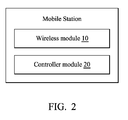
- Fig. 2 is a block diagram illustrating an MS according to an embodiment of the invention.
- An MS comprises at least a wireless module 10, and a controller module 20.
- the wireless module 10 is responsible for performing the functionality of wireless transmission and reception to and from the service network 130.
- the controller module 20 is responsible for controlling the operations of the wireless module 10, and other functional components (not shown), such as a display unit and/or keypad serving as the Man-Machine Interface (MMI), a storage unit storing the program codes of applications or communication protocols, a Global Positioning System (GPS) unit for obtaining location information, an audio speaker, a lighting unit for emitting visible and/or colorful lights, a vibrator, or others.
- the controller module 20 controls the wireless module 10 for performing the method for providing emergent SMS.
- the wireless module 10 may be a Radio Frequency (RF) unit
- the controller module 20 may be a general-purpose processor or a Micro Control Unit (MCU) of a baseband unit (not shown).
- the baseband unit may contain multiple hardware devices to perform baseband signal processing, including analog-to-digital conversion (ADC)/digital-to-analog conversion (DAC), gain adjusting, modulation/demodulation, encoding/decoding, and so on.
- the RF unit may receive RF wireless signals, convert the received RF wireless signals to baseband signals, which are processed by the baseband unit, or receive baseband signals from the baseband unit and convert the received baseband signals to RF wireless signals, which are later transmitted.
- the RF unit may also contain multiple hardware devices to perform radio frequency conversion.
- the RF unit may comprise a mixer to multiply the baseband signals with a carrier oscillated in the radio frequency of the mobile communication system, wherein the radio frequency may be 900MHz, 1800MHz, or 1900MHz utilized in the GPRS/GPRS/EDGE technology, or 900MHz, 1900MHz, or 2100MHz utilized in WCDMA technology, or 900MHz, 2100MHz, or 2.6GHz utilized in LTE/LTE-Advanced technology, or others depending on the cellular technology in use.
- Fig. 3 is a flow chart illustrating the method for providing emergent SMS between a sender MS and a receiver MS according to an embodiment of the invention.
- the sender MS configures a short message as emergent by a user command (step S310).
- the short message is transmitted from the sender MS to the receiver MS via a service network (step S320).
- the emergent SMS between the sender MS and the receiver MS is provided via the service network which includes at least an SMSC for storing and forwarding short messages.
- the receiver MS alerts its user about that the short message is configured as emergent (step S330).
- the receiver MS may provide an audible notification (e.g., beep, as shown in Fig. 4A ), vibrating notification (e.g., vibrating the receiver MS, as shown in Fig. 4B ), or lighting notification (e.g., flashes of visual and/or colorful lights, as shown in Fig. 4C ), or displaying an alarm icon (e.g., exclamation, star, or flag sign, as shown in Fig. 4D ), to alert the user about that the short message is configured as emergent and should be prioritized over the other normal short messages, i.e., the short messages configured as non-emergent.
- the receiver MS may determine whether the received short message is configured as emergent or urgent, and only alert the user when the received short message is configured as emergent or urgent.
- the sender MS may add the emergency information in the TP(Transfer layer Protocol)-Protocol-Identifier (TP-PID) of the short message, to configure the short message as emergent.
- TP-PID TP(Transfer layer Protocol)-Protocol-Identifier
- the SMS service is provided in compliance with the 3GPP Technical Specification (TS) 23.040
- the TP-PID is one octet, i.e., 8 bits, long and the emergency information may be added to bits 5 to 0 of the TP-PID.
- the receiver MS may determine whether the short message is configured as emergent according to the value of the TP-PID of the short message.
- the sender MS may add the emergency information in the TP-User-Data (TP-UD) of the short message, to configure the short message as emergent.
- the emergency information may be added to any Information Element Identifier (IEI) in the TP-UD.
- IEI Information Element Identifier
- an IEI may be set to the any of the reserved hexadecimal values, e.g., "02", to indicate "User-Defined Emergent SMS".
- the detailed indication is further defined by bits 4 to 2 of the Information Element Data (IED) corresponding to the IEI in the TP-UD, and bits 4 to 2 of the IED in the TP-UD may be set to any of the unused binary values, e.g., "010", to indicate "User-Defined Emergent SMS".
- the receiver MS may determine whether the short message is configured as emergent according to the value of the IEI in the TP-UD, or according to the value of bits 4 to 2 of the IED in the TP-UD.
- SMS Short-message-based services
- EMS Enhanced Messaging Service
- MMS Multimedia Messaging Service
Landscapes
- Engineering & Computer Science (AREA)
- Computer Networks & Wireless Communication (AREA)
- Signal Processing (AREA)
- Business, Economics & Management (AREA)
- Health & Medical Sciences (AREA)
- Emergency Management (AREA)
- Environmental & Geological Engineering (AREA)
- Public Health (AREA)
- Mobile Radio Communication Systems (AREA)
- Telephonic Communication Services (AREA)
- Telephone Function (AREA)
Abstract
Description
- This Application claims priority of
U.S. Application No. 14/159,103, filed on January 20, 2014 U.S. Provisional Application No. 61/828,192, filed on May 29, 2013 - The invention generally relates to provision of Short Message Service (SMS), and more particularly, to apparatuses and methods for providing emergent SMS.
- With growing demand for ubiquitous computing and networking, various cellular technologies, including the Global System for Mobile communications (GSM) technology, General Packet Radio Service (GPRS) technology, Enhanced Data rates for Global Evolution (EDGE) technology, Wideband Code Division Multiple Access (WCDMA) technology, Code Division Multiple Access 2000 (CDMA-2000) technology, Time Division-Synchronous Code Division Multiple Access (TD-SCDMA) technology, Worldwide Interoperability for Microwave Access (WiMAX) technology, Long Term Evolution (LTE) technology, LTE-Advanced technology, and Time- Division LTE (TD-LTE) technology, etc., have been developed for mobile telecommunication.
- One of the most popular mobile telecommunication services is the Short Message Service (SMS). SMS is a communications protocol that allows for point-to-point communication of short text messages to and from Mobile Stations (MSs), such as smartphones, panel Personal Computers (PCs), laptop computers with wireless functionality, etc. Within the SMS service, a short message may be transmitted from the sender MS to a Short Message Service Center (SMSC) in a store-and-forward transport mechanism. The SMSC attempts to deliver the short message to the receiver MS. If the receiver MS is not reachable at a given moment, the SMSC will store the short message for subsequent delivery. Later, when the receiver MS is reachable, the SMSC retries the delivery process. Thus, the SMS service allows an active subscriber unit, i.e., an MS, to transmit and receive a short message at any time.
- As convenient as it is, the SMS does not provide priority information for a particular short message. For cases in which a receiver MS receives five different short messages at one time, including one short message with information of an urgent or emergent subject matter, and four spam short messages, all of the short messages may very well be treated as equal when presented to the user of the receiver MS and the user may have to look into each of the short messages to identify the urgent or emergent one.
- In order to solve the aforementioned problem, the invention proposes an emergent SMS which allows the user at the sender's end to configure a short message as emergent, so that the short message may be prioritized at the receiver's end.
- In one aspect of the invention, a sender MS for providing emergent SMS is provided. The sender MS comprises a wireless module and a controller module. The wireless module performs wireless transmission and reception to and from a service network. The controller module configures a short message as emergent by a user command, and transmits the short message to the service network via the wireless module to be forwarded to a receiver MS, so that, when the receiver MS receives the short message, a user of the receiver MS is alerted about that the short message is configured as emergent.
- In another aspect of the invention, a receiver MS for providing emergent SMS is provided. The receiver MS comprises a wireless module and a controller module. The wireless module performs wireless transmission and reception to and from a service network. The controller module receives a short message from the service network via the wireless module, determines whether the short message is configured as emergent, and if so, alerts a user of the receiver MS about that the short message is configured as emergent.
- In yet another aspect of the invention, a method for providing emergent SMS between a sender MS and a receiver MS is provided. The method comprises the steps of: configuring, by the sender MS, a short message as emergent by a user command; transmitting the short message from the sender MS to the receiver MS via a service network; and alerting, by the receiver MS, a user of the receiver MS about that the short message is configured as emergent, when the receiver MS receives the short message.
- Other aspects and features of the invention will become apparent to those with ordinary skill in the art upon review of the following descriptions of specific embodiments of the sender MS, the receiver MS, the method for providing emergent SMS.
- The invention can be more fully understood by reading the subsequent detailed description and examples with references made to the accompanying drawings, wherein:
-
Fig. 1 is a block diagram of a mobile telecommunication environment according to an embodiment of the invention; -
Fig. 2 is a block diagram illustrating an MS according to an embodiment of the invention; -
Fig. 3 is a flow chart illustrating the method for providing emergent SMS between a sender MS and a receiver MS according to an embodiment of the invention; -
Fig. 4A is a schematic diagram showing a smartphone alert with an audible notification according to an embodiment of the invention; -
Fig. 4B is a schematic diagram showing a smartphone alert with a vibrating notification according to an embodiment of the invention; -
Fig. 4C is a schematic diagram showing a smartphone alert with a lighting notification according to an embodiment of the invention; and -
Fig. 4D is a schematic diagram showing a smartphone alert with an alarm icon according to an embodiment of the invention. - The following description is of the best-contemplated mode of carrying out the invention. This description is made for the purpose of illustrating the general principles of the invention and should not be taken in a limiting sense. The 3rd Generation Partnership Project (3GPP) specifications are used to teach the spirit of the invention, and the invention is not limited thereto.
-
Fig. 1 is a block diagram of a mobile telecommunication environment according to an embodiment of the invention. Themobile telecommunication environment 100 comprises twoMSs service network 130, wherein the MSs 110 and 120 are wirelessly connected to theservice network 130 for obtaining wireless services, including voice and/or data services, and SMS. Each of the MSs 110 and 120 may be a smartphone, a panel PC, a laptop computer, or any computing device supporting at least the cellular technology utilized by theservice network 130. Theservice network 130 may be a GSM system, GPRS system, WCDMA system, CDMA-2000 system, TD-SCDMA system, WiMAX system, LTE system, LTE-Advanced system, or TD-LTE system, etc., depending on the cellular technology in use. Theservice network 130 comprises at least anaccess network 131 and acore network 132, wherein theaccess network 131 is responsible for processing radio signals, terminating radio protocols, and connecting the MSs 110 and 120 with thecore network 132, and thecore network 132 is responsible for performing mobility management, network-side authentication, and interfaces with public networks. Theaccess network 131 comprises at least a base station 1311 for providing the functionality of wireless transceiving for theservice network 130. Alternatively, theaccess network 131 may further comprise a base station controller for controlling the operation of the base station, or the base station controller may be incorporated into the base station 1311. Thecore network 132 comprises at least anSMSC 1321 for storing and forwarding short messages. - For example, if the
service network 130 is a GSM/GPRS/EDGE/WCDMA system, theaccess network 131 may be a Base Station Subsystem (BSS) which includes at least a Base Transceiver Station (BTS) and a Base Station Controller (BSC), and thecore network 132 may be a GPRS core which includes a Home Location Register (HLR), at least one Serving GPRS Support Node (SGSN), at least one Gateway GPRS Support Node (GGSN), and theSMSC 1321. Alternatively, if theservice network 130 is an LTE/LTE-Advanced system, theaccess network 131 may be an Evolved-UTRAN (E-UTRAN) which includes at least an evolved NB (eNB), and thecore network 132 may be an Evolved Packet Core (EPC) which includes a Home Subscriber Server (HSS), Mobility Management Entity (MME), Serving Gateway (S-GW), Packet Data Network Gateway (PDN-GW or P-GW), and theSMSC 1321. - In another embodiment, each of the MSs 110 and 120 may be wirelessly connected to a respective service network, and the SMSC may be separated from the service networks and established on the Internet through which the service networks are connected thereto.
-
Fig. 2 is a block diagram illustrating an MS according to an embodiment of the invention. An MS comprises at least awireless module 10, and acontroller module 20. Thewireless module 10 is responsible for performing the functionality of wireless transmission and reception to and from theservice network 130. Thecontroller module 20 is responsible for controlling the operations of thewireless module 10, and other functional components (not shown), such as a display unit and/or keypad serving as the Man-Machine Interface (MMI), a storage unit storing the program codes of applications or communication protocols, a Global Positioning System (GPS) unit for obtaining location information, an audio speaker, a lighting unit for emitting visible and/or colorful lights, a vibrator, or others. Also, thecontroller module 20 controls thewireless module 10 for performing the method for providing emergent SMS. - To further clarify, the
wireless module 10 may be a Radio Frequency (RF) unit, and thecontroller module 20 may be a general-purpose processor or a Micro Control Unit (MCU) of a baseband unit (not shown). The baseband unit may contain multiple hardware devices to perform baseband signal processing, including analog-to-digital conversion (ADC)/digital-to-analog conversion (DAC), gain adjusting, modulation/demodulation, encoding/decoding, and so on. The RF unit may receive RF wireless signals, convert the received RF wireless signals to baseband signals, which are processed by the baseband unit, or receive baseband signals from the baseband unit and convert the received baseband signals to RF wireless signals, which are later transmitted. The RF unit may also contain multiple hardware devices to perform radio frequency conversion. For example, the RF unit may comprise a mixer to multiply the baseband signals with a carrier oscillated in the radio frequency of the mobile communication system, wherein the radio frequency may be 900MHz, 1800MHz, or 1900MHz utilized in the GPRS/GPRS/EDGE technology, or 900MHz, 1900MHz, or 2100MHz utilized in WCDMA technology, or 900MHz, 2100MHz, or 2.6GHz utilized in LTE/LTE-Advanced technology, or others depending on the cellular technology in use. -
Fig. 3 is a flow chart illustrating the method for providing emergent SMS between a sender MS and a receiver MS according to an embodiment of the invention. To begin, the sender MS configures a short message as emergent by a user command (step S310). Next, the short message is transmitted from the sender MS to the receiver MS via a service network (step S320). Specifically, the emergent SMS between the sender MS and the receiver MS is provided via the service network which includes at least an SMSC for storing and forwarding short messages. After that, when the receiver MS receives the short message, the receiver MS alerts its user about that the short message is configured as emergent (step S330). Specifically, the receiver MS may provide an audible notification (e.g., beep, as shown inFig. 4A ), vibrating notification (e.g., vibrating the receiver MS, as shown inFig. 4B ), or lighting notification (e.g., flashes of visual and/or colorful lights, as shown inFig. 4C ), or displaying an alarm icon (e.g., exclamation, star, or flag sign, as shown inFig. 4D ), to alert the user about that the short message is configured as emergent and should be prioritized over the other normal short messages, i.e., the short messages configured as non-emergent. In one embodiment, the receiver MS may determine whether the received short message is configured as emergent or urgent, and only alert the user when the received short message is configured as emergent or urgent. - In one embodiment for step S310, the sender MS may add the emergency information in the TP(Transfer layer Protocol)-Protocol-Identifier (TP-PID) of the short message, to configure the short message as emergent. For cases in which the SMS service is provided in compliance with the 3GPP Technical Specification (TS) 23.040, the TP-PID is one octet, i.e., 8 bits, long and the emergency information may be added to bits 5 to 0 of the TP-PID. For example, when bit 7 and bit 6 of the TP-PID are set to '0' and '1', respectively, the use of the short message is defined by the value of bits 5 to 0, and the value of bits 5 to 0 may be set to any of the reserved binary values, e.g., '001001', to indicate "User-Defined Emergent SMS". In response to the configuration, the receiver MS may determine whether the short message is configured as emergent according to the value of the TP-PID of the short message.
- In another embodiment for step S310, the sender MS may add the emergency information in the TP-User-Data (TP-UD) of the short message, to configure the short message as emergent. For the case where the SMS service is provided in compliance with the 3GPP TS 23.040, the emergency information may be added to any Information Element Identifier (IEI) in the TP-UD. For example, an IEI may be set to the any of the reserved hexadecimal values, e.g., "02", to indicate "User-Defined Emergent SMS". Alternatively, when an IEI is set to the hexadecimal value "01", which indicates "Special SMM Message Indication", the detailed indication is further defined by bits 4 to 2 of the Information Element Data (IED) corresponding to the IEI in the TP-UD, and bits 4 to 2 of the IED in the TP-UD may be set to any of the unused binary values, e.g., "010", to indicate "User-Defined Emergent SMS". In response to the configuration, the receiver MS may determine whether the short message is configured as emergent according to the value of the IEI in the TP-UD, or according to the value of bits 4 to 2 of the IED in the TP-UD.
- It is to be understood that, the detailed description of the data structure of a short message is omitted herein for brevity since it is beyond the scope of the invention, and reference may be made to the 3GPP TS 23.040.
- While the invention has been described by way of example and in terms of preferred embodiment, it is to be understood that the invention is not limited thereto. Those who are skilled in this technology can still make various alterations and modifications without departing from the scope and spirit of this invention. For example, the term "SMS" used in the invention encompasses all short-message-based services, including SMS, Enhanced Messaging Service (EMS), and Multimedia Messaging Service (MMS). Therefore, the scope of the invention shall be defined and protected by the following claims and their equivalents.
Claims (13)
- A sender Mobile Station, MS, (110,120) for providing emergent Short Message Services, SMS" comprising:a wireless module (10) performing wireless transmission and reception to and from a service network; anda controller module (20) configuring a short message as emergent by a user command, and transmitting the short message to the service network via the wireless module to be forwarded to a receiver MS, so that, when the receiver MS receives the short message, a user of the receiver MS is alerted about that the short message is configured as emergent.
- The sender MS of claim 1, wherein the user is alerted by at least one of the following from the receiver MS:an audible notification;a vibrating notification;a lighting notification; andan alarm icon.
- The sender MS of claim 1 or 2, wherein the configuring of the short message as emergent comprises adding emergency information in a, TP, Transfer layer Protocol-Protocol-Identifier, TP-PID, of the short message.
- The sender MS of any of the claims 1 to 3, wherein the configuring of the short message as emergent comprises adding emergency information in a TP-User-Data, TP-UD, of the short message.
- A receiver Mobile Station, MS, (110,120) for providing emergent Short Message Services, SMS, comprising:a wireless module (10) performing wireless transmission and reception to and from a service network; anda controller module (20) receiving a short message from the service network via the wireless module, determining whether the short message is configured as emergent, and if so, alerting a user of the receiver MS about that the short message is configured as emergent.
- The receiver MS of claim 5, wherein the alerting of the user of the receiver MS comprises at least one of the following:providing an audible notification;providing a vibrating notification;providing a lighting notification; anddisplaying an alarm icon.
- The receiver MS of claim 5 or , wherein the short message is determined to be configured as emergent when a TP, Transfer layer Protocol-Protocol-Identifier, TP-PID, of the short message comprises emergency information.
- The receiver MS of claim any of the claims 5 to 7, wherein the short message is determined to be configured as emergent when a TP-User-Data, TP-UD, of the short message comprises emergency information.
- A method for providing emergent Short Message Services, SMS, between a sender Mobile Station, MS, and a receiver MS, comprising:Configuring (310), by the sender MS, a short message as emergent by a user command;Transmitting (320) the short message from the sender MS to the receiver MS via a service network; andAlerting (330), by the receiver MS, a user of the receiver MS about that the short message is configured as emergent, when the receiver MS receives the short message.
- The method of claim 9, wherein the alerting of the user of the receiver MS comprises at least one of the following:providing an audible notification;providing a vibrating notification;providing a lighting notification; anddisplaying an alarm icon.
- The method of claim 9 or 10, further comprising:determining, by the receiver MS, whether the short message is configured as emergent when the receiver MS receives the short message.
- The method of claim 11, wherein the configuring of the short message as emergent comprises adding, by the sender MS, emergency information in a TP, Transfer layer Protocol-Protocol-Identifier, TP-PID, of the short message, and the receiver MS determines whether the TP-PID of the short message comprises the emergency information, for the determining of whether the short message is configured as emergent.
- The method of claim 11 or 12, wherein the configuring of the short message as emergent comprises adding, by the sender MS, emergency information in a TP-User-Data, TP-UD, of the short message, and the receiver MS determines whether the TP-UD of the short message comprises the emergency information, for the determining of whether the short message is configured as emergent.
Applications Claiming Priority (2)
| Application Number | Priority Date | Filing Date | Title |
|---|---|---|---|
| US201361828192P | 2013-05-29 | 2013-05-29 | |
| US14/159,103 US20140357308A1 (en) | 2013-05-29 | 2014-01-20 | Apparatuses and methods for providing emergent short message services (sms) |
Publications (2)
| Publication Number | Publication Date |
|---|---|
| EP2809093A1 true EP2809093A1 (en) | 2014-12-03 |
| EP2809093B1 EP2809093B1 (en) | 2019-04-17 |
Family
ID=50068806
Family Applications (1)
| Application Number | Title | Priority Date | Filing Date |
|---|---|---|---|
| EP14153367.9A Active EP2809093B1 (en) | 2013-05-29 | 2014-01-31 | Apparatuses and methods for providing emergent short message services (sms) |
Country Status (4)
| Country | Link |
|---|---|
| US (1) | US20140357308A1 (en) |
| EP (1) | EP2809093B1 (en) |
| CN (1) | CN104219642A (en) |
| TW (1) | TW201446031A (en) |
Cited By (1)
| Publication number | Priority date | Publication date | Assignee | Title |
|---|---|---|---|---|
| US11553322B2 (en) * | 2017-09-12 | 2023-01-10 | John Mezzalingua Associates, LLC | Edge-based location-specific warning system for LTE networks |
Families Citing this family (2)
| Publication number | Priority date | Publication date | Assignee | Title |
|---|---|---|---|---|
| CN106488417A (en) * | 2016-10-31 | 2017-03-08 | 惠州Tcl移动通信有限公司 | A kind of mobile terminal realizes the method and system of early warning event point-to-point notice |
| US11995978B1 (en) | 2021-07-28 | 2024-05-28 | T-Mobile Usa, Inc. | Emergency alert systems and methods for differently abled persons |
Citations (3)
| Publication number | Priority date | Publication date | Assignee | Title |
|---|---|---|---|---|
| DE202004008172U1 (en) * | 2004-05-19 | 2004-07-29 | Smartphone Solutions Gmbh | Mobile telephone with alarm function such as for alerting workers in a building of a fire or the like and providing both an acoustic and a visual alarm |
| US20070032252A1 (en) * | 2005-08-02 | 2007-02-08 | Chun-Chieh Yang | Method and Device for Remote Controlling a Wireless Communication Device utilizing a Text Message |
| WO2012151901A1 (en) * | 2011-08-17 | 2012-11-15 | 中兴通讯股份有限公司 | Alerting method and system, sending end, and receiving end |
Family Cites Families (2)
| Publication number | Priority date | Publication date | Assignee | Title |
|---|---|---|---|---|
| US7676234B2 (en) * | 2005-11-23 | 2010-03-09 | Research In Motion Limited | Routing of a short message originated by a mobile device |
| US9055415B2 (en) * | 2011-10-19 | 2015-06-09 | Facebook, Inc. | Urgency notification delivery channel |
-
2014
- 2014-01-20 US US14/159,103 patent/US20140357308A1/en not_active Abandoned
- 2014-01-31 EP EP14153367.9A patent/EP2809093B1/en active Active
- 2014-04-02 TW TW103112266A patent/TW201446031A/en unknown
- 2014-05-13 CN CN201410201590.4A patent/CN104219642A/en active Pending
Patent Citations (3)
| Publication number | Priority date | Publication date | Assignee | Title |
|---|---|---|---|---|
| DE202004008172U1 (en) * | 2004-05-19 | 2004-07-29 | Smartphone Solutions Gmbh | Mobile telephone with alarm function such as for alerting workers in a building of a fire or the like and providing both an acoustic and a visual alarm |
| US20070032252A1 (en) * | 2005-08-02 | 2007-02-08 | Chun-Chieh Yang | Method and Device for Remote Controlling a Wireless Communication Device utilizing a Text Message |
| WO2012151901A1 (en) * | 2011-08-17 | 2012-11-15 | 中兴通讯股份有限公司 | Alerting method and system, sending end, and receiving end |
Non-Patent Citations (1)
| Title |
|---|
| "Digital cellular telecommunications system (Phase 2+); Universal Mobile Telecommunications System (UMTS); Technical realization of Short Message Service (SMS) (3GPP TS 23.040 version 7.0.1 Release 7); ETSI TS 123 040", IEEE, LIS, SOPHIA ANTIPOLIS CEDEX, FRANCE, vol. 3-T2, no. V7.0.1, 1 March 2007 (2007-03-01), XP014037705, ISSN: 0000-0001 * |
Cited By (1)
| Publication number | Priority date | Publication date | Assignee | Title |
|---|---|---|---|---|
| US11553322B2 (en) * | 2017-09-12 | 2023-01-10 | John Mezzalingua Associates, LLC | Edge-based location-specific warning system for LTE networks |
Also Published As
| Publication number | Publication date |
|---|---|
| TW201446031A (en) | 2014-12-01 |
| CN104219642A (en) | 2014-12-17 |
| EP2809093B1 (en) | 2019-04-17 |
| US20140357308A1 (en) | 2014-12-04 |
Similar Documents
| Publication | Publication Date | Title |
|---|---|---|
| JP7736104B2 (en) | UE, AMF, UE method, and AMF method | |
| CN103858453B (en) | Mobility Management Entity with Mobile Switching Center functionality | |
| US9585123B2 (en) | User equipment, base station, and MTC-IWF for implementing group based MTC messaging through cell broadcast | |
| RU2414096C2 (en) | Extended capability for transmitting data between user equipment and wireless network | |
| EP2519040B1 (en) | Methods and apparatuses for transmission of PDP context activation rejection cause codes to the UICC | |
| EP2490463A1 (en) | Service networks and methods for handling machine type communication device triggering | |
| CN112135331B (en) | Method and device for transmitting information | |
| CN105981471A (en) | Conveyance of application communication patterns from an external application server to a 3rd generation partnership project system | |
| EP3637866B1 (en) | Paging method, terminal device, and network device | |
| CN102695152A (en) | Mobile communication device and processing method for requesting emergency loading service | |
| CN108206991A (en) | Communication system and method | |
| CN102550054A (en) | Registration notification for SMS over LTE | |
| EP2728925B1 (en) | Congestion control methods for dual priority devices and apparatuses using the same | |
| WO2020020428A1 (en) | Transferring a data connection to a radio access network | |
| JP5367827B2 (en) | Method of transmitting ETWS notification message in GERAN cellular radio system | |
| EP2809093B1 (en) | Apparatuses and methods for providing emergent short message services (sms) | |
| EP3393182B1 (en) | System information sending and updating method and device | |
| EP3169090B1 (en) | Apparatuses and methods for reducing paging for extended discontinuous reception (edrx) mobile station (ms) to receive mobile terminated (mt) short messages (sm) | |
| US8965329B1 (en) | Transmission of wireless communication device status information | |
| US9918182B2 (en) | Mobile device and method of information transmission | |
| EP3119115A1 (en) | Cellular stations and methods for warning status reporting | |
| CN101998280A (en) | Method and base station for realizing broadcasting/multicasting emergency service in wireless communication system | |
| US9264864B1 (en) | Message delivery receipt transmission in a wireless communication system | |
| EP2624645B1 (en) | Suspending and resuming packet switched service | |
| EP2472917B1 (en) | Method of handling an emergency bearer service for mobile station |
Legal Events
| Date | Code | Title | Description |
|---|---|---|---|
| PUAI | Public reference made under article 153(3) epc to a published international application that has entered the european phase |
Free format text: ORIGINAL CODE: 0009012 |
|
| 17P | Request for examination filed |
Effective date: 20140131 |
|
| AK | Designated contracting states |
Kind code of ref document: A1 Designated state(s): AL AT BE BG CH CY CZ DE DK EE ES FI FR GB GR HR HU IE IS IT LI LT LU LV MC MK MT NL NO PL PT RO RS SE SI SK SM TR |
|
| AX | Request for extension of the european patent |
Extension state: BA ME |
|
| R17P | Request for examination filed (corrected) |
Effective date: 20150428 |
|
| RBV | Designated contracting states (corrected) |
Designated state(s): AL AT BE BG CH CY CZ DE DK EE ES FI FR GB GR HR HU IE IS IT LI LT LU LV MC MK MT NL NO PL PT RO RS SE SI SK SM TR |
|
| STAA | Information on the status of an ep patent application or granted ep patent |
Free format text: STATUS: EXAMINATION IS IN PROGRESS |
|
| 17Q | First examination report despatched |
Effective date: 20170426 |
|
| RIC1 | Information provided on ipc code assigned before grant |
Ipc: H04W 4/90 20180101ALI20180926BHEP Ipc: H04W 4/14 20090101AFI20180926BHEP |
|
| GRAP | Despatch of communication of intention to grant a patent |
Free format text: ORIGINAL CODE: EPIDOSNIGR1 |
|
| STAA | Information on the status of an ep patent application or granted ep patent |
Free format text: STATUS: GRANT OF PATENT IS INTENDED |
|
| RIN1 | Information on inventor provided before grant (corrected) |
Inventor name: CHENG, TSUNG-YO |
|
| INTG | Intention to grant announced |
Effective date: 20181108 |
|
| RIC1 | Information provided on ipc code assigned before grant |
Ipc: H04W 4/14 20090101AFI20180926BHEP Ipc: H04W 4/90 20180101ALI20180926BHEP |
|
| GRAS | Grant fee paid |
Free format text: ORIGINAL CODE: EPIDOSNIGR3 |
|
| GRAA | (expected) grant |
Free format text: ORIGINAL CODE: 0009210 |
|
| STAA | Information on the status of an ep patent application or granted ep patent |
Free format text: STATUS: THE PATENT HAS BEEN GRANTED |
|
| AK | Designated contracting states |
Kind code of ref document: B1 Designated state(s): AL AT BE BG CH CY CZ DE DK EE ES FI FR GB GR HR HU IE IS IT LI LT LU LV MC MK MT NL NO PL PT RO RS SE SI SK SM TR |
|
| REG | Reference to a national code |
Ref country code: GB Ref legal event code: FG4D |
|
| REG | Reference to a national code |
Ref country code: CH Ref legal event code: EP |
|
| REG | Reference to a national code |
Ref country code: DE Ref legal event code: R096 Ref document number: 602014044764 Country of ref document: DE |
|
| REG | Reference to a national code |
Ref country code: AT Ref legal event code: REF Ref document number: 1122863 Country of ref document: AT Kind code of ref document: T Effective date: 20190515 Ref country code: IE Ref legal event code: FG4D |
|
| REG | Reference to a national code |
Ref country code: NL Ref legal event code: MP Effective date: 20190417 |
|
| REG | Reference to a national code |
Ref country code: LT Ref legal event code: MG4D |
|
| PG25 | Lapsed in a contracting state [announced via postgrant information from national office to epo] |
Ref country code: NL Free format text: LAPSE BECAUSE OF FAILURE TO SUBMIT A TRANSLATION OF THE DESCRIPTION OR TO PAY THE FEE WITHIN THE PRESCRIBED TIME-LIMIT Effective date: 20190417 |
|
| PG25 | Lapsed in a contracting state [announced via postgrant information from national office to epo] |
Ref country code: AL Free format text: LAPSE BECAUSE OF FAILURE TO SUBMIT A TRANSLATION OF THE DESCRIPTION OR TO PAY THE FEE WITHIN THE PRESCRIBED TIME-LIMIT Effective date: 20190417 Ref country code: PT Free format text: LAPSE BECAUSE OF FAILURE TO SUBMIT A TRANSLATION OF THE DESCRIPTION OR TO PAY THE FEE WITHIN THE PRESCRIBED TIME-LIMIT Effective date: 20190817 Ref country code: FI Free format text: LAPSE BECAUSE OF FAILURE TO SUBMIT A TRANSLATION OF THE DESCRIPTION OR TO PAY THE FEE WITHIN THE PRESCRIBED TIME-LIMIT Effective date: 20190417 Ref country code: HR Free format text: LAPSE BECAUSE OF FAILURE TO SUBMIT A TRANSLATION OF THE DESCRIPTION OR TO PAY THE FEE WITHIN THE PRESCRIBED TIME-LIMIT Effective date: 20190417 Ref country code: LT Free format text: LAPSE BECAUSE OF FAILURE TO SUBMIT A TRANSLATION OF THE DESCRIPTION OR TO PAY THE FEE WITHIN THE PRESCRIBED TIME-LIMIT Effective date: 20190417 Ref country code: SE Free format text: LAPSE BECAUSE OF FAILURE TO SUBMIT A TRANSLATION OF THE DESCRIPTION OR TO PAY THE FEE WITHIN THE PRESCRIBED TIME-LIMIT Effective date: 20190417 Ref country code: ES Free format text: LAPSE BECAUSE OF FAILURE TO SUBMIT A TRANSLATION OF THE DESCRIPTION OR TO PAY THE FEE WITHIN THE PRESCRIBED TIME-LIMIT Effective date: 20190417 Ref country code: NO Free format text: LAPSE BECAUSE OF FAILURE TO SUBMIT A TRANSLATION OF THE DESCRIPTION OR TO PAY THE FEE WITHIN THE PRESCRIBED TIME-LIMIT Effective date: 20190717 |
|
| PG25 | Lapsed in a contracting state [announced via postgrant information from national office to epo] |
Ref country code: BG Free format text: LAPSE BECAUSE OF FAILURE TO SUBMIT A TRANSLATION OF THE DESCRIPTION OR TO PAY THE FEE WITHIN THE PRESCRIBED TIME-LIMIT Effective date: 20190717 Ref country code: GR Free format text: LAPSE BECAUSE OF FAILURE TO SUBMIT A TRANSLATION OF THE DESCRIPTION OR TO PAY THE FEE WITHIN THE PRESCRIBED TIME-LIMIT Effective date: 20190718 Ref country code: PL Free format text: LAPSE BECAUSE OF FAILURE TO SUBMIT A TRANSLATION OF THE DESCRIPTION OR TO PAY THE FEE WITHIN THE PRESCRIBED TIME-LIMIT Effective date: 20190417 Ref country code: RS Free format text: LAPSE BECAUSE OF FAILURE TO SUBMIT A TRANSLATION OF THE DESCRIPTION OR TO PAY THE FEE WITHIN THE PRESCRIBED TIME-LIMIT Effective date: 20190417 Ref country code: LV Free format text: LAPSE BECAUSE OF FAILURE TO SUBMIT A TRANSLATION OF THE DESCRIPTION OR TO PAY THE FEE WITHIN THE PRESCRIBED TIME-LIMIT Effective date: 20190417 |
|
| REG | Reference to a national code |
Ref country code: AT Ref legal event code: MK05 Ref document number: 1122863 Country of ref document: AT Kind code of ref document: T Effective date: 20190417 |
|
| PG25 | Lapsed in a contracting state [announced via postgrant information from national office to epo] |
Ref country code: IS Free format text: LAPSE BECAUSE OF FAILURE TO SUBMIT A TRANSLATION OF THE DESCRIPTION OR TO PAY THE FEE WITHIN THE PRESCRIBED TIME-LIMIT Effective date: 20190817 |
|
| REG | Reference to a national code |
Ref country code: DE Ref legal event code: R097 Ref document number: 602014044764 Country of ref document: DE |
|
| PG25 | Lapsed in a contracting state [announced via postgrant information from national office to epo] |
Ref country code: CZ Free format text: LAPSE BECAUSE OF FAILURE TO SUBMIT A TRANSLATION OF THE DESCRIPTION OR TO PAY THE FEE WITHIN THE PRESCRIBED TIME-LIMIT Effective date: 20190417 Ref country code: RO Free format text: LAPSE BECAUSE OF FAILURE TO SUBMIT A TRANSLATION OF THE DESCRIPTION OR TO PAY THE FEE WITHIN THE PRESCRIBED TIME-LIMIT Effective date: 20190417 Ref country code: AT Free format text: LAPSE BECAUSE OF FAILURE TO SUBMIT A TRANSLATION OF THE DESCRIPTION OR TO PAY THE FEE WITHIN THE PRESCRIBED TIME-LIMIT Effective date: 20190417 Ref country code: EE Free format text: LAPSE BECAUSE OF FAILURE TO SUBMIT A TRANSLATION OF THE DESCRIPTION OR TO PAY THE FEE WITHIN THE PRESCRIBED TIME-LIMIT Effective date: 20190417 Ref country code: DK Free format text: LAPSE BECAUSE OF FAILURE TO SUBMIT A TRANSLATION OF THE DESCRIPTION OR TO PAY THE FEE WITHIN THE PRESCRIBED TIME-LIMIT Effective date: 20190417 Ref country code: SK Free format text: LAPSE BECAUSE OF FAILURE TO SUBMIT A TRANSLATION OF THE DESCRIPTION OR TO PAY THE FEE WITHIN THE PRESCRIBED TIME-LIMIT Effective date: 20190417 |
|
| PLBE | No opposition filed within time limit |
Free format text: ORIGINAL CODE: 0009261 |
|
| STAA | Information on the status of an ep patent application or granted ep patent |
Free format text: STATUS: NO OPPOSITION FILED WITHIN TIME LIMIT |
|
| PG25 | Lapsed in a contracting state [announced via postgrant information from national office to epo] |
Ref country code: IT Free format text: LAPSE BECAUSE OF FAILURE TO SUBMIT A TRANSLATION OF THE DESCRIPTION OR TO PAY THE FEE WITHIN THE PRESCRIBED TIME-LIMIT Effective date: 20190417 Ref country code: SM Free format text: LAPSE BECAUSE OF FAILURE TO SUBMIT A TRANSLATION OF THE DESCRIPTION OR TO PAY THE FEE WITHIN THE PRESCRIBED TIME-LIMIT Effective date: 20190417 |
|
| 26N | No opposition filed |
Effective date: 20200120 |
|
| PG25 | Lapsed in a contracting state [announced via postgrant information from national office to epo] |
Ref country code: TR Free format text: LAPSE BECAUSE OF FAILURE TO SUBMIT A TRANSLATION OF THE DESCRIPTION OR TO PAY THE FEE WITHIN THE PRESCRIBED TIME-LIMIT Effective date: 20190417 |
|
| PG25 | Lapsed in a contracting state [announced via postgrant information from national office to epo] |
Ref country code: SI Free format text: LAPSE BECAUSE OF FAILURE TO SUBMIT A TRANSLATION OF THE DESCRIPTION OR TO PAY THE FEE WITHIN THE PRESCRIBED TIME-LIMIT Effective date: 20190417 |
|
| PG25 | Lapsed in a contracting state [announced via postgrant information from national office to epo] |
Ref country code: MC Free format text: LAPSE BECAUSE OF FAILURE TO SUBMIT A TRANSLATION OF THE DESCRIPTION OR TO PAY THE FEE WITHIN THE PRESCRIBED TIME-LIMIT Effective date: 20190417 |
|
| REG | Reference to a national code |
Ref country code: CH Ref legal event code: PL |
|
| REG | Reference to a national code |
Ref country code: BE Ref legal event code: MM Effective date: 20200131 |
|
| PG25 | Lapsed in a contracting state [announced via postgrant information from national office to epo] |
Ref country code: LU Free format text: LAPSE BECAUSE OF NON-PAYMENT OF DUE FEES Effective date: 20200131 |
|
| PG25 | Lapsed in a contracting state [announced via postgrant information from national office to epo] |
Ref country code: BE Free format text: LAPSE BECAUSE OF NON-PAYMENT OF DUE FEES Effective date: 20200131 Ref country code: LI Free format text: LAPSE BECAUSE OF NON-PAYMENT OF DUE FEES Effective date: 20200131 Ref country code: CH Free format text: LAPSE BECAUSE OF NON-PAYMENT OF DUE FEES Effective date: 20200131 |
|
| PG25 | Lapsed in a contracting state [announced via postgrant information from national office to epo] |
Ref country code: IE Free format text: LAPSE BECAUSE OF NON-PAYMENT OF DUE FEES Effective date: 20200131 |
|
| PG25 | Lapsed in a contracting state [announced via postgrant information from national office to epo] |
Ref country code: MT Free format text: LAPSE BECAUSE OF FAILURE TO SUBMIT A TRANSLATION OF THE DESCRIPTION OR TO PAY THE FEE WITHIN THE PRESCRIBED TIME-LIMIT Effective date: 20190417 Ref country code: CY Free format text: LAPSE BECAUSE OF FAILURE TO SUBMIT A TRANSLATION OF THE DESCRIPTION OR TO PAY THE FEE WITHIN THE PRESCRIBED TIME-LIMIT Effective date: 20190417 |
|
| PG25 | Lapsed in a contracting state [announced via postgrant information from national office to epo] |
Ref country code: MK Free format text: LAPSE BECAUSE OF FAILURE TO SUBMIT A TRANSLATION OF THE DESCRIPTION OR TO PAY THE FEE WITHIN THE PRESCRIBED TIME-LIMIT Effective date: 20190417 |
|
| PGFP | Annual fee paid to national office [announced via postgrant information from national office to epo] |
Ref country code: GB Payment date: 20251211 Year of fee payment: 13 |
|
| PGFP | Annual fee paid to national office [announced via postgrant information from national office to epo] |
Ref country code: FR Payment date: 20251222 Year of fee payment: 13 |
|
| PGFP | Annual fee paid to national office [announced via postgrant information from national office to epo] |
Ref country code: DE Payment date: 20251216 Year of fee payment: 13 |