EP2808937A1 - Air battery and battery pack using same - Google Patents
Air battery and battery pack using same Download PDFInfo
- Publication number
- EP2808937A1 EP2808937A1 EP13741397.7A EP13741397A EP2808937A1 EP 2808937 A1 EP2808937 A1 EP 2808937A1 EP 13741397 A EP13741397 A EP 13741397A EP 2808937 A1 EP2808937 A1 EP 2808937A1
- Authority
- EP
- European Patent Office
- Prior art keywords
- air
- air battery
- battery
- fluid
- anode material
- Prior art date
- Legal status (The legal status is an assumption and is not a legal conclusion. Google has not performed a legal analysis and makes no representation as to the accuracy of the status listed.)
- Granted
Links
Images



Classifications
-
- H—ELECTRICITY
- H01—ELECTRIC ELEMENTS
- H01M—PROCESSES OR MEANS, e.g. BATTERIES, FOR THE DIRECT CONVERSION OF CHEMICAL ENERGY INTO ELECTRICAL ENERGY
- H01M12/00—Hybrid cells; Manufacture thereof
- H01M12/04—Hybrid cells; Manufacture thereof composed of a half-cell of the fuel-cell type and of a half-cell of the primary-cell type
- H01M12/06—Hybrid cells; Manufacture thereof composed of a half-cell of the fuel-cell type and of a half-cell of the primary-cell type with one metallic and one gaseous electrode
-
- H—ELECTRICITY
- H01—ELECTRIC ELEMENTS
- H01M—PROCESSES OR MEANS, e.g. BATTERIES, FOR THE DIRECT CONVERSION OF CHEMICAL ENERGY INTO ELECTRICAL ENERGY
- H01M12/00—Hybrid cells; Manufacture thereof
- H01M12/04—Hybrid cells; Manufacture thereof composed of a half-cell of the fuel-cell type and of a half-cell of the primary-cell type
- H01M12/06—Hybrid cells; Manufacture thereof composed of a half-cell of the fuel-cell type and of a half-cell of the primary-cell type with one metallic and one gaseous electrode
- H01M12/065—Hybrid cells; Manufacture thereof composed of a half-cell of the fuel-cell type and of a half-cell of the primary-cell type with one metallic and one gaseous electrode with plate-like electrodes or stacks of plate-like electrodes
-
- H—ELECTRICITY
- H01—ELECTRIC ELEMENTS
- H01M—PROCESSES OR MEANS, e.g. BATTERIES, FOR THE DIRECT CONVERSION OF CHEMICAL ENERGY INTO ELECTRICAL ENERGY
- H01M12/00—Hybrid cells; Manufacture thereof
- H01M12/08—Hybrid cells; Manufacture thereof composed of a half-cell of a fuel-cell type and a half-cell of the secondary-cell type
-
- H—ELECTRICITY
- H01—ELECTRIC ELEMENTS
- H01M—PROCESSES OR MEANS, e.g. BATTERIES, FOR THE DIRECT CONVERSION OF CHEMICAL ENERGY INTO ELECTRICAL ENERGY
- H01M50/00—Constructional details or processes of manufacture of the non-active parts of electrochemical cells other than fuel cells, e.g. hybrid cells
- H01M50/10—Primary casings; Jackets or wrappings
- H01M50/138—Primary casings; Jackets or wrappings adapted for specific cells, e.g. electrochemical cells operating at high temperature
-
- H—ELECTRICITY
- H01—ELECTRIC ELEMENTS
- H01M—PROCESSES OR MEANS, e.g. BATTERIES, FOR THE DIRECT CONVERSION OF CHEMICAL ENERGY INTO ELECTRICAL ENERGY
- H01M50/00—Constructional details or processes of manufacture of the non-active parts of electrochemical cells other than fuel cells, e.g. hybrid cells
- H01M50/40—Separators; Membranes; Diaphragms; Spacing elements inside cells
-
- Y—GENERAL TAGGING OF NEW TECHNOLOGICAL DEVELOPMENTS; GENERAL TAGGING OF CROSS-SECTIONAL TECHNOLOGIES SPANNING OVER SEVERAL SECTIONS OF THE IPC; TECHNICAL SUBJECTS COVERED BY FORMER USPC CROSS-REFERENCE ART COLLECTIONS [XRACs] AND DIGESTS
- Y02—TECHNOLOGIES OR APPLICATIONS FOR MITIGATION OR ADAPTATION AGAINST CLIMATE CHANGE
- Y02E—REDUCTION OF GREENHOUSE GAS [GHG] EMISSIONS, RELATED TO ENERGY GENERATION, TRANSMISSION OR DISTRIBUTION
- Y02E60/00—Enabling technologies; Technologies with a potential or indirect contribution to GHG emissions mitigation
- Y02E60/10—Energy storage using batteries
Definitions
- the present invention relates to an air battery and a battery pack having air batteries stacked together.
- Patent Document 1 discloses the use of air batteries as a so-called battery pack. More specifically, the battery pack of Patent Document 1 has three button-type air batteries vertically connected in series and placed in a metal exterior can, with an insulating sheet interposed between the air batteries and the exterior can, such that the air batteries are insulated from the exterior can by the insulating sheet.
- Each of the air batteries includes: a cathode can formed of a metal material in a bottomed-cylindrical shape with one end open and storing therein an anode active material e.g. zinc and an electrolyte e.g. aqueous potassium hydroxide solution; and an anode cap closing the open end of the cathode can.
- anode active material e.g. zinc and an electrolyte e.g. aqueous potassium hydroxide solution
- an anode cap closing the open end of the cathode can.
- Patent Document 1 Japanese Laid-Open Patent Publication No. 2000-67824
- an object of the present invention to provide an air battery with no structural part corresponding to the anode cap so as to achieve not only reduction in weight and size but also reduction in cost. It is also an object of the present invention to provide a battery pack using such an air battery.
- an air battery for use by being stacked in a battery pack, comprising an anode material and a cathode constituting member, wherein the anode material of the air battery is adapted such that at least a part of the anode material of the air battery is brought into direct contact with a cathode constituting member of another air battery adjacent thereto.
- the air battery can establish electrical conduction between the adjacent air batteries, without the use of the anode material and the structural part corresponding to the anode cap, and achieve not only reduction in weight and size but also reduction in cost.
- FIG. 1 is a cross-section view of a battery pack using an air battery according to the first embodiment of the present invention.
- FIG. 2 is a cross-section view of an air battery according to the second embodiment of the present invention.
- the battery pack is exemplified as a battery pack B having three air batteries: two air batteries A1 and A1, each of which is according to the first embodiment of the present invention, and one air battery A0 vertically stacked together.
- the air battery A1 includes a frame member 10, a contact member 20, a cathode constituting member 30, an electrolyte and separator layer 40 and an anode material 50.
- the frame member 10 is made of an electrolyte-resistant resin such as polypropylene (PP) or engineering plastic material and exhibits electrical insulation properties.
- PP polypropylene
- FRP fiber-reinforced plastic material
- the use of the electrolyte-resistant resin such as polypropylene (PP) or engineering plastic material leads to weight reduction.
- electrolyte refers to an aqueous or non-aqueous solution containing potassium hydroxide (KOH) or chloride as a main component.
- the frame member 10 is cylindrical is shape with both ends open.
- An engagement portion 10b is provided around the entire inner circumferential edge part of one open end face (upper end face) 10a of the frame member 10 for engagement of the contact member 20 (explained in detail later).
- Air flow holes 11a are made in a circumferential wall 11 of the frame member 10, at a height position facing the after-mentioned fluid-tight air-permeable film 31 and at predetermined angular intervals about the axis O, so as to provide air communication between the inside and outside of the circumferential wall 11.
- the engagement portion 10b is formed as a step with an inner diameter equal to an outer diameter of the contact member 20 and a height substantially equal to a height of the contact member 20.
- the contact member 20 is made of a conductive metal material and brought into electrical conduction with the after-mentioned fluid-tight air-permeable film 31 and with the after-mentioned cathode material 32 and into contact with the frame member 10 of the another adjacent (upper-side) air battery A1.
- the contact member 20 has a ring shape with an outer diameter engageable in the engagement portion 10b and a height that makes its end face flush with the open end face 10a of the frame member 10 by engagement of the contact member 20 in the engagement portion 10b.
- Air flow holes 21a are made in a circumferential wall 21 of the contact member 20, at a height position facing the air flow holes 11a and at the same angular intervals as the air flow holes 11 a, so as to provide air communication between the inside and outside of the circumferential wall 21.
- the cathode constituting member 30 is provided with a fluid-tight air-permeable film 31, a cathode material 32 and a collector 33.
- the cathode constituting member 30 has a conductive layer structure containing a catalyst for oxygen reduction reaction of the cathode material 32 and a conduction path forming material such as carbon powder.
- a binder may also be used to form the catalyst and the carbon powder into a layer shape.
- the fluid-tight air-permeable film 31 exhibits conductivity in addition to fluid tightness and air permeability.
- the fluid-tight air-permeable film 31 is formed with a plurality of fine pores for gas supply (air supply) to the cathode material and made of a fluoro resin etc. capable of preventing the electrolyte from leaking to the outside.
- the fluid-tight air-permeable film 31 has a circular shape, when viewed in plane, with an outer diameter equal to an inner diameter of the contact member 20.
- the fluid-tight air-permeable film 31 is adapted to cover an outer surface 32a of the cathode material 32.
- the fluid-tight air-permeable film 31 has the feature of allowing a flow of gas such as air by its air permeability while blocking a flow of fluid by its fluid tightness or water tightness.
- the collector 33 is formed as an apertured conductive body of stainless steel, Cu, Ni, carbon or the like.
- the aperture rate of the collector 33 can be set as appropriate depending on the conductivity of the cathode material 32. In the case of using a wire mesh as the collector 33, for example, the aperture rate of the collector 33 is set equivalent to 50 to 600 mesh. There can alternatively be used a carbon paper as the collector 33.
- the collector 33 has a circular shape with an outer diameter equal to the inner diameter of the contact member 20 when viewed in plan.
- the collector 33 is in the form of a conductive wire mesh whose apertures are sized to allow a flow of ions therethrough. The arrangement of the collector 33 leads to improvement in conductivity and mechanical strength.
- the cathode material 32 is a conductive porous material containing a catalyst.
- the cathode material 32 is in the form of a porous body prepared from a carbon material and a binder resin and carrying therein a catalyst such as manganese dioxide.
- the anode material 50 is a pure metal such as Li, Al, Fe, Zn or Mg or an alloy containing one or more of such metals as a main component and is adapted such that a part or the whole of the anode material 50 is brought into direct contact with the cathode constituting member 30 of the another adjacent air battery A1.
- the entire lower surface of the anode material 50 of the upper-side air battery A1 faces the conductive fluid-tight air-permeable film 31 of the cathode constituting member 30 of the lower-side air battery A1 or A0.
- the upper-side air battery A1 and the lower-side air battery A1 or A0 are electrically conducted and connected in series to each other when at least the part of the anode material 50 of the upper-side air battery A1 is brought into press contact with the fluid-tight air-permeable film 31 of the cathode constituting member 30 of the lower-side air battery A1 or A0 as will be explained later.
- the anode material 50 has a plate shape with an outer diameter equal to an inner diameter of the frame member 10 and a height that allows the lower surface 50a of the anode material 50 to be flush with or slightly protrude toward the lower side from the lower end face 10c of the frame member 10. This eliminate the need for a conventionally required collector plate like a collector plate 22 of the lowermost-side air battery A0 of FIG. 1 .
- the air battery A0 is structurally the same as the air battery A1 except that the collector plate 22 is arranged on the lower end face 10c of the frame member 10.
- the other parts and portions of the air battery A0 are the same as those of the air battery A1 and thus are designated by the same reference numerals in FIG. 1 to omit repeated explanations thereof.
- the collector plate 22 is made of a conductive material capable of preventing the electrolyte from leaking to the cartridge outside.
- a conductive material capable of preventing the electrolyte from leaking to the cartridge outside.
- a material there can be used stainless steel, copper (alloy) or a metal material having a surface coated with a plating of corrosion resistant metal.
- the lower surface 50a of the anode material 50 of the air battery A1 is brought into intimate contact with and into electrical conduction with the fluid-tight air-permeable film 31 of the air battery A0.
- the upper-side air battery A1 and the lower-side air battery A0 are connected in series to each other.
- Each of these air batteries easily allows a flow of air since the air flow holes 11a and 21a are made in the frame member 10 and the contact member 20, respectively.
- the upper end face 20a of the contact member 20 and the upper end face 10a of the frame member 10 of the lower-side air battery A1 are brought into contact with the lower end face 10c of the frame member 10 of the upper-side air battery A1.
- the lower surface 50a of the anode material 50 of the upper-side air battery A1 is brought into intimate contact with and into electrical conduction with the fluid-tight air-permeable film 31 of the lower-side air battery A1.
- the upper-side air battery A1 and the lower-side air battery A0 are connected in series to each other.
- each of these air batteries easily allows a flow of air since the air flow holes 11 a and 21 a are made in the frame member 10 and the contact member 20, respectively.
- the conductive fluid-tight air-permeable film 31 is utilized so as to secure a large contact surface with the anode material. This leads to reduction in electrical resistance at a contact interface between the anode material and the fluid-tight air-permeable film. This also enables monitoring of the degree of wear of the anode material as there occurs a voltage change in response to a change of anode surface area in current-controlled operation.
- FIG. 2 is a cross-section view of the air battery according to the second embodiment of the present invention.
- parts and portions that are the same as or similar to those in the above embodiment are designated by the same or similar reference numerals to avoid repeated explanations thereof.
- the air battery A2 has a frame member and an anode material that are of different compositions and shapes.
- the anode material 50A includes a small-diameter region 50A' made equal in diameter to an inner diameter of the frame member 10A and a large-diameter region 50A" made larger in diameter than the small-diameter region 50A'.
- the frame member 10A is cylindrical in shape with both ends open.
- An engagement portion 10b is provided around the entire inner circumferential edge part of one open end face (upper end face) 10a of the frame member 10 for engagement of the conductive fluid-tight air-permeable film 31.
- Another engagement portion 10d is provided around the entire inner circumferential edge part of the other open end face (lower end face) 10c of the frame member 10 for engagement of the large-diameter region 50A" of the anode material 50A.
- the anode material 50A is adapted such that the entire lower surface of the anode material 50A is brought into direct contact with a cathode constituting member 30 of another adjacent air battery A1 and, more specifically, brought into direct contact with a fluid-tight air-permeable film 31 of the cathode constituting member 30 of the another adjacent air battery A1.
- the conductive fluid-tight air-permeable film 31 is utilized so as to secure a large contact surface with the anode material as in the case of the first embodiment. This leads to reduction in electrical resistance at a contact interface between the anode material and the fluid-tight air-permeable film. This also enables monitoring of the degree of wear of the anode material as there occurs a voltage change in response to a change of anode surface area in current-controlled operation.
- FIG. 3 is a cross-section view of the air battery according to the third embodiment of the present invention.
- parts and portions that are the same as or similar to those in the above-mentioned embodiments are designated by the same or similar reference numerals to avoid repeated explanations thereof.
- the air battery A3 according to the third embodiment has a frame member and an anode material that are of different shapes as in the case of the second embodiment.
- the anode material 50B has a substantially trapezoidal cross-sectional area gradually increasing from an upper surface 50a to the vicinity of a lower surface 50b thereof. Further, the anode material 50B is adapted such that the entire lower surface of the anode material 50A is brought into direct contact with a cathode constituting member 30 of another adjacent air battery A3 and, more specifically, brought into direct contact with a fluid-tight air-permeable film 31 of the cathode constituting member 30 of the another adjacent air battery A3.
- the frame member 10B is cylindrical in shape with both ends open.
- An engagement portion 10e is provided around the entire inner circumferential edge part of one open end face (lower end face) 10b of the frame member 10 for engagement of the anode material 50B.
- FIG. 4 is a cross-section view of a stack of two air batteries according to the fourth embodiment of the present invention.
- parts and portions that are the same as or similar to those in the above-mentioned embodiments are designated by the same or similar reference numerals to avoid repeated explanations thereof.
- the air battery A4 has an anode material 50A and a conductive fluid-tight air-permeable film 31 formed with an outer diameter D2 larger than an outer diameter D1 of the anode material 50A. This enables the fluid-tight air-permeable film 31, which is larger in size than the anode material 50A, to perform a seal function even when there occurs perforation of the anode material 50A by dissolution during continuous use.
- FIG. 5 is a cross-section view of a stack of two air batteries according to the fifth embodiment of the present invention.
- parts and portions that are the same as or similar to those in the above-mentioned embodiments are designated by the same or similar reference numerals to avoid repeated explanations thereof.
- the air battery A5 has a conductive fluid-tight air-permeable film 31 and an anode material 50C adapted to, when the fluid-tight air-permeable film 31 of the air battery A5 is brought into contact with the anode material 50C of the another adjacent air battery A5, form an air flow path for air flow at a contact interface therebetween (as indicated by an arrow).
- the air flow path is formed by making a groove in the contact surface (particularly, surface 50") of the anode material 50C or by making a groove in the contact surface of the fluid-tight air-permeable film 31.
- the air battery A5 has a frame member 10C of cylindrical or rectangular shape with both ends open.
- the cross-section view of FIG. 5 is based on the premise that the frame member 10C is rectangular in shape (the same applies to the following).
- No engagement portions are provided around inner circumferential edge parts of both end faces of the frame member 10.
- the anode material 50C has a small-diameter region 50C' made equal in outer diameter to an inner diameter of the frame member 10C and a large-diameter region 50C" ranging in outer diameter between inner and outer diameters of the frame member 10C.
- the large-diameter region 50C" is interposed between the two adjacent air batteries A5 and A5 and, more specifically, between the lower end face 10b of the frame member 10C of the upper-side air battery A5 and the upper end face 10a of the frame member 10C of the lower-side air battery A5 for the formation of the air flow path.
- the air battery A5 also has a collector 33A of the same type as the collector 33.
- the collector 33A is arranged at an interface between the small-diameter region 50C' and the large-diameter region 50C", that is, at a height position substantially flush with the lower end face 10b of the frame member 10C.
- the air battery A5 has a fluid-tight air-preferable film 31A of higher air permeability than the fluid-tight air-permeable film 31.
- the fluid-tight air-permeable film 31A is disposed on inlet and outlet of the air flow path.
- the fluid-tight air-preferable film 31A has an inner diameter equal to an outer diameter of the fluid-tight air-preferable film 31 and an outer diameter equal to an outer diameter of the frame member 10C.
- the fluid-tight air-preferable film 31A serves as a fluid sealing member on the inlet and outlet of the air flow path.
- the fluid-tight air-preferable film 31A prevents the electrolyte from leaking through the inlet and outlet of the air flow path.
- these upper and lower-side air batteries A5 and A5 are electrically conducted and connected in series to each other by intimate contact of the large-diameter region 50C" of the collector 50C of the upper-side air battery A5 with the fluid-tight air-permeable film 31 of the lower-side air battery A5.
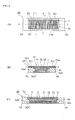
- FIG. 6(A) is a plan view of an air battery according to the sixth embodiment of the present invention
- FIGS. 6(B) and (C) are cross-section views of the air battery taken along line I-I and line II-II of FIG. 6(A) , respectively.
- parts and portions that are the same as or similar to those in the above-mentioned embodiments are designated by the same or similar reference numerals to avoid repeated explanations thereof.
- the air battery A6 has a frame member 60 of rectangular frame shape when viewed in plan such that the cathode constituting member 30, the electrolyte and separator layer 40 and the anode material 50A are placed in the frame member 60.
- the air battery A6 also has a flow path forming member 70 and highly air-permeable seal members 80 and 80
- the flow path forming member 70 is arranged on the conductive fluid-tight air-permeable film 31 of the cathode constituting member 30 and has a plurality of ribs 71 formed at regular intervals and extending in parallel to the direction of air flow ⁇ .
- the flow path forming member 70 has conductivity.
- the highly air-permeable seal members 80 and 80 are disposed on air inlet- and outlet-side surfaces 60b and 60c of the frame member 60 and, more specifically, in center portions of longitudinal-side upper end faces 60a and 60a of the frame member 60 so as to easily allow a flow of air.
- the upper end faces 60a and 60a of the frame member 60, on which the highly air-permeable seal members 80 and 80 are disposed, are made lower in height than the flow path forming member 70. There is thus formed an air flow path between the upper-and lower-side air batteries A6 and A6 when the air batteries A6 and A6 are stacked together.
- FIGS. 7(A) and (B) are a top view and a bottom view of an air battery according to the seventh embodiment of the present invention, respectively; and FIGS. 7(C) and (D) are cross-section views of the air battery taken along line III-III and line IV-IV of FIG. 7(A) , respectively.
- parts and portions that are the same as or similar to those in the above-mentioned embodiments are designated by the same or similar reference numerals to avoid repeated explanations thereof.
- the air battery A7 has an outer frame 90 of ring shape when viewed in plane, an air introduction tube 91 of smaller diameter than the outer frame 90 and a flow path forming member 110.
- the outer frame 90 and the air introduction tube 91 are coaxially arranged about the axis O.
- the contact member 20, the flow path forming member 110, the cathode constituting member 30, the electrolyte and separator layer 40 and the anode material 50 are stacked together and placed in an inner space between the outer frame 90 and the air introduction tube 91.
- the air battery A7 has a highly air-permeable seal member 100 located on an upper end face 90a of the outer frame 90.
- the highly air-permeable seal member 100 has a thick annular shape with a predetermined height and with inner and outer diameters equal to those of the outer frame 90 so as to surround the fluid-tight air-permeable film 31.
- Air flow grooves 101 are made in the highly air-permeable seal member 100 at predetermined angular intervals about the axis O so as to provide air communication between the inside and outside of the outer frame 90.
- the air battery A7 also has a highly air-permeable seal member 100 located on a lower end face 90b of the outer frame 90.
- the highly air-permeable seal member 100 has a thick annular shape with inner and outer diameters equal to those of the outer frame 90.
- Air flow grooves 101 are made in the highly air-permeable seal member 100 at predetermined angular intervals about the axis O so as to provide air communication between the inside and outside of the outer frame 90.
- an upper end face 91a of the air introduction tube 91 is at the same height as the highly air-permeable seal member 100.
- Air introduction grooves 92 are made in the upper end face 91a of the air introduction tube 91 so as to extend along a diameter line across the axis O.
- Air introduction grooves 94 are also made in a lower end face 91b of the air introduction tube 91 so as to extend along a diameter line across the axis O.
- the flow path forming member 110 is arranged on the conductive fluid-tight air-permeable film 31 of the cathode constituting member 30 and has a plurality of ribs formed radially about the axis O so as to allow a smooth flow of air from the air introduction groove 92 to the air flow grooves 101.
Landscapes
- Chemical & Material Sciences (AREA)
- Chemical Kinetics & Catalysis (AREA)
- Electrochemistry (AREA)
- General Chemical & Material Sciences (AREA)
- Engineering & Computer Science (AREA)
- Manufacturing & Machinery (AREA)
- Hybrid Cells (AREA)
- Battery Mounting, Suspending (AREA)
- Connection Of Batteries Or Terminals (AREA)
Abstract
Description
- The present invention relates to an air battery and a battery pack having air batteries stacked together.
- Patent Document 1 discloses the use of air batteries as a so-called battery pack. More specifically, the battery pack of Patent Document 1 has three button-type air batteries vertically connected in series and placed in a metal exterior can, with an insulating sheet interposed between the air batteries and the exterior can, such that the air batteries are insulated from the exterior can by the insulating sheet.
- Each of the air batteries includes: a cathode can formed of a metal material in a bottomed-cylindrical shape with one end open and storing therein an anode active material e.g. zinc and an electrolyte e.g. aqueous potassium hydroxide solution; and an anode cap closing the open end of the cathode can.
- In the battery pack of Patent Document 1, however, the weight ratio of the anode plate (anode cap) is large. This causes unsolved problems such as difficulty in weight reduction and hindrance to size reduction.
- Patent Document 1: Japanese Laid-Open Patent Publication No.
2000-67824 - In view of the foregoing, it is an object of the present invention to provide an air battery with no structural part corresponding to the anode cap so as to achieve not only reduction in weight and size but also reduction in cost. It is also an object of the present invention to provide a battery pack using such an air battery.
- As a solution to the above-mentioned problems, there is provided according to one aspect of the present invention an air battery for use by being stacked in a battery pack, comprising an anode material and a cathode constituting member, wherein the anode material of the air battery is adapted such that at least a part of the anode material of the air battery is brought into direct contact with a cathode constituting member of another air battery adjacent thereto. In this configuration, the air battery can establish electrical conduction between the adjacent air batteries, without the use of the anode material and the structural part corresponding to the anode cap, and achieve not only reduction in weight and size but also reduction in cost.
- It is possible in the present invention to eliminate the need for the structural part corresponding to the conventional anode cap and achieve not only reduction in weight and size but also reduction in cost.
-
-
FIG. 1 is a cross-section view of a battery pack using an air battery according to a first embodiment of the present invention. -
FIG. 2 is a cross-section view of an air battery according to a second embodiment of the present invention. -
FIG. 3 is a cross-section view of an air battery according to a third embodiment of the present invention. -
FIG. 4 is a cross-section view of a stack of two air batteries, each of which is according to a fourth embodiment of the present invention. -
FIG. 5 is a cross-section view of a stack of two air batteries, each of which according to a fifth embodiment of the present invention. -
FIG. 6(A) is a plan view of an air battery according to a sixth embodiment of the present invention; andFIGS. 6(B) and (C) are cross-section views of the air battery taken along line I-I and line II-II ofFIG. 6(A) , respectively. -
FIGS. 7(A) and (B) are a top view and a bottom view of an air battery according to a seventh embodiment of the present invention, respectively; andFIGS. 7(C) and (D) are cross-section views of the air battery taken along line III-III and line IV-IV ofFIG. 7(A) , respectively. - Hereinafter, embodiments of the present invention will be described below with reference to the drawings.
FIG. 1 is a cross-section view of a battery pack using an air battery according to the first embodiment of the present invention.FIG. 2 is a cross-section view of an air battery according to the second embodiment of the present invention. - As shown in
FIG. 1 , the battery pack is exemplified as a battery pack B having three air batteries: two air batteries A1 and A1, each of which is according to the first embodiment of the present invention, and one air battery A0 vertically stacked together. - The air battery A1 according to the first embodiment includes a
frame member 10, acontact member 20, acathode constituting member 30, an electrolyte andseparator layer 40 and ananode material 50. In the first embodiment, theframe member 10 is made of an electrolyte-resistant resin such as polypropylene (PP) or engineering plastic material and exhibits electrical insulation properties. As the material of theframe member 10, there can alternatively be used a fiber-reinforced plastic material (FRP) in which reinforcing fibers such as carbon fibers or glass fibers are mixed to ensure mechanical strength. The use of the electrolyte-resistant resin such as polypropylene (PP) or engineering plastic material leads to weight reduction. It should however be noted that it is essential for theframe member 10 to exhibit electrical insulation properties as mentioned above in the first embodiment. The term "electrolyte" herein refers to an aqueous or non-aqueous solution containing potassium hydroxide (KOH) or chloride as a main component. - In the first embodiment, the
frame member 10 is cylindrical is shape with both ends open. Anengagement portion 10b is provided around the entire inner circumferential edge part of one open end face (upper end face) 10a of theframe member 10 for engagement of the contact member 20 (explained in detail later). -
Air flow holes 11a are made in acircumferential wall 11 of theframe member 10, at a height position facing the after-mentioned fluid-tight air-permeable film 31 and at predetermined angular intervals about the axis O, so as to provide air communication between the inside and outside of thecircumferential wall 11. Theengagement portion 10b is formed as a step with an inner diameter equal to an outer diameter of thecontact member 20 and a height substantially equal to a height of thecontact member 20. - The
contact member 20 is made of a conductive metal material and brought into electrical conduction with the after-mentioned fluid-tight air-permeable film 31 and with the after-mentionedcathode material 32 and into contact with theframe member 10 of the another adjacent (upper-side) air battery A1. - In the first embodiment, the
contact member 20 has a ring shape with an outer diameter engageable in theengagement portion 10b and a height that makes its end face flush with theopen end face 10a of theframe member 10 by engagement of thecontact member 20 in theengagement portion 10b. -
Air flow holes 21a are made in acircumferential wall 21 of thecontact member 20, at a height position facing theair flow holes 11a and at the same angular intervals as theair flow holes 11 a, so as to provide air communication between the inside and outside of thecircumferential wall 21. - In the first embodiment, the
cathode constituting member 30 is provided with a fluid-tight air-permeable film 31, acathode material 32 and acollector 33. Herein, thecathode constituting member 30 has a conductive layer structure containing a catalyst for oxygen reduction reaction of thecathode material 32 and a conduction path forming material such as carbon powder. A binder may also be used to form the catalyst and the carbon powder into a layer shape. - The fluid-tight air-
permeable film 31 exhibits conductivity in addition to fluid tightness and air permeability. The fluid-tight air-permeable film 31 is formed with a plurality of fine pores for gas supply (air supply) to the cathode material and made of a fluoro resin etc. capable of preventing the electrolyte from leaking to the outside. In the first embodiment, the fluid-tight air-permeable film 31 has a circular shape, when viewed in plane, with an outer diameter equal to an inner diameter of thecontact member 20. In other words, the fluid-tight air-permeable film 31 is adapted to cover an outer surface 32a of thecathode material 32. The fluid-tight air-permeable film 31 has the feature of allowing a flow of gas such as air by its air permeability while blocking a flow of fluid by its fluid tightness or water tightness. - The
collector 33 is formed as an apertured conductive body of stainless steel, Cu, Ni, carbon or the like. The aperture rate of thecollector 33 can be set as appropriate depending on the conductivity of thecathode material 32. In the case of using a wire mesh as thecollector 33, for example, the aperture rate of thecollector 33 is set equivalent to 50 to 600 mesh. There can alternatively be used a carbon paper as thecollector 33. - In the first embodiment, the
collector 33 has a circular shape with an outer diameter equal to the inner diameter of thecontact member 20 when viewed in plan. For example, thecollector 33 is in the form of a conductive wire mesh whose apertures are sized to allow a flow of ions therethrough. The arrangement of thecollector 33 leads to improvement in conductivity and mechanical strength. - The
cathode material 32 is a conductive porous material containing a catalyst. For example, thecathode material 32 is in the form of a porous body prepared from a carbon material and a binder resin and carrying therein a catalyst such as manganese dioxide. - The
anode material 50 is a pure metal such as Li, Al, Fe, Zn or Mg or an alloy containing one or more of such metals as a main component and is adapted such that a part or the whole of theanode material 50 is brought into direct contact with thecathode constituting member 30 of the another adjacent air battery A1. In the case of placing the air battery A0 at the lowermost position and stacking two air batteries A1 on the air battery A0 as shown inFIG. 1 , the entire lower surface of theanode material 50 of the upper-side air battery A1 faces the conductive fluid-tight air-permeable film 31 of thecathode constituting member 30 of the lower-side air battery A1 or A0. Accordingly, the upper-side air battery A1 and the lower-side air battery A1 or A0 are electrically conducted and connected in series to each other when at least the part of theanode material 50 of the upper-side air battery A1 is brought into press contact with the fluid-tight air-permeable film 31 of thecathode constituting member 30 of the lower-side air battery A1 or A0 as will be explained later. - In the first embodiment, the
anode material 50 has a plate shape with an outer diameter equal to an inner diameter of theframe member 10 and a height that allows thelower surface 50a of theanode material 50 to be flush with or slightly protrude toward the lower side from thelower end face 10c of theframe member 10. This eliminate the need for a conventionally required collector plate like acollector plate 22 of the lowermost-side air battery A0 ofFIG. 1 . - The air battery A0 is structurally the same as the air battery A1 except that the
collector plate 22 is arranged on thelower end face 10c of theframe member 10. The other parts and portions of the air battery A0 are the same as those of the air battery A1 and thus are designated by the same reference numerals inFIG. 1 to omit repeated explanations thereof. - The
collector plate 22 is made of a conductive material capable of preventing the electrolyte from leaking to the cartridge outside. As such a material, there can be used stainless steel, copper (alloy) or a metal material having a surface coated with a plating of corrosion resistant metal. - Next, the assembling of the above-mentioned air batteries into the battery pack B will be explained below. When the air battery A1 is stacked on the lowermost-side air battery A0, the
upper end face 20a of thecontact member 20 and theupper end face 10a of theframe member 10 of the air battery A0 are brought into contact with thelower end face 10c of theframe member 10 of the air battery A1. - Simultaneously, the
lower surface 50a of theanode material 50 of the air battery A1 is brought into intimate contact with and into electrical conduction with the fluid-tight air-permeable film 31 of the air battery A0. By this, the upper-side air battery A1 and the lower-side air battery A0 are connected in series to each other. Each of these air batteries easily allows a flow of air since the air flow holes 11a and 21a are made in theframe member 10 and thecontact member 20, respectively. - When the another air battery A1 is stacked on this air battery A1, the
upper end face 20a of thecontact member 20 and theupper end face 10a of theframe member 10 of the lower-side air battery A1 are brought into contact with thelower end face 10c of theframe member 10 of the upper-side air battery A1. Simultaneously, thelower surface 50a of theanode material 50 of the upper-side air battery A1 is brought into intimate contact with and into electrical conduction with the fluid-tight air-permeable film 31 of the lower-side air battery A1. By this, the upper-side air battery A1 and the lower-side air battery A0 are connected in series to each other. As in the above case, each of these air batteries easily allows a flow of air since the air flow holes 11 a and 21 a are made in theframe member 10 and thecontact member 20, respectively. - In the above configuration, the conductive fluid-tight air-
permeable film 31 is utilized so as to secure a large contact surface with the anode material. This leads to reduction in electrical resistance at a contact interface between the anode material and the fluid-tight air-permeable film. This also enables monitoring of the degree of wear of the anode material as there occurs a voltage change in response to a change of anode surface area in current-controlled operation. - As explained above, there is no need to use any structural part corresponding to the conventional anode cap for sealing. There is also no need to provide the
collector plate 20 in the air battery A1 as is different from the air battery A0. It is therefore possible to achieve not only reduction in weight and size but also reduction in cost and facilitate battery assembling due to the reduction of parts count. - Next, an air battery according to the second embodiment of the present invention will be explained below with reference to
FIG. 2. FIG. 2 is a cross-section view of the air battery according to the second embodiment of the present invention. In the second embodiment, parts and portions that are the same as or similar to those in the above embodiment are designated by the same or similar reference numerals to avoid repeated explanations thereof. - The air battery A2 according to the second embodiment has a frame member and an anode material that are of different compositions and shapes. The
anode material 50A includes a small-diameter region 50A' made equal in diameter to an inner diameter of theframe member 10A and a large-diameter region 50A" made larger in diameter than the small-diameter region 50A'. - The
frame member 10A is cylindrical in shape with both ends open. Anengagement portion 10b is provided around the entire inner circumferential edge part of one open end face (upper end face) 10a of theframe member 10 for engagement of the conductive fluid-tight air-permeable film 31. - Another
engagement portion 10d is provided around the entire inner circumferential edge part of the other open end face (lower end face) 10c of theframe member 10 for engagement of the large-diameter region 50A" of theanode material 50A. Further, theanode material 50A is adapted such that the entire lower surface of theanode material 50A is brought into direct contact with acathode constituting member 30 of another adjacent air battery A1 and, more specifically, brought into direct contact with a fluid-tight air-permeable film 31 of thecathode constituting member 30 of the another adjacent air battery A1. - In the above configuration, the conductive fluid-tight air-
permeable film 31 is utilized so as to secure a large contact surface with the anode material as in the case of the first embodiment. This leads to reduction in electrical resistance at a contact interface between the anode material and the fluid-tight air-permeable film. This also enables monitoring of the degree of wear of the anode material as there occurs a voltage change in response to a change of anode surface area in current-controlled operation. - An air battery according to the third embodiment of the present invention will be explained below with reference to
FIG. 3. FIG. 3 is a cross-section view of the air battery according to the third embodiment of the present invention. In the third embodiment, parts and portions that are the same as or similar to those in the above-mentioned embodiments are designated by the same or similar reference numerals to avoid repeated explanations thereof. - The air battery A3 according to the third embodiment has a frame member and an anode material that are of different shapes as in the case of the second embodiment. The
anode material 50B has a substantially trapezoidal cross-sectional area gradually increasing from anupper surface 50a to the vicinity of alower surface 50b thereof. Further, theanode material 50B is adapted such that the entire lower surface of theanode material 50A is brought into direct contact with acathode constituting member 30 of another adjacent air battery A3 and, more specifically, brought into direct contact with a fluid-tight air-permeable film 31 of thecathode constituting member 30 of the another adjacent air battery A3. - The
frame member 10B is cylindrical in shape with both ends open. Anengagement portion 10e is provided around the entire inner circumferential edge part of one open end face (lower end face) 10b of theframe member 10 for engagement of theanode material 50B. In the above configuration, it is possible for the air battery A3 to obtain the same effects as those of the air battery A2. - An air battery according to the fourth embodiment of the present invention will be explained below with reference to
FIG. 4. FIG. 4 is a cross-section view of a stack of two air batteries according to the fourth embodiment of the present invention. In the fourth embodiment, parts and portions that are the same as or similar to those in the above-mentioned embodiments are designated by the same or similar reference numerals to avoid repeated explanations thereof. - The air battery A4 according to the fourth embodiment has an
anode material 50A and a conductive fluid-tight air-permeable film 31 formed with an outer diameter D2 larger than an outer diameter D1 of theanode material 50A. This enables the fluid-tight air-permeable film 31, which is larger in size than theanode material 50A, to perform a seal function even when there occurs perforation of theanode material 50A by dissolution during continuous use. - An air battery according to the fifth embodiment of the present invention will be explained below with reference to
FIG. 5. FIG. 5 is a cross-section view of a stack of two air batteries according to the fifth embodiment of the present invention. In the fifth embodiment, parts and portions that are the same as or similar to those in the above-mentioned embodiments are designated by the same or similar reference numerals to avoid repeated explanations thereof. - The air battery A5 according to the fifth embodiment has a conductive fluid-tight air-
permeable film 31 and ananode material 50C adapted to, when the fluid-tight air-permeable film 31 of the air battery A5 is brought into contact with theanode material 50C of the another adjacent air battery A5, form an air flow path for air flow at a contact interface therebetween (as indicated by an arrow). - Although not shown in
FIG. 5 , the air flow path is formed by making a groove in the contact surface (particularly,surface 50") of theanode material 50C or by making a groove in the contact surface of the fluid-tight air-permeable film 31. - The air battery A5 has a
frame member 10C of cylindrical or rectangular shape with both ends open. Herein, the cross-section view ofFIG. 5 is based on the premise that theframe member 10C is rectangular in shape (the same applies to the following). No engagement portions are provided around inner circumferential edge parts of both end faces of theframe member 10. Theanode material 50C has a small-diameter region 50C' made equal in outer diameter to an inner diameter of theframe member 10C and a large-diameter region 50C" ranging in outer diameter between inner and outer diameters of theframe member 10C. - The large-
diameter region 50C" is interposed between the two adjacent air batteries A5 and A5 and, more specifically, between thelower end face 10b of theframe member 10C of the upper-side air battery A5 and theupper end face 10a of theframe member 10C of the lower-side air battery A5 for the formation of the air flow path. - The air battery A5 also has a
collector 33A of the same type as thecollector 33. Thecollector 33A is arranged at an interface between the small-diameter region 50C' and the large-diameter region 50C", that is, at a height position substantially flush with thelower end face 10b of theframe member 10C. - Further, the air battery A5 has a fluid-tight air-
preferable film 31A of higher air permeability than the fluid-tight air-permeable film 31. The fluid-tight air-permeable film 31A is disposed on inlet and outlet of the air flow path. In the fifth embodiment, the fluid-tight air-preferable film 31A has an inner diameter equal to an outer diameter of the fluid-tight air-preferable film 31 and an outer diameter equal to an outer diameter of theframe member 10C. - In the above configuration, the fluid-tight air-
preferable film 31A serves as a fluid sealing member on the inlet and outlet of the air flow path. In a state where theanode material 50C is brought into direct contact with the fluid-tight air-permeable film 31 with the use of no collector plate, there may occur leakage of the electrolyte due to dissolution and perforation of theanode material 50C. Even in such a case, the fluid-tight air-preferable film 31A prevents the electrolyte from leaking through the inlet and outlet of the air flow path. When the two air batteries A5 and A5 are stacked together as shown inFIG. 5 , these upper and lower-side air batteries A5 and A5 are electrically conducted and connected in series to each other by intimate contact of the large-diameter region 50C" of thecollector 50C of the upper-side air battery A5 with the fluid-tight air-permeable film 31 of the lower-side air battery A5. - An air battery according to the sixth embodiment of the present invention will be explained below with reference to
FIG. 6. FIG. 6(A) is a plan view of an air battery according to the sixth embodiment of the present invention; andFIGS. 6(B) and (C) are cross-section views of the air battery taken along line I-I and line II-II ofFIG. 6(A) , respectively. In the sixth embodiment, parts and portions that are the same as or similar to those in the above-mentioned embodiments are designated by the same or similar reference numerals to avoid repeated explanations thereof. - The air battery A6 according to the sixth embodiment has a
frame member 60 of rectangular frame shape when viewed in plan such that thecathode constituting member 30, the electrolyte andseparator layer 40 and theanode material 50A are placed in theframe member 60. The air battery A6 also has a flowpath forming member 70 and highly air-permeable seal members - The flow
path forming member 70 is arranged on the conductive fluid-tight air-permeable film 31 of thecathode constituting member 30 and has a plurality ofribs 71 formed at regular intervals and extending in parallel to the direction of air flow α. In the sixth embodiment, the flowpath forming member 70 has conductivity. The highly air-permeable seal members side surfaces frame member 60 and, more specifically, in center portions of longitudinal-side upper end faces 60a and 60a of theframe member 60 so as to easily allow a flow of air. - The upper end faces 60a and 60a of the
frame member 60, on which the highly air-permeable seal members path forming member 70. There is thus formed an air flow path between the upper-and lower-side air batteries A6 and A6 when the air batteries A6 and A6 are stacked together. - An air battery according to the seventh embodiment of the present invention will be explained below with reference to
FIG. 7. FIGS. 7(A) and (B) are a top view and a bottom view of an air battery according to the seventh embodiment of the present invention, respectively; andFIGS. 7(C) and (D) are cross-section views of the air battery taken along line III-III and line IV-IV ofFIG. 7(A) , respectively. In the seventh embodiment, parts and portions that are the same as or similar to those in the above-mentioned embodiments are designated by the same or similar reference numerals to avoid repeated explanations thereof. - The air battery A7 according to the seventh embodiment has an
outer frame 90 of ring shape when viewed in plane, anair introduction tube 91 of smaller diameter than theouter frame 90 and a flowpath forming member 110. Theouter frame 90 and theair introduction tube 91 are coaxially arranged about the axis O. Thecontact member 20, the flowpath forming member 110, thecathode constituting member 30, the electrolyte andseparator layer 40 and theanode material 50 are stacked together and placed in an inner space between theouter frame 90 and theair introduction tube 91. - Further, the air battery A7 has a highly air-
permeable seal member 100 located on anupper end face 90a of theouter frame 90. The highly air-permeable seal member 100 has a thick annular shape with a predetermined height and with inner and outer diameters equal to those of theouter frame 90 so as to surround the fluid-tight air-permeable film 31.Air flow grooves 101 are made in the highly air-permeable seal member 100 at predetermined angular intervals about the axis O so as to provide air communication between the inside and outside of theouter frame 90. - The air battery A7 also has a highly air-
permeable seal member 100 located on alower end face 90b of theouter frame 90. The highly air-permeable seal member 100 has a thick annular shape with inner and outer diameters equal to those of theouter frame 90.Air flow grooves 101 are made in the highly air-permeable seal member 100 at predetermined angular intervals about the axis O so as to provide air communication between the inside and outside of theouter frame 90. - As shown in
FIG. 7(C) , anupper end face 91a of theair introduction tube 91 is at the same height as the highly air-permeable seal member 100.Air introduction grooves 92 are made in theupper end face 91a of theair introduction tube 91 so as to extend along a diameter line across the axis O.Air introduction grooves 94 are also made in alower end face 91b of theair introduction tube 91 so as to extend along a diameter line across the axis O. - The flow
path forming member 110 is arranged on the conductive fluid-tight air-permeable film 31 of thecathode constituting member 30 and has a plurality of ribs formed radially about the axis O so as to allow a smooth flow of air from theair introduction groove 92 to theair flow grooves 101. - Although the embodiments of the present invention have been described in detail above, the features of the respective embodiments are not limited to the above applications. The feature or features of any one of the embodiments may be applied, with or without modification, to any other one of the embodiments. It is feasible to combine any of the features of the above embodiments.
Claims (7)
- An air battery for use by being stacked in a battery pack, comprising an anode material and a cathode constituting member, wherein the anode material of the air battery is adapted such that at least a part of the anode material of the air battery is brought into direct contact with a cathode constituting member of another air battery adjacent thereto.
- The air battery according to claim 1, wherein the anode material of the air battery has a cross-sectional area gradually or stepwisely increasing from the cathode constituting member of the air battery toward the cathode constituting member of said another air battery.
- The air battery according to claim 1 or 2, wherein the cathode constituting member of the air battery has a fluid-tight air-permeable film brought into contact with an anode material of still another air battery adjacent thereto; and wherein the fluid-tight air-permeable film of the air battery has a surface area larger than that of the anode material of said still another air battery.
- The air battery according to any one of claims 1 to 3, wherein the fluid-tight air-permeable film has conductivity.
- The air battery according to any one of claims 1 to 4, wherein there is an air flow path formed at an interface between the anode material and the fluid-tight air-permeable film; and wherein the air battery comprises another fluid-tight air-permeable film having higher air permeability than that of the fluid-tight air-permeable film of the cathode constituting member and disposed on inlet and outlet of the air flow path.
- The air battery according to any one of claims 1 to 5, wherein the air battery comprises a frame member formed with air flow holes for air supply to the fluid-tight air-permeable film.
- A battery pack having a plurality of air batteries stacked together, wherein each of the air batteries is the air battery according to any one of claims 1 to 6.
Applications Claiming Priority (3)
| Application Number | Priority Date | Filing Date | Title |
|---|---|---|---|
| JP2012012966 | 2012-01-25 | ||
| JP2013007478A JP6056496B2 (en) | 2012-01-25 | 2013-01-18 | Air battery and battery pack using the same |
| PCT/JP2013/051084 WO2013111702A1 (en) | 2012-01-25 | 2013-01-21 | Air battery and battery pack using same |
Publications (3)
| Publication Number | Publication Date |
|---|---|
| EP2808937A1 true EP2808937A1 (en) | 2014-12-03 |
| EP2808937A4 EP2808937A4 (en) | 2015-08-05 |
| EP2808937B1 EP2808937B1 (en) | 2019-01-09 |
Family
ID=48873422
Family Applications (1)
| Application Number | Title | Priority Date | Filing Date |
|---|---|---|---|
| EP13741397.7A Active EP2808937B1 (en) | 2012-01-25 | 2013-01-21 | Air battery and battery pack using same |
Country Status (6)
| Country | Link |
|---|---|
| US (1) | US9502741B2 (en) |
| EP (1) | EP2808937B1 (en) |
| JP (1) | JP6056496B2 (en) |
| CN (1) | CN104067441B (en) |
| TW (1) | TWI504044B (en) |
| WO (1) | WO2013111702A1 (en) |
Cited By (1)
| Publication number | Priority date | Publication date | Assignee | Title |
|---|---|---|---|---|
| CN113745730A (en) * | 2021-08-03 | 2021-12-03 | 西安交通大学 | A button-type metal-air fuel cell stack |
Families Citing this family (6)
| Publication number | Priority date | Publication date | Assignee | Title |
|---|---|---|---|---|
| JP6437797B2 (en) * | 2014-11-18 | 2018-12-12 | シャープ株式会社 | Metal-air battery and metal-air battery pack |
| WO2018014927A1 (en) * | 2016-07-18 | 2018-01-25 | Bayerische Motoren Werke Aktiengesellschaft | Metal/oxygen battery |
| CN106684392B (en) * | 2016-11-21 | 2019-08-02 | 深圳海能动力控股有限公司 | Cathode air electrode, water power generation metal-air battery and preparation method |
| KR102429170B1 (en) * | 2017-09-04 | 2022-08-03 | 현대자동차주식회사 | Lithium air battery |
| US11145924B2 (en) * | 2017-10-09 | 2021-10-12 | Prologium Technology Co., Ltd. | Battery structure |
| CN111326831B (en) * | 2018-12-14 | 2021-09-28 | 中国科学院大连化学物理研究所 | Metal-air battery pack or single battery |
Family Cites Families (13)
| Publication number | Priority date | Publication date | Assignee | Title |
|---|---|---|---|---|
| JPS5723479A (en) * | 1980-07-17 | 1982-02-06 | Yuasa Battery Co Ltd | Dry type air cell |
| JPS57121080U (en) * | 1981-01-22 | 1982-07-27 | ||
| US4988581A (en) * | 1989-07-19 | 1991-01-29 | Alcan International Limited | Metal-air bipolar cell unit |
| JP2000067937A (en) | 1998-08-19 | 2000-03-03 | Sony Corp | Air battery and battery pack using this air battery |
| JP2000067824A (en) | 1998-08-20 | 2000-03-03 | Sony Corp | Battery pack |
| CN2365765Y (en) | 1999-03-18 | 2000-02-23 | 孙法炯 | Button type metal air cell |
| US6921606B2 (en) * | 2002-04-16 | 2005-07-26 | Gore Enterprise Holdings, Inc. | Composite films for electrochemical devices |
| US20040157101A1 (en) * | 2003-02-11 | 2004-08-12 | Smedley Stuart I. | Fuel cell electrode assembly |
| CN102625960A (en) * | 2009-06-30 | 2012-08-01 | 雷沃尔特科技有限公司 | Metal-air flow battery |
| JP5721329B2 (en) | 2010-01-18 | 2015-05-20 | 住友化学株式会社 | Air battery, air battery stack |
| US20120021303A1 (en) * | 2010-07-21 | 2012-01-26 | Steven Amendola | Electrically rechargeable, metal-air battery systems and methods |
| JP6020896B2 (en) * | 2011-09-15 | 2016-11-02 | 日産自動車株式会社 | Assembled battery |
| JP6011799B2 (en) * | 2012-01-27 | 2016-10-19 | 日産自動車株式会社 | Assembled battery |
-
2013
- 2013-01-18 JP JP2013007478A patent/JP6056496B2/en active Active
- 2013-01-21 US US14/373,935 patent/US9502741B2/en active Active
- 2013-01-21 CN CN201380006486.3A patent/CN104067441B/en active Active
- 2013-01-21 EP EP13741397.7A patent/EP2808937B1/en active Active
- 2013-01-21 WO PCT/JP2013/051084 patent/WO2013111702A1/en not_active Ceased
- 2013-01-25 TW TW102102914A patent/TWI504044B/en active
Cited By (2)
| Publication number | Priority date | Publication date | Assignee | Title |
|---|---|---|---|---|
| CN113745730A (en) * | 2021-08-03 | 2021-12-03 | 西安交通大学 | A button-type metal-air fuel cell stack |
| CN113745730B (en) * | 2021-08-03 | 2022-07-12 | 西安交通大学 | Button type metal-air fuel cell stack |
Also Published As
| Publication number | Publication date |
|---|---|
| CN104067441B (en) | 2017-03-08 |
| WO2013111702A1 (en) | 2013-08-01 |
| TWI504044B (en) | 2015-10-11 |
| EP2808937A4 (en) | 2015-08-05 |
| EP2808937B1 (en) | 2019-01-09 |
| CN104067441A (en) | 2014-09-24 |
| JP2013175445A (en) | 2013-09-05 |
| TW201332198A (en) | 2013-08-01 |
| JP6056496B2 (en) | 2017-01-11 |
| US9502741B2 (en) | 2016-11-22 |
| US20150037693A1 (en) | 2015-02-05 |
Similar Documents
| Publication | Publication Date | Title |
|---|---|---|
| EP2808937A1 (en) | Air battery and battery pack using same | |
| EP2808938B1 (en) | Battery pack | |
| CN111937187B (en) | Cylindrical battery | |
| US20190221824A1 (en) | Non-aqueous electrolyte secondary battery | |
| EP2824755B1 (en) | Air battery | |
| US20140087217A1 (en) | Battery cell having a click spring area integrated into the housing coer plate | |
| JP6345763B2 (en) | Battery case and battery | |
| EP4258434A1 (en) | Cylindrical secondary battery | |
| CN114762180B (en) | Sealed battery | |
| JP7410880B2 (en) | cylindrical battery | |
| KR20220040647A (en) | Jig for charging and discharging a battery cell | |
| US20180301672A1 (en) | Sealing body for cylindrical batteries, and cylindrical battery using same | |
| EP4120447A1 (en) | Hermetically sealed battery | |
| JP2023070239A (en) | battery case and battery | |
| KR101174919B1 (en) | Lithium rechargeable battery | |
| KR102295591B1 (en) | Secondary battery | |
| US9966643B2 (en) | Battery cell having air electrode assembly bonded to can and method of manufacture | |
| EP4661147A1 (en) | Cylindrical non-aqueous electrolyte secondary battery | |
| US20260081294A1 (en) | Case for secondary battery and secondary battery including same | |
| KR20260037942A (en) | Secondary battery including vent plate and method for manufacturing same | |
| CN118476093A (en) | Cylindrical battery | |
| KR20260038072A (en) | Secondary battery including vent plate and method for manufacturing same | |
| JP2022069082A (en) | Gasket and battery |
Legal Events
| Date | Code | Title | Description |
|---|---|---|---|
| PUAI | Public reference made under article 153(3) epc to a published international application that has entered the european phase |
Free format text: ORIGINAL CODE: 0009012 |
|
| 17P | Request for examination filed |
Effective date: 20140709 |
|
| AK | Designated contracting states |
Kind code of ref document: A1 Designated state(s): AL AT BE BG CH CY CZ DE DK EE ES FI FR GB GR HR HU IE IS IT LI LT LU LV MC MK MT NL NO PL PT RO RS SE SI SK SM TR |
|
| DAX | Request for extension of the european patent (deleted) | ||
| RA4 | Supplementary search report drawn up and despatched (corrected) |
Effective date: 20150703 |
|
| RIC1 | Information provided on ipc code assigned before grant |
Ipc: H01M 2/14 20060101ALI20150629BHEP Ipc: H01M 12/06 20060101AFI20150629BHEP Ipc: H01M 2/02 20060101ALI20150629BHEP |
|
| STAA | Information on the status of an ep patent application or granted ep patent |
Free format text: STATUS: EXAMINATION IS IN PROGRESS |
|
| 17Q | First examination report despatched |
Effective date: 20180615 |
|
| REG | Reference to a national code |
Ref country code: DE Ref legal event code: R079 Ref document number: 602013049561 Country of ref document: DE Free format text: PREVIOUS MAIN CLASS: H01M0012060000 Ipc: H01M0002020000 |
|
| GRAP | Despatch of communication of intention to grant a patent |
Free format text: ORIGINAL CODE: EPIDOSNIGR1 |
|
| STAA | Information on the status of an ep patent application or granted ep patent |
Free format text: STATUS: GRANT OF PATENT IS INTENDED |
|
| RIC1 | Information provided on ipc code assigned before grant |
Ipc: H01M 2/02 20060101AFI20180831BHEP Ipc: H01M 12/08 20060101ALI20180831BHEP Ipc: H01M 12/06 20060101ALI20180831BHEP Ipc: H01M 2/14 20060101ALI20180831BHEP |
|
| INTG | Intention to grant announced |
Effective date: 20180925 |
|
| RIN1 | Information on inventor provided before grant (corrected) |
Inventor name: TSUKADA, YOSHIKO Inventor name: IRITSUKI, KEITA Inventor name: HIMENO, TOMOKATSU Inventor name: MIYAZAWA, ATSUSHI |
|
| GRAS | Grant fee paid |
Free format text: ORIGINAL CODE: EPIDOSNIGR3 |
|
| GRAA | (expected) grant |
Free format text: ORIGINAL CODE: 0009210 |
|
| STAA | Information on the status of an ep patent application or granted ep patent |
Free format text: STATUS: THE PATENT HAS BEEN GRANTED |
|
| AK | Designated contracting states |
Kind code of ref document: B1 Designated state(s): AL AT BE BG CH CY CZ DE DK EE ES FI FR GB GR HR HU IE IS IT LI LT LU LV MC MK MT NL NO PL PT RO RS SE SI SK SM TR |
|
| REG | Reference to a national code |
Ref country code: GB Ref legal event code: FG4D |
|
| REG | Reference to a national code |
Ref country code: CH Ref legal event code: EP Ref country code: AT Ref legal event code: REF Ref document number: 1088421 Country of ref document: AT Kind code of ref document: T Effective date: 20190115 |
|
| REG | Reference to a national code |
Ref country code: DE Ref legal event code: R096 Ref document number: 602013049561 Country of ref document: DE |
|
| REG | Reference to a national code |
Ref country code: IE Ref legal event code: FG4D |
|
| REG | Reference to a national code |
Ref country code: NL Ref legal event code: MP Effective date: 20190109 |
|
| REG | Reference to a national code |
Ref country code: LT Ref legal event code: MG4D |
|
| PG25 | Lapsed in a contracting state [announced via postgrant information from national office to epo] |
Ref country code: NL Free format text: LAPSE BECAUSE OF FAILURE TO SUBMIT A TRANSLATION OF THE DESCRIPTION OR TO PAY THE FEE WITHIN THE PRESCRIBED TIME-LIMIT Effective date: 20190109 |
|
| REG | Reference to a national code |
Ref country code: AT Ref legal event code: MK05 Ref document number: 1088421 Country of ref document: AT Kind code of ref document: T Effective date: 20190109 |
|
| PG25 | Lapsed in a contracting state [announced via postgrant information from national office to epo] |
Ref country code: ES Free format text: LAPSE BECAUSE OF FAILURE TO SUBMIT A TRANSLATION OF THE DESCRIPTION OR TO PAY THE FEE WITHIN THE PRESCRIBED TIME-LIMIT Effective date: 20190109 Ref country code: LT Free format text: LAPSE BECAUSE OF FAILURE TO SUBMIT A TRANSLATION OF THE DESCRIPTION OR TO PAY THE FEE WITHIN THE PRESCRIBED TIME-LIMIT Effective date: 20190109 Ref country code: PL Free format text: LAPSE BECAUSE OF FAILURE TO SUBMIT A TRANSLATION OF THE DESCRIPTION OR TO PAY THE FEE WITHIN THE PRESCRIBED TIME-LIMIT Effective date: 20190109 Ref country code: FI Free format text: LAPSE BECAUSE OF FAILURE TO SUBMIT A TRANSLATION OF THE DESCRIPTION OR TO PAY THE FEE WITHIN THE PRESCRIBED TIME-LIMIT Effective date: 20190109 Ref country code: NO Free format text: LAPSE BECAUSE OF FAILURE TO SUBMIT A TRANSLATION OF THE DESCRIPTION OR TO PAY THE FEE WITHIN THE PRESCRIBED TIME-LIMIT Effective date: 20190409 Ref country code: PT Free format text: LAPSE BECAUSE OF FAILURE TO SUBMIT A TRANSLATION OF THE DESCRIPTION OR TO PAY THE FEE WITHIN THE PRESCRIBED TIME-LIMIT Effective date: 20190509 Ref country code: SE Free format text: LAPSE BECAUSE OF FAILURE TO SUBMIT A TRANSLATION OF THE DESCRIPTION OR TO PAY THE FEE WITHIN THE PRESCRIBED TIME-LIMIT Effective date: 20190109 |
|
| PG25 | Lapsed in a contracting state [announced via postgrant information from national office to epo] |
Ref country code: HR Free format text: LAPSE BECAUSE OF FAILURE TO SUBMIT A TRANSLATION OF THE DESCRIPTION OR TO PAY THE FEE WITHIN THE PRESCRIBED TIME-LIMIT Effective date: 20190109 Ref country code: LV Free format text: LAPSE BECAUSE OF FAILURE TO SUBMIT A TRANSLATION OF THE DESCRIPTION OR TO PAY THE FEE WITHIN THE PRESCRIBED TIME-LIMIT Effective date: 20190109 Ref country code: IS Free format text: LAPSE BECAUSE OF FAILURE TO SUBMIT A TRANSLATION OF THE DESCRIPTION OR TO PAY THE FEE WITHIN THE PRESCRIBED TIME-LIMIT Effective date: 20190509 Ref country code: BG Free format text: LAPSE BECAUSE OF FAILURE TO SUBMIT A TRANSLATION OF THE DESCRIPTION OR TO PAY THE FEE WITHIN THE PRESCRIBED TIME-LIMIT Effective date: 20190409 Ref country code: RS Free format text: LAPSE BECAUSE OF FAILURE TO SUBMIT A TRANSLATION OF THE DESCRIPTION OR TO PAY THE FEE WITHIN THE PRESCRIBED TIME-LIMIT Effective date: 20190109 Ref country code: GR Free format text: LAPSE BECAUSE OF FAILURE TO SUBMIT A TRANSLATION OF THE DESCRIPTION OR TO PAY THE FEE WITHIN THE PRESCRIBED TIME-LIMIT Effective date: 20190410 |
|
| REG | Reference to a national code |
Ref country code: CH Ref legal event code: PL |
|
| PG25 | Lapsed in a contracting state [announced via postgrant information from national office to epo] |
Ref country code: LU Free format text: LAPSE BECAUSE OF NON-PAYMENT OF DUE FEES Effective date: 20190121 |
|
| REG | Reference to a national code |
Ref country code: DE Ref legal event code: R097 Ref document number: 602013049561 Country of ref document: DE |
|
| REG | Reference to a national code |
Ref country code: BE Ref legal event code: MM Effective date: 20190131 |
|
| REG | Reference to a national code |
Ref country code: IE Ref legal event code: MM4A |
|
| PG25 | Lapsed in a contracting state [announced via postgrant information from national office to epo] |
Ref country code: RO Free format text: LAPSE BECAUSE OF FAILURE TO SUBMIT A TRANSLATION OF THE DESCRIPTION OR TO PAY THE FEE WITHIN THE PRESCRIBED TIME-LIMIT Effective date: 20190109 Ref country code: SK Free format text: LAPSE BECAUSE OF FAILURE TO SUBMIT A TRANSLATION OF THE DESCRIPTION OR TO PAY THE FEE WITHIN THE PRESCRIBED TIME-LIMIT Effective date: 20190109 Ref country code: CZ Free format text: LAPSE BECAUSE OF FAILURE TO SUBMIT A TRANSLATION OF THE DESCRIPTION OR TO PAY THE FEE WITHIN THE PRESCRIBED TIME-LIMIT Effective date: 20190109 Ref country code: MC Free format text: LAPSE BECAUSE OF FAILURE TO SUBMIT A TRANSLATION OF THE DESCRIPTION OR TO PAY THE FEE WITHIN THE PRESCRIBED TIME-LIMIT Effective date: 20190109 Ref country code: AL Free format text: LAPSE BECAUSE OF FAILURE TO SUBMIT A TRANSLATION OF THE DESCRIPTION OR TO PAY THE FEE WITHIN THE PRESCRIBED TIME-LIMIT Effective date: 20190109 Ref country code: DK Free format text: LAPSE BECAUSE OF FAILURE TO SUBMIT A TRANSLATION OF THE DESCRIPTION OR TO PAY THE FEE WITHIN THE PRESCRIBED TIME-LIMIT Effective date: 20190109 Ref country code: EE Free format text: LAPSE BECAUSE OF FAILURE TO SUBMIT A TRANSLATION OF THE DESCRIPTION OR TO PAY THE FEE WITHIN THE PRESCRIBED TIME-LIMIT Effective date: 20190109 Ref country code: AT Free format text: LAPSE BECAUSE OF FAILURE TO SUBMIT A TRANSLATION OF THE DESCRIPTION OR TO PAY THE FEE WITHIN THE PRESCRIBED TIME-LIMIT Effective date: 20190109 Ref country code: IT Free format text: LAPSE BECAUSE OF FAILURE TO SUBMIT A TRANSLATION OF THE DESCRIPTION OR TO PAY THE FEE WITHIN THE PRESCRIBED TIME-LIMIT Effective date: 20190109 |
|
| PLBE | No opposition filed within time limit |
Free format text: ORIGINAL CODE: 0009261 |
|
| STAA | Information on the status of an ep patent application or granted ep patent |
Free format text: STATUS: NO OPPOSITION FILED WITHIN TIME LIMIT |
|
| PG25 | Lapsed in a contracting state [announced via postgrant information from national office to epo] |
Ref country code: BE Free format text: LAPSE BECAUSE OF NON-PAYMENT OF DUE FEES Effective date: 20190131 Ref country code: SM Free format text: LAPSE BECAUSE OF FAILURE TO SUBMIT A TRANSLATION OF THE DESCRIPTION OR TO PAY THE FEE WITHIN THE PRESCRIBED TIME-LIMIT Effective date: 20190109 |
|
| 26N | No opposition filed |
Effective date: 20191010 |
|
| PG25 | Lapsed in a contracting state [announced via postgrant information from national office to epo] |
Ref country code: LI Free format text: LAPSE BECAUSE OF NON-PAYMENT OF DUE FEES Effective date: 20190131 Ref country code: CH Free format text: LAPSE BECAUSE OF NON-PAYMENT OF DUE FEES Effective date: 20190131 |
|
| PG25 | Lapsed in a contracting state [announced via postgrant information from national office to epo] |
Ref country code: IE Free format text: LAPSE BECAUSE OF NON-PAYMENT OF DUE FEES Effective date: 20190121 |
|
| PG25 | Lapsed in a contracting state [announced via postgrant information from national office to epo] |
Ref country code: SI Free format text: LAPSE BECAUSE OF FAILURE TO SUBMIT A TRANSLATION OF THE DESCRIPTION OR TO PAY THE FEE WITHIN THE PRESCRIBED TIME-LIMIT Effective date: 20190109 |
|
| PG25 | Lapsed in a contracting state [announced via postgrant information from national office to epo] |
Ref country code: TR Free format text: LAPSE BECAUSE OF FAILURE TO SUBMIT A TRANSLATION OF THE DESCRIPTION OR TO PAY THE FEE WITHIN THE PRESCRIBED TIME-LIMIT Effective date: 20190109 |
|
| PG25 | Lapsed in a contracting state [announced via postgrant information from national office to epo] |
Ref country code: MT Free format text: LAPSE BECAUSE OF NON-PAYMENT OF DUE FEES Effective date: 20190121 |
|
| REG | Reference to a national code |
Ref country code: DE Ref legal event code: R079 Ref document number: 602013049561 Country of ref document: DE Free format text: PREVIOUS MAIN CLASS: H01M0002020000 Ipc: H01M0050100000 |
|
| PG25 | Lapsed in a contracting state [announced via postgrant information from national office to epo] |
Ref country code: CY Free format text: LAPSE BECAUSE OF FAILURE TO SUBMIT A TRANSLATION OF THE DESCRIPTION OR TO PAY THE FEE WITHIN THE PRESCRIBED TIME-LIMIT Effective date: 20190109 |
|
| PG25 | Lapsed in a contracting state [announced via postgrant information from national office to epo] |
Ref country code: HU Free format text: LAPSE BECAUSE OF FAILURE TO SUBMIT A TRANSLATION OF THE DESCRIPTION OR TO PAY THE FEE WITHIN THE PRESCRIBED TIME-LIMIT; INVALID AB INITIO Effective date: 20130121 |
|
| PG25 | Lapsed in a contracting state [announced via postgrant information from national office to epo] |
Ref country code: MK Free format text: LAPSE BECAUSE OF FAILURE TO SUBMIT A TRANSLATION OF THE DESCRIPTION OR TO PAY THE FEE WITHIN THE PRESCRIBED TIME-LIMIT Effective date: 20190109 |
|
| PGFP | Annual fee paid to national office [announced via postgrant information from national office to epo] |
Ref country code: GB Payment date: 20251217 Year of fee payment: 14 |
|
| PGFP | Annual fee paid to national office [announced via postgrant information from national office to epo] |
Ref country code: FR Payment date: 20251217 Year of fee payment: 14 |
|
| PGFP | Annual fee paid to national office [announced via postgrant information from national office to epo] |
Ref country code: DE Payment date: 20251217 Year of fee payment: 14 |