EP2808423A1 - Dry etching method, dry etching apparatus, metal film, and device including the metal film - Google Patents
Dry etching method, dry etching apparatus, metal film, and device including the metal film Download PDFInfo
- Publication number
- EP2808423A1 EP2808423A1 EP14001853.2A EP14001853A EP2808423A1 EP 2808423 A1 EP2808423 A1 EP 2808423A1 EP 14001853 A EP14001853 A EP 14001853A EP 2808423 A1 EP2808423 A1 EP 2808423A1
- Authority
- EP
- European Patent Office
- Prior art keywords
- etching
- metal film
- diketone
- additive
- chamber
- Prior art date
- Legal status (The legal status is an assumption and is not a legal conclusion. Google has not performed a legal analysis and makes no representation as to the accuracy of the status listed.)
- Granted
Links
Images
Classifications
-
- H—ELECTRICITY
- H10—SEMICONDUCTOR DEVICES; ELECTRIC SOLID-STATE DEVICES NOT OTHERWISE PROVIDED FOR
- H10P—GENERIC PROCESSES OR APPARATUS FOR THE MANUFACTURE OR TREATMENT OF DEVICES COVERED BY CLASS H10
- H10P50/00—Etching of wafers, substrates or parts of devices
- H10P50/20—Dry etching; Plasma etching; Reactive-ion etching
- H10P50/24—Dry etching; Plasma etching; Reactive-ion etching of semiconductor materials
- H10P50/242—Dry etching; Plasma etching; Reactive-ion etching of semiconductor materials of Group IV materials
-
- H—ELECTRICITY
- H10—SEMICONDUCTOR DEVICES; ELECTRIC SOLID-STATE DEVICES NOT OTHERWISE PROVIDED FOR
- H10P—GENERIC PROCESSES OR APPARATUS FOR THE MANUFACTURE OR TREATMENT OF DEVICES COVERED BY CLASS H10
- H10P50/00—Etching of wafers, substrates or parts of devices
- H10P50/20—Dry etching; Plasma etching; Reactive-ion etching
- H10P50/26—Dry etching; Plasma etching; Reactive-ion etching of conductive or resistive materials
- H10P50/264—Dry etching; Plasma etching; Reactive-ion etching of conductive or resistive materials by chemical means
- H10P50/266—Dry etching; Plasma etching; Reactive-ion etching of conductive or resistive materials by chemical means by vapour etching only
-
- C—CHEMISTRY; METALLURGY
- C23—COATING METALLIC MATERIAL; COATING MATERIAL WITH METALLIC MATERIAL; CHEMICAL SURFACE TREATMENT; DIFFUSION TREATMENT OF METALLIC MATERIAL; COATING BY VACUUM EVAPORATION, BY SPUTTERING, BY ION IMPLANTATION OR BY CHEMICAL VAPOUR DEPOSITION, IN GENERAL; INHIBITING CORROSION OF METALLIC MATERIAL OR INCRUSTATION IN GENERAL
- C23F—NON-MECHANICAL REMOVAL OF METALLIC MATERIAL FROM SURFACE; INHIBITING CORROSION OF METALLIC MATERIAL OR INCRUSTATION IN GENERAL; MULTI-STEP PROCESSES FOR SURFACE TREATMENT OF METALLIC MATERIAL INVOLVING AT LEAST ONE PROCESS PROVIDED FOR IN CLASS C23 AND AT LEAST ONE PROCESS COVERED BY SUBCLASS C21D OR C22F OR CLASS C25
- C23F1/00—Etching metallic material by chemical means
- C23F1/10—Etching compositions
- C23F1/12—Gaseous compositions
-
- C—CHEMISTRY; METALLURGY
- C23—COATING METALLIC MATERIAL; COATING MATERIAL WITH METALLIC MATERIAL; CHEMICAL SURFACE TREATMENT; DIFFUSION TREATMENT OF METALLIC MATERIAL; COATING BY VACUUM EVAPORATION, BY SPUTTERING, BY ION IMPLANTATION OR BY CHEMICAL VAPOUR DEPOSITION, IN GENERAL; INHIBITING CORROSION OF METALLIC MATERIAL OR INCRUSTATION IN GENERAL
- C23F—NON-MECHANICAL REMOVAL OF METALLIC MATERIAL FROM SURFACE; INHIBITING CORROSION OF METALLIC MATERIAL OR INCRUSTATION IN GENERAL; MULTI-STEP PROCESSES FOR SURFACE TREATMENT OF METALLIC MATERIAL INVOLVING AT LEAST ONE PROCESS PROVIDED FOR IN CLASS C23 AND AT LEAST ONE PROCESS COVERED BY SUBCLASS C21D OR C22F OR CLASS C25
- C23F4/00—Processes for removing metallic material from surfaces, not provided for in group C23F1/00 or C23F3/00
-
- C—CHEMISTRY; METALLURGY
- C23—COATING METALLIC MATERIAL; COATING MATERIAL WITH METALLIC MATERIAL; CHEMICAL SURFACE TREATMENT; DIFFUSION TREATMENT OF METALLIC MATERIAL; COATING BY VACUUM EVAPORATION, BY SPUTTERING, BY ION IMPLANTATION OR BY CHEMICAL VAPOUR DEPOSITION, IN GENERAL; INHIBITING CORROSION OF METALLIC MATERIAL OR INCRUSTATION IN GENERAL
- C23F—NON-MECHANICAL REMOVAL OF METALLIC MATERIAL FROM SURFACE; INHIBITING CORROSION OF METALLIC MATERIAL OR INCRUSTATION IN GENERAL; MULTI-STEP PROCESSES FOR SURFACE TREATMENT OF METALLIC MATERIAL INVOLVING AT LEAST ONE PROCESS PROVIDED FOR IN CLASS C23 AND AT LEAST ONE PROCESS COVERED BY SUBCLASS C21D OR C22F OR CLASS C25
- C23F4/00—Processes for removing metallic material from surfaces, not provided for in group C23F1/00 or C23F3/00
- C23F4/02—Processes for removing metallic material from surfaces, not provided for in group C23F1/00 or C23F3/00 by evaporation
-
- H—ELECTRICITY
- H10—SEMICONDUCTOR DEVICES; ELECTRIC SOLID-STATE DEVICES NOT OTHERWISE PROVIDED FOR
- H10P—GENERIC PROCESSES OR APPARATUS FOR THE MANUFACTURE OR TREATMENT OF DEVICES COVERED BY CLASS H10
- H10P72/00—Handling or holding of wafers, substrates or devices during manufacture or treatment thereof
- H10P72/04—Apparatus for manufacture or treatment
- H10P72/0402—Apparatus for fluid treatment
- H10P72/0406—Apparatus for fluid treatment for cleaning followed by drying, rinsing, stripping, blasting or the like
- H10P72/0408—Apparatus for fluid treatment for cleaning followed by drying, rinsing, stripping, blasting or the like for drying
-
- H—ELECTRICITY
- H10—SEMICONDUCTOR DEVICES; ELECTRIC SOLID-STATE DEVICES NOT OTHERWISE PROVIDED FOR
- H10P—GENERIC PROCESSES OR APPARATUS FOR THE MANUFACTURE OR TREATMENT OF DEVICES COVERED BY CLASS H10
- H10P72/00—Handling or holding of wafers, substrates or devices during manufacture or treatment thereof
- H10P72/04—Apparatus for manufacture or treatment
- H10P72/0402—Apparatus for fluid treatment
- H10P72/0418—Apparatus for fluid treatment for etching
- H10P72/0421—Apparatus for fluid treatment for etching for drying etching
-
- H—ELECTRICITY
- H10—SEMICONDUCTOR DEVICES; ELECTRIC SOLID-STATE DEVICES NOT OTHERWISE PROVIDED FOR
- H10W—GENERIC PACKAGES, INTERCONNECTIONS, CONNECTORS OR OTHER CONSTRUCTIONAL DETAILS OF DEVICES COVERED BY CLASS H10
- H10W20/00—Interconnections in chips, wafers or substrates
- H10W20/01—Manufacture or treatment
- H10W20/071—Manufacture or treatment of dielectric parts thereof
- H10W20/093—Manufacture or treatment of dielectric parts thereof by modifying materials of the dielectric parts
- H10W20/095—Manufacture or treatment of dielectric parts thereof by modifying materials of the dielectric parts by irradiating with electromagnetic or particle radiation
Definitions
- the present invention relates to a dry etching method performed on a metal film by use of etching gas containing ⁇ -diketone, a dry etching apparatus for realizing the method, a metal film etched by the method, and a device including the metal film.
- a metal film is formed of a metal gate material, an electrode material or a magnetic material on a surface of a substrate by use of a film formation apparatus.
- metal films or the like are unnecessarily attached to surfaces inside the film formation apparatus, for example, surfaces of a stage for holding and heating the substrate located in a film formation chamber of the film formation apparatus, surfaces of an electrode used to generate plasma, surfaces of other jigs, inner walls of the chamber, inner walls of tubes connected to the inner walls of the chamber, and the like. Such unnecessary metal films or the like need to be removed.
- a known method for removing the unnecessary metal film or the like in the state where the chamber is still heated after the substrate having a film formed thereon is removed from the chamber is a dry cleaning method using ⁇ -diketone.
- ⁇ -diketone such as, for example, hexafluoroacetylacetone (hereinafter, referred to simply as HFAc) is put into contact with a metal oxide film, and the metal oxide film is brought into a reaction and is removed in the form of a metal complex (for example, Patent Literature 1).
- the process of etching a metal film by use of complexed gas such as ⁇ -diketone or the like can be divided into three reaction steps from the point of view of chemical reaction, namely, the step of oxidizing the metal film to generate a metal oxide (oxidation step), the step of complexing the metal oxide to form a metal complex (complexation step), and the step of sublimating the formed metal complex (sublimation step). Since an organic metal complex formed by a reaction with ⁇ -diketone has a high vapor pressure, unnecessary deposited substances containing the metal film can be easily removed along with the sublimation of the organic metal complex.
- complexed gas such as ⁇ -diketone or the like
- Patent Literature 4 discloses a method for processing a metal film formed at a surface of a processing target by use of a gas cluster beam. According to this method, mixed gas of oxide gas for oxidizing an element contained in a metal film to form an oxide, complexed gas that is reacted with an oxide to form an organic metal complex, and rare gas is adiabatically expanded to form a gas cluster beam; and the gas cluster beam is caused to impinge on the metal film of the processing target to etch the metal film.
- Patent Literature 4 also describes that oxide gas such as O 2 , H 2 O, H 2 O 2 or the like is incorporated into the complexed gas used to form the organic metal complex.
- Patent Literature 5 discloses an etching method including an etching step of etching a thin film formed on a substrate by use of etching gas containing ⁇ -diketone to expose a surface of the substrate. It is described that according to this method, H 2 O is incorporated into the etching gas containing ⁇ -diketone such that H 2 O has a concentration of 2000 ppm or less in order to increase the etching rate.
- an oxidizer such as O 2 , H 2 O or the like is incorporated into complexed gas to proceed with an oxidation step, which is immediately followed by a complexation step and a sublimation step. In this manner, etching on the metal film proceeds (Patent Literature 2 and Patent Literature 3).
- the structure of the complex to be formed varies in accordance with the type of metal to be etched. It has been found that with the conventional method, metal films of various structures are not necessarily etched equally. Especially, a metal material such as Co, Fe, Zn, Mn, Hf or the like, which forms a penta- or hexa-coordinated complex with ⁇ -diketone, does not allow a complexation reaction to proceed easily and thus does not provide a sufficiently high etching rate.
- a metal material such as Co, Fe, Zn, Mn, Hf or the like, which forms a penta- or hexa-coordinated complex with ⁇ -diketone
- the present invention made in light of the above-described problem has an object of providing a dry etching method for etching, with increased etching rate, a film of a metal material that forms a penta- or hexa-coordinated complex structure with ⁇ -diketone.
- the present invention also has an object of providing a dry etching apparatus for realizing the method, a metal film etched by the method, and a device including the metal film.
- the present inventors paid attention to a structure of a metal complex that forms a complex with ⁇ -diketone, and found that the etching reaction performed on a film of a metal that forms a penta- or hexa-coordinated complex structure with ⁇ -diketone is allowed to proceed in an improved manner by incorporating a certain amount of specific additive to ⁇ -diketone.
- the present invention has been made.
- the present invention is directed to a dry etching method for etching a metal film formed on a substrate by use of etching gas containing ⁇ -diketone, wherein the metal film contains at least one metal material that forms a penta- or hexa-coordinated complex structure with ⁇ -diketone; the etching gas containing ⁇ -diketone contains at least one additive among H 2 O or H 2 O 2 ; and the additive is contained at a volume concentration of 1% or greater and 20% or less.
- the metal film may be formed of at least one material selected from the group consisting of Zn, Co, Hf, Fe, Mn and V.
- the etching gas may be reacted with the metal film in a temperature range of 100°C or higher and 350°C or lower.
- the present invention is also directed to a dry etching apparatus including a chamber that accommodates a substrate having a metal film formed thereon, the metal film being formed of a metal material that forms a penta- or hexa-coordinated complex structure with ⁇ -diketone; an etching gas supply unit that is connected to the chamber and supplies etching gas containing ⁇ -diketone; an additive supply unit that is connected to the chamber and supplies at least one additive among H 2 O and H 2 O 2 ; and a heating unit that heats the chamber.
- the etching gas and the additive are supplied to the chamber such that the additive is contained at a volume concentration of 1% or greater and 20% or less.
- the metal film formed of at least one material selected from the group consisting of Zn, Co, Hf, Fe, Mn and V may be reacted with the etching gas.
- the heating unit may heat the chamber to a temperature of 100°C or higher and 350°C or lower; and the etching gas may be reacted with the metal film in the chamber.
- the present invention is further directed to a metal film formed on a substrate and containing at least one metal material that forms a penta- or hexa-coordinated complex structure with ⁇ -diketone.
- the metal film has been etched with etching gas that contains ⁇ -diketone and also contains at least one additive among H 2 O and H 2 O 2 at a volume concentration of 1% or higher and 20% or lower.
- the metal film may be formed of at least one material selected from the group consisting of Zn, Co, Hf, Fe, Mn and V is reacted with the etching gas.
- the metal film may be a metal film which has been reacted with the etching gas in a temperature range of 100°C or higher and 350°C or lower.
- the present invention is further directed to a device including any metal film described above.
- the etching reaction performed on a film of a metal that forms a penta- or hexa-coordinated complex structure with ⁇ -diketone is allowed to proceed in an improved manner.
- a dry etching apparatus for realizing the method, a metal film etched by the method, and a device including the metal film are also provided.
- the present invention is directed to a dry etching method for etching a metal film formed on a substrate by use of etching gas containing ⁇ -diketone.
- the metal film contains at least one metal material that forms a penta- or hexa-coordinated complex structure with ⁇ -diketone.
- the etching gas containing ⁇ -diketone contains at least one additive among H 2 O and H 2 O 2 .
- the additive is contained at a volume concentration of 1% or greater and 20% or less.
- the etching gas is introduced into an etching apparatus that accommodates a processing target including a metal film, and the etching gas is put into contact with, and is reacted with, the metal film of the processing target to complex the metal film.
- the complexed metal film is etched.
- a metal film which is a target of the dry etching method according to the present invention, is formed of a material that forms a penta- or hexa-coordinated complex structure with ⁇ -diketone.
- a material is, specifically, at least one element selected from the group consisting of Zn, Co, Hf, Fe, Mn, V, Zr, Ti, Ru and Ir.
- the metal film may be formed of any one of these elements, or alternatively may be formed of a plurality of elements among these elements.
- the metal film may be formed of a metal material such as NiSi, CoSi, HfSi, NiCo, FeCo, CoPt, MnZn, NiZn, CuZn, FeNi or the like or an oxide film thereof.
- the present invention is especially effective on a metal film containing at least one of Zn, Co, Fe and Mn among these elements.
- the substrate may be any known etchable semiconductor substrate, glass substrate or the like on which a film of a material that forms a penta- or hexa-coordinated complex structure with ⁇ -diketone can be formed.
- the etching gas needs to contain ⁇ -diketone and H 2 O or H 2 O 2 as an additive.
- the present inventors were the first to find that the etching reaction performed on a film of a metal that forms a penta- or hexa-coordinated complex structure with ⁇ -diketone is allowed to proceed in an improved manner by incorporating a certain amount of H 2 O or H 2 O 2 as an additive.
- the concentration of H 2 O is higher during the etching process. Therefore, the complexation rate is increased, and thus the etching rate is increased.
- H 2 O is occasionally used as an oxidizer, but almost no example of using H 2 O as a ligand for etching a metal film has been reported.
- O 2 which is used as an oxidizer, acts also as a ligand.
- An etching reaction performed on a metal film by use of ⁇ -diketone mainly includes two steps, namely, an oxidation step and a complexation step.
- the etching reaction is considered to include the following.
- step (a) Under the conventional condition that O 2 is incorporated, H 2 O necessary for formation of a Co complex is merely supplied by generation in step (a), which is a part of the complexation step. Therefore, it is expected that among a series of reactions for etching a metal film by use of ⁇ -diketone, the complexation reaction is rate-controlling.
- the metal in the metal film is oxidized by H 2 O in the absence of oxidation gas (oxidation step). Two molecules of ⁇ -diketone are coordinated to the oxidized metal atom, and thus the metal forms a penta- or hexa-coordinated complex structure with ⁇ -diketone (complexation step (a)).
- H 2 O molecule are coordinated at vacant coordination positions of the metal atom (H 2 O gas acts as an oxidizer), and thus the complex is stabilized (complexation step (b)). It is considered that according to the present invention, such a reaction mechanism allows the metal in the metal film to be oxidized by H 2 O even in the absence of the oxidation gas and thus the rate of the complexation reaction depends on the amount of H 2 O.
- Examples of ⁇ -diketone usable in the present invention include hexafluoroacetylacetone, trifluoroacetylacetone, acetylacetone and the like. One or a plurality of substances among these may be used. Hexafluoroacetylacetone and trifluoroacetylacetone, which allow etching to be performed at high speed, are especially preferable. As the concentration of ⁇ -diketone contained in the etching gas increases, the etching rate on the metal increases. It should be noted that in the case where the vapor pressure of ⁇ -diketone is low and there is a possibility that liquefaction is caused in the film formation apparatus, it is preferable to appropriately adjust the concentration by use of dilution gas.
- the additive (H 2 O or H 2 O 2 ) contained in the etching gas has a content of 1% by volume or greater and 20% by volume or less in the etching gas composition. More preferably, the content of the additive in the etching gas is 3% by volume or greater and 10% by volume or less. When the content of the additive in the etching gas exceeds 20% by volume, ⁇ -diketone is undesirably hydrated. When the content of the additive in the etching gas is less than 1% by volume, the effect of the etching cannot be sufficiently provided.
- the etching gas may contain, in addition to ⁇ -diketone and the additive (H 2 O or H 2 O 2 ), inert gas such as N 2 , He, Ar, Ne, Kr or the like.
- inert gas such as N 2 , He, Ar, Ne, Kr or the like.
- concentration thereof there is no limitation on the concentration thereof as long as the inert gas is used as being diluted to an appropriate concentration.
- the inert gas is usually used at a content of 1% by volume or greater and 50% by volume or less, and is preferably used at a content of 30% by volume or greater and 50% by volume or less, with respect to the etching gas composition.
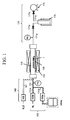
- an etching apparatus 100 includes, for example, a chamber 110 that accommodates a substrate 1, an etching gas supply unit 130 that is connected to the chamber 110 and supplies etching gas containing ⁇ -diketone, an additive supply unit 140 that is connected to the chamber 110 and supplies at least one additive among H 2 O and H 2 O 2 , and a heating unit 150 that heats the chamber 110.
- the step of mixing ⁇ -diketone and H 2 O or H 2 O 2 in the etching apparatus 100 is preferably performed immediately before the etching gas is supplied to the chamber 110.
- the additive supply unit 140 is connected to the etching gas supply unit 130, so that ⁇ -diketone and H 2 O or H 2 O 2 are supplied to the chamber 110 in a mixed state.
- the chamber 110 accommodates a stage 120 on which a substrate having a metal film, formed thereon, that forms a penta- or hexa-coordinated complex structure with ⁇ -diketone is to be placed.
- a stage 120 on which a substrate having a metal film, formed thereon, that forms a penta- or hexa-coordinated complex structure with ⁇ -diketone is to be placed.
- Any type of chamber that is resistant against ⁇ -diketone to be used and can have the inner pressure thereof decreased to a predetermined level may be usable as the chamber 110 with no specific limitation.
- a common chamber provided in a semiconductor etching apparatus, for example, is applied.
- a supply tube for supplying etching gas and other tubes may each be of any type that is resistant against ⁇ -diketone, with no specific limitation.
- a common tube is usable.
- the etching gas supply unit 130 is connected to the chamber 110.
- the etching gas supply unit 130 supplies ⁇ -diketone to the chamber 110 via a tube 131.
- a flow rate adjustment unit 133a adjusts the amount of ⁇ -diketone to be supplied, and thus ⁇ -diketone is supplied from a tube 131a to the tube 131.
- a flow rate adjustment unit 133b adjusts the amount of inert gas as dilution gas to be supplied, and thus the inert gas is supplied from the tube 131b to the tube 131.
- the additive supply unit 140 adjusts the amount of at least one additive among H 2 O or H 2 O 2 to be supplied, and the additive is supplied from a tube 141 to the tube 131.
- ⁇ -diketone is diluted by the dilution gas to a predetermined concentration and is supplied to the chamber 100 in the state of being mixed at a predetermined concentration with the additive supplied from the additive supply unit 140.
- ⁇ -diketone diluted immediately before being supplied to the chamber 110 and H 2 O and/or H 2 O 2 are mixed. Therefore, clogging of the tube 141, which would otherwise be caused by hydration and solidification of ⁇ -diketone, does not occur.
- the heating unit 150 that heats the chamber 110 is located outside, and is connected to, the chamber 110. It is preferable that a heater as a second heating unit is provided inside the stage 120. In the case where a plurality of stages are located in the chamber 110, a heater may be provided for each of the stages so that each stage may be set to a predetermined temperature independently.
- One end of the chamber 110 is connected to a gas discharge unit 170 that discharges post-reaction gas.
- the post-reaction gas is discharged from the chamber 110 by a vacuum pump 173 of the gas discharge unit 170 via a tube 171a.
- a liquid nitrogen trap 175 located between the tube 171a and a tube 171b recovers the post-reaction gas.
- the tubes 171a and 171b are provided with valves 177a and 177b so as to adjust the pressure.
- PG and PIC each represent a pressure meter.
- the flow rate adjustment units and the valves can be controlled based on values in PG and PIC.
- the etching method will be specifically described. In the following description, the etching method is carried out by use of the etching apparatus 100.
- the substrate 1 having a metal film, formed thereon, that forms a penta-or hexa-coordinated complex structure with ⁇ -diketone is put into in the chamber 110.
- Inner pressures of the chamber 110, the tube 131, the tube 131a, the tube 131b, the liquid nitrogen trap 175, the tube 171a and the tube 171b are decreased to predetermined levels by vacuum replacement by use of the vacuum pump 173, and then the substrate 1 is heated by the heating unit 150.
- ⁇ -diketone and dilution gas are supplied at a prescribed flow rate from the etching gas supply unit 130 to the tube 131, and the additive is supplied at a prescribed flow rate from the additive supply unit 140 to the tube 131.
- the diluted ⁇ -diketone and the additive are mixed at a predetermined composition and supplied to the chamber 110. While the mixed etching gas is introduced into the chamber 110, the inner pressure of the chamber 110 is controlled to a predetermined level. The etching gas and the metal film are reacted with each other for a predetermined time period, and as a result, the metal film is etched.
- the heating by the heating unit 150 is stopped to decrease the temperature, and the vacuum pump 173 is stopped to release the chamber 110 from a vacuum state. In this manner, the etching on the metal film according to the present invention is performed.
- any temperature is usable for the etching as long as the complex can be gasified. It is especially preferable that the temperature of the metal film as a target of processing is in a range of 100°C or higher and 350°C or lower.
- the inner pressure of the chamber during the etching is in a range of 0.1 kPa to 101.3 kPa.
- etching time period there is no specific limitation on the etching time period. It is preferable that the etching time period is 60 minutes or shorter in consideration of the efficiency of the semiconductor device production process.
- the "etching time period” refers to a time period from the time when the etching gas is introduced into the process chamber in which the substrate is located and an etching operation is to be performed until the etching gas in the process chamber is discharged by the vacuum pump or the like in order to terminate the etching operation.
- Patent Literature 4 specifically, the method of etching a metal film by use of a cluster beam of complexed gas used to form an organic metal complex, is a non-plasma process and does not damage a sample electrically or by ultraviolet light.
- this method has a problem that the production of the apparatus is costly because a high pressure needs to be applied to the gas to be supplied in order to form a cluster beam, and a nozzle at the tip of the gas supply tube needs to be processed to have a specific shape.
- the etching method according to the present invention does not require the etching apparatus to be significantly changed and thus is advantageous over the technology described in Patent Literature 4.
- a metal film can be provided that is formed on a substrate, contains at least one metal material that forms a penta- or hexa-coordinated complex structure with ⁇ -diketone, and is etched by use of etching gas containing ⁇ -diketone and also containing at least one of H 2 O and H 2 O 2 as an additive at a volume concentration of 1% or greater and 20% or less.
- a metal film is etched at significantly higher etching rate than by the conventional etching method, with no need to significantly change the etching apparatus. Therefore, the production cost of the etching apparatus is suppressed. As a result, the metal film can be produced at low cost.
- the metal film according to the present invention may be used as a substitute of a metal film of a device produced by a conventional semiconductor production process.
- the device according to the present invention can be produced at low cost by using a metal film etched by the etching method according to the present invention. Examples of such a device include solar cell, hard disc drive, dynamic random access memory, phase change memory, ferromagnetic memory, magnetoresistive random access memory, resistive random access memory, MEMS and the like.
- the present invention will be described in detail by way of examples.
- the present invention is not limited to the following examples.
- the metal materials used were Co, Fe, Zn and Mn.
- Ni was used as an example of metal material that forms a tetra-coordinated complex structure with ⁇ -diketone.
- additive gas H 2 O and H 2 O 2 were used.
- An etching apparatus like the etching apparatus 100 shown in FIG. 1 was used.
- a metal foil (2 cm x 2 cm; thickness: 0.1 mm) formed on a substrate was used.
- the inner pressures of the chamber 110, the tubes 131, 131 a and 131b, the liquid nitrogen trap 175, and the tubes 171a and 171b were decreased to a level less than 10 Pa by vacuum replacement. Then, a sample placed on the stage 120 was heated to a predetermined temperature by the heating unit 150 and the heater located inside the heater 120. The weight of the sample had been measured in advance. After the temperature of the heating unit 150 and the heater located inside the stage 120 were confirmed to reach a predetermined value, ⁇ -diketone and dilution gas were supplied at a predetermined flow rate from the etching gas supply unit 130 to the tube 131, and an additive was supplied at a predetermined flow rate from the additive supply unit 140 to the tube 131.
- the etching gas was introduced into the chamber 110, the inner pressure of the chamber 110 was controlled to a predetermined level. The introduction of the etching gas was stopped when a predetermined time period (10 minutes) elapsed after the start of the introduction. The inside of the chamber 110 was released from the vacuum state. Then, the sample was taken out, and the weight thereof was measured. Based on the difference between the pre-test weight and the post-test weight, the etched amount was calculated. In the examples, the lower limit of quantitative determination of the etched amount is 20 nm because of the measurement precision of the scale used to measure the weight.
- the total amount of the etching gas introduced into the chamber was 50 sccm, the dilution gas was N 2 , and the etching time period was 10 minutes.
- the inner pressure of the chamber and the temperature of the metal foil were each set to a predetermined level. Tables 1 through 5 show the etching conditions and the etched amounts of the metal materials in the examples and the comparative examples.
- Etching tests of examples 1-1, example 1-2 and example 1-3 were performed, in which H 2 O was used as the additive gas and the volume concentrations of H 2 O were 1%, 2% and 5%, respectively.
- the inner pressure of the chamber was 13.33 kPa, and the temperature of the metal foil was 275°C.
- the etched amounts in examples 1-1, 1-2 and 1-3 were 332.8 nm, 359.2 nm and 541.3 nm, respectively.
- Example 1-4 An etching test of example 1-4 was performed under the same experimental conditions as those of example 1-1 except that H 2 O 2 was used as the additive gas.
- the etched amount of Co was 1042 nm.
- etching performed under the following conditions was also examined: the temperature of the metal foil: 150°C (example 1-5); the inner pressure of the chamber: 1.33 kPa (example 1-6); and ⁇ -diketone: trifluoroacetylacetone (example 1-7).
- the other experimental conditions were the same as those of example 1-3.
- Example 1-5 was compared against comparative example 1-8 described later, and example 1-6 was compared against comparative example 1-9 described later.
- the etched amounts in both of the examples were superior to those in the comparative examples.
- Etching tests of comparative example 1-3, comparative example 1-4, comparative example 1-5 and comparative example 1-6 were performed, in which oxygen was used as the additive gas and the volume concentration of oxygen was varied in the range of 3% to 30%.
- the etched amount was changed as the volume concentration of oxygen was changed.
- the etching amounts were superior to that in the case where no additive was incorporated (comparative example 1-7), but were inferior to those in the examples in which H 2 O or H 2 O 2 was incorporated as the additive even though the same temperature and pressure conditions were the same as those of these examples.
- comparative example 1-7 An etching test of comparative example 1-7 was performed under the same experimental conditions as those of example 1-1 except that no additive was incorporated.
- the etched amount in comparative example 1-7 was 55.4 nm.
- comparative example 1-8 An etching test of comparative example 1-8 was performed under the same experimental conditions as those of example 1-5 except that O 2 was used as the additive gas.
- the etched amount in comparative example 1-8 was 13.2 nm.
- the temperature of the metal foil was 150°C, which was lower than in the other comparative examples, and the etched amount was inferior to that in comparative example 1-7 in which no additive was incorporated.
- the etched amount was inferior.
- comparative example 1-9 An etching test of comparative example 1-9 was performed under the same experimental conditions as those of example 1-6 except that O 2 was used as the additive gas.
- the etched amount in comparative example 1-9 was 34.7 nm.
- the etched amount was inferior.
- Etching tests of examples 2-1, example 2-2 and example 2-3 were performed, in which H 2 O was used as the additive gas and the volume concentrations of H 2 O were 2%, 5% and 8%, respectively.
- the inner pressure of the chamber was 13.33 kPa, and the temperature of the metal foil was 275°C.
- the etched amounts in examples 2-1, 2-2 and 2-3 were 317.9 nm, 1525.6 nm, 628.2 nm, respectively.
- Example 2-4 An etching test of example 2-4 was performed under the same experimental conditions as those of example 2-1 except that H 2 O 2 was used as the additive gas.
- the etched amount in example 2-4 was 2031.2 nm.
- Etching tests were performed under the same experimental conditions as those of example 2-2 except that the temperature of the metal foil was 150°C (example 2-5), the inner pressure of the chamber was 1.33 kPa (example 2-6), and ⁇ -diketone was trifluoroacetylacetone (example 2-7).
- Example 2-5 was compared against comparative example 2-7 described later, and example 2-6 was compared against comparative example 2-8 described later.
- the etched amounts in both of the examples were superior to those in the comparative examples. Namely, even in the case where the temperature of the metal foil was 150°C and the inner pressure of the chamber was 1.33 kPa, an effect of significantly increasing the etched amount was provided by using H 2 O as the additive. In the case where trifluoroacetylacetone was used as ⁇ -diketone also, the etched amount was equivalent to that in example 2-2.
- comparative example 2-6 An etching test of comparative example 2-6 was performed under the same experimental conditions as those of example 2-5 except that O 2 was used as the additive gas.
- the etched amount in comparative example 2-6 was 103.5 nm.
- the etched amount was inferior.
- comparative example 2-7 An etching test of comparative example 2-7 was performed under the same experimental conditions as those of example 2-6 except that O 2 was used as the additive gas.
- the etched amount in comparative example 2-7 was 130.6 nm.
- the etched amount was inferior.
- Etching tests of examples 3-1 and example 3-2 were performed, in which H 2 O was used as the additive gas and the volume concentrations of H 2 O were 2% and 5%, respectively.
- the inner pressure of the chamber was 13.33 kPa, and the temperature of the metal foil was 275°C.
- the etched amounts in examples 3-1 and 3-2 were 319.8 nm and 1248 nm, respectively.
- Example 3-3 An etching test of example 3-3 was performed under the same experimental conditions as those of example 3-1 except that H 2 O 2 was used as the additive gas.
- the etched amount in example 3-3 was 1532 nm.
- Etching tests were performed under the same experimental conditions as those of example 3-1 except that the temperature of the metal foil was 150°C (example 3-4), the inner pressure of the chamber was 1.33 kPa (example 3-5), and ⁇ -diketone was trifluoroacetylacetone (example 3-6). Even in the case where the temperature of the metal foil was 150°C and the inner pressure of the chamber was 1.33 kPa, the etched amounts were equivalent to that in example 3-1. In the case where trifluoroacetylacetone was used as ⁇ -diketone also, the etched amount was equivalent to that in example 3-2.
- etching test of comparative examples 3-1 was performed, in which the volume concentration of H 2 O as the additive gas was 30%, the temperature of the metal foil was 275°C, and the inner pressure of the chamber was 13.33 kPa.
- the etched amount in comparative examples 3-1 was 20.6 nm. In the case where the volume concentration of the additive was outside the range of the present invention, the etched amount was inferior to those in examples 3-1 and 3-2 even though the temperature and pressure conditions were the same as those of these examples.
- comparative example 3-2 An etching test of comparative example 3-2 was performed, in which oxygen was used as the additive gas and the volume concentration of oxygen was 2%.
- the etching amount in comparative example 3-2 was 136.5 nm.
- the etched amount in comparative example 3-2 was inferior.
- Etching tests of examples 4-1 and example 4-2 were performed, in which H 2 O was used as the additive gas and the volume concentrations of H 2 O were 2% and 5%, respectively.
- the inner pressure of the chamber was 13.33 kPa, and the temperature of the metal foil was 275°C.
- the etched amounts in examples 4-1 and 4-2 were 233.1 nm and 491.3 nm, respectively.
- Example 4-3 An etching test of example 4-3 was performed under the same experimental conditions as those of example 4-1 except that H 2 O 2 was used as the additive gas.
- the etched amount in example 4-3 was 589.7 nm.
- Etching tests were performed under the same experimental conditions as those of example 4-1 except that the temperature of the metal foil was 150°C (example 4-4), the inner pressure of the chamber was 1.33 kPa (example 4-5), and ⁇ -diketone was trifluoroacetylacetone (example 4-6).
- Example 4-4 was compared against comparative example 4-3 described later. Even in the case where the temperature of the metal foil was 150°C, the etched amount was superior to that in the comparative example. Even in the case where the inner pressure of the chamber was 1.33 kPa, the etched amount was equivalent to that in example 4-1. Even in the case where trifluoroacetylacetone was used as ⁇ -diketone, the etched amount was equivalent to that in example 4-2.
- comparative example 4-2 An etching test of comparative example 4-2 was performed, in which oxygen was used as the additive gas and the volume concentration of oxygen was 2%.
- the etching amount in comparative example 4-2 was 81.8 nm.
- the etched amount in comparative example 4-2 was inferior.
- comparative example 4-3 An etching test of comparative example 4-3 was performed under the same experimental conditions as those of example 4-4 except that O 2 was used as the additive gas.
- the etched amount in comparative example 4-3 was 10.4 nm.
- the etched amount was inferior.
- Etching tests of comparative examples 5-1 and example 5-2 were performed, in which H 2 O was used as the additive gas and the volume concentrations of H 2 O were 2% and 5%, respectively.
- the inner pressure of the chamber was 13.33 kPa and the temperature of the metal foil was 250°C and 325°C, respectively.
- the etched amounts in comparative examples 5-1 and 5-2 were 613.0 nm and 956.2 nm, respectively.
- comparative example 5-3 An etching test of comparative example 5-3 was performed under the same experimental conditions as those of comparative example 5-2 except that H 2 O 2 was used as the additive gas.
- the etching amount in comparative example 5-3 was 947.8 nm.
- etching test of comparative example 5-4 was performed, in which O 2 was used as the additive gas and the volume concentration of O 2 was 2%.
- the inner pressure of the chamber was 13.33 kPa and the temperature of the metal foil was 250°C.
- the etched amount in comparative example 5-4 was 902.1 nm.
- the present invention is useful for microprocessing performed by etching on a metal film in semiconductor device production.
Landscapes
- Chemical & Material Sciences (AREA)
- Engineering & Computer Science (AREA)
- Materials Engineering (AREA)
- Mechanical Engineering (AREA)
- Metallurgy (AREA)
- Organic Chemistry (AREA)
- Chemical Kinetics & Catalysis (AREA)
- General Chemical & Material Sciences (AREA)
- Drying Of Semiconductors (AREA)
- ing And Chemical Polishing (AREA)
- Internal Circuitry In Semiconductor Integrated Circuit Devices (AREA)
Abstract
Description
- The present invention relates to a dry etching method performed on a metal film by use of etching gas containing β-diketone, a dry etching apparatus for realizing the method, a metal film etched by the method, and a device including the metal film.
- In a production process of a semiconductor device, a metal film is formed of a metal gate material, an electrode material or a magnetic material on a surface of a substrate by use of a film formation apparatus. In this film formation step, in addition to the metal film formed on the surface of the substrate, metal films or the like are unnecessarily attached to surfaces inside the film formation apparatus, for example, surfaces of a stage for holding and heating the substrate located in a film formation chamber of the film formation apparatus, surfaces of an electrode used to generate plasma, surfaces of other jigs, inner walls of the chamber, inner walls of tubes connected to the inner walls of the chamber, and the like. Such unnecessary metal films or the like need to be removed.
- A known method for removing the unnecessary metal film or the like in the state where the chamber is still heated after the substrate having a film formed thereon is removed from the chamber is a dry cleaning method using β-diketone. According to an example of dry cleaning method, β-diketone such as, for example, hexafluoroacetylacetone (hereinafter, referred to simply as HFAc) is put into contact with a metal oxide film, and the metal oxide film is brought into a reaction and is removed in the form of a metal complex (for example, Patent Literature 1).
- However, when this method is carried out on a metal film formed in a film formation chamber, an etching reaction does not proceed because the metal is not in an oxide state. According to another example of dry cleaning method for avoiding this, β-diketone such as HFAc or the like and oxygen are used in combination to oxidize the metal film. In this case, the metal oxide film is brought into a reaction and can be removed in the form of a metal complex (for example, Patent Literature 2 and Patent Literature 3).
- In general, the process of etching a metal film by use of complexed gas such as β-diketone or the like can be divided into three reaction steps from the point of view of chemical reaction, namely, the step of oxidizing the metal film to generate a metal oxide (oxidation step), the step of complexing the metal oxide to form a metal complex (complexation step), and the step of sublimating the formed metal complex (sublimation step). Since an organic metal complex formed by a reaction with β-diketone has a high vapor pressure, unnecessary deposited substances containing the metal film can be easily removed along with the sublimation of the organic metal complex.
- Patent Literature 4 discloses a method for processing a metal film formed at a surface of a processing target by use of a gas cluster beam. According to this method, mixed gas of oxide gas for oxidizing an element contained in a metal film to form an oxide, complexed gas that is reacted with an oxide to form an organic metal complex, and rare gas is adiabatically expanded to form a gas cluster beam; and the gas cluster beam is caused to impinge on the metal film of the processing target to etch the metal film. Patent Literature 4 also describes that oxide gas such as O2, H2O, H2O2 or the like is incorporated into the complexed gas used to form the organic metal complex.
- Patent Literature 5 discloses an etching method including an etching step of etching a thin film formed on a substrate by use of etching gas containing β-diketone to expose a surface of the substrate. It is described that according to this method, H2O is incorporated into the etching gas containing β-diketone such that H2O has a concentration of 2000 ppm or less in order to increase the etching rate.
-
- Patent Literature 1: Japanese Laid-Open Patent Publication No.
2001-176807 - Patent Literature 2: Japanese Laid-Open Patent Publication No.
Hei 6-101076 - Patent Literature 3: Japanese Laid-Open Patent Publication No.
Hei 11-140652 - Patent Literature 4: Japanese Laid-Open Patent Publication No.
2012-156259 - Patent Literature 5: Japanese Laid-Open Patent Publication No.
2004-91829 - According to a known technology of metal etching, an oxidizer such as O2, H2O or the like is incorporated into complexed gas to proceed with an oxidation step, which is immediately followed by a complexation step and a sublimation step. In this manner, etching on the metal film proceeds (Patent Literature 2 and Patent Literature 3).
- However, the structure of the complex to be formed varies in accordance with the type of metal to be etched. It has been found that with the conventional method, metal films of various structures are not necessarily etched equally. Especially, a metal material such as Co, Fe, Zn, Mn, Hf or the like, which forms a penta- or hexa-coordinated complex with β-diketone, does not allow a complexation reaction to proceed easily and thus does not provide a sufficiently high etching rate.
- The present invention made in light of the above-described problem has an object of providing a dry etching method for etching, with increased etching rate, a film of a metal material that forms a penta- or hexa-coordinated complex structure with β-diketone. The present invention also has an object of providing a dry etching apparatus for realizing the method, a metal film etched by the method, and a device including the metal film.
- Regarding etching on a metal film performed by use of β-diketone as complexed gas, the present inventors paid attention to a structure of a metal complex that forms a complex with β-diketone, and found that the etching reaction performed on a film of a metal that forms a penta- or hexa-coordinated complex structure with β-diketone is allowed to proceed in an improved manner by incorporating a certain amount of specific additive to β-diketone. Thus, the present invention has been made.
- Namely, the present invention is directed to a dry etching method for etching a metal film formed on a substrate by use of etching gas containing β-diketone, wherein the metal film contains at least one metal material that forms a penta- or hexa-coordinated complex structure with β-diketone; the etching gas containing β-diketone contains at least one additive among H2O or H2O2; and the additive is contained at a volume concentration of 1% or greater and 20% or less.
- In the dry etching method, the metal film may be formed of at least one material selected from the group consisting of Zn, Co, Hf, Fe, Mn and V.
- In the dry etching method, the etching gas may be reacted with the metal film in a temperature range of 100°C or higher and 350°C or lower.
- The present invention is also directed to a dry etching apparatus including a chamber that accommodates a substrate having a metal film formed thereon, the metal film being formed of a metal material that forms a penta- or hexa-coordinated complex structure with β-diketone; an etching gas supply unit that is connected to the chamber and supplies etching gas containing β-diketone; an additive supply unit that is connected to the chamber and supplies at least one additive among H2O and H2O2; and a heating unit that heats the chamber. The etching gas and the additive are supplied to the chamber such that the additive is contained at a volume concentration of 1% or greater and 20% or less.
- In the dry etching apparatus, the metal film formed of at least one material selected from the group consisting of Zn, Co, Hf, Fe, Mn and V may be reacted with the etching gas.
- In the dry etching apparatus, the heating unit may heat the chamber to a temperature of 100°C or higher and 350°C or lower; and the etching gas may be reacted with the metal film in the chamber.
- The present invention is further directed to a metal film formed on a substrate and containing at least one metal material that forms a penta- or hexa-coordinated complex structure with β-diketone. The metal film has been etched with etching gas that contains β-diketone and also contains at least one additive among H2O and H2O2 at a volume concentration of 1% or higher and 20% or lower.
- The metal film may be formed of at least one material selected from the group consisting of Zn, Co, Hf, Fe, Mn and V is reacted with the etching gas.
- The metal film may be a metal film which has been reacted with the etching gas in a temperature range of 100°C or higher and 350°C or lower.
- The present invention is further directed to a device including any metal film described above.
- According to the present invention, the etching reaction performed on a film of a metal that forms a penta- or hexa-coordinated complex structure with β-diketone is allowed to proceed in an improved manner. According to the present invention, a dry etching apparatus for realizing the method, a metal film etched by the method, and a device including the metal film are also provided.
-
- [
FIG. 1] FIG. 1 is a schematic view of an etching apparatus in an embodiment according to the present invention. - The present invention is directed to a dry etching method for etching a metal film formed on a substrate by use of etching gas containing β-diketone. The metal film contains at least one metal material that forms a penta- or hexa-coordinated complex structure with β-diketone. The etching gas containing β-diketone contains at least one additive among H2O and H2O2. The additive is contained at a volume concentration of 1% or greater and 20% or less.
- According to the present invention, the etching gas is introduced into an etching apparatus that accommodates a processing target including a metal film, and the etching gas is put into contact with, and is reacted with, the metal film of the processing target to complex the metal film. Thus, the complexed metal film is etched. By incorporating a certain amount of specific additive into the etching gas, the etching rate on the metal film that forms a specific complex structure is increased.
- A metal film, which is a target of the dry etching method according to the present invention, is formed of a material that forms a penta- or hexa-coordinated complex structure with β-diketone. Such a material is, specifically, at least one element selected from the group consisting of Zn, Co, Hf, Fe, Mn, V, Zr, Ti, Ru and Ir. The metal film may be formed of any one of these elements, or alternatively may be formed of a plurality of elements among these elements. For example, the metal film may be formed of a metal material such as NiSi, CoSi, HfSi, NiCo, FeCo, CoPt, MnZn, NiZn, CuZn, FeNi or the like or an oxide film thereof. The present invention is especially effective on a metal film containing at least one of Zn, Co, Fe and Mn among these elements. According to the present invention, the substrate may be any known etchable semiconductor substrate, glass substrate or the like on which a film of a material that forms a penta- or hexa-coordinated complex structure with β-diketone can be formed.
- According to the present invention, the etching gas needs to contain β-diketone and H2O or H2O2 as an additive. The present inventors were the first to find that the etching reaction performed on a film of a metal that forms a penta- or hexa-coordinated complex structure with β-diketone is allowed to proceed in an improved manner by incorporating a certain amount of H2O or H2O2 as an additive. According to the present invention, as compared with the conventionally used condition that O2 is incorporated, the concentration of H2O is higher during the etching process. Therefore, the complexation rate is increased, and thus the etching rate is increased. Conventionally, H2O is occasionally used as an oxidizer, but almost no example of using H2O as a ligand for etching a metal film has been reported. A reason for this is that with the conventional art, O2, which is used as an oxidizer, acts also as a ligand.
- An etching reaction performed on a metal film by use of β-diketone mainly includes two steps, namely, an oxidation step and a complexation step. Now, in an example in which the metal film is formed of Co, the etching reaction is considered to include the following.
- (1) Oxidation step
2Co + O2 → 2CoO
- (2) Complexation step
- (a) CoO + 2HFAc → Co(HFAc)2 + 2H2O
- (b) Co(HFAc)2 + 2H2O → Co(HFAc)2(H2O)2 ↑
- Under the conventional condition that O2 is incorporated, H2O necessary for formation of a Co complex is merely supplied by generation in step (a), which is a part of the complexation step. Therefore, it is expected that among a series of reactions for etching a metal film by use of β-diketone, the complexation reaction is rate-controlling. According to the present invention, the metal in the metal film is oxidized by H2O in the absence of oxidation gas (oxidation step). Two molecules of β-diketone are coordinated to the oxidized metal atom, and thus the metal forms a penta- or hexa-coordinated complex structure with β-diketone (complexation step (a)). H2O molecule are coordinated at vacant coordination positions of the metal atom (H2O gas acts as an oxidizer), and thus the complex is stabilized (complexation step (b)). It is considered that according to the present invention, such a reaction mechanism allows the metal in the metal film to be oxidized by H2O even in the absence of the oxidation gas and thus the rate of the complexation reaction depends on the amount of H2O.
- Examples of β-diketone usable in the present invention include hexafluoroacetylacetone, trifluoroacetylacetone, acetylacetone and the like. One or a plurality of substances among these may be used. Hexafluoroacetylacetone and trifluoroacetylacetone, which allow etching to be performed at high speed, are especially preferable. As the concentration of β-diketone contained in the etching gas increases, the etching rate on the metal increases. It should be noted that in the case where the vapor pressure of β-diketone is low and there is a possibility that liquefaction is caused in the film formation apparatus, it is preferable to appropriately adjust the concentration by use of dilution gas.
- Preferably, the additive (H2O or H2O2) contained in the etching gas has a content of 1% by volume or greater and 20% by volume or less in the etching gas composition. More preferably, the content of the additive in the etching gas is 3% by volume or greater and 10% by volume or less. When the content of the additive in the etching gas exceeds 20% by volume, β-diketone is undesirably hydrated. When the content of the additive in the etching gas is less than 1% by volume, the effect of the etching cannot be sufficiently provided.
- The etching gas may contain, in addition to β-diketone and the additive (H2O or H2O2), inert gas such as N2, He, Ar, Ne, Kr or the like. In the case where inert gas is incorporated into the etching gas, there is no limitation on the concentration thereof as long as the inert gas is used as being diluted to an appropriate concentration. The inert gas is usually used at a content of 1% by volume or greater and 50% by volume or less, and is preferably used at a content of 30% by volume or greater and 50% by volume or less, with respect to the etching gas composition.
- The etching method according to the present invention can be realized by use of a common etching apparatus usable for a semiconductor production process as shown in
FIG. 1 . In an embodiment, an etching apparatus 100 according to the present invention includes, for example, achamber 110 that accommodates a substrate 1, an etchinggas supply unit 130 that is connected to thechamber 110 and supplies etching gas containing β-diketone, anadditive supply unit 140 that is connected to thechamber 110 and supplies at least one additive among H2O and H2O2, and aheating unit 150 that heats thechamber 110. - When H2O or H2O2 is incorporated into β-diketone, β-diketone is hydrated and solidified. This may clog tubes. Therefore, the step of mixing β-diketone and H2O or H2O2 in the etching apparatus 100 is preferably performed immediately before the etching gas is supplied to the
chamber 110. However, from the point of view of fully mixing β-diketone and H2O or H2O2, it is not preferable to incorporate β-diketone and H2O or H2O2 separately. Therefore, according to the present invention, theadditive supply unit 140 is connected to the etchinggas supply unit 130, so that β-diketone and H2O or H2O2 are supplied to thechamber 110 in a mixed state. - The
chamber 110 accommodates astage 120 on which a substrate having a metal film, formed thereon, that forms a penta- or hexa-coordinated complex structure with β-diketone is to be placed. Any type of chamber that is resistant against β-diketone to be used and can have the inner pressure thereof decreased to a predetermined level may be usable as thechamber 110 with no specific limitation. Usually, a common chamber provided in a semiconductor etching apparatus, for example, is applied. A supply tube for supplying etching gas and other tubes may each be of any type that is resistant against β-diketone, with no specific limitation. A common tube is usable. - The etching
gas supply unit 130 is connected to thechamber 110. The etchinggas supply unit 130 supplies β-diketone to thechamber 110 via atube 131. As shown inFIG. 1 , a flowrate adjustment unit 133a adjusts the amount of β-diketone to be supplied, and thus β-diketone is supplied from atube 131a to thetube 131. A flowrate adjustment unit 133b adjusts the amount of inert gas as dilution gas to be supplied, and thus the inert gas is supplied from thetube 131b to thetube 131. As described above, in this embodiment, theadditive supply unit 140 adjusts the amount of at least one additive among H2O or H2O2 to be supplied, and the additive is supplied from atube 141 to thetube 131. - In the etching apparatus 100, β-diketone is diluted by the dilution gas to a predetermined concentration and is supplied to the chamber 100 in the state of being mixed at a predetermined concentration with the additive supplied from the
additive supply unit 140. According to the present invention, β-diketone diluted immediately before being supplied to thechamber 110 and H2O and/or H2O2 are mixed. Therefore, clogging of thetube 141, which would otherwise be caused by hydration and solidification of β-diketone, does not occur. - The
heating unit 150 that heats thechamber 110 is located outside, and is connected to, thechamber 110. It is preferable that a heater as a second heating unit is provided inside thestage 120. In the case where a plurality of stages are located in thechamber 110, a heater may be provided for each of the stages so that each stage may be set to a predetermined temperature independently. - One end of the
chamber 110 is connected to agas discharge unit 170 that discharges post-reaction gas. The post-reaction gas is discharged from thechamber 110 by avacuum pump 173 of thegas discharge unit 170 via atube 171a. Aliquid nitrogen trap 175 located between thetube 171a and atube 171b recovers the post-reaction gas. Thetubes valves FIG. 1 , PG and PIC each represent a pressure meter. The flow rate adjustment units and the valves can be controlled based on values in PG and PIC. - The etching method will be specifically described. In the following description, the etching method is carried out by use of the etching apparatus 100. The substrate 1 having a metal film, formed thereon, that forms a penta-or hexa-coordinated complex structure with β-diketone is put into in the
chamber 110. Inner pressures of thechamber 110, thetube 131, thetube 131a, thetube 131b, theliquid nitrogen trap 175, thetube 171a and thetube 171b are decreased to predetermined levels by vacuum replacement by use of thevacuum pump 173, and then the substrate 1 is heated by theheating unit 150. When the temperature in thechamber 110 reaches a predetermined level, β-diketone and dilution gas are supplied at a prescribed flow rate from the etchinggas supply unit 130 to thetube 131, and the additive is supplied at a prescribed flow rate from theadditive supply unit 140 to thetube 131. - The diluted β-diketone and the additive are mixed at a predetermined composition and supplied to the
chamber 110. While the mixed etching gas is introduced into thechamber 110, the inner pressure of thechamber 110 is controlled to a predetermined level. The etching gas and the metal film are reacted with each other for a predetermined time period, and as a result, the metal film is etched. - After the etching, the heating by the
heating unit 150 is stopped to decrease the temperature, and thevacuum pump 173 is stopped to release thechamber 110 from a vacuum state. In this manner, the etching on the metal film according to the present invention is performed. - In the etching method according to the present invention, any temperature is usable for the etching as long as the complex can be gasified. It is especially preferable that the temperature of the metal film as a target of processing is in a range of 100°C or higher and 350°C or lower. There is no specific limitation on the inner pressure of the chamber during the etching. Usually, the inner pressure is in a range of 0.1 kPa to 101.3 kPa.
- There is no specific limitation on the etching time period. It is preferable that the etching time period is 60 minutes or shorter in consideration of the efficiency of the semiconductor device production process. The "etching time period" refers to a time period from the time when the etching gas is introduced into the process chamber in which the substrate is located and an etching operation is to be performed until the etching gas in the process chamber is discharged by the vacuum pump or the like in order to terminate the etching operation.
- The method described in Patent Literature 4, specifically, the method of etching a metal film by use of a cluster beam of complexed gas used to form an organic metal complex, is a non-plasma process and does not damage a sample electrically or by ultraviolet light. However, this method has a problem that the production of the apparatus is costly because a high pressure needs to be applied to the gas to be supplied in order to form a cluster beam, and a nozzle at the tip of the gas supply tube needs to be processed to have a specific shape. Regarding these points, the etching method according to the present invention does not require the etching apparatus to be significantly changed and thus is advantageous over the technology described in Patent Literature 4.
- By use of the above-described etching method according to the present invention, a metal film can be provided that is formed on a substrate, contains at least one metal material that forms a penta- or hexa-coordinated complex structure with β-diketone, and is etched by use of etching gas containing β-diketone and also containing at least one of H2O and H2O2 as an additive at a volume concentration of 1% or greater and 20% or less.
- According to the present invention, a metal film is etched at significantly higher etching rate than by the conventional etching method, with no need to significantly change the etching apparatus. Therefore, the production cost of the etching apparatus is suppressed. As a result, the metal film can be produced at low cost.
- The metal film according to the present invention may be used as a substitute of a metal film of a device produced by a conventional semiconductor production process. The device according to the present invention can be produced at low cost by using a metal film etched by the etching method according to the present invention. Examples of such a device include solar cell, hard disc drive, dynamic random access memory, phase change memory, ferromagnetic memory, magnetoresistive random access memory, resistive random access memory, MEMS and the like.
- Hereinafter, the present invention will be described in detail by way of examples. The present invention is not limited to the following examples. In etching tests performed on metal films, the relationship among the type of metal, the type of additive in the etching gas containing β-diketone, and the amount of additive was examined. The metal materials used were Co, Fe, Zn and Mn. In comparative examples, Ni was used as an example of metal material that forms a tetra-coordinated complex structure with β-diketone. As the additives (occasionally, referred to as "additive gas"), H2O and H2O2 were used.
- An etching apparatus like the etching apparatus 100 shown in
FIG. 1 was used. As a sample, a metal foil (2 cm x 2 cm; thickness: 0.1 mm) formed on a substrate was used. - The inner pressures of the
chamber 110, thetubes liquid nitrogen trap 175, and thetubes stage 120 was heated to a predetermined temperature by theheating unit 150 and the heater located inside theheater 120. The weight of the sample had been measured in advance. After the temperature of theheating unit 150 and the heater located inside thestage 120 were confirmed to reach a predetermined value, β-diketone and dilution gas were supplied at a predetermined flow rate from the etchinggas supply unit 130 to thetube 131, and an additive was supplied at a predetermined flow rate from theadditive supply unit 140 to thetube 131. While the etching gas was introduced into thechamber 110, the inner pressure of thechamber 110 was controlled to a predetermined level. The introduction of the etching gas was stopped when a predetermined time period (10 minutes) elapsed after the start of the introduction. The inside of thechamber 110 was released from the vacuum state. Then, the sample was taken out, and the weight thereof was measured. Based on the difference between the pre-test weight and the post-test weight, the etched amount was calculated. In the examples, the lower limit of quantitative determination of the etched amount is 20 nm because of the measurement precision of the scale used to measure the weight. - In the etching tests of the examples, the total amount of the etching gas introduced into the chamber was 50 sccm, the dilution gas was N2, and the etching time period was 10 minutes. Before performing the etching tests of the examples and the comparative examples, the inner pressure of the chamber and the temperature of the metal foil were each set to a predetermined level. Tables 1 through 5 show the etching conditions and the etched amounts of the metal materials in the examples and the comparative examples.
- Hereinafter, experiment examples in which Co was etched as the target metal will be described. The results of etching Co are shown in Table 1.
[Table 1] Target metal Gas composition (volume ratio) Pressure (kPa) Temperature (°C) Etched amount (nm) Ex. 1-1 Co HFAc/H2O/N2 (50/1/49) 13.33 275 332.8 Ex. 1-2 Co HFAc/H2O/N2 (50/2/48) 13.33 275 359.2 Ex. 1-3 Co HFAc/H2O/N2 (50/5/45) 13.33 275 541.3 Ex. 1-4 Co HFAc/H2O2/N2 (50/5/45) 13.33 275 1042 Ex. 1-5 Co HFAc/H2O/N2 (50/5/45) 13.33 150 105.2 Ex. 1-6 Co HFAc/H2O/N2 (50/5/45) 1.33 275 224.2 Ex. 1-7 Co TFAc/H2O/N2 (50/5/45) 13.33 275 378.1 Comparative ex. 1-1 Co HFAc/H2O/N2 (50/30/20) 13.33 275 108 Comparative ex. 1-2 Co HFAc/H2O (50/50) 13.33 275 1.2 Comparative ex. 1-3 Co HFAc/O2/N2 (50/3/47) 13.33 300 219.8 Comparative ex. 1-4 Co HFAc/O2/N2 (50/5/45) 13.33 300 122.4 Comparative ex. 1-5 Co HFAc/O2/N2 (50/10/40) 13.33 300 185.2 Comparative ex. 1-6 Co HFAc/O2/N2 (50/30/20) 13.33 275 160.9 Comparative ex. 1-7 Co HFAc/N2 (50/50) 13.33 275 55.4 Comparative ex. 1-8 Co HFAc/O2/N2 (50/5/45) 13.33 150 13.2 Comparative ex. 1-9 Co HFAc/O2/N2 (50/5/45) 1.33 275 34.7 - Etching tests of examples 1-1, example 1-2 and example 1-3 were performed, in which H2O was used as the additive gas and the volume concentrations of H2O were 1%, 2% and 5%, respectively. In the etching tests, the inner pressure of the chamber was 13.33 kPa, and the temperature of the metal foil was 275°C. The etched amounts in examples 1-1, 1-2 and 1-3 were 332.8 nm, 359.2 nm and 541.3 nm, respectively.
- An etching test of example 1-4 was performed under the same experimental conditions as those of example 1-1 except that H2O2 was used as the additive gas. The etched amount of Co was 1042 nm.
- The pressure, the temperature or the like at the time of etching may be restricted depending on the type of etching apparatus. Therefore, etching performed under the following conditions was also examined: the temperature of the metal foil: 150°C (example 1-5); the inner pressure of the chamber: 1.33 kPa (example 1-6); and β-diketone: trifluoroacetylacetone (example 1-7). The other experimental conditions were the same as those of example 1-3. Example 1-5 was compared against comparative example 1-8 described later, and example 1-6 was compared against comparative example 1-9 described later. The etched amounts in both of the examples were superior to those in the comparative examples. Namely, even in the case where the temperature of the metal foil was 150°C and the inner pressure of the chamber was 1.33 kPa, an effect of significantly increasing the etched amount was provided by using H2O as the additive. In the case where trifluoroacetylacetone was used as β-diketone also, the etched amount was equivalent to that in example 1-3.
- Etching tests of comparative examples 1-1 and comparative example 1-2 were performed, in which the volume concentrations of H2O as the additive gas were 30% and 50% respectively, the temperature of the metal foil was 275°C, and the inner pressure of the chamber was 13.33 kPa. The etched amounts in comparative examples 1-1 and 1-2 were 108 nm and 1.2 nm, respectively. In the case where the volume concentration of the additive was outside the range of the present invention, the etched amounts were inferior to those in examples 1-1 through 1-3 even though the temperature and pressure conditions were the same as those of these examples.
- Etching tests of comparative example 1-3, comparative example 1-4, comparative example 1-5 and comparative example 1-6 were performed, in which oxygen was used as the additive gas and the volume concentration of oxygen was varied in the range of 3% to 30%. In comparative examples 1-3 through 1-6, the etched amount was changed as the volume concentration of oxygen was changed. The etching amounts were superior to that in the case where no additive was incorporated (comparative example 1-7), but were inferior to those in the examples in which H2O or H2O2 was incorporated as the additive even though the same temperature and pressure conditions were the same as those of these examples.
- An etching test of comparative example 1-7 was performed under the same experimental conditions as those of example 1-1 except that no additive was incorporated. The etched amount in comparative example 1-7 was 55.4 nm.
- An etching test of comparative example 1-8 was performed under the same experimental conditions as those of example 1-5 except that O2 was used as the additive gas. The etched amount in comparative example 1-8 was 13.2 nm. The temperature of the metal foil was 150°C, which was lower than in the other comparative examples, and the etched amount was inferior to that in comparative example 1-7 in which no additive was incorporated. As compared against example 1-5 performed under the same temperature and pressure conditions but with a different additive, the etched amount was inferior.
- An etching test of comparative example 1-9 was performed under the same experimental conditions as those of example 1-6 except that O2 was used as the additive gas. The etched amount in comparative example 1-9 was 34.7 nm. As compared against example 1-6 performed under the same temperature and pressure conditions but with a different additive, the etched amount was inferior.
- Now, experiment examples in which Fe was etched as the target metal will be described. The results of etching Fe are shown in Table 2.
[Table 2] Target metal Gas composition (volume ratio) Pressure (kPa) Temperature (°C) Etched amount (nm) Ex. 2-1 Fe HFAc/H2O/N2 (50/2/48) 13.33 275 317.9 Ex. 2-2 Fe HFAc/H2O/N2 (50/5/45) 13.33 275 1525.6 Ex. 2-3 Fe HFAc/H2O/N2 (50/8/42) 13.33 275 628.2 Ex. 2-4 Fe HFAc/H2O2/N2 (50/5/45) 13.33 275 2031.2 Ex. 2-5 Fe HFAc/H2O/N2 (50/5/45) 13.33 150 351.2 Ex. 2-6 Fe HFAc/H2O/N2 (50/5/45) 1.33 275 181.4 Ex. 2-7 Fe TFAc/H2O/N2 (50/5/45) 13.33 275 1068.3 Comparative ex. 2-1 Fe HFAc/H2O/N2 (50/30/20) 13.33 275 69.2 Comparative ex. 2-2 Fe HFAc/H2O (50/50) 13.33 275 ND(-40) Comparative ex. 2-3 Fe HFAc/O2/N2 (50/2/48) 13.33 275 193.2 Comparative ex. 2-4 Fe HFAc/O2/N2 (50/3/47) 13.33 275 234.6 Comparative ex. 2-5 Fe HFAc/O2/N2 (50/5/45) 13.33 275 75.6 Comparative ex. 2-6 Fe HFAc/O2/N2 (50/5/45) 13.33 150 103.5 Comparative ex. 2-7 Fe HFAc/O2/N2 (50/5/45) 1.33 275 130.6 - Etching tests of examples 2-1, example 2-2 and example 2-3 were performed, in which H2O was used as the additive gas and the volume concentrations of H2O were 2%, 5% and 8%, respectively. In the etching tests of examples 2-1 through 2-3, the inner pressure of the chamber was 13.33 kPa, and the temperature of the metal foil was 275°C. The etched amounts in examples 2-1, 2-2 and 2-3 were 317.9 nm, 1525.6 nm, 628.2 nm, respectively.
- An etching test of example 2-4 was performed under the same experimental conditions as those of example 2-1 except that H2O2 was used as the additive gas. The etched amount in example 2-4 was 2031.2 nm.
- Etching tests were performed under the same experimental conditions as those of example 2-2 except that the temperature of the metal foil was 150°C (example 2-5), the inner pressure of the chamber was 1.33 kPa (example 2-6), and β-diketone was trifluoroacetylacetone (example 2-7). Example 2-5 was compared against comparative example 2-7 described later, and example 2-6 was compared against comparative example 2-8 described later. The etched amounts in both of the examples were superior to those in the comparative examples. Namely, even in the case where the temperature of the metal foil was 150°C and the inner pressure of the chamber was 1.33 kPa, an effect of significantly increasing the etched amount was provided by using H2O as the additive. In the case where trifluoroacetylacetone was used as β-diketone also, the etched amount was equivalent to that in example 2-2.
- Etching tests of comparative examples 2-1 and comparative example 2-2 were performed, in which the volume concentrations of H2O as the additive gas were 30% and 50% respectively, the temperature of the metal foil was 275°C, and the inner pressure of the chamber was 13.33 kPa. The etched amounts in comparative examples 2-1 and 2-2 were 69.2 nm and equal to or lower than the detection limit (ND), respectively. In the case where the volume concentration of the additive was outside the range of the present invention, the etched amounts were inferior to those in examples 2-1 through 2-3 even though the temperature and pressure conditions were the same as those of these examples.
- Etching tests of comparative example 2-3, comparative example 2-4 and comparative example 2-5 were performed, in which oxygen was used as the additive gas and the volume concentration of oxygen was varied in the range of 2% to 5%. In comparative examples 2-3, 2-4 and 2-5, the etched amount was changed as the volume concentration of oxygen was changed. The etching amounts in comparative examples 2-3 through 2-5 were inferior to those in the examples in which H2O2 was incorporated as the additive even though the temperature and pressure conditions were the same as those of these examples.
- An etching test of comparative example 2-6 was performed under the same experimental conditions as those of example 2-5 except that O2 was used as the additive gas. The etched amount in comparative example 2-6 was 103.5 nm. As compared against example 2-5 performed under the same temperature and pressure conditions but with a different additive, the etched amount was inferior.
- An etching test of comparative example 2-7 was performed under the same experimental conditions as those of example 2-6 except that O2 was used as the additive gas. The etched amount in comparative example 2-7 was 130.6 nm. As compared against example 2-6 performed under the same temperature and pressure conditions but with a different additive, the etched amount was inferior.
- Now, experiment examples in which Zn was etched as the target metal will be described. The results of etching Zn are shown in Table 3.
[Table 3] Target metal Gas composition (volume ratio) Pressure (kPa) Temperature (°C) Etched amount (nm) Ex. 3-1 Zn HFAc/H2O/N2 (50/2/48) 24 275 391.8 Ex. 3-2 Zn HFAc/H2O/N2 (50/5/45) 24 275 1248 Ex. 3-3 Zn HFAc/H2O2/N2 (50/5/45) 24 275 1532 Ex. 3-4 Zn HFAc/H2O/N2 (50/5/45) 24 150 341.7 Ex. 3-5 Zn HFAc/H2O/N2 (50/5/45) 1.33 275 217.2 Ex. 3-6 Zn TFAc/H2O/N2 (50/5/45) 24 275 998.4 Comparative ex. 3-1 Zn HFAc/H2O/N2 (50/30/20) 24 275 20.6 Comparative ex. 3-2 Zn HFAc/O2/N2 (50/2/48) 24 275 136.5 - Etching tests of examples 3-1 and example 3-2 were performed, in which H2O was used as the additive gas and the volume concentrations of H2O were 2% and 5%, respectively. In the etching tests of examples 3-1 and 3-2, the inner pressure of the chamber was 13.33 kPa, and the temperature of the metal foil was 275°C. The etched amounts in examples 3-1 and 3-2 were 319.8 nm and 1248 nm, respectively.
- An etching test of example 3-3 was performed under the same experimental conditions as those of example 3-1 except that H2O2 was used as the additive gas. The etched amount in example 3-3 was 1532 nm.
- Etching tests were performed under the same experimental conditions as those of example 3-1 except that the temperature of the metal foil was 150°C (example 3-4), the inner pressure of the chamber was 1.33 kPa (example 3-5), and β-diketone was trifluoroacetylacetone (example 3-6). Even in the case where the temperature of the metal foil was 150°C and the inner pressure of the chamber was 1.33 kPa, the etched amounts were equivalent to that in example 3-1. In the case where trifluoroacetylacetone was used as β-diketone also, the etched amount was equivalent to that in example 3-2.
- An etching test of comparative examples 3-1 was performed, in which the volume concentration of H2O as the additive gas was 30%, the temperature of the metal foil was 275°C, and the inner pressure of the chamber was 13.33 kPa. The etched amount in comparative examples 3-1 was 20.6 nm. In the case where the volume concentration of the additive was outside the range of the present invention, the etched amount was inferior to those in examples 3-1 and 3-2 even though the temperature and pressure conditions were the same as those of these examples.
- An etching test of comparative example 3-2 was performed, in which oxygen was used as the additive gas and the volume concentration of oxygen was 2%. The etching amount in comparative example 3-2 was 136.5 nm. As compared against the example in which H2O or H2O2 was incorporated as the additive, the etched amount in comparative example 3-2 was inferior.
- Now, experiment examples in which Mn was etched as the target metal will be described. The results of etching Mn are shown in Table 4.
[Table 4] Target metal Gas composition (volume ratio) Pressure (kPa) Temperature (°C) Etched amount (nm) Ex. 4-1 Mn HFAc/H2O/N2 (50/2/48) 13.33 275 233.1 Ex. 4-2 Mn HFAc/H2O/N2 (50/5/45) 13.33 275 491.3 Ex. 4-3 Mn HFAc/H2O2/N2 (50/5/45) 13.33 275 589.7 Ex. 4-4 Mn HFAc/H2O/N2 (50/5/45) 13.33 150 98.1 Ex. 4-5 Mn HFAc/H2O/N2 (50/5/45) 1.33 275 184.9 Ex. 4-6 Mn TFAc/H2O/N2 (50/5/45) 13.33 275 397.9 Comparative ex. 4-1 Mn HFAc/H2O/N2(50/30/20) 13.33 275 13.9 Comparative ex. 4-2 Mn HFAc/O2/N2 (50/2/48) 13.33 275 81.8 Comparative ex. 4-3 Mn HFAc/O2/N2 (50/5/45) 13.33 150 10.4 - Etching tests of examples 4-1 and example 4-2 were performed, in which H2O was used as the additive gas and the volume concentrations of H2O were 2% and 5%, respectively. In the etching tests of examples 4-1 and 4-2, the inner pressure of the chamber was 13.33 kPa, and the temperature of the metal foil was 275°C. The etched amounts in examples 4-1 and 4-2 were 233.1 nm and 491.3 nm, respectively.
- An etching test of example 4-3 was performed under the same experimental conditions as those of example 4-1 except that H2O2 was used as the additive gas. The etched amount in example 4-3 was 589.7 nm.
- Etching tests were performed under the same experimental conditions as those of example 4-1 except that the temperature of the metal foil was 150°C (example 4-4), the inner pressure of the chamber was 1.33 kPa (example 4-5), and β-diketone was trifluoroacetylacetone (example 4-6). Example 4-4 was compared against comparative example 4-3 described later. Even in the case where the temperature of the metal foil was 150°C, the etched amount was superior to that in the comparative example. Even in the case where the inner pressure of the chamber was 1.33 kPa, the etched amount was equivalent to that in example 4-1. Even in the case where trifluoroacetylacetone was used as β-diketone, the etched amount was equivalent to that in example 4-2.
- An etching test of comparative examples 4-1 was performed, in which the volume concentration of H2O as the additive gas was 30%, the temperature of the metal foil was 275°C, and the inner pressure of the chamber was 13.33 kPa. The etched amount in comparative examples 4-1 was 13.9 nm. In the case where the volume concentration of the additive was outside the range of the present invention, the etched amount was inferior to those in examples 4-1 and 4-2.
- An etching test of comparative example 4-2 was performed, in which oxygen was used as the additive gas and the volume concentration of oxygen was 2%. The etching amount in comparative example 4-2 was 81.8 nm. As compared with the examples in which H2O or H2O2 was incorporated as the additive, the etched amount in comparative example 4-2 was inferior.
- An etching test of comparative example 4-3 was performed under the same experimental conditions as those of example 4-4 except that O2 was used as the additive gas. The etched amount in comparative example 4-3 was 10.4 nm. As compared against example 4-4 performed under the same temperature and pressure conditions but with a different additive, the etched amount was inferior.
- Now, experiment examples in which Ni, which forms a tetra-coordinated complex structure with β-diketone, was etched as the target metal will be described. The results of etching Ni are shown in Table 5.
[Table 5] Target metal Gas composition (volume ratio) Pressure (kPa) Temperature (°C) Etched amount (nm) Comparative ex. 5-1 Ni HFAc/H2O/N2 (50/2/48) 13.33 250 613.0 Comparative ex. 5-2 Ni HFAc/H2O/N2 (50/5/45) 13.33 325 956.2 Comparative ex. 5-3 Ni HFAc/H2O2/N2 (50/5/45) 13.33 325 947.8 Comparative ex. 5-4 Ni HFAc/O2/N2 (50/2/48) 13.33 250 902.1 - Etching tests of comparative examples 5-1 and example 5-2 were performed, in which H2O was used as the additive gas and the volume concentrations of H2O were 2% and 5%, respectively. In the etching tests of comparative examples 5-1 and 5-2, the inner pressure of the chamber was 13.33 kPa and the temperature of the metal foil was 250°C and 325°C, respectively. The etched amounts in comparative examples 5-1 and 5-2 were 613.0 nm and 956.2 nm, respectively.
- An etching test of comparative example 5-3 was performed under the same experimental conditions as those of comparative example 5-2 except that H2O2 was used as the additive gas. The etching amount in comparative example 5-3 was 947.8 nm.
- An etching test of comparative example 5-4 was performed, in which O2 was used as the additive gas and the volume concentration of O2 was 2%. In the etching test of comparative example 5-4, the inner pressure of the chamber was 13.33 kPa and the temperature of the metal foil was 250°C. The etched amount in comparative example 5-4 was 902.1 nm.
- From the results of comparative examples 5-1 through 5-4, it is seen that the effect of incorporating H2O was not provided for Ni, which forms a tetra-coordinated complex structure with β-diketone.
- 1: substrate; 110: chamber; 130: etching gas supply unit; 131: tube; 131a: tube; 131b: tube; 133a: flow rate adjustment unit; 133b: flow rate adjustment unit; 140: additive supply unit; 141: tube; 143: flow rate adjustment unit; 150: heating unit; 170: gas discharge unit; 171a: tube; 171b: tube; 173: vacuum pump; 175: liquid nitrogen trap: 177a: valve; 177b: valve.
- The present invention is useful for microprocessing performed by etching on a metal film in semiconductor device production.
Claims (10)
- A dry etching method for etching a metal film formed on a substrate by use of etching gas containing β-diketone, wherein:the metal film contains at least one metal material that forms a penta-or hexa-coordinated complex structure with β-diketone;the etching gas containing β-diketone contains at least one additive among H2O or H2O2; andthe additive is contained at a volume concentration of 1% or greater and 20% or less.
- The dry etching method according to claim 1, wherein the metal film is formed of at least one material selected from the group consisting of Zn, Co, Hf, Fe, Mn and V.
- The dry etching method according to claim 1 or 2, wherein the etching gas is reacted with the metal film in a temperature range of 100°C or higher and 350°C or lower.
- A dry etching apparatus, comprising:a chamber that accommodates a substrate having a metal film formed thereon, the metal film being formed of a metal material that forms a penta- or hexa-coordinated complex structure with β-diketone;an etching gas supply unit that is connected to the chamber and supplies etching gas containing β-diketone;an additive supply unit that is connected to the chamber and supplies at least one additive among H2O and H2O2; anda heating unit that heats the chamber;wherein the etching gas and the additive are supplied to the chamber such that the additive is contained at a volume concentration of 1% or greater and 20% or less.
- The dry etching apparatus according to claim 4, wherein the metal film formed of at least one material selected from the group consisting of Zn, Co, Hf, Fe, Mn and V is reacted with the etching gas.
- The dry etching apparatus according to claim 4 or 5, wherein:the heating unit heats the chamber to a temperature of 100°C or higher and 350°C or lower; andthe etching gas is reacted with the metal film in the chamber.
- A metal film formed on a substrate and containing at least one metal material that forms a penta- or hexa-coordinated complex structure with β-diketone, wherein the metal film has been etched with etching gas that contains β-diketone and also contains at least one additive among H2O and H2O2 at a volume concentration of 1% or higher and 20% or lower.
- The metal film according to claim 7, which is formed of at least one material selected from the group consisting of Zn, Co, Hf, Fe, Mn and V is reacted with the etching gas.
- The metal film according to claim 7 or 8, which has been reacted with the etching gas in a temperature range of 100°C or higher and 350°C or lower.
- A device, comprising a metal film according to any one of claims 7 through 9.
Applications Claiming Priority (1)
| Application Number | Priority Date | Filing Date | Title |
|---|---|---|---|
| JP2013116250A JP6142676B2 (en) | 2013-05-31 | 2013-05-31 | Dry etching method, dry etching apparatus, metal film and device including the same |
Publications (2)
| Publication Number | Publication Date |
|---|---|
| EP2808423A1 true EP2808423A1 (en) | 2014-12-03 |
| EP2808423B1 EP2808423B1 (en) | 2017-08-02 |
Family
ID=50842011
Family Applications (1)
| Application Number | Title | Priority Date | Filing Date |
|---|---|---|---|
| EP14001853.2A Not-in-force EP2808423B1 (en) | 2013-05-31 | 2014-05-28 | Dry etching method |
Country Status (6)
| Country | Link |
|---|---|
| US (1) | US20140352716A1 (en) |
| EP (1) | EP2808423B1 (en) |
| JP (1) | JP6142676B2 (en) |
| KR (1) | KR101551095B1 (en) |
| CN (1) | CN104213122A (en) |
| TW (1) | TWI575599B (en) |
Cited By (2)
| Publication number | Priority date | Publication date | Assignee | Title |
|---|---|---|---|---|
| CN112921320A (en) * | 2015-07-23 | 2021-06-08 | 中央硝子株式会社 | Wet etching method and etching solution |
| EP3933892A4 (en) * | 2019-03-01 | 2022-11-09 | Central Glass Company, Limited | DRY ETCHING METHOD, METHOD FOR FABRICATING A SEMICONDUCTOR DEVICE, AND ETCHING DEVICE |
Families Citing this family (16)
| Publication number | Priority date | Publication date | Assignee | Title |
|---|---|---|---|---|
| KR102437717B1 (en) * | 2015-06-17 | 2022-08-29 | 인텔 코포레이션 | Transition Metal Dry Etching by Atomic Layer Removal of Oxide Layers for Device Fabrication |
| JP6529371B2 (en) * | 2015-07-27 | 2019-06-12 | 東京エレクトロン株式会社 | Etching method and etching apparatus |
| WO2018020822A1 (en) * | 2016-07-26 | 2018-02-01 | セントラル硝子株式会社 | Etching method and etching device |
| JP6559107B2 (en) * | 2016-09-09 | 2019-08-14 | 東京エレクトロン株式会社 | Film forming method and film forming system |
| WO2018128079A1 (en) | 2017-01-04 | 2018-07-12 | セントラル硝子株式会社 | DRY ETCHING METHOD AND β-DIKETONE-FILLED CONTAINER |
| KR102308032B1 (en) * | 2017-01-04 | 2021-10-05 | 샌트랄 글래스 컴퍼니 리미티드 | Dry etching method and etching apparatus |
| US10843618B2 (en) | 2017-12-28 | 2020-11-24 | Lam Research Corporation | Conformality modulation of metal oxide films using chemical inhibition |
| KR20200096406A (en) * | 2019-02-01 | 2020-08-12 | 주식회사 히타치하이테크 | Etching method and plasma treatment device |
| JP6854844B2 (en) * | 2019-05-08 | 2021-04-07 | 東京エレクトロン株式会社 | Etching method and etching equipment |
| CN114616651B (en) | 2019-10-23 | 2026-03-27 | 中央硝子株式会社 | Dry etching method, semiconductor device manufacturing method and etching apparatus |
| CN113161259B (en) * | 2020-01-23 | 2025-08-12 | 东京毅力科创株式会社 | Substrate processing apparatus, substrate processing method, and chemical solution |
| WO2021192210A1 (en) * | 2020-03-27 | 2021-09-30 | 株式会社日立ハイテク | Method for producing semiconductor |
| CN111473805B (en) | 2020-04-17 | 2021-09-21 | 江苏多维科技有限公司 | Micro-electro-mechanical environment sensor and preparation method thereof |
| CN112382589A (en) * | 2020-11-10 | 2021-02-19 | 泉芯集成电路制造(济南)有限公司 | Device and method for removing silicon oxide on surface of chip |
| US20230027528A1 (en) * | 2020-12-10 | 2023-01-26 | Hitachi High-Tech Corporation | Semiconductor manufacturing method and semiconductor manufacturing apparatus |
| WO2022230862A1 (en) | 2021-04-28 | 2022-11-03 | セントラル硝子株式会社 | Surface treatment method, dry etching method, cleaning method, semiconductor device manufacturing method, and etching device |
Citations (6)
| Publication number | Priority date | Publication date | Assignee | Title |
|---|---|---|---|---|
| JPH06101076A (en) | 1991-04-01 | 1994-04-12 | Air Prod And Chem Inc | Removal of metal-containing contaminants from substrate surface and cleaning method |
| JPH11140652A (en) | 1997-11-06 | 1999-05-25 | Anelva Corp | Method for cleaning adhered metal film in film forming apparatus |
| JP2001176807A (en) | 1999-12-20 | 2001-06-29 | Hitachi Ltd | Semiconductor device manufacturing apparatus, manufacturing method, and cleaning method |
| JP2004039976A (en) * | 2002-07-05 | 2004-02-05 | Tokyo Electron Ltd | Cleaning method for substrate processing equipment |
| JP2004091829A (en) | 2002-08-30 | 2004-03-25 | Tokyo Electron Ltd | Etching method and etching apparatus |
| JP2012156259A (en) | 2011-01-25 | 2012-08-16 | Tokyo Electron Ltd | Metal film processing method and processing device |
Family Cites Families (8)
| Publication number | Priority date | Publication date | Assignee | Title |
|---|---|---|---|---|
| JP2862797B2 (en) * | 1994-08-11 | 1999-03-03 | 日本酸素株式会社 | Dry cleaning method for semiconductor substrate |
| JP3840123B2 (en) * | 2002-03-07 | 2006-11-01 | 株式会社日立ハイテクノロジーズ | Etching method for difficult-to-etch materials |
| TW550701B (en) * | 2002-03-07 | 2003-09-01 | Hitachi High Tech Corp | Etching method of hardly-etched material and semiconductor fabricating method and apparatus using the method |
| US20050139234A1 (en) * | 2002-07-05 | 2005-06-30 | Tokyo Electron Limited | Method of cleaning substrate processing apparatus and computer-readable recording medium |
| US20050142885A1 (en) * | 2002-08-30 | 2005-06-30 | Tokyo Electron Limited | Method of etching and etching apparatus |
| JP2005330546A (en) * | 2004-05-20 | 2005-12-02 | Fujitsu Ltd | Metal film processing method and metal film processing apparatus |
| JP2006078825A (en) * | 2004-09-10 | 2006-03-23 | Shin Etsu Chem Co Ltd | Photomask blank, photomask, and manufacturing method thereof |
| KR20100005058A (en) * | 2007-03-30 | 2010-01-13 | 캐논 아네르바 가부시키가이샤 | Method of fabricating magnetic device |
-
2013
- 2013-05-31 JP JP2013116250A patent/JP6142676B2/en active Active
-
2014
- 2014-05-28 EP EP14001853.2A patent/EP2808423B1/en not_active Not-in-force
- 2014-05-28 TW TW103118682A patent/TWI575599B/en active
- 2014-05-29 US US14/289,747 patent/US20140352716A1/en not_active Abandoned
- 2014-05-29 CN CN201410233504.8A patent/CN104213122A/en active Pending
- 2014-05-30 KR KR1020140066547A patent/KR101551095B1/en active Active
Patent Citations (7)
| Publication number | Priority date | Publication date | Assignee | Title |
|---|---|---|---|---|
| JPH06101076A (en) | 1991-04-01 | 1994-04-12 | Air Prod And Chem Inc | Removal of metal-containing contaminants from substrate surface and cleaning method |
| JPH11140652A (en) | 1997-11-06 | 1999-05-25 | Anelva Corp | Method for cleaning adhered metal film in film forming apparatus |
| JP2001176807A (en) | 1999-12-20 | 2001-06-29 | Hitachi Ltd | Semiconductor device manufacturing apparatus, manufacturing method, and cleaning method |
| JP2004039976A (en) * | 2002-07-05 | 2004-02-05 | Tokyo Electron Ltd | Cleaning method for substrate processing equipment |
| JP2004091829A (en) | 2002-08-30 | 2004-03-25 | Tokyo Electron Ltd | Etching method and etching apparatus |
| JP2012156259A (en) | 2011-01-25 | 2012-08-16 | Tokyo Electron Ltd | Metal film processing method and processing device |
| US20130306597A1 (en) * | 2011-01-25 | 2013-11-21 | Tokyo Electron Limited | Processing apparatus and method for processing metal film |
Non-Patent Citations (1)
| Title |
|---|
| VIGATO P A ET AL: "The evolution of beta-diketone or beta-diketophenol ligands and related complexes", COORDINATION CHEMISTRY REVIEWS, vol. 253, no. 7-8, April 2009 (2009-04-01), ELSEVIER SCIENCE, AMSTERDAM [NL], pages 1099 - 1201, XP026004375, ISSN: 0010-8545, [retrieved on 20080730], DOI: 10.1016/J.CCR.2008.07.013 * |
Cited By (3)
| Publication number | Priority date | Publication date | Assignee | Title |
|---|---|---|---|---|
| CN112921320A (en) * | 2015-07-23 | 2021-06-08 | 中央硝子株式会社 | Wet etching method and etching solution |
| CN112921320B (en) * | 2015-07-23 | 2023-04-28 | 中央硝子株式会社 | Wet etching method and etching solution |
| EP3933892A4 (en) * | 2019-03-01 | 2022-11-09 | Central Glass Company, Limited | DRY ETCHING METHOD, METHOD FOR FABRICATING A SEMICONDUCTOR DEVICE, AND ETCHING DEVICE |
Also Published As
| Publication number | Publication date |
|---|---|
| EP2808423B1 (en) | 2017-08-02 |
| CN104213122A (en) | 2014-12-17 |
| KR101551095B1 (en) | 2015-09-07 |
| US20140352716A1 (en) | 2014-12-04 |
| JP2014236096A (en) | 2014-12-15 |
| TWI575599B (en) | 2017-03-21 |
| JP6142676B2 (en) | 2017-06-07 |
| TW201445634A (en) | 2014-12-01 |
| KR20140141531A (en) | 2014-12-10 |
Similar Documents
| Publication | Publication Date | Title |
|---|---|---|
| EP2808423A1 (en) | Dry etching method, dry etching apparatus, metal film, and device including the metal film | |
| JP6974721B2 (en) | Dry etching method and semiconductor device manufacturing method | |
| JP6997372B2 (en) | Dry etching method and etching equipment | |
| JP5929386B2 (en) | Dry cleaning method for metal film in film forming apparatus | |
| CN111837221B (en) | Semiconductor manufacturing equipment | |
| TWI768789B (en) | Semiconductor manufacturing method | |
| JP7525793B2 (en) | Dry etching method, semiconductor device manufacturing method and etching apparatus | |
| CN113614891A (en) | Dry etching method and method for manufacturing semiconductor device | |
| KR20220083637A (en) | Semiconductor manufacturing method and semiconductor manufacturing apparatus | |
| EP4047636A1 (en) | Dry etching method, method for producing semiconductor device, and etching device |
Legal Events
| Date | Code | Title | Description |
|---|---|---|---|
| PUAI | Public reference made under article 153(3) epc to a published international application that has entered the european phase |
Free format text: ORIGINAL CODE: 0009012 |
|
| 17P | Request for examination filed |
Effective date: 20140528 |
|
| AK | Designated contracting states |
Kind code of ref document: A1 Designated state(s): AL AT BE BG CH CY CZ DE DK EE ES FI FR GB GR HR HU IE IS IT LI LT LU LV MC MK MT NL NO PL PT RO RS SE SI SK SM TR |
|
| AX | Request for extension of the european patent |
Extension state: BA ME |
|
| R17P | Request for examination filed (corrected) |
Effective date: 20150601 |
|
| RBV | Designated contracting states (corrected) |
Designated state(s): AL AT BE BG CH CY CZ DE DK EE ES FI FR GB GR HR HU IE IS IT LI LT LU LV MC MK MT NL NO PL PT RO RS SE SI SK SM TR |
|
| 17Q | First examination report despatched |
Effective date: 20151001 |
|
| GRAP | Despatch of communication of intention to grant a patent |
Free format text: ORIGINAL CODE: EPIDOSNIGR1 |
|
| STAA | Information on the status of an ep patent application or granted ep patent |
Free format text: STATUS: GRANT OF PATENT IS INTENDED |
|
| INTG | Intention to grant announced |
Effective date: 20170228 |
|
| GRAS | Grant fee paid |
Free format text: ORIGINAL CODE: EPIDOSNIGR3 |
|
| GRAA | (expected) grant |
Free format text: ORIGINAL CODE: 0009210 |
|
| STAA | Information on the status of an ep patent application or granted ep patent |
Free format text: STATUS: THE PATENT HAS BEEN GRANTED |
|
| AK | Designated contracting states |
Kind code of ref document: B1 Designated state(s): AL AT BE BG CH CY CZ DE DK EE ES FI FR GB GR HR HU IE IS IT LI LT LU LV MC MK MT NL NO PL PT RO RS SE SI SK SM TR |
|
| REG | Reference to a national code |
Ref country code: CH Ref legal event code: EP Ref country code: AT Ref legal event code: REF Ref document number: 914576 Country of ref document: AT Kind code of ref document: T Effective date: 20170815 |
|
| REG | Reference to a national code |
Ref country code: IE Ref legal event code: FG4D |
|
| REG | Reference to a national code |
Ref country code: DE Ref legal event code: R096 Ref document number: 602014012392 Country of ref document: DE |
|
| REG | Reference to a national code |
Ref country code: NL Ref legal event code: MP Effective date: 20170802 |
|
| REG | Reference to a national code |
Ref country code: AT Ref legal event code: MK05 Ref document number: 914576 Country of ref document: AT Kind code of ref document: T Effective date: 20170802 |
|
| REG | Reference to a national code |
Ref country code: LT Ref legal event code: MG4D |
|
| PG25 | Lapsed in a contracting state [announced via postgrant information from national office to epo] |
Ref country code: AT Free format text: LAPSE BECAUSE OF FAILURE TO SUBMIT A TRANSLATION OF THE DESCRIPTION OR TO PAY THE FEE WITHIN THE PRESCRIBED TIME-LIMIT Effective date: 20170802 Ref country code: FI Free format text: LAPSE BECAUSE OF FAILURE TO SUBMIT A TRANSLATION OF THE DESCRIPTION OR TO PAY THE FEE WITHIN THE PRESCRIBED TIME-LIMIT Effective date: 20170802 Ref country code: NL Free format text: LAPSE BECAUSE OF FAILURE TO SUBMIT A TRANSLATION OF THE DESCRIPTION OR TO PAY THE FEE WITHIN THE PRESCRIBED TIME-LIMIT Effective date: 20170802 Ref country code: SE Free format text: LAPSE BECAUSE OF FAILURE TO SUBMIT A TRANSLATION OF THE DESCRIPTION OR TO PAY THE FEE WITHIN THE PRESCRIBED TIME-LIMIT Effective date: 20170802 Ref country code: NO Free format text: LAPSE BECAUSE OF FAILURE TO SUBMIT A TRANSLATION OF THE DESCRIPTION OR TO PAY THE FEE WITHIN THE PRESCRIBED TIME-LIMIT Effective date: 20171102 Ref country code: HR Free format text: LAPSE BECAUSE OF FAILURE TO SUBMIT A TRANSLATION OF THE DESCRIPTION OR TO PAY THE FEE WITHIN THE PRESCRIBED TIME-LIMIT Effective date: 20170802 Ref country code: LT Free format text: LAPSE BECAUSE OF FAILURE TO SUBMIT A TRANSLATION OF THE DESCRIPTION OR TO PAY THE FEE WITHIN THE PRESCRIBED TIME-LIMIT Effective date: 20170802 |
|
| PG25 | Lapsed in a contracting state [announced via postgrant information from national office to epo] |
Ref country code: GR Free format text: LAPSE BECAUSE OF FAILURE TO SUBMIT A TRANSLATION OF THE DESCRIPTION OR TO PAY THE FEE WITHIN THE PRESCRIBED TIME-LIMIT Effective date: 20171103 Ref country code: ES Free format text: LAPSE BECAUSE OF FAILURE TO SUBMIT A TRANSLATION OF THE DESCRIPTION OR TO PAY THE FEE WITHIN THE PRESCRIBED TIME-LIMIT Effective date: 20170802 Ref country code: RS Free format text: LAPSE BECAUSE OF FAILURE TO SUBMIT A TRANSLATION OF THE DESCRIPTION OR TO PAY THE FEE WITHIN THE PRESCRIBED TIME-LIMIT Effective date: 20170802 Ref country code: IS Free format text: LAPSE BECAUSE OF FAILURE TO SUBMIT A TRANSLATION OF THE DESCRIPTION OR TO PAY THE FEE WITHIN THE PRESCRIBED TIME-LIMIT Effective date: 20171202 Ref country code: BG Free format text: LAPSE BECAUSE OF FAILURE TO SUBMIT A TRANSLATION OF THE DESCRIPTION OR TO PAY THE FEE WITHIN THE PRESCRIBED TIME-LIMIT Effective date: 20171102 Ref country code: LV Free format text: LAPSE BECAUSE OF FAILURE TO SUBMIT A TRANSLATION OF THE DESCRIPTION OR TO PAY THE FEE WITHIN THE PRESCRIBED TIME-LIMIT Effective date: 20170802 Ref country code: PL Free format text: LAPSE BECAUSE OF FAILURE TO SUBMIT A TRANSLATION OF THE DESCRIPTION OR TO PAY THE FEE WITHIN THE PRESCRIBED TIME-LIMIT Effective date: 20170802 |
|
| REG | Reference to a national code |
Ref country code: FR Ref legal event code: PLFP Year of fee payment: 5 |
|
| PG25 | Lapsed in a contracting state [announced via postgrant information from national office to epo] |
Ref country code: RO Free format text: LAPSE BECAUSE OF FAILURE TO SUBMIT A TRANSLATION OF THE DESCRIPTION OR TO PAY THE FEE WITHIN THE PRESCRIBED TIME-LIMIT Effective date: 20170802 Ref country code: DK Free format text: LAPSE BECAUSE OF FAILURE TO SUBMIT A TRANSLATION OF THE DESCRIPTION OR TO PAY THE FEE WITHIN THE PRESCRIBED TIME-LIMIT Effective date: 20170802 Ref country code: CZ Free format text: LAPSE BECAUSE OF FAILURE TO SUBMIT A TRANSLATION OF THE DESCRIPTION OR TO PAY THE FEE WITHIN THE PRESCRIBED TIME-LIMIT Effective date: 20170802 |
|
| REG | Reference to a national code |
Ref country code: DE Ref legal event code: R097 Ref document number: 602014012392 Country of ref document: DE |
|
| PG25 | Lapsed in a contracting state [announced via postgrant information from national office to epo] |
Ref country code: EE Free format text: LAPSE BECAUSE OF FAILURE TO SUBMIT A TRANSLATION OF THE DESCRIPTION OR TO PAY THE FEE WITHIN THE PRESCRIBED TIME-LIMIT Effective date: 20170802 Ref country code: SK Free format text: LAPSE BECAUSE OF FAILURE TO SUBMIT A TRANSLATION OF THE DESCRIPTION OR TO PAY THE FEE WITHIN THE PRESCRIBED TIME-LIMIT Effective date: 20170802 Ref country code: SM Free format text: LAPSE BECAUSE OF FAILURE TO SUBMIT A TRANSLATION OF THE DESCRIPTION OR TO PAY THE FEE WITHIN THE PRESCRIBED TIME-LIMIT Effective date: 20170802 Ref country code: IT Free format text: LAPSE BECAUSE OF FAILURE TO SUBMIT A TRANSLATION OF THE DESCRIPTION OR TO PAY THE FEE WITHIN THE PRESCRIBED TIME-LIMIT Effective date: 20170802 |
|
| PLBE | No opposition filed within time limit |
Free format text: ORIGINAL CODE: 0009261 |
|
| STAA | Information on the status of an ep patent application or granted ep patent |
Free format text: STATUS: NO OPPOSITION FILED WITHIN TIME LIMIT |
|
| 26N | No opposition filed |
Effective date: 20180503 |
|
| PG25 | Lapsed in a contracting state [announced via postgrant information from national office to epo] |
Ref country code: SI Free format text: LAPSE BECAUSE OF FAILURE TO SUBMIT A TRANSLATION OF THE DESCRIPTION OR TO PAY THE FEE WITHIN THE PRESCRIBED TIME-LIMIT Effective date: 20170802 |
|
| REG | Reference to a national code |
Ref country code: CH Ref legal event code: PL |
|
| REG | Reference to a national code |
Ref country code: BE Ref legal event code: MM Effective date: 20180531 |
|
| PG25 | Lapsed in a contracting state [announced via postgrant information from national office to epo] |
Ref country code: MC Free format text: LAPSE BECAUSE OF FAILURE TO SUBMIT A TRANSLATION OF THE DESCRIPTION OR TO PAY THE FEE WITHIN THE PRESCRIBED TIME-LIMIT Effective date: 20170802 |
|
| REG | Reference to a national code |
Ref country code: IE Ref legal event code: MM4A |
|
| PG25 | Lapsed in a contracting state [announced via postgrant information from national office to epo] |
Ref country code: CH Free format text: LAPSE BECAUSE OF NON-PAYMENT OF DUE FEES Effective date: 20180531 Ref country code: LI Free format text: LAPSE BECAUSE OF NON-PAYMENT OF DUE FEES Effective date: 20180531 |
|
| PG25 | Lapsed in a contracting state [announced via postgrant information from national office to epo] |
Ref country code: LU Free format text: LAPSE BECAUSE OF NON-PAYMENT OF DUE FEES Effective date: 20180528 |
|
| PG25 | Lapsed in a contracting state [announced via postgrant information from national office to epo] |
Ref country code: IE Free format text: LAPSE BECAUSE OF NON-PAYMENT OF DUE FEES Effective date: 20180528 |
|
| PG25 | Lapsed in a contracting state [announced via postgrant information from national office to epo] |
Ref country code: BE Free format text: LAPSE BECAUSE OF NON-PAYMENT OF DUE FEES Effective date: 20180531 |
|
| PG25 | Lapsed in a contracting state [announced via postgrant information from national office to epo] |
Ref country code: MT Free format text: LAPSE BECAUSE OF NON-PAYMENT OF DUE FEES Effective date: 20180528 |
|
| PG25 | Lapsed in a contracting state [announced via postgrant information from national office to epo] |
Ref country code: TR Free format text: LAPSE BECAUSE OF FAILURE TO SUBMIT A TRANSLATION OF THE DESCRIPTION OR TO PAY THE FEE WITHIN THE PRESCRIBED TIME-LIMIT Effective date: 20170802 |
|
| PG25 | Lapsed in a contracting state [announced via postgrant information from national office to epo] |
Ref country code: PT Free format text: LAPSE BECAUSE OF FAILURE TO SUBMIT A TRANSLATION OF THE DESCRIPTION OR TO PAY THE FEE WITHIN THE PRESCRIBED TIME-LIMIT Effective date: 20170802 Ref country code: HU Free format text: LAPSE BECAUSE OF FAILURE TO SUBMIT A TRANSLATION OF THE DESCRIPTION OR TO PAY THE FEE WITHIN THE PRESCRIBED TIME-LIMIT; INVALID AB INITIO Effective date: 20140528 |
|
| PG25 | Lapsed in a contracting state [announced via postgrant information from national office to epo] |
Ref country code: MK Free format text: LAPSE BECAUSE OF NON-PAYMENT OF DUE FEES Effective date: 20170802 Ref country code: CY Free format text: LAPSE BECAUSE OF FAILURE TO SUBMIT A TRANSLATION OF THE DESCRIPTION OR TO PAY THE FEE WITHIN THE PRESCRIBED TIME-LIMIT Effective date: 20170802 |
|
| PG25 | Lapsed in a contracting state [announced via postgrant information from national office to epo] |
Ref country code: AL Free format text: LAPSE BECAUSE OF FAILURE TO SUBMIT A TRANSLATION OF THE DESCRIPTION OR TO PAY THE FEE WITHIN THE PRESCRIBED TIME-LIMIT Effective date: 20170802 |
|
| P01 | Opt-out of the competence of the unified patent court (upc) registered |
Effective date: 20230330 |
|
| PGFP | Annual fee paid to national office [announced via postgrant information from national office to epo] |
Ref country code: GB Payment date: 20240522 Year of fee payment: 11 |
|
| PGFP | Annual fee paid to national office [announced via postgrant information from national office to epo] |
Ref country code: DE Payment date: 20240517 Year of fee payment: 11 |
|
| PGFP | Annual fee paid to national office [announced via postgrant information from national office to epo] |
Ref country code: FR Payment date: 20240523 Year of fee payment: 11 |
|
| REG | Reference to a national code |
Ref country code: DE Ref legal event code: R119 Ref document number: 602014012392 Country of ref document: DE |
|
| GBPC | Gb: european patent ceased through non-payment of renewal fee |
Effective date: 20250528 |
|
| PG25 | Lapsed in a contracting state [announced via postgrant information from national office to epo] |
Ref country code: GB Free format text: LAPSE BECAUSE OF NON-PAYMENT OF DUE FEES Effective date: 20250528 |
|
| PG25 | Lapsed in a contracting state [announced via postgrant information from national office to epo] |
Ref country code: DE Free format text: LAPSE BECAUSE OF NON-PAYMENT OF DUE FEES Effective date: 20251202 |
|
| PG25 | Lapsed in a contracting state [announced via postgrant information from national office to epo] |
Ref country code: FR Free format text: LAPSE BECAUSE OF NON-PAYMENT OF DUE FEES Effective date: 20250531 |