EP2807135B1 - Purification of a hydrocarbon stream - Google Patents
Purification of a hydrocarbon stream Download PDFInfo
- Publication number
- EP2807135B1 EP2807135B1 EP13700940.3A EP13700940A EP2807135B1 EP 2807135 B1 EP2807135 B1 EP 2807135B1 EP 13700940 A EP13700940 A EP 13700940A EP 2807135 B1 EP2807135 B1 EP 2807135B1
- Authority
- EP
- European Patent Office
- Prior art keywords
- hydrocarbon stream
- chemical agent
- organoaluminum compounds
- contaminated
- process according
- Prior art date
- Legal status (The legal status is an assumption and is not a legal conclusion. Google has not performed a legal analysis and makes no representation as to the accuracy of the status listed.)
- Active
Links
Images


Classifications
-
- C—CHEMISTRY; METALLURGY
- C07—ORGANIC CHEMISTRY
- C07C—ACYCLIC OR CARBOCYCLIC COMPOUNDS
- C07C7/00—Purification; Separation; Use of additives
- C07C7/148—Purification; Separation; Use of additives by treatment giving rise to a chemical modification of at least one compound
- C07C7/14875—Purification; Separation; Use of additives by treatment giving rise to a chemical modification of at least one compound with organic compounds
-
- C—CHEMISTRY; METALLURGY
- C08—ORGANIC MACROMOLECULAR COMPOUNDS; THEIR PREPARATION OR CHEMICAL WORKING-UP; COMPOSITIONS BASED THEREON
- C08F—MACROMOLECULAR COMPOUNDS OBTAINED BY REACTIONS ONLY INVOLVING CARBON-TO-CARBON UNSATURATED BONDS
- C08F110/00—Homopolymers of unsaturated aliphatic hydrocarbons having only one carbon-to-carbon double bond
- C08F110/04—Monomers containing three or four carbon atoms
- C08F110/06—Propene
-
- C—CHEMISTRY; METALLURGY
- C08—ORGANIC MACROMOLECULAR COMPOUNDS; THEIR PREPARATION OR CHEMICAL WORKING-UP; COMPOSITIONS BASED THEREON
- C08F—MACROMOLECULAR COMPOUNDS OBTAINED BY REACTIONS ONLY INVOLVING CARBON-TO-CARBON UNSATURATED BONDS
- C08F6/00—Post-polymerisation treatments
- C08F6/02—Neutralisation of the polymerisation mass, e.g. killing the catalyst also removal of catalyst residues
-
- C—CHEMISTRY; METALLURGY
- C10—PETROLEUM, GAS OR COKE INDUSTRIES; TECHNICAL GASES CONTAINING CARBON MONOXIDE; FUELS; LUBRICANTS; PEAT
- C10G—CRACKING HYDROCARBON OILS; PRODUCTION OF LIQUID HYDROCARBON MIXTURES, e.g. BY DESTRUCTIVE HYDROGENATION, OLIGOMERISATION, POLYMERISATION; RECOVERY OF HYDROCARBON OILS FROM OIL-SHALE, OIL-SAND, OR GASES; REFINING MIXTURES MAINLY CONSISTING OF HYDROCARBONS; REFORMING OF NAPHTHA; MINERAL WAXES
- C10G21/00—Refining of hydrocarbon oils, in the absence of hydrogen, by extraction with selective solvents
- C10G21/06—Refining of hydrocarbon oils, in the absence of hydrogen, by extraction with selective solvents characterised by the solvent used
- C10G21/12—Organic compounds only
- C10G21/16—Oxygen-containing compounds
-
- C—CHEMISTRY; METALLURGY
- C10—PETROLEUM, GAS OR COKE INDUSTRIES; TECHNICAL GASES CONTAINING CARBON MONOXIDE; FUELS; LUBRICANTS; PEAT
- C10G—CRACKING HYDROCARBON OILS; PRODUCTION OF LIQUID HYDROCARBON MIXTURES, e.g. BY DESTRUCTIVE HYDROGENATION, OLIGOMERISATION, POLYMERISATION; RECOVERY OF HYDROCARBON OILS FROM OIL-SHALE, OIL-SAND, OR GASES; REFINING MIXTURES MAINLY CONSISTING OF HYDROCARBONS; REFORMING OF NAPHTHA; MINERAL WAXES
- C10G21/00—Refining of hydrocarbon oils, in the absence of hydrogen, by extraction with selective solvents
- C10G21/06—Refining of hydrocarbon oils, in the absence of hydrogen, by extraction with selective solvents characterised by the solvent used
- C10G21/12—Organic compounds only
- C10G21/20—Nitrogen-containing compounds
-
- C—CHEMISTRY; METALLURGY
- C10—PETROLEUM, GAS OR COKE INDUSTRIES; TECHNICAL GASES CONTAINING CARBON MONOXIDE; FUELS; LUBRICANTS; PEAT
- C10G—CRACKING HYDROCARBON OILS; PRODUCTION OF LIQUID HYDROCARBON MIXTURES, e.g. BY DESTRUCTIVE HYDROGENATION, OLIGOMERISATION, POLYMERISATION; RECOVERY OF HYDROCARBON OILS FROM OIL-SHALE, OIL-SAND, OR GASES; REFINING MIXTURES MAINLY CONSISTING OF HYDROCARBONS; REFORMING OF NAPHTHA; MINERAL WAXES
- C10G21/00—Refining of hydrocarbon oils, in the absence of hydrogen, by extraction with selective solvents
- C10G21/06—Refining of hydrocarbon oils, in the absence of hydrogen, by extraction with selective solvents characterised by the solvent used
- C10G21/12—Organic compounds only
- C10G21/27—Organic compounds not provided for in a single one of groups C10G21/14 - C10G21/26
-
- C—CHEMISTRY; METALLURGY
- C10—PETROLEUM, GAS OR COKE INDUSTRIES; TECHNICAL GASES CONTAINING CARBON MONOXIDE; FUELS; LUBRICANTS; PEAT
- C10G—CRACKING HYDROCARBON OILS; PRODUCTION OF LIQUID HYDROCARBON MIXTURES, e.g. BY DESTRUCTIVE HYDROGENATION, OLIGOMERISATION, POLYMERISATION; RECOVERY OF HYDROCARBON OILS FROM OIL-SHALE, OIL-SAND, OR GASES; REFINING MIXTURES MAINLY CONSISTING OF HYDROCARBONS; REFORMING OF NAPHTHA; MINERAL WAXES
- C10G29/00—Refining of hydrocarbon oils, in the absence of hydrogen, with other chemicals
- C10G29/20—Organic compounds not containing metal atoms
-
- C—CHEMISTRY; METALLURGY
- C10—PETROLEUM, GAS OR COKE INDUSTRIES; TECHNICAL GASES CONTAINING CARBON MONOXIDE; FUELS; LUBRICANTS; PEAT
- C10G—CRACKING HYDROCARBON OILS; PRODUCTION OF LIQUID HYDROCARBON MIXTURES, e.g. BY DESTRUCTIVE HYDROGENATION, OLIGOMERISATION, POLYMERISATION; RECOVERY OF HYDROCARBON OILS FROM OIL-SHALE, OIL-SAND, OR GASES; REFINING MIXTURES MAINLY CONSISTING OF HYDROCARBONS; REFORMING OF NAPHTHA; MINERAL WAXES
- C10G29/00—Refining of hydrocarbon oils, in the absence of hydrogen, with other chemicals
- C10G29/20—Organic compounds not containing metal atoms
- C10G29/22—Organic compounds not containing metal atoms containing oxygen as the only hetero atom
-
- C—CHEMISTRY; METALLURGY
- C10—PETROLEUM, GAS OR COKE INDUSTRIES; TECHNICAL GASES CONTAINING CARBON MONOXIDE; FUELS; LUBRICANTS; PEAT
- C10G—CRACKING HYDROCARBON OILS; PRODUCTION OF LIQUID HYDROCARBON MIXTURES, e.g. BY DESTRUCTIVE HYDROGENATION, OLIGOMERISATION, POLYMERISATION; RECOVERY OF HYDROCARBON OILS FROM OIL-SHALE, OIL-SAND, OR GASES; REFINING MIXTURES MAINLY CONSISTING OF HYDROCARBONS; REFORMING OF NAPHTHA; MINERAL WAXES
- C10G50/00—Production of liquid hydrocarbon mixtures from lower carbon number hydrocarbons, e.g. by oligomerisation
-
- C—CHEMISTRY; METALLURGY
- C10—PETROLEUM, GAS OR COKE INDUSTRIES; TECHNICAL GASES CONTAINING CARBON MONOXIDE; FUELS; LUBRICANTS; PEAT
- C10G—CRACKING HYDROCARBON OILS; PRODUCTION OF LIQUID HYDROCARBON MIXTURES, e.g. BY DESTRUCTIVE HYDROGENATION, OLIGOMERISATION, POLYMERISATION; RECOVERY OF HYDROCARBON OILS FROM OIL-SHALE, OIL-SAND, OR GASES; REFINING MIXTURES MAINLY CONSISTING OF HYDROCARBONS; REFORMING OF NAPHTHA; MINERAL WAXES
- C10G57/00—Treatment of hydrocarbon oils, in the absence of hydrogen, by at least one cracking process or refining process and at least one other conversion process
- C10G57/02—Treatment of hydrocarbon oils, in the absence of hydrogen, by at least one cracking process or refining process and at least one other conversion process with polymerisation
-
- C—CHEMISTRY; METALLURGY
- C10—PETROLEUM, GAS OR COKE INDUSTRIES; TECHNICAL GASES CONTAINING CARBON MONOXIDE; FUELS; LUBRICANTS; PEAT
- C10G—CRACKING HYDROCARBON OILS; PRODUCTION OF LIQUID HYDROCARBON MIXTURES, e.g. BY DESTRUCTIVE HYDROGENATION, OLIGOMERISATION, POLYMERISATION; RECOVERY OF HYDROCARBON OILS FROM OIL-SHALE, OIL-SAND, OR GASES; REFINING MIXTURES MAINLY CONSISTING OF HYDROCARBONS; REFORMING OF NAPHTHA; MINERAL WAXES
- C10G2300/00—Aspects relating to hydrocarbon processing covered by groups C10G1/00 - C10G99/00
- C10G2300/20—Characteristics of the feedstock or the products
- C10G2300/201—Impurities
-
- C—CHEMISTRY; METALLURGY
- C10—PETROLEUM, GAS OR COKE INDUSTRIES; TECHNICAL GASES CONTAINING CARBON MONOXIDE; FUELS; LUBRICANTS; PEAT
- C10G—CRACKING HYDROCARBON OILS; PRODUCTION OF LIQUID HYDROCARBON MIXTURES, e.g. BY DESTRUCTIVE HYDROGENATION, OLIGOMERISATION, POLYMERISATION; RECOVERY OF HYDROCARBON OILS FROM OIL-SHALE, OIL-SAND, OR GASES; REFINING MIXTURES MAINLY CONSISTING OF HYDROCARBONS; REFORMING OF NAPHTHA; MINERAL WAXES
- C10G2400/00—Products obtained by processes covered by groups C10G9/00 - C10G69/14
- C10G2400/20—C2-C4 olefins
Definitions
- the present invention relates to a process for producing a purified hydrocarbon stream by contacting a hydrocarbon stream, which is contaminated with one or more organoaluminum compounds, with a specifically selected chemical agent capable of reacting with said one or more organoaluminum compounds.
- Organoaluminum compounds started entering industrial use only in the second part of the 20 th century. This was primarily due to the fact that they are relatively difficult to produce and highly reactive, thus posing difficulties with respect to their handling in an industrial environment. Today, however, they are routinely used in a number of chemical processes, of which polymerization processes, especially the polymerization of olefins, are the most important ones.
- the polymerization of olefins may be done in a polymerization zone generally under elevated temperatures and pressures using for example Ziegler-Natta polymerization catalysts or metallocene-based polymerization catalysts.
- Ziegler-Natta polymerization catalysts generally comprise a titanium halide on a magnesium halide support. As such they are inactive and require a co-catalyst so as to be able to polymerize.
- the most widely used co-catalysts are organoaluminum compounds.
- Metallocene-based polymerization catalysts generally comprise a metallocene on a support, for example a silica.
- Polymerization processes include slurry processes, wherein the polymerization is performed in an inert diluent, and bulk processes, wherein the polymerization is performed in the olefin itself.
- a slurry process is the polymerization or copolymerization of ethylene or propylene in one or more inert hydrocarbon diluents.
- An example of the bulk polymerization is the polymerization of propylene.
- the polymers are withdrawn from the polymerization zone in form of an effluent, which comprises polymer, olefin, one or more organoaluminum compounds and the optional one or more diluents.
- an effluent which comprises polymer, olefin, one or more organoaluminum compounds and the optional one or more diluents.
- Olefin and diluent(s) are separated from the polymer by flashing, e.g. by reducing the pressure, and withdrawing olefin and diluent in gaseous form.
- the withdrawn olefin and diluent are in general not pure and may contain contaminants, such as for example the already mentioned organoaluminum compounds.
- organoaluminum compounds can also be detrimental to and limit the use of downstream equipment, such as for example a membrane separation unit.
- examples of potential further use include use as fuel gas, co-cracking gas or as liquefied petroleum gas (LPG).
- Organoaluminum compounds may be eliminated from the product stream by injecting for example water or alcohols or other compounds known to irreversibly react with the organoaluminum compounds and thus to deactivate them.
- GB2007680 discloses washing the polymerisation slurry resulting from polymerisation of propylene with unsaturated hydrocarbons in presence of a catalyst system consisting of activated titanium trichloride and an organo-aluminum compound with a C 3 -C 8 alcohol and liquid propylene to deactivate the catalyst and separate slurry-insoluble polymers from slurry-soluble polymers and reaction products of residual catalyst and alcohol.
- a catalyst system consisting of activated titanium trichloride and an organo-aluminum compound with a C 3 -C 8 alcohol and liquid propylene to deactivate the catalyst and separate slurry-insoluble polymers from slurry-soluble polymers and reaction products of residual catalyst and alcohol.
- GB837088 discloses the separation of 2-methyl-1 -butene from propene and an alkylaluminum residue, reaction of the alkylaluminum residue with ethylene in presence of a Ni hydrogenation catalyst and fractionation of the reaction mixture to recover 2-methyl-1-butene, ethylene and propene as well as triethylaluminum.
- FR2581987 discloses removing Al, Ni and Cl compounds from a liquid hydrocarbon product obtained by oligomerisation in liquid phase of C 2 -C 4 mono-olefins in presence of a catalyst obtained by interaction of a Ni compound soluble in hydrocarbons with an organo aluminum chloride.
- US3271380 discloses the removal of catalyst residues from slurry polymerisation effluents containing polymers such as polypropylene suspended in liquid monomers such as propylene and catalyst systems containing alkyl aluminum halide such as diethylaluminum chloride by extraction with an halogenated epoxide such as epichlorohydrin.
- polymers such as polypropylene suspended in liquid monomers such as propylene and catalyst systems containing alkyl aluminum halide such as diethylaluminum chloride by extraction with an halogenated epoxide such as epichlorohydrin.
- alkyl aluminum halide such as diethylaluminum chloride
- the present inventors have found that the above objects can be attained either individually or in any combination by contacting a contaminated hydrocarbon stream comprising one or more organoaluminum compounds with a specifically selected chemical agent.
- the present application discloses a process for producing a purified hydrocarbon stream, said process comprising the steps of
- hydrocarbon is used to denote a chemical compound that consists of hydrogen atoms and carbon atoms only.
- hydrocarbon stream denotes a stream comprising one or more hydrocarbons as defined below.
- the hydrocarbon stream comprises preferably at least 90 wt%, more preferably at least 95 %, even more preferably at least 97 wt% and most preferably at least 99 wt%, relative to the total weight of said hydrocarbon stream, of the one or more hydrocarbons.
- the hydrocarbons used herein have a molecular weight of at most 250 g/mol, more preferably of at most 200 g/mol and most preferably of at most 150 g/mol.
- the hydrocarbons used herein have a molecular weight of at least 10 g/mol and most preferably of at least 20 g/mol.
- the hydrocarbon stream comprises at least one of the group consisting of olefins, alkanes, and aromatic hydrocarbons. Most preferably, the hydrocarbon stream comprises at least an olefin or an alkane.
- Preferred olefins are olefins having from one to ten carbon atoms. More preferred olefins are selected from the group consisting of ethylene, propylene, 1-butene, 2-butene, 1-pentene, 2-pentene, 1-hexene, 2-hexene, 3-hexene, 1-heptene, 2-heptene, 3-heptene, 1-octene, 2-octene, 3-octene, nonene, decene, and 1,3-butadiene. Even more preferred olefins are selected from the group consisting of ethylene, propylene, 1-butene, 1-hexene and 1-octene. Still even more preferred olefins are ethylene and propylene. The most preferred olefin is propylene.
- Preferred alkanes are alkanes having from one to ten carbon atoms. More preferred alkanes are selected from the group consisting of methane, ethane, propane, butane, iso-butane, pentane, hexane, heptane and octane. Even more preferred alkanes are those having from one to four carbon atoms. Still even more preferred alkanes are ethane, propane, n-butane and iso-butane. The most preferred alkanes are propane and iso-butane.
- Preferred aromatic hydrocarbons are selected from the group consisting of benzene, toluene, xylene (ortho-, meta- and para-xylene) and styrene.
- the present hydrocarbon stream may also comprise a blend of for example an olefin as defined above and an alkane as defined above.
- a non-limiting example of a mixture of an olefin and alkane is a mixture of propylene and propane, or a mixture of ethylene and ethane, or a mixture of ethylene and iso-butane, or a mixture of ethylene, hexene and iso-butane, or a mixture of ethylene, butene and iso-butane.
- reacting is used in a general way and may for example denote the formation of covalent chemical bonds as well as the formation of coordinative bonds.
- purification or “purifying” or “purify” are used to denote the at least partial removal of organoaluminum compound(s) from a contaminated hydrocarbon stream comprising one of more organoaluminum compounds.
- aluminum content is indicated in ppm Al relative to the total weight of the hydrocarbon stream. It is noted that “aluminum content” refers to the respective weight of aluminum only, not to the respective total weight of organoaluminum compound(s).
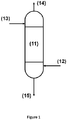
- the present process for producing a purified hydrocarbon stream comprises the steps of (i) contacting in a contact vessel a contaminated hydrocarbon stream and a chemical agent, thereby producing a purified hydrocarbon stream, and (ii) withdrawing said purified hydrocarbon stream from said contact vessel.
- Said contaminated hydrocarbon stream comprises one or more organoaluminum compounds.
- chemical agent as used herein may also be read in the sense of "at least one chemical agent", though a single chemical agent is preferred.
- contaminated hydrocarbon stream is used to denote a hydrocarbon stream comprising one or more organoaluminum compounds before being contacted in the contact vessel with the chemical agent.
- said one or more organoaluminum compounds comprised in the contaminated hydrocarbon stream are selected from the group consisting of organoaluminum compounds represented by the general formula R 3-n AlX n (I), wherein each R is independently selected from alkyl having from one to ten carbon atoms, each X is independently a halogen atom, and n is 0, 1 or 2; alkylalumoxanes wherein alkyl is selected from alkyl having from one to ten carbon atoms; and blends of both.
- alkyl groups having from one to ten carbon atoms are methyl, ethyl, n-propyl, iso-propyl, n-butyl, sec-butyl, tert-butyl, pentyl, hexyl, heptyl, octyl, nonyl and decyl.
- R is an alkyl having from one to six carbons atoms, such as for example methyl, ethyl, n-propyl, iso-propyl, n-butyl, sec-butyl, tert-butyl, pentyl and hexyl. Most preferably R is ethyl.
- X is selected from the group consisting of fluorine, chlorine, bromine and iodine. Most preferably X is chlorine.
- n is 0 or 1
- most preferably n is 0.
- Exemplary organoaluminum compounds of general formula (I) include trimethylaluminum (Me 3 Al), triethylaluminum (Et 3 Al, frequently referred to as "TEAL”), tri-n-propylaluminum (nPr 3 Al), tri-iso-propylaluminum (iPr 3 Al), tri-n-butylaluminum (nBu 3 Al), tri-iso-butylaluminum (iBu 3 Al, frequently referred to as "TIBAL”), tri-sec-butylaluminum (secBu 3 Al), and tri-octyl-aluminum. Triethylaluminum is the most preferred one.
- Alkylalumoxanes may be produced by hydrolysis of the respective trialkylaluminum.
- Preferred examples of alkylalumoxanes include methylalumoxane (MAO), ethylalumoxane, n-propylalumoxane, iso-propylalumoxane, n-butylalumoxane, isobutylalumoxane, sec-butylalumoxane, and octylalumoxane.
- MAO methylalumoxane
- MAO methylalumoxane
- ethylalumoxane ethylalumoxane
- n-propylalumoxane iso-propylalumoxane
- n-butylalumoxane isobutylalumoxane
- sec-butylalumoxane sec-butylalumoxane
- the chemical agent used in the present process needs to be capable of reacting with such organoaluminum compounds.
- the term "capable of reacting” is used to denote that the equilibrium between reactants, i.e. chemical agent and organoaluminum compound(s), and products lies almost entirely on the product side.
- reactants i.e. chemical agent and organoaluminum compound(s)
- products lies almost entirely on the product side.
- at least 90 mol% of the initial amount of reactants is present as product, more preferably at least 95 mol%, even more preferably at least 97 mol%, and most preferably at least 99 mol%.
- Components A 1 , A 2 , A 3 , A 4 , X 1 , X 2 , R 1 and R 2 may be chosen such that one or more, preferably six-membered, saturated or unsaturated rings may be formed. Optionally, such rings may also be fused. For example, in X 1 -A 1 -X 2 component A 1 , and in X 1 -A 1 -A 2 -X 2 component A 1 or component A 2 or both may be a cyclohexyl ring.
- NR 1 may also indicate that the nitrogen atom forms part of an aromatic ring or an aromatic fused ring system.
- the preferred aryl is phenyl.
- aryl is an ortho-phenylene.
- phenylene refers to the bivalent radical of benzene, said radical having the general formula C 6 H 4 .
- Ortho-phenylene may be represented by "1,2-C 6 H 4 ".
- said chemical agent is selected from the group consisting of the following classes of compounds
- (A) include glycol and polyethylene glycol, said polyethylene glycol having a preferred molecular weight of at least 100 and of at most 5000, more preferably of at most 4000 or 3000, even more preferably of at most 2000 and most preferably of at most 1000 g/mol.
- (B) and (C) include (HOOC-CH 2 ) 2 N-CH 2 -CH 2 -N(CH 2 -COOH) 2 (ethylenediaminetetraacetic acid, EDTA, CAS-number 60-00-4), cyclohexanediaminetetraacetic acid and their respective di-sodium salts.
- (D) include the following compounds of general formula (C p H 2p+1 )N(CH 2 -CH 2 -OH) 2 , wherein p is from 12 to 18 (N-(C 12 -C 18 alkyl)bis(2-hydroxyethyl) amine, CAS-number 71786-60-2).
- Such compounds are commercially available for example as Atmer 163 (CAS-number 107043-84-5) or Armostat 400 (N-(C 12 -C 14 alkyl)bis(2-hydroxyethyl) amine, CAS-number 61791-31-9) or Armostat 300 (N-(C 14 -C 18 alkyl)bis(2-hydroxyethyl) amine, CAS-number 61791-44-4).
- (E) examples include N(CH 2 -COOH) 3 (nitrilotriacetic acid, CAS-number 139-13-9) and the respective sodium salts.
- (F) examples include (HOOC-CH 2 ) 2 N-CH 2 -CH 2 -N(CH 2 -COOH)-CH 2 -CH 2 -N(CH 2 -COOH) 2 (diethylenetriaminepentaacetic acid, DTPA, CAS-number 67-43-6), (HOOC-CH 2 ) 2 N-(CH 2 -CH 2 -O) 2 -CH 2 -CH 2 -N(CH 2 -COOH) 2 (ethylenebis(oxyethylenenitrilo)tetraacetic acid, EGTA, CAS-number 67-42-5), (HOOC-CH 2 ) 2 N-(1,2-C 6 H 4 )-O-CH2-CH 2 -O-(1,2-C 6 H 4 )-N(CH 2 -COOH) 2 (2,2'-(ethylenedioxy)dianiline-N,N,N',N'-tetraacetic acid, BAPTA, CAS-number 85233-19-8),
- said chemical agent is suspended or dissolved in a liquid, thus forming a suspension or solution, in the following referred to as "solution", wherein said liquid is chemically inert towards organoaluminum compounds.
- solution wherein said liquid is chemically inert towards organoaluminum compounds.
- chemically inert diluents are saturated hydrocarbons, such as for example mineral oil.
- the concentration of chemical agent in said liquid is of at least 5 wt% and most preferably of at least 10 wt%, relative to the amount of said liquid.
- said concentration is of at most 90 wt%, more preferably of at most 80 wt%, even more preferably of at most 70 wt%, and most preferably of at most 60 wt%, relative to the amount of said liquid.
- the concentration of chemical agent in said liquid is given as wt% relative to the total weight of the solution.
- the temperature therein is above the boiling point of the contaminated hydrocarbon stream.
- the contaminated hydrocarbon stream is preferably heated in order to avoid condensation in the contact vessel. Such condensation could lead to an accumulation of liquid in the contact vessel and eventually to the contact vessel becoming inoperable due to the presence of too much liquid.
- the contaminated hydrocarbon stream is superheated when being fed to the contact vessel.
- the aluminum content of the contaminated hydrocarbon stream strongly depends upon the chemical process and its respective process conditions, from which the contaminated hydrocarbon stream originates. Hence, the aluminum content of the contaminated hydrocarbon stream can vary within very wide ranges, for example from 1 ppm to 10000 ppm, or for example from 1 ppm to 1000 ppm.
- a contaminated hydrocarbon stream originating from an olefin polymerization process may for example have an aluminum content of at least 1 ppm and of at most 100 ppm.
- the extent of reduction of the aluminum content from contaminated hydrocarbon stream to purified hydrocarbon stream can be controlled for example by the concentration of the solution of chemical agent or by the residence time of the contaminated hydrocarbon stream in the contact vessel.
- the aluminum content of the purified hydrocarbon stream can be targeted such that the concentration of organoaluminum compound(s) in the purified hydrocarbon stream is such that the purified hydrocarbon is suited for the intended further use.
- the aluminum content of the purified hydrocarbon stream is preferably at most 10 ppm, more preferably at most 5 ppm or 4 ppm, even more preferably at most 3 ppm, still even more preferably at most 2 ppm, and most preferably at most 1 ppm.
- the aluminum content of a hydrocarbon stream may be determined by coupled plasma technique with atomic emission spectroscopy.
- a sample of the hydrocarbon stream may for example be directly injected into the flame of the atomic emission spectrometer and analyzed as indicated in the test methods.
- a solution comprising the chemical agent and the reaction product(s) of chemical agent and organoaluminum compound(s) is recovered; said solution is in the following referred to as "recovered solution".
- said recovery can be done either in a continuous or discontinuous way.
- discontinuous recovery the solution comprising chemical agent and the reaction product(s) of chemical agent and organoaluminum compound(s) is only removed from the contact vessel once the concentration of organoaluminum compound(s) becomes to high too work safely.
- the solution comprising the chemical agent and the reaction product(s) of chemical agent and organoaluminum compound(s) is continuously removed from the contact vessel and may then either re-introduced directly into the contact vessel or before being re-introduced into the contact vessel pass through an intermediate stage, such as for example a storage stage or a cleansing stage.
Landscapes
- Chemical & Material Sciences (AREA)
- Oil, Petroleum & Natural Gas (AREA)
- Organic Chemistry (AREA)
- Chemical Kinetics & Catalysis (AREA)
- Engineering & Computer Science (AREA)
- General Chemical & Material Sciences (AREA)
- Medicinal Chemistry (AREA)
- Polymers & Plastics (AREA)
- Health & Medical Sciences (AREA)
- Analytical Chemistry (AREA)
- Water Supply & Treatment (AREA)
- Organic Low-Molecular-Weight Compounds And Preparation Thereof (AREA)
- Production Of Liquid Hydrocarbon Mixture For Refining Petroleum (AREA)
Priority Applications (2)
| Application Number | Priority Date | Filing Date | Title |
|---|---|---|---|
| EP13700940.3A EP2807135B1 (en) | 2012-01-26 | 2013-01-24 | Purification of a hydrocarbon stream |
| PL13700940T PL2807135T3 (pl) | 2012-01-26 | 2013-01-24 | Oczyszczanie strumienia węglowodorowego |
Applications Claiming Priority (3)
| Application Number | Priority Date | Filing Date | Title |
|---|---|---|---|
| EP12152651 | 2012-01-26 | ||
| EP13700940.3A EP2807135B1 (en) | 2012-01-26 | 2013-01-24 | Purification of a hydrocarbon stream |
| PCT/EP2013/051363 WO2013110719A2 (en) | 2012-01-26 | 2013-01-24 | Purification of a hydrocarbon stream |
Publications (2)
| Publication Number | Publication Date |
|---|---|
| EP2807135A2 EP2807135A2 (en) | 2014-12-03 |
| EP2807135B1 true EP2807135B1 (en) | 2018-10-24 |
Family
ID=47598871
Family Applications (1)
| Application Number | Title | Priority Date | Filing Date |
|---|---|---|---|
| EP13700940.3A Active EP2807135B1 (en) | 2012-01-26 | 2013-01-24 | Purification of a hydrocarbon stream |
Country Status (7)
| Country | Link |
|---|---|
| US (1) | US9156750B2 (pl) |
| EP (1) | EP2807135B1 (pl) |
| KR (1) | KR102012536B1 (pl) |
| CN (1) | CN104136403B (pl) |
| ES (1) | ES2707586T3 (pl) |
| PL (1) | PL2807135T3 (pl) |
| WO (1) | WO2013110719A2 (pl) |
Families Citing this family (1)
| Publication number | Priority date | Publication date | Assignee | Title |
|---|---|---|---|---|
| EP3739021A1 (de) * | 2019-05-14 | 2020-11-18 | Evonik Operations GmbH | Verfahren zur reinigung eines kohlenwasserstoffstroms |
Family Cites Families (7)
| Publication number | Priority date | Publication date | Assignee | Title |
|---|---|---|---|---|
| GB837088A (en) * | 1957-12-23 | 1960-06-09 | Continental Oil Co | Process for the production of 2-methyl-1-butene |
| US3271380A (en) * | 1963-04-01 | 1966-09-06 | Phillips Petroleum Co | Process for catalyst residue removal |
| JPS5830887B2 (ja) * | 1977-11-11 | 1983-07-02 | 住友化学工業株式会社 | 高結晶性ポリオレフィンの精製方法 |
| FR2581987B2 (fr) * | 1985-05-14 | 1987-07-24 | Inst Francais Du Petrole | Procede ameliore d'enlevement du nickel, de l'aluminium et du chlore des oligomeres d'olefines |
| MY112177A (en) * | 1994-09-30 | 2001-04-30 | Mitsui Chemicals Inc | Olefin polymerization catalyst and process for olefin polymerization |
| US7446167B2 (en) * | 2006-04-13 | 2008-11-04 | Fina Technology, Inc. | Catalyst deactivation agents and methods for use of same |
| BRPI0914831A2 (pt) * | 2008-06-26 | 2015-10-27 | Basf Corp | processo para a produção de um polímero de alfa-olefina |
-
2013
- 2013-01-24 PL PL13700940T patent/PL2807135T3/pl unknown
- 2013-01-24 KR KR1020147023327A patent/KR102012536B1/ko active Active
- 2013-01-24 ES ES13700940T patent/ES2707586T3/es active Active
- 2013-01-24 WO PCT/EP2013/051363 patent/WO2013110719A2/en not_active Ceased
- 2013-01-24 EP EP13700940.3A patent/EP2807135B1/en active Active
- 2013-01-24 US US14/374,645 patent/US9156750B2/en active Active
- 2013-01-24 CN CN201380011421.8A patent/CN104136403B/zh active Active
Non-Patent Citations (1)
| Title |
|---|
| None * |
Also Published As
| Publication number | Publication date |
|---|---|
| US9156750B2 (en) | 2015-10-13 |
| CN104136403A (zh) | 2014-11-05 |
| WO2013110719A4 (en) | 2014-01-16 |
| ES2707586T3 (es) | 2019-04-04 |
| EP2807135A2 (en) | 2014-12-03 |
| KR20140115358A (ko) | 2014-09-30 |
| CN104136403B (zh) | 2018-05-08 |
| WO2013110719A2 (en) | 2013-08-01 |
| WO2013110719A3 (en) | 2013-11-21 |
| PL2807135T3 (pl) | 2019-03-29 |
| KR102012536B1 (ko) | 2019-08-20 |
| US20140336346A1 (en) | 2014-11-13 |
Similar Documents
| Publication | Publication Date | Title |
|---|---|---|
| US8071835B2 (en) | Process to produce polyolefins using metallocene catalysts | |
| EP1987047B1 (en) | Process for generating alpha olefin comonomers | |
| KR102011167B1 (ko) | 폴리프로필렌 제조 프로세스에서 프로판을 퍼징하는 방법 | |
| US10407358B2 (en) | Process for ethylene oligomerization to produce alpha-olefins | |
| CN110114128B (zh) | 膜和变压吸附混合inru方法 | |
| US4461889A (en) | Separation of solid polymers and liquid diluent | |
| CN103415560B (zh) | 使基于乙烯的聚合反应中所用溶剂循环的方法及其系统 | |
| WO2012096160A1 (ja) | α-オレフィンオリゴマーの製造方法 | |
| WO2020068735A1 (en) | Amino-quinone antipolymerants and methods of using | |
| WO2020132178A1 (en) | Hydroxylated quinone antipolymerants and methods of using | |
| EP2807135B1 (en) | Purification of a hydrocarbon stream | |
| NO159463B (no) | Varmeisolerende roerelement. | |
| CN120435449A (zh) | 用于生产1-己烯的方法 | |
| CA2980648A1 (en) | Method and apparatus for the preparation of a polyolefin | |
| JP5808693B2 (ja) | オレフィンの脱ハロゲン処理方法および被処理物を用いたオレフィンの連続重合方法 | |
| US7528222B1 (en) | Olefin polymerization process |
Legal Events
| Date | Code | Title | Description |
|---|---|---|---|
| PUAI | Public reference made under article 153(3) epc to a published international application that has entered the european phase |
Free format text: ORIGINAL CODE: 0009012 |
|
| 17P | Request for examination filed |
Effective date: 20140710 |
|
| AK | Designated contracting states |
Kind code of ref document: A2 Designated state(s): AL AT BE BG CH CY CZ DE DK EE ES FI FR GB GR HR HU IE IS IT LI LT LU LV MC MK MT NL NO PL PT RO RS SE SI SK SM TR |
|
| DAX | Request for extension of the european patent (deleted) | ||
| RIN1 | Information on inventor provided before grant (corrected) |
Inventor name: EECKHOUT, KAREL Inventor name: RICHET, MARC |
|
| GRAP | Despatch of communication of intention to grant a patent |
Free format text: ORIGINAL CODE: EPIDOSNIGR1 |
|
| STAA | Information on the status of an ep patent application or granted ep patent |
Free format text: STATUS: GRANT OF PATENT IS INTENDED |
|
| INTG | Intention to grant announced |
Effective date: 20180509 |
|
| GRAS | Grant fee paid |
Free format text: ORIGINAL CODE: EPIDOSNIGR3 |
|
| GRAA | (expected) grant |
Free format text: ORIGINAL CODE: 0009210 |
|
| STAA | Information on the status of an ep patent application or granted ep patent |
Free format text: STATUS: THE PATENT HAS BEEN GRANTED |
|
| AK | Designated contracting states |
Kind code of ref document: B1 Designated state(s): AL AT BE BG CH CY CZ DE DK EE ES FI FR GB GR HR HU IE IS IT LI LT LU LV MC MK MT NL NO PL PT RO RS SE SI SK SM TR |
|
| REG | Reference to a national code |
Ref country code: CH Ref legal event code: EP |
|
| REG | Reference to a national code |
Ref country code: IE Ref legal event code: FG4D |
|
| REG | Reference to a national code |
Ref country code: AT Ref legal event code: REF Ref document number: 1056473 Country of ref document: AT Kind code of ref document: T Effective date: 20181115 |
|
| REG | Reference to a national code |
Ref country code: DE Ref legal event code: R096 Ref document number: 602013045492 Country of ref document: DE |
|
| REG | Reference to a national code |
Ref country code: NL Ref legal event code: FP |
|
| REG | Reference to a national code |
Ref country code: LT Ref legal event code: MG4D |
|
| REG | Reference to a national code |
Ref country code: ES Ref legal event code: FG2A Ref document number: 2707586 Country of ref document: ES Kind code of ref document: T3 Effective date: 20190404 |
|
| PG25 | Lapsed in a contracting state [announced via postgrant information from national office to epo] |
Ref country code: IS Free format text: LAPSE BECAUSE OF FAILURE TO SUBMIT A TRANSLATION OF THE DESCRIPTION OR TO PAY THE FEE WITHIN THE PRESCRIBED TIME-LIMIT Effective date: 20190224 Ref country code: BG Free format text: LAPSE BECAUSE OF FAILURE TO SUBMIT A TRANSLATION OF THE DESCRIPTION OR TO PAY THE FEE WITHIN THE PRESCRIBED TIME-LIMIT Effective date: 20190124 Ref country code: NO Free format text: LAPSE BECAUSE OF FAILURE TO SUBMIT A TRANSLATION OF THE DESCRIPTION OR TO PAY THE FEE WITHIN THE PRESCRIBED TIME-LIMIT Effective date: 20190124 Ref country code: FI Free format text: LAPSE BECAUSE OF FAILURE TO SUBMIT A TRANSLATION OF THE DESCRIPTION OR TO PAY THE FEE WITHIN THE PRESCRIBED TIME-LIMIT Effective date: 20181024 Ref country code: LT Free format text: LAPSE BECAUSE OF FAILURE TO SUBMIT A TRANSLATION OF THE DESCRIPTION OR TO PAY THE FEE WITHIN THE PRESCRIBED TIME-LIMIT Effective date: 20181024 Ref country code: LV Free format text: LAPSE BECAUSE OF FAILURE TO SUBMIT A TRANSLATION OF THE DESCRIPTION OR TO PAY THE FEE WITHIN THE PRESCRIBED TIME-LIMIT Effective date: 20181024 Ref country code: HR Free format text: LAPSE BECAUSE OF FAILURE TO SUBMIT A TRANSLATION OF THE DESCRIPTION OR TO PAY THE FEE WITHIN THE PRESCRIBED TIME-LIMIT Effective date: 20181024 |
|
| PG25 | Lapsed in a contracting state [announced via postgrant information from national office to epo] |
Ref country code: SE Free format text: LAPSE BECAUSE OF FAILURE TO SUBMIT A TRANSLATION OF THE DESCRIPTION OR TO PAY THE FEE WITHIN THE PRESCRIBED TIME-LIMIT Effective date: 20181024 Ref country code: RS Free format text: LAPSE BECAUSE OF FAILURE TO SUBMIT A TRANSLATION OF THE DESCRIPTION OR TO PAY THE FEE WITHIN THE PRESCRIBED TIME-LIMIT Effective date: 20181024 Ref country code: AL Free format text: LAPSE BECAUSE OF FAILURE TO SUBMIT A TRANSLATION OF THE DESCRIPTION OR TO PAY THE FEE WITHIN THE PRESCRIBED TIME-LIMIT Effective date: 20181024 Ref country code: GR Free format text: LAPSE BECAUSE OF FAILURE TO SUBMIT A TRANSLATION OF THE DESCRIPTION OR TO PAY THE FEE WITHIN THE PRESCRIBED TIME-LIMIT Effective date: 20190125 Ref country code: PT Free format text: LAPSE BECAUSE OF FAILURE TO SUBMIT A TRANSLATION OF THE DESCRIPTION OR TO PAY THE FEE WITHIN THE PRESCRIBED TIME-LIMIT Effective date: 20190224 |
|
| REG | Reference to a national code |
Ref country code: DE Ref legal event code: R097 Ref document number: 602013045492 Country of ref document: DE |
|
| PG25 | Lapsed in a contracting state [announced via postgrant information from national office to epo] |
Ref country code: CZ Free format text: LAPSE BECAUSE OF FAILURE TO SUBMIT A TRANSLATION OF THE DESCRIPTION OR TO PAY THE FEE WITHIN THE PRESCRIBED TIME-LIMIT Effective date: 20181024 Ref country code: DK Free format text: LAPSE BECAUSE OF FAILURE TO SUBMIT A TRANSLATION OF THE DESCRIPTION OR TO PAY THE FEE WITHIN THE PRESCRIBED TIME-LIMIT Effective date: 20181024 |
|
| PG25 | Lapsed in a contracting state [announced via postgrant information from national office to epo] |
Ref country code: SM Free format text: LAPSE BECAUSE OF FAILURE TO SUBMIT A TRANSLATION OF THE DESCRIPTION OR TO PAY THE FEE WITHIN THE PRESCRIBED TIME-LIMIT Effective date: 20181024 Ref country code: EE Free format text: LAPSE BECAUSE OF FAILURE TO SUBMIT A TRANSLATION OF THE DESCRIPTION OR TO PAY THE FEE WITHIN THE PRESCRIBED TIME-LIMIT Effective date: 20181024 Ref country code: RO Free format text: LAPSE BECAUSE OF FAILURE TO SUBMIT A TRANSLATION OF THE DESCRIPTION OR TO PAY THE FEE WITHIN THE PRESCRIBED TIME-LIMIT Effective date: 20181024 Ref country code: SK Free format text: LAPSE BECAUSE OF FAILURE TO SUBMIT A TRANSLATION OF THE DESCRIPTION OR TO PAY THE FEE WITHIN THE PRESCRIBED TIME-LIMIT Effective date: 20181024 Ref country code: MC Free format text: LAPSE BECAUSE OF FAILURE TO SUBMIT A TRANSLATION OF THE DESCRIPTION OR TO PAY THE FEE WITHIN THE PRESCRIBED TIME-LIMIT Effective date: 20181024 |
|
| PLBE | No opposition filed within time limit |
Free format text: ORIGINAL CODE: 0009261 |
|
| REG | Reference to a national code |
Ref country code: CH Ref legal event code: PL |
|
| STAA | Information on the status of an ep patent application or granted ep patent |
Free format text: STATUS: NO OPPOSITION FILED WITHIN TIME LIMIT |
|
| PG25 | Lapsed in a contracting state [announced via postgrant information from national office to epo] |
Ref country code: LU Free format text: LAPSE BECAUSE OF NON-PAYMENT OF DUE FEES Effective date: 20190124 |
|
| 26N | No opposition filed |
Effective date: 20190725 |
|
| REG | Reference to a national code |
Ref country code: IE Ref legal event code: MM4A |
|
| PG25 | Lapsed in a contracting state [announced via postgrant information from national office to epo] |
Ref country code: SI Free format text: LAPSE BECAUSE OF FAILURE TO SUBMIT A TRANSLATION OF THE DESCRIPTION OR TO PAY THE FEE WITHIN THE PRESCRIBED TIME-LIMIT Effective date: 20181024 |
|
| PG25 | Lapsed in a contracting state [announced via postgrant information from national office to epo] |
Ref country code: LI Free format text: LAPSE BECAUSE OF NON-PAYMENT OF DUE FEES Effective date: 20190131 Ref country code: CH Free format text: LAPSE BECAUSE OF NON-PAYMENT OF DUE FEES Effective date: 20190131 |
|
| PG25 | Lapsed in a contracting state [announced via postgrant information from national office to epo] |
Ref country code: IE Free format text: LAPSE BECAUSE OF NON-PAYMENT OF DUE FEES Effective date: 20190124 |
|
| PG25 | Lapsed in a contracting state [announced via postgrant information from national office to epo] |
Ref country code: TR Free format text: LAPSE BECAUSE OF FAILURE TO SUBMIT A TRANSLATION OF THE DESCRIPTION OR TO PAY THE FEE WITHIN THE PRESCRIBED TIME-LIMIT Effective date: 20181024 |
|
| PG25 | Lapsed in a contracting state [announced via postgrant information from national office to epo] |
Ref country code: MT Free format text: LAPSE BECAUSE OF NON-PAYMENT OF DUE FEES Effective date: 20190124 |
|
| PG25 | Lapsed in a contracting state [announced via postgrant information from national office to epo] |
Ref country code: CY Free format text: LAPSE BECAUSE OF FAILURE TO SUBMIT A TRANSLATION OF THE DESCRIPTION OR TO PAY THE FEE WITHIN THE PRESCRIBED TIME-LIMIT Effective date: 20181024 |
|
| PG25 | Lapsed in a contracting state [announced via postgrant information from national office to epo] |
Ref country code: HU Free format text: LAPSE BECAUSE OF FAILURE TO SUBMIT A TRANSLATION OF THE DESCRIPTION OR TO PAY THE FEE WITHIN THE PRESCRIBED TIME-LIMIT; INVALID AB INITIO Effective date: 20130124 |
|
| PG25 | Lapsed in a contracting state [announced via postgrant information from national office to epo] |
Ref country code: MK Free format text: LAPSE BECAUSE OF FAILURE TO SUBMIT A TRANSLATION OF THE DESCRIPTION OR TO PAY THE FEE WITHIN THE PRESCRIBED TIME-LIMIT Effective date: 20181024 |
|
| P01 | Opt-out of the competence of the unified patent court (upc) registered |
Effective date: 20230523 |
|
| PGFP | Annual fee paid to national office [announced via postgrant information from national office to epo] |
Ref country code: DE Payment date: 20250121 Year of fee payment: 13 |
|
| PGFP | Annual fee paid to national office [announced via postgrant information from national office to epo] |
Ref country code: ES Payment date: 20250226 Year of fee payment: 13 |
|
| PGFP | Annual fee paid to national office [announced via postgrant information from national office to epo] |
Ref country code: AT Payment date: 20250122 Year of fee payment: 13 Ref country code: BE Payment date: 20250121 Year of fee payment: 13 |
|
| PGFP | Annual fee paid to national office [announced via postgrant information from national office to epo] |
Ref country code: PL Payment date: 20250117 Year of fee payment: 13 Ref country code: FR Payment date: 20250127 Year of fee payment: 13 |
|
| PGFP | Annual fee paid to national office [announced via postgrant information from national office to epo] |
Ref country code: GB Payment date: 20250128 Year of fee payment: 13 Ref country code: IT Payment date: 20250129 Year of fee payment: 13 |
|
| PGFP | Annual fee paid to national office [announced via postgrant information from national office to epo] |
Ref country code: NL Payment date: 20260121 Year of fee payment: 14 |