EP2805963A1 - Amyloid -protein-specific production-inhibiting polypeptide - Google Patents
Amyloid -protein-specific production-inhibiting polypeptide Download PDFInfo
- Publication number
- EP2805963A1 EP2805963A1 EP13738569.6A EP13738569A EP2805963A1 EP 2805963 A1 EP2805963 A1 EP 2805963A1 EP 13738569 A EP13738569 A EP 13738569A EP 2805963 A1 EP2805963 A1 EP 2805963A1
- Authority
- EP
- European Patent Office
- Prior art keywords
- polypeptide
- protein
- secretase
- amino acid
- seq
- Prior art date
- Legal status (The legal status is an assumption and is not a legal conclusion. Google has not performed a legal analysis and makes no representation as to the accuracy of the status listed.)
- Granted
Links
- 108090000765 processed proteins & peptides Proteins 0.000 title claims abstract description 290
- 229920001184 polypeptide Polymers 0.000 title claims abstract description 284
- 102000004196 processed proteins & peptides Human genes 0.000 title claims abstract description 284
- 238000004519 manufacturing process Methods 0.000 title claims abstract description 51
- 230000002401 inhibitory effect Effects 0.000 title description 17
- 108010048112 Amyloidogenic Proteins Proteins 0.000 title description 2
- 102000009091 Amyloidogenic Proteins Human genes 0.000 title description 2
- 102000002659 Amyloid Precursor Protein Secretases Human genes 0.000 claims abstract description 141
- 108010043324 Amyloid Precursor Protein Secretases Proteins 0.000 claims abstract description 141
- 230000000694 effects Effects 0.000 claims abstract description 139
- 239000003112 inhibitor Substances 0.000 claims abstract description 77
- 208000024827 Alzheimer disease Diseases 0.000 claims abstract description 60
- 239000003795 chemical substances by application Substances 0.000 claims abstract description 34
- 230000014616 translation Effects 0.000 claims abstract description 30
- 210000004897 n-terminal region Anatomy 0.000 claims abstract description 16
- 125000003275 alpha amino acid group Chemical group 0.000 claims abstract 9
- 238000000034 method Methods 0.000 claims description 24
- 230000002265 prevention Effects 0.000 claims description 7
- 239000008194 pharmaceutical composition Substances 0.000 claims description 5
- 102000004169 proteins and genes Human genes 0.000 abstract description 73
- 108090000623 proteins and genes Proteins 0.000 abstract description 73
- 150000001875 compounds Chemical class 0.000 abstract description 9
- 239000004480 active ingredient Substances 0.000 abstract description 6
- 239000003814 drug Substances 0.000 abstract description 6
- 229940079593 drug Drugs 0.000 abstract description 4
- 150000001413 amino acids Chemical group 0.000 description 71
- IAZDPXIOMUYVGZ-UHFFFAOYSA-N Dimethylsulphoxide Chemical compound CS(C)=O IAZDPXIOMUYVGZ-UHFFFAOYSA-N 0.000 description 48
- 238000002474 experimental method Methods 0.000 description 41
- 238000003776 cleavage reaction Methods 0.000 description 37
- 230000007017 scission Effects 0.000 description 37
- 210000004027 cell Anatomy 0.000 description 35
- 230000005764 inhibitory process Effects 0.000 description 33
- 101800001628 Notch 1 intracellular domain Proteins 0.000 description 17
- 102400000552 Notch 1 intracellular domain Human genes 0.000 description 17
- 238000001262 western blot Methods 0.000 description 17
- 108010070047 Notch Receptors Proteins 0.000 description 14
- 239000013642 negative control Substances 0.000 description 13
- 239000000758 substrate Substances 0.000 description 11
- MURCDOXDAHPNRQ-ZJKZPDEISA-N L-685,458 Chemical compound C([C@@H]([C@H](O)C[C@H](C(=O)N[C@@H](CC(C)C)C(=O)N[C@@H](CC=1C=CC=CC=1)C(N)=O)CC=1C=CC=CC=1)NC(=O)OC(C)(C)C)C1=CC=CC=C1 MURCDOXDAHPNRQ-ZJKZPDEISA-N 0.000 description 10
- 102000014736 Notch Human genes 0.000 description 10
- 230000001413 cellular effect Effects 0.000 description 10
- 239000000470 constituent Substances 0.000 description 10
- 238000010586 diagram Methods 0.000 description 10
- 239000003540 gamma secretase inhibitor Substances 0.000 description 10
- 241000699666 Mus <mouse, genus> Species 0.000 description 9
- 125000000539 amino acid group Chemical group 0.000 description 9
- 239000006143 cell culture medium Substances 0.000 description 9
- 239000013592 cell lysate Substances 0.000 description 9
- 239000000243 solution Substances 0.000 description 9
- -1 Delta1 Proteins 0.000 description 8
- 229940125373 Gamma-Secretase Inhibitor Drugs 0.000 description 8
- 238000012986 modification Methods 0.000 description 8
- 230000004048 modification Effects 0.000 description 8
- 210000004556 brain Anatomy 0.000 description 7
- 230000001419 dependent effect Effects 0.000 description 7
- 102000004190 Enzymes Human genes 0.000 description 6
- 108090000790 Enzymes Proteins 0.000 description 6
- 238000012404 In vitro experiment Methods 0.000 description 6
- 125000003368 amide group Chemical group 0.000 description 6
- 125000003178 carboxy group Chemical group [H]OC(*)=O 0.000 description 6
- 230000003247 decreasing effect Effects 0.000 description 6
- DHMQDGOQFOQNFH-UHFFFAOYSA-N Glycine Chemical compound NCC(O)=O DHMQDGOQFOQNFH-UHFFFAOYSA-N 0.000 description 5
- 241000699670 Mus sp. Species 0.000 description 5
- KZSNJWFQEVHDMF-UHFFFAOYSA-N Valine Chemical compound CC(C)C(N)C(O)=O KZSNJWFQEVHDMF-UHFFFAOYSA-N 0.000 description 5
- 238000009825 accumulation Methods 0.000 description 5
- 238000006243 chemical reaction Methods 0.000 description 5
- 210000001320 hippocampus Anatomy 0.000 description 5
- 102000005650 Notch Receptors Human genes 0.000 description 4
- 230000009471 action Effects 0.000 description 4
- 230000002411 adverse Effects 0.000 description 4
- 238000004458 analytical method Methods 0.000 description 4
- 230000006870 function Effects 0.000 description 4
- 230000002829 reductive effect Effects 0.000 description 4
- 239000002904 solvent Substances 0.000 description 4
- 102000035160 transmembrane proteins Human genes 0.000 description 4
- 108091005703 transmembrane proteins Proteins 0.000 description 4
- 101800001517 C99 Proteins 0.000 description 3
- 241001465754 Metazoa Species 0.000 description 3
- 210000000683 abdominal cavity Anatomy 0.000 description 3
- 230000017488 activation-induced cell death of T cell Effects 0.000 description 3
- 150000001408 amides Chemical class 0.000 description 3
- 230000000844 anti-bacterial effect Effects 0.000 description 3
- 230000002421 anti-septic effect Effects 0.000 description 3
- 229940064004 antiseptic throat preparations Drugs 0.000 description 3
- 239000003899 bactericide agent Substances 0.000 description 3
- 239000000969 carrier Substances 0.000 description 3
- 210000004720 cerebrum Anatomy 0.000 description 3
- 208000010877 cognitive disease Diseases 0.000 description 3
- 238000000326 densiometry Methods 0.000 description 3
- 208000037265 diseases, disorders, signs and symptoms Diseases 0.000 description 3
- 239000001963 growth medium Substances 0.000 description 3
- 238000002347 injection Methods 0.000 description 3
- 239000007924 injection Substances 0.000 description 3
- 230000003834 intracellular effect Effects 0.000 description 3
- 239000003381 stabilizer Substances 0.000 description 3
- YBJHBAHKTGYVGT-ZKWXMUAHSA-N (+)-Biotin Chemical compound N1C(=O)N[C@@H]2[C@H](CCCCC(=O)O)SC[C@@H]21 YBJHBAHKTGYVGT-ZKWXMUAHSA-N 0.000 description 2
- 108010090849 Amyloid beta-Peptides Proteins 0.000 description 2
- 102000013455 Amyloid beta-Peptides Human genes 0.000 description 2
- 102000000905 Cadherin Human genes 0.000 description 2
- 108050007957 Cadherin Proteins 0.000 description 2
- 238000008157 ELISA kit Methods 0.000 description 2
- KZSNJWFQEVHDMF-BYPYZUCNSA-N L-valine Chemical compound CC(C)[C@H](N)C(O)=O KZSNJWFQEVHDMF-BYPYZUCNSA-N 0.000 description 2
- ULSSJYNJIZWPSB-CVRXJBIPSA-N LY-411575 Chemical compound C1([C@H](O)C(=O)N[C@@H](C)C(=O)N[C@@H]2C(N(C)C3=CC=CC=C3C3=CC=CC=C32)=O)=CC(F)=CC(F)=C1 ULSSJYNJIZWPSB-CVRXJBIPSA-N 0.000 description 2
- 102000015499 Presenilins Human genes 0.000 description 2
- 108010050254 Presenilins Proteins 0.000 description 2
- 102000003838 Sialyltransferases Human genes 0.000 description 2
- 108090000141 Sialyltransferases Proteins 0.000 description 2
- 239000000654 additive Substances 0.000 description 2
- 108010064397 amyloid beta-protein (1-40) Proteins 0.000 description 2
- 108010064539 amyloid beta-protein (1-42) Proteins 0.000 description 2
- 239000000090 biomarker Substances 0.000 description 2
- 210000004899 c-terminal region Anatomy 0.000 description 2
- 210000003710 cerebral cortex Anatomy 0.000 description 2
- 230000006957 competitive inhibition Effects 0.000 description 2
- 238000012790 confirmation Methods 0.000 description 2
- 210000004748 cultured cell Anatomy 0.000 description 2
- 201000010099 disease Diseases 0.000 description 2
- 238000010494 dissociation reaction Methods 0.000 description 2
- 230000005593 dissociations Effects 0.000 description 2
- 238000009826 distribution Methods 0.000 description 2
- 238000009472 formulation Methods 0.000 description 2
- 230000007246 mechanism Effects 0.000 description 2
- 239000002609 medium Substances 0.000 description 2
- 208000027061 mild cognitive impairment Diseases 0.000 description 2
- 239000000203 mixture Substances 0.000 description 2
- 229940021182 non-steroidal anti-inflammatory drug Drugs 0.000 description 2
- NRNCYVBFPDDJNE-UHFFFAOYSA-N pemoline Chemical compound O1C(N)=NC(=O)C1C1=CC=CC=C1 NRNCYVBFPDDJNE-UHFFFAOYSA-N 0.000 description 2
- 210000000952 spleen Anatomy 0.000 description 2
- 239000000725 suspension Substances 0.000 description 2
- 208000024891 symptom Diseases 0.000 description 2
- 238000012360 testing method Methods 0.000 description 2
- 239000004474 valine Substances 0.000 description 2
- 208000037259 Amyloid Plaque Diseases 0.000 description 1
- 102100040055 Amyloid beta precursor like protein 1 Human genes 0.000 description 1
- 102100040038 Amyloid beta precursor like protein 2 Human genes 0.000 description 1
- 101710137189 Amyloid-beta A4 protein Proteins 0.000 description 1
- 102100022704 Amyloid-beta precursor protein Human genes 0.000 description 1
- 101710151993 Amyloid-beta precursor protein Proteins 0.000 description 1
- 239000004475 Arginine Substances 0.000 description 1
- 102000035101 Aspartic proteases Human genes 0.000 description 1
- 108091005502 Aspartic proteases Proteins 0.000 description 1
- 206010003694 Atrophy Diseases 0.000 description 1
- 238000011740 C57BL/6 mouse Methods 0.000 description 1
- 102100032912 CD44 antigen Human genes 0.000 description 1
- 206010008096 Cerebral atrophy Diseases 0.000 description 1
- 208000028698 Cognitive impairment Diseases 0.000 description 1
- DWJXYEABWRJFSP-XOBRGWDASA-N DAPT Chemical compound N([C@@H](C)C(=O)N[C@H](C(=O)OC(C)(C)C)C=1C=CC=CC=1)C(=O)CC1=CC(F)=CC(F)=C1 DWJXYEABWRJFSP-XOBRGWDASA-N 0.000 description 1
- XZWYTXMRWQJBGX-VXBMVYAYSA-N FLAG peptide Chemical compound NCCCC[C@@H](C(O)=O)NC(=O)[C@H](CC(O)=O)NC(=O)[C@H](CC(O)=O)NC(=O)[C@H](CC(O)=O)NC(=O)[C@H](CC(O)=O)NC(=O)[C@H](CCCCN)NC(=O)[C@@H](NC(=O)[C@@H](N)CC(O)=O)CC1=CC=C(O)C=C1 XZWYTXMRWQJBGX-VXBMVYAYSA-N 0.000 description 1
- 108010020195 FLAG peptide Proteins 0.000 description 1
- 239000004471 Glycine Substances 0.000 description 1
- 101000890407 Homo sapiens Amyloid beta precursor like protein 1 Proteins 0.000 description 1
- 101000890401 Homo sapiens Amyloid beta precursor like protein 2 Proteins 0.000 description 1
- 101500026579 Homo sapiens C99 Proteins 0.000 description 1
- 101000868273 Homo sapiens CD44 antigen Proteins 0.000 description 1
- 101000896414 Homo sapiens Nuclear nucleic acid-binding protein C1D Proteins 0.000 description 1
- 101001043564 Homo sapiens Prolow-density lipoprotein receptor-related protein 1 Proteins 0.000 description 1
- 206010020880 Hypertrophy Diseases 0.000 description 1
- 101500026624 Mus musculus C99 Proteins 0.000 description 1
- ZMXDDKWLCZADIW-UHFFFAOYSA-N N,N-dimethylformamide Substances CN(C)C=O ZMXDDKWLCZADIW-UHFFFAOYSA-N 0.000 description 1
- 108050000637 N-cadherin Proteins 0.000 description 1
- 102000002356 Nectin Human genes 0.000 description 1
- 108060005251 Nectin Proteins 0.000 description 1
- 206010028980 Neoplasm Diseases 0.000 description 1
- 101000579647 Penaeus vannamei Penaeidin-2a Proteins 0.000 description 1
- 102000035195 Peptidases Human genes 0.000 description 1
- 108091005804 Peptidases Proteins 0.000 description 1
- 102100021923 Prolow-density lipoprotein receptor-related protein 1 Human genes 0.000 description 1
- 239000004365 Protease Substances 0.000 description 1
- 101710170213 Protein jagged-2 Proteins 0.000 description 1
- 102100032733 Protein jagged-2 Human genes 0.000 description 1
- 241000283984 Rodentia Species 0.000 description 1
- 208000006981 Skin Abnormalities Diseases 0.000 description 1
- 239000013504 Triton X-100 Substances 0.000 description 1
- 229920004890 Triton X-100 Polymers 0.000 description 1
- 239000002250 absorbent Substances 0.000 description 1
- 230000002745 absorbent Effects 0.000 description 1
- 230000004913 activation Effects 0.000 description 1
- 239000002671 adjuvant Substances 0.000 description 1
- DZHSAHHDTRWUTF-SIQRNXPUSA-N amyloid-beta polypeptide 42 Chemical compound C([C@@H](C(=O)N[C@@H](C)C(=O)N[C@@H](CCC(O)=O)C(=O)N[C@@H](CC(O)=O)C(=O)N[C@H](C(=O)NCC(=O)N[C@@H](CO)C(=O)N[C@@H](CC(N)=O)C(=O)N[C@@H](CCCCN)C(=O)NCC(=O)N[C@@H](C)C(=O)N[C@H](C(=O)N[C@@H]([C@@H](C)CC)C(=O)NCC(=O)N[C@@H](CC(C)C)C(=O)N[C@@H](CCSC)C(=O)N[C@@H](C(C)C)C(=O)NCC(=O)NCC(=O)N[C@@H](C(C)C)C(=O)N[C@@H](C(C)C)C(=O)N[C@@H]([C@@H](C)CC)C(=O)N[C@@H](C)C(O)=O)[C@@H](C)CC)C(C)C)NC(=O)[C@H](CC=1C=CC=CC=1)NC(=O)[C@@H](NC(=O)[C@H](CC(C)C)NC(=O)[C@H](CCCCN)NC(=O)[C@H](CCC(N)=O)NC(=O)[C@H](CC=1N=CNC=1)NC(=O)[C@H](CC=1N=CNC=1)NC(=O)[C@@H](NC(=O)[C@H](CCC(O)=O)NC(=O)[C@H](CC=1C=CC(O)=CC=1)NC(=O)CNC(=O)[C@H](CO)NC(=O)[C@H](CC(O)=O)NC(=O)[C@H](CC=1N=CNC=1)NC(=O)[C@H](CCCNC(N)=N)NC(=O)[C@H](CC=1C=CC=CC=1)NC(=O)[C@H](CCC(O)=O)NC(=O)[C@H](C)NC(=O)[C@@H](N)CC(O)=O)C(C)C)C(C)C)C1=CC=CC=C1 DZHSAHHDTRWUTF-SIQRNXPUSA-N 0.000 description 1
- 238000000540 analysis of variance Methods 0.000 description 1
- 101150089041 aph-1 gene Proteins 0.000 description 1
- ODKSFYDXXFIFQN-UHFFFAOYSA-N arginine Natural products OC(=O)C(N)CCCNC(N)=N ODKSFYDXXFIFQN-UHFFFAOYSA-N 0.000 description 1
- 230000037444 atrophy Effects 0.000 description 1
- 229960002685 biotin Drugs 0.000 description 1
- 235000020958 biotin Nutrition 0.000 description 1
- 239000011616 biotin Substances 0.000 description 1
- 210000004369 blood Anatomy 0.000 description 1
- 239000008280 blood Substances 0.000 description 1
- 210000004204 blood vessel Anatomy 0.000 description 1
- 201000011510 cancer Diseases 0.000 description 1
- 210000000170 cell membrane Anatomy 0.000 description 1
- 210000001175 cerebrospinal fluid Anatomy 0.000 description 1
- 230000008859 change Effects 0.000 description 1
- 238000012824 chemical production Methods 0.000 description 1
- 210000002987 choroid plexus Anatomy 0.000 description 1
- 239000003086 colorant Substances 0.000 description 1
- 238000004440 column chromatography Methods 0.000 description 1
- 230000034994 death Effects 0.000 description 1
- 210000001947 dentate gyrus Anatomy 0.000 description 1
- 230000008021 deposition Effects 0.000 description 1
- 238000011161 development Methods 0.000 description 1
- 238000002059 diagnostic imaging Methods 0.000 description 1
- 239000003085 diluting agent Substances 0.000 description 1
- BFMYDTVEBKDAKJ-UHFFFAOYSA-L disodium;(2',7'-dibromo-3',6'-dioxido-3-oxospiro[2-benzofuran-1,9'-xanthene]-4'-yl)mercury;hydrate Chemical compound O.[Na+].[Na+].O1C(=O)C2=CC=CC=C2C21C1=CC(Br)=C([O-])C([Hg])=C1OC1=C2C=C(Br)C([O-])=C1 BFMYDTVEBKDAKJ-UHFFFAOYSA-L 0.000 description 1
- 208000035475 disorder Diseases 0.000 description 1
- 238000011977 dual antiplatelet therapy Methods 0.000 description 1
- 230000004064 dysfunction Effects 0.000 description 1
- 239000003995 emulsifying agent Substances 0.000 description 1
- 238000005516 engineering process Methods 0.000 description 1
- 239000000796 flavoring agent Substances 0.000 description 1
- 239000012530 fluid Substances 0.000 description 1
- 235000013355 food flavoring agent Nutrition 0.000 description 1
- 235000003599 food sweetener Nutrition 0.000 description 1
- 239000012634 fragment Substances 0.000 description 1
- 238000010353 genetic engineering Methods 0.000 description 1
- 229960000789 guanidine hydrochloride Drugs 0.000 description 1
- PJJJBBJSCAKJQF-UHFFFAOYSA-N guanidinium chloride Chemical compound [Cl-].NC(N)=[NH2+] PJJJBBJSCAKJQF-UHFFFAOYSA-N 0.000 description 1
- 208000026278 immune system disease Diseases 0.000 description 1
- 230000036039 immunity Effects 0.000 description 1
- 230000002055 immunohistochemical effect Effects 0.000 description 1
- 238000001114 immunoprecipitation Methods 0.000 description 1
- 238000000338 in vitro Methods 0.000 description 1
- 238000007912 intraperitoneal administration Methods 0.000 description 1
- 238000011813 knockout mouse model Methods 0.000 description 1
- 201000003723 learning disability Diseases 0.000 description 1
- 150000002632 lipids Chemical class 0.000 description 1
- 230000004807 localization Effects 0.000 description 1
- 239000000314 lubricant Substances 0.000 description 1
- 210000003519 mature b lymphocyte Anatomy 0.000 description 1
- 239000012528 membrane Substances 0.000 description 1
- 238000000386 microscopy Methods 0.000 description 1
- 238000002715 modification method Methods 0.000 description 1
- 238000010369 molecular cloning Methods 0.000 description 1
- 230000035772 mutation Effects 0.000 description 1
- 230000001537 neural effect Effects 0.000 description 1
- 210000002569 neuron Anatomy 0.000 description 1
- 102000046701 nicastrin Human genes 0.000 description 1
- 108700022821 nicastrin Proteins 0.000 description 1
- 239000000041 non-steroidal anti-inflammatory agent Substances 0.000 description 1
- 102000039446 nucleic acids Human genes 0.000 description 1
- 108020004707 nucleic acids Proteins 0.000 description 1
- 150000007523 nucleic acids Chemical class 0.000 description 1
- 230000002018 overexpression Effects 0.000 description 1
- 230000003950 pathogenic mechanism Effects 0.000 description 1
- 230000001575 pathological effect Effects 0.000 description 1
- 230000007170 pathology Effects 0.000 description 1
- 239000002953 phosphate buffered saline Substances 0.000 description 1
- 238000010149 post-hoc-test Methods 0.000 description 1
- 239000000843 powder Substances 0.000 description 1
- 239000003755 preservative agent Substances 0.000 description 1
- 125000002924 primary amino group Chemical group [H]N([H])* 0.000 description 1
- 102000005962 receptors Human genes 0.000 description 1
- 108020003175 receptors Proteins 0.000 description 1
- 239000012925 reference material Substances 0.000 description 1
- 238000011160 research Methods 0.000 description 1
- 238000003118 sandwich ELISA Methods 0.000 description 1
- 238000012216 screening Methods 0.000 description 1
- 239000000126 substance Substances 0.000 description 1
- 239000004094 surface-active agent Substances 0.000 description 1
- 239000003765 sweetening agent Substances 0.000 description 1
- 238000010189 synthetic method Methods 0.000 description 1
- 239000006188 syrup Substances 0.000 description 1
- 235000020357 syrup Nutrition 0.000 description 1
- 239000003826 tablet Substances 0.000 description 1
- 102000013498 tau Proteins Human genes 0.000 description 1
- 108010026424 tau Proteins Proteins 0.000 description 1
- 230000001225 therapeutic effect Effects 0.000 description 1
- 238000002560 therapeutic procedure Methods 0.000 description 1
- 210000001541 thymus gland Anatomy 0.000 description 1
- 210000001519 tissue Anatomy 0.000 description 1
- 239000003981 vehicle Substances 0.000 description 1
- XLYOFNOQVPJJNP-UHFFFAOYSA-N water Substances O XLYOFNOQVPJJNP-UHFFFAOYSA-N 0.000 description 1
- 229940124648 γ-Secretase Modulator Drugs 0.000 description 1
Images




Classifications
-
- C—CHEMISTRY; METALLURGY
- C07—ORGANIC CHEMISTRY
- C07K—PEPTIDES
- C07K7/00—Peptides having 5 to 20 amino acids in a fully defined sequence; Derivatives thereof
- C07K7/04—Linear peptides containing only normal peptide links
- C07K7/06—Linear peptides containing only normal peptide links having 5 to 11 amino acids
-
- A—HUMAN NECESSITIES
- A61—MEDICAL OR VETERINARY SCIENCE; HYGIENE
- A61P—SPECIFIC THERAPEUTIC ACTIVITY OF CHEMICAL COMPOUNDS OR MEDICINAL PREPARATIONS
- A61P25/00—Drugs for disorders of the nervous system
- A61P25/28—Drugs for disorders of the nervous system for treating neurodegenerative disorders of the central nervous system, e.g. nootropic agents, cognition enhancers, drugs for treating Alzheimer's disease or other forms of dementia
-
- A—HUMAN NECESSITIES
- A61—MEDICAL OR VETERINARY SCIENCE; HYGIENE
- A61P—SPECIFIC THERAPEUTIC ACTIVITY OF CHEMICAL COMPOUNDS OR MEDICINAL PREPARATIONS
- A61P43/00—Drugs for specific purposes, not provided for in groups A61P1/00-A61P41/00
-
- C—CHEMISTRY; METALLURGY
- C07—ORGANIC CHEMISTRY
- C07K—PEPTIDES
- C07K14/00—Peptides having more than 20 amino acids; Gastrins; Somatostatins; Melanotropins; Derivatives thereof
-
- C—CHEMISTRY; METALLURGY
- C07—ORGANIC CHEMISTRY
- C07K—PEPTIDES
- C07K14/00—Peptides having more than 20 amino acids; Gastrins; Somatostatins; Melanotropins; Derivatives thereof
- C07K14/435—Peptides having more than 20 amino acids; Gastrins; Somatostatins; Melanotropins; Derivatives thereof from animals; from humans
- C07K14/46—Peptides having more than 20 amino acids; Gastrins; Somatostatins; Melanotropins; Derivatives thereof from animals; from humans from vertebrates
- C07K14/47—Peptides having more than 20 amino acids; Gastrins; Somatostatins; Melanotropins; Derivatives thereof from animals; from humans from vertebrates from mammals
- C07K14/4701—Peptides having more than 20 amino acids; Gastrins; Somatostatins; Melanotropins; Derivatives thereof from animals; from humans from vertebrates from mammals not used
- C07K14/4711—Alzheimer's disease; Amyloid plaque core protein
-
- C—CHEMISTRY; METALLURGY
- C07—ORGANIC CHEMISTRY
- C07K—PEPTIDES
- C07K14/00—Peptides having more than 20 amino acids; Gastrins; Somatostatins; Melanotropins; Derivatives thereof
- C07K14/81—Protease inhibitors
-
- C—CHEMISTRY; METALLURGY
- C07—ORGANIC CHEMISTRY
- C07K—PEPTIDES
- C07K14/00—Peptides having more than 20 amino acids; Gastrins; Somatostatins; Melanotropins; Derivatives thereof
- C07K14/81—Protease inhibitors
- C07K14/8107—Endopeptidase (E.C. 3.4.21-99) inhibitors
- C07K14/8142—Aspartate protease (E.C. 3.4.23) inhibitors, e.g. HIV protease inhibitors
-
- A—HUMAN NECESSITIES
- A61—MEDICAL OR VETERINARY SCIENCE; HYGIENE
- A61K—PREPARATIONS FOR MEDICAL, DENTAL OR TOILETRY PURPOSES
- A61K38/00—Medicinal preparations containing peptides
Definitions
- the present invention relates to a polypeptide that particulally inhibits the production of amyloid ⁇ protein.
- amyloid protein is considered to be one of the proteins that cause Alzheimer's disease. Particulally, the accumulation of the A ⁇ protein in the brain is recognized as one of the pathological hallmarks of Alzheimer's disease. Accumulation of A ⁇ protein in the brain forms a rigid fibrous molecular structure. It is believed that this causes the death of neurons in the brain, damaging neural function and, as a result, causing the onset of Alzheimer's disease.
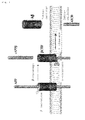
- a ⁇ protein is formed in such a manner that an amyloid precursor protein (or "APP"), which is a transmembrane protein, is cleaved by ⁇ -secretase to form ⁇ CTF, which is also a transmembrane protein, and the ⁇ CTF is further cleaved by ⁇ -secretase to form the A ⁇ protein.
- APP amyloid precursor protein
- ⁇ CTF which is also a transmembrane protein
- a ⁇ protein corresponds to the 653rd to 694th amino acid residues
- ⁇ CTF corresponds to the 653rd to 751st amino acid residues
- the sAPP ⁇ corresponds to the 18th to 652nd amino acid residues
- AICD corresponds to the 701st to 751st amino acid residues.
- a ⁇ protein which is a protein that causes Alzheimer's disease.
- ⁇ -secretase which is known as a complex comprising Pen-2, presenilin, nicastrin, and Aph-1 each being a transmembrane protein
- ⁇ -secretase is a aspartic protease that recognizes, as the substrate, not only the APP mentioned above but also transmembrane proteins, such as APLP1, APLP2, Notch, Jagged2, Delta1, E-cadherin, N-cadherin, CD44, ErbB4, Nectin1, and LRP1; receptors; etc.
- NPL 1 LY-411,575
- NPL 2 lowering the enzyme activity of ⁇ -secretase itself may cause skin abnormalities, squamous cancer, spleen hypertrophy, and the like
- nonsteroidal antiinflammatory drugs are effective in inhibiting the production of A ⁇ protein.
- these drugs are not effective for some familial Alzheimer's diseases (e.g., those associated presenilin mutations) (NPL 3).
- NPL 4 ⁇ -secretase isolated from patients with mild cognitive impairment or Alzheimer's disease exhibits change in its activity, indicating that the effect of the ⁇ -secretase modulator that reduces the production of A ⁇ 42 is low (NPL 4).
- Non-patent Literature 5 ⁇ -Secretase-dependent cleavage of ⁇ CTF fused with FLAG tag at the N-terminus is not observed in the presence of anti-FLAG antibody.
- the main purpose of this invention is to develop a compound that particulally inhibits the production of A ⁇ protein and serves as an active ingredient of a medicament for use in the treatment and/or prevention of Alzheimer's disease.
- the present inventors In seeking a compound that particulally inhibits the production of A ⁇ protein, the present inventors have focused on the fact that A ⁇ protein is produced by the enzyme activity of ⁇ -secretase against ⁇ CTF. Therefore, the inventors searched for a compound that achieves the effect of particulally inhibiting the production of A ⁇ protein not in view of inhibiting the enzyme activity of ⁇ -secretase itself but in view of particulally inhibiting the binding of ⁇ -secretase and ⁇ CTF.
- the inventors found that by reacting ⁇ CTF with ⁇ -secretase in the presence of a monoclonal antibody that particulally binds to the N-terminal region, which is the extracellular region of ⁇ CTF, the effect for remarkably and particulally inhibiting the production of A ⁇ protein can be achieved.
- the inventors also found that little effect is made on the enzyme activity of the ⁇ -secretase to substrates other than ⁇ CTF.
- the inventors conducted extensive research based on the above and found that a peptide having a specific amino acid sequence exhibits remarkable effects as a compound that particulally inhibits the production of A ⁇ protein.
- the present invention encompasses the wide range of embodiments described below.
- the polypeptide of the present invention has the amino acid sequence represented by any one of SEQ ID NOs: 1, 13, 14, and 22, preferably has the amino acid sequence represented by any one of SEQ ID NOs: 2-14 and 22, more preferably has the amino acid sequence represented by any one of SEQ ID NOs: 2-8, 10-12, 14, and 22, and further preferably has the amino acid sequence represented by any one of SEQ ID NOs: 3, 4, 6, 10, 11, 14, and 22.
- amino acid residue in the 2nd, 3rd, 4th, 5th, 11th, 12th, 13th, 14th, 16th, 19th, 21st, 22nd and 23rd positions are each one of the amino acid residues shown in Table 1 below Table 1 Position Amino acid residues 2 Asn, Ser, Asp, Gly, His, Val, Leu, Arg, Phe 3 Thr, Ile, Leu, Pro, Tyr, Arg 4 Leu, Arg, Val, Ile, Thr, Phe, Ser 5 Ile, Val, Ser, Asp, Asn, Thr 11 Ser, His, Asp, Thr, Phe, Tyr, Ile, Ala 12 Leu, Gly, Asn, Ser, Thr, Ala, Arg, Tyr 13 Thr, Asp, Tyr, Ser, Phe, His, Asn 14 Arg, Leu, Val, Ala, Ile, Ser, Tyr 16 Phe, Tyr 19 Ser, Phe, Tyr 21 Val, Ile, Ile, Ser, Tyr 16 Phe, Tyr 19
- the 3rd amino acid residue in the amino acid sequence represented by SEQ ID NO: 14 is L-4,4'-biphenylalanine residue.
- the carboxyl group of the 2nd glycine and the amide group in L-4,4'-biphenylalanine are linked together by a peptide bond
- the amide group of the 4th valine and the amide group of the L-4,4'-biphenylalanine are linked together by a peptide bond.
- the 3rd amino acid residue in the amino acid sequence represented by SEQ ID NO: 22 is L-4,4'-biphenylalanine residue.
- the carboxyl group of the 2nd arginine and the amide group in L-4,4'-biphenylalanine are linked together by a peptide bond
- the amide group of the 4th valine and the amide group of the L-4,4'-biphenylalanine are linked together by a peptide bond.
- an amide terminal may be acetylated or a carboxy terminal may be amidated. Furthermore, the amide terminal may be acetylated and the carboxy terminal may also be amidated.
- polypeptide of the present invention may be suitably modified.
- modifications include, but are not limited to, biotin modification, fluorochrome modification, glycosilation, and lipid modification.
- the modification sites are not particularly limited and may be the inside polypeptide, C-terminal of polypeptide, or N-terminal of polypeptide.
- the modification method is not particularly limited, and a known method may be used.
- the polypeptide of the present invention binds to the N-terminal region of ⁇ CTF.
- ⁇ CTF is a product of APP (e.g., a protein having the amino acid sequence of Accession No. Q95241.1 of NCBI, etc.) cleaved by ⁇ -secretase. Therefore, binding to the N-terminal region of ⁇ CTF is the same meaning as binding to the APP. Furthermore, the N-terminal region of ⁇ CTF corresponds to the region close to the cleavage recognition site by ⁇ -secretase on APP.
- the region close to the N-terminal of ⁇ CTF can be recognized and cleaved also by ⁇ -secretase.
- the fragment after the cleavage is produced as an A ⁇ protein (e.g., a protein having the amino acid sequence of Accession No 1Z0Q_ A, 1BA6_A of NCBI); therefore, binding to the N-terminal region of ⁇ CTF is the same meaning as binding to the A ⁇ protein.
- the amino acid sequence of the N-terminal region of ⁇ CTF to which the polypeptide of the present invention binds is not particulally limited. Examples include the amino acid sequence represented by SEQ ID NO: 15. Some of the amino acids of SEQ ID NO: 15 may also be given as examples.
- the N-terminal region of ⁇ CTF of the present invent does not necessarily contain Asp residue in the present invention at the N-terminal of ⁇ CTF.
- Examples of the amino acid sequence of ⁇ CTF include, particulally in the case of human ⁇ CTF, the amino acid sequence represented by SEQ ID NO: 20. In the case of mouse ⁇ CTF, examples include the amino acid sequence represented by SEQ ID NO: 21.
- the strength of the binding between the polypeptide of the present invention and the N-terminal region of ⁇ CTF is not particularly limited. If it is expressed, for example, by a dissociation constant (KD), it is generally in the range of 50 ⁇ M or less, and preferably about 5 ⁇ M or less.
- KD dissociation constant
- the polypeptide of the present invention is soluble in various solvents without any limitation.
- solvents such as water, PBS, DMSO, and DMF. These solvents may be used in a combination of two or more.
- the polypeptide of the present invention binds to the N-terminal region of ⁇ CTF. As explained above, this region corresponds to the region close to the ⁇ -secretase cleavage recognition site on ⁇ CTF; therefore, it is useful as a ⁇ -secretase activity inhibitor.
- the polypeptide of the present invention binds to the N-terminal region of ⁇ CTF. As explained above, this region corresponds to the region close to the ⁇ -secretase cleavage recognition site on APP; therefore, it is useful as a ⁇ -secretase activity inhibitor.
- the polypeptide of the present invention can be produced by using a known method. More particulally, a chemical production method using a peptide synthesizer or the like may be used, and a biochemical synthetic method may also be used, wherein a nucleic acid having a base sequence encoding the amino acid sequence of the polypeptide is introduced into a host cell.
- the polypeptide of the present invention thus produced may be purified by using a known method such as using column chromatography.
- the ⁇ -secretase activity inhibitor of the present invention contains the polypeptide of the present invention described above.
- polypeptides having the amino acid sequence represented by any one of SEQ ID NOs: 2-14 and 22 are preferable.
- polypeptides contained in the ⁇ -secretase activity inhibitor of the present invention polypeptides having the amino acid sequences represented by any one of SEQ ID NOs: 3, 4, 6, 7, 10, 14, and 22 are preferable.
- polypeptides include those having the amino acid sequence represented by any one of SEQ ID NOs: 3, 4, 6, 10 and 14; polypeptides having the amino acid sequence represented by any one of SEQ ID NOs: 3, 4, 6, and 14; polypeptides having the amino acid sequence represented by any one of SEQ ID NOs: 3, 4, and 6; and polypeptides having the amino acid sequence represented by any one of SEQ ID NOs: 3 and 6 are preferable in increasing preference in this order.
- the most preferable is the polypeptide having the amino acid sequence represented by SEQ ID NO: 3.
- the polypeptide of the present invention contained in the ⁇ -secretase activity inhibitor of the present invention binds to the N-terminal region of ⁇ CTF.
- the ⁇ -secretase activity inhibitor of the present invention exhibits functions based on these phenomena. Therefore, in the present invention, there is a tendency that the ⁇ -secretase activity towards the substrates other than ⁇ CTF recognized by the ⁇ -secretase is not inhibited. More particulally, the ⁇ -secretase of the present invention is preferably used as a ⁇ CTF-specific ⁇ -secretase activity inhibitor.
- ⁇ CTF-specific means that the ⁇ -secretase activity inhibitor tends to select ⁇ CTF as the substrate for inhibiting its activity when ⁇ CTF and other substrate candidates for inhibiting the activity of ⁇ -secretase are concurentaly present.
- the ⁇ -secretase activity inhibitor of the present invention When used as a ⁇ CTF-specific ⁇ -secretase activity inhibitor, the ⁇ -secretase activity inhibitor preferably exhibits competitive inhibition activity.
- the ⁇ -secretase activity inhibitor of the present invention contains the polypeptide of the present invention, and it may be used as a ⁇ -secretase activity inhibitor without adding constituents other than the polypeptide.
- the ⁇ -secretase activity inhibitor of the present invention contains constituents other than the polypeptide of the present invention, the constituents are not particulally limited as long as they do not adversely affect the ⁇ -secretase activity inhibition effect, and known agents such as antiseptics, bactericides, and stabilizers may be contained.
- the content of the polypeptide of the present invention in the ⁇ -secretase activity inhibitor of the present invention may be generally about 0.001 to 99.9 wt% relative to the weight of the ⁇ -secretase activity inhibitor.
- ⁇ -secretase recognizes ⁇ CTF as a substrate and causes production of A ⁇ protein. Accordingly, the polypeptide of the present invention contained in the ⁇ -secretase activity inhibitor of the present invention is also useful as an A ⁇ protein production inhibitor.
- the ⁇ -secretase activity inhibitor of the present invention contains the polypeptide of the present invention described above.
- polypeptides having the amino acid sequence represented by any one of SEQ ID NOs: 2-14 and 22 are preferable.
- polypeptides contained in the ⁇ -secretase activity inhibitor of the present invention polypeptides having the amino acid sequence represented by any one of SEQ ID NOs: 3-8, 10-12, 14, and 22 are preferable.
- polypeptides include those having the amino acid sequence represented by any one of SEQ ID NOs: 3-8, 10, 12, and 14; polypeptides having the amino acid sequence represented by any one of SEQ ID NOs: 3-8, 12, and 14; polypeptides having the amino acid sequence represented by any one of SEQ ID NOs: 3-8 and 14; polypeptides having the amino acid sequence represented by any one of SEQ ID NOs: SEQ ID NOs: 3-6, 8, and 14; polypeptides having the amino acid sequence represented by any one of SEQ ID NOs: 3, 4, 6, 8, and 14; polypeptides having the amino acid sequence represented by any one of SEQ ID NOs: 3, 4, 6, and 8; polypeptides having the amino acid sequence represented by any one of SEQ ID NOs: 4, 6, and 8; and polypeptides having the amino acid sequence represented by any one of SEQ ID NOs: 4 and 6 are preferable in increasing preference in this order. Among these, the most preferable is the polypeptide having the amino acid sequence represented by SEQ ID NOs: 3
- the polypeptide of the present invention contained in the ⁇ -secretase activity inhibitor of the present invention binds to the recognition region close to the ⁇ -secretase cleavage recognition site on APP.
- the ⁇ -secretase activity inhibitor exhibits functions based on these phenomena. Therefore, in the present invention, there is a tendency that the ⁇ -secretase activity towards the substrates other than APP recognized by the ⁇ -secretase is not inhibited. More particulally, the ⁇ -secretase of the present invention is preferably used as an APP-specific ⁇ -secretase activity inhibitor.
- APP-specific means that the ⁇ -secretase activity inhibitor tends to select APP as the substrate for inhibiting its activity when APP and other substrate candidates for inhibiting the activity of ⁇ -secretase are concurentaly present.
- the ⁇ -secretase activity inhibitor of the present invention When used as an APP-specific ⁇ -secretase activity inhibitor, the ⁇ -secretase activity inhibitor preferably exhibits competitive inhibition activity.
- the ⁇ -secretase activity inhibitor of the present invention contains the polypeptide of the present invention, and it may be used as a ⁇ -secretase activity inhibitor without adding constituents other than the polypeptide.
- the ⁇ -secretase activity inhibitor of the present invention contains constituents other than the polypeptide of the present invention, the constituents are not particulally limited as long as they do not adversely affect the ⁇ -secretase activity inhibition effect, and known agents such as antiseptics, bactericides, and stabilizers may be contained.
- the content of the polypeptide of the present invention in the ⁇ -secretase activity inhibitor of the present invention may be generally about 0.001 to 99.9 wt% relative to the weight of the ⁇ -secretase activity inhibitor.
- ⁇ -secretase recognizes APP as a substrate and causes production of ⁇ CTF.
- the produced ⁇ CTF is decomposed by the action of ⁇ -secretase to produce A ⁇ protein.
- the polypeptide of the present invention contained in the ⁇ -secretase activity inhibitor of the present invention is also useful as an A ⁇ protein production inhibitor.
- the A ⁇ protein production inhibitor of the present invention contains the polypeptide of the present invention described above.
- polypeptides having the amino acid sequence represented by any one of SEQ ID NOs: 2-14 and 22 are preferable.
- polypeptides contained in the A ⁇ protein production inhibitor of the present invention polypeptides having the amino acid sequence represented by any one of SEQ ID NOs: 3, 4, 6, 10, 11, 14, and 22 are preferable.
- polypeptides include those having the amino acid sequence represented by any one of SEQ ID NOs: 3, 4, 6, 10, 14, and 22; polypeptides having the amino acid sequence represented by any one of SEQ ID NOs: 3, 4, 6, 10, and 14; polypeptides having the amino acid sequence represented by any one of SEQ ID NOs: 3, 4, 6, and 14; polypeptides having the amino acid sequence represented by any one of SEQ ID NOs: 3, 4, or 6; polypeptides having the amino acid sequence represented by any one of SEQ ID NOs: 3 and 6 are preferable in increasing preference in this order. Among these, the most preferable is the polypeptide having the amino acid sequence represented by SEQ ID NO: 6.
- the A ⁇ protein production inhibitor of the present invention contains the polypeptide of the present invention described above.
- the polypeptide in particular, exhibits a ⁇ CTF-specific ⁇ -secretase inhibition activation effect and/or APP-specific ⁇ -secretase activity inhibition effect.
- APP produces ⁇ CTF by the action of ⁇ -secretase
- ⁇ CTF produces A ⁇ protein by the action of ⁇ -secretase. Therefore, the A ⁇ protein production inhibitor containing the polypeptide of the present invention exhibits the effect in particulally inhibiting the production of A ⁇ protein.
- the A ⁇ protein production inhibitor is preferably used as an A ⁇ -protein-specific production inhibitor.
- a ⁇ -protein-specific means that the A ⁇ protein production inhibitor of the present invention tends to selectively inhibit the production of A ⁇ protein when the A ⁇ protein coexists with other candidates for inhibiting production.
- the constituents are not particulally limited as long as they do not adversely affect the A ⁇ protein production inhibition effect, and known agents such as antiseptics, bactericides, and stabilizers may be contained.
- the content of the polypeptide of the present invention in the A ⁇ protein production inhibitor of the present invention may be generally about 0.001 to 99.9 wt% relative to the weight of the A ⁇ protein production inhibitor.
- a ⁇ protein Production and accumulation of A ⁇ protein is one of the pathogenic mechanisms of Alzheimer's disease; therefore, inhibiting production of A ⁇ protein is effective for prevention and/or treatment of Alzheimer's disease.
- the polypeptide contained in the A ⁇ protein production inhibitor of the present invention is also useful as an agent for treating and/or preventing Alzheimer's disease.
- polypeptide of the present invention is suitably used for treating and/or preventing Alzheimer's disease.
- Alzheimer's disease For the specific uses in treating and/or preventing Alzheimer's disease, one may refer to the usage methods explained in detail in the section "Agent for Treating and/or Preventing Alzheimer's Disease” below.
- the polypeptide of the present invention described above is suitably used for manufacturing a pharmaceutical composition for treating and/or preventing Alzheimer's disease.
- Alzheimer's disease For the specific uses for manufacturing medicine for treating and/or preventing Alzheimer's disease, one may refer to the usage methods explained in detail in the section below on treatment and/or prevention agent for Alzheimer's disease.
- the agent for treating and/or preventing Alzheimer's disease contains the polypeptide of the present invention described above.
- polypeptides having the amino acid sequence represented by any one of SEQ ID NOs: 2-14, and 22 are preferable.
- polypeptides contained in the agent for treating and/or preventing Alzheimer's disease of the present invention polypeptides having the amino acid sequence represented by any one of SEQ ID NOs: 3, 4, 6, 10, 11, 14, and 22 are preferable.
- preferable polypeptides include those having the amino acid sequence represented by any one of SEQ ID NOs: 3, 4, 6, 10, 14, and 22; polypeptides having the amino acid sequence represented by any one of SEQ ID NOs: 3, 4, 6, 10, and 14; polypeptides having the amino acid sequence represented by any one of SEQ ID NOs: 3, 4, 6, and 14; polypeptides having the amino acid sequence represented by any one of SEQ ID NOs: 3, 4, and 6; and polypeptides having the amino acid sequence represented by any one of SEQ ID NOs: 3 and 6 are preferable in increasing preference in this order.
- the most preferable is the polypeptide having the amino acid sequence represented by SEQ ID NO: 6.
- the agent for treating and/or preventing Alzheimer's disease contains the polypeptide of the present invention described above.
- the polypeptide exhibits an A ⁇ -protein-specific production inhibition effect. This allows the agent for treating and/or preventing Alzheimer's disease to achieve remarkable effects, such as few side effects.
- the agent for treating and/or preventing Alzheimer's disease of the present invention contains constituents other than the polypeptide of the present invention, the constituents may contain pharmacologically applicable carriers or additives as long as they do not adversely affect the effect of the agent for treating and/or preventing Alzheimer's disease.
- Examples of pharmacologically applicable carriers or additives include any carriers, diluents, vehicles, suspensions, lubricants, adjuvants, media, emulsifiers, absorbents, preservatives, surfactants, colorants, flavoring agents, or sweeteners. Among these, any known may be used in a suitable manner.
- the content of the polypeptide of the present invention in the agent for treating and/or preventing Alzheimer's disease of the present invention may be generally about 0.001 to 99.9 wt% relative to the weight of the agent for treating and/or preventing Alzheimer's disease.
- the formulation of the agent for treating and/or preventing Alzheimer's disease of the present invention is not particularly limited and may be in a form of tablet, powder, syrup, poulice, injection, drops, or other form. Forming it into an injection or drops is preferable.
- the injection and drops may be aqueous, non-aqueous, or a suspension.
- the formulation may be a prepared when needed.
- the agent for treating and/or preventing Alzheimer's disease of the present invention has potential for use in therapeutic procedures for treating immunologic diseases, comprising administering the agent to an Alzheimer's disease patient.
- the agent also has potential for use in prevention of Alzheimer's disease, comprising administering the agent to a patient who has not developed the pathology or symptoms of Alzheimer's disease but who may have predisposition to Alzheimer's disease.
- the agent also has potential to be used for a person who has mild cognitive impairment (e.g., MMSE of 26 or lower) in the preclinical stage of Alzheimer's disease.
- Alzheimer's disease patients there are no particular limitations to the Alzheimer's disease patients.
- patients who have dysmnesia, disorientation, learning disability, attentional dysfunction, failures in spatial awareness function and problem-solving ability, and other disorders gradually progress and exhibit cognitive impairment and like symptoms.
- Observations in diagnostic imaging and the like include a patient diagnosed as having senile plaques (deposition image of A ⁇ protein) in the cerebral cortex observed, a patient diagnosed as having diffuse cerebral atrophy, and a patient diagnosed with tau protein, A ⁇ protein and like spinal fluid biomarkers, blood biomarkers, etc.
- the dose and administration method of the agent for treating and/or preventing Alzheimer's disease of the present invention may be suitably selected in the range of 0.001 to 100 mg/kg/day depending on the patient's sex, race, age, general condition, severity of the disease, etc.
- the agent for treating and/or preventing Alzheimer's disease of the present invention may be administered in the above doses once per day, or the dosage may be divided and administered several times.
- the frequency of dosage may be once per day, every other day, every week, every other week, every two to three weeks, every month, every other month, or every two to three months.
- the administration route is not particularly limited, and the agent may be, for example, administered orally, intramuscularly, intravenously, intra-arterialy, intrathecaly, intradermaly, intraperitonealy, intranasaly, intrapulmonaryly, intraocularly, intravaginaly, intracervicaly, intrarectaly, and subcutaneously.
- the method for treating and/or preventing Alzheimer's disease of the present invention comprises administering the polypeptide of the present invention to an Alzheimer's disease patient.
- polypeptide of the present invention examples of the effects of the polypeptide of the present invention are given below.
- the polypeptide of the present invention is, of course, not limited to those that have all of the effects mentioned below.
- polypeptide of the present invention is usable as an active ingredient of a ⁇ -secretase activity inhibitor, in particular, a ⁇ CTF-specific ⁇ -secretase activity inhibitor.
- polypeptide of the present invention is usable as an active ingredient of a ⁇ -secretase activity inhibitor, in particular, an APP-specific ⁇ -secretase activity inhibitor.
- polypeptide of the present invention is usable as an active ingredient of an A ⁇ protein production inhibitor, in particular, an A ⁇ -protein-specific production inhibitor.
- the polypeptide of the present invention is usable as an active ingredient of an agent for treating and/or preventing Alzheimer's disease.
- an agent for treating and/or preventing Alzheimer's disease with few side effect can be provided.
- a polypeptide that specifically binds to polypeptide (Amyloid ⁇ 1-9), which is the polypeptide represented by SEQ ID NO: 15 corresponding to the N-terminal region of ⁇ CTF, was identified using the polypeptide screening technique disclosed in PTL 1, and produced.
- polypeptides having the amino acid sequences represented by SEQ ID NOs: 2-14 were all used in the state dissolved in DMSO.
- the dissociation constant (KD) of peptide name "#4" having the amino acid sequence represented by SEQ ID NO: 15 described above was determined to be 2.62 ⁇ M.
- a polypeptide having ⁇ CTF (C99-FLAG: SEQ ID NO: 16) and mouse-derived Notch protein having a FLAG peptide at the C-terminal side (modification of NCBI Accession No. Q01705.2; SEQ ID NO: 17; hereunder referred to as "Notch”) shown in Fig. 2(A) were each made into a solution having a final concentration of 50 nM.
- 9-7 polypeptide, 6-5 polypeptide, #1 polypeptide, #2 polypeptide, #3 polypeptide, and #4 polypeptide were added in such a manner that the final concentrations were 50 ⁇ M, followed by reacting with 50 ⁇ L of CHAPSO-solubilized membrane fraction ( ⁇ -secretase-containing fraction) for 4 hours.
- the reaction temperature was 37°C.
- DMSO was used in place of the six types of polypeptides described above.
- a sample using C99-FLAG was subjected to Western blotting using a monoclonal antibody (82E-1) that specifically recognizes the N terminal of C99-FLAG, and the amount of A ⁇ 40 protein produced by the cleavarage by ⁇ -secretase was measured.
- the reaction sample using Notch-FLAG was subjected to Western blotting using an anti-FLAG monoclonal antibody, and the amount of NICD produced to the separete by ⁇ -secretase was also measured.
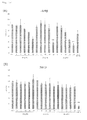
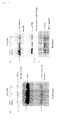
- Fig. 2(B) and Fig. 2(C) show the results.
- Fig. 2(B) is a Western-blotting image indicating the presence of A ⁇ protein and NICD.
- a C99 band appears, indicating that C99-FLAG is barely separated by ⁇ -secretase in the presence of the six polypeptides mentioned above. It became clear that, among the six polypeptides, #4, #2, #1, or like polypeptide inhibited more cleavage activity of ⁇ -secretase against ⁇ CTF.
- Fig. 2(C) is a graph wherein the A ⁇ protein and NICD were quantified based on the density of each band shown in the Western-blotting image of Fig. 2(B) .
- the vertical axis indicates the relative value taking the result of control using DMSO as 100%.
- Figs. 3(A) and 3(B) show the results.
- 0 ⁇ M indicates the results of a negative control experiment wherein DMSO was used in place of #1 polypeptide.
- Fig. 3(A) is a Western-blotting image indicating the presence of A ⁇ protein and NICD. It became clear that #1 polypeptide more intensively inhibits the cleavage activity of ⁇ -secretase against ⁇ CTF in a concentration-dependent manner.
- Fig. 3(B) is a graph wherein A ⁇ protein and NICD were quantified depending on the intensity of each band in the Western-blotting image shown in Fig. 3(A) .
- the vertical axis indicates the relative value taking the result of control using DMSO as 100%.
- Fig. 4 shows the results.
- “cont” indicates the negative control experiment wherein DMSO was used.
- Fig. 4 shows the Western-blotting image indicating the presence of A ⁇ protein and NICD. It became clear that as with #1 polypeptide, S4 polypeptide also inhibits more intensely in a concentration-dependent manner the cleavage activity of ⁇ -secretase against ⁇ CTF.
- S4 polypeptide also selectively inhibits the cleavage activity of ⁇ -secretase against ⁇ CTF, as with #1 polypeptide.
- a solution containing the polypeptide having APP (APP-EQ-FLAG: SEQ ID NO: 18) as shown in Fig. 5(A) was prepared in such a manner that its final concentration was 50 nM.
- 9-7 polypeptide, 6-5 polypeptide, #1 polypeptide, #2 polypeptide, #3 polypeptide, #4 polypeptide, #5 polypeptide, #6 polypeptide, #7 polypeptide, #8 polypeptide, #9 polypeptide, and #10 polypeptide were added in such a manner that each solution had the final concentration of 50 ⁇ M, followed by reacting with 50 ⁇ L ⁇ -secretase (0.02 U/ ⁇ L) for 4 hours.
- the reaction temperature was 37°C.
- DMSO was used in place of the 12 types of polypeptides mentioned above.
- each sample was subjected to Western blotting using a monoclonal antibody (82E-1) that specifically recognizes the N terminal of APP-EQ-FLAG as shown in Fig. 5(A) . Thereafter, the amount of A ⁇ 33-FLAG protein separated by ⁇ -secretase was measured.
- Fig. 5(B) shows the results.
- Fig. 5(B) shows the Western-blotting image indicating the presence of ⁇ CTF (A ⁇ 33). It became clear that, 11 types of polypeptides, except #7 polypeptide among the 12 types of polypeptides mentioned above, inhibit the cleavage activity of ⁇ -secretase against APP.
- #2, #4, #6, #1, #3, #5, #10, #8, and #9 polypeptides preferably inhibit the cleavage activity of ⁇ -secretase against APP more intensely, with intensity increasing in this order.
- Fig. 5(C) shows the results.
- “cont” indicates the negative control experiment wherein DMSO was used.
- S4 polypeptide inhibited the cleavage activity of ⁇ -secretase against APP, although inferior to #4 polypeptide. It became clear that both S4 polypeptide and #4 polypeptide inhibited the cleavage activity of ⁇ -secretase against APP in a concentration-dependent manner more intensively than other polypeptides.
- sAPP ⁇ , NICD, ⁇ CTF (c99), and A ⁇ protein contained in the cell culture medium (Medium) or cell lysate were confirmed by using a Western-blotting method using antibodies for recognizing each (A ⁇ protein present in the cell lysate is referred to as "intracellular A ⁇ ” and A ⁇ protein present in the cell culture medium is referred to as "released A ⁇ .”).
- Fig. 6 , Fig. 7-1 , and Fig. 7-2 show the results.
- 1 ⁇ M L685458 shows the results of the experiment wherein L685458 (i.e., a ⁇ -secretase inhibitor) was added in such a manner to have a final concentration of 1 ⁇ M in place of the three types of polypeptides described above.
- Fig. 6 indicates that whenever #1, #2, or #4 polypeptide was added, sAPP in the cell lysate was no longer present in a manner dependent on the final concentration. This indicates that #1, #2, and #4 polypeptides all preferably inhibited the cleavage activity against APP expressing in the 7WD10 cells by internal ⁇ -secretase. In contrast, such a phenomenon was not observed when L685458 (i.e., a ⁇ -secretase inhibitor) was used.
- L685458 i.e., a ⁇ -secretase inhibitor
- Fig. 6 indicates that whenever #1, #2, or #4 polypeptide was added, ⁇ CTF (C99) and A ⁇ protein in the cell lysate were no longer present in a manner dependent on the final concentration.
- #1, #2, and #4 polypeptides all desirably inhibit the cleavage activity of the internal ⁇ -secretase against the ⁇ CTF expressed in 7WD10 cells and the ⁇ CTF formed due to cleavage of APP by ⁇ -secretase.
- L685458 i.e., a ⁇ -secretase inhibitor
- a ⁇ protein in the cell culture medium also decreased depending on the concentration as used here. It also revealed that when L685458 was added, A ⁇ protein in the cell culture medium decreased.
- #1, #2, and #4 polypeptides all desirably inhibit the cleavage activity of the internal ⁇ -secretase and ⁇ -secretase in cells having overexpression of APP. This indicates that #1, #2, and #4 polypeptides all inhibit the production of A ⁇ protein at the cellular level.
- #1, #2, and #4 polypeptides all specifically inhibit the cleavage activity of ⁇ -secretase against APP and the inhibition activity of ⁇ -secretase against ⁇ CTF at the cellular level. These facts further indicate that these polypeptides have an activity that specifically inhibits the production of A ⁇ protein at the cellular level.
- Fig. 7-1 and Fig. 7-2 are graphs where the amounts of sAPP ⁇ , NICD, and A ⁇ protein in the cell lysate were quantified based on the intensity of each band in the Western-blotting image of Fig. 6 .
- the vertical axis indicates the relative value taking the result of control using DMSO as 100%.
- the symbols "*" and "**” in the graphs respectively mean that there was a significant difference of P ⁇ 0.05 and p ⁇ 0001 in the ANOVA Scheffe's post hoc test.
- the graphs of Fig. 7-1 and Fig. 7-2 also clearly show that, unlike L685458 (i.e., a ⁇ -secretase inhibitor), #1, #2, and #4 polypeptides all specifically inhibit, at the cellular level, the cleavage activity of ⁇ -secretase against APP, and cleavage activity of ⁇ -secretase against ⁇ CTF. Accordingly, at the cellular level, they specifically inhibit the production of A ⁇ protein.
- L685458 i.e., a ⁇ -secretase inhibitor
- Fig. 8 shows the results. It was revealed that when S4 polypeptide was added, A ⁇ protein (intracellular A ⁇ ) in the cell lysate decreased, but the amount of NICD in the cell lysate did not decrease. This makes it clear that S4 polypeptide has ⁇ -secretase inhibition activity even at the cellular level, and therefore specifically inhibits the cleavage activity of ⁇ -secretase against ⁇ CTF.
- S4 polypeptide When S4 polypeptide was added, the sAPP ⁇ production amount in the cell culture medium was reduced, but the st6gal production amount in the cell culture medium was not decreased. This indicates that S4 polypeptide has ⁇ -secretase inhibition activity even at the cellular level, and therefore S4 polypeptide specifically inhibits the cleavage activity of ⁇ -secretase against APP.
- a #4 polypeptide solution using 50% DMSO as a solvent was administered to a C57BL/6 mouse in an amount of 0.2 ng/g.
- the solution was directly administered in the right-side hippocampus of the mouse.
- the right-side hippocampus was extracted, and the amount of A ⁇ protein extracted by TBS and 6M guanidine hydrochloride was measured by using the sandwich ELISA method (product name: human/rat ⁇ amyloid (40) ELISA Kit Wako for immunochemistry, product No. 294-62501; product name: human/rat ⁇ amyloid (42) ELISA Kit Wako for immunochemistry, product No. 290-62501: both manufactured by Wako Pure Chemical Industries, Ltd.).
- a polypeptide (rev#4: SEQ ID NO: 19) having the amino acid sequence in inverse order of #4 polypeptide was administered to the left-side hippocampus of the same mouse.
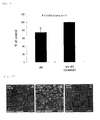
- Fig. 9 shows the results.
- Fig. 9 is a graph showing the A ⁇ protein extracted from the mouse was quantified. The vertical axis indicates the relative value taking the result of negative control experiment in which rev#4 polypeptide was administered as 100%.
- Biotin-modified #4 polypeptide was prepared using a known method. This polypeptide was allowed to react with CHO-K1 cells and the 7WD10 cells mentioned above, and the resulting cells were immobilized, and then treated with Triton X-100. Thereafter, avidin-modified Alexa488 was reacted with the above. As the negative control experiment, an experiment was conducted reacting avidin-modified Alexa 488 in place of Biotin-modified #4 polypeptide. Fig. 10 shows the results. The experiment revealed that, in the CHO-K1 cells expressing endogenous APP protein at a low level, #4 polypeptide binded to APP in the cells. Furthermore, in 7WD10 cells overexpressing APP, #4 polypeptide remarkably binded also to the intracellular APP.
- polypeptide #1, #2, and #4 polypeptides were added to the culture solutions of CHO-K1 cells and Neuro 2A cells (N2A) in such a manner that the final concentration was 20 ⁇ M.
- L685458 i.e., a ⁇ -secretase inhibitor
- DMSO DMSO
- FIG. 11 shows the results.
- L indicates L685458, which is a ⁇ -secretase inhibitor (final concentration of 1 ⁇ M).
- This figure shows that whenever any one of #1, #2, and #4 polypeptides was administered, the production of A ⁇ in the culture medium was reduced also against CHO-K1 and Neuro2A cells. Both CHO-K1 cells and Neuro2A cells express mouse-type APP; therefore, #1, #2, and #4 polypeptides all clearly inhibit production of mouse-type A ⁇ protein.
- mice 150 mg/kg #4 polypeptide dissolved in DMSO was intraperitoneally administered to ten wild-type mice (C57 BL/6 N Cr Slc, seven weeks old). The administration was conducted for three consecutive days. Four days after, the mice were euthanized to extract the cerebrum.
- the extracted cerebrums were dissolved by using a known method, subjected to immunoprecipitation with anti-4G8 antibody, and then subjected to Western blotting using the anti-mouse A ⁇ antibody.
- An experiment was conducted in the same manner except that only DMSO was administered as the negative control experiment group (ten mice).
- FITC-modified #4 polypeptide prepared by using a known method was intraperitoneally administered to a mouse.
- the dose was 150 mg/kg, and the administration was conducted for three consecutive days. Four days after, the mice were euthanized to prepare the test pieces of tissue around the hippocampus.
- DMSO was administered in place of FITC-modified #4 polypeptide.
- Fig. 12(C) shows the results of analyzing the test piece using a fluorescent microscopy.
- CA1 indicates the area called the "CA1 region.”
- DG indicates the area called the "dentate gyrus,” and a portion dyed green indicating the presence of #4 polypeptide was also confirmed in this portion.
- CPLV indicates the area called the "choroid plexus,” which is for producing cerebrospinal fluid. In this area, a portion dyed green indicating the presence of #4 polypeptide was confirmed in the blood vessel.
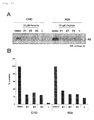
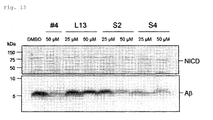
- Fig. 13 shows the results.
- DMSO shows the results of the negative control.
- Fig. 13 clearly shows that when S2 polypeptide was used in an amount having a final concentration of 50 ⁇ M, it exhibited the A ⁇ protein production inhibition effect almost to the same level as #4 polypeptide and S4 polypeptide. It did not have any influence on NICD. Accordingly, this figure indicates that S2 polypeptide also has an activity specifically inhibiting the production of A ⁇ protein.
- L13 polypeptide did not have any affect on NICD, but did not inhibit the production of A ⁇ .
- the polypeptide of the present invention delivered to the brain even when intraperitoneally administered, and exhibits an effect inhibiting the production of A ⁇ in the brain. Furthermore, because it is clear that the polypeptide of the present invention inhibits production of not only mouse-type A ⁇ but also human A ⁇ , this suggests that the polypeptide of the present invention will also achieve the effect of inhibiting the production of A ⁇ in the brain when administered to a human.
Landscapes
- Health & Medical Sciences (AREA)
- Chemical & Material Sciences (AREA)
- Organic Chemistry (AREA)
- Life Sciences & Earth Sciences (AREA)
- General Health & Medical Sciences (AREA)
- Medicinal Chemistry (AREA)
- Biochemistry (AREA)
- Molecular Biology (AREA)
- Genetics & Genomics (AREA)
- Biophysics (AREA)
- Proteomics, Peptides & Aminoacids (AREA)
- Gastroenterology & Hepatology (AREA)
- Engineering & Computer Science (AREA)
- Biomedical Technology (AREA)
- Neurology (AREA)
- Bioinformatics & Cheminformatics (AREA)
- AIDS & HIV (AREA)
- Toxicology (AREA)
- Zoology (AREA)
- Nuclear Medicine, Radiotherapy & Molecular Imaging (AREA)
- Neurosurgery (AREA)
- Veterinary Medicine (AREA)
- Public Health (AREA)
- Animal Behavior & Ethology (AREA)
- Pharmacology & Pharmacy (AREA)
- General Chemical & Material Sciences (AREA)
- Chemical Kinetics & Catalysis (AREA)
- Psychiatry (AREA)
- Hospice & Palliative Care (AREA)
- Medicines That Contain Protein Lipid Enzymes And Other Medicines (AREA)
- Peptides Or Proteins (AREA)
Abstract
Description
- The present invention relates to a polypeptide that particulally inhibits the production of amyloid β protein.
- The amyloid protein ("Aβ protein") is considered to be one of the proteins that cause Alzheimer's disease. Particulally, the accumulation of the Aβ protein in the brain is recognized as one of the pathological hallmarks of Alzheimer's disease. Accumulation of Aβ protein in the brain forms a rigid fibrous molecular structure. It is believed that this causes the death of neurons in the brain, damaging neural function and, as a result, causing the onset of Alzheimer's disease.
- Aβ protein is formed in such a manner that an amyloid precursor protein (or "APP"), which is a transmembrane protein, is cleaved by β-secretase to form βCTF, which is also a transmembrane protein, and the βCTF is further cleaved by γ-secretase to form the Aβ protein. The Aβ protein thus formed is believed to be released from the cell membrane and accumulate in the brain.
- It is known that the βCTF cleaved by γ-secretase is divided into Aβ protein and AICD, and it is also known that sAPPβ is released when the APP is cleaved by β-secretase (
Fig. 1 ). - Based on the matured APP, Aβ protein corresponds to the 653rd to 694th amino acid residues, and βCTF corresponds to the 653rd to 751st amino acid residues. The sAPPβ corresponds to the 18th to 652nd amino acid residues and AICD corresponds to the 701st to 751st amino acid residues.
- For the reasons described above, a γ-secretase inhibitor was believed to be effective in inhibiting the accumulation of Aβ protein, which is a protein that causes Alzheimer's disease.
- However, γ-secretase, which is known as a complex comprising Pen-2, presenilin, nicastrin, and Aph-1 each being a transmembrane protein, is a aspartic protease that recognizes, as the substrate, not only the APP mentioned above but also transmembrane proteins, such as APLP1, APLP2, Notch, Jagged2, Delta1, E-cadherin, N-cadherin, CD44, ErbB4, Nectin1, and LRP1; receptors; etc.
- Accordingly, if L-685,458, DAPT, LY-411,575, and like γ-secretase inhibitors are used to inhibit the production of Aβ protein, the enzyme activity of γ-secretase as a protease against the proteins other than βCTF will also be inhibited; therefore, use of such an inhibitor without modification as a drug may cause undesirable side effects.
- For example, it has been reported that LY-411,575, which is one of the γ-secretase inhibitors, induces atrophy of the thymus and reduces the number of mature B cells in the spleen. If such an inhibitor is used as a pharmaceutical composition without modification, there is a risk that this may trigger side effects in immunity, etc. (NPL 1). Furthermore, it has been reported that lowering the enzyme activity of γ-secretase itself may cause skin abnormalities, squamous cancer, spleen hypertrophy, and the like (NPL 2).
- Considering the production mechanism of Aβ protein, use of a compound that inhibits the enzyme activity of β-secretase also may be effective. However, there is a report that such use will decrease the number of births of β-secretase knockout mice; therefore, use of such a compound as a drug for Alzheimer's disease is not preferable.
- There are findings that nonsteroidal antiinflammatory drugs (or "NSAIDs") are effective in inhibiting the production of Aβ protein. However, it is also known that these drugs are not effective for some familial Alzheimer's diseases (e.g., those associated presenilin mutations) (NPL 3). Furthermore, γ-secretase isolated from patients with mild cognitive impairment or Alzheimer's disease exhibits change in its activity, indicating that the effect of the γ-secretase modulator that reduces the production of Aβ42 is low (NPL 4).
- γ-Secretase-dependent cleavage of βCTF fused with FLAG tag at the N-terminus is not observed in the presence of anti-FLAG antibody (Non-patent Literature 5).
-
- NPL 1: Wong, G. T. et al., J. Biol. Chem. 2004; 279: 12876-12882
- NPL 2: Choi, S. H. et al., J. Neurosci. 2007; 27: 13579-13580
- NPL 3: Page, R. M. et al., J. Biol. Chem. 2008; 283: 677-683
- NPL 4: Kakuda, N. et al., EMBO Mol. Med. 2012; 4: 344-352
- NPL 5: Shah, S. et al., Cell. 2005; 122: 435-447
- As described above, the development of a compound that inhibits accumulation of Aβ protein has been in demand for the treatment and/or prevention of Alzheimer's disease; however, there is no finding so far relating to a compound that particulally inhibits the production of Aβ protein.
- The main purpose of this invention is to develop a compound that particulally inhibits the production of Aβ protein and serves as an active ingredient of a medicament for use in the treatment and/or prevention of Alzheimer's disease.
- In seeking a compound that particulally inhibits the production of Aβ protein, the present inventors have focused on the fact that Aβ protein is produced by the enzyme activity of γ-secretase against βCTF. Therefore, the inventors searched for a compound that achieves the effect of particulally inhibiting the production of Aβ protein not in view of inhibiting the enzyme activity of γ-secretase itself but in view of particulally inhibiting the binding of γ-secretase and βCTF.
- The inventors found that by reacting βCTF with γ-secretase in the presence of a monoclonal antibody that particulally binds to the N-terminal region, which is the extracellular region of βCTF, the effect for remarkably and particulally inhibiting the production of Aβ protein can be achieved. The inventors also found that little effect is made on the enzyme activity of the γ-secretase to substrates other than βCTF.
- The inventors conducted extensive research based on the above and found that a peptide having a specific amino acid sequence exhibits remarkable effects as a compound that particulally inhibits the production of Aβ protein. The present invention encompasses the wide range of embodiments described below.
-
Item 1. A polypeptide having the amino acid sequence represented by any one of SEQ ID NOs: 1, 13, 14, and 22, the polypeptide binding to the N-terminal region of βCTF.
Particulally, the examples of the inventions include the embodiments described in Item 1-1 to Item 1-6 below.- Item 1-1. The polypeptide according to
Item 1, which has the amino acid sequence represented by any one of SEQ ID NOs: 2-14 and 22. - Item 1-3. The polypeptide according to
Item 1, which has the amino acid sequence represented by any one of SEQ ID NOs: 3, 4, 6, 10, 11, 14, and 22. - Item 1-4. The polypeptide according to any one of
Item 1 and Items (1-1) to (1-3), wherein the amide terminal is acetylated and/or the carboxy terminal is amidated. - Item 1-5. The polypeptide according to any one of
Item 1 and Items (1-1) to (1-4), wherein the N-terminal region of βCTF comprises the amino acid sequence represented by SEQ ID NO: 15. - Item 1-6. The polypeptide according to any one of
Item 1 and Items (1-1) to (1-5), wherein the binding satisfies the KD values of 50 µM or less.
- Item 1-1. The polypeptide according to
-
Item 2. A γ-secretase activity inhibitor comprising the polypeptide according to any one ofItem 1 and Items (1-1) to (1-6).
The inventions also include the embodiments described in Item 2-1 to Item 2-3 below.- Item 2-1. A βCTF-specific γ-secretase activity inhibitor comprising a polypeptide of any one of
Item 1 and Item 1-1 to Item 1-6. - Item 2-2. The γ-secretase activity inhibitor according to
Item 2, which comprises a polypeptide having the amino acid sequence represented by SEQ ID NO: 3. - Item 2-3. The βCTF-specific γ-secretase activity inhibitor according to
Item 2, which comprises the amino acid sequence represented by SEQ ID NO: 3.
- Item 2-1. A βCTF-specific γ-secretase activity inhibitor comprising a polypeptide of any one of
-
Item 3. A β-secretase activity inhibitor comprising a polypeptide of any one ofItem 1 and Item 1-1 to Item 1-6.
The inventions further include the embodiments described in Item 3-1 to Item 3-3 below.- Item 3-1. An APP-specific β-secretase activity inhibitor comprising a polypeptide of any one of
Item 1 and Item 1-1 to Item 1-6. - Item 3-2. The β-secretase activity inhibitor according to
Item 3, which comprises a polypeptide having the amino acid sequence represented by SEQ ID NO: 6. - Item 3-3. The APP-specific β-secretase activity inhibitor according to
Item 3, which comprises a polypeptide having the amino acid sequence represented by SEQ ID NO: 6.
- Item 3-1. An APP-specific β-secretase activity inhibitor comprising a polypeptide of any one of
-
Item 4. An Aβ protein production inhibitor comprising a polypeptide of any one ofItem 1 and Item 1-1 to Item 1-6.
The inventions further include the embodiments described in Item 4-1 to Item 4-3 below.- Item 4-1. The Aβ-protein-specific production inhibitor comprising a polypeptide of any one of
Item 1 and Item 1-1 to Item 1-6. - Item 4-2. The Aβ protein production inhibitor according to
Item 4, which comprises a polypeptide having the amino acid sequence represented by SEQ ID NO: 6. - Item 4-3. The Aβ-protein-specific production inhibitor according to
Item 4, which comprises a polypeptide having the amino acid sequence represented by SEQ ID NO: 6.
- Item 4-1. The Aβ-protein-specific production inhibitor comprising a polypeptide of any one of
-
Item 5. An agent for treating and/or preventing Alzheimer's disease comprising a polypeptide of any one ofItem 1 and Item 1-1 to Item 1-6.
The inventions further include the embodiment described in Item 5-1 below.- Item 5-1. The treatment and/or prevention agent according to
Item 5, the agent comprising a polypeptide having the amino acid sequence represented by SEQ ID NO: 6.
- Item 5-1. The treatment and/or prevention agent according to
-
Item 6. A method for treating and/or preventing Alzheimer's disease comprising administering the polypeptide of any one ofItem 1 and Item 1-1 to Item 1-6 to an Alzheimer's disease patent.
The inventions further include the embodiment described in Item 6-1 below.- Item 6-1. The method according to
Item 6, wherein a polypeptide having the amino acid sequence represented by SEQ ID NO: 6 is administered to an Alzheimer's disease patient.
- Item 6-1. The method according to
- Item 7. The polypeptide of any one of
Item 1 and Item 1-1 to Item 1-6 for use in treating and/or preventing Alzheimer's disease.
The inventions further include the embodiment described in Item 7-1 below.- Item 7-1. The polypeptide of Item 7 having the amino acid sequence represented by SEQ ID NO: 6 for use in treating and/or preventing Alzheimer's disease.
- Item 8. Use of the polypeptide of any one of
Item 1 and Item 1-1 to Item 1-6 for use in manufacturing a pharmaceutical composition for treating and/or preventing Alzheimer's disease.
The inventions further include the embodiment described in Item 8-1 below.- Item 8-1. Use according to Item 8, wherein the polypeptide having the amino acid sequence represented by SEQ ID NO: 6 is used for manufacturing a pharmaceutical composition for treating and/or preventing Alzheimer's disease.
- The present invention is explained in detail below.
- A person skilled in the art can easily and reliably carry out the various techniques used in the present invention based on known documents and the like, except for techniques the source of which is particulally indicated. For example, in the fields of genetic engineering and molecular biological technology, the following documents may be referred to: Sambrook and Russell, "Molecular Cloning: A Laboratory Manual", Cold Spring Harbor Laboratory Press, New York (2001); Ausubel, F. M. et al.; "Current Protocols in Molecular Biology", John Wiley & Sons, New York.
- The polypeptide of the present invention has the amino acid sequence represented by any one of SEQ ID NOs: 1, 13, 14, and 22, preferably has the amino acid sequence represented by any one of SEQ ID NOs: 2-14 and 22, more preferably has the amino acid sequence represented by any one of SEQ ID NOs: 2-8, 10-12, 14, and 22, and further preferably has the amino acid sequence represented by any one of SEQ ID NOs: 3, 4, 6, 10, 11, 14, and 22.
- In the amino acid sequence represented by SEQ ID NO: 1, the amino acid residue in the 2nd, 3rd, 4th, 5th, 11th, 12th, 13th, 14th, 16th, 19th, 21st, 22nd and 23rd positions are each one of the amino acid residues shown in Table 1 below
Table 1 Position Amino acid residues 2 Asn, Ser, Asp, Gly, His, Val, Leu, Arg, Phe 3 Thr, Ile, Leu, Pro, Tyr, Arg 4 Leu, Arg, Val, Ile, Thr, Phe, Ser 5 Ile, Val, Ser, Asp, Asn, Thr 11 Ser, His, Asp, Thr, Phe, Tyr, Ile, Ala 12 Leu, Gly, Asn, Ser, Thr, Ala, Arg, Tyr 13 Thr, Asp, Tyr, Ser, Phe, His, Asn 14 Arg, Leu, Val, Ala, Ile, Ser, Tyr 16 Phe, Tyr 19 Ser, Phe, Tyr 21 Val, Ile, Ser, Thr, Tyr, Gly, His, Arg 22 Asp, Asn, His, Pro, Ile, Arg, Ser 23 Ser, Val, Phe, Asn, Thr, Tyr, His, Ile, Arg, Asp - The 3rd amino acid residue in the amino acid sequence represented by SEQ ID NO: 14 is L-4,4'-biphenylalanine residue. Particulally, in the polypeptide having the amino acid sequence represented by SEQ ID NO: 14, the carboxyl group of the 2nd glycine and the amide group in L-4,4'-biphenylalanine are linked together by a peptide bond, and the amide group of the 4th valine and the amide group of the L-4,4'-biphenylalanine are linked together by a peptide bond.
- Likewise, the 3rd amino acid residue in the amino acid sequence represented by SEQ ID NO: 22 is L-4,4'-biphenylalanine residue. Particulally, in the polypeptide having the amino acid sequence represented by SEQ ID NO: 22, the carboxyl group of the 2nd arginine and the amide group in L-4,4'-biphenylalanine are linked together by a peptide bond, and the amide group of the 4th valine and the amide group of the L-4,4'-biphenylalanine are linked together by a peptide bond.
- In the polypeptide of the present invention, an amide terminal may be acetylated or a carboxy terminal may be amidated. Furthermore, the amide terminal may be acetylated and the carboxy terminal may also be amidated.
- The polypeptide of the present invention may be suitably modified. Examples of the modifications include, but are not limited to, biotin modification, fluorochrome modification, glycosilation, and lipid modification.
- The modification sites are not particularly limited and may be the inside polypeptide, C-terminal of polypeptide, or N-terminal of polypeptide.
- The modification method is not particularly limited, and a known method may be used.
- The polypeptide of the present invention binds to the N-terminal region of βCTF. βCTF is a product of APP (e.g., a protein having the amino acid sequence of Accession No. Q95241.1 of NCBI, etc.) cleaved by β-secretase. Therefore, binding to the N-terminal region of βCTF is the same meaning as binding to the APP. Furthermore, the N-terminal region of βCTF corresponds to the region close to the cleavage recognition site by β-secretase on APP.
- The region close to the N-terminal of βCTF can be recognized and cleaved also by γ-secretase. The fragment after the cleavage is produced as an Aβ protein (e.g., a protein having the amino acid sequence of Accession No 1Z0Q_ A, 1BA6_A of NCBI); therefore, binding to the N-terminal region of βCTF is the same meaning as binding to the Aβ protein.
- The amino acid sequence of the N-terminal region of βCTF to which the polypeptide of the present invention binds is not particulally limited. Examples include the amino acid sequence represented by SEQ ID NO: 15. Some of the amino acids of SEQ ID NO: 15 may also be given as examples. The N-terminal region of βCTF of the present invent does not necessarily contain Asp residue in the present invention at the N-terminal of βCTF.
- Examples of the amino acid sequence of βCTF include, particulally in the case of human βCTF, the amino acid sequence represented by SEQ ID NO: 20. In the case of mouse βCTF, examples include the amino acid sequence represented by SEQ ID NO: 21.
- The strength of the binding between the polypeptide of the present invention and the N-terminal region of βCTF is not particularly limited. If it is expressed, for example, by a dissociation constant (KD), it is generally in the range of 50 µM or less, and preferably about 5 µM or less.
- The polypeptide of the present invention is soluble in various solvents without any limitation. Examples include solvents such as water, PBS, DMSO, and DMF. These solvents may be used in a combination of two or more.
- The polypeptide of the present invention binds to the N-terminal region of βCTF. As explained above, this region corresponds to the region close to the γ-secretase cleavage recognition site on βCTF; therefore, it is useful as a γ-secretase activity inhibitor.
- The polypeptide of the present invention binds to the N-terminal region of βCTF. As explained above, this region corresponds to the region close to the β-secretase cleavage recognition site on APP; therefore, it is useful as a β-secretase activity inhibitor.
- The polypeptide of the present invention can be produced by using a known method. More particulally, a chemical production method using a peptide synthesizer or the like may be used, and a biochemical synthetic method may also be used, wherein a nucleic acid having a base sequence encoding the amino acid sequence of the polypeptide is introduced into a host cell.
- The polypeptide of the present invention thus produced may be purified by using a known method such as using column chromatography.
- The γ-secretase activity inhibitor of the present invention contains the polypeptide of the present invention described above. Among the polypeptides described above, polypeptides having the amino acid sequence represented by any one of SEQ ID NOs: 2-14 and 22 are preferable.
- Among the preferable polypeptides contained in the γ-secretase activity inhibitor of the present invention, polypeptides having the amino acid sequences represented by any one of SEQ ID NOs: 3, 4, 6, 7, 10, 14, and 22 are preferable.
- Further examples of preferable polypeptides include those having the amino acid sequence represented by any one of SEQ ID NOs: 3, 4, 6, 10 and 14; polypeptides having the amino acid sequence represented by any one of SEQ ID NOs: 3, 4, 6, and 14; polypeptides having the amino acid sequence represented by any one of SEQ ID NOs: 3, 4, and 6; and polypeptides having the amino acid sequence represented by any one of SEQ ID NOs: 3 and 6 are preferable in increasing preference in this order. Among these, the most preferable is the polypeptide having the amino acid sequence represented by SEQ ID NO: 3.
- As explained above, the polypeptide of the present invention contained in the γ-secretase activity inhibitor of the present invention binds to the N-terminal region of βCTF. The γ-secretase activity inhibitor of the present invention exhibits functions based on these phenomena. Therefore, in the present invention, there is a tendency that the γ-secretase activity towards the substrates other than βCTF recognized by the γ-secretase is not inhibited. More particulally, the γ-secretase of the present invention is preferably used as a βCTF-specific γ-secretase activity inhibitor.
- The preferable "βCTF-specific" means that the γ-secretase activity inhibitor tends to select βCTF as the substrate for inhibiting its activity when βCTF and other substrate candidates for inhibiting the activity of γ-secretase are concurentaly present.
- When the γ-secretase activity inhibitor of the present invention is used as a βCTF-specific γ-secretase activity inhibitor, the γ-secretase activity inhibitor preferably exhibits competitive inhibition activity.
- The γ-secretase activity inhibitor of the present invention contains the polypeptide of the present invention, and it may be used as a γ-secretase activity inhibitor without adding constituents other than the polypeptide.
- When the γ-secretase activity inhibitor of the present invention contains constituents other than the polypeptide of the present invention, the constituents are not particulally limited as long as they do not adversely affect the γ-secretase activity inhibition effect, and known agents such as antiseptics, bactericides, and stabilizers may be contained. In this case, the content of the polypeptide of the present invention in the γ-secretase activity inhibitor of the present invention may be generally about 0.001 to 99.9 wt% relative to the weight of the γ-secretase activity inhibitor.
- As described above, γ-secretase recognizes βCTF as a substrate and causes production of Aβ protein. Accordingly, the polypeptide of the present invention contained in the γ-secretase activity inhibitor of the present invention is also useful as an Aβ protein production inhibitor.
- The β-secretase activity inhibitor of the present invention contains the polypeptide of the present invention described above. Among the polypeptides described above, polypeptides having the amino acid sequence represented by any one of SEQ ID NOs: 2-14 and 22 are preferable.
- Among the preferable polypeptides contained in the β-secretase activity inhibitor of the present invention, polypeptides having the amino acid sequence represented by any one of SEQ ID NOs: 3-8, 10-12, 14, and 22 are preferable.
- Further examples of preferable polypeptides include those having the amino acid sequence represented by any one of SEQ ID NOs: 3-8, 10, 12, and 14; polypeptides having the amino acid sequence represented by any one of SEQ ID NOs: 3-8, 12, and 14; polypeptides having the amino acid sequence represented by any one of SEQ ID NOs: 3-8 and 14; polypeptides having the amino acid sequence represented by any one of SEQ ID NOs: SEQ ID NOs: 3-6, 8, and 14; polypeptides having the amino acid sequence represented by any one of SEQ ID NOs: 3, 4, 6, 8, and 14; polypeptides having the amino acid sequence represented by any one of SEQ ID NOs: 3, 4, 6, and 8; polypeptides having the amino acid sequence represented by any one of SEQ ID NOs: 4, 6, and 8; and polypeptides having the amino acid sequence represented by any one of SEQ ID NOs: 4 and 6 are preferable in increasing preference in this order. Among these, the most preferable is the polypeptide having the amino acid sequence represented by SEQ ID NO: 4.
- As explained above, the polypeptide of the present invention contained in the β-secretase activity inhibitor of the present invention binds to the recognition region close to the β-secretase cleavage recognition site on APP. The β-secretase activity inhibitor exhibits functions based on these phenomena. Therefore, in the present invention, there is a tendency that the β-secretase activity towards the substrates other than APP recognized by the β-secretase is not inhibited. More particulally, the β-secretase of the present invention is preferably used as an APP-specific β-secretase activity inhibitor.
- The term "APP-specific" means that the β-secretase activity inhibitor tends to select APP as the substrate for inhibiting its activity when APP and other substrate candidates for inhibiting the activity of β-secretase are concurentaly present.
- When the β-secretase activity inhibitor of the present invention is used as an APP-specific β-secretase activity inhibitor, the β-secretase activity inhibitor preferably exhibits competitive inhibition activity.
- The β-secretase activity inhibitor of the present invention contains the polypeptide of the present invention, and it may be used as a β-secretase activity inhibitor without adding constituents other than the polypeptide.
- When the β-secretase activity inhibitor of the present invention contains constituents other than the polypeptide of the present invention, the constituents are not particulally limited as long as they do not adversely affect the β-secretase activity inhibition effect, and known agents such as antiseptics, bactericides, and stabilizers may be contained. In this case, the content of the polypeptide of the present invention in the β-secretase activity inhibitor of the present invention may be generally about 0.001 to 99.9 wt% relative to the weight of the γ-secretase activity inhibitor.
- As described above, β-secretase recognizes APP as a substrate and causes production of βCTF. The produced βCTF is decomposed by the action of γ-secretase to produce Aβ protein. Accordingly, the polypeptide of the present invention contained in the β-secretase activity inhibitor of the present invention is also useful as an Aβ protein production inhibitor.
- The Aβ protein production inhibitor of the present invention contains the polypeptide of the present invention described above. Among the polypeptides, polypeptides having the amino acid sequence represented by any one of SEQ ID NOs: 2-14 and 22 are preferable.
- Among the preferable polypeptides contained in the Aβ protein production inhibitor of the present invention, polypeptides having the amino acid sequence represented by any one of SEQ ID NOs: 3, 4, 6, 10, 11, 14, and 22 are preferable.
- Further examples of preferable polypeptides include those having the amino acid sequence represented by any one of SEQ ID NOs: 3, 4, 6, 10, 14, and 22; polypeptides having the amino acid sequence represented by any one of SEQ ID NOs: 3, 4, 6, 10, and 14; polypeptides having the amino acid sequence represented by any one of SEQ ID NOs: 3, 4, 6, and 14; polypeptides having the amino acid sequence represented by any one of SEQ ID NOs: 3, 4, or 6; polypeptides having the amino acid sequence represented by any one of SEQ ID NOs: 3 and 6 are preferable in increasing preference in this order. Among these, the most preferable is the polypeptide having the amino acid sequence represented by SEQ ID NO: 6.
- The Aβ protein production inhibitor of the present invention contains the polypeptide of the present invention described above. The polypeptide, in particular, exhibits a βCTF-specific γ-secretase inhibition activation effect and/or APP-specific β-secretase activity inhibition effect. APP produces βCTF by the action of β-secretase, and βCTF produces Aβ protein by the action of γ-secretase. Therefore, the Aβ protein production inhibitor containing the polypeptide of the present invention exhibits the effect in particulally inhibiting the production of Aβ protein.
- Thus, the Aβ protein production inhibitor is preferably used as an Aβ-protein-specific production inhibitor.
- The term "Aβ-protein-specific" means that the Aβ protein production inhibitor of the present invention tends to selectively inhibit the production of Aβ protein when the Aβ protein coexists with other candidates for inhibiting production.
- When the Aβ protein production inhibitor of the present invention contains constituents other than the polypeptide of the present invention, the constituents are not particulally limited as long as they do not adversely affect the Aβ protein production inhibition effect, and known agents such as antiseptics, bactericides, and stabilizers may be contained. In this case, the content of the polypeptide of the present invention in the Aβ protein production inhibitor of the present invention may be generally about 0.001 to 99.9 wt% relative to the weight of the Aβ protein production inhibitor.
- Production and accumulation of Aβ protein is one of the pathogenic mechanisms of Alzheimer's disease; therefore, inhibiting production of Aβ protein is effective for prevention and/or treatment of Alzheimer's disease.
- Accordingly, the polypeptide contained in the Aβ protein production inhibitor of the present invention is also useful as an agent for treating and/or preventing Alzheimer's disease.
- For the reasons described above, the polypeptide of the present invention is suitably used for treating and/or preventing Alzheimer's disease.
- For the specific uses in treating and/or preventing Alzheimer's disease, one may refer to the usage methods explained in detail in the section "Agent for Treating and/or Preventing Alzheimer's Disease" below.
- The polypeptide of the present invention described above is suitably used for manufacturing a pharmaceutical composition for treating and/or preventing Alzheimer's disease.
- For the specific uses for manufacturing medicine for treating and/or preventing Alzheimer's disease, one may refer to the usage methods explained in detail in the section below on treatment and/or prevention agent for Alzheimer's disease.
- The agent for treating and/or preventing Alzheimer's disease contains the polypeptide of the present invention described above. Among the polypeptides described above, polypeptides having the amino acid sequence represented by any one of SEQ ID NOs: 2-14, and 22 are preferable.
- Among the preferable polypeptides contained in the agent for treating and/or preventing Alzheimer's disease of the present invention, polypeptides having the amino acid sequence represented by any one of SEQ ID NOs: 3, 4, 6, 10, 11, 14, and 22 are preferable.
- Further examples of preferable polypeptides include those having the amino acid sequence represented by any one of SEQ ID NOs: 3, 4, 6, 10, 14, and 22; polypeptides having the amino acid sequence represented by any one of SEQ ID NOs: 3, 4, 6, 10, and 14; polypeptides having the amino acid sequence represented by any one of SEQ ID NOs: 3, 4, 6, and 14; polypeptides having the amino acid sequence represented by any one of SEQ ID NOs: 3, 4, and 6; and polypeptides having the amino acid sequence represented by any one of SEQ ID NOs: 3 and 6 are preferable in increasing preference in this order. Among these, the most preferable is the polypeptide having the amino acid sequence represented by SEQ ID NO: 6.
- The agent for treating and/or preventing Alzheimer's disease contains the polypeptide of the present invention described above. In particular, the polypeptide exhibits an Aβ-protein-specific production inhibition effect. This allows the agent for treating and/or preventing Alzheimer's disease to achieve remarkable effects, such as few side effects.
- When the agent for treating and/or preventing Alzheimer's disease of the present invention contains constituents other than the polypeptide of the present invention, the constituents may contain pharmacologically applicable carriers or additives as long as they do not adversely affect the effect of the agent for treating and/or preventing Alzheimer's disease.
- Examples of pharmacologically applicable carriers or additives include any carriers, diluents, vehicles, suspensions, lubricants, adjuvants, media, emulsifiers, absorbents, preservatives, surfactants, colorants, flavoring agents, or sweeteners. Among these, any known may be used in a suitable manner.
- In this case, the content of the polypeptide of the present invention in the agent for treating and/or preventing Alzheimer's disease of the present invention may be generally about 0.001 to 99.9 wt% relative to the weight of the agent for treating and/or preventing Alzheimer's disease.
- The formulation of the agent for treating and/or preventing Alzheimer's disease of the present invention is not particularly limited and may be in a form of tablet, powder, syrup, poulice, injection, drops, or other form. Forming it into an injection or drops is preferable. The injection and drops may be aqueous, non-aqueous, or a suspension. The formulation may be a prepared when needed.
- The agent for treating and/or preventing Alzheimer's disease of the present invention has potential for use in therapeutic procedures for treating immunologic diseases, comprising administering the agent to an Alzheimer's disease patient. The agent also has potential for use in prevention of Alzheimer's disease, comprising administering the agent to a patient who has not developed the pathology or symptoms of Alzheimer's disease but who may have predisposition to Alzheimer's disease. Furthermore, the agent also has potential to be used for a person who has mild cognitive impairment (e.g., MMSE of 26 or lower) in the preclinical stage of Alzheimer's disease.
- In the present invention, there are no particular limitations to the Alzheimer's disease patients. For example, patients who have dysmnesia, disorientation, learning disability, attentional dysfunction, failures in spatial awareness function and problem-solving ability, and other disorders gradually progress and exhibit cognitive impairment and like symptoms. Observations in diagnostic imaging and the like include a patient diagnosed as having senile plaques (deposition image of Aβ protein) in the cerebral cortex observed, a patient diagnosed as having diffuse cerebral atrophy, and a patient diagnosed with tau protein, Aβ protein and like spinal fluid biomarkers, blood biomarkers, etc.
- The dose and administration method of the agent for treating and/or preventing Alzheimer's disease of the present invention may be suitably selected in the range of 0.001 to 100 mg/kg/day depending on the patient's sex, race, age, general condition, severity of the disease, etc.
- The agent for treating and/or preventing Alzheimer's disease of the present invention may be administered in the above doses once per day, or the dosage may be divided and administered several times. As long as the therapeutic effects can be achieved against the diseases mentioned above, the frequency of dosage may be once per day, every other day, every week, every other week, every two to three weeks, every month, every other month, or every two to three months. The administration route is not particularly limited, and the agent may be, for example, administered orally, intramuscularly, intravenously, intra-arterialy, intrathecaly, intradermaly, intraperitonealy, intranasaly, intrapulmonaryly, intraocularly, intravaginaly, intracervicaly, intrarectaly, and subcutaneously.
- The method for treating and/or preventing Alzheimer's disease of the present invention comprises administering the polypeptide of the present invention to an Alzheimer's disease patient.
- For the specific administration methods for Alzheimer's disease patients, refer to the methods described in detail in the section "Agent for Treating and/or Preventing Alzheimer's Disease" above.
- Examples of the effects of the polypeptide of the present invention are given below. The polypeptide of the present invention is, of course, not limited to those that have all of the effects mentioned below.
- The polypeptide of the present invention is usable as an active ingredient of a γ-secretase activity inhibitor, in particular, a βCTF-specific γ-secretase activity inhibitor.
- The polypeptide of the present invention is usable as an active ingredient of a β-secretase activity inhibitor, in particular, an APP-specific β-secretase activity inhibitor.
- The polypeptide of the present invention is usable as an active ingredient of an Aβ protein production inhibitor, in particular, an Aβ-protein-specific production inhibitor.
- The polypeptide of the present invention is usable as an active ingredient of an agent for treating and/or preventing Alzheimer's disease. In particular, when administered to an individual, such as a human, an agent for treating and/or preventing Alzheimer's disease with few side effect can be provided.
-
-
Fig. 1 is a schematic diagram showing the cleavage sites in Aβ protein, βCTF, APP, sAPPβ, and AICD cleaved by γ-secretase and β-secretase. -
Fig. 2 is a diagram showing the results of the in vitro experiments of the polypeptide of the present invention in terms of the γ-secretase activity inhibition. -
Fig. 3 is a diagram showing the results of the in vitro experiments of the polypeptide of the present invention in terms of the γ-secretase activity inhibition. -
Fig. 4 is a diagram showing the results of the in vitro experiments of the polypeptide of the present invention in terms of the γ-secretase activity inhibition. -
Fig. 5 is a diagram showing the results of the in vitro experiments of the polypeptide of the present invention in terms of the β-secretase activity inhibition. -
Fig. 6 is a diagram showing the results of the in vitro experiments of the polypeptide of the present invention in terms of the γ-secretase activity inhibition at the cellular level, β-secretase activity inhibition, and Aβ protein production inhibition. -
Fig. 7-1 is a diagram showing the experimental results ofFig. 6 in the form of a graph. -
Fig. 7-2 is a diagram showing the experimental results ofFig. 6 in a form of a graph. -
Fig. 8 is a diagram showing the results of the in vitro experiments of the polypeptide of the present invention in terms of the γ-secretase activity inhibition at the cellular level, β-secretase activity inhibition, and Aβ protein production inhibition. -
Fig. 9 is a diagram showing the experimental results of administering the polypeptide of the present invention to animal individual. -
Fig. 10 is a figure showing the subcellular distribution of the polypeptide of the present invention.Fig. 10(A) shows the results of an experiment wherein the biotinylated polypeptide of the present invention was reacted with CHO-K1 cells, and the cells were immobilized and treated withTriron X 100, and then reacted with avidin-modified Alexa 488.Fig. 10(B) shows the results of an experiment wherein the biotinylated polypeptide of the present invention was reacted with the CHO-K1 cells having overexpressed APP (hereunder referred to as "7WD10 cells"), and the cells were immobilized and treated withTriron X 100, and then reacted with avidin-modified Alexa 488.Fig. 10(C) shows the results of an experiment wherein 7WD10 cells were immobilized and treated withTriron X 100, and then reacted only with avidin-modified Alexa 488. In the figures, the bars indicate 50 µm. -
Fig. 11 is a figure showing the mouse-type Aβ production inhibition action of the polypeptide of the present invention.Fig. 11(A) shows Western-blotting images wherein the polypeptide of the present invention was reacted with CHO-K1 cells and Neuro2A cells (N2A).Fig. 11(B) shows the results of analyzing the results of (A) with densitometry. -
Fig. 12 is a figure showing the results of an experiment wherein the polypeptide of the present invention was administered into the mouse abdominal cavity.Fig. 12 (A-1) andFig. 12 (A-2) show Western-blotting images analyzing the amounts of Aβ in the cerebral cortex after the administration into the abdominal cavity.Fig. 12(B) shows the results of analyzing the results of (A) with densitometry.Fig. 12(C) shows immunohistochemical stained images indicating the localization of the polypeptide of the present invention in the hippocampus after abdominal cavity administration. In the figures, the bars indicate 50 µm. -
Fig. 13 is a figure showing the results of the Aβ protein production inhibition experiment of the polypeptide of the present invention. - The Examples are described below for explaining the present invention in detail. The scope of the present invention is, of course, not limited to these Examples.
- A polypeptide that specifically binds to polypeptide (Amyloid β 1-9), which is the polypeptide represented by SEQ ID NO: 15 corresponding to the N-terminal region of βCTF, was identified using the polypeptide screening technique disclosed in
PTL 1, and produced.Table 2 Seq ID NO: peptide name amino acid sequence
(N-terminus to C-terminus.)2 9-7 MNTLICDCYCSLTRCFCYSCVDS 3 #1 MSIRVCDCYCHGDLCFCYSCINS 4 #2 MDTVICDCYCDNYVCFCYSCSHV 5 #3 MGLISCDCYCDSTACFCYSCTDF 6 #4 MHLVICDCYCTTDICYCYSCPN 7 #5 MVPVVCDCYCFLSVCFCYSCYIT 8 #6 MLYTSCDCYCDAFSCFCYSCGPY 9 #7 MRIFDCDCYCYRDICYCYFCTRH 10 #8 MGRVNCDCYCIGHYCYCYYCHNI 11 #9 MPLSICDCYCISTICYCYFCVHR 12 #10 MPTVYCDCYCAYNACYCYYCRSD 13 6-5 MHHVYCDCYCFGPVCYCHSCT 14 S4 FGBTWDYWVYR 22 S2 FRBGWVYTYTV 23 L13 MLICDCYCDPRSCICGSCTLV Note: In the polypeptides, all the amino terminals are acetylated and the carboxy terminals are amidated. B in S4 (peptide name: SEQ ID NO. 14) and S2 (peptide name: SEQ ID NO. 22) is L-4,4'-biphenylalanine (Bph) residue. - In all the experiments below, the polypeptides having the amino acid sequences represented by SEQ ID NOs: 2-14 were all used in the state dissolved in DMSO.
- The dissociation constant (KD) of peptide name "#4" having the amino acid sequence represented by SEQ ID NO: 15 described above was determined to be 2.62 µM.
- A polypeptide having βCTF (C99-FLAG: SEQ ID NO: 16) and mouse-derived Notch protein having a FLAG peptide at the C-terminal side (modification of NCBI Accession No. Q01705.2; SEQ ID NO: 17; hereunder referred to as "Notch") shown in
Fig. 2(A) were each made into a solution having a final concentration of 50 nM. - To these solutions, 9-7 polypeptide, 6-5 polypeptide, #1 polypeptide, #2 polypeptide, #3 polypeptide, and #4 polypeptide were added in such a manner that the final concentrations were 50 µM, followed by reacting with 50 µL of CHAPSO-solubilized membrane fraction (γ-secretase-containing fraction) for 4 hours. The reaction temperature was 37°C. As a negative control experiment, DMSO was used in place of the six types of polypeptides described above.
- Each sample after completion of the reaction was measured in the following manner. As shown in
Fig. 2(A) , a sample using C99-FLAG was subjected to Western blotting using a monoclonal antibody (82E-1) that specifically recognizes the N terminal of C99-FLAG, and the amount of Aβ40 protein produced by the cleavarage by γ-secretase was measured. In contrast, the reaction sample using Notch-FLAG was subjected to Western blotting using an anti-FLAG monoclonal antibody, and the amount of NICD produced to the separete by γ-secretase was also measured.Fig. 2(B) and Fig. 2(C) show the results. -
Fig. 2(B) is a Western-blotting image indicating the presence of Aβ protein and NICD. In the image, a C99 band appears, indicating that C99-FLAG is barely separated by γ-secretase in the presence of the six polypeptides mentioned above. It became clear that, among the six polypeptides, #4, #2, #1, or like polypeptide inhibited more cleavage activity of γ-secretase against βCTF. - In contrast, in all the six polypeptides, bands indicating the presence of NICD appeared; therefore, it became clear that the cleavage activity of γ-secretase against Notch was not inhibited.
-
Fig. 2(C) is a graph wherein the Aβ protein and NICD were quantified based on the density of each band shown in the Western-blotting image ofFig. 2(B) . In the graph, the vertical axis indicates the relative value taking the result of control using DMSO as 100%. It became clear that among the six polypeptides, in particular, #1 polypeptide inhibited the cleavage activity of γ-secretase against Aβ protein, but it did not inhibit the cleavage activity against Notch. This result suggests that #1 polypeptide most selectively inhibits the cleavage activity of γ-secretase against βCTF. - An experiment was conducted in the same manner as in Experimental Example 1 described above, except that
only # 1 polypeptide was used and the amount of #1 polypeptide was selected so that the final concentrations were 0.5, 1, 5, 10, 20, and 50 µM. -
Figs. 3(A) and 3(B) show the results. In the figures, 0 µM indicates the results of a negative control experiment wherein DMSO was used in place of #1 polypeptide.Fig. 3(A) is a Western-blotting image indicating the presence of Aβ protein and NICD. It became clear that #1 polypeptide more intensively inhibits the cleavage activity of γ-secretase against βCTF in a concentration-dependent manner. - However, regardless of the concentration of #1 polypeptide, a band indicating the presence of NICD appeared. Thus, it became clear that #1 polypeptide did not inhibit the cleavage activity of γ-secretase against Notch.
-
Fig. 3(B) is a graph wherein Aβ protein and NICD were quantified depending on the intensity of each band in the Western-blotting image shown inFig. 3(A) . In the graph, the vertical axis indicates the relative value taking the result of control using DMSO as 100%. It became clear that #1 polypeptide inhibited the cleavage activity of γ-secretase against βCTF in a concentration-dependent manner, but it did not inhibit the cleavage activity against Notch. This result suggests that #1 polypeptide most selectively inhibits the cleavage activity of γ-secretase against βCTF. - An experiment was conducted in the same manner as in Experimental Example 1 described above, except that S4 polypeptide was used as the polypeptide, and each addition amount was set in such a manner that the final concentrations were 1, 5, 10, 20, and 50 µM. In this Experimental Example, #4 polypeptide was added in such a manner that the final result was 50 µM.
-
Fig. 4 shows the results. In the figure, "cont" indicates the negative control experiment wherein DMSO was used.Fig. 4 shows the Western-blotting image indicating the presence of Aβ protein and NICD. It became clear that as with #1 polypeptide, S4 polypeptide also inhibits more intensely in a concentration-dependent manner the cleavage activity of γ-secretase against βCTF. - As with #1 polypeptide, bands indicating the presence of NICD also appeared in the sample of S4 polypeptide regardless of the concentration. Therefore, it became clear that the cleavage activity of γ-secretase against Notch was not inhibited.
- The above facts indicate that S4 polypeptide also selectively inhibits the cleavage activity of γ-secretase against βCTF, as with #1 polypeptide.
- A solution containing the polypeptide having APP (APP-EQ-FLAG: SEQ ID NO: 18) as shown in
Fig. 5(A) was prepared in such a manner that its final concentration was 50 nM. - To this solution, 9-7 polypeptide, 6-5 polypeptide, #1 polypeptide, #2 polypeptide, #3 polypeptide, #4 polypeptide, #5 polypeptide, #6 polypeptide, #7 polypeptide, #8 polypeptide, #9 polypeptide, and #10 polypeptide were added in such a manner that each solution had the final concentration of 50 µM, followed by reacting with 50 µL β-secretase (0.02 U/µL) for 4 hours. The reaction temperature was 37°C. As a negative control experiment, DMSO was used in place of the 12 types of polypeptides mentioned above.
- After completion of the reaction, each sample was subjected to Western blotting using a monoclonal antibody (82E-1) that specifically recognizes the N terminal of APP-EQ-FLAG as shown in
Fig. 5(A) . Thereafter, the amount of Aβ33-FLAG protein separated by β-secretase was measured. -
Fig. 5(B) shows the results.Fig. 5(B) shows the Western-blotting image indicating the presence of βCTF (Aβ33). It became clear that, 11 types of polypeptides, except #7 polypeptide among the 12 types of polypeptides mentioned above, inhibit the cleavage activity of β-secretase against APP. - Among these, #2, #4, #6, #1, #3, #5, #10, #8, and #9 polypeptides preferably inhibit the cleavage activity of β-secretase against APP more intensely, with intensity increasing in this order.
- An experiment was conducted in the same manner as Experimental Example 4 described above except that S4 and #4 polypeptides were used as the polypeptide and the amounts of these polypeptides added were adjusted so that the final concentrations were 1, 5, 10, 20, 50, and 100 µM.
-
Fig. 5(C) shows the results. In the figure, "cont" indicates the negative control experiment wherein DMSO was used. - It became clear that S4 polypeptide inhibited the cleavage activity of β-secretase against APP, although inferior to #4 polypeptide. It became clear that both S4 polypeptide and #4 polypeptide inhibited the cleavage activity of β-secretase against APP in a concentration-dependent manner more intensively than other polypeptides.
- An experiment was conducted wherein #1, #2, and #4 polypeptides were reacted with CHO-K1 cells (7WD10 cells) that stably expressed APP protein and transiently expressed Notch to confirm the production of Aβ protein and cleavage of Notch protein.
- To culture medium of the above cells, three types of polypeptides were added in such a manner that each had a final concentration of 1, 5, 10, 20, and 50 µM. Thereafter, sAPPβ, NICD, βCTF (c99), and Aβ protein contained in the cell culture medium (Medium) or cell lysate were confirmed by using a Western-blotting method using antibodies for recognizing each (Aβ protein present in the cell lysate is referred to as "intracellular Aβ" and Aβ protein present in the cell culture medium is referred to as "released Aβ.").
-
Fig. 6 ,Fig. 7-1 , andFig. 7-2 show the results. In thefigures, 1 µM L685458 shows the results of the experiment wherein L685458 (i.e., a γ-secretase inhibitor) was added in such a manner to have a final concentration of 1 µM in place of the three types of polypeptides described above. -
Fig. 6 indicates that whenever #1, #2, or #4 polypeptide was added, sAPP in the cell lysate was no longer present in a manner dependent on the final concentration. This indicates that #1, #2, and #4 polypeptides all preferably inhibited the cleavage activity against APP expressing in the 7WD10 cells by internal β-secretase. In contrast, such a phenomenon was not observed when L685458 (i.e., a γ-secretase inhibitor) was used. -
Fig. 6 indicates that whenever #1, #2, or #4 polypeptide was added, βCTF (C99) and Aβ protein in the cell lysate were no longer present in a manner dependent on the final concentration. As is evident from these facts, #1, #2, and #4 polypeptides all desirably inhibit the cleavage activity of the internal γ-secretase against the βCTF expressed in 7WD10 cells and the βCTF formed due to cleavage of APP by β-secretase. Such a phenomenon of decrease in βCTF (C99) and Aβ protein was also observed when L685458 (i.e., a γ-secretase inhibitor) was added. - Whenever #1, #2, or #4 polypeptide was added, Aβ protein in the cell culture medium also decreased depending on the concentration as used here. It also revealed that when L685458 was added, Aβ protein in the cell culture medium decreased.
- The facts described above revealed that #1, #2, and #4 polypeptides all desirably inhibit the cleavage activity of the internal γ-secretase and β-secretase in cells having overexpression of APP. This indicates that #1, #2, and #4 polypeptides all inhibit the production of Aβ protein at the cellular level.
- The results of the experiments clearly indicate that when #1, #2, and #4 polypeptides all were added, regardless of the concentrations of each, the abundance of the NICD in the cell lysate was not decreased. The results also clearly indicated that when L685458 (i.e., a γ-secretase inhibitor) was added, the amount of NICD was decreased.
- These facts prove that #1, #2, and #4 polypeptides all specifically inhibit the cleavage activity of β-secretase against APP and the inhibition activity of γ-secretase against βCTF at the cellular level. These facts further indicate that these polypeptides have an activity that specifically inhibits the production of Aβ protein at the cellular level.
-
Fig. 7-1 andFig. 7-2 are graphs where the amounts of sAPPβ, NICD, and Aβ protein in the cell lysate were quantified based on the intensity of each band in the Western-blotting image ofFig. 6 . The vertical axis indicates the relative value taking the result of control using DMSO as 100%. Furthermore, the symbols "*" and "**" in the graphs respectively mean that there was a significant difference of P<0.05 and p<0001 in the ANOVA Scheffe's post hoc test. - The graphs of
Fig. 7-1 andFig. 7-2 also clearly show that, unlike L685458 (i.e., a γ-secretase inhibitor), #1, #2, and #4 polypeptides all specifically inhibit, at the cellular level, the cleavage activity of β-secretase against APP, and cleavage activity of γ-secretase against βCTF. Accordingly, at the cellular level, they specifically inhibit the production of Aβ protein. - An experiment was conducted in the same manner as Experimental Example 6 except that only S4 polypeptide was used as the polypeptide; the S4 polypeptide was added to have the final concentrations of 25 µM and 50 µM; the cell used in this experiment was CHO-K1 cell (7WD10 cell) that expressed APP protein and transiently expressed Notch and sialyltransferase (st6gal), which is the substrate of β-secretase; and confirmation of cleavage by sialyltransferase was conducted in addition to the confirmation of the production of Aβ protein and cleavage of Notch protein.
-
Fig. 8 shows the results. It was revealed that when S4 polypeptide was added, Aβ protein (intracellular Aβ) in the cell lysate decreased, but the amount of NICD in the cell lysate did not decrease. This makes it clear that S4 polypeptide has γ-secretase inhibition activity even at the cellular level, and therefore specifically inhibits the cleavage activity of γ-secretase against βCTF. - When S4 polypeptide was added, the sAPPβ production amount in the cell culture medium was reduced, but the st6gal production amount in the cell culture medium was not decreased. This indicates that S4 polypeptide has β-secretase inhibition activity even at the cellular level, and therefore S4 polypeptide specifically inhibits the cleavage activity of β-secretase against APP.
- It was also revealed that when S4 polypeptide was added, the amount of Aβ protein (released Aβ) in the cell culture medium was reduced. The above facts indicate that S4 polypeptide, as with #1, #2, and #4 polypeptide, has an activity that specifically inhibits the production of Aβ protein even at the cellular level.
- A #4 polypeptide solution using 50% DMSO as a solvent was administered to a C57BL/6 mouse in an amount of 0.2 ng/g. The solution was directly administered in the right-side hippocampus of the mouse. Three hours after administration, the right-side hippocampus was extracted, and the amount of Aβ protein extracted by TBS and 6M guanidine hydrochloride was measured by using the sandwich ELISA method (product name: human/rat β amyloid (40) ELISA Kit Wako for immunochemistry, product No. 294-62501; product name: human/rat β amyloid (42) ELISA Kit Wako for immunochemistry, product No. 290-62501: both manufactured by Wako Pure Chemical Industries, Ltd.). As a negative control experiment, a polypeptide (rev#4: SEQ ID NO: 19) having the amino acid sequence in inverse order of #4 polypeptide was administered to the left-side hippocampus of the same mouse.
-
Fig. 9 shows the results.Fig. 9 is a graph showing the Aβ protein extracted from the mouse was quantified. The vertical axis indicates the relative value taking the result of negative control experiment in whichrev# 4 polypeptide was administered as 100%. - It was revealed that #4 polypeptide remarkably inhibited Aβ protein production even when administered to an individual mouse, as with the results of Experimental Example 6 described above. From these results, it can be expected that when any one of #1, #2, and S4 polypeptide is administered, Aβ protein production can be remarkably inhibited, as with #4 polypeptide.
- Biotin-modified #4 polypeptide was prepared using a known method. This polypeptide was allowed to react with CHO-K1 cells and the 7WD10 cells mentioned above, and the resulting cells were immobilized, and then treated with Triton X-100. Thereafter, avidin-modified Alexa488 was reacted with the above. As the negative control experiment, an experiment was conducted reacting avidin-modified Alexa 488 in place of Biotin-modified #4 polypeptide.
Fig. 10 shows the results. The experiment revealed that, in the CHO-K1 cells expressing endogenous APP protein at a low level, #4 polypeptide binded to APP in the cells. Furthermore, in 7WD10 cells overexpressing APP, #4 polypeptide remarkably binded also to the intracellular APP. - These results revealed that #4 polypeptide has a mechanism entering the cells and binding also to the APP before being exposed to the cell surface. This suggests that production of Aβ will be inhibited as a result.
- #1, #2, and #4 polypeptides were added to the culture solutions of CHO-K1 cells and Neuro 2A cells (N2A) in such a manner that the final concentration was 20 µM. As a control, L685458 (i.e., a γ-secretase inhibitor) and DMSO were added thereto in such a manner that the final concentration was 20 µM.
- Thereafter, Aβ contained in the cell culture medium was identified by using a Western-blotting method with an antibody (anti-mouse Aβ antibody) that recognizes Aβ.
Fig. 11 shows the results. In the figure, L indicates L685458, which is a γ-secretase inhibitor (final concentration of 1 µM). This figure shows that whenever any one of #1, #2, and #4 polypeptides was administered, the production of Aβ in the culture medium was reduced also against CHO-K1 and Neuro2A cells. Both CHO-K1 cells and Neuro2A cells express mouse-type APP; therefore, #1, #2, and #4 polypeptides all clearly inhibit production of mouse-type Aβ protein. - 150 mg/
kg # 4 polypeptide dissolved in DMSO was intraperitoneally administered to ten wild-type mice (C57 BL/6 N Cr Slc, seven weeks old). The administration was conducted for three consecutive days. Four days after, the mice were euthanized to extract the cerebrum. - The extracted cerebrums were dissolved by using a known method, subjected to immunoprecipitation with anti-4G8 antibody, and then subjected to Western blotting using the anti-mouse Aβ antibody. An experiment was conducted in the same manner except that only DMSO was administered as the negative control experiment group (ten mice).
- In the Western blotting, an experiment was conducted using 5, 10, 50, 100, and 200 pg Aβ protein derived from rodent as the standard reference material.
Fig. 10 (A-1) andFig. 10 (A-2) show the results. - It became clear that, compared to the bands of Aβ in the negative control experiments (1-5 and 6-10), the number of bands indicating Aβ was reduced in the cerebrum of mice to which #4 polypeptide was intraperitoneally administered. Furthermore,
Fig. 10(B) , which shows the results of quantifying these bands with densitometry, clearly indicates that #4 polypeptide exhibits an excellent Aβ production inhibition effect. - Subsequently, FITC-modified #4 polypeptide prepared by using a known method was intraperitoneally administered to a mouse. The dose was 150 mg/kg, and the administration was conducted for three consecutive days. Four days after, the mice were euthanized to prepare the test pieces of tissue around the hippocampus. As the negative control experiment, DMSO was administered in place of FITC-modified #4 polypeptide.
Fig. 12(C) shows the results of analyzing the test piece using a fluorescent microscopy. - In the figure, CA1 indicates the area called the "CA1 region." Here, compared to the negative control experiment, a portion dyed green indicating the presence of #4 polypeptide was confirmed. In the figure, DG indicates the area called the "dentate gyrus," and a portion dyed green indicating the presence of #4 polypeptide was also confirmed in this portion. In the figure, CPLV indicates the area called the "choroid plexus," which is for producing cerebrospinal fluid. In this area, a portion dyed green indicating the presence of #4 polypeptide was confirmed in the blood vessel.
- An experiment was conducted in the same manner as in Experimental Example 6 by reacting #4, L13, S2, and S4 polypeptides with CHO-K1 cells (7WD10 cells) that stably express APP protein and transiently express Notch, followed by confirming the production of Aβ protein and cleavage of Notch protein.
- To culture medium of the above cells, four types of polypeptides were added in such a manner that each had a final concentration of 25 or 50 µM as shown in the figure (#4 polypeptide had only 25 µM). Thereafter, the presence of Aβ protein contained in the cell culture medium (Medium) and NICD in the cell lysate were confirmed by using a Western-blotting method with antibodies for recognizing each.
-
Fig. 13 shows the results. In the figure, DMSO shows the results of the negative control. -
Fig. 13 clearly shows that when S2 polypeptide was used in an amount having a final concentration of 50 µM, it exhibited the Aβ protein production inhibition effect almost to the same level as #4 polypeptide and S4 polypeptide. It did not have any influence on NICD. Accordingly, this figure indicates that S2 polypeptide also has an activity specifically inhibiting the production of Aβ protein. - In contrast, L13 polypeptide did not have any affect on NICD, but did not inhibit the production of Aβ.
- The results described above reveal that the polypeptide of the present invention delivered to the brain even when intraperitoneally administered, and exhibits an effect inhibiting the production of Aβ in the brain. Furthermore, because it is clear that the polypeptide of the present invention inhibits production of not only mouse-type Aβ but also human Aβ, this suggests that the polypeptide of the present invention will also achieve the effect of inhibiting the production of Aβ in the brain when administered to a human.


Claims (15)
- A polypeptide having the amino acid sequence represented by any one of SEQ ID NOs: 1, 13, 14, and 22, the polypeptide binding to the N-terminal region of βCTF.
- The polypeptide according to claim 1, wherein the polypeptide has the amino acid sequence represented by any one of SEQ ID NOs: 2-14 and 22.
- The polypeptide according to claim 1, wherein the polypeptide has the amino acid sequence represented by any one of SEQ ID NOs: 2-8, 10-12, 14, and 22.
- (Item 1-3) The polypeptide according to claim 1, wherein the polypeptide has the amino acid sequence represented by any one of SEQ ID NOs: 3, 4, 6, 10, 11, 14, and 22.
- A γ-secretase activity inhibitor comprising a polypeptide of any one of claims 1 to 4.
- The γ-secretase activity inhibitor according to claim 5, which comprises a polypeptide having the amino acid sequence represented by SEQ ID NO: 3.
- A β-secretase activity inhibitor comprising a polypeptide of any one of claims 1 to 4.
- The β-secretase activity inhibitor according to claim 7, which comprises a polypeptide having the amino acid sequence represented by SEQ ID NO: 6.
- An Aβ protein production inhibitor comprising a polypeptide of any one of claims 1 to 4.
- The Aβ protein production inhibitor according to claim 9, which comprises a polypeptide having the amino acid sequence represented by SEQ ID NO: 6.
- An agent for treating and/or preventing Alzheimer's disease comprising a polypeptide of any one of claims 1 to 4.
- The agent for treating and/or preventing Alzheimer's disease according to claim 11, wherein the agent comprises a polypeptide having the amino acid sequence represented by SEQ ID NO: 6.
- A method for treating and/or preventing Alzheimer's disease, wherein a polypeptide of any one of claims 1 to 4 is administered to an Alzheimer's disease patient.
- The polypeptide of any one of claims 1 to 4 for use in treating and/or preventing Alzheimer's disease.
- Use of the polypeptide of any one of claims 1 to 4 for the manufacture of a pharmaceutical composition for the treatment and/or prevention of Alzheimer's disease.
Applications Claiming Priority (3)
| Application Number | Priority Date | Filing Date | Title |
|---|---|---|---|
| JP2012006687 | 2012-01-17 | ||
| JP2012208277 | 2012-09-21 | ||
| PCT/JP2013/050663 WO2013108780A1 (en) | 2012-01-17 | 2013-01-16 | AMYLOID β-PROTEIN-SPECIFIC PRODUCTION-INHIBITING POLYPEPTIDE |
Publications (4)
| Publication Number | Publication Date |
|---|---|
| EP2805963A1 true EP2805963A1 (en) | 2014-11-26 |
| EP2805963A4 EP2805963A4 (en) | 2015-07-15 |
| EP2805963B1 EP2805963B1 (en) | 2017-04-12 |
| EP2805963B8 EP2805963B8 (en) | 2017-08-02 |
Family
ID=48799205
Family Applications (1)
| Application Number | Title | Priority Date | Filing Date |
|---|---|---|---|
| EP13738569.6A Not-in-force EP2805963B8 (en) | 2012-01-17 | 2013-01-16 | Amyloid beta-protein-specific production-inhibiting polypeptide |
Country Status (4)
| Country | Link |
|---|---|
| US (1) | US9045525B2 (en) |
| EP (1) | EP2805963B8 (en) |
| JP (1) | JP6168998B2 (en) |
| WO (1) | WO2013108780A1 (en) |
Families Citing this family (1)
| Publication number | Priority date | Publication date | Assignee | Title |
|---|---|---|---|---|
| JP7315964B2 (en) * | 2018-08-21 | 2023-07-27 | 学校法人同志社 | Aβ protein-specific production inhibitor |
Family Cites Families (2)
| Publication number | Priority date | Publication date | Assignee | Title |
|---|---|---|---|---|
| EP2065472A1 (en) * | 2007-11-27 | 2009-06-03 | FU Berlin | Screening method for agents suitable for therapy of Alzheimer's disease |
| US20090176711A1 (en) | 2008-01-08 | 2009-07-09 | Chi-Bom Chae | Inhibitors of amyloid precursor protein processing |
-
2013
- 2013-01-16 EP EP13738569.6A patent/EP2805963B8/en not_active Not-in-force
- 2013-01-16 US US14/372,597 patent/US9045525B2/en not_active Expired - Fee Related
- 2013-01-16 JP JP2013554307A patent/JP6168998B2/en active Active
- 2013-01-16 WO PCT/JP2013/050663 patent/WO2013108780A1/en not_active Ceased
Also Published As
| Publication number | Publication date |
|---|---|
| WO2013108780A1 (en) | 2013-07-25 |
| EP2805963B8 (en) | 2017-08-02 |
| JP6168998B2 (en) | 2017-08-02 |
| EP2805963A4 (en) | 2015-07-15 |
| US20140371152A1 (en) | 2014-12-18 |
| US9045525B2 (en) | 2015-06-02 |
| JPWO2013108780A1 (en) | 2015-05-11 |
| EP2805963B1 (en) | 2017-04-12 |
Similar Documents
| Publication | Publication Date | Title |
|---|---|---|
| CN107921085B (en) | Methods and compositions for treating aging-related disorders | |
| US9730979B2 (en) | Methods for decreasing set in inhibiting protein phosphatase 2A (PP2A) and/or increasing the activity of cyclin-dependent kinase 5 (CDK5) by an APOE peptide | |
| US11104710B2 (en) | Methods and compositions comprising tau oligomers | |
| US20210395319A1 (en) | Methods and compositions comprising tau oligomers | |
| JP6120782B2 (en) | Interleukin-1 receptor antagonist | |
| JP5893614B2 (en) | Compounds and methods for the treatment of Alzheimer's disease and familial dementia | |
| US20230183661A1 (en) | Bicompatible peptidebiocompatible peptides for inhibition of aggregation of b-amyloid protein | |
| EP2928910B1 (en) | Treatment of inflammation, autoimmune, and neurodegenerative disorders with immunosuppressive tat derivative polypeptides | |
| US20180170983A1 (en) | New Use of Cell-Permeable Peptide Inhibitors of the JNK Signal Transduction Pathway for the Treatment of Mild Cognitive Impairment | |
| US9045525B2 (en) | Amyloid β-protein-specific production-inhibiting polypeptide | |
| US20110104715A1 (en) | Cytotoxic peptides and peptidomimetics based thereon, and methods for use thereof | |
| CN111617232B (en) | Application of ApoE receptor protein short peptide blocker in Alzheimer disease | |
| JP7315964B2 (en) | Aβ protein-specific production inhibitor | |
| KR20220127877A (en) | Improved cell-permeable modified PBFA recombinant protein for treatment of degenerative brain disease and use thereof | |
| JP2023548609A (en) | Polypeptides for use in the treatment and prevention of neurodegenerative diseases | |
| US20130102538A1 (en) | Method of treating alzheimer's disease using pharmacological chaperones to increase presenilin function and gamma-secretase activity | |
| US20260061064A1 (en) | Correction of alzheimer's disease pathology | |
| AU2009227824A1 (en) | Cytotoxic peptides and peptidomimetics based thereon, and methods for use thereof | |
| WO2024192296A1 (en) | Compositions and methods for treating alzheimer's disease | |
| KR20250009999A (en) | Novel peptides and their uses | |
| JP6258282B2 (en) | Compounds and methods for the treatment of Alzheimer's disease and familial dementia | |
| US20090176711A1 (en) | Inhibitors of amyloid precursor protein processing | |
| HK1216318B (en) | Treatment of inflammation, autoimmune, and neurodegenerative disorders with immunosuppressive tat derivative polypeptides |
Legal Events
| Date | Code | Title | Description |
|---|---|---|---|
| PUAI | Public reference made under article 153(3) epc to a published international application that has entered the european phase |
Free format text: ORIGINAL CODE: 0009012 |
|
| 17P | Request for examination filed |
Effective date: 20140723 |
|
| AK | Designated contracting states |
Kind code of ref document: A1 Designated state(s): AL AT BE BG CH CY CZ DE DK EE ES FI FR GB GR HR HU IE IS IT LI LT LU LV MC MK MT NL NO PL PT RO RS SE SI SK SM TR |
|
| DAX | Request for extension of the european patent (deleted) | ||
| RIC1 | Information provided on ipc code assigned before grant |
Ipc: A61P 25/28 20060101ALI20150604BHEP Ipc: C07K 14/00 20060101AFI20150604BHEP Ipc: A61P 43/00 20060101ALI20150604BHEP Ipc: A61K 38/55 20060101ALI20150604BHEP Ipc: C07K 7/06 20060101ALI20150604BHEP |
|
| RA4 | Supplementary search report drawn up and despatched (corrected) |
Effective date: 20150612 |
|
| 17Q | First examination report despatched |
Effective date: 20160209 |
|
| GRAP | Despatch of communication of intention to grant a patent |
Free format text: ORIGINAL CODE: EPIDOSNIGR1 |
|
| INTG | Intention to grant announced |
Effective date: 20170102 |
|
| RAP1 | Party data changed (applicant data changed or rights of an application transferred) |
Owner name: THE DOSHISHA |
|
| RIN1 | Information on inventor provided before grant (corrected) |
Inventor name: SASAKI, TORU Inventor name: IHARA, YASUO Inventor name: FUNAMOTO, SATORU |
|
| GRAS | Grant fee paid |
Free format text: ORIGINAL CODE: EPIDOSNIGR3 |
|
| GRAA | (expected) grant |
Free format text: ORIGINAL CODE: 0009210 |
|
| AK | Designated contracting states |
Kind code of ref document: B1 Designated state(s): AL AT BE BG CH CY CZ DE DK EE ES FI FR GB GR HR HU IE IS IT LI LT LU LV MC MK MT NL NO PL PT RO RS SE SI SK SM TR |
|
| REG | Reference to a national code |
Ref country code: GB Ref legal event code: FG4D |
|
| REG | Reference to a national code |
Ref country code: CH Ref legal event code: EP |
|
| REG | Reference to a national code |
Ref country code: IE Ref legal event code: FG4D |
|
| REG | Reference to a national code |
Ref country code: AT Ref legal event code: REF Ref document number: 883766 Country of ref document: AT Kind code of ref document: T Effective date: 20170515 |
|
| REG | Reference to a national code |
Ref country code: DE Ref legal event code: R096 Ref document number: 602013019768 Country of ref document: DE |
|
| GRAT | Correction requested after decision to grant or after decision to maintain patent in amended form |
Free format text: ORIGINAL CODE: EPIDOSNCDEC |
|
| REG | Reference to a national code |
Ref country code: NL Ref legal event code: MP Effective date: 20170412 |
|
| REG | Reference to a national code |
Ref country code: LT Ref legal event code: MG4D |
|
| REG | Reference to a national code |
Ref country code: AT Ref legal event code: MK05 Ref document number: 883766 Country of ref document: AT Kind code of ref document: T Effective date: 20170412 |
|
| PG25 | Lapsed in a contracting state [announced via postgrant information from national office to epo] |
Ref country code: NL Free format text: LAPSE BECAUSE OF FAILURE TO SUBMIT A TRANSLATION OF THE DESCRIPTION OR TO PAY THE FEE WITHIN THE PRESCRIBED TIME-LIMIT Effective date: 20170412 |
|
| PG25 | Lapsed in a contracting state [announced via postgrant information from national office to epo] |
Ref country code: ES Free format text: LAPSE BECAUSE OF FAILURE TO SUBMIT A TRANSLATION OF THE DESCRIPTION OR TO PAY THE FEE WITHIN THE PRESCRIBED TIME-LIMIT Effective date: 20170412 Ref country code: HR Free format text: LAPSE BECAUSE OF FAILURE TO SUBMIT A TRANSLATION OF THE DESCRIPTION OR TO PAY THE FEE WITHIN THE PRESCRIBED TIME-LIMIT Effective date: 20170412 Ref country code: AT Free format text: LAPSE BECAUSE OF FAILURE TO SUBMIT A TRANSLATION OF THE DESCRIPTION OR TO PAY THE FEE WITHIN THE PRESCRIBED TIME-LIMIT Effective date: 20170412 Ref country code: NO Free format text: LAPSE BECAUSE OF FAILURE TO SUBMIT A TRANSLATION OF THE DESCRIPTION OR TO PAY THE FEE WITHIN THE PRESCRIBED TIME-LIMIT Effective date: 20170712 Ref country code: GR Free format text: LAPSE BECAUSE OF FAILURE TO SUBMIT A TRANSLATION OF THE DESCRIPTION OR TO PAY THE FEE WITHIN THE PRESCRIBED TIME-LIMIT Effective date: 20170713 Ref country code: LT Free format text: LAPSE BECAUSE OF FAILURE TO SUBMIT A TRANSLATION OF THE DESCRIPTION OR TO PAY THE FEE WITHIN THE PRESCRIBED TIME-LIMIT Effective date: 20170412 Ref country code: FI Free format text: LAPSE BECAUSE OF FAILURE TO SUBMIT A TRANSLATION OF THE DESCRIPTION OR TO PAY THE FEE WITHIN THE PRESCRIBED TIME-LIMIT Effective date: 20170412 |
|
| PG25 | Lapsed in a contracting state [announced via postgrant information from national office to epo] |
Ref country code: PL Free format text: LAPSE BECAUSE OF FAILURE TO SUBMIT A TRANSLATION OF THE DESCRIPTION OR TO PAY THE FEE WITHIN THE PRESCRIBED TIME-LIMIT Effective date: 20170412 Ref country code: IS Free format text: LAPSE BECAUSE OF FAILURE TO SUBMIT A TRANSLATION OF THE DESCRIPTION OR TO PAY THE FEE WITHIN THE PRESCRIBED TIME-LIMIT Effective date: 20170812 Ref country code: LV Free format text: LAPSE BECAUSE OF FAILURE TO SUBMIT A TRANSLATION OF THE DESCRIPTION OR TO PAY THE FEE WITHIN THE PRESCRIBED TIME-LIMIT Effective date: 20170412 Ref country code: RS Free format text: LAPSE BECAUSE OF FAILURE TO SUBMIT A TRANSLATION OF THE DESCRIPTION OR TO PAY THE FEE WITHIN THE PRESCRIBED TIME-LIMIT Effective date: 20170412 Ref country code: BG Free format text: LAPSE BECAUSE OF FAILURE TO SUBMIT A TRANSLATION OF THE DESCRIPTION OR TO PAY THE FEE WITHIN THE PRESCRIBED TIME-LIMIT Effective date: 20170712 Ref country code: SE Free format text: LAPSE BECAUSE OF FAILURE TO SUBMIT A TRANSLATION OF THE DESCRIPTION OR TO PAY THE FEE WITHIN THE PRESCRIBED TIME-LIMIT Effective date: 20170412 |
|
| REG | Reference to a national code |
Ref country code: FR Ref legal event code: PLFP Year of fee payment: 6 |
|
| REG | Reference to a national code |
Ref country code: DE Ref legal event code: R097 Ref document number: 602013019768 Country of ref document: DE |
|
| PG25 | Lapsed in a contracting state [announced via postgrant information from national office to epo] |
Ref country code: DK Free format text: LAPSE BECAUSE OF FAILURE TO SUBMIT A TRANSLATION OF THE DESCRIPTION OR TO PAY THE FEE WITHIN THE PRESCRIBED TIME-LIMIT Effective date: 20170412 Ref country code: RO Free format text: LAPSE BECAUSE OF FAILURE TO SUBMIT A TRANSLATION OF THE DESCRIPTION OR TO PAY THE FEE WITHIN THE PRESCRIBED TIME-LIMIT Effective date: 20170412 Ref country code: CZ Free format text: LAPSE BECAUSE OF FAILURE TO SUBMIT A TRANSLATION OF THE DESCRIPTION OR TO PAY THE FEE WITHIN THE PRESCRIBED TIME-LIMIT Effective date: 20170412 Ref country code: SK Free format text: LAPSE BECAUSE OF FAILURE TO SUBMIT A TRANSLATION OF THE DESCRIPTION OR TO PAY THE FEE WITHIN THE PRESCRIBED TIME-LIMIT Effective date: 20170412 Ref country code: EE Free format text: LAPSE BECAUSE OF FAILURE TO SUBMIT A TRANSLATION OF THE DESCRIPTION OR TO PAY THE FEE WITHIN THE PRESCRIBED TIME-LIMIT Effective date: 20170412 |
|
| PLBE | No opposition filed within time limit |
Free format text: ORIGINAL CODE: 0009261 |
|
| STAA | Information on the status of an ep patent application or granted ep patent |
Free format text: STATUS: NO OPPOSITION FILED WITHIN TIME LIMIT |
|
| PG25 | Lapsed in a contracting state [announced via postgrant information from national office to epo] |
Ref country code: SM Free format text: LAPSE BECAUSE OF FAILURE TO SUBMIT A TRANSLATION OF THE DESCRIPTION OR TO PAY THE FEE WITHIN THE PRESCRIBED TIME-LIMIT Effective date: 20170412 Ref country code: IT Free format text: LAPSE BECAUSE OF FAILURE TO SUBMIT A TRANSLATION OF THE DESCRIPTION OR TO PAY THE FEE WITHIN THE PRESCRIBED TIME-LIMIT Effective date: 20170412 |
|
| 26N | No opposition filed |
Effective date: 20180115 |
|
| PG25 | Lapsed in a contracting state [announced via postgrant information from national office to epo] |
Ref country code: SI Free format text: LAPSE BECAUSE OF FAILURE TO SUBMIT A TRANSLATION OF THE DESCRIPTION OR TO PAY THE FEE WITHIN THE PRESCRIBED TIME-LIMIT Effective date: 20170412 |
|
| REG | Reference to a national code |
Ref country code: CH Ref legal event code: PL |
|
| PG25 | Lapsed in a contracting state [announced via postgrant information from national office to epo] |
Ref country code: LU Free format text: LAPSE BECAUSE OF NON-PAYMENT OF DUE FEES Effective date: 20180116 |
|
| REG | Reference to a national code |
Ref country code: IE Ref legal event code: MM4A |
|
| REG | Reference to a national code |
Ref country code: BE Ref legal event code: MM Effective date: 20180131 |
|
| PG25 | Lapsed in a contracting state [announced via postgrant information from national office to epo] |
Ref country code: CH Free format text: LAPSE BECAUSE OF NON-PAYMENT OF DUE FEES Effective date: 20180131 Ref country code: BE Free format text: LAPSE BECAUSE OF NON-PAYMENT OF DUE FEES Effective date: 20180131 Ref country code: LI Free format text: LAPSE BECAUSE OF NON-PAYMENT OF DUE FEES Effective date: 20180131 |
|
| PG25 | Lapsed in a contracting state [announced via postgrant information from national office to epo] |
Ref country code: IE Free format text: LAPSE BECAUSE OF NON-PAYMENT OF DUE FEES Effective date: 20180116 |
|
| PG25 | Lapsed in a contracting state [announced via postgrant information from national office to epo] |
Ref country code: MC Free format text: LAPSE BECAUSE OF FAILURE TO SUBMIT A TRANSLATION OF THE DESCRIPTION OR TO PAY THE FEE WITHIN THE PRESCRIBED TIME-LIMIT Effective date: 20170412 |
|
| PG25 | Lapsed in a contracting state [announced via postgrant information from national office to epo] |
Ref country code: MT Free format text: LAPSE BECAUSE OF NON-PAYMENT OF DUE FEES Effective date: 20180116 |
|
| PG25 | Lapsed in a contracting state [announced via postgrant information from national office to epo] |
Ref country code: TR Free format text: LAPSE BECAUSE OF FAILURE TO SUBMIT A TRANSLATION OF THE DESCRIPTION OR TO PAY THE FEE WITHIN THE PRESCRIBED TIME-LIMIT Effective date: 20170412 |
|
| PG25 | Lapsed in a contracting state [announced via postgrant information from national office to epo] |
Ref country code: HU Free format text: LAPSE BECAUSE OF FAILURE TO SUBMIT A TRANSLATION OF THE DESCRIPTION OR TO PAY THE FEE WITHIN THE PRESCRIBED TIME-LIMIT; INVALID AB INITIO Effective date: 20130116 Ref country code: PT Free format text: LAPSE BECAUSE OF FAILURE TO SUBMIT A TRANSLATION OF THE DESCRIPTION OR TO PAY THE FEE WITHIN THE PRESCRIBED TIME-LIMIT Effective date: 20170412 |
|
| PG25 | Lapsed in a contracting state [announced via postgrant information from national office to epo] |
Ref country code: CY Free format text: LAPSE BECAUSE OF FAILURE TO SUBMIT A TRANSLATION OF THE DESCRIPTION OR TO PAY THE FEE WITHIN THE PRESCRIBED TIME-LIMIT Effective date: 20170412 Ref country code: MK Free format text: LAPSE BECAUSE OF NON-PAYMENT OF DUE FEES Effective date: 20170412 |
|
| PG25 | Lapsed in a contracting state [announced via postgrant information from national office to epo] |
Ref country code: AL Free format text: LAPSE BECAUSE OF FAILURE TO SUBMIT A TRANSLATION OF THE DESCRIPTION OR TO PAY THE FEE WITHIN THE PRESCRIBED TIME-LIMIT Effective date: 20170412 |
|
| PGFP | Annual fee paid to national office [announced via postgrant information from national office to epo] |
Ref country code: GB Payment date: 20221201 Year of fee payment: 11 Ref country code: FR Payment date: 20221208 Year of fee payment: 11 |
|
| PGFP | Annual fee paid to national office [announced via postgrant information from national office to epo] |
Ref country code: DE Payment date: 20221130 Year of fee payment: 11 |
|
| REG | Reference to a national code |
Ref country code: DE Ref legal event code: R119 Ref document number: 602013019768 Country of ref document: DE |
|
| GBPC | Gb: european patent ceased through non-payment of renewal fee |
Effective date: 20240116 |
|
| PG25 | Lapsed in a contracting state [announced via postgrant information from national office to epo] |
Ref country code: DE Free format text: LAPSE BECAUSE OF NON-PAYMENT OF DUE FEES Effective date: 20240801 |
|
| PG25 | Lapsed in a contracting state [announced via postgrant information from national office to epo] |
Ref country code: GB Free format text: LAPSE BECAUSE OF NON-PAYMENT OF DUE FEES Effective date: 20240116 |
|
| PG25 | Lapsed in a contracting state [announced via postgrant information from national office to epo] |
Ref country code: FR Free format text: LAPSE BECAUSE OF NON-PAYMENT OF DUE FEES Effective date: 20240131 |
|
| PG25 | Lapsed in a contracting state [announced via postgrant information from national office to epo] |
Ref country code: GB Free format text: LAPSE BECAUSE OF NON-PAYMENT OF DUE FEES Effective date: 20240116 Ref country code: FR Free format text: LAPSE BECAUSE OF NON-PAYMENT OF DUE FEES Effective date: 20240131 Ref country code: DE Free format text: LAPSE BECAUSE OF NON-PAYMENT OF DUE FEES Effective date: 20240801 |