EP2805960A1 - Methods for the preparation of diasteromerically pure phosphoramidate prodrugs - Google Patents
Methods for the preparation of diasteromerically pure phosphoramidate prodrugs Download PDFInfo
- Publication number
- EP2805960A1 EP2805960A1 EP14181224.8A EP14181224A EP2805960A1 EP 2805960 A1 EP2805960 A1 EP 2805960A1 EP 14181224 A EP14181224 A EP 14181224A EP 2805960 A1 EP2805960 A1 EP 2805960A1
- Authority
- EP
- European Patent Office
- Prior art keywords
- another aspect
- alkyl
- optionally substituted
- formula
- aryl
- Prior art date
- Legal status (The legal status is an assumption and is not a legal conclusion. Google has not performed a legal analysis and makes no representation as to the accuracy of the status listed.)
- Withdrawn
Links
- 238000000034 method Methods 0.000 title abstract description 99
- 239000000651 prodrug Substances 0.000 title abstract description 38
- 229940002612 prodrug Drugs 0.000 title abstract description 38
- PTMHPRAIXMAOOB-UHFFFAOYSA-L phosphoramidate Chemical compound NP([O-])([O-])=O PTMHPRAIXMAOOB-UHFFFAOYSA-L 0.000 title abstract description 3
- 238000002360 preparation method Methods 0.000 title description 5
- 150000001875 compounds Chemical class 0.000 claims abstract description 204
- 150000003839 salts Chemical class 0.000 claims description 43
- 150000002148 esters Chemical class 0.000 claims description 22
- 239000000543 intermediate Substances 0.000 abstract description 8
- 238000011282 treatment Methods 0.000 abstract description 6
- 208000005176 Hepatitis C Diseases 0.000 abstract description 2
- 208000010710 hepatitis C virus infection Diseases 0.000 abstract description 2
- 125000004209 (C1-C8) alkyl group Chemical group 0.000 description 286
- 125000000623 heterocyclic group Chemical group 0.000 description 160
- -1 nucleoside triphosphates Chemical class 0.000 description 120
- 125000006736 (C6-C20) aryl group Chemical group 0.000 description 104
- 125000004649 C2-C8 alkynyl group Chemical group 0.000 description 86
- 239000002585 base Substances 0.000 description 86
- 125000003118 aryl group Chemical group 0.000 description 84
- 125000001072 heteroaryl group Chemical group 0.000 description 84
- 125000002496 methyl group Chemical group [H]C([H])([H])* 0.000 description 77
- 125000004648 C2-C8 alkenyl group Chemical group 0.000 description 75
- 229910052799 carbon Inorganic materials 0.000 description 68
- 125000004432 carbon atom Chemical group C* 0.000 description 66
- 125000004452 carbocyclyl group Chemical group 0.000 description 61
- 125000005884 carbocyclylalkyl group Chemical group 0.000 description 61
- 239000000203 mixture Substances 0.000 description 44
- 125000000217 alkyl group Chemical group 0.000 description 42
- 229910052736 halogen Inorganic materials 0.000 description 42
- 150000002367 halogens Chemical class 0.000 description 42
- VLKZOEOYAKHREP-UHFFFAOYSA-N n-Hexane Chemical compound CCCCCC VLKZOEOYAKHREP-UHFFFAOYSA-N 0.000 description 36
- 150000001721 carbon Chemical group 0.000 description 35
- 239000002904 solvent Substances 0.000 description 34
- OKTJSMMVPCPJKN-UHFFFAOYSA-N Carbon Chemical compound [C] OKTJSMMVPCPJKN-UHFFFAOYSA-N 0.000 description 33
- XEKOWRVHYACXOJ-UHFFFAOYSA-N Ethyl acetate Chemical compound CCOC(C)=O XEKOWRVHYACXOJ-UHFFFAOYSA-N 0.000 description 33
- RTZKZFJDLAIYFH-UHFFFAOYSA-N Diethyl ether Chemical compound CCOCC RTZKZFJDLAIYFH-UHFFFAOYSA-N 0.000 description 31
- 125000006501 nitrophenyl group Chemical group 0.000 description 31
- WYURNTSHIVDZCO-UHFFFAOYSA-N Tetrahydrofuran Chemical compound C1CCOC1 WYURNTSHIVDZCO-UHFFFAOYSA-N 0.000 description 30
- 125000001997 phenyl group Chemical group [H]C1=C([H])C([H])=C(*)C([H])=C1[H] 0.000 description 29
- 238000006243 chemical reaction Methods 0.000 description 28
- 229910052757 nitrogen Inorganic materials 0.000 description 28
- JCXJVPUVTGWSNB-UHFFFAOYSA-N Nitrogen dioxide Chemical compound O=[N]=O JCXJVPUVTGWSNB-UHFFFAOYSA-N 0.000 description 27
- IJGRMHOSHXDMSA-UHFFFAOYSA-N nitrogen Substances N#N IJGRMHOSHXDMSA-UHFFFAOYSA-N 0.000 description 27
- 125000002924 primary amino group Chemical group [H]N([H])* 0.000 description 27
- ZMANZCXQSJIPKH-UHFFFAOYSA-N Triethylamine Chemical compound CCN(CC)CC ZMANZCXQSJIPKH-UHFFFAOYSA-N 0.000 description 25
- OKKJLVBELUTLKV-UHFFFAOYSA-N Methanol Chemical compound OC OKKJLVBELUTLKV-UHFFFAOYSA-N 0.000 description 24
- 238000002425 crystallisation Methods 0.000 description 22
- 230000008025 crystallization Effects 0.000 description 22
- ZHCAAFJSYLFLPX-UHFFFAOYSA-N nitrocyclohexatriene Chemical group [O-][N+](=O)C1=CC=C=C[CH]1 ZHCAAFJSYLFLPX-UHFFFAOYSA-N 0.000 description 22
- 239000000243 solution Substances 0.000 description 22
- 239000002777 nucleoside Substances 0.000 description 19
- YMWUJEATGCHHMB-UHFFFAOYSA-N Dichloromethane Chemical compound ClCCl YMWUJEATGCHHMB-UHFFFAOYSA-N 0.000 description 18
- HEDRZPFGACZZDS-MICDWDOJSA-N Trichloro(2H)methane Chemical compound [2H]C(Cl)(Cl)Cl HEDRZPFGACZZDS-MICDWDOJSA-N 0.000 description 18
- KDCGOANMDULRCW-UHFFFAOYSA-N 7H-purine Chemical compound N1=CNC2=NC=NC2=C1 KDCGOANMDULRCW-UHFFFAOYSA-N 0.000 description 17
- 125000004435 hydrogen atom Chemical group [H]* 0.000 description 17
- 125000001449 isopropyl group Chemical group [H]C([H])([H])C([H])(*)C([H])([H])[H] 0.000 description 17
- XKRFYHLGVUSROY-UHFFFAOYSA-N Argon Chemical compound [Ar] XKRFYHLGVUSROY-UHFFFAOYSA-N 0.000 description 16
- ISAKRJDGNUQOIC-UHFFFAOYSA-N Uracil Chemical compound O=C1C=CNC(=O)N1 ISAKRJDGNUQOIC-UHFFFAOYSA-N 0.000 description 16
- 125000005843 halogen group Chemical group 0.000 description 16
- 125000002887 hydroxy group Chemical group [H]O* 0.000 description 16
- 229910052760 oxygen Inorganic materials 0.000 description 16
- 125000000304 alkynyl group Chemical group 0.000 description 15
- 125000003917 carbamoyl group Chemical group [H]N([H])C(*)=O 0.000 description 15
- 125000001424 substituent group Chemical group 0.000 description 15
- 241000711549 Hepacivirus C Species 0.000 description 14
- HSFWRNGVRCDJHI-UHFFFAOYSA-N alpha-acetylene Natural products C#C HSFWRNGVRCDJHI-UHFFFAOYSA-N 0.000 description 13
- 235000019439 ethyl acetate Nutrition 0.000 description 13
- OPTASPLRGRRNAP-UHFFFAOYSA-N cytosine Chemical compound NC=1C=CNC(=O)N=1 OPTASPLRGRRNAP-UHFFFAOYSA-N 0.000 description 12
- 125000002534 ethynyl group Chemical group [H]C#C* 0.000 description 12
- 125000003342 alkenyl group Chemical group 0.000 description 11
- 229940024606 amino acid Drugs 0.000 description 11
- 235000001014 amino acid Nutrition 0.000 description 11
- QJGQUHMNIGDVPM-UHFFFAOYSA-N nitrogen group Chemical group [N] QJGQUHMNIGDVPM-UHFFFAOYSA-N 0.000 description 11
- 239000000126 substance Substances 0.000 description 11
- XLYOFNOQVPJJNP-UHFFFAOYSA-N water Substances O XLYOFNOQVPJJNP-UHFFFAOYSA-N 0.000 description 11
- 125000006648 (C1-C8) haloalkyl group Chemical group 0.000 description 10
- 239000004215 Carbon black (E152) Substances 0.000 description 10
- 125000003710 aryl alkyl group Chemical group 0.000 description 10
- 229930195733 hydrocarbon Natural products 0.000 description 10
- 150000002430 hydrocarbons Chemical class 0.000 description 10
- 125000006239 protecting group Chemical group 0.000 description 10
- 238000005160 1H NMR spectroscopy Methods 0.000 description 9
- 239000002253 acid Substances 0.000 description 9
- 125000002947 alkylene group Chemical group 0.000 description 9
- 150000001370 alpha-amino acid derivatives Chemical class 0.000 description 9
- 235000008206 alpha-amino acids Nutrition 0.000 description 9
- 125000004429 atom Chemical group 0.000 description 9
- 239000003814 drug Substances 0.000 description 9
- 125000004404 heteroalkyl group Chemical group 0.000 description 9
- 125000005842 heteroatom Chemical group 0.000 description 9
- RAXXELZNTBOGNW-UHFFFAOYSA-N imidazole Chemical group C1=CNC=N1 RAXXELZNTBOGNW-UHFFFAOYSA-N 0.000 description 9
- 150000003833 nucleoside derivatives Chemical class 0.000 description 9
- LMBFAGIMSUYTBN-MPZNNTNKSA-N teixobactin Chemical compound C([C@H](C(=O)N[C@@H]([C@@H](C)CC)C(=O)N[C@@H](CO)C(=O)N[C@H](CCC(N)=O)C(=O)N[C@H]([C@@H](C)CC)C(=O)N[C@@H]([C@@H](C)CC)C(=O)N[C@@H](CO)C(=O)N[C@H]1C(N[C@@H](C)C(=O)N[C@@H](C[C@@H]2NC(=N)NC2)C(=O)N[C@H](C(=O)O[C@H]1C)[C@@H](C)CC)=O)NC)C1=CC=CC=C1 LMBFAGIMSUYTBN-MPZNNTNKSA-N 0.000 description 9
- WFDIJRYMOXRFFG-UHFFFAOYSA-N Acetic anhydride Chemical compound CC(=O)OC(C)=O WFDIJRYMOXRFFG-UHFFFAOYSA-N 0.000 description 8
- 150000001413 amino acids Chemical class 0.000 description 8
- 230000000840 anti-viral effect Effects 0.000 description 8
- 229910052786 argon Inorganic materials 0.000 description 8
- 239000013078 crystal Substances 0.000 description 8
- 230000000694 effects Effects 0.000 description 8
- 239000011541 reaction mixture Substances 0.000 description 8
- 229940035893 uracil Drugs 0.000 description 8
- 125000003341 7 membered heterocyclic group Chemical group 0.000 description 7
- 229940079593 drug Drugs 0.000 description 7
- 125000004123 n-propyl group Chemical group [H]C([H])([H])C([H])([H])C([H])([H])* 0.000 description 7
- 238000010898 silica gel chromatography Methods 0.000 description 7
- YLQBMQCUIZJEEH-UHFFFAOYSA-N tetrahydrofuran Natural products C=1C=COC=1 YLQBMQCUIZJEEH-UHFFFAOYSA-N 0.000 description 7
- 125000000391 vinyl group Chemical group [H]C([*])=C([H])[H] 0.000 description 7
- QTBSBXVTEAMEQO-UHFFFAOYSA-N Acetic acid Chemical compound CC(O)=O QTBSBXVTEAMEQO-UHFFFAOYSA-N 0.000 description 6
- CSCPPACGZOOCGX-UHFFFAOYSA-N Acetone Chemical compound CC(C)=O CSCPPACGZOOCGX-UHFFFAOYSA-N 0.000 description 6
- IAZDPXIOMUYVGZ-WFGJKAKNSA-N Dimethyl sulfoxide Chemical compound [2H]C([2H])([2H])S(=O)C([2H])([2H])[2H] IAZDPXIOMUYVGZ-WFGJKAKNSA-N 0.000 description 6
- BZLVMXJERCGZMT-UHFFFAOYSA-N Methyl tert-butyl ether Chemical compound COC(C)(C)C BZLVMXJERCGZMT-UHFFFAOYSA-N 0.000 description 6
- 101100109871 Neurospora crassa (strain ATCC 24698 / 74-OR23-1A / CBS 708.71 / DSM 1257 / FGSC 987) aro-8 gene Proteins 0.000 description 6
- CZPWVGJYEJSRLH-UHFFFAOYSA-N Pyrimidine Chemical compound C1=CN=CN=C1 CZPWVGJYEJSRLH-UHFFFAOYSA-N 0.000 description 6
- RWRDLPDLKQPQOW-UHFFFAOYSA-N Pyrrolidine Chemical group C1CCNC1 RWRDLPDLKQPQOW-UHFFFAOYSA-N 0.000 description 6
- HEMHJVSKTPXQMS-UHFFFAOYSA-M Sodium hydroxide Chemical compound [OH-].[Na+] HEMHJVSKTPXQMS-UHFFFAOYSA-M 0.000 description 6
- YXFVVABEGXRONW-UHFFFAOYSA-N Toluene Chemical compound CC1=CC=CC=C1 YXFVVABEGXRONW-UHFFFAOYSA-N 0.000 description 6
- 125000003545 alkoxy group Chemical group 0.000 description 6
- 210000004027 cell Anatomy 0.000 description 6
- 229940104302 cytosine Drugs 0.000 description 6
- 125000001495 ethyl group Chemical group [H]C([H])([H])C([H])([H])* 0.000 description 6
- 125000004449 heterocyclylalkenyl group Chemical group 0.000 description 6
- 230000000269 nucleophilic effect Effects 0.000 description 6
- 239000001301 oxygen Substances 0.000 description 6
- 238000012856 packing Methods 0.000 description 6
- 239000000047 product Substances 0.000 description 6
- 239000007787 solid Substances 0.000 description 6
- 229910052717 sulfur Inorganic materials 0.000 description 6
- 125000000999 tert-butyl group Chemical group [H]C([H])([H])C(*)(C([H])([H])[H])C([H])([H])[H] 0.000 description 6
- 238000004679 31P NMR spectroscopy Methods 0.000 description 5
- HBAQYPYDRFILMT-UHFFFAOYSA-N 8-[3-(1-cyclopropylpyrazol-4-yl)-1H-pyrazolo[4,3-d]pyrimidin-5-yl]-3-methyl-3,8-diazabicyclo[3.2.1]octan-2-one Chemical class C1(CC1)N1N=CC(=C1)C1=NNC2=C1N=C(N=C2)N1C2C(N(CC1CC2)C)=O HBAQYPYDRFILMT-UHFFFAOYSA-N 0.000 description 5
- UHOVQNZJYSORNB-UHFFFAOYSA-N Benzene Chemical compound C1=CC=CC=C1 UHOVQNZJYSORNB-UHFFFAOYSA-N 0.000 description 5
- 0 CC1=C2N=C(*)N=C(*)C2=I**1 Chemical compound CC1=C2N=C(*)N=C(*)C2=I**1 0.000 description 5
- VEXZGXHMUGYJMC-UHFFFAOYSA-N Hydrochloric acid Chemical compound Cl VEXZGXHMUGYJMC-UHFFFAOYSA-N 0.000 description 5
- AFVFQIVMOAPDHO-UHFFFAOYSA-N Methanesulfonic acid Chemical compound CS(O)(=O)=O AFVFQIVMOAPDHO-UHFFFAOYSA-N 0.000 description 5
- 108060004795 Methyltransferase Proteins 0.000 description 5
- NINIDFKCEFEMDL-UHFFFAOYSA-N Sulfur Chemical compound [S] NINIDFKCEFEMDL-UHFFFAOYSA-N 0.000 description 5
- QAOWNCQODCNURD-UHFFFAOYSA-N Sulfuric acid Chemical compound OS(O)(=O)=O QAOWNCQODCNURD-UHFFFAOYSA-N 0.000 description 5
- 125000003282 alkyl amino group Chemical group 0.000 description 5
- QVGXLLKOCUKJST-UHFFFAOYSA-N atomic oxygen Chemical compound [O] QVGXLLKOCUKJST-UHFFFAOYSA-N 0.000 description 5
- 239000011203 carbon fibre reinforced carbon Substances 0.000 description 5
- 125000000524 functional group Chemical group 0.000 description 5
- 125000004415 heterocyclylalkyl group Chemical group 0.000 description 5
- 238000004128 high performance liquid chromatography Methods 0.000 description 5
- 238000001727 in vivo Methods 0.000 description 5
- 230000000670 limiting effect Effects 0.000 description 5
- 125000004108 n-butyl group Chemical group [H]C([H])([H])C([H])([H])C([H])([H])C([H])([H])* 0.000 description 5
- 125000004433 nitrogen atom Chemical group N* 0.000 description 5
- 125000003835 nucleoside group Chemical group 0.000 description 5
- 125000004437 phosphorous atom Chemical group 0.000 description 5
- 150000003254 radicals Chemical class 0.000 description 5
- 238000003756 stirring Methods 0.000 description 5
- 239000011593 sulfur Substances 0.000 description 5
- FYADHXFMURLYQI-UHFFFAOYSA-N 1,2,4-triazine Chemical compound C1=CN=NC=N1 FYADHXFMURLYQI-UHFFFAOYSA-N 0.000 description 4
- RYHBNJHYFVUHQT-UHFFFAOYSA-N 1,4-Dioxane Chemical compound C1COCCO1 RYHBNJHYFVUHQT-UHFFFAOYSA-N 0.000 description 4
- 102000004190 Enzymes Human genes 0.000 description 4
- 108090000790 Enzymes Proteins 0.000 description 4
- DHMQDGOQFOQNFH-UHFFFAOYSA-N Glycine Chemical compound NCC(O)=O DHMQDGOQFOQNFH-UHFFFAOYSA-N 0.000 description 4
- CSNNHWWHGAXBCP-UHFFFAOYSA-L Magnesium sulfate Chemical compound [Mg+2].[O-][S+2]([O-])([O-])[O-] CSNNHWWHGAXBCP-UHFFFAOYSA-L 0.000 description 4
- 229910019142 PO4 Inorganic materials 0.000 description 4
- JUJWROOIHBZHMG-UHFFFAOYSA-N Pyridine Chemical compound C1=CC=NC=C1 JUJWROOIHBZHMG-UHFFFAOYSA-N 0.000 description 4
- KAESVJOAVNADME-UHFFFAOYSA-N Pyrrole Chemical group C=1C=CNC=1 KAESVJOAVNADME-UHFFFAOYSA-N 0.000 description 4
- UIIMBOGNXHQVGW-UHFFFAOYSA-M Sodium bicarbonate Chemical compound [Na+].OC([O-])=O UIIMBOGNXHQVGW-UHFFFAOYSA-M 0.000 description 4
- YTPLMLYBLZKORZ-UHFFFAOYSA-N Thiophene Chemical group C=1C=CSC=1 YTPLMLYBLZKORZ-UHFFFAOYSA-N 0.000 description 4
- 125000004450 alkenylene group Chemical group 0.000 description 4
- 125000004419 alkynylene group Chemical group 0.000 description 4
- 125000005018 aryl alkenyl group Chemical group 0.000 description 4
- 125000005015 aryl alkynyl group Chemical group 0.000 description 4
- 230000015572 biosynthetic process Effects 0.000 description 4
- 238000004587 chromatography analysis Methods 0.000 description 4
- 239000002178 crystalline material Substances 0.000 description 4
- 125000000753 cycloalkyl group Chemical group 0.000 description 4
- 238000011161 development Methods 0.000 description 4
- 230000002255 enzymatic effect Effects 0.000 description 4
- BHEPBYXIRTUNPN-UHFFFAOYSA-N hydridophosphorus(.) (triplet) Chemical compound [PH] BHEPBYXIRTUNPN-UHFFFAOYSA-N 0.000 description 4
- 208000015181 infectious disease Diseases 0.000 description 4
- 239000003112 inhibitor Substances 0.000 description 4
- 230000003287 optical effect Effects 0.000 description 4
- 239000012044 organic layer Substances 0.000 description 4
- 235000021317 phosphate Nutrition 0.000 description 4
- LVTJOONKWUXEFR-FZRMHRINSA-N protoneodioscin Natural products O(C[C@@H](CC[C@]1(O)[C@H](C)[C@@H]2[C@]3(C)[C@H]([C@H]4[C@@H]([C@]5(C)C(=CC4)C[C@@H](O[C@@H]4[C@H](O[C@H]6[C@@H](O)[C@@H](O)[C@@H](O)[C@H](C)O6)[C@@H](O)[C@H](O[C@H]6[C@@H](O)[C@@H](O)[C@@H](O)[C@H](C)O6)[C@H](CO)O4)CC5)CC3)C[C@@H]2O1)C)[C@H]1[C@H](O)[C@H](O)[C@H](O)[C@@H](CO)O1 LVTJOONKWUXEFR-FZRMHRINSA-N 0.000 description 4
- 238000000746 purification Methods 0.000 description 4
- 125000000714 pyrimidinyl group Chemical group 0.000 description 4
- 230000002829 reductive effect Effects 0.000 description 4
- 125000006413 ring segment Chemical group 0.000 description 4
- 125000002914 sec-butyl group Chemical group [H]C([H])([H])C([H])([H])C([H])(*)C([H])([H])[H] 0.000 description 4
- 238000003786 synthesis reaction Methods 0.000 description 4
- RWQNBRDOKXIBIV-UHFFFAOYSA-N thymine Chemical compound CC1=CNC(=O)NC1=O RWQNBRDOKXIBIV-UHFFFAOYSA-N 0.000 description 4
- 150000003918 triazines Chemical class 0.000 description 4
- IAZDPXIOMUYVGZ-UHFFFAOYSA-N Dimethylsulphoxide Chemical compound CS(C)=O IAZDPXIOMUYVGZ-UHFFFAOYSA-N 0.000 description 3
- 108090000371 Esterases Proteins 0.000 description 3
- SIKJAQJRHWYJAI-UHFFFAOYSA-N Indole Chemical group C1=CC=C2NC=CC2=C1 SIKJAQJRHWYJAI-UHFFFAOYSA-N 0.000 description 3
- 241001465754 Metazoa Species 0.000 description 3
- ZMXDDKWLCZADIW-UHFFFAOYSA-N N,N-Dimethylformamide Chemical compound CN(C)C=O ZMXDDKWLCZADIW-UHFFFAOYSA-N 0.000 description 3
- MUBZPKHOEPUJKR-UHFFFAOYSA-N Oxalic acid Chemical compound OC(=O)C(O)=O MUBZPKHOEPUJKR-UHFFFAOYSA-N 0.000 description 3
- OFOBLEOULBTSOW-UHFFFAOYSA-N Propanedioic acid Natural products OC(=O)CC(O)=O OFOBLEOULBTSOW-UHFFFAOYSA-N 0.000 description 3
- IWUCXVSUMQZMFG-AFCXAGJDSA-N Ribavirin Chemical compound N1=C(C(=O)N)N=CN1[C@H]1[C@H](O)[C@H](O)[C@@H](CO)O1 IWUCXVSUMQZMFG-AFCXAGJDSA-N 0.000 description 3
- 239000008186 active pharmaceutical agent Substances 0.000 description 3
- 125000003277 amino group Chemical group 0.000 description 3
- 150000005840 aryl radicals Chemical class 0.000 description 3
- 125000001797 benzyl group Chemical group [H]C1=C([H])C([H])=C(C([H])=C1[H])C([H])([H])* 0.000 description 3
- 210000004369 blood Anatomy 0.000 description 3
- 239000008280 blood Substances 0.000 description 3
- KRKNYBCHXYNGOX-UHFFFAOYSA-N citric acid Chemical compound OC(=O)CC(O)(C(O)=O)CC(O)=O KRKNYBCHXYNGOX-UHFFFAOYSA-N 0.000 description 3
- 229940125898 compound 5 Drugs 0.000 description 3
- 125000001188 haloalkyl group Chemical group 0.000 description 3
- FFUAGWLWBBFQJT-UHFFFAOYSA-N hexamethyldisilazane Chemical compound C[Si](C)(C)N[Si](C)(C)C FFUAGWLWBBFQJT-UHFFFAOYSA-N 0.000 description 3
- 230000002401 inhibitory effect Effects 0.000 description 3
- 125000000959 isobutyl group Chemical group [H]C([H])([H])C([H])(C([H])([H])[H])C([H])([H])* 0.000 description 3
- 125000000904 isoindolyl group Chemical group C=1(NC=C2C=CC=CC12)* 0.000 description 3
- 125000000842 isoxazolyl group Chemical group 0.000 description 3
- CQRPUKWAZPZXTO-UHFFFAOYSA-M magnesium;2-methylpropane;chloride Chemical group [Mg+2].[Cl-].C[C-](C)C CQRPUKWAZPZXTO-UHFFFAOYSA-M 0.000 description 3
- 230000014759 maintenance of location Effects 0.000 description 3
- 125000000956 methoxy group Chemical group [H]C([H])([H])O* 0.000 description 3
- 125000000740 n-pentyl group Chemical group [H]C([H])([H])C([H])([H])C([H])([H])C([H])([H])C([H])([H])* 0.000 description 3
- 239000010452 phosphate Substances 0.000 description 3
- 230000000704 physical effect Effects 0.000 description 3
- QDQVXVRZVCTVHE-YFKPBYRVSA-N propan-2-yl (2s)-2-aminopropanoate Chemical compound CC(C)OC(=O)[C@H](C)N QDQVXVRZVCTVHE-YFKPBYRVSA-N 0.000 description 3
- 230000009257 reactivity Effects 0.000 description 3
- 229960000329 ribavirin Drugs 0.000 description 3
- HZCAHMRRMINHDJ-DBRKOABJSA-N ribavirin Natural products O[C@@H]1[C@H](O)[C@@H](CO)O[C@H]1N1N=CN=C1 HZCAHMRRMINHDJ-DBRKOABJSA-N 0.000 description 3
- 150000008223 ribosides Chemical class 0.000 description 3
- 229920006395 saturated elastomer Polymers 0.000 description 3
- 238000000926 separation method Methods 0.000 description 3
- 239000002002 slurry Substances 0.000 description 3
- 239000000725 suspension Substances 0.000 description 3
- FPGGTKZVZWFYPV-UHFFFAOYSA-M tetrabutylammonium fluoride Chemical compound [F-].CCCC[N+](CCCC)(CCCC)CCCC FPGGTKZVZWFYPV-UHFFFAOYSA-M 0.000 description 3
- 125000001544 thienyl group Chemical group 0.000 description 3
- 238000004809 thin layer chromatography Methods 0.000 description 3
- CSRZQMIRAZTJOY-UHFFFAOYSA-N trimethylsilyl iodide Substances C[Si](C)(C)I CSRZQMIRAZTJOY-UHFFFAOYSA-N 0.000 description 3
- 239000001226 triphosphate Substances 0.000 description 3
- 235000011178 triphosphate Nutrition 0.000 description 3
- SHAHPWSYJFYMRX-GDLCADMTSA-N (2S)-2-(4-{[(1R,2S)-2-hydroxycyclopentyl]methyl}phenyl)propanoic acid Chemical compound C1=CC([C@@H](C(O)=O)C)=CC=C1C[C@@H]1[C@@H](O)CCC1 SHAHPWSYJFYMRX-GDLCADMTSA-N 0.000 description 2
- MTCFGRXMJLQNBG-REOHCLBHSA-N (2S)-2-Amino-3-hydroxypropansäure Chemical compound OC[C@H](N)C(O)=O MTCFGRXMJLQNBG-REOHCLBHSA-N 0.000 description 2
- 125000004169 (C1-C6) alkyl group Chemical group 0.000 description 2
- OZAIFHULBGXAKX-UHFFFAOYSA-N 2-(2-cyanopropan-2-yldiazenyl)-2-methylpropanenitrile Chemical compound N#CC(C)(C)N=NC(C)(C)C#N OZAIFHULBGXAKX-UHFFFAOYSA-N 0.000 description 2
- 125000004398 2-methyl-2-butyl group Chemical group CC(C)(CC)* 0.000 description 2
- 125000004918 2-methyl-2-pentyl group Chemical group CC(C)(CCC)* 0.000 description 2
- 125000004922 2-methyl-3-pentyl group Chemical group CC(C)C(CC)* 0.000 description 2
- 125000001494 2-propynyl group Chemical group [H]C#CC([H])([H])* 0.000 description 2
- NHQDETIJWKXCTC-UHFFFAOYSA-N 3-chloroperbenzoic acid Chemical compound OOC(=O)C1=CC=CC(Cl)=C1 NHQDETIJWKXCTC-UHFFFAOYSA-N 0.000 description 2
- 125000004917 3-methyl-2-butyl group Chemical group CC(C(C)*)C 0.000 description 2
- 125000004919 3-methyl-2-pentyl group Chemical group CC(C(C)*)CC 0.000 description 2
- 125000004921 3-methyl-3-pentyl group Chemical group CC(CC)(CC)* 0.000 description 2
- 125000004920 4-methyl-2-pentyl group Chemical group CC(CC(C)*)C 0.000 description 2
- YGCJBESZJIGDMP-UHFFFAOYSA-N 7-bromopyrrolo[2,1-f][1,2,4]triazin-4-amine Chemical compound NC1=NC=NN2C(Br)=CC=C12 YGCJBESZJIGDMP-UHFFFAOYSA-N 0.000 description 2
- UJOBWOGCFQCDNV-UHFFFAOYSA-N 9H-carbazole Chemical compound C1=CC=C2C3=CC=CC=C3NC2=C1 UJOBWOGCFQCDNV-UHFFFAOYSA-N 0.000 description 2
- GFFGJBXGBJISGV-UHFFFAOYSA-N Adenine Chemical compound NC1=NC=NC2=C1N=CN2 GFFGJBXGBJISGV-UHFFFAOYSA-N 0.000 description 2
- 229930024421 Adenine Natural products 0.000 description 2
- NLXLAEXVIDQMFP-UHFFFAOYSA-N Ammonia chloride Chemical compound [NH4+].[Cl-] NLXLAEXVIDQMFP-UHFFFAOYSA-N 0.000 description 2
- 239000004475 Arginine Substances 0.000 description 2
- CIWBSHSKHKDKBQ-JLAZNSOCSA-N Ascorbic acid Chemical compound OC[C@H](O)[C@H]1OC(=O)C(O)=C1O CIWBSHSKHKDKBQ-JLAZNSOCSA-N 0.000 description 2
- QXKBBSFTMRYRAV-UHFFFAOYSA-N CN(C=C(N=C1C(N)=O)F)C1=O Chemical compound CN(C=C(N=C1C(N)=O)F)C1=O QXKBBSFTMRYRAV-UHFFFAOYSA-N 0.000 description 2
- IJQNDGGNJARPCR-CEXHIMGSSA-N C[C@@H](C(OC)=O)N[P@](Oc1ccccc1)(Oc(cc1)ccc1[NH+]([O-])OC)=O Chemical compound C[C@@H](C(OC)=O)N[P@](Oc1ccccc1)(Oc(cc1)ccc1[NH+]([O-])OC)=O IJQNDGGNJARPCR-CEXHIMGSSA-N 0.000 description 2
- CURLTUGMZLYLDI-UHFFFAOYSA-N Carbon dioxide Chemical compound O=C=O CURLTUGMZLYLDI-UHFFFAOYSA-N 0.000 description 2
- 229940126062 Compound A Drugs 0.000 description 2
- RGHNJXZEOKUKBD-SQOUGZDYSA-N D-gluconic acid Chemical compound OC[C@@H](O)[C@@H](O)[C@H](O)[C@@H](O)C(O)=O RGHNJXZEOKUKBD-SQOUGZDYSA-N 0.000 description 2
- QOSSAOTZNIDXMA-UHFFFAOYSA-N Dicylcohexylcarbodiimide Chemical compound C1CCCCC1N=C=NC1CCCCC1 QOSSAOTZNIDXMA-UHFFFAOYSA-N 0.000 description 2
- LCGLNKUTAGEVQW-UHFFFAOYSA-N Dimethyl ether Chemical compound COC LCGLNKUTAGEVQW-UHFFFAOYSA-N 0.000 description 2
- VZCYOOQTPOCHFL-OWOJBTEDSA-N Fumaric acid Chemical compound OC(=O)\C=C\C(O)=O VZCYOOQTPOCHFL-OWOJBTEDSA-N 0.000 description 2
- WHUUTDBJXJRKMK-UHFFFAOYSA-N Glutamic acid Natural products OC(=O)C(N)CCC(O)=O WHUUTDBJXJRKMK-UHFFFAOYSA-N 0.000 description 2
- 239000004471 Glycine Substances 0.000 description 2
- AEMRFAOFKBGASW-UHFFFAOYSA-N Glycolic acid Chemical compound OCC(O)=O AEMRFAOFKBGASW-UHFFFAOYSA-N 0.000 description 2
- ZRALSGWEFCBTJO-UHFFFAOYSA-N Guanidine Chemical compound NC(N)=N ZRALSGWEFCBTJO-UHFFFAOYSA-N 0.000 description 2
- NLDMNSXOCDLTTB-UHFFFAOYSA-N Heterophylliin A Natural products O1C2COC(=O)C3=CC(O)=C(O)C(O)=C3C3=C(O)C(O)=C(O)C=C3C(=O)OC2C(OC(=O)C=2C=C(O)C(O)=C(O)C=2)C(O)C1OC(=O)C1=CC(O)=C(O)C(O)=C1 NLDMNSXOCDLTTB-UHFFFAOYSA-N 0.000 description 2
- UFHFLCQGNIYNRP-UHFFFAOYSA-N Hydrogen Chemical compound [H][H] UFHFLCQGNIYNRP-UHFFFAOYSA-N 0.000 description 2
- KFZMGEQAYNKOFK-UHFFFAOYSA-N Isopropanol Chemical compound CC(C)O KFZMGEQAYNKOFK-UHFFFAOYSA-N 0.000 description 2
- QNAYBMKLOCPYGJ-REOHCLBHSA-N L-alanine Chemical compound C[C@H](N)C(O)=O QNAYBMKLOCPYGJ-REOHCLBHSA-N 0.000 description 2
- ODKSFYDXXFIFQN-BYPYZUCNSA-P L-argininium(2+) Chemical compound NC(=[NH2+])NCCC[C@H]([NH3+])C(O)=O ODKSFYDXXFIFQN-BYPYZUCNSA-P 0.000 description 2
- WHUUTDBJXJRKMK-VKHMYHEASA-N L-glutamic acid Chemical compound OC(=O)[C@@H](N)CCC(O)=O WHUUTDBJXJRKMK-VKHMYHEASA-N 0.000 description 2
- AGPKZVBTJJNPAG-WHFBIAKZSA-N L-isoleucine Chemical compound CC[C@H](C)[C@H](N)C(O)=O AGPKZVBTJJNPAG-WHFBIAKZSA-N 0.000 description 2
- ROHFNLRQFUQHCH-YFKPBYRVSA-N L-leucine Chemical compound CC(C)C[C@H](N)C(O)=O ROHFNLRQFUQHCH-YFKPBYRVSA-N 0.000 description 2
- KDXKERNSBIXSRK-YFKPBYRVSA-N L-lysine Chemical compound NCCCC[C@H](N)C(O)=O KDXKERNSBIXSRK-YFKPBYRVSA-N 0.000 description 2
- AYFVYJQAPQTCCC-GBXIJSLDSA-N L-threonine Chemical compound C[C@@H](O)[C@H](N)C(O)=O AYFVYJQAPQTCCC-GBXIJSLDSA-N 0.000 description 2
- ROHFNLRQFUQHCH-UHFFFAOYSA-N Leucine Natural products CC(C)CC(N)C(O)=O ROHFNLRQFUQHCH-UHFFFAOYSA-N 0.000 description 2
- WHXSMMKQMYFTQS-UHFFFAOYSA-N Lithium Chemical compound [Li] WHXSMMKQMYFTQS-UHFFFAOYSA-N 0.000 description 2
- KDXKERNSBIXSRK-UHFFFAOYSA-N Lysine Natural products NCCCCC(N)C(O)=O KDXKERNSBIXSRK-UHFFFAOYSA-N 0.000 description 2
- 239000004472 Lysine Substances 0.000 description 2
- YNAVUWVOSKDBBP-UHFFFAOYSA-N Morpholine Chemical group C1COCCN1 YNAVUWVOSKDBBP-UHFFFAOYSA-N 0.000 description 2
- JGFZNNIVVJXRND-UHFFFAOYSA-N N,N-Diisopropylethylamine (DIPEA) Chemical compound CCN(C(C)C)C(C)C JGFZNNIVVJXRND-UHFFFAOYSA-N 0.000 description 2
- MZRVEZGGRBJDDB-UHFFFAOYSA-N N-Butyllithium Chemical compound [Li]CCCC MZRVEZGGRBJDDB-UHFFFAOYSA-N 0.000 description 2
- IMNFDUFMRHMDMM-UHFFFAOYSA-N N-Heptane Chemical compound CCCCCCC IMNFDUFMRHMDMM-UHFFFAOYSA-N 0.000 description 2
- UFWIBTONFRDIAS-UHFFFAOYSA-N Naphthalene Chemical class C1=CC=CC2=CC=CC=C21 UFWIBTONFRDIAS-UHFFFAOYSA-N 0.000 description 2
- 108010011356 Nucleoside phosphotransferase Proteins 0.000 description 2
- NBIIXXVUZAFLBC-UHFFFAOYSA-N Phosphoric acid Chemical compound OP(O)(O)=O NBIIXXVUZAFLBC-UHFFFAOYSA-N 0.000 description 2
- GLUUGHFHXGJENI-UHFFFAOYSA-N Piperazine Chemical group C1CNCCN1 GLUUGHFHXGJENI-UHFFFAOYSA-N 0.000 description 2
- NQRYJNQNLNOLGT-UHFFFAOYSA-N Piperidine Chemical group C1CCNCC1 NQRYJNQNLNOLGT-UHFFFAOYSA-N 0.000 description 2
- WTKZEGDFNFYCGP-UHFFFAOYSA-N Pyrazole Chemical group C=1C=NNC=1 WTKZEGDFNFYCGP-UHFFFAOYSA-N 0.000 description 2
- 101800001554 RNA-directed RNA polymerase Proteins 0.000 description 2
- MTCFGRXMJLQNBG-UHFFFAOYSA-N Serine Natural products OCC(N)C(O)=O MTCFGRXMJLQNBG-UHFFFAOYSA-N 0.000 description 2
- WQDUMFSSJAZKTM-UHFFFAOYSA-N Sodium methoxide Chemical compound [Na+].[O-]C WQDUMFSSJAZKTM-UHFFFAOYSA-N 0.000 description 2
- KDYFGRWQOYBRFD-UHFFFAOYSA-N Succinic acid Natural products OC(=O)CCC(O)=O KDYFGRWQOYBRFD-UHFFFAOYSA-N 0.000 description 2
- AYFVYJQAPQTCCC-UHFFFAOYSA-N Threonine Natural products CC(O)C(N)C(O)=O AYFVYJQAPQTCCC-UHFFFAOYSA-N 0.000 description 2
- 239000004473 Threonine Substances 0.000 description 2
- 108020000999 Viral RNA Proteins 0.000 description 2
- 238000010521 absorption reaction Methods 0.000 description 2
- 235000011054 acetic acid Nutrition 0.000 description 2
- 150000007513 acids Chemical class 0.000 description 2
- 239000004480 active ingredient Substances 0.000 description 2
- 125000002252 acyl group Chemical group 0.000 description 2
- 229960000643 adenine Drugs 0.000 description 2
- 229960003767 alanine Drugs 0.000 description 2
- 235000004279 alanine Nutrition 0.000 description 2
- 150000001335 aliphatic alkanes Chemical class 0.000 description 2
- 150000001345 alkine derivatives Chemical class 0.000 description 2
- 238000004458 analytical method Methods 0.000 description 2
- 150000001450 anions Chemical class 0.000 description 2
- MWPLVEDNUUSJAV-UHFFFAOYSA-N anthracene Chemical class C1=CC=CC2=CC3=CC=CC=C3C=C21 MWPLVEDNUUSJAV-UHFFFAOYSA-N 0.000 description 2
- ODKSFYDXXFIFQN-UHFFFAOYSA-N arginine Natural products OC(=O)C(N)CCCNC(N)=N ODKSFYDXXFIFQN-UHFFFAOYSA-N 0.000 description 2
- 229960003121 arginine Drugs 0.000 description 2
- HONIICLYMWZJFZ-UHFFFAOYSA-N azetidine Chemical compound C1CNC1 HONIICLYMWZJFZ-UHFFFAOYSA-N 0.000 description 2
- 125000004069 aziridinyl group Chemical group 0.000 description 2
- 125000000499 benzofuranyl group Chemical group O1C(=CC2=C1C=CC=C2)* 0.000 description 2
- WPYMKLBDIGXBTP-UHFFFAOYSA-N benzoic acid Chemical compound OC(=O)C1=CC=CC=C1 WPYMKLBDIGXBTP-UHFFFAOYSA-N 0.000 description 2
- PASDCCFISLVPSO-UHFFFAOYSA-N benzoyl chloride Chemical compound ClC(=O)C1=CC=CC=C1 PASDCCFISLVPSO-UHFFFAOYSA-N 0.000 description 2
- AGEZXYOZHKGVCM-UHFFFAOYSA-N benzyl bromide Chemical compound BrCC1=CC=CC=C1 AGEZXYOZHKGVCM-UHFFFAOYSA-N 0.000 description 2
- 230000004071 biological effect Effects 0.000 description 2
- 229910052794 bromium Inorganic materials 0.000 description 2
- IYYIVELXUANFED-UHFFFAOYSA-N bromo(trimethyl)silane Chemical compound C[Si](C)(C)Br IYYIVELXUANFED-UHFFFAOYSA-N 0.000 description 2
- 125000000609 carbazolyl group Chemical group C1(=CC=CC=2C3=CC=CC=C3NC12)* 0.000 description 2
- CREMABGTGYGIQB-UHFFFAOYSA-N carbon carbon Chemical compound C.C CREMABGTGYGIQB-UHFFFAOYSA-N 0.000 description 2
- 235000011089 carbon dioxide Nutrition 0.000 description 2
- 125000002915 carbonyl group Chemical group [*:2]C([*:1])=O 0.000 description 2
- PFKFTWBEEFSNDU-UHFFFAOYSA-N carbonyldiimidazole Chemical compound C1=CN=CN1C(=O)N1C=CN=C1 PFKFTWBEEFSNDU-UHFFFAOYSA-N 0.000 description 2
- 239000000460 chlorine Substances 0.000 description 2
- 229910052801 chlorine Inorganic materials 0.000 description 2
- IJOOHPMOJXWVHK-UHFFFAOYSA-N chlorotrimethylsilane Chemical compound C[Si](C)(C)Cl IJOOHPMOJXWVHK-UHFFFAOYSA-N 0.000 description 2
- 230000001684 chronic effect Effects 0.000 description 2
- 238000003776 cleavage reaction Methods 0.000 description 2
- 239000013058 crude material Substances 0.000 description 2
- 238000010511 deprotection reaction Methods 0.000 description 2
- AQEFLFZSWDEAIP-UHFFFAOYSA-N di-tert-butyl ether Chemical compound CC(C)(C)OC(C)(C)C AQEFLFZSWDEAIP-UHFFFAOYSA-N 0.000 description 2
- WCGGWVOVFQNRRS-UHFFFAOYSA-N dichloroacetamide Chemical compound NC(=O)C(Cl)Cl WCGGWVOVFQNRRS-UHFFFAOYSA-N 0.000 description 2
- ZUOUZKKEUPVFJK-UHFFFAOYSA-N diphenyl Chemical class C1=CC=CC=C1C1=CC=CC=C1 ZUOUZKKEUPVFJK-UHFFFAOYSA-N 0.000 description 2
- 229940088679 drug related substance Drugs 0.000 description 2
- 150000002170 ethers Chemical class 0.000 description 2
- 239000000706 filtrate Substances 0.000 description 2
- 238000001914 filtration Methods 0.000 description 2
- 150000002243 furanoses Chemical group 0.000 description 2
- 125000002541 furyl group Chemical group 0.000 description 2
- 210000001035 gastrointestinal tract Anatomy 0.000 description 2
- 229960002989 glutamic acid Drugs 0.000 description 2
- 235000013922 glutamic acid Nutrition 0.000 description 2
- 239000004220 glutamic acid Substances 0.000 description 2
- 229960002449 glycine Drugs 0.000 description 2
- UYTPUPDQBNUYGX-UHFFFAOYSA-N guanine Chemical compound O=C1NC(N)=NC2=C1N=CN2 UYTPUPDQBNUYGX-UHFFFAOYSA-N 0.000 description 2
- 238000010438 heat treatment Methods 0.000 description 2
- 210000003494 hepatocyte Anatomy 0.000 description 2
- 125000004446 heteroarylalkyl group Chemical group 0.000 description 2
- IPCSVZSSVZVIGE-UHFFFAOYSA-N hexadecanoic acid Chemical compound CCCCCCCCCCCCCCCC(O)=O IPCSVZSSVZVIGE-UHFFFAOYSA-N 0.000 description 2
- 229910052739 hydrogen Inorganic materials 0.000 description 2
- 239000001257 hydrogen Substances 0.000 description 2
- 230000007062 hydrolysis Effects 0.000 description 2
- 238000006460 hydrolysis reaction Methods 0.000 description 2
- FDGQSTZJBFJUBT-UHFFFAOYSA-N hypoxanthine Chemical compound O=C1NC=NC2=C1NC=N2 FDGQSTZJBFJUBT-UHFFFAOYSA-N 0.000 description 2
- 125000002883 imidazolyl group Chemical group 0.000 description 2
- 238000000338 in vitro Methods 0.000 description 2
- 125000001041 indolyl group Chemical group 0.000 description 2
- 230000001939 inductive effect Effects 0.000 description 2
- SUMDYPCJJOFFON-UHFFFAOYSA-N isethionic acid Chemical compound OCCS(O)(=O)=O SUMDYPCJJOFFON-UHFFFAOYSA-N 0.000 description 2
- 229960000310 isoleucine Drugs 0.000 description 2
- AGPKZVBTJJNPAG-UHFFFAOYSA-N isoleucine Natural products CCC(C)C(N)C(O)=O AGPKZVBTJJNPAG-UHFFFAOYSA-N 0.000 description 2
- 125000002183 isoquinolinyl group Chemical group C1(=NC=CC2=CC=CC=C12)* 0.000 description 2
- 125000001786 isothiazolyl group Chemical group 0.000 description 2
- JVTAAEKCZFNVCJ-UHFFFAOYSA-N lactic acid Chemical compound CC(O)C(O)=O JVTAAEKCZFNVCJ-UHFFFAOYSA-N 0.000 description 2
- 229960003136 leucine Drugs 0.000 description 2
- 125000005647 linker group Chemical group 0.000 description 2
- 238000004811 liquid chromatography Methods 0.000 description 2
- 238000004895 liquid chromatography mass spectrometry Methods 0.000 description 2
- 229910000103 lithium hydride Inorganic materials 0.000 description 2
- 210000004185 liver Anatomy 0.000 description 2
- 238000011068 loading method Methods 0.000 description 2
- 229960003646 lysine Drugs 0.000 description 2
- 229910052943 magnesium sulfate Inorganic materials 0.000 description 2
- 238000001819 mass spectrum Methods 0.000 description 2
- 230000002503 metabolic effect Effects 0.000 description 2
- 229940098779 methanesulfonic acid Drugs 0.000 description 2
- 125000000325 methylidene group Chemical group [H]C([H])=* 0.000 description 2
- 125000001620 monocyclic carbocycle group Chemical group 0.000 description 2
- 125000001280 n-hexyl group Chemical group C(CCCCC)* 0.000 description 2
- 210000000056 organ Anatomy 0.000 description 2
- 150000002894 organic compounds Chemical class 0.000 description 2
- 125000002971 oxazolyl group Chemical group 0.000 description 2
- 125000003538 pentan-3-yl group Chemical group [H]C([H])([H])C([H])([H])C([H])(*)C([H])([H])C([H])([H])[H] 0.000 description 2
- NBIIXXVUZAFLBC-UHFFFAOYSA-K phosphate Chemical compound [O-]P([O-])([O-])=O NBIIXXVUZAFLBC-UHFFFAOYSA-K 0.000 description 2
- 229910052698 phosphorus Inorganic materials 0.000 description 2
- XNGIFLGASWRNHJ-UHFFFAOYSA-N phthalic acid Chemical compound OC(=O)C1=CC=CC=C1C(O)=O XNGIFLGASWRNHJ-UHFFFAOYSA-N 0.000 description 2
- 230000008569 process Effects 0.000 description 2
- 150000003212 purines Chemical class 0.000 description 2
- 125000000561 purinyl group Chemical group N1=C(N=C2N=CNC2=C1)* 0.000 description 2
- 125000003373 pyrazinyl group Chemical group 0.000 description 2
- 125000003226 pyrazolyl group Chemical group 0.000 description 2
- UMJSCPRVCHMLSP-UHFFFAOYSA-N pyridine Natural products COC1=CC=CN=C1 UMJSCPRVCHMLSP-UHFFFAOYSA-N 0.000 description 2
- 125000004076 pyridyl group Chemical group 0.000 description 2
- 125000000168 pyrrolyl group Chemical group 0.000 description 2
- 238000010791 quenching Methods 0.000 description 2
- 125000002943 quinolinyl group Chemical group N1=C(C=CC2=CC=CC=C12)* 0.000 description 2
- 238000010992 reflux Methods 0.000 description 2
- 238000011160 research Methods 0.000 description 2
- YGSDEFSMJLZEOE-UHFFFAOYSA-N salicylic acid Chemical compound OC(=O)C1=CC=CC=C1O YGSDEFSMJLZEOE-UHFFFAOYSA-N 0.000 description 2
- 230000007017 scission Effects 0.000 description 2
- 229960001153 serine Drugs 0.000 description 2
- 229910000030 sodium bicarbonate Inorganic materials 0.000 description 2
- 229910000104 sodium hydride Inorganic materials 0.000 description 2
- 241000894007 species Species 0.000 description 2
- 125000000547 substituted alkyl group Chemical group 0.000 description 2
- 125000003107 substituted aryl group Chemical group 0.000 description 2
- XOAAWQZATWQOTB-UHFFFAOYSA-N taurine Chemical compound NCCS(O)(=O)=O XOAAWQZATWQOTB-UHFFFAOYSA-N 0.000 description 2
- 150000003512 tertiary amines Chemical class 0.000 description 2
- 125000003507 tetrahydrothiofenyl group Chemical group 0.000 description 2
- 230000001225 therapeutic effect Effects 0.000 description 2
- 125000000335 thiazolyl group Chemical group 0.000 description 2
- 229960002898 threonine Drugs 0.000 description 2
- JOXIMZWYDAKGHI-UHFFFAOYSA-N toluene-4-sulfonic acid Chemical compound CC1=CC=C(S(O)(=O)=O)C=C1 JOXIMZWYDAKGHI-UHFFFAOYSA-N 0.000 description 2
- 231100000419 toxicity Toxicity 0.000 description 2
- 230000001988 toxicity Effects 0.000 description 2
- VZCYOOQTPOCHFL-UHFFFAOYSA-N trans-butenedioic acid Natural products OC(=O)C=CC(O)=O VZCYOOQTPOCHFL-UHFFFAOYSA-N 0.000 description 2
- IMNIMPAHZVJRPE-UHFFFAOYSA-N triethylenediamine Chemical compound C1CN2CCN1CC2 IMNIMPAHZVJRPE-UHFFFAOYSA-N 0.000 description 2
- 125000002221 trityl group Chemical group [H]C1=C([H])C([H])=C([H])C([H])=C1C([*])(C1=C(C(=C(C(=C1[H])[H])[H])[H])[H])C1=C([H])C([H])=C([H])C([H])=C1[H] 0.000 description 2
- 230000003612 virological effect Effects 0.000 description 2
- AIFRHYZBTHREPW-UHFFFAOYSA-N β-carboline Chemical compound N1=CC=C2C3=CC=CC=C3NC2=C1 AIFRHYZBTHREPW-UHFFFAOYSA-N 0.000 description 2
- QBYIENPQHBMVBV-HFEGYEGKSA-N (2R)-2-hydroxy-2-phenylacetic acid Chemical compound O[C@@H](C(O)=O)c1ccccc1.O[C@@H](C(O)=O)c1ccccc1 QBYIENPQHBMVBV-HFEGYEGKSA-N 0.000 description 1
- FDKWRPBBCBCIGA-REOHCLBHSA-N (2r)-2-azaniumyl-3-$l^{1}-selanylpropanoate Chemical compound [Se]C[C@H](N)C(O)=O FDKWRPBBCBCIGA-REOHCLBHSA-N 0.000 description 1
- 125000004642 (C1-C12) alkoxy group Chemical group 0.000 description 1
- 125000004641 (C1-C12) haloalkyl group Chemical group 0.000 description 1
- 125000003837 (C1-C20) alkyl group Chemical group 0.000 description 1
- 125000004191 (C1-C6) alkoxy group Chemical group 0.000 description 1
- 125000006716 (C1-C6) heteroalkyl group Chemical group 0.000 description 1
- BJEPYKJPYRNKOW-REOHCLBHSA-N (S)-malic acid Chemical compound OC(=O)[C@@H](O)CC(O)=O BJEPYKJPYRNKOW-REOHCLBHSA-N 0.000 description 1
- SCYULBFZEHDVBN-UHFFFAOYSA-N 1,1-Dichloroethane Chemical compound CC(Cl)Cl SCYULBFZEHDVBN-UHFFFAOYSA-N 0.000 description 1
- TUSDEZXZIZRFGC-UHFFFAOYSA-N 1-O-galloyl-3,6-(R)-HHDP-beta-D-glucose Natural products OC1C(O2)COC(=O)C3=CC(O)=C(O)C(O)=C3C3=C(O)C(O)=C(O)C=C3C(=O)OC1C(O)C2OC(=O)C1=CC(O)=C(O)C(O)=C1 TUSDEZXZIZRFGC-UHFFFAOYSA-N 0.000 description 1
- LOSXTWDYAWERDB-UHFFFAOYSA-N 1-[chloro(diphenyl)methyl]-2,3-dimethoxybenzene Chemical compound COC1=CC=CC(C(Cl)(C=2C=CC=CC=2)C=2C=CC=CC=2)=C1OC LOSXTWDYAWERDB-UHFFFAOYSA-N 0.000 description 1
- VWCUMTCXBIRRSG-UHFFFAOYSA-N 1-[chloro(diphenyl)methyl]-2-methoxybenzene Chemical compound COC1=CC=CC=C1C(Cl)(C=1C=CC=CC=1)C1=CC=CC=C1 VWCUMTCXBIRRSG-UHFFFAOYSA-N 0.000 description 1
- MICMHFIQSAMEJG-UHFFFAOYSA-N 1-bromopyrrolidine-2,5-dione Chemical compound BrN1C(=O)CCC1=O.BrN1C(=O)CCC1=O MICMHFIQSAMEJG-UHFFFAOYSA-N 0.000 description 1
- 125000001462 1-pyrrolyl group Chemical group [*]N1C([H])=C([H])C([H])=C1[H] 0.000 description 1
- BAXOFTOLAUCFNW-UHFFFAOYSA-N 1H-indazole Chemical group C1=CC=C2C=NNC2=C1 BAXOFTOLAUCFNW-UHFFFAOYSA-N 0.000 description 1
- KEQTWHPMSVAFDA-UHFFFAOYSA-N 2,3-dihydro-1h-pyrazole Chemical group C1NNC=C1 KEQTWHPMSVAFDA-UHFFFAOYSA-N 0.000 description 1
- FFMBYMANYCDCMK-UHFFFAOYSA-N 2,5-dihydro-1h-imidazole Chemical group C1NCN=C1 FFMBYMANYCDCMK-UHFFFAOYSA-N 0.000 description 1
- QEVGZEDELICMKH-UHFFFAOYSA-L 2-(carboxylatomethoxy)acetate Chemical compound [O-]C(=O)COCC([O-])=O QEVGZEDELICMKH-UHFFFAOYSA-L 0.000 description 1
- WXHLLJAMBQLULT-UHFFFAOYSA-N 2-[[6-[4-(2-hydroxyethyl)piperazin-1-yl]-2-methylpyrimidin-4-yl]amino]-n-(2-methyl-6-sulfanylphenyl)-1,3-thiazole-5-carboxamide;hydrate Chemical compound O.C=1C(N2CCN(CCO)CC2)=NC(C)=NC=1NC(S1)=NC=C1C(=O)NC1=C(C)C=CC=C1S WXHLLJAMBQLULT-UHFFFAOYSA-N 0.000 description 1
- 125000004493 2-methylbut-1-yl group Chemical group CC(C*)CC 0.000 description 1
- KRTGJZMJJVEKRX-UHFFFAOYSA-N 2-phenylethan-1-yl Chemical group [CH2]CC1=CC=CC=C1 KRTGJZMJJVEKRX-UHFFFAOYSA-N 0.000 description 1
- 125000003903 2-propenyl group Chemical group [H]C([*])([H])C([H])=C([H])[H] 0.000 description 1
- 125000004105 2-pyridyl group Chemical group N1=C([*])C([H])=C([H])C([H])=C1[H] 0.000 description 1
- RSEBUVRVKCANEP-UHFFFAOYSA-N 2-pyrroline Chemical group C1CC=CN1 RSEBUVRVKCANEP-UHFFFAOYSA-N 0.000 description 1
- ALKYHXVLJMQRLQ-UHFFFAOYSA-N 3-Hydroxy-2-naphthoate Chemical compound C1=CC=C2C=C(O)C(C(=O)O)=CC2=C1 ALKYHXVLJMQRLQ-UHFFFAOYSA-N 0.000 description 1
- BMYNFMYTOJXKLE-UHFFFAOYSA-N 3-azaniumyl-2-hydroxypropanoate Chemical compound NCC(O)C(O)=O BMYNFMYTOJXKLE-UHFFFAOYSA-N 0.000 description 1
- UOQHWNPVNXSDDO-UHFFFAOYSA-N 3-bromoimidazo[1,2-a]pyridine-6-carbonitrile Chemical compound C1=CC(C#N)=CN2C(Br)=CN=C21 UOQHWNPVNXSDDO-UHFFFAOYSA-N 0.000 description 1
- 125000003349 3-pyridyl group Chemical group N1=C([H])C([*])=C([H])C([H])=C1[H] 0.000 description 1
- JVQIKJMSUIMUDI-UHFFFAOYSA-N 3-pyrroline Chemical group C1NCC=C1 JVQIKJMSUIMUDI-UHFFFAOYSA-N 0.000 description 1
- RTDAMORRDXWYPT-UHFFFAOYSA-N 4,5-dichloro-3,6-dioxocyclohexa-1,4-diene-1,2-dicarbonitrile Chemical compound ClC1=C(Cl)C(=O)C(C#N)=C(C#N)C1=O.ClC1=C(Cl)C(=O)C(C#N)=C(C#N)C1=O RTDAMORRDXWYPT-UHFFFAOYSA-N 0.000 description 1
- MCGBIXXDQFWVDW-UHFFFAOYSA-N 4,5-dihydro-1h-pyrazole Chemical group C1CC=NN1 MCGBIXXDQFWVDW-UHFFFAOYSA-N 0.000 description 1
- CSDQQAQKBAQLLE-UHFFFAOYSA-N 4-(4-chlorophenyl)-4,5,6,7-tetrahydrothieno[3,2-c]pyridine Chemical compound C1=CC(Cl)=CC=C1C1C(C=CS2)=C2CCN1 CSDQQAQKBAQLLE-UHFFFAOYSA-N 0.000 description 1
- USYVBQLOSZDDBE-UHFFFAOYSA-N 4-iodopyrimidine Chemical compound IC1=CC=NC=N1 USYVBQLOSZDDBE-UHFFFAOYSA-N 0.000 description 1
- BTJIUGUIPKRLHP-UHFFFAOYSA-N 4-nitrophenol Chemical compound OC1=CC=C([N+]([O-])=O)C=C1 BTJIUGUIPKRLHP-UHFFFAOYSA-N 0.000 description 1
- 125000005986 4-piperidonyl group Chemical group 0.000 description 1
- 125000000339 4-pyridyl group Chemical group N1=C([H])C([H])=C([*])C([H])=C1[H] 0.000 description 1
- KDDQRKBRJSGMQE-UHFFFAOYSA-N 4-thiazolyl Chemical group [C]1=CSC=N1 KDDQRKBRJSGMQE-UHFFFAOYSA-N 0.000 description 1
- 125000002471 4H-quinolizinyl group Chemical group C=1(C=CCN2C=CC=CC12)* 0.000 description 1
- SVXNJCYYMRMXNM-UHFFFAOYSA-N 5-amino-2h-1,2,4-triazin-3-one Chemical compound NC=1C=NNC(=O)N=1 SVXNJCYYMRMXNM-UHFFFAOYSA-N 0.000 description 1
- NPYPQKXJJZZSAX-UHFFFAOYSA-N 5-benzylpyrimidine Chemical class C=1N=CN=CC=1CC1=CC=CC=C1 NPYPQKXJJZZSAX-UHFFFAOYSA-N 0.000 description 1
- LZGICTBSBIWVFA-UHFFFAOYSA-N 5-bromo-2-ethenylpyrimidine Chemical compound BrC1=CN=C(C=C)N=C1 LZGICTBSBIWVFA-UHFFFAOYSA-N 0.000 description 1
- HXXVIKZQIFTJOQ-UHFFFAOYSA-N 5-ethenylpyrimidine Chemical compound C=CC1=CN=CN=C1 HXXVIKZQIFTJOQ-UHFFFAOYSA-N 0.000 description 1
- 125000006043 5-hexenyl group Chemical group 0.000 description 1
- LRSASMSXMSNRBT-UHFFFAOYSA-N 5-methylcytosine Chemical compound CC1=CNC(=O)N=C1N LRSASMSXMSNRBT-UHFFFAOYSA-N 0.000 description 1
- NOYDQGFVFOQSAJ-UHFFFAOYSA-N 5-nitropyrimidine Chemical compound [O-][N+](=O)C1=CN=CN=C1 NOYDQGFVFOQSAJ-UHFFFAOYSA-N 0.000 description 1
- 125000004938 5-pyridyl group Chemical group N1=CC=CC(=C1)* 0.000 description 1
- CWDWFSXUQODZGW-UHFFFAOYSA-N 5-thiazolyl Chemical group [C]1=CN=CS1 CWDWFSXUQODZGW-UHFFFAOYSA-N 0.000 description 1
- ZKBQDFAWXLTYKS-UHFFFAOYSA-N 6-Chloro-1H-purine Chemical compound ClC1=NC=NC2=C1NC=N2 ZKBQDFAWXLTYKS-UHFFFAOYSA-N 0.000 description 1
- PVRBGBGMDLPYKG-UHFFFAOYSA-N 6-benzyl-7h-purine Chemical compound N=1C=NC=2N=CNC=2C=1CC1=CC=CC=C1 PVRBGBGMDLPYKG-UHFFFAOYSA-N 0.000 description 1
- DBCMWACNZJYUHS-UHFFFAOYSA-N 6-ethenyl-7h-purine Chemical compound C=CC1=NC=NC2=C1NC=N2 DBCMWACNZJYUHS-UHFFFAOYSA-N 0.000 description 1
- RDUORFDQRFHYBF-UHFFFAOYSA-N 6-methoxy-1-methyl-2,3,4,9-tetrahydro-1h-pyrido[3,4-b]indole Chemical compound CC1NCCC2=C1NC1=CC=C(OC)C=C12 RDUORFDQRFHYBF-UHFFFAOYSA-N 0.000 description 1
- 125000004939 6-pyridyl group Chemical group N1=CC=CC=C1* 0.000 description 1
- ZCYVEMRRCGMTRW-UHFFFAOYSA-N 7553-56-2 Chemical compound [I] ZCYVEMRRCGMTRW-UHFFFAOYSA-N 0.000 description 1
- MSSXOMSJDRHRMC-UHFFFAOYSA-N 9H-purine-2,6-diamine Chemical compound NC1=NC(N)=C2NC=NC2=N1 MSSXOMSJDRHRMC-UHFFFAOYSA-N 0.000 description 1
- OZAIFHULBGXAKX-VAWYXSNFSA-N AIBN Substances N#CC(C)(C)\N=N\C(C)(C)C#N OZAIFHULBGXAKX-VAWYXSNFSA-N 0.000 description 1
- WEVYAHXRMPXWCK-UHFFFAOYSA-N Acetonitrile Chemical compound CC#N WEVYAHXRMPXWCK-UHFFFAOYSA-N 0.000 description 1
- 108090000531 Amidohydrolases Proteins 0.000 description 1
- 102000004092 Amidohydrolases Human genes 0.000 description 1
- QGZKDVFQNNGYKY-UHFFFAOYSA-N Ammonia Chemical class N QGZKDVFQNNGYKY-UHFFFAOYSA-N 0.000 description 1
- QGZKDVFQNNGYKY-UHFFFAOYSA-O Ammonium Chemical compound [NH4+] QGZKDVFQNNGYKY-UHFFFAOYSA-O 0.000 description 1
- DCXYFEDJOCDNAF-UHFFFAOYSA-N Asparagine Natural products OC(=O)C(N)CC(N)=O DCXYFEDJOCDNAF-UHFFFAOYSA-N 0.000 description 1
- 229910015844 BCl3 Inorganic materials 0.000 description 1
- 239000005711 Benzoic acid Substances 0.000 description 1
- KZMGYPLQYOPHEL-UHFFFAOYSA-N Boron trifluoride etherate Chemical compound FB(F)F.CCOCC KZMGYPLQYOPHEL-UHFFFAOYSA-N 0.000 description 1
- OMSPNIGCBQFQFQ-UHFFFAOYSA-N BrC1=CC=NC(C=C)=N1 Chemical compound BrC1=CC=NC(C=C)=N1 OMSPNIGCBQFQFQ-UHFFFAOYSA-N 0.000 description 1
- WKBOTKDWSSQWDR-UHFFFAOYSA-N Bromine atom Chemical compound [Br] WKBOTKDWSSQWDR-UHFFFAOYSA-N 0.000 description 1
- 125000003860 C1-C20 alkoxy group Chemical group 0.000 description 1
- 125000003358 C2-C20 alkenyl group Chemical group 0.000 description 1
- 125000000882 C2-C6 alkenyl group Chemical group 0.000 description 1
- 125000003601 C2-C6 alkynyl group Chemical group 0.000 description 1
- GKMIDMKPBOUSBQ-UHFFFAOYSA-N CC(C(N1)=O)=CN(C)C1=O Chemical compound CC(C(N1)=O)=CN(C)C1=O GKMIDMKPBOUSBQ-UHFFFAOYSA-N 0.000 description 1
- XFVYKDAVVQOAFE-UHFFFAOYSA-N CC(C(OC)=O)N[O](c(cc1)ccc1[NH+]([O-])OC)P(Oc1ccccc1)=O Chemical compound CC(C(OC)=O)N[O](c(cc1)ccc1[NH+]([O-])OC)P(Oc1ccccc1)=O XFVYKDAVVQOAFE-UHFFFAOYSA-N 0.000 description 1
- OJOCOYNEGREPJC-UHFFFAOYSA-N CC(C(OC)=O)N[O](c(cc1)ccc1[NH+]([O-])OC)[P](Oc1ccccc1)=O Chemical compound CC(C(OC)=O)N[O](c(cc1)ccc1[NH+]([O-])OC)[P](Oc1ccccc1)=O OJOCOYNEGREPJC-UHFFFAOYSA-N 0.000 description 1
- OQJFCDWEQXXXIW-AYBWSJBYSA-N CC(C)OC([C@H](C)NP(Oc1ccccc1)(Oc(cc1)ccc1[NH+]([O-])OC)=O)=O Chemical compound CC(C)OC([C@H](C)NP(Oc1ccccc1)(Oc(cc1)ccc1[NH+]([O-])OC)=O)=O OQJFCDWEQXXXIW-AYBWSJBYSA-N 0.000 description 1
- YKUFMYSNUQLIQS-UHFFFAOYSA-N CC1=CNC(N)=NC1=O Chemical compound CC1=CNC(N)=NC1=O YKUFMYSNUQLIQS-UHFFFAOYSA-N 0.000 description 1
- SNQZQNHWVGUNQM-GTOJURISSA-O CCC(CC)COC([C@H](C)N[P@](Oc1ccccc1)(Oc(cc1)ccc1N(OC)[I]=[OH+])=O)=O Chemical compound CCC(CC)COC([C@H](C)N[P@](Oc1ccccc1)(Oc(cc1)ccc1N(OC)[I]=[OH+])=O)=O SNQZQNHWVGUNQM-GTOJURISSA-O 0.000 description 1
- RGFVOUCDXXXXMV-XHVUARLKSA-N CCCCCCCOC([C@H](C)N[P@@](Oc(cc1)ccc1NOC)(Oc(cc1)ccc1Cl)=O)=O Chemical compound CCCCCCCOC([C@H](C)N[P@@](Oc(cc1)ccc1NOC)(Oc(cc1)ccc1Cl)=O)=O RGFVOUCDXXXXMV-XHVUARLKSA-N 0.000 description 1
- FJOFLWZRTKPRKR-SRKBSBODSA-O CCCCCCCOC([C@H](C)N[P@](Oc(cc1)ccc1N(OC)[I]=[OH+])(Oc(cc1)ccc1Cl)=O)=O Chemical compound CCCCCCCOC([C@H](C)N[P@](Oc(cc1)ccc1N(OC)[I]=[OH+])(Oc(cc1)ccc1Cl)=O)=O FJOFLWZRTKPRKR-SRKBSBODSA-O 0.000 description 1
- KUAQLQSNJMFWQZ-AZYRPFHASA-N CCOC([C@H](C)N[P@@](Oc(cc1)ccc1NOC)(Oc1cccc2ccccc12)=O)=O Chemical compound CCOC([C@H](C)N[P@@](Oc(cc1)ccc1NOC)(Oc1cccc2ccccc12)=O)=O KUAQLQSNJMFWQZ-AZYRPFHASA-N 0.000 description 1
- PPCVYQHUOMISIG-UHFFFAOYSA-N CN(C=C(C(N1)=O)F)C1=O Chemical compound CN(C=C(C(N1)=O)F)C1=O PPCVYQHUOMISIG-UHFFFAOYSA-N 0.000 description 1
- JHUMLWNGSSYPHS-KNTRGWTASA-O C[C@@H](C(OCC(C)(C)C)=O)N[P@](Oc1ccccc1)(Oc(cc1)ccc1N(OC)[I]=[OH+])=O Chemical compound C[C@@H](C(OCC(C)(C)C)=O)N[P@](Oc1ccccc1)(Oc(cc1)ccc1N(OC)[I]=[OH+])=O JHUMLWNGSSYPHS-KNTRGWTASA-O 0.000 description 1
- XSYSCJFZVAQVPL-RARXMTEBSA-N C[C@@]1(C(OC)O[C@H](CO)[C@H]1O)O Chemical compound C[C@@]1(C(OC)O[C@H](CO)[C@H]1O)O XSYSCJFZVAQVPL-RARXMTEBSA-N 0.000 description 1
- DQHCCSLSHUWTLA-GULDDDQBSA-N C[C@@]1(C(OC)O[C@H](COC(c2ccc(C)cc2)=O)[C@H]1OC(c1ccc(C)cc1)=O)O Chemical compound C[C@@]1(C(OC)O[C@H](COC(c2ccc(C)cc2)=O)[C@H]1OC(c1ccc(C)cc1)=O)O DQHCCSLSHUWTLA-GULDDDQBSA-N 0.000 description 1
- ZAMOUSCENKQFHK-UHFFFAOYSA-N Chlorine atom Chemical compound [Cl] ZAMOUSCENKQFHK-UHFFFAOYSA-N 0.000 description 1
- 108090000322 Cholinesterases Proteins 0.000 description 1
- 102000003914 Cholinesterases Human genes 0.000 description 1
- 208000006154 Chronic hepatitis C Diseases 0.000 description 1
- FDKWRPBBCBCIGA-UWTATZPHSA-N D-Selenocysteine Natural products [Se]C[C@@H](N)C(O)=O FDKWRPBBCBCIGA-UWTATZPHSA-N 0.000 description 1
- RGHNJXZEOKUKBD-UHFFFAOYSA-N D-gluconic acid Natural products OCC(O)C(O)C(O)C(O)C(O)=O RGHNJXZEOKUKBD-UHFFFAOYSA-N 0.000 description 1
- HMFHBZSHGGEWLO-SOOFDHNKSA-N D-ribofuranose Chemical compound OC[C@H]1OC(O)[C@H](O)[C@@H]1O HMFHBZSHGGEWLO-SOOFDHNKSA-N 0.000 description 1
- 102000016928 DNA-directed DNA polymerase Human genes 0.000 description 1
- 108010014303 DNA-directed DNA polymerase Proteins 0.000 description 1
- 108090000626 DNA-directed RNA polymerases Proteins 0.000 description 1
- 102000004163 DNA-directed RNA polymerases Human genes 0.000 description 1
- PXXNTAGJWPJAGM-VCOUNFBDSA-N Decaline Chemical compound C=1([C@@H]2C3)C=C(OC)C(OC)=CC=1OC(C=C1)=CC=C1CCC(=O)O[C@H]3C[C@H]1N2CCCC1 PXXNTAGJWPJAGM-VCOUNFBDSA-N 0.000 description 1
- FEWJPZIEWOKRBE-JCYAYHJZSA-N Dextrotartaric acid Chemical compound OC(=O)[C@H](O)[C@@H](O)C(O)=O FEWJPZIEWOKRBE-JCYAYHJZSA-N 0.000 description 1
- ZAFNJMIOTHYJRJ-UHFFFAOYSA-N Diisopropyl ether Chemical compound CC(C)OC(C)C ZAFNJMIOTHYJRJ-UHFFFAOYSA-N 0.000 description 1
- XTHFKEDIFFGKHM-UHFFFAOYSA-N Dimethoxyethane Chemical compound COCCOC XTHFKEDIFFGKHM-UHFFFAOYSA-N 0.000 description 1
- MYMOFIZGZYHOMD-UHFFFAOYSA-N Dioxygen Chemical compound O=O MYMOFIZGZYHOMD-UHFFFAOYSA-N 0.000 description 1
- VGGSQFUCUMXWEO-UHFFFAOYSA-N Ethene Chemical compound C=C VGGSQFUCUMXWEO-UHFFFAOYSA-N 0.000 description 1
- 239000005977 Ethylene Substances 0.000 description 1
- 239000001263 FEMA 3042 Substances 0.000 description 1
- GHASVSINZRGABV-UHFFFAOYSA-N Fluorouracil Chemical compound FC1=CNC(=O)NC1=O GHASVSINZRGABV-UHFFFAOYSA-N 0.000 description 1
- 206010019668 Hepatic fibrosis Diseases 0.000 description 1
- UGQMRVRMYYASKQ-UHFFFAOYSA-N Hypoxanthine nucleoside Natural products OC1C(O)C(CO)OC1N1C(NC=NC2=O)=C2N=C1 UGQMRVRMYYASKQ-UHFFFAOYSA-N 0.000 description 1
- WRYCSMQKUKOKBP-UHFFFAOYSA-N Imidazolidine Chemical group C1CNCN1 WRYCSMQKUKOKBP-UHFFFAOYSA-N 0.000 description 1
- 102000006992 Interferon-alpha Human genes 0.000 description 1
- 108010047761 Interferon-alpha Proteins 0.000 description 1
- XUJNEKJLAYXESH-REOHCLBHSA-N L-Cysteine Chemical compound SC[C@H](N)C(O)=O XUJNEKJLAYXESH-REOHCLBHSA-N 0.000 description 1
- AHLPHDHHMVZTML-BYPYZUCNSA-N L-Ornithine Chemical compound NCCC[C@H](N)C(O)=O AHLPHDHHMVZTML-BYPYZUCNSA-N 0.000 description 1
- ONIBWKKTOPOVIA-BYPYZUCNSA-N L-Proline Chemical compound OC(=O)[C@@H]1CCCN1 ONIBWKKTOPOVIA-BYPYZUCNSA-N 0.000 description 1
- DCXYFEDJOCDNAF-REOHCLBHSA-N L-asparagine Chemical compound OC(=O)[C@@H](N)CC(N)=O DCXYFEDJOCDNAF-REOHCLBHSA-N 0.000 description 1
- CKLJMWTZIZZHCS-REOHCLBHSA-N L-aspartic acid Chemical compound OC(=O)[C@@H](N)CC(O)=O CKLJMWTZIZZHCS-REOHCLBHSA-N 0.000 description 1
- ZDXPYRJPNDTMRX-VKHMYHEASA-N L-glutamine Chemical compound OC(=O)[C@@H](N)CCC(N)=O ZDXPYRJPNDTMRX-VKHMYHEASA-N 0.000 description 1
- HNDVDQJCIGZPNO-YFKPBYRVSA-N L-histidine Chemical compound OC(=O)[C@@H](N)CC1=CN=CN1 HNDVDQJCIGZPNO-YFKPBYRVSA-N 0.000 description 1
- FFEARJCKVFRZRR-BYPYZUCNSA-N L-methionine Chemical compound CSCC[C@H](N)C(O)=O FFEARJCKVFRZRR-BYPYZUCNSA-N 0.000 description 1
- COLNVLDHVKWLRT-QMMMGPOBSA-N L-phenylalanine Chemical compound OC(=O)[C@@H](N)CC1=CC=CC=C1 COLNVLDHVKWLRT-QMMMGPOBSA-N 0.000 description 1
- QIVBCDIJIAJPQS-VIFPVBQESA-N L-tryptophane Chemical compound C1=CC=C2C(C[C@H](N)C(O)=O)=CNC2=C1 QIVBCDIJIAJPQS-VIFPVBQESA-N 0.000 description 1
- OUYCCCASQSFEME-QMMMGPOBSA-N L-tyrosine Chemical compound OC(=O)[C@@H](N)CC1=CC=C(O)C=C1 OUYCCCASQSFEME-QMMMGPOBSA-N 0.000 description 1
- KZSNJWFQEVHDMF-BYPYZUCNSA-N L-valine Chemical compound CC(C)[C@H](N)C(O)=O KZSNJWFQEVHDMF-BYPYZUCNSA-N 0.000 description 1
- OFOBLEOULBTSOW-UHFFFAOYSA-L Malonate Chemical compound [O-]C(=O)CC([O-])=O OFOBLEOULBTSOW-UHFFFAOYSA-L 0.000 description 1
- FXHOOIRPVKKKFG-UHFFFAOYSA-N N,N-Dimethylacetamide Chemical compound CN(C)C(C)=O FXHOOIRPVKKKFG-UHFFFAOYSA-N 0.000 description 1
- CHJJGSNFBQVOTG-UHFFFAOYSA-N N-methyl-guanidine Natural products CNC(N)=N CHJJGSNFBQVOTG-UHFFFAOYSA-N 0.000 description 1
- 238000005481 NMR spectroscopy Methods 0.000 description 1
- 239000007832 Na2SO4 Substances 0.000 description 1
- GRYLNZFGIOXLOG-UHFFFAOYSA-N Nitric acid Chemical compound O[N+]([O-])=O GRYLNZFGIOXLOG-UHFFFAOYSA-N 0.000 description 1
- CTQNGGLPUBDAKN-UHFFFAOYSA-N O-Xylene Chemical compound CC1=CC=CC=C1C CTQNGGLPUBDAKN-UHFFFAOYSA-N 0.000 description 1
- TXFOLHZMICYNRM-UHFFFAOYSA-N O=P(Oc1ccccc1)(Cl)Cl Chemical compound O=P(Oc1ccccc1)(Cl)Cl TXFOLHZMICYNRM-UHFFFAOYSA-N 0.000 description 1
- AHLPHDHHMVZTML-UHFFFAOYSA-N Orn-delta-NH2 Natural products NCCCC(N)C(O)=O AHLPHDHHMVZTML-UHFFFAOYSA-N 0.000 description 1
- UTJLXEIPEHZYQJ-UHFFFAOYSA-N Ornithine Natural products OC(=O)C(C)CCCN UTJLXEIPEHZYQJ-UHFFFAOYSA-N 0.000 description 1
- 235000021314 Palmitic acid Nutrition 0.000 description 1
- 229920002230 Pectic acid Polymers 0.000 description 1
- LRBQNJMCXXYXIU-PPKXGCFTSA-N Penta-digallate-beta-D-glucose Natural products OC1=C(O)C(O)=CC(C(=O)OC=2C(=C(O)C=C(C=2)C(=O)OC[C@@H]2[C@H]([C@H](OC(=O)C=3C=C(OC(=O)C=4C=C(O)C(O)=C(O)C=4)C(O)=C(O)C=3)[C@@H](OC(=O)C=3C=C(OC(=O)C=4C=C(O)C(O)=C(O)C=4)C(O)=C(O)C=3)[C@H](OC(=O)C=3C=C(OC(=O)C=4C=C(O)C(O)=C(O)C=4)C(O)=C(O)C=3)O2)OC(=O)C=2C=C(OC(=O)C=3C=C(O)C(O)=C(O)C=3)C(O)=C(O)C=2)O)=C1 LRBQNJMCXXYXIU-PPKXGCFTSA-N 0.000 description 1
- PCNDJXKNXGMECE-UHFFFAOYSA-N Phenazine Natural products C1=CC=CC2=NC3=CC=CC=C3N=C21 PCNDJXKNXGMECE-UHFFFAOYSA-N 0.000 description 1
- 102000015439 Phospholipases Human genes 0.000 description 1
- 108010064785 Phospholipases Proteins 0.000 description 1
- 108090001050 Phosphoric Diester Hydrolases Proteins 0.000 description 1
- 102000004861 Phosphoric Diester Hydrolases Human genes 0.000 description 1
- OAICVXFJPJFONN-UHFFFAOYSA-N Phosphorus Chemical compound [P] OAICVXFJPJFONN-UHFFFAOYSA-N 0.000 description 1
- 108010020346 Polyglutamic Acid Proteins 0.000 description 1
- ONIBWKKTOPOVIA-UHFFFAOYSA-N Proline Natural products OC(=O)C1CCCN1 ONIBWKKTOPOVIA-UHFFFAOYSA-N 0.000 description 1
- KYQCOXFCLRTKLS-UHFFFAOYSA-N Pyrazine Natural products C1=CN=CC=N1 KYQCOXFCLRTKLS-UHFFFAOYSA-N 0.000 description 1
- IWYDHOAUDWTVEP-UHFFFAOYSA-N R-2-phenyl-2-hydroxyacetic acid Natural products OC(=O)C(O)C1=CC=CC=C1 IWYDHOAUDWTVEP-UHFFFAOYSA-N 0.000 description 1
- PYMYPHUHKUWMLA-LMVFSUKVSA-N Ribose Natural products OC[C@@H](O)[C@@H](O)[C@@H](O)C=O PYMYPHUHKUWMLA-LMVFSUKVSA-N 0.000 description 1
- 229940124639 Selective inhibitor Drugs 0.000 description 1
- VYPSYNLAJGMNEJ-UHFFFAOYSA-N Silicium dioxide Chemical compound O=[Si]=O VYPSYNLAJGMNEJ-UHFFFAOYSA-N 0.000 description 1
- KEAYESYHFKHZAL-UHFFFAOYSA-N Sodium Chemical compound [Na] KEAYESYHFKHZAL-UHFFFAOYSA-N 0.000 description 1
- PMZURENOXWZQFD-UHFFFAOYSA-L Sodium Sulfate Chemical compound [Na+].[Na+].[O-]S([O-])(=O)=O PMZURENOXWZQFD-UHFFFAOYSA-L 0.000 description 1
- 235000021355 Stearic acid Nutrition 0.000 description 1
- FEWJPZIEWOKRBE-UHFFFAOYSA-N Tartaric acid Natural products [H+].[H+].[O-]C(=O)C(O)C(O)C([O-])=O FEWJPZIEWOKRBE-UHFFFAOYSA-N 0.000 description 1
- FZWLAAWBMGSTSO-UHFFFAOYSA-N Thiazole Chemical group C1=CSC=N1 FZWLAAWBMGSTSO-UHFFFAOYSA-N 0.000 description 1
- QIVBCDIJIAJPQS-UHFFFAOYSA-N Tryptophan Natural products C1=CC=C2C(CC(N)C(O)=O)=CNC2=C1 QIVBCDIJIAJPQS-UHFFFAOYSA-N 0.000 description 1
- KZSNJWFQEVHDMF-UHFFFAOYSA-N Valine Natural products CC(C)C(N)C(O)=O KZSNJWFQEVHDMF-UHFFFAOYSA-N 0.000 description 1
- 108020005202 Viral DNA Proteins 0.000 description 1
- YLEIFZAVNWDOBM-ZTNXSLBXSA-N ac1l9hc7 Chemical compound C([C@H]12)C[C@@H](C([C@@H](O)CC3)(C)C)[C@@]43C[C@@]14CC[C@@]1(C)[C@@]2(C)C[C@@H]2O[C@]3(O)[C@H](O)C(C)(C)O[C@@H]3[C@@H](C)[C@H]12 YLEIFZAVNWDOBM-ZTNXSLBXSA-N 0.000 description 1
- WETWJCDKMRHUPV-UHFFFAOYSA-N acetyl chloride Chemical compound CC(Cl)=O WETWJCDKMRHUPV-UHFFFAOYSA-N 0.000 description 1
- 239000012346 acetyl chloride Substances 0.000 description 1
- 125000002777 acetyl group Chemical group [H]C([H])([H])C(*)=O 0.000 description 1
- 125000000641 acridinyl group Chemical group C1(=CC=CC2=NC3=CC=CC=C3C=C12)* 0.000 description 1
- 230000004913 activation Effects 0.000 description 1
- 239000013543 active substance Substances 0.000 description 1
- 239000000654 additive Substances 0.000 description 1
- 150000001298 alcohols Chemical class 0.000 description 1
- 239000000783 alginic acid Substances 0.000 description 1
- 235000010443 alginic acid Nutrition 0.000 description 1
- 229960001126 alginic acid Drugs 0.000 description 1
- 229920000615 alginic acid Polymers 0.000 description 1
- 150000004781 alginic acids Chemical class 0.000 description 1
- 229910052783 alkali metal Inorganic materials 0.000 description 1
- 150000001340 alkali metals Chemical class 0.000 description 1
- 150000001336 alkenes Chemical class 0.000 description 1
- 150000003973 alkyl amines Chemical class 0.000 description 1
- 125000002877 alkyl aryl group Chemical group 0.000 description 1
- 150000005215 alkyl ethers Chemical class 0.000 description 1
- 150000001350 alkyl halides Chemical class 0.000 description 1
- 125000004414 alkyl thio group Chemical group 0.000 description 1
- HMFHBZSHGGEWLO-UHFFFAOYSA-N alpha-D-Furanose-Ribose Natural products OCC1OC(O)C(O)C1O HMFHBZSHGGEWLO-UHFFFAOYSA-N 0.000 description 1
- BJEPYKJPYRNKOW-UHFFFAOYSA-N alpha-hydroxysuccinic acid Natural products OC(=O)C(O)CC(O)=O BJEPYKJPYRNKOW-UHFFFAOYSA-N 0.000 description 1
- 229910000147 aluminium phosphate Inorganic materials 0.000 description 1
- 150000001408 amides Chemical class 0.000 description 1
- 150000001409 amidines Chemical class 0.000 description 1
- 150000001412 amines Chemical class 0.000 description 1
- 125000004103 aminoalkyl group Chemical group 0.000 description 1
- 208000007502 anemia Diseases 0.000 description 1
- SMWDFEZZVXVKRB-UHFFFAOYSA-N anhydrous quinoline Natural products N1=CC=CC2=CC=CC=C21 SMWDFEZZVXVKRB-UHFFFAOYSA-N 0.000 description 1
- 235000010323 ascorbic acid Nutrition 0.000 description 1
- 239000011668 ascorbic acid Substances 0.000 description 1
- 229960005070 ascorbic acid Drugs 0.000 description 1
- 229960001230 asparagine Drugs 0.000 description 1
- 235000009582 asparagine Nutrition 0.000 description 1
- 229960005261 aspartic acid Drugs 0.000 description 1
- 235000003704 aspartic acid Nutrition 0.000 description 1
- CREXVNNSNOKDHW-UHFFFAOYSA-N azaniumylideneazanide Chemical group N[N] CREXVNNSNOKDHW-UHFFFAOYSA-N 0.000 description 1
- 125000004931 azocinyl group Chemical group N1=C(C=CC=CC=C1)* 0.000 description 1
- 230000008901 benefit Effects 0.000 description 1
- 150000001555 benzenes Chemical class 0.000 description 1
- SRSXLGNVWSONIS-UHFFFAOYSA-N benzenesulfonic acid Chemical compound OS(=O)(=O)C1=CC=CC=C1 SRSXLGNVWSONIS-UHFFFAOYSA-N 0.000 description 1
- 229940092714 benzenesulfonic acid Drugs 0.000 description 1
- 125000003785 benzimidazolyl group Chemical group N1=C(NC2=C1C=CC=C2)* 0.000 description 1
- 125000004603 benzisoxazolyl group Chemical group O1N=C(C2=C1C=CC=C2)* 0.000 description 1
- 235000010233 benzoic acid Nutrition 0.000 description 1
- 125000004196 benzothienyl group Chemical group S1C(=CC2=C1C=CC=C2)* 0.000 description 1
- 125000003354 benzotriazolyl group Chemical group N1N=NC2=C1C=CC=C2* 0.000 description 1
- 125000004935 benzoxazolinyl group Chemical group O1C(=NC2=C1C=CC=C2)* 0.000 description 1
- KCXMKQUNVWSEMD-UHFFFAOYSA-N benzyl chloride Chemical compound ClCC1=CC=CC=C1 KCXMKQUNVWSEMD-UHFFFAOYSA-N 0.000 description 1
- 229940073608 benzyl chloride Drugs 0.000 description 1
- OQFSQFPPLPISGP-UHFFFAOYSA-N beta-carboxyaspartic acid Natural products OC(=O)C(N)C(C(O)=O)C(O)=O OQFSQFPPLPISGP-UHFFFAOYSA-N 0.000 description 1
- 125000002619 bicyclic group Chemical group 0.000 description 1
- 239000004305 biphenyl Chemical class 0.000 description 1
- 235000010290 biphenyl Nutrition 0.000 description 1
- SIOVKLKJSOKLIF-UHFFFAOYSA-N bis(trimethylsilyl)acetamide Chemical compound C[Si](C)(C)OC(C)=N[Si](C)(C)C SIOVKLKJSOKLIF-UHFFFAOYSA-N 0.000 description 1
- 238000009835 boiling Methods 0.000 description 1
- 239000012267 brine Substances 0.000 description 1
- GDTBXPJZTBHREO-UHFFFAOYSA-N bromine Substances BrBr GDTBXPJZTBHREO-UHFFFAOYSA-N 0.000 description 1
- SNCZNSNPXMPCGN-UHFFFAOYSA-N butanediamide Chemical compound NC(=O)CCC(N)=O SNCZNSNPXMPCGN-UHFFFAOYSA-N 0.000 description 1
- KDYFGRWQOYBRFD-NUQCWPJISA-N butanedioic acid Chemical compound O[14C](=O)CC[14C](O)=O KDYFGRWQOYBRFD-NUQCWPJISA-N 0.000 description 1
- 150000001768 cations Chemical class 0.000 description 1
- 238000000423 cell based assay Methods 0.000 description 1
- 230000001413 cellular effect Effects 0.000 description 1
- 238000012512 characterization method Methods 0.000 description 1
- 238000001311 chemical methods and process Methods 0.000 description 1
- 239000003795 chemical substances by application Substances 0.000 description 1
- 238000002512 chemotherapy Methods 0.000 description 1
- 238000004296 chiral HPLC Methods 0.000 description 1
- 238000010568 chiral column chromatography Methods 0.000 description 1
- 125000003016 chromanyl group Chemical group O1C(CCC2=CC=CC=C12)* 0.000 description 1
- 125000004230 chromenyl group Chemical group O1C(C=CC2=CC=CC=C12)* 0.000 description 1
- 125000000259 cinnolinyl group Chemical group N1=NC(=CC2=CC=CC=C12)* 0.000 description 1
- 230000007882 cirrhosis Effects 0.000 description 1
- 208000019425 cirrhosis of liver Diseases 0.000 description 1
- 235000015165 citric acid Nutrition 0.000 description 1
- 229940125904 compound 1 Drugs 0.000 description 1
- 229940125782 compound 2 Drugs 0.000 description 1
- 230000001010 compromised effect Effects 0.000 description 1
- 239000012043 crude product Substances 0.000 description 1
- 125000001485 cycloalkadienyl group Chemical group 0.000 description 1
- 125000001995 cyclobutyl group Chemical group [H]C1([H])C([H])([H])C([H])(*)C1([H])[H] 0.000 description 1
- 125000004850 cyclobutylmethyl group Chemical group C1(CCC1)C* 0.000 description 1
- 125000000113 cyclohexyl group Chemical group [H]C1([H])C([H])([H])C([H])([H])C([H])(*)C([H])([H])C1([H])[H] 0.000 description 1
- 125000004210 cyclohexylmethyl group Chemical group [H]C([H])(*)C1([H])C([H])([H])C([H])([H])C([H])([H])C([H])([H])C1([H])[H] 0.000 description 1
- 125000002433 cyclopentenyl group Chemical group C1(=CCCC1)* 0.000 description 1
- 125000001511 cyclopentyl group Chemical group [H]C1([H])C([H])([H])C([H])([H])C([H])(*)C1([H])[H] 0.000 description 1
- 125000004851 cyclopentylmethyl group Chemical group C1(CCCC1)C* 0.000 description 1
- 125000001559 cyclopropyl group Chemical group [H]C1([H])C([H])([H])C1([H])* 0.000 description 1
- 125000004186 cyclopropylmethyl group Chemical group [H]C([H])(*)C1([H])C([H])([H])C1([H])[H] 0.000 description 1
- XUJNEKJLAYXESH-UHFFFAOYSA-N cysteine Natural products SCC(N)C(O)=O XUJNEKJLAYXESH-UHFFFAOYSA-N 0.000 description 1
- 229960002433 cysteine Drugs 0.000 description 1
- 235000018417 cysteine Nutrition 0.000 description 1
- DEZRYPDIMOWBDS-UHFFFAOYSA-N dcm dichloromethane Chemical compound ClCCl.ClCCl DEZRYPDIMOWBDS-UHFFFAOYSA-N 0.000 description 1
- 125000004856 decahydroquinolinyl group Chemical group N1(CCCC2CCCCC12)* 0.000 description 1
- 230000001419 dependent effect Effects 0.000 description 1
- 238000013461 design Methods 0.000 description 1
- 239000012973 diazabicyclooctane Substances 0.000 description 1
- JMRYOSQOYJBDOI-UHFFFAOYSA-N dilithium;di(propan-2-yl)azanide Chemical compound [Li+].CC(C)[N-]C(C)C.CC(C)N([Li])C(C)C JMRYOSQOYJBDOI-UHFFFAOYSA-N 0.000 description 1
- SWSQBOPZIKWTGO-UHFFFAOYSA-N dimethylaminoamidine Natural products CN(C)C(N)=N SWSQBOPZIKWTGO-UHFFFAOYSA-N 0.000 description 1
- UXGNZZKBCMGWAZ-UHFFFAOYSA-N dimethylformamide dmf Chemical compound CN(C)C=O.CN(C)C=O UXGNZZKBCMGWAZ-UHFFFAOYSA-N 0.000 description 1
- POLCUAVZOMRGSN-UHFFFAOYSA-N dipropyl ether Chemical compound CCCOCCC POLCUAVZOMRGSN-UHFFFAOYSA-N 0.000 description 1
- UZZWBUYVTBPQIV-UHFFFAOYSA-N dme dimethoxyethane Chemical compound COCCOC.COCCOC UZZWBUYVTBPQIV-UHFFFAOYSA-N 0.000 description 1
- CETRZFQIITUQQL-UHFFFAOYSA-N dmso dimethylsulfoxide Chemical compound CS(C)=O.CS(C)=O CETRZFQIITUQQL-UHFFFAOYSA-N 0.000 description 1
- 238000012377 drug delivery Methods 0.000 description 1
- 238000009510 drug design Methods 0.000 description 1
- 238000009509 drug development Methods 0.000 description 1
- 238000001962 electrophoresis Methods 0.000 description 1
- 238000000132 electrospray ionisation Methods 0.000 description 1
- 230000007515 enzymatic degradation Effects 0.000 description 1
- CCIVGXIOQKPBKL-UHFFFAOYSA-M ethanesulfonate Chemical compound CCS([O-])(=O)=O CCIVGXIOQKPBKL-UHFFFAOYSA-M 0.000 description 1
- 125000005677 ethinylene group Chemical group [*:2]C#C[*:1] 0.000 description 1
- 125000001301 ethoxy group Chemical group [H]C([H])([H])C([H])([H])O* 0.000 description 1
- OJCSPXHYDFONPU-UHFFFAOYSA-N etoac etoac Chemical compound CCOC(C)=O.CCOC(C)=O OJCSPXHYDFONPU-UHFFFAOYSA-N 0.000 description 1
- 238000001704 evaporation Methods 0.000 description 1
- 230000008020 evaporation Effects 0.000 description 1
- 239000000284 extract Substances 0.000 description 1
- 238000000605 extraction Methods 0.000 description 1
- 239000012065 filter cake Substances 0.000 description 1
- 238000003818 flash chromatography Methods 0.000 description 1
- XRECTZIEBJDKEO-UHFFFAOYSA-N flucytosine Chemical compound NC1=NC(=O)NC=C1F XRECTZIEBJDKEO-UHFFFAOYSA-N 0.000 description 1
- 229960004413 flucytosine Drugs 0.000 description 1
- 229910052731 fluorine Inorganic materials 0.000 description 1
- 125000004216 fluoromethyl group Chemical group [H]C([H])(F)* 0.000 description 1
- 229960002949 fluorouracil Drugs 0.000 description 1
- 239000012458 free base Substances 0.000 description 1
- 239000001530 fumaric acid Substances 0.000 description 1
- 235000011087 fumaric acid Nutrition 0.000 description 1
- 125000003838 furazanyl group Chemical group 0.000 description 1
- LRBQNJMCXXYXIU-QWKBTXIPSA-N gallotannic acid Chemical compound OC1=C(O)C(O)=CC(C(=O)OC=2C(=C(O)C=C(C=2)C(=O)OC[C@H]2[C@@H]([C@@H](OC(=O)C=3C=C(OC(=O)C=4C=C(O)C(O)=C(O)C=4)C(O)=C(O)C=3)[C@H](OC(=O)C=3C=C(OC(=O)C=4C=C(O)C(O)=C(O)C=4)C(O)=C(O)C=3)[C@@H](OC(=O)C=3C=C(OC(=O)C=4C=C(O)C(O)=C(O)C=4)C(O)=C(O)C=3)O2)OC(=O)C=2C=C(OC(=O)C=3C=C(O)C(O)=C(O)C=3)C(O)=C(O)C=2)O)=C1 LRBQNJMCXXYXIU-QWKBTXIPSA-N 0.000 description 1
- 239000000174 gluconic acid Substances 0.000 description 1
- 235000012208 gluconic acid Nutrition 0.000 description 1
- ZDXPYRJPNDTMRX-UHFFFAOYSA-N glutamine Natural products OC(=O)C(N)CCC(N)=O ZDXPYRJPNDTMRX-UHFFFAOYSA-N 0.000 description 1
- 229960002743 glutamine Drugs 0.000 description 1
- 235000004554 glutamine Nutrition 0.000 description 1
- 229940093915 gynecological organic acid Drugs 0.000 description 1
- 108700008776 hepatitis C virus NS-5 Proteins 0.000 description 1
- 206010073071 hepatocellular carcinoma Diseases 0.000 description 1
- 231100000844 hepatocellular carcinoma Toxicity 0.000 description 1
- 150000002391 heterocyclic compounds Chemical class 0.000 description 1
- ALBYIUDWACNRRB-UHFFFAOYSA-N hexanamide Chemical compound CCCCCC(N)=O ALBYIUDWACNRRB-UHFFFAOYSA-N 0.000 description 1
- 229960002885 histidine Drugs 0.000 description 1
- HNDVDQJCIGZPNO-UHFFFAOYSA-N histidine Natural products OC(=O)C(N)CC1=CN=CN1 HNDVDQJCIGZPNO-UHFFFAOYSA-N 0.000 description 1
- 238000009396 hybridization Methods 0.000 description 1
- 150000004677 hydrates Chemical class 0.000 description 1
- AFQIYTIJXGTIEY-UHFFFAOYSA-N hydrogen carbonate;triethylazanium Chemical compound OC(O)=O.CCN(CC)CC AFQIYTIJXGTIEY-UHFFFAOYSA-N 0.000 description 1
- ARRNBPCNZJXHRJ-UHFFFAOYSA-M hydron;tetrabutylazanium;phosphate Chemical compound OP(O)([O-])=O.CCCC[N+](CCCC)(CCCC)CCCC ARRNBPCNZJXHRJ-UHFFFAOYSA-M 0.000 description 1
- 125000002768 hydroxyalkyl group Chemical group 0.000 description 1
- 239000005457 ice water Substances 0.000 description 1
- 125000002632 imidazolidinyl group Chemical group 0.000 description 1
- MTNDZQHUAFNZQY-UHFFFAOYSA-N imidazoline Chemical group C1CN=CN1 MTNDZQHUAFNZQY-UHFFFAOYSA-N 0.000 description 1
- 125000002636 imidazolinyl group Chemical group 0.000 description 1
- 230000006872 improvement Effects 0.000 description 1
- 239000012535 impurity Substances 0.000 description 1
- 238000010348 incorporation Methods 0.000 description 1
- PZOUSPYUWWUPPK-UHFFFAOYSA-N indole Chemical group CC1=CC=CC2=C1C=CN2 PZOUSPYUWWUPPK-UHFFFAOYSA-N 0.000 description 1
- RKJUIXBNRJVNHR-UHFFFAOYSA-N indolenine Chemical group C1=CC=C2CC=NC2=C1 RKJUIXBNRJVNHR-UHFFFAOYSA-N 0.000 description 1
- 125000004926 indolenyl group Chemical group 0.000 description 1
- 125000003387 indolinyl group Chemical group N1(CCC2=CC=CC=C12)* 0.000 description 1
- 125000003406 indolizinyl group Chemical group C=1(C=CN2C=CC=CC12)* 0.000 description 1
- 230000005764 inhibitory process Effects 0.000 description 1
- 230000000968 intestinal effect Effects 0.000 description 1
- 230000003834 intracellular effect Effects 0.000 description 1
- 229910052740 iodine Inorganic materials 0.000 description 1
- 239000011630 iodine Substances 0.000 description 1
- 125000004936 isatinoyl group Chemical group N1(C(=O)C(=O)C2=CC=CC=C12)C(=O)* 0.000 description 1
- 229940045996 isethionic acid Drugs 0.000 description 1
- AWJUIBRHMBBTKR-UHFFFAOYSA-N iso-quinoline Natural products C1=NC=CC2=CC=CC=C21 AWJUIBRHMBBTKR-UHFFFAOYSA-N 0.000 description 1
- 125000001977 isobenzofuranyl group Chemical group C=1(OC=C2C=CC=CC12)* 0.000 description 1
- 125000003384 isochromanyl group Chemical group C1(OCCC2=CC=CC=C12)* 0.000 description 1
- GWVMLCQWXVFZCN-UHFFFAOYSA-N isoindoline Chemical group C1=CC=C2CNCC2=C1 GWVMLCQWXVFZCN-UHFFFAOYSA-N 0.000 description 1
- 125000004594 isoindolinyl group Chemical group C1(NCC2=CC=CC=C12)* 0.000 description 1
- 238000002955 isolation Methods 0.000 description 1
- 125000001972 isopentyl group Chemical group [H]C([H])([H])C([H])(C([H])([H])[H])C([H])([H])C([H])([H])* 0.000 description 1
- 125000005956 isoquinolyl group Chemical group 0.000 description 1
- ZLTPDFXIESTBQG-UHFFFAOYSA-N isothiazole Chemical group C=1C=NSC=1 ZLTPDFXIESTBQG-UHFFFAOYSA-N 0.000 description 1
- 230000000155 isotopic effect Effects 0.000 description 1
- 239000004310 lactic acid Substances 0.000 description 1
- 235000014655 lactic acid Nutrition 0.000 description 1
- 229940099563 lactobionic acid Drugs 0.000 description 1
- 239000010410 layer Substances 0.000 description 1
- 229910052744 lithium Inorganic materials 0.000 description 1
- SIAPCJWMELPYOE-UHFFFAOYSA-N lithium hydride Chemical compound [LiH] SIAPCJWMELPYOE-UHFFFAOYSA-N 0.000 description 1
- UBJFKNSINUCEAL-UHFFFAOYSA-N lithium;2-methylpropane Chemical compound [Li+].C[C-](C)C UBJFKNSINUCEAL-UHFFFAOYSA-N 0.000 description 1
- 208000019423 liver disease Diseases 0.000 description 1
- VZCYOOQTPOCHFL-UPHRSURJSA-N maleic acid Chemical compound OC(=O)\C=C/C(O)=O VZCYOOQTPOCHFL-UPHRSURJSA-N 0.000 description 1
- 239000011976 maleic acid Substances 0.000 description 1
- 239000001630 malic acid Substances 0.000 description 1
- 235000011090 malic acid Nutrition 0.000 description 1
- 238000007726 management method Methods 0.000 description 1
- 229960002510 mandelic acid Drugs 0.000 description 1
- 238000004519 manufacturing process Methods 0.000 description 1
- 239000000463 material Substances 0.000 description 1
- 238000005259 measurement Methods 0.000 description 1
- 230000007246 mechanism Effects 0.000 description 1
- BCVXHSPFUWZLGQ-UHFFFAOYSA-N mecn acetonitrile Chemical compound CC#N.CC#N BCVXHSPFUWZLGQ-UHFFFAOYSA-N 0.000 description 1
- 238000002844 melting Methods 0.000 description 1
- 230000008018 melting Effects 0.000 description 1
- 239000012528 membrane Substances 0.000 description 1
- COTNUBDHGSIOTA-UHFFFAOYSA-N meoh methanol Chemical compound OC.OC COTNUBDHGSIOTA-UHFFFAOYSA-N 0.000 description 1
- 230000004060 metabolic process Effects 0.000 description 1
- 239000002207 metabolite Substances 0.000 description 1
- LULAYUGMBFYYEX-UHFFFAOYSA-N metachloroperbenzoic acid Natural products OC(=O)C1=CC=CC(Cl)=C1 LULAYUGMBFYYEX-UHFFFAOYSA-N 0.000 description 1
- 229910052987 metal hydride Inorganic materials 0.000 description 1
- 150000004681 metal hydrides Chemical class 0.000 description 1
- 229930182817 methionine Natural products 0.000 description 1
- 229960004452 methionine Drugs 0.000 description 1
- 125000001570 methylene group Chemical group [H]C([H])([*:1])[*:2] 0.000 description 1
- 125000002816 methylsulfanyl group Chemical group [H]C([H])([H])S[*] 0.000 description 1
- 125000004170 methylsulfonyl group Chemical group [H]C([H])([H])S(*)(=O)=O 0.000 description 1
- 230000000813 microbial effect Effects 0.000 description 1
- 150000007522 mineralic acids Chemical class 0.000 description 1
- 238000002156 mixing Methods 0.000 description 1
- 238000012986 modification Methods 0.000 description 1
- 230000004048 modification Effects 0.000 description 1
- 239000003607 modifier Substances 0.000 description 1
- 150000007518 monoprotic acids Chemical class 0.000 description 1
- 125000002757 morpholinyl group Chemical group 0.000 description 1
- PSHKMPUSSFXUIA-UHFFFAOYSA-N n,n-dimethylpyridin-2-amine Chemical compound CN(C)C1=CC=CC=N1 PSHKMPUSSFXUIA-UHFFFAOYSA-N 0.000 description 1
- PEECTLLHENGOKU-UHFFFAOYSA-N n,n-dimethylpyridin-4-amine Chemical compound CN(C)C1=CC=NC=C1.CN(C)C1=CC=NC=C1 PEECTLLHENGOKU-UHFFFAOYSA-N 0.000 description 1
- WQEPLUUGTLDZJY-UHFFFAOYSA-N n-Pentadecanoic acid Natural products CCCCCCCCCCCCCCC(O)=O WQEPLUUGTLDZJY-UHFFFAOYSA-N 0.000 description 1
- YZMHQCWXYHARLS-UHFFFAOYSA-N naphthalene-1,2-disulfonic acid Chemical compound C1=CC=CC2=C(S(O)(=O)=O)C(S(=O)(=O)O)=CC=C21 YZMHQCWXYHARLS-UHFFFAOYSA-N 0.000 description 1
- PSZYNBSKGUBXEH-UHFFFAOYSA-N naphthalene-1-sulfonic acid Chemical compound C1=CC=C2C(S(=O)(=O)O)=CC=CC2=C1 PSZYNBSKGUBXEH-UHFFFAOYSA-N 0.000 description 1
- 125000001624 naphthyl group Chemical group 0.000 description 1
- 125000004923 naphthylmethyl group Chemical group C1(=CC=CC2=CC=CC=C12)C* 0.000 description 1
- 125000004593 naphthyridinyl group Chemical group N1=C(C=CC2=CC=CN=C12)* 0.000 description 1
- 229910017604 nitric acid Inorganic materials 0.000 description 1
- 231100000252 nontoxic Toxicity 0.000 description 1
- 230000003000 nontoxic effect Effects 0.000 description 1
- QIQXTHQIDYTFRH-UHFFFAOYSA-N octadecanoic acid Chemical compound CCCCCCCCCCCCCCCCCC(O)=O QIQXTHQIDYTFRH-UHFFFAOYSA-N 0.000 description 1
- OQCDKBAXFALNLD-UHFFFAOYSA-N octadecanoic acid Natural products CCCCCCCC(C)CCCCCCCCC(O)=O OQCDKBAXFALNLD-UHFFFAOYSA-N 0.000 description 1
- 125000004930 octahydroisoquinolinyl group Chemical group C1(NCCC2CCCC=C12)* 0.000 description 1
- 125000002347 octyl group Chemical group [H]C([*])([H])C([H])([H])C([H])([H])C([H])([H])C([H])([H])C([H])([H])C([H])([H])C([H])([H])[H] 0.000 description 1
- 150000007524 organic acids Chemical class 0.000 description 1
- 235000005985 organic acids Nutrition 0.000 description 1
- 239000012074 organic phase Substances 0.000 description 1
- 229960003104 ornithine Drugs 0.000 description 1
- 235000006408 oxalic acid Nutrition 0.000 description 1
- 125000000160 oxazolidinyl group Chemical group 0.000 description 1
- 125000004095 oxindolyl group Chemical group N1(C(CC2=CC=CC=C12)=O)* 0.000 description 1
- 125000004430 oxygen atom Chemical group O* 0.000 description 1
- FJKROLUGYXJWQN-UHFFFAOYSA-N papa-hydroxy-benzoic acid Natural products OC(=O)C1=CC=C(O)C=C1 FJKROLUGYXJWQN-UHFFFAOYSA-N 0.000 description 1
- 230000002085 persistent effect Effects 0.000 description 1
- 239000008194 pharmaceutical composition Substances 0.000 description 1
- 125000004934 phenanthridinyl group Chemical group C1(=CC=CC2=NC=C3C=CC=CC3=C12)* 0.000 description 1
- 125000004625 phenanthrolinyl group Chemical group N1=C(C=CC2=CC=C3C=CC=NC3=C12)* 0.000 description 1
- 125000001791 phenazinyl group Chemical group C1(=CC=CC2=NC3=CC=CC=C3N=C12)* 0.000 description 1
- 150000002989 phenols Chemical class 0.000 description 1
- 125000001484 phenothiazinyl group Chemical group C1(=CC=CC=2SC3=CC=CC=C3NC12)* 0.000 description 1
- 125000004932 phenoxathinyl group Chemical group 0.000 description 1
- 125000001644 phenoxazinyl group Chemical group C1(=CC=CC=2OC3=CC=CC=C3NC12)* 0.000 description 1
- COLNVLDHVKWLRT-UHFFFAOYSA-N phenylalanine Natural products OC(=O)C(N)CC1=CC=CC=C1 COLNVLDHVKWLRT-UHFFFAOYSA-N 0.000 description 1
- 229960005190 phenylalanine Drugs 0.000 description 1
- 125000002467 phosphate group Chemical group [H]OP(=O)(O[H])O[*] 0.000 description 1
- UEZVMMHDMIWARA-UHFFFAOYSA-M phosphonate Chemical compound [O-]P(=O)=O UEZVMMHDMIWARA-UHFFFAOYSA-M 0.000 description 1
- WRMXOVHLRUVREB-UHFFFAOYSA-N phosphono phosphate;tributylazanium Chemical compound OP(O)(=O)OP([O-])([O-])=O.CCCC[NH+](CCCC)CCCC.CCCC[NH+](CCCC)CCCC WRMXOVHLRUVREB-UHFFFAOYSA-N 0.000 description 1
- 150000008298 phosphoramidates Chemical class 0.000 description 1
- 150000003013 phosphoric acid derivatives Chemical class 0.000 description 1
- 239000011574 phosphorus Substances 0.000 description 1
- 238000006303 photolysis reaction Methods 0.000 description 1
- 230000015843 photosynthesis, light reaction Effects 0.000 description 1
- 125000004592 phthalazinyl group Chemical group C1(=NN=CC2=CC=CC=C12)* 0.000 description 1
- 125000004193 piperazinyl group Chemical group 0.000 description 1
- 125000000587 piperidin-1-yl group Chemical group [H]C1([H])N(*)C([H])([H])C([H])([H])C([H])([H])C1([H])[H] 0.000 description 1
- 125000003386 piperidinyl group Chemical group 0.000 description 1
- 125000005936 piperidyl group Chemical group 0.000 description 1
- 229920001223 polyethylene glycol Polymers 0.000 description 1
- 239000010318 polygalacturonic acid Substances 0.000 description 1
- 229920002643 polyglutamic acid Polymers 0.000 description 1
- NTTOTNSKUYCDAV-UHFFFAOYSA-N potassium hydride Chemical compound [KH] NTTOTNSKUYCDAV-UHFFFAOYSA-N 0.000 description 1
- 229910000105 potassium hydride Inorganic materials 0.000 description 1
- 239000002244 precipitate Substances 0.000 description 1
- 229960002429 proline Drugs 0.000 description 1
- 125000001501 propionyl group Chemical group O=C([*])C([H])([H])C([H])([H])[H] 0.000 description 1
- 125000001042 pteridinyl group Chemical group N1=C(N=CC2=NC=CN=C12)* 0.000 description 1
- 125000004309 pyranyl group Chemical group O1C(C=CC=C1)* 0.000 description 1
- 125000004307 pyrazin-2-yl group Chemical group [H]C1=C([H])N=C(*)C([H])=N1 0.000 description 1
- 125000004944 pyrazin-3-yl group Chemical group [H]C1=C([H])N=C(*)C([H])=N1 0.000 description 1
- 125000003072 pyrazolidinyl group Chemical group 0.000 description 1
- DNXIASIHZYFFRO-UHFFFAOYSA-N pyrazoline Chemical group C1CN=NC1 DNXIASIHZYFFRO-UHFFFAOYSA-N 0.000 description 1
- 125000002755 pyrazolinyl group Chemical group 0.000 description 1
- 125000005412 pyrazyl group Chemical group 0.000 description 1
- 125000002206 pyridazin-3-yl group Chemical group [H]C1=C([H])C([H])=C(*)N=N1 0.000 description 1
- 125000004940 pyridazin-4-yl group Chemical group N1=NC=C(C=C1)* 0.000 description 1
- 125000004941 pyridazin-5-yl group Chemical group N1=NC=CC(=C1)* 0.000 description 1
- 125000004942 pyridazin-6-yl group Chemical group N1=NC=CC=C1* 0.000 description 1
- PBMFSQRYOILNGV-UHFFFAOYSA-N pyridazine Chemical group C1=CC=NN=C1 PBMFSQRYOILNGV-UHFFFAOYSA-N 0.000 description 1
- 125000002098 pyridazinyl group Chemical group 0.000 description 1
- 125000005495 pyridazyl group Chemical group 0.000 description 1
- 125000006513 pyridinyl methyl group Chemical group 0.000 description 1
- 125000000246 pyrimidin-2-yl group Chemical group [H]C1=NC(*)=NC([H])=C1[H] 0.000 description 1
- 125000004527 pyrimidin-4-yl group Chemical group N1=CN=C(C=C1)* 0.000 description 1
- FVLAYJRLBLHIPV-UHFFFAOYSA-N pyrimidin-5-amine Chemical compound NC1=CN=CN=C1 FVLAYJRLBLHIPV-UHFFFAOYSA-N 0.000 description 1
- 125000004528 pyrimidin-5-yl group Chemical group N1=CN=CC(=C1)* 0.000 description 1
- 125000004943 pyrimidin-6-yl group Chemical group N1=CN=CC=C1* 0.000 description 1
- XVIAPHVAGFEFFN-UHFFFAOYSA-N pyrimidine-5-carbonitrile Chemical compound N#CC1=CN=CN=C1 XVIAPHVAGFEFFN-UHFFFAOYSA-N 0.000 description 1
- 125000000719 pyrrolidinyl group Chemical group 0.000 description 1
- 125000001422 pyrrolinyl group Chemical group 0.000 description 1
- 125000002294 quinazolinyl group Chemical group N1=C(N=CC2=CC=CC=C12)* 0.000 description 1
- 125000005493 quinolyl group Chemical group 0.000 description 1
- 125000001567 quinoxalinyl group Chemical group N1=C(C=NC2=CC=CC=C12)* 0.000 description 1
- 125000004621 quinuclidinyl group Chemical group N12C(CC(CC1)CC2)* 0.000 description 1
- 238000011084 recovery Methods 0.000 description 1
- 238000001953 recrystallisation Methods 0.000 description 1
- 238000004007 reversed phase HPLC Methods 0.000 description 1
- 229960004889 salicylic acid Drugs 0.000 description 1
- 238000007423 screening assay Methods 0.000 description 1
- 229940055619 selenocysteine Drugs 0.000 description 1
- 235000016491 selenocysteine Nutrition 0.000 description 1
- ZKZBPNGNEQAJSX-UHFFFAOYSA-N selenocysteine Natural products [SeH]CC(N)C(O)=O ZKZBPNGNEQAJSX-UHFFFAOYSA-N 0.000 description 1
- 230000009919 sequestration Effects 0.000 description 1
- 239000000741 silica gel Substances 0.000 description 1
- 229910002027 silica gel Inorganic materials 0.000 description 1
- 239000012312 sodium hydride Substances 0.000 description 1
- 229910052938 sodium sulfate Inorganic materials 0.000 description 1
- HPALAKNZSZLMCH-UHFFFAOYSA-M sodium;chloride;hydrate Chemical compound O.[Na+].[Cl-] HPALAKNZSZLMCH-UHFFFAOYSA-M 0.000 description 1
- YHOBGCSGTGDMLF-UHFFFAOYSA-N sodium;di(propan-2-yl)azanide Chemical compound [Na+].CC(C)[N-]C(C)C YHOBGCSGTGDMLF-UHFFFAOYSA-N 0.000 description 1
- 239000012453 solvate Substances 0.000 description 1
- 230000003595 spectral effect Effects 0.000 description 1
- 230000002269 spontaneous effect Effects 0.000 description 1
- 239000007858 starting material Substances 0.000 description 1
- 239000008117 stearic acid Substances 0.000 description 1
- 230000000707 stereoselective effect Effects 0.000 description 1
- 238000006467 substitution reaction Methods 0.000 description 1
- 239000000758 substrate Substances 0.000 description 1
- KDYFGRWQOYBRFD-UHFFFAOYSA-L succinate(2-) Chemical compound [O-]C(=O)CCC([O-])=O KDYFGRWQOYBRFD-UHFFFAOYSA-L 0.000 description 1
- IIACRCGMVDHOTQ-UHFFFAOYSA-N sulfamic acid group Chemical class S(N)(O)(=O)=O IIACRCGMVDHOTQ-UHFFFAOYSA-N 0.000 description 1
- 235000015523 tannic acid Nutrition 0.000 description 1
- 229940033123 tannic acid Drugs 0.000 description 1
- 229920002258 tannic acid Polymers 0.000 description 1
- 239000011975 tartaric acid Substances 0.000 description 1
- 235000002906 tartaric acid Nutrition 0.000 description 1
- 229960003080 taurine Drugs 0.000 description 1
- ILMRJRBKQSSXGY-UHFFFAOYSA-N tert-butyl(dimethyl)silicon Chemical group C[Si](C)C(C)(C)C ILMRJRBKQSSXGY-UHFFFAOYSA-N 0.000 description 1
- BCNZYOJHNLTNEZ-UHFFFAOYSA-N tert-butyldimethylsilyl chloride Chemical compound CC(C)(C)[Si](C)(C)Cl BCNZYOJHNLTNEZ-UHFFFAOYSA-N 0.000 description 1
- HWCKGOZZJDHMNC-UHFFFAOYSA-M tetraethylammonium bromide Chemical compound [Br-].CC[N+](CC)(CC)CC HWCKGOZZJDHMNC-UHFFFAOYSA-M 0.000 description 1
- 125000003718 tetrahydrofuranyl group Chemical group 0.000 description 1
- 125000003039 tetrahydroisoquinolinyl group Chemical group C1(NCCC2=CC=CC=C12)* 0.000 description 1
- 125000005942 tetrahydropyridyl group Chemical group 0.000 description 1
- 125000000147 tetrahydroquinolinyl group Chemical group N1(CCCC2=CC=CC=C12)* 0.000 description 1
- CZDYPVPMEAXLPK-UHFFFAOYSA-N tetramethylsilane Chemical compound C[Si](C)(C)C CZDYPVPMEAXLPK-UHFFFAOYSA-N 0.000 description 1
- 150000003536 tetrazoles Chemical class 0.000 description 1
- 125000003831 tetrazolyl group Chemical group 0.000 description 1
- WROMPOXWARCANT-UHFFFAOYSA-N tfa trifluoroacetic acid Chemical compound OC(=O)C(F)(F)F.OC(=O)C(F)(F)F WROMPOXWARCANT-UHFFFAOYSA-N 0.000 description 1
- 229940124597 therapeutic agent Drugs 0.000 description 1
- 238000002560 therapeutic procedure Methods 0.000 description 1
- 125000004927 thianaphthalenyl group Chemical group S1C(C=CC2=CC=CC=C12)* 0.000 description 1
- 125000004627 thianthrenyl group Chemical group C1(=CC=CC=2SC3=CC=CC=C3SC12)* 0.000 description 1
- 125000005302 thiazolylmethyl group Chemical group [H]C1=C([H])N=C(S1)C([H])([H])* 0.000 description 1
- 125000004001 thioalkyl group Chemical group 0.000 description 1
- 229930192474 thiophene Chemical group 0.000 description 1
- 229940113082 thymine Drugs 0.000 description 1
- 125000004306 triazinyl group Chemical group 0.000 description 1
- IMFACGCPASFAPR-UHFFFAOYSA-N tributylamine Chemical compound CCCCN(CCCC)CCCC IMFACGCPASFAPR-UHFFFAOYSA-N 0.000 description 1
- FAQYAMRNWDIXMY-UHFFFAOYSA-N trichloroborane Chemical compound ClB(Cl)Cl FAQYAMRNWDIXMY-UHFFFAOYSA-N 0.000 description 1
- LEIMLDGFXIOXMT-UHFFFAOYSA-N trimethylsilyl cyanide Chemical compound C[Si](C)(C)C#N LEIMLDGFXIOXMT-UHFFFAOYSA-N 0.000 description 1
- 125000000026 trimethylsilyl group Chemical group [H]C([H])([H])[Si]([*])(C([H])([H])[H])C([H])([H])[H] 0.000 description 1
- 229960004799 tryptophan Drugs 0.000 description 1
- 229960004441 tyrosine Drugs 0.000 description 1
- OUYCCCASQSFEME-UHFFFAOYSA-N tyrosine Natural products OC(=O)C(N)CC1=CC=C(O)C=C1 OUYCCCASQSFEME-UHFFFAOYSA-N 0.000 description 1
- 229960004295 valine Drugs 0.000 description 1
- 239000004474 valine Substances 0.000 description 1
- 235000014393 valine Nutrition 0.000 description 1
- PXXNTAGJWPJAGM-UHFFFAOYSA-N vertaline Natural products C1C2C=3C=C(OC)C(OC)=CC=3OC(C=C3)=CC=C3CCC(=O)OC1CC1N2CCCC1 PXXNTAGJWPJAGM-UHFFFAOYSA-N 0.000 description 1
- 229920002554 vinyl polymer Polymers 0.000 description 1
- 230000029812 viral genome replication Effects 0.000 description 1
- 238000005406 washing Methods 0.000 description 1
- 125000001834 xanthenyl group Chemical group C1=CC=CC=2OC3=CC=CC=C3C(C12)* 0.000 description 1
- 239000008096 xylene Substances 0.000 description 1
- 125000004933 β-carbolinyl group Chemical group C1(=NC=CC=2C3=CC=CC=C3NC12)* 0.000 description 1
Classifications
-
- C—CHEMISTRY; METALLURGY
- C07—ORGANIC CHEMISTRY
- C07H—SUGARS; DERIVATIVES THEREOF; NUCLEOSIDES; NUCLEOTIDES; NUCLEIC ACIDS
- C07H1/00—Processes for the preparation of sugar derivatives
-
- A—HUMAN NECESSITIES
- A61—MEDICAL OR VETERINARY SCIENCE; HYGIENE
- A61K—PREPARATIONS FOR MEDICAL, DENTAL OR TOILETRY PURPOSES
- A61K31/00—Medicinal preparations containing organic active ingredients
- A61K31/70—Carbohydrates; Sugars; Derivatives thereof
- A61K31/7042—Compounds having saccharide radicals and heterocyclic rings
-
- A—HUMAN NECESSITIES
- A61—MEDICAL OR VETERINARY SCIENCE; HYGIENE
- A61K—PREPARATIONS FOR MEDICAL, DENTAL OR TOILETRY PURPOSES
- A61K31/00—Medicinal preparations containing organic active ingredients
- A61K31/70—Carbohydrates; Sugars; Derivatives thereof
- A61K31/7042—Compounds having saccharide radicals and heterocyclic rings
- A61K31/7052—Compounds having saccharide radicals and heterocyclic rings having nitrogen as a ring hetero atom, e.g. nucleosides, nucleotides
-
- A—HUMAN NECESSITIES
- A61—MEDICAL OR VETERINARY SCIENCE; HYGIENE
- A61P—SPECIFIC THERAPEUTIC ACTIVITY OF CHEMICAL COMPOUNDS OR MEDICINAL PREPARATIONS
- A61P31/00—Antiinfectives, i.e. antibiotics, antiseptics, chemotherapeutics
- A61P31/12—Antivirals
- A61P31/14—Antivirals for RNA viruses
-
- A—HUMAN NECESSITIES
- A61—MEDICAL OR VETERINARY SCIENCE; HYGIENE
- A61P—SPECIFIC THERAPEUTIC ACTIVITY OF CHEMICAL COMPOUNDS OR MEDICINAL PREPARATIONS
- A61P43/00—Drugs for specific purposes, not provided for in groups A61P1/00-A61P41/00
-
- C—CHEMISTRY; METALLURGY
- C07—ORGANIC CHEMISTRY
- C07D—HETEROCYCLIC COMPOUNDS
- C07D309/00—Heterocyclic compounds containing six-membered rings having one oxygen atom as the only ring hetero atom, not condensed with other rings
- C07D309/02—Heterocyclic compounds containing six-membered rings having one oxygen atom as the only ring hetero atom, not condensed with other rings having no double bonds between ring members or between ring members and non-ring members
- C07D309/08—Heterocyclic compounds containing six-membered rings having one oxygen atom as the only ring hetero atom, not condensed with other rings having no double bonds between ring members or between ring members and non-ring members with hetero atoms or with carbon atoms having three bonds to hetero atoms with at the most one bond to halogen, e.g. ester or nitrile radicals, directly attached to ring carbon atoms
- C07D309/10—Oxygen atoms
-
- C—CHEMISTRY; METALLURGY
- C07—ORGANIC CHEMISTRY
- C07F—ACYCLIC, CARBOCYCLIC OR HETEROCYCLIC COMPOUNDS CONTAINING ELEMENTS OTHER THAN CARBON, HYDROGEN, HALOGEN, OXYGEN, NITROGEN, SULFUR, SELENIUM OR TELLURIUM
- C07F9/00—Compounds containing elements of Groups 5 or 15 of the Periodic Table
- C07F9/02—Phosphorus compounds
- C07F9/06—Phosphorus compounds without P—C bonds
- C07F9/22—Amides of acids of phosphorus
- C07F9/24—Esteramides
- C07F9/2454—Esteramides the amide moiety containing a substituent or a structure which is considered as characteristic
- C07F9/2458—Esteramides the amide moiety containing a substituent or a structure which is considered as characteristic of aliphatic amines
-
- C—CHEMISTRY; METALLURGY
- C07—ORGANIC CHEMISTRY
- C07F—ACYCLIC, CARBOCYCLIC OR HETEROCYCLIC COMPOUNDS CONTAINING ELEMENTS OTHER THAN CARBON, HYDROGEN, HALOGEN, OXYGEN, NITROGEN, SULFUR, SELENIUM OR TELLURIUM
- C07F9/00—Compounds containing elements of Groups 5 or 15 of the Periodic Table
- C07F9/02—Phosphorus compounds
- C07F9/547—Heterocyclic compounds, e.g. containing phosphorus as a ring hetero atom
- C07F9/6558—Heterocyclic compounds, e.g. containing phosphorus as a ring hetero atom containing at least two different or differently substituted hetero rings neither condensed among themselves nor condensed with a common carbocyclic ring or ring system
- C07F9/65586—Heterocyclic compounds, e.g. containing phosphorus as a ring hetero atom containing at least two different or differently substituted hetero rings neither condensed among themselves nor condensed with a common carbocyclic ring or ring system at least one of the hetero rings does not contain nitrogen as ring hetero atom
-
- C—CHEMISTRY; METALLURGY
- C07—ORGANIC CHEMISTRY
- C07F—ACYCLIC, CARBOCYCLIC OR HETEROCYCLIC COMPOUNDS CONTAINING ELEMENTS OTHER THAN CARBON, HYDROGEN, HALOGEN, OXYGEN, NITROGEN, SULFUR, SELENIUM OR TELLURIUM
- C07F9/00—Compounds containing elements of Groups 5 or 15 of the Periodic Table
- C07F9/02—Phosphorus compounds
- C07F9/547—Heterocyclic compounds, e.g. containing phosphorus as a ring hetero atom
- C07F9/6561—Heterocyclic compounds, e.g. containing phosphorus as a ring hetero atom containing systems of two or more relevant hetero rings condensed among themselves or condensed with a common carbocyclic ring or ring system, with or without other non-condensed hetero rings
-
- C—CHEMISTRY; METALLURGY
- C07—ORGANIC CHEMISTRY
- C07F—ACYCLIC, CARBOCYCLIC OR HETEROCYCLIC COMPOUNDS CONTAINING ELEMENTS OTHER THAN CARBON, HYDROGEN, HALOGEN, OXYGEN, NITROGEN, SULFUR, SELENIUM OR TELLURIUM
- C07F9/00—Compounds containing elements of Groups 5 or 15 of the Periodic Table
- C07F9/02—Phosphorus compounds
- C07F9/547—Heterocyclic compounds, e.g. containing phosphorus as a ring hetero atom
- C07F9/6561—Heterocyclic compounds, e.g. containing phosphorus as a ring hetero atom containing systems of two or more relevant hetero rings condensed among themselves or condensed with a common carbocyclic ring or ring system, with or without other non-condensed hetero rings
- C07F9/65616—Heterocyclic compounds, e.g. containing phosphorus as a ring hetero atom containing systems of two or more relevant hetero rings condensed among themselves or condensed with a common carbocyclic ring or ring system, with or without other non-condensed hetero rings containing the ring system having three or more than three double bonds between ring members or between ring members and non-ring members, e.g. purine or analogs
-
- C—CHEMISTRY; METALLURGY
- C07—ORGANIC CHEMISTRY
- C07H—SUGARS; DERIVATIVES THEREOF; NUCLEOSIDES; NUCLEOTIDES; NUCLEIC ACIDS
- C07H1/00—Processes for the preparation of sugar derivatives
- C07H1/06—Separation; Purification
-
- C—CHEMISTRY; METALLURGY
- C07—ORGANIC CHEMISTRY
- C07H—SUGARS; DERIVATIVES THEREOF; NUCLEOSIDES; NUCLEOTIDES; NUCLEIC ACIDS
- C07H19/00—Compounds containing a hetero ring sharing one ring hetero atom with a saccharide radical; Nucleosides; Mononucleotides; Anhydro-derivatives thereof
- C07H19/02—Compounds containing a hetero ring sharing one ring hetero atom with a saccharide radical; Nucleosides; Mononucleotides; Anhydro-derivatives thereof sharing nitrogen
-
- C—CHEMISTRY; METALLURGY
- C07—ORGANIC CHEMISTRY
- C07H—SUGARS; DERIVATIVES THEREOF; NUCLEOSIDES; NUCLEOTIDES; NUCLEIC ACIDS
- C07H19/00—Compounds containing a hetero ring sharing one ring hetero atom with a saccharide radical; Nucleosides; Mononucleotides; Anhydro-derivatives thereof
- C07H19/02—Compounds containing a hetero ring sharing one ring hetero atom with a saccharide radical; Nucleosides; Mononucleotides; Anhydro-derivatives thereof sharing nitrogen
- C07H19/04—Heterocyclic radicals containing only nitrogen atoms as ring hetero atom
- C07H19/06—Pyrimidine radicals
- C07H19/10—Pyrimidine radicals with the saccharide radical esterified by phosphoric or polyphosphoric acids
-
- C—CHEMISTRY; METALLURGY
- C07—ORGANIC CHEMISTRY
- C07H—SUGARS; DERIVATIVES THEREOF; NUCLEOSIDES; NUCLEOTIDES; NUCLEIC ACIDS
- C07H19/00—Compounds containing a hetero ring sharing one ring hetero atom with a saccharide radical; Nucleosides; Mononucleotides; Anhydro-derivatives thereof
- C07H19/02—Compounds containing a hetero ring sharing one ring hetero atom with a saccharide radical; Nucleosides; Mononucleotides; Anhydro-derivatives thereof sharing nitrogen
- C07H19/04—Heterocyclic radicals containing only nitrogen atoms as ring hetero atom
- C07H19/16—Purine radicals
- C07H19/20—Purine radicals with the saccharide radical esterified by phosphoric or polyphosphoric acids
Definitions
- the invention relates generally to methods for preparing compounds with antiviral activity, most particularly to prodrugs of inhibitors of hepatitis C virus RNA-dependent RNA polymerase.
- HCV hepatitis C virus
- ribavirin a nucleoside analog
- IFN interferon-alpha
- Ribavirin alone is not effective in reducing viral RNA levels, has significant toxicity, and is known to induce anemia.
- the combination of IFN and ribavirin has been reported to be effective in the management of chronic hepatitis C ( Scott, L. J., et al. Drugs 2002, 62, 507-556 ) but less than half the patients given this treatment show a persistent benefit.
- RNA-dependent RNA polymerase is one of the best studied targets for the development of novel HCV therapeutic agents.
- the NS5B polymerase is a target for inhibitors in early human clinical trials ( Sommadossi, J., WO 01/90121 A2 , US 2004/0006002 A1 ). These enzymes have been extensively characterized at the biochemical and structural level, with screening assays for identifying selective inhibitors ( De Clercq, E. (2001) J. Pharmacol. Exp.Ther. 297:1-10 ; De Clercq, E. (2001) J. Clin. Virol. 22:73-89 ). Biochemical targets such as NS5B are important in developing HCV therapies since HCV does not replicate in the laboratory and there are difficulties in developing cell-based assays and preclinical animal systems.
- nucleosides that inhibit RdRp.
- NTPs nucleoside triphosphates
- many NTPs lack adequate specificity for viral polymerases compared to host polymerases and, as a result, cause substantial toxicity. This has led to efforts to modify the core structures of nucleosides to achieve higher selectivity but many of the structural modifcations have simultaneously compromised NTP production in the cells ( Yamanaka, Antimicrob. Agents Chemother. 1999: 190-193 ).
- NMP prodrugs have been used to bypass poor nucleoside kinase activity ( Schultz, Bioorg. Med. Chem. 2003, 11, 885 ). Among these prodrugs, NMP phosphoramidates have been reported to increase intracellular concentrations of NTP compared to the nucleoside alone ( McGuigan, J. Med. Chem. 1993, 36, 1048-1052 ).
- NMP prodrugs are substrates for esterases and phosphodiesterases in the blood and other body tissues which can cleave the prodrug to a charged molelcule or to the nucleoside, respectively.
- the charged molecule is then impermeable to the target organ or cell and the nucleoside is poorly phosphorylated intracellularly.
- NMP prodrug The development of a highly effective, non-toxic NMP prodrug is largely an unpredictable trial and error exercise requiring the balancing of the stability of the NMP prodrug in blood with the ability of the prodrug to reach a target organ or cell, be absorbed or actively taken up by the target cell, being efficiently cleaved to the NMP intracellularly and subsequently converted to a NTP that is selective for inhibiting the viral polymerase ( Perrone, J. Med. Chem. 2007, 50, 1840-49 ; Gardelli, J. Med. Chem. 2009, 52, 5394-5407 ).
- the NMP prodrug would need to be chemically stable to the conditions of the upper intestinal tract, be efficiently absorbed from the intestinal tract, survive the many esterases of the intestinal cells and blood, be efficiently extracted by the hepatocytes, and be cleaved to the NMP and subsequently converted to a NTP in hepatocytes that is specific for inhibiting the HCV NS5B polymerase.
- the anti-HCV activity of phosphate prodrugs can markedly depend upon the chirality of the phosphorous in the prodrug ( Gardelli, J. Med. Chem. 2009, 52, 5394-5407 ; Meppen, Abstracts of Papers, 236th ACS National Meeting, Philadelphia, PA, United States, August 17-21, 2008 (2008), MEDI-404 .).
- anti-HCV therapeutics that are NMP prodrugs with chiral phosphorous atoms such as those described by Cho, et al., Gardelli, et al., Perrone et al., and Meppen, et al., new efficient methods of producing chiral phosphates of these prodrugs are needed.
- the compounds are prodrugs of nucleoside monophosphates that, when administered to animals, are intracellularly converted to nucleoside triphosphates.
- the chirality of the phosphorous atom determines the efficiency of the conversion to the nucleoside triphosphate in the animal.
- the method disclosed provides a convergent synthesis of these single diastereomeric prodrugs which is an improvement over the previously disclosed chromatographic methods of separating a single diastereomer from a mixture of diastereomers.
- the invention also provides novel intermediates disclosed herein which are useful for preparing Formula Ia or Formula Ib.
- the method of for preparing a compound of Formula Ia from Formula II and Formula IIIa or Formula Ib from Formula II and Formula IIIb is performed in a suitable solvent.
- the suitable solvent is preferably an anhydrous, non-acid, non-hydroxylic solvent.
- suitable solvents are ethers, for example, diethyl ether, diisopropyl ether, di t -butyl ether, tetrahydrofuran, dioxane and various glyme solvents; dimethylformamide or dimethylacetamide.
- a preferred solvent is tetrahydrofuran.
- the concentration of Formula II in the solvent is typically about 0.01 to about 1 mole per liter of solvent.
- the method is performed at a temperature of about 0 °C to about 80 °C, more preferably about 20 °C to about 60 °C.
- the solution of Formula II is typically treated with a hindered base or a non-nucleophilic base.
- Typical, but non-limiting, examples of hindered bases are t- butyllithium, sec -isobutyllithium, lithium or sodium diisopropylamide and t- butylmagnesium halides.
- a preferred hindered base is t -butylmagnesium chloride.
- Typical, but non-limiting, examples of non-nucleophic bases are sodium hydride, potassium hydride, lithium hydride and calcium hydride. The hindered bases or non-nucleophic bases may be used as solutions in or as undiluted bases.
- the bases are used as solutions in anhydrous, non-hydroxylic solvents wherein the concentration of the base in the solvent is about 0.5 to about 3 moles per liter.
- concentration of the base in the solvent is about 0.5 to about 3 moles per liter.
- the molar ratio of base to the compound of Formula II is about 1:1 to about 3:1, preferably about 1.1:1 to about 1.5:1.
- the solution of the compound of Formula II is typically treated with the base for about 5 minutes to about two hours, preferably less than 30 minutes.
- the mixture of the solution of the compound of Formula II and the base is treated with a compound of Formula IIIa or Formula IIIb for about 30 minutes to about 24 hours, preferably about one to about four hours.
- the molar ratio of the compound Formula II to the compound of Formula IIIa or Formula IIIb is typically about 1:1 to about 1:4. Preferably, the molar ratio is about 1:1.1 to about 1:2.
- Formula Ia is Formula IVa
- Formula Ib is Formula IVb
- Formula II is Formula V:
- R 1 is H, halogen, optionally substituted (C1-C 8 )alkyl, optionally substituted (C 2 -C 8 )alkenyl or optionally substituted (C 2 -C 8 )alkynyl.
- R 1 is H.
- R 1 is optionally substituted (C 1 -C 8 )alkyl.
- R 1 is methyl.
- R 1 is optionally substituted (C 2 -C 8 )alkenyl.
- R 1 is optionally substituted (C 2 -C 8 )alkynyl.
- R 1 is F.
- R 2 is F.
- R 2 is OR 11 .
- R 2 is OH.
- R 7 is H.
- R 7 is optionally substituted (C 1 -C 8 )alkyl.
- R 7 is optionally substituted (C 2 -C 8 )alkynyl.
- R 7 is CN.
- R 5 is H.
- one of R c or R d is H.
- R c or R d is H and the other of R c or R d is optionally substituted (C 1 -C 8 )alkyl.
- R 6 is optionally substituted (C 1 -C 8 )alkyl.
- R 4 is optionally substituted (C 6 -C 20 )aryl.
- Ar is optionally substituted nitrophenyl.
- R 23 is H.
- R 22 is OR 11 .
- R 22 is OH.
- R 24 is N 3 .
- R 24 is H.
- Base is selected from the group consisting of: wherein:
- Base is selected from the group consisting of:
- Base is selected from the group consisting of
- Base is selected from the group consisting of and
- R 1 is H, halogen, optionally substituted (C 1 -C 8 )alkyl, optionally substituted (C 2 -C 8 )alkenyl or optionally substituted (C 2 -C 8 )alkynyl;
- R 2 is OR 11 or halogen;
- R 22 is OR 11 and each R 5 , R 23 and R 24 is H.
- R 1 is H.
- R 1 is optionally substituted (C 1 -C 8 )alkyl.
- R 1 is methyl.
- R 1 is optionally substituted (C 2 -C 8 )alkenyl. In another aspect of this embodiment, R 1 is optionally substituted (C 2 -C 8 )alkynyl. In another aspect of this embodiment, R 1 is F. In another aspect of this embodiment, R 2 is F. In another aspect of this embodiment, R 2 is OH. In another aspect of this embodiment, R 22 is OH. In another aspect of this embodiment, each R 2 and R 22 is OH. In another aspect of this embodiment, R 7 is H. In another aspect of this embodiment, R 7 is optionally substituted (C 1 -C 8 )alkyl. In another aspect of this embodiment, R 7 is optionally substituted (C 2 -C 8 )alkynyl.
- R 7 is CN.
- one of R c or R d is H.
- one of R c or R d is H and the other of R c or R d is optionally substituted (C 1 -C 8 )alkyl.
- R 6 is optionally substituted (C 1 -C 8 )alkyl.
- R 4 is optionally substituted (C 6 -C 20 )aryl.
- Ar is optionally substituted nitrophenyl.
- Base is selected from the group consisting of: wherein:
- Base is selected from the group consisting of:
- Base is selected from the group consisting of
- Base is selected from the group consisting of and
- R 1 is H or CH 3 ;
- R 2 is OR 11 or halogen;
- R 6 is optionally substituted (C 1 -C 8 )alkyl; one of R c or R d is H and the other of R c or R d is optionally substituted (C 1 -C 8 )alkyl;
- R 22 is OR 11 , and each R 5 , R 23 and R 24 is H .
- R 1 is H.
- R 1 is CH 3 .
- R 2 is F.
- R 2 is OH.
- R 22 is OH.
- each R 2 and R 22 is OH.
- R 7 is H.
- R 7 is CH 3 .
- R 7 is ethynyl.
- R 7 is CN.
- R 4 is optionally substituted (C 6 -C 20 )aryl.
- R 4 is optionally substituted phenyl.
- R 4 is optionally substituted napthyl.
- Ar is optionally substituted nitrophenyl.
- Base is selected from the group consisting of: wherein:
- Base is selected from the group consisting of:
- Base is selected from the group consisting of
- Base is selected from the group consisting of and
- R 1 is H or CH 3 ;
- R 2 is OR 11 or halogen;
- R 6 is optionally substituted (C 1 -C 8 )alkyl; one of R c or R d is H and the other of R c or R d is optionally substituted (C 1 -C 8 )alkyl;
- R 22 is OR 11 , each R 5 , R 23 and R 24 is H and Base is selected from the group consisting of: wherein:
- R 1 is H. In another aspect of this embodiment, R 1 is CH 3 . In another aspect of this embodiment, R 2 is F. In another aspect of this embodiment, R 2 is OH. In another aspect of this embodiment, R 22 is OH. In another aspect of this embodiment, each R 2 and R 22 is OH. In another aspect of this embodiment, R 7 is H. In another aspect of this embodiment, R 7 is CH 3 . In another aspect of this embodiment, R 7 is ethynyl. In another aspect of this embodiment, R 7 is CN. In another aspect of this embodiment, R 4 is optionally substituted (C 6 -C 20 )aryl. In another aspect of embodiment, R 4 is optionally substituted phenyl.
- R 4 is optionally substituted napthyl.
- one of R c or R d is H and the other of R c or R d is CH 3 .
- Ar is optionally substituted nitrophenyl.
- Base is In another aspect of this embodiment, Base is In another aspect of this embodiment, Base is In another aspect of this embodiment, Base is In another aspect of this embodiment, Base is In another aspect of this embodiment, Base is In another aspect of this embodiment, Base is In another aspect of this embodiment, Base is In another aspect of this embodiment, Base is In another aspect of this embodiment, Base is In another aspect of this embodiment, Base is In another aspect of this embodiment, Base is In another aspect of this embodiment, Base is In another aspect of this embodiment, Base is In another aspect of this embodiment, Base is In another aspect of this embodiment, Base is In another aspect of this embodiment, Base is In another aspect of this embodiment, Base is In another aspect of this embodiment, Base is In another aspect of this embodiment, Base is In another aspect of this embodiment, Base is In another aspect of this embodiment, Base is In another aspect of this embodiment, Base is In another aspect of this embodiment, Base is In another aspect of this embodiment, Base is In another aspect of this embodiment, Base is In another aspect of this embodiment, Base is In another aspect of this embodiment, Base is In another aspect of this embodiment, Base is
- Formula Ia is Formula VIa
- Formula Ib is Formula VIb
- Formula II is Formula VII: wherein:
- X 1 is CR 10 .
- R 10 is H.
- R 1 is H.
- R 1 is F.
- R 1 is optionally substituted (C 1 -C 8 )alkyl.
- R 1 is methyl.
- R 1 is optionally substituted (C 2 -C 8 )alkenyl.
- R 1 is optionally substituted ethenyl.
- R 1 is optionally substituted (C 2 -C 8 )alkynyl.
- R 1 is optionally substituted ethynyl.
- R 2 is F.
- R 2 is OH.
- R 22 is OH.
- each R 2 and R 22 is OH.
- R 7 is H.
- R 7 is optionally substituted (C 1 -C 8 )alkyl.
- R 7 is optionally substituted (C 2 -C 8 )alkynyl.
- R 7 is CN.
- one of R c or R d is H.
- one of R c or R d is H and the other of R c or R d is optionally substituted (C 1 -C 8 )alkyl.
- R 6 is optionally substituted (C 1 -C 8 )alkyl.
- R 4 is optionally substituted (C 6 -C 20 )aryl.
- Ar is optionally substituted nitrophenyl.
- X 1 is CH, R 1 is H or CH 3 and one of R c or R d is H.
- R 2 is F.
- R 2 is OH.
- R 22 is OH.
- each R 2 and R 22 is OH.
- R 7 is H.
- R 7 is optionally substituted (C 1 -C 8 )alkyl.
- R 7 is CH 3 .
- R 7 is optionally substituted (C 2 -C 8 )alkynyl.
- R 7 is ethynyl. In another aspect of this embodiment, R 7 is CN. In another aspect of this embodiment, one of R c or R d is H and the other of R c or R d is optionally substituted (C 1 -C 8 )alkyl. In another aspect of this embodiment, R 6 is optionally substituted (C 1 -C 8 )alkyl. In another aspect of this embodiment, R 4 is optionally substituted (C 6 -C 20 )aryl. In another aspect of this embodiment, Ar is optionally substituted nitrophenyl. In another aspect of this embodiment, R 8 is NR 11 R 12 . In another aspect of this embodiment, R 8 is OR 11 .
- R 8 is NH 2 . In another aspect of this embodiment, R 8 is OH. In another aspect of this embodiment, R 9 is H. In another aspect of this embodiment, R 9 is NR 11 R 12 . In another aspect of this embodiment, R 9 is OR 11 . In another aspect of this embodiment, R 8 is NR 11 R 12 and R 9 is H. In another aspect of this embodiment, R 8 is NR 11 R 12 and R 9 is NR 11 R 12 .
- X 1 is CH, R 1 is H or CH 3 , one of R c or R d is H and R 7 is CN.
- R 2 is F.
- R 2 is OH.
- R 22 is OH.
- each R 2 and R 22 is OH.
- one of R c or R d is H and the other of R c or R d is optionally substituted (C 1 -C 8 )alkyl.
- R c or R d is H and the other of R c or R d is CH 3 .
- R 6 is optionally substituted (C 1 -C 8 )alkyl.
- R 4 is optionally substituted (C 6 -C 20 )aryl.
- R 4 is optionally substituted phenyl.
- Ar is optionally substituted nitrophenyl.
- R 8 is NR 11 R 12 .
- R 8 is OR 11 .
- R 8 is NH 2 .
- R 8 is OH.
- R 9 is H. In another aspect of this embodiment, R 9 is NR 11 R 12 . In another aspect of this embodiment, R 9 is OR 11 . In another aspect of this embodiment, R 8 is NR 11 R 12 and R 9 is H. In another aspect of this embodiment, R 8 is NH 2 and R 9 is H. In another aspect of this embodiment, R 8 is NR 11 R 12 and R 9 is NR 11 R 12 . In another aspect of this embodiment, R 8 is NH 2 and R 9 is NH 2 . In another aspect of this embodiment, R 8 is OH and R 9 is NH 2 .
- R 5 is H and one of R c or R d is H.
- one of R c or R d is H and the other of R c or R d is optionally substituted (C 1 -C 8 )alkyl.
- one of R c or R d is H and the other of R c or R d is CH 3 .
- R 6 is optionally substituted (C 1 -C 8 )alkyl.
- R 6 is optionally substituted (C 1 -C 8 ) secondary or tertiary alkyl.
- R 4 is optionally substituted (C 6 -C 20 )aryl. In another aspect of this embodiment, R 4 is optionally substituted phenyl. In another aspect of this embodiment, Ar is optionally substituted nitrophenyl. In another aspect of this embodiment, Ar is optionally substituted para- nitrophenyl. In another aspect of this embodiment, the chirality at the carbon directly attached to R c and R d is S . In another aspect of this embodiment, the chirality at the carbon directly attached to R c and R d is R.
- R 5 is H
- one of R c or R d is H
- R 6 is optionally substituted (C 1- C 8 )alkyl
- R 4 is optionally substituted (C 6 -C 20 )aryl.
- one of R c or R d is H and the other of R c or R d is optionally substituted (C 1 -C 8 )alkyl.
- one of R c or R d is H and the other of R c or R d is CH 3 .
- R 6 is optionally substituted (C 1 -C 8 ) secondary or tertiary alkyl.
- R 6 is optionally substituted 2-propyl.
- R 4 is optionally substituted phenyl.
- Ar is optionally substituted nitrophenyl.
- Ar is optionally substituted para -nitrophenyl.
- Ar is para- nitrophenyl.
- the chirality at the carbon directly attached to R c and R d is S .
- the chirality at the carbon directly attached to R c and R d is R.
- R 5 is H
- one of R c or R d is H and the other of R c or R d is optionally substituted (C 1 -C 8 )alkyl
- R 6 is optionally substituted (C 1 -C 8 )alkyl
- R 4 is optionally substituted phenyl.
- one of R c or R d is H and the other of R c or R d is CH 3 .
- R 6 is optionally substituted (C 1 -C 8 ) secondary or tertiary alkyl.
- R 6 is optionally substituted 2-propyl.
- R 4 is phenyl.
- Ar is optionally substituted nitrophenyl.
- Ar is optionally substituted para -nitrophenyl.
- Ar is para- nitrophenyl.
- the chirality at the carbon directly attached to R c and R d is S .
- the chirality at the carbon directly attached to R c and R d is R.
- R 5 is H
- one of R c or R d is H and the other of R c or R d is CH 3
- R 6 is optionally substituted (C 1 -C 8 )alkyl
- R 4 is optionally substituted phenyl.
- R 6 is optionally substituted (C 1 -C 8 ) secondary or tertiary alkyl.
- R 6 is optionally substituted 2-propyl.
- R 6 is 2-propyl.
- R 4 is phenyl.
- Ar is optionally substituted nitrophenyl.
- Ar is optionally substituted para -nitrophenyl. In another aspect of this embodiment, Ar is para- nitrophenyl. In another aspect of this embodiment, the chirality at the carbon directly attached to R c and R d is S . In another aspect of this embodiment, the chirality at the carbon directly attached to R c and R d is R.
- the diastereomeric mixture of the compound of Formula VIII is resolved by crystallization of the compound of Formula VIII from a suitable solvent.
- suitable solvents are diethyl ether, dipropyl ether, di t -butyl ether, methyl t -butyl ether, C 1 -C 6 halogenated alkanes, C 5 -C 8 hydrocarbon, tetrahydrofuran, toluene, xylene, dioxane and the like.
- the compound of Formula IV is dissolved in a suitable solvent and crystallization is induced by addition of a C 5 -C 8 hydrocarbon or C 5 -C 8 cyclic hydrocarbon.
- the compound of Formula VIII is dissolved in an ether solvent and crystallization is induced by addition of a C 5 -C 8 hydrocarbon.
- the compound of Formula VIII is dissolved in diethyl ether and crystallization is induced by the addition of hexane.
- the diastereomeric mixture of the compound of Formula VIII is resolved by crystallization of the compound of Formula VIII from a suitable solvent at a temperature of about 80 °C to about -20 °C.
- the temperature is about 30 °C to about -20 °C, more preferably about ambient to -10 °C.
- the diastereomeric mixture of the compound of Formula VIII is resolved by crystallization of the compound of Formula VIII from a suitable solvent wherein the concentration of the compound of Formula VIII in solution is about 25 g to about 1000 g per liter of solvent. More typically, the concentration of the compound of Formula VIII is about 50 to 500 g per liter of solvent.
- the resolution of the diastereomeric mixture of the compound of Formula VIII by crystallization may be promoted by the addition of seed crystals of the pure diastereomer. Seed crystals of pure diastereomers may be obtained through purification of the diastereomeric mixture of the compound of Formula VIII by liquid chromatography, chiral liquid chromatography, high pressure liquid chromatography, or chiral high pressure liquid chromatography such as by the non-limiting methods described herein.
- the crystallization of the diastereomeric mixture of the compound of Formula VIII produces a mixture of diastereomers containing at least 60 % of a single diastereomer. More typically, the mixture produced contains at least 70 % of a single diastereomer, most typically, at least 80 % of a single diastereomer, preferably at least 90 % of a single diastereomer, and more preferably at least 95 % of a single diastereomer. Higher diastereomeric purity, for example at least 99 % diastereomeric purity, may be obtained by one or more subsequent crystallizations.
- the yield of crystalline material from a single crystallization is typically about 10 to 45 %, more typically about 20-35 %.
- R 5 is H and one of R c or R d is H.
- one of R c or R d is H and the other of R c or R d is optionally substituted (C 1 -C 8 )alkyl.
- one of R c or R d is H and the other of R c or R d is CH 3 .
- R 6 is optionally substituted (C 1 -C 8 )alkyl.
- R 6 is optionally substituted (C 1 -C 8 ) secondary or tertiary alkyl.
- R 4 is optionally substituted (C 6 -C 20 )aryl. In another aspect of this embodiment, R 4 is optionally substituted phenyl. In another aspect of this embodiment, Ar is optionally substituted nitrophenyl. In another aspect of this embodiment, Ar is optionally substituted para -nitrophenyl. In another aspect of this embodiment, the chirality at the carbon directly attached to R c and R d is S . In another aspect of this embodiment, the chirality at the carbon directly attached to R c and R d is R. In another aspect of this embodiment, the moiety of Formula IIIa or Formula IIIb comprises a nitrogen-linked ester of a naturally occurring ⁇ -amino acid.
- R 5 is H
- one of R c or R d is H
- R 6 is optionally substituted (C 1 -C 8 )alkyl
- R 4 is optionally substituted (C 6 -C 20 )aryl.
- one of R c or R d is H and the other of R c or R d is optionally substituted (C 1 -C 8 )alkyl.
- one of R c or R d is H and the other of R c or R d is CH 3 .
- R 6 is optionally substituted (C 1 -C 8 ) secondary or tertiary alkyl.
- R 6 is optionally substituted 2-propyl.
- R 4 is optionally substituted phenyl.
- Ar is optionally substituted nitrophenyl.
- Ar is optionally substituted para -nitrophenyl.
- Ar is para -nitrophenyl.
- the chirality at the carbon directly attached to R c and R d is S .
- the chirality at the carbon directly attached to R c and R d is R.
- the moiety of Formula IIIa or Formula IIIb comprises a nitrogen-linked ester of a naturally occurring ⁇ -amino acid.
- R 5 is H
- one of R c or R d is H and the other of R c or R d is optionally substituted (C 1 -C 8 )alkyl
- R 6 is optionally substituted (C 1 -C 8 )alkyl
- R 4 is optionally substituted phenyl.
- one of R c or R d is H and the other of R c or R d is CH 3 .
- R 6 is optionally substituted (C 1 -C 8 ) secondary or tertiary alkyl.
- R 6 is optionally substituted 2-propyl.
- R 4 is phenyl.
- Ar is optionally substituted nitrophenyl.
- Ar is optionally substituted para -nitrophenyl.
- Ar is para -nitrophenyl.
- the chirality at the carbon directly attached to R c and R d is S .
- the chirality at the carbon directly attached to R c and R d is R.
- the moiety of Formula IIIa or Formula IIIb comprises a nitrogen-linked ester of a naturally occurring ⁇ -amino acid.
- R 5 is H
- one of R c or R d is H and the other of R c or R d is CH 3
- R 6 is optionally substituted (C 1 -C 8 )alkyl
- R 4 is optionally substituted phenyl.
- R 6 is optionally substituted (C 1 -C 8 ) secondary or tertiary alkyl.
- R 6 is optionally substituted 2-propyl.
- R 6 is 2-propyl.
- R 4 is phenyl.
- Ar is optionally substituted nitrophenyl.
- Ar is optionally substituted para- nitrophenyl. In another aspect of this embodiment, Ar is para -nitrophenyl. In another aspect of this embodiment, the chirality at the carbon directly attached to R c and R d is S . In another aspect of this embodiment, the chirality at the carbon directly attached to R c and R d is R. In another aspect of this embodiment, the moiety of Formula IIIa or Formula IIIb comprises a nitrogen-linked ester of a naturally occurring ⁇ -amino acid.
- compounds of Formula IIIa or Formula IIIb selected from the group consisting of: or salts or esters thereof.
- the chirally pure amino acid of Formula IX or a salt thereof is dissolved or suspended in a suitable non-nucleophilic solvent.
- suitable non-nucleophilic solvents include haloalkanes, e.g., methylene chloride, dichloroethane and ethers, e.g. dioxane, tetrahydrofuran and glymes.
- the suspension or solution contains about 0.1 to about 5 moles of the compound of Formula IX per liter of solvent.
- the suspension or solution of the chirally pure amino acid of Formula IX is treated with a compound of Formula X.
- the reaction is conducted at about -20 to about 60 °C.
- the mole ratio of the compound of Formula IX to the compound of Formula X is about 1:2 to about 2:1, preferably about 1:1.
- the reaction is conducted in the presence of a non-nucleophilic base.
- non-nucleophilic bases are tertiary amines, e.g. triethylamine, diisopropylethylamine and triethylamine; metal hydrides, e.g. LiH, NaH and CaH 2 ; and nitrogen containing heterocycles, e.g.
- the base is a tertiary amine such as triethylamine.
- the mole ratio of base to the compound of Formula IX is typically about 2:1. If the compound of Formula IX is a free base, the mole ratio of base to the compound of Formula IX is about 1:1.
- the reaction of the compound of Formula IX with the compound of Formula X may be followed by many conventional means known to those skilled in the art. Such means include thin-layer chromatography and hplc.
- the reaction is treated with a phenolic compound ArOH where Ar is defined as herein.
- the mole ratio of the compound of Formula X to ArOH is about 1.1:1 to about 1:1.1, preferably about 1:1.
- additional base is required, typically enough base to neutralize the acid generated in the reaction.
- the additional base is a non-nucleophilic base such as described above.
- the compound of Formula VIII is isolated by conventional means known to those skilled in the art.
- the salt formed in the reaction may be precipitated from the reaction mixture and the compound of Formula VIII isolated by evaporation of the solvent followed by crystallization or chromatography.
- R 5 is H and one of R c or R d is H.
- one of R c or R d is H and the other of R c or R d is optionally substituted (C 1 -C 8 )alkyl.
- one of R c or R d is H and the other of R c or R d is CH 3 .
- R 6 is optionally substituted (C 1 -C 8 )alkyl.
- R 6 is optionally substituted (C 1 -C 8 ) secondary or tertiary alkyl.
- R 4 is optionally substituted (C 6 -C 20 )aryl. In another aspect of this embodiment, R 4 is optionally substituted phenyl. In another aspect of this embodiment, Ar is optionally substituted nitrophenyl. In another aspect of this embodiment, Ar is optionally substituted para- nitrophenyl. In another aspect of this embodiment, the chirality at the carbon directly attached to R c and R d is S . In another aspect of this embodiment, the chirality at the carbon directly attached to R c and R d is R. In another aspect of this embodiment, the compound of Formula IX or salt thereof, is an ester of a naturally occurring ⁇ -amino acid.
- R 5 is H
- one of R c or R d is H
- R 6 is optionally substituted (C 1 -C 8 )alkyl
- R 4 is optionally substituted (C 6 -C 20 )aryl.
- one of R c or R d is H and the other of R c or R d is optionally substituted (C 1 -C 8 )alkyl.
- one of R c or R d is H and the other of R c or R d is CH 3 .
- R 6 is optionally substituted (C 1 -C 8 ) secondary or tertiary alkyl.
- R 6 is optionally substituted 2-propyl.
- R 4 is optionally substituted phenyl.
- Ar is optionally substituted nitrophenyl.
- Ar is optionally substituted para -nitrophenyl.
- Ar is para -nitrophenyl.
- the chirality at the carbon directly attached to R c and R d is S .
- the chirality at the carbon directly attached to R c and R d is R.
- the compound of Formula IX or salt thereof is an ester of a naturally occurring ⁇ -amino acid.
- R 5 is H
- one of R c or R d is H and the other of R c or R d is optionally substituted (C 1 -C 8 )alkyl
- R 6 is optionally substituted (C 1 -C 8 )alkyl
- R 4 is optionally substituted phenyl.
- one of R c or R d is H and the other of R c or R d is CH 3 .
- R 6 is optionally substituted (C 1 -C 8 ) secondary or tertiary alkyl.
- R 6 is optionally substituted 2-propyl.
- R 4 is phenyl.
- Ar is optionally substituted nitrophenyl.
- Ar is optionally substituted para -nitrophenyl.
- Ar is para -nitrophenyl.
- the chirality at the carbon directly attached to R c and R d is S .
- the chirality at the carbon directly attached to R c and R d is R.
- the compound of Formula IX or salt thereof is an ester of a naturally occurring ⁇ -amino acid.
- R 5 is H
- one of R c or R d is H and the other of R c or R d is CH 3
- R 6 is optionally substituted (C 1 -C 8 )alkyl
- R 4 is optionally substituted phenyl.
- R 6 is optionally substituted (C 1 -C 8 ) secondary or tertiary alkyl.
- R 6 is optionally substituted 2-propyl.
- R 6 is 2-propyl.
- R 4 is phenyl.
- Ar is optionally substituted nitrophenyl.
- Ar is optionally substituted para- nitrophenyl. In another aspect of this embodiment, Ar is para -nitrophenyl. In another aspect of this embodiment, the chirality at the carbon directly attached to R c and R d is S . In another aspect of this embodiment, the chirality at the carbon directly attached to R c and R d is R. In another aspect of this embodiment, the compound of Formula IX or salt thereof, is an ester of a naturally occurring ⁇ -amino acid.
- Formula Ia is Formula XIa
- Formula Ib is Formula XIb
- Formula II is Formula XII: wherein:
- X 1 is CR 10 .
- R 10 is H.
- R 1 is H.
- R 1 is F.
- R 1 is optionally substituted (C 1 -C 8 )alkyl.
- R 1 is methyl.
- R 1 is optionally substituted (C 2 -C 8 )alkenyl.
- R 1 is optionally substituted ethenyl.
- R 1 is optionally substituted (C 2 -C 8 )alkynyl. In another aspect of this embodiment, R 1 is optionally substituted ethynyl.
- R 2 is F. In another aspect of this embodiment, R 2 is OH. In another aspect of this embodiment R 22 is OH. In another aspect of this embodiment, each R 2 and R 22 is OH. In another aspect of this embodiment, each R 2 is F and R 22 is OH.
- R 7 is H. In another aspect of this embodiment, R 7 is optionally substituted (C 1 -C 8 )alkyl. In another aspect of this embodiment, R 7 is optionally substituted (C 2 -C 8 )alkynyl.
- R 7 is CN.
- one of R c or R d is H.
- one of R c or R d is H and the other of R c or R d is optionally substituted (C 1 -C 8 )alkyl.
- R 6 is optionally substituted (C 1 -C 8 )alkyl.
- R 4 is optionally substituted (C 6 -C 20 )aryl.
- Ar is optionally substituted nitrophenyl.
- X 1 is CH, R 1 is H or CH 3 and one of R c or R d is H.
- R 2 is F.
- R 2 is OH.
- R 22 is OH.
- each R 2 and R 22 is OH.
- each R 2 is F and R 22 is OH.
- R 7 is H.
- R 7 is optionally substituted (C 1 -C 8 )alkyl.
- R 7 is CH 3 .
- R 7 is optionally substituted (C 2 -C 8 )alkynyl. In another aspect of this embodiment, R 7 is ethynyl. In another aspect of this embodiment, R 7 is CN. In another aspect of this embodiment, one of R c or R d is H and the other of R c or R d is optionally substituted (C 1 -C 8 )alkyl. In another aspect of this embodiment, R 6 is optionally substituted (C 1 -C 8 )alkyl. In another aspect of this embodiment, R 4 is optionally substituted (C 6 -C 20 )aryl. In another aspect of this embodiment, Ar is optionally substituted nitrophenyl.
- R 8 is NR 11 R 12 . In another aspect of this embodiment, R 8 is OR 11 . In another aspect of this embodiment, R 8 is NH 2 . In another aspect of this embodiment, R 8 is OH. In another aspect of this embodiment, R 9 is H. In another aspect of this embodiment, R 9 is NR 11 R 12 . In another aspect of this embodiment, R 9 is OR 11 . In another aspect of this embodiment, R 8 is NR 11 R 12 and R 9 is H. In another aspect of this embodiment, R 8 is NR 11 R 12 and R 9 is NR 11 R 12 .
- X 1 is CH, R 1 is H or CH 3 , one of R c or R d is H and R 7 is H.
- R 2 is F.
- R 2 is OH.
- R 22 is OH.
- each R 2 and R 22 is OH.
- each R 2 is F and R 22 is OH.
- one of R c or R d is H and the other of R c or R d is optionally substituted (C 1 -C 8 )alkyl.
- R c or R d is H and the other of R c or R d is CH 3 .
- R 6 is optionally substituted (C 1 -C 8 )alkyl.
- R 4 is optionally substituted (C 6 -C 20 )aryl.
- R 4 is optionally substituted phenyl.
- Ar is optionally substituted nitrophenyl.
- R 8 is NR 11 R 12 .
- R 8 is OR 11 .
- R 8 is NH 2 .
- R 8 is OH.
- R 9 is H. In another aspect of this embodiment, R 9 is NR 11 R 12 . In another aspect of this embodiment, R 9 is OR 11 . In another aspect of this embodiment, R 8 is NR 11 R 12 and R 9 is H. In another aspect of this embodiment, R 8 is NH 2 and R 9 is H. In another aspect of this embodiment, R 8 is NR 11 R 12 and R 9 is NR 11 R 12 . In another aspect of this embodiment, R 8 is NH 2 and R 9 is NH 2 . In another aspect of this embodiment, R 8 is OR 11 and R 9 is NH 2 . In another aspect of this embodiment, R 8 is OH and R 9 is NH 2 .
- X 1 is N.
- R 1 is H.
- R 1 is F.
- R 1 is optionally substituted (C 1 -C 8 )alkyl.
- R 1 is methyl.
- R 1 is optionally substituted (C 2 -C 8 )alkenyl.
- R 1 is optionally substituted ethenyl.
- R 1 is optionally substituted (C 2 -C 8 )alkynyl.
- R 1 is optionally substituted ethynyl.
- R 2 is F.
- R 2 is OH.
- R 22 is OH.
- each R 2 and R 22 is OH.
- each R 2 is F and R 22 is OH.
- R 7 is H.
- R 7 is optionally substituted (C 1 -C 8 )alkyl.
- R 7 is optionally substituted (C 2 -C 8 )alkynyl.
- R 7 is CN.
- one of R c or R d is H. In another aspect of this embodiment, one of R c or R d is H and the other of R c or R d is optionally substituted (C 1 -C 8 )alkyl. In another aspect of this embodiment, R 6 is optionally substituted (C 1 -C 8 )alkyl. In another aspect of this embodiment, R 4 is optionally substituted (C 6 -C 20 )aryl. In another aspect of this embodiment, Ar is optionally substituted nitrophenyl.
- X 1 is N, R 1 is H or CH 3 and one of R c or R d is H.
- R 2 is F.
- R 2 is OH.
- R 22 is OH.
- each R 2 and R 22 is OH.
- each R 2 is F and R 22 is OH.
- R 7 is H.
- R 7 is optionally substituted (C 1 -C 8 )alkyl.
- R 7 is CH 3 .
- R 7 is optionally substituted (C 2 -C 8 )alkynyl. In another aspect of this embodiment, R 7 is ethynyl. In another aspect of this embodiment, R 7 is CN. In another aspect of this embodiment, one of R c or R d is H and the other of R c or R d is optionally substituted (C 1 -C 8 )alkyl. In another aspect of this embodiment, R 6 is optionally substituted (C 1 -C 8 )alkyl. In another aspect of this embodiment, R 4 is optionally substituted (C 6 -C 20 )aryl. In another aspect of this embodiment, Ar is optionally substituted nitrophenyl.
- R 8 is NR 11 R 12 . In another aspect of this embodiment, R 8 is OR 11 . In another aspect of this embodiment, R 8 is NH 2 . In another aspect of this embodiment, R 8 is OH. In another aspect of this embodiment, R 9 is H. In another aspect of this embodiment, R 9 is NR 11 R 12 . In another aspect of this embodiment, R 9 is OR 11 . In another aspect of this embodiment, R 8 is NR 11 R 12 and R 9 is H. In another aspect of this embodiment, R 8 is NR 11 R 12 and R 9 is NR 11 R 12 .
- X 1 is N, R 1 is H or CH 3 , one of R c or R d is H and R 7 is H.
- R 2 is F.
- R 2 is OH.
- R 22 is OH.
- each R 2 and R 22 is OH.
- each R 2 is F and R 22 is OH.
- one of R c or R d is H and the other of R c or R d is optionally substituted (C 1 -C 8 )alkyl.
- R c or R d is H and the other of R c or R d is CH 3 .
- R 6 is optionally substituted (C 1 -C 8 )alkyl.
- R 4 is optionally substituted (C 6 -C 20 )aryl.
- R 4 is optionally substituted phenyl.
- Ar is optionally substituted nitrophenyl.
- R 8 is NR 11 R 12 .
- R 8 is OR 11 .
- R 8 is NH 2 .
- R 8 is OH.
- R 9 is H. In another aspect of this embodiment, R 9 is NR 11 R 12 . In another aspect of this embodiment, R 9 is OR 11 . In another aspect of this embodiment, R 8 is NR 11 R 12 and R 9 is H. In another aspect of this embodiment, R 8 is NH 2 and R 9 is H. In another aspect of this embodiment, R 8 is NR 11 R 12 and R 9 is NR 11 R 12 . In another aspect of this embodiment, R 8 is NH 2 and R 9 is NH 2 . In another aspect of this embodiment, R 8 is OR 11 and R 9 is NH 2 . In another aspect of this embodiment, R 8 is OH and R 9 is NH 2 .
- Formula Ia is Formula XIIIa
- Formula Ib is Formula XIIIb
- Formula II is Formula XIV: wherein:
- X 1 is CR 10 .
- R 10 is H.
- R 10 is CH 3 .
- R 1 is H.
- R 1 is F.
- R 1 is optionally substituted (C 1 -C 8 )alkyl.
- R 1 is methyl.
- R 1 is optionally substituted (C 2 -C 8 )alkenyl.
- R 1 is optionally substituted ethenyl.
- R 1 is optionally substituted (C 2 -C 8 )alkynyl. In another aspect of this embodiment, R 1 is optionally substituted ethynyl.
- R 2 is F. In another aspect of this embodiment, R 2 is OH. In another aspect of this embodiment R 22 is OH. In another aspect of this embodiment, each R 2 and R 22 is OH. In another aspect of this embodiment, each R 2 is F and R 22 is OH.
- R 7 is H. In another aspect of this embodiment, R 7 is optionally substituted (C 1 -C 8 )alkyl. In another aspect of this embodiment, R 7 is optionally substituted (C 2 -C 8 )alkynyl.
- R 7 is CN.
- one of R c or R d is H.
- one of R c or R d is H and the other of R c or R d is optionally substituted (C 1 -C 8 )alkyl.
- R 6 is optionally substituted (C 1 -C 8 )alkyl.
- R 4 is optionally substituted (C 6 -C 20 )aryl.
- Ar is optionally substituted nitrophenyl.
- X 1 is CH, R 1 is H or CH 3 and one of R c or R d is H.
- R 2 is F.
- R 2 is OH.
- R 22 is OH.
- each R 2 and R 22 is OH.
- each R 2 is F and R 22 is OH.
- R 7 is H.
- R 7 is optionally substituted (C 1 -C 8 )alkyl.
- R 7 is CH 3 .
- R 7 is optionally substituted (C 2 -C 8 )alkynyl. In another aspect of this embodiment, R 7 is ethynyl. In another aspect of this embodiment, R 7 is CN. In another aspect of this embodiment, one of R c or R d is H and the other of R c or R d is optionally substituted (C 1 -C 8 )alkyl. In another aspect of this embodiment, R 6 is optionally substituted (C 1 -C 8 )alkyl. In another aspect of this embodiment, R 4 is optionally substituted (C 6 -C 20 )aryl. In another aspect of this embodiment, Ar is optionally substituted nitrophenyl. In another aspect of this embodiment, R 8 is NR 11 R 12 . In another aspect of this embodiment, R 8 is OR 11 . In another aspect of this embodiment, R 8 is NH 2 . In another aspect of this embodiment, R 8 is OH.
- X 1 is CH, R 1 is H or CH 3 , one of R c or R d is H and R 7 is H.
- R 2 is F.
- R 2 is OH.
- R 22 is OH.
- each R 2 and R 22 is OH.
- each R 2 is F and R 22 is OH.
- one of R c or R d is H and the other of R c or R d is optionally substituted (C 1 -C 8 )alkyl.
- R c or R d is H and the other of R c or R d is CH 3 .
- R 6 is optionally substituted (C 1 -C 8 )alkyl.
- R 4 is optionally substituted (C 6 -C 20 )aryl.
- R 4 is optionally substituted phenyl.
- Ar is optionally substituted nitrophenyl.
- R 8 is NR 11 R 12 .
- R 8 is OR 11 .
- R 8 is NH 2 .
- R 8 is OH.
- X 1 is CF.
- R 1 is H.
- R 1 is F.
- R 1 is optionally substituted (C 1 -C 8 )alkyl.
- R 1 is methyl.
- R 1 is optionally substituted (C 2 -C 8 )alkenyl.
- R 1 is optionally substituted ethenyl.
- R 1 is optionally substituted (C 2 -C 8 )alkynyl.
- R 1 is optionally substituted ethynyl.
- R 2 is F.
- R 2 is OH.
- R 22 is OH.
- each R 2 and R 22 is OH.
- each R 2 is F and R 22 is OH.
- R 7 is H.
- R 7 is optionally substituted (C 1 -C 8 )alkyl.
- R 7 is optionally substituted (C 2 -C 8 )alkynyl.
- R 7 is CN.
- one of R c or R d is H. In another aspect of this embodiment, one of R c or R d is H and the other of R c or R d is optionally substituted (C 1 -C 8 )alkyl. In another aspect of this embodiment, R 6 is optionally substituted (C 1 -C 8 )alkyl. In another aspect of this embodiment, R 4 is optionally substituted (C 6 -C 20 )aryl. In another aspect of this embodiment, Ar is optionally substituted nitrophenyl.
- X 1 is CF, R 1 is H or CH 3 and one of R c or R d is H.
- R 2 is F.
- R 2 is OH.
- R 22 is OH.
- each R 2 and R 22 is OH.
- each R 2 is F and R 22 is OH.
- R 7 is H.
- R 7 is optionally substituted (C 1 -C 8 )alkyl.
- R 7 is CH 3 .
- R 7 is optionally substituted (C 2 -C 8 )alkynyl. In another aspect of this embodiment, R 7 is ethynyl. In another aspect of this embodiment, R 7 is CN. In another aspect of this embodiment, one of R c or R d is H and the other of R c or R d is optionally substituted (C 1 -C 8 )alkyl. In another aspect of this embodiment, R 6 is optionally substituted (C 1 -C 8 )alkyl. In another aspect of this embodiment, R 4 is optionally substituted (C 6 -C 20 )aryl. In another aspect of this embodiment, Ar is optionally substituted nitrophenyl. In another aspect of this embodiment, R 8 is NR 11 R 12 . In another aspect of this embodiment, R 8 is OR 11 . In another aspect of this embodiment, R 8 is NH 2 . In another aspect of this embodiment, R 8 is OH.
- X 1 is CF, R 1 is H or CH 3 , one of R c or R d is H and R 7 is H.
- R 2 is F.
- R 2 is OH.
- R 22 is OH.
- each R 2 and R 22 is OH.
- each R 2 is F and R 22 is OH.
- one of R c or R d is H and the other of R c or R d is optionally substituted (C 1 -C 8 )alkyl.
- R c or R d is H and the other of R c or R d is CH 3 .
- R 6 is optionally substituted (C 1 -C 8 )alkyl.
- R 4 is optionally substituted (C 6 -C 20 )aryl.
- R 4 is optionally substituted phenyl.
- Ar is optionally substituted nitrophenyl.
- R 8 is NR 11 R 12 .
- R 8 is OR 11 .
- R 8 is NH 2 .
- R 8 is OH.
- a compound of the invention or "a compound of Formula I” means a compound of Formula I or a pharmaceutically acceptable salt, thereof.
- a compound of Formula (number) means a compound of that formula and pharmaceutically acceptable salts, thereof.
- Alkyl is hydrocarbon containing normal, secondary, tertiary or cyclic carbon atoms.
- an alkyl group can have 1 to 20 carbon atoms (i.e, C 1 -C 20 alkyl), 1 to 8 carbon atoms ( i.e., C 1 -C 8 alkyl), or 1 to 6 carbon atoms ( i.e., C 1 -C 6 alkyl).
- alkyl groups include, but are not limited to, methyl (Me, -CH 3 ), ethyl (Et, -CH 2 CH 3 ), 1-propyl ( n -Pr, n -propyl, -CH 2 CH 2 CH 3 ), 2-propyl ( i -Pr, i -propyl, -CH(CH 3 ) 2 ), 1-butyl ( n -Bu, n-butyl, -CH 2 CH 2 CH 2 CH 3 ), 2-methyl-1-propyl ( i -Bu, i- butyl, -CH 2 CH(CH 3 ) 2 ), 2-butyl ( s -Bu, s -butyl, -CH(CH 3 )CH 2 CH 3 ), 2-methyl-2-propyl ( t -Bu, t -butyl, -C(CH 3 ) 3 ), 1-pentyl ( n -pentyl, -CH 2 CH 3
- Alkoxy means a group having the formula -O-alkyl, in which an alkyl group, as defined above, is attached to the parent molecule via an oxygen atom.
- the alkyl portion of an alkoxy group can have 1 to 20 carbon atoms ( i.e., C 1 -C 20 alkoxy), 1 to 12 carbon atoms( i.e ., C 1 -C 12 alkoxy), or 1 to 6 carbon atoms( i.e ., C 1 -C 6 alkoxy).
- alkoxy groups include, but are not limited to, methoxy (-O-CH 3 or -OMe), ethoxy (-OCH 2 CH 3 or -OEt), t-butoxy (-O-C(CH 3 ) 3 or -OtBu) and the like.
- Haloalkyl is an alkyl group, as defined above, in which one or more hydrogen atoms of the alkyl group is replaced with a halogen atom.
- the alkyl portion of a haloalkyl group can have 1 to 20 carbon atoms ( i.e., C 1 -C 20 haloalkyl), 1 to 12 carbon atoms( i.e ., C 1 -C 12 haloalkyl), or 1 to 6 carbon atoms( i.e ., C 1 -C 6 alkyl).
- suitable haloalkyl groups include, but are not limited to, -CF 3 , -CHF 2 , -CFH 2 , -CH 2 CF 3 , and the like.
- Alkenyl is a hydrocarbon containing normal, secondary, tertiary or cyclic carbon atoms with at least one site of unsaturation, i.e. a carbon-carbon, sp 2 double bond.
- an alkenyl group can have 2 to 20 carbon atoms ( i.e., C 2 -C 20 alkenyl), 2 to 8 carbon atoms ( i.e., C 2 -C 8 alkenyl), or 2 to 6 carbon atoms ( i.e., C 2 -C 6 alkenyl).
- Alkynyl is a hydrocarbon containing normal, secondary, tertiary or cyclic carbon atoms with at least one site of unsaturation, i.e. a carbon-carbon, sp triple bond.
- an alkynyl group can have 2 to 20 carbon atoms ( i.e., C 2 -C 20 alkynyl), 2 to 8 carbon atoms ( i.e., C 2 -C 8 alkyne,), or 2 to 6 carbon atoms ( i.e., C 2 -C 6 alkynyl).
- suitable alkynyl groups include, but are not limited to, acetylenic (-C ⁇ CH), propargyl (-CH 2 C ⁇ CH), and the like.
- Alkylene refers to a saturated, branched or straight chain or cyclic hydrocarbon radical having two monovalent radical centers derived by the removal of two hydrogen atoms from the same or two different carbon atoms of a parent alkane.
- an alkylene group can have 1 to 20 carbon atoms, 1 to 10 carbon atoms, or 1 to 6 carbon atoms.
- Typical alkylene radicals include, but are not limited to, methylene (-CH 2 -), 1,1-ethyl (-CH(CH 3 )-), 1,2-ethyl (-CH 2 CH 2 -), 1,1-propyl (-CH(CH 2 CH 3 )-), 1,2-propyl (-CH 2 CH(CH 3 )-), 1,3-propyl (-CH 2 CH 2 CH 2 -), 1,4-butyl (-CH 2 CH 2 CH 2 CH 2 -), and the like.
- alkenylene refers to an unsaturated, branched or straight chain or cyclic hydrocarbon radical having two monovalent radical centers derived by the removal of two hydrogen atoms from the same or two different carbon atoms of a parent alkene.
- alkenylene group can have 1 to 20 carbon atoms, 1 to 10 carbon atoms, or 1 to 6 carbon atoms.
- Alkynylene refers to an unsaturated, branched or straight chain or cyclic hydrocarbon radical having two monovalent radical centers derived by the removal of two hydrogen atoms from the same or two different carbon atoms of a parent alkyne.
- an alkynylene group can have 1 to 20 carbon atoms, 1 to 10 carbon atoms, or 1 to 6 carbon atoms.
- Typical alkynylene radicals include, but are not limited to, acetylene (-C ⁇ C-), propargyl (-CH 2 C ⁇ C-), and 4-pentynyl (-CH 2 CH 2 CH 2 C ⁇ C-).
- Ammonia refers generally to a nitrogen radical which can be considered a derivative of ammonia, having the formula -N(X) 2 , where each "X” is independently H, substituted or unsubstituted alkyl, substituted or unsubstituted carbocyclyl, substituted or unsubstituted heterocyclyl, etc.
- the hybridization of the nitrogen is approximately sp 3 .
- Nonlimiting types of amino include -NH 2 , -N(alkyl) 2 , -NH(alkyl), -N(carbocyclyl) 2 , - NH(carbocyclyl), -N(heterocyclyl) 2 , -NH(heterocyclyl), -N(aryl) 2 , -NH(aryl), - N(alkyl)(aryl), -N(alkyl)(heterocyclyl), -N(carbocyclyl)(heterocyclyl), - N(aryl)(heteroaryl), -N(alkyl)(heteroaryl), etc.
- alkylamino refers to an amino group substituted with at least one alkyl group.
- Nonlimiting examples of amino groups include -NH 2 , -NH(CH 3 ), -N(CH 3 ) 2 , -NH(CH 2 CH 3 ), - N(CH 2 CH 3 ) 2 , - NH(phenyl), -N(phenyl) 2 , -NH(benzyl), -N(benzyl) 2 , etc.
- Substituted alkylamino refers generally to alkylamino groups, as defined above, in which at least one substituted alkyl, as defined herein, is attached to the amino nitrogen atom.
- Non-limiting examples of substituted alkylamino includes -NH(alkylene-C(O)-OH), -NH(alkylene-C(O)-O-alkyl), -N(alkylene-C(O)-OH) 2 , -N(alkylene-C(O)-O-alkyl) 2 , etc.
- Aryl means an aromatic hydrocarbon radical derived by the removal of one hydrogen atom from a single carbon atom of a parent aromatic ring system.
- an aryl group can have 6 to 20 carbon atoms, 6 to 14 carbon atoms, or 6 to 10 carbon atoms.
- Typical aryl groups include, but are not limited to, radicals derived from benzene (e.g., phenyl), substituted benzene, naphthalene, anthracene, biphenyl, and the like.
- Arylalkyl refers to an acyclic alkyl radical in which one of the hydrogen atoms bonded to a carbon atom, typically a terminal or sp 3 carbon atom, is replaced with an aryl radical.
- Typical arylalkyl groups include, but are not limited to, benzyl, 2-phenylethan-1-yl, naphthylmethyl, 2-naphthylethan-1-yl, naphthobenzyl, 2-naphthophenylethan-1-yl and the like.
- the arylalkyl group can comprise 7 to 20 carbon atoms, e.g., the alkyl moiety is 1 to 6 carbon atoms and the aryl moiety is 6 to 14 carbon atoms.
- Arylalkenyl refers to an acyclic alkenyl radical in which one of the hydrogen atoms bonded to a carbon atom, typically a terminal or sp 3 carbon atom, but also an sp 2 carbon atom, is replaced with an aryl radical.
- the aryl portion of the arylalkenyl can include, for example, any of the aryl groups disclosed herein, and the alkenyl portion of the arylalkenyl can include, for example, any of the alkenyl groups disclosed herein.
- the arylalkenyl group can comprise 8 to 20 carbon atoms, e.g., the alkenyl moiety is 2 to 6 carbon atoms and the aryl moiety is 6 to 14 carbon atoms.
- Arylalkynyl refers to an acyclic alkynyl radical in which one of the hydrogen atoms bonded to a carbon atom, typically a terminal or sp 3 carbon atom, but also an sp carbon atom, is replaced with an aryl radical.
- the aryl portion of the arylalkynyl can include, for example, any of the aryl groups disclosed herein, and the alkynyl portion of the arylalkynyl can include, for example, any of the alkynyl groups disclosed herein.
- the arylalkynyl group can comprise 8 to 20 carbon atoms, e.g., the alkynyl moiety is 2 to 6 carbon atoms and the aryl moiety is 6 to 14 carbon atoms.
- substituted in reference to alkyl, alkylene, aryl, arylalkyl, alkoxy, heterocyclyl, heteroaryl, carbocyclyl, etc.
- substituted alkyl means, unless otherwise stated, alkyl, alkylene, aryl, arylalkyl, heterocyclyl, carbocyclyl respectively, in which one or more hydrogen atoms are each independently replaced with a non-hydrogen substituent.
- Alkylene, alkenylene, and alkynylene groups may also be similarly substituted. Unless otherwise indicated, when the term "substituted" is used in conjunction with groups such as arylalkyl, which have two or more moieties capable of substitution, the substituents can be attached to the aryl moiety, the alkyl moiety, or both.
- prodrug refers to any compound that when administered to a biological system generates the drug substance, i.e., active ingredient, as a result of spontaneous chemical reaction(s), enzyme catalyzed chemical reaction(s), photolysis, and/or metabolic chemical reaction(s).
- a prodrug is thus a covalently modified analog or latent form of a therapeutically active compound.
- Heteroalkyl refers to an alkyl group where one or more carbon atoms have been replaced with a heteroatom, such as, O, N, or S.
- a heteroatom e.g., O, N, or S
- the resulting heteroalkyl groups are, respectively, an alkoxy group (e.g., -OCH 3 , etc.), an amine (e.g., -NHCH 3 , -N(CH 3 ) 2 , etc.), or a thioalkyl group (e.g., -SCH 3 ).
- the resulting heteroalkyl groups are, respectively, an alkyl ether (e.g., -CH 2 CH 2 -O-CH 3 , etc.), an alkyl amine (e.g., -CH 2 NHCH 3 , -CH 2 N(CH 3 ) 2 , etc.), or a thioalkyl ether (e.g.,-CH 2 -S-CH 3 ).
- an alkyl ether e.g., -CH 2 CH 2 -O-CH 3 , etc.
- an alkyl amine e.g., -CH 2 NHCH 3 , -CH 2 N(CH 3 ) 2 , etc.
- a thioalkyl ether e.g.,-CH 2 -S-CH 3
- the resulting heteroalkyl groups are, respectively, a hydroxyalkyl group (e.g., -CH 2 CH 2 -OH), an aminoalkyl group (e.g., -CH 2 NH 2 ), or an alkyl thiol group (e.g., -CH 2 CH 2 -SH).
- a heteroalkyl group can have, for example, 1 to 20 carbon atoms, 1 to 10 carbon atoms, or 1 to 6 carbon atoms.
- a C 1 -C 6 heteroalkyl group means a heteroalkyl group having 1 to 6 carbon atoms.
- Heterocycle or “heterocyclyl” as used herein includes by way of example and not limitation those heterocycles described in Paquette, Leo A.; Principles of Modern Heterocyclic Chemistry (W.A. Benjamin, New York, 1968), particularly Chapters 1, 3, 4, 6, 7, and 9 ; The Chemistry of Heterocyclic Compounds, A Series of Monographs” (John Wiley & Sons, New York, 1950 to present), in particular Volumes 13, 14, 16, 19, and 28 ; and J. Am. Chem. Soc. (1960) 82:5566 .
- heterocycle includes a "carbocycle” as defined herein, wherein one or more ( e.g.
- heterocycle or “heterocyclyl” includes saturated rings, partially unsaturated rings, and aromatic rings ( i.e., heteroaromatic rings).
- Substituted heterocyclyls include, for example, heterocyclic rings substituted with any of the substituents disclosed herein including carbonyl groups.
- a non-limiting example of a carbonyl substituted heterocyclyl is:
- heterocycles include by way of example and not limitation pyridyl, dihydroypyridyl, tetrahydropyridyl (piperidyl), thiazolyl, tetrahydrothiophenyl, sulfur oxidized tetrahydrothiophenyl, pyrimidinyl, furanyl, thienyl, pyrrolyl, pyrazolyl, imidazolyl, tetrazolyl, benzofuranyl, thianaphthalenyl, indolyl, indolenyl, quinolinyl, isoquinolinyl, benzimidazolyl, piperidinyl, 4-piperidonyl, pyrrolidinyl, 2-pyrrolidonyl, pyrrolinyl, tetrahydrofuranyl, tetrahydroquinolinyl, tetrahydroisoquinolinyl, decahydroquinolinyl
- carbon bonded heterocycles are bonded at position 2, 3, 4, 5, or 6 of a pyridine, position 3, 4, 5, or 6 of a pyridazine, position 2, 4, 5, or 6 of a pyrimidine, position 2, 3, 5, or 6 of a pyrazine, position 2, 3, 4, or 5 of a furan, tetrahydrofuran, thiofuran, thiophene, pyrrole or tetrahydropyrrole, position 2, 4, or 5 of an oxazole, imidazole or thiazole, position 3, 4, or 5 of an isoxazole, pyrazole, or isothiazole, position 2 or 3 of an aziridine, position 2, 3, or 4 of an azetidine, position 2, 3, 4, 5, 6, 7, or 8 of a quinoline or position 1, 3, 4, 5, 6, 7, or 8 of an isoquinoline.
- carbon bonded heterocycles include 2-pyridyl, 3-pyridyl, 4-pyridyl, 5-pyridyl, 6-pyridyl, 3-pyridazinyl, 4-pyridazinyl, 5-pyridazinyl, 6-pyridazinyl, 2-pyrimidinyl, 4-pyrimidinyl, 5-pyrimidinyl, 6-pyrimidinyl, 2-pyrazinyl, 3-pyrazinyl, 5-pyrazinyl, 6-pyrazinyl, 2-thiazolyl, 4-thiazolyl, or 5-thiazolyl.
- nitrogen bonded heterocycles are bonded at position 1 of an aziridine, azetidine, pyrrole, pyrrolidine, 2-pyrroline, 3-pyrroline, imidazole, imidazolidine, 2-imidazoline, 3-imidazoline, pyrazole, pyrazoline, 2-pyrazoline, 3-pyrazoline, piperidine, piperazine, indole, indoline, 1H-indazole, position 2 of a isoindole, or isoindoline, position 4 of a morpholine, and position 9 of a carbazole, or ⁇ -carboline.
- nitrogen bonded heterocycles include 1-aziridyl, 1-azetedyl, 1-pyrrolyl, 1-imidazolyl, 1-pyrazolyl, and 1-piperidinyl.
- Heterocyclylalkyl refers to an acyclic alkyl radical in which one of the hydrogen atoms bonded to a carbon atom, typically a terminal or sp 3 carbon atom, is replaced with a heterocyclyl radical (i.e., a heterocyclyl-alkylene- moiety).
- Typical heterocyclyl alkyl groups include, but are not limited to heterocyclyl-CH 2 -, 2-(heterocyclyl)ethan-1-yl, and the like, wherein the "heterocyclyl” portion includes any of the heterocyclyl groups described above, including those described in Principles of Modern Heterocyclic Chemistry .
- heterocyclyl group can be attached to the alkyl portion of the heterocyclyl alkyl by means of a carbon-carbon bond or a carbon-heteroatom bond, with the proviso that the resulting group is chemically stable.
- the heterocyclyl alkyl group comprises 3 to 20 carbon atoms, e.g., the alkyl portion of the arylalkyl group is 1 to 6 carbon atoms and the heterocyclyl moiety is 2 to 14 carbon atoms.
- heterocyclylalkyls include by way of example and not limitation 5-membered sulfur, oxygen, and/or nitrogen containing heterocycles such as thiazolylmethyl, 2-thiazolylethan-1-yl, imidazolylmethyl, oxazolylmethyl, thiadiazolylmethyl, etc., 6-membered sulfur, oxygen, and/or nitrogen containing heterocycles such as piperidinylmethyl, piperazinylmethyl, morpholinylmethyl, pyridinylmethyl, pyridizylmethyl, pyrimidylmethyl, pyrazinylmethyl, etc.
- heterocycles such as thiazolylmethyl, 2-thiazolylethan-1-yl, imidazolylmethyl, oxazolylmethyl, thiadiazolylmethyl, etc.
- 6-membered sulfur, oxygen, and/or nitrogen containing heterocycles such as piperidinylmethyl, piperazinylmethyl, morpholinylmethyl, pyridinylmethyl,
- Heterocyclylalkenyl refers to an acyclic alkenyl radical in which one of the hydrogen atoms bonded to a carbon atom, typically a terminal or sp 3 carbon atom, but also a sp 2 carbon atom, is replaced with a heterocyclyl radical (i.e., a heterocyclyl-alkenylene- moiety).
- the heterocyclyl portion of the heterocyclyl alkenyl group includes any of the heterocyclyl groups described herein, including those described in Principles of Modern Heterocyclic Chemistry, and the alkenyl portion of the heterocyclyl alkenyl group includes any of the alkenyl groups disclosed herein.
- heterocyclyl group can be attached to the alkenyl portion of the heterocyclyl alkenyl by means of a carbon-carbon bond or a carbon-heteroatom bond, with the proviso that the resulting group is chemically stable.
- the heterocyclyl alkenyl group comprises 4 to 20 carbon atoms, e.g., the alkenyl portion of the heterocyclyl alkenyl group is 2 to 6 carbon atoms and the heterocyclyl moiety is 2 to 14 carbon atoms.
- Heterocyclylalkynyl refers to an acyclic alkynyl radical in which one of the hydrogen atoms bonded to a carbon atom, typically a terminal or sp 3 carbon atom, but also an sp carbon atom, is replaced with a heterocyclyl radical (i.e., a heterocyclylalkynylene- moiety).
- the heterocyclyl portion of the heterocyclyl alkynyl group includes any of the heterocyclyl groups described herein, including those described in Principles of Modern Heterocyclic Chemistry, and the alkynyl portion of the heterocyclyl alkynyl group includes any of the alkynyl groups disclosed herein.
- heterocyclyl group can be attached to the alkynyl portion of the heterocyclyl alkynyl by means of a carbon-carbon bond or a carbon-heteroatom bond, with the proviso that the resulting group is chemically stable.
- the heterocyclyl alkynyl group comprises 4 to 20 carbon atoms, e.g., the alkynyl portion of the heterocyclyl alkynyl group is 2 to 6 carbon atoms and the heterocyclyl moiety is 2 to 14 carbon atoms.
- Heteroaryl refers to an aromatic heterocyclyl having at least one heteroatom in the ring.
- suitable heteroatoms which can be included in the aromatic ring include oxygen, sulfur, and nitrogen.
- Non-limiting examples of heteroaryl rings include all of those aromatic rings listed in the definition of "heterocyclyl", including pyridinyl, pyrrolyl, oxazolyl, indolyl, isoindolyl, purinyl, furanyl, thienyl, benzofuranyl, benzothiophenyl, carbazolyl, imidazolyl, thiazolyl, isoxazolyl, pyrazolyl, isothiazolyl, quinolyl, isoquinolyl, pyridazyl, pyrimidyl, pyrazyl, etc.
- purine or "pyrimidine” base comprises, but is not limited to, adenine, N 6 -alkylpurines, N 6 -acylpurines (wherein acyl is C(O)(alkyl, aryl, alkylaryl, or arylalkyl), N 6 -benzylpurine, N 6 -halopurine, N 6 -vinylpurine, N 6 -acetylenic purine, N 6 -acyl purine, N 6 -hydroxyalkyl purine, N 6 -allylaminopurine, N 6 -thioallyl purine, N 2 -alkylpurines, N 2 -alkyl-6-thiopurines, thymine, cytosine, 5-fluorocytosine, 5-methylcytosine, 6-azapyrimidine, including 6-azacytosine, 2- and/or 4-mercaptopyrmidine, uracil, 5-halouracil, including 5-fluorouracil, C 5
- Purine bases include, but are not limited to, guanine, adenine, hypoxanthine, 2,6-diaminopurine, and 6-chloropurine. Additional non-classical purine bases include pyrrolo[1,2-f][1,2,4]triazines, imidazo[1,5-f][1,2,4]triazines, imidazo[1,2-f][1,2,4]triazines, and [1,2,4]triazolo[4,3-f][1,2,4]triazines, all of which are optionally substituted.
- the purine and pyrimidine bases of Formula II are linked to the ribose sugar, or analog thereof, through a nitrogen atom or carbon atom of the base.
- Suitable protecting groups are well known to those skilled in the art, and include, but are not limited to, trimethylsilyl, dimethylhexylsilyl, t-butyldimethylsilyl, and t-butyldiphenylsilyl, trityl, alkyl groups, and acyl groups such as acetyl and propionyl, methanesulfonyl, and p-toluenesulfonyl.
- Carbocycle or “carbocyclyl” refers to a saturated (i.e., cycloalkyl), partially unsaturated (e.g., cycloakenyl, cycloalkadienyl, etc.) or aromatic ring having 3 to 7 carbon atoms as a monocycle, 7 to 12 carbon atoms as a bicycle, and up to about 20 carbon atoms as a polycycle.
- Monocyclic carbocycles have 3 to 7 ring atoms, still more typically 5 or 6 ring atoms.
- Bicyclic carbocycles have 7 to 12 ring atoms, e.g., arranged as a bicyclo [4,5], [5,5], [5,6] or [6,6] system, or 9 or 10 ring atoms arranged as a bicyclo [5,6] or [6,6] system, or spiro-fused rings.
- Non-limiting examples of monocyclic carbocycles include cyclopropyl, cyclobutyl, cyclopentyl, 1-cyclopent-1-enyl, 1-cyclopent-2-enyl, 1-cyclopent-3-enyl, cyclohexyl, 1-cyclohex-1-enyl, 1-cyclohex-2-enyl, 1-cyclohex-3-enyl, and phenyl.
- Non-limiting examples of bicyclo carbocycles includes naphthyl, tetrahydronapthalene, and decaline.
- Carbocyclylalkyl refers to to an acyclic alkyl radical in which one of the hydrogen atoms bonded to a carbon atom is replaced with a carbocyclyl radical as described herein.
- Typical, but non-limiting, examples of carbocyclylalkyl groups include cyclopropylmethyl, cyclopropylethyl, cyclobutylmethyl, cyclopentylmethyl and cyclohexylmethyl.
- Arylheteroalkyl refers to a heteroalkyl as defined herein, in which a hydrogen atom (which may be attached either to a carbon atom or a heteroatom) has been replaced with an aryl group as defined herein.
- the aryl groups may be bonded to a carbon atom of the heteroalkyl group, or to a heteroatom of the heteroalkyl group, provided that the resulting arylheteroalkyl group provides a chemically stable moiety.
- an arylheteroalkyl group can have the general formulae -alkylene-O-aryl, -alkylene-O-alkylene-aryl, -alkylene-NH-aryl, -alkylene-NH-alkylene-aryl, -alkylene-S-aryl, -alkylene-S-alkylene-aryl, etc.
- any of the alkylene moieties in the general formulae above can be further substituted with any of the substituents defined or exemplified herein.
- Heteroarylalkyl refers to an alkyl group, as defined herein, in which a hydrogen atom has been replaced with a heteroaryl group as defined herein.
- Non-limiting examples of heteroaryl alkyl include -CH 2 -pyridinyl, -CH 2 -pyrrolyl, -CH 2 -oxazolyl, -CH 2 -indolyl, -CH 2 -isoindolyl, -CH 2 -purinyl, -CH 2 -furanyl, -CH 2 -thienyl, -CH 2 -benzofuranyl, -CH 2 -benzothiophenyl, -CH 2 -carbazolyl, -CH 2 -imidazolyl, -CH 2 -thiazolyl, -CH 2 -isoxazolyl, -CH 2 -pyrazolyl, -CH 2 -isothiazolyl, -CH 2
- optionally substituted in reference to a particular moiety of the compound of Formula I-XIV (e.g., an optionally substituted aryl group) refers to a moiety wherein all substiutents are hydrogen or wherein one or more of the hydrogens of the moiety may be replaced by substituents such as those listed under the definition of "substituted”.
- the term "optionally replaced” in reference to a particular moiety of the compound of Formula I-XIV e.g., the carbon atoms of said (C 1 -C 8 )alkyl may be optionally replaced by -O-, -S-, or -NR a -) means that one or more of the methylene groups of the (C 1 -C 8 )alkyl may be replaced by 0, 1, 2, or more of the groups specified (e.g., -O-, -S-, or -NR a -).
- non-terminal carbon atom(s) in reference to an alkyl, alkenyl, alkynyl, alkylene, alkenylene, or alkynylene moiety refers to the carbon atoms in the moiety that intervene between the first carbon atom of the moiety and the last carbon atom in the moiety. Therefore, by way of example and not limitation, in the alkyl moiety -CH 2 (C*)H 2 (C*)H 2 CH 3 or alkylene moiety -CH 2 (C*)H 2 (C*)H 2 CH 2 - the C* atoms would be considered to be the non-terminal carbon atoms.
- Linker or “link” means a chemical moiety comprising a covalent bond or a chain of atoms.
- Linkers include repeating units of alkyloxy (e.g. polyethyleneoxy, PEG, polymethyleneoxy) and alkylamino (e.g. polyethyleneamino, JeffamineTM); and diacid ester and amides including succinate, succinamide, diglycolate, malonate, and caproamide.
- oxygen-linked means that if a bond between two moieties can be formed by using more than one type of atom in a moiety, then the bond formed between the moieties is through the atom specified.
- a nitrogen-linked amino acid would be bonded through a nitrogen atom of the amino acid rather than through an oxygen or carbon atom of the amino acid.
- Some embodiments of the compounds of Formula I-XIV comprise the moiety which may comprise a radical of a nitrogen-linked ester of a naturally occurring ⁇ -amino acid.
- naturally occurring amino acids include isoleucine, leucine, lysine, methionine, phenylalanine, threonine, tryptophan, valine, alanine, asparagine, aspartic acid, cysteine, glutamic acid, glutamine, glycine, proline, selenocysteine, serine, tyrosine, arginine, histidine, ornithine and taurine.
- the esters of these amino acids comprise any of those described for the substitutent R 6 , particularly those in which R 6 is optionally substituted (C 1 -C 8 )alkyl.
- the carbon atoms of the compounds of Formula I-XIV are intended to have a valence of four.
- the remaining carbon substitutents needed to provide a valence of four should be assumed to be hydrogen. For example, has the same meaning as
- Protecting group refers to a moiety of a compound that masks or alters the properties of a functional group or the properties of the compound as a whole.
- the chemical substructure of a protecting group varies widely.
- One function of a protecting group is to serve as an intermediate in the synthesis of the parental drug substance.
- Chemical protecting groups and strategies for protection/deprotection are well known in the art. See: “ Protective Groups in Organic Chemistry", Theodora W. Greene (John Wiley & Sons, Inc., New York, 1991 .
- Protecting groups are often utilized to mask the reactivity of certain functional groups, to assist in the efficiency of desired chemical reactions, e.g. making and breaking chemical bonds in an ordered and planned fashion.
- Protection of functional groups of a compound alters other physical properties besides the reactivity of the protected functional group, such as the polarity, lipophilicity (hydrophobicity), and other properties which can be measured by common analytical tools.
- Chemically protected intermediates may themselves be biologically active or inactive.
- Protected compounds may also exhibit altered, and in some cases, optimized properties in vitro and in vivo, such as passage through cellular membranes and resistance to enzymatic degradation or sequestration. In this role, protected compounds with intended therapeutic effects may be referred to as prodrugs.
- Another function of a protecting group is to convert the parental drug into a prodrug, whereby the parental drug is released upon conversion of the prodrug in vivo. Because active prodrugs may be absorbed more effectively than the parental drug, prodrugs may possess greater potency in vivo than the parental drug.
- Protecting groups are removed either in vitro, in the instance of chemical intermediates, or in vivo, in the case of prodrugs. With chemical intermediates, it is not particularly important that the resulting products after deprotection, e.g. alcohols, be physiologically acceptable, although in general it is more desirable if the products are pharmacologically innocuous.
- Prodrug moiety means a labile functional group which separates from the active inhibitory compound during metabolism, systemically, inside a cell, by hydrolysis, enzymatic cleavage, or by some other process ( Bundgaard, Hans, “Design and Application of Prodrugs” in Textbook of Drug Design and Development (1991), P. Krogsgaard-Larsen and H. Bundgaard, Eds. Harwood Academic Publishers, pp. 113-191 ).
- Enzymes which are capable of an enzymatic activation mechanism with the phosphonate prodrug compounds of the invention include, but are not limited to, amidases, esterases, microbial enzymes, phospholipases, cholinesterases, and phosphases.
- Prodrug moieties can serve to enhance solubility, absorption and lipophilicity to optimize drug delivery, bioavailability and efficacy.
- a prodrug moiety may include an active metabolite or drug itself.
- the phosphate group may be a phosphate prodrug moiety.
- the prodrug moiety may be sensitive to hydrolysis.
- the prodrug moiety may be sensitive to enzymatic cleavage, such as a lactate ester or a phosphonamidate-ester group.
- a compound of Formula I-XIV and its pharmaceutically acceptable salts may exist as different polymorphs or pseudopolymorphs.
- crystalline polymorphism means the ability of a crystalline compound to exist in different crystal structures. The crystalline polymorphism may result from differences in crystal packing (packing polymorphism) or differences in packing between different conformers of the same molecule (conformational polymorphism).
- crystalline pseudopolymorphism means the ability of a hydrate or solvate of a compound to exist in different crystal structures.
- the pseudopolymorphs of the instant invention may exist due to differences in crystal packing (packing pseudopolymorphism) or due to differences in packing between different conformers of the same molecule (conformational pseudopolymorphism).
- the instant invention comprises all polymorphs and pseudopolymorphs of the compounds of Formula I-IV and their pharmaceutically acceptable salts.
- a compound of Formula I-XIV and its pharmaceutically acceptable salts may also exist as an amorphous solid.
- an amorphous solid is a solid in which there is no long-range order of the positions of the atoms in the solid. This definition applies as well when the crystal size is two nanometers or less.
- Additives, including solvents, may be used to create the amorphous forms of the instant invention.
- the instant invention comprises all amorphous forms of the compounds of Formula I-IV and their pharmaceutically acceptable salts.
- Selected substituents comprising the compounds of Formula I-XIV are present to a recursive degree.
- "recursive substituent” means that a substituent may recite another instance of itself. Because of the recursive nature of such substituents, theoretically, a large number of compounds may be present in any given embodiment.
- One of ordinary skill in the art of medicinal chemistry understands that the total number of such substituents is reasonably limited by the desired properties of the compound intended. Such properties include, by way of example and not limitation, physical properties such as molecular weight, solubility or log P, application properties such as activity against the intended target, and practical properties such as ease of synthesis.
- Recursive substituents are an intended aspect of the invention.
- One of ordinary skill in the art of medicinal chemistry understands the versatility of such substituents. To the degree that recursive substituents are present in an embodiment of the invention, they may recite another instance of themselves, 0, 1, 2, 3, or 4 times.
- any reference to the compounds of the invention described heerein also includes a reference to a physiologically acceptable salt thereof.
- physiologically acceptable salts of the compounds of the invention include salts derived from an appropriate base, such as an alkali metal or an alkaline earth (for example, Na + , Li + , K + , Ca +2 and Mg +2 ), ammonium and NR a 4 + (wherein R a is defined herein).
- Physiologically acceptable salts of a nitrogen atom or an amino group include (a) acid addition salts formed with inorganic acids, for example, hydrochloric acid, hydrobromic acid, sulfuric acid, sulfamic acids, phosphoric acid, nitric acid and the like; (b) salts formed with organic acids such as, for example, acetic acid, oxalic acid, tartaric acid, succinic acid, maleic acid, fumaric acid, gluconic acid, citric acid, malic acid, ascorbic acid, benzoic acid, isethionic acid, lactobionic acid, tannic acid, palmitic acid, alginic acid, polyglutamic acid, naphthalenesulfonic acid, methanesulfonic acid, p-toluenesulfonic acid, benzenesulfonic acid, naphthalenedisulfonic acid, polygalacturonic acid, malonic acid, sulfosalicylic acid
- salts of active ingredients of the compounds of the invention will be physiologically acceptable, i.e. they will be salts derived from a physiologically acceptable acid or base.
- salts of acids or bases which are not physiologically acceptable may also find use, for example, in the preparation or purification of a physiologically acceptable compound. All salts, whether or not derived form a physiologically acceptable acid or base, are within the scope of the present invention.
- compositions herein comprise compounds of the invention in their un-ionized, as well as zwitterionic form, and combinations with stoichiometric amounts of water as in hydrates.
- the compounds of the invention exemplified by Formula I-XIV have chiral centers, e.g. chiral carbon or phosphorus atoms.
- the phosphorous atoms of Formula I-XIV may be chiral because they have four different substituents.
- the compounds of the invention thus include racemic mixtures of all stereoisomers, including enantiomers, diastereomers, and atropisomers.
- the compounds of the invention include enriched or resolved optical isomers at any or all asymmetric, chiral atoms. In other words, the chiral centers apparent from the depictions are provided as the chiral isomers or racemic mixtures.
- racemic and diastereomeric mixtures are all within the scope of the invention.
- the racemic mixtures are separated into their individual, substantially optically pure isomers through well-known techniques such as, for example, the separation of diastereomeric salts formed with optically active adjuncts, e.g., acids or bases followed by conversion back to the optically active substances.
- optically active adjuncts e.g., acids or bases followed by conversion back to the optically active substances.
- the desired optical isomer is synthesized by means of stereospecific reactions, beginning with the appropriate stereoisomer of the desired starting material.
- chiral refers to molecules which have the property of non-superimposability of the mirror image partner, while the term “achiral” refers to molecules which are superimposable on their mirror image partner.
- stereoisomers refers to compounds which have identical chemical constitution, but differ with regard to the arrangement of the atoms or groups in space.
- Diastereomer refers to a stereoisomer with two or more centers of chirality and whose molecules are not mirror images of one another. Diastereomers have different physical properties, e.g. melting points, boiling points, spectral properties, reactivities and biological properties.
- the compounds of Formula I-XIV may have a chiral phosphorus atom when phosphorus has four different substitutents, e.g., Formula XIV, where the chirality is R or S .
- R c and R d of the amino acid of the phosphoramidate of Formula IV are different, there are two centers of chirality in the molecule leading to potential diastereomeric mixtures of compounds, e.g.
- Diastereomeres may have different physical attributes such as, but not limited to, solubility, chemical stabilities and crystallinity and may also have different biological properties suc as, but not limited to, enzymatic stability, absorption and metabolic stability.
- Enantiomers refer to two stereoisomers of a compound which are non-superimposable mirror images of one another.
- racemic mixture A 50:50 mixture of enantiomers is referred to as a racemic mixture or a racemate, which may occur where there has been no stereoselection or stereospecificity in a chemical reaction or process.
- racemic mixture and “racemate” refer to an equimolar mixture of two enantiomeric species, devoid of optical activity.
- the compounds of the invention can also exist as tautomeric isomers in certain cases. Although only one delocalized resonance structure may be depicted, all such forms are contemplated within the scope of the invention.
- ene-amine tautomers can exist for purine, pyrimidine, imidazole, guanidine, amidine, and tetrazole systems and all their possible tautomeric forms are within the scope of the invention.
- nucleoside bases such as the pyrrolo[1,2-f][1,2,4]triazine nucleosides can exist in tautomeric forms.
- structures (a) and (b) can have equivalent tautomeric forms as shown below: All possible tautomeric forms of the heterocycles and nucleobases in all of the embodiments disclosed herein are within the scope of the invention.
- the compounds of Formula I-XIV also include molecules that incorporate isotopes of the atoms specified in the particular molecules.
- Non-limiting examples of these isotopes include D, T, 14 C, 13 C and 15 N. All such isotopic variations of these molelcules are provided by the instant invention.
- TMSC1 room temperature
- TMSBr bromotrimethylsilane
- TEA triethylamine
- TBSC1 t-butyldimethylsilyl chloride
- TEAB triethylammonium bicarbonate
- TFA trifluoroacetic acid
- Alanine isopropyl ester hydrochloride (7.95 g, 47.4 mmol) was suspended in dichloromethane (100 mL).
- Compound A (10 g, 47.4 mmol) was added.
- Triethylamine (13.2 mL, 95 mmol) was then dropwise added over a period of 15 min. (internal reaction temperature; -10 °C ⁇ -3 °C).
- p -nitrophenol (6.29 g, 45.0 mmol) was added as a solid in one portion.
- To the resulting slurry was added triethylamine (6.28 mL, 45 mmol) over a period of 15 min.
- Compounds 25-38 may be prepared using either Compound ( S )-C or Compound ( R )-C.
Landscapes
- Chemical & Material Sciences (AREA)
- Organic Chemistry (AREA)
- Health & Medical Sciences (AREA)
- Life Sciences & Earth Sciences (AREA)
- General Health & Medical Sciences (AREA)
- Molecular Biology (AREA)
- Biochemistry (AREA)
- Engineering & Computer Science (AREA)
- Genetics & Genomics (AREA)
- Biotechnology (AREA)
- Medicinal Chemistry (AREA)
- Animal Behavior & Ethology (AREA)
- Pharmacology & Pharmacy (AREA)
- Public Health (AREA)
- Veterinary Medicine (AREA)
- Epidemiology (AREA)
- Chemical Kinetics & Catalysis (AREA)
- General Chemical & Material Sciences (AREA)
- Virology (AREA)
- Nuclear Medicine, Radiotherapy & Molecular Imaging (AREA)
- Communicable Diseases (AREA)
- Oncology (AREA)
- Bioinformatics & Cheminformatics (AREA)
- Pharmaceuticals Containing Other Organic And Inorganic Compounds (AREA)
- Saccharide Compounds (AREA)
- Organic Low-Molecular-Weight Compounds And Preparation Thereof (AREA)
Abstract

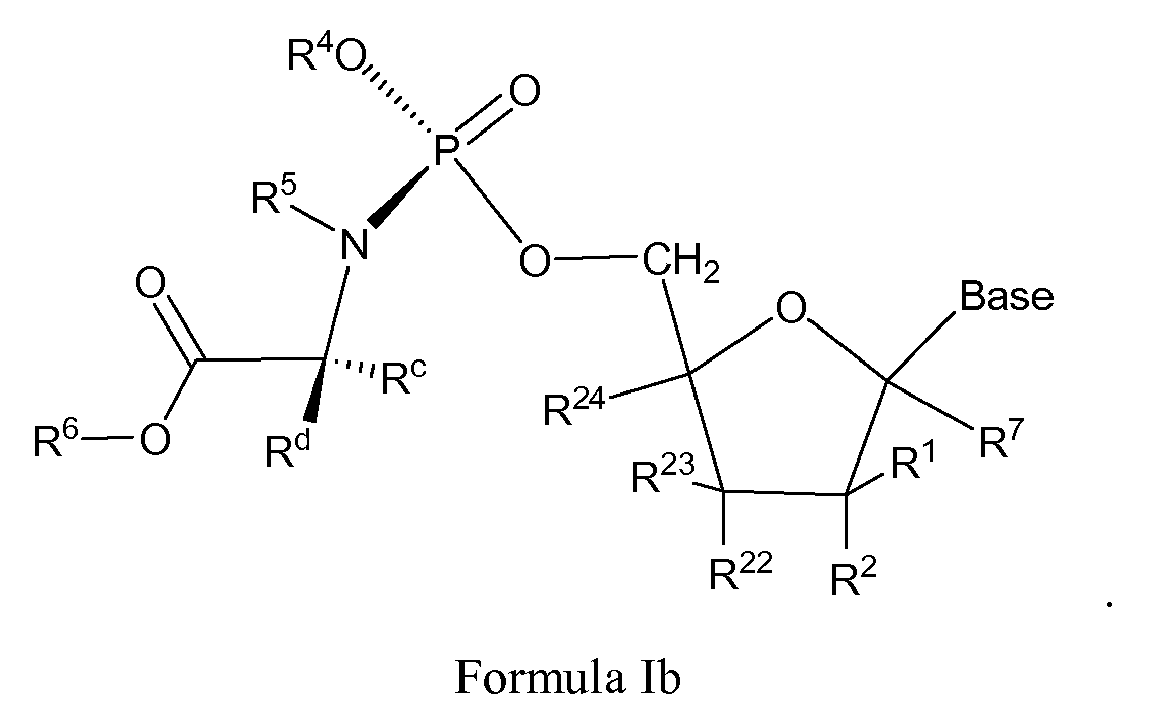
Description
- This application is a divisional application of
EP11743400.1 - The invention relates generally to methods for preparing compounds with antiviral activity, most particularly to prodrugs of inhibitors of hepatitis C virus RNA-dependent RNA polymerase.
- The hepatitis C virus (HCV) is a leading cause of chronic liver disease worldwide (Boyer, N. et al. J Hepatol. 32:98-112, 2000) and may lead to hepatic fibrosis, cirrhosis and hepatocellular carcinoma (Cale, P., Gastroenterolgy Clin. Biol. 2009, 33, 958). A significant focus of current antiviral research is directed toward the development of improved methods of treatment of chronic HCV infections in humans (Di Besceglie, A.M. and Bacon, B. R., Scientific American, Oct.: 80-85, (1999); Gordon, C. P., et al., J. Med. Chem. 2005, 48, 1-20; Maradpour, D.; et al., Nat. Rev. Micro. 2007, 5(6), 453-463). A number of HCV treatments are reviewed by Bymock et al. in Antiviral Chemistry & Chemotherapy, 11:2; 79-95 (2000).
- Currently, there are primarily two antiviral compounds, ribavirin, a nucleoside analog, and interferon-alpha (α) (IFN), which are used for the treatment of chronic HCV infections in humans. Ribavirin alone is not effective in reducing viral RNA levels, has significant toxicity, and is known to induce anemia. The combination of IFN and ribavirin has been reported to be effective in the management of chronic hepatitis C (Scott, L. J., et al. Drugs 2002, 62, 507-556) but less than half the patients given this treatment show a persistent benefit. Other patent applications disclosing the use of nucleoside analogs to treat hepatitis C virus include
WO 01/32153 WO 01/60315 WO 02/057425 WO 02/057287 WO 02/032920 WO 02/18404 WO 04/046331 WO2008/089105 andWO2008/141079 but additional treatments for HCV infections have not yet become available for patients. Therefore, drugs having improved antiviral and pharmacokinetic properties with enhanced activity against development of HCV resistance, improved oral bioavailability, greater efficacy, fewer undesirable side effects and extended effective half-life in vivo (De Francesco, R. et al. (2003) Antiviral Research 58:1-16) are urgently needed. - RNA-dependent RNA polymerase (RdRp) is one of the best studied targets for the development of novel HCV therapeutic agents. The NS5B polymerase is a target for inhibitors in early human clinical trials (
Sommadossi, J., WO 01/90121 A2 US 2004/0006002 A1 ). These enzymes have been extensively characterized at the biochemical and structural level, with screening assays for identifying selective inhibitors (De Clercq, E. (2001) J. Pharmacol. Exp.Ther. 297:1-10; De Clercq, E. (2001) J. Clin. Virol. 22:73-89). Biochemical targets such as NS5B are important in developing HCV therapies since HCV does not replicate in the laboratory and there are difficulties in developing cell-based assays and preclinical animal systems. - Inhibition of viral replication by nucleosides has been extensively studied (De Clercq, E. (2001) J. Clin. Virol. 22:73-89) including nucleosides that inhibit RdRp. Generally, the antiviral activity of these nucleosides are attributed to the conversion of the nucleosides to their nucleoside triphosphates (NTPs) which act as inhibitors of DNA and RNA polymerases or as chain terminators following incorporation into the lengthening viral DNA or RNA strand. However, many NTPs lack adequate specificity for viral polymerases compared to host polymerases and, as a result, cause substantial toxicity. This has led to efforts to modify the core structures of nucleosides to achieve higher selectivity but many of the structural modifcations have simultaneously compromised NTP production in the cells (Yamanaka, Antimicrob. Agents Chemother. 1999: 190-193).
- The poor conversion of the nucleoside to NTP can often be attributed to the inability of nucleoside kinases to convert the nucleoside to the nucleoside 5'-monophosphate (NMP). NMP prodrugs have been used to bypass poor nucleoside kinase activity (Schultz, Bioorg. Med. Chem. 2003, 11, 885). Among these prodrugs, NMP phosphoramidates have been reported to increase intracellular concentrations of NTP compared to the nucleoside alone (McGuigan, J. Med. Chem. 1993, 36, 1048-1052). However, these NMP prodrugs are substrates for esterases and phosphodiesterases in the blood and other body tissues which can cleave the prodrug to a charged molelcule or to the nucleoside, respectively. The charged molecule is then impermeable to the target organ or cell and the nucleoside is poorly phosphorylated intracellularly.
- The development of a highly effective, non-toxic NMP prodrug is largely an unpredictable trial and error exercise requiring the balancing of the stability of the NMP prodrug in blood with the ability of the prodrug to reach a target organ or cell, be absorbed or actively taken up by the target cell, being efficiently cleaved to the NMP intracellularly and subsequently converted to a NTP that is selective for inhibiting the viral polymerase (Perrone, J. Med. Chem. 2007, 50, 1840-49; Gardelli, J. Med. Chem. 2009, 52, 5394-5407). For the case of an orally effective RdRp inhibitor for treating HCV infection, the NMP prodrug would need to be chemically stable to the conditions of the upper intestinal tract, be efficiently absorbed from the intestinal tract, survive the many esterases of the intestinal cells and blood, be efficiently extracted by the hepatocytes, and be cleaved to the NMP and subsequently converted to a NTP in hepatocytes that is specific for inhibiting the HCV NS5B polymerase. Notably, the anti-HCV activity of phosphate prodrugs can markedly depend upon the chirality of the phosphorous in the prodrug (Gardelli, J. Med. Chem. 2009, 52, 5394-5407; Meppen, Abstracts of Papers, 236th ACS National Meeting, Philadelphia, PA, United States, August 17-21, 2008 (2008), MEDI-404.).
-
Babu, Y. S., WO2008/089105 andWO2008/141079 , discloses ribosides of pyrrolo[1,2-f][1,2,4]triazine nucleobases with antiviral, anti-HCV, and anti-RdRp activity. -
Butler, et al., WO2009132135 , disclose 1' substituted ribosides and prodrugs comprising pyrrolo[1,2-f][1,2,4]triazine nucleobases which have anti-HCV and anti-RdRp activity but does not disclose species of the 3'-O-acylated derivatives of those ribosides or the expected properties of such derivatives.Cho, et al., US 61353351 - In view of the importance of anti-HCV therapeutics that are NMP prodrugs with chiral phosphorous atoms such as those described by Cho, et al., Gardelli, et al., Perrone et al., and Meppen, et al., new efficient methods of producing chiral phosphates of these prodrugs are needed.
- Provided are methods for preparing compounds that inhibit hepatitis C virus. The compounds are prodrugs of nucleoside monophosphates that, when administered to animals, are intracellularly converted to nucleoside triphosphates. The chirality of the phosphorous atom determines the efficiency of the conversion to the nucleoside triphosphate in the animal. The method disclosed, provides a convergent synthesis of these single diastereomeric prodrugs which is an improvement over the previously disclosed chromatographic methods of separating a single diastereomer from a mixture of diastereomers.
- In one embodiment, provided is a method for preparing a compound of Formula Ia or Ib:


wherein: - each R1, R2, R7, R22, R23 or R24 is independently H, OR11, NR11R12, C(O)NR11R12, -OC(O)NR11R12, C(O)OR11, OC(O)OR11, S(O)nRa, S(O)2NR11R12, N3, CN, halogen, (C1-C8)alkyl, (C3-C8)carbocyclyl, (C4-C8)carbocyclylalkyl, (C2-C8)alkenyl, (C2-C8)alkynyl or aryl(C1-C8)alkyl;
- or any two R1, R2, R7, R22, R23 or R24 on adjacent carbon atoms when taken together are -O(CO)O- or -O(CR11R12)O- or when taken together with the ring carbon atoms to which they are attached form a double bond;
- each Base is independently a naturally occurring or modified purine or pyrimidine base linked to the furanose ring through a carbon or nitrogen atom;
- each n is independently 0, 1, or 2;
- each Ra, R4 or R6 is independently (C2-C8)alkenyl, (C2-C8)alkynyl, (C3-C8)carbocyclyl, (C4-C8)carbocyclylalkyl, aryl(C1-C8)alkyl, heterocyclyl(C1-C8)alkyl, (C6-C20)aryl, (C2-C20)heterocyclyl or heteroaryl;
- each Rc or Rd is independently H, (C1-C8)alkyl, (C2-C8)alkenyl, (C2-C8)alkynyl, (C3-C8)carbocyclyl, (C4-C8)carbocyclylalkyl, aryl(C1-C8)alkyl, heterocyclyl(C1-C8)alkyl, (C6-C20)aryl, (C2-C20)heterocyclyl or heteroaryl provided that Rc and Rd are not the same;
- each R5 is independently H, (C1-C8)alkyl, (C2-C8)alkenyl, (C2-C8)alkynyl, (C3-C8)carbocyclyl, (C4-C8)carbocyclylalkyl, aryl(C1-C8)alkyl, heterocyclyl(C1-C8)alkyl, (C6-C20)aryl, (C2-C20)heterocyclyl or heteroaryl;
- each R11 or R12 is independently H, (C1-C8)alkyl, (C2-C8)alkenyl, (C2-C8)alkynyl, (C3-C8)carbocyclyl, (C4-C8)carbocyclylalkyl, aryl(C1-C8)alkyl, heterocyclyl(C1-C8)alkyl, (C6-C20)aryl, (C2-C20)heterocyclyl, heteroaryl, -C(=O)(C1-C8)alkyl, -S(O)n(C1-C8)alkyl or R11 and R12 taken together with a nitrogen to which they are both attached form a 3 to 7 membered heterocyclic ring wherein any one carbon atom of said heterocyclic ring can optionally be replaced with -O-, -S(O)n- or -NRa-; and
- wherein each (C1-C8)alkyl, (C2-C8)alkenyl, (C2-C8)alkynyl, (C3-C8)carbocyclyl, (C4-C8)carbocyclylalkyl, aryl(C1-C8)alkyl, heterocyclyl(C1-C8)alkyl, (C6-C20)aryl, (C2-C20)heterocyclyl or heteroaryl of each Rc, Rd, R1, R2, R22, R23, R24, R4, R5, R6, R7, R11 or R12 is, independently, optionally substituted with one or more halo, hydroxy, CN, N3, N(Ra)2, NH(Ra), NH2, NO2, C(O)N(Ra)2, C(O)NH(Ra), C(O)NH2, OC(O)N(Ra)2, OC(O)NH(Ra), OC(O)NH2, C(O)ORa, OC(O)ORa, C(O)Ra, OC(O)Ra, S(O)nRa, S(O)2N(Ra)2, S(O)2NH(Ra), S(O)2NH2, ORa or Ra;
- said method comprising:
- (a) providing a compound of Formula II

- (b) treating the compound of Formula II with a compound of Formula IIIa and a base

- (c) treating the compound of Formula II with a compound of Formula IIIb and a base

wherein:- each Ar is a (C6-C20) aryl or heteroaryl wherein said (C6-C20) aryl or heteroaryl is substituted with one or more halogen, NO2, or (C1-C8)haloalkyl and optionally substituted with one or more CN, N3, N(Ra)2, C(O)N(Ra)2, OC(O)N(Ra)2, C(O)ORa, OC(O)ORa, C(O)Ra, OC(O)Ra, S(O)nRa, S(O)2N(Ra)2, ORa or Ra with the proviso that Ar is different from R4. In another aspect, Base is not uracil. In another aspect, Base is not cytosine.
- (a) providing a compound of Formula II
- In another aspect, the invention also provides novel intermediates disclosed herein which are useful for preparing Formula Ia or Formula Ib.
- In other aspects, methods for the synthesis, analysis, separation, isolation, purification, and characterization of the novel intermediates of this invention are provided.
- Reference will now be made in detail to certain embodiments of the invention, examples of which are illustrated in the accompanying description, structures and formulas. While the invention will be described in conjunction with the enumerated embodiments, it will be understood that they are not intended to limit the invention to those embodiments. On the contrary, the invention is intended to cover all alternatives, modifications, and equivalents, which may be included within the scope of the present invention.
- Typically, the method of for preparing a compound of Formula Ia from Formula II and Formula IIIa or Formula Ib from Formula II and Formula IIIb is performed in a suitable solvent. The suitable solvent is preferably an anhydrous, non-acid, non-hydroxylic solvent. Non-limiting examples of suitable solvents are ethers, for example, diethyl ether, diisopropyl ether, di t-butyl ether, tetrahydrofuran, dioxane and various glyme solvents; dimethylformamide or dimethylacetamide. A preferred solvent is tetrahydrofuran. The concentration of Formula II in the solvent is typically about 0.01 to about 1 mole per liter of solvent. The method is performed at a temperature of about 0 °C to about 80 °C, more preferably about 20 °C to about 60 °C.
- The solution of Formula II is typically treated with a hindered base or a non-nucleophilic base. Typical, but non-limiting, examples of hindered bases are t-butyllithium, sec-isobutyllithium, lithium or sodium diisopropylamide and t-butylmagnesium halides. A preferred hindered base is t-butylmagnesium chloride. Typical, but non-limiting, examples of non-nucleophic bases are sodium hydride, potassium hydride, lithium hydride and calcium hydride. The hindered bases or non-nucleophic bases may be used as solutions in or as undiluted bases. Preferably, the bases are used as solutions in anhydrous, non-hydroxylic solvents wherein the concentration of the base in the solvent is about 0.5 to about 3 moles per liter. The molar ratio of base to the compound of Formula II is about 1:1 to about 3:1, preferably about 1.1:1 to about 1.5:1. The solution of the compound of Formula II is typically treated with the base for about 5 minutes to about two hours, preferably less than 30 minutes.
- The mixture of the solution of the compound of Formula II and the base is treated with a compound of Formula IIIa or Formula IIIb for about 30 minutes to about 24 hours, preferably about one to about four hours. The molar ratio of the compound Formula II to the compound of Formula IIIa or Formula IIIb is typically about 1:1 to about 1:4. Preferably, the molar ratio is about 1:1.1 to about 1:2.
- In another embodiment of the method for preparing a compound of Formula Ia or Ib or a pharmaceutically salt or ester thereof, Formula Ia is Formula IVa, Formula Ib is Formula IVb and Formula II is Formula V:


- In one embodiment of the method for preparing a compound of Formula IVa or IVb from a compound of Formula V, R1 is H, halogen, optionally substituted (C1-C8)alkyl, optionally substituted (C2-C8)alkenyl or optionally substituted (C2-C8)alkynyl. In another aspect of this embodiment, R1 is H. In another aspect of this embodiment, R1 is optionally substituted (C1-C8)alkyl. In another aspect of this embodiment, R1 is methyl. In another aspect of this embodiment, R1 is optionally substituted (C2-C8)alkenyl. In another aspect of this embodiment, R1 is optionally substituted (C2-C8)alkynyl. In another aspect of this embodiment, R1 is F. In another aspect of this embodiment, R2 is F. In another aspect of this embodiment, R2 is OR11. In another aspect of this embodiment, R2 is OH. In another aspect of this embodiment, R7 is H. In another aspect of this embodiment, R7 is optionally substituted (C1-C8)alkyl. In another aspect of this embodiment, R7 is optionally substituted (C2-C8)alkynyl. In another aspect of this embodiment, R7 is CN. In another aspect of this embodiment, R5 is H. In another aspect of this embodiment, one of Rc or Rd is H. In another aspect of this embodiment, one of Rc or Rd is H and the other of Rc or Rd is optionally substituted (C1-C8)alkyl. In another aspect of this embodiment, R6 is optionally substituted (C1-C8)alkyl. In another aspect of this embodiment, R4 is optionally substituted (C6-C20)aryl. In another aspect of this embodiment, Ar is optionally substituted nitrophenyl. In another aspect of this embodiment, R23 is H. In another aspect of this embodiment, R22 is OR11. In another aspect of this embodiment, R22 is OH. In another aspect of this embodiment, R24 is N3. In another aspect of this embodiment, R24 is H. In another aspect of this embodiment, Base is selected from the group consisting of:


- each X1 is independently N or CR10;
- each X2 is independently NR11, O, or S(O)n;
- each R8 is independently halogen, NR11R12, N(R11)OR11, NR11NR11R12, N3, NO, NO2, CHO, CN, -CH(=NR11), -CH=NNHR11, -CH=N(OR11), -CH(OR11)2, -C(=O)NR11R12, -C(=S)NR11R12, -C(=O)OR11, (C1-C8)alkyl, (C2-C8)alkenyl, (C2-C8)alkynyl, (C4-C8)carbocyclylalkyl, (C6-C20)aryl, (C2-C20)heterocyclyl, heteroaryl, -C(=O)(C1-C8)alkyl, -S(O)n(C1-C8)alkyl, aryl(C1-C8)alkyl, OR11 or SR11;
- each n is independently 0, 1, or 2;
- each R9 or R10 is independently H, halogen, NR11R12, N(R11)OR11, NR11NR11R12, N3, NO, NO2, CHO, CN, -CH(=NR11), -CH=NHNR11, -CH=N(OR11), -CH(OR11)2, -C(=O)NR11R12, -C(=S)NR11R12, -C(=O)OR11, R11, OR11 or SR11;
- each R11 or R12 is independently H, (C1-C8)alkyl, (C2-C8)alkenyl, (C2-C8)alkynyl, (C3-C8)carbocyclyl, (C4-C8)carbocyclylalkyl, aryl(C1-C8)alkyl, heterocyclyl(C1-C8)alkyl, (C6-C20)aryl, (C2-C20)heterocyclyl, heteroaryl, -C(=O)(C1-C8)alkyl, -S(O)n(C1-C8)alkyl or R11 and R12 taken together with a nitrogen to which they are both attached form a 3 to 7 membered heterocyclic ring wherein any one carbon atom of said heterocyclic ring can optionally be replaced with -O-, -S(O)n- or -NRa-; and
- wherein each (C1-C8)alkyl, (C2-C8)alkenyl, (C2-C8)alkynyl, (C3-C8)carbocyclyl, (C4-C8)carbocyclylalkyl, aryl(C1-C8)alkyl, heterocyclyl(C1-C8)alkyl, (C6-C20)aryl, (C2-C20)heterocyclyl or heteroaryl of each Rc, Rd, R1, R2, R22, R23, R24, R4 R5, R6, R7, R8, R9, R10, R11 or R12 is, independently, optionally substituted with one or more halo, hydroxy, CN, N3, N(Ra)2 NH(Ra), NH2, NO2, C(O)N(Ra)2, C(O)NH(Ra), C(O)NH2, OC(O)N(Ra)2, OC(O)NH(Ra), OC(O)NH2, C(O)ORa, OC(O)ORa, C(O)Ra, OC(O)Ra, S(O)nRa, S(O)2N(Ra)2, S(O)2NH(Ra), S(O)2NH2, ORa or Ra. In another aspect, Base is not uracil. In another aspect, the Base is not cytosine.
- In another aspect of this embodiment, Base is selected from the group consisting of:


- In another aspect of this embodiment, Base is selected from the group consisting of


- In another aspect of this embodiment, Base is selected from the group consisting of


- each X1 is independently N or CR10;
- each X2 is independently NR11, O, or S(O)n;
- each R8 is independently halogen, NR11R12, N(R11)OR11, NR11NR11R12, N3, NO, NO2, CHO, CN, -CH(=NR11), -CH=NNHR11, -CH=N(OR11), -CH(OR11)2, -C(=O)NR11R12, -C(=S)NR11R12, -C(=O)OR11, (C1-C8)alkyl, (C2-C8)alkenyl, (C2-C8)alkynyl, (C4-C8)carbocyclylalkyl, (C6-C20)aryl, (C2-C20)heterocyclyl, heteroaryl, -C(=O)(C1-C8)alkyl, -S(O)n(C1-C8)alkyl, aryl(C1-C8)alkyl, OR11 or SR11;
- each n is independently 0, 1, or 2;
- each R9 or R10 is independently H, halogen, NR11R12, N(R11)OR11, NR11NR11R12, N3, NO, NO2, CHO CN, -CH(=NR11), -CH=NHNR11, -CH=N(OR11), -CH(OR11)2, -C(=O)NR11R12, -C(=S)NR11R12, -C(=O)OR11, R11, OR11 or SR11;
- each R11 or R12 is independently H, (C1-C8)alkyl, (C2-C8)alkenyl, (C2-C8)alkynyl, (C3-C8)carbocyclyl, (C4-C8)carbocyclylalkyl, aryl(C1-C8)alkyl, heterocyclyl(C1-C8)alkyl, (C6-C20)aryl, (C2-C20)heterocyclyl, heteroaryl, -C(=O)(C1-C8)alkyl, -S(O)n(C1-C8)alkyl or R11 and R12 taken together with a nitrogen to which they are both attached form a 3 to 7 membered heterocyclic ring wherein any one carbon atom of said heterocyclic ring can optionally be replaced with -O-, -S(O)n- or -NRa-; and
- wherein each (C1-C8)alkyl, (C2-C8)alkenyl, (C2-C8)alkynyl, (C3-C8)carbocyclyl, (C4-C8)carbocyclylalkyl, aryl(C1-C8)alkyl, heterocyclyl(C1-C8)alkyl, (C6-C20)aryl, (C2-C20)heterocyclyl or heteroaryl of each Rc, Rd, R1, R2, R22, R23, R24, R4 R5, R6, R7, R8, R9, R10, R11 or R12 is, independently, optionally substituted with one or more halo, hydroxy, CN, N3, N(Ra)2, NH(Ra), NH2, NO2, C(O)N(Ra)2, C(O)NH(Ra), C(O)NH2, OC(O)N(Ra)2, OC(O)NH(Ra), OC(O)NH2, C(O)ORa, OC(O)ORa, C(O)Ra, OC(O)Ra, S(O)nRa, S(O)2N(Ra)2, S(O)2NH(Ra), S(O)2NH2, ORa or Ra. In another aspect, Base is not uracil. In another aspect, the Base is not cytosine.
- In another aspect of this embodiment, Base is selected from the group consisting of:

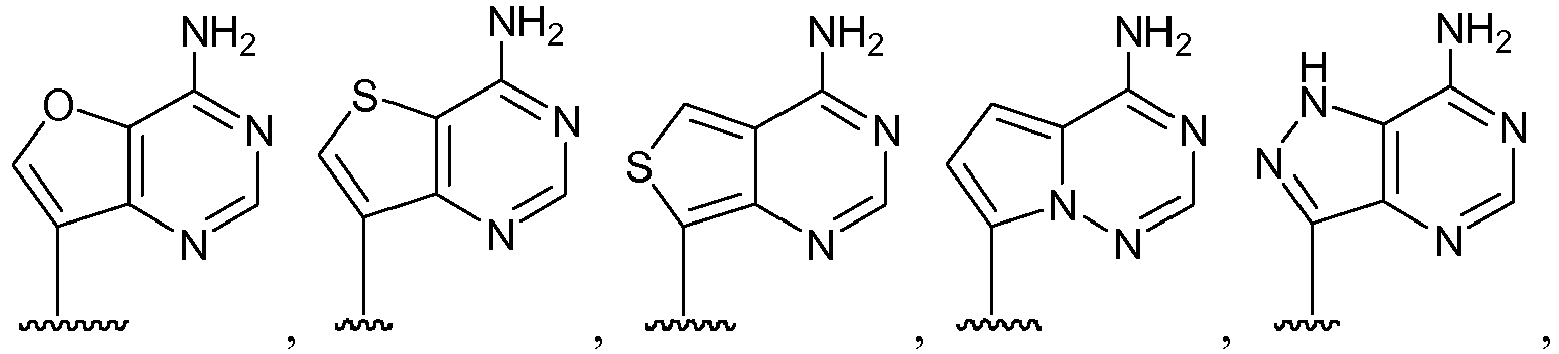

- In another aspect of this embodiment, Base is selected from the group consisting of


- In another aspect of this embodiment, Base is selected from the group consisting of


- In another embodiment of the method for preparing a compound of Formula IVa or IVb from a compound of Formula V, R1 is H or CH3; R2 is OR11 or halogen; R6 is optionally substituted (C1-C8)alkyl; one of Rc or Rd is H and the other of Rc or Rd is optionally substituted (C1-C8)alkyl; R22 is OR11, and each R5, R23 and R24 is H. In another aspect of this embodiment, R1 is H. In another aspect of this embodiment, R1 is CH3. In another aspect of this embodiment, R2 is F. In another aspect of this embodiment, R2 is OH. In another aspect of this embodiment, R22 is OH. In another aspect of this embodiment, each R2 and R22 is OH. In another aspect of this embodiment, R7 is H. In another aspect of this embodiment, R7 is CH3. In another aspect of this embodiment, R7 is ethynyl. In another aspect of this embodiment, R7 is CN. In another aspect of this embodiment, R4 is optionally substituted (C6-C20)aryl. In another aspect of embodiment, R4 is optionally substituted phenyl. In another aspect of this embodiment, R4 is optionally substituted napthyl. In another aspect of this embodiment, Ar is optionally substituted nitrophenyl. In another aspect of this embodiment, Base is selected from the group consisting of:


- each X1 is independently N or CR10;
- each X2 is independently NR11, O, or S(O)n;
- each R8 is independently halogen, NR11R12, N(R11)OR11, NR11NR11R12, N3, NO, NO2, CHO, CN, -CH(=NR11), -CH=NNHR11, -CH=N(OR11), -CH(OR11)2, -C(=O)NR11R12, -C(=S)NR11R12, -C(=O)OR11, (C1-C8)alkyl, (C2-C8)alkenyl, (C2-C8)alkynyl, (C4-C8)carbocyclylalkyl, (C6-C20)aryl, (C2-C20)heterocyclyl, heteroaryl, -C(=O)(C1-C8)alkyl, -S(O)n(C1-C8)alkyl, aryl(C1-C8)alkyl, OR11 or SR11;
- each n is independently 0, 1, or 2;
- each R9 or R10 is independently H, halogen, NR11R12, N(R11)OR11, NR11NR11R12, N3, NO, NO2, CHO, CN, -CH(=NR11), -CH=NHNR11, -CH=N(OR11), -CH(OR11)2, -C(=O)NR11R12, -C(=S)NR11R12, -C(=O)OR11, R11, OR11 or SR11 ;
- each R11 or R12 is independently H, (C1-C8)alkyl, (C2-C8)alkenyl, (C2-C8)alkynyl, (C3-C8)carbocyclyl, (C4-C8)carbocyclylalkyl, aryl(C1-C8)alkyl, heterocyclyl(C1-C8)alkyl, (C6-C20)aryl, (C2-C20)heterocyclyl, heteroaryl, -C(=O)(C1-C8)alkyl, -S(O)n(C1-C8)alkyl or R11 and R12 taken together with a nitrogen to which they are both attached form a 3 to 7 membered heterocyclic ring wherein any one carbon atom of said heterocyclic ring can optionally be replaced with -O-, -S(O)n- or -NRa-; and
- wherein each (C1-C8)alkyl, (C2-C8)alkenyl, (C2-C8)alkynyl, (C3-C8)carbocyclyl, (C4-C8)carbocyclylalkyl, aryl(C1-C8)alkyl, heterocyclyl(C1-C8)alkyl, (C6-C20)aryl, (C2-C20)heterocyclyl or heteroaryl of each Rc, Rd, R1, R2, R22, R23, R24, R4 R5, R6, R7, R8, R9, R10, R11 or R12 is, independently, optionally substituted with one or more halo, hydroxy, CN, N3, N(Ra)2, NH(Ra), NH2, NO2, C(O)N(Ra)2, C(O)NH(Ra), C(O)NH2, OC(O)N(Ra)2, OC(O)NH(Ra), OC(O)NH2, C(O)ORa, OC(O)ORa, C(O)Ra, OC(O)Ra, S(O)nRa, S(O)2N(Ra)2, S(O)2NH(Ra), S(O)2NH2, ORa or Ra. In another aspect, Base is not uracil. In another aspect, the Base is not cytosine.
- In another aspect of this embodiment, Base is selected from the group consisting of:

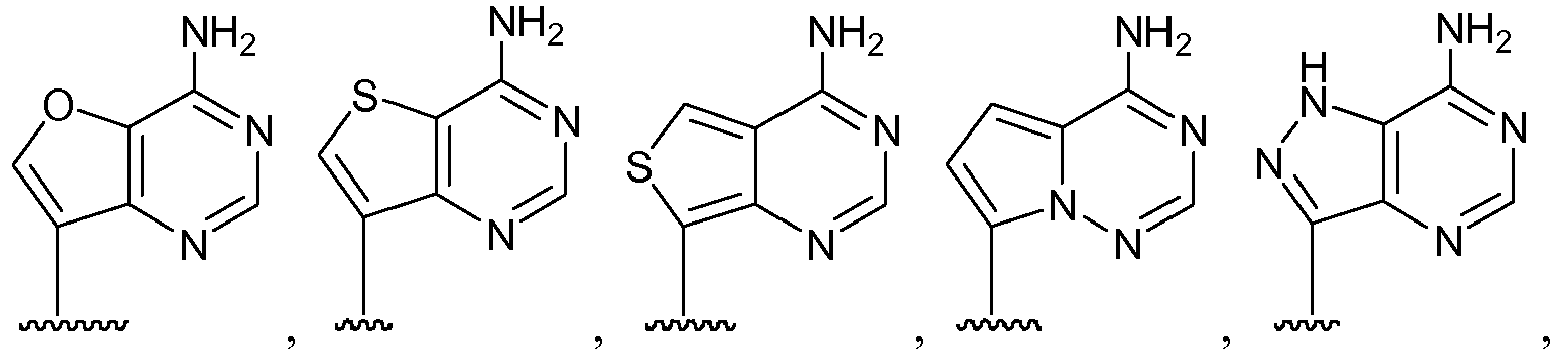
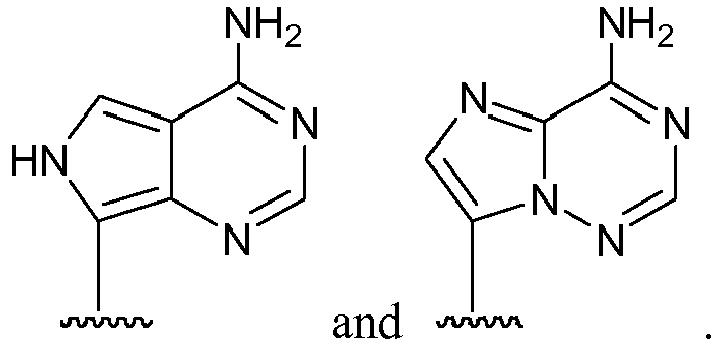
- In another aspect of this embodiment, Base is selected from the group consisting of


- In another aspect of this embodiment, Base is selected from the group consisting of


- In another embodiment of the method for preparing a compound of Formula IVa or IVb from a compound of Formula V, R1 is H or CH3; R2 is OR11 or halogen; R6 is optionally substituted (C1-C8)alkyl; one of Rc or Rd is H and the other of Rc or Rd is optionally substituted (C1-C8)alkyl; R22 is OR11, each R5, R23 and R24 is H and Base is selected from the group consisting of:


- each X1 is independently N or CR10;
- each X2 is independently NR11, O, or S(O)n;
- each R8 is independently halogen, NR11R12, N(R11)OR11, NR11NR11R12, N3, NO, NO2, CHO, CN, -CH(=NR11), -CH=NNHR11 -CH=N(OR11), -CH(OR11)2, -C(=O)NR11R12, -C(=S)NR11R12, -C(=O)OR11, (C1-C8)alkyl, (C2-C8)alkenyl, (C2-C8)alkynyl, (C4-C8)carbocyclylalkyl, (C6-C20)aryl, (C2-C20)heterocyclyl, heteroaryl, -C(=O)(C1-C8)alkyl, -S(O)n(C1-C8)alkyl, aryl(C1-C8)alkyl, OR11 or SR11;
- each n is independently 0, 1, or 2;
- each R9 or R10 is independently H, halogen, NR11R12, N(R11)OR11, NR11NR11R12, N3, NO, NO2, CHO, CN, -CH(=NR11), -CH=NHNR11, -CH=N(OR11), -CH(OR11)2, -C(=O)NR11R12, -C(=S)NR11R12, -C(=O)OR11, R11, OR11 or SR11;
- each R11 or R12 is independently H, (C1-C8)alkyl, (C2-C8)alkenyl, (C2-C8)alkynyl, (C3-C8)carbocyclyl, (C4-C8)carbocyclylalkyl, aryl(C1-C8)alkyl, heterocyclyl(C1-C8)alkyl, (C6-C20)aryl, (C2-C20)heterocyclyl, heteroaryl, -C(=O)(C1-C8)alkyl, -S(O)n(C1-C8)alkyl or R11 and R12 taken together with a nitrogen to which they are both attached form a 3 to 7 membered heterocyclic ring wherein any one carbon atom of said heterocyclic ring can optionally be replaced with -O-, -S(O)n- or -NRa-; and
- wherein each (C1-C8)alkyl, (C2-C8)alkenyl, (C2-C8)alkynyl, (C3-C8)carbocyclyl, (C4-C8)carbocyclylalkyl, aryl(C1-C8)alkyl, heterocyclyl(C1-C8)alkyl, (C6-C20)aryl, (C2-C20)heterocyclyl or heteroaryl of each Rc, Rd, R1, R2, R22, R23, R24, R4 R5, R6, R7, R8, R9, R10, R11 or R12 is, independently, optionally substituted with one or more halo, hydroxy, CN, N3, N(Ra)2, NH(Ra), NH2, NO2, C(O)N(Ra)2, C(O)NH(Ra), C(O)NH2, OC(O)N(Ra)2, OC(O)NH(Ra), OC(O)NH2, C(O)ORa, OC(O)ORa, C(O)Ra, OC(O)Ra, S(O)nRa, S(O)2N(Ra)2, S(O)2NH(Ra), S(O)2NH2, ORa or Ra. In another aspect Base is not uracil. In another aspect, the Base is not cytosine.
- In another aspect of this embodiment, R1 is H. In another aspect of this embodiment, R1 is CH3. In another aspect of this embodiment, R2 is F. In another aspect of this embodiment, R2 is OH. In another aspect of this embodiment, R22 is OH. In another aspect of this embodiment, each R2 and R22 is OH. In another aspect of this embodiment, R7 is H. In another aspect of this embodiment, R7 is CH3. In another aspect of this embodiment, R7 is ethynyl. In another aspect of this embodiment, R7 is CN. In another aspect of this embodiment, R4 is optionally substituted (C6-C20)aryl. In another aspect of embodiment, R4 is optionally substituted phenyl. In another aspect of this embodiment, R4 is optionally substituted napthyl. In another aspect of this embodiment, one of Rc or Rd is H and the other of Rc or Rd is CH3. In another aspect of this embodiment, Ar is optionally substituted nitrophenyl. In another aspect of this embodiment, Base is


- In another embodiment of the method for preparing a compound of Formula Ia or Ib or a pharmaceutically acceptable salt or ester thereof, Formula Ia is Formula VIa, Formula Ib is Formula VIb and Formula II is Formula VII:


- each R1 is independently H, halogen, optionally substituted (C1-C8)alkyl, optionally substituted (C2-C8)alkenyl or optionally substituted (C2-C8)alkynyl;
- each R2 is independently halogen or OR11;
- each R5 is H;
- each R22 is OR11 and
- the remaining variables are defined as for Formulas Ia or Ib or II or IIIa or IIIb.
- In one embodiment of the method for preparing a compound of Formula VIa or Formula VIb from a compound of Formula VII, X1 is CR10. In another aspect of this embodiment, R10 is H. In another aspect of this embodiment, R1 is H. In another aspect of this embodiment, R1 is F. In another aspect of this embodiment, R1 is optionally substituted (C1-C8)alkyl. In another aspect of this embodiment, R1 is methyl. In another aspect of this embodiment, R1 is optionally substituted (C2-C8)alkenyl. In another aspect of this embodiment, R1 is optionally substituted ethenyl. In another aspect of this embodiment, R1 is optionally substituted (C2-C8)alkynyl. In another aspect of this embodiment, R1 is optionally substituted ethynyl. In another aspect of this embodiment, R2 is F. In another aspect of this embodiment, R2 is OH. In another aspect of this embodiment R22 is OH. In another aspect of this embodiment, each R2 and R22 is OH. In another aspect of this embodiment, R7 is H. In another aspect of this embodiment, R7 is optionally substituted (C1-C8)alkyl. In another aspect of this embodiment, R7 is optionally substituted (C2-C8)alkynyl. In another aspect of this embodiment, R7 is CN. In another aspect of this embodiment, one of Rc or Rd is H. In another aspect of this embodiment, one of Rc or Rd is H and the other of Rc or Rd is optionally substituted (C1-C8)alkyl. In another aspect of this embodiment, R6 is optionally substituted (C1-C8)alkyl. In another aspect of this embodiment, R4 is optionally substituted (C6-C20)aryl. In another aspect of this embodiment, Ar is optionally substituted nitrophenyl.
- In another embodiment of the method for preparing a compound of Formula VIa or Formula VIb from a compound of Formula VII, X1 is CH, R1 is H or CH3 and one of Rc or Rd is H. In another aspect of this embodiment, R2 is F. In another aspect of this embodiment, R2 is OH. In another aspect of this embodiment R22 is OH. In another aspect of this embodiment, each R2 and R22 is OH. In another aspect of this embodiment, R7 is H. In another aspect of this embodiment, R7 is optionally substituted (C1-C8)alkyl. In another aspect of this embodiment, R7 is CH3. In another aspect of this embodiment, R7 is optionally substituted (C2-C8)alkynyl. In another aspect of this embodiment, R7 is ethynyl. In another aspect of this embodiment, R7 is CN. In another aspect of this embodiment, one of Rc or Rd is H and the other of Rc or Rd is optionally substituted (C1-C8)alkyl. In another aspect of this embodiment, R6 is optionally substituted (C1-C8)alkyl. In another aspect of this embodiment, R4 is optionally substituted (C6-C20)aryl. In another aspect of this embodiment, Ar is optionally substituted nitrophenyl. In another aspect of this embodiment, R8 is NR11R12. In another aspect of this embodiment, R8 is OR11. In another aspect of this embodiment, R8 is NH2. In another aspect of this embodiment, R8 is OH. In another aspect of this embodiment, R9 is H. In another aspect of this embodiment, R9 is NR11R12. In another aspect of this embodiment, R9 is OR11. In another aspect of this embodiment, R8 is NR11R12 and R9 is H. In another aspect of this embodiment, R8 is NR11R12 and R9 is NR11R12 .
- In another embodiment of the method for preparing a compound of Formula VIa or Formula VIb from a compound of Formula VII, X1 is CH, R1 is H or CH3, one of Rc or Rd is H and R7 is CN. In another aspect of this embodiment, R2 is F. In another aspect of this embodiment, R2 is OH. In another aspect of this embodiment R22 is OH. In another aspect of this embodiment, each R2 and R22 is OH. In another aspect of this embodiment, one of Rc or Rd is H and the other of Rc or Rd is optionally substituted (C1-C8)alkyl. In another aspect of this embodiment, one of Rc or Rd is H and the other of Rc or Rd is CH3. In another aspect of this embodiment, R6 is optionally substituted (C1-C8)alkyl. In another aspect of this embodiment, R4 is optionally substituted (C6-C20)aryl. In another aspect of this embodiment, R4 is optionally substituted phenyl. In another aspect of this embodiment, Ar is optionally substituted nitrophenyl. In another aspect of this embodiment, R8 is NR11R12. In another aspect of this embodiment, R8 is OR11. In another aspect of this embodiment, R8 is NH2. In another aspect of this embodiment, R8 is OH. In another aspect of this embodiment, R9 is H. In another aspect of this embodiment, R9 is NR11R12. In another aspect of this embodiment, R9 is OR11. In another aspect of this embodiment, R8 is NR11R12 and R9 is H. In another aspect of this embodiment, R8 is NH2 and R9 is H. In another aspect of this embodiment, R8 is NR11R12 and R9 is NR11R12. In another aspect of this embodiment, R8 is NH2 and R9 is NH2. In another aspect of this embodiment, R8 is OH and R9 is NH2.
- In another embodiment, provided is a method of preparing a compound of Formula IIIa or Formula IIIb


- each Ra, R4 or R6 is independently (C1-C8)alkyl, (C2-C8)alkenyl, (C2-C8)alkynyl, (C3-C8)carbocyclyl, (C4-C8)carbocyclylalkyl, aryl(C1-C8)alkyl, heterocyclyl(C1-C8)alkyl, (C6-C20)aryl, (C2-C20)heterocyclyl or heteroaryl;
- each Rc or Rd is independently H, (C1-C8)alkyl, (C2-C8)alkenyl, (C2-C8)alkynyl, (C3-C8)carbocyclyl, (C4-C8)carbocyclylalkyl, aryl(C1-C8)alkyl, heterocyclyl(C1-C8)alkyl, (C6-C20)aryl, (C2-C20)heterocyclyl or heteroaryl provided that Rc and Rd are not the same;
- each R5 is independently H, (C1-C8)alkyl, (C2-C8)alkenyl, (C2-C8)alkynyl, (C3-C8)carbocyclyl, (C4-C8)carbocyclylalkyl, aryl(C1-C8)alkyl, heterocyclyl(C1-C8)alkyl, (C6-C20)aryl, (C2-C20)heterocyclyl or heteroaryl;
- wherein each (C1-C8)alkyl, (C2-C8)alkenyl, (C2-C8)alkynyl, (C3-C8)carbocyclyl, (C4-C8)carbocyclylalkyl, aryl(C1-C8)alkyl, heterocyclyl(C1-C8)alkyl, (C6-C20)aryl, (C2-C20)heterocyclyl or heteroaryl of each Rc, Rd, R4, R5 or R6 is, independently, optionally substituted with one or more halo, hydroxy, CN, N3, N(Ra)2, NH(Ra), NH2, C(O)N(Ra)2, C(O)NH(Ra), C(O)NH2, OC(O)N(Ra)2, OC(O)NH(Ra), OC(O)NH2, C(O)ORa, OC(O)ORa, S(O)nRa, S(O)2N(Ra)2, S(O)2NH(Ra), S(O)2NH2, ORa or Ra; and
- each Ar is a (C6-C20) aryl or heteroaryl wherein said (C6-C20) aryl or heteroaryl is substituted with one or more halogen, NO2, or (C1-C8)haloalkyl and optionally substituted with with one or more CN, N3, N(Ra)2, C(O)N(Ra)2, OC(O)N(Ra)2, C(O)ORa, OC(O)ORa, C(O)Ra, OC(O)Ra, S(O)nRa, S(O)2N(Ra)2, ORa or Ra with the proviso that Ar is different from R4;
- said method comprising:
- (d) providing a diastereomeric compound of Formula VIII

- (e) crystallizing the compound of Formula VIII from a suitable solvent;
thereby forming a pure diasteromer of Formula IIIa or Formula IIIb.
- (d) providing a diastereomeric compound of Formula VIII
- In one embodiment of the method of preparing a compound of Formula IIIa or Formula IIIb, R5 is H and one of Rc or Rd is H. In another aspect of this embodiment, one of Rc or Rd is H and the other of Rc or Rd is optionally substituted (C1-C8)alkyl. In another aspect of this embodiment, one of Rc or Rd is H and the other of Rc or Rd is CH3. In another aspect of this embodiment, R6 is optionally substituted (C1-C8)alkyl. In another aspect of this embodiment, R6 is optionally substituted (C1-C8) secondary or tertiary alkyl. In another aspect of this embodiment, R4 is optionally substituted (C6-C20)aryl. In another aspect of this embodiment, R4 is optionally substituted phenyl. In another aspect of this embodiment, Ar is optionally substituted nitrophenyl. In another aspect of this embodiment, Ar is optionally substituted para-nitrophenyl. In another aspect of this embodiment, the chirality at the carbon directly attached to Rc and Rd is S. In another aspect of this embodiment, the chirality at the carbon directly attached to Rc and Rd is R.
- In another embodiment of the method of preparing a compound of Formula IIIa or Formula IIIb, R5 is H, one of Rc or Rd is H, R6 is optionally substituted (C1-C8)alkyl, and R4 is optionally substituted (C6-C20)aryl. In another aspect of this embodiment, one of Rc or Rd is H and the other of Rc or Rd is optionally substituted (C1-C8)alkyl. In another aspect of this embodiment, one of Rc or Rd is H and the other of Rc or Rd is CH3. In another aspect of this embodiment, R6 is optionally substituted (C1-C8) secondary or tertiary alkyl. In another aspect of this embodiment, R6 is optionally substituted 2-propyl. In another aspect of this embodiment, R4 is optionally substituted phenyl. In another aspect of this embodiment, Ar is optionally substituted nitrophenyl. In another aspect of this embodiment, Ar is optionally substituted para-nitrophenyl. In another aspect of this embodiment, Ar is para-nitrophenyl. In another aspect of this embodiment, the chirality at the carbon directly attached to Rc and Rd is S. In another aspect of this embodiment, the chirality at the carbon directly attached to Rc and Rd is R.
- In another embodiment of the method of preparing a compound of Formula IIIa or Formula IIIb, R5 is H, one of Rc or Rd is H and the other of Rc or Rd is optionally substituted (C1-C8)alkyl, R6 is optionally substituted (C1-C8)alkyl, and R4 is optionally substituted phenyl. In another aspect of this embodiment, one of Rc or Rd is H and the other of Rc or Rd is CH3. In another aspect of this embodiment, R6 is optionally substituted (C1-C8) secondary or tertiary alkyl. In another aspect of this embodiment, R6 is optionally substituted 2-propyl. In another aspect of this embodiment, R4 is phenyl. In another aspect of this embodiment, Ar is optionally substituted nitrophenyl. In another aspect of this embodiment, Ar is optionally substituted para-nitrophenyl. In another aspect of this embodiment, Ar is para-nitrophenyl. In another aspect of this embodiment, the chirality at the carbon directly attached to Rc and Rd is S. In another aspect of this embodiment, the chirality at the carbon directly attached to Rc and Rd is R.
- In another embodiment of the method of preparing a compound of Formula IIIa or Formula IIIb, R5 is H, one of Rc or Rd is H and the other of Rc or Rd is CH3, R6 is optionally substituted (C1-C8)alkyl, and R4 is optionally substituted phenyl. In another aspect of this embodiment, R6 is optionally substituted (C1-C8) secondary or tertiary alkyl. In another aspect of this embodiment, R6 is optionally substituted 2-propyl. In another aspect of this embodiment, R6 is 2-propyl. In another aspect of this embodiment, R4 is phenyl. In another aspect of this embodiment, Ar is optionally substituted nitrophenyl. In another aspect of this embodiment, Ar is optionally substituted para-nitrophenyl. In another aspect of this embodiment, Ar is para-nitrophenyl. In another aspect of this embodiment, the chirality at the carbon directly attached to Rc and Rd is S. In another aspect of this embodiment, the chirality at the carbon directly attached to Rc and Rd is R.
- The diastereomeric mixture of the compound of Formula VIII is resolved by crystallization of the compound of Formula VIII from a suitable solvent. Non-limiting examples of suitable solvents are diethyl ether, dipropyl ether, di t-butyl ether, methyl t-butyl ether, C1-C6 halogenated alkanes, C5-C8 hydrocarbon, tetrahydrofuran, toluene, xylene, dioxane and the like. In another embodiment, the compound of Formula IV is dissolved in a suitable solvent and crystallization is induced by addition of a C5-C8 hydrocarbon or C5-C8 cyclic hydrocarbon. In a preferred embodiment, the compound of Formula VIII is dissolved in an ether solvent and crystallization is induced by addition of a C5-C8 hydrocarbon. In a particularly preferred embodiment, the compound of Formula VIII is dissolved in diethyl ether and crystallization is induced by the addition of hexane.
- The diastereomeric mixture of the compound of Formula VIII is resolved by crystallization of the compound of Formula VIII from a suitable solvent at a temperature of about 80 °C to about -20 °C. Preferrably, the temperature is about 30 °C to about -20 °C, more preferably about ambient to -10 °C.
- The diastereomeric mixture of the compound of Formula VIII is resolved by crystallization of the compound of Formula VIII from a suitable solvent wherein the concentration of the compound of Formula VIII in solution is about 25 g to about 1000 g per liter of solvent. More typically, the concentration of the compound of Formula VIII is about 50 to 500 g per liter of solvent.
- The resolution of the diastereomeric mixture of the compound of Formula VIII by crystallization may be promoted by the addition of seed crystals of the pure diastereomer. Seed crystals of pure diastereomers may be obtained through purification of the diastereomeric mixture of the compound of Formula VIII by liquid chromatography, chiral liquid chromatography, high pressure liquid chromatography, or chiral high pressure liquid chromatography such as by the non-limiting methods described herein.
- Typically, the crystallization of the diastereomeric mixture of the compound of Formula VIII produces a mixture of diastereomers containing at least 60 % of a single diastereomer. More typically, the mixture produced contains at least 70 % of a single diastereomer, most typically, at least 80 % of a single diastereomer, preferably at least 90 % of a single diastereomer, and more preferably at least 95 % of a single diastereomer. Higher diastereomeric purity, for example at least 99 % diastereomeric purity, may be obtained by one or more subsequent crystallizations. The yield of crystalline material from a single crystallization is typically about 10 to 45 %, more typically about 20-35 %.
- In another embodiment, provided is a compound of Formula IIIa or Formula IIIb


wherein: - each Ra, R4 or R6 is independently (C1-C8)alkyl, (C2-C8)alkenyl, (C2-C8)alkynyl, (C3-C8)carbocyclyl, (C4-C8)carbocyclylalkyl, aryl(C1-C8)alkyl, heterocyclyl(C1-C8)alkyl, (C6-C20)aryl, (C2-C20)heterocyclyl or heteroaryl;
- each Rc or Rd is independently H, (C1-C8)alkyl, (C2-C8)alkenyl, (C2-C8)alkynyl, (C3-C8)carbocyclyl, (C4-C8)carbocyclylalkyl, aryl(C1-C8)alkyl, heterocyclyl(C1-C8)alkyl, (C6-C20)aryl, (C2-C20)heterocyclyl or heteroaryl provided that Rc and Rd are not the same;
- each R5 is independently H, (C1-C8)alkyl, (C2-C8)alkenyl, (C2-C8)alkynyl, (C3-C8)carbocyclyl, (C4-C8)carbocyclylalkyl, aryl(C1-C8)alkyl, heterocyclyl(C1-C8)alkyl, (C6-C20)aryl, (C2-C20)heterocyclyl or heteroaryl;
- wherein each (C1-C8)alkyl, (C2-C8)alkenyl, (C2-C8)alkynyl, (C3-C8)carbocyclyl, (C4-C8)carbocyclylalkyl, aryl(C1-C8)alkyl, heterocyclyl(C1-C8)alkyl, (C6-C20)aryl, (C2-C20)heterocyclyl or heteroaryl of each Rc, Rd, R4, R5 or R6 is, independently, optionally substituted with one or more halo, hydroxy, CN, N3, N(Ra)2, NH(Ra), NH2, C(O)N(Ra)2, C(O)NH(Ra), C(O)NH2, OC(O)N(Ra)2, OC(O)NH(Ra), OC(O)NH2, C(O)ORa, OC(O)ORa, S(O)nRa, S(O)2N(Ra)2, S(O)2NH(Ra), S(O)2NH2, ORa or Ra; and
- each Ar is a (C6-C20) aryl or heteroaryl wherein said (C6-C20) aryl or heteroaryl is substituted with one or more halogen, NO2, or (C1-C8)haloalkyl and optionally substituted with with one or more CN, N3, N(Ra)2, C(O)N(Ra)2, OC(O)N(Ra)2, C(O)ORa, OC(O)ORa, C(O)Ra, OC(O)Ra, S(O)nRa, S(O)2N(Ra)2, ORa or Ra with the proviso that Ar is different from R4.
- In another embodiment of the compound of Formula IIIa or Formula IIIb, R5 is H and one of Rc or Rd is H. In another aspect of this embodiment, one of Rc or Rd is H and the other of Rc or Rd is optionally substituted (C1-C8)alkyl. In another aspect of this embodiment, one of Rc or Rd is H and the other of Rc or Rd is CH3. In another aspect of this embodiment, R6 is optionally substituted (C1-C8)alkyl. In another aspect of this embodiment, R6 is optionally substituted (C1-C8) secondary or tertiary alkyl. In another aspect of this embodiment, R4 is optionally substituted (C6-C20)aryl. In another aspect of this embodiment, R4 is optionally substituted phenyl. In another aspect of this embodiment, Ar is optionally substituted nitrophenyl. In another aspect of this embodiment, Ar is optionally substituted para-nitrophenyl. In another aspect of this embodiment, the chirality at the carbon directly attached to Rc and Rd is S. In another aspect of this embodiment, the chirality at the carbon directly attached to Rc and Rd is R. In another aspect of this embodiment, the moiety

- In another embodiment of the compound of Formula IIIa or Formula IIIb, R5 is H, one of Rc or Rd is H, R6 is optionally substituted (C1-C8)alkyl and R4 is optionally substituted (C6-C20)aryl. In another aspect of this embodiment, one of Rc or Rd is H and the other of Rc or Rd is optionally substituted (C1-C8)alkyl. In another aspect of this embodiment, one of Rc or Rd is H and the other of Rc or Rd is CH3. In another aspect of this embodiment, R6 is optionally substituted (C1-C8) secondary or tertiary alkyl. In another aspect of this embodiment, R6 is optionally substituted 2-propyl. In another aspect of this embodiment, R4 is optionally substituted phenyl. In another aspect of this embodiment, Ar is optionally substituted nitrophenyl. In another aspect of this embodiment, Ar is optionally substituted para-nitrophenyl. In another aspect of this embodiment, Ar is para-nitrophenyl. In another aspect of this embodiment, the chirality at the carbon directly attached to Rc and Rd is S. In another aspect of this embodiment, the chirality at the carbon directly attached to Rc and Rd is R. In another aspect of this embodiment, the moiety

- In another embodiment of the compound of Formula IIIa or Formula IIIb, R5 is H, one of Rc or Rd is H and the other of Rc or Rd is optionally substituted (C1-C8)alkyl, R6 is optionally substituted (C1-C8)alkyl and R4 is optionally substituted phenyl. In another aspect of this embodiment, one of Rc or Rd is H and the other of Rc or Rd is CH3. In another aspect of this embodiment, R6 is optionally substituted (C1-C8) secondary or tertiary alkyl. In another aspect of this embodiment, R6 is optionally substituted 2-propyl. In another aspect of this embodiment, R4 is phenyl. In another aspect of this embodiment, Ar is optionally substituted nitrophenyl. In another aspect of this embodiment, Ar is optionally substituted para-nitrophenyl. In another aspect of this embodiment, Ar is para-nitrophenyl. In another aspect of this embodiment, the chirality at the carbon directly attached to Rc and Rd is S. In another aspect of this embodiment, the chirality at the carbon directly attached to Rc and Rd is R. In another aspect of this embodiment, the moiety

- In another embodiment of the compound of Formula IIIa or Formula IIIb, R5 is H, one of Rc or Rd is H and the other of Rc or Rd is CH3, R6 is optionally substituted (C1-C8)alkyl, and R4 is optionally substituted phenyl. In another aspect of this embodiment, R6 is optionally substituted (C1-C8) secondary or tertiary alkyl. In another aspect of this embodiment, R6 is optionally substituted 2-propyl. In another aspect of this embodiment, R6 is 2-propyl. In another aspect of this embodiment, R4 is phenyl. In another aspect of this embodiment, Ar is optionally substituted nitrophenyl. In another aspect of this embodiment, Ar is optionally substituted para-nitrophenyl. In another aspect of this embodiment, Ar is para-nitrophenyl. In another aspect of this embodiment, the chirality at the carbon directly attached to Rc and Rd is S. In another aspect of this embodiment, the chirality at the carbon directly attached to Rc and Rd is R. In another aspect of this embodiment, the moiety

- In another embodiment, provided are compounds of Formula IIIa or Formula IIIb selected from the group consisting of:
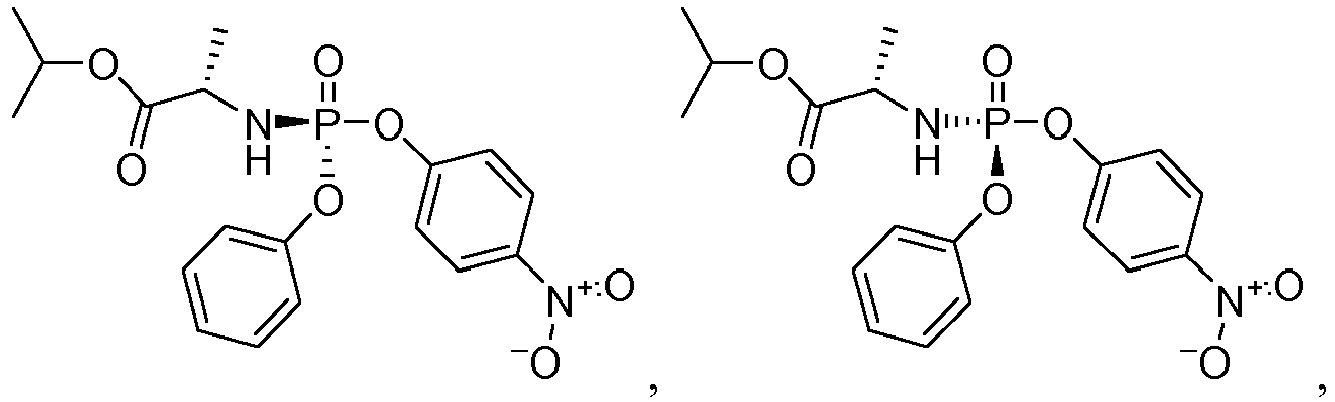


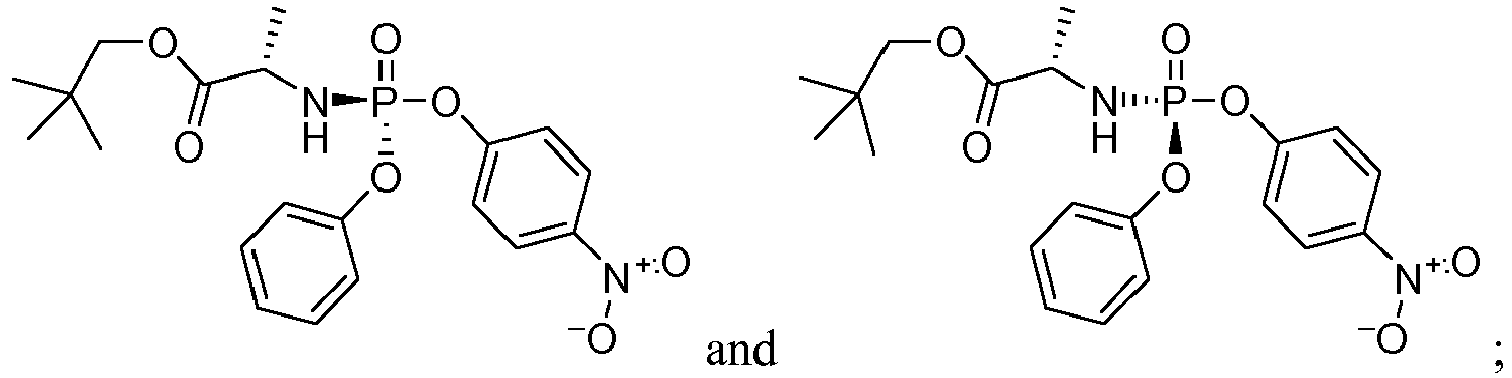
- In another embodiment, provided is a method of preparing a compound of Formula VIII
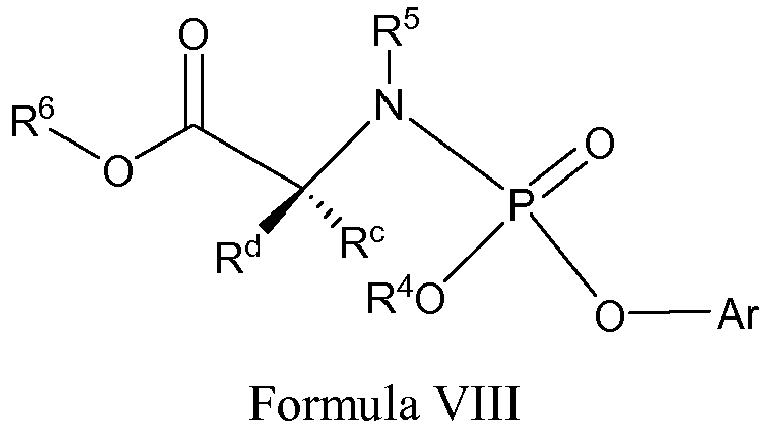
- each Ra, R4 or R6 is independently (C1-C8)alkyl, (C2-C8)alkenyl, (C2-C8)alkynyl, (C3-C8)carbocyclyl, (C4-C8)carbocyclylalkyl, aryl(C1-C8)alkyl, heterocyclyl(C1-C8)alkyl, (C6-C20)aryl, (C2-C20)heterocyclyl or heteroaryl;
- each Rc or Rd is independently H, (C1-C8)alkyl, (C2-C8)alkenyl, (C2-C8)alkynyl, (C3-C8)carbocyclyl, (C4-C8)carbocyclylalkyl, aryl(C1-C8)alkyl, heterocyclyl(C1-C8)alkyl, (C6-C20)aryl, (C2-C20)heterocyclyl or heteroaryl provided that Rc and Rd are not the same;
- each R5 is independently H, (C1-C8)alkyl, (C2-C8)alkenyl, (C2-C8)alkynyl, (C3-C8)carbocyclyl, (C4-C8)carbocyclylalkyl, aryl(C1-C8)alkyl, heterocyclyl(C1-C8)alkyl, (C6-C20)aryl, (C2-C20)heterocyclyl or heteroaryl;
- wherein each (C1-C8)alkyl, (C2-C8)alkenyl, (C2-C8)alkynyl, (C3-C8)carbocyclyl, (C4-C8)carbocyclylalkyl, aryl(C1-C8)alkyl, heterocyclyl(C1-C8)alkyl, (C6-C20)aryl, (C2-C20)heterocyclyl, heteroaryl of each Rc, Rd, R4, R5 or R6 is, independently, optionally substituted with one or more halo, hydroxy, CN, N3, N(Ra)2, NH(Ra), NH2, C(O)N(Ra)2, C(O)NH(Ra), C(O)NH2, OC(O)N(Ra)2, OC(O)NH(Ra), OC(O)NH2, C(O)ORa, OC(O)ORa, S(O)nRa, S(O)2N(Ra)2, S(O)2NH(Ra), S(O)2NH2, ORa or Ra; and
- each Ar is a (C6-C20) aryl or heteroaryl wherein said (C6-C20) aryl or heteroaryl is substituted with one or more halogen, NO2, or (C1-C8)haloalkyl and optionally substituted with with one or more CN, N3, N(Ra)2, C(O)N(Ra)2, OC(O)N(Ra)2, C(O)ORa, OC(O)ORa, C(O)Ra, OC(O)Ra, S(O)nRa, S(O)2N(Ra)2, ORa or Ra with the proviso that Ar is different from R4;
- said method comprising:
- (f) providing a chirally pure amino acid ester of Formula IX or a salt thereof

- (g) treating the compound of Formula IX with a compound of Formula X in the presence of a base

- (h) treating the resulting mixture with ArOH;
thereby forming a compound of Formula VIII.
- (f) providing a chirally pure amino acid ester of Formula IX or a salt thereof
- Typically, the chirally pure amino acid of Formula IX or a salt thereof is dissolved or suspended in a suitable non-nucleophilic solvent. Non-limiting non-nucleophilic solvents include haloalkanes, e.g., methylene chloride, dichloroethane and ethers, e.g. dioxane, tetrahydrofuran and glymes. Typically, the suspension or solution contains about 0.1 to about 5 moles of the compound of Formula IX per liter of solvent.
- The suspension or solution of the chirally pure amino acid of Formula IX is treated with a compound of Formula X. Typically, the reaction is conducted at about -20 to about 60 °C. The mole ratio of the compound of Formula IX to the compound of Formula X is about 1:2 to about 2:1, preferably about 1:1. The reaction is conducted in the presence of a non-nucleophilic base. Non-limiting examples of non-nucleophilic bases are tertiary amines, e.g. triethylamine, diisopropylethylamine and triethylamine; metal hydrides, e.g. LiH, NaH and CaH2; and nitrogen containing heterocycles, e.g. pyridine and dimethylaminopyridine. In a preferred embodiment, the base is a tertiary amine such as triethylamine. When the compound of Formula IX is a salt of a mono-protic acid, the mole ratio of base to the compound of Formula IX is typically about 2:1. If the compound of Formula IX is a free base, the mole ratio of base to the compound of Formula IX is about 1:1.
- The reaction of the compound of Formula IX with the compound of Formula X may be followed by many conventional means known to those skilled in the art. Such means include thin-layer chromatography and hplc. When the reaction between the compound Formula IX and the compound of Formula X is complete, the reaction is treated with a phenolic compound ArOH where Ar is defined as herein. The mole ratio of the compound of Formula X to ArOH is about 1.1:1 to about 1:1.1, preferably about 1:1. After the addition of ArOH, additional base is required, typically enough base to neutralize the acid generated in the reaction. Typically, the additional base is a non-nucleophilic base such as described above.
- The compound of Formula VIII is isolated by conventional means known to those skilled in the art. For example, the salt formed in the reaction may be precipitated from the reaction mixture and the compound of Formula VIII isolated by evaporation of the solvent followed by crystallization or chromatography.
- In one embodiment of the method of preparing a compound of Formula VIII, R5 is H and one of Rc or Rd is H. In another aspect of this embodiment, one of Rc or Rd is H and the other of Rc or Rd is optionally substituted (C1-C8)alkyl. In another aspect of this embodiment, one of Rc or Rd is H and the other of Rc or Rd is CH3. In another aspect of this embodiment, R6 is optionally substituted (C1-C8)alkyl. In another aspect of this embodiment, R6 is optionally substituted (C1-C8) secondary or tertiary alkyl. In another aspect of this embodiment, R4 is optionally substituted (C6-C20)aryl. In another aspect of this embodiment, R4 is optionally substituted phenyl. In another aspect of this embodiment, Ar is optionally substituted nitrophenyl. In another aspect of this embodiment, Ar is optionally substituted para-nitrophenyl. In another aspect of this embodiment, the chirality at the carbon directly attached to Rc and Rd is S. In another aspect of this embodiment, the chirality at the carbon directly attached to Rc and Rd is R. In another aspect of this embodiment, the compound of Formula IX or salt thereof, is an ester of a naturally occurring α-amino acid.
- In another embodiment of the method of preparing a compound of Formula VIII, R5 is H, one of Rc or Rd is H, R6 is optionally substituted (C1-C8)alkyl, and R4 is optionally substituted (C6-C20)aryl. In another aspect of this embodiment, one of Rc or Rd is H and the other of Rc or Rd is optionally substituted (C1-C8)alkyl. In another aspect of this embodiment, one of Rc or Rd is H and the other of Rc or Rd is CH3. In another aspect of this embodiment, R6 is optionally substituted (C1-C8) secondary or tertiary alkyl. In another aspect of this embodiment, R6 is optionally substituted 2-propyl. In another aspect of this embodiment, R4 is optionally substituted phenyl. In another aspect of this embodiment, Ar is optionally substituted nitrophenyl. In another aspect of this embodiment, Ar is optionally substituted para-nitrophenyl. In another aspect of this embodiment, Ar is para-nitrophenyl. In another aspect of this embodiment, the chirality at the carbon directly attached to Rc and Rd is S. In another aspect of this embodiment, the chirality at the carbon directly attached to Rc and Rd is R. In another aspect of this embodiment, the compound of Formula IX or salt thereof, is an ester of a naturally occurring α-amino acid.
- In another embodiment of the method of preparing a compound of Formula VIII, R5 is H, one of Rc or Rd is H and the other of Rc or Rd is optionally substituted (C1-C8)alkyl, R6 is optionally substituted (C1-C8)alkyl, and R4 is optionally substituted phenyl. In another aspect of this embodiment, one of Rc or Rd is H and the other of Rc or Rd is CH3. In another aspect of this embodiment, R6 is optionally substituted (C1-C8) secondary or tertiary alkyl. In another aspect of this embodiment, R6 is optionally substituted 2-propyl. In another aspect of this embodiment, R4 is phenyl. In another aspect of this embodiment, Ar is optionally substituted nitrophenyl. In another aspect of this embodiment, Ar is optionally substituted para-nitrophenyl. In another aspect of this embodiment, Ar is para-nitrophenyl. In another aspect of this embodiment, the chirality at the carbon directly attached to Rc and Rd is S. In another aspect of this embodiment, the chirality at the carbon directly attached to Rc and Rd is R. In another aspect of this embodiment, the compound of Formula IX or salt thereof, is an ester of a naturally occurring α-amino acid.
- In another embodiment of the method of preparing a compound of Formula VIII, R5 is H, one of Rc or Rd is H and the other of Rc or Rd is CH3, R6 is optionally substituted (C1-C8)alkyl, and R4 is optionally substituted phenyl. In another aspect of this embodiment, R6 is optionally substituted (C1-C8) secondary or tertiary alkyl. In another aspect of this embodiment, R6 is optionally substituted 2-propyl. In another aspect of this embodiment, R6 is 2-propyl. In another aspect of this embodiment, R4 is phenyl. In another aspect of this embodiment, Ar is optionally substituted nitrophenyl. In another aspect of this embodiment, Ar is optionally substituted para-nitrophenyl. In another aspect of this embodiment, Ar is para-nitrophenyl. In another aspect of this embodiment, the chirality at the carbon directly attached to Rc and Rd is S. In another aspect of this embodiment, the chirality at the carbon directly attached to Rc and Rd is R. In another aspect of this embodiment, the compound of Formula IX or salt thereof, is an ester of a naturally occurring α-amino acid.
- In another embodiment of the method for preparing a compound of Formula Ia or Ib or a pharmaceutically acceptable salt or ester thereof, Formula Ia is Formula XIa, Formula Ib is Formula XIb and Formula II is Formula XII:


- each R1 is independently H, halogen, optionally substituted (C1-C8)alkyl, optionally substituted (C2-C8)alkenyl or optionally substituted (C2-C8)alkynyl;
- each R2 is independently halogen or OR11;
- each R5 is H;
- each R22 is OR11 and
- the remaining variables are defined as for Formulas Ia or Ib or II or IIIa or IIIb.
- In one embodiment of the method for preparing a compound of Formula XIa or Formula XIb from a compound of Formula XII, X1 is CR10. In another aspect of this embodiment, R10 is H. In another aspect of this embodiment, R1 is H. In another aspect of this embodiment, R1 is F. In another aspect of this embodiment, R1 is optionally substituted (C1-C8)alkyl. In another aspect of this embodiment, R1 is methyl. In another aspect of this embodiment, R1 is optionally substituted (C2-C8)alkenyl. In another aspect of this embodiment, R1 is optionally substituted ethenyl. In another aspect of this embodiment, R1 is optionally substituted (C2-C8)alkynyl. In another aspect of this embodiment, R1 is optionally substituted ethynyl. In another aspect of this embodiment, R2 is F. In another aspect of this embodiment, R2 is OH. In another aspect of this embodiment R22 is OH. In another aspect of this embodiment, each R2 and R22 is OH. In another aspect of this embodiment, each R2 is F and R22 is OH. In another aspect of this embodiment, R7 is H. In another aspect of this embodiment, R7 is optionally substituted (C1-C8)alkyl. In another aspect of this embodiment, R7 is optionally substituted (C2-C8)alkynyl. In another aspect of this embodiment, R7 is CN. In another aspect of this embodiment, one of Rc or Rd is H. In another aspect of this embodiment, one of Rc or Rd is H and the other of Rc or Rd is optionally substituted (C1-C8)alkyl. In another aspect of this embodiment, R6 is optionally substituted (C1-C8)alkyl. In another aspect of this embodiment, R4 is optionally substituted (C6-C20)aryl. In another aspect of this embodiment, Ar is optionally substituted nitrophenyl.
- In another embodiment of the method for preparing a compound of Formula XIa or Formula XIb from a compound of Formula XII, X1 is CH, R1 is H or CH3 and one of Rc or Rd is H. In another aspect of this embodiment, R2 is F. In another aspect of this embodiment, R2 is OH. In another aspect of this embodiment R22 is OH. In another aspect of this embodiment, each R2 and R22 is OH. In another aspect of this embodiment, each R2 is F and R22 is OH. In another aspect of this embodiment, R7 is H. In another aspect of this embodiment, R7 is optionally substituted (C1-C8)alkyl. In another aspect of this embodiment, R7 is CH3. In another aspect of this embodiment, R7 is optionally substituted (C2-C8)alkynyl. In another aspect of this embodiment, R7 is ethynyl. In another aspect of this embodiment, R7 is CN. In another aspect of this embodiment, one of Rc or Rd is H and the other of Rc or Rd is optionally substituted (C1-C8)alkyl. In another aspect of this embodiment, R6 is optionally substituted (C1-C8)alkyl. In another aspect of this embodiment, R4 is optionally substituted (C6-C20)aryl. In another aspect of this embodiment, Ar is optionally substituted nitrophenyl. In another aspect of this embodiment, R8 is NR11R12. In another aspect of this embodiment, R8 is OR11. In another aspect of this embodiment, R8 is NH2. In another aspect of this embodiment, R8 is OH. In another aspect of this embodiment, R9 is H. In another aspect of this embodiment, R9 is NR11R12. In another aspect of this embodiment, R9 is OR11. In another aspect of this embodiment, R8 is NR11R12 and R9 is H. In another aspect of this embodiment, R8 is NR11R12 and R9 is NR11R12.
- In another embodiment of the method for preparing a compound of Formula XIa or Formula XIb from a compound of Formula XII, X1 is CH, R1 is H or CH3, one of Rc or Rd is H and R7 is H. In another aspect of this embodiment, R2 is F. In another aspect of this embodiment, R2 is OH. In another aspect of this embodiment R22 is OH. In another aspect of this embodiment, each R2 and R22 is OH. In another aspect of this embodiment, each R2 is F and R22 is OH. In another aspect of this embodiment, one of Rc or Rd is H and the other of Rc or Rd is optionally substituted (C1-C8)alkyl. In another aspect of this embodiment, one of Rc or Rd is H and the other of Rc or Rd is CH3. In another aspect of this embodiment, R6 is optionally substituted (C1-C8)alkyl. In another aspect of this embodiment, R4 is optionally substituted (C6-C20)aryl. In another aspect of this embodiment, R4 is optionally substituted phenyl. In another aspect of this embodiment, Ar is optionally substituted nitrophenyl. In another aspect of this embodiment, R8 is NR11R12. In another aspect of this embodiment, R8 is OR11. In another aspect of this embodiment, R8 is NH2. In another aspect of this embodiment, R8 is OH. In another aspect of this embodiment, R9 is H. In another aspect of this embodiment, R9 is NR11R12. In another aspect of this embodiment, R9 is OR11. In another aspect of this embodiment, R8 is NR11R12 and R9 is H. In another aspect of this embodiment, R8 is NH2 and R9 is H. In another aspect of this embodiment, R8 is NR11R12 and R9 is NR11R12. In another aspect of this embodiment, R8 is NH2 and R9 is NH2. In another aspect of this embodiment, R8 is OR11 and R9 is NH2. In another aspect of this embodiment, R8 is OH and R9 is NH2.
- In one embodiment of the method for preparing a compound of Formula XIa or Formula XIb from a compound of Formula XII, X1 is N. In another aspect of this embodiment, R1 is H. In another aspect of this embodiment, R1 is F. In another aspect of this embodiment, R1 is optionally substituted (C1-C8)alkyl. In another aspect of this embodiment, R1 is methyl. In another aspect of this embodiment, R1 is optionally substituted (C2-C8)alkenyl. In another aspect of this embodiment, R1 is optionally substituted ethenyl. In another aspect of this embodiment, R1 is optionally substituted (C2-C8)alkynyl. In another aspect of this embodiment, R1 is optionally substituted ethynyl. In another aspect of this embodiment, R2 is F. In another aspect of this embodiment, R2 is OH. In another aspect of this embodiment R22 is OH. In another aspect of this embodiment, each R2 and R22 is OH. In another aspect of this embodiment, each R2 is F and R22 is OH. In another aspect of this embodiment, R7 is H. In another aspect of this embodiment, R7 is optionally substituted (C1-C8)alkyl. In another aspect of this embodiment, R7 is optionally substituted (C2-C8)alkynyl. In another aspect of this embodiment, R7 is CN. In another aspect of this embodiment, one of Rc or Rd is H. In another aspect of this embodiment, one of Rc or Rd is H and the other of Rc or Rd is optionally substituted (C1-C8)alkyl. In another aspect of this embodiment, R6 is optionally substituted (C1-C8)alkyl. In another aspect of this embodiment, R4 is optionally substituted (C6-C20)aryl. In another aspect of this embodiment, Ar is optionally substituted nitrophenyl.
- In another embodiment of the method for preparing a compound of Formula XIa or Formula XIb from a compound of Formula XII, X1 is N, R1 is H or CH3 and one of Rc or Rd is H. In another aspect of this embodiment, R2 is F. In another aspect of this embodiment, R2 is OH. In another aspect of this embodiment R22 is OH. In another aspect of this embodiment, each R2 and R22 is OH. In another aspect of this embodiment, each R2 is F and R22 is OH. In another aspect of this embodiment, R7 is H. In another aspect of this embodiment, R7 is optionally substituted (C1-C8)alkyl. In another aspect of this embodiment, R7 is CH3. In another aspect of this embodiment, R7 is optionally substituted (C2-C8)alkynyl. In another aspect of this embodiment, R7 is ethynyl. In another aspect of this embodiment, R7 is CN. In another aspect of this embodiment, one of Rc or Rd is H and the other of Rc or Rd is optionally substituted (C1-C8)alkyl. In another aspect of this embodiment, R6 is optionally substituted (C1-C8)alkyl. In another aspect of this embodiment, R4 is optionally substituted (C6-C20)aryl. In another aspect of this embodiment, Ar is optionally substituted nitrophenyl. In another aspect of this embodiment, R8 is NR11R12. In another aspect of this embodiment, R8 is OR11. In another aspect of this embodiment, R8 is NH2. In another aspect of this embodiment, R8 is OH. In another aspect of this embodiment, R9 is H. In another aspect of this embodiment, R9 is NR11R12. In another aspect of this embodiment, R9 is OR11. In another aspect of this embodiment, R8 is NR11R12 and R9 is H. In another aspect of this embodiment, R8 is NR11R12 and R9 is NR11R12.
- In another embodiment of the method for preparing a compound of Formula XIa or Formula XIb from a compound of Formula XII, X1 is N, R1 is H or CH3, one of Rc or Rd is H and R7 is H. In another aspect of this embodiment, R2 is F. In another aspect of this embodiment, R2 is OH. In another aspect of this embodiment R22 is OH. In another aspect of this embodiment, each R2 and R22 is OH. In another aspect of this embodiment, each R2 is F and R22 is OH. In another aspect of this embodiment, one of Rc or Rd is H and the other of Rc or Rd is optionally substituted (C1-C8)alkyl. In another aspect of this embodiment, one of Rc or Rd is H and the other of Rc or Rd is CH3. In another aspect of this embodiment, R6 is optionally substituted (C1-C8)alkyl. In another aspect of this embodiment, R4 is optionally substituted (C6-C20)aryl. In another aspect of this embodiment, R4 is optionally substituted phenyl. In another aspect of this embodiment, Ar is optionally substituted nitrophenyl. In another aspect of this embodiment, R8 is NR11R12. In another aspect of this embodiment, R8 is OR11. In another aspect of this embodiment, R8 is NH2. In another aspect of this embodiment, R8 is OH. In another aspect of this embodiment, R9 is H. In another aspect of this embodiment, R9 is NR11R12. In another aspect of this embodiment, R9 is OR11. In another aspect of this embodiment, R8 is NR11R12 and R9 is H. In another aspect of this embodiment, R8 is NH2 and R9 is H. In another aspect of this embodiment, R8 is NR11R12 and R9 is NR11R12. In another aspect of this embodiment, R8 is NH2 and R9 is NH2. In another aspect of this embodiment, R8 is OR11 and R9 is NH2. In another aspect of this embodiment, R8 is OH and R9 is NH2.
- In another embodiment of the method for preparing a compound of Formula Ia or Ib or a pharmaceutically acceptable salt or ester thereof, Formula Ia is Formula XIIIa, Formula Ib is Formula XIIIb and Formula II is Formula XIV:


- each R1 is independently H, halogen, optionally substituted (C1-C8)alkyl, optionally substituted (C2-C8)alkenyl or optionally substituted (C2-C8)alkynyl;
- each R2 is independently halogen or OR11;
- each R5 is H;
- each R22 is OR11 and
- the remaining variables are defined as for Formulas Ia or Ib or II or IIIa or IIIb.
- In one embodiment of the method for preparing a compound of Formula XIIIa or Formula XIIIb from a compound of Formula XIV, X1 is CR10. In another aspect of this embodiment, R10 is H. In another aspect of this embodiment, R10 is CH3. In another aspect of this embodiment, R1 is H. In another aspect of this embodiment, R1 is F. In another aspect of this embodiment, R1 is optionally substituted (C1-C8)alkyl. In another aspect of this embodiment, R1 is methyl. In another aspect of this embodiment, R1 is optionally substituted (C2-C8)alkenyl. In another aspect of this embodiment, R1 is optionally substituted ethenyl. In another aspect of this embodiment, R1 is optionally substituted (C2-C8)alkynyl. In another aspect of this embodiment, R1 is optionally substituted ethynyl. In another aspect of this embodiment, R2 is F. In another aspect of this embodiment, R2 is OH. In another aspect of this embodiment R22 is OH. In another aspect of this embodiment, each R2 and R22 is OH. In another aspect of this embodiment, each R2 is F and R22 is OH. In another aspect of this embodiment, R7 is H. In another aspect of this embodiment, R7 is optionally substituted (C1-C8)alkyl. In another aspect of this embodiment, R7 is optionally substituted (C2-C8)alkynyl. In another aspect of this embodiment, R7 is CN. In another aspect of this embodiment, one of Rc or Rd is H. In another aspect of this embodiment, one of Rc or Rd is H and the other of Rc or Rd is optionally substituted (C1-C8)alkyl. In another aspect of this embodiment, R6 is optionally substituted (C1-C8)alkyl. In another aspect of this embodiment, R4 is optionally substituted (C6-C20)aryl. In another aspect of this embodiment, Ar is optionally substituted nitrophenyl.
- In another embodiment of the method for preparing a compound of Formula XIIIa or Formula XIIIb from a compound of Formula XIV, X1 is CH, R1 is H or CH3 and one of Rc or Rd is H. In another aspect of this embodiment, R2 is F. In another aspect of this embodiment, R2 is OH. In another aspect of this embodiment R22 is OH. In another aspect of this embodiment, each R2 and R22 is OH. In another aspect of this embodiment, each R2 is F and R22 is OH. In another aspect of this embodiment, R7 is H. In another aspect of this embodiment, R7 is optionally substituted (C1-C8)alkyl. In another aspect of this embodiment, R7 is CH3. In another aspect of this embodiment, R7 is optionally substituted (C2-C8)alkynyl. In another aspect of this embodiment, R7 is ethynyl. In another aspect of this embodiment, R7 is CN. In another aspect of this embodiment, one of Rc or Rd is H and the other of Rc or Rd is optionally substituted (C1-C8)alkyl. In another aspect of this embodiment, R6 is optionally substituted (C1-C8)alkyl. In another aspect of this embodiment, R4 is optionally substituted (C6-C20)aryl. In another aspect of this embodiment, Ar is optionally substituted nitrophenyl. In another aspect of this embodiment, R8 is NR11R12. In another aspect of this embodiment, R8 is OR11. In another aspect of this embodiment, R8 is NH2. In another aspect of this embodiment, R8 is OH.
- In another embodiment of the method for preparing a compound of Formula XIIIa or Formula XIIIb from a compound of Formula XIV, X1 is CH, R1 is H or CH3, one of Rc or Rd is H and R7 is H. In another aspect of this embodiment, R2 is F. In another aspect of this embodiment, R2 is OH. In another aspect of this embodiment R22 is OH. In another aspect of this embodiment, each R2 and R22 is OH. In another aspect of this embodiment, each R2 is F and R22 is OH. In another aspect of this embodiment, one of Rc or Rd is H and the other of Rc or Rd is optionally substituted (C1-C8)alkyl. In another aspect of this embodiment, one of Rc or Rd is H and the other of Rc or Rd is CH3. In another aspect of this embodiment, R6 is optionally substituted (C1-C8)alkyl. In another aspect of this embodiment, R4 is optionally substituted (C6-C20)aryl. In another aspect of this embodiment, R4 is optionally substituted phenyl. In another aspect of this embodiment, Ar is optionally substituted nitrophenyl. In another aspect of this embodiment, R8 is NR11R12. In another aspect of this embodiment, R8 is OR11. In another aspect of this embodiment, R8 is NH2. In another aspect of this embodiment, R8 is OH.
- In one embodiment of the method for preparing a compound of Formula XIIIa or Formula XIIIb from a compound of Formula XIV, X1 is CF. In another aspect of this embodiment, R1 is H. In another aspect of this embodiment, R1 is F. In another aspect of this embodiment, R1 is optionally substituted (C1-C8)alkyl. In another aspect of this embodiment, R1 is methyl. In another aspect of this embodiment, R1 is optionally substituted (C2-C8)alkenyl. In another aspect of this embodiment, R1 is optionally substituted ethenyl. In another aspect of this embodiment, R1 is optionally substituted (C2-C8)alkynyl. In another aspect of this embodiment, R1 is optionally substituted ethynyl. In another aspect of this embodiment, R2 is F. In another aspect of this embodiment, R2 is OH. In another aspect of this embodiment R22 is OH. In another aspect of this embodiment, each R2 and R22 is OH. In another aspect of this embodiment, each R2 is F and R22 is OH. In another aspect of this embodiment, R7 is H. In another aspect of this embodiment, R7 is optionally substituted (C1-C8)alkyl. In another aspect of this embodiment, R7 is optionally substituted (C2-C8)alkynyl. In another aspect of this embodiment, R7 is CN. In another aspect of this embodiment, one of Rc or Rd is H. In another aspect of this embodiment, one of Rc or Rd is H and the other of Rc or Rd is optionally substituted (C1-C8)alkyl. In another aspect of this embodiment, R6 is optionally substituted (C1-C8)alkyl. In another aspect of this embodiment, R4 is optionally substituted (C6-C20)aryl. In another aspect of this embodiment, Ar is optionally substituted nitrophenyl.
- In another embodiment of the method for preparing a compound of Formula XIa or Formula XIb from a compound of Formula XII, X1 is CF, R1 is H or CH3 and one of Rc or Rd is H. In another aspect of this embodiment, R2 is F. In another aspect of this embodiment, R2 is OH. In another aspect of this embodiment R22 is OH. In another aspect of this embodiment, each R2 and R22 is OH. In another aspect of this embodiment, each R2 is F and R22 is OH. In another aspect of this embodiment, R7 is H. In another aspect of this embodiment, R7 is optionally substituted (C1-C8)alkyl. In another aspect of this embodiment, R7 is CH3. In another aspect of this embodiment, R7 is optionally substituted (C2-C8)alkynyl. In another aspect of this embodiment, R7 is ethynyl. In another aspect of this embodiment, R7 is CN. In another aspect of this embodiment, one of Rc or Rd is H and the other of Rc or Rd is optionally substituted (C1-C8)alkyl. In another aspect of this embodiment, R6 is optionally substituted (C1-C8)alkyl. In another aspect of this embodiment, R4 is optionally substituted (C6-C20)aryl. In another aspect of this embodiment, Ar is optionally substituted nitrophenyl. In another aspect of this embodiment, R8 is NR11R12. In another aspect of this embodiment, R8 is OR11. In another aspect of this embodiment, R8 is NH2. In another aspect of this embodiment, R8 is OH.
- In another embodiment of the method for preparing a compound of Formula XIIIa or Formula XIIIb from a compound of Formula XIV, X1 is CF, R1 is H or CH3, one of Rc or Rd is H and R7 is H. In another aspect of this embodiment, R2 is F. In another aspect of this embodiment, R2 is OH. In another aspect of this embodiment R22 is OH. In another aspect of this embodiment, each R2 and R22 is OH. In another aspect of this embodiment, each R2 is F and R22 is OH. In another aspect of this embodiment, one of Rc or Rd is H and the other of Rc or Rd is optionally substituted (C1-C8)alkyl. In another aspect of this embodiment, one of Rc or Rd is H and the other of Rc or Rd is CH3. In another aspect of this embodiment, R6 is optionally substituted (C1-C8)alkyl. In another aspect of this embodiment, R4 is optionally substituted (C6-C20)aryl. In another aspect of this embodiment, R4 is optionally substituted phenyl. In another aspect of this embodiment, Ar is optionally substituted nitrophenyl. In another aspect of this embodiment, R8 is NR11R12. In another aspect of this embodiment, R8 is OR11. In another aspect of this embodiment, R8 is NH2. In another aspect of this embodiment, R8 is OH.
- Unless stated otherwise, the following terms and phrases as used herein are intended to have the following meanings:
- When trade names are used herein, applicants intend to independently include the tradename product and the active pharmaceutical ingredient(s) of the tradename product.
- As used herein, "a compound of the invention" or "a compound of Formula I" means a compound of Formula I or a pharmaceutically acceptable salt, thereof. Similarly, with respect to isolatable intermediates, the phrase "a compound of Formula (number)" means a compound of that formula and pharmaceutically acceptable salts, thereof.
- "Alkyl" is hydrocarbon containing normal, secondary, tertiary or cyclic carbon atoms. For example, an alkyl group can have 1 to 20 carbon atoms (i.e, C1-C20 alkyl), 1 to 8 carbon atoms (i.e., C1-C8 alkyl), or 1 to 6 carbon atoms (i.e., C1-C6 alkyl). Examples of suitable alkyl groups include, but are not limited to, methyl (Me, -CH3), ethyl (Et, -CH2CH3), 1-propyl (n-Pr, n-propyl, -CH2CH2CH3), 2-propyl (i-Pr, i-propyl, -CH(CH3)2), 1-butyl (n-Bu, n-butyl, -CH2CH2CH2CH3), 2-methyl-1-propyl (i-Bu, i-butyl, -CH2CH(CH3)2), 2-butyl (s-Bu, s-butyl, -CH(CH3)CH2CH3), 2-methyl-2-propyl (t-Bu, t-butyl, -C(CH3)3), 1-pentyl (n-pentyl, -CH2CH2CH2CH2CH3), 2-pentyl (-CH(CH3)CH2CH2CH3), 3-pentyl (-CH(CH2CH3)2), 2-methyl-2-butyl (-C(CH3)2CH2CH3), 3-methyl-2-butyl (-CH(CH3)CH(CH3)2), 3-methyl-1-butyl (-CH2CH2CH(CH3)2), 2-methyl-1-butyl (-CH2CH(CH3)CH2CH3), 1-hexyl (-CH2CH2CH2CH2CH2CH3), 2-hexyl (-CH(CH3)CH2CH2CH2CH3), 3-hexyl (-CH(CH2CH3)(CH2CH2CH3)), 2-methyl-2-pentyl (-C(CH3)2CH2CH2CH3), 3-methyl-2-pentyl (-CH(CH3)CH(CH3)CH2CH3), 4-methyl-2-pentyl (-CH(CH3)CH2CH(CH3)2), 3-methyl-3-pentyl (-C(CH3)(CH2CH3)2), 2-methyl-3-pentyl (-CH(CH2CH3)CH(CH3)2), 2,3-dimethyl-2-butyl (-C(CH3)2CH(CH3)2), 3,3-dimethyl-2-butyl (-CH(CH3)C(CH3)3, and octyl (-(CH2)7CH3).
- "Alkoxy" means a group having the formula -O-alkyl, in which an alkyl group, as defined above, is attached to the parent molecule via an oxygen atom. The alkyl portion of an alkoxy group can have 1 to 20 carbon atoms (i.e., C1-C20 alkoxy), 1 to 12 carbon atoms(i.e., C1-C12 alkoxy), or 1 to 6 carbon atoms(i.e., C1-C6 alkoxy). Examples of suitable alkoxy groups include, but are not limited to, methoxy (-O-CH3 or -OMe), ethoxy (-OCH2CH3 or -OEt), t-butoxy (-O-C(CH3)3 or -OtBu) and the like.
- "Haloalkyl" is an alkyl group, as defined above, in which one or more hydrogen atoms of the alkyl group is replaced with a halogen atom. The alkyl portion of a haloalkyl group can have 1 to 20 carbon atoms (i.e., C1-C20 haloalkyl), 1 to 12 carbon atoms(i.e., C1-C12 haloalkyl), or 1 to 6 carbon atoms(i.e., C1-C6 alkyl). Examples of suitable haloalkyl groups include, but are not limited to, -CF3, -CHF2, -CFH2, -CH2CF3, and the like.
- "Alkenyl" is a hydrocarbon containing normal, secondary, tertiary or cyclic carbon atoms with at least one site of unsaturation, i.e. a carbon-carbon, sp2 double bond. For example, an alkenyl group can have 2 to 20 carbon atoms (i.e., C2-C20 alkenyl), 2 to 8 carbon atoms (i.e., C2-C8 alkenyl), or 2 to 6 carbon atoms (i.e., C2-C6 alkenyl). Examples of suitable alkenyl groups include, but are not limited to, ethylene or vinyl (-CH=CH2), allyl (-CH2CH=CH2), cyclopentenyl (-C5H7), and 5-hexenyl (-CH2CH2CH2CH2CH=CH2).
- "Alkynyl" is a hydrocarbon containing normal, secondary, tertiary or cyclic carbon atoms with at least one site of unsaturation, i.e. a carbon-carbon, sp triple bond. For example, an alkynyl group can have 2 to 20 carbon atoms (i.e., C2-C20 alkynyl), 2 to 8 carbon atoms (i.e., C2-C8 alkyne,), or 2 to 6 carbon atoms (i.e., C2-C6 alkynyl). Examples of suitable alkynyl groups include, but are not limited to, acetylenic (-C≡CH), propargyl (-CH2C≡CH), and the like.
- "Alkylene" refers to a saturated, branched or straight chain or cyclic hydrocarbon radical having two monovalent radical centers derived by the removal of two hydrogen atoms from the same or two different carbon atoms of a parent alkane. For example, an alkylene group can have 1 to 20 carbon atoms, 1 to 10 carbon atoms, or 1 to 6 carbon atoms. Typical alkylene radicals include, but are not limited to, methylene (-CH2-), 1,1-ethyl (-CH(CH3)-), 1,2-ethyl (-CH2CH2-), 1,1-propyl (-CH(CH2CH3)-), 1,2-propyl (-CH2CH(CH3)-), 1,3-propyl (-CH2CH2CH2-), 1,4-butyl (-CH2CH2CH2CH2-), and the like.
- "Alkenylene" refers to an unsaturated, branched or straight chain or cyclic hydrocarbon radical having two monovalent radical centers derived by the removal of two hydrogen atoms from the same or two different carbon atoms of a parent alkene. For example, and alkenylene group can have 1 to 20 carbon atoms, 1 to 10 carbon atoms, or 1 to 6 carbon atoms. Typical alkenylene radicals include, but are not limited to, 1,2-ethylene (-CH=CH-).
- "Alkynylene" refers to an unsaturated, branched or straight chain or cyclic hydrocarbon radical having two monovalent radical centers derived by the removal of two hydrogen atoms from the same or two different carbon atoms of a parent alkyne. For example, an alkynylene group can have 1 to 20 carbon atoms, 1 to 10 carbon atoms, or 1 to 6 carbon atoms. Typical alkynylene radicals include, but are not limited to, acetylene (-C≡C-), propargyl (-CH2C≡C-), and 4-pentynyl (-CH2CH2CH2C≡C-).
- "Amino" refers generally to a nitrogen radical which can be considered a derivative of ammonia, having the formula -N(X)2, where each "X" is independently H, substituted or unsubstituted alkyl, substituted or unsubstituted carbocyclyl, substituted or unsubstituted heterocyclyl, etc. The hybridization of the nitrogen is approximately sp3. Nonlimiting types of amino include -NH2, -N(alkyl)2, -NH(alkyl), -N(carbocyclyl)2, - NH(carbocyclyl), -N(heterocyclyl)2, -NH(heterocyclyl), -N(aryl)2, -NH(aryl), - N(alkyl)(aryl), -N(alkyl)(heterocyclyl), -N(carbocyclyl)(heterocyclyl), - N(aryl)(heteroaryl), -N(alkyl)(heteroaryl), etc. The term "alkylamino" refers to an amino group substituted with at least one alkyl group. Nonlimiting examples of amino groups include -NH2, -NH(CH3), -N(CH3)2, -NH(CH2CH3), - N(CH2CH3)2, - NH(phenyl), -N(phenyl)2, -NH(benzyl), -N(benzyl)2, etc. Substituted alkylamino refers generally to alkylamino groups, as defined above, in which at least one substituted alkyl, as defined herein, is attached to the amino nitrogen atom. Non-limiting examples of substituted alkylamino includes -NH(alkylene-C(O)-OH), -NH(alkylene-C(O)-O-alkyl), -N(alkylene-C(O)-OH)2, -N(alkylene-C(O)-O-alkyl)2, etc.
- "Aryl" means an aromatic hydrocarbon radical derived by the removal of one hydrogen atom from a single carbon atom of a parent aromatic ring system. For example, an aryl group can have 6 to 20 carbon atoms, 6 to 14 carbon atoms, or 6 to 10 carbon atoms. Typical aryl groups include, but are not limited to, radicals derived from benzene (e.g., phenyl), substituted benzene, naphthalene, anthracene, biphenyl, and the like.
- "Arylalkyl" refers to an acyclic alkyl radical in which one of the hydrogen atoms bonded to a carbon atom, typically a terminal or sp3 carbon atom, is replaced with an aryl radical. Typical arylalkyl groups include, but are not limited to, benzyl, 2-phenylethan-1-yl, naphthylmethyl, 2-naphthylethan-1-yl, naphthobenzyl, 2-naphthophenylethan-1-yl and the like. The arylalkyl group can comprise 7 to 20 carbon atoms, e.g., the alkyl moiety is 1 to 6 carbon atoms and the aryl moiety is 6 to 14 carbon atoms.
- "Arylalkenyl" refers to an acyclic alkenyl radical in which one of the hydrogen atoms bonded to a carbon atom, typically a terminal or sp3 carbon atom, but also an sp2 carbon atom, is replaced with an aryl radical. The aryl portion of the arylalkenyl can include, for example, any of the aryl groups disclosed herein, and the alkenyl portion of the arylalkenyl can include, for example, any of the alkenyl groups disclosed herein. The arylalkenyl group can comprise 8 to 20 carbon atoms, e.g., the alkenyl moiety is 2 to 6 carbon atoms and the aryl moiety is 6 to 14 carbon atoms.
- "Arylalkynyl" refers to an acyclic alkynyl radical in which one of the hydrogen atoms bonded to a carbon atom, typically a terminal or sp3 carbon atom, but also an sp carbon atom, is replaced with an aryl radical. The aryl portion of the arylalkynyl can include, for example, any of the aryl groups disclosed herein, and the alkynyl portion of the arylalkynyl can include, for example, any of the alkynyl groups disclosed herein. The arylalkynyl group can comprise 8 to 20 carbon atoms, e.g., the alkynyl moiety is 2 to 6 carbon atoms and the aryl moiety is 6 to 14 carbon atoms.
- The term "substituted" in reference to alkyl, alkylene, aryl, arylalkyl, alkoxy, heterocyclyl, heteroaryl, carbocyclyl, etc. , for example, "substituted alkyl", "substituted alkylene", "substituted aryl", "substituted arylalkyl", "substituted heterocyclyl", and "substituted carbocyclyl" means, unless otherwise stated, alkyl, alkylene, aryl, arylalkyl, heterocyclyl, carbocyclyl respectively, in which one or more hydrogen atoms are each independently replaced with a non-hydrogen substituent. Typical substituents include, but are not limited to, -X, -Rb, -O-, =O, -ORb, -SRb, -S-, -NRb 2, -N+Rb 3, =NRb, -CX3, -CN, -OCN, -SCN, -N=C=O, -NCS, -NO, -NO2, =N2, -N3, -NHC(=O)Rb, -OC(=O)Rb, -NHC(=O)NRb 2, -S(=O)2-, -S(=O)2OH, -S(=O)2Rb, -OS(=O)2ORb, -S(=O)2NRb 2, -S(=O)Rb, -OP(=O)(ORb)2, -P(=O)(ORb)2, -P(=O)(O-)2, -P(=O)(OH)2, -P(O)(ORb)(O-), -C(=O)Rb, -C(=O)X, -C(S)Rb, -C(O)ORb, -C(O)O-, -C(S)ORb, -C(O)SRb, -C(S)SRb, -C(O)NRb 2, -C(S)NRb 2, -C(=NRb)NRb 2, where each X is independently a halogen: F, Cl, Br, or I; and each Rb is independently H, alkyl, aryl, arylalkyl, a heterocycle, or a protecting group or prodrug moiety. Alkylene, alkenylene, and alkynylene groups may also be similarly substituted. Unless otherwise indicated, when the term "substituted" is used in conjunction with groups such as arylalkyl, which have two or more moieties capable of substitution, the substituents can be attached to the aryl moiety, the alkyl moiety, or both.
- The term "prodrug" as used herein refers to any compound that when administered to a biological system generates the drug substance, i.e., active ingredient, as a result of spontaneous chemical reaction(s), enzyme catalyzed chemical reaction(s), photolysis, and/or metabolic chemical reaction(s). A prodrug is thus a covalently modified analog or latent form of a therapeutically active compound.
- One skilled in the art will recognize that substituents and other moieties of the compounds of Formula I-XIV should be selected in order to provide a compound which is sufficiently stable to provide a pharmaceutically useful compound which can be formulated into an acceptably stable pharmaceutical composition. Compounds of Formula I-XIV which have such stability are contemplated as falling within the scope of the present invention.
- "Heteroalkyl" refers to an alkyl group where one or more carbon atoms have been replaced with a heteroatom, such as, O, N, or S. For example, if the carbon atom of the alkyl group which is attached to the parent molecule is replaced with a heteroatom (e.g., O, N, or S) the resulting heteroalkyl groups are, respectively, an alkoxy group (e.g., -OCH3, etc.), an amine (e.g., -NHCH3, -N(CH3)2, etc.), or a thioalkyl group (e.g., -SCH3). If a non-terminal carbon atom of the alkyl group which is not attached to the parent molecule is replaced with a heteroatom (e.g., O, N, or S) the resulting heteroalkyl groups are, respectively, an alkyl ether (e.g., -CH2CH2-O-CH3, etc.), an alkyl amine (e.g., -CH2NHCH3, -CH2N(CH3)2, etc.), or a thioalkyl ether (e.g.,-CH2-S-CH3). If a terminal carbon atom of the alkyl group is replaced with a heteroatom (e.g., O, N, or S), the resulting heteroalkyl groups are, respectively, a hydroxyalkyl group (e.g., -CH2CH2-OH), an aminoalkyl group (e.g., -CH2NH2), or an alkyl thiol group (e.g., -CH2CH2-SH). A heteroalkyl group can have, for example, 1 to 20 carbon atoms, 1 to 10 carbon atoms, or 1 to 6 carbon atoms. A C1-C6 heteroalkyl group means a heteroalkyl group having 1 to 6 carbon atoms.
- "Heterocycle" or "heterocyclyl" as used herein includes by way of example and not limitation those heterocycles described in Paquette, Leo A.; Principles of Modern Heterocyclic Chemistry (W.A. Benjamin, New York, 1968), particularly Chapters 1, 3, 4, 6, 7, and 9; The Chemistry of Heterocyclic Compounds, A Series of Monographs" (John Wiley & Sons, New York, 1950 to present), in particular Volumes 13, 14, 16, 19, and 28; and J. Am. Chem. Soc. (1960) 82:5566. In one specific embodiment of the invention "heterocycle" includes a "carbocycle" as defined herein, wherein one or more (e.g. 1, 2, 3, or 4) carbon atoms have been replaced with a heteroatom (e.g. O, N, or S). The terms "heterocycle" or "heterocyclyl" includes saturated rings, partially unsaturated rings, and aromatic rings (i.e., heteroaromatic rings). Substituted heterocyclyls include, for example, heterocyclic rings substituted with any of the substituents disclosed herein including carbonyl groups. A non-limiting example of a carbonyl substituted heterocyclyl is:

- Examples of heterocycles include by way of example and not limitation pyridyl, dihydroypyridyl, tetrahydropyridyl (piperidyl), thiazolyl, tetrahydrothiophenyl, sulfur oxidized tetrahydrothiophenyl, pyrimidinyl, furanyl, thienyl, pyrrolyl, pyrazolyl, imidazolyl, tetrazolyl, benzofuranyl, thianaphthalenyl, indolyl, indolenyl, quinolinyl, isoquinolinyl, benzimidazolyl, piperidinyl, 4-piperidonyl, pyrrolidinyl, 2-pyrrolidonyl, pyrrolinyl, tetrahydrofuranyl, tetrahydroquinolinyl, tetrahydroisoquinolinyl, decahydroquinolinyl, octahydroisoquinolinyl, azocinyl, triazinyl, 6H-1,2,5-thiadiazinyl, 2H,6H-1,5,2-dithiazinyl, thienyl, thianthrenyl, pyranyl, isobenzofuranyl, chromenyl, xanthenyl, phenoxathinyl, 2H-pyrrolyl, isothiazolyl, isoxazolyl, pyrazinyl, pyridazinyl, indolizinyl, isoindolyl, 3H-indolyl, 1H-indazoly, purinyl, 4H-quinolizinyl, phthalazinyl, naphthyridinyl, quinoxalinyl, quinazolinyl, cinnolinyl, pteridinyl, 4aH-carbazolyl, carbazolyl, β-carbolinyl, phenanthridinyl, acridinyl, pyrimidinyl, phenanthrolinyl, phenazinyl, phenothiazinyl, furazanyl, phenoxazinyl, isochromanyl, chromanyl, imidazolidinyl, imidazolinyl, pyrazolidinyl, pyrazolinyl, piperazinyl, indolinyl, isoindolinyl, quinuclidinyl, morpholinyl, oxazolidinyl, benzotriazolyl, benzisoxazolyl, oxindolyl, benzoxazolinyl, isatinoyl, and bis-tetrahydrofuranyl:
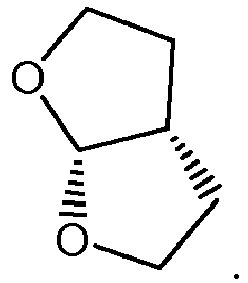
- By way of example and not limitation, carbon bonded heterocycles are bonded at position 2, 3, 4, 5, or 6 of a pyridine, position 3, 4, 5, or 6 of a pyridazine, position 2, 4, 5, or 6 of a pyrimidine, position 2, 3, 5, or 6 of a pyrazine, position 2, 3, 4, or 5 of a furan, tetrahydrofuran, thiofuran, thiophene, pyrrole or tetrahydropyrrole, position 2, 4, or 5 of an oxazole, imidazole or thiazole, position 3, 4, or 5 of an isoxazole, pyrazole, or isothiazole, position 2 or 3 of an aziridine, position 2, 3, or 4 of an azetidine, position 2, 3, 4, 5, 6, 7, or 8 of a quinoline or position 1, 3, 4, 5, 6, 7, or 8 of an isoquinoline. Still more typically, carbon bonded heterocycles include 2-pyridyl, 3-pyridyl, 4-pyridyl, 5-pyridyl, 6-pyridyl, 3-pyridazinyl, 4-pyridazinyl, 5-pyridazinyl, 6-pyridazinyl, 2-pyrimidinyl, 4-pyrimidinyl, 5-pyrimidinyl, 6-pyrimidinyl, 2-pyrazinyl, 3-pyrazinyl, 5-pyrazinyl, 6-pyrazinyl, 2-thiazolyl, 4-thiazolyl, or 5-thiazolyl.
- By way of example and not limitation, nitrogen bonded heterocycles are bonded at position 1 of an aziridine, azetidine, pyrrole, pyrrolidine, 2-pyrroline, 3-pyrroline, imidazole, imidazolidine, 2-imidazoline, 3-imidazoline, pyrazole, pyrazoline, 2-pyrazoline, 3-pyrazoline, piperidine, piperazine, indole, indoline, 1H-indazole, position 2 of a isoindole, or isoindoline, position 4 of a morpholine, and position 9 of a carbazole, or β-carboline. Still more typically, nitrogen bonded heterocycles include 1-aziridyl, 1-azetedyl, 1-pyrrolyl, 1-imidazolyl, 1-pyrazolyl, and 1-piperidinyl.
- "Heterocyclylalkyl" refers to an acyclic alkyl radical in which one of the hydrogen atoms bonded to a carbon atom, typically a terminal or sp3 carbon atom, is replaced with a heterocyclyl radical (i.e., a heterocyclyl-alkylene- moiety). Typical heterocyclyl alkyl groups include, but are not limited to heterocyclyl-CH2-, 2-(heterocyclyl)ethan-1-yl, and the like, wherein the "heterocyclyl" portion includes any of the heterocyclyl groups described above, including those described in Principles of Modern Heterocyclic Chemistry. One skilled in the art will also understand that the heterocyclyl group can be attached to the alkyl portion of the heterocyclyl alkyl by means of a carbon-carbon bond or a carbon-heteroatom bond, with the proviso that the resulting group is chemically stable. The heterocyclyl alkyl group comprises 3 to 20 carbon atoms, e.g., the alkyl portion of the arylalkyl group is 1 to 6 carbon atoms and the heterocyclyl moiety is 2 to 14 carbon atoms. Examples of heterocyclylalkyls include by way of example and not limitation 5-membered sulfur, oxygen, and/or nitrogen containing heterocycles such as thiazolylmethyl, 2-thiazolylethan-1-yl, imidazolylmethyl, oxazolylmethyl, thiadiazolylmethyl, etc., 6-membered sulfur, oxygen, and/or nitrogen containing heterocycles such as piperidinylmethyl, piperazinylmethyl, morpholinylmethyl, pyridinylmethyl, pyridizylmethyl, pyrimidylmethyl, pyrazinylmethyl, etc.
- "Heterocyclylalkenyl" refers to an acyclic alkenyl radical in which one of the hydrogen atoms bonded to a carbon atom, typically a terminal or sp3 carbon atom, but also a sp2 carbon atom, is replaced with a heterocyclyl radical (i.e., a heterocyclyl-alkenylene- moiety). The heterocyclyl portion of the heterocyclyl alkenyl group includes any of the heterocyclyl groups described herein, including those described in Principles of Modern Heterocyclic Chemistry, and the alkenyl portion of the heterocyclyl alkenyl group includes any of the alkenyl groups disclosed herein. One skilled in the art will also understand that the heterocyclyl group can be attached to the alkenyl portion of the heterocyclyl alkenyl by means of a carbon-carbon bond or a carbon-heteroatom bond, with the proviso that the resulting group is chemically stable. The heterocyclyl alkenyl group comprises 4 to 20 carbon atoms, e.g., the alkenyl portion of the heterocyclyl alkenyl group is 2 to 6 carbon atoms and the heterocyclyl moiety is 2 to 14 carbon atoms.
- "Heterocyclylalkynyl" refers to an acyclic alkynyl radical in which one of the hydrogen atoms bonded to a carbon atom, typically a terminal or sp3 carbon atom, but also an sp carbon atom, is replaced with a heterocyclyl radical (i.e., a heterocyclylalkynylene- moiety). The heterocyclyl portion of the heterocyclyl alkynyl group includes any of the heterocyclyl groups described herein, including those described in Principles of Modern Heterocyclic Chemistry, and the alkynyl portion of the heterocyclyl alkynyl group includes any of the alkynyl groups disclosed herein. One skilled in the art will also understand that the heterocyclyl group can be attached to the alkynyl portion of the heterocyclyl alkynyl by means of a carbon-carbon bond or a carbon-heteroatom bond, with the proviso that the resulting group is chemically stable. The heterocyclyl alkynyl group comprises 4 to 20 carbon atoms, e.g., the alkynyl portion of the heterocyclyl alkynyl group is 2 to 6 carbon atoms and the heterocyclyl moiety is 2 to 14 carbon atoms.
- "Heteroaryl" refers to an aromatic heterocyclyl having at least one heteroatom in the ring. Non-limiting examples of suitable heteroatoms which can be included in the aromatic ring include oxygen, sulfur, and nitrogen. Non-limiting examples of heteroaryl rings include all of those aromatic rings listed in the definition of "heterocyclyl", including pyridinyl, pyrrolyl, oxazolyl, indolyl, isoindolyl, purinyl, furanyl, thienyl, benzofuranyl, benzothiophenyl, carbazolyl, imidazolyl, thiazolyl, isoxazolyl, pyrazolyl, isothiazolyl, quinolyl, isoquinolyl, pyridazyl, pyrimidyl, pyrazyl, etc.
- The term "purine" or "pyrimidine" base comprises, but is not limited to, adenine, N6-alkylpurines, N6-acylpurines (wherein acyl is C(O)(alkyl, aryl, alkylaryl, or arylalkyl), N6-benzylpurine, N6-halopurine, N6-vinylpurine, N6-acetylenic purine, N6-acyl purine, N6-hydroxyalkyl purine, N6-allylaminopurine, N6-thioallyl purine, N2-alkylpurines, N2-alkyl-6-thiopurines, thymine, cytosine, 5-fluorocytosine, 5-methylcytosine, 6-azapyrimidine, including 6-azacytosine, 2- and/or 4-mercaptopyrmidine, uracil, 5-halouracil, including 5-fluorouracil, C5-alkylpyrimidines, C5-benzylpyrimidines, C5-halopyrimidines, C5-vinylpyrimidine, C5-acetylenic pyrimidine, C5-acyl pyrimidine, C5-hydroxyalkyl purine, C5-amidopyrimidine, C5-cyanopyrimidine, C5-5-iodopyrimidine, C6-iodo-pyrimidine, C5-Br-vinyl pyrimidine, C6-Br-vinyl pyrimidine, C5-nitropyrimidine, C5-amino-pyrimidine, N2-alkylpurines, N2-alkyl-6-thiopurines, 5-azacytidinyl, 5-azauracilyl, triazolopyridinyl, imidazolopyridinyl, pyrrolopyrimidinyl, and pyrazolopyrimidinyl. Purine bases include, but are not limited to, guanine, adenine, hypoxanthine, 2,6-diaminopurine, and 6-chloropurine. Additional non-classical purine bases include pyrrolo[1,2-f][1,2,4]triazines, imidazo[1,5-f][1,2,4]triazines, imidazo[1,2-f][1,2,4]triazines, and [1,2,4]triazolo[4,3-f][1,2,4]triazines, all of which are optionally substituted. The purine and pyrimidine bases of Formula II are linked to the ribose sugar, or analog thereof, through a nitrogen atom or carbon atom of the base. Functional oxygen and nitrogen groups on the base can be protected as necessary or desired. Suitable protecting groups are well known to those skilled in the art, and include, but are not limited to, trimethylsilyl, dimethylhexylsilyl, t-butyldimethylsilyl, and t-butyldiphenylsilyl, trityl, alkyl groups, and acyl groups such as acetyl and propionyl, methanesulfonyl, and p-toluenesulfonyl.
- "Carbocycle" or "carbocyclyl" refers to a saturated (i.e., cycloalkyl), partially unsaturated (e.g., cycloakenyl, cycloalkadienyl, etc.) or aromatic ring having 3 to 7 carbon atoms as a monocycle, 7 to 12 carbon atoms as a bicycle, and up to about 20 carbon atoms as a polycycle. Monocyclic carbocycles have 3 to 7 ring atoms, still more typically 5 or 6 ring atoms. Bicyclic carbocycles have 7 to 12 ring atoms, e.g., arranged as a bicyclo [4,5], [5,5], [5,6] or [6,6] system, or 9 or 10 ring atoms arranged as a bicyclo [5,6] or [6,6] system, or spiro-fused rings. Non-limiting examples of monocyclic carbocycles include cyclopropyl, cyclobutyl, cyclopentyl, 1-cyclopent-1-enyl, 1-cyclopent-2-enyl, 1-cyclopent-3-enyl, cyclohexyl, 1-cyclohex-1-enyl, 1-cyclohex-2-enyl, 1-cyclohex-3-enyl, and phenyl. Non-limiting examples of bicyclo carbocycles includes naphthyl, tetrahydronapthalene, and decaline.
- "Carbocyclylalkyl" refers to to an acyclic alkyl radical in which one of the hydrogen atoms bonded to a carbon atom is replaced with a carbocyclyl radical as described herein. Typical, but non-limiting, examples of carbocyclylalkyl groups include cyclopropylmethyl, cyclopropylethyl, cyclobutylmethyl, cyclopentylmethyl and cyclohexylmethyl.
- "Arylheteroalkyl" refers to a heteroalkyl as defined herein, in which a hydrogen atom (which may be attached either to a carbon atom or a heteroatom) has been replaced with an aryl group as defined herein. The aryl groups may be bonded to a carbon atom of the heteroalkyl group, or to a heteroatom of the heteroalkyl group, provided that the resulting arylheteroalkyl group provides a chemically stable moiety. For example, an arylheteroalkyl group can have the general formulae -alkylene-O-aryl, -alkylene-O-alkylene-aryl, -alkylene-NH-aryl, -alkylene-NH-alkylene-aryl, -alkylene-S-aryl, -alkylene-S-alkylene-aryl, etc. In addition, any of the alkylene moieties in the general formulae above can be further substituted with any of the substituents defined or exemplified herein.
- "Heteroarylalkyl" refers to an alkyl group, as defined herein, in which a hydrogen atom has been replaced with a heteroaryl group as defined herein. Non-limiting examples of heteroaryl alkyl include -CH2-pyridinyl, -CH2-pyrrolyl, -CH2-oxazolyl, -CH2-indolyl, -CH2-isoindolyl, -CH2-purinyl, -CH2-furanyl, -CH2-thienyl, -CH2-benzofuranyl, -CH2-benzothiophenyl, -CH2-carbazolyl, -CH2-imidazolyl, -CH2-thiazolyl, -CH2-isoxazolyl, -CH2-pyrazolyl, -CH2-isothiazolyl, -CH2-quinolyl, -CH2-isoquinolyl, -CH2-pyridazyl, -CH2-pyrimidyl, -CH2-pyrazyl, -CH(CH3)-pyridinyl, -CH(CH3)-pyrrolyl, -CH(CH3)-oxazolyl, -CH(CH3)-indolyl, -CH(CH3)-isoindolyl, -CH(CH3)-purinyl, -CH(CH3)-furanyl, -CH(CH3)-thienyl, -CH(CH3)-benzofuranyl, -CH(CH3)-benzothiophenyl, -CH(CH3)-carbazolyl, -CH(CH3)-imidazolyl, -CH(CH3)-thiazolyl, -CH(CH3)-isoxazolyl, -CH(CH3)-pyrazolyl, -CH(CH3)-isothiazolyl, -CH(CH3)-quinolyl, -CH(CH3)-isoquinolyl, -CH(CH3)-pyridazyl, -CH(CH3)-pyrimidyl, -CH(CH3)-pyrazyl, etc.
- The term "optionally substituted" in reference to a particular moiety of the compound of Formula I-XIV (e.g., an optionally substituted aryl group) refers to a moiety wherein all substiutents are hydrogen or wherein one or more of the hydrogens of the moiety may be replaced by substituents such as those listed under the definition of "substituted".
- The term "optionally replaced" in reference to a particular moiety of the compound of Formula I-XIV (e.g., the carbon atoms of said (C1-C8)alkyl may be optionally replaced by -O-, -S-, or -NRa-) means that one or more of the methylene groups of the (C1-C8)alkyl may be replaced by 0, 1, 2, or more of the groups specified (e.g., -O-, -S-, or -NRa-).
- The term "non-terminal carbon atom(s)" in reference to an alkyl, alkenyl, alkynyl, alkylene, alkenylene, or alkynylene moiety refers to the carbon atoms in the moiety that intervene between the first carbon atom of the moiety and the last carbon atom in the moiety. Therefore, by way of example and not limitation, in the alkyl moiety -CH2(C*)H2(C*)H2CH3 or alkylene moiety -CH2(C*)H2(C*)H2CH2- the C* atoms would be considered to be the non-terminal carbon atoms.
- "Linker" or "link" means a chemical moiety comprising a covalent bond or a chain of atoms. Linkers include repeating units of alkyloxy (e.g. polyethyleneoxy, PEG, polymethyleneoxy) and alkylamino (e.g. polyethyleneamino, Jeffamine™); and diacid ester and amides including succinate, succinamide, diglycolate, malonate, and caproamide.
- The terms such as "oxygen-linked", "nitrogen-linked", "carbon-linked", "sulfur-linked", or "phosphorous-linked" mean that if a bond between two moieties can be formed by using more than one type of atom in a moiety, then the bond formed between the moieties is through the atom specified. For example, a nitrogen-linked amino acid would be bonded through a nitrogen atom of the amino acid rather than through an oxygen or carbon atom of the amino acid.
- Some embodiments of the compounds of Formula I-XIV comprise the moiety

- Unless otherwise specified, the carbon atoms of the compounds of Formula I-XIV are intended to have a valence of four. In some chemical structure representations where carbon atoms do not have a sufficient number of variables attached to produce a valence of four, the remaining carbon substitutents needed to provide a valence of four should be assumed to be hydrogen. For example,


- "Protecting group" refers to a moiety of a compound that masks or alters the properties of a functional group or the properties of the compound as a whole. The chemical substructure of a protecting group varies widely. One function of a protecting group is to serve as an intermediate in the synthesis of the parental drug substance. Chemical protecting groups and strategies for protection/deprotection are well known in the art. See: "Protective Groups in Organic Chemistry", Theodora W. Greene (John Wiley & Sons, Inc., New York, 1991. Protecting groups are often utilized to mask the reactivity of certain functional groups, to assist in the efficiency of desired chemical reactions, e.g. making and breaking chemical bonds in an ordered and planned fashion. Protection of functional groups of a compound alters other physical properties besides the reactivity of the protected functional group, such as the polarity, lipophilicity (hydrophobicity), and other properties which can be measured by common analytical tools. Chemically protected intermediates may themselves be biologically active or inactive.
- Protected compounds may also exhibit altered, and in some cases, optimized properties in vitro and in vivo, such as passage through cellular membranes and resistance to enzymatic degradation or sequestration. In this role, protected compounds with intended therapeutic effects may be referred to as prodrugs. Another function of a protecting group is to convert the parental drug into a prodrug, whereby the parental drug is released upon conversion of the prodrug in vivo. Because active prodrugs may be absorbed more effectively than the parental drug, prodrugs may possess greater potency in vivo than the parental drug. Protecting groups are removed either in vitro, in the instance of chemical intermediates, or in vivo, in the case of prodrugs. With chemical intermediates, it is not particularly important that the resulting products after deprotection, e.g. alcohols, be physiologically acceptable, although in general it is more desirable if the products are pharmacologically innocuous.
- "Prodrug moiety" means a labile functional group which separates from the active inhibitory compound during metabolism, systemically, inside a cell, by hydrolysis, enzymatic cleavage, or by some other process (Bundgaard, Hans, "Design and Application of Prodrugs" in Textbook of Drug Design and Development (1991), P. Krogsgaard-Larsen and H. Bundgaard, Eds. Harwood Academic Publishers, pp. 113-191). Enzymes which are capable of an enzymatic activation mechanism with the phosphonate prodrug compounds of the invention include, but are not limited to, amidases, esterases, microbial enzymes, phospholipases, cholinesterases, and phosphases. Prodrug moieties can serve to enhance solubility, absorption and lipophilicity to optimize drug delivery, bioavailability and efficacy.
A prodrug moiety may include an active metabolite or drug itself. - The phosphate group may be a phosphate prodrug moiety. The prodrug moiety may be sensitive to hydrolysis. Alternatively, the prodrug moiety may be sensitive to enzymatic cleavage, such as a lactate ester or a phosphonamidate-ester group.
- It is to be noted that all enantiomers, diastereomers, and racemic mixtures, tautomers, polymorphs, pseudopolymorphs of compounds within the scope of Formula I-IV and pharmaceutically acceptable salts thereof are embraced by the present invention. All mixtures of such enantiomers and diastereomers are within the scope of the present invention.
- A compound of Formula I-XIV and its pharmaceutically acceptable salts may exist as different polymorphs or pseudopolymorphs. As used herein, crystalline polymorphism means the ability of a crystalline compound to exist in different crystal structures. The crystalline polymorphism may result from differences in crystal packing (packing polymorphism) or differences in packing between different conformers of the same molecule (conformational polymorphism). As used herein, crystalline pseudopolymorphism means the ability of a hydrate or solvate of a compound to exist in different crystal structures. The pseudopolymorphs of the instant invention may exist due to differences in crystal packing (packing pseudopolymorphism) or due to differences in packing between different conformers of the same molecule (conformational pseudopolymorphism). The instant invention comprises all polymorphs and pseudopolymorphs of the compounds of Formula I-IV and their pharmaceutically acceptable salts.
- A compound of Formula I-XIV and its pharmaceutically acceptable salts may also exist as an amorphous solid. As used herein, an amorphous solid is a solid in which there is no long-range order of the positions of the atoms in the solid. This definition applies as well when the crystal size is two nanometers or less. Additives, including solvents, may be used to create the amorphous forms of the instant invention. The instant invention comprises all amorphous forms of the compounds of Formula I-IV and their pharmaceutically acceptable salts.
- Selected substituents comprising the compounds of Formula I-XIV are present to a recursive degree. In this context, "recursive substituent" means that a substituent may recite another instance of itself. Because of the recursive nature of such substituents, theoretically, a large number of compounds may be present in any given embodiment. One of ordinary skill in the art of medicinal chemistry understands that the total number of such substituents is reasonably limited by the desired properties of the compound intended. Such properties include, by way of example and not limitation, physical properties such as molecular weight, solubility or log P, application properties such as activity against the intended target, and practical properties such as ease of synthesis. Recursive substituents are an intended aspect of the invention. One of ordinary skill in the art of medicinal chemistry understands the versatility of such substituents. To the degree that recursive substituents are present in an embodiment of the invention, they may recite another instance of themselves, 0, 1, 2, 3, or 4 times.
- The modifier "about" used in connection with a quantity is inclusive of the stated value and has the meaning dictated by the context (e.g., includes the degree of error associated with measurement of the particular quantity).
- Any reference to the compounds of the invention described heerein also includes a reference to a physiologically acceptable salt thereof. Examples of physiologically acceptable salts of the compounds of the invention include salts derived from an appropriate base, such as an alkali metal or an alkaline earth (for example, Na+, Li+, K+, Ca+2 and Mg+2), ammonium and NRa 4 + (wherein Ra is defined herein). Physiologically acceptable salts of a nitrogen atom or an amino group include (a) acid addition salts formed with inorganic acids, for example, hydrochloric acid, hydrobromic acid, sulfuric acid, sulfamic acids, phosphoric acid, nitric acid and the like; (b) salts formed with organic acids such as, for example, acetic acid, oxalic acid, tartaric acid, succinic acid, maleic acid, fumaric acid, gluconic acid, citric acid, malic acid, ascorbic acid, benzoic acid, isethionic acid, lactobionic acid, tannic acid, palmitic acid, alginic acid, polyglutamic acid, naphthalenesulfonic acid, methanesulfonic acid, p-toluenesulfonic acid, benzenesulfonic acid, naphthalenedisulfonic acid, polygalacturonic acid, malonic acid, sulfosalicylic acid, glycolic acid, 2-hydroxy-3-naphthoate, pamoate, salicylic acid, stearic acid, phthalic acid, mandelic acid, lactic acid, ethanesulfonic acid, lysine, arginine, glutamic acid, glycine, serine, threonine, alanine, isoleucine, leucine and the like; and (c) salts formed from elemental anions for example, chlorine, bromine, and iodine. Physiologically acceptable salts of a compound of a hydroxy group include the anion of said compound in combination with a suitable cation such as Na+ and NRa 4 +.
- For therapeutic use, salts of active ingredients of the compounds of the invention will be physiologically acceptable, i.e. they will be salts derived from a physiologically acceptable acid or base. However, salts of acids or bases which are not physiologically acceptable may also find use, for example, in the preparation or purification of a physiologically acceptable compound. All salts, whether or not derived form a physiologically acceptable acid or base, are within the scope of the present invention.
- Finally, it is to be understood that the compositions herein comprise compounds of the invention in their un-ionized, as well as zwitterionic form, and combinations with stoichiometric amounts of water as in hydrates.
- The compounds of the invention, exemplified by Formula I-XIV have chiral centers, e.g. chiral carbon or phosphorus atoms. For example, the phosphorous atoms of Formula I-XIV may be chiral because they have four different substituents. The compounds of the invention thus include racemic mixtures of all stereoisomers, including enantiomers, diastereomers, and atropisomers. In addition, the compounds of the invention include enriched or resolved optical isomers at any or all asymmetric, chiral atoms. In other words, the chiral centers apparent from the depictions are provided as the chiral isomers or racemic mixtures. Both racemic and diastereomeric mixtures, as well as the individual optical isomers isolated or synthesized, substantially free of their enantiomeric or diastereomeric partners, are all within the scope of the invention. The racemic mixtures are separated into their individual, substantially optically pure isomers through well-known techniques such as, for example, the separation of diastereomeric salts formed with optically active adjuncts, e.g., acids or bases followed by conversion back to the optically active substances. In most instances, the desired optical isomer is synthesized by means of stereospecific reactions, beginning with the appropriate stereoisomer of the desired starting material.
- The term "chiral" refers to molecules which have the property of non-superimposability of the mirror image partner, while the term "achiral" refers to molecules which are superimposable on their mirror image partner.
- The term "stereoisomers" refers to compounds which have identical chemical constitution, but differ with regard to the arrangement of the atoms or groups in space.
- "Diastereomer" refers to a stereoisomer with two or more centers of chirality and whose molecules are not mirror images of one another. Diastereomers have different physical properties, e.g. melting points, boiling points, spectral properties, reactivities and biological properties. For example, the compounds of Formula I-XIV may have a chiral phosphorus atom when phosphorus has four different substitutents, e.g., Formula XIV, where the chirality is R or S. When Rc and Rd of the amino acid of the phosphoramidate of Formula IV are different, there are two centers of chirality in the molecule leading to potential diastereomeric mixtures of compounds, e.g. R,S; S,R; S,S and R,R isomers. Mixtures of diastereomers may be separate under high resolution analytical procedures such as electrophoresis, crystallization and/or chromatography. Diastereomeres may have different physical attributes such as, but not limited to, solubility, chemical stabilities and crystallinity and may also have different biological properties suc as, but not limited to, enzymatic stability, absorption and metabolic stability.
- "Enantiomers" refer to two stereoisomers of a compound which are non-superimposable mirror images of one another.
- Stereochemical definitions and conventions used herein generally follow S. P. Parker, Ed., McGraw-Hill Dictionary of Chemical Terms (1984) McGraw-Hill Book Company, New York; and Eliel, E. and Wilen, S., Stereochemistry of Organic Compounds (1994) John Wiley & Sons, Inc., New York. Many organic compounds exist in optically active forms, i.e., they have the ability to rotate the plane of plane-polarized light. In describing an optically active compound, the prefixes D and L or R and S are used to denote the absolute configuration of the molecule about its chiral center(s). The prefixes d and 1, D and L, or (+) and (-) are employed to designate the sign of rotation of plane-polarized light by the compound, with S, (-), or 1 meaning that the compound is levorotatory while a compound prefixed with R, (+), or d is dextrorotatory. For a given chemical structure, these stereoisomers are identical except that they are mirror images of one another. A specific stereoisomer may also be referred to as an enantiomer, and a mixture of such isomers is often called an enantiomeric mixture. A 50:50 mixture of enantiomers is referred to as a racemic mixture or a racemate, which may occur where there has been no stereoselection or stereospecificity in a chemical reaction or process. The terms "racemic mixture" and "racemate" refer to an equimolar mixture of two enantiomeric species, devoid of optical activity.
- Whenever a compound described herein is substituted with more than one of the same designated group, e.g., "Ra" or "R1", then it will be understood that the groups may be the same or different, i.e., each group is independently selected. Wavy lines,indicate the site of covalent bond attachments to the adjoining substructures, groups, moieties, or atoms.

- The compounds of the invention can also exist as tautomeric isomers in certain cases. Although only one delocalized resonance structure may be depicted, all such forms are contemplated within the scope of the invention. For example, ene-amine tautomers can exist for purine, pyrimidine, imidazole, guanidine, amidine, and tetrazole systems and all their possible tautomeric forms are within the scope of the invention.
- One skilled in the art will recognize that nucleoside bases such as the pyrrolo[1,2-f][1,2,4]triazine nucleosides can exist in tautomeric forms. For example, but not by way of limitation, structures (a) and (b) can have equivalent tautomeric forms as shown below:


- The compounds of Formula I-XIV also include molecules that incorporate isotopes of the atoms specified in the particular molecules. Non-limiting examples of these isotopes include D, T, 14C, 13C and 15N. All such isotopic variations of these molelcules are provided by the instant invention.
- Certain abbreviations and acronyms are used in describing the experimental details. Although most of these would be understood by one skilled in the art, Table 1 contains a list of many of these abbreviations and acronyms.
Table 1. List of abbreviations and acronyms. Abbreviation Meaning Ac2O acetic anhydride AIBN 2,2'-azobis(2-methylpropionitrile) Bn benzyl BnBr benzylbromide BSA bis(trimethylsilyl)acetamide BzCl benzoyl chloride CDI carbonyl diimidazole DABCO 1,4-diazabicyclo[2.2.2]octane DBN 1,5-diazabicyclo[4.3.0]nonene-5 DDQ 2,3-dichloro-5,6-dicyano-1,4-benzoquinone DBU 1,5-diazabicyclo[5.4.0]undecene-5 DCA dichloroacetamide DCC dicyclohexylcarbodiimide DCM dichloromethane DMAP 4-dimethylaminopyridine DME 1,2-dimethoxyethane DMTC1 dimethoxytrityl chloride DMSO dimethylsulfoxide DMTr 4, 4'-dimethoxytrityl DMF dimethylformamide EtOAc ethyl acetate ESI electrospray ionization HMDS hexamethyldisilazane HPLC High pressure liquid chromatography LDA lithium diisopropylamide LRMS low resolution mass spectrum MCPBA meta-chloroperbenzoic acid MeCN acetonitrile MeOH methanol MMTC mono methoxytrityl chloride m/z or m/e mass to charge ratio MH+ mass plus 1 MH- mass minus 1 MsOH methanesulfonic acid MS or ms mass spectrum NBS N-bromosuccinimide rt or r.t. room temperature TBAF tetrabutylammonium fluoride TMSC1 chlorotrimethylsilane TMSBr bromotrimethylsilane TMSI iodotrimethylsilane TEA triethylamine TBA tributylamine TBAP tributylammonium pyrophosphate TBSC1 t-butyldimethylsilyl chloride TEAB triethylammonium bicarbonate TFA trifluoroacetic acid TLC or tlc thin layer chromatography Tr triphenylmethyl Tol 4-methylbenzoyl δ parts per million down field from tetramethylsilane -

- To a solution of 1a (22.0 g, 54.9 mmol, prepared according to the procedures described in J.O.C., 2004, 6257) in methanol (300 mL) was dropwise added acetyl chloride (22 mL) at 0 °C using a dropping funnel over a period of 30 min. and then stirred at room temperature for 16 h. The mixture was concentrated, re-dissolved in ethyl acetate (400 mL), washed with ice-cold 2 N NaOH, and concentrated to dryness, affording the crude methyl ether 1b as an oil. MS = 437.2 (M + Na+).

- To a solution of 1b (obtained from the previous step) in methanol (300 mL) was added 0.5 M sodium methoxide solution in methanol (20 mL, 10 mmol), and stirred for 16 h at room temperature. The reaction was quenched with 4.0 N HCl solution in dioxane (2.5 mL, 10 mmol). The mixture was then concentrated, affording the crude 1c. MS = 201.0 (M + Na+).

- A mixture of 1c (obtained from the previous step), Tritron X-405 (70% in water, 6.0 g), 50% KOH (in water, 85 g) in toluene (500 mL) was heated to reflux with a Dean-Stark trap attached. After 1h collecting ~25 mL of water, benzyl chloride (33 g, 260 mmol) was added and continued to reflux with stirring for 16 h. The mixture was then cooled and partitioned between ethyl acetate (400 mL) and water (300mL). The organic layer was washed with water (300 mL), and concentrated. The residue was purified by silica gel column chromatography (∼20% EtOAc / hexanes), affording the methyl ether 1d as an oil (22.0 g, 89% in three steps). 1H NMR (300 MHz, CDCl3): δ 7.3 (m, 15H), 4.5 - 4.9 (m, 7H), 4.37 (m, 1H), 3.87 (d, 1H), 3.56 (m, 2H), 3.52 (s, 3H), 1.40 (s, 3H).

- To a solution of 1d (22.0 g, 49.0 mmol) in acetic acid (110 mL) was added ~ 3 M sulfuric acid (prepared by mixing 4.8 g of concentrated sulfuric acid with 24 mL of water) and stirred at 70 °C for 8 h. The mixture was concentrated to a volume of ∼20 mL, and partitioned between ethyl acetate and ice-cold 2N NaOH. The ethyl acetate layer was concentrated, and purified by silica gel column chromatography (∼35% EtOAc / hexanes), affording 1e as an oil (17.0 g, 80%). MS = 457.2 (M + Na+).

- To a solution of 1e (45 g, 104 mmol) in DMSO (135 mL) was dropwise added acetic anhydride (90 mL, 815 mmol) at room temperature under argon. The mixture was stirred for 16 h at room temperature, and then poured into ice-water (1 L) while stirring. After ice was completely melted (-30 min), ethyl acetate (-500 mL) was added. The organic layer was separated. This extraction process was repeated three times (3x500 mL). The organic extracts were combined and concentrated. The residue was purified by silica gel column chromatography (∼20% EtOAc / hexanes), affording If as an oil (39 g, 88%). 1H NMR (300 MHz, DMSO-d6): δ 7.3 (m, 15H), 4.4 - 4.8 (m, 7H), 4.08 (d, J= 7.5 Hz, 1H), 3.75 (dd, J= 2,4, 11.4 Hz, 1H), 3.64 (dd, J = 5.4, 11.4 Hz, 1H), 1.51 (s, 3H).
-

- To a dry, argon purged round bottom flask (100 mL) were added 7-bromo-pyrrolo[2,1-f][1,2,4]triazin-4-ylamine (234 mg, 1.10 mmol) (prepared according to
WO2007056170 ) and anhydrous THF (1.5 mL). TMSC1 (276 µL, 2.2 mmol) was then added and the reaction mixture stirred for 2 h. The flask was placed into a dry ice/acetone bath (~ -78 °C) and BuLi (2.5 mL, 4.0 mmol, 1.6M in hexanes) was added dropwise. After 1h, a solution of If (432.5 mg, 1.0 mmol) in THF was cooled to 0 °C and then added to the reaction flask dropwise. After 1 h of stirring at -78 °C, the flask was warmed to 0 °C and sat. NH4Cl (5 mL) was added to quench the reaction. The organics were extracted using EtOAc (3 x 10 mL) and the combined organic layers were dried using MgSO4. The solvent was removed under reduced pressure and the crude material was purified using flash chromatography (hexanes / EtOAc). 560 mg (90 %) of 2a was isolated as a mixture of two anomers. LC/MS = 567.2 (M + H+). 1H NMR (300 MHz, CDCl3): δ 7.85 (m, 1H), 7.27 (m, 15H), 7.01 (m, 1H), 6.51 (m, 1H), 4.66 (m, 8H), 4.40 (m, 2H), 3.79 (m, 3H), 1.62 (s, 2'-CH3 from the one anomer), 1.18 (s, 2'-CH3 from the other anomer). - To a dry, argon purged round bottom flask were added 7-bromo-pyrrolo[2,1-f][1,2,4]triazin-4-ylamine (9.6 g, 45 mmol) and anhydrous THF (60 mL). TMSC1 (12.4 mL, 99 mmol) was then added and the reaction mixture stirred for 2 h. The flask was placed into a dry ice/acetone bath (~ -78 °C) and BuLi (98 mL, 158 mmol, 1.6M in hexanes) was added dropwise. After 1 h, this reaction mixture was added to a solution of 1f (13.0 g, 30 mmol) in THF at -78 °C via cannula. After 2 h of stirring at -78 °C, the flask was warmed to 0 °C. Saturated NH4Cl (150 mL) was added to quench the reaction. The organics were extracted using EtOAc (3 x 100 mL) and the combined organic layers were dried using MgSO4. The solvent was removed under reduced pressure and the crude material was purified using flash silica gel chromatography (hexanes / EtOAc). 7.5 g (44 %) of the desired material 2a was isolated. LC/MS = 567.2 (M + H+).
-

- To a solution of compound 2a (1 g, 1.77 mmol) in CH2Cl2 (20 mL) at 0 °C was added TMSCN (1.4 mL, 10.5 mmol) and BF3-Et2O (1 mL, 8.1 mmol). The reaction mixture was stirred at 0 °C for 0.5 h, then at room temperature for additional 0.5 h. The reaction was quenched with NaHCO3 at 0 °C, and diluted with CH3CO2Et. The organic phase was separated, washed with brine, dried over Na2SO4, filtered and concentrated. The residue was purified by chromatography on silica gel, eluted with CH3CO2Et-hexanes (1:1 to 2:1), to give the desired compound 5a (620 mg, 61%) as an isomeric mixture. MS = 576.1 (M + H+).

- To a solution of compound 5a (150 mg, 0.26 mmol) in CH2Cl2 (4 mL) at -78 °C was added BCl3 (2 mL, 1M in CH2Cl2). The reaction mixture was stirred at -78 °C for 1 h. The reaction was quenched at -78 °C by dropwise addition of TEA (2 mL) and MeOH (5 mL). The mixture was allowed to warm up to room temperature, evaporated, and co-evaporated with MeOH several times. The residue was treated with NaHCO3 (1 g in 10 mL H2O), concentrated and purified by HPLC to give the desired product Compound 5 (48 mg, 60%). 1H NMR (300 MHz, D2O): δ 7.74 (s 1H), 6.76 (d, J = 5 Hz, 1H), 6.73 (d, J = 5 Hz, 1H), 4.1 (m, 1H), 3.9 (m, 1H), 3.8 (m, 2H), 0.84 (s, 3H). MS = 305.9 (M + H+). The other alpha-anomer was also obtained (9 mg, 11%): 1H NMR (300 MHz, D2O): δ 7.70 (s 1H), 6.8 (d, J = 5 Hz, 1H), 6.7 (d, J = 5 Hz, 1H), 4.25 (d, J = 9 Hz, 1H), 4.07 (m, 1H), 3.85 (m, 1H), 3.7 (m, 1H), 1.6 (s, 3H). MS = 306.1 (M + H+).

- Compound A (commercially available, 4.99 g, 23.8 mmol) was dissolved in dichloromethane (100 mL) and alanine isopropyl ester hydrochloride (3.98 g, 23.8 mmol) was added. The resulting clear solution was cooled -78 °C for 30 min. Triethylamine (6.63 mL, 47.5 mmol) was added dropwise over 15 min. The mixture was then allowed to warm to room temperature. After 16 h, the solvent was removed by argon stream. The residue was re-dissolved in MTBE (25 mL) and the insoluble was removed by filtration under argon. The filtrate was then condensed by argon stream and the crude product B was used for the next reaction without further purification. 1H NMR (300 MHz, CDCl3): 7.1-7.4 (m, 5H), 5.1 (m, 1H), 4.35 (m, 1H), 4.15 (m, 1H), 1.5 (d, 3H), 1.2 (m, 6H). 31P NMR (121.4 MHz, CDCl3): δ 7.8 and 8.4 (2s).

- Alanine isopropyl ester hydrochloride (7.95 g, 47.4 mmol) was suspended in dichloromethane (100 mL). Compound A (10 g, 47.4 mmol) was added. Triethylamine (13.2 mL, 95 mmol) was then dropwise added over a period of 15 min. (internal reaction temperature; -10 °C ~ -3 °C). When the reaction was almost complete (by phosphorous NMR), p-nitrophenol (6.29 g, 45.0 mmol) was added as a solid in one portion. To the resulting slurry was added triethylamine (6.28 mL, 45 mmol) over a period of 15 min. The mixture was then warmed up to room temperature. When the reaction was complete, MTBE (100 mL) was added. The white precipitate was removed by filtration. The filter cake was washed with MTBE (3 x 50 mL). The filtrate and washings were combined and concentrated. The residue was purified by silica gel column chromatography (0 to 50% ethyl acetate / hexanes), affording compound C as a 1:1 ratio of diasteromeric mixture (14.1 g, 77%). 1H NMR (300 MHz, CDCl3): δ 8.22 (2d, 2H), 7.2-7.4 (m, 7H), 5.0 (m, 1H), 4.09 (m, 1H), 3.96 (m, 1H), 1.39 (2d, 3H), 1.22 (m, 6H). MS = 409.0 (M + H+), 407.2 (M - H+).
-

- Column: Chiralpak IC, 2 x 25 cm
- Solvent system: 70% heptane and 30% isopropanol (IPA)
- Flow rate: 6 mL/min.
- Loading volume per run: 1.0 mL
- Concentration of loading sample: 150 mg / mL in 70% hepane and 30% IPA (S)-compound C: retention time 43 min. 31P NMR (161.9 MHz, CDCl3): δ -2.99 (s). (R)-compound C: retention time 62 min. 31P NMR (161.9 MHz, CDCl3): δ -3.02 (s).
-

- To a dry, argon purged round-bottom flask were added compound 5 (1.0 g, 3.28 mmol) and anhydrous THF (15 mL). The slurry was stirred for 10 min. and the flask was place in a water bath at room temperature. t-Butylmagnesium chloride in THF (1.0 M, 4.91 mL) was dropwise added, and the mixture was stirred for an additional 10 min. A solution of (S)-C (2.68 g, 6.55 mmol) in THF (10 mL) was then added. The flask was place in a heating oil bath pre-set at 50 oC and the mixture was stirred until compound 1 was almost consumed. After -2.5 h, the reaction mixture was cooled to room temperature, and methanol (5 mL) was added. Solvents were removed under reduced pressure and the residue was purified by silica gel column chromatography (70% ethyl acetare / hexanes to remove less polar impurities, 10% methanol / dichloromethane to elute the product), affording (S)-6 as an off-white solid (1.45 g, 77%). 1H NMR (400 MHz, DMSO-d6): δ 7.89 (s, 1H), 7.84 (brs, 2H), 7.36 (t, 2H), 7.23 (d, 2H), 7.17 (t, 1H), 6.87 (d, J= 4.4 Hz, 1H), 6.74 (d, J= 4.4 Hz, 1H), 6.02 (dd, 1H), 5.96 (s, 1H), 5.41 (d, 1H), 4.82 (m, 1H), 4.38 (dd, 1H), 4.22 (q, 1H), 4.16 (m, 1H), 3.81 (m, 1H), 3.67 (dd, 1H), 1.22 (d, 3H), 1.11 (dd, 6H), 0.89 (s, 3H). 31P NMR (161.9 MHz, DMSO-d6): δ 3.99 (s). MS = 575.0 (M + H+), 572.7 (M - H+).
-

- To a dry, argon purged round-bottom flask were added compound 7 (prepared according to J. Med. Chem., 2005, 48, 5504-5508, 100 mg, 0.38 mmol), anhydrous THF (3 mL) and anhydrous NMP (1 mL). The slurry was stirred for 10 min. and the flask was place in a water bath at room temperature. t-Butylmagnesium chloride in THF (1.0 M, 0.76 mL) was dropwise added, and the mixture was stirred for an additional 10 min. A solution of (S)-C (313 mg, 0.76 mmol) in THF (2 mL) was then added. The flask was place in a heating oil bath pre-set at 55 °C and the mixture was stirred until compound 7 was almost consumed. After ~2.5 h, the reaction mixture was cooled to room temperature, and methanol (1 mL) was added. Solvents were removed under reduced pressure and the residue was purified by RP-HPLC followed by silica gel column chromatography, affording (S)-8 (130 mg, 65%). 1H NMR (400 MHz, CDCl3): δ 8.51 (brs, 1H), 7.46 (d, 1H), 7.2-7.4 (m, 5H), 6.28 (d, 1H), 5.70 (dd, 1H), 5.01 (m, 1H), 4.49 (m, 2H), 3.8-4.1 (m, 4H), 1.41 (d, 3H), 1.35 (d, 3H), 1.24 (d, 6H). 31P NMR (162.1 MHz, CDCl3): δ 3.70 (s). MS = 530.0 (M + H+), 528.0 (M-H+). Chiral HPLC retention time (Chiralpak AS-H, 250 x 4.6 mm 5 micron, 100% CH3CN, 1 mL/min flow rate); 6.5 min vs. 5.2 min for the R-isomer).
- Using the general procedures described for the preparation of Compound (S)-C or Compound (R)-C, Compounds 10-24 may be prepared.


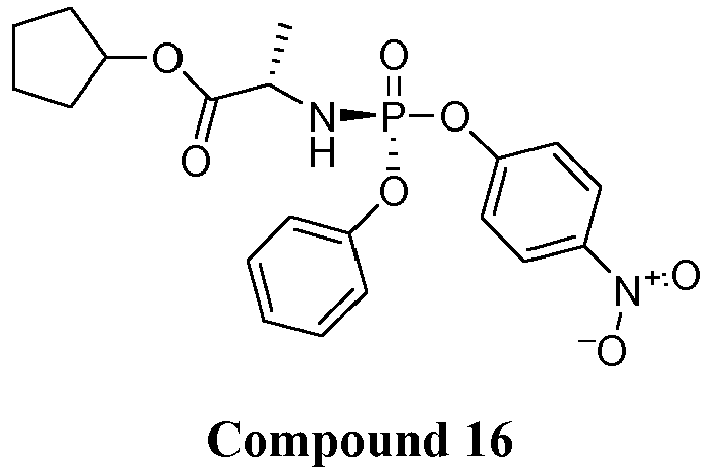


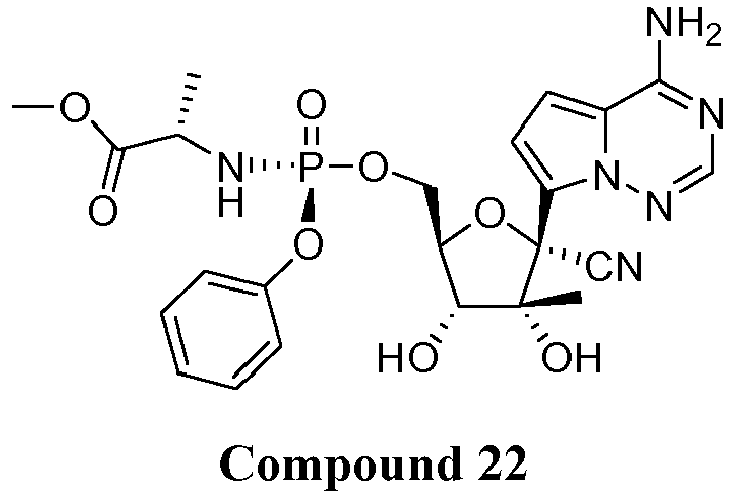

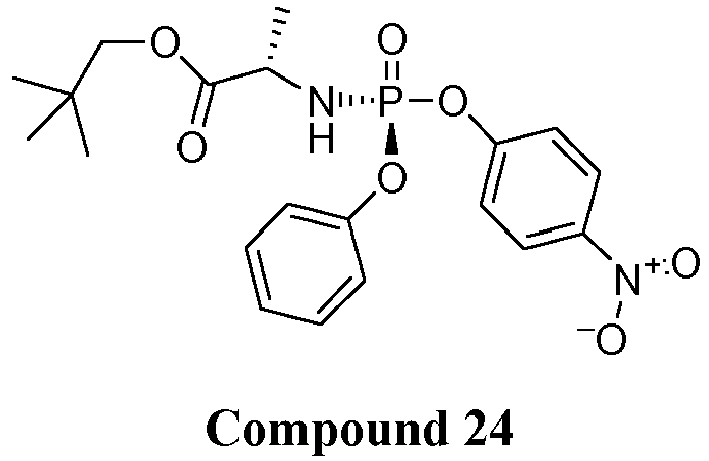
- Using the general procedures described for the preparation of Compound (S)-6, Compounds 25-38 may be prepared using either Compound (S)-C or Compound (R)-C.


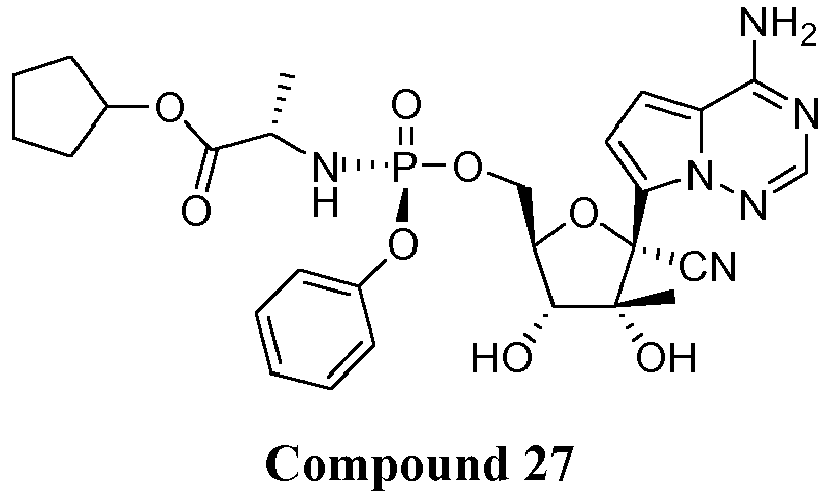
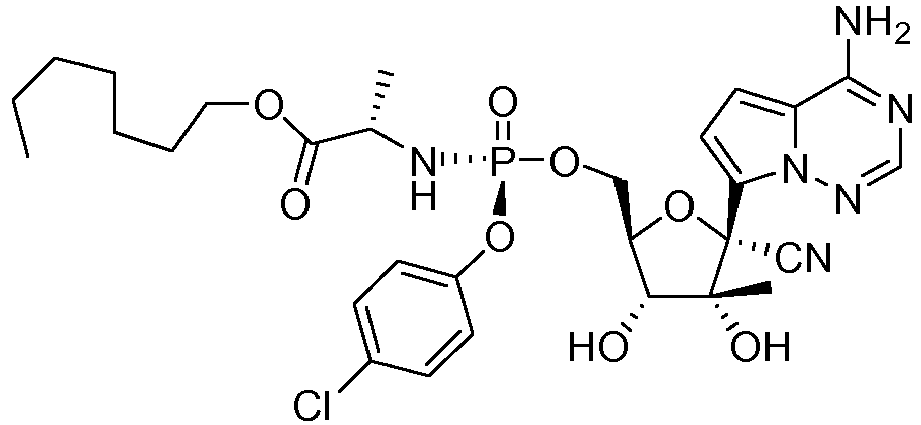


- The present invention will now be described with reference to the following clauses:
- 1. A method for preparing a compound of Formula Ia or Ib:


wherein:- each R1, R2, R7, R22, R23 or R24 is independently H, OR11, NR11R12, C(O)NR11R12, -OC(O)NR11R12, C(O)OR11, OC(O)OR11, S(O)nRa, S(O)2NR11R12, N3, CN, halogen, (C1-C8)alkyl, (C3-C8)carbocyclyl, (C4-C8)carbocyclylalkyl, (C2-C8)alkenyl, (C2-C8)alkynyl or aryl(C1-C8)alkyl;
- or any two R1, R2, R7, R22, R23 or R24 on adjacent carbon atoms when taken together are -O(CO)O- or -O(CR11R12)O- or when taken together with the ring carbon atoms to which they are attached form a double bond;
- each Base is independently a naturally occurring or modified purine or pyrimidine base linked to the furanose ring through a carbon or nitrogen atom;
- provided that Base is not uracil;
- each n is independently 0, 1, or 2;
- each Ra, R4 or R6 is independently (C1-C8)alkyl, (C2-C8)alkenyl, (C2-C8)alkynyl, (C3-C8)carbocyclyl, (C4-C8)carbocyclylalkyl, aryl(C1-C8)alkyl, heterocyclyl(C1-C8)alkyl, (C6-C20)aryl, (C2-C20)heterocyclyl or heteroaryl;
- each Rc or Rd is independently H, (C1-C8)alkyl, (C2-C8)alkenyl, (C2-C8)alkynyl, (C3-C8)carbocyclyl, (C4-C8)carbocyclylalkyl, aryl(C1-C8)alkyl, heterocyclyl(C1-C8)alkyl, (C6-C20)aryl, (C2-C20)heterocyclyl or heteroaryl provided that Rc and Rd are not the same;
- each R5 is independently H, (C1-C8)alkyl, (C2-C8)alkenyl, (C2-C8)alkynyl, (C3-C8)carbocyclyl, (C4-C8)carbocyclylalkyl, aryl(C1-C8)alkyl, heterocyclyl(C1-C8)alkyl, (C6-C20)aryl, (C2-C20)heterocyclyl or heteroaryl;
- each R11 or R12 is independently H, (C1-C8)alkyl, (C2-C8)alkenyl, (C2-C8)alkynyl, (C3-C8)carbocyclyl, (C4-C8)carbocyclylalkyl, aryl(C1-C8)alkyl, heterocyclyl(C1-C8)alkyl, (C6-C20)aryl, (C2-C20)heterocyclyl, heteroaryl, -C(=O)(C1-C8)alkyl, -S(O)n(C1-C8)alkyl or R11 and R12 taken together with a nitrogen to which they are both attached form a 3 to 7 membered heterocyclic ring wherein any one carbon atom of said heterocyclic ring can optionally be replaced with -O-, -S(O)n- or -NRa-; and
- wherein each (C1-C8)alkyl, (C2-C8)alkenyl, (C2-C8)alkynyl, (C3-C8)carbocyclyl, (C4-C8)carbocyclylalkyl, aryl(C1-C8)alkyl, heterocyclyl(C1-C8)alkyl, (C6-C20)aryl, (C2-C20)heterocyclyl or heteroaryl of each Rc, Rd, R1, R2, R22, R23, R24, R4, R5, R6, R7, R11 or R12 is, independently, optionally substituted with one or more halo, hydroxy, CN, N3, N(Ra)2 NH(Ra), NH2, NO2, C(O)N(Ra)2, C(O)NH(Ra), C(O)NH2, OC(O)N(Ra)2, OC(O)NH(Ra), OC(O)NH2, C(O)ORa, OC(O)ORa, C(O)Ra, OC(O)Ra, S(O)nRa, S(O)2N(Ra)2, S(O)2NH(Ra), S(O)2NH2, ORa or Ra:
- said method comprising :
- (a) providing a compound of Formula II

- (b) treating the compound of Formula II with a compound of Formula IIIa and a base

- (c) treating the compound of Formula II with a compound of Formula IIIb and a base


wherein:- each Ar is a (C6-C20) aryl or heteroaryl wherein said (C6-C20) aryl or heteroaryl is substituted with one or more halogen, NO2, or (C1-C8)haloalkyl and optionally substituted with with one or more CN, N3, N(Ra)2, C(O)N(Ra)2, OC(O)N(Ra)2, C(O)ORa, OC(O)ORa, C(O)Ra, OC(O)Ra, S(O)nRa, S(O)2N(Ra)2, ORa or Ra with the proviso that Ar is different from R4.
- (a) providing a compound of Formula II
- 2. The method of clause 1 wherein Formula Ia is Formula IVa, Formula Ib is Formula IVb and Formula II is Formula V:
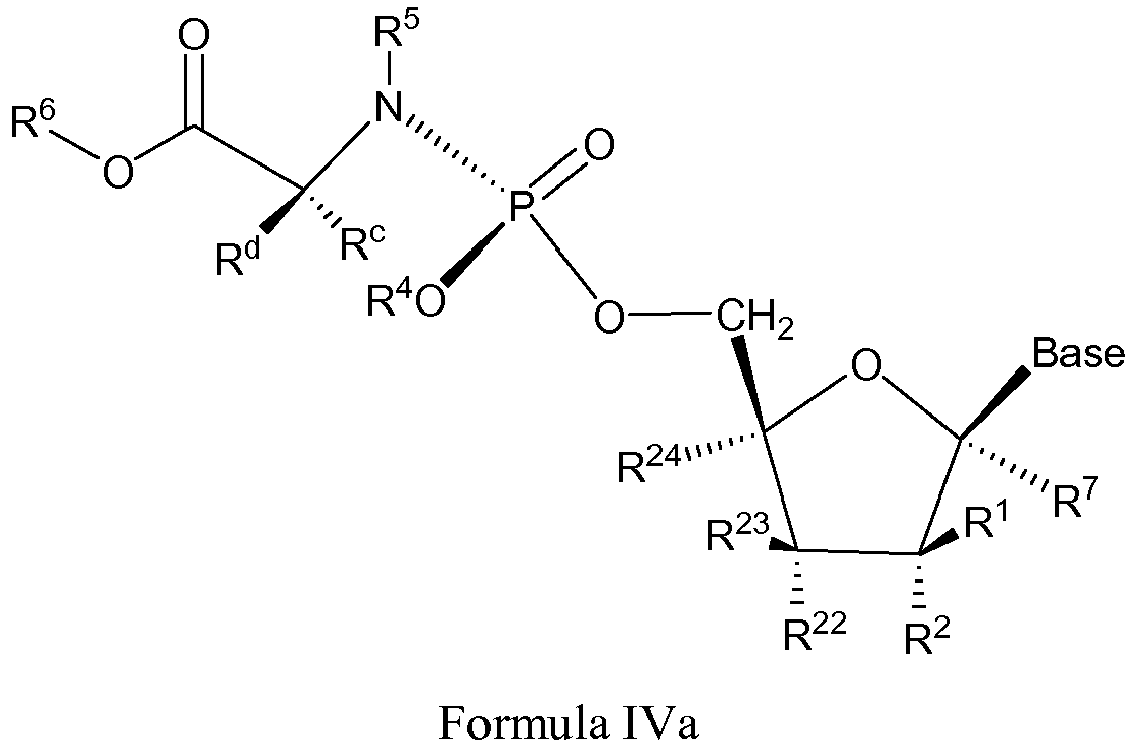


- 3. The method of clause 1 or 2 wherein Base is selected from the group consisting of:


- each X1 is independently N or CR10;
- each X2 is independently NR11, O, or S(O)n;
- each R8 is independently halogen, NR11R12, N(R11)OR11, NR11NR11R12, N3, NO, NO2, CHO, CN, -CH(=NR11), -CH=NNHR11, -CH=N(OR11), -CH(OR11)2, -C(=O)NR11R12, -C(=S)NR11R12, -C(=O)OR11, (C1-C8)alkyl, (C2-C8)alkenyl, (C2-C8)alkynyl, (C4-C8)carbocyclylalkyl, (C6-C20)aryl, (C2-C20)heterocyclyl, heteroaryl, -C(=O)(C1-C8)alkyl, -S(O)n(C1-C8)alkyl, aryl(C1-C8)alkyl, OR11 or SR11;
- each n is independently 0, 1, or 2;
- each R9 or R10 is independently H, halogen, NR11R12, N(R11)OR11, NR11NR11R12, N3, NO, NO2, CHO, CN, -CH(=NR11), -CH=NHNR11, -CH=N(OR11), -CH(OR11)2, -C(=O)NR11R12, -C(=S)NR11R12, -C(=O)OR11, R11, OR11 or SR11;
- each R11 or R12 is independently H, (C1-C8)alkyl, (C2-C8)alkenyl, (C2-C8)alkynyl, (C3-C8)carbocyclyl, (C4-C8)carbocyclylalkyl, aryl(C1-C8)alkyl, heterocyclyl(C1-C8)alkyl, (C6-C20)aryl, (C2-C20)heterocyclyl, heteroaryl, -C(=O)(C1-C8)alkyl, -S(O)n(C1-C8)alkyl or R11 and R12 taken together with a nitrogen to which they are both attached form a 3 to 7 membered heterocyclic ring wherein any one carbon atom of said heterocyclic ring can optionally be replaced with -O-, -S(O)n- or -NRa-;
- wherein each (C1-C8)alkyl, (C2-C8)alkenyl, (C2-C8)alkynyl, (C3-C8)carbocyclyl, (C4-C8)carbocyclylalkyl, aryl(C1-C8)alkyl, heterocyclyl(C1-C8)alkyl, (C6-C20)aryl, (C2-C20)heterocyclyl or heteroaryl of each Rc, Rd, R1, R2, R22, R23, R24, R4, R5, R6, R7, R8, R9, R10, R11 or R12 is, independently, optionally substituted with one or more halo, hydroxy, CN, N3, N(Ra)2, NH(Ra), NH2, NO2, C(O)N(Ra)2, C(O)NH(Ra), C(O)NH2, OC(O)N(Ra)2, OC(O)NH(Ra), OC(O)NH2, C(O)ORa, OC(O)ORa, C(O)Ra, OC(O)Ra, S(O)nRa, S(O)2N(Ra)2, S(O)2NH(Ra), S(O)2NH2, ORa or Ra; and
- provided that Base is not uracil.
- 4. The method of any one of clauses 1-3 wherein Base is selected from the group consisting of:

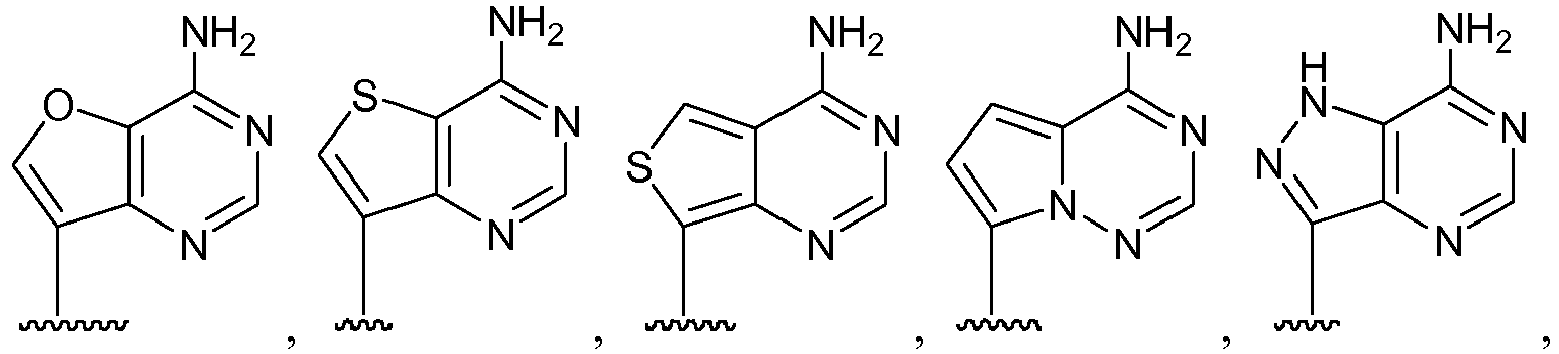


- 5. The method of any one of clauses 1-3 wherein Formula Ia is Formula VIa, Formula Ib is Formula VIb and Formula II is Formula VII:

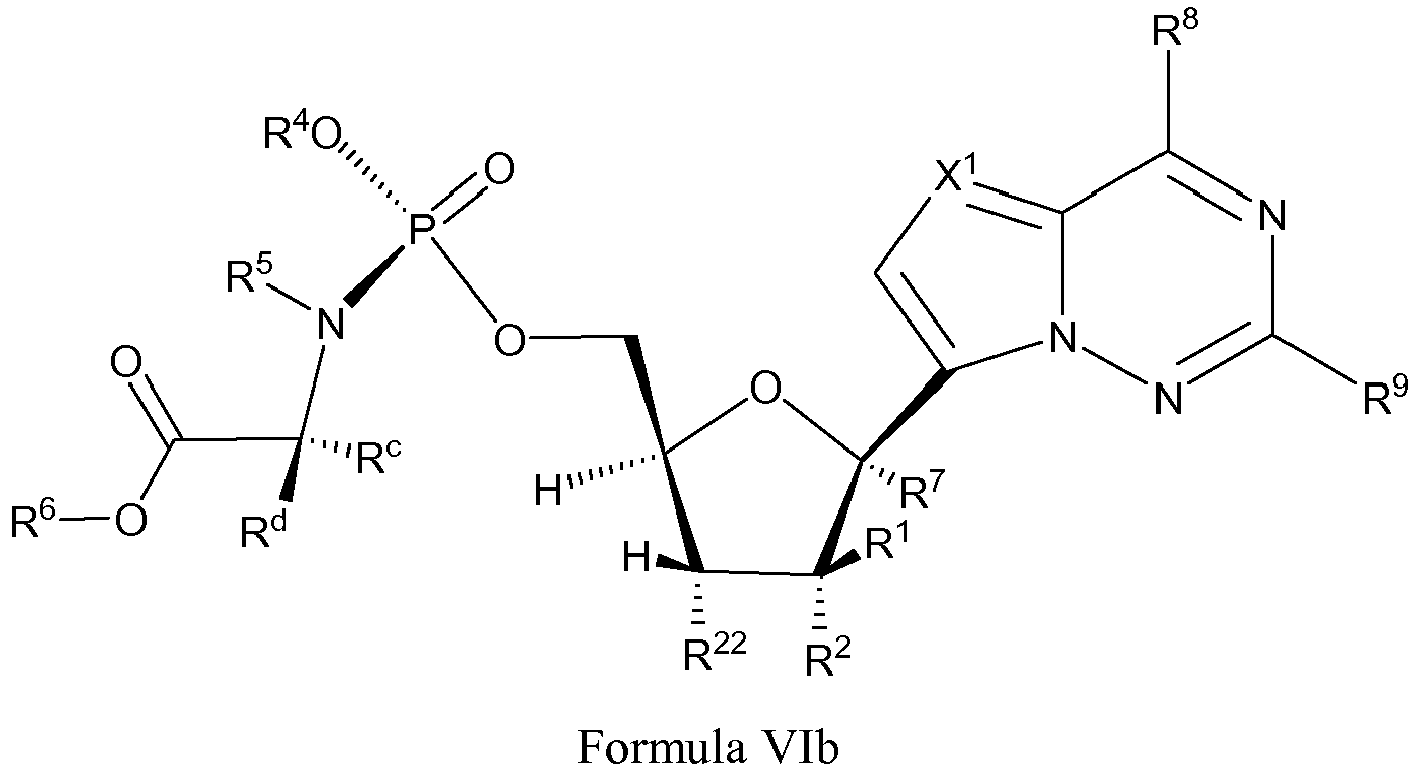

- 6. The method of any one of clauses 1-3 wherein Formula Ia is Formula XIa, Formula Ib is Formula XIb and Formula II is Formula XII:


- each R1 is independently H, halogen, optionally substituted (C1-C8)alkyl, optionally substituted (C2-C8)alkenyl or optionally substituted (C2-C8)alkynyl;
- each R2 is independently halogen or OR11;
- each R5 is H; and
- each R22 is OR11.
- 7. The method of any one of clauses 1-3 wherein Formula Ia is Formula XIIIa, Formula Ib is Formula XIIIb and Formula II is Formula XIV:


- each R1 is independently H, halogen, optionally substituted (C1-C8)alkyl, optionally substituted (C2-C8)alkenyl or optionally substituted (C2-C8)alkynyl;
- each R2 is independently halogen or OR11;
- each R5 is H; and
- each R22 is OR11.
- 8. The method of any one of clauses 1-7 wherein R1 is H, halogen, optionally substituted (C1-C8)alkyl, optionally substituted (C2-C8)alkenyl or optionally substituted (C2-C8)alkynyl.
- 9. The method of any one of clauses 1-8 wherein R1 is H, CH3 or F.
- 10. The method of any one of clauses 1-9 wherein each R5, R23 and R24 is H.
- 11. The method of any one of clauses 1-10 wherein one of Rc or Rd is H and the other of Rc or Rd is optionally substituted (C1-C8)alkyl.
- 12. The method of any one of clauses 1-11 wherein R6 is optionally substituted (C1-C8)alkyl.
- 13. The method of any one of clauses 1-12 wherein R8 is NR11R12 or OR11.
- 14. The method of any one of clauses 1-13 wherein R9 is H or NR11R12.
- 15. The method of any one of clauses 1-14 wherein when R8 or R9 is OR11 or NR11R12 then each R11 and R12 of said OR11 or NR11R12 is H.
- 16. The method of any one of clauses 1-15 wherein R8 is NH2 and R9 is H.
- 17. The method of any one of clauses 1-16 wherein R4 is optionally substituted (C6-C20)aryl.
- 18. The method of any one of clauses 1-17 further comprising a method of preparing a compound of Formula IIIa or Formula IIIb


- each Ra, R4 or R6 is independently (C1-C8)alkyl, (C2-C8)alkenyl, (C2-C8)alkynyl, (C3-C8)carbocyclyl, (C4-C8)carbocyclylalkyl, aryl(C1-C8)alkyl, heterocyclyl(C1-C8)alkyl, (C6-C20)aryl, (C2-C20)heterocyclyl or heteroaryl;
- each Rc or Rd is independently H, (C1-C8)alkyl, (C2-C8)alkenyl, (C2-C8)alkynyl, (C3-C8)carbocyclyl, (C4-C8)carbocyclylalkyl, aryl(C1-C8)alkyl, heterocyclyl(C1-C8)alkyl, (C6-C20)aryl, (C2-C20)heterocyclyl or heteroaryl provided that Rc and Rd are not the same;
- each R5 is independently H, (C1-C8)alkyl, (C2-C8)alkenyl, (C2-C8)alkynyl, (C3-C8)carbocyclyl, (C4-C8)carbocyclylalkyl, aryl(C1-C8)alkyl, heterocyclyl(C1-C8)alkyl, (C6-C20)aryl, (C2-C20)heterocyclyl or heteroaryl;
- wherein each (C1-C8)alkyl, (C2-C8)alkenyl, (C2-C8)alkynyl, (C3-C8)carbocyclyl, (C4-C8)carbocyclylalkyl, aryl(C1-C8)alkyl, heterocyclyl(C1-C8)alkyl, (C6-C20)aryl, (C2-C20)heterocyclyl or heteroaryl of each Rc, Rd, R4, R5 or R6 is, independently, optionally substituted with one or more halo, hydroxy, CN, N3, N(Ra)2, NH(Ra), NH2, C(O)N(Ra)2, C(O)NH(Ra), C(O)NH2, OC(O)N(Ra)2, OC(O)NH(Ra), OC(O)NH2, C(O)ORa, OC(O)ORa, S(O)nRa, S(O)2N(Ra)2, S(O)2NH(Ra), S(O)2NH2, ORa or Ra; and
- each Ar is a (C6-C20) aryl or heteroaryl wherein said (C6-C20) aryl or heteroaryl is substituted with one or more halogen, NO2, or (C1-C8)haloalkyl and optionally substituted with with one or more CN, N3, N(Ra)2, C(O)N(Ra)2, OC(O)N(Ra)2, C(O)ORa, OC(O)ORa, C(O)Ra, OC(O)Ra, S(O)nRa, S(O)2N(Ra)2, ORa or Ra with the proviso that Ar is different from R4;
- said method comprising:
- (d) providing a diastereomeric compound of Formula VIII

- (e) dissolving the compound of Formula VIII in a suitable solvent and inducing crystallization by addition of a C5-C8 hydrocarbon or C5-C8 cyclic hydrocarbon;
thereby forming a pure diasteromer of Formula IIIa or Formula IIIb.
- (d) providing a diastereomeric compound of Formula VIII
- 19. The method of clause 18 wherein the compound of Formula VIII is dissolved in an ether solvent and the crystallization is induced by addition of a C5-C8 hydrocarbon.
- 20. The method of clause 18 or 19 wherein the compound of Formula VIII is dissolved in diethyl ether or methyl-t-butyl ether and crystallization is induced by the addition of hexane.
- 21. The method of any one of clauses 18-20 wherein the compound of Formula VIII is dissolved in diethyl ether and crystallization is induced by the addition of hexane.
- 22. The method of any one of clauses 18-21 further comprising a method of preparing a compound of Formula VIII

- each Ra, R4 or R6 is independently (C1-C8)alkyl, (C2-C8)alkenyl, (C2-C8)alkynyl, (C3-C8)carbocyclyl, (C4-C8)carbocyclylalkyl, aryl(C1-C8)alkyl, heterocyclyl(C1-C8)alkyl, (C6-C20)aryl, (C2-C20)heterocyclyl or heteroaryl;
- each Rc or Rd is independently H, (C1-C8)alkyl, (C2-C8)alkenyl, (C2-C8)alkynyl, (C3-C8)carbocyclyl, (C4-C8)carbocyclylalkyl, aryl(C1-C8)alkyl, heterocyclyl(C1-C8)alkyl, (C6-C20)aryl, (C2-C20)heterocyclyl or heteroaryl provided that Rc and Rd are not the same;
- each R5 is independently H, (C1-C8)alkyl, (C2-C8)alkenyl, (C2-C8)alkynyl, (C3-C8)carbocyclyl, (C4-C8)carbocyclylalkyl, aryl(C1-C8)alkyl, heterocyclyl(C1-C8)alkyl, (C6-C20)aryl, (C2-C20)heterocyclyl or heteroaryl;
- wherein each (C1-C8)alkyl, (C2-C8)alkenyl, (C2-C8)alkynyl, (C3-C8)carbocyclyl, (C4-C8)carbocyclylalkyl, aryl(C1-C8)alkyl, heterocyclyl(C1-C8)alkyl, (C6-C20)aryl, (C2-C20)heterocyclyl or heteroaryl of each Rc, Rd, R4, R5 or R6 is, independently, optionally substituted with one or more halo, hydroxy, CN, N3, N(Ra)2, NH(Ra), NH2, C(O)N(Ra)2, C(O)NH(Ra), C(O)NH2, OC(O)N(Ra)2, OC(O)NH(Ra), OC(O)NH2, C(O)ORa, OC(O)ORa, S(O)nRa, S(O)2N(Ra)2, S(O)2NH(Ra), S(O)2NH2, ORa or Ra; and
- each Ar is a (C6-C20) aryl or heteroaryl wherein said (C6-C20) aryl or heteroaryl is substituted with one or more halogen, NO2, or (C1-C8)haloalkyl and optionally substituted with with one or more CN, N3, N(Ra)2, C(O)N(Ra)2, OC(O)N(Ra)2, C(O)ORa, OC(O)ORa, C(O)Ra, OC(O)Ra, S(O)nRa, S(O)2N(Ra)2, ORa or Ra with the proviso that Ar is different from R4;
- said method comprising:
- (f) providing a chirally pure amino acid ester of Formula IX or a salt thereof

- (g) treating the compound of Formula IX with a compound of Formula X in the presence of a base

- (h) treating the resulting mixture with ArOH;
thereby forming a compound of Formula VIII.
- (f) providing a chirally pure amino acid ester of Formula IX or a salt thereof
- 23. A method of preparing a compound of Formula IIIa or Formula IIIb


wherein:- each Ra, R4 or R6 is independently (C1-C8)alkyl, (C2-C8)alkenyl, (C2-C8)alkynyl, (C3-C8)carbocyclyl, (C4-C8)carbocyclylalkyl, aryl(C1-C8)alkyl, heterocyclyl(C1-C8)alkyl, (C6-C20)aryl, (C2-C20)heterocyclyl or heteroaryl;
- each Rc or Rd is independently H, (C1-C8)alkyl, (C2-C8)alkenyl, (C2-C8)alkynyl, (C3-C8)carbocyclyl, (C4-C8)carbocyclylalkyl, aryl(C1-C8)alkyl, heterocyclyl(C1-C8)alkyl, (C6-C20)aryl, (C2-C20)heterocyclyl or heteroaryl provided that Rc and Rd are not the same;
- each R5 is independently H, (C1-C8)alkyl, (C2-C8)alkenyl, (C2-C8)alkynyl, (C3-C8)carbocyclyl, (C4-C8)carbocyclylalkyl, aryl(C1-C8)alkyl, heterocyclyl(C1-C8)alkyl, (C6-C20)aryl, (C2-C20)heterocyclyl or heteroaryl;
- wherein each (C1-C8)alkyl, (C2-C8)alkenyl, (C2-C8)alkynyl, (C3-C8)carbocyclyl, (C4-C8)carbocyclylalkyl, aryl(C1-C8)alkyl, heterocyclyl(C1-C8)alkyl, (C6-C20)aryl, (C2-C20)heterocyclyl or heteroaryl of each Rc, Rd, R4, R5 or R6 is, independently, optionally substituted with one or more halo, hydroxy, CN, N3, N(Ra)2, NH(Ra), NH2, C(O)N(Ra)2, C(O)NH(Ra), C(O)NH2, OC(O)N(Ra)2, OC(O)NH(Ra), OC(O)NH2, C(O)ORa, OC(O)ORa, S(O)nRa, S(O)2N(Ra)2, S(O)2NH(Ra), S(O)2NH2, ORa or Ra; and
- each Ar is a (C6-C20) aryl or heteroaryl wherein said (C6-C20) aryl or heteroaryl is substituted with one or more halogen, NO2, or (C1-C8)haloalkyl and optionally substituted with with one or more CN, N3, N(Ra)2, C(O)N(Ra)2, OC(O)N(Ra)2, C(O)ORa, OC(O)ORa, C(O)Ra, OC(O)Ra, S(O)nRa, S(O)2N(Ra)2, ORa or Ra with the proviso that Ar is different from R4;
- said method comprising:
- (d) providing a diastereomeric compound of Formula VIII

- (e) dissolving the compound of Formula VIII in a suitable solvent and inducing crystallization by addition of a C5-C8 hydrocarbon or C5-C8 cyclic hydrocarbon;
thereby forming a pure diasteromer of Formula IIIa or Formula IIIb.
- (d) providing a diastereomeric compound of Formula VIII
- 24. The method of clause 23 wherein the compound of Formula VIII is dissolved in an ether solvent and the crystallization is induced by addition of a C5-C8 hydrocarbon.
- 25. The method of clause 23 or 24 wherein the compound of Formula VIII is dissolved in diethyl ether or methyl-t-butyl ether and crystallization is induced by the addition of hexane.
- 26. The method of any one of clauses 23-25 wherein the compound of Formula VIII is dissolved in diethyl ether and crystallization is induced by the addition of hexane.
- 27. The method of any one of clauses 23-26 further comprising a method of preparing a compound of Formula VIII

wherein- each Ra, R4 or R6 is independently (C1-C8)alkyl, (C2-C8)alkenyl, (C2-C8)alkynyl, (C3-C8)carbocyclyl, (C4-C8)carbocyclylalkyl, aryl(C1-C8)alkyl, heterocyclyl(C1-C8)alkyl, (C6-C20)aryl, (C2-C20)heterocyclyl or heteroaryl;
- each Rc or Rd is independently H, (C1-C8)alkyl, (C2-C8)alkenyl, (C2-C8)alkynyl, (C3-C8)carbocyclyl, (C4-C8)carbocyclylalkyl, aryl(C1-C8)alkyl, heterocyclyl(C1-C8)alkyl, (C6-C20)aryl, (C2-C20)heterocyclyl or heteroaryl provided that Rc and Rd are not the same;
- each R5 is independently H, (C1-C8)alkyl, (C2-C8)alkenyl, (C2-C8)alkynyl, (C3-C8)carbocyclyl, (C4-C8)carbocyclylalkyl, aryl(C1-C8)alkyl, heterocyclyl(C1-C8)alkyl, (C6-C20)aryl, (C2-C20)heterocyclyl or heteroaryl;
- wherein each (C1-C8)alkyl, (C2-C8)alkenyl, (C2-C8)alkynyl, (C3-C8)carbocyclyl, (C4-C8)carbocyclylalkyl, aryl(C1-C8)alkyl, heterocyclyl(C1-C8)alkyl, (C6-C20)aryl, (C2-C20)heterocyclyl or heteroaryl of each Rc, Rd, R4, R5 or R6 is, independently, optionally substituted with one or more halo, hydroxy, CN, N3, N(Ra)2, NH(Ra), NH2, C(O)N(Ra)2, C(O)NH(Ra), C(O)NH2, OC(O)N(Ra)2, OC(O)NH(Ra), OC(O)NH2, C(O)ORa, OC(O)ORa, S(O)nRa, S(O)2N(Ra)2, S(O)2NH(Ra), S(O)2NH2, ORa or Ra; and
- each Ar is a (C6-C20) aryl or heteroaryl wherein said (C6-C20) aryl or heteroaryl is substituted with one or more halogen, NO2, or (C1-C8)haloalkyl and optionally substituted with with one or more CN, N3, N(Ra)2, C(O)N(Ra)2, OC(O)N(Ra)2, C(O)ORa, OC(O)ORa, C(O)Ra, OC(O)Ra, S(O)nRa, S(O)2N(Ra)2, ORa or Ra with the proviso that Ar is different from R4;
- said method comprising:
- (f) providing a chirally pure amino acid ester of Formula IX or a salt thereof

- (g) treating the compound of Formula IX with a compound of Formula X in the presence of a base

- (h) treating the resulting mixture with ArOH;
thereby forming a compound of Formula VIII.
- (f) providing a chirally pure amino acid ester of Formula IX or a salt thereof
- 28. The method of any one of clauses 18-27 wherein the compound Formula IIIa or Formula IIIb is


wherein:- each Ra, R4 or R6 is independently (C1-C8)alkyl, (C2-C8)alkenyl, (C2-C8)alkynyl, (C3-C8)carbocyclyl, (C4-C8)carbocyclylalkyl, aryl(C1-C8)alkyl, heterocyclyl(C1-C8)alkyl, (C6-C20)aryl, (C2-C20)heterocyclyl or heteroaryl;
- each Rc or Rd is independently H, (C1-C8)alkyl, (C2-C8)alkenyl, (C2-C8)alkynyl, (C3-C8)carbocyclyl, (C4-C8)carbocyclylalkyl, aryl(C1-C8)alkyl, heterocyclyl(C1-C8)alkyl, (C6-C20)aryl, (C2-C20)heterocyclyl or heteroaryl provided that Rc and Rd are not the same;
- each R5 is independently H, (C1-C8)alkyl, (C2-C8)alkenyl, (C2-C8)alkynyl, (C3-C8)carbocyclyl, (C4-C8)carbocyclylalkyl, aryl(C1-C8)alkyl, heterocyclyl(C1-C8)alkyl, (C6-C20)aryl, (C2-C20)heterocyclyl or heteroaryl;
- wherein each (C1-C8)alkyl, (C2-C8)alkenyl, (C2-C8)alkynyl, (C3-C8)carbocyclyl, (C4-C8)carbocyclylalkyl, aryl(C1-C8)alkyl, heterocyclyl(C1-C8)alkyl, (C6-C20)aryl, (C2-C20)heterocyclyl or heteroaryl of each Rc, Rd, R4, R5 or R6 is, independently, optionally substituted with one or more halo, hydroxy, CN, N3, N(Ra)2, NH(Ra), NH2, C(O)N(Ra)2, C(O)NH(Ra), C(O)NH2, OC(O)N(Ra)2, OC(O)NH(Ra), OC(O)NH2, C(O)ORa, OC(O)ORa, S(O)nRa, S(O)2N(Ra)2, S(O)2NH(Ra), S(O)2NH2, ORa or Ra; and
- each Ar is a (C6-C20) aryl or heteroaryl wherein said (C6-C20) aryl or heteroaryl is substituted with one or more halogen, NO2, or (C1-C8)haloalkyl and optionally substituted with with one or more CN, N3, N(Ra)2, C(O)N(Ra)2, OC(O)N(Ra)2, C(O)ORa, OC(O)ORa, C(O)Ra, OC(O)Ra, S(O)nRa, S(O)2N(Ra)2, ORa or Ra with the proviso that Ar is different from R4.
- 29. The method of any one of clauses 18-28 wherein R5 is H and one of Rc or Rd is H.
- 30. The method of any one of clauses 18-29 wherein R6 is optionally substituted (C1-C8)alkyl and R4 is optionally substituted (C6-C20)aryl.
- 31. The method of any one of clauses 18-30 wherein R4 is optionally substituted phenyl.
- 32. The method of any one of clauses 18-31 wherein one of Rc or Rd is H and the other of Rc or Rd is CH3.
- 33. The method of any one of clauses 18-32 wherein Ar is optionally substituted para-nitrophenyl.
- 34. The method of any one of clauses 18-33 wherein the chirality at the carbon directly attached to Rc and Rd is S.
- 35. The method of any one of clauses 18-34 wherein the chirality at the carbon directly attached to Rc and Rd is R.
- 36. The method of any one of clauses 18-35 wherein the compound is selected from the group consisting of


Compound C was dissolved in diethyl ether (~10 mL/ gram). While stirring, hexanes was then added until the solution became turbid. Seed crystals (~10 mg / gram of compound C) were added to promote crystallization. The resulting suspension was gently stirred for 16 h, cooled to ~ 0 °C, stirred for an additional 2 h, and filtered to collect the crystalline material (recovery yield of the crystalline material 35%-35% The crystalline material contains ~95% of (S)-compound C and ~5% of (R)-compound C. Re-crystallization afforded 99% diastereomerically pure (S)-isomer.
Claims (1)
- A compound selected from the group consisting of:

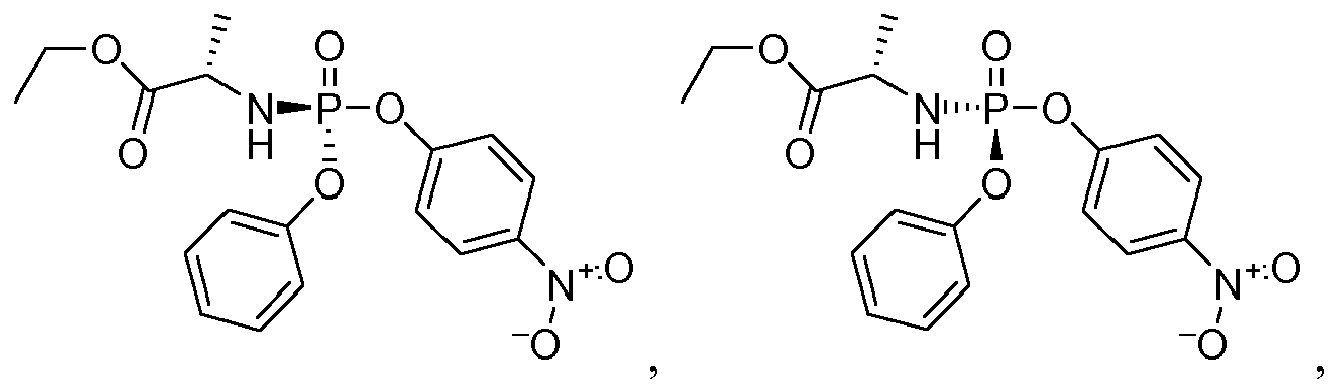


Applications Claiming Priority (2)
| Application Number | Priority Date | Filing Date | Title |
|---|---|---|---|
| US36562110P | 2010-07-19 | 2010-07-19 | |
| EP11743400.1A EP2596004B1 (en) | 2010-07-19 | 2011-07-19 | Methods for the preparation of diasteromerically pure phosphoramidate prodrugs |
Related Parent Applications (1)
| Application Number | Title | Priority Date | Filing Date |
|---|---|---|---|
| EP11743400.1A Division EP2596004B1 (en) | 2010-07-19 | 2011-07-19 | Methods for the preparation of diasteromerically pure phosphoramidate prodrugs |
Publications (1)
| Publication Number | Publication Date |
|---|---|
| EP2805960A1 true EP2805960A1 (en) | 2014-11-26 |
Family
ID=44534619
Family Applications (2)
| Application Number | Title | Priority Date | Filing Date |
|---|---|---|---|
| EP11743400.1A Active EP2596004B1 (en) | 2010-07-19 | 2011-07-19 | Methods for the preparation of diasteromerically pure phosphoramidate prodrugs |
| EP14181224.8A Withdrawn EP2805960A1 (en) | 2010-07-19 | 2011-07-19 | Methods for the preparation of diasteromerically pure phosphoramidate prodrugs |
Family Applications Before (1)
| Application Number | Title | Priority Date | Filing Date |
|---|---|---|---|
| EP11743400.1A Active EP2596004B1 (en) | 2010-07-19 | 2011-07-19 | Methods for the preparation of diasteromerically pure phosphoramidate prodrugs |
Country Status (25)
| Country | Link |
|---|---|
| US (2) | US9090642B2 (en) |
| EP (2) | EP2596004B1 (en) |
| JP (1) | JP5937073B2 (en) |
| KR (3) | KR101995598B1 (en) |
| CN (1) | CN103052646A (en) |
| AP (1) | AP2013006665A0 (en) |
| AU (1) | AU2011282241B2 (en) |
| BR (1) | BR112013001267A2 (en) |
| CA (1) | CA2804375C (en) |
| CL (1) | CL2013000076A1 (en) |
| CO (1) | CO6680607A2 (en) |
| CR (1) | CR20130063A (en) |
| EA (1) | EA025311B1 (en) |
| EC (1) | ECSP13012451A (en) |
| ES (1) | ES2524398T3 (en) |
| IL (2) | IL224045A (en) |
| MA (1) | MA34471B1 (en) |
| MX (1) | MX2013000656A (en) |
| NZ (1) | NZ606141A (en) |
| PE (1) | PE20130807A1 (en) |
| PH (1) | PH12013500033A1 (en) |
| PT (1) | PT2596004E (en) |
| SG (1) | SG186831A1 (en) |
| WO (1) | WO2012012465A1 (en) |
| ZA (1) | ZA201300135B (en) |
Cited By (1)
| Publication number | Priority date | Publication date | Assignee | Title |
|---|---|---|---|---|
| CN108276463A (en) * | 2017-01-06 | 2018-07-13 | 米文君 | A new class of compound and application thereof |
Families Citing this family (117)
| Publication number | Priority date | Publication date | Assignee | Title |
|---|---|---|---|---|
| PY0111577A (en) | 2000-05-23 | 2017-01-02 | Idenix Cayman Ltd | METHODS AND COMPOSITIONS FOR THE TREATMENT OF HEPATITIS C VIRUS |
| RU2005118421A (en) | 2002-11-15 | 2006-01-20 | Айденикс (Кайман) Лимитед (Ky) | 2'-BRANCHED NUCLEOSIDES AND MUTATION FLAVIVIRIDAE |
| US7964580B2 (en) | 2007-03-30 | 2011-06-21 | Pharmasset, Inc. | Nucleoside phosphoramidate prodrugs |
| HRP20130048T1 (en) | 2008-04-23 | 2013-02-28 | Gilead Sciences, Inc. | CARBA-NUCLEOSIDE ANALYSIS FOR ANTI-VIRUS THERAPY |
| WO2011035250A1 (en) | 2009-09-21 | 2011-03-24 | Gilead Sciences, Inc. | Processes and intermediates for the preparation of 1'-substituted carba-nucleoside analogs |
| EA025311B1 (en) | 2010-07-19 | 2016-12-30 | Гайлид Сайэнсиз, Инк. | Methods for the preparation of diasteromerically pure phosphoramidate prodrugs |
| ES2524356T3 (en) | 2010-07-22 | 2014-12-05 | Gilead Sciences, Inc. | Methods and compounds to treat infections caused by Paramyxoviridae virus |
| AU2011349844B2 (en) | 2010-12-20 | 2017-06-01 | Gilead Sciences, Inc. | Combinations for treating HCV |
| DK3447061T3 (en) | 2011-03-01 | 2022-01-03 | NuCana plc | PHARMACEUTICAL FORMULATION INCLUDING A PHOSPHORAMIDATE DERIVATIVE OF 5-FLUORO-2'-DEOXYURIDINE FOR USE IN CANCER TREATMENT |
| CN103842369A (en) | 2011-03-31 | 2014-06-04 | 埃迪尼克斯医药公司 | Compounds and pharmaceutical compositions for the treatment of viral infections |
| AR088441A1 (en) | 2011-09-12 | 2014-06-11 | Idenix Pharmaceuticals Inc | SUBSTITUTED CARBONYLOXYMETHYLPHOSPHORAMIDATE COMPOUNDS AND PHARMACEUTICAL COMPOSITIONS FOR THE TREATMENT OF VIRAL INFECTIONS |
| SI2709613T2 (en) | 2011-09-16 | 2020-12-31 | Gilead Pharmasset LLC c/o Gilead Sciences, Inc. | Methods for treating hcv |
| US9708357B2 (en) | 2011-12-20 | 2017-07-18 | Riboscience, LLC | 4′-azido, 3′-fluoro substituted nucleoside derivatives as inhibitors of HCV RNA replication |
| UA111761C2 (en) | 2011-12-20 | 2016-06-10 | Рібосаєнс Ллс | 2 ', 4'-DIFTOR-2'-METHYL-SUBSTITUTED NUCLEOSIDE DERIVATIVES AS INHIBITORS OF Hepatitis C Virus PHK Replication |
| SG10201610936RA (en) | 2011-12-22 | 2017-02-27 | Alios Biopharma Inc | Substituted nucleosides, nucleotides and analogs thereof |
| US9441007B2 (en) | 2012-03-21 | 2016-09-13 | Alios Biopharma, Inc. | Substituted nucleosides, nucleotides and analogs thereof |
| USRE48171E1 (en) | 2012-03-21 | 2020-08-25 | Janssen Biopharma, Inc. | Substituted nucleosides, nucleotides and analogs thereof |
| EP2852604B1 (en) | 2012-05-22 | 2017-04-12 | Idenix Pharmaceuticals LLC | 3',5'-cyclic phosphoramidate prodrugs for hcv infection |
| US9296778B2 (en) | 2012-05-22 | 2016-03-29 | Idenix Pharmaceuticals, Inc. | 3′,5′-cyclic phosphate prodrugs for HCV infection |
| AP3913A (en) | 2012-05-22 | 2016-11-26 | Idenix Pharamaceuticals Inc | D-amino acid compounds for liver disease |
| HUE029038T2 (en) | 2012-05-25 | 2017-01-30 | Janssen Sciences Ireland Uc | Uracyl spirooxetane nucleosides |
| EP2870169A1 (en) * | 2012-07-03 | 2015-05-13 | Bristol-Myers Squibb Company | Process for preparing diastereomerically enriched phosphoramidate derivatives of nucleoside compounds for treatment of viral infections |
| US9556216B2 (en) | 2012-08-31 | 2017-01-31 | Novartis Ag | 2′-Ethynyl nucleoside derivatives for treatment of viral infections |
| WO2014052638A1 (en) | 2012-09-27 | 2014-04-03 | Idenix Pharmaceuticals, Inc. | Esters and malonates of sate prodrugs |
| SG11201502750UA (en) * | 2012-10-08 | 2015-06-29 | Idenix Pharmaceuticals Inc | 2'-chloro nucleoside analogs for hcv infection |
| HUE044605T2 (en) * | 2012-11-16 | 2019-11-28 | Univ College Cardiff Consultants Ltd | Mixture of rp/sp gemcitabine-[phenyl-(benzyloxy-l-alaninyl)]-phosphate |
| WO2014078463A1 (en) * | 2012-11-19 | 2014-05-22 | Merck Sharp & Dohme Corp. | 2 -alkynyl substituted nucleoside derivatives for treating viral diseases |
| EP2935304A1 (en) | 2012-12-19 | 2015-10-28 | IDENIX Pharmaceuticals, Inc. | 4'-fluoro nucleosides for the treatment of hcv |
| GEP201706757B (en) | 2012-12-21 | 2017-10-25 | Alios Biopharma Inc | Substituted nucleosides, nucleotides and analogs thereof |
| NZ729172A (en) | 2013-01-31 | 2018-06-29 | Gilead Pharmasset Llc | Combination formulation of two antiviral compounds |
| US9309275B2 (en) | 2013-03-04 | 2016-04-12 | Idenix Pharmaceuticals Llc | 3′-deoxy nucleosides for the treatment of HCV |
| WO2014137930A1 (en) | 2013-03-04 | 2014-09-12 | Idenix Pharmaceuticals, Inc. | Thiophosphate nucleosides for the treatment of hcv |
| EP2970357B1 (en) | 2013-03-13 | 2025-01-01 | Idenix Pharmaceuticals LLC | Amino acid phosphoramidate pronucleotides of 2'-cyano, azido and amino nucleosides for the treatment of hcv |
| EP2981542B1 (en) | 2013-04-01 | 2021-09-15 | Idenix Pharmaceuticals LLC | 2',4'-fluoro nucleosides for the treatment of hcv |
| BR112015025766A2 (en) * | 2013-04-12 | 2017-10-17 | Achillion Pharmaceuticals Inc | highly active nucleoside derivative for the treatment of hcv |
| HK1219901A1 (en) | 2013-05-16 | 2017-04-21 | Riboscience Llc | 4'-azido, 3'-deoxy-3'-fluoro substituted nucleoside derivatives |
| US20180200280A1 (en) | 2013-05-16 | 2018-07-19 | Riboscience Llc | 4'-Fluoro-2'-Methyl Substituted Nucleoside Derivatives as Inhibitors of HCV RNA Replication |
| MA46490A1 (en) | 2013-05-16 | 2021-04-30 | Riboscience Llc | Substituted 4'- fluoro-2 '- methyl nucleoside derivatives |
| US10005779B2 (en) | 2013-06-05 | 2018-06-26 | Idenix Pharmaceuticals Llc | 1′,4′-thio nucleosides for the treatment of HCV |
| WO2015017713A1 (en) * | 2013-08-01 | 2015-02-05 | Idenix Pharmaceuticals, Inc. | D-amino acid phosphoramidate pronucleotides of halogeno pyrimidine compounds for liver disease |
| JP6562908B2 (en) | 2013-10-11 | 2019-08-21 | ヤンセン バイオファーマ インク. | Substituted nucleosides, substituted nucleotides and analogs thereof |
| UA119050C2 (en) | 2013-11-11 | 2019-04-25 | Ґілеад Саєнсиз, Інк. | PYROL [1.2-f] [1.2.4] TRIASINES USED FOR TREATMENT OF RESPIRATORY-SYNCITAL VIRAL INFECTIONS |
| CN103804446A (en) * | 2014-02-27 | 2014-05-21 | 苏州东南药业股份有限公司 | Preparation method of 3,5-dibenzoyl-2-deoxy-2-fluoro-2-methyl-D-ribo-gamma-lactone |
| CZ307789B6 (en) | 2014-04-15 | 2019-05-09 | Zentiva, K.S. | Method of producing biologically active phosphoramidate medicaments |
| WO2015161137A1 (en) | 2014-04-16 | 2015-10-22 | Idenix Pharmaceuticals, Inc. | 3'-substituted methyl or alkynyl nucleosides for the treatment of hcv |
| WO2015166370A1 (en) | 2014-04-28 | 2015-11-05 | Pfizer Inc. | Heteroaromatic compounds and their use as dopamine d1 ligands |
| TWI678369B (en) | 2014-07-28 | 2019-12-01 | 美商基利科學股份有限公司 | Thieno[3,2-d]pyrimidine, furo[3,2-d]pyrimidine, and pyrrolo[3,2-d]pyrimidines useful for treating respiratory syncitial virus infections |
| CN104130302B (en) * | 2014-08-08 | 2017-02-15 | 乳源东阳光药业有限公司 | Crystal form of nucleotide medicines and preparation method of crystal form |
| TWI673283B (en) | 2014-08-21 | 2019-10-01 | 美商基利科學股份有限公司 | 2'-chloro aminopyrimidinone and pyrimidine dione nucleosides |
| CN104230985B (en) * | 2014-09-01 | 2017-01-18 | 北京天弘天达医药科技有限公司 | Preparation method of (s)-2-[(s)-(4-nitro-phenoxy)-phenoxy-phosphoryl amino] isopropyl propionate |
| CN105461773B (en) * | 2014-09-30 | 2020-12-01 | 江苏豪森药业集团有限公司 | The preparation method of sofosbuvir and its intermediate |
| US10251903B2 (en) | 2014-10-20 | 2019-04-09 | Merck Sharp & Dohme Corp. | Process for making nucleoside phosphoramidate compounds |
| TWI740546B (en) | 2014-10-29 | 2021-09-21 | 美商基利科學股份有限公司 | Methods for the preparation of ribosides |
| CN111909231B (en) | 2014-11-28 | 2025-10-17 | 努卡那有限公司 | Novel 2' -and/or 5' -amino acid ester phosphoramidate 3' -deoxyadenosine derivatives as anticancer compounds |
| WO2016094677A2 (en) * | 2014-12-10 | 2016-06-16 | Solstice Biologics, Ltd. | Mononucleotides having a bioreversible disulfide group |
| IL296496B2 (en) | 2014-12-26 | 2024-10-01 | Univ Emory | N4-hydroxycytidine, history and related antiviral uses |
| GEP20217282B (en) | 2015-03-06 | 2021-08-10 | Atea Pharmaceuticals Inc | β-D-2'-DEOXY-2'α-FLUORO-2'-β-C-SUBSTITUTED-2-MODIFIED-N6-SUBSTITUTED PURINE NUCLEOTIDES FOR HCV TREATMENT |
| CN104829673B (en) * | 2015-03-12 | 2017-10-27 | 南京旗昌医药科技有限公司 | A kind of preparation method of rope fluorine cloth Wei crystal formation 6 |
| US10618926B2 (en) | 2015-04-02 | 2020-04-14 | Merck Sharp & Dohme | Process for making phosphoramidate protected nucleoside compounds |
| CA2986812A1 (en) | 2015-05-26 | 2016-12-01 | Sandoz Ag | Selective process for synthesis of nucleoside phosphoramidates |
| WO2016196735A2 (en) | 2015-06-03 | 2016-12-08 | Teva Pharmaceuticals International Gmbh | Improved processes for the preparation of sofosbuvir and intermediates thereof |
| WO2017024310A1 (en) | 2015-08-06 | 2017-02-09 | Chimerix, Inc. | Pyrrolopyrimidine nucleosides and analogs thereof useful as antiviral agents |
| HRP20220355T1 (en) | 2015-09-16 | 2022-05-13 | Gilead Sciences, Inc. | Methods for treating coronaviridae infections |
| CN106478753A (en) | 2015-09-16 | 2017-03-08 | 博瑞生物医药(苏州)股份有限公司 | A kind of preparation method of NUC 1031 individual isomer and purposes |
| CN106543220A (en) | 2015-09-16 | 2017-03-29 | 博瑞生物医药(苏州)股份有限公司 | Phosphoramidate compounds and preparation method thereof and crystal |
| WO2017093973A1 (en) * | 2015-12-02 | 2017-06-08 | Sun Pharmaceutical Industries Limited | Process for the preparation of pure sofosbuvir |
| SMT202100665T1 (en) | 2015-12-11 | 2022-03-21 | NuCana plc | Diastereoselective synthesis of phosphate derivatives and of the gemcitabine prodrug nuc-1031 |
| CN109311885A (en) | 2016-03-24 | 2019-02-05 | 诺华股份有限公司 | Alkynyl nucleoside analogs as inhibitors of human rhinovirus |
| CN114456176B (en) | 2016-03-28 | 2024-08-30 | 因赛特公司 | Pyrrolotriazine compounds as TAM inhibitors |
| EP4483875A3 (en) | 2016-05-10 | 2025-04-02 | C4 Therapeutics, Inc. | Spirocyclic degronimers for target protein degradation |
| CN109562107A (en) | 2016-05-10 | 2019-04-02 | C4医药公司 | Heterocycle degron body for target protein degradation |
| EP3455219A4 (en) | 2016-05-10 | 2019-12-18 | C4 Therapeutics, Inc. | AMINE-LINKED C3-GLUTARIMIDE DEGRONIMERS FOR THE DEGRADATION OF TARGET PROTEINS |
| CN109641874A (en) | 2016-05-10 | 2019-04-16 | C4医药公司 | C for target protein degradation3The glutarimide degron body of carbon connection |
| US10202412B2 (en) | 2016-07-08 | 2019-02-12 | Atea Pharmaceuticals, Inc. | β-D-2′-deoxy-2′-substituted-4′-substituted-2-substituted-N6-substituted-6-aminopurinenucleotides for the treatment of paramyxovirus and orthomyxovirus infections |
| WO2018013937A1 (en) | 2016-07-14 | 2018-01-18 | Atea Pharmaceuticals, Inc. | Beta-d-2'-deoxy-2'-alpha-fluoro-2'-beta-c-substituted-4'-fluoro-n6-substituted-6-amino-2-substituted purine nucleotides for the treatment of hepatitis c virus infection |
| PT3512863T (en) | 2016-09-07 | 2022-03-09 | Atea Pharmaceuticals Inc | 2'-substituted-n6-substituted purine nucleotides for rna virus treatment |
| US20190276481A1 (en) * | 2016-11-18 | 2019-09-12 | Neurovive Pharmaceutical Ab | Liver Prodrugs of Mitochondrial Proton Ionophores |
| CN110248951B (en) | 2017-02-01 | 2022-10-28 | 阿堤亚制药公司 | Nucleotide hemisulfate salt for treating hepatitis C virus |
| CN116036112A (en) | 2017-03-14 | 2023-05-02 | 吉利德科学公司 | Methods of Treating Feline Coronavirus Infection |
| WO2018204198A1 (en) | 2017-05-01 | 2018-11-08 | Gilead Sciences, Inc. | Crystalline forms of (s) 2 ethylbutyl 2 (((s) (((2r,3s,4r,5r) 5 (4 aminopyrrolo[2,1-f] [1,2,4]triazin-7-yl)-5-cyano-3,4-dihydroxytetrahydrofuran-2 yl)methoxy)(phenoxy) phosphoryl)amino)propanoate |
| GB201709471D0 (en) | 2017-06-14 | 2017-07-26 | Nucana Biomed Ltd | Diastereoselective synthesis of hosphate derivatives |
| EP3641762B1 (en) | 2017-06-20 | 2026-02-18 | C4 Therapeutics, Inc. | N/o-linked degrons and degronimers for protein degradation |
| EP4512475A3 (en) | 2017-07-11 | 2025-05-14 | Gilead Sciences, Inc. | Compositions comprising an rna polymerase inhibitor and cyclodextrin for treating viral infections |
| GB201715011D0 (en) | 2017-09-18 | 2017-11-01 | Nucana Biomed Ltd | Floxuridine synthesis |
| WO2019060692A1 (en) | 2017-09-21 | 2019-03-28 | Chimerix, Inc. | MORPHIC FORMS OF 4-AMINO-7-(3,4-DIHYDROXY-5-(HYDROXYMETHYL)TETRAHYDROFURAN-2-YL)-2-METHYL-7H-PYRROLO[2,3-d]PYRIMIDINE-5-CARBOXAMIDE AND USES THEREOF |
| AU2018335411B2 (en) | 2017-09-21 | 2024-06-27 | Riboscience Llc | 4'-fluoro-2'-methyl substituted nucleoside derivatives as inhibitors of HCV RNA replication |
| KR102626210B1 (en) | 2017-12-07 | 2024-01-18 | 에모리 유니버시티 | N4-hydroxycytidine and derivatives and anti-viral uses related thereto |
| JP7352544B2 (en) | 2017-12-08 | 2023-09-28 | ヤンセン ファーマシューティカ エヌ.ベー. | Novel spirobicyclic analogs |
| WO2019200005A1 (en) | 2018-04-10 | 2019-10-17 | Atea Pharmaceuticals, Inc. | Treatment of hcv infected patients with cirrhosis |
| AU2020267486B2 (en) | 2019-05-09 | 2025-12-18 | Aligos Therapeutics, Inc. | Modified cyclic dinucleoside compounds as STING modulators |
| AU2021214911A1 (en) | 2020-01-27 | 2022-07-21 | Gilead Sciences, Inc. | Methods for treating SARS CoV-2 infections |
| CN113214262B (en) * | 2020-02-05 | 2023-07-07 | 华创合成制药股份有限公司 | Compound containing guanidine group, and preparation method and application thereof |
| TWI794742B (en) | 2020-02-18 | 2023-03-01 | 美商基利科學股份有限公司 | Antiviral compounds |
| AU2021224588B2 (en) | 2020-02-18 | 2024-07-18 | Gilead Sciences, Inc. | Antiviral compounds |
| TWI791193B (en) | 2020-02-18 | 2023-02-01 | 美商基利科學股份有限公司 | Antiviral compounds |
| TWI874791B (en) | 2020-02-18 | 2025-03-01 | 美商基利科學股份有限公司 | Antiviral compounds |
| US10874687B1 (en) | 2020-02-27 | 2020-12-29 | Atea Pharmaceuticals, Inc. | Highly active compounds against COVID-19 |
| CN118994170A (en) | 2020-03-12 | 2024-11-22 | 吉利德科学公司 | Process for preparing 1' -cyanonucleosides |
| CN113402546A (en) * | 2020-03-17 | 2021-09-17 | 浙江四维医药科技有限公司 | Dynamic kinetic resolution method for tail chain of Rudesiwei phosphate intermediate |
| CN115715190B (en) * | 2020-04-02 | 2025-08-29 | 密歇根大学董事会 | Remdesivir and remdesivir analogs, solutions, and nanoparticle, liposome, and microparticle compositions for treating viral infections |
| EP4132651B1 (en) | 2020-04-06 | 2026-03-18 | Gilead Sciences, Inc. | Inhalation formulations of 1'-cyano substituted carbanucleoside analogs |
| ES3041698T3 (en) | 2020-05-29 | 2025-11-13 | Gilead Sciences Inc | Remdesivir for the treatment of viral infections |
| CN113754692B (en) * | 2020-06-03 | 2022-06-10 | 上海交通大学 | Asymmetric catalytic synthesis of remdesivir intermediate (S,S)-phosphoramidate |
| WO2021257569A1 (en) * | 2020-06-15 | 2021-12-23 | Metro International Biotech, Llc | Anti-viral compounds and methods of use |
| CA3187821A1 (en) * | 2020-06-24 | 2021-12-30 | Gilead Sciences, Inc. | 1'-cyano nucleoside analogs and uses thereof |
| MX2023002233A (en) | 2020-08-24 | 2023-03-15 | Gilead Sciences Inc | Phospholipid compounds and uses thereof. |
| WO2022047065A2 (en) | 2020-08-27 | 2022-03-03 | Gilead Sciences, Inc. | Compounds and methods for treatment of viral infections |
| TWI811812B (en) * | 2020-10-16 | 2023-08-11 | 美商基利科學股份有限公司 | Phospholipid compounds and uses thereof |
| US12558364B2 (en) | 2021-01-20 | 2026-02-24 | Regents Of The University Of Minnesota | Next generation remdesivir antivirals |
| CN113105504B (en) * | 2021-03-30 | 2024-06-04 | 澳门科技大学 | REMDESIVIR derivative, analogues thereof, preparation method and application thereof |
| JP7688152B2 (en) | 2021-04-16 | 2025-06-03 | ギリアード サイエンシーズ, インコーポレイテッド | Method for preparing carbanucleosides using amides |
| BR112023026356A2 (en) | 2021-06-17 | 2024-03-05 | Atea Pharmaceuticals Inc | METHOD FOR TREATING HEPATITIS C VIRUS OR A CONDITION RESULTING FROM A HEPATITIS C INFECTION, COMBINATION, USE OF THE COMBINATION, PHARMACEUTICAL COMPOSITION, AND, KIT FOR TREATMENT OF HEPATITIS C VIRUS |
| JP7719954B2 (en) | 2021-08-18 | 2025-08-06 | ギリアード サイエンシーズ, インコーポレイテッド | Phospholipid compounds and methods for producing and using same |
| TW202525810A (en) | 2022-03-02 | 2025-07-01 | 美商基利科學股份有限公司 | Compounds and methods for treatment of viral infections |
| EP4504341A1 (en) | 2022-04-08 | 2025-02-12 | Shy Therapeutics LLC | Compounds that interact with ras superfamily proteins for treatment of cancers, inflammatory diseases, rasopathies, and fibrotic disease |
| CN115322237B (en) * | 2022-10-13 | 2023-03-10 | 广东帕派恩生物科技有限公司 | A compound that inhibits RNA viruses |
| US12357577B1 (en) | 2024-02-02 | 2025-07-15 | Gilead Sciences, Inc. | Pharmaceutical formulations and uses thereof |
Citations (15)
| Publication number | Priority date | Publication date | Assignee | Title |
|---|---|---|---|---|
| WO2001032153A2 (en) | 1999-11-04 | 2001-05-10 | Shire Biochem Inc. | Method for the treatment or prevention of flaviviridae viral infection using nucleoside analogues |
| WO2001060315A2 (en) | 2000-02-18 | 2001-08-23 | Shire Biochem Inc. | Method for the treatment or prevention of flavivirus infections using nucleoside analogues |
| WO2001090121A2 (en) | 2000-05-23 | 2001-11-29 | Idenix (Cayman) Limited | Methods and compositions for treating hepatitis c virus |
| WO2002018404A2 (en) | 2000-08-30 | 2002-03-07 | F. Hoffmann-La Roche Ag | Nucleoside derivatives for the treatment of hepatitis c |
| WO2002032920A2 (en) | 2000-10-18 | 2002-04-25 | Pharmasset Limited | Modified nucleosides for treatment of viral infections and abnormal cellular proliferation |
| WO2002057425A2 (en) | 2001-01-22 | 2002-07-25 | Merck & Co., Inc. | Nucleoside derivatives as inhibitors of rna-dependent rna viral polymerase |
| US20040006002A1 (en) | 2001-09-28 | 2004-01-08 | Jean-Pierre Sommadossi | Methods and compositions for treating flaviviruses and pestiviruses using 4'-modified nucleoside |
| WO2004046331A2 (en) | 2002-11-15 | 2004-06-03 | Idenix (Cayman) Limited | 2’-branched nucleosides and flaviviridae mutation |
| WO2007056170A2 (en) | 2005-11-02 | 2007-05-18 | Bayer Healthcare Ag | Pyrrolo[2,1-f] [1,2,4] triazin-4-ylamines igf-1r kinase inhibitors for the treatment of cancer and other hyperproliferative diseases |
| WO2008089105A2 (en) | 2007-01-12 | 2008-07-24 | Biocryst Pharmaceuticals, Inc. | Antiviral nucleoside analogs |
| WO2008121634A2 (en) * | 2007-03-30 | 2008-10-09 | Pharmasset, Inc. | Nucleoside phosphoramidate prodrugs |
| WO2008141079A1 (en) | 2007-05-10 | 2008-11-20 | Biocryst Pharmaceuticals, Inc. | Tetrahydrofuro [3 4-d] dioxolane compounds for use in the treatment of viral infections and cancer |
| WO2009132135A1 (en) | 2008-04-23 | 2009-10-29 | Gilead Sciences, Inc. | 1' -substituted carba-nucleoside analogs for antiviral treatment |
| WO2010135569A1 (en) * | 2009-05-20 | 2010-11-25 | Pharmasset, Inc. | N- [ (2 ' r) -2 ' -deoxy-2 ' -fluoro-2 ' -methyl-p-phenyl-5 ' -uridylyl] -l-alanine 1-methylethyl ester and process for its production |
| WO2011123672A1 (en) * | 2010-03-31 | 2011-10-06 | Pharmasset, Inc. | Purine nucleoside phosphoramidate |
Family Cites Families (70)
| Publication number | Priority date | Publication date | Assignee | Title |
|---|---|---|---|---|
| US4816570A (en) | 1982-11-30 | 1989-03-28 | The Board Of Regents Of The University Of Texas System | Biologically reversible phosphate and phosphonate protective groups |
| US4968788A (en) | 1986-04-04 | 1990-11-06 | Board Of Regents, The University Of Texas System | Biologically reversible phosphate and phosphonate protective gruops |
| AU651835B2 (en) | 1990-06-13 | 1994-08-04 | Arnold Glazier | Phosphorous prodrugs |
| EP0481214B1 (en) | 1990-09-14 | 1998-06-24 | Institute Of Organic Chemistry And Biochemistry Of The Academy Of Sciences Of The Czech Republic | Prodrugs of phosphonates |
| JPH07196565A (en) * | 1993-12-28 | 1995-08-01 | Idemitsu Petrochem Co Ltd | 4-alkyl-2-fluorocyclohexanol, its production and optical resolution method |
| US6887707B2 (en) | 1996-10-28 | 2005-05-03 | University Of Washington | Induction of viral mutation by incorporation of miscoding ribonucleoside analogs into viral RNA |
| EP1060190B1 (en) | 1998-03-03 | 2003-11-19 | Novo Nordisk A/S | New salt forms of (2e)- 5-amino-5- methylhex-2- enoic acid n-methyl-n-((1r)-1-(n- methyl-n-((1r)-1-(methylcarbamoyl)-2- phenylethyl)carbamoyl)-2- (2-naphtyl)ethyl)amide |
| US6312662B1 (en) | 1998-03-06 | 2001-11-06 | Metabasis Therapeutics, Inc. | Prodrugs phosphorus-containing compounds |
| AU3363499A (en) | 1998-03-27 | 1999-10-18 | George W. Griesgraber | Nucleosides with antiviral and anticancer activity |
| AU760688B2 (en) | 1998-10-16 | 2003-05-22 | Merck Sharp & Dohme Limited | Pyrazolo-triazine derivatives as ligands for GABA receptors |
| DE19912636A1 (en) | 1999-03-20 | 2000-09-21 | Aventis Cropscience Gmbh | Bicyclic heterocycles, processes for their preparation and their use as herbicides and pharmaceutical agents |
| US6656915B1 (en) | 1999-09-15 | 2003-12-02 | Biocryst Pharmaceuticals, Inc. | Inhibiting T-cell proliferation |
| AP2006003708A0 (en) | 2000-05-26 | 2006-08-31 | Idenix Cayman Ltd | Methods and compositions for treating flavivirusesand pestiviruses |
| CN1291994C (en) | 2000-07-21 | 2006-12-27 | 吉里德科学公司 | Nucleotide phosphonate analog prodrug and its screening and preparation method |
| DE10145223A1 (en) * | 2001-09-13 | 2003-04-03 | Basf Ag | Process for the preparation of meso-zeaxanthin |
| JP2003095991A (en) * | 2001-09-27 | 2003-04-03 | Mitsubishi Rayon Co Ltd | Method for producing optically active 3,3,3-trifluoro-2-hydroxy-2-methylpropionic acid |
| AT410792B (en) | 2001-12-28 | 2003-07-25 | Dsm Fine Chem Austria Gmbh | PROCESS FOR THE PREPARATION OF PROTECTED, ENANTIOMERIC ENRICHED CYANHYDRINES BY IN SITU DERIVATIZATION |
| WO2003073989A2 (en) | 2002-02-28 | 2003-09-12 | Biota, Inc. | Nucleoside 5'-monophosphate mimics and their prodrugs |
| US7285658B2 (en) | 2002-02-28 | 2007-10-23 | Biota, Inc. | Nucleotide mimics and their prodrugs |
| US20040138170A1 (en) | 2002-03-06 | 2004-07-15 | Montgomery John A. | Nucleosides, preparation thereof and use as inhibitors of rna viral polymerases |
| GB0210124D0 (en) | 2002-05-02 | 2002-06-12 | Merck Sharp & Dohme | Therapeutic agents |
| GB0210127D0 (en) | 2002-05-02 | 2002-06-12 | Merck Sharp & Dohme | Therapeutic agents |
| KR20050006221A (en) | 2002-05-06 | 2005-01-15 | 제네랩스 테크놀로지스, 인코포레이티드 | Nucleoside derivatives for treating hepatitis c virus infection |
| US20050250728A1 (en) | 2002-05-23 | 2005-11-10 | Shanta Bantia | Enhancing the efficacy of reverse transcriptase and dna polymerase inhibitors (nucleoside analogs) using pnp inhibitors and/or 2'-deoxyguanosine and/or prodrug thereof |
| PL1628685T3 (en) | 2003-04-25 | 2011-05-31 | Gilead Sciences Inc | Antiviral phosphonate analogs |
| DK1658302T3 (en) | 2003-07-25 | 2010-11-22 | Idenix Pharmaceuticals Inc | Purine nucleoside analogues for the treatment of diseases caused by Flavirividae, including hepatitis C |
| KR20060123707A (en) | 2003-08-27 | 2006-12-04 | 바이오타, 인코포레이티드 | New Tricyclic Nucleosides or Nucleotides as Therapeutic Agents |
| US7534767B2 (en) | 2004-06-15 | 2009-05-19 | Merck & Co., Inc. | C-purine nucleoside analogs as inhibitors of RNA-dependent RNA viral polymerase |
| WO2006002231A1 (en) | 2004-06-22 | 2006-01-05 | Biocryst Pharmaceuticals, Inc. | Aza nucleosides, preparation thereof and use as inhibitors of rna viral polymerases |
| MX2007003085A (en) | 2004-09-14 | 2007-08-02 | Pharmasset Inc | Preparation of 2' ifluoro-2'- alkyl- substituted or other optionally substituted ribofuranosyl pyrimidines and purines and their derivatives. |
| CN101043893A (en) | 2004-10-21 | 2007-09-26 | 默克公司 | Fluorinated pyrrolo[2,3-d]pyrimidine nucleosides for the treatment of rna-dependent rna viral infection |
| AU2005317081A1 (en) | 2004-10-21 | 2006-06-22 | Merck & Co., Inc. | Fluorinated pyrrolo[2,3-d]pyrimidine nucleosides for the treatment of RNA-dependent RNA viral infection |
| US8133870B2 (en) | 2004-10-29 | 2012-03-13 | Biocryst Pharmaceuticals, Inc. | Therapeutic furopyrimidines and thienopyrimidines |
| EP1858889A1 (en) | 2005-03-08 | 2007-11-28 | Biota Scientific Management Pty. Ltd. | Bicyclic nucleosides and nucleotides as therapeutic agents |
| EP2537520A1 (en) | 2005-03-29 | 2012-12-26 | Biocryst Pharmaceuticals, Inc. | Hepatics C therapies |
| TW200720285A (en) | 2005-04-25 | 2007-06-01 | Genelabs Tech Inc | Nucleoside compounds for treating viral infections |
| WO2006121820A1 (en) | 2005-05-05 | 2006-11-16 | Valeant Research & Development | Phosphoramidate prodrugs for treatment of viral infection |
| WO2007027248A2 (en) | 2005-05-16 | 2007-03-08 | Valeant Research & Development | 3', 5' - cyclic nucleoside analogues for treatment of hcv |
| US20100087388A1 (en) | 2005-10-03 | 2010-04-08 | Kotra Lakshmi P | Odcase inhibitors as anti-virals and antibiotics |
| PE20070855A1 (en) | 2005-12-02 | 2007-10-14 | Bayer Pharmaceuticals Corp | DERIVATIVES OF 4-AMINO-PYRROLOTRIAZINE SUBSTITUTE AS KINASE INHIBITORS |
| KR101461680B1 (en) | 2005-12-02 | 2014-11-19 | 바이엘 헬스케어 엘엘씨 | Substituted 4-amino-pyrrolotriazine derivatives useful for the treatment of diseases associated with hyper-proliferative disorders and angiogenesis |
| WO2007065289A2 (en) | 2005-12-09 | 2007-06-14 | Basilea Pharmaceutica Ag | 4-oxo-(iso)tretinoin for the topical treatment of severe dermatological disorders |
| WO2007097991A2 (en) | 2006-02-16 | 2007-08-30 | Pharmasset, Inc. | Methods and kits for dosing of antiviral agents |
| CL2007001427A1 (en) | 2006-05-22 | 2008-05-16 | Novartis Ag | 5-AMINO-3- MALEATE SALT (2 ', 3'-DI-O-ACETYL-BETA-D-RIBOFURANOSIL) -3H-TIAZOLO [4,5-D] PIRIMIDIN-2-ONA; PREPARATION PROCEDURE; PHARMACEUTICAL COMPOSITION THAT INCLUDES SUCH COMPOUND; AND USE OF THE COMPOUND FOR THE TREATMENT OF A PO INFECTION |
| WO2008005542A2 (en) | 2006-07-07 | 2008-01-10 | Gilead Sciences, Inc., | Antiviral phosphinate compounds |
| US20080161324A1 (en) | 2006-09-14 | 2008-07-03 | Johansen Lisa M | Compositions and methods for treatment of viral diseases |
| US8148349B2 (en) | 2006-12-20 | 2012-04-03 | Istituto Di Ricerche Di Biologia Molecolare P. Angeletti S.P.A. | Nucleoside cyclic phosphoramidates for the treatment of RNA-dependent RNA viral infection |
| US7951789B2 (en) | 2006-12-28 | 2011-05-31 | Idenix Pharmaceuticals, Inc. | Compounds and pharmaceutical compositions for the treatment of viral infections |
| US8071568B2 (en) | 2007-01-05 | 2011-12-06 | Merck Sharp & Dohme Corp. | Nucleoside aryl phosphoramidates for the treatment of RNA-dependent RNA viral infection |
| JP2010522241A (en) | 2007-03-21 | 2010-07-01 | ブリストル−マイヤーズ スクイブ カンパニー | Condensed heterocyclic compounds useful as proliferative diseases, allergic diseases, autoimmune diseases or inflammatory diseases |
| CN100532388C (en) | 2007-07-16 | 2009-08-26 | 郑州大学 | 2 '-fluoro-4' -substituted-nucleoside analogue, preparation method and application thereof |
| TW200942243A (en) | 2008-03-05 | 2009-10-16 | Biocryst Pharm Inc | Antiviral therapeutic agents |
| US8227431B2 (en) | 2008-03-17 | 2012-07-24 | Hetero Drugs Limited | Nucleoside derivatives |
| US7863291B2 (en) | 2008-04-23 | 2011-01-04 | Bristol-Myers Squibb Company | Quinuclidine compounds as alpha-7 nicotinic acetylcholine receptor ligands |
| WO2010036407A2 (en) | 2008-05-15 | 2010-04-01 | Biocryst Pharmaceuticals, Inc. | Antiviral nucleoside analogs |
| EP2313102A2 (en) | 2008-07-03 | 2011-04-27 | Biota Scientific Management | Bycyclic nucleosides and nucleotides as therapeutic agents |
| CA2751277C (en) | 2009-02-10 | 2018-10-30 | Gilead Sciences, Inc. | Carba-nucleoside analogs for antiviral treatment |
| AR075584A1 (en) | 2009-02-27 | 2011-04-20 | Intermune Inc | THERAPEUTIC COMPOSITIONS THAT INCLUDE beta-D-2'-DESOXI-2'-FLUORO-2'-C-METHYLYCTIDINE AND A CARDIEX ISOINDOL ACID DERIVATIVE AND ITS USES. COMPOUND. |
| PL2411394T3 (en) | 2009-03-24 | 2015-01-30 | Biocryst Pharm Inc | Useful pharmaceutical salts of 7-[(3r, 4r)-3-hydroxy-4-hydroxymethyl-pyrrolidin-1-ylmethyl]-3,5-dihydro-pyrrolo[3,2-d]pyrimidin-4-one |
| US7973013B2 (en) | 2009-09-21 | 2011-07-05 | Gilead Sciences, Inc. | 2'-fluoro substituted carba-nucleoside analogs for antiviral treatment |
| US8455451B2 (en) | 2009-09-21 | 2013-06-04 | Gilead Sciences, Inc. | 2'-fluoro substituted carba-nucleoside analogs for antiviral treatment |
| WO2011035250A1 (en) | 2009-09-21 | 2011-03-24 | Gilead Sciences, Inc. | Processes and intermediates for the preparation of 1'-substituted carba-nucleoside analogs |
| AU2010295373B2 (en) | 2009-09-21 | 2016-09-29 | Gilead Sciences, Inc. | 2' -fluoro substituted carba-nucleoside analogs for antiviral treatment |
| CL2011000716A1 (en) * | 2010-03-31 | 2012-04-20 | Gilead Pharmasset Llc | Crystalline forms 1 6 of (s) -isopropyl-2 - (((s) - (((2r.3r.4r.5r) -5- (2,4-dioxo-3,4-dihydropyrimidin-1 (2h) -yl) -4-fluoro-3-hydroxy-4-methyl tetrahydrofuran-2-yl) methoxy) (phenoxy) phosphoryl) amino) propanoate; pharmaceutical composition and combination; and its use to treat a hepatitis c virus infection. |
| TW201201815A (en) | 2010-05-28 | 2012-01-16 | Gilead Sciences Inc | 1'-substituted-carba-nucleoside prodrugs for antiviral treatment |
| EA025311B1 (en) | 2010-07-19 | 2016-12-30 | Гайлид Сайэнсиз, Инк. | Methods for the preparation of diasteromerically pure phosphoramidate prodrugs |
| ES2524356T3 (en) | 2010-07-22 | 2014-12-05 | Gilead Sciences, Inc. | Methods and compounds to treat infections caused by Paramyxoviridae virus |
| TW201305185A (en) | 2010-09-13 | 2013-02-01 | 吉李德科學股份有限公司 | 2'-fluoro substituted carbon-nucleoside analog for antiviral therapy |
| PE20131165A1 (en) | 2010-09-20 | 2013-10-14 | Gilead Sciences Inc | 2'-FLUORINE SUBSTITUTED CARBA-NUCLEOSID ANALOGS FOR ANTIVIRAL TREATMENT |
| MX348759B (en) | 2010-10-15 | 2017-06-28 | Biocryst Pharm Inc | METHODS AND COMPOSITIONS FOR POLYMERASE INHIBITION. |
-
2011
- 2011-07-19 EA EA201390133A patent/EA025311B1/en unknown
- 2011-07-19 EP EP11743400.1A patent/EP2596004B1/en active Active
- 2011-07-19 ES ES11743400.1T patent/ES2524398T3/en active Active
- 2011-07-19 SG SG2012095691A patent/SG186831A1/en unknown
- 2011-07-19 MX MX2013000656A patent/MX2013000656A/en active IP Right Grant
- 2011-07-19 CA CA2804375A patent/CA2804375C/en active Active
- 2011-07-19 MA MA35666A patent/MA34471B1/en unknown
- 2011-07-19 JP JP2013520821A patent/JP5937073B2/en active Active
- 2011-07-19 AP AP2013006665A patent/AP2013006665A0/en unknown
- 2011-07-19 KR KR1020137003792A patent/KR101995598B1/en active Active
- 2011-07-19 EP EP14181224.8A patent/EP2805960A1/en not_active Withdrawn
- 2011-07-19 AU AU2011282241A patent/AU2011282241B2/en active Active
- 2011-07-19 PT PT117434001T patent/PT2596004E/en unknown
- 2011-07-19 PH PH1/2013/500033A patent/PH12013500033A1/en unknown
- 2011-07-19 PE PE2013000093A patent/PE20130807A1/en not_active Application Discontinuation
- 2011-07-19 NZ NZ606141A patent/NZ606141A/en unknown
- 2011-07-19 KR KR1020207012760A patent/KR20200052384A/en not_active Ceased
- 2011-07-19 CN CN2011800352819A patent/CN103052646A/en active Pending
- 2011-07-19 KR KR1020197018279A patent/KR102108864B1/en active Active
- 2011-07-19 BR BR112013001267A patent/BR112013001267A2/en not_active Application Discontinuation
- 2011-07-19 US US13/813,886 patent/US9090642B2/en active Active
- 2011-07-19 WO PCT/US2011/044581 patent/WO2012012465A1/en not_active Ceased
-
2012
- 2012-12-31 IL IL224045A patent/IL224045A/en active IP Right Grant
-
2013
- 2013-01-07 ZA ZA2013/00135A patent/ZA201300135B/en unknown
- 2013-01-08 CL CL2013000076A patent/CL2013000076A1/en unknown
- 2013-01-10 CO CO13004205A patent/CO6680607A2/en unknown
- 2013-02-14 CR CR20130063A patent/CR20130063A/en unknown
- 2013-02-19 EC ECSP13012451 patent/ECSP13012451A/en unknown
-
2015
- 2015-06-22 US US14/746,430 patent/US9487544B2/en active Active
-
2016
- 2016-07-11 IL IL246704A patent/IL246704A/en active IP Right Grant
Patent Citations (17)
| Publication number | Priority date | Publication date | Assignee | Title |
|---|---|---|---|---|
| WO2001032153A2 (en) | 1999-11-04 | 2001-05-10 | Shire Biochem Inc. | Method for the treatment or prevention of flaviviridae viral infection using nucleoside analogues |
| WO2001060315A2 (en) | 2000-02-18 | 2001-08-23 | Shire Biochem Inc. | Method for the treatment or prevention of flavivirus infections using nucleoside analogues |
| WO2001090121A2 (en) | 2000-05-23 | 2001-11-29 | Idenix (Cayman) Limited | Methods and compositions for treating hepatitis c virus |
| WO2002018404A2 (en) | 2000-08-30 | 2002-03-07 | F. Hoffmann-La Roche Ag | Nucleoside derivatives for the treatment of hepatitis c |
| WO2002032920A2 (en) | 2000-10-18 | 2002-04-25 | Pharmasset Limited | Modified nucleosides for treatment of viral infections and abnormal cellular proliferation |
| WO2002057425A2 (en) | 2001-01-22 | 2002-07-25 | Merck & Co., Inc. | Nucleoside derivatives as inhibitors of rna-dependent rna viral polymerase |
| WO2002057287A2 (en) | 2001-01-22 | 2002-07-25 | Merck & Co., Inc. | Nucleoside derivatives as inhibitors of rna-dependent rna viral polymerase |
| US20040006002A1 (en) | 2001-09-28 | 2004-01-08 | Jean-Pierre Sommadossi | Methods and compositions for treating flaviviruses and pestiviruses using 4'-modified nucleoside |
| WO2004046331A2 (en) | 2002-11-15 | 2004-06-03 | Idenix (Cayman) Limited | 2’-branched nucleosides and flaviviridae mutation |
| WO2007056170A2 (en) | 2005-11-02 | 2007-05-18 | Bayer Healthcare Ag | Pyrrolo[2,1-f] [1,2,4] triazin-4-ylamines igf-1r kinase inhibitors for the treatment of cancer and other hyperproliferative diseases |
| WO2008089105A2 (en) | 2007-01-12 | 2008-07-24 | Biocryst Pharmaceuticals, Inc. | Antiviral nucleoside analogs |
| WO2008121634A2 (en) * | 2007-03-30 | 2008-10-09 | Pharmasset, Inc. | Nucleoside phosphoramidate prodrugs |
| WO2008141079A1 (en) | 2007-05-10 | 2008-11-20 | Biocryst Pharmaceuticals, Inc. | Tetrahydrofuro [3 4-d] dioxolane compounds for use in the treatment of viral infections and cancer |
| WO2009132135A1 (en) | 2008-04-23 | 2009-10-29 | Gilead Sciences, Inc. | 1' -substituted carba-nucleoside analogs for antiviral treatment |
| WO2009132123A1 (en) * | 2008-04-23 | 2009-10-29 | Gilead Sciences, Inc. | Carba-nucleoside analogs for antiviral treatment |
| WO2010135569A1 (en) * | 2009-05-20 | 2010-11-25 | Pharmasset, Inc. | N- [ (2 ' r) -2 ' -deoxy-2 ' -fluoro-2 ' -methyl-p-phenyl-5 ' -uridylyl] -l-alanine 1-methylethyl ester and process for its production |
| WO2011123672A1 (en) * | 2010-03-31 | 2011-10-06 | Pharmasset, Inc. | Purine nucleoside phosphoramidate |
Non-Patent Citations (26)
| Title |
|---|
| "The Chemistry of Heterocyclic Compounds, A Series of Monographs", vol. 13 - 28, 1950, JOHN WILEY & SONS, article "in particular Volumes 13, 14, 16, 19, and 28" |
| ALI H M ET AL: "Quantitative structure-activity relationships (QSAR) of two series of O-aryl or N-aryl O-ethyl phosphoramidate and phosphorodiamidate fungicides incorporating amino acid ethyl esters", BULLETIN OF ENVIRONMENTAL CONTAMINATION AND TOXICOLOGY, SPRINGER-VERLAG, NE, vol. 65, no. 4, 1 October 2000 (2000-10-01), pages 415 - 420, XP019698851, ISSN: 1432-0800 * |
| BOYER, N. ET AL., J HEPATOL., vol. 32, 2000, pages 98 - 112 |
| BYMOCK ET AL., ANTIVIRAL CHEMISTRY & CHEMOTHERAPY, vol. 11, no. 2, 2000, pages 79 - 95 |
| CALE, P., GASTROENTEROLGY CLIN. BIOL., vol. 33, 2009, pages 958 |
| DE CLERCQ, E., J. CLIN. VIROL., vol. 22, 2001, pages 73 - 89 |
| DE CLERCQ, E., J. PHARMACOL. EXP.THER., vol. 297, 2001, pages 1 - 10 |
| DE FRANCESCO, R. ET AL., ANTIVIRAL RESEARCH, vol. 58, 2003, pages 1 - 16 |
| DI BESCEGLIE, A.M.; BACON, B. R., SCIENTIFIC AMERICAN, October 1999 (1999-10-01), pages 80 - 85 |
| ELIEL, E.; WILEN, S.: "Stereochemistry of Organic Compounds", 1994, JOHN WILEY & SONS, INC. |
| GARDELLI, J. MED. CHEM., vol. 52, 2009, pages 5394 - 5407 |
| GORDON, C. P. ET AL., J. MED. CHEM., vol. 48, 2005, pages 1 - 20 |
| J. AM. CHEM. SOC., vol. 82, 1960, pages 5566 |
| J. MED. CHEM., vol. 48, 2005, pages 5504 - 5508 |
| J.O.C., 2004, pages 6257 |
| MARADPOUR, D. ET AL., NAT. REV. MICRO., vol. 5, no. 6, 2007, pages 453 - 463 |
| MCGUIGAN, J. MED. CHEM., vol. 36, 1993, pages 1048 - 1052 |
| MEPPEN: "Abstracts of Papers", 236TH ACS NATIONAL MEETING, 17 August 2008 (2008-08-17) |
| P. KROGSGAARD-LARSEN AND H. BUNDGAARD: "Textbook of Drug Design and Development", 1991, HARWOOD ACADEMIC PUBLISHERS, article BUNDGAARD, HANS: "Design and Application of Prodrugs", pages: 113 - 191 |
| PAQUETTE, LEO A.; W.A. BENJAMIN: "Principles of Modem Heterocyclic Chemistry", 1968, article "Chapters 1, 3, 4, 6, 7, and 9" |
| PERRONE, J. MED. CHEM., vol. 50, 2007, pages 1840 - 49 |
| S. P. PARKER: "McGraw-Hill Dictionary of Chemical Terms", 1984, MCGRAW-HILL BOOK COMPANY |
| SCHULTZ, BIOORG. MED. CHEM., vol. 11, 2003, pages 885 |
| SCOTT, L. J. ET AL., DRUGS, vol. 62, 2002, pages 507 - 556 |
| THEODORA W. GREENE: "Protective Groups in Organic Chemistry", 1991, JOHN WILEY & SONS, INC. |
| YAMANAKA, ANTIMICROB. AGENTS CHEMOTHER., 1999, pages 190 - 193 |
Cited By (1)
| Publication number | Priority date | Publication date | Assignee | Title |
|---|---|---|---|---|
| CN108276463A (en) * | 2017-01-06 | 2018-07-13 | 米文君 | A new class of compound and application thereof |
Also Published As
Similar Documents
| Publication | Publication Date | Title |
|---|---|---|
| EP2596004B1 (en) | Methods for the preparation of diasteromerically pure phosphoramidate prodrugs | |
| US10118941B2 (en) | Methods for the preparation of diastereomerically pure phosphoramidate prodrugs | |
| EP2719701B1 (en) | Method for the preparation of thieno[3,4-d]pyrimidin-7-yl ribosides | |
| US11344565B2 (en) | Methods for the preparation of ribosides | |
| EP2480559B1 (en) | Processes and intermediates for the preparation of 1'-cyano-carbanucleoside analogs | |
| HK1182394A (en) | Methods for the preparation of diasteromerically pure phosphoramidate prodrugs | |
| HK1182394B (en) | Methods for the preparation of diasteromerically pure phosphoramidate prodrugs | |
| OA16292A (en) | Methods for the preparation of diasteromerically pure phosphoramidate prodrugs. | |
| HK40129166A (en) | Methods for the preparation of ribosides | |
| HK40077478B (en) | Methods for the preparation of ribosides | |
| SE1451080A1 (en) | Methods for the preparation of diasteromerically pure phosphoramidate prodrugs | |
| HK1196816B (en) | Method for the preparation of thieno[3,4-d]pyrimidin-7-yl ribosides | |
| HK1196816A (en) | Method for the preparation of thieno[3,4-d]pyrimidin-7-yl ribosides | |
| HK1242567A1 (en) | Methods for the preparation of ribosides | |
| HK1242567B (en) | Methods for the preparation of ribosides | |
| HK1173451B (en) | Processes and intermediates for the preparation of 1'-cyano-carbanucleoside analogs | |
| Hong | Synthesis of Novel 2'(β)-Methyl-5'-deoxyapiose Nucleoside Phosphonic Acid Analogues as Antiviral Agents |
Legal Events
| Date | Code | Title | Description |
|---|---|---|---|
| PUAI | Public reference made under article 153(3) epc to a published international application that has entered the european phase |
Free format text: ORIGINAL CODE: 0009012 |
|
| 17P | Request for examination filed |
Effective date: 20140818 |
|
| AC | Divisional application: reference to earlier application |
Ref document number: 2596004 Country of ref document: EP Kind code of ref document: P |
|
| AK | Designated contracting states |
Kind code of ref document: A1 Designated state(s): AL AT BE BG CH CY CZ DE DK EE ES FI FR GB GR HR HU IE IS IT LI LT LU LV MC MK MT NL NO PL PT RO RS SE SI SK SM TR |
|
| AX | Request for extension of the european patent |
Extension state: BA ME |
|
| RIN1 | Information on inventor provided before grant (corrected) |
Inventor name: WOLCKENHAUER, SCOTT, ALAN Inventor name: CLARKE, MICHAEL, O'NEIL HANRAHAN Inventor name: CHO, AESOP |
|
| STAA | Information on the status of an ep patent application or granted ep patent |
Free format text: STATUS: THE APPLICATION IS DEEMED TO BE WITHDRAWN |
|
| 18D | Application deemed to be withdrawn |
Effective date: 20150527 |