EP2803747A1 - Cold-rolled steel sheet and method for producing cold-rolled steel sheet - Google Patents
Cold-rolled steel sheet and method for producing cold-rolled steel sheet Download PDFInfo
- Publication number
- EP2803747A1 EP2803747A1 EP13735806.5A EP13735806A EP2803747A1 EP 2803747 A1 EP2803747 A1 EP 2803747A1 EP 13735806 A EP13735806 A EP 13735806A EP 2803747 A1 EP2803747 A1 EP 2803747A1
- Authority
- EP
- European Patent Office
- Prior art keywords
- hot stamping
- steel sheet
- rolling
- cold
- rolled steel
- Prior art date
- Legal status (The legal status is an assumption and is not a legal conclusion. Google has not performed a legal analysis and makes no representation as to the accuracy of the status listed.)
- Granted
Links
Images



Classifications
-
- C—CHEMISTRY; METALLURGY
- C22—METALLURGY; FERROUS OR NON-FERROUS ALLOYS; TREATMENT OF ALLOYS OR NON-FERROUS METALS
- C22C—ALLOYS
- C22C38/00—Ferrous alloys, e.g. steel alloys
- C22C38/06—Ferrous alloys, e.g. steel alloys containing aluminium
-
- C—CHEMISTRY; METALLURGY
- C21—METALLURGY OF IRON
- C21D—MODIFYING THE PHYSICAL STRUCTURE OF FERROUS METALS; GENERAL DEVICES FOR HEAT TREATMENT OF FERROUS OR NON-FERROUS METALS OR ALLOYS; MAKING METAL MALLEABLE, e.g. BY DECARBURISATION OR TEMPERING
- C21D8/00—Modifying the physical properties of ferrous metals or ferrous alloys by deformation combined with, or followed by, heat treatment
- C21D8/02—Modifying the physical properties of ferrous metals or ferrous alloys by deformation combined with, or followed by, heat treatment during manufacturing of plates or strips
- C21D8/0247—Modifying the physical properties of ferrous metals or ferrous alloys by deformation combined with, or followed by, heat treatment during manufacturing of plates or strips characterised by the heat treatment
- C21D8/0263—Modifying the physical properties of ferrous metals or ferrous alloys by deformation combined with, or followed by, heat treatment during manufacturing of plates or strips characterised by the heat treatment following hot rolling
-
- C—CHEMISTRY; METALLURGY
- C22—METALLURGY; FERROUS OR NON-FERROUS ALLOYS; TREATMENT OF ALLOYS OR NON-FERROUS METALS
- C22C—ALLOYS
- C22C38/00—Ferrous alloys, e.g. steel alloys
-
- C—CHEMISTRY; METALLURGY
- C22—METALLURGY; FERROUS OR NON-FERROUS ALLOYS; TREATMENT OF ALLOYS OR NON-FERROUS METALS
- C22C—ALLOYS
- C22C38/00—Ferrous alloys, e.g. steel alloys
- C22C38/001—Ferrous alloys, e.g. steel alloys containing N
-
- C—CHEMISTRY; METALLURGY
- C22—METALLURGY; FERROUS OR NON-FERROUS ALLOYS; TREATMENT OF ALLOYS OR NON-FERROUS METALS
- C22C—ALLOYS
- C22C38/00—Ferrous alloys, e.g. steel alloys
- C22C38/002—Ferrous alloys, e.g. steel alloys containing In, Mg, or other elements not provided for in one single group C22C38/001 - C22C38/60
-
- C—CHEMISTRY; METALLURGY
- C22—METALLURGY; FERROUS OR NON-FERROUS ALLOYS; TREATMENT OF ALLOYS OR NON-FERROUS METALS
- C22C—ALLOYS
- C22C38/00—Ferrous alloys, e.g. steel alloys
- C22C38/005—Ferrous alloys, e.g. steel alloys containing rare earths, i.e. Sc, Y, Lanthanides
-
- C—CHEMISTRY; METALLURGY
- C22—METALLURGY; FERROUS OR NON-FERROUS ALLOYS; TREATMENT OF ALLOYS OR NON-FERROUS METALS
- C22C—ALLOYS
- C22C38/00—Ferrous alloys, e.g. steel alloys
- C22C38/02—Ferrous alloys, e.g. steel alloys containing silicon
-
- C—CHEMISTRY; METALLURGY
- C22—METALLURGY; FERROUS OR NON-FERROUS ALLOYS; TREATMENT OF ALLOYS OR NON-FERROUS METALS
- C22C—ALLOYS
- C22C38/00—Ferrous alloys, e.g. steel alloys
- C22C38/04—Ferrous alloys, e.g. steel alloys containing manganese
-
- C—CHEMISTRY; METALLURGY
- C22—METALLURGY; FERROUS OR NON-FERROUS ALLOYS; TREATMENT OF ALLOYS OR NON-FERROUS METALS
- C22C—ALLOYS
- C22C38/00—Ferrous alloys, e.g. steel alloys
- C22C38/08—Ferrous alloys, e.g. steel alloys containing nickel
-
- C—CHEMISTRY; METALLURGY
- C22—METALLURGY; FERROUS OR NON-FERROUS ALLOYS; TREATMENT OF ALLOYS OR NON-FERROUS METALS
- C22C—ALLOYS
- C22C38/00—Ferrous alloys, e.g. steel alloys
- C22C38/12—Ferrous alloys, e.g. steel alloys containing tungsten, tantalum, molybdenum, vanadium, or niobium
-
- C—CHEMISTRY; METALLURGY
- C22—METALLURGY; FERROUS OR NON-FERROUS ALLOYS; TREATMENT OF ALLOYS OR NON-FERROUS METALS
- C22C—ALLOYS
- C22C38/00—Ferrous alloys, e.g. steel alloys
- C22C38/14—Ferrous alloys, e.g. steel alloys containing titanium or zirconium
-
- C—CHEMISTRY; METALLURGY
- C22—METALLURGY; FERROUS OR NON-FERROUS ALLOYS; TREATMENT OF ALLOYS OR NON-FERROUS METALS
- C22C—ALLOYS
- C22C38/00—Ferrous alloys, e.g. steel alloys
- C22C38/16—Ferrous alloys, e.g. steel alloys containing copper
-
- C—CHEMISTRY; METALLURGY
- C22—METALLURGY; FERROUS OR NON-FERROUS ALLOYS; TREATMENT OF ALLOYS OR NON-FERROUS METALS
- C22C—ALLOYS
- C22C38/00—Ferrous alloys, e.g. steel alloys
- C22C38/18—Ferrous alloys, e.g. steel alloys containing chromium
-
- C—CHEMISTRY; METALLURGY
- C22—METALLURGY; FERROUS OR NON-FERROUS ALLOYS; TREATMENT OF ALLOYS OR NON-FERROUS METALS
- C22C—ALLOYS
- C22C38/00—Ferrous alloys, e.g. steel alloys
- C22C38/18—Ferrous alloys, e.g. steel alloys containing chromium
- C22C38/22—Ferrous alloys, e.g. steel alloys containing chromium with molybdenum or tungsten
-
- C—CHEMISTRY; METALLURGY
- C22—METALLURGY; FERROUS OR NON-FERROUS ALLOYS; TREATMENT OF ALLOYS OR NON-FERROUS METALS
- C22C—ALLOYS
- C22C38/00—Ferrous alloys, e.g. steel alloys
- C22C38/18—Ferrous alloys, e.g. steel alloys containing chromium
- C22C38/28—Ferrous alloys, e.g. steel alloys containing chromium with titanium or zirconium
-
- C—CHEMISTRY; METALLURGY
- C22—METALLURGY; FERROUS OR NON-FERROUS ALLOYS; TREATMENT OF ALLOYS OR NON-FERROUS METALS
- C22C—ALLOYS
- C22C38/00—Ferrous alloys, e.g. steel alloys
- C22C38/18—Ferrous alloys, e.g. steel alloys containing chromium
- C22C38/32—Ferrous alloys, e.g. steel alloys containing chromium with boron
-
- C—CHEMISTRY; METALLURGY
- C22—METALLURGY; FERROUS OR NON-FERROUS ALLOYS; TREATMENT OF ALLOYS OR NON-FERROUS METALS
- C22C—ALLOYS
- C22C38/00—Ferrous alloys, e.g. steel alloys
- C22C38/18—Ferrous alloys, e.g. steel alloys containing chromium
- C22C38/38—Ferrous alloys, e.g. steel alloys containing chromium with more than 1.5% by weight of manganese
-
- C—CHEMISTRY; METALLURGY
- C23—COATING METALLIC MATERIAL; COATING MATERIAL WITH METALLIC MATERIAL; CHEMICAL SURFACE TREATMENT; DIFFUSION TREATMENT OF METALLIC MATERIAL; COATING BY VACUUM EVAPORATION, BY SPUTTERING, BY ION IMPLANTATION OR BY CHEMICAL VAPOUR DEPOSITION, IN GENERAL; INHIBITING CORROSION OF METALLIC MATERIAL OR INCRUSTATION IN GENERAL
- C23C—COATING METALLIC MATERIAL; COATING MATERIAL WITH METALLIC MATERIAL; SURFACE TREATMENT OF METALLIC MATERIAL BY DIFFUSION INTO THE SURFACE, BY CHEMICAL CONVERSION OR SUBSTITUTION; COATING BY VACUUM EVAPORATION, BY SPUTTERING, BY ION IMPLANTATION OR BY CHEMICAL VAPOUR DEPOSITION, IN GENERAL
- C23C2/00—Hot-dipping or immersion processes for applying the coating material in the molten state without affecting the shape; Apparatus therefor
- C23C2/02—Pretreatment of the material to be coated, e.g. for coating on selected surface areas
-
- C—CHEMISTRY; METALLURGY
- C23—COATING METALLIC MATERIAL; COATING MATERIAL WITH METALLIC MATERIAL; CHEMICAL SURFACE TREATMENT; DIFFUSION TREATMENT OF METALLIC MATERIAL; COATING BY VACUUM EVAPORATION, BY SPUTTERING, BY ION IMPLANTATION OR BY CHEMICAL VAPOUR DEPOSITION, IN GENERAL; INHIBITING CORROSION OF METALLIC MATERIAL OR INCRUSTATION IN GENERAL
- C23C—COATING METALLIC MATERIAL; COATING MATERIAL WITH METALLIC MATERIAL; SURFACE TREATMENT OF METALLIC MATERIAL BY DIFFUSION INTO THE SURFACE, BY CHEMICAL CONVERSION OR SUBSTITUTION; COATING BY VACUUM EVAPORATION, BY SPUTTERING, BY ION IMPLANTATION OR BY CHEMICAL VAPOUR DEPOSITION, IN GENERAL
- C23C2/00—Hot-dipping or immersion processes for applying the coating material in the molten state without affecting the shape; Apparatus therefor
- C23C2/02—Pretreatment of the material to be coated, e.g. for coating on selected surface areas
- C23C2/022—Pretreatment of the material to be coated, e.g. for coating on selected surface areas by heating
- C23C2/0224—Two or more thermal pretreatments
-
- C—CHEMISTRY; METALLURGY
- C23—COATING METALLIC MATERIAL; COATING MATERIAL WITH METALLIC MATERIAL; CHEMICAL SURFACE TREATMENT; DIFFUSION TREATMENT OF METALLIC MATERIAL; COATING BY VACUUM EVAPORATION, BY SPUTTERING, BY ION IMPLANTATION OR BY CHEMICAL VAPOUR DEPOSITION, IN GENERAL; INHIBITING CORROSION OF METALLIC MATERIAL OR INCRUSTATION IN GENERAL
- C23C—COATING METALLIC MATERIAL; COATING MATERIAL WITH METALLIC MATERIAL; SURFACE TREATMENT OF METALLIC MATERIAL BY DIFFUSION INTO THE SURFACE, BY CHEMICAL CONVERSION OR SUBSTITUTION; COATING BY VACUUM EVAPORATION, BY SPUTTERING, BY ION IMPLANTATION OR BY CHEMICAL VAPOUR DEPOSITION, IN GENERAL
- C23C2/00—Hot-dipping or immersion processes for applying the coating material in the molten state without affecting the shape; Apparatus therefor
- C23C2/02—Pretreatment of the material to be coated, e.g. for coating on selected surface areas
- C23C2/024—Pretreatment of the material to be coated, e.g. for coating on selected surface areas by cleaning or etching
-
- C—CHEMISTRY; METALLURGY
- C23—COATING METALLIC MATERIAL; COATING MATERIAL WITH METALLIC MATERIAL; CHEMICAL SURFACE TREATMENT; DIFFUSION TREATMENT OF METALLIC MATERIAL; COATING BY VACUUM EVAPORATION, BY SPUTTERING, BY ION IMPLANTATION OR BY CHEMICAL VAPOUR DEPOSITION, IN GENERAL; INHIBITING CORROSION OF METALLIC MATERIAL OR INCRUSTATION IN GENERAL
- C23C—COATING METALLIC MATERIAL; COATING MATERIAL WITH METALLIC MATERIAL; SURFACE TREATMENT OF METALLIC MATERIAL BY DIFFUSION INTO THE SURFACE, BY CHEMICAL CONVERSION OR SUBSTITUTION; COATING BY VACUUM EVAPORATION, BY SPUTTERING, BY ION IMPLANTATION OR BY CHEMICAL VAPOUR DEPOSITION, IN GENERAL
- C23C2/00—Hot-dipping or immersion processes for applying the coating material in the molten state without affecting the shape; Apparatus therefor
- C23C2/04—Hot-dipping or immersion processes for applying the coating material in the molten state without affecting the shape; Apparatus therefor characterised by the coating material
- C23C2/06—Zinc or cadmium or alloys based thereon
-
- C—CHEMISTRY; METALLURGY
- C23—COATING METALLIC MATERIAL; COATING MATERIAL WITH METALLIC MATERIAL; CHEMICAL SURFACE TREATMENT; DIFFUSION TREATMENT OF METALLIC MATERIAL; COATING BY VACUUM EVAPORATION, BY SPUTTERING, BY ION IMPLANTATION OR BY CHEMICAL VAPOUR DEPOSITION, IN GENERAL; INHIBITING CORROSION OF METALLIC MATERIAL OR INCRUSTATION IN GENERAL
- C23C—COATING METALLIC MATERIAL; COATING MATERIAL WITH METALLIC MATERIAL; SURFACE TREATMENT OF METALLIC MATERIAL BY DIFFUSION INTO THE SURFACE, BY CHEMICAL CONVERSION OR SUBSTITUTION; COATING BY VACUUM EVAPORATION, BY SPUTTERING, BY ION IMPLANTATION OR BY CHEMICAL VAPOUR DEPOSITION, IN GENERAL
- C23C2/00—Hot-dipping or immersion processes for applying the coating material in the molten state without affecting the shape; Apparatus therefor
- C23C2/04—Hot-dipping or immersion processes for applying the coating material in the molten state without affecting the shape; Apparatus therefor characterised by the coating material
- C23C2/12—Aluminium or alloys based thereon
-
- C—CHEMISTRY; METALLURGY
- C23—COATING METALLIC MATERIAL; COATING MATERIAL WITH METALLIC MATERIAL; CHEMICAL SURFACE TREATMENT; DIFFUSION TREATMENT OF METALLIC MATERIAL; COATING BY VACUUM EVAPORATION, BY SPUTTERING, BY ION IMPLANTATION OR BY CHEMICAL VAPOUR DEPOSITION, IN GENERAL; INHIBITING CORROSION OF METALLIC MATERIAL OR INCRUSTATION IN GENERAL
- C23C—COATING METALLIC MATERIAL; COATING MATERIAL WITH METALLIC MATERIAL; SURFACE TREATMENT OF METALLIC MATERIAL BY DIFFUSION INTO THE SURFACE, BY CHEMICAL CONVERSION OR SUBSTITUTION; COATING BY VACUUM EVAPORATION, BY SPUTTERING, BY ION IMPLANTATION OR BY CHEMICAL VAPOUR DEPOSITION, IN GENERAL
- C23C2/00—Hot-dipping or immersion processes for applying the coating material in the molten state without affecting the shape; Apparatus therefor
- C23C2/26—After-treatment
-
- C—CHEMISTRY; METALLURGY
- C23—COATING METALLIC MATERIAL; COATING MATERIAL WITH METALLIC MATERIAL; CHEMICAL SURFACE TREATMENT; DIFFUSION TREATMENT OF METALLIC MATERIAL; COATING BY VACUUM EVAPORATION, BY SPUTTERING, BY ION IMPLANTATION OR BY CHEMICAL VAPOUR DEPOSITION, IN GENERAL; INHIBITING CORROSION OF METALLIC MATERIAL OR INCRUSTATION IN GENERAL
- C23C—COATING METALLIC MATERIAL; COATING MATERIAL WITH METALLIC MATERIAL; SURFACE TREATMENT OF METALLIC MATERIAL BY DIFFUSION INTO THE SURFACE, BY CHEMICAL CONVERSION OR SUBSTITUTION; COATING BY VACUUM EVAPORATION, BY SPUTTERING, BY ION IMPLANTATION OR BY CHEMICAL VAPOUR DEPOSITION, IN GENERAL
- C23C2/00—Hot-dipping or immersion processes for applying the coating material in the molten state without affecting the shape; Apparatus therefor
- C23C2/26—After-treatment
- C23C2/28—Thermal after-treatment, e.g. treatment in oil bath
-
- C—CHEMISTRY; METALLURGY
- C21—METALLURGY OF IRON
- C21D—MODIFYING THE PHYSICAL STRUCTURE OF FERROUS METALS; GENERAL DEVICES FOR HEAT TREATMENT OF FERROUS OR NON-FERROUS METALS OR ALLOYS; MAKING METAL MALLEABLE, e.g. BY DECARBURISATION OR TEMPERING
- C21D2211/00—Microstructure comprising significant phases
- C21D2211/001—Austenite
-
- C—CHEMISTRY; METALLURGY
- C21—METALLURGY OF IRON
- C21D—MODIFYING THE PHYSICAL STRUCTURE OF FERROUS METALS; GENERAL DEVICES FOR HEAT TREATMENT OF FERROUS OR NON-FERROUS METALS OR ALLOYS; MAKING METAL MALLEABLE, e.g. BY DECARBURISATION OR TEMPERING
- C21D2211/00—Microstructure comprising significant phases
- C21D2211/002—Bainite
-
- C—CHEMISTRY; METALLURGY
- C21—METALLURGY OF IRON
- C21D—MODIFYING THE PHYSICAL STRUCTURE OF FERROUS METALS; GENERAL DEVICES FOR HEAT TREATMENT OF FERROUS OR NON-FERROUS METALS OR ALLOYS; MAKING METAL MALLEABLE, e.g. BY DECARBURISATION OR TEMPERING
- C21D2211/00—Microstructure comprising significant phases
- C21D2211/005—Ferrite
-
- C—CHEMISTRY; METALLURGY
- C21—METALLURGY OF IRON
- C21D—MODIFYING THE PHYSICAL STRUCTURE OF FERROUS METALS; GENERAL DEVICES FOR HEAT TREATMENT OF FERROUS OR NON-FERROUS METALS OR ALLOYS; MAKING METAL MALLEABLE, e.g. BY DECARBURISATION OR TEMPERING
- C21D2211/00—Microstructure comprising significant phases
- C21D2211/008—Martensite
-
- C—CHEMISTRY; METALLURGY
- C21—METALLURGY OF IRON
- C21D—MODIFYING THE PHYSICAL STRUCTURE OF FERROUS METALS; GENERAL DEVICES FOR HEAT TREATMENT OF FERROUS OR NON-FERROUS METALS OR ALLOYS; MAKING METAL MALLEABLE, e.g. BY DECARBURISATION OR TEMPERING
- C21D2211/00—Microstructure comprising significant phases
- C21D2211/009—Pearlite
-
- C—CHEMISTRY; METALLURGY
- C21—METALLURGY OF IRON
- C21D—MODIFYING THE PHYSICAL STRUCTURE OF FERROUS METALS; GENERAL DEVICES FOR HEAT TREATMENT OF FERROUS OR NON-FERROUS METALS OR ALLOYS; MAKING METAL MALLEABLE, e.g. BY DECARBURISATION OR TEMPERING
- C21D8/00—Modifying the physical properties of ferrous metals or ferrous alloys by deformation combined with, or followed by, heat treatment
- C21D8/02—Modifying the physical properties of ferrous metals or ferrous alloys by deformation combined with, or followed by, heat treatment during manufacturing of plates or strips
- C21D8/0221—Modifying the physical properties of ferrous metals or ferrous alloys by deformation combined with, or followed by, heat treatment during manufacturing of plates or strips characterised by the working steps
- C21D8/0226—Hot rolling
-
- C—CHEMISTRY; METALLURGY
- C21—METALLURGY OF IRON
- C21D—MODIFYING THE PHYSICAL STRUCTURE OF FERROUS METALS; GENERAL DEVICES FOR HEAT TREATMENT OF FERROUS OR NON-FERROUS METALS OR ALLOYS; MAKING METAL MALLEABLE, e.g. BY DECARBURISATION OR TEMPERING
- C21D8/00—Modifying the physical properties of ferrous metals or ferrous alloys by deformation combined with, or followed by, heat treatment
- C21D8/02—Modifying the physical properties of ferrous metals or ferrous alloys by deformation combined with, or followed by, heat treatment during manufacturing of plates or strips
- C21D8/0221—Modifying the physical properties of ferrous metals or ferrous alloys by deformation combined with, or followed by, heat treatment during manufacturing of plates or strips characterised by the working steps
- C21D8/0236—Cold rolling
-
- Y—GENERAL TAGGING OF NEW TECHNOLOGICAL DEVELOPMENTS; GENERAL TAGGING OF CROSS-SECTIONAL TECHNOLOGIES SPANNING OVER SEVERAL SECTIONS OF THE IPC; TECHNICAL SUBJECTS COVERED BY FORMER USPC CROSS-REFERENCE ART COLLECTIONS [XRACs] AND DIGESTS
- Y10—TECHNICAL SUBJECTS COVERED BY FORMER USPC
- Y10T—TECHNICAL SUBJECTS COVERED BY FORMER US CLASSIFICATION
- Y10T428/00—Stock material or miscellaneous articles
- Y10T428/12—All metal or with adjacent metals
- Y10T428/12493—Composite; i.e., plural, adjacent, spatially distinct metal components [e.g., layers, joint, etc.]
- Y10T428/12771—Transition metal-base component
- Y10T428/12785—Group IIB metal-base component
- Y10T428/12792—Zn-base component
- Y10T428/12799—Next to Fe-base component [e.g., galvanized]
Definitions
- the present invention relates to a cold rolled steel sheet having an excellent formability before hot stamping and/or after hot stamping, and a method for producing the same.
- hot stamping also called hot pressing, hot stamping, diequenching, press quenching or the like
- the hot stamping refers to a forming method in which a steel sheet is heated at a high temperature of, for example, 700°C or more, then hot-formed so as to improve the formability of the steel sheet, and quenched by cooling after forming, thereby obtaining desired material qualities.
- a steel sheet used for a body structure of a vehicle is required to have high press workability and a high strength.
- a steel sheet having a ferrite and martensite structure, a steel sheet having a ferrite and bainite structure, a steel sheet containing retained austenite in a structure or the like is known as a steel sheet having both press workability and high strength.
- a multi-phase steel sheet having martensite dispersed in a ferrite base has a low yield strength and a high tensile strength, and furthermore, has excellent elongation characteristics.
- the multi-phase steel sheet has a poor hole expansibility since stress concentrates at the interface between the ferrite and the martensite, and cracking is likely to initiate from the interface.
- patent Documents 1 to 3 disclose the multi-phase steel sheet.
- Patent Documents 4 to 6 describe relationships between the hardness and formability of a steel sheet.
- An object of the present invention is to provide a cold rolled steel sheet, a hot-dip galvanized cold rolled steel sheet, a galvannealed cold rolled steel sheet, an electrogalvanized cold rolled steel sheet, and an aluminized cold rolled steel sheet, which are capable of ensuring a strength before and after hot stamping and have a more favorable hole expansibility, and a method for producing the same.
- the present inventors carried out intensive studies regarding a cold rolled steel sheet, a hot-dip galvanized cold rolled steel sheet, a galvannealed cold rolled steel sheet, an electrogalvanized cold rolled steel sheet, and an aluminized cold rolled steel sheet that ensured a strength before hot stamping (before heating for carrying out quenching in a hot stamping process) and/or after hot stamping (after quenching in a hot stamping process), and having an excellent formability (hole expansibility).
- the inventors have found a variety of aspects of the present invention as described below. In addition, it was found that the effects are not impaired even when a hot-dip galvanized layer, a galvannealed layer, an electrogalvanized layer and an aluminizied layer are formed on the cold rolled steel sheet.
- the hot stamped steel obtained by using the steel sheet any one of (1) to (20) has an excellent formability.
- the present invention since an appropriate relationship is established among the amount of C, the amount of Mn and the amount of Si, and the hardness of the martensite measured with a nanoindenter is set to an appropriate value, it is possible to obtain a more favorable hole expansibility before hot stamping and/or after hot stamping in the hot stamped steel.
- a cold rolled steel sheet before hot stamping according to an embodiment of the present invention in some cases, also referred to as a cold rolled steel sheet before hot stamping according to the present embodiment
- a cold rolled steel sheet after hot stamping according to an embodiment of the present invention in some cases, also referred to as a cold rolled steel sheet after hot stamping according to the present embodiment
- steel used for manufacture thereof will be described.
- “%” that is a unit of an amount of an individual component indicates “mass%”.
- the amount of C is an important element to strengthen the martensite and increase the strength of the steel.
- the amount of C is less than 0.030%, it is not possible to sufficiently increase the strength of the steel.
- the amount of C exceeds 0.150%, degradation of the ductility (elongation) of the steel becomes significant. Therefore, the range of the amount of C is set to 0.030% to 0.150%. In a case in which there is a demand for high hole expansibility, the amount of C is desirably set to 0.100% or less.
- Si is an important element for suppressing a formation of a harmful carbide and obtaining a multi-phase structure mainly including a ferrite structure and a balance of the martensite.
- the amount of Si exceeds 1.000%, the elongation or hole expansibility of the steel degrades, and a chemical conversion treatment property also degrades. Therefore, the amount of Si is set to 1.000% or less.
- the Si is added for deoxidation, a deoxidation effect is not sufficient when the amount of Si is less than 0.010%. Therefore, the amount of Si is set to 0.010% or more.
- Al is an important element as a deoxidizing agent. To obtain the deoxidation effect, the amount of Al is set to 0.010% or more. On the other hand, even when the Al is excessively added, the above-described effect is saturated, and conversely, the steel becomes brittle. Therefore, the amount of Al is set in a range of 0.010% to 0.050%.
- Mn is an important element for increasing a hardenability of the steel and strengthening the steel.
- the amount of Mn is less than 1.50%, it is not possible to sufficiently increase the strength of the steel.
- the amount of Mn exceeds 2.70%, since the hardenability increases more than necessary, an increase in the strength of the steel is caused, and consequently, the elongation or hole expansibility of the steel degrades. Therefore, the amount of Mn is set in a range of 1.50% to 2.70%. In a case in which there is a demand for high elongation, the amount of Mn is desirably set to 2.00% or less.
- the amount of P is set to 0.060% or less.
- the amount of P is desirably set to 0.001% or more.
- the upper limit of the amount of S is set to 0.010%.
- a lower limit of the amount of S is desirably set to 0.001%.
- N is an important element to precipitate AlN and the like and miniaturize crystal grains.
- the amount ofN exceeds 0.0100%, a N solid solution (nitrogen solid solution) remains and the ductility of the steel is degraded. Therefore, the amount of N is set to 0.0100% or less. Due to a problem of refining costs, the lower limit of the amount of N is desirably set to 0.0005%.
- the cold rolled steel sheet according to the embodiment has a basic composition including the above-described components, Fe as a balance and unavoidable impurities, but may further contain any one or more elements of Nb, Ti, V, Mo, Cr, Ca, REM (rare earth metal), Cu, Ni and B as elements that have thus far been used in amounts that are equal to or less than the below-described upper limits to improve the strength, to control a shape of a sulfide or an oxide, and the like. Since these chemical elements are not necessarily added to the steel sheet, the lower limits thereof are 0%.
- Nb, Ti and V are elements that precipitate a fine carbonitride and strengthen the steel.
- Mo and Cr are elements that increase hardenability and strengthen the steel.
- Nb: more than 0.050%, Ti: more than 0.100%, V: more than 0.100%, Mo: more than 0.50%, and Cr: more than 0.50% are contained, the strength-increasing effect is saturated, and there is a concern that the degradation of the elongation or the hole expansibility may be caused.
- the steel may further contain Ca in a range of 0.0005% to 0.0050%.
- Ca controls the shape of the sulfide or the oxide and improves the local ductility or hole expansibility.
- the upper limit of the amount of Ca is set to 0.0050%.
- the rare earth metal (REM) as well, it is preferable to set the lower limit of the amount to 0.0005% and an upper limit of the amount to 0.0050%.
- the steel may further contain Cu: 0.01% to 1.00%, Ni: 0.01% to 1.00% and B: 0.0005% to 0.0020%. These elements also can improve the hardenability and increase the strength of the steel. However, to obtain the effect, it is preferable to contain Cu: 0.01% or more, Ni: 0.01% or more and B: 0.0005% or more. In a case in which the amounts are equal to or less than the above-described values, the effect that strengthens the steel is small. On the other hand, even when Cu: more than 1.00%, Ni: more than 1.00% and B: more than 0.0020% are added, the strength-increasing effect is saturated, and there is a concern that the ductility may degrade.
- the steel contains B, Mo, Cr, V, Ti, Nb, Ni, Cu, Ca and REM
- one or more elements are contained.
- the balance of the steel is composed of Fe and unavoidable impurities.
- Elements other than the above-described elements for example, Sn, As and the like
- B, Mo, Cr, V, Ti, Nb, Ni, Cu, Ca and REM are contained in amounts that are less than the above-described lower limits, the elements are treated as unavoidable impurities.
- the hardness ratio between the surface part of the sheet thickness and the central part of the sheet thickness in the cold rolled steel sheet according to the embodiment before hot stamping, and the hardness ratio between the surface part of the sheet thickness and the central part of the sheet thickness in the steel sheet obtained by hot stamping the cold rolled steel sheet according to the embodiment, are almost the same.
- the variance of the hardness of the martensite in the central part of the sheet thickness in the cold rolled steel sheet according to the embodiment before hot stamping, and the variance of the hardness of the martensite in the central part of the sheet thickness in the steel sheet obtained by hot stamping the cold rolled steel sheet according to the embodiment are almost the same. Therefore, the formability of the steel sheet obtained by hot stamping the cold rolled steel sheet according to the embodiment is similarly excellent to the formability of the cold rolled steel sheet according to the embodiment before hot stamping.
- H1 is the average hardness of the martensite in the surface part of the sheet thickness that is within an area having a width of 200 ⁇ m in a thickness direction from an outermost layer of the steel sheet in the thickness direction in the steel sheet before hot stamping
- H2 is the average hardness of the martensite in an area having a width of ⁇ 100 ⁇ m in the thickness direction from the central part of the sheet thickness in the central part of the sheet thickness in the steel sheet before hot stamping
- ⁇ HM is the variance of the hardness of the martensite in an area having a width of ⁇ 100 ⁇ m in the thickness direction from the central part of the sheet thickness before hot stamping.
- H11 is the hardness of the martensite in the surface part of the sheet thickness in the cold rolled steel sheet for hot stamping after hot stamping
- H21 is the hardness of the martensite in the central part of the sheet thickness, that is, in an area having a width of 200 ⁇ m in the thickness direction in a center of the sheet thickness after hot stamping
- ⁇ HM1 is the variance of the hardness of the martensite in the central part of the sheet thickness after hot stamping.
- the H1, H11, H2, H21, ⁇ HM and ⁇ HM1 are obtained respectively from 300-point measurements for each.
- An area having a width of ⁇ 100 ⁇ m in the thickness direction from the central part of the sheet thickness refers to an area having a center at the center of the sheet thickness and having a dimension of 200 ⁇ m in the thickness direction.
- the variance is a value obtained using a following expression (O) and indicating a distribution of the hardness of the martensite.
- a value of H2/H1 of 1.10 or more represents that the hardness of the martensite in the central part of the sheet thickness is 1.1 or more times the hardness of the martensite in the surface part of the sheet thickness, and, in this case, ⁇ HM becomes 20 or more as illustrated in FIG. 2A .
- the value of the H2 / H1 is 1.10 or more, the hardness of the central part of the sheet thickness becomes too high, TS ⁇ ⁇ becomes less than 50000MPa•% as illustrated in FIG. 2B , and a sufficient formability cannot be obtained both before quenching (that is, before hot stamping) and after quenching (that is, after hot stamping).
- the lower limit of the H2 / H1 becomes the same in the central part of the sheet thickness and in the surface part of the sheet thickness unless a special thermal treatment is carried out; however, in an actual production process, when considering productivity, the lower limit is, for example, up to approximately 1.005. What has been described above regarding the value of H2 / H1 shall also apply in a similar manner to the value of H21 / H11.
- the variance ⁇ HM being 20 or more indicates that a scattering of the hardness of the martensite is large, and parts in which the hardness is too high locally exist.
- TS ⁇ ⁇ becomes less than 50000MPa•% as illustrated in FIG. 2B , and a sufficient formability cannot be obtained.
- What has been described above regarding the value of the ⁇ HM shall also apply in a similar manner to the value of the ⁇ HM1.
- the area fraction of the ferrite in a metallographic structure before hot stamping and/or after hot stamping is 40% to 90%.
- the area fraction of the ferrite is less than 40%, a sufficient elongation or a sufficient hole expansibility cannot be obtained.
- the area fraction of the ferrite exceeds 90%, the martensite becomes insufficient, and a sufficient strength cannot be obtained. Therefore, the area fraction of the ferrite before hot stamping and/or after hot stamping is set to 40% to 90%.
- the metallographic structure of the steel sheet before hot stamping and/or after hot stamping also includes the martensite, an area fraction of the martensite is 10% to 60%, and a total of the area fraction of the ferrite and the area fraction of the martensite is 60% or more. All or principal parts of the metallographic structure of the steel sheet before hot stamping and/or after hot stamping are occupied by the ferrite and the martensite, and furthermore, one or more of a pearlite, a bainite as remainder and a retained austenite may be included in the metallographic structure. However, when the retained austenite remains in the metallographic structure, a secondary working brittleness and a delayed fracture characteristic are likely to degrade.
- the retained austenite is substantially not included; however, unavoidably, 5% or less of the retained austenite in a volume ratio may be included.
- the pearlite is a hard and brittle structure, it is preferable not to include the pearlite in the metallographic structure before hot stamping and/or after hot stamping; however, unavoidably, up to 10% of the pearlite in an area fraction may be included.
- the amount of the bainite as remainder is preferably 40% or less in an area fraction with respect to a region excluding the ferrite and the martensite.
- the metallographic structures of the ferrite, the bainite as remainder and the pearlite were observed through Nital etching, and the metallographic structure of the martensite was observed through Le pera etching.
- a 1/4 part of the sheet thickness was observed at a magnification of 1000 times.
- the volume ratio of the retained austenite was measured with an X-ray diffraction apparatus after polishing the steel sheet up to the 1/4 part of the sheet thickness.
- the 1/4 part of the sheet thickness refers to a part 1/4 of the thickness of the steel sheet away from a surface of the steel sheet in a thickness direction of the steel sheet in the steel sheet.
- the hardness of the martensite measured at a magnification of 1000 times is specified by using a nanoindenter. Since an indentation formed in an ordinary Vickers hardness test is larger than the martensite, according to the Vickers hardness test, while a macroscopic hardness of the martensite and peripheral structures thereof (ferrite and the like) can be obtained, it is not possible to obtain the hardness of the martensite itself. Since the formability (hole expansibility) is significantly affected by the hardness of the martensite itself, it is difficult to sufficiently evaluate the formability only with a Vickers hardness. On the contrary, in the present invention, since an appropriate relationship of the hardness of the martensite before hot stamping and/or after hot stamping measured with the nanoindenter is provided, it is possible to obtain an extremely favorable formability.
- MnS having an equivalent circle diameter of 0.1 ⁇ m or more exists during a hole expansibility test, since stress concentrates in the vicinity thereof, cracking is likely to occur.
- a reason for not counting the MnS having the equivalent circle diameter of less than 0.1 ⁇ m is that the MnS having the equivalent circle diameter of less than 0.1 ⁇ m little affects the stress concentration.
- a reason for not counting the MnS having the equivalent circle diameter of more than 10 ⁇ m is that, the MnS having the above-described grain size is included in a latter half, the grain size is too large, and the steel sheet becomes unsuitable for working.
- n1 and n11 are number densities of the MnS having the equivalent circle diameter of 0.1 ⁇ m to 10 ⁇ m at the 1/4 part of the sheet thickness before hot stamping and after hot stamping respectively
- n2 and n21 are number densities of the MnS having the equivalent circle diameter of 0.1 ⁇ m to 10 ⁇ m at the central part of the sheet thickness before hot stamping and after hot stamping respectively.
- the formability is likely to degrade.
- the lower limit of the area fraction of the MnS is not particularly specified, however, 0.0001% or more of the MnS is present due to a below-described measurement method, a limitation of a magnification and a visual field, and an original amount of Mn or the S.
- a value of an n2/n1 (or an n21/n11) being 1.5 or more represents that a number density of the MnS having the equivalent circle diameter of 0.1 ⁇ m to 10 ⁇ m in the central part of the sheet thickness is 1.5 or more times the number density of the MnS having the equivalent circle diameter of 0.1 ⁇ m to 10 ⁇ m in the 1/4 part of the sheet thickness. In this case, the formability is likely to degrade due to a segregation of the MnS in the central part of the sheet thickness.
- the equivalent circle diameter and number density of the MnS having the equivalent circle diameter of 0.1 ⁇ m to 10 ⁇ m were measured with a field emission scanning electron microscope (Fe-SEM) manufactured by JEOL Ltd.
- Ten visual fields were observed in the 1/4 part of the sheet thickness, and ten visual fields were observed in the central part of the sheet thickness.
- the area fraction of the MnS having the equivalent circle diameter of 0.1 ⁇ m to 10 ⁇ m was computed with particle analysis software.
- a form (a shape and a number) of the MnS formed before hot stamping is the same before and after hot stamping.
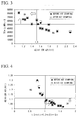
- FIG. 3 is a view illustrating a relationship between the n2 / n1 and TS ⁇ ⁇ before hot stamping and a relationship between an n21 / n11 and TS ⁇ ⁇ after hot stamping, and, according to FIG. 3 , the n2 / n1 before hot stamping and the n21 / n11 after hot stamping are almost the same. This is because the form of the MnS does not change at a heating temperature of a hot stamping, generally.
- the steel sheet having the above-described configuration it is possible to realize a tensile strength of 500 MPa to 1200 MPa, and a significant formability-improving effect is obtained in the steel sheet having the tensile strength of approximately 550 MPa to 850 MPa.
- a galvanizing cold rolled steel sheet in which galvanizing is formed on the steel sheet of the present inventions indicates the steel sheet in which a galvanizing, a hot-dip galvannealing, an electrogalvanizing, an aluminizing, or mixture thereof is formed on a surface of the cold rolled steel sheet, which is preferable in terms of rust prevention.
- a formation of the above-described platings does not impair the effects of the embodiment.
- the above-described platings can be carried out with a well-known method.
- the steel sheet (a cold rolled steel sheet, a hot-dip galvanized cold rolled steel sheet, a galvannealed cold rolled steel sheet, an electrogalvanized cold rolled steel sheet and an aluminized cold rolled steel sheet) will be described.
- the casting rate is desirably 1.0 m/minute to 2.5 m/minute.
- the slab after the casting can be subjected to hot-rolling as it is.
- the slab after cooling has been cooled to less than 1100°C
- a slab temperature is less than 1100°C
- the steel sheet to which Ti and Nb are added since a dissolution of the precipitate becomes insufficient during the heating, which causes a decrease in a strength.
- the heating temperature is more than 1300°C, a generation of a scale becomes great, and there is a case in which it is not possible to make favorable a surface property of the steel sheet.
- the temperature of the heating furnace before carrying out hot-rolling refers to an extraction temperature at an outlet side of the heating furnace
- the in-furnace time refers to a time elapsed from an insertion of the slab into the hot heating furnace to an extraction of the slab from the heating furnace. Since the MnS does not change even after hot stamping as described above, it is preferable to satisfy the expression (G) or the expression (N) in a heating process before hot-rolling.
- the hot-rolling is carried out according to a conventional method.
- the finishing temperature (the hot-rolling end temperature) which is set in a range of an Ar 3 temperature to 970°C.
- the hot-rolling becomes a ( ⁇ + ⁇ ) two-phase region rolling (two-phase region rolling of the ferrite + the martensite), and there is a concern that the elongation may degrade.
- the finishing temperature exceeds 970°C, an austenite grain size coarsens, and the fraction of the ferrite becomes small, and thus, there is a concern that the elongation may degrade.
- a hot-rolling facility may have a plurality of stands.
- the Ar 3 temperature was estimated from an inflection point of a length of a test specimen after carrying out a formastor test.
- the steel After the hot-rolling, the steel is cooled at an average cooling rate of 20 °C/second to 500 °C/second, and is coiled at a predetermined coiling temperature CT.
- the average cooling rate is less than 20 °C/second, the pearlite that causes the degradation of the ductility is likely to be formed.
- an upper limit of the cooling rate is not particularly specified and is set to approximately 500 °C/second in consideration of a facility specification, but is not limited thereto.
- the cold-rolling is carried out under a condition in which a following expression (E) ((L) as well) is satisfied.
- E a following expression
- TS ⁇ ⁇ ⁇ 50000 MPa ⁇ % is ensured before hot stamping and/or after hot stamping.
- the cold-rolling is desirably carried out with a tandem rolling mill in which a plurality of rolling mills are linearly disposed, and the steel sheet is continuously rolled in a single direction, thereby obtaining a predetermined thickness.
- the total cold-rolling reduction is a so-called cumulative reduction, and on a basis of the sheet thickness at an inlet of a first stand, is a percentage of the cumulative reduction (a difference between the sheet thickness at the inlet before a first pass and the sheet thickness at an outlet after a final pass) with respect to the above-described basis.
- the inventors found that, when the expression (E) is satisfied, an obtained form of the martensite structure after the annealing is maintained in almost the same state even after hot stamping is carried out, and therefore the cold rolled steel sheet according to the embodiment becomes advantageous in terms of the elongation or the hole expansibility even after hot stamping.
- the hot stamped steel for which the cold rolled steel sheet for hot stamping according to the embodiment is used is heated up to the two-phase region in the hot stamping, a hard phase including the martensite before hot stamping turns into an austenite structure, and the ferrite before hot stamping remains as it is.
- Carbon (C) in the austenite does not move to the peripheral ferrite.
- the austenite turns into a hard phase including the martensite. That is, when the expression (E) is satisfied and the above-described H2 / H1 is in a predetermined range, the H2 / H1 is maintained even after hot stamping and the formability becomes excellent after hot stamping.
- r, r1, r2 and r3 are the target cold-rolling reductions.
- the cold-rolling is carried out while controlling the target cold-rolling reduction and an actual cold-rolling reduction to become substantially the same value. It is not preferable to carry out the cold-rolling in a state in which the actual cold-rolling reduction is unnecessarily made to be different from the target cold-rolling reduction.
- the embodiment is carried out when the actual cold-rolling reduction satisfies the expression (E).
- the actual cold-rolling reduction is preferably within ⁇ 10% of the target cold-rolling reduction.
- a recrystallization is caused in the steel sheet by carrying out the annealing.
- a hot-dip galvanizing, or a hot-dip galvanizing and alloying treatment is performed on the steel sheet, and then, the steel sheet is cooled with a conventional method.
- the annealing and the cooling forms a desired martensite.
- an annealing temperature it is preferable to carry out the annealing by heating the steel sheet to 700°C to 850°C, and cool the steel sheet to a room temperature or a temperature at which a surface treatment such as the galvanizing is carried out.
- annealing temperature conditions are not particularly specified, but a holding time at 700°C to 850°C is preferably 1 second or more as long as the productivity is not impaired to reliably obtain a predetermined structure, and it is also preferable to appropriately determine a temperature-increase rate in a range of 1 °C/second to an upper limit of a facility capacity, and to appropriately determine the cooling rate in a range of 1 °C/second to the upper limit of the facility capacity.
- temper-rolling is carried out with a conventional method.
- An elongation ratio of the temper-rolling is, generally, approximately 0.2% to 5%, and is preferable within a range in which a yield point elongation is avoided and the shape of the steel sheet can be corrected.
- the ferrite and the hard phase have an ideal distribution form as described above.
- the distribution form is maintained as described above. If it is possible to more reliably ensure the above-described metallographic structure by satisfying the expression (F), the metallographic structure is maintained even after hot stamping, and the formability becomes excellent after hot stamping.
- a hot-dip galvanizing process in which a hot-dip galvanizing is formed between an annealing process and the temper-rolling process, and to form the hot-dip galvanizing on a surface of the cold rolled steel sheet.
- an alloying process in which an alloying treatment is performed after the hot-dip galvanizing. In a case in which the alloying treatment is performed, a treatment in which a galvannealed surface is brought into contact with a substance oxidizing a sheet surface such as water vapor, thereby thickening an oxidized film may be further carried out on the surface.
- an electrogalvanizing process in which an electrogalvanizing is formed after the temper-rolling process as well as the hot-dip galvanizing and the galvannealing and to form an electrogalvanizing on the surface of the cold rolled steel sheet.
- an aluminizing process in which an aluminizing is formed between the annealing process and the temper-rolling process, and to form the aluminizing on the surface of the cold rolled steel sheet.
- the aluminizing is generally hot dip aluminizing, which is preferable.
- the hot stamping is carried out as necessary.
- the hot stamping is desirably carried out, for example, under the following condition.
- the steel sheet is heated up to 700°C to 1000°C at the temperature-increase rate of 5 °C/second to 500 °C/second, and the hot stamping (a hot stamping process) is carried out after the holding time of 1 second to 120 seconds.
- the heating temperature is preferably an Ac 3 temperature or less. The Ac 3 temperature was estimated from the inflection point of the length of the test specimen after carrying out the formastor test.
- the steel sheet is cooled, for example, to the room temperature to 300°C at the cooling rate of 10 °C/second to 1000 °C/second (quenching in the hot stamping).
- the heating temperature in the hot stamping process is less than 700°C, the quenching is not sufficient, and consequently, the strength cannot be ensured, which is not preferable.
- the heating temperature is more than 1000°C, the steel sheet becomes too soft, and, in a case in which a plating, particularly zinc plating, is formed on the surface of the steel sheet, and the sheet, there is a concern that the zinc may be evaporated and burned, which is not preferable. Therefore, the heating temperature in the hot stamping is preferably 700°C to 1000°C.
- the temperature-increase rate is less than 5 °C/second, since it is difficult to control heating in the hot stamping, and the productivity significantly degrades, it is preferable to carry out the heating at the temperature-increase rate of 5 °C/second or more.
- an upper limit of the temperature-increase rate of 500 °C/second depends on a current heating capability, but is not necessary to limit thereto.
- the cooling rate is less than 10 °C/second, since the rate control of the cooling after hot stamping is difficult, and the productivity also significantly degrades, it is preferable to carry out the cooling at the cooling rate of 10 °C/second or more.
- An upper limit of the cooling rate of 1000 °C/second depends on a current cooling capability, but is not necessary to limit thereto.
- a reason for setting a time until the hot stamping after an increase in the temperature to 1 second or more is a current process control capability (a lower limit of a facility capability), and a reason for setting the time until the hot stamping after the increase in the temperature to 120 seconds or less is to avoid an evaporation of the zinc or the like in a case in which the galvanizing or the like is formed on the surface of the steel sheet.
- a reason for setting the cooling temperature to the room temperature to 300°C is to sufficiently ensure the martensite and ensure the strength after hot stamping.
- FIG. 8A and FIG. 8B are flowcharts illustrating the method for producing the cold rolled steel sheet according to the embodiment of the present invention.
- Reference signs S1 to S13 in the drawing respectively correspond to individual process described above.
- the expression (B) and the expression (C) are satisfied even after hot stamping is carried out under the above-described condition.
- the cold-rolling was carried out so that the value of the expression (E) or the expression (L) became a value described in Table 5.
- annealing was carried out in a continuous annealing furnace at an annealing temperature described in Table 2.
- a galvanizing was further formed in the middle of cooling after a soaking in the continuous annealing furnace, and then an alloying treatment was further performed on the part of the steel sheets, thereby forming a galvannealing.
- an electrogalvanizing or an aluminizing was formed on the part of the steel sheets.
- temper-rolling was carried out at an elongation ratio of 1% according to an conventional method.
- CR represents a non-plated, that is, a cold rolled steel sheet
- GI represents that the hot-dip galvanizing is formed on the cold rolled steel sheet
- GA represents that the galvannealing is formed on the cold rolled steel sheet
- EG represents that the electrogalvanizing is formed on the cold rolled steel sheet.
- the expression (H), the expression (I), the expression (J), the expression (K), the expression (L), the expression (M), and the expression (N) are substantially the same as the expression (A),the expression (B), the expression (C), the expression (D), the expression (E), the expression (F), the expression (G), respectively, in headings of the respective tables, the expression (A),the expression (B), the expression (C), the expression (D), the expression (E), the expression (F), and the expression (G), are described as representatives.
- the hot stamped steel Since the cold rolled steel sheet, the hot-dip galvanized cold rolled steel sheet, and the galvannealed cold rolled steel sheet, which are obtained in the present invention and satisfy TS ⁇ ⁇ ⁇ 50000 MPa ⁇ % before hot stamping and after hot stamping, the hot stamped steel has a high press workability and a high strength, and satisfies the current requirements for a vehicle such as an additional reduction of the weight and a more complicated shape of a component.
Landscapes
- Chemical & Material Sciences (AREA)
- Engineering & Computer Science (AREA)
- Materials Engineering (AREA)
- Mechanical Engineering (AREA)
- Metallurgy (AREA)
- Organic Chemistry (AREA)
- Chemical Kinetics & Catalysis (AREA)
- Thermal Sciences (AREA)
- Physics & Mathematics (AREA)
- Crystallography & Structural Chemistry (AREA)
- Oil, Petroleum & Natural Gas (AREA)
- Heat Treatment Of Sheet Steel (AREA)
- Coating With Molten Metal (AREA)
- Heat Treatment Of Articles (AREA)
Abstract
Description
- The present invention relates to a cold rolled steel sheet having an excellent formability before hot stamping and/or after hot stamping, and a method for producing the same.
- Priority is claimed on Japanese Patent Application No.
2012-004549, filed January 13, 2012 2012-004864, filed January 13, 2012 - Recently, a steel sheet for a vehicle is required to be improved in terms of collision safety and to have a reduced weight. In such a situation, hot stamping (also called hot pressing, hot stamping, diequenching, press quenching or the like) is drawing attention as a method for obtaining a high strength. The hot stamping refers to a forming method in which a steel sheet is heated at a high temperature of, for example, 700°C or more, then hot-formed so as to improve the formability of the steel sheet, and quenched by cooling after forming, thereby obtaining desired material qualities. As described above, a steel sheet used for a body structure of a vehicle is required to have high press workability and a high strength. A steel sheet having a ferrite and martensite structure, a steel sheet having a ferrite and bainite structure, a steel sheet containing retained austenite in a structure or the like is known as a steel sheet having both press workability and high strength. Among these steel sheets, a multi-phase steel sheet having martensite dispersed in a ferrite base has a low yield strength and a high tensile strength, and furthermore, has excellent elongation characteristics. However, the multi-phase steel sheet has a poor hole expansibility since stress concentrates at the interface between the ferrite and the martensite, and cracking is likely to initiate from the interface.
- For example,
patent Documents 1 to 3 disclose the multi-phase steel sheet. In addition,Patent Documents 4 to 6 describe relationships between the hardness and formability of a steel sheet. - However, even with these techniques of the related art, it is difficult to obtain a steel sheet which satisfies the current requirements for a vehicle such as an additional reduction of weight and more complicated shapes of components.
-
- [Patent Document 1] Japanese Unexamined Patent Application, First Publication No.
H6-128688 - [Patent Document 2] Japanese Unexamined Patent Application, First Publication No.
2000-319756 - [Patent Document 3] Japanese Unexamined Patent Application, First Publication No.
2005-120436 - [Patent Document 4] Japanese Unexamined Patent Application, First Publication No.
2005-256141 - [Patent Document 5] Japanese Unexamined Patent Application, First Publication No.
2001-355044 - [Patent Document 6] Japanese Unexamined Patent Application, First Publication No.
H11-189842 - An object of the present invention is to provide a cold rolled steel sheet, a hot-dip galvanized cold rolled steel sheet, a galvannealed cold rolled steel sheet, an electrogalvanized cold rolled steel sheet, and an aluminized cold rolled steel sheet, which are capable of ensuring a strength before and after hot stamping and have a more favorable hole expansibility, and a method for producing the same.
- The present inventors carried out intensive studies regarding a cold rolled steel sheet, a hot-dip galvanized cold rolled steel sheet, a galvannealed cold rolled steel sheet, an electrogalvanized cold rolled steel sheet, and an aluminized cold rolled steel sheet that ensured a strength before hot stamping (before heating for carrying out quenching in a hot stamping process) and/or after hot stamping (after quenching in a hot stamping process), and having an excellent formability (hole expansibility). As a result, it was found that, regarding the steel composition, when an appropriate relationship is established among the amount of Si, the amount of Mn and the amount of C, a fraction of a ferrite and a fraction of a martensite in the steel sheet are set to predetermined fractions, and the hardness ratio (difference of a hardness) of the martensite between a surface part of a sheet thickness and a central part of the sheet thickness of the steel sheet and the hardness distribution of the martensite in the central part of the sheet thickness are set in specific ranges, it is possible to industrially produce a cold rolled steel sheet capable of ensuring, in the steel sheet, a greater formability than ever, that is, a characteristic of TS × λ ≥ 50000MPa•% that is a product of a tensile strength TS and a hole expansion ratio λ. Furthermore, it was found that, when this cold rolled steel sheet is used for hot stamping, a steel sheet having excellent formability even after hot stamping is obtained. In addition, it was also clarified that the suppression of a segregation of MnS in the central part of the sheet thickness of the cold rolled steel sheet is also effective in improving the formability (hole expansibility) of the steel sheet before hot stamping and/or after hot stamping. In addition, it was also found that, in cold-rolling, an adjustment of a fraction of a cold-rolling reduction to a total cold-rolling reduction (cumulative rolling reduction) from an uppermost stand to a third stand based on the uppermost stand within a specific range is effective in controlling a hardness of the martensite. Furthermore, the inventors have found a variety of aspects of the present invention as described below. In addition, it was found that the effects are not impaired even when a hot-dip galvanized layer, a galvannealed layer, an electrogalvanized layer and an aluminizied layer are formed on the cold rolled steel sheet.
-
- (1) That is, according to a first aspect of the present invention, a cold rolled steel sheet includes, by mass%, C: 0.030% to 0.150%, Si: 0.010% to 1.000%, Mn: 1.50% to 2.70%, P: 0.001% to 0.060%, S: 0.001% to 0.010%, N: 0.0005% to 0.0100%, Al: 0.010% to 0.050%, and optionally one or more of B: 0.0005% to 0.0020%, Mo: 0.01% to 0.50%, Cr: 0.01% to 0.50%, V: 0.001% to 0.100%, Ti: 0.001% to 0.100%, Nb: 0.001% to 0.050%, Ni: 0.01% to 1.00%, Cu: 0.01% to 1.00%, Ca: 0.0005% to 0.0050%, REM: 0.0005% to 0.0050%, and a balance including Fe and unavoidable impurities, in which, when [C] represents an amount of C by mass%, [Si] represents an amount of Si by mass%, and [Mn] represents an amount of Mn by mass%, a following expression (A) is satisfied, a metallographic structure before a hot stamping includes 40% to 90% of a ferrite and 10% to 60% of a martensite in an area fraction, a total of an area fraction of the ferrite and an area fraction of the martensite is 60% or more, the metallographic structure may optionally further includes one or more of 10% or less of a perlite in an area fraction, 5% or less of a retained austenite in a volume ratio, and less than 40% of a bainite as a remainder in an area fraction, a hardness of the martensite measured with a nanoindenter satisfies a following expression (B) and a following expression(C) before the hot stamping, TS × λ which is a product of a tensile strength TS and a hole expansion ratio λ is 50000MPa•% or more,


and
the H1 is an average hardness of the martensite in a surface part of a sheet thickness before the hot stamping, the H2 is an average hardness of the martensite in a central part of the sheet thickness which is an area having a width of 200 µm in a thickness direction at a center of the sheet thickness before the hot stamping, and the σHM is a variance of the hardness of the martensite in the central part of the sheet thickness before the hot stamping. - (2) In the cold rolled steel sheet according to the above (1), an area fraction of MnS existing in the cold rolled steel sheet and having an equivalent circle diameter of 0.1 µm to 10 µm may be 0.01% or less, and a following expression (D) may be satisfied,

and
the n1 is an average number density per 10000 µm2 of the MnS having the equivalent circle diameter of 0.1 µm to 10 µm in a 1/4 part of the sheet thickness before the hot stamping, and the n2 is an average number density per 10000 µm2 of the MnS having the equivalent circle diameter of 0.1 µm to 10 µm in the central part of the sheet thickness before the hot stamping. - (3) In the hot stamped steel according to the above (1) or (2), a galvanizing may be formed on a surface thereof.
- (4) According to another aspect of the present invention, there is provided a method for producing a cold rolled steel sheet including casting a molten steel having a chemical composition according to the above (1) and obtaining a steel, heating the steel, hot-rolling the steel with a hot-rolling mill including a plurality of stands, coiling the steel after the hot-rolling, pickling the steel after the coiling, cold-rolling the steel with a cold-rolling mill including a plurality of stands after the pickling under a condition satisfying a following expression (E), annealing in which the steel is annealed under 700°C to 850°C and cooled after the cold-rolling, temper-rolling the steel after the annealing,

and
the ri (i = 1, 2, 3) represents an individual target cold-rolling reduction at an ith stand (i = 1, 2, 3) based on an uppermost stand in the plurality of stands in the cold-rolling in unit %, and the r represents a total cold-rolling reduction in the cold-rolling in unit %. - (5) The method for producing the cold rolled steel sheet according to the above (4) may further include galvanizing the steel between the annealing and the temper-rolling.
- (6) In the method for producing the cold rolled steel sheet according to the above (4), when CT represents a coiling temperature in the coiling in unit °C, [C] represents the amount of C by mass%, [Mn] represents the amount of Mn by mass%, [Si] represents the amount of Si by mass%, and [Mo] represents the amount of Mo by mass% in the steel sheet, a following expression (F) may be satisfied,

- (7) In the method for producing the cold rolled steel sheet according to the above (6), when T represents a heating temperature in the heating in unit °C, t represents an in-furnace time in the heating in unit minute, [Mn] represents the amount of Mn by mass%, and [S] represents an amount of S by mass% in the steel sheet, a following expression (G) may be satisfied,

- (8) That is, according to a first aspect of the present invention, there is provided a cold rolled steel sheet including, by mass%, C: 0.030% to 0.150%, Si: 0.010% to 1.000%, Mn: 1.50% to 2.70%, P: 0.001% to 0.060%, S: 0.001% to 0.010%, N: 0.0005% to 0.0100%, Al: 0.010% to 0.050%, and optionally one or more of B: 0.0005% to 0.0020%, Mo: 0.01% to 0.50%, Cr: 0.01% to 0.50%, V: 0.001% to 0.100%, Ti: 0.001% to 0.100%, Nb: 0.001% to 0.050%, Ni: 0.01% to 1.00%, Cu: 0.01% to 1.00%, Ca: 0.0005% to 0.0050%, REM: 0.0005% to 0.0050%, and a balance including Fe and unavoidable impurities, in which, when [C] represents an amount of C by mass%, [Si] represents an amount of Si by mass%, and [Mn] represents an amount of Mn by mass%, a following expression (H) is satisfied, a metallographic structure after a hot stamping includes 40% to 90% of a ferrite and 10% to 60% of a martensite in an area fraction, a total of an area fraction of the ferrite and an area fraction of the martensite is 60% or more, the metallographic structure may optionally further includes one or more of 10% or less of a perlite in an area fraction, 5% or less of a retained austenite in a volume ratio, and less than 40% of a bainite as a remainder in an area fraction, a hardness of the martensite measured with a nanoindenter satisfies a following expression (I) and a following expression(J) after the hot stamping, TS × λ which is a product of a tensile strength TS and a hole expansion ratio λ is 50000MPa•% or more,


and
the H11 is an average hardness of the martensite in a surface part of a sheet thickness after the hot stamping, the H21 is an average hardness of the martensite in a central part of the sheet thickness which is an area having a width of 200 µm in a thickness direction at a center of the sheet thickness after the hot stamping, and the σHM1 is a variance of the average hardness of the martensite in the central part of the sheet thickness after the hot stamping. - (9) In the cold rolled steel sheet for the hot stamping according to the above (8), an area fraction of MnS existing in the cold rolled steel sheet and having an equivalent circle diameter of 0.1 µm to 10 µm may be 0.01% or less, and a following expression (K) may be satisfied,

and
the n11 is an average number density per 10000 µm2 of the MnS having the equivalent circle diameter of 0.1 µm to 10 µm in a 1/4 part of the sheet thickness after the hot stamping, and the n21 is an average number density per 10000 µm2 of the MnS having the equivalent circle diameter of 0.1 µm to 10 µm in the central part of the sheet thickness after the hot stamping. - (10) In the cold rolled steel sheet for the hot stamping according to the above (8) or (9), a hot dip galvanizing may be formed on a surface thereof.
- (11) In the cold rolled steel sheet for the hot stamping according to the above (10), a galvannealing may be formed on a surface of the hot dip galvanizing.
- (12) In the cold rolled steel sheet for the hot stamping according to the above (8) or (9), an electrogalvanizing may be formed on a surface thereof.
- (13) In the cold rolled steel sheet for the hot stamping according to the above (8) or (9), an aluminizing may be formed on a surface thereof.
- (14) According to another aspect of the present invention, there is provided a method for producing a cold rolled steel sheet including casting a molten steel having a chemical composition according to the above (8) and obtaining a steel, heating the steel, hot-rolling the steel with a hot-rolling mill including a plurality of stands, coiling the steel after the hot-rolling, pickling the steel after the coiling, cold-rolling the steel with a cold-rolling mill including a plurality of stands after the pickling under a condition satisfying a following expression (L), annealing in which the steel is annealed under 700°C to 850°C and cooled after the cold-rolling, and temper-rolling the steel after the annealing,

and
the ri (i = 1, 2, 3) represents an individual target cold-rolling reduction at an ith stand (i = 1, 2, 3) based on an uppermost stand in the plurality of stands in the cold-rolling in unit %, and the r represents a total cold-rolling reduction in the cold-rolling in unit %. - (15) In the method for producing the cold rolled steel sheet for the hot stamping according to the above (14), when CT represents a coiling temperature in the coiling in unit °C, [C] represents the amount of C by mass%, [Mn] represents the amount of Mn by mass%, [Si] represents the amount of Si by mass%, and [Mo] represents the amount of Mo by mass% in the steel sheet, a following expression (M) may be satisfied,

- (16) In the method for producing the cold rolled steel sheet for the hot stamping according to the above (15), when T represents a heating temperature in the heating in unit °C, t represents an in-furnace time in the heating in unit minute, [Mn] represents the amount of Mn by mass%, and [S] represents an amount of S by mass% in the steel sheet, a following expression (N) may be satisfied,

- (17) The producing method according to any one of the above (14) to (16) may further include galvanizing the steel between the annealing and the temper-rolling.
- (18) The producing method according to the above (17) may further include alloying the steel between the galvanizing and the temper-rolling.
- (19) The producing method according to any one of the above (14) to (16) may further include electrogalvanizing the steel after the temper-rolling.
- (20) The producing method according to any one of the above (14) to (16) may further include aluminizing the steel between the annealing and the temper-rolling.
- The hot stamped steel obtained by using the steel sheet any one of (1) to (20) has an excellent formability.
- According to the present invention, since an appropriate relationship is established among the amount of C, the amount of Mn and the amount of Si, and the hardness of the martensite measured with a nanoindenter is set to an appropriate value, it is possible to obtain a more favorable hole expansibility before hot stamping and/or after hot stamping in the hot stamped steel.
-
-
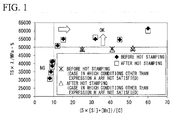
FIG. 1 is a graph illustrating the relationship between (5 × [Si] + [Mn]) / [C] and TS × λ before hot stamping and after hot stamping. -
FIG. 2A is a graph illustrating a foundation of an expression (B) and is a graph illustrating the relationship between H2 / H1 and a σHM before hot stamping and the relationship between H21 / H11 and σHM1 after hot stamping. -
FIG. 2B is a graph illustrating a foundation of an expression (C) and is a graph illustrating the relationship between the σHM and TS × λ before hot stamping and the relationship between σHM1 and TS × λ after hot stamping. -
FIG. 3 is a graph illustrating the relationship between n2 / n1 and TS × λ before hot stamping and the relationship between n21 / n11 and TS × λ after hot stamping, and illustrating a foundation of an expression (D). -
FIG. 4 is a graph illustrating the relationship between 1.5 × r1 / r + 1.2 × r2 / r + r3 / r and H2 / H1 before hot stamping and the relationship between 1.5 × r1 / r + 1.2 × r2 / 2 + r3 / r and H21 / H11 after hot stamping, and illustrating a foundation of an expression (E). -
FIG. 5A is a graph illustrating the relationship between an expression (F) and a fraction of a martensite. -
FIG. 5B is a graph illustrating the relationship between the expression (F) and a fraction of a pearlite. -
FIG. 6 is a graph illustrating the relationship between T × ln(t) / (1.7 × [Mn] + [S]) and TS × λ, and illustrating a foundation of an expression (G). -
FIG. 7 is a perspective view of a hot stamped steel used in an example. -
FIG. 8A is a flowchart illustrating a method for producing the cold rolled steel sheet according to an embodiment of the present invention. -
FIG. 8B is a flowchart illustrating a method for producing the cold rolled steel sheet after hot stamping according to another embodiment of the present invention. - As described above, it is important to establish an appropriate relationship among the amount of Si, the amount of Mn and the amount of C and provide an appropriate hardness to a martensite in a predetermined position in a steel sheet in order to improve formability (hole expansibility). Thus far, there have been no studies regarding the relationship between the formability and the hardness of the martensite in a steel sheet before hot stamping or after hot stamping.
- Herein, reasons for limiting a chemical composition of a cold rolled steel sheet before hot stamping according to an embodiment of the present invention (in some cases, also referred to as a cold rolled steel sheet before hot stamping according to the present embodiment), a cold rolled steel sheet after hot stamping according to an embodiment of the present invention (in some cases, also referred to as a cold rolled steel sheet after hot stamping according to the present embodiment), and steel used for manufacture thereof will be described. Hereinafter, "%" that is a unit of an amount of an individual component indicates "mass%".
- C is an important element to strengthen the martensite and increase the strength of the steel. When the amount of C is less than 0.030%, it is not possible to sufficiently increase the strength of the steel. On the other hand, when the amount of C exceeds 0.150%, degradation of the ductility (elongation) of the steel becomes significant. Therefore, the range of the amount of C is set to 0.030% to 0.150%. In a case in which there is a demand for high hole expansibility, the amount of C is desirably set to 0.100% or less.
- Si is an important element for suppressing a formation of a harmful carbide and obtaining a multi-phase structure mainly including a ferrite structure and a balance of the martensite. However, in a case in which the amount of Si exceeds 1.000%, the elongation or hole expansibility of the steel degrades, and a chemical conversion treatment property also degrades. Therefore, the amount of Si is set to 1.000% or less. In addition, while the Si is added for deoxidation, a deoxidation effect is not sufficient when the amount of Si is less than 0.010%. Therefore, the amount of Si is set to 0.010% or more.
- Al is an important element as a deoxidizing agent. To obtain the deoxidation effect, the amount of Al is set to 0.010% or more. On the other hand, even when the Al is excessively added, the above-described effect is saturated, and conversely, the steel becomes brittle. Therefore, the amount of Al is set in a range of 0.010% to 0.050%.
- Mn is an important element for increasing a hardenability of the steel and strengthening the steel. However, when the amount of Mn is less than 1.50%, it is not possible to sufficiently increase the strength of the steel. On the other hand, when the amount of Mn exceeds 2.70%, since the hardenability increases more than necessary, an increase in the strength of the steel is caused, and consequently, the elongation or hole expansibility of the steel degrades. Therefore, the amount of Mn is set in a range of 1.50% to 2.70%. In a case in which there is a demand for high elongation, the amount of Mn is desirably set to 2.00% or less.
- In a case in which the amount is large, P segregates at a grain boundary, and deteriorates the local ductility and weldability of the steel. Therefore, the amount of P is set to 0.060% or less. On the other hand, since an unnecessary decrease of P leads to an increasing in the cost of refining, the amount of P is desirably set to 0.001% or more.
- S is an element that forms MnS and significantly deteriorates the local ductility or weldability of the steel. Therefore, the upper limit of the amount of S is set to 0.010%. In addition, in order to reduce refining costs, a lower limit of the amount of S is desirably set to 0.001%.
- N is an important element to precipitate AlN and the like and miniaturize crystal grains. However, when the amount ofN exceeds 0.0100%, a N solid solution (nitrogen solid solution) remains and the ductility of the steel is degraded. Therefore, the amount of N is set to 0.0100% or less. Due to a problem of refining costs, the lower limit of the amount of N is desirably set to 0.0005%.
- The cold rolled steel sheet according to the embodiment has a basic composition including the above-described components, Fe as a balance and unavoidable impurities, but may further contain any one or more elements of Nb, Ti, V, Mo, Cr, Ca, REM (rare earth metal), Cu, Ni and B as elements that have thus far been used in amounts that are equal to or less than the below-described upper limits to improve the strength, to control a shape of a sulfide or an oxide, and the like. Since these chemical elements are not necessarily added to the steel sheet, the lower limits thereof are 0%.
- Nb, Ti and V are elements that precipitate a fine carbonitride and strengthen the steel. In addition, Mo and Cr are elements that increase hardenability and strengthen the steel. To obtain these effects, it is desirable to contain Nb: 0.001% or more, Ti: 0.001% or more, V: 0.001% or more, Mo: 0.01% or more, and Cr: 0.01% or more. However, even when Nb: more than 0.050%, Ti: more than 0.100%, V: more than 0.100%, Mo: more than 0.50%, and Cr: more than 0.50% are contained, the strength-increasing effect is saturated, and there is a concern that the degradation of the elongation or the hole expansibility may be caused.
- The steel may further contain Ca in a range of 0.0005% to 0.0050%. Ca controls the shape of the sulfide or the oxide and improves the local ductility or hole expansibility. To obtain this effect using Ca, it is preferable to add 0.0005% or more of Ca. However, since there is a concern that an excessive addition may deteriorate workability, the upper limit of the amount of Ca is set to 0.0050%. For the same reason, for the rare earth metal (REM) as well, it is preferable to set the lower limit of the amount to 0.0005% and an upper limit of the amount to 0.0050%.
- The steel may further contain Cu: 0.01% to 1.00%, Ni: 0.01% to 1.00% and B: 0.0005% to 0.0020%. These elements also can improve the hardenability and increase the strength of the steel. However, to obtain the effect, it is preferable to contain Cu: 0.01% or more, Ni: 0.01% or more and B: 0.0005% or more. In a case in which the amounts are equal to or less than the above-described values, the effect that strengthens the steel is small. On the other hand, even when Cu: more than 1.00%, Ni: more than 1.00% and B: more than 0.0020% are added, the strength-increasing effect is saturated, and there is a concern that the ductility may degrade.
- In a case in which the steel contains B, Mo, Cr, V, Ti, Nb, Ni, Cu, Ca and REM, one or more elements are contained. The balance of the steel is composed of Fe and unavoidable impurities. Elements other than the above-described elements (for example, Sn, As and the like) may be further contained as unavoidable impurities as long as the elements do not impair characteristics. Furthermore, when B, Mo, Cr, V, Ti, Nb, Ni, Cu, Ca and REM are contained in amounts that are less than the above-described lower limits, the elements are treated as unavoidable impurities.
- In addition, in the cold rolled steel sheet according to the embodiment, as illustrated in
FIG. 1 , when the amount of C (mass%), the amount of Si (mass%) and the amount of Mn (mass%) are represented by [C], [Si] and [Mn] respectively, it is important to satisfy a following expression (A) ((H) as well).
- When the above expression (A) is satisfied before hot stamping and/or after hot stamping, it is possible to satisfy a condition of TS × λ ≥ 50000MPa•%. When the value of (5 × [Si] + [Mn]) / [C] is 11 or less, it is not possible to obtain a sufficient hole expansibility. This is because, when the amount of C is large, the hardness of a hard phase becomes too high, the hardness difference (ratio of the hardness) between the hard phase and a soft phase becomes great, and therefore the λ value deteriorates, and, when the amount of Si or the amount of Mn is small, TS becomes low.
- Generally, it is the martensite rather than the ferrite to dominate the formability (hole expansibility) in a dual-phase steel (DP steel). As a result of intensive studies by the inventors regarding the hardness of martensite, it was clarified that, when the hardness difference (the ratio of the hardness) of the martensite between a surface part of a sheet thickness and a central part of the sheet thickness, and the hardness distribution of the martensite in the central part of the sheet thickness are in a predetermined state in a phase of before hot stamping, the state is almost maintained even after quenching in a hot stamping process as illustrated in
FIGS. 2A and 2B , and the formability such as elongation or hole expansibility becomes favorable. This is considered to be because the hardness distribution of the martensite formed before hot stamping still has a significant effect even after hot stamping, and alloy elements concentrated in the central part of the sheet thickness still hold a state of being concentrated in the central part of the sheet thickness even after hot stamping. That is, in the steel sheet before hot stamping, in a case in which the hardness ratio between the martensite in the surface part of the sheet thickness and the martensite in the central part of the sheet thickness is great, or a variance of the hardness of the martensite is great, the same tendency is exhibited even after hot stamping. As illustrated inFIGS. 2A and 2B , the hardness ratio between the surface part of the sheet thickness and the central part of the sheet thickness in the cold rolled steel sheet according to the embodiment before hot stamping, and the hardness ratio between the surface part of the sheet thickness and the central part of the sheet thickness in the steel sheet obtained by hot stamping the cold rolled steel sheet according to the embodiment, are almost the same. In addition, similarly, the variance of the hardness of the martensite in the central part of the sheet thickness in the cold rolled steel sheet according to the embodiment before hot stamping, and the variance of the hardness of the martensite in the central part of the sheet thickness in the steel sheet obtained by hot stamping the cold rolled steel sheet according to the embodiment, are almost the same. Therefore, the formability of the steel sheet obtained by hot stamping the cold rolled steel sheet according to the embodiment is similarly excellent to the formability of the cold rolled steel sheet according to the embodiment before hot stamping. - In addition, regarding the hardness of the martensite measured with an nanoindenter manufactured by Hysitron Corporation at a magnification of 1000 times, it is found in the present invention that a following expression (B) and a following expression (C) ((I) and (J) as well) being satisfied before hot stamping and/or after hot stamping are advantageous to the formability of the steel sheet. Here, "H1" is the average hardness of the martensite in the surface part of the sheet thickness that is within an area having a width of 200 µm in a thickness direction from an outermost layer of the steel sheet in the thickness direction in the steel sheet before hot stamping, "H2" is the average hardness of the martensite in an area having a width of ± 100 µm in the thickness direction from the central part of the sheet thickness in the central part of the sheet thickness in the steel sheet before hot stamping, and "σHM" is the variance of the hardness of the martensite in an area having a width of ±100 µm in the thickness direction from the central part of the sheet thickness before hot stamping. In addition, "H11" is the hardness of the martensite in the surface part of the sheet thickness in the cold rolled steel sheet for hot stamping after hot stamping, "H21" is the hardness of the martensite in the central part of the sheet thickness, that is, in an area having a width of 200 µm in the thickness direction in a center of the sheet thickness after hot stamping, and "σHM1" is the variance of the hardness of the martensite in the central part of the sheet thickness after hot stamping. The H1, H11, H2, H21, σHM and σHM1 are obtained respectively from 300-point measurements for each. An area having a width of ± 100 µm in the thickness direction from the central part of the sheet thickness refers to an area having a center at the center of the sheet thickness and having a dimension of 200 µm in the thickness direction.


- In addition, here, the variance is a value obtained using a following expression (O) and indicating a distribution of the hardness of the martensite.
[Expression 1]
xave represents the average value of the hardness, and xi represents an ith hardness. - A value of H2/H1 of 1.10 or more represents that the hardness of the martensite in the central part of the sheet thickness is 1.1 or more times the hardness of the martensite in the surface part of the sheet thickness, and, in this case, σHM becomes 20 or more as illustrated in
FIG. 2A . When the value of the H2 / H1 is 1.10 or more, the hardness of the central part of the sheet thickness becomes too high, TS × λ becomes less than 50000MPa•% as illustrated inFIG. 2B , and a sufficient formability cannot be obtained both before quenching (that is, before hot stamping) and after quenching (that is, after hot stamping). Furthermore, theoretically, there is a case in which the lower limit of the H2 / H1 becomes the same in the central part of the sheet thickness and in the surface part of the sheet thickness unless a special thermal treatment is carried out; however, in an actual production process, when considering productivity, the lower limit is, for example, up to approximately 1.005. What has been described above regarding the value of H2 / H1 shall also apply in a similar manner to the value of H21 / H11. - In addition, the variance σHM being 20 or more indicates that a scattering of the hardness of the martensite is large, and parts in which the hardness is too high locally exist. In this case, TS × λ becomes less than 50000MPa•% as illustrated in
FIG. 2B , and a sufficient formability cannot be obtained. What has been described above regarding the value of the σHM shall also apply in a similar manner to the value of the σHM1. - In the cold rolled steel sheet according to the embodiment, the area fraction of the ferrite in a metallographic structure before hot stamping and/or after hot stamping is 40% to 90%. When the area fraction of the ferrite is less than 40%, a sufficient elongation or a sufficient hole expansibility cannot be obtained. On the other hand, when the area fraction of the ferrite exceeds 90%, the martensite becomes insufficient, and a sufficient strength cannot be obtained. Therefore, the area fraction of the ferrite before hot stamping and/or after hot stamping is set to 40% to 90%. In addition, the metallographic structure of the steel sheet before hot stamping and/or after hot stamping also includes the martensite, an area fraction of the martensite is 10% to 60%, and a total of the area fraction of the ferrite and the area fraction of the martensite is 60% or more. All or principal parts of the metallographic structure of the steel sheet before hot stamping and/or after hot stamping are occupied by the ferrite and the martensite, and furthermore, one or more of a pearlite, a bainite as remainder and a retained austenite may be included in the metallographic structure. However, when the retained austenite remains in the metallographic structure, a secondary working brittleness and a delayed fracture characteristic are likely to degrade. Therefore, it is preferable that the retained austenite is substantially not included; however, unavoidably, 5% or less of the retained austenite in a volume ratio may be included. Since the pearlite is a hard and brittle structure, it is preferable not to include the pearlite in the metallographic structure before hot stamping and/or after hot stamping; however, unavoidably, up to 10% of the pearlite in an area fraction may be included. Furthermore, the amount of the bainite as remainder is preferably 40% or less in an area fraction with respect to a region excluding the ferrite and the martensite. Here, the metallographic structures of the ferrite, the bainite as remainder and the pearlite were observed through Nital etching, and the metallographic structure of the martensite was observed through Le pera etching. In both cases, a 1/4 part of the sheet thickness was observed at a magnification of 1000 times. The volume ratio of the retained austenite was measured with an X-ray diffraction apparatus after polishing the steel sheet up to the 1/4 part of the sheet thickness. The 1/4 part of the sheet thickness refers to a
part 1/4 of the thickness of the steel sheet away from a surface of the steel sheet in a thickness direction of the steel sheet in the steel sheet. - In the embodiment, the hardness of the martensite measured at a magnification of 1000 times is specified by using a nanoindenter. Since an indentation formed in an ordinary Vickers hardness test is larger than the martensite, according to the Vickers hardness test, while a macroscopic hardness of the martensite and peripheral structures thereof (ferrite and the like) can be obtained, it is not possible to obtain the hardness of the martensite itself. Since the formability (hole expansibility) is significantly affected by the hardness of the martensite itself, it is difficult to sufficiently evaluate the formability only with a Vickers hardness. On the contrary, in the present invention, since an appropriate relationship of the hardness of the martensite before hot stamping and/or after hot stamping measured with the nanoindenter is provided, it is possible to obtain an extremely favorable formability.
- In addition, in the cold rolled steel sheet before hot stamping and/or after hot stamping, as a result of observing MnS at a 1/4 part of the sheet thickness and in the central part of the sheet thickness, it was found that it is preferable that an area fraction of the MnS having an equivalent circle diameter of 0.1 µm to 10 µm is 0.01% or less, and, as illustrated in
FIG. 3 , a following expression (D) ((K) as well) is satisfied in order to favorably and stably satisfy the condition of TS × λ ≥ 50000MPa•% before hot stamping and/or after hot stamping. When the MnS having an equivalent circle diameter of 0.1 µm or more exists during a hole expansibility test, since stress concentrates in the vicinity thereof, cracking is likely to occur. A reason for not counting the MnS having the equivalent circle diameter of less than 0.1 µm is that the MnS having the equivalent circle diameter of less than 0.1 µm little affects the stress concentration. In addition, a reason for not counting the MnS having the equivalent circle diameter of more than 10 µm is that, the MnS having the above-described grain size is included in a latter half, the grain size is too large, and the steel sheet becomes unsuitable for working. Furthermore, when the area fraction of the MnS having the equivalent circle diameter of 0.1 µm or more exceeds 0.01%, since it becomes easy for fine cracks generated due to the stress concentration to propagate, the hole expansibility further deteriorates, and there is a case in which the condition of TS × λ ≥ 50000MPa•% is not satisfied. Here, "n1" and "n11" are number densities of the MnS having the equivalent circle diameter of 0.1 µm to 10 µm at the 1/4 part of the sheet thickness before hot stamping and after hot stamping respectively, and "n2" and "n21" are number densities of the MnS having the equivalent circle diameter of 0.1 µm to 10 µm at the central part of the sheet thickness before hot stamping and after hot stamping respectively.

- These relationships are all identical to the steel sheet before hot stamping and the steel sheet after hot stamping.
- When the area fraction of the MnS having the equivalent circle diameter of 0.1 µm to 10 µm is more than 0.01%, the formability is likely to degrade. The lower limit of the area fraction of the MnS is not particularly specified, however, 0.0001% or more of the MnS is present due to a below-described measurement method, a limitation of a magnification and a visual field, and an original amount of Mn or the S. In addition, a value of an n2/n1 (or an n21/n11) being 1.5 or more represents that a number density of the MnS having the equivalent circle diameter of 0.1 µm to 10 µm in the central part of the sheet thickness is 1.5 or more times the number density of the MnS having the equivalent circle diameter of 0.1 µm to 10 µm in the 1/4 part of the sheet thickness. In this case, the formability is likely to degrade due to a segregation of the MnS in the central part of the sheet thickness. In the embodiment, the equivalent circle diameter and number density of the MnS having the equivalent circle diameter of 0.1 µm to 10 µm were measured with a field emission scanning electron microscope (Fe-SEM) manufactured by JEOL Ltd. At a measurement, a magnification was 1000 times, and a measurement area of the visual field was set to 0.12 × 0.09 mm2 (= 10800 µm2 ≈ 10000 µm2). Ten visual fields were observed in the 1/4 part of the sheet thickness, and ten visual fields were observed in the central part of the sheet thickness. The area fraction of the MnS having the equivalent circle diameter of 0.1 µm to 10 µm was computed with particle analysis software. In the cold rolled steel sheet according to the embodiment, a form (a shape and a number) of the MnS formed before hot stamping is the same before and after hot stamping.
FIG. 3 is a view illustrating a relationship between the n2 / n1 and TS × λ before hot stamping and a relationship between an n21 / n11 and TS × λ after hot stamping, and, according toFIG. 3 , the n2 / n1 before hot stamping and the n21 / n11 after hot stamping are almost the same. This is because the form of the MnS does not change at a heating temperature of a hot stamping, generally. - According to the steel sheet having the above-described configuration, it is possible to realize a tensile strength of 500 MPa to 1200 MPa, and a significant formability-improving effect is obtained in the steel sheet having the tensile strength of approximately 550 MPa to 850 MPa.
- Furthermore, a galvanizing cold rolled steel sheet in which galvanizing is formed on the steel sheet of the present inventions indicates the steel sheet in which a galvanizing, a hot-dip galvannealing, an electrogalvanizing, an aluminizing, or mixture thereof is formed on a surface of the cold rolled steel sheet, which is preferable in terms of rust prevention. A formation of the above-described platings does not impair the effects of the embodiment. The above-described platings can be carried out with a well-known method.
- Hereinafter, a method for producing the steel sheet (a cold rolled steel sheet, a hot-dip galvanized cold rolled steel sheet, a galvannealed cold rolled steel sheet, an electrogalvanized cold rolled steel sheet and an aluminized cold rolled steel sheet) will be described.
- When producing the steel sheet according to the embodiment, as an ordinary condition, a molten steel melted in a converter is continuously cast, thereby producing a slab. In the continuous casting, when a casting rate is fast, a precipitate of Ti and the like becomes too fine, and, when the casting rate is slow, a productivity deteriorates, and consequently, the above-described precipitate coarsens and the number of particles decreases, and thus, there is a case other characteristics such as a delayed fracture cannot be controlled. Therefore, the casting rate is desirably 1.0 m/minute to 2.5 m/minute.
- The slab after the casting can be subjected to hot-rolling as it is. Alternatively, in a case in which the slab after cooling has been cooled to less than 1100°C, it is possible to reheat the slab after cooling to 1100°C to 1300°C in a tunnel furnace or the like and subject the slab to hot-rolling. When a slab temperature is less than 1100°C, it is difficult to ensure a finishing temperature in the hot-rolling, which causes a degradation of the elongation. In addition, in the steel sheet to which Ti and Nb are added, since a dissolution of the precipitate becomes insufficient during the heating, which causes a decrease in a strength. On the other hand, when the heating temperature is more than 1300°C, a generation of a scale becomes great, and there is a case in which it is not possible to make favorable a surface property of the steel sheet.
- In addition, to decrease the area fraction of the MnS having the equivalent circle diameter of 0.1 µm to 10 µm, when the amount of Mn and the amount of S in the steel are respectively represented by [Mn] and [S] by mass%, it is preferable for a temperature T (°C) of a heating furnace before carrying out hot-rolling, an in-furnace time t (minutes), [Mn] and [S] to satisfy a following expression (G) ((N) as well) as illustrated in
FIG. 6 .
- When T × ln(t) / (1.7 × [Mn] + [S]) is equal to or less than 1500, the area fraction of the MnS having the equivalent circle diameter of 0.1 µm to 10 µm becomes large, and there is a case in which a difference between the number density of the MnS having the equivalent circle diameter of 0.1 µm to 10 µm in the 1/4 part of the sheet thickness and the number density of the MnS having the equivalent circle diameter of 0.1 µm to 10 µm in the central part of the sheet thickness becomes large. The temperature of the heating furnace before carrying out hot-rolling refers to an extraction temperature at an outlet side of the heating furnace, and the in-furnace time refers to a time elapsed from an insertion of the slab into the hot heating furnace to an extraction of the slab from the heating furnace. Since the MnS does not change even after hot stamping as described above, it is preferable to satisfy the expression (G) or the expression (N) in a heating process before hot-rolling.
- Next, the hot-rolling is carried out according to a conventional method. At this time, it is desirable to carry out hot-rolling on the slab at the finishing temperature (the hot-rolling end temperature) which is set in a range of an Ar3 temperature to 970°C. When the finishing temperature is less than the Ar3 temperature, the hot-rolling becomes a (α + γ) two-phase region rolling (two-phase region rolling of the ferrite + the martensite), and there is a concern that the elongation may degrade. On the other hand, when the finishing temperature exceeds 970°C, an austenite grain size coarsens, and the fraction of the ferrite becomes small, and thus, there is a concern that the elongation may degrade. A hot-rolling facility may have a plurality of stands.
- Here, the Ar3 temperature was estimated from an inflection point of a length of a test specimen after carrying out a formastor test.
- After the hot-rolling, the steel is cooled at an average cooling rate of 20 °C/second to 500 °C/second, and is coiled at a predetermined coiling temperature CT. In a case in which the average cooling rate is less than 20 °C/second, the pearlite that causes the degradation of the ductility is likely to be formed. On the other hand, an upper limit of the cooling rate is not particularly specified and is set to approximately 500 °C/second in consideration of a facility specification, but is not limited thereto.
- After the coiling, pickling is carried out, and cold-rolling is carried out. At this time, to obtain a range satisfying the above-described expression (C) as illustrated in
FIG. 4 , the cold-rolling is carried out under a condition in which a following expression (E) ((L) as well) is satisfied. When conditions for annealing, cooling and the like described below are further satisfied after the above-described rolling, TS × λ ≥ 50000 MPa·% is ensured before hot stamping and/or after hot stamping. The cold-rolling is desirably carried out with a tandem rolling mill in which a plurality of rolling mills are linearly disposed, and the steel sheet is continuously rolled in a single direction, thereby obtaining a predetermined thickness.
- Here, the "ri" represents an individual target cold-rolling reduction (%) at an ith stand (i = 1, 2, 3) from an uppermost stand in the cold-rolling, and the "r" represents a total target cold-rolling reduction (%) in the cold-rolling. The total cold-rolling reduction is a so-called cumulative reduction, and on a basis of the sheet thickness at an inlet of a first stand, is a percentage of the cumulative reduction (a difference between the sheet thickness at the inlet before a first pass and the sheet thickness at an outlet after a final pass) with respect to the above-described basis.
- When the cold-rolling is carried out under the conditions in which the expression (E) is satisfied, it is possible to sufficiently divide the pearlite in the cold-rolling even when a large pearlite exists before the cold-rolling. As a result, it is possible to burn the pearlite or suppress the area fraction of the pearlite to a minimum through the annealing carried out after cold-rolling, and therefore it becomes easy to obtain a structure in which an expression (B) and an expression (C) are satisfied. On the other hand, in a case in which the expression (E) is not satisfied, the cold-rolling reductions in upper stream stands are not sufficient, the large pearlite is likely to remain, and it is not possible to form a desired martensite in the following annealing. In addition, the inventors found that, when the expression (E) is satisfied, an obtained form of the martensite structure after the annealing is maintained in almost the same state even after hot stamping is carried out, and therefore the cold rolled steel sheet according to the embodiment becomes advantageous in terms of the elongation or the hole expansibility even after hot stamping. In a case in which the hot stamped steel for which the cold rolled steel sheet for hot stamping according to the embodiment is used is heated up to the two-phase region in the hot stamping, a hard phase including the martensite before hot stamping turns into an austenite structure, and the ferrite before hot stamping remains as it is. Carbon (C) in the austenite does not move to the peripheral ferrite. After that, when cooled, the austenite turns into a hard phase including the martensite. That is, when the expression (E) is satisfied and the above-described H2 / H1 is in a predetermined range, the H2 / H1 is maintained even after hot stamping and the formability becomes excellent after hot stamping.
- In the embodiment, r, r1, r2 and r3 are the target cold-rolling reductions. Generally, the cold-rolling is carried out while controlling the target cold-rolling reduction and an actual cold-rolling reduction to become substantially the same value. It is not preferable to carry out the cold-rolling in a state in which the actual cold-rolling reduction is unnecessarily made to be different from the target cold-rolling reduction. However, in a case in which there is a large difference between a target rolling reduction and an actual rolling reduction, it is possible to consider that the embodiment is carried out when the actual cold-rolling reduction satisfies the expression (E). Furthermore, the actual cold-rolling reduction is preferably within ±10% of the target cold-rolling reduction.
- After cold-rolling, a recrystallization is caused in the steel sheet by carrying out the annealing. In addition, in a case that hot-dip galvanizing or galvannealing is formed to improve the rust-preventing capability, a hot-dip galvanizing, or a hot-dip galvanizing and alloying treatment is performed on the steel sheet, and then, the steel sheet is cooled with a conventional method. The annealing and the cooling forms a desired martensite. Furthermore, regarding an annealing temperature, it is preferable to carry out the annealing by heating the steel sheet to 700°C to 850°C, and cool the steel sheet to a room temperature or a temperature at which a surface treatment such as the galvanizing is carried out. When the annealing is carried out in the above-described range, it is possible to stably ensure a predetermined area fraction of the ferrite and a predetermined area fraction of the martensite, to stably set a total of the area fraction of the ferrite and the area fraction of the martensite to 60% or more, and to contribute to an improvement of TS × λ. Other annealing temperature conditions are not particularly specified, but a holding time at 700°C to 850°C is preferably 1 second or more as long as the productivity is not impaired to reliably obtain a predetermined structure, and it is also preferable to appropriately determine a temperature-increase rate in a range of 1 °C/second to an upper limit of a facility capacity, and to appropriately determine the cooling rate in a range of 1 °C/second to the upper limit of the facility capacity. In a temper-rolling process, temper-rolling is carried out with a conventional method. An elongation ratio of the temper-rolling is, generally, approximately 0.2% to 5%, and is preferable within a range in which a yield point elongation is avoided and the shape of the steel sheet can be corrected.
- As a still more preferable condition of the present invention, when the amount of C (mass%), the amount of Mn (mass%), the amount of Si (mass%) and the amount of Mo (mass%) of the steel are represented by [C], [Mn], [Si] and [Mo] respectively, regarding the coiling temperature CT, it is preferable to satisfy a following expression (F) ((M) as well).

- As illustrated in
FIG. 5A , when the coiling temperature CT is less than "560 - 474 × [C] - 90 × [Mn] - 20 × [Cr] - 20 × [Mo]", the martensite is excessively formed, the steel sheet becomes too hard, and there is a case in which the following cold-rolling becomes difficult. On the other hand, as illustrated inFIG. 5B , when the coiling temperature CT exceeds "830 - 270 × [C] - 90 × [Mn] - 70 × [Cr] - 80 × [Mo]", a banded structure of the ferrite and the pearlite is likely to be formed, and furthermore, a fraction of the pearlite in the central part of the sheet thickness is likely to increase. Therefore, a uniformity of a distribution of the martensite formed in the following annealing degrades, and it becomes difficult to satisfy the above-described expression (C). In addition, there is a case in which it becomes difficult for the martensite to be formed in a sufficient amount. - When the expression (F) is satisfied, the ferrite and the hard phase have an ideal distribution form as described above. In this case, when a two-phase region heating is carried out in the hot stamping, the distribution form is maintained as described above. If it is possible to more reliably ensure the above-described metallographic structure by satisfying the expression (F), the metallographic structure is maintained even after hot stamping, and the formability becomes excellent after hot stamping.
- Furthermore, to improve a rust-preventing capability, it is also preferable to include a hot-dip galvanizing process in which a hot-dip galvanizing is formed between an annealing process and the temper-rolling process, and to form the hot-dip galvanizing on a surface of the cold rolled steel sheet. Furthermore, it is also preferable to include an alloying process in which an alloying treatment is performed after the hot-dip galvanizing. In a case in which the alloying treatment is performed, a treatment in which a galvannealed surface is brought into contact with a substance oxidizing a sheet surface such as water vapor, thereby thickening an oxidized film may be further carried out on the surface.
- It is also preferable to include, for example, an electrogalvanizing process in which an electrogalvanizing is formed after the temper-rolling process as well as the hot-dip galvanizing and the galvannealing and to form an electrogalvanizing on the surface of the cold rolled steel sheet. In addition, it is also preferable to include, instead of the hot-dip galvanizing, an aluminizing process in which an aluminizing is formed between the annealing process and the temper-rolling process, and to form the aluminizing on the surface of the cold rolled steel sheet. The aluminizing is generally hot dip aluminizing, which is preferable.
- After a series of the above-described treatments, the hot stamping is carried out as necessary. In the hot stamping process, the hot stamping is desirably carried out, for example, under the following condition. First, the steel sheet is heated up to 700°C to 1000°C at the temperature-increase rate of 5 °C/second to 500 °C/second, and the hot stamping (a hot stamping process) is carried out after the holding time of 1 second to 120 seconds. To improve the formability, the heating temperature is preferably an Ac3 temperature or less. The Ac3 temperature was estimated from the inflection point of the length of the test specimen after carrying out the formastor test. Subsequently, the steel sheet is cooled, for example, to the room temperature to 300°C at the cooling rate of 10 °C/second to 1000 °C/second (quenching in the hot stamping).
- When the heating temperature in the hot stamping process is less than 700°C, the quenching is not sufficient, and consequently, the strength cannot be ensured, which is not preferable. When the heating temperature is more than 1000°C, the steel sheet becomes too soft, and, in a case in which a plating, particularly zinc plating, is formed on the surface of the steel sheet, and the sheet, there is a concern that the zinc may be evaporated and burned, which is not preferable. Therefore, the heating temperature in the hot stamping is preferably 700°C to 1000°C. When the temperature-increase rate is less than 5 °C/second, since it is difficult to control heating in the hot stamping, and the productivity significantly degrades, it is preferable to carry out the heating at the temperature-increase rate of 5 °C/second or more. On the other hand, an upper limit of the temperature-increase rate of 500 °C/second depends on a current heating capability, but is not necessary to limit thereto. When the cooling rate is less than 10 °C/second, since the rate control of the cooling after hot stamping is difficult, and the productivity also significantly degrades, it is preferable to carry out the cooling at the cooling rate of 10 °C/second or more. An upper limit of the cooling rate of 1000 °C/second depends on a current cooling capability, but is not necessary to limit thereto. A reason for setting a time until the hot stamping after an increase in the temperature to 1 second or more is a current process control capability (a lower limit of a facility capability), and a reason for setting the time until the hot stamping after the increase in the temperature to 120 seconds or less is to avoid an evaporation of the zinc or the like in a case in which the galvanizing or the like is formed on the surface of the steel sheet. A reason for setting the cooling temperature to the room temperature to 300°C is to sufficiently ensure the martensite and ensure the strength after hot stamping.
-
FIG. 8A andFIG. 8B are flowcharts illustrating the method for producing the cold rolled steel sheet according to the embodiment of the present invention. Reference signs S1 to S13 in the drawing respectively correspond to individual process described above. - In the cold rolled steel sheet of the embodiment, the expression (B) and the expression (C) are satisfied even after hot stamping is carried out under the above-described condition. In addition, consequently, it is possible to satisfy the condition of TS × λ ≥ 50000M•Pa% even after hot stamping is carried out.
- As described above, when the above-described conditions are satisfied, it is possible to manufacture the steel sheet in which the hardness distribution or the structure is maintained even after hot stamping, and consequently the strength is ensured and a more favorable hole expansibility before hot stamping and/or after hot stamping can be obtained.
- Steel having a composition described in Table 1 was continuously cast at a casting rate of 1.0 m/minute to 2.5 m/minute, a slab was heated in a heating furnace under a conditions shown in Table 2 with an conventional method as it is or after cooling the steel once, and hot-rolling was carried out at a finishing temperature of 910°C to 930°C, thereby producing a hot rolled steel sheet. After that, the hot rolled steel sheet was coiled at a coiling temperature CT described in Table 1. After that, pickling was carried out so as to remove a scale on a surface of the steel sheet, and a sheet thickness was made to be 1.2 mm to 1.4 mm through cold-rolling. At this time, the cold-rolling was carried out so that the value of the expression (E) or the expression (L) became a value described in Table 5. After cold-rolling, annealing was carried out in a continuous annealing furnace at an annealing temperature described in Table 2. On a part of the steel sheets, a galvanizing was further formed in the middle of cooling after a soaking in the continuous annealing furnace, and then an alloying treatment was further performed on the part of the steel sheets, thereby forming a galvannealing. In addition, an electrogalvanizing or an aluminizing was formed on the part of the steel sheets. Furthermore, temper-rolling was carried out at an elongation ratio of 1% according to an conventional method. In this state, a sample was taken to evaluate material qualities and the like before hot stamping, and a material quality test or the like was carried out. After that, to obtain a hot stamped steel having a form as illustrated in
FIG. 7 , hot stamping in which a temperature was increased at a temperature-increase rate of 10 °C/second to 100 °C/second, the steel sheet was held at 780°C for 10 seconds, and the steel sheet was cooled at a cooling rate of 100 °C/second to 200°C or less, was carried out. A sample was cut from a location ofFIG. 7 in an obtained hot stamped steel, the material quality test and the like were carried out, and the tensile strength (TS), the elongation (E1), the hole expansion ratio (λ) and the like were obtained. The results are described in Table 2, Table 3 (continuation of Table 2), Table 4 and Table 5 (continuation of Table 4). The hole expansion ratios λ in the tables were obtained from a following expression (P).
- d': a hole diameter when a crack penetrates the sheet thickness
- d: an initial hole diameter
- Furthermore, regarding plating types in Table 2, CR represents a non-plated, that is, a cold rolled steel sheet, GI represents that the hot-dip galvanizing is formed on the cold rolled steel sheet, GA represents that the galvannealing is formed on the cold rolled steel sheet, EG represents that the electrogalvanizing is formed on the cold rolled steel sheet.
- Furthermore, determinations G and B in the tables have the following meanings.
- G: a target condition expression is satisfied.
- B: the target condition expression is not satisfied.
- In addition, since the expression (H), the expression (I), the expression (J), the expression (K), the expression (L), the expression (M), and the expression (N) are substantially the same as the expression (A),the expression (B), the expression (C), the expression (D), the expression (E), the expression (F), the expression (G), respectively, in headings of the respective tables, the expression (A),the expression (B), the expression (C), the expression (D), the expression (E), the expression (F), and the expression (G), are described as representatives.


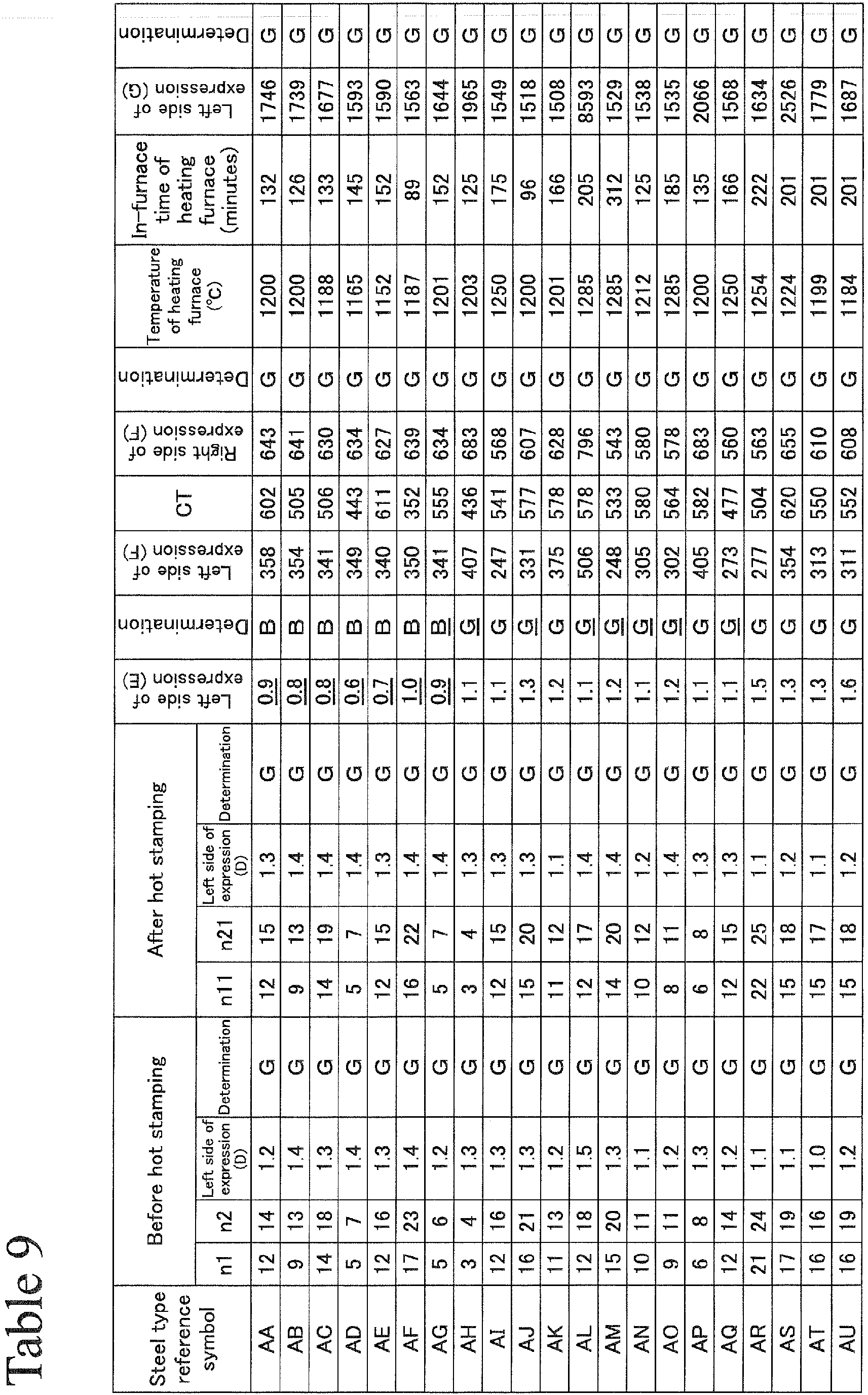
- Based on the above-described examples, as long as the conditions of the present invention are satisfied, it is possible to obtain an excellent cold rolled steel sheet, an excellent hot-dip galvanized cold rolled steel sheet, an excellent galvannealed cold rolled steel sheet, all of which satisfy TS × λ ≥ 50000 MPa·%, before hot stamping and/or after hot stamping.
- Since the cold rolled steel sheet, the hot-dip galvanized cold rolled steel sheet, and the galvannealed cold rolled steel sheet, which are obtained in the present invention and satisfy TS × λ ≥ 50000 MPa·% before hot stamping and after hot stamping, the hot stamped steel has a high press workability and a high strength, and satisfies the current requirements for a vehicle such as an additional reduction of the weight and a more complicated shape of a component.
-
- S1:
- MELTING PROCESS
- S2:
- CASTING PROCESS
- S3:
- HEATING PROCESS
- S4:
- HOT-ROLLING PROCESS
- S5:
- COILING PROCESS
- S6:
- PICKLING PROCESS
- S7:
- COLD-ROLLING PROCESS
- S8:
- ANNEALING PROCESS
- S9:
- TEMPER-ROLLING PROCESS
- S10:
- GALVANIZING PROCESS
- S11:
- ALLOYING PROCESS
- S12:
- ALUMINIZING PROCESS
- S13:
- ELECTROGALVANIZING PROCESS
Claims (20)
- A cold rolled steel sheet comprising, by mass%:C: 0.030% to 0.150%;Si: 0.010% to 1.000%;Mn: 1.50% to 2.70%;P: 0.001% to 0.060%;S: 0.001% to 0.010%;N: 0.0005% to 0.0100%;Al: 0.010% to 0.050%, andoptionally one or more ofB: 0.0005% to 0.0020%;Mo: 0.01% to 0.50%;Cr: 0.01% to 0.50%;V: 0.001 % to 0.100%;Ti: 0.001% to 0.100%;Nb: 0.001% to 0.050%;Ni: 0.01% to 1.00%;Cu: 0.01% to 1.00%;Ca: 0.0005% to 0.0050%;REM: 0.0005% to 0.0050%, anda balance including Fe and unavoidable impurities, whereinwhen [C] represents an amount of C by mass%, [Si] represents an amount of Si by mass%, and [Mn] represents an amount of Mn by mass%, a following expression (A) is satisfied,a metallographic structure before a hot stamping includes 40% to 90% of a ferrite and 10% to 60% of a martensite in an area fraction,a total of an area fraction of the ferrite and an area fraction of the martensite is 60% or more,the metallographic structure optionally further includes one or more of 10% or less of a perlite in an area fraction, 5% or less of a retained austenite in a volume ratio, and less than 40% of a bainite as a remainder in an area fraction,a hardness of the martensite measured with a nanoindenter satisfies a following expression (B) and a following expression(C) before the hot stamping,TS × λ which is a product of a tensile strength TS and a hole expansion ratio λ is 50000MPa•% or more,


and
where the H1 is an average hardness of the martensite in a surface part of a sheet thickness before the hot stamping, the H2 is an average hardness of the martensite in a central part of the sheet thickness which is an area having a width of 200 µm in a thickness direction at a center of the sheet thickness before the hot stamping, and the σHM is a variance of the hardness of the martensite in the central part of the sheet thickness before the hot stamping. - The cold rolled steel sheet according to claim 1, wherein
an area fraction of MnS existing in the cold rolled steel sheet and having an equivalent circle diameter of 0.1 µm to 10 µm is 0.01% or less,
a following expression (D) is satisfied,
where the n1 is an average number density per 10000 µm2 of the MnS having the equivalent circle diameter of 0.1 µm to 10 µm in a 1/4 part of the sheet thickness before the hot stamping, and the n2 is an average number density per 10000 µm2 of the MnS having the equivalent circle diameter of 0.1 µm to 10 µm in the central part of the sheet thickness before the hot stamping. - The cold rolled steel sheet according to claim 1 or 2, wherein a galvanizing is formed on a surface thereof.
- A method for producing a cold rolled steel sheet, the method comprising:casting a molten steel having a chemical composition according to claim 1 and obtaining a steel;heating the steel;hot-rolling the steel with a hot-rolling mill including a plurality of stands;coiling the steel after the hot-rolling;pickling the steel after the coiling;cold-rolling the steel with a cold-rolling mill including a plurality of stands after the pickling under a condition satisfying a following expression (E);annealing in which the steel is annealed under 700°C to 850°C and cooled after the cold-rolling;temper-rolling the steel after the annealing;

andthe ri (i = 1, 2, 3) represents an individual target cold-rolling reduction at an ith stand (i = 1, 2, 3) based on an uppermost stand in the plurality of stands in the cold-rolling in unit %, and the r represents a total cold-rolling reduction in the cold-rolling in unit %. - The method for producing the cold rolled steel sheet according to claim 4, further comprising:galvanizing the steel between the annealing and the temper-rolling.
- The method for producing the cold rolled steel sheet according to claim 4, wherein
when CT represents a coiling temperature in the coiling in unit °C, [C] represents the amount of C by mass%, [Mn] represents the amount of Mn by mass%, [Si] represents the amount of Si by mass%, and [Mo] represents the amount of Mo by mass%, a following expression (F) is satisfied,
- The method for producing the cold rolled steel sheet according to claim 6, wherein
when T represents a heating temperature in the heating in unit °C, t represents an in-furnace time in the heating in unit minute, [Mn] represents the amount of Mn by mass%, and [S] represents an amount of S by mass%, a following expression (G) is satisfied.
- A cold rolled steel sheet for a hot stamping comprising, by mass%:C: 0.030% to 0.150%;Si: 0.010% to 1.000%;Mn: 1.50% to 2.70%;P: 0.001% to 0.060%;S: 0.001% to 0.010%;N: 0.0005% to 0.0100%;Al: 0.010% to 0.050%, andoptionally one or more ofB: 0.0005% to 0.0020%;Mo: 0.01% to 0.50%;Cr: 0.01% to 0.50%;V: 0.001% to 0.100%;Ti: 0.001% to 0.100%;Nb: 0.001% to 0.050%;Ni: 0.01% to 1.00%;Cu: 0.01% to 1.00%;Ca: 0.0005% to 0.0050%;REM: 0.0005% to 0.0050%, anda balance including Fe and unavoidable impurities, whereinwhen [C] represents an amount of C by mass%, [Si] represents an amount of Si by mass%, and [Mn] represents an amount of Mn by mass%, a following expression (H) is satisfied,a metallographic structure after the hot stamping includes 40% to 90% of a ferrite and 10% to 60% of a martensite in an area fraction,a total of an area fraction of the ferrite and an area fraction of the martensite is 60% or more,the metallographic structure optionally further includes one or more of 10% or less of a perlite in an area fraction, 5% or less of a retained austenite in a volume ratio, and less than 40% of a bainite as a remainder in an area fraction,a hardness of the martensite measured with a nanoindenter satisfies a following expression (I) and a following expression(J) after the hot stamping,TS × λ which is a product of a tensile strength TS and a hole expansion ratio λ is 50000MPa•% or more,


andthe H11 is an average hardness of the martensite in a surface part of a sheet thickness after the hot stamping, the H21 is an average hardness of the martensite in a central part of the sheet thickness which is an area having a width of 200 µm in a thickness direction at a center of the sheet thickness after the hot stamping, and the σHM1 is a variance of the hardness of the martensite in the central part of the sheet thickness after the hot stamping. - The cold rolled steel sheet for the hot stamping according to claim 8, wherein
an area fraction of MnS existing in the cold rolled steel sheet and having an equivalent circle diameter of 0.1 µm to 10 µm is 0.01% or less,
a following expression (K) is satisfied,
and
the n11 is an average number density per 10000 µm2 of the MnS having the equivalent circle diameter of 0.1 µm to 10 µm in a 1/4 part of the sheet thickness after the hot stamping, and the n21 is an average number density per 10000 µm2 of the MnS having the equivalent circle diameter of 0.1 µm to 10 µm in the central part of the sheet thickness after the hot stamping. - The cold rolled steel sheet for the hot stamping according to claim 8 or 9, wherein a hot dip galvanizing is formed on a surface thereof.
- The cold rolled steel sheet for the hot stamping according to claim 10, wherein a galvannealing is formed on a surface of the cold rolled steel sheet in which the hot dip galvanizing is formed on the surface thereof.
- The cold rolled steel sheet for the hot stamping according to claim 8 or 9, wherein an electrogalvanizing is formed on a surface thereof.
- The cold rolled steel sheet for the hot stamping according to claim 8 or 9, wherein an aluminizing is formed on a surface thereof.
- A method for producing a cold rolled steel sheet for a hot stamping, the method comprising:casting a molten steel having a chemical composition according to claim 8 and obtaining a steel;heating the steel;hot-rolling the steel with a hot-rolling mill including a plurality of stands;coiling the steel after the hot-rolling;pickling the steel after the coiling;cold-rolling the steel with a cold-rolling mill including a plurality of stands after the pickling under a condition satisfying a following expression (L);annealing in which the steel is annealed under 700°C to 850°C and cooled after the cold-rolling;temper-rolling the steel after the annealing,

andthe ri (i = 1, 2, 3) represents an individual target cold-rolling reduction at an ith stand (i = 1, 2, 3) based on an uppermost stand in the plurality of stands in the cold-rolling in unit %, and the r represents a total cold-rolling reduction in the cold-rolling in unit %. - The method for producing the cold rolled steel sheet for the hot stamping according to claim 14, wherein
when CT represents a coiling temperature in the coiling in unit °C, [C] represents the amount of C by mass%, [Mn] represents the amount of Mn by mass%, [Si] represents the amount of Si by mass%, and [Mo] represents the amount of Mo by mass% in the steel sheet, a following expression (M) is satisfied,
- The method for producing the cold rolled steel sheet for the hot stamping according to claim 15, wherein
when T represents a heating temperature in the heating in unit °C, t represents an in-furnace time in the heating in unit minute, [Mn] represents the amount of Mn by mass% in the steel sheet, and [S] represents an amount of S by mass%, a following expression (N) is satisfied.
- The method for producing the cold rolled steel sheet for the hot stamping according to any one of claims 14 to 16, further comprising:galvanizing the steel between the annealing and the temper-rolling.
- The method for producing the cold rolled steel sheet for the hot stamping according to claim 17, further comprising:alloying the steel between the galvanizing and the temper-rolling.
- The method for producing the cold rolled steel sheet for the hot stamping according to any one of claims 14 to 16, further comprising:electrogalvanizing the steel after the temper-rolling.
- The method for producing the cold rolled steel sheet for the hot stamping according to any one of claims 14 to 16, further comprising:aluminizing the steel between the annealing and the temper-rolling.
Priority Applications (1)
| Application Number | Priority Date | Filing Date | Title |
|---|---|---|---|
| PL13735806T PL2803747T3 (en) | 2012-01-13 | 2013-01-11 | Cold-rolled steel sheet and method for producing cold-rolled steel sheet |
Applications Claiming Priority (3)
| Application Number | Priority Date | Filing Date | Title |
|---|---|---|---|
| JP2012004864 | 2012-01-13 | ||
| JP2012004549 | 2012-01-13 | ||
| PCT/JP2013/050405 WO2013105638A1 (en) | 2012-01-13 | 2013-01-11 | Cold-rolled steel sheet and method for producing cold-rolled steel sheet |
Publications (3)
| Publication Number | Publication Date |
|---|---|
| EP2803747A1 true EP2803747A1 (en) | 2014-11-19 |
| EP2803747A4 EP2803747A4 (en) | 2016-05-25 |
| EP2803747B1 EP2803747B1 (en) | 2019-03-27 |
Family
ID=48781580
Family Applications (1)
| Application Number | Title | Priority Date | Filing Date |
|---|---|---|---|
| EP13735806.5A Active EP2803747B1 (en) | 2012-01-13 | 2013-01-11 | Cold-rolled steel sheet and method for producing cold-rolled steel sheet |
Country Status (14)
| Country | Link |
|---|---|
| US (1) | US9920407B2 (en) |
| EP (1) | EP2803747B1 (en) |
| JP (1) | JP5545414B2 (en) |
| KR (1) | KR101660607B1 (en) |
| CN (1) | CN104040010B (en) |
| BR (1) | BR112014017020B1 (en) |
| CA (1) | CA2862257C (en) |
| ES (1) | ES2727684T3 (en) |
| MX (1) | MX376693B (en) |
| PL (1) | PL2803747T3 (en) |
| RU (1) | RU2586387C2 (en) |
| TW (1) | TWI524953B (en) |
| WO (1) | WO2013105638A1 (en) |
| ZA (1) | ZA201404813B (en) |
Cited By (2)
| Publication number | Priority date | Publication date | Assignee | Title |
|---|---|---|---|---|
| EP3910087A4 (en) * | 2019-01-09 | 2021-11-17 | JFE Steel Corporation | HIGH STRENGTH COLD ROLLED SHEET AND PROCESS FOR ITS PRODUCTION |
| EP4610386A4 (en) * | 2022-10-24 | 2026-04-15 | Posco Co Ltd | STEEL SHEET WITH EXCELLENT BENDABILITY AND MANUFACTURING METHOD FOR IT |
Families Citing this family (37)
| Publication number | Priority date | Publication date | Assignee | Title |
|---|---|---|---|---|
| US9945013B2 (en) | 2012-01-13 | 2018-04-17 | Nippon Steel & Sumitomo Metal Corporation | Hot stamped steel and method for producing hot stamped steel |
| EP2803747B1 (en) | 2012-01-13 | 2019-03-27 | Nippon Steel & Sumitomo Metal Corporation | Cold-rolled steel sheet and method for producing cold-rolled steel sheet |
| RU2605404C2 (en) | 2012-08-06 | 2016-12-20 | Ниппон Стил Энд Сумитомо Метал Корпорейшн | Cold-rolled steel sheet and method for manufacture thereof, and hot-formed article |
| CN104583437A (en) | 2012-08-15 | 2015-04-29 | 新日铁住金株式会社 | Steel sheet for hot pressing, manufacturing method thereof, and hot-pressed steel sheet member |
| WO2015088523A1 (en) * | 2013-12-11 | 2015-06-18 | ArcelorMittal Investigación y Desarrollo, S.L. | Cold rolled and annealed steel sheet |
| CA2934597C (en) * | 2013-12-27 | 2019-01-15 | Nippon Steel & Sumitomo Metal Corporation | Hot-pressed steel sheet member, method of manufacturing the same, and steel sheet for hot pressing |
| JP6102902B2 (en) * | 2014-03-05 | 2017-03-29 | Jfeスチール株式会社 | Cold-rolled steel sheet, manufacturing method thereof, high-strength hot-dip galvanized steel sheet, and high-strength galvannealed steel sheet |
| JP6119655B2 (en) * | 2014-03-31 | 2017-04-26 | Jfeスチール株式会社 | High strength alloyed hot dip galvanized steel strip excellent in formability with small material variations in steel strip and method for producing the same |
| CN105506478B (en) * | 2014-09-26 | 2017-10-31 | 宝山钢铁股份有限公司 | Cold rolling ultrahigh-strength steel plates, steel band and its manufacture method of a kind of high formability |
| CN105057350B (en) * | 2015-08-26 | 2017-04-05 | 山西太钢不锈钢股份有限公司 | A kind of stainless milling method of vehicle |
| KR101736620B1 (en) * | 2015-12-15 | 2017-05-17 | 주식회사 포스코 | Ultra-high strength steel sheet having excellent phosphatability and hole expansibility, and method for manufacturing the same |
| KR101714930B1 (en) * | 2015-12-23 | 2017-03-10 | 주식회사 포스코 | Ultra high strength steel sheet having excellent hole expansion ratio, and method for manufacturing the same |
| US10619223B2 (en) | 2016-04-28 | 2020-04-14 | GM Global Technology Operations LLC | Zinc-coated hot formed steel component with tailored property |
| US10385415B2 (en) | 2016-04-28 | 2019-08-20 | GM Global Technology Operations LLC | Zinc-coated hot formed high strength steel part with through-thickness gradient microstructure |
| US10288159B2 (en) | 2016-05-13 | 2019-05-14 | GM Global Technology Operations LLC | Integrated clutch systems for torque converters of vehicle powertrains |
| US10240224B2 (en) | 2016-08-12 | 2019-03-26 | GM Global Technology Operations LLC | Steel alloy with tailored hardenability |
| US11078550B2 (en) * | 2016-11-25 | 2021-08-03 | Nippon Steel Corporation | Method for manufacturing quenched molding, method for manufacturing hot press steel material, and hot press steel material |
| US10260121B2 (en) | 2017-02-07 | 2019-04-16 | GM Global Technology Operations LLC | Increasing steel impact toughness |
| JP6428969B1 (en) * | 2017-02-20 | 2018-11-28 | 新日鐵住金株式会社 | Steel sheet and manufacturing method thereof |
| US20200071789A1 (en) * | 2017-04-20 | 2020-03-05 | Tata Steel Nederland Technology B.V. | High strength steel sheet having excellent ductility and stretch flangeability |
| CN107012392B (en) * | 2017-05-15 | 2019-03-12 | 河钢股份有限公司邯郸分公司 | A kind of 600MPa grade high-strength low-alloy cold-strip steel and its production method |
| WO2019122960A1 (en) * | 2017-12-19 | 2019-06-27 | Arcelormittal | Cold rolled and heat treated steel sheet, method of production thereof and use of such steel to produce vehicle parts |
| WO2019222950A1 (en) | 2018-05-24 | 2019-11-28 | GM Global Technology Operations LLC | A method for improving both strength and ductility of a press-hardening steel |
| CN112534078A (en) | 2018-06-19 | 2021-03-19 | 通用汽车环球科技运作有限责任公司 | Low density press hardened steel with enhanced mechanical properties |
| CN111197145B (en) | 2018-11-16 | 2021-12-28 | 通用汽车环球科技运作有限责任公司 | Steel alloy workpiece and method for producing a press-hardened steel alloy part |
| US11530469B2 (en) | 2019-07-02 | 2022-12-20 | GM Global Technology Operations LLC | Press hardened steel with surface layered homogenous oxide after hot forming |
| WO2021020789A1 (en) * | 2019-07-29 | 2021-02-04 | 주식회사 포스코 | High-strength steel sheet and manufacturing method thereof |
| WO2021125878A1 (en) * | 2019-12-20 | 2021-06-24 | 주식회사 포스코 | Steel for hot forming, hot-formed member, and manufacturing methods therefor |
| CN113737087B (en) * | 2020-05-27 | 2022-07-19 | 宝山钢铁股份有限公司 | Ultrahigh-strength dual-phase steel and manufacturing method thereof |
| KR102379444B1 (en) * | 2020-07-22 | 2022-03-28 | 주식회사 포스코 | Steel sheet having excellent formability and strain hardening rate and method for manufacturing thereof |
| CN114381654B (en) * | 2020-10-21 | 2022-11-15 | 宝山钢铁股份有限公司 | 780 MPa-grade cold-rolled high-strength galvanized steel plate and manufacturing method thereof |
| CN113106336B (en) * | 2021-03-17 | 2022-06-10 | 唐山钢铁集团有限责任公司 | Ultrahigh-strength dual-phase steel capable of reducing softening degree of laser welding head and production method thereof |
| CN113667894B (en) * | 2021-08-13 | 2022-07-15 | 北京首钢冷轧薄板有限公司 | A kind of 800MPa grade dual-phase steel with excellent hole expansion performance and preparation method thereof |
| KR20230028618A (en) * | 2021-08-19 | 2023-03-02 | 주식회사 포스코 | Steel material for hot forming, hot formed part, and mehod for manufacturing thereof |
| KR20230043352A (en) * | 2021-09-24 | 2023-03-31 | 주식회사 포스코 | High strength cold rolled steel sheet having excellent surface quality and low mechanical property deviation and manufacturing method of the same |
| US20250312842A1 (en) * | 2022-05-09 | 2025-10-09 | Jfe Steel Corporation | Continuously cast slab and method for producing the same |
| CN117265412A (en) * | 2023-10-10 | 2023-12-22 | 首钢集团有限公司 | Hot stamping parts and preparation method thereof |
Family Cites Families (42)
| Publication number | Priority date | Publication date | Assignee | Title |
|---|---|---|---|---|
| JPH06128688A (en) | 1992-10-20 | 1994-05-10 | Sumitomo Metal Ind Ltd | Hot-rolled steel sheet having excellent fatigue properties and method for producing the same |
| JP3755301B2 (en) | 1997-10-24 | 2006-03-15 | Jfeスチール株式会社 | High-strength, high-workability hot-rolled steel sheet excellent in impact resistance, strength-elongation balance, fatigue resistance and hole expansibility, and method for producing the same |
| JP3769143B2 (en) | 1999-05-06 | 2006-04-19 | 新日本製鐵株式会社 | Hot-rolled steel sheet for machining excellent in fatigue characteristics and method for producing the same |
| JP4414563B2 (en) | 2000-06-12 | 2010-02-10 | 新日本製鐵株式会社 | High-strength steel sheet excellent in formability and hole expansibility and method for producing the same |
| KR100473497B1 (en) | 2000-06-20 | 2005-03-09 | 제이에프이 스틸 가부시키가이샤 | Thin steel sheet and method for production thereof |
| FR2830260B1 (en) | 2001-10-03 | 2007-02-23 | Kobe Steel Ltd | DOUBLE-PHASE STEEL SHEET WITH EXCELLENT EDGE FORMABILITY BY STRETCHING AND METHOD OF MANUFACTURING THE SAME |
| DE10341087A1 (en) | 2003-09-05 | 2005-04-07 | Siemens Ag | Method for supporting the name delivery feature for mixed TDM networks / SIP CENTREX communication architectures |
| JP4635525B2 (en) | 2003-09-26 | 2011-02-23 | Jfeスチール株式会社 | High-strength steel sheet excellent in deep drawability and manufacturing method thereof |
| JP4317418B2 (en) | 2003-10-17 | 2009-08-19 | 新日本製鐵株式会社 | High strength thin steel sheet with excellent hole expandability and ductility |
| JP2005126733A (en) * | 2003-10-21 | 2005-05-19 | Nippon Steel Corp | Steel sheet for hot pressing and automotive parts with excellent high-temperature workability |
| US7981224B2 (en) | 2003-12-18 | 2011-07-19 | Nippon Steel Corporation | Multi-phase steel sheet excellent in hole expandability and method of producing the same |
| JP4473587B2 (en) * | 2004-01-14 | 2010-06-02 | 新日本製鐵株式会社 | Hot-dip galvanized high-strength steel sheet with excellent plating adhesion and hole expandability and its manufacturing method |
| JP4510488B2 (en) | 2004-03-11 | 2010-07-21 | 新日本製鐵株式会社 | Hot-dip galvanized composite high-strength steel sheet excellent in formability and hole expansibility and method for producing the same |
| JP4293020B2 (en) | 2004-03-15 | 2009-07-08 | Jfeスチール株式会社 | Manufacturing method of high-strength steel sheet with excellent hole expandability |
| JP4725415B2 (en) * | 2006-05-23 | 2011-07-13 | 住友金属工業株式会社 | Hot-pressed steel sheet, hot-pressed steel sheet member, and production method thereof |
| US11155902B2 (en) * | 2006-09-27 | 2021-10-26 | Nucor Corporation | High strength, hot dip coated, dual phase, steel sheet and method of manufacturing same |
| WO2008110670A1 (en) * | 2007-03-14 | 2008-09-18 | Arcelormittal France | Steel for hot working or quenching with a tool having an improved ductility |
| JP5223360B2 (en) | 2007-03-22 | 2013-06-26 | Jfeスチール株式会社 | High-strength hot-dip galvanized steel sheet with excellent formability and method for producing the same |
| EP2202327B1 (en) | 2007-10-25 | 2020-12-02 | JFE Steel Corporation | Method for manufacturing a high-strength galvanized steel sheet with excellent formability |
| WO2009057731A1 (en) * | 2007-10-29 | 2009-05-07 | Nippon Steel Corporation | Martensitic non-heat-treated steel for hot forging and non-heat-treated steel hot forgings |
| WO2009090443A1 (en) | 2008-01-15 | 2009-07-23 | Arcelormittal France | Process for manufacturing stamped products, and stamped products prepared from the same |
| JP5365217B2 (en) | 2008-01-31 | 2013-12-11 | Jfeスチール株式会社 | High strength steel plate and manufacturing method thereof |
| JP5167487B2 (en) | 2008-02-19 | 2013-03-21 | Jfeスチール株式会社 | High strength steel plate with excellent ductility and method for producing the same |
| CA2718304C (en) | 2008-03-27 | 2012-03-06 | Nippon Steel Corporation | High-strength cold-rolled steel sheet, high-strength galvanized steel sheet, and high-strength alloyed hot-dip galvanized steel sheet having excellent formability and weldability,and methods for manufacturing the same |
| PL2264206T3 (en) | 2008-04-10 | 2015-04-30 | Nippon Steel & Sumitomo Metal Corp | High-strength steel sheets which are extremely excellent in the balance between burring workability and ductility and excellent in fatigue endurance, zinc-coated steel sheets, and processes for production of both |
| US8128762B2 (en) | 2008-08-12 | 2012-03-06 | Kobe Steel, Ltd. | High-strength steel sheet superior in formability |
| JP5418047B2 (en) | 2008-09-10 | 2014-02-19 | Jfeスチール株式会社 | High strength steel plate and manufacturing method thereof |
| JP5347392B2 (en) * | 2008-09-12 | 2013-11-20 | Jfeスチール株式会社 | Hot press member excellent in ductility, steel plate for hot press member, and method for producing hot press member |
| JP5418168B2 (en) * | 2008-11-28 | 2014-02-19 | Jfeスチール株式会社 | High-strength cold-rolled steel sheet excellent in formability, high-strength hot-dip galvanized steel sheet, and production method thereof |
| MX2011012371A (en) * | 2009-05-27 | 2011-12-08 | Nippon Steel Corp | High-strength steel sheet, hot-dipped steel sheet, and alloy hot-dipped steel sheet that have excellent fatigue, elongation, and collision characteristics, and manufacturing method for said steel sheets. |
| JP5363922B2 (en) | 2009-09-03 | 2013-12-11 | 株式会社神戸製鋼所 | High-strength cold-rolled steel sheet with an excellent balance between elongation and stretch flangeability |
| JP5521562B2 (en) * | 2010-01-13 | 2014-06-18 | 新日鐵住金株式会社 | High-strength steel sheet with excellent workability and method for producing the same |
| US20120328901A1 (en) | 2010-01-13 | 2012-12-27 | Toshiki Nonaka | High tensile steel sheet superior in formability and method of manufacturing the same |
| CN102712980B (en) | 2010-01-26 | 2014-07-02 | 新日铁住金株式会社 | High-strength cold-rolled steel sheet and manufacturing method thereof |
| US9228244B2 (en) | 2010-03-31 | 2016-01-05 | Nippon Steel & Sumitomo Metal Corporation | High strength, hot dipped galvanized steel sheet excellent in shapeability and method of production of same |
| JP4962594B2 (en) * | 2010-04-22 | 2012-06-27 | Jfeスチール株式会社 | High-strength hot-dip galvanized steel sheet excellent in workability and manufacturing method thereof |
| JP5510057B2 (en) | 2010-05-10 | 2014-06-04 | 新日鐵住金株式会社 | Hot-dip galvanized steel sheet and manufacturing method thereof |
| MX2012014594A (en) | 2010-06-14 | 2013-02-21 | Nippon Steel & Sumitomo Metal Corp | Hot-stamp-molded article, process for production of steel sheet for hot stamping, and process for production of hot-stamp-molded article. |
| JP5709545B2 (en) | 2011-01-18 | 2015-04-30 | キヤノン株式会社 | Imaging device |
| CN103597106B (en) * | 2011-06-10 | 2016-03-02 | 株式会社神户制钢所 | Hot compacting product, its manufacture method and hot compacting steel sheet |
| US9945013B2 (en) | 2012-01-13 | 2018-04-17 | Nippon Steel & Sumitomo Metal Corporation | Hot stamped steel and method for producing hot stamped steel |
| EP2803747B1 (en) | 2012-01-13 | 2019-03-27 | Nippon Steel & Sumitomo Metal Corporation | Cold-rolled steel sheet and method for producing cold-rolled steel sheet |
-
2013
- 2013-01-11 EP EP13735806.5A patent/EP2803747B1/en active Active
- 2013-01-11 BR BR112014017020A patent/BR112014017020B1/en not_active IP Right Cessation
- 2013-01-11 RU RU2014129323/02A patent/RU2586387C2/en not_active IP Right Cessation
- 2013-01-11 US US14/370,580 patent/US9920407B2/en active Active
- 2013-01-11 KR KR1020147019475A patent/KR101660607B1/en active Active
- 2013-01-11 ES ES13735806T patent/ES2727684T3/en active Active
- 2013-01-11 CN CN201380005130.8A patent/CN104040010B/en active Active
- 2013-01-11 WO PCT/JP2013/050405 patent/WO2013105638A1/en not_active Ceased
- 2013-01-11 PL PL13735806T patent/PL2803747T3/en unknown
- 2013-01-11 JP JP2013530459A patent/JP5545414B2/en active Active
- 2013-01-11 CA CA2862257A patent/CA2862257C/en not_active Expired - Fee Related
- 2013-01-11 TW TW102101298A patent/TWI524953B/en not_active IP Right Cessation
- 2013-01-11 MX MX2014008428A patent/MX376693B/en active IP Right Grant
-
2014
- 2014-06-27 ZA ZA2014/04813A patent/ZA201404813B/en unknown
Cited By (3)
| Publication number | Priority date | Publication date | Assignee | Title |
|---|---|---|---|---|
| EP3910087A4 (en) * | 2019-01-09 | 2021-11-17 | JFE Steel Corporation | HIGH STRENGTH COLD ROLLED SHEET AND PROCESS FOR ITS PRODUCTION |
| US12241137B2 (en) | 2019-01-09 | 2025-03-04 | Jfe Steel Corporation | High-strength cold-rolled steel sheet and production method for same |
| EP4610386A4 (en) * | 2022-10-24 | 2026-04-15 | Posco Co Ltd | STEEL SHEET WITH EXCELLENT BENDABILITY AND MANUFACTURING METHOD FOR IT |
Also Published As
| Publication number | Publication date |
|---|---|
| PL2803747T3 (en) | 2019-09-30 |
| JPWO2013105638A1 (en) | 2015-05-11 |
| US9920407B2 (en) | 2018-03-20 |
| CN104040010B (en) | 2016-06-15 |
| RU2014129323A (en) | 2016-03-10 |
| BR112014017020A2 (en) | 2017-06-13 |
| TW201345627A (en) | 2013-11-16 |
| EP2803747B1 (en) | 2019-03-27 |
| WO2013105638A1 (en) | 2013-07-18 |
| RU2586387C2 (en) | 2016-06-10 |
| MX2014008428A (en) | 2014-10-06 |
| ZA201404813B (en) | 2015-08-26 |
| BR112014017020A8 (en) | 2017-07-04 |
| BR112014017020B1 (en) | 2020-04-14 |
| JP5545414B2 (en) | 2014-07-09 |
| CN104040010A (en) | 2014-09-10 |
| CA2862257A1 (en) | 2013-07-18 |
| KR20140102755A (en) | 2014-08-22 |
| MX376693B (en) | 2025-03-07 |
| EP2803747A4 (en) | 2016-05-25 |
| TWI524953B (en) | 2016-03-11 |
| US20140342185A1 (en) | 2014-11-20 |
| CA2862257C (en) | 2018-04-10 |
| ES2727684T3 (en) | 2019-10-17 |
| KR101660607B1 (en) | 2016-09-27 |
Similar Documents
| Publication | Publication Date | Title |
|---|---|---|
| EP2803747B1 (en) | Cold-rolled steel sheet and method for producing cold-rolled steel sheet | |
| US11371110B2 (en) | Cold-rolled steel sheet | |
| EP2803748B1 (en) | Hot stamp molded article, and method for producing hot stamp molded article | |
| EP2803746B1 (en) | Hot stamped steel and method for producing the same | |
| EP2803744B1 (en) | Cold-rolled steel sheet and method for producing same | |
| JP5578289B2 (en) | Cold-rolled steel sheet, method for producing the same, and hot stamping molded body | |
| JP5659604B2 (en) | High strength steel plate and manufacturing method thereof |
Legal Events
| Date | Code | Title | Description |
|---|---|---|---|
| PUAI | Public reference made under article 153(3) epc to a published international application that has entered the european phase |
Free format text: ORIGINAL CODE: 0009012 |
|
| 17P | Request for examination filed |
Effective date: 20140731 |
|
| AK | Designated contracting states |
Kind code of ref document: A1 Designated state(s): AL AT BE BG CH CY CZ DE DK EE ES FI FR GB GR HR HU IE IS IT LI LT LU LV MC MK MT NL NO PL PT RO RS SE SI SK SM TR |
|
| DAX | Request for extension of the european patent (deleted) | ||
| RA4 | Supplementary search report drawn up and despatched (corrected) |
Effective date: 20160425 |
|
| STAA | Information on the status of an ep patent application or granted ep patent |
Free format text: STATUS: EXAMINATION IS IN PROGRESS |
|
| 17Q | First examination report despatched |
Effective date: 20170724 |
|
| REG | Reference to a national code |
Ref country code: DE Ref legal event code: R079 Ref document number: 602013052929 Country of ref document: DE Free format text: PREVIOUS MAIN CLASS: C22C0038060000 Ipc: B21D0022200000 |
|
| GRAP | Despatch of communication of intention to grant a patent |
Free format text: ORIGINAL CODE: EPIDOSNIGR1 |
|
| STAA | Information on the status of an ep patent application or granted ep patent |
Free format text: STATUS: GRANT OF PATENT IS INTENDED |
|
| RIC1 | Information provided on ipc code assigned before grant |
Ipc: C22C 38/14 20060101ALI20180918BHEP Ipc: C21D 9/00 20060101ALI20180918BHEP Ipc: C21D 9/46 20060101ALI20180918BHEP Ipc: C22C 38/18 20060101ALI20180918BHEP Ipc: C21D 8/02 20060101ALI20180918BHEP Ipc: C23C 2/06 20060101ALI20180918BHEP Ipc: B21D 22/20 20060101AFI20180918BHEP Ipc: C22C 38/22 20060101ALI20180918BHEP Ipc: C22C 38/12 20060101ALI20180918BHEP Ipc: C22C 38/28 20060101ALI20180918BHEP Ipc: C21D 1/18 20060101ALI20180918BHEP Ipc: C23C 2/26 20060101ALI20180918BHEP Ipc: C22C 38/16 20060101ALI20180918BHEP Ipc: C23C 2/12 20060101ALI20180918BHEP Ipc: C22C 38/06 20060101ALI20180918BHEP Ipc: C23C 2/28 20060101ALI20180918BHEP Ipc: C22C 38/04 20060101ALI20180918BHEP Ipc: C22C 38/08 20060101ALI20180918BHEP Ipc: C23C 2/02 20060101ALI20180918BHEP Ipc: C22C 38/58 20060101ALI20180918BHEP |
|
| INTG | Intention to grant announced |
Effective date: 20181005 |
|
| RIN1 | Information on inventor provided before grant (corrected) |
Inventor name: NONAKA, TOSHIKI Inventor name: KAWASAKI, KAORU Inventor name: TOMOKIYO, TOSHIMASA Inventor name: KATO, SATOSHI |
|
| GRAS | Grant fee paid |
Free format text: ORIGINAL CODE: EPIDOSNIGR3 |
|
| GRAA | (expected) grant |
Free format text: ORIGINAL CODE: 0009210 |
|
| STAA | Information on the status of an ep patent application or granted ep patent |
Free format text: STATUS: THE PATENT HAS BEEN GRANTED |
|
| AK | Designated contracting states |
Kind code of ref document: B1 Designated state(s): AL AT BE BG CH CY CZ DE DK EE ES FI FR GB GR HR HU IE IS IT LI LT LU LV MC MK MT NL NO PL PT RO RS SE SI SK SM TR |
|
| REG | Reference to a national code |
Ref country code: GB Ref legal event code: FG4D |
|
| REG | Reference to a national code |
Ref country code: CH Ref legal event code: EP |
|
| REG | Reference to a national code |
Ref country code: AT Ref legal event code: REF Ref document number: 1112448 Country of ref document: AT Kind code of ref document: T Effective date: 20190415 |
|
| REG | Reference to a national code |
Ref country code: IE Ref legal event code: FG4D |
|
| REG | Reference to a national code |
Ref country code: DE Ref legal event code: R096 Ref document number: 602013052929 Country of ref document: DE |
|
| REG | Reference to a national code |
Ref country code: RO Ref legal event code: EPE |
|
| REG | Reference to a national code |
Ref country code: SE Ref legal event code: TRGR |
|
| RAP2 | Party data changed (patent owner data changed or rights of a patent transferred) |
Owner name: NIPPON STEEL CORPORATION |
|
| PG25 | Lapsed in a contracting state [announced via postgrant information from national office to epo] |
Ref country code: FI Free format text: LAPSE BECAUSE OF FAILURE TO SUBMIT A TRANSLATION OF THE DESCRIPTION OR TO PAY THE FEE WITHIN THE PRESCRIBED TIME-LIMIT Effective date: 20190327 Ref country code: NO Free format text: LAPSE BECAUSE OF FAILURE TO SUBMIT A TRANSLATION OF THE DESCRIPTION OR TO PAY THE FEE WITHIN THE PRESCRIBED TIME-LIMIT Effective date: 20190627 Ref country code: LT Free format text: LAPSE BECAUSE OF FAILURE TO SUBMIT A TRANSLATION OF THE DESCRIPTION OR TO PAY THE FEE WITHIN THE PRESCRIBED TIME-LIMIT Effective date: 20190327 |
|
| REG | Reference to a national code |
Ref country code: NL Ref legal event code: MP Effective date: 20190327 |
|
| PG25 | Lapsed in a contracting state [announced via postgrant information from national office to epo] |
Ref country code: NL Free format text: LAPSE BECAUSE OF FAILURE TO SUBMIT A TRANSLATION OF THE DESCRIPTION OR TO PAY THE FEE WITHIN THE PRESCRIBED TIME-LIMIT Effective date: 20190327 Ref country code: RS Free format text: LAPSE BECAUSE OF FAILURE TO SUBMIT A TRANSLATION OF THE DESCRIPTION OR TO PAY THE FEE WITHIN THE PRESCRIBED TIME-LIMIT Effective date: 20190327 Ref country code: BG Free format text: LAPSE BECAUSE OF FAILURE TO SUBMIT A TRANSLATION OF THE DESCRIPTION OR TO PAY THE FEE WITHIN THE PRESCRIBED TIME-LIMIT Effective date: 20190627 Ref country code: LV Free format text: LAPSE BECAUSE OF FAILURE TO SUBMIT A TRANSLATION OF THE DESCRIPTION OR TO PAY THE FEE WITHIN THE PRESCRIBED TIME-LIMIT Effective date: 20190327 Ref country code: GR Free format text: LAPSE BECAUSE OF FAILURE TO SUBMIT A TRANSLATION OF THE DESCRIPTION OR TO PAY THE FEE WITHIN THE PRESCRIBED TIME-LIMIT Effective date: 20190628 Ref country code: HR Free format text: LAPSE BECAUSE OF FAILURE TO SUBMIT A TRANSLATION OF THE DESCRIPTION OR TO PAY THE FEE WITHIN THE PRESCRIBED TIME-LIMIT Effective date: 20190327 |
|
| REG | Reference to a national code |
Ref country code: AT Ref legal event code: MK05 Ref document number: 1112448 Country of ref document: AT Kind code of ref document: T Effective date: 20190327 |
|
| REG | Reference to a national code |
Ref country code: ES Ref legal event code: FG2A Ref document number: 2727684 Country of ref document: ES Kind code of ref document: T3 Effective date: 20191017 |
|
| PG25 | Lapsed in a contracting state [announced via postgrant information from national office to epo] |
Ref country code: EE Free format text: LAPSE BECAUSE OF FAILURE TO SUBMIT A TRANSLATION OF THE DESCRIPTION OR TO PAY THE FEE WITHIN THE PRESCRIBED TIME-LIMIT Effective date: 20190327 Ref country code: AL Free format text: LAPSE BECAUSE OF FAILURE TO SUBMIT A TRANSLATION OF THE DESCRIPTION OR TO PAY THE FEE WITHIN THE PRESCRIBED TIME-LIMIT Effective date: 20190327 Ref country code: PT Free format text: LAPSE BECAUSE OF FAILURE TO SUBMIT A TRANSLATION OF THE DESCRIPTION OR TO PAY THE FEE WITHIN THE PRESCRIBED TIME-LIMIT Effective date: 20190727 Ref country code: CZ Free format text: LAPSE BECAUSE OF FAILURE TO SUBMIT A TRANSLATION OF THE DESCRIPTION OR TO PAY THE FEE WITHIN THE PRESCRIBED TIME-LIMIT Effective date: 20190327 Ref country code: SK Free format text: LAPSE BECAUSE OF FAILURE TO SUBMIT A TRANSLATION OF THE DESCRIPTION OR TO PAY THE FEE WITHIN THE PRESCRIBED TIME-LIMIT Effective date: 20190327 |
|
| PG25 | Lapsed in a contracting state [announced via postgrant information from national office to epo] |
Ref country code: SM Free format text: LAPSE BECAUSE OF FAILURE TO SUBMIT A TRANSLATION OF THE DESCRIPTION OR TO PAY THE FEE WITHIN THE PRESCRIBED TIME-LIMIT Effective date: 20190327 |
|
| PG25 | Lapsed in a contracting state [announced via postgrant information from national office to epo] |
Ref country code: AT Free format text: LAPSE BECAUSE OF FAILURE TO SUBMIT A TRANSLATION OF THE DESCRIPTION OR TO PAY THE FEE WITHIN THE PRESCRIBED TIME-LIMIT Effective date: 20190327 Ref country code: IS Free format text: LAPSE BECAUSE OF FAILURE TO SUBMIT A TRANSLATION OF THE DESCRIPTION OR TO PAY THE FEE WITHIN THE PRESCRIBED TIME-LIMIT Effective date: 20190727 |
|
| REG | Reference to a national code |
Ref country code: DE Ref legal event code: R097 Ref document number: 602013052929 Country of ref document: DE |
|
| PG25 | Lapsed in a contracting state [announced via postgrant information from national office to epo] |
Ref country code: DK Free format text: LAPSE BECAUSE OF FAILURE TO SUBMIT A TRANSLATION OF THE DESCRIPTION OR TO PAY THE FEE WITHIN THE PRESCRIBED TIME-LIMIT Effective date: 20190327 |
|
| PGFP | Annual fee paid to national office [announced via postgrant information from national office to epo] |
Ref country code: RO Payment date: 20191220 Year of fee payment: 8 |
|
| PLBE | No opposition filed within time limit |
Free format text: ORIGINAL CODE: 0009261 |
|
| STAA | Information on the status of an ep patent application or granted ep patent |
Free format text: STATUS: NO OPPOSITION FILED WITHIN TIME LIMIT |
|
| PG25 | Lapsed in a contracting state [announced via postgrant information from national office to epo] |
Ref country code: SI Free format text: LAPSE BECAUSE OF FAILURE TO SUBMIT A TRANSLATION OF THE DESCRIPTION OR TO PAY THE FEE WITHIN THE PRESCRIBED TIME-LIMIT Effective date: 20190327 |
|
| PGFP | Annual fee paid to national office [announced via postgrant information from national office to epo] |
Ref country code: PL Payment date: 20191212 Year of fee payment: 8 Ref country code: BE Payment date: 20191217 Year of fee payment: 8 |
|
| 26N | No opposition filed |
Effective date: 20200103 |
|
| PG25 | Lapsed in a contracting state [announced via postgrant information from national office to epo] |
Ref country code: TR Free format text: LAPSE BECAUSE OF FAILURE TO SUBMIT A TRANSLATION OF THE DESCRIPTION OR TO PAY THE FEE WITHIN THE PRESCRIBED TIME-LIMIT Effective date: 20190327 |
|
| PGFP | Annual fee paid to national office [announced via postgrant information from national office to epo] |
Ref country code: GB Payment date: 20200102 Year of fee payment: 8 Ref country code: SE Payment date: 20200110 Year of fee payment: 8 Ref country code: ES Payment date: 20200203 Year of fee payment: 8 Ref country code: IT Payment date: 20200114 Year of fee payment: 8 |
|
| PG25 | Lapsed in a contracting state [announced via postgrant information from national office to epo] |
Ref country code: MC Free format text: LAPSE BECAUSE OF FAILURE TO SUBMIT A TRANSLATION OF THE DESCRIPTION OR TO PAY THE FEE WITHIN THE PRESCRIBED TIME-LIMIT Effective date: 20190327 |
|
| REG | Reference to a national code |
Ref country code: CH Ref legal event code: PL |
|
| PG25 | Lapsed in a contracting state [announced via postgrant information from national office to epo] |
Ref country code: LU Free format text: LAPSE BECAUSE OF NON-PAYMENT OF DUE FEES Effective date: 20200111 |
|
| PG25 | Lapsed in a contracting state [announced via postgrant information from national office to epo] |
Ref country code: LI Free format text: LAPSE BECAUSE OF NON-PAYMENT OF DUE FEES Effective date: 20200131 Ref country code: CH Free format text: LAPSE BECAUSE OF NON-PAYMENT OF DUE FEES Effective date: 20200131 |
|
| PG25 | Lapsed in a contracting state [announced via postgrant information from national office to epo] |
Ref country code: IE Free format text: LAPSE BECAUSE OF NON-PAYMENT OF DUE FEES Effective date: 20200111 |
|
| REG | Reference to a national code |
Ref country code: SE Ref legal event code: EUG |
|
| GBPC | Gb: european patent ceased through non-payment of renewal fee |
Effective date: 20210111 |
|
| REG | Reference to a national code |
Ref country code: BE Ref legal event code: MM Effective date: 20210131 |
|
| PG25 | Lapsed in a contracting state [announced via postgrant information from national office to epo] |
Ref country code: GB Free format text: LAPSE BECAUSE OF NON-PAYMENT OF DUE FEES Effective date: 20210111 Ref country code: RO Free format text: LAPSE BECAUSE OF NON-PAYMENT OF DUE FEES Effective date: 20210111 Ref country code: SE Free format text: LAPSE BECAUSE OF NON-PAYMENT OF DUE FEES Effective date: 20210112 |
|
| REG | Reference to a national code |
Ref country code: ES Ref legal event code: FD2A Effective date: 20220427 |
|
| PG25 | Lapsed in a contracting state [announced via postgrant information from national office to epo] |
Ref country code: IT Free format text: LAPSE BECAUSE OF NON-PAYMENT OF DUE FEES Effective date: 20210111 |
|
| PG25 | Lapsed in a contracting state [announced via postgrant information from national office to epo] |
Ref country code: MT Free format text: LAPSE BECAUSE OF FAILURE TO SUBMIT A TRANSLATION OF THE DESCRIPTION OR TO PAY THE FEE WITHIN THE PRESCRIBED TIME-LIMIT Effective date: 20190327 Ref country code: CY Free format text: LAPSE BECAUSE OF FAILURE TO SUBMIT A TRANSLATION OF THE DESCRIPTION OR TO PAY THE FEE WITHIN THE PRESCRIBED TIME-LIMIT Effective date: 20190327 |
|
| PG25 | Lapsed in a contracting state [announced via postgrant information from national office to epo] |
Ref country code: MK Free format text: LAPSE BECAUSE OF FAILURE TO SUBMIT A TRANSLATION OF THE DESCRIPTION OR TO PAY THE FEE WITHIN THE PRESCRIBED TIME-LIMIT Effective date: 20190327 |
|
| PG25 | Lapsed in a contracting state [announced via postgrant information from national office to epo] |
Ref country code: ES Free format text: LAPSE BECAUSE OF NON-PAYMENT OF DUE FEES Effective date: 20210112 Ref country code: BE Free format text: LAPSE BECAUSE OF NON-PAYMENT OF DUE FEES Effective date: 20210131 |
|
| PG25 | Lapsed in a contracting state [announced via postgrant information from national office to epo] |
Ref country code: PL Free format text: LAPSE BECAUSE OF NON-PAYMENT OF DUE FEES Effective date: 20210111 |
|
| PGFP | Annual fee paid to national office [announced via postgrant information from national office to epo] |
Ref country code: FR Payment date: 20241209 Year of fee payment: 13 |
|
| PGFP | Annual fee paid to national office [announced via postgrant information from national office to epo] |
Ref country code: DE Payment date: 20241203 Year of fee payment: 13 |