EP2803536A1 - Passenger car and airbag device - Google Patents
Passenger car and airbag device Download PDFInfo
- Publication number
- EP2803536A1 EP2803536A1 EP13002569.5A EP13002569A EP2803536A1 EP 2803536 A1 EP2803536 A1 EP 2803536A1 EP 13002569 A EP13002569 A EP 13002569A EP 2803536 A1 EP2803536 A1 EP 2803536A1
- Authority
- EP
- European Patent Office
- Prior art keywords
- airbag
- passenger car
- airbag device
- sleeve block
- hose
- Prior art date
- Legal status (The legal status is an assumption and is not a legal conclusion. Google has not performed a legal analysis and makes no representation as to the accuracy of the status listed.)
- Granted
Links
Images

Classifications
-
- B—PERFORMING OPERATIONS; TRANSPORTING
- B60—VEHICLES IN GENERAL
- B60R—VEHICLES, VEHICLE FITTINGS, OR VEHICLE PARTS, NOT OTHERWISE PROVIDED FOR
- B60R19/00—Wheel guards; Radiator guards, e.g. grilles; Obstruction removers; Fittings damping bouncing force in collisions
- B60R19/02—Bumpers, i.e. impact receiving or absorbing members for protecting vehicles or fending off blows from other vehicles or objects
- B60R19/18—Bumpers, i.e. impact receiving or absorbing members for protecting vehicles or fending off blows from other vehicles or objects characterised by the cross-section; Means within the bumper to absorb impact
- B60R19/20—Bumpers, i.e. impact receiving or absorbing members for protecting vehicles or fending off blows from other vehicles or objects characterised by the cross-section; Means within the bumper to absorb impact containing mainly gas or liquid, e.g. inflatable
- B60R19/205—Bumpers, i.e. impact receiving or absorbing members for protecting vehicles or fending off blows from other vehicles or objects characterised by the cross-section; Means within the bumper to absorb impact containing mainly gas or liquid, e.g. inflatable inflatable in the direction of an obstacle upon impending impact, e.g. using air bags
Definitions
- the invention relates to a passenger car according to claim 1 and to an airbag device according to claim 6.
- Small and lightweight passenger cars have a variety of advantages in relation to traditional large and heavy passenger cars.
- a lightweight passenger car is more energy-efficient during its production and, of course, also during its operation.
- a small passenger car uses less "public space" than a large passenger car. This is especially important in urban areas. Because of these aspects and because of the fact that a passenger car is rarely occupied by more than two persons, there is a tendency to develop small and lightweight passenger cars, especially for the use in urban areas. It is expected that small passenger cars will play an important role particularly in the field of electro-mobility.
- a small passenger car provides a high degree of safety for its occupants when the small passenger car is involved in an accident.
- a small passenger car has (if no additional measures are taken) a structural disadvantage in relation to a larger passenger car, namely its small dimensions. ln other words: The distance of a person to be protected inside the small passenger car to the outer periphery of the car is small, making it difficult to avoid that a structural element of the small passenger car moving to the inside because of an impacting object hits and thus hurts a person inside the small passenger car.
- the basic idea is to provide an oblong, especially hose-type, airbag which is located outside the passenger compartment in such a way that the external dimensions of the passenger car rise when the airbag is filled with gas from an inflator and thus expands.
- the passenger car "grows" in case of an accident and thus shows the advantages of a small-sized car in the normal operation, but gives the protection of a bigger car.
- the airbag used for this purpose has a different purpose than a traditional airbag located inside the passenger compartment:
- the airbag located inside the passenger compartment usually has the task to softly catch the passenger such that energy can be dissipated.
- the airbag should be very hard and usually no ventilation should be given.
- the inner pressure reached inside the airbag must be quite high and should preferably reach more than 10 bars.
- the airbag comprises a woven structure and is preferably made out of a fire hose or similar type of hose which might be coated on the inside in order to improve the gas-tightness.
- the airbag has an oblong shape and shows a woven structure.
- the airbag is made from a hose, that means that its ends are initially open. These open ends are closed, preferably by closing seams.
- a first sleeve block is mounted on the first end and a second sleeve block is mounted on the second end.
- the sleeve blocks each comprise two - preferably parallel or nearly parallel - side walls, such that the end sections with the closing seams are housed between the walls. So, the airbag can not expand freely to the closing seams and this leads to a strong reduction of the forces acting on the closing seams.
- a mounting element comprising a deformable section is provided.
- This mounting element can especially be a bent sheet metal part.
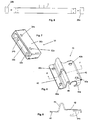
- Figure 1 shows a hose 10.
- This hose extends from a first end 10a to a second end 10b.
- This hose is seamlessly woven as is generally known, for example from fire hoses.
- the hose can be coated on the inside (for example with silicone) in order to enhance its gas-tightness.
- the hose 10 can have a typical length of between 50 cm to 2 m and has typically a circumference of 30 to 70 cm.
- Holes 12 are provided in the lateral surface of the hose, preferably in a middle section.
- Figure 1 further shows a gas generator unit being comprised of a gas generator 14 serving as inflator, studs 16a, 16b extending from the lateral surface of the cylindrical gas generator 14 and an ignition wire 18 also extending from the gas generator 14. Sealing discs 19a-c can be provided on the studs and the ignition wire 18 respectively.
- the gas generator 14 is inserted into the hose 10 via the first end 10a or the second end 10b.
- the studs 16a, b and the ignition wire 18 extend through the holes 12 with the sealing discs remaining inside the hose 10.
- external sealing discs can be applied on the studs and the ignition wire; but this is not shown in the figures.
- the hose 10 is folded in half along a folding line F extending from the first end 10a the second end 10b.
- closing seams are applied to the hose 10 near the first end 10a and the second end 10b respectively. Because of these closing seams 20a, 20b a closed gas space is created. In some embodiments alternative closing techniques like gluing or welding may be applied, but sewing is at present the preferred way of closing the ends of the hose.
- mounting holes 22 are punched, drilled or cut into the two end sections of the oblong airbag 22 being created by closing the folded hose 10.
- the mounting holes 22 all lie outside the gas space (this means they are located between the respective closing seam 20a, b and the edge of the airbag).
- two mounting holes 22 are provided on each side.
- a sleeve 28a, 28b is applied onto each end section of the oblong airbag 25.
- These sleeves 28a, 28b should show some elasticity and can be made of strong rubber material, but also of a woven material.
- Figure 7 shows a sleeve block 30.
- two such sleeve blocks 30, 30' are provided; one on each end section of the oblong airbag 25 when the airbag device is in its assembled state. Since both sleeve blocks 30, 30' are identically formed, reference is only made to sleeve block 30.
- This sleeve block 30 has a basically O-shaped, closed cross section with two parallel walls 30a, 30b.
- the sleeve block 30 is made of a sturdy and rigid material, preferably of steel, but in some embodiments aluminum or plastic, especially fibre-reinforced plastic, may also be used.
- Two pairs of through-holes are provided in the parallel walls of the sleeve block 30.
- the first through-holes 32a, 32b form a first pair of through-holes with one of the first through-holes being provided in the first side wall 30a and the other first through-hole 32b being provided in the second side wall 30b.
- the two first through-holes align with each other.
- the second through-holes 34a, 34b form a second pair of through-holes in the same way the first through-holes form a first pair of through-holes.
- FIGS 8 and 9 show a mounting element 40 which is in the assembled state mounted to the sleeve block 30.
- This mounting element 40 is a bent sheet metal part and comprises three sections, namely a block-side section 42, a vehicle-side section 46 and a deformable section 49 connecting the block-side section 42 and the vehicle-side section 46.
- the deformable section 49 is basically U- or V-shaped.
- two block-side mounting holes 42a, 42b are provided in the block-side section 42.
- the first block-side mounting hole 42a is in alignment with the first through-holes 32a, 32b and the second block-side mounting holes 42b is in alignment with the second through-holes 34a, 34b.
- vehicle-side mounting holes 48a, 48b are provided such that the vehicle-side section 46 can be connected to a vehicle structure, for example by means of rivets, bolts or screws.
- Two hooks 44a, 44b extend from the block-side section 42 and point towards the vehicle-side section 46.
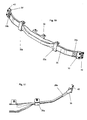
- Figures 10 and 11 show the completely assembled state of the airbag device.
- the two end sections of the oblong airbag 25 are enclosed by the sleeves 28a, b and that they extend into their respective sleeve blocks 30, 30', which are connected with their respective mounting element 40, 40'.
- a mounting bracket 52 for the gas generator and additional fixation elements 50a, 50b which have an enclosing section enclosing the package of the oblong airbag 25.
- the enclosing sections can be broken by the deploying airbag such that they are only active in the resting state of the airbag device.
- Figure 12 shows a schematic cut through an end section of the airbag device when it is mounted to a vehicle structure 54.
- the four layers 26a - 26d of the oblong airbag 25 and the two layers of the sleeve 28a are located between the two side walls 30a, 30b of the sleeve block 30.
- the inner surfaces of these side walls are preferably parallel to one another, but there is no need of an absolute parallelity. But, it is important that the surface normals of these two inner surfaces basically point in opposing directions.
- the vehicle-side section 46 of the mounting element 40 is screwed or riveted to the vehicle structure 54 (a structural element of the vehicle, for example a part of the frame or an other basically rigid part).
- the sleeve block 30, the block-side section 42 of the mounting element 40 and the airbag 25 are connected to each other by means of bolts or screws 23 extending through the mounting holes 22, the through-holes 32a, 32b, 34a, 34b and the block-side mounting holes 42a, 42b.
- the hooks 44a, 44b are each held in a receiving aperture 56, such that the sleeve block 30 cannot move in direction R.
- the other end of the airbag device is of course mounted exactly the same way.
- Figure 13 shows the situation when after the gas generator 14 had been triggered and the oblong airbag 25 deployed to its unfolded, pressurized state. Because of this deployment, the oblong airbag 25 does not only expand in radial direction (this means that at least a middle section of the oblong airbag 25 returns to its original hose-shape), but the oblong airbag also contracts in axial direction, that means the distance between the first end 25a and the second end 25b decreases. Because of this shortening, the oblong airbag 25 applies a force to the sleeve blocks 30, 30' towards the middle of the oblong airbag 25.
- the sleeve blocks 30, 30' transmit this force to their mounting element 40, 40', leading to a deformation (namely a stretching) of the deformable sections (shown in Figure 13 is the stretched deformable section 49). Due to this deformation, the sleeve block 30 moves to the inside, leading it to a disengagement of the hooks from their respective receiving apertures 56. Due to this, the oblong airbag 25 can contract in axial direction (when expanding in radial direction) without causing damage to the airbag, the sleeve blocks 30 or the vehicle structure.
- the sleeves 28a, 28b additionally help keeping the layers of the oblong airbag intact, especially the sleeves protect the outer layers from being damaged by the sleeve blocks 30, 30'.
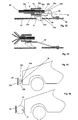
- FIGS 14 and 15 show an application of the airbag device just described, namely as a part of an active bumper.
- the airbag device is mounted at the rear or at the front end of the vehicle, wherein the oblong airbag 25 basically extends transversally to the moving direction of the vehicle.
- the oblong airbag 25 is covered by a covering element 60 which is detachably connected to the vehicle, for example via break-way snap connectors.
- the covering element 60 may be connected to the airbag 25.
- the gas generator 14 is triggered, the oblong airbag 25 expands such that its radial dimension rises (it "thickens").
- This deployment in radial direction makes the vehicle longer and moves the covering element 60 away from the car body, such that during a collision the outer dimension of the vehicle is enlarged. It is preferred to trigger the gas generator based on the signal of a proximity sensor (not shown in the figures).
- the covering element may be constructed like "traditional covers of frontal airbags inside the vehicle, namely with a door showing a hinge and being partially surrounded by a slit line, To provide a covering element is generally preferred for aesthetical reasons and in order to protect the airbag from environmental influences.
- the airbag device is located on the side of the vehicle, especially on a side door with the airbag extending basically parallel to the longitudinal direction of the vehicle.
Landscapes
- Engineering & Computer Science (AREA)
- Mechanical Engineering (AREA)
- Air Bags (AREA)
Abstract
Description
- The invention relates to a passenger car according to claim 1 and to an airbag device according to claim 6.
- Small and lightweight passenger cars have a variety of advantages in relation to traditional large and heavy passenger cars. First of all, a lightweight passenger car is more energy-efficient during its production and, of course, also during its operation. Second, a small passenger car uses less "public space" than a large passenger car. This is especially important in urban areas. Because of these aspects and because of the fact that a passenger car is rarely occupied by more than two persons, there is a tendency to develop small and lightweight passenger cars, especially for the use in urban areas. It is expected that small passenger cars will play an important role particularly in the field of electro-mobility.
- Of course, it is desired that a small passenger car provides a high degree of safety for its occupants when the small passenger car is involved in an accident. In this point, a small passenger car has (if no additional measures are taken) a structural disadvantage in relation to a larger passenger car, namely its small dimensions. ln other words: The distance of a person to be protected inside the small passenger car to the outer periphery of the car is small, making it difficult to avoid that a structural element of the small passenger car moving to the inside because of an impacting object hits and thus hurts a person inside the small passenger car.
- So, it is the first task of the invention to provide a passenger car, especially a small passenger car, which improves the safety of its inhabitants during a collision.
- This task is solved by a passenger car according to claim 1.
- The basic idea is to provide an oblong, especially hose-type, airbag which is located outside the passenger compartment in such a way that the external dimensions of the passenger car rise when the airbag is filled with gas from an inflator and thus expands.
- So. the passenger car "grows" in case of an accident and thus shows the advantages of a small-sized car in the normal operation, but gives the protection of a bigger car.
- The airbag used for this purpose has a different purpose than a traditional airbag located inside the passenger compartment: The airbag located inside the passenger compartment usually has the task to softly catch the passenger such that energy can be dissipated. In the case of an "external" airbag according to the invention, the airbag should be very hard and usually no ventilation should be given. In order to achieve this, the inner pressure reached inside the airbag must be quite high and should preferably reach more than 10 bars. In order to achieve this without making the airbag heavy and/or expensive, the airbag comprises a woven structure and is preferably made out of a fire hose or similar type of hose which might be coated on the inside in order to improve the gas-tightness.
- If the airbag is made in this way (which is preferred), various measures must be taken in order to make sure that the airbag remains intact when filled by high pressure. So, it is another object of the present invention to provide an airbag device whose airbag is being made from a hose whose initially open ends are closed and which can withstand a high internal pressure, especially a pressure of 10 to 20 bars.
- This task is solved by an airbag device according to claim 6.
- In this airbag device, the airbag has an oblong shape and shows a woven structure. The airbag is made from a hose, that means that its ends are initially open. These open ends are closed, preferably by closing seams. In order to prevent the closing seams from tearing a first sleeve block is mounted on the first end and a second sleeve block is mounted on the second end. The sleeve blocks each comprise two - preferably parallel or nearly parallel - side walls, such that the end sections with the closing seams are housed between the walls. So, the airbag can not expand freely to the closing seams and this leads to a strong reduction of the forces acting on the closing seams.
- Since the airbag made in this way (especially when made from a section of a fire hose or a similar structure) tends to shorten during deployment, according to claim 7 a mounting element comprising a deformable section is provided. This mounting element can especially be a bent sheet metal part.
- Further preferred embodiments and advantages result from the further subclaims and from the preferred embodiments described hereinafter with reference to the figures.
- The invention will now be described in detail in view of a preferred embodiment with reference to the figures. The figures show:
- Figure 1
- a hose and a gas generator unit in a schematic perspective representation,
- Figure 2
- the hose of
figure 1 after the gas generator has been inserted into the hose in a plan view, - Figure 3
- what is shown in
figure 2 after a folding step has been performed, - Figure 4
- what is shown in
figure 3 after two closing seams have been applied, - Figure 5
- what is shown in
figure 4 after mounting holes have been punched into the end sections of the airbag, - Figure 6
- what is shown in
figure 5 and two sleeves, - Figure 7
- a sleeve block in a perspective view,
- Figure 8
- a mounting element in a perspective view,
- Figure 9
- the mounting element of
figure 8 in a cut along plain E-E inFigure 8 , - Figure 10
- a complete airbag device,
- Figure 11
- a part of the airbag device of
figure 10 viewed from a different angle, - Figure 12
- an end section of the airbag device of
figure 11 , mounted to a vehicle structure in a representation according tofigure 9 , - Figure 13
- what is shown in
Figure 12 after deployment of the airbag, - Figure 14
- an example of how the airbag device of
Figure 11 can be used in a very schematic representation and - Figure 15
- what is shown in
figure 14 after deployment of the airbag. -
Figure 1 shows ahose 10. This hose extends from afirst end 10a to asecond end 10b. This hose is seamlessly woven as is generally known, for example from fire hoses. The hose can be coated on the inside (for example with silicone) in order to enhance its gas-tightness. Thehose 10 can have a typical length of between 50 cm to 2 m and has typically a circumference of 30 to 70 cm. Holes 12 (in the embodiment shown: 3 holes) are provided in the lateral surface of the hose, preferably in a middle section. -
Figure 1 further shows a gas generator unit being comprised of agas generator 14 serving as inflator,studs cylindrical gas generator 14 and anignition wire 18 also extending from thegas generator 14.Sealing discs 19a-c can be provided on the studs and theignition wire 18 respectively. - In the first mounting step as is shown in
Figure 2 , thegas generator 14 is inserted into thehose 10 via thefirst end 10a or thesecond end 10b. After this mounting step is finished, thestuds 16a, b and theignition wire 18 extend through theholes 12 with the sealing discs remaining inside thehose 10. In this stadium, external sealing discs can be applied on the studs and the ignition wire; but this is not shown in the figures. - Next, the
hose 10 is folded in half along a folding line F extending from thefirst end 10a thesecond end 10b. - In the next step, as is shown in
Figure 4 , closing seams are applied to thehose 10 near thefirst end 10a and thesecond end 10b respectively. Because of these closingseams - It would also be possible to apply the closing seams first and to fold the airbag after the sewing. It needs also to be mentioned, that embodiments without a folding are (although not preferred) possible.
- In the next step, as is shown in
Figure 5 , mountingholes 22 are punched, drilled or cut into the two end sections of theoblong airbag 22 being created by closing the foldedhose 10. The mounting holes 22 all lie outside the gas space (this means they are located between therespective closing seam 20a, b and the edge of the airbag). In the embodiment shown, two mountingholes 22 are provided on each side. - In the next step, as is shown in
Figure 6 , asleeve oblong airbag 25. Thesesleeves Figure 7 shows asleeve block 30. As will be seen later with reference toFigure 10 , two such sleeve blocks 30, 30' are provided; one on each end section of theoblong airbag 25 when the airbag device is in its assembled state. Since both sleeve blocks 30, 30' are identically formed, reference is only made tosleeve block 30. Thissleeve block 30 has a basically O-shaped, closed cross section with twoparallel walls sleeve block 30 is made of a sturdy and rigid material, preferably of steel, but in some embodiments aluminum or plastic, especially fibre-reinforced plastic, may also be used. Two pairs of through-holes are provided in the parallel walls of thesleeve block 30. The first through-holes first side wall 30a and the other first through-hole 32b being provided in thesecond side wall 30b. The two first through-holes align with each other. The second through-holes -
Figures 8 and 9 show a mountingelement 40 which is in the assembled state mounted to thesleeve block 30. This mountingelement 40 is a bent sheet metal part and comprises three sections, namely a block-side section 42, a vehicle-side section 46 and adeformable section 49 connecting the block-side section 42 and the vehicle-side section 46. Thedeformable section 49 is basically U- or V-shaped. In the block-side section 42, two block-side mounting holes side mounting hole 42a is in alignment with the first through-holes side mounting holes 42b is in alignment with the second through-holes side section 46 vehicle-side mounting holes 48a, 48b are provided such that the vehicle-side section 46 can be connected to a vehicle structure, for example by means of rivets, bolts or screws. Twohooks side section 42 and point towards the vehicle-side section 46. -
Figures 10 and 11 show the completely assembled state of the airbag device. One can see that the two end sections of theoblong airbag 25 are enclosed by thesleeves 28a, b and that they extend into their respective sleeve blocks 30, 30', which are connected with their respective mountingelement 40, 40'. One can also see a mountingbracket 52 for the gas generator andadditional fixation elements oblong airbag 25. The enclosing sections can be broken by the deploying airbag such that they are only active in the resting state of the airbag device. -
Figure 12 shows a schematic cut through an end section of the airbag device when it is mounted to avehicle structure 54. One can see that the fourlayers 26a - 26d of theoblong airbag 25 and the two layers of thesleeve 28a are located between the twoside walls sleeve block 30. As has already been pointed out, the inner surfaces of these side walls are preferably parallel to one another, but there is no need of an absolute parallelity. But, it is important that the surface normals of these two inner surfaces basically point in opposing directions. - The vehicle-
side section 46 of the mountingelement 40 is screwed or riveted to the vehicle structure 54 (a structural element of the vehicle, for example a part of the frame or an other basically rigid part). Thesleeve block 30, the block-side section 42 of the mountingelement 40 and theairbag 25 are connected to each other by means of bolts or screws 23 extending through the mountingholes 22, the through-holes side mounting holes hooks sleeve block 30 cannot move in direction R. The other end of the airbag device is of course mounted exactly the same way. -
Figure 13 shows the situation when after thegas generator 14 had been triggered and theoblong airbag 25 deployed to its unfolded, pressurized state. Because of this deployment, theoblong airbag 25 does not only expand in radial direction (this means that at least a middle section of theoblong airbag 25 returns to its original hose-shape), but the oblong airbag also contracts in axial direction, that means the distance between thefirst end 25a and thesecond end 25b decreases. Because of this shortening, theoblong airbag 25 applies a force to the sleeve blocks 30, 30' towards the middle of theoblong airbag 25. The sleeve blocks 30, 30' transmit this force to their mountingelement 40, 40', leading to a deformation (namely a stretching) of the deformable sections (shown inFigure 13 is the stretched deformable section 49). Due to this deformation, thesleeve block 30 moves to the inside, leading it to a disengagement of the hooks from their respective receiving apertures 56. Due to this, theoblong airbag 25 can contract in axial direction (when expanding in radial direction) without causing damage to the airbag, the sleeve blocks 30 or the vehicle structure. - Another very important thing can be seen from
Figure 13 , namely how thesleeve block 30 protects theclosing seam 20a. Because thelayers 26a - 26d run parallel between the twoside walls sleeve block 30 and the space between these two side walls is limited, thelayers 26a - 26d cannot move very far away from each other in the area of theclosing seam 20a, which leads to a strong limitation of the peel force acting on theclosing seam 20a, making it possible that theclosing seam 20a remains intact despite the very high forces. At least in this situation, thelayers 26a - 26d are clamped between the side walls of thesleeve block 30, so that the sleeve blocks 30, 30' could also be referred to as "clamping blocks". - The
sleeves -
Figures 14 and 15 show an application of the airbag device just described, namely as a part of an active bumper. The airbag device is mounted at the rear or at the front end of the vehicle, wherein theoblong airbag 25 basically extends transversally to the moving direction of the vehicle. Theoblong airbag 25 is covered by a coveringelement 60 which is detachably connected to the vehicle, for example via break-way snap connectors. The coveringelement 60 may be connected to theairbag 25. When thegas generator 14 is triggered, theoblong airbag 25 expands such that its radial dimension rises (it "thickens"). This deployment in radial direction makes the vehicle longer and moves the coveringelement 60 away from the car body, such that during a collision the outer dimension of the vehicle is enlarged. It is preferred to trigger the gas generator based on the signal of a proximity sensor (not shown in the figures). - In alternative embodiments, the covering element may be constructed like "traditional covers of frontal airbags inside the vehicle, namely with a door showing a hinge and being partially surrounded by a slit line, To provide a covering element is generally preferred for aesthetical reasons and in order to protect the airbag from environmental influences.
- In an other important application, the airbag device is located on the side of the vehicle, especially on a side door with the airbag extending basically parallel to the longitudinal direction of the vehicle.
-
10 hose 10a first end 10b second end 12 holes in the lateral surface 14 gas generator 16a, b stud 18 ignition wire 19a,b, c sealing disc 20a, b closing seam 22 mounting hole 23 bolt or screw 25 oblong airbag 25a first end 25b second end 16a- b layer 28a, b sleeve 30,30' sleeve block 30a, b side wall 32a,b first through- holes 34a,b second through- holes 40,40' mounting element 42 block- side section 42a,b block- side mounting holes 44a,b hooks 46 vehicle-side section 48a,b vehicle-side mounting holes 49 deformable section 50a, b fixation element 52 mounting bracket for gas generator 54 vehicle structure 56 receiving aperture 60 covering element F folding line
Claims (15)
- Passenger car with a passenger compartment and an airbag device being located outside the passenger compartment, said airbag arrangement comprising an oblong airbag (25) with a woven structure, an inflator in fluid communication with the airbag (25) and mounting elements (40, 40') holding the airbag on at least one structural element of the passenger car outside the passenger compartment, wherein the airbag (25) is located on the at least one structural element of the passenger car in such a way that the effective length or the effective width of the passenger car increases when the airbag (25) is filled with gas and the airbag (25) thus expands in its radial direction.
- Passenger car according to claim 1, characterised in that a triggering device for triggering the inflator is present, said triggering device comprising a proximity sensor.
- Passenger car according to claim 1 or claim 2, characterised in that the pressure inside the gas space encompassed by the airbag (25) reaches a maximum of at least 10 bars.
- Passenger car according to one of the preceding claims, characterised in that the airbag is at least in an initial state covered by a covering element (60).
- Passenger car according to claim 4. characterised in that the covering element (60) shows a split line or is in its initial state de-attachably connected to a structural element of the passenger car.
- Airbag device, especially for use in a passenger car according to one of the claims 1 to 5, said airbag arrangement comprising:- an oblong airbag (25) with a woven structure, said airbag being a hose (10) whose initially open ends are closed, preferably by closing seams (20a, 20b), and said oblong airbag (25) extending from a first end to a second end (25a, 25b),- a first sleeve block (30) being mounted on a first end section proximate the first end (25a) of the airbag (25).- a second sleeve block (30') being mounted on a second end section proximate the second end (25b) of the airbag, and- an inflator being in fluid communication with the gas space encompassed by the airbag (25), said inflator preferably being a gas generator (14) being completely located inside the gas space.
- Airbag device according to claim 6, characterised in that from at least one sleeve block (30, 30') a mounting element (40,40') for mounting the airbag device to a structural element of a vehicle extends, said mounting element (40,40') comprising a deformable section (49), which is especially in form of a bent sheet metal part.
- Airbag device according to claim 7, characterised in that additionally at least one fixing element, especially a hook (44a, 44b), extends from the sleeve block (30, 30') or from the mounting element (40, 40'), said fixation element fixing the sleeve block (30, 30') to a structural element of the vehicle when the airbag device is in its non-activated state and de-attaching from said structural element when the airbag deploys.
- Airbag device according to one of the claims 6 to 8, characterised in that the airbag (25) is folded at least one time along a folding line (F) running from the first end (25a) to the second end (25b) of the airbag (25).
- Airbag device according one of the claims 6 to 9, characterised in that near each end of the airbag an elastic sleeve (28a, 28b) is located on the airbag (25).
- Airbag device according to claim 10, characterised in that the elastic sleeve (28a, 28b) extends into the sleeve block (30, 30').
- Airbag device according to one of the claims 6 to 11, characterised that at least one additional mounting element (40a, 40b) is resent between the first and the second sleeve block (30, 30'), said additional mounting element (40a, 40b) comprising a breakable enclosing section encompassing the airbag (25) at least in sections.
- Airbag device according to one of the claims 6 to 12, characterised in that the hose (10) comprises a woven hose that is coated on the inside.
- Airbag device according to one of the claims 6 to 13, characterised in that the hose (10) is seamless.
- Airbag according to one of the claims 6 to 14, characterised in that at least one stud, bolt, or screw (23) extends through an end section of the airbag and connects the end section to its sleeve block (30, 30'), wherein the stud and the gas space are separated by the closing seam (20a, 20b).
Priority Applications (1)
| Application Number | Priority Date | Filing Date | Title |
|---|---|---|---|
| EP13002569.5A EP2803536B1 (en) | 2013-05-16 | 2013-05-16 | Passenger car and airbag device |
Applications Claiming Priority (1)
| Application Number | Priority Date | Filing Date | Title |
|---|---|---|---|
| EP13002569.5A EP2803536B1 (en) | 2013-05-16 | 2013-05-16 | Passenger car and airbag device |
Publications (2)
| Publication Number | Publication Date |
|---|---|
| EP2803536A1 true EP2803536A1 (en) | 2014-11-19 |
| EP2803536B1 EP2803536B1 (en) | 2016-09-21 |
Family
ID=48444035
Family Applications (1)
| Application Number | Title | Priority Date | Filing Date |
|---|---|---|---|
| EP13002569.5A Active EP2803536B1 (en) | 2013-05-16 | 2013-05-16 | Passenger car and airbag device |
Country Status (1)
| Country | Link |
|---|---|
| EP (1) | EP2803536B1 (en) |
Citations (6)
| Publication number | Priority date | Publication date | Assignee | Title |
|---|---|---|---|---|
| FR1407642A (en) * | 1964-09-15 | 1965-07-30 | Safety device for automobiles | |
| WO2004024514A1 (en) * | 2002-09-11 | 2004-03-25 | Key Safety Systems, Inc. | Tubular airbag for installation in a vehicle |
| WO2004108477A2 (en) * | 2003-06-05 | 2004-12-16 | Kyung Hwan Kim | Structure of shock- absorbing air bag for automobile |
| JP2005112210A (en) * | 2003-10-09 | 2005-04-28 | Daicel Chem Ind Ltd | Bumper with built-in airbag |
| US20050087998A1 (en) * | 2001-01-11 | 2005-04-28 | Curry Paul G. | Bumper airbag and system |
| EP1698526A1 (en) * | 2005-03-01 | 2006-09-06 | Takata Corporation | Airbag and airbag device |
-
2013
- 2013-05-16 EP EP13002569.5A patent/EP2803536B1/en active Active
Patent Citations (6)
| Publication number | Priority date | Publication date | Assignee | Title |
|---|---|---|---|---|
| FR1407642A (en) * | 1964-09-15 | 1965-07-30 | Safety device for automobiles | |
| US20050087998A1 (en) * | 2001-01-11 | 2005-04-28 | Curry Paul G. | Bumper airbag and system |
| WO2004024514A1 (en) * | 2002-09-11 | 2004-03-25 | Key Safety Systems, Inc. | Tubular airbag for installation in a vehicle |
| WO2004108477A2 (en) * | 2003-06-05 | 2004-12-16 | Kyung Hwan Kim | Structure of shock- absorbing air bag for automobile |
| JP2005112210A (en) * | 2003-10-09 | 2005-04-28 | Daicel Chem Ind Ltd | Bumper with built-in airbag |
| EP1698526A1 (en) * | 2005-03-01 | 2006-09-06 | Takata Corporation | Airbag and airbag device |
Also Published As
| Publication number | Publication date |
|---|---|
| EP2803536B1 (en) | 2016-09-21 |
Similar Documents
| Publication | Publication Date | Title |
|---|---|---|
| US10328886B2 (en) | Module cover, arrangement of a module cover between a vehicle roof and a vehicle ceiling, airbag module, and vehicle safety system | |
| JP4332183B2 (en) | Knee airbag device with column and method of assembling a steering column having the same to a vehicle | |
| JP4291821B2 (en) | Hood airbag device for vehicle | |
| KR20040071126A (en) | Air bag device for knee protection | |
| JP6430652B2 (en) | Side airbag device | |
| US8544879B1 (en) | Active bolster with stepped bladder spacing | |
| US10994693B2 (en) | Airbag and airbag assembly | |
| WO2018123427A1 (en) | Side air bag device | |
| US8720941B1 (en) | Airbag module with bending cushion | |
| EP3828040B1 (en) | Vehicle having a safety airbag assembly | |
| CN210653007U (en) | Airbags and Airbag Devices | |
| CN109421644A (en) | Vehicle occupant's ankle protective device | |
| US8651524B2 (en) | Airbag trajectory control envelope | |
| BR102015004874A2 (en) | active reinforcement for pedestrian protection | |
| CN110182164B (en) | Airbag device | |
| EP2803536B1 (en) | Passenger car and airbag device | |
| JP7462063B2 (en) | Near-complete enclosure for airbag assembly - Patents.com | |
| US20130033023A1 (en) | Safety device for a motor vehicle | |
| KR101325284B1 (en) | Impact Absorbing Apparatus of Vehicle Connection Type for Two Lane | |
| JP6507586B2 (en) | Roofside reinforcement structure for vehicles equipped with curtain airbags | |
| JP4680292B2 (en) | Hood airbag device for vehicle | |
| CN103303245A (en) | Protective device for a motor vehicle | |
| WO2012124548A1 (en) | Airbag device | |
| WO2015146361A1 (en) | Curtain air bag system | |
| EP2759450B1 (en) | A method of packing an air-bag |
Legal Events
| Date | Code | Title | Description |
|---|---|---|---|
| PUAI | Public reference made under article 153(3) epc to a published international application that has entered the european phase |
Free format text: ORIGINAL CODE: 0009012 |
|
| 17P | Request for examination filed |
Effective date: 20130516 |
|
| AK | Designated contracting states |
Kind code of ref document: A1 Designated state(s): AL AT BE BG CH CY CZ DE DK EE ES FI FR GB GR HR HU IE IS IT LI LT LU LV MC MK MT NL NO PL PT RO RS SE SI SK SM TR |
|
| AX | Request for extension of the european patent |
Extension state: BA ME |
|
| R17P | Request for examination filed (corrected) |
Effective date: 20150519 |
|
| RBV | Designated contracting states (corrected) |
Designated state(s): AL AT BE BG CH CY CZ DE DK EE ES FI FR GB GR HR HU IE IS IT LI LT LU LV MC MK MT NL NO PL PT RO RS SE SI SK SM TR |
|
| 17Q | First examination report despatched |
Effective date: 20150907 |
|
| GRAP | Despatch of communication of intention to grant a patent |
Free format text: ORIGINAL CODE: EPIDOSNIGR1 |
|
| INTG | Intention to grant announced |
Effective date: 20160422 |
|
| GRAS | Grant fee paid |
Free format text: ORIGINAL CODE: EPIDOSNIGR3 |
|
| GRAA | (expected) grant |
Free format text: ORIGINAL CODE: 0009210 |
|
| AK | Designated contracting states |
Kind code of ref document: B1 Designated state(s): AL AT BE BG CH CY CZ DE DK EE ES FI FR GB GR HR HU IE IS IT LI LT LU LV MC MK MT NL NO PL PT RO RS SE SI SK SM TR |
|
| REG | Reference to a national code |
Ref country code: GB Ref legal event code: FG4D |
|
| REG | Reference to a national code |
Ref country code: CH Ref legal event code: EP |
|
| REG | Reference to a national code |
Ref country code: AT Ref legal event code: REF Ref document number: 830753 Country of ref document: AT Kind code of ref document: T Effective date: 20161015 |
|
| REG | Reference to a national code |
Ref country code: IE Ref legal event code: FG4D |
|
| REG | Reference to a national code |
Ref country code: DE Ref legal event code: R096 Ref document number: 602013011758 Country of ref document: DE |
|
| REG | Reference to a national code |
Ref country code: LT Ref legal event code: MG4D Ref country code: NL Ref legal event code: MP Effective date: 20160921 |
|
| PG25 | Lapsed in a contracting state [announced via postgrant information from national office to epo] |
Ref country code: FI Free format text: LAPSE BECAUSE OF FAILURE TO SUBMIT A TRANSLATION OF THE DESCRIPTION OR TO PAY THE FEE WITHIN THE PRESCRIBED TIME-LIMIT Effective date: 20160921 Ref country code: NO Free format text: LAPSE BECAUSE OF FAILURE TO SUBMIT A TRANSLATION OF THE DESCRIPTION OR TO PAY THE FEE WITHIN THE PRESCRIBED TIME-LIMIT Effective date: 20161221 Ref country code: RS Free format text: LAPSE BECAUSE OF FAILURE TO SUBMIT A TRANSLATION OF THE DESCRIPTION OR TO PAY THE FEE WITHIN THE PRESCRIBED TIME-LIMIT Effective date: 20160921 Ref country code: LT Free format text: LAPSE BECAUSE OF FAILURE TO SUBMIT A TRANSLATION OF THE DESCRIPTION OR TO PAY THE FEE WITHIN THE PRESCRIBED TIME-LIMIT Effective date: 20160921 |
|
| REG | Reference to a national code |
Ref country code: AT Ref legal event code: MK05 Ref document number: 830753 Country of ref document: AT Kind code of ref document: T Effective date: 20160921 |
|
| PG25 | Lapsed in a contracting state [announced via postgrant information from national office to epo] |
Ref country code: GR Free format text: LAPSE BECAUSE OF FAILURE TO SUBMIT A TRANSLATION OF THE DESCRIPTION OR TO PAY THE FEE WITHIN THE PRESCRIBED TIME-LIMIT Effective date: 20161222 Ref country code: LV Free format text: LAPSE BECAUSE OF FAILURE TO SUBMIT A TRANSLATION OF THE DESCRIPTION OR TO PAY THE FEE WITHIN THE PRESCRIBED TIME-LIMIT Effective date: 20160921 Ref country code: NL Free format text: LAPSE BECAUSE OF FAILURE TO SUBMIT A TRANSLATION OF THE DESCRIPTION OR TO PAY THE FEE WITHIN THE PRESCRIBED TIME-LIMIT Effective date: 20160921 Ref country code: SE Free format text: LAPSE BECAUSE OF FAILURE TO SUBMIT A TRANSLATION OF THE DESCRIPTION OR TO PAY THE FEE WITHIN THE PRESCRIBED TIME-LIMIT Effective date: 20160921 |
|
| PG25 | Lapsed in a contracting state [announced via postgrant information from national office to epo] |
Ref country code: RO Free format text: LAPSE BECAUSE OF FAILURE TO SUBMIT A TRANSLATION OF THE DESCRIPTION OR TO PAY THE FEE WITHIN THE PRESCRIBED TIME-LIMIT Effective date: 20160921 Ref country code: EE Free format text: LAPSE BECAUSE OF FAILURE TO SUBMIT A TRANSLATION OF THE DESCRIPTION OR TO PAY THE FEE WITHIN THE PRESCRIBED TIME-LIMIT Effective date: 20160921 |
|
| REG | Reference to a national code |
Ref country code: FR Ref legal event code: PLFP Year of fee payment: 5 |
|
| PG25 | Lapsed in a contracting state [announced via postgrant information from national office to epo] |
Ref country code: SK Free format text: LAPSE BECAUSE OF FAILURE TO SUBMIT A TRANSLATION OF THE DESCRIPTION OR TO PAY THE FEE WITHIN THE PRESCRIBED TIME-LIMIT Effective date: 20160921 Ref country code: AT Free format text: LAPSE BECAUSE OF FAILURE TO SUBMIT A TRANSLATION OF THE DESCRIPTION OR TO PAY THE FEE WITHIN THE PRESCRIBED TIME-LIMIT Effective date: 20160921 Ref country code: IS Free format text: LAPSE BECAUSE OF FAILURE TO SUBMIT A TRANSLATION OF THE DESCRIPTION OR TO PAY THE FEE WITHIN THE PRESCRIBED TIME-LIMIT Effective date: 20170121 Ref country code: PT Free format text: LAPSE BECAUSE OF FAILURE TO SUBMIT A TRANSLATION OF THE DESCRIPTION OR TO PAY THE FEE WITHIN THE PRESCRIBED TIME-LIMIT Effective date: 20170123 Ref country code: BE Free format text: LAPSE BECAUSE OF FAILURE TO SUBMIT A TRANSLATION OF THE DESCRIPTION OR TO PAY THE FEE WITHIN THE PRESCRIBED TIME-LIMIT Effective date: 20160921 Ref country code: CZ Free format text: LAPSE BECAUSE OF FAILURE TO SUBMIT A TRANSLATION OF THE DESCRIPTION OR TO PAY THE FEE WITHIN THE PRESCRIBED TIME-LIMIT Effective date: 20160921 Ref country code: SM Free format text: LAPSE BECAUSE OF FAILURE TO SUBMIT A TRANSLATION OF THE DESCRIPTION OR TO PAY THE FEE WITHIN THE PRESCRIBED TIME-LIMIT Effective date: 20160921 Ref country code: PL Free format text: LAPSE BECAUSE OF FAILURE TO SUBMIT A TRANSLATION OF THE DESCRIPTION OR TO PAY THE FEE WITHIN THE PRESCRIBED TIME-LIMIT Effective date: 20160921 Ref country code: BG Free format text: LAPSE BECAUSE OF FAILURE TO SUBMIT A TRANSLATION OF THE DESCRIPTION OR TO PAY THE FEE WITHIN THE PRESCRIBED TIME-LIMIT Effective date: 20161221 |
|
| REG | Reference to a national code |
Ref country code: DE Ref legal event code: R097 Ref document number: 602013011758 Country of ref document: DE |
|
| PG25 | Lapsed in a contracting state [announced via postgrant information from national office to epo] |
Ref country code: IT Free format text: LAPSE BECAUSE OF FAILURE TO SUBMIT A TRANSLATION OF THE DESCRIPTION OR TO PAY THE FEE WITHIN THE PRESCRIBED TIME-LIMIT Effective date: 20160921 |
|
| PLBE | No opposition filed within time limit |
Free format text: ORIGINAL CODE: 0009261 |
|
| STAA | Information on the status of an ep patent application or granted ep patent |
Free format text: STATUS: NO OPPOSITION FILED WITHIN TIME LIMIT |
|
| PG25 | Lapsed in a contracting state [announced via postgrant information from national office to epo] |
Ref country code: DK Free format text: LAPSE BECAUSE OF FAILURE TO SUBMIT A TRANSLATION OF THE DESCRIPTION OR TO PAY THE FEE WITHIN THE PRESCRIBED TIME-LIMIT Effective date: 20160921 |
|
| 26N | No opposition filed |
Effective date: 20170622 |
|
| PG25 | Lapsed in a contracting state [announced via postgrant information from national office to epo] |
Ref country code: LU Free format text: LAPSE BECAUSE OF NON-PAYMENT OF DUE FEES Effective date: 20170531 |
|
| PG25 | Lapsed in a contracting state [announced via postgrant information from national office to epo] |
Ref country code: SI Free format text: LAPSE BECAUSE OF FAILURE TO SUBMIT A TRANSLATION OF THE DESCRIPTION OR TO PAY THE FEE WITHIN THE PRESCRIBED TIME-LIMIT Effective date: 20160921 |
|
| REG | Reference to a national code |
Ref country code: CH Ref legal event code: PL |
|
| PG25 | Lapsed in a contracting state [announced via postgrant information from national office to epo] |
Ref country code: MC Free format text: LAPSE BECAUSE OF FAILURE TO SUBMIT A TRANSLATION OF THE DESCRIPTION OR TO PAY THE FEE WITHIN THE PRESCRIBED TIME-LIMIT Effective date: 20160921 |
|
| REG | Reference to a national code |
Ref country code: IE Ref legal event code: MM4A |
|
| PG25 | Lapsed in a contracting state [announced via postgrant information from national office to epo] |
Ref country code: CH Free format text: LAPSE BECAUSE OF NON-PAYMENT OF DUE FEES Effective date: 20170531 Ref country code: LI Free format text: LAPSE BECAUSE OF NON-PAYMENT OF DUE FEES Effective date: 20170531 |
|
| PG25 | Lapsed in a contracting state [announced via postgrant information from national office to epo] |
Ref country code: LU Free format text: LAPSE BECAUSE OF NON-PAYMENT OF DUE FEES Effective date: 20170516 |
|
| PG25 | Lapsed in a contracting state [announced via postgrant information from national office to epo] |
Ref country code: IE Free format text: LAPSE BECAUSE OF NON-PAYMENT OF DUE FEES Effective date: 20170516 |
|
| REG | Reference to a national code |
Ref country code: FR Ref legal event code: PLFP Year of fee payment: 6 |
|
| PG25 | Lapsed in a contracting state [announced via postgrant information from national office to epo] |
Ref country code: MT Free format text: LAPSE BECAUSE OF NON-PAYMENT OF DUE FEES Effective date: 20170516 |
|
| PG25 | Lapsed in a contracting state [announced via postgrant information from national office to epo] |
Ref country code: AL Free format text: LAPSE BECAUSE OF FAILURE TO SUBMIT A TRANSLATION OF THE DESCRIPTION OR TO PAY THE FEE WITHIN THE PRESCRIBED TIME-LIMIT Effective date: 20160921 |
|
| PG25 | Lapsed in a contracting state [announced via postgrant information from national office to epo] |
Ref country code: HU Free format text: LAPSE BECAUSE OF FAILURE TO SUBMIT A TRANSLATION OF THE DESCRIPTION OR TO PAY THE FEE WITHIN THE PRESCRIBED TIME-LIMIT; INVALID AB INITIO Effective date: 20130516 |
|
| PG25 | Lapsed in a contracting state [announced via postgrant information from national office to epo] |
Ref country code: ES Free format text: LAPSE BECAUSE OF NON-PAYMENT OF DUE FEES Effective date: 20160921 |
|
| PG25 | Lapsed in a contracting state [announced via postgrant information from national office to epo] |
Ref country code: CY Free format text: LAPSE BECAUSE OF FAILURE TO SUBMIT A TRANSLATION OF THE DESCRIPTION OR TO PAY THE FEE WITHIN THE PRESCRIBED TIME-LIMIT Effective date: 20160921 |
|
| PG25 | Lapsed in a contracting state [announced via postgrant information from national office to epo] |
Ref country code: MK Free format text: LAPSE BECAUSE OF FAILURE TO SUBMIT A TRANSLATION OF THE DESCRIPTION OR TO PAY THE FEE WITHIN THE PRESCRIBED TIME-LIMIT Effective date: 20160921 |
|
| PG25 | Lapsed in a contracting state [announced via postgrant information from national office to epo] |
Ref country code: TR Free format text: LAPSE BECAUSE OF FAILURE TO SUBMIT A TRANSLATION OF THE DESCRIPTION OR TO PAY THE FEE WITHIN THE PRESCRIBED TIME-LIMIT Effective date: 20160921 |
|
| PG25 | Lapsed in a contracting state [announced via postgrant information from national office to epo] |
Ref country code: HR Free format text: LAPSE BECAUSE OF FAILURE TO SUBMIT A TRANSLATION OF THE DESCRIPTION OR TO PAY THE FEE WITHIN THE PRESCRIBED TIME-LIMIT Effective date: 20160921 |
|
| P01 | Opt-out of the competence of the unified patent court (upc) registered |
Effective date: 20230507 |
|
| PGFP | Annual fee paid to national office [announced via postgrant information from national office to epo] |
Ref country code: DE Payment date: 20250528 Year of fee payment: 13 |
|
| PGFP | Annual fee paid to national office [announced via postgrant information from national office to epo] |
Ref country code: GB Payment date: 20250520 Year of fee payment: 13 |
|
| PGFP | Annual fee paid to national office [announced via postgrant information from national office to epo] |
Ref country code: FR Payment date: 20250526 Year of fee payment: 13 |