EP2803098B1 - Fluidregelende mikroventilanordnung für flüssigkeitsverbrauchende zellen mit federartiger formbeständiger öffnungsabdeckung - Google Patents
Fluidregelende mikroventilanordnung für flüssigkeitsverbrauchende zellen mit federartiger formbeständiger öffnungsabdeckung Download PDFInfo
- Publication number
- EP2803098B1 EP2803098B1 EP13735857.8A EP13735857A EP2803098B1 EP 2803098 B1 EP2803098 B1 EP 2803098B1 EP 13735857 A EP13735857 A EP 13735857A EP 2803098 B1 EP2803098 B1 EP 2803098B1
- Authority
- EP
- European Patent Office
- Prior art keywords
- cell
- fluid
- microvalve
- microactuator
- microvalve assembly
- Prior art date
- Legal status (The legal status is an assumption and is not a legal conclusion. Google has not performed a legal analysis and makes no representation as to the accuracy of the status listed.)
- Not-in-force
Links
- 239000012530 fluid Substances 0.000 title claims description 175
- 230000001105 regulatory effect Effects 0.000 title description 46
- QVGXLLKOCUKJST-UHFFFAOYSA-N atomic oxygen Chemical compound [O] QVGXLLKOCUKJST-UHFFFAOYSA-N 0.000 claims description 53
- 239000001301 oxygen Substances 0.000 claims description 53
- 229910052760 oxygen Inorganic materials 0.000 claims description 53
- 239000003792 electrolyte Substances 0.000 claims description 19
- 239000000126 substance Substances 0.000 claims description 7
- 230000003213 activating effect Effects 0.000 claims description 6
- 230000002999 depolarising effect Effects 0.000 claims description 6
- 239000002253 acid Substances 0.000 claims description 4
- 230000000694 effects Effects 0.000 claims description 4
- 230000004913 activation Effects 0.000 claims description 3
- 210000004027 cell Anatomy 0.000 description 243
- 239000000758 substrate Substances 0.000 description 55
- 239000000463 material Substances 0.000 description 45
- 238000000034 method Methods 0.000 description 30
- 230000000712 assembly Effects 0.000 description 29
- 238000000429 assembly Methods 0.000 description 29
- -1 polyethylenes Polymers 0.000 description 27
- 230000008569 process Effects 0.000 description 25
- 230000009467 reduction Effects 0.000 description 24
- 238000007639 printing Methods 0.000 description 22
- 229920001971 elastomer Polymers 0.000 description 21
- 229920000642 polymer Polymers 0.000 description 20
- 229910052751 metal Inorganic materials 0.000 description 18
- 239000002184 metal Substances 0.000 description 18
- 239000012528 membrane Substances 0.000 description 16
- HCHKCACWOHOZIP-UHFFFAOYSA-N Zinc Chemical compound [Zn] HCHKCACWOHOZIP-UHFFFAOYSA-N 0.000 description 14
- 239000007789 gas Substances 0.000 description 14
- 229910052725 zinc Inorganic materials 0.000 description 14
- 239000011701 zinc Substances 0.000 description 14
- 239000005060 rubber Substances 0.000 description 13
- 238000007789 sealing Methods 0.000 description 13
- 230000006870 function Effects 0.000 description 12
- 239000000446 fuel Substances 0.000 description 10
- 239000000203 mixture Substances 0.000 description 10
- 238000013461 design Methods 0.000 description 9
- PXHVJJICTQNCMI-UHFFFAOYSA-N Nickel Chemical compound [Ni] PXHVJJICTQNCMI-UHFFFAOYSA-N 0.000 description 8
- 239000000806 elastomer Substances 0.000 description 8
- 239000007773 negative electrode material Substances 0.000 description 8
- XLYOFNOQVPJJNP-UHFFFAOYSA-N water Substances O XLYOFNOQVPJJNP-UHFFFAOYSA-N 0.000 description 8
- 239000004020 conductor Substances 0.000 description 7
- 238000009792 diffusion process Methods 0.000 description 7
- 239000011149 active material Substances 0.000 description 6
- 238000000576 coating method Methods 0.000 description 6
- 238000004891 communication Methods 0.000 description 6
- 239000002245 particle Substances 0.000 description 6
- 239000004743 Polypropylene Substances 0.000 description 5
- ATJFFYVFTNAWJD-UHFFFAOYSA-N Tin Chemical compound [Sn] ATJFFYVFTNAWJD-UHFFFAOYSA-N 0.000 description 5
- 230000008901 benefit Effects 0.000 description 5
- 230000001965 increasing effect Effects 0.000 description 5
- 150000002739 metals Chemical class 0.000 description 5
- 229920001155 polypropylene Polymers 0.000 description 5
- 229920001343 polytetrafluoroethylene Polymers 0.000 description 5
- 239000004810 polytetrafluoroethylene Substances 0.000 description 5
- 239000011135 tin Substances 0.000 description 5
- 229910052718 tin Inorganic materials 0.000 description 5
- RYGMFSIKBFXOCR-UHFFFAOYSA-N Copper Chemical compound [Cu] RYGMFSIKBFXOCR-UHFFFAOYSA-N 0.000 description 4
- UFHFLCQGNIYNRP-UHFFFAOYSA-N Hydrogen Chemical compound [H][H] UFHFLCQGNIYNRP-UHFFFAOYSA-N 0.000 description 4
- VYPSYNLAJGMNEJ-UHFFFAOYSA-N Silicium dioxide Chemical compound O=[Si]=O VYPSYNLAJGMNEJ-UHFFFAOYSA-N 0.000 description 4
- 239000000654 additive Substances 0.000 description 4
- 239000000853 adhesive Substances 0.000 description 4
- 230000001070 adhesive effect Effects 0.000 description 4
- 229910052782 aluminium Inorganic materials 0.000 description 4
- XAGFODPZIPBFFR-UHFFFAOYSA-N aluminium Chemical compound [Al] XAGFODPZIPBFFR-UHFFFAOYSA-N 0.000 description 4
- 238000013459 approach Methods 0.000 description 4
- 239000012298 atmosphere Substances 0.000 description 4
- 238000006243 chemical reaction Methods 0.000 description 4
- 239000011248 coating agent Substances 0.000 description 4
- 239000010949 copper Substances 0.000 description 4
- 229910052802 copper Inorganic materials 0.000 description 4
- 238000005520 cutting process Methods 0.000 description 4
- 238000000151 deposition Methods 0.000 description 4
- AMWRITDGCCNYAT-UHFFFAOYSA-L manganese oxide Inorganic materials [Mn].O[Mn]=O.O[Mn]=O AMWRITDGCCNYAT-UHFFFAOYSA-L 0.000 description 4
- PPNAOCWZXJOHFK-UHFFFAOYSA-N manganese(2+);oxygen(2-) Chemical class [O-2].[Mn+2] PPNAOCWZXJOHFK-UHFFFAOYSA-N 0.000 description 4
- 238000004519 manufacturing process Methods 0.000 description 4
- 229910052759 nickel Inorganic materials 0.000 description 4
- 229920000728 polyester Polymers 0.000 description 4
- 229910001220 stainless steel Inorganic materials 0.000 description 4
- 229920002554 vinyl polymer Polymers 0.000 description 4
- OKTJSMMVPCPJKN-UHFFFAOYSA-N Carbon Chemical compound [C] OKTJSMMVPCPJKN-UHFFFAOYSA-N 0.000 description 3
- CURLTUGMZLYLDI-UHFFFAOYSA-N Carbon dioxide Chemical compound O=C=O CURLTUGMZLYLDI-UHFFFAOYSA-N 0.000 description 3
- WHXSMMKQMYFTQS-UHFFFAOYSA-N Lithium Chemical compound [Li] WHXSMMKQMYFTQS-UHFFFAOYSA-N 0.000 description 3
- OKKJLVBELUTLKV-UHFFFAOYSA-N Methanol Chemical compound OC OKKJLVBELUTLKV-UHFFFAOYSA-N 0.000 description 3
- 239000004698 Polyethylene Substances 0.000 description 3
- 239000003054 catalyst Substances 0.000 description 3
- 210000003850 cellular structure Anatomy 0.000 description 3
- 230000006835 compression Effects 0.000 description 3
- 238000007906 compression Methods 0.000 description 3
- 230000001276 controlling effect Effects 0.000 description 3
- 229920001577 copolymer Polymers 0.000 description 3
- 150000001993 dienes Chemical class 0.000 description 3
- 238000005516 engineering process Methods 0.000 description 3
- 239000011521 glass Substances 0.000 description 3
- 229910052744 lithium Inorganic materials 0.000 description 3
- 239000011159 matrix material Substances 0.000 description 3
- 230000003647 oxidation Effects 0.000 description 3
- 238000007254 oxidation reaction Methods 0.000 description 3
- 230000003071 parasitic effect Effects 0.000 description 3
- 229920000573 polyethylene Polymers 0.000 description 3
- 239000007774 positive electrode material Substances 0.000 description 3
- 150000003839 salts Chemical class 0.000 description 3
- 239000013535 sea water Substances 0.000 description 3
- 239000004065 semiconductor Substances 0.000 description 3
- 229910052710 silicon Inorganic materials 0.000 description 3
- 239000010703 silicon Substances 0.000 description 3
- 239000002904 solvent Substances 0.000 description 3
- 239000010935 stainless steel Substances 0.000 description 3
- 229920001897 terpolymer Polymers 0.000 description 3
- WKBOTKDWSSQWDR-UHFFFAOYSA-N Bromine atom Chemical compound [Br] WKBOTKDWSSQWDR-UHFFFAOYSA-N 0.000 description 2
- KAKZBPTYRLMSJV-UHFFFAOYSA-N Butadiene Chemical compound C=CC=C KAKZBPTYRLMSJV-UHFFFAOYSA-N 0.000 description 2
- 229920002943 EPDM rubber Polymers 0.000 description 2
- XEEYBQQBJWHFJM-UHFFFAOYSA-N Iron Chemical compound [Fe] XEEYBQQBJWHFJM-UHFFFAOYSA-N 0.000 description 2
- RRHGJUQNOFWUDK-UHFFFAOYSA-N Isoprene Chemical compound CC(=C)C=C RRHGJUQNOFWUDK-UHFFFAOYSA-N 0.000 description 2
- 241001275902 Parabramis pekinensis Species 0.000 description 2
- 239000004952 Polyamide Substances 0.000 description 2
- 239000004793 Polystyrene Substances 0.000 description 2
- 229920002125 Sokalan® Polymers 0.000 description 2
- 229910000831 Steel Inorganic materials 0.000 description 2
- PPBRXRYQALVLMV-UHFFFAOYSA-N Styrene Chemical compound C=CC1=CC=CC=C1 PPBRXRYQALVLMV-UHFFFAOYSA-N 0.000 description 2
- 229920006362 Teflon® Polymers 0.000 description 2
- XLOMVQKBTHCTTD-UHFFFAOYSA-N Zinc monoxide Chemical compound [Zn]=O XLOMVQKBTHCTTD-UHFFFAOYSA-N 0.000 description 2
- 229910001297 Zn alloy Inorganic materials 0.000 description 2
- 239000004480 active ingredient Substances 0.000 description 2
- 229910045601 alloy Inorganic materials 0.000 description 2
- 239000000956 alloy Substances 0.000 description 2
- 239000011230 binding agent Substances 0.000 description 2
- GDTBXPJZTBHREO-UHFFFAOYSA-N bromine Substances BrBr GDTBXPJZTBHREO-UHFFFAOYSA-N 0.000 description 2
- 229910052794 bromium Inorganic materials 0.000 description 2
- 229910052799 carbon Inorganic materials 0.000 description 2
- 125000004432 carbon atom Chemical group C* 0.000 description 2
- 229910002092 carbon dioxide Inorganic materials 0.000 description 2
- 238000003486 chemical etching Methods 0.000 description 2
- 239000007795 chemical reaction product Substances 0.000 description 2
- 150000001875 compounds Chemical class 0.000 description 2
- 238000010276 construction Methods 0.000 description 2
- 230000008021 deposition Effects 0.000 description 2
- 239000003989 dielectric material Substances 0.000 description 2
- 239000011262 electrochemically active material Substances 0.000 description 2
- 230000002708 enhancing effect Effects 0.000 description 2
- 238000005530 etching Methods 0.000 description 2
- 239000000835 fiber Substances 0.000 description 2
- 239000000945 filler Substances 0.000 description 2
- 238000010438 heat treatment Methods 0.000 description 2
- 239000001257 hydrogen Substances 0.000 description 2
- 229910052739 hydrogen Inorganic materials 0.000 description 2
- 238000003475 lamination Methods 0.000 description 2
- 239000007788 liquid Substances 0.000 description 2
- 230000014759 maintenance of location Effects 0.000 description 2
- NUJOXMJBOLGQSY-UHFFFAOYSA-N manganese dioxide Chemical compound O=[Mn]=O NUJOXMJBOLGQSY-UHFFFAOYSA-N 0.000 description 2
- 229910044991 metal oxide Inorganic materials 0.000 description 2
- 150000004706 metal oxides Chemical class 0.000 description 2
- 238000005459 micromachining Methods 0.000 description 2
- 239000000178 monomer Substances 0.000 description 2
- 229920001778 nylon Polymers 0.000 description 2
- 229920003023 plastic Polymers 0.000 description 2
- 239000004033 plastic Substances 0.000 description 2
- BASFCYQUMIYNBI-UHFFFAOYSA-N platinum Chemical compound [Pt] BASFCYQUMIYNBI-UHFFFAOYSA-N 0.000 description 2
- 229920002492 poly(sulfone) Polymers 0.000 description 2
- 229920000058 polyacrylate Polymers 0.000 description 2
- 229920002647 polyamide Polymers 0.000 description 2
- 229920001223 polyethylene glycol Polymers 0.000 description 2
- 229920000139 polyethylene terephthalate Polymers 0.000 description 2
- 239000005020 polyethylene terephthalate Substances 0.000 description 2
- 229920000098 polyolefin Polymers 0.000 description 2
- 229920001296 polysiloxane Polymers 0.000 description 2
- 229920002223 polystyrene Polymers 0.000 description 2
- 239000000565 sealant Substances 0.000 description 2
- 239000000377 silicon dioxide Substances 0.000 description 2
- 239000007787 solid Substances 0.000 description 2
- 125000006850 spacer group Chemical group 0.000 description 2
- 239000010959 steel Substances 0.000 description 2
- 239000011800 void material Substances 0.000 description 2
- 239000001993 wax Substances 0.000 description 2
- PMJHHCWVYXUKFD-SNAWJCMRSA-N (E)-1,3-pentadiene Chemical compound C\C=C\C=C PMJHHCWVYXUKFD-SNAWJCMRSA-N 0.000 description 1
- QTYUSOHYEPOHLV-FNORWQNLSA-N 1,3-Octadiene Chemical compound CCCC\C=C\C=C QTYUSOHYEPOHLV-FNORWQNLSA-N 0.000 description 1
- RBSXHDIPCIWOMG-UHFFFAOYSA-N 1-(4,6-dimethoxypyrimidin-2-yl)-3-(2-ethylsulfonylimidazo[1,2-a]pyridin-3-yl)sulfonylurea Chemical compound CCS(=O)(=O)C=1N=C2C=CC=CN2C=1S(=O)(=O)NC(=O)NC1=NC(OC)=CC(OC)=N1 RBSXHDIPCIWOMG-UHFFFAOYSA-N 0.000 description 1
- CSCSROFYRUZJJH-UHFFFAOYSA-N 1-methoxyethane-1,2-diol Chemical compound COC(O)CO CSCSROFYRUZJJH-UHFFFAOYSA-N 0.000 description 1
- SMZOUWXMTYCWNB-UHFFFAOYSA-N 2-(2-methoxy-5-methylphenyl)ethanamine Chemical compound COC1=CC=C(C)C=C1CCN SMZOUWXMTYCWNB-UHFFFAOYSA-N 0.000 description 1
- NIXOWILDQLNWCW-UHFFFAOYSA-N 2-Propenoic acid Natural products OC(=O)C=C NIXOWILDQLNWCW-UHFFFAOYSA-N 0.000 description 1
- KGIGUEBEKRSTEW-UHFFFAOYSA-N 2-vinylpyridine Chemical compound C=CC1=CC=CC=N1 KGIGUEBEKRSTEW-UHFFFAOYSA-N 0.000 description 1
- DXIJHCSGLOHNES-UHFFFAOYSA-N 3,3-dimethylbut-1-enylbenzene Chemical compound CC(C)(C)C=CC1=CC=CC=C1 DXIJHCSGLOHNES-UHFFFAOYSA-N 0.000 description 1
- NLHHRLWOUZZQLW-UHFFFAOYSA-N Acrylonitrile Chemical compound C=CC#N NLHHRLWOUZZQLW-UHFFFAOYSA-N 0.000 description 1
- 208000031872 Body Remains Diseases 0.000 description 1
- 229920000049 Carbon (fiber) Polymers 0.000 description 1
- 229920003043 Cellulose fiber Polymers 0.000 description 1
- ZAMOUSCENKQFHK-UHFFFAOYSA-N Chlorine atom Chemical compound [Cl] ZAMOUSCENKQFHK-UHFFFAOYSA-N 0.000 description 1
- 229920000742 Cotton Polymers 0.000 description 1
- 244000043261 Hevea brasiliensis Species 0.000 description 1
- FYYHWMGAXLPEAU-UHFFFAOYSA-N Magnesium Chemical compound [Mg] FYYHWMGAXLPEAU-UHFFFAOYSA-N 0.000 description 1
- CERQOIWHTDAKMF-UHFFFAOYSA-N Methacrylic acid Chemical compound CC(=C)C(O)=O CERQOIWHTDAKMF-UHFFFAOYSA-N 0.000 description 1
- 229920000459 Nitrile rubber Polymers 0.000 description 1
- IOVCWXUNBOPUCH-UHFFFAOYSA-M Nitrite anion Chemical compound [O-]N=O IOVCWXUNBOPUCH-UHFFFAOYSA-M 0.000 description 1
- 239000006057 Non-nutritive feed additive Substances 0.000 description 1
- 239000004677 Nylon Substances 0.000 description 1
- 241000233805 Phoenix Species 0.000 description 1
- 229920003171 Poly (ethylene oxide) Polymers 0.000 description 1
- 229930182556 Polyacetal Natural products 0.000 description 1
- 239000005062 Polybutadiene Substances 0.000 description 1
- 239000002202 Polyethylene glycol Substances 0.000 description 1
- 239000004372 Polyvinyl alcohol Substances 0.000 description 1
- XUIMIQQOPSSXEZ-UHFFFAOYSA-N Silicon Chemical compound [Si] XUIMIQQOPSSXEZ-UHFFFAOYSA-N 0.000 description 1
- BQCADISMDOOEFD-UHFFFAOYSA-N Silver Chemical compound [Ag] BQCADISMDOOEFD-UHFFFAOYSA-N 0.000 description 1
- RTAQQCXQSZGOHL-UHFFFAOYSA-N Titanium Chemical compound [Ti] RTAQQCXQSZGOHL-UHFFFAOYSA-N 0.000 description 1
- 241000242599 Tricladida Species 0.000 description 1
- GOPYZMJAIPBUGX-UHFFFAOYSA-N [O-2].[O-2].[Mn+4] Chemical class [O-2].[O-2].[Mn+4] GOPYZMJAIPBUGX-UHFFFAOYSA-N 0.000 description 1
- 150000001252 acrylic acid derivatives Chemical class 0.000 description 1
- 230000009471 action Effects 0.000 description 1
- 150000001336 alkenes Chemical class 0.000 description 1
- 125000005250 alkyl acrylate group Chemical group 0.000 description 1
- XYLMUPLGERFSHI-UHFFFAOYSA-N alpha-Methylstyrene Chemical compound CC(=C)C1=CC=CC=C1 XYLMUPLGERFSHI-UHFFFAOYSA-N 0.000 description 1
- 239000004760 aramid Substances 0.000 description 1
- 229920003235 aromatic polyamide Polymers 0.000 description 1
- 125000003118 aryl group Chemical group 0.000 description 1
- 239000011324 bead Substances 0.000 description 1
- 229910052797 bismuth Inorganic materials 0.000 description 1
- JCXGWMGPZLAOME-UHFFFAOYSA-N bismuth atom Chemical compound [Bi] JCXGWMGPZLAOME-UHFFFAOYSA-N 0.000 description 1
- 239000003990 capacitor Substances 0.000 description 1
- 239000001569 carbon dioxide Substances 0.000 description 1
- 239000004917 carbon fiber Substances 0.000 description 1
- 230000020411 cell activation Effects 0.000 description 1
- 230000008859 change Effects 0.000 description 1
- 239000000460 chlorine Substances 0.000 description 1
- 229910052801 chlorine Inorganic materials 0.000 description 1
- 239000004927 clay Substances 0.000 description 1
- 239000003086 colorant Substances 0.000 description 1
- 229920001940 conductive polymer Polymers 0.000 description 1
- 238000005260 corrosion Methods 0.000 description 1
- 230000007797 corrosion Effects 0.000 description 1
- YZKBQNHNNRATPE-UHFFFAOYSA-N cyclopenta-1,3-diene ethene prop-1-ene Chemical compound C1=CC=CC1.C=CC.C=C YZKBQNHNNRATPE-UHFFFAOYSA-N 0.000 description 1
- 230000003111 delayed effect Effects 0.000 description 1
- 238000010586 diagram Methods 0.000 description 1
- 238000007599 discharging Methods 0.000 description 1
- 239000002270 dispersing agent Substances 0.000 description 1
- 238000009826 distribution Methods 0.000 description 1
- 238000005553 drilling Methods 0.000 description 1
- 238000001035 drying Methods 0.000 description 1
- 238000010292 electrical insulation Methods 0.000 description 1
- 238000004070 electrodeposition Methods 0.000 description 1
- 229920005558 epichlorohydrin rubber Polymers 0.000 description 1
- JBAFGPYYLLXEKL-UHFFFAOYSA-N ethene;hexa-1,4-diene;prop-1-ene Chemical compound C=C.CC=C.CC=CCC=C JBAFGPYYLLXEKL-UHFFFAOYSA-N 0.000 description 1
- 229920006229 ethylene acrylic elastomer Polymers 0.000 description 1
- 239000011152 fibreglass Substances 0.000 description 1
- 239000003063 flame retardant Substances 0.000 description 1
- 238000007647 flexography Methods 0.000 description 1
- 239000003349 gelling agent Substances 0.000 description 1
- PCHJSUWPFVWCPO-UHFFFAOYSA-N gold Chemical compound [Au] PCHJSUWPFVWCPO-UHFFFAOYSA-N 0.000 description 1
- 229910052737 gold Inorganic materials 0.000 description 1
- 239000010931 gold Substances 0.000 description 1
- 229910002804 graphite Inorganic materials 0.000 description 1
- 239000010439 graphite Substances 0.000 description 1
- AHAREKHAZNPPMI-UHFFFAOYSA-N hexa-1,3-diene Chemical compound CCC=CC=C AHAREKHAZNPPMI-UHFFFAOYSA-N 0.000 description 1
- 210000004754 hybrid cell Anatomy 0.000 description 1
- 230000002209 hydrophobic effect Effects 0.000 description 1
- 230000006872 improvement Effects 0.000 description 1
- 238000010348 incorporation Methods 0.000 description 1
- 229910052738 indium Inorganic materials 0.000 description 1
- APFVFJFRJDLVQX-UHFFFAOYSA-N indium atom Chemical compound [In] APFVFJFRJDLVQX-UHFFFAOYSA-N 0.000 description 1
- IGUXCTSQIGAGSV-UHFFFAOYSA-K indium(iii) hydroxide Chemical compound [OH-].[OH-].[OH-].[In+3] IGUXCTSQIGAGSV-UHFFFAOYSA-K 0.000 description 1
- 238000007641 inkjet printing Methods 0.000 description 1
- 150000002484 inorganic compounds Chemical class 0.000 description 1
- 229910010272 inorganic material Inorganic materials 0.000 description 1
- 238000009434 installation Methods 0.000 description 1
- 238000009413 insulation Methods 0.000 description 1
- 239000012212 insulator Substances 0.000 description 1
- 230000010354 integration Effects 0.000 description 1
- 229910052742 iron Inorganic materials 0.000 description 1
- 238000005304 joining Methods 0.000 description 1
- 238000010030 laminating Methods 0.000 description 1
- 238000003698 laser cutting Methods 0.000 description 1
- 238000010329 laser etching Methods 0.000 description 1
- 238000007644 letterpress printing Methods 0.000 description 1
- 239000011244 liquid electrolyte Substances 0.000 description 1
- 238000001459 lithography Methods 0.000 description 1
- 239000000314 lubricant Substances 0.000 description 1
- 238000003754 machining Methods 0.000 description 1
- 239000011777 magnesium Substances 0.000 description 1
- 229910052749 magnesium Inorganic materials 0.000 description 1
- 238000005259 measurement Methods 0.000 description 1
- 230000007246 mechanism Effects 0.000 description 1
- 230000008018 melting Effects 0.000 description 1
- 238000002844 melting Methods 0.000 description 1
- QSHDDOUJBYECFT-UHFFFAOYSA-N mercury Chemical compound [Hg] QSHDDOUJBYECFT-UHFFFAOYSA-N 0.000 description 1
- 229910052753 mercury Inorganic materials 0.000 description 1
- 238000001465 metallisation Methods 0.000 description 1
- 239000012982 microporous membrane Substances 0.000 description 1
- 239000002557 mineral fiber Substances 0.000 description 1
- 229920003052 natural elastomer Polymers 0.000 description 1
- 229920001194 natural rubber Polymers 0.000 description 1
- 150000002894 organic compounds Chemical class 0.000 description 1
- 238000001259 photo etching Methods 0.000 description 1
- 238000000206 photolithography Methods 0.000 description 1
- 229910052697 platinum Inorganic materials 0.000 description 1
- 229920001084 poly(chloroprene) Polymers 0.000 description 1
- 229920001200 poly(ethylene-vinyl acetate) Polymers 0.000 description 1
- 229920002401 polyacrylamide Polymers 0.000 description 1
- 229920000412 polyarylene Polymers 0.000 description 1
- 229920002857 polybutadiene Polymers 0.000 description 1
- 229920000515 polycarbonate Polymers 0.000 description 1
- 239000004417 polycarbonate Substances 0.000 description 1
- 239000002861 polymer material Substances 0.000 description 1
- 229920000193 polymethacrylate Polymers 0.000 description 1
- 229920006324 polyoxymethylene Polymers 0.000 description 1
- 239000005077 polysulfide Substances 0.000 description 1
- 229920001021 polysulfide Polymers 0.000 description 1
- 150000008117 polysulfides Polymers 0.000 description 1
- 229920002635 polyurethane Polymers 0.000 description 1
- 239000004814 polyurethane Substances 0.000 description 1
- 229920002451 polyvinyl alcohol Polymers 0.000 description 1
- 229920000915 polyvinyl chloride Polymers 0.000 description 1
- 239000004800 polyvinyl chloride Substances 0.000 description 1
- 229920001290 polyvinyl ester Polymers 0.000 description 1
- 229920001289 polyvinyl ether Polymers 0.000 description 1
- 229920001291 polyvinyl halide Polymers 0.000 description 1
- 229920006215 polyvinyl ketone Polymers 0.000 description 1
- 239000011148 porous material Substances 0.000 description 1
- 125000004805 propylene group Chemical class [H]C([H])([H])C([H])([*:1])C([H])([H])[*:2] 0.000 description 1
- 230000007420 reactivation Effects 0.000 description 1
- 230000000717 retained effect Effects 0.000 description 1
- 238000007650 screen-printing Methods 0.000 description 1
- 229910001285 shape-memory alloy Inorganic materials 0.000 description 1
- 229920002379 silicone rubber Polymers 0.000 description 1
- 229910052709 silver Inorganic materials 0.000 description 1
- 239000004332 silver Substances 0.000 description 1
- 239000007784 solid electrolyte Substances 0.000 description 1
- 239000003381 stabilizer Substances 0.000 description 1
- 229920003048 styrene butadiene rubber Polymers 0.000 description 1
- 229920003051 synthetic elastomer Polymers 0.000 description 1
- 229920002994 synthetic fiber Polymers 0.000 description 1
- 239000012209 synthetic fiber Substances 0.000 description 1
- 239000012815 thermoplastic material Substances 0.000 description 1
- 150000003568 thioethers Chemical class 0.000 description 1
- 239000010936 titanium Substances 0.000 description 1
- 229910052719 titanium Inorganic materials 0.000 description 1
- 150000003673 urethanes Chemical class 0.000 description 1
- 238000007740 vapor deposition Methods 0.000 description 1
- 125000000391 vinyl group Chemical group [H]C([*])=C([H])[H] 0.000 description 1
- 238000005406 washing Methods 0.000 description 1
- 239000011787 zinc oxide Substances 0.000 description 1
Images


Classifications
-
- H—ELECTRICITY
- H01—ELECTRIC ELEMENTS
- H01M—PROCESSES OR MEANS, e.g. BATTERIES, FOR THE DIRECT CONVERSION OF CHEMICAL ENERGY INTO ELECTRICAL ENERGY
- H01M8/00—Fuel cells; Manufacture thereof
- H01M8/04—Auxiliary arrangements, e.g. for control of pressure or for circulation of fluids
- H01M8/04082—Arrangements for control of reactant parameters, e.g. pressure or concentration
- H01M8/04089—Arrangements for control of reactant parameters, e.g. pressure or concentration of gaseous reactants
-
- F—MECHANICAL ENGINEERING; LIGHTING; HEATING; WEAPONS; BLASTING
- F16—ENGINEERING ELEMENTS AND UNITS; GENERAL MEASURES FOR PRODUCING AND MAINTAINING EFFECTIVE FUNCTIONING OF MACHINES OR INSTALLATIONS; THERMAL INSULATION IN GENERAL
- F16K—VALVES; TAPS; COCKS; ACTUATING-FLOATS; DEVICES FOR VENTING OR AERATING
- F16K99/00—Subject matter not provided for in other groups of this subclass
- F16K99/0001—Microvalves
- F16K99/0003—Constructional types of microvalves; Details of the cutting-off member
- F16K99/0005—Lift valves
- F16K99/0007—Lift valves of cantilever type
-
- F—MECHANICAL ENGINEERING; LIGHTING; HEATING; WEAPONS; BLASTING
- F16—ENGINEERING ELEMENTS AND UNITS; GENERAL MEASURES FOR PRODUCING AND MAINTAINING EFFECTIVE FUNCTIONING OF MACHINES OR INSTALLATIONS; THERMAL INSULATION IN GENERAL
- F16K—VALVES; TAPS; COCKS; ACTUATING-FLOATS; DEVICES FOR VENTING OR AERATING
- F16K99/00—Subject matter not provided for in other groups of this subclass
- F16K99/0001—Microvalves
- F16K99/0003—Constructional types of microvalves; Details of the cutting-off member
- F16K99/0015—Diaphragm or membrane valves
-
- F—MECHANICAL ENGINEERING; LIGHTING; HEATING; WEAPONS; BLASTING
- F16—ENGINEERING ELEMENTS AND UNITS; GENERAL MEASURES FOR PRODUCING AND MAINTAINING EFFECTIVE FUNCTIONING OF MACHINES OR INSTALLATIONS; THERMAL INSULATION IN GENERAL
- F16K—VALVES; TAPS; COCKS; ACTUATING-FLOATS; DEVICES FOR VENTING OR AERATING
- F16K99/00—Subject matter not provided for in other groups of this subclass
- F16K99/0001—Microvalves
- F16K99/0034—Operating means specially adapted for microvalves
- F16K99/0042—Electric operating means therefor
- F16K99/0044—Electric operating means therefor using thermo-electric means
-
- H—ELECTRICITY
- H01—ELECTRIC ELEMENTS
- H01M—PROCESSES OR MEANS, e.g. BATTERIES, FOR THE DIRECT CONVERSION OF CHEMICAL ENERGY INTO ELECTRICAL ENERGY
- H01M10/00—Secondary cells; Manufacture thereof
- H01M10/42—Methods or arrangements for servicing or maintenance of secondary cells or secondary half-cells
- H01M10/425—Structural combination with electronic components, e.g. electronic circuits integrated to the outside of the casing
- H01M10/4257—Smart batteries, e.g. electronic circuits inside the housing of the cells or batteries
-
- H—ELECTRICITY
- H01—ELECTRIC ELEMENTS
- H01M—PROCESSES OR MEANS, e.g. BATTERIES, FOR THE DIRECT CONVERSION OF CHEMICAL ENERGY INTO ELECTRICAL ENERGY
- H01M10/00—Secondary cells; Manufacture thereof
- H01M10/42—Methods or arrangements for servicing or maintenance of secondary cells or secondary half-cells
- H01M10/48—Accumulators combined with arrangements for measuring, testing or indicating the condition of cells, e.g. the level or density of the electrolyte
-
- H—ELECTRICITY
- H01—ELECTRIC ELEMENTS
- H01M—PROCESSES OR MEANS, e.g. BATTERIES, FOR THE DIRECT CONVERSION OF CHEMICAL ENERGY INTO ELECTRICAL ENERGY
- H01M12/00—Hybrid cells; Manufacture thereof
- H01M12/04—Hybrid cells; Manufacture thereof composed of a half-cell of the fuel-cell type and of a half-cell of the primary-cell type
-
- H—ELECTRICITY
- H01—ELECTRIC ELEMENTS
- H01M—PROCESSES OR MEANS, e.g. BATTERIES, FOR THE DIRECT CONVERSION OF CHEMICAL ENERGY INTO ELECTRICAL ENERGY
- H01M12/00—Hybrid cells; Manufacture thereof
- H01M12/04—Hybrid cells; Manufacture thereof composed of a half-cell of the fuel-cell type and of a half-cell of the primary-cell type
- H01M12/06—Hybrid cells; Manufacture thereof composed of a half-cell of the fuel-cell type and of a half-cell of the primary-cell type with one metallic and one gaseous electrode
-
- H—ELECTRICITY
- H01—ELECTRIC ELEMENTS
- H01M—PROCESSES OR MEANS, e.g. BATTERIES, FOR THE DIRECT CONVERSION OF CHEMICAL ENERGY INTO ELECTRICAL ENERGY
- H01M12/00—Hybrid cells; Manufacture thereof
- H01M12/08—Hybrid cells; Manufacture thereof composed of a half-cell of a fuel-cell type and a half-cell of the secondary-cell type
-
- H—ELECTRICITY
- H01—ELECTRIC ELEMENTS
- H01M—PROCESSES OR MEANS, e.g. BATTERIES, FOR THE DIRECT CONVERSION OF CHEMICAL ENERGY INTO ELECTRICAL ENERGY
- H01M50/00—Constructional details or processes of manufacture of the non-active parts of electrochemical cells other than fuel cells, e.g. hybrid cells
- H01M50/10—Primary casings; Jackets or wrappings
- H01M50/138—Primary casings; Jackets or wrappings adapted for specific cells, e.g. electrochemical cells operating at high temperature
- H01M50/1385—Hybrid cells
-
- F—MECHANICAL ENGINEERING; LIGHTING; HEATING; WEAPONS; BLASTING
- F16—ENGINEERING ELEMENTS AND UNITS; GENERAL MEASURES FOR PRODUCING AND MAINTAINING EFFECTIVE FUNCTIONING OF MACHINES OR INSTALLATIONS; THERMAL INSULATION IN GENERAL
- F16K—VALVES; TAPS; COCKS; ACTUATING-FLOATS; DEVICES FOR VENTING OR AERATING
- F16K99/00—Subject matter not provided for in other groups of this subclass
- F16K99/0001—Microvalves
- F16K2099/0069—Bistable microvalves
-
- H—ELECTRICITY
- H01—ELECTRIC ELEMENTS
- H01M—PROCESSES OR MEANS, e.g. BATTERIES, FOR THE DIRECT CONVERSION OF CHEMICAL ENERGY INTO ELECTRICAL ENERGY
- H01M6/00—Primary cells; Manufacture thereof
- H01M6/30—Deferred-action cells
- H01M6/32—Deferred-action cells activated through external addition of electrolyte or of electrolyte components
- H01M6/34—Immersion cells, e.g. sea-water cells
-
- Y—GENERAL TAGGING OF NEW TECHNOLOGICAL DEVELOPMENTS; GENERAL TAGGING OF CROSS-SECTIONAL TECHNOLOGIES SPANNING OVER SEVERAL SECTIONS OF THE IPC; TECHNICAL SUBJECTS COVERED BY FORMER USPC CROSS-REFERENCE ART COLLECTIONS [XRACs] AND DIGESTS
- Y02—TECHNOLOGIES OR APPLICATIONS FOR MITIGATION OR ADAPTATION AGAINST CLIMATE CHANGE
- Y02E—REDUCTION OF GREENHOUSE GAS [GHG] EMISSIONS, RELATED TO ENERGY GENERATION, TRANSMISSION OR DISTRIBUTION
- Y02E60/00—Enabling technologies; Technologies with a potential or indirect contribution to GHG emissions mitigation
- Y02E60/10—Energy storage using batteries
-
- Y—GENERAL TAGGING OF NEW TECHNOLOGICAL DEVELOPMENTS; GENERAL TAGGING OF CROSS-SECTIONAL TECHNOLOGIES SPANNING OVER SEVERAL SECTIONS OF THE IPC; TECHNICAL SUBJECTS COVERED BY FORMER USPC CROSS-REFERENCE ART COLLECTIONS [XRACs] AND DIGESTS
- Y02—TECHNOLOGIES OR APPLICATIONS FOR MITIGATION OR ADAPTATION AGAINST CLIMATE CHANGE
- Y02E—REDUCTION OF GREENHOUSE GAS [GHG] EMISSIONS, RELATED TO ENERGY GENERATION, TRANSMISSION OR DISTRIBUTION
- Y02E60/00—Enabling technologies; Technologies with a potential or indirect contribution to GHG emissions mitigation
- Y02E60/30—Hydrogen technology
- Y02E60/50—Fuel cells
Definitions
- the present invention relates to improved fluid regulating microvalve assemblies adapted to control the rate of flow of one or more fluids, particularly a gas, between an interior and an exterior of a cell housing of a cell, such as a fuel cell or battery that is preferably air-depolarized or air-assisted, as well as fuel cells and batteries containing the fluid regulating microvalve assemblies.
- Methods for preparing fluid regulating microvalve assemblies and cells containing the improved microvalve assemblies are disclosed.
- Electrochemical battery cells that use a fluid, such as oxygen or other gas(es), from outside the cell as an active material to produce electrical energy, such as air-depolarized, air-assisted and fuel cell battery cells, can be used to power a variety of electronic devices.
- air containing oxygen enters into an air-depolarized or air-assisted cell, where it can be used as, or can recharge, the positive electrode active material.
- the oxygen reduction electrode promotes the reaction of the oxygen with the cell electrolyte and, ultimately the oxidation of the negative electrode active material with the oxygen.
- the material in the oxygen reduction electrode that promotes the reaction of oxygen with the electrolyte is often referred to as a catalyst.
- some materials used in oxygen reduction electrodes are not true catalysts because they can be at least partially reduced, particularly during periods of relatively high rate discharge. They can also be recharged by an outside power source.
- One type of air-depolarized cell is a zinc/air cell.
- This type of cell uses zinc as the negative electrode active material and has an aqueous alkaline (e.g., KOH) electrolyte.
- aqueous alkaline e.g., KOH
- Manganese oxides that can be used in zinc/air cell air electrodes are capable of electrochemical reduction in concert with oxidation of the negative electrode active material, particularly when the rate of diffusion of oxygen into the air electrode is insufficient. These manganese oxides can then be reoxidized by the oxygen during periods of lower rate discharge or rest. Some of these manganese dioxides as well as the zinc negative electrode material can be recharged by power supplied from outside the zinc air or fuel cell.
- Another type of air-depolarized cell is a lithium /air cell.
- This type of cell uses lithium as the negative electrode active material and has an aqueous or a organic liquid or solid electrolyte.
- Manganese oxides that can be used in lithium/air cell electrodes are capable of electrochemical reduction in concert with oxidation of the negative electrode active material, particularly when the rate of diffusion of oxygen into the air electrode is insufficient. These manganese oxides can then be reoxidized by the oxygen during periods of lower rate discharge or rest.
- Air-assisted cells are hybrid cells that contain consumable positive and negative electrode active materials as well as an oxygen reduction electrode.
- the positive electrode can sustain a high discharge rate for a significant period of time, but through the oxygen reduction electrode, oxygen can only partially but significantly recharge the positive electrode during periods of lower or no discharge, so oxygen can be used for a substantial portion of the total cell discharge capacity. This means the amount of positive electrode active material put into the cell can be reduced and the amount of negative electrode active material can be increased to increase the total cell capacity in the standard volume for each size cell. Examples of air-assisted cells are disclosed in U.S. Patent No. 6,383,674 and U.S. Patent No. 5,079,106 .
- An advantage of air-depolarized, air-assisted and fuel cells is their high energy density, since at least a portion of the active material of at least one of the electrodes comes from or is regenerated by a fluid (e.g., a gas) from outside the cell.
- a fluid e.g., a gas
- another advantage is that they can be recharged for a number of cycles depending on previous discharge history and recharging voltage and current characteristics.
- a disadvantage of these cells is that the maximum discharge rates they are capable of can be limited by the rate at which oxygen can enter the oxygen reduction electrode.
- efforts have been made to increase the rate of oxygen entry into the oxygen reduction electrode and/or control the rate of entry of undesirable gases, such as carbon dioxide, that can cause wasteful reactions.
- the cell performance can also depend on the rate of water entry or loss, which in turn depends on the relative water vapor partial pressures outside and inside the cell.
- the reaction products and increased water can fill void space in the cell intended to accommodate the increased volume of discharge reaction products or dry the cell out, respectively. Examples of these approaches can be found in U.S. Patent Numbers 6,558,828 ; 6,492,046 ; 5,795,667 ; 5,733,676 ; U.S. Patent Publication No. 2002/0150814 ; and International Patent Publication No. WO 02/35641 .
- changing the diffusion rate of one of these gases generally affects the others as well.
- fans have been used to force air into cells (e.g., U.S. Patent No. 6,500,575 ), but fans and controls for them can add cost and complexity to manufacturing, and fans, even micro fans, can take up valuable volume within individual cells, multiple cell battery packs and devices. They also increase the continuous parasitic current required.
- microvalves to control the amount of air entering the cells (e.g., U.S. Patent No. 6,641,947 and U.S. Patent Publication No. 2003/0186099 ).
- Microactuators are further described in U.S. Patent Numbers 4,969,938 ; 5,069,419 ; 5,271,597 ; and publications such as "Fluister: semiconductor microactuator” described in Instruments and Apparatus News (IAN), October 1993, p. 47 , and Electronic Design, November 1, 1993, p.3 .
- WO2006/049989 discloses a fluid regulating microvalve assembly for use to control fluid flow to a fluid consuming electrode, such as an oxygen reduction electrode, in an electrochemical cell.
- the microvalve assembly includes a stationary valve body comprising a polymer, elastomer or rubber having an aperture and a microactuator movable from a first position where the microvalve body aperture is closed to fluid flow to at least a second position where fluid is able to pass through the microvalve body aperture.
- the fluid regulating microvalve assembly can utilize cell potential or a separate source to open and close the microvalve.
- the fluid regulating microvalve assembly can be located outside the cell housing or inside the cell housing, for example between one or more fluid inlet apertures and the fluid consuming electrode.
- a further object is to provide a fluid regulating microvalve assembly that is relatively small in size and takes up little volume in a cell in which the microvalve assembly is incorporated, thereby maximizing volume for energy producing components.
- Another object of the invention is to provide a cell, particularly a fuel cell or battery with a fluid consuming positive electrode, preferably an oxygen reduction electrode and a fluid regulating microvalve assembly that allows high rate discharge of the cell with relatively low or even no capacity loss during periods of low rate or no discharge.
- Yet another object of the invention is to provide a multi-layer microvalve assembly that can have a complex configuration and be efficiently and economically produced at high speeds, preferably utilizing a printing process during at least one step utilized to form the microvalve assembly. Accordingly, the present invention relates to the following embodiments:
- an improved fluid regulating microvalve assembly is operatively connected to a cell that uses a fluid, such as oxygen or other gas or gases, from an exterior of the cell, such as the surrounding atmosphere, as an active material for an electrode present in the interior of the cell.
- the one or more fluid regulating microvalve assemblies control the flow rate of fluid between the exterior and interior of the cell and ultimately the flow rate to a fluid consuming electrode, such as an oxygen reduction electrode.
- the cell can be a fuel cell such as a methanol or hydrogen fueled oxygen cell, an air-depolarized cell, or an air-assisted cell as known in the art.
- Other possible cell types include, but are not limited to, chlorine or bromine depolarized cells.
- the microvalve assemblies of the present invention can be used in "reserve" cells where the fluid admitted into a predetermined area of the cell by the microvalve assembly is stored in a separate reservoir until required.
- the fluid can be a salt containing electrolyte or solvent which will dissolve salts in the body of the cell which in combination with the salts form the electrolyte necessary for the cell operation.
- cells designed to operate under water, including saltwater or seawater can incorporate a microvalve of the present invention allowing the cell to be relatively light in weight until placed in the water whereby the microvalve assemblies selectively admit the water into the cell to be used therein.
- the one or more fluid regulating microvalve assemblies are configured to selectively supply the fluid in sufficient amounts from the exterior of the cell so that the cell can discharge at a high rate or power level, and also minimize or prevent the fluid from entering the interior of the cell when the cell is not being discharged or being discharged at an extremely low rate.
- the fluid regulating microvalve assemblies of the invention are described herein (below) with respect to air-depolarized cells, preferably utilizing an oxygen reduction electrode, but it is to be understood that the microvalve assemblies can also be utilized with other types of fluid consuming electrodes, such as fuel cells that can utilize one or more fluids other than oxygen, or from outside the cell housing as active materials for one or all of the electrodes of the cell or as performance and safety enhancing devices in rechargeable cells of the aforesaid types.
- the fluid regulating microvalve assemblies can be utilized with fluids such as seawater, particularly for an underwater application. Examples of seawater batteries are described in U.S. Patent No. 3,007,993 and in U.S. Patent No. 3,943,004 .
- an air-depolarized electrochemical cell including a fluid regulating microvalve assembly is a button cell, as shown in FIG. 1 .
- the cell includes a housing with a container 11 and a cover 2 and has one or more fluid inlet apertures 9 which preferably are the only fluid communication port(s) between the interior and the exterior of the cell housing.
- At least one fluid regulating microvalve assembly 10 is operatively connected to the one or more apertures 9 such that, when microvalve assembly 10 is in a closed position, fluid communication from the ambient atmosphere to an oxygen reduction positive electrode located in the interior of the cell is prevented.
- microvalve assembly 10 is in an open position, fluid communication from the exterior to the oxygen reduction positive electrode in the cell is permitted.
- the cover 2 is a made from an electrically conductive metal.
- the metal can include a steel or stainless steel substrate.
- the exterior surface can have a layer including a metal, such as nickel or tin, that is resistant to corrosion, and the interior surface can have a layer including one or more metals, such as copper, tin, zinc and alloys thereof, with a relatively high hydrogen over potential, to minimize hydrogen gas generation.
- the substrate metal can be plated and/or clad on one or both surfaces.
- the cover 2 can be formed from a triclad material with a stainless steel substrate, a nickel layer on the external surface, and a copper layer on the internal surface, and the formed cup can optionally be plated or otherwise coated after forming with another metal, such as tin.
- the container 11 can be made from an electrically conductive metal such as steel or stainless steel, which may be plated with tin on one or both surfaces.
- the housing also includes a gasket 3 between the adjacent side walls of the cover 2 and container 11 to provide a compression seal therebetween and to electrically insulate the cover 2 from the container 11.
- the gasket 3 can be made from any suitable thermoplastic material that provides the desired sealing properties. Material selection is based in part on the electrolyte composition. Suitable materials for alkaline zinc-air cells include nylons, propylenes, sulfonated polyethylenes, and impact modified polystyrenes.
- the cell contains a negative electrode 1 that is adjacent to and in electrical contact with the cover 2, which can be the negative terminal of the cell.
- the negative electrode includes an active material mixture comprising an electrochemically active material, such as zinc, and an electrolyte, preferably an aqueous electrolyte with a solute such as KOH.
- the zinc is preferably a low gassing zinc alloy, as described in U.S. Patent No. 6,602,629 , particularly when the cell contains no added mercury.
- the zinc can be a low expansion zinc, as disclosed in U.S. Patent No. 5,464,709 , such as an alloy of zinc alloyed with bismuth, indium and aluminum, as disclosed in U.S. Patent Publication No. 2005/0106461-A1 .
- the negative electrode mixture can be a gelled mixture, using an acrylic acid polymer in the 100% acid form (e.g., CARBOPOL® 940 or 934, available from Noveon, Inc., Cleveland, Ohio, USA) as a gelling agent.
- the mixture can also include various organic and inorganic compounds as additives, such as additives that can reduce hydrogen gas generation in the cell. Examples of such additives include zinc oxide, indium hydroxide, and a polyethylene glycol compound (e.g., a methoxyethylene glycol such as CARBOWAX® 550, available from Dow Chemical, Midland, Michigan, USA).
- the cell also contains an oxygen reduction positive electrode 7, which can also be referred to as an air electrode.
- the positive electrode 7 is isolated from the container 11 such that electrical output is passed through the microvalve assembly 10 connected in series to the positive electrode 7.
- the positive electrode 7 is in electrical contact with the container 11, which can be the positive terminal of the cell.
- the positive electrode 7 is a porous layer containing a reversibly reducible material that promotes the reaction of oxygen from outside the cell with the electrolyte so the zinc in the negative electrode 1 can be oxidized.
- the porous layer of the positive electrode 7 can also contain carbon or graphite and a binder such as polytetrafluoroethylene.
- Positive electrode 7 can further include an electrically conductive metal (e.g., nickel) screen or mesh current collector located in the portion of the positive electrode 7 adjacent to the negative electrode 1.
- the positive electrode can also include a gas (e.g., oxygen) permeable, electrolyte impermeable membrane 5 on the surface of the porous layer facing the apertures 9.
- the membrane 5 can be a polymeric film, such as a polytetrafluoroethylene film.
- At least one, preferably two layers of separator 8 are disposed between the negative electrode 1 and the positive electrode 7.
- the separator 8 is a thin microporous membrane that is ion-permeable and electrically nonconductive. It is capable of holding at least some electrolyte within the pores of the separator 8.
- the separator 8 is disposed between adjacent surfaces of the electrodes 1, 7 to electrically insulate them from each other.
- the separator layers can be the same or different materials. Suitable materials include polypropylene separators. For example, if two layers are used, the layer immediately adjacent to the positive electrode 7 can be a hydrophobic or weakly hydrophilic polypropylene membrane, and the other layer can be a water-wettable nonwoven polypropylene.
- a porous gas diffusion pad Located on the side of the positive electrode 7 opposite the separator 8 can be a porous gas diffusion pad, to allow distribution of air entering the cell across the surface of the positive electrode 7 most distant from the negative electrode.
- This pad can be made from any suitable material, such as a sheet of polytetrafluoroethylene film.
- the diffusion pad could be supplanted by a set of microvalves suitably distributed.
- a spacer 6 with one or more cavities therein to accommodate the one or more microvalve assemblies 10.
- the spacer 6 cooperates with the container 11 and microvalve assemblies 10 so the only path for gas communication between the exterior and interior of the cell is through apertures 9 and microvalve assembly(lies) 10.
- a second gasket 4 can be disposed on the inside of container 11 to electrically isolate positive electrode 7, if desired, such that electrical output is passed through microvalve assembly 10 as shown in FIG. 1 .
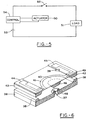
- microvalve assembly 10 is controlled utilizing a control circuit ("control circuit” also referred to as “control circuitry"), and gasket 4 is absent or otherwise situated such that positive electrode 7 is in electrical contact with container 11.
- control circuit also referred to as “control circuitry”
- gasket 4 is absent or otherwise situated such that positive electrode 7 is in electrical contact with container 11.
- Materials suitable for gasket 4 include those types of materials listed above as suitable for gasket 3.
- Figure 2 illustrates a further embodiment of the present invention, wherein fluid regulating microvalve assembly 15 is disposed in a cylindrical cell housing. While a cylindrical cell is shown, it is understood by one of ordinary skill in the art that other shapes and/or sizes of cells can be utilized.
- the cell can be a prismatic cell, having a housing with a generally rectangular or square shape.
- the cell in Figure 2 has a housing that includes a can 26 with a closed bottom and a top end, as well as a cell cover 12 and a gasket 18 disposed in the top end of the can 26.
- the can 26 is in electrical contact with a positive electrode 24, located within an annular chamber, and the cover 12 is in electrical contact with the negative electrode mixture 23 through the microvalve assembly 15 as shown in FIG. 2 . That electrical contact can be in series through the microvalve assembly, or the microvalve assembly can be in parallel with the cell.
- the negative electrode 23 is located in a cavity within the annular positive electrode chamber.
- a separator 21 is located between positive electrode 24
- the top end of the can 26 cooperates with the cell cover 12 and gasket 18, as well as a sealing member 20, a structural bracing member 17 and a contact member 13 to close the top of the cell, except for one or more passageways for fluid from outside the cell to reach the positive electrode chamber to be controlled by the microvalve assembly 15.
- the fluid passageway includes at least one fluid inlet aperture 16 in the cell cover 12 and at least one opening in the bracing member 17, and the sealing member 20 is either porous or contains at least one hole 19.
- At least one microvalve assembly 15 is in control of fluid communication with the passageway(s) to selectively control fluid flow to the positive electrode 24, closing the fluid passageway(s) when the microvalve assembly 15 is in the closed position.
- the microvalve assembly 15 When the microvalve assembly 15 is closed, the active ingredients of the cell are effectively sealed from the ambient atmosphere, and when the microvalve assembly is open, fluid communication from the ambient atmosphere to the desired active portions of the cell is permitted.
- the microvalve assembly 15 is electrically connected to the negative electrode 23 and positive electrode 24 of the cell, through a control circuit.
- the can 26 has a bead or reduced diameter step near the top end to support gasket 18 and cell cover 12. Gasket 18 is compressed between can 26 and cover 12 to form a seal, and a compression seal is also formed between the sealing member 20 and both the can 26 and the contact member 13. The gasket 18 also electrically insulates the negative cell cover 12 from the positive can 26.
- the negative electrode 23 includes a current collector 25, which is in electrical contact with contact member 13, and contact member 13 is in electrical contact with cell cover 12, either directly or in series through microvalve assembly 15. Bracing member 17 holds contact member 13 in a centered position, and when electrical contact between the contact member 13 and the cell cover 12 is through the microvalve assembly 15, insulating cap 14 provides electrical insulation between the contact member 13 and cell cover 12.
- the negative electrode 23 includes zinc as an electrochemically active material and an electrolyte.
- Positive electrode 24 preferably is porous and electrically conductive and includes a catalyst, such as manganese dioxide, and optionally a binder.
- a decorative label 22 surrounds the outside of the can 26 except on the end where the positive terminal cover 27 covers the end of the can 26.
- the positive terminal cover could also have one or more microvalve assemblies included in the space between the cover and the bottom of the can containing the positive electrode.
- components of the cell shown in Figure 2 can be made from materials of similar compositions to the corresponding components of the button cell described above.
- the locations of the positive and negative electrodes can be reversed; this requires corresponding relocation of the air inlets and microvalve assemblies.
- two or more cells in one or more housings may utilize the same microvalve assembly or more than one microvalve assembly can be connected to a single cell.
- the microvalve assembly can be located outside or within the cell housing.
- the fluid regulating microvalve assembly can be designed to be operated prior to integration into the electrochemical cell, or otherwise be designed to begin functioning after incorporation into the cell.
- the cell is provided with a seal over a fluid inlet aperture.
- the seal is removed manually.
- the microvalve assembly is provided with a seal thereon, that is broken, perforated or split on initial activation of the electrical device.
- the improved fluid regulating microvalve assembly is operatively connected to the surface of the oxygen reduction electrode that is accessible to fluid (air) from outside of the cell, i.e., the air side, and thus is able to control fluid access to the oxygen reduction electrode.
- the one or more fluid regulating microvalve assemblies can be disposed in any suitable location in relation to the cell housing, i.e., operatively connected to, on, or within, as long as the assembly is on the air side of the oxygen reduction electrode.
- a fluid regulating microvalve assembly can be connected to or positioned adjacent to the inside surface of that portion of the housing in which one or more fluid inlets or in particular, air entry ports, are located, or connected to or adjacent to the oxygen reduction electrode, connected to another cell component such as an internal seal member, bracing member or gas permeable sheet, on the air side of the oxygen reduction electrode, or integrated into the case of a battery or of a jacket containing the cell(s).
- another cell component such as an internal seal member, bracing member or gas permeable sheet
- a printing device is utilized in one embodiment to form one or more layers or components of the fluid regulating microvalve assembly. While the terms “printing” and “depositing” are utilized throughout the specification to describe the microvalve assembly and methods of the present invention, it is to be understood in the broadest aspect of the invention that at least one layer of the microvalve assembly is printed on one or more other layers. The one or more other layers of the microvalve assembly can be printed or formed using one or more different processes, and combinations thereof.
- the printing device can produce one or more layers in numerous configurations at a relatively high speed on a substrate. Thus, fluid regulating microvalve assemblies of various shapes and sizes can be mass produced in high volume.
- the substrate can form a portion of the microvalve assembly, such as a microvalve body, or be removed from the printed layers of the microvalve assembly once the printing operation has been performed.
- the printed layers can form the microvalve assembly alone, or be used in conjunction with one or more other components or layers, for example a spring-like shape-retaining valve that functions as an interior aperture or inlet cover such as a belleville spring disk, flat spring, or flip spring strip, all of which are situated to function to alternately occlude and permit fluid to pass through the microvalve assembly into the cell. Any suitable printing process can be used.
- printing processes include indirect (offset) processes, in which ink is applied to a printing plate to form an image to be printed, transferred to a rubber "blanket", and then transferred to the substrate, and direct processes, in which an image is transferred directly from an image carrier to the substrate.
- Lithography is an example of an offset process
- examples of direct processes include gravure, flexography, screen printing, letterpress printing, and photolithography.
- Printing processes such as ink jet and laser jet processes can be adapted to making a microvalve assembly.
- Preferred printing processes include ink jet printing and laser jet printing.
- Commercially available printing devices and services can be used. Contract manufacturing and design services can be obtained from companies such as First Index of Spokane, WA and Whippany, NJ as well as from Conductive Technologies, Inc.
- Ink jet printers or printer services are available from REA Electronik GmbH, Cleveland, OH, and Muehtal, Germany as well as from Aesthetic Finishers of Piqua, OH.
- Etching services are available from Northwest Etch Technology of Tacoma, WA, and Fotofabrication of Chicago, IL.
- Laser cutting and other services are available from Magni-fab Division of Wooster, OH, Schoonover Industries of Ashland, OH and Marian, Inc. of Indianapolis, IN.
- Miniature spring or spring-like devices are available from Moyer Spring Co., Angola, IN, or Maverick Spring Makers Limited of Brantford, Ontario, Canada.
- Belleville discs or belleville washers are available from Fan Disc Corporation of Sun Valley, California and flat click springs can be obtained from Pacific Coast Distributing, Inc. Phoenix, Arizona.
- One can make a belleville valve by printing a layer of metal or plastic and creating differential material density or thickness in a layer and securing the layer by another layer to create spring-like compression in a layer so that upon movement of the layer, the layer snaps or pops reversibly from one shape-retaining form to another shape-retaining form.
- additional devices and processes can be utilized in combination to produce the microvalve assembly.
- devices can be utilized to create apertures or vents in one or more layers of the microvalve assembly; to remove a portion of a layer or coating of the microvalve assembly such as by a process, but not limited to, cutting, melting, washing, dissolving, or the like; and to join portions of the microvalve assembly.
- additional devices that can be used to prepare a microvalve assembly, individually or in combination, include, but are not limited to, die cutting devices, drilling devices, chemical and photochemical etching processes, and devices such as lasers, laminating devices, machining or micromachining devices, or the like.
- Devices and processes can be utilized that wash away or melt out a portion of one or more (a) temporary layers such as a filler plug, or (b) permanent layers of the microvalve assembly to create a desired form such as, but not limited to, a cavity or fluid transport channel, aperture, port, or inlet, or a free space to allow movement of one or more parts.
- One or more layers can be printed which do not adhere to parts of the substrate or subsequent layers so they function as parting layers allowing movement of adjacent parts. Examples of various materials and techniques are set forth in U.S. Patent Application No. 2003/0201175 , U.S. Patent No. 5,246,730 , and U.S. Patent No. 4,830,922 .
- Fluid regulating microvalve assemblies generally comprise a stationary microvalve body having one or more fluid apertures and a microactuator, which is movable from a closed position to an open position, thereby allowing fluid to flow through the microvalve body one or more apertures.
- construction of a fluid regulating microvalve assembly is accomplished using a printing process to build layers of the microvalve assembly on a substrate.
- substrates can be utilized, including, but not limited to, metals, metal oxides, glass, polymers, rubbers or elastomers, and combinations thereof.
- Non-limiting examples of metals and metal oxide substrates comprise silica, silicon, aluminum, iron, nickel, tin, zinc, copper, titanium and combinations and alloys thereof, such as brasses, bronzes, stainless steels and shape memory alloys.
- Non-limiting examples of polymers comprise polyester, polycarbonate, polystyrene, polyolefins such as polyethylene or polypropylene, polyethylene terephthalate, polyamide, polyoxides such as polyethylene oxide, polyacrylamide, polyurethane, polyalkene, polyacrylate, polymethacrylate, polyvinyl ether, polyvinyl thioether, polyvinyl alcohol, polyvinyl ketone, halogenated polymers such as polytetrafluoroethylene (TEFLON® from DuPont) or polyvinyl halides such as polyvinyl chloride, polyvinyl nitrite, polyvinyl ester, polyarylene, polysulfonate, polysiloxane, polysulfide, polythioester, polysulfone, polyacetal, or copolymers or combinations thereof.
- TEFLON® polytetrafluoroethylene
- polyvinyl halides such as polyvinyl chloride, poly
- Non-limiting examples of substrate rubbers or elastomers comprise or are derived from one or more same or different conjugated dienes having from 4 to 12 carbon atoms with specific examples including butadiene, isoprene, pentadiene, hexadiene, octadiene, and the like.
- Rubbers of the substrate include copolymers of the above-noted conjugated diene monomers with one or more vinyl substituted aromatic monomers containing from 8 to 12 carbon atoms such as styrene, alpha-methyl styrene, t-butyl styrene, or a vinyl compound such as acrylonitrile, vinylpyridine, acrylic acid, methacrylic acid, alkyl acrylate, and alkyl methacrylate.
- Still further rubbers include copolymers of olefins with a non-conjugated diene (EPDM rubbers) such as ethylene propylene cyclopentadiene terpolymers, ethylene-propylene-5-ethylidene-2-norbornene terpolymers, and ethylene propylene 1,4-hexadiene terpolymers.
- EPDM rubbers such as ethylene propylene cyclopentadiene terpolymers, ethylene-propylene-5-ethylidene-2-norbornene terpolymers, and ethylene propylene 1,4-hexadiene terpolymers.
- suitable rubbers include polybutadiene, synthetic polyisoprene, natural rubber, styrene-butadiene rubber, EPDM rubber, nitrile rubber, halogenated rubber, neoprene, silicone elastomers, ethylene acrylic elastomers, ethylene vinyl acetate copolymers, epichlorohydrin elastomers, and the like, or combinations thereof.
- the polymers, rubbers, or elastomers, and combinations thereof, whether utilized in the substrate layer, or in one or more other layers of the present invention, independently, can include one or more of various additives, fillers, lubricants, stabilizers, processing aids, antidegradents, waxes, fibers that are synthetic or natural or both, mineral fibers, glass, clay, silica, compatibilizers, flame retardants, dispersing agents, colorants, and the like, which are utilized in conventional amounts as known to the art and to the literature.
- natural fibers include, but are not limited to, cotton and cellulose fibers.
- synthetic fibers include, but are not limited to, fiberglass, polyester, polyamide both nylon and aramid, polyethylene, polypropylene, and carbon fibers.
- the substrate is rigid or flexible in character.
- the substrate is a rigid sheet or film.
- the substrate has a thickness of generally from 0.01 to 0.375 millimeters, and preferably from 0.05 to 0.25 millimeters.
- the substrate forms at least a portion of the microvalve body of the fluid regulating microvalve assembly and remains in a stationary position when the microvalve assembly microactuator is actuated moving a sealing member between a closed position and an open position.
- the substrate may be porous or non-porous to fluids, with non-porous substrates being preferred to more accurately control the amount of fluid that passes through the fluid regulating microvalve assembly.
- a fluid regulating microvalve assembly consisting of two halves joined together after microactuator construction is fabricated in one embodiment as follows.
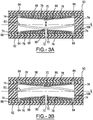
- One embodiment of the particular microvalve assembly is illustrated in FIG. 3A .
- the microvalve assembly contains two microactuators cooperating together and a belleville spring disk, flat spring, or flip spring strip, all of which are situated to function to alternately occlude and permit fluid to pass into the cell, sealed in the assembly.
- Desired substrates 62,63 are provided, preferably having a thickness sufficient to bear the contemplated fluid pressure.
- the substrate 62 is perforated or cut to produce an aperture 72 through which fluid will flow.
- the substrate may be perforated or cut to the size of the desired microvalve assembly to be produced.
- the length, width and height dimensions of the microvalve assembly are limited by the dimensions and desired placement in a cell, battery, or case design. Independently, the length and width generally range from 2 to 25 millimeters, and preferably from 5 to 10 millimeters.
- the size of one aperture 72 ranges generally from 0.1 to 10 millimeters, and preferably from 0.4 to 2 millimeters.
- a preferred microvalve assembly is 5 millimeters in length by 5 millimeters in width having a 1.25 plus or minus 0.25 millimeter diameter aperture. It is contemplated that numerous fluid regulating microvalve assemblies can be prepared on a single substrate being formed in rows and columns with appropriate spacing between each microvalve assembly.
- the microvalve assemblies can be mass produced and separated for incorporating one or more into a cell or housing.
- the microvalve assembly particularly using the belleville spring, can be miniaturized to a nanotechnology level, limited only by the power carrying capacity of the conductive layers, the thinness of deposition possible to accomplish the functions of the various layers, the desired fluid flow, and then selecting a material for the belleville spring or flat spring of suitable flexibility and shape retention characteristic to achieve the performance characteristics described in this invention enabled to a microscopic or nanoscopic level.
- That material can be a plastic or polymer material as no conductive characteristic is needed.
- One or more layers are then deposited upon the substrates 62,63 in desired areas thereof. Such layers can be part of the microvalve body or microactuator and can be conductive or non-conductive as desired.
- a first layer is deposited onto the substrates 62,63.
- the first layer deposited onto the substrates 62,63 can be a conductive layer 64, deposited in two lines, each of which form an electrical lead, so that one end of each lead is adjacent to an edge of the microactuator assembly.
- the conductive layer 64 is formed of two electrical lead lines which extend in a direction parallel to the length or width of substrates 62,63.
- the insulating layer 66 is then printed onto the actuators, over at least a portion of the conductive layer 64.
- the insulating layer 66 generally comprises a dielectric coating sheet or film, or the like, which is electrically non-conductive and will not decompose, become conductive or unintentionally adhere to a subsequent layer when exposed to heating of the later applied resistive layer, as described below.
- Such insulating coatings are known to those skilled in the art and include, but are not limited to, urethanes, acrylates, polysulfones, polysiloxanes, halogenated polymers, and polyesters, or combinations thereof.
- one or more insulating layers 66 deposited on the substrate 62 or another layer, or combinations thereof, can be formed from non-conductive or dielectric polymers, rubbers, or elastomers as described for the substrate 62 hereinabove.
- FIG. 3A three insulating sublayers are shown, but any appropriate number of layers can be used to create the desired form. If more than one insulating layer is used, each layer can be the same or a different material.
- insulating layer 66 is chosen to provide effective parting layer characteristics.
- the insulating layer 66 covers substantially all of the substrates 62,63 of the microactuator assemblies and the conductive layer 64 except for one or more areas near one or more ends or edges of the substrate 62.
- Printing of one or more insulating layers, such as 66, 68, and 70 as illustrated in FIG. 3A and 3B can be accomplished in one or more passes in order to build up the insulating layers 66, 68, 70 on the substrates 62,63 such as in the area where the aperture will be or any other desired area.
- FIG. 3A the insulating layer 66 covers substantially all of the substrates 62,63 of the microactuator assemblies and the conductive layer 64 except for one or more areas near one or more ends or edges of the substrate 62.
- Printing of one or more insulating layers, such as 66, 68, and 70 as illustrated in FIG. 3A and 3B can be accomplished in one or more passes in order to build up the insulating layers 66, 68, 70 on the substrates 62,63 such as
- microvalve body insulating layer 66 has a parting layer 76 printed on it so layer 68 can move away from layer 66 when the microactuator moves to the open position. Then insulating layer 68 is printed on a portion thereof of layers 66 and 76, generally between the lead lines of conductive layer 64. The upper surface of insulating layer 68 is curved in order to cause resistive layer 78 to expand away from insulating layer 66 during heating and expansion of the resistive layer 78.
- the microvalve body can include an additional insulating layer formed as a boss or simply have a boss 80 shaped on layer 78. Boss 80 is generally a raised rim surrounding aperture 72 that serves to provide a gasket having desired sealing characteristics. A laser or chemical etching process then is utilized to remove the portions of the insulating layer above the conductive lines of the first layer or any insulating layer material above aperture 72 in substrate 62, and combinations thereof.
- conductive material which can be of the same type or a different type than utilized in the first layer, is deposited in the areas removed by the laser to provide rigid electrical contacts 74 protruding up through the insulating layer.
- the composition of the conductive material of protruding electrical contact 74 is not critical, but preferably the material is of appropriate resistivity, is rigid, has adequate cohesive strength, and is readily adhered to by the resistive layers 78 described below. It is important, however, that the conductive material, if a liquid, be able to dry upon being printed or coated on the substrate or other layer, leaving a conductive coating thereon.
- Examples of conductive materials include, but are not limited to, metals and solvated polymer solutions containing conductive particles such as aluminum, carbon, silver, gold, copper, platinum, or combinations thereof.
- the conductive solids content of the solvated polymer generally ranges from 40 to 90 percent by weight, based on the total weight of the solvent, polymer, and conductive solids in the mixture.
- the amount of conductive particles required to be present in the mixture to provide the desired electrical conductivity may vary depending on the identity of the conductive particle due to differences among the particles with respect to density, conductivity, etc.
- the same or different coatings may be utilized in the same or different layers of the microvalve assembly.
- the conductive material may be comprised of a variety of film forming polymers which are compatible with the conductive particles and mixed therewith and which will adhere to the substrate or other layer upon drying or removal of the solvent.
- film forming polymers which may be utilized to form a conductive material include, but are not limited to, polymers such as polyesters and polyacrylates.
- polymers such as polyesters and polyacrylates.
- One of ordinary skill in the art can readily ascertain the identity of acceptable polymers for use in the conductive material layer(s).
- direct metal deposition by electrochemical or vapor deposition means could be employed alone, or in combination with the above polymer matrix films to form either conductive layer 64 or conductive protruding electrical contact 74, and combinations thereof.
- An aperture or apertures 72 are left uncoated or created after forming the one or more insulating layers 66, 68, 76 and boss 80 immediately above and matching the aperture or apertures 72 in the substrate 62, to extend through both the substrate and the insulating layers.
- a plug of material is then placed in each aperture 72 which can be washed or melted out after the next layer or layers have been deposited. Examples of suitable materials include waxes and low molecular weight polymers that can be at least partially removed. The plug is utilized to prevent subsequent material applied to the microvalve assembly from obstructing or partially obstructing aperture 72.
- the resistive material layer 78 is deposited upon a predetermined portion of an upper surface of the microactuator assembly, generally on the parting layer 76.
- the resistive material layer 78 is conductive and has a coefficient of thermal expansion (CTE) greater than that of preferably all of the layers 66, 68, 76 and boss 80.
- CTE coefficient of thermal expansion
- the resistive material layer 78 in the microactuator containing the aperture or apertures is deposited at least in an area which makes electrical contact with the two electrical contacts 74 protruding upward through the insulating layer 66 and also covers the aperture 72 in the layers 66, 68,76 and 70.
- a segment of a circuit is formed running from the first lead through the resistive material layer 78 to the second lead.
- the resistive material layer 78 is secured to the microvalve assembly in at least one line or location. The plug of material is removed from aperture 72 after the resistive material layer 78 is formed.
- the resistive material layer 78 heats and distorts away carrying with it the layers 68, 76 and boss 80, creating a passage through these layers, resistive material layer 78 and layers 68, 76 and boss 80 thereon and the fluid inlet aperture or apertures 72 in the insulating layer and substrate. Fluid can then pass the aperture or apertures.
- the substrate 62 and insulating layer 66 of the microactuator body remain stationary while the microactuator layers 68,76 and resistive layer 78 move from a first position to a second position, thereby causing the spring-like shape-retaining interior valve, which functions as an aperture cover, such as a belleville spring disc 82 or a flat spring which is a deformable flat strip of the microvalve assembly (not shown, but to be anchored on one edge by 74 as in Figure 4A ) to snap to a second position thereby permitting fluid flow through the microvalve assembly.
- an aperture cover such as a belleville spring disc 82 or a flat spring which is a deformable flat strip of the microvalve assembly (not shown, but to be anchored on one edge by 74 as in Figure 4A ) to snap to a second position thereby permitting fluid flow through the microvalve assembly.
- resistive materials for resistive layers 78 include, but are not limited to, materials described for the conductive layers 64 and 74 hereinabove, and preferably are high thermal expansion conductive polymer matrix materials including conductive particles, and high thermal expansion metals such as aluminum, certain brasses, bronzes and magnesium.
- the above described fluid regulating microactuator assembly is optionally detached from the substrate 62 and assembled into a cell as desired to control flow of fluid. That said, if the substrate 62 is removed, insulating layer 66 is generally considered the base of the microvalve body of the microvalve assembly.
- the fluid regulating microvalve assembly includes a belleville disc.
- FIGS. 3A and 3B show an embodiment of this microvalve assembly with a belleville spring operating to provide a closed position and an open position, respectively.
- An adhesive may be used to join the halves together as appropriate.
- a control unit which can include a microchip or embedded microcircuit, as shown in FIG. 5 , can be added.
- the control unit can be connected electrically through two additional conductive contact lines included in the conductive layer of the microvalve assembly, extending across at least part of the substrate to provide electrical connections to the first (closed) position microactuator.
- the control unit can be used to provide power to this microactuator only when power is required from the cell or battery for a powered appliance.
- belleville disc 82 is shown in a first position when the microvalve assembly is in the closed position.
- Applying a potential across the resistive layer 78 (adjacent to aperture 72) through conductive layer or strips 64, 74 causes the resistive layer 78 to expand and move upward with insulating layer 68 and parting layer 76, a design determined distance, thereby causing the belleville disc or strip to "pop" away from its first position covering the entry to an aperture to fluid inlet 72 which extends through the parting layer 76, the insulating layer 68, the resistive layer 78, insulating layer 70, and boss 80.
- the belleville disc, or flat spring strip is moved, and thereby snaps or "pops" to its second open position where it remains until acted upon.
- the potential is then removed from the resistive layer 78, allowing it to cool and return to its first position as shown in FIG. 3B leaving a passageway through which fluid can pass through the aperture 72 in the substrate 62 and insulating layers 66, 68, parting layer 76, boss 80, and resistive layer 78 and inlet 108 even though no current is flowing through the resistive layer 78 or the belleville disc.
- the spring-like, shape-retaining cover here a belleville disc 82 or flat spring (which flat spring could be a flip spring strip) which is being popped, can contain one or more perforations to allow fluid to flow into the cell.
- inlets 108 can be created opening to allow fluid to pass into the cell and positive electrode.
- the microvalve is connected to a control unit, and when the control unit senses that power is no longer required from the cell, the control unit allows a potential to be placed across the resistive layer 78 adjacent to the second position of the belleville disc or strip through conductive strips 74 of the second microactuator for a sufficient time for insulating layer 68, resistive layer 78 and parting layer 76 to move against the spring-like shape-retaining aperture cover, here a Belleville disk or flip spring, 82, moving it the designed distance.
- the belleville disc with spring-like characteristic 82 is popped back to its first position, and the second microactuator is deactivated allowing it to return to its first position. In this manner, parasitic power from the cell is consumed only to move the microvalve assembly from the closed position ( FIG. 3A ) to the open position ( FIG. 3B ) and vice versa, and the useful life of the cell is extended.
- the microvalve assembly in FIGS. 4A and 4B can be made utilizing a process similar to that described above for the microvalve assembly in FIG. 3A and 3B , except as follows.
- an internal microactuator arm consists of a flat spring which is placed or deposited within a cavity in the microvalve assembly. Opposing microactuators cooperate and are disposed within the microvalve assembly; one method is by depositing layers of the microactuators and using an adhesive to join the halves together.
- the fluid regulating microvalve assembly includes a simple flat spring.
- FIGS. 4A and 4B show an embodiment of this microvalve assembly with a flat spring operating to provide a closed position and an open position, respectively.
- a control unit which can include a microchip or imbedded microcircuit, as shown in FIG. 5 , can be added.
- the control unit can be connected electrically through two additional conductive contact lines included in the conductive layer of the microvalve assembly, extending across at least part of the substrate to provide electrical connections to the first microactuator adjacent to the closed position which first microactuator is designed to move the flat spring to the open position and cooperating with the second cooperating microactuator enabling a catch of the flat spring.
- the two microactuators are sequenced by the control unit so the second microactuator in conjunction with the catch of the flat spring opens followed by energizing the first microactuator which moves the spring from the closed position to the open position.
- Deenergizing the second microactuator cooperating with the catch of the flat spring causes the flat spring to be engaged and prevented from returning to its first position at which time the first microactuator is de-energized allowing it to return its original position leaving the flat spring retained in the microvalve open position.
- the control unit activates only one of the microactuators, that is, the second microactuator, moving the catch of the flat spring, and disengaging it from the flat spring, whereupon the flat spring returns to a first position and closes the microvalve.
- the control unit can be used to provide power to these microactuators only when power is required from the cell or battery for a powered appliance or when the power is not needed and the microvalve needs to be turned off or the closure of the microvalve can be delayed by the control circuit as described elsewhere in this application.
- the control circuit or control circuitry can be configured to control one or more microvalve assemblies, or one or more microactuators or set of microactuators within a microvalve assembly.
- the flat spring is shown in a first position when the microvalve is in the closed position.
- the second microactuator is built up upon base 98 and insulating layers 92 and parting layer 102 are coated in or on base 98. Conductive strips 94 and 96 are coated in or on base 98. Applying a potential across the resistive layer 86 through conductive strips 94, 96 causes the resistive layer 86 to expand and move upward with parting layer 102, a design determined distance. Applying a potential to the second microactuator creates an opening into which the spring strip 104 can be pushed by the first microactuator. Simultaneously or after a slight delay a potential is applied across the cooperating first microactuator containing an aperture or apertures.
- the second microactuator assembly can contain one or more perforations to allow fluid to flow into the space between the microactuators or through one or more inlets, inlet apertures, or apertures 108 into the cell.
- the microvalve assembly is connected to a control unit, and when the control unit senses that power is no longer required from the cell, the control unit allows a potential to be placed across the resistive layer 86 through conductive strips 94, 96 of the second microactuator for a sufficient time for the insulating layer 92, resistive layer 86 and parting layer 102 to move releasing the flat spring 104 to return to its first position.
- the potential is removed from the second microactuator allowing it to return to its first position.
- parasitic power from the cell is consumed only to move the microvalve from the closed position ( FIG. 4A ) to the open position ( FIG. 4B ) and vice versa, and the useful life of the cell is extended.
- since only one of the two microactuators is activated for the closing action less power is consumed to close the microvalve assembly in a period when less power is often available from the associated electrochemical cell or cells.
- FIG. 5 is a schematic diagram illustrating one embodiment of a control circuit for microactuator 50 of a microvalve assembly of the present invention.
- Microactuator 50 is connected to a control unit 54, that can be printed in one embodiment, connected in series with an electrical switch 52.
- Figure 5 also illustrates load 51, connected in series with switch 52, control unit 54 and battery 53 or cell including those of Figures 1 and 2 .
- Control unit 54 responds to voltage and current characteristics of the circuit it is connected to.
- Control unit 54 can vary the potential supplied to the microactuator 50 in order to regulate or optimize fluid flow through the microvalve assembly.
- the control unit can also respond to measurement of potential which can signify the fluid depolarized state of the fluid depolarizing electrode, which in air cells would be a potential reflective of the oxygen state of the cell at the "air electrode.”
- FIG. 6 A further embodiment of a fluid regulating microvalve assembly is illustrated in cross section in FIG. 6 .
- the cross-section shows a microvalve assembly in two sections which are in position to be connected, such as through an adhesive or lamination, or the like, to create an assembled microvalve assembly.
- the microvalve assembly includes a microvalve body comprising substrate 36 which is preferably in the form of a rigid sheet or film, as described hereinabove.
- Substrate 36 includes aperture 37.
- End supports 38 are deposited on substrate 36, preferably utilizing a printing process.
- Boss 48 can be deposited around aperture 37 utilizing the same material as end supports 38.
- end supports 38 and boss 48 can be deposited as a continuous layer on the substrate 36 and portions of the material subsequently removed to create the end supports 38 and boss 48.
- boss 48 is a different material, selected to provide a good seal with a second boss 46.
- a coating could be deposited on the surface of at least one of boss 48 and boss 46 to function as a gasket.
- the upper portion of the microvalve assembly comprising a microactuator as illustrated in FIG. 6 is formed on a non-conductive membrane sheet 40, at least utilizing the printing process.
- the membrane sheet 40 is formed of material as described for the substrate hereinabove, such as polymer matrix semiconductors, glasses, silicon, polymers, rubbers, or elastomers. Selected areas of the membrane sheet 40 are overprinted in one embodiment with a non-conductive layer 49, preferably adjacent to two opposite ends of the membrane sheet 40 at least in the area above end supports 43, with the same or a different material as membrane sheet 40 in order to create a relatively thin section within supports 43, located radially outward from the location of second boss 46.
- expansion layer 41 which includes a resistive material, is deposited on membrane sheet 40 preferably by printing.
- expansion layer 41 is preferably formed in an annular strip disposed around boss 48, rather than having a planar shape as in the embodiment shown in FIGS. 4A and 4B .
- Conductive leads make electric contact between each of contact points 44 and 45 and expansion layer 41, such as illustrated.
- expansion layer 41 heats, expands, and causes deformation of membrane sheet 40.
- Aperture 39 is preferably placed in membrane sheet 40 to admit fluid to the center of the microvalve.
- a boss 46 is deposited on the underside of membrane sheet 40 in one embodiment and is sufficient in size and located to cover boss 48 in the lower portion of the microvalve assembly.
- Boss 46 functions as a sealing plug on lower annular boss 48.
- End supports 43 are deposited along one or more lower edges of the membrane sheet 40.
- Boss 46 and end supports 43 can be deposited utilizing a printing process. If desired, end supports 43 and boss 46 can be deposited as a continuous layer on the underside of membrane sheet 40 and portions of the material subsequently removed to create the end supports and boss 46.
- the upper and lower end supports are connected to form the microvalve assembly.
- the supports can be connected via lamination or an adhesive such as known in the art.
- a gasket or sealant layer is deposited on boss 48 to optimally seal aperture 37 in conjunction with boss 46.
- the gasket or sealant layer is preferably formed of an elastomeric compound which will not adhere to the layer, such as boss 46 contacting it during the operation of the microvalve and microactuator. Suitable materials include, but are not limited to, polyethylene terephthalate, polytetrafluoroethylene such as TEFLON® (DuPont), or polymethylsiloxane.
- fluid can flow through the gap in the sides of the microvalve if not sealed by end supports 38 and 43, or through aperture 39 if the microvalve ends are sealed, and ultimately through aperture 37 into the cell or into a battery compartment.
- a layer e.g., end supports 38 and boss 48 on substrate 36, or end supports 43 and boss 46 on membrane sheet 40
- end supports 38 and boss 48 on substrate 36, or end supports 43 and boss 46 on membrane sheet 40 can be either the same material, as described above, or they can contain different materials.
- the conceptual framework is that fluid is alternately occluded and permitted to enter from the exterior of the microvalve assembly to a void just above the boss against which the bellville valve, flip spring or flat spring seat to occlude fluid flow through the aperture 72 or 106 into the cell.
- apertures or holes or a framework through the side wall of the microactuator can be used.
- Figures 3A and 3B and 4A and 4B show an aperture 108 as one way to accomplish that result.
- the fluid regulating microvalve assemblies of the present invention include microactuators that can move in various ways and in combinations of ways from a first position where fluid cannot pass through the microvalve body aperture to at least a second position which allows fluid to pass through the microvalve body aperture. Movements include, but are not limited to, motion towards and away from a portion of the microvalve body particularly an aperture, linear or non-linear movement, movement parallel to a surface such as a microvalve body, and movement which serves to engage or disengage a spring-like shape retaining valve which has a springy-arm characteristic.
- the fluid regulating microvalve assembly is electrically connected, preferably in a series circuit, to the cell to which it is controlling fluid access.
- the fluid regulating microvalve assembly is provided with a separate power source other than the cell or cells it is operatively connected to.
- Electrical connections between the microvalve assembly electrical contacts and the cell electrodes can be accomplished in any suitable manner that provides a reliable connection.
- one of the microvalve assembly electrodes can be in direct physical and electrical contact with the positive electrode such as the oxygen reduction electrode.
- one electrical contact can be in direct contact with an electrically conductive portion of the cell housing that is in electrical contact with the positive electrode.
- an electrical lead can be used to provide electrical contact with the positive electrode.
- microvalve assembly It may be desirable to electrically polarize the microvalve assembly as either positive or negative. It is desirable to polarize the microvalve assembly negatively in an acid electrolyte cell and positively in an alkaline electrolyte cell to reduce the likelihood of electrolyte creepage into the microvalve assembly reducing or destroying its ability to operate.
- the microvalve assembly electrical contact that is electrically connected to the negative electrode of the cell can be connected with an electrical lead.
- An electrical lead can have a travel path around or through the positive electrode or oxygen-reduction electrode, as long as the lead is electrically insulated therefrom.
- the electrical connector connecting the microvalve assembly to the negative electrode of the cell may be in the form of a wire or thin metal strip with dielectric material insulating any parts of the lead that may otherwise come in electrical contact with the positive electrode, either directly or indirectly through another cell component such as a conductive portion of the cell housing, a positive electrode, current collector, or a positive electrode electrical contact, lead or spring.
- the electrical lead to the negative electrode may be in the form of one or more thin layers of metal printed or otherwise deposited on a portion of one or more other cell component, such as surfaces of gasket, insulators, cans, covers, and the like. Layers of the dielectric material may be coated over or beneath, or a combination thereof, the metal layers to provide the necessary insulation from the positive electrode.
- the potential applied to the fluid regulating microvalve assembly to operate the microactuator can originate within the cell.
- the potential applied to the microvalve assembly can be the cell potential, as described above.
- the cell potential can also be changed. If a higher voltage is needed to produce a desired microvalve assembly microactuator movement, the cell potential can be adjusted upward. Adjusting the cell potential can allow for the use of different types of materials for the microactuator. Increasing the cell potential can be accomplished, for example, with a controlled circuit, to regulate or step up the cell voltage and thus more strongly induce movement of the microactuator to operate the microvalve assembly.
- the control circuit can also be utilized to control other cell features or components.
- the control circuit can be utilized to monitor the need for oxygen and then apply a potential across the microvalve assembly to open or close the microactuator.
- the control circuit can include an oxygen sensor to monitor the oxygen level in the cell.
- the control circuit can also be utilized to monitor the cell voltage or monitor the potential of the positive electrode against a separate reference electrode.
- the control circuit can be connected to an oxygen sensor or fluid sensor (such as in a bromine cell) to determine if the cell needs restoration of its fuel fluid potential state so that there is adequate start-up energy for cell activation when the cell is reactivated.
- the control circuitry would normally be set so that the predetermined level at which the cell would be deemed to have adequate energy presence would be that level at which the cell can produce the design voltage of the cell on reactivation and microvalve assembly functioning.
- the control circuit can be printed utilizing the printing process of the present invention or another process.
- the control circuit can be applied to a cell or battery component or be included on a separate substrate or wafer or chip, or any other suitable arrangement can be utilized.
- the control circuit can have components including, but not limited to, fuses, inductors, capacitors, resistors, and transistors.
- the control circuit can be designed to fail on contact with a corrosive fluid or to shut down upon excessive current demand.
- the fluid regulating microvalve assemblies of the present invention can be incorporated into cells in various ways, depending on the type and design of the microvalve assembly and the cell.
- the fluid regulating microvalve assembly is contained within the cell housing.
- the microvalve assembly, control circuit, or combinations thereof can be disposed outside the cell, such as between the external surface of the cell housing and a battery jacket or case.
- the minimal volume requirements for the fluid regulating microvalve assembly make such embodiments possible in batteries with little space available between the cell and jacket or case.
- a preferred embodiment of an electrochemical cell using a microvalve assembly according to the invention is an air-depolarized cell.
- Another preferred embodiment is an air-assisted cell.
- Yet another preferred embodiment is a fuel cell.
- a preferred cell shape is a button shape.
- Another preferred cell shape is a cylindrical shape.
- Yet another preferred cell shape is a prismatic shape.
- An electrochemical cell according to the invention can be part of a battery comprising one or more cells.
- more than one battery cell can share a single microvalve assembly, and in another preferred embodiment each cell can have one or more separate microvalve assemblies.
- microvalve assemblies can be located within or on the battery housing, or they can be mounted on a portion of an appliance in which the battery is installed.
- the appliance can be designed to have the microvalve assembly disposed so that when a fluid depolarized cell is inserted, exchanged, or otherwise provided, an inlet to such a fluid depolarized cell is adjacent to and has space for fluid such as air to pass sealingly to a port of the microvalve assembly so that when the appliance is activated, the microvalve assembly operates as presented herein, and the one or more cells are prevented from losing active ingredients when the appliance is turned off, and yet powers the appliance with fluid entering the cell or cells.
- the embodiments of the invention with various options and features can be integrated with this latter design of the cell designed to be dropped into the appliance having the microvalve assembly, and corresponding appliance design.
- control units can be located within on or on the battery housing, or at least portions of the control units can be mounted on a portion of an appliance in which the battery is installed.
Landscapes
- Engineering & Computer Science (AREA)
- Chemical & Material Sciences (AREA)
- Electrochemistry (AREA)
- General Chemical & Material Sciences (AREA)
- Chemical Kinetics & Catalysis (AREA)
- Manufacturing & Machinery (AREA)
- General Engineering & Computer Science (AREA)
- Dispersion Chemistry (AREA)
- Mechanical Engineering (AREA)
- Sustainable Energy (AREA)
- Life Sciences & Earth Sciences (AREA)
- Sustainable Development (AREA)
- Microelectronics & Electronic Packaging (AREA)
- Hybrid Cells (AREA)
Claims (6)
- Elektrochemische Zelle, umfassend ein Gehäuse, das eine oder mehrere Flüssigkeitseinlassöffnungen (9), eine negative Elektrode (1), eine flüssigkeitsverbrauchende positive Elektrode (7) und wenigstens eine Mikroventilbaugruppe (10), die funktionell mit der einen oder den mehreren Flüssigkeitseinlassöffnungen (9) verbunden ist, um den Durchtritt von Flüssigkeit zu der flüssigkeitsverbrauchenden positiven Elektrode (7) zu steuern, umfasst, dadurch gekennzeichnet, dass die Mikroventilbaugruppe (10) umfasst:(a) einen stationären Mikroventilkörper mit wenigstens einer zweiten Einlassöffnung (9);(b) ein erstes bewegliches Mikrostellglied, das wenigstens zwei abgeschiedene Schichten aufweist und sich zwischen einer ersten Position und einer zweiten Position bewegen kann, wobei das erste bewegliche Stellglied mit einer federartigen formbewahrenden Öffnungsabdeckung zusammenwirkt, die ihre Form verändert, wenn Druck auf eine Seite der federartigen formbewahrenden Öffnungsabdeckung ausgeübt wird, und sich die Öffnungsabdeckung in einer ersten Verschlussposition befindet, um den Eintritt von Flüssigkeit durch wenigstens eine der einen oder der mehreren Flüssigkeitseinlassöffnungen zu verhindern;(c) wobei das erste bewegliche Mikrostellglied bei Aktivierung des ersten beweglichen Mikrostellglieds Druck auf die Öffnungsabdeckung ausübt und durch diesen Druck bewirkt wird, dass die Öffnungsabdeckung aus der ersten Verschlussposition in eine zweite Position einrastet, wobei die zweite Position Flüssigkeit durch die wenigstens eine der wenigstens einen Flüssigkeitseinlassöffnungen (9) hindurchtreten lässt;(d) ein zweites bewegliches Mikrostellglied, das ein mehrschichtiges Stellglied aufweist, welches wenigstens zwei abgeschiedene Schichten aufweist, die einen Druck auf die Öffnungsabdeckung ausüben und bewirken können, dass die Öffnungsabdeckung in die erste Verschlussposition einrastet;(e) wobei die Mikrostellglieder mit dem Mikroventilkörper verbunden sind;(f) wobei die wenigstens eine Mikroventilbaugruppe (10) eine Steuerungsschaltung aufweist, wobei die Steuerungsschaltung, wenn die Zelle einen Strombedarf aufweist, bewirkt, dass sich das erste Mikrostellglied bewegt und bewirkt, dass die federartige formbewahrende Öffnungsabdeckung aus der ersten Position in eine zweite Position einrastet und dadurch Flüssigkeit in die Zelle fließen lässt, einschließlich durch die wenigstens eine zweite Einlassöffnung, wobei das erste Mikrostellglied nach dieser Bewegung deaktiviert wird und, nachdem der Strombedarf der Zelle nachgelassen hat, die Steuerungsschaltung das zweite Mikrostellglied aktiviert und bewirkt, dass die federartige formbewahrende Öffnungsabdeckung aus der zweiten Position in die erste Position einrastet, in der keine Flüssigkeit durch die wenigstens eine der einen oder der mehreren Flüssigkeitseinlassöffnungen (9) hindurchtreten kann, woraufhin das erste Mikrostellglied deaktiviert wird.
- Elektrochemische Zelle gemäß Anspruch 1, weiterhin umfassend:(i) einen Potentialsensor, um zu erkennen, wenn die chemische Aktivität einer bestimmten Elektrode niedrig ist, und die Aktivierung des zweiten Mikrostellglieds durch die Steuerungsschaltung, nachdem der Strombedarf der Zelle nachgelassen hat, verzögert, bis die chemische Aktivität auf ein vorbestimmtes Niveau gestiegen ist; oder(ii) einen Flüssigkeitssensor, um zu erkennen, wenn die Konzentration der depolarisierenden Flüssigkeit in der Zelle niedrig ist, und die Aktivierung des zweiten Mikrostellglieds durch die Steuerungsschaltung, nachdem der Strombedarf der Zelle nachgelassen hat, verzögert, bis die Konzentration der depolarisierenden Flüssigkeit in der Zelle auf ein vorbestimmtes Niveau gestiegen ist; oder(iii) einen Sauerstoffsensor, um zu erkennen, wenn die Sauerstoffkonzentration in der Zelle niedrig ist, und die Aktivierung des zweiten Mikrostellglieds durch die Steuerungsschaltung, nachdem der Strombedarf der Zelle nachgelassen hat, verzögert, bis die Sauerstoffkonzentration in der Zelle auf ein vorbestimmtes Niveau gestiegen ist.
- Elektrochemische Zelle gemäß Anspruch 1, wobei(i) die federartige formbewahrende Öffnungsabdeckung ein Tellerfederventil ist; oder(ii) die federartige formbewahrende Öffnungsabdeckung eine Blattfeder ist.
- Elektrochemische Zelle gemäß Anspruch 1, wobei die Zelle eine luftdepolarisierte oder luftunterstützte Zelle ist.
- Elektrochemische Zelle gemäß Anspruch 1, wobei(i) sich die Mikroventilbaugruppe (10) innerhalb des Zellgehäuses befindet; oder(ii) sich die Mikroventilbaugruppe (10) auf und außerhalb des Gehäuses befindet.
- Elektrochemische Zelle gemäß Anspruch 1, wobei(i) die Zelle eine Säureelektrolytzelle ist und die Mikroventilbaugruppe (10) als negativ polarisiert ist; oder(ii) die Zelle eine alkalische Elektrolytzelle ist und die Mikroventilbaugruppe (10) als positiv polarisiert ist.
Applications Claiming Priority (4)
| Application Number | Priority Date | Filing Date | Title |
|---|---|---|---|
| US201261586489P | 2012-01-13 | 2012-01-13 | |
| US13/350,727 US9252467B2 (en) | 2005-03-21 | 2012-01-13 | Fluid regulating microvalve assembly for fluid consuming cells with spring-like shape-retaining aperture cover |
| US13/530,828 US20130344402A1 (en) | 2012-06-22 | 2012-06-22 | Multicapability printed microactuators with fuel and oxidizer control device group |
| PCT/US2013/021242 WO2013106714A1 (en) | 2012-01-13 | 2013-01-11 | Fluid regulating microvalve assembly for fluid consuming cells with spring-like shape-retaining aperture cover |
Publications (3)
| Publication Number | Publication Date |
|---|---|
| EP2803098A1 EP2803098A1 (de) | 2014-11-19 |
| EP2803098A4 EP2803098A4 (de) | 2015-07-08 |
| EP2803098B1 true EP2803098B1 (de) | 2018-08-22 |
Family
ID=48781944
Family Applications (1)
| Application Number | Title | Priority Date | Filing Date |
|---|---|---|---|
| EP13735857.8A Not-in-force EP2803098B1 (de) | 2012-01-13 | 2013-01-11 | Fluidregelende mikroventilanordnung für flüssigkeitsverbrauchende zellen mit federartiger formbeständiger öffnungsabdeckung |
Country Status (2)
| Country | Link |
|---|---|
| EP (1) | EP2803098B1 (de) |
| WO (1) | WO2013106714A1 (de) |
Families Citing this family (1)
| Publication number | Priority date | Publication date | Assignee | Title |
|---|---|---|---|---|
| DE102019110613A1 (de) | 2019-04-24 | 2020-10-29 | Kautex Textron Gmbh & Co. Kg | Batteriegehäuseanordnung mit Wärmeübertragungseinrichtung und Traktionsbatterie mit Batteriegehäuseanordnung |
Family Cites Families (8)
| Publication number | Priority date | Publication date | Assignee | Title |
|---|---|---|---|---|
| US5069419A (en) | 1989-06-23 | 1991-12-03 | Ic Sensors Inc. | Semiconductor microactuator |
| US4969938A (en) | 1990-01-03 | 1990-11-13 | The Perkin-Elmer Corporation | Fluid connector for microdevices |
| US5271597A (en) | 1992-05-29 | 1993-12-21 | Ic Sensors, Inc. | Bimetallic diaphragm with split hinge for microactuator |
| JP3677845B2 (ja) * | 1995-12-23 | 2005-08-03 | ソニー株式会社 | 密封型非水電解質角型二次電池 |
| CA2355535A1 (en) | 2001-08-22 | 2003-02-22 | Aluminum-Power, Inc. | Metal gas batteries |
| US7474180B2 (en) * | 2002-11-01 | 2009-01-06 | Georgia Tech Research Corp. | Single substrate electromagnetic actuator |
| US7378168B2 (en) * | 2004-10-29 | 2008-05-27 | Eveready Battery Company, Inc. | Fluid regulating microvalve assembly for fluid consuming cells |
| WO2006102266A2 (en) * | 2005-03-21 | 2006-09-28 | Schumm Brooke Jr | Multicapability printed microactuators (with spiral or ferromagnetic action) and fuel and oxidizer control device group |
-
2013
- 2013-01-11 WO PCT/US2013/021242 patent/WO2013106714A1/en not_active Ceased
- 2013-01-11 EP EP13735857.8A patent/EP2803098B1/de not_active Not-in-force
Non-Patent Citations (1)
| Title |
|---|
| None * |
Also Published As
| Publication number | Publication date |
|---|---|
| EP2803098A1 (de) | 2014-11-19 |
| WO2013106714A1 (en) | 2013-07-18 |
| EP2803098A4 (de) | 2015-07-08 |
Similar Documents
| Publication | Publication Date | Title |
|---|---|---|
| US7923140B2 (en) | Fluid regulating microvalve assembly for fluid consuming cells | |
| US9252467B2 (en) | Fluid regulating microvalve assembly for fluid consuming cells with spring-like shape-retaining aperture cover | |
| EP2135322B1 (de) | Batteriefluidverwaltungsvorrichtung mit formspeicherlegierungskomponenten mit verschiedenen betätigungstemperaturen | |
| EP2434574A1 (de) | Batterie mit einem Flüssigkeitsmanager ausserhalb der Zelle | |
| CN102356508B (zh) | 具有改良的高倍率性能的耗氧电池组 | |
| EP2198473B1 (de) | Batterie mit flüssigkeitsmanagement und einem schiebeventil mit reibungsreduktionselementen | |
| EP2803098B1 (de) | Fluidregelende mikroventilanordnung für flüssigkeitsverbrauchende zellen mit federartiger formbeständiger öffnungsabdeckung | |
| HK1099411B (en) | Fluid regulating microvalve assembly for fluid consuming cells | |
| HK1138680B (en) | Battery fluid manager using shape memory alloy components with different actuation temperatures | |
| HK1143456B (en) | Battery having fluid manager and sliding valve with friction reduction members | |
| HK1167745A (en) | Battery including a fluid manager mounted external to cell |
Legal Events
| Date | Code | Title | Description |
|---|---|---|---|
| PUAI | Public reference made under article 153(3) epc to a published international application that has entered the european phase |
Free format text: ORIGINAL CODE: 0009012 |
|
| 17P | Request for examination filed |
Effective date: 20140805 |
|
| AK | Designated contracting states |
Kind code of ref document: A1 Designated state(s): AL AT BE BG CH CY CZ DE DK EE ES FI FR GB GR HR HU IE IS IT LI LT LU LV MC MK MT NL NO PL PT RO RS SE SI SK SM TR |
|
| DAX | Request for extension of the european patent (deleted) | ||
| RA4 | Supplementary search report drawn up and despatched (corrected) |
Effective date: 20150609 |
|
| RIC1 | Information provided on ipc code assigned before grant |
Ipc: H01M 8/04 20060101ALI20150602BHEP Ipc: H01M 10/52 20060101ALI20150602BHEP Ipc: B81B 5/00 20060101ALI20150602BHEP Ipc: H01M 12/04 20060101ALI20150602BHEP Ipc: H01M 12/08 20060101ALI20150602BHEP Ipc: F16K 99/00 20060101ALI20150602BHEP Ipc: H01M 2/12 20060101AFI20150602BHEP |
|
| 17Q | First examination report despatched |
Effective date: 20160408 |
|
| REG | Reference to a national code |
Ref country code: DE Ref legal event code: R079 Ref document number: 602013042380 Country of ref document: DE Free format text: PREVIOUS MAIN CLASS: H01M0002120000 Ipc: H01M0008040890 |
|
| RIC1 | Information provided on ipc code assigned before grant |
Ipc: H01M 12/06 20060101ALI20171123BHEP Ipc: F16K 99/00 20060101ALI20171123BHEP Ipc: H01M 12/04 20060101ALI20171123BHEP Ipc: H01M 10/48 20060101ALI20171123BHEP Ipc: H01M 12/08 20060101ALI20171123BHEP Ipc: H01M 2/02 20060101ALI20171123BHEP Ipc: H01M 8/04089 20160101AFI20171123BHEP Ipc: H01M 6/34 20060101ALN20171123BHEP Ipc: H01M 10/42 20060101ALI20171123BHEP |
|
| GRAP | Despatch of communication of intention to grant a patent |
Free format text: ORIGINAL CODE: EPIDOSNIGR1 |
|
| STAA | Information on the status of an ep patent application or granted ep patent |
Free format text: STATUS: GRANT OF PATENT IS INTENDED |
|
| RIC1 | Information provided on ipc code assigned before grant |
Ipc: H01M 12/08 20060101ALI20171213BHEP Ipc: H01M 10/42 20060101ALI20171213BHEP Ipc: F16K 99/00 20060101ALI20171213BHEP Ipc: H01M 8/04089 20160101AFI20171213BHEP Ipc: H01M 2/02 20060101ALI20171213BHEP Ipc: H01M 12/04 20060101ALI20171213BHEP Ipc: H01M 6/34 20060101ALN20171213BHEP Ipc: H01M 10/48 20060101ALI20171213BHEP Ipc: H01M 12/06 20060101ALI20171213BHEP |
|
| INTG | Intention to grant announced |
Effective date: 20180117 |
|
| GRAS | Grant fee paid |
Free format text: ORIGINAL CODE: EPIDOSNIGR3 |
|
| GRAA | (expected) grant |
Free format text: ORIGINAL CODE: 0009210 |
|
| STAA | Information on the status of an ep patent application or granted ep patent |
Free format text: STATUS: THE PATENT HAS BEEN GRANTED |
|
| AK | Designated contracting states |
Kind code of ref document: B1 Designated state(s): AL AT BE BG CH CY CZ DE DK EE ES FI FR GB GR HR HU IE IS IT LI LT LU LV MC MK MT NL NO PL PT RO RS SE SI SK SM TR |
|
| REG | Reference to a national code |
Ref country code: GB Ref legal event code: FG4D |
|
| REG | Reference to a national code |
Ref country code: CH Ref legal event code: EP |
|
| REG | Reference to a national code |
Ref country code: AT Ref legal event code: REF Ref document number: 1033509 Country of ref document: AT Kind code of ref document: T Effective date: 20180915 |
|
| REG | Reference to a national code |
Ref country code: IE Ref legal event code: FG4D |
|
| REG | Reference to a national code |
Ref country code: DE Ref legal event code: R096 Ref document number: 602013042380 Country of ref document: DE |
|
| REG | Reference to a national code |
Ref country code: NL Ref legal event code: MP Effective date: 20180822 |
|
| REG | Reference to a national code |
Ref country code: LT Ref legal event code: MG4D |
|
| PG25 | Lapsed in a contracting state [announced via postgrant information from national office to epo] |
Ref country code: LT Free format text: LAPSE BECAUSE OF FAILURE TO SUBMIT A TRANSLATION OF THE DESCRIPTION OR TO PAY THE FEE WITHIN THE PRESCRIBED TIME-LIMIT Effective date: 20180822 Ref country code: FI Free format text: LAPSE BECAUSE OF FAILURE TO SUBMIT A TRANSLATION OF THE DESCRIPTION OR TO PAY THE FEE WITHIN THE PRESCRIBED TIME-LIMIT Effective date: 20180822 Ref country code: NL Free format text: LAPSE BECAUSE OF FAILURE TO SUBMIT A TRANSLATION OF THE DESCRIPTION OR TO PAY THE FEE WITHIN THE PRESCRIBED TIME-LIMIT Effective date: 20180822 Ref country code: BG Free format text: LAPSE BECAUSE OF FAILURE TO SUBMIT A TRANSLATION OF THE DESCRIPTION OR TO PAY THE FEE WITHIN THE PRESCRIBED TIME-LIMIT Effective date: 20181122 Ref country code: GR Free format text: LAPSE BECAUSE OF FAILURE TO SUBMIT A TRANSLATION OF THE DESCRIPTION OR TO PAY THE FEE WITHIN THE PRESCRIBED TIME-LIMIT Effective date: 20181123 Ref country code: RS Free format text: LAPSE BECAUSE OF FAILURE TO SUBMIT A TRANSLATION OF THE DESCRIPTION OR TO PAY THE FEE WITHIN THE PRESCRIBED TIME-LIMIT Effective date: 20180822 Ref country code: IS Free format text: LAPSE BECAUSE OF FAILURE TO SUBMIT A TRANSLATION OF THE DESCRIPTION OR TO PAY THE FEE WITHIN THE PRESCRIBED TIME-LIMIT Effective date: 20181222 Ref country code: NO Free format text: LAPSE BECAUSE OF FAILURE TO SUBMIT A TRANSLATION OF THE DESCRIPTION OR TO PAY THE FEE WITHIN THE PRESCRIBED TIME-LIMIT Effective date: 20181122 Ref country code: SE Free format text: LAPSE BECAUSE OF FAILURE TO SUBMIT A TRANSLATION OF THE DESCRIPTION OR TO PAY THE FEE WITHIN THE PRESCRIBED TIME-LIMIT Effective date: 20180822 |
|
| REG | Reference to a national code |
Ref country code: CH Ref legal event code: PK Free format text: BERICHTIGUNGEN |
|
| RIC2 | Information provided on ipc code assigned after grant |
Ipc: F16K 99/00 20060101ALI20171213BHEP Ipc: H01M 6/34 20060101ALN20171213BHEP Ipc: H01M 12/08 20060101ALI20171213BHEP Ipc: H01M 10/42 20060101ALI20171213BHEP Ipc: H01M 12/06 20060101ALI20171213BHEP Ipc: H01M 8/04089 20160101AFI20171213BHEP Ipc: H01M 12/04 20060101ALI20171213BHEP Ipc: H01M 2/02 20060101ALI20171213BHEP Ipc: H01M 10/48 20060101ALI20171213BHEP |
|
| REG | Reference to a national code |
Ref country code: AT Ref legal event code: MK05 Ref document number: 1033509 Country of ref document: AT Kind code of ref document: T Effective date: 20180822 |
|
| PG25 | Lapsed in a contracting state [announced via postgrant information from national office to epo] |
Ref country code: HR Free format text: LAPSE BECAUSE OF FAILURE TO SUBMIT A TRANSLATION OF THE DESCRIPTION OR TO PAY THE FEE WITHIN THE PRESCRIBED TIME-LIMIT Effective date: 20180822 Ref country code: LV Free format text: LAPSE BECAUSE OF FAILURE TO SUBMIT A TRANSLATION OF THE DESCRIPTION OR TO PAY THE FEE WITHIN THE PRESCRIBED TIME-LIMIT Effective date: 20180822 Ref country code: AL Free format text: LAPSE BECAUSE OF FAILURE TO SUBMIT A TRANSLATION OF THE DESCRIPTION OR TO PAY THE FEE WITHIN THE PRESCRIBED TIME-LIMIT Effective date: 20180822 |
|
| PG25 | Lapsed in a contracting state [announced via postgrant information from national office to epo] |
Ref country code: RO Free format text: LAPSE BECAUSE OF FAILURE TO SUBMIT A TRANSLATION OF THE DESCRIPTION OR TO PAY THE FEE WITHIN THE PRESCRIBED TIME-LIMIT Effective date: 20180822 Ref country code: CZ Free format text: LAPSE BECAUSE OF FAILURE TO SUBMIT A TRANSLATION OF THE DESCRIPTION OR TO PAY THE FEE WITHIN THE PRESCRIBED TIME-LIMIT Effective date: 20180822 Ref country code: ES Free format text: LAPSE BECAUSE OF FAILURE TO SUBMIT A TRANSLATION OF THE DESCRIPTION OR TO PAY THE FEE WITHIN THE PRESCRIBED TIME-LIMIT Effective date: 20180822 Ref country code: PL Free format text: LAPSE BECAUSE OF FAILURE TO SUBMIT A TRANSLATION OF THE DESCRIPTION OR TO PAY THE FEE WITHIN THE PRESCRIBED TIME-LIMIT Effective date: 20180822 Ref country code: IT Free format text: LAPSE BECAUSE OF FAILURE TO SUBMIT A TRANSLATION OF THE DESCRIPTION OR TO PAY THE FEE WITHIN THE PRESCRIBED TIME-LIMIT Effective date: 20180822 Ref country code: EE Free format text: LAPSE BECAUSE OF FAILURE TO SUBMIT A TRANSLATION OF THE DESCRIPTION OR TO PAY THE FEE WITHIN THE PRESCRIBED TIME-LIMIT Effective date: 20180822 Ref country code: AT Free format text: LAPSE BECAUSE OF FAILURE TO SUBMIT A TRANSLATION OF THE DESCRIPTION OR TO PAY THE FEE WITHIN THE PRESCRIBED TIME-LIMIT Effective date: 20180822 |
|
| REG | Reference to a national code |
Ref country code: DE Ref legal event code: R097 Ref document number: 602013042380 Country of ref document: DE |
|
| PG25 | Lapsed in a contracting state [announced via postgrant information from national office to epo] |
Ref country code: DK Free format text: LAPSE BECAUSE OF FAILURE TO SUBMIT A TRANSLATION OF THE DESCRIPTION OR TO PAY THE FEE WITHIN THE PRESCRIBED TIME-LIMIT Effective date: 20180822 Ref country code: SM Free format text: LAPSE BECAUSE OF FAILURE TO SUBMIT A TRANSLATION OF THE DESCRIPTION OR TO PAY THE FEE WITHIN THE PRESCRIBED TIME-LIMIT Effective date: 20180822 Ref country code: SK Free format text: LAPSE BECAUSE OF FAILURE TO SUBMIT A TRANSLATION OF THE DESCRIPTION OR TO PAY THE FEE WITHIN THE PRESCRIBED TIME-LIMIT Effective date: 20180822 |
|
| PLBE | No opposition filed within time limit |
Free format text: ORIGINAL CODE: 0009261 |
|
| STAA | Information on the status of an ep patent application or granted ep patent |
Free format text: STATUS: NO OPPOSITION FILED WITHIN TIME LIMIT |
|
| 26N | No opposition filed |
Effective date: 20190523 |
|
| PG25 | Lapsed in a contracting state [announced via postgrant information from national office to epo] |
Ref country code: MC Free format text: LAPSE BECAUSE OF FAILURE TO SUBMIT A TRANSLATION OF THE DESCRIPTION OR TO PAY THE FEE WITHIN THE PRESCRIBED TIME-LIMIT Effective date: 20180822 Ref country code: SI Free format text: LAPSE BECAUSE OF FAILURE TO SUBMIT A TRANSLATION OF THE DESCRIPTION OR TO PAY THE FEE WITHIN THE PRESCRIBED TIME-LIMIT Effective date: 20180822 |
|
| REG | Reference to a national code |
Ref country code: CH Ref legal event code: PL |
|
| PG25 | Lapsed in a contracting state [announced via postgrant information from national office to epo] |
Ref country code: LU Free format text: LAPSE BECAUSE OF NON-PAYMENT OF DUE FEES Effective date: 20190111 |
|
| REG | Reference to a national code |
Ref country code: BE Ref legal event code: MM Effective date: 20190131 |
|
| REG | Reference to a national code |
Ref country code: IE Ref legal event code: MM4A |
|
| PGFP | Annual fee paid to national office [announced via postgrant information from national office to epo] |
Ref country code: FR Payment date: 20190724 Year of fee payment: 7 Ref country code: DE Payment date: 20190710 Year of fee payment: 7 |
|
| PG25 | Lapsed in a contracting state [announced via postgrant information from national office to epo] |
Ref country code: BE Free format text: LAPSE BECAUSE OF NON-PAYMENT OF DUE FEES Effective date: 20190131 |
|
| PG25 | Lapsed in a contracting state [announced via postgrant information from national office to epo] |
Ref country code: CH Free format text: LAPSE BECAUSE OF NON-PAYMENT OF DUE FEES Effective date: 20190131 Ref country code: LI Free format text: LAPSE BECAUSE OF NON-PAYMENT OF DUE FEES Effective date: 20190131 |
|
| PGFP | Annual fee paid to national office [announced via postgrant information from national office to epo] |
Ref country code: GB Payment date: 20190725 Year of fee payment: 7 |
|
| PG25 | Lapsed in a contracting state [announced via postgrant information from national office to epo] |
Ref country code: IE Free format text: LAPSE BECAUSE OF NON-PAYMENT OF DUE FEES Effective date: 20190111 |
|
| PG25 | Lapsed in a contracting state [announced via postgrant information from national office to epo] |
Ref country code: TR Free format text: LAPSE BECAUSE OF FAILURE TO SUBMIT A TRANSLATION OF THE DESCRIPTION OR TO PAY THE FEE WITHIN THE PRESCRIBED TIME-LIMIT Effective date: 20180822 |
|
| PG25 | Lapsed in a contracting state [announced via postgrant information from national office to epo] |
Ref country code: PT Free format text: LAPSE BECAUSE OF FAILURE TO SUBMIT A TRANSLATION OF THE DESCRIPTION OR TO PAY THE FEE WITHIN THE PRESCRIBED TIME-LIMIT Effective date: 20181222 Ref country code: MT Free format text: LAPSE BECAUSE OF NON-PAYMENT OF DUE FEES Effective date: 20190111 |
|
| REG | Reference to a national code |
Ref country code: DE Ref legal event code: R119 Ref document number: 602013042380 Country of ref document: DE |
|
| GBPC | Gb: european patent ceased through non-payment of renewal fee |
Effective date: 20200111 |
|
| PG25 | Lapsed in a contracting state [announced via postgrant information from national office to epo] |
Ref country code: FR Free format text: LAPSE BECAUSE OF NON-PAYMENT OF DUE FEES Effective date: 20200131 Ref country code: GB Free format text: LAPSE BECAUSE OF NON-PAYMENT OF DUE FEES Effective date: 20200111 Ref country code: DE Free format text: LAPSE BECAUSE OF NON-PAYMENT OF DUE FEES Effective date: 20200801 |
|
| PG25 | Lapsed in a contracting state [announced via postgrant information from national office to epo] |
Ref country code: CY Free format text: LAPSE BECAUSE OF FAILURE TO SUBMIT A TRANSLATION OF THE DESCRIPTION OR TO PAY THE FEE WITHIN THE PRESCRIBED TIME-LIMIT Effective date: 20180822 |
|
| PG25 | Lapsed in a contracting state [announced via postgrant information from national office to epo] |
Ref country code: HU Free format text: LAPSE BECAUSE OF FAILURE TO SUBMIT A TRANSLATION OF THE DESCRIPTION OR TO PAY THE FEE WITHIN THE PRESCRIBED TIME-LIMIT; INVALID AB INITIO Effective date: 20130111 |
|
| PG25 | Lapsed in a contracting state [announced via postgrant information from national office to epo] |
Ref country code: MK Free format text: LAPSE BECAUSE OF FAILURE TO SUBMIT A TRANSLATION OF THE DESCRIPTION OR TO PAY THE FEE WITHIN THE PRESCRIBED TIME-LIMIT Effective date: 20180822 |