EP2802184A1 - Zugriffsverfahren für physikalische direktzugriffskanäle, basisstation und benutzergerät - Google Patents
Zugriffsverfahren für physikalische direktzugriffskanäle, basisstation und benutzergerät Download PDFInfo
- Publication number
- EP2802184A1 EP2802184A1 EP12867602.0A EP12867602A EP2802184A1 EP 2802184 A1 EP2802184 A1 EP 2802184A1 EP 12867602 A EP12867602 A EP 12867602A EP 2802184 A1 EP2802184 A1 EP 2802184A1
- Authority
- EP
- European Patent Office
- Prior art keywords
- prach
- sequences
- sequence
- root
- root sequence
- Prior art date
- Legal status (The legal status is an assumption and is not a legal conclusion. Google has not performed a legal analysis and makes no representation as to the accuracy of the status listed.)
- Granted
Links
Images






Classifications
-
- H—ELECTRICITY
- H04—ELECTRIC COMMUNICATION TECHNIQUE
- H04W—WIRELESS COMMUNICATION NETWORKS
- H04W74/00—Wireless channel access
- H04W74/08—Non-scheduled access, e.g. ALOHA
- H04W74/0866—Non-scheduled access, e.g. ALOHA using a dedicated channel for access
-
- H—ELECTRICITY
- H04—ELECTRIC COMMUNICATION TECHNIQUE
- H04J—MULTIPLEX COMMUNICATION
- H04J11/00—Orthogonal multiplex systems, e.g. using WALSH codes
- H04J11/0069—Cell search, i.e. determining cell identity [cell-ID]
-
- H—ELECTRICITY
- H04—ELECTRIC COMMUNICATION TECHNIQUE
- H04W—WIRELESS COMMUNICATION NETWORKS
- H04W74/00—Wireless channel access
- H04W74/08—Non-scheduled access, e.g. ALOHA
- H04W74/0833—Random access procedures, e.g. with 4-step access
-
- H—ELECTRICITY
- H04—ELECTRIC COMMUNICATION TECHNIQUE
- H04J—MULTIPLEX COMMUNICATION
- H04J2211/00—Orthogonal indexing scheme relating to orthogonal multiplex systems
- H04J2211/001—Orthogonal indexing scheme relating to orthogonal multiplex systems using small cells within macro cells, e.g. femto, pico or microcells
-
- H—ELECTRICITY
- H04—ELECTRIC COMMUNICATION TECHNIQUE
- H04W—WIRELESS COMMUNICATION NETWORKS
- H04W74/00—Wireless channel access
- H04W74/08—Non-scheduled access, e.g. ALOHA
- H04W74/0833—Random access procedures, e.g. with 4-step access
- H04W74/0838—Random access procedures, e.g. with 4-step access using contention-free random access [CFRA]
Definitions
- Embodiments of the present invention relate to the field of network communication technologies, and in particular, to a method, a base station, and a user equipment for accessing a physical random access channel (PRACH).
- PRACH physical random access channel
- a third CoMP scene at a transfer node that includes a Macro Site and a radio remote head (RRH) and is in a macro base station area, one cell ID is allocated to each RRH, respectively, and such a structure is similar to a system where multiple base stations coexist.
- a same cell ID is shared by all transfer nodes that include a macro base station and a radio remote head and is in a macro base station area, and the architecture is also referred to as a distributed antenna system (DAS).
- DAS distributed antenna system
- the enhanced DL and UL signaling mechanism includes an enhanced PDCCH (ePDCCH, enhanced physical downlink control channel), an enhanced PUCCH (Physical uplink control channel), an enhanced PRACH, an enhanced TA (Timing advance), an enhanced PHICH (Physical HARQ indicator channel), an enhanced PCFICH (Physical control frame indicator channel), an enhanced PBCH (Physical broadcast channel), and so on.
- ePDCCH enhanced physical downlink control channel
- an enhanced PUCCH Physical uplink control channel
- an enhanced PRACH an enhanced TA (Timing advance)
- an enhanced PHICH Physical HARQ indicator channel
- an enhanced PCFICH Physical control frame indicator channel
- an enhanced PBCH Physical broadcast channel
- Random access is a most basic function of a cellular system, which makes it possible to establish a connection between a UE and a network.
- the random access is initiated and the resource is adopted randomly, and of course the access also succeeds randomly.
- a scene of random access is as follows:
- Random access in a contention-based mode an initial access in an RRC_IDLE status; an initial access after an error occurs on a radio link; in an RRC_CONNECTED status, when there is uplink data transmission, for example, after an uplink is non-synchronized, or no PUCCH resource is used for sending a scheduling request message, that is, in this case, except for a random access manner, there is no other way to inform an eNB that the UE has uplink data that needs to be sent.
- Random access in a non-contention-based mode in the RRC _CONNECTED status, when there is downlink data transmission, the uplink is non-synchronized.
- the data transmission further requires confirmation in addition to reception, and therefore, if the uplink is non-synchronized, the eNB cannot guarantee that confirmation information of the UE can be received.
- the downlink is still synchronized, and therefore, the UE can be informed through a downlink message of a resource, for example, a preamble sequence (or referred to as a "PRACH sequence " or a "preamble") and sending timing, that needs to be used for initiating random access. Because these resources are known to both parties, the system does not need to be accessed through a contention manner.
- a target eNB may inform the UE through a serving eNB of the resource that it can use; whether it is contention-based lies in whether in that case a terminal can intercept a downlink control channel information transferred by the eNB, so as to acquire a specific resource to be used for transmitting an uplink preamble, and definitely, the judgment is made by the eNB rather than deciding by the UE itself.
- a process of initializing a random access process is as follows: The random access process may be triggered by a PDCCH order or a MAC (Media Access Control) sublayer. If one PDCCH transmission received by the UE includes one PDCCH order, the UE initiates one random access process.
- the PDCCH order or an RRC message indicates ra-Preamblelndex and ra-PRACH-MaskIndex information to inform the UE of the preamble sequence and a sending opportunity that the UE can use.
- Only one random access process is allowed at a certain moment. If the UE is in one random access process while receiving a new random access request at the same time, whether to continue the current process or to cancel the current process depends on the implementation of the UE, and then one new process is initiated according to the new request.
- a PRACH access mechanism of the LTE-Release-8/9/10 system adopts 64 base sequences (ID: 0 to 63), which includes three PRACH sequences, that is, the foregoing PRACH sequences of Group A, PRACH sequences of Group B, and non-contention based PRACH sequences, so as to solve the problem that PRACHs of all UEs access the eNB.
- RRHs Remote Radio Head
- multiple RRHs and MeNBs adopt a same Cell ID (cell identity), thereby resulting in significant increase of the number of UEs in the radio cell, and the original 64 IDs become far insufficient for a large number of UEs to access multiple RRHs or MeNBs.
- the PRACH contention is caused to be so excessively fierce that many UEs fail to access the network, thereby affecting user experience of UEs.
- An embodiment of the present invention provides a method, a base station, and a user equipment for accessing an enhanced PRACH, which can reduce the fierceness of contention access to a PRACH.
- a PRACH access method which includes: determining a PRACH sequence group used by multiple base stations, where the multiple base stations use a same cell identity and include a macro base station and at least one pico base station, and the PRACH sequence group includes k1 first PRACH sequences, k2 second PRACH sequences, k3 third PRACH sequences, k4 fourth PRACH sequences, k5 fifth PRACH sequences, and k6 sixth PRACH sequences, where k1 and k4 are positive integers, and k2, k3, k5, and k6 are nonnegative integers; and sending an indication parameter of the PRACH sequence group to a user equipment UE for the UE to randomly access a network, where the indication parameter is used for indicating the first PRACH sequences to the sixth PRACH sequences.
- a PRACH access method which includes: receiving an indication parameter of a PRACH sequence group used by multiple base stations, where the multiple base stations use a same cell identity and include a macro base station and at least one pico base station, and the indication parameter is used for indicating first PRACH sequences to sixth PRACH sequences, where the first PRACH sequences to the sixth PRACH sequences are included in the PRACH sequence group; determining, according to the indication parameter, that the PRACH sequence group includes k1 first PRACH sequences, k2 second PRACH sequences, k3 third PRACH sequences, k4 fourth PRACH sequences, k5 fifth PRACH sequences, and k6 sixth PRACH sequences, where k1 and k4 are positive integers, and k2, k3, k5, and k6 are nonnegative integers; and selecting a PRACH sequence from the PRACH sequence group to randomly access a network.
- a PRACH access method which includes: determining M PRACH sequence groups used by L groups of base stations, where the L groups of base stations use a same cell identity, each PRACH sequence group includes m1 first PRACH sequences, m2 second PRACH sequences, and m3 third PRACH sequences, M and L are positive integers and 1 ⁇ M ⁇ L, m1 is a positive integer, and m2 and m3 are nonnegative integers; and sending an indication parameter of the PRACH sequence group to a user equipment UE for the UE to randomly access a network, where the indication parameter is used for indicating the first PRACH sequences to the third PRACH sequences, where the first PRACH sequences to the third PRACH sequences are included in the M PRACH sequences.
- a PRACH access method which includes: receiving an indication parameter of M PRACH sequence groups used by L groups of base stations, where the L groups of base stations use a same cell identity, and the indication parameter is used for indicating first PRACH sequences to third PRACH sequences, where the first PRACH sequences to the third PRACH sequences are included in each PRACH sequence group; determining, according to the indication parameter, that each PRACH sequence group includes m1 first PRACH sequences, m2 second PRACH sequences, and m3 third PRACH sequences, M and L are positive integers and 1 ⁇ M ⁇ L, m1 is a positive integer, and m2 and m3 are nonnegative integers; and selecting a PRACH sequence from the PRACH sequence group to randomly access a network.
- a base station which includes: a determining unit, configured to determine a physical random access channel PRACH sequence group used by multiple base stations, where the multiple base stations use a same cell identity and include a macro base station and at least one pico base station, and the PRACH sequence group includes k1 first PRACH sequences, k2 second PRACH sequences, k3 third PRACH sequences, k4 fourth PRACH sequences, k5 fifth PRACH sequences, and k6 sixth PRACH sequences, where k1 and k4 are positive integers, and k2, k3, k5, and k6 are nonnegative integers; and a sending unit, configured to send an indication parameter of the PRACH sequence group determined by the determining unit, to a user equipment UE for the UE to randomly access a network, where the indication parameter is used for indicating the first PRACH sequences to the sixth PRACH sequences.
- a determining unit configured to determine a physical random access channel PRACH sequence group used by multiple base stations, where the multiple base stations use a
- a user equipment which includes: a receiving unit, configured to receive an indication parameter of a physical random access channel PRACH sequence group used by multiple base stations, where the multiple base stations use a same cell identity and include a macro base station and at least one pico base station, and the indication parameter is used for indicating first PRACH sequences to sixth PRACH sequences, where the first PRACH sequences to the sixth PRACH sequences are included in the PRACH sequence group; a determining unit, configured to determine, according to the indication parameter received by the receiving unit, that the PRACH sequence group includes k1 first PRACH sequences, k2 second PRACH sequences, k3 third PRACH sequences, k4 fourth PRACH sequences, k5 fifth PRACH sequences, and k6 sixth PRACH sequences, where k1 and k4 are positive integers, and k2, k3, k5, and k6 are nonnegative integers; and a selecting unit, configured to select a PRACH sequence from the PRACH sequence group determined by the determining unit
- a base station which includes: a determining unit, configured to determine M physical random access channel PRACH sequence groups used by L groups of base stations, where the L groups of base stations use a same cell identity, each PRACH sequence group includes m1 first PRACH sequences, m2 second PRACH sequences, and m3 third PRACH sequences, M and L are positive integers and 1 ⁇ M ⁇ L, m1 is a positive integer, and m2 and m3 are nonnegative integers; and a sending unit, configured to send an indication parameter of the PRACH sequence group determined by the determining unit, to a user equipment UE for the UE to randomly access a network, where the indication parameter is used for indicating the first PRACH sequences to the third PRACH sequences, where the first PRACH sequences to the third PRACH sequences are included in the M PRACH sequences.
- a user equipment which includes: a receiving unit, configured to receive an indication parameter of M physical random access channel PRACH sequence groups used by L groups of base stations, where the L groups of base stations use a same cell identity, the indication parameter is used for indicating first PRACH sequences to third PRACH sequences, where the first PRACH sequences to the third PRACH sequences are included in each PRACH sequence group; a determining unit, configured to determine, according to the indication parameter, that each PRACH sequence group includes m1 first PRACH sequences, m2 second PRACH sequences, and m3 third PRACH sequences, M and L are positive integers and 1 ⁇ M ⁇ L, m1 is a positive integer, and m2 and m3 are nonnegative integers; and a selecting unit, configured to select a PRACH sequence from the PRACH sequence group to randomly access a network.
- a receiving unit configured to receive an indication parameter of M physical random access channel PRACH sequence groups used by L groups of base stations, where the L groups of base stations use a same cell identity,
- the PRACH sequence group used by the multiple base stations includes the first PRACH sequences to the sixth PRACH sequences and is not limited to three PRACH sequences, thereby reducing the fierceness of contention access to a PRACH.
- GSM global system for mobile communication
- CDMA code division multiple access
- WCDMA wideband code division multiple access
- GPRS general packet radio service
- LTE long term evolution
- a base station may be a base transceiver station (BTS) in the GSM or the CDMA, may also be a NodeB in the WCDMA, and may also be an evolutional Node B (eNB or e-NodeB) in the LTE, which is not limited in the present invention, but for ease of description, the NodeB is taken as an example for description in the following embodiments.
- BTS base transceiver station
- eNB evolutional Node B
- e-NodeB evolutional Node B
- a user equipment may also be referred to as a mobile terminal, a mobile user equipment, and so on, which can communicate with one or more core networks via a radio access network (for example, RAN).
- the user equipment may be the mobile terminal, for example, a mobile phone (or referred to as a "cellular" phone) and a computer with the mobile terminal, for example, may be a portable, pocket, handheld, computer built-in or onboard mobile apparatus, and they exchange speech or data or exchange both speech and data at the same time with the radio access network.
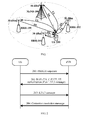
- FIG. 1 it is a schematic diagram of a scene of combined communication of a macro base station and an RRH in a heterogeneous network where an embodiment of the present invention is applicable.
- Power transfer nodes in a macro base station area where one same cell ID is shared include a macro base station MeNB-100 with sending power of 46 dBm and pico base stations RRH-100, RRH-101, and RRH-102 which are with sending power of 30 dBm.
- FIG. 1 it is a schematic diagram of combined communication of a macro base station and an RRH in a heterogeneous network.
- the macro base station MeNB-100 and the pico base stations RRH-100, RRH-101, and RRH-102 share one same cell identity (Cell ID).
- Cell ID cell identity
- the MeNB-100, the RRH-100, the RRH-101, the RRH-102, and a UE-100 in the coverage together form a downlink (DL) CoMP transmission system and an uplink (UL) CoMP transmission system of CoMP Solution 4.
- DL downlink
- UL uplink
- optical fibers between base stations are not drawn for simplicity, actually optical fibers exist among the MeNB and RRHs.
- the optical fiber can implement ideal data exchange, for example, with a short enough delay, a fast enough speed, and a large enough capacity.
- the number of base stations in FIG. 1 is merely exemplary and does not limit the scope of the embodiments of the present invention.
- the number of RRHs may be two, or may be more than three.
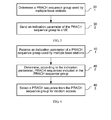
- FIG. 2 is a schematic diagram of a conventional PRACH solution.
- an LTE-Release-8/9/10 system as shown in FIG. 2 , by adopting a conventional PRACH process, there are a non-contention-based PRACH solution and a contention-based PRACH solution, where the contention-based PRACH solution includes four steps:
- the UE randomly selects a PRACH Preamble, and sends the PRACH sequence to the eNB.
- the eNB After receiving the PRACH sequence sent by the UE, the eNB sends a random access response (RAR) to the UE.
- RAR random access response
- the UE send a layer 2 (L2) message or a layer 3 (L3) message or a message including both the L2 message and the L3 message to the eNB.
- L2 layer 2
- L3 layer 3
- the eNB sends a contention resolution message to the UE according to the received L2/L3 message of the UE. According to the contention resolution message sent by the eNB, the UE confirms that the PRACH succeeds in contention, and selects the PRACH sequence to access the eNB.
- Table 1 specifies correspondence between a logical root sequence and a physical root sequence, where the logical root sequence and the physical root sequence are of an FDD system.
- the network configures a RACH sequence that allows the UE to adopt, each cell has 64 logical RACH root sequences, that is, Logical ROOT_SEQUENCE.
- the Logical ROOT_SEQUENCE is a part of system information (SI), the eNB informs the UE of SIB2 through a PDSCH channel, and the 64 Logical ROOT_SEQUENCEs are continuous.
- Sequence numbers of the logical RACH root sequences are continuous, which are from 0 to 837.
- the UE knows from the SIB2 that a start number of the logical RACH root sequence is 60, which indicates that the logical RACH sequences of the UE are from 60 to 123, and corresponding physical RACH sequences are ⁇ 178, 661, 136, 703, 86, 753, 78, 761, 43, 796, 39, 800, 20, 819, 21, 818, 95, 744, 202, 637, 190, 649, 181, 658, 137, 702, 125, 714, 151, 688, 217, 622, 128, 711, 142, 697, 122, 717, 203, 636, 118, 721, 110, 729, 89, 750, 103, 736, 61, 778, 55, 784, 15, 824, 14, 825, 12, 827, 23, 816, 34, 805, 37, 802 ⁇ .
- the UE knows, through SIB2, that the logical RACH root sequence is performed before a PRACH process starts.
- an RRC configures ra-Preamblelndex and ra-PRACH-MaskIndex in SIB2 to inform the UE of the logical RACH root sequence that should be used in the PRACH process, while in a contention-based random access process, the RRC configures in SIB2 a start logical root sequence of the PRACH sequence group and its sequence length information, where the sequence length information is an ending point identity of the root sequence or the number of sequences included in the root sequence.
- the UE When starting the PRACH process, the UE first finds a physical RACH root sequence according to the logical RACH root sequence and mapping relationships in Table 1, then randomly selects a PRACH sequence in the physical RACH root sequence, and then sends the sequence to the eNB to perform access.
- Table 1 Mapping relationship between a logical root sequence and a physical root sequence in an FDD system Logical Root Sequence Number Physical Root Sequence Number u (According to an ascending order of corresponding logical sequence numbers) 0-23 129, 710, 140, 699, 120, 719, 210, 629, 168, 671, 84, 755, 105, 734, 93, 746, 70, 769, 60, 779, 2, 837, 1, 838 24-29 56, 783, 112, 727, 148, 691 30-35 80, 759, 42, 797, 40, 799 36-41 35, 804, 73, 766, 146, 693 42-51 31, 808, 28, 811, 30, 809, 27, 812, 29, 810 52-63 24, 815, 48, 791, 68, 771, 74, 765, 178, 661, 136, 703 64-75 86, 753, 78, 761, 43, 796, 39, 800, 20, 819, 21, 818
- Table 2 (reference may be made to Table 5.7.2-5 in the standardized protocol TS 36.213) specifies correspondence between a logical root sequence and a physical root sequence, where the logical root sequence and the physical root sequence are of a TDD system.
- a mapping relationship of the corresponding logical RACH and physical RACH and a principle for the eNB to inform SIB2 broadcast information in the PDSCH are the same as those in the FDD system, which is not repeatedly described here again.
- Table 2 Mapping relationship between a logical root sequence and a physical root sequence in a TDD system Logical Root Sequence Number Physical Root Sequence Number u (According to an ascending order of corresponding logical sequence numbers) 0 - 19 1 138 2 137 3 136 4 135 5 134 6 133 7 132 8 131 9 130 10 129 20 - 39 11 128 12 127 13 126 14 125 15 124 16 123 17 122 18 121 19 120 20 119 40 - 59 21 118 22 117 23 116 24 115 25 114 26 113 27 112 28 111 29 110 30 109 60 - 79 31 108 32 107 33 106 34 105 35 104 36 103 37 102 38 101 39 100 40 99 80 - 99 41 98 42 97 43 96 44 95 45 94 46 93 47 92 48 91 49 90 50 89 100 - 119 51 88 52 87 53 86 54 85 55 84 56 83 57 82 58 81 59 80 60 79
- the UE Before sending an uplink PRACH sequence, the UE should already be synchronized with the downlink of the system.
- the downlink synchronization means the UE acquires frame synchronization and a system broadcast message, but the uplink is not synchronized.
- the eNB After the PRACH sequence, the eNB knows one terminal exists and attempts to establish a connection with the base station.
- a bandwidth of a reserved resource is six RBs (Resource Block), which can satisfy all bandwidths supported by the LTE.
- Resource Block Resource Block
- the design of a physical layer is based on such consideration, for example, both a synchronous channel and a physical broadcast channel are like that.
- the uplink is not synchronized when the PRACH sequence is sent, interference in other non-access resources needs to be avoided, so that the PRACH sequence length is about 0.9 ms, and 0.1 ms is left as a protection time.
- the PRACH sequence is acquired through a specific shift based on Zadoff-Chu (ZC).
- ZC Zadoff-Chu
- the sequence has some very good characteristics, for example, has very good self-correlation and fixed amplitude.
- the eNB ensures uplink synchronization through timeslot adjustment, which is implemented by sending a TA. Meanwhile, an uplink resource is allocated. The foregoing content is carried in a random access response message.
- the eNB When detecting the PRACH sequence, the eNB sends on a DL-SCH one response, which includes an index number of the sequence, time adjustment information, resource scheduling information (that is, the uplink resource allocated to the user), and a temporary RNTI, and is used for the UE to intercept a corresponding PDCCH channel in a subsequent interaction process.
- RA-RNTI one ID reserved for use by a random access response to intercept an L1/L2 control channel for decoding the DL-SCH, so as to acquire the information on it:
- RA - RNTI 1 + t_id + 10 * f_id
- f_id is a PRACH index in this subframe, that is, a frequency domain location index.
- the f_id is always zero.
- Interception time starts with three subframes after the preamble is sent and lasts ra-ResponseWindowSize subframes, and the window size is acquired by reading a system broadcast message (SIB2).
- SIB2 system broadcast message
- This value can be set to 10 at maximum, because misunderstanding may occur if this value is greater than 10, and because there is an opportunity of random access in next radio frame, to avoid this situation, this window is set to 10 at maximum.
- SIB2 system broadcast message
- the terminal When the terminal receives an RA response successfully, the terminal adjusts an uplink sending time, saves a temporary C-RNTI acquired from the response for subsequent communication till a final C-RNTI is acquired, and in the end sends power information of the PRACH sequence. If the response is not received successfully, one is added to a counter PREAMBLE_TRANSMISSION_COUNTER.
- a terminal UE sends, on the allocated resource, a user ID and corresponding UL-SCH information for sending basic information such as the user ID and an RRC connection request, that is, the so-called message 3 (MSG3), specific content is related to a status of the user.
- MSG3 message 3
- the terminal acquires uplink synchronization and necessary information of subsequent communication.
- a unique C-RNTI must be acquired. According to different user statuses, the process has different message interactions.
- a contention resolution ID may be further sent to perform a contention resolution confirmation operation in step 204. Because multiple UEs may select a same preamble sequence, resources that the UEs acquire in step 202 are the same.
- message 3 when message 3 is sent, the same manner is selected at the same location for sending, which naturally results in a conflict and is equivalent to multiple UEs contending for access. Although there is a conflict, the eNB may still solves the MSG3 sent by a certain UE, so that through the contention resolution message in step 204, the UE may access successfully. For example, when one certain UE is relatively far from the base station and has a relatively weak signal, while another UE is close to the base station and has a relatively strong signal, the UE that is relatively far may only cause a not very large interference and the eNB can still solve the message 3 of the UE that is relatively close. In addition, message 3 further carries a contention resolution ID.
- the contention resolution ID is unique and is not reduplicative with that of another UE, which is optimally an identity such as an IMSI of the UE.
- Message 4 carries the contention resolution ID and sends it to the UE, so that the UE naturally knows the access succeeds.
- the eNB sends a conflict resolution message to the terminal UE through the DL-SCH.
- step 201 is a pure physical layer process, and the three subsequent steps 202-204 have no difference with an ordinary data transmission process.
- the content of the message such as MSG3 or MSG4 of the MAC protocol is not fixed, which sometimes may carry an RRC connection request and sometimes may carry some control messages and even service data packets, and is therefore referred to as message 3 whose meaning is a third message. It is known that a conflict may occur on message 3, and after the message is sent, a contention resolution timer needs to be started right away (this timer needs to be restarted in every retransmission of message 3 subsequently).
- the uplink message includes a CCCH SDU (for example, an RRC connection request message) in step 203, and a temporary C-RNTI sent by the downlink PDCCH is received: if a MAC PDU decodes successfully, the contention resolution timer is stopped; and if the MAC PDU includes a control message unit of the contention resolution ID of the UE and this ID matches the contention resolution ID sent by the uplink, it is considered that the contention resolution succeeds, and this MAC PDU is demultiplexed to extract the content in it, the temporary C-RNTI is set to the C-RNTI, and meanwhile, the temporary C-RNTI is discarded and then it is confirmed that the random access succeeds; otherwise, the temporary C-RNTI is discarded, and the UE considers that the random access fails and discards this MAC PDU; if the contention resolution timer times out, it is considered that the access fails; and after the failure, a random access process is restarted according to a retreat mechanism until the number of
- message 4 does not have a retransmission mechanism. If retransmission is adopted for message 4, because in this case the contention is not resolved, if some UEs succeed in decoding and some UEs fail in decoding; or some UEs succeed in receiving and some UEs fail in receiving, a simultaneous ACK/NACK situation occurs. Although a similar situation also occurs on message 3, because the eNB confirms the information and returns only one kind of confirmation information once, subsequent processing is not affected.
- the existing PRACH access mechanism in the LTE-Release-8/9/10 system adopts 64 base sequences (ID: 0 to 63), which can solve a problem that PRACHs of all UEs access the eNB.
- ID 0 to 63
- PRACH time and frequency resource, Preamble PRACH time and frequency resource, Preamble
- multiple RRHs and MeNBs adopt a same cell identity, which causes a significant increase to the number of UEs in the radio cell, and the original 64 IDs cannot satisfy a requirement that a large number of UEs access multiple RRHs and/or MeNBs.
- the PRACH contention is caused to be so excessively fierce that many UEs cannot access the network, which affects user experience of the UEs.
- the technical problems to be solved in the present invention is mainly that a PRACH ID resource in CoMP Solution 4 is insufficient to be provided for a large number of UEs to use, and the PRACH contention is excessively fierce.
- the method proposed in the present invention can increase the PRACH ID capacity and reduce the fierceness of the PRACH contention.
- FIG. 3 is a flow chart of a method for accessing an enhanced PRACH according to an embodiment of the present invention.
- the method in FIG. 3 is performed by base stations (for example, MeNB-100 and RRH-100, RRH-101, and RRH-102 which are shown in FIG. 1 ) and is performed before the method in FIG. 2 .
- base stations for example, MeNB-100 and RRH-100, RRH-101, and RRH-102 which are shown in FIG. 1 .
- the 301 Determine a PRACH sequence group used by multiple base stations.
- the multiple base stations use a same cell identity and include a macro base station and at least one pico base station.
- the PRACH sequence group includes k1 first PRACH sequences, k2 second PRACH sequences, k3 third PRACH sequences, k4 fourth PRACH sequences, k5 fifth PRACH sequences, and k6 sixth PRACH sequences, where k1 and k4 are positive integers, and k2, k3, k5, and k6 are nonnegative integers.
- the total number k1 + k2 + k3 + k4 + k5 + k6 of PRACH sequences included in the PRACH sequence group may be a fixed value, for example, 128. However, a specific value of the total number of PRACH sequences is not limited in the embodiment of the present invention.
- the first PRACH sequences and the fourth PRACH sequences are PRACH sequences of contention-based Group A
- the second PRACH sequences and the fifth PRACH sequences are PRACH sequences of contention-based Group B
- the third PRACH sequences and the sixth PRACH sequences are non-contention based PRACH sequences. Examples of the first PRACH sequences to the sixth PRACH sequences are further described in detail in the following in combination with specific embodiments (for example, embodiments in FIG. 7 to FIG. 9 ).
- the first PRACH sequences to the third PRACH sequences are used for the random access to the macro base station or the pico base station
- the fourth PRACH sequences to the sixth PRACH sequences are used for the random access to the pico base station.
- the first PRACH sequences to the sixth PRACH sequences can be divided into two groups, which correspond to the macro base station or the pico base station, respectively, so as to facilitate flexible selection by the UE and reduce the fierceness of the contention.
- the indication parameter is used for indicating the first PRACH sequences to the sixth PRACH sequences.
- a manner of sending the indication parameter of the PRACH sequence group is not limited in the embodiments of the present invention.
- the indication parameter can be carried in one or more messages.
- a form of the message does not limit the scope of the embodiments of the present invention, and may be, for example, a broadcast message or a dedicated message. These manners all fall within the scope of the embodiments of the present invention.
- the PRACH sequence group may be based on two root sequences.
- the first PRACH sequences to the third PRACH sequences are based on a first root sequence
- the fourth PRACH sequences to the sixth PRACH sequences are based on a second root sequence.
- the indication parameter may include a starting point identity of the first root sequence, length information of the first root sequence, a starting point identity of the second root sequence, and length information of the second root sequence.
- the length information of the first root sequence is an ending point identity of the first root sequence or the number of sequences included in the first root sequence.
- the length information of the second root sequence is an ending point identity of the second root sequence or the number of sequences included in the second root sequence.
- the length information of the root sequence is optional. If the base station and the UE use the same length information (for example, negotiated in advance, agreed in advance or specified according to a protocol), the indication parameter may not include length information.
- the PRACH sequence group may be based on one root sequence.
- the first PRACH sequences to the sixth PRACH sequences are based on one root sequence.
- the indication parameter may include a starting point identity of the root sequence and length information of the root sequence.
- the length information of the root sequence is an ending point identity of the root sequence or the number of sequences included in the root sequence.
- the length information of the root sequence is optional. If the base station and the UE use the same length information (for example, negotiated in advance, agreed in advance or specified according to a protocol), the indication parameter may not include length information.
- the size of each sequence can be flexibly set.
- K is the total number of PRACH sequences included in the PRACH sequence group, which is described as in the foregoing, and may be a fixed value, for example, 128.
- the value of K is not limited in the present invention.
- the base station may carry the indication parameter in SIB2 which is sent to the UE.
- k1, kx, k4, and ky can be carried through SIB2.
- k1 is the number of sequences of Group A, sizeOfRA-PreamblesGroupA, defined in SIB2 of the macro base station
- kx is the number of contention-based sequences of the macro base station, numberOfRA-Preambles
- k4 is the number of sequences of Group A, sizeOfRA-PreamblesGroupA, defined in SIB2 of the pico base station
- ky is the number of contention-based sequences of the pico base station, numberOfRA-Preambles.
- the base station may not separately inform the UE of the value of N, the UE can acquire the value of N through the length information of the first root sequence or the second root sequence.
- the base station and the UE may negotiate or agree upon the value of N in advance, so that N does not need to be carried in the indication parameter.
- the value of N can be carried by including N in the indication parameter sent through SIB2, for example, by adding one information element in SIB2 or by using a reserved field in SIB2.
- the base station does not need to inform the UE of the values of K and N.
- N 64
- the indication parameter further includes k1, kx, k4, and ky.
- the base station can carry the indication parameter in the SIB2 which is sent to the UE, and in this case, k1, kx, k4, and ky can be carried through SIB2.
- k1 is the number of sequences of Group A, sizeOfRA-PreamblesGroupA, defined in SIB2 of the macro base station
- kx is the number of contention-based sequences of the macro base station, numberOfRA-Preambles
- k4 is the number of sequences of Group A, sizeOfRA-PreamblesGroupA, defined in SIB2 of the pico base station
- ky is the number of contention-based sequences of the pico base station, numberOfRA-Preambles.
- the PRACH sequence group used by multiple base stations includes first PRACH sequences to sixth PRACH sequences and is not limited to three PRACH sequences, thereby reducing the fierceness of contention access to a PRACH.
- the total number K of PRACH sequences in the PRACH sequence group can always be a fixed value, for example, 128, and is not related to the number of macro base stations and pico base stations. For example, when the number of the pico base stations is two or more than two, all base stations that participate in the CoMP still use the total number of 128 PRACH sequences.
- FIG. 4 is a flow chart of a method for accessing an enhanced PRACH according to another embodiment of the present invention.
- the method in FIG. 4 is performed by the UE (for example, UE-100 shown in FIG. 1 ), and corresponds to the method in FIG. 3 .
- the 401 Receive an indication parameter of a PRACH sequence group used by multiple base stations.
- the multiple base stations use a same cell identity and include a macro base station and at least one pico base station.
- the indication parameter is used for indicating first PRACH sequences to sixth PRACH sequences, where the first PRACH sequences to the sixth PRACH sequences are included in the PRACH sequence group.
- the indication parameter received in step 401 may be the indication parameter sent in step 302 in FIG. 3 .
- the manner of receiving an indication parameter of the PRACH sequence group is not limited.
- the indication parameter carried in one or more messages can be received.
- the form of the message does not limit the scope of the embodiments of the present invention, and may be, for example, a broadcast message or a dedicated message. All these manners fall within the scope of the embodiments of the present invention.
- the PRACH sequence group includes k1 first PRACH sequences, k2 second PRACH sequences, k3 third PRACH sequences, k4 fourth PRACH sequences, k5 fifth PRACH sequences, and k6 sixth PRACH sequences, where k1 and k4 are positive integers, and k2, k3, k5, and k6 are nonnegative integers.
- the total number k1 + k2 + k3 + k4 + k5 + k6 of PRACH sequences included in the PRACH sequence group may be a fixed value, for example, 128.
- the specific value of the total number of the PRACH sequences is not limited in the embodiments of the present invention.
- the PRACH sequence group is based on two root sequences.
- the length information of the first root sequence is the ending point identity of the first root sequence or the number of sequences included in the first root sequence.
- the length information of the second root sequence is the ending point identity of the second root sequence or the number of sequences included in the second root sequence.
- the length information of the root sequence is optional. If the base station and the UE use the same length information (for example, negotiated in advance, agreed in advance or specified according to the protocol), the indication parameter may not include length information.
- the first PRACH sequences to the sixth PRACH sequences are based on the root sequence.
- the PRACH sequence group is based on one root sequence.
- the length information of the root sequence is the ending point identity of the root sequence or the number of sequences included in the root sequence.
- the length information of the root sequence is optional. If the base station and the UE use the same length information (for example, negotiated in advance, agreed in advance or specified according to the protocol), the indication parameter may not include length information.
- k1 to k6 can be determined according to indication information which is of the values of k1, kx, k4, and ky and is included in the indication parameter.
- K is the total number of PRACH sequences included in the PRACH sequence group, which is described as in the foregoing, and may be a fixed value, for example, 128. However, the value of K is not limited in the present invention.
- the base station can carry the indication parameter in the SIB2 which is sent to the UE, and in this case, k1, kx, k4, and ky can be carried through SIB2.
- k1 is the number of sequences of Group A, sizeOfRA-PreamblesGroupA, defined in SIB2 of the macro base station
- kx is the number of contention-based sequences of the macro base station, numberOfRA-Preambles
- k4 is the number of sequences of Group A, sizeOfRA-PreamblesGroupA, defined in SIB2 of the pico base station
- ky is the number of contention-based sequences of the pico base station, numberOfRA-Preambles.
- the base station may not separately inform the UE of the value of N, and the UE may acquire the value of N through length information of the first root sequence or the second root sequence.
- the base station and the UE may negotiate or agree upon the value of N in advance, so that N does not need to be carried in the indication parameter.
- the value of N is carried by including N in the indication parameter sent through SIB2, for example, by adding one information element in SIB2 or by using a reserved field in SIB2, and the UE determines k1 to k6 according to the value of N.
- the base station does not need to inform the UE of the values of K and N.
- N 64
- the indication parameter further includes k1, kx, k4, and ky.
- the base station can carry the indication parameter in the SIB2 which is sent to the UE, and in this case, k1, kx, k4, and ky can be carried through SIB2.
- k1 is the number of sequences of Group A, sizeOfRA-PreamblesGroupA, defined in SIB2 of the macro base station
- kx is the number of contention-based sequences of the macro base station, numberOfRA-Preambles
- k4 is the number of sequences of Group A, sizeOfRA-PreamblesGroupA, defined in SIB2 of the pico base station
- ky is the number of contention-based sequences of the pico base station, numberOfRA-Preambles.
- a PRACH sequence can be selected from the first PRACH sequence or the fourth PRACH sequence for random access of contention-based Group A.
- a PRACH sequence can be selected from the second PRACH sequences or the fifth PRACH sequences for random access of contention-based Group B.
- a PRACH sequence can be selected from the third PRACH sequences or the sixth PRACH sequences for non-contention based random access. Examples of the first PRACH sequence to the sixth PRACH sequence are further described in detail in the following in combination with specific embodiments (for example, embodiments in FIG. 7 to FIG. 9 ).
- a PRACH sequence can be selected from the first PRACH sequences to the third PRACH sequences for random access to the macro base station or the pico base station.
- a PRACH sequence can be selected from the fourth PRACH sequences to the sixth PRACH sequences for random access to the pico base station.
- the first PRACH sequences to the sixth PRACH sequences can be divided into two groups, which correspond to the macro base station or the pico base station, respectively, so as to facilitate flexible selection by the UE and reduce the fierceness of the contention.
- a process of specifically performing random access may be similar to the method shown in FIG. 2 , and the process of performing random access in the embodiments of the present invention is further described in the following in combination with specific examples (the embodiment shown in FIG. 6 ), which is not repeatedly described here again.
- a PRACH sequence group used by multiple base stations includes first PRACH sequences to sixth PRACH sequences and is not limited to three PRACH sequences, thereby reducing the fierceness of contention access to a PRACH.
- the total number K of PRACH sequences in the PRACH sequence group can always be a fixed value, for example, 128, and is not related to the number of the macro base stations and the pico base stations. For example, when the number of the pico base stations is two or more than two, all base stations that participate in the CoMP still use the total number of 128 PRACH sequences.
- FIG. 5 is a schematic diagram of a scene of a CoMP communication system where Embodiment 1 of the present invention is applicable.
- a MeNB-100 and low power transmit nodes for example RRH-200, RRH-201, and RRH-202 in a radio cell.
- LPN low power transmit nodes
- RRHs can be actually regarded as pico base stations (Pico).
- UE-100 and UE-101 are legacy UEs of an LTE Rel-8/9/10
- UE200 and UE-201 are UEs of an LTE Rel-11/12
- MeNB-100 and RRH-200, RRH-201, and RRH-202 are connected to a server for background communication through optical fibers.
- optical fibers are not drawn for simplicity, actually the optical fibers between the MeNB/RRHs all exist.
- the optical fiber can implement ideal data exchange, for example, with a short delay, a fast speed, and a large capacity.
- FIG. 6 Specific implementation of a separate MeNB/RRH PRACH method proposed in this embodiment is shown in FIG. 6 , and the specific steps of FIG. 6 are described in the following in combination with the schematic diagram of the scene in FIG. 5 .
- S100 A network decides a PRACH sequence group.
- the network decides the PRACH sequence group.
- CoMP Solution 4 because one or more RRHs are adopted and these RRHs all use the same cell ID as the MeNB, a same-ID RRH system is formed.
- the characteristics of the RRH system are a large number of RRHs and a large number of UEs, so that the fierceness of a PRACH sequence ID contention increases greatly.
- the network decides the PRACH sequence group is decided by the MeNB and the multiple RRHs together.
- a PRACH sequence group based on two root sequences is proposed.
- a root sequence Preamble 1 is used for a PRACH of a Macro user
- a root sequence Preamble 2 is used for a PRACH of a Pico user.
- the Macro user here is defined as a Legacy UE (including a UE of the LTE Rel-8/9/10)
- the Pico user is defined as a UE covered by one or more RRHs (including a UE of the LTE Release-11). If some UEs are not only covered by the MeNB, but also covered by the RRH, these UEs can make a selection in the root sequences Preamble 1 and Preamble 2. In this way, in an RRH system, because the PRACH sequence group is introduced, the fierceness of the PRACH contention of all UEs is significantly reduced.
- the MeNB adopts logical PRACH sequences ⁇ 216, 623, 218, 621, 200, 201, ..., 263 ⁇ , and corresponding physical PRACH sequences are ⁇ 152, 687, 144, 695, 134, 705, 138, 701, 199, 640, 162, 677, 176, 663, 119, 720, 158, 681, 164, 675, 174, 665, 171, 668, 170, 669, 87, 752, 169, 670, 88, 751, 107, 732, 81, 758, 82, 757, 100, 739, 98, 741, 71, 768, 59, 780, 65, 774, 50, 789, 49, 790, 26, 813, 17, 822, 13, 826, 6, 833 ⁇ .
- the Pico adopts logical PRACH sequences ⁇ 90, 91,..,153 ⁇ , and corresponding physical PRACH sequences are ⁇ 217, 622, 128, 711, 142, 697, 122, 717, 203, 636, 118, 721, 110, 729, 89, 750, 103, 736, 61, 778, 55, 784, 15, 824, 14, 825, 12, 827, 23, 816, 34, 805, 37, 802, 46, 793, 207, 632, 179, 660, 145, 694, 130, 709, 223, 616, 228, 611, 227, 612, 132, 707, 133, 706, 143, 696, 135, 704, 161, 678, 201, 638, 173, 666 ⁇ .
- a PRACH sequence group which is based on one root sequence may also be adopted.
- a Macro user selects a PRACH sequence from Group A_Macro, Group B_Macro, and non-contention Group_Macro
- a Pico user selects a PRACH sequence from Group A_Pico, Group B_Pico, and non-contention Group_Pico, and IDs of the 128 logical PRACH sequences are continuous.
- the Preamble based on one root sequence is also completely compatible with the LTE Rel-8/9/10 system, where the total length of Group A_Macro, Group B_Macro, and non-contention Group_Macro is 64.
- S101 The UE intercepts SIB2 broadcast information.
- UEs in a non-connected status in the radio cell include Legacy UEs (for example, UE-100 and UE-101) of the LTE Rel-8/9/10 and UEs (for example, UE-200, UE-201, UE-202, and UE-203) of the LTE Rel-11/12/13.
- UE-100, UE-101, UE-200, UE-201, UE-202, and UE-203 intercept SIB2 broadcast information on a PDSCH channel, and the SIB2 broadcast information is sent by MeNB-100, RRH-200, RRH-201, and RRH-202.
- Upper-layer SIB2 information gives RACH_ROOT_SEQUENCE, and according to RACH_ROOT_SEQUENCE and a mapping relationship in the foregoing Table 1, the UE acquires u in a root ZC sequence, that is, a physical number.
- the physical root sequence is acquired according to the u value, and a cyclic shift sequence is calculated according to the information of SIB2, such as a PRACH Configuration Index, zeroCorrelationZoneConfig, and High-speed-flag.
- a subsequently adjacent u of this u value is selected according to a given logical number and physical number to continue generating a root sequence for cyclic shift until 64 preamble locations are generated.
- a PDCCH order or an RRC message indicates ra-Preamblelndex and ra-PRACH-MaskIndex, where ra-Preamblelndex informs the UE of PRACH sequences that it can use, and ra-PRACH-MaskIndex informs the UE of PRACH time and frequency resources that it can use.
- prach-ConfigIndex indicates the resources which are used for sending a PRACH.
- a PRACH preamble is divided into three parts: the PRACH sequences of contention-based random access being divided into Group A and Group B, and a PRACH sequence group of non-contention based random access.
- the PRACH sequences including Group A and Group B are calculated and obtained through a parameter numberOfRA-Preambles and a parameter sizeOfRA-PreamblesGroupA which are provided by SIB2.
- the parameter provided by SIB2 also includes a starting point identity of a Group A root sequence and length information of the Group A root sequence, where the length information is an ending point identity of the Group A root sequence or the number of sequences included in the Group A root sequence.
- sizeOfRA-PreamblesGroupA and numberOfRA-Preambles have an equal size
- the UE knows that sizeOfRA-PreamblesGroupB does not exist in SIB2.
- the PRACH sequence of Group A is from 0 to sizeOfRA-PreamblesGroupA - 1
- the PRACH sequence of Group B is from sizeOfRA-PreamblesGroupA to numberOfRA-Preambles - 1.
- Group A, Group B, and the non-contention based PRACH sequences are all subsets of the 64 PRACH sequences.
- MeNB-100, RRH-200, RRH-201, and RRH-202 send an RS (Reference Signal), respectively, and UE-100, UE-101, UE-200, UE-201, UE-202, and UE-203 determine, according to the degree of the path-loss (PL) of each RS, the macro base station and/or one or more RRHs that they serve.
- RS Reference Signal
- the strongest RS path-loss received by UE-200 comes from
- S102 The UE selects an ID of the PRACH sequence.
- each UE already knows their serving base stations, so each UE knows the IDs of their PRACH base sequences.
- the foregoing three types of UEs randomly select one ID of the PRACH sequences in their ID groups, respectively.
- S103 The UE sends a PRACH sequence to the base station/RRH.
- UE-100 and UE-101 send PRACH sequences randomly selected according to step S101 to MeNB-100
- UE-200 sends PRACH sequences randomly selected according to step 2 to RRH-200, RRH-201, and RRH-202, respectively.
- the base station/RRH sends an RAR to the UE.
- MeNB-100 receives PRACH sequences sent by UE-100 and UE-101, and then MeNB-100 sends random access response (RAR) information to UE-100 and UE-101, respectively.
- RAR random access response
- RRH-200, RRH-201, RRH-202 receive PRACH sequences sent by UE-200, and then RRH-200, RRH-201, and RRH-202 jointly send RAR information to UE-200.
- MeNB-100, RRH-200, RRH-201, and RRH-202 can also jointly send RAR information.
- these base stations can adopt a combined sending manner of an SFN (Single Frequency Network) to enhance the reliability of downlink reception.
- SFN Single Frequency Network
- S105 The UE sends an L2/L3 message to the base station/RRH.
- UE-200 After UE-200 receives RAR information sent by RRH-200, RRH-201, and RRH-202, and acquires combined RAR information, it is considered that distances from UE-200 to RRH-200, RRH-201, and RRH-202 are in an ascending order, and therefore, UE-200 sends the L2/L3 message according to a minimum TA (Timing Arrival). In this way, it can be basically guaranteed that RRH-200, RRH-201, and RRH-202 can jointly receive the L2/L3 message sent by UE-200.
- TA Timing Arrival
- S106 The base station/RRH decides a UE that decodes successfully.
- the same uplink resource is acquired by UE-100 and UE-101, and when message 3 is sent, a same manner is selected at a same location for sending, and then a conflict naturally occurs.
- This is equivalent to both UE-100 and UE-101 needing to contend for access.
- UE-100 and UE-101 perform sending by using a same resource, thereby causing the conflict.
- the eNB may still solve MSG3 sent by a certain UE, and then through a contention resolution message, a certain UE can succeed in the access.
- MSG3 message 3
- ID 100
- ID ⁇ 64,65,..,127 ⁇
- RRH-200, RRH-201, and RRH-202 all receive messages 3 (MSG3) of the PRACHs of UE-200 and UE-201, and if the power of message 3 (MSG3) which is of the PRACH from UE-200 and is received by RRH-200, RRH-201, and RRH-202 is greater than the power of message 3 (MSG3) of the PRACH from UE-201, RRH-200, RRH-201, and RRH-202 determine that message 3 (MSG3) of the PRACH of UE-200 is decoded successfully.
- the base station/RRH sends contention resolution information to the UE.
- MeNB-100 sends a conflict resolution message to terminals UE-100 and UE-101 through a DL-SCH.
- a conflict may occur on messages 3 of UE-100 and messages 3 of UE-101, and after the conflict resolution message is sent, a contention resolution timer needs to be started right away (and this timer needs to be restarted in every retransmission of message 3 subsequently).
- an uplink message includes CCCH SDU (for example, an RRC connection request message) in a third step and a temporary C-RNTI sent by a downlink PDCCH is received: if a MAC PDU decodes successfully, the contention resolution timer is stopped; if the MAC PDU includes a control message unit of the contention resolution ID of the UE and this ID matches the contention resolution ID sent by the uplink, it is considered that the contention resolution succeeds, and this MAC PDU is demultiplexed to extract the content in it, the temporary C-RNTI is set to the C-RNTI, and meanwhile, the temporary C-RNTI is discarded and then it is confirmed that the random access succeeds; otherwise, the temporary C-RNTI is discarded, the UE determines that the random access fails and discards this MAC PDU; if the contention resolution timer times out, it is considered that the access fails; and after the failure, a random access process is restarted according to a retreat mechanism until the number of attempts exceeds
- RNTIs of RRH-200, RRH-201, RRH-202 can be RA-200-RNTI, RA-201-RNTI, and RA-202-RNTI, respectively, and can also share a unified RA-RNTI.
- S108 The UE is successfully connected to the base station/RRH.
- UE-100 and UE-101 are Legacy UEs, and after the information of PRACH contention resolution informed by MeNB-100 is received, UE-100 confirms that the random access succeeds, and then UE-100 accesses a radio network represented by MeNB-100.
- both UE-100 and UE-101 are UEs in a connected status (Connected).
- UE-200 After UE-200 receives information of PRACH contention resolution informed by RRH-200, RRH-201, and RRH-202, respectively, UE-200 confirms that the random access succeeds, and UE-200 accesses a radio network jointly formed by RRH-200, RRH-201, and RRH-202.
- UE-200 is a UE in a connected status. Because this embodiment is for a scene of CoMP Solution 4, and all macro base stations and LPNs share one same cell ID, MeNB-100, RRH-200, RRH-201, and RRH-202 which are shown in FIG. 5 share one same cell ID and the radio cells they represent are one same radio cell. The UE turns from a non-connected status into a connected status, which indicates that the whole PRACH process ends smoothly.
- the macro base station and the pico base station use respective PRACH sequences, which increases the PRACH resource capacity, and reduces the fierceness of the PRACH sequence contention.
- the flexible scheduling of PRACH sequences of the macro base station and the pico base station can be implemented through an unfixed N (the embodiment in FIG. 8 or FIG. 9 ), which further enhances the setting flexibility of PRACH sequences.
- a radio cell has a macro base station MeNB-300 and a low power transmit node RRH-400.
- RRH-400 can be actually regarded as a Pico base station
- UE-300 is a Legacy UE of an LTE Rel-8/9/10
- UE-400, UE-401, and UE-402 are UEs of an LTE Rel-11/12.
- MeNB-300 and RRH-400 are connected to a server through optical fibers for background communication. It should be noted that in FIG. 11 , although the optical fibers are not drawn for simplicity, in practice the optical fibers between the MeNB/RRHs all exist.
- the optical fibers can implement ideal data exchange, for example, with a short enough delay, a fast enough speed, and a large enough capacity.
- PRACH sequence groups used by the base stations MeNB-300 and RRH-400 in Embodiment 2 are based on one root sequence, for example, as shown in FIG. 8 .
- Embodiment 2 can also support the foregoing UE-300, UE-400, UE-401, and UE-402 and a flexible ID grouping mechanism to implement, for example, a method in FIG. 6 , which is not repeatedly described here again.
- the macro base station and the pico base station use respective PRACH sequences, which increases the PRACH resource capacity, and reduces the fierceness of PRACH sequence contention.
- the flexible scheduling of PRACH sequences of macro base stations and pico base stations can be implemented through an unfixed N (the embodiment in FIG. 8 or FIG. 9 ), so as to further enhance the setting flexibility of the PRACH sequence.
- the base stations are divided into two groups: the macro base stations as a group and the pico base stations RRHs as another group.
- the total number of the PRACH sequences used by the two groups of base stations may be a fixed value.
- the embodiments of the present invention is not limited to this, and the base stations can also be divided in another form, for example, can be divided into three groups or more groups, and the types of base stations included in each group of base stations are not limited. In this way, each group of base stations can be allocated a corresponding PRACH sequence group, so as to further increase the capacity of the uplink PRACH and reduce the fierceness that multiple RRHs participate in the PRACH contention.
- FIG. 12 is a flow chart of a method for accessing an enhanced PRACH according to another embodiment of the present invention.
- the method in FIG. 12 is performed by a network side (for example, a base station).
- each PRACH sequence group includes m1 first PRACH sequences, m2 second PRACH sequences, and m3 third PRACH sequences, M and L are positive integers and 1 ⁇ M ⁇ L, m1 is a positive integer, and m2 and m3 are nonnegative integers.
- m1 first PRACH sequences may be PRACH sequences of contention-based Group A
- m2 second PRACH sequences may be PRACH sequences of contention-based Group B
- m3 third PRACH sequences may be non-contention based PRACH sequences.
- m1, m2, and m3 may be fixed values.
- m1, m2, and m3 may be variables, which are different for different sequence groups. This is not limited in the embodiments of the present invention.
- a manner of grouping base stations is not limited in the embodiments of the present invention.
- the base stations can be divided according to geographic locations.
- M PRACH sequence groups may be multiplexed in the L groups of base stations according to the geographic locations of the L groups of base stations.
- the base stations whose geographic locations are relatively far away have relatively small mutual interferences, and may be able to multiplex a same PRACH sequence group. In this way, the total number of the PRACH sequence groups can be reduced.
- the groups of base stations that belong to a high contention area and are in the L groups of base stations can be allocated PRACH sequence groups that include more PRACH sequences.
- the groups of base stations that belong to a low contention area and are in the L groups of base stations can be allocated PRACH sequence groups that include fewer PRACH sequences. In this way, the fierceness of the PRACH sequence contention can be controlled better.
- the indication parameter is used for indicating first PRACH sequences to third PRACH sequences, where the first PRACH sequences to the third PRACH sequences are included in M PRACH sequences.
- a manner of sending an indication parameter of the PRACH sequence group is not limited in the embodiments of the present invention.
- the indication parameter may be carried in one or more messages.
- a form of the message does not limit the scope of the embodiments of the present invention, and may be, for example, a broadcast message or a dedicated message. All these manners fall within the scope of the embodiments of the present invention.
- the indication parameter includes a starting point identity of the root sequence and length information of the root sequence.
- the indication parameter includes starting point identities of M root sequences and length information of M root sequences.
- the length information of the root sequence is an ending point identity of the root sequence or the number of sequences included in the root sequence.
- the length information of the root sequence is optional. If the base station and the UE use the same length information (for example, negotiated in advance, agreed in advance or specified according to a protocol), the indication parameter may not include length information.
- the indication parameter may be carried through SIB2.
- m1 is the number of Preambles of Group A, sizeOfRA-PreamblesGroupA, defined in SIB2; and mx is the number of contention-based Preambles, numberOfRA-Preambles.
- m1 + m2 + m3 of the M PRACH sequence groups may be a fixed value, for example, equal to 64.
- the values of the number of sequences of each PRACH sequence group, m1 + m2 + m3, may be the same or different.
- the base station may separately send a corresponding value of m1 + m2 + m3 to the UE, for example, through a broadcast or dedicated message to indicate the number of sequences of each PRACH sequence group.
- a specific implementation manner may be similar to the example in FIG. 8 or FIG. 9 .
- the indication parameter can be further used to indicate identity information of a base station corresponding to each PRACH sequence group.
- identity information of a base station corresponding to each PRACH sequence group it is convenient for the UE to select the PRACH sequence corresponding to the base station.
- the base stations are divided, and corresponding PRACH sequence groups are determined for the base stations after the division, thereby expanding the PRACH sequence resource and reducing the fierceness of the PRACH sequence contention.
- FIG. 13 is a flow chart of a method for accessing an enhanced PRACH according to another embodiment of the present invention. The method in FIG. 13 is performed by the UE and corresponds to a method in FIG. 12 .
- the indication parameter received in step 131 may be the indication parameter sent in step 122 in FIG. 12 .
- the manner of receiving the indication parameter of the PRACH sequence group is not limited in the embodiments of the present invention.
- the indication parameter carried in one or more messages can be received.
- the form of the message does not limit the scope of the embodiments of the present invention, and may be, for example, a broadcast message or a dedicated message. All these manners fall within the scope of the embodiments of the present invention.
- each PRACH sequence group includes m1 first PRACH sequences, m2 second PRACH sequences, and m3 third PRACH sequences, where M and L are positive integers and 1 ⁇ M ⁇ L, m1 is a positive integer, and m2 and m3 are nonnegative integers.
- m1 first PRACH sequences may be PRACH sequences of contention-based Group A
- m2 second PRACH sequences may be PRACH sequences of contention-based Group B
- m3 third PRACH sequences may be non-contention based PRACH sequences.
- the indication parameter may not include length information.
- the indication parameter can be carried by SIB2, where m1 is the number of sequences of Group A, sizeOfRA-PreamblesGroupA, defined in a system information block SIB2; and mx is the number of contention-based sequences, numberOfRA-Preambles.
- m1 + m2 + m3 of the M PRACH sequence groups may be a fixed value, for example, equal to 64.
- the values of the number of sequences of each PRACH sequence group, m1 + m2 + m3, can be the same or different, and the base station can separately send a corresponding value of m1 + m2 + m3 to the UE, for example, through a broadcast or dedicated message, so as to indicate the number of sequences of each PRACH sequence group.
- the specific implementation manner may be similar to the example in FIG. 8 or FIG. 9 .
- a process of specifically performing random access may be similar to a corresponding process shown in FIG. 2 or FIG. 6 , which is not repeatedly described here again.
- the base stations are divided, and corresponding PRACH sequence groups are determined for the base stations after the division, thereby expanding the PRACH sequence resource and reducing the fierceness of the PRACH sequence contention.
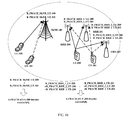
- a radio cell has a macro base station MeNB-500 and low power transmit nodes RRH-500, RRH-501, RRH-502, RRH-503, RRH-504, and RRH-505, where these RRHs can be actually regarded as Pico base stations.
- UE-500, UE-501, UE-502, and UE-503 are UEs of an LTE Rel-11/12, and MeNB-500 and RRH-500, RRH-501, RRH-502, RRH-503, RRH-504, and RRH-505 are connected to a server through optical fibers for background communication.
- the base stations are divided based on geographic locations, as shown by dotted blocks in FIG. 14 .
- the base stations are divided, and corresponding PRACH sequence groups are determined for the base stations after the division, thereby expanding the PRACH sequence resource and reducing the fierceness of the PRACH sequence contention.
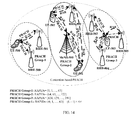
- FIG. 15 there are a macro base station MeNB-100 and low power transmit nodes RRH-200, RRH-201, and RRH-202 in a radio cell, and in the area where RRH-200, RRH-201, and RRH-202 are located, the number of RRHs is relatively large and the number of UEs is relatively large. In this way, the PRACH contention in this area is relatively fierce, and in this embodiment, the area is defined as a high PRACH contention area.
- the number of RRHs in the area where RRH-101 and RRH-102 are located is medium and the number of UEs is medium, the fierceness of the PRACH contention by multiple UEs in the area is medium, and the area is defined as a medium PRACH contention area.
- the area is defined as a low PRACH contention area.
- a network divides the entire radio cell into the high PRACH contention area, the medium PRACH contention area, and the low PRACH contention area according to statistic information.
- the network informs the UE of adopting an ID of a medium or low PRACH contention area to contend for accessing the network. In this way, the fierceness of PRACH contention is controlled. Therefore, this method is a PRACH method based on PRACH load balancing, thereby reducing the fierceness of the PRACH contention of the radio cell. Similar to Embodiment 1 of the present invention, specific implementation steps of Embodiment 3 are not repeatedly described here again.
- the base stations are divided, and corresponding PRACH sequence groups are determined for the base stations after the division, thereby expanding the PRACH sequence resource and reducing the fierceness of the PRACH sequence contention.
- FIG. 16 is a block diagram of a base station according to an embodiment of the present invention.
- a base station 1600 in FIG. 16 includes a determining unit 1610 and a sending unit 1620.
- the determining unit 1610 determines a PRACH sequence group used by multiple base stations.
- the multiple base stations use a same cell identity and include a macro base station and at least one pico base station, and the PRACH sequence group includes k1 first PRACH sequences, k2 second PRACH sequences, k3 third PRACH sequences, k4 fourth PRACH sequences, k5 fifth PRACH sequences, and k6 sixth PRACH sequences, where k1 and k4 are positive integers, and k2, k3, k5, and k6 are nonnegative integers.
- the sending unit 1620 sends to a UE an indication parameter of the PRACH sequence group determined by the determining unit 1610 for the UE to randomly access a network, where the indication parameter is used for indicating the first PRACH sequences to the sixth PRACH sequences.
- the PRACH sequence group used by multiple base stations includes the first PRACH sequences to the sixth PRACH sequences and is not limited to three PRACH sequences, thereby reducing the fierceness of contention access to a PRACH.
- the determining unit 1610 can be implemented by a processor, and the sending unit 1620 can be implemented by a transmitter or a transceiver.
- the base station 1600 in FIG. 16 can implement each step of a method shown in FIG. 3 , which is not described in detail again so as to avoid repetition.
- the first PRACH sequences or the fourth PRACH sequences determined by the determining unit 1610 are PRACH sequences of contention-based Group A
- the second PRACH sequences or the fifth PRACH sequences are PRACH sequences of contention-based Group B
- the third PRACH sequences or the sixth PRACH sequences are non-contention based PRACH sequences.
- the first PRACH sequences to the third PRACH sequences, determined by the determining unit 1610, are based on a first root sequence
- the fourth PRACH sequences to the sixth PRACH sequences are based on a second root sequence
- the indication parameter sent by the sending unit 1620 includes a starting point identity of the first root sequence, length information of the first root sequence, a starting point identity of the second root sequence, and length information of the second root sequence, where the length information of the first root sequence is an ending point identity of the first root sequence or the number of sequences included in the first root sequence
- the length information of the second root sequence is an ending point identity of the second root sequence or the number of sequences included in the second root sequence.
- the first PRACH sequence to the sixth PRACH sequences, determined by the determining unit 1610 are based on one root sequence
- the indication parameter includes a starting point identity of the root sequence and length information of the root sequence, where the length information of the root sequence is an ending point identity of the root sequence or the number of sequences included in the root sequence.
- the first PRACH sequences to the third PRACH sequences, determined by the determining unit 1610, are used for random access to the macro base station or the pico base station, and the fourth PRACH sequences to the sixth PRACH sequences are used for random access to the pico base station.
- the base station 1600 can further implement other operations related to the base station in FIG. 5 to FIG. 11 (Embodiment 1 and Embodiment 2).
- the base station 1600 may send SIB2 broadcast information to the user equipment, and the SIB2 broadcast information includes a starting ID of a logical ID group of the PRACH sequences, the number of sequences of Group A and Group B numberOfRA-Preamble, and the number of sequences of Group A sizeOfRA-PreamblesGroupA.
- the base station 1600 can further receive a PRACH sequence sent by the user equipment.
- the base station 1600 can further send a random access response (RAR) to the user equipment.
- RAR random access response
- the base station 1600 After detecting the PRACH sequence sent by the user equipment, the base station 1600 sends on a downlink shared channel (DL-SCH) the foregoing RAR, which includes: an index number of the PRACH sequence, time adjustment information, uplink resource scheduling information (UL grant), and a temporary RNTI, which is used for the user equipment to intercept a corresponding PDCCH channel in a subsequent exchange process.
- DL-SCH downlink shared channel
- UL grant uplink resource scheduling information
- a temporary RNTI which is used for the user equipment to intercept a corresponding PDCCH channel in a subsequent exchange process.
- the base station 1600 can further receive L2/L3 information sent by the UE, that is, receive a user ID sent by the UE on the allocated resource on the uplink, which is the L2 information, and information such as the corresponding uplink shared channel (UL-SCH) information for use of an RRC connection request, which is the L3 information (MSG3).
- L2/L3 information sent by the UE that is, receive a user ID sent by the UE on the allocated resource on the uplink, which is the L2 information, and information such as the corresponding uplink shared channel (UL-SCH) information for use of an RRC connection request, which is the L3 information (MSG3).
- the UE To implement the uplink data transmission, the UE must acquire a unique C-RNTI, and according to different user statuses, this process has different message interactions. If the PRACH contention needs to be resolved, the UE may send a contention resolution ID so as to perform a contention resolution confirmation operation at the base station.
- the base station 1600 can further send a contention resolution message to the UE, where when an uplink message received by a second receiving unit includes a CCCH SDU (for example, an RRC connection request message), and a temporary C-RNTI sent by the downlink PDCCH is received: if a MAC PDU succeeds in decoding: a contention resolution timer is stopped; if the MAC PDU includes a control message unit of the contention resolution ID of the UE and this ID matches the contention resolution ID sent by the uplink, it is considered that the contention resolution succeeds, this MAC PDU is demultiplexed to extract the content in it, the temporary C-RNTI is set to a C-RNTI, and meanwhile, the temporary C-RNTI is discarded, and then it is confirmed that the random access succeeds; otherwise, the temporary C-RNTI is discarded, the UE determines that the random access fails and discards this MAC PDU; if the contention resolution timer times out, it is considered that the access fails; after the failure, a random access
- FIG. 17 is a block diagram of a user equipment according to an embodiment of the present invention.
- a user equipment 1700 in FIG. 17 includes a receiving unit 1710, a determining unit 1720, and a selecting unit 1730.
- the receiving unit 1710 receives an indication parameter of a PRACH sequence group used by multiple base stations.
- the multiple base stations use a same cell identity and include a macro base station and at least one pico base station, and the indication parameter is used for indicating first PRACH sequences to sixth PRACH sequences, where the first PRACH sequences to the sixth PRACH sequences are included in the PRACH sequence group.
- the determining unit 1720 determines, according to the indication parameter received by the receiving unit 1710, that the PRACH sequence group includes k1 first PRACH sequences, k2 second PRACH sequences, k3 third PRACH sequences, k4 fourth PRACH sequences, k5 fifth PRACH sequences, and k6 sixth PRACH sequences, where k1 and k4 are positive integers, and k2, k3, k5, and k6 are nonnegative integers.
- the selecting unit 1730 selects a PRACH sequence from the PRACH sequence group determined by the determining unit 1720 to randomly access a network.
- the PRACH sequence group used by multiple base stations includes the first PRACH sequences to the sixth PRACH sequences and is not limited to three PRACH sequences, thereby reducing the fierceness of contention access to a PRACH.
- the determining unit 1720 and the selecting unit 1730 can be implemented by a processor, and the receiving unit 1710 can be implemented by a receiver or a transceiver.
- the user equipment 1700 in FIG. 17 can implement each step of a method shown in FIG. 4 , which is not repeatedly described again so as to avoid repetition.
- the selecting unit 1730 can select a PRACH sequence from the first PRACH sequence or the fourth PRACH sequence for random access of contention-based Group A; or, select a PRACH sequence from the second PRACH sequences or the fifth PRACH sequences for random access of contention-based Group B; or, select a PRACH sequence from the third PRACH sequences or the sixth PRACH sequences for non-contention based random access.
- the determining unit 1720 can determine, according to a starting point identity of a first root sequence, length information of the first root sequence, a starting point identity of a second root sequence, and length information of the second root sequence which are included in the indication parameter, that the first PRACH sequences to the third PRACH sequences are based on the first root sequence and the fourth PRACH sequences to the sixth PRACH sequences are based on the second root sequence, where the length information of the first root sequence is an ending point identity of the first root sequence or the number of sequences included in the first root sequence; and the length information of the second root sequence is an ending point identity of the second root sequence or the number of sequences included in the second root sequence.
- the determining unit 1720 can determine, according to a starting point identity of one root sequence and length information of the root sequence which are included in the indication parameter, that the first PRACH sequences to the sixth PRACH sequences are based on the root sequence, where the length information of the root sequence is an ending point identity of the root sequence or the number of sequences included in the root sequence.
- the user equipment 1700 can further implement other operations related to the user equipment in FIG. 5 to FIG. 11 (Embodiment 1 and Embodiment 2).
- the user equipment 1700 can intercept SIB2 broadcast information sent by the base station, the SIB2 broadcast information includes a starting ID of a logical ID group of the PRACH sequence, the number of sequences of Group A and Group B numberOfRA-Preamble, and the number of sequences of Group A sizeOfRA-PreamblesGroupA.
- the user equipment 1700 can further send a PRACH sequence to the base station.
- the user equipment 1700 can receive random access response (RAR) information sent by the base station, which include an index number of a PRACH sequence, time adjustment information, uplink resource scheduling information (UL grant), and a temporary RNTI.
- RAR random access response
- the user equipment 1700 can send an L2/L3 layer message to the base station, that is, a user ID sent by the UE on the allocated resource on the uplink, which is L2 information, and information such as the corresponding uplink shared channel (UL-SCH) information for an RRC connection request, which is L3 information (MSG3).
- L2/L3 layer message to the base station, that is, a user ID sent by the UE on the allocated resource on the uplink, which is L2 information, and information such as the corresponding uplink shared channel (UL-SCH) information for an RRC connection request, which is L3 information (MSG3).
- the UE must acquire a unique C-RNTI, and according to different user statuses, this process has different message interactions. If the PRACH contention needs to be resolved, the UE may send a contention resolution ID so as to perform a contention resolution confirmation operation at the base station.
- the user equipment 1700 can further receive a contention resolution message sent by the base station.
- FIG. 18 is a block diagram of a base station according to an embodiment of the present invention.
- Abase station 1800 of FIG. 18 includes a determining unit 1810 and a sending unit 1820.
- the determining unit 1810 determines M PRACH sequence groups used by L groups of base stations, where the L groups of base stations use a same cell identity, each PRACH sequence group includes m1 first PRACH sequences, m2 second PRACH sequences, and m3 third PRACH sequences, M and L are positive integers and 1 ⁇ M ⁇ L, m1 is a positive integer, and m2 and m3 are nonnegative integers.
- the sending unit 1820 sends an indication parameter of the PRACH sequence group determined by the determining unit 1810 to a UE for the UE to randomly access a network, where the indication parameter is used for indicating the first PRACH sequences to the third PRACH sequences, where the first PRACH sequences to the third PRACH sequences are included in M PRACH sequences.
- the base stations are divided, and corresponding PRACH sequence groups are determined for the base stations after the division, thereby expanding the PRACH sequence resource and reducing the fierceness of PRACH sequence contention.
- the determining unit 1810 can be implemented by a processor, and the sending unit 1820 can be implemented by a transmitter or a transceiver.
- the base station 1800 in FIG. 18 can implement each step of a method shown in FIG. 12 , which is not repeatedly described in detail again so as to avoid repetition.
- the determining unit 1810 may determine that M PRACH sequence groups are based on one root sequence, and the indication parameter sent by the sending unit 1820 may include a starting point identity of the root sequence and length information of the root sequence.
- the determining unit 1810 can determine that M PRACH sequence groups are based on M root sequences, and the indication parameter sent by the sending unit 1820 may include starting point identities of M root sequences and length information of M root sequences.
- the length information of the root sequence is an ending point identity of the root sequence or the number of sequences included in the root sequence.
- m1 + m2 + m3 of the M PRACH sequence groups may be a fixed value, for example, equal to 64.
- the values of the number of sequences of each PRACH sequence group, m1 + m2 + m3, can be the same or different, and the base station can separately send a corresponding value of m1 + m2 + m3 to the UE, for example, through a broadcast or dedicated message, so as to indicate the number of sequences of each PRACH sequence group.
- a specific implementation manner may be similar to an example in FIG. 8 or FIG. 9 .
- a manner of grouping the base stations is not limited.
- the base stations can be divided according to geographic locations.
- the determining unit 1810 can multiplexes the M PRACH sequence groups in the L groups of base stations according to the geographic locations of the L groups of base stations. In this way, the total number of the PRACH sequence groups can be reduced, for example, as shown in the embodiment (Embodiment 3) in FIG. 14 .
- the determining unit 1810 can allocate a PRACH sequence group that includes more PRACH sequences to a group of base stations that belong to a high contention area and are in the L groups of base stations; and alternatively, allocate a PRACH sequence group that includes fewer PRACH sequences to a group of base stations that belong to a low contention area and are in the L groups of base stations.
- the fierceness of the PRACH sequence contention can be controlled better, for example, as shown in the embodiment (Embodiment 4) in FIG. 15 .
- the indication parameter sent by the sending unit 1820 is further used for indicating identity information of a base station which corresponds to each PRACH sequence group.
- the base station 1800 can further implement other operations related to the base station in FIG. 5 to FIG. 11 (Embodiment 1 and Embodiment 2).
- the base station 1800 may send SIB2 broadcast information to the user equipment, and the SIB2 broadcast information includes a starting ID of a logical ID group of a PRACH sequence, the number of sequences of Group A and Group B numberOfRA-Preamble, and the number of sequences of Group A sizeOfRA-PreamblesGroupA.
- the base station 1600 can further receive a PRACH sequence sent by the user equipment.
- the base station 1800 can further send a random access response (RAR) to the user equipment.
- RAR random access response
- the base station 1800 After detecting a PRACH sequence sent by the user equipment, the base station 1800 sends the foregoing RAR on a downlink shared channel (DL-SCH), which includes: an index number of the PRACH sequence, time adjustment information, uplink resource scheduling information (UL grant), and a temporary RNTI, which is used for the user equipment to intercept a corresponding PDCCH channel in a subsequent exchange process.
- DL-SCH downlink shared channel
- DL-SCH downlink shared channel
- UL grant uplink resource scheduling information
- a temporary RNTI which is used for the user equipment to intercept a corresponding PDCCH channel in a subsequent exchange process.
- the base station 1800 can further receive L2/L3 information sent by the UE, that is, receive a user ID sent by the UE on the allocated resource on the uplink, which is L2 information, and information such as the corresponding uplink shared channel (UL-SCH) information used for an RRC connection request, which is L3 information (MSG3).
- L2/L3 information sent by the UE that is, receive a user ID sent by the UE on the allocated resource on the uplink, which is L2 information, and information such as the corresponding uplink shared channel (UL-SCH) information used for an RRC connection request, which is L3 information (MSG3).
- UL-SCH uplink shared channel
- MSG3 information L3 information
- the base station 1800 can further send a contention resolution message to the UE.
- a CCCH SDU for example, an RRC connection request message
- a temporary C-RNTI sent by a downlink PDCCH is received: if a MAC PDU succeeds in decoding: a contention resolution timer is stopped; if the MAC PDU includes a control message unit of the contention resolution ID of the UE and this ID matches the contention resolution ID sent by the uplink, it is considered that the contention resolution succeeds, and this MAC PDU is demultiplexed to extract the content in it, the temporary C-RNTI is set to a C-RNTI, meanwhile, the temporary C-RNTI is discarded, and it is confirmed that the random access succeeds; otherwise, the temporary C-RNTI is discarded, the UE determines that the random access fails and discards this MAC PDU; if the contention resolution timer times out, it is considered that the access fails; after the failure, a random access process is
- FIG. 19 is a block diagram of a user equipment according to an embodiment of the present invention.
- a user equipment 1900 in FIG. 19 includes a receiving unit 1910, a determining unit 1920, and a selecting unit 1930.
- the receiving unit 1910 receives an indication parameter of M PRACH sequence groups used by L groups of base stations.
- the L groups of base stations use a same cell identity.
- the indication parameter is used for indicating first PRACH sequences to third PRACH sequences, where the first PRACH sequences to the third PRACH sequences are included in each PRACH sequence group.
- the determining unit 1920 determines, according to the indication parameter, that each PRACH sequence group includes m1 first PRACH sequences, m2 second PRACH sequences, and m3 third PRACH sequences, where M and L are positive integers and 1 ⁇ M ⁇ L, m1 is a positive integer, and m2 and m3 are nonnegative integers.
- the selecting unit 1930 selects a PRACH sequence from a PRACH sequence group to randomly access a network.
- the base stations are divided, and corresponding PRACH sequence groups are determined for the base stations after the division, thereby expanding the PRACH sequence resource and reducing the fierceness of PRACH sequence contention.
- the determining unit 1920 and the selecting unit 1930 can be implemented by a processor, and the receiving unit 1910 can be implemented by a receiver or a transceiver.
- the user equipment 1900 in FIG. 19 can implement each step of a method in FIG. 13 , which is not repeatedly described in detail again so as to avoid repetition.
- the determining unit 1920 can determine, according to a starting point identity of one root sequence and length information of the root sequence which are included in the indication parameter, that M PRACH sequence groups are based on the root sequence; and alternatively, determine according to starting point identities of M root sequences and length information of the M root sequences, that each PRACH sequence group among the M PRACH sequence groups is based on one root sequence among the M root sequences, where the starting point identities of the M root sequences and the length information of the M root sequences are included in the indication parameter.
- the length information of the root sequence is an ending point identity of the root sequence or the number of sequences included in the root sequence.
- m1 + m2 + m3 of the M PRACH sequence groups may be a fixed value, for example, equal to 64.
- the values of the number of sequences of each PRACH sequence group, m1 + m2 + m3, can be the same or different, and the base station can separately send a corresponding value of m1 + m2 + m3 to the UE, for example, through a broadcast or dedicated message, so as to indicate the number of sequences of each PRACH sequence group.
- a specific implementation manner may be similar to an example in FIG. 8 or FIG. 9 .
- the user equipment 1900 can further implement other operations related to the user equipment in FIG. 5 to FIG. 11 (Embodiment 1 and Embodiment 2).
- the user equipment 1900 can intercept SIB2 broadcast information sent by the base station, the SIB2 broadcast information includes a starting ID of a logical ID group of a PRACH sequence, the number of sequences of Group A and Group B numberOfRA-Preamble, and the number of sequences of Group A sizeOfRA-PreamblesGroupA.
- the user equipment 1900 can further send the PRACH sequence to the base station.
- the user equipment 1900 can receive random access response (RAR) information sent by the base station, which includes an index number of the PRACH sequence, time adjustment information, uplink resource scheduling information (UL grant), and a temporary RNTI.
- RAR random access response
- the user equipment 1900 can send an L2/L3 layer message to the base station, that is, a user ID sent by the UE on the allocated resource on the uplink, which is L2 information, and information such as the corresponding uplink shared channel (UL-SCH) information used for an RRC connection request, which is L3 information (MSG3).
- L2/L3 layer message to the base station, that is, a user ID sent by the UE on the allocated resource on the uplink, which is L2 information, and information such as the corresponding uplink shared channel (UL-SCH) information used for an RRC connection request, which is L3 information (MSG3).
- the UE must acquire a unique C-RNTI, and according to different user statuses, this process has different message interactions. If the PRACH contention needs to be resolved, the UE may send a contention resolution ID so as to perform a contention resolution confirmation operation at the base station.
- the user equipment 1900 can further receive a contention resolution message sent by the base station.
- a communication system may include the foregoing base station 1600 and user equipment 1700, or include the foregoing base station 1800 and user equipment 1900.
- the UE in a non-connected status intercepts SIB2 broadcast information to acquire an ID of a PRACH base sequence of a radio cell, the UE sends the PRACH sequence to the base station and/or several RRHs, the base station and/or several RRHs send random access response (RAR) information to the UE after receiving a PRACH signal sent by the UE, the UE sends an L2/L3 message to the base station and/or several RRHs after receiving the RAR information, and the base station and/or multiple RRHs decide a UE that succeeds in the PRACH contention, and send the information representing that the PRACH contention succeeds to the UE.
- RAR random access response
- the advantages of the present invention are embodied as follows: several RRHs participate in the reception of the PRACH sequence and participate in the judgment of the PRACH contention, thereby increasing the capacity of the uplink PRACH and reducing the fierceness that multiple RRHs participate in the PRACH contention; moreover, a PRACH ID group can be flexibly configured, thereby greatly saving a PRACH ID resource, and it is guaranteed that the UE in a non-connected status can access the base station and/or several RRHs well.
- the disclosed system, apparatus, and method may be implemented through another manner.
- the foregoing described apparatus embodiments are merely exemplary.
- the division of the units is merely a logical functional division and may be another division manner in actual implementation.
- multiple units or components can be combined or can be integrated into another system, or some features can be ignored or not performed.
- the displayed or discussed mutual couplings or direct couplings or communication connections are implemented through some interfaces.
- the indirect couplings or communication connections between the apparatuses or units may be implemented in electronic, mechanical, or other forms.
- the units described as separate parts may be or may not be physically separate, and parts displayed as units may be or may not be physical units, and may be located in one location, or may also be distributed onto multiple network elements. A part or all of the units may be selected according to actual needs to achieve the objectives of the solutions of the embodiments.
- each function unit in each embodiment of the present invention may be integrated into a processing unit, and may also be each unit which exists alone physically, and two or more units may also be integrated into one unit.
- the functions may be stored in a computer-readable storage medium.
- the computer software product is stored in a storage medium, and includes several instructions which is used to make a computer device (which may be a personal computer, a server, or a network device) to execute all or a part of steps of the method in each embodiment of the present invention.
- the foregoing storage medium may be various medium that is capable of storing program codes, including a USB disk, a removable hard disk, a read-only memory (ROM), a random access memory (RAM), a magnetic disk, or a compact disk.
Landscapes
- Engineering & Computer Science (AREA)
- Computer Networks & Wireless Communication (AREA)
- Signal Processing (AREA)
- Databases & Information Systems (AREA)
- Mobile Radio Communication Systems (AREA)
Applications Claiming Priority (2)
| Application Number | Priority Date | Filing Date | Title |
|---|---|---|---|
| CN201210022501.0A CN103249167B (zh) | 2012-02-01 | 2012-02-01 | 物理随机接入信道接入方法、基站和用户设备 |
| PCT/CN2012/076040 WO2013113197A1 (zh) | 2012-02-01 | 2012-05-25 | 物理随机接入信道接入方法、基站和用户设备 |
Publications (3)
| Publication Number | Publication Date |
|---|---|
| EP2802184A1 true EP2802184A1 (de) | 2014-11-12 |
| EP2802184A4 EP2802184A4 (de) | 2014-12-03 |
| EP2802184B1 EP2802184B1 (de) | 2016-12-21 |
Family
ID=48904395
Family Applications (1)
| Application Number | Title | Priority Date | Filing Date |
|---|---|---|---|
| EP12867602.0A Active EP2802184B1 (de) | 2012-02-01 | 2012-05-25 | Zugriffsverfahren für physikalische direktzugriffskanäle, basisstation und benutzergerät |
Country Status (4)
| Country | Link |
|---|---|
| US (1) | US9439222B2 (de) |
| EP (1) | EP2802184B1 (de) |
| CN (1) | CN103249167B (de) |
| WO (1) | WO2013113197A1 (de) |
Families Citing this family (50)
| Publication number | Priority date | Publication date | Assignee | Title |
|---|---|---|---|---|
| US10425134B2 (en) | 2004-04-02 | 2019-09-24 | Rearden, Llc | System and methods for planned evolution and obsolescence of multiuser spectrum |
| US10749582B2 (en) | 2004-04-02 | 2020-08-18 | Rearden, Llc | Systems and methods to coordinate transmissions in distributed wireless systems via user clustering |
| US11394436B2 (en) | 2004-04-02 | 2022-07-19 | Rearden, Llc | System and method for distributed antenna wireless communications |
| US10985811B2 (en) | 2004-04-02 | 2021-04-20 | Rearden, Llc | System and method for distributed antenna wireless communications |
| US10886979B2 (en) | 2004-04-02 | 2021-01-05 | Rearden, Llc | System and method for link adaptation in DIDO multicarrier systems |
| US11451275B2 (en) | 2004-04-02 | 2022-09-20 | Rearden, Llc | System and method for distributed antenna wireless communications |
| US11309943B2 (en) | 2004-04-02 | 2022-04-19 | Rearden, Llc | System and methods for planned evolution and obsolescence of multiuser spectrum |
| US9685997B2 (en) | 2007-08-20 | 2017-06-20 | Rearden, Llc | Systems and methods to enhance spatial diversity in distributed-input distributed-output wireless systems |
| US11189917B2 (en) | 2014-04-16 | 2021-11-30 | Rearden, Llc | Systems and methods for distributing radioheads |
| US11050468B2 (en) | 2014-04-16 | 2021-06-29 | Rearden, Llc | Systems and methods for mitigating interference within actively used spectrum |
| US10194346B2 (en) | 2012-11-26 | 2019-01-29 | Rearden, Llc | Systems and methods for exploiting inter-cell multiplexing gain in wireless cellular systems via distributed input distributed output technology |
| US11190947B2 (en) | 2014-04-16 | 2021-11-30 | Rearden, Llc | Systems and methods for concurrent spectrum usage within actively used spectrum |
| US9167603B2 (en) * | 2012-12-19 | 2015-10-20 | Fujitsu Limited | System and method for optimized access messaging in a wireless network |
| US10164698B2 (en) | 2013-03-12 | 2018-12-25 | Rearden, Llc | Systems and methods for exploiting inter-cell multiplexing gain in wireless cellular systems via distributed input distributed output technology |
| RU2767777C2 (ru) | 2013-03-15 | 2022-03-21 | Риарден, Ллк | Системы и способы радиочастотной калибровки с использованием принципа взаимности каналов в беспроводной связи с распределенным входом - распределенным выходом |
| GB2515456B (en) * | 2013-04-05 | 2015-11-11 | Broadcom Corp | Resource Control |
| KR102065034B1 (ko) * | 2013-07-19 | 2020-01-10 | 엘지전자 주식회사 | 무선 통신 시스템에서 랜덤 액세스 절차를 수행하는 방법 및 장치 |
| US9380605B1 (en) * | 2013-07-19 | 2016-06-28 | Sprint Spectrum L.P. | Allocating resources in a wireless communication system |
| US9137827B1 (en) * | 2013-07-19 | 2015-09-15 | Sprint Communications Company L.P. | Dynamic adjustment of preambles for a random access channel |
| CN104684101B (zh) * | 2013-12-02 | 2018-12-21 | 中国移动通信集团公司 | 一种终端竞争接入的方法、系统及装置 |
| JP2016540422A (ja) * | 2013-12-12 | 2016-12-22 | インテル・コーポレーション | ミリメートル波対応スモールセルとのセルの関連付けおよびビームフォーミングトレーニングのためのユーザ機器および方法 |
| CN104871628B (zh) | 2013-12-17 | 2019-09-03 | 华为技术有限公司 | 上行数据传输的确认装置、设备和方法 |
| EP3108712B1 (de) * | 2014-02-19 | 2018-05-09 | Telefonaktiebolaget LM Ericsson (publ) | Prach-auswahl bei anordnungen mit kombinierten funkzellen |
| US11290162B2 (en) | 2014-04-16 | 2022-03-29 | Rearden, Llc | Systems and methods for mitigating interference within actively used spectrum |
| US20160295423A1 (en) * | 2014-11-07 | 2016-10-06 | Telefonaktiebolaget Lm Ericsson (Publ) | A Network Node, A Wireless Communication Device and Methods Therein for Handling Uplink Transmissions |
| WO2016119228A1 (zh) * | 2015-01-30 | 2016-08-04 | 华为技术有限公司 | 一种异步上行的方法、终端及基站 |
| US9794944B2 (en) * | 2015-03-13 | 2017-10-17 | Qualcomm Incorporated | System and method for mobility tracking of user equipment |
| CN106301444B (zh) * | 2015-05-29 | 2019-04-12 | 华为技术有限公司 | 射频处理设备及处理方法 |
| US10004089B2 (en) * | 2015-06-24 | 2018-06-19 | Electronics And Telecommunications Research Institute | Method and apparatus for controlling random access opportunity in mobile communication system |
| CN106900032B (zh) * | 2015-12-21 | 2020-02-28 | 上海诺基亚贝尔股份有限公司 | 上行链路广播传输的方法、终端设备以及网络节点 |
| JP2017163519A (ja) * | 2016-03-04 | 2017-09-14 | 株式会社Nttドコモ | ユーザ装置、及びランダムアクセス方法 |
| US10117274B2 (en) * | 2016-03-10 | 2018-10-30 | Lg Electronics Inc. | Method for performing operation related to radio link failure in wireless communication system and apparatus for supporting the same |
| US10009929B1 (en) * | 2016-03-24 | 2018-06-26 | Sprint Spectrum L.P. | Contention-based random access |
| CN107734600B (zh) * | 2016-08-12 | 2019-12-13 | 电信科学技术研究院 | 一种终端初始接入网络的方法及相关设备 |
| CN107889270A (zh) * | 2016-09-30 | 2018-04-06 | 北京信威通信技术股份有限公司 | 一种随机接入的方法、装置及系统 |
| EP3560269B1 (de) * | 2016-12-21 | 2023-09-06 | Fraunhofer-Gesellschaft zur Förderung der angewandten Forschung e.V. | Basisstation, nutzergerät und drahtloses kommunikationssystem für veränderbare präambellänge |
| CN115413056B (zh) * | 2017-01-06 | 2025-04-18 | 北京三星通信技术研究有限公司 | 前导序列重传的方法、用户设备及基站 |
| KR102237430B1 (ko) * | 2017-02-22 | 2021-04-07 | 주식회사 케이티 | 물리 랜덤 접속 채널 설정 방법 및 시스템 |
| CN108737044B (zh) * | 2017-04-19 | 2021-08-03 | 华为技术有限公司 | 上行参考信号的发送方法及装置 |
| CN108882248B (zh) * | 2017-05-16 | 2021-05-18 | 西安电子科技大学 | 基于扇区标识的lte超长距离用户随机接入方法 |
| US12309831B2 (en) | 2017-06-16 | 2025-05-20 | Qualcomm Incorporated | Differentiated random access in new radio |
| US11147102B2 (en) * | 2018-04-23 | 2021-10-12 | Qualcomm Incorporated | Random access coverage extension in wireless communications |
| US20200288506A1 (en) * | 2019-02-15 | 2020-09-10 | Qualcomm Incorporated | Techniques for supporting co-existence between 2-step random access and 4-step random access |
| US20200329504A1 (en) * | 2019-04-11 | 2020-10-15 | Mediatek Singapore Pte. Ltd. | MsgB Format In Two-Step Random Access In Mobile Communications |
| CN112087811A (zh) * | 2019-06-14 | 2020-12-15 | 普天信息技术有限公司 | 随机接入前导码的发送方法和装置 |
| US12041667B2 (en) * | 2019-08-30 | 2024-07-16 | Qualcomm Incorporated | Root set selection for multi-root preamble |
| EP4059293B1 (de) | 2020-02-12 | 2024-12-11 | Apple Inc. | Erweiterung des physikalischen rundfunkkanals in drahtloser kommunikation |
| US11832115B2 (en) * | 2020-05-04 | 2023-11-28 | Qualcomm Incorporated | Estimating features of a radio frequency band based on an inter-band reference signal |
| WO2022151048A1 (en) * | 2021-01-13 | 2022-07-21 | Lenovo (Beijing) Limited | Method and apparatus for handling fallback of data transmission |
| US12382504B2 (en) * | 2021-09-10 | 2025-08-05 | Parallel Wireless, Inc. | RACH response preamble reduction |
Family Cites Families (17)
| Publication number | Priority date | Publication date | Assignee | Title |
|---|---|---|---|---|
| EP1134992B1 (de) * | 2000-03-14 | 2006-05-24 | Lucent Technologies Inc. | Vefahren und Mobilfunknetz zum Minimieren der RACH-Sendeleistung |
| CN102724766B (zh) | 2006-01-17 | 2016-03-16 | 上海原动力通信科技有限公司 | 宽带时分双工移动通信系统的物理层随机接入方法 |
| CN101115304B (zh) * | 2006-07-25 | 2012-07-04 | 华为技术有限公司 | 随机接入方法及系统 |
| BRPI0715898A2 (pt) * | 2006-08-17 | 2013-07-30 | Panasonic Corporation | aparelho de rÁdio transmissço e mÉtodo de rÁdio transmissço |
| USRE49693E1 (en) * | 2007-03-15 | 2023-10-10 | Electronics And Telecommunications Research Institute | Preamble allocation method and random access method in mobile communication system |
| US8773968B2 (en) * | 2007-08-06 | 2014-07-08 | Texas Instruments Incorporated | Signaling of random access preamble sequences in wireless networks |
| US8218496B2 (en) * | 2007-10-26 | 2012-07-10 | Texas Instruments Incorporated | Random access cyclic prefix dimensioning in wireless networks |
| CN101179860B (zh) * | 2007-12-05 | 2011-03-16 | 中兴通讯股份有限公司 | 随机接入信道的zc序列排序方法和装置 |
| WO2009134001A1 (en) * | 2008-04-28 | 2009-11-05 | Lg Electronics Inc. | Random access channel preamble selection |
| CN101772183B (zh) * | 2009-01-05 | 2012-04-18 | 电信科学技术研究院 | 随机接入反馈消息发送方法和系统以及基站和终端 |
| WO2011084033A2 (en) * | 2010-01-11 | 2011-07-14 | Samsung Electronics Co., Ltd. | Wireless communication system and random access method thereof |
| WO2012081812A1 (ko) * | 2010-12-16 | 2012-06-21 | 엘지전자 주식회사 | 무선 통신 시스템에서 릴레이 노드가 기지국으로 사운딩 참조 신호를 전송하는 방법 및 장치 |
| CN103718636B (zh) * | 2011-06-17 | 2018-10-09 | 瑞典爱立信有限公司 | 用于随机接入的方法和节点 |
| CN102231917B (zh) * | 2011-07-05 | 2015-05-20 | 电信科学技术研究院 | 一种随机接入的方法及装置 |
| US9025476B2 (en) * | 2011-08-10 | 2015-05-05 | Blackberry Limited | Method and system for random access interference mitigation in heterogeneous cellular networks |
| EP2761780A1 (de) * | 2011-09-30 | 2014-08-06 | Interdigital Patent Holdings, Inc. | Mehrpunktübertragung in einer drahtlosen kommunikation |
| US9232540B2 (en) * | 2011-09-30 | 2016-01-05 | Qualcomm Incorporated | Random access channel design for narrow bandwidth operation in a wide bandwidth system |
-
2012
- 2012-02-01 CN CN201210022501.0A patent/CN103249167B/zh active Active
- 2012-05-25 WO PCT/CN2012/076040 patent/WO2013113197A1/zh not_active Ceased
- 2012-05-25 EP EP12867602.0A patent/EP2802184B1/de active Active
-
2013
- 2013-03-11 US US13/793,849 patent/US9439222B2/en active Active
Also Published As
| Publication number | Publication date |
|---|---|
| US9439222B2 (en) | 2016-09-06 |
| CN103249167A (zh) | 2013-08-14 |
| EP2802184B1 (de) | 2016-12-21 |
| WO2013113197A1 (zh) | 2013-08-08 |
| EP2802184A4 (de) | 2014-12-03 |
| CN103249167B (zh) | 2016-12-21 |
| US20130286958A1 (en) | 2013-10-31 |
Similar Documents
| Publication | Publication Date | Title |
|---|---|---|
| EP2802184B1 (de) | Zugriffsverfahren für physikalische direktzugriffskanäle, basisstation und benutzergerät | |
| US10805960B2 (en) | Method for performing a random access procedure in wireless communication system and a device therefor | |
| EP2214448B1 (de) | Direktzugriffressourcenkonfiguration | |
| JP7157762B2 (ja) | ランダム接続過程を行う方法及びそのための装置 | |
| KR102560672B1 (ko) | 랜덤 접속 과정을 수행하는 방법 및 이를 위한 장치 | |
| JP6383012B2 (ja) | 無線通信システムにおけるデータ送信方法及び装置 | |
| CN113765570B (zh) | 用于波束调整请求的系统和方法 | |
| JP7240328B2 (ja) | ランダム接続過程を行う方法及びそのための装置 | |
| EP3117683B1 (de) | Verfahren zur zuweisung eines temporären identifikators zu einem endgerät in einem direktzugriffsverfahren in einem drahtloskommunikationssystem und vorrichtung dafür | |
| EP2086277B1 (de) | Verfahren und Gerät zur Durchführung eines Direktzugriffs nach Anwendung eines Back-Off | |
| US8406781B2 (en) | Determination of user equipment antenna capability | |
| US8693448B2 (en) | Random access procedure | |
| CN113905453B (zh) | 随机接入的方法和设备 | |
| US20180077696A1 (en) | Random access method considering a coverage level, subcarrier spacing configuration and/or multi-tone configuration in internet of things environment | |
| EP3297386A1 (de) | Verfahren und vorrichtung zur durchführung eines direktzugriffsprozesses in einem unlizenzierten band | |
| CN106464404A (zh) | 在无线通信系统中发送用于终端之间直接通信的同步信号的方法及其装置 | |
| WO2020031588A1 (ja) | 基地局装置、端末装置、通信方法、および、集積回路 | |
| CN107026721A (zh) | 前导序列的发送和接收方法、装置及系统 | |
| EP3944714B1 (de) | Verfahren für konfliktbasierten zufallszugriff, netzwerkvorrichtung und endgerätevorrichtung | |
| KR101911211B1 (ko) | 무선 통신 시스템에서 랜덤 액세스의 수행장치 및 방법 |
Legal Events
| Date | Code | Title | Description |
|---|---|---|---|
| PUAI | Public reference made under article 153(3) epc to a published international application that has entered the european phase |
Free format text: ORIGINAL CODE: 0009012 |
|
| 17P | Request for examination filed |
Effective date: 20140806 |
|
| AK | Designated contracting states |
Kind code of ref document: A1 Designated state(s): AL AT BE BG CH CY CZ DE DK EE ES FI FR GB GR HR HU IE IS IT LI LT LU LV MC MK MT NL NO PL PT RO RS SE SI SK SM TR |
|
| A4 | Supplementary search report drawn up and despatched |
Effective date: 20141103 |
|
| RIC1 | Information provided on ipc code assigned before grant |
Ipc: H04J 11/00 20060101ALN20141028BHEP Ipc: H04W 74/08 20090101AFI20141028BHEP |
|
| DAX | Request for extension of the european patent (deleted) | ||
| GRAP | Despatch of communication of intention to grant a patent |
Free format text: ORIGINAL CODE: EPIDOSNIGR1 |
|
| RIC1 | Information provided on ipc code assigned before grant |
Ipc: H04J 11/00 20060101ALI20160602BHEP Ipc: H04W 74/08 20090101AFI20160602BHEP |
|
| INTG | Intention to grant announced |
Effective date: 20160704 |
|
| GRAS | Grant fee paid |
Free format text: ORIGINAL CODE: EPIDOSNIGR3 |
|
| GRAA | (expected) grant |
Free format text: ORIGINAL CODE: 0009210 |
|
| AK | Designated contracting states |
Kind code of ref document: B1 Designated state(s): AL AT BE BG CH CY CZ DE DK EE ES FI FR GB GR HR HU IE IS IT LI LT LU LV MC MK MT NL NO PL PT RO RS SE SI SK SM TR |
|
| REG | Reference to a national code |
Ref country code: GB Ref legal event code: FG4D |
|
| REG | Reference to a national code |
Ref country code: CH Ref legal event code: EP |
|
| REG | Reference to a national code |
Ref country code: IE Ref legal event code: FG4D |
|
| REG | Reference to a national code |
Ref country code: AT Ref legal event code: REF Ref document number: 856465 Country of ref document: AT Kind code of ref document: T Effective date: 20170115 |
|
| REG | Reference to a national code |
Ref country code: DE Ref legal event code: R096 Ref document number: 602012026977 Country of ref document: DE |
|
| PG25 | Lapsed in a contracting state [announced via postgrant information from national office to epo] |
Ref country code: LV Free format text: LAPSE BECAUSE OF FAILURE TO SUBMIT A TRANSLATION OF THE DESCRIPTION OR TO PAY THE FEE WITHIN THE PRESCRIBED TIME-LIMIT Effective date: 20161221 |
|
| REG | Reference to a national code |
Ref country code: FR Ref legal event code: PLFP Year of fee payment: 6 |
|
| REG | Reference to a national code |
Ref country code: LT Ref legal event code: MG4D |
|
| REG | Reference to a national code |
Ref country code: NL Ref legal event code: MP Effective date: 20161221 |
|
| PG25 | Lapsed in a contracting state [announced via postgrant information from national office to epo] |
Ref country code: SE Free format text: LAPSE BECAUSE OF FAILURE TO SUBMIT A TRANSLATION OF THE DESCRIPTION OR TO PAY THE FEE WITHIN THE PRESCRIBED TIME-LIMIT Effective date: 20161221 Ref country code: GR Free format text: LAPSE BECAUSE OF FAILURE TO SUBMIT A TRANSLATION OF THE DESCRIPTION OR TO PAY THE FEE WITHIN THE PRESCRIBED TIME-LIMIT Effective date: 20170322 Ref country code: LT Free format text: LAPSE BECAUSE OF FAILURE TO SUBMIT A TRANSLATION OF THE DESCRIPTION OR TO PAY THE FEE WITHIN THE PRESCRIBED TIME-LIMIT Effective date: 20161221 Ref country code: NO Free format text: LAPSE BECAUSE OF FAILURE TO SUBMIT A TRANSLATION OF THE DESCRIPTION OR TO PAY THE FEE WITHIN THE PRESCRIBED TIME-LIMIT Effective date: 20170321 |
|
| REG | Reference to a national code |
Ref country code: AT Ref legal event code: MK05 Ref document number: 856465 Country of ref document: AT Kind code of ref document: T Effective date: 20161221 |
|
| PG25 | Lapsed in a contracting state [announced via postgrant information from national office to epo] |
Ref country code: FI Free format text: LAPSE BECAUSE OF FAILURE TO SUBMIT A TRANSLATION OF THE DESCRIPTION OR TO PAY THE FEE WITHIN THE PRESCRIBED TIME-LIMIT Effective date: 20161221 Ref country code: HR Free format text: LAPSE BECAUSE OF FAILURE TO SUBMIT A TRANSLATION OF THE DESCRIPTION OR TO PAY THE FEE WITHIN THE PRESCRIBED TIME-LIMIT Effective date: 20161221 Ref country code: RS Free format text: LAPSE BECAUSE OF FAILURE TO SUBMIT A TRANSLATION OF THE DESCRIPTION OR TO PAY THE FEE WITHIN THE PRESCRIBED TIME-LIMIT Effective date: 20161221 |
|
| PG25 | Lapsed in a contracting state [announced via postgrant information from national office to epo] |
Ref country code: NL Free format text: LAPSE BECAUSE OF FAILURE TO SUBMIT A TRANSLATION OF THE DESCRIPTION OR TO PAY THE FEE WITHIN THE PRESCRIBED TIME-LIMIT Effective date: 20161221 |
|
| PG25 | Lapsed in a contracting state [announced via postgrant information from national office to epo] |
Ref country code: SK Free format text: LAPSE BECAUSE OF FAILURE TO SUBMIT A TRANSLATION OF THE DESCRIPTION OR TO PAY THE FEE WITHIN THE PRESCRIBED TIME-LIMIT Effective date: 20161221 Ref country code: CZ Free format text: LAPSE BECAUSE OF FAILURE TO SUBMIT A TRANSLATION OF THE DESCRIPTION OR TO PAY THE FEE WITHIN THE PRESCRIBED TIME-LIMIT Effective date: 20161221 Ref country code: IS Free format text: LAPSE BECAUSE OF FAILURE TO SUBMIT A TRANSLATION OF THE DESCRIPTION OR TO PAY THE FEE WITHIN THE PRESCRIBED TIME-LIMIT Effective date: 20170421 Ref country code: RO Free format text: LAPSE BECAUSE OF FAILURE TO SUBMIT A TRANSLATION OF THE DESCRIPTION OR TO PAY THE FEE WITHIN THE PRESCRIBED TIME-LIMIT Effective date: 20161221 Ref country code: EE Free format text: LAPSE BECAUSE OF FAILURE TO SUBMIT A TRANSLATION OF THE DESCRIPTION OR TO PAY THE FEE WITHIN THE PRESCRIBED TIME-LIMIT Effective date: 20161221 |
|
| PG25 | Lapsed in a contracting state [announced via postgrant information from national office to epo] |
Ref country code: PL Free format text: LAPSE BECAUSE OF FAILURE TO SUBMIT A TRANSLATION OF THE DESCRIPTION OR TO PAY THE FEE WITHIN THE PRESCRIBED TIME-LIMIT Effective date: 20161221 Ref country code: PT Free format text: LAPSE BECAUSE OF FAILURE TO SUBMIT A TRANSLATION OF THE DESCRIPTION OR TO PAY THE FEE WITHIN THE PRESCRIBED TIME-LIMIT Effective date: 20170421 Ref country code: ES Free format text: LAPSE BECAUSE OF FAILURE TO SUBMIT A TRANSLATION OF THE DESCRIPTION OR TO PAY THE FEE WITHIN THE PRESCRIBED TIME-LIMIT Effective date: 20161221 Ref country code: IT Free format text: LAPSE BECAUSE OF FAILURE TO SUBMIT A TRANSLATION OF THE DESCRIPTION OR TO PAY THE FEE WITHIN THE PRESCRIBED TIME-LIMIT Effective date: 20161221 Ref country code: LU Free format text: LAPSE BECAUSE OF NON-PAYMENT OF DUE FEES Effective date: 20170531 Ref country code: BG Free format text: LAPSE BECAUSE OF FAILURE TO SUBMIT A TRANSLATION OF THE DESCRIPTION OR TO PAY THE FEE WITHIN THE PRESCRIBED TIME-LIMIT Effective date: 20170321 Ref country code: AT Free format text: LAPSE BECAUSE OF FAILURE TO SUBMIT A TRANSLATION OF THE DESCRIPTION OR TO PAY THE FEE WITHIN THE PRESCRIBED TIME-LIMIT Effective date: 20161221 Ref country code: SM Free format text: LAPSE BECAUSE OF FAILURE TO SUBMIT A TRANSLATION OF THE DESCRIPTION OR TO PAY THE FEE WITHIN THE PRESCRIBED TIME-LIMIT Effective date: 20161221 Ref country code: BE Free format text: LAPSE BECAUSE OF FAILURE TO SUBMIT A TRANSLATION OF THE DESCRIPTION OR TO PAY THE FEE WITHIN THE PRESCRIBED TIME-LIMIT Effective date: 20161221 |
|
| REG | Reference to a national code |
Ref country code: DE Ref legal event code: R097 Ref document number: 602012026977 Country of ref document: DE |
|
| PLBE | No opposition filed within time limit |
Free format text: ORIGINAL CODE: 0009261 |
|
| STAA | Information on the status of an ep patent application or granted ep patent |
Free format text: STATUS: NO OPPOSITION FILED WITHIN TIME LIMIT |
|
| 26N | No opposition filed |
Effective date: 20170922 |
|
| PG25 | Lapsed in a contracting state [announced via postgrant information from national office to epo] |
Ref country code: DK Free format text: LAPSE BECAUSE OF FAILURE TO SUBMIT A TRANSLATION OF THE DESCRIPTION OR TO PAY THE FEE WITHIN THE PRESCRIBED TIME-LIMIT Effective date: 20161221 |
|
| REG | Reference to a national code |
Ref country code: CH Ref legal event code: PL |
|
| PG25 | Lapsed in a contracting state [announced via postgrant information from national office to epo] |
Ref country code: MC Free format text: LAPSE BECAUSE OF FAILURE TO SUBMIT A TRANSLATION OF THE DESCRIPTION OR TO PAY THE FEE WITHIN THE PRESCRIBED TIME-LIMIT Effective date: 20161221 |
|
| REG | Reference to a national code |
Ref country code: IE Ref legal event code: MM4A |
|
| PG25 | Lapsed in a contracting state [announced via postgrant information from national office to epo] |
Ref country code: CH Free format text: LAPSE BECAUSE OF NON-PAYMENT OF DUE FEES Effective date: 20170531 Ref country code: LI Free format text: LAPSE BECAUSE OF NON-PAYMENT OF DUE FEES Effective date: 20170531 Ref country code: SI Free format text: LAPSE BECAUSE OF FAILURE TO SUBMIT A TRANSLATION OF THE DESCRIPTION OR TO PAY THE FEE WITHIN THE PRESCRIBED TIME-LIMIT Effective date: 20161221 |
|
| PG25 | Lapsed in a contracting state [announced via postgrant information from national office to epo] |
Ref country code: LU Free format text: LAPSE BECAUSE OF NON-PAYMENT OF DUE FEES Effective date: 20170525 |
|
| REG | Reference to a national code |
Ref country code: FR Ref legal event code: PLFP Year of fee payment: 7 |
|
| PG25 | Lapsed in a contracting state [announced via postgrant information from national office to epo] |
Ref country code: IE Free format text: LAPSE BECAUSE OF NON-PAYMENT OF DUE FEES Effective date: 20170525 |
|
| PG25 | Lapsed in a contracting state [announced via postgrant information from national office to epo] |
Ref country code: MT Free format text: LAPSE BECAUSE OF NON-PAYMENT OF DUE FEES Effective date: 20170525 |
|
| PG25 | Lapsed in a contracting state [announced via postgrant information from national office to epo] |
Ref country code: HU Free format text: LAPSE BECAUSE OF FAILURE TO SUBMIT A TRANSLATION OF THE DESCRIPTION OR TO PAY THE FEE WITHIN THE PRESCRIBED TIME-LIMIT; INVALID AB INITIO Effective date: 20120525 |
|
| PG25 | Lapsed in a contracting state [announced via postgrant information from national office to epo] |
Ref country code: CY Free format text: LAPSE BECAUSE OF FAILURE TO SUBMIT A TRANSLATION OF THE DESCRIPTION OR TO PAY THE FEE WITHIN THE PRESCRIBED TIME-LIMIT Effective date: 20161221 |
|
| PG25 | Lapsed in a contracting state [announced via postgrant information from national office to epo] |
Ref country code: MK Free format text: LAPSE BECAUSE OF FAILURE TO SUBMIT A TRANSLATION OF THE DESCRIPTION OR TO PAY THE FEE WITHIN THE PRESCRIBED TIME-LIMIT Effective date: 20161221 |
|
| PG25 | Lapsed in a contracting state [announced via postgrant information from national office to epo] |
Ref country code: TR Free format text: LAPSE BECAUSE OF FAILURE TO SUBMIT A TRANSLATION OF THE DESCRIPTION OR TO PAY THE FEE WITHIN THE PRESCRIBED TIME-LIMIT Effective date: 20161221 |
|
| PG25 | Lapsed in a contracting state [announced via postgrant information from national office to epo] |
Ref country code: AL Free format text: LAPSE BECAUSE OF FAILURE TO SUBMIT A TRANSLATION OF THE DESCRIPTION OR TO PAY THE FEE WITHIN THE PRESCRIBED TIME-LIMIT Effective date: 20161221 |
|
| REG | Reference to a national code |
Ref country code: FR Ref legal event code: PLFP Year of fee payment: 12 |
|
| PGFP | Annual fee paid to national office [announced via postgrant information from national office to epo] |
Ref country code: DE Payment date: 20250402 Year of fee payment: 14 |
|
| PGFP | Annual fee paid to national office [announced via postgrant information from national office to epo] |
Ref country code: GB Payment date: 20250401 Year of fee payment: 14 |
|
| PGFP | Annual fee paid to national office [announced via postgrant information from national office to epo] |
Ref country code: FR Payment date: 20250401 Year of fee payment: 14 |