EP2802159B1 - Dispositif d'assistance auditive présentant une meilleure protection de microphone - Google Patents
Dispositif d'assistance auditive présentant une meilleure protection de microphone Download PDFInfo
- Publication number
- EP2802159B1 EP2802159B1 EP14167395.4A EP14167395A EP2802159B1 EP 2802159 B1 EP2802159 B1 EP 2802159B1 EP 14167395 A EP14167395 A EP 14167395A EP 2802159 B1 EP2802159 B1 EP 2802159B1
- Authority
- EP
- European Patent Office
- Prior art keywords
- assistance device
- hearing assistance
- microphone
- acoustic
- battery door
- Prior art date
- Legal status (The legal status is an assumption and is not a legal conclusion. Google has not performed a legal analysis and makes no representation as to the accuracy of the status listed.)
- Active
Links
Images


Classifications
-
- H—ELECTRICITY
- H04—ELECTRIC COMMUNICATION TECHNIQUE
- H04R—LOUDSPEAKERS, MICROPHONES, GRAMOPHONE PICK-UPS OR LIKE ACOUSTIC ELECTROMECHANICAL TRANSDUCERS; ELECTRIC HEARING AIDS; PUBLIC ADDRESS SYSTEMS
- H04R25/00—Electric hearing aids
- H04R25/60—Mounting or interconnection of hearing aid parts, e.g. inside tips, housings or to ossicles
- H04R25/602—Mounting or interconnection of hearing aid parts, e.g. inside tips, housings or to ossicles of batteries
-
- H—ELECTRICITY
- H04—ELECTRIC COMMUNICATION TECHNIQUE
- H04R—LOUDSPEAKERS, MICROPHONES, GRAMOPHONE PICK-UPS OR LIKE ACOUSTIC ELECTROMECHANICAL TRANSDUCERS; ELECTRIC HEARING AIDS; PUBLIC ADDRESS SYSTEMS
- H04R25/00—Electric hearing aids
- H04R25/65—Housing parts, e.g. shells, tips or moulds, or their manufacture
- H04R25/652—Ear tips; Ear moulds
- H04R25/654—Ear wax retarders
-
- H—ELECTRICITY
- H04—ELECTRIC COMMUNICATION TECHNIQUE
- H04R—LOUDSPEAKERS, MICROPHONES, GRAMOPHONE PICK-UPS OR LIKE ACOUSTIC ELECTROMECHANICAL TRANSDUCERS; ELECTRIC HEARING AIDS; PUBLIC ADDRESS SYSTEMS
- H04R2225/00—Details of deaf aids covered by H04R25/00, not provided for in any of its subgroups
- H04R2225/023—Completely in the canal [CIC] hearing aids
-
- H—ELECTRICITY
- H04—ELECTRIC COMMUNICATION TECHNIQUE
- H04R—LOUDSPEAKERS, MICROPHONES, GRAMOPHONE PICK-UPS OR LIKE ACOUSTIC ELECTROMECHANICAL TRANSDUCERS; ELECTRIC HEARING AIDS; PUBLIC ADDRESS SYSTEMS
- H04R25/00—Electric hearing aids
- H04R25/60—Mounting or interconnection of hearing aid parts, e.g. inside tips, housings or to ossicles
- H04R25/604—Mounting or interconnection of hearing aid parts, e.g. inside tips, housings or to ossicles of acoustic or vibrational transducers
Definitions
- This document relates generally to hearing assistance systems and more particularly to apparatus for improved microphone protection for hearing assistance devices.
- Hearing aids are electronic instruments worn in or around the ear that compensate for hearing losses by specially amplifying sound.
- Hearing aids typically include an enclosure or housing with one or more openings for a microphone that senses sound, hearing assistance device electronics including processing electronics, and a speaker or receiver to play processed sound for the wearer.
- hearing assistance device electronics including processing electronics
- speaker or receiver to play processed sound for the wearer.
- wax or debris is often pushed or migrates into the microphone openings causing blockage of the acoustic inlet. If not regularly removed, such blockage can render the device inoperable and sometimes beyond repair.
- European Patent Application No. EP 1246507 A1 relates to a hearing aid having a microphone connected with a socket and communicates with surroundings through two microphone ports formed in the socket and a battery lid. When the battery lid is closed, the microphone ports register to provide sound access to the microphone.
- the microphone port in the battery lid is formed as an open slit that can be cleaned by opening the battery lid.
- United States Patent Application Publication No. US 2010/0322452 A1 relates to providing a hearing device with optimized geometric arrangements, dimensions and/or coatings of opposed surfaces to create openings that pass sound while blocking contaminants.
- a hearing assistance device such as a completely-in-the-canal (CIC) type hearing aid, that includes a battery door with a microphone slit and a battery contact including a microphone port.
- the microphone slit and the microphone port are configured to create a nonlinear acoustic path to a microphone of the hearing assistance device.
- the acoustic path is configured to prevent earwax from blocking and/or damaging the microphone, such as during insertion, removal or cleaning of the hearing assistance device.
- a hearing assistance device in one embodiment, includes a microphone, a battery door including a microphone slit, and a battery contact including a microphone port.
- the microphone slit and the microphone port are configured to create an acoustic path to the microphone.
- the acoustic path includes an approximately 90 degree turn.
- a hearing assistance device in one embodiment, includes a microphone, a battery door including a microphone opening, a battery contact configured to be an acoustic barrier and including a microphone port for the microphone, and an acoustic path between the microphone opening and the microphone.
- the acoustic path is formed by the battery door and the battery contact when the battery door is closed.
- a hearing assistance device in one embodiment, includes a shell customized to mate with a wearer's ear canal, a faceplate attached to the shell, and a faceplate module attached to the faceplate.
- the faceplate module includes a microphone opening, a microphone, and an acoustic path between the microphone opening and the microphone.
- the acoustic path includes two approximately 90 degree turns.
- Hearing assistance devices are only one type of hearing assistance device.
- Other hearing assistance devices include, but are not limited to, those in this document. It is understood that their use in the description is intended to demonstrate the present subject matter, but not in a limited or exclusive or exhaustive sense.
- Hearing aids typically include an enclosure or housing with one or more openings for a microphone that senses sound, hearing assistance device electronics including processing electronics, and a speaker or receiver to play processed sound for the hearing aid wearer.
- hearing assistance device electronics including processing electronics
- speaker or receiver to play processed sound for the hearing aid wearer.
- wax is often pushed or migrates into the microphone openings causing blockage of the acoustic inlet. This blockage if not regularly removed can render the device inoperable and sometimes unrepairable.
- One aspect of the present subject matter includes a CIC type hearing assistance device for a wearer including a battery door with a microphone slit and a battery contact including a microphone port.
- the microphone slit and the microphone port are configured to create a nonlinear acoustic path to a device microphone, in various embodiments.
- the microphone slit and the microphone port are configured to create an approximately 90 degree acoustic path to a device microphone.
- Other angles can be used without departing from the scope of the present subject matter, to create a torturous acoustic path to the microphone thus impeding the ingress of wax and other debris.
- the acoustic path is configured to prevent wax from entering during insertion, removal or cleaning of the hearing assistance device.
- the present subject matter provides a hearing assistance device with a faceplate assembly that makes blockage of the acoustic inlet less likely to occur, makes wax build up easier to identify and remove, and increases the ease of daily maintenance for the wearer.
- the present subject matter places a wax channel on the side of a battery door, making it easier to see and clean.
- the present subject matter provides the wax channel with a larger surface area that, when compared to other solutions, enhances access and allow for longer time between cleanings in embodiments.
- a battery contact which is configured to be an acoustic barrier and includes one or more acoustic ports, creates an acoustic channel including two approximately 90 degree turns that will stop most wax ingress.
- turns can be used without departing from the scope of the present subject matter.
- the turns can have a greater or lesser angle than 90 degrees, in various embodiments.
- Various embodiments of the present subject matter include a side slit acoustic port in the battery door.
- the battery door is coupled to a hinge pin of the hearing assistance device, which also includes centering bosses around the hinge pin to enhance hinge strength and locate the battery door so as to reduce drag on its opening and closing.
- Various embodiments of the present subject matter include split draft sidewalls on the battery door to create freer swing during its opening and closing.
- the battery contact is designed to create an acoustic barrier and port, in various embodiments.
- the battery door and the battery contact together create dual 90 degree turns in the acoustic path to the microphone, according to various embodiments.
- acoustic port positioning is used to prevent any wax from entering during cleaning process.
- the present subject matter is an improvement over previous solutions for a number of reasons.
- the wax protection feature is visible when the battery door is open.
- the surface area of the wax protection feature available for collecting wax makes it easier to clean via fingers or a brush, in various embodiments.
- the present subject matter provides a port/cleaning mechanism without using additional component such as like a microphone hood or wax guard, making this an economical solution that does not have to increase the overall size of the hearing assistance device.
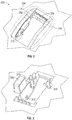
- FIGS. 1A-1C illustrate various views of a battery door 102 and a battery contact 110 for a hearing assistance device, according to various embodiments of the present subject matter.
- FIG. 1A shows portions of a faceplate or battery door assembly 100 of the hearing assistance device.
- the faceplate 100 as shown represents portions of a faceplate module for a CIC type hearing aid.
- the faceplate module will be further discussed below, with reference to FIGS. 5A-5C .
- the faceplate 100 includes a microphone opening 104 in the battery door 102.
- the microphone opening 104 is a microphone slit vertically along the side of the battery door 102.
- Other configurations for the microphone opening 104 are possible without departing from the scope of the present subject matter.
- the microphone opening 104 can be horizontal or at an angle from the horizontal or vertical direction, and can be in the body of the battery door 102 or at an end of the battery door 102 instead of along the side, in various embodiments.
- a "horizontal” direction refers to a direction parallel to the axis of rotation (swinging) of the battery door 102
- a “vertical direction” refers to a direction that is perpendicular to that axis.
- FIG. 1B shows the faceplate 100 with the battery door 102 in an open position.
- a battery 120 of the hearing assistance device is affixed to the interior of the battery door 102.
- An acoustic recess 106 is formed in the battery door 102 in an overhang area that is over a microphone port when the battery door 102 is in the close position. The position of the recess 106 allows wax to be easily cleaned from it when the battery door 102 is in an open position.
- FIG. 1B also shows a battery contact 110 of the faceplate 100 that provides for electrical connection between the battery 120 and components of the hearing assistance device that are powered by the battery 120.
- FIG. 1C shows another view (opposite side from FIG. B) of the faceplate 100 with the battery door 102 in the open position.
- the battery contact 100 as shown in FIG. 1C includes an acoustic port or microphone port 112.
- the battery contact 110 and the battery door 102 or 502 together create a non-linear acoustic path between the microphone opening 104 to the microphone.
- this acoustic path includes at least one approximately 90 degree turn.
- a sound entering through the microphone slit 104 makes an approximately 90 degree turn at the microphone port 112.
- this acoustic path includes two approximately 90 degree turns.
- a sound entering through the microphone slit 104 makes an approximately 90 degree turn to go through the acoustic recess 106 and another approximately 90 degree turn at the microphone port 112.
- this acoustic path is a torturous acoustic path.
- the torturous acoustic path may be formed by the relative locations and/or shapes of the microphone opening 104, acoustic recess 106, and microphone port 112.
- FIG. 2 illustrates a faceplate or battery door assembly 200 for a hearing assistance device, according to various embodiments of the present subject matter.
- Faceplate 200 includes a base or door frame structure for the battery door 102 and the battery door 102 (not shown in FIG. 2 ).
- the base structure includes a hinge pin 226 to which the battery door 102 is to be coupled and rotates around when being opened and closed, and centering bosses 230 around the hinge pin 226.
- the battery door 102 includes split draft walls. The centering bosses 230 and the split draft walls keep drag to a minimum during the opening and closing of the battery door 102.
- a vertical battery contact 210 with one or more microphones port permits repositioning of the microphone.
- the battery door 102 rotates (swings) around the hinge pin 226, which has an axis 224 (around which the battery door 102 rotates (swings)).
- a "horizontal” direction refers to a direction parallel to the axis 224
- a “vertical direction” refers to a direction that is perpendicular to the axis 224.
- FIG. 3 illustrates a battery contact 310 for a hearing assistance device, according to various embodiments of the present subject matter.
- the battery contact 310 creates a thin wall functioning as an acoustic barrier and acoustic channel or port 312 for a microphone 340.
- the space saved by such a design can be used to downsize the internal component footprint for the hearing assistance device, in various embodiments.
- FIGS. 4A-C illustrate microphone positioning examples for a hearing assistance device, according to various embodiments of the present subject matter.
- FIG. 4A shows a directional version with a battery door designed to provide for microphones 440 to locate on both sides of a battery 420, in an embodiment.
- FIG. 4B shows a conjoined microphone 442 located on one side of the battery 420, in one embodiment (e.g., when the hearing assistance device is of a CIC type).
- FIG. 4C shows two microphones 444 on one side of the battery 420, in one embodiment (e.g., when the hearing assistance device is of a CIC type).
- the acoustic path to the microphone as discussed in this document is applied to each microphone in these examples.
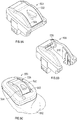
- FIGS. 5A-C illustrate a snap-in faceplate module 508 including a battery door 502 for a hearing assistance device, according to various embodiments of the present subject matter.
- FIG. 5A shows the faceplate module 508 including the battery door 502 with a microphone slit 504 along a side of the battery door 502, in an embodiment.
- FIG. 5B shows the faceplate module 508 with a microphone contact 510 and centering bosses 530 to minimize drag during the opening and closing of the battery door 502, in various embodiments.
- FIG. 5C shows the faceplate module 508 snapped-in or otherwise attached to a faceplate 500 of a hearing assistance device 550.
- the snap-in faceplate module 508 includes most of components of the hearing assistance device 550, in various embodiments.
- the snap-in faceplate module 508 includes all the components but the receiver (speaker) of the hearing assistance device 550.
- a smaller form factor is made possible by using a U-shaped design, in the depicted embodiments.
- the present subject matter includes a self-cleaning wiper arm to remove wax and debris, in various embodiments.
- the hearing assistance device 550 as shown in FIG. 5C as a CIC type hearing aid.
- the hearing assistance device 550 is an invisible-in-the-canal (IIC) type hearing aid.
- the hearing assistance device 550 may include any custom fit hearing aid or standard fit hearing aid, without departing from the scope of the present subject matter.
- the hearing assistance device 550 includes a shell 553 that may be customized to mate with the wearer's hearing canal, and the faceplate 500 attached to the shell 552.
- the shell 552 includes a large opening configured for interfacing with the faceplate 500.
- this opening is of an irregular shape, requiring that the mating faceplate 500 be customized to fit to it.
- a standard faceplate that is larger than the opening is fitted to the shell 552, and then modified to a custom shape to form the faceplate 500.
- components of the hearing assistance device 550 housed in the shell 552 include a microphone to receive a sound signal, a processing circuit to process the sound signal to produce an output sound signal, and a receiver (speaker) that converts the output sound signal to a sound audible to the wearer and transmits that sound to the wearer's ear canal.
- the hearing assistance device 550 may include additional components.
- the shell 552 houses circuitry including the microphone, processing circuitry, receiver, and optionally the additional components.
- the faceplate 500 is configured to utilize various controls, such as adjusting dials and push-button switches.
- the present subject matter includes a battery contact that creates an acoustic barrier and acoustic (microphone) port, and a vertical slit in the battery door creates an acoustic (microphone) opening.
- the battery contact e.g., the battery contact 110, 210, 310, or 510
- the battery door e.g., the battery door 102 or 502 together create a non-linear acoustic path from the microphone opening on the battery door to the microphone.
- this acoustic path includes at least one approximately 90 degree turn. In one embodiment, this acoustic path includes two approximately 90 degree turns.
- this acoustic path is a torturous acoustic path.
- the size and shape of this acoustic path is determined by the design of the battery door and the battery contact, including relative locations and shapes of various structural features of the battery door and the battery contact.
- the acoustic path is formed in the hearing assistance device such that it is substantially or fully contained in the battery door and battery contact, does not increase a dimension of the battery door or the battery contact, does not add overall volume to the hearing assistance device, and is substantially invisible when the battery door is closed.
- the present subject matter provides for smaller hearing assistance devices, such as CIC or IIC devices, by eliminating additional microphone protective components such as microphone hood or wax guard.
- the saved space can be used for a thicker device shell, in an embodiment.
- the present subject matter allows for less frequent repairs due to microphone wax buildup, in various embodiments.
- the present subject matter provides a solution to problems resulting from ingress of wax that is less labor intensive than manually carving out of an acoustic port.
- Hearing assistance devices typically include an enclosure or housing, a microphone, hearing assistance device electronics including processing electronics, and a speaker or receiver. It is understood that in various embodiments the receiver is optional.
- Antenna configurations may vary and may be included within an enclosure for the electronics or be external to an enclosure for the electronics. Thus, the examples set forth herein are intended to be demonstrative and not a limiting or exhaustive depiction of variations.
- any hearing assistance device may be used without departing from the scope and the devices depicted in the figures are intended to demonstrate the subject matter, but not in a limited, exhaustive, or exclusive sense. It is also understood that the present subject matter can be used with a device designed for use in the right ear or the left ear or both ears of the wearer.
- the hearing aids referenced in this patent application include a processor.
- the processor may be a digital signal processor (DSP), microprocessor, microcontroller, other digital logic, or combinations thereof.
- DSP digital signal processor
- the processing of signals referenced in this application can be performed using the processor. Processing may be done in the digital domain, the analog domain, or combinations thereof. Processing may be done using subband processing techniques. Processing may be done with frequency domain or time domain approaches. Some processing may involve both frequency and time domain aspects. For brevity, in some examples drawings may omit certain blocks that perform frequency synthesis, frequency analysis, analog-to-digital conversion, digital-to-analog conversion, amplification, audio decoding, and certain types of filtering and processing.
- the processor is adapted to perform instructions stored in memory which may or may not be explicitly shown.
- Various types of memory may be used, including volatile and nonvolatile forms of memory.
- instructions are performed by the processor to perform a number of signal processing tasks.
- analog components are in communication with the processor to perform signal tasks, such as microphone reception, or receiver sound embodiments (i.e., in applications where such transducers are used).
- signal tasks such as microphone reception, or receiver sound embodiments (i.e., in applications where such transducers are used).
- different realizations of the block diagrams, circuits, and processes set forth herein may occur without departing from the scope of the present subject matter.
- hearing assistance devices including hearing aids, including but not limited to, behind-the-ear (BTE), in-the-ear (ITE), in-the-canal (ITC), receiver-in-canal (RIC), invisible-in-the-canal (IIC) or completely-in-the-canal (CIC) type hearing aids.
- BTE behind-the-ear
- ITE in-the-ear
- ITC in-the-canal
- RIC receiver-in-canal
- IIC invisible-in-the-canal
- CIC completely-in-the-canal
- hearing assistance devices including but not limited to, behind-the-ear (BTE), in-the-ear (ITE), in-the-canal (ITC), receiver-in-canal (RIC), invisible-in-the-canal (IIC) or completely-in-the-canal (CIC) type hearing aids.
- BTE behind-the-ear
- ITE in-the-ear
- ITC in-the-canal
- RIC receiver-in
- the present subject matter can also be used in hearing assistance devices generally, such as cochlear implant type hearing devices and such as deep insertion devices having a transducer, such as a receiver or microphone, whether custom fitted, standard, open fitted or occlusive fitted. It is understood that other hearing assistance devices not expressly stated herein may be used in conjunction with the present subject matter.
Landscapes
- Engineering & Computer Science (AREA)
- Health & Medical Sciences (AREA)
- General Health & Medical Sciences (AREA)
- Neurosurgery (AREA)
- Otolaryngology (AREA)
- Physics & Mathematics (AREA)
- Acoustics & Sound (AREA)
- Signal Processing (AREA)
- Manufacturing & Machinery (AREA)
- Battery Mounting, Suspending (AREA)
Claims (12)
- Appareil d'aide auditive (550) comprenant :un microphone ;un couvercle de compartiment de piles (102, 502) comprenant une paroi latérale, le couvercle de compartiment de piles incluant une ouverture acoustique (104, 504), la paroi latérale incluant un renfoncement (106) et l'ouverture acoustique étant située au-dessus du renfoncement ;un contact de piles (110) incluant un orifice acoustique (112, 312) destiné au microphone ; etun chemin acoustique non linéaire entre l'ouverture acoustique et le microphone, le chemin acoustique non linéaire étant formé par le couvercle de compartiment de piles et par le contact de piles quand le couvercle de compartiment de piles est fermé, et incluant l'ouverture acoustique, le renfoncement et l'orifice acoustique, le renfoncement étant face à l'orifice acoustique quand le couvercle de compartiment de piles est fermé, et la position du renfoncement permettant de nettoyer le cérumen du renfoncement quand le couvercle de compartiment de piles est ouvert.
- Appareil d'aide auditive selon la revendication 1, dans lequel l'ouverture acoustique comprend une fente (504).
- Appareil d'aide auditive selon la revendication 2, dans lequel la fente suit un côté du couvercle de compartiment de piles.
- Appareil d'aide auditive selon l'une quelconque des revendications précédentes, dans lequel le chemin acoustique non linéaire est entièrement contenu dans le couvercle de compartiment de piles et dans le contact de piles.
- Appareil d'aide auditive selon l'une quelconque des revendications précédentes, dans lequel le chemin acoustique non linéaire est conçu de façon qu'un son entrant par l'ouverture acoustique fasse un tour à environ 90° au niveau de l'orifice acoustique.
- Appareil d'aide auditive selon la revendication 5, dans lequel le chemin acoustique non linéaire est conçu de sorte que le son entrant par l'ouverture acoustique fasse un tour à environ 90° pour traverser le renfoncement et fasse un autre tour à environ 90° au niveau de l'orifice acoustique.
- Appareil d'aide auditive selon la revendication 4, dans lequel le chemin acoustique non linéaire comprend un chemin acoustique tortueux.
- Appareil d'aide auditive selon l'une quelconque des revendications précédentes, comprenant une aide auditive (550) incluant une coque (552), une plaque avant (100, 200, 500) attachée à la coque et un module de plaque avant attaché à la plaque avant, le module de plaque avant (508) incluant le couvercle de compartiment de piles et le contact de piles.
- Appareil d'aide auditive selon la revendication 8, dans lequel l'aide auditive comprend un axe de pivot (226) auquel est couplé le couvercle de compartiment de piles et des renflements de centrage (230) autour de l'axe de pivot.
- Appareil d'aide auditive selon la revendication 9, dans lequel l'axe de pivot a un axe autour duquel tourne le couvercle de compartiment de piles, et l'ouverture acoustique est une fente le long d'un côté du couvercle de compartiment de piles, perpendiculaire à l'axe.
- Appareil d'aide auditive selon l'une quelconque des revendications 8 à 10, dans lequel l'aide auditive comprend une aide auditive intra-auriculaire (CIC).
- Appareil d'aide auditive selon la revendication 11, dans lequel l'aide auditive comprend une aide auditive profonde invisible (IIC).
Applications Claiming Priority (2)
| Application Number | Priority Date | Filing Date | Title |
|---|---|---|---|
| US201361822182P | 2013-05-10 | 2013-05-10 | |
| US14/085,031 US9648429B2 (en) | 2013-05-10 | 2013-11-20 | Hearing assistance device with improved microphone protection |
Publications (2)
| Publication Number | Publication Date |
|---|---|
| EP2802159A1 EP2802159A1 (fr) | 2014-11-12 |
| EP2802159B1 true EP2802159B1 (fr) | 2018-11-28 |
Family
ID=50639377
Family Applications (1)
| Application Number | Title | Priority Date | Filing Date |
|---|---|---|---|
| EP14167395.4A Active EP2802159B1 (fr) | 2013-05-10 | 2014-05-07 | Dispositif d'assistance auditive présentant une meilleure protection de microphone |
Country Status (3)
| Country | Link |
|---|---|
| US (3) | US9648429B2 (fr) |
| EP (1) | EP2802159B1 (fr) |
| DK (1) | DK2802159T3 (fr) |
Families Citing this family (10)
| Publication number | Priority date | Publication date | Assignee | Title |
|---|---|---|---|---|
| US9648429B2 (en) | 2013-05-10 | 2017-05-09 | Starkey Laboratories, Inc. | Hearing assistance device with improved microphone protection |
| DK3422741T3 (da) * | 2014-04-07 | 2020-08-03 | Oticon As | Høreapparatanordning der har en batteriskuffe |
| EP3157269A1 (fr) * | 2015-10-13 | 2017-04-19 | Sonion A/S | Ensemble boîtier compact ou disposition de plaque frontale |
| US10219088B2 (en) | 2016-10-24 | 2019-02-26 | Starkey Laboratories, Inc. | Photoactive self-cleaning hearing assistance device |
| US11140498B2 (en) | 2017-10-17 | 2021-10-05 | Eargo, Inc. | Wax management system |
| US11014125B2 (en) | 2017-10-17 | 2021-05-25 | Eargo, Inc. | Hand removable, clip on wax guards |
| DE102018125675A1 (de) | 2017-10-17 | 2019-04-18 | Eargo, Inc. | Vorrichtungsreinigende Ohrenschmalzschutzvorrichtungen |
| WO2019173514A1 (fr) | 2018-03-07 | 2019-09-12 | Milwaukee Electric Tool Corporation | Mètre ruban à lame de ruban renforcée |
| US10798500B1 (en) * | 2019-05-30 | 2020-10-06 | Xiamen Retone Hearing Technology Co., Ltd. | Behind-the-ear hearing aid |
| US12457461B2 (en) * | 2022-04-15 | 2025-10-28 | Starkey Laboratories, Inc. | Removable battery designs for custom hearing instruments |
Family Cites Families (12)
| Publication number | Priority date | Publication date | Assignee | Title |
|---|---|---|---|---|
| US5201008A (en) * | 1987-01-27 | 1993-04-06 | Unitron Industries Ltd. | Modular hearing aid with lid hinged to faceplate |
| DE3736591C3 (de) | 1987-04-13 | 1994-04-14 | Beltone Electronics Corp | Hörgerät mit Ohrschmalzschutz |
| EP1116415B1 (fr) * | 1998-09-24 | 2004-04-28 | SonionMicrotronic A/S | Prothese auditive a commande discrete |
| EP1246507A1 (fr) | 2001-03-26 | 2002-10-02 | Widex A/S | Prothèse auditive avec anneau d' étanchéité |
| DK176395B1 (da) | 2001-04-25 | 2007-11-19 | Oticon As | ITE höreapparat og kontaktmodul til brug i et ITE höreapparat. |
| US7142682B2 (en) | 2002-12-20 | 2006-11-28 | Sonion Mems A/S | Silicon-based transducer for use in hearing instruments and listening devices |
| US8457336B2 (en) | 2004-02-05 | 2013-06-04 | Insound Medical, Inc. | Contamination resistant ports for hearing devices |
| US7443992B2 (en) * | 2004-04-15 | 2008-10-28 | Starkey Laboratories, Inc. | Method and apparatus for modular hearing aid |
| DK2127466T3 (en) | 2007-03-27 | 2016-09-26 | Sonova Ag | Hearing-aid with microphone protection |
| WO2009083007A2 (fr) | 2007-12-27 | 2009-07-09 | Gn Resound A/S | Appareil auditif à paroi constituée d'une carte à circuit imprimé |
| US8737658B2 (en) * | 2008-12-19 | 2014-05-27 | Starkey Laboratories, Inc. | Three dimensional substrate for hearing assistance devices |
| US9648429B2 (en) | 2013-05-10 | 2017-05-09 | Starkey Laboratories, Inc. | Hearing assistance device with improved microphone protection |
-
2013
- 2013-11-20 US US14/085,031 patent/US9648429B2/en active Active
-
2014
- 2014-05-07 EP EP14167395.4A patent/EP2802159B1/fr active Active
- 2014-05-07 DK DK14167395.4T patent/DK2802159T3/en active
-
2017
- 2017-05-08 US US15/589,244 patent/US10440484B2/en active Active
-
2019
- 2019-10-07 US US16/595,198 patent/US10771906B2/en active Active
Non-Patent Citations (1)
| Title |
|---|
| None * |
Also Published As
| Publication number | Publication date |
|---|---|
| DK2802159T3 (en) | 2019-01-07 |
| US20140334651A1 (en) | 2014-11-13 |
| US9648429B2 (en) | 2017-05-09 |
| US10440484B2 (en) | 2019-10-08 |
| EP2802159A1 (fr) | 2014-11-12 |
| US20170311098A1 (en) | 2017-10-26 |
| US20200037087A1 (en) | 2020-01-30 |
| US10771906B2 (en) | 2020-09-08 |
Similar Documents
| Publication | Publication Date | Title |
|---|---|---|
| US10771906B2 (en) | Hearing assistance device with improved microphone protection | |
| US9877122B2 (en) | Hearing device | |
| EP1627553B1 (fr) | Aide auditive | |
| US9467787B2 (en) | Hearing aid with a replaceable insertion cap | |
| US9247360B2 (en) | Hearing instrument housing having a plug-in connection, plug and hearing instrument | |
| US8542858B2 (en) | Hearing device with a space-saving arrangement of microphones and sound openings | |
| US8098866B2 (en) | Receiver device with manipulable sound outlet direction | |
| US9980063B2 (en) | Method and apparatus for integrating a living-hinge in a hearing instrument | |
| US20100098279A1 (en) | Hearing apparatus comprising a membrane on the battery compartment interior | |
| US10993055B2 (en) | Elastomeric wax barrier for hearing aid acoustic port | |
| US20160165368A1 (en) | Wax relief pathway for hearing aid sound inlet | |
| US20130077808A1 (en) | Ite hearing instrument with programming connector | |
| US9992589B2 (en) | ITE hearing aid and method of manufacturing the same | |
| US9161143B2 (en) | BTE hearing instrument with housing and sound tube | |
| US20150146901A1 (en) | Hearing aid removal handle | |
| US8126178B2 (en) | In-the-ear hearing device with a moveable gripping element | |
| EP3057341B1 (fr) | Commutateur de puissance parallèle pour prothèse auditive | |
| US20180160243A1 (en) | Housing for a hearing aid and hearing aid having a housing | |
| US20160119727A1 (en) | Sinter bonded mu-metal receiver can |
Legal Events
| Date | Code | Title | Description |
|---|---|---|---|
| PUAI | Public reference made under article 153(3) epc to a published international application that has entered the european phase |
Free format text: ORIGINAL CODE: 0009012 |
|
| 17P | Request for examination filed |
Effective date: 20140513 |
|
| AK | Designated contracting states |
Kind code of ref document: A1 Designated state(s): AL AT BE BG CH CY CZ DE DK EE ES FI FR GB GR HR HU IE IS IT LI LT LU LV MC MK MT NL NO PL PT RO RS SE SI SK SM TR |
|
| AX | Request for extension of the european patent |
Extension state: BA ME |
|
| 17Q | First examination report despatched |
Effective date: 20160629 |
|
| STAA | Information on the status of an ep patent application or granted ep patent |
Free format text: STATUS: EXAMINATION IS IN PROGRESS |
|
| GRAP | Despatch of communication of intention to grant a patent |
Free format text: ORIGINAL CODE: EPIDOSNIGR1 |
|
| STAA | Information on the status of an ep patent application or granted ep patent |
Free format text: STATUS: GRANT OF PATENT IS INTENDED |
|
| INTG | Intention to grant announced |
Effective date: 20180613 |
|
| RIN1 | Information on inventor provided before grant (corrected) |
Inventor name: RICHARDSON, JANET Inventor name: RUZICKA, JEROME CHARLES Inventor name: ZAJICEK, GARY Inventor name: HIGGINS, SIDNEY A. Inventor name: SAYKEO, TOTO |
|
| GRAS | Grant fee paid |
Free format text: ORIGINAL CODE: EPIDOSNIGR3 |
|
| GRAA | (expected) grant |
Free format text: ORIGINAL CODE: 0009210 |
|
| STAA | Information on the status of an ep patent application or granted ep patent |
Free format text: STATUS: THE PATENT HAS BEEN GRANTED |
|
| AK | Designated contracting states |
Kind code of ref document: B1 Designated state(s): AL AT BE BG CH CY CZ DE DK EE ES FI FR GB GR HR HU IE IS IT LI LT LU LV MC MK MT NL NO PL PT RO RS SE SI SK SM TR |
|
| REG | Reference to a national code |
Ref country code: CH Ref legal event code: EP Ref country code: CH Ref legal event code: NV Representative=s name: RENTSCH PARTNER AG, CH |
|
| REG | Reference to a national code |
Ref country code: AT Ref legal event code: REF Ref document number: 1071690 Country of ref document: AT Kind code of ref document: T Effective date: 20181215 |
|
| REG | Reference to a national code |
Ref country code: DE Ref legal event code: R096 Ref document number: 602014036802 Country of ref document: DE |
|
| REG | Reference to a national code |
Ref country code: IE Ref legal event code: FG4D |
|
| REG | Reference to a national code |
Ref country code: DK Ref legal event code: T3 Effective date: 20190104 |
|
| REG | Reference to a national code |
Ref country code: NL Ref legal event code: FP |
|
| REG | Reference to a national code |
Ref country code: LT Ref legal event code: MG4D |
|
| REG | Reference to a national code |
Ref country code: AT Ref legal event code: MK05 Ref document number: 1071690 Country of ref document: AT Kind code of ref document: T Effective date: 20181128 |
|
| PG25 | Lapsed in a contracting state [announced via postgrant information from national office to epo] |
Ref country code: HR Free format text: LAPSE BECAUSE OF FAILURE TO SUBMIT A TRANSLATION OF THE DESCRIPTION OR TO PAY THE FEE WITHIN THE PRESCRIBED TIME-LIMIT Effective date: 20181128 Ref country code: LT Free format text: LAPSE BECAUSE OF FAILURE TO SUBMIT A TRANSLATION OF THE DESCRIPTION OR TO PAY THE FEE WITHIN THE PRESCRIBED TIME-LIMIT Effective date: 20181128 Ref country code: NO Free format text: LAPSE BECAUSE OF FAILURE TO SUBMIT A TRANSLATION OF THE DESCRIPTION OR TO PAY THE FEE WITHIN THE PRESCRIBED TIME-LIMIT Effective date: 20190228 Ref country code: LV Free format text: LAPSE BECAUSE OF FAILURE TO SUBMIT A TRANSLATION OF THE DESCRIPTION OR TO PAY THE FEE WITHIN THE PRESCRIBED TIME-LIMIT Effective date: 20181128 Ref country code: FI Free format text: LAPSE BECAUSE OF FAILURE TO SUBMIT A TRANSLATION OF THE DESCRIPTION OR TO PAY THE FEE WITHIN THE PRESCRIBED TIME-LIMIT Effective date: 20181128 Ref country code: IS Free format text: LAPSE BECAUSE OF FAILURE TO SUBMIT A TRANSLATION OF THE DESCRIPTION OR TO PAY THE FEE WITHIN THE PRESCRIBED TIME-LIMIT Effective date: 20190328 Ref country code: AT Free format text: LAPSE BECAUSE OF FAILURE TO SUBMIT A TRANSLATION OF THE DESCRIPTION OR TO PAY THE FEE WITHIN THE PRESCRIBED TIME-LIMIT Effective date: 20181128 Ref country code: ES Free format text: LAPSE BECAUSE OF FAILURE TO SUBMIT A TRANSLATION OF THE DESCRIPTION OR TO PAY THE FEE WITHIN THE PRESCRIBED TIME-LIMIT Effective date: 20181128 Ref country code: BG Free format text: LAPSE BECAUSE OF FAILURE TO SUBMIT A TRANSLATION OF THE DESCRIPTION OR TO PAY THE FEE WITHIN THE PRESCRIBED TIME-LIMIT Effective date: 20190228 |
|
| PG25 | Lapsed in a contracting state [announced via postgrant information from national office to epo] |
Ref country code: PT Free format text: LAPSE BECAUSE OF FAILURE TO SUBMIT A TRANSLATION OF THE DESCRIPTION OR TO PAY THE FEE WITHIN THE PRESCRIBED TIME-LIMIT Effective date: 20190328 Ref country code: SE Free format text: LAPSE BECAUSE OF FAILURE TO SUBMIT A TRANSLATION OF THE DESCRIPTION OR TO PAY THE FEE WITHIN THE PRESCRIBED TIME-LIMIT Effective date: 20181128 Ref country code: AL Free format text: LAPSE BECAUSE OF FAILURE TO SUBMIT A TRANSLATION OF THE DESCRIPTION OR TO PAY THE FEE WITHIN THE PRESCRIBED TIME-LIMIT Effective date: 20181128 Ref country code: RS Free format text: LAPSE BECAUSE OF FAILURE TO SUBMIT A TRANSLATION OF THE DESCRIPTION OR TO PAY THE FEE WITHIN THE PRESCRIBED TIME-LIMIT Effective date: 20181128 Ref country code: GR Free format text: LAPSE BECAUSE OF FAILURE TO SUBMIT A TRANSLATION OF THE DESCRIPTION OR TO PAY THE FEE WITHIN THE PRESCRIBED TIME-LIMIT Effective date: 20190301 |
|
| PG25 | Lapsed in a contracting state [announced via postgrant information from national office to epo] |
Ref country code: PL Free format text: LAPSE BECAUSE OF FAILURE TO SUBMIT A TRANSLATION OF THE DESCRIPTION OR TO PAY THE FEE WITHIN THE PRESCRIBED TIME-LIMIT Effective date: 20181128 Ref country code: CZ Free format text: LAPSE BECAUSE OF FAILURE TO SUBMIT A TRANSLATION OF THE DESCRIPTION OR TO PAY THE FEE WITHIN THE PRESCRIBED TIME-LIMIT Effective date: 20181128 Ref country code: IT Free format text: LAPSE BECAUSE OF FAILURE TO SUBMIT A TRANSLATION OF THE DESCRIPTION OR TO PAY THE FEE WITHIN THE PRESCRIBED TIME-LIMIT Effective date: 20181128 |
|
| REG | Reference to a national code |
Ref country code: DE Ref legal event code: R097 Ref document number: 602014036802 Country of ref document: DE |
|
| PG25 | Lapsed in a contracting state [announced via postgrant information from national office to epo] |
Ref country code: RO Free format text: LAPSE BECAUSE OF FAILURE TO SUBMIT A TRANSLATION OF THE DESCRIPTION OR TO PAY THE FEE WITHIN THE PRESCRIBED TIME-LIMIT Effective date: 20181128 Ref country code: EE Free format text: LAPSE BECAUSE OF FAILURE TO SUBMIT A TRANSLATION OF THE DESCRIPTION OR TO PAY THE FEE WITHIN THE PRESCRIBED TIME-LIMIT Effective date: 20181128 Ref country code: SM Free format text: LAPSE BECAUSE OF FAILURE TO SUBMIT A TRANSLATION OF THE DESCRIPTION OR TO PAY THE FEE WITHIN THE PRESCRIBED TIME-LIMIT Effective date: 20181128 Ref country code: SK Free format text: LAPSE BECAUSE OF FAILURE TO SUBMIT A TRANSLATION OF THE DESCRIPTION OR TO PAY THE FEE WITHIN THE PRESCRIBED TIME-LIMIT Effective date: 20181128 |
|
| PLBE | No opposition filed within time limit |
Free format text: ORIGINAL CODE: 0009261 |
|
| STAA | Information on the status of an ep patent application or granted ep patent |
Free format text: STATUS: NO OPPOSITION FILED WITHIN TIME LIMIT |
|
| PG25 | Lapsed in a contracting state [announced via postgrant information from national office to epo] |
Ref country code: SI Free format text: LAPSE BECAUSE OF FAILURE TO SUBMIT A TRANSLATION OF THE DESCRIPTION OR TO PAY THE FEE WITHIN THE PRESCRIBED TIME-LIMIT Effective date: 20181128 |
|
| 26N | No opposition filed |
Effective date: 20190829 |
|
| PG25 | Lapsed in a contracting state [announced via postgrant information from national office to epo] |
Ref country code: MC Free format text: LAPSE BECAUSE OF FAILURE TO SUBMIT A TRANSLATION OF THE DESCRIPTION OR TO PAY THE FEE WITHIN THE PRESCRIBED TIME-LIMIT Effective date: 20181128 |
|
| REG | Reference to a national code |
Ref country code: BE Ref legal event code: MM Effective date: 20190531 |
|
| PG25 | Lapsed in a contracting state [announced via postgrant information from national office to epo] |
Ref country code: LU Free format text: LAPSE BECAUSE OF NON-PAYMENT OF DUE FEES Effective date: 20190507 |
|
| PG25 | Lapsed in a contracting state [announced via postgrant information from national office to epo] |
Ref country code: TR Free format text: LAPSE BECAUSE OF FAILURE TO SUBMIT A TRANSLATION OF THE DESCRIPTION OR TO PAY THE FEE WITHIN THE PRESCRIBED TIME-LIMIT Effective date: 20181128 |
|
| PG25 | Lapsed in a contracting state [announced via postgrant information from national office to epo] |
Ref country code: IE Free format text: LAPSE BECAUSE OF NON-PAYMENT OF DUE FEES Effective date: 20190507 |
|
| PG25 | Lapsed in a contracting state [announced via postgrant information from national office to epo] |
Ref country code: BE Free format text: LAPSE BECAUSE OF NON-PAYMENT OF DUE FEES Effective date: 20190531 |
|
| PG25 | Lapsed in a contracting state [announced via postgrant information from national office to epo] |
Ref country code: CY Free format text: LAPSE BECAUSE OF FAILURE TO SUBMIT A TRANSLATION OF THE DESCRIPTION OR TO PAY THE FEE WITHIN THE PRESCRIBED TIME-LIMIT Effective date: 20181128 |
|
| PG25 | Lapsed in a contracting state [announced via postgrant information from national office to epo] |
Ref country code: MT Free format text: LAPSE BECAUSE OF FAILURE TO SUBMIT A TRANSLATION OF THE DESCRIPTION OR TO PAY THE FEE WITHIN THE PRESCRIBED TIME-LIMIT Effective date: 20181128 Ref country code: HU Free format text: LAPSE BECAUSE OF FAILURE TO SUBMIT A TRANSLATION OF THE DESCRIPTION OR TO PAY THE FEE WITHIN THE PRESCRIBED TIME-LIMIT; INVALID AB INITIO Effective date: 20140507 |
|
| PG25 | Lapsed in a contracting state [announced via postgrant information from national office to epo] |
Ref country code: MK Free format text: LAPSE BECAUSE OF FAILURE TO SUBMIT A TRANSLATION OF THE DESCRIPTION OR TO PAY THE FEE WITHIN THE PRESCRIBED TIME-LIMIT Effective date: 20181128 |
|
| PGFP | Annual fee paid to national office [announced via postgrant information from national office to epo] |
Ref country code: GB Payment date: 20220513 Year of fee payment: 9 |
|
| PGFP | Annual fee paid to national office [announced via postgrant information from national office to epo] |
Ref country code: NL Payment date: 20230419 Year of fee payment: 10 |
|
| P01 | Opt-out of the competence of the unified patent court (upc) registered |
Effective date: 20230610 |
|
| GBPC | Gb: european patent ceased through non-payment of renewal fee |
Effective date: 20230507 |
|
| PG25 | Lapsed in a contracting state [announced via postgrant information from national office to epo] |
Ref country code: GB Free format text: LAPSE BECAUSE OF NON-PAYMENT OF DUE FEES Effective date: 20230507 |
|
| REG | Reference to a national code |
Ref country code: NL Ref legal event code: MM Effective date: 20240601 |
|
| PG25 | Lapsed in a contracting state [announced via postgrant information from national office to epo] |
Ref country code: NL Free format text: LAPSE BECAUSE OF NON-PAYMENT OF DUE FEES Effective date: 20240601 |
|
| PGFP | Annual fee paid to national office [announced via postgrant information from national office to epo] |
Ref country code: DE Payment date: 20250409 Year of fee payment: 12 |
|
| PGFP | Annual fee paid to national office [announced via postgrant information from national office to epo] |
Ref country code: DK Payment date: 20250411 Year of fee payment: 12 |
|
| PGFP | Annual fee paid to national office [announced via postgrant information from national office to epo] |
Ref country code: FR Payment date: 20250414 Year of fee payment: 12 |
|
| PGFP | Annual fee paid to national office [announced via postgrant information from national office to epo] |
Ref country code: CH Payment date: 20250601 Year of fee payment: 12 |