EP2801046B1 - Verfahren und system zur identifikation von verbindungen, die einen zielopioidrezeptor abhängig vom ph-wert binden und vorzugsweise aktivieren - Google Patents
Verfahren und system zur identifikation von verbindungen, die einen zielopioidrezeptor abhängig vom ph-wert binden und vorzugsweise aktivieren Download PDFInfo
- Publication number
- EP2801046B1 EP2801046B1 EP13702929.4A EP13702929A EP2801046B1 EP 2801046 B1 EP2801046 B1 EP 2801046B1 EP 13702929 A EP13702929 A EP 13702929A EP 2801046 B1 EP2801046 B1 EP 2801046B1
- Authority
- EP
- European Patent Office
- Prior art keywords
- receptor
- binding
- opioid
- compound
- modified
- Prior art date
- Legal status (The legal status is an assumption and is not a legal conclusion. Google has not performed a legal analysis and makes no representation as to the accuracy of the status listed.)
- Not-in-force
Links
Images



Classifications
-
- G—PHYSICS
- G16—INFORMATION AND COMMUNICATION TECHNOLOGY [ICT] SPECIALLY ADAPTED FOR SPECIFIC APPLICATION FIELDS
- G16B—BIOINFORMATICS, i.e. INFORMATION AND COMMUNICATION TECHNOLOGY [ICT] SPECIALLY ADAPTED FOR GENETIC OR PROTEIN-RELATED DATA PROCESSING IN COMPUTATIONAL MOLECULAR BIOLOGY
- G16B15/00—ICT specially adapted for analysing two-dimensional [2D] or three-dimensional [3D] molecular structures, e.g. structural or functional relations or structure alignment
-
- A—HUMAN NECESSITIES
- A61—MEDICAL OR VETERINARY SCIENCE; HYGIENE
- A61K—PREPARATIONS FOR MEDICAL, DENTAL OR TOILETRY PURPOSES
- A61K49/00—Preparations for testing in vivo
- A61K49/0004—Screening or testing of compounds for diagnosis of disorders, assessment of conditions, e.g. renal clearance, gastric emptying, testing for diabetes, allergy, rheuma, pancreas functions
- A61K49/0008—Screening agents using (non-human) animal models or transgenic animal models or chimeric hosts, e.g. Alzheimer disease animal model, transgenic model for heart failure
-
- C—CHEMISTRY; METALLURGY
- C07—ORGANIC CHEMISTRY
- C07D—HETEROCYCLIC COMPOUNDS
- C07D211/00—Heterocyclic compounds containing hydrogenated pyridine rings, not condensed with other rings
- C07D211/04—Heterocyclic compounds containing hydrogenated pyridine rings, not condensed with other rings with only hydrogen or carbon atoms directly attached to the ring nitrogen atom
- C07D211/06—Heterocyclic compounds containing hydrogenated pyridine rings, not condensed with other rings with only hydrogen or carbon atoms directly attached to the ring nitrogen atom having no double bonds between ring members or between ring members and non-ring members
- C07D211/36—Heterocyclic compounds containing hydrogenated pyridine rings, not condensed with other rings with only hydrogen or carbon atoms directly attached to the ring nitrogen atom having no double bonds between ring members or between ring members and non-ring members with hetero atoms or with carbon atoms having three bonds to hetero atoms with at the most one bond to halogen, e.g. ester or nitrile radicals, directly attached to ring carbon atoms
- C07D211/56—Nitrogen atoms
- C07D211/58—Nitrogen atoms attached in position 4
-
- C—CHEMISTRY; METALLURGY
- C07—ORGANIC CHEMISTRY
- C07D—HETEROCYCLIC COMPOUNDS
- C07D491/00—Heterocyclic compounds containing in the condensed ring system both one or more rings having oxygen atoms as the only ring hetero atoms and one or more rings having nitrogen atoms as the only ring hetero atoms, not provided for by groups C07D451/00 - C07D459/00, C07D463/00, C07D477/00 or C07D489/00
- C07D491/02—Heterocyclic compounds containing in the condensed ring system both one or more rings having oxygen atoms as the only ring hetero atoms and one or more rings having nitrogen atoms as the only ring hetero atoms, not provided for by groups C07D451/00 - C07D459/00, C07D463/00, C07D477/00 or C07D489/00 in which the condensed system contains two hetero rings
- C07D491/08—Bridged systems
-
- G—PHYSICS
- G01—MEASURING; TESTING
- G01N—INVESTIGATING OR ANALYSING MATERIALS BY DETERMINING THEIR CHEMICAL OR PHYSICAL PROPERTIES
- G01N33/00—Investigating or analysing materials by specific methods not covered by groups G01N1/00 - G01N31/00
- G01N33/48—Biological material, e.g. blood, urine; Haemocytometers
- G01N33/50—Chemical analysis of biological material, e.g. blood, urine; Testing involving biospecific ligand binding methods; Immunological testing
- G01N33/94—Chemical analysis of biological material, e.g. blood, urine; Testing involving biospecific ligand binding methods; Immunological testing involving narcotics or drugs or pharmaceuticals, neurotransmitters or associated receptors
- G01N33/9486—Analgesics, e.g. opiates, aspirine
-
- G—PHYSICS
- G06—COMPUTING OR CALCULATING; COUNTING
- G06F—ELECTRIC DIGITAL DATA PROCESSING
- G06F30/00—Computer-aided design [CAD]
- G06F30/20—Design optimisation, verification or simulation
-
- G—PHYSICS
- G16—INFORMATION AND COMMUNICATION TECHNOLOGY [ICT] SPECIALLY ADAPTED FOR SPECIFIC APPLICATION FIELDS
- G16B—BIOINFORMATICS, i.e. INFORMATION AND COMMUNICATION TECHNOLOGY [ICT] SPECIALLY ADAPTED FOR GENETIC OR PROTEIN-RELATED DATA PROCESSING IN COMPUTATIONAL MOLECULAR BIOLOGY
- G16B15/00—ICT specially adapted for analysing two-dimensional [2D] or three-dimensional [3D] molecular structures, e.g. structural or functional relations or structure alignment
- G16B15/30—Drug targeting using structural data; Docking or binding prediction
-
- G—PHYSICS
- G01—MEASURING; TESTING
- G01N—INVESTIGATING OR ANALYSING MATERIALS BY DETERMINING THEIR CHEMICAL OR PHYSICAL PROPERTIES
- G01N2500/00—Screening for compounds of potential therapeutic value
-
- G—PHYSICS
- G16—INFORMATION AND COMMUNICATION TECHNOLOGY [ICT] SPECIALLY ADAPTED FOR SPECIFIC APPLICATION FIELDS
- G16C—COMPUTATIONAL CHEMISTRY; CHEMOINFORMATICS; COMPUTATIONAL MATERIALS SCIENCE
- G16C20/00—Chemoinformatics, i.e. ICT specially adapted for the handling of physicochemical or structural data of chemical particles, elements, compounds or mixtures
- G16C20/50—Molecular design, e.g. of drugs
Definitions
- the invention relates to a method for identifying candidate compounds that bind and preferably activate a target opioid receptor in a pH-dependent manner.
- the present invention relates also to the influence of an inflamed (acidic) environment on opioid receptor-ligand interactions and provides a method for identifying candidate compounds that bind and preferably activate a target opioid receptor in a pH-dependent manner, such that opioid receptors are exclusively or preferentially activated in injured or inflamed tissue.
- Such compounds are intended for selectively modulating peripheral opioid receptors without causing side effects via opioid receptors in physiological (neutral) environments (for example in the gut or central nervous system).
- the invention thereby enables the identification of effective analgesic compounds that do not exhibit the side effects commonly associated with conventional natural or synthetic opioid analgesics.
- Non-steroidal analgesics cause gastrointestinal ulcers, bleeding and cardiovascular complications, and opioid drugs produce drowsiness, nausea, respiratory depression, constipation, tolerance or addiction.
- opioid receptors on peripheral terminals of primary sensory neurons are upregulated, their G-protein coupling, signaling and recycling is enhanced, and their activation results in potent inhibition of neuronal excitability and analgesia.
- the augmented intracellular signaling suggests conformational alterations of opioid receptors or ligands in the inflamed environment.
- Systemically applied conventional opioid agonists e.g. morphine
- activate both peripheral and central (brain) opioid receptors activate both peripheral and central (brain) opioid receptors.
- Activation of opioid receptors in physiological (neutral) environments e.g. brain, gut
- leads to severe side effects leaving a significant need in the field of pain treatment for compounds that work preferably selectively on peripheral receptors in injured (inflamed) tissue.
- Inflammation accompanied by tissue acidosis, is an essential component of a large group of painful syndromes ( Stein, C. et al. Brain Res Rev 60, 90-113 (2009 )), including arthritis, skin inflammation, inflammatory back pain, headache (certain types of neurogenic migraine), inflammatory lesions of the nervous system (neuropathic pain), cancer pain, disorders of the immune system (HIV/AIDS, multiple sclerosis), traumatic and postoperative pain.
- analgesic drugs are limited by unacceptable side effects such as the central actions of opioids (e.g. sedation, respiratory depression, nausea, addiction, tolerance), the intestinal effects of opioids (constipation, ileus), the gastrointestinal and cardiovascular effects of cyclooxygenase (COX) inhibitors (e.g.
- DRG dorsal root ganglion
- CNS central nervous system
- peripherally acting opioids have been shown to reduce inflammation by modulating proinflammatory mediators, edema, plasma extravasation and other parameters ( Stein, C. et al. Curr Pharm Design 2012; 18(37):6053-6069 ).
- peripherally acting opioids have been shown to reduce inflammation, leading to potential success in pain relief strategies regarding modulation of peripheral receptors, few methods have been disclosed for effectively targeting selectively peripheral opioid receptors within injured tissue without effects on either the gut or CNS.
- Opioid pharmacology commands a huge armamentarium of non-peptidic and peptidic opioid receptor ligands.
- the most thoroughly studied include the alkaloid morphine, the piperidine fentanyl, and the enkephalin derivative (D-Ala 2 N-MePhe 4 Gly 5 -ol)-enkephalin (DAMGO). All of these bind to the mu-receptor, the most important receptor type for the mediation of analgesic effects in animals and humans ( Zöllner, C. and Stein, C. Handbook of Experimental Pharmacology (Vol. 177) Analgesia (2007 )).
- Fentanyl is one example (among others e.g. morphine, codeine etc.) of a potent synthetic opioid ("narcotic") analgesic with a rapid onset and short duration of action. It is a potent agonist at mu-opioid receptors. Historically it has been used to treat chronic and breakthrough pain and is commonly used before, during and after procedures as a pain reliever as well as an anaesthetic. However, fentanyl (and others, e.g.
- morphine, codeine etc. exhibits significant side effects, such as nausea, vomiting, constipation, dry mouth, somnolence, confusion, hypoventilation, apnoea, tolerance and addiction, in addition to abdominal pain, headache, fatigue, weight loss, dizziness, nervousness, hallucination, anxiety, depression, flu-like symptoms, dyspepsia (indigestion), and urinary retention, which renders fentanyl (and others, e.g. morphine, codeine etc.) in many cases unusable, especially when delivered systemically to a subject in pain.
- opioid derivatives that do not exhibit the side effects commonly associated with fentanyl (and others, e.g. morphine, codeine etc.). Many of these side effects are thought to be associated with the effect of fentanyl on the CNS.
- opioid agonists inhibit the TRPV1 ion channel, which is preferentially expressed in DRG neurons and is activated by the pungent compound capsaicin, protons and other stimuli. The inhibition occurs via opioid receptor-coupled G i/o proteins and the cAMP pathway.
- peripherally mediated opioid antinociception is particularly prominent within inflamed tissue, and that its efficacy increases with the duration of the inflammatory process. Underlying mechanisms include upregulation of synthesis, peripherally directed axonal transport and G-protein coupling of opioid receptors in DRG neurons.
- pH-values as low as 4-5 have been measured in painful inflammation ( Reeh, P.W. & Steen, K.H., Prog Brain Res 113, 143-51 (1996 ), Woo, Y.C., et al., Anesthesiology 101, 468-75 (2004 ).
- This significant change in pH in inflamed tissue provides a potential mechanism according to which inflammation-specific active agents can be developed, which only exhibit an opioid receptor agonistic function in the area of damage, inflammation and/or pain.
- Trivedi et al. (“Pharmacology of Opioids - Anaesthesia tutorial of the Week", August 12, 2007 ) describe the pKa values of various opioids, including fentanyl, and aspects of their pharmacokinetics.
- the prior art reveals no insight into either identification or utilisation of the relationships between ligand structure, their physical properties and pH-dependent binding to (and potentially activation of) opioid receptors.
- Opioid receptors belong to the rhodopsin/class A subfamily of seven-transmembrane G-protein coupled receptors (GPCR). As such, it is possible to extrapolate information from other members of this subfamily such as the rhodopsin and adrenergic receptors.
- the invention is therefore related to modelling of opioid receptor and ligand interaction, and testing the conformational dynamics of opioid receptor-ligand behavior at different pH conditions.
- the present invention is also related to the influence of an inflamed (acidic) environment on opioid receptor-ligand interactions and provides a method for identifying ligands that selectively activate opioid receptors in injured (acidic, low pH) tissue.
- the technical problem underlying the present invention is to provide a method or a system for identifying candidate compounds that possess effective analgesic function but do not exhibit side effects on either the gut or central nervous system commonly associated with conventional natural or synthetic opioid analgesics.
- an object of the invention is to provide a method for identifying compounds that bind a target opioid receptor in a pH-dependent manner, comprising
- step d) is carried out by computer simulation with the modified compound and base compound, successively, in any order, whereby binding and/or activation of the receptor by the modified compound in the binding pocket model (and/or receptor activation model) is compared to binding and/or activation of the receptor by the base compound in the binding pocket model (and/or receptor activation model), whereby desired modified compounds are identified when the binding and/or activation of the receptor caused by the modified compound is either improved, the same or similar, in comparison to the base compound.
- the binding model and the activation path model relate preferably to the same model, but may involve different analyses in order to detect any given compound binding to and/or activating the receptor.
- the binding event has been modeled and is demonstrated in full detail.
- the activation potency of a modified (or unmodified base compound as reference) can be measured and/or estimated by observing (thereby measuring or determining) the conformational changes of the alpha helices of the opioid-receptor model after binding of the test ligand to be analysed.
- the method of the invention therefore also encompasses simulation of receptor activation, which can occur on its own or in combination with analysis of binding between receptor and compound.
- the model is therefore capable of also measuring not only binding as such, but additionally (or separately) conformational changes in the receptor itself, in particular of the alpha helices of the receptor, during a binding event.
- the method of the present invention is characterized in that one or more of the steps a) to d) are simulations carried out by one or more computer programmes, preferably as individual software modules combined to be automatically carried out, on a computing device.
- An acid dissociation constant, Ka (also known as acidity constant, or acid-ionization constant) is a quantitative measure of the strength of an acid in solution.
- the acid dissociation constant of a small molecule is therefore determined by the dissociation constants of its acidic and basic groups. Due to the many orders of magnitude spanned by Ka values, a logarithmic measure of the acid dissociation constant is more commonly used in practice.
- the logarithmic constant, pKa which is equal to -log10 Ka, is also referred to as the acid dissociation constant.
- the present invention refers to pKa as commonly used.
- the pKa value of any given modified compound can be determined by various methods known to those skilled in the art, either computationally, or for example via chemical experimentation involving titration. Although pKa can be calculated using various methods, the methods of calculation provide very similar results to one another and to those measurements carried out by empirical experimentation. The specific method used in the examples of the invention should therefore not be considered a limiting feature.
- the method of the present invention is characterized in that the identified modified and/or base compound is chemically synthesized or chemically synthesizable.
- the modification of a base compound relates to any structural modification; preferably change, in the molecular and/or atomic structure.
- Methods for modification of chemical compounds are known to those in the art, especially to those skilled in chemistry and/or chemical synthesis of pharmaceutical compounds.
- a base compound can essentially be any chemical structure that can be used as a starting point for further chemical modification.
- Base compounds can therefore preferably be known opioids, or known opioid receptor ligands and/or agonists, or any other candidate molecule for which modified variants are to be sought.
- a modified compound therefore relates to any given compound that exhibits a structural modification in relation to a base compound.
- the method of the present invention is characterized in that the modified compound and/or base compound, preferably in their physical form (as produced by chemical synthesis) are tested for opioid receptor binding, and preferably opioid receptor agonist function, using in vitro and/or in vivo validation methods.
- the in vivo and/or in vitro validation is a preferred aspect of the method but is not considered fundamental to the method of the invention.
- the binding of the modified compound in, and preferably activation of, said target opioid receptor may be carried out via simulation of binding of the modified (and/or base) compound in a three-dimensional (3D) binding pocket model for said target opioid receptor, preferably using computer implemented methods. Appropriate software to generate binding and/or activation models and subsequent testing of binding and/or activation using in silico approaches is also a preferred aspect of the invention.
- the method of the present invention is characterized in that the in vitro validation comprises of measurement of GTP ⁇ S binding, G-protein activation, cAMP accumulation, modulation of TRVP1 currents, modulation of stimulus-evoked action potentials and/or any other suitable in vitro assay for determining opioid receptor activation by tested compounds.
- the method of the present invention is characterized in that the in vitro validation comprises use of embryonic kidney cells, preferably HEK 293 cells, sensory neurons and/or cultured dorsal root ganglion (DRG) neurons.
- DRG dorsal root ganglion
- the method of the present invention is characterized in that the in vivo validation comprises the CFA-induced hindpaw inflammation assay, in vitro skin-nerve preparations, neuropathic pain models and/or any other suitable in vivo assay for determining analgesic effects of the tested compounds.
- tissue damage, inflammation or injury of the nervous system may result in chronic inflammatory or neuropathic pain characterised by increased sensitivity to painful stimuli (hyperalgesia), the perception of innocuous stimuli as painful (allodynia) and spontaneous pain.
- the method of the present invention is characterized in that the base compound is an opioid or opioid derivative or analogue, which exhibits a nitrogen atom that can be protonated or non-protonated.
- a positively charged nitrogen atom of a modified compound is considered as an important feature for effective interaction with the ligand-binding site of the receptor, whereby the positively charged nitrogen of the ligand (modified compound) is considered to interact with an anionic site of the receptor.
- a preferred embodiment of the present invention is characterised in that the anionic binding site of the binding pocket model is the aspartic acid residue 147 (Asp147) of the mu-opioid receptor.
- the method of the present invention is characterized in that protonation of said nitrogen atom (that can be protonated or non-protonated) occurs in modified compounds with a pKa of less than 7 when at pH values less than 7.
- the method of the present invention is characterized in that the target opioid receptor is selected from the group consisting of the mu-receptor, delta-receptor, kappa-receptor and/or subtypes.
- the binding of compounds identified using the method provided herein to the opioid receptors and the subsequent receptor activation as described herein, relates preferably to compounds binding the mu-opioid receptor.
- the binding and receptor activation by the claimed compounds may also occur with opioid receptors in addition to the mu-receptor, such as the delta-receptor, kappa-receptor, or other related opioid receptors, such as target receptors of the family of opioid-related G-protein coupled receptors, such as the rhodopsin, opsin, chemokine, cannabinoid, dopamine, histamine, muscarinic, neurotensin, adrenergic, adenosine, beta-androgen and/or any other opioid-related receptor.
- opioid receptors in addition to the mu-receptor, such as the delta-receptor, kappa-receptor, or other related opioid receptors, such as target receptors of the family of opioid-related G-protein coupled receptors, such as the rhodopsin, opsin, chemokine, cannabinoid, dopamine, histamine, muscarinic, neurotensin, adrene
- the method of the present invention is characterized in that the modification of the base compound is the replacement of one or more hydrogen atoms with one or more atoms of greater electronegativity compared to hydrogen, preferably with a halogen atom, such as Cl, Br, I, Fl, more preferably with a fluorine atom.
- Electronegativity can be deduced from the periodic table of electronegativity using the Pauling scale.
- the method of the present invention is characterized in that the evaluation of binding of the modified or base compound in the binding pocket model is carried out using steric and/or energetic criteria measured and/or determined during simulation of binding.
- Energetic criteria relate in their broadest sense to any measurement, simulation or calculation of the electrostatic interaction between electrically charged atoms or molecules or interactions between a pair of neutral atoms or molecules.
- the method of the present invention is characterized in that the energetic criteria for evaluation of binding and/or receptor activation of the modified or base compound in the binding pocket model and/or receptor activation path model are determined by calculation of the Leonard Jones potential and/or Coulomb interactions.
- the method of the present invention is characterized in that calculation of the energetic binding criteria for the modified and/or base compound is carried out for binding and/or receptor activation of the compound in the binding pocket model and/or receptor activation path model, and then compared to binding and/or receptor activation of the compound in water as a reference value.
- These measurements can be carried out using, for example, in one embodiment, the computer simulations and/or software as disclosed herein or as commonly used in the art.
- the method of the present invention is characterized in that the steric criteria for evaluation of binding (and/or receptor activation) of the modified or base compound in the binding pocket and/or receptor activation path model are determined by measurement of the distance between reference atoms of the modified compound and the binding pocket model. This measurement can be carried out using, for example, in one embodiment, the computer simulations and/or software as disclosed herein or as commonly used in the art.
- the method of the present invention is characterized in that the method additionally comprises identifying chemical residues (e.g. amino acids and others) within the receptor that are responsible for pH-dependent binding and/or activation of the receptor.
- the method preferably comprises modelling the interaction between receptor residues and the compound binding to the receptor. Through analysis of this interaction the residues of the receptor involved in pH-dependent binding can also be determined, thereby providing useful information for further modification of base compounds for future analysis.
- the method of the present invention is characterized in that the reference atom of the modified compound is the nitrogen atom that can be protonated or non-protonated. In one embodiment the method of the present invention is characterized in that the reference atom of the binding pocket model is the aspartic acid residue 147 (Asp147) of the mu-opioid receptor.
- the method of the present invention is characterized in that the modified compound binds and preferably activates the target opioid receptor in conditions of inflammation-associated pH in inflamed tissue, preferably at pH values between 4 and 7, such as 4, 4.5, 5, 5.5, 6 or 6.5, more preferably between 5 and 7, or 5 and 6, or any other pH value below 7.
- pH values between 4 and 7, such as 4, 4.5, 5, 5.5, 6 or 6.5, more preferably between 5 and 7, or 5 and 6, or any other pH value below 7.
- the method of the present invention is characterized in that the modified compound exhibits inflammation-specific peripheral analgesic function in inflamed or injured tissues, preferably without causing central or intestinal effects.
- the method of the present invention is characterized in that determination of the pKa of a modified compound comprises determination of the pKa for each conformation of said modified compound and calculation of the pKa based on a weighted average of the pKa for each conformation, whereby the weighted average corresponds to the statistical weight for each conformation.
- the method of the present invention is characterized in that simulation of binding is carried out using multiple 3D conformations of the modified compound, whereby determination of 3D conformation of a candidate compound comprises determination of potential 3D conformations of a candidate compound as meta-stable conformations in position space and determination of the statistical weights for each conformation.
- the method of the present invention is characterized in that simulation of binding is carried out using binding path analysis. In one embodiment the method of the present invention is characterized in that simulation of receptor activation is carried out using receptor activation analysis.
- the method of the present invention is characterized in that the 3D binding pocket model (and/or receptor activation model) is constructed by determination of size of the atoms of the binding pocket, charge of the atoms of the binding pocket and preferably charge of regions of the binding pocket model.
- the method of the present invention is characterized in that the 3D binding pocket model (and/or receptor activation model) is constructed by determination of size of the atoms of the receptor activation path, charge of the atoms of the receptor activation path, and preferably charge of regions of the receptor activation path model.
- the method of the present invention is characterized in that the binding pocket and/or receptor activation path model is constructed using homology modelling.
- Homology modelling also known as comparative modelling refers to constructing an atomic-resolution model of a target protein from its amino acid sequence and an experimental three-dimensional structure of a related homologous protein.
- Homology modelling relies on the identification of one or more known protein structures likely to resemble the structure of the query sequence, and on the production of an alignment that maps residues in the query sequence to residues in the template sequence. Evolutionarily related proteins have similar sequences and naturally occurring homologous proteins have similar protein structure.
- Homology modelling may use software such as SWISS-MODEL or the like, e.g. structural bioinformatics web-servers, or protein databases (such as PDB, 2iql, 2iqo) ( Fowler et al. Biochemistry 43, 15796-810, 2004 ).
- the method of the present invention is characterized in that the binding pocket and/or receptor activation path model is constructed using amino acid sequences and/or crystal structures of the mu-opioid receptor, delta-opioid receptor, kappa-opioid receptor, rhodopsin, opsin, chemokine, cannabinoid, dopamine, histamine, muscarinic, neurotensin, adrenergic, adenosine, beta-androgen and/or any opioid-related receptor.
- Candidate compounds identified via the claimed method can then be preferably tested in transfected cell lines, cultured sensory neurons, in the in vitro skin-nerve preparation, in knock-in mice carrying mutant opioid receptors and/or in animal models of inflammatory or neuropathic pain.
- the compounds identified and the method of the present invention transcends traditional concepts and methods of pain treatment by focusing on the specific activation of peripheral opioid receptors in injured tissues.
- the agonists identified via the method described herein have been demonstrated to exhibit analgesic activity in animal models of inflammatory or neuropathic pain in vivo.
- the present invention therefore relates to the influence of an inflamed (acidic) environment on opioid receptor-ligand interactions and provides a method for identifying candidate compounds that selectively bind and preferably activate a target opioid receptor in a pH-dependent manner in injured tissue.
- the method in a preferred embodiment relates to (i) simulating the conformations of opioid receptors, their binding pocket (and their G-protein binding domain and/or receptor activation path) at different pH values and protonation states; (ii) analyzing conformational changes of opioid agonists at different pH values; (iii) using transfected human embryonic kidney (HEK-293) cells, cultured primary afferent neurons and in vitro skin-nerve preparations to examine opioid agonist binding, GTP ⁇ S binding, cAMP accumulation and modulation of TRPV1 currents and action potentials by opioid agonists at varying pH values; (iv) analyzing receptor docking and/or receptor activation of protonated versus deprotonated opioid agonists; (v) using this information to design novel opioid agonists that selectively activate opioid receptors at acidic but not at normal pH values; and (vi) testing these compounds for antinociceptive efficacy in animal models of inflammatory and/or neuropathic pain.
- HEK-293
- the identification method of the present invention applies, in a preferred embodiment, computational methods and software for the simulation of binding processes (and/or the receptor activation path) and conformational stability of the opioid receptor and opioid ligands at different pH-values, and for the computational design of novel opioid agonists.
- Conformation dynamics are defined as almost invariant (metastable) subsets in the conformational space, not as local minima of the energy landscape of a molecule.
- Conformation dynamics is the ideal method to generate a canonical ensemble simulation in a well-conditioned way including error analysis. For the simulation of ligand-receptor binding via conformation dynamics, much of the protein is held fixed, whereas the active binding site and the ligand are fully sampled.
- binding affinities can be estimated and, thus, rational drug development is feasible.
- conformation dynamics simulations include entropical effects of the binding process. Entropical effects are particularly important for the pH dependency of opioid receptor-ligand interactions and consequent receptor function.
- the fentanyl derivatives identified by the method of the present invention function as opioid receptor agonists, which bind and activate target opioid receptors in a pH-dependent manner.
- the fentanyl compounds as described herein relate to examples of compounds identified by the method of the present invention and limit in no way the method itself. Other compounds with different chemical structures can be identified using the method described herein.
- the fluoro-substituents of the herein described fluoro-fentanyl derivatives exhibit an enhanced electronegativity when compared to hydrogen and therefore lead to an enhanced electronegativity of the fentanyl derivative molecule, thus providing the compounds with their pH-dependent receptor agonist activity.
- Through the fluor-modification of the fentanyl backbone the overall conformation or three-dimensional structure of the molecules remains unchanged, or only changed to a minor extent, whereas the electronegativity is significantly reduced.
- the "pH-dependent binding" between the compounds as described herein and the opioid receptor relates to an enhanced binding (and/or receptor activation) at pH values less than 7, in comparison to values above 7.
- the binding between compound and receptor (as well as preferably receptor activation) is enhanced proportionally with lowering pH values.
- the receptor protein may undergo significant conformational change and/or denaturation, so that the binding and activation no longer occurs in an improved manner.
- the binding between F-fentanyl and receptor as well as receptor activation occurs preferably at pH values of 4.0, 4.1, 4.2, 4.3, 4.4, 4.5, 4.6, 4.7, 4.8, 4.9, 5.0, 5.1, 5.2, 5.3, 5.4, 5.5, 5.6, 5.7, 5.8, 5.9, 6.0, 6.1, 6.2, 6.3, 6.4, 6.5, 6.6, 6.7, 6.8, 6.9, or any other pH value below 7, whereby the binding and activation occurs preferably between 4 and 7, preferably between 4.5 and 6.5, most preferentially at pH values between 5 and 6.
- binding and activation of the receptor occurs most preferentially at pH levels, which are naturally lowered to approximately 4, 4.5, 5, 5.5, 6 or 6.5, or any other pH value below 7, after injury or inflammation of tissue.
- the activation of the receptor occurs in a preferred embodiment via binding of the agonist to the receptor.
- the binding of the agonist to the receptor may be either a stable or transient event, of either strong or weak interaction, such that the receptor is activated preferably by agonist-receptor physical interaction.
- Activation of an opioid receptor by an agonist, such as morphine of fentanyl can cause analgesia or sedation. Activation can be assessed via various methods as described herein and those known to a skilled person.
- inflammation-associated pain relates to any kind of pain experienced by a subject when inflammation is involved. Inflammation may be detected or recognized by various physiological effects (such as swelling, warmth, redness of tissue), cellular effects (for example leukocyte activity) or molecular effects (such as cytokine or chemokine detection, for example TNF alpha detection).
- physiological effects such as swelling, warmth, redness of tissue
- cellular effects for example leukocyte activity
- molecular effects such as cytokine or chemokine detection, for example TNF alpha detection.
- the compounds of the present invention are intended for use in the treatment of arthritis, skin inflammation, inflammatory back pain, headache (including neurogenic migraine), inflammatory lesions of the nervous system (neuropathic pain), cancer pain, disorders of the immune system (HIV/AIDS, multiple sclerosis), traumatic pain, postoperative pain, inflamed joints, dental surgery, visceral pain, bone pain, burn injury, and/or eye lesions.
- headache including neurogenic migraine
- inflammatory lesions of the nervous system neuropathic pain
- cancer pain disorders of the immune system (HIV/AIDS, multiple sclerosis)
- traumatic pain postoperative pain
- inflamed joints dental surgery
- visceral pain bon pain
- burn injury burn injury
- eye lesions are intended as examples of conditions that are associated with inflammatory pain and are not intended as a limiting disclosure.
- the compounds detected by the method of the present invention therefore exhibit the surprising advantage that unacceptable side effects of traditional analgesic treatments are avoided, such as the central actions of opioids (e.g. sedation, respiratory depression, nausea, addiction, tolerance), the intestinal effects of opioids (constipation, ileus), the gastrointestinal and cardiovascular effects of cyclooxygenase (COX) inhibitors (e.g. bleeding, ulcers, thrombo-embolic complications) and the adverse effects of anticonvulsants and antidepressants (e.g. sedation, ataxia, arrhythmias, coronary vasoconstriction).
- opioids e.g. sedation, respiratory depression, nausea, addiction, tolerance
- the intestinal effects of opioids constipation, ileus
- COX cyclooxygenase
- anticonvulsants and antidepressants e.g. sedation, ataxia, arrhythmias, coronary vasoconstriction.
- FIG. 1 Two different conformations (or sub-conformations (SC)) of protonated morphine: SC1 (left) and SC2 (right) have different positions of 6-OH. Transition rates between SC1 and SC2 for protonated morphine (N+) and for deprotonated morphine (N) are shown in Tab. 1 and Tab. 2.
- FIG. 2 Morphine with indexed hydrogens. Hydrogens were replaced by fluorine and corresponding pKa-values calculated. Only results with decreased pKa-values are shown.
- Figure 3 A) structure of fentanyl, B) fentanyl with indexed hydrogens.
- FIG. 4 F-Fentanyl binding. Distances between fentanyl and Asp147, Phe 289 and Trp 293, amino acids belonging to the binding pocket of the mu-receptor are shown.
- Figure 5 Competitive binding experiments measuring the affinity of control mu-agonsists to the mu-receptor.
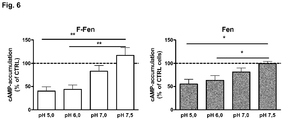
- FIG. 6 Suppression of FSK/IBMX-stimulated cAMP-accumulation by F-fentanyl (white) and fentanyl (grey).
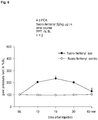
- FIG. 7 Antinociceptive effects of opioid ligands in vivo. Antinociceptive effects (PPT elevations in % baseline) in inflamed (ipsi) and noninflamed (contra) paws following i.pl. (intraplantar) injection of drugs in rats.
- FIG. 8 Antinociceptive effects of opioid ligands in vivo. Antinociceptive effects (PPT elevations in % baseline) in inflamed (ipsi) and noninflamed (contra) paws following i.v. (intravenous) injection of drugs.
- the invention is further described by the following examples. These are not intended to limit the scope of the invention.
- the experimental examples relate to identification and validation of candidate compounds using the method as described herein. The experiments are used to demonstrate the invention by way of example.
- the crystal structure of rhodopsin served as the basis for the modelling of the mu-opioid receptor.
- An accurate 3D structure model of the rat mu-opioid receptor from a protein database (PDB, 2iql, 2iqo) Fowler et al. Biochemistry 43, 15796-810, 2004 ) was used.
- the human and rat mu-receptor share 95 % amino acid identity.
- the Fab fragment of the anti-morphine antibody 9B1 was also used, which exists as a crystal structure with a bound morphine molecule (PDB-ld 1Q0Y).
- the binding pockets have similar amino acid compositions: In 9B1, morphine's protonated nitrogen forms a salt bridge with GluH50, in the mu-receptor with Asp147.
- the mu-opioid receptor preferably requires an opioid agonist with protonated N-group ( Li et al, Life Sciences, vol. 65, 2, 175-185, 1999 ).
- the pKa value of the N-group of most opioids is about 8 (e.g. 8.2 for morphine, 8.4 for fentanyl).
- the N-group is protonated both in inflamed (pH 5-6) and in healthy (pH 7.4) tissue and opioid receptors are activated in both environments.
- the pKa value of an agonist's N-group could be decreased to about 6, it would be protonated in inflamed but deprotonated in normal tissue and, therefore, it would be active only in inflamed tissue.
- Fluorine is very electronegative and hence attracts protons and decreases the pKa-value.
- F5 qualifies as a candidate compound for a drug candidate. It has a predicted pKa-value of its N-group of 6.20. The conformational space and binding behavior of protonated F5 is very similar to that of protonated morphine.
- Table 6 shows the estimated pKa-values for fentanyl and modified fentanyl after F substitution. Indexed hydrogens were replaced by fluorine and corresponding pKa-values were calculated. Only results with decreased pKa-values (in comparison to fentanyl itself) are shown.
- F3* qualifies as a candidate compound for a drug candidate.
- fentanyl and F3* were simulated in the binding pocket of the mu-receptor as described above for morphine and morphine derivatives.
- the binding affinities were estimated (table 7).
- Table 7 Estimated binding affinities of fentanyl and F3* to the mu-receptor. We found 5 stable positions for fentanyl, one stable position for F7, one for F6, 2 for F3 and 2 for F4.
- HEK-293 cells and cultured dorsal root ganglion (DRG) neurons were used to examine mu-agonist binding, GTP ⁇ S binding, cAMP formation and modulation of TRPV1 currents by F-Fentanyl according to F3*, selected as described above, and by control mu-agonists.
- Incubation of HEK-293 cells at different pH-values was initiated after the expression of mu-opioid receptors at the membrane surface was completed and stable. Affinity and number of mu-ligand ( 3 H-DAMGO) binding sites were slightly (nonsignificantly) lower at pH 5.5 compared to pH 7.5 (Tab. 9).
- F-fentanyl yielded half maximal effective concentrations (EC50) of 0.25 nM (pH 5.5) and 4.14 nM (pH 7.5). The corresponding values for fentanyl were 53.37 nM (pH 5.5) and 41.91 nM (pH 7.5). Thus, F-fentanyl was functionally more potent at pH 5.5 than at pH 7.5, and it was more potent than fentanyl at all pH values.
Landscapes
- Chemical & Material Sciences (AREA)
- Health & Medical Sciences (AREA)
- Life Sciences & Earth Sciences (AREA)
- Engineering & Computer Science (AREA)
- Organic Chemistry (AREA)
- Physics & Mathematics (AREA)
- Molecular Biology (AREA)
- Bioinformatics & Cheminformatics (AREA)
- Spectroscopy & Molecular Physics (AREA)
- General Health & Medical Sciences (AREA)
- Biotechnology (AREA)
- Theoretical Computer Science (AREA)
- Biomedical Technology (AREA)
- Urology & Nephrology (AREA)
- Immunology (AREA)
- Hematology (AREA)
- Medicinal Chemistry (AREA)
- Pharmacology & Pharmacy (AREA)
- Bioinformatics & Computational Biology (AREA)
- Crystallography & Structural Chemistry (AREA)
- Evolutionary Biology (AREA)
- Medical Informatics (AREA)
- Biophysics (AREA)
- Pathology (AREA)
- General Physics & Mathematics (AREA)
- Cell Biology (AREA)
- Emergency Medicine (AREA)
- Analytical Chemistry (AREA)
- Microbiology (AREA)
- Food Science & Technology (AREA)
- Biochemistry (AREA)
- Pain & Pain Management (AREA)
- Toxicology (AREA)
- Gastroenterology & Hepatology (AREA)
- Public Health (AREA)
- Zoology (AREA)
- Diabetes (AREA)
- Endocrinology (AREA)
- Veterinary Medicine (AREA)
- Animal Behavior & Ethology (AREA)
Claims (14)
- Verfahren zur Identifikation von Verbindungen, die einen Zielopioidrezeptor abhängig vom pH-Wert binden, umfassenda) Modifikation einer Basenverbindung, um eine modifizierte Verbindungen zu erzeugen,b) Bestimmung der Säuredissoziationskonstanten (pKa) der modifizierten Verbindung,c) Auswahl der modifizierten Verbindung für das weitere Verfahren, wenn der pKa-Wert der modifizierten Verbindung niedriger als 7 ist, bevorzugt zwischen 4 und 7, bevorzugter zwischen 5 und 7, undd) Testen der Bindung der modifizierten Verbindung in dem Zielopioidrezeptor,
wobei die modifizierte Verbindung den Zielopioidrezeptor bei einem pH-Wert unter 7 bindet, und/oder wobei die Schritte a) bis d) Simulationen sind, die durch ein oder mehrere Computerprogramme ausgeführt werden, und wobei Schritt d) mit der modifizierten Verbindung und der Basenverbindung der Reihe nach in einer beliebigen Reihenfolge durchgeführt wird, wobei auf einem Computer implementierte Verfahren in einer dreidimensionalen (3D) Bindungstasche und/oder einem Rezeptoraktivierungspfadmodell angewendet werden, wobei eine modifizierte Verbindung als einen Zielopioidrezeptor abhängig vom pH-Wert bindend identifiziert wird, wenn die Bindung des Zielopioidrezeptors durch die modifizierte Verbindung in Schritt d) im Vergleich zur Bindung des Zielopioidrezeptors durch die Basenverbindung verbessert oder dieselbe ist. - Verfahren nach Anspruch 1 zur Identifizierung von Verbindungen, die einen Zielopioidrezeptor abhängig vom pH-Wert binden und aktivieren, wobei Schritt d) nach Anspruch 1 das Testen der Bindung der modifizierten Verbindung an den Zielopioidrezeptor und die Aktivierung des Zielopioidrezeptors umfasst.
- Verfahren nach einem der vorhergehenden Ansprüche, dadurch gekennzeichnet, dass die Simulationen, die durch ein oder mehrere Computerprogramme von Schritt a) bis d) ausgeführt werden, als einzelne Softwaremodule durchgeführt werden, die kombiniert sind, um automatisch auf einem Computer ausgeführt zu werden.
- Verfahren nach einem der vorhergehenden Ansprüche, dadurch gekennzeichnet, dass das Verfahren zusätzlich die Identifikation von chemischen Resten (z. B. Aminosäuren und anderen) innerhalb des Rezeptors umfasst, die für eine pH-Wert-abhängige Bindung und/oder Aktivierung des Rezeptors verantwortlich sind.
- Verfahren nach einem der vorhergehenden Ansprüche, dadurch gekennzeichnet, dass die identifizierte, modifizierte Verbindung und/oder Basenverbindung chemisch synthetisiert wird.
- Verfahren nach einem der vorhergehenden Ansprüche, dadurch gekennzeichnet, dass die chemisch synthetisierte, modifizierte Verbindung und/oder Basenverbindung für die Bindung von Opioidrezeptoren getestet wird, wobei In-vitro-Verfahren angewendet werden.
- Verfahren nach dem vorhergehenden Anspruch, dadurch gekennzeichnet, dass die chemisch synthetisierte, modifizierte Verbindung und/oder Basenverbindung für die Aktivierung von Opioidrezeptoren (Agonistfunktion) getestet wird, wobei In-vitro-Verfahren angewendet werden.
- Verfahren nach einem der vorhergehenden Ansprüche, dadurch gekennzeichnet, dass die Basenverbindung ein Opioid, ein Opioidderivat oder -analogon ist, das ein Stickstoffatom aufweist, das protoniert oder nicht protoniert sein kann.
- Verfahren nach dem vorhergehenden Anspruch, wobei die Protonierung des Stickstoffatoms in modifizierten Verbindungen mit einem pKa-Wert von unter 7 stattfindet, wenn der pH-Wert unter 7 ist.
- Verfahren nach einem der vorhergehenden Ansprüche, dadurch gekennzeichnet, dass der Zielopioidrezeptor aus der Gruppe, die aus dem mu-Rezeptor, delta-Rezeptor, kappa-Rezeptor und/oder Unterarten davon besteht, ausgewählt wird, und/oder der Zielrezeptor zur Familie der opioidverwandten G-Proteingekoppelten Rezeptoren gehört, wie der Rhodopsin-, Opsin-, Chemokin-, Cannabinoid-, Dopamin-, Histamin-, muscarinische, Neurotensin-, adrenerge, Adenosin- und/oder jeglicher anderer opioidverwandter Rezeptor.
- Verfahren nach einem der vorhergehenden Ansprüche, dadurch gekennzeichnet, dass die Modifikation der Basenverbindung ein Austausch von einem oder mehreren Wasserstoffatomen mit einem oder mehreren Atomen mit höherer Elektronegativität im Vergleich zu Wasserstoff ist.
- Verfahren nach dem vorhergehenden Anspruch, wobei das Atom, das eine höhere Elektronegativität im Vergleich zum Wasserstoff aufweist, ein Halogen ist.
- Verfahren nach dem vorhergehenden Anspruch, wobei das Halogen ein Fluoratom ist.
- Verfahren nach einem der vorhergehenden Ansprüche, dadurch gekennzeichnet, dass die Bewertung der Bindung von und/oder Rezeptoraktivierung durch eine(r) modifizierte(n) Verbindung oder Basenverbindung in dem Bindungstaschenmodell und/oder Rezeptoraktivierungspfadmodell durch Anwenden von sterischen und/oder energetischen Kriterien, die während der Simulation der Bindung und/oder Rezeptoraktivierung gemessen und/oder bestimmt wurden, durchgeführt wird.
Priority Applications (1)
| Application Number | Priority Date | Filing Date | Title |
|---|---|---|---|
| EP13702929.4A EP2801046B1 (de) | 2012-01-06 | 2013-01-07 | Verfahren und system zur identifikation von verbindungen, die einen zielopioidrezeptor abhängig vom ph-wert binden und vorzugsweise aktivieren |
Applications Claiming Priority (3)
| Application Number | Priority Date | Filing Date | Title |
|---|---|---|---|
| EP12150376.7A EP2613277A1 (de) | 2012-01-06 | 2012-01-06 | Verfahren und System zur Identifikation von Verbindungen, die einen Zielopioidrezeptor abhängig vom pH-Wert binden und vorzugsweise aktivieren |
| PCT/EP2013/050156 WO2013102681A1 (en) | 2012-01-06 | 2013-01-07 | Method and system for indentifying compounds that bind and/or activate a target opioid receptor in a ph-dependent manner |
| EP13702929.4A EP2801046B1 (de) | 2012-01-06 | 2013-01-07 | Verfahren und system zur identifikation von verbindungen, die einen zielopioidrezeptor abhängig vom ph-wert binden und vorzugsweise aktivieren |
Publications (2)
| Publication Number | Publication Date |
|---|---|
| EP2801046A1 EP2801046A1 (de) | 2014-11-12 |
| EP2801046B1 true EP2801046B1 (de) | 2017-03-15 |
Family
ID=47678705
Family Applications (2)
| Application Number | Title | Priority Date | Filing Date |
|---|---|---|---|
| EP12150376.7A Withdrawn EP2613277A1 (de) | 2012-01-06 | 2012-01-06 | Verfahren und System zur Identifikation von Verbindungen, die einen Zielopioidrezeptor abhängig vom pH-Wert binden und vorzugsweise aktivieren |
| EP13702929.4A Not-in-force EP2801046B1 (de) | 2012-01-06 | 2013-01-07 | Verfahren und system zur identifikation von verbindungen, die einen zielopioidrezeptor abhängig vom ph-wert binden und vorzugsweise aktivieren |
Family Applications Before (1)
| Application Number | Title | Priority Date | Filing Date |
|---|---|---|---|
| EP12150376.7A Withdrawn EP2613277A1 (de) | 2012-01-06 | 2012-01-06 | Verfahren und System zur Identifikation von Verbindungen, die einen Zielopioidrezeptor abhängig vom pH-Wert binden und vorzugsweise aktivieren |
Country Status (3)
| Country | Link |
|---|---|
| US (1) | US20140364449A1 (de) |
| EP (2) | EP2613277A1 (de) |
| WO (1) | WO2013102681A1 (de) |
Family Cites Families (2)
| Publication number | Priority date | Publication date | Assignee | Title |
|---|---|---|---|---|
| DE60322680D1 (de) * | 2002-02-07 | 2008-09-18 | Univ Missouri | Opioid-rezeptor-aktive 4-(3-hydroxyphenyl) oder 4-(3-alkoxyphenyl)-1,2,4-triazol-verbindungen |
| GB0305153D0 (en) * | 2003-03-07 | 2003-04-09 | Cambridge Biotechnology Ltd | Identification of therapeutic compounds |
-
2012
- 2012-01-06 EP EP12150376.7A patent/EP2613277A1/de not_active Withdrawn
-
2013
- 2013-01-07 US US14/370,691 patent/US20140364449A1/en not_active Abandoned
- 2013-01-07 EP EP13702929.4A patent/EP2801046B1/de not_active Not-in-force
- 2013-01-07 WO PCT/EP2013/050156 patent/WO2013102681A1/en not_active Ceased
Non-Patent Citations (1)
| Title |
|---|
| MAHESH DR ET AL: "PHARMACOLOGY OF OPIOIDS - PART 1 ANAESTHESIA TUTORIAL OF THE WEEK 64 12TH AUGUST 2007", INTERNET ATICLE, 12 August 2007 (2007-08-12), pages 1 - 7, XP055212867, Retrieved from the Internet <URL:http://www.aagbi.org/sites/default/files/64-Pharmacology-of-Opioids-part-I.pdf> [retrieved on 20150911] * |
Also Published As
| Publication number | Publication date |
|---|---|
| WO2013102681A1 (en) | 2013-07-11 |
| US20140364449A1 (en) | 2014-12-11 |
| EP2801046A1 (de) | 2014-11-12 |
| EP2613277A1 (de) | 2013-07-10 |
Similar Documents
| Publication | Publication Date | Title |
|---|---|---|
| Wallach et al. | Identification of 5-HT2A receptor signaling pathways associated with psychedelic potential | |
| Dembla et al. | Anti-nociceptive action of peripheral mu-opioid receptors by G-beta-gamma protein-mediated inhibition of TRPM3 channels | |
| Bermudez et al. | Strategies for the discovery of biased GPCR ligands | |
| Callaghan et al. | Analgesic α-conotoxins Vc1. 1 and Rg1A inhibit N-type calcium channels in rat sensory neurons via GABAB receptor activation | |
| Dunn et al. | Signaling properties of structurally diverse kappa opioid receptor ligands: toward in vitro models of in vivo responses | |
| Qiu et al. | Oxytocin inhibits the activity of acid‐sensing ion channels through the vasopressin, V1A receptor in primary sensory neurons | |
| Grandy et al. | “TAARgeting Addiction”—the alamo bears witness to another revolution: an overview of the Plenary Symposium of the 2015 Behavior, Biology and Chemistry Conference | |
| Obeng et al. | Structure–activity relationship studies of 6α-and 6β-indolylacetamidonaltrexamine derivatives as bitopic mu opioid receptor modulators and elaboration of the “message-address concept” to comprehend their functional conversion | |
| Sung et al. | Serotonin contracts the rat mesenteric artery by inhibiting 4-aminopyridine-sensitive Kv channels via the 5-HT2A receptor and Src tyrosine kinase | |
| Noha et al. | Molecular docking, molecular dynamics, and structure–activity relationship explorations of 14-oxygenated N-methylmorphinan-6-ones as potent μ-opioid receptor agonists | |
| Qaradakhi et al. | Alamandine reverses hyperhomocysteinemia‐induced vascular dysfunction via PKA‐dependent mechanisms | |
| Peng et al. | ASIC3 mediates itch sensation in response to coincident stimulation by acid and nonproton ligand | |
| Rivara et al. | Novel sodium channel antagonists in the treatment of neuropathic pain | |
| Matsoukas et al. | Insights into AT1 receptor activation through AngII binding studies | |
| Wittekindt et al. | Point mutations identify the glutamate binding pocket of the N-methyl-D-aspartate receptor as major site of conantokin-G inhibition | |
| Budusan et al. | The funnel-web spider venom derived single knot peptide Hc3a modulates acid-sensing ion channel 1a desensitisation | |
| Jeong et al. | Low concentrations of tricyclic antidepressants stimulate TRPC4 channel activity by acting as an opioid receptor ligand | |
| Wu et al. | Taurine-evoked chloride current and its potentiation by intracellular Ca2+ in immature rat hippocampal CA1 neurons | |
| Rogers et al. | Using automated patch clamp electrophysiology platforms in ion channel drug discovery: an industry perspective | |
| Modestia et al. | Biased agonist TRV027 determinants in AT1R by molecular dynamics simulations | |
| Han et al. | Discovery of a small-molecule inhibitor of the TRIP8b–HCN interaction with efficacy in neurons | |
| US20140364449A1 (en) | Method and system for identifying compounds that bind and/or activate a target opioid receptor in a ph-dependent manner | |
| Kanemitsu et al. | Dynorphin A inhibits NMDA receptors through a pH-dependent mechanism | |
| Khasanov et al. | Sea anemone Cys‐ladder peptide Ms13‐1 induces a pain response as a positive modulator of acid‐sensing ion channel 1a | |
| Liu et al. | Opioid receptor desensitization contributes to thermal hyperalgesia in infant rats |
Legal Events
| Date | Code | Title | Description |
|---|---|---|---|
| PUAI | Public reference made under article 153(3) epc to a published international application that has entered the european phase |
Free format text: ORIGINAL CODE: 0009012 |
|
| 17P | Request for examination filed |
Effective date: 20140728 |
|
| AK | Designated contracting states |
Kind code of ref document: A1 Designated state(s): AL AT BE BG CH CY CZ DE DK EE ES FI FR GB GR HR HU IE IS IT LI LT LU LV MC MK MT NL NO PL PT RO RS SE SI SK SM TR |
|
| DAX | Request for extension of the european patent (deleted) | ||
| 17Q | First examination report despatched |
Effective date: 20150917 |
|
| GRAP | Despatch of communication of intention to grant a patent |
Free format text: ORIGINAL CODE: EPIDOSNIGR1 |
|
| INTG | Intention to grant announced |
Effective date: 20161025 |
|
| STAA | Information on the status of an ep patent application or granted ep patent |
Free format text: STATUS: GRANT OF PATENT IS INTENDED |
|
| GRAS | Grant fee paid |
Free format text: ORIGINAL CODE: EPIDOSNIGR3 |
|
| GRAA | (expected) grant |
Free format text: ORIGINAL CODE: 0009210 |
|
| STAA | Information on the status of an ep patent application or granted ep patent |
Free format text: STATUS: THE PATENT HAS BEEN GRANTED |
|
| AK | Designated contracting states |
Kind code of ref document: B1 Designated state(s): AL AT BE BG CH CY CZ DE DK EE ES FI FR GB GR HR HU IE IS IT LI LT LU LV MC MK MT NL NO PL PT RO RS SE SI SK SM TR |
|
| REG | Reference to a national code |
Ref country code: CH Ref legal event code: EP Ref country code: GB Ref legal event code: FG4D |
|
| REG | Reference to a national code |
Ref country code: IE Ref legal event code: FG4D |
|
| REG | Reference to a national code |
Ref country code: AT Ref legal event code: REF Ref document number: 876241 Country of ref document: AT Kind code of ref document: T Effective date: 20170415 |
|
| REG | Reference to a national code |
Ref country code: DE Ref legal event code: R096 Ref document number: 602013018538 Country of ref document: DE |
|
| REG | Reference to a national code |
Ref country code: NL Ref legal event code: MP Effective date: 20170315 |
|
| REG | Reference to a national code |
Ref country code: LT Ref legal event code: MG4D |
|
| PG25 | Lapsed in a contracting state [announced via postgrant information from national office to epo] |
Ref country code: HR Free format text: LAPSE BECAUSE OF FAILURE TO SUBMIT A TRANSLATION OF THE DESCRIPTION OR TO PAY THE FEE WITHIN THE PRESCRIBED TIME-LIMIT Effective date: 20170315 Ref country code: LT Free format text: LAPSE BECAUSE OF FAILURE TO SUBMIT A TRANSLATION OF THE DESCRIPTION OR TO PAY THE FEE WITHIN THE PRESCRIBED TIME-LIMIT Effective date: 20170315 Ref country code: FI Free format text: LAPSE BECAUSE OF FAILURE TO SUBMIT A TRANSLATION OF THE DESCRIPTION OR TO PAY THE FEE WITHIN THE PRESCRIBED TIME-LIMIT Effective date: 20170315 Ref country code: GR Free format text: LAPSE BECAUSE OF FAILURE TO SUBMIT A TRANSLATION OF THE DESCRIPTION OR TO PAY THE FEE WITHIN THE PRESCRIBED TIME-LIMIT Effective date: 20170616 Ref country code: NO Free format text: LAPSE BECAUSE OF FAILURE TO SUBMIT A TRANSLATION OF THE DESCRIPTION OR TO PAY THE FEE WITHIN THE PRESCRIBED TIME-LIMIT Effective date: 20170615 |
|
| REG | Reference to a national code |
Ref country code: AT Ref legal event code: MK05 Ref document number: 876241 Country of ref document: AT Kind code of ref document: T Effective date: 20170315 |
|
| PG25 | Lapsed in a contracting state [announced via postgrant information from national office to epo] |
Ref country code: RS Free format text: LAPSE BECAUSE OF FAILURE TO SUBMIT A TRANSLATION OF THE DESCRIPTION OR TO PAY THE FEE WITHIN THE PRESCRIBED TIME-LIMIT Effective date: 20170315 Ref country code: LV Free format text: LAPSE BECAUSE OF FAILURE TO SUBMIT A TRANSLATION OF THE DESCRIPTION OR TO PAY THE FEE WITHIN THE PRESCRIBED TIME-LIMIT Effective date: 20170315 Ref country code: SE Free format text: LAPSE BECAUSE OF FAILURE TO SUBMIT A TRANSLATION OF THE DESCRIPTION OR TO PAY THE FEE WITHIN THE PRESCRIBED TIME-LIMIT Effective date: 20170315 Ref country code: BG Free format text: LAPSE BECAUSE OF FAILURE TO SUBMIT A TRANSLATION OF THE DESCRIPTION OR TO PAY THE FEE WITHIN THE PRESCRIBED TIME-LIMIT Effective date: 20170615 |
|
| PG25 | Lapsed in a contracting state [announced via postgrant information from national office to epo] |
Ref country code: NL Free format text: LAPSE BECAUSE OF FAILURE TO SUBMIT A TRANSLATION OF THE DESCRIPTION OR TO PAY THE FEE WITHIN THE PRESCRIBED TIME-LIMIT Effective date: 20170315 |
|
| PG25 | Lapsed in a contracting state [announced via postgrant information from national office to epo] |
Ref country code: EE Free format text: LAPSE BECAUSE OF FAILURE TO SUBMIT A TRANSLATION OF THE DESCRIPTION OR TO PAY THE FEE WITHIN THE PRESCRIBED TIME-LIMIT Effective date: 20170315 Ref country code: AT Free format text: LAPSE BECAUSE OF FAILURE TO SUBMIT A TRANSLATION OF THE DESCRIPTION OR TO PAY THE FEE WITHIN THE PRESCRIBED TIME-LIMIT Effective date: 20170315 Ref country code: CZ Free format text: LAPSE BECAUSE OF FAILURE TO SUBMIT A TRANSLATION OF THE DESCRIPTION OR TO PAY THE FEE WITHIN THE PRESCRIBED TIME-LIMIT Effective date: 20170315 Ref country code: ES Free format text: LAPSE BECAUSE OF FAILURE TO SUBMIT A TRANSLATION OF THE DESCRIPTION OR TO PAY THE FEE WITHIN THE PRESCRIBED TIME-LIMIT Effective date: 20170315 Ref country code: SK Free format text: LAPSE BECAUSE OF FAILURE TO SUBMIT A TRANSLATION OF THE DESCRIPTION OR TO PAY THE FEE WITHIN THE PRESCRIBED TIME-LIMIT Effective date: 20170315 Ref country code: RO Free format text: LAPSE BECAUSE OF FAILURE TO SUBMIT A TRANSLATION OF THE DESCRIPTION OR TO PAY THE FEE WITHIN THE PRESCRIBED TIME-LIMIT Effective date: 20170315 |
|
| PG25 | Lapsed in a contracting state [announced via postgrant information from national office to epo] |
Ref country code: IS Free format text: LAPSE BECAUSE OF FAILURE TO SUBMIT A TRANSLATION OF THE DESCRIPTION OR TO PAY THE FEE WITHIN THE PRESCRIBED TIME-LIMIT Effective date: 20170715 Ref country code: PT Free format text: LAPSE BECAUSE OF FAILURE TO SUBMIT A TRANSLATION OF THE DESCRIPTION OR TO PAY THE FEE WITHIN THE PRESCRIBED TIME-LIMIT Effective date: 20170717 Ref country code: SM Free format text: LAPSE BECAUSE OF FAILURE TO SUBMIT A TRANSLATION OF THE DESCRIPTION OR TO PAY THE FEE WITHIN THE PRESCRIBED TIME-LIMIT Effective date: 20170315 Ref country code: PL Free format text: LAPSE BECAUSE OF FAILURE TO SUBMIT A TRANSLATION OF THE DESCRIPTION OR TO PAY THE FEE WITHIN THE PRESCRIBED TIME-LIMIT Effective date: 20170315 |
|
| REG | Reference to a national code |
Ref country code: DE Ref legal event code: R097 Ref document number: 602013018538 Country of ref document: DE |
|
| PLBE | No opposition filed within time limit |
Free format text: ORIGINAL CODE: 0009261 |
|
| STAA | Information on the status of an ep patent application or granted ep patent |
Free format text: STATUS: NO OPPOSITION FILED WITHIN TIME LIMIT |
|
| REG | Reference to a national code |
Ref country code: FR Ref legal event code: PLFP Year of fee payment: 6 |
|
| PG25 | Lapsed in a contracting state [announced via postgrant information from national office to epo] |
Ref country code: DK Free format text: LAPSE BECAUSE OF FAILURE TO SUBMIT A TRANSLATION OF THE DESCRIPTION OR TO PAY THE FEE WITHIN THE PRESCRIBED TIME-LIMIT Effective date: 20170315 |
|
| 26N | No opposition filed |
Effective date: 20171218 |
|
| PG25 | Lapsed in a contracting state [announced via postgrant information from national office to epo] |
Ref country code: IT Free format text: LAPSE BECAUSE OF FAILURE TO SUBMIT A TRANSLATION OF THE DESCRIPTION OR TO PAY THE FEE WITHIN THE PRESCRIBED TIME-LIMIT Effective date: 20170315 Ref country code: SI Free format text: LAPSE BECAUSE OF FAILURE TO SUBMIT A TRANSLATION OF THE DESCRIPTION OR TO PAY THE FEE WITHIN THE PRESCRIBED TIME-LIMIT Effective date: 20170315 |
|
| PGFP | Annual fee paid to national office [announced via postgrant information from national office to epo] |
Ref country code: CH Payment date: 20180125 Year of fee payment: 6 Ref country code: GB Payment date: 20180125 Year of fee payment: 6 Ref country code: DE Payment date: 20171229 Year of fee payment: 6 |
|
| PGFP | Annual fee paid to national office [announced via postgrant information from national office to epo] |
Ref country code: FR Payment date: 20180124 Year of fee payment: 6 |
|
| PG25 | Lapsed in a contracting state [announced via postgrant information from national office to epo] |
Ref country code: LU Free format text: LAPSE BECAUSE OF NON-PAYMENT OF DUE FEES Effective date: 20180107 |
|
| REG | Reference to a national code |
Ref country code: IE Ref legal event code: MM4A |
|
| REG | Reference to a national code |
Ref country code: BE Ref legal event code: MM Effective date: 20180131 |
|
| REG | Reference to a national code |
Ref country code: DE Ref legal event code: R079 Ref document number: 602013018538 Country of ref document: DE Free format text: PREVIOUS MAIN CLASS: G06F0019160000 Ipc: G16B0015000000 |
|
| PG25 | Lapsed in a contracting state [announced via postgrant information from national office to epo] |
Ref country code: BE Free format text: LAPSE BECAUSE OF NON-PAYMENT OF DUE FEES Effective date: 20180131 |
|
| PG25 | Lapsed in a contracting state [announced via postgrant information from national office to epo] |
Ref country code: IE Free format text: LAPSE BECAUSE OF NON-PAYMENT OF DUE FEES Effective date: 20180107 |
|
| PG25 | Lapsed in a contracting state [announced via postgrant information from national office to epo] |
Ref country code: MC Free format text: LAPSE BECAUSE OF FAILURE TO SUBMIT A TRANSLATION OF THE DESCRIPTION OR TO PAY THE FEE WITHIN THE PRESCRIBED TIME-LIMIT Effective date: 20170315 |
|
| REG | Reference to a national code |
Ref country code: DE Ref legal event code: R119 Ref document number: 602013018538 Country of ref document: DE |
|
| REG | Reference to a national code |
Ref country code: CH Ref legal event code: PL |
|
| GBPC | Gb: european patent ceased through non-payment of renewal fee |
Effective date: 20190107 |
|
| PG25 | Lapsed in a contracting state [announced via postgrant information from national office to epo] |
Ref country code: DE Free format text: LAPSE BECAUSE OF NON-PAYMENT OF DUE FEES Effective date: 20190801 Ref country code: FR Free format text: LAPSE BECAUSE OF NON-PAYMENT OF DUE FEES Effective date: 20190131 |
|
| PG25 | Lapsed in a contracting state [announced via postgrant information from national office to epo] |
Ref country code: CH Free format text: LAPSE BECAUSE OF NON-PAYMENT OF DUE FEES Effective date: 20190131 Ref country code: LI Free format text: LAPSE BECAUSE OF NON-PAYMENT OF DUE FEES Effective date: 20190131 Ref country code: GB Free format text: LAPSE BECAUSE OF NON-PAYMENT OF DUE FEES Effective date: 20190107 |
|
| PG25 | Lapsed in a contracting state [announced via postgrant information from national office to epo] |
Ref country code: MT Free format text: LAPSE BECAUSE OF NON-PAYMENT OF DUE FEES Effective date: 20180107 |
|
| PG25 | Lapsed in a contracting state [announced via postgrant information from national office to epo] |
Ref country code: TR Free format text: LAPSE BECAUSE OF FAILURE TO SUBMIT A TRANSLATION OF THE DESCRIPTION OR TO PAY THE FEE WITHIN THE PRESCRIBED TIME-LIMIT Effective date: 20170315 |
|
| PG25 | Lapsed in a contracting state [announced via postgrant information from national office to epo] |
Ref country code: HU Free format text: LAPSE BECAUSE OF FAILURE TO SUBMIT A TRANSLATION OF THE DESCRIPTION OR TO PAY THE FEE WITHIN THE PRESCRIBED TIME-LIMIT; INVALID AB INITIO Effective date: 20130107 |
|
| PG25 | Lapsed in a contracting state [announced via postgrant information from national office to epo] |
Ref country code: MK Free format text: LAPSE BECAUSE OF NON-PAYMENT OF DUE FEES Effective date: 20170315 Ref country code: CY Free format text: LAPSE BECAUSE OF FAILURE TO SUBMIT A TRANSLATION OF THE DESCRIPTION OR TO PAY THE FEE WITHIN THE PRESCRIBED TIME-LIMIT Effective date: 20170315 |
|
| PG25 | Lapsed in a contracting state [announced via postgrant information from national office to epo] |
Ref country code: AL Free format text: LAPSE BECAUSE OF FAILURE TO SUBMIT A TRANSLATION OF THE DESCRIPTION OR TO PAY THE FEE WITHIN THE PRESCRIBED TIME-LIMIT Effective date: 20170315 |