EP2799852A1 - 2DEG-based sensor and device for ECG sensing - Google Patents
2DEG-based sensor and device for ECG sensing Download PDFInfo
- Publication number
- EP2799852A1 EP2799852A1 EP20140166250 EP14166250A EP2799852A1 EP 2799852 A1 EP2799852 A1 EP 2799852A1 EP 20140166250 EP20140166250 EP 20140166250 EP 14166250 A EP14166250 A EP 14166250A EP 2799852 A1 EP2799852 A1 EP 2799852A1
- Authority
- EP
- European Patent Office
- Prior art keywords
- sensor
- ecg
- algan
- gan
- 2deg
- Prior art date
- Legal status (The legal status is an assumption and is not a legal conclusion. Google has not performed a legal analysis and makes no representation as to the accuracy of the status listed.)
- Withdrawn
Links
Images






Classifications
-
- G—PHYSICS
- G01—MEASURING; TESTING
- G01N—INVESTIGATING OR ANALYSING MATERIALS BY DETERMINING THEIR CHEMICAL OR PHYSICAL PROPERTIES
- G01N27/00—Investigating or analysing materials by the use of electric, electrochemical, or magnetic means
- G01N27/02—Investigating or analysing materials by the use of electric, electrochemical, or magnetic means by investigating impedance
- G01N27/04—Investigating or analysing materials by the use of electric, electrochemical, or magnetic means by investigating impedance by investigating resistance
- G01N27/12—Investigating or analysing materials by the use of electric, electrochemical, or magnetic means by investigating impedance by investigating resistance of a solid body in dependence upon absorption of a fluid; of a solid body in dependence upon reaction with a fluid, for detecting components in the fluid
- G01N27/129—Diode type sensors, e.g. gas sensitive Schottky diodes
-
- A—HUMAN NECESSITIES
- A61—MEDICAL OR VETERINARY SCIENCE; HYGIENE
- A61B—DIAGNOSIS; SURGERY; IDENTIFICATION
- A61B5/00—Measuring for diagnostic purposes; Identification of persons
- A61B5/24—Detecting, measuring or recording bioelectric or biomagnetic signals of the body or parts thereof
- A61B5/25—Bioelectric electrodes therefor
- A61B5/279—Bioelectric electrodes therefor specially adapted for particular uses
- A61B5/28—Bioelectric electrodes therefor specially adapted for particular uses for electrocardiography [ECG]
-
- A—HUMAN NECESSITIES
- A61—MEDICAL OR VETERINARY SCIENCE; HYGIENE
- A61B—DIAGNOSIS; SURGERY; IDENTIFICATION
- A61B5/00—Measuring for diagnostic purposes; Identification of persons
- A61B5/24—Detecting, measuring or recording bioelectric or biomagnetic signals of the body or parts thereof
- A61B5/25—Bioelectric electrodes therefor
- A61B5/251—Means for maintaining electrode contact with the body
- A61B5/256—Wearable electrodes, e.g. having straps or bands
-
- A—HUMAN NECESSITIES
- A61—MEDICAL OR VETERINARY SCIENCE; HYGIENE
- A61B—DIAGNOSIS; SURGERY; IDENTIFICATION
- A61B5/00—Measuring for diagnostic purposes; Identification of persons
- A61B5/24—Detecting, measuring or recording bioelectric or biomagnetic signals of the body or parts thereof
- A61B5/25—Bioelectric electrodes therefor
- A61B5/263—Bioelectric electrodes therefor characterised by the electrode materials
-
- G—PHYSICS
- G01—MEASURING; TESTING
- G01N—INVESTIGATING OR ANALYSING MATERIALS BY DETERMINING THEIR CHEMICAL OR PHYSICAL PROPERTIES
- G01N27/00—Investigating or analysing materials by the use of electric, electrochemical, or magnetic means
- G01N27/26—Investigating or analysing materials by the use of electric, electrochemical, or magnetic means by investigating electrochemical variables; by using electrolysis or electrophoresis
- G01N27/403—Cells and electrode assemblies
- G01N27/414—Ion-sensitive or chemical field-effect transistors, i.e. ISFETS or CHEMFETS
-
- H—ELECTRICITY
- H10—SEMICONDUCTOR DEVICES; ELECTRIC SOLID-STATE DEVICES NOT OTHERWISE PROVIDED FOR
- H10D—INORGANIC ELECTRIC SEMICONDUCTOR DEVICES
- H10D30/00—Field-effect transistors [FET]
- H10D30/40—FETs having zero-dimensional [0D], one-dimensional [1D] or two-dimensional [2D] charge carrier gas channels
- H10D30/47—FETs having zero-dimensional [0D], one-dimensional [1D] or two-dimensional [2D] charge carrier gas channels having two-dimensional [2D] charge carrier gas channels, e.g. nanoribbon FETs or high electron mobility transistors [HEMT]
- H10D30/471—High electron mobility transistors [HEMT] or high hole mobility transistors [HHMT]
- H10D30/475—High electron mobility transistors [HEMT] or high hole mobility transistors [HHMT] having wider bandgap layer formed on top of lower bandgap active layer, e.g. undoped barrier HEMTs such as i-AlGaN/GaN HEMTs
-
- H—ELECTRICITY
- H10—SEMICONDUCTOR DEVICES; ELECTRIC SOLID-STATE DEVICES NOT OTHERWISE PROVIDED FOR
- H10D—INORGANIC ELECTRIC SEMICONDUCTOR DEVICES
- H10D64/00—Electrodes of devices having potential barriers
- H10D64/20—Electrodes characterised by their shapes, relative sizes or dispositions
- H10D64/27—Electrodes not carrying the current to be rectified, amplified, oscillated or switched, e.g. gates
- H10D64/311—Gate electrodes for field-effect devices
- H10D64/411—Gate electrodes for field-effect devices for FETs
- H10D64/511—Gate electrodes for field-effect devices for FETs for IGFETs
- H10D64/512—Disposition of the gate electrodes, e.g. buried gates
- H10D64/513—Disposition of the gate electrodes, e.g. buried gates within recesses in the substrate, e.g. trench gates, groove gates or buried gates
-
- H—ELECTRICITY
- H10—SEMICONDUCTOR DEVICES; ELECTRIC SOLID-STATE DEVICES NOT OTHERWISE PROVIDED FOR
- H10D—INORGANIC ELECTRIC SEMICONDUCTOR DEVICES
- H10D64/00—Electrodes of devices having potential barriers
- H10D64/20—Electrodes characterised by their shapes, relative sizes or dispositions
- H10D64/27—Electrodes not carrying the current to be rectified, amplified, oscillated or switched, e.g. gates
- H10D64/311—Gate electrodes for field-effect devices
- H10D64/411—Gate electrodes for field-effect devices for FETs
- H10D64/511—Gate electrodes for field-effect devices for FETs for IGFETs
- H10D64/517—Gate electrodes for field-effect devices for FETs for IGFETs characterised by the conducting layers
-
- H—ELECTRICITY
- H10—SEMICONDUCTOR DEVICES; ELECTRIC SOLID-STATE DEVICES NOT OTHERWISE PROVIDED FOR
- H10D—INORGANIC ELECTRIC SEMICONDUCTOR DEVICES
- H10D84/00—Integrated devices formed in or on semiconductor substrates that comprise only semiconducting layers, e.g. on Si wafers or on GaAs-on-Si wafers
- H10D84/80—Integrated devices formed in or on semiconductor substrates that comprise only semiconducting layers, e.g. on Si wafers or on GaAs-on-Si wafers characterised by the integration of at least one component covered by groups H10D12/00 or H10D30/00, e.g. integration of IGFETs
- H10D84/82—Integrated devices formed in or on semiconductor substrates that comprise only semiconducting layers, e.g. on Si wafers or on GaAs-on-Si wafers characterised by the integration of at least one component covered by groups H10D12/00 or H10D30/00, e.g. integration of IGFETs of only field-effect components
- H10D84/83—Integrated devices formed in or on semiconductor substrates that comprise only semiconducting layers, e.g. on Si wafers or on GaAs-on-Si wafers characterised by the integration of at least one component covered by groups H10D12/00 or H10D30/00, e.g. integration of IGFETs of only field-effect components of only insulated-gate FETs [IGFET]
-
- A—HUMAN NECESSITIES
- A61—MEDICAL OR VETERINARY SCIENCE; HYGIENE
- A61B—DIAGNOSIS; SURGERY; IDENTIFICATION
- A61B5/00—Measuring for diagnostic purposes; Identification of persons
- A61B5/02—Detecting, measuring or recording for evaluating the cardiovascular system, e.g. pulse, heart rate, blood pressure or blood flow
- A61B5/021—Measuring pressure in heart or blood vessels
- A61B5/02108—Measuring pressure in heart or blood vessels from analysis of pulse wave characteristics
- A61B5/02125—Measuring pressure in heart or blood vessels from analysis of pulse wave characteristics of pulse wave propagation time
-
- A—HUMAN NECESSITIES
- A61—MEDICAL OR VETERINARY SCIENCE; HYGIENE
- A61B—DIAGNOSIS; SURGERY; IDENTIFICATION
- A61B5/00—Measuring for diagnostic purposes; Identification of persons
- A61B5/68—Arrangements of detecting, measuring or recording means, e.g. sensors, in relation to patient
- A61B5/6801—Arrangements of detecting, measuring or recording means, e.g. sensors, in relation to patient specially adapted to be attached to or worn on the body surface
- A61B5/6813—Specially adapted to be attached to a specific body part
- A61B5/6824—Arm or wrist
Definitions
- the present invention relates generally to the field of sensor devices comprising a two-dimensional electron gas (2DEG) and more specifically to an AlGaN/GaN 2DEG-based sensor and device for ECG sensing.
- 2DEG two-dimensional electron gas
- AlGaN/GaN aluminium gallium nitride/gallium nitride
- AlGaN/GaN aluminium gallium nitride/gallium nitride
- 2DEG-based biochemical sensors have been used for the detection of gases, polar liquids, pH, proteins and DNA.
- a new AlGaN/GaN 2DEG-based sensor is developed that can be used for Electro Cardiogram (ECG) detection, measurement or monitoring.
- ECG Electro Cardiogram
- the ECG) detection comprises a charge-based non-differential ECG detection.
- the developed sensor makes ECG detection possible on a single body point.
- the developed 2DEG-based sensitive structure could be placed on single skin point, for example at the chest or on the wrist, inside of patch-worn or wrist-worn device located at certain sufficient distance from the body.
- a sensor comprising: a substrate layer; a GaN/AlGaN hetero-junction structure configured so as to form a 2DEG channel within said structure; ohmic contacts connected to electrical metallizations and to the 2DEG channel; wherein the GaN/AlGaN hetero-junction structure has a recessed area between the ohmic contacts, and wherein the sensor further comprises a dielectric layer on top of the sensor.
- the senor may further comprise a layer of an extended gate material placed on top of the dielectric layer and in the GaN/AlGaN hetero-junction recessed area.
- the senor may further comprise an electrode stack on top of the extended gate material.
- the senor may further comprise a cavity closure layer element on top of the dielectric layer, the cavity closure layer element defining a cavity filled with air, an inert gas or a liquid.
- the cavity closure layer element may be made of a conductive polymer, such as for example rubber.
- the cavity may be filed with nitrogen or an electrolyte.
- the cavity may further comprise a layer of an extended gate material attached to a wall of the cavity closure layer element.
- the invention also relates to a device for ECG detection, comprising an AlGaN/GaN 2DEG-based sensor according to any of the embodiments herein described.
- the device for ECG sensing may be arranged so that the GaN/AlGaN hetero-junction recessed area, the extended gate material or the electrode stack is in direct contact or sufficiently close to a certain body skin point such that, during an electrophysiological heart function polarization cycle, the electrical body charge interacts with the 2DEG channel causing its conductivity to change.
- the device may be placed into a conductive liquid solution.
- the device comprises two sensors arranged so that one of them is configured to act as an external charge gating electrode providing electrical connection to the body.
- the ECG sensing comprises a charge-based non-differential ECG sensing.
- At least one sensor of the device for ECG sensing is under the influence of a magnetic field.
- said device is advantageously suitable for ECG, atrial-ventricular heart polarization cycles and/or blood pressure (BP) monitoring.
- BP blood pressure
- a device for ECG sensing comprises a sensor according to any of the embodiments herein described which is arranged so that the GaN/AlGaN hetero-junction recessed area, the extended gate material or the electrode stack is in direct contact or sufficiently close to a certain body skin point such that, during an ECG P-QRS-T complex, the skin electrical potential and intra or extra cellular ionic micro currents interact with the 2DEG channel causing its conductivity to change.
- the device for ECG sensing comprises a plurality of such sensors connected in series or in parallel for combined ECG detection.
- the device for ECG sensing comprises at least one sensor which is under the influence of a magnetic field arranged in such a way to influence the ECG detection sensitivity.
- the device for ECG sensing may be further configured for calculating a blood pressure (BP) value based on ECG detection.
- the device for ECG sensing may be a patch-worn or wrist-worn device for ECG sensing.
- the invention also relates to the use of a sensor according to any of the embodiments herein described for ECG detection, when applying the sensor in direct contact or sufficiently close to a certain body skin point.
- a sensor according to any of the embodiments herein described is used for ECG detection, when applying the sensor in direct contact or sufficiently close to a certain single body skin point such that, during an electrophysiological heart function polarization cycle, the electrical body charge interacts with the 2DEG channel causing its conductivity to change.
- the invention also relates to a method for ECG detection comprising: applying a sensor according to any of the embodiments herein described such that that the GaN/AlGaN hetero-junction recessed area, the extended gate material or the electrode stack is in direct contact or close to a certain living being's body skin so that the skin electrical charge and intra or extra cellular ionic micro currents interact with the sensor's 2DEG channel; and detecting a conductivity change within the 2DEG channel during an ECG P-QRS-T complex of a living being.
- the method for ECG detection comprising: applying a sensor according to any of the embodiments herein described in direct contact or sufficiently close to a certain living being's body skin point so that, during an electrophysiological heart function polarization cycle, the body charge interacts with the sensor's 2DEG channel; and detecting said conductivity change within the 2DEG channel.
- Figure 1A shows an exemplary embodiment of an AlGaN/GaN 2DEG-based sensor 1, comprising a substrate layer 100, a GaN layer 105, an AlGaN layer 110, ohmic contacts 115, a 2DEG channel 120, and electrical metallizations 125.
- the shown sensor element 1 comprises a GaN/AlGaN hetero-junction with a two-dimensional electron gas (2DEG) channel 120 close to the interface between GaN buffer layer 105 and the AlGaN barrier layer 110.
- the AlGaN layer 110 may be either recessed or grown thin between the ohmic contacts 115, thus forming an open gate layout.
- the AlGaN layer 110 may be recessed to a thickness between 5 to 8 nanometres between the ohmic contacts 115.
- the AlGaN layer 110 may be grown to a thickness between 6 to 8 nanometres between the ohmic contacts 115.
- the electrical metallizations 125 may be any type of metallization that allows the flow of electric current to/from the ohmic contacts 115, which also contact the 2DEG channel 120.
- the substrate layer 100 may be made of Si, SiC, Sapphire, GaN or AlN.
- the 2DEG channel 120 formed near or at the GaN/AlGaN interface is the main sensitive element reacting to any surface charge and potential.
- the 2DEG channel 120 is able to interact with very small variations in surface or proximal charge or changes of electrical field on AlGaN/liquid-gas or AlGaN/metal/liquid-gas interfaces interacting with the surface donor states of the AlGaN layer.
- Surface donor states are considered to be the source of electrons in the formation of the 2DEG channel 120. These donor states may possess a wide distribution of ionization energies within the band gap and are caused by redox reactions, dangling bonds and vacancies in the surface layer.
- the AlGaN/GaN 2DEG-based sensor 1 may be used for detection of electrical field or charge changes. This is advantageous, for example, for detection of heart dipole charges dynamics during complete heart cycle from atrial depolarization till ventricular repolarization.
- the AlGaN/GaN 2DEG-based sensor 1 may be used to detect electrical heart charges considered as an electrical volume source enabling the heart function. Said body charges, may be detected, for example by placing the recessed gate or AlGaN layer recessed part, between the ohmic contacts 115, at a close distance or in direct contact with the body skin in order to obtain ECG-activity detection.
- said location may be a single body skin point location and the ECG detection a charge-based non-differential ECG-time-equivalent detection.
- the sensor may be separated up to a distance of 0,5 meters for ECG sensing, sufficient such that, during an electrophysiological heart function polarization cycle, the body charge interacts with the sensor's 2DEG channel 120.
- the sensor 1 is positioned sufficiently close to a certain body skin point so that, during the P-QRS-T heart dipole dynamics (an electrophysiological heart function polarization cycle), the skin electrical charge interacts directly electrostatically and through the surface states with the 2DEG channel 120 causing its conductivity to change.
- the interaction nature between the skin surface and the 2DEG channel 120 occurs electrostatically by electric field similar to a gate electrode and by ionisation or energy shift of the surface states of AlGaN barrier layer 110.
- a gas such as for example air
- a liquid such as for example water or sweat
- a gel between the sensor 1 and the body skin surface.
- Figure 1 B shows another exemplary embodiment of an AlGaN/GaN 2DEG-based sensor 1 according to the invention, comprising a substrate layer 100, a GaN layer 105, a AlGaN layer 110, ohmic contacts 115, a 2DEG channel 120, electrical metallizations 125, and a dielectric layer 130.
- the sensor 1 of Figure 1 B is basically the same sensor shown in Figure 1A but comprising an additional dielectric layer 130 on top of the sensor or on the surface of the sensor that may be placed sufficiently close or in contact with the body skin.
- the dielectric layer 130 advantageously prevents leakage currents to flow between the skin and the 2DEG channel 120. It is also advantageous that the dielectric layer 130 enhances sensibility for detection of the body charges.
- the dielectric layer 130 may have a thickness between 3 and 10 nanometres, and may be made for example of an aluminium oxide AlOx.
- Figure 2A shows a further exemplary embodiment of an AlGaN/GaN 2DEG-based sensor 1 according to the invention, comprising a substrate layer 100, a GaN layer 105, a AlGaN layer 110, ohmic contacts 115, a 2DEG channel 120, electrical metallizations 125, and an extended gate material 140.
- the sensor 1 of Figure 2A is basically the same sensor shown in Figure 1A but comprising a layer of an additional gate material 140 placed on top of the AlGaN gate electrode and may be placed sufficiently close or in contact with the body skin.
- the extended gate material 140 advantageously enhances the charge sensitivity of the 2DEG channel 120 by increasing the polarization field with an electrolyte (e.g. sweat or gel), creating a better electrical skin contact with dry skin or by increasing the charge transfer from the skin to the AlGaN gate surface.
- an electrolyte e.g. sweat or gel
- the extended gate material 140 may have a thickness between 1 and 1000 nanometres, and may be made, for example, of Au, Ag, Pt(Ox), Ir(Ox), PtIrOx or Ag/AgCl - quasi reference electrode stack.
- an extended charge-gating electrode another 2DEG-channel patterned close or electrically connected to a primary sensitive 2DEG-channel.
- the 2DEG-based extended gate is electrically connected to the body single point.
- a non-polarizable extended gate material 140 comprising a quasi-reference electrode (Ag/AgCl)-stack may be advantageously used in order to detect those micro currents very sensitively, which correspond with the ECG-activity.
- such gate material may be put in electrical contact with the body skin, for example in direct contact with the skin or via a gel, for reacting chemically with chloride (Cl-) ions.
- the chloride concentration involved in ionic micro currents during an ECG-pulse will change, what changes the work function and surface potential of the Ag/AgCl extended gate material 140 deposited on the AlGaN layer 110, thus changing the ionisation and energy level of the surface states within AlGaN-barrier layer.
- a chemically inert Au extended gate material 140 may be used to enhance the E-field interaction with the AlGaN layer 110 in dry and wet conditions.
- Figure 2B shows a further exemplary embodiment of an AlGaN/GaN 2DEG-based sensor 1 according to the invention, comprising a substrate layer 100, a GaN layer 105, a AlGaN layer 110, ohmic contacts 115, a 2DEG channel 120, electrical metallizations 125, a dielectric layer 130 and an extended gate material 140.
- the sensor 1 of Figure 2B is basically the same sensor shown in Figure 2A but comprising a dielectric layer 130 between the AlGaN layer 110 and the extended gate material 140.
- the dielectric layer 130 advantageously prevents leakage currents to flow between the skin - extended gate material 140 and the 2DEG channel 120.
- the dielectric layer 130 may have a thickness between 3 and 10 nanometres, and may be made for example of an aluminium oxide AlOx.
- the dielectric layer 130 advantageously allows the usage of gate pre-biasing mode.
- the extended gate material 140 in order to improve the electric-field sensitivity of the transistor (2DEG conductivity change in dependence on the gate material voltage) the extended gate material 140 may be biased under some electric potential.
- the presence of an additional or natural (sweat) conductive liquid on top of the AlGaN-layer 110 may create an electrochemical double layer formation at the AlGaN/Liquid-interface.
- This double layer consists of negative and positive ionic layers directly interacting with AlGaN surface donor states creating a charge neutrality with AlGaN-surface potential.
- ions and double layer formation are very sensitive to an external charge and the liquid is strongly enhancing charge response.
- Figure 2C shows an AlGaN/GaN 2DEG-based sensor 1 further comprising a cavity closure element 250 defining a cavity 260 which is filled with air, an inert gas or a liquid.
- the liquid filled cavity 260 is filled with nitrogen or an electrolyte.
- the cavity closure element 250 is made from the same material as the extended gate material 140 or from a conductive polymer, such as for example, rubber.
- the sensor may, but does not require to, comprise a dielectric layer 130.
- the cavity closure element 250 removes parasitic charges that may trap at the AlGaN/electrolyte interface during charge detection.
- Figure 3 shows a further exemplary embodiment of an AlGaN/GaN 2DEG-based sensor 1 according to the invention, comprising a substrate layer 100, a GaN layer 105, a AlGaN layer 110, ohmic contacts 115, a 2DEG channel 120, electrical metallizations 125, an extended gate material 140 and an electrode stack 2.
- the sensor 1 of Figure 3 is basically the same sensor shown in Figure 2A but comprising, on top of the extended gate material 140, an electrode stack 2 which may be placed sufficiently close or in contact with the body skin.
- the electrode stack 2 may comprise a first layer of Ag 145 and a second layer of Ag/AgCl 150.
- the electrode stack 2 advantageously increases the charge transfer from the skin to the AlGaN surface which.
- the extended gate material 140 may have a thickness between 1 and 1000 nanometres.
- the sensor 1 of Figure 3 may comprise a dielectric layer 130 between the AlGaN layer 110 and the extended gate material 140.
- FIG 4 shows a schematic view of an exemplary device for ECG sensing comprising a sensor 1 according to the invention.
- the figure depicts schematically an exemplary wrist worn watch-like device for ECG sensing, comprising a watch-like chassis 155 and a bracelet 160.
- the watch-like chassis 155 provides mechanical protection and comprises control and readout circuitry for the sensor 1 of Figure 3 .
- the electrode stack 2 is integrated in the bracelet 160 in order to be placed sufficiently close or in direct contact with the body skin such that ECG-pulse detection is achieved.
- Figure 5 shows a schematic view of another exemplary device for ECG sensing comprising a sensor 1 according to the invention.
- the figure depicts schematically an exemplary wrist worn watch-like device for ECG sensing, comprising a watch-like chassis 155 and a bracelet 160.
- the bracelet 160 comprises at least one container 170 configured for providing mechanical protection and a control and readout circuitry for the sensor 1 of Figure 3 .
- the bracelet 160 comprises circuitry configured for connecting a plurality of sensors 1 in series.
- the electrode stack 2 of each sensor 1 is integrated in the inner side 165 of the bracelet 160 or the side be placed sufficiently close or in direct contact with the body skin such that ECG-pulse detection is achieved.
- Figure 6 shows a schematic view of a further exemplary device for ECG sensing comprising a sensor 1 according to the invention.
- the figure depicts schematically an exemplary wrist worn watch-like device for ECG sensing, comprising a watch-like chassis 155 and a bracelet 160 and plurality of sensors 1 according to the embodiment of figures 2A or 2B with the extended gate material 140 facing to the inner side 165 of the bracelet 160 and to be placed sufficiently close or in direct contact with the body skin such that ECG-pulse detection is achieved.
- FIG. 7 shows a schematic view of a further exemplary device for ECG sensing comprising a sensor 1 according to the invention.
- the figure depicts schematically an exemplary wrist worn watch-like device for ECG sensing, comprising a watch-like chassis 155 and a bracelet 160 and plurality of sensors 1 according to the embodiment of figures 2A or 2B with the extended gate material 140 facing to the inner side 165 of the bracelet 160 and to be placed sufficiently close or in direct contact with the body skin such that ECG-pulse detection is achieved.
- the sensors 1 may be under the influence a magnetic field.
- the magnetic field also interacts with the intra/extra cellular ionic currents during the ECG-peak.
- the magnetic field is placed such that, due to Lorentz force, the trajectories of the ions close to the skin surface 190 are deflected towards the skin/sensor interface, thus advantageously intensifying the interaction and increasing the sensitivity to body potential detection.
- such magnetic field is created by magnetic elements 181,182 located in the vicinity of the sensor 1.
- said magnetic elements 181,182 may be permanent or electromagnetic magnets located on each side of the sensor 1.
- Figure 9A shows a heart charge-based ECG-time equivalent signal measured at a single body point on the wrist using an exemplary sensor configuration as shown in Figure 9C , or in a configuration where the sensor was placed into a conductive liquid solution as shown in Figure 9 B.
- Figure 10A shows a heart charge-based ECG-time equivalent signal measured at single body point using an exemplary sensor configuration as shown in Figure 10B comprising an additional 2DEG-channel acting as an external charge gating electrode providing electrical connection to the body.
- the second gating-2DEG-channel is patterned within the same GaN/AlGaN-substrate.
- Figure 11A shows a heart charge-based ECG-time equivalent signal synchronized with a standard differential ECG-signal measured at a 0.5 meter distance from the body skin using an exemplary sensor configuration shown in Figure 11 B, where the sensor was placed into a conductive liquid solution.
- the senor is a very charge sensitive open gate-passivation free recessed (or ultrathin grown) 2DEG-based HEMT. Its high charge sensitivity is such that it is able to detect smallest electrical charges (in the pC range) at distances of dozens of centimetres.
- the liquid ions will electro-dynamically react to any external charge by their movement and being in direct contact to the AIGaN-surface the charge sensitivity is very much enhanced.
- the liquid functions in this situation as an additional sensor functionalization-antenna perfectly matched to a 2DEG-transducer.
- the heart generates electric charges (of few pC) and a superposition dipole of them is projected to a liquid antenna in which the sensor is immersed in. If the body surface point is in physical contact with liquid the sensed signal is the biggest, because the electric field within body is transferred to the liquid with minimal loses. If the body surface point is outside of the liquid then the inner-body electric field created by the heart is much weaker transmitted to the liquid but its detection until a critical distance (around 50 cm in a Faraday room) remains possible.
- the device for ECG sensing may also use the detected heart charges dynamics, which is fully time equivalent with P-QRS-T-wave to calculate a blood pressure (BP) value.
- the calculated BP value is a real time value
- the device for ECG sensing comprises further HW and/or SW computing means for determining the blood pressure based on a time difference between the heart charge-pulse and a measured palpatoric (mechanic) conventional heart rate.
- the length of this time is defining the systolic and diastolic blood pressure values by means of known Pulse-Transit-Time (PTT) techniques.
- PTT Pulse-Transit-Time
- the palpatoric (blood motion based) heart rate may be also measure by means of Photo-plethysmographic (Pulse-Oxymetric) heart rate measurements.
Landscapes
- Health & Medical Sciences (AREA)
- Life Sciences & Earth Sciences (AREA)
- General Health & Medical Sciences (AREA)
- Physics & Mathematics (AREA)
- Pathology (AREA)
- Engineering & Computer Science (AREA)
- Chemical & Material Sciences (AREA)
- Molecular Biology (AREA)
- Biophysics (AREA)
- Medical Informatics (AREA)
- Surgery (AREA)
- Animal Behavior & Ethology (AREA)
- Biomedical Technology (AREA)
- Public Health (AREA)
- Veterinary Medicine (AREA)
- Heart & Thoracic Surgery (AREA)
- Chemical Kinetics & Catalysis (AREA)
- Microelectronics & Electronic Packaging (AREA)
- Electrochemistry (AREA)
- Analytical Chemistry (AREA)
- Biochemistry (AREA)
- General Physics & Mathematics (AREA)
- Immunology (AREA)
- Power Engineering (AREA)
- Cardiology (AREA)
- Measuring Pulse, Heart Rate, Blood Pressure Or Blood Flow (AREA)
Abstract
Description
- The present invention relates generally to the field of sensor devices comprising a two-dimensional electron gas (2DEG) and more specifically to an AlGaN/GaN 2DEG-based sensor and device for ECG sensing.
- Heterostructures based on aluminium gallium nitride/gallium nitride (AlGaN/GaN) show great promise as a generic platform for the development of high performance sensing devices that offer direct electrical readout. These devices employ the sensitivity of the highly mobile 2DEG formed at the interface of the AlGaN/GaN heterostructure to changes in the polarization or surface charge. 2DEG-based biochemical sensors have been used for the detection of gases, polar liquids, pH, proteins and DNA.
- Some known 2-DEG based sensors are described, for example, in international patent application
WO 2012/054683 and in papers "Ultra-Sensitive NO2 Detection with AlGaN/GaN 2DEG Channels for Air Quality Monitoring", P. Offermans et al., IEEE Sensors Journal 2012, Date of Conference:28-31 Oct.2012, and " Detection of chloride ions using an integrated Ag/AgCl electrode with AlGaNlGaN high electron mobility transistors", S. C. Hung et al., Applied Physics Letters 92, 14 May 2008. - According to exemplary embodiments of the invention, a new AlGaN/GaN 2DEG-based sensor is developed that can be used for Electro Cardiogram (ECG) detection, measurement or monitoring. Advantageously, according to embodiments of the invention, the ECG) detection comprises a charge-based non-differential ECG detection. Advantageously, according to embodiments of the invention, the developed sensor makes ECG detection possible on a single body point. According to some exemplary embodiments of the invention, the developed 2DEG-based sensitive structure could be placed on single skin point, for example at the chest or on the wrist, inside of patch-worn or wrist-worn device located at certain sufficient distance from the body.
- According to an exemplary embodiment, there is provided a sensor comprising: a substrate layer; a GaN/AlGaN hetero-junction structure configured so as to form a 2DEG channel within said structure; ohmic contacts connected to electrical metallizations and to the 2DEG channel; wherein the GaN/AlGaN hetero-junction structure has a recessed area between the ohmic contacts, and wherein the sensor further comprises a dielectric layer on top of the sensor.
- According to an exemplary embodiment, the sensor may further comprise a layer of an extended gate material placed on top of the dielectric layer and in the GaN/AlGaN hetero-junction recessed area.
- According to another exemplary embodiment, the sensor may further comprise an electrode stack on top of the extended gate material.
- According to another exemplary embodiment, the sensor may further comprise a cavity closure layer element on top of the dielectric layer, the cavity closure layer element defining a cavity filled with air, an inert gas or a liquid. The cavity closure layer element may be made of a conductive polymer, such as for example rubber. The cavity may be filed with nitrogen or an electrolyte. The cavity may further comprise a layer of an extended gate material attached to a wall of the cavity closure layer element.
- The invention also relates to a device for ECG detection, comprising an AlGaN/GaN 2DEG-based sensor according to any of the embodiments herein described.
- According to an exemplary embodiment, the device for ECG sensing may be arranged so that the GaN/AlGaN hetero-junction recessed area, the extended gate material or the electrode stack is in direct contact or sufficiently close to a certain body skin point such that, during an electrophysiological heart function polarization cycle, the electrical body charge interacts with the 2DEG channel causing its conductivity to change. The device may be placed into a conductive liquid solution.
- According to an exemplary embodiment, the device comprises two sensors arranged so that one of them is configured to act as an external charge gating electrode providing electrical connection to the body.
- According to an exemplary embodiment, the ECG sensing comprises a charge-based non-differential ECG sensing.
- According to an exemplary embodiment, at least one sensor of the device for ECG sensing is under the influence of a magnetic field.
- According to exemplary embodiments, said device is advantageously suitable for ECG, atrial-ventricular heart polarization cycles and/or blood pressure (BP) monitoring.
- According to an exemplary embodiment, a device for ECG sensing comprises a sensor according to any of the embodiments herein described which is arranged so that the GaN/AlGaN hetero-junction recessed area, the extended gate material or the electrode stack is in direct contact or sufficiently close to a certain body skin point such that, during an ECG P-QRS-T complex, the skin electrical potential and intra or extra cellular ionic micro currents interact with the 2DEG channel causing its conductivity to change. According to an exemplary embodiment, the device for ECG sensing comprises a plurality of such sensors connected in series or in parallel for combined ECG detection. According to an exemplary embodiment, the device for ECG sensing comprises at least one sensor which is under the influence of a magnetic field arranged in such a way to influence the ECG detection sensitivity. According to an exemplary embodiment, the device for ECG sensing may be further configured for calculating a blood pressure (BP) value based on ECG detection. According to an exemplary embodiment, the device for ECG sensing may be a patch-worn or wrist-worn device for ECG sensing.
- The invention also relates to the use of a sensor according to any of the embodiments herein described for ECG detection, when applying the sensor in direct contact or sufficiently close to a certain body skin point.
- According to an exemplary embodiment, a sensor according to any of the embodiments herein described is used for ECG detection, when applying the sensor in direct contact or sufficiently close to a certain single body skin point such that, during an electrophysiological heart function polarization cycle, the electrical body charge interacts with the 2DEG channel causing its conductivity to change.
- The invention also relates to a method for ECG detection comprising: applying a sensor according to any of the embodiments herein described such that that the GaN/AlGaN hetero-junction recessed area, the extended gate material or the electrode stack is in direct contact or close to a certain living being's body skin so that the skin electrical charge and intra or extra cellular ionic micro currents interact with the sensor's 2DEG channel; and detecting a conductivity change within the 2DEG channel during an ECG P-QRS-T complex of a living being.
- According to an exemplary embodiment the method for ECG detection comprising: applying a sensor according to any of the embodiments herein described in direct contact or sufficiently close to a certain living being's body skin point so that, during an electrophysiological heart function polarization cycle, the body charge interacts with the sensor's 2DEG channel; and detecting said conductivity change within the 2DEG channel.
- Certain objects and advantages of various new and inventive aspects have been described above. It is to be understood that not necessarily all such objects or advantages may be achieved in accordance with any particular embodiment of the present invention. Those skilled in the art will recognize that the solution of the present invention may be embodied or carried out in a manner that achieves or optimizes one advantage or group of advantages without necessarily achieving other objects or advantages.
- The above and other aspects of the AlGaN/GaN 2DEG-based sensor and device for ECG sensing according to the present invention will be shown and explained with reference to the non-restrictive example embodiments described hereinafter.
-
Figures 1A and 1B show first exemplary embodiments of AlGaN/GaN 2DEG-based sensors according to the invention. -
Figures 2A to 2C show further exemplary embodiments of AlGaN/GaN 2DEG-based sensors according to the invention. -
Figure 3 shows a further exemplary embodiment of an AlGaN/GaN 2DEG-based sensor according to the invention. -
Figure 4 shows a schematic view of a device for ECG sensing according to a first exemplary embodiment of the invention. -
Figure 5 shows a schematic view of a device for ECG sensing according to a second exemplary embodiment of the invention. -
Figure 6 shows a schematic view of a device for ECG sensing according to a third exemplary embodiment of the invention. -
Figure 7 shows a schematic view of a device for ECG sensing according to a fourth exemplary embodiment of the invention. -
Figure 8 shows an exemplary embodiment of a detail ofFigure 7 . -
Figures 9A to 9C show a heart charge-based ECG-time equivalent signal measured with an AlGaN/GaN 2DEG-based sensor according to embodiments of the invention. -
Figures 10A and 10B show a heart charge-based ECG-time equivalent signal measured with an AlGaN/GaN 2DEG-based sensor according to embodiments of the invention. -
Figures 11A and 11B show a heart charge-based ECG-time equivalent signal measured with an AlGaN/GaN 2DEG-based sensor according to embodiments of the invention. - In the following, in the description of exemplary embodiments, various features may be grouped together in a single embodiment, figure, or description thereof for the purpose of streamlining the disclosure and aiding in the understanding of one or more of the various inventive aspects. This is however not to be interpreted as the invention requiring more features than the ones expressly recited in the main claim. Furthermore, combinations of features of different embodiments are meant to be within the scope of the invention, as would be clearly understood by those skilled in the art. Additionally, in other instances, well-known methods, structures and techniques have not been shown in detail in order not to obscure an understanding of the description.
-
Figure 1A shows an exemplary embodiment of an AlGaN/GaN 2DEG-basedsensor 1, comprising asubstrate layer 100, aGaN layer 105, anAlGaN layer 110,ohmic contacts 115, a2DEG channel 120, andelectrical metallizations 125. - Generally, the shown
sensor element 1 comprises a GaN/AlGaN hetero-junction with a two-dimensional electron gas (2DEG)channel 120 close to the interface betweenGaN buffer layer 105 and theAlGaN barrier layer 110. Advantageously, the AlGaNlayer 110 may be either recessed or grown thin between theohmic contacts 115, thus forming an open gate layout. According to an exemplary embodiment of the invention, the AlGaNlayer 110 may be recessed to a thickness between 5 to 8 nanometres between theohmic contacts 115. According to another exemplary embodiment of the invention, the AlGaNlayer 110 may be grown to a thickness between 6 to 8 nanometres between theohmic contacts 115. By reducing the thickness of theAlGaN layer 110 the charge sensitivity of the2DEG channel 120 is improved. Theelectrical metallizations 125 may be any type of metallization that allows the flow of electric current to/from theohmic contacts 115, which also contact the2DEG channel 120. Thesubstrate layer 100 may be made of Si, SiC, Sapphire, GaN or AlN. When a potential difference is applied between theohmic contacts 115, a current flows through the2DEG channel 120. - The
2DEG channel 120 formed near or at the GaN/AlGaN interface is the main sensitive element reacting to any surface charge and potential. According to an exemplary embodiment of the invention, the2DEG channel 120 is able to interact with very small variations in surface or proximal charge or changes of electrical field on AlGaN/liquid-gas or AlGaN/metal/liquid-gas interfaces interacting with the surface donor states of the AlGaN layer. Surface donor states are considered to be the source of electrons in the formation of the2DEG channel 120. These donor states may possess a wide distribution of ionization energies within the band gap and are caused by redox reactions, dangling bonds and vacancies in the surface layer. A balance exists between the 2DEG channel density and the number of ionized surface donors which is governed by charge neutrality and continuity of the electric field at the interfaces. - According to an exemplary embodiment of the invention, the AlGaN/GaN 2DEG-based
sensor 1 may be used for detection of electrical field or charge changes. This is advantageous, for example, for detection of heart dipole charges dynamics during complete heart cycle from atrial depolarization till ventricular repolarization. According to an exemplary embodiment of the invention, the AlGaN/GaN 2DEG-basedsensor 1 may be used to detect electrical heart charges considered as an electrical volume source enabling the heart function. Said body charges, may be detected, for example by placing the recessed gate or AlGaN layer recessed part, between theohmic contacts 115, at a close distance or in direct contact with the body skin in order to obtain ECG-activity detection. Advantageously, said location may be a single body skin point location and the ECG detection a charge-based non-differential ECG-time-equivalent detection. According to exemplary embodiments the sensor may be separated up to a distance of 0,5 meters for ECG sensing, sufficient such that, during an electrophysiological heart function polarization cycle, the body charge interacts with the sensor's2DEG channel 120. - According to an exemplary embodiment of the invention, by using a reference-electrode-free transistor-like measurement/operation (e.g. ISFET-like) with current flowing between two ohmic contacts (Source-Drain), a single skin point ECG detection is possible, avoiding the need to apply separated sensing electrodes at two body points. According to an exemplary embodiment, the
sensor 1 is positioned sufficiently close to a certain body skin point so that, during the P-QRS-T heart dipole dynamics (an electrophysiological heart function polarization cycle), the skin electrical charge interacts directly electrostatically and through the surface states with the2DEG channel 120 causing its conductivity to change. The interaction nature between the skin surface and the2DEG channel 120 occurs electrostatically by electric field similar to a gate electrode and by ionisation or energy shift of the surface states ofAlGaN barrier layer 110. - According to exemplary embodiments, there may be a gas, such as for example air, a liquid, such as for example water or sweat, or a gel between the
sensor 1 and the body skin surface. -
Figure 1 B shows another exemplary embodiment of an AlGaN/GaN 2DEG-basedsensor 1 according to the invention, comprising asubstrate layer 100, aGaN layer 105, aAlGaN layer 110,ohmic contacts 115, a2DEG channel 120,electrical metallizations 125, and adielectric layer 130. - The
sensor 1 ofFigure 1 B is basically the same sensor shown inFigure 1A but comprising an additionaldielectric layer 130 on top of the sensor or on the surface of the sensor that may be placed sufficiently close or in contact with the body skin. Thedielectric layer 130 advantageously prevents leakage currents to flow between the skin and the2DEG channel 120. It is also advantageous that thedielectric layer 130 enhances sensibility for detection of the body charges. According to an exemplary embodiment, thedielectric layer 130 may have a thickness between 3 and 10 nanometres, and may be made for example of an aluminium oxide AlOx. -
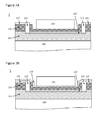
Figure 2A shows a further exemplary embodiment of an AlGaN/GaN 2DEG-basedsensor 1 according to the invention, comprising asubstrate layer 100, aGaN layer 105, aAlGaN layer 110,ohmic contacts 115, a2DEG channel 120,electrical metallizations 125, and anextended gate material 140. - The
sensor 1 ofFigure 2A is basically the same sensor shown inFigure 1A but comprising a layer of anadditional gate material 140 placed on top of the AlGaN gate electrode and may be placed sufficiently close or in contact with the body skin. Theextended gate material 140 advantageously enhances the charge sensitivity of the2DEG channel 120 by increasing the polarization field with an electrolyte (e.g. sweat or gel), creating a better electrical skin contact with dry skin or by increasing the charge transfer from the skin to the AlGaN gate surface. According to an exemplary embodiment, theextended gate material 140 may have a thickness between 1 and 1000 nanometres, and may be made, for example, of Au, Ag, Pt(Ox), Ir(Ox), PtIrOx or Ag/AgCl - quasi reference electrode stack. - According to another exemplary embodiment, it is possible to use as an extended charge-gating electrode another 2DEG-channel patterned close or electrically connected to a primary sensitive 2DEG-channel. The 2DEG-based extended gate is electrically connected to the body single point.
- During an electrophysiological P-QRS-T heart dipole dynamics, there are intracellular ionic micro currents present caused by heart muscle polarization within the electrolyte-like volume conductive body tissue. According to an exemplary embodiment, a non-polarizable
extended gate material 140 comprising a quasi-reference electrode (Ag/AgCl)-stack may be advantageously used in order to detect those micro currents very sensitively, which correspond with the ECG-activity. According to an embodiment of the invention, such gate material may be put in electrical contact with the body skin, for example in direct contact with the skin or via a gel, for reacting chemically with chloride (Cl-) ions. The chloride concentration involved in ionic micro currents during an ECG-pulse will change, what changes the work function and surface potential of the Ag/AgClextended gate material 140 deposited on theAlGaN layer 110, thus changing the ionisation and energy level of the surface states within AlGaN-barrier layer. According to another exemplary embodiment, a chemically inert Auextended gate material 140 may be used to enhance the E-field interaction with theAlGaN layer 110 in dry and wet conditions. -
Figure 2B shows a further exemplary embodiment of an AlGaN/GaN 2DEG-basedsensor 1 according to the invention, comprising asubstrate layer 100, aGaN layer 105, aAlGaN layer 110,ohmic contacts 115, a2DEG channel 120,electrical metallizations 125, adielectric layer 130 and anextended gate material 140. - The
sensor 1 ofFigure 2B is basically the same sensor shown inFigure 2A but comprising adielectric layer 130 between theAlGaN layer 110 and theextended gate material 140. Thedielectric layer 130 advantageously prevents leakage currents to flow between the skin - extendedgate material 140 and the2DEG channel 120. According to an exemplary embodiment, thedielectric layer 130 may have a thickness between 3 and 10 nanometres, and may be made for example of an aluminium oxide AlOx. Furthermore, thedielectric layer 130 advantageously allows the usage of gate pre-biasing mode. According to an exemplary embodiment, in order to improve the electric-field sensitivity of the transistor (2DEG conductivity change in dependence on the gate material voltage) theextended gate material 140 may be biased under some electric potential. - In some embodiments, the presence of an additional or natural (sweat) conductive liquid on top of the AlGaN-
layer 110 may create an electrochemical double layer formation at the AlGaN/Liquid-interface. This double layer consists of negative and positive ionic layers directly interacting with AlGaN surface donor states creating a charge neutrality with AlGaN-surface potential. Hence ions and double layer formation are very sensitive to an external charge and the liquid is strongly enhancing charge response. -
Figure 2C shows an AlGaN/GaN 2DEG-basedsensor 1 further comprising acavity closure element 250 defining acavity 260 which is filled with air, an inert gas or a liquid. According to an exemplary embodiment, the liquid filledcavity 260 is filled with nitrogen or an electrolyte. According to an exemplary embodiment, thecavity closure element 250 is made from the same material as theextended gate material 140 or from a conductive polymer, such as for example, rubber. The sensor may, but does not require to, comprise adielectric layer 130. Advantageously, thecavity closure element 250 removes parasitic charges that may trap at the AlGaN/electrolyte interface during charge detection. -
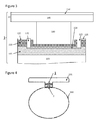
Figure 3 shows a further exemplary embodiment of an AlGaN/GaN 2DEG-basedsensor 1 according to the invention, comprising asubstrate layer 100, aGaN layer 105, aAlGaN layer 110,ohmic contacts 115, a2DEG channel 120,electrical metallizations 125, anextended gate material 140 and anelectrode stack 2. - The
sensor 1 ofFigure 3 is basically the same sensor shown inFigure 2A but comprising, on top of theextended gate material 140, anelectrode stack 2 which may be placed sufficiently close or in contact with the body skin. According to an exemplary embodiment, theelectrode stack 2 may comprise a first layer ofAg 145 and a second layer of Ag/AgCl 150. Theelectrode stack 2 advantageously increases the charge transfer from the skin to the AlGaN surface which. According to an exemplary embodiment, theextended gate material 140 may have a thickness between 1 and 1000 nanometres. According to another exemplary embodiment, thesensor 1 ofFigure 3 may comprise adielectric layer 130 between theAlGaN layer 110 and theextended gate material 140. -
Figure 4 shows a schematic view of an exemplary device for ECG sensing comprising asensor 1 according to the invention. The figure depicts schematically an exemplary wrist worn watch-like device for ECG sensing, comprising a watch-like chassis 155 and abracelet 160. According to an exemplary embodiment, the watch-like chassis 155 provides mechanical protection and comprises control and readout circuitry for thesensor 1 ofFigure 3 . According to an exemplary embodiment, theelectrode stack 2 is integrated in thebracelet 160 in order to be placed sufficiently close or in direct contact with the body skin such that ECG-pulse detection is achieved. -
Figure 5 shows a schematic view of another exemplary device for ECG sensing comprising asensor 1 according to the invention. The figure depicts schematically an exemplary wrist worn watch-like device for ECG sensing, comprising a watch-like chassis 155 and abracelet 160. According to an exemplary embodiment, thebracelet 160 comprises at least onecontainer 170 configured for providing mechanical protection and a control and readout circuitry for thesensor 1 ofFigure 3 . According to an exemplary embodiment, thebracelet 160 comprises circuitry configured for connecting a plurality ofsensors 1 in series. According to an exemplary embodiment, theelectrode stack 2 of eachsensor 1 is integrated in theinner side 165 of thebracelet 160 or the side be placed sufficiently close or in direct contact with the body skin such that ECG-pulse detection is achieved. -
Figure 6 shows a schematic view of a further exemplary device for ECG sensing comprising asensor 1 according to the invention. The figure depicts schematically an exemplary wrist worn watch-like device for ECG sensing, comprising a watch-like chassis 155 and abracelet 160 and plurality ofsensors 1 according to the embodiment offigures 2A or 2B with theextended gate material 140 facing to theinner side 165 of thebracelet 160 and to be placed sufficiently close or in direct contact with the body skin such that ECG-pulse detection is achieved. -
Figure 7 shows a schematic view of a further exemplary device for ECG sensing comprising asensor 1 according to the invention. The figure depicts schematically an exemplary wrist worn watch-like device for ECG sensing, comprising a watch-like chassis 155 and abracelet 160 and plurality ofsensors 1 according to the embodiment offigures 2A or 2B with theextended gate material 140 facing to theinner side 165 of thebracelet 160 and to be placed sufficiently close or in direct contact with the body skin such that ECG-pulse detection is achieved. Additionally, one or more of thesensors 1 may be under the influence a magnetic field. According to an exemplary embodiment, the magnetic field also interacts with the intra/extra cellular ionic currents during the ECG-peak. According to an exemplary embodiment, as shown inFigure 8 , the magnetic field is placed such that, due to Lorentz force, the trajectories of the ions close to theskin surface 190 are deflected towards the skin/sensor interface, thus advantageously intensifying the interaction and increasing the sensitivity to body potential detection. According to an exemplary embodiment, such magnetic field is created by magnetic elements 181,182 located in the vicinity of thesensor 1. According to an exemplary embodiment, said magnetic elements 181,182 may be permanent or electromagnetic magnets located on each side of thesensor 1. - It shall be understood that in
Figures 5 to 7 , for clarity reasons, not all reference signs to the same represented elements have been specifically shown, but is clear that the same represented elements shall be considered as having the same reference sign, when not specifically shown. It shall also be understood that although the exemplary embodiments ofFigures 4 to 7 refer to an exemplary device for ECG sensing with wrist-worn form, thesensor 1 according to any of the embodiments of the invention may be integrated in a device for ECG sensing with a patch-worn form. As shown inFigures 5 to 7 , a plurality ofsensor elements 1 may be connected in series (or in parallel) in such patch-worn device for ECG sensing. -
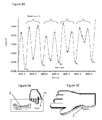
Figure 9A shows a heart charge-based ECG-time equivalent signal measured at a single body point on the wrist using an exemplary sensor configuration as shown inFigure 9C , or in a configuration where the sensor was placed into a conductive liquid solution as shown inFigure 9 B. -
Figure 10A shows a heart charge-based ECG-time equivalent signal measured at single body point using an exemplary sensor configuration as shown inFigure 10B comprising an additional 2DEG-channel acting as an external charge gating electrode providing electrical connection to the body. According to an exemplary embodiment, the second gating-2DEG-channel is patterned within the same GaN/AlGaN-substrate. -
Figure 11A shows a heart charge-based ECG-time equivalent signal synchronized with a standard differential ECG-signal measured at a 0.5 meter distance from the body skin using an exemplary sensor configuration shown inFigure 11 B, where the sensor was placed into a conductive liquid solution. - Advantageously, according to some embodiments, the sensor is a very charge sensitive open gate-passivation free recessed (or ultrathin grown) 2DEG-based HEMT. Its high charge sensitivity is such that it is able to detect smallest electrical charges (in the pC range) at distances of dozens of centimetres. According to an exemplary embodiment, if the sensor is immersed into an ion conductive liquid, then the liquid ions will electro-dynamically react to any external charge by their movement and being in direct contact to the AIGaN-surface the charge sensitivity is very much enhanced. The liquid functions in this situation as an additional sensor functionalization-antenna perfectly matched to a 2DEG-transducer. The heart generates electric charges (of few pC) and a superposition dipole of them is projected to a liquid antenna in which the sensor is immersed in. If the body surface point is in physical contact with liquid the sensed signal is the biggest, because the electric field within body is transferred to the liquid with minimal loses. If the body surface point is outside of the liquid then the inner-body electric field created by the heart is much weaker transmitted to the liquid but its detection until a critical distance (around 50 cm in a Faraday room) remains possible.
- Further advantageous embodiments of the invention will be described below. For example, according to an exemplary embodiment, the device for ECG sensing may also use the detected heart charges dynamics, which is fully time equivalent with P-QRS-T-wave to calculate a blood pressure (BP) value. According to an exemplary embodiment, the calculated BP value is a real time value According to an exemplary embodiment, the device for ECG sensing comprises further HW and/or SW computing means for determining the blood pressure based on a time difference between the heart charge-pulse and a measured palpatoric (mechanic) conventional heart rate. The length of this time (Palpatoric delay) is defining the systolic and diastolic blood pressure values by means of known Pulse-Transit-Time (PTT) techniques. According to an exemplary embodiment, the palpatoric (blood motion based) heart rate may be also measure by means of Photo-plethysmographic (Pulse-Oxymetric) heart rate measurements.
Claims (15)
- A sensor (1) comprising:a substrate layer (100); a GaN/AlGaN hetero-junction structure (105, 110) configured so as to form a 2DEG channel (120) within said structure; and ohmic contacts (115) connected to electrical metallizations (125) and to the 2DEG channel; wherein the GaN/AlGaN hetero-junction structure (105, 110) has a recessed area between the ohmic contacts (115); andcharacterized byfurther comprising a dielectric layer (130) on top of the sensor.
- A sensor (1) according to claim 1 further comprising a layer of an extended gate material (140) placed on top of the dielectric layer (130) and in the GaN/AlGaN hetero-junction recessed area.
- A sensor (1) according to claim 2 further comprising an electrode stack (2) on top of the extended gate material (140).
- A sensor (1) according to claim 1 further comprising a cavity closure layer element (250) on top of the dielectric layer (130), the cavity closure layer element defining a cavity (260) filled with air, an inert gas or a liquid.
- A sensor (1) according to claim 4 wherein the cavity closure layer element (250) is made of a conductive polymer.
- A sensor (1) according to claims 4 or 5 wherein the cavity (260) is filed with nitrogen or an electrolyte.
- A sensor (1) according to claim 4 wherein the cavity (260) further comprises a layer of an extended gate material (140) attached to a wall of the cavity closure layer element (250).
- A device for ECG sensing comprising at least one sensor (1) according to any of claims 1 to 7.
- A device for ECG sensing according to claim 8 arranged so that the GaN/AlGaN hetero-junction recessed area, the extended gate material (140) or the electrode stack (2) is in direct contact or sufficiently close to a certain body skin point such that, during an electrophysiological heart function polarization cycle, the electrical body charge interacts with the 2DEG channel (120) causing its conductivity to change.
- A device according to claim 8 or 9 wherein the sensor (1) is placed into a conductive liquid solution (300).
- A device for ECG sensing according to claim 8 comprising two sensors (1) arranged so that one of them is configured to act as an external charge gating electrode providing electrical connection to the body.
- A device according to any of claims 8 to 11 wherein the ECG sensing comprises a charge-based non-differential ECG sensing.
- A device according to any of claims 8 to 12 wherein at least one sensor (1) is under the influence of a magnetic field.
- Use of a sensor (1) according to any of claims 1 to 7 for ECG detection, when applying the sensor in direct contact or sufficiently close to a certain single body skin point such that, during an electrophysiological heart function polarization cycle, the electrical body charge interacts with the 2DEG channel (120) causing its conductivity to change.
- A method for ECG detection comprising:applying a sensor (1) according to any of claims 1 to 7 in direct contact or sufficiently close to a certain living being's body skin point so that, during an electrophysiological heart function polarization cycle, the body charge interacts with the sensor's 2DEG channel (120); anddetecting said conductivity change within the 2DEG channel (120).
Priority Applications (1)
| Application Number | Priority Date | Filing Date | Title |
|---|---|---|---|
| EP20140166250 EP2799852A1 (en) | 2013-04-29 | 2014-04-28 | 2DEG-based sensor and device for ECG sensing |
Applications Claiming Priority (2)
| Application Number | Priority Date | Filing Date | Title |
|---|---|---|---|
| EP13165848 | 2013-04-29 | ||
| EP20140166250 EP2799852A1 (en) | 2013-04-29 | 2014-04-28 | 2DEG-based sensor and device for ECG sensing |
Publications (1)
| Publication Number | Publication Date |
|---|---|
| EP2799852A1 true EP2799852A1 (en) | 2014-11-05 |
Family
ID=48236694
Family Applications (1)
| Application Number | Title | Priority Date | Filing Date |
|---|---|---|---|
| EP20140166250 Withdrawn EP2799852A1 (en) | 2013-04-29 | 2014-04-28 | 2DEG-based sensor and device for ECG sensing |
Country Status (2)
| Country | Link |
|---|---|
| US (1) | US9675262B2 (en) |
| EP (1) | EP2799852A1 (en) |
Cited By (5)
| Publication number | Priority date | Publication date | Assignee | Title |
|---|---|---|---|---|
| WO2017153906A3 (en) * | 2016-03-10 | 2017-10-12 | RG Innovations PTE LTD. | Pseudo-conductive high-electron mobility transistors and microelectronic sensors based on them |
| WO2017199110A1 (en) * | 2016-05-17 | 2017-11-23 | Rg Innovations Pte Ltd | Microelectronic sensor for biometric authentication |
| CN111095792A (en) * | 2017-09-05 | 2020-05-01 | 艾皮乔尼克控股有限公司 | Microelectronic sensor for biometric authentication |
| US10905346B2 (en) | 2016-03-10 | 2021-02-02 | Epitronic Holdings Pte Ltd. | Pseudo-conductive high-electron mobility transistors and microelectronic sensors based on them |
| WO2021105839A1 (en) * | 2019-11-26 | 2021-06-03 | Epitronic Holdings Pte. Ltd. | Microelectronic sensors for inter-chip networks capable of recording and processing neural signals and action potentials |
Families Citing this family (13)
| Publication number | Priority date | Publication date | Assignee | Title |
|---|---|---|---|---|
| JP6854612B2 (en) | 2015-10-06 | 2021-04-07 | 三星電子株式会社Samsung Electronics Co.,Ltd. | Biological information measuring device, biometric information measuring method, and computer-readable recording medium |
| WO2017153909A1 (en) * | 2016-03-10 | 2017-09-14 | Rg Innovations Pte Ltd | Microelectronic sensor for air quality monitoring |
| US10932684B2 (en) | 2016-03-10 | 2021-03-02 | Epitronic Holdings Pte Ltd. | Microelectronic sensor for air quality monitoring |
| EP3426133B1 (en) * | 2016-03-10 | 2020-05-06 | Epitronic Holdings Pte. Ltd. | Microelectronic sensors for non-invasive monitoring of physiological parameters |
| US10945643B2 (en) * | 2016-03-10 | 2021-03-16 | Epitronic Holdings Pte. Ltd. | Microelectronic sensor for biometric authentication |
| EP3500851B1 (en) * | 2016-08-16 | 2020-09-16 | Epitronic Holdings Pte. Ltd. | Surface acoustic wave rfid sensor for chemical detection and (bio)molecular diagnostics |
| EP3679648B1 (en) * | 2017-09-05 | 2021-06-02 | Epitronic Holdings Pte. Ltd. | Microelectronic sensor for non-invasive monitoring of blood glucose levels |
| CA3120321A1 (en) * | 2018-11-28 | 2020-06-04 | Easyg Llc | Contactless electrode for sensing physiological electrical activity |
| US11522079B2 (en) | 2019-10-16 | 2022-12-06 | Tower Semiconductor Ltd. | Electrostatically controlled gallium nitride based sensor and method of operating same |
| CN112924515A (en) * | 2021-01-20 | 2021-06-08 | 南方科技大学 | Gas sensor and preparation method thereof |
| CN115753537A (en) * | 2022-11-30 | 2023-03-07 | 中国科学院苏州纳米技术与纳米仿生研究所 | Smoke sensor |
| CN117147637B (en) * | 2023-11-01 | 2024-01-23 | 合肥美镓传感科技有限公司 | Gallium nitride gas sensor and preparation method thereof |
| CN119856934B (en) * | 2025-01-21 | 2026-01-06 | 中山大学 | Integrated bio-neural electrodes, preparation method and neural signal detection equipment |
Citations (4)
| Publication number | Priority date | Publication date | Assignee | Title |
|---|---|---|---|---|
| US5217014A (en) * | 1991-11-04 | 1993-06-08 | Biofield Corp. | Depolarized pre-gelled electrodes |
| US20100270595A1 (en) * | 2009-04-23 | 2010-10-28 | Micronas Gmbh | Device for Detection of a Gas or Gas Mixture and Method for Manufacturing Such a Device |
| WO2011046858A1 (en) * | 2009-10-16 | 2011-04-21 | University Of Florida Research Foundation Inc. | Normalized hydrogen sensing and methods of fabricating a normalized hydrogen sensor |
| WO2012054683A2 (en) | 2010-10-21 | 2012-04-26 | Carnegie Mellon University | Two-dimensional electron gas (2deg)-based chemical sensors |
Family Cites Families (8)
| Publication number | Priority date | Publication date | Assignee | Title |
|---|---|---|---|---|
| US7382001B2 (en) * | 2004-01-23 | 2008-06-03 | International Rectifier Corporation | Enhancement mode III-nitride FET |
| US8173906B2 (en) * | 2007-02-07 | 2012-05-08 | Raytheon Company | Environmental protection coating system and method |
| US7915643B2 (en) * | 2007-09-17 | 2011-03-29 | Transphorm Inc. | Enhancement mode gallium nitride power devices |
| US8019409B2 (en) * | 2008-06-09 | 2011-09-13 | Pacesetter, Inc. | Cardiac resynchronization therapy optimization using electromechanical delay from realtime electrode motion tracking |
| US9970897B2 (en) * | 2008-06-16 | 2018-05-15 | Duke University | Chemical sensors and methods for making and using the same |
| JP5672723B2 (en) * | 2010-03-09 | 2015-02-18 | 富士通株式会社 | Method for manufacturing compound semiconductor device |
| JP5685918B2 (en) * | 2010-12-10 | 2015-03-18 | 富士通株式会社 | Manufacturing method of semiconductor device |
| US9171960B2 (en) * | 2013-01-25 | 2015-10-27 | Qualcomm Mems Technologies, Inc. | Metal oxide layer composition control by atomic layer deposition for thin film transistor |
-
2014
- 2014-04-28 EP EP20140166250 patent/EP2799852A1/en not_active Withdrawn
- 2014-04-29 US US14/265,088 patent/US9675262B2/en not_active Expired - Fee Related
Patent Citations (4)
| Publication number | Priority date | Publication date | Assignee | Title |
|---|---|---|---|---|
| US5217014A (en) * | 1991-11-04 | 1993-06-08 | Biofield Corp. | Depolarized pre-gelled electrodes |
| US20100270595A1 (en) * | 2009-04-23 | 2010-10-28 | Micronas Gmbh | Device for Detection of a Gas or Gas Mixture and Method for Manufacturing Such a Device |
| WO2011046858A1 (en) * | 2009-10-16 | 2011-04-21 | University Of Florida Research Foundation Inc. | Normalized hydrogen sensing and methods of fabricating a normalized hydrogen sensor |
| WO2012054683A2 (en) | 2010-10-21 | 2012-04-26 | Carnegie Mellon University | Two-dimensional electron gas (2deg)-based chemical sensors |
Non-Patent Citations (3)
| Title |
|---|
| P. OFFERMANS ET AL.: "Ultra-Sensitive N02 Detection with AIGaNlGaN 2DEG Channels for Air Quality Monitoring", IEEE SENSORS JOURNAL 2012, 28 October 2012 (2012-10-28) |
| P. OFFERMANS ET AL.: "Ultra-Sensitive N02 Detection with AIGaNlGaN 2DEG Channels for Air Quality Monitoring", IEEE SENSORS JOURNAL 2012, 28 October 2012 (2012-10-28), XP002728928 * |
| S. C. HUNG ET AL.: "Detection of chloride ions using an integrated AglAgCl electrode with AIGaN/GaN high electron mobility transistors", APPLIED PHYSICS LETTERS, vol. 92, 14 May 2008 (2008-05-14) |
Cited By (5)
| Publication number | Priority date | Publication date | Assignee | Title |
|---|---|---|---|---|
| WO2017153906A3 (en) * | 2016-03-10 | 2017-10-12 | RG Innovations PTE LTD. | Pseudo-conductive high-electron mobility transistors and microelectronic sensors based on them |
| US10905346B2 (en) | 2016-03-10 | 2021-02-02 | Epitronic Holdings Pte Ltd. | Pseudo-conductive high-electron mobility transistors and microelectronic sensors based on them |
| WO2017199110A1 (en) * | 2016-05-17 | 2017-11-23 | Rg Innovations Pte Ltd | Microelectronic sensor for biometric authentication |
| CN111095792A (en) * | 2017-09-05 | 2020-05-01 | 艾皮乔尼克控股有限公司 | Microelectronic sensor for biometric authentication |
| WO2021105839A1 (en) * | 2019-11-26 | 2021-06-03 | Epitronic Holdings Pte. Ltd. | Microelectronic sensors for inter-chip networks capable of recording and processing neural signals and action potentials |
Also Published As
| Publication number | Publication date |
|---|---|
| US9675262B2 (en) | 2017-06-13 |
| US20140323895A1 (en) | 2014-10-30 |
Similar Documents
| Publication | Publication Date | Title |
|---|---|---|
| US9675262B2 (en) | 2DEG-based sensor and device for ECG sensing | |
| US11121334B2 (en) | 3D graphene transistor | |
| Hemaja et al. | A comprehensive review on high electron mobility transistor (HEMT) based biosensors: recent advances and future prospects and its comparison with Si-based biosensor | |
| Hempel et al. | PEDOT: PSS organic electrochemical transistors for electrical cell-substrate impedance sensing down to single cells | |
| US8836351B2 (en) | Chloride detection | |
| EP3426133B1 (en) | Microelectronic sensors for non-invasive monitoring of physiological parameters | |
| US10905346B2 (en) | Pseudo-conductive high-electron mobility transistors and microelectronic sensors based on them | |
| EP2479563B1 (en) | Electrochemical sensor comprising a 2-dimensional electron gas layer (2DEG) and method for electrochemical sensing using such electrochemical sensor | |
| MX373009B (en) | SALIVARY BIOSENSORS AND BIOFUEL CELLS. | |
| WO2017153906A2 (en) | Pseudo-conductive high-electron mobility transistors and microelectronic sensors based on them | |
| Kutovyi et al. | Origin of noise in liquid-gated Si nanowire troponin biosensors | |
| US20140295573A1 (en) | Biosensor with dual gate structure and method for detecting concentration of target protein in a protein solution | |
| Pal et al. | Analytical modeling and simulation of AlGaN/GaN MOS-HEMT for high sensitive pH sensor | |
| Hess et al. | Electrical coupling between cells and graphene transistors | |
| Varghese et al. | A complete analytical model for MOS-HEMT biosensors: capturing the effect of stern layer and charge screening on sensor performance | |
| Reddy et al. | Sensitivity Analysis of Dielectrically Modulated Hetero junction InSb/Si SOI-TFET based Biosensor for Cancer Detection. | |
| Hemaja et al. | Dielectric modulated enhancement mode N-polar GaN MIS-HEMT biosensor for label free detection | |
| Alifragis et al. | Potassium selective chemically modified field effect transistors based on AlGaN/GaN two-dimensional electron gas heterostructures | |
| Sriramani et al. | Analytical model for DG-AlGaN/GaN MOS-HEMT for sensitive analysis of pH analytes and charged biomolecules | |
| Panda et al. | Modeling and sensitivity estimation of a dual cavity source pocket-based charge plasma tunneling FET for label-free biological molecule detection | |
| US10605769B2 (en) | Sensing device and biological detection method | |
| Hung et al. | Integration of selective area anodized AgCl thin film with AlGaN/GaN HEMTs for chloride ion detection | |
| Abhinav et al. | Enhancing Potentiometric Response Using Modified Ion Sensitive Transistor | |
| Jose et al. | HEMT Biosensors: Materials, Device Engineering, and Future Directions in Ultra-Sensitive Detection | |
| Peesa et al. | Simulation of GaN MOS-HEMT based bio-sensor for breast cancer detection |
Legal Events
| Date | Code | Title | Description |
|---|---|---|---|
| PUAI | Public reference made under article 153(3) epc to a published international application that has entered the european phase |
Free format text: ORIGINAL CODE: 0009012 |
|
| 17P | Request for examination filed |
Effective date: 20140428 |
|
| AK | Designated contracting states |
Kind code of ref document: A1 Designated state(s): AL AT BE BG CH CY CZ DE DK EE ES FI FR GB GR HR HU IE IS IT LI LT LU LV MC MK MT NL NO PL PT RO RS SE SI SK SM TR |
|
| AX | Request for extension of the european patent |
Extension state: BA ME |
|
| RBV | Designated contracting states (corrected) |
Designated state(s): AL AT BE BG CH CY CZ DE DK EE ES FI FR GB GR HR HU IE IS IT LI LT LU LV MC MK MT NL NO PL PT RO RS SE SI SK SM TR |
|
| R17P | Request for examination filed (corrected) |
Effective date: 20150504 |
|
| RIN1 | Information on inventor provided before grant (corrected) |
Inventor name: OFFERMANS, PETER Inventor name: VITUSHINSKY, ROMAN |
|
| STAA | Information on the status of an ep patent application or granted ep patent |
Free format text: STATUS: THE APPLICATION IS DEEMED TO BE WITHDRAWN |
|
| 18D | Application deemed to be withdrawn |
Effective date: 20181101 |