EP2797136A1 - Thin film battery module, thin film battery package, thin film battery package manufacturing device, and thin film battery package manufacturing method - Google Patents
Thin film battery module, thin film battery package, thin film battery package manufacturing device, and thin film battery package manufacturing method Download PDFInfo
- Publication number
- EP2797136A1 EP2797136A1 EP12859847.1A EP12859847A EP2797136A1 EP 2797136 A1 EP2797136 A1 EP 2797136A1 EP 12859847 A EP12859847 A EP 12859847A EP 2797136 A1 EP2797136 A1 EP 2797136A1
- Authority
- EP
- European Patent Office
- Prior art keywords
- filling
- filling material
- battery module
- region
- viscosity
- Prior art date
- Legal status (The legal status is an assumption and is not a legal conclusion. Google has not performed a legal analysis and makes no representation as to the accuracy of the status listed.)
- Withdrawn
Links
Images




Classifications
-
- H—ELECTRICITY
- H01—ELECTRIC ELEMENTS
- H01M—PROCESSES OR MEANS, e.g. BATTERIES, FOR THE DIRECT CONVERSION OF CHEMICAL ENERGY INTO ELECTRICAL ENERGY
- H01M10/00—Secondary cells; Manufacture thereof
- H01M10/02—Details
-
- H—ELECTRICITY
- H01—ELECTRIC ELEMENTS
- H01M—PROCESSES OR MEANS, e.g. BATTERIES, FOR THE DIRECT CONVERSION OF CHEMICAL ENERGY INTO ELECTRICAL ENERGY
- H01M10/00—Secondary cells; Manufacture thereof
- H01M10/04—Construction or manufacture in general
-
- H—ELECTRICITY
- H01—ELECTRIC ELEMENTS
- H01M—PROCESSES OR MEANS, e.g. BATTERIES, FOR THE DIRECT CONVERSION OF CHEMICAL ENERGY INTO ELECTRICAL ENERGY
- H01M50/00—Constructional details or processes of manufacture of the non-active parts of electrochemical cells other than fuel cells, e.g. hybrid cells
- H01M50/20—Mountings; Secondary casings or frames; Racks, modules or packs; Suspension devices; Shock absorbers; Transport or carrying devices; Holders
- H01M50/204—Racks, modules or packs for multiple batteries or multiple cells
- H01M50/207—Racks, modules or packs for multiple batteries or multiple cells characterised by their shape
- H01M50/211—Racks, modules or packs for multiple batteries or multiple cells characterised by their shape adapted for pouch cells
-
- H—ELECTRICITY
- H01—ELECTRIC ELEMENTS
- H01M—PROCESSES OR MEANS, e.g. BATTERIES, FOR THE DIRECT CONVERSION OF CHEMICAL ENERGY INTO ELECTRICAL ENERGY
- H01M50/00—Constructional details or processes of manufacture of the non-active parts of electrochemical cells other than fuel cells, e.g. hybrid cells
- H01M50/20—Mountings; Secondary casings or frames; Racks, modules or packs; Suspension devices; Shock absorbers; Transport or carrying devices; Holders
- H01M50/233—Mountings; Secondary casings or frames; Racks, modules or packs; Suspension devices; Shock absorbers; Transport or carrying devices; Holders characterised by physical properties of casings or racks, e.g. dimensions
- H01M50/24—Mountings; Secondary casings or frames; Racks, modules or packs; Suspension devices; Shock absorbers; Transport or carrying devices; Holders characterised by physical properties of casings or racks, e.g. dimensions adapted for protecting batteries from their environment, e.g. from corrosion
-
- H—ELECTRICITY
- H01—ELECTRIC ELEMENTS
- H01M—PROCESSES OR MEANS, e.g. BATTERIES, FOR THE DIRECT CONVERSION OF CHEMICAL ENERGY INTO ELECTRICAL ENERGY
- H01M50/00—Constructional details or processes of manufacture of the non-active parts of electrochemical cells other than fuel cells, e.g. hybrid cells
- H01M50/20—Mountings; Secondary casings or frames; Racks, modules or packs; Suspension devices; Shock absorbers; Transport or carrying devices; Holders
- H01M50/233—Mountings; Secondary casings or frames; Racks, modules or packs; Suspension devices; Shock absorbers; Transport or carrying devices; Holders characterised by physical properties of casings or racks, e.g. dimensions
- H01M50/242—Mountings; Secondary casings or frames; Racks, modules or packs; Suspension devices; Shock absorbers; Transport or carrying devices; Holders characterised by physical properties of casings or racks, e.g. dimensions adapted for protecting batteries against vibrations, collision impact or swelling
-
- H—ELECTRICITY
- H01—ELECTRIC ELEMENTS
- H01M—PROCESSES OR MEANS, e.g. BATTERIES, FOR THE DIRECT CONVERSION OF CHEMICAL ENERGY INTO ELECTRICAL ENERGY
- H01M50/00—Constructional details or processes of manufacture of the non-active parts of electrochemical cells other than fuel cells, e.g. hybrid cells
- H01M50/50—Current conducting connections for cells or batteries
- H01M50/572—Means for preventing undesired use or discharge
- H01M50/574—Devices or arrangements for the interruption of current
- H01M50/579—Devices or arrangements for the interruption of current in response to shock
-
- H—ELECTRICITY
- H01—ELECTRIC ELEMENTS
- H01M—PROCESSES OR MEANS, e.g. BATTERIES, FOR THE DIRECT CONVERSION OF CHEMICAL ENERGY INTO ELECTRICAL ENERGY
- H01M50/00—Constructional details or processes of manufacture of the non-active parts of electrochemical cells other than fuel cells, e.g. hybrid cells
- H01M50/20—Mountings; Secondary casings or frames; Racks, modules or packs; Suspension devices; Shock absorbers; Transport or carrying devices; Holders
- H01M50/271—Lids or covers for the racks or secondary casings
-
- Y—GENERAL TAGGING OF NEW TECHNOLOGICAL DEVELOPMENTS; GENERAL TAGGING OF CROSS-SECTIONAL TECHNOLOGIES SPANNING OVER SEVERAL SECTIONS OF THE IPC; TECHNICAL SUBJECTS COVERED BY FORMER USPC CROSS-REFERENCE ART COLLECTIONS [XRACs] AND DIGESTS
- Y02—TECHNOLOGIES OR APPLICATIONS FOR MITIGATION OR ADAPTATION AGAINST CLIMATE CHANGE
- Y02E—REDUCTION OF GREENHOUSE GAS [GHG] EMISSIONS, RELATED TO ENERGY GENERATION, TRANSMISSION OR DISTRIBUTION
- Y02E60/00—Enabling technologies; Technologies with a potential or indirect contribution to GHG emissions mitigation
- Y02E60/10—Energy storage using batteries
-
- Y—GENERAL TAGGING OF NEW TECHNOLOGICAL DEVELOPMENTS; GENERAL TAGGING OF CROSS-SECTIONAL TECHNOLOGIES SPANNING OVER SEVERAL SECTIONS OF THE IPC; TECHNICAL SUBJECTS COVERED BY FORMER USPC CROSS-REFERENCE ART COLLECTIONS [XRACs] AND DIGESTS
- Y02—TECHNOLOGIES OR APPLICATIONS FOR MITIGATION OR ADAPTATION AGAINST CLIMATE CHANGE
- Y02P—CLIMATE CHANGE MITIGATION TECHNOLOGIES IN THE PRODUCTION OR PROCESSING OF GOODS
- Y02P70/00—Climate change mitigation technologies in the production process for final industrial or consumer products
- Y02P70/50—Manufacturing or production processes characterised by the final manufactured product
-
- Y—GENERAL TAGGING OF NEW TECHNOLOGICAL DEVELOPMENTS; GENERAL TAGGING OF CROSS-SECTIONAL TECHNOLOGIES SPANNING OVER SEVERAL SECTIONS OF THE IPC; TECHNICAL SUBJECTS COVERED BY FORMER USPC CROSS-REFERENCE ART COLLECTIONS [XRACs] AND DIGESTS
- Y10—TECHNICAL SUBJECTS COVERED BY FORMER USPC
- Y10T—TECHNICAL SUBJECTS COVERED BY FORMER US CLASSIFICATION
- Y10T29/00—Metal working
- Y10T29/53—Means to assemble or disassemble
- Y10T29/5313—Means to assemble electrical device
- Y10T29/53135—Storage cell or battery
Definitions
- the present invention relates to an apparatus for manufacturing a thin film battery package and, more particularly, to a thin film battery module having impact resistance, a thin film battery package, and an apparatus and method for manufacturing a thin film battery package.
- a thin film battery is a battery formed by stacking components including a cathode, an anode and electrolytes in the form of thin films to have a total thickness of several dozens of micrometers.
- the thin film battery has a package housing.
- the package housing has a lamination space therein.
- Unit cells are laminated in multiple layers inside the lamination space.
- the unit cells are laminated to form a battery module.
- the battery module has spaces at opposite sides thereof in the lamination space.
- a space is defined between an upper surface of the battery module and a cover placed on an upper side of the package housing.
- the battery module defining such separation spaces or alignment of the unit cells is likely to be displaced by external impact.
- the battery module defining such separation spaces is likely to be damaged by external impact.
- Korean Patent No. 10-0535739 (issue date: December 9, 2005 ) discloses a technology of molding a protective circuit with a single package.
- a thin film battery module includes: a battery module formed by stacking unit cells one above another; and an impact absorption portion surrounding the battery module and a space between the unit cells and.
- a thin film battery package includes: a package housing having a battery module in which unit cells are stacked one above another; and an impact absorption portion filling the package housing and surrounding the battery module.
- an apparatus for manufacturing a thin film battery package includes: a seating part on which a package housing receiving a battery module therein is seated, the seating part being open at an upper side thereof; and a filling unit supplying a filling material in response to an electrical signal from outside to fill the package housing with the filling material such that the filling material surrounds the battery module.
- a method for manufacturing a thin film battery package includes: a first step of preparing a package housing open at an upper side thereof and having a battery module disposed therein; and a second step of filling the package housing with a filling material such that the filling material surrounds the battery module.
- the present invention provides an effect of protecting unit cells stacked inside a package housing from external impact.
- the present invention provides an effect of imparting impact resistance to a thin film battery module by forming an impact absorption layer using a filling material to surround the unit cells.
- the present invention provides an effect of allowing the impact absorption layer surrounding the unit cells to perform multi-stage impact absorption.
- the present invention provides an effect of relieving impact between the unit cells and impact applied to the battery module by supplying a filling material in a liquid or solid phase into a space between the unit cells for molding of the battery module.
- Fig. 1 is a sectional view of a thin film battery package according to one embodiment of the present invention.
- the thin film battery package includes a package housing 100 and an impact absorption portion 200.
- the package housing 100 is open at an upper side thereof and defines a lamination space 101 therein.
- the lamination space 101 receives a battery module 10 therein.
- the battery module 10 is composed of unit cells stacked in multiple layers.
- the unit cells are electrically connected to each other and include a lower unit cell electrically connected to an electrode 110 placed on a bottom surface of the lamination space.
- the battery module 10 has a side surface separated a predetermined distance from an inner wall of the lamination space 101.
- an upper surface of the battery module 10 is separated from an upper end of the package housing 100 by a certain height.
- the upper end of the package housing 100 corresponds to a region on which a cover 130 is placed.
- the cover is welded to the upper end of the package housing 100.
- a portion of the upper end of the package housing welded to the cover 130 substantially corresponds to an upper end of a partition wall 120 formed of Kovar alloy.
- the welded portion will be considered to be integrated with the package housing 100.
- the package housing 100 may be formed of a ceramic material.
- the cover 130 serves to seal the lamination space 101 from external environments.
- the impact absorption portion 200 is formed by filling the lamination space 101 with a filling material 201.
- the filling material 201 may be at least one of a silicon-based elastic epoxy resin or an epoxy resin having viscosity.
- the filling material may have a viscosity of 400 cps or less.
- the viscosity of the filling material 201 is less than or equal to 400 cps, the filling material 201 has flowability and can flow in the direction of gravity.
- the battery module 10 has a first region (a) formed on the upper surface thereof.
- a second region (b) is formed between the circumference of the battery module 10 and the inner wall of the lamination space 101.
- the filling material 201 fills the first region (a) and the second region (b).
- Symbol c indicates the upper end of the package housing.
- the filling material 201 surrounds the circumference of the battery module 10.
- the impact absorption portion 200 serves to relieve external impact applied to the battery module 10.
- the thin film battery package according to the present invention can efficiently prevent damage to the unit cells stacked one above another by relieving external impact.
- Fig. 2 is a sectional view of a thin film battery package in accordance with another embodiment of the present invention.
- an impact absorption portion 300 may be composed of first and second impact absorption regions 310, 320.
- the first impact absorption region 310 is formed to a predetermined thickness to surround the circumference of the battery module 10.
- the first impact absorption region 310 is formed by filling with a solid-phase filling material 311.
- the first impact absorption region 310 may be formed by filling with a liquid-phase filling material having viscosity, followed by curing the liquid-phase filling material at a predetermined temperature.
- the cured filling material has a hardness from 500 gf to 1500 gf, or from 1500 gf to 4000 gf.
- the filling material In the hardness range from 500 gf to 1500 gf, the filling material is soft to absorb a certain degree of impact, and in the hardness range from 1500 gf to 4000 gf, the filling material becomes rigid to move.
- the first impact absorption region 310 formed of the solid-phase filling material 311 can prevent distortion of the unit cells inside the battery module 10.
- the second impact absorption region 320 is formed by filling with a liquid-phase filling material 321.
- the second impact absorption region 320 is formed to a predetermined thickness to surround the circumference of the first impact absorption region 310.
- the liquid-phase filling material 321 may be an epoxy resin having viscosity.
- the filling material may have a viscosity of 400 cP or less.
- the filling material 321 has a viscosity of 400 cP or less, the filling material 321 has flowability and can flow in the direction of gravity.
- the second impact absorption region 320 is formed between the circumference of the first impact absorption region 310 and the inner wall of the lamination space 101.
- the impact absorption portion 300 provides a region composed multiple layers on the circumference of the battery module 10 and capable of absorbing impact in multiple stages.
- impact when applied to the package housing, impact can be absorbed or relieved in multiple stages by the first and second impact absorption regions.
- the battery module 10 can be prevented from suffering from displacement or the like by the first impact absorption region 310.
- Fig. 3 shows an apparatus for manufacturing a thin film battery package according to the present invention.
- the apparatus for manufacturing a thin film battery package includes a seating part 700 and a filling unit 500.
- the seating part 700 includes a seating stage 710 and a vacuum providing unit 720.
- the seating stage 710 provides a region on which the package housing 100 will be seated.
- the seating stage 710 is formed with a plurality of vacuum holes 711.
- the plural vacuum holes 711 are connected to the vacuum providing unit 720 via a tube or the like.
- the vacuum providing unit 720 provides a certain degree of vacuum suction force to the plurality of vacuum holes 711 in response to an electrical signal from outside.
- the plural vacuum holes 711 are exposed to a lower surface of the package housing 100 seated on the seating stage 710.
- the package housing 100 When vacuum suction force is applied to the plurality of vacuum holes 711, the package housing 100 is secured to an upper surface of the seating stage 710 by vacuum suctioning.
- the package housing 100 can be stably seated on the seating stage 710.
- the filling unit 500 includes a filling material ejector 510, a filling region setting part (not shown), and a controller 560.
- the filling material ejector 510 is a device for ejecting a liquid-phase filling material 201 (see Fig. 6 ).
- the filling material ejector 510 includes a filling material supply 550 for supplying the liquid-phase filling material 201.
- the filling material ejector 510 is disposed above the seating stage 710.
- An XY gantry 530 is disposed above the seating stage 710.
- the filling material ejector 510 is connected to the XY gantry 530.
- the XY gantry 530 is connected to a drive unit 540.
- the drive unit 540 may move the filling material ejector 510 to a certain XY coordinate location in response to an electrical signal from the controller 560.
- a Z-axis elevator 520 is disposed between the XY gantry 530 and the filling material ejector 510.
- the Z-axis elevator 520 may act like a cylinder elevating the filling material ejector 510 in response to an electrical signal from the controller 560.
- the controller 560 can move the filling material ejector 510 to a certain XYZ location using the drive unit 540 and the Z-axis elevator 520.
- the filling region setting part serves to set a region to which the filling material 201 will be ejected.
- Fig. 4 shows one example of filling regions set in the battery module.
- the filling regions includes a first region (a) formed on the upper surface of the battery module 10 and a second region (b) formed between the circumference of the battery module 10 and the inner wall of the lamination space 101.
- the first region (a) and the second region (b) may have the same filling thickness.
- the filling region setting part may employ a system of coordinates.
- the system of coordinates may be placed above the battery module 10. Based on the system of coordinates, coordinates defining the circumference of the battery module 10 are measured and connected to each other. As a result, a first 1 boundary B1 is defined.
- an inner region of the first boundary B1 is set as the first region (a).
- a region between the first boundary B1 and the second boundary B2 is set as the second region (b).
- Each of the first region (a) and the second region (b) is filled with the filling material to a predetermined thickness.
- Symbol c indicates a region at the upper end of the package housing.
- the controller 560 controls operation of the filling material ejector 510 such that the first and second regions (a, b) are filled with a predetermined amount of the liquid-phase filling material.
- the filling material 201 may be an epoxy resin having viscosity.
- the filling material 201 may have a viscosity of 400 cps or less.
- the filling material 201 When the filling material 201 has a viscosity of 400 cps or less, the filling material 201 has flowability and can flow in the direction of gravity.
- the filling unit 500 further includes a viscosity imparting part 570 electrically connected to the controller 560.
- the viscosity imparting part 570 includes a viscosity measurement instrument 571, a temperature sensor 572, and a heater 573.
- the viscosity measurement instrument 571 measures viscosity of the filling material 201.
- the viscosity measurement instrument 571 sends the measured viscosity to the controller 560.
- the controller 560 determines whether the measured viscosity is within a preset viscosity range.
- the preset viscosity range may be 400 cps or less.
- the controller 560 stores a preset temperature for achieving the preset viscosity range.
- the temperature sensor 572 measures the temperature of the liquid-phase filling material 201.
- the temperature sensor 572 sends the measured temperature to the controller 560.
- the heater 573 heats the filling material 201 in response to an electrical signal from the controller 560.
- the heater 573 may include a heating coil.
- the controller 560 controls the heater 573 to heat the filling material 201 to the temperature at which the filling material 201 has a viscosity of 400 cps or less.
- the filling unit 500 is provided with a filling depth setting part (not shown).
- the filling depth setting part includes a distance sensor 600 and a setting device (not shown).
- the distance sensor 600 may be provided to the filling material ejector 510.
- the distance sensor 600 measures a depth Dp of the lamination space and a depth Dcell from the bottom surface of the lamination space 101 to the upper surface of the battery module 10, and sends the measured values to the setting device.
- the setting device determines a distance between the depth Dcell from the bottom surface of the lamination space 101 to the upper surface of the battery module 10 and the depth Dp of the lamination space 101 as an upper limit of a filling depth.
- the filling depth Dfill refers to a distance from the bottom surface of the lamination space 101 to the upper limit.
- the upper limit of the filling depth Dfill be coplanar with or lower than the upper end of the package housing 100.
- the setting device sends the preset filling depth Dfill to the controller 560.
- the controller 560 controls the filling material ejector 510 such that the filling material is supplied to the preset filling depth Dfill.
- the package housing 100 is seated on the upper surface of the seating stage 710.
- the vacuum providing unit 720 receives an electrical signal sent from the controller 560 and supplies vacuum suction force to the vacuum holes 711 formed on the seating stage 710.
- the package housing 100 is attached to the upper surface of the seating stage 710 via vacuum suctioning.
- the package housing 100 is stably seated on the upper surface of the seating stage 710.
- the filling region setting part sets regions to be filled with the filling material 201.
- the filling region setting part sets, as the filling regions, the first region (a) defined on the upper surface of the battery module 10 and the second region (b) defined between the circumference of the battery module 10 and the inner wall of the lamination space 101.
- the filling region setting part sends information about the set filling regions to the controller 560.
- the filling depth setting part sets a filling depth Dfill to be filled with the filling material 201.
- the filling depth setting part sets a distance between the depth Dcell from the bottom surface of the lamination space 101 to the upper surface of the battery module 10 and the depth Dp of the lamination space 101 as the filling depth Dfill.
- the filling depth setting part sends information about the set filling depth Dfill to the controller 560.
- the filling depth setting part determines an upper limit of the filling material 201. It is desirable that the upper limit of the filling material 201 be coplanar with or lower than the upper end of the package housing 100.
- the upper end of the package housing 100 is a region which is brought into contact with and welded to the cover 130 (see Fig. 7 ). It is desirable that the welding region not contain foreign matter such as the filling material 201 at the upper end of the package housing 100.
- the viscosity imparting part 570 imparts viscosity to the filling material 201 to be within a preset viscosity range.
- the viscosity measurement instrument 571 measures the viscosity of the filling material 201 and sends the measured viscosity to the controller 560.
- the controller 560 determines whether the viscosity of the filling material falls within the preset viscosity range.
- the viscosity range is set to a viscosity of 400 cps or less.
- the controller 560 controls the heater 573 to heat the filling material 201 to a temperature at which the filling material has a viscosity of 400 cps or less.
- the filling material 201 can be maintained at a viscosity of 400 cps or less.
- the filling material ejector 510 is moved to a location for ejecting the filling material.
- Fig. 5 shows the package housing before filling with the filling material.
- Fig. 3 shows the package housing before filling with the filling material.
- the controller 560 controls the drive unit 540 and the Z-axis elevator 520 to place the filling material ejector 510 above a filling region A.
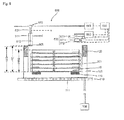
- Fig. 6 shows the package housing after filling with the filling material.
- the controller 560 allows the filling region A to be filled with the liquid-phase filling material 201 to the aforementioned filling depth Dfill.
- the battery module 10 can be surrounded by the filling material 201 inside the package housing 100.
- Fig. 7 shows the package housing coupled to the cover.
- the cover 130 is placed on the upper end of the package housing 100.
- the cover 130 is welded to the upper end of the package housing 100.
- the unit cells stacked inside the package housing can be protected from external impact.
- an impact absorption layer is formed around the unit cells using the filling material, thereby imparting impact resistance to the package housing.
- the filling material is supplied to spaces between the unit cells for molding of the battery module, thereby relieving impact between the unit cells and to the battery module.
- Fig. 8 shows another example of the filling material ejector according to the present invention.
- a filling material ejector 510 includes a liquid-phase filling material ejector 511 and a solid-phase filling material ejector 512.
- the liquid-phase filling material ejector 511 ejects a liquid-phase filling material 321 (see Fig. 11 ).
- the liquid-phase filling material 321 may be an epoxy resin having a viscosity of 400 cps.
- the solid-phase filling material ejector 512 ejects a solid-phase filling material 311.
- the solid-phase filling material 311 may be a material capable of being cured immediately after ejection.
- the solid-phase filling material 311 has a hardness from 500 gf to 1500 gf or a hardness from 1500 gf to 4000 gf.
- the filling material In the hardness range from 500 gf to 1500 gf, the filling material is soft to absorb a certain degree of impact, and in the hardness range from 1500 gf to 4000 gf, the filling material becomes rigid to move.
- Fig. 9 shows another example of filling regions set in a battery module.
- the filling region setting part (not shown) according to the present invention sets a first filling region b1 and a second filling region b2.
- the first filling region b1 is formed to surround an upper circumferential surface of the battery module 10 and the circumference of the battery module 10.
- the second filling region b2 is formed to surround the first filling region b1. That is, the second filling region b2 is formed between the circumference of the first filling region b1 and the inner wall of the lamination space 101.
- a boundary is defined between the first filling region b1 and the second filling region b2.
- Fig. 10 shows the package housing before the package housing is filled with the filling material and Fig. 11 shows the package housing after the package housing is filled with the filling material.
- the controller 560 controls the drive unit 540 and the Z-axis elevator 520 to place the solid-phase filling material ejector 512 above the first filling region b1.
- the solid-phase filling material ejector 512 ejects the solid-phase filling material 311 to the first filling region b1 in response to an electrical signal from the controller 560.
- the first filling region b1 is filled with the solid-phase filling material 311.
- the solid-phase filling material 311 is cured after a predetermined period of time from ejection.
- the solid-phase filling material 311 is formed by ejecting a liquid material through the solid-phase filling material ejector 512 and curing the liquid material by heating to a predetermined temperature.
- the solid-phase filling material 311 has a hardness from 500 gf to 1500 gf or a hardness from 1500 gf to 4000 gf.
- the filling material In the hardness range from 500 gf to 1500 gf, the filling material is soft to absorb a certain degree of impact, and in the hardness range from 1500 gf to 4000 gf, the filling material becomes rigid to move.
- the first impact absorption region 310 having a predetermined thickness is formed to surround the upper circumferential surface of the battery module 10 and the circumference of the battery module 10.
- the first impact absorption region 310 has a solid phase and serves to hold the battery module 10 while surrounding the circumference of the battery module 10.
- the liquid-phase filling material ejector 511 ejects the liquid-phase filling material 321 to the second filling region b2 in response to an electrical signal from the controller 560.
- the second filling region b2 is filled with the liquid-phase filling material 321.
- the second impact absorption region 320 having a predetermined thickness is formed around the first filling region b1.
- the second impact absorption region 320 has a liquid phase and serves to protect the battery module 10 surrounded by the first impact absorption region 310 from external impact.
- the first impact absorption region 310 and the second impact absorption region 320 are formed to the impact depth Dfill set as described above.
- Fig. 12 shows the package housing coupled to a cover.
- the cover 130 is placed on the upper end of the package housing 100.
- the cover 130 is welded to the upper end of the package housing 100.
- the impact absorption layer surrounding the unit cells may be formed to absorb impact through multistage absorption.
- the filling material is supplied to spaces between the unit cells for molding of the battery module, thereby relieving impact between the unit cells and to the battery module.
- Fig. 13 is a flowchart of a method for manufacturing a thin film battery package according to the present invention.
- the package housing 100 is placed on the seating stage 710.
- the package housing 100 is open at an upper side thereof and defines the lamination space 101 therein.
- the lamination space 101 receives the battery module 10 including the unit cells stacked one above another in multiple stages.
- the package housing 100 may be secured to the seating stage 710 via vacuum suctioning using the vacuum providing unit 720.
- the package housing is filled with a filling material such that the filling material surrounds the battery module 10.
- the second step will be described in more detail.
- Formation of the filling regions may be carried out using the aforementioned filling region setting part.
- a first region (a) is formed on an upper surface of the battery module 10, and a second region (b) is formed in a space between the circumference of the battery module 10 and the inner wall of the lamination space 101.
- a filling depth (Dfill) is formed.
- the filling depth Dfill may be formed using the aforementioned filling depth setting part.
- a distance between the depth Dcell from the bottom surface of the lamination space 101 to the upper surface of the battery module 10 and the depth Dp of the lamination space 101 is determined as an upper limit of the filling depth Dfill.
- the filling depth Dfill refers to a distance from the bottom surface of the lamination space 101 to the upper limit.
- the upper limit of the filling depth Dfill be coplanar with or lower than the upper end of the package housing 100.
- Viscosity is impartedto the filling material.
- the filling material may be a liquid-phase filling material 201.
- the filling material 201 may be an epoxy resin having a viscosity of 400 cps or less.
- Fig. 14 shows a process of imparting viscosity.
- the viscosity measurement instrument 571 measures the viscosity of the filling material 201.
- the viscosity measurement instrument 571 sends the measured viscosity to the setting device.
- the setting device determines whether the measured viscosity falls within a preset reference viscosity range.
- the setting device finishes the process of imparting viscosity.
- the setting device heats the filling material 201 using the heater 573.
- the temperature sensor 572 measures the temperature of the filling material 201 and sends the measured temperature to the setting device.
- the setting device heats the filling material 201 to a preset reference temperature.
- the reference temperature refers to a temperature at which the filling material 201 has a viscosity within the reference viscosity range.
- the setting device finishes the process of imparting viscosity.
- the controller 560 selects single-stage filling or multi-stage filling, after the process of imparting viscosity to the filling material 201 is finished as described above.
- the controller controls the filling material ejector 510 to fill the filling regions including the first and second regions (a, b) with the filling material 201.
- the first region (a) and the second region (b) are filled with the filling material 201 to a predetermined thickness, thereby forming the impact absorption portion 200.
- the cover 130 is welded to the upper end of the package housing 100.
- the unit cells stacked inside the package housing can be protected from external impact.
- an impact absorption layer is formed around the unit cells using the filling material, thereby imparting impact resistance to the package housing.
- the filling region setting part may reset the filling regions.
- the filling region setting part sets first and second filling regions b1, b2, as shown in Fig. 10 .
- the first and second filling regions b1, b2 are formed to a predetermined thickness around the circumference of the battery module 10 and a boundary is formed therebetween.
- the filling region is formed in multiple layers.
- the controller 560 controls the solid-phase filling material ejector 511 to fill the first filling region b1 with a solid-phase filling material 511.
- the solid-phase filling material 311 is cured after a predetermined period of time from ejection.
- the first filling region b1 is filled with a liquid filling material having a predetermined viscosity, followed by curing the filling material at a predetermined temperature.
- the solid-phase filling material has a hardness from 500 gf to 1500 gf or a hardness from 1500 gf to 4000 gf.
- the filling material In the hardness range from 500 gf to 1500 gf, the filling material is soft to absorb a certain degree of impact, and in the hardness range from 1500 gf to 4000 gf, the filling material becomes rigid to move.
- a first impact absorption region 310 is formed to a certain thickness on the upper surface of the battery module 10 and around the circumference of the battery module 10.
- the controller 560 controls the liquid-phase filling material ejector 512 to fill the second filling region b2 with the liquid-phase filling material 321.
- the liquid-phase filling material 321 is placed between the circumference of the first filling region b1 and the inner wall of the lamination space 101.
- a second impact absorption region 320 is formed in the second filling region b2.
- the cover 130 is welded to the upper end of the package housing 100.
- the package housing when impact is applied to the package housing, relieves the impact through the first and second impact absorption regions by multistage absorption or relief.
- displacement of the battery module can be prevented by the first impact absorption region formed in a solid state.
- Fig. 15 is a sectional view of a thin film battery module according to one embodiment of the present invention.
- the thin film battery module includes a battery module 10 and an impact absorption portion 200.
- the battery module 10 is provided with a plurality of unit cells 1 stacked one above another in a vertical direction.
- the impact absorption portion 200 surrounds the battery module 10 and the space between the unit cells 1.
- the impact absorption portion 200 may be formed of at least one of a silicon-based elastic epoxy resin or an epoxy resin having viscosity.
- the epoxy resin may have a viscosity of 400 cps (centipoise) or less.
- the epoxy resin is provided as the liquid-phase filling material 201 and is supplied into the space between the unit cells 1 while surrounding the battery module 10.
- the thin film battery module when impact is applied to the battery module, the thin film battery module can relieve impact between the unit cells and impact applied to the battery module itself.
- Fig. 16 is a sectional view of a thin film battery module according to another embodiment of the present invention.
- An impact absorption portion 300 includes impact absorption regions formed on the circumference of the battery module 10 and having different material phases such that a boundary is defined between the impact absorption regions.
- the impact absorption regions may include a first impact absorption region 310 and a second impact absorption region 320.
- the first impact absorption region 310 is formed to a certain thickness to surround the circumference of the battery module 10 and has a solid phase.
- the second impact absorption region 320 surrounds the first impact absorption region 310 and is formed of an epoxy resin having viscosity.
- the first impact absorption region 310 is formed by curing a liquid material having viscosity at a predetermined temperature.
- the cured material has a hardness from 500 gf to 1500 gf, or from 1500 gf to 4000 gf.
- the filling material In the hardness range from 500 gf to 1500 gf, the filling material is soft to absorb a certain degree of impact, and in the hardness range from 1500 gf to 4000 gf, the filling material becomes rigid to move.
- the filling material when the filling material has a liquid phase, the filling material is supplied into the space between the unit cells 1 and is cured at a predetermined temperature.
- liquid-phase filling material 312 and the solid-phase filling material 311 are supplied to surround the battery module while infiltrating the space between the unit cells.
- the battery module when impact is applied to the battery module, the battery module can relieve impact between the unit cells and impact applied to the battery module itself.
Landscapes
- Chemical & Material Sciences (AREA)
- Chemical Kinetics & Catalysis (AREA)
- Electrochemistry (AREA)
- General Chemical & Material Sciences (AREA)
- Engineering & Computer Science (AREA)
- Manufacturing & Machinery (AREA)
- Battery Mounting, Suspending (AREA)
- Sealing Battery Cases Or Jackets (AREA)
Abstract
Description
- The present invention relates to an apparatus for manufacturing a thin film battery package and, more particularly, to a thin film battery module having impact resistance, a thin film battery package, and an apparatus and method for manufacturing a thin film battery package.
- Recently, with rapid development of techniques relating to miniaturization of electric devices and elements, a thin film battery has attracted attention for use as a micro-power source for operating these devices and elements.
- A thin film battery is a battery formed by stacking components including a cathode, an anode and electrolytes in the form of thin films to have a total thickness of several dozens of micrometers.
- The thin film battery has a package housing.
- The package housing has a lamination space therein. Unit cells are laminated in multiple layers inside the lamination space. The unit cells are laminated to form a battery module.
- The battery module has spaces at opposite sides thereof in the lamination space. In addition, a space is defined between an upper surface of the battery module and a cover placed on an upper side of the package housing.
- The battery module defining such separation spaces or alignment of the unit cells is likely to be displaced by external impact.
- In addition, the battery module defining such separation spaces is likely to be damaged by external impact.
- As a prior document relating to the present invention, Korean Patent No.
10-0535739 (issue date: December 9, 2005 - It is an aspect of the present invention to provide a thin film battery module, which has impact resistance to protect unit cells stacked inside a package housing from external impact, a thin film battery package, and an apparatus and method for manufacturing a thin film battery package.
- It is another aspect of the present invention to provide a thin film battery module, which has an impact absorption layer formed of a filling material and surrounding the unit cells to have impact resistance, a thin film battery package, and an apparatus and method for manufacturing a thin film battery package.
- It is a further aspect of the present invention to provide a thin film battery module, which includes an impact absorption layer surrounding the unit cells to allow multistage impact absorption, a thin film battery package, and an apparatus and method for manufacturing a thin film battery package.
- In accordance with embodiments of the present invention, a thin film battery module includes: a battery module formed by stacking unit cells one above another; and an impact absorption portion surrounding the battery module and a space between the unit cells and.
- In accordance with embodiments of the present invention, a thin film battery package includes: a package housing having a battery module in which unit cells are stacked one above another; and an impact absorption portion filling the package housing and surrounding the battery module.
- In accordance with embodiments of the present invention, an apparatus for manufacturing a thin film battery package includes: a seating part on which a package housing receiving a battery module therein is seated, the seating part being open at an upper side thereof; and a filling unit supplying a filling material in response to an electrical signal from outside to fill the package housing with the filling material such that the filling material surrounds the battery module.
- In accordance with embodiments of the present invention, a method for manufacturing a thin film battery package includes: a first step of preparing a package housing open at an upper side thereof and having a battery module disposed therein; and a second step of filling the package housing with a filling material such that the filling material surrounds the battery module.
- The present invention provides an effect of protecting unit cells stacked inside a package housing from external impact.
- In addition, the present invention provides an effect of imparting impact resistance to a thin film battery module by forming an impact absorption layer using a filling material to surround the unit cells.
- Further, the present invention provides an effect of allowing the impact absorption layer surrounding the unit cells to perform multi-stage impact absorption.
- Furthermore, the present invention provides an effect of relieving impact between the unit cells and impact applied to the battery module by supplying a filling material in a liquid or solid phase into a space between the unit cells for molding of the battery module.
-
-
Fig. 1 is a sectional view of a thin film battery package in accordance with one embodiment of the present invention. -
Fig. 2 is a sectional view of a thin film battery package in accordance with another embodiment of the present invention. -
Fig. 3 is a view of an apparatus for manufacturing a thin film battery package according to the present invention. -
Fig. 4 is a plan view of one example of filling regions set in a battery module. -
Fig. 5 is a sectional view of a package housing before filling with a filling material. -
Fig. 6 is a sectional view of the package housing after filling with the filling material. -
Fig. 7 is a sectional view of the package housing coupled to a cover. -
Fig. 8 is a view of the apparatus for manufacturing a thin film battery package according to the present invention, which employs another example of a filling material ejector. -
Fig. 9 is a plan view of another example of filling regions set in a battery module. -
Fig. 10 is a sectional view of the package housing before filling with the filling material. -
Fig. 11 is a sectional view of the package housing after filling with the filling material. -
Fig. 12 is a sectional view of the package housing coupled to a cover. -
Fig. 13 is a flowchart of a method for manufacturing a thin film battery package according to the present invention. -
Fig. 14 is a flowchart of a process of imparting viscosity according to the present invention. -
Fig. 15 is a sectional view of a thin film battery module according to one embodiment of the present invention. -
Fig. 16 is a sectional view of a thin film battery module according to another embodiment of the present invention. - Hereinafter, a thin film battery module, a thin film battery package, and an apparatus and method for manufacturing a thin film battery package according to exemplary embodiments of the present invention will be described in detail with reference to the accompanying drawings.
-
Fig. 1 is a sectional view of a thin film battery package according to one embodiment of the present invention. - Referring to
Fig. 1 , the thin film battery package according to this embodiment includes apackage housing 100 and animpact absorption portion 200. - The
package housing 100 is open at an upper side thereof and defines alamination space 101 therein. - The
lamination space 101 receives abattery module 10 therein. Thebattery module 10 is composed of unit cells stacked in multiple layers. - The unit cells are electrically connected to each other and include a lower unit cell electrically connected to an
electrode 110 placed on a bottom surface of the lamination space. - The
battery module 10 has a side surface separated a predetermined distance from an inner wall of thelamination space 101. - Further, an upper surface of the
battery module 10 is separated from an upper end of the package housing 100 by a certain height. - Here, the upper end of the
package housing 100 corresponds to a region on which acover 130 is placed. The cover is welded to the upper end of thepackage housing 100. - Here, a portion of the upper end of the package housing welded to the
cover 130 substantially corresponds to an upper end of apartition wall 120 formed of Kovar alloy. Hereinafter, the welded portion will be considered to be integrated with thepackage housing 100. - The
package housing 100 may be formed of a ceramic material. - The
cover 130 serves to seal thelamination space 101 from external environments. - The
impact absorption portion 200 is formed by filling thelamination space 101 with a fillingmaterial 201. - The
filling material 201 may be at least one of a silicon-based elastic epoxy resin or an epoxy resin having viscosity. - The filling material may have a viscosity of 400 cps or less. When the viscosity of the
filling material 201 is less than or equal to 400 cps, thefilling material 201 has flowability and can flow in the direction of gravity. - Here, as shown in
Fig. 4 , thebattery module 10 has a first region (a) formed on the upper surface thereof. A second region (b) is formed between the circumference of thebattery module 10 and the inner wall of thelamination space 101. - The filling
material 201 fills the first region (a) and the second region (b). Symbol c indicates the upper end of the package housing. - The filling
material 201 surrounds the circumference of thebattery module 10. - That is, the
impact absorption portion 200 serves to relieve external impact applied to thebattery module 10. - The thin film battery package according to the present invention can efficiently prevent damage to the unit cells stacked one above another by relieving external impact.
-
Fig. 2 is a sectional view of a thin film battery package in accordance with another embodiment of the present invention. - Referring to
Fig. 2 , in this embodiment, animpact absorption portion 300 may be composed of first and secondimpact absorption regions - The first
impact absorption region 310 is formed to a predetermined thickness to surround the circumference of thebattery module 10. - The first
impact absorption region 310 is formed by filling with a solid-phase filling material 311. - Here, the first
impact absorption region 310 may be formed by filling with a liquid-phase filling material having viscosity, followed by curing the liquid-phase filling material at a predetermined temperature. - The cured filling material has a hardness from 500 gf to 1500 gf, or from 1500 gf to 4000 gf.
- In the hardness range from 500 gf to 1500 gf, the filling material is soft to absorb a certain degree of impact, and in the hardness range from 1500 gf to 4000 gf, the filling material becomes rigid to move.
- The first
impact absorption region 310 formed of the solid-phase filling material 311 can prevent distortion of the unit cells inside thebattery module 10. - The second
impact absorption region 320 is formed by filling with a liquid-phase filling material 321. - The second
impact absorption region 320 is formed to a predetermined thickness to surround the circumference of the firstimpact absorption region 310. - The liquid-
phase filling material 321 may be an epoxy resin having viscosity. The filling material may have a viscosity of 400 cP or less. - When the filling
material 321 has a viscosity of 400 cP or less, the fillingmaterial 321 has flowability and can flow in the direction of gravity. - The second
impact absorption region 320 is formed between the circumference of the firstimpact absorption region 310 and the inner wall of thelamination space 101. - Thus, the
impact absorption portion 300 provides a region composed multiple layers on the circumference of thebattery module 10 and capable of absorbing impact in multiple stages. - In this embodiment, when applied to the package housing, impact can be absorbed or relieved in multiple stages by the first and second impact absorption regions.
- In addition, the
battery module 10 can be prevented from suffering from displacement or the like by the firstimpact absorption region 310. - Next, an apparatus for manufacturing a thin film battery package according to the present invention will be described.
-
Fig. 3 shows an apparatus for manufacturing a thin film battery package according to the present invention. - Referring to
Fig. 3 , the apparatus for manufacturing a thin film battery package includes aseating part 700 and afilling unit 500. - The
seating part 700 includes aseating stage 710 and avacuum providing unit 720. - The
seating stage 710 provides a region on which thepackage housing 100 will be seated. - The
seating stage 710 is formed with a plurality of vacuum holes 711. - The plural vacuum holes 711 are connected to the
vacuum providing unit 720 via a tube or the like. - The
vacuum providing unit 720 provides a certain degree of vacuum suction force to the plurality of vacuum holes 711 in response to an electrical signal from outside. - The plural vacuum holes 711 are exposed to a lower surface of the
package housing 100 seated on theseating stage 710. - When vacuum suction force is applied to the plurality of vacuum holes 711, the
package housing 100 is secured to an upper surface of theseating stage 710 by vacuum suctioning. - As a result, the
package housing 100 can be stably seated on theseating stage 710. - The filling
unit 500 includes a fillingmaterial ejector 510, a filling region setting part (not shown), and acontroller 560. - The filling
material ejector 510 is a device for ejecting a liquid-phase filling material 201 (seeFig. 6 ). - The filling
material ejector 510 includes a fillingmaterial supply 550 for supplying the liquid-phase filling material 201. - The filling
material ejector 510 is disposed above theseating stage 710. - An
XY gantry 530 is disposed above theseating stage 710. The fillingmaterial ejector 510 is connected to theXY gantry 530. - The
XY gantry 530 is connected to adrive unit 540. Thedrive unit 540 may move the fillingmaterial ejector 510 to a certain XY coordinate location in response to an electrical signal from thecontroller 560. - In addition, a Z-
axis elevator 520 is disposed between theXY gantry 530 and the fillingmaterial ejector 510. - The Z-
axis elevator 520 may act like a cylinder elevating the fillingmaterial ejector 510 in response to an electrical signal from thecontroller 560. - With this structure, the
controller 560 can move the fillingmaterial ejector 510 to a certain XYZ location using thedrive unit 540 and the Z-axis elevator 520. - The filling region setting part (not shown) serves to set a region to which the filling
material 201 will be ejected. -
Fig. 4 shows one example of filling regions set in the battery module. - Referring to
Fig. 4 , the filling regions includes a first region (a) formed on the upper surface of thebattery module 10 and a second region (b) formed between the circumference of thebattery module 10 and the inner wall of thelamination space 101. - The first region (a) and the second region (b) may have the same filling thickness.
- The filling region setting part may employ a system of coordinates.
- The system of coordinates may be placed above the
battery module 10. Based on the system of coordinates, coordinates defining the circumference of thebattery module 10 are measured and connected to each other. As a result, a first 1 boundary B1 is defined. - Based on the system of coordinates, an inner region of the first boundary B1 is set as the first region (a).
- Based on the system of coordinates, coordinates defining the inner wall of the
lamination space 101 are measured and connected to each other. As a result, a second boundary B2 is defined. - Based on the system of coordinates, a region between the first boundary B1 and the second boundary B2 is set as the second region (b).
- Each of the first region (a) and the second region (b) is filled with the filling material to a predetermined thickness.
- Symbol c indicates a region at the upper end of the package housing.
- Referring to
Figs. 3 and4 , thecontroller 560 controls operation of the fillingmaterial ejector 510 such that the first and second regions (a, b) are filled with a predetermined amount of the liquid-phase filling material. - Here, the filling
material 201 may be an epoxy resin having viscosity. The fillingmaterial 201 may have a viscosity of 400 cps or less. - When the filling
material 201 has a viscosity of 400 cps or less, the fillingmaterial 201 has flowability and can flow in the direction of gravity. - Referring to
Fig. 3 , the fillingunit 500 according to the present invention further includes aviscosity imparting part 570 electrically connected to thecontroller 560. - The
viscosity imparting part 570 includes aviscosity measurement instrument 571, atemperature sensor 572, and aheater 573. - The
viscosity measurement instrument 571 measures viscosity of the fillingmaterial 201. Theviscosity measurement instrument 571 sends the measured viscosity to thecontroller 560. - The
controller 560 determines whether the measured viscosity is within a preset viscosity range. The preset viscosity range may be 400 cps or less. - The
controller 560 stores a preset temperature for achieving the preset viscosity range. - The
temperature sensor 572 measures the temperature of the liquid-phase filling material 201. Thetemperature sensor 572 sends the measured temperature to thecontroller 560. - The
heater 573 heats the fillingmaterial 201 in response to an electrical signal from thecontroller 560. Theheater 573 may include a heating coil. - Thus, the
controller 560 controls theheater 573 to heat the fillingmaterial 201 to the temperature at which the fillingmaterial 201 has a viscosity of 400 cps or less. - The filling
unit 500 is provided with a filling depth setting part (not shown). - Referring to
Fig. 3 , the filling depth setting part includes adistance sensor 600 and a setting device (not shown). - The
distance sensor 600 may be provided to the fillingmaterial ejector 510. - The
distance sensor 600 measures a depth Dp of the lamination space and a depth Dcell from the bottom surface of thelamination space 101 to the upper surface of thebattery module 10, and sends the measured values to the setting device. - The setting device determines a distance between the depth Dcell from the bottom surface of the
lamination space 101 to the upper surface of thebattery module 10 and the depth Dp of thelamination space 101 as an upper limit of a filling depth. - Thus, the filling depth Dfill refers to a distance from the bottom surface of the
lamination space 101 to the upper limit. - Particularly, it is desirable that the upper limit of the filling depth Dfill be coplanar with or lower than the upper end of the
package housing 100. - The setting device sends the preset filling depth Dfill to the
controller 560. - The
controller 560 controls the fillingmaterial ejector 510 such that the filling material is supplied to the preset filling depth Dfill. - Next, operation of the apparatus having the aforementioned configuration will be described.
- Referring to
Figs. 3 and4 , thepackage housing 100 is seated on the upper surface of theseating stage 710. - The
vacuum providing unit 720 receives an electrical signal sent from thecontroller 560 and supplies vacuum suction force to the vacuum holes 711 formed on theseating stage 710. - The
package housing 100 is attached to the upper surface of theseating stage 710 via vacuum suctioning. - As a result, the
package housing 100 is stably seated on the upper surface of theseating stage 710. - The filling region setting part sets regions to be filled with the filling
material 201. - Referring to
Fig. 4 , as described above, based on the system of coordinates, the filling region setting part sets, as the filling regions, the first region (a) defined on the upper surface of thebattery module 10 and the second region (b) defined between the circumference of thebattery module 10 and the inner wall of thelamination space 101. - The filling region setting part sends information about the set filling regions to the
controller 560. - The filling depth setting part sets a filling depth Dfill to be filled with the filling
material 201. - Referring to
Fig. 3 , as described above, the filling depth setting part sets a distance between the depth Dcell from the bottom surface of thelamination space 101 to the upper surface of thebattery module 10 and the depth Dp of thelamination space 101 as the filling depth Dfill. - The filling depth setting part sends information about the set filling depth Dfill to the
controller 560. - The filling depth setting part determines an upper limit of the filling
material 201. It is desirable that the upper limit of the fillingmaterial 201 be coplanar with or lower than the upper end of thepackage housing 100. - That is, the upper end of the
package housing 100 is a region which is brought into contact with and welded to the cover 130 (seeFig. 7 ). It is desirable that the welding region not contain foreign matter such as the fillingmaterial 201 at the upper end of thepackage housing 100. - The
viscosity imparting part 570 imparts viscosity to the fillingmaterial 201 to be within a preset viscosity range. - The
viscosity measurement instrument 571 measures the viscosity of the fillingmaterial 201 and sends the measured viscosity to thecontroller 560. - The
controller 560 determines whether the viscosity of the filling material falls within the preset viscosity range. The viscosity range is set to a viscosity of 400 cps or less. - When the measured viscosity is 400 cps or more, the
controller 560 controls theheater 573 to heat the fillingmaterial 201 to a temperature at which the filling material has a viscosity of 400 cps or less. - As a result, the filling
material 201 can be maintained at a viscosity of 400 cps or less. - In addition, the filling
material ejector 510 is moved to a location for ejecting the filling material. -
Fig. 5 shows the package housing before filling with the filling material. Hereinafter, descriptions of the other components will refer toFig. 3 . - Referring to
Fig. 5 , thecontroller 560 controls thedrive unit 540 and the Z-axis elevator 520 to place the fillingmaterial ejector 510 above a filling region A. -
Fig. 6 shows the package housing after filling with the filling material. - Referring to
Fig. 6 , thecontroller 560 allows the filling region A to be filled with the liquid-phase filling material 201 to the aforementioned filling depth Dfill. - Accordingly, the
battery module 10 can be surrounded by the fillingmaterial 201 inside thepackage housing 100. -
Fig. 7 shows the package housing coupled to the cover. - Referring to
Fig. 7 , thecover 130 is placed on the upper end of thepackage housing 100. Thecover 130 is welded to the upper end of thepackage housing 100. - According to the embodiment of the invention, the unit cells stacked inside the package housing can be protected from external impact.
- In this embodiment, an impact absorption layer is formed around the unit cells using the filling material, thereby imparting impact resistance to the package housing.
- In this embodiment, the filling material is supplied to spaces between the unit cells for molding of the battery module, thereby relieving impact between the unit cells and to the battery module.
- Next, another example of the filling material ejector according to the present invention will be described.
-
Fig. 8 shows another example of the filling material ejector according to the present invention. - Referring to
Fig. 8 , a fillingmaterial ejector 510 according to the present invention includes a liquid-phase fillingmaterial ejector 511 and a solid-phase fillingmaterial ejector 512. - The liquid-phase filling
material ejector 511 ejects a liquid-phase filling material 321 (seeFig. 11 ). - The liquid-
phase filling material 321 may be an epoxy resin having a viscosity of 400 cps. - The solid-phase filling
material ejector 512 ejects a solid-phase filling material 311. - The solid-
phase filling material 311 may be a material capable of being cured immediately after ejection. - The solid-
phase filling material 311 has a hardness from 500 gf to 1500 gf or a hardness from 1500 gf to 4000 gf. - In the hardness range from 500 gf to 1500 gf, the filling material is soft to absorb a certain degree of impact, and in the hardness range from 1500 gf to 4000 gf, the filling material becomes rigid to move.
-
Fig. 9 shows another example of filling regions set in a battery module. - Referring to
Fig. 9 , the filling region setting part (not shown) according to the present invention sets a first filling region b1 and a second filling region b2. - The first filling region b1 is formed to surround an upper circumferential surface of the
battery module 10 and the circumference of thebattery module 10. - The second filling region b2 is formed to surround the first filling region b1. That is, the second filling region b2 is formed between the circumference of the first filling region b1 and the inner wall of the
lamination space 101. - Thus, a boundary is defined between the first filling region b1 and the second filling region b2.
- Next, operation of the manufacturing apparatus employing the aforementioned filling material ejector will be described.
-
Fig. 10 shows the package housing before the package housing is filled with the filling material andFig. 11 shows the package housing after the package housing is filled with the filling material. - Hereinafter, descriptions of the configuration of the manufacturing apparatus will refer to
Fig. 8 . - Referring to
Figs. 10 and11 , thecontroller 560 controls thedrive unit 540 and the Z-axis elevator 520 to place the solid-phase fillingmaterial ejector 512 above the first filling region b1. - The solid-phase filling
material ejector 512 ejects the solid-phase filling material 311 to the first filling region b1 in response to an electrical signal from thecontroller 560. - As a result, the first filling region b1 is filled with the solid-
phase filling material 311. The solid-phase filling material 311 is cured after a predetermined period of time from ejection. - Specifically, the solid-
phase filling material 311 is formed by ejecting a liquid material through the solid-phase fillingmaterial ejector 512 and curing the liquid material by heating to a predetermined temperature. - The solid-
phase filling material 311 has a hardness from 500 gf to 1500 gf or a hardness from 1500 gf to 4000 gf. - In the hardness range from 500 gf to 1500 gf, the filling material is soft to absorb a certain degree of impact, and in the hardness range from 1500 gf to 4000 gf, the filling material becomes rigid to move.
- As a result, the first
impact absorption region 310 having a predetermined thickness is formed to surround the upper circumferential surface of thebattery module 10 and the circumference of thebattery module 10. - The first
impact absorption region 310 has a solid phase and serves to hold thebattery module 10 while surrounding the circumference of thebattery module 10. - Then, the liquid-phase filling
material ejector 511 ejects the liquid-phase filling material 321 to the second filling region b2 in response to an electrical signal from thecontroller 560. - Thus, the second filling region b2 is filled with the liquid-
phase filling material 321. - As a result, the second
impact absorption region 320 having a predetermined thickness is formed around the first filling region b1. - The second
impact absorption region 320 has a liquid phase and serves to protect thebattery module 10 surrounded by the firstimpact absorption region 310 from external impact. - Here, the first
impact absorption region 310 and the secondimpact absorption region 320 are formed to the impact depth Dfill set as described above. -
Fig. 12 shows the package housing coupled to a cover. - Referring to
Fig. 12 , thecover 130 is placed on the upper end of thepackage housing 100. Thecover 130 is welded to the upper end of thepackage housing 100. - In this embodiment, the impact absorption layer surrounding the unit cells may be formed to absorb impact through multistage absorption.
- In this embodiment, the filling material is supplied to spaces between the unit cells for molding of the battery module, thereby relieving impact between the unit cells and to the battery module.
- Next, a method for manufacturing a thin film battery package according to the present invention will be described.
-
Fig. 13 is a flowchart of a method for manufacturing a thin film battery package according to the present invention. - In the following description, the configuration of the manufacturing apparatus will refer to
Fig. 3 to Fig. 7 . - Referring to
Fig. 13 , thepackage housing 100 is placed on theseating stage 710. Thepackage housing 100 is open at an upper side thereof and defines thelamination space 101 therein. - The
lamination space 101 receives thebattery module 10 including the unit cells stacked one above another in multiple stages. - The
package housing 100 may be secured to theseating stage 710 via vacuum suctioning using thevacuum providing unit 720. - The package housing is filled with a filling material such that the filling material surrounds the
battery module 10. - The second step will be described in more detail.
- Filling regions are formed.
- Formation of the filling regions may be carried out using the aforementioned filling region setting part.
- A first region (a) is formed on an upper surface of the
battery module 10, and a second region (b) is formed in a space between the circumference of thebattery module 10 and the inner wall of thelamination space 101. - A filling depth (Dfill) is formed.
- The filling depth Dfill may be formed using the aforementioned filling depth setting part.
- Here, a distance between the depth Dcell from the bottom surface of the
lamination space 101 to the upper surface of thebattery module 10 and the depth Dp of thelamination space 101 is determined as an upper limit of the filling depth Dfill. - Thus, the filling depth Dfill refers to a distance from the bottom surface of the
lamination space 101 to the upper limit. - Particularly, it is desirable that the upper limit of the filling depth Dfill be coplanar with or lower than the upper end of the
package housing 100. - Viscosity is impartedto the filling material.
- Here, the filling material may be a liquid-
phase filling material 201. - The filling
material 201 may be an epoxy resin having a viscosity of 400 cps or less. -
Fig. 14 shows a process of imparting viscosity. - Referring to
Fig. 14 , theviscosity measurement instrument 571 measures the viscosity of the fillingmaterial 201. - The
viscosity measurement instrument 571 sends the measured viscosity to the setting device. - The setting device determines whether the measured viscosity falls within a preset reference viscosity range.
- When the measured viscosity falls within the preset reference viscosity range, the setting device finishes the process of imparting viscosity.
- When the measured viscosity does not fall within the preset reference viscosity range, the setting device heats the filling
material 201 using theheater 573. - Here, during heating of the filling material, the
temperature sensor 572 measures the temperature of the fillingmaterial 201 and sends the measured temperature to the setting device. - The setting device heats the filling
material 201 to a preset reference temperature. - Herein, the reference temperature refers to a temperature at which the filling
material 201 has a viscosity within the reference viscosity range. - Then, the setting device finishes the process of imparting viscosity.
- Referring to
Fig. 13 , thecontroller 560 selects single-stage filling or multi-stage filling, after the process of imparting viscosity to the fillingmaterial 201 is finished as described above. - First, the case of selecting single-stage filling will be described.
- The controller controls the filling
material ejector 510 to fill the filling regions including the first and second regions (a, b) with the fillingmaterial 201. - Here, the first region (a) and the second region (b) are filled with the filling
material 201 to a predetermined thickness, thereby forming theimpact absorption portion 200. - Then, the
cover 130 is welded to the upper end of thepackage housing 100. - According to the embodiment of the invention, the unit cells stacked inside the package housing can be protected from external impact.
- In this embodiment, an impact absorption layer is formed around the unit cells using the filling material, thereby imparting impact resistance to the package housing.
- Next, the case of selecting multi-stage filling will be described.
- In the following description, the configuration of the manufacturing apparatus will refer to
Fig. 8 to Fig. 12 . - The filling region setting part may reset the filling regions.
- That is, the filling region setting part sets first and second filling regions b1, b2, as shown in
Fig. 10 . - The first and second filling regions b1, b2 are formed to a predetermined thickness around the circumference of the
battery module 10 and a boundary is formed therebetween. - That is, the filling region is formed in multiple layers.
- The
controller 560 controls the solid-phase fillingmaterial ejector 511 to fill the first filling region b1 with a solid-phase filling material 511. - The solid-
phase filling material 311 is cured after a predetermined period of time from ejection. - Specifically, the first filling region b1 is filled with a liquid filling material having a predetermined viscosity, followed by curing the filling material at a predetermined temperature.
- The solid-phase filling material has a hardness from 500 gf to 1500 gf or a hardness from 1500 gf to 4000 gf.
- In the hardness range from 500 gf to 1500 gf, the filling material is soft to absorb a certain degree of impact, and in the hardness range from 1500 gf to 4000 gf, the filling material becomes rigid to move.
- As a result, a first
impact absorption region 310 is formed to a certain thickness on the upper surface of thebattery module 10 and around the circumference of thebattery module 10. - Then, the
controller 560 controls the liquid-phase fillingmaterial ejector 512 to fill the second filling region b2 with the liquid-phase filling material 321. - The liquid-
phase filling material 321 is placed between the circumference of the first filling region b1 and the inner wall of thelamination space 101. - As a result, a second
impact absorption region 320 is formed in the second filling region b2. - Then, the
cover 130 is welded to the upper end of thepackage housing 100. - In the embodiment of the present invention, when impact is applied to the package housing, the package housing relieves the impact through the first and second impact absorption regions by multistage absorption or relief.
- According to the embodiment of the invention, displacement of the battery module can be prevented by the first impact absorption region formed in a solid state.
-
Fig. 15 is a sectional view of a thin film battery module according to one embodiment of the present invention. - Referring to
Fig. 15 , the thin film battery module according to this embodiment includes abattery module 10 and animpact absorption portion 200. - The
battery module 10 is provided with a plurality ofunit cells 1 stacked one above another in a vertical direction. - Here, a space is formed between the
unit cells 1. - The
impact absorption portion 200 surrounds thebattery module 10 and the space between theunit cells 1. - The
impact absorption portion 200 may be formed of at least one of a silicon-based elastic epoxy resin or an epoxy resin having viscosity. - The epoxy resin may have a viscosity of 400 cps (centipoise) or less.
- In this embodiment, the epoxy resin is provided as the liquid-
phase filling material 201 and is supplied into the space between theunit cells 1 while surrounding thebattery module 10. - As a result, according to this embodiment, when impact is applied to the battery module, the thin film battery module can relieve impact between the unit cells and impact applied to the battery module itself.
-
Fig. 16 is a sectional view of a thin film battery module according to another embodiment of the present invention. - An
impact absorption portion 300 includes impact absorption regions formed on the circumference of thebattery module 10 and having different material phases such that a boundary is defined between the impact absorption regions. - The impact absorption regions may include a first
impact absorption region 310 and a secondimpact absorption region 320. - The first
impact absorption region 310 is formed to a certain thickness to surround the circumference of thebattery module 10 and has a solid phase. - The second
impact absorption region 320 surrounds the firstimpact absorption region 310 and is formed of an epoxy resin having viscosity. - The first
impact absorption region 310 is formed by curing a liquid material having viscosity at a predetermined temperature. - The cured material has a hardness from 500 gf to 1500 gf, or from 1500 gf to 4000 gf.
- In the hardness range from 500 gf to 1500 gf, the filling material is soft to absorb a certain degree of impact, and in the hardness range from 1500 gf to 4000 gf, the filling material becomes rigid to move.
- Here, when the filling material has a liquid phase, the filling material is supplied into the space between the
unit cells 1 and is cured at a predetermined temperature. - In this embodiment, the liquid-phase filling material 312 and the solid-
phase filling material 311 are supplied to surround the battery module while infiltrating the space between the unit cells. - As a result, according to this embodiment, when impact is applied to the battery module, the battery module can relieve impact between the unit cells and impact applied to the battery module itself.
Claims (36)
- A thin film battery package comprising:a package housing having a battery module in which unit cells are stacked one above another; andan impact absorption portion filling the package housing and surrounding the battery module to relieve impact.
- The thin film battery according to claim 1, wherein the impact absorption portion is formed of at least one of a silicon-based elastic epoxy resin or an epoxy resin having viscosity.
- The thin film battery according to claim 2, wherein the epoxy resin has a viscosity of 400 cps (centipoise) or less.
- The thin film battery according to claim 1, wherein the impact absorption portion comprises impact absorption regions formed on a circumference of the battery module and having different material phases such that a boundary is defined between the impact absorption regions.
- The thin film battery according to claim 4, wherein the impact absorption regions comprises:a first impact absorption region formed to a certain thickness and surrounding the circumference of the battery module and having a solid phase; anda second impact absorption region surrounding a circumference of the first impact absorption region and formed of an epoxy resin having viscosity.
- The thin film battery according to claim 5, wherein the first impact absorption region is formed by curing a liquid material having viscosity at a predetermined temperature such that the cured material has a certain degree of hardness, the hardness falling within the range of 500 gf to 1500 gf or within the range of 1500 gf to 4000gf.
- An apparatus for manufacturing a thin film battery package, comprising:a seating part on which a package housing receiving a battery module therein is seated, the seating part being open at an upper side thereof; anda filling unit supplying a filling material in response to an electrical signal from outside to fill the package housing with the filling material to relieve impact such that the filling material surrounds the battery module.
- The apparatus according to claim 7, wherein the filling unit comprises:a filling material ejector ejecting the filling material,a filling region setting part setting a filling region to be filled with the filling material, anda controller electrically connected to the filling material ejector and controlling the filling material ejector to fill the filling region with the filling material.
- The apparatus according to claim 8, wherein the filling material comprises at least one of a silicon-based elastic epoxy resin or an epoxy resin having viscosity.
- The apparatus according to claim 9, wherein the epoxy resin has a viscosity of 400 cps or less.
- The apparatus according to claim 8, wherein the filling region comprises a first region formed on an upper surface of the battery module and a second region formed between the battery module and an inner wall of the package housing.
- The apparatus according to claim 8, wherein the filling region setting part sets a plurality of filling regions having a predetermined thickness from a circumference of the battery module and defining a boundary therebetween.
- The apparatus according to claim 12, wherein the plurality of filling regions comprises:a first filling region having a predetermined thickness from the circumference of the battery module; anda second filling region formed between the first filling region and an inner wall of the package housing.
- The apparatus according to claim 13, wherein the filling material ejector comprises a liquid-phase filling material ejector ejecting a liquid-phase filling material having viscosity and a solid-phase filling material ejector ejecting a solid-phase filling material having viscosity;
wherein the controller controls the solid-phase filling material ejector to fill the first filling region with the solid-phase filling material, and controls the liquid-phase filling material ejector to fill the second filling region with the liquid-phase filling material; and
wherein the solid-phase filling material is formed by ejecting a liquid material through the solid-phase filling material ejector, followed by curing the liquid material at a predetermined temperature to have a certain degree of hardness, the hardness falling within the range of 500 gf to 1500 gf or within the range of 1500 gf to 4000 gf. - The apparatus according to claim 14, wherein the liquid-phase filling material has a viscosity of 400 cps or less.
- The apparatus according to claim 10 or 15, wherein the filling unit further comprises a viscosity imparting part, the viscosity imparting part comprising a temperature sensor measuring temperature of the filling material having viscosity and a heater heating the filling material having viscosity, and the controller controls the heater to heat the liquid-phase filling material such that the liquid-phase filling material has a viscosity of 400 cps or less.
- The apparatus according to claim 8, wherein the filling unit further comprises a filling depth setting part setting a filling depth of the filling material,
the filling depth having an upper limit set between a depth from a bottom surface of the lamination space to an upper surface of the battery module and a depth of the lamination space, the filling depth being set to a distance from the bottom surface of the lamination space to the upper limit. - The apparatus according to claim 17, wherein the filling depth setting part comprises:a distance sensor provided to the filling material ejector to measure the depth of the lamination space and the distance from the bottom surface of the lamination space to the upper surface of the battery module; anda setting device setting the filling depth,wherein the controller controls the filling material ejector to supply the filling material to the set filling depth.
- The apparatus according to claim 7, wherein the seating part comprises:a seating stage on which the package housing is seated; anda vacuum providing unit provided to the seating stage and attaching the package housing to the seating stage via vacuum suctioning.
- A method for manufacturing a thin film battery package, comprising:a first step of preparing a package housing open at an upper side thereof and having a battery module disposed therein; anda second step of filling the package housing with a filling material such that the filling material surrounds the battery module.
- The method according to claim 20, wherein the package housing is seated on a seating stage and is attached thereto via vacuum suctioning using a vacuum providing unit.
- The method according to claim 20, wherein the second step comprises setting a filling region to be filled with the filling material and filling the filling region with the filling material.
- The method according to claim 22, wherein the filling region comprises a first region formed on an upper surface of the battery module and a second region formed between the battery module and an inner wall of the package housing.
- The method according to claim 22, wherein the filling material comprises at least one of a silicon-based elastic epoxy resin or an epoxy resin having viscosity.
- The method according to claim 22, wherein the filling region comprises a first filling region having a predetermined thickness from a circumference of the battery module and a second filling region formed between the first filling region and an inner wall of the package housing.
- The method according to claim 25, wherein the first filling region is filled with a solid-phase filling material, and the second filling region is filled with a liquid-phase filling material.
- The method according to claim 26, wherein the solid-phase filling material is formed by curing a liquid material having viscosity at a predetermined temperature such that the cured material has a certain degree of hardness, the hardness falling within the range of 500 gf to 1500 gf or within the range of 1500 gf to 4000gf.
- The method according to claim 24 or 25, wherein the liquid-phase filling material has a viscosity of 400 cps (centipoise) or less.
- The method according to claim 28, wherein the filling material is heated by a heater to have a viscosity of 400 cps (centipoise) or less.
- The method according to claim 22, wherein the second step comprises:setting a distance between a depth from a bottom surface of the lamination space to an upper surface of the battery module and a depth of the lamination space as an upper limit of the filling depth, andsetting a distance from the bottom surface of the lamination space to the upper limit as the filling depth.
- A thin film battery module comprising:a battery module formed by stacking unit cells one above another; andan impact absorption portion surrounding the battery module and a space between the unit cells to relieve impact.
- The thin film battery module according to claim 31, wherein the impact absorption portion comprises at least one of a silicon-based elastic epoxy resin or an epoxy resin having viscosity.
- The thin film battery module according to claim 32, wherein the epoxy resin has a viscosity of 400 cps or less.
- The thin film battery module according to claim 31, wherein the impact absorption portion comprises impact absorption regions formed on a circumference of the battery module and having different material phases such that a boundary is defined between the impact absorption regions.
- The thin film battery module according to claim 34, wherein the impact absorption regions comprises:a first impact absorption region formed to a certain thickness and surrounding the circumference of the battery module and having a solid phase; anda second impact absorption region surrounding a circumference of the first impact absorption region and formed of an epoxy resin having viscosity.
- The thin film battery module according to claim 35, wherein the first impact absorption region is formed by curing a liquid material having viscosity at a predetermined temperature such that the cured material has a certain degree of hardness,
the hardness falling within the range of 500 gf to 1500 gf or within the range of 1500 gf to 4000 gf.
Applications Claiming Priority (2)
| Application Number | Priority Date | Filing Date | Title |
|---|---|---|---|
| KR1020110137067A KR101319523B1 (en) | 2011-12-19 | 2011-12-19 | Thin film cells module and thin film cells package and apparatus for packaging thin film cells and method for manufacturing thin film cells package |
| PCT/KR2012/009206 WO2013094873A1 (en) | 2011-12-19 | 2012-11-02 | Thin film battery module, thin film battery package, thin film battery package manufacturing device, and thin film battery package manufacturing method |
Publications (2)
| Publication Number | Publication Date |
|---|---|
| EP2797136A1 true EP2797136A1 (en) | 2014-10-29 |
| EP2797136A4 EP2797136A4 (en) | 2015-06-03 |
Family
ID=48668721
Family Applications (1)
| Application Number | Title | Priority Date | Filing Date |
|---|---|---|---|
| EP12859847.1A Withdrawn EP2797136A4 (en) | 2011-12-19 | 2012-11-02 | THIN-FILM BATTERY MODULE, THIN-FILTER BATTERY BOX, THIN-FILM BATTERY BOX MANUFACTURING DEVICE, AND THIN-FILTER BATTERY BOX MANUFACTURING METHOD |
Country Status (6)
| Country | Link |
|---|---|
| US (1) | US9728754B2 (en) |
| EP (1) | EP2797136A4 (en) |
| JP (1) | JP6127064B2 (en) |
| KR (1) | KR101319523B1 (en) |
| CN (1) | CN104040753B (en) |
| WO (1) | WO2013094873A1 (en) |
Cited By (2)
| Publication number | Priority date | Publication date | Assignee | Title |
|---|---|---|---|---|
| EP3584876A4 (en) * | 2017-03-22 | 2020-12-09 | Sekisui Polymatech Co., Ltd. | BATTERY MODULE AND BATTERY PACK |
| DE102024001075A1 (en) * | 2024-04-05 | 2025-10-09 | Mercedes-Benz Group AG | Method for applying potting compound |
Families Citing this family (7)
| Publication number | Priority date | Publication date | Assignee | Title |
|---|---|---|---|---|
| JP6129441B2 (en) | 2015-05-12 | 2017-05-17 | オリンパス株式会社 | Battery assembly for medical device and medical device unit |
| CN105957953B (en) * | 2016-06-08 | 2018-11-02 | 上海加冷松芝汽车空调股份有限公司 | A kind of thermoelectric cell group |
| KR102146540B1 (en) * | 2017-09-15 | 2020-08-20 | 주식회사 엘지화학 | Battery module |
| DE102019135381A1 (en) * | 2019-12-20 | 2021-06-24 | Audi Ag | Method for manufacturing a traction battery of a motor vehicle and a corresponding manufacturing device |
| CN111162225A (en) * | 2020-03-02 | 2020-05-15 | 荣盛盟固利新能源科技有限公司 | Battery module |
| KR20220065601A (en) | 2020-11-13 | 2022-05-20 | 주식회사 엘지에너지솔루션 | Battery pack having a structure capable of swelling control and Vehicle including the same |
| CN112886044B (en) * | 2021-01-11 | 2022-12-23 | 上海凯矜新材料科技有限公司 | Automatic packaging equipment for aluminum foil soft package battery |
Family Cites Families (23)
| Publication number | Priority date | Publication date | Assignee | Title |
|---|---|---|---|---|
| JP3454748B2 (en) | 1999-02-26 | 2003-10-06 | 三洋電機株式会社 | Battery pack |
| WO2000072398A1 (en) | 1999-05-25 | 2000-11-30 | Leading Edge Technologies, Inc. | Apparatus and method for battery cell electrode preparation, assembly and lamination |
| JP2001307704A (en) * | 2000-04-24 | 2001-11-02 | Yuasa Corp | Film package battery fixing structure |
| JP2001357882A (en) * | 2000-06-13 | 2001-12-26 | Mitsubishi Chemicals Corp | Flat battery |
| JP2002100332A (en) * | 2000-09-22 | 2002-04-05 | Matsushita Electric Ind Co Ltd | Battery storage device |
| JP4826686B2 (en) | 2001-01-29 | 2011-11-30 | 株式会社Gsユアサ | Assembled battery |
| EP1294032B1 (en) | 2001-09-17 | 2005-10-19 | Nissan Motor Co., Ltd. | Assembled battery |
| JP2003109667A (en) * | 2001-09-28 | 2003-04-11 | Mitsubishi Electric Corp | Non-aqueous electrolyte battery and method of manufacturing the same |
| US6574111B1 (en) * | 2002-05-26 | 2003-06-03 | Motorola, Inc. | Impact resistant rechargeable battery cell with crumple zone |
| JP4067338B2 (en) * | 2002-05-31 | 2008-03-26 | 三洋電機株式会社 | Battery pack for non-aqueous electrolyte secondary battery |
| JP2006049289A (en) * | 2004-06-29 | 2006-02-16 | Kyocera Corp | Battery case and battery, and electric double layer capacitor case and electric double layer capacitor |
| DE102004043828B4 (en) * | 2004-09-10 | 2018-09-13 | Robert Bosch Gmbh | battery Pack |
| JP5028812B2 (en) * | 2006-02-09 | 2012-09-19 | 日産自動車株式会社 | Battery module |
| JP5205713B2 (en) * | 2006-05-01 | 2013-06-05 | 日産自動車株式会社 | Bipolar secondary battery |
| US20070259258A1 (en) * | 2006-05-04 | 2007-11-08 | Derrick Scott Buck | Battery assembly with temperature control device |
| KR101064236B1 (en) * | 2006-12-23 | 2011-09-14 | 주식회사 엘지화학 | Cylindrical secondary battery with center pin for improved safety against external shock |
| JP4954775B2 (en) * | 2007-04-12 | 2012-06-20 | ソニー株式会社 | Battery pack |
| KR101077873B1 (en) * | 2007-06-22 | 2011-10-31 | 주식회사 엘지화학 | Case for Secondary Battery Having Improved Safety and Lithium Secondary Battery Containing the Same |
| US20090004557A1 (en) * | 2007-06-26 | 2009-01-01 | Nokia Corporation | Protecting a functional component and a protected functional component |
| JP2009266740A (en) * | 2008-04-28 | 2009-11-12 | Idemitsu Kosan Co Ltd | Battery module, manufacturing method of battery module, and device equipped with battery module |
| JP2010118159A (en) * | 2008-11-11 | 2010-05-27 | Sumitomo Electric Ind Ltd | Solid-state battery, and method of manufacturing solid-state battery |
| JP5509684B2 (en) | 2009-06-03 | 2014-06-04 | ソニー株式会社 | Battery pack |
| CN201931454U (en) | 2010-12-09 | 2011-08-17 | 北大方正集团有限公司 | Vacuum absorption table top and vacuum absorption table provided with same |
-
2011
- 2011-12-19 KR KR1020110137067A patent/KR101319523B1/en not_active Expired - Fee Related
-
2012
- 2012-11-02 US US14/366,911 patent/US9728754B2/en not_active Expired - Fee Related
- 2012-11-02 CN CN201280063125.8A patent/CN104040753B/en not_active Expired - Fee Related
- 2012-11-02 WO PCT/KR2012/009206 patent/WO2013094873A1/en not_active Ceased
- 2012-11-02 JP JP2014548648A patent/JP6127064B2/en active Active
- 2012-11-02 EP EP12859847.1A patent/EP2797136A4/en not_active Withdrawn
Cited By (3)
| Publication number | Priority date | Publication date | Assignee | Title |
|---|---|---|---|---|
| EP3584876A4 (en) * | 2017-03-22 | 2020-12-09 | Sekisui Polymatech Co., Ltd. | BATTERY MODULE AND BATTERY PACK |
| DE102024001075A1 (en) * | 2024-04-05 | 2025-10-09 | Mercedes-Benz Group AG | Method for applying potting compound |
| DE102024001075B4 (en) * | 2024-04-05 | 2025-11-13 | Mercedes-Benz Group AG | Method for applying potting compound |
Also Published As
| Publication number | Publication date |
|---|---|
| EP2797136A4 (en) | 2015-06-03 |
| JP2015505144A (en) | 2015-02-16 |
| WO2013094873A1 (en) | 2013-06-27 |
| CN104040753B (en) | 2017-11-03 |
| JP6127064B2 (en) | 2017-05-10 |
| US9728754B2 (en) | 2017-08-08 |
| KR20130069985A (en) | 2013-06-27 |
| CN104040753A (en) | 2014-09-10 |
| KR101319523B1 (en) | 2013-11-06 |
| US20140370364A1 (en) | 2014-12-18 |
Similar Documents
| Publication | Publication Date | Title |
|---|---|---|
| US9728754B2 (en) | Thin film battery module, thin film battery package, thin film battery package manufacturing device, and thin film battery package manufacturing method | |
| EP2728643B1 (en) | Method for packaging a thin film battery and apparatus for manufacturing a thin film battery package | |
| KR101705503B1 (en) | Battery manufacturing method and manufacturing device | |
| KR101978557B1 (en) | Manufacturing method for all-solid-state battery, manufacturing apparatus for all-solid-state battery, and all-solid-state battery | |
| EP2472634B1 (en) | Double-sealed cap assembly and cylindrical secondary battery comprising same | |
| US20130312869A1 (en) | Method and device for filling an electrochemical cell | |
| WO2015105967A1 (en) | Stacked battery tray structure and related methods | |
| WO2018055717A1 (en) | Production method for film-clad battery | |
| JP2011216818A (en) | Method of manufacturing semiconductor device | |
| JP2013507748A (en) | Cap assembly in which sagging of gasket is prevented, and cylindrical secondary battery including the same | |
| KR20120011819A (en) | Electrolyte Impregnation Method and Electrolyte Impregnation Apparatus | |
| CN1221020C (en) | Method for producing chip, seal device, metal mold and runner and semiconductor device | |
| TW200919756A (en) | Laminator, laminator heating plate, and method of manufacturing the laminator heating plate | |
| US9168743B1 (en) | Nozzle device | |
| US10505176B2 (en) | Power storage device manufacturing method, manufacturing device, liquid injection device, and liquid injection method | |
| US20250253451A1 (en) | All-solid state secondary battery and manufacturing method of same | |
| JP4340552B2 (en) | Vacuum forming equipment | |
| WO2020175401A1 (en) | Adhering device, transfer device using same, and transfer method | |
| EP3199351B1 (en) | Inkjet head and inkjet head manufacturing method | |
| JP2011119574A (en) | Method of manufacturing resin molded type capacitor, and molding die used for the manufacturing method | |
| EP4187661A1 (en) | Battery cell sealing apparatus | |
| KR102633567B1 (en) | Substrate Laminating Device with Hybrid Press | |
| US10128057B2 (en) | Supercapacitor with movable separator and method of operating a supercapacitor | |
| CN108470790B (en) | Apparatus for mounting a plurality of solar cells on a carrier, and assembly line and method therefor | |
| CN102292847A (en) | Battery having simplified design |
Legal Events
| Date | Code | Title | Description |
|---|---|---|---|
| PUAI | Public reference made under article 153(3) epc to a published international application that has entered the european phase |
Free format text: ORIGINAL CODE: 0009012 |
|
| 17P | Request for examination filed |
Effective date: 20140702 |
|
| AK | Designated contracting states |
Kind code of ref document: A1 Designated state(s): AL AT BE BG CH CY CZ DE DK EE ES FI FR GB GR HR HU IE IS IT LI LT LU LV MC MK MT NL NO PL PT RO RS SE SI SK SM TR |
|
| DAX | Request for extension of the european patent (deleted) | ||
| RA4 | Supplementary search report drawn up and despatched (corrected) |
Effective date: 20150507 |
|
| RIC1 | Information provided on ipc code assigned before grant |
Ipc: H01M 2/10 20060101AFI20150429BHEP Ipc: H01M 2/34 20060101ALI20150429BHEP Ipc: H01M 10/04 20060101ALI20150429BHEP |
|
| RAP1 | Party data changed (applicant data changed or rights of an application transferred) |
Owner name: APPLIED MATERIALS, INC. |
|
| 17Q | First examination report despatched |
Effective date: 20180419 |
|
| STAA | Information on the status of an ep patent application or granted ep patent |
Free format text: STATUS: THE APPLICATION IS DEEMED TO BE WITHDRAWN |
|
| 18D | Application deemed to be withdrawn |
Effective date: 20190326 |